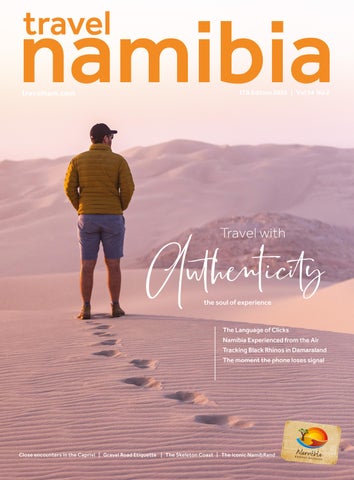
namibia travel

![]()

The moment the phone loses signal the soul of experience
The Language of Clicks
Namibia Experienced from the Air
Tracking Black Rhinos in Damaraland


For international adventurers in search of expansive landscapes, natural beauty, and genuinely authentic experiences, Namibia stands out as one of the globe’s most captivating destinations. However, beyond its famous vistas lies an equally significant promise: a national commitment to ensuring that every visitor can discover this extraordinary country with assurance.
In the current travel landscape, safety is a crucial element when selecting a destination. Namibia recognizes this expectation and places visitor safety at the core of its tourism strategy. Whether traversing the ageless desert, observing wildlife in their natural surroundings, or engaging with vibrant local cultures, travellers can anticipate a destination that emphasizes preparedness, responsibility, and care.
Tourism is vital to Namibia’s economy, providing thousands of jobs and supporting conservation and community initiatives. Therefore, safeguarding visitors is not just about hospitality it is essential for maintaining the quality, reliability, and global reputation of the travel experience itself. A secure journey enables travellers to fully engage with the country’s expansive landscapes and remarkable moments.
This dedication is led by the Namibia Tourism Board (NTB), whose vision focuses on fostering a safe and inviting atmosphere for every guest. Through close collaboration with government authorities, industry partners, and local stakeholders, Namibia consistently enhances awareness, preparedness, and visitor support throughout the tourism value chain.
For European travellers in particular, Namibia presents a unique blend (triple s): space, safety and stability. Supporting the growing connection to Europe is the Namibia Tourism Board’s Frankfurt office, which has dedicated over twenty years to establishing Namibia as a top destination for travellers from Germany, the UK, and nearby markets.
Their strategic approach emphasises what makes Namibia truly unique: authenticity, space, sustainability, and transformative travel, all while ensuring that visitor expectations for comfort and safety are consistently fulfilled.
The outcome is a powerful co-operation: thoughtful global promotion attracts travellers, while a vigorous culture of safety guarantees they return home not only inspired but also eager to recommend Namibia to others. As global travellers increasingly look for destinations that provide both emotional depth and practical reassurance, Namibia confidently rises to meet this demand. Here, safety is not an afterthought; it is woven into the very essence of the visitor experience.
Namibia invites you to explore a land where adventure and security exist in perfect harmony. Travel far, feel free, and explore boldly, knowing that your well-being is a priority and that every journey is backed by a destination committed to excellence.
Let your next great story starts in Namibia safely, confidently, and memorably.
Flora E. Quest Manager: Corporate Communication
Email:
flora.quest@namibiatourism.com.na


is published by Venture Media in Windhoek, Namibia www.venture.com.na
Tel: +264 81 285 7450, 5 Conradie Street, Windhoek PO Box 21593, Windhoek, Namibia
EDITOR Elzanne McCulloch elzanne@venture.com.na
PUBLIC RELATIONS Elzanne McCulloch elzanne@venture.com.na
PRODUCTION Liza Lottering liza@venture.com.na
LAYOUT & DESIGN Richmond Ackah Jnr. design@venture.com.na
CUSTOMER SERVICE Bonn Nortjé bonn@venture.com.na
TEXT CONTRIBUTORS
Elzanne McCulloch, Madeleen Duvenhage, Ron Swilling, Suné van Wyk
PHOTOGRAPHERS
Suné van Wyk, Elzanne McCulloch, Ron Swilling, Le Roux van Schalkwyk, Marcus Westberg
Travel Namibia is published quarterly, distributed worldwide via Zinio digital newsstand and in physical format in southern Africa. The editorial content of TN is contributed by the Venture Media team, freelance writers and journalists. It is the sole property of the publisher and no part of the magazine may be reproduced without written permission from the publisher.
All information and travel details are correct at the time of going to press. Due to uncertain circumstances, this may have changed after the date of publication. Please check businesses' individual websites for up-to-date details.


SURFACE AREA: Windhoek CAPITAL:
824,268 km²
INDEPENDENCE:
21 March 1990
CURRENT PRESIDENT:
Netumbo Nandi-Ndaitwah
Multiparty parliament
Democratic constitution Division of power between executive, legislature and judiciary
Secular state
Christian freedom of religion
90%

ROADS:
NATURE RESERVES: of surface area
HIGHEST MOUNTAIN: Brandberg
Spitzkoppe, Moltkeblick, Gamsberg
MAIN PRIVATE SECTORS: Mining, Manufacturing, Fishing and Agriculture 46%
BIGGEST EMPLOYER: Agriculture
FASTEST-GROWING SECTOR: Information Communication Industry
Diamonds, uranium, copper, lead, zinc, magnesium, cadmium, arsenic, pyrites, silver, gold, lithium minerals, dimension stones (granite, marble, blue sodalite) and many semiprecious stones
CURRENCY:
Foreign currency, international Visa, MasterCard, American Express and Diners Club credit cards are accepted.
AND CUSTOMS
All goods and services are priced to include value-added tax of 15%. Visitors may reclaim VAT.
ENQUIRIES: Namibia Revenue Agency (NamRA) Tel (+264) 61 209 2259 in Windhoek
EPHEMERAL RIVERS: Numerous, including Fish, Kuiseb, Swakop and Ugab 20% 14 400 680
OTHER PROMINENT MOUNTAINS: vegetation zones species of trees ENDEMIC plant species 120+ species of lichen
PERENNIAL RIVERS: Orange, Kunene, Okavango, Zambezi and Kwando/Linyanti/Chobe
HARBOURS: Walvis Bay, Lüderitz
MAIN AIRPORTS: Hosea
Kutako International Airport, Eros Airport
RAIL NETWORK:
6.2 telephone lines per 100 inhabitants
MOBILE COMMUNICATION SYSTEM:
Direct-dialling facilities to 221 countries
GSM agreements with 150 countries
LIVING FOSSIL PLANT: Welwitschia mirabilis
BIG GAME:
Elephant, lion, rhino, buffalo, cheetah, leopard, giraffe
20 antelope species
250 mammal species (14 endemic)
256 699
50 reptile species
ENDEMIC BIRDS including Herero Chat, Rockrunner, Damara Tern, Monteiro’s Hornbill and Dune Lark frog species 15%
Public transport is NOT available to all tourist destinations in Namibia.
There are bus services from Windhoek to Swakopmund as well as Cape Town/Johannesburg/Vic Falls. Namibia’s main railway line runs from the South African border, connecting Windhoek to Swakopmund in the west and Tsumeb in the north.
There is an extensive network of international and regional flights from Windhoek and domestic charters to all destinations.
Most tap water is purified and safe to drink.
Visitors should exercise caution in rural areas.
GMT + 2 hours
0.4182 medical doctor per 1,000 people privately run hospitals in Windhoek with intensive-care units
4
Medical practitioners (world standard) 24-hour medical emergency services
3.1 million DENSITY: 3.8 per km²
461 000 inhabitants in Windhoek (15% of total)
EDUCATIONAL INSTITUTIONS: over 1,900 schools, various vocational and tertiary institutions bird species FOREIGN REPRESENTATION
220 volts AC, 50hz, with outlets for round three-pin type plugs
More than 50 countries have Namibian consular or embassy representation in Windhoek.

Namibia is not merely a destination it is an awakening. It is where time slows to the rhythm of the desert winds, where the golden dunes of Sossusvlei meet the wild expanse of Etosha, and where the heartbeat of Africa echoes through its people, culture, and landscapes.
As the Namibia Tourism Board (NTB), our vision is to become a world-class destination management organisation that elevates Namibia’s standing on the global stage. Guided by this vision, our mission is to regulate, grow, and promote sustainable tourism that enriches lives, strengthens communities, and safeguards our natural heritage for generations to come.
Under our Integrated Strategic Business Plan (ISBP 2023–2029), we are shaping a bold new chapter for Namibian tourism. This transformation is anchored in innovation, inclusivity, and partnership. Through flagship initiatives, we are strengthening the tourism value chain from digital transformation projects, such as the introduction of a national Tourism Information Management System (TIMS) and an enhanced NTB website and visitor chatbot, to regional office expansion across the country to bring services closer to our operators and communities.
We are also redefining service excellence through the Welcome Host Namibia Programme, a national customer-service initiative aimed at uplifting the standards of hospitality across all sectors. In addition, our MICE (Meetings, Incentives, Conferences, and Exhibitions), Cruise Tourism, Culinary and Gastronomic strategies is positioning Namibia as a premier business events destination in Southern Africa, attracting global conferences and trade fairs that stimulate local economies.
Sustainability remains at the heart of all we do. Through strong partnerships with the Ministry of Environment, Forestry and Tourism (MEFT), conservancies, and local entrepreneurs, we continue to promote communitybased tourism, empower youth innovation in travel, and ensure that every visitor experience contributes to conservation and inclusive growth.
Namibia’s charm transcends borders. As part of our market development efforts, NTB is deepening its presence across key international source markets including Germany, the United Kingdom, France, Italy, South Africa, the United States, and China while exploring new frontiers in Japan, India, and the Middle East. Through participation in global trade fairs such as ITB Berlin, IMEX America, and China International Fair for Investment and Trade (CIFIT), Namibia continues to forge partnerships, attract investors, and showcase its unmatched tourism offerings to the world.
We are also embracing the power of digital storytelling, influencer collaborations, and content partnerships to share authentic Namibian narratives that resonate with modern travellers seeking meaningful, sustainable experiences.
Every journey to Namibia is more than a holiday, it is a connection to something larger. It is the warmth of a Himba smile, the quiet dignity of desert elephants, the vibrant craft markets of the north, and the taste of homegrown adventure under the brightest African skies.
As we continue to chart a path toward global excellence, I invite you to be part of this story to discover Namibia, invest in her potential, and celebrate her authenticity. Here, nature inspires the spirit of discovery, and every traveller becomes part of a legacy that endures.

Sebulon C. Chicalu Chief Executive Officer Namibia Tourism Board (NTB)


16. Sesriem Campsite
17. Naukluft Camp
18. Hardap Resort
19. Fish River Canyon & Hobas Camp
20. /Ai-/Ais Hotsprings Spa
21. Mile 72
22. Mile 108
23. Jakkalsputz
24. Boplaas Campsite
25. Von Bach Tungeni Resort
26. Dead Valley Lodge & Oshana Sesriem Campsite
In Namibia, it is not something you tick off a list. It is something that quietly happens to you.
An authentic travel experience here begins the moment the road stretches longer than expected and the radio loses its signal. When the landscape stops performing and simply exists. When you realise no one is trying to impress you – not the land, not the people, not the wildlife. They are just being.
It is standing in the cool of early morning while a guide traces a story in the sand with his finger – not a rehearsed script, but knowledge passed down through generations. A lesson in reading tracks, grasses, wind. In listening more than speaking. In understanding that survival, beauty and respect for the land are deeply intertwined.
It is a cup of coffee poured at a roadside stop where time has its own rules. Where conversations drift easily, and strangers greet you like neighbours. Where the tomato on your plate was still on the vine an hour ago, and the dust on your shoes feels earned.
Authenticity in Namibia lives in the small moments – the unplanned detours, the quiet drives, the pause to watch light move across a mountain range. It is hearing a place rather than narrating it. Feeling insignificant in the best possible way, reminded that the land was here long before you, and will remain long after.
This is a country that does not rush to explain itself. It asks you to slow down instead. An authentic Namibian journey is not about seeing more –it is about seeing differently
With humility. With curiosity. With space to breathe.
And when you leave, you carry less certainty, but far more understanding.
This is the lens through which we approached this year’s ITB special issue. With authentic travel as our theme, we have sought out stories that slow the pace, honour the people behind the places, and celebrate the quiet, meaningful moments that define a true Namibian journey. I hope these pages guide you toward your own most authentic discoveries – and that wherever your travels take you, you find the space to listen, to linger, and to experience Namibia as it truly is.
With love from Namibia,

Elzanne McCulloch Editor
ON THE COVER

A place of stark beauty and quiet drama, the beguiling Skeleton Coast and northern Namib draw you into a world of shifting dunes, salt-bleached shipwrecks, fogdraped shores and a wilderness that feels both unforgiving and utterly mesmerising.
Cover image: Elzanne McCulloch
FOLLOW US ON INSTAGRAM
@thisis_namibia


FOLLOW US ON INSTAGRAM


There is a moment, if you think about it long enough and hard enough, when language fails you briefly – when you feel that familiar tingling sensation of trying to find a word far in the back of your mind. A word to encapsulate a place, an experience, a feeling that refuses to be summarised neatly and insists on being felt first.
And then you discover that the word you’ve been searching for is sincerity.
That is the word that belongs to Nooishof.
The tomato on my plate is plump, morning dew still clinging to its flesh. The lavender garnish on the side of the plate has been freshly plucked from the garden, just moments before being placed there. Nothing here has travelled far. Nothing feels rushed. Everything feels deliberate, without ever feeling forced.
Mariza and Marc are sincerely happy to welcome us here – into their home, into the farmhouse life they have created, surrounded by people they love and respect, and who feel the same in return. We feel it instantly. They sincerely love hosting, love cooking, love serving wine, and love chatting with you for hours on end about life, family and everything in between – from the mundane to the grandiose.

Conversations flow more easily here than ever before. Familiar names, places, experiences, recipes, loves and dislikes, irritations and quiet wonderments are swapped across a sturdy antique farm table. Perspectives shift and are gently realigned, often without you realising it in the moment. Food tastes better. Wine feels richer. Coffee is more comforting than ever before.
Food tastes better. Wine feels richer. Coffee is more comforting than ever before.
Inside the farmhouse, every element has a story. The bricks were made on the farm during construction. Old telephone poles from the property were repurposed for the vegetable garden. The décor is warm, layered and lived in, and while you might initially wonder what is so special about a farmhouse like this, the atmosphere soon answers that question for you.
Because real authenticity cannot be recreated.
It comes from a place of love and appreciation, from real moments lived in real time, and from real people who care deeply – about everything, and everyone, around them.
Nooishof was once an old karakul sheep farm, like most of the farms in southern Namibia. Marc and Mariza bought it in 2016 and, quietly and deliberately, removed all the fences – even the ones between themselves and their neighbours. The land feels different without borders. More open. More honest.
After 26 years as owners of The Mushara Collection just outside Etosha, they moved here in 2023, initially with the idea of retiring. Mariza quickly found retirement boring though, and Marc eventually relented. In April 2024, Nooishof opened as a small, upmarket guest farm – not as a calculated business venture, but as a natural extension of their life here.
The name carries its own quiet poetry. When Marc would visit the farm alone before their move, one of the workers would enquire as to where the Nooi was – Afrikaans for girl or young lady. Marc had built this place for Mariza. Naming it after the Nooi felt inevitable.
Arrival is unpretentious. A small sign. An old farm gate that you open yourself. It is understated and quiet, and you would never expect what waits inside once you step through.
Mariza’s kitchen is the heartbeat of the experience. She follows recipes precisely, almost to the letter, yet everything feels intuitive and natural – as though the dish simply came together because it was meant to. You can see that raw and vibrant essence of life on the plate. Everything comes from the garden or was sourced nearby. It feels organic and earthy in a way that is increasingly rare.
This is not just food. It is not a salad repeated every Tuesday for two years. It is hearty, wholesome and feels deeply nourishing, unapologetically using butter and cream while remaining incredibly healthy. There are no processed ingredients, and that honesty lends even more weight to the experience.
We sit at the table together for every meal, Mariza moving constantly – popping in and out of the kitchen, chatting, cooking, disappearing and reappearing again. She is full of energy and life. An infectious buzz. Marc, by contrast, is a calm, steady presence who floats quietly through the space. He is owner, manager, booking agent and waiter, clearing plates, pouring wine, opening bottles without hesitation.
He greets you at the gate when you arrive, and somehow, he is always there again when you return from a walk or a drive, as if he has been waiting for you all along.
You find yourself saying thank you repeatedly. And every thank you is met with a courteous bitte schön. You’re welcome. Oh, and I feel so very welcome.


Their staff mirror that same ease. Relaxed. Happy. At home. Mariza is constantly guiding and uplifting them, gently correcting and encouraging, and it shows. The environment feels familial without being forced, professional without being stiff.
Outside, life unfolds slowly. The chickens – all fifteen of them, collectively called the Henriettas – wander freely. The rooster is Alfonso. We christen the geese ‘the Gizelas’, because why can’t they have names too? The farm’s wild donkeys move through the landscape, so much a part of the place that they feature in the logo: a donkey with a duck on its back and a chicken perched on top.
There are dogs – Otis, Jack, Pablo and Frankie – and Lilybelle the tortoise, who has lived here for more than


forty years. She came with the farm and is part of the furniture at this point.
The surrounding Sinclair Nature Reserve was named in homage to the Sinclair Guest House that once stood here, one of the very first guesthouses in southern Namibia. It honours what came before while allowing something new to grow.
Days unfold at your pace. E-bike trails wind across the land, accessible to anyone, regardless of experience. Everything here is weather-dependent and mood-dependent – the activities, the food, even the conversations.
As we venture across the landscape on sundowner drives with Nakale, our guide, and his new apprentice


Nelson, bat-eared foxes emerge – four families, five at a time, popping up through yellow grass like punctuation marks in a sentence you don’t want to end. Gemsbok move quietly in the distance. The light softens. The views stretch endlessly.
In the vegetable garden, Petrus knows every plant. He tends to each one individually, attentively, with care that is impossible to fake. This is not farm-totable as a concept. This is this-farm-to-this-table –from just outside the kitchen door to your plate, to the old wooden table that has held so many stories before yours.

We spoke about trees and the memories the 200-year-old camelthorn trees across the farm must carry. We spoke about gathering around a table, about energy – nature’s energy and people’s energy – and about the humility that comes with sharing space honestly.
Stories emerged that were never planned to be told. The kind usually reserved for close friends.
The quiet of early mornings on the stoep outside your room stays with you. The kind of quiet that reminds you how rarely we allow ourselves to simply be still.

Nooishof does not try to be authentic. It simply is.
And in a world where authenticity is so often curated, packaged and sold, that might be the rarest luxury of all. That feeling of sincerity. That feeling of quiet belonging.
That feeling you get when someone welcomes you home. TN


Experience the ultimate in luxury with Westair’s Private Charter flightsseamlessly taking you to any destination in Namibia and beyond.


“Languages represent thousands of natural experiments: ways of seeing, understanding and living that should form part of any meaningful account of what it is to be human” – Ross Perlin, a co-director of the non-profit Endangered Language Alliance.
MADELEEN DUVENHAGE
The language is alive, and we need to ensure it doesn’t become extinct!

When Hans ‡Eichab, a native Khoekhoegowab speaker and linguist, attended a conference on languages in the Middle East, he was surprised to encounter a man from Nubia (an ethnic group originating in Sudan and southern Egypt), who used the same word for water. Across geography and culture, fascinating commonalities reveal themselves, threading between languages that seem, at first glance, worlds apart. Experiences like this highlight the deep connections embedded in language and the enduring presence of tongues like Khoekhoegowab.
Spoken by just under 12 percent of the population, Khoekhoegowab is Namibia’s second-largest language group and it is considered one of the world’s oldest languages. Belonging to the Khoisan language family, it is among the few African languages that retain the original click consonants characteristic of the Khoisan languages.
Traditionally spoken by three ethnic communities across Namibia, South Africa and Botswana – the Hai||omkhoen, Namakhoen and ‡Nūkhoen (also spelled !Gunikhoen, where the exclamation mark represents a click sound) –Khoekhoegowab derives its name from the word khoe, meaning “person,” and it remains the last surviving
language of the Khoekhoe branch within the broader Khoe language family.
Chief Hans Axasi ‡Eichab (his last name means ‘Big Foot’, he laughs and points to his size 12 shoes) is, aside from being a linguist, an independent researcher, historian, poet, musician and occasional botanist. Previously a lecturer at UNAM (University of Namibia), he is currently teaching a class at IOL (Institute of Open Learning) in Windhoek.
At first I am tempted to think this is a slightly exaggerated portfolio. But then he slowly places his broad-brimmed hat on the table and starts talking. Our conversation spans everything from Greek mythology to the slow disappearance of original place names in Namibia.
Shortly after Namibia gained independence in 1990, the often-neglected term Khoekhoegowab was officially reinstated for the language commonly referred to as Nama or Nama/Damara. ‡Eichab, though, is quick to clarify: “I am not a Damara. I am part of the !Gunikhoen (pronounced !Nguni) dialect, which means ‘orphan’.”
Although ‡Eichab’s dialect shares the click sound system with Damara, it is one of several separate dialects within Khoekhoegowab. The common claim that the ethnically distinct Damara adopted the Nama language has since


Whether you're on business or exploring Namibia, CYMOT Hilltop has everything you need under one roof!
Conveniently located next to Grove Mall in Windhoek, we make shopping easy, hassle-free, and enjoyable.
Start your journey with the perfect cup! Fuel up with the rich aroma and bold avours of Slow Town Coffee, available in-store. From a quick espresso to a smooth latte, every cup is crafted to perfection.


been disproved. As ‡Eichab explains, Nama literally means “those who speak a different dialect,” confirming the diversity and varying origin of the language.
Throughout our interview ‡Eichab demonstrates the simultaneous fluidity and gravity of his language, rattling off a few expressions in Khoekhoegowab. For example: “Khoeba xu xawe a khoe xūb kom khoebao,” which translates to “a person is a person through other people.”
He is a patient teacher. I try my best to mimic the glottalised clicks, yet my tongue feels awkward and unaccustomed to
the language’s complex, rounded cadence. I wish I could pin down and perfectly replicate for you, the reader, the depth hidden in each distinct click. In writing the words remain just printed symbols. Flat, perfunctory. Vocalised, the consonants immediately become playful, layered. Dynamic. Some tonal melodies produce hollow, raspy sounds. Others sound like a reverberating clap! Rumbling from the back of the mouth. Yet, in the same sentence, a light, nearly inaudible click, pronounced ever so softly, makes me think of water flowing continually.
To prevent the language from teetering on the edge of extinction, ‡Eichab emphasises the importance of creating platforms where Khoekhoegowab can be expressed and enjoyed, and not merely studied. “The language is alive, and we need to ensure it doesn’t become extinct!”
Seeing himself as a custodian of oral history, meticulously transcribed and preserved through decades of tireless research, he reflects, “It would be sad if all of this were lost after my death.” A sobering reminder that such heritage is worth protecting and passing on to the next generation. Yet the younger generation often fails to grasp the nuances of the language, leading to linguistic misunderstandings. As is the case for many young people today, the grammatical rules of their mother tongue have become blurred, bending under the influence of borrowed English syntax. An unapologetic purist at heart, ‡Eichab comments with a wry smile: “These days, young Khoekhoegowab speakers put the verb at the beginning of a sentence, instead of at the end.”
Still, a robust and revitalised interest sustains the preservation of the language. It is taught at both secondary and tertiary levels. Currently, it is one of only three Namibian languages offered as a major undergraduate subject. Efforts extend to the literary and poetic landscape, including spoken word events and communal storytelling initiatives.
This awareness goes beyond semantics. Language serves as a unifier and a resilient voice for an entire people. It draws communities together, it is where ancient history and hopeful heritage converge. It creates a sense of place, measures time and gives form to ancestral, nearly lost narratives. It symbolises belonging.
It is through language that collective memory lasts, connecting past, present and future in a living continuum. Each story, told and retold, holds the wisdom of elders gathered around a fire, and each sentence, learned and memorised, bridges the divide between tradition and modernity. In preserving Khoekhoegowab, Chief ‡Eichab and his contemporaries are not merely saving words: they are keeping a people’s vision of themselves, their history and the promise of cultural continuity. TN


Iam sitting on the porch of my suite, a book open on my lap, when a flicker of movement catches my eye. A hare darts across the red sand, no more than two metres in front of me, its buoyant legs carrying it effortlessly across the dune slope before it disappears into a patch of grass and on into the immensity. It is a small moment. And yet, it feels like an invitation.
In the NamibRand Nature Reserve, the desert does not perform. It does not demand your attention or compete for it. Instead, it waits – patient, ancient, confident that if you slow down enough, it will reveal itself.
NamibRand is one of Namibia’s most remarkable conservation achievements – a vast, privately protected wilderness where red dune seas roll endlessly into gravel plains and rocky escarpments. It is quieter than Sossusvlei, emptier, less photographed. For travellers willing to venture beyond the familiar icons and curated viewpoints, NamibRand offers something rarer – space, solitude, and an intimacy with the land that crowds simply do not allow.
Wolwedans exists because of this place, but also because of a philosophy. Founded by Albi Brückner and shaped further by his son, Stephan Brückner, Wolwedans is not a lodge collection in the conventional sense. It is a longterm experiment in how tourism can exist responsibly, intelligently and beautifully within a fragile landscape.
Nothing here is done halfway. Everything is thought through.
They call it the Five Cs – Conservation, Commerce, Community, Culture and Consciousness – but at Wolwedans, these are not abstract ideals. They are daily practices, lived and tested over decades.


Our introduction to this depth began on foot, moving slowly through the desert on a Bushman Walk with Boetie, our San guide. What initially appears empty reveals itself as layered and alive under his gaze. He points out grasses I would have walked past without noticing – ostrich grass, resilient and purposeful – explaining how it was traditionally used. He kneels to show us medicinal plants once relied upon by his ancestors, each with a specific function, each answering a need.
He shows us tracks in the sand – small, precise, easily missed – and suddenly the desert becomes a storybook written in footprints. He tells us of remnants of ancient Bushman rock circles, low and carefully constructed. These were hunting hides, he explains. The San were small people, he says with a quiet smile, and they used the land intelligently. Antelope would be funnelled between valleys, while hunters waited unseen in these stone shelters, releasing poison-tipped arrows at precisely the right moment.
There is no nostalgia in the way Boetie speaks. No romanticising. Just knowledge, passed down through observation, experience and survival.
“Nature is my home,” he says. “Nature is my school. Nature is my shop.”
In that moment, his words crystallise everything Wolwedans is trying to protect – not just landscapes, but ways of knowing.


Back at Dune Camp, perched high on intensely red mountains of sand, the scale of NamibRand unfolds in every direction. The dunes glow at sunrise and sunset, their curves softened by light, their ridges sharpened by shadow. The wind moves softly, lifting grains of sand, combing the surface, singing a song you do not hear so much as feel. Its meaning settles somewhere deep in your chest, instinctively understood.
That evening, we walk up onto a dune crest and sit in silence as the sun begins its slow descent. Clouds gather at the horizon, and when the sun finally dips below them, golden rays spill across the land, washing the desert in fire and light.
We sit and talk about everything and anything. About the wilderness, life and evolution, and about how every element in nature answers a question. An adaptation. A survival strategy. A response to pressure, time or scarcity. As humans, we are wired to search for these answers, to understand the mechanisms, to explain the how and the why.
Monika, who has been querying what question natural phenomena answer throughout our journey, stares out at the view in front of us and gently breaks the thread.
“Maybe we don’t need all the answers,” she says, still watching the light shift across the dunes.
“Maybe we just need to leave some space for magic.”
A single drop of rain falls on my cheek, improbable. It blends with a tear already there, merging into one track of awe and wonder. No one speaks. What could we possibly say?
In that moment, sitting on a red dune that feels as though it is glowing from within, I feel the entire universe. Something divine is unmistakably present. Earth, time, life, love, and everything that has ever mattered laid out in front of me.
Wolwedans has a way of creating these moments by design, not accident.
Sossusvlei and the NamibRand Nature Reserve both showcase the drama of Namibia’s desert landscapes –but the experience of each could not be more different. For travellers deciding how to shape their Namibian journey, understanding this distinction is key.


This becomes even clearer the next morning on the Heart & Home Tour – a journey into the operational soul of Wolwedans, guided by Cecilia, whose official title is Happiness Coordinator. It may be the most fitting job description I have ever encountered.
Her role, she explains, is to nurture wellbeing – of staff, guests and the environment alike. Happiness here is not a by-product. It is intentional.
The tour takes us through Wolwedans Village, the engine room behind the camps. Water is sustainably managed and bottled on site in glass – both still and sparkling – eliminating plastic and transport inefficiencies. Prickly pear juice is made using fruit sourced from a nearby farm, a conscious alternative to trucking orange juice in from South Africa. Lemons for homemade lemonade come from orchards around back.
Workshops hum quietly with purpose – carpentry, metalwork, canvas repair – ensuring that construction and maintenance happen on site within a closed-loop system. Chickens provide eggs. Pigs roam nearby. Vegetable gardens thrive improbably in the desert, organic and productive.
Every system feeds another. Waste is reduced. Reused. Skills are shared. Purpose is tangible. In a landscape defined by scarcity, abundance is created through care.
This is commerce that sustains rather than extracts. Conservation rooted in long-term custodianship of a fragile desert landscape. Community that offers dignity, not dependency. Culture that is nurtured internally, shaping a working environment as thoughtful as the guest experience. And above all, consciousness – an awareness that every decision carries weight, and that sustainability begins with intention.


On the far side of the reserve, Wolwedans Boulders Camp offers a completely different conversation with the desert. Set among towering granite formations and endless gravel plains, this is a place of profound stillness, where isolation becomes a form of meditation. The camp is woven into the rock itself, with an immense installation artwork of carefully packed rock circles surrounding it – echoing the natural fairy circles scattered across the landscape.
Each circle feels like a meditation in itself. A quiet invitation to pause and reflect.
Here, isolation becomes a gift. A profound stillness settles in, grounding and ancient. Time stretches and softens; the noise of daily life dissolves into wind, light and shadow. Your visit to Boulders feels less like a stay and more like a reset –a grounding, introspective counterpoint to the softness of the dunes, and a powerful reminder that solitude, when held gently, can be one of the most generous luxuries of all.

And to remember that sometimes, the most meaningful journeys are not about answers at all - but about leaving space for magic.

One of Wolwedans’ most powerful offerings is an activity simply called Solitude. Our guide drops us on a vast plain – over 9,000 hectares of open desert – two chairs placed far apart, a drink in hand, and then leaves.
For up to an hour, you are completely alone.
No voices. No devices. Just wind, birds, and the distant bark of geckos as the sun sinks lower. It is a reset – for the mind, the nervous system, the soul. Time for you to just sit and listen. To feel. To rethink while you wait gor the first 10 stars above. The longest minutes of your life. I am reminded of a quote I once read: Man worships an invisible God while destroying a visible nature, without realising that the nature he is destroying is the God he is worshipping.
Nowhere has that ever felt more true.
Wolwedans is not about ticking boxes or chasing landmarks. It is about learning to see. To think deeper. To walk slower. To sit long enough for the desert to speak back. And to remember that sometimes, the most meaningful journeys are not about answers at all – but about leaving space for magic. TN
www.wolwedans.com

The Icon
Why people go: Home to some of the world’s tallest dunes, Sossusvlei is Namibia’s most recognisable landscape and a wonderful experience for first-time visitors.
The experience: Early-mornings to miss the heat, shared space, busy dune climbs – especially in peak season.
Best for: First-time Namibia travellers, photographers chasing classic shots, short itineraries, and travellers who want to tick off a world-famous landmark.
What you take away: A powerful visual experience and iconic imagery – but limited solitude and immersion.
NAMIBRAND NATURE RESERVE
The Deeper Journey
Why people go: One of Southern Africa’s largest private nature reserves, offering vast wilderness, low visitor density and deeply immersive desert experiences.
The experience: Space, silence and freedom. No crowds, no rush. Activities unfold at a slower pace, allowing time for walking, solitude, stargazing and reflection.
Best for: Repeat Namibia travellers, conscious travellers, nature lovers, photographers seeking originality, and those wanting a more meaningful connection with place.
What you take away: Perspective, stillness and a sense of belonging to the landscape – not just passing through it.
WHY WOLWEDANS IN NAMIBRAND?
Wolwedans offers access to NamibRand through a conscious tourism model, grounded in conservation, community upliftment and long-term sustainability. With five camps across different landscapes – from red dunes to rugged granite outcrops – guests experience the desert from multiple perspectives, all without crowds.
Pro tip for itineraries:
Combine NamibRand and Wolwedans before or after Sossusvlei. Allow yourself the time and grace to experience both. Start with depth and stillness, then end with the icon – creating a journey that balances meaning with spectacle.
Sossusvlei is about seeing the desert.
NamibRand is about feeling it.
For travellers ready to go further, slower and deeper, NamibRand is not an alternative to Sossusvlei – it is the evolution of the Namibian desert experience. TN

ELZANNE MCCULLOCH
This past December we spent a week at Cape Cross, on Namibia’s Skeleton Coast. Technically, there was cellphone signal –MTC Edge. Just enough to give you hope. Enough bars to suggest connection. But not enough to actually reach the internet.
That detail matters, because it changes the psychology of the matter.
On the first day I reached for my phone constantly. Not deliberately – instinctively. A reflex. Instagram. Messages. Email. But each time, the same result. Nothing loaded. There was no dopamine hit waiting, no quick distraction to ruffle the edges of quiet relaxation. Just a small, faint irritation that lingered longer than expected.
By the second day the reaching slowed. The habit began to fray. I still checked, but with less urgency, more out of curiosity than need. By the third day I realised I didn’t know where my phone was. Not lost – simply irrelevant.
Something shifts when there is nowhere to go digitally. Your brain, so used to constant stimulation, starts to recalibrate. Time stretches. Mornings feel longer. Afternoons unfold without interruption. Attention settles into whatever is directly in front of you. That tickle in the back of your neck, the static in your head – clear signs of addiction you will continue to deny… But the background noise fades.
The change was even more striking with the kids. At home, they might get an hour or two of Paw Patrol or Bluey a day. At Cape Cross, there was none of that. No internet. No TV. No YouTube. No streaming. No negotiation. And so they did what children have always done when there are no screens to entice them – they became children again.
They ran outside all day. They played along the beach, in the desert sand, between rocks and wind and space. They invented games, argued, resolved things, disappeared and reappeared. They were bored sometimes, briefly – and then became creative. Absorbed. Entirely present.
Namibia still offers this kind of accidental disconnection. Not a curated digital detox, not an expensive promise of mindfulness – just places where the signal doesn’t quite reach, and life quietly fills the gap instead.
There is a strange anxiety tied to constant reachability. The idea that we must always be available, always responsive, always plugged in. It hums beneath everything. Out here, that hum disappears. And in its absence, something gentler takes its place.
Sometimes disconnecting really means reconnecting –with yourself, with your children, with the rhythm of days that move at a human pace.
I should confess something. In a moment of parental foresight – or weakness – I had downloaded a number of the kid’s favourite episodes onto my iPad. A secret emergency stash, just in case. We never used them. By day three the kids didn’t even ask. As far as they knew, television simply did not exist.
What did exist was the land.
Endless space. A soft desert breeze moving across sand and sea. Time measured not in notifications, but in light and tide. Out here, the world doesn’t bend to you. Instead, you adapt to it. The remoteness does not mean absence – it is presence. One that asks very little and gives a great deal back.
The phone losing signal was not the story after all. It was simply the moment we stopped reaching beyond ourselves and allowed this place to take over. Namibia’s remote destinations don’t offer distraction. They offer perspective.
And once you have experienced that kind of quiet – the kind shaped by distance, solitude and open land – you will carry it with you long after the signal returns. TN


Bagatelle Kalahari Boutique Farmhouse www.bagatelle-lodge.com/farmhouse/

Bagatelle Kalahari Game Ranch www.bagatelle-lodge.com
Büllsport Lodge & Farm buellsport-naukluft.com

Cornerstone Guest House www.cornerstoneguesthouse.com

Corona Guest Farm www.coronaguestfarm.com

Etusis Lodge www.etusis.com


Frans Indongo Lodge www.indongolodge.com
Fiume Lodge www.fiume-lodge.com
Fort Sesfontein www.fortsesfontein.com


Guest Farm Kiripotib www.kiripotib.com
Gecko Ridge www.geckoridge.com.na
Goibib Mountain Lodge www.goibibmountainlodge.net
Huab Lodge www.huab.com
Jackalberry Tented Camp www.jbcamp.com
Kashana Namibia www.kashana-namibia.com
Namib’s Valley Lodge www.namibsvalley.com
Ndhovu Safari Lodge www.ndhovu.com


Nkasa Lupala Tented Camp www.nkasalupalalodge.com
Ongula Village Homestead Lodge www.ongula.com
Ohange Lodge www.ohange.com
Otjiwa Eagle’s Rest www.otjiwa.com.na
Otjiwa Thornbush Tented Camp www.otjiwa.com.na/thorn-bush-tented-camp
Otjiwa Savanna Luxury Villa www.otjiwa.com.na/savanna-luxury-villa
Otjiwa Mountain Lodge www.otjiwamountainlodge.com
Serondela Lodge www.serondelalodge.com
Ugab Terrace Lodge www.ugabterracelodge.com

Tucked away in the heart of Swakopmund, The Made in Namibia Collection is far more than a gift shop. It is a living showcase of Namibian creativity: a space where heritage, skill and personal stories converge through handcrafted design.
Founded by husband-and-wife team Raymond and Marilyn Spall, the collection began modestly, with a small range of Namibian-made gifts. Over time, it has grown into a nationwide platform that champions and connects local artisans and suppliers. Today, the shop stands as a testament to how consistent curation and community support can elevate craft into self-sustainability.
The Spalls’ vision finds its true expression in the hands of the artisans themselves. One such maker is Zelma Stefanus from Osona Village near Okahandja. She is known for her distinctive, quirky leather bags and backpacks. When she first approached the Made in Namibia Collection

more than five years ago, she could not have foreseen how strongly her work would resonate with its creativelyminded clientele.
“My creations didn’t start with authentic leather. I first worked with synthetic leather and later progressed to genuine leather. My goal was to tell my own story through my creations. I chose leather because of its value, durability and uniqueness: qualities that remind me of myself.”
Zelma recalls, “I didn’t really see myself becoming a crafter until people started showing serious interest in my work. The unexpected encouragement from family, friends and strangers pushed me to keep going in those early days. I encourage anyone, young or old, to listen to their inner voice, pray about it, surround themselves with likeminded people, and start wherever they are with whatever they have. Never give up. Your creations might one day travel into the whole world, as mine do!”
Expanding the collection’s variety of crafts, another familiar name on the shelves is Morgan of Morgi Crafts. Morgan is known for playful interpretations of Namibia’s wildlife. “I have been painting since high school, but after moving to Walvis Bay twenty-two years ago, I shifted from fabric and canvas to craft items”, Morgan shares. “I am mostly inspired by guinea fowl, they are such comical birds! The way they seem directionless, and the fact that a group of them is called a ‘confusion’, gives me so much room to play when painting them. Sun-basking lizards and majestic elephants inspire me just as much, and these types of creatures have delighted tourists for many years. What started as a passion has become a full-time career. I am busy every day cutting wooden items, painting, varnishing and more.”
When her husband Dave retired he took over the labelling and packaging, which saves Morgan an enormous amount of time. Since the Made in Namibia Collection started promoting her work, she regularly receives orders from throughout Namibia. “To young people with ambition and a love for art I want to say: be persistent, share your passion, and most of all, be patient. It takes time to be seen.”


The collection also features deeply personal journeys, such as that of textile artisan Luwisa Guriras, whose creative path bridges healing and expression.
“I was very fortunate to be trained as a massage therapist. Though I didn’t like it in the beginning. In fact, it was one of the hardest things I had ever done! I jokingly say that my trainer hypnotised me, but today I see it as a gift. Like a doctor I work with my hands, and it is the best work I could have chosen.”
But when Luwisa’s niece left for Russia to study, life became difficult. Luwisa recalls: ”I felt I needed to create something more, but I didn’t know what yet. I started with greeting cards. They weren’t perfect, but people bought them. Over time, I improved. Then COVID came – no movement, no work, no clients. So I started creating wall art inspired by my imagination, in a pop-art style. I made it affordable so more people could have healing and beauty in their homes.”
Luwisa reflects, “Today I heal people with my hands, and I heal hearts with my art. My African Lady portraits carry hope, peace and strength. I sell my work in different art shops, and my dream is to take my art beyond Namibia. My journey has taught me this: everything is possible if you have the will in your heart. Keep going! What you build today will benefit you tomorrow.”

Together, these three stories form the soul of the Made in Namibia Collection: a place where souvenirs become storytellers, and where travellers can take home not just an object, but a piece of Namibia’s creative, collaborative spirit. TN

The Skeleton Coast, its Desert Lions and the Man who walks with them


At the far edge of Namibia – where the desert loosens its grip and the Atlantic tightens its own – lies a place that resists simplification. The Skeleton Coast is not merely remote: it is elemental. Fog rolls in without warning, shipwrecks appear and disappear with the tides, and life persists in forms that seem almost impossible. This is a coast of bones and myths, of silence broken only by wind, surf and the distant bark from a seal colony. It is also one of the last places on Earth where wilderness still dictates the rules.
To travel through Skeleton Coast National Park is to realise how small we are. Stretching from the Ugab River northwards toward the Kunene, this vast protected landscape – dunes, gravel plains, ephemeral rivers and icy shoreline – remains largely untouched by modern infrastructure. There are no towns here, no casual detours, no conveniences masquerading as comfort. You come prepared, or you do not come at all.
And yet, within this apparent desolation, life flourishes.
The name Skeleton Coast was earned honestly. Early sailors called it The Gates of Hell, and with reason. Thick fogs driven by the Benguela Current blinded navigators, while uncharted reefs and relentless surf tore wooden hulls apart. More than a thousand vessels are believed to have met their end along Namibia’s coastline – their remains now scattered like ribs along the shore.
The wrecks are rarely cinematic in the way popular imagination suggests. There are no intact hulls frozen in time, no dramatic silhouettes rising from the sea. Instead, there are fragments – corroded


steel ribs, timbers half-buried in sand, a propeller revealed only when the tide and wind allow it. Finding them feels less like sightseeing and more like archaeology. You don’t arrive at a wreck: you stumble upon it. This sense of discovery defines the Skeleton Coast experience. It is not curated. It does not perform. It waits.
Sitting on a dune overlooking both ocean and desert, Shipwreck Lodge appears as if it, too, has been cast ashore by the elements. Its angular cabins echo the forms of stranded vessels, deliberately unsettled in the sand, deliberately exposed to wind and light.
From the deck of a cabin the scale of the place becomes clear. There is nothing to interrupt the horizon. No roads. No powerlines. No signs of human permanence beyond the lodge itself. In the morning, fog moves silently inland, wrapping the dunes in silver. By afternoon, the sun burns it away, revealing textures and colours that shift by the hour.
Shipwreck Lodge offers comfort, but never distraction. It does not insulate you from the landscape – it frames it. Fires crackle inside while the Atlantic roars beyond the glass. Meals are refined but grounded, echoing the lodge’s philosophy: luxury is space, silence and perspective.
It is from places like this – perched delicately on the boundary between hospitality and wilderness – that the Skeleton Coast reveals its deeper stories.
In the river systems east of the coast, a population of lions did something extraordinary. When drought and conflict decimated inland prey in the late 20th century, they did not vanish. They adapted.
Namibia’s desert-adapted lions retreated into the harshest terrain imaginable – a sea of sand, rock and fog with almost no surface water. Over generations, they learned to survive where no lions were thought capable of doing so. They developed the largest home ranges of any lion population on earth, travelling thousands of square kilometres in search of food. They learned to live without regular water, drawing moisture from their prey. They learned restraint.
And eventually, after decades away, they found the ocean again.
After decades away, desert lions returned to the Skeleton Coast shoreline and began hunting seals, cormorants and other marine prey. Today, they are the only known lions in the world to regularly hunt from the sea.
This extraordinary adaptation is not folklore. It is documented science. And much of it exists because of one man.
In the midst of shifting stakeholders, funding debates and global conservation narratives, Dr Philip Stander – known universally as Flip – goes about his work quietly.
Flip is not a conservationist shaped by boardrooms or conferences. He is shaped by distance, dust and time spent on foot behind lions in the desert. Born in Namibia, he developed an early bond with the bush that never loosened. Long before academic recognition followed, Flip learned by observing – by tracking, by living close to wildlife, by listening.
He worked his way into science the hard way. Initially without formal tertiary education, he taught himself the methods of rigorous research, eventually producing work of such calibre that it led him to Cornell University and Cambridge, where he completed his PhD and was awarded the T.H. Huxley Award. Titles followed. Positions followed. But prestige never redirected him.
In 2004, Flip stepped away from government service to focus entirely on desert lions as an independent researcher, founding what would become the Desert Lion Trust. His aim has always been clear: gather long-term data to reduce human-lion conflict and ensure coexistence.
His fieldwork borders on legendary. He drinks from the same water sources as the lions. Sleeps beside the fire on a thin roll while new equipment becomes padding for anaesthetised cats. Reads tracks in sand that others would never notice – reconstructing hunts, movements and interactions from a single paw print. He fixes vehicles, electronics and research equipment because there is no one else to do it.


Flip’s work reached global audiences through film – first with Vanishing Kings – Lions of the Namib, followed by Vanishing Kings II, and now most powerfully with Lions of the Skeleton Coast.
The film follows the remarkable lives of three orphaned desert lion cubs – Alpha, Bravo and Charly – born in 2015 and raised under impossible conditions after losing their mother. What unfolds is not only a story of survival, but of intelligence, adaptability and the long view of conservation. Filmed over eight years by wildlife filmmakers Will and Lianne Steenkamp, the documentary has received major international recognition, including top honours at Jackson Wild in the USA and the Cannes Corporate Media & TV Awards, where it claimed the Grand Prix.
But beyond accolades, the film has achieved something more important: it has shifted perception. It has shown that Namibia’s desert lions are not anomalies to be managed, but ambassadors of resilience – symbols of what is possible when wildlife is given space, time and respect.

The Skeleton Coast is not a destination for everyone – and that is precisely why it matters.
It asks something of the traveller. Patience. Humility. Awareness. To stand on a dune and know that a lion may pass through this same corridor hours later is a sobering privilege. To watch fog nourish lichens that sustain insects that sustain birds is to understand how finely tuned survival can be. Conservation is not abstract here. It is lived daily – by researchers, by conservancy members, by guides whose livelihoods depend on wildlife remaining wild. Tourism, when done thoughtfully, becomes part of that system. Not an intrusion, but a reinforcement.
As desert lions once again pad along the beaches of the Skeleton Coast, hunting where shipwrecked sailors once
despaired, the symbolism is hard to ignore. Nature, when given room, reclaims its narratives.
At sunset, a lion descends the sunlit side of a dune, unaware of the debates, funding battles and ethical questions unfolding beyond the horizon. He occupies his place in the desert without apology. His survival now rests not on instinct alone, but on our collective choices.
The Skeleton Coast does not ask for admiration. It asks for responsibility.
And in a world running out of true wilderness, that may be the rarest thing of all. TN


Namibia is not a destination you rush. It is a country that reveals itself gradually – through changing light, widening horizons, and landscapes so vast they recalibrate your sense of scale. FlyNamibia Safari was created for exactly this kind of place: a hop-on, hop-off shuttle flight experience that allows travellers to move through the country with ease, intention, and perspective.
Operating in a clockwise circuit from Windhoek, FlyNamibia Safari connects Namibia’s most iconic regions in a natural, intuitive flow. From the capital, the journey heads south-west to Sossusvlei, where dune seas ripple endlessly into the horizon. From there, it continues to the coastal charm of Swakopmund, before turning inland to the rugged geology and ancient landscapes of Twyfelfontein. The circuit then carries northward to Etosha South and across to Etosha East, offering access to one of Africa’s most celebrated wildlife regions from multiple vantage points.
By taking to the air, travellers trade long, repetitive drives for time spent where it matters most – on safari, at the lodge, or simply absorbing the stillness of the land. Each flight becomes part of the experience, revealing Namibia’s contrasts from above: desert melting into gravel plains, dry riverbeds carving quiet lines through the earth, and wildlife corridors stretching far beyond the roads below.
The hop-on, hop-off structure offers flexibility without complication. Guests can linger longer in places that resonate with them, or move on smoothly when ready. The circuit is designed to work as a complete journey, but it also adapts easily to individual travel styles, whether that means a focused highlights trip or a slower, more immersive safari.
What makes FlyNamibia Safari particularly compelling is its seamless integration with Westair Charters. While the shuttle flights connect the main circuit points, additional charter legs can be incorporated to reach individual lodges, private airstrips, and remote concessions across Namibia. This ensures that travellers are not limited to fixed stops – even the most exclusive or off-the-map properties can be added effortlessly, transforming the journey into a tailored safari without the complexity of organising private charters independently.
The circuit also links intelligently with FlyNamibia’s scheduled airline network. Travellers can easily combine FlyNamibia Safari with onward journeys to Katima Mulilo via Maun, or extend their adventure on FlyNamibia’s Windhoek–Victoria Falls route. This makes it possible to connect Namibia’s classic safari regions with neighbouring highlights, creating a broader Southern African itinerary while keeping logistics smooth and cohesive.
Backed by Westair Aviation’s long-standing operational expertise, FlyNamibia Safari offers a level of safety, reliability, and local knowledge that is essential in a country where aviation plays a vital role in tourism and connectivity.
FlyNamibia Safari is not simply a way to move between destinations. It is a considered way of travelling – one that respects Namibia’s scale, enhances the journey itself, and allows travellers to experience the country as a connected whole. For those who want to see more, drive less, and truly understand the land beneath them, this is Namibia from its best possible angle – the air. TN


Discovering ancient middens, petrified elephant tracks and desert life in the Kuiseb Delta…

It is the wheels that concern me. A series of anxious thoughts somersault through my head accompanied by a shiver of anticipation as I drive the 30 km between desert and sea from Swakopmund to Walvis Bay to partake in Fanie du Preez’s Kuiseb Delta Adventure. Rated as one of the best edu-adventures in the Namib Desert, the Kuiseb adventure is undertaken on a quad bike. Although Fanie has assured me that no previous experience is necessary, I silently send out a prayer that I’ll survive the morning with all my body parts intact and attached.
I arrive in time to hear Fanie enlightening the group about the ephemeral Kuiseb River that meanders through the desert to the coast, creating a bold line separating the Namib Plain from the Namib Dune Sea. Although the Kuiseb appears dry for most of the year, water remains in the underground aquifer and has supported life along the riverbed for aeons. “The dune sea is six million years old”, he explains. “The sand is brought from the Orange River to the Atlantic Ocean, conveyed up the coast by the Benguela Current and blown onto land by the strong winds.”
“The Kuiseb’s delta and river mouth have shifted over the centuries, gradually edging northwards”, Fanie continues. And that is fortunate. When Walvis Bay was established in 1870, the first buildings had to be built on poles. When the whole town was flooded in 1934, it is recorded that people moved between the houses in small rowing boats. The town had to be evacuated for seven months, and later the townsfolk erected a barrier where the river meets the dunes to prevent it flowing northwards into the town. But nature follows its own course and after the heavy rainfall of 2011 the river broke through the barrier and rushed to the salt pans taking the road with it.
With the intro over, the fleet of robust, shiny, fullyautomatic quad bikes that are parked in a row behind us beckons. Fanie gives us a quick lesson and then nonchalantly states, “Even twelve-year-olds can master these.” A comment that doesn’t provide any reassurance. Before I can give it anymore thought, we zoom off down the street and into the public area of the desert that adjoins the protected swathes of the 107 540 km² Dorob National Park. This is where we have a chance to practise before entering the

national park where we will need to follow old tracks and ride in single file to keep our environmental impact minimal. Just as I am thinking that I may just make it through the morning unscathed, Fanie says, “Now let me show you how to drive a quad in the dunes”, and I learn that it is not sufficient to be able to ride the quadbike on a level stretch, we have to learn to shift our weight to the side and open the throttle on the gradients to keep the bike steady. We also need to learn how to descend dunes. We park in a row at the top of a small, steep dune overlooking a 33-degree slip face and take turns to edge forward slowly to the lip and then descend using the combination of braking and sliding down the loose sand to the bottom. That done, I feel a huge sense of relief and accomplishment until Fanie laughs and says, “Okay, do that another ten times.”
Eventually he shouts, “Now you can drive a quad bike. Let’s go!” And before I can blink, the group is off and I am carried along with the momentum, trying to keep up through the burnished dunes. Strangely enough – and to my amazement –rather than it being a matter of endurance and survival, something kicks in and I start to enjoy the ride. It’s just in the nick of time. The interesting part is about to begin.
Throughout the morning, as the coastal fog burns off revealing a clear blue sky, we ride through the desert landscape, stopping to hop off our bikes and discover the intriguing elements of the Kuiseb Delta. On one of our first stops, besides being introduced to some of the 334 types of tenebrionid beetle that make the Namib their home, Fanie shows us an old grave that has recently been uncovered by the wind. Pointing to a skull and a scattering of bones surrounded by pottery shards, he tells us that three years ago this grave site wasn’t visible. “The Khoi believed in afterlife and buried the dead with a pot of food”, he says, explaining the presence of the pottery shards that litter the desert floor. Unlike some of the other sites we see later on, which are less well-displayed and have been carbon-dated by archaeologists to around 2000 years old, this grave is probably only around 500 years old. He tells us that this can be discerned from the wood used for the coffin, which came from the European ships that explored the coast in the late 1400s. We discover that it is not only the graves that are exposed, but etched in the hardened river sediment from wetter periods


in our history are petrified human footprints and an assortment of animal tracks from species that have long disappeared from the area. Fanie points out giraffe, buffalo and elephant tracks, adding amusing anecdotes, until he calls out, “OK, let’s go”, and we hop onto our bikes and continue into the sandy desert realm.
Cresting a dune, we pause to appreciate the magnificence of the desert surrounding us. In the distance springbok rams nibble !nara plants, and tracks of mice, ants and elephant shrews surround us in the sand. When we stop amidst green patches of desert vegetation, Fanie shows us the thorny thickets of the desert-adapted !nara (Acanhosicyos horridus) that provides sustenance for the animals in the desert and for the Topnaar people, a Nama group who live further inland along the riverbed in the adjacent Namib-Naukluft Park. The Topnaar harvest the melons, dry the nutritious seeds and cook the pulp, laying it out to dry into a fruit leather.
At another patch further along, we have the opportunity to open the ripe melons and try the unusual almosttasteless desert fruit and the more appetising Namib capers (Capparis hereroensis) that carpet the ground and are surprisingly reminiscent of tropical fruit.
The desert is a choppy sand sea and we crest and descend the dunes, accelerating for soft sand and ascents, and


shifting our weight from side to side to counteract dune angles – until we reach a midden. Fish bones and mussel shells lie scattered on the sand, interspersed with small ostrich eggshell beads, pot shards, limpet cups, sharpened chips of basalt and pieces of bone shaped into knives. “With no pockets, the Khoi made holes in the bone and wore it tied around their neck”, Fanie informs us as we wander around carefully watching where we place our feet.
The remains of older graves are visible at some of the sites, the bones sandblasted over time and scattered untidily on the desert floor, always with pot shards or even a clay pot handle among them. At one site Fanie shows us desert treasures, to be appreciated and not removed. The “jewels” include pieces of Delft pottery, glass beads, a St. Christopher and a VOC coin, evidence of shipwrecks and of trade with Europeans arriving at the coast. We also find more human footprints and animal tracks in the stretches of hardened mud between the dunes where the river once flowed. We read ancient history on the shifting pages of the desert sand.
As the sun begins to make its presence known, Fanie fills us in on the natural wonders of the desert, sharing his
wealth of knowledge. While we all watch in awe, he drops onto the sand on his knees and digs until the ground becomes moist. He treats us to the well-filtered water that he scoops up in a limpet cup and passes it around. We are amazed to learn that if you know where to look, water CAN be found in the desert.
As we make our way back to civilisation I am grateful to have him in the lead because in the vast desert we would be completely lost without him. He got to know the Namib intimately over the last three-and-a-half decades and considers it his backyard.
We reach the well-ordered streets of Walvis Bay after one of the most unusual mornings I have as yet experienced in the desert, and thankfully I am still in possession of all my limbs. We return with the knowledge that beyond the town the ancient Namib Desert holds infinite secrets and unlimited natural treasures to be discovered – at opportune and appropriate times like this one – on wheels. TN
www.kuisebonline.com
+264 (0)81 1282 580


Gravel roads in Namibia come with rules you are expected to know without ever being told. They are not written anywhere, but you feel them the moment you leave the tar.
It starts with tyre pressure. You lower it not only for your comfort, but out of courtesy. Too hard and you rattle the road, deepen the corrugation, make it worse for whoever comes next. It’s a small act of respect – for the road, and for strangers you will never meet.
Then there’s the wave. A hand lifted from the steering wheel, fingers barely moving. You don’t know each other, but you acknowledge each other anyway. Out here, that matters.
If someone has a flat tyre, you stop. If someone looks lost, you slow down. You help, but you are not naive. Long, elaborate stories are met with polite caution. Kindness, yes – but with common sense firmly in place.
Water is a different matter. If you have extra and you pass someone walking or hitchhiking, you hand it to them. No questions. No speeches. Just the water.
My favourite part of any gravel road journey, though, is the roadside stall. Tiny, handmade, appearing out of nowhere. Along the coast it might be offering pink salt rocks; inland, a few carved animals or beaded bracelets. Sometimes there is no one there at all – just a jar, a price scratched into wood, and an unspoken agreement. You leave the cash in the jar. You take the item. Trust still works out here.
Gravel roads don’t rush you. They teach patience, restraint and quiet decency. If you listen carefully, they show you how to behave. TN

It’s still dark and the stars are still shining when I leave my room at Wilderness Desert Rhino Camp. A quick stop in the main area for a much-needed coffee. Then with a poncho pulled on, the crisp morning air is biting at my face as I climb onto the back of that beautiful, quintessential safari Land Cruiser. My guide gets behind the wheel. Two Save the Rhino Trust trackers take their seats, quiet and focused. We roll forward into the darkness.
As the engine hums, the world begins to loosen its grip on the night. A faint wash of colour creeps into the eastern sky, revealing the sculpted, rocky red terrain of Damaraland. This is not a soft landscape. It is angular and ancient, shaped by time and scarcity. Dolerite ridges rise like the spines of a sleeping animal. Dry riverbeds cut pale scars through the land. And everywhere, the sense that you are a guest in a place that owes you nothing.
We stop at a natural spring, a shallow depression where moisture lingers longer than it should. The trackers get down first, scanning the damp soil with an intensity that feels almost reverent. They crouch, fingers hovering just above the sand. Footprints. Spoor. The story of the night written clearly for those who know how to read it. A black rhino has passed through here in the early hours.

Without ceremony, we turn and follow the spoor.
For hours we drive, weaving through valleys and over rocky shelves, the sun climbing steadily, the heat beginning to press against our backs. The trackers speak little, offering directions with subtle gestures. Left. Slower. Stop. This is their landscape, their language. Eventually, after what feels like a lifetime of watching the land scroll past, one of them lifts his hand and points.
There. A grey silhouette against an almost equally greygreen milk bush. At first, it barely registers with me. Then it resolves into form. A shoulder. A horn. A black rhino, standing perfectly still, as if carved from the land itself.
We leave the vehicle and set off on foot.
We walk single file, placing our feet deliberately in the prints ahead of us. The rule is simple and absolute. Stay downwind. Black rhinos do not see or hear particularly well, but their sense of smell is extraordinary. The key, I am told, to successfully approaching a rhino is that the rhino never knows you are there. You do not want it to expend precious energy by running. You do not want fear to be part of this encounter.


Supporting Save the Rhino Trust Namibia means directly backing the people on the ground who protect the world’s largest free-roaming population of black rhinos. Through Rhino Guardianship Certificates, individuals and businesses can support verified conservation work, from ranger patrols and rhino monitoring to communitybased conservation efforts. With 90 percent of every certificate funding field operations, this initiative offers a transparent, meaningful way to turn support into real conservation impact.


This is not conservation at arm’s length. It is personal. It is Namibian. And it is profoundly human.

This is wildlife tracking in its purest form. No shortcuts. No engines. Just patience, awareness, and trust in the people leading you.
As we draw closer, every sense sharpens. The crunch of gravel underfoot sounds impossibly loud. The breeze on my neck becomes something to monitor, something to negotiate with. And then suddenly, impossibly, we are close enough to see the cracks in the rhino’s skin, the slow rhythm of its breathing, the dust clinging to its flanks.
There are no crowds here. No helicopters. No airlifts that conveniently drop you beside an animal for a photograph. You have to work for this. You earn it step by careful step, hour by hour, in a landscape that demands humility. Cheap adventures are everywhere else. True adventures, the kind that leave a mark, rarely come easily.
Standing there, watching this ancient animal move through its world, I am struck by how right this feels. How honest. This is one of the last truly wild places left, and this is how it should be experienced.
Wilderness Desert Rhino Camp sits at the heart of this philosophy. The camp operates in partnership with local communities and conservancies, ensuring that conservation is not an abstract idea, but a lived reality with tangible benefits. Hosting Save the Rhino Trust trackers is not a marketing gesture. It is a commitment. An invitation for travellers to engage directly with the people who are dedicating their lives to protecting Namibia’s desertadapted black rhinos.
These rhinos are unlike any others. Driven by scarcity and resilience, they navigate a harsh environment
that has honed them over generations. Their survival is not guaranteed. It is earned daily through vigilance, collaboration and an unyielding belief that they matter.
For me, this experience cuts deeper than most. My friendship with Simson Uri-Khob, the CEO of Save the Rhino Trust, stretches back more than a decade. Our Ride for Rhinos (now Ride for Rangers) initiative has taken us across northwest Namibia for twelve years. Raising awareness and support for the work on the ground. Through that journey I have met many of the trackers, learned their stories, and witnessed firsthand the weight of responsibility they carry.
This is not conservation at arm’s length. It is personal. It is Namibian. And it is profoundly human.
I return to this camp at least twice a year, not because it is easy, but because it reminds me – of what matters. Of how unique and fragile this country is. Of how privilege and responsibility are inseparable when it comes to travel.
Tracking black rhinos in Damaraland is not about ticking a box or making a sighting. It is about effort. About respect. About understanding that the most meaningful experiences are often the ones that ask the most of you.
And when I finally turn away, leaving the rhino undisturbed, unaware, and exactly where it belongs, I carry with me a quiet certainty. This is why Namibia matters. This is why we protect it. And this is why some places stay with you long after the dust has come off your boots. TN
Learn more about Namibia’s black rhino conservation at www.savetherhinotrust.org


An intimate reflection on empathy and belonging through cultural tourism in Namibia
Silence is not empty in Namibia’s far north. It has weight. It presses gently against you, humming softly in your ears, as if the land itself is breathing. Here, everything is distilled to its purest form – rock and sand, wind and sky, and a river that threads its way through the desert like a quiet promise of life.
I have come to the banks of the Kunene River, to Wilderness Serra Cafema, a lodge that feels less like a destination and more like an edge – of the country, of comfort, of certainty. Angola lies just across the water. The rest of the world feels impossibly far away.
The journey is part of the story. From the small Wilderness Air Cessna the landscape unfolds in endless layers – gold fading into bronze, bronze deepening into ochre. Dunes ripple like fabric. Dry riverbeds scar the earth. The terrain looks ancient, patient, unbothered by time. It has been years since I last travelled this far north, and as the desert rolls beneath us, awe settles in again. People live here. They always have.
Then I notice the circles.

From above, they appear as dark rings etched into pale sand – animal kraals built by nomadic Himba families. Each one marks presence. Belonging. Continuity. In a place that can feel brutally empty, these circles speak softly but firmly of human life.
On the ground the heat wraps itself around me. There is no easing into it. From the airstrip I head straight to a Himba village for a cultural visit, guided by Stephanus, who will help translate not only language but nuance.
This is not theatre. Nothing here has been curated for effect. Life happens openly – imperfect, warm, complicated. People are born here, work here, raise children, bury their loved ones. Entire lives are lived here, against the ochre mountains of Hartmann’s Valley, a place so arrestingly beautiful it makes my chest ache. For a moment, I wonder why I don’t live here, too.
Then I remember why I have come – not to romanticise, but to understand. To sit, listen and learn what makes cultural tourism meaningful rather than extractive. Human rather than hollow.


I ask why they choose to stay here, in a place so harsh and isolated. The answer is simple. This is home. Grass was once better, the say. Life is harder now. Still this is home.
We sit together in a wide circle. I ask, through Stephanus, whether they enjoy having visitors. The answer comes immediately, accompanied by laughter and enthusiastic agreement. They like meeting people from far away. They like those who laugh with them most.
I introduce myself. My name is repeated carefully, curiously, tested aloud with smiles. Then the tables turn. I am given nine names to remember and repeat. I stumble. They clap. The children laugh. Being Namibian helps – the rhythm of the language feels familiar, the warmth instinctive.
Children tumble around us, sandy and curious, carrying babies on their backs with an ease that startles me. They wrestle, invent games, disappear and reappear. It takes a village is not a saying here – it is a daily reality.
Later, another circle forms. This time for song and movement. No one announces it. No one performs for me. It simply happens. Hands clap. Voices rise. Feet move in rhythm. Laughter punctuates the air. The sound settles deep in my body, somewhere beyond thought. This is joy –uncomplicated and shared.
They tell me the only thing that saddens them is when visitors seem unhappy to be there. “We are happy when people come”, Stephanus translates. “We want them to laugh with us, not feel uncomfortable.”
And just like that, the heart of cultural tourism reveals itself. Not spectacle, but exchange. Not observation, but participation. Meeting, quite literally, in the middle.
The women glow in ochre skin and layered adornments – beads, headdresses fashioned from animal skin, skirts now often made from brightly patterned shweshwe fabric bought in Opuwo. Tradition and modernity sit comfortably together here. I tell them they are beautiful. They laugh and tell me I am. We all laugh. Difference fascinates us. Familiarity connects us.
They happily agree to be photographed, but their delight peaks when they see the images on my camera. They crowd around, pointing, laughing, calling others over. In that moment I know I will print these photographs, bind them into a small album and send them back on the next flight to Serra Cafema. A small gesture. A circle closed.
Circles are everywhere here. Huts are round. Kraals are round. Conversations happen in circles. It is the most inclusive shape – no beginning, no end.


Inside one hut, I am shown a traditional perfuming ritual. Dried herbs, including Commiphora wildii smoulder gently, releasing fragrant smoke that clings to skin and fabric. It is grounding, intimate – a ritual of identity passed down through generations.
The children remain endlessly curious. They tug at my clothes, peek underneath my shirt, squeal and scatter. Unfiltered curiosity. Human, universal.
I ask why they choose to stay here, in a place so harsh and isolated. The answer is simple. This is home. Grass was once better, they say. Life is harder now. Still, this is home.
Stephanus tells me of a Himba man who travelled to Opuwo and was robbed on his first day. “That is no way to live,” he had said quietly on his return.
Down by the river small vegetable gardens cling to life. Babies grow up beneath open skies, learning the rhythms of earth and water before they can walk. Life continues, as it always has, pared back to what truly matters – family, shelter, belonging.
Many men from this community work at Serra Cafema. The lodge provides access to water, income and support. It is cultural tourism done with care –collaborative, respectful, mutually sustaining.
When tourism is done right, it does not dilute culture. It strengthens it. It creates dignity where there might otherwise be vulnerability. It builds bridges between people who might never have met, and reminds us that value lives far beyond photographs and checklists.
Cultural tourism, at its best, is a kind of return. For travellers it is a reconnection with meaning. For hosts it is culture seen anew, reflected through curious eyes.
Sitting cross-legged in the sand, clapping to a rhythm that has echoed through this valley for generations, something old stirs in me. Something steady. Something human.
We are, after all, a social species. We learn through contact. We grow through exchange. And here, beneath endless sky and ancient hills, the circles keep turning – unbroken, grounding, quietly reminding us of who we are.
We soften in these shared moments. We listen. We laugh. And perhaps, full circle, we remember what it means to belong – to a place, to a story, to one another. TN
There are places that impress you. And then there are places that welcome you so completely, you feel as though you have arrived somewhere you belong. The Mushara Collection, set just eight kilometres from Von Lindequist Gate on the eastern side of Etosha National Park, is firmly the latter.

Arriving at Mushara is a gentle exhale. The bustle of travel softens the moment you step onto the shaded walkways of Mushara Lodge – the original, elegant heart of the collection. The lodge is refined yet relaxed, stylish without ever feeling staged. Light spills through the thatched roof, catching on warm woods, soft linens and thoughtfully curated artefacts. It is luxury defined not by excess, but by ease. By comfort. By the sense that everything has been considered, quietly and carefully.


From here the collection unfolds like a well-told story, each chapter offering its own mood while sharing the same soul. Mushara Lodge is the gracious host – ideal for lingering afternoons between game drives and unhurried evenings around the fire. Mushara Bush Camp, by contrast, offers a more down-to-earth tented experience, perfect for families and independent travellers who want to feel closer to the rhythm of the bush without sacrificing comfort. Mushara Outpost, on the other hand, strikes a beautiful balance between privacy and polish, modelled on the welcoming elegance of an African homestead and designed for travellers who appreciate both space and solitude.
And then there are the private villas.
Villa Mushara is a retreat within a retreat – just two exclusive villas, created for those who crave seclusion and serenity. Inside, the world slows. Open-plan spaces flow effortlessly, layered with natural textures and earthy tones. A freestanding bathtub covered in zebra hide anchors the room, while soft furnishings and gauzy mosquito nets lend a romantic, almost timeless quality. Sliding doors open onto a private veranda where birdsong and rustling leaves replace any need for background music. This is safari living at its most intimate – indulgent, but deeply grounding.
What truly sets Mushara apart, however, is not only its aesthetic or its enviable location, but its people. The Spirit of Mushara is no marketing phrase – it is lived daily by a team whose warmth and loyalty are extraordinary. Some staff members have been part of the Mushara family for over two decades, a rarity in hospitality and a testament to the culture which began 25 years ago. Under the guidance of managing team Johan and Jennifer Fourie, and General
Manager Mika Shapwanale, that spirit of genuine care translates into service that feels intuitive, personal and deeply human.
Days here unfold at an unhurried pace. A leisurely breakfast gives way to early morning game drives, with Etosha’s waterholes and wildlife just minutes away. Elephants, giraffes, zebras and antelope move across vast open plains, while lions wait patiently near the water’s edge. And when the heat of the day calls you back, Mushara welcomes you home again.
Since 2025 that welcome has grown even more indulgent with the introduction of the Mushara Spa at Mushara Lodge. Using African oils such as baobab, marula and Kalahari melon, and partnering with Charlotte Rhys, the spa offers deeply restorative treatments that feel perfectly attuned to the landscape. A massage here is not an add-on – it is part of the rhythm of slowing down.
As evening falls, lanterns glow, conversations soften and the bush takes over. Whether dining under the stars, in one of the beautifully appointed dining areas of the respective lodges, or retreating to your villa’s private garden with a drink in hand, Mushara leaves space for stillness. For reflection. For simply being.
Mushara is not just a base for exploring Etosha. It is a destination in its own right – one that stays with you long after you leave. A place you do not merely visit, but return to, again and again, at least in your memories.TN
www.mushara-lodge.com


We left Windhoek with that familiar feeling of release, the kind that only comes after a long year of work when the road ahead feels lighter with every kilometre. Northbound, past Tsumeb and onwards, the landscape began to soften and then transform. Green crept in slowly at first, then confidently. By the time we reached Popa Falls, the air felt different. Heavier. Wetter. Alive.
For me this was new territory. I had never travelled this far northeast. Etosha had always been my reference point for wild Namibia, but the Caprivi is a completely different conversation. For my travel partner the north feels like home. That familiarity quietly shaped our journey, grounding us as we crossed into a part of the country formed by water, movement and survival.
We checked in near Popa Falls and lingered there briefly, letting the sound of rushing water refresh us after the drive. Then we headed straight into Bwabwata National Park, beginning with the Buffalo Core Area. Even before wildlife appeared, the park told its story. Old military buildings stood abandoned and weathered, slowly being reclaimed by bush and animals. Here, history does not disappear. It is absorbed.
Rain arrived just before we entered the gate. Wind whipped through the open vehicle, and we huddled behind canvas, half soaked, half laughing, watching the bush blur into grey. The shower passed quickly, as it does up here, and almost

immediately the veld offered its first moment of silence and gravity.
A young impala stood alone, wet and still. Something was wrong. As we drew closer, we saw that one front leg ended abruptly, bone pale against the dark, healing flesh. No backstory. No explanation. An unknown story, but one which speaks very loudly and leaves an impression forever remembered. It was a quiet introduction to a place that makes no apologies.
As we moved closer to the river, the park opened up. Antelope scattered across fresh grass, monkeys darted through trees, warthogs disappeared into undergrowth. Elephant damage was visible on tree trunks, bark torn away with casual strength. Colourful birds filled the air, flashes of blue, yellow and rust.
Hippos lounged and played, submerged and resurfaced with deep, echoing calls. It had been many years since I last saw a hippo in the wild, and hearing them again was something else entirely. That low sound does not just reach your ears, it settles into your chest. Standing there, watching their bulk rise from the water, I felt small. Vulnerable. Humbled by scale and power.
We decided to continue the drive. There was still so much ground to cover. Barely ten metres from the river, the guide casually pointed into the bush beside us. At first, I did not comprehend what I was seeing. Then my eyes adjusted.


Four metres away. Half hidden. Shining in the filtered light. We stared at each other in complete stillness while I slowly lifted my camera, very aware of every breath. After a few long seconds, the hippo turned and walked back towards the river, a white bird landing on its back and hitching a ride. I remember wanting to warn that bird, wanting it to understand the power beneath it.
The afternoon unfolded with more wildlife, more abandoned buildings, more reminders of layered histories. We spotted a black mongoose, a first for me. Large herds of antelope grazed close together until, suddenly, they ran. Only later did we realise why.
The sound reached us first. A roar that vibrates through your body and leaves no room for doubt. Excitement took over instinct. The guide followed fresh tracks, and suddenly we were no longer on a relaxed game drive. We were searching. Listening. Watching every inch of ground as the sun began to lower and a distant rain shower drew a grey line across the horizon, like a bride’s veil sweeping slowly over the land.
Bare feet into cold mud. Valuables held high. One line, no stopping. Just as we stepped out, deep grunts echoed again, too close for comfort..
At an open, swampy plain I saw her. A lioness, resting beside an anthill, surveying the landscape. We edged closer, pushing into ground heavy with rain. The vehicle slowed. Mud flew. Then stopped.
Fifty metres away, her presence multiplied. Two large males appeared, watching. Waiting. The open vehicle that had felt so liberating now felt dangerously exposed. Rain closed in. Darkness followed. Panic crept in as the guide climbed out to dig and search for traction, the lions’ attention firmly fixed on us.
Time stretched and collapsed all at once. We sat there for three hours. Wet. Cold. Alert. Running through scenarios no one ever wants to rehearse. At one point, one of the males moved closer, head low, purposeful. I shouted, abandoning politeness in favour of survival.
Eventually, help was called. We lowered the canvas sides as rain poured down and waited, listening to every sound, using


the camera screen to see beyond the dark. When headlights finally cut through the night, relief arrived with trembling hands.
Bare feet into cold mud. Valuables held high. One line, no stopping. Just as we stepped out, deep grunts echoed again, too close for comfort. Hippos somewhere nearby. Crocodiles earlier seen sliding into these same waters. There was no choice. We walked.
I have never been so afraid in my life.
Dinner that night tasted like survival. Sleep came hard and heavy. The next morning felt unreal. As if the bush had exhaled and reset.
Hippo tracks crossed the path outside our room. At the falls, we tried our luck with fishing. Small tigerfish flashed in the water. While one of us fished, the other watched birds, otters and a distant crocodile, soaking up a peace we had earned.


We left the Buffalo Core Area with full hearts and headed east towards the Kwando Core Area. Ten minutes into the drive, an elephant stood beside the road, calm and massive, as if sending us off.
Villages passed by. Children played. Life looked hard and simple at the same time. I tried to work, laptop open, but could not stop looking up. I was not sure whether I envied that simplicity, knowing my own life is easier in many ways, yet far more complicated
Kwando welcomed us with sunshine. A simple stream of water marked the boundary between Namibia and Botswana, quietly splitting two countries. The river here is alive with movement. Hippos. Crocodiles. Birds nesting in trees. On the water, families of hippos surfaced close to the boat, ears, eyes and nostrils breaking the surface, water blasting from their nostrils with sharp tshh sounds, followed by that unmistakable he-he-he that gets into your body and takes over. Powerful. Unsettling. Addictive.
At night, hippos passed through the lodge grounds. Tracks appeared each morning. Bush babies darted through the trees. Catfish slithered along the swampy areas after insects. Lechwe grazed near our rooms. Sleep came easier with time, though respect never faded.
We drove and cruised, guided and on our own. We came within centimetres of the largest crocodile I have ever seen, easily five metres in length, floating silently beside the boat, emotionless and ancient. We watched elephants in the distance, antelope everywhere, warthogs and zebra framed by the greenest landscapes I have ever seen in Namibia.
On our last night we sat at the hippo pool for sundowners. No fence. No vehicle. Just us and a family of around fortythree hippos. I could have stayed there for days.
Before sunset we tried fishing one last time. Catfish took the bait. A hippo nearby opened its mouth wide, reminding us whose territory we were in.
Leaving felt too soon. This land is not gentle or forgiving. It is raw and unfiltered. It does not make excuses. It demands respect. Here, close encounters are not curated. They are real. Hippos in the bush. Lions in the rain. Crocodiles beside your boat.
We drove home with hearts full. Of rain and fear and gratitude. Of people and animals and stories layered deep into the soil. Bwabwata and the Kavango and Zambezi regions left their mark. And we know, without question, that we will be back. TN


Welcome to Namibia, the land of wide open spaces. We offer the planning of your Namibia vacation, regardless of group size or vehicle type. Pick from a variety of tour offers or have your personal tour wish worked out accordingly; decide either to self-drive or worry less and have your tour be accompanied by an experienced professional tour guide: German, English and French speaking.
Web: Join-us-in-namibia.pro Email: info@join-us-in-namibia.com


There are places in Africa where wilderness still follows its own rules. Where roads disappear, seasons dictate access, and water decides everything. Nkasa Rupara National Park in the far eastern reaches of Namibia’s Zambezi Region, is one such place – a vast, shifting wetland wilderness often described as Namibia’s answer to the Okavango Delta, yet quieter, wilder and far less known.
Cradled between the Kwando and Linyanti rivers, Nkasa Rupara is Namibia’s largest protected wetland system. It is a landscape shaped by water arriving slowly from the Angolan highlands, flooding the plains months after the rains have fallen upstream. In some years up to 80% of the park lies submerged, transforming grasslands into a shimmering mosaic of reed-fringed channels, lily-filled lagoons, oxbow lakes and floating papyrus islands. In other years the floodwaters retreat and the land opens again, revealing ancient game paths, termite mounds and wide, golden plains.


It is this constant transformation that makes Nkasa Rupara extraordinary. No two seasons are ever the same. Hippos carve channels through reed beds, elephants shape islands with their migration paths and even termite mounds can redirect water during flood cycles. It is a living, breathing ecosystem – dynamic, unpredictable and profoundly alive. Wildlife thrives here in remarkable density. Nkasa Rupara is home to Namibia’s largest buffalo population, vast herds of elephant, red lechwe grazing in the shallows and elusive sitatunga hidden in papyrus stands. Lions patrol the islands, leopards move silently through woodland edges, and crocodiles and hippos dominate the waterways. With over 430 recorded bird species, it is also one of southern Africa’s most rewarding birding destinations – a haven for Wattled Cranes, Slaty Egrets and Saddle-billed Storks.
Despite its richness, Nkasa Rupara remains wonderfully remote. Access is limited, travel is slow and the sense of isolation is complete. It is this very remoteness that has preserved the park’s integrity – and now sets the stage for a new chapter in low-impact safari travel.
Scheduled to open in May 2026, Nkasa Linyanti by Natural Selection will be the only permanent camp on Nkasa Island. Set within a private concession and framed by reed-lined channels and sweeping floodplains, the camp consists of six suites under canvas. It is designed to blend into its surroundings rather than dominate them. Canvas walls open to the wilderness, al fresco showers connect guests to the elements, and every detail reflects a philosophy of understated luxury rooted in place and purpose.
From here, guests will explore the area on a game drive, guided walk, by mokoro or boat, depending on the season. Floodwaters allow for water-based safaris reminiscent of the Okavango, in drier months wildlife concentrates on the islands in spectacular numbers. All the while, each visitor directly contributes to conservation in this unfenced, transboundary ecosystem that forms part of the greater Kavango–Zambezi (KAZA) conservation network.
Nkasa Rupara is not a destination for ticking boxes. It is a place for travellers drawn to raw landscapes, quiet drama and nature in flux. With Nkasa Linyanti’s arrival, one of Namibia’s last true wildernesses will finally welcome guests in a way that honours its rhythms – offering frontrow access to a wetland world that still feels wonderfully, defiantly untamed. TN
www.naturalselection.travel


By putting nature first at Ongava, we set the scene for a renewed understanding and appreciation of the importance of wildlife conservation.


