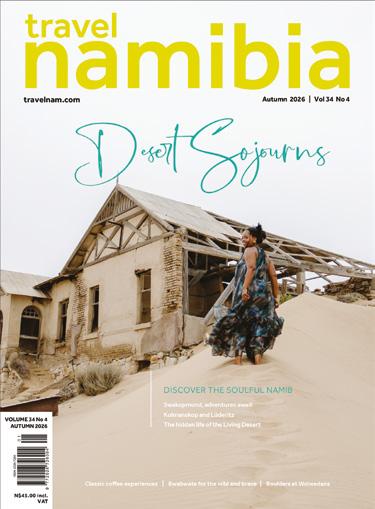
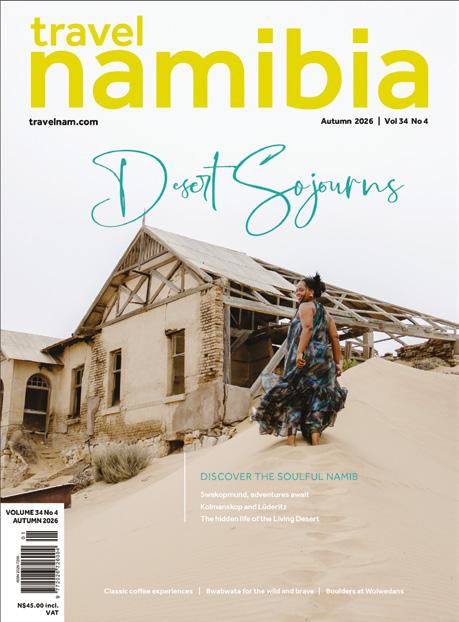
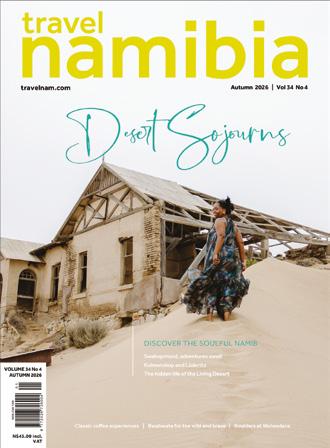
Desert Sojourns
DISCOVER THE SOULFUL NAMIB
Swakopmund, adventures await Kolmanskop and Lűderitz
The hidden life of the Living Desert
Swakopmund, adventures await Kolmanskop and Lűderitz
The hidden life of the Living Desert
CLIMATE AWARENESS
• Hot days, cold nights pack light clothes and warm layers.
• Hydrate regularly desert conditions can dehydrate quickly.
• Always use sunscreen, a hat, and sunglasses.
ROAD SAFETY
• Drive on the left.
• Gravel roads require slow, careful driving.
• Avoid driving at night-wildlife is often active.
• Ensure your vehicle is roadworthy and carry a spare tire and fuel.
PERSONAL SAFETY
• Keep valuables out of sight, especially in urban areas.
• Avoid isolated areas at night.
• Respect local customs and traditions.
• Ask permission before photographing people.
Only use accommodation and shuttle services registered with the Namibia Tourism Board (NTB)
• All lodges, guesthouses, and transport providers must have valid NTB registration.
• You have the right to request proof of registration.
• Look for the official NTB certificate at reception or ask your shuttle driver to show registration.
• When unsure, check or report with NTB

WILDLIFE SAFETY
• Do not feed or approach wild animals.
• Remain inside vehicles in game parks.
• Store food safely when camping and follow park rules.
HEALTH & EMERGENCIES
• Travel insurance is essential.
• Take malaria precautions when visiting the north.
• All-round emergency: 10111 or 999 or 112 and MVA National Accident Response: 9682
GENERAL TRAVEL TIPS
• Currency: Namibian Dollar (NAD) – equal to South African Rand (ZAR).
• Language: English is official; local languages and Afrikaans are widely spoken.
• Help us protect Namibia’s beauty – leave only footprints.
City of Windhoek police
Emergency services: (24hr) 061 211 111
Crime prevention: Windhoek city
+264 (0) 61 290 2239 +264 (0) 61 290 2018
Toll-free number: +264 (0) 61 302 302
Ambulance: 10177
Fire Brigade: 998
Med Rescue
+264 (61) 249777
+264 (61) 230 505/6/7
Emergency Rescue 24 084 124
Lifeline 086 132 2322
Crisis Response
+264 81 881 8181
+264 61 303 395
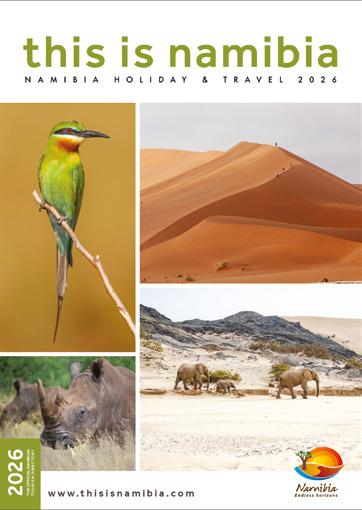
is published by Venture Media in Windhoek, Namibia www.thisisnamibia.com
Tel: +264 81 285 7450, 5 Conradie Street, Windhoek PO Box 21593, Windhoek, Namibia
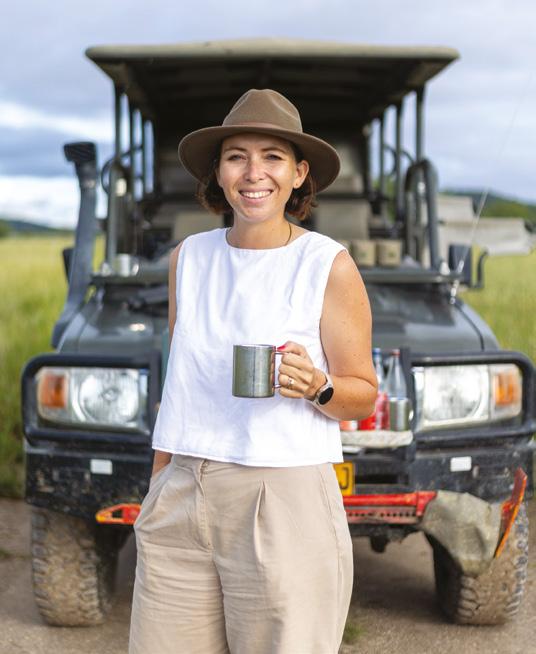
EDITOR Elzanne McCulloch elzanne@venture.com.na
PUBLIC RELATIONS Elzanne McCulloch elzanne@venture.com.na
PRODUCTION Liza Lottering liza@venture.com.na
LAYOUT & DESIGN Richmond Ackah Jnr. design@venture.com.na
CUSTOMER SERVICE Bonn Nortjé bonn@venture.com.na
TEXT CONTRIBUTORS
Elzanne McCulloch, Pompie Burger, Madeleen Duvenhage, Suné van Wyk, Marianne Sparkles, Namafu Amutse
PHOTOGRAPHERS
Suné van Wyk, Pompie Burger, Elzanne McCulloch,Annalien Davin, Madeleen Duvenhage, Abner Simeon, Marianne Sparkles
Travel Namibia is published quarterly, distributed worldwide via Zinio digital newsstand and in physical format in southern Africa. The editorial content of TN is contributed by the Venture Media team, freelance writers and journalists. It is the sole property of the publisher and no part of the magazine may be reproduced without written permission from the publisher.
All information and travel details are correct at the time of going to press. Due to uncertain circumstances, this may have changed after the date of publication. Please check businesses' individual websites for up-to-date details.







T R O W , S H A R E
Y O U R

Venture Media is the pioneer of Namibia tourism promotion. We are the leader in spreading the tourism word around the world. We distribute accurate, credible, up to date and regular tourism-related information on paper, in social media, on the World Wide Web, and on mobile apps. We have reached hundreds of thousands over three decades. Be part of our community and let’s do it together.
W
We focus on telling and sharing STORIES THAT MATTER across our various magazines and digital platforms. Join the journey and share your stories with audiences that understand and value why certain things matter.


Why ethical business, conservation, tourism, people and communities matter. How these elements interrelate and how we can bring about change, contribute to the world and support each other. Whether for an entire nation, an industry, a community, or even just an individual.
WWW.VENTURE.COM.NA or email us at info@venture.com.na for a curated proposal

the
Come on an audio adventure with us as we bring our favourite travel stories to life, inviting you to listen, dream, and fall in love with the magic of Namibia.

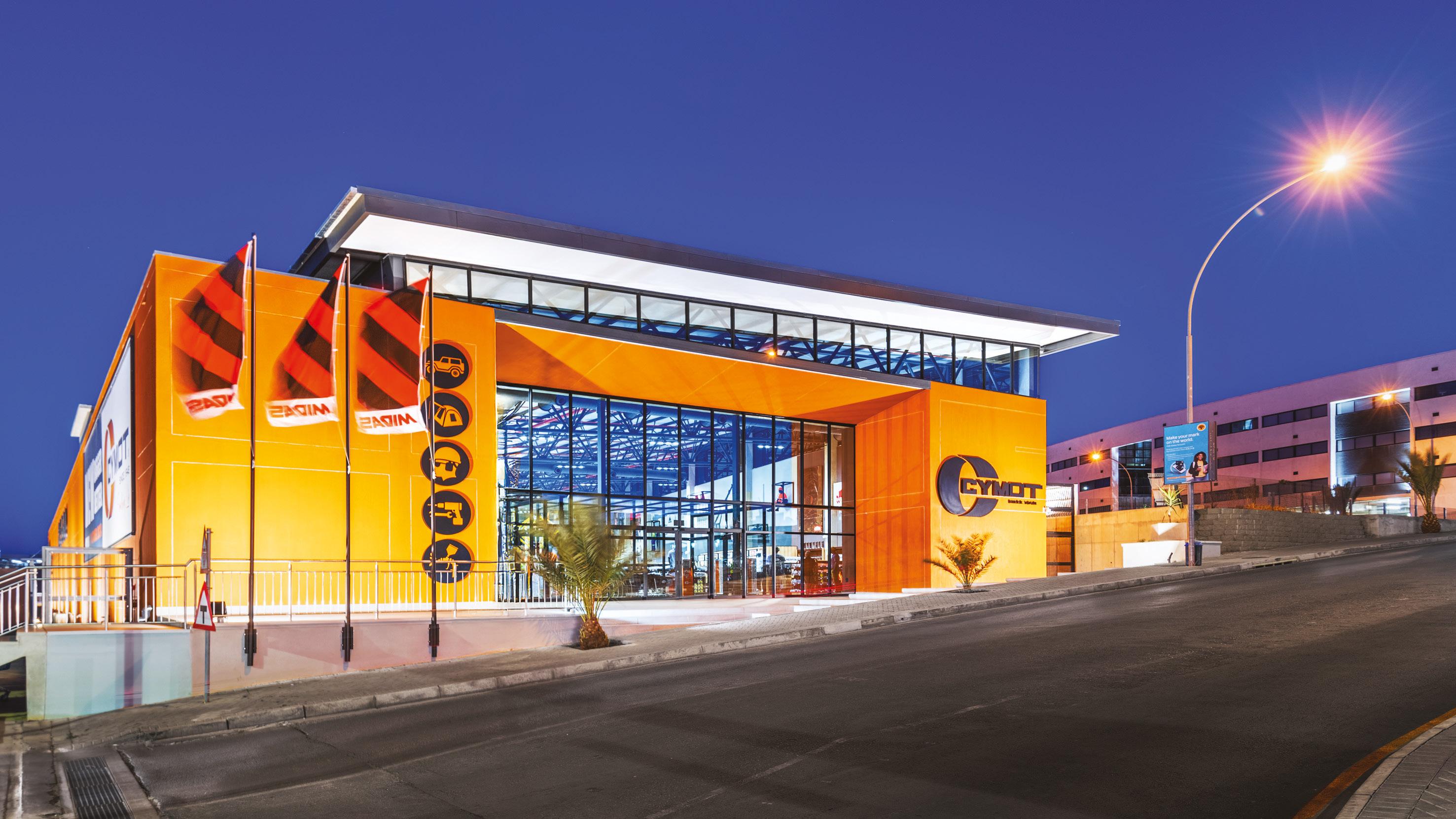
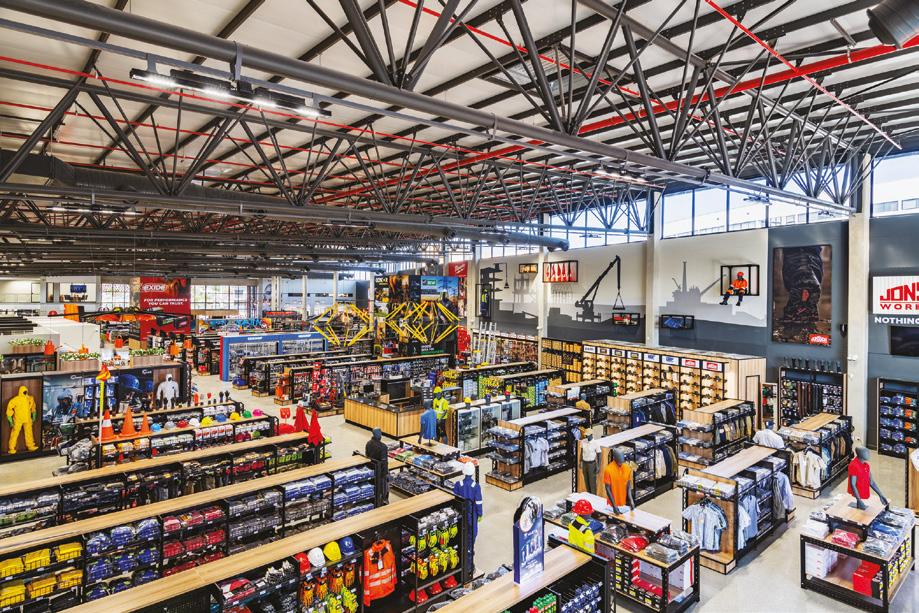

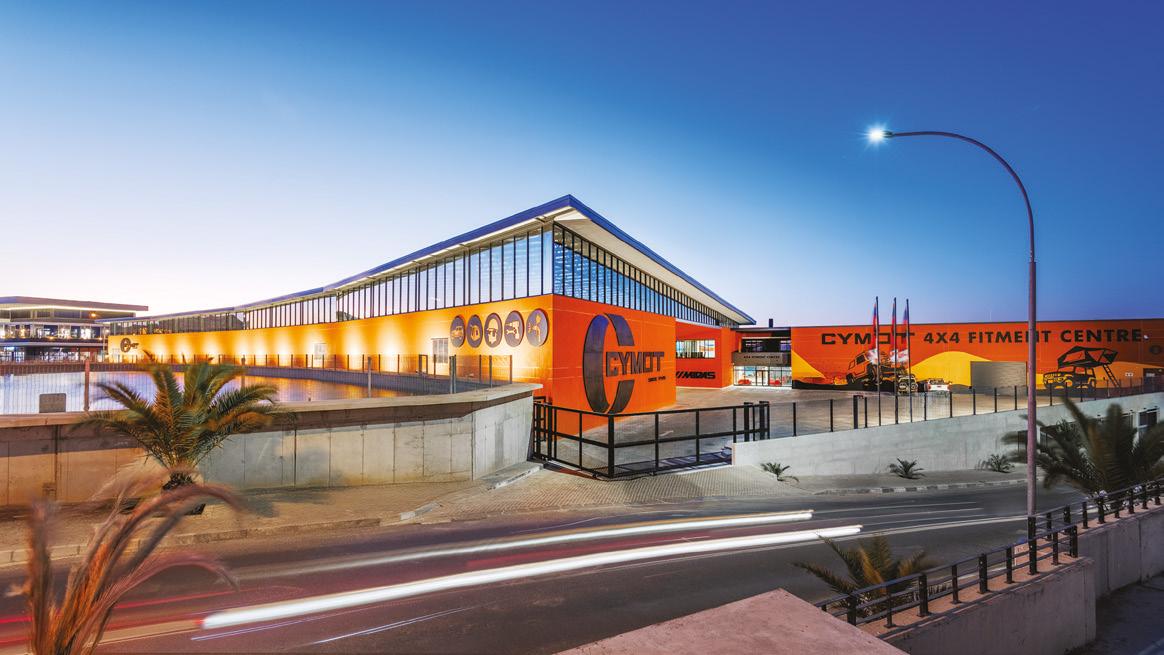
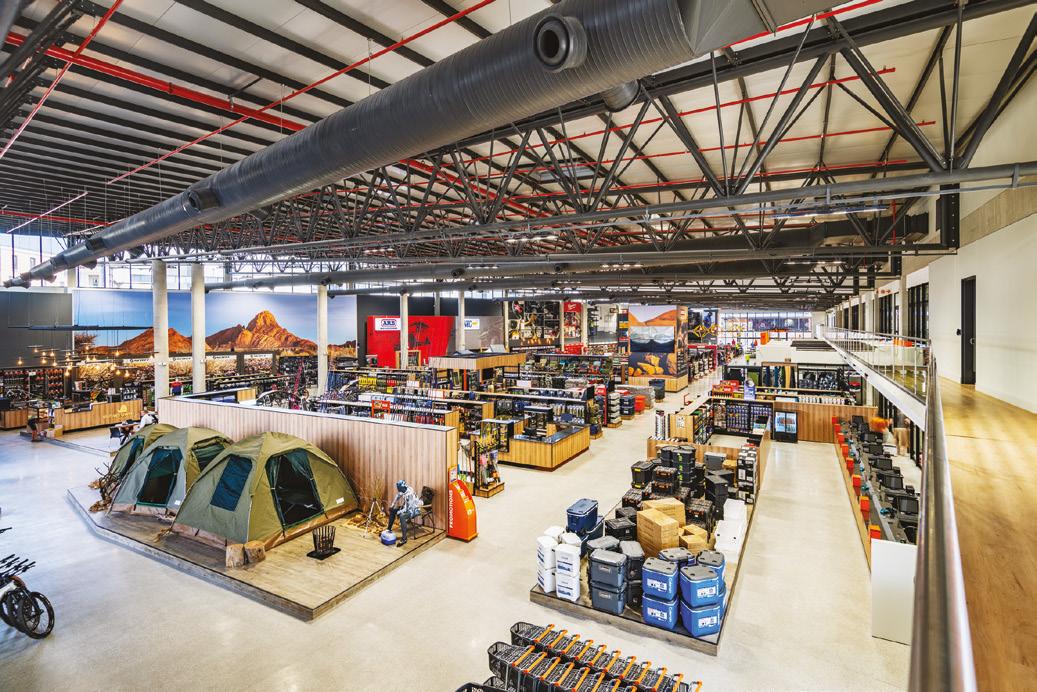
Whether you're on business or exploring Namibia, CYMOT Hilltop has everything you need under one roof!
Conveniently located next to Grove Mall in Windhoek, we make shopping easy, hassle-free, and enjoyable.
Start your journey with the perfect cup! Fuel up with the rich aroma and bold avours of Slow Town Coffee, available in-store. From a quick espresso to a smooth latte, every cup is crafted to perfection.

There is a certain magic in the moments we don’t plan for.
Not the bold headline experiences or the bucket-list ticks we proudly share, but the small pauses along the way – the unexpected turnoff, the roadside padstal, the conversation that lingers longer than intended. Autumn in Namibia has a way of inviting exactly that. The heat softens, the light mellows, and the road seems to ask you to slow down just a little.
In this issue of Travel Namibia, many of the stories begin not with a destination, but with a decision to stop.
Up in Bwabwata National Park, Suné discovers a wet and wild wonderland where life unfolds close and unfiltered. In the Kavango, encounters aren’t rushed or staged – they happen in between, in quiet moments where wildlife and wilderness exist on their own terms. It is a reminder that sometimes the most powerful experiences aren’t announced. They simply appear when you give them space.
Further south, my own journey becomes less about where I’m going and more about who I meet along the way. A catch-up with old friends leads to new conversations, new faces, and new stories that could only exist in that moment, on that stretch of road. These are the threads that quietly stitch a journey together.
In Swakopmund, Madeleen finds beauty in details often overlooked –hidden corners, local treasures, the familiar seen through fresh eyes. It’s a town many of us think we know well, yet it reveals itself differently when we slow down and really look.
And in our Photography Feature, Wilderness guide Abner Simeon shows us Namibia through a storyteller’s lens. His images remind us that guiding and photography share the same purpose – to frame a moment, preserve a feeling, and invite others to see what they may otherwise miss.
Travel, after all, isn’t only about the grand reveal at the end of the road. It’s about pulling over safely to catch the light just right. It’s about stopping for coffee at a padstal you’ve driven past a hundred times. It’s about listening when someone offers their story.
This autumn, may you take the road less travelled – and may you remember to stop along the way.
ON THE COVER
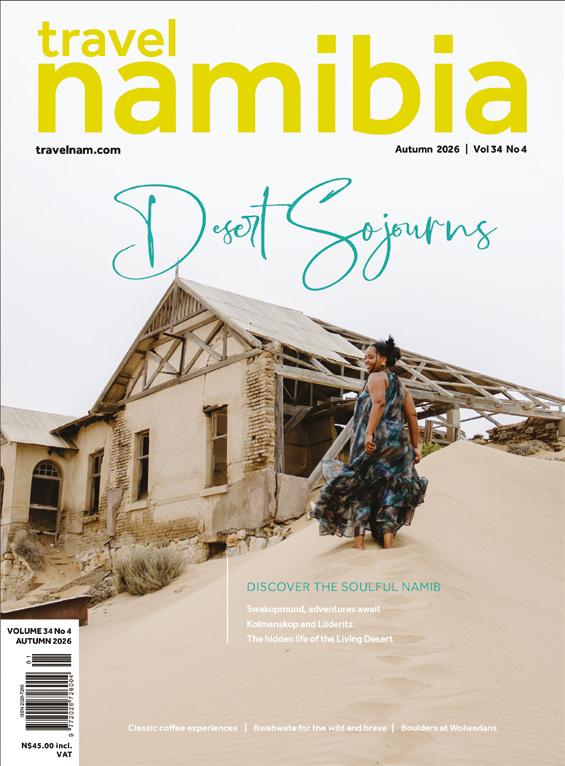
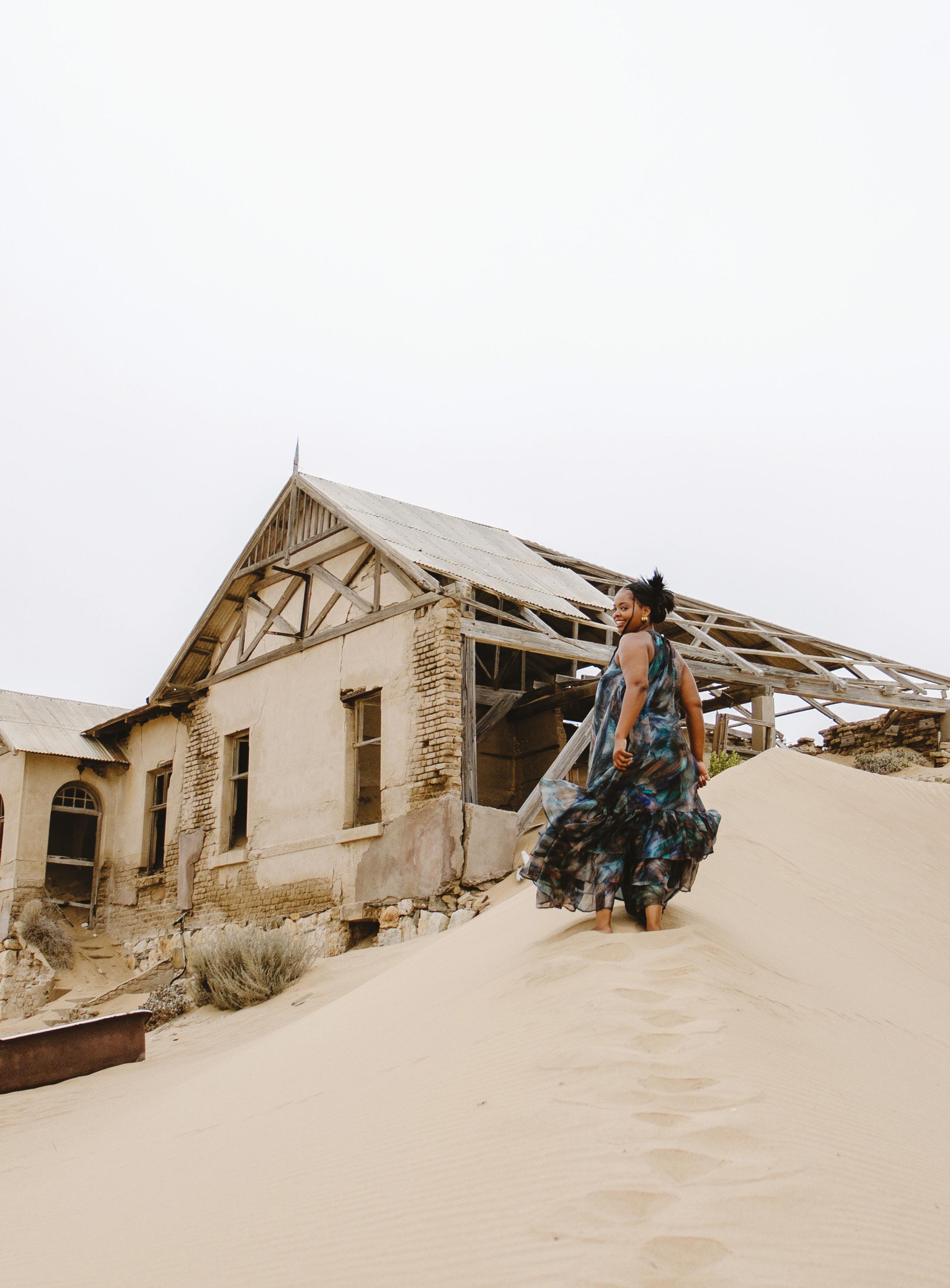
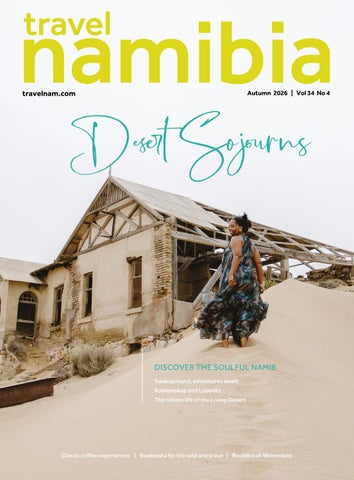
In the silence of Kolmanskop, the Namib Desert drifts through empty rooms, showing that ambition fades but dreams endure in sand and light. Read more on pg 32.
Image: Suné van Wyk
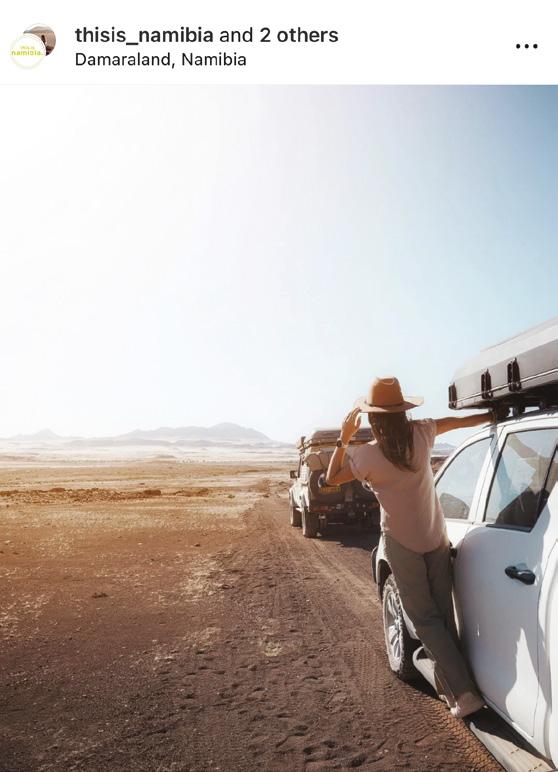
FOLLOW US ON INSTAGRAM @thisis_namibia

SWAKOPMUND p12
Where the desert dares you to play in the adventure capital of the world
KOLMANSKOP p32
Where the desert remembers
Abner Simeon and the art of seeing wilderness
How do you greet a place you’ve never met before?
CLOSE ENCOUNTERS IN THE CAPRIVI | Close calls, big wildlife, and the heart of Bwabwata
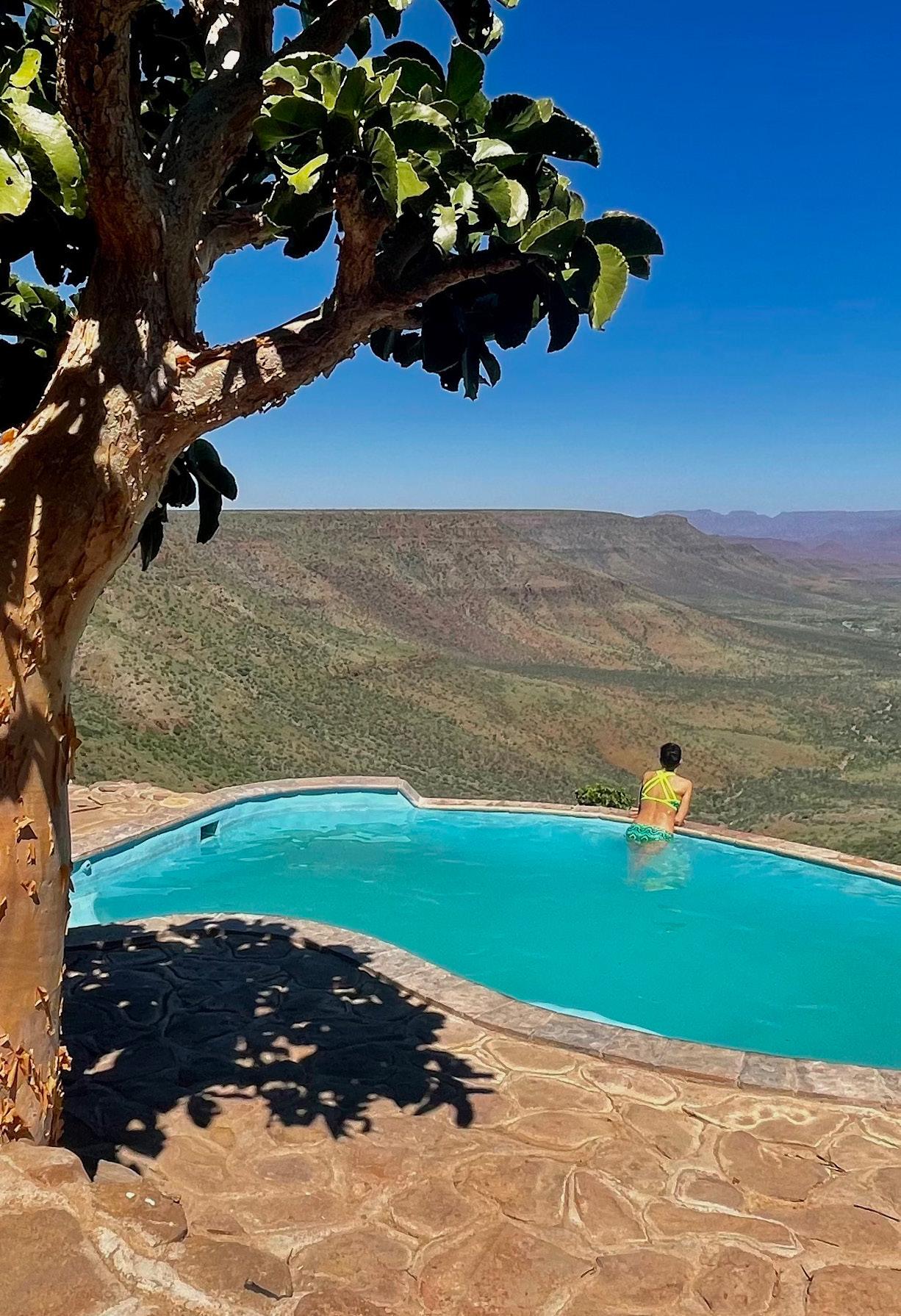
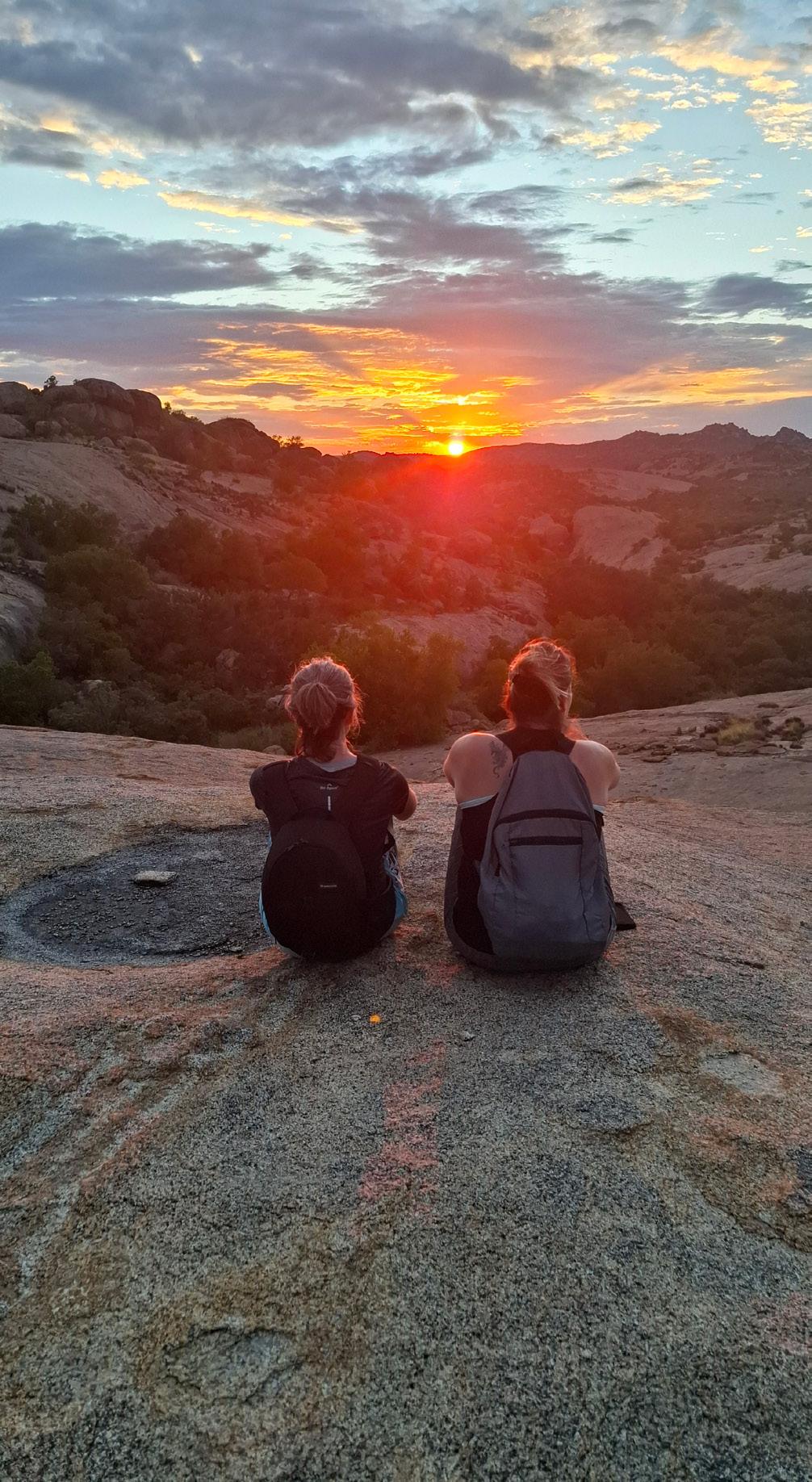
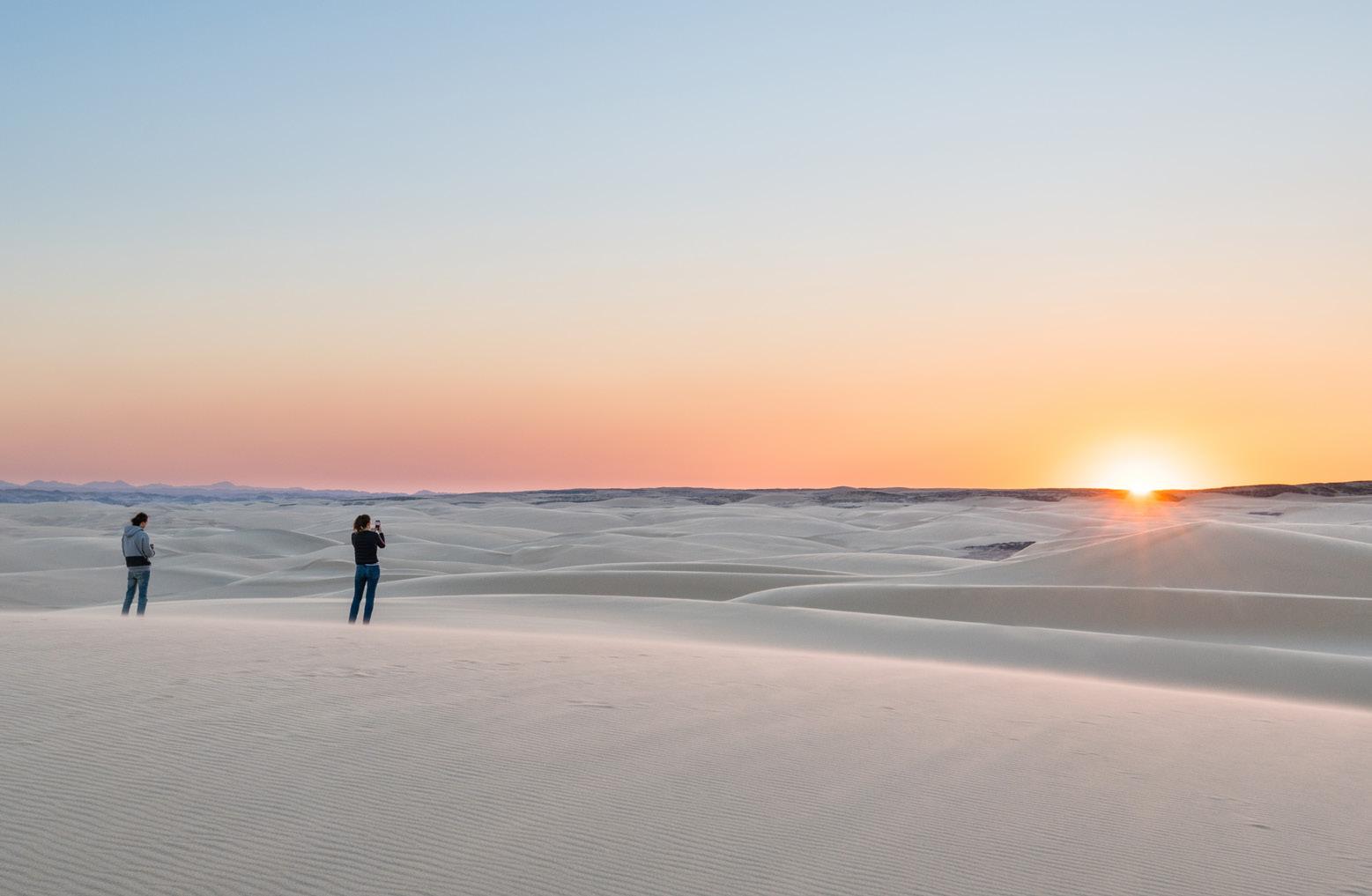

Sunsets and views over vast landscapes - awaken all your senses linktr.ee/journeysnamibia


Namibia’s tourism industry marked a significant milestone with the official launch of the Tourist Statistical Report 2024 in Windhoek on 3 December. Presented by Minister of Environment, Forestry and Tourism, Hon. Indileni N. Daniel, the report highlights a strong resurgence in visitor numbers, signalling the sector’s continued recovery and resilience following years of disruption.
According to the report, Namibia recorded 1,257,093 international tourist arrivals in 2024, a notable 45.5% increase from the previous year. This figure reflects almost 79% recovery toward pre-pandemic levels, underscoring the country’s growing appeal as a global travel destination. South Africa remains the dominant source market, accounting for 38.5% of arrivals, followed by neighbouring countries including Angola, Botswana, Zambia and Zimbabwe. Germany continues to lead among long-haul markets, with steady interest also coming from the United States, the United Kingdom, France and the Netherlands.
Holiday and leisure travel remains the primary motivation for visitors, making up 47.5% of all arrivals, while business travel accounted for 15.8%. Beyond the encouraging numbers, the Ministry emphasised a commitment to

sustainable growth, announcing progress on the National Tourism Spatial Development Master Plan, aimed at guiding the sector toward a more inclusive and internationally competitive future.
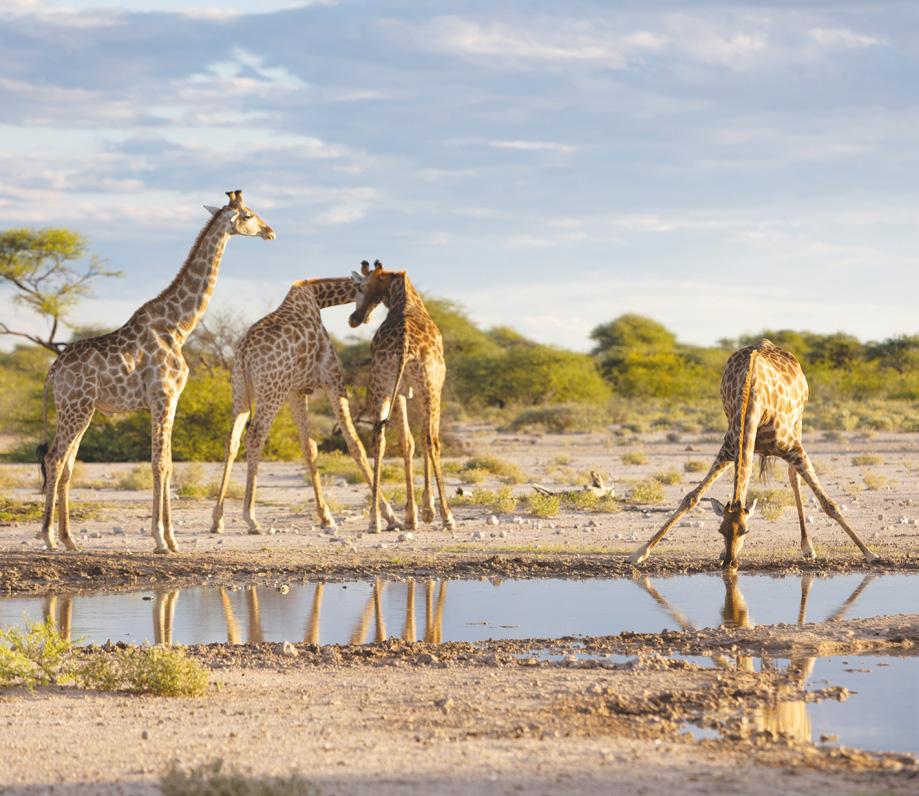
Namibia has been named Africa’s most authentic and indemand tourism destination by the African Tourism Board (ATB), a recognition that underscores the country’s growing appeal to international travellers in search of immersive, conservation-led experiences.
The ATB noted rising interest from key markets such as Germany and the United States, where travellers are increasingly drawn to responsible, experience-driven journeys rather than mass tourism. Central to Namibia’s appeal is what the board describes as “space as the new luxury”; vast, uncrowded landscapes paired with safety and well-developed infrastructure.
“Travellers in 2025 are no longer looking for crowded experiences; they are seeking space, silence, and scale,” the ATB explained, adding that Namibia’s uncompromising authenticity is precisely what makes it so rewarding for visitors.
A strong commitment to sustainability further sets the country apart. Namibia’s tourism model prioritises environmental protection, community benefits, and highvalue, low-impact travel. More than 40% of the country is under conservation management, reflecting its status as the first African nation to embed environmental protection in its constitution.
Exploring Namibia is an experience in itself. Defined by vast distances and long stretches of gravel road, the country lends itself to self-drive travel, rewarding visitors who embrace navigation skills, mechanical awareness, and a spirit of self-reliance.
“Namibia is not designed for quick, high-volume tourism,” the ATB said. “It is for travellers who are intentional about the impact they leave behind.”
As the final accommodation figures for December were confirmed, the picture for Namibia’s tourism sector in 2025 came into clearer focus. Based on data submitted by HAN members across the country and spanning the full range of accommodation types, overall room occupancy reached 51.99%for the year. While this fell slightly short of the previous year’s performance and remained below 2019 averages, December told a more encouraging story. Roads, restaurants and activity hubs reflected a noticeable increase in international visitors, particularly from Europe. Although arrivals from German-speaking markets dipped marginally compared to last year, they still exceeded pre-pandemic levels, while Namibian guest numbers in December edged upward, though not yet matching those seen in 2019. At the same time, the visible presence of visitors from neighbouring countries during the festive season was not fully reflected in the data, pointing to the continued use of unregistered accommodation.
Looking ahead, the industry steps into 2026 with cautious optimism tempered by real and pressing challenges. Forward bookings are softer than in previous years, shaped

by limited air access, evolving visa requirements and a global travel climate marked by uncertainty and shorter planning horizons. Yet the country continues to stand out for its authenticity and commitment to sustainable, conscious travel.
The Ministry of Environment, Forestry and Tourism has announced revised park entry fees to be introduced from April 2026. The new fee structure follows extensive nationwide consultations held throughout 2025 and reflects input from tourism stakeholders, aimed at supporting a practical and sustainable model for park management going forward.
Five years after its launch, Discover Airlines is making its boldest move yet, unveiling its new Ocean Blue long-haul cabin as part of the largest investment in the airline’s history. From spring 2027, all 16 Airbus A330-300 aircraft will be retrofitted with the elegant, ocean-inspired design, delivering a refined holiday feel across Economy, Premium Economy and Business Class by mid-2028. The upgrade introduces standout features such as a new Business Class Suite with sliding doors and a 32-inch screen, a toptier Premium Economy with hard-shell seats and enhanced privacy, and improved comfort and legroom in Economy. Across all classes, passengers can expect state-of-the-art 4K touchscreens, Bluetooth connectivity and free highspeed Starlink internet, alongside human-centric lighting designed to support wellbeing on long journeys. Blending cutting-edge technology with relaxed luxury, Ocean Blue signals Discover Airlines’ ambition to set new standards in long-haul leisure travel while staying true to its roots as the Lufthansa Group’s quality leisure airline. TN
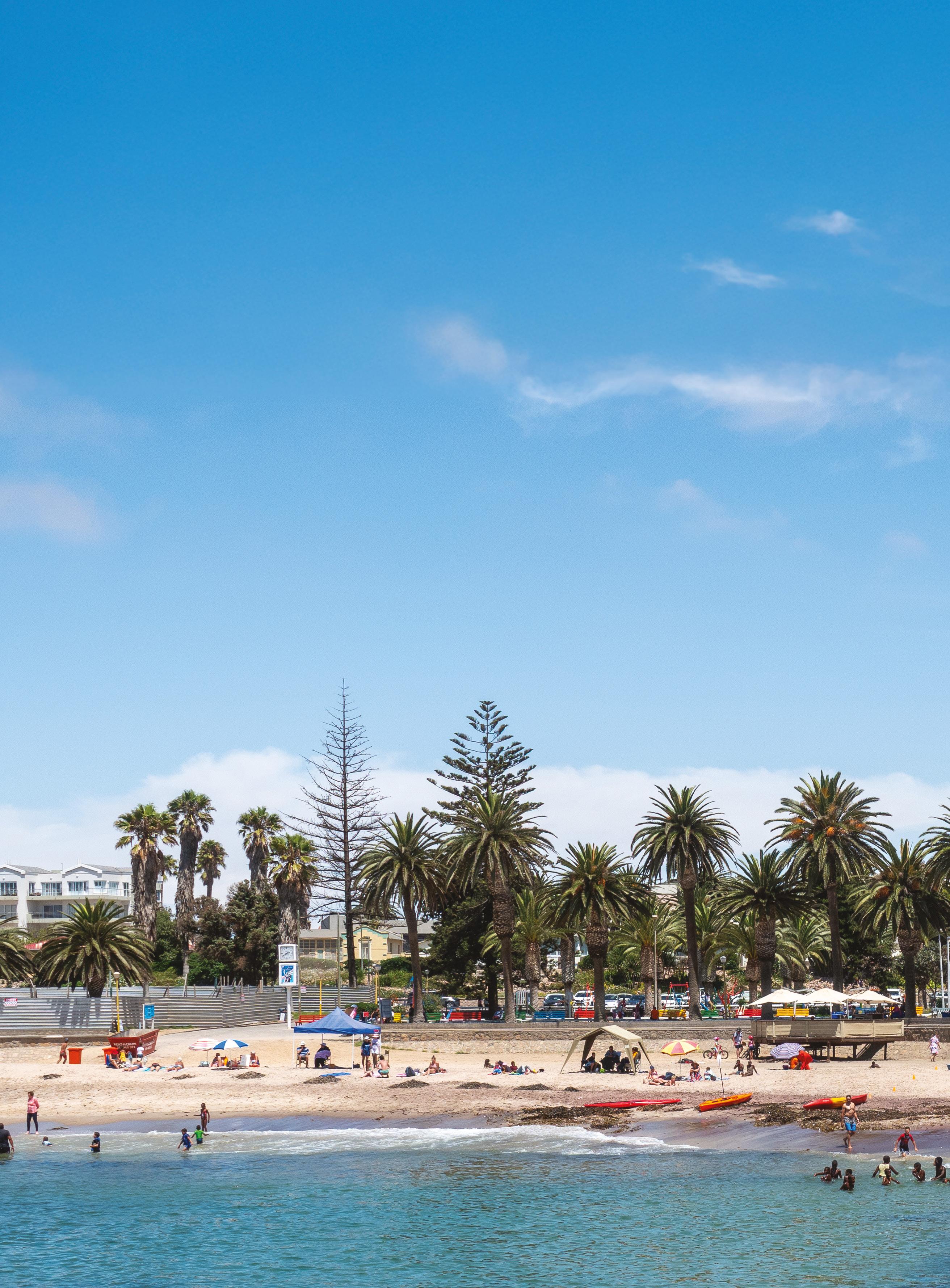
There are places where adventure is an addon – a single activity pencilled between meals and museum visits. And then there is Swakopmund, where adventure is the atmosphere itself. Here, the Atlantic Ocean crashes against a desert edge that refuses to behave, fog rolls in like a curtain call, and the horizon feels deliberately wide, as if inviting you to test your limits.
It is this rare convergence of elements that has earned Swakopmund its reputation as Namibia’s undisputed adventure capital – and increasingly, as one of the world’s most exhilarating playgrounds.
Perched between the skeletal vastness of the Namib Desert and the cold, nutrient-rich Atlantic, Swakopmund offers something few destinations can match: extreme contrasts packed into a single day. You can be airborne at sunrise, carving through dunes by mid-morning, paddling among seals at lunchtime, and sharing a sundowner as desert light fades into ocean mist.
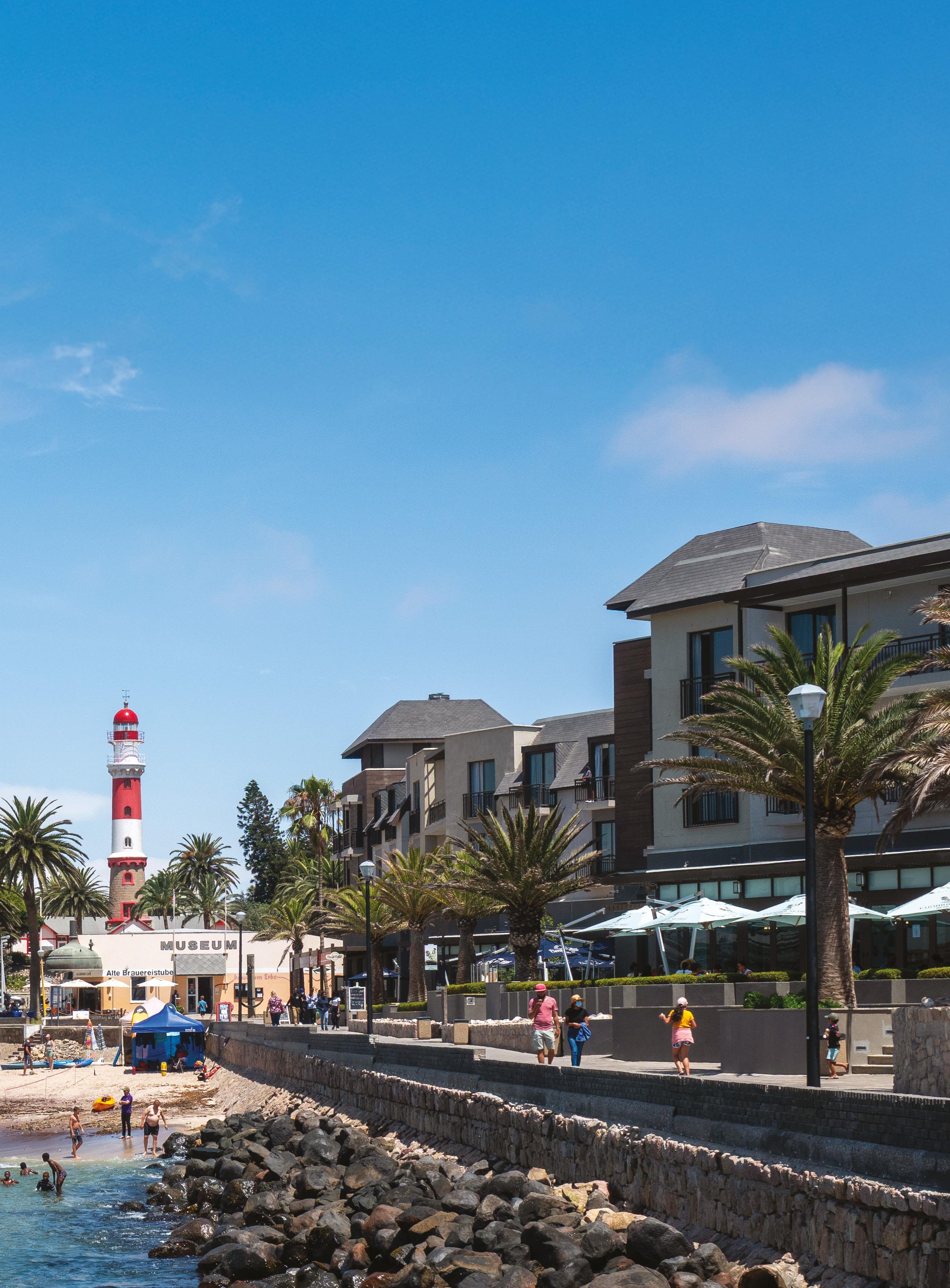
In 2025, this spirit of adventure received continental recognition when Namibia was named Africa’s Best Adventure Tourism Destination at the Africa Tourism Awards – also known as The Balearica Awards – held in London. The accolade specifically highlighted Swakopmund as the beating heart of the country’s adventure offering, celebrating not only adrenaline-fuelled experiences but Namibia’s commitment to sustainability, innovation, and community-led tourism.
For visitors, however, Swakopmund’s appeal is far more visceral than trophies and titles. It is felt in the thrum of a quad bike engine revving against a dune face, the moment of silence before a parachute opens, the laughter echoing across a salt-streaked lagoon.
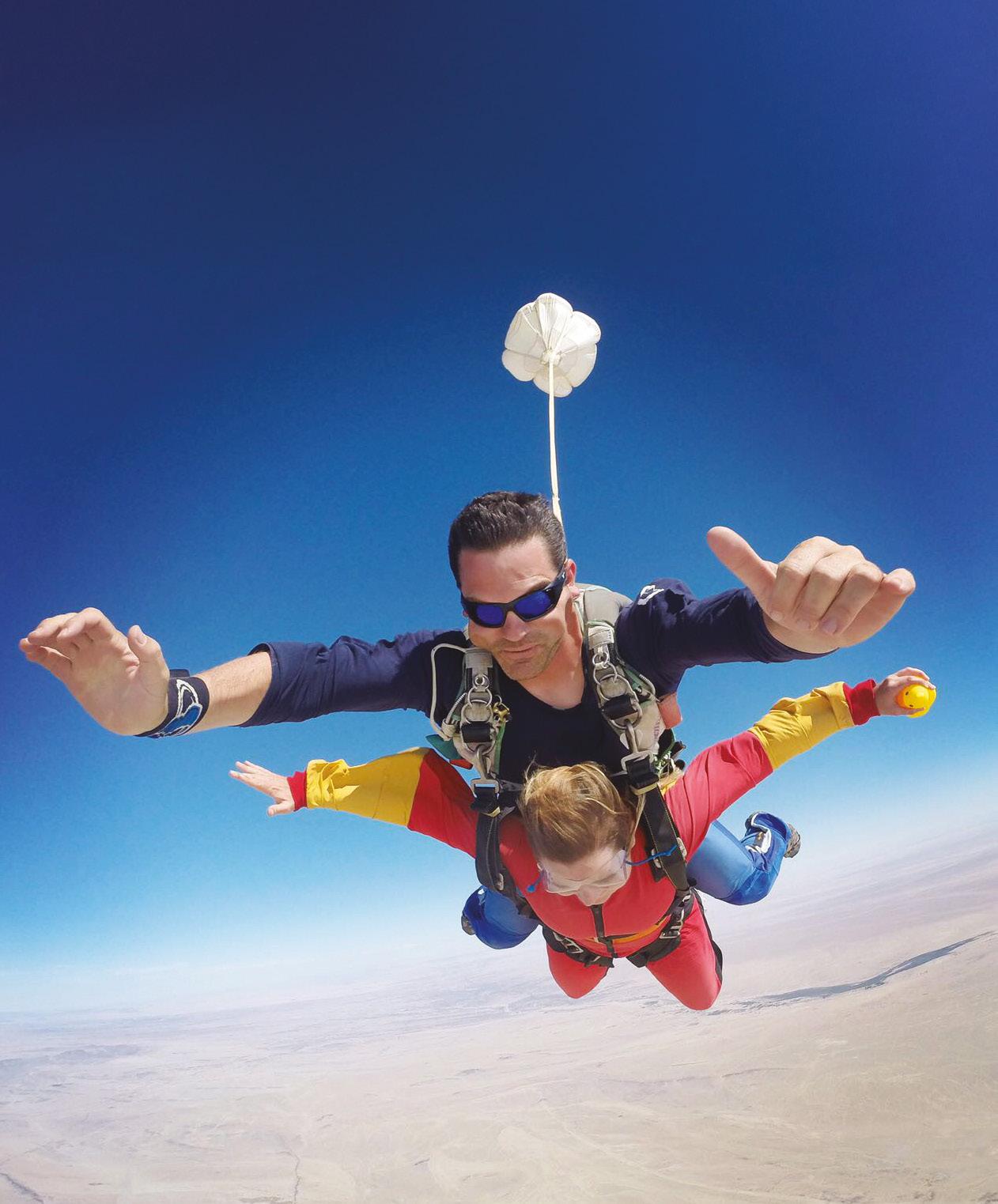
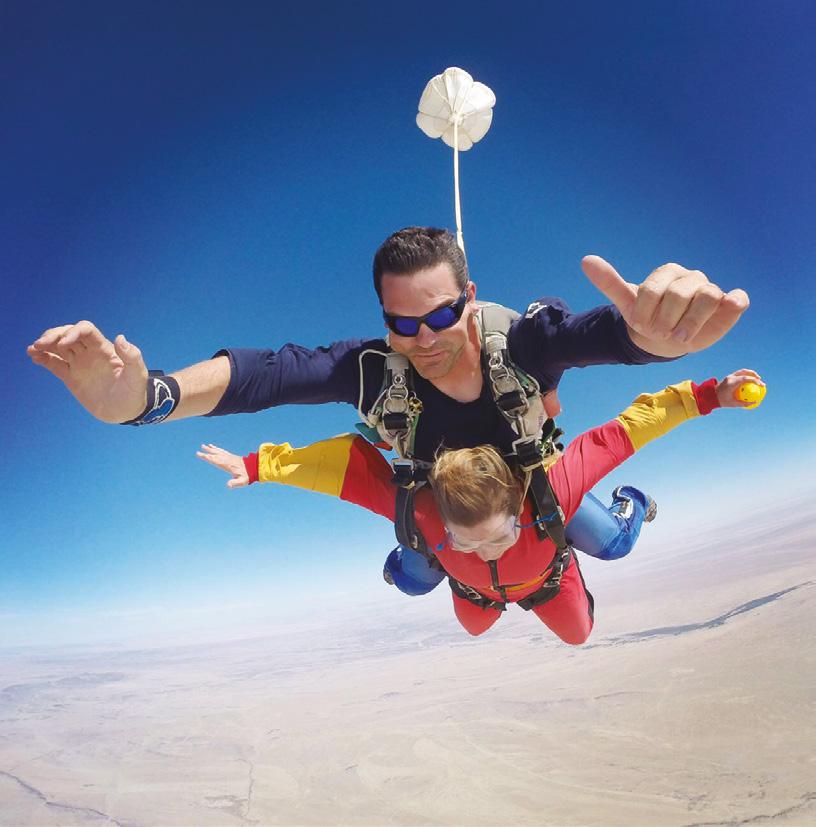
Skydiving over Swakopmund remains one of the town’s most iconic experiences. Few jumps in the world offer such dramatic theatre: the desert unfolding beneath you in endless shades of rust and gold, the Atlantic stretching cool and steel-blue beyond.
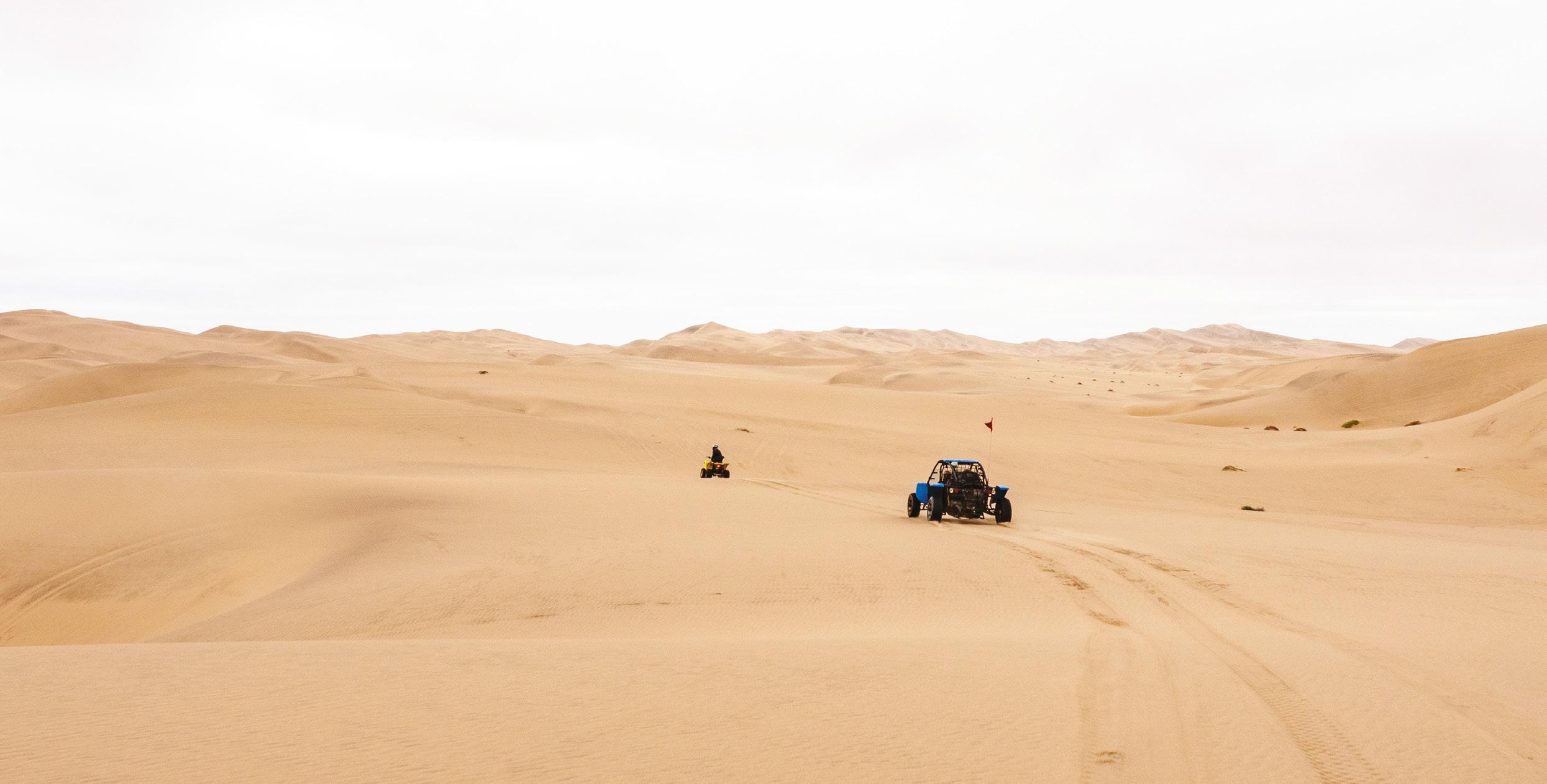
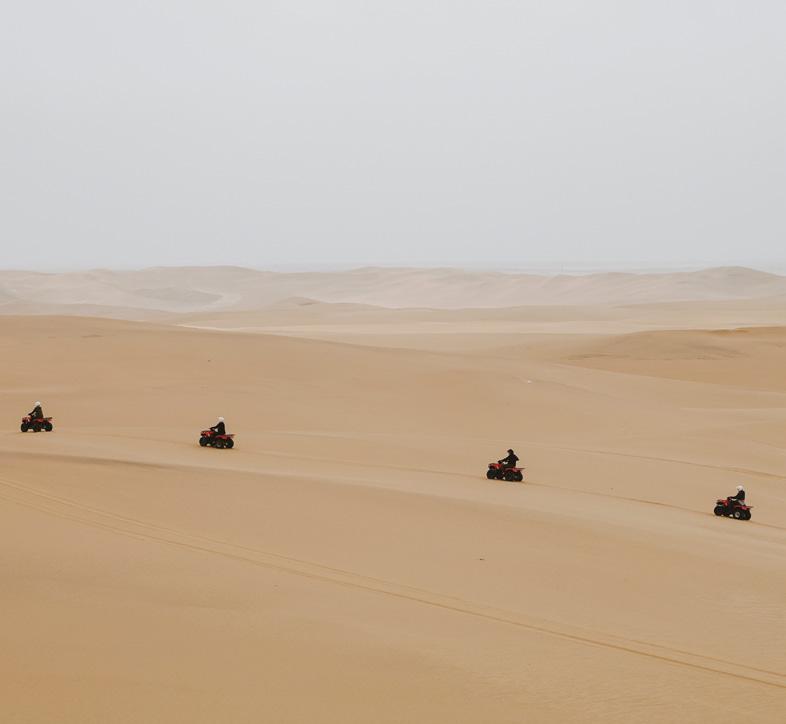
For those who prefer to keep their feet closer to the ground, the dunes provide their own brand of exhilaration. Sandboarding down towering slipfaces delivers a rush as pure as any alpine slope, while quad biking and dune buggy tours trace sinuous paths through a landscape shaped by wind and time. Guides navigate with practiced ease, reading the dunes like a language, sharing stories of how fragile and fiercely protected this ecosystem truly is.
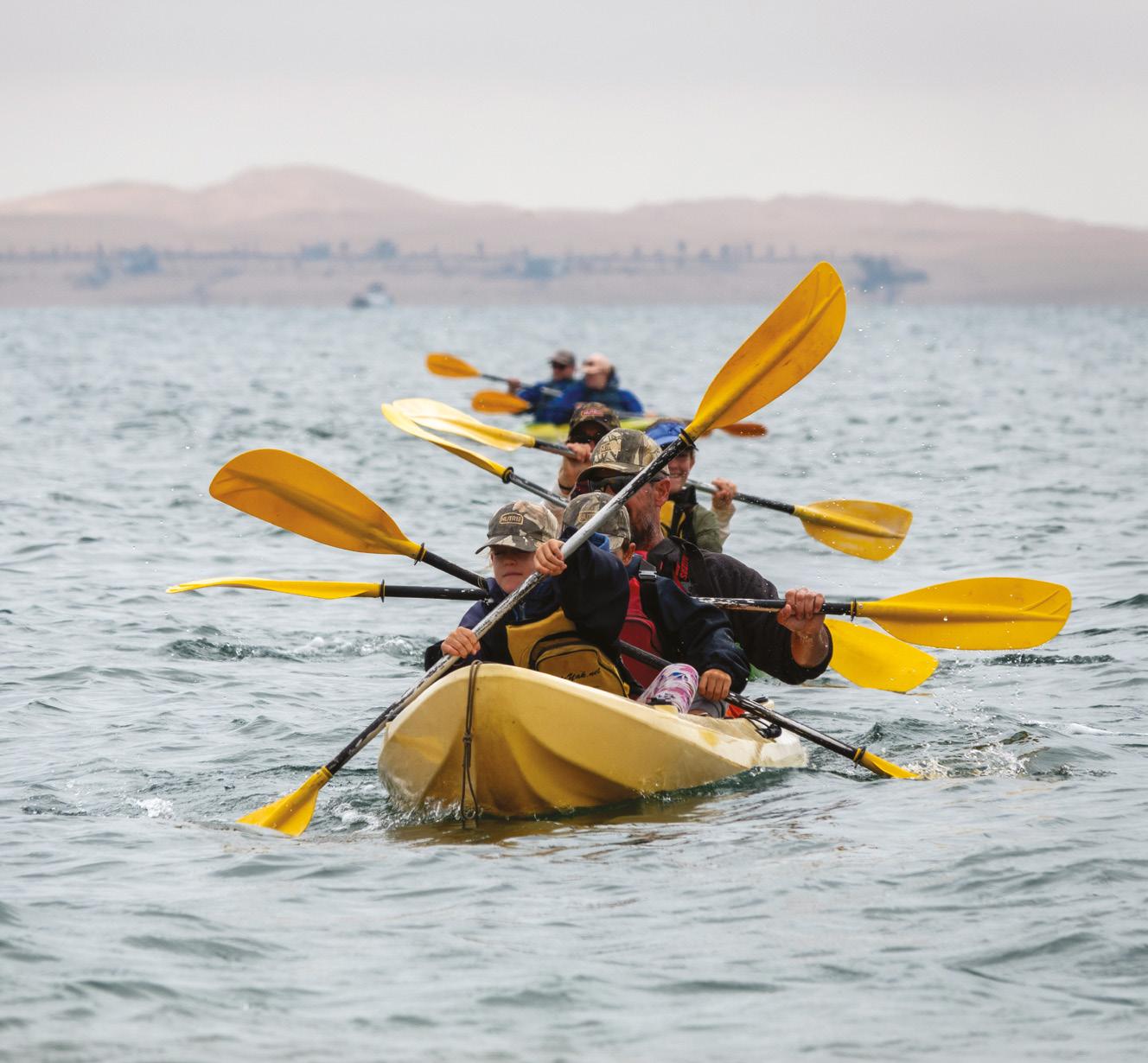

Adventure in Swakopmund is not only about speed and height – it is also about intimacy with nature. Kayaking on the calm waters of Walvis Bay Lagoon offers encounters of a different kind. Seals slip into the water beside your kayak, curious and playful, while pelicans glide overhead and flamingos paint the shallows pink. It is an experience that reminds you that adventure can be gentle, immersive, and deeply moving.
In Swakopmund, adventure is not staged. It is lived.
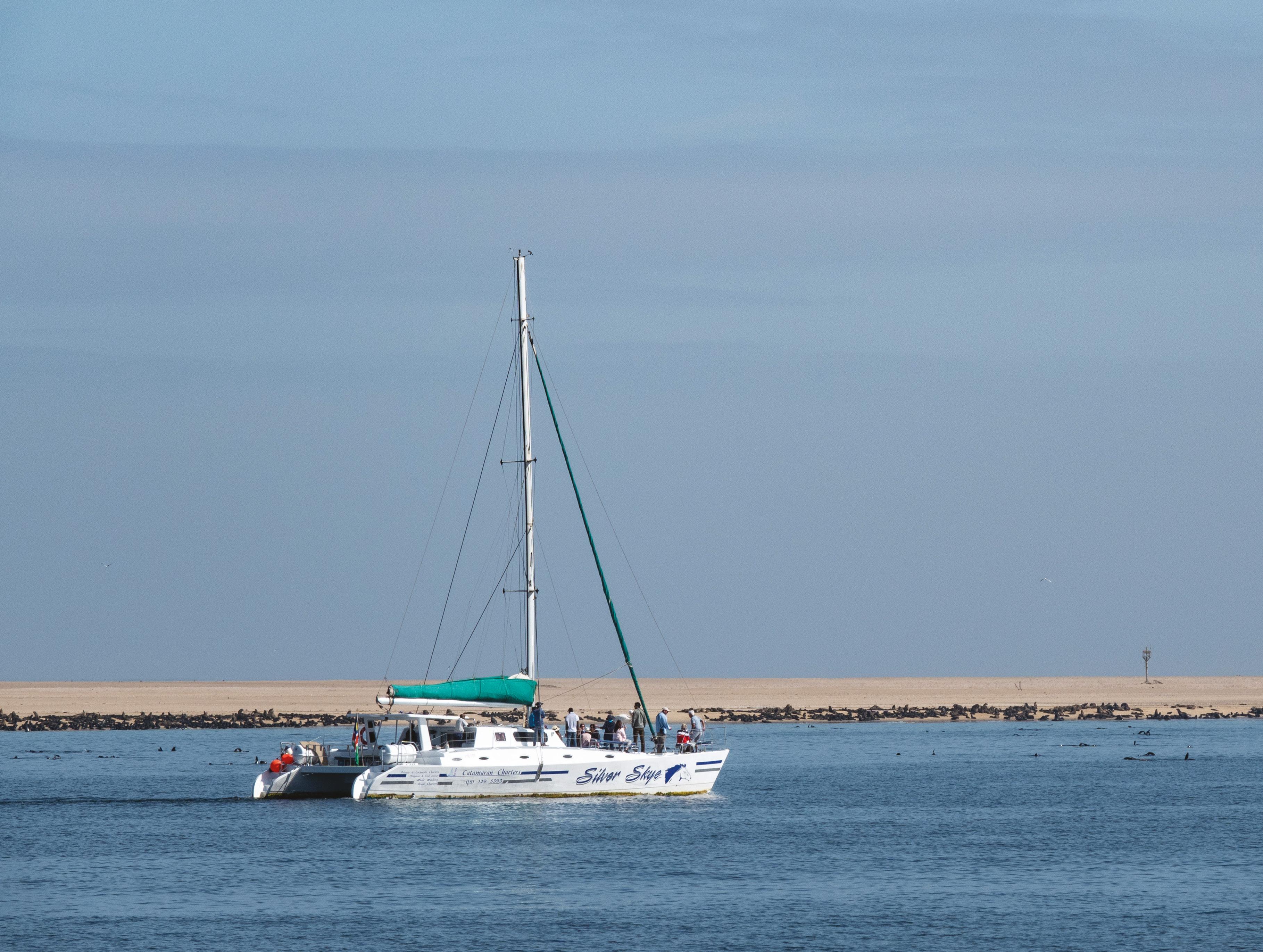
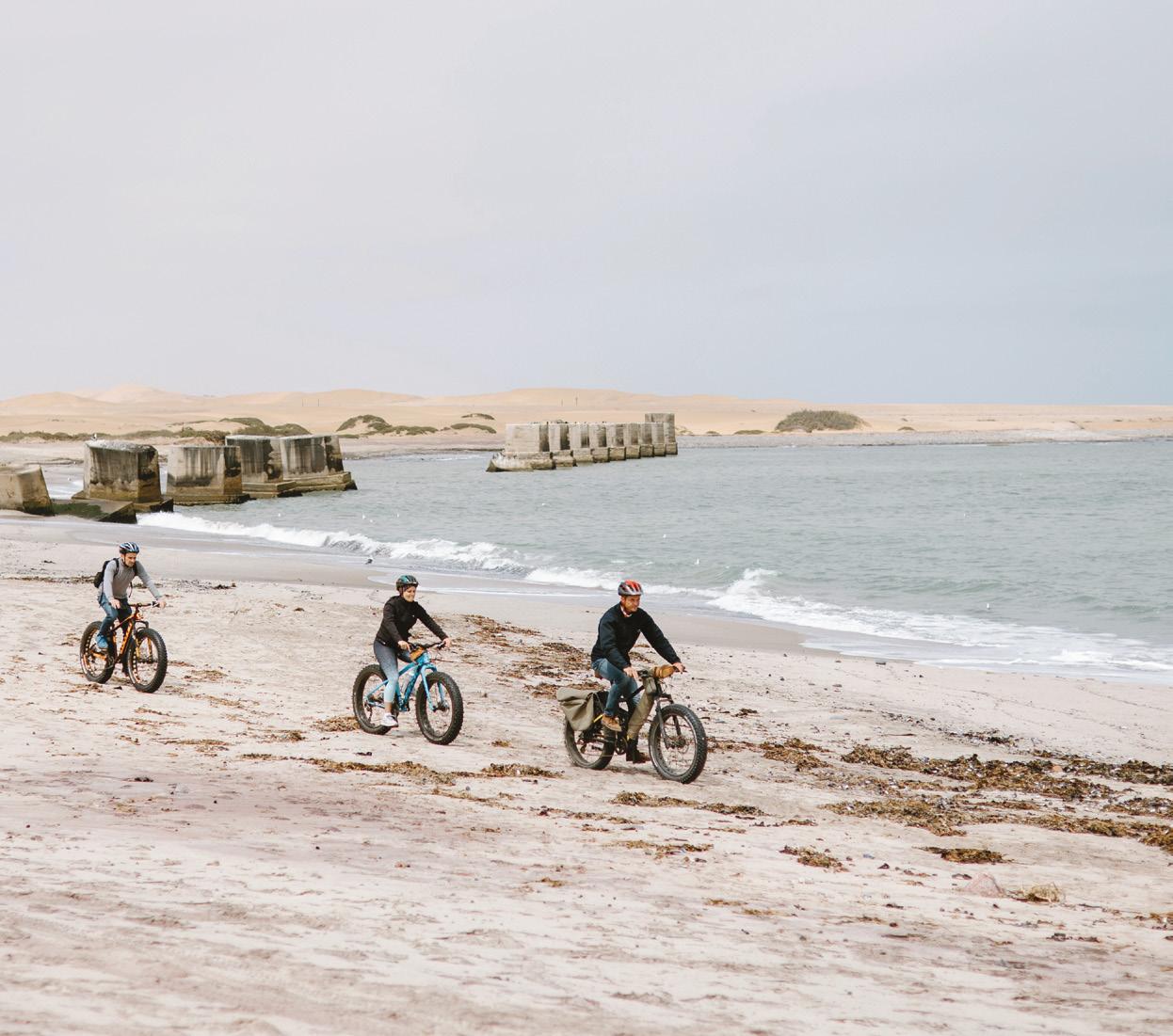
Further offshore, catamaran cruises combine marine wildlife viewing with the thrill of the open sea. Dolphins ride the bow waves, mola mola drift past like living relics, and the chill air sharpens the senses. Back on land, fat biking along the beach allows you to pedal where desert sand meets surf, tyres floating effortlessly across terrain that would stop ordinary bicycles in their tracks.

Even walking becomes an adventure here. Guided desert tours reveal a hidden world beneath the sand – translucent lizards, fog-basking beetles, ancient welwitschias clinging to life against all odds. These small wonders anchor Swakopmund’s bigger thrills, offering context and respect for the environment that makes such experiences possible.
What truly sets Swakopmund apart, though, is not just the range of activities, but the ease with which they coexist. Adventure here is accessible. Operators are experienced, safety-focused, and deeply connected to the place they call home. Many are family-run businesses, rooted in the community, employing local guides whose knowledge extends far beyond technical skill.
This balance between thrill and responsibility was central to the recent award recognition. Namibia stood out not only for what it offers travellers, but
for how it offers it – with environmental stewardship, innovation, and meaningful community impact at its core. It is a reminder that adventure tourism, when done well, can be a powerful force for sustainable development.
Yet awards aside, Swakopmund’s magic lies in moments that cannot be measured. The way fog beads on your eyelashes during an early-morning run along the promenade. The taste of salt on your lips after a day at sea. The shared grin between strangers who have just conquered a fear, together.
In Swakopmund, adventure is not staged. It is lived. It is woven into the fabric of daily life, into the rhythm of tides and winds, into a town that understands that the greatest journeys often happen at the edge – where desert meets ocean, and where travellers rediscover a sense of wonder. TN
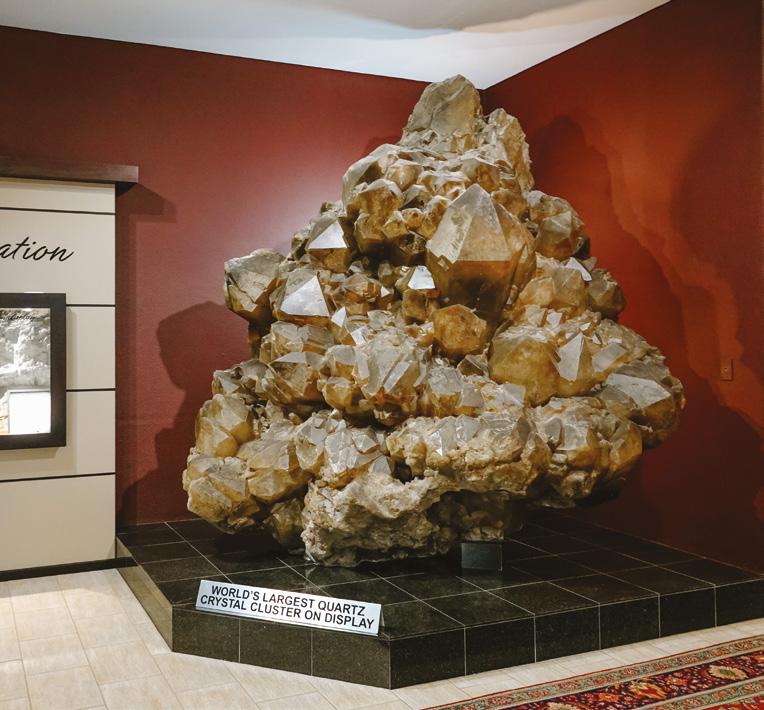
In Swakopmund, few places are visited as frequently by our family as the well-known landmark, the Kristall Galerie. This is partly thanks to my sister-in-law. A jeweller by trade, her mind perpetually scouts for new ideas and designs to incorporate into her gem cutting and silversmithing. Originally from the frigid Dakotas in the USA, she makes a point of visiting the Kristall Galerie whenever she and my brother travel to Namibia every three years, often squeezing it into their already crammed itinerary.
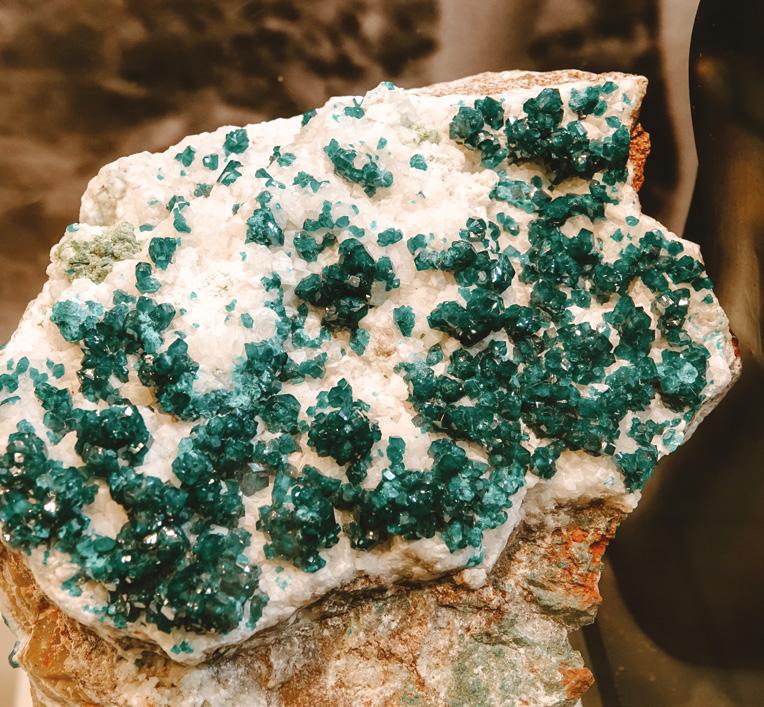
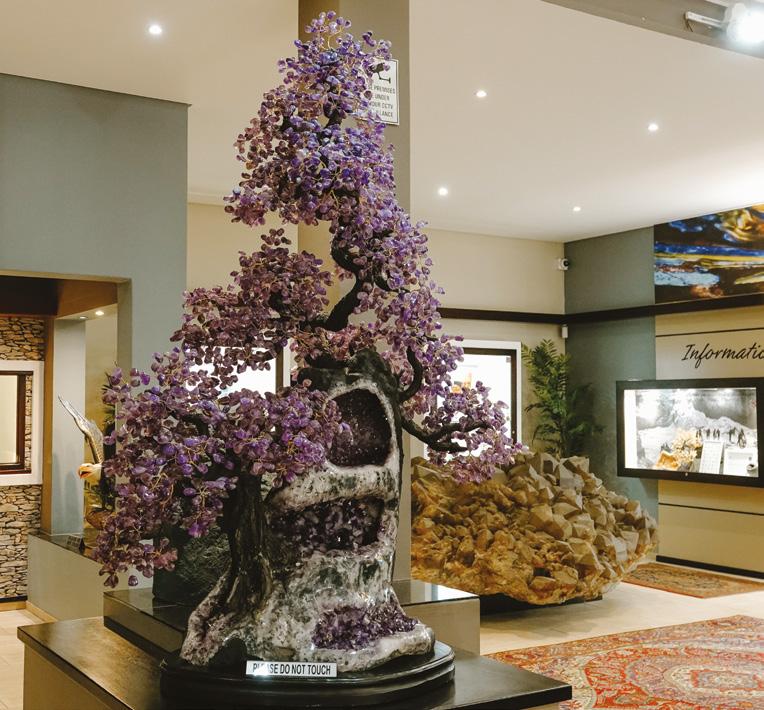
Established in 1998, the Kristall Galerie displays a wide array of specimens, crystals, and cut gemstones. In addition to its impressive displays, the exhibition now features three jewellery boutiques, a souvenir shop, a ‘gem garden’, a rock cave, and a studio. Here, visitors can watch local artists tinker away on semi-precious stones. The displays include Dioptase; shades of blue, pink, and purple Tourmaline; Pyrite; Amethyst; Fluorite clusters; Aquamarine; and Pietersite. Notably, Pietersite is found in only two places in the world: China and Namibia.
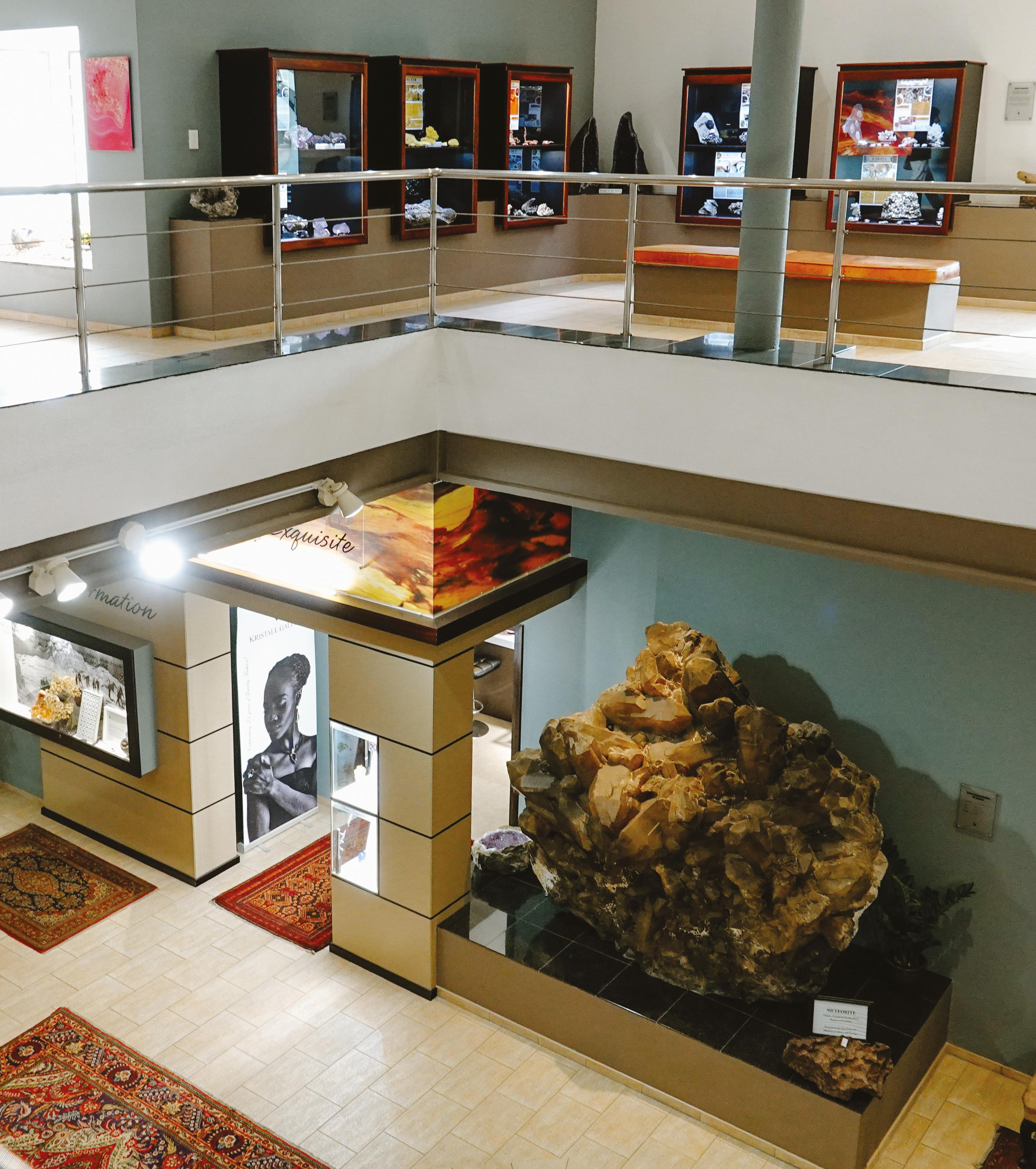
Quartz crystal clusters are among the many fascinating attractions. The largest known quartz crystal cluster on display anywhere in the world can be found at the Kristall Galerie. This awe-inspiring natural wonder, estimated to be around 520 million years old, was discovered on a farm in Namibia’s Erongo Region in August 1985. Towering 3 metres high and spanning 3 metres across, the cluster weighs an astonishing 14,100 kilograms. Excavating this delicate specimen took five full years.
Quartz crystals found at the Otjua mine near Karibib are distinct for their seemingly near-perfect beauty. Many are also unique, as they are doubly terminated, a term meaning the crystals have natural points at both ends instead of just one. This quality also makes them “floaters”: crystals that formed while suspended in mineralised fluid, not attached to any surface. There is no recorded reference to the largest floater ever found. It is possible that the Otjua crystals hold that distinction. The largest single crystal from Otjua is a floater measuring 2.2 metres long and 1.8 metres in circumference, with an estimated weight of one
ton. It is part of the colossal cluster exhibited in the foyer of the Kristall Galerie.
With my nieces and nephew in tow, I am inevitably pulled towards the Gem Garden. An assortment of tumbled semiprecious stones lies jumbled together, nestled in sculpted crannies. It offers a delightful treasure hunt for young and old alike. With their salvaged stones stuffed into small bags, we meander slowly through the semi-dark rock cave; a replica of the original Otjua Tourmaline Mine. Here, a collection of crystals is illuminated by softened light winding through its twists and turns.
This clever, immersive maze leads to the main exhibition area and manufacturing studio. Natural gemstones, mostly from Namibian mines, are set here in 14-and 18-karat gold or sterling silver by professional smiths. At the entrance, La Tourmaline Jewellery Boutique – Sister-in-law’s place of utter, unrestrained joy – offers fine jewellery and souvenirs. These include exquisitely crafted and beautifully cut stones.
Yet the gallery goes beyond the purely commercial and aesthetic. Over the years, I have watched my brother’s children pore over these luminous stones in slow wonderment and wide-eyed curiosity.
In the end, the Kristall Galerie is more than an exhibition. It is a careful guardianship of the Earth’s cavernous, mysterious history. Its collections stand as a testament to the dedication required to uncover, preserve, and share these geological marvels. For future generations, it offers more than beauty and knowledge. It is also a quiet reminder of our responsibility to protect the natural treasures entrusted to us. TN
Opening hours: Monday to Saturday 09:00 - 17:00 Small entry fee at the entrance - enquire at reception
Located on the corner of Tobias Hainyeko and Theo-Ben Gurirab Avenue in Swakopmund
SUNÉ VAN WYK
We left Windhoek with that familiar feeling of release, the kind that only comes after a long year of work when the road ahead feels lighter with every kilometre. Northbound, past Tsumeb and onwards, the landscape began to soften and then transform. Green crept in slowly at first, then confidently. By the time we reached Popa Falls, the air felt different. Heavier. Wetter. Alive.
For me, this was new territory. I had never travelled this far north east. Etosha had always been my reference point for wild Namibia, but the Caprivi is a completely different conversation. For my travel partner, the north feels like home. That familiarity shaped our journey quietly, grounding us as we crossed into a part of the country shaped by water, movement and survival.
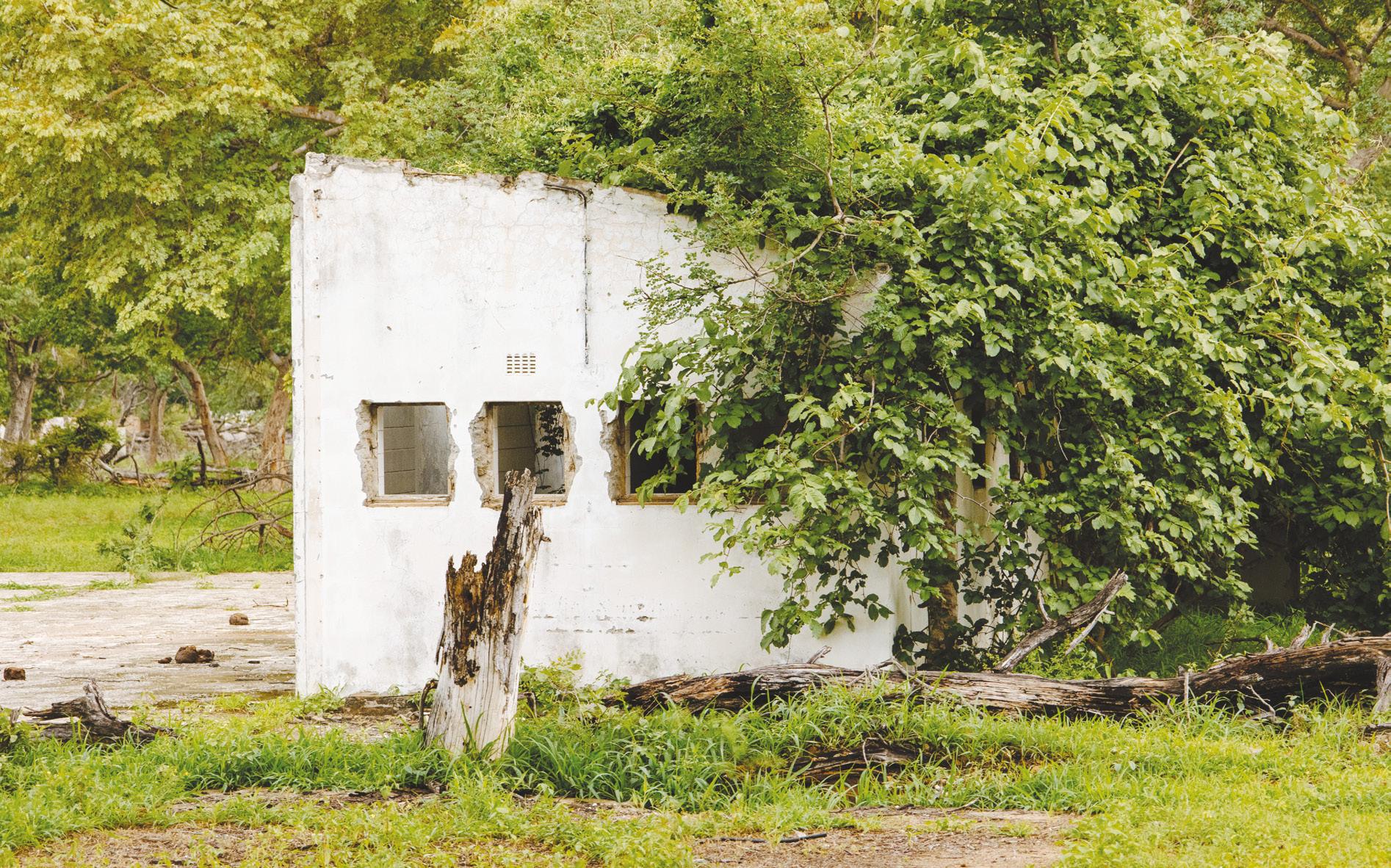
We checked in near Popa Falls and lingered there briefly, letting the sound of rushing water settle us after the drive. Then we headed straight into Bwabwata National Park, beginning with the Buffalo Core Area. Even before wildlife appeared, the park told its story. Old military buildings stood abandoned and weathered, slowly being reclaimed by bush and animals. History here does not disappear. It is absorbed.

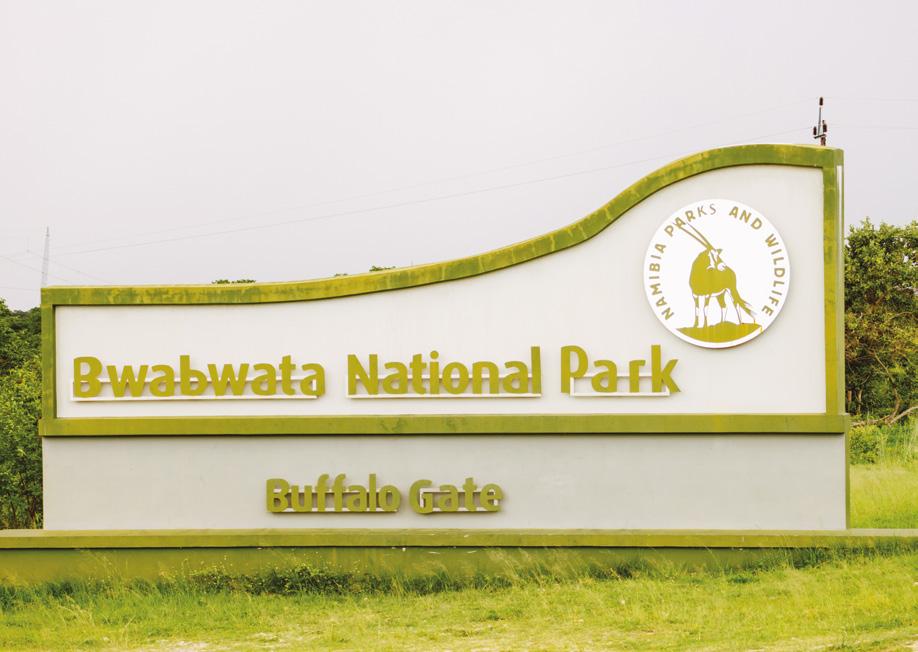
Rain arrived just before we entered the gate. Wind whipped through the open vehicle and we huddled behind canvas, half soaked, half laughing, watching the bush blur into grey. The shower passed quickly, as it does up here, and almost immediately the veld offered its first moment of silence and gravity.
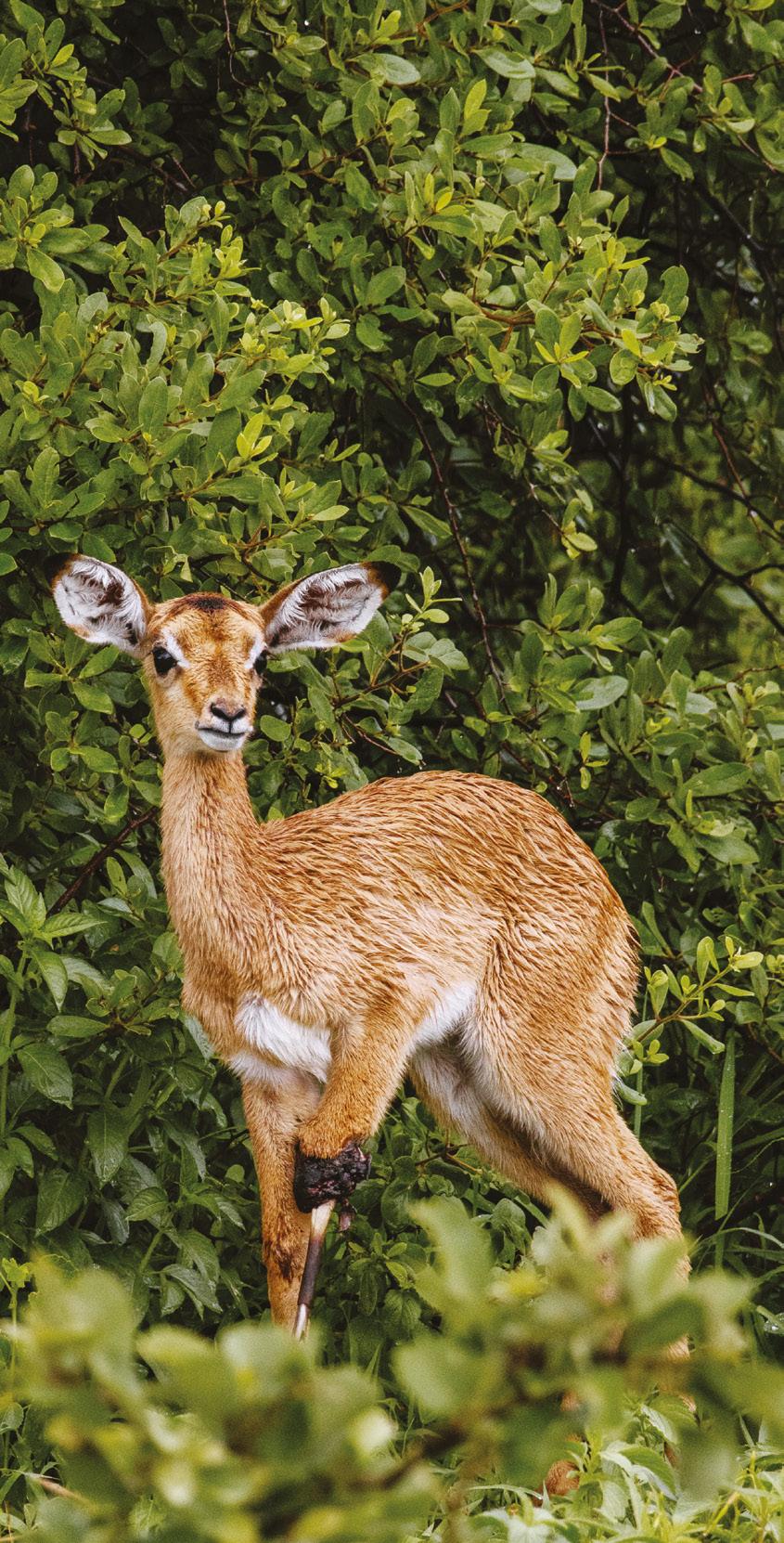
A baby impala stood alone, wet and still. Something was wrong. As we drew closer, we saw that one front leg ended abruptly, bone pale against the dark, healing flesh. No backstory. No explanation. An unknown story, but one who speaks very loudly and leaves an impression forever remembered. It was a quiet introduction to a place that makes no apologies.
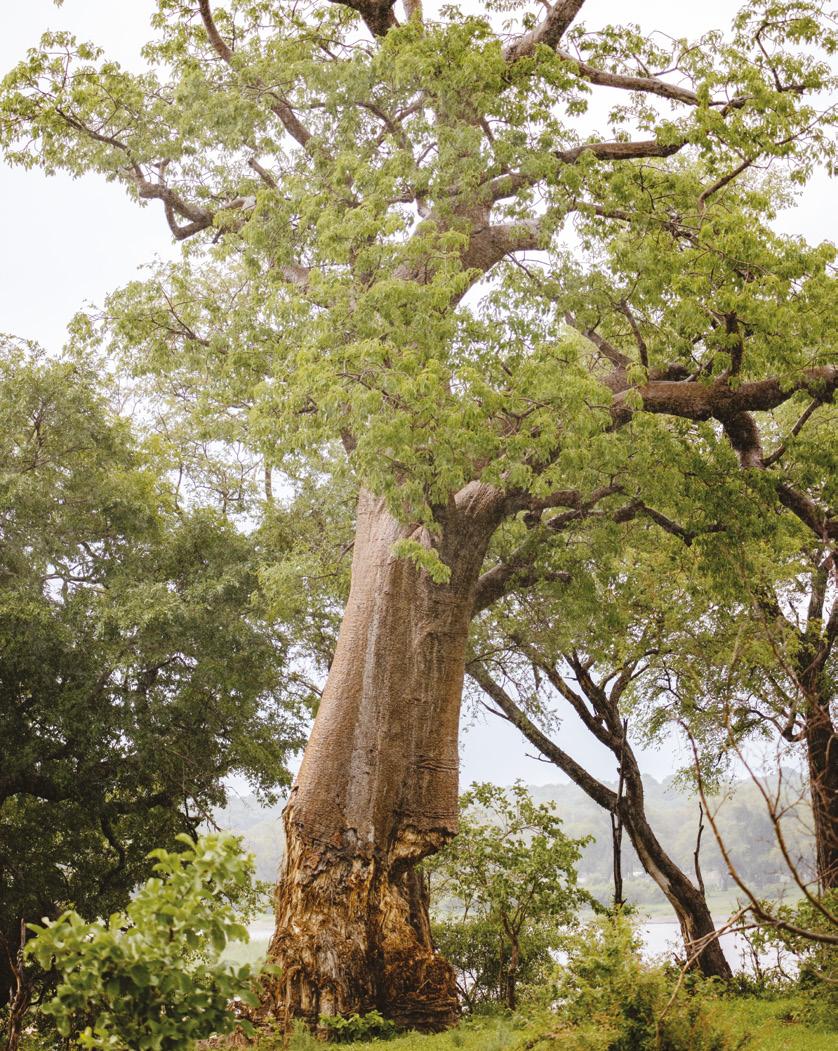
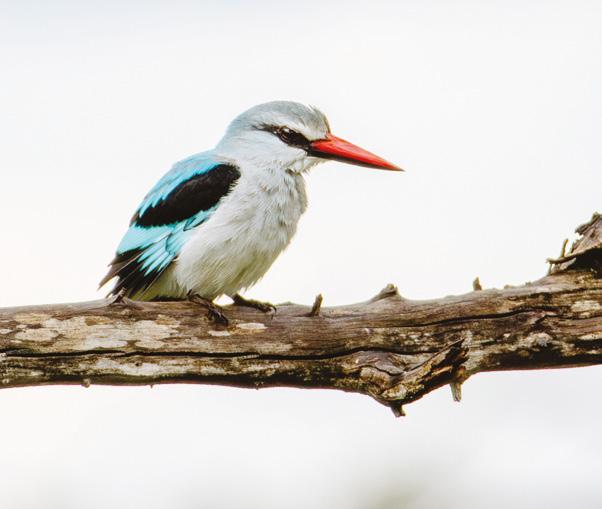
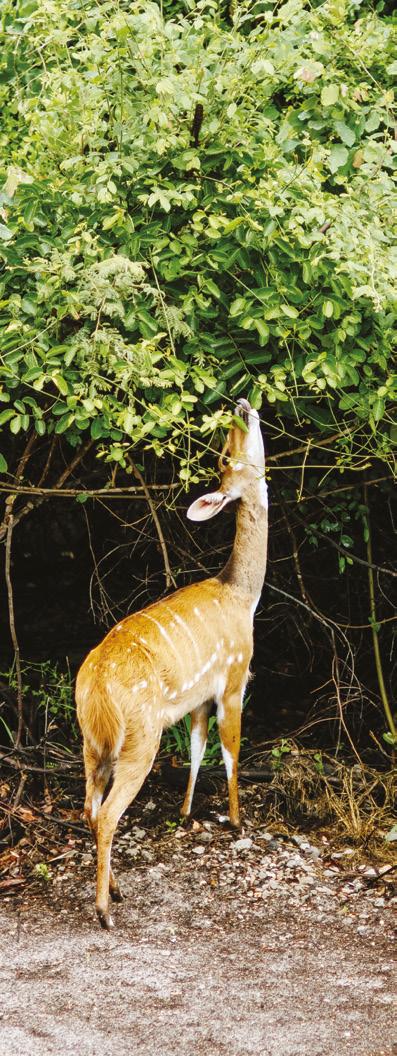
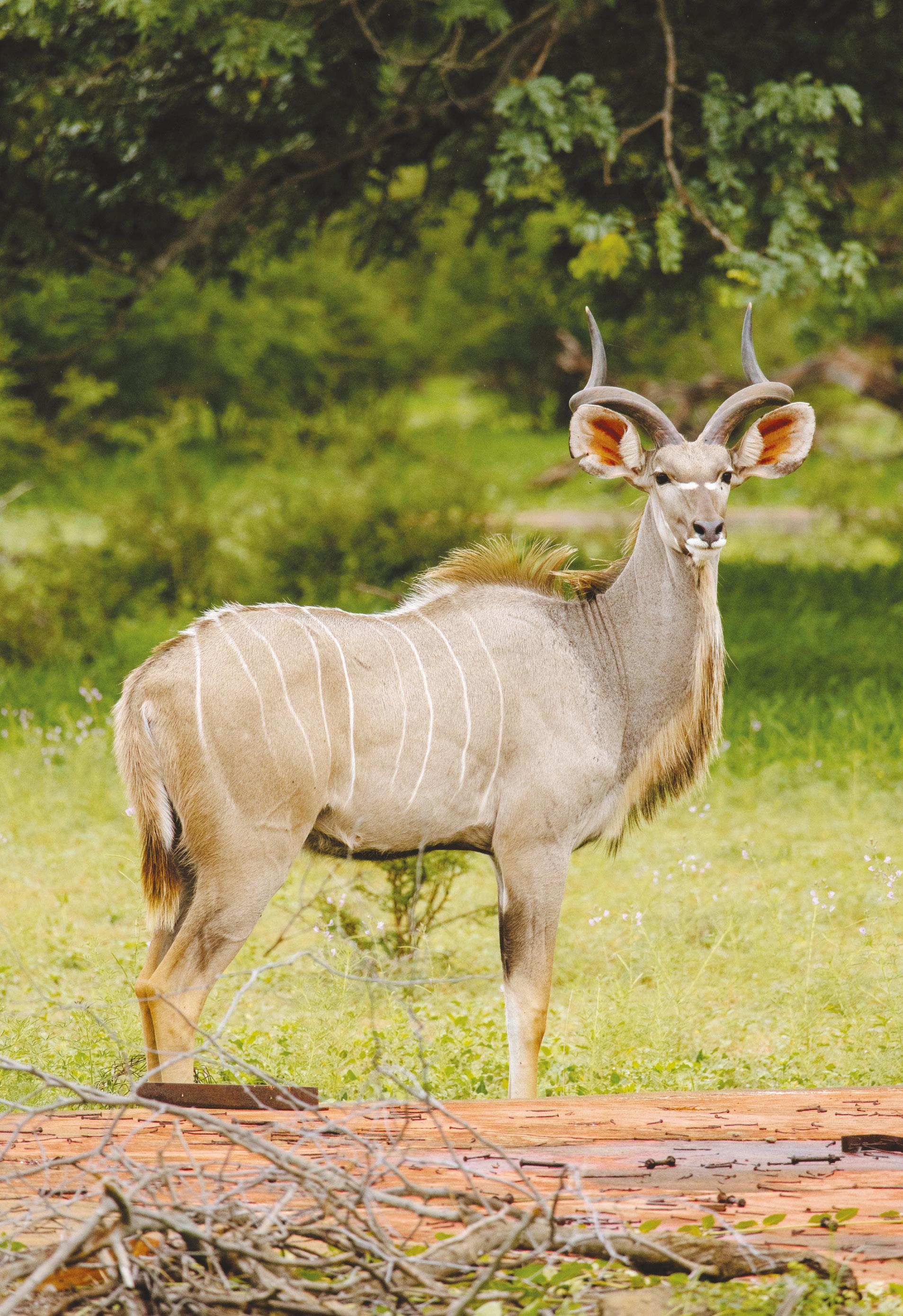
As we moved closer to the river, the park opened up. Antelope scattered across fresh grass, monkeys darted through trees, warthogs disappeared into undergrowth. Elephant damage was visible on tree trunks, bark torn away with casual strength. Colourful birds filled the air, flashes of blue, yellow and rust.
Bare feet into cold mud. Valuables held high. One line, no stopping. Just as we stepped out, deep grunts echoed again, too close for comfort.
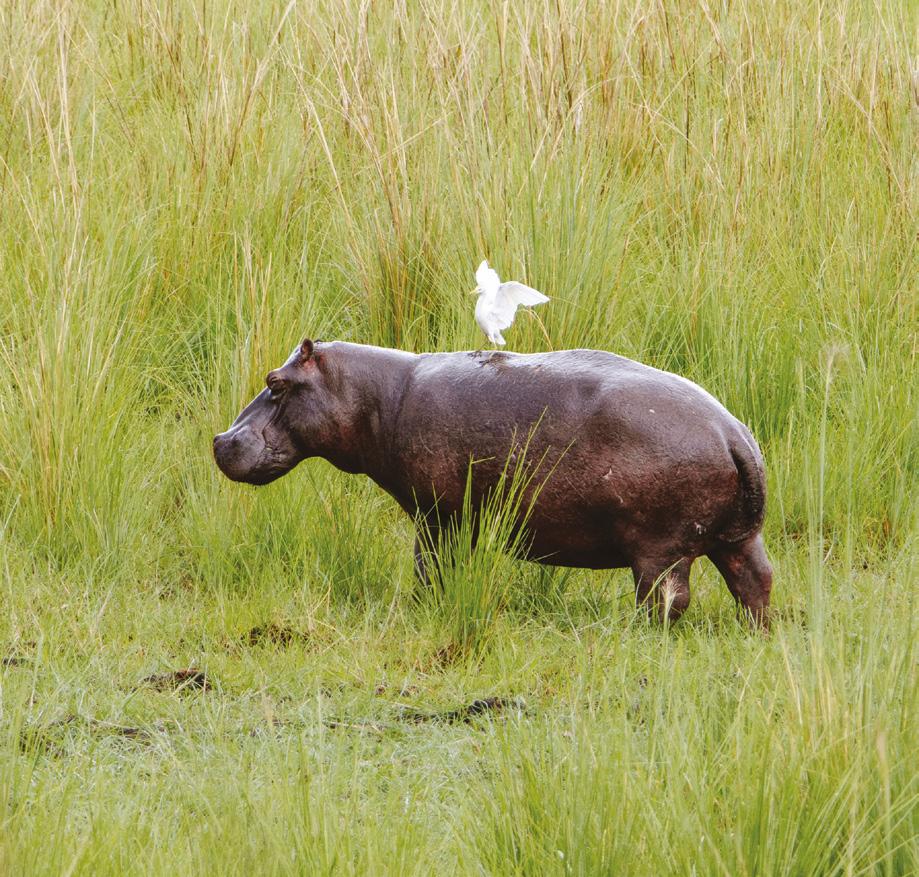
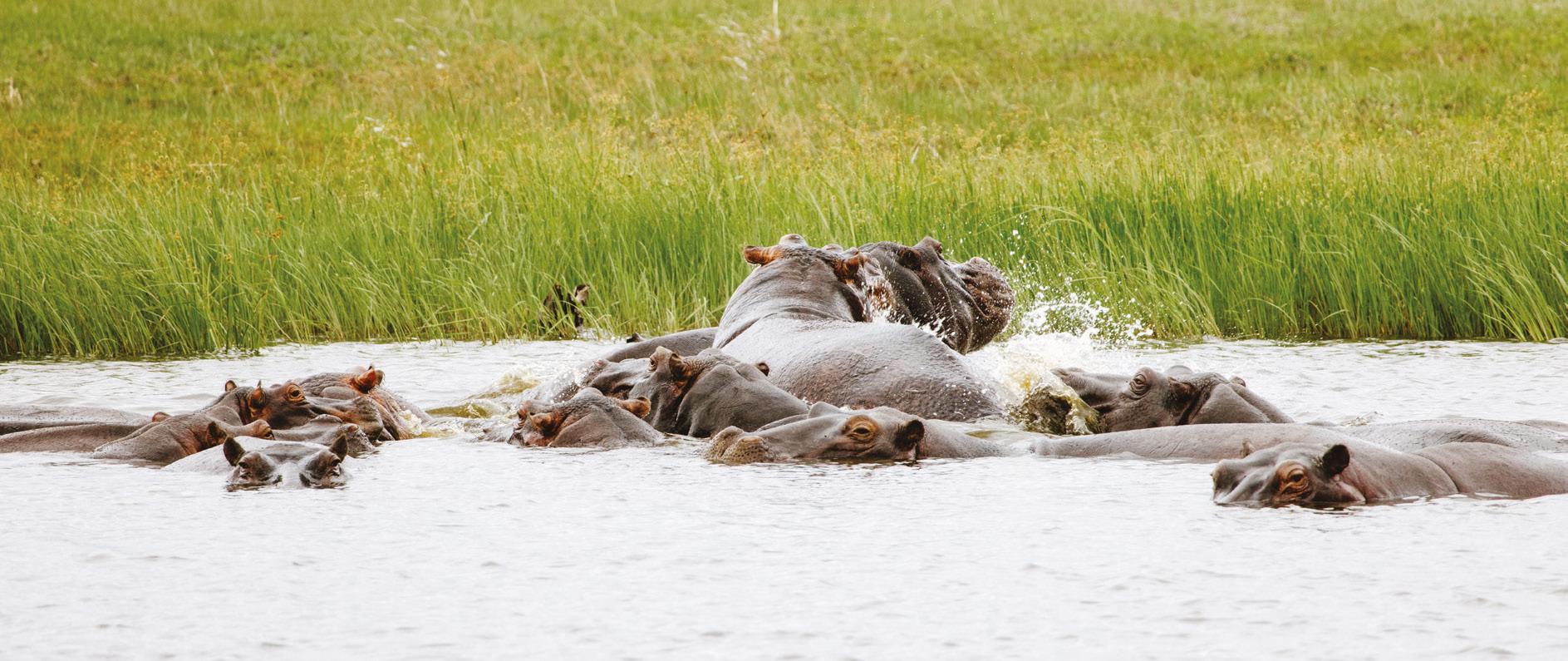
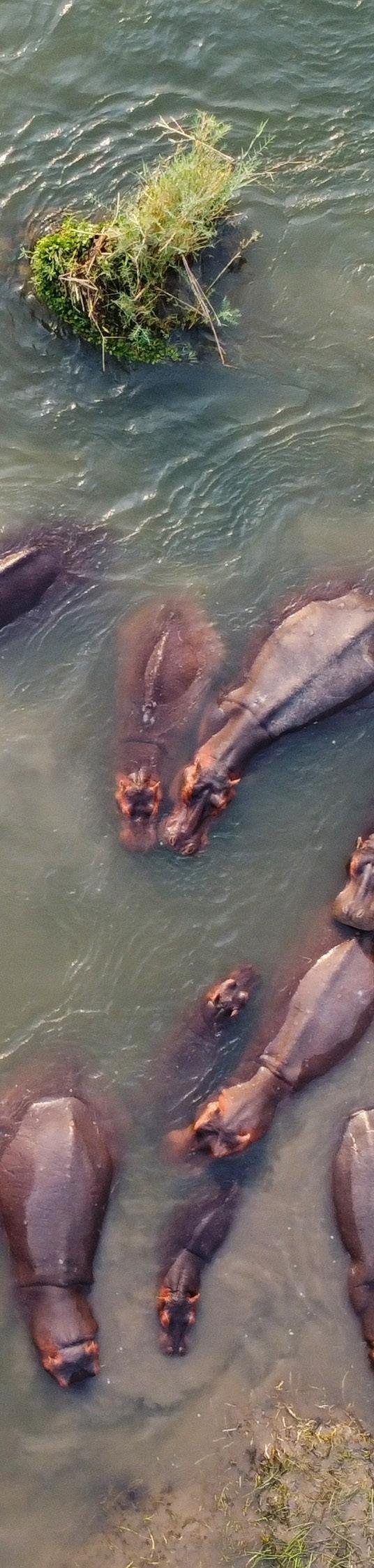
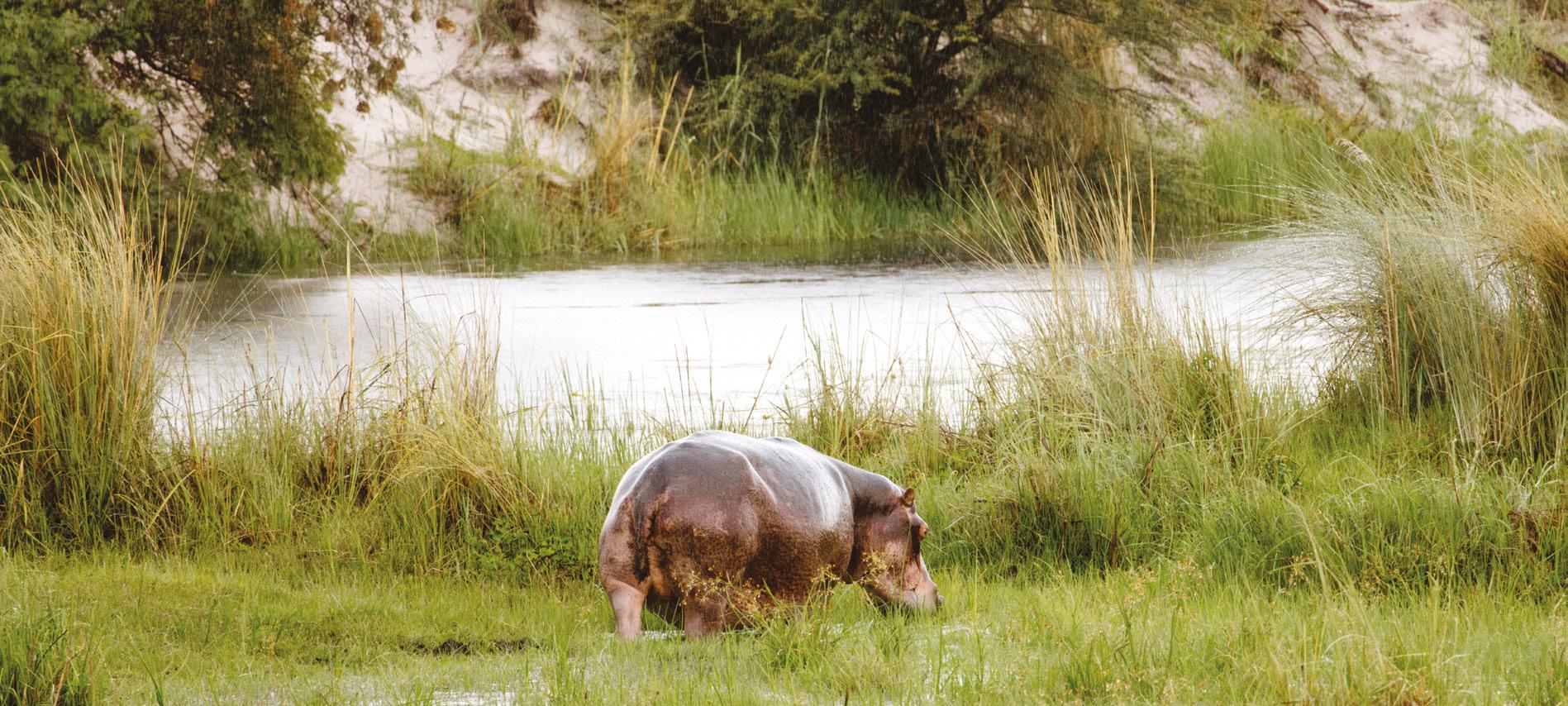
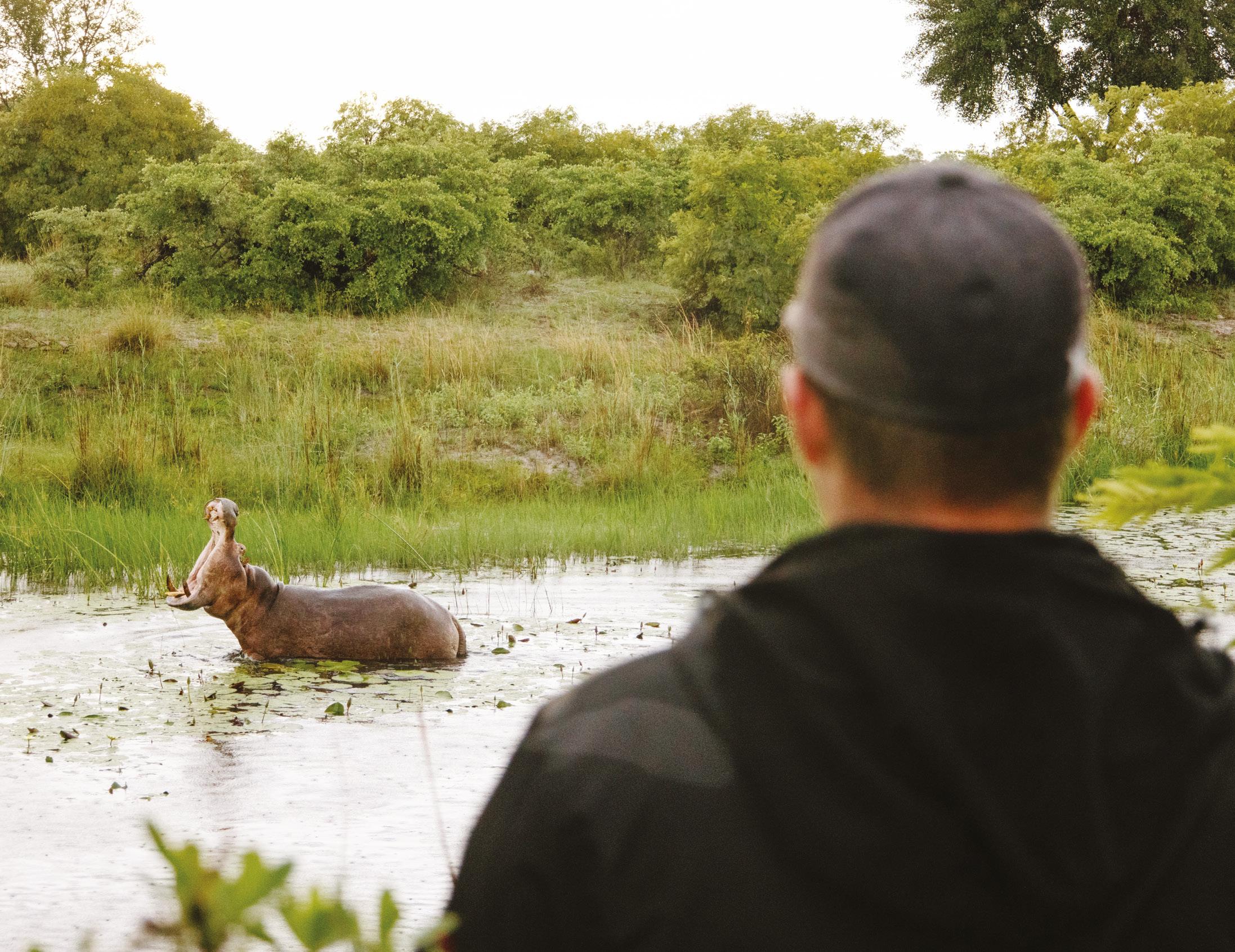
Hippos lounged and played, submerged and resurfacing with deep, echoing calls. It had been many years since I last saw a hippo in the wild, and hearing them again was something else entirely. That low sound does not just reach your ears, it settles into your chest. Standing there, watching their bulk rise from the water, I felt small. Vulnerable. Humbled by scale and power.
We decided to continue the drive. There was still so much ground to cover. Barely ten metres from the river, the guide casually pointed into the bush beside us. At first, I did not understand what I was seeing. Then my eyes adjusted.
Four metres away. Half hidden. Shining in the filtered light. We stared at each other in complete stillness while I slowly lifted my camera, very aware of every breath. After a few long seconds, it turned and walked back towards the river, a white bird landing on its back and following along. I remember wanting to warn that bird, wanting it to understand the force beneath it.
The afternoon unfolded with more wildlife, more abandoned buildings, more reminders of layered histories. We spotted a black mongoose, a first for me. Large herds of antelope grazed close together until, suddenly, they ran. Only later did we understand why.
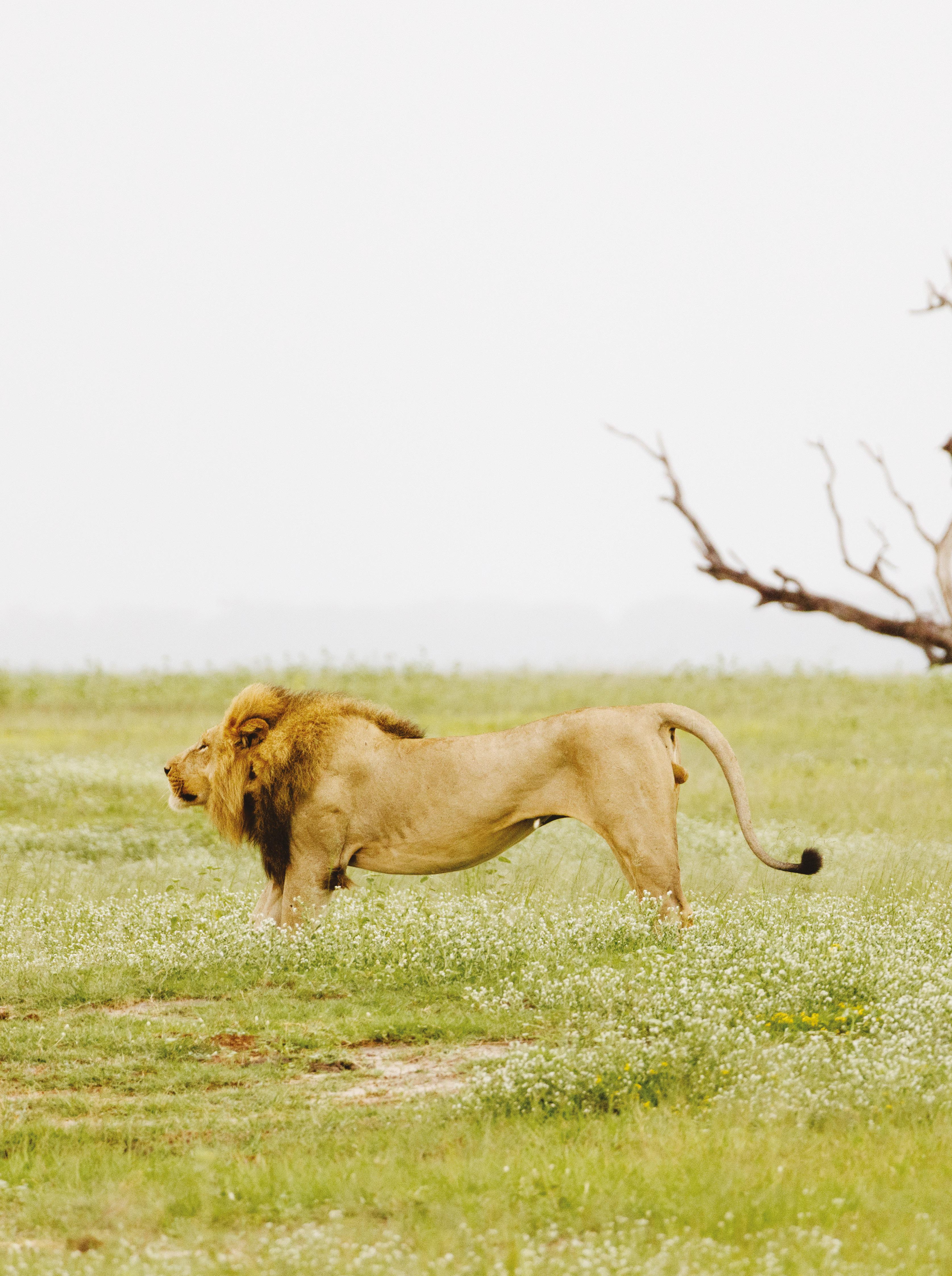
The sound reached us first. A roar that vibrates through your body and leaves no room for doubt. Excitement took over instinct. The guide followed fresh tracks and suddenly we were no longer on a relaxed game drive. We were searching. Listening. Watching every inch of ground as the sun began to lower and a distant rain shower drew a grey line across the horizon, like a bride’s veil sweeping slowly over the land.
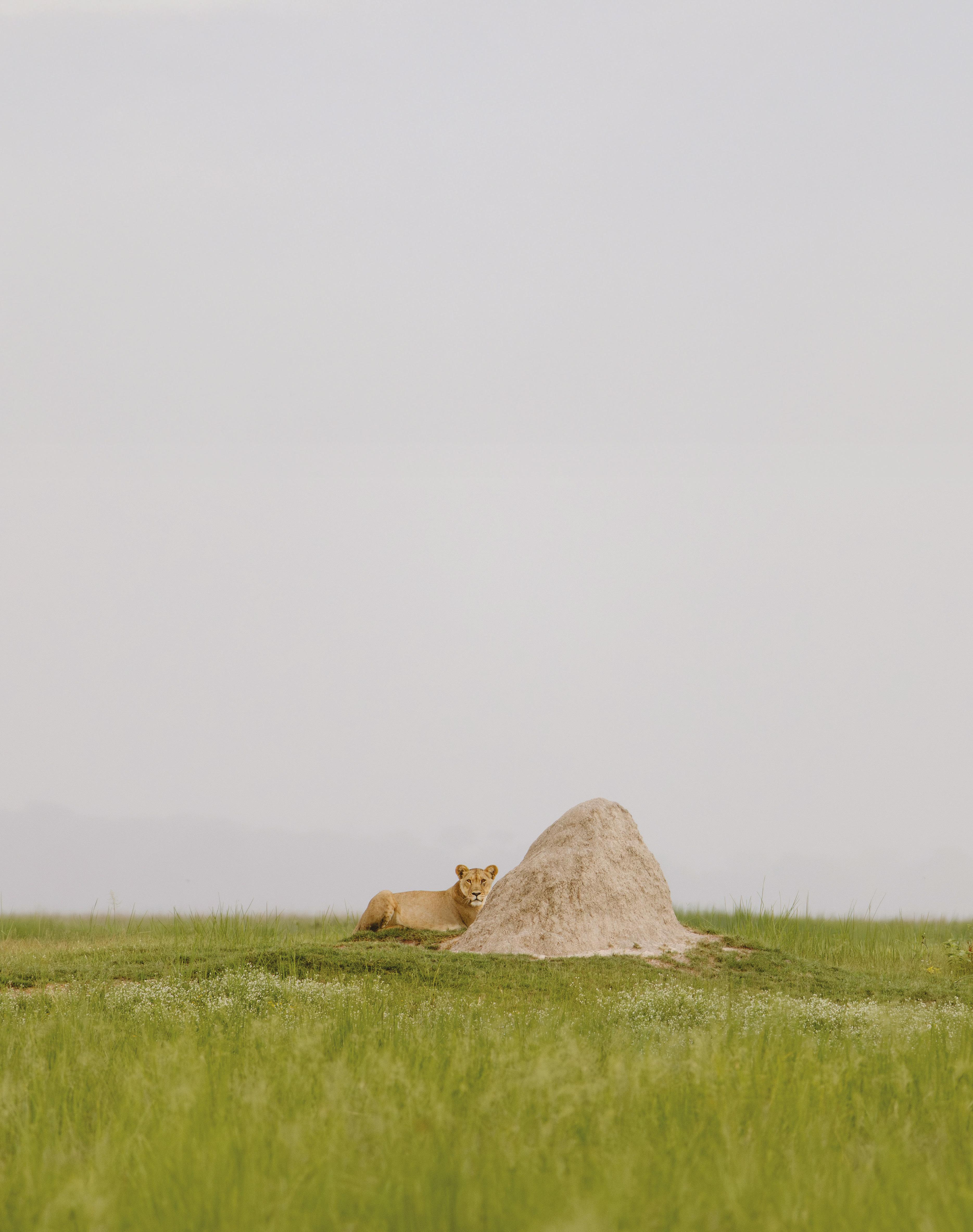
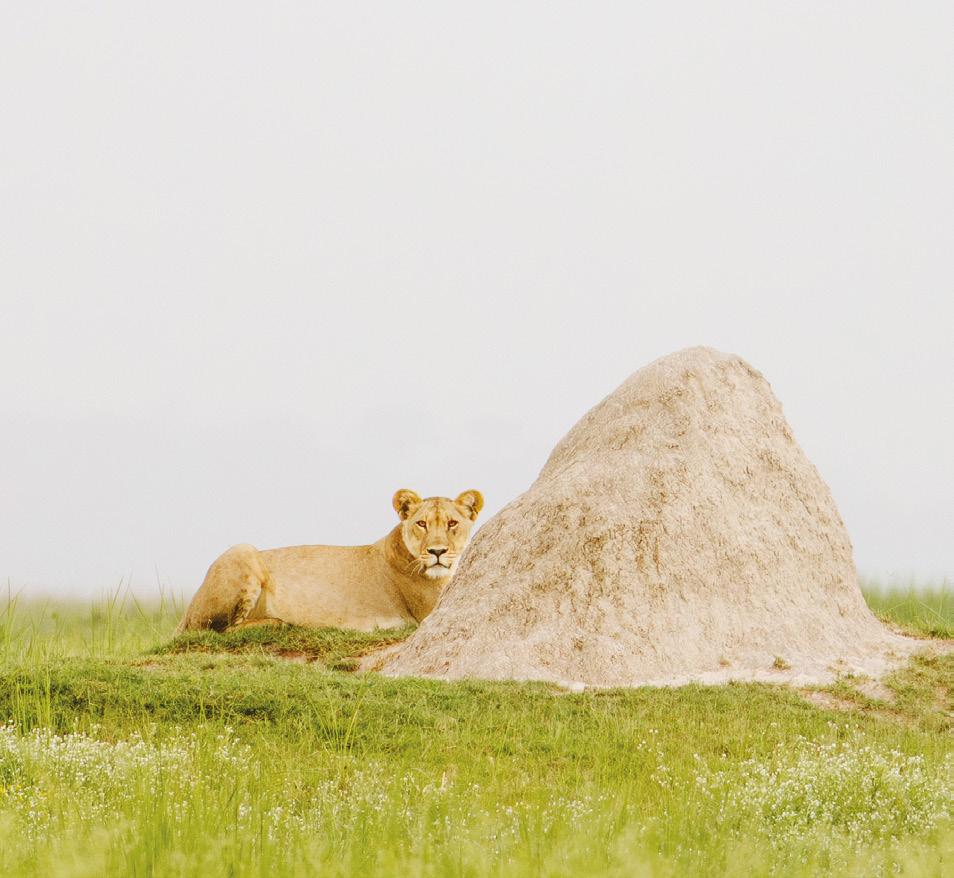
At an open, swampy plain, I saw her. A lioness, resting beside an anthill, surveying the landscape. We edged closer, pushing into ground heavy with rain. The vehicle slowed. Mud flew. Then stopped.
Fifty metres away, her presence multiplied. Two large males appeared, watching. Waiting. The open vehicle that had felt so freeing now felt dangerously exposed. Rain closed in. Darkness followed. Panic crept in as the guide climbed out to dig and search for traction, the lions’ attention fixed firmly on us.
Time stretched and collapsed all at once. For three hours, we sat there. Wet. Cold. Alert. Running through scenarios no one ever wants to rehearse. At one point, one of the males moved closer, head low, purposeful. I shouted, abandoning politeness in favour of survival.
Eventually, help was called. We lowered the canvas sides as rain poured down and waited, listening to every sound, using the camera screen to see beyond the dark. When headlights finally cut through the night, relief arrived with trembling hands.
Bare feet into cold mud. Valuables held high. One line, no stopping. Just as we stepped out, deep grunts echoed again, too close for comfort. Hippos somewhere nearby. Crocodiles earlier seen sliding into these same waters. There was no choice. We walked.
I have never been so afraid in my life.
Dinner that night tasted like survival. Sleep came hard and heavy. The next morning felt unreal. As if the bush had exhaled and reset.
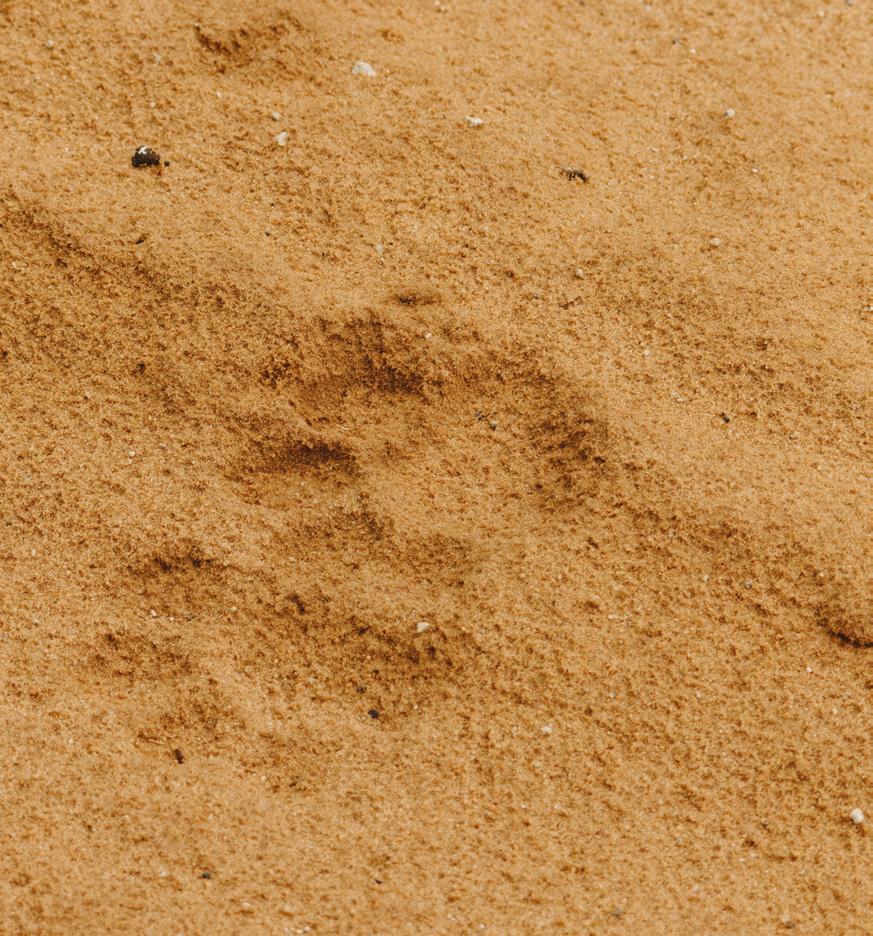
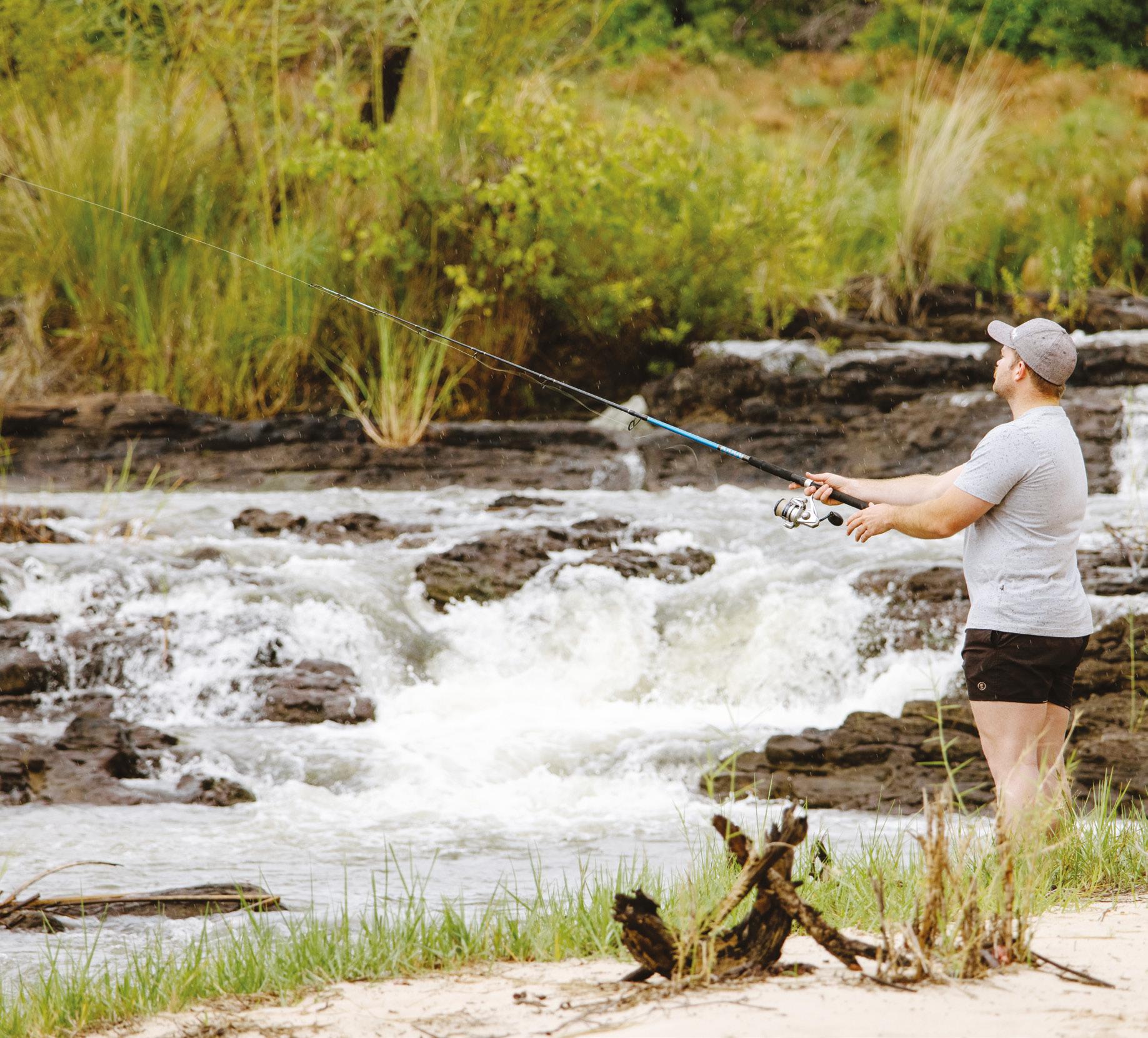
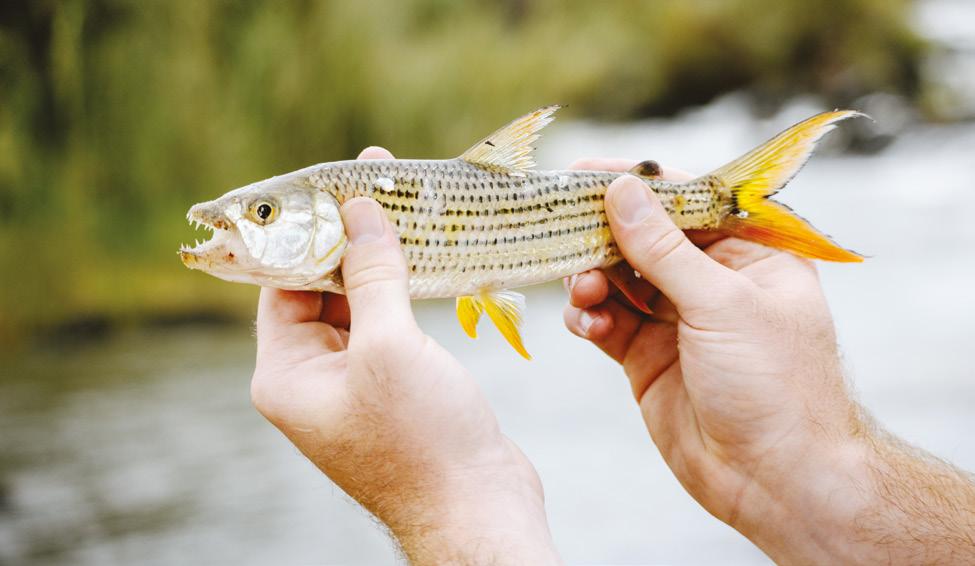
Hippo tracks crossed the path outside our room. At the falls, we tried our luck with fishing. Small tigerfish flashed in the water. While one of us fished, the other watched birds, otters and a distant crocodile, soaking up a peace we had earned.
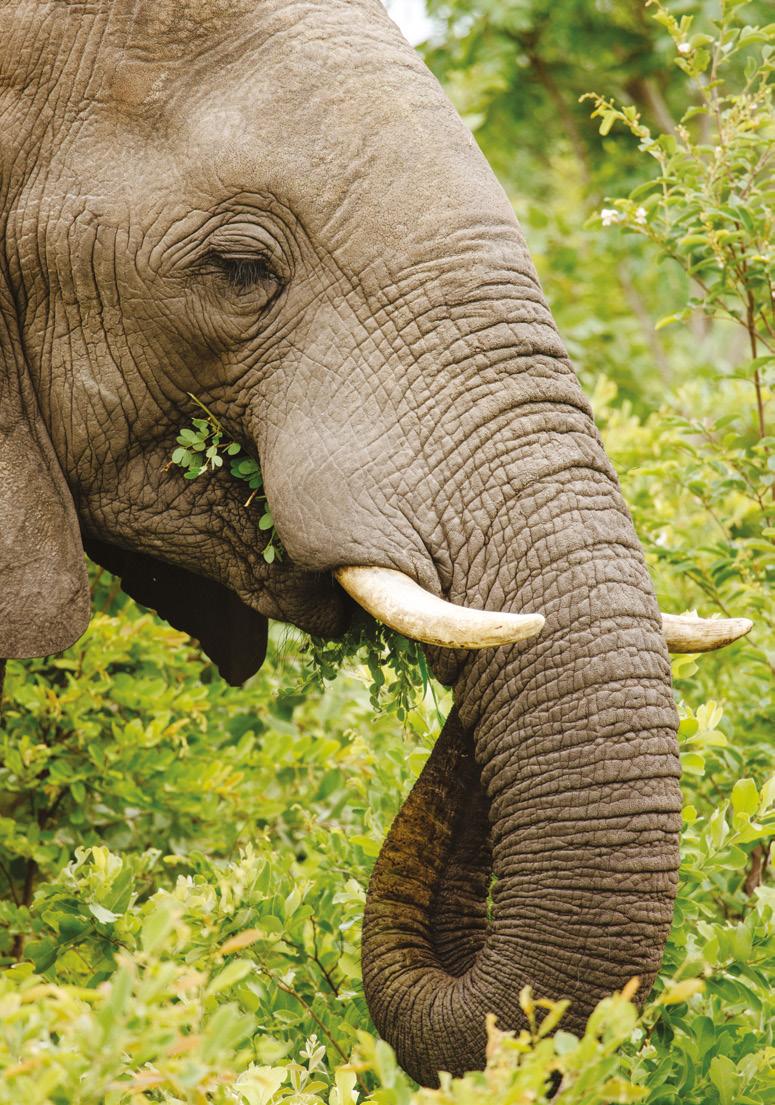
We left Buffalo Core Area with full hearts and headed east towards the Kwando Core Area. Ten minutes into the drive, an elephant stood beside the road, calm and massive, as if sending us off.
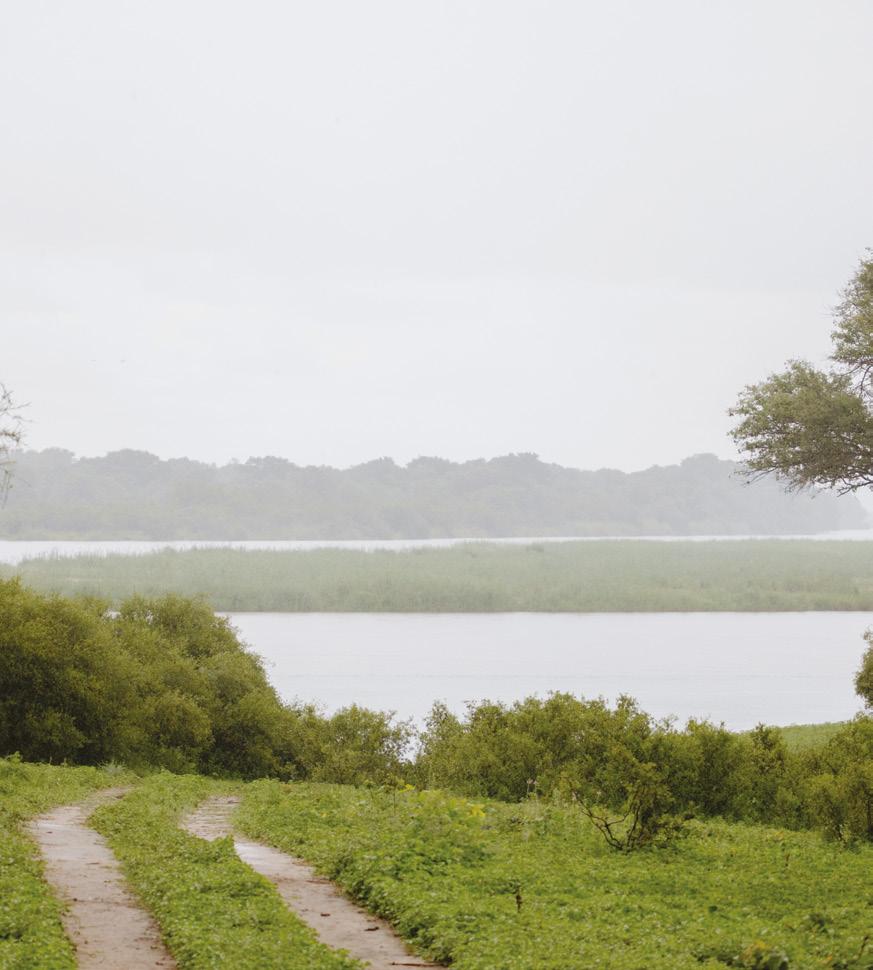
Villages passed by. Children played. Life looked hard and simple at once. I tried to work, laptop open, but could not stop looking up. I was not sure whether I envied that simplicity, knowing my own life is easier in many ways, yet far more complicated
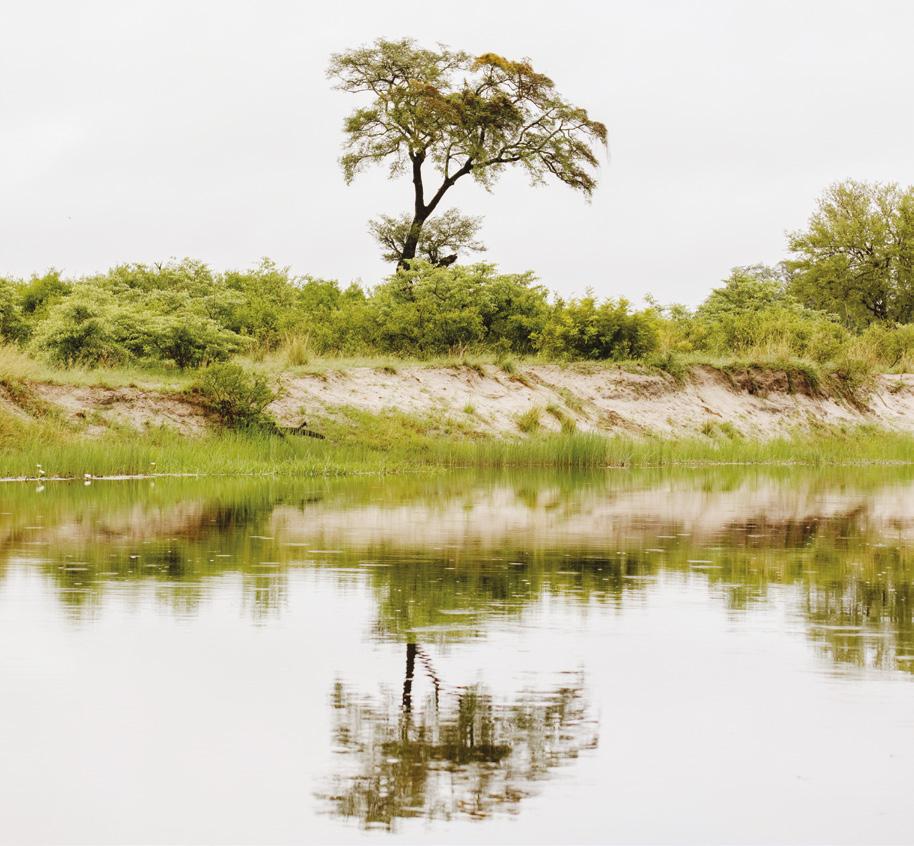
Kwando welcomed us with sunshine. A simple stream of water marked the boundary between Namibia and Botswana, quietly splitting two countries. The river here is alive with movement. Hippos. Crocodiles. Birds nesting in trees. On the water, families of hippos surfaced close to the boat, ears, eyes and nostrils breaking the surface, water blasting from their noses with sharp tshh sounds, followed by that unmistakable he-he-he that climbs into your body and takes over. Powerful. Unsettling. Addictive.
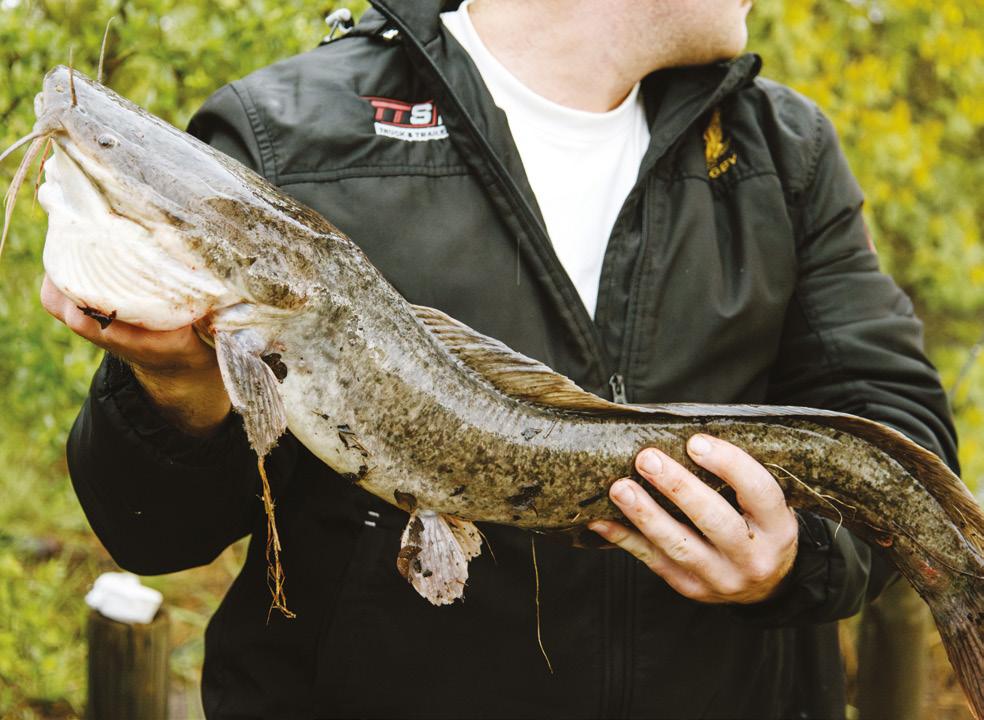
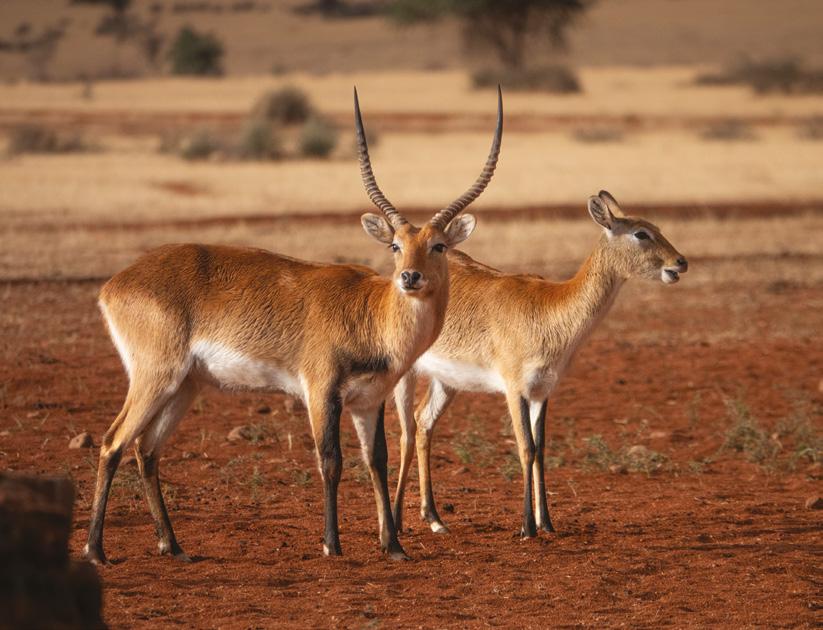
At night, hippos passed through the lodge grounds. Tracks appeared each morning. Bush babies darted through the trees. Catfish slithered along the swampy areas after insects. Lechwe grazed near our rooms. Sleep came easier with time, though respect never faded.
We drove and cruised, guided and alone. We came within centimetres of the largest crocodile I have ever seen,
easily 5 meters in length, floating silently beside the boat, emotionless and ancient. We watched elephants in the distance, antelope everywhere, warthogs and zebra framed by the greenest landscapes I have ever seen in Namibia.
On our last night, we sat at the hippo pool for sundowners. No fence. No vehicle. Just us and a family of around forty three hippos. I could have stayed there for days.
Before sunset, we tried fishing one last time. Catfish took the bait. A hippo nearby opened its mouth wide, reminding us whose territory we were in.
Leaving felt too soon. This land is not gentle or forgiving. It is raw and unfiltered. It does not make excuses. It demands respect. Close encounters here are not curated. They are real. Hippos in the bush. Lions in the rain. Crocodiles beside your boat.
We drove home with hearts full. Of rain and fear and gratitude. Of people and animals and stories layered deep into the soil. Bwabwata and the Caprivi left their mark. And we know, without question, that we will be back. TN

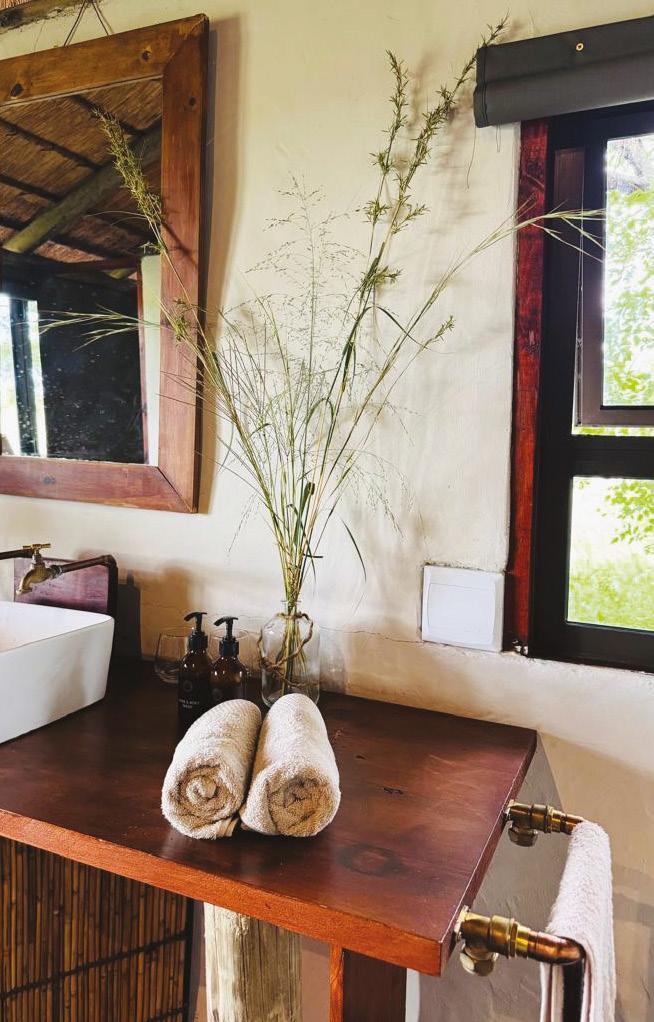

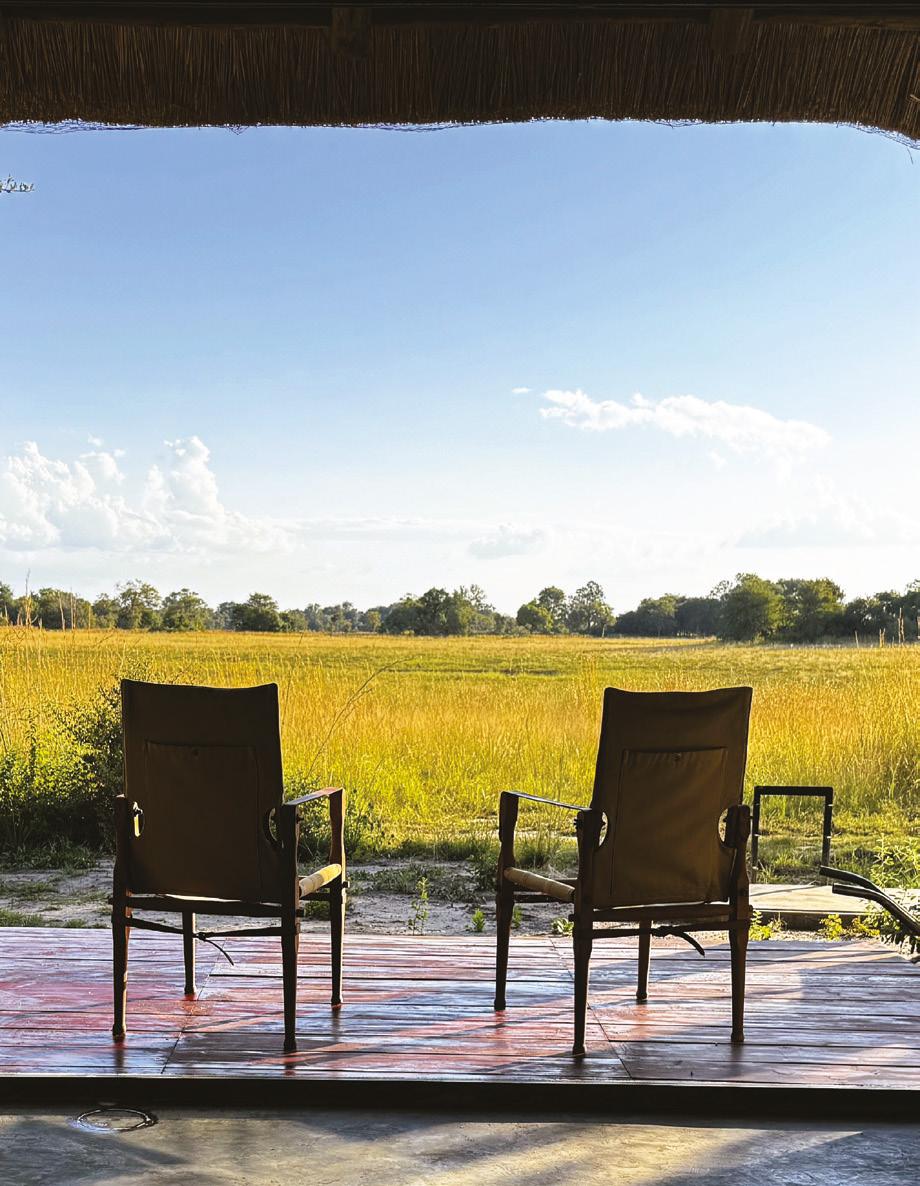
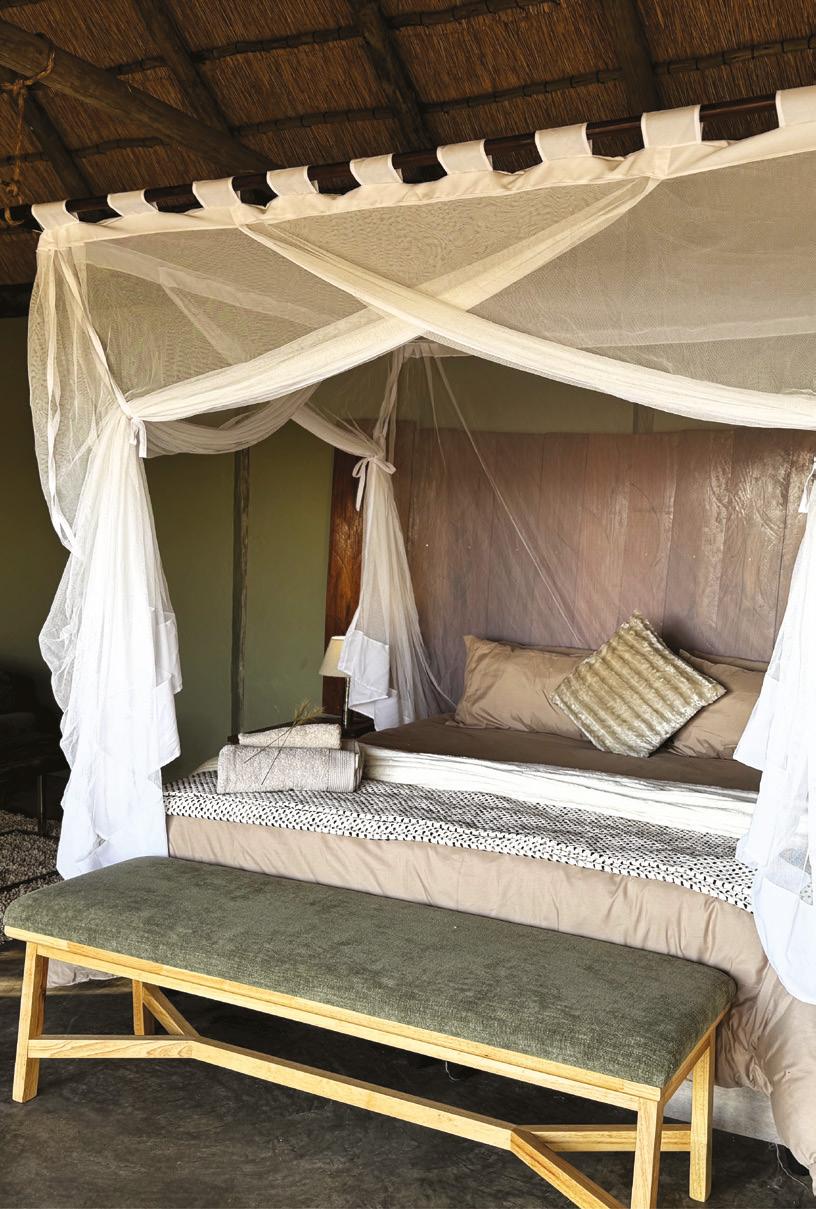
On the edge of the Nkasa Rupara National Park, where the Linyanti wetlands stretch wide and wildlife moves freely, you’ll find Livingstone’s Camp, a place where comfort meets true wilderness. Whether you prefer our exclusive private campsites, the cosy self-catering chalet for two, or the spacious Livingstone’s House for families and small groups, every stay offers space, privacy, and a genuine connection to nature.
Our new main area, complete with cocktail pool, bar lounge, and open dining deck, brings relaxed comfort to the bush without taking away from the wild surroundings. Livingstone’s Camp is for travellers who value quiet, open landscapes, authentic safari experiences, and moments that don’t need to be rushed.
www.livingstonescamp.com | Reservations email: info@livingstonescamp.com | Reservations Tel: +264 81 698 2908



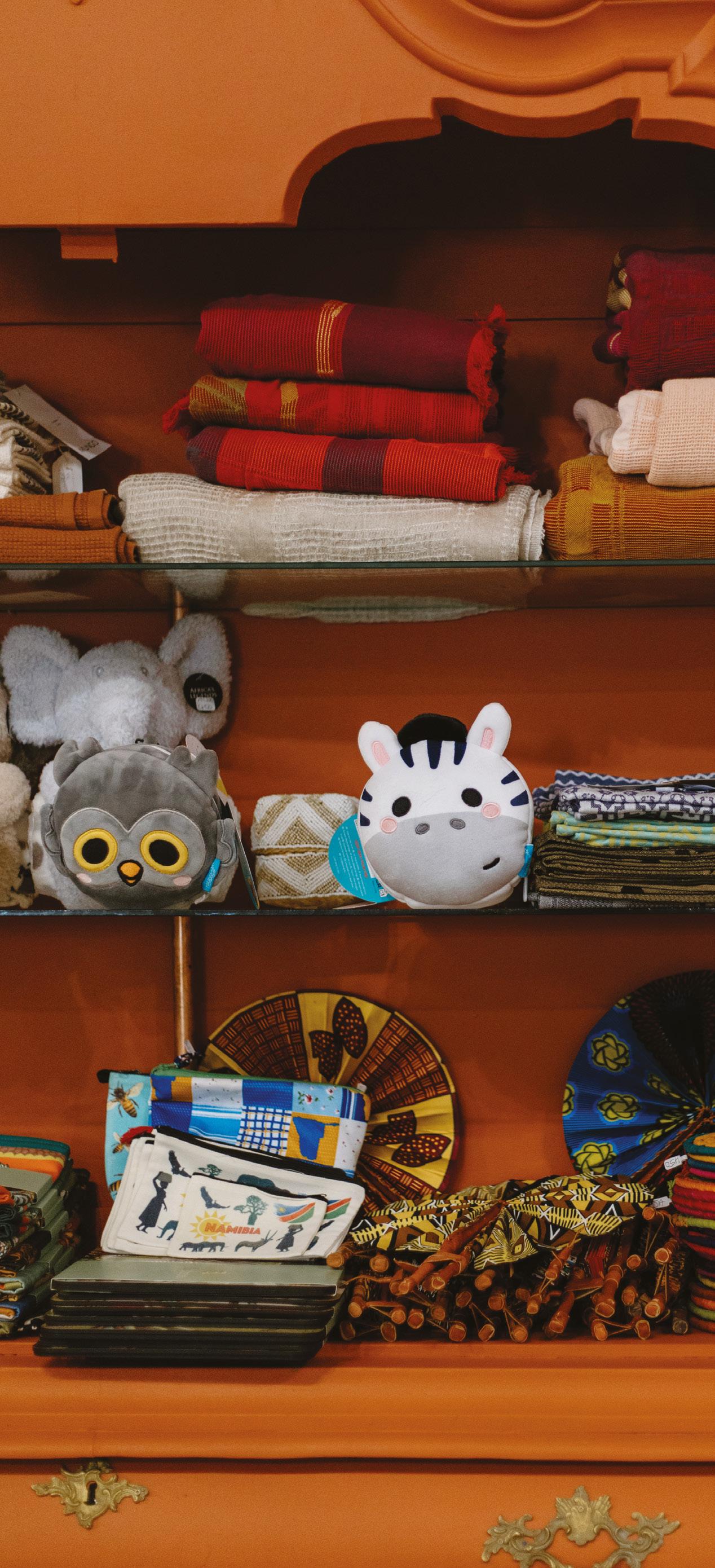
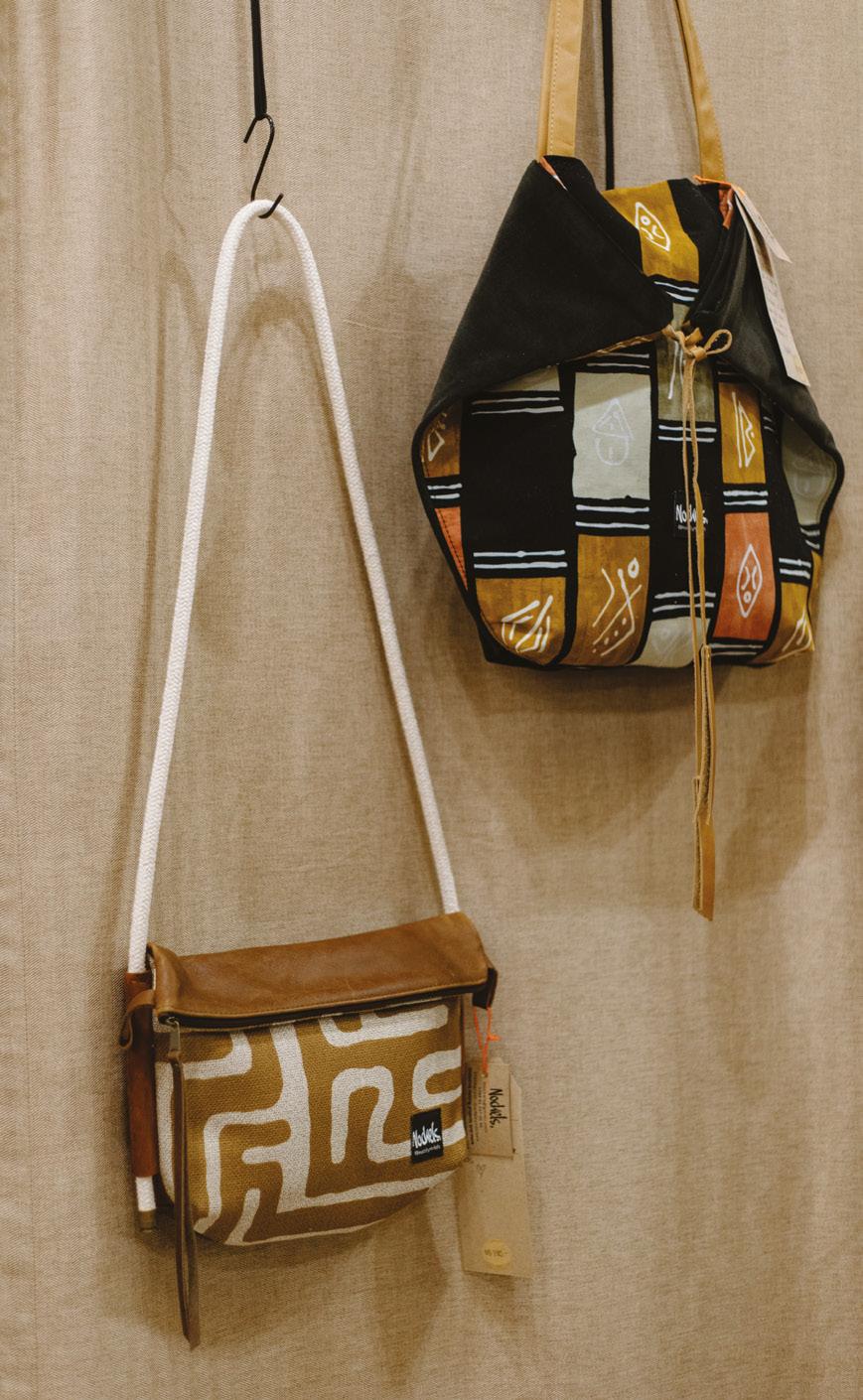
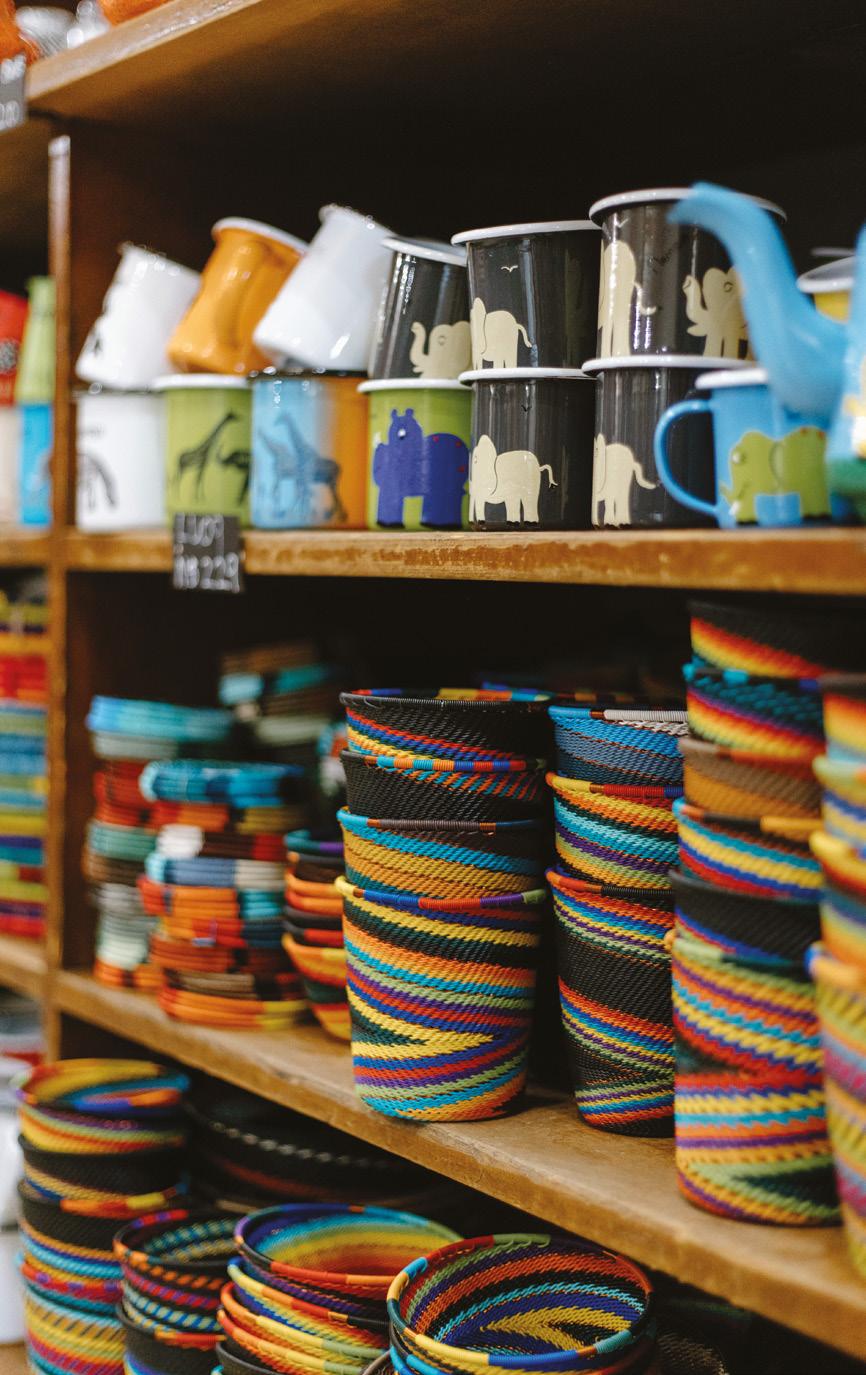
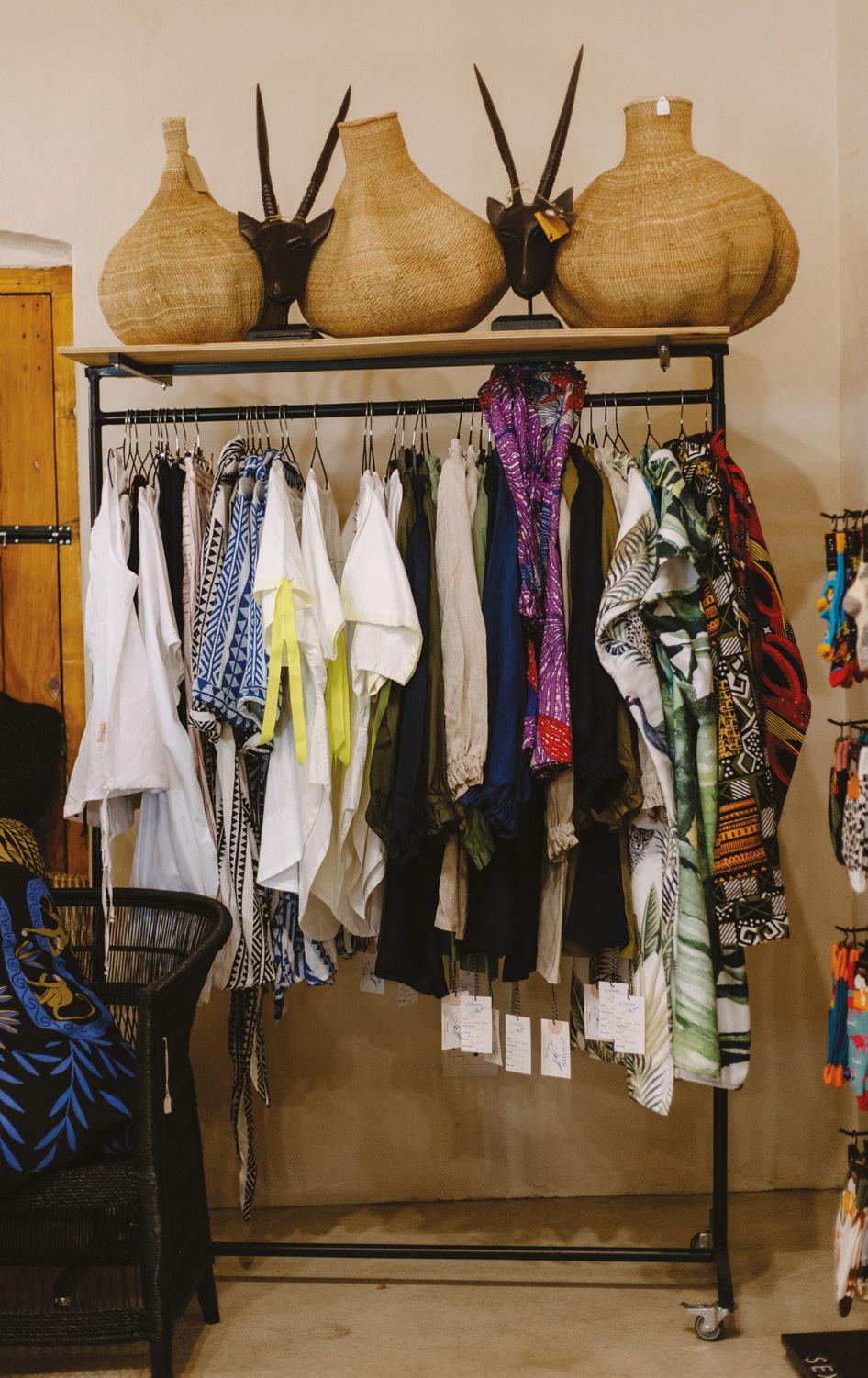
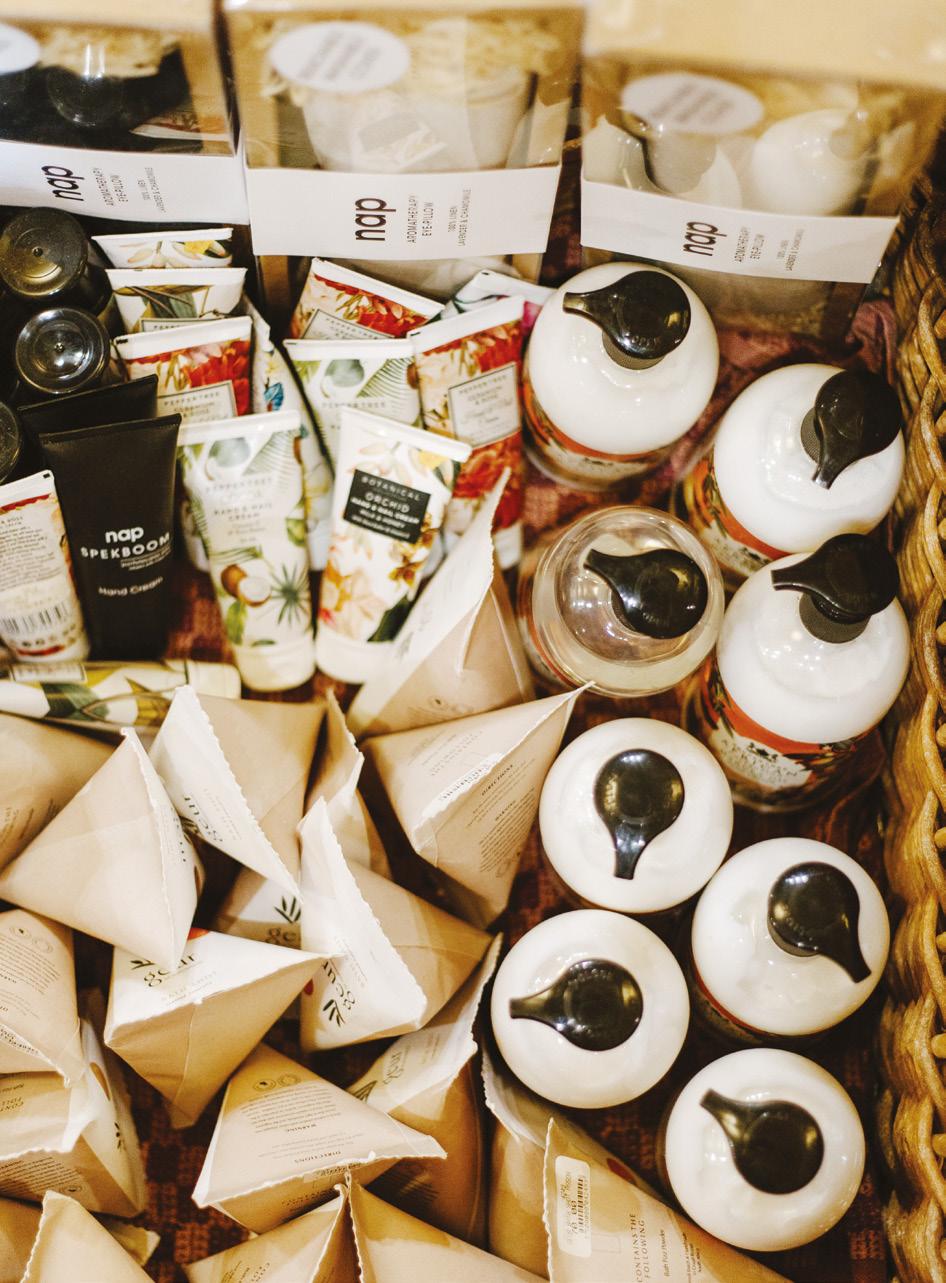
When you step into African Chic, the spacious high ceiling and open layout immediately draw you in, enveloping the unsuspecting shopper in a dreamy embrace. This is a place where you can slow down, browse at your own pace and uncover a treasure trove of unique, handcrafted African arts and crafts.
African Chic is an offshoot of its successful sister store, The !Ikhoba Project, located at the Namibia Craft Centre. While !Ikhoba focuses mainly on locally made items, African Chic offers a broader and more diverse collection, with the majority of products sourced from Namibia, South Africa, Kenya, Zambia and Zimbabwe.
The store opened its doors in July 2025 and is nestled among beautifully restored buildings in Grüner Kranz, Southern Industrial, Windhoek. Shop owner Mildred von Frankenberg-Lüttwitz envisions a seamless shopping experience for everyone, not only tourists and local curio lovers but also lodges and tour operators. “I want lodges to come and grab what they need to restock their establishments,” she explains.
African Chic is the ideal “one-stop shop” for lodge owners: an elegant wholesaler abundantly supplied with anything from woven placemats, stylish tote bags and purses to beaded ornaments, plush stuffed animals, skincare products, spices and even a collection of 100% cotton attire.
Adding to the appeal is Leo’s Garden Restaurant, a tranquil courtyard eatery conveniently adjacent to the store. And for those in the tourism industry, African Chic offers a direct-to-trade model, with tour operators eligible for generous discounts of up to 40%.
Whether you are a local, a traveller or a lodge owner, step inside and discover something special. TN

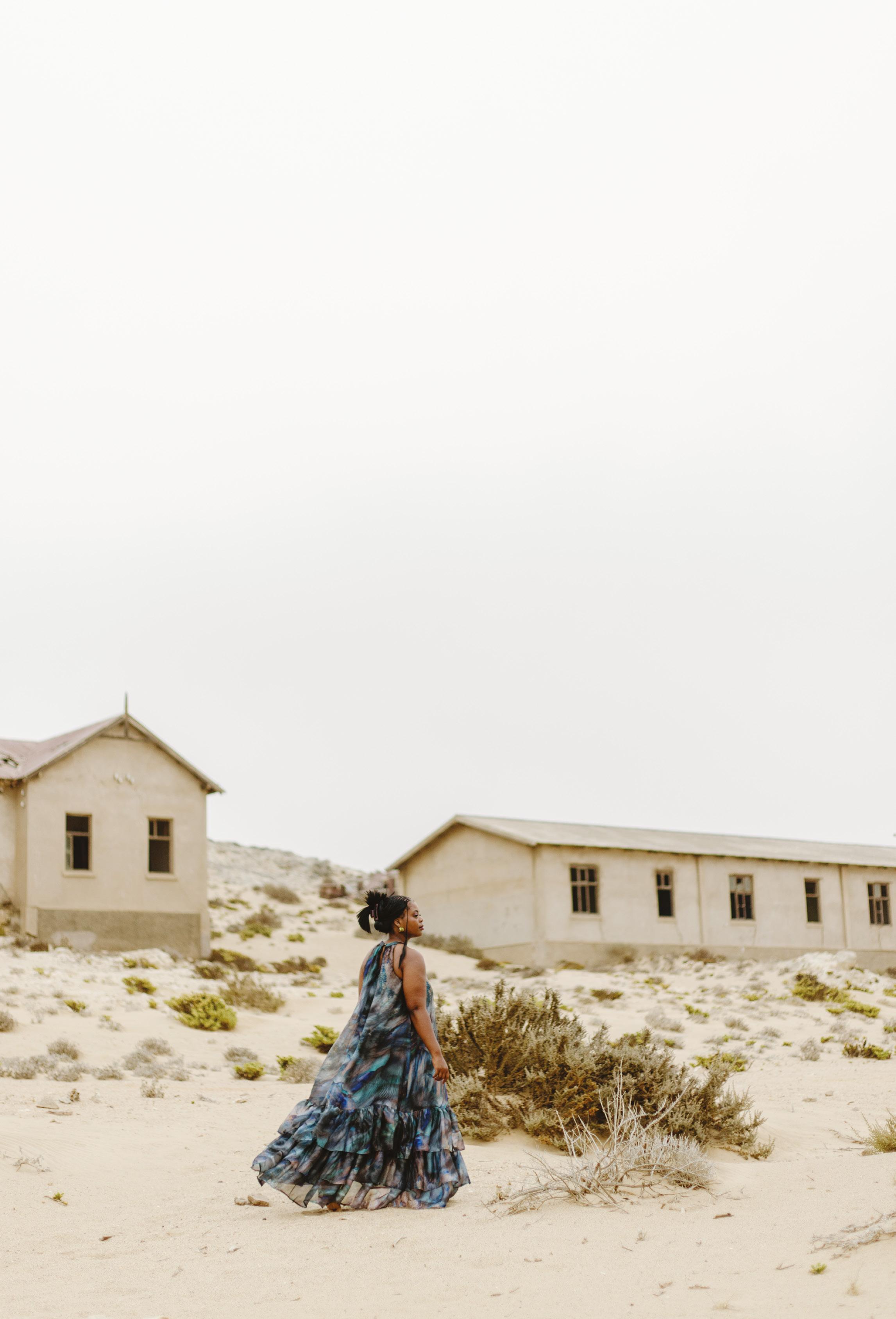
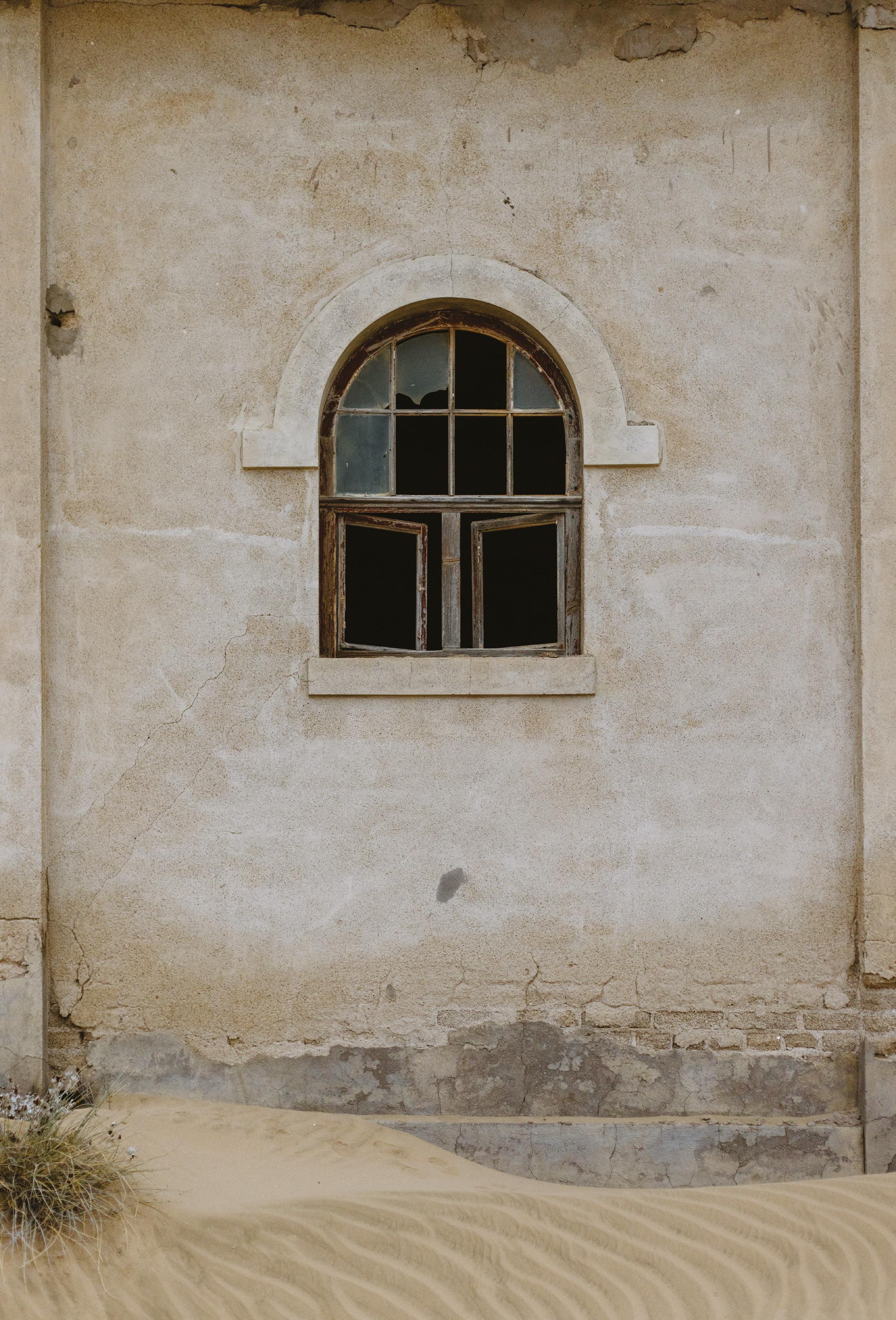
There is an eerie silence that settles over you the moment you step into Kolmanskop. It is not the absence of sound, exactly, but a hush – as if the desert itself is listening. You find yourself walking softly, instinctively, as though raising your voice or scuffing your feet might disturb someone resting just beyond the next doorway. No one lives here anymore, and yet the sense of human presence lingers. Lives were built here. Dreams took shape here. Hope once flourished behind these walls.
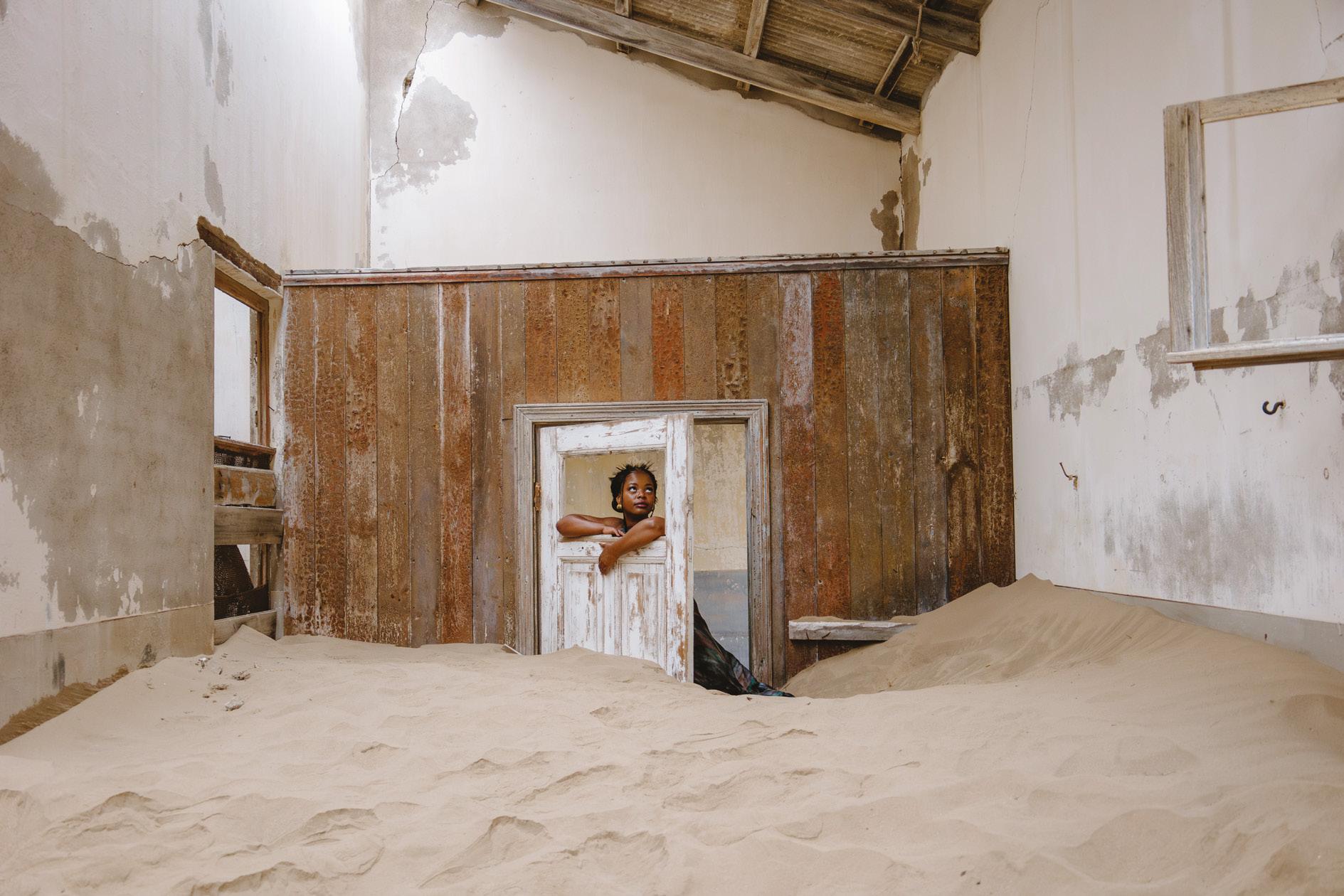
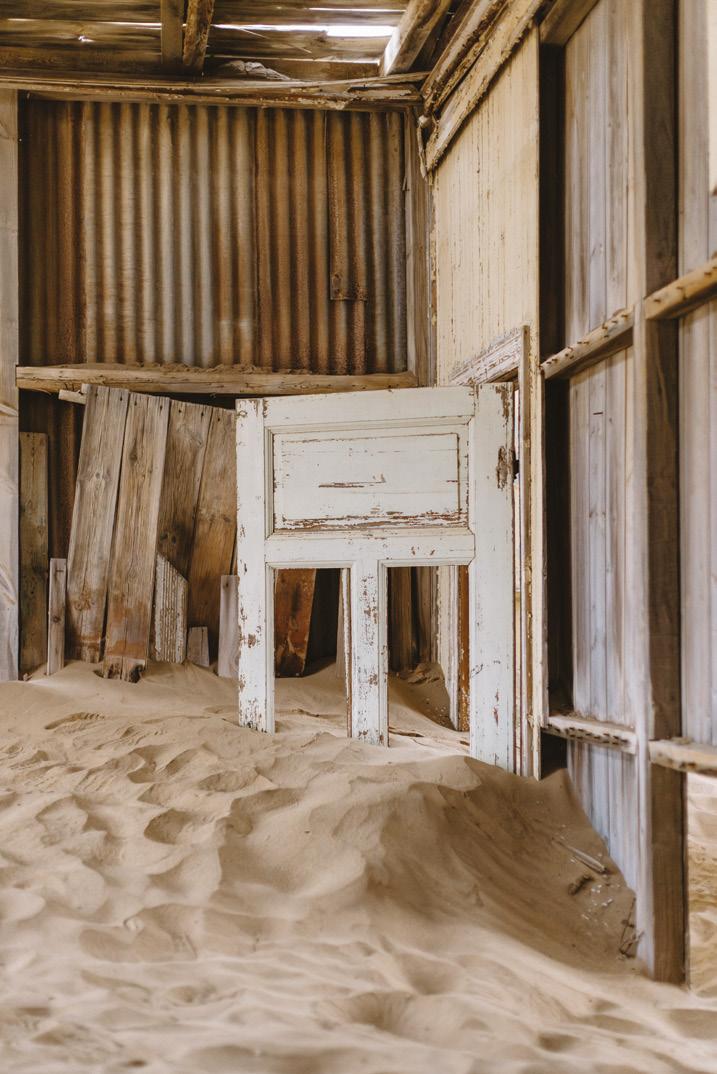
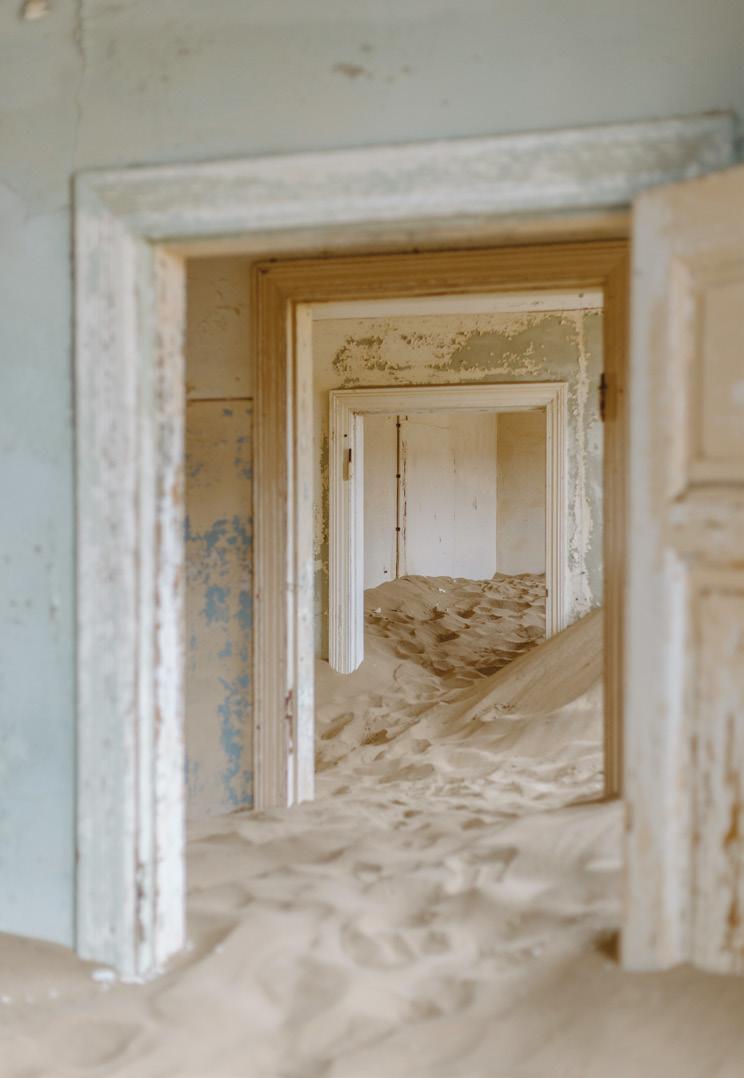
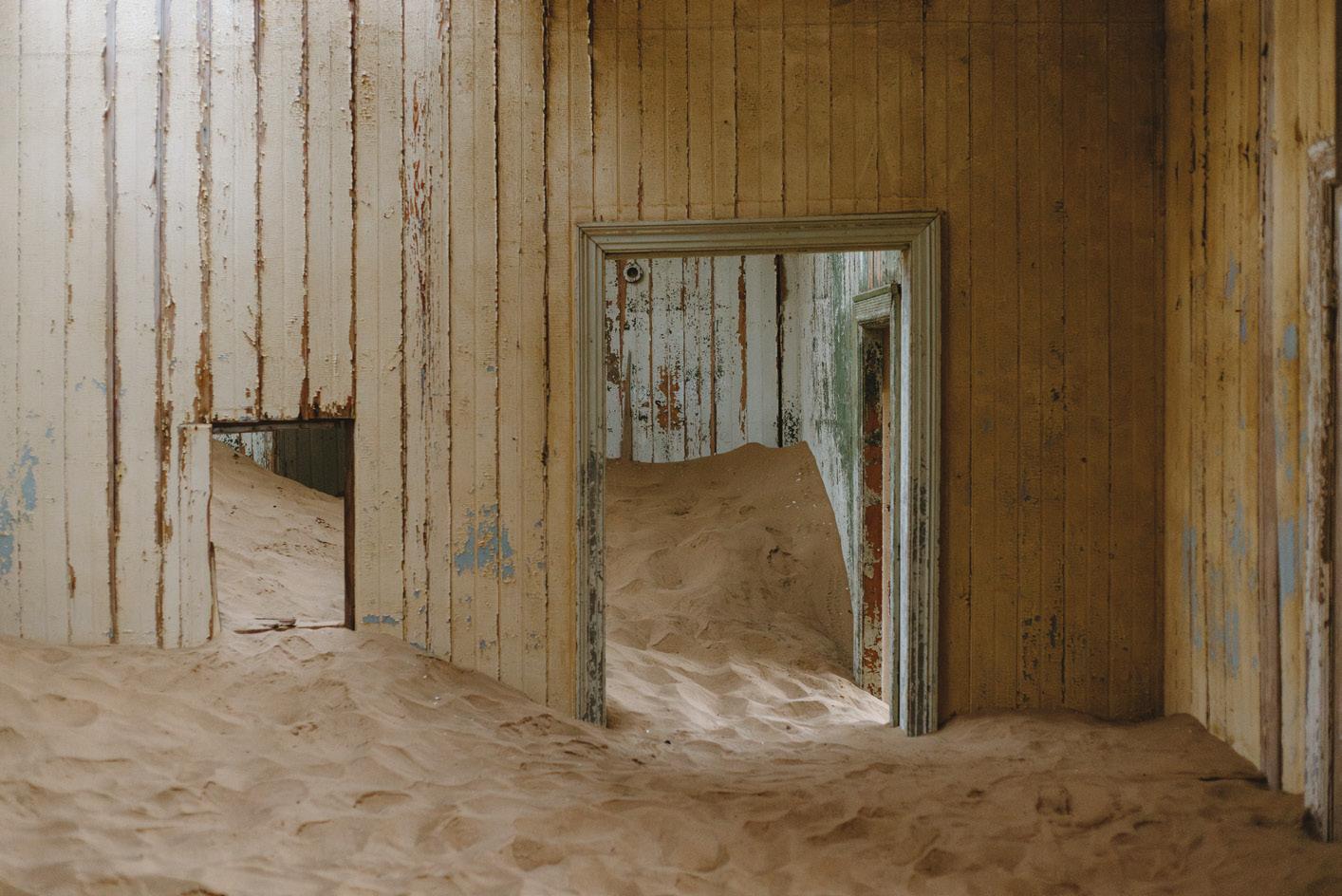
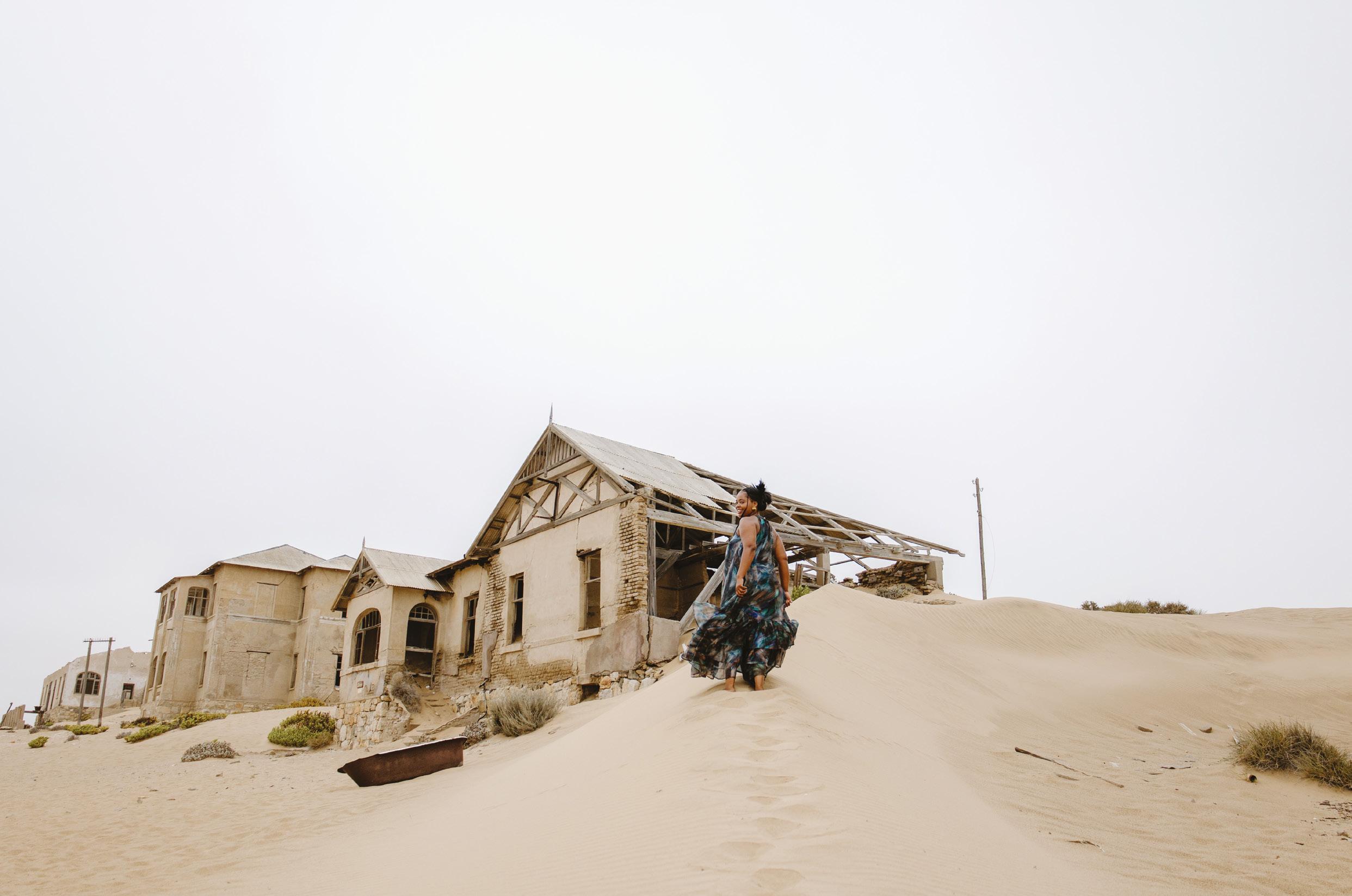
Today, the Namib Desert is steadily reclaiming what was once one of the wealthiest towns in Africa. Sand pours through broken windows and pools in corners like slowmoving tides. Doorways frame dunes instead of domestic interiors. Ceilings gape open to the sky, allowing sunlight, wind and time to pass freely through spaces that were once carefully contained. The energy of the place feels suspended – evaporating like ocean mist under desert heat, but never quite disappearing.
Kolmanskop owes its existence to a single, glittering truth – the diamond. In 1908, a railway worker named Zacharias Lewala found a diamond in the sand and showed it to his supervisor, August Stauch. That moment triggered a frantic rush into what was then German South West Africa, as fortune seekers converged on this stark stretch
of desert in search of unimaginable wealth. Soon after, the German Empire declared the area a Sperrgebiet – a prohibited zone – and intensive diamond mining began.
What emerged from this inhospitable landscape was nothing short of astonishing. Kolmanskop was built in the architectural style of a German town, complete with wide streets and grand buildings that seemed almost defiant in their elegance. At its peak, the town boasted amenities unheard of elsewhere in the region – a hospital, school, theatre, casino, ballroom, skittle alley and sports hall. There was an ice factory in the desert, the first X-ray station in the southern hemisphere, and even the first tram in Africa. A railway line connected the town to Lüderitz, while electrified narrow-gauge lines ran south to service the diamond fields.
Walking through Kolmanskop today, it is impossible not to marvel at the ambition of it all. The remains of Edwardian interiors are still visible – fragments of wallpaper, the curve of a staircase, the proportions of rooms designed for comfort and social life rather than survival. The arid climate has preserved these structures with haunting clarity, allowing the imagination to fill in the rest. You picture evening gatherings, children running down corridors, music drifting from the ballroom. The contrast between that vibrant past and the present stillness is deeply unsettling, and deeply moving.
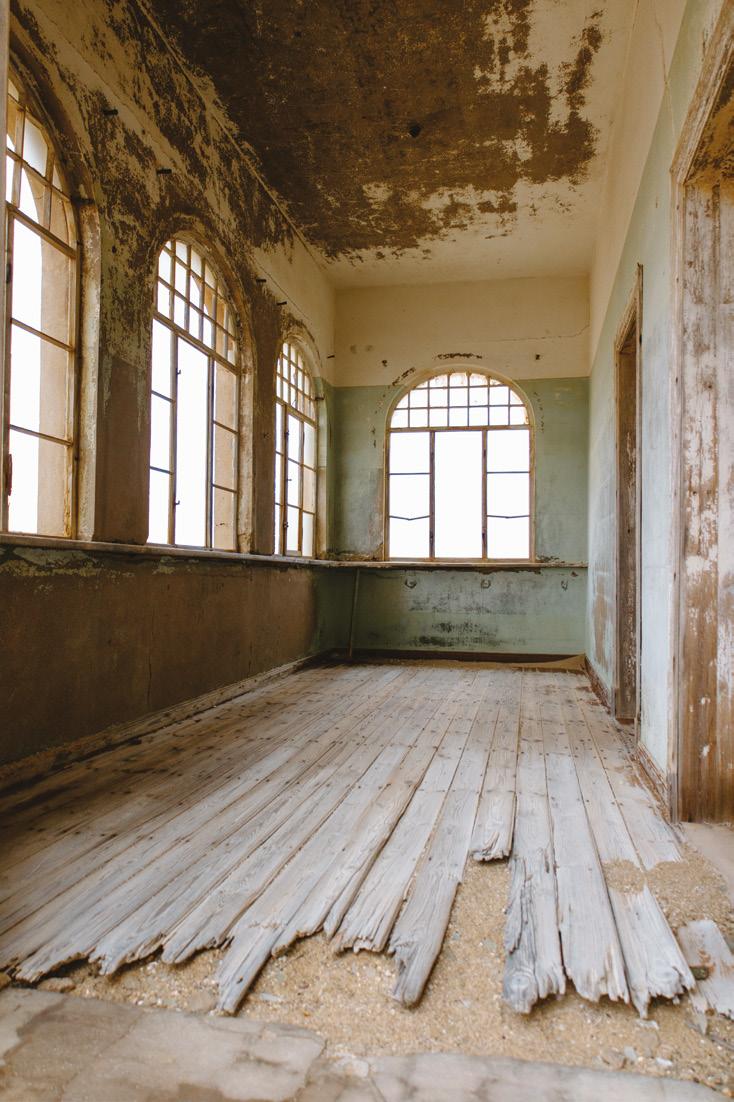

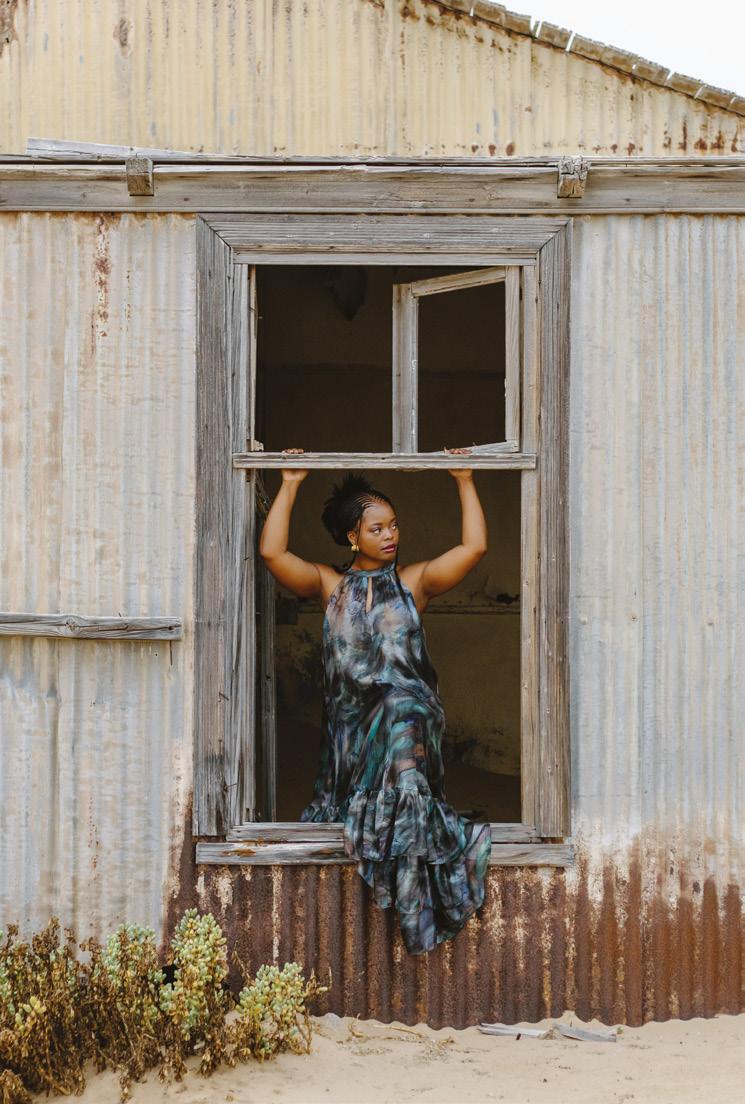
Visiting Kolmanskop is not simply about seeing a ghost town. It is about standing inside a memory. About feeling the weight of ambition, excess, innovation and eventual abandonment pressed into sand and stone.
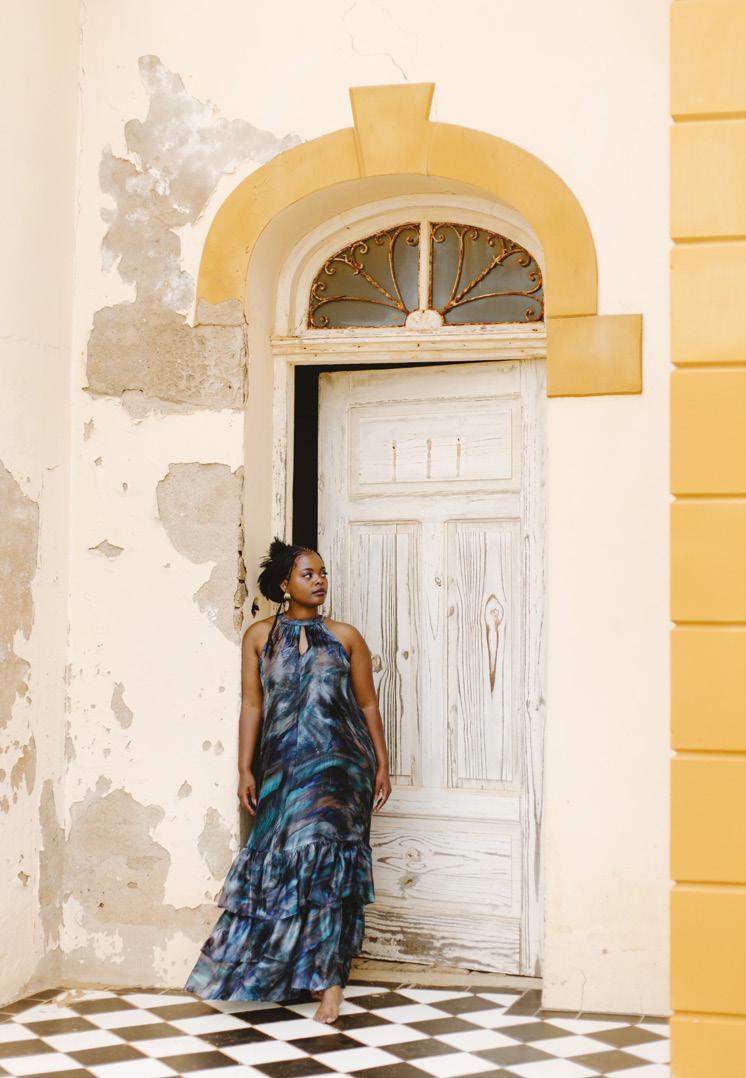
The town’s decline began quietly, accelerated by forces far beyond its control. World War I disrupted operations, and by the early 1920s the diamond fields around Kolmanskop were slowly depleting. Then, in 1928, the richest diamondbearing deposits ever known were discovered along the beaches near the Orange River, far to the south. The lure was irresistible. One by one, residents packed up and left, abandoning homes and possessions in pursuit of easier riches. By 1956, Kolmanskop was completely deserted.
Nature wasted no time in asserting itself. Geological forces pushed sand into every available space, transforming domestic rooms into sculptural landscapes. Today, visitors walk knee-deep through dunes inside former living rooms and bedrooms. It is this surreal interplay between architecture and desert that has made Kolmanskop one of Namibia’s most photographed locations – a place where the boundaries between human endeavour and natural inevitability blur.

Yet Kolmanskop is not entirely empty. A small population of rare brown hyenas has made use of the town’s deteriorating infrastructure, finding shelter among the ruins. It is a quiet reminder that while human stories may fade, life continues to adapt and persist.
Visiting Kolmanskop is not simply about seeing a ghost town. It is about standing inside a memory. About feeling the weight of ambition, excess, innovation and eventual abandonment pressed into sand and stone. The desert does not erase the past here – it preserves it, reshapes it, and asks you to look closer.
As you leave, the silence follows you for a while. And long after the sand has slipped back into the rooms and the wind has smoothed over your footprints, the sense remains that Kolmanskop is not finished telling its story. It waits patiently, held between history and horizon – a place where the desert remembers. TN
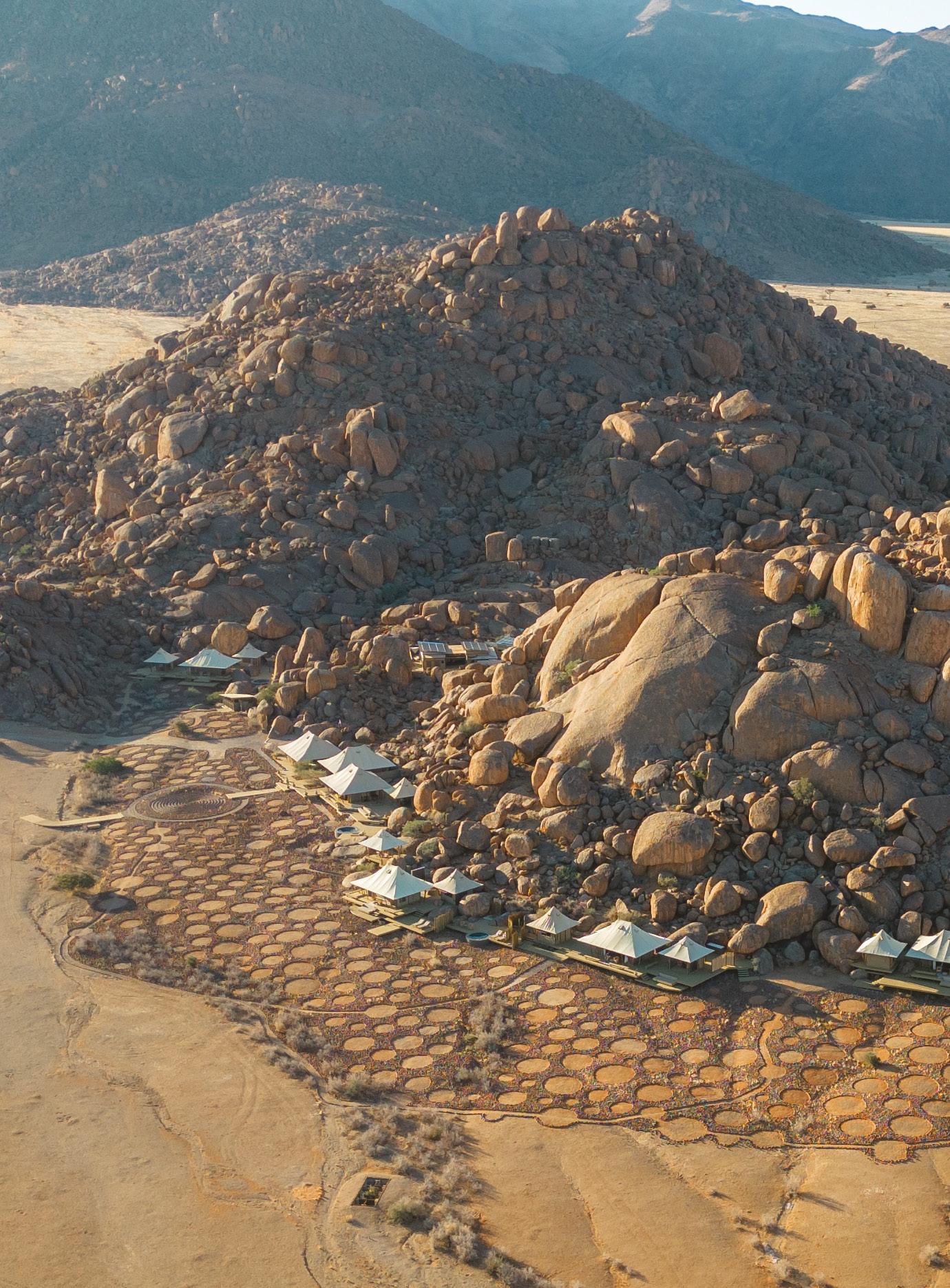
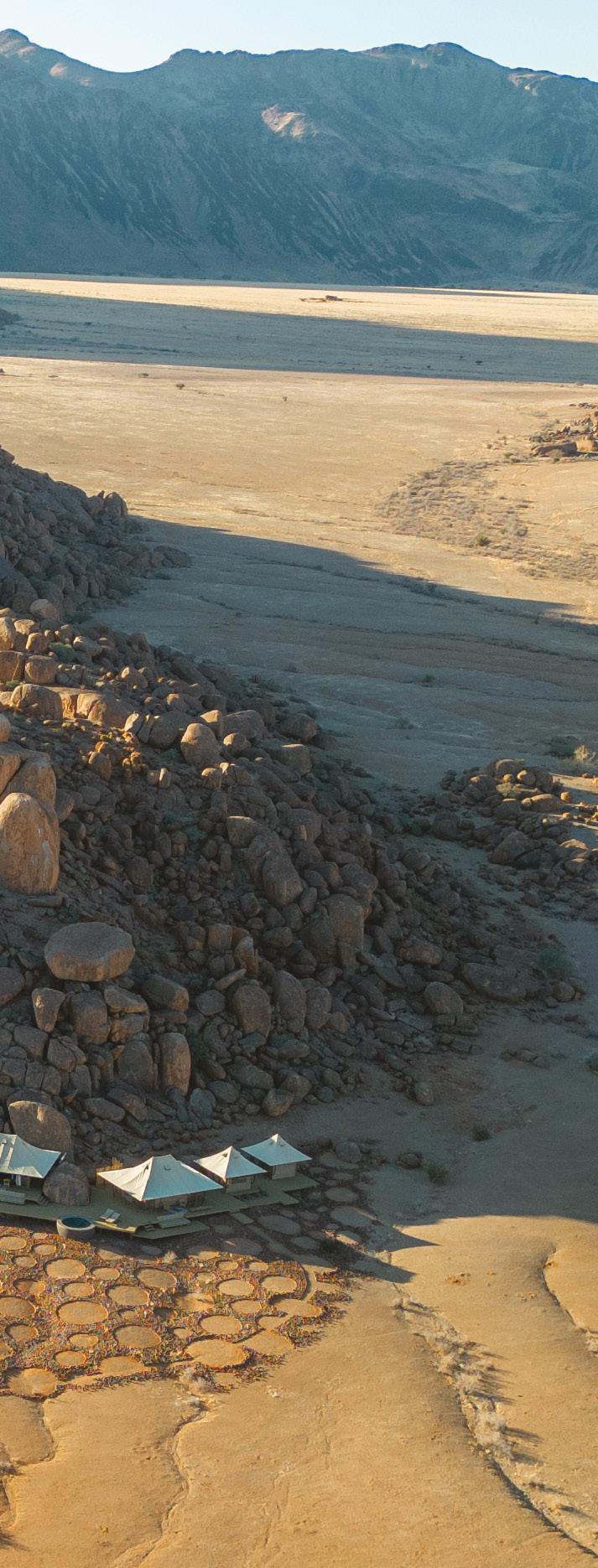
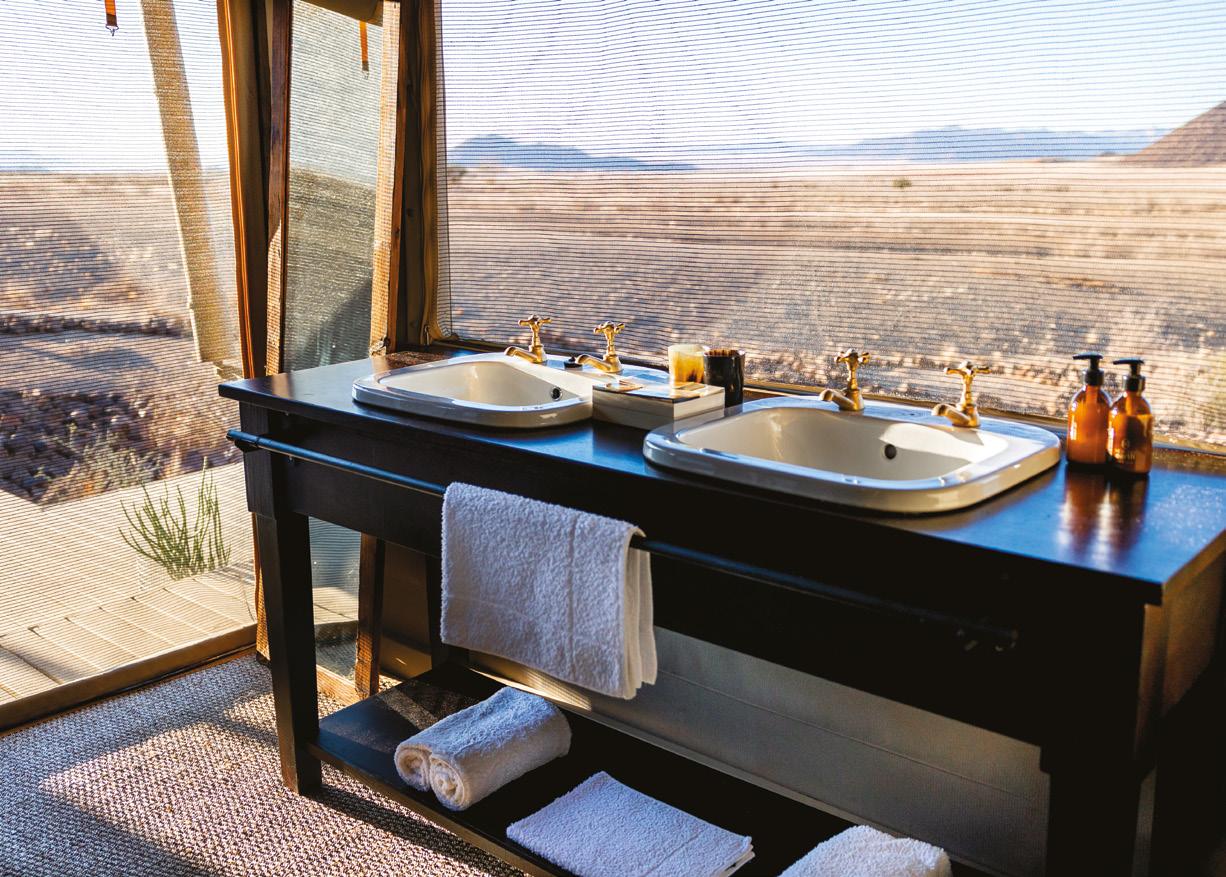
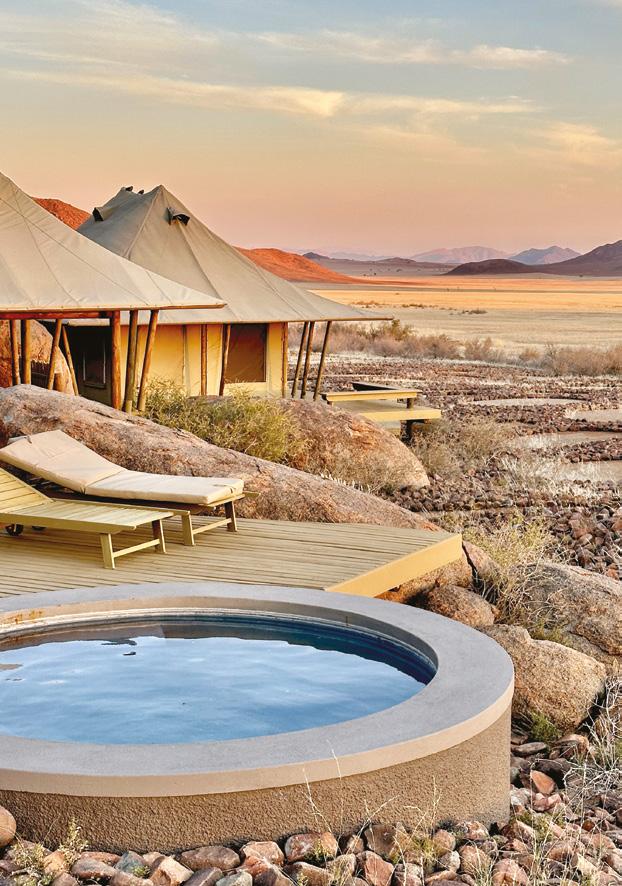
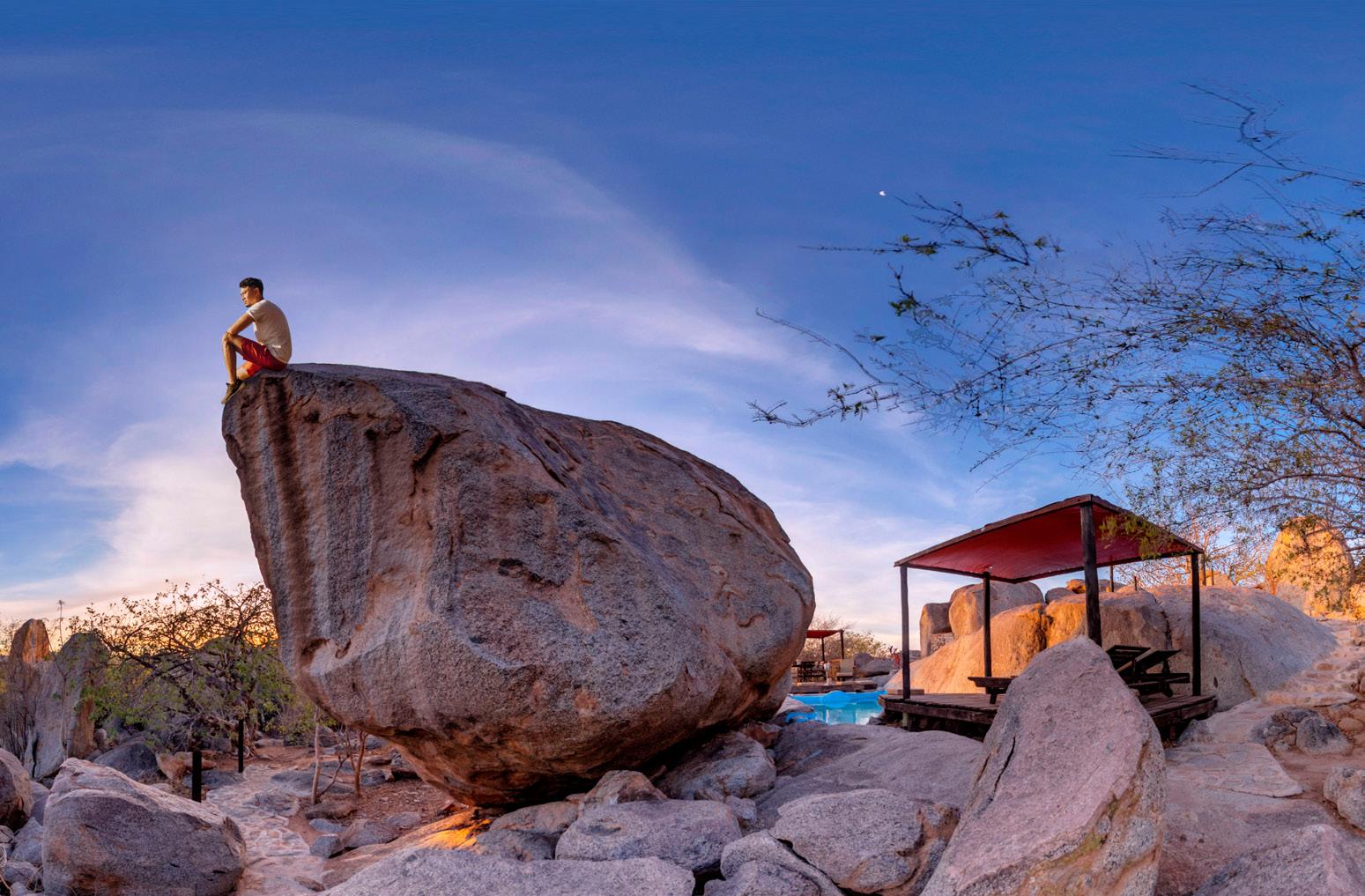
There are places in the world that feel like they were never meant to be discovered – only felt. Wolwedans Boulders Camp is such a place. Perched at the foot of towering granite outcrops deep in the NamibRand Nature Reserve, this remote enclave invites you not merely to stay, but to disappear into the quiet geometry of desert and stone.
Boulders is not a waypoint. It is a destination you arrive at only after a long and thoughtful journey into great, echoing plains where the horizon seems to stretch into forever. Here, where travel becomes pilgrimage, every moment feels calibrated for reflection, stillness and wonder.
From the moment you step out of the vehicle, the landscape speaks for itself. Massive granite monoliths loom overhead. Gravel plains ripple in every direction. The light here is not simply bright – it radiates, washing the desert in a palette of rusts, golds and greys that shift with the sun’s arc.
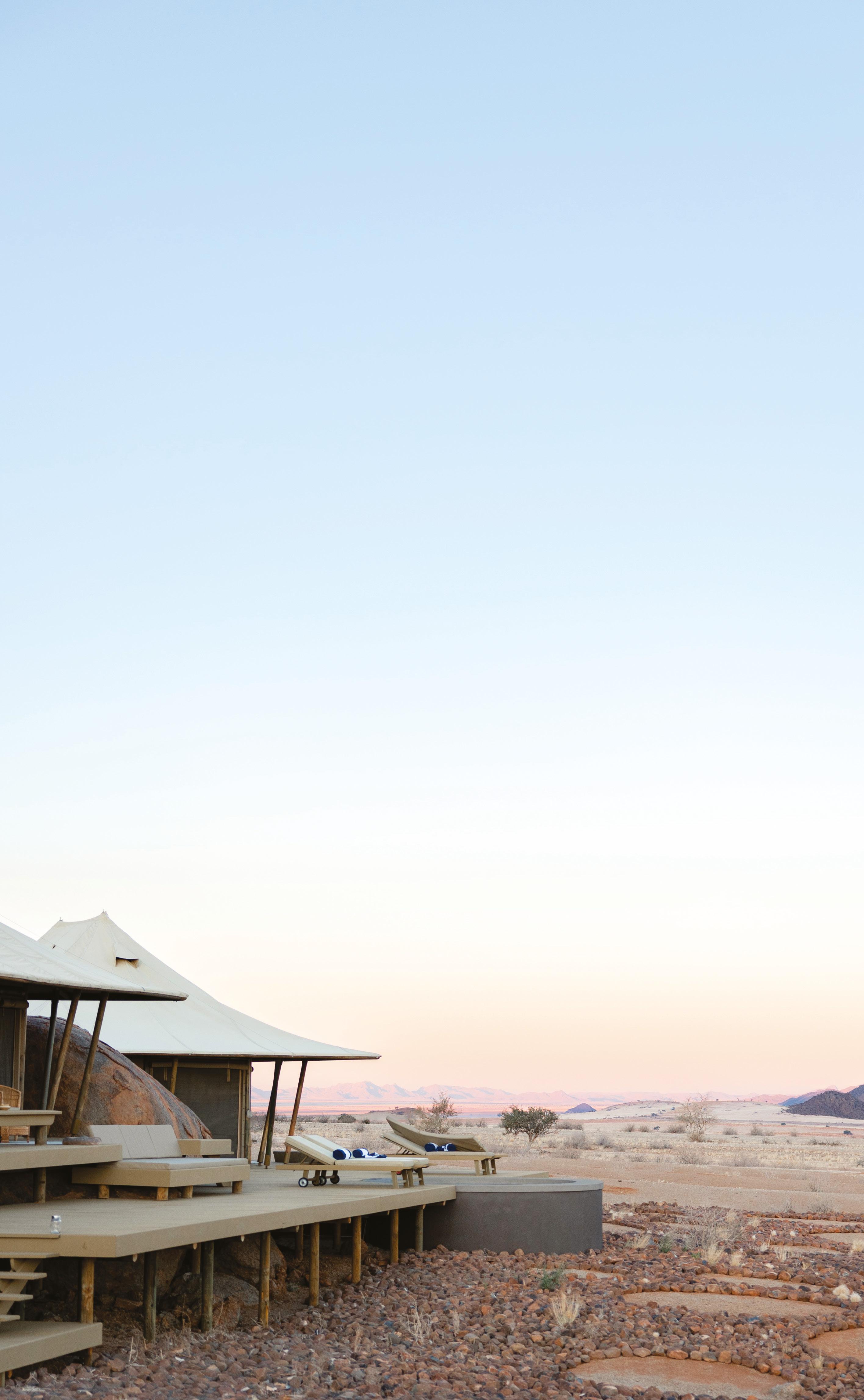
Boulders sleeps just ten guests in five spacious tented suites nestled among these rocky giants. Each suite opens on three sides to the endless plains beyond, with broad wooden platforms that invite you to sit, breathe and simply look. Some suites share private plunge pools; others have their own intimate outdoor spaces – all designed to dissolve the boundary between shelter and savannah.


There is no grand arrival here, only arrival into presence.
Days at Boulders are measured in long silences, slow sunrises and the soft shifting of light across rock faces that seem ancient enough to host the universe’s memories. The main area – dining and lounge tent, breakfast deck, library, open fireplace and pool – faces a vast sweep of gravel plains framed by distant mountains. Sundowners on a nearby plateau bring you eye-to-sunset spectacles that feel less like a photo opportunity and more like a calling.
Activities here echo the camp’s spirit of quiet immersion. You can set out on guided scenic drives across the southern reaches of NamibRand, each turn revealing new geology, desert flora and the subtle tracks of life adapted to this harsh expanse. Walking safaris trace the ancient terrain once traversed by Bushmen, while e-biking brings a different kind of intimacy to the quiet dunes and plains.
But the greatest activity at Boulders is stillness
Here, where space is not a commodity but a condition, the desert offers a form of meditation. Not the meditation of retreat, but the meditation of arrival – arriving at the truth that you are part of this place, not separate from it. Granite, sand and sky conspire to humble the self, dissolving the noise of daily life into something softer, quieter, deeper…
Within the broader Wolwedans philosophy, Boulders stands as the pinnacle of conscious travel – a place where each decision, from the placement of tents to the pacing of days, reflects intention and respect for the land. Wolwedans’ founding purpose is the “Pursuit of Happiness” – not as a slogan, but as a lived experiment in tourism that heals rather than exploits. Here, conservation, community, commerce, culture and consciousness are not marketing pillars but lived realities.
For the traveller seeking something different –something quieter, deeper and more reflective – Wolwedans Boulders Camp is the perfect counterpoint to Namibia’s more familiar icons. It is a place to stretch time, to sit with horizon and thought alike, and to feel the desert respond. Few places in the world offer such unencumbered quiet; fewer still allow you to rediscover a sense of belonging to something vaster than yourself.
Wolwedans Boulders Camp does not wow with spectacle. It woos with stillness. And for those ready to truly listen, it speaks the language of desert wind, granite shadow and infinite sky – a language that feels like home to the soul. TN

The hidden life of the
“The Namib is not about what you see. The Namib is about what you don’t see.”
– Tommy Collard
To the casual passerby, the desert can appear quiet and unassuming. Perhaps even barren. Yet beneath the surface of the Namib, entire ecosystems stir to life. Hidden deep within the pillowy, voluminous sand, small, swift creatures go about their secret lives. The desert’s tinier residents are often overlooked in favour of the coast’s more conspicuous, bulkier inhabitants: the brown hyena (strandwolf), jackal, Cape fur seals and, naturally, Namibia’s revered desert lions roaming parts of the Skeleton Coast.
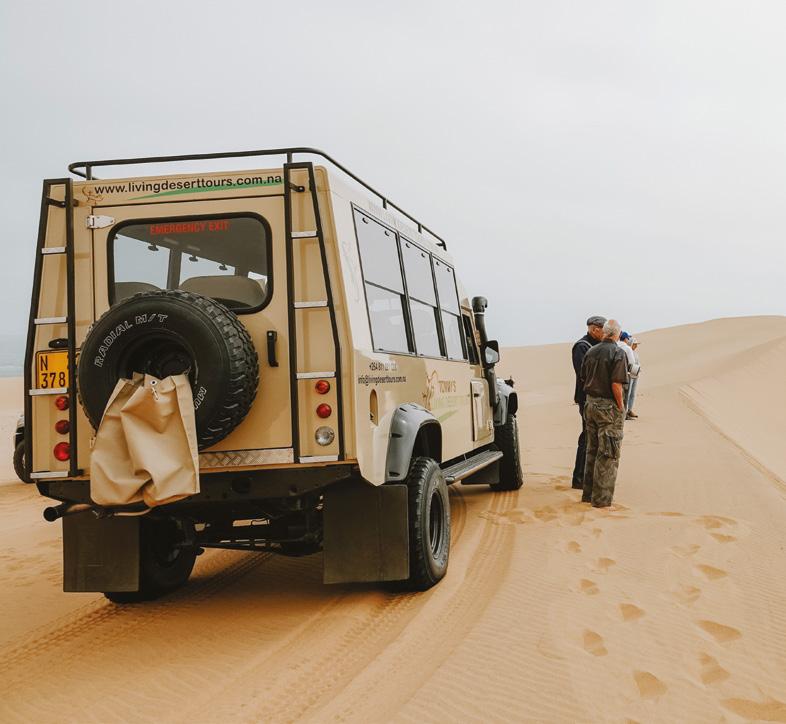
Operating from Swakopmund, Tommy’s Living Desert Tours shifts that focus, offering a microscopic lens on the Namib’s miniature, yet complex wildlife.
The tour starts with experienced guides leading a 4x4 expedition into the dune belt on the edge of Swakopmund within Dorob National Park. Dorob, meaning “dry land,” is a protected area stretching along the central Namibian coast, from the Kuiseb Delta south of Walvis Bay to north of the Ugab River, and west to the Atlantic Ocean. Skilled off-road driving swoops you over rising and falling dunes, seemingly gliding over trackless hills – a thrilling preview of what awaits those who continue on to Sandwich Harbour.
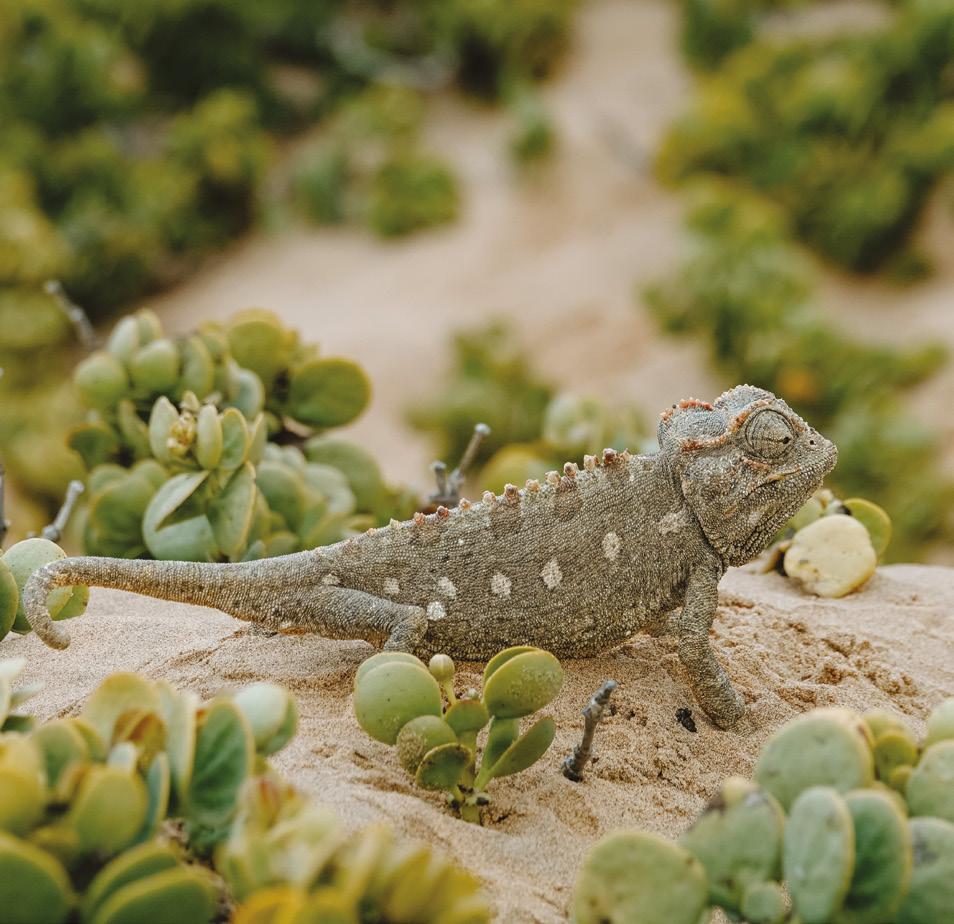
Along the way, visitors can track the Namaqua chameleon ( Chamaeleo namaquensis ), the fastest chameleon on earth and one of Southern Africa’s larger species, or get a glimpse of the sidewinder (Peringuey’s adder), sailing
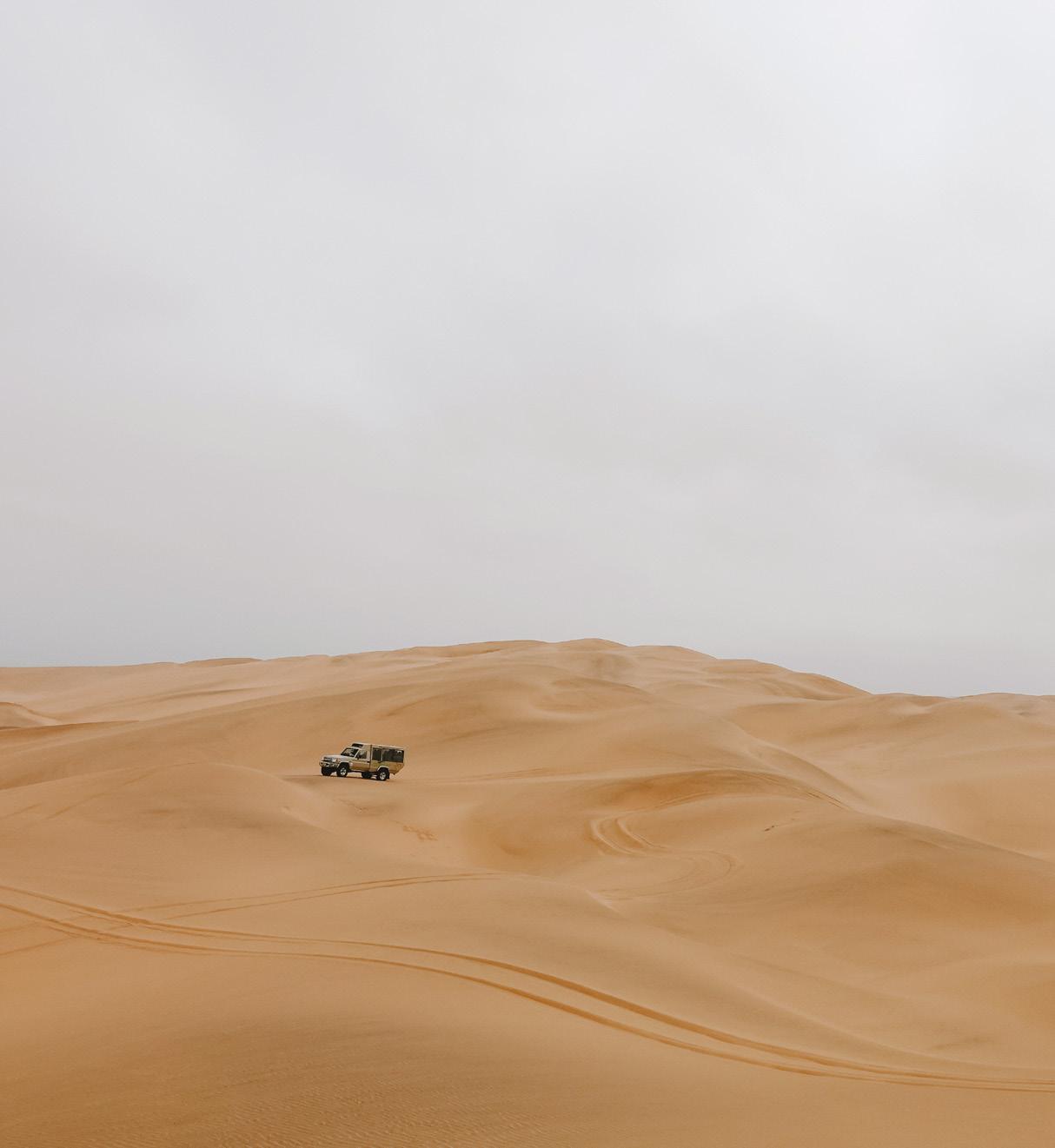
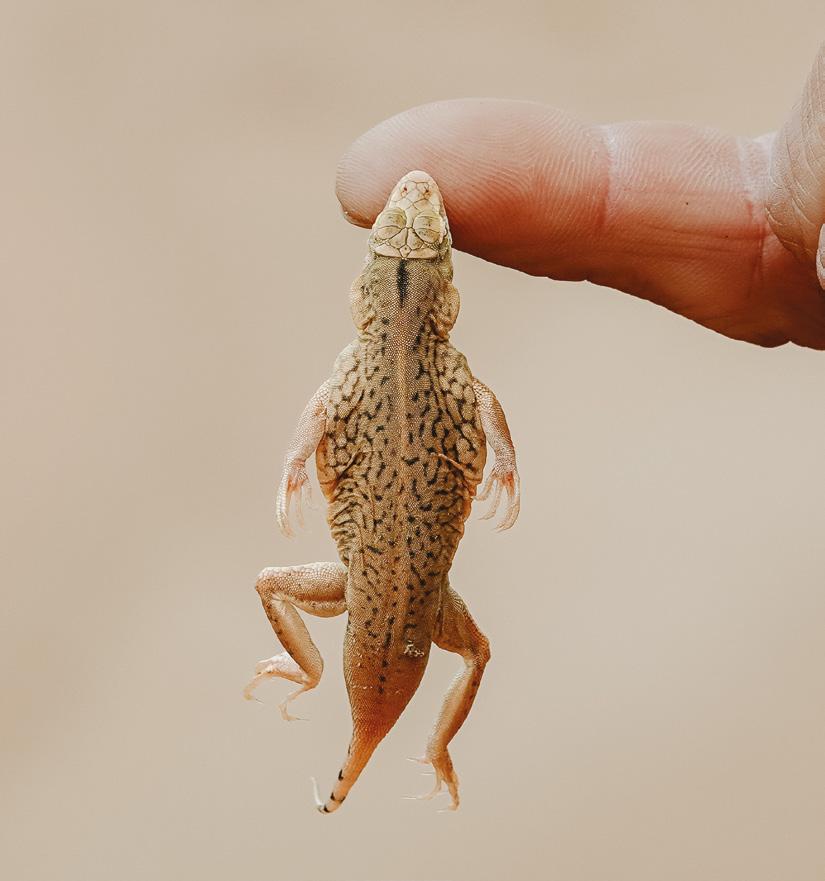
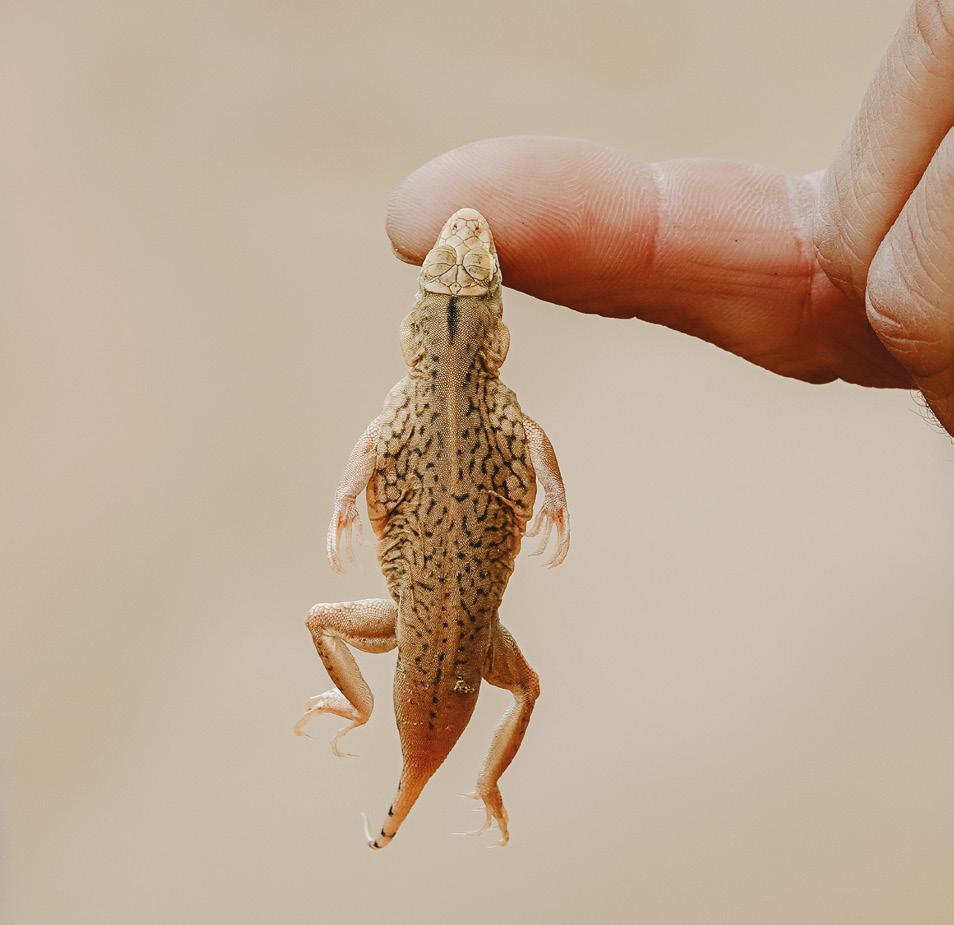
sideways over the dunes, its body blending perfectly with the sand. The black Parabuthus villosus scorpion may scamper across the plains, while the shovel-snouted lizard ( Meroles anchietae ), also known as the thermal dancing lizard, alternates tiny feet to avoid scorching sand and dives into the dune slip-face when approached. Its snout aids in rapid digging, and a special organ stores water from morning mists, allowing it to survive temperatures up to 44°C.
Other fascinating creatures include FitzSimons’ burrowing skink (Typhlacontias brevipes), the dancing white lady spider and the wheel spider (Leucorchestris arenicola and Carparachne aureoflava), the palmato gecko (Pachydactylus
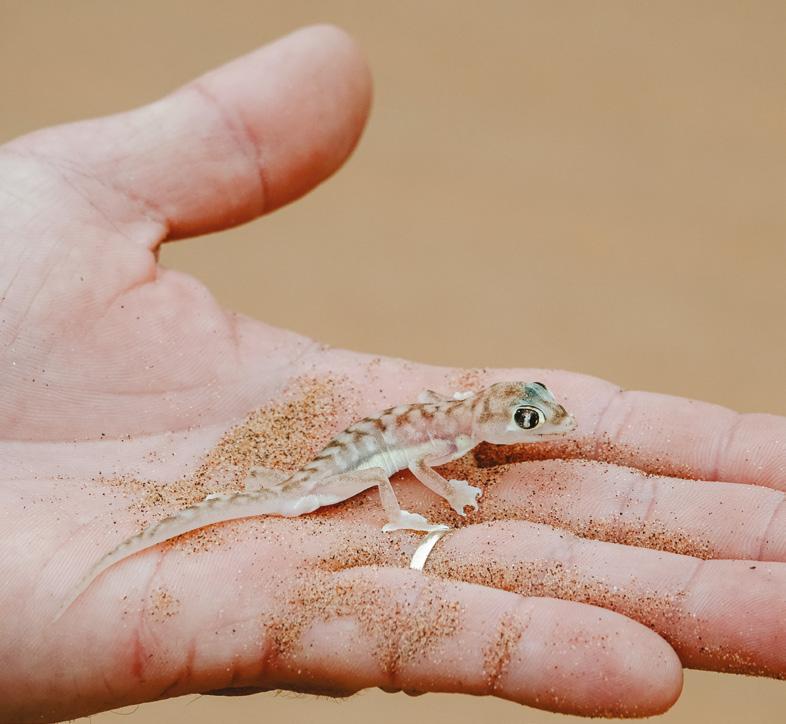
rangei) and Namibia’s beloved Toktokkie beetle, tapping rhythmically on the sand.
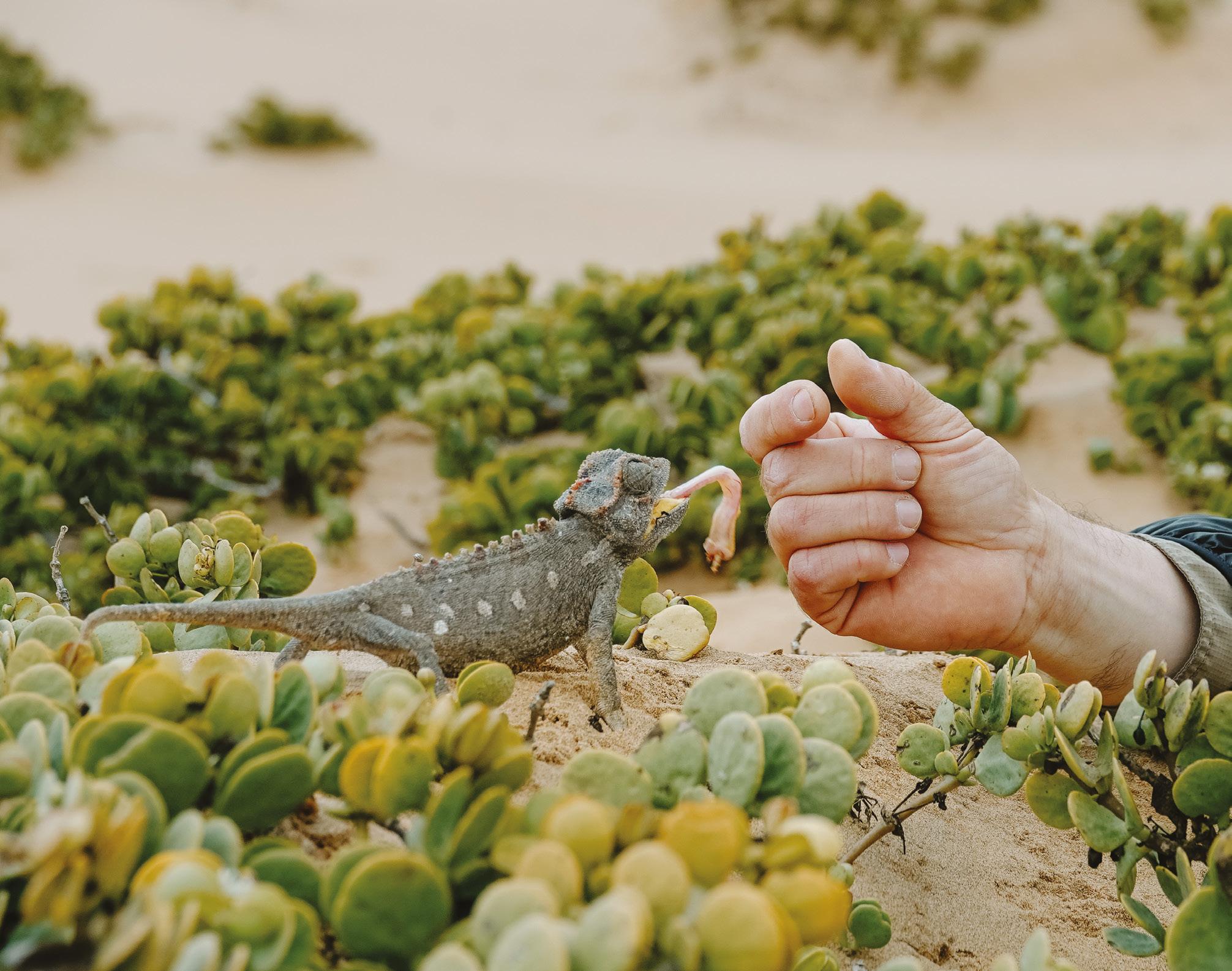
Our guide, Ansgar Gaedke, barefoot and spry, sprints ahead like a detective, eagle-eyed for tracks imperceptible to us. “It’s a matter of perspective,” he hints, demonstrating a patient, incisive eye for the unseen. To preserve the naturalness of the tour, the animals are never prodded or poked out of their burrows but are rather subtly lured to emerge, making their eventual appearance all the more delightful and rewarding. They might even linger for a hold-your-breath-or-they-will-dash moment, like the dark-green Namaqua chameleon, settled and unmoving between succulents, before quickly lurching its muscular tongue outwards to lap up a wriggling worm offered by Angsar (he carries a small jar of live worms to satiate any peckish critters we might encounter).
Holding a delicate palmato gecko in my hand, I marvel at its near-translucent skin and large, unblinking eyes fixed intently on me. In that still moment, I find myself wondering which of us is truly the careful observer.
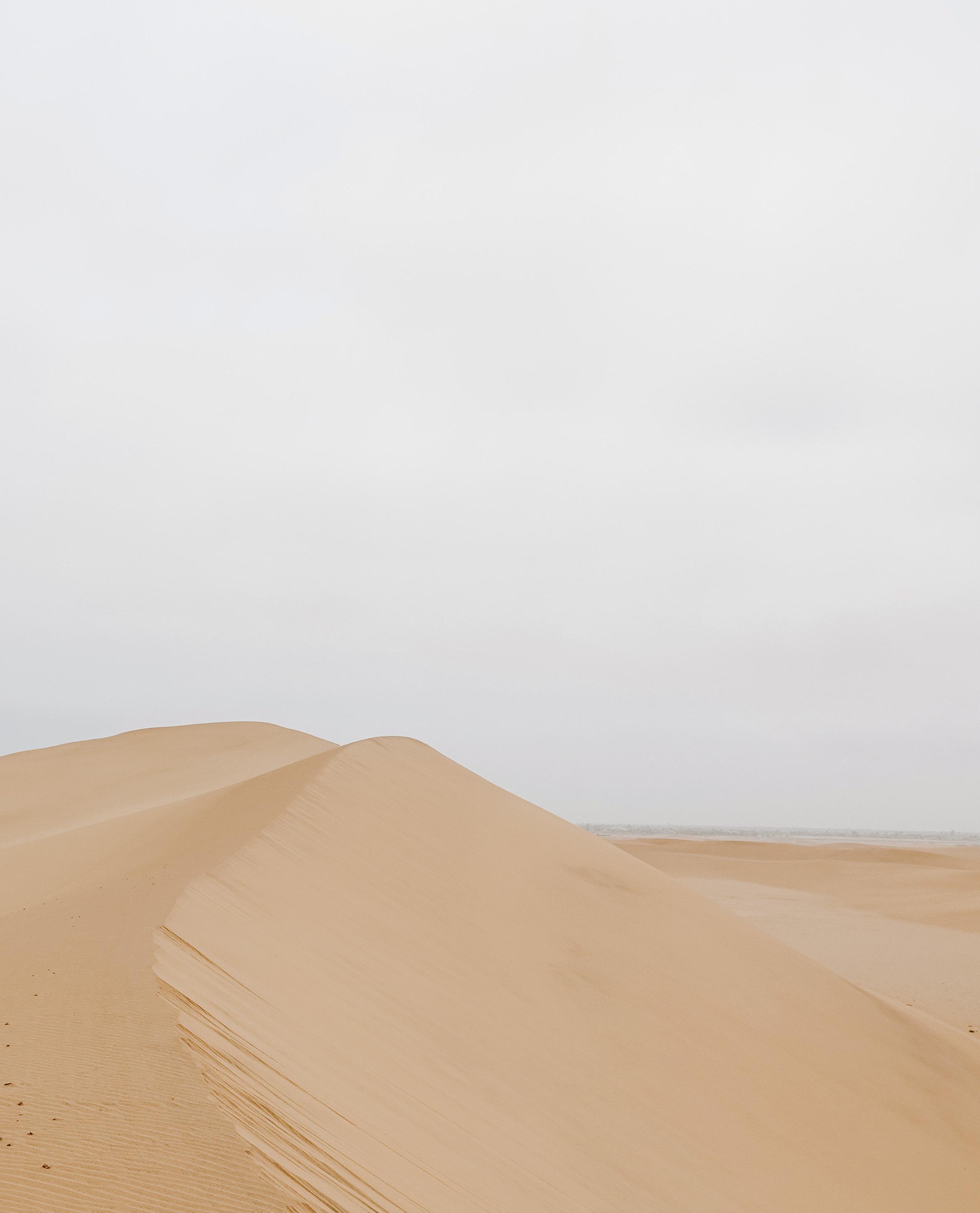
Between sightings, guides reveal how even sand tells the earth’s oldest stories. In the Namib, dunes are not just shaped by wind; they are sculpted by the slow chemistry of time. Iron-rich rocks from the interior highlands weather and crumble over millennia, releasing minerals like hematite and magnetite. These tiny particles travel through river systems to the coast, only to be carried back inland by relentless southwesterly winds.
As the wind moves across the desert, it sorts and re-sorts the grains. Lighter quartz grains are whisked further, while the denser, iron-bearing minerals settle and gradually concentrate in certain dune fields. Sun, salt fog and oxidation deepen their colour over ages, shifting sands from pale gold to a burnished rust – the signature hues of the world’s oldest desert. In some places, these mineralrich grains are so iron-dense that they respond to a magnet! Nearing the end of our journey, we pass remnants of an old
railway track, nearly swallowed by an ever-growing swell of heaped sand. Formed over as few as fifty years, it stands as humbling proof of a desert in motion – a perpetual shifting of malleable yet ancient matter.
The Living Desert Tour usually concludes on the crest of a dune, overlooking the cold, endless Atlantic Ocean. This is not the desert of postcards; it is deeper, quieter, more intimate. A world where survival is an art form and tiny marvels replace big-game spectacles. A hidden world that asks you to slow down, look closer and rethink what wilderness truly is. TN
Scheduled tours have limited availability – book online in advance
• The tour is 4 to 5 hours long.
• The tour includes snacks, drinks, an expert guide and a 4x4 vehicle.
• Option to book a combined tour which includes Tommy’s Living Desert and Sandwich Harbour Tour www.livingdeserttours.com.na
Tribute to Tommy Collard (28/09/1956 –12/02/2025)
Tommy Collard founded Tommy’s Tours & Safaris in 1997 and over the years became a highly respected figure in the industry. His passion for the Namib and its wildlife was unparalleled, inspiring all who had the privilege of knowing him. Many guides continue to carry forward his knowledge and enthusiasm, a testament to the care and dedication with which he trained them. Lovingly known as the “Gogga (Bug) Mechanic”, Tommy’s legacy will continue to shape the journeys of countless travellers and leave a lasting mark on all who share his love for the desert.


16. Sesriem Campsite
17. Naukluft Camp
18. Hardap Resort
19. Fish River Canyon & Hobas Camp
20. /Ai-/Ais Hotsprings Spa
21. Mile 72
22. Mile 108
23. Jakkalsputz
24. Boplaas Campsite
25. Von Bach Tungeni Resort
26. Dead Valley Lodge & Oshana Sesriem Campsite
Growing up in Namibia, you learnt early on that the cooler box was never just a box. It was an economy – carefully balanced, tightly regulated, and governed by rules that were enforced without discussion.
The most important rule was always the same: keep it closed. Especially when you were going somewhere hot. Especially when you were a child. Opening the cooler box unnecessarily was not curiosity, it was sabotage. Every lift of the lid let the cold air escape, every second it stayed open shaved minutes off the ice’s lifespan. The consequences were collective, and they were felt later, when it mattered.
Children, of course, were the weakest link. Opening, closing, peering inside as if something miraculous might have changed since the last look. Adults responded instantly, instinctively – a sharp word, a look that said you know better, even if you didn’t yet.
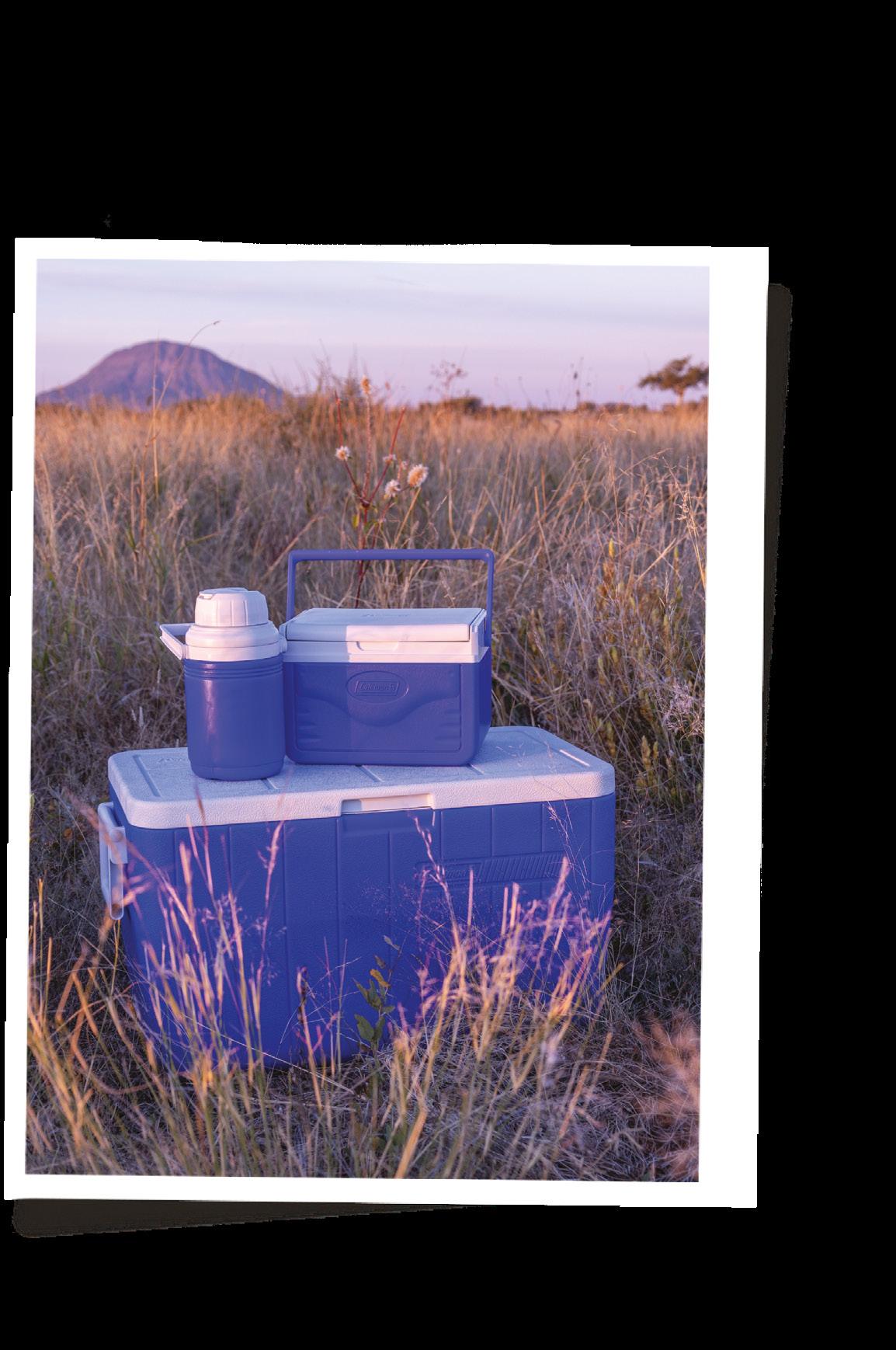
Once, it was the iconic blue Coleman with the white lid. Sun-faded, scratched, reliable. In recent years, many of those have been upgraded to khaki green Römer boxes, and if you’re particularly serious about such things, a National Luna camping fridge, or the indestructible Engel. The container may change, but the rules never do.
Inside, everything had its place. Cold Tafel Lager was the gold standard – proof that the system was still functioning. Ice is essential infrastructure, never wasted, never taken for granted. And the meat, always packed right at the bottom, was not about now. It was about tonight’s braai. About foresight. About understanding that enjoyment required patience.
You didn’t open the cooler box unless you had a reason. You didn’t linger. You certainly didn’t “just look”. One careless moment affected everyone, and everyone knew it. The cooler box demanded discipline, and in return it promised reward.
Somewhere along the way, something shifts. You become the very person you once feared. You hear yourself saying the same things with the same authority. You guard the lid. You count the ice. You measure time not in kilometres, but in how long the cold will hold.
Only later do you realise that the cooler box was never really about drinks or meat. It was a lesson in thinking collectively. In restraint. In understanding that pleasure comes later – if you protect it now.
And perhaps that’s why it stayed with us. Because long after the road trip ended, the cooler box taught us how to carry responsibility quietly, and how to look after what we’d all be sharing at the end of the day.
I wonder what else that reminds us of… TN
ELZANNE MCCULLOCH
There are places in Namibia that don’t announce themselves loudly. No billboards. No grand entrances. Just a small sign on the roadside – easy to miss if you’re not paying attention – and a sense that if you do stop, you might be rewarded with something quietly special.
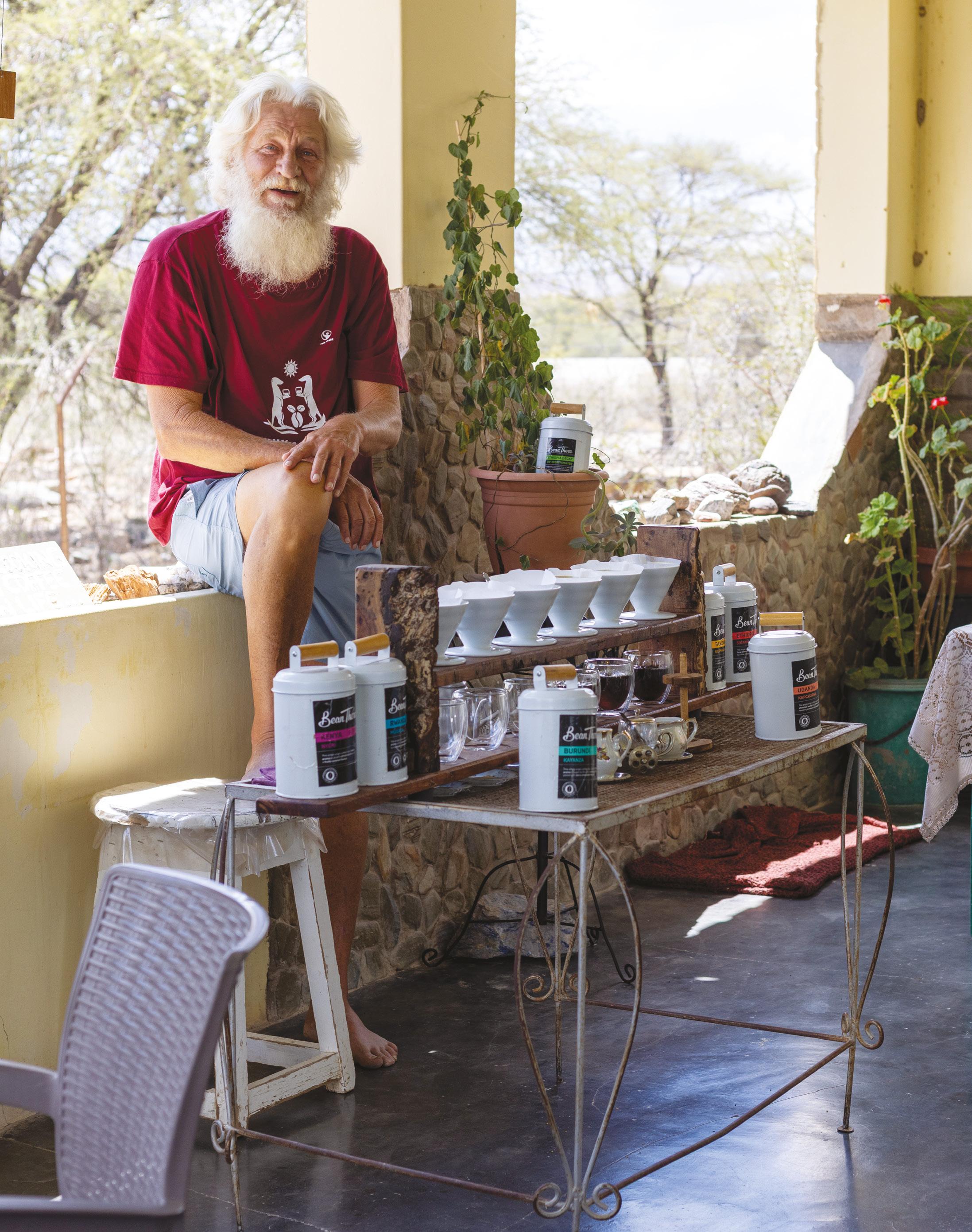
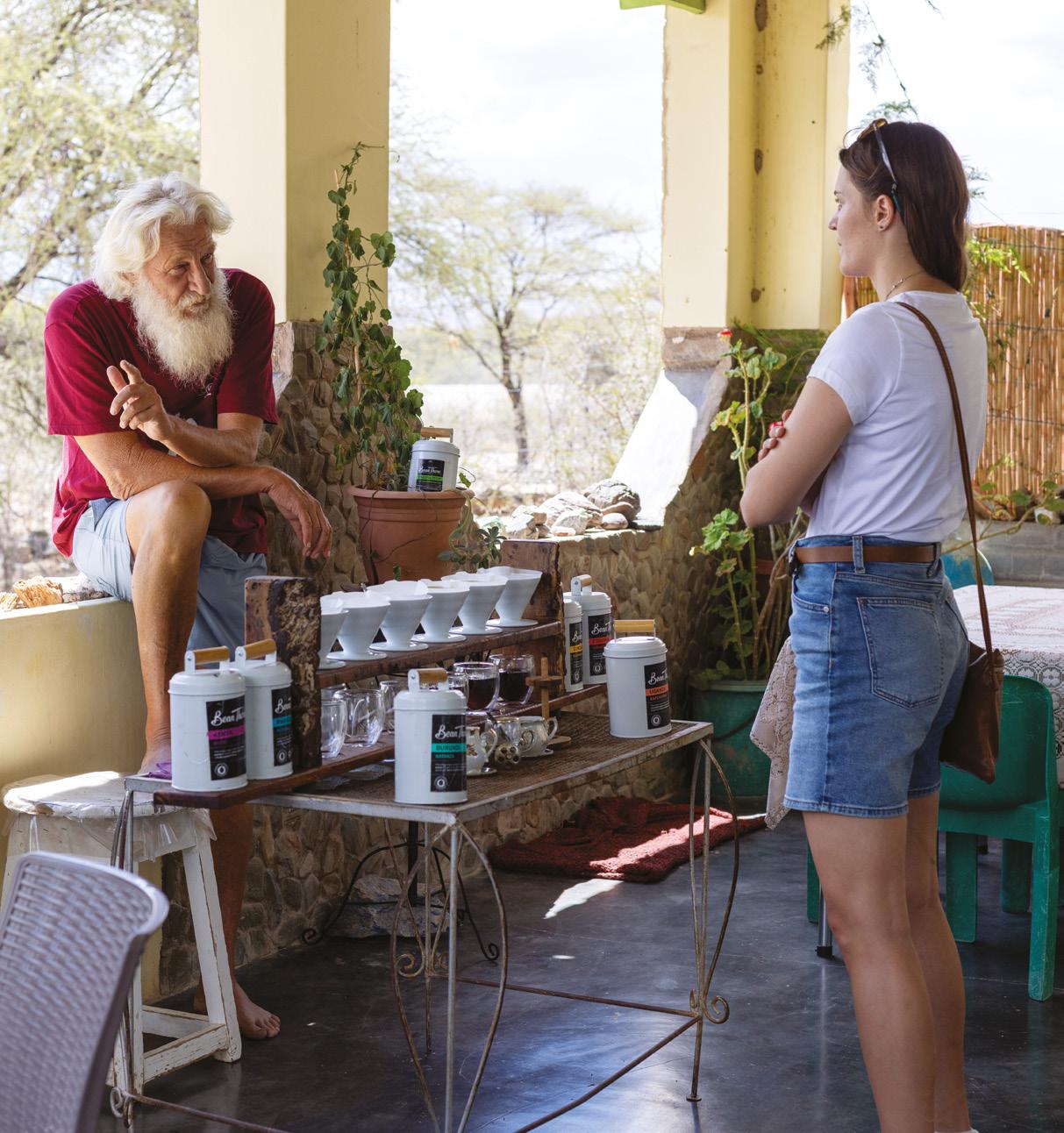
Just outside the small settlement of Klein Aub lies one of those places. Conny’s Coffee Shop sits alone in the desert, looking very much like a rundown old farmhouse that time forgot. A broken windmill with no blades stands quiet guard nearby. Large chickens wander freely. And when my friend Monika and I pull in, a man with a grey beard, barefoot and shirtless, ambles out onto the stoep like a character who’s stepped straight out of a Hemingway novel. Seeing us, he disappears briefly and returns moments later, now wearing a shirt – still no shoes – ready for polite company.
This is Günter Martins. He took over Conny’s in 2017, but the soul of the place stretches much further back.
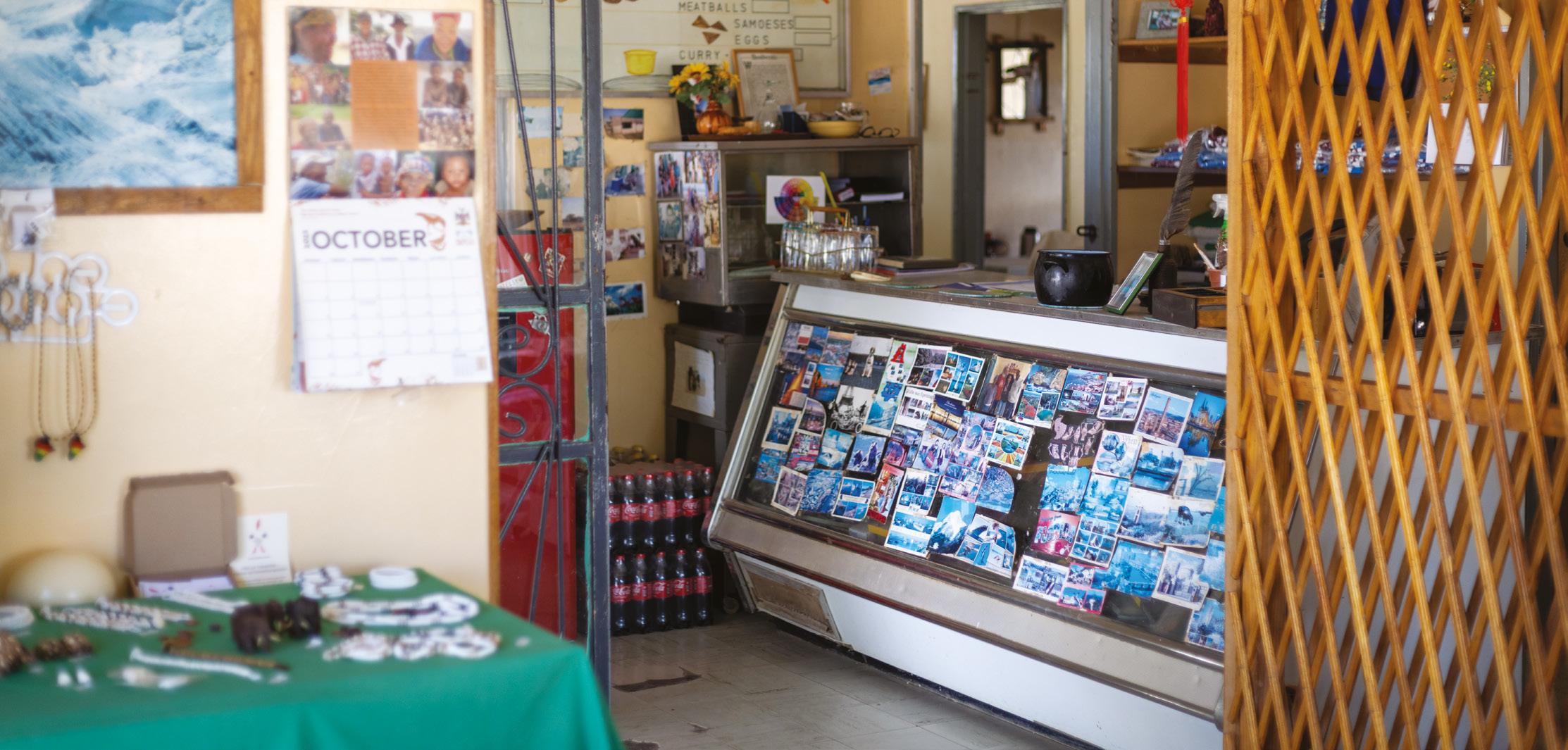
The name Klein Aub itself means “small fountain”, a reference to water in an otherwise unforgiving landscape. And Conny, the woman who originally ran the general dealer here with her husband, became a quiet anchor point for the community when mining activity brought people to the area. Men would arrive after work for fish and chips – where that fish came from in the middle of the desert remains one of life’s unanswered mysteries – while women would stop by for coffee and conversation. Over time, the shop evolved into what it is today.
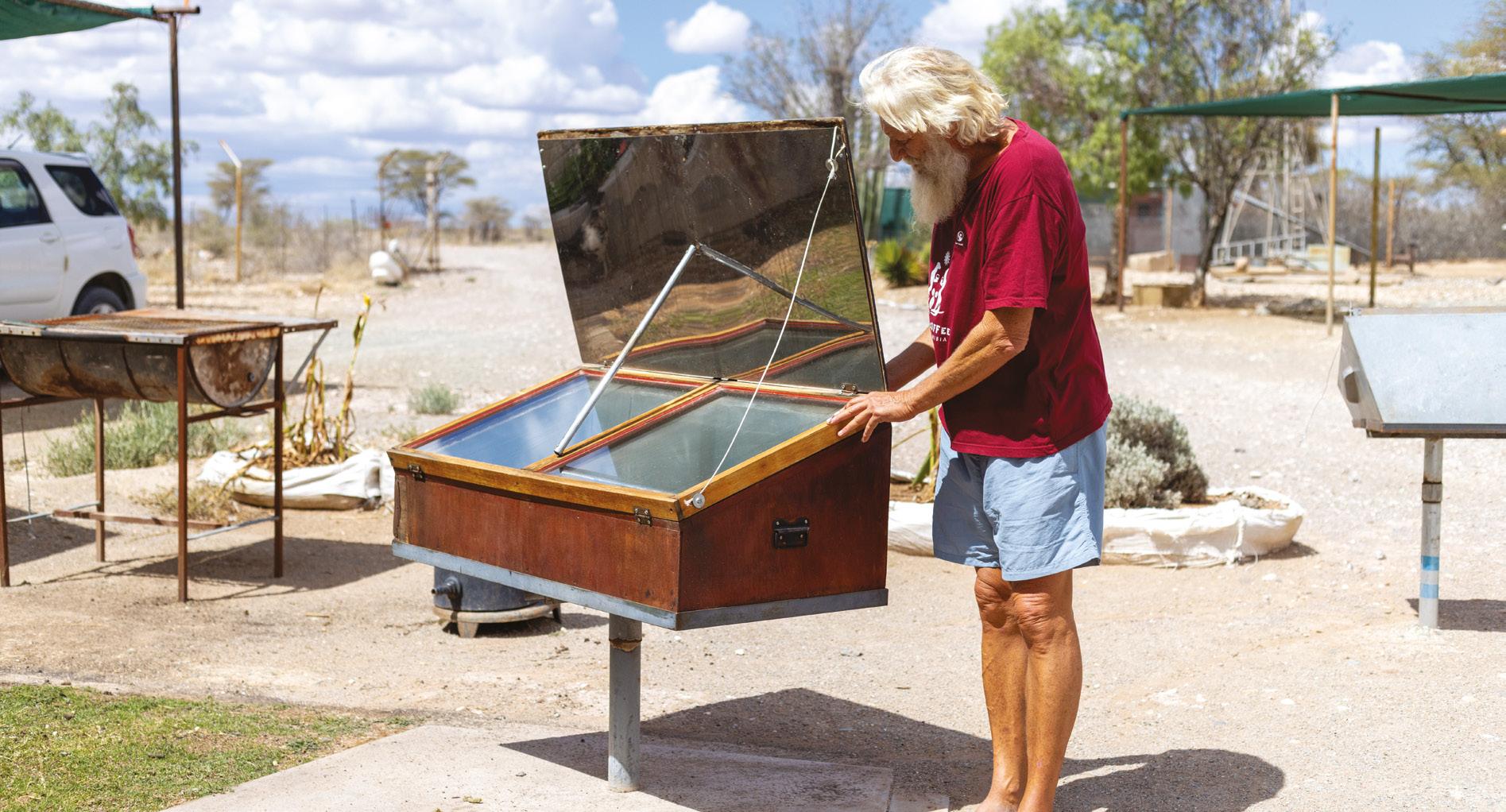
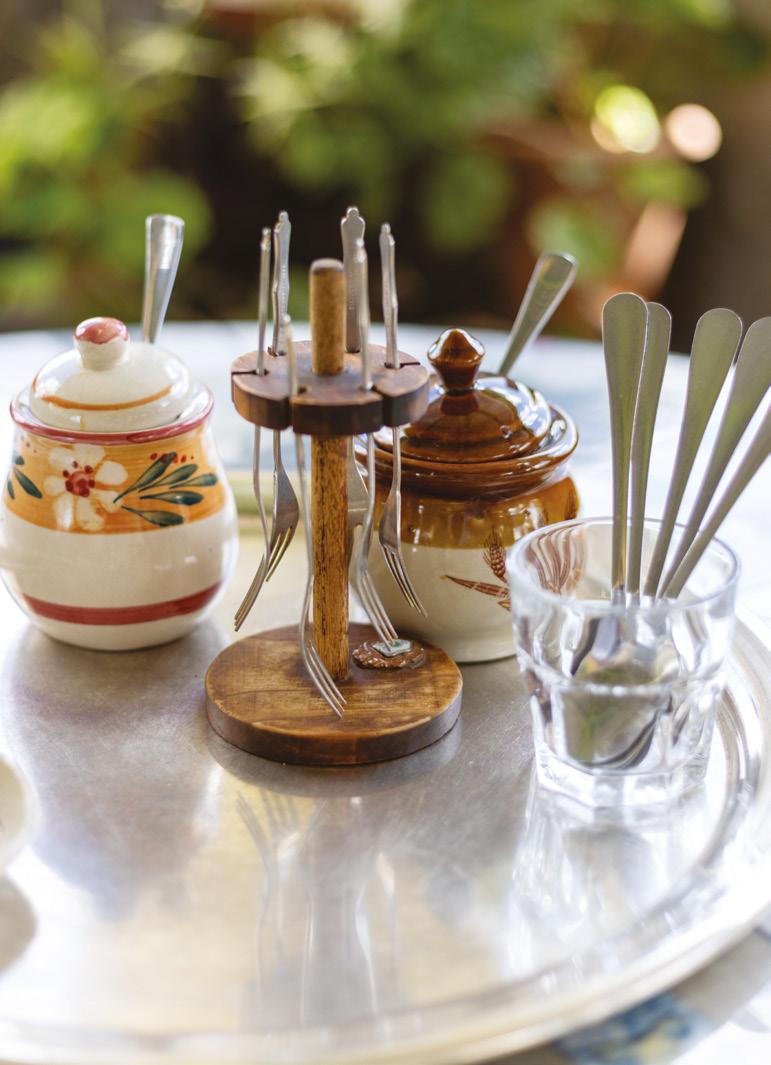
Günter welcomes us warmly. On his wide veranda is one of the most fascinating coffee setups you’re ever likely to encounter. His coffee machine is handmade – a wooden contraption with ceramic cups at the top and glass cups below. Each ceramic cup has a hole in the bottom, fitted with a coffee filter. The water, heated precisely to 60 degrees Celsius, is poured slowly from a silver kettle over the freshly ground coffee. It’s part ritual, part science, and entirely mesmerising.
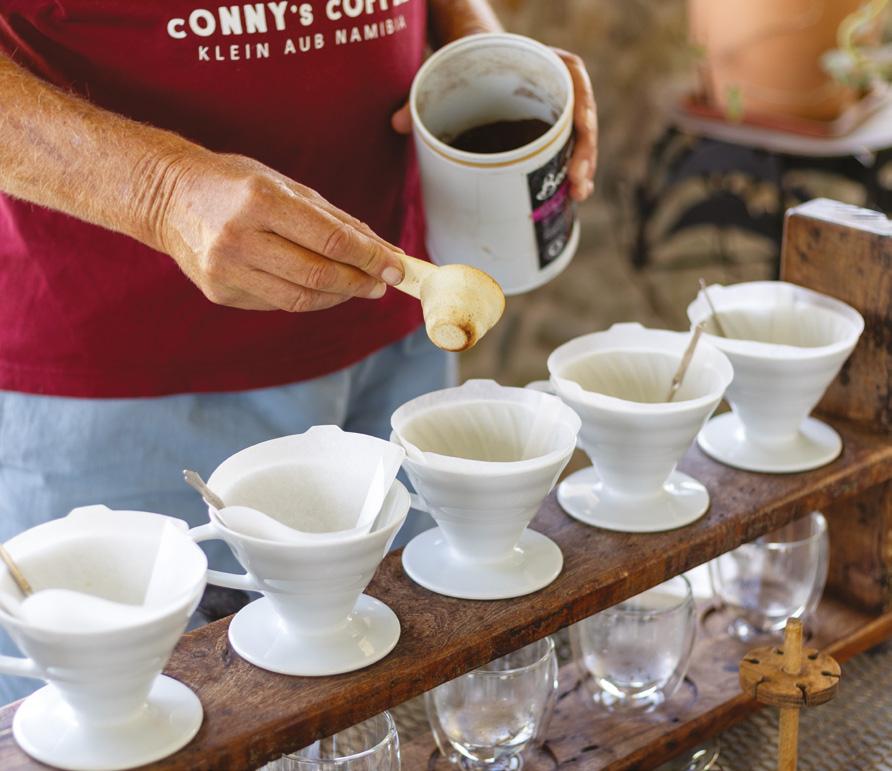
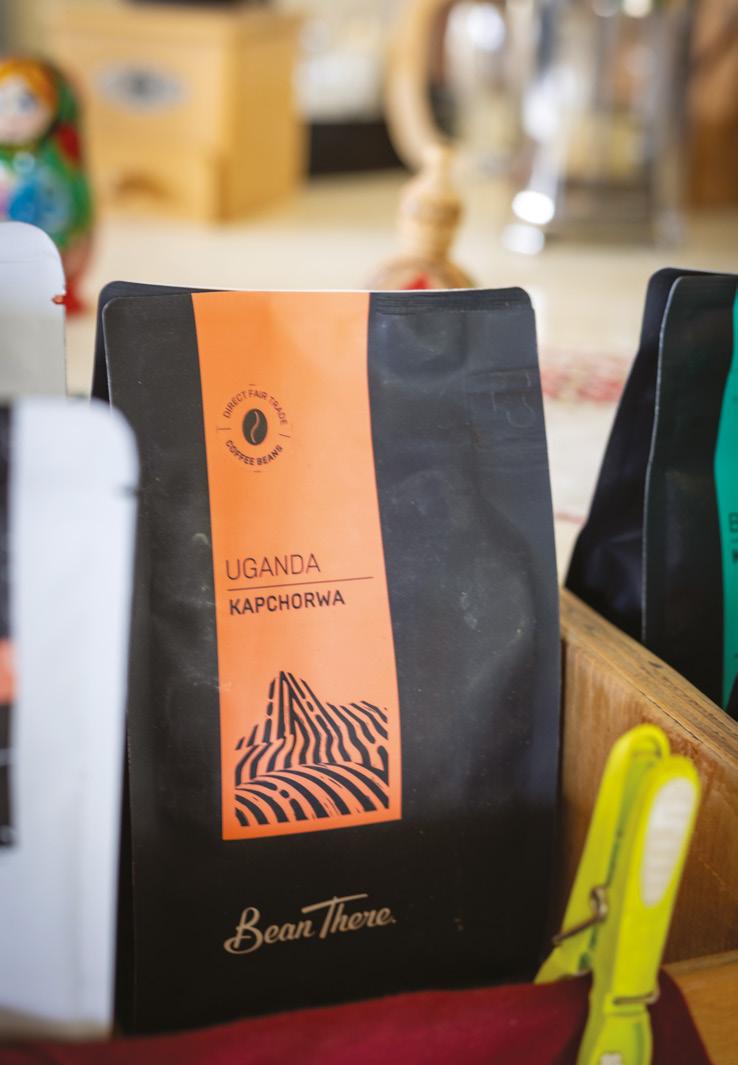
He talks us through his range of coffees – all 100 percent African Arabica – from mild to medium to as strong as he can make it. Monika opts for a medium roast. I ask for the strongest. At our feet, a small puppy, a cat and an older dog weave between chairs, entirely unbothered by the ceremony unfolding above them.
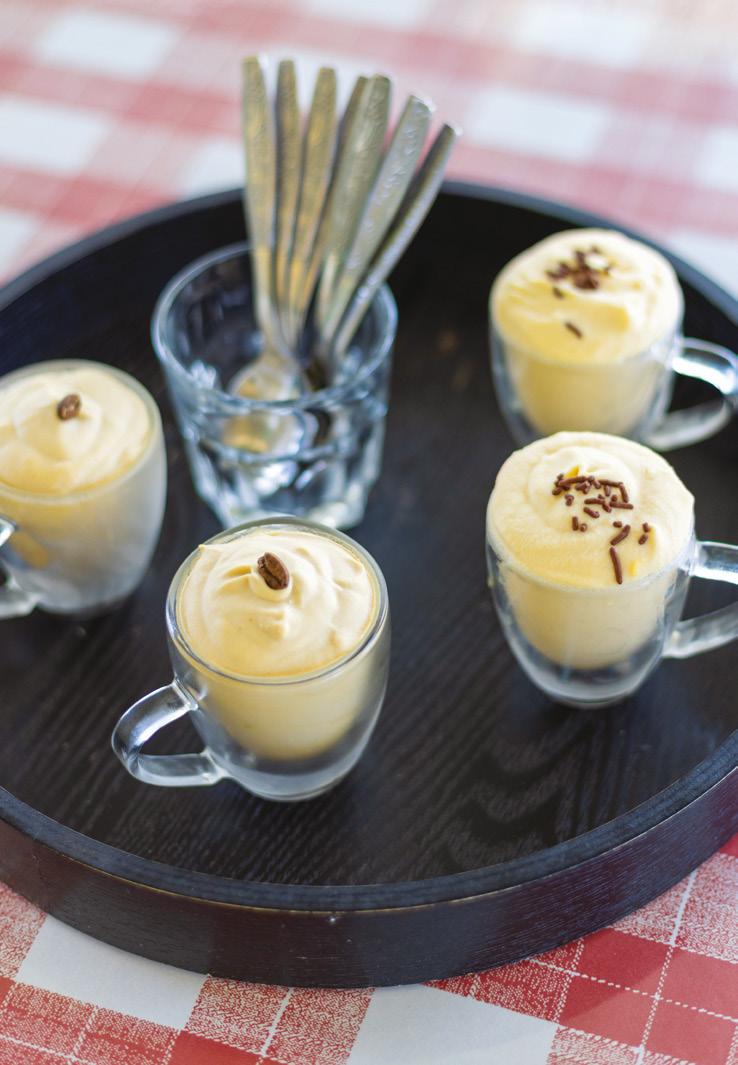
While the coffee brews, Günter disappears again and returns with a tray bearing homemade ice creams, served in tiny glass cups. Coffee- or Amarula-flavoured. There is no discussion – we both opt for the Amarula. Some choices in life are simple..
And then, as it always does over good coffee, the conversation flows.
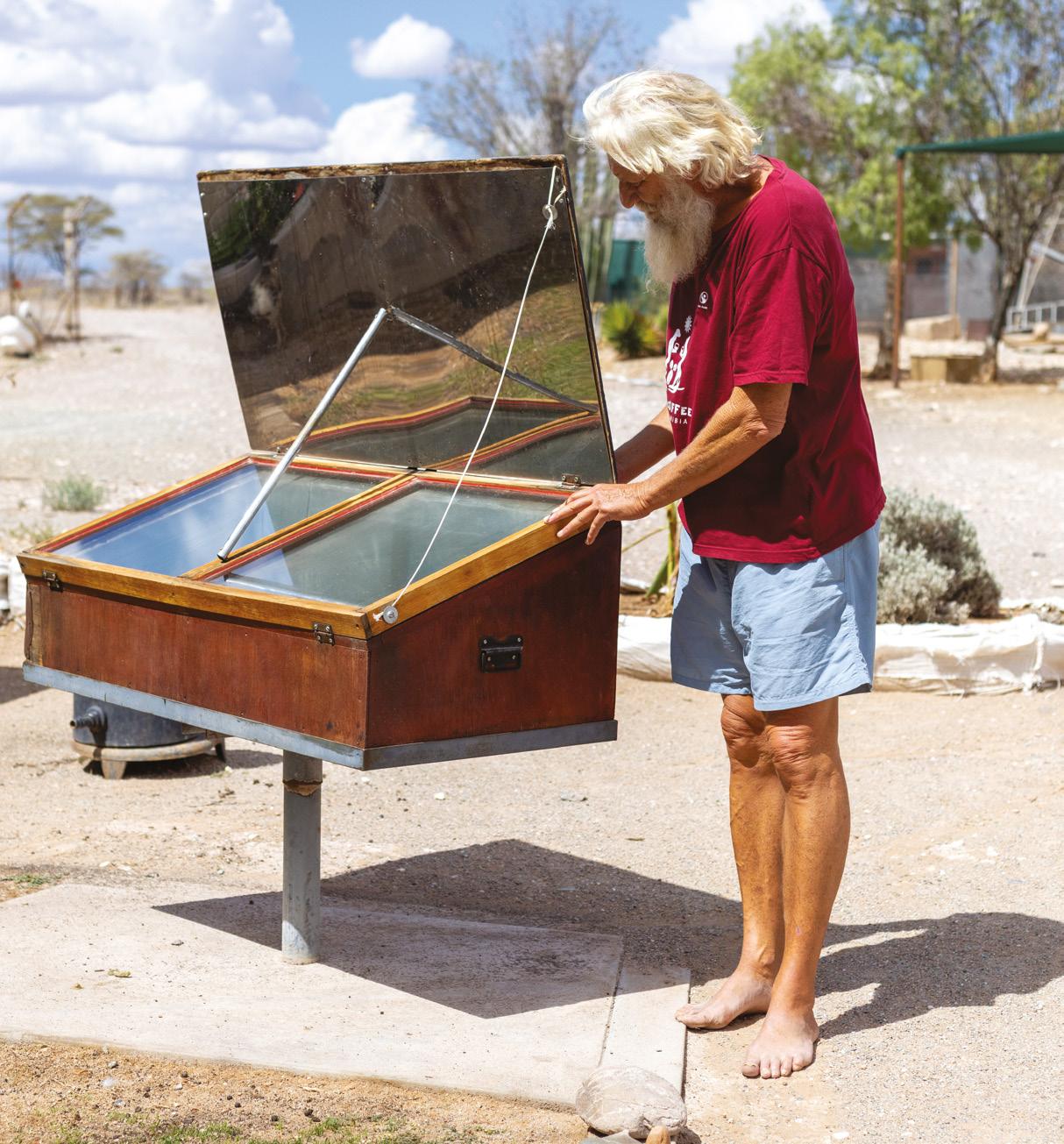
Günter runs Conny’s primarily as a tourist stopover now. Tour operators bring groups a few times a week, and lunch is served daily – always the same, and proudly so. Freshly baked bread, made that morning. Bobotie, cooked slowly over six hours in a sun-oven powered entirely by the Namibian sun. Rice with lentils. Chutney. Salad. Honest food, made with intention.
He bakes muffins in the sun-oven too, although as his groups have grown larger, keeping up has become a challenge. His sister once suggested an air fryer. He laughs at the memory. The air fryer, he says, can’t bake a muffin to save its life – certainly not compared to the sun-oven. These days it’s relegated to toasting bread. “I should’ve just bought a toaster,” he jokes.
Our conversation drifts, as conversations do. To life. To routine. To the quiet tiredness that sometimes creeps in when days begin to repeat themselves. Günter still loves the desert – loves Namibia – but he admits he sometimes escapes to Windhoek to see friends. Ironically, he often
goes just to sit somewhere and have another cup of coffee. Because, as he says, the best conversations always happen over coffee.
We talk about artificial intelligence and his recent exchange with an “AI expert”. He asked the expert what his WhatsApp wants him to do with that new AI chat feature. “I don’t know what I’m supposed to ‘Ask Meta’?” Apparently, according to the expert, if he wakes up feeling sad, he should ask it how to feel better. Günter shakes his head in disbelief. The image of him standing alone in his desert kitchen, asking a machine how to be human, strikes him as absolute nonsense. We agree. Somewhere along the way, basic human connection feels like it’s slipping through our fingers.
Günter has no social media. No Facebook. No Instagram. Monika and I admit we envy him. Perhaps his path –unplugged, unfiltered – is the better one.
The conversation turns more serious when we speak about wildlife, hunting and conservation. About neighbours who leave little room for wildlife to exist. About policies that strip animals of value for the very people who live alongside them. Günter is thoughtful, balanced, unapologetically honest. He makes a point of telling every visitor that the meat he serves comes from a local hunting farm. Without tourism and hunting, he believes, wildlife would struggle to survive. It’s a perspective shaped not by ideology, but by lived reality.
When it’s time to leave, Günter refuses to charge us for the ice cream. We protest. He insists. We accept, grateful. We decline the muffins – not because they don’t look delicious, but because these are air-fryer muffins, not sun-oven muffins. We promise to return for the real thing.
We pay in cash – important out here – and on our way out, I bump into an old colleague. The only other people we’ve seen for many kilometers and we just happen to be familiar. Another reminder of how small Namibia is. Even in the middle of nowhere, you will always greet someone by name.
At the gate, we say goodbye to two beautiful cement swans – standing sentinel, overlooking rolling desert plains. And as we drive south, past dust and silence and sky, we say goodbye to Klein Aub.
We’ll be back. For the coffee. For the conversation. For the muffins baked by the sun. TN
Günter has no social media. No Facebook. No Instagram. Monika and I admit we envy him. Perhaps his path – unplugged, unfiltered – is the better one.
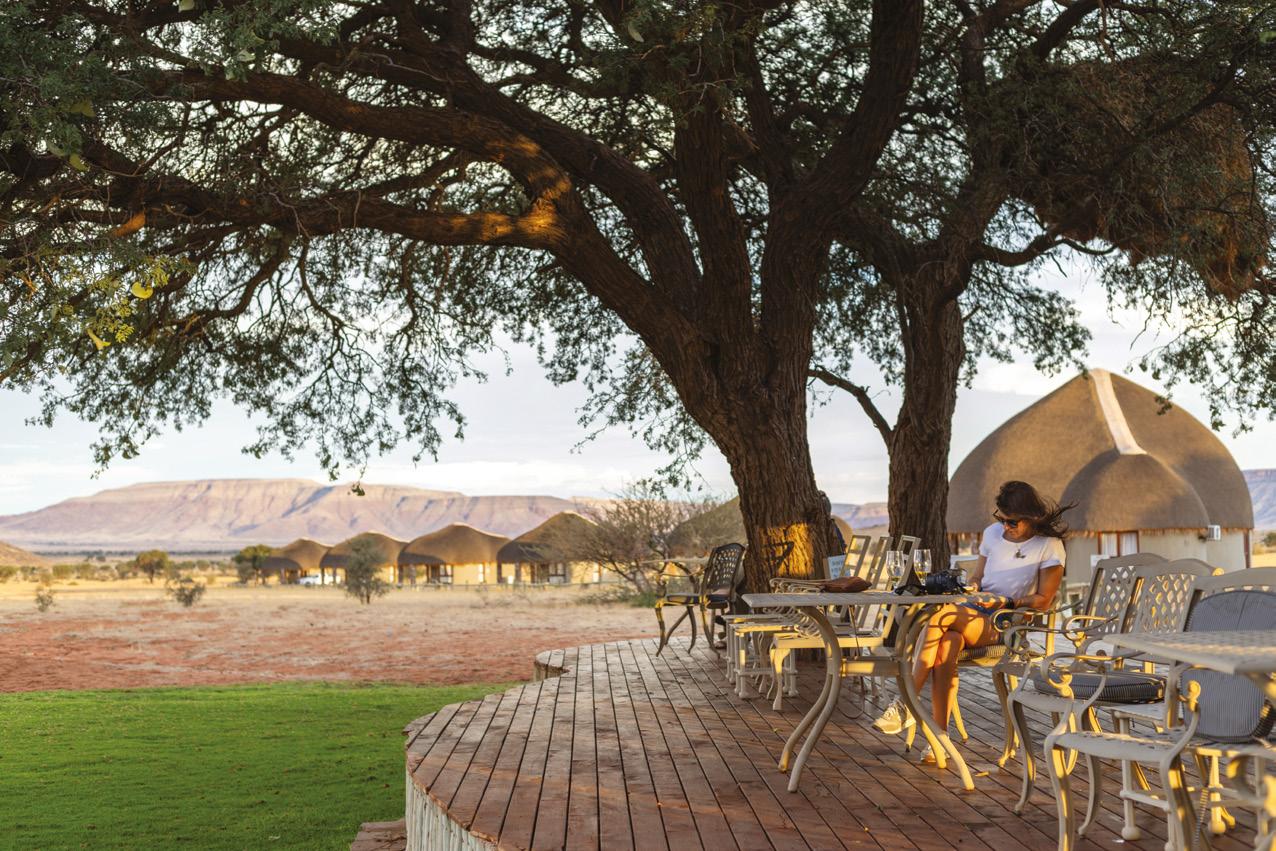
There was a moment as I sat on the wide veranda curved around We Kebi Safari Lodge, taking in the setting sun and roaming wildlife, when I felt the land take a breath.
Southern Namibia unfolds in long, uninterrupted lines – plains that seem to breathe with you, skies that feel heavier at sunset, silence so complete it becomes a presence of its own. The heat of the day loosens its grip as the sun sinks slowly, deliberately, as if even it understands that nothing should be rushed here. The horizon feels expansive, the landscape uncompromising, yet never empty. Camelthorn silhouettes etch themselves against the sky, blue wildebeest drift across the plains, eland stand heavy and deliberate in the distance. It is the
kind of place where you slow down without realising you have done so.
From my veranda perch, my eye keeps returning to a sociable weaver nest in a nearby camelthorn tree. An enormous, thatched mass of grass and twigs, far larger than it first appears. Dozens of birds live within a single nest like this, each chamber carefully woven, insulated against cold desert nights and shaded from the sun. Some of these nests take generations to build, growing heavier and more complex over time, becoming landmarks rather than temporary shelters.
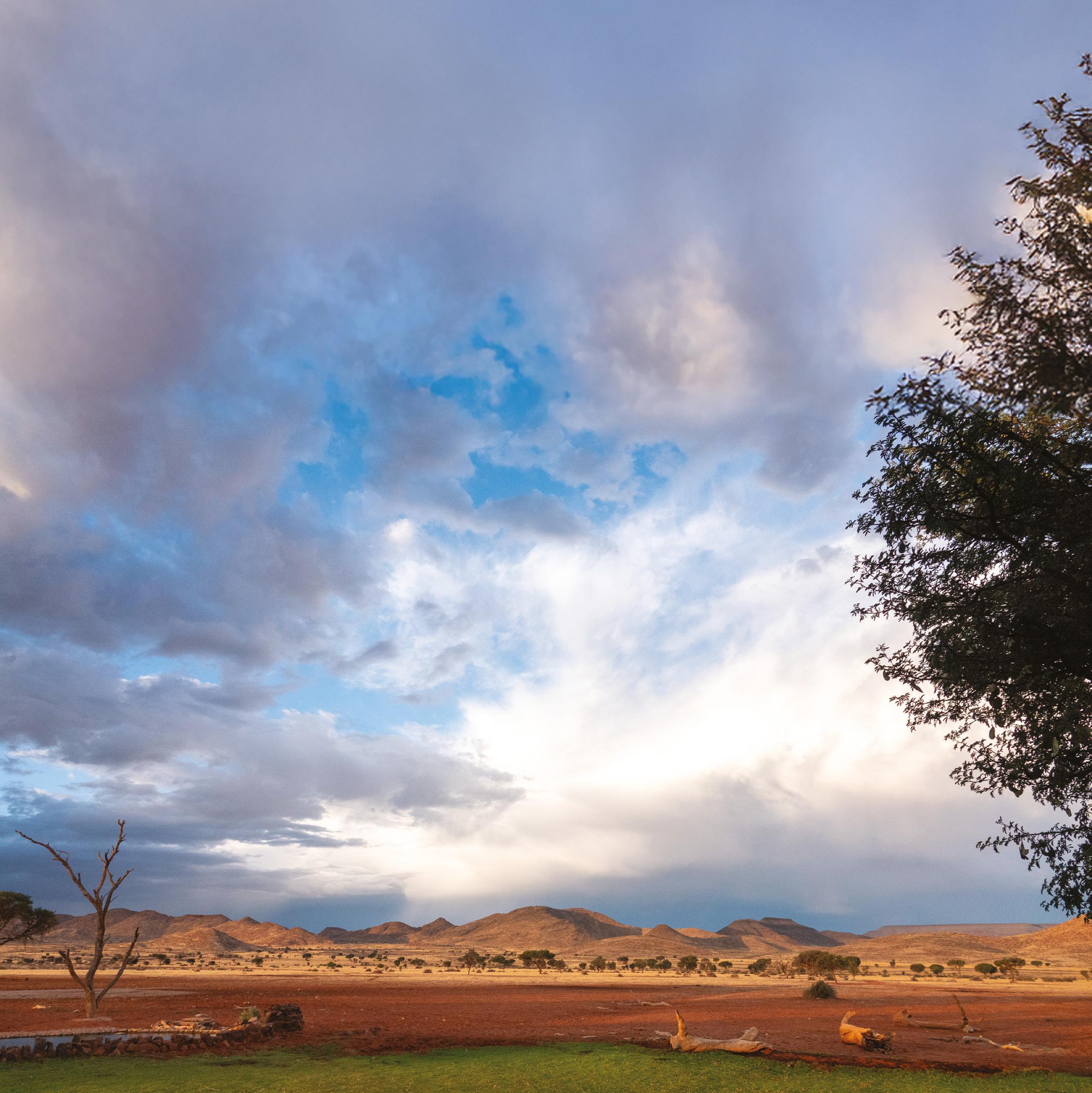
Born in the one place where sun and sand are old friends and every wind carries an echo of eternity, the sociable weaver knows how to braid grass into shared shelter. How to build not just a nest, but a community – chambers buzzing with life, even in a world that feels half made of heat and light. Watching the birds come and go, quick flickers of movement against the sky, I find myself wondering how they must see this endless, dry yet living place. From their perspective, I imagine the land does not read as harsh or empty, but as pattern and possibility – waterholes as markers, movement below as meaning, home chosen not for beauty, but for balance.
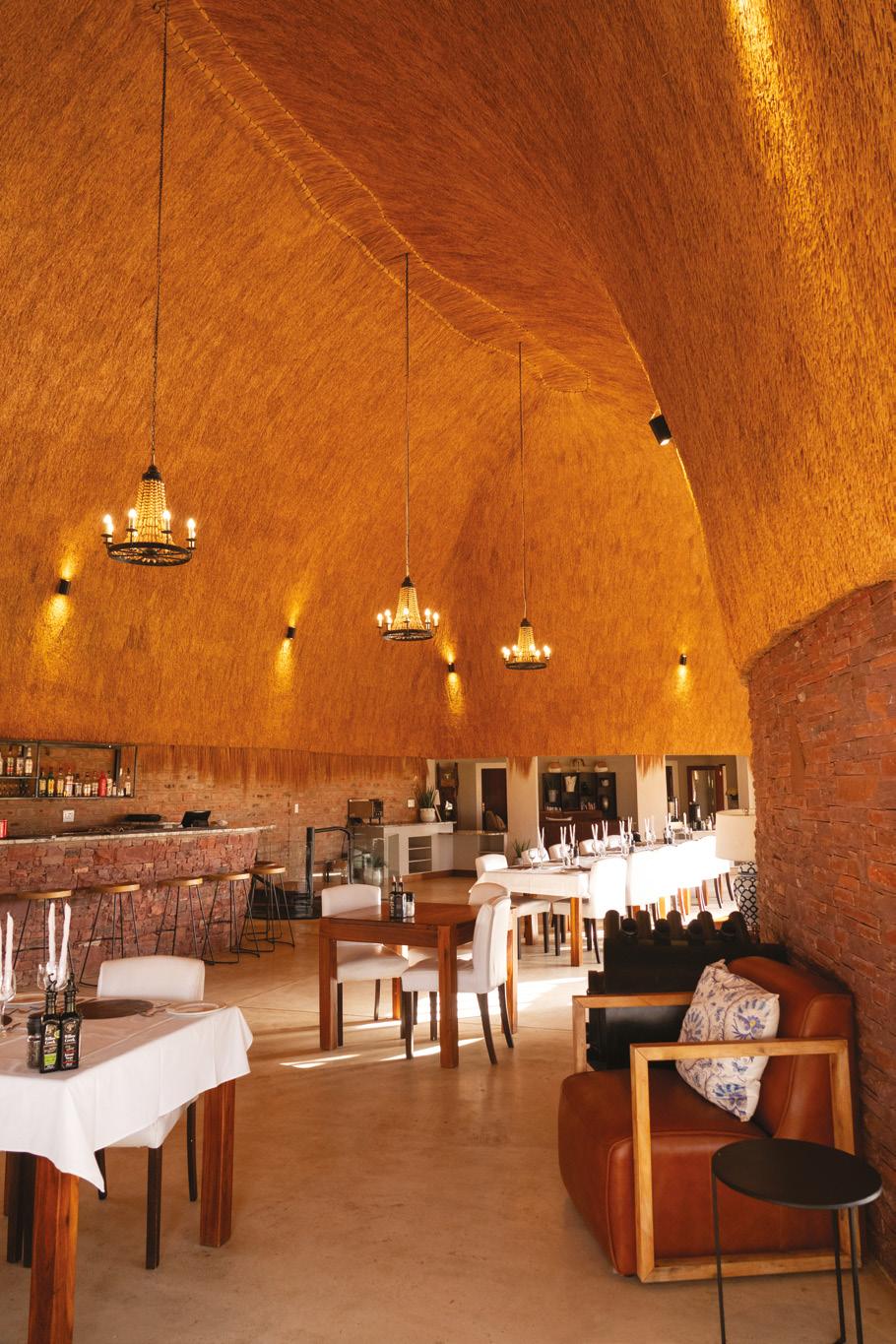
Out here at We Kebi – where desert sands blur into horizons and silence feels as deep as night – a different kind of nest rises from the soil. Fourteen thatched chalets, wild in shape yet familiar in spirit, sit against a backdrop that feels ancient. They are not stone or glass; they are woven structures echoing the languages of birds and wind, husks shaped by an instinct to return to the land. The buildings do not compete with the landscape. They borrow from it. Architecture guided by observation, not dominance.
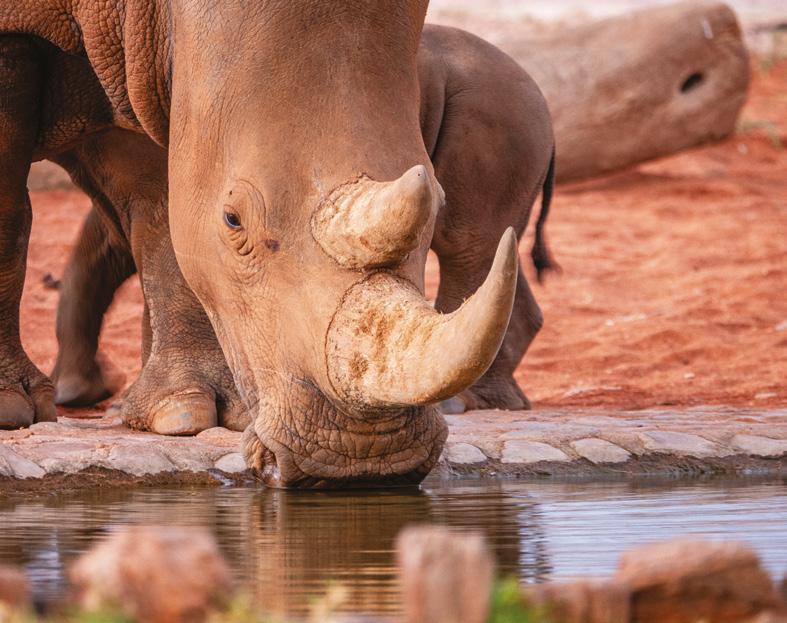
The same philosophy hums beneath the reserve itself. A white rhino and her calf emerge in the distance and amble towards the waterhole in front of the lodge – entirely at ease. For some, their presence here in the far south feels unexpected, almost out of place. But that surprise fades when you remember that once, long before fences and farms, white rhino thundered across all of southern Africa. Their presence here is not an anomaly; it is a restoration.
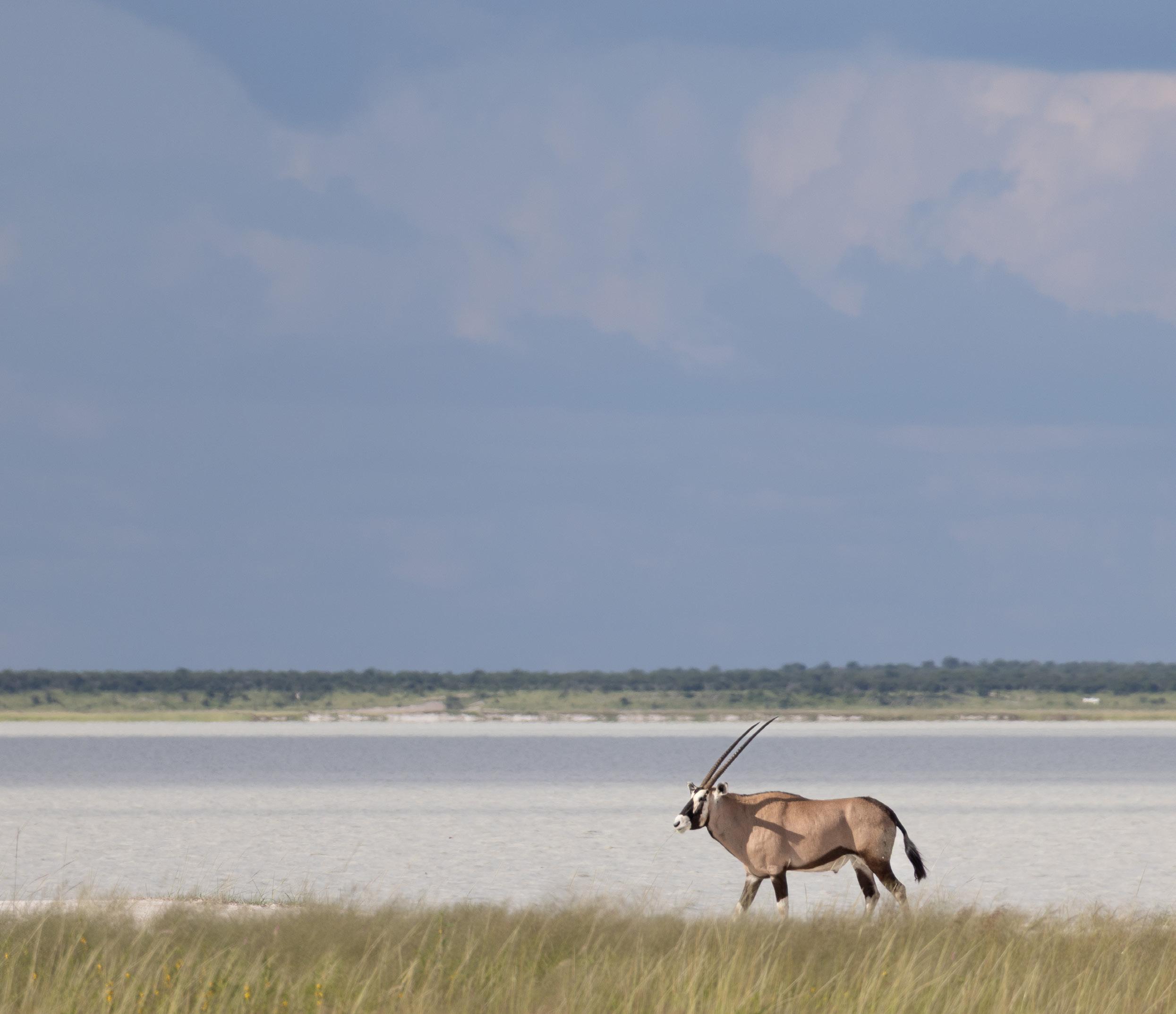
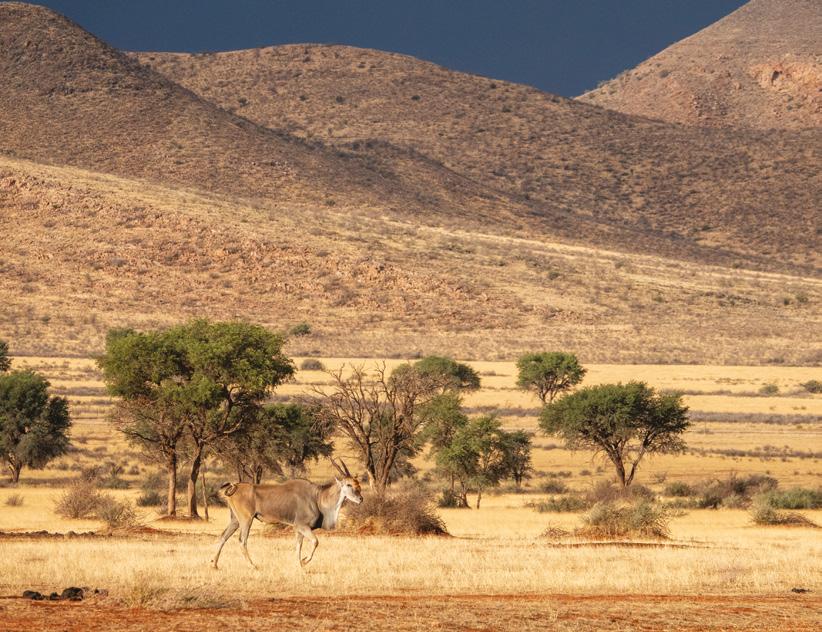
Blue wildebeest, eland, gemsbok, and even, to my surprise, lechwe move across the plains – part of a living system shaped by grazing paths, water, and time. Nothing feels rushed. Nature here is not a backdrop, a stage, or a souvenir.
From my vantage, travellers arrive like migratory birds. Some sit on the veranda with coffee in hand, watching wildlife drift by. Others set out on sundowner drives or guided nature excursions across We Kebi’s private reserve – each finding their own way to meet with and discover the wonders of this desert.
I think of the sociable weaver again. How it reads the land. How it chooses where to stop in a landscape that offers no obvious end. How its nest is both refuge and meeting place, a pause in the endlessness of the desert. A longing for stillness. For wonder. For a horizon you can follow without reaching the end.
They call this place a lodge, a retreat, a stop along the road to Sossusvlei’s dunes. But in truth, southern Namibia’s profound landscapes are a threshold – a place where the desert’s pulse slows your breath and invites you to find something you may have forgotten: your place in the weave of life. A reminder that discovery is not a point on a map, but the quiet acceptance that you belong to something wilder, older, and profoundly alive.
And when you eventually leave, carrying the dust and the silence with you, the desert stays. Not behind you – but inside you. TN
Discover We Kebi: www.daosa.com.na/we-kebi-lodge
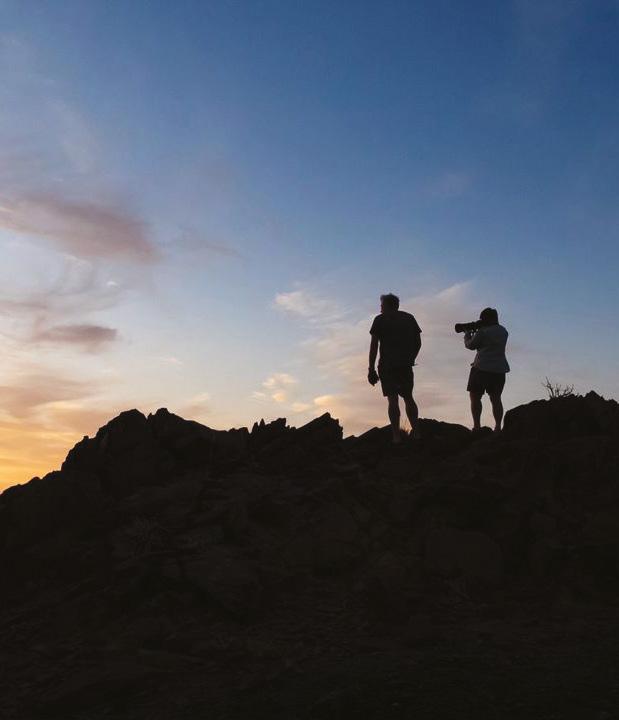
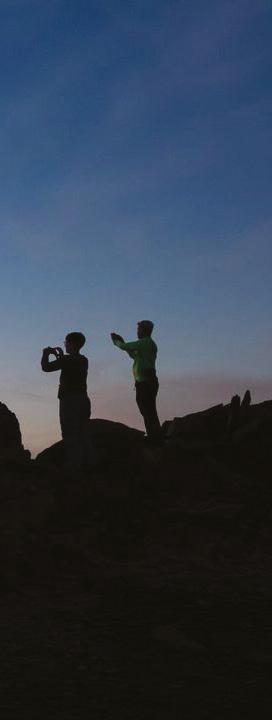
Out in the Namib, long before the light settles and the dunes begin to glow, Abner Simeon has already lifted his camera. For him, the act is instinctive. There is no checklist, no overthinking. The subject arrives first –and then, almost immediately, his eyes begin to frame the story.
Abner is a professional guide with Wilderness, but he is also something else entirely: a quiet observer of moments that most travellers pass without noticing. His photography does not shout for attention. Instead, it waits. It watches. It allows the land to speak on its own terms.
“Guiding is living in the moment,” he says. “Photography is memory.”
It is a simple distinction, but one that sits at the heart of his work. As a guide, he is fully present with his guests – interpreting landscapes, tracking movement, responding to weather and wildlife in real time. But once the moment has passed, it lives on only in recollection. Photography, on the other hand, makes those moments permanent. It turns fleeting light into something lasting.

“When you spend so much time in the wild, you learn to appreciate what we have, “ he reflects. “You start to understand how everything works together”
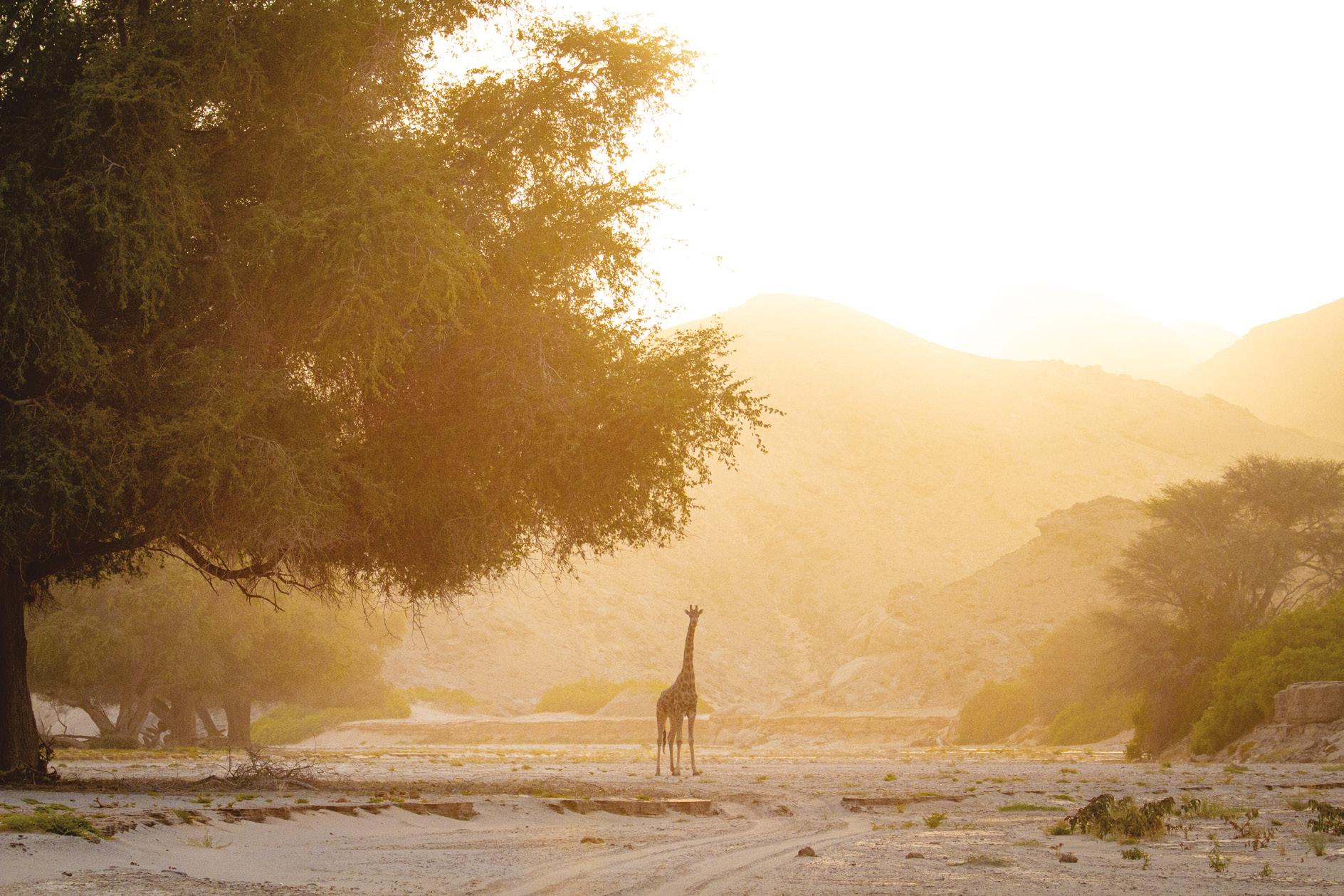
That duality shapes the way Abner frames every image. He does not photograph scenes – he photographs stories. Years of guiding have taught him how to read the land, how to anticipate change, and how to sense when something is about to unfold. A shift in wind over the dunes. A break in cloud just before sunset. A sliver of light finding its way through a line of trees.
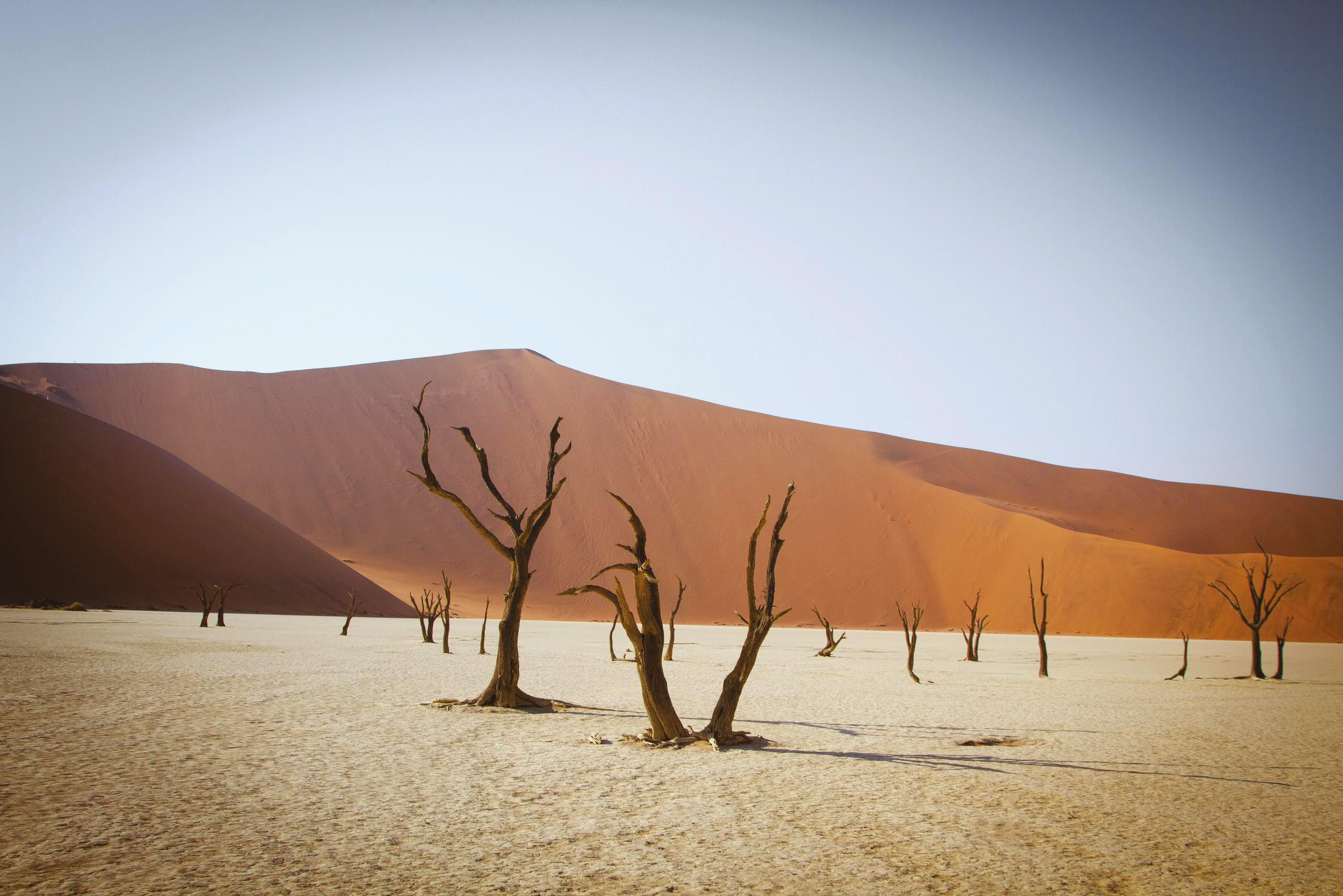
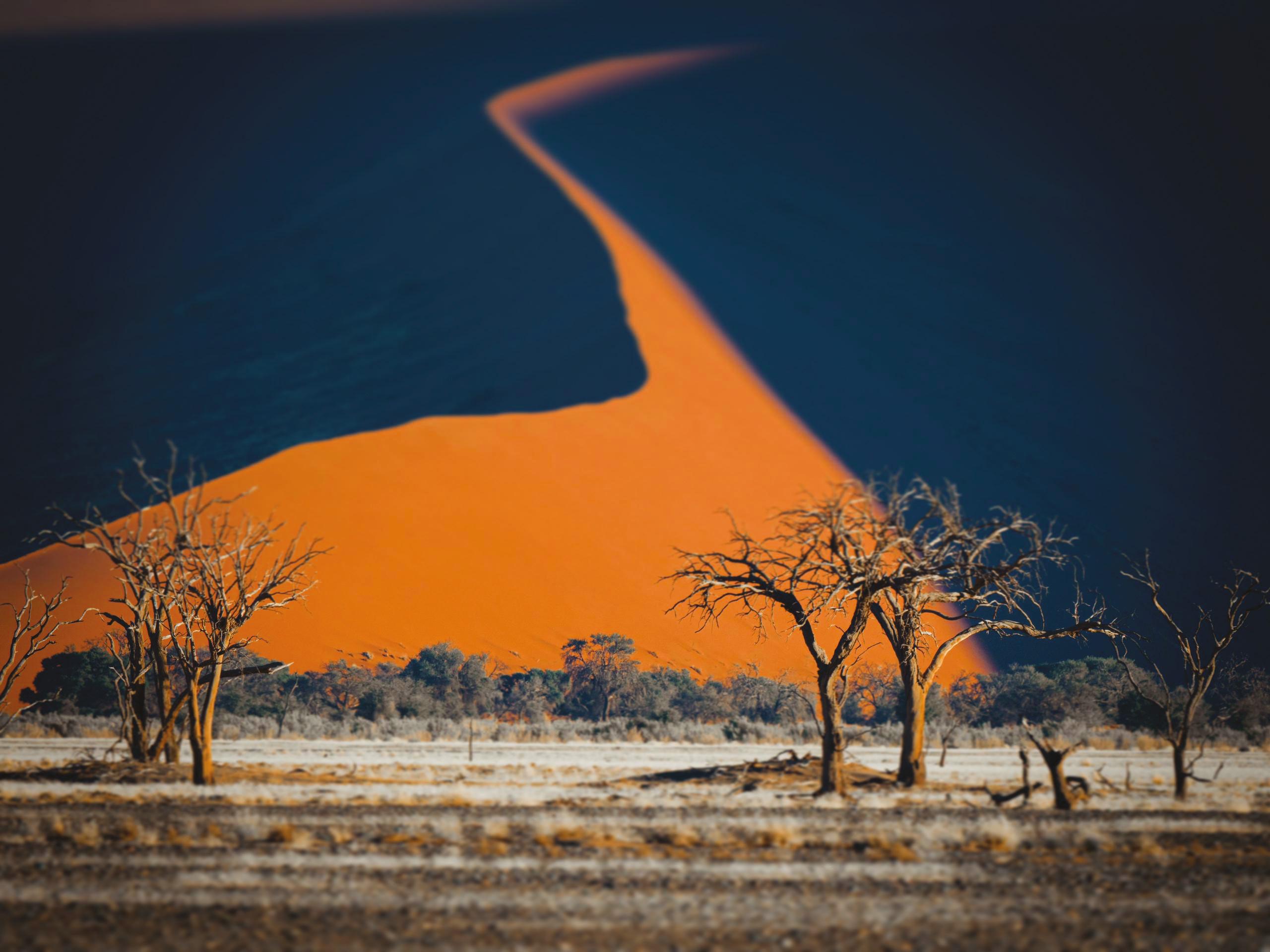
I see photography like storytelling,” he explains. “I am always travelling and exploring our beautiful country. Through photography, I get to share that journey with everyone.”
The landscapes he captures are not postcard-perfect by accident. They are deliberate, patient compositions built on timing and restraint. Abner is particularly drawn to the relationship between light and shadow – the moment when brightness fades, or when a beam of sunlight cuts across sand or bark just long enough to transform the scene.
“It adds mood,” he says simply. “You can’t go wrong with that.”
One image in this feature holds a secret known almost only to him. Somewhere deep in the Namib–Naukluft National Park lies a dune with a subtle S-shape, far from the main road. It is unmarked, uncelebrated, and rarely stopped at.
“About 95 percent of people don’t know about this dune,” Abner says. “I have never seen anyone stop there.”
To him, it is one of the most beautiful forms in the desert –a quiet curve of sand shaped by time and wind. “You have to be a photographer to see the beauty in it,” he adds, not with arrogance, but with understanding.
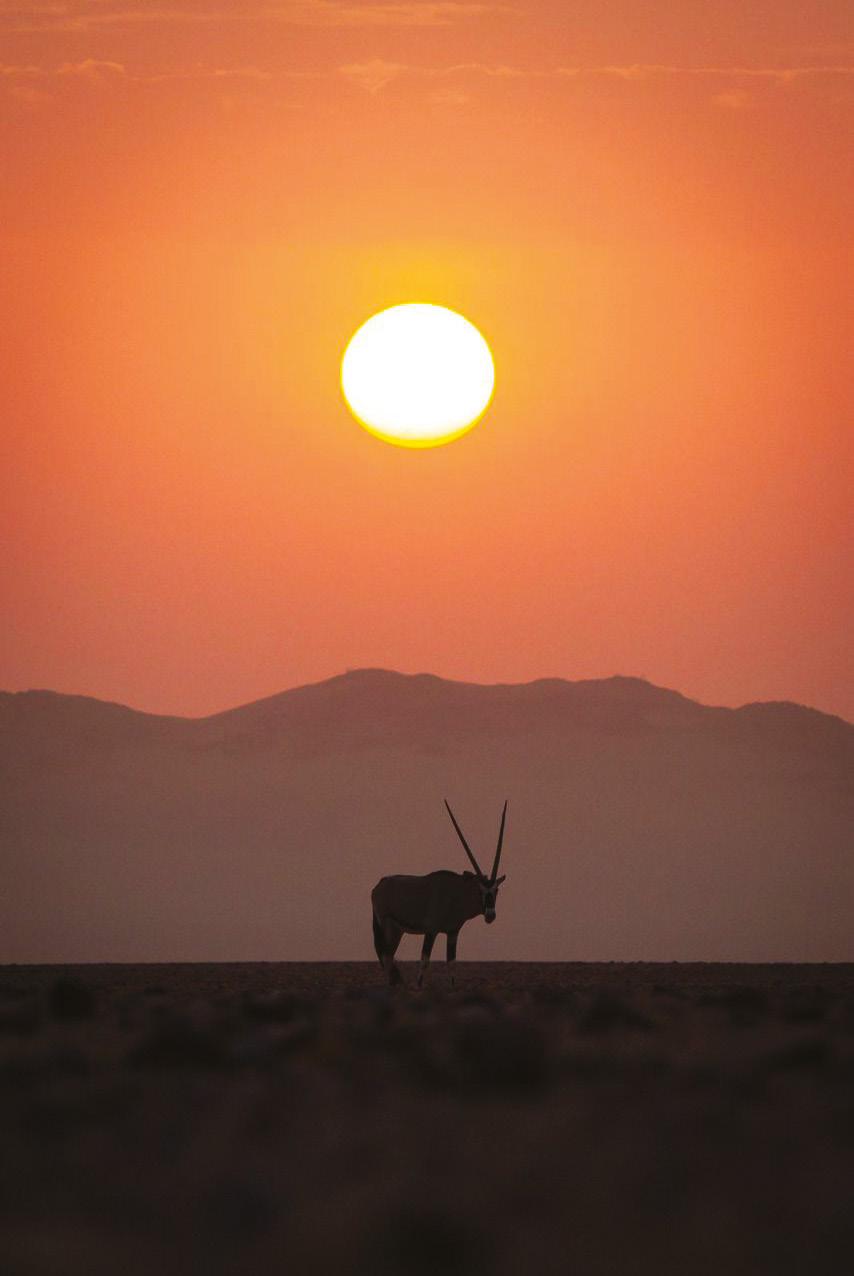
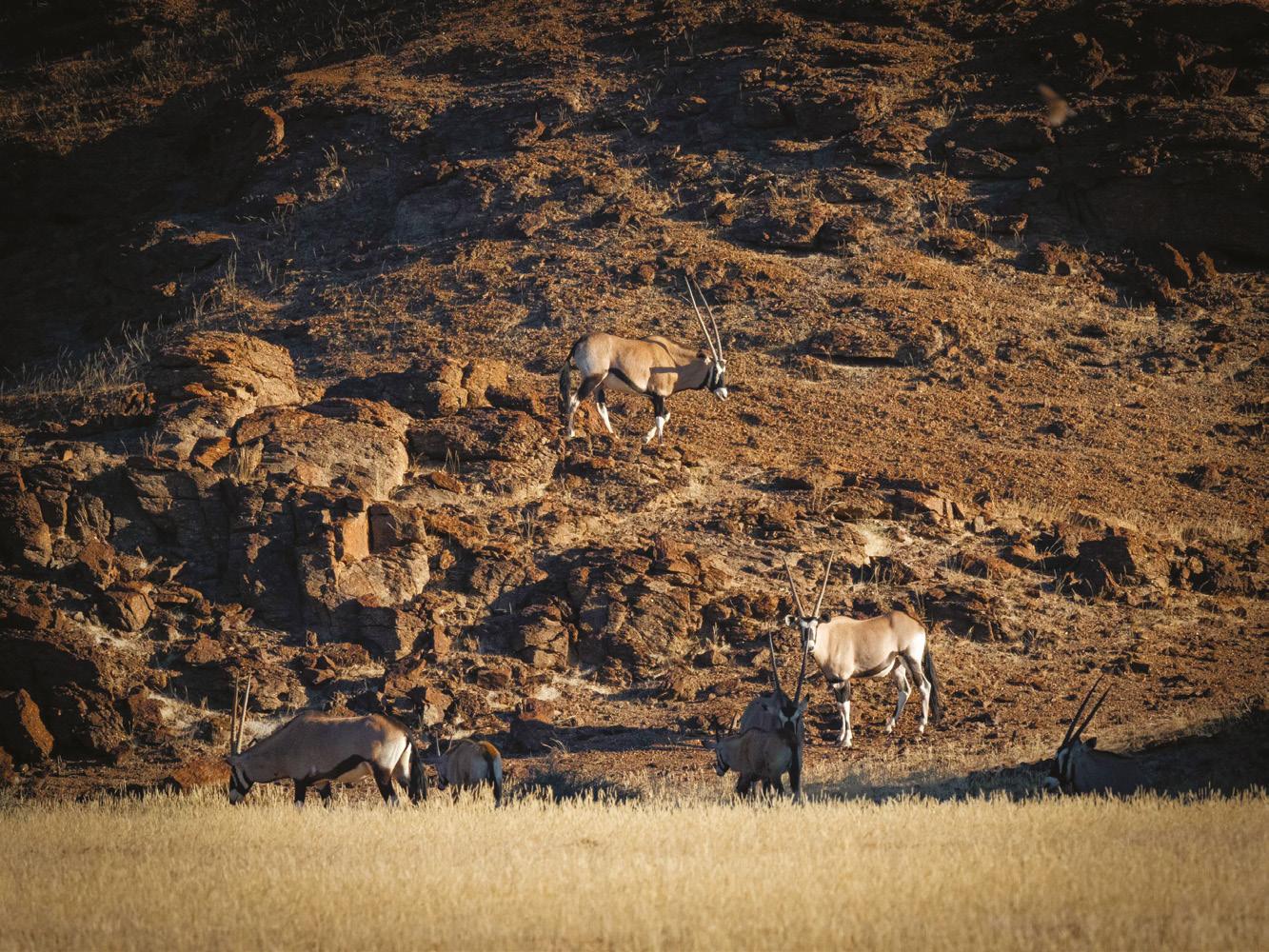
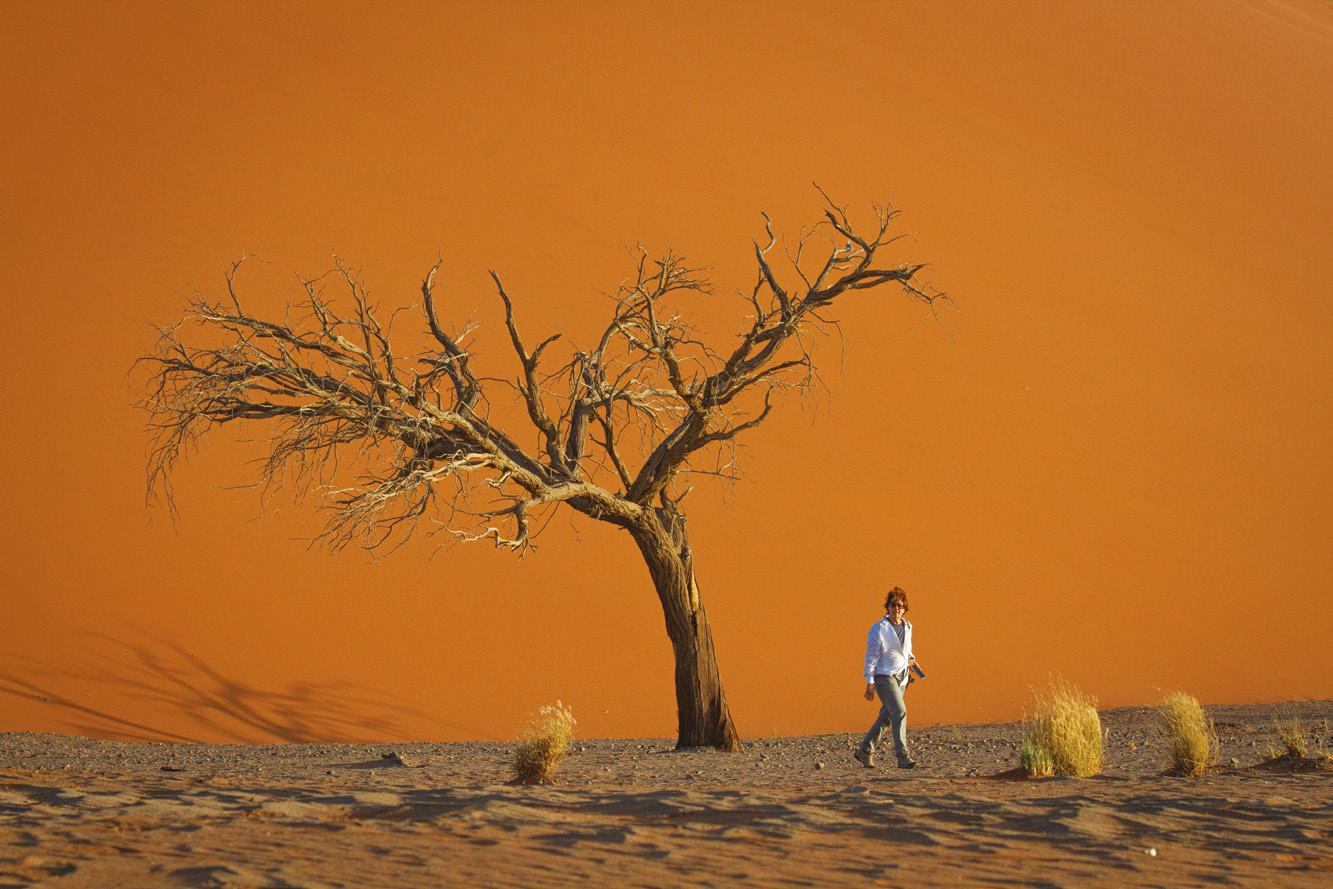
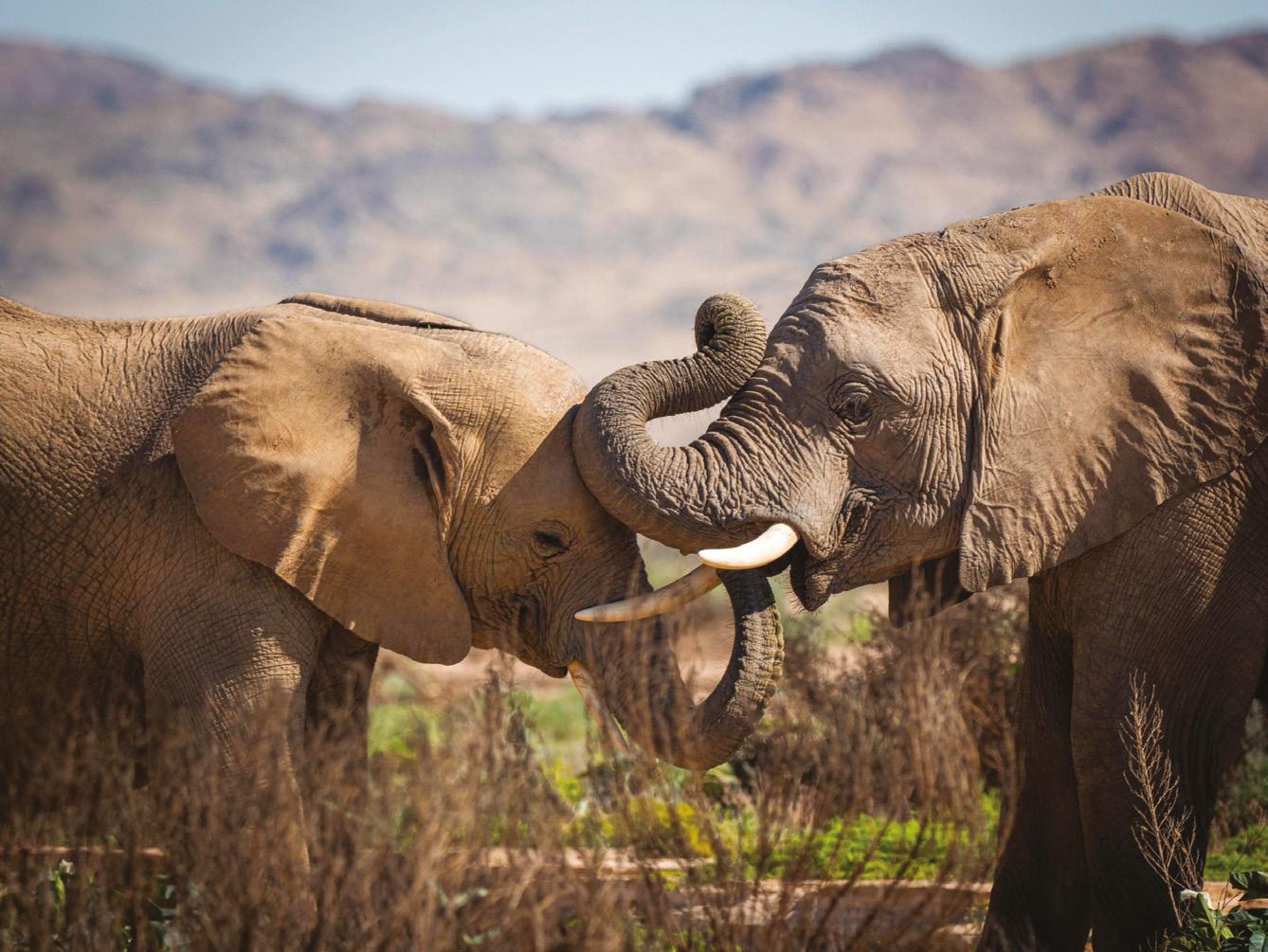
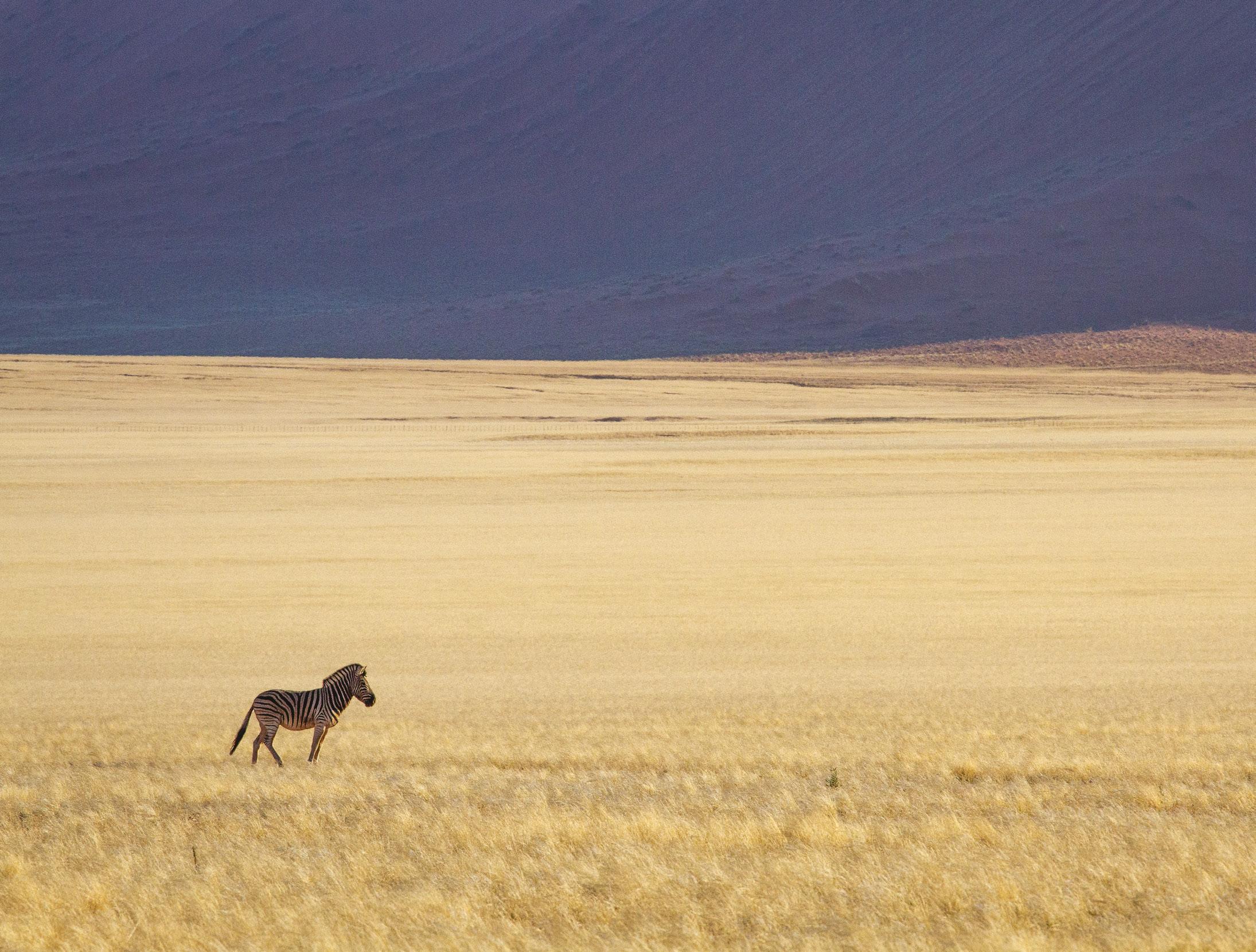
This ability to see beyond the obvious is something the wilderness has taught him over years spent outdoors. Beauty, he has learned, is not only about appearance. It is about function, resilience, and adaptation. Watching how living things survive and thrive in harsh environments has reshaped his perspective – not just as a photographer, but as a human being.
“When you spend so much time in the wild, you learn to appreciate what we have,” he reflects. “You start to understand how everything works together.”
That understanding runs deep in his relationship with the word “wilderness” itself. Beyond the brand name, wilderness represents something far more personal – an internal state of awe, silence, and humility.
“My photographs reflect wilderness not just as a place,” he says, “but as a feeling. A reminder of raw, untamed existence. A personal retreat into silence.”
Interestingly, Abner does not consciously see photography as another form of guiding. The camera is simply part of who he is – something he carries everywhere, ready
for whatever the day may reveal. Whether travelling with guests or alone, he never knows what might appear.
What he does recognise, however, is the responsibility that comes with sharing images of Namibia. Through his lens, he becomes an ambassador – a son of the soil from the Land of the Brave – entrusted with showing the country honestly, respectfully, and with pride.
And if someone were to experience the bush only through his photographs?
“I want them to love and appreciate what we have,” he says. “Not to take it for granted.”
His own journey began that way – introduced to nature, falling in love, becoming a guide, and then a photographer. Now, through both guiding and imagery, he shares Namibia with those who may never set foot in its deserts or forests. In Abner Simeon’s photographs, wilderness is not conquered or curated. It is listened to. And in that quiet attention, its true beauty is revealed. TN
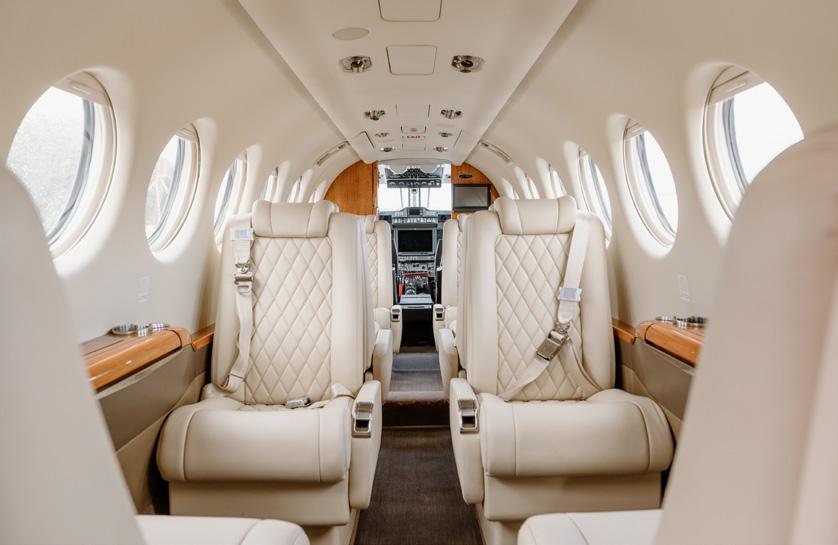
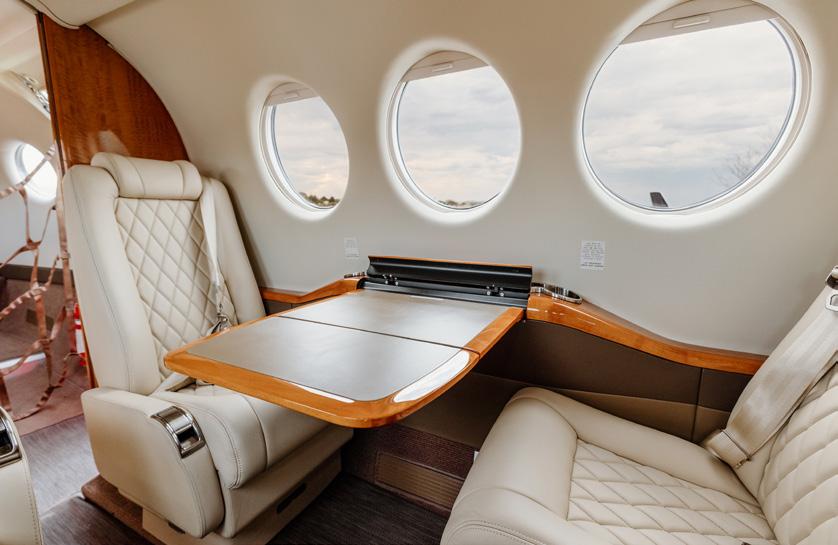
Experience the ultimate in luxury with Westair’s Private Charter flightsseamlessly taking you to any destination in Namibia and beyond.
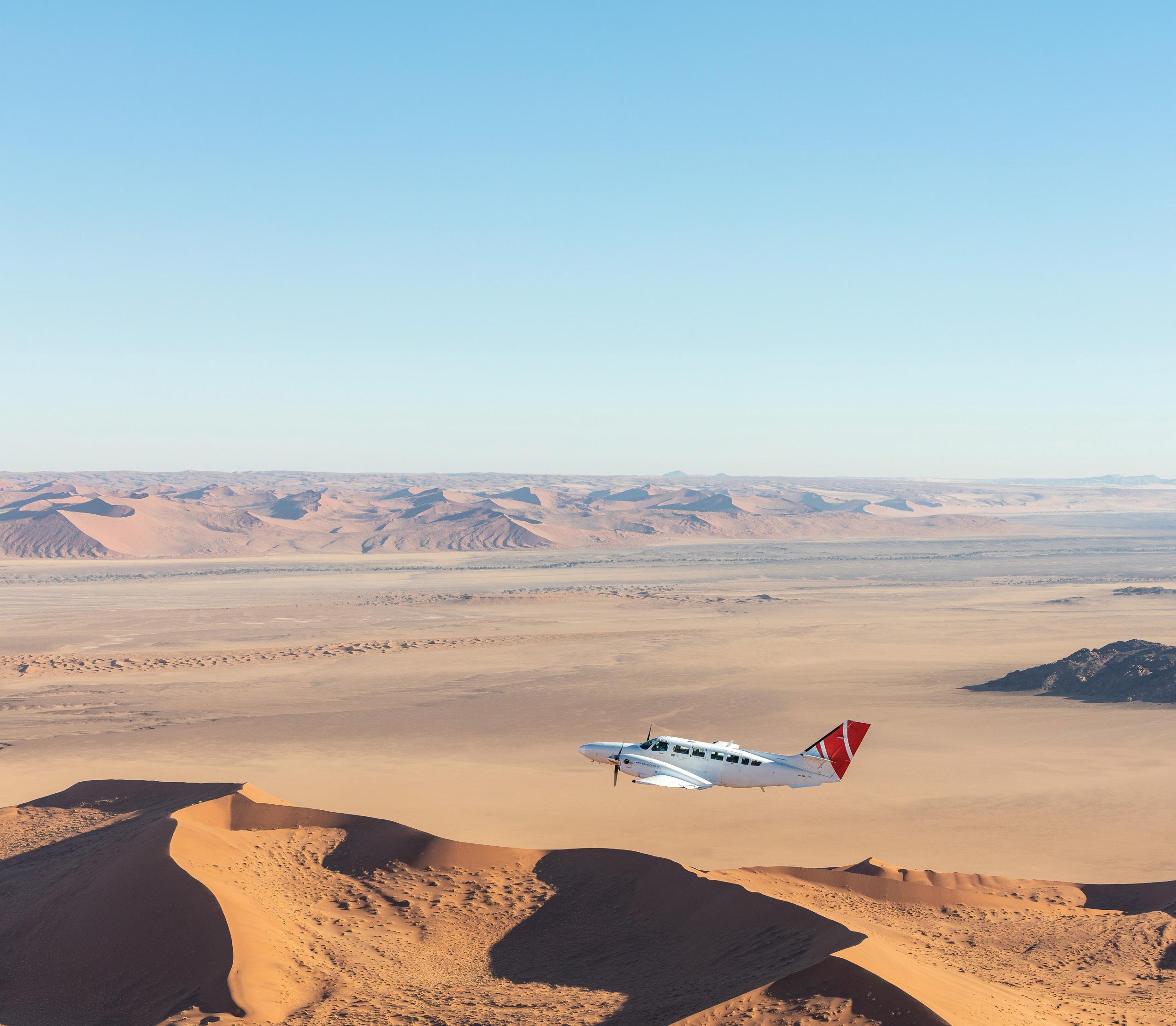
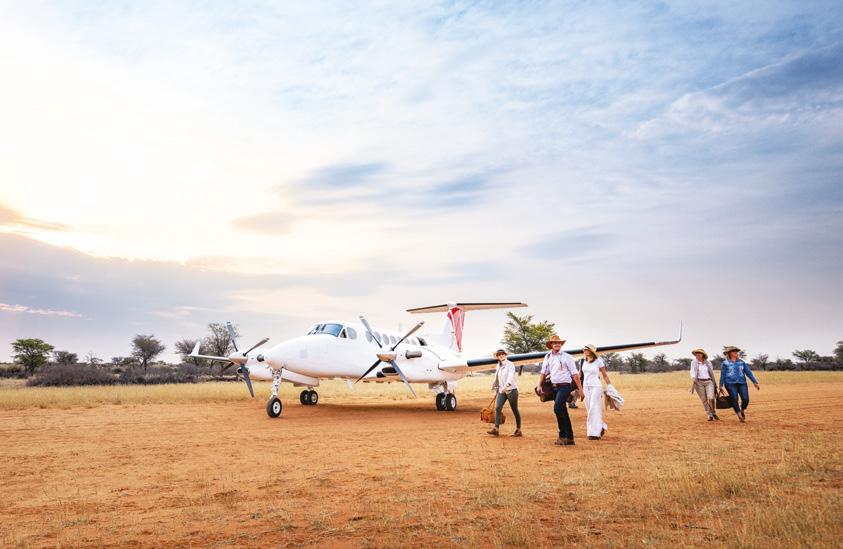
Swakopmund has always carried a certain serendipitous charm. Its well-preserved 19thcentury architecture, broad palm-lined avenues, and unusually pedestrian-friendly streets – a rarity in much of Namibia – create an atmosphere both nostalgic and beguiling. Cobblestone courtyards tucked behind cafés and restaurants noisily hum with locals and holidaymakers alike, and then there`s the ocean: a steady, rumbling presence enveloping the town. The coastal windsometimes a gentle breeze, sometimes a warm, spirited whipseems to tug unsuspecting travellers along whimsical paths they hadn’t planned to wander. In Swakopmund, you never quite know where the day might lead, and that is precisely part of its magic.
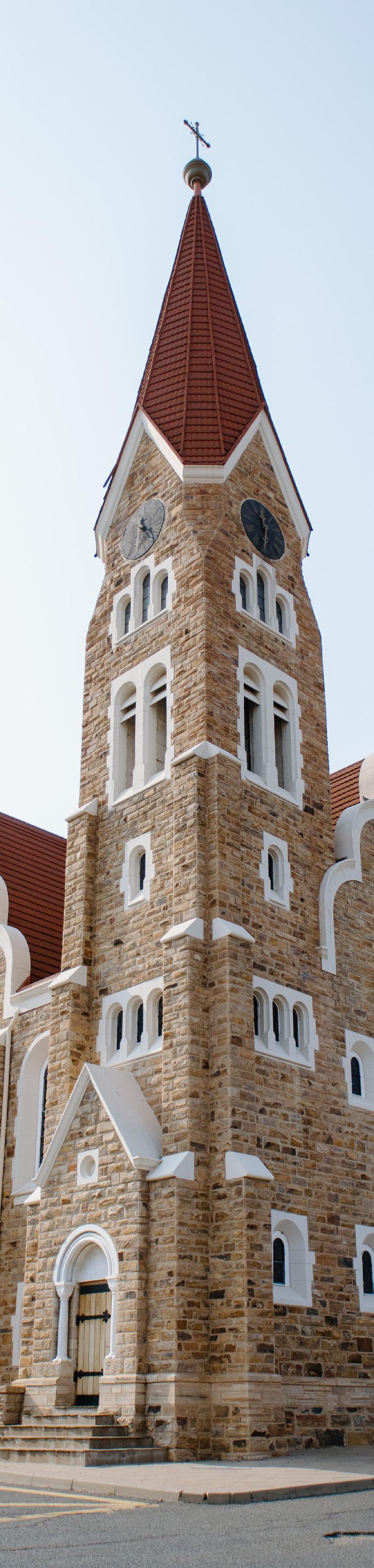
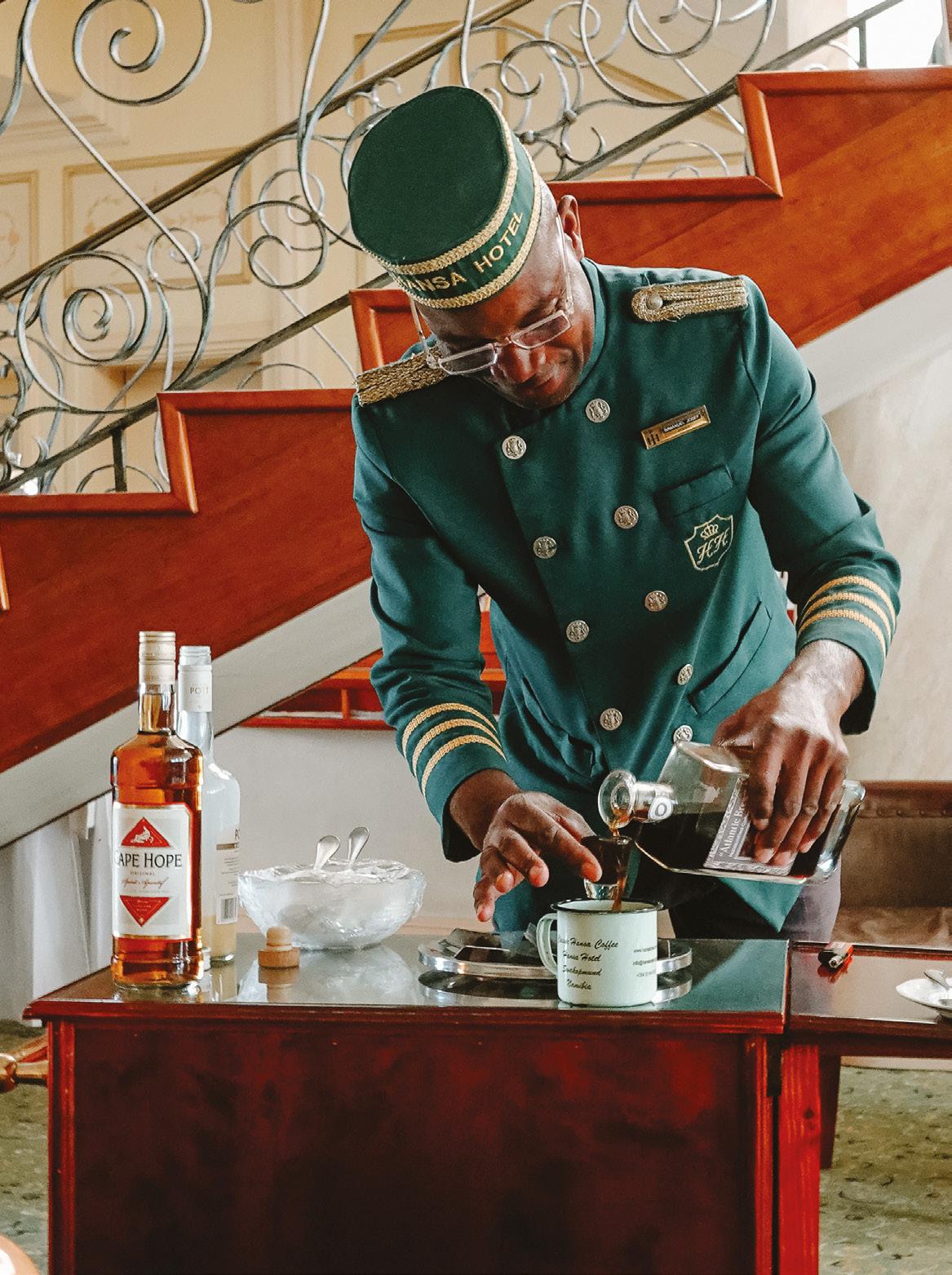
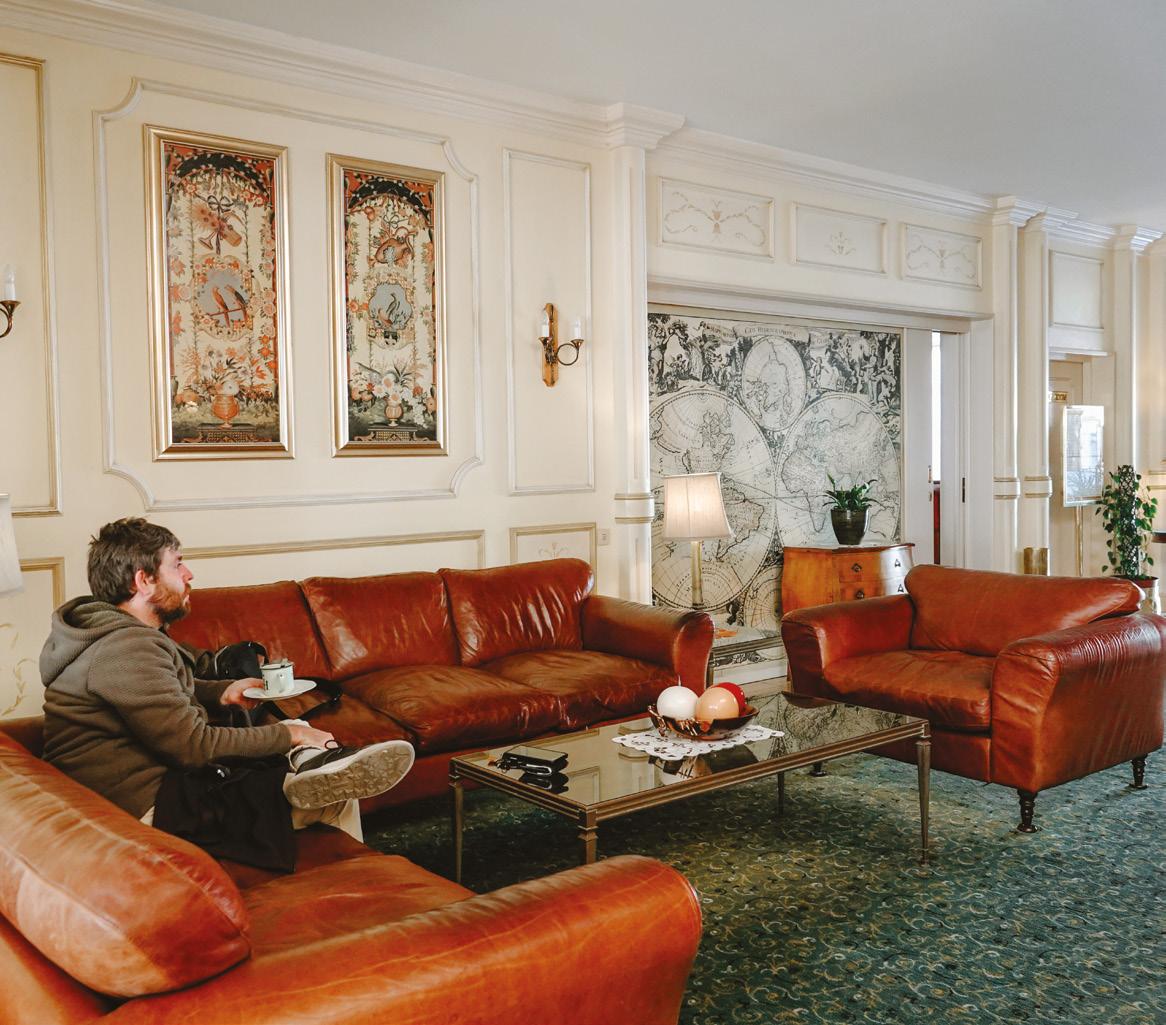
On one such day, I found myself on the steps leading to the Hansa Hotel. Swakopmund’s oldest hotel, Hansa is centrally located and boasts classic architecture dating back to 1905, with an elegant, vintage interior that pays tribute to a bygone era. I’ve come here to try Hansa Hotel’s iconic house speciality, the Classic Coffee, rumoured to be crafted right at your table. No sooner had I ordered than Immanuel – our waiter, immaculately dressed as a porter in a style both incongruous and perfectly in keeping with the hotel’s old-world appeal – sauntered over.
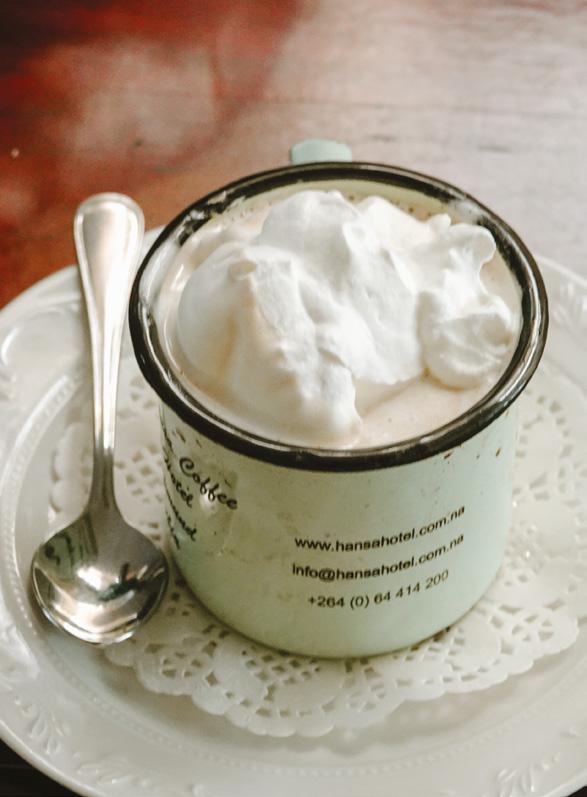
The coffee is served from an old-fashioned cart, with flames from a portable gas stove setting the stage. A blend of handcrafted coffee liqueurs and a shot of brandy is allowed to simmer in a metal campfire cup, with Immanuel expertly swiveling the mixture to prevent it from burning. A serving of freshly brewed black coffee is poured in, and the drink is finally crowned with a dollop of luxurious cream, added with a flourish.
Even though every element is carefully portioned and measured, the Classic Coffee is delivered with an unmistakably playful presentation. Throughout the process, Immanuel peppers the preparation with lively, animated chatter – “good sleep, good sleep” – no doubt hinting at the generous alcohol content, postconsumption. His mischievous twinkle adds a layer of theatrics; making the experience as entertaining as it is delicious.
Be warned: the Classic Coffee does have a kick – and yes, it delivers on the promise of sleep. Very, very good sleep. TN

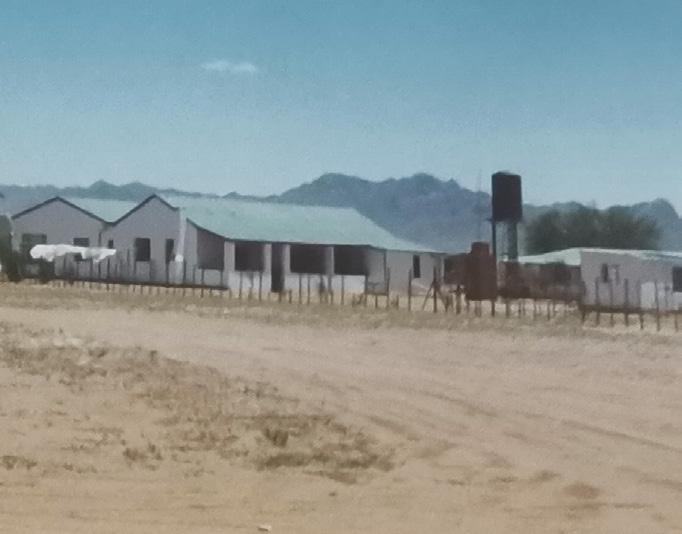
Betta is situated in the south of Namibia, in the Maltahöhe district – an area known for its open plains, tranquility and breathtaking landscapes. In the wider surroundings of Betta, there are several other lodges, some of them well established. A nearby attraction is the beautiful historic Duwisib Castle, located 21 km from Betta.
Betta is a central point located between Maltahöhe, which is about 100 km to the north, and Helmeringhausen, about 110 km to the south on the road to Aus and Lüderitz.
The very first owner of the farm was Mr T.N. van Lill. The name of his farm was Izabetha, which he named after his wife. The farm was then given to the eldest son, Andries. Later, Andries’ daughter Elize and her husband, Frank Henry Thompson, bought the farm from her father.
On 6 December 1994, the farm Izabetha was purchased from Frank Henry Thompson by Hennie Vermeulen. It was then that Hennie and his son, Henri, decided to change the name of the farm to Betta. Hennie Vermeulen mainly farmed with goats and cattle.
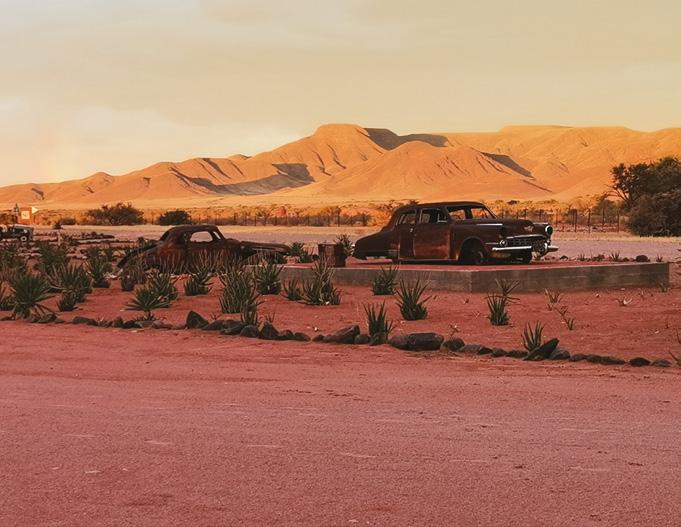
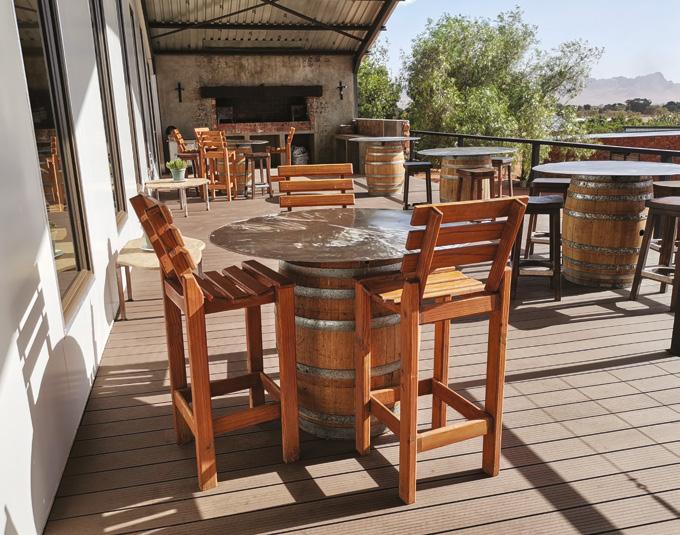
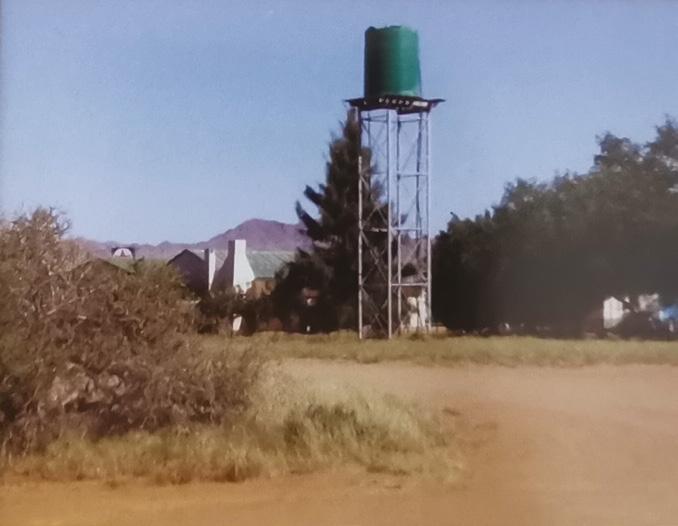
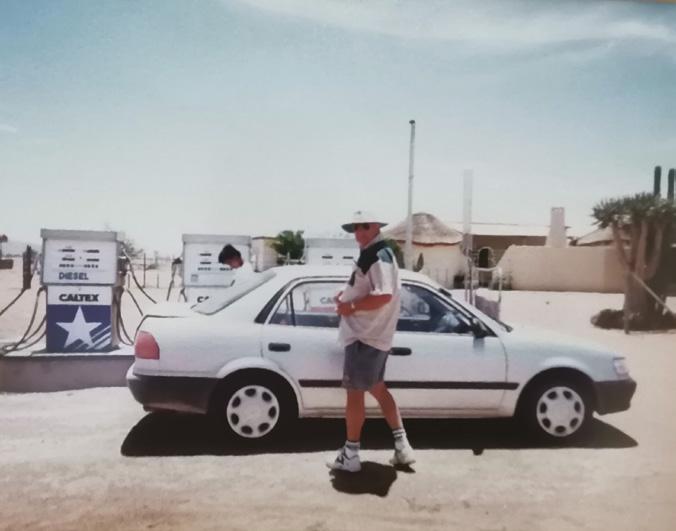
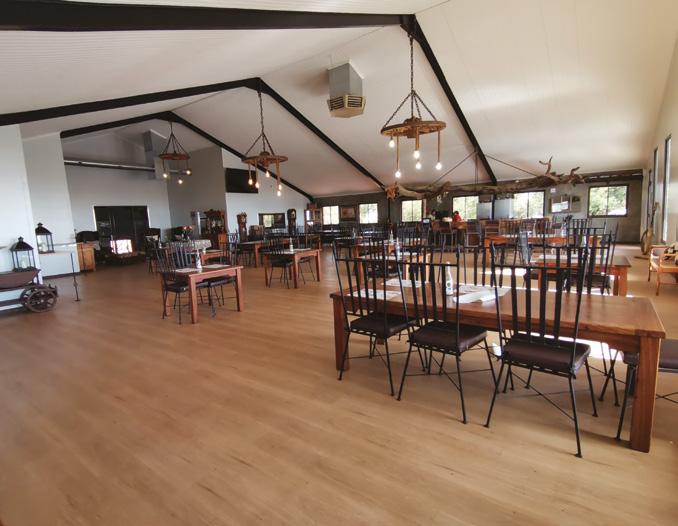
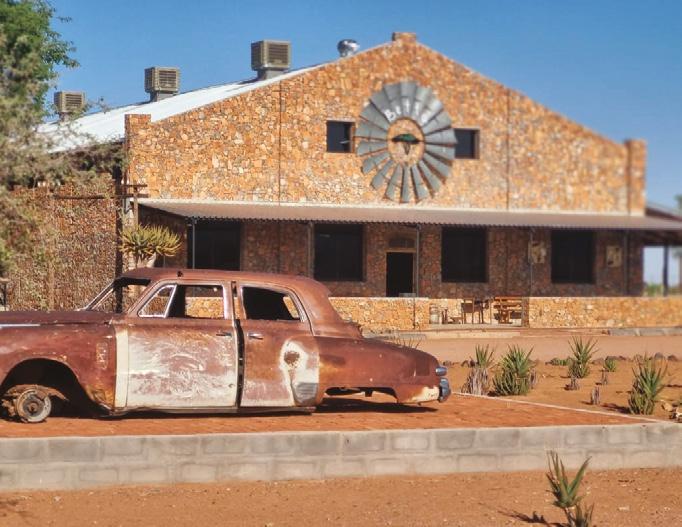
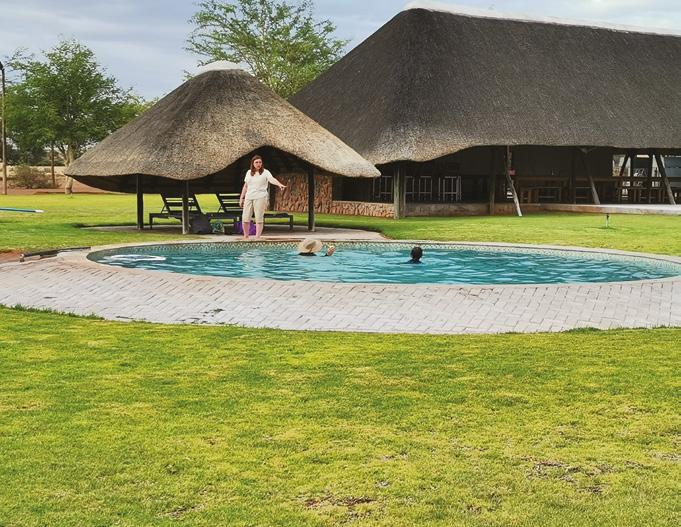
Here
at Betta, I found a treasure I could not find anywhere else – a chest full of nature’s jewels, which I captured in my collection of photographs.
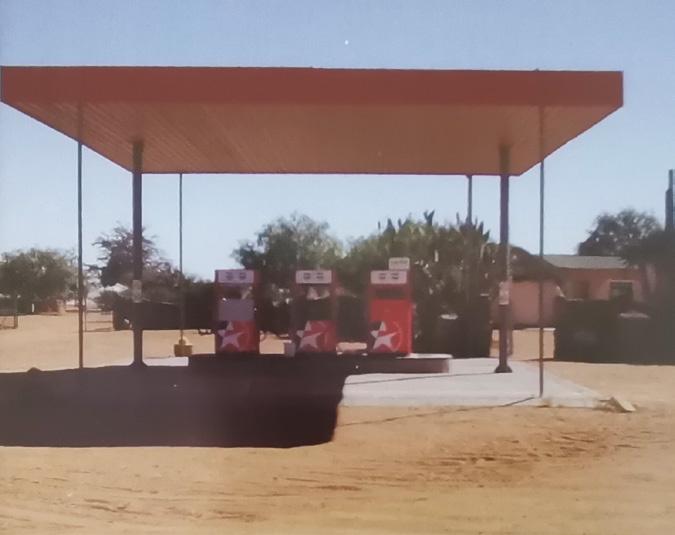
In 2000, Hennie had the idea to build a fuel station on the property, noting its proximity to the popular dirt road linking Keetmanshoop (B4), Aus, the C13 toward Helmeringhausen, the D707 past Betta Farm and the C27 to Sesriem, Solitaire and Swakopmund.
Holidaymakers frequently stopped at Betta in search of fuel, and the fuel station quickly became a popular pitstop, providing a reliable source of income. A few years later, Henri, who lived on the farm with his wife Betsie, suggested the next step: a small shop to complement the fuel station. The aim was to give travellers the opportunity to enjoy a cool drink and something to eat while filling up.
Over time, the idea of overnight accommodation began to take shape. It was a natural and wise decision. Initially, the farm offered two caravans, campsites and two tents, but the tents were blown over and torn apart by the strong winds. Even so, the accommodation proved popular, and more and more travellers began using Betta as a resting place.
By 2006, Henri decided to replace the caravans and tents with four rooms, while keeping the campsites. By this time, the combination of fuel, shop and accommodation had made Betta increasingly well known among travellers. The tranquillity of the farm and the surrounding nature held a special place for nature lovers.
Henri, a hardworking and visionary man, also established a small museum displaying antiques. These items were collected over the years from local residents or gifted to him. The museum further enhanced Betta’s already unique character.
Henri’s ultimate dream, however, was to create a beautiful stone lodge, using materials available on the farm. The construction progressed steadily, with the rooms rising one by one. The lodge eventually expanded to six self-catering rooms and eight non-self-catering rooms.
For campers, he built the stunning Mountain Camp with three luxury rooms, open-air showers, outdoor toilets and washbasins. A convenient ablution block with indoor showers and toilets was added. Today, a thatched lounge area and a swimming pool offer the perfect place to cool
off, with breathtaking views of the mountains, wide plains and sunsets that enhance the beauty of the surroundings.
At the main lodge, a separate camping area was created, thoughtfully designed with an extra lookout point at each site. Guests can enjoy the panoramic views of the plains and sunsets, sip a twilight drink and admire the scenery from a deck.
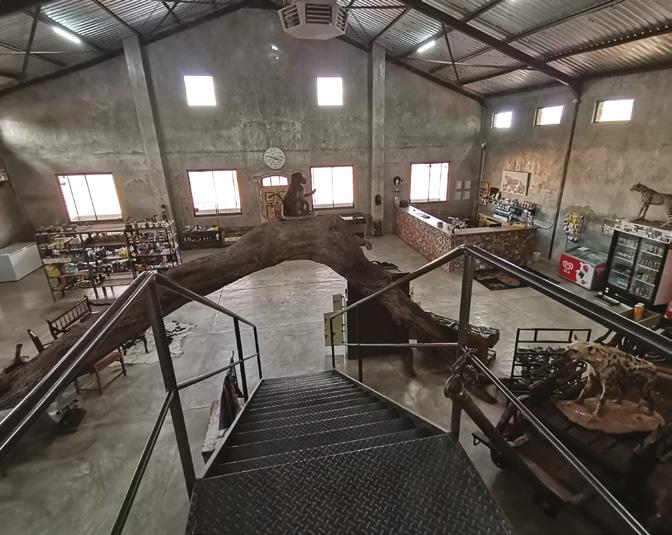
In place of the small original shop, a larger store was built to house a bistro-style restaurant. In front of the restaurant is a deck where guests can enjoy delicious à la carte meals and drinks. The restaurant and shop are beautifully decorated with antiques, some of which have fascinating histories. The restaurant and shop officially opened on 25 July 2025.
MY EXPERIENCE AT BETTA LODGE & CAMP
Betta is a retreat for those who appreciate silence and the beauty of nature. In the evenings, as you stand by your braai fire, a little owl calls to its mate, who softly replies, “Good night, my friend.” Meanwhile, the sleeping Bergvrou* and her husband watches over the farm, catching their well-deserved rest during the day.
In the early morning, when the sun rises, the scene is completed with old, rusted cars, patiently waiting for when it’s time to be driven. As the day progresses, the sun spreads its colourful blanket across the landscape, perfectly completing this picture.
Here at Betta, I found a treasure I could not find anywhere else – a chest full of nature’s jewels, which I captured in my collection of photographs. I will return again, for Betta calls me back every time. TN
*The Bergvrou is a remarkable rock formation that looks like a sleeping woman. Look closely, and you will recognise her face in the mountain.
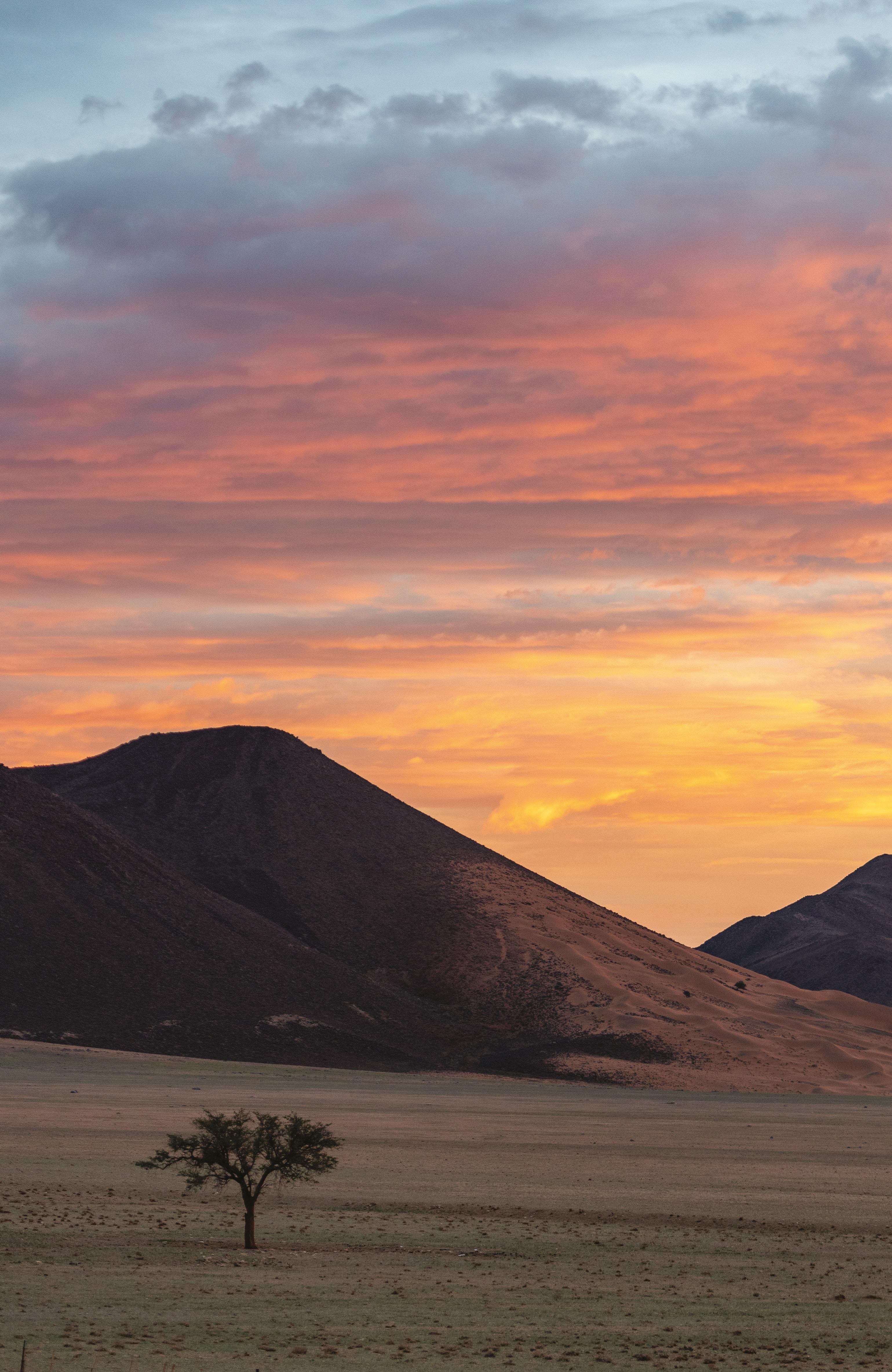
In Namibia, weather isn’t small talk. It’s identity.
We don’t mention it politely in passing. We measure ourselves by it. We boast about our heat casually – hottest country energy, endless blue skies, summer worn like a badge of honour. Sunshine isn’t something we hope for; it’s the baseline. Days are expected to be bright. Shade is strategic. Heat is endured with a kind of quiet pride.
Out here, weather isn’t background. It’s character. And, over tine, it becomes ours.
Visitors often underestimate it. They comment on the sun as if it’s temporary, something that might pass. We know better. Here, the light shapes your day, your movement, your mood. It dictates when you travel, when you rest, and when you gather yourself for the long road ahead.
Then winter arrives and surprises people.
It isn’t snow-cold, but it’s sharp. Early mornings on the back of a game-viewing vehicle bite at your face. The air is crisp and clean, thin enough to make you inhale a little deeper. It’s the kind of cold that wakes you up properly, clears your head, reminds you that you’re alive. By mid-morning the sun softens it again, but for a while, you carry that edge with you.
And then there’s rain.
We define ourselves by it. We talk about it endlessly. We track it obsessively. Rain dictates routes, holidays, detours. We drive hundreds of kilometres to see sun-topped lilies in bloom, their appearance
treated like a collective event. If Sossusvlei has water, we go. We don’t hesitate. If Etosha floods, we make sure not to miss it – dramatic white thunderclouds rolling across the pan, reflections blurring sky and earth, flamingos breeding where dust usually rules.
Rain transforms everything it touches. It turns familiar landscapes into something briefly unrecognisable. It brings movement, colour, sound. It carries promise.
Rain isn’t just weather here. It’s hope. It’s drama. It’s memory. It’s the difference between survival and abundance, between waiting and arriving.
We don’t simply experience weather in Namibia. We carry it with us. It shapes how we travel – early starts, long distances, careful planning. It shapes how we talk – about heat endured, cold mornings, rains that came just in time. It shapes how we see ourselves – resilient, attentive, deeply aware of the land we move through.
Out here, weather isn’t background. It’s character. And, over time, it becomes ours. TN
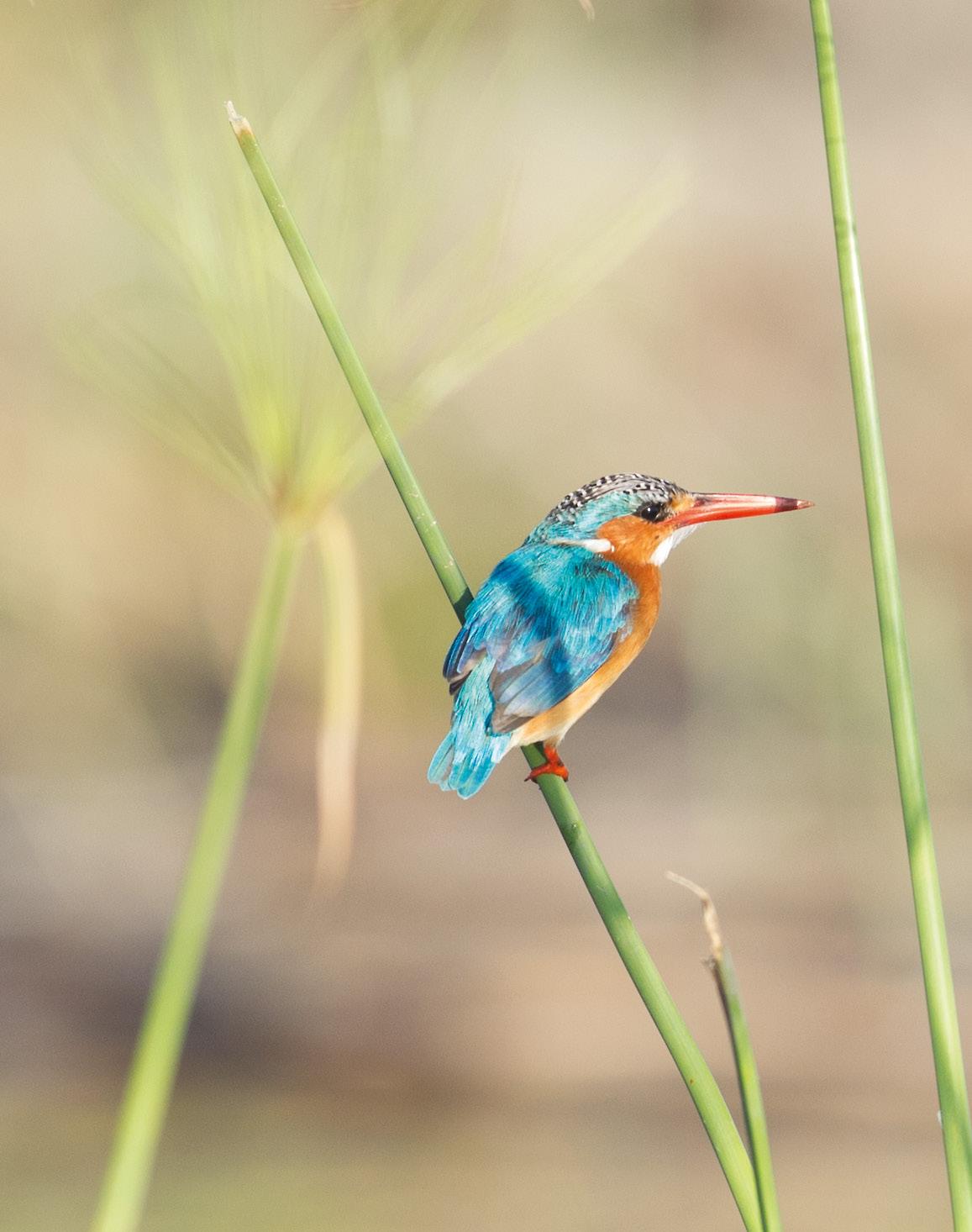
After a welcome early coffee and a cigarette to calm my nerves, we arrived at the boat loaded with cameras, a tripod, a beanbag, binoculars, sunscreen and hats. The sun was just arriving over the river in the east, looking for a place between the clouds that had brought welcome showers the previous night. My favourite non-favourite activity on a visit to a game park is a game drive. I have to qualify this statement; game drives can become a spectacular, nauseating activity when all the wrong things are in place. A crowd of tourists wanting to see lions, maybe the odd leopard, multiple cold beers, and no bird stops is not my cup of tea. I already had my coffee. Fishing is another no-no, but we were lucky to realise we had been blessed with no other passengers and a rather enthusiastic guide.

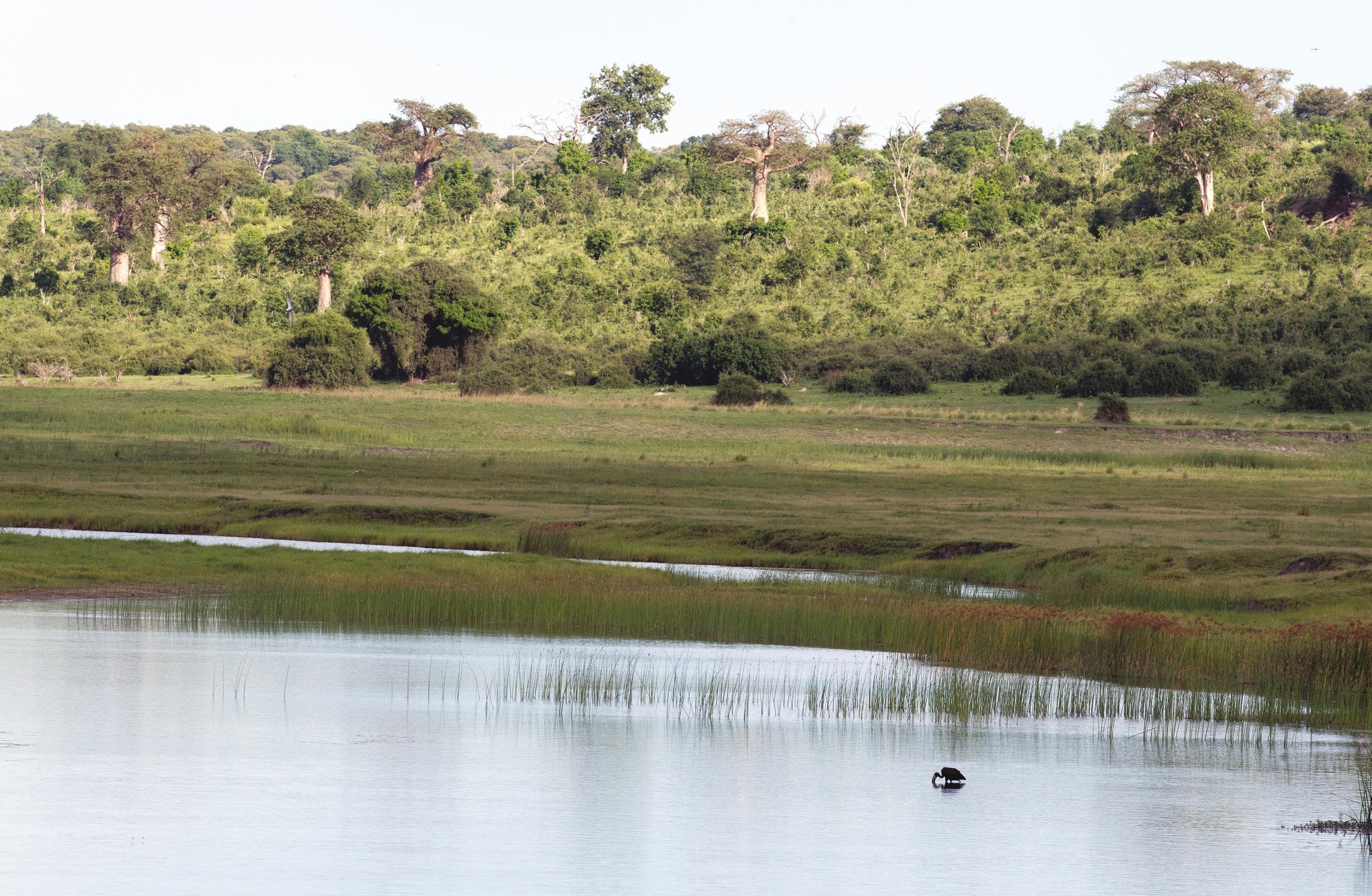
The rivers in northeastern Namibia are the lifeline of the Zambezi Region. The Kwando, Kavango, Linyanti and Zambezi rivers are a novelty for Namibians. We are used to dry riverbeds and playgrounds for four-wheel drivers. But here, in the northeast, each river has its own charm and special character. The variety of channels, sandbanks, floodplains and, obviously, birds will astonish you every time you visit the area. This is not to mention the trees lining the waterways, water plants, and a variety of wildlife, be it frogs, insects, and yes, hippos and crocodiles. Eustice, our guide, began his speech with the necessary safety instructions, then went on to explain the difficulties that were gradually becoming massive problems for the region’s rivers and for the survival of the ecosystem. Dams built in Angola, poaching, tree harvesting, and fishing nets all have a cumulative negative effect on the environment.
He did not mention hippos and crocodiles eating tourists who might fall from the boat, get lost in the myriad channels, or get stuck in water plants that block the boat’s rotors. Those are then probably just my own internal fears.
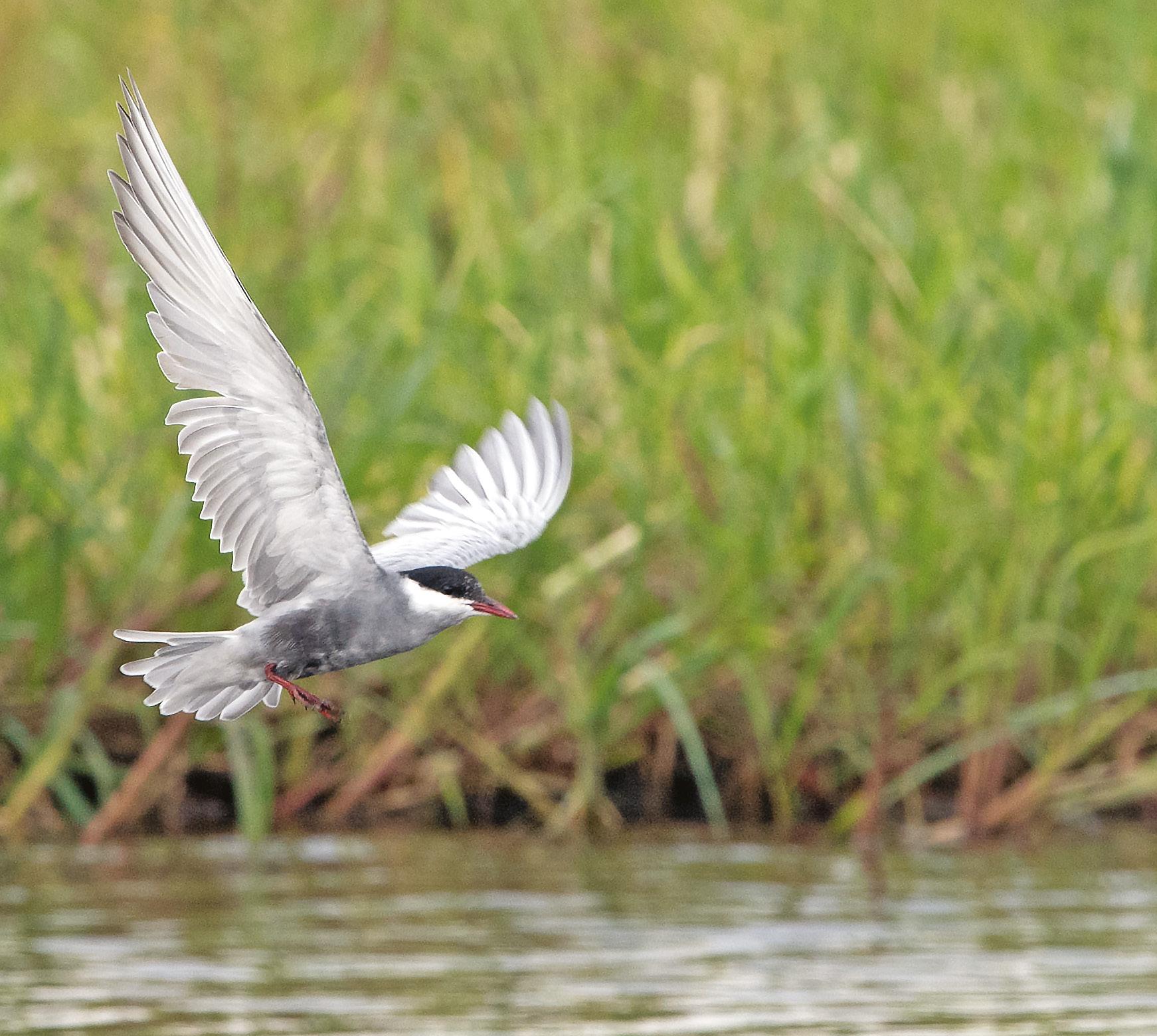
The majority of birds that you see from a boat will not be seen on land, so if you are looking for waterbirds to tick from your lifer list, this is it. From your vehicle on land, you will not see African Finfoot trying to hide in the reeds, Lesser Jacana cleaning the water lily leaves, Purple Gallinule hiding in the channels, or Rock Pratincoles sunbathing on the river rock islands. You might see a Malachite Kingfisher on land, but you will not see them hunting from a convenient perch along the channels, or, for that matter, Giant and Pied Kingfishers fishing.
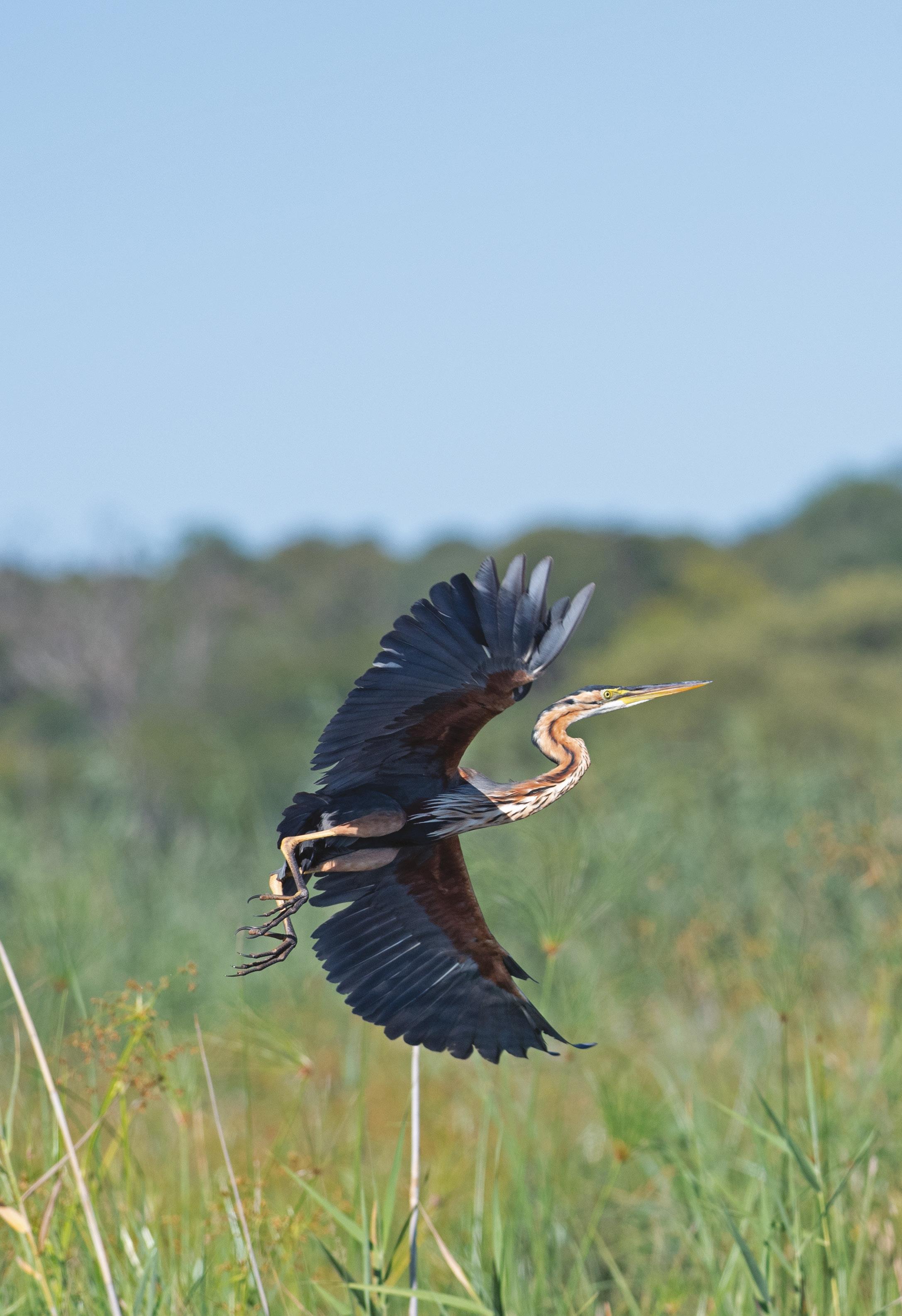
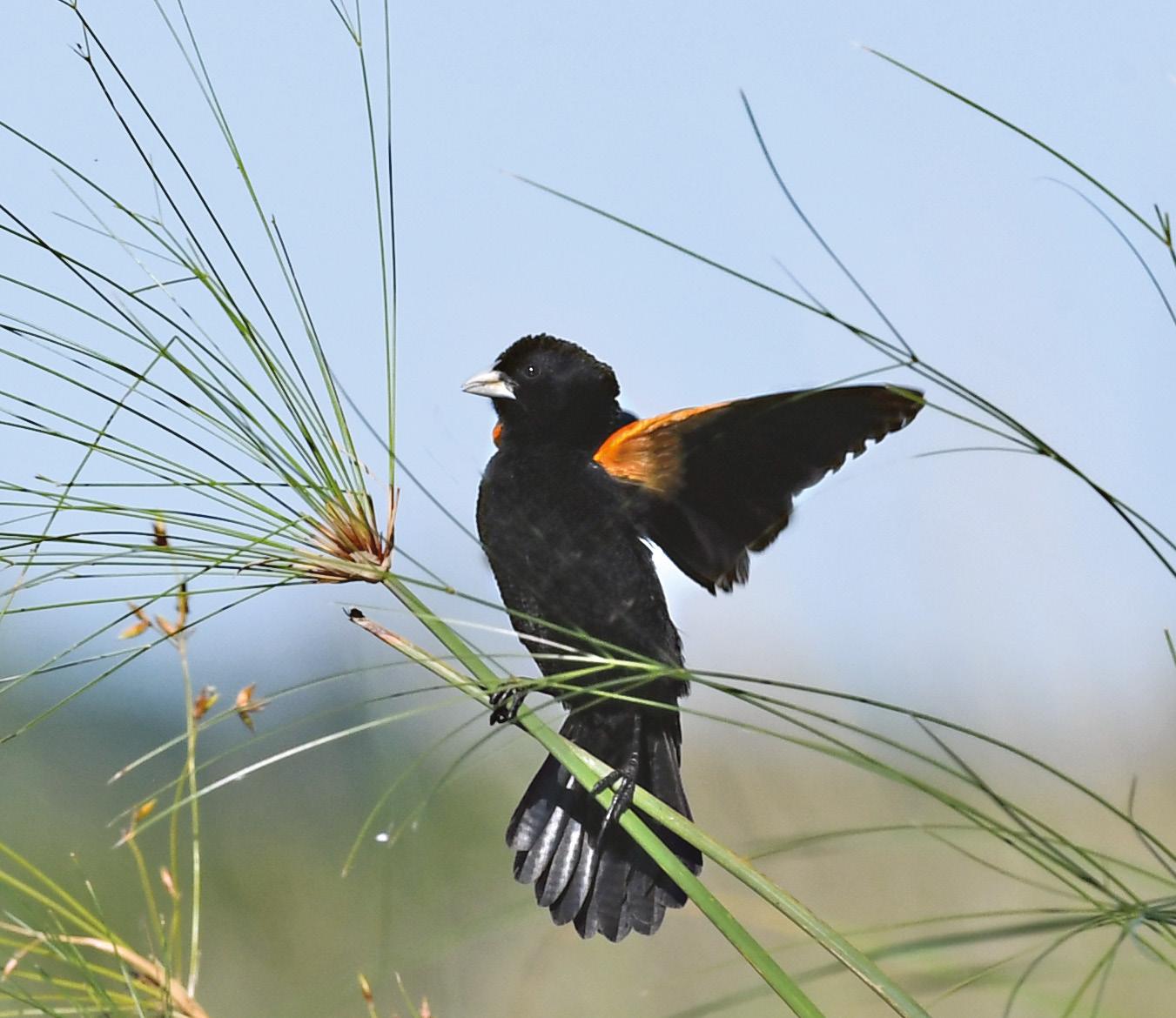

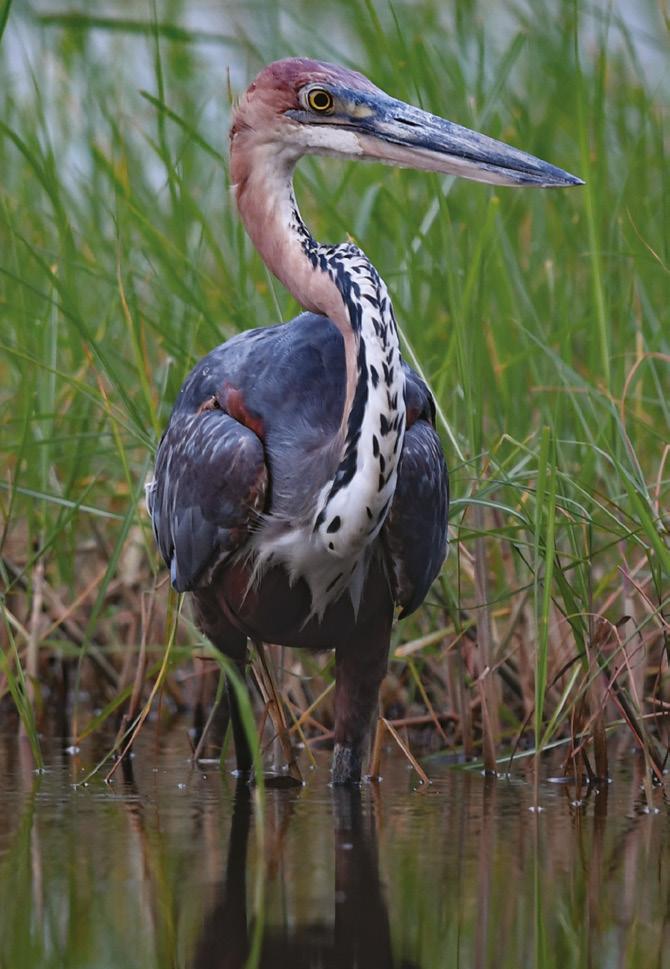
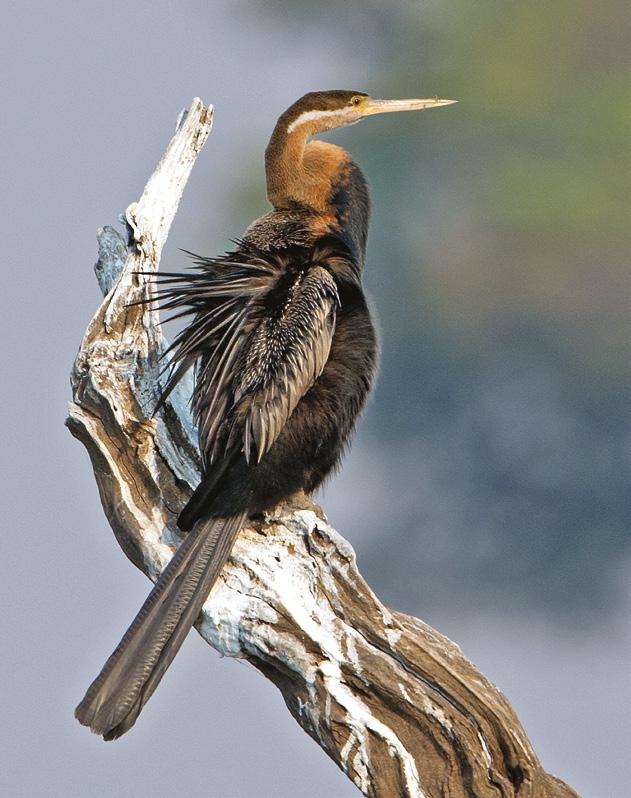
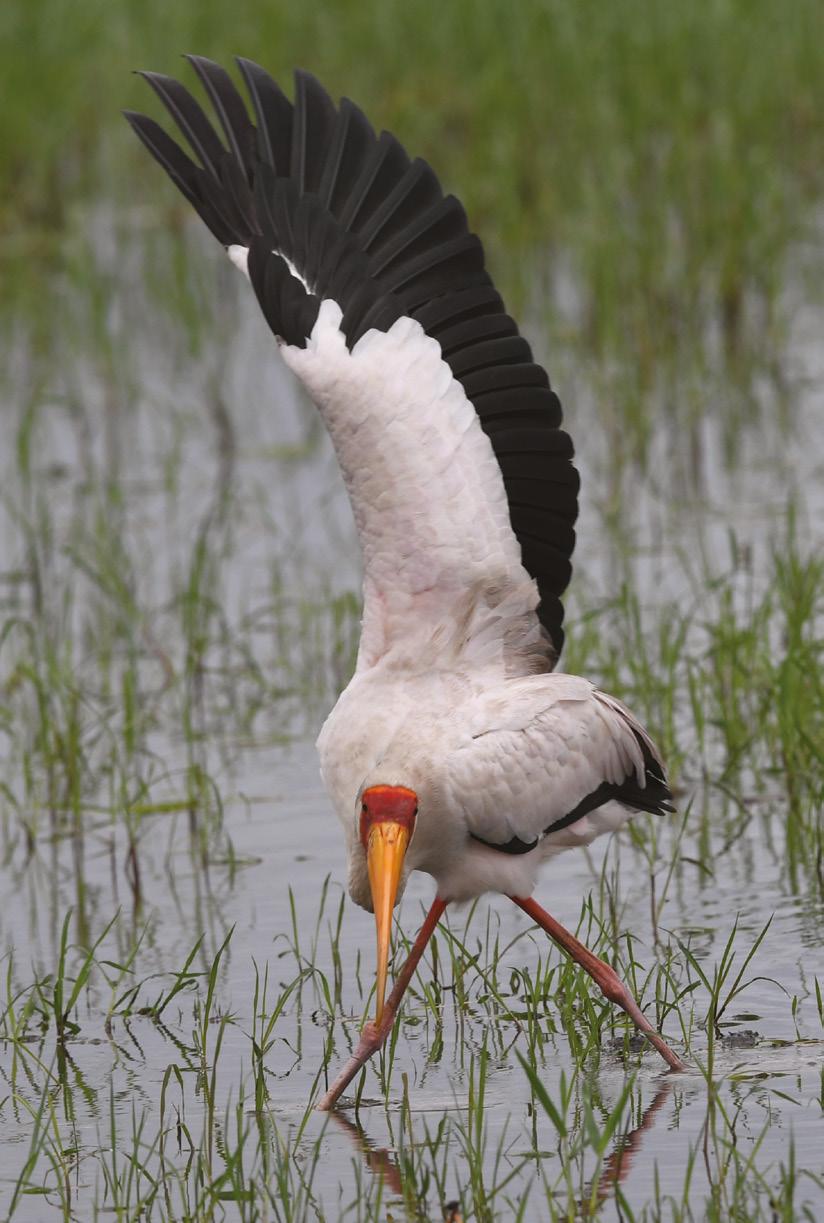
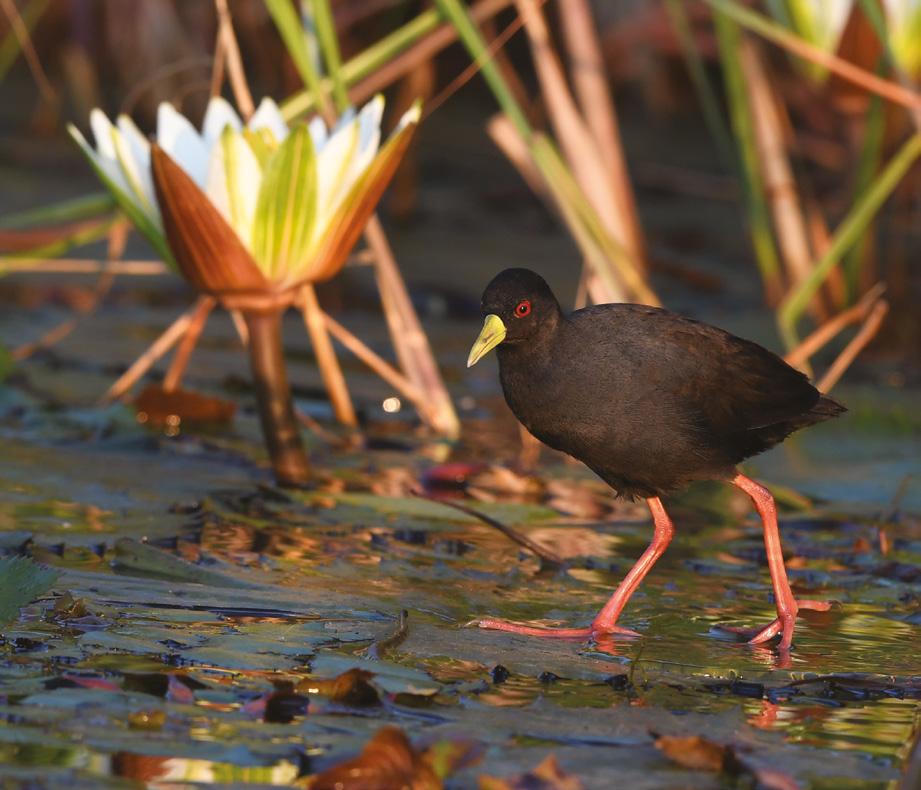
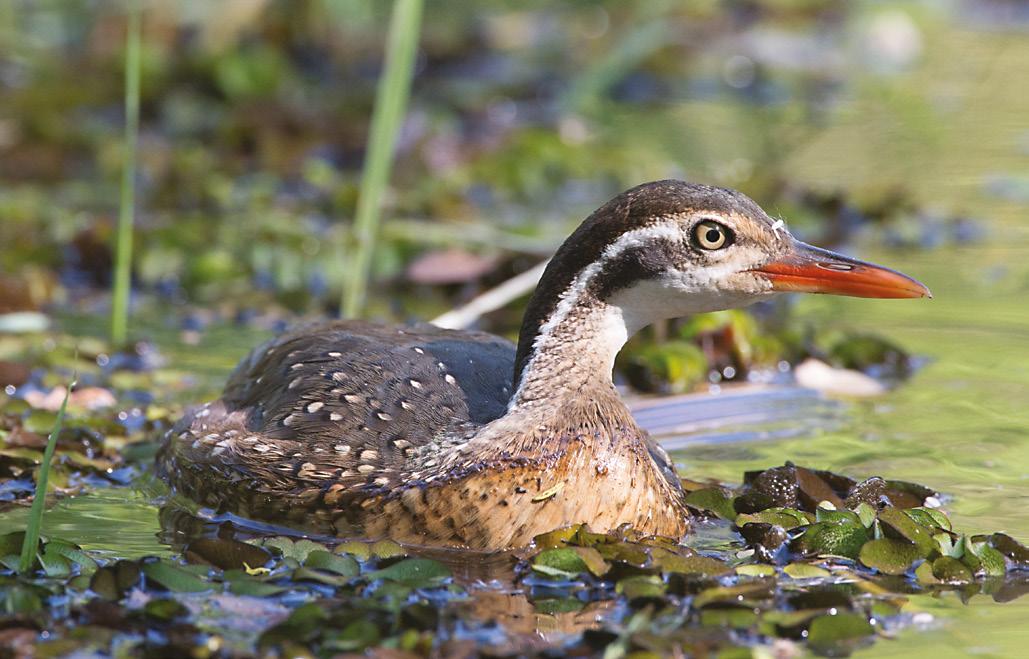
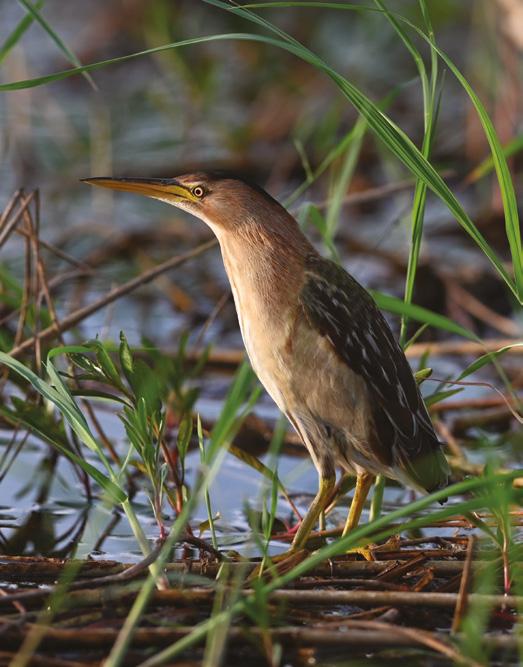
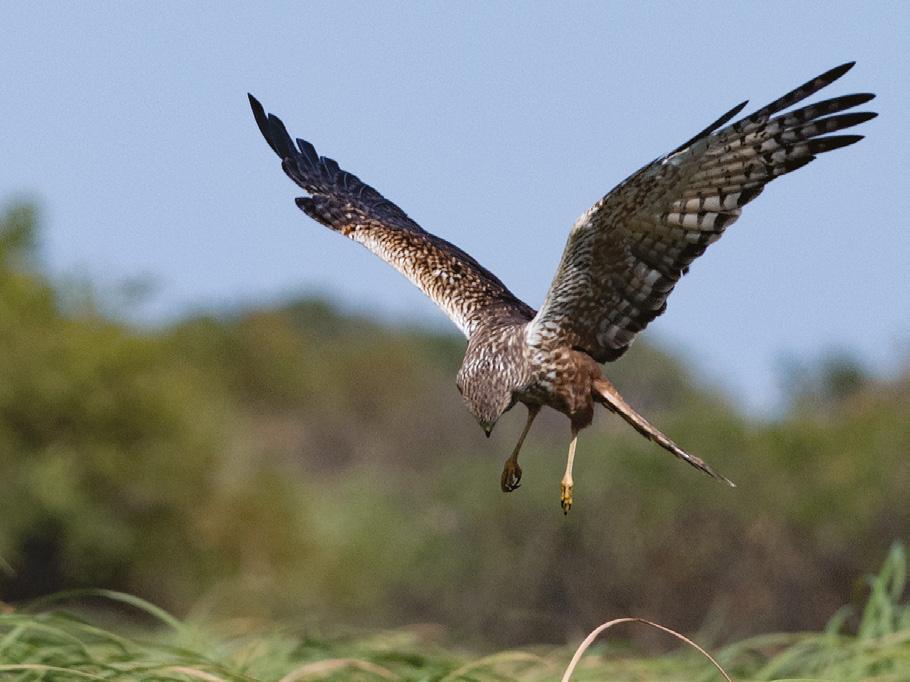
Each river offers different habitats, birds and animals.
The best time to do your boating is early morning (fewer sundowners, only sunuppers). Somehow, most birds agree. The experience of a sunrise over the river makes the early rise worthwhile. In the summertime, when the migrant birds arrive, birding is even more attractive in the area. Food, such as fish, insects and seeds, is more readily available when the rivers fill up from Angola. If all else fails, and by some upside-down miracle you do not see a single bird, the beautiful surrounding trees and plants seen from your boat will give you a totally new perspective of the wetlands’ beauty.
The advantages of the different habitats on and along the river are endless. Waterbirds flying along the river, such as White-faced Geese, African Skimmers, beeeaters, swallows, and martins, are always on the cards. The kingfishers prefer to do their fishing from overhanging trees along the mainstream, as well as an ample supply of insects fresh from the reeds. This is also a perfect opportunity to see Redwing Whydahs and Common Stone Chat in the reeds along the river.
Along the channels, you will see the more secretive waterbirds like the gallinules, coots, crakes and warblers. One of the big advantages here is the close proximity to these rare and secretive birds. You might also run into a lost hippo that will invariably block the channel, looking for trouble and birders.
The sand banks are an ideal place to watch the skimmers breeding, waders patrolling the shores, as well as large flocks of pratincoles. This is also the ideal place to see the less common Long-toed Plovers. Don’t be surprised to see the odd flamingo or pelican, trying to avoid the coastal overcrowding during the summer holiday. The Carmine Bee-eater colonies along some of the rivers are a treat,
especially when breeding in the sandbanks along the river. Although the inland breeders do come down to the river for refreshments. The breeding season is from September to November, but there are still lots of them hunting along the river later in the year.
The floodplains are my and the birds’ favourite habitat. This is probably the area where food is most abundant, and various birds, including raptors such as African Marsh Harriers, come here to feed. This is obviously the ideal place to see Pygmy Geese, jacanas and various other waterbirds. Also very common are herons, bitterns, egrets and crakes. The best river for floodplain birding is along the Chobe River, but unfortunately, the traffic in this area is very similar to Johannesburg during rush hours, which can be rather hazardous.
The trees along the river are an ideal place to look for night herons and a variety of raptors, such as African Fish Eagles, Long-crested Eagles, Osprey, and Bat Hawks. Once you have seen them all, you can ask your guide to show you a Pel’s Fishing Owl, which is not everybody’s cup of tea, so early in the morning. Many inland birds also seem to cool down at the river and are sometimes very approachable from a boat. One of the special trees of the region, the Water Pear, bears lots of fruit during the summertime. As one can expect, all the trees along the river are just that much bigger and more impressive than inland.
If, for any obscure reason, you are not into birding, the wildlife is always abundant along the rivers during the summer months. Lechwes running elegantly through the water and Sitatunga hiding among the reeds are usually best seen from a boat. Seeing elephants is always exciting, especially when they come for a drink and a swim. Any stop during such trips is usually associated with the wonderful opportunity to have snacks, coffee and a smoke break. If all else fails, you can even have a beer.
One of the wonderful things is that each river offers different habitats, birds and animals. Wherever you go for a birding boat trip, you will be safe and never be sorry. Happy birding! TN
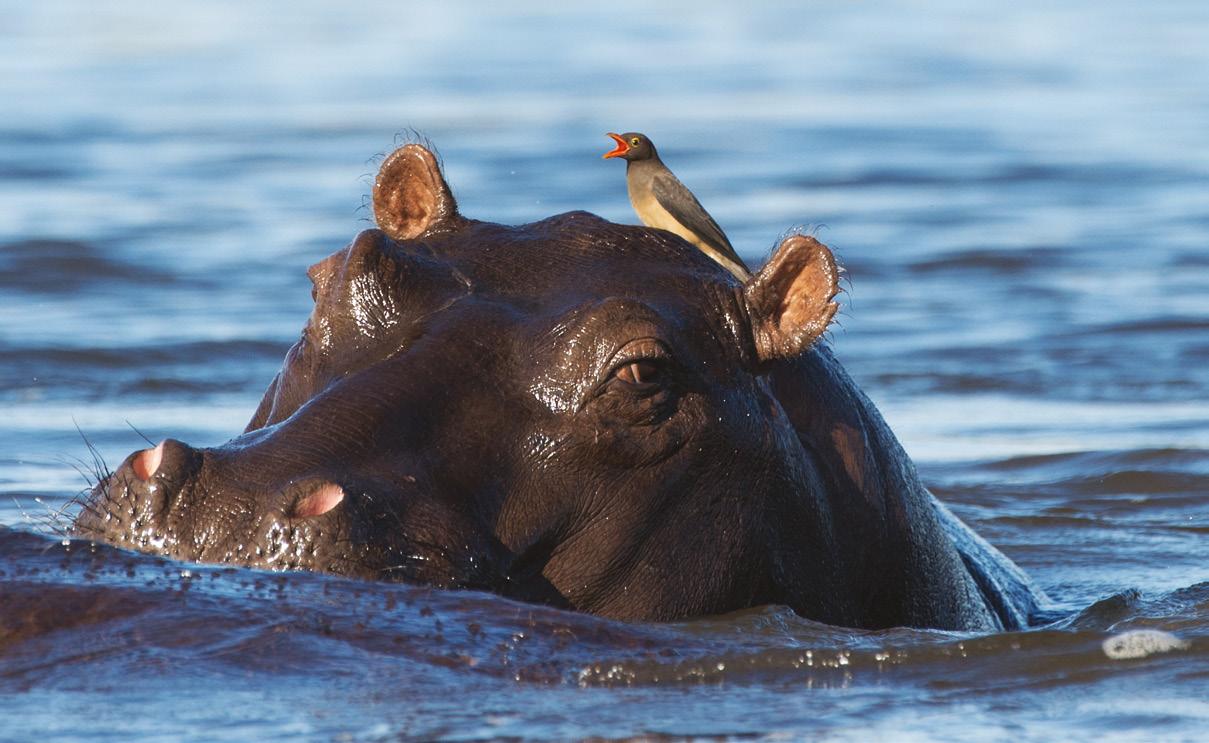
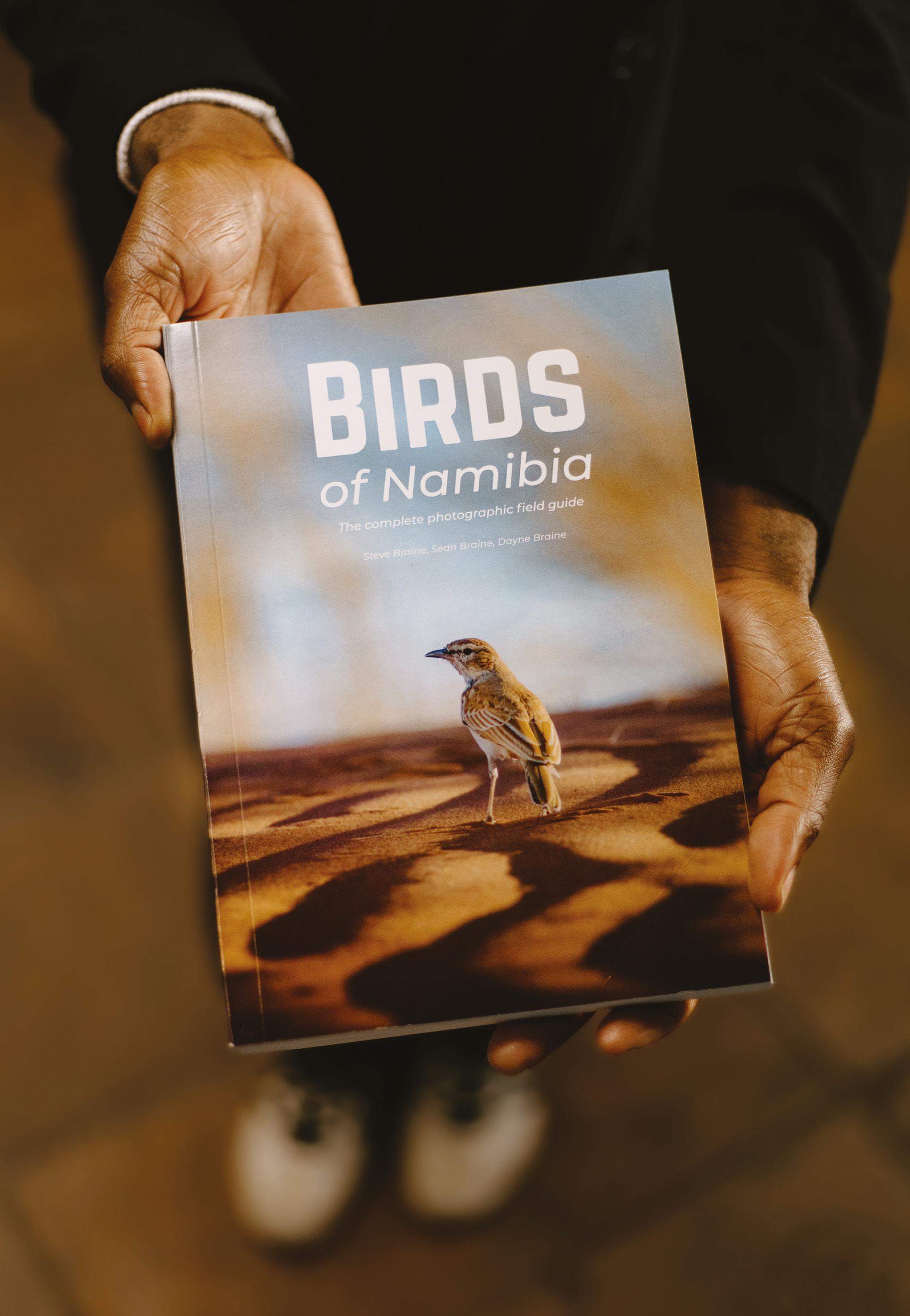
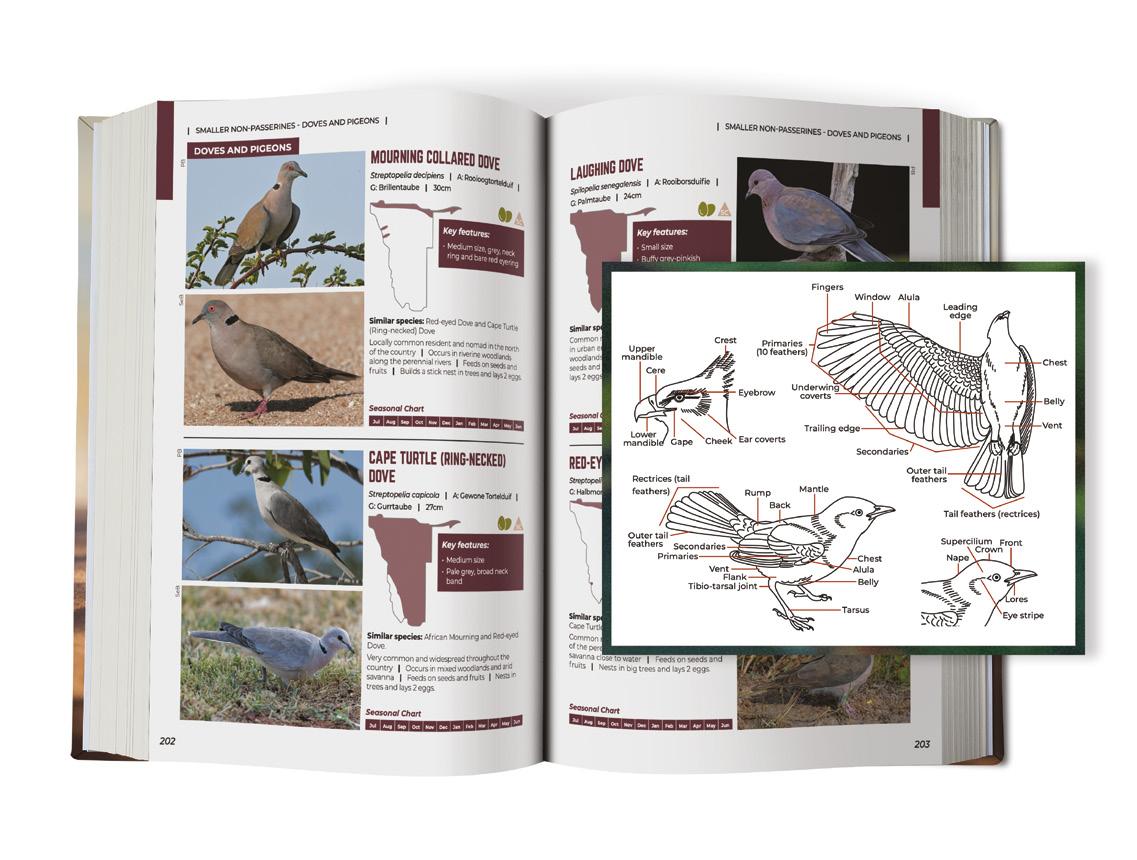
In a country defined by vast horizons and staggering biodiversity, Birds of Namibia – A Photographic Field Guide emerges as both a scientific milestone and a love letter to the land’s avian wonders. Authored by Steve, Sean, and Dayne Braine – Namibia’s most respected birding family – this volume fills a longstanding gap in the nation’s natural history literature. For the first time, birders, guides, and travellers alike have a single, comprehensive reference dedicated solely to Namibia’s birds, from the haunting deserts of the Namib to the lush floodplains of the Zambezi.
What immediately distinguishes Birds of Namibia is the depth of field experience that underpins it. The Braine family’s decades of guiding, research, and photography in Namibia’s most remote regions are distilled into 691 species accounts, each enriched with identification details, behavioural notes, and clear distribution maps. The result is a guide grounded not only in scientific rigour but also in an intimacy born of long observation – an understanding of how light, season, and habitat shape the lives of birds in this uniquely challenging environment.
Visually, the book is nothing short of spectacular. Hundreds of high-quality photographs – the majority taken within Namibia’s borders – reveal a breadth of diversity few realise the country possesses. The images celebrate both Namibia’s endemic and migratory species: from the desertadapted Dune Lark, found nowhere else on Earth, to the iridescent Carmine Bee-eaters that line the Zambezi River’s banks. The photography does more than illustrate; it captures moments of motion, courtship, and survival, making this as much an art book as a field guide.
Beyond its scientific and visual value, Birds of Namibia functions as a tribute to place and attempts to find interesting new ways in helping birders, both experienced and beginners, identify species based on location or behaviour. In doing so, the book reminds readers that birdwatching in
Namibia is not merely a pastime; it is an act of connection to the living landscape.
The guide’s design and structure enhance its usability in the field. Distribution maps and the concise notes on habitat, calls, and distinguishing features make quick identification possible even for amateurs. Yet there is enough depth to satisfy professional ornithologists and tour guides. The balance between accessibility and authority is one of the book’s greatest achievements.
Ultimately, Birds of Namibia – A Photographic Field Guide is more than a reference – it is a celebration. It pays homage to Namibia’s wild spaces, its people, and the photographers who have captured these fleeting moments of feather and flight. For lodges, guides, conservationists, or simply those who find joy in the sound of birdcall against a desert dawn, this book will become an indispensable companion. It stands as both a record and a reminder: that to know a country’s birds is to know its soul and is a true reflection of your depth of love for nature. TN
Order now at bonn@venture.com.na
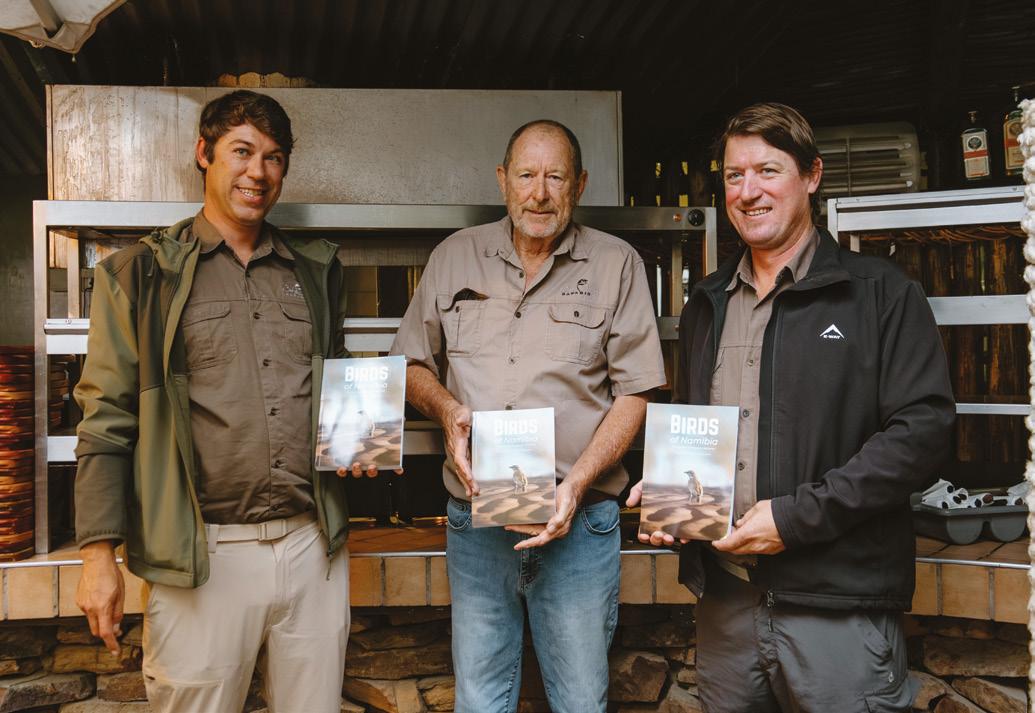
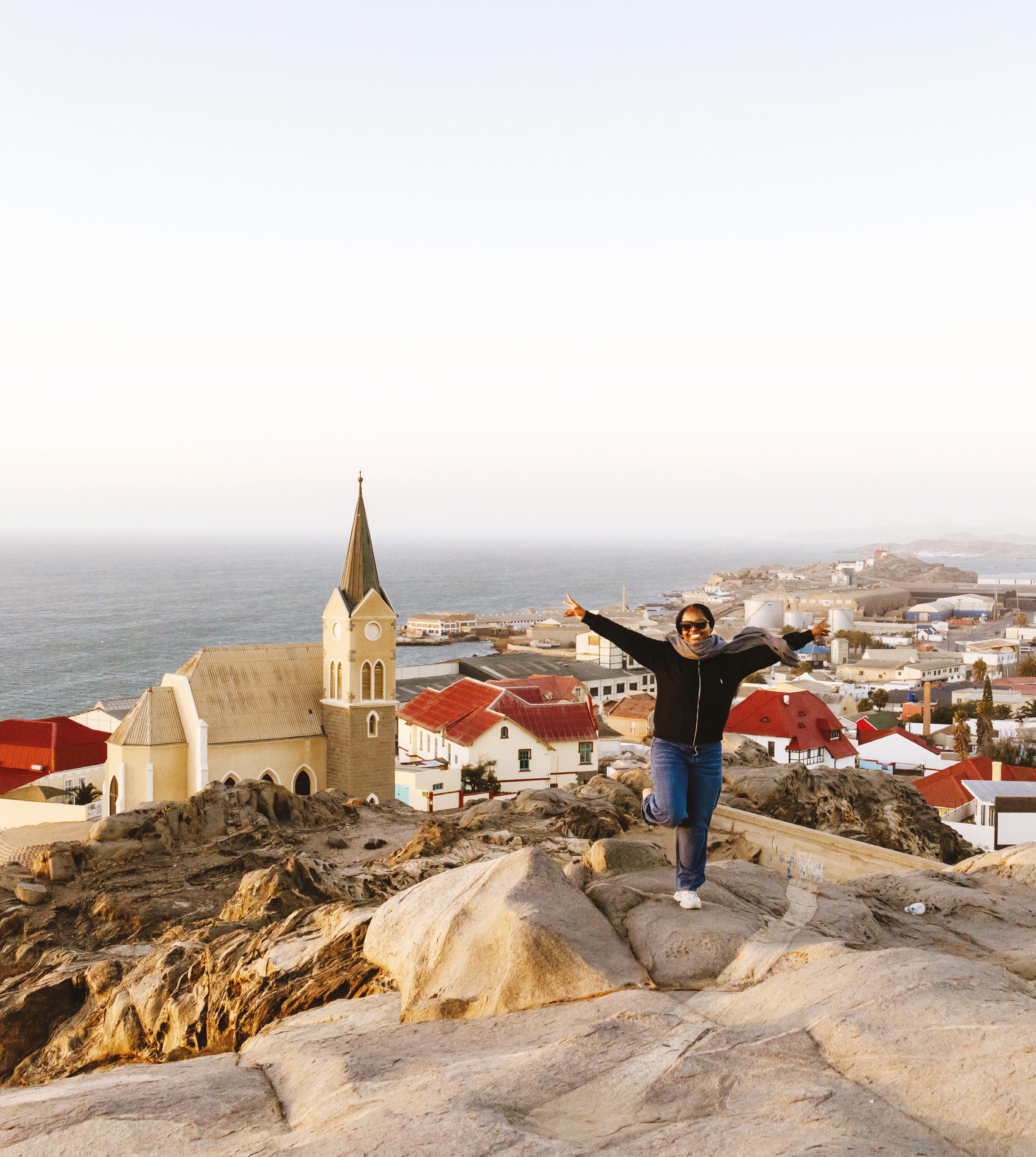
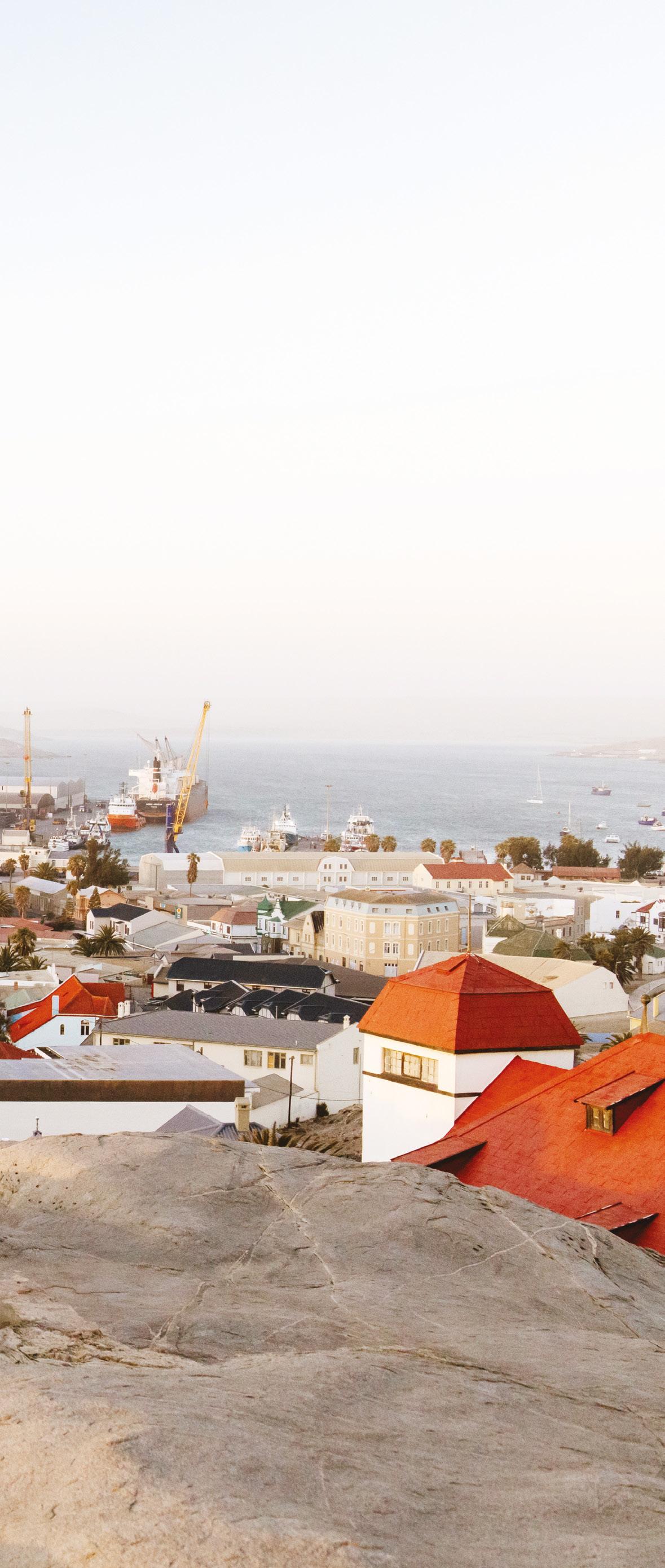
NAMAFU AMUTSE
Dear Lüderitz,
How do you greet a place you’ve never met before?
When I saw you from the sky, you looked petite, quiet. But if life has taught me anything, it’s that places, much like people, do not reveal themselves from a distance. The moment I stepped off the plane, there was a stillness the wind attempted to fill. You felt foreign yet familiar, because I’m no stranger to coastal towns and so instead of feeling like a tourist, I felt more like a long awaited guest whose invitation had been collecting dust in a pile of mail.
You immediately made yourself known by greeting me with an aggressive, sand-filled, wind-driven stir that I chose to interpret as an overzealous hug. The more time I spent with you, I came to learn that you are the perfect example of big personalities often coming in small packages.
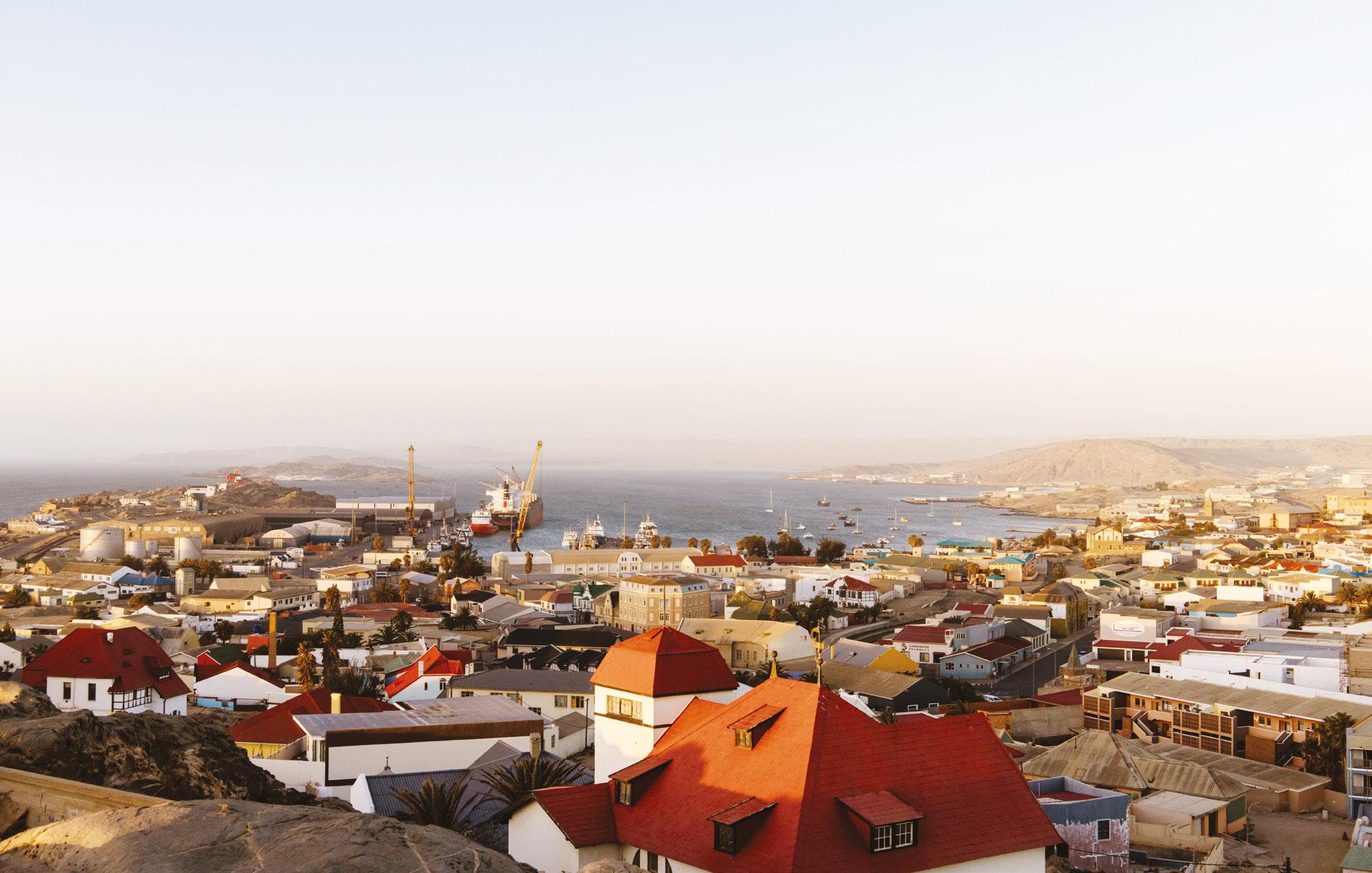
Every adventure with you felt fresh, different and layered. You hid nothing. Not your stillness, not your rage, nor your chaos. You stayed true to yourself as if to say this is me, take it or leave it. I was pleased to have had no expectations of you because that allowed me to discover your curves and edges as they revealed themselves along the journey.
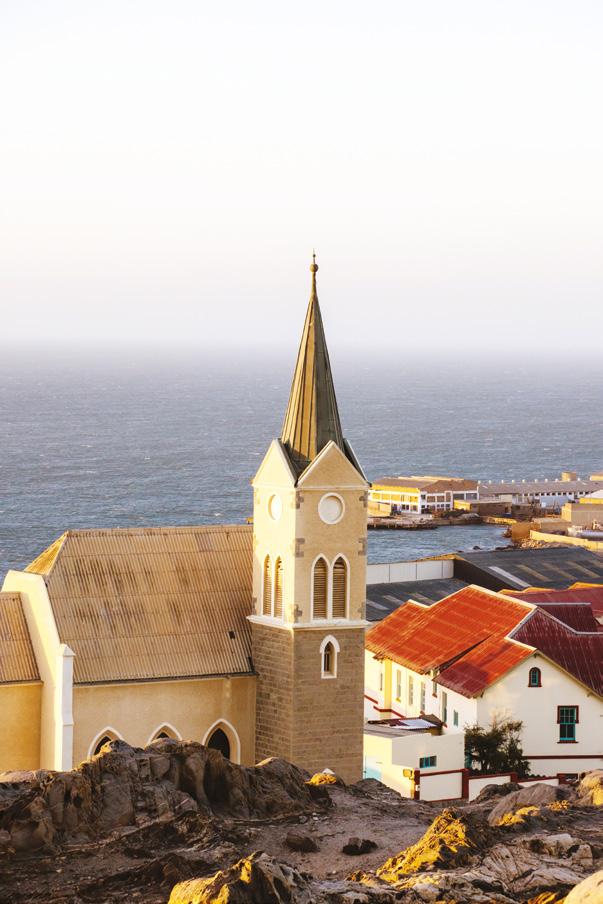
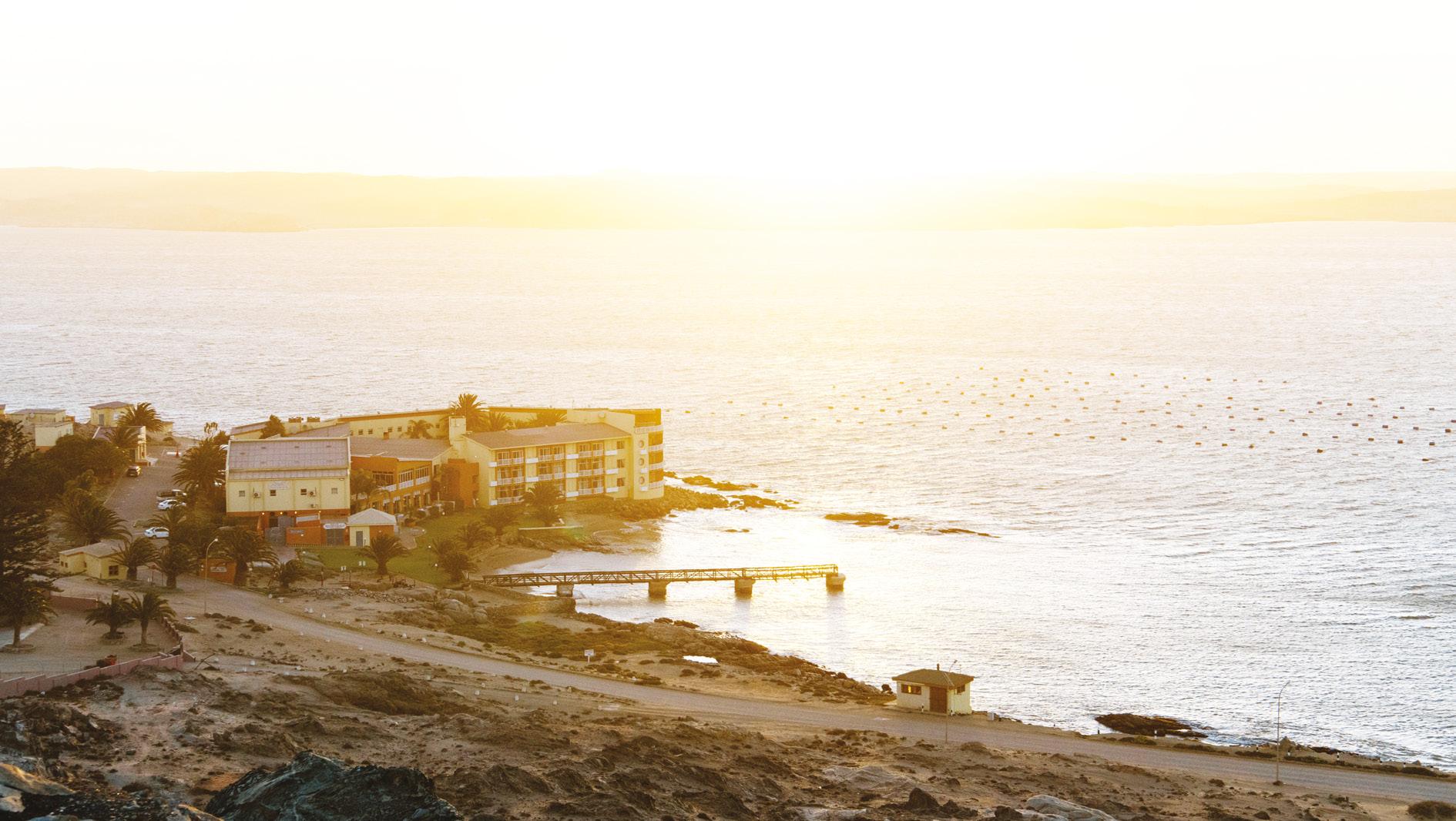
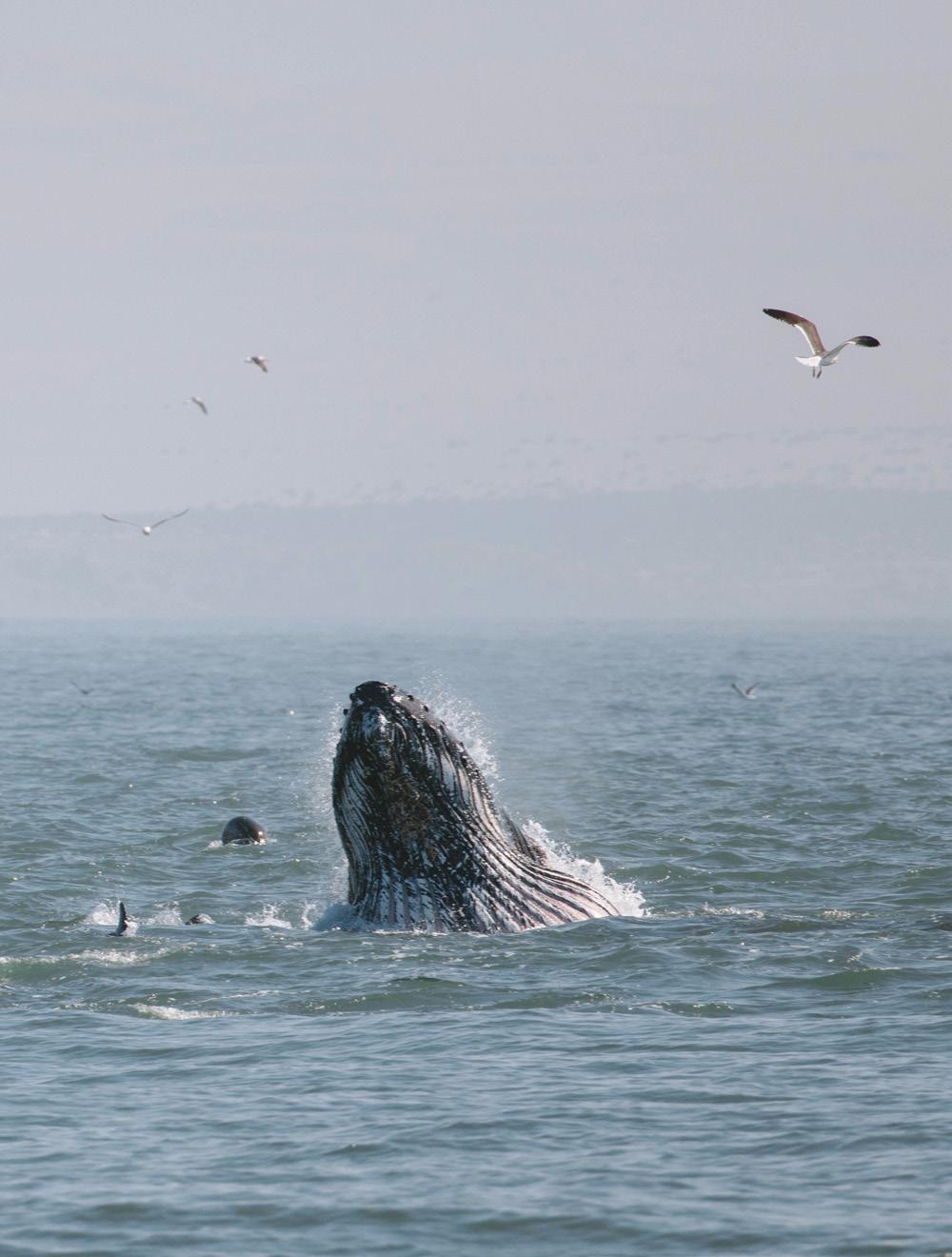
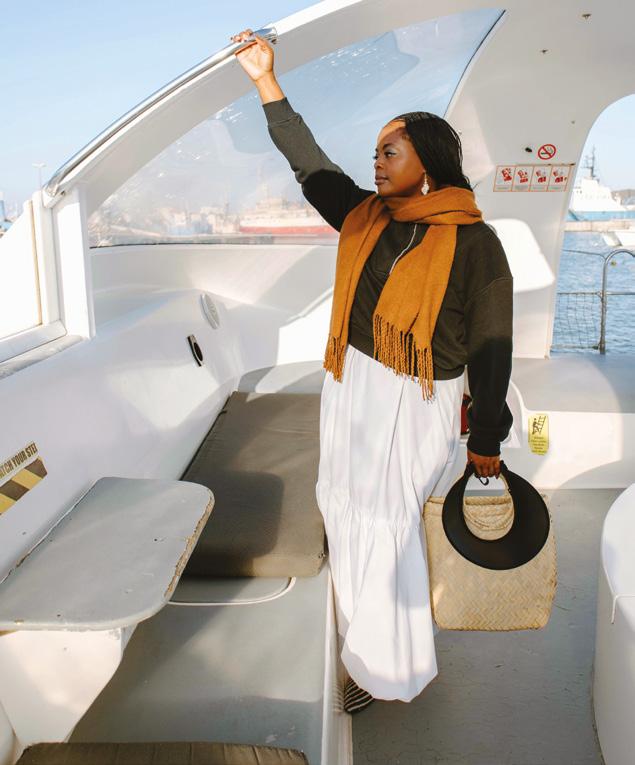
You were easygoing and gave me an opportunity to experience a significant first. An experience I have been running away from for as long as I can remember but in your presence it only felt right to give in and get it over with. At first I hesitated, because what do you mean it’s fresh, uncooked, slimy looking and possibly slimy tasting? Truth be told, oysters are an acquired taste and for some reason my palate seems to have reached the level of maturity that has acquired said taste.
The nights were short and your days were long. A slowness that felt intentional. It gave me enough time to explore and learn in a way that didn’t feel rushed. Like how you are one of the windiest towns in Namibia and you don’t apologise for it. Or how you look modest from above, but beneath your water lies diamonds and delicacies. I cannot leave out the fact that your buildings speak another language and how you wrestle with your soil having been both a blessing and a burden.
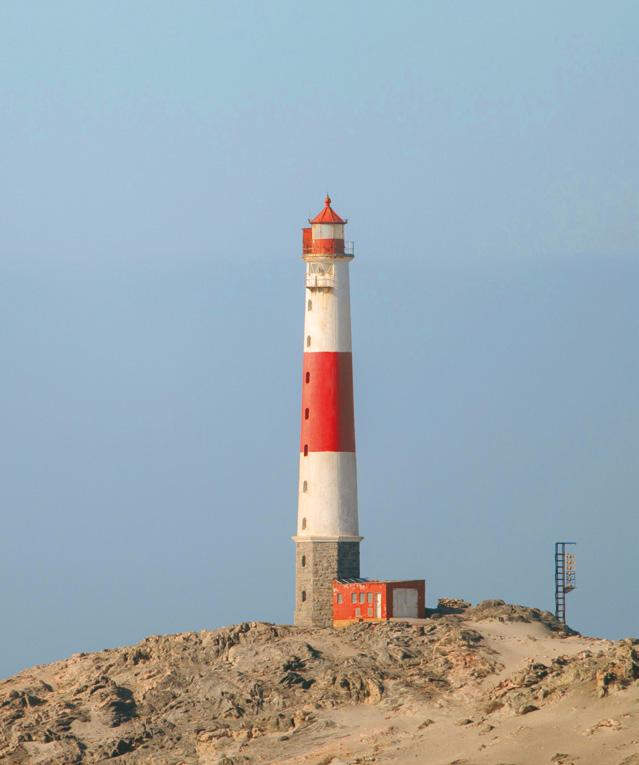
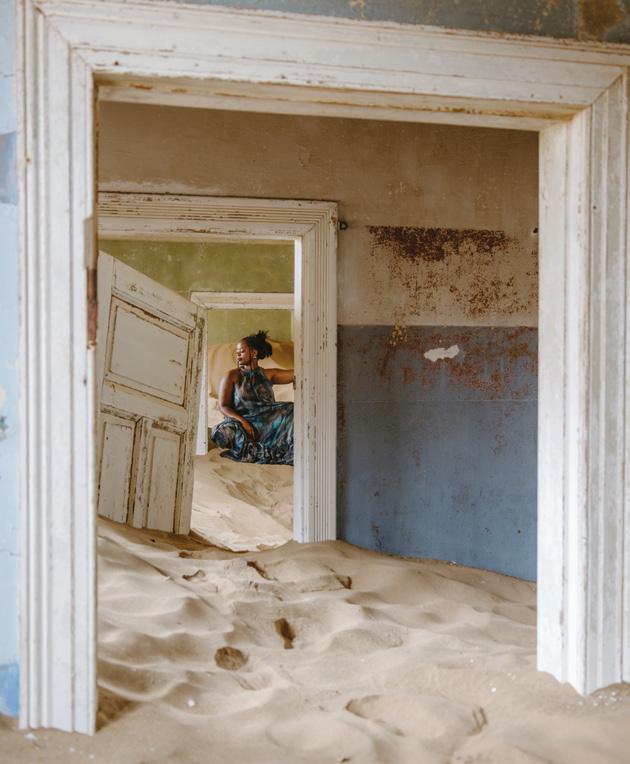
A moment that will always resurface on days that feel more quiet than others will be the visit to Kolmanskop. There was an undeniable heaviness that weighed as I walked through rooms where sand has now claimed the floors as its own. It felt as though time forgot to sweep and you were left holding the silence.
I remember sitting by the ocean as the wind refused to let my hair stay in place. The water looked blue, the air smelled fresh and the sound of the streets was drowned by waves crashing on the shore. The ocean wasn’t calm, it was alive. You gave me moments of peace, the kind that doesn’t announce itself loudly but settles gently on your shoulders while sitting on some rocks and having conversations with the wind.
Thank you for the quiet mornings of reflection accompanied by the sound of the ocean clearing its throat and the evenings where it had the last say. Thank you for being kind and for existing as you are instead of trying to impress me.
I didn’t know how to say hello, but now I know how to say goodbye. Or rather, till I see you again.
Yours with gratitude, Namafu. TN