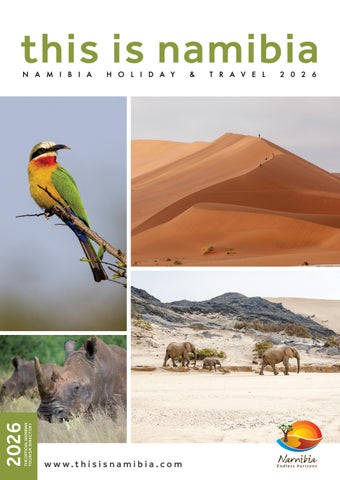
this is namibia
THE OFFICIAL NAMIBIAN TOURISM DIRECTORY
2026
N A M I B I A
H O L I D A Y
w w w.t h i s i s n a m i b i a .c o m
&
T R A V E L
2 0 2 6
WE’RE FOR NAMIBIANS
MESSAGE FROM THE NAMIBIA TOURISM BOARD
N
Namibia’s Journey of Renewal
amibia is not merely a destination it is an awakening. It is where time slows to the rhythm of the desert winds, where the golden dunes of Sossusvlei meet the wild expanse of Etosha, and where the heartbeat of Africa echoes through its people, culture, and landscapes. As the Namibia Tourism Board (NTB), our vision is to become a world-class destination management organisation that elevates Namibia’s standing on the global stage. Guided by this vision, our mission is to regulate, grow, and promote sustainable tourism that enriches lives, strengthens communities, and safeguards our natural heritage for generations to come. Under our Integrated Strategic Business Plan (ISBP 2023–2029), we are shaping a bold new chapter for Namibian tourism. This transformation is anchored in innovation, inclusivity, and partnership. Through flagship initiatives, we are strengthening the tourism value chain from digital transformation projects, such as the introduction of a national Tourism Information Management System (TIMS) and an enhanced NTB website and visitor chatbot, to regional office expansion across the country to bring services closer to our operators and communities. We are also redefining service excellence through the Welcome Host Namibia Programme, a national customer-service initiative aimed at uplifting the standards
of hospitality across all sectors. In addition, our MICE (Meetings, Incentives, Conferences, and Exhibitions), Cruise Tourism, Culinary and Gastronomic strategies is positioning Namibia as a premier business events destination in Southern Africa, attracting global conferences and trade fairs that stimulate local economies. Sustainability remains at the heart of all we do. Through strong partnerships with the Ministry of Environment, Forestry and Tourism (MEFT), conservancies, and local entrepreneurs, we continue to promote community-based tourism, empower youth innovation in travel, and ensure that every visitor experience contributes to conservation and inclusive growth. Namibia’s charm transcends borders. As part of our market development efforts, NTB is deepening its presence across key international source markets including Germany, the United Kingdom, France, Italy, South Africa, the United States, and China while exploring new frontiers in Japan, India, and the Middle East. Through participation in global trade fairs such as ITB Berlin, IMEX America, and China International Fair for Investment and Trade (CIFIT), Namibia continues to forge partnerships, attract investors, and showcase its unmatched tourism offerings to the world. We are also embracing the power of digital storytelling, influencer
collaborations, and content partnerships to share authentic Namibian narratives that resonate with modern travellers seeking meaningful, sustainable experiences. Every journey to Namibia is more than a holiday, it is a connection to something larger. It is the warmth of a Himba smile, the quiet dignity of desert elephants, the vibrant craft markets of the north, and the taste of home-grown adventure under the brightest African skies. As we continue to chart a path toward global excellence, I invite you to be part of this story to discover Namibia, invest in her potential, and celebrate her authenticity. Here, nature inspires the spirit of discovery, and every traveller becomes part of a legacy that endures.
Sebulon C. Chicalu Chief Executive Officer Namibia Tourism Board (NTB)
NTB Offices Windhoek Sam Nujoma Drive Private Bag 13244, Windhoek Tel: +264 61 290 6000 info@namibiatourism.com.na Swakopmund C/O Sam Nujoma & Bismarck Avenue Tel: +264 83 330 4030 info@namibiatourism.com.na
Rundu Eugene Kakukuru Street Tel: +264 81 950 9501 info@namibiatourism.com.na
Lüderitz Old Power Station, Dias Street Tel: +264 81 950 9502 info@namibiatourism.com.na
Ongwediva C46 Oshakati – Ongwediva Road Tel: +264 81 950 9500 info@namibiatourism.com.na
Frankfurt Kaiserstr. 77 60329 Frankfurt, Germany Tel: +49 69 770 673 092 info@namibia-tourism.com
THIS IS NAMIBIA: NAMIBIA HOLIDAY & TRAVEL P.O. Box 21593 Windhoek, Namibia Tel (+264) 81 285 7450 Email: info@venture.com.na
Editor
Layout & Production Admin and Enquiries Printing
Text Contributors
Photographs AD CL EM GT LL LVS MVR NVZ PVS TS SVW KW LW MN YD SA DP
Elzanne McCulloch Liza Lottering Bonn Nortje
John Meinert (Pty) Ltd
Willie Olivier Elzanne McCulloch Le Roux van Schalkwyk Kirsty Watermeyer Charene Labuschagne Madeleen Duvenhage
© The Venture Media Team and various contributors as indicated.
Annalien Davin Charene Labuschagne Elzanne McCulloch Gerhard Thirion Liza Lottering Le Roux van Schalkwyk Marita van Rooyen Nina van Zyl Paul van Schalkwyk Tiffany Steenkamp Sune van Wyk Kirsty Watermeyer Louis Wessels Michael Nakapandi York Duvenhage Sky Angula David Penda
SUBSCRIBE TO TRAVEL NAMIBIA ON Visit www.travelnewsnamibia.com to subscribe to our digital publication on Zinio or to order physical copies of the magazine. We are focused on telling and sharing STORIES THAT MATTER across our various magazines and digital platforms. Join the journey and share your stories with audiences that understand and value why certain things matter. Why ethical business, conservation, tourism, people and communities matter. How these elements interrelate and how we can bring about change, contribute to the world and support each other. Whether for an entire nation, an industry, a community, or even just an individual.
Whilst every care has been taken in the preparation of this publication, no liability can be accepted by the publishers for any errors or omissions that may have occurred. The publication is the exclusive property of the publishers and it is a criminal offence to reproduce any copyright material from it without written permission from the publisher.
www.venture.com.na
or email us at info@venture.com.na for a curated proposal.
YOUR COMPREHENSIVE GUIDE to Exploring Namibia extraordinary Namibian stories. This is Namibia: Namibia Holiday & Travel is an annual tourism directory with over 180 pages of upto-date information on the country, regions, people, activities and wildlife. Venture Media is the pioneer of Namibia tourism promotion. We are the leader in spreading the tourism word around the world. We distribute accurate, credible, up-todate and regular tourism-related information on paper, social media, on the internet, and on mobile apps. We have reached hundreds of thousands over three decades. Be part of our community and let’s share extraordinary Namibian stories that matter together.
Order any of these publications from bonn@venture.com.na or order online at www.venture.com.na
ANGOLA
KAOKOLAND & KUNENE REGION
ETOSHA NATIONAL PARK & OWAMBO
NORTHEAST, KAVANGO & ZAMBEZI
Okaukeujo
SOSSUSVLEI & NAMIBNAUKLUFT NATIONAL PARK
WINDHOEK, SURROUNDINGS & CENTRAL EAST
BOTSWANA
Contents
IP TR LS TA AS CO
WATERBERG, KHAUDUM & NYAE NYAE
DAMARALAND, BRANDBERG & TWYFELFONTEIN
DEEP SOUTH, COASTAL & THE FISH RIVER CANYON
SOUTH AFRICA
LL KW
2 4
07 08 15 17 20 22 25 30 34 38 42 44
Message from the Namibia Tourism Board About Venture Media Map of Namibia
TIPS FOR TRAVELLERS
Namibia’s Environment Plan your Trip People of Namibia Joint Venture Tourism in Communal Conservancies Cuisine Driving in Namibia Flying in Namibia Namibia’s Highlight Route Tourism & Travel Companies Camping Tips Namibian Lodge Groups
WINDHOEK, SURROUNDINGS & 48 CENTRAL EAST 50 53 53
54 55 57 58 59 60 61
Walk through the city of Windhoek Museums Community Campsites in this Region Day trips from Windhoek Towns close to Windhoek Culture: The Basters Top Adventures in this Region Khomas Hochland Map of the Region Accommodation
66
NORTHEAST, KAVANGO & ZAMBEZI
68 69 70 71 72 73 74
74 74 75 76
Kavango East & West Regions The People of the Kavango The Zambezi Region Parks in Zambezi The People of the Zambezi Kavango-Zambezi Transfrontier Conservation Area Community Campsites in this Region Top Adventures in this Region Museums Map of the Region Accommodation
LL
1
SOSSUSVLEI & NAMIB-NAUKLUFT 136 NATIONAL PARK
82 84 85 86 88 90 91 91 92 93
102 104 105 106 107 108 109
110 112 113 114 115 117 117 118 119 120
ETOSHA NATIONAL PARK & OWAMBO Etosha National Park Gateways to Etosha Map of Etosha National Park Main Tourist Attractions in Owambo Culture: The Aawambo Towns north of Etosha Community Campsites Map of the region Accommodation
KAOKOLAND & KUNENE REGION Top Attractions Wildlife Culture: The Ovahimba Community Campsites Map of the Region Accommodation
WATERBERG, KHAUDUM & NYAE NYAE Waterberg Plateau Park Top Attractions in the Area Khaudum National Park Towns in the Region Culture: The San Community Campsites Culture: The Ovaherero Map of the Region Accommodation
DAMARALAND, BRANDBERG 122 & TWYFELFONTEIN 124 126 127 128 130 131 132
Top Attractions Top Adventures Community Campsites Towns in the Region Culture: The Damara Map of the Region Accommodation
138 138 139 140 141 142 142 143 144
Namib-Naukluft National Park Namib Section Sossusvlei Naukluft Section NamibRand Nature Reserve Top Adventures in this Area Community Campsites Map of the Region Accommodation
148
COASTAL STRIP
150 151 155 157 159 159 160 162 163
Dorob National Park Swakopmund Walvis Bay Henties Bay Cape Cross Seal Reserve Skeleton Coast National Park Top Adventures at the Coast Map of the Region Accommodation
168
DEEP SOUTH, COASTAL & THE FISH RIVER CANYON
170 171
172 174 174 175 176 177 179 179 180 181
Top attractions in the South Fish River Canyon & /Ai - Ais Richtersveld Transfrontier Park Lüderitz Kolmanskop Aus Top Adventures in the South Tsau //Khaeb National Park More Towns in the South Culture: The Nama Community Campsites Map of the Region Accommodation
183
GENERAL INFORMATION
183
Namibia’s Government, Economy and Investment 185 Transport in Namibia 186 Money Matters 186 Communication Services 187 Media, Literacy & Education, Religion, Key Tourism-Related Associations 188 Health in Namibia 189 Venture Media Publications 190 General Index
EM
This is Namibia Namibia is a land of striking contrasts – from its vast deserts and rugged coastlines to its vibrant cultures and welcoming people. It is a country where space, silence, and solitude blend with warmth, comfort, and adventure.
SVW
LVS
Additional drawcards include the friendliness and cultural diversity of the Namibian people, a welldeveloped infrastructure, and an extensive choice of parks, resorts, and accommodation establishments. These range from luxury hotels and upmarket guest lodges to simple, rustic facilities tucked away in the quiet seclusion of the bush. Whether you choose to travel in luxury or on a budget, with a guide or on your own, Namibia has it all. Its appeal lies in its diversity – wildlife, landscapes, people, adventure, geology, photography, culture, and cuisine. With bountiful sunshine, abundant wildlife, and a remarkable variety of geological formations, Namibia remains a destination that captures hearts and inspires travellers to return time and again.
NAMIBIAN PUBLIC HOLIDAYS
2026 New Year’s Day Independence Day Good Friday Easter Monday Workers’ Day Cassinga Day Ascension Day Africa Day Genocide Remembrance Day Heroes’ Day Human Rights Day Christmas Day Family Day
1 Jan 21 March 3 April 6 April 1 May 4 May 14 May 25 May 28 May 26 Aug 10 Dec 25 Dec 26 Dec
7
LVS
Namibia’s Environment Kunene River Marienfluss River Khumib River
Zambezi River
Okavango River
Hoarusib River
Kwando River
Cuvelai Omatako River
Hoanib River
Waterberg Plateau Mount Etjo
Ugab River Brandberg Omaruru River
Omatakos Erongo Mountains Spitzkoppe Swakop Moltkeblick River Bismarckfelsen Kuiseb Gamsberg River
Nossob River
Naukluft Mountains
Tsauchab River Brukkaros Mountain
Fish River
Dicker Willem
NAMIBIA’S MAIN TOPOGRAPHICAL REGIONS: Kavango and Zambezi high rainfall areas in the northeast. Kalahari in the east Central plateau Namib Desert in the west
8
Chobe River
DISTINCTIVE MOUNTAINS
Brandberg – highest, western Erongo Moltkeblick – second highest, Auas range, south of Windhoek Bismarckfelsen – third highest, south of Windhoek Gamsberg – fourth highest, table-topped, Khomas Hochland, southwest of Windhoek Mount Etjo – south of Otjiwarongo Spitzkoppe – most imposing peaks, Erongo Region Omatakos – twin-peaked, between Okahandja and Otjiwarongo Erongo Mountains – between Usakos and Omaruru Naukluft Mountains – massif, Namib-Naukluft Park Waterberg Plateau – east of Otjiwarongo Brukkaros Mountain – crater-like, halfway between Mariental and Keetmanshoop Dicker Willem – conspicuous inselberg, towards the west near Aus
RIVERS
Orange River
Linyanti River
Namibia is the most arid country in southern Africa, with water being a key resource. Perennial rivers: Orange River, forms the southern border Kunene, in the northwest Okavango, Zambezi & Kwando/Linyanti/Chobe, in the northeast Major ephemeral/seasonal rivers: Fish and Nossob, tributaries of the Orange Kuiseb, Swakop, Omaruru, Hoarusib, Hoanib, Ugab and Khumib, all west-flowing and draining into the Atlantic Tsauchab, landlocked, with floodwaters occasionally feeding Sossusvlei Marienfluss and Omatako, north-flowing Cuvelai, a drainage system of rivers originating in southern Angola, with floodwaters flowing into the Etosha Pan.
| NAMIBIA'S ENVIRONMENT | CLIMATE • Typical of a semi-desert country, with droughts a regular occurrence.
• Namibia is the most arid country in southern Africa, with a humidity of less than 10% during the winter months and varying from 50% to 80% during the summer. • Except for the south-western areas where winter rainfall occurs, rain usually falls during the southern-hemisphere summer.
SVW
Rainy season
• Short – October/November to December • Main – January to March. Average annual rainfall
FAUNA
• 50 mm and less, along the coast in the west • 350 mm, central highlands • 700 mm, far north-eastern areas
Namibia’s abundant wildlife is arguably its greatest tourist asset.
Temperatures
• Days – mostly warm to very hot, summer from 20–34°C, in winter average day temperatures vary from 18–22°C.
• Nights – generally cool, dropping to ± 18°C, average from 0–10°C, as low as -8°C.
• Interior – lower than in pre-Namib due to altitude. • Coast and hinterland – moderate due to influence of
YD
the cold Benguela Current, causing the typical fog of the coast, reducing rainfall in the rest of the country.
Fast facts on fauna • The country hosts eight endemic mammal species. • Over 20 antelope species. • A wealth of small mammals, including mongoose and jackal; the less common, solitary and nocturnal aardvark; and the honey badger. • The Namib Desert is world-renowned for its large number of endemic dune-dwellers, especially lizards, including 30 endemic species. • Large game species are elephant, rhino, giraffe, buffalo, lion, leopard and cheetah. • Endangered mammals are wild dog, cheetah, black rhino, lion, puku, oribi and waterbuck.
Namibia’s plant-life is categorised into 14 vegetation zones: • Desert • Semi-desert • Mopane • Mountain • Thorn bush • Highland • Dwarf shrub • Camel-thorn • Mixed tree and shrub savannahs • Forest savannahs and woodlands • Golden expanses of African grasslands, dotted by solitary acacias, typified by stretches of silvery grass after rains Fast facts on flora
• Namibia has 195 plant families, with over 4,300 species,
subspecies and varieties. Areas of particularly high diversity include the Succulent Karoo, Kaokoveld, Otavi/Karstveld area, Okavango Basin and Khomas highlands. • Over 1,000 species are endemic or near-endemic to Namibia or the Namib. • The Namib hosts over 100 species of lichen, several endemic. • Namibia’s most noteworthy plant, the Welwitschia mirabilis, is endemic to the Namib Desert and one of the oldest plants known to man.
LW
FLORA
BIRDS
Of 887 bird species recorded for southern Africa, 676 occur in Namibia. About 500 breed locally, the rest migrate; 11 species are near-endemic, with over 75% of world populations found in Namibia. Special near-endemics • Herero Chat • Rockrunner • Monteiro’s Hornbill • Damara Tern Namibia’s only true endemic is the Dune Lark. For detailed information, refer to Birds of Namibia by Steve, Sean and Dayne Braine. To purchase: bonn@venture.com.na.
www.thisisnamibia.com
9
| NAMIBIA'S ENVIRONMENT |
CONSERVANCIES
LW
The objective of a conservancy is to reinstate the area’s original biodiversity and share resources among all conservancy members.
CONSERVATION AND ECOTOURISM
Namibia was the first country in the world to include the protection of the environment in its constitution. Today approximately 46.6% of its surface area is protected, either as a national park, game reserve, conservancy or other form of state protected area, exceeding the 10% prescribed by the IUCN.
• The protection of rare and endangered species was
•
•
•
•
boosted in 1972, when Waterberg Plateau Park was proclaimed a sanctuary and breeding ground for animals such as white rhino, eland, buffalo, roan and sable antelope and tsessebe. Protection of the black rhino in the western arid regions gained momentum in the early eighties. Today Namibia is one of the few countries in Africa with growing populations of the highly endangered black rhino, within as well as outside national parks. The first Marine Protected Area – stretching 400 km along the coast and 30 km offshore, incorporating 10 islands – was established in 2009. This will be expanded to encompass the entire coastline (excluding towns), as the Namib-Skeleton Coast National Park, set to be the eighth largest park in the world and the largest in Africa. In the private sector several NGOs assist the Government with conservation and development. These include the Namibia Nature Foundation, Save the Rhino Trust, Cheetah Conservation Fund, AfriCat Foundation, and the Namibian Association of Community Based Natural Resource Management (CBNRM) Support Organisations, an association comprising 15 non-governmental organisations (NGOs) and the University of Namibia (UNAM). Certain game ranches and lodges focus especially on the conservation of certain species of wildlife on their farms. The largest private conservation area in Namibia is the NamibRand Nature Reserve, an area of over 180 000 ha situated south of Sesriem. Others are the Gondwana Canyon Park in the south, Erindi Private Game Reserve in the central plateau area, Ongava Game Reserve south of Etosha and Okonjima Nature Reserve. Over 160 private game reserves are registered with the MEFT.
Venture Media, the publisher of Namibia Holiday & Travel, also publishes Conservation and the Environment in Namibia annually, containing the latest information on conservation efforts by the MEFT and NGOs in Namibia. www.conservationnamibia.com
10
Communal conservancies are managed by the local communities in each region. They provide employment and allow people to benefit directly from their wildlife and other natural resources on a sustainable use basis. Today there are 86 registered communal conservancies in Namibia, which add 20.2% to Namibia’s protected area network. There are also 43 community forests which cover 10.3% of Namibia’s land surface. With the addition of communal conservancies and community forests to state-protected land, the total land available to wildlife apart from private land, is around 45.6% of Namibia. Find out more here: www.nacso.org.na
ENVIRONMENTAL MANAGEMENT
After independence in 1990, a Directorate of Environmental Affairs (DEA) was established in the Ministry of Environment, Forestry and Tourism to actively promote and maintain the welfare of the people. • Namibia, as a signatory to several international environmental treaties, has introduced a number of groundbreaking programmes and policies aimed at tackling environmental challenges while implementing national development goals. • Desertification is Namibia’s most pressing environmental concern. • Other issues are deforestation, overgrazing, soil erosion, bush encroachment, climate change, poaching, habitat loss, loss of groundwater resources and decreasing crops. • Threats related to mining and habitat and biodiversity loss have also been highlighted as areas of concern.
ENVIRONMENTAL INVESTMENT FUND
The Environmental Investment Fund (EIF) of Namibia provides economic opportunities and a stake in the use of natural resources to the impoverished sectors of Namibian society. www.eifnamibia.com
RECYCLE NAMIBIA FORUM
As a private-public sector partnership, the Recycle Namibia Forum (RNF) is aimed at promoting the 3 Rs (Recycle, Reuse and Reduce) for products through projects and networking. www.rnf.com.na
| NAMIBIA'S ENVIRONMENT |
NAMIBIAN CHAMBER OF ENVIRONMENT
The Namibian Chamber of Environment (NCE) is an umbrella Association that provides a forum and mouthpiece for the broader environment sector, that can lobby with government and other parties, raise funds for its members and represent the sector. The Chamber is a financial (and other) resource centre, sponsored by industry, but at the same time keeping industry at arm’s length and ensuring complete independence. Many environmental specialists work in remote areas, often alone or in small groups with little in the way of support structures. The Chamber aims to provide support to such individuals and organisations. www.n-c-e.org
NON-GOVERNMENTAL ORGANISATIONS
The Namibia Nature Foundation (NNF) is Namibia’s leading nongovernmental environmental organisation. Other NGOs that aim to support the environment are the Desert Research Foundation of Namibia (DRFN), which incorporates the Desert Ecological Research Unit (DERU); the Namibia Institute for Sustainable Development (NISD); the Namib Desert Environmental Education Trust (NaDEET); Integrated Rural Development and Nature Conservation (IRDNC); and the Namibia Association of CBNRM Support Organisations (NACSO). One of Namibia’s longest-standing NGOs is the Save the Rhino Trust (SRT), founded in 1982. Others worth mentioning are the Cheetah Conservation Fund (CCF); the AfriCat Foundation; N/a’an ku sê; Harnas; the Namibia Animal Rehabilitation, Research and Education Centre (NARREC); the Namibia Environmental and Wildlife Society (NEWS); the Large Carnivore Management Association of Namibia (LCMAN); the Elephant Human Relations Aid (EHRA); the World Wildlife Fund (WWF); the Namibia Development Trust (NDT); and the Southern African Institute for Environmental Assessment (SAIEA). www.nnf.org.na www.savetherhinotrust.org
STRATEGIC ENVIRONMENTAL ASSESSMENT (SEA)
SEAs in Namibia offer a well-developed methodology for improving strategic decision-making and integrating environmental issues into policies, plans and programmes. The country’s Environmental Management Act (EMA) of 2007 stipulates mandatory environmental assessments for a number of policies, plans and programmes. An Environmental Commissioner’s office was established within the MEFT.
Private landholders in Namibia have played a significant role in the conservation of wildlife by establishing conservation initiatives on their land. • The NamibRand Nature Reserve, a vast area of around 180 000 ha situated south of Sesriem, is a scenically beautiful conservation area created by the late Windhoek businessman, Albi Brückner. • The Erongo Mountain Nature Sanctuary encompasses an area of almost 180 000 ha, protecting a unique wilderness reserve with the Erongo Mountains at its centre. • In southern Namibia the Gondwana Collection has established four private nature reserves (about 197 000 ha combined). • Also in the south is the Sandfontein Nature Game Reserve, which extends over 76 000 ha. • The Erindi Private Game Reserve (79 000 ha) in central Namibia is home to over 20 000 animals. • Situated in the upper reaches of the Huab River, the Huab Private Nature Reserve (8 060 ha) provides a sanctuary for the desert-dwelling elephants of the area. • Ongava Game Reserve south of Etosha (30 000 ha) is a rhino sanctuary. • The 34 000 ha Onguma Nature Reserve adjoining Etosha National Park, harbours many of the mammals and birds found in Etosha. • Founded in 1999, Etosha Heights is one of the largest private reserves in Namibia, sharing a 65-kilometre boundary with the famous Etosha National Park. The reserve offers 60,000 hectares of unspoiled wildlife. This reserve has transitioned from an agricultural and hunting area to what is now a conservation success story. The result has been a significant increase in both variety and density of wildlife. At present there are about 200 private game reserves registered in Namibia.
EM
GT
PRIVATE GAME RESERVES
HUNTING AND HUNTING SAFARIS
Guided by strict ethical standards set and encouraged by the Namibia Professional Hunting Association (NAPHA), hunting is intrinsically part of the Namibian culture. The country’s hunting activities have evolved into a highly specialised wildlife industry, with conservation hunting playing a crucial role in managing wildlife populations and contributing significantly to the GDP. www.napha.com.na
www.thisisnamibia.com
11
| NAMIBIA'S ENVIRONMENT | Iona Skeleton Coast Transfrontier Conservation Area Kavango-Zambezi Transfrontier Conservation Area (KAZA)
/Ai-/Ais Richtersveld Transfrontier Park
TRANSFRONTIER CONSERVATION AREAS
The concept of TFCAs (Transfrontier Conservation Areas) has gained momentum in SADC countries such as Namibia, Angola, Mozambique, Botswana, South Africa, Zimbabwe and Zambia. TFCAs are transfrontier wildlife sanctuaries that embrace crossborder conservation areas and game parks. www.peaceparks.org The Namibian Government is firmly committed to the transfrontier process and has achieved cross-border agreements with several countries. Namibia established its first TFCA, the /Ai-/Ais Richtersveld Transfrontier Park, in 2003, with South Africa as co-signee. About 70% of the 6 046 km² park is situated in Namibia, comprising the /Ai-/ Ais Hot Springs Game Park, the Hunsberg conservation area, the Huns Mountains, Fish River Canyon and /Ai/Ais Hot Springs. A Memorandum of Understanding between Namibia and Angola was signed in 2003 to establish the Iona Skeleton Coast Transfrontier Conservation Area, encompassing 31 540 km² of the northern Namib coastal desert.
EM
Officially launched in 2012 and spanning over 444 000 km² (similar in size to Sweden), the Kavango-Zambezi Transfrontier Conservation Area (KAZA) is the world’s biggest conservation area, comprising national parks, game reserves, forest reserves, conservancies, game/ wildlife management areas and communal lands in Angola, Botswana, Namibia, Zambia and Zimbabwe. www.kavangozambezi.org
LINK YOUR TRIP WITH A VISIT TO NEIGHBOURING COUNTRIES
Visitors to Namibia travelling to neighbouring countries must ensure that they comply with the latest immigration, customs and other cross-border requirements.
TO BOTSWANA Fly with FlyNamibia from Windhoek to Maun, or Windhoek to Katima Mulilo (Mpacha Airport) for a safari in Chobe National Park or on to the Okavango Delta. OR Travel from Windhoek to Maun and the Okavango Delta through the Muhembo border post.
OR Link a self-drive safari through the Kalahari in eastern Namibia with a visit to the Kgalagadi Transfrontier Park in South Africa and Botswana. TO SOUTH AFRICA Fly from Windhoek to Cape Town or Johannesburg on any of the frequent scheduled flights.
OR Link a self-drive safari to southern Namibia with a visit to the Richtersveld in South Africa. OR Link a self-drive safari through the Kalahari in eastern Namibia with a visit to the Kgalagadi Transfrontier Park in South Africa and Botswana.
12
TO ZIMBABWE Fly with FlyNamibia from Windhoek to Victoria Falls. Include Victoria Falls in a self-drive safari from Katima Mulilo in the Zambezi Region through Botswana’s Chobe National Park – a journey of about 220 km.
SEE FOUR OF OUR FIVE NEIGHBOURS
Visit the Kavango-Zambezi Transfrontier Conservation Area (KAZA) and see Angola, Botswana, Namibia, Zambia and Zimbabwe.
TO ZAMBIA Include Livingstone and Mosi-oaTunya (Victoria Falls) in a self-drive safari that visits the Zambezi Region. TO ANGOLA Fly from Windhoek’s Hosea Kutako International Airport to Luanda. OR Include Angola, in a self-drive itinerary to northern Namibia.
DID YOU KNOW?
KAZA is the largest conservation area in the world! Visit www.kavangozambezi.org or see page 73 for more information.
| NAMIBIA'S ENVIRONMENT | ANGOLA Omahanene
Ruacana
ZAMBIA Wenela
Katwitwi
Oshikango
Impalila/Kasane
Mohembo
Dobe Klein Manasse
Buitepos
BOTSWANA ATLANTIC OCEAN
Mata Mata Hohlweg Ariamsvlei
Sendelingsdrif Oranjemund
Noordoewer
Velloorsdrift
ZIMBABWE
OPENING TIMES AT BORDER POSTS Ruacana
06:00–18:00
Omahenene
08:00–18:00
Oshikango
08:00–18:00
Katwitwi
06:00–18:00
Wenela
06:00–17:00
Impalila/Kasane
07:00–18:00
Ngoma
06:00–18:00
Mohembo
06:00–18:00
Dobe
06:00–16:30
Klein Manasse
07:30–16:30
Buitepos
07:00–24:00
Mata Mata
06:30–16:30
Hohlweg
08:00–16:30
Ariamsvlei
24 hours
Velloorsdrift
08:00–22:00
Noordoewer
24 hours
Sendelingsdrift
07:30–16:30
Oranjemund
06:00–22:00
LVS
SOUTH AFRICA
Ngoma
www.thisisnamibia.com
13
LW
| NAMIBIA'S ENVIRONMENT |
NAMIBIA’S NATIONAL PARKS Bwabwata National Park
See more on page 71
Skeleton Coast National Park
Etosha National Park See more on page 84
Mangetti National Park
See more on page 159
See more on page 68
Waterberg Plateau Park
Cape Cross Seal Reserve See more on page 159
Mudumu National Park Khaudum National Park
Nkasa Rupara National Park See more on page 71
See more on page 114
See more on page 112
Dorob National Park
See more on page 150
Von Bach Game Park
See more on page 54
Daan Viljoen Game Park
See more on page 54
NamibNaukluft National Park
See more on page 138
Tsau //Khaeb National Park
See more on page 176
Hardap Game Park
Naute Game Park See more on page 170
Ai-Ais/Richtersveld Transfrontier Park See more on page 171
14
See more on page 71
Namibia’s national parks are pivotal in wildlife conservation and eco-tourism, providing havens for diverse species and unique landscapes. They play an essential role in protecting rare and endangered species, preserving natural habitats, and supporting sustainable community development. These parks attract visitors from around the globe with their breathtaking scenery and unforgettable wildlife encounters. From the towering dunes of Sossusvlei in Namib-Naukluft Park to the vast salt pans of Etosha National Park, Namibia’s parks offer a blend of adventure, education, and the raw beauty of nature, making them a cornerstone of the country’s tourism and conservation efforts.
Plan your trip SEASONAL TIPS
•
• •
•
•
•
•
• • • •
May and September, when it is cool and dry. In the rainy season from November to March it is hot and somewhat humid, sometimes with heavy rains. December to January is the main school holiday season in Namibia, when much of the population heads to the coast. If you are visiting southern Namibia and the desert areas surrounding Sossusvlei it is best to avoid the summer months, as temperatures can be extreme. The period between May and September is generally better and more comfortable for visiting, but keep in mind that in winter, especially at night, it can be cold. The climate at Lüderitz and the southern coast is hospitable from February to May, but quite cool and misty year-round, and particularly windy in August. From October to March is the best time to go to the coastal areas of Swakopmund, Walvis Bay and Henties Bay, as the weather is pleasant compared to the hot interior. When the dry easterly winds blow, however, it can also be very hot. The northern Skeleton Coast has much the same moderate weather, with mist, wind and very little or no rain all year round. For fishing enthusiasts, this area is best visited between November and March. In Kaokoland the best time to visit is from May to August, as it is dry and cool. The summer months bring extremely high temperatures and occasionally flash floods, as most rain falls between January and March. The best time to visit Etosha is from April to September when the temperatures are tolerably cool, especially at night. This is also the best time for game viewing, as many animals gather at the waterholes to drink. For bird-watching, on the other hand, summer is the best time to visit, as migratory birds flock into the park after the summer rains. The summer months are hot and humid in the northern regions of Kavango and Zambezi, but this is also the best time for birdwatching. Rains and seasonal flooding might make it difficult to travel there, as some of the tracks might be inaccessible. It is advisable to check the condition of the roads before embarking on a trip. The months from April to October are the best time to travel to the Zambezi Region for game viewing, as it is much cooler and drier then, with practically no rain. April and May are pleasant months in Namibia. This is usually when the last rains of the season fall, the air is fresh and free of dust, and the land is green, vibrant and full of new life. During the winter months from June to August the country cools down and nights can become quite cold. As it becomes drier, game migrates to the waterholes and is easier to spot. By September and October it warms up again and game viewing in most areas is at its best, although there is often a lot of dust around and the vegetation has lost its vibrancy. November is a highly variable month. Sometimes the hot, dry weather will continue, at other times it might be humid, the sky will fill with clouds, and the first thunderstorms and rains might occur.
LVS
• The best time to visit the capital and surroundings is between
www.thisisnamibia.com
15
| PLAN YOUR TRIP |
VISA ON ARRIVAL REQUIREMENTS
Nationals and citizens of countries that have not reciprocated Namibia’s gesture of visa exemption will be required to apply for a visa in order to gain entry into Namibia. The implementation date for this visa regime was 1 April 2025. African countries A fee of NAD 1,200.00 (approximately USD 70) applies to citizens from the following African countries. Children aged 6 to 11 years pay half price, which is NAD 600.00 per child (approximately USD 35). Children under the age of 6 are exempt from fees and no charges apply. This applies to nationals from Benin, Burkina Faso, Burundi, Cabo Verde, Cameroon, Central African Republic (CAR), Chad, Comoros, Côte d’Ivoire, Djibouti, Equatorial Guinea, Eritrea, Gabon, Gambia, Ghana, Guinea, Guinea-Bissau, Liberia, Madagascar, Mauritania, Niger, Rwanda, São Tomé and Príncipe, Sierra Leone, Togo, Tunisia, Western Sahara Republic, and Uganda. Other countries A fee of NAD 1,600.00 (approximately USD 90) applies to citizens from the following countries. Children aged 6 to 11 years pay half price, which is NAD 800.00 per child (approximately USD 45). Children under the age of 6 are exempt from fees and no charges apply. This applies to nationals from Argentina, Armenia, Australia, Austria, Azerbaijan, Belarus, Belgium, Bulgaria, Canada, Cambodia, Chile, Croatia, Czech Republic, Denmark, Ecuador, Estonia, Finland, France (Official & Ordinary Passports), Germany (Official & Ordinary Passports), Greece, Hungary, Iceland, Ireland, Israel, Italy, Japan, Kazakhstan, Kyrgyzstan, Latvia, Liechtenstein, Lithuania, Luxembourg, Mexico, Moldova, Netherlands, New Zealand, Nicaragua, Norway, Paraguay, Peru, Poland, Portugal, Romania, Slovakia, South Korea, Spain, Sweden, Switzerland (Ordinary Passports only), Tajikistan, Thailand, Turkey, Turkmenistan, Ukraine, United Arab Emirates, United Kingdom, United States of America, Uruguay, Uzbekistan, Vatican/The Holy See, Venezuela, and Vietnam. Foreign countries exempted from visa requirements for holders of diplomatic, official, or service passports only: Holders of such passports from the following entities and countries are exempt from visa requirements: Africa Development Bank (Laisser–Passer holders*), Algeria, Benin, Burkina Faso, Burundi, Cabo Verde, Cameroon, Central African Republic (CAR), Chad, China, Comoros, Congo Brazzaville, Côte d’Ivoire, Democratic Republic of Congo, Egypt, Equatorial Guinea, Eritrea, Ethiopia, France (Diplomatic Passports only), Gabon, Gambia, Germany (Diplomatic Passports only), Ghana, Guinea, India, Liberia, Madagascar, Mauritania, Niger, Nigeria, Poland, Rwanda, SADC (Laisser– Passer holders*), Saharawi Arab Democratic Republic, São Tomé and Príncipe, Senegal, Sierra Leone, Switzerland (Diplomatic & Official Passports only), Togo, Tunisia, Turkey, United Nations (Laisser–Passer holders*), and Venezuela. Foreign nationals exempted from visa requirements when travelling to Namibia (for holders of all passports): Citizens from the following countries do not require a visa to enter Namibia: Angola, Botswana, Brazil, Cuba, Eswatini, Indonesia, Jamaica, Kenya, Lesotho, Malawi, Malaysia, Mauritius, Mozambique, Russian Federation, Seychelles, Singapore, South Africa, Tanzania, Zambia, and Zimbabwe. This exemption also applies to the Special
16
Administrative Regions of the People’s Republic of China: Hong Kong and Macau. E-Visa and In-person Visa on Arrival E-visas and in-person visas on arrival are accepted and processed at the following official ports of entry into Namibia: Ariamsvlei Border, Hosea Kutako International Airport, Impalila Border, Katima Mulilo Border, Lüderitz Harbour, Mohembo Border, Noordoewer Border, Ngoma Border, Oranjemund Border, Oshikango Border, Trans-Kalahari Border, Walvis Bay Airport, and Walvis Bay Harbour. Ports of Entry Accepting Only E-Visa on Arrival (No Visa on Arrival Applications Allowed): Only E-visas on arrival are accepted and processed at the following ports of entry — no Visa on Arrival applications are allowed at these locations: Eros Airport, Gobabis Airport, Grootfontein Airport, Kasika Border, Katwitwi Border, Keetmanshoop Airport, Klein Manasse Border, Lüderitz Airport, Mata-Mata Border, Mpacha Airport, Nkurenkuru Border, Omahenene Border, Ondangwa Airport, Oranjemund Airport, Ruacana Border, Rundu Airport, Sarusungu Border, Senderlingsdrift Border, Singalamwe Border, and Verloorsdrift Border. Note: The Dobe Border is not yet operational for Visa on Arrival or E-Visa processing. Visit www.eservices.mhaiss.gov.na to apply.
TIPS FOR TRAVELLING WITH CHILDREN • Arrive at your destination in the early afternoon to give your children an opportunity to work off their surplus energy.
• Even in the middle of winter it is warm enough to swim in the middle of the day.
• Children too young to take malaria prophylactics should not visit northern Namibia.
• We recommend itineraries that include fewer destinations, with more time to spend on activities.
• If the family is interested in conservation,
make sure to include places with an education centre, rehabilitation programme or other conservation activities.
• Keep in mind that destinations can be quite far
from each other and children might become bored or frustrated on the road, so make sure they have enough to keep them busy. It is also advisable to stop frequently to stretch your legs and admire the surroundings.
• Many accommodation facilities cater for
children, but not all of them, so it is advisable to establish this when making a booking.
• Depending on the age of the children, adventure activities such as quad-biking, dune-boarding and dolphin-watching can be a lot of fun.
People of Namibia
LOCAL LINGO
The following words are typical local vernacular, influenced by Afrikaans – still largely the lingua franca – and other indigenous languages. Using these words will do much to improve your communication with locals. aweh – said in excitement. The word has many meanings and uses, including hello, goodbye, and yes LVS
bakkie – a pickup truck
biltong – dried and seasoned meat (like jerky), a popular snack
braai – a barbecue. Braaing – a national pastime that traditionally entails turning the meat with one hand while holding a beer in the other – is taken very seriously brötchen – a bread roll, offered with different toppings, to be eaten as breakfast, lunch, supper or a snack dorp – small town
droëwors – dried sausage, a snack often eaten with biltong efundja – periodic flood in the Owambo regions, northern Namibia eish! – an interjection expressing resignation jol – to have fun, to party LVS
just now / now-now – meaning anytime within the next 50 years other than right at this moment
kapana – traditionally barbecued meat, usually sold in the townships and at the side of the road
RESPONSIBLE TOURISM
• Respect the customs and traditions of your hosts. • Support local people and their products by spending your • • • •
•
money within the local economy. Bargain fairly. Don’t insult Namibians by turning them into beggars. Try to learn a new local word every day, and be open to friendship. Keep the realities of the economy in mind. Even though Namibia is a developing country, the hotels and lodges are graded according to international standards, hence prices will more or less tally with international prices. Namibians are very relaxed people, so please be patient with them!
Best-culture practice
• It is polite to begin conversations with a courteous greeting. • If you wish to stay in a traditional village, request permission from the headman.
• If you want to draw water from a community well,
permission must be sought. • In a Himba village it is disrespectful to walk between the sacred fire and the kraal (animal enclosure) or the headman’s hut. • Show respect when approaching a traditional Herero or Himba grave, often indicated by an array of cattle horns.
lekker – nice, good, great, tasty, awesome
mémé – respectful form of address for an adult female
iishana – shallow pools and watercourses in the Owambo regions, northern Namibia pap – traditional maize porridge plaas – farm
potjie – a three-legged cast-iron pot used for cooking stews over the fire robot – a traffic light
shebeen – an informal bar, open 24 hours
sosatie – meat (traditionally lamb) and vegetable pieces on skewers, usually accompanying other meat on a braai táté – respectful form of address for a male
vetkoek – deep-fried bread dough, often sold with kapana wors – spicy sausage for accompanying meat on a braai yoh – an expression of surprise
www.thisisnamibia.com
17
• Remember that it is illegal to take photos of men and
women in uniform, except when they are performing in a public parade, or something similar. Taking a picture of a police officer on duty is therefore out of the question.
• When taking photos at a cultural village, at a cultural
performance, or on a pre-arranged photographic tour, it is not necessary to ask permission. To be on the safe side, check with your guide or local companion first.
CL
• When on an organised tour, many photo opportunities are pre-arranged, making it easy for you to just snap away, while leaving the formalities to your guide. Ask your guide about this if you are not sure.
KEY PHRASES IN SOME OF THE LOCAL LANGUAGES Good morning How are you? Fine, thanks Please Thank you Goodbye
• Make friends with the locals. If you are planning on
Setswana Dumela O kae? Ke a leboga Sala sentle
Hello How are you? Thank you Goodbye
• Always ask before you photograph someone. Not
Silozi Ma lumele sha! Ni itumezi Na lapela Mu siale hande
EM
Afrikaans Goeie môre Hoe gaan dit? Goed dankie Asseblief Dankie Totsiens
TIPS FOR PHOTOGRAPHING PEOPLE taking photos of them in their private surroundings, it is always best to have a local guide take you around to converse with them and overcome the barrier of photographer versus subject. everybody likes to have his or her picture taken, so avoid conflict by asking first.
• Some people will expect payment for having their
picture taken. This includes the Himba and Herero people, who still dress traditionally and are thus interesting subjects. They spend considerable time and effort on their appearance and if you ‘steal’ their image without asking their permission and offering payment, it might make them angry and put you at a disadvantage. The best option is to ask them first and agree on a price before taking the photo.
• Young children are often fond of being photographed, but it is always best to ask a guardian or parent first.
• Older people might be more hesitant to have their
picture taken. Once again, with friendliness you will achieve more.
• If you take a digital photograph of someone, show it to
him or her afterwards. Many people don’t own cameras and are amazed by the possibilities of technology. This gesture will make them warm to you, and might result in you taking a great photograph.
• If possible, try to send a copy of the picture to the
person you have photographed. Those living in rural areas will truly appreciate it. But don’t promise to do so and then not deliver. If you are not sure whether you will get round to sending the photo, rather not make the promise.
18
Oshiwambo Wa lelepo nawa? Eee! Nawa! Tangi unene Kalapa nawa
I greet you! Thank you Please Goodbye Did you sleep well? Yes! Well! Thank you very much Goodbye
Otjiherero Perivi? Nawa Okuhepa Kara nawa
Are you well? Yes, well Thank you Goodbye
Kavango Morokeni! Na pandura
Hello! Thank you
Nama/Damara Matisa? Ayo Moro Gaiseha
How are you? Thank you Good morning Goodbye
San Am thai? Mem ari gu Mem tlabe
How are you? I am thirsty I am hungry
| PEOPLE OF NAMIBIA | CULTURAL ACTIVITIES
SVW
Cultural development is promoted by institutions such as the National & Mobile Museum, the Museum Association of Namibia, the National Art Gallery of Namibia, the National Theatre of Namibia, the College of the Arts, the Art Department at UNAM and the Namibia Theatre School.
ART AND CRAFTS
The first artists of Namibia were the San, whose rock art can be viewed in shelters on mountains and hills throughout the country. Today, relative to its small population, Namibia has a surprisingly large and active community of artists and craftspeople. • The National Art Gallery of Namibia (NAGN) and the Arts Association Heritage Trust (AAHT) have comprehensive permanent collections of Namibian art that can be viewed by the public. • The Katutura Community Art Centre (KCAC) offers a wide range of training programmes for young artists and houses the John Muafangejo Art Centre, an NGO that also offers training programmes and exhibition space for young artists. • Work by contemporary artists and craftspeople can be viewed and purchased in galleries, craft centres, at urban and rural street markets and along roadsides. The biggest of these is the Namibia Craft Centre (NCC) in Tal Street, Windhoek.
Showcasing the traditions of the many different groups that coexist in the country are: • Namibian cultural groups performing customary African dances to rhythmic drumbeats. • The COTA Youth Choir and Voices of Namibia choir, with singers drawn from different cultural groups singing songs that originate from all over of the country. • Multicultural events that include exhibitions, dance and music concerts featuring Namibian and foreign artists. • The cultural activities of diplomatic missions have expanded the cultural dimensions of Namibians considerably, and helped promote rural art abroad. The Franco-Namibian Cultural Centre (FNCC) has been particularly active by organising different cultural activities and supporting all art disciplines. It regularly presents film screenings and courses in French, English, art, photography and cooking. • Art lovers can explore two of Windhoek’s most popular contemporary galleries. The Project Room, founded by Namibian jewellery designer and artist Frieda Lühl, offers a vibrant platform for local creativity at 5 Crohn Street. Just a short distance away, BELLHAUS Atelier & Galerie – envisioned by artist and creative director Marcii Magson – invites visitors into an elegant space where art, conversation, and sensory experiences come together in the historic Grüner Kranz complex on Bell Street.
Traditional crafts include woodcraft from Kavango and Zambezi; Owambo, Kavango, Zambezian and Himba baskets; and San eggshell jewellery. Embroidery and appliqué work, wall hangings and carpets woven from karakul wool feature native designs of trees, animals and birds. www.nagn.org.na www.namibiacraftcentre.com The German colonial architecture found in many of Namibia’s towns contrasts with the open expanses of African bush and savannah. Residences with wide, shady verandas reflect European architectural styles of the time, adapted to the local climate. In Windhoek, Swakopmund and Lüderitz many of these earlier buildings have been renovated as government offices, libraries and research facilities. New developments follow the post-modern movement, echoing the German colonial style, but with the emphasis on shape and colour.
SVW
ARCHITECTURE
www.thisisnamibia.com
19
Stories that Matter
UNLOCKING THE CONSERVATION POTENTIAL
Namibia’s Communal Conservancies Namibia’s communal conservancies and community forests stand as beacons of community-driven conservation, through the Ministry of Environment, Forestry and Tourism (MEFT). These self-governing entities, each equipped with a constitution and an elected management committee, serve as guardians of the environment while harnessing sustainable natural resources for economic prosperity. But they are more than just administrative bodies; they represent a profound shift in conservation paradigms, where people’s rights to their land intersect with efforts to preserve biodiversity.
NACSO is a network of NGOs that directly assist communal conservancies, community forests and other relevant CBOs with advice, support and training, in partnership with the Ministry of Environment, Forestry and Tourism (MEFT). The ethos of communal conservancies revolves around people - their rights, their resources, and their future. Within these shared spaces, communities collaborate to manage wildlife and natural assets. Once essential prerequisites like constitutions, elected committees, and management plans are in place, conservancies begin their important work of conserving wild spaces. As communal conservancies are found in every corner of Namibia, they have diverse landscapes, ranging from the lush floodplains of the north-east to the rugged plains of the Nama Karoo in the south. In regions like the Erongo, Kunene, Omaheke, and Otjozondjupa, communal conservancies forge vast expanses of contiguous conservation landscapes. Here, amidst mostly unfenced terrain, wildlife roams freely, creating corridors of biodiversity crucial for the region’s ecological balance. This decentralised approach to conservation not only empowers rural Namibians with the legal right and responsibility to steward their natural heritage but also enhances their livelihoods. The benefits of communal conservancies extend far beyond conservation alone. They have become catalysts for community development, offering economic opportunities through wildlife-based tourism, indigenous crafts, and sustainable resource utilisation. By fostering partnerships with private lodge and hunting operators, conservancies maximise revenue while ensuring equitable benefit sharing and employment creation.
20
For visitors, communal conservancies offer a unique opportunity to experience Namibia’s natural and cultural heritage firsthand. Whether marvelling at diverse wildlife, exploring local crafts in cultural villages, or relishing the freedom of vast, unfenced landscapes, travellers can immerse themselves in the symbiotic relationship between communities and their environment. However, as guests in these communal farmlands, visitors must tread respectfully, honouring local customs and seeking permission before entering villages or homesteads. Responsible travel practices, including staying on designated roads and campsites, ensure that the delicate balance between conservation and community livelihoods is maintained. In essence, Namibia’s communal conservancies represent a harmonious blend of tradition, sustainability, and conservation. As they continue to evolve, guided by the principles of community empowerment and environmental stewardship, they stand as shining examples of how collaborative efforts can safeguard biodiversity while improving lives. Look for the community conservation logo in Namibia Holiday and Travel and visit our website at www.nacso.org.na for more information.
COMMUNITY CONSERVATION 2023 COMMUNITY CONSERVATION AT A GLANCE At the end of 2023 there were:
86 47 20 22 83 54 48 79 74 767 19
registered communal conservancies and 3 community conservation associations registered community forests community fisheries reserves in 7 conservancies concessions in national parks or on other state land held by 28 conservancies (some conservancies share concessions) registered conservancies and 1 association using the Event Book monitoring tool conservancies conducting annual game counts conservancies with own use harvesting quotas conservancies with a game management and utilisation plan conservancies with a zonation plan game guards working in conservancies sustainable business and financial plans in place
WHAT’S BEING ACHIEVED
80 82 12% 47% 35% 22% 38 74 57 1,006 1,057
annual financial reports presented annual general meetings held female chairpersons female treasurers/financial managers female management committee members female staff members conservancies directly involved with tourism activities
joint-venture tourism agreements with enterprises employing 934 full time and 104 part time/seasonal employees
conservation hunting concessions with 165 full time and 80 part time/seasonal employees conservancy representatives receiving allowances conservancy employees
Community conservation covers 185,809 km², which is about 60.7% of all communal land with an estimated 244,587 residents (7,384 residents supported by the Kyaramacan Association live in Bwabwata National Park and 468 residents supported by ≠Aonin Community Association live in the Dorob and Namib Naukluft National Parks, and 900 residents supported by the !Goabob Hai//om Community Association live in the Etosha National Park).
Community conservation facilitated 2,340 jobs in 2023.**
Of this area, conservancies manage 166,179 km², which comprises 20.2% of Namibia.
Conservancy residents received 90,116 kg of game meat from hunting.
47 registered community forests cover a total area of almost 93,400 km², with around 19,600 km² outside of conservancy boundaries. Namibia’s elephant population grew from around 7,600 to around 23,600 between 1995 and 2016 according to aerial survey data.*
Namibia has the largest free-roaming population of black rhinos in the world.
From the beginning of 1990 to the end of 2023, community conservation contributed an estimated N$ 15.468 billion to Namibia’s net national income.
56 conservancies hosted a total of 93 enterprises based on natural resources. Conservancy residents earned a total cash income of N$ 90,525,478 from enterprise wages, of which: • N$ 57,744,805 was from joint-venture tourism • N$ 30,798,243 from conservancies • N$ 1,982,430 from conservation hunting
Conservancies generated a total cash income and in-kind benefits to rural communities of N$ 166,855,933 in 2023, of this: • Conservation hunting generated N$ 48,986,405 with a meat value of N$ 2,433,132 • Tourism generated N$ 111,167,250 • Indigenous plant products generated N$ 1,194,83 • Miscellaneous income (including interest) generated N$ 3,074,311 Conservancies received N$ 19,441,133 in grants.
N$ 28,026,553 in cash benefits was distributed to conservancy residents and used to support community projects.
* Craig, Gibson and Uiseb (2021) Namibia’s elephants – population, distribution and trends. Pachyderm 62:35–5 ** Does not include the number of crafts and harvesters
www.thisisnamibia.com
21
Cuisine DINING AND WINING WITH A NAMIBIAN FLAIR Namibia’s cuisine is an eclectic mix of customs derived from Germany, South Africa and of course Namibian traditions and ingredients. At lodges, hotels, restaurants and eateries that cater for foreign tourists, visitors will be familiar with most of what is on the menus.
Gemsbok (Oryx gazella), springbok and kudu are served smoked, as carpaccio, pâté, steaks or in casseroles. Zebra, eland and warthog feature less frequently on menus. Seafood is a speciality in the coastal towns of Lüderitz, Walvis Bay, Swakopmund and Henties Bay. Oysters and black mussels are popular starters, while rock lobster from Lüderitz and calamari feature on various menus. Cob, also known as kabeljou, has a firm texture and heads the list of line fish. Other fish dishes include steenbras, kingklip, hake and sole. Namibian delicacies such as omajova and Kalahari truffels are seasonally available. Omajova is the Otjiherero name for a large edible mushroom which grows at the base of termite hills in the central parts of the country shortly after the first summer rains. Sautéed in butter it is an excellent accompaniment to steak. The Kalahari truffle, a fungus known as the !Naba by the Nama people, grows in the Kalahari sands after rains. These truffles can be cooked whole, sliced and fried in butter, or used in a delicious soup. The German culinary tradition is still strongly represented in Namibia. Typical German dishes include Eisbein (smoked pork shank), Rouladen (beef roll) and Kassler (salted and smoked pork chops) usually served with Sauerkraut (sour cabbage). Kartoffelsalat (potato salad), Rotkohl (red cabbage), Bratkartoffeln (pan-fried potatoes) and Spätzle (egg noodles) are popular side dishes. Some restaurants serve a traditional German Tagesessen (a dish of the day) at lunchtime. Then there is the almost endless variety of German-style cold meats, hams, sausages, salami and snacks produced locally by Hartlief and Windhoek Schlachterei to the highest standards. Raith Gourmet also makes a wide variety of meat products. Typical German products include Leberwurst (a liver spread), Bratwurst made from pork or veal, Bierwurst, a Bavarian-style pork, beef and game sausage, which does not contain any beer despite its name. Jagdwurst, or hunter’s sausage, is made from pork and beef, to mention but a few.
22
SVW
Since livestock are reared entirely on natural grazing, Namibian meat is free of artificial stimulants and of a high quality. It’s not an exaggeration to say, “Namibia is meat country,” with a choice between free-ranging game and succulent beef, especially steak.
The German baking tradition is also still alive and well in Windhoek and many small towns. Brötchen (the German equivalent of bread rolls, but more crusty) with a variety of fillings are popular as a breakfast or lunch snack. Brötchen with filling are known as belegte Brötchen and may come with the typical German Rohhack – raw mince, salt, black pepper, onion and gherkins. The Willi Probst Bakery, Boulevard Café and Restaurant, which has been a landmark in Walvis Bay since it opened its doors in August 1957, offers what is undoubtedly the largest selection of Brötchen with a choice of more than 50 fillings. There’s also a wide choice of German Brot (bread) made from top quality whole rye grain. Three different types of grain are used in Dreikorn, while Katenbrot is made from a mixture of wheat and rye flower with added sunflower seeds. Pumpernickel is a very dark, course wholemeal bread with a strong flavour. Bauernbrot (farmer’s bread) is made with sour dough. For those with a sweet tooth there is a wide selection of mouth-watering cakes and pastries. Indulge in a slice of Schwarzwälder Kirschtorte (Black Forest cake – a chocolate sponge cake with a cherry filling and cream) or Sachertorte (Austrian chocolate cake). Or tuck into Apfelstrudel (sliced apples wrapped in pastry) and Käsekuchen (cheese cake). German Stollen, a rich fruit and nut loaf, is popular at Christmas. Lebkuchen (German gingerbread in different designs), Pfeffernüsse – which true to their name contain pepper, plus a mixture of honey, cinnamon, allspice and ground cloves) and Zimtsterne (cinnamon stars) are among the wide variety of cookies that are available during the Christmas season.
| CUISINE | PROST!
THE EVER-POPULAR BRAAI
At social gatherings, the traditional braai (barbecue) is a popular way of entertaining. It usually includes a combination of meat cuts, chicken, sosaties (skewered meat) and sausage cooked over the coals and served with salads. Potjiekos, a stew of beef, lamb or chicken and vegetables cooked in a cast-iron pot over an open fire is another popular dish. Other delicacies include skilpadjies and pofadder which are made from cubes of lambs liver wrapped in caul fat and cooked over the coals. Skilpadjies (little tortoises) are named for the resemblance of the parcels to the shell of a tortoise when they are roasted, while pofadder, which is shaped like a sausage, resembles the puff adder snake.
NAMIBIAN FARE FOR THE ADVENTUROUS PALATE If you are looking for Namibia’s national dish and true street food, you need to make your way to an open-air market in Windhoek or any of the towns in the north of the country to buy kapana. These strips of beef are grilled over the coals and named after the chilli spice that is sprinkled over them. Kapana has become so popular that a local bank, Nedbank, has been sponsoring a national kapana cook-off, where vendors can showcase their cooking skills, since 2015.
Namibia’s beer drinking tradition dates back to the arrival of German soldiers and officials in the late 1880s. Four breweries, two in Windhoek, one in Omaruru and one in Swakopmund, amalgamated in 1920 to form the South West Africa Breweries – renamed Namibia Breweries after independence. NBL has since been acquired by Heineken. The company’s beer is brewed in accordance with the German Reinheitsgebot (Purity Laws) issued by the Duke of Bavaria in 1516, and only the purest malted barley, hops, yeast and water are used. No grains or cereals and no chemical additives, stabilizers, sugar or preservatives may be used. The brewery’s extensive range includes the Windhoek and Tafel brands, Hansa draught, King Lager (the first beer brewed from home-grown Namibian barley), Heineken and Erdinger.
Typical Namibian dishes from the north of the country include omahangu (pearl millet), the staple dish in the north and ekaka, wild spinach harvested in the mahangu fields. Also popular is oxuxwa, a dish made from chicken fried in nuttytasting marula oil. Restaurants in the north usually feature local dishes on their menus. In Windhoek you can feast your taste buds on traditional fare at Xwama Traditional Restaurant in Katutura. Also well worth a visit is Hafeni Traditional Restaurant in Swakopmund’s Mondesa township.
EM
Another typical Namibian dish, the Smiley, is a goat’s head cooked over an open fire. It is ready when the flesh around the teeth becomes soft and tender. And if you are more adventurous you can try some mopane worms, which are named after the leaves of the tree that the caterpillars feed on.
CRAFT BEERS
Beer lovers can also enjoy a wide range of craft beers. The Camelthorn Brewing Company, Namibia’s first independent brewery, produced its first range of craft beers in 2009. It was acquired by Namibia Breweries in 2014 and its range includes Urbock – a traditional ‘bock’ beer with a sweet taste and an alcohol content of 7%. It is traditionally brewed for the winter months to meet the demand for a stronger beer and is usually served at room temperature.
DP
The Swakopmund Brewing Company in the Strand Hotel’s Brewer and Butcher restaurant has been producing a range of craft beers since the hotel opened in 2015. Also at the coast are the Namib Dunes Craft Brewery at Swakopmund and the Skeleton Coast Brewery at Henties Bay. In Windhoek craft beer is produced by two microbreweries. Helles, Indian Pale Ale and a limited edition beer is brewed by Tholch Brewery. The on-site brewery at the Roof of Africa Hotel has a range for four beers – Helles, Indian Pale Ale and a limited edition Roof Reef Draught, Roof Unfiltered Draft, Roof Pilsner, Roof Dark Lager.
www.thisisnamibia.com
23
IN VINO VERITAS
LVS
It comes as a surprise to many visitors that Namibia with its arid and hot climate has wineries. As these wineries are smallscale, production is limited, but the wines are available in selected bottle stores and restaurants.
MARKETS Locally produced cheese, meat products, organic vegetables and other Namibian delicacies are available at several markets in Windhoek and elsewhere. The Green Market, also known as the Bio-Markt, in Windhoek is the first organic market in the country. A variety of organically grown vegetables and meats, cheese and fresh farm produce is sold at the market, held at Dr. Kenneth David Kaunda Street in Klein Windhoek every Saturday from 07:30 to 12:15. The Village Sunday Market at 18 Liliencron Street in Windhoek is held on Sundays only. The market has evolved into a vibrant gathering that supports small businesses and offers a platform for recognition and growth for talented musicians. Diverse stalls showcase a myriad of artistic expressions. But it is the culinary delights that truly take centre stage with artisan bread, fresh organic produce and aromatic herbs and spices on offer. Despite its hot and dry climate, conditions in Namibia are surprisingly ideal for growing olives. Ruheleben Estate and Shalom Farm, in the Swakop River valley, produce cold pressed virgin olive oil and olives. Noab Olive farm is further inland, in a valley along the Remhoogte Pass. The Swakop River valley is famous for delicious asparagus from the Swakopmund Asparagus Farm. A wide variety of fresh vegetables are also grown on smallholdings along the valley.
The country’s first wine was produced as far back as the early 1900s at the Catholic mission station in Klein Windhoek. The cellar initially produced communion wine because of the prohibitive cost of importing the wine from Germany. The range was later expanded to include a semi-sweet and a dry white wine, as well as brandy (locally nicknamed Katholischer), which was sold commercially. Production stopped in the 1980s. The country’s first commercial winery, Kristall Kellerei, was established in Omaruru on the banks of the Omaruru River in 1990. The first harvest was five years later. It produces a red blend and two white Colombard wines. Also in Omaruru is the Erongo Mountain Winery which produced its first vintage in 2014. Its range includes four red blends, three white wines and a sparkling wine made from the corky monkey orange. Thonningii Wine Cellar in the Otavi valley produced its first wines in 2005. Its range consists of a white and a red blend as well as Shiraz, Tinta Barocca, Barbera and a Shiraz rosé. What started off as a hobby for retired businessman Allen Walkden-Davies with the first planting of vines at Neuras in the foothills of the Naukluft mountains in 1998, has expanded over the years. The farm was bought by the N/a’an kus ê Foundation in 2012. The range consists of three red wines. A wide range of wines from South Africa and other wineproducing countries is sold in retail stores and bottle stores and is available in restaurants.
LIFT YOUR SPIRITS Namibian distilleries produce a variety of uniquely handcrafted spirits made from indigenous plant products. How about trying some Eembe liqueur made from the fruit of the Jackalberry tree, or the Essence of Namibia (a liqueur made from a mixture of ginger and aniseed and Devil’s Claw) – both from the cellars of Erongo Mountain Winery at Omaruru. The winery also distils Grappa from the skins of red grapes.
Stillhouse Atlantic craft distillery at Swakopmund produces a range of local gin infused with a variety of herbs, spices and indigenous ingredients such as the !Nara and Devil’s Claw.
24
LVS
Kristall Kellerei at Omaruru also produces grappa, Nappa, as well as Matisa, a prickly pear liqueur, and Lumela, a liqueur made from the corky monkey orange. Naute Kristall, situated on the C12 to Naute Dam, has been operating since 2014. It produces NamGin, NamGlint (a gin liqueur) and NamRum which is flavoured with Devil’s Claw. The Copper & Coal Distillery Company in Walvis Bay produces a range of four gins which contain a variety of herbs, spices and local plant products such as Devil’s Claw and Marula fruit.
| CUISINE |
Drive TIPS FOR CAR RENTALS AND SELF-DRIVES Namibia has an excellent road system that extends to just about every popular tourist destination in the country. However, the majority of the roads are gravel, and in the more remote areas they become tracks which require careful driving, and for safety considerations, a second vehicle. These areas are not advisable for the inexperienced driver. Guided tours or organised safaris are recommended instead. Which vehicles are the most suitable to rent? The main choices are: • Any 2WD with good ground clearance and standard high-profile tyres. • Any 4WD with suitable high profile tyres. • A camper van or motor home with suitable tyres as described above. Important facts to consider
• 4WD vehicles cost more to hire and run, but have good • • • •
ground clearance and are normally fitted with tyres that are better suited to Namibian roads. 2WD vehicles have less ground clearance and carry less. 2WD camping cars come equipped with everything you’ll need. 4WD camping cars also come equipped with everything you’ll need, but are more versatile than normal sedans or other two-wheel drive vehicles equipped for camping. Motor homes are usually better suited to tarred roads, as they tend to be top-heavy and have poor ground clearance.
EM
NOTE: When you reserve a vehicle with a CARAN member, enquire about the class of vehicle for which you have been given a quotation. CARAN vehicles are classed in five categories, ranging from Class 1 (representing the latest vehicles with the lowest mileage available for rent) to Class 5 (representing the oldest vehicles with the highest mileage available for rent). You will obviously pay more for a Class 1 vehicle than for a similar model Class 5 vehicle. Your final choice will be a question of where you intend travelling and your budget.
www.thisisnamibia.com
25
GENERAL SAFETY PRECAUTIONS
SELF-DRIVING
• In Namibia we drive on the left side of the road. • The driver and all passengers must wear seatbelts. • It is compulsory to drive with headlights on dim during
• The Namibian landscape is extremely fragile, so please
daytime on any road outside municipal areas.
• You need a valid driving licence and must carry it with you
• • • • • • • • • •
• • • • •
•
when you are driving. If your driver’s licence is not printed in English, it is advisable to travel with an International Driver’s Licence. Make sure you are fully insured. Make sure the brakes of your vehicle are in good working order. Your tyres must have the correct air pressure. Always carry at least one spare tyre. Take two, if possible. Four-by-four vehicles are recommended when travelling through remote areas. Carry a well-equipped first-aid kit. Plan your trip carefully, ensuring that you have enough fuel for the journey. Fill your tank at every opportunity available, even though you may not be in immediate need. Always carry water when you travel. It is advisable to leave your itinerary with your tour operator, hotel or friends, so that in the unlikely event that you might become lost, authorities will be able to find you. Make sure you have a current, authoritative map before you leave on your trip. When you leave the official roads marked on your map, there may be no road signs to direct you, and the condition of the roads may be poor. Listen carefully to the safety briefing given by your carhire company. Ask advice on the condition of the roads in the areas you plan to visit. If your car has extra tanks for fuel and water, use them. Watch out for animals crossing the road or grazing near the roadside. Avoid travelling at night. Wildlife is most active at dusk, and the possibility of a collision at this time of day is vastly increased. When entering any game park or other area where there are wild animals, read the safety guidelines provided. It is dangerous to leave your vehicle when you are in a wildlife area. Destinations are far apart, so take regular breaks.
TIPS ON TRAILER TOWING
• Ensure that your trailer is in a good roadworthy condition. • The tyres fitted to your trailer should match the towing
• •
• •
vehicle's in size and should be in good condition, as they will travel the same roads. Having that extra spare for the vehicle may be a lifesaver. Tyre pressure should be the same on the trailer and the tow vehicle. It is advisable to have a break coupler that may be locked to de-activate the brake system. Excessive and unnecessary stress is placed on a trailer’s breaking system during severe off-road conditions. Maintain a manageable and safe travelling speed at all times. Pack the trailer to place a positive weight distribution of between 30 kg and 80 kg on the tow ball of the vehicle.
• •
•
•
•
follow only well-defined tracks and roads. In certain areas, such as the gravel plains in the Namib, a single set of tracks can remain visible for decades. Deviating off existing tracks not only spoils the scenery and enjoyment of others, but also destroys plants and small creatures. Respect the culture and traditions of those inhabiting the area through which you are travelling. Disrespect causes resentment and ill feeling towards other tourists. Bear in mind that assistance could be days away in the event of an unexpected breakdown. A minimum of two vehicles travelling together is therefore strongly recommended. Engage four-wheel drive and manually lock front hubs (if required) before negotiating difficult terrain or steep inclines or declines. Inspect the terrain for obstacles and plan your route accordingly. In sandy terrain, deflate the tyre pressure to about 1 kPa (front) and 1.2 kPa (rear). If the vehicle becomes stuck, remember that brute force will not get you out of trouble. If anything, you’ll become bogged down even more. Check whether the vehicle is engaged in four-wheel drive and the front hubs are locked, and clear the sand in front and behind the wheels. Other options are to deflate the tyres a little more or jack the vehicle up and place stones or dead branches under the wheels.
DRIVING IN SAND
• The keys to successful sand driving are momentum and
• • • • •
tyre pressure. Momentum and speed stop the vehicle from becoming mired in the sand, while dropping your tyre pressure creates a bigger tyre ‘footprint’, spreading the vehicle’s weight over a larger area and giving you more grip. Remember that fast cornering on soft tyres is highly dangerous, as you can roll the tyre off the rim. Don’t forget to re-inflate when you are back on hard ground. Never brake hard in soft sand. Your wheels will dig in and you’ll stop faster than you expect. Simply decelerate, as the loss of momentum will halt the vehicle. Always stop on a downhill or on the flat. Avoid wheel-spin – the vehicle will simply dig into the sand.
BEWARE OF FLASH FLOODS • Due to the erratic nature of Namibia’s rainfall, the rivers in the interior are ephemeral and usually dry.
• Runoff occurs only when the intensity of a rainstorm is high or if it lasts long enough to produce runoff.
• In terms of driving, all dry riverbeds should be
considered as hazardous during the rainy season, especially when clouds are visible on the horizon. • Devastating flash floods can occur especially in the period between late afternoon and early morning. Visitors should therefore never drive in a dry riverbed or camp near the river in the rainy season.
SPEED LIMITS: Tarmac: 120 km/h | Gravel: 80 km/h | Towns: 60 km/h
26
| DRIVING IN NAMIBIA | Not all gravel roads are the same. Be aware of this and drive accordingly. Take note of the following before you set out: • Punctures are common on gravel roads, so carry two spare tyres. • Do not exceed the prescribed speed limit. • Observe road traffic signs conscientiously, particularly those indicating a gentle or sharp curve ahead, and reduce your speed accordingly. • In dusty conditions it is advisable to switch on the headlights of your vehicle. • When there is oncoming traffic, reduce speed and keep to the left of the road as far as possible. • In rainy or wet conditions, beware of slippery roads, sections of the road that have washed away, and running and/or stagnant water at drifts and/or causeways. • Be on the lookout for animals, domestic and wild, at all times. • Be constantly on the lookout for the unexpected, such as loose and sandy patches, potholes or a sharp bend in the road. • Other hazards are dry riverbed crossings and dips in the road. These are often eroded or rocky. • Be constantly on the alert, as road signs have sometimes been removed or run over. • Overtaking on gravel roads is dangerous. Draw the attention of the driver in front of you by flicking your headlights, indicating that you wish to overtake. • The simple rule when going into a skid is: skid left, steer left – skid right, steer right. Gently! Take your foot off the accelerator for a moment as the car is gently brought under control, and stay off the brakes!
• Be careful when you approach the top of a blind rise, as there is often a slight bend just out of sight that could catch you off-guard. • The major hazards when driving on gravel roads are: driving TOO FAST, not concentrating, or taking a chance by overtaking ‘blind’ into the dust of another vehicle.
EM
SPECIAL SAFETY PRECAUTIONS FOR GRAVEL ROADS
www.thisisnamibia.com
27
| DRIVING IN NAMIBIA |
28
| DRIVING IN NAMIBIA |
ADVENTURE AWAITS!
Tel: 264 61 232871 | 24hr emergency no: 081 129 3355 Email: info@africa-on-wheels.com www.africa-on-wheels.com
www.thisisnamibia.com
Scan the QR code to access the website
29
Fly Scenic flights and fly-in safaris in Namibia offer the discerning traveller the chance to explore parts of the country that are almost exclusively off-limits from the ground. When flying, the landscape unfurls before you and the breathtaking views make for once-in-a-lifetime photographs. Flying gets you to your destinations in a short period of time. As opposed to driving vast distances on dusty roads, take to the skies instead. A flight to Namibia’s northwest passes over its dramatic desert landscapes, all along the coast and over famous fishing waters off Swakopmund, Wlotzkasbaken and Henties Bay. See shipwrecks abandoned along the lonesome beaches and the bright orange lichen fields all the way up to the Kunene River. Admire the line where Namibia’s sand dunes and the dark blue waters of the Atlantic coast meet. From above, the Skeleton Coast becomes completely open to visitors. The area is unlike anywhere else in the country. The isolation and desolation lend themselves to the legendary coast’s dramatic name. This is a part of Namibia that up until recently very few people had the opportunity to see, and it continues to be one of the least-visited places in the country. Further east, moving inland towards the Kaokoland and Kunene River, visitors have the opportunity to land in the heart of the Himba community and pay a visit to one of the last semi-nomadic cultures in the world. The landscape might even offer a rare sighting of an endangered desertadapted rhino. Many Namibian companies offer day trips along Namibia’s coast, setting off from Swakopmund and looping around the area. Other flights are available to lodges from Eros Airport in Windhoek, and between lodges around the country.
AIR TRAVEL FlyNamibia, Namibia’s only private airline, offers regular scheduled return flights from Windhoek to Victoria Falls, Maun and in partnership with Airlink to Cape Town. FlyNamibia also offers regular scheduled domestic flights from Windhoek to Ondangwa, Katima Mulilo and Lüderitz. The Namibia Airports Company (NAC) provides and facilitates airport infrastructure, facilities and airport services. The NAC owns and manages eight airports: Hosea Kutako International, Eros, Walvis Bay, Lüderitz, Keetmanshoop, Ondangwa, Rundu and Katima Mulilo.
PVS
Foreign airlines flying to Windhoek: • Airlink • SAA • Discover • TAAG Angola Airlines • Ethiopian Airlines
30
| FLYING IN NAMIBIA |
WHEN LUXURY IS THE DESTINATION Experience the ultimate in luxury with Westair’s Private Charter flights seamlessly taking you to any destination in Namibia and beyond.
t +264 839378247 w westair.com.na e reservations@westair.com.na PO Box 407, Aviation Road, Eros Airport, Windhoek, Namibia
www.thisisnamibia.com
31
| FLYING IN NAMIBIA |
32
| FLYING IN NAMIBIA |
www.flynamibiasafari.com.na
www.thisisnamibia.com
33
First time in Namibia? Experience the best of Namibia with this
LVS
Highlight Route
34
| HIGHLIGHT ROUTE |
Travelling through Namibia is like enjoying a fine red wine – it’s meant to be savoured, not rushed. Take the time to appreciate every detail. The more time you spend discovering the finer intricacies, the more you will Ondjiva A N G O L Aby the experience. Keep in mind that Namibia unearth hidden memorable tones and be greatly rewarded is a large country. If your visit is limited in time, don’t try to do too much. You will miss out Aon the hidden OLA NG gems. For first-time visitors, this essential list showcases where to stay and what to do. It provides a great Ohangwena introduction to the country and will allow you to plan future Namibian trips in finer detail.
Luena National Park
Epupa
Kava
ng
Naulila
Calueque
Ruacana Falls
Oshikang
Uutapi (Ombalantu)
On do
t
IPA JIH OT MTS
ZE BR AM TS
State Forest
State Forest
Van Zyl's Pass
STEILR
AN D
MT
N
FE
AF
ila
Oshakati
Od
S
Ongula Village Homestead Lodge
Ondangwa
Otjiv ero
GIR
Cu ito
Cuangar
Otjijandjasemo Hot Spring
Oshana
S MT
Opuwo
i us ar Ho
Omusati
Rundu
Nakambale Museum & Church
Oshikoto
Oponono Lake
Dorsland Trekkers Monument & Ruin
Kavango Khaudum
Spring
Nehale Lya Mpingana
E N D E K A Otjita
Ganamu
im
Western area of park open to registered tour operators only Nomab Tobieroe Sonderko n p Dolomietpun t Teespoe Duiwelsvuu r Okawao d Rateldraf Charl Marais Jakkalswate Aasvoëlba Pan r d
Blinkwater Falls
S
Ozonjuitj i m’Bari
Okondek a
3
Moringa Forest
Giant Baobab Tree
Lake Guinas
Lake Otjikoto
Aus
Elands Drink Waterhole
Tsumeb
ma
to
nd bo
o
Om
le
Nho
Andersson
a Ho
n
Kunene
Fort Grootfontein
Hoba Meteorite
Khorab Memorial
C
Rock Engravings
Om ata k
ke
nib
Ovamb
Okevi Fort Namutoni Okerfontei n Von Chudo Springbokfontei Lindequi bKalkheuwe st n l Rietfontei n
Etosha
Etosha National Park
Duinevel d
Fort Sesfontein
Cuvelai and Etosha Pan Groot Klein Okevi
Dorslandtrekkers Monument
si aru Ho
Natukanaok a Pan
State Forest
Grootfontein
G (G Tr
Otavi
A I
ar
M
P
B
Springbok Wasser
C39
Koic ha
Salt Flats
2
Danei
Otjozondjo
i
Waterberg Wilderness Trail Waterberg Walks German & Herero Military Graveyard
Ugab River
Durissa Bay
Rooiboklaagte
Kalkveld Ugab Brandberg
Ugab Guided Trail
5
Kungveld
Dinosaur's Footprints
2573mWhite Lady
Painting
Salt Flats
Bandom Bay
Bocock’s Bay Horing Bay
Franke Tower & Roman Catholic Omaruru Church & Rhenish Mission
a aw Or
National West Coast Tourist Recreational Area
6
PPE
SPITZKO
Rock Arch
r
aru
Om
N
Cape Cross Diego Cão Cross Cape Cross Seal Reserve
uk
Ep
su Mes Messum Crater
B1 Ovikokorero War Memorial
ERONGO
Okaharui War Memorial
2350m
Rietfontein
Ombo Ostrich Farm
Philips Cave
1728m Gross Spitzkoppe
Karibib
A
C34
Rock Paintings
Usakos
M
Von Bach Recreation Resort
D1992
B
Erongo
Hot Springs
Regimental Rock Bay
7
W
B2
WITSCH EL DRIVE IA
Welwitschia Plains Swa ko
Tinkas Nature Trail
Rock Sculpture Trail
Namib Desert Park
PE RM
Bosua Pass
KH
D
1 WINDHOEK 10 Prayer
EROS
Khomas
2300m
GE ER
Sk
B
MIT P ER
Rehoboth
Gamsberg Pass
Lake Oanob Resort
Gaub Pass
Leonardville
C24 Us ib
Spreetshoogte Pass
Remhoogte Pass
da
Tson
b
Tsondab Vlei
sso No
ts an Olif
C14 Kalkrand
1973m
Salt Flats
NAUKL UF T
C19
b
ha
uc
a Ts
Cemetery at Nomtsas
h Fis
Har dap
TSARISBERGE 1895m
Gochas
Duwisib Castle
p
Gibeon
ts fan Ol i
Hudup
Namib Rand Nature Reserve
SCHWARZRAN
Namib-Naukluft Park
Hu du
Zarishoogte Pass
D
E
Kgalagadi Transfrontier Park
Fallen Mukorob
Hu am s
R
Easter
Stampriet
Mariental
9
S
Easter
Naukluft Hiking Trail
Sesriem Canyon Hot-air Balloon Flights
Fish Kub Memoria Hardap Recreation Resort
Maltahöhe
D E
St Francis Bay
Sossusvlei
Olive Trail Waterkloof Trail
b
Hollandsbir d
Aranos Naukluft 4x4 Trail
o Au
Salt Flats
B M I N A
Meob Bay Black
1530m
2479m
Dassie Trails
Kuiseb
Conception Bay
Gobabis
Arnhem Cave
Auasberge
Kupferberg Pass
S KO
Zebra Pan
Black Cliff
AN
HA
Kuiseb Pass
Kuiseb Canyon
MIT
MIT
AS
HL
German Lazarette
Witvlei
Fort
Usib
PERMIT
PER PER
OM
C HO
Sweet Thorn Hiking Trail Daan Viljoen Game Park
IT
C14
Namib-Naukluft Park
Sandwich Harbour
Von François Fort
PERMIT
8
Old Rhenish Walvis Bay Mission Dune 7 Church & Hope Walvis BayBoundary Post, Locomotive Nature ReserveKuiseb River Sandwich Harbour
Tsaobis Leopard Nature Park
HOSEA KUTAKO (International
aa
Walvis Bay
op
Charles Wit-Nossob
B1
Powder Tower
ak Sw
Arandis
Goanikontes
Moon Landscape
Swakopmund
an
Omaheke
Okahandja
Moordkoppi
I
Henties Bay
Kh
Ogden Rocks
Otjiwarongo Dramatic Cliffs
Salt Flats
Ambrose Bay
C38
Burnt Mountain
Twyfelfontein Rock Engraving
C34
Otjozondjupa
Waterberg Plateau Park
ga
4
MIT
Palgrave Point
PE R
Salt Flats
Naulila Monument & U Stone Tower
C39
Vingerklip (Rock Finger)
Khorixas
Petrified Forest
IN MTS 1553m
Gun
F
k
Outjo NTE SFO RAN
at a
k
b
Unia
Dune
ab
ess Acc
N
lic
st
Pub
Holboom Axel Eriksson’s Grave Gamkarab Cave
Grootberg Pass
Hu
No
oa
Kamanjab
Om
T
JOUBERTBERGE Robbie's Pass
Fish
E
Kaokoland
T e nib Ka
1920m
ROOIRAND
Spencer Bay Mercury Island
Fis h
Brukkaros
Tses Koës
1586m
Berseba
Simaedjo Point
Mooifontein Military Cemetery
Great Tiras 1867m
NO PUBLIC ACCESS
p
Salt
ie Konk
www.thisisnamibia.com
h Fis
35 Quivertree
iro
| HIGHLIGHT ROUTE |
3. ETOSHA
SVW
Etosha National Park is the country’s premier wildlife park, where visitors can tick off four of the Big Five (Cape buffalo can only be seen at Waterberg and in the northeastern parks). It is famous for its 4,730 km² salt pan. Experience wild animals up close and watch the interaction between species at man-made and natural waterholes dotted all over the park. Stay at one of the six camps within the park, each with its own unique waterhole and atmosphere. There are also numerous accommodation options outside the park but close enough for day excursions into Etosha.
Most visitors spend a night in the capital before commencing their unforgettable journey through Namibia. It allows travellers to stock up on supplies or buy a few last necessities before heading out. Windhoek is a cosmopolitan city with a vibrant and diverse social environment. Take time to explore its historical monuments and buildings. Visit the local museums or take a city or township tour to gain some first-hand knowledge about the country and its people before setting off on your adventure. Taste local cuisine, like Oshiwambo chicken or spicy mopane worms, at Xwama Restaurant — or if you are not so brave, head to Joe’s Beerhouse for a mouth-watering selection of game steaks and more.
2. WATERBERG
Towering above the surrounding landscape, Waterberg, with its steep sandstone cliffs and lush vegetation on the plateau, is the perfect wildlife sanctuary. Waterberg Plateau Park is an ideal overnight stopover to shorten the long distances that must be covered, as well as a first chance to experience Namibia’s incredible wildlife in a unique setting. Go for a short hike to the top of the plateau for a bird’s-eye view of the landscape, or join a guided drive on the plateau to see some of the rare animals that reside there, such as black rhino and buffalo.
SCENIC STOPS AND THINGS TO DO ALONG THE WAY
History buffs can stop at the small town of Otavi to locate the Khorab Memorial, where Imperial Germany surrendered to the Union of South Africa in 1915, marking the first permanent victory for the allied forces. Taste some authentic Namibian wine and enjoy a scrumptious lunch at the family-owned and run Thonningii Wine Cellar, situated about 15 km east of Otavi on the B8 road. Further north, some 20 km northwest of Tsumeb, is Lake Otjikoto. A sinkhole significant not only for its natural mystery but also for the weapons dumped into the lake by the German Schutztruppe during World War I.
36
EM
1. WINDHOEK
SCENIC STOPS AND THINGS TO DO ALONG THE WAY
Vingerklip is a 35-metre-high rock formation that looks like a giant finger pointing to the heavens. This unique landmark took shape over 30 million years due to erosion of the Ugab River floodplain. Situated 70 km east of Khorixas on the D2743 road, travellers can stop for a quick visit or overnight at Vingerklip Lodge or Ugab Terrace Lodge, the latter boasting a zip line of 860 metres, the 15th longest in the world. The Petrified Forest lies 42 km west of Khorixas on the C39 road. Petrified tree trunks up to 34 metres long and 6 metres in circumference, estimated to be around 260 million years old, can be viewed on a guided tour.
4. TWYFELFONTEIN
Twyfelfontein is a UNESCO World Heritage Site where one of Africa’s largest concentrations of rock engravings can be found. Over 2,500 rock engravings have been counted here, varying in age from 1,000 to 10,000 years. Situated in Damaraland, Twyfelfontein is a popular destination to experience the rock art and environment, as well as to see desert-adapted elephants and the last of the free-roaming black rhinos. Various accommodation options are available in the area, including Wilderness’ Doro Nawas Camp, Mowani Mountain Camp, and Ultimate Safaris’ Onduli Ridge. Interesting geological formations in this area are the Burnt Mountain and the Organ Pipes.
| HIGHLIGHT ROUTE |
5. BRANDBERG
Brandberg is Namibia’s highest mountain, with its peak Königstein rising 2,573 meters above sea level. Visit the mysterious White Lady rock painting deep in the mountain, or the more adventurous can book a guide to take them on a multi-day hike up the mountain. Keep your eyes open for desert-adapted elephants, which are often seen browsing in the Ugab River just north of Brandberg. There are various accommodation options in the nearby town of Uis, or stay at the Brandberg White Lady Lodge or at Madisa Camp.
6. SPITZKOPPE
LVS
A striking group of bare granite peaks that seemingly rise out of nowhere, towering over the otherwise flat landscape, are the iconic Spitzkoppe mountains. Take a swim in one of the natural rock pools while exploring the weathered granite domes. Have your camera and a sundowner drink ready for when the sun starts dipping on the horizon; the light reflected off the granite makes for a magical experience.
7. SWAKOPMUND
After spending enough time inland, enjoy some coastal comfort in Swakopmund. This town, with its German colonial architecture that dates back more than a century, is best explored on foot or by bicycle. Also visit the surroundings and acquire a permit to drive into NamibNaukluft National Park. The Welwitschia Drive will take you past fields of Welwitschia, a plant endemic to the Namib Desert that can live up to 2,000 years. On this route, you will also enjoy great views of the barren and inhospitable Moon Landscape. The more adventurous can go skydiving, quad biking, or sandboarding in the dune belt just south of Swakopmund.
8. WALVIS BAY
Namibia’s main port, Walvis Bay, is 40 km south of Swakopmund. There you will find the Walvis Bay Lagoon, a Ramsar site and birder’s paradise, with the main attraction being the lesser and greater flamingos foraging in great numbers in the shallow waters. Activities in and around the harbour town include boat cruises, kitesurfing, kayaking, and 4×4 trips into the dunes. A day trip to Sandwich Harbour, where the Namib dunes run straight into the Atlantic Ocean, is an unmissable adventure.
LL
SCENIC STOPS AND THINGS TO DO ALONG THE WAY
Stop at one of the various viewpoints to experience the spectacular landscape of the Kuiseb Canyon when travelling on the C14 towards Sossusvlei. Be sure to drive carefully as the gravel road can be busy and in poor condition due to heavy traffic. Take a photo at the sign marking the Tropic of Capricorn before eventually arriving at the desert oasis of Solitaire, where good coffee and freshly baked apple crumble will fortify you for the last leg of the journey.
www.thisisnamibia.com
37
| HIGHLIGHT ROUTE |
9. SOSSUSVLEI
Travel deep into the Namib Desert and experience the wonders of Sossusvlei. Have an early start to visit the much-photographed Deadvlei and its neighbour Sossusvlei. Get your heart pumping by climbing one of the big dunes, like Big Daddy or Dune 45. When the heat of the day subsides, take a hike down into Sesriem Canyon and uncover its hidden nooks and crannies. After a long day of exploring, enjoy a desert sundowner with barking geckos as your soundtrack.
SCENIC STOPS AND THINGS TO DO ALONG THE WAY
Scan me
LVS
Start your day with a sunrise balloon trip with Namib Sky over the breathtaking scenery of the Namib Desert. This is a great way to appreciate the vastness of the Namib Sand Sea, a UNESCO World Heritage Site, which lies to the west. On landing, you will be spoilt with a champagne breakfast in the middle of nowhere. Make sure to thoroughly absorb the freedom and space of the desert before you have to go back to reality.
ESCAPE
EXPLORE
DISCOVER
EXPERIENCE
INTO THE OLDEST DESERT ON EARTH, THE NAMIB, AND ENJOY THE FREEDOM AND VASTNESS IT OFFERS.
THE ICONIC TOWERING SAND DUNES THAT PLUNGE INTO THE OCEAN ALONG NAMIBIA'S BARREN COASTLINE
THE HIDDEN GEMS OF THE SPERRGEBIET, WITH THE HIGHLIGHT BEING A STOP AT BREATHTAKING BOGENFELS
THE SOUTH ATLANTIC OCEAN ON OUR CATAMARANS OR KAYAKS IN SEARCH OF THE NAMIBIAN MARINE BIG 5
+264 (0) 81 129 5393 dolphin@namibiancharters.com
38
+264 (0) 81 147 3933 info@sandwich-harbour.com
+264 (0) 81 143 9837 info@adventuretravelnamibia.com
| TOURISM & TRAVEL COMPANIES |
ai164327175917_ROAN Magazine.pdf 2 27/01/2022 10:22:41
C
M
Y
CM
MY
CY
CMY
K
Scheduled Guided Tours / Fly-in Safaris: A scheduled approach, without compromising on a uniquely personal experience Private Guided Tours: An expertly planned itinerary to explore our country Special Interest: For travellers looking for a more focused itinerary centered around a unique passion or interest Mobile Camping: A comfortable tented camp set up with a touch of adventure, where guests spend their evenings around a campfire under the stars Adventure Travel: A Namibian experience off the beaten track, offering guests insight into little known tour and safari highlights Our Fleet: We own and operate our fleet of vehicles designed and custom-built to suit the Namibian road conditions Business-to-Business (B2B) solution: Real-time availability and rates for accommodation and tourism products Self-Drive Travel: On the road to discovering Namibia’s many secrets. We will accommodate your requirements. Accommodation & Car Rental: From luxurious, comfortable or budget-conscious, we have what you are looking for Linger Longer: Stay for 3 nights, pay for 2
Tel: +264 (0)61 275 300 l Fax: +264 (0)61 263 417 E-mail: info@sense-of-africa.com.na Web: www.senseofafrica.com/namibia
www.renniestravelnamibia.com
+264 61 289 0760 I leisure@renniestravel.com.na
www.thisisnamibia.com
39
| TOURISM & TRAVEL COMPANIES |
Experience Timeless Beauty. Vast, contrasting, and unpredictable. The top destination for those who enjoy nature, grandiose landscape, spectacular sand dunes, the darkest skies contrasted by the Milky Way and firstclass wildlife viewing. • Tailor-Made Tours (guided or self-drive) • Honeymoon Getaways • Travel with Disability • Fly-Ins
+264 (61) 221193 tanja@swasafaris.com 12 Trift Street, Windhoek,Namibia
www. swasafaris.com
Scan to access website
JOIN US IN NAMIBIA
Our world of joy.
Tours & Hunting Safaris
Our world of wonder.
with 30 years of experience
Our world of adventure.
Let us share it with you.
info@firefinch.tours www.firefinch.tours
40
Welcome to Namibia, the land of wide open spaces. We offer the planning of your Namibia vacation, regardless of group size or vehicle type. We look forward to welcoming you personally at Windhoek Int. AP. Pick from a variety of tour offers or have your personal tour worked out accordingly; decide either to self-drive or worry less and have your tour be accompanied by an experienced professional tour guide (English, French or German speaking). Any more infos to find on our website join-us-in-namibia.pro Please feel free to ask any question arising directly via email info@join-us-in-nambia.com
©Ute von Ludwiger
| TOURISM & TRAVEL COMPANIES |
Tailor-Made Tours
Diverse Stays
Guided & Private Camping
enquiries@cafrica.tours
+264 (0) 81 817 2770
www.thisisnamibia.com
4×4 Rentals & Self-Drive
41
CAMPING TIPS
Apart from the usual gear – tents, sleeping bags, cooking utensils, food, emergency supplies and a first aid kit – consider packing the following to make your adventure more enjoyable: • Binoculars for catching sight of free-roaming game. • Toilet paper – handy in all sorts of emergencies. • Hand sanitiser, as it can be difficult to find clean water or facilities in some places. • Items for campsite fun, such as balls, kites, frisbees etc., especially when travelling with children. • Insect repellent for those buzzing and flying annoyances. • Books and magazines for when relaxing under a tree. • Water, water, water – rather too much than too little. Remember, Namibia is a desert country. • Rope, which can be used to pull your car out of thick sand or even as an emergency washing line. • Sunscreen – with Namibia’s bountiful sunshine, it’s always a good move to cover your sensitive areas with a protective layer of UVA + UVB cream (at least factor 30). • Locks and protective covering for your valuables. Holiday stories are just not the same when the camera disappears halfway down the line. Also keep in mind: • Firewood should always be purchased in a prepacked form, not collected from the veld. • Take along a small hatchet, firelighters and matches, two powerful torches and plenty of spare batteries. • Vehicle spares should include a spare wheel (preferably two), air compressor or pump, tyre gauge, battery leads, towrope, shovel and basic toolkit. • After use, toilet paper should be burnt if there is no risk of causing a veld fire otherwise buried to prevent it from blowing away and spoiling the surroundings.
42
R
CYMOT HILLTOP
Simplifying Life
CYMOT HILLTOP – YOUR ULTIMATE ONE STOP SHOP IN WINDHOEK!
PRIME LOCATION
VARIETY
CONVENIENCE
Whether you're on business or exploring Namibia, CYMOT Hilltop has everything you need under one roof!
Explore our wide range of products and services:
We’re open 7 days a week!
Conveniently located next to Grove Mall in Windhoek, we make shopping easy, hassle-free, and enjoyable.
Automotive Parts & Accessories Outdoor Gear & Camping Equipment Workwear & Protective Clothing Tools & Equipment Automotive Refinish Products Cycling Workshop & 4x4 Fitment Centre
Monday - Friday: 09:00 - 18:00 Saturday: 09:00 - 15:00 Sunday: 09:00 - 13:00
Start your journey with the perfect cup! Fuel up with the rich aroma and bold flavours of Slow Town Coffee, available in-store. From a quick espresso to a smooth latte, every cup is crafted to perfection.
CONTACT US CYMOT HEAD OFFICE info@cymot.com +264 (83) 295 6000 www.cymot.com
FOLLOW US
www.thisisnamibia.com
FREE & secure parking
Basement parking via Grove Street Upper deck parking for quick access 4x4-friendly spaces – even with rooftop tents!
VISIT US CYMOT HILLTOP Grove Street, Kleine Kuppe Windhoek,Namibia +264 (83) 295 8900
43
LL
Lodge Groups
NATURAL SELECTION
On a Natural Selection Namibia safari, we will take you to the most remote corners of Namibia, and best of all, the experience is never shared with anyone but the wildlife.
www.naturalselection.travel 6
4 5
2 1 3
7
1
Etosha Mountain Lodge
5
Hoanib Elephant Camp
2
Safarihoek Lodge
6
Shipwreck Lodge
Safari House
7
3 4
44
See page 94 See page 94 See page 94
Hoanib Valley Camp See page 109
See page 109 See page 109
Kwessi Dunes See page 145
| LODGE GROUPS |
BIG SKY LODGES
Big Sky Lodges comprise two stylish, luxurious and eco-friendly properties in central and northern Namibia, and a hiking trails experience.
www.bigsky-namibia.com
2 3 1
1
Ai Aiba Lodge
2
Etendeka Mountain Camp
3
See page 134 See page 134
Etendeka Hiking Trails See page 134
JOURNEYS NAMIBIA
Amidst the harshness of Namibia’s rugged beauty, where vast distances separate destinations, visitors will be delighted on finding our well-appointed lodges dotted across the country. These havens provide respite from the heat and swirling dust by offering our visitors luxurious comforts, excellent service, and thrilling experiences that will never be forgotten.
www.journeysnamibia.com
4 2
1 5
3
1
Hoada Camp
4
Shipwreck Lodge
2
Grootberg Lodge
5
Ondudu Safari Lodge
3
See page 132 See page 132
Fish River Lodge
See page 109 See page 132
See page 181
www.thisisnamibia.com
45
| LODGE GROUPS |
NAMIBIA WILDLIFE RESORTS
Namibia Wildlife Resorts is a state-owned enterprise, mandated to run the tourism facilities within the protected areas of Namibia. Its only shareholder is the Government of the Republic of Namibia; hence, it belongs to the Namibian people. NWR offers something for everyone – whether it is photography, nature, wildlife, landscapes, geology, camping, fishing, birding, history, culture or just the pure exhilaration of finding yourself surrounded by the essence of Africa – NWR is your willing partner and host.
www.nwr.com.na
7 6 8
9
5
4
2
1
3
10
11
1
Popa Falls Resort
13 Sossus Dune Lodge
2
Onkoshi Resort
14 Sesriem Campsite
Namutoni Resort
15 Naukluft Camp
Halali Resort
16 Hardap Resort
Okaukuejo Resort
17 Hobas Lodge
Olifantsrus Campsite
18 /Ai-/Ais Hotsprings & Spa
Dolomite Resort
19 Mile 72
Terrace Bay Resort
20 Mile 108
Torra Bay
21 Jakkalsputz
3
21 20 19
12
4 5
14
13
6
15 16
7 8
17
18
22
9
See page 76 See page 95 See page 95 See page 95 See page 95 See page 95 See page 95
See page 165 See page 165
10 Khorixas Restcamp
See page 132
11 Waterberg Resort
See page 121
12 Gross Barmen Resort
See page 61
46
See page 144 See page 144 See page 144 See page 61
See page 182 See page 182 See page 165 See page 165 See page 165
22 Boplaas Campsite
See page 182
| LODGE GROUPS |
NATURALLY NAMIBIA
Naturally Namibia brings together the leading safari families, with extraordinary destinations across the heart and soul of Africa’s gem, to provide visitors with the ultimate unforgettable African experience within one sublime collection. When you desire to turn your African dream into reality, the collective of Namibia’s most prized and praised hosts and offerings enable you to cover all you could dream of in a true African adventure. The ethos behind Naturally Namibia is simple. Whilst the individual experiences are as diverse as the spectacular regions in which they are hidden – when combined they provide the perfectly encompassing African Dream that will be beyond anything anyone can imagine.
www.naturallynamibia.com
1 6 5 7 4
1
The Mushara Collection
2
Namib Sky Balloon Safaris
See page 93
See page 147
Wolwedans Collection 4 Ai Aiba Lodge 3
8
5
2 3
6 7
9
8 9
www.thisisnamibia.com
See page 134
Etendeka Mountain Camp & Hiking Trails See page 134
Ongava Game Reserve See page 100
Okonjima Nature Reserve See page 120
Windhoek Luxury Suites Nooishof
47
SVW
W IND HO EK SURROUNDINGS & CENTRAL EAST BUCKET LIST FOR THIS REGION
Buy crafts at the Namibia Craft Centre
Join a guided tour of Katutura township Head to the Penduka Craft Village
Visit the Independence Memorial Museum
Stroll through the National Botanical Garden of Namibia Enjoy the view of Windhoek from the Christus Kirche Do the 4x4 trail in Daan Viljoen Game Reserve
Take a dip in the warm outdoor pool at Gross Barmen
| WINDHOEK SURROUNDINGS & CENTRAL EAST |
SVW
HISTORY OF WINDHOEK
Windhoek's history is a tapestry woven with indigenous African cultures and European colonial influences. Originally inhabited by the San and Herero peoples, the area was colonized by Germany in the late 19th century. Today, the city bears the imprints of this colonial era in its architecture and cultural traditions.
Statue of Sam Nujoma
EM
Because of the many hot springs in the area, Windhoek was initially known as Ai-gams (correctly spelt / Ai //Gams to indicate the click sound), a Nama word meaning ‘firewater’, ‘steam’ or ‘smoke’, and Otjomuise, an Otjiherero word meaning the ‘place of steam’. The Nama captain, Jan Jonker Afrikaner, gave the town its name. In the early 1840s Afrikaner settled where the most powerful spring reached the surface. It is thought that in a moment of nostalgia he named the place after Winterhoek, the farm in the Cape where he was born. During the German colonial administration the town was called Windhuk, which was subsequently changed to Windhoek.
SVW
Independence Memorial Museum
SVW
Walk through the city of Windhoek
Nestled in the heart of Namibia, Windhoek is a vibrant and culturally diverse city that offers a unique blend of fascinating history, captivating landscapes and warm hospitality. As the capital and largest city of Namibia, Windhoek serves as the gateway to this extraordinary country. Whether you're exploring the city's rich history, immersing yourself in its diverse cultures, or venturing into the surrounding natural wonders, Windhoek has something for every traveller.
Christus Kirche
50
Supreme Court
To delve into Windhoek's past, begin your journey at the Christus Kirche. The Evangelical Lutheran Church is one of the city’s most striking landmarks, built from local sandstone and completed in 1910. Its blend of the neo-Gothic and Art Nouveau styles is a testament to the city's rich architectural heritage. The stained glass windows were donated by Kaiser Wilhelm II.
INDEPENDENCE MEMORIAL MUSEUM | TINTENPALAST | SUPREME COURT
Adjacent to this iconic Windhoek landmark is the golden Independence Memorial Museum. After visiting this museum, dedicated to the Namibian liberation struggle, head to the nearby historic buildings like the Tintenpalast (Ink Palace), which houses Namibia's parliament. This is Namibia’s original Government Building, completed in 1914 in time for the first session of the Landesrat. Since then it has housed a series of successive administrations and governments. After independence it was renovated to accommodate the Namibian Parliament. The statues in front of the National Assembly honour three Namibian nationalists who campaigned for the country’s independence: Chief Hosea Kutako (1870 - 1970), Kaptein Hendrik Witbooi (1906 - 1978) and Reverend Theophilus Hamutumbangela (1917 1990). Nearby, the Supreme Court is an interesting architectural sight.
NAMIBIA CRAFT CENTRE | PENDUKA CRAFT VILLAGE
Windhoek's cultural diversity is celebrated through its vibrant festivals and markets. The Namibia Craft Centre in Tal Street is a haven for art enthusiasts or those looking for something authentically Namibian to take home. It offers a vast collection of traditional arts and crafts created by local artisans. Here, you can witness the intricate craftsmanship of handmade jewelry, textiles and woodcarvings, while directly supporting the talented individuals who create them. There are plans to move the centre to the Alte Feste during 2025. For a taste of Namibian cuisine and the lively atmosphere of an informal market, visit the Penduka Craft Village, where you can sample delicious local delicacies and purchase unique souvenirs.
WINDHOEK RAILWAY STATION
The historical Windhoek Railway Station, built in 1912/1913, is another worthwhile sight to visit. In front of the building is a narrow-gauge locomotive, and on the first floor is the TransNamib Railway Museum.
ART & THEATRES
The National Art Gallery of Namibia is well worth a visit to see the Permanent Collection established and owned by the Arts Association Heritage Trust, which features historical and contemporary Namibian art. Next door is the National Theatre of Namibia, and opposite the Namibia Scientific Society, where a wide selection of authoritative publications on the country published by the Society can be purchased.
STATE HOUSE
Up the hill on Robert Mugabe Avenue (on the right) is the former State House, a renovated version of the original house occupied by the former South West African administrators.
KATUTURA
Explore the lively suburb of Katutura on a Windhoek City Tour for an authentic glimpse of everyday life in Namibia. Join a guided tour to learn about Katutura’s history, including its role in the struggle for independence, and interact with the friendly residents.
JOE'S BEERHOUSE
No visit to Windhoek is complete without experiencing its vibrant nightlife or array of restaurants. Head to Joe's Beerhouse, a legendary establishment known for its warm ambiance, delicious local cuisine and an extensive selection of Namibian beers.
SVW
CHRISTUS KIRCHE
SVW
| WINDHOEK SURROUNDINGS & CENTRAL EAST |
Uncle Spike’s Book Shop
UNCLE SPIKE`S BOOK EXCHANGE
A beloved unofficial landmark in Windhoek’s city centre, is a cosy retreat for book lovers. This distinctive bookshop stocks an eclectic mix of new and second-hand titles. Locals will readily point you to the shop at the corner of Tal and Garten Streets, where floor-to-ceiling shelves brim with countless stories. Visitors can explore a wide array of genres, from rare collectibles to science fiction, thrillers, and romance.
BOTANICAL GARDEN
The National Botanical Garden of Namibia (NBGN) in the heart of Windhoek is undoubtedly one of the capital’s gems. Situated on the slopes of a hill that forms a natural divide between the city centre and the suburb of Klein Windhoek, it was proclaimed a conservation area in 1969. In 1990 the National Botanical Research Institute (NBRI) moved to the site above the garden.Since then, the Botanical Garden has become a versatile paradise of greenery and flowers, providing sanctuary to many small creatures and birds. Wandering along the paths you can learn about plants from Namibia’s other regions, identifying them by their nametags, and rest on a bench while enjoying the peaceful atmosphere and watching the visitors to the birdbaths. The entrance to the grounds is at the NBRI, 8 Orban Street. The garden is open on weekdays during office hours (8:00 to 17:00). A tour is conducted on the first Saturday of each month by a member of the Botanical Society of Namibia, Tel (+264) 61 202 2014. The tour starts at 8:00.
Namibia Craft Centre
www.thisisnamibia.com
51
| WINDHOEK SURROUNDINGS & CENTRAL EAST | PERFORMING ARTS
LVS
The National Theatre of Namibia (NTN) is situated in the heart of the city, providing art lovers with performances ranging from theatre, contemporary dance and music to ballet and opera. Further up in Robert Mugabe Avenue is the Bank Windhoek Theatre School. The College of the Arts and UNAM Performing Arts Department presents music recitals, art, drama, ballet and experimental theatre. The Warehouse Theatre in the Old Breweries Building provides a platform for theatrical and social needs. African music groups perform at the Windhoek Showgrounds and the Independence Arena in Katutura. www.ntn.org.na
National Theatre of Namibia
1
Robert Mugab
2 Windhoek Railway Station
ue
e Avenue
3 TransNamib Railway Museum
4 National Art Gallery of Namibia
e
nu
8 9 12 10 15
8 Tintenpalast
9 Christus Kirche
Sam
16
Nu
jom
Sam
aD
rive
10 Independence Memorial Museum Nu
jom
11 College of the Arts
aD
rive
12 Supreme Court
14 Namibia Craft Centre
n
Jo
nk
e
er
nu
St
re e
t
ve eA
ve nu e
A
Ja
15 Bank Windhoek Theatre School
17
18
eA g ab Robert Mu
Mandume Ndemufay oA ven ue
13 Warehouse Theatre
ab
e nc de pen I de
ug
rt M
be
Ro
B1
22
7 Zoo Park
e Av
rive
la
13 14
aD
de
jom
6 Namibia Scientific Society
an
Nu
nM
11
lso
Sam
7
5 National Theatre of Namibia
Ne
4 6 5
ve
17 Windhoek Showgrounds
18 Museum Association of Namibia
n
19 State House
ue
B1
16 Windhoek City Museum
20 National Earth Science Museum
B1
19
21 Eros Airport
22 Uncle Spike’s Book Shop
52
Gibeon Meteorites
EM
EM
21 20
Zoo Park
EM
ce Aven Idependen
B1
2 3
1 Joe’s Beerhouse
City of Windhoek
| WINDHOEK SURROUNDINGS & CENTRAL EAST |
THE MUSEUM CIRCUIT IN WINDHOEK
A wealth of historical collections are presented as concise and viewer friendly overviews of local history, natural history and cultural life to address the general public, including children, and visitors to Namibia. • The Windhoek City Museum on Robert Mugabe Avenue has interesting information panels, photos and displays of artifacts on pre-colonial and colonial Windhoek, the Old Location, Windhoek today and the city’s natural environment. • The Independence Memorial Museum is next to the Alte Feste Museum. • The TransNamib Railway Museum in the historical Windhoek Railway Station in Mburumba Kerina Street depicts the history of railways and transport in Namibia. • The National Earth Science Museum, on the ground floor of the Ministry of Mines and Energy at 1 Aviation Street near Eros Airport, houses displays of minerals, fossils and meteorites in their geological context. Namibia’s mining activities and geology are depicted with collections of maps, ore samples and photographs. • The Museum Association of Namibia (MAN) – accessible from Love Street – works on new museum projects in regions and communities where museums and heritage sites were previously underdeveloped. MAN joined forces with the National Museum of Namibia in 2008 to launch the annual Museum Week. In 2010 the National Heritage Council was also included and it became known as Namibian Heritage Week, held each year under a different theme.
MUSEUMS OUTSIDE WINDHOEK • Colonial household items and farming implements are displayed at the Gobabis Museum.
• A unique display of Baster history can be viewed in the Rehoboth Museum housed in the old Postmaster’s House.
EM
Museums
Independence Memorial Museum
Community Campsites in this Region
3
1 Kambahoka Restcamp can be found next to the Aminuis Saltpan, 180 km southeast of Gobabis. 2 For an excellent and educational San experience in the extreme east of Namibia, visit Sãa Ta Ko close to the Botswana border.
5
1
2
4
3 Boiteko Campsite, positioned at the top of the hill on the Epukiro Roman Catholic Mission Grounds, is part of the Tswana village, Metsweding.
4 Goamus Campsite is surrounded by the striking mountain landscape of Gibeon, a historical area where the Nama fought against and hid from the Germans in colonial times. 5 Hoachanas Campsite, 53 km from Kalkrand, is situated in the Hoachanas settlement, a historically important location for the Nama people.
www.thisisnamibia.com
53
| WINDHOEK SURROUNDINGS & CENTRAL EAST |
There are several recreation resorts and guest farms close enough to Windhoek in the central region for day and weekend excursions. These include the Daan Viljoen Game Park, the Gross Barmen Hot Springs Resort about 100 km northwest of the capital, the Von Bach Recreation Resort, 65 km north of Windhoek off the B1 (a popular venue for aquatic sports and freshwater angling enthusiasts), and the Hardap Recreation Resort, 250 km south of Windhoek.
Gross Barmen Hot Springs
Day trips from Windhoek
Daan Viljoen Game Park
Von Bach Recreation Area
Oanob Dam
VON BACH RECREATION RESORT
Accessible from the B1 from Windhoek to the north, sign-posted about 3.5 km south of Okahandja, the Von Bach Dam and Game Park extends over an area of 43 km².The facility, proclaimed in 1972, has become a popular venue for aquatic sports such as water-skiing, yachting, windsurfing and boating. The dam is popular among freshwater angling enthusiasts, as it is stocked with largemouth bass, blue kurper and smallmouth yellowfish. Carp and barbel also occur there.Visitors can explore the surrounding nature reserve on foot. Game-viewing opportunities are limited, but kudu, baboon, Hartmann’s mountain zebra, gemsbok and red hartebeest are seen here. Facilities at the dam, which are on a 50-year lease by Tungeni Investments, include luxury chalets, deluxe bungalows, campsites and the Daw Restaurant overlooking the dam. Activities include taking a sundowner boat cruise, canoeing, fishing and a variety of watersports.
Gross Barmen
GROSS BARMEN HOT SPRINGS RESORT
About 100 km northwest of Windhoek off the B1, the Gross Barmen Hot Springs Resort is another popular day and weekend destination. The main feature of this facility is the large dome-shaped and glass-enclosed thermal hall, which houses a communal pool of steaming spring water (65˚C). The resort, which is managed by Namibia Wildlife Resorts (NWR), offers accommodation in chalets and self-catering units, while campsites are also available. Guests can enjoy spa treatments, explore the area on foot and go birding at the dam.
DAAN VILJOEN GAME PARK
Daan Viljoen Game Park, located approximately 20 kilometers west of Windhoek, is a captivating natural sanctuary. Spanning an area of 40 square kilometers, the park offers a peaceful retreat from the bustling city. Its diverse landscape encompasses rolling hills, rocky outcrops, and a variety of indigenous plant species. Nature enthusiasts can embark on self-guided or guided game drives within the reserve to spot wildlife such as zebras, giraffes, elands and warthogs. The park is also a haven for birdwatchers, with over 200 bird species recorded, including the striking Monteiro's hornbill and the colourful crimson-breasted shrike.
54
Oanob Dam
OANOB DAM
The Oanob Dam is the focal point of the Lake Oanob Resort which offers a wide variety of accommodation options, water activities including angling (a permit must be obtained in advance), guided nature drives through an area stocked with game, a self-drive 4x4 route, hiking and birding. The resort is especially popular and busy over weekends. The dam was completed in 1990 to supply water to nearby Rehoboth. It has a capacity of nearly 35 million m³ and covers an area of 2,65 km² when full. The 55 m high concrete double-curvature arch dam wall spans 275 m across the Oanob River. A lookout point near the dam wall affords expansive views across the dam and the surrounding rolling countryside.
| WINDHOEK SURROUNDINGS & CENTRAL EAST |
Towns close to Windhoek
Okahandja
WINDHOEK Rehoboth
OKAHANDJA
Directly north of Windhoek lies Okahandja, a town of great significance to the Ovaherero because it was once the seat of the famous Chief Samuel Maharero. On 26 August 1923, Chief Samuel Maherero was laid to rest in Okahandja at a funeral attended by approximately 2 000 people. Since then this day has been celebrated annually at Okahandja by the Ovaherero. Every year on the weekend closest to 26 August – with the exception of 2011 when it was held in Gobabis, and referred to as Red Flag Day – thousands of Ovaherero converge on the town to pay homage at the graves of their great chiefs. Some of the women are dressed in traditional red and black, others in green and black, while the men wear full military regalia, complete with medals. Visitors are welcome to view this rich and colourful ceremony. The name Okahandja comes from Otjiherero and means ‘small widening’, the place where the rivers meet. The earliest records of the town date back to 1844 when the first two missionaries arrived there. The year 1894, however, is regarded as the birth of the town, as Okahandja became a military base and a fort was built. The town is an important centre for woodcarvers from the north. They practise their skills at the wood-and-thatch Mbangura Woodcarvers Market next to the main road, both at the entrance and at the exit of the town. Also at the main entrance to the town, right next to the service station, is a biltong, coffee and gift shop that makes for a good pit stop. A good place to buy biltong is CLOSWA.
Okahandja
Gobabis
Mariental
Rehoboth
REHOBOTH
Some 88 km south of Windhoek, amongst a relatively dense acacia woodland of camel thorn, sweet thorn and candlepod acacia, is the historical town of Rehoboth. It is inhabited by the Baster community, descendants of people of mixed race parentage who trekked across the Orange River under their leader Hermanus van Wyk and settled at Rehoboth in 1870. The history of the Rehoboth Basters is recorded in the Rehoboth Museum, established by Namibian anthropologist and archaeologist, Dr Beatrice Sandelowsky. Exhibits display the cultural heritage of the Basters and archaeological finds in the area, such as an open-air burial site. Representing a vital component in the preservation of Rehoboth’s past, displays of minerals and volcanic rocks give an insight into the geological formations on the African continent in general and in Namibia in particular, while fossil remains provide a glimpse into the evolution of man on the continent. Augmented by the many historical items representing the lives and stories of this interesting people, the reference library contains further reading on the national heritage of the Rehoboth Volk. In earlier times a camel thorn tree referred to as Kaptein’s Tree was the venue for the meetings of the Kapteinsraad, an equivalent to a Chief’s Council. Just west of Rehoboth is Oanob Dam, which supplies Rehoboth with water. Overlooking the dam are picnic places with barbecue facilities, a restaurant, bungalows and a number of walking trails. Oanob is a favoured venue for day and weekend outings, for locals as well as bird-watchers and water sports enthusiasts. An area of some 8 400 ha referred to as the Acacia Forest and well-known for its large camel thorn trees (some estimated to be 2 000 years old) lies within the municipal boundaries of Rehoboth. The possibility of proclaiming the area as a community park is being considered.
www.thisisnamibia.com
55
| WINDHOEK SURROUNDINGS & CENTRAL EAST | MARIENTAL
Situated 178 km south of Rehoboth off the B1, Mariental is a small, quietly flourishing market town. Nearby Hardap Dam is the second largest reservoir in Namibia and provides water for irrigation, enabling the cultivation of animal fodder, as well as some fruits and vegetables. The Aimeb Superfarm in Mariental is one of the most modern dairy farms in the world. It produces on average 31 500 litres of milk per day and aimed to increase that capacity to 60, 000 litres by 2025. Sitting astride the main route into the Kalahari and Namib deserts, Mariental also services the needs of farmers in these areas. Mariental is home to a large number of Nama-speaking people, descendants of the early Khoi inhabitants of Namibia.
GOBABIS
The largest town east of Windhoek is Gobabis, an important cattleranching centre. A monument of a bull welcomes visitors at the entrance to the town. Gobabis is the gateway to the Trans-Kalahari Highway, linking Namibia to Botswana and South Africa. The completion of this highway resulted in the development of several new tourist lodges in the surroundings. Gobabis developed around a mission station established in 1856 by Friederich Eggert of the Rhenish Missionary Society. In the latter half of the 1800s and in the early 1900s, several conflicts flared up between the Mbanderu and Khauas Khoekhoe, as well as between the settlers and the indigenous people. The Gobabis district was proclaimed by the German authorities in February 1894, and in June the following year, Gobabis was occupied by a German garrison. While the military fort, built in 1896/7, has long since disappeared, one of the few buildings dating back to that era is the field hospital, or Lazarett, which has been declared a national monument. Of special interest is the Gobabis Museum, rehoused by the Museum Association of Namibia in the old library building with a grant from the Federal Republic of Germany. The new museum was established with the support of Eberhard and Elfriede Einbeck, the couple who ran a private museum in Gobabis for many years. The Uakii Wilderness & Gobabis Info and Coffee Shop in Gobabis is the only tourism information office in the Omaheke Region. It offers services such as bookings, tour facilitation, a coffee shop, Internet facilities, camping and ‘information with a warm smile’. Approximately 100 kilometres northeast of Gobabis, the Harnas Wildlife Foundation and Guest Farm is one of the few wildlife orphanages and welfare centres in Southern Africa. The foundation focuses on the rehabilitation of neglected, abused and abandoned wild animals, while the guest farm provides a variety of accommodation.
Hardap Dam
56
Southeast of Windhoek is the historical town of Dordabis, where cattle farmer and local businessman Michael Krafft of Farm Ibenstein has taken on the massive task of renovating the historical buildings. The Krafft family has lived in the Dordabis area for many years. Michael is the grandson of August Stauch, the diamond pioneer of Kolmanskop, who developed Dordabis as a trade centre in the 1920s. Michael has restored the old stone house – once the residence of August Stauch and his wife Ida – to its former glory and uses it to accommodate hunters. He has also restored several other historical buildings, such as the dairy and abattoirs built in the 1920s. Also in this area is the farm Peperkorrel. It houses a sculpture studio, with works by local artist Dörte Berner.
| WINDHOEK SURROUNDINGS & CENTRAL EAST |
One of the interesting cultures in this area
The Basters
T
To avoid conflict over grazing and access to water with the increasing number of white farmers settling in the northern frontier area, as well as raids by the Koranna and San, a group under the leadership of Hermanus van Wyk decided to migrate across the Orange River in November 1868. At Warmbad, just north of the Orange River, the Basters adopted a constitution and elected Hermanus van Wyk as their ‘Kaptein’ (captain). After staying at Warmbad for a short while they continued their journey further north until they reached the springs of !Anes – a Nama name meaning ‘place of smoke’ and referring to the steam rising from the springs on cold mornings. After negotiating with Abraham Swartbooi, who had abandoned the area in 1864 but retained possession of the land, they acquired a large tract of land and settled at what had earlier been named after the biblical Rehoboth when the Rhenish mission established a mission station there. The Basters have always had a very strong sense of selfdetermination. The promulgation of the South African Act No. 56 of 1976 granted self-government to the Rehoboth Gebiet (area) over an area of close to 15,000 km² and it virtually became an independent state within Namibia. Following independence the area was declared state land, despite a court case by the Rehoboth Baster Community and Kaptein Hans Diergaardt against the government. The home language of the majority of Basters is Afrikaans which is spoken with a distinctive accent. This is partly due to the influence of the German language as the result of marriages between German men and Baster women during the German colonial era. Traditional Baster attire is nowadays only worn at special occasions. Women wear long dresses, a white apron and a distinctive white ‘kappie’ (bonnet). Men wear khaki
MVR
he Basters, a name meaning half-caste or bastards, trace their origins to intermarriage and extra-marital relations between European male settlers and indigenous Khoikhoi women in the northern reaches of the Cape Colony in the 18th century. As they were regarded as inferior by the white farmers they established several independent settlements where they pursued a nomadic pastoral way of life. The Basters, however, adopted Afrikaans as their language, as well as the religion and customs of their forefathers. Despite the pejorative meaning of the word Baster, the Basters are extremely proud of their heritage.
trousers and shirts, a leather hat and velskoene (handmade leather shoes). Small-stock farming is practiced in the rural areas while many Basters commute daily from Rehoboth to Windhoek where they are employed in various trades and industries. Many men are actively involved in the building industry.
COMMEMMORATING SAM KHUBIS
Every year on the 7th and 8th of May, the Basters congregate in large numbers at Sam Khubis to commemorate the Battle of Sam Khubis. A large number of Basters took refuge at Sam Khubis, a natural amphitheatre of rocky outcrops, after hostilities broke out between the Basters and the German military in April 1915. The Baster force of between 700 and 800 men positioned themselves in entrenchments at Sam Khubis, but were outgunned by the stronger German force. In the evening the Basters took an oath that they would commemorate the day even if only one Baster survived. Much to their surprise, the Germans withdrew the following morning to avoid the approaching Union Forces. Nine people were killed and 24 wounded on the side of the Basters, while the Germans suffered five deaths and 9 wounded.
www.thisisnamibia.com
57
| WINDHOEK SURROUNDINGS & CENTRAL EAST |
Top adventures in this region
Bitterwasser, north of Mariental, has an international reputation for gliding and several world records have been set there. Situated at an altitude of 1259 m, the area has excellent thermals, a climbing rate of 3 m to 7 m per second, sunny skies and visibility of up to 200 km. Between October and January each year, Bitterwasser becomes a hive of activity as an international array of gliding pilots gather there. Five flights of over 1 300 km and 210 flights of over 1 000 km have been recorded, while a total of 590 000 km has been flown since records have been kept. Numerous international records have been set at Bitterwasser. There are gliding opportunities on private farms, but these are normally used by associations that book in advance.
CYCLING
Farm Windhoek, on the southern outskirts of the city, has a 70 km network of jeep tracks and single tracks with different gradients and degrees of difficulty. It hosts several mountain bike events throughout the year. Windhoek hosts a number of very popular mountain biking and road race events that draw in excess of 1 000 competitors. The Nedbank Cycle Challenge, which was launched in 1986, features road races as well as mountain biking races over varying distances. It usually takes place in February. The Namibian Pick ‘n Pay Cycle Classic takes place in October. Cyclists can enter for different distances in the road race as well as the mountain bike race. The gruelling Nedbank Desert Dash, the world’s longest single stage mountain bike race, is held annually in December. It takes riders from Windhoek across the undulating Khomas Hochland and the plains of the Namib to Swakopmund over a distance of more than 360 km with a 24hour cut-off time. The race attracts over a thousand cyclists, including large numbers of international participants, competing in different categories: solo, two-person teams, four-person teams and tandem cycles.
HIKING
Düsternbrook Safari Guest Farm is the starting point of the Khomas Hochland Hiking Trail which meanders over the farm and adjoining farms. Two circular options are available: a 54 km trail over
58
four days, or a 90 km route over six days. Düsternbrook also offers a two-day overnight trail. For overnight visitors at Düsternbrook Guest Farm routes range from one hour to six hours. Yellowstone Trails, a family and pet friendly farm on the outskirts of Windhoek behind Avis Dam, features well-maintained hiking and bike trails. Ideal for pet lovers. Nestled in the scenic Auas Mountains just south of Windhoek, Farm Windhoek features 70 km of trails winding along jeep tracks and diverse paths with varying lengths and gradients. At Daan Viljoen Game Park outside Windhoek visitors have a choice of two walks. The 3 km Wag-‘n-Bietjie Trail is an easy ramble, while the 9 km Rooibos Trail is a more strenuous circular route.
ANGLING
Hardap Dam north of Mariental, Von Bach Dam near Okahandja and Naute Dam west of Keetmanshoop are popular with freshwater angling enthusiasts. Largemouth and smallmouth bass, yellowfish, carp, Mozambique tilapia and barbel are the most commonly caught species. Tour operators can put visitors in touch with clubs and expert fishermen.
HORSE-RIDING
Sitting astride a horse provides a totally different perspective of your surroundings and few experiences are as exhilarating as galloping at full speed over seemingly endless plains. Several Namibian companies offer short rides for beginners, intermediate and experienced riders, as well as extended horse safaris for experienced riders. Equitrails Namibia conducts a wide variety of trails for beginner, intermediate and experienced riders in the Eros Mountains, just 15 km north of Windhoek. Trails range from hour-long and full-day rides to one or two-day excursions with accommodation at a lodge. Hooves & Gardens, situated 25 kilometres south of Windhoek (towards Rehoboth) on the B1 highway. Formerly known as the Aris Hotel, Hooves & Gardens offers weekly horse and pony rides alongside a variety of family-orientated activities and farm-to-table organic meals at the restaurant.
EM
GLIDING
Desert Dash
| WINDHOEK SURROUNDINGS & CENTRAL EAST |
KHOMAS HOCHLAND
When travelling in a circular route in the Gamsberg surroundings, the scenery is spectacular, especially along the Gamsberg, Spreetshoogte and Remhoogte passes. Dominating the landscape 120 km southwest of Windhoek and characterised by its conspicuous cap of weather-resistant quartzite sandstone is the Gamsberg, a large table-topped mountain that rises some 500 metres above the surrounding Khomas Hochland. At a height of 2 347 metres, it is Namibia’s fourth-highest mountain. The plateau is regarded as an outstanding site for astronomical observations, as the night sky is extraordinarily clear and the absence of light pollution, and the resulting darkness of the surroundings, makes it an ideal location from which to study the stars of the southern hemisphere. Many of the farms in the area are involved in tourism, and can be visited to have a meal, spend a night or two, or simply relax over coffee and cake. Hakos Guest Farm is situated above Gamsberg Pass on the C26, 135 km from Windhoek and 240 km each from Walvis Bay and Sesriem. Nestled against the Hakos Mountains, Hakos Guest Farm offers incomparable views. An observatory, run by the IAS (International Amateur Observatory Society) to keep Gamsberg accessible for astronomy, is situated on the farm and guided stargazing sessions form part of the Hakos experience.
THE WINDHOEK GREEN BELT LANDSCAPE
The Windhoek Green Belt Landscape is one of five Protected Landscape Conservation Areas launched in 2011, each including a state protected area at its core. With the other PLCAs – around Waterberg Plateau Park (18 763 km²), Sossusvlei (5 730 km²), Fish River Canyon 7 621 km²) and Mudumu (2 047 km²) in north-eastern Namibia – almost 35 000 km² are under protected management. These are demonstration sites, but the long-term vision of the Namibian Ministry of Environment, Forestry and Tourism is to expand such areas into a large-scale network in order to address the loss of habitat and other threats to species, to conserve biodiversity and ecosystems, and to establish corridors to sustain viable wildlife populations. Close to Windhoek the PLCA covers 760 km² in the Khomas Hochland plateau west of the capital. The area includes several state and freehold farms used for cattle, game farming, hunting and tourism, and has the Daan Viljoen Game Park at its core.
www.thisisnamibia.com
59
12
D2 5
D3805
D3 82 2
ib
D2895
D3 804
D2 47 6
M1 12
628
D2166
40 D1 6 D1658 63 D16
1
D1715
8
D180
D180
05 D18
44
D1
D14
4
3 M5
24
9
30 D12
52 D10
D1262
D1219
59 D1 2
D1264
26 2 D1 0
D86
D3 809
D1
D2 120
47 MR
D160
40
D2
D2475
D2 11 2
D2 18 0
08 282
D861
Fish
D1065
D1059
Bulwana
5
C15
Persip
D1
D1089
Asab
D1077
Fallen Mukorob
Eindpaal D3919
075
D4 1
903
D3
7 D61
h
D620
54
Brukkaros
Fis
M2
D5
D
4
D1
es nib Ka
ROOIRAND
D4
066
D81 1
Gründorner
07
D1089
Witbooisvlei
C18
Gibeon
D107 2
D804
15
D39
Falkenhorst
Hanaus
D1
4 D111
11
Gochas
C18
ts fan Oli
D3916
14
049
D1
33 D10
Gibeon
053
Droombos D1088
D1
9
du p
D8
Huams
M29
Boutique Hotel 8Hu Heinitzburg D1112 B1
33 D10
River Crossing LodgeEbeneerde 8
08
D1
D619
D1265
D12
06
D16 38
D251 5
D2 1
2 D21 9
D1
97
D1
3 D195
D855
b
D8 27
sso
T 7
M40
No 9
17
R D70
D3821
D1
4 91 D1
2
2 95 D1
967
D19 31
K
7
66
M40
Har dap
C19
84
13
1920m
M3
D1041
C15
Haribes
D8
C27
D1
C20
Mariental Otjimbondona Kalahari Lodge
D10
Hu am s
C14
Stampriet
3
D6
D831
E
D808
42
D10
04
Salzbrunn
Aranos
C20
D1
C41
ob Au
S C27
C22 D1010
Eirup
M29
D826
Duwisib Castle
75
C14
SCHWARZRAND
30
D17
D1
Grootfontein D8
nts 318
Zarishoogte Pass
Vogelweide
7 04
6
Maltahöhe
Hudup
4 Gross Barmen Resort Namib-Naukluft Park Namib Rand 5 Zannier Omaanda Nature Reserve
a Olif
3
Twilight
C20
Hardap
7
C19
5 D177
C21
1895m
Zaris
3
85
D17
Fish Kub Memorial Hardap Recreation Resort
C42
Lidfontein
D1
C27 Hardap Resort
TSARISBERGE
D1
D1066
3
Ombo Rest Camp 5
D84
79
Kalkrand
Schlip
1 D83
2
D E
60
D
C79
C15
Narib
Lake Oanob Resort
D1785
B M I N A
1
D1
Rietoog
Leonardville 770 D1765
9 123
C21
Büllsport
NAUKL UF T
Derm C41
54
Onde
15
D17
Gross Ums
D1
Uhlenhorst
D12
Olive Trail Waterkloof Naukluft Haruchas Trail This is just an approximate indication of where Neuras these establishments Cemetery are situated. Hiking Trail Nomtsas 4 at Nomtsas D85 ab h 50 c D8 h u s i a Sesriem Canyon F Ts Hot-air C14 Balloon Flights D8 Sossusvlei 50 C19
135
C14
ib
D1268
1973m
Us
Tsumis Park
D1218
C25
Duineveld
Remhoogte Pass
ab
d Tson
C15
782
D1248
5
D1
Klein Aub
Nauzerus
1
26
Solitaire
Hoaseb
C23
23
D12
D121
C14
Klein Nauas
Girib
B1
D1290
Tsondab Vlei
C20
3
C23
D1230
C22
Keitsas
D142
Heide
Nauchas
Spreetshoogte Pass
Kakus
D1790
Nina
C23
C25
Gebied
D
1
C24
283
153
Gobabis
M5
Kuiseb
8
D122
German Lazarette
Ninette
C20
Doreenville
82
0
67
D1
Okasewa
Garib
Rehoboth
D1
C24
Dassie Trails
D2166
Gaub Pass
Zebra Pan
Homeb
Rehoboth
Lake Oanob Resort1
Gamsberg Pass
Drimiopsis
B6
Witvlei
0 D18
D14
Oma D1670
Otjimukandi Grünental
ap
C26
C30
Diana
D1472
Dordabis
Sk a
Wortel
Naos
H
Kuiseb Pass
Osamba
Omitara
C15
D1232
IT
E RG
BE
OS AK
C29
Brack
Bergland
D
Arnhem Cave
D1463
M13
D1
C23
2479m
Aris
Usib
M PER
Us
7 9mounds Prayer
2300m
D1982
6 M51
Du Plessis
3 166
3 64
0
Finkenstein Kapp’s Farm
EROS
Haris
Khomas
Chaibis
Kuiseb Canyon
MIT
C28
D1982
MIT P ER
PER
A
Fort
D1635
Steinhausen
B6
Ondekaremba
C22 D1641
D1639
Nossob
237
PERMIT
C14
HL
38
Okavarumendu
47
D14
Seeis
Dis Al
Okozondara
1 D2
Wit-Nossob
D1
IT
Ganab
Naukluft rk
KH
OM
OC
4
O
D16
68
HOSEA KUTAKO (International Airport)
Auasberge
C26
Kupferberg Pass
14
0
H AS
ND
43
5
Brakwater
WINDHOEK 8
D14
D198
PE RM
Von François Fort
D1
Otjihajavara
Sweet Thorn Hiking Trail Daan Viljoen Game Park
58
NAMIBIA
Bosua Pass
D1985
Namib Desert Park
D19
72
Teufelsbach
B1
D2146
77
Tinkas Nature Trail
PERMIT
28
obabeb search Centre
6
D197
D21
825
M85
C30
M53
2
Von Bach Recreation Resort
Summerdown
Okaharui War D2170 Memorial
D210
Okahandja
7 M8
Hot Springs
Powder Tower
C31
D21
Rock Sculpture Trail
2
D3
Otjinene
C29
C31
D2170
Moordkoppie
4
Otjimbingwe
ak
Sw
10
ko p
Wilhelmstal
Tsaobis Leopard Nature Park
Welwitschia Plains
Swa
op
D2143
D2149
Hochveld
Ovikokorero War Memorial C31
Ombo Ostrich Farm Waldau
Okazize
D1992
C32 D19
ntes
C22
D1621
0
C30
D2124
D2110
B2
Karibib
n
Arandis
Otjisemba
D1958
ha
0
D211
Vogelsang
3 D195
89
B2
D2414
Albrechts
D19
Trekkopje
Evero
C36
Usakos
Waterbank
D2
Otjimbovo
Erongo
Etiro
Philips Ameib Cave
Ebony
46
D2
9
2 D23
B1
5
Aukas
D2
806
D3
Okondjatu
5 D21 Otjosondu 87 D2 bustling metropolitan city, surroundedD212by nature. 328
C33
93
1728m Gross Spitzkoppe
D2404
D2121
intings
Sukses
4
Etjo
Osire D2459
D2 47 5
D2 334
Dinosaur's Footprints
344 Okakombo
2350m
D1
4
D2 11 6
D235 1 D3712
D3 71 5
D2483
4
D2
ERONGO
Rock Arch
C22
D245
D2138
51
P
41
Okozangoro
Franke Tower Etemba & Roman Catholic Omaruru Church D2315 & Rhenish Mission Norman House
D2306
0 D193
PE ITZKOP
D2454
41 Okarukurume Omatako Windhoek's surroundings and the central east region are dominated by its capital, a 4
Tjirundo
C36
Tubusis
D3804
D2
Kaalkop
Otuwe
Otjumue
Okombahe
Hebron
C30
WINDHOEK AND SURROUNDINGS
338
D23
Omatjete
D3805
8 D3
3
Kalkveld
D2
Epako
Neineis
B1
D3805
46
Avond
Kameelberg
D
0 D38
7
Ondumbo
C36 D19 30
6
Okamatapati
01
Ozondjache
D24
41
D2339
14
Erundu
C33
D2476
D2
Eremutua
D37
Otjozondjupa
D382
D3802
1
0 38
Okakarara
C22
D2511
Otjihorongo
44
C42
Coblenz
ACCOMMODATION Otjiwarongo
Dramatic Cliffs
Omahoro
D23
Waterberg Wilderness Trail Otjahevita Waterberg Walks German & Herero Military Graveyard
Otjenga
Heuningberg
D
Otjitasu
Epupa
Ozondati
B1
5 250
2
51
D2
Waterberg Plateau Park
D2433
Okave
5
G un
C38
804
3 80 D3
Orusewa
Hartseer
D2
62
D2902
D28
Otjikango
D2430
D2752
04
8
D2
Esere
D3802
& Stone Tower
U
Gainatseb Vingerklip (Rock Finger)
D2775
gab
D2743
68
73
ein
D28
Okaputa
C39 Naulila | WINDHOEK SURROUNDINGS & CENTRAL EAST | Vrindskap IN MTS 1553m Monument
NTE D274 NSFO C39 4 FRA
D2
14
80
Om at ak o
Cauas
D2
Outjo
Nugubaes
4
80
Platveld
4 D2
D3236
Tutara
D
C40
7 D2
3236
Neina
Goreis
12
D2
W C17
| WINDHOEK SURROUNDINGS & CENTRAL EAST | 1
Lake Oanob Resort
Welcome to Namibia's unique waterfront Lake Oanob Resort, where you can experience the savanna, its wildlife, breathtaking sunsets and still you are linked to the outside world (WiFi). We offer luxury accommodation in self-catering chalets, en-suite rooms and camping/caravan sites. The à la carte restaurant and bar is where you chill out after your water sport activities, a nature drive, or a sundowner boat cruise. Our resort is also offering different venues for workshops, conferencing, weddings, birthday parties and more – all next to the waterfront. P.O. Box 3381, Rehoboth Bookings Tel: (+264) 62 522 369/70 Cell/WhatsApp: (+264) 81 322 2175 After hour Cell: (+264) 81 253 4636 Email: reservations@oanob.com.na Web: www.oanob.com.na
2
Ombo Rest camp
Discover the charm of Ombo Rest Camp, where comfort meets nature. Whether camping, self-catering, or staying in a bungalow, you’re welcome to enjoy a hearty meal or refreshing drink at our à la carte restaurant (weekdays 7h30–17h00, weekends/holidays 8h00– 14h00, with dinner available on request). Overnight guests can relax at the swimming pool and take in the beauty of wild animals gathering daily at our waterhole and feeding area, right in view of the bungalows and restaurant. Don’t miss our daily guided Ostrich & Crocodile Tours (9h00–12h00). Our farm stall also stocks firewood, ice, barbecue packs, and more. Tel: (+264) 62 502003 Cell: (+264) 81 206 2791 Email: omborestcamp@africaonline.com.na Web: www.ombo-rest-camp.com
3
Hardap Resort
Overlooking Hardap Dam, about 260 km south of Windhoek, is Hardap Resort. Accommodation options at the resort consist of VIP rooms, family and bush chalets, a dormitory and camping sites. Other amenities and facilities include a swimming pool, conference facility, restaurant and shop. Hardap is well known as an angler’s paradise, with annual competitions held regularly for enthusiasts. But few know that the small Hardap Game Reserve is a haven for black rhino and that the dam and surroundings accommodate one of Namibia’s most strategic Great White Pelican breeding colonies and a thriving freshwater fish institute that is supporting the country’s growing aquaculture industry. P/Bag 13378, Windhoek Tel: (+264) 61 285 7200 Email: reservations@nwr.com.na Web: www.nwr.com.na
4
Gross Barmen Resort
Gross Barmen, a short distance out of Okahandja north of Windhoek, has been a popular destination for locals and visitors alike for many years. A state-of-the-art spa and wellness facilities, a variety of accommodation options, conferencing and event venues make this an ideal location for all your needs. The resort’s iconic indoor and outdoor swimming pools ideally round off your stay. For those looking for a home away from home for weekends and holidays, Gross Barmen is the place to go. P/Bag 13378, Windhoek Tel: (+264) 61 285 7200 Email: reservations@nwr.com.na Web: www.nwr.com.na
www.thisisnamibia.com
61
| WINDHOEK SURROUNDINGS & CENTRAL EAST | 5
Zannier Omaanda
Zannier Omaanda is a luxurious lodge set within a 9,000 hectare private animal conservancy near Windhoek, overlooking vast savannah landscapes. The lodge features fifteen spacious thatched huts, inspired by traditional Ovambo architecture, blending earthy tones and warm design with modern comfort. As a Green Globe certified property, Omaanda is committed to sustainability and wildlife conservation, proudly partnering with the N/a’an ku sê Foundation to support vital ecological initiatives. Guests can enjoy refined cuisine at the authentic restaurant, offering homemade breakfasts, mezze-style lunches, and elegant meat, fish, and vegetarian dishes for dinner. The heated infinity pool and adjacent bar offer some of Namibia’s best sunset views, perfect after tailor-made excursions and conservationfocused tours. Evenings bring guests together at the cosy bar and boma, where open fires create a welcoming atmosphere. The lodge also features a serene spa with double treatment rooms, offering soothing, Namibian-inspired massages for complete relaxation.
Farm n° 78, Rest of Ondekaremba Farm - Kapps Farm Tel: (+264) 81 127 2425 Email: reservations.omaanda@zannier.com Web: www.zannierhotels.com
6
Otjimbondona Kalahari Lodge
Wellness for body and soul - Just 80 km from Hosea Kutako Airport, Otjimbondona rests on a red sand dune, surrounded by camel thorn trees and endless Kalahari views. With only four private villas and a welcoming Manor House, it’s the perfect place to begin or end your Namibian journey, or simply to pause and unwind. Enjoy infinity pool swims, fine dining, or quiet moments in the library and around the fireplace. Each villa offers modern comfort, complete privacy, its own plunge pool, and views over a waterhole. Activities include game drives, guided walks, fat biking, bush sundowners, wellness treatments, and a special encounter with our resident meerkats. CAMP KALENGA The new explorer’s retreat - Our new Camp Kalenga offers a fresh way to experience the Kalahari. Nestled in nature, it features stylish safari tents and a cozy cabin, available on a fully catered or self-catering basis. Perfect for travellers seeking freedom and flexibility, Camp Kalenga combines comfort with an authentic wilderness feel, a new chapter of hospitality at Otjimbondona.
Tel: (+264) 81 243 5478, Anita Slaney or (+264) 81 127 4358, Wilfried Slaney Email: welcome@otjimbondona.com Web: www.otjimbondona.com
62
7
River Crossing Lodge
| WINDHOEK SURROUNDINGS & CENTRAL EAST |
Feel the pulse of the City in the heart of the Bushveld River Crossing Lodge offers a serene marriage of blissful, undisturbed nature and comfortable modern amenities.The lodge is located on a pristine 6500 hectare reserve which is home to 19 different species of game, while being only a 5 minute drive from the heart of Windhoek. Our twenty chalets are equipped with air-conditioner units, satellite TV, a tea and coffee station, a minibar fridge with complementary bottled water, a private balcony with gorgeous views of the surrounds and an ensuite bathroom. Six of our chalets offer beautiful sunset views over the city, whilst the other fourteen chalets have exquisite sunrise views of the Moltkeblick Mountains. The reserve can be explored on foot, on horseback or in one of our game viewer vehicles. Bookings can be made at the lodge on arrival.
Direct Lodge Tel: (+264) 61 401 494 Emergency Cell: (+264) 81 124 3544 Email: reservations@rivercrossing.com.na Web: www.rivercrossing.com.na
Windhoek
Where Opportunity, Culture & Excellence Meet Welcome to Windhoek, the vibrant heart of Namibia! A city where African charm blends seamlessly with European influences, offering world-class infrastructure, top-tier medical facilities, and state-of-the-art conference venues. Whether you’re here for business, health, or leisure, Windhoek promises an inspiring experience with its rich culture, innovation, and warm hospitality. Discover a city that connects, captivates, and sets the stage for your journey.
Contact Information
Department of Economic Development & Community Services Tourism Office: Tel: +264 61 290 2093 E-mail: tourism@windhoekcc.org.na www.cityofwindhoek.org.na
Vision: “To be a Sustainable & Caring City by 2027”
www.thisisnamibia.com
63
| WINDHOEK SURROUNDINGS & CENTRAL EAST | 8
Heinitzburg Boutique Hotel Your Home Above Windhoek
Namibia is a land of striking contrasts – vast and wild, peaceful yet powerful, deeply rooted in tradition and open to the world. You’ll feel this spirit the moment you arrive at Boutique Hotel Heinitzburg, where African warmth meets European elegance. Perched high on a hilltop with breathtaking views over Windhoek, our hotel is a haven of charm, calm, and character – a place where you can truly relax and feel at home. Whether you’re savouring a glass of wine from our award-winning cellar, dining under the stars, or simply pausing to take in the moment – we’re here for you.
We, the Raith family, and the entire Heinitzburg team, look forward to welcoming you personally and making your stay truly unforgettable – with care, comfort, and attention to every detail. Welcome to Heinitzburg.
22 Heinitzburg Street PO Box 458, Windhoek Tel: (+264) 61 249 597 Email: heinitzburg@heinitzburg.com Web: www.heinitzburg.com
64
Namibia.
Welcome
to
| WINDHOEK SURROUNDINGS & CENTRAL EAST |
9
Droombos
Where Elegance Meets Experience in the Heart of Namibia
Just outside Windhoek and minutes from Hosea Kutako International Airport lies Droombos, a destination that redefines hospitality. More than a venue, it is a place where business meets leisure, nature blends with design, and every guest – whether corporate traveller, wedding couple, or weekend explorer – feels at home. A World of Experiences Droombos is an ecosystem of moments designed for connection and memorymaking. From five-star conferences to wine tastings and family celebrations, the estate has become a landmark for locals and international visitors seeking comfort, indulgence, and inspiration. Culinary Highlights At its heart is The Birdcage Restaurant, known for refined dining that celebrates seasonal produce and local flavours with international flair. Perfect for business lunches, romantic dinners, or special occasions, it sets a new standard in Namibian cuisine. Just steps away, the Rosewood Pub offers a more relaxed atmosphere. Guests enjoy curated wines, craft cocktails, and signature wine and gin tastings – where knowledge meets enjoyment. Together, Birdcage and Rosewood balance sophistication with warmth. Nature and Tranquility Lush gardens and serene outdoor spaces make Droombos a sanctuary. Lovebirds flutter across the estate, adding a touch of romance. Whether for sundowners, a private function, or a simple stroll, nature becomes part of the story. Events and Conferencing With 14 versatile venues, Droombos is the premier location for gatherings of any scale – from intimate board meetings to grand weddings and gala dinners. A dedicated events team ensures every detail, from catering to logistics, is handled seamlessly. For corporate clients, Droombos combines state-of-the-art facilities with inspiring surroundings. Tailored packages, thoughtful catering, and unique add-ons such as wine tastings make every event professional yet memorable. Stay and Personalize Droombos offers 24 elegant rooms designed for both productivity and relaxation, complete with high-speed internet and serene interiors. Personalized services – from private celebrations to themed corporate events – ensure each stay feels unique. A Destination to Return To For some, Droombos is fine dining; for others, a dream wedding venue or corporate hub. Always, it is more than a place – it is an experience where elegance, individuality, and nature meet. Tel: (+264) 81 872 2613 Email: info@droombos.com.na Web: www.droombos.com.na
www.thisisnamibia.com
65
NORTHEAST KAVANGO & ZAMBEZI BUCKET LIST FOR THIS REGION Visit the Popa Falls
Take a boat cruise on the mighty Zambezi Catch a tigerfish See a Fish Eagle
Go for a game drive in one of the parks Buy a traditional basket
Go for a ride on a mokoro
| NORTHEAST, KAVANGO & ZAMBEZI |
The Kavango East and Kavango West Regions Rundu
The lure of the area is its wild and untamed quality, which gives visitors a peek into authentic African lifestyles. Perennial rivers and expansive floodplains, lush sub-tropical vegetation, an abundance of game and birds, and scattered settlements are a complete change of scenery from the rest of the Namibian landscape. The 575 kilometre tarred Trans-Caprivi Highway provides easy access to the region. The Okavango River and its broad floodplains make the Kavango East and Kavango West regions considerably greener than the rest of Namibia. The river forms a natural boundary between Namibia and Angola for more than 400 km and is the lifeline to the Kavango people, who make a living from fishing, tending cattle and cultivating sorghum, millet and maize.
RUNDU
MANGETTI NATIONAL PARK
Previously managed as a game camp for breeding rare and endangered species such as black and white rhino, the Mangetti conservation area was proclaimed as the Mangetti National Park in 2008 to protect its wildlife and vegetation and provide tangible socioeconomic benefits to local communities through gentle tourism development. Situated some 100 km southwest of Rundu in the Kavango West Region, the park extends over 420 km² and is managed jointly by the Uukwangali Traditional Authority and the MEFT. Animals seen here include eland, blue wildebeest, African wild dog, leopard and hyaena. Additional species such as common impala, gemsbok, kudu, giraffe and Burchell’s zebra were translocated through the Enhancing Wildlife-based Economy in Rural Areas project from Etosha National Park and the private sector.
LVS
The main town in the Kavango East Region is Rundu, situated on the banks of the Okavango River. This is the home of Namibia’s well-known Kavango woodcarvers. Their ancient craft, handed down over generations, is a flourishing industry today. Wood carvings are made and offered for sale at the Mbungura Woodcraft Cooperative, which has its main workshop and office in the town. Another worthwhile stop is the Rundu Open Market to taste some local fare and experience the unique culture of the region. FlyNamibia offers several flights a week to Rundu from Windhoek. Thirty kilometres east of Rundu is the Sambyu Museum, an art and crafts facility displaying woodcarvings and traditional crafts from the Kavango Region and southern Angola, and stone tools found locally.
Mangetti National Park
Okavango River
68
| NORTHEAST, KAVANGO & ZAMBEZI |
One of the interesting cultures in this area
The people of Kavango
The Okavango River, which forms the border between Namibia and Angola for more than 400 km, is a lifeline to the people of Kavango. It is home to a rich diversity of fish, while a variety of crops are planted on the fertile floodplains. The river is also a highway for the Kavango people who ply the waterway between distant settlements in their watus or mokoros – dugout canoes made from the trunks of Zambezi teak, copalwood and wild teak trees. The Kavango people, who are closely related to the Aawambo, originated from the Great Lakes region of east Africa. They settled on both sides of the Okavango River after migrating south. Archaeological excavations place the arrival of the earliest settlers in the 17th century. There are considerable cultural differences between the five Kavango communities. Each community inhabits its own traditional area and is ruled by a traditional chief or chieftainess, assisted by a council of headmen. The Vakangwali and the Vambunza, the two western-most communities, have similar social practices such as preparing young boys for manhood and young girls to take care of a household. The Vashambyu and Vagiriku inhabit the central areas, while the Hambukushu are the eastern-most community. Rukwangali, the most common language, is spoken by the Vakwangali and Vambunza. Shishambyu is spoken by the Vashambuyu, and Thimbukushu by the Hambukushu. The Kavango people practice a mixed economy of subsistence crop farming and animal husbandry. More than 60% of the population live within 5 km from the Okavango River which usually reaches its peak in February or March. Once the water has subsided, pearl millet, sorghum and maize are cultivated in the fertile ground. Other crops include beans, pumpkins and groundnuts. Dryland crops of cereals, which are dependent on rains, are cultivated further inland, while cattle and goats are also kept. Fish, an important source of protein, is caught for domestic consumption and as a source of income. Although commercial nets have been used increasingly in recent years, traditional methods such as fish weirs and funnel-shaped baskets are still used. Much of the rapid population growth in Kavango has been the result of immigration from Angola. Rundu, the administrative centre of the Kavango East Region, is one of the fastest-growing towns in Namibia. Nkurenkuru is the administrative centre of the Kavango West Region. The Kavango people are expert woodcarvers. A wide variety of household items such as bowls, spoons and decorative items such as masks, furniture, animals and exquisitely carved wooden doors are made from teak. Woodcarvings and furniture can be bought from roadside vendors along the B8 north of the Mururani veterinary control post, the Ncumcara Craft Shop, 35 km south of Rundu, and the Mbangura Woodcarvers’ Cooperative in Rundu. The cooperative also has two craft outlets in Okahandja, 70 km north of Windhoek.
www.thisisnamibia.com
EM
EXPERIENCING KAVANGO CULTURE
The main focus of the Living Museum of the Mbunza, 14 km west of Rundu, is to provide visitors with a detailed insight into the pre-colonial culture of the Vambunza. Fishing and the cultivation of land are an essential part of the museum’s various interactive programmes.
69
EM
| NORTHEAST, KAVANGO & ZAMBEZI |
The Zambezi Region
Katima Mulilo
Formerly referred to as the Caprivi, the Zambezi Region is a fertile wilderness of riverine forests, floodplains, swamps and open woodland created by a complex network of rivers and relatively high summer rainfall. For freshwater angling enthusiasts and canoeists, Zambezi offers much excitement and challenge. Well over 400 of Namibia’s bird species occur in this part of the country, and the region is an ideal retreat for bird-watchers, nature lovers and specialist travellers. It is also of interest to scientists studying the wetlands system and its flora and fauna. In pre-colonial times known as Itenga, Zambezi was ruled by the Lozi kings until it became part of the British Protectorate of Bechuanaland, today’s Botswana. In 1890, at the Berlin Conference, Germany acquired the territory, named it after German Chancellor Count Georg Leo von Caprivi, and added it to German South West Africa. The capital of the Caprivi was Schuckmannsburg (renamed Luhonono in 2013) until 1935, when it was moved to Katima Mulilo, a name that means ‘put out the fire’. Katima Mulilo has since become a busy tourist centre and gateway to Victoria Falls in Zimbabwe and Chobe National Park in Botswana. Travelling from Katima Mulilo on the B8, you cross into Botswana at the Ngoma border post. The road now traverses Chobe National Park to Kasane, the springboard to Impalila Island where Namibia borders on Botswana, Zambia and Zimbabwe. The link for these attractions is the 575 kilometre TransCaprivi Highway, a wide, tarred road that has replaced the dusty gravel tracks of the past. The route runs through a region of which one third is a floodplain. Providing access to three state-protected game reserves, it lies in the geographic heart of the Kavango-Zambezi (KaZa) Transfrontier Conservation Area. Read more on KAZA further down in this section.
70
KATIMA MULILO
The largest town in Zambezi, Katima Mulilo, lies on the banks of the Zambezi River, at the crossroads of Namibia, Zambia, Zimbabwe, Botswana and Angola. It beats with the pulse of Africa and is a microcosm of Zambezi, a place where seven different languages and many more dialects are spoken, with traditional villages bordering the town and open markets resonating with more modern conveniences. Dirt tracks and freshly paved roads in the centre of Katima Mulilo lead you to a mixture of old and new shops, banks and small businesses. An interesting feature of the town is an ancient baobab which once housed a flush toilet in its hollow trunk. A large, vibrant African market in the centre of Katima Mulilo provides a glimpse into the daily lives of Namibians in this lively town. Zambezi pottery and baskets are noted for their distinctive beauty and symmetry. The fine workmanship of the Zambezians can be seen in the crafts offered for sale at several outlets, including the Katima Craft Centre next to the open market in Katima Mulilo; the Ngoma Crafts Centre near the Ngoma border post; Mashi Crafts at Kongola; and at the Lizauli Traditional Village, where a programme of traditional music and dance gives visitors an insight into Zambezian culture. The Green Basket Café is a great place for a meal, and it also provides information on what to see and do in the area. If you’re looking for entertainment on the banks of the Zambezi River, Bezi Bar is a favoured hangout for locals and visitors alike. Katima Mulilo Airport is situated 20 km outside the town within a two hours’ drive from Victoria Falls and not more than a four hours’ drive from the Okavango Delta in Botswana. FlyNamibia offers several flights a week between Windhoek and Katima Mulilo.
LVS
| NORTHEAST, KAVANGO & ZAMBEZI |
Bwabwata National Park Popa Game Park
MUDUMU NATIONAL PARK
Mudumu National Park
Nkasa Rupara National Park
Parks in Zambezi
Centred on the Mudumu Mulapo fossil river course, this vast 1 010 km² expanse of dense savannah and mopane woodlands, bordered in the west by the Kwando River, was proclaimed a national park in 1990. The combination of forest and water ensures a wealth of wildlife. The park is home to small populations of sitatunga and red lechwe, while spottednecked otter, hippo and crocodile inhabit the waterways. During a game drive, animals likely to be encountered are elephant, buffalo, roan antelope, kudu, impala and Burchell’s zebra. The park is alive with more than 400 species of birds. Of particular interest are Slaty Egret, Hartlaub’s Babbler, Greater Swamp-warbler (in the papyrus swamps), Chirping Cisticola, and Swamp Boubou. Other noteworthy species include Black Coucal (an intra-African migrant), Copperytailed and Senegal Coucal, Wattled Crane (floodplains) and Rosy-throated Longclaw. In the backwaters and swamps, African Pygmy Geese and Comb Duck (between September and April), Allen’s Gallinule (between December and April), and African and Lesser Jacana are found.
NKASA RUPARA NATIONAL PARK
The 320 km² Nkasa Rupara National Park, proclaimed in 1990, has the distinction of being the largest wetland area with conservation status in Namibia. The park is characterised by a complex network of channels, reed beds, oxbow lakes and islands, with the focal point on Nkasa and Lupala, two large elevated areas that punctuate the floodplains. Up to 80% of the park can be inundated during wet periods, leaving Nkasa and Lupala isolated as islands amid a sea of water. The same bird and animal species occur in Nkasa Rupara as in Mudumu National Park.
LVS
Camping is not permitted in Nkasa Rupara National Park, but campsites with shared hot-water ablutions, braai places and water taps, as well as self-catering chalets are available at Rupara Rest Camp, 3 km south of the park entrance. Please note: Visitors must be completely selfsufficient in respect of food and fuel. Four-by-four vehicles are necessary here and two-vehicle parties are essential during the rainy season.
Nkasa Rupara National Park
BWABWATA NATIONAL PARK
In 2007 the former Caprivi Game Park, proclaimed in 1968, was incorporated into the 6 100 km² Bwabwata National Park, also including the Kwando or Golden Triangle, and the Buffalo and Mahango (the former Mahango Game Park) core areas. This heralded a new generation of parks in terms of an integrated approach towards park management. Bwabwata was designed not only to protect the environment, but also to accommodate the people living in the park. The central area of the park is zoned for community-based tourism, including trophy hunting, human settlement and development. Cattle movement is controlled to prevent the spread of diseases, and communities living in the park or neighbouring areas are given conditional tourism rights to establish – either on their own or in joint ventures – tourism facilities within the park’s confines. Bwabwata has three distinct areas: the perennial Okavango and Kwando rivers, their riparian vegetation and floodplains characterised by reedbeds, floating grass mats and woodlands with jackalberry, mangosteen, apple-leaf, knob thorn and wild date palm; a parallel system of drainage lines (omiramba) that run west-north-west or east-southwest; and deep windblown Kalahari sands that form dunes between 20 to 60 metres high and support deciduous woodlands dominated by seringa, Zambezi teak, wild teak and several wild raisin and bushwillow species. The park is a sanctuary for 35 large game species – including elephant, buffalo, impala, reedbuck, red lechwe, sitatunga, hippo, giraffe, zebra, wildebeest, Chobe bushbuck, tsessebe, and sable and roan antelope – and numerous small-game species. Predators such as lion, leopard, cheetah and African wild dog also occur in Bwabwata. Because there is no surface water, most species congregate along the Okavango and Kwando riverbanks and at the Malombe and Ndwasa pans in the northeast. Visitors are cautioned that there are crocodiles and hippos in the river. Bwabwata takes its name from a village in the park, and refers to the sound of bubbling water.
POPA GAME PARK
Rushing rapids, melodious birdsong and the rustling leaves of shady, riverine trees are sounds that typify Popa Game Park. Located on the Okavango River opposite Bwabwata National Park, Popa Falls is famous for its lush setting and the sound of the rapids cascading down the rocky descents in the river. Over 400 species of birds have been recorded here. Tigerfish, threespot and green-headed tilapia are just some of the game fish that occur in the Okavango River, making it a popular destination for anglers. All the parks in the region form part of the 519, 912km² Kavango-Zambezi (KAZA) Transfrontier Conservation Area, the world’s largest conservation area.
www.thisisnamibia.com
71
| NORTHEAST, KAVANGO & ZAMBEZI |
One of the interesting cultures in this area
The people of the Zambezi
Eastern Zambezi, formerly known as East Caprivi, is a water-rich region which is virtually surrounded by rivers – the Kwando River in the west, the Linyanti/Chobe River in the south/southeast and the Zambezi River in the northeast. It is, therefore, not surprising that many people live in close proximity to these rivers. There is also a high concentration of people in the administrative centre, Katima Mulilo, and along the main roads linking villages in the region. The early history of the Zambezi Region was characterised by consecutive periods of domination by the Lozi from southwestern Zambia and the Koloko, a South Sotho community who migrated from the present-day Free State in South Africa through Botswana until they reached the Zambezi River. The Zambezians are composed of a diversity of communities. The Basubia live mainly on the floodplains in the east and the khuta (chief’s council) is situated at Bukalo. The Mafwe consist of a variety of ethnic linguistic groups which includes the Mafwe proper and the Batotela, while the Mayeyi and the Mashi, which originally fell under the Mafwe umbrella, have their own traditional authorities.
EXPERIENCING ZAMBEZIAN CULTURE
For those keen to gain an insight into the history, culture and way of life of the people of Zambezi there are two traditional villages well worth exploring. The Living Museum of the Mafwe is situated 17 km north of Kongola along the D3502. Programmes include a guided walk through the village, a short bush walk, singing and dancing. With the half-day programme visitors can get an insight and participate in various daily activities. At the Namushasha Heritage Centre close to the Namushasha River Lodge, 20 km south of Kongola, you can learn more about the cultural diversity of the region’s people. Information on various aspects are provided on information boards, while a variety of demonstrations including singing, dancing and crafts, as well as a performance by a medicine man.
Zambezians practice a mixed subsistence economy of crop production and pastoralism. The main crops are maize and millet, others are beans, sweet potatoes, groundnuts, pumpkins and melons. Cattle and goats are also kept. Fishing for domestic use or commercial purposes is another important economic activity. Bounded by Botswana, Angola and Zambia, a vibrant craft industry has developed in the region. Women in the Zambezi are experts at basket weaving. Products range from the unique khwe fruit collecting baskets of western Zambezi, once used to carry fruits from the fields, and the open east Zambezi baskets used when harvesting crops and sifting millet and maize flower. Other handicrafts include woodcarvings of domestic implements, animal carvings, reed mats, pottery and necklaces made from mbono and other seeds.
Local crafts and handiwork from neighbouring countries can be bought at the Zambezi Art Centre near the open market in Katima Mulilo. Handicrafts ranging from wood and sandstone carvings to basketry, domestic implements and fabrics are for sale.
72
EM
A variety of good quality handicrafts can be bought at the Mashi Tourism Hub, 118 km west of Katima Mulilo, at Kongola.
| NORTHEAST, KAVANGO & ZAMBEZI |
Although baskets vary from region to region, they are generally made from the leaves of the makalani palm, Hyphaene petersiana, using the coil technique. Shades of brown, purple and yellow are obtained by boiling the leaves, bark and roots of various shrubs and trees with the strands of prepared palm leaves. Musemes, the Lozi name for reed floor mats, are made from papyrus by women. Each reed is halved lengthwise and dried in the sun to allow the inner pith to shrink, thus making the reed curl inwards, which makes it more durable. The reeds are then sewn together tightly, using string made from the locally grown mafuu (mother-in-law’s tongue) and narakuku plants.
In 2011 a treaty was signed at the SADC Summit in Luanda, Angola, by the Presidents of the republics of Angola, Botswana, Namibia, Zambia and Zimbabwe, which formally and legally established the Kavango-Zambezi Transfrontier Conservation Area (KaZa TFCA). Spanning over 519,912km², and including no less than 36 formally proclaimed national parks, game reserves, forest reserves and game/wildlife management areas across Namibia, Botswana, Zimbabwe, Zambia and Angola, KAZA is the world’s largest conservation area. Namibia has designated Bwabwata National Park, Mudumu National Park, Nkasa Rupara National Park, Khaudum National Park, Mangetti National Park, the Caprivi State Forest and Conservancies, and community forests between and around these protected areas for inclusion in the KaZa TFCA. Over 400 bird species have been recorded in this area. A key objective of a TFCA is to join fragmented wildlife habitats into an interconnected assortment of protected areas and transboundary wildlife corridors to facilitate and enhance the free movement of animals across international boundaries. The KaZa TFCA has the largest contiguous elephant population on the African continent, while it also includes some of the world’s renowned natural features and tourist attractions, such as the Victoria Falls and the Okavango Delta, the largest Ramsar Site in the world.
KW
BASKET TRADITIONS
A basket-weaving tradition has survived in Kavango and Zambezi, where the timehonoured baskets still used by women in the mahangu fields for harvesting and winnowing their grain are ideal containers for transporting goods when on foot and for storing the grain in homesteads. The revival of inherent traditional skills, seemingly rendered redundant by modern times, and the acquisition of new skills in marketing and sales, have especially enabled women to create a vibrant and successful craft industry.
Kavango-Zambezi Transfrontier Conservation Area
www.thisisnamibia.com
73
| NORTHEAST, KAVANGO & ZAMBEZI | 3 1
2
4
6
5
7
1 Mbamba Campsite has reed-lined lapas situated on the banks of the Shamangwe tributary to the Okavango River.
2 White Sands - N//goabaca Campsite is situated next to Popa Falls, a series of rapids in the Okavango River.
3 Chobe Community Campsite is owned and managed by the local conservancy and receives management support from the nearby Chobe Camp lodge. 4 Situated in Bwabwata National Park is the Nambwa Campsite on the banks of the Kwando River.
5 Salambala Campsite can be found in mopane woodland next to a small pan and waterhole.
KW
Community Campsites in this region Top adventures in this region
The lush and vibrant wildernesses of the Zambezi and Kavango regions beckon adventurers with their abundant wildlife and captivating landscapes. If you are planning a trip to Namibia, don’t miss out on these must-do activities.
6 Mafwe Campsite, another community campsite managed by the Living Culture Foundation, overlooks the Kwando River.
GAME DRIVE
8 Near Nkasa Rupara National Park is the Wuparo Campsite, each site with its own reed and thatch ablution facility.
BOAT CRUISE
7 Treesleeper Camp is surrounded by tamboti, leadwood and buffalo-thorn woodland, with wooden decks built into the trees for optimal viewing.
Experience the thrill of spotting the Big Five and other wildlife in Bwabwata, Mudumu, or Nkasa Rupara national parks on a game drive. Keep your camera ready for elephants, leopards, lions, and more.
Enjoy a sunset boat cruise on the Okavango, Zambezi, Kwando, Linyanti, or Chobe River, passing hippos and elephants along the way. Most lodges and camps offer this breathtaking activity.
NATURE WALKS
Embark on guided nature walks to explore the bush up close. Experienced guides will lead you to discover hidden wonders and encounter wildlife. EM
TIGER FISHING
Sambyu Museum
Zambezi Museum
Museums
• In Katima Mulilo the small Zambezi Museum tells the interesting
story of the journey of early missionaries in the region and the precolonial Kololo invasion. • The Sambyu Museum, 30 km from Rundu, is an art and crafts facility showcasing mainly woodcarvings and traditional crafts from the Kavango Region and southern Angola.
74
Try tiger fishing in the intricate waterways. Lodges promote catch-and-release policies and offer guidance on the best fishing spots. The Zambezi and Okavango rivers in northeastern Namibia are home to no less than 76 fish species, including several fine angling species. Heading the list is the rapacious tiger fish, while bream, three-spot tilapia, nembwe and pink happy also rank high on the catch list.
BIRD WATCHING
The northeast is a bird watching paradise, with species like Slaty Egret, Hartlaub’s Babbler, and African Fish Eagle. Early morning and late afternoon are ideal for bird watching.
| NORTHEAST, KAVANGO & ZAMBEZI |
ACCOMMODATION KAVANGO & ZAMBEZI
The lush northeastern wetlands region of Namibia – explore its parks, rivers and wildlife.
2 7c
8
Rundu
ango
1
Mudumu Luena National Park National 7d Park 3
4
o Kavang
Nkasa Rupara National Park
ANGOLA
Khaudum Game Park
D3405
st
Cu
ito
6 7
Mucusso National Park
Cuangar
D340
D3404
7a 7b
Nkurenkuru Dorsland Trek
Mpungu
Baobab
Grootboom (Giant Baobab Tree)
Nepara
Maiuvo
Dobe Tondoro
Holboom
Calai
Rupara
C45
Sambusu
Mutango
5
Rundu
Utokota
0 40
Kavango B OT S WA N A
Khaudum
Taratara
B8
D3403
Ncaute
Kh
ungveld
Tamsu
Mururani
Khaudum
Park Elands National Dussi Drink Waterhole Waterhole
D3016
D29
Karakuwisa
D3312
6
ko
African Monarch Lodges
Klein Dobe
Grootboom Tsumkwe(Giant Baobab Tree)
80
3
D3300
800 D2
www.thisisnamibia.com
Tweeputte
Holboom 02
D33
Djokwe D3303
8 84 D2
M73
ata Om
874 D2
Aasvoëlnes
D3311
C44
3
Otjituuo
7d Rupara Rest Camp
Dorsland Trek Baobab
Quankwa Dobe
3
C42
7c Serondela Lodge Luhebu
80 D2
D3
36
D28
D2830
Simanya River Lodge
Nhoma
7b Jackalberry Tented Nhom Camp
8
Nhoma Soncana Waterhole
Wild Waters Group
7a Nkasa Lupala Tented Lodge
D330
44 NdhovuD28Safari Lodge
6
Sikereti
Samagaigai
a
Livingstone’s Camp B8
5 Taranga Safari Lodge Grootfontein 874 D2
a
Rietfontein Axel Eriksson’s Grave
4
Maroelaboom Caprivi Mutoya Lodge C44 D2893
Fort Grootfontein
3
7
Kano Vlei
D2868
2
Abenab
D2845
D2858 21
D30
Popa Falls Resort
D2898
1
5
Charles Hill
Maanlig
D330
D285
D3039
D2 84
8
D2848
Xaudum
303
This is just an approximate indication of where these establishments are situated.
eke
D3
D3016
08
D30 17
Doringstraa t Waterhole
D3301
Giant Baobab Tree
D3016
um aud
Khaudum
Mangetti National Park
Mangetti
bis
B8
Nyangana
D3
D3400
Tsitsib
Dirico
Mashari
B15
D3309
6 D340
75
| NORTHEAST, KAVANGO & ZAMBEZI |
1
Popa Falls Resort
With its perennial river, magnificent indigenous riverine forests, expansive floodplains and reed-lined channels, Popa Falls Resort is the ideal destination from which to explore Bwabwata National Park, comprising the former Caprivi, Kwando, Buffalo and Mahango core areas. Over 450 bird species and a wide variety of wildlife species – including elephant, hippo, African buffalo, crocodile, red lechwe, reedbuck, roan and sable antelope and the elusive sitatunga – can be viewed here. Beautiful chalets are surrounded by lush woodland and luxury villas overlook the rumbling falls. The main viewpoint of the ‘falls’ – a series of cascades created by a quartzite ledge that splits the river into numerous channels – is from the resort’s riverside beach bar. P/Bag 13378, Windhoek Tel: (+264) 61 285 7200 Fax: (+264) 61 22 4900 Email: reservations@nwr.com.na Web: www.nwr.com.na
2
Caprivi Mutoya Lodge
Immerse yourself in a variety of land and water activities, whether you’re an avid angler seeking the elusive Tigerfish, a birdwatcher yearning to spot the African Fish Eagle in action, wanting to soak in the local culture by visiting a nearby village, or just relaxing with a massage in a serene setting, our offerings cater to every interest. Accommodations have been meticulously designed to seamlessly blend comfort with the stunning surroundings. Air-conditioned en-suite bungalows offer a touch of modern luxury, while our campsite invites you to immerse yourself in the wilderness. Nestled within our lodge’s serene surroundings, the Pavilion is a versatile space where ideas flourish and connections thrive. Whether you’re hosting a corporate retreat, a workshop, or a team-building event, our Conference Pavilion provides a refreshing environment that encourages creativity and collaboration. D3508 Luhonono Road, Katima Mulilo Tel: (+264 66) 253 553 Cell: (+264 81) 287 5438 Email: info@caprivimutoyalodge.com Web: www.caprivimutoyalodge.com
3
Livingstone’s Camp
Livingstone’s Camp is a peaceful hideaway on the edge of the Nkasa Rupala National Park in Namibia’s lush Zambezi Region. Overlooking the Linyanti Wetlands, the camp offers four exclusive campsites, a beautifully secluded self-catering chalet, and a spacious two-bedroom bush house—ideal for couples, families, and adventure explorers. Guests can enjoy game drives, walking safaris, and birdwatching in this untouched wilderness. The new main area features a relaxed bar, dining deck, and cocktail pool with sweeping wetland views.
Email: info@livingstonescamp.com Web: www.livingstonescamp.com
4
Ndhovu Safari Lodge
Perched on the banks of the majestic Okavango River, overlooking the riverine forests of the Bwabwata National Park, sits Ndhovu Safari Lodge. We have accommodation options to suit every taste, from our luxury safari tents, campsites, or you can even take your pick of one of our two river suites, or the three land suites. Whether you want to relax and watch the game from the lodge deck or explore one of the last true wilderness areas in Southern Africa, you have the freedom to choose from a host of activities. Join us and come experience our piece of paradise! Reservations: Tel: (+264) 61 250 725 Email: ndhovu@resdest.com Lodge Direct: Tel: (+264) 66 259 901 Email: info@ndhovu.com Web: www.ndhovu.com
76
5
| NORTHEAST, KAVANGO & ZAMBEZI |
Taranga Safari Lodge Taranga Safari Lodge is one of very few luxury bush lodges in the Rundu-Kavango region. With 2 Deluxe and 8 Classic Luxury open-fronted tented cottages, situated on the riverbank among tall trees and a green campsite, guests are offered ample opportunity to take in the sights and sounds of the African bush with views across the river into the nearby floodplains and, during season, the lily covered wetlands. The Okavango River, which is home to crocodile and hippo, flows from west to east past the lodge on its journey towards the Okavango Delta. There are daily guided river safaris taking you out for an adventure: an early sunrise cruise through the morning mist rising from the river or a late afternoon sundowner or fly fishing. You may plan to go on a bushwalk, traditional village tour or choose to celebrate the end of a lazy day by spending memorable time at night stargazing by the firepit. The large wooden decks offer a private and idyllic location for those wishing to unwind. You’ll find a swimming pool at the main deck to keep everyone cool or allow you to just relax and enjoy the African sun.
Reservations: (+264) 81 718 1966 Email: info@taranganamibia.com Web: www.taranganamibia.com
Katima Mulilo
bwata
Bwa
Divundu
onal
Nati
Impalila Island
Park
Lianshulu
Mudumu National Park
Kasane
Victoria Falls
Nkasa Rupara National Park
We can fly to any regional airstrip
Maun
The new Fly-in Zambezi Lodge-Hopping Charter, in partnership with Gondwana Collection Namibia, will operate from July to November 2025 on a charter-only basis, providing seamless connections between lodges in Namibia’s Zambezi Region, Victoria Falls, and Maun. The aircraft will be stationed in Katima Mulilo, allowing for flexible, on-demand flights tailored to travel agents, tour operators, and private guests. For more information or bookings, please contact reservations@westair.com.na
www.thisisnamibia.com
77
| NORTHEAST, KAVANGO & ZAMBEZI |
6
Simanya River Lodge
Simanya River Lodge is a secluded, upmarket retreat on the banks of the Kavango River in Namibia’s remote northeast. A sister property to Droombos near Windhoek, it carries the same commitment to thoughtful service while drawing identity from the lush riparian landscapes of Kavango West. Located just 13 kilometres from the border town of Nkurenkuru and roughly six hours by road from the capital along the scenic B15 “Timber Route”, it is the only luxury lodge within a 130-kilometreradius – making it a rare find in one of Namibia’s least explored regions. Every suite and villa faces the river, placing guests in constant dialogue with water and sky. Mornings begin with mist rising off the Kavango; evenings end in flamboyant sunsets mirrored in the current. The setting is tranquil rather than remote for its own sake – privacy and perspective come standard, with uninterrupted views that slow the pace and settle the mind. Anchoring the social life of the lodge is The Fancy Fisherman, a signature pub where local craft gin, fireside meals, and easy conversation turn travellers into companions under star-bright skies.
Simanya is designed for immersion, not just relaxation. River cruises glide quietly past fishermen casting nets from dugout canoes, while curated dining on board turns the water into a private venue. Keen anglers can join guided excursions on Simanya’s own boat, led by local experts who know the river’s rhythms. On land, guided cultural visits offer insight into village life along the Kavango, and scenic picnic setups invite slow afternoons at hidden bends along the bank. For corporate groups and special celebrations, the team stages tailored experiences – from riverside banquets to intimate strategy sessions beneath the trees – combining atmosphere with seamless logistics. Travellers seeking a wilder, self-guided stay can opt for Simanya Basecamp. Ten grassed campsites provide private ablutions and braai facilities, balancing comfort with a back-to-nature feel. A nearby supply store keeps overlanders well equipped with essentials such as ice, wood, and vacuum-sealed meat, removing the friction from remote travel without losing its sense of freedom. Behind the scenes, operations are as polished as the setting. The lodge can assist with flight bookings, car rentals, and even cross-border arrangements for Angolan guests. Personalised welcome kits, branded amenities, and hand-selected guest gifts reflect a Droombos-style attention to detail, ensuring the experience feels both curated and effortless from arrival to departure. Getting to Simanya is part of the journey’s pleasure. A northern itinerary can flow naturally from the wildlife of Etosha National Park to the riverine calm of the Kavango. Leaving Etosha’s eastern gate at Namutoni (Von Lindequist), travellers connect with the B15, a lesser-travelled road that winds through verdant woodlands, traditional villages, baobabs, and mango trees. The drive becomes a continuation of safari – trading elephants for dugout canoes and arid plains for waterside serenity – making Simanya a fitting complement to a broader Namibian adventure. Ultimately, Simanya River Lodge is a threshold into a slower, more elemental Namibia: a place where the river guides the day, the people shape the story, and the landscape reminds you that memorable journeys often begin where the road ends and the water begins. Tel: (+264) 81 954 4440 / (+264) 66 258 058 Email: reservations@simanya.com.na Web: www.simanya.com.na
78
7
Wild Waters Group
| NORTHEAST, KAVANGO & ZAMBEZI |
To be one with nature and blending in is the underlying theme of Wild Waters Exclusive Camps and Lodges. Our lodges do not only inspire visitors, but provoke some soul-searching, and surely create memories of a lifetime, leaving guests with a warm feeling of having contributed to and lived the legacy of wildest Africa. 7a Nkasa Lupala Tented Lodge
Located on the banks of one of the many channels in the KwandoLinyanti river system is Nkasa Lupala Tented Lodge. This unique Namibian wetland paradise in eastern Zambezi was proclaimed as Mamili National Park in 1990 and more recently renamed Nkasa Rupara NP. The lodge offers ten luxury tents with en-suite facilities and is 100% powered by solar energy. Be ready to experience a truly eco-friendly holiday in one of the most exclusive and unknown parks of Namibia. This is sustainable tourism at its best! The Italian owners/managers are looking forward to welcoming you. Lodge Tel: (+264)81 675 9118 / (+264) 81 308 0262 Tel Reservations: (+264) 61 224 712 Email: info@nkasalupalalodge.com Web: www.nkasalupalalodge.com
7b Jackalberry Tented Camp
Jackalberry Tented Camp is inside Nkasa Rupara National Park. The ONLY 4 luxury tents are situated close to the banks of the Linyanti River and the fact that there is no fence allows large mammals and other animals to roam freely in the surroundings and to be sighted from the rooms. Jackalberry Tented Camp welcomes guests to one of the most unique areas in the Zambezi Region, the wetland paradise for ultimate adventure. This enhances the sense of remote wilderness and adventure. Guests will experience an environment like the Okavango Delta, combining wetland, woodlands and open plains, which is characteristic of the Zambezi Region and unique to Namibia. The lodge offers four double rooms and one double guide room, restaurant, bar, lounge area, transfers, specials & activities, and birding. Lodge Tel: (+264) 81 675 9490 / (+264) 81 308 0262 Tel Reservations: (+264) 61 224 712 Email: info@jbcamp.com Web: www.jbcamp.com
7c Serondela Lodge
Serondela Lodge is located on the Namibian side of the Chobe River, precisely in front of the famous sighting spot in Chobe NP called Serondela. With only 8 rooms, the guests at Serondela will enjoy a dedicated service with a smile. The free boat transfer from Kasane, situated 17 km away, is in itself a unique game viewing experience. All the rooms are on high ground overlooking the banks of the Chobe River. The southwest-facing balconies overlook the Serondela area, especially famous for big herds of elephants and many other animals that come to feed and drink. Lodge Tel: (+264) 81 675 9350 / (+264) 81 308 0262 Tel Reservations: (+264) 61 224 712 Email: info@serondelalodge.com Web: www.serondelalodge.com
7d Rupara Rest Camp
Situated along one of the seasonal channels of the Kwando-Linyanti river system on the southern boundary of the Wuparo Conservancy, Rupara Rest Camp is perfectly located to explore Nkasa Rupara National Park. It offers 3 private camping sites, 4 standard sites and 23 self-catering units which are ideal for groups and families or just individual travellers. The Rest Camp offers a big swimming pool and a main area with wifi and bar. The camp is often visited by elephants and other wild animals.
Lodge Tel: (+264) 81 308 0262 Email: info@rupara.com Web: www.rupara.com
For more inspiration on these lodges go to wildwatersgroup.com
www.thisisnamibia.com
79
| NORTHEAST, KAVANGO & ZAMBEZI |
8
African Monarch Lodges
African Monarch Lodges include Nambwa Tented Lodge and Kazile Island Lodge, a collection which is owner-run and located in Bwabwata National Park in the Zambezi Region of Namibia, in the heart of KAZA, the world’s largest wildlife conservation area. 8a
Nambwa Tented Lodge
Nambwa Tented Lodge is nestled high amongst majestic trees, honouring the elephants’ right of way below. An authentic walkway joins ten decadently spacious tented suites, which emanate a feeling of vastness and evoke a gentle balance of serenity. 8b Kazile Island Lodge
Kazile Island Lodge is situated on an exclusive island on the banks of the Kwando River. The Lodge offers thirteen Meru tents nestled within a Mangosteen forest. The tented rooms overlook the Kwando River as well as the expansive floodplains between the Island and the famous Horseshoe Bend. Kazile Island is a special paradise that can only be reached by boat.
Our unquenchable desire to create memorable African experiences takes you on foot, by boat or vehicle, up close and personal with some of the biggest herds of elephants that traverse this continent. Nambwa and Kazile work as Joint Venture Partners with the Mayuni and Mashi Conservancies. Our focus is on promoting responsible and sustainable tourism.
80
| NORTHEAST, KAVANGO & ZAMBEZI |
8c
The Sijwa Project
DREAM. CREATE. INSPIRE.
The Sijwa Project is a haven nestled in the raw beauty of the Zambezi wetlands. This island of hope began with a DREAM. A dream to repurpose and re-invent all the recyclable waste from the African Monarch Lodges; Nambwa Tented Lodge and Kazile Island Lodge as well as from the local community and neighbouring lodges. The CREATION of exquisite saleable craft and jewellery pieces is an organic process that morphed out of the artisanal skills training centres where local community members are empowered. It is here where we create magic, magic that not only touches the lives of our people, but also enriches the souls of our guests and in turn preserves the environment. A holistic balance exists and it’s tangible. It INSPIRES a culture of integration between conservation, community, culture and commerce. We invite you to join us on this magical journey where dreams take flight, creations come to life, and inspiration knows no bounds.
Reservations: (+264) 81 125 2122 Email: reservations@africanmonarchlodges.com Web: www.africanmonarchlodges.com
www.thisisnamibia.com
81
EM
E TOSHA
NATIONAL PARK & OWAMBO BUCKET LIST FOR THIS REGION
Spend an evening at the Okaukuejo waterhole to watch rhinos interacting around the water Spot four of the Big Five in Etosha
Be intrigued by the mysterious Lake Otjikoto
Eat mopane worms at the Oshakati open market
Do a homestead tour to learn about the Aawambo culture
| ETOSHA NATIONAL PARK AND OWAMBO |
Etosha National Park
EM
Etosha National Park
Etosha Pan
ETOSHA PAN
Etosha owes its unique landscape to the Etosha Pan, a vast, shallow chalky white depression of approximately 5 000 km² that forms the heart of the park. Once a large inland lake fed by the early Kunene River and other rivers from the north, it began drying up about three million years ago when the Kunene was diverted to the Atlantic Ocean. A series of waterholes along the southern edge of the pan guarantee rewarding and often spectacular game viewing. In good rain years the pan fills with water draining southwards from Angola via a delta-like system of shallow rivers and oshanas, drying out in the winter to become an austere expanse of white cracked mud, shimmering with mirages and upward spiralling dust devils. What we call Etosha today was proclaimed as Game Reserve No 2 in 1907 by the German Governor Friedrich von Lindequist. With subsequent additions it became the largest game reserve in the world, covering a vast area of ±80 000 km². For political considerations its size was progressively diminished, until by 1975 it had been reduced by 77 per cent to its present surface area of 22 912 km². Nevertheless, it is still one of the largest game reserves in Africa.
WILDLIFE
Of the 114 mammal species found in the park, several are rare and endangered,
84
such as black rhino and cheetah, and the lesser-known black-faced impala, which is endemic to northwestern Namibia and southwestern Angola. Etosha’s current population of black rhino represents one of the largest populations of black rhino in the world. Other large mammals in the park include elephant, giraffe, blue wildebeest, mountain and plains zebra, hyaena and lion. Cheetah and leopard complete the trio of ‘big cats’. Antelope species range from kudu, gemsbok and the large and stately eland to the diminutive Damara dikdik. Smaller mammals include jackal, bat-eared fox, honey badger, warthog and the ubiquitous ground squirrel. For the greater part of the year (the dry season) Etosha’s animals and birds are dependent on about 30 springs and man-made waterholes. These provide excellent game viewing and photographic opportunities. A good policy before setting out is to enquire from camp officials what the current game movements are. During the rainy season, the birdlife at the main pan and at Fischer’s Pan is well worth viewing. Etosha’s vegetation varies from dwarf shrub savannah and grasslands, which occur around the pan, to thornbush and woodland savannah throughout the park. Eighty per cent of all of Etosha’s trees are mopane. West of Okaukuejo is the well-known Sprokieswoud – Fairy, Phantom or Haunted Forest – the
only place where the African moringa tree, Moringa ovalifolia, grows in such a large concentration on a flat area. Etosha is open throughout the year and accessible by tarred roads via the Andersson Gate on the C38 from Outjo, the Von Lindequist Gate in the east from Tsumeb on the B1, the Galton Gate in the west from Kowares on the C35 and the King Nehale Gate located on the Andoni plains just north of the Andoni waterhole, which provides access from the north-central Owambo regions on the B1 from Omuthiya.
BIRDING IN ETOSHA
Some 340 bird species occur in Etosha, about one third being migratory, including the European Bee-eater and several species of wader. Larger birds include Ostrich, Kori Bustard and Greater and Lesser Flamingo, of which tens of thousands congregate on the pan to breed during a good rainy season. Ten of Etosha’s 35 raptor species are migratory. Those most commonly seen are Lappet-faced, White-backed and Hooded Vultures, while sightings of the Cape, Egyptian and Palmnut Vultures have been recorded. There are eight species of owl, including the Pearl-spotted Owlet and Southern White-faced ScopsOwl, and four species of nightjar.
| ETOSHA NATIONAL PARK AND OWAMBO |
Otjikoto Lake Tsumeb Lake Guinas
Gateways to Etosha
Outjo
TSUMEB
Accessed from the B1 and situated about 96 km from the Von Lindequist Gate, the town of Tsumeb was founded in 1905. While initially closely linked to the mining industry, operations have been scaled down considerably. The colourful jacarandas, flamboyant trees and bougainvillaea that line the town’s streets have earned Tsumeb the title ‘Namibia’s garden town’. The history of the town is depicted in the Tsumeb Museum, where a comprehensive collection of rare minerals can be viewed. An interesting facet of the Tsumeb Museum is the Khorab Room, displaying a collection of restored cannons and other armaments dumped into Lake Otjikoto by retreating German forces shortly before the signing of the Khorab Peace Treaty in 1915. It is estimated that at least 30 cannons and 4 500 boxes of ammunition were plunged into the lake. The museum is housed in the former German Private School Building, constructed in 1915, now a national monument. The Tsumeb Arts and Crafts Centre, situated in the main street, is run by an educational trust promoting traditional arts and crafts. An African-style, open-air market on the outskirts of Tsumeb gives small traders the opportunity to sell their wares. The Arts Performance Centre is another popular attraction in Tsumeb. The centre presents concerts, African dance, music, and typical plays from the north of Namibia for tourists. The Tsumeb Cultural Village, also known as the Helvi Mpingana Kondombolo Cultural Village – named after founding president Sam Nujoma’s mother – is located in the southern outskirts of town. This community project is presented as an
Tsumeb Museum
open-air museum, where exhibits display the life, history and culture of the majority of Namibians. The centre also hosts a curio shop. The oldest building in town is the Otavi Minen und Eisenbahn Gesellschaft (OMEG) Minenbüro, completed at the end of 1907, while the Second Director’s House, erected in 1912, is the second-oldest building. The latter still houses some of the original furniture and retains its original appearance. St Barbara’s Roman Catholic Church, which was built in 1913, is one of the town’s most prominent landmarks. The Tsumeb Airstrip meets International Civil Aviation Organisation standards and is the closest commercial airstrip to Etosha National Park.
OUTJO
Outjo Bakkery
Located amidst a cluster of low hills is the town of Outjo, an important cattle-ranching centre and regarded as Etosha’s gateway to the south. Situated on the C38, Outjo is about 100 km from the Andersson Gate. The history of the town and surroundings is depicted in the Outjo Museum, where the focus is on gemstones and wildlife. The museum is housed in Franke House, built in 1899 for the German commanding officer, Hauptmann Franke. The Naulila Monument was erected in 1933 to commemorate the 12 German soldiers who lost their lives in the attack on the Portuguese military post at Naulila in southern Angola on 18 December 1914. The attack was launched in retaliation for the death of the District Commissioner of Outjo, two military officers and an ‘African police servant’ in an incident that took place in Naulila earlier. Also of interest is the Water Tower, built in 1900 to provide fresh water for the German soldiers, their horses and the hospital. Outjo Bakkery, a good place to stop for refreshments, offers tasty freshly baked delicacies.
www.thisisnamibia.com
85
| ETOSHA NATIONAL PARK AND OWAMBO |
Map of Etosha National Park with natural and artificial waterholes
Narawandu
to Ruacana
Panpoint
Duineveld Dolomite Resort Dolomietpunt
Nomad Olifantsrus Tobieroen Olifantsrus Teëspoed
Sonderkop
Ozonjuitji m’Bari
Duiwelsvuur
Natco
Okawao
Klippan Okondethe Rateldraf Luiperdskop Aasvoëlbad
Jakkalswater
Grunewald
Duikerdrink
Okondeka
Adamax
Wolfsnes Leeubron
Sprokieswoud Okaukeujo Okaukeujo
Renostervlei Miernes
Ga
Otjovasandufontein
GALTON GATE
Ongava Lodge
Karoshoek Karospomp Karosfontein
86
LW
Note: Accurate at the time of going to print. The publishers are aware of MEFT’s intention to change the gate names of park entrance points. Check online for updates.
EM
EM
EM
EM
to Kamanjab
Taleni Village
A G
8
| ETOSHA NATIONAL PARK AND OWAMBO |
to Ondangwa
48km to the main road
KING NEHALE IYA MPINGANA GATE Andoni Mushara Kameeldoring
Stinkwater Onkoshi Resort
Tsumcor Aroe
Onguma Lodge
VON LINDEQUIST GATE
Groot Okevi Namutoni Klein Okevi King Nehale Koinachas Okerfontein Klein Namutoni Chudop Ngobib Kalkheuwel Nuamses
Okondeka Wolfsnes
Gonob Homob Ondogab Kapupuhedi
Salvadora Rietfontein Sueda Helio Halali Charitsaub Moringa
Okaukeujo Okaukeujo
Nebrowni Gemsbokvlakte Gaseb
Goas
Mokuti Lodge
Mushara Lodge
to Tsumeb
Springbokfontein Batia
Noniams
Dungariespomp
Aus Olifantsbad Gobaub
Ombika Taleni Village
ANDERSSON GATE
www.thisisnamibia.com
LW
LW
LW
LW
LW
88km to Outjo
87
MN
MN
| ETOSHA NATIONAL PARK AND OWAMBO |
Main Tourist Attractions in Owambo
Eenhana Heroes’ Memorial Shrine
Ombalantu Baobab Onandjokwe Heritage Centre Medical Museum
Otjikoto Lake Guinas Lake
Tourism in this vast flat region, typified by oshanas, makalani palms and herds of cattle, used to be virtually non-existent. However, these days it is steadily increasing. The area has a rich and interesting cultural and historical tradition, which can be explored by visiting some of the sites in the surroundings. The town of Oniipa hosts the Onandjokwe Medical Museum in the grounds of the Onandjokwe Hospital. Built by the Finnish Mission Society in 1911, Onandjokwe was the first hospital in Owambo. The Eenhana Heroes’ Memorial Shrine depicts the history of the liberation struggle and acknowledges the courage of the combatants of the People’s Liberation Army of Namibia (PLAN) and the civilians who supported them.
MN
The main attraction at the Ombalantu Baobab Heritage Centre is a huge Baobab tree estimated to be around 700-750 years old. During tribal wars the tree served as a hiding place and was later also used as a post office and a chapel. The centre, located in Outapi, also offers camping sites laid out under the tree, as well as a small kiosk, a craft centre and facilities for day visitors.
Nakambale Museum
88
AD
| ETOSHA NATIONAL PARK AND OWAMBO |
Lake Guinas
AD
OTJIKOTO AND GUINAS LAKES
Lake Otjikoto, located 24 km northwest of Tsumeb in the Oshikoto Region, was used as a unique underwater dumping site in 1915 when retreating German forces disposed of their military equipment during the South West Africa Campaign. South African divers of the Ministry of Works recovered armaments in January 1916 and several more pieces of armaments were brought to the surface during subsequent diving expeditions. What’s left in the lake can be inspected by qualified divers. The majority of the armaments are on display in the Tsumeb Museum.
Lake Guinas
The 130 metre deep Lake Guinas, which lies northwest of Otjikoto, is noted for its beautiful setting and the dark inky-blue colour of its water. However, since it is on a farm, permission to view it needs to be obtained from the farmer. Visitors to Namibia who are qualified divers are welcome to join club members on a journey of underwater exploration to view these two geological curiosities.
LVS
A rare, mouth-breeding species of tilapia or dwarf bream is found in both of these sinkhole lakes.
Lake Otjikoto
www.thisisnamibia.com
89
| ETOSHA NATIONAL PARK AND OWAMBO |
Main culture in this area
The Aawambo
A large percentage of Namibia’s inhabitants live in the Omusati, Oshana, Ohangwena and Oshikoto regions between Etosha National Park and Namibia’s northern border with Angola. After the capital Windhoek, this region has the largest urban concentration of people in the country. The major portion of these four regions, which have a total surface area of just over 56 100 km², consists of communal farming land – that is land without individual ownership or demarcation and where the majority of the inhabitants live from subsistence farming. Life on the vast plains of these essentially agricultural regions depends on the seasonal efundja, the floods that feed the rivers and iishana. The latter are flat, shallow depressions, many of which light up with copious growths of white lilies soon after they have filled with water in the rainy season. The highlands of Angola are the origin of these waters. After a long journey southwards, the Cuvelai River disperses its contents into many channels, covering the sandy flats of southern Angola and spreading into northern Namibia to form a large expansive delta of rivulets and iishana. These, in turn, provide drinking water for humans and animals, protein in the form of fish and a habitat that supports large numbers of aquatic birds. The essentially flat landscape is characterised by huge expansive marula trees and sporadic stands of the tall makalani palm, Hyphaene petersiana. Sap is tapped from the growing tip of the stems of these palms and left to ferment into a potent drink called palm wine. The fruit of the makalani palm takes two years to mature and has a white, bony kernel. Referred to as vegetable ivory, the hard kernel is suitable for carving small ornaments, jewellery and curios.
THE AAWAMBO
The people collectively referred to as the Aawambo live in central northern Namibia, an area formerly known as Owambo, and southern Angola. In about 1550, groups of these people, who have a common origin and culture, moved southwards from the Great Lakes in East Africa and settled between the Kunene and Okavango rivers. Eight of these communities, representing around half of Namibia’s population, live in northern Namibia, while four communities live in Angola’s southern Cunene Province. The Aawambo communities are administered by traditional authorities headed by a king, queen or a chief. The Aandonga, Aangandjera and Aakwaluudhi are ruled by a king, while the Aakwanyama made history when a queen was installed in November 2005. The traditional authorities of the Aakwambi, Aambalantu, Aambadja and two small communities in western Owambo, the Aakonlonkadhi and Unda which are under a single traditional authority, are administered by traditional authorities headed by a chief. A council of seniors and councillors assists the king, queen or chief in the performance of his or her duties. It is often mistakenly assumed that Oshiwambo is the language of the Aawambo, but it is in actual fact a cluster of closely related dialects. The languages of the Aandonga and the Aakwanyama, the two largest communities, as well as the Aakwambi have been developed into written languages. The Aawambo people who live on the land practise a mixed economy of subsistence agriculture and
90
LVS
THE TRADITIONAL LAND OF THE AAWAMBO PEOPLE
stock farming with cattle and goats. Omahangu (pearl millet), sorghum and beans are the main dryland crops. A wide variety of leafy green vegetable plants and wild fruits are collected to supplement the staple diet of oshithima (pearl millet porridge). Fish are caught in the watercourses (iishana) during seasonal floods and in the rainy season. Aawambo houses are traditionally of the rondavel type, mostly surrounded by wooden palisades and often connected by passages. Cattle kraals (enclosures) usually form part of the complex which is surrounded by fields cultivated seasonally. Numerous small bars, locally known as cuca shops, small enterprises and locally owned shopping complexes are testimony to the business acumen of the Aawambo. Open markets, a feature of all the towns in Owambo, are bustling places where vendors sell a variety of traditional food and other products.
EXPERIENCING AAWAMBO CULTURE
The Uukwaluudhi Traditional Homestead at Tsandi in the Omusati Region is a good place to learn about the history and culture of the Aakwaluudhi. Guides take visitors through the homestead, the former palace of King Josia Taapopi, pointing out the customs and history of the Aakwaluudhi. Historic photos and maps of the Finnish Mission Society and early Owambo can be viewed in the Nakambale Museum at Olukonda. There are also several displays of traditional domestic implements, clothing, decorations and weapons of the Aandonga. The museum forms part of the historic Finnish mission complex which is a national monument that includes the church and the nearby cemetery. A guided tour through the adjacent traditional Aandonga homestead provides an interesting insight into the history, culture and way of life of the Aandonga people. The Oshituthi Shomagongo (Marula Fruit Festival) is rotated among the eight communities. The two-day event is usually held in March or April during the marula season. The festival was inscribed in the UNESCO Representative List of the Intangible Cultural Heritage of Humanity in 2015.
| ETOSHA NATIONAL PARK AND OWAMBO |
Towns north of Etosha
Oshakati
Owambo’s two main centres, Oshakati and Ondangwa, are in the Oshana Region. These two bustling towns have the same informality and happy-go-lucky character as urban centres throughout much of Africa. Their main streets are lined with a haphazard arrangement of residential houses and shops, and the traffic varies from donkey carts to the latest in luxury four-wheel-drive vehicles. The Oshakati Omatala (open market) is the largest in Namibia and a big tourist attraction in the north. The Ongwediva Trade Fair has been held annually since 1995. Apart from an array of local stands, it also hosts exhibitors from other Southern African countries. Since independence, the Oshakati-Ongwediva-Ondangwa complex has experienced dramatic urban growth. The complex plays an increasingly important commercial role in the north and has considerable industrial potential. Near Ondangwa, at Olukonda, is the oldest building in northern Namibia, the Nakambale Mission House. The museum building originally served as the residence of Finnish Missionary Martti Rautanen and his family. In 1995, the site, which includes the old church and graveyard, was declared a museum and national monument. The museum features exhibitions on missionary architecture, the Rautanen family, Olukonda, church development, everyday missionary life, traditional musical instruments, decorations, toys, household utensils, livelihoods, the political history of Ovamboland, and the kings of the north. Nakambale
3
1
Lodge is situated next to the museum and offers tented accommodation, campsites, a restaurant and bar. The Ongula Village Homestead Lodge allows visitors to experience authentic village life at an Owambo homestead. Cultural heritage tours with the community, craft workshops and demonstrations, traditional gastronomic experiences, clay pot making, local agri-tourism, and stargazing and astronomy programs are offered. Visitors can gain a fascinating insight into the history, culture and life of the Uukwaluudhi, one of the eight Aawambo communities, at the Uukwaluudhi Royal Homestead on the outskirts of Tsandi. Guided tours are conducted from Monday to Friday and there is also a small craft shop where locally-made handicrafts can be bought.
MN
OSHAKATI, ONGWEDIVA, ONDANGWA
Ongwediva Ondangwa
Ondangwa
2
Community Campsites
1 A variety of accommodation options are available at the Nakambale Museum in the village of Olukonda, 14 km southwest of Ondangwa.
2 The Omauni Community Campsite is located at the Centre for Sustainable Forest Management, east of Okongo.
3 The Ombalantu Baobab Tree Campsite is situated on community land behind the brightly-painted open market in Outapi. It is a heritage site with a large baobab tree at the centre of the campsite.
www.thisisnamibia.com
91
| ETOSHA NATIONAL PARK AND OWAMBO |
ACCOMMODATION ETOSHA NATIONAL PARK & OWAMBO
Namibia's central north, characterised by culture and the country's most famous Ombala-io-Mungo Ondjiva
NGOLA and successful nationalA park.
61
6
Tsandi
C35
Oshikuku
Ogongo D3 612
D3
State Forest
B1
Okatana
Oshakati
D3
61
2
C46
Oshana
Etilyasa
Omusati
M
Ekoko
D3603
Oshikoto
605
B1
Otjumue
Okozangoro
Etjo 9
2 D23
Epako
Okombahe
C36
D2
344 Okakombo
D2
32
41
4
Omatako D21
87
17
D
M73
at
ak
D2895
Om
47
D2
Evero
M1 12
D2
Sukses
D2404
D2
Osire D2459 46
0
C30 120
Tjirundo
Dinosaur's Footprints
4
40 4
Otuwe
C22
D245
6
41 D2483 6 Kaalkop 4 Ongava Game Reserve
5
Omatjete
338
D2
47
D2339
D2
D3
D2
Eremutua
1
80
D2454
C30
Kameelberg
D2475
5 71
C36 D19 30
B1
D2511
5 Onguma Nature Reserve Kalkveld
Hebron
D2
1
8
62
Uis
Ozondjache
KifaruAvondLuxury Lodge & Bush Camp
D3805
Okakarara
C22
03
14
Erundu
C33
Dramatic Cliffs
D
D3
Namutoni Resort
D3802 1
80
D3
D38
D23 19
Olifantsrus Camp
Ondumbo
D37
Otjiwarongo
5
C42
D2138
342 D2
ssum
44
2 Halali Resort Otjitasu D
Waterberg Wilderness Trail Otjahevita Waterberg Walks German & Herero Military Graveyard
Otjenga
3
2573mWhite Lady
92
D23
Heuningberg
46
Ozondati
D2359
Painting
4
417
51
d Trail
D2
D23
Brandberg
3f
Otjihorongo
3b Onkoshi Resort
3c Okaukuejo Resort Ugab
3e
Epupa Omahoro
3a Dolomite Resort Sorris Sorris
Brandberg West
3d
Okave
B1
505
2
51
D2
Waterberg Plateau Park
D2433
D24
NWRD-261Etosha National Park 2
Burnt 3Mountain
C38
804
D28
Otjikango
62
D2902
D2476
Doros
D2743
Orusewa
C35
D2752
D2
D2
80
Twyfelfontein Rock Engravings
Natural Selection
Gainatseb Vingerklip (Rock Finger)
04
4
80
D2
Esere
D3
2
The Mushara Collection C39
D2
1
Khorixas
D3712
25
Petrified Forest
D235
D26
D28
8
Okaputa
68
Naulila Vrindskap Monument ab & Ug Stone Hartseer Tower
D2775
C39
D
14
80
Rietfontein Axel Eriksson’s Grave
6
0 28
51 2
Nugubaes
D2633
Bergsig
Outjo
3 77
Cauas
TS TEIN M 1553m SFONC39 Fransfontein D274 4 Fthese This is just an approximate indication of where are situated RAN establishments
D2
4 D2
Tutara
D3236
Komukanti Platveld
D2
36 D32
C40
D2809
D2
Goreis
D2670
Gamkarab Cave Neina
4
D2
6
66
D2
69
D2430
Otjikondo
D2650
D28
D2612
696
Gr
Kombat
10 D28
D2
D2 334
C35
B8
Elefanteberg
Hohental
D2869
0 78 D2
Otjitambi
D2
0
3
D287
Fort Grootfontei
Otjihaenena
D2807
D265
46 D26
Grootberg Pass
7 66
C39
D2782
22
D30
Hoba Meteorite
Schumannsthal Hermanstal Gross-Otavi
Otavi
Abe
C42
D2830
D2710
Tsobis
Khorab Memorial
D27
82
4
69
Grootberg
65
Ghaub B1 Cave
804
D2
D28
D285
21
D30
D3
D2779
11 6
695 D2
e
C40
Kamanjab
C38
Jakkalsberg
D2
D2
3
nd
Biermanskool
Rock Engravings
Weissbrünn C40
Mon Desir
D2695
T Tsumeb
Bobos
D3028
69
Gagarus
6
Aus
Andersson Gate
D251 5
7
7
D3039
Lake D3043 Guinas Lake Guinas Otjikoto D3031
76
bo
D2
Om
2
D269
B1
3
3d
D2761
Otjovasandu
3c Okaukuejo
Moringa Forest
D300
C83 B15
Rietfontei n
D2866
Charl Marais Pan
Tsintsabis D3047
Baadjie
Teespoed Duiwelsvuur
Jakkalswate r
Aasvoëlbad
Okondeka
25
C35
Ozonjuitji m’Bari
1
D30
elle
Okawao
Rateldraf
Sonderkop
D3001
D3007
0
71
Kowares
3e
Dolomietpunt
Etosha National Park
Tobieroen
Ovambo
Groot Klein Okevi Okevi 5 Etosha Pan Fort Namutoni 3f Okerfontei Namutoni n Von C38 Springbokfontei Chudob Lindequist n Kalkheuwel Gate
D3028
D3
3a
Nomab
Oshivelo
3b
D30
Cuvelai and Etosha Pan
Okatjiura Duineveld
C43
Nehale Lya Mpingana Gate Andoni
D3004
Natukanaok a Pan
State Forest
Otjondeka
Dorslandtrekkers Monument
3
ila
Od
Onyati
C35
D2671
Otjitunduwa 3708
30
D3404
C45
D3
D3709
Otjitoko
D2
Okongo Oshititu
Omulunga Okankolo
Olukonda Nakambale Museum & Church
Oponono Lake
C41
C45
Ohangwena
D3604
Oshigambo Ongula Village Homestead Lodge Oniipa
Ondangwa
Onaanda
State Forest
Epembe
Ongwediva
9 61 D3
C41
Okahao
Ondobe
Omundaungilo
Elundu
Eenhana
Ohangwena
Engela
D3609
Onesi
D3617
Oshikango
D3608 Ongenga
Okalongo
602
Ruacana
Oshikango
D3608
11 D36
Uutapi C46 (Ombalantu)
Mahenene
D3622
Ruacana Falls
D3
Naulila
Calueque
125
D2
Otjosondu
D
| ETOSHA NATIONAL PARK AND OWAMBO |
1
The Mushara Collection
Luxury accommodation on the outskirts of Etosha National Park
The Mushara Collection is an oasis of hospitality and bespoke service, where the staff are the soul behind the brand. Mushara offers luxury accommodation on the doorstep of the famous Etosha National Park, located just 8 km from the Von Lindequist gate of the park. This special place caters for families and those seeking exclusive private accommodation, where an aura of tranquillity and contemplation prevails. Experienced and enthusiastic guides will enchant guests with their intricate knowledge of the Etosha Pan, the flora and fauna and the diverse animal species you encounter. Mushara Lodge is the original establishment in the collection – the elegant lady. The comfort to be found whilst relaxing in luxury, will offer welcome relief after the day's game viewing activities. In the heat of the Namibian day, guests can indulge in a refreshing dip in the invigorating large blue swimming pool, surrounded by green lawns which are kept perfectly manicured by visiting local wildlife. With individuality in mind, at Villa Mushara only two exclusive villas are available. They were designed to create an elegant retreat from the strains of modern-day life. An aura of tranquillity and contemplation prevails in the villas.
Mushara Bush Camp offers a down-to-earth tented bush experience. It is ideally suited as an exceptionally affordable base for independent travellers and families exploring the wonders of Etosha National Park. Mushara Outpost, modelled on the welcoming elegance of an African homestead, offers a superb combination of splendid accommodation, exquisite cuisine and personal service which will appeal to the most discerning traveller. P.O. Box 1814, Tsumeb Booking Office: Tel: (+264) 61 24 1880 Email: reservations@mushara-lodge.com
For more inspiration on these lodges go to www.mushara-lodge.com
www.thisisnamibia.com
93
| ETOSHA NATIONAL PARK AND OWAMBO |
2
Natural Selection
Safarihoek Lodge
In the middle of northern Namibia’s arid, captivating savannah, bordering the world-famous Etosha National Park, is Safarihoek. Perched on top of a hill, overlooking the plains below, Safarihoek is a stylish lodge. Here you will find airconditioned chalets all with private decks, a double-storey photography hide for up-close wildlife action, and a swimming pool with 180 degree vistas of the brilliant savannah. If there is one thing about Safarihoek, it’s the location. Everywhere you turn, the rugged Namibian landscape stretches into the distance, with only a spangly tree here, and a spiky bush there. The wildlife roams freely across the neverending space, unhindered and unobstructed. This is a place of silence and solitude, and a rare opportunity to be at one with nature and the animals that thrive here. Safari House
Located on the Etosha Heights Private Reserve, just next to Safarihoek, Safari House is a traditional Namibian farmhouse that we have given the Natural Selection treatment and can be booked on an exclusive-use basis. Expect three ensuite bedrooms and a fully equipped kitchen, dining room and sitting area. Outside, there is a large veranda with a braai and plenty of seating, a firepit and a second thatched braai area, as well as a swimming pool, all amidst the luscious green gardens. With a private guide, vehicle and a chef all to yourself, it is a safari that is 100% on your terms whether you want to look for big game early in the morning, or have a leisurely start to the day. Flexibility is key here and the house is a perfect spot for families, groups of friends and adventurers looking for their very own, day-to-day itinerary. Etosha Mountain Lodge
Located in the exclusive Etosha Heights Private Reserve on the southwestern border of Etosha National Park, Etosha Mountain Lodge offers nine safari-chic chalets, all with 180 degree camera-loving panoramas of the wilderness, a beautiful main ‘lapa’ area, and a cool swimming pool for the hot Namibian days. And the activities certainly won’t disappoint either. Think morning and afternoon game drives in the private reserve, a former hunting concession and now conservation success story. Go out in search of big cats and watch for signs of elephant on the horizon; watch all the action at the waterhole in front of the camp; hop on a night drive with some of the best guides out there; and of course track endangered rhino, the icons of the area.
Tel: (+264) 61 225 616 Email: resnam@naturalselection.travel Web: www.naturalselection.travel
94
| ETOSHA NATIONAL PARK AND OWAMBO |
3
Etosha National Park - Namibia Wildlife Resorts 3a
Dolomite Resort
3b
Onkoshi Resort
Dolomite Resort is perched atop a dolomite ridge in the western part of Etosha National Park, where animals abound. Built by hand, Dolomite offers panoramic views unique in Etosha. The ecologically designed thatched chalets blend into the mountaintop, creating a sense of being one with nature. Three of the twenty chalets are deluxe, with their own plunge pools. A large pool with several pavilions, a fireside boma for game viewing, dining, and relaxing complete the comfortable and ambient layout of the resort. There are more than fifteen waterholes in the vicinity of Dolomite Resort. Distances between Dolomite Resort and the other resorts in Etosha are: Okaukuejo 180 km, Halali 250 km, Namutoni 320 km and Onkoshi 350 km. Onkoshi Resort is a low-impact environmentally friendly accommodation facility on the eastern edge of the immense Etosha Pan. Built on elevated wooden decks, it offers 15 chalets, a restaurant and bar area, and an infinity pool overlooking the pan. Guests enter the park at Namutoni. The road between Namutoni and Onkoshi Resort, which was previously only accessible by NWR vehicles, is now open to guests, who can drive through with any vehicle. The lodge is situated on a secluded peninsula overlooking the pan. It offers a pristine, tranquil and unique experience to its guests. 3c
Okaukuejo Resort
Okaukuejo is located 17 km from the southern entrance of the park. The resort is famous for its floodlit waterhole where visitors can observe at close quarters a spectacle of wildlife congregating and interacting. The waterhole experience has been enhanced by reducing disturbance in this area. Five of the waterhole chalets are premier double-storey units with a balcony overlooking the waterhole. Accommodation suits every need, from premier bush chalets overlooking the waterhole to family chalets, bush chalets, double rooms and camping. 3d Halali Resort
Halali is situated at the base of a dolomite hill, amongst shady mopane trees. A flood-lit waterhole, which is viewed from an amphitheatrestyle vantage point, provides exceptional wildlife viewing day and night. Accommodation units are beautifully integrated into the natural surroundings. The largest swimming pool in the park provides a welcome respite. Other facilities include a restaurant, bar, shop and fuel station. Accommodation options include family chalets, two-bed and four-bed bush chalets, double units and camping.
3e
Olifantsrus Campsite
3f
Namutoni Resort
Olifantsrus, a historical site in Etosha National Park, situated in the less Namutoni is located on the eastern side of Etosha National Park. It utilised western section, approximately 60 kilometres from Galton Gate, centres around an old German Fort, overlooking the King Nehale is the sole camping-only location in the park. It also boasts what some waterhole. Namutoni has been redeveloped to highlight the fort describe as the greatest wildlife observation hide in southern Africa. itself, which is a National Monument. Privacy for each unit has been Olifantsrus Camp is situated conveniently between the Galton Gate enhanced. Accommodation options include comfortable double entrance at the western side of Etosha National Park, and Okaukuejo – rooms, bush chalets and camping. one of the park’s oldest accommodation sites. The campsite consists of 10 sites for a maximum group of 8 people per site. P.O. Box 13267, Windhoek Tel: (+264) 61 285 7200 Email: reservations@nwr.com.na
For more inspiration on these lodges go to www.nwr.com.na
www.thisisnamibia.com
95
| ETOSHA NATIONAL PARK AND OWAMBO |
4
Kifaru Luxury Lodge & Bush Camp Where Conservation Meets Comfort
96
In the heart of Namibia’s wild north, where the golden light lingers over ancient landscapes and wildlife moves freely across untamed plains, lies a destination unlike any other – Kifaru Luxury Lodge and Bush Camp. More than just a luxury escape, Kifaru is a powerful symbol of purpose: it was built with one mission in mind – to protect and preserve Namibia’s rhino population through the pioneering Rhino Momma Project.
What began with just three rhinos and a dream has grown into a beacon of hope. Today, the Rhino Momma Project has successfully brought over 100 white rhino calves into the world, building a carefully managed and genetically diverse population. This is not just conservation – it is restoration. It is resilience. It is a living legacy that continues to expand through the support of every Kifaru guest.
From its elevated wooden decks and hand-crafted furnishings to its starlit dinners and sweeping savannah views, Kifaru may appear to be a sanctuary of rest and elegance – but its true essence lies beneath the surface. Every stay at Kifaru directly funds and supports the work of the Rhino Momma Project, a bold and critical Namibian rhino conservation initiative. Here, luxury tourism becomes an act of protection.
Kifaru invites travellers to step beyond the traditional safari and into the heart of real conservation. Through immersive activities such as rhino tracking, guided game drives, and the unforgettable Unicorn Brunch, guests experience firsthand the extraordinary efforts that go into protecting and breeding rhino in a secure, nurturing environment. This is not tourism at a distance – this is connection, understanding, and participation.
The story of Kifaru and the Rhino Momma Project is inseparable. The lodge exists to financially sustain the long-term conservation of white rhinos in Namibia, and it is this commitment that sets it apart. When guests choose Kifaru, they are not merely booking a safari – they are actively investing in the future of one of the planet’s most endangered animals.
Guests often leave with more than memories; they leave with names and faces – of rhino calves born into safety, of rangers who stand guard through the night, of researchers and caretakers fighting a silent war against extinction. Kifaru offers a rare window into what it takes to protect a species on the brink – and the opportunity to become a part of that story.
| ETOSHA NATIONAL PARK AND OWAMBO |
While the lodge itself offers every indulgence – from infinity pools and curated cuisine to serene, stylish accommodations – it is the purpose behind the place that defines its soul. The name Kifaru, meaning “rhinoceros” in Swahili, is not just symbolic, it is a declaration of intent. Every element of the guest experience is rooted in celebrating and sustaining the rhino population that inspired its creation. Evenings at Kifaru are filled with stories of hope, rescue, and renewal. The crackle of the fire blends with the low rumble of distant wildlife, and under the endless canopy of stars, a deeper truth settles in: this is not just a lodge – it is a lifeline. In a world where the wild is vanishing, Kifaru stands as a powerful example of what is possible when tourism becomes a force for good. Each visit contributes directly to the Rhino Momma Project and its ongoing efforts to secure the future of Namibia’s rhinos. Guests leave not only relaxed and inspired, but with the quiet pride of knowing they have helped protect a species in peril. Kifaru Luxury Lodge and Bush Camp – Your Gateway to the Rhino Momma Project.
Tel: (+264) 61 237 294 Email: kifaru@exclusive.com.na To learn more or to book your stay, visit www.kifarulodge.com. To support rhino conservation, visit www.rhinomomma.com.
www.thisisnamibia.com
97
| ETOSHA NATIONAL PARK AND OWAMBO |
5
Onguma Nature Reserve
Sharing the eastern boundary of Etosha National Park, Onguma Nature Reserve is a beguiling mixture of sophistication and relaxation, of elegance and the earth. In the local Herero language, Onguma means ‘the place you don’t want to leave’, and the 34 000 hectare private reserve certainly lives up to its name. Onguma Camp Kala – sophisticated, authentic, intimate Onguma Camp Kala is an unparalleled lodge elevated on wooden decks with a central tower, resembling a termite mound, that blends perfectly with the surroundings and offers panoramic views of the natural waterhole. The lodge offers several vantage points for game viewing, including a lounge, cocktail bar, and a beautiful deck. Guests can also enjoy a gym, spa, yoga deck, and a photographic hide. The four spacious suites, each with its own butler, feature private decks, a woodfired hot tub, plunge pool, and shaded sala, perfect for an armchair safari or stargazing. Onguma The Fort - iconic luxury Onguma The Fort, unlike any other, boasts an idyllic location, providing guests with breathtaking panoramic views across the waterhole to Etosha Pan, perfect for enjoying stunning sunsets. With its elegant north African-inspired architecture, The Fort comprises a Sultan Suite within the main lodge, a Honeymoon Suite with wood-fired hot tub and 11 Bush Suites, each located 50 metres apart, ensuring complete privacy. The Bush Suites feature a fireplace, air conditioning, a spacious bathroom with indoor and outdoor shower, and long wooden decks with private outdoor seating area and sun loungers to unwind and relish the extraordinary views. Onguma Tented Camp – the ultimate in safari chic Onguma Tented Camp offers a modern 'Out of Africa' atmosphere, the epitome of safari chic. Designed with attention to detail, each of the 7 luxury tents boast an evening breeze over the bed, a gorgeous modern interpretation of an old zinc bath in a generous bathroom, before spilling out to a spacious, shaded deck, complete with Etoshastone-walled outdoor shower and wood-fired hot tub from which to enjoy views of any activity at the waterhole. For that extra personalised touch, butlers are available on request.
98
| ETOSHA NATIONAL PARK AND OWAMBO |
Onguma Forest Camp – for a secluded bush-lodge experience Nestled amidst the trees is Onguma Forest Camp, an intimate and relaxed bush lodge with a character that gives guests a glimpse into the authentic yesteryear safari-style. The main lodge area, featuring an elevated fire pit on a deck overlooking a large waterhole, and its 11 bungalows are adorned with thatched roofs and wooden furniture, enveloped in nature. The down-to-earth friendly character of the lodge and staff embody the true spirit of the Namibian bush experience. A well-stocked wine cellar complements hearty meals served under the stars. Onguma Bush Camp - ideal for families Onguma Bush Camp offers a stunning waterhole around which the main guest areas are positioned, ensuring there is something to see while enjoying every meal. Thatch, wooden decks and canvas ensure a quintessentially African atmosphere. With 18 rooms available, the camp caters to singles, couples, and families. Since the camp is fenced, it is perfectly suitable for families, allowing little ones to enjoy our Young Explorer’s Walk and stretch their legs while parents relax around the pool or enjoy an Onguma-tailored massage. Onguma Trails Camp – Unique walking trails camp Onguma Trails Camp is an immersive wilderness escape, offering a unique, walking safari in the heart of the reserve with four of the big five. With just four en-suite glamping tents, each with a private hot tub and outdoor bucket shower, the camp hosts a maximum of eight guests. Led by expert guides, daily walks explore the bush on foot – a chance to track wildlife, learn survival skills, and reconnect with nature. Onguma Leadwood Campsite – an intimate camping experience Nestled in the shade of large leadwood trees are 6 private camping sites, each with their own ablution, wash-up area and power point. Leadwood campers can also make use of Onguma Bush Camp’s facilities including sipping sundowners at the waterhole or cooling off in the swimming pool. This is the perfect campsite for exclusive use and to explore the eastern side of Etosha. Onguma Tamboti Campsite - the ultimate in luxury camping Onguma Tamboti Campsite boasts a lovely restaurant overlooking the waterhole – for days when you just want to relax and enjoy a hearty meal. The 25 campsites are well placed to offer privacy and each one is equipped with generous private ablutions and ample plugs for charging cameras and equipment. The swimming pool, WiFi and small supply shop ensure campers want for nothing! Game drives can be booked at reception.
P.O. Box 24046, Windhoek Tel: (+264) 61 23 7055 Email: reservations@onguma.com Web: www.onguma.com
www.thisisnamibia.com
99
| ETOSHA NATIONAL PARK AND OWAMBO |
6
Ongava Game Reserve
Nestled in the mountains and plains, Ongava Game Reserve provides visitors with the ultimate in accommodation, offering comfort, luxury and a connection to the earth. Each lodge on Ongava has its own unique style, layout and atmosphere; but all offer the same wonderful sense of luxurious seclusion. Built from local materials in traditional fashion, they blend tastefully into the surrounding landscape, allowing visitors to feel at one with nature. Little Ongava Designed for privacy, luxury and intimacy with the land, Little Ongava is set on a high hill with pristine views across the plains. A boardwalk meanders over rocks and trees, connecting the beautiful main area with one of only three secluded en-suite thatched luxury villas. Each luxury villa is like a home, featuring a large sala with a cosy fireplace, comfortable seating, a private deck, infinity pool and sun loungers. The overall impression is one of pure natural indulgence indoors, surrounded by untamed nature outdoors. The lounge and dining areas have wonderful views over a popular waterhole, the open deck allowing for relaxed, stylish dining under the African sky. In the company of Ongava’s well-versed guides ensures the best possible nature experience including bird watching, game drives, guided nature walks, white rhino tracking, excursions into Etosha National Park and use of the photographic hide. The Ongava Research Centre's Discovery Centre boasts dozens of in-depth displays where guests can interface with science and research on a personal level. Anderssons at Ongava Central to the design of the new Anderssons at Ongava is the connection to the wild, and it is most keenly felt at the waterhole and nearby underground viewing hide. Here guests have a water-level view of the prolific wildlife and birdlife on Ongava Game Reserve in a setting that inspires intimacy without intrusion. The social area, where guests gather for meals and to meet fellow wildlife enthusiasts, guides and naturalists, encompasses an undercover and open-air dining area, a spacious lounge and bar, a sunken observation terrace and an open fireplace. Additional features include the Ongava Safari Boutique, a small library and complimentary Wi-Fi. The Ongava Research Centre's Discovery Centre is a short walk away and guests can meander through the self-guided exhibition area at their own pace.
100
| ETOSHA NATIONAL PARK AND OWAMBO |
Ongava Lodge Ongava Lodge is perched on a ridge with seemingly endless views across the plains. Ongava Lodge’s fourteen air-conditioned brick, rock and thatch chalets, each with en-suite facilities, offer a relaxing retreat in the African bush. Gather at the main thatched dining area and enjoy a refreshing drink while watching wildlife interact at the floodlit waterhole. Your lodge experience includes a swimming pool, Wi-Fi and a dedicated guide and shared game drive vehicle. Participate in bird watching, game drives, bush walks, wellness in the wild treatments and the waterhole hide. Guests are encouraged to explore the Ongava Research Centre's Discovery Centre.
Ongava Tented Camp Immersed in the African mopane bush, Ongava Tented Camp is a natural extension of this wild, wonderful landscape, tucked away in a hidden valley at the foot of a dolomite hill. Eight large, comfortable tents all have ensuite facilities, with double basins, indoor and open-air showers and private verandas. The dining area, bar and deck have an unobstructed view of the activities at the waterhole. Your lodge experience includes nights at the campfire, stunning waterhole views, swimming pool, a dedicated guide and shared game drive vehicle. The available activities include bird watching, game drives, guided nature walks, white rhino tracking, excursions into Etosha National Park and the opportunity to meander through the self-guided exhibition area of the Ongava Research Centre's Discovery Centre.
P.O. Box 58, Okaukeujo Tel: (+264) 83 330 3920 Email: hello@ongava.com Web: www.ongava.com
www.thisisnamibia.com
101
LW
K AOKOL AND & THE KUNENE REGION BUCKET LIST FOR THIS REGION
Learn about the Ovahimba culture at the Ovahimba Living Museum. Take a sunset walk to view the Epupa Falls.
Tick the Rufous-tailed Palm Thrush and the Cinderella Waxbill at Epupa. Set off in search of the desert-dwelling elephants. Overnight at one of the community campsites.
Visit the Ruacana Falls when the Kunene River is in flood. Marvel at the Fairy Circles of the Marienfluss. Search for the mysterious Lone Men
| KAOKOLAND & THE KUNENE REGION |
Top attractions
Epupa Falls Ruacana Falls
Kaokoland extends from the Kunene River southwards across a sparsely populated harsh environment down to the Hoanib River. The area holds a special allure for those who love remote and wild places to negotiate its challenging and rugged terrain in four-wheeldrive vehicles. Attractions include desert-adapted elephants, scattered Himba settlements, the impressive Epupa Falls, off-thebeaten-track destinations such as the expansive Marienfluss and Hartmann valleys, the wild and beautiful Khowarib Schlucht, and Swartbooisdrift, site of a Dorslandtrekker monument.
EPUPA FALLS
With its scenically beautiful surroundings, Epupa is one of Namibia’s prime tourist destinations. The falls are a series of cascades where the Kunene River drops a total of 60 metres over a distance of about 1.5 km, separating into a multitude of channels and forming a myriad of rock pools. Enhanced by richly coloured rock walls, a variety of trees including wild figs, baobabs and makalani palms waving in the breeze, spectacular sunsets and perennially flowing waters, the Epupa area offers much to see, do and experience.
Scattered Himba settlements are an especially interesting feature of the area. Although officially declared as a town only at the end of 2000, Opuwo has long acted as the capital of the Kunene Region, and as the gateway to Epupa Falls and the land of the Himba people. The town itself doesn’t offer much for the tourist, except in the form of hand-made jewellery and other craft items, which can be found at street stalls and at the open market. The Kunene Craft Centre is also a good place to stock up on souvenirs from the area. Opuwo has well-stocked grocery shops, Internet cafés, a post office, banks, fuel stations, a hospital, and everything else a traveller might need. Opuwo is connected to Kamanjab and Windhoek by a tarred road that is in excellent condition. There is an airfield in town, managed by the Opuwo Country Hotel.
RUACANA FALLS
At 120 metres high and 700 metres wide, the Ruacana Falls on the Kunene River are among the largest waterfalls in Africa. However, for most of the year the waterfall is dry, due to the Ruacana Hydropower Plant, which is the major source of electricity generated in Namibia.
104
EM
Bird-watching is rewarding, especially for the rare Rufoustailed Palm Thrush. Also seen are Bee-eaters, African Fish Eagles, Kingfishers ranging from the Giant to the tiny Malachite species, Rosy-faced Lovebirds, Paradise Flycatchers, Turacos, Bulbuls, Hornbills and Rollers.
THE MYSTERIOUS LONE MEN
Kaokoland has long been described as a forelorn and mysterious place, often called the Wild West of Namibia. But, a new mystery has emerged, one that adds to the atmosphere of this fascinating desert wilderness: the Lone Men of Kaokoland. Nearly life-size rock sculptures of men have started appearing across the area a couple of years ago. Made from the rock prevailing in the area, they blend in perfectly with their surroundings and take on different poses, catching you by surprise with their lifelike gait or posture. One figure sits on a hilltop, surveying the arid landscape, another one – referred to as the Dapper Stapper – strolls across the stony plains carrying a bundle on the end of a stick like an old-time traveller, another appears to be deep in thought, while yet another strides across the rugged land with a strong sense of purpose. Each figure has an aluminium disc attached to it, with a number and a message as to where it is going. The sculptures have been spotted along the road on the routes between Puros in the south, Van Zyl’s Pass in the east, Otjinungua in the north and Skeleton Coast National Park in the west.
LW
| KAOKOLAND & THE KUNENE REGION |
Wildlife
NORTHWEST’S FAMOUS ‘DESERT ELEPHANTS’
The African elephant, a strong and majestic giant, is a key feature on the plains, in the forest and across other landscapes in Africa. In remote parts of north-western Namibia these gentle giants have adapted to survive in harsh desert conditions. In Kaokoland the desert-adapted elephants’ home ranges cover as much as 3 000 km², with the animals trekking up to 200 km in search of water. It was thought initially that these elephants were a different species to the African elephant, Loxodonta africana, because they seem to have longer legs, are taller and have larger feet. However, because they have less to eat than their Etosha counterparts, they don’t carry the same body mass, and therefore appear to be taller and to have longer legs. But they do have larger feet, an environmental adaptation caused by walking primarily on soft sand all their lives. Kaokoland’s desert-adapted elephants rotate the home ranges that they occupy as the seasons change to where food and water can be found. Herds are led by a matriarch, who is usually the oldest female and has accumulated as much as 30 years’ experience of the climatic conditions in her home range. By definition, desert-dwelling elephants occupy an arid habitat for at least part of the year and have special behavioural characteristics, large annual and seasonal ranges, and a social structure and daily activities suited to an arid environment. When feeding, these denizens of the desert take far greater care than their relatives in Etosha. They hardly ever fell trees, break fewer branches and debark much less than other elephants. Whereas adult elephants on average drink between 100–200 litres of water a day, in the Kunene Region they drink only once every three or four days. During droughts they dig deep, narrow holes (gorras) in dry riverbeds with their tusks, trunk and feet to find water.
LW
THE DESERT LIONS’ FIGHT FOR SURVIVAL
Another curiosity of the area is the remarkable desert-adapted lion. With only a small number of their kind left, the desert lions are a rare group of carnivores that have adapted to survive in one of the harshest, most unforgiving landscapes on earth. With their numbers dwindling as poaching and human encroachment threaten their future, sightings are few and far between. For more information on the desert lions of the Namib visit www.desertlion.info.
www.thisisnamibia.com
105
| KAOKOLAND & THE KUNENE REGION |
One of the interesting cultures in this area
The Ovahimba
butter fat, herbs and powdered ochre (otjize) not only protects their skins, but also keeps insects at bay and prevents their hair from falling out. Head ornamentation and hairstyles still feature prominently in the Ovahimba culture. A young girl typically has plaits (ozondato). Once she has completed her puberty ceremony, she wears the ekori – a headdress made from tanned sheep’s hide or goatskin with three leaf-shaped points, often decorated with iron beads.
The Ovahimba of Namibia’s remote north-western Kunene Region, formerly known as Kaokoland, are semi-nomadic pastoralists who migrate in search of grazing and water for their cattle. They are the descendants of Ovaherero who remained in Kaokoland when the rest of the Ovaherero migrated further south. They came under attack from Oorlam Nama commandos who raided their cattle from the mid-1800s to the end of the 19th century, leaving them destitute. Most of them took refuge north of the Kunene River in southern Angola where they gradually rebuilt their herds and returned to Namibia in the 1920s. Despite the influences they have been exposed to in the past few decades, they have largely retained their traditional way of life. The Ovahimba live in semi-permanent settlements throughout the Kunene Region. Tall, slender and statuesque, they are characterised especially by their proud and friendly bearing. The women are noted for their sculptural beauty, enhanced by intricate hairstyles and traditional adornments. Ovahimba homes (ozondjuwo) are simple, cone-shaped structures of saplings bound together with palm leaves and plastered with mud and dung. The structures which have a short tunnel-shaped entrance are built by men, while the women do the plastering. A fire burns in the headman’s hut day and night to provide light, heat and keep insects away. Every homestead has a holy fire (okuruwo) in the middle of the main dwelling and the cattle enclosure. The fire has to be kept smouldering as it serves as the sacred link between the ancestors and the living. Families may move from one home to another up to ten times a year to search for grazing for their cattle and goats. As they are frequently on the move, a family may live in hundreds of dwellings in a lifetime. Women wear a short calfskin front apron and a black skirt made of calfskin, while most men nowadays wear a black cloth around their waist. A distinctive feature of Ovahimba women is the ochre colour of their skin. This mixture of
106
Ovahimba males also wear different hairstyles such as the single plait (ondato) worn by young boys down the back of the head. Men of marriageable age wear the two-plait ozondato. Married men must keep their hair covered, except when mourning the death of a close relative, and wear a fabric scarf covering the head and decorated with an ornamental band. Children, men and women wear a variety of body adornments made from iron and shells that are indicative of their status. One of the most prized adornments worn by women between their breasts is the ohumba, a sea shell which is passed on from mother to daughter.
EXPERIENCING OVAHIMBA CULTURE
The Ovahimba Living Museum, one of six living museums established by the Living Culture Foundation of Namibia, offers a fascinating insight into the culture and traditions of the Ovaherero. Visitors can experience the daily routine of the Ovahimba by joining several programmes, ranging from traditional life, bush walks and craft-making to singing and dancing. The village is 42 km north of Opuwo on the D3700/ C43 road to Epupa Falls.
THE OVAHIMBA LIVING MUSEUM
The Living Museum allows visitors to discover the mysteries and wonders of Ovahimba culture. An exhilarating, energetic demonstration, the living museum gives you the opportunity to learn about the intriguing traditional life of the Himba people. This includes their dress, food and crafts (wood carving and metal work). Guests learn about how the homestead is built, with the Holy Fire at its heart, where all the important communication with the ancestors takes place. They also have the unique opportunity to sit in a hut with a bevy of Himba women learning about their intricate beauty rituals. The Ovahimba Living Museum was opened officially in November 2016 and is the sixth of its kind. The museum can be found on the C43, 40 km north of Opuwo.
LVS
| KAOKOLAND & THE KUNENE REGION |
View across the Kunene River
Community Campsites
8
7
1
9 6 4
1 Hippo Pools Campsite, 12 km west of Ruacana, has shady campsites situated under leadwood and mopane trees, with superb views over the Kunene River.
5
3
2
2 Perched on a hill in the midst of mountains overlooking a dry river course, is the Khowarib Campsite.
3 The Figtree Campsite, situated close to the Sesfontein Conservancy office, consists of four large sites in a grove of ancient sycamore fig trees around one of the six Sesfontein springs.
CAMPING ON THE KUNENE
There are several campsites along the Kunene River between Hippo Pools and the Epupa Falls. Facilities vary from campsite to campsite and at some you might find no-one in attendance when you arrive. Some campsites mentioned in tourist brochures have closed down. Facilities at Kunene River Lodge and Epupa Falls Lodge are, however, of a high standard.
4 Puros Campsite is positioned on the banks of the Hoarusib River, stamping ground of Namibia’s desertadapted elephants, which often wander through the campsite.
6 Situated on the Khumib riverbank, the Marble Campsite is an attractive and well-equipped facility that represents a veritable oasis in the rugged surroundings.
LVS
5 Providing affordable self-catering accommodation in the area is Puros Bush Lodge, with Himba settlements close by.
7 The Okarohombo Community Campsite is shaded by giant ana trees in the remote Marienfluss Valley along the Kunene River, with the mountains of Angola looming on the other side. 8 At the Epupa Falls Campsite, spread out among waving makalani palms, water rushes toward the falls and fine mist hovers in the air. 9 The Van Zyl’s Pass Campsite is only for those who are extremely well prepared for negotiating difficult and rough terrain to get there.
Hippo Pools Campsite
www.thisisnamibia.com
107
| KAOKOLAND & THE KUNENE REGION |
ACCOMMODATION KAOKOLAND & THE KUNENE REGION Epupa Falls
Enyandi
Okauwe
to
STEILR
Pass
AN D
Etanga Otji
G
Otjiu
Okandjombo
S
Spring
Opuwo
Kaoko Otavi
705
C43
T E
JOUBERTBERGE
N D E K A
S
Ganamub Fort Sesfontein
Okaw
Rateldraf C35
Jakkalswate r
Aasvoëlbad
Baadjie
Otjovasandu 3
Kunene
C43
Weissbrünn
oa N
Grootberg
A
P Palgrave Point
D26
C43
3
Wêreldsend
Bergsig
Hoanib Elephant Camp C39
Springbokwasser Gate Koic hab
D2633
Torra Bay
C3
D2650
I B
k C34
Hoanib Valley Camp
D2
0
46 D26
M
ar
ab
Uni
Grootberg Pass
Palmwag
7
66
D265
Fran
D26
25
Petrified Forest
Khorix
C3
8
ess
Acc
st
lic
Pub
Kamanjab
C40
Salt Flats
108
Dubis
Dolomietpunt
C No
2
Ongongo Warmquelle
Nomab
76 D2
n Dune Point This is just an approximate indication of where these establishments are situated
Shipwreck Lodge
Kowares
e nd bo
to Terrace Bay
1
Duineveld
Sesfontein
Khowarib
Okatjiura
Om
le
Amspoort
Otjomatemba
C43
06
ib
an
Ho
Otjondeka
Dorslandtrekkers Monument
D37
ke
2 3
C35
0 71 D3
Tomakas
Möwe Bay
Otjita imo
ed
1
5 70 D3
ic t str
7
sib aru Ho
Rocky Point
8 Otjitunduwa
D370
Ombombo
Ganamub
c bli
Purros
Otjitoko
Okatumba
Otjikondavirongo D370
C41
D3
Oruwanje
Robbie's Pass
e
O
Dorsland Trekkers D3707 Monument & Ruin
Kaokoland
E
Pu
Ac ce s sR
Tsandi
C35
D3709
Sanitatas
6
3
ib us ar Ho
AF
IR
0
S
MT
61
62
Orupembe
MT
D3
State Forest
70
C46 (
Onesi
D3617
D370
vero
N FE
Ehomba
D2
Salt Flats
02
Otjiveze D3
Mahenene
Ruacana
D37
D3710
TS
D37 03
NM
Otjijandjasemo Hot Spring
On do
AN
Epembe
97
IPA JIH OT MTS
M RT
HA
Okangwati
Etengwa
Van Zyl's Otjitanda
Salt Flats
Ruacana Falls
Swartbooisdrift
D3
Otjinungwa
Naulila
Calueque
ZE D37 BR 00 AM TS
C43
D2 6
ne
Cune
C35
1
| KAOKOLAND & THE KUNENE REGION |
Shipwreck Lodge Visit the world-renowned Skeleton Coast and stay at the iconic Shipwreck Lodge for an unforgettable adventure. You will experience uninhabited expanses, premium service, opulent accommodation and adventurous activities. The lodge and cabins are one-ofa-kind in the world, resembling the stranded ships that litter the shores and waters of this coastline. Broken spars reach for the skies, and the wooden structures appear to be lying in the ever-encroaching sands of the desert.
P.O. Box 91045, Windhoek Reservations Tel: (+264) 61 228 104 Email: res6@journeysnamibia.com Web: www.shipwrecklodge.com.na
2
Hoanib Valley Camp
In a country jam-packed with vast, spectacularly beautiful landscapes, Kaokoland may just be the most incredible of them all. Deep in north-western Namibia, the area is a melee of towering mountains, sand dunes, and huge expanses of desert, scattered with unique wildlife and nomadic Himba settlements. It is also one of Namibia’s most remote and wild environments, and a place not many will get the chance to discover in their lifetime - exactly why we decided to build Hoanib Valley Camp! A joint venture between the local communities and the Giraffe Conservation Foundation (GCF), the camp is an elegant, intimate affair that immerses you into the wilds of the desert. The six rooms blend seamlessly with the environment, offering a simple aesthetic that matches the rugged landscape down to a tee. Days are spent tracking endangered rhino, desert-adapted wildlife like elephant, and of course giraffe, before retiring to your private veranda to marvel at the magnitude of your surroundings (G&T in hand). Tel: (+264) 61 225 616 Email: resnam@naturalselection.travel Web: www.naturalselection.travel
3
Hoanib Elephant Camp
In this rugged corner of Namibia’s Kaokoland is where the latest Natural Selection camp sits, opening May 2026. Here, desert-adapted elephants roam freely, tracing ancient riverbeds in search of water and food. At Hoanib Elephant Camp, you don’t just observe these majestic creatures – you become fully immersed in their world. The 10 spacious tents are 100% solar powered, and come with air-conditioning and their own private pool and deck, with sweeping views of the starkly beautiful Hoanib Valley landscape. Made for those who seek the road less travelled – this camp is your base for raw desert exploration. Tel: (+264) 61 225 616 Email: resnam@naturalselection.travel Web: www.naturalselection.travel
www.thisisnamibia.com
109
SVW
WAT ERBERG KHAUDUM & NYAE NYAE BUCKET LIST FOR THIS REGION
Climb the Waterberg for an awe-inspiring view
Take a photo with the largest meteorite in the world
Visit Khaudum and see gemsbok and roan grazing together - the only place in Namibia where both occur naturally. Visit a San village and learn about their traditional way of life
| WATERBERG, KHAUDUM AND NYAE NYAE | Khaudum National Park Dragon’s Breath Cave Otavi
Otjiwarongo
Grootfontein Hoba Meteorite
Tsumkwe
Waterberg Plateau Park Okakarara
Dinosaur Footprints
The 405 km² Waterberg Plateau Park was proclaimed in 1972 as a reserve for endangered and protected species. The history of the park began on 15 June 1956 with the declaration of two portions of the plateau as natural monuments. This came to pass after representations were made to the then SWA Administration by the Kameradschaft Ehemaliger Deutscher Soldaten, members of the Scientific Society, the Monuments Commission, and other interested parties. The two areas – the Omuverume Plateau and the Karakuwisa Mountain Range – were, however, divided by farms that had been allocated to farmers in the past. The Omuverume Plateau is probably the only sandveld vegetation type that developed for many centuries without being disturbed, due to the vertical cliffs and flora there having reached a unique stage of climate development. Interestingly enough, the original motivation for the proclamation of the entire Waterberg Plateau as a park was to create a reserve for eland. It was reasoned that there were about 800 eland in the Waterberg area that moved from farm to farm and caused a nuisance. As soon as the farmers obtained ownership of the game on their land, the future of these eland would be in jeopardy because the farmers did not tolerate these animals on their land. How wrong this statement proved to be! It was only when farmers were granted ownership of their game, that game populations in the country began to flourish and increase.
SVW
Today’s Waterberg Plateau Park is home to some 25 game and over 200 bird species. Rare species such as roan and sable antelope, Cape buffalo and tsessebe occur in large numbers. Species such as black and white rhino are also firmly established on the plateau. The vegetation changes dramatically from acacia savannah at the foot of the plateau
112
Waterberg Plateau Park
Rising as an island of colour some 200 metres above the surrounding African bush and savannah, the Waterberg Plateau, with its flamboyant brick-red sandstone formations and lush green vegetation, is without a doubt the main drawcard of the region. to lush green sub-tropical dry woodland with tall trees and grassy plains at the top. Ten fern species have been recorded at the Waterberg, of which one is endemic to Namibia and Angola. There is also an impressive range of flowering plants, including the conspicuous flame lily, Gloriosa superba. At the foot of the Waterberg plateau a German military graveyard serves as a reminder of one of the darkest periods in Namibian history. During the German-Herero conflict of 1904 to 1907 this was the site of the historic Battle of Waterberg. On 11 August 1904 with Lieut. Gen. Lothar von Trotha at the helm, the German Schutztruppe attempted an aggressive encirclement tactic, surrounding the Herero south of the plateau and killing between 3 000 - 5 000 Herero combatants.The Germans failed to complete the encirclement and most of the Herero managed to escape southeasterly into the waterless Omaheke. The Germans aggressively pursued them and then cut off all escape routes, forcing the Herero to flee east into British Bechuanaland (now Botswana). During the exodus tens of thousands of men, women and children died of thirst and hunger as they had to travel through the Kalahari Desert to reach the safety of British Bechuanaland. At the eastern extremity of the park is the Okatjikona Environmental Education Centre, a facility run by the Ministry of Environment, Forestry and Tourism that provides the opportunity for visiting groups, mainly schoolchildren, to learn about the importance of environmental conservation. The superb natural beauty of the Waterberg can be enjoyed by vehicle on a guided game-viewing tour conducted by NWR or on easy walking routes along the base of the plateau.
TS
| WATERBERG, KHAUDUM AND NYAE NYAE |
Dragon’s Breath
Top attractions in the area HOBA METEORITE
The largest known meteorite in the world, Hoba Meteorite, lies in a shallow depression on the farm Hoba-West, about 20 km west of Grootfontein. The 50-tonne mass of iron and nickel is between 100 and 300 million years old. It crashed into earth some 30 000 to 80 000 years ago. It was discovered by Jacobus Hermanus Brits in the 1920s. Measures to protect the meteorite were taken in the 1980s in a joint venture between Rössing Uranium Ltd and the National Monuments Council. A stone amphitheatre was built around it to allow for convenient viewing, with a museum wall at the entrance displaying information about the meteorite. An interesting variety of birds such as the Kalahari Scrub Robin and several species of waxbills inhabit the surroundings.
DRAGON’S BREATH
On the farm Harasib, 46 km northwest of Grootfontein off the C42 to Tsumeb, is the world’s largest known underground lake. It lies about 60 metres below ground level in a cave referred to as Dragon’s Breath, an enormous cavern of solid rock accessed from above using ropes and caving equipment. The lake has crystal-clear water and a surface area of almost two hectares. It is currently accessible only to professional cavers and divers. On the same property is Harasib Lake, where a group of cave divers, reaching depths of 147 metres in July 2012, set a new record. Dragon’s Breath is only accessible through pre-arranged private tours.
DINOSAUR FOOTPRINTS
Tracks of a two-legged, three-toed dinosaur can be viewed 29 km north of the town of Kalkveld on the farm Otjihaenamaparero. The cluster of small, shallow indentations in the rock surface – declared a national monument in 1951 – is estimated to be 150 million to 185 million years old. Visitors are required to pay a fee, and overnight and picnic facilities are provided on the farm.
LL
NYAE NYAE CONSERVANCY
Hoba Meteorite
Formerly called Bushmanland, the Nyae Nyae Conservancy is home to the Ju’Hoansi San. The conservancy is situated next to the northeastern border with Botswana and stretches south from Khaudum National Park to the veterinary cordon fence 30 km north of Gam. The area is speckled with pans that flood after good rains, such as the Nyae Nyae Pan. The body of water attracts thousands of birds that feed and nest in the shallow waters. The variety of birdlife includes Whiskered Terns, Ducks, Geese, Beeeaters, Spoonbills, the African Open-bill, Saddle-billed Stork, Herons, and the Wattled Crane.
www.thisisnamibia.com
113
Khaudum National Park
Khaudum National Park is a densely wooded wilderness reserve that borders Botswana in the east and can only be explored in 4x4 vehicles. It is the only conservation area in Namibia where the northern Kalahari sandveld biome is protected. The Khaudum Game Park was proclaimed in 1989. In February 2007, the 3 842 km² reserve was given national park status and its name was adapted accordingly. This wilderness harbours several big game species and a multitude of birds. However, as a result of the dense vegetation, game viewing in the Khaudum requires considerable patience. Large animals found throughout the park are elephant and giraffe, while predators are lion, leopard, spotted hyaena, and sidestriped and black-backed jackal.
LVS
African wild dogs also occur here. Game numbers vary considerably, as Khaudum is largely unfenced, enabling the animals to follow their natural migration routes. Khaudum is the stronghold of Namibia’s roan antelope. Other animals seen here are kudu, steenbok, gemsbok and blue wildebeest. Tsessebe, hartebeest, eland and reedbuck occur in the central areas. About 320 bird species have been recorded at Khaudum. Rare species include the Coppery-tailed and Senegal Coucal, Bradfield’s Hornbill, Rufous-bellied Tit, Black-faced Babbler and Sharp-tailed Starling.
114
LVS
Khaudum National Park
LVS
| WATERBERG, KHAUDUM AND NYAE NYAE |
Please note: A minimum of two 4x4 vehicles per group are required for travel. There are two campsites in the park: Khaudum Camp in the north and Sikereti in the south. You are advised to bring your own water, wood, fuel and provisions. Fuel is only available at Bagani, Divundu and Rundu in the Kavango East Region to the north of the park and at Tsumkwe to the south.
Towns in the region OTJIWARONGO
The town of Otjiwarongo, a Herero word meaning ‘a good place’, is an important centre for cattle ranching. It is situated about 250 km north of Windhoek, on a slope amid undulating plains. The AfriCat Foundation, a non-profit organisation committed to the long-term conservation of Namibia’s large carnivores, is based at Okonjima, south of Otjiwarongo. Also in the area, albeit east of Otjiwarongo, are the headquarters of the Cheetah Conservation Fund (CCF), an acclaimed organisation dedicated to saving the cheetah in the wild. Founded by Dr Laurie Marker in 1990, CCF has created a set of integrated programmes aimed at addressing the principal threats to the cheetah. Based on this research, CCF developed various integrated programmes that together address the threats both to the cheetah and its entire ecosystem, including human populations. CCF is open to the public every day of the year except Christmas Day. Visitors to CCF can enjoy a variety of activities and experiences, including:
• Centre Tours – a walking tour of the main facility and
GROOTFONTEIN
The small town of Grootfontein serves the surrounding cattle-ranching community and is the last urban centre on the road to Rundu and the far northeast. Its history and character are personified in its coat of arms by depictions of the Hoba Meteorite, a palm tree, kudu, eland and cheetah. The Herero name of the town – Otjiwanda Tjongue – means leopard’s crest, and these secretive, nocturnal cats still occur in the surroundings. Due to the relatively high rainfall and large number of springs in the area, the San and Damara who lived here during the first half of the 19th century called the place Gei-/ous, which translates as Grootfontein (Afrikaans for large spring). A historic fort from the German era, built in 1896, houses the Grootfontein Museum with its formidable mineralogical collection, ethnical display – including an extensive exhibition on the Himbas – implements for making ox wagons, utensils used in the Kavango Region and an exhibition featuring the German colonial Schutztruppe. The museum celebrated its 40th year in 2023. Café Vergissmeinnicht at the museum serves Brötchen with a variety of toppings, freshly baked cakes and tea and coffee. Situated in the Grootfontein district, northeast of the homestead of the farm Keibib, is a large baobab tree that was declared a national monument because it was regarded as the largest of its kind in the commercial farming area. On the farm Rietfontein is the grave of Axel W Eriksson, well-known traveller, hunter and pioneer in South West Africa during the second half of the 19th century. Grootfontein Museum Tel (+264) 67 24 2456
KW
an introduction to the cheetahs, dogs and livestock that live at the centre. • Cheetah Drive – a drive through the Elandsvreugde cheetah enclosure in search of some of the female cheetah who live there. An experienced guide will be on hand to explain how cheetahs such as Samantha, Rosie and Solo came to be at CCF. • Cheetah Runs – see the resident cheetahs stretch their legs on a lure course and experience the wonder of watching the world’s fastest land animal in action.
| WATERBERG, KHAUDUM AND NYAE NYAE |
www.thisisnamibia.com
115
| WATERBERG, KHAUDUM AND NYAE NYAE | OTAVI
The small towns of Otavi, Grootfontein and Tsumeb demarcate the so-called Maize Triangle, a relatively highrainfall area with a flourishing agriculture sector centred mainly around the cultivation of maize and lucerne, some of which is under irrigation. While the town itself doesn’t offer much in terms of tourist attractions, the surroundings do. The Khorab Memorial, about 3 km from Otavi, marks the spot where a ceasefire was signed at Khorab on 9 July, 1915 between the German Schutztruppe and South African Union forces, effectively ending the First World War in German South West Africa. On the farm Ghaub, 35 km northeast of Otavi, a historical mission station built in 1895 was converted into Guest Farm Ghaub. There is much of interest in the surroundings, including the Ghaub Caves, remarkable for their stalactites and San paintings, which have been declared a national monument. The Fourways Stopover at the intersection leading to Tsumeb and Grootfontein hosts a petrol station, car wash, biltong shop and butchery, takeaway outlet, chickenand-chips shop, pizzeria, fresh vegetable market, and a small nursery. There are also braai facilities for truckers, and the Camel Inn Restaurant and Bar, which is open seven days a week for breakfast, lunch and dinner.
OKAKARARA COMMUNITY CULTURAL AND TOURISM CENTRE
Located in the small settlement of Okakarara, the Okakarara Community Cultural and Tourism Centre (OCCTC) was inaugurated in August 2004 during the 100-year commemoration of the Battle of Ohamakari, fought in the early liberation struggle of Namibia’s indigenous people. The centre serves as a link between present and past, as well as between visitors and residents, and works towards enhancing a common future in and around the traditional lands of the Herero people. The site hosts a café and kiosk, a small souvenir shop and a dialogue circle for meetings and team-building exercises. Camping sites are available. Tel (+264) 67 31 7603/7604
TOP ADVENTURES IN THE AREA
Whipps Wilderness Safaris offers a 4-day slackpacking hike that covers 95 km from Tsumkwe through the Nyae Nyae pans and surrounding wilderness. Hikers get to experience the Kalahari sandveld with its majestic baobabs and stunning wildlife on foot.
LVS
walking@whippswilderness.com +264 81 423 1961
Nyae Nyae Pans
TSUMKWE
The main town in Bushmanland – home to the San people – is Tsumkwe. It is reached by turning onto the C44, which is signposted on the B1, 55 km north of Grootfontein. A further 220 km along the C44 will get you to Tsumkwe. Further south and east is a vast expanse of wooded savannah where animals such as roan antelope and elephant roam. A distinctive tree found in the area is the baobab, easily recognised by its grotesquely fat trunk. Exclusive tours to introduce visitors to the San and their vanishing way of life are offered by several safari companies. Groups usually leave from Tsumkwe, visit Khaudum National Park, and are introduced to San communities such as the Ju/’Hoansi. Depending on the tour company, the San act as hosts, demonstrating skills such as tracking and food gathering, and sharing their knowledge of local customs and beliefs with their guests. Most of the traditional San villages in the area offer activities for tourists as well as a community campsite. The activities include bush walks with San trackers, who demonstrate hunting, snaring and tracking skills, and how bush food is collected as well as dances and showcasing traditional San life. The general dealer at Tsumkwe can usually supply petrol and diesel, but this may not always be the case. If travelling towards Tsumkwe, be sure to rather fill up with petrol at Grootfontein and Tsumeb and also carry extra jerry cans of fuel. It is also recommended to stock up with provisions and to take extra water.
116
| WATERBERG, KHAUDUM AND NYAE NYAE |
Namibia’s Earliest Inhabitants
SVW
SVW
SVW
The San
The San (Bushmen), the earliest known inhabitants of Namibia, belong to the Khoesan people. Generally short in stature, they have light yellowish-brown skins, and their language, which differs among the various groups, is characterised by numerous click sounds. The San in Namibia are divided into five main groups, each with their own history, customs and language. What was formerly known as Bushmanland is the area in Namibia that is most frequently associated with the San people. The Ju/’hoansi of eastern Bushmanland have retained some of their traditional territories and still pursue their traditional way of life to some extent by gathering veld food and hunting with their traditional weapons. The Hai//om traditionally inhabited Etosha, as well as the Kunene and Western and Eastern Kavango regions. The !Kung, which had the widest traditional distribution in Namibia, include the Ju/’hoansi in Bushmanland where they have retained some access to their traditional territory. Bwabwata National Park forms part of the traditional core territory of the Kxoe-speaking San. These hunter-gatherers roamed the southern African plains for thousands of years in small nomadic groups. The wealth of rock paintings and engravings in mountains and hills throughout Namibia bear witness to their former extensive range. The oldest rock art dates back some 28 000 years. The Brandberg has one of the largest concentrations of rock paintings in Africa, while Twyfelfontein, Namibia’s first World Heritage Site, has one of the richest collections of rock engravings on the continent. The San were systematically displaced and dispossessed of their traditional territories – first with the arrival of the Bantuspeaking people and later by the arrival of white settlers – and driven out to the most remote and harsh environments of southern Africa. Most of the San became farm workers, and
EXPERIENCING SAN CULTURE
The Living Museum of the Ju’Hoansi at Grashoek and the Living Museum of the Little Hunters provide fascinating insights into the history, culture and customs of the San people. TUCSIN Tsumkwe Lodge in Tsumkwe conducts a variety of half-day and fullday tours that feature aspects such as gathering of veld foods, hunting and traditional dancing. Other activities include village tours and half-day tours. Muramba Bushman Trails are conducted by Reinhard Friedrich on his farm near Tsintsabis. He has an outstanding knowledge of the Hai//om San and speaks their language fluently. Visitors can interact with the Ju/’Hoansi-San by participating in several programmes at Omandumba Guest Farm in the Erongo Mountains. Omandumba is renowned for its large number of rock art sites and variety of paintings.
Community Campsites
4 2 3 1
large numbers were recruited for the South African Defence Force during the war of independence. Beadwork made from ostrich eggshell, seeds, berries, roots and segments of porcupine quills have formed part of the San people’s traditional crafts for thousands of years. Glass beads were traded with other communities. Nowadays, plastic beads are also used. Functional items such as bags traditionally used for collecting wild fruit and berries are made from softened antelope skin. Traditional San crafts can be bought at the Namibia Craft Centre in Windhoek and at G!hunku Crafts situated next to the Nyae Nyae Conservancy office in Tsumkwe.
1 For those travelling to Bushmanland and the Tsumkwe area via Gam, Kaumbangere Restcamp, located 5 km south of Otjinene, makes for a good stopover. 2 Southeast of Tsumkwe is the Djokhoe Camspite.
3 Further east is the Makuri Camspite, situated in an area with several pans that attract birds and wildlife.
4 The Living Museum of the Ju/’Hoansi San provides an opportunity to view and learn about this subgroup of the San.
www.thisisnamibia.com
117
| WATERBERG, KHAUDUM AND NYAE NYAE |
The Ovaherero
The Herero are pastoral cattle-breeding people who migrated from the great lakes region to Namibia several centuries ago. They eventually settled at the Kunene River where they remained for about two centuries before splinter groups moved to central Namibia and eastwards, while the Ovahimba, Ovatjimba and Ovazemba remained in Kaokoland.
CL
From the great lakes of East Africa
The Ovaherero of central and eastern Namibia are subdivided into several groups who are associated with and pay allegiance to different royal houses headed by a chief. Followers can be distinguished by the colours of their flag which is displayed at ceremonial occasions. The followers of Chief Samuel Maherero formed the Red Flag organisation, while the western Zeraua Ovaherero are united under the White Flag and the Ovambanderu under the Green Flag. Another Ovaherero group are followers of the Kambazembi Royal House in the Waterberg area. The Herero Uprising of 1904-1907 resulted in the death of tens of thousands of Ovaherero. Following the final battle between the Ovaherero and the German military at Hamakari on 11 August 1904, General Lothar von Trotha issued his infamous Vernichtungsbefehl (extermination order). The surviving Ovaherero fled into the wastelands of the Omaheke where tens of thousands died of hunger and thirst. Others fled to Bechuanaland - now Botswana. The Ovaherero and the Nama have been engaged in a protracted standoff with the German government for the past few years for reparations for what is considered the first genocide of the 20th century. The distinctive 19th century style dresses (ohorokova) worn by Ovaherero women were introduced by the wives of the German missionaries in colonial times. Up to seven cotton petticoats are worn under the dresses of different colours and patterns – giving them their voluminous shape.
Herero Living Museum
The striking otjikaeva headdress replaced the traditional ekori headdress worn by adult women. It consisted of a three-pointed leather cap with a veil in front, usually worn rolled up. The two lateral points of the otjikaeva symbolise the horns of cattle, which play an important role in the Ovaherero culture, religion and economy. Ovaherero crafts include traditional hand-sewn Herero dolls, leather purses, phone pouches and knife holsters, leather handbags and hand-crafted walking sticks.
CL
EXPERIENCING OVAHERERO CULTURE
Red Flag Day, known as Otjiserandu in Otjiherero, is the best known of several ceremonies where the Ovaherero pay homage to their ancestors. Red Flag Day is commemorated at Okahandja on the weekend closest to 26 August – the date when the remains of Chief Samuel Maharero were reburied at the town in 1923. The Zeraua Herero commemorate their ancestors at Omaruru on the weekend preceding 10 October each year, while the Ovambanderu commemorate the death of their leader, Kahimemua Nguvauva, in June each year. He was executed by a firing squad at Okahandja in June 1896 after a failed rebellion against German rule in Gobabis.
Herero Living Museum
118
The Okakarara Community Cultural and Tourism Centre has interesting exhibits of the culture of the Ovaherero as well as the 1904 war. There is also a campsite.
State Forest Ondobe
Cuangar Oshititu
la Odi
602
WATERBERG, KHAUDUM & NYAE NYAE Maiuvo
Calai
Sambusu
D3
0
40
D3
Oshivelo
D3309
08 D2
ata
ko
D2868
D2845
2 82
D3312
D3
D3301
D8374 303
D2
D3303
D3805
ko at a
ib Gun
M1 12
0
0 D2 12
809 D3
628
D2 11 6
9
D1
64 D1
1
3
D1
C30
638
C29
D1830
M13
64
D1
Epukiro
Du Plessis
663
3
0
84
8 8 D2
M73
Om
6 47 D2 0 D2
628 D1 64
D3 80
D2 11 2 18
8 10 D2
Om
D30 17
84
6
D2 51 2
5 4
D2
D2475
M1 12
D29
D3004
ko ata
D330
874 D2
47 40
D2
68
D1641
M114
D1635
Steinhausen
D1658
D3805
D251 5
Gun ib
D2
D14
E
7
Du Plessis
iro
k pu
C22
66
D1
D2166
4
D3028
D2866
D2868
D2845
D2869
2
82
D3
D2430
ak o Om at D3 80 4
D2895
08 D29 8 84 D2
2882 48
DD27
M73
D2761
92
Epukiro
D1 D1830 www.thisisnamibia.com 43 4
Okovimburu
38
D1639
D3811
M114
72
Okozondara
D3301
Okatuwo
Otjiyarwa
D16
D1
D21
7
Otjinoko
D3808
D2170
D2
825
M85
Dis Al
Okavarumendu
7
14
80
B OT S WA N A
D2 33
Om
17
D30 0 78
D2895
3
80
D3
Okovimburu
D1635
D2146
C30
M53
D21
D2893
D2
D2898
Otjiyarwa
Rooiboklaagte C29
Hochveld 4 Cheetah Conservation Fund
Okaharui War Memorial D2170
Von Bach Recreation
D2
Okahandja D1641
D3311
7
M8
3
Moordkoppie
C31
C22
D330
Okavarumendu
C31
D2149
D3
Otjinene
C31 Tsumkwe Country Lodge Summerdown
3
Kungve
C22
D1621
Okarukurume
135
Ombo Okozondara D16 Ostrich 38 2 Farm D210 Waldau
D2
Ovikokorero War Memorial
Dis Al
D3301
D2110
6 eb 80Eis
D3
D2143
D1830
1 Wilhelmstal D2
B2
D3802
47
Okazize
0
Kungveld 125 Otjosondu D2
D3808
C30
Summerdown D2146
D2855
4
Otjinoko
D2124
Gam
D3804
M85
C29
Daneib
C22
D245
D2166
D2121
D2170
D1992
825
Otjozondjou
C44
1
C30
D3
135
Karibib
Vogelsang
36
D2
C36
D2166
i War al
C31
D2149
Albrechts
C31
Otjisemba
Otjimbovo
Hochveld
os
D2143
Djokwe
Okondjatu
C22
Okarukurume Waterberg Resort D2414
C33 Erongo
328
D3306
(Xaixai)
D3805
46
806
Quankwa Dobe
Otjozondjupa Caecae
6
Okamatapati
D3805
Osire D2459
D3
D1621 Okonjima Nature Reserve B1 Otjinene
OtjosonduD2110
D
87
D28
D2138
212
D21
D2
D2 Tower Franke 1 mba 4&60 Roman Catholic Omaruru 0 Church 2 & Rhenish Mission Norman House 5
1
80
D3
D3
D2
Evero
3
Holboom
D382
D3802
03 D38
D2404
Epako
344 Okakombo
Etiro
D2454
C30
00 D2
80
24 D2 Okondjatu This is just an approximate of where these establishments are situated 14 indicationOmatako
D2
C42
Otjozondjou
Hebron
Dorsland Trek Baobab
Nama Pan
Okakarara
Ozondjache
Nhoma Soncana Kano Vlei Waterhole
80 Grootboom 3 Tsumkwe(Giant Baobab Tree)
D33
Tweeputte Coblenz
2
German & Herero Military Graveyard
C22
Sukses
Otjituuo
02
1 25
Sikereti
Xaudum
D38
D3300
D
D2830
329
5
D2138
Dinosaur's Footprints
Etjo
Okozangoro
D2612
Tjirundo
Ondumbo
D3804
4
Otuwe
2
D2483
4
03 D38
51
D23
C22
D245
41
Kaalkop
804
3
D2
338
62
Waterberg
4
C42 Aasvoëlnes
Klein Dobe
80
D2
C44
874
D2
C42 D2
D3
8
D3
Grootfontein
Esere
D
Maroelaboom
Nhoma
a Nhom
D2902
Waterberg Plateau Park
B1
1
D3805
4
80
D2
46 D24
D2511
Kameelberg
D
10
3 D2339 01
D3805
Kalkveld
8
D2476
Erundu Okamatapati
6
Wilderness Trail Otjenga Otjahevita Otjozondjupa Heuningberg Waterberg Walks
Avond
80
D3
raraEremutua
D2
Dramatic Cliffs
6
C33
D2 801 D3417
D330 D268 04
Okave
Otjiwarongo
D382
D3802
D28
Otjikango B1
Khaudum
D2844
Fort Grootfontein
Rietfontein Axel Eriksson’s Grave
Doringstraat Waterhole
D3016
National Park ElandsD2Drink 848 Dussi Waterhole Waterhole Maanlig
C44
Samagaigai B8
Otjihaenena Luhebu
0 28
14
80
Abenab
Kombat
D28
C42
8
Coblenz 05
46
C38
25 Otjitasu D
Otjahevita
D2
D2433
D3802
2
51
3
D2
D2902 D2752
B8
Komukanti
3
22
D30
Hoba Meteorite
Schumannsthal Hermanstal Gross-Otavi
D2809
Platveld
21
C42
Mururani Khaudum
D3016
D2858 D30
Ghaub B1 Cave
Tsobis Kano Vlei
Okaputa
D2775
Vrindskap DNaulila 26 Monument 25 b & Uga Stone Hartseer Tower
Esere
D2
C42
3
C39
4
80
D2
00 D38 D2
80
77 D2
D2612
6 80 Nugubaes D2
Otavi
Elefanteberg
80
C40
Otjituuo
36
Goreis
69
D28
Rietfontein Axel Eriksson’s Grave Outjo
D2830
Kombat
Gamkarab C42 Cave Neina
D3047
Otjihaenena
D28
D
Jakkalsberg
Khorab Memorial
Hohental
Karakuwisa
D2807
Grootfontein
D
D2
hal al 6Gross-Otavi 96
2873
4 287
Giant Baobab Tree
D3016
Tsumeb
Bobos
D3031
D27Fort 82 Grootfontein
Hoba Meteorite
D2844
D2898
D2710
C39
65
D2893
D
D28
B8
Tamsu
D3039
Lake D3043 Guinas Lake Guinas Otjikoto
Maanlig
Maroelaboom
C44
D3007
D3016
D2848
D2858
Abenab
C42
3022
3 B1 Mururani
25
D2855
Ghaub Cave
B1
D300
D30
D3047
D3007
D30Gate 39 Andersson
Mangetti National Park
National Park
Mangetti
Tsintsabis
C83 B15
D3016
Aus
D2779
um a ud Kh Mangetti
D3001
Von C38Mangetti Chudob Lindequist Kalkheuwel Gate
Giant Baobab Tree
RietfonteinD3016
2 D30
Taratara
Ncaute
D3028
Tsintsabis
Okondeka
B8
D3403
Fort Namutoni Okerfontein Namutoni Springbokfontein
1
Kavango B8
Ovambo
Etosha Pan
C38 Tsumeb
Sambusu
Nyangana
D3400
605
D3
Khaudum
B8
Groot Okevi Klein Okevi
s
Calai C45
Rupara
Utokota
Rundu
Kavango
Nehale Lya Mpingana Gate Andoni
Cuvelai and Etosha Pan
Okaukuejo C83
Maiuvo
Tondoro
Mutango
C45
Khaudum
tional Park
Mucusso National Park
6
D340
Nepara
B1 Tsitsib
o
Cuangar
Nkurenkuru
Mashariadventurer. Dirico Oshikoto The lush bushland wilderness areas, for the true Onyatiregion is characterised by Tsitsib
no ke
Natukanaoka Pan
7
D340
Mpungu
Ekoko
Rupara
Olukonda Nakambale Museum & Church
ito
D3404
C45
D3 804
D3622
Ondangwa
Cu
Okongo
Nkurenkuru Oshigambo Ongula Village Mpungu D3603 Homestead Lodge 6 D340 Omulunga Oniipa Tondoro Okankolo Nepara
C46
a
C45
7 D340
Epembe
D3404
C45
Ongwediva
D3604
ANGOLA
D3405
Ohangwena
D3405
State Forest
6
Ohangwena
Omundaungilo
Elundu
Eenhana
Okatana
ANGOLA
ACCOMMODATION
Oshikango
B1
National Park
ngo Kava
ngo Kava
Oshikango
enga Engela
| WATERBERG, Luena KHAUDUM AND NYAE NYAE |
ANGOLA
D330
Ondjiva
Rietfont
Omaheke D1670
119
| WATERBERG, KHAUDUM AND NYAE NYAE | 1
Okonjima Nature Reserve The place where people and wildlife connect
Okonjima Nature Reserve is equally famed for frequent leopard, brown hyena and pangolin sightings on its safaris, as well as for the AfriCat Foundation. AfriCat’s mission has been to make significant contributions to conservation, while trying to ensure the survival of Namibia’s predators, endangered species and their natural habitat. AfriCat has one of the longest running leopard monitoring projects in Namibia, and the AfriCat Pangolin Research Project is one of only a handful of projects studying free-roaming pangolin. Okonjima offers a wide spectrum of accommodation, ranging from wellappointed private campsites to breath-taking safari lodges. The Okonjima African Villa is a luxurious accommodation located in a serene wilderness area that offers breath-taking views of a natural waterhole. This spot is perfect for wildlife photography and bird watching. Our discreet hosts and chefs attend to all our guests’ needs. The villa features a safari-chic design and has two luxury bedrooms in the main house, as well as two separate private mini suites. For a private and luxurious experience, the Private Bush Suite is the perfect choice. It is nestled in the open Acacia thornveld within the secluded wilderness area of the Okonjima valley. With two separate luxury bedrooms under a double-volume thatched roof, this suite can accommodate a family or group of four. Guests are treated to a private chef, a guide and safari vehicle, providing an unparalleled luxury safari experience. The Okonjima Luxury Bush Camp is located within the wilderness area of Okonjima Nature Reserve and offers frequent leopard and hyaena sightings during guided drives. The camp consists of eight safari-chic chalets, each with its own ‘sala’ – a lounge and dining area with earthy tones and African design elements. The chalets offer amazing views over a waterhole in the lush savanna landscape.
Private Bush Suite
Luxury Bush Camp
African Villa
Plains Camp
For a taste of history and tradition, the Okonjima Plains Camp is the perfect option. The design of the camp honours the founding family, the Hanssen’s cattle-farming history. The Plains Camp Barn includes a warm dining and lounge area with stunning views over a spectacular waterhole and the Okonjima plains. Camping in Okonjima Nature Reserve epitomises the African safari experience. Nature drives in search of elusive leopards and guided bush walks offer visitors an intimate, up-close perspective of Namibia’s wildlife with special emphasis on its most endangered species.
Okonjima Reservations: Tel: (+264) 83 373 1400 24h Emergency Cell: (+264) 81 127 6233 Email: info@okonjimalodge.com Web: www.okonjima.com
120
The AfriCat Foundation: Tel: (+264) 83 373 1400 Email: info@africat.org Web: www.africat.org
| WATERBERG, KHAUDUM AND NYAE NYAE | 2
Waterberg Resort
The Waterberg Plateau, towering some 200 metres above the surrounding landscape, is one of the most spectacular features of the region. Nestled along the base of the cliffs, amongst tall trees, Waterberg Resort offers comfortable premier bush chalets, two-bed and four-bed bush chalets and double rooms. Amenities include a restaurant, bar and kiosk, housed in the historic Rasthaus originally built in 1908, and a shop, swimming pool and camping site. Guided drives are offered daily to the plateau, which is managed as a breeding area for rare and endangered species such as rhino, buffalo, sable and roan antelope. The natural beauty of the area can also be explored on foot on various walking and hiking trails. P/Bag 13378, Windhoek Tel: (+264) 61 285 7200 Email: reservations@nwr.com.na Web: www.nwr.com.na
3
Tsumkwe Country Lodge
Tsumkwe is situated less than 60 km west of the Dobe border post to Botswana, and 256 km east of Grootfontein in the Otjozondjupa Region. The Nyae Nyae Conservancy, meaning ‘place without mountains, but rocky’, covers a protected area of 1 million hectares of unspoiled wilderness in the far eastern part of Namibia. In proximity to the Nyae Nyae Pans and Khaudum National Park, Tsumkwe Country Lodge is an ideal adventure starting point to reach the Zambezi (Caprivi) Region as well as the famous Okavango Delta. Tsumkwe Country Lodge offers 22 well-appointed twin chalets with en-suite facilities in a rustic, yet comfortable style. The two individual self-catering units are air-conditioned and fully equipped for self-sufficient guests. The 10 individual campsites are well tended and have electricity and water points. Bundles of firewood are available to buy at the lodge. Activities revolve around the traditional Bushmen villages and Khaudum National Park. Tel: (+264) 67 240 901 Direct Lodge Cell: (+264) 81 249 7653 or Cell:(+264) 81 127 5575 Emergency Cell: (+264) 81 276 3974 Email: reservations.tsumkwe@travel-weaver.com Web: www.tsumkwelodge.com
4
Cheetah Conservation Fund(CCF) is an International Research & Education Facility with a Cheetah Museum, a Model Farm, Cheetah Sanctuary, Cheetah café & Dancing goat creamery, all dedicated to the long-term survival of the species and is based 44km outside of Otjiwarongo. Day visitors are welcome, while our overnight visitors have a choice between the family and eco-friendly Cheetah View Lodge or the luxurious Babson House. We encourage school and university groups for educational day visits or for an immersive multi-day experience at Camp Lightfoot. Daily activities include a tour of the Cheetah Centre and Cheetah Drive, while pre-booking is essential for the Cheetah Run, Behind the Scenes and Serengeti Drive. Enjoy a delicious meal at our Cheetah Cafe or visit the Dancing Goat Creamery, museum or gift shop. CCF is open 364 days a year (closed only on Christmas day) from 08:00 to 17:00. Online: www.cheetahecolodge.com | Phone: +264 (0)61 237 294 / +264 (0)67 306225 Email: visit@ccfnamibia.com | Bookings: ccf@exclusive.com.na | www.cheetah.org
www.thisisnamibia.com
121
YD
DAM ARAL AND BRANDBERG & TWYFELFONTEIN BUCKET LIST FOR THIS REGION
Visit the Damara Living Museum
Witness the awe-inspiring granite peaks and star-filled skies of Spitzkoppe Explore ancient rock engravings at Twyfelfontein
See desert-adapted elephants meander along the dry Ugab River
Wonder about the enigmatic Messum Crater, with its striking concentric circles of hills Climb Namibia’s highest mountain, the Brandberg
EM
| DAMARALAND, BRANDBERG & TWYFELFONTEIN |
Top attractions in the area At the heart of this region lies Twyfelfontein, Namibia’s inaugural World Heritage Site, boasting an abundance of ancient rock engravings. Amidst its wonders, one discovers the majestic Brandberg, adorned with ancient San rock art and offering formidable backpacking adventures, alongside the Petrified Forest, Burnt Mountain, Organ Pipes, the iconic Spitzkoppe, and the rugged beauty of the Erongo Mountains, each a testament to the rich tapestry of nature and history in this captivating land. TWYFELFONTEIN AND SURROUNDINGS
Twyfelfontein became Namibia’s first World Heritage site in 2007. It is an expansive open-air art gallery captivating rock-art connoisseurs. Housing over 2,000 rock engravings, dating back approximately 6,000 years, it stands as one of Africa’s largest and most significant concentrations of rock art. Contemporary research suggests that these engravings were crafted by San medicine people, or shamans, delving into altered states of consciousness for spiritual connection, to invite the rain or heal the sick. Nearby, the Petrified Forest preserves the remnants of a cataclysmic event, where ancient tree trunks turned to stone millions of years ago. Today the Namib’s living fossil plant, Welwitschia mirabilis, grows among these fossilised trunks. South of Twyfelfontein is the Burnt Mountain, a panorama of desolation with colourful rocks contrasting vividly with the grey-black mountain. The Organ Pipes, a mass of vertical basalt columns in a ravine gouged out by a river, are another geological curiosity in the area. Southwest of Twyfelfontein is the Doros Crater, where fossil remains have been found among the rocks.
VINGERKLIP
Dominating the landscape when travelling westwards en route to Khorixas, 95 km west of Outjo the Vingerklip (Finger Rock) sits on the rugged Ugab Terraces. About 35 metres high, this distinctive monolith was shaped by erosion spanning many millennia.
124
Petrified Forest Organ Pipes Burnt Mountain Doros Crater
Vingerklip
Twyfelfontein
Brandberg Messum Crater
Erongo Mountains Spitzkoppe
MESSUM CRATER
In the southwestern expanse of the Brandberg lies the remarkable Messum Crater, which is part of an igneous ring complex on a once active volcano the centre of which collapsed. Dating back some 130 million years, this geological marvel, replete with quartz-rich basalt, stretches 18 to 25 km in diameter. It is surrounded by a ring-shaped range of hills and is home to fine specimens of the ancient desert plant Welwitschia mirabilis. The Messum Crater is a vestige of the Etendeka period, and it is regarded as a volcanic feature within the Goboboseb Mountains. En route to Messum, don’t miss the captivating lichen fields, which play an important role in stabilising the upper layer of soil, augmenting the ecosystem in the Namib desert. The western part of Messum lies in Dorob National Park and you will need a permit, obtainable at the Henties Bay Tourism Association or the Ministry of Environment, Forestry and Tourism offices.
| DAMARALAND, BRANDBERG & TWYFELFONTEIN | SPITZKOPPE
The Spitzkoppe with its iconic peak is often likened to Namibia’s own Matterhorn. Rising majestically against its flat surroundings, the Spitzkoppe mountain is 1728 m high. It is a group of rounded granite mountains consisting of the Spitzkoppe and the Little Spitzkoppe, which has a height of 1584 metres. Located between Usakos and Swakopmund, this is a paradise for hikers, mountaineers, and camping enthusiasts. The main inselberg of the Spitzkoppe is approximately 700 million years old, and all around the Spitzkoppe hundreds of rock paintings can be found. The most prominent collection being at Bushman’s Paradise, which has unfortunately seen much damage due to vandalism. Rising seventy metres above the surrounding gravel plains are Sugarloaf Mountain and the Pondok Mountains (resembling the rounded Damara huts called pondoks). At the Spitzkoppe turn-off, where the D1918 meets the B2, is the popular ÛibaÔas Crystal Market. Here the local community sells a variety of crystals, gemstones and minerals. The market is open seven days a week.
THE BRANDBERG
The rugged Brandberg massif presents a formidable challenge to hikers, notably its highest peak, Königstein, standing at 2,573 metres and marking the zenith of Namibia’s landscape. The Senegalia montis-usti trees, conspicuous in the Brandberg valley, are endemic to this region. In this imposing terrain the renowned White Lady rock painting is found in Maack’s Shelter in the picturesque Tsisab Gorge. Named after the surveyor who first documented it in 1918, Maack’s Shelter offers a glimpse into ancient artistry amid a backdrop of sprawling rock formations, remnants of ancient landslides. Although the figure of the White Lady, surrounded by paintings of numerous animals, has faded over the years, a pilgrimage to see it is well worth the effort. Walks to the shelter are conducted daily by National Heritage Council (NHC) guides from 08h00 until 16h30 when the last walk departs. The round-trip takes around two-and-a half hours and is best done early in the morning. This massive outdoor gallery has been nominated for proclamation as a UNESCO World Heritage Site. Spanning 8,083 square kilometres, the Tsiseb Conservancy, encompassing the Uis and Brandberg environments, is the second-largest conservancy in Namibia. For travellers passing through the nearby town of Uis, the Multi-Purpose Information Centre offers a gateway to the region’s wonders, providing essential amenities and facilitating connections with Dâureb Mountain Guides for those inclined to conquer the Brandberg’s peaks.
LVS
To preserve the extremely rich rock painting heritage of the Brandberg, hikers planning to ascend the mountain must be accompanied by a guide provided by the NHC. The guides know the mountain intimately, including where to find water which can be a challenge for those unfamiliar with the Brandberg.
Erongo Mountains
In order to preserve the ecological and cultural marvel of the Brandberg, you’ll need a letter of permission issued by the NHC to hike, camp, research or film on the mountain. To request these permissions, contact the NHC at www.nhc-nam.org or (+264) 61 244 375.
Incorporating the Erongo Mountains and the western escarpment, the Erongo Mountain Nature Conservancy extends over approximately 200 000 hectares. It encompasses one of the most environmentally diverse areas in Namibia, and includes cultural artefacts such as rock paintings, rock engravings and prehistoric settlements. Home to thriving populations of leopard and brown hyena, conservancy members are dedicated to reintroducing historically indigenous species like the black-faced impala and black rhino. As a hotspot for endemic species, the Erongo environment teems with unique flora and fauna, including the Angolan dwarf python, White-tailed Shrike, Hartlaub’s Spurfowl, Rüppell’s Parrot, Rockrunner, and Hartmann’s zebra. Rare avian residents such as the Peregrine Falcon, Booted Eagle, and Verreaux’s Eagle find sanctuary amidst these striking mountains, further enriching the region’s natural tapestry.
PVS
THE ERONGO MOUNTAINS
www.thisisnamibia.com
Brandberg
125
EM
| DAMARALAND, BRANDBERG & TWYFELFONTEIN |
Etendeka Hiking Trails
Top adventures in the area Experience the untouched beauty of Damaraland wilderness on foot with the Etendeka Hiking Trails. This unique offering from the Etendeka Lodge Company takes you through the northwest’s remote landscape, where you traverse the terrain on foot. Be prepared to be awed by ancient rock formations or marvel at the desert-adapted plants and wildlife. Sleep under the stars and enjoy the rustic campsites while immersing yourself in the natural wonders of the area.
SVW
HIKING
CYCLING
Embark on a truly transformative journey with the RMB & Wilderness Ride for Rangers, a cycling tour that winds its way through the rugged terrain of Namibia’s Damaraland. The tour raises funds and awareness for the Save the Rhino Trust and Children in the Wilderness, where riders can contribute to the fight against poaching and safeguard the region’s black rhino population. Throughout Namibia, lodges stand ready to cater to cycling enthusiasts, offering a myriad of mountain-bike trails that wind through breathtaking landscapes. For those seeking an adrenaline-fuelled adventure, some lodges provide e-bikes and fat bikes with wide tyres, ideal for exploring the vast desert expanses with ease. In the picturesque Erongo Region, Ai Aiba Lodge beckons adventurers to explore its stunning landscapes at their own pace with a network of mountain biking trails. You can rent an e-bike or bring your own mountain bike. For the ultimate fun, you can join the annual 3-day mountain biking event, Ride the Erongos, held every February at Ai Aiba Lodge. Find out more at www.aiaiba-namibia.com
126
RMB & Wilderness Ride for Rangers
| DAMARALAND, BRANDBERG & TWYFELFONTEIN | ZIP LINING
The 15th longest zip line in the world is found at Ugab Terrace Lodge, offering an exciting adrenaline-filled adventure for all ages. From an aerial vantage point you can take in the panoramic views and scenery of this region.
ROCK CLIMBING
LL
Spitzkoppe is considered the pinnacle rock climbing destination in Namibia, captivating adventurers with its rugged beauty and unparalleled challenges. Boasting a diverse array of over 100 routes etched into sculpted rock faces, climbers are treated to a playground of adrenaline-pumping ascents against the backdrop of blazing red sunsets and sweeping vistas that stretch into the vast expanse of the Namib desert. Even the most accessible routes present formidable challenges, requiring skill, determination, and a keen eye for route finding. This magical area attracts climbers from all over the world and yet you will still find uncrowded climbing routes and pure wilderness.
Spitzkoppe Arch
Community Campsites 1 Nestled between the huge boulders in the magnificent mountain world of the Spitzkoppe is the Spitzkoppe Rest Camp. 2 Ozohere Campsite is located between and around huge boulders under shady trees, on the banks of the Ugab River between Khorixas and Uis.
5 6 3
4
3 The Aba-Huab Campsite is a busy, bustling campsite located 9 km from the Twyfelfontein rock engravings. 2
4 Doro !Nawas Granietkop Campsite, 20 km southeast of Twyfelfontein, offers exclusive, private sites in alcoves created by granite boulders.
5 Situated near the town of Kamanjab, Hoada Campsite is surrounded by golden-yellow grass and mopane trees, boulders and birdsong. 1
6 Fonteine Community Restcamp can be found in the Twyfelfontein area of Damaraland. It offers campsites to travellers passing through.
www.thisisnamibia.com
127
| DAMARALAND, BRANDBERG & TWYFELFONTEIN |
Towns in the region
KHORIXAS
Khorixas, the unofficial capital of the former Damaraland, is a useful stopover for refuelling your vehicle and stocking up on basic supplies. While the town itself may not boast many attractions, its surroundings feature rare rock formations, ancient engravings, and peculiar geological wonders, attracting geologists and travellers alike. Khorixas serves as a gateway to the iconic Twyfelfontein, a UNESCO World Heritage Site renowned for its ancient rock engravings. The Petrified Forest with tree trunks over 300 million years old is situated about 40 kilometres west of Khorixas. Uis is renowned for abundant mineral resources. Positioned at the base of Namibia’s tallest peak, the Brandberg, Uis boasts proximity to the renowned White Lady rock painting, believed by some to date back over 20,000 years. Uis is located on the C36, a pivotal route linking the coast to the Damaraland hinterland.
OMARURU
Omaruru, situated in central Namibia, serves as a remarkable example of a town continually rejuvenating itself and prospering in the process. Emerging as a vibrant hub for a dynamic community of artists in recent years, it is a small town with grand aspirations. Like many towns in Namibia, it started as a mission station. Missionary Hugo Hahn was the first European to set foot here. When Omaruru was besieged by Herero forces during the Herero/German war, it was freed by Captain Victor Franke and his men. The Franke Tower, built to commemorate this event, was inaugurated in 1908. The oldest building in Omaruru, the Old Rhenish Mission House, now serves as the town museum. In 1907 Omaruru officially acquired municipality status. By this time Willi Wronsky had built his residence, today’s Wronsky House, at the north end of Wilhelm Zeraua Road; the small Roman Catholic Church on Wilhelm Zeraua Road had been built and dedicated by then; and the Omaruru River had run above ground throughout the entire winter that year, most unusual in this dry part of the country. Every year the artists’ community of Omaruru presents an Artists’ Trail. The open studios and outdoor exhibits draw visitors to Namibia from around Southern Africa and beyond. During 2009 the Omuntu Garden was opened with an exhibition of over 50 sculptures by five Namibian sculptors. The creator of Omuntu, Hanne Alpers, maintains the garden as a permanent display area for sculptural art. Omuntu means ‘human being’ in Oshiwambo. Local crafts and small industries On the south-western edge of town you will find Tikoloshe Afrika, a vibrant gallery and workshop where visitors can
128
KW
UIS
Franke Tower in Omaruru
watch award-winning woodcarvers in action. In an open-air studio they transform weather-worn roots and tree trunks into unique sculptures of animals, varying in size from 10 cm to 10 metres high. Since June 2004, the Kristall Kellerei in Omaruru has been distilling its own brandy. It also produces wines. A range of schnapps is distilled from prickly pears, prosopis roots, lemons and, naturally, grapes. Well worth a visit is the Erongo Mountain Winery situated on the fringe of town along the Omaruru River. The boutique winery is open for personal tours and tastings of their interesting and innovative wines and spirits. Rock paintings The Erongo Mountains and the area surrounding Omaruru are extremely rich in rock paintings; among them is Omandumba Guest Farm. At Etemba there are six main sites with rock paintings. The largest of these is the Etemba Cave, where a large number depict humans and animals.
KARIBIB
Karibib is situated on the Khan River halfway between Windhoek and Swakopmund. The town exists mostly due to the railroad development between the coast and inland Namibia. The Karibib railway building is a national monument. Places of interest in the town include the Old Station building, Hälbich House and the Henckert Tourist centre. This town is well-known for its aragonite marble quarries and gold mining activities. Karibib, with its rich history was originally no more than an unknown waterhole belonging to the West-Hereros. The waterhole and surrounding 20 000 hectares were sold by the Herero headman of Otjimbingwe to Eduard Hälbich of Otjimbingwe.
| DAMARALAND, BRANDBERG & TWYFELFONTEIN | Fort Sesfontein Warmquelle
Kamanjab
OTJIMBINGWE
South of Karibib lies a small, weathered village known as Otjimbingwe, its name hinting at its origins as a “place of refreshment” next to the Omusema River’s spring. Despite its current state of obscurity, Otjimbingwe held significant importance during the era of German colonial rule in Deutsch-Südwestafrika, when it was established as the administrative hub. It hosted a mission station from 1849 and witnessed the construction of its first church in 1867. Notable remnants of its colonial past include the Hälbich Trading Store, the historic Rhenish Mission Church, and the Powder Magazine, built in 1872 as a defence against Nama attacks. The town’s legacy also includes the old Windmill, which once powered a wagon factory owned by the Hälbich family. However, with the relocation of Curt von Francois’s garrison to Windhoek in 1890 and the bypassing of Otjimbingwe by the railway line connecting Windhoek and Swakopmund, completed in the early 1900s, the village gradually declined into obscurity.
USAKOS
The small sun-baked town of Usakos in the Khan River valley developed around a station on the old narrowgauge railway built in 1900. Beyond Usakos is the Trekkopje Battlefield, site of one of the most important battles fought during the short-lived 1915 campaign waged by South Africa against German forces. The Erongo Mountains north of the town are renowned for the rock art found at various sites. A popular stopover for visitors to and from the coast, the Namib Oasis farm stall is well known for its homemade biltong and droëwors, home-cooked meals and handmade gifts.
KAMANJAB
Uis Omaruru Usakos Karibib
Otimbingwe
this initiative brings together a group of talented rural women and young individuals, pooling their skills to craft exquisite handmade pottery. The project offers support to marginalised women and girls facing economic hardship or abuse. Through their creative endeavours, these women generate income and empowerment.
SESFONTEIN
Sesfontein, set between mountains in the Hoanib Valley, marks the northern edge of Damaraland. The name “Sesfontein” stems from the six nearby springs that provide its water source. Not far from the warm springs of Warmquelle lies Sesfontein Fort. Once a desolate ruin on the verge of collapse, it has since been restored and adapted to welcome tourists. The palm trees within the fort were planted by colonial German police officers who once patrolled the area to combat smuggling and poaching. Nearby, Signal Hill offers a panoramic vista and once hosted a heliograph station erected by German troops.
EM
While Kamanjab may not boast significant tourist attractions, its Pots of Hope project is a hidden gem waiting to be discovered. Spearheaded by Alexia /Naris,
Khorixas
Hoanib Valley
www.thisisnamibia.com
129
| DAMARALAND, BRANDBERG & TWYFELFONTEIN |
Damaraland Living Museum
One of the interesting cultures in this area
The Damara
Anthropologists have long puzzled over the origins of the Damara people, with several intriguing facets still shrouded in mystery. Notably, despite their physical distinctions from the Nama and Hai||om peoples, the Damara share the Khoekhoegowab language, adding complexity to their ancestral lineage. Additionally, apart from being dark-skinned, they differ from other Namibian populations of Bantu origin with various other characteristics.
Together with the San, the Damara are one of the oldest nations in Namibia and their origins are unrecorded. Historically, Damara sustenance mirrored that of the San, relying on hunting, gathering veld food, and herding small stock, particularly goats. The Damara community consists of a number of subdivisions called haoti. These are clusters of clans and extended families that were formerly concentrated in specific areas, consisting of about 11 sub-groups. Phonological research of Khoekhoegowab dialects has provided evidence that the Damara were Khoespeakers before they came into contact with the Nama. Their original distribution in the central part of Namibia extended from Otavi southwards to Rehoboth and the Khomas Hochland west of Windhoek as well as the areas between the Kuiseb and Swakop rivers. Other areas inhabited by the Damara include the Tsumeb, Grootfontein and Otavi triangle, as well as the arid proNamib from Sesfontein southward to the Brandberg. The Damara were ousted from their traditional areas by the advancing Nama and Ovaherero. In German colonial times they were settled in the Okombahe area, as well as other smaller reserves, including land that
130
was subsequently proclaimed as the Daan Viljoen Game Reserve, west of Windhoek. An area of close to 4.7 million hectares was proclaimed as Damaraland by the South African administration in 1973, with Khorixas as its administrative capital. Following independence, this area became part of the Erongo Region.
EXPERIENCING DAMARA CULTURE
Explore the authentic way of life of the Damara people at the Damara Living Museum, conveniently located just 8 km from the Twyfelfontein World Heritage Site. Delve into the desert existence of the Damara and discover the ingenious methods they employed for daily tasks, from using native plants as toothbrushes to traditional remedies for ailments predating modern medicine. Immerse yourself in a captivating re-creation of bygone eras, offering a hands-on interpretation of history. This unique experience provides insight into how ancient cultures thrived, relying on profound knowledge of the land and the resources offered by the natural environment. By visiting a living museum, you are actively contributing to preserving the traditional wisdom of indigenous cultures while assisting communities in generating income from their rich heritage. The annual Damara Festival, a vibrant two-day event held at Okombahe, approximately 60 km west of Omaruru, happens every November. This festival pays tribute to departed Damara leaders and endeavours to instil awareness of Damara traditions among younger generations through captivating cultural performances. It’s a celebration of heritage and a testament to the resilience and richness of the Damara culture.
Dorsland Trekkers
D3
5 70 D3
Otjita
Otjomatemba
0
Sesfontein
Kowares
Ongongo Warmquelle
Etosha National Park
Tobieroen
Dolomietpunt
Sonderkop
Ozonjuitji m’Bari
Okondeka
Teespoed Duiwelsvuur
Okawao
Rateldraf
Rietfontei n
Charl Marais Pan
D2
1
I MIT
PE R
4
91
D1
Camp Isa
Mowani Campsite Ganab
OM
H AS
H OC
D2430
11 2 D2
D2 10 8
92
Ok
Hot Springs
334 D2
D19
58
Von François Fort
Bosua Pass
KH
LA
ND
C28
Sweet Th Hiking T Daan Viljoen Game Park
WINDHOE
Us
C26
Kupferberg Pass
230
D198
Chaibis
E RG
BE
H
OS AK
E
Haris
Khomas 2
D1982
Kuiseb
7
M8
131 Usib
C14
IT
MIT P ER
PERMIT
Boundary Post, www.thisisnamibia.com Walvis Bay Kuiseb River Rooibank Nature Reserve
Moordkoppie
237 D1
PE RM
D251
5 2 95
D1
K
MIT
B2
14
Dune 7 C14
Camp Kipwe PER
Ombo Ostrich Farm
Waldau
D14
8d
Rock Tinkas Nature Trail MowaniSculpture Mountain Camp Trail
Namib Desert Park
Okazize
D1958
8c
D2110
NAMIBIA
0
Old Rhenish Mission Church & Hope Locomotive
Chiwani Safari Camps
Welwitschia Plains 8a ko p8b
Otjisemba
Powder Tower
Otjimbingwe
Nature Park
D1985
Walvis Bay
3
Swa
C28
B2
C32
p ko
D198
WITSCHIA EL W DRIVE
0
D211
Wilhelmstal
D195
Moon Landscape
Swakopmund
8
Goanikontes
D2414
D1992
10
Rössing Namib
B1
Karibib
aLodge Ai-Aiba - The Rock Painting 6 Sw D197 Arandis 7b Etendeka Mountain Camp & Walking Trails Tsaobis Leopard 7a
Regimental Badges
Rock Bay
n BighaSky Lodges
D19
Uitkyk Guest Farm
89
6
Madisa Camp
B2
87
Vogelsang
Albrechts
D19
5
Khorixas Restcamp
7
D21
328
C36
Usakos
Waterbank
4
D2
5
Aukas
Omatako
41
Otjimbovo
Erongo
Etiro
6
B
4
Trekkopje
Ondudu Safari Lodge
C33
Philips Ameib Cave
1728m Gross Spitzkoppe
Ebony
Wlotzkasbaken
Okakombo
2350m
M
3
Grootberg Lodge
344
93
D19
C34
D2
D21
18
A
1 30
D2
2
Hoada Camp
29
D23
Sukses
D2404
D1 9
D19 0
N
Rock Paintings
D2
Franke Tower Etemba & 7a Roman Catholic Omaruru Church D2315 & 3 Rhenish Mission Norman House
D1
Henties Baythese establishments are Erongo This is just an approximate indication of where situated
1
Dinosaur's Footprints Etjo
Okozangoro
ERONGO
Rock Arch
a
Om
D2483
4
D2121
PE
u rur
41
967
31
Okombahe
OP SPITZK
C35
Tjirundo
C36
Tubusis
Diego Cão Cross Cape Cross Seal Reserve
Kaalkop Otuwe
Otjumue
D2306
C34
Omatjete
D193
Horing Bay
D2
338
B1
Epako
Neineis
aw
Dorob National Park
D3712
5 71 D3
D2
30
3
342
Bocock’s Bay
ab
Or
D2
D2339
14
C36 D19 30
Ozo
D2511
Ondumbo
Uis
Heuningberg
Kameelberg
Kalkveld
Eremutua
D37
B1
Avond
51
D2
sum Mes Messum Crater
Bandom Bay
44
2573mWhite Lady
Painting
Salt Flats
D23
D2359
Brandberg
Ugab Guided Trail
7
19
Ugab
D243
Okave
Otjiwarongo
Erundu
C33
41
D23
Ugab River Gate Ogden Rocks
D2
Otjihorongo Ozondati
Otjika
05 D25
Otjitasu
Omahoro D23
5
Brandberg West
C38
D235
8 62 D2 12
Sorris Sorris Salt Flats
Naulila Vrindskap Monument & Stone Hartseer Tower
Epupa
D26
Doros
Hu
Orusewa
C35
Burnt Mountain
Twyfelfontein Rock Engravings ab
8d
8b 8c
ab Ug D2752
D2743
68
C39
8a
C39
Gainatseb Vingerklip (Rock Finger)
Khorixas
4 D2
Petrified Forest
IN MTS 1553m
D2775
4
NTE NSFO C39 FRA
3
Koic hab
4
Outjo
Nugubaes
77
algrave Point
D274
C40
Cauas
D2
D2633
Fransfontein
Tutara
D2869
0 78
Goreis D3236
3
D287
Gamkarab Cave Neina
D1
46
I B
D2
25
Springbokwasser Gate
Durissa Bay
696
6 66
D26
Flats
Ambrose Bay
D2
Otjikondo
3
D26
M
k
Bergsig
C39
D2782
Otjitambi C35
D2650
C39
C34
D27 82
D2671
7
36 D32
Wêreldsend
Salt Flats
D2710
D2
D2
0
C43
Bay
D28
D2670
4
D2779
D195
A
ar
Palmwag
C40
66
D265
Grootberg 2 Pass
C38
4 69 D2
N
P ab
Grootberg
7b
Biermanskool
Rock Engravings
Kamanjab
1
D2695
Mon Desir
695
C40
Uni
Gagarus
C43
Weissbrünn
Andersson Gate
72
3 76 D2
e nd bo
Kunene
Aus
D269 mega-fauna roams. 7
Otjovasandu
D2761
Baadjie
7
Khowarib
Dubis
Jakkalswate
C35
Om
spoort
Nomab
Aasvoëlbad r A region rich in history and wildlife, where ancient art canMoringa be found and prehistoric Okaukuejo Forest
06 D37
ib
an
Ho
Groot Klein Okevi Okevi Fort Namutoni Okerfontei Namutoni n C38 Springbokfontei Chudob n Kalkheuw
Etosha Pan
DAMARALAND & SURROUNDINGS
71
C43
Cuvelai and Etosha Pan
Okatjiura
Duineveld
D3
Ganamub
Dorslandtrekkers Monument
Natukanaok a Pan
State Forest
Otjitunduwa Otjondeka 708
Ombombo
Nehale Lya Mpingana Gate Andoni
C35
Otjitoko
Okatumba
Otjikondavirongo
Ganamub Fort Sesfontein
D3 605
ACCOMMODATION
JOUBERTBERGE Robbie's Pass
07
Onyati
| DAMARALAND, BRANDBERG & TWYFELFONTEIN | B1
D3 7 0 9
okoland
C43
Museum & Church
Oponono Lake
C41
D3707 Monument & Ruin 705 D3 Oruwanje
Kaoko Otavi
akas
Omusati
69
Spring
Opuwo
D2
ib us ar Ho
D3710
jiu
M
imo
EN
Naos
| DAMARALAND, BRANDBERG & TWYFELFONTEIN | 1
Hoada Camp
Hidden amongst large grey granite boulders and flourishing mopane trees, Hoada Campsite is situated on the #Khoadi//Hoas Conservancy close to Grootberg Lodge and just 75 kilometres from Kamanjab. It is another effort on the part of the community to raise funds for their people and showcase this isolated and unspoiled wilderness, with gratifying results.
P.O. Box 91045, Klein Windhoek Reservations Tel: (+264) 61 22 8104 Booking Email: res4@journeysnamibia.com Web: www.hoadacampsite.com
2
Grootberg Lodge Grootberg Lodge is the flagship of the Journeys Namibia portfolio, the first middle-market establishment to be wholly owned by a conservancy and hosted by members of the rural community. Situated on the edge of the Etendeka Plateau, the views across the Klip River Valley will awe you as you enjoy drinks on the decks or take a dip in the pool.
P.O. Box 91045, Klein Windhoek Reservations Tel: (+264) 61 22 8104 Booking Email: res3@journeysnamibia.com Web: www.grootberg.com
3
Ondudu Safari Lodge
Just 14 kilometres west of the small town of Omaruru you will find The Ondudu Safari Lodge, nestled amongst the rugged granite koppies (hills) of the lower Erongo Mountains. The area is also wellknown for its excellent hiking trails, where you can take a relaxing stroll or go on a guided walk, suitable for the more experienced hiker. This bushveld Eden is also home to bounteous birdlife, with over 260 local species. Namibia has close to 700 species in total truly a birders paradise. P.O. Box 91045, Klein Windhoek Reservations Tel: (+264) 61 22 8104 Booking Email: res7@journeysnamibia.com Web: www.ondudusl.com
4
Khorixas Restcamp
SAFARI LODGE
In the heart of arid central Namibia, between Swakopmund and Etosha National Park, lies Khorixas Restcamp, a port of call that provides a relaxing environment for travellers weary after a day’s exploration. Near Khorixas is the Burnt Mountain, the Petrified Forest and the famous accumulation of rock engravings at Twyfelfontein, Namibia’s first UNESCO World Heritage Site. The lodge offers 29 bush chalets, two family chalets, a house for self-caterers, 10 single rooms, a camping site and a restaurant. Khorixas can be reached from Windhoek by taking the B1 northwards, turning onto the C38 from Otjiwarongo through Outjo and then the C39 to Khorixas. P/Bag 13378, Windhoek Tel: (+264) 61 285 7200 Email: reservations@nwr.com.na Web: www.nwr.com.na
132
5
| DAMARALAND, BRANDBERG & TWYFELFONTEIN |
Madisa Camp
Tucked between giant granite boulders along the route to Twyfelfontein, Madisa Camp offers a peaceful escape into the heart of Namibia’s wild Damaraland. Stay in stylish safari tents with openair bathrooms or choose between private campsites with bathrooms on stilts and spacious overland sites shaded by Mopane trees. Enjoy unforgettable sunsets, refreshing dips in the rock pool, and guided elephant tracking in search of desert-adapted giants.
Reservations Tel: (+264) 81 698 2908 Camp direct Tel: (+264) 81 302 1405 Email: bookings@madisacamp.com Web: www.madisacamp.com
6
Uitkyk Guest Farm
Located outside the town of Usakos, Uitkyk Guest Farm offers an authentic Namibian farmstay filled with peace, nature, and warm hospitality. Relax in comfortable rooms, enjoy delicious homecooked meals, and meet our friendly animals – from giraffes and nyalas to curious ostriches. Unwind with a sundowner at the Lapa, take in the mountain views, and reconnect with the quiet rhythm of the land. Perfect for families, couples, or solo travellers looking to slow down and soak up the charm of the countryside. Tel: (+264) 81 287 6299 Email: uitkykusakos@gmail.com Web: www.uitkykguestfarm.com
UITKYK USAKOS - NAMIBIA
Sstories that Matter
A TRIBUTE TO THE GUARDIANS OF THE WILD The desert wind howled across the plains, sculpting the landscape and teasing our resolve, but over four extraordinary days in Namibia’s remote northwest, we were reminded again and again why we ride. The 2025 RMB & Wilderness Ride for Rangers took us deep into one of Africa’s last true wilderness areas, across stark valleys, dry riverbeds, and golden savannahs that pulse with life and silence in equal measure. Though the wind was relentless, nature offered its own kind of encouragement. Every morning began with a spectacular sunrise, every evening was bathed in
the soft glow of a desert sunset, and every moment in between was filled with movement, discovery, and awe. This ride was more than just a physical challenge. It was a celebration of the rangers, game guards, and communities who protect this land and its wild inhabitants. Formerly known as Ride for Rhinos, this annual cycling tour has entered a new chapter. Ride for Rangers honours the boots on the ground – the individuals who dedicate their lives to safeguarding the black rhino, desert-adapted elephants, lions, hyenas, and countless other species that call this landscape home.
Scan the QR code to read the full story
www.thisisnamibia.com
133
| DAMARALAND, BRANDBERG & TWYFELFONTEIN |
7 7a
Big Sky Lodges
Ai-Aiba - The Rock Painting Lodge
The Erongo Region of Namibia is a treasure trove of natural beauty and historical significance. The ancient rock paintings scattered throughout the Erongo mountain range offer a window into the lives of the San people, who have inhabited these lands for over two millennia. Nestled within this breathtaking landscape is Ai Aiba Lodge, a sanctuary that harmoniously blends into its surroundings. The lodge’s design takes inspiration from the African wilderness, with each of the twenty chalets offering a serene retreat amid the grandeur of towering granite formations. The rooms are thoughtfully appointed with amenities that ensure comfort while fostering a sense of unity with the wilderness outside. Ai Aiba Lodge is not just a place to stay; it is a gateway to exploring the rich tapestry of life that thrives in the heart of Erongo’s geological wonderland. Highlights & Activities: Countless rock art sites, guided and selfguided walks, guided nature drives, guided and self-guided mountain biking trails with own mountain bike or with specialized Levo E-bikes to rent at the Lodge, panoramic views from the restaurant and rooms, comfortable tastefully decorated rooms, swimming pool, relaxation, delicious and original meals, birding and stargazing. Reservations & Enquiries: Tel: (+264) 61 239 199 Email: info@aiaiba-namibia.com Lodge Tel: (+264) 64 570 330 Web: www.aiaiba-namibia.com / www.bigsky-namibia.com 7b
Etendeka Mountain Camp & Hiking Trails Etendeka Mountain Camp
Set in the foothills of the Grootberg massif in northern Damaraland, this property appeals to the traveller who is prepared to step outside of their comfort zone and experience this remote wilderness with its harsh beauty in an authentic way. Here one is reminded that we are all guests of Mother Nature. Highlights & Activities: Comfortable tented accommodation, Etendeka bucket showers, eco-friendly, set in the remote wilderness of Kaokoveld, magnificent scenery, “back to basics” experience, wholesome meals, true wilderness experience, guided walks, guided nature drives and great wildlife.
Etendeka Hiking Trails Experience
A multi-day guided hiking experience that promises to be an authentic and exhilarating engagement with nature. Trek through one of Namibia’s most remote and untouched landscapes on foot with a highly experienced guide. Highlights & Activities: Challenging ‘back to basics’ hiking experience, sleep under open skies on raised platforms, comfortable beds and ‘bed-rolls’, wholesome meals cooked over open fire, true wilderness experience and great wildlife. Reservation & Enquiries: Tel: (+264) 61 239 199 Email: info@etendeka-namibia.com Web: www.etendeka-namibia.com / www.etendeka-hikes.com / www.bigsky-namibia.com
134
8
Chiwani Safari Camps
| DAMARALAND, BRANDBERG & TWYFELFONTEIN |
In the heat and dust of ancient Damaraland, designed to blend harmoniously with the natural environment, are two lodges, a glamping and a camping site offering respite whilst exploring the raw beauty of this Namibian wilderness. Relax by the sparkling pools, sip signature sundowners at breathtaking viewpoints, and explore Damaraland with our local guides. From desert-adapted wildlife (including tracking the elusive desert elephants) to the ancient rock art engravings of Twyfelfontein – Namibia’s World Heritage Site – this place will linger long after the journey ends. 8a
Mowani Mountain Camp
Tranquillity and inner calm await you at Mowani Mountain Camp. Perched atop the rocks, 12 air-conditioned View Rooms take in the boulder-strewn landscape. The Rock Suite is cocooned within the rocks, and the Luxury Room overlooking the valley both benefit from heated splash pools. For those seeking complete privacy and seclusion, the Mountain Suite offers expansive decks, a heated splash pool, and openair bathroom that will leave a lasting impression long after you have left.
8b
Camp Kipwe
Nestled against ochre boulders with views to the Aba Huab valley, lies Camp Kipwe. Stepping into one of our 9 dome-shaped bungalows, you will feel like you are entering a cool, serene cave, with your unique private outdoor bathroom tucked into the rocks. Relax on your veranda, immersing yourself in the breathtaking landscape. Discerning guests will find solace in the charming Kipwe Suite, with ample space and a heated splash pool. And for those seeking more, our two elevated Luxury Suites, facing east and west, feature separate lounges, extensive decks with heated splash pools, and panoramic Damaraland vistas.
8c
Camp Isa
Camp Isa is an intimate self-catering glamping camp set against the rocky boulders of Damaraland. Each of the four canvas tents features twin beds, a ceiling fan, fridge, basin, charging points, and all utensils for cooking. Shared ablutions and cooking areas are nearby, with a small shop offering essentials like meat, wood, and drinks. Camp Isa offers spectacular views and a peaceful, comfortable retreat for nature lovers under the vast Namibian sky.
8d
Mowani Campsite
Mowani Campsite provides nine sites, all boasting breathtaking views. Nestled against the boulders, each site ensures privacy and features electricity, ablution facilities, kitchen area, BBQ facilities and a shaded area with a bench. At the swimming pool is a small shop which also serves cold drinks and simple meals to order.
P.O. Box 40788, Windhoek Tel: (+264) 61 232 009 Email: res@chiwani.com
For more inspiration on these lodges go to www.chiwani.com
www.thisisnamibia.com
135
KW
S OS S U SVL E I
& NAMIB-NAUKLUFT NATIONAL PARK BUCKET LIST FOR THIS REGION
Marvel at the petrified trees of Deadvlei
Climb red and golden dunes against a blue sky at the must-see Sossusvlei Swim in the Sesriem Canyon (if it has water in it)
Take in the views of the mountain pass at Spreetshoogte
Experience the awe you will feel under some of the world’s most spectacular night skies
Drift peacefully above the desert landscape aboard a hot-air balloon
| SOSSUSVLEI AND NAMIB-NAUKLUFT NATIONAL PARK |
Namib-Naukluft National Park Proclaimed in 1979 as Namib-Naukluft Park, this national park now is Namibia’s largest conservation area, covering an expansive 49,768 square kilometres. It emerged from the amalgamation of several distinct regions, including the Namib Desert Park, established in 1962, and the Naukluft Mountain Zebra Park, proclaimed in 1968. This vast expanse culminated in the creation of a sanctuary renowned for its breathtaking natural wonders.
Namib-Naukluft National Park
At the heart of the park lies Sossusvlei, a legendary attraction celebrated for its mesmerising white pan ensconced by towering sand dunes, among the tallest in the world. Adjacent to Sossusvlei, the haunting Deadvlei captivates visitors with its stark landscape adorned by ancient camel-thorn skeletons. Beyond these iconic sites, Namib-Naukluft National Park boasts a wealth of diverse features, including the enchanting Sesriem Canyon, the fascinating Welwitschia Trail, the rugged Naukluft Mountains, and the majestic Kuiseb Canyon. This extraordinary conservation area stands as a testament to Namibia’s commitment to preserving its natural heritage and captivating visitors from around the globe.
Deadvlei
Namib Section Nestled between the Swakop and Kuiseb river valleys, this section of NamibNaukluft National Park teems with a rich array of wildlife uniquely adapted to its desert environment. Across the vast desert plains, ostrich, springbok, and gemsbok roam freely, while giraffes, blue wildebeest, and warthog add to the landscape’s allure. In the canyons carved by the Swakop and Kuiseb rivers, you’ll find Hartmann’s mountain zebra, klipspringer, and baboon, alongside elusive predators like leopard and spotted hyena. Among the smaller denizens, black-backed jackals, bat-eared foxes, and ground squirrels thrive, while a significant population of Lappet-faced Vultures soars overhead.
138
Intriguing adaptations abound among the smaller inhabitants of the Namib dunes. Witness the remarkable ingenuity of the fog-basking beetle, Onymacris unguicularis, as it harnesses fog condensation for survival, or observe the mesmerising “thermal dance” of the shovel-snouted lizard, Meroles anchietae, a testament to their resilience against the relentless desert heat. The nearby Gobabeb Training and Research Centre, nestled along the banks of the Kuiseb River, stands as a beacon of international acclaim for its pioneering research in Namib ecology, although its gates typically remain closed to the public, barring special “open” days.
Sandwich Harbour
Gobabeb Training and Research Centre
Kuiseb Canyon
EM
Sossusvlei
SVW
| SOSSUSVLEI AND NAMIB-NAUKLUFT NATIONAL PARK |
SESRIEM CANYON
At Sesriem, visitors to Sossusvlei and other attractions in this region find the permit office complex, serving as the gateway to adventure. Just four kilometres south, Sesriem Canyon awaits, a testament to the relentless forces of erosion over centuries. Carved into the landscape, this narrow gorge stretches approximately one kilometre in length and plunges 30–40 metres deep. At its base lie replenishing pools, vital oases particularly after rainfall.
Sesriem’s name harkens back to the pioneering days when settlers ingeniously used six rawhide thongs to draw water from these pools. Flowing through Sesriem Canyon, the Tsauchab River carries on its journey toward the iconic Sossusvlei, weaving tales of resilience and adaptation in the heart of the desert.
MALTAHÖHE
Sesriem Canyon
Maltahöhe, with its intriguing history and unique natural phenomena, is found about 110 km west of Mariental on the C19 en route to Sossusvlei.
Sossusvlei Maltahöhe
The nearby salt pan on the farm Sandhof, although typically dry, transforms into a spectacle of life during rainy seasons, with vibrant amaryllis lilies bursting into bloom seemingly overnight. This ephemeral display attracts visitors from far and wide, creating a bustling atmosphere in Maltahöhe during the short-lived lily season. The Maltahöhe Hotel is one of Namibia’s oldest country hotels. Its historical significance adds to the charm of the town, offering a glimpse into the past amidst the desert landscape. Today, Maltahöhe is undergoing a remarkable transformation into a hub of sustainability. The RuralRevive project spearheads this endeavour, aiming to create a desert-based economy rooted in community transformation. By fostering opportunities for local residents to supply fresh organic produce for tourism operations, the project is not only creating entrepreneurial and employment opportunities but also tackling wealth inequality and revitalising the community.
www.thisisnamibia.com
SVW
Many visitors to Namibia say that no part of the desert is visually more dramatic than Sossusvlei with its monumentally high dunes. These gigantic star-shaped mountains of sand – one of the largest was measured from the base as 325 metres high – are a sought-after object for artists and photographers. The warm tints of the sand contrast vividly with the dazzling white surfaces of the large deflationary clay pans at their bases. One of these, referred to as Deadvlei, is a large ghostly expanse of dried white clay, punctuated by skeletons of ancient camel thorn trees, carbon-dated as being between 500 and 600 years old. Sossusvlei’s mountainous dunes lie at the end of an erosional trough formed by the Tsauchab River. They are shaped by strong multi-directional winds, primarily the southwester, and have three to five sinuous crests, which meet at the highest point to give them their characteristic star shapes. Visitors are allowed access to Sossusvlei only between sunrise and sunset. The first 60 km of the road from Sesriem to Sossusvlei have a permanent surface suitable for sedan cars, whereas the last five-kilometre stretch of sandy track is negotiable by 4x4 vehicles only. A shuttle service is available for the last 5 km.
Sesriem Canyon
Sandhof Lilies
139
LVS
| SOSSUSVLEI AND NAMIB-NAUKLUFT NATIONAL PARK |
Naukluft Section
The Naukluft section of the park is a sanctuary, originally established to protect Hartmann’s mountain zebra from competition with livestock on neighbouring farms. Beyond the conservation efforts, Naukluft is a geologist’s haven, boasting massive and diverse rock formations that captivate the imagination. Horizontally folded layers of igneous rock, quartzite, dolomite, and shale create awe-inspiring patterns, offering a glimpse into the Earth’s ancient history. Within the park’s boundaries, five distinct vegetation communities thrive, supporting a rich diversity of tree and shrub species, as well as various aloes. Wildlife abounds in the Naukluft, with notable inhabitants including kudu, gemsbok, klipspringer, duiker, steenbok, leopard, baboon, black-backed jackal, bat-eared fox, African wildcat, caracal, and aardwolf. Moreover, Naukluft’s steep cliffs serve as nesting grounds for numerous cliff-breeding bird species, including the majestic Verreaux’s Eagles.
PERMITS FOR NAMIB-NAUKLUFT NATIONAL PARK
LVS
LVS
Permits for the Namib-Naukluft Park are available at the permit offices of the Ministry of Environment, Forestry and Tourism in Swakopmund ((+264) 64 40 4576), Walvis Bay ((+264) 64 20 5971) and Windhoek ((+264) 61 284 2111). Permits are also available at Sesriem.
140
KW
| SOSSUSVLEI AND NAMIB-NAUKLUFT NATIONAL PARK |
NamibRand Nature Reserve What began as a visionary quest to expand the horizons of the Namib Desert culminated in the creation of the NamibRand Nature Reserve during the latter half of the 1980s. This ambitious endeavour aimed to unite numerous former sheep farms, fostering the rehabilitation of the land into a sanctuary free from fences.
NamibRand Nature Reserve
The reserve showcases the diverse facets of the Namib Desert, weaving together a living tapestry of colour and contour that delights artists and photographers alike. From towering dunes to rugged rocky outcrops, NamibRand presents a visual utopia brimming with natural splendour. Its diverse ecosystems support a rich array of wildlife, including gemsbok, giraffe, mountain and plains zebra, springbok, red hartebeest, bateared fox, spotted hyena, Cape fox, and African wildcat. In the rocky terrain, elusive species such as kudu, klipspringer, baboon, and leopard find refuge, while the dunes harbour a vibrant microfauna of lizards, beetles, spiders, and even the elusive golden mole. Moreover, NamibRand is a haven for bird enthusiasts, boasting over a hundred recorded species within its boundaries. Spanning 202,000 hectares and comprising 15 former farms, the reserve ranks among the largest private nature reserves in Southern Africa. Notably, NamibRand holds the distinction of being an International Dark Skies Reserve,
www.thisisnamibia.com
offering unparalleled opportunities for stargazing and celestial exploration. Based in the reserve are the Namib Desert Environmental Education Trust (NaDEET) Centre and the NamibRand Desert Research & Awareness Centre.
DUWISIB CASTLE
About 72 kilometres southwest of Maltahöhe, nestled amidst undulating red hills, stands a mediaeval-like stronghold: Duwisib Castle. Crafted from red sandstone, this architectural marvel was commissioned by the legendary Baron von Wolf for his American wife, Jayta. Much of the building materials and furnishings were transported from Germany, arriving by ship at Lüderitz and were hauled to Duwisib by ox-wagon. This historic monument is currently closed for accommodations. However, the caretaker, if present, graciously opens its doors daily for visitors. It is not guaranteed that you will find it open, but travellers passing through are welcome to stop and see if you can catch a glimpse of the castle’s century-old interior, fitted with its original furniture and artworks.
141
| SOSSUSVLEI AND NAMIB-NAUKLUFT NATIONAL PARK |
Top adventures in this area
Namib Sky Balloon Safaris
HOT-AIR BALLOON
As you ascend gently into the sky, you will be treated to a mesmerising bird’seye view of the desert plains, majestic dunes, and intriguing inselbergs below. The tranquillity of the early morning hours, combined with the awe-inspiring scenery, creates a sense of serenity and wonder that is unparalleled. Namibia’s ideal atmospheric conditions set the stage for unforgettable air adventures, offering travellers the opportunity to experience the breathtaking beauty of the landscape from a unique perspective. Drifting silently over the Namib Desert in a hot-air balloon is a once-in-a-lifetime experience that leaves an indelible mark on the soul. Namib Sky Balloon Safaris operates from its launch site south of Sesriem, while Samawati operates flights over the Tsondab Vlei area from its base near Solitaire. Hot Air Ballooning, based at Swakopmund, operates flights behind the dune belt at the coast. All balloon flights are subject to weather conditions.
1 2
Whether you’re seeking an epic multi-day trek or a leisurely day hike, the Naukluft region offers an array of hiking trails, each promising unforgettable experiences amidst Namibia’s stunning natural beauty. Choose from a selection of routes to suit your preferences and abilities. The Naukluft Hiking Trail meanders through spectacular mountain scenery. It is a tough trail that should only be attempted by fit hikers. The trail offers a choice of two four-day routes or an eight-day route. The circular four-day route from the Naukluft office covers 63 km, while the linear four-day route ending at Tsams Ost is 58 km. The full route covers 120 km. Basic overnight facilities are available on the trail. Two-day hikes are also offered: the Olive Trail which covers 10 km, while the 17 km Waterkloof Trail is more demanding and should not be attempted if you are not fit. The Dassie Trails on Namibgrens Guest Farm follow two circular routes of 45 km with shorter options. The Rock Sculpture Trail near Bloedkoppie in the Namib section of Namib-Naukluft National Park meanders through a natural open-air rock sculpture gallery. It takes about three hours to complete the walk.
EM
EM
HIKING
Horse riding - Desert Homestead Lodge
HORSE RIDING
The Namibia Horse Safari Company offers four safaris for experienced riders in some of the most scenic parts of the country. Areas covered are the Namib Desert, Damaraland and the desert canyons of southern Namibia. The Wild Horse Safari in southern Namibia takes riders over the sand sea and the Namib plains and also includes seeing the wild horses of the Namib Desert. Eight of the ten nights on the trails are spent camping in the open, under the expansive sky. The packages are fully inclusive. Early morning and late afternoon rides are conducted from the Desert Homestead Lodge, 30 km south of Sesriem.
Community Campsites 1 Garies Restcamp provides a glimpse of Baster hospitality in an otherwise undeveloped area.
2 Located in Maltahöhe, //Hai-Sores Campsite comprises six sites and several demonstration Nama huts.
142
D1
D2 11
D2414
D2124
Ovikokorero
D2 18 0
D2 10 8
0 War Memorial Otjisemba | SOSSUSVLEI AND NAMIB-NAUKLUFT NATIONAL PARK | D211
Philips Ameib Cave
M
01
D1
B2
Karibib
Usakos
Aukas
Okazize
Vogelsang
Albrechts
Wilhelmstal
D1992
7
M8
72 D1 9
D1 967
Gamsberg Pass
Gaub Pass
Heide
47
Kuiseb
Nauchas
Spreetshoogte Pass
B1
25 D1
2 26 0 D86
D861 C19
Haribes
Maltahöhe Grootfontein
Hudup
D
Namib Rand Nature Reserve
D826
D808
D831
Duwisib Castle C27
SCHWARZRAND
C14
830
Hu du
D804
Zarishoogte Pass
D8 27
Zaris
D10
84
D3916
D8 Hu 11 am s
7
D1112
p
D81 1
C27
R
Hanau
D1
07
D1089
13
5
D8
T D70 7
Spencer Bay Mercury Island
C27
1920m
ROOIRAND
This is just an approximate indication of where these establishments are situated
C14
1895m
E
Easter Cliffs
h
Fis
TSARISBERGE
D84
C21
Cemetery Nomtsas at Nomtsas
50
S
Easter Point
Haruchas
Kub Memor
1
Namib-Naukluft Park
D E
St Francis Bay
F
3
D8
5
5
Schlip
D83
B M I N A
Hollandsbird Island
2 1
54
Büllsport
Olive Trail Waterkloof Naukluft Trail Hiking Trail Neuras 4 D85 ab h D850 uc Tsa
Sesriem Canyon Hot-air Balloon Flights
Sossusvlei
C14
D855
C19
NAUKL UF T
D12
Rietoog
06
6
1973m
Salt Flats
D
Remhoogte Pass
dab Tson
Salt Flats
Meob Bay Black Reef
D1
D12
Tsondab Vlei
Nauzerus
1
26
Solitaire
i
D1
C14
Klein Aub
Us
Tsumis Park
D1230
D1290
Conception Bay
C25
Gebied
283
Gir
9
Homeb
9
C24 D1
C24
Dassie Trails
8
D122
Rehoboth
Lake Oanob Resort
Zebra Pan
Black Cliff
Rehoboth
D1 282
C26
Wortel
Naos
D1262
MIT
E RG
H
Kuiseb Pass
Bra
D1463
Aris
Bergland
BE
OS AK
C23
2479m
2300m
D1982
Chaibis
EROS
Haris
Khomas Us
Prayer mounds Auasberge
C26
Kupferberg Pass
MR
PER
C28
D1982
Kuiseb Canyon
MIT
D
WINDHOEK
Finkenstein Kapp’s Farm
D1232
Gobabeb Desert Research Centre
PER
AN
Ondekarem
Fort
Usib
Namib-Naukluft Park
O
HO
L CH
HOSEA KUTAKO (International Airport)
Brakwater
7
C14
KH
S MA
Otjihajavara
23 D1
Sandwich Harbour
Ganab
MIT P ER
PERMIT
Boundary Post,
Walvis Bay Kuiseb River Rooibank Nature Reserve
IT
Von François Fort
14
Namib Desert Park
Dune 7 C14
PE RM
D1985
Walvis Bay
NAMIBIA
Bosua Pass
PERMIT
C28
B2
Old Rhenish Mission Church & Hope Locomotive
ko p
Tinkas Nature Trail
Teufelsbach
B1
Sweet Thorn Hiking Trail Daan Viljoen Game Park
58
D14
PE R
MIT
Swa
Rock Sculpture Trail
0 D198
WITSCHIA EL W DRIVE
Welwitschia Plains
D19
D1265
Goanikontes
Moon Landscape
Swakopmund
6
D197
Tsaobis Leopard Nature Park
4
Namib
Otjimbingwe
ak
Sw
0
Arandis
Rössing
Rock Bay
52
14 D1 9
Regimental Badges
Powder Tower
D195 3
K
C32
op
72
77
n 1 D19
Wlotzkasbaken
ha
Von Bach Recreation Resort
D 21
B2
D21
Okahandja
Moordkoppie
Hot Springs
D1958
Trekkopje
C34
3 D195
89 D19
B
Waterbank
D1 9
I
Henties Bay
2
D210
Erongo SOSSUSVLEI & NAMIB-NAUKLUFT NATIONAL PARK Ebony
Okaha Memor D2170
D1089
3 D2
A
1728m Gross Spitzkoppe
Ombo Ostrich Farm Waldau
M5
5
C31
D2110
C36
24
Otjimbovo
Erongo
Etiro
93
Huams
C14
4
N
Rock Paintings
918
D1
D4 1
ar
Om
2350m
Rock Arch
uru
C33
D1
ERONGO
ACCOMMODATION OPPE SPITZK
C35
Diego Cão Cross Cape Cross Seal Reserve
B1
D21 92
C34
Tubusis 0 D193
14
D5
D4
54
Helmeringhausen D417
Simaedjo Point
3
Sesriem Campsite Naukluft Camp
Hottentot’s Bay
Icaboe Island Marshall Rocks
4 5 6
Wüstenquell Conservation Farm Kwessi Dunes
7
D707 Zannier Sonop
D425
Neisip
NO PUBLIC ACCESS
C13 D43
7
Wild Horses of the Namib
Lüderitz
Aus
Ausnek
Prisoner of
Bethanie
Asbospan
U
Rotkop
Ausweiche
Schmelen House
D435
B4
Garub
H
Große Bucht
B4
6 D44
Tsaukaib Diaz Cross www.thisisnamibia.com Haalenberg
D3
Gunab
C14
Salt
Flats Koichab Moon Mountain Lodge Pan
1
D42
iep Konk
2
Sossus Dune Lodge
Great Tiras 1867m
0
1
Mooifontein Mooifontein Military Cemetery
D43
Horing Bay
& Roman Catholic Omaruru Church & Rhenish Mission Norman House
D2315
D2121
Bocock’s Bay
Neineis
aw
Or
D2306
Crater
Dorob National Park
D431
143
Site of Veneration
Guibes
Goageb
| SOSSUSVLEI AND NAMIB-NAUKLUFT NATIONAL PARK |
1
Sossus Dune Lodge
Sossus Dune Lodge offers guests an evocative and life-changing experience. Situated within the park, guests will benefit from being able to reach Sossusvlei before sunrise, and to stay until after sunset, and on their return after an exhilarating day, to relax in the tranquillity and splendour of the Namib Desert under the spectacular African sky. Sossus Dune Lodge offers professional guided tours to fully unleash the beauty and biological diversity of the desert environment to visitors.
P.O. Box 13267, Windhoek Tel: (+264) 61 285 7200 Email: reservations@nwr.com.na Web: www.nwr.com.na
2
Sesriem Campsite
At the entry point to Sossusvlei is Sesriem Canyon, where millennia of erosion have incised a narrow gorge about 1 km in length. At the foot of the gorge, which plunges down 30 to 40 metres, are pools that become replenished after good rains. Sesriem derives its name from the time when pioneers tied six lengths of rawhide thongs (riem) together to draw water from the pools. Explore the Sesriem Canyon from this great and scenic campsite. Sossusvlei is the reason you are staying here! The dunes are best seen early in the morning or late in the afternoon. Elim Dune, a petrified dune near the Sesriem Camp, provides a popular spot to watch the sunset. P.O. Box 13267, Windhoek Tel: (+264) 61 285 7200 Email: reservations@nwr.com.na Web: www.nwr.com.na
3
Naukluft Camp
The Naukluft section of the Namib-Naukluft National Park was created to serve as a sanctuary for Hartmann’s mountain zebra, which are endemic to Namibia. Other wildlife includes kudu, gemsbok, klipspringer, duiker, steenbok, leopard, baboon, black-backed jackal, bat-eared fox, African wildcat, caracal and aardwolf. The Naukluft’s steep cliffs are nesting grounds for various cliff-breeding bird species, including Black Eagles. Five different vegetation communities within the park ensure a wealth of tree and shrub species, and a variety of aloes. With its massive and varied rock formations, the Naukluft is a geologist’s paradise. The camp offers 6 modern guest chalets and 21 campsites. This area is a nature lover's playground where guests can enjoy hiking trails, 4x4 trails, nature walks and bird watching. P.O. Box 13267, Windhoek Tel: (+264) 61 285 7200 Email: reservations@nwr.com.na Web: www.nwr.com.na
4
Wüstenquell Conservation Farm Escape to the peace and raw beauty of Wüstenquell Conservation Farm, bordering the Namib-Naukluft Park just 105 km from Swakopmund. Surrounded by towering granite formations and wide desert skies, Wüstenquell offers off-grid comfort in lodge rooms, self-catering mountain chalets, a traditional Rondawel, and spacious campsites. Enjoy a sparkling pool, guided tours to rock formations and San Rock Art, scenic hikes, and sundowners with a view. Whether you’re seeking solitude, stargazing, or family adventure, this desert retreat invites you to reconnect with nature and yourself.
Tel: (+264) 81 244 8517 Email: bookings@wuestenquell.com Web: www.wuestenquell.com
144
5
Kwessi Dunes
| SOSSUSVLEI AND NAMIB-NAUKLUFT NATIONAL PARK |
Treat yourself to space, silence and a sky full of stars deep in the heart of the NamibRand Nature Reserve. Here you will be immersed in a landscape of iconic red dunes, mysterious fairy circles, and vast, silent plains. Each air-conditioned chalet offers exceptional comfort – and the separate open-roof ‘star gazer’ room, is the perfect place to witness the clearest night skies in one of the world’s dark sky reserves. Views from the rooms, the main area and the swimming pool are of the vast, desert vistas and when you can tear you eyes away, go and enjoy quad biking, scenic drives and walks, hot-air ballooning, helicopter flights, horse riding and day trips to Sossusvlei.
Tel: (+264) 61 225 616 Email: resnam@naturalselection.travel Web: www.naturalselection.travel
Sstories that Matter
RURALREVIVE: A BUDDING SEED IN MALTAHÖHE A transformative and well-rooted project, RuralRevive was conceptualised under the Wolwedans Foundation’s Vision 2030 – The AridEden Project, a practical framework for building more sustainable, resilient and inclusive tourism. It is a medium to long-term development and community revitalisation project taking shape in Maltahöhe, a settlement marred by high unemployment, destitution, pollution and social disintegration – like so many other small villages in rural Namibia that have seen better days. Maltahöhe is one of those places that is slightly larger than the “blink and you might miss it” varieties, but small and sleepy enough to make you wonder where everyone is… Villagers recall better days when droughts were not as frequent or as severe, when the Karakul sheep farms were thriving, and when youth weren’t forced to seek greener pastures in the country’s larger centres. Scan the QR code to read the full story
www.thisisnamibia.com
145
| SOSSUSVLEI AND NAMIB-NAUKLUFT NATIONAL PARK |
6
Moon Mountain Lodge
Moon Mountain Lodge is a luxury tented lodge, situated at the foot of the Naukluft Mountains. The large airy rooms, each with a splash pool, offer comfort and respite with infinite views of the desert landscape. The lodge is situated 56 km north of Sesriem, “the gateway to Sossusvlei”. Moon Mountain Lodge has 11 Luxury tented units and six Executive tented units each with a private splash pool. The spectacular view of the adjacent mountain range and desert landscape remain a focal point of this establishment. Activities to Sossuvlei & Deadvlei can be booked in addition. To highlight the end of your day, enjoy a sundowner from the sun deck, high above the desert floor, with spectacular colours and endless views, which only the Desert can provide.
Reservations Tel: (+264) 67 240 901 Lodge Day Tel: (+264) 81 622 7822 Emergency Cell: (+264) 81 276 3974 Email: reservations@travel-weaver.com Web: www.moonmountain.biz
7
Zannier Sonop
Zannier Sonop is more than a destination ‒ it is a timeless retreat in the golden heart of the Namib Desert. Set atop ancient granite boulders, this 1920s British colonialstyle tented camp features ten lavish tents adorned with antiques, rich textures, and handcrafted details. Beyond its elegance, Sonop is proudly Green Globe certified, running almost entirely on solar power and designed to tread lightly on its pristine surroundings. Guests can dine by candlelight, relax by the desert-facing infinity pool, or explore lunar-like landscapes on horseback. As night falls, the desert transforms into an open-air cinema under a star-studded sky ‒ a magical blend of luxury and nature. With a wellness spa, cigar lounge, curated adventures, and awe-inspiring views, Sonop offers an indulgent yet deeply connected experience. A special 20% honeymoon offer for stays of two nights or more in 2026 makes this an unforgettable way to fall in love with Namibia.
Sonop Farm - Road D707 - Hardap Region Tel: (+264) 81 125 4930 Email: reservations.sonop@zannier.com Web: www.zannierhotels.com
146
| SOSSUSVLEI AND NAMIB-NAUKLUFT NATIONAL PARK |
SOAR WITH THE WINDS ABOVE THE WORLD’S OLDEST DESERT www.namibsky.com
Hot Air Balloon Safaris - Sossusvlei
Tel: +264 81 304 22 05 | Email: Info@namibsky.com
www.thisisnamibia.com
147
EM
COA STAL STR I P BUCKET LIST FOR THIS REGION Climb a sand dune
Go on a dolphin cruise
Dip your toes in the icy Atlantic Ocean
Watch birds at the Walvis Bay lagoon, a RAMSAR site Eat German cuisine
| COASTAL STRIP |
The towns on the coastal strip are Henties Bay, Swakopmund and Walvis Bay, and the small settlement of Wlotzkasbaken. Dorob National Park – proclaimed to protect sensitive environmental areas – extends between the Swakop and Ugab rivers, while Skeleton Coast National Park covers the area north of the Ugab River up to the Kunene River, protecting the northern third of Namibia’s coastline. In 2013, the Namib Sand Sea – stretching from the Kuiseb River southwards to the northern boundary of Tsau //Khaeb National Park - became Namibia’s second UNESCO World Heritage Site.
Dorob National Park
To protect the most frequented coastal area against damage caused by off-road driving, the stretch of coastline between the Kuiseb Delta and the Ugab River – eastwards from the low-water mark of the Atlantic towards the boundary of the Swakopmund district – was roclaimed as the Dorob National Park in 2008, elevating the status of the West Coast Recreational Area (WCRA). Dorob National Park includes the Walvis Bay Lagoon – a RAMSAR site – but excludes the municipal areas of Walvis Bay, Swakopmund and Henties Bay, as well as Wlotzkasbaken. The Namibian coastline is a haven for numerous unique plants, animals and birds. A special feature of international interest is the occurrence of extensive lichen fields. Over a hundred lichen species have been recorded in the Namib Desert. A symbiotic composition of an algae and a fungus, lichens depend on coastal fog for survival. The continued existence of this intriguing form of desert life is a matter of serious concern to environmentalists, as lichens are extremely slow growing and are destroyed by vehicles driving off-road. The 200 km stretch of coastline between the Swakop and Ugab rivers is renowned for its excellent angling potential. Over the years, popular angling spots along the coast were identified by dedicated anglers and named to indicate their distance from Swakopmund. To drive in specially demarcated off-road areas, drivers must have a permit, which is issued free of charge and can be obtained from the Ministry of Environment, Forestry and Tourism (MEFT) offices in Swakopmund ((+264) 64 40 4576) and Walvis Bay ((+264) 64 20 5971). A free information pamphlet is also available from these offices, as well as from coastal information offices.
Dorob National Park
Lichen fields, Dorob National Park
150
| COASTAL STRIP |
Swakopmund
LVS
Swakopmund
Swakopmund is much-loved by Namibians as a welcome respite from the heat in the interior. It is also popular among visitors because of its old-world charm and relaxed atmosphere. Founded in 1892 during German colonial rule, it served as the territory’s main harbour for several years. Today this quaint town between the desert and the sea is enhanced by lush green lawns, elegant palm trees and carefully tended public gardens. It has a wide choice of hotels, guesthouses and restaurants, and several coffee shops selling traditional German cakes and pastries. The coast with its desert hinterland offers many options for adventure and for relaxation. From surfing and dune adventures to shopping and sightseeing, Swakopmund is considered one of the must-visit destinations on a first-timer route through Namibia. Striking architecture from a bygone era adds to the place-out-of-time atmosphere of Swakopmund. When approached from the interior, the skyline of domes, turrets and towers appears like a hazy desert mirage. Much of the distinct German colonial character has been preserved and today many of the town’s old buildings house shops, offices and other services. Swakop Info on Tobias Hainyeko Street +264 (0)81 155 4000 info@swakopinfo.com
STEPPING INTO THE PAST
Swakopmund Museum is a small but comprehensive institution with displays ranging from natural history, mineralogy and botany to historical and ethnological dioramas. A walk through the museum, founded by Dr Alfons Weber in 1951, takes you travelling through time, from ancient earth formation to a more recent colonial past. It showcases a 27-million-year-old fossil, meteorite chunks, fossilised wood, and jawbones of our human ancestors which mingle with Spanish coins, restored ox wagons and turn-of-the-century drawing rooms. A large airy hall houses a People of Namibia exhibition with information on the diverse and distinct population groups of Namibia. Baskets, headdresses, amulets and ostrich eggs fill the many display shelves. The Emil Jensen Herbarium exhibits Namib flora. The entrance of the museum faces the Atlantic Ocean and the Mole which shelters a popular swimming beach. The Sam Cohen Library comprises some 6 000 volumes and an impressive collection of historic photographs. This includes the renowned 2 000-title Africana collection of the late Ferdinand Stich. The archives, housed in the same building, give visitors access to a unique collection of newspapers dating from 1898 to the present day.
www.thisisnamibia.com
151
| COASTAL STRIP |
COLONIAL BUILDINGS AND STRUCTURES OF SIGNIFICANCE
Woermann House was built in 1905 to accommodate the Damara and Namaqua Trading Company. In 1909 it was sold to Woermann Brock. Today it houses the Swakopmund Arts Association and Public Library. The Woermann Tower, accessible at specific times, offers a panoramic view of the coastal town. The Otavi-Bahn building served as the terminal for the mining railway line. The goods shed next to it, built in 1911 and called OMEG-Haus, is a national monument. Die Alte Kaserne, the old barracks, was built by the German colonial government in 1905 to house the Engineer Regiment responsible for the construction of the jetty and the railway line into the interior. Hohenzollern-Haus is privately owned and now serves as an apartment house. The building, embellished by a frieze of angels and lions and originally built in 1905 to accommodate visiting aristocracy from Germany, at one time functioned as a house of ill repute.
Das Kaiserliche Bezirksgericht (magistrates court), built in 1901, is now known as State House. The building serves as a summer residence for the President of Namibia. Next to it are the gardens of the Marine Memorial, commemorating marines who died in the 1904/5 Herero uprising. The Railway Station Building, erected in 1901, has been transformed into a luxury 75-room hotel and entertainment centre, complete with casino, cinema, bar and restaurant. The Swakopmund Lighthouse was completed in 1903, as was the harbour breakwater known as the Mole, today the southern boundary of Swakopmund’s main tourist beach. The Evangelical Lutheran Church, consecrated in 1912, is the second-oldest of its kind in the country. The Old Iron Jetty, originally built in 1905 as a berthing facility, became popular with anglers and tourists in later decades, but gradually fell into disrepair. Renovation attempts started in the 1980s. A private company restored it to its present state and reopened it with a seafood restaurant, the Jetty 1905, at the tip.
Regimental Badges
FOR THE REAL HISTORY BUFF
Laid out in stone in 1915, a selection of the regimental badges from the South West Africa Campaign can be viewed 27 km and 46 km east of Swakopmund respectively, as well as between Swakopmund and Trekkopje, along the railway line. Other interesting sites in the area are small fortifications, the trenches, and the cemetery at the Trekkopje station. The campaign was launched by the Union of South Africa against the Germans stationed in South West Africa at the outbreak of WWI.
LVS
The Martin Luther ‘steam-ox’ was imported from Germany in 1896 to transport goods between the town and other settlements. It can be seen just before reaching Swakopmund from the interior, enclosed in a small glass-fronted structure. When the tractor became irretrievably bogged down in the sand, it was dubbed Martin Luther, because of Luther’s apparent historic statement in 1521, “Here I stand, may God help me, I can go no further.” The venue has a museum, toilet facilities and curios for sale. The Old Iron Jetty
152
LL
Hotel Prinzessin Rupprecht was built in 1902 as a hospital. After the First World War it was used for various purposes until it was turned into a hotel several years ago.
LVS
| COASTAL STRIP |
The Brauhaus Arcade Accessible from Sam Nujoma Avenue and Hendrik Witbooi and Tobias Hainyeko streets, this arcade houses many small specialist shops including leatherwork, arts and crafts, furnishings and Namibian textiles and embroidery. The Brauhaus itself is a popular German-style restaurant and bar with seating inside and outside; make advance reservations and try a beer in boot-shaped glasses. Art Africa ‘s main outlet is situated here, and a great destination for quirky curios and tribal art. Across from the arcade on Tobias Hainyeko Street is a corridor of craftsmen and women selling mostly art. The Woermann Brock Arcade, accessible from Sam Nujoma Avenue and Hendrik Witbooi Street, features regular shops. It leads into the Ankerplatz complex, also accessible from Sam Nujoma Avenue with a few local shops. Ikhoba in Sam Nujoma Avenue offers a range of well-crafted embroidered goods produced by 400 women of various ethnic groups as part of the Ikhoba Textiles Farm Project. Meme Ikhoba, situated in Hendrik Witbooi Avenue, is another outlet. Karakulia Weavers sells woollen carpets and wall hangings made from karakul wool, woven into designs depicting Namibian animals and desert scenery. Swakop Vellies, across from Karakulia, sells locally crafted leather “veldskoen”, or bush shoes, in various colours and sizes. Kavita Craft Market is an open market of informal sellers on A. Shad Promenade.
LVS
WHERE TO SHOP
HAND-CRAFTED JEWELLERY
A special feature of the coastal town is its outstanding jewellery shops. Master goldsmiths and specialised craftsmen and women design individual pieces with local gemstones in styles ranging from classic to contemporary. African Art Jewellers is one of Swakopmund’s top outlets for handcrafted jewellery, next to the Hansa Hotel on Hendrik Witbooi Street, with a second, dutyfree shop in Sam Nujoma Avenue. Imke Engelhard Design Studio is run by award-winning jewellery designer Imke Engelhard, who transforms locally produced traditional shell necklaces into oneof-a-kind works of art. Kristall Galerie on the corner of Garnison and Bahnhof streets showcases mineral displays such as gigantic quartz crystal clusters and also offers gemstone jewellery for sale.
ART GALLERIES
The Swakopmund Arts Association is situated on the first floor of the historical Woermann House and showcases a wide range of diverse Namibian art, as well as a selection of works by European artists. The Ivanoff-Erb PhotoGallery is located in the Brauhaus Arcade and offers fine art photographs of Namibia by their local owners. Die Muschel, also in the Brauhaus Arcade, is a bookshop which also sells local fine art. The Fine Art Gallery in Sam Nujoma Avenue presents regular exhibitions of fine art for the collector. Kamma Art and Design in Libertina Amathila Ave houses a small design agency and showcases contemporary art by Namibian artists.
WHERE TO EAT
Swakopmund offers a plethora of restaurants, many testifying to the German heritage of the town, such as Brauhaus, Kücki’s Pub and Grill, Altstadt and Brewer & Butcher. Other great restaurants in town include Sound Garden, The Tug, The Ocean Cellar and The Wreck. For good coffee, baked goods and lunch, cafés and bistros abound, including Café Anton, Bojos, Raith’s, Two Beards and a Saint, Wild Rocket Café and the popular Village Café.
www.thisisnamibia.com
153
EM
| COASTAL STRIP |
SWAKOPMUND'S ENVIRONMENT
154
The Mole
SPORT AND ADVENTURE
The Mole is a local favourite for swimming and sunbathing. Contestants in the annual Jetty Mile, which takes place in December, end their swim at The Mole. Rossmund is a well laid-out 18-hole grass golf course with a unique desert setting located some 10 km inland from Swakopmund, with herds of free-roaming springbok in the surroundings adding to its charm. Other sports include skydiving, dune boarding, sand-skiing, paragliding, surfing and windsurfing, yachting, and angling from the beach or a boat.
LVS
The environmentally friendly Swakopmund Saltworks (not open to the public) north of the town have been registered as a private nature reserve. The shallow expanses of water, created to allow evaporation in the salt-producing process, are ideal feeding grounds for thousands of wetland birds, such as Greater and Lesser Flamingos. Damara Terns breed on the surrounding desert plains and bring their young to the salt works to feed. Other visitors are rare Great Crested Grebes and a large colony of Cape Cormorants. The Swakopmund River mouth is also a good place for bird-watching. Camel and horse rides are offered a short distance from the town. Cars and 4x4 vehicles can be hired to embark on day trips or safaris into the desert. Flights over the town and the shipwrecks along the coast can be expanded to include charter flights further afield, while specialised safaris take visitors to see the dune landscapes and plants of the desert. Reputable air-charter companies take visitors on short flips over the dunes.
| COASTAL STRIP |
Walvis Bay
Walvis Bay
Walvis Bay, Namibia’s only port town, is fast developing into a sought-after seaside holiday haven. Attractions are the lagoon with its prolific bird life and the variety of recreational possibilities, a desert golf course, modern and comfortable hotels and a choice of restaurants, and activities such as catamaran tours and kayaking on the lagoon at sunrise. The world-class deep-water port is Namibia’s largest commercial harbour, while its fishing harbour is the hub of Namibia’s lucrative fishing industry. Entry permits to visit the harbour can be obtained from the Police Office at the Harbour Entrance on 13th Road. The Civic Centre complex of the harbour town houses the Walvis Bay information office and consists of the Town Hall, Mayor’s Office, a museum and a public library, the latter with temporary membership facilities. The oldest building in Walvis Bay, and a national monument, is the Rhenish Mission Church, a timber structure built in Hamburg in 1880, then dismantled and shipped to Walvis Bay. Other places of interest include historic monuments such as the old railway tracks on the airport road and Railway Engine No 652. A relic from the first attempts to introduce railroad transport to Namibia, the narrow-gauge engine which arrived from London in 1899 can be seen in front of the railway station in a glass enclosure to shield it from the prevailing southwesterly winds and the corrosive effect of the salt-laden mists. Interestingly, due to complications with the railway line, caused by the prevailing southwesterly winds, the locomotive was put to little use during its brief lifetime. Outside the town, in the Kuiseb Valley, stands a wooden Boundary Post, erected in 1885 to demarcate the border between the newly founded colony of German South West Africa and the British enclave of Walvis Bay.
WALVIS BAY TOURISM CENTRE
At the end of Union Street in Walvis Bay, bordering the desert and tourist area, the Walvis Bay Tourism Centre is a welcoming ‘one-stop shop’. The Centre is a novel concept, with much to offer, such as a backpackers and bungalows, a coffee shop, curios, second hand books, pro-golf shop and driving range, Information Desk and Photo Ventures – which offers photographic and other tours. Tel (+264) 64 20 0606
WHERE TO EAT
For lunch or dinner try Godenfang, Anchors, Rojos at the Yacht Club, Dockside Seafood and Grill, The Raft and Bush Café. For breakfast and baked goods try Willi Probst, Sweet Side and Levani’s. The Walvis Bay Waterfront is abuzz with activity. Apart from the unique ocean atmosphere – with pelicans and other seabirds entertaining visitors with their playful antics – and operators offering ocean cruises, there is a wide selection of restaurants. Pirate’s Wreck Sports Bar is a popular sundowner spot, and the Jetty Shoppe sells a wide variety of gift items. Dockside Seafood and Grill has a rustic atmosphere and a great selection of light meals and drinks. Local crafters also sell their goods at the Waterfront.
LVS
WALVIS BAY WATERFRONT
Walvis Bay Yacht Club
www.thisisnamibia.com
155
| COASTAL STRIP |
Sandwich Harbour
YD
SANDWICH HARBOUR
Walvis Bay Lagoon
WALVIS BAY LAGOON
The Walvis Bay Lagoon takes pride of place as a scenic attraction in the Walvis Bay area. The tranquil body of water, its natural beauty accentuated by thousands of flamingos gathering at the rich feeding grounds, is over 3000 years old. The lagoon has been silting up for hundreds of years, a process hastened by man’s activities. Because of its value nationally and internationally as a wetland area, it was designated as a RAMSAR site in 1995, named after a convention on wetlands held in 1971 in Ramsar, Iran. The lagoon is regarded as the most important wetland for coastal birds in Southern Africa. Wading birds including Lesser and Greater Flamingos, and White Pelicans are seen here. A pleasant walk of just over 3 km leads to Lover’s Hill, which overlooks the lagoon.
WALVIS BAY’S ENVIRONMENT
SVW
Midway between Walvis Bay and Swakopmund is Langstrand. Established by the Walvis Bay Municipality, the neighbourhood’s main beach features tidal pools and ideal swimming conditions. Dune 7, on the outskirts of town, is the highest dune in the area. Palm-tree-shaded facilities for day camping and barbecues are ideal for family entertainment. The angling potential along the coast is particularly good. An angling area favoured by locals is Paaltjies, which consists of four angling spots south of the town. The ‘paaltjies’ are navigational beacons used by commercial fishermen. The first ‘paaltjie’ can be reached by ordinary vehicle, but a 4x4 is required to reach the other three further south. The Walvis Bay Lagoon is ideal for windsurfing, boating and regattas organised by the Yacht Club, in which Hoby Cats, Fireballs and catamarans compete. A tour operator offers skiboat trips for shark, bottom and game fishing. Beach-fishing trips in 4x4 vehicles along the coast specialise in shark fishing. Boating day trips are enjoyable pleasure excursions. If you would like to lay your hands on some fresh fish, a good option is to catch it yourself by booking an ocean safari, or going on a fishing expedition along the beach.
156
The lagoon at Sandwich Harbour, situated 48 km south of Walvis Bay at the foot of towering dunes, is a spectacular and sought-after destination. The lagoon, referred to in old texts as Sandfisch Hafen, is a former bay that silted up over the years. Today especially ornithologists, photographers and nature lovers visit Sandwich. The Sandwich area has a strange mystique, enhanced by the legend that buried somewhere in the dunes above the high-water mark is a ship with a rich cargo of ivory, gold and precious stones. This treasure has been searched for by many fortune hunters, but to date has eluded all. The lagoon is fed by fresh water seeping from an inland aquifer, and it is a sanctuary for large numbers of coastal and freshwater birds. It is also an important breeding ground for a variety of fish species. Sandwich Harbour was proclaimed a RAMSAR site in 1995. It is one of five such protected wetlands in Namibia. Permits to visit Sandwich are obtainable from the MEFT offices in Swakopmund, Walvis Bay, Sesriem and Windhoek. Please note that Sandwich is accessible only by 4x4 vehicles; that it is recommended to take a guided tour; that in certain areas angling and vehicles are prohibited; that angling is not allowed from 25 January to 15 April; and that overnight camping is not allowed here.
| COASTAL STRIP |
Henties Bay
In 1929, Major Hentie van der Merwe, a motor car dealer who operated from Kalkveld, discovered a fresh-water spring close to the mouth of the Omaruru River while on a rhinohunting expedition in the desert. He fell in love with the surroundings and for years it was his private haven to which he escaped every December. Henties Bay has since become a popular proposition for holiday and retirement property investments, due to the relatively affordable property prices and the town’s popularity as a holiday resort. Its peaceful atmosphere and remote setting on the coast is one of its greatest assets.
Henties Bay
The Henties Bay Tourism Centre is located on the corner of Nickey Iyambo and Jakkalsputz streets.
WHAT TO DO IN HENTIES BAY
The Jakkalsputz walking trail leads through the beautiful Solitude Bay, south of the town, with its rocky shores and hummock dunes stabilised by coastal desert plants adapted to growing in harsh conditions. The Omaruru River Walking Trail, a long hike along the riverbed and across the Namib Desert plains, gives hikers an experience of the harsh but beautiful desert environment. Remember to take drinking water along. The Henties Bay Golf Course is laid out in the Valley. It is a nine-hole course, extending over 2.7 km, and has well-tended grass greens and tees, while the fairways are being planted with grass, which will turn it into a lush green spot in the riverbed.
EM
Horse Riding on the beach at a leisurely pace affords a glimpse into the often elaborate, sea-facing holiday homes. The Henties Bay Fish Festival in August each year attracts angling enthusiasts and visitors from all over Namibia, South Africa and even overseas.
www.thisisnamibia.com
157
| COASTAL STRIP |
HENTIES BAY’S ENVIRONMENT
Situated in Dorob National Park (the former National West Coast Recreation Area), Henties Bay offers the nature lover an attractive albeit sensitive natural environment with diversified fauna and flora and many sites of interest. Some of the biggest and best specimens of the renowned Welwitschia mirabilis grow among the hills of the Messum Crater. This curious plant – some specimens are estimated to be at least 1,500 years old – is endemic to the Namib Desert, from Swakopmund northwards to Mossamedes in Angola. Desert-adapted game species seen on the desert plains and in the dry watercourses include steenbok, springbok, gemsbok and Hartmann’s mountain zebra. Ostrich are commonly seen in southern Damaraland. This wonderland can be explored along 4x4 routes to destinations such as the Messum Crater, Brandberg West, the Ugab Menhir, Spitzkoppe, Omaruru River and various mineral mines. All roads are signposted and graded. An A2 satellite map with all the routes can be bought from the Henties Bay Tourist Centre. Please note that permits are required for trails in and traversing Dorob National Park. Lichen fields can be viewed at Mile 30 south of Henties Bay, just north of the turnoff to the Cape Cross Seal Reserve and on the way to the Messum Crater. Visitors are asked not to leave the existing roads, but to park their vehicles next to the road and inspect these interesting organisms on foot. If a little water is sprinkled on them, they magically come to life. The Damara Tern, a bird endemic to Namibia that makes its nest in shallow scrapes among the saltbushes (ganna) on the gravel plains, is especially threatened by off-road driving. The nesting grounds of these diminutive birds are between the coastal road and the sea, and there is an important breeding colony just north of the Omaruru River. If you leave the road to reach the beach, stay on the existing tracks. The Omaruru River offers opportunities for walking, quad-biking and 4x4 driving, and has excellent picnic sites. The Old Fig Tree is a well-known and popular picnic site not far from Henties Bay. You can also drive up the sandy riverbed past the Omdel Dam to Skoenklip and exit the river at Lêwater to follow the route to the Spitzkoppe. The Omdel Dam – mostly dry – offers picnic sites, a variety of bird species, especially when there is water in the dam, and interesting desert-adapted plants. To reach Omdel Dam, take the C35 to Uis for ±27 km, then turn right and follow the narrow track for 14 km to the Omdel Dam wall. Alternatively, the course of the Omaruru River can be followed in a 4x4.
158
| COASTAL STRIP |
Cape Cross Seal Reserve
EM
Cape Cross Seal Reserve
The Cape Cross Seal Reserve, with a surrounding area of 60 km² consisting of flat gravel plains and the rocky outcrop where the seals gather, was proclaimed in 1968 to protect the biggest and best known of the 23 colonies of Cape fur seals that breed along the coast of Namibia and western South Africa. The reserve is situated approximately 130 km north of Swakopmund. From January until the end of June it is open on weekdays from 08:00–17:00; from the beginning of July until the end of November from 10:00–17:00; and in December again from 08:00–17:00. On weekends the reserve is open from 08:00–17:00. For further information contact the Ministry of Environment, Forestry and Tourism at Cape Cross,
Tel: (+264) 64 69 4037. It was here that the Portuguese navigator, Diogo Cão, on his second expedition to Africa south of the equator, erected a stone cross in 1486. Two replicas of this cross can be viewed at the site where the original one was erected. Germany has undertaken to return the original padrão to Namibia. A small lichen reserve containing a relatively large variety of species can be viewed from close by. Bird islands off the coast are also protected. The South African (Cape) fur seal, Arctocephalus pusillus, is the largest of the world’s nine fur seal species. As many as 210 000 of these animals gather at Cape Cross at any one time during the November/December breeding season.
Skeleton Coast National Park
KW
The Skeleton Coast National Park, proclaimed in its present form in 1971, extends from the Ugab River for 500 km up to the Kunene River in the north, covering an area of 16 845 km². It protects about one third of Namibia’s coastline. The landscape in the park ranges from sweeping vistas of windswept dunes, to rugged canyons with walls of richly coloured volcanic rock and extensive mountain ranges. Over a hundred species of lichen grow on the plains and west-facing mountain slopes, changing colour and becoming soft and leathery to the touch when the coastal fog generated by the cold Benguela Current pushes inland. Animals occurring on the plains are gemsbok, springbok, jackal, ostrich and brown hyaena, while desert-adapted elephant and even black rhino, lion and giraffe roam up and down the dry river courses. The northern section of the Skeleton Coast National Park is a tourism concession area that is restricted to fly-in safaris and guests to Shipwreck Lodge north of Möwe Bay. Of special interest are the clay castles of the Hoarusib, the saltpans near the Agate Mountain and the seal colony at Cape Frio. The southern section – between the Ugab River and just north of Terrace Bay – is accessible to the general public staying at Terrace Bay and Torra Bay. Because of the ecological sensitivity of the coastal desert, the entire park is managed by the MEFT as a wilderness area. A day permit to drive directly through the southern section of the park is obtainable from the MEFT Tourist Office in Swakopmund, as well as at the Ugab and Springbokwasser gates. Visitors driving through need to enter before 15:00 and leave by 17:00 and may not visit Terrace Bay or Torra Bay along the way. Overnight visitors must be in possession of a valid reservation advice for Terrace Bay or Torra Bay and arrive at the checkpoints at the Ugab Mouth or Springbokwasser gates no later than 15:00 and leave from these points no later than 17:00.
Skeleton Coast National Park
www.thisisnamibia.com
159
| COASTAL STRIP |
Top adventures at the coast
CAMEL RIDING
The Swakopmund Camel Farm in the Swakop River valley has been conducting short camel rides since 1982. Rides are conducted daily between 14h00 and 17h00 in the afternoon, except on Sundays and public holidays. Desert Explorers in Swakopmund take camel riders through the Swakop River and into the dunes. Trips are conducted daily and last around 30 minutes.
HORSE RIDING
EM
The Okakambe Riding Centre offers short rides of one to three hours in the Swakop River Valley and the canyons of the Little Moon Landscape for beginners and experienced riders. Overnight rides are also conducted. In Henties Bay, LukZet stables offers short rides along the beach.
OFF-ROAD ADVENTURES
Day and overnight 4x4 routes can be explored from Henties Bay to destinations such as the Doros and Messum craters, Brandberg and the ‘Dead Sea’ at the old Strathmore Mine. A satellite map and booklets with GPS coordinates can be obtained from the Henties Bay Tourism Office. A permit, issued by the Henties Bay Tourism Office, is required as the trails are either in or traverse Dorob National Park. Several companies offer day trips from Walvis Bay to Sandwich Harbour in their own vehicles. These include West Coast 4x4, Turnstone Tours, Sandwich Harbour 4x4, Unique Tours and Dolphin Tours. Contact any tour operator at the coast. You can also do this as a self-drive trip, but bear in mind that it can only be done at low tide and requires a permit, obtainable from the Ministry of Environment, Forestry and Tourism in Walvis Bay or Swakopmund. One can also obtain a permit to drive in the off-road vehicle zones in the dune belt between Swakopmund and Walvis Bay.
Guided tours through various parts of the sand sea are offered to destinations in what was known as Diamond Area No 2 before it was incorporated into the Namib-Naukluft Park. Trips are conducted to Saddle Hill (3 or 4 days), between Lüderitz and Walvis Bay (6 days) and other remote spots along the coast. These tours will not only test your driving skills to the limit, but also your nerves as you use your own vehicle. The section of the Skeleton Coast from just north of Terrace Bay to the Kunene River mouth can also only be explored by joining a guided tour in your own vehicle. Operators who offer these must have a valid concession from the Ministry of Environment, Forestry and Tourism to conduct these tours and only a certain number of trips are allowed every year.
TAKING TO THE SKIES
Skydiving with Ground Rush Adventures or GoSkydive4Fun offer jumps from between 10 000 and 12 000 feet and incredible views of the desert and ocean for the adrenaline junkie. Scenic flights depart from Swakopmund and Walvis Bay, taking you along the coast. Day excursions are also offered further afield to attractions such as Sossusvlei, the Fish River Canyon, Damaraland and even as far north as the Kunene River.
160
| COASTAL STRIP | WATER ADVENTURES
Surfing lessons for beginners and guided surf trips for more experienced surfers are offered by Salty Jackal in Swakopmund. The discovery of the best left-breaks and one of the longest tube rides in the world at Donkey Bay off Pelican Point in 2008 put Namibia on the world surfing map. It is renowned for its barrels that can be surfed for close to a kilometre and the incredible speed of the waves. In Swakopmund, a popular surf spot is on the doorstep of The Wreck hotel, and further north along the coast, at the Cape Cross Seal Reserve, there are also good left-breaks when the swell is good. Catamaran tours are available in abundance, setting sail from the Walvis Bay Waterfront. Local oysters are served onboard and there is ample opportunity for close-ups of seals, dolphins, sea birds and, if you are lucky, whales.
EM
Kite surfing on the Walvis Bay Lagoon is offered by Namibia Kite Centre, located at the Yacht Club. Angling is at its most promising from November to March and for some it is the Number 1 attraction of the Namibian coast. Galjoen tops the list of sought-after species, while kob (kabeljou), West Coast steenbras and blacktail are also popular. The coast also offers excellent shark angling opportunities from mid-December to mid-June. The bronzy, or copper shark, is renowned for its fighting spirit. Weighing up to 180 kg, it is the main target of shark anglers. Cow shark, spotted gully shark and the hound shark are other species that may be caught. Most shark angling operators support catch and release.
CYCLING
The Nedbank Desert Dash, the world’s longest single stage mountain bike race, is held annually in December. Taking riders from Windhoek, across the Khomas Hochland and the plains of the Namib to Swakopmund, the race covers 360 km with a 24-hour cut-off time. It attracts over a thousand cyclists, including large numbers of international participants.
DUNE ADVENTURES
If you are relatively fit and know how to handle a bicycle, you can opt for something more physical but also more eco-friendly. Pedalling up and down the dunes on a fat bike is a thrilling experience and you will enjoy breathtaking views of Swakopmund, the Swakop River and the dunes. Guided trips last about two hours. Riding along the beach at low tide is another option and physically less demanding than longer fat bike trips along the coast to Sandwich Harbour.
SVW
Quad biking is the most popular activity in the dunes and guided trips of varying duration are offered by Dune 7 Adventures, Desert Explorers and Dare Devil Adventures.
Sandboarding down the many different slip faces of the dune belt is an adventure that requires no experience. You lie down on a piece of hardboard, lift your legs, arms and the front of the board and off you go on a high speed thrill as you accelerate down the dune slope at up to 60 km/h.
Living Desert tours take you into the dune belt, where the desert, seemingly devoid of life, reveals itself as home to many small creatures adapted to the hostile environment. In addition to the stunning scenery, you will also learn about the “Little Five of the Namib Desert.”
www.thisisnamibia.com
SVW
Paragliding conditions are ideal, thanks to the fresh southwesterly winds blowing off the coast and the dunes south of Swakopmund which serve as a launching site. Once you have mastered the techniques you will enjoy stunning views of the dune belt and the Atlantic Ocean as you glide effortlessly through the air like a bird.
161
imo
Duineveld
Nomab
Etosha National Park
Tobieroen
0
Sonderkop
Sesfontein
Kowares
Dolomietpunt
ACCOMMODATION C35
D3 7
46 D26
M
7
69
Petrified Forest
C39
D2743
D235
28 D2 6
Omahoro Otjihorongo
18
31
I
K
PE RM
Ganab C14
MIT
PE R
Namib-Naukluft Park
CLOSE TO NATURE. FAR FROM ORDINARY.
IT
Gobabeb Desert Research Centre
PER M PER
Homeb
Black Cliff
Unforgettable fat bike tours Conception Bay through dunes & coast.
IT
MIT P ER
PERMIT
Boundary Post, Walvis Bay Kuiseb River Rooibank Nature Reserve
Tinkas Nature Trail
Bosua Pass
PERMIT
Namib Desert Park
Dune 7 C14
Sandwich Harbour
Rock Sculpture Trail
KH
D1985
Walvis Bay
N
0
C28
B2
6
D197
D198
ko p
Otjimbing
Sw
Tsaobis Leopard Nature Park
Welwitschia Plains
Swa
2 D1
D1
Arandis
Goanikontes
3
C32
p
o ak
10
This is just an approximate indication of where these establishments are situated
E-bike option
n
Namib
WITSCHIA EL W DRIVE
Old Rhenish Mission Church & Hope Locomotive
ha
Rössing
Moon Landscape
Swakopmund
D1992
D195
Regimental Badges
5d
Waterbank
D19
Rock Bay
Karibib
Usakos
89
B2
Wlotzkasbaken
Family-friendly
Albre
D19
Trekkopje
C34
Eco-friendly
5
Aukas
Erongo
B
5b Mile 72
5e Terrace Bay Resort
93
Philips Ameib Cave
1728m Gross Spitzkoppe
Ebony
5a Torra Bay
5d Jakkalsputz
Erongo
Etiro
D19
Henties Bay
5c Mile 108
C33
2350m
D1
M
NWR Coast
Rock Paintings
A
1
The Stiltz
5b
ru
aru
Om
ERONGO
Rock Arch
4
Diego Cão Cross Cape Cross Seal Reserve
D19
OPPE SPITZK
C35
Desert Breeze
D2306
Neineis
344 Okakombo
Franke Tower Etemba & Roman Catholic Oma Church 5 D231 & Rhenish Mission Norman House
Tubusis
30
5
Oyster Box Guesthouse
C34
D2
4
Horing Bay
N
3
Bocock’s Bay
ab
aw
Or
Dorob National Park
D2
C36
Okombahe
0
2
Hotel Prinzessin Rupprecht
5c
338
Tjirundo
Otjumue
D193
1
sum Mes Messum Crater
D3712
5 D3
D2
30
3
342
Bandom Bay
Omatjete
14
C36 D19 30
D2
D2339
D37
Uis
Ka
Eremutua
51
2573mWhite Lady
Painting
Salt Flats
44
D2359
Brandberg
Ugab Guided Trail
D23
71
Ugab
Brandberg West
D2
Durissa Bay
Ozondati
D23
Ugab River Gate Ogden Rocks
Epupa
12 D23 19
ab Hu
Orusewa
C35
Sorris Sorris Salt Flats
a
D2752
D26
Doros
C39
Ug
Gainatseb Vingerklip (Rock Finger)
Khorixas
Burnt Mountain
Nugubaes
1
D2633
Fransfontein 25
C40
Cauas
MTS 1553m NTEIN D274 NSFO C39 4 FRA
D26
Twyfelfontein Rock Engravings
C34
Goreis D3236
Tutara
91
k
I B
ar
Bergsig
Koic hab
Ambrose Bay
696
66
6 D2 36
Springbokwasser Gate
Salt Flats
D2
Otjikondo
D2650
C39
Palgrave Point
94
Otjitambi
D32
Wêreldsend
Salt Flats
C38
D2710
C35
C43
5a
Mon Desir
D2670
C34
Torra Bay
D2
0
A
P
Dune Point
ab
Uni
Palmwag
7
66
D265
D2695
6 D2
N
ss cce ic A
st
l Pub
oa
No
Grootberg Grootberg Pass
C40
Kamanjab
C40
Okaukue
Ander
Biermanskool
Rock Engravings
Weissbrünn
Moringa Forest
Gagarus
695
C
Terrace Bay 5e
7
C43
COASTAL STRIP
Okondeka
D269
D2
Kunene
63
n
Möwe Bay
Otjovasandu
7 D2
to
Amspoort
Charl Marais Pan
Jakkalswate r
Aasvoëlbad
Baadjie
e nd bo Om
le
a
Ho
Dubis
06
ke
nib
Khowarib
Okawao
Rateldraf
D2671
Ongongo Warmquelle
D2
S
Ganamub Fort Sesfontein
Ozonjuitji m’Bari
Teespoed Duiwelsvuur
95
Otjita
C43
71
Ganamub
Otjomatemba
D3
Rocky Point
05
7
Tomakas
sib aru Ho
| COASTAL STRIP |
37
te d
D370
Purros
D1
Kuiseb Pass
Kuiseb Canyon
MIT
AS
OM
Gaub Pass
Zebra Pan Dassie Trails
Kuiseb
Spreetshoo Pass
C14
So Tsondab Vlei
dab Tson
Salt Flats
1973
NAUKL UF C19
Black Reef
162
Hollandsbird Island
Salt Flats
B M I N A
Meob The Atrium Building • 6 Hendrik Witbooi str • +264 81 395 5813 • info@swakopfatbiketours.com Bay
Nauklu Hiking T
Sossusvlei
Sesriem Canyon Hot-air Balloon Flights
5
D84
| COASTAL STRIP | 1
Hotel Prinzessin Rupprecht
Situated on the corner of Bismarck and Anton Lubowski Avenue, you will find the beautiful historic building constructed in 1902, which was first used as a military hospital. In 1914, it was taken over by the Bavarian Women’s Red Cross and named after its patron, Princess Rupprecht, wife of the Bavarian Crown Prince. The history associated with this remarkable building is beyond reproach. The building has now been converted into a guest house with 23 bedrooms, free Wi-Fi, 24-hour security, secure parking, a stunning garden, a mouth-watering breakfast, and so many more free amenities. We have our own Senior Residency funded by the hotel, as well as a Frail Care Unit with qualified nurses and 24-hour care. Whether you are looking for accommodation, we will be glad to accommodate you, or if you need someone to take care of your elderly loved ones, we are always available with trained staff and a fully equipped Frail Care Unit. 15 Anton Lubowski Street, Swakopmund P O Box 124, Swakopmund Tel: +(264) 64 412 540 After hours: (+264) 81 413 4843 Email: info@hotel-prinzessin-rupprecht.com Web: www.hotel-prinzessin-rupprecht.com
2
Oyster Box Guesthouse The Walvis Bay Lagoon, regarded as the most important coastal wetland in Southern Africa, is a RAMSAR site that is an important way station for African and Palaearctic migrants. It is also home to large numbers of resident birds and thousands of lesser and greater flamingos. If you are not an avid bird watcher, the harbour town offers a range of other activities, such as angling from the beach; sand-boarding down the dunes; sailing, kayaking, windsurfing and kitesurfing on the lagoon; watching dolphins and seals; quad-biking; venturing on 4x4 trips into the Namib Desert; or simply taking a leisurely stroll on a paved walkway around our famous lagoon. Start your day with a hearty Oyster Box breakfast, and end it by unwinding on our open deck, watching the vibrant African sunset over the Atlantic or enjoying a cosy sundowner in our sheltered lounge and bar!
Corner of The Esplanade, JJ Cleverly Street Tel: (+264) 64 20 2247 Email: oysterboxguesthouse@oysterboxguesthouse. com Web: www.oysterboxguesthouse.com
es From Ocean Waves to Dese un rt D
Explore it All Your journey starts here. Scan & visit us online
www.iventuretours.net
+264 81 293 4155 bookings@iventuretours.net End of Atlantic Street, Waterfront, Walvis Bay www.thisisnamibia.com
163
| COASTAL STRIP | 3
Desert Breeze
In its prime position above the ephemeral Swakop River overlooking a vast and sensuous apricot dune sea, Desert Breeze offers the ultimate desert experience. A short drive from central Swakopmund, its spectacular location provides peace and tranquillity away from the bustling town, and the privilege of savouring the ancient Namib Desert. Surrounded by the colourful and unique architecture contrasting but yet fitting in with the desert landscape, it will sooth any soul. Big basalt sculptures stand guard over the desert landscape. The luxury bungalows with their creative atmosphere and the friendly staff will make your stay one to remember.
Tel: (+264) 64 406 236 / (+264) 81 149 4979 Email: info@desertbreezeswakopmund.com Email (Reservations): reservations@desertbreezeswakopmund.com Web: www.desertbreezeswakopmund.com
4
The Stiltz Unique in every aspect, staying at The Stiltz offers the most spectacular views in Swakopmund. Overlooking the Atlantic Ocean, the Namib sand dunes and the birdrich lagoon at the river mouth, the Stiltz offers breathtaking views and unforgettable sunsets. If that does not take your breath away, the architecture of these wooden bungalows built on stilts will. Each private bungalow has been attended to in the finest detail, interlinked by wooden walkways to each other and to the main dining bungalow. You will feel like you are staying in a remote location, yet you are only minutes away from the charming town centre with plentiful restaurants, loads of activities and all the amenities you could wish for... that is if you really feel like leaving your bungalow!
Tel: (+264) 64 400 771 / (+264) 64 400 711 Email: info@thestiltz.com Email (Reservations): reservations@thestiltz.com Web: thestiltz.com
164
| COASTAL STRIP | 5
The Coast with Namibia Wildlife Resorts 5a
Mile 72
Mile 72 is located on the Namibian coastline in Dorob National Park. It offers a perfect getaway for families looking for a peaceful and scenic vacation. The accommodation features well-equipped self-catering chalets, providing visitors with a comfortable stay, including a lounge area, kitchen and private bathroom. The chalets also feature a braai area, perfect for having a traditional braai while enjoying the magnificent ocean views. The location of Mile 72 is ideal for visitors to explore the nearby tourist attractions such as seal watching at Cape Cross, swimming in the Dead Sea, or visiting the towering dunes of the Namib Desert. 5b
Mile 108
Mile 108 is a beachfront accommodation facility which offers a perfect escape for those seeking to enjoy the beauty of nature. It features well-equipped fishing chalets or sizable campsites, making it an ideal destination for families, couples or solo travellers. The fishing chalets are designed to provide a comfortable stay. They are equipped with all the necessary amenities, including a kitchenette, lounge area and private bathroom. The spacious campsites can accommodate tents, caravans or motorhomes and provide access to communal ablution facilities and braai areas. Mile 108 is an excellent fishing destination, offering abundant marine life. 5c
Jakkalsputz
Jakkalsputz is a beautiful coastal campsite, a popular attraction for fishing enthusiasts. It is known for its pristine and rugged coastline, breathtaking sunsets and diverse marine life. Visitors can enjoy fishing for a variety of species including shark, kabeljou and galjoen, either from the shore or by boat. The campsite offers basic amenities such as running water, fire pits and barbecue facilities. In addition to fishing, visitors can enjoy a range of outdoor activities such as hiking, bird watching and exploring the nearby seal colonies. Jakkalsputz is the perfect destination for those seeking a peaceful and scenic getaway, surrounded by the natural beauty of Namibia's coast.
5d
Torra Bay
Torra Bay is a seasonal fishing retreat, situated inside Skeleton Coast National Park on the Atlantic coast. Open only in December and January, Torra Bay is famous in angling circles due to the variety and quantity of fish that come with the Benguela Current. Other activities include bird watching, walking along the beach, and more fishing. The resort offers minimal facilities for a lesser impact on its natural surroundings: 60 campsites (that need to be booked in advance, and visitors are advised to bring all their equipment with them), a shop, petrol station and communal shower facilities. 5e
Terrace Bay Resort
Terrace Bay is an angler’s paradise offering an exceptional experience inside the famous Skeleton Coast National Park along Namibia’s northwestern coastline. The resort is located on the coast, set in an undisturbed and peaceful spot, surrounded by the majestic dunes of the northern Namib Desert. You can easily venture into the nearby Uniab River Delta for a glimpse of Terrace Bay’s wildlife. Here, you can hike, watch birds, spot game or witness breathtaking sunsets from atop the dunes. Choose from two Beach Chalets or our 20 double rooms and enjoy our restaurant, bar and kiosk during your adventurous stay.
P.O. Box 13267, Windhoek Tel: (+264) 61 285 7200 Email: reservations@nwr.com.na
For more inspiration on these lodges go to www.nwr.com.na
www.thisisnamibia.com
165
| COASTAL STRIP |
166
| COASTAL STRIP |
Mola Mola is a daily activity provider based in Walvis Bay that has been offering bespoke experiences since 1995. Over 30 years of pioneering and developing unforgettable experiences for guests, we have fine-tuned our activities to ensure that you have the best of what the wild and beautiful Namibian coast has to offer.
Beyond Epic Experiences
Evolving over this time, we’ve created and offer multiple experiences at once to suit your preferences and to allow you to choose activities based on what you want to see and explore, as well as fitting into the time you have available. Whether it is enjoying a Marine Dolphin Cruise on our planing catamarans, kayaking with the seals at Pelican Point, or 4x4 dune driving in Sandwich Harbour, we offer activities that suit everyone’s Namibian travel dreams. With this, we’ve incorporated our Pelican Point Experience, where you get to visit the seal colonies, Pelican Point lighthouse, and wildlife, all while enjoying a delicious sit-down Beach Braai (BBQ) with Namibian cuisine presented through fresh Walvis Bay oysters, Namibian flame-grilled beef fillet, fresh local crayfish, salads, and dessert.
Recently, we’ve also received the first Crystal Kayaks in our country, where you can explore the breathtaking coastline at Pelican Point in our transparent, crystal-clear kayaks. These cutting-edge kayaks offer an unforgettable experience, allowing you to glide effortlessly over the waters while enjoying unique views of the sea life below. The best thing about it all is that you can combine multiple activities into one full day, which allows you to experience everything that there is to enjoy at the Walvis Bay coast, or you can do half-day activities over multiple days. For those who appreciate even more adventure, our newly introduced multi-day overnight expeditions in the Namib Sand Sea (UNESCO World Heritage Site) will allow you to immerse yourself in the true “off the grid” likeness of Namibia. This is where humans return to their basic nature of sleeping under the stars and sitting around a campfire surrounded by miles of deserted landscapes. If you find yourself on the Namibian coast, be sure to visit us for an unforgettable journey.
www.thisisnamibia.com
www.mola-namibia.com
167
LVS
D E EP S O U TH COASTAL & THE FISH RIVER CANYON BUCKET LIST FOR THIS REGION
Stand on the edge of the spectacular Fish River Canyon Photograph a quiver tree at sunset
Visit the historic ghost town of Kolmanskop Go for an excursion to Bogenfels Eat oysters in Lüderitz
| DEEP SOUTH, COASTAL AND THE FISH RIVER CANYON |
Top attractions in the South
Brukkaros Mountain Helmeringhausen Bethanie Lüderitz Kolmanskop
The country’s most spectacular geological phenomenon and the highlight of Namibia’s ‘Deep South’ is the Fish River Canyon. The famous ravine lies in the lower reaches of Namibia’s longest river, the Fish. It took millions of years for the canyon to evolve to its present shape – a massive 160 km long, up to 27 km wide and up to 550 metres deep.
Aus
Seeheim Naute Dam
Quiver Tree Forest Giant’s Playground Keetmanshoop
Rosh Pinah
Oranjemund
Warmbad
Top tourist attractions in the region include the quaint coastal town of Lüderitz; Namibia’s most famous ghost town, Kolmanskop, a former diamond settlement that was deserted in the 1950s; the Tsau //Khaeb National Park (Sperrgebiet), which can be explored with concession-holding tour operators. Further east are quiver tree forests, the Giant’s Playground and Brukkaros Mountain, the latter not an extinct volcano as is popularly thought but the remnants of a gaseous explosion many millions of years ago. Lying at the centre of this region is the unofficial capital of the south, Keetmanshoop – the gateway to many of these attractions. Further south lies the Fish River Canyon, the second largest canyon in the world.
NAUTE DAM
QUIVER TREES AND THE GIANT’S PLAYGROUND
A subject much favoured by photographers, the quiver tree, can be viewed across much of Namibia’s southern reaches. The Aloidendron dichotomum, also referred to by its Afrikaans name, kokerboom, reaches skywards with graphically forked branches. On average about 3–5 metres tall, the trees are rewarding subjects to photograph, especially at sunset or sunrise. They produce bright yellow flowers during the winter months, and their trunks are smooth and shiny with light silvery-grey bark, which peels and forms intricate rectangular and diamond-shaped patterns as the tree matures. About 14 km northeast of Keetmanshoop, you will find the Giant’s Playground, an impressive jumble of massive dolerite boulders between 160 million and 180 million years old. Wandering through the maze of boulders is an interesting excursion, but care must be taken not to become lost in the extensive rock labyrinth.
170
BRUKKAROS MOUNTAIN
About 130 km northwest of Keetmanshoop en route to the small settlement of Berseba, where a mission station was established in 1850, is the conspicuous Brukkaros Mountain. In a landscape almost devoid of vegetation, this mass of dark-coloured rock rises abruptly from a vast, sun-scorched plain. The turnoff to the base of the mountain, accessible only with 4x4 vehicles, is south of Tses. A footpath leads from the end of the road via the eroded southern rim to the mountain. The footpath was built when the Smithsonian Institute installed a solar telescope in a tunnel on the crater’s southwestern rim in 1929 to determine the amount of energy the earth received from the sun. It closed down two years later. At the turn of the century the German authorities maintained a heliograph station on the eastern rim of Brukkaros. A VHF radio mast was also placed on the northern rim. Brukkaros is not an extinct volcano, as its shape would suggest, but the eroded remnants of a pile of fragmented rock produced by a gigantic gaseous explosion some 84 million years ago. At its highest point it is about 1 580 metres, the mountainous ridge surrounding a deep crater of almost 2 000 metres in diameter, with a flat, rock-littered floor. The mountain’s vernacular name, the Nama word Geitsigubeb, refers to its resemblance to a large leather ‘trouser apron’ worn traditionally by Khoekhoe women.
SA
EM
Some 50 km southwest of Keetmanshoop en route to Seeheim, is Namibia’s thirdlargest water reservoir, the Naute Dam, fed by the Löwen River, a tributary of the Fish. Surrounded by flat-topped ridges and large rust-coloured boulders, the area is scenically attractive and harbours a surprising variety of birds, including some aquatic species. The Naute Recreation Resort was proclaimed in 1989. The Naute Project is an irrigation scheme fed by the dam for the production of white maize, dates, grapes, prickly pears and pomegranates.
Naute Dam
KW
| DEEP SOUTH, COASTAL AND THE FISH RIVER CANYON |
Fish River Canyon
Fish River Canyon and /Ai-/Ais Richtersveld Transfrontier Park Ai-Ais/Richtersveld Transfrontier Park
KW
The /Ai-/Ais Hot Springs and Fish River Canyon were first proclaimed a game park in 1968. In 1989 the Huns Mountains complex west of the canyon was added ‘to these features’ to form a single conservation entity. In 2003 the long-term conservation objective to manage the Huns Mountains and /Ai-/Ais Game Park jointly with the Richtersveld National Park in South Africa as one integrated Transfrontier Conservation Area (TFCA) became a reality when the /Ai-/Ais-Richtersveld Transfrontier Park became Namibia’s first transfrontier conservation area. The attraction of this rugged wilderness is its isolated and otherworldly landscape, and its wealth of interesting xerophytic plants, such as the halfmens or elephant’s trunk, Pachypodium namaquanum. Geologically and botanically the area is similar to South Africa’s Richtersveld south of the Orange River. Eroded over many millennia, the Fish River Canyon is the second-largest canyon in the world. Set in a harsh, stony plain, dotted with droughtresistant succulents such as the distinctive quiver tree or kokerboom, Aloidendron dichotomum, and Euphorbia gregaria, the canyon is a spectacular natural phenomenon that took hundreds of millions of years to form. While its full length is 160 km – the width is up to 27 km and the depth up to 550 metres – its most spectacular section is the 56 km stretch downstream of the northernmost viewpoint. Because the river flows intermittently, there is always water in some of the pools, except in very dry years. Containing smallmouth and largemouth yellowfish, sharptooth catfish, tilapia and common carp, the pools are also frequented by the water monitor or leguan. Baboon, rock hyrax, ground squirrel and klipspringer are often seen in the canyon, while the presence of leopard and mountain zebra is indicated by tracks left at waterholes. Kudu inhabit the densely vegetated lower reaches north of /Ai-/Ais. An interesting variety of birds, such as the Olive Thrush, Cape Robin-chat and African Black Duck, are found in the canyon.
www.thisisnamibia.com
FISH RIVER VIEWPOINT
The viewpoint overlooking the spectacular canyon landscape was completed in 2010. A series of interpretive information posters at the viewpoint provides details on the flora, fauna and geology of the canyon, the history of the area, the human footprint, the transfrontier process and the Fish River Canyon hiking trail.
171
| DEEP SOUTH, COASTAL AND THE FISH RIVER CANYON |
One of Namibia’s truly unique destinations is the coastal town of Lüderitz in the so-called Deep South. Originally named Angra Pequena (small bay) by the famous Portuguese explorer Bartholomeu Dias in 1487, the settlement was renamed Lüderitz in honour of its founder Adolf Lüderitz in 1886. Located directly on the shores of Lüderitz Bay facing the Atlantic Ocean, Lüderitz forms a barrier between the towering coastal dunes of Namib-Naukluft National Park directly to the north, and the unforgiving rocky coastline to the south. The town has a fishing harbour surrounded by early 20th century German colonial buildings. Ten kilometres to the east the world-renowned ghost town, Kolmanskop, affords you the opportunity to gain a spellbinding insight into what life was once like in this former diamond settlement. Other activities include bird-watching such as at Halifax Island to view Namibia’s largest colony of African Penguins from a boat. Set aside a morning or afternoon to explore the sheltered coves of the Lüderitz Peninsula, Shark Island, Grosse Bucht, Sturmvogel Bucht and Dias Point where the Portuguese navigator Bartholomeu Dias erected a stone cross in July 1488. Lüderitz is especially famous for its delicious fresh seafood: west coast rock lobster (called crayfish locally), oysters and the much soughtafter delicacy – abalone (perlemoen variety). The town celebrates its rich seafood culture with an annual Lüderitz Crayfish Festival. The Ombepo Wind Farm east of Lüderitz is Namibia’s first wind farm.
SVW
Lüderitz
LÜDERITZ WATERFRONT
A number of exciting modern developments have taken place in the centre of Lüderitz. One of them is the Lüderitz Waterfront Development which currently includes the harbour square that hosts the annual Crayfish Festival. The harbour square consists of shops, restaurants and coffee shops, offices and apartments. The Yacht Club is also at the Waterfront. A major project which was launched in the last quarter of 2024 is the largest maritime museum complex in Africa. This multi-million-Namibia-dollar attraction displays Namibia’s rich maritime history, geology and marine fauna and flora. It is housed in the Lüderitz Waterfront complex at the historical power station located directly on Lüderitz Bay. The impressive modernised building is currently home to a restaurant, offices, gym, conference facilities, auditorium, a large promenade and a satellite campus of the Namibia University of Science and Technology. Lüderitz is easily accessible by good roads from Windhoek (685 km tar), Keetmanshoop (340 km tar) and the Fish River Canyon (480 km from Ai-Ais Resort – 184 gravel and 295 tar), and with FlyNamibia on a direct flight between Windhoek and Lüderitz airport.
SVW
DISTINCTIVE ARCHITECTURE
Maritime Museum
172
Among the most striking architectural attractions are the Goerkehaus and Felsenkirche (rock church). Both adorn the slopes of Diamond Mountain. The church with its beautiful stained-glass windows is truly unique, as all building materials – even the sand – were shipped from Germany. In the ‘old town’ are the houses of former mining magnates and prominent businessmen, including Kreplin House and Troost House. The Krabbenhöft & Lampe Building was erected for a trading business during the period of economic prosperity that followed the discovery of diamonds. The Deutsche Afrika Bank is part of the historic street view of Bismarck Street, one of the oldest roads in town. In Berg Street, in the historic core of the town, is a complex of residences built during the diamond boom. Other noteworthy structures are the old post office, the former German school, the Lesehalle and the Turnhalle.
| DEEP SOUTH, COASTAL AND THE FISH RIVER CANYON | ACTIVITIES IN AND AROUND LÜDERITZ
LVS
Windsurfing and speed sailing are two activities that draw crowds to the small town during October/November for the annual Lüderitz Speed Challenge. Excellent wind conditions and a specially made 500 m long canal attract the world’s best kitesurfers and windsurfers to compete for the top world ranking in speed sailing. It is observed by the World Sailing Speed Record Council (WSSRC) and the International Sailing Federation (ISAF). More than 100 national and 17 world records have been achieved since the first event in 2007 and Lüderitz has become synonymous with speed sailing records. Known as the pinnacle of speed windsurfing spots in the world, the Lüderitz Speed Challenge is set up to chase world speed records: warm winds gain momentum on their way through the coastal hills of the Namib Desert and are accelerated to incredibly high speeds by thermal atmospheric pressure when they reach the cold waters of the Atlantic Ocean. Statistically the wind blows at 35 knots and more at least 3 times a week during the event, often reaching 40-45 knots and sometimes even 50 to 65 knots (119 km/h). If you are in Lüderitz during the annual speed challenge it is definitely worth your while to see these world-class speed sailors in action. www.luderitz-speed.com
SVW
Excursions from Lüderitz range from guided overnight selfdrive 4x4 trips into the Namib Sand Sea and guided day trips to Elizabeth Bay, Pomona and the Bogenfels, to exploring the Lüderitz Peninsula. Attractions on the peninsula include the abandoned whaling station, WWI entrenchments, Dias Point, secluded bays and beaches and the old lighthouse. Sightings of Cape fur seals, Heaviside’s dolphins and, in season, humpback and southern right whales, as well as a variety of seabirds are possible on a catamaran cruise. Deep-sea angling, private charters and bird watching are other possibilities. The large Lüderitz second lagoon, with Lüderitz’s famous strong winds, offers windsurfers and kitesurfers exciting sailing opportunities throughout the year – this is a real sailing paradise with no crowds and plenty of opportunities to test your skills.
BEACHES, BAYS AND BIRDS
The Lüderitz Peninsula is characterised by numerous bays, lagoons and unspoilt stretches of beach. At Diaz Point a replica of Bartolomeu Dias’ padrão can be seen, while a memorial on Shark Island commemorates Captain Cornelius Fredericks. The popular local beaches are Grosse Bucht, Sturmvogelbucht and Agate Beach, the latter with barbecue facilities, a long sandy beach and good bathing opportunities. The remains of an old Norwegian whaling station can be viewed at Sturmvogelbucht. The Lüderitz area is home to a wide variety of aquatic birds. Large numbers of flamingos, cormorants and seagulls inhabit the shallow lagoons. When sailing in the bay, seals and dolphins can be seen playing in the water. For anglers, favoured species are galjoen, steenbras, dassie and rock lobster. It is not unusual to see an occasional jackal or brown hyena trotting along the beach, or a group of springbok close to the sea. An attractive plant in the surroundings is the Bushman’s candle, its pink flowers contrasting vividly against the black rock. Unusual species of dwarf succulents grow in the area, such as the small but intriguing lithops.
Lüderitz Speed Challenge
www.thisisnamibia.com
173
| DEEP SOUTH, COASTAL AND THE FISH RIVER CANYON |
Namibia’s most famous ghost town, Kolmanskop, is situated in Tsau //Khaeb National Park about 10 km inland from Lüderitz. It was named after transport driver Johnny Coleman, who lived in the tiny settlement of Aus at the turn of the century. During a fierce sandstorm he was forced to abandon his ox wagon on the small incline from where Kolmanskop can be seen. It stood there for a while, giving rise to the name Colemanshügel, which eventually became Kolmanskop. In 1908, the railway worker Zacharias Lewala found a sparkling stone in the sand he was shovelling at Grasplatz railway station nearby Kolmanskop. His supervisor, August Stauch, was convinced he had found a diamond. When this was confirmed, the news spread like wildfire, sparking a frantic diamond rush and causing fortune hunters to converge on Kolmanskop in droves. It soon became a bustling little centre, featuring a butchery, bakery, furniture factory, soda-water and lemonade plant. By 1915, Kolmanskuppe was one of the richest towns in the world with its own millionaire’s row, large outdoor saltwater swimming pool, bowling alley, hospital, entertainment hall and ice-making factory. The first X-ray machine in the southern hemisphere was introduced here, as well as the first tram in Africa. Today, Namibia’s diamond-mining operations take place offshore in the Oranjemund area (on the border with South Africa). The development of Kolmanskop reached its pinnacle in the 1920s, with approximately 300 German adults, 40 of their children and 800 Owambo contract workers living there. Despite, or probably because of, the isolation and bleakness of the surrounding desert, Kolmanskop developed into a lively little haven of German culture, providing entertainment and recreation to suit the requirements of the affluent, for whom large, elegant houses were built. However, when richer diamond deposits were discovered further south, operations were moved to Oranjemund. Today, the crumbling ruins of the ghost town bear little resemblance to its former glory. The stately homes, their grandeur now scoured and demolished by desert winds, are gradually enveloped by sand. In 1980 the mining company CDM (now Namdeb) restored a number of the buildings and established a museum for tourist viewing. Permits are needed to enter Kolmanskop, which is open daily from 08:00 to 13:00 (longer for visitors who have a photo permit). Join a scheduled tour departing from the Main Building (where the Coffee Shop is situated) or obtain a Voice Map recording online and take the tour at your own pace. Permits can be obtained either online, directly at the Kolmanskop entrance gate or at Desert Deli in Lüderitz (Corner of Bahnhof & Moltke Streets). Guided tours take place on Mondays to Saturdays at 09:30 and 11:00, and on Sundays & Public Holidays at 10:00. A guided tour takes 45-60 minutes and is offered in English and German. Groups can join the normal guided tour, or book a private tour which can be arranged for a different time (min. 6 participants, prebooking required). A “day pass” gives you access between 6:00 and 19:00 and is ideal for those wanting to take pictures at sunrise and sunset. See www.kolmanskuppe.com for more information.
174
SVW
Kolmanskop
Aus
Kolmanskop
An almost-forgotten hamlet on the north-south and eastwest crossroads between the Maltahöhe–Rosh Pinah and Keetmanshoop–Lüderitz routes is the small town of Aus. The settlement has several historical buildings and traces of crucial historical events, including the remains of the prisoner-of-war camp where over 1 500 German prisoners were kept after the surrender of the German forces in 1915. Aus is also a starting point for viewing the well-known wild horses of Garub and a trading centre for the karakul farmers of the surroundings. Aus is located at the meeting point of three main ecological biomes – the Succulent Karoo, Nama Karoo and Dune Namib. In terms of natural assets this makes Aus one of the most diverse places in Namibia. Over 500 plant species have been recorded in the surroundings, representing nearly one fifth of Namibia’s entire flora. Some species are restricted to the granite koppies around Aus, and grow nowhere else on earth. The sporadic occurrence of winter and summer rains, and diverse landforms including granite outcrops, sand-and-gravel plains and riverbeds, contribute to this extraordinary natural diversity. As an outpost of the Succulent Karoo biome, the area yields flower displays that rival those of Namaqualand a few weeks after significant rains. These could occur almost any time of the year due to the transitional nature of the Aus environment between the two major climatic regimes in Southern Africa. Good times to view the plant life are from May to June and from August to September. Aus is also a rewarding spot for birding. Namib endemics such as the Namib Dune Lark can be seen here, as well as a variety of other larks, raptors and shrikes, in addition to the regular inhabitants of the marginal desert areas, such as Ludwig’s Bustard, Rüppel’s Korhaan and Namaqua Sandgrouse.
Top adventures in the South
| DEEP SOUTH, COASTAL AND THE FISH RIVER CANYON |
HIKING
The Fish River Canyon ranks as one of Southern Africa’s top trails. The 85 km hike is usually completed in four or five days, but it is no walk in the park. Following the course of the Fish River, the terrain varies from deep, loose sand and stretches of boulders that have to be negotiated to seemingly endless tracts of round river stones. There are no set overnight stops and no facilities along the trail which ends at Ai-Ais Resort. At Klein Aus Vista near Aus, visitors have a choice of 6 selfguided trails. Routes range from an easy to moderate 4.1 km to a 20 km hike graded as intermediate to advanced, depending on your level of fitness.
WATER ADVENTURES
Hardap Dam north of Mariental and Naute Dam west of Keetmanshoop are popular dams with freshwater angling enthusiasts. Largemouth and smallmouth bass, yellowfish, carp, Mozambique tilapia and barbel are the most commonly caught species. Tour operators can put visitors in touch with clubs and expert fishermen. It is the perfect conditions at Lüderitz that attract kitesurfers and windsurfers from around the world to this southern coastal town where the world-speed record for kitesurfing is challenged annually in November. The Orange River has been a popular destination for canoeing trips which are offered by several companies. Trips lasting between four and six days start a few kilometres downstream of Noordoewer and end at Aussenkehr or continue some 20 km further. Fish River Canyon Hike
THE DESERT HORSES
EM
An interesting feature of the region are the legendary ‘desert’ horses seen from the road when travelling between Lüderitz and Aus. About 100 km east of Lüderitz, a signpost indicates the turn-off to Garub, a maintained water point where these feral horses can be observed and photographed as they come to drink. There are several theories regarding their origin. One is that they are descendants of the horse stud belonging to Baron von Wolf, who built Duwisib Castle 160 km northeast of Garub. Another is that they are descendants of horses left behind when the German Schutztruppe abandoned Aus during the South West Africa Campaign in 1915, and yet another that they are descended from some 6 000 horses belonging to South African soldiers who camped at the borehole at Garub in 1915. There was also the so-called Kubub stud at the Kubub Station under management of Emil Kreplin (mayor of Lüderitz from 1909–1914), who bred workhorses for mining purposes as well as racehorses. Orange River
www.thisisnamibia.com
175
| DEEP SOUTH, COASTAL AND THE FISH RIVER CANYON |
Tsau //Khaeb National Park
Tsau //Khaeb National Park
In April 2008, a shipwreck was discovered on the southern Sperrgebiet coast with priceless treasure in the form of gold coins and hundreds of almost mint-condition silver pieces. Other artefacts retrieved were fifty ivory tusks, thousands of Portuguese and Spanish gold and silver coins minted in late 1400 and early 1500, and pewterware. Astrolabes were the only navigational tools found on the wreck. Astrolabes were used to determine how far north or south you had sailed, although what doomed this ship still remains a mystery. In all likelihood, it ran aground due to bad weather, as this stretch of coast is notorious for fierce, disorienting storms. Unofficial estimates are that the gold coins alone are worth N$ 16 million. The origin of this find also remains a mystery, although informed sources speculate the ship could have been one of a fleet of four small, fast Portuguese ships – led by Bartholomeu Dias in the 15th century - that came to grief during a storm off the Cape of Good Hope in May 1500. Dias’s caravel was part of a fleet of a dozen ships that set sail from Portugal in early 1500 under the command of the legendary sailor Pedro Alvarez Cabral, who stumbled on Brazil after becoming lost at sea. The ancient wreck was discovered inside Namdeb’s Mining Area 1, which is accessible only with permits issued jointly by the Ministry of Mines and Energy and the government’s Protective Resources Unit. Namibian heritage laws on such discoveries automatically give ownership of the treasure to the State.
176
EM
ANCIENT SHIPWRECK DISCOVERED
Bogenfels
Sperrgebiet National Park, now renamed Tsau //Khaeb National Park (Tsau meaning Soft and //Khaeb meaning Sand), was proclaimed in 2008. While it is still largely undeveloped and much of it remains inaccessible to visitors, sections of this wild landscape can be explored with registered concession holders. The Sperrgebiet (forbidden territory) covers 26 000 km² of globally important semi-desert. It forms part of the Succulent Karoo biome that extends into Namibia from South Africa. With its profusion of succulent species, unrivalled anywhere else on the planet in terms of endemism and quantity, conservation scientists have classified this area as one of the world’s top 35 Biodiversity Hotspots. To qualify for hot-spot status, an area must contain at least 1 500 endemic vascular plants (0.5% of the planet’s total) and must have lost at least 70% of its primary vegetation. Prior to the establishment of Tsau //Khaeb National Park, a mere 11% of the surviving Succulent Karoo, which is home to 2 439 endemic plants, was in protected areas. Now, following the proclamation of the park, 90% of this zone is protected. Because the Sperrgebiet, due to its diamond wealth, has been off limits to the public for close to a century, the habitat is largely untouched and pristine, making a visit to the park a truly unique wilderness experience.
EXPLORING TSAU //KHAEB NATIONAL PARK AND NAMIBNAUKLUFT NATIONAL PARK
To protect the fragile environment, visitors can only explore the park by joining one of the tours operated by tourism concession holders. Areas open to tourists include the mysterious ghost towns of Elizabeth Bay, Pomona (noteworthy for enduring the highest average wind speeds in southern Africa), Bogenfels Rock Arch, and the Märchental – the famous ‘Fairy Tale Valley’ – where diamonds were once so abundant that they could be picked up in handfuls from the surface as they lay gleaming in the moonlight. Guided day and overnight drives to Dagger Rocks and Douglas Bay, north of Lüderitz, are also conducted, while the Roter Kamm, a meteorite impact crater, which previously has been inaccessible to tourists, is now also accessible. Lüderitz is also the starting point of guided 4x4 trips into Namib-Naukluft National Park. Options include trips to Saddle Hill, an old mining camp and Spencer Bay. Longer, six-day trips to longabandoned mining camps, Conception Bay, the wreck of the Eduard Bohlen, Sandwich Harbour and Walvis Bay are also conducted. Participants drive in their own vehicles and are accompanied by a tour guide and a backup vehicle with the kitchen equipment and meals. Guided activities offered further south in the adventure zone of Oranjemund include 4x4 dune driving and sandboarding, and kayaking on the Orange River.
| DEEP SOUTH, COASTAL AND THE FISH RIVER CANYON |
More towns in the South SEEHEIM
Founded in 1896 as a base for the German Schutztruppe, and serving as an overnight stop for visitors travelling by rail to Lüderitz, the settlement does not offer much apart from the hotel. Seeheim was a booming little town during the 40s and 50s, of even greater prominence than Keetmanshoop. In the late 50s it started falling into decline and in 1974, the last remaining business – the Seeheim Hotel – was forced to close down. After standing empty for 30 years, the hotel is once again open for business.
ORANJEMUND
The historical town of Bethanie, one of the oldest settlements in the country, lies west of Keetmanshoop. It can be visited from the road leading to Lüderitz. A significant historical event took place in Bethanie in 1883 when the first recorded deed of sale was signed at the house of the 19th century Nama Chief, Joseph Fredericks, for the land around what was to become known as Lüderitz. The house, built in the same year, is a national monument. Buildings of historical interest in Bethanie are the Evangelical Lutheran Church Complex, comprising Schmelenhaus, built in 1814 and believed to be the oldest existing building in the country, the original mission church and the adjacent graveyard. The twin-towered church, one of the first churches in Namibia, was built by Rhenish missionary Hermann Kreft and consecrated in June 1859.
HELMERINGHAUSEN
Although the small settlement of Helmeringhausen doesn’t offer much in terms of tourism it is a nice stopover seemingly in the middle of nowhere. Founded during the German colonial era as a farm by a member of the Schutztruppe, the Helmeringhausen area later became famous for the breeding of karakul sheep. On the farm Mooifontein is a cemetery containing graves of German soldiers who were killed during the Nama uprisings against German colonial rule (1903–1907), as well as some civilian graves. The farm was formerly a German military post known as Chamis.
ORANJEMUND BORDER CONTROL
Oranjemund Border control is situated between Namibia and South Africa. Opposite of Oranjemund on the Namibian side lies Alexander Bay in South Africa. A single paved carriageway leads towards the border post crossing at the bridge between Alexander Bay and Oranjemund.
LL
Known as the ‘town built on diamonds’ where jackal, ostrich and gemsbok wander the streets amongst the local inhabitants, Oranjemund was officially granted local-authority status in August 2011. The long-standing plan to proclaim Oranjemund as an open town came to fruition following the proclamation of a 90 km access road linking Rosh Pinah to Oranjemund as a national road. The town was previously owned by Namdeb. Oranjemund can lay claim to being the only town surrounded completely by Tsau //Khaeb National Park. In its heyday, when Oranjemund boasted 15 000 inhabitants, the mining giant DeBeers provided luxuries for its employees, such as one of the best 18-hole golf courses in Namibia. Fishing and birding are other popular pastimes, as the town is located at the Orange River mouth, a RAMSAR wetland. The Jasper House Museum in 7th Avenue has an interesting photographic display depicting the town’s history, mining at Oranjemund and the desert environment, as well as numerous historical artefacts. As of October 2017, visitors to the town no longer need to apply for an entry permit prior to their visit.
BETHANIE
Orange River
www.thisisnamibia.com
177
| DEEP SOUTH, COASTAL AND THE FISH RIVER CANYON |
The main centre and focal point of the scenic and historic attractions in the south is its ‘capital’ Keetmanshoop. Founded in 1860 by the Rhenish Mission Society, the town still retains vestiges of its original German buildings, and some dating back to the arrival of the first Europeans, who trekked across the Orange River to trade, hunt and explore the land. The first of these expeditions was in 1791. It was led by Hendrik Hop, who trekked as far as Hainabis on the Löwen River, about 12 km from Keetmanshoop. In 1866 preacher John Schröder of the German Missionary Society built a shelter at Keetmanshoop from which to operate. It is said the two acacias he used to support the shelter are still alive and well. Schröder approached the rich industrialist, Johan Keetman, chairman of the society, for funds to build a church and a dwelling for himself and his family. Keetman donated 2,000 German marks for the church and was rewarded for his generosity by having the settlement named after him, although he never saw the town himself. The first version of the Rhenish Mission Church built by Johan Schröder was swept away in 1890 by floodwaters of the Swartmodder River. It was then rebuilt on higher ground, completed in 1895, and used as a church until 1930. It is now a museum with displays depicting the colourful past of the region. Eagle’s Monument, built between 1897–1907 in remembrance of the casualties in the battles fought with the Bondelswarts and the Namas and declared a National Monument in 1966, can be viewed in the Garden of Remembrance. A former officers’ barracks built in German colonial times, the Turnverein Gut Heil has been converted into tourist accommodation. Much of the German architectural style was retained, as well as unexpected Jewish motifs in the shape of the Star of David, lending an interesting detail to the tall windows of Schützenhaus. The previous owner transferred the windows to the house when the old Jewish Synagogue in Keetmanshoop was demolished. The Southern Tourism Forum (STF) operates from an information office in the centre of Keetmanshoop. The building in which it is housed was inaugurated in 1910 as Kaiserliches Postamt (Imperial Post Office) and is a national monument. Also in the Keetmanshoop vicinity is the site of the former monolith Mukurob, a relic of erosion also referred to as the Finger of God, which collapsed in December 1988. Today, only the base and part of the neck are still in evidence.
WARMBAD
For most Namibians the small settlement of Warmbad in southern Namibia is a mere dot on the map. However, in historical times Warmbad was a prominent place in the country. Two hundred years ago the Albrecht brothers, Abraham and Christian, as representatives of the London Missionary Association, settled in Warmbad to introduce Christianity to local inhabitants. By then, in addition to its Nama residents, including Bondelswarts people who were farming in the surroundings, the settlement was an important stopover for big-game hunters, traders and adventurers en route to and from South Africa. Thus, although these activities started as early as 1760, the Albrecht brothers are regarded as the founders of Warmbad. Of great historical interest in Warmbad is the site where the Bondelswarts leader, Jan Christiaan Abraham, was shot and killed by German district officer Lieutenant Jobst when resisting arrest in 1903. The Bondelswarts retaliated by shooting Lieutenant Jobst and a non-commissioned officer, an incident that gave rise to the Bondelswarts taking up arms against the Germans. Also of interest in Warmbad is the stone entrance
178
built between 1907 and 1913 as a gateway to the German fort. Completed around 1895, the fort with its single tower was enclosed by a stone wall. Although the fort no longer exists, the remains of the Schutztruppe stables with their beautiful stone cribs can still be seen. Nearby is the old prison building with its two cells, still in relatively good condition. To appreciate the historic attractions offered by Warmbad, it is best to engage the services of a guide. The hot-water springs at Warmbad were discovered by the Bondelswarts people more than 200 years ago when searching for water and grazing for their livestock. Another site of interest is that of a commemorative stone erected in 1929 for Reverend Edward Cook, the second Wesleyan missionary to arrive in the area. The community-based Warmbad Museum is the result of a cooperation between the Warmbad Community-Based Tourism Enterprise (WCBTE) and the History Department of the University of Namibia. It houses pictures and items that are unique to Namibia. Other sites of historical interest are old German and South African graves, the Lutheran Church of 1805 and the Roman Catholic mission building.
EM
KEETMANSHOOP
QUIVERTREE DOLERITE PARK
Forty-two kilometres northeast of Keetmanshoop on the road to Koës is the Mesosaurus Fossil Site & Quivertree Dolerite Park. Father and son, Giel and Hendrik Steenkamp, happened on to a rock with an imprint of a reptile’s skeleton on their farm, which geologists informed them was a fossil of the early saurian Mesosaurus tenuidens, a predecessor of the dinosaurs. They unearthed further fossils in the layers of mudstone, and, having gained permission from the National Heritage Board, started taking tourists to the site in 2000. Tourist facilities are provided on site. Close by is a quiver tree ‘forest’ and a ‘singing rock’. A guided tour takes 90–120 minutes. For those who prefer to explore on their own, there are two marked trails.
| DEEP SOUTH, COASTAL AND THE FISH RIVER CANYON |
One of the interesting cultures in this area
The Nama
Namibia. Nama women are highly skilled in needlework. Their embroidery and appliqué work, regarded as a traditional art form, consists of brightly coloured motifs inspired by their rural environment and lifestyles. The colourful patchwork dresses worn by the women are particularly typical of their traditional clothing. Kaross floor rugs and blankets made from smallstock and antelope skins are a speciality of the south.
LVS
The Nama people, who live mainly in southern and central Namibia, are light in complexion and short in stature, and their language has four distinctive click sounds. Eight groups are the descendants of Khoikhoi pastoralists who migrated from northern Botswana westwards along the Orange River some 3,000 years ago. As they migrated further west, the increasingly arid environment forced them to split into two groups. One group settled south of the Orange River in what became known as Little Namaqualand, while the other group crossed the river and settled in what became known as Great Namaqualand. According to oral tradition, another group, the Topnaars, migrated from the north and settled in the Walvis Bay area and the lower Kuiseb Valley, while some remained at Sesfontein. The original migrants were later joined by five groups of Khoikhoi people who migrated from the Cape colony northwards across the Orange River in the 18th century. Collectively known as the Oorlams, these groups wandered northwards ahead of the white trekboers with whom they had contact. As a result they spoke Dutch and as they owned horses and guns they launched raids against the other Nama groups with devastating effect. Thousands of Nama died in battle and in concentration camps after Captain Hendrik Witbooi declared war against the German colonial government on 5 October 1904. Witbooi was killed in battle on 25 October 1905, but the Nama continued to engage the German Schutztruppe with guerilla war tactics until the end of 1906. After the war ended, the Nama lost most of the land they had occupied. Nama people have a natural talent for music, poetry and prose. Numerous proverbs, riddles, tales and poems have been handed down orally from generation to generation. Praise poems range from impromptu love songs and praise of heroic figures to songs of the animals and plants in their environment. They are excellent dancers and the Nama Stap is without doubt one of the best known dances in
Community Campsites
1
1 Camp at Brukkaros near Berseba in beautiful mountain surroundings. The facilities are basic, so be self-sufficient.
4
3
2
2 Situated in a scenic rocky mountain area, the sites at Snyfontein Camp overlook an attractive section of the Fish River. 3 ≠Nudi Campsite is set amongst quiver trees and dolerite rock formations in the !Knob !Naub Conservancy.
4 Situated northeast of Tses is Ganigobes Campsite, a basic facility with views over a riverbed.
www.thisisnamibia.com
179
D1230
2
D1264
26 D1
0
D86
Haruchas
Fish Kub Memorial Hardap Recreation Resort
C21
Vogelweide
D1
C41
D1010
42
D10
3
C20
D855
D861
C15
1
Har dap
8
08
Fish
3 81
5
D5
14
O
59
PL
Inachab
D72
15 D6
9 M2
D
B1
U
T IC
NO ESS
O (Gariep) Sendelingsdrif
e
ACC
S
rang
5
6
Fish River Canyon Hiking Trail
9
D209
D211
0
Ho
m
Aussenkehr
Noordoewer
D20
Vioolsdrif
Dabenoris
Onseepk
8
Goodhouse
Velloorsdrif
R35
/Ai-/Ais Hot Springs Spa Kalahari Game Lodge
Velloorsdrif Orange (G ari ep)
92
Eksteenfontein
Boplaas Campsite
Kok
E RWACHT PLAT BLYDEVE
Edward Cook Warmbad Memorial Warmbad & Hot Springs Historical D2 Gateways 06
D2
Holgat
C21
Haib
7
6
C10
D21
a ng e p)
7 D23
16
Lüderitz Nest Hotel
Bahnhof Hotel Aus
Hamab
D3
B1
D213
Lekkersing
5
Karasburg Wolplaas
Wreck Point
Fish River Lodge
Satco
M
N7
This is just an approximate indication of where these establishments are situated
B3
22
Or ie r (Ga
S O U TH A FR I C A
D258 C11
Nanzes
C37
C13
Alexander Bay
60
C10
Richtersveld National Park Kuboes
Tsa
D2
Kanus
C10
C37
Oranjemund
KA
D25
D60 8
Grünau
R
T
E
D209
Rosh Pinah
Hot Springs Ai-Ais
C37
G D270
C12
O
8
R ST RE
ED AC CE S
Ai-Ais/Richtersveld Transfrontier Park
Signalberg
D2 0
Restricted Area (Former Sperrgebiet)
Fish River Canyon Conservation Area
Klein-Karas
Gorges
O
8
C13
4
D2 98
E BE
D463
S
Salt Flats
Roastbeef Island
Fish River Canyon
RG
Witpütz
Konkiep
MT
NS
RD
HU
HA
C37
RG
D612
ING
Holoog
1
BE
S RA
D203
Cape Dernburg
1559m
3
12
M26
607
2202m
D46
KL
D610
Warmfontein
Karas
C12
Huns
ESS CC DA
Plumpudding Island Bakers Bay Sinclair's Island
Hobas Lodge
M26
EA
7
AT
S
Bogenfels (Rock Arch)
4
Narubis
Gawagab
ICTE RESTR
ES ACC
Black Point
D578
D4
CH
T ED RESTRIC
Pomona Island Pomona
Naute
Naute Recreation Area
n
-H 1700m
D578
Jurgen
Seeheim
Feldschuhhorn
Musical Stone
C16
Eagle Monument & Historic Buildings Löwen
we
IB
C13
Possession Island Albatross Island
Sandverhaar
Aukam
Coenbult
B4
Goageb
U
S A C CE S
Old German Fort
Site of Veneration
Guibes
Spitzkoppe Fossil Trail
Lö
Prisoner of War Camp Memorial
6
ED CT
Ausnek
H
TRI RES
2
D463
Aus
Ausweiche
Asbospan
D44
3
Diaz Cross Haalenberg Große Bucht Rotkop Kolmanskop Grasplatz Ghost Mining Town Elizabeth Bay Ghost Mining Elizabeth Town
Gobas
D435
B4
Garub
Tsaukaib
Quiver Tree Forest Giant’s Playground
D6
Keetmanshoop
32
B4
Gariganus
D431
Bethanie
D4
Lüderitz
09
1
7
C17
D6
D61 1
D531
D3905
D43
Wild Horses of the Namib
h
Fis
Schmelen House
Garinais
D608
C13
3
Tsawisis
07
Koichab Pan
D391
B1
D39
Salt Flats
Wasser
D3918
D609
0
NO PUBLIC ACCESS
Gunab
C14
iep Konk
Icaboe Island Marshall Rocks
D425
Neisip
D43
Hottentot’s Bay
D3
D20
D4
7
D707
1
90
1
D42
D3906
D531
Great Tiras 1867m
Koës
10
Berseba
W C17
1 D61
Mooifontein Mooifontein Military Cemetery
7
M24
D39
D417
Simaedjo Point
3
D1065
M98
1586m
D3909
Tses
BRUKKAROS
7
54
Helmeringhausen
M29
D5
h
D61
14
D4
Brukkaros
Fis
D620
D70
075
D1
es nib Ka
1920m
ROOIRAND
C27
Eindpaal D3919
D3903
T
Spencer Bay Mercury Island
Persip
Fallen Mukorob
Asab
D1077
07
D
Huams
C14
C15
Bulwana
D1
D1089 D1
D1089
D1059
D619
R
D8 Hu 11 am s
D1072
Gründorner
Hanaus
D3916
Witbooisvlei
C18
Gibeon
066
D804
84
ts fan Oli
D10
D81 1
D8 27
Falkenhorst
88
33 D10
C27
D
D10
Gibeon
Gochas
C18
3915
17 D6
D831
D808
D1112
p
049
D1
M29
D826
Duwisib Castle
SCHWARZRAND
D
Namib Rand Nature Reserve
E
Easter Cliffs
Grootfontein
C14
830
Hu du
M29
4 D111
Zarishoogte Pass
S
Easter Point
B1
wandering hearts and intrigue any traveller. Zaris
Hudup
D E
Namib-Naukluft Park
Maltahöhe
Ebeneerde
D1066
C19
C27
St Francis Bay
D1
1895m
053
Mariental
C19
33 D10
Haribes
D8 3
TSARISBERGE
5
D1041
ob Au
50
7
C14
D8
D84
9
D1
h
Fis
04
Sesriem Canyon Hot-air Balloon Flights
Sossusvlei
M3
Hardap
Namibia's southern reaches with its dramatic vistas and endless horizons will warm
Hollandsbird Island
2
Aranos
C20
04
Stampriet
Salzbrunn
D1
B M I N A
Cemetery Nomtsas at Nomtsas
C22
Lidfontein
Eirup
Twilight
C20
DEEP SOUTH, COASTAL AND THE FISH RIVER CANYON
Salt Flats
1
C42
2
D12 06
Narib
5
ts
Olive Trail Waterkloof Naukluft Trail Hiking Trail Neuras 4 D85 ab h D850 uc a s T
C15
Kalkrand
Schlip
Büllsport
NAUKL UF T
n 318 D1
C14
54
D1268
1973m
C21
D12
Rietoog
b sso No
7 D17
a Olif
Duineveld
Remhoogte Pass
ab
d Tson
C19
180
39
D12
C79
5
Salt Flats
D1
A D1765
C41
ACCOMMODATION Tsondab Vlei
Meob Bay Black Reef
Klein Aub
Nauzerus
1
26
Solitaire
Leonardville 0
77 D1
Uhlenhorst
D121
C14
ib
Park
Derm
D1 2
D1290
Conception Bay
C25
Tsumis Us
D10 5
Spreetshoogte Pass
0
MR 47
Nauchas
D1218
59
Kuiseb
C23 Heide
B1
D1262
Homeb
Black Cliff
C24
Dassie Trails
D1248
M40
MIT
C15
C25
Gebied
283
C23
23
D12
5 D177
Centre
Girib
D1219
D1
Gaub Pass
D1
Gobabeb | DEEP SOUTH, COASTAL Zebra Pan AND THE FISH RIVER CANYON | Desert Research PER
D
Rehoboth
C24
D12 3
Kuiseb Canyon
MIT
Rehoboth
Lake Oanob Resort
D1265
PER
Gamsberg Pass
1
Namib-Naukluft Park
2
C26
Sandwich Harbour
| DEEP SOUTH, COASTAL AND THE FISH RIVER CANYON | 1
Fish River Lodge
The only lodge directly on the rim of the renowned Fish River Canyon, a must-see attraction in Namibia, Fish River Lodge provides awe-inspiring vistas that span from sunrise to sunset. With its strategic location, guests can marvel at the breathtaking views of the canyon directly from the lodge. Rim to River Hike: this is an extraordinary adventure for the ultra-fit, one of Namibia’s most exciting and fascinating excursions to be introduced to the explorer. Embark on this 2-3 day hike into this ancient rift, experiencing a sense of true unity with nature as there are no demarcated tracks. P.O. Box 91045, Klein Windhoek Reservations Tel: (+264) 61 22 8104 Booking Email: res2@journeysnamibia.com Web: www.fishriverlodge-namibia.com
2
Bahnhof Hotel Aus
The historic Bahnhof Hotel presents itself in a modern, elegant format, combining rich history and traditional comfort with excellent service and an à la carte cuisine. Light lunches, daily fresh bread and cakes from the kitchen are best enjoyed on the sundeck. 26 double rooms with en-suite facilities, including a 4-bed family unit and a room accessible by wheelchair, are inviting the weary traveller to stop over for a good night’s rest.
20 Lüderitz Street, Aus, Namibia Reservations Tel: (+264) 67 240 901 Direct Hotel Tel: (+264) 63 258 091 Email: reservations.bahnhof@travel-weaver.com Web: www.hotel-aus.com
3
Lüderitz Nest Hotel
LÜDERITZ NEST HOTEL [est. 1998] in Lüderitz, southern Namibia, offers you its very own private tidal beach and walk-on jetty – unique in Namibia! This four-star hotel is fully renovated and all rooms and luxurious suites enjoy direct sea views. Modern facilities include complimentary fibre optic wi-fi, outdoor pool [heated], sauna, bar, lounges, elevator, verdant gardens, outside terraces, secure free parking on site and 24-hour reception. The popular Penguin Restaurant serves a delicious menu including west coast rock lobster and sought-after Lüderitz oysters – vegetarians and meat lovers are catered for. The drinks menu is extensive. Management and staff very much look forward to hosting you. Tel: (+264) 63 204000/2 Email: reservations@nesthotel.com Web: www.nesthotel.com
Journey
into the heart of Namibia’s wild desert
We offer guided trips filled with local stories, culture, and unforgettable views. +264 81 127 6191 | bele@aus-accommodation.com | www.ausdeserttours.com
www.thisisnamibia.com
181
| DEEP SOUTH, COASTAL AND THE FISH RIVER CANYON | 4
Hobas Lodge
Hobas Lodge is located in the /Ai-/Ais Richtersveld Transfrontier Park, near the Fish River Canyon, one of the largest canyons in the world and the main attraction in southern Namibia. Hobas Lodge sits at the start of the 90 km Fish River Canyon Hiking Trail, ranked one of the best hiking trails in southern Africa. The lodge offers six en-suite rooms and 14 campsites nestled among shady trees. Hobas is closely located to the Fish River viewpoint.
P/Bag 13378, Windhoek Tel: (+264) 61 285 7200 Email: reservations@nwr.com.na Web: www.nwr.com.na
5
/Ai-/Ais Hot Springs Spa
/Ai-/Ais Hot Springs Spa offers comfortable accommodation in 36 exquisitely appointed double rooms facing either the Fish River or the mountains, all with direct access to the indoor spa pools, and seven self-catering chalets. Visitors can enjoy the therapeutic powers of the thermal springs in the central indoor spa or choose to luxuriate in the large outdoor thermal pool, and experience an invigorating and relaxing foot massage with a magnificent view of the surrounding mountains. For a true Namibian touch or true relaxation and true tranquillity that heals body, mind and soul, a wide range of wellness treatment options are on offer. Hikers and visitors alike can experience exotic massages on the banks of the Fish River. P/Bag 13378, Windhoek Tel: (+264) 61 285 7200 Email: reservations@nwr.com.na Web: www.nwr.com.na
6
Boplaas Campsite
Boplaas Campsite is a popular camping destination situated on the banks of the Orange River. Visitors can enjoy the natural beauty of the surrounding area while camping in this peaceful and serene location. One of the most popular activities at Boplaas Campsite is kayaking, and the Orange River provides an excellent opportunity for this water sport. The campsite is easily accessible from either the /Ai-Ais Hotsprings Spa or Hobas Lodge, making it a convenient location for visitors to explore the surrounding area.
P/Bag 13378, Windhoek Tel: (+264) 61 285 7200 Email: reservations@nwr.com.na Web: www.nwr.com.na
7
Kalahari Game Lodge
Kalahari Game Lodge is a luxury private game ranch situated in Namibia close to the Kgalagadi Transfrontier Park. This oasis surrounded by red dunes is on the C15 a mere 18 km from the Mata-Mata border post. The lodge provides eight luxurious chalet accommodation and six spaciously set apart campsites along the dry Auob riverbed. Guests can enjoy idyllic views of the tranquil surroundings, restaurant, swimming pool, bonfire pit and bar facilities. The lodge offers open vehicle game drives all year round and our 4x4 self-drive trail is available to the more adventurous guest. Lodge Tel: (+264) 63 252 052 Email: reservations@kalaharigamelodge.com Web: www.kalaharigamelodge.com
182
General Information
Namibia’s Government, Economy and Investment
Namibia’s varied geographical features have played a significant role in the history of the Namibian people. In pre-colonial times a relatively stable water supply and the well-wooded terrain in the north-eastern regions of the country encouraged cattle farming and agricultural practices by people along the Okavango River. Among the earliest inhabitants of the central and southern areas were the San, who were hunter-gatherers; the Damara, about whom little is known other than that they were hunters and to a lesser extent pastoralists; and the Nama, who were nomadic stock farmers.
GOVERNMENT AND THE RULE OF LAW
Namibia has a democratic constitution that is highly regarded by the international community. • The country is ruled by a multi-party parliament. • Nine political parties are represented in the National Assembly, the lower chamber of parliament. They are SWAPO, Rally for Democracy and Progress, Congress of Democrats, Popular Democratic Movement (formerly DTA), United Democratic Front, National Unity Democratic Organisation, Republican Party, All People’s Party, Independent Patriots for Change (IPC) and the South West Africa National Union. • Following independence the territory was divided into 14 regions: Omusati, Oshana, Ohangwena and Oshikoto in the north; Kunene in the northwest; Kavango East, Kavango West and Zambezi in the northeast; Erongo in the west; Otjozondjupa, Omaheke, Khomas and Hardap in the central parts of the country; and Karas in the south. • Namibia hosts the following diplomatic missions: Algeria, Angola, Botswana, Brazil, China, Congo, DRC, Cuba, Egypt, the European Union, Finland, France, Germany, Ghana, Iceland, India, Indonesia, Kenya, Libya, Malaysia, Nigeria, Portugal, the Russian Federation, South Africa, Spain, United Kingdom, the United States of America, Venezuela, Zambia, Turkey, Malawi, The Sovereign Military Order of Malta and Zimbabwe. • The country is represented by diplomatic missions in Angola, Austria, Belgium, Botswana, Brazil, China, DRC, Cuba, Egypt, Ethiopia, France, Germany, India, Japan, Malaysia, Nigeria, the Russian Federation, South Africa, Sweden, Switzerland, Tanzania, United Kingdom, United Nations, the USA, Zambia and Zimbabwe. • The Namibian Police Force, based on the British model of policing, has its headquarters in Windhoek. It has 22 A-class, 26 B-class and 70 C-class police stations, 36 sub-police stations, 18 immigration border posts, 14 satellite police stations and three checkpoints across the country. • The judiciary, headed by the Chief Justice, is independent and accountable only to the Constitution and the Law. The judicial power is shared by the Supreme Court, a High Court and lower courts, consisting of regional and magistrate’s courts.
INVESTING IN NAMIBIA
Namibia enjoys one of the most peaceful and politically stable environments in Sub-Saharan Africa and has an infrastructure to rival those of many developed countries. • Most of the country’s primary resources are exported. • Almost all consumer goods are imported. • There is scope for investment in manufacturing for both local and international markets. • Economic activity is complemented by an advantageous legislative and fiscal environment and a government keen to boost the engines of economic growth and prosperity. www.nipdb.com Investment incentives Namibia has a highly competitive incentive and fiscal regime, which adds to its attractions for foreign investors. Cornerstones of this regime are: • The Foreign Investment Act and its provision for a Certificate of Status investment; • The Special Incentives for Manufacturers and Exporters, and • The Export Processing Zone Incentives. The Foreign Investment Act provides for:
• Liberal Foreign Investment conditions; • Equal treatment of foreign and local investors; • Openness of all sectors of the economy to foreign investment;
• Full protection of investments; and • The granting of a Certificate of Status of Investment (CSI).
See also the 2026 Namibia Trade Network, the official foreign investment directory for the Ministry of International Relations & Trade. www.namibiatradenetwork.com
LVS
HISTORICAL AND POLITICAL DEVELOPMENT
www.thisisnamibia.com
183
| GENERAL INFORMATION | Tourism structures Rigid standards of protection, conservation and control are practised to ensure sustainable utilisation of Namibia’s natural assets by the tourism industry. • Tourism developments are closely monitored, with the emphasis on high-quality tourism, carrying capacity and minimum impact on the environment • Environmental impact assessment studies are required. • New resorts or expansion of existing resorts require registration and endorsement by the MEFT and the Namibia Tourism Board (NTB). NTB ensures that services rendered and facilities provided to tourists comply with prescribed regulations. www.visitnamibia.com.na
PHYSICAL INFRASTRUCTURE
Namibia has well-developed and efficient infrastructures to supply its citizens consistently with electricity and water. A total of 126 bulk national schemes supply water for domestic, stock-watering, mining, irrigation and industrial purposes.
ELECTRICITY
Namibia depends to a large extent on imports of electricity to meet national demand. Opportunities for hydrocarbon exploration exist on and offshore. The local power utility company, NamPower, has three power stations: the Ruacana Hydro Power Station on the Kunene River (249 MW), the coalfired Van Eck Power Station in Windhoek’s north (120 MW), and the diesel-powered Paratus Power Station in Walvis Bay (24 MW). The latter is used mainly to match short-term demand peaks. The latest development in terms of energy is the construction of the Ombepo Wind Farm near Lüderitz. www.nampower.com.na
• The Federation of Namibian Tourism Associations
(FENATA) acts as an umbrella organisation for tourism associations in the private sector. • The Namibia Professional Hunting Association (NAPHA), the Tour and Safari Association (TASA), and the Hospitality Association of Namibia (HAN) are the three oldest and largest tourism associations in Namibia. • The Regional Tourism Organisation of Southern Africa (RETOSA) is a specialised agency of the Southern African Development Community (SADC), mandated to facilitate the development of regional tourism and market the region as a single destination. www.retosa.co.za
OIL AND GAS
Namibia is attracting significant international interest as large oil reserves off the coast near Lüderitz have recently been discovered and hold great potential.
Top-notch diamonds Namibia is one of the world’s foremost producers of gemquality diamonds and the world’s sixth-largest diamond supplier by value. The first ‘pretty stone’ to be identified as a diamond was picked up by railway worker Zacharias Lewala in 1908. Today the leading diamond-mining company, Namdeb Diamond Corporation (Pty) Ltd, produces 90% of all Namibia’s diamonds and employs over 1 600 people, primarily Namibians. De Beers and the Government of Namibia are now equal shareholders in Debmarine Namibia. Namdeb does land-based prospecting, mining and rehabilitation operations and services for Namdeb Holdings, primarily along Namibia’s south-western coast and in inland areas around and between the coastal towns of Oranjemund and Lüderitz.
NAMIBIA’S GEMSTONES
Namibia is also internationally known as a producer of a large selection of fine gemstones. These include tourmaline, beryl, garnet, pietersite, jeremejevite, iolite, dioptase, topaz, sodalite, agate, jasper, amethyst, rose quartz, carnelian and a host of others.
184
Namibia has no refining capacity, and imports the petroleum products consumed in the country mainly from South Africa.
KW
The Namibia Diamond Trading Company (NDTC) is a diamond sorting facility established in 1988 under the name Central Selling Organisation (CSO) Valuations. NDTC, headquartered in Windhoek, sells diamonds in Namibia for local manufacturing, and handles all diamonds produced by Namdeb and Debmarine Namibia. www.debeersgroup.com
FUEL
| GENERAL INFORMATION |
Transport in Namibia PORTS AND HARBOURS
Namibia’s two harbours, Walvis Bay and Lüderitz, are administered by the Namibian Ports Authority (NamPort), a state-owned organisation. NamPort: • Manages a Syncrolift (dry-dock facility) that can lift vessels of up to 2 000 tonnes for repairs. • Operates two floating docks with a lifting capacity of 8 000 tonnes each through its subsidiary – the ship repair company, Elgin Brown & Hamer. The Port of Walvis Bay: • Is Namibia’s largest commercial port. • Is a sheltered deepwater harbour benefiting from a temperate climate. • Has direct access to principal shipping routes. • Is strategically located halfway down the Namibian coast. • Provides a fast transit route between southern Africa, Europe and the Americas. The Port of Lüderitz: • Provides access to markets in South Africa’s Northern Cape. • Caters for southern Namibia. • Serves the needs of the Namibian fishing industry. • Also caters for the needs of the offshore diamond industry. www.namport.com
RAILWAYS
Namibia’s railway network comprises 2 615 km. The Cape gauge railway network (1 067 km) is managed by TransNamib Holdings Ltd. www.transnamib.com.na
WALVIS BAY CORRIDORS
This network of transport corridors consists of wellmaintained tarred roads and rail networks, enabling transport from Walvis Bay via the TransKalahari, the Walvis Bay-Ndola-Lubumbashi Development Corridor (TransCaprivi Corridor), the Trans-Cunene Corridor and the TransOranje Corridor, providing landlocked SADC countries with access to the global market. www.wbcg.com.na
ROADS
Namibia has a well-established road network of over 45 645 km, of which 6 664 km is bitumen-surfaced and the responsibility of the Roads Authority of Namibia. • Arterial roads link Namibia with Angola, Zambia, Zimbabwe, Botswana and South Africa. • The Trans-Caprivi and Trans-Kalahari highways provide a road link between Walvis Bay and landlocked neighbouring countries in the Southern SADC Region, reducing the time required to transport imports and exports by at least five days. • There are also 37 170 km of well-maintained gravel roads, and 287 km of salt roads, providing access to most towns, parks, nature reserves and tourist attractions in the country. www.ra.org.na
PUBLIC TRANSPORT
In Windhoek locals use a 24-hour taxi service, while a daily bus service provides transport to and from work. A scheduled bus service and private operators transport passengers in registered taxis to and from Hosea Kutako International Airport and the capital, while daily shuttle services transport guests between Windhoek and Swakopmund or Walvis Bay. Informal minibuses travel all over the country. A bus service (www.intercape.co.za) runs between major centres in Namibia and connects with Johannesburg, Cape Town, Pretoria, Upington and other towns and cities in South Africa. This service is also available between Windhoek and Swakopmund/ Walvis Bay and between Windhoek and Oshakati/Oshikango. Another service connects Windhoek with Katima Mulilo, Oshakati, and Lusaka twice a week and covers the Cape Town route three times weekly. This service is also available between Windhoek and Swakopmund/ Walvis Bay and between Windhoek and Oshakati/Oshikango. In Windhoek, visitors can make use of the LEFA, YANGO or INDRIVE taxi apps, which are available on the Appstore and Google Playstore. These apps work similar to international apps such as UBER but currently still make use of cash payments instead of credit cards. UBER is not available in Namibia.
TRAIN TRAVEL
TransNamib has suspended its Starline Passenger Services between Windhoek and several towns, but there are plans to reintroduce this service. Rovos Rail offers scheduled safaris from South Africa to Namibia. Situated in the Windhoek Railway Station building at the bottom of Bahnhof Street, the TransNamib Railway Museum is a veritable mine of information for railway enthusiasts, as well as for the general public.
www.thisisnamibia.com
185
| GENERAL INFORMATION |
MONEY MATTERS
CURRENCY AND CREDIT CARDS • The Namibian dollar (NAD) is fixed to and equals the South African Rand (ZAR), which is also legal tender in Namibia. Please note: the Namibian dollar is not legal tender in South Africa. • International Visa, Diners Club, American Express and MasterCard credit cards are generally accepted, while Speedpoint and ATM facilities assure quick and efficient service. • Note: Petrol can be bought with internationally accepted debit or credit cards if the service station has point-ofsale devices. TAX AND CUSTOMS
• Value-added tax (VAT) is levied at a rate of 15% on goods and services at the point of sale. Foreign visitors to Namibia can claim VAT on holiday purchases exceeding N$ 250 when they leave Namibia via Hosea Kutako International Airport and at the border posts at Ariamsvlei and Noordoewer. www.airports.com.na
• VAT on services rendered or goods consumed cannot be refunded.
• No VAT is payable on exports of goods when sold,
consigned or delivered by the seller to the purchaser at an address outside Namibia. • No customs duties are applicable within the SACU (Southern African Customs Union) countries Namibia, Botswana, South Africa, Lesotho and Eswatini. • Firearms must be declared and need a temporary import permit, obtainable on arrival. Only hunting rifles with magazines not exceeding a five-round capacity may be brought into the country. The importation of handguns is prohibited. • Formalities concerning trophies are handled by the professional hunter concerned, who contacts a forwarding agent to make arrangements for the trophy to be sent to the hunter’s destination. DUTY-FREE ALLOWANCES While all goods and gifts acquired abroad or in a duty-free shop, including goods bought duty-free on an aircraft, are subject to customs duty and VAT when brought into Namibia, travellers may qualify for the following concessions: • Certain duty-free allowances • A flat-rate assessment on goods brought into Namibia as accompanied baggage. Visitors are allowed the following goods duty free: • 400 cigarettes • 50 cigars • 250 grams of cigarette or pipe tobacco • 2 litres of wine • 1 litre of spirits or alcoholic beverages • 50 ml perfume • 250 ml eau de toilette • New or used goods to the value of N$ 1 250
TIME FACTS Central Africa Time zone in Namibia (GMT+2) 186
COMMUNICATION SERVICES
TELEPHONE SERVICES Namibia’s leading communications company, Telecom Namibia: • Has a transmission network that is 100% digital. • Provides a comprehensive portfolio of communication services and solutions in broadband, data and voiceover fixed, fixed-wireless and mobile platforms. • Enables Namibians to enjoy full Internet connectivity through various independent Internet Service Providers. • Offers a mobile service called TN Mobile (formerly trading as Leo) that covers much of the country. • Has a highly developed international network that provides direct connections from Namibia to more than 240 destinations worldwide. • Is an investor in some of the world’s most sophisticated submarine cable systems, such as SAT3, Seacom and WACS (West Africa Cable System), to which it was linked with a new fibre-optic cable of approximately 14 400 km along the southern Atlantic coast in 2012, improving Internet and other telecommunications capabilities to and from the African continent. • Is involved in business operations in Angola and South Africa through joint ventures with Startel and Neotel. www.telecom.na OTHER Mobile Telecommunications Limited (MTC) is the country’s largest mobile operator with over two million active subscribers. MTC is a joint-venture between the Namibian government and private partners. The MTC eSIM card is a digital SIM that lets you connect your smartphone or tablet to mobile networks without needing a physical SIM. It offers instant, reliable, and fast connectivity, avoids expensive roaming fees, eliminates the need to buy local SIMs, and works on 800+ global networks with flexible, hassle-free support. Paratus is the first privately and wholly owned Namibian telecommunications operator, providing high-speed internet, enterprise connectivity, data center services, and cutting-edge digital solutions to individuals and businesses across the country. POSTAL SERVICE Namibia has one of the most modern postal infrastructures in Africa. NamPost (Namibia Post Ltd) was established in 1991 following the commercialisation of post and telecommunications. It is affiliated to the Universal Postal Union and provides postal, logistics and financial services to customers through more than 128 post offices countrywide. NamPost Philately, which is well-known for its outstanding stamp designs and first-day covers, has won two international awards for its beautiful stamps. Financial services such as SmartCard savings accounts with fingerprint identification, Save-AsYou-Earn, and tax-free investments for individuals are also available. The Tourist SmartCard provides tourists with a safe option to transact at all post offices and selected merchants nationwide. www.nampost.com.na
| GENERAL INFORMATION | RELIGION MEDIA
Despite its small population, Namibia has a varied and lively press, with 13 newspapers. • Five are dailies – The Namibian, New Era (issued by the government), The Namibian Sun, Allgemeine Zeitung and Die Republikein. • The Namib Times appears twice a week • The Economist, Informanté and Confidénte once a week • A weekend tabloid, the Windhoek Observer, appears on Fridays, as does Namibia Today, the mouthpiece of the SWAPO party. Likewise, there is an eclectic variety of broadcasting media: • The Namibian Broadcasting Corporation (NBC) has nine radio services and one television channel. It broadcasts in English, German, Afrikaans and eight indigenous languages. • There is one privately owned television channel, One Africa TV. • Privately owned radio stations operating from Windhoek are Radiowave, Nova, Radio Omulunga, Fresh FM, Radio Energy, Kosmos, 99FM and Channel 7. Base FM is owned by the Katutura Community Trust, while UNAM Radio, also community-owned, operates from the UNAM campus. • Hitradio Namibia, a commercial radio station targets the German market. • Private commercial enterprises, such as Multichoice Namibia, account for several additional television channels. • The Media Institute of Southern Africa (MISA) is an NGO with members in 11 SADC countries. The MISA Namibia Chapter was launched in November 1998, aimed at maintaining a genuinely free and pluralistic media in southern Africa. www.misa.org
LITERACY AND EDUCATION
The current literacy rate in Namibia is about 83%, one of the highest in Africa. • An estimated 94% of children between the ages of seven and 18 now attend school. • There are over 1 600 schools in the country, with an average learner/ teacher ratio of 29:1. • The University of Namibia (UNAM), the Namibia University of Science and Technology (NUST), the Polytechnic School of Health and Applied Sciences, two agricultural colleges, four colleges of education (that fall under UNAM) and seven vocational training centres provide tertiary education. • The privately owned International University of Management (IUM) – which has its roots in the Institute of Higher Education (IHE) – was founded in 1993. • The Microsoft IT Academy was launched as a partnership between the Polytechnic of Namibia Centre of Entrepreneurial Development and the Microsoft Tate Group. www.nust.na www.unam.edu.na www.ium.edu.na
Freedom of religion is enshrined in Namibia’s Bill of Fundamental Rights. • About 90% of the population is Christian. • There are three Lutheran denominations. • Major denominations represented are Roman Catholic, Dutch Reformed, Rhenish, Anglican, Methodist and Protestant. • There are several reformed groupings and independent African churches. • Many traditional African celebrations have permeated the Christian denominations, such as Ancestors’ Memorial Day observed by the Herero people in Okahandja, and similar festivals in Gobabis and Omaruru. • In 1995 Namibia’s first mosque opened in Windhoek. • The Council of Churches in Namibia (CCN) is the governing body for most Christian churches.
KEY TOURISM-RELATED ASSOCIATIONS
Federation of Namibian Tourism Associations (FENATA) FENATA acts as an umbrella organisation for tourism associations in the private sector. (+264) 61 23 0337, welcome@fenata.org www.fenata.org Its members are: • Namibian Professional Hunting Association (NAPHA) • Tour and Safari Association (TASA) • Hospitality Association of Namibia (HAN) • Namibian Academy for Tourism and Hospitality (NATH) • B&B Association of Namibia (B&BAN) • Car Rental Association of Namibia (CARAN) • Tour Guides Association of Namibia (TAN) • Namibian Association for Community Based Natural Resources Management Support Organisations (NACSO) • Association of Namibian Travel Agents (ANTA) • Tourism Related Enterprises and Business Association (TRENABA) • Emerging Tourism Enterprises Association (ETEA) • Namibia Wildlife Resorts (NWR) • FNB – Tourism Desk • Namibian Association for Protected Desert Areas (NAPDA) Hospitality Association of Namibia (HAN) The Hospitality Association of Namibia has since its inception in 1987 grown from an initial 16 members to a total of close to 400 members. HAN represents the full spectrum of the hospitality industry, from hotels to guest houses, guest farms, lodges, rest camps, restaurants, conference centres and catering services. Over the years, more and more tourism and hospitality-related businesses also joined the Hospitality Association, making HAN a true umbrella body and an important factor in the tourism & hospitality industry of Namibia in general. (+264) 61 22 2904, info@hannamibia.com www.hannamibia.com Tour and Safari Association of Namibia (TASA) Founded in 1989, TASA is a voluntary private-sector body that acts on behalf of its members, encourages the development of responsible tourism in Namibia, ensures standards and reliability in the Namibian tourism industry and furthers the common interests of Namibian Tour Operators. (+264) 61 23 8423, info@tasa.na www.tasa.na
www.thisisnamibia.com
187
SA
| GENERAL INFORMATION |
Health in Namibia
HEALTH AND WELFARE
Namibia currently has: • About 700 registered medical practitioners • Approximately 250 medical specialists in fields of expertise • An average of one doctor per 4 000 people Qualifications of medical practitioners measure up to international standards. All specialist fields are available in Windhoek, where 90% of emergency cases can be treated. All medication is obtainable in the capital. There is strict adherence to the American Food and Drug Organisation standards, and the local Drug Control Board controls all imported medication. www.hpcna.com.na
EMERGENCY MEDICAL SERVICES
Emergency evacuation services extend to the furthest corners of Namibia. • E-MED Rescue 24 is a Black Economic Empowerment (BEE) company. • Crisis Response Rescue Union offers an emergency medical service that includes a medical service, transfer and standby. • Air evacuation is a highly reliable service, since weather conditions are suitable for safe flying most of the time. • Medical Rescue Africa (MRA) is a premier emergency medical service provider in Namibia, offering aeromedical evacuations, topside support, ground ambulance services, and critical care transport. Committed to the highest standards of patient care, MRA delivers fast, dependable, and life-saving medical assistance throughout Africa.
HOSPITALS
All major centres have state-run hospitals. In Windhoek there are five world-standard, privately run hospitals and two state hospitals, all with fully equipped and maintained intensive care units. In smaller towns, villages and rural settlements, the Ministry of Health and Social Services operates wellequipped clinics and health-care centres with professionally trained medical staff.
188
Windhoek’s five private hospitals are: Medi-Clinic in the Eros suburb. The Paramount Health Care Centre, also in Eros. The Roman Catholic Hospital in the centre of town. The Rhino Park Private Hospital, accessible from the northern highway. • The Lady Pohamba Private Hospital, in Kleine Kuppe. Major private hospitals outside Windhoek include Cottage Medi-Clinic in Swakopmund, the Medi-Clinic Private Hospital in Otjiwarongo, the Tsumeb Private Hospital in Tsumeb, the Welwitschia Hospital in Walvis Bay, and Ongwediva Medipark in Ongwediva.
• • • •
HIV/AIDS IN NAMIBIA • Namibia is one of the countries in Africa most affected by the pandemic.
• The overall HIV prevalence in Namibia stands at under 20%, peaking in the age group of 30–34 years.
• The Namibian Government has called on stakeholders
in the public and the private sector to establish comprehensive HIV/Aids programmes. • Non-governmental organisations, churches, and youth and women’s groups are assisting by raising awareness and provide care and support. www.mhss.gov.na
MALARIA IN NAMIBIA
Malaria is potentially a serious disease that could be fatal if not treated timeously and properly. • It is transmitted to people through the bite of an infected Anopholes mosquito, usually after dark. • It is prevalent primarily in the north of the country, mainly in summer during the rainy season. • The risk of malaria can be reduced by using personal protection measures and prophylactics.
TAKE NOTE
If any flu-like symptoms are experienced on the way home, seek immediate medical attention and inform your doctor that you recently visited a malaria-prone area.
| GENERAL INFORMATION |
Discover More About Namibia extraordinary Namibian stories.
Your journey through Namibia doesn’t have to end here! Explore our range of magazines, books, and collections to dive deeper into the country’s stories, landscapes, wildlife, and culture:
Travel Namibia Magazine For inspiring travel stories and guides across Namibia.
FlyNamibia Magazine Insights, features, and updates from Namibia’s airline.
Namibia Trade Network Learn about Namibia’s thriving trade, business, and industry.
Huntinamibia Immerse yourself in Namibia’s hunting adventures and stories.
Conservation and the Environment in Namibia Namibia’s remarkable conservation efforts and wildlife stories.
Namibia’s Namib A breathtaking exploration of the Namib Desert.
Then & Now Photographic journey, contrasting Namibia’s past and present through archival and contemporary images.
The Stonemen of Kaokoland Namibia’s mystical Kaokoland, where stone figures reveal stories of adventure, nature, and timeless wisdom.
Birds of Namibia The essential guide for bird lovers and wildlife enthusiasts.
Order any of these publications from bonn@venture.com.na or order online at www.venture.com.na www.thisisnamibia.com
189
GENERAL INDEX !Anes 57 !Nara 24 /Ai-/Ais Hotsprings & Spa 46, 180, 182 /Ai-/Ais Richtersveld 12, 171, 182
A
Aawambo 69, 90, 91 Acacia Forest 55 Active Adventure Travel & Tours 38 Adolf Lüderitz 172 Africa on Wheels 29 African Monarch Lodges 75, 80 African moringa tree 84 AfriCat Foundation 10, 11, 115, 120 Afrikaans 17, 18, 57 , 187 Ai Aiba Lodge 45, 47, 126, 131, 134 Aimeb Superfarm 56 Airlink 30 Alte Feste Museum 53 Alte Kaserne 152 Andersson Gate 84, 85, 87 Andoni plains 84 Andoni waterhole 84 Angling 54, 58, 70, 74, 150, 154, 156, 161, 163, 165, 173, 175 Apfelstrudel 22 Architecture 19, 37, 50, 91, 151, 172 Art and crafts 19, 51, 85, 153 Atlantic Ocean 37, 84, 151, 161, 172, 173 August Stauch 56, 174 Aus 8, 174, 175, 180, 181 Aus Desert Tours 181
B
Bahnhof Hotel Aus 180, 181 Balloon Safaris 47, 142 Bank Windhoek Theatre School 52 Baobab Tree 88, 91, 115 Basket traditions 73 Baster Community 55, 57 Basters 55, 57 BELLHAUS Atelier & Galerie 19 Bethanie 177 Big Daddy 38 Bird watching 74, 100, 120, 144, 165, 173 Birds 9, 15, 71, 84, 104, 113, 114, 117, 154, 156, 171, 173, 189 Birds of Namibia 3, 9, 189 Bitterwasser 58 Black Forest cake 22 Black mussels 22 Boat cruise 37, 55, 61, 75 Bogenfels & Diamond Tours 38 Bogenfels 173, 176 Boiteko Campsite 53 Bondelswarts 178 Boplaas Campsite 46, 180, 182 Border posts 13, 186, 183 Botanical Garden 51 Boulevard Café 22 Brandberg 8, 37, 117, 124, 125, 128, 130, 158, 180 Brandberg White Lady Lodge 37 Bratkartoffeln 22 Brauhaus Arcade 153 Breweries 23, 52 Brot 22 Brötchens 17, 22, 115 Brukkaros Mountain 8, 170 Burnt Mountain 36, 132
190
Bwabwata National Park 14, 21, 71, 73, 74, 76, 80, 117
C
C Africa Safaris & Tours 41 Camel Riding 160 Camelthorn Brewing Company 23 Camp Isa 131, 135 Camp Kipwe 131, 135 Camping Tips 42 Cape Cross Seal Reserve 14, 158, 159, 161 Caprivi Game Park 71 Caprivi Mutoya Lodge 75, 76 Car Rental Association of Namibia (CARAN) 187 Catamaran Charters & Kayaking 38 Catholic mission station 24 Cheetah Conservation Fund (CCF) 10, 11, 115, 119, 121 Chief Samuel Maharero 55, 118 Chiwani Safari Camps 131, 135 Chobe Community Campsite 74 Chobe National Park 12, 70 Chobe River 72, 74, 79 Christus Kirche 50, 51, 52 City of Windhoek 63 Climate 9, 10, 15, 19, 24, 112, 185 Coastal Strip 149, 150 College of the Arts 19, 52 Communal Conservancies 10, 20 Communication Services 186 Community Campsites 53, 74, 91, 107, 117, 127, 142, 179 Conservancies 10, 12, 20, 21, 73, 80 Conservation and the Environment in Namibia 3, 189 Conservation Area 10, 11, 12, 51, 59, 68, 70, 71, 73, 80, 114, 138, 171 Copper & Coal Distillery 24 COTA Youth Choir 19 Craft Beers 23 Craft Centre 19, 51, 52, 70, 88, 104, 117 Craft Market 153 Crayfish Festival 172 Cuisine 22, 36, 51, 62, 65, 93, 97, 181 Cultural activities 19 Cultures 30, 50, 57, 69, 72, 106, 130, 179 Currency 186 Cuvelai River 90 Cycling 58, 126, 133, 161 CYMOT 43
D
Daan Viljoen Game Park 14, 54, 58, 59 Damara 115, 125, 130, 152 Damara Living Museum 130 Damaraland 36, 123, 126, 127, 128, 129, 130 Dassie Trails 142 Day trips from Windhoek 54 Deadvlei 38, 138, 139 Deep South 169, 170, 172 Desert Africa Safaris & Desert Air 32 Desert Breeze 162, 164 Desert Dash 58, 161 Desert Elephants 105, 135 Desert Horses 175 Desert Lions 105 Diamonds 172, 176, 177, 184 Diaz Point 173
Die Muschel 153 Dinosaur footprints 113 Discover Airlines 30 Dolomite Resort 46, 86, 92, 95 Dolphin Tours 160 Dordabis 56 Dorob National Park 14, 124, 150, 158, 160, 165 Doros Crater 124 Dragon’s Breath 113 Driving in Namibia 26 Droombos 60, 65, 78 Dune 45 38 Dune 7 156, 161 Dune boarding 154 Duty-free allowances 186 Duwisib Castle 141, 175
E
E-visa 16 Eagle’s Monument 178 Earth Science Museum 52, 53 Economy 17, 69, 72, 90, 118, 139, 183 Education 16, 11, 112, 141, 187 Eenhana Heroes’ Memorial Shrine 88 Eisbein 22 Electricity 104, 184 Elizabeth Bay 173, 176 Emergency Medical Services 188 Endangered mammals 9 Endangered Species 9, 10, 14, 68, 84, 96, 112, 120, 121 Energy 53, 176, 184 Environmental Investment Fund (EIF) 10 Epupa Falls 104, 106, 107 Epupa Falls Campsite 107 Epupa Falls Lodge 107 Equitrails Namibia 58 Erindi Private Game Reserve 10, 11 Erongo Mountain Nature Conservancy 125 Erongo Mountain Winery 24, 25, 128 Erongo Mountains 8, 11, 125, 128, 129 Erongo Region 8, 126, 130 Eros Airport 16, 30, 53 Eros Mountains 58 Esim card 186 Etendeka Hiking Trails 45, 126, 134 Etendeka Lodge Company 126 Etendeka Mountain Camp 45, 47, 131, 134 Ethiopian Airlines 30 Etosha Mountain Lodge 44, 94 Etosha National Park 11, 14, 21, 36, 68, 84, 85, 86, 90, 93, 94, 95, 98, 100, 101 Etosha Pan 8, 84, 93, 95, 98
F
Fairy Circles 145 Farm Ibenstein 56 Farm Windhoek 58 Fat Bike 126, 161, 162 Fauna 9, 70, 93, 125, 158, 171, 172 Federation of Namibian Tourism Associations (FENATA) 184, 187 Figtree Campsite 107 Finnish Mission Society 88, 90 Firearms 186 Firefinch Safaris 40 Fish River Canyon 5, 12, 59, 160, 170, 171, 172, 175, 181, 182
| GENERAL INDEX |
Fish River Lodge 45, 180, 181 Fish River viewpoint 171, 182 Fishing 15, 30, 54, 68, 69, 72, 74, 77, 155, 156, 165, 172, 177, 185 Flora 9, 70, 93, 112, 125, 151, 158, 171, 172, 174 Fly in Zambezi 77 Fly-in safaris 30, 39, 159 FlyNamibia inside front, 12, 30, 68, 70, 172, 189 FlyNamibia Safari 33 FNB 187 Franco-Namibian Cultural Centre (FNCC) 19 Fuel 27, 71, 95, 104, 114, 116, 128, 184
G
Galton Gate 84, 86, 95 Game Reserve 10, 11, 12, 47, 61, 70, 73, 84, 100, 130 Gamsberg 8, 59 Ganigobes Campsite 179 Garies Restcamp 142 Garub 174, 175 Gateways to Etosha 85 General Information 183 Geology 7, 46, 53, 171, 172 German 19, 22, 23, 36, 37, 50, 53, 56, 57, 70, 84, 85, 89, 95, 112, 115, 116, 118, 128, 129, 130, 141, 151, 152, 153, 155, 170, 172, 174, 175, 177, 178, 179, 187 German colonial era 57, 177 German Reinheitsgebot 23 Ghaub Caves 116 Giant’s Playground 170 Gibeon Meteorites 52 Gliding 58 GoArid 28 Gobabis 16, 53, 55, 56, 118, 187 Gobabis Museum 53, 56 Godenfang 155 Gondwana Collection 11 Grappa 24 Green Market 24 Grootberg Lodge 45, 131, 132 Grootfontein 16, 112, 113, 115, 116, 121, 130 Gross Barmen Resort 46, 60, 61
H
Hafeni Traditional Restaurant 23 Hakos Guest Farm 59 Halali 46, 87, 95 Halali Resort 46, 92, 95 Halifax Island 172 Hardap Dam 56, 58, 61, 175 Hardap Game Reserve 61 Hardap Resort 46, 60, 61 Harnas Wildlife Foundation 56 Hartlief 22 Health 5, 187, 188 Heinitzburg Boutique Hotel 60, 64 Helmeringhausen 170, 177 Hendrik Witbooi 51, 153, 179 Henties Bay 15, 22, 23, 30, 124, 150, 157, 158, 160 Henties Bay Fish Festival 157 Herero 17, 18, 50, 98, 112, 115, 116, 118, 128, 152, 187 Herero people 18, 50, 116, 187 Hermanus van Wyk 55, 57
Hiking 45, 47, 54, 58, 121, 126, 132, 134, 142, 144, 165, 171, 175, 182 Hiking Trails 45, 47, 121, 126, 132, 134, 142, 144, 182, 191 Himba people 104, 106 Hippo Pools Campsite 107 HIV/Aids 188 Hoada Camp 45, 127, 131, 132 Hoanib Elephant Camp 108, 109 Hoanib Valley Camp 44, 108, 109 Hoba Meteorite 112, 113, 115 Hobas Lodge 46, 180, 182 Hohenzollern-Haus 152 Hollard 6 Hooves & Gardens 58 Horse Riding 142, 145, 157, 160 Hosea Kutako International Airport 12, 16, 30, 65, 185, 186 Hospitality Association of Namibia (HAN) 184, 187 Hospitals 188 Hotel Prinzessin Rupprecht 152, 162, 163 Huntinamibia 3, 189 Hunting 11, 20, 21, 59, 71, 94, 116, 117, 130, 157, 184, 186, 187, 189 Hunting safaris 11
I
Iishana 17, 90 Impalila Island 70 Independence Memorial Museum 49, 51, 53 Indian Pale Ale 23 Intangible Cultural Heritage of Humanity 90 Investment incentives 183 iVenture Tours & Guides 163
J
Jackalberry Tented Camp 75, 79 Jagdwurst 22 Jakkalsputz 46, 157, 162, 165 Jan Jonker Afrikaner 50 Jasper House Museum 177 Jetty 152, 154, 155 Jetty Mile 154 Joe’s Beerhouse 36, 51, 52 Join us in Namibia Tours & Hunting Safaris 40 Journeys Namibia 45
K
Kabeljou 22, 161, 165 Kalahari 8, 12, 16, 22, 56, 62, 71, 112, 114, 116, 182, 185 Kalahari Game Lodge 180, 182 Kamanjab 104, 127, 129, 132 Kambahoka Restcamp 53 Kaokoland 15, 30, 103, 104, 105, 106, 109, 118, 189 Kaptein’s Tree 55 Karibib 128, 129 Kartoffelsalat 22 Käsekuche 22 Kassler 22 Katholischer 24 Katima Mulilo 12, 16, 30, 70, 72, 74, 76, 185 Katutura 19, 23, 51, 52, 187 Katutura Community Art Centre 19 Kavango 8, 12, 15, 18, 19, 67, 68, 69, 71, 73, 74, 114, 115, 117 Kavango East 68, 69, 114, 183
www.thisisnamibia.com
Kavango West 68, 69, 78, 183 Kazile Island Lodge 80, 81 Keetmanshoop 8, 16, 30, 58, 170, 172, 174, 175, 177, 178 Khaudum National Park 14, 73, 112, 113, 114, 116, 121 Khoikhoi 57, 179 Khomas Hochland 8, 58, 59, 130, 161 Khomas Hochland Hiking Trail 58 Khorab Memorial 36, 116 Khorixas 36, 124, 127, 128, 130, 132 Khorixas Restcamp 46, 131, 132 Khowarib Campsite 107 Kifaru Luxury Lodge & Bush Camp 92, 96 King Nehale Gate 84, 87 Kite surfing 37, 161, 175 Kolmanskop 56, 170, 172, 174 Koranna 57 Kristall Kellerei 24, 128 Kunene Region 104, 103, 105, 106 Kunene River 30, 84, 104, 106, 107, 118, 150, 159, 160, 184 Kunene River Lodge 107 Kwando River 71, 72, 74, 80 Kwessi Dunes 44, 145
L
Lake Guinas 85, 89 Lake Oanob 54, 61 Lake Oanob Resort 54, 60, 61 Lake Otjikoto 36, 85, 89 Langstrand 156 Lebkuchen 22 Lichen fields 30, 124, 150, 158 Life on a Table 3 Linyanti River 79 Literacy and education 187 Little Ongava 100 Living Culture Foundation of Namibia 106 Livingstone’s Camp 75, 76 Local lingo 17 Lodge Groups 44 Lone men 104 Lüderitz 15, 16, 19, 22, 30, 141, 160, 170, 172, 173, 174, 175, 176, 177, 180, 181, 184, 185 Lüderitz Nest Hotel 180, 181 Lüderitz Peninsula 173 Lüderitz Speed Challenge 173
M
Maack’s Shelter 125 Madisa Camp 37, 131, 133 Mafwe Campsite 74 Mahangu fields 23, 73 Malaria 16, 188 Maltahöhe 139, 141, 142, 145 Mangetti National Park 14, 68, 73 Map of Namibia 4 Marble Campsite 107 Mariental 8, 55, 56, 58, 139, 175 Martime Museum 172 Marula fruit 24, 90 Marula Fruit Festival 90 Mbangura Woodcarvers Market 55 Media 187 Messum Crater 124, 158, 160 Mile 108 46, 108, 165 Mile 72 46, 162, 165 Ministry of Environment, Forestry and
191
| GENERAL INDEX |
Tourism (MEFT) 10, 11, 20, 59, 68, 86, 112, 124, 140, 150, 156, 159, 160, 184 Mola Mola 166, 167 Mondesa township 23 Moon Landscape 37, 160 Moon Mountain Lodge 143, 146 Mowani Campsite 131, 135 Mowani Mountain Camp 36, 131, 135 Museum Association of Namibia 19, 52, 53, 56 Museums 36, 53, 74, 91, 106 Mushara Collection 47, 92, 93
N
N//goabaca Campsite 74 Nakambale lodge 91 Nakambale mission house 91 Nakambale Museum 88, 90, 91 Nama 18, 20, 22, 50, 53, 56, 57, 106, 118, 129, 130, 142, 170, 174, 177, 178, 179, 183 Nama people 22, 53, 179 Nambwa Campsite 74 Nambwa Tented Lodge 80, 81 Namib Desert 8, 9, 37, 38, 127, 141, 142, 144, 146, 150, 157, 158, 161, 163, 164, 165, 173 Namib Dunes Craft Brewery 23 Namib Sand Sea 38, 150, 167, 173 Namib Sky Balloon Safaris 47, 142, 147 Namib-Naukluft Park 8, 14, 138, 140, 144, 160 Namibia Airports Company (NAC) 30 Namibia Breweries 23 Namibia Chamber of Environment (NCE) 11 Namibia Craft Centre 19, 51, 52, 117 Namibia Scientific Society 51, 52 Namibia Tourism Board (NTB) 1, 184 Namibia Trade Network 3, 183, 189 Namibia University of Science and Technology (NUST) 172, 187 Namibia Wildlife Resorts (NWR) 46, 54, 95, 165, 187 Namibia’s Namib 3, 189 Namibian Broadcasting Corporation (NBC) 187 Namibian meat 22 NamibRand Nature Reserve 10, 11, 141, 145 NamPort 185 Namutoni Resort 46, 92, 95 National Art Gallery of Namibia (NAGN) 19, 51, 52 National Earth Science Museum 52, 53 National Heritage Council 53, 125 National Museum of Namibia 53 National Park 10, 11, 12, 14, 36, 37, 68, 70, 71, 73, 74, 84, 86, 113, 114, 116, 117, 124, 138, 140, 142, 150, 158, 159. 170, 171, 176, 177 Natural Selection 44, 92, 94, 109 Naturally Namibia 47 Nature walks 75, 100, 144 Naukluft Camp 46, 143, 144 Naute Dam 24, 58, 170, 175 Naute Kristall 24 Ndhovu Safari Lodge 75, 76 Nedbank 23 Nedbank Cycle Challenge 58 Nedbank Desert Dash 58, 161 Nkasa Lupala Tented Lodge 75, 79
192
Nkasa Rupara National Park 14, 71, 73, 74, 79 Nooishof 47 Noordoewer 13, 16, 175, 186 Nyae Nyae Conservancy 113, 117, 121 Nyae Nyae Pans 113, 116, 121
O
Oanob Dam 54, 55 Oil and gas 184 Okahandja 8, 54, 55, 58, 61, 69, 118, 175, 187 Okakarara 112, 116, 118 Okarohombo Community Campsite 107 Okaukuejo Resort 46, 92, 95 Okavango River 68, 69, 71, 74, 76, 77, 90, 183 Okonjima Nature Reserve 10, 47, 119, 120 Old Iron Jetty 152 Olifantsrus Campsite 46, 86, 92, 95 Olukonda 90, 91 Omahangu 23, 90 Omaheke Region 56 Omajova 22 Omaruru 8, 23, 24, 118, 128, 129, 130, 132, 187 Omaruru River 24, 128, 157, 158 Omauni Community Campsite 91 Ombalantu Baobab Heritage Centre 88 Ombalantu Baobab Tree Campsite 91 Ombo Restcamp 60, 61 Omusati Region 90 Ondangwa 16, 30, 91 Ondudu Safari Lodge 45, 131, 132 One Africa TV 187 Ongava Game Reserve 10, 11, 47, 92, 100, 101 Onguma Nature Reserve 11, 92, 98, 99 Onkoshi Resort 46, 92, 95 Opening times at border posts 13 Opuwo 104, 106 Orange River 8, 55, 57, 171, 175, 176, 177, 178, 179, 182 Oranjemund 13, 16, 174, 177, 184 Organ Pipes 36, 124 Organic market 24 Oshakati 91, 185 Oshikoto Region 89, 90 Oshituthi Shomagongo (Marula Fruit Festival) 90 Oshiwambo 18, 36, 90, 128 Otavi 9, 24, 36, 85, 116, 130 Otavi valley 24 Otavi-bahn 152 Otjiherero 18, 22, 50, 55, 118 Otjimbondona Kalahari Lodge 60, 62 Otjiwarongo 8, 115, 132, 188 Outjo 84, 85, 124, 132 Outjo Bakkery 85 Ovaherero 55, 106, 118, 130 Ovahimba 106, 118 Ovahimba Living Museum 106 Owambo 17, 19, 84, 88, 90, 91, 74 Owambo regions 17, 84 Oyster Box Guesthouse 162, 163 Oysters 22, 161, 172
P
Paragliding 154, 161 Paul van Schalkwyk Photographic
Collection 3 Pearl millet 23, 69, 90 Penduka Craft Village 51 Peperkorrel farm 56 Petrified Forest 36, 124, 128, 132 Pofadder 23 Pondok Mountains 125 Popa Falls Resort 46, 75, 76 Popa Game Park 71 Port of Lüderitz 185 Port of Walvis Bay 185 Ports and harbours 185 Postal service 186 Potjiekos 23 Private Game Reserve 10, 11 Public Holidays 7 Public transport 185 Pumpernickel 22 Puros Campsite 107
Q
Quad biking 37, 145, 161 Quiver Trees 170, 179 Quivertree Dolerite Park 178
R
Railways 53, 185 Raith Gourmet 22 RAMSAR site 37, 73, 150, 156, 163 Recycle Namibia Forum 10 Red Flag Day 55, 118 Regimental Badges 152 Rehoboth 53, 54, 55, 56, 57, 58, 130 Rehoboth Baster Community 57 Rehoboth Basters 55 Rehoboth Gebiet 57 Rehoboth Museum 53, 55 Rennies Travel 39 Richtersveld 12, 14, 171, 182 Ride the Erongos 126 River Crossing Lodge 60, 63 RMB & Wilderness Ride for Rangers 126, 133 Rock lobster 22, 172, 173, 181 Roof of Africa Hotel 23 Rooibos Trail 58 Rosh Pinah 174, 177 Rotkohl 22 Rouladen 22 Ruacana Falls 104 Ruacana Hydropower Plant 104 Ruheleben Estate 24 Rundu 16, 30, 68, 69, 74, 77, 114, 115, 192 Ruralrevive 139, 145 Rupara Rest Camp 45, 79
S
SAA Airlines 30 Sãa Ta Ko 53 Sachertorte 22 Safari House 44, 94 Safarihoek Lodge 44, 94 Salt pan 14, 36, 139 Sam Cohen Library 151 Sam Khubis 57 Sambyu Museum 68, 74 San 18, 19, 50, 53, 57, 113, 115, 116, 117, 124, 130, 134, 144, 183 Sand-skiing 154 Sandhof lilies 139
| GENERAL INDEX |
Sandwich Harbour 37, 138, 156, 160, 161, 176 Sandwich Harbour 4x4 38 Sauerkraut 22 Savanna 4x4 Rentals 27 Scenic flights 30, 160 Seeheim 170, 177 Self-drive 12, 26, 39, 40, 41, 54, 160, 182 Sense of Africa 39 Serondela Lodge 75, 79 Sesfontein 107, 129, 130, 179 Sesriem Campsite 46, 143, 144 Sesriem Canyon 38, 138, 139, 144 Shalom Farm 24 Shipwreck 30, 109, 154, 159, 176 Shipwreck Lodge 44, 45, 108, 109, 159 Simanya River Lodge 75, 78 Skeleton Coast Brewery 23 Skeleton Coast National Park 10, 14, 104, 150, 159, 165 Skilpadjies 23 Skydiving 37, 154 Snyfontein Camp 179 Solitaire 37, 142 Sosaties 23 Sossus Dune Lodge 46, 143, 144 Sossusvlei 8, 14, 15, 37, 38, 59, 137, 138, 139, 144, 145, 146, 160 Spätzle 22 Sperrgebiet 38, 170, 176 Spitzkoppe 8, 37, 124, 125, 127, 158 Sprokieswoud 84, 86 State House 51, 152 Stollen 22 Stonemen 3, 104, 189 Strand Hotel’s Brewer and Butcher 23 Strategic Environmental Assessment (SEA) 11 Supreme Court 50, 51, 52, 183 SWA Safaris Namibia 40 Swakop River 24, 130, 154, 160, 161, 164 Swakop River valley 24, 160 Swakop Vellies 153 Swakopmund 15, 19, 22, 23, 24, 30, 37, 58, 125, 128, 129, 132, 140, 142, 150, 151, 152, 153, 154, 156, 158, 159, 160, 161, 163, 164, 185, 188 Swakopmund Brewing Company 23 Swakopmund Fat Bike Tours 162 Swakopmund Lighthouse 152 Swartbooisdrift 104
T
TAAG Angola Airlines 30 Taranga Safari Lodge 75, 77 Tax 186 Tax and customs 186 Taxis 185 Teller essen 22 Temperatures 9, 15 Terrace Bay 46, 159, 160, 162, 165 The Green Market 24 The Mole 151, 152, 154 The Mushara Collection 47, 92, 93 The Namibian Pick ‘n Pay Cycle Classic 58 The Nedbank Cycle Challenge 58 The Project Room 19 The Rock Painting Lodge 131, 134 The Sijwa Project 81 The Stiltz 162, 164
The Stonemen of Kaokoland 3, 189 Then & Now 3, 189 Tholch Brewery 23 Thonningii Wine Cellar 24, 36 Tiger fishing 74 Tintenpalast 51, 52 Torra Bay 46, 159, 162, 165 Tour & Safari Association (TASA) 184, 187 Towns close to Windhoek 55 Trans-Kalahari Highway 56, 185 Transfrontier Conservation Area 12, 70, 71, 73, 171 TransNamib Railway Museum 51, 52, 53, 185 Travel Namibia 3, 189 Treesleeper Camp 74 Trip Tours Namibia 40 Tropic of Capricorn 37 Tsandi 90, 91 Tsau //Khaeb National Park 14, 150, 164, 176, 177 Tsauchab River 139 Tsumeb 36, 84, 85, 89, 113, 116, 130, 188 Tsumeb Museum 85, 89 Tsumkwe 114, 116, 117, 121 Tsumkwe Country Lodge 119, 121 Twyfelfontein 36, 117, 124, 127, 128, 130, 132, 133, 135
U
Ugab Terrace Lodge 36, 127 Uis 128 Uitkyk Guest Farm 131, 133 Uncle Spike’s Book Shop 51, 52 Unda 90 UNESCO World Heritage Site 36, 38, 125, 128, 132, 150, 167 Urbock 23 Usakos 8, 125, 129 Uukwaluudhi Traditional Homestead 90
Windhoek 8, 11, 19, 22, 23, 24, 30, 36, 49, 50, 51, 52, 53, 54, 55, 56, 57, 58, 59, 61, 62, 63, 64, 65, 183, 184, 185, 187, 188, 194 Windhoek Green Belt Landscape 59 Windhoek Luxury Suites 47 Windhoek Railway Station 51, 52, 53, 185 Windsurfing 54, 154, 156, 173 Wine 24, 36, 64, 65, 90, 99, 128, 186 Wlotzkasbaken 30, 150 Wolwedans Collection 47 World Heritage Site 36, 38, 117, 124, 125, 128, 130, 132, 135, 150 Wuparo Campsite 74 Wüstenquell Conservation Farm 143, 144
X
Xwama Traditional Restaurant 23
Y
Yellowstone trails 58
Z
Zacharias Lewala 174, 184 Zambezi Museum 74 Zambezi Region 12, 15, 70, 72, 76, 79, 80 Zannier Omaanda 60, 62 Zannier Sonop 143, 146 Zimtsterne 22 Zip Lining 127 Zoo Park 52
V
Vambunza 69 Van Zyl’s Pass Campsite 107 Venture Media 2, 3, 10 Vingerklip 36, 124 Visa requirements 16 Von Bach Dam 54, 58, 175 Von Bach Recreation Resort 54 Von Lindequist Gate 84, 85, 87, 93
W
Wag-’n-Bietjie Trail 58 Walvis Bay 15, 16, 22, 24, 30, 37, 59, 140, 150, 155, 156, 160, 161, 163, 176, 179, 184, 185, 188 Walvis Bay Corridors 185 Walvis Bay Lagoon 37, 150, 156, 161 Walvis Bay Tourism Centre 155 Walvis Bay Waterfront 155, 161 Warehouse Theatre 52 Warmbad 57, 178 Waterberg Plateau Park 10, 14, 36, 59, 112 Waterberg Resort 46, 119, 121 Welwitschia 9, 37, 124, 138, 158 Welwitschia trail 138 Westair Aviation 31 Whipps Wilderness Safaris 116 Wild Waters Group 75, 79 Willi Probst Bakery 22
www.thisisnamibia.com
193
this is namibia N A M I B I A
H O L I D A Y
&
w w w.t h i s i s n a m i b i a .c o m
T R A V E L
NTB Head Office C/O Haddy & Sam Nujoma Drive Private Bag 13244, Windhoek Tel (+264 61) 290 6000 Fax (+264 61) 254 848 info@namibiatourism.com.na www.namibiatourism.com.na
NTB Europe Kaiserstr. 77 60329 Frankfurt, Germany Tel (+49 69) 770 673 212 Fax (+49 69) 133 73615 info@namibia-tourism.com www.namibia-tourism.com
N$ / R 150.00 Namibia Holiday & Travel 2026