Take me home! Your free copy
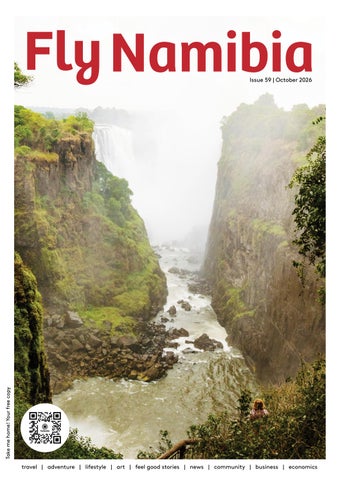
Issue 59 | October 2026
travel | adventure | lifestyle | art | feel good stories | news | community | business | economics
Every goal starts with saving Every cheer, every celebration, every unforgettable match day starts with a plan. FNB weSave helps you and your crew save towards the moments you don’t want to miss together. Save together. Celebrate together. Visit your nearest FNB branch today and open your FNB weSave Account. 061 299 2222
081 953 6262
www.fnbnamibia.com.na
CONTENTS Welcome on board
9
The art of safari in Namibia
10
This is Namibia: Namibia’s earliest inhabitants
15
The Project Room: Michael Mansfield
17
Namibia’s African Penguin on the brink of extinction
18
Native Leaves: Tamboti tree
21
The Brief: A monthly wrap-up of news worth knowing
22
The many hats of Bazzuka
25
Cleanup Namibia
27
Fashion: House of Poulton
28
Reflections: The climate choice
31
Macro Pulse: Namibia's housing affordability trap
32
Love Local Arts
34
First government-owned MRI marks major milestone for Namibia’s public healthcare
35
A child beneath the African sky
37
We’re for Namibians: Dallin NoabebIsi
38
Potjie Food Competition: Cooking for a Cause in Southern Namibia
41
Your summer skin reset
43
Threads of identity: The sacred stages of traditional Ovaherero marriage
44
Living Well: Guts feelings
47
A Mosi-oa-Tunya farewell from Namafu
48
Air fryers: Modern kitchen hero or fleeting trend?
50
Guided self-drive convoy trips through Namibia
53
Martin Zimelka: Finding stillness through photography
54
The psychology of home: Why we miss home when we travel
57
Health ministry targets 1.2 Million households in malaria spraying campaign
58
Why business readiness matters more than first oil
61
Namibia targets green industrialisation to drive economic growth and jobs
62
New heavy vehicle permit system comes into effect in Windhoek
65
The decisions that build a country
66
Junior National Council challenged to become problem-solvers for Namibia’s future
69
Made in Namibia, by Namibians
71
Did you know?
74
Love Namibia
76
10
28
50
FLYNAMIBIA OCTOBER 2026
1
Welcome to the October edition of the FlyNamibia Magazine
brought to you by At Venture Media, we’re more than just a publisher - we’re a multi-media content creation powerhouse. Our expertise includes awe-inspiring photography, striking videography, impeccable design, and crisp podcasts. With a reputation for excellence spanning three decades, we bring unparalleled storytelling to life. In our boutique publishing and content marketing house, stories that matter take center stage. Every page you turn reflects our commitment to quality and innovation. Dive in and experience the difference that top-tier content creation can make. Cover image by Suné van Wyk Read more on page 49. Editor Elzanne McCulloch elzanne@venture.com.na Production Manager Liza Lottering liza@venture.com.na Sales Daleen Small daleen@venture.com.na Layout & Design Richmond Ackah Jnr. design@venture.com.na Admin and Enquiries Bonn Nortje bonn@venture.com.na Printing John Meinert (Pty) Ltd
Venture Publications (Pty) Ltd. PO Box 21593 Windhoek Namibia Disclaimer: Please note that while every effort has been made to ensure the accuracy and reliability of the content within this magazine, Venture Publications Pty Ltd and FlyNamibia accept no responsibility for any errors or omissions. The views expressed by individual authors are solely their own and do not necessarily reflect those of the publisher or FlyNamibia. All material, including text and images, is the property of its respective authors and cannot be reproduced or used without explicit permission from Venture Publications Pty Ltd.
2
our services. Creative Professional Concept & Photography Campaign Development
Creative Design
Social Media Management
Video Production
Creative Storytelling & Content Creation
Want to be part of our content creation revolution? Find our contact details here.
+264 81 285 7450 | info@venture.com.na | www.venture.com.na
our publications.
From the Publisher
our storytellers.
Order any of these publications from bonn@venture.com.na
10
21
Agnes Shivute
An environmental consultant with interest in indigenous flora, nature enthusiast, Namibia Botanical Society awardee and aspiring author.
28
Elzanne McCulloch
Writer, editor and publisher of Stories that Matter. Managing Director of Venture Media.
44
Rukee Kaakunga
Glen-Nora Zeupereje
A Windhoek-based Tjipura communications specialist, is a writer and filmmaker, blogger and freelance fashion passionate about stories, writer. whether reading or consuming
35 27 43
Emily Kandanga-Erastus
58 47
38
Cerina Bezuidenhout
62
David Penda
Maggie Forcelledo Paz
A digital content creator News & Content Editor. Windhoek-based creative & Haasbroek capturing Namibia's stories Passion and dedication to movement enthusiast. A creator, guide, and curious through bold visuals and real keep the nation abreast with Usually building, creating, and soul inspired to help people moments. My work celebrates what’s happening on national storytelling, blending wellness, reconnect with their bodies, and international level. purpose, and a passion for find their flow, and reclaim their the people, places, and pulse of the nation. bringing meaningful ideas to life. health – naturally.
31
17
David Bishop
Host of Nova Sunrise on Nova 103.5, climbing wall owner, voracious reader, sometime writer, active lifestyle proponent, family man, and coffee lover.
Laschandre Coetzee A strategic dreamer, working in sustainability and communication strategy. Partner of local gallery The Project Room. FLYNAMIBIA OCTOBER 2026
3
STRONG BUSINESSES DON’T WAIT FOR UNCERTAINTY TO BECOME DISRUPTION. THEY PREPARE FOR IT. At Corporate Guarantee, we help businesses take a more strategic approach to risk through Alternative Risk Transfer solutions designed around their unique needs. By planning ahead, businesses can structure their insurance to retain the risks they can manage, transfer the risks they cannot, and ensure financial capacity is available when losses occur. Because when disruption comes, the advantage belongs to those who were prepared for it.
Insurance structured differently and trusted by leading Namibian businesses. GET IN TOUCH 083 331 3032 clientcare@corporateguarantee.com 4
Need To Knows. with FlyNamibia
How to buy
a ticket online www.flynam.com
Select your flight Select which tickets you would like to purchase: destinations, travel dates, morning/afternoon departure. We offer multiple fare options such as: Saver, Classic or Premium
Additional flight information / rules Read up on all our additional information regarding terms and conditions, and tick the selection box once completed to continue.
Passenger details
Payment
Please enter names as they appear on passport or travel documentation
Fill in your payment details in our DPO paygate to make final payment.
LOGIN to upload passenger details from previous booking.
More options for the perfect trip
Confirmation Mail Transaction confirmation will be sent to passenger email entered.
Baggage policy, sporting equipment, over weight luggage or to add an additional bag(s)
How can you make
You can also purchase
from:
a payment?
Cash payment at: Eros Airport, Ondangwa Airport
Electronic Funds Transfer (EFT)
Windhoek Eros Airport Office Ondangwa airport office Katima Mulilo airport office Hosea Kutako airport office All major travel agents
Online card transaction
PayToday app Buddy SuperApp
Check-in
prior to flight Online check-in opens 24 hours before departure of the flight on Fly Namibia Check-in opens 1h 30min before domestic flight and 2 hours before international flight. Check-in CLOSES 30 min prior to domestic flight and 50 min prior to international flight.
Luggage
restrictions Items NOT allowed in hand luggage:
MAX 20kg Per person
Lotions and aerosols above 100ml, flammable aerosol, sharp objects, i.e. nail files, nail scissors, Leatherman, matches. See full conditions of carriage by scanning the QR code
FLYNAMIBIA OCTOBER 2026
5
DOMESTIC & SAFARI FLIGHTS Katima Mulilo (via Maun) Bwabwata National Park
Ondangwa
Skeleton Coast Park
Rundu
Mokuti
Etosha National Park
Khaudum National Park
Tsumeb
Ongava
Otavi
Grootfontein
Mudumu National Park Nkasa Rupara National Park
Maun
Twyfelfontein Otjiwarongo
Waterberg Plateau Park
Dorob National Park
BOTSWANA Okahandja
Swakopmund
Windhoek
Walvis Bay
Gobabis
NamibNaukluft Park
Mariental Keerweder (Sossusvlei)
Keetmanshoop
Lüderitz
Ai-Ais/ Richtersveld Transfrontier Park
Oranjemund
with FlyNamibia Contact The Call Centre | +264 83 339 0011 Schedule as per date of going to print. Please check the FlyNamibia website to stay updated on flight destinations, routes and schedules.
Victoria Falls ZIMBABWE
DOMESTIC FLIGHTS FLIGHT NO.
DEPARTURE
FROM
TO
ARRIVAL
DAYS
WV*4Z8505
06:30
Eros - Windhoek
Ondangwa - Toivo Ya Toivo
07:30
Tue
WV*4Z8506
08:00
Ondangwa - Toivo Ya Toivo
Eros - Windhoek
09:00
Tue
WV*4Z8595
16:20
Eros - Windhoek
Ondangwa - Toivo Ya Toivo
17:20
Tue, Wed, Thu, Fri, Sun
WV*4Z8596
17:50
Ondangwa - Toivo Ya Toivo
Eros - Windhoek
18:50
Tue, Wed, Thu, Fri, Sun
WV*4Z8137
13:30
HKIA - Windhoek
Katima Mulilo (via Maun)
15:30
Mon, Wed, Fri, Sun
WV*4Z8138
16:00
Katima Mulilo
HKIA - Windhoek (via Maun)
18:15
Mon, Wed, Fri, Sun
REGIONAL FLIGHTS FLIGHT NO.
DEPARTURE
FROM
TO
ARRIVAL
DAYS
WV*4Z8137
13:30
HKIA - Windhoek
Maun
14:30
Mon, Wed, Fri, Sun
WV*4Z8138
17:05
Maun
HKIA - Windhoek
18:15
Mon, Wed, Fri, Sun
WV*4Z8135
09:15
HKIA - Windhoek
Victoria Falls
10:40
Tue, Wed, Thu, Fri, Sat, Sun
WV*4Z8136
11:15
Victoria Falls
HKIA - Windhoek
12:50
Tue, Wed, Thu, Fri, Sat, Sun
Mon-Sun
in Partnership with 4Z341
11:40
Cape Town
Walvis Bay
13:55
4Z342
14:40
Walvis Bay
Cape Town
16:45
Mon-Sun
4Z320
07:00
Cape Town
HKIA - Windhoek
09:10
Mon, Tue, Wed, Thu, Fri, Sat
4Z326
10:40
Cape Town
HKIA - Windhoek
12:50
Mon-Sun
4Z328
18:15
Cape Town
HKIA - Windhoek
20:25
Mon, Tue, Wed, Thu, Fri, Sun
4Z329
07:05
HKIA - Windhoek
Cape Town
09:10
Mon, Tue, Wed, Thu, Fri, Sat
4Z321
09:50
HKIA - Windhoek
Cape Town
11:55
Mon, Tue, Wed, Thu, Fri, Sat
4Z327
13:40
HKIA - Windhoek
Cape Town
15:45
Mon-Sun
*Code Share ** For Luderitz flights please contact your nearest Travel Agent or FlyNamibia offices for the newest updates. HKIA - Hosea Kutako International Airport
Our main routes
The seasonal FlyNamibia Safari schedule will resume on 1 May 2026 and run until 30 November 2026. Our daily shuttle flight operates in a clockwise circuit seven days a week. The exact departure and arrival times are determined the day before the flight and will be communicated directly to lodges, tour operators, and transfer companies. A minimum of two passengers is required per sector. All destinations remain available on a private charter basis. The departure time from Sossusvlei is between 08:30 and 11:00, meaning arrival in Swakopmund and Twyfelfontein will be in time for lunch, and arrival at Etosha will be between 12:30 and 15:30. The arrival time in Windhoek will be between 16:00 and 17:00, or earlier if necessary to ensure connections with various airlines. It’s important to note that no activities should be booked on the day of departure to the next destination until the departure time is confirmed the day before. All destinations remain available on a private charter basis. For more information, contact: Email: safari@flynamibia.com.na
FROM
TO
Windhoek
Sossusvlei
Sossusvlei
Swakopmund
Swakopmund
Twyfelfontein
Twyfelfontein
Ongava
Ongava
Mokuti
Mokuti
Windhoek
Additional route options FROM
TO
Swakopmund
Ongava
Swakopmund
Mokuti
Twyfelfontein
Mokuti
Ongava
Windhoek
Sossusvlei
Twyfelfontein
Sossusvlei
Ongava
Sossusvlei
Mokuti
Twyfelfontein
Windhoek
Swakopmund
Windhoek
ON BOARD Dear Guests, September gave us another wonderful opportunity to bring people together for something bigger than ourselves. On 25 September, we hosted our third Padel for a Purpose, an initiative that has quickly become a highlight on our calendar. This year, we played for conservation, raising support and awareness for Save the Rhino Trust Namibia, IRDNC and the Giraffe Conservation Foundation – three organisations doing important work to protect Namibia’s wildlife, landscapes and community-led conservation legacy.
Read our previous issues
WELCOME
A sincere thank you to every player, partner and supporter who joined us. Padel for a Purpose is built on a simple idea: that when people come together, even a day of sport and fun can contribute to something meaningful. That same spirit of support continues this month as we once again stand behind the Janine & Suzelle Davin Sport Trust. The Trust helps talented young Namibian athletes access the coaching, training, travel and opportunities they need to compete beyond our borders. It is an investment in potential – helping young Namibians take their talent from Namibia to the world. Looking ahead, we are also continuing to strengthen the connections that take Namibia to the region and bring the region closer to us. From April 2027, we will introduce additional frequencies on our regional network, including increased services to Maun and Katima Mulilo, while further strengthening our Victoria Falls connectivity. These additions respond to growing demand and give our passengers more choice and flexibility when travelling across some of Southern Africa’s most remarkable destinations. For us, however, growth has never simply been about adding flights to a schedule. It is about what those connections make possible – for tourism, for business, for communities and for the people who call this country home. At FlyNamibia, we’re for Namibia and its people. Whether through the routes we fly, the organisations we support or the opportunities we help create, that remains at the heart of who we are. Thank you for choosing to fly with us. Wherever your journey takes you today, we are proud to be part of it. Warm regards, Nerine Uys CEO, FlyNamibia
SC A
NM
E!
The art of
safari in Namibia
10
T
here is an art to safari in Namibia. It is neither a science nor a formula. And certainly not something that can be measured by how many animals you tick off before breakfast. It is an art in the same way that patience is an art, or silence is an art, or knowing when to stop the car simply because the light has turned the colour of warm honey across the plains. Most visitors imagine safari as a seamless procession of wildlife sightings. Lions here. Elephants there. Leopards draped decoratively over tree branches like living ornaments. And yes, in some corners of Namibia, that expectation is generously rewarded. But Namibia, being true to itself, refuses to be predictable. Safari here is not just about animals. It is about space. About anticipation. About learning to appreciate the long stretches between sightings just as much as the sightings themselves. Because here, the journey is not a filler – it is the story. Take Etosha, for instance. If Namibia is a grand theatre for wildlife, Etosha is the main stage, complete with seasoned performers and a reliable script that rarely disappoints. Game drives in Etosha have a rhythm of their own. Early mornings begin with the quiet clink of enamel mugs and the smell of strong coffee poured into travel flasks. The gates open, tyres crunch over gravel and suddenly you are part of the choreography. Vehicles fan out across the pan’s edges, each driver convinced that today will be the day – the day of lions on the road, elephants at every
waterhole and perhaps even a leopard or cheetah sighting if the safari gods are feeling particularly generous. And often, they are. At the waterholes, life unfolds like a slow-burning drama. A herd of springbok arrives first, tentative and twitching. Zebras gather in striped committees, debating whether it is safe enough to drink. Then, without warning, elephants appear on the horizon – enormous silhouettes growing steadily larger until the ground seems to hum beneath their footsteps. Etosha is where Namibia flexes its wildlife muscles. It is where visitors fall in love with safari for the first time. Where the magic feels abundant, almost effortless. But Namibia does not let you stay comfortable for too long. Head northwest into Damaraland and Kaokoland, and safari becomes something altogether different. Here, you earn your sightings. You drive for hours through landscapes that feel impossibly ancient – valleys carved by time, mountains that look as though they have been sketched rather than built and riverbeds that only occasionally remember what water feels like. The vast and unapologetically empty terrain stretches quietly and endlessly. And sometimes, for days, you see… nothing.
FLYNAMIBIA OCTOBER 2026
11
Well, not nothing exactly. You see tracks. Dust. The whisper of wind moving through dry grass. You scan distant ridgelines until your eyes ache, convinced that every shadow might be an rhino, every rock a resting lion. This is the kind of safari that tests your resolve. But then – just when you begin to wonder if perhaps the desert has swallowed up its secrets entirely – you see them. A line of desert-adapted elephants emerges from a dry riverbed, moving with calm confidence through a terrain that seems incapable of supporting life. Or a lone giraffe appears, impossibly elegant against a backdrop of raw stone. Or, if fortune smiles broadly, the rare outline of a desert-adapted lion materialises on a distant duneside, surveying a kingdom that feels entirely their own. And in that moment, every empty kilometre becomes worth it. Because rarity carries weight. Effort sharpens appreciation. The harder the search, the sweeter the reward. That is the art of safari in Namibia – understanding that abundance and absence are two sides of the same story. Travel south, and the safari transforms again. Southern Namibia is not always about traditional game drives or dense wildlife sightings. Instead, it offers something quieter and infinitely more expansive. Here, safari becomes about distance. The landscapes stretch so wide that they seem to swallow sound. You drive for hours across gravel roads framed by mountains that shift colour as the sun moves overhead. Gemsbok appear like living sculptures against the horizon – adequately adapted, perfectly poised. Ostriches stride across open plains with prehistoric confidence, while a solitary springbok punctuates the emptiness with sudden bursts of motion. In the south, wildlife sightings feel like punctuation marks in a much larger sentence written by geology and time. And yet, it is no less safari. Because safari is not only about animals. It is about immersion. About being small in vast places. About feeling your senses recalibrate to the pace of nature rather than the pace of modern life. Then there is the art of birding safaris – a pursuit that, at first glance, seems deceptively gentle. Birders carry binoculars instead of cameras the size of small cannons. Their checklists are long, their patience longer and their excitement often triggered by creatures which the untrained eye might overlook entirely.
12
Scale changes everything in Namibia. Wildlife is often discovered slowly, quietly, from afar.
Safari in Namibia is not one thing. It is many things, layered together like brushstrokes on a canvas.
But spend a single morning with a dedicated birder, and you will begin to understand. In Namibia’s northeast – the lush Zambezi Region with its winding waterways and riverine forests – birding is less a hobby and more a treasure hunt. Fish Eagles call overhead with that unmistakable cry that feels like a soundtrack made for Africa alone. Carmine Bee-eaters cluster along riverbanks in bursts of improbable colour. Kingfishers flash like living jewels over still waters. And suddenly, safari becomes about feathers rather than fur. It becomes about noticing the small things – the movement of a reed, the shape of a silhouette against the sky, or the difference between one warbler and another. Birding teaches observation at a granular level. It slows you down in a way few other safari experiences can. Which, again, brings us back to the art of it all. It is the reliable theatre of Etosha, where wildlife gathers predictably at waterholes, offering front-row seats to nature’s daily performances. It is the stubborn patience of the northwest, where sightings are rare but unforgettable, and landscapes dominate the narrative as much as the animals themselves.
Sometimes, the best safari moments are not the ones that fill your memory card. They are the ones that happen in silence – watching dust drift across a dry riverbed, listening to distant thunder rolling across an empty plain or sitting quietly beside a waterhole as the light fades and the world shifts into evening. There is a moment, often late in the day, when the air cools and the sky softens into gold and amber. The engine is switched off. The world holds still. Somewhere, an animal moves – unseen but unmistakably present. You wait. You listen. You feel the weight of the landscape around you. And in that pause, you realise something quietly profound: safari in Namibia is not about chasing wildlife. It is about learning to belong, briefly and respectfully, to the wild rhythm of this place. That is the true art of safari. Not speed. Not numbers. Not spectacle. But patience, perspective and the quiet understanding that the best sightings are often the ones you almost miss – until Namibia decides you are ready to see them.
It is the quiet solitude of the south, where distance becomes the main character and wildlife feels like an elegant afterthought rather than the headline act.
Elzanne McCulloch
It is the detail-driven joy of birding in the northeast, where the thrill lies not in size, but in discovery.
First published in the Winter 2026 issue of Travel Namibia magazine. Subscribe to Travel Namibia here:
And threaded through all of it is a lesson Namibia teaches better than almost anywhere else: safari is not about how much you see, but about how deeply you experience what you see.
www.travelnam.com
FLYNAMIBIA OCTOBER 2026
13
Book your conference
at Popa Falls Resort
Discover unparalleled conference facilities amidst breathtaking natural landscapes with Namibia Wildlife Resorts. Host your next event at Popa Falls Resort, where the serene Okavango River meets nature’s tranquility.
Elevate your business travel with the NWR NAMLEISURE CORPORATE CARD! Enjoy exclusive discounts on accommodation and activities, ranging from 50% for Namibian to 10% for international cardholders. With a validity of three years and easy renewal, it’s tailored for businesses with a minimum group size of 10. Experience convenience, savings, and unparalleled benefits for your corporate outings.
+264 61 285 7108 |
MICE@nwr.com.na |
www.nwr.com.na
Photography credit: Suné van Wyk
This is Namibia
Namibia’s earliest inhabitants
T
The San
he San (Bushmen), the earliest known inhabitants of Namibia, belong to the Khoisan people. Generally short in stature, they have light yellowish-brown skins, and their language, which differs among the various groups, is characterised by numerous click sounds. The San in Namibia are divided into five main groups, each with their own history, customs and language. What was formerly known as Bushmanland is the area in Namibia that is most frequently associated with the San people. The Ju/’hoansi of eastern Bushmanland have retained some of their traditional territories and still pursue their traditional way of life to some extent by gathering veld food and hunting with their traditional weapons.
Most of the San became farm workers, and large numbers were recruited for the South African Defence Force during the war of independence. Beadwork made from ostrich eggshell, seeds, berries, roots and segments of porcupine quills have formed part of the San people’s traditional crafts for thousands of years. Glass beads were traded with other communities. Nowadays, plastic beads are also used.
The Hai//om traditionally inhabited Etosha, as well as the Kunene and Western and Eastern Kavango regions. The !Kung, which had the widest traditional distribution in Namibia, include the Ju/’hoansi in Bushmanland where they have retained some access to their traditional territory. Bwabwata National Park forms part of the traditional core territory of the Kxoe-speaking San. These hunter-gatherers roamed the southern African plains for thousands of years in small nomadic groups.
EXPERIENCING SAN CULTURE The Living Museum of the Ju’Hoansi at Grashoek and the Living Museum of the Little Hunters provide fascinating insights into the history, culture and customs of the San people. TUCSIN Tsumkwe Lodge in Tsumkwe conducts a variety of half-day and full-day tours that feature aspects such as gathering of veld foods, hunting and traditional dancing. Other activities include village tours and half-day tours. Muramba Bushman Trails are conducted by Reinhard Friedrich on his farm near Tsintsabis. He has an outstanding knowledge of the Hai//om San and speaks their language fluently. Visitors can interact with the Ju/’Hoansi-San by participating in several programmes at Omandumba Guest Farm in the Erongo Mountains. Omandumba is renowned for its large number of rock art sites and variety of paintings.
The wealth of rock paintings and engravings in mountains and hills throughout Namibia bear witness to their former extensive range. The oldest rock art dates back some 28,000 years. The Brandberg has one of the largest concentrations of rock paintings in Africa, while Twyfelfontein, Namibia’s first World Heritage Site, has one of the richest collections of rock engravings on the continent. The San were systematically displaced and dispossessed of their traditional territories – first with the arrival of the Bantu-speaking people and later by the arrival of white settlers – and driven out to the most remote and harsh environments of southern Africa.
Functional items such as bags traditionally used for collecting wild fruit and berries are made from softened antelope skin. Traditional San crafts can be bought at the Namibia Craft Centre in Windhoek and at G!hunku Crafts situated next to the Nyae Nyae Conservancy office in Tsumkwe.
Find more Namibia travel inspiration at www.thisisnamibia.com Follow @thisis_namibia on Facebook and instagram for extraordinary Namibia travel stories..
FLYNAMIBIA OCTOBER 2026
15
Beyond the
BO�D�OM
STRATEGY SESSIONS - CONFERENCES - CORPORATE EVENTS
A
s businesses begin planning for the year ahead, Droombos Estate offers a refreshing alternative to the traditional boardroom.
STRATEGY SESSIONS
CONFERENCES & WORKSHOPS
CORPORATE EVENTS
BREAKAWAY SPACES
CATERING & ACCOMODATION
TEAM EXPERIENCES
Surrounded by gardens and tranquil spaces just outside the bustle of Windhoek, the Estate provides an inspiring setting for strategy sessions, conferences, workshops, team gatherings and corporate events. The place where delegates trades the fluorescent lights and recycled air for shaded courtyards and open sky. The change of scenery tends to change the conversation, with sharper thinking, easier candour, ideas that would not haved surfaced across a laminate table.
ST M E AL S
D
E
N T
V
DI
N G AN D
N G E VE
N
E
D I N G
S
N G
CI N E
DI
S
E R
G
CON F
E
O
CH
D
H OS TI N
W
N
AT
TOP T
E
E D
BE
N
Y
O
W
E R E N CI
W
NF
T
O
G
C
This is not a retreat from the work it is a more deliberate way of doing it. With full-service catering, comfortable accommodation and flexible event setups means an entire gathering can unfold on one estate, from start to finish. What remains once the agenda closes is a kind of connection that rarely survives in a conventional boardroom.
U R
D RE A
M
Discover Dr�mbos Estate Where every moment is an escape.
+264 81 2888 352 reservations@droombos.com.na www.droombos.com.na
Michael Mansfield
New Paintings
M
ichael Mansfield finds material in the ordinary: toys, household objects, books, trinkets and whatever else happens to catch his eye. He collects boxes of things with no immediate purpose, keeping them just in case, as he puts it, he might need them one day. Eventually, some unlikely combination presents itself and an object becomes a prop, a character or the beginning of a story. Still life has long provided Mansfield with a stage for these encounters. His compositions bring together objects that under normal circumstances would have no reason to share a canvas, yet within the carefully constructed world of the painting, they begin to make a peculiar kind of sense. A Mills & Boon novel becomes romantic love; Spider-Man calls to mind the compassionate person who rescues a spider with a glass and piece of card; a doughnut joins them because, sometimes, a composition simply needs a doughnut.
And so they swim, fly and inhabit environments of Mansfield’s construction. Cheerfully orange squid congregate in blue water. Pale whales rise en masse from a churning sea. Elsewhere, pigs occupy strange architectural structures, while carrots, pencils and other familiar things find themselves cast in roles for which they were presumably never intended. The results sit somewhere between still life and theatre. The exhibition also sees Mansfield return selectively to the figure. Here his affection for classical painting and sculpture comes to the fore. Art history has always been something he approaches with both genuine admiration and a mischievous eye. The grandeur and drama of classical mythology are treated with respect, but never so much respect that their theatrical – and occasionally camp – possibilities cannot be enjoyed. That balance is central to Mansfield’s practice. He is a serious painter who does not insist that paintings behave seriously. His technical precision and careful compositions invite a closer look, but humour provides the way in. Familiar objects become strange through unexpected relationships, handmade creatures acquire personalities and art history is gently nudged from its pedestal. Mansfield does not prescribe what the viewer should discover beneath these encounters. He would rather let the painting entertain, please, provoke conversation and encourage curiosity. No grand declaration. No promise of reinvention. Just New Paintings: new objects, new arrangements and new little worlds, made with considerable skill and just enough mischief to keep things interesting. Laschandre Coetzee
For Mansfield, composition is everything. In New Paintings, however, the objects have begun to escape the confines of conventional still life. Where his earlier Still Life Stories largely drew upon objects that already existed, Mansfield has now started making some of his subjects himself. Squid and whales are fashioned from polymer clay, birds from ping pong balls and planes from folded paper. Once made, he gives them somewhere to go.
The Project Room - Namibia www.theprojectroom.com.na
FLYNAMIBIA OCTOBER 2026
17
M
eet Egbert, an African Penguin rescued as an abandoned egg from the Stony Point penguin colony in South Africa. Years later, as an adult, he was found stranded in Swakopmund, where a first responder rescued him and arranged his transfer to facilities run by the Namibian Foundation for the Conservation of Seabirds (NAMCOB) in Lüderitz for rehabilitation. A few months after his rescue, he was released back into the wild at Guano Bay, Namibia. From there, he made his way to Halifax Island, off the Namibian coast, where he now waddles freely alongside his penguin buddies in the Namibian Islands’ Marine Protected Area (NIMPA). Double happy endings like Egbert’s are cause for celebration, given there are only 1,500 African Penguin adults (700–800 breeding pairs) left on four islands within NIMPA. African Penguins have been pushed to the brink of extinction by guano harvesting, overfishing, predation, habitat loss and climate change. Can we save Egbert and his friends from extinction? The African Penguin is the only penguin species found in Africa, breeding primarily on coastal islands and forming large colonies from Namibia to Port Elizabeth, South Africa. These endearing little penguins are more than just charming waddlers; they play a vital role in Namibia’s marine ecosystems. As an indicator species, their health reflects the state of our oceans and signals changes in the fish stocks critical to our marine ecosystem and the coastal fisheries that depend on it. Globally, their population has crashed by over 97%, prompting the International Union for Conservation of Nature (IUCN) to classify the species as “Critically Endangered,” one step away from extinction in the
18
wild. Starvation is a key reason for their demise, as we have overfished the sardines, anchovies and other small pelagic fish that comprise their primary diet. Oil spills, climate change and habitat loss from past guano harvesting are among the other factors that have compounded the crisis. Against this backdrop, experts emphasise urgency. “The African Penguin is in a dire situation, and we cannot afford to wait any longer to protect the species properly,” says Nicky Stander, Head of Conservation at the Southern African Foundation for the Conservation of Coastal Birds (SANCCOB). “In just over a decade, they could no longer exist. Governments, organisations and individuals must come together to save them at all costs.” What the science tells us Scientific studies paint a sobering picture of the challenges facing Namibia’s African Penguins. Research from Mercury Island in Namibia, one of the last strongholds, shows that these seabirds are being forced to survive on low-energy prey, such as gobies, rather than their preferred diet of nutrient-
Photography: NAMCOB/Gail Thomson
Namibia’s African Penguin on the brink of extinction
rich sardines and anchovies. This dietary shift drastically reduces their breeding success, chick survival and overall health, indicating the collapse of their food web.
In just over a decade, they could no longer exist. Governments, organisations and individuals must come together to save them at all costs.
A landmark study in the scientific journal Biological Conservation revealed that declines in sardine populations due to overfishing and climate variability are tightly correlated with penguin population crashes. Penguins can only hunt close to their breeding islands, making them particularly vulnerable to overfishing close to key breeding sites. These findings reinforce the urgent need for ecosystem-based fisheries management and strict enforcement of marine protection policies in NIMPA.
conservation measures on all four of the penguin breeding islands in NIMPA. These efforts include protected area monitoring, oil spill preparedness, and seabird research and monitoring. The team also engages with coastal communities through awareness initiatives.
Furthermore, long-term monitoring in the Benguela Current ecosystem reveals that guano-dependent nesting sites remain degraded due to historical exploitation, and recovery is slow without active habitat restoration. To address this, NAMCOB has installed 100 nest boxes across the four NIMPA islands to support breeding populations.
“As the government, we have to strengthen our efforts by working with NGOs and experts in the field like never before,” says Desmond Tom, Senior Fisheries Biologist at MAFWLR. Crucially, MAFWLR has implemented a moratorium on commercial sardine fishing to allow for the recovery of this important fish stock for humans and penguins.
Fighting for survival The 9,500 km² NIMPA was designated in 2009 as a safe space for marine animals to feed, breed and rest. Despite being established in 2009, the NIMPA management framework has yet to be approved, which hinders conservation efforts. NAMCOB is advocating for the Ministry of Agriculture, Fisheries, Water and Land Reform (MAFWLR) to adopt the NIMPA operations management plan.
Saving African Penguins like Egbert is possible if we all work together. Monitoring their survival, reproduction and breeding colony sizes must guide Namibia’s ecosystem-based management to ensure healthy oceans. A robust NIMPA management plan that protects the key breeding islands – Mercury, Ichaboe, Halifax and Possession – around Lüderitz is critical to their survival and broader ecosystem health.
The NIMPA operations management plan will help conservationists to make better decisions and implement regulations to protect marine life and ecosystems. It will also support sustainable resource use by communities. For it to work well, fisheries managers need proper training, and the plan must be based on solid evidence. “The African Penguin is in a very perilous state. As one of the sentinels of our oceans, they are signalling that we are not managing our local marine environment holistically enough. We need to change this in order to arrest the situation,” says Angus Middleton, Chairman of the NAMCOB executive committee. The Power of Collaboration NAMCOB and MAFWLR, in collaboration with national and international partners, are implementing hands-on
Waddle we do without the penguins? African Penguins play a crucial role in marine ecosystems. They enrich coastal waters with guano, contribute to marine food webs and support biodiversity beyond the fisheries sector. Their story doesn’t have to end in extinction. You can support the critical work being done by the government and its partner organisations, like NAMCOB. Penguins need more than happy endings for individuals like Egbert; they need systemic change in how we manage marine ecosystems. In the long run, these changes will help penguins and people. Namibia Nature Foundation First published in the Conservation and the Environment in Namibia 2025 issue. Read more stories here: www.conservationnamibia.com
FLYNAMIBIA OCTOBER 2026
19
ADVENTURE AWAITS!
Tel: 264 61 232871 | 24hr emergency no: 081 129 3355 Email: info@africa-on-wheels.com www.africa-on-wheels.com 20
Scan the QR code to access the website
Native Leaves:
TAMBOTI TREE
I
Scientific name: Spirostachys africana Common name: Tamboti tree
find it fascinating that we have a culture of naming tourism establishments after plants or animals – if not tribes, rivers or mountains – and in most cases the names are in our native languages. A trend not only here in Namibia but common throughout the continent of Africa. Second only to Asia in size, Africa has just recently been adjusted on the world map to show its real dimensions in proportion to the rest of the continents. It is eye-opening that century-old narratives and assumptions can be challenged and changed. Well, the Correct the Map movement succeeded, but it makes me wonder what other misrepresentations about Africa still exist if we had something as basic as the size of Africa wrong. The plant enthusiast in me is now wondering whether we perhaps have native plants of Africa out there wrongly assumed as native to other continents. Talking about tourism establishments named after animals or plants, here in Namibia, you will find lodges such as Onduli, which translates to giraffe, or Damara Mopane Lodge, which is a combination of the Damara tribe and the mopane tree. We have the Tambuti Lodge in Rundu, which refers to the tamboti tree. (This tree can also be referred to as tamboti or tambuti, but the most common name reference is tamboti.) I found this tree to have a unique use in the preparation of a traditional delicacy of the Aawambo people, but let’s save the best for last and first get to know a little more about this tree. Tamboti trees can grow up to a height of 12 metres and have spread crowns. Their bark is often very rough, with deep fissures forming rectangular shapes. The colour of the bark ranges from light grey to almost black. Its leaves are simple with an ovate shape, and they are spirally arranged. The surface of the leaves is hairless and has a prominent midrib. The upper side of the leaf surface is dull and dark green, while the lower side is pale green. The leaves of the tamboti turn yellow in autumn. It flowers in spikes covered with brown bracts that can be up to 30 millimetres long. Both male and female flowers are on the same tree, and flowering occurs from August to December.
The tamboti tree is amongst the protected trees in Namibia since it is heavily used for timber. Its wood is hard and oily, and sawing it is easy. Although its wood is one of the best wood types one can get locally, it needs to be treated to prevent it from cracking. The wood is also used to build huts, fences and carvings, but it is not suitable for firewood because its smoke has a bitter aftertaste when inhaled. The aftertaste is known to cause nausea or even headaches. This means that food exposed to its smoke is likely to be poisonous. While in most cases the tamboti tree is rather toxic, communities have figured out ways to best use it both locally and beyond the borders of Namibia – from making beads from the wood to using pieces of the wood to serve as an insect repellent in linen and clothes or to treat livestock for tick and snake bites. I must admit that the scent of the wood is something one could smell over and over again – a scent I would consider suitable for a perfume. While all sorts of uses of this tree point towards a “no-taste policy”, there is a delicacy out there that seems to be incomplete without a piece of the tamboti wood in the pot. Good rains come with a good supply of African giant bullfrogs – something which is considered a delicacy amongst my people, the Aawambo. What most people do not know is the significance of the presence of a piece of tamboti wood in the preparation of bullfrogs. The tamboti wood is often placed in the pot when preparing this cuisine. Why? The African giant bullfrog is known to contain a lethal toxin within its skin and bladder that can cause possible kidney failure. The presence of a piece of tamboti wood during cooking is therefore essential, as its chemical properties react with the juices of the frogs, neutralising these toxins and preventing possible kidney failure. This makes the frogs safe to consume. Interesting, right? Not just a ritual, but chemistry. Agnes Shekupe Shivute
FLYNAMIBIA OCTOBER 2026
21
A monthly wrap-up of news worth knowing NACC, CPBN STEP UP FIGHT AGAINST TENDER RIGGING AND PRICE FIXING
collusive behaviour. The agreement supports the National Competition Policy 2020–2025 and aims to promote fair competition, protect public procurement integrity and improve value for taxpayers, without compromising either institution’s statutory independence. AAC PLANS TO USE EXISTING NAMIBIAN FISHPROCESSING FACILITIES FOR SALMON PRODUCTION
The Namibian Competition Commission (NaCC) and Central Procurement Board of Namibia (CPBN) have signed a Memorandum of Understanding (MoU) to strengthen the detection and prevention of anti-competitive practices in government procurement. The agreement targets bid rigging, price fixing, market allocation, abuse of dominance and technical specifications designed to favour specific bidders. The partnership allows the institutions to share complaints, information and intelligence, within legal requirements, while jointly analysing supplier behaviour and market dynamics. They will also conduct research, training, secondments and knowledge-sharing initiatives to improve officials’ ability to identify collusion and other competition violations. A Joint Working Committee will oversee implementation, monitor progress and identify emerging risks. Both organisations emphasised that cooperation is necessary because procurement legislation alone may not prevent
African Aquaculture Company (AAC) plans to establish a 51,000-tonne Atlantic salmon farming operation near Lüderitz, using existing fish-processing facilities in Lüderitz and Walvis Bay rather than initially building its own. The company has secured licences for three coastal sites and considers Namibia’s cold Benguela Current suitable for salmon farming. External experts have assessed environmental and operational risks, including waves, currents, oxygen, algae and seals, and believe the targeted production is achievable. AAC expects the project to create employment, generate tax revenue and expand Namibia’s seafood value chain. The company is also encouraged by Namibia’s political stability and investment environment, while growing global demand for farmed salmon presents a significant market opportunity.
Namibia
SCAN HERE Finance
22
thebrief.com.na
miningandenergy.com.na
@thebrieflive.nam
Namibia Mining and Energy
@thebrieflive
@miningandenergy
@thebrieflive
Namibia Mining and Energy
MINING
TO FOLLOW OUR
WHATSAPP CHANNEL
ENERGY Business
NAMIBIA RANKS SECOND GLOBALLY FOR RENEWABLE ENERGY GROWTH
The Namibia has been ranked the world’s second-fastest-growing renewable energy market, according to an August 2026 analysis by the World Resources Institute (WRI). The country has increased solar generation from virtually zero to more than one-third of domestic electricity generation within a decade, driven by efforts to reduce costly reliance on electricity imports and improve energy security. Namibia’s exceptional solar resources, including around 300 days of strong sunlight annually, have supported rapid expansion. Competitive auctions have also produced some of Africa’s lowest solar power prices, while local ownership requirements have increased Namibian participation. WRI estimates Namibia has achieved about three-quarters of the annual solar and wind growth rate required globally between 2025 and 2030. However, the institute cautions that Namibia must maintain rapid investment as electricity demand grows. Globally, solar and wind generated 17.4% of electricity in 2025, but their share must rise substantially by 2030 to support net-zero emissions goals. CAPRICORN FOUNDATION INVESTS N$57.8M IN NAMIBIAN COMMUNITIES OVER SIX YEARS
The Capricorn Foundation has invested N$57.8 million in community initiatives across Namibia over six years, including approximately N$14.1 million during the 2026 financial year. Its focus areas include education and training, vulnerability, economic advancement, health and sustainability, with education receiving
the largest share at N$21.9 million. The Foundation currently supports 41 projects across 120 touchpoints nationwide and plans to deepen its focus on early childhood development, food security, vocational skills and economic advancement towards 2030. Meanwhile, Bank Windhoek invested more than N$21 million in social and community initiatives during its latest financial year, including N$9.65 million in direct CSI and sponsorships and N$11.87 million through the Foundation. Key initiatives included cancer support, teacher development, school feeding, agricultural training and youth development. Both organisations emphasise measurable, sustainable long-term impact and strengthening communities’ ability to participate meaningfully in Namibia’s economy. NANDI-NDAITWAH CALLS FOR REGULAR SKILLS AUDITS TO CLOSE NAMIBIA’S WORKFORCE GAPS
President Netumbo Nandi-Ndaitwah has called for regular skills audits and labour market assessments to ensure Namibia’s workforce is prepared for emerging industries, including oil and gas, green hydrogen, renewable energy, advanced manufacturing and digital technology. She stressed that the country’s ability to benefit from these sectors depends on developing workers with specialised, adaptable and globally competitive skills. Nandi-Ndaitwah identified Technical and Vocational Education and Training (TVET) institutions as central to Namibia’s economic transformation and said government is committed to strengthening practical and technical training in line with changing labour market needs. Speaking at the send-off of 17 Namibian competitors to the WorldSkills Shanghai 2026 competition, she encouraged them to learn from international peers, adopt global best practices and bring new knowledge and technologies back to Namibia. She also urged institutions to address skills shortages in line with Vision 2030 and the Sixth National Development Plan.
FLYNAMIBIA OCTOBER 2026
23
Local Expertise, Global Reach Make every international transaction seamless with guidance from our Forex Helpdesk, offering foreign exchange solutions that take you around the world. For any queries or information, contact our expert team on +264 61 299 1434 or fxhelpdesk@bankwindhoek.com.na. Come, journey with us.
24
The many hats of
Bazzuka
M
any people are talented in more than one department, but one seldom finds a man who is equally gifted in five different departments. Festus David, popularly known as Bazzuka NamZee, is one of these rare individuals who have mastered divergent crafts, while seamlessly transcending different industries. Apart from being a gifted musician with three albums to his name, the Ondangwa-born, 33-year-old is also a disc jockey, a personal trainer, an entrepreneur and a builder. We recently caught up with this multi-talented individual to find out how he managed to become such a jack of all trades. “It all goes down to studying and learning continually. Another factor is hard work. I am a hard worker and I always like learning,” he says.
music, because our music industry is small. Which is why I am involved in other business ventures,” he explains. NamZee has a gym at his home where his clients can exercise. “I am not muscular, but I like exercising and keeping fit. I have about 20 regular clients who use my gym. We don’t have expensive equipment, but it keeps people fit, especially the youth,” he notes, while adding that he intends to purchase more exercise equipment to expand his gym.
If you happen to get an opportunity, study hard. Learn a skill and also do business. Don’t wait to have millions to start a business. Start with what you have...
Bazzuka NamZee cut his musical teeth in 2013 when, as a teenager, he recorded his first song in Walvis Bay. “That was one of the big achievements during the early stages of my career. I recorded that song at a cost of N$200. It was a memorable moment for me,” he remembers. Apart from doing music, Bazzuka NamZee, who is an artisan graduate from NIMT (Namibia Institute of Mining and Technology), also owns a construction company called Bazzuka Investment. The company specialises in various engineering and construction projects, employing several young people. A portion of the company’s proceeds goes towards advancing his music career. “Music is in my blood and that’s why I am heavily addicted to it. However, in Namibia, one cannot always rely on
His gym has provided employment to two youths from his settlement of Okangwena, in downtown Ondangwa. “We have a lady doing administration and another gentleman helping out with keeping the place neat and taking care of the equipment. I move around a lot, and I cannot always be at home. The construction business and music work take up much of my time, so I cannot always be at the gym. But I always try to be around where possible.”
He advises fellow young people in Ondangwa and elsewhere in the country to study and work hard, while also getting involved in business activities to put bread on the table and create employment opportunities for others. “If you happen to get an opportunity, study hard. Learn a skill and also do business. Don’t wait to have millions to start a business. Start with what you have. Even if you have a formal job, start a side hustle, like selling kapana or cutting hair. It can help you pay the bills and keep you stress-free.” Marx Itamalo
FLYNAMIBIA OCTOBER 2026
25
Practical wisdom. Trusted advice. Specialising in comprehensive legal solutions, we combine deep local knowledge with personalised service to navigate your legal needs with confidence.
ferasmuslaw.com | +264 83 332 5300 | info@ferasmuslaw.com.na
26
Cleanup O Namibia
n Saturday, 19 September, the call to clean up Namibia became a powerful display of community spirit as residents, public figures, government representatives and volunteers came together in Goreangab, Windhoek, for the official Clean Up Namibia campaign day. What began as a call to action quickly became a day filled with energy, purpose and a shared sense of responsibility. Communities came out in numbers, rolling up their sleeves and getting to work to clear litter and illegal dumping sites, proving that meaningful change can start with something as simple as taking responsibility for the space around us. The day was given added significance by the presence of the Honourable Prime Minister of Namibia, Elijah Ngurare, who joined residents on the ground and took part in the clean-up. The Prime Minister highlighted the connection between responsible waste management and the challenges communities face, including the increasing presence of baboons attracted by exposed food waste in areas such as Goreangab and Havana. The morning brought together a broad group of participants, including the National Youth Service, Namibian Defence Force, City of Windhoek, government officials and community members. The effort extended beyond simply collecting rubbish, with the campaign calling for a longer-term shift towards civic pride, responsible waste disposal and collective action. At the heart of the day was a simple but important message: keeping Namibia clean is everyone's responsibility. The campaign was also supported by Namibian personalities and public figures, including its founder, Dr LaToya “Lioness” Mwoombola-Hamutenya, who encouraged Namibians to take action wherever they find themselves. The campaign forms part of a wider effort to build environmental awareness and encourage communities to take ownership of their surroundings. And perhaps the most encouraging sight of the day was the people themselves, families, young people, volunteers and community members working side by side. There was no distinction between who should clean and who should simply watch. Everyone had a role to play. For a country as vast and diverse as Namibia, the challenge of keeping communities clean cannot rest with one organisation, one government department or one campaign. It requires all of us. Saturday's turnout showed what is possible when a community comes together around a common purpose. More than a clean-up, it was a reminder that the places we call home are shaped by the choices we make every day. The movement has taken flight. Now, the challenge is to keep it moving, one street, one neighbourhood and one community at a time. Emily Kandanga-Erastus
FLYNAMIBIA OCTOBER 2026
27
HOUSE OF POULTON Incubator inspires sustainable fashion
Naemi Ndjuluwa’s winning look.
A
fter a rigorous couple of months in the first House of Poulton Incubator masterclass hosted by veteran designer Melisa Poulton, winner Naemi Ndjuluwa was humbled by the industry recognition she received through the programme.
“Winning the masterclass means validation. It means my work and my story as a Namibian designer are being seen and believed in. It’s also proof that hard work and authentic storytelling pay off,” she said. Naemi is one of eight rising designers who battled it out in a masterclass competition at the end of the programme, winning over the judging panel with her winning look.
to start it off,” says Melisa on where her latest venture started. As a designer who has faced a fair share of challenges throughout her career, Melisa realised that many other designers faced similar challenges, which included limited access to industry knowledge, business skills, mentorship and other opportunities. “There are so many talented designers out there, but many lack the support needed to turn that talent into sustainable businesses,” she says. This inspired Melisa to create an incubator: a space where all designers can learn from real industry experience and build brands that can thrive both locally and internationally.
Inspired by experience The House of Poulton Incubator Programme is the brainchild of Melisa Poulton. Officially launched in June, it serves as a designer incubator where young fashion designers receive business mentorship and a space to turn their talent into sustainable businesses.
From hosting her first runway show in her parents’ backyard to eventually opening one of Namibia’s first local fashion stores and eventually closing that retail shop and opting for a space back in her home, Melisa’s journey is no different from countless others in Namibia. Today, the lessons learnt over the years have led her to build one of Namibia’s most recognisable brands and grow a loyal fanbase that has kept her in business through every season.
“This idea has always been on my mind. I had a long thought process of how I wanted to do it and how I wanted
“The business has its ups and downs. I learnt most of my business skills from my late father and through years of
28
The top-3 looks from the programme.
Melisa Poulton (third from right) pictured with Miss Namibia 2025, Johanna Swartbooi, and stakeholders at the opening of the incubator programme.
experience. I learnt by building my own brand, making mistakes, adapting and continuously educating myself,” she says. For Melisa, fashion is not just about creating beautiful garments; it is about understanding branding, pricing, production, marketing, customer relationships, financial management, time management and production management.
and entrepreneurship. It provides an environment where creativity and business development go hand in hand, making it the ideal partner for this initiative. Together, the two organisations are building a platform that supports long-term growth for Namibia’s creative sector and helps unlock opportunities for emerging talent.
The curriculum focuses on the realities of running a creative business. This includes everything from pricing, negotiating, building a personal brand and effective marketing to financial management, networking with purpose, pitching, report writing, grant applications and more. Soft skills like professionalism, leadership and adaptability are also taught. A puzzle piece to Namibia’s economic growth Looking ahead, Melisa has big dreams for this programme to strengthen Namibia’s creative economy by helping designers build sustainable businesses that create employment and contribute to economic growth. “As more designers become commercially viable, we will see stronger local brands, increased collaboration, higher standards within the industry and greater confidence in Namibian fashion,” she says. According to Melisa, this space has the potential to further usher Windhoek into becoming a city where fashion businesses can grow and ultimately compete locally and internationally. On who can sign up for the programme, Melisa says, “Talent is important, but it is not the deciding factor. We are looking for individuals who are passionate, committed, open to learning and willing to put in the work, because to succeed as a designer you must work hard. Skills can be developed over time, but determination, discipline, resilience and a genuine desire to grow are what truly set successful entrepreneurs apart. We want people who are ready to invest in themselves and embrace the journey of building something meaningful.” Partnerships that matter The Creative Industry Institute Africa shares the House of Poulton Incubator Programme’s vision of empowering creatives through education, innovation
As a designer who firmly believes there is enough room for all to succeed in the creator economy, Melisa calls on all creative peers to avoid competing but rather build a strong community. “When we empower others, we strengthen the entire industry,” she says. With all the lessons her journey has taught her, one of the main takeaways is that knowledge becomes more meaningful when it is shared. “For Namibia’s fashion industry to grow,” she continues, “all players need to realise that collaboration should always trump competition.” But how will the success of this creative hub be measured? “It will not only be measured by graduation certificates. It will be seen in participants launching sustainable businesses, securing new opportunities, creating employment, collaborating with industry partners and confidently representing Namibia on larger platforms,” according to Melisa. She adds that if participants leave with the skills, confidence, networks and mindset to build lasting careers, the incubator will have achieved its purpose. Ultimately, her biggest hope is that the first cohort will become proof that investing in creative talent can transform lives, businesses and the future of Namibia’s fashion industry. For Naemi, the programme changed everything about how she does business. “The incubator gave me structure and the confidence to treat my brand like a real business – not just garments, but planning, systems and a clear vision.” Armed with mentorship and upskilling, she aims to move forward with discipline and purpose, and with a strategic approach to her brand. Rukee Kaakunga
FLYNAMIBIA OCTOBER 2026
29
Connecting dreams to a decade of knowledge and experience The leading aviation training organisation in Africa.
www.signaaviation.com 30
NCAA ATO 00077
Reflections
THE CLIMATE CHOICE
What happens next is up to us
L
ast month the United Nations released a report that should have been given a lot more attention than it did, warning that we have now reached a point at which it will no longer be possible to limit global warming to the 1.5 oC above pre-industrial levels agreed upon in the 2015 Paris Climate Agreement.
Less than a week prior to that a massive glacial collapse – almost unanimously agreed to have been brought about by climate change – triggered landslides and flash floods in the border region of Tibet and Nepal that resulted in the death of thousands of people, with many thousands more still missing at the time of writing, some presumably never to be found. This year also saw catastrophically intensified wildfires in the United States, Canada, and large parts of Europe, where an area of over 6,000 km2 burned in the first eight months of the year, which is far above the 20-year average. Numerous warnings have meanwhile been issued about the 2026-2027 “Godzilla-level” El Niño that will likely make 2027 the hottest year on record, impacting weather patterns across the globe and potentially pushing 50 million people into acute hunger. What is disheartening is that this is not something that snuck up on us – scientists have been warning for years that this is exactly the future we could expect if we did not do something to stop it.
Donald Trump issued an executive order in January 2025 to withdraw from the agreement for a second time, and we are beginning to see the damages Prof. Pershing warned of in real time. With the United Nations now calling for the world to work together to limit the “overshoot” and “duration of the exceedance”, and then eventually try to cool the planet back to below the 1.5 oC mark, there are some promising signs though. China has dramatically increased its renewable power generation targets and, since the outbreak of the US-Israeli war on Iran, saw a 1% decrease in its carbon dioxide emissions due to a drop in oil consumption of about 1 million barrels per day – signs that the world’s largest emitter may be nearing a tipping point in decarbonisation. Electric vehicle sales reached record highs in over 50 countries in the second quarter of this year, outselling petrol and diesel vehicles in Australia and accounting for 98.7% of all vehicle sales in Norway. And even fuel-free, electric short-haul commercial flights are being predicted within the next five years.
What is disheartening is that this is not something that snuck up on us – scientists have been warning for years that this is exactly the future we could expect if we did not do something to stop it.
I was fortunate enough to get to interview then US Deputy Special Envoy for Climate Change, Prof. Jonathan Pershing, PhD, when he was in Namibia in September 2021. At the time, the world was preparing for COP26 in Glasgow, Scotland and he was touting the Biden administration’s renewed commitment to the fight against climate change, having rejoined the Paris Climate Agreement earlier that year, and the fact that the US was planning to put “substantial new resources into the global community”. Prof. Pershing told me at the time that he saw “a bright future” but warned that “it’s a choice we’re going to have to make pretty soon, because the damages that we might end up with if we don’t change are very substantial”. While it is not fair to lay all, or even most of the blame on the United States, things did of course change since then.
It is easy to become fatalistic in the face of a problem that seems (and in fact is) too large to solve individually, but Dr Steve Westlake, a PhD Researcher in Environmental Leadership at Cardiff University, says the “debate about personal vs collective action … is a false dichotomy” because “individual action is part of the collective,” explaining that “while you won’t save the world on your own, you might be part of the solution”.
This should be enough reason for us to all carry on trying to “do our bit” and pressuring our leaders, be they political, business, religious, or otherwise, to focus their attention, decisions, and efforts on fighting climate change in whatever way they can. After all, even if, regardless of all the evidence and scientific consensus, you don’t “believe” in climate change, as American cartoonist Joel Pett puts it in his famous cartoon of an attendee at a climate summit, “What if it’s a big hoax and we create a better world for nothing?”… Until next time, enjoy your journey. David Bishop
FLYNAMIBIA OCTOBER 2026
31
PRICED OUT
N
Namibia's housing affordability trap
amibia's housing affordability crisis is driven principally by weak and insecure household incomes and a slow serviced-land pipeline, amplified by high construction costs, financing conditions, tenure insecurity and a housing-product mix designed for a small formal market. Broad price controls cannot substitute for reforms that expand supply, incomes and suitable housing product.
51.1%
~18%
N$43,765
of adults report personal income of N$2,000 or less a month
of the 10,000-plot annual land target was fully serviced in the most recent reported period
illustrative gross income required to afford the national average house price.
NFIS 2025, individual income
MURD, 2025/26 budget motivation
Simonis Storm Research calculation
Only the N$44,000 income level clears the national average price under these assumptions. At N$11,000, the highest income bracket separately disclosed in NFIS press summaries, the model supports roughly a quarter of the national average price. This is a demand-side test only. It shows what a given income could service if a household pursued formal mortgage finance, which most currently do not.
ACTUAL SERVICED-LAND DELIVERY HAS RUN WELL BELOW THE 10,000-PLOT ANNUAL TARGET MURD's Strategic Plan sets a target of 10,000 serviced plots a year through 2029/30. In the 2025/26 budget motivation, the Minister of Urban and Rural Development reported 1,772 plots fully serviced and a further 1,064 partially serviced, against the annual target of 10,000. Fully serviced delivery was roughly 18% of target in that reporting period. Separately, the Mass Housing Development Programme has delivered 4,826 completed houses cumulatively since its 2014 launch, an average of well under 500 a year. 65.3% of households report owning their dwelling, 13.9% rent and 16.9% occupy rent-free. Ownership alone therefore overstates formal market access: most owners built rather than bought, and only a small share financed the purchase or build with a bank loan. Namibia's first official Informal Settlements Baseline Report, published by NSA in February 2026, assessed 563 urban settlements across 57 local authorities and classified 419 as informal, housing more than 200,000 residents in the settlements assessed.
32
"Employers are battling a business environment characterised by modest growth, rising input and compliance costs and regulatory uncertainty." - Elia Shikongo, President, Namibia Employer's Federation, January 2026
THE FORMAL MARKET SHOWS RISING PRICES ALONGSIDE WEAK PARTICIPATION National average house price N$1,461,215. Transaction volume growth, y/y +2.8%, down from +10.4%. Household mortgage credit growth, y/y +2.1%. Plot-sale volume growth -26.7% nationally. Current indicators, transaction growth, mortgage credit growth and plot sales, provide no clear evidence of a broadbased speculative boom. National average price up 7.4% y/y, 2Q2026; regional growth up to 11.9%. Materials for a standard 3-bed house roughly N$301,000 to N$318,000, 2024; land prices up 20% to 38% by region.
Macro Pulse
Serviced plots delivered vs MURD's annual target
NHE, estimated cost to clear the blocklog vs confirmed funding
Serviced-land and housing backlog: a roughly 300,000-unit backlog, NHE's 2025 estimate, costing N$76bn, an implied roughly N$253,000 per unit. Confirmed funding is N$1.5bn in the 2026/27 budget, leaving a gap of roughly N$74.5bn against NHE's own estimate. NHE's projected five-year revenue, N$4.4bn per its own ISBP, is institutional capacity, not funding confirmed for this backlog specifically.
measures: pursue firm-entry, financing-cost and skills measures as a parallel track to housing supply. Matched, targeted finance: direct staged construction loans, savingslinked products and partial guarantees toward verified affordability, evaluated by additional adequate housing created rather than loan volume disbursed. Targeted tenant protection: strengthen standard leases, rent-board mediation and time-bound emergency protection; reserve blanket price or rent controls for cases where targeted measures are demonstrably insufficient. Institutional accountability for delivery: use published performance agreements between MURD, NHE and local authorities, with mandatory corrective action where targets are missed, rather than repeated re-diagnosis of the same constraints.
"Household mortgage lending remains below its long term historical average, reflecting persistent affordability challenges.” — Ebson Uanguta, Governor, Bank of Namibia, Q1 2026 Financial Stability Review
THE POLICY PACKAGE, IMPLEMENTATION ROADMAP AND THE DECISION REQUIRED Serviced land as a predictable pipeline: publish a rolling, quarterly-updated land pipeline with plots planned, funded and fully serviced by town, tracked against the existing 10,000-plot annual target. A broader housing-product ladder: expand serviced sites, core or starter units and incremental self-build finance alongside, not instead of, formal mortgage products, matched to how most owner households already build. Business-environment and income
0 to 12 months: publish a quarterly serviced-land dashboard by town; reconcile MURD and NDP6 baselines; commission a primary reconciliation of the employer and housing-backlog figures flagged in this report. 1 to 3 years: scale incremental-finance and rental pilots evaluated against verified affordability; expand approvaltime reporting to all major local authorities; begin costed pension co-investment pilots with published risk allocation. 3 to 5 years: report annually against jobs, incomes, completions and affordability metrics; material improvement in the delivery gap is achievable within this period if implementation begins immediately.
Namibia's housing affordability crisis is driven principally by weak and insecure household incomes and a slow serviced-land pipeline, amplified by high construction costs, financing conditions, tenure insecurity and a housing-product mix designed for a small formal market. Broad price controls cannot substitute for reforms that expand land supply, incomes and suitable housing products. State land delivery has remained materially below stated requirements and targets; this is the single most consequential, verifiable finding in this report, and it is a decision government can act on directly, through its own delivery institutions, without waiting for income growth elsewhere in the economy. The decision required is not whether to regulate prices. It is whether to shift MURD, NHE and local-authority reporting from repeated diagnosis toward a published, quarterlyverified delivery record, with mandatory corrective action where targets are missed. Material improvement is achievable within five years if implementation begins immediately.
Simonis Storm is known for financial products and services that match individual client needs with specific financial goals. For more information, visit: www.sss.com.na
NETWORK
FLYNAMIBIA OCTOBER 2026
33
LO C AL O V E
ARTS
JOSEPHINE'S LEATHERWORK Inspired by a lifelong love of leather craft, Claudia Hangara creates beautifully handcrafted leather goods using locally sourced Namibian leather. From handbags and wallets to unique home décor and accessories, every piece tells a story of authentic Namibian craftsmanship.
NAMPOST NamPost, your one-stop shop for mail, banking, airtime, bills and parcels. Don't miss our stunning postcards and landscape photos by award-winning photographer Christian Goltz.
TAMEKA COLLECTION Discover the Tameka Collection at the Namibia Craft Centre, where Heike and Atilla bring their passion for creativity to life through unique, handmade jewellery that is beautiful, distinctive and accessible.
ONJABA SHOP ART Where wood becomes art. Discover the beauty of handcrafted wooden creations at Onjaba Shop Art. From intricate carvings to unique decorative pieces, each item reflects skill, creativity and the rich tradition of Namibian craftsmanship.
OUT OF KATUTURA Colourful, quirky and full of character! Out of Katutura brings fun, vibrant merchandise that celebrates creativity, culture and individuality. From unique gifts to statement pieces, there’s something to brighten up everyone’s day.
The Namibia Craft Centre is located in the heart of the city and has become known as the leading retail space for handmade crafts, gifts, and curios in Namibia. It provides a platform for Namibian handicrafts ranging from jewellery to carved tree roots.
34
Find us at 40 Tal Street, Windhoek +264 61 242 2222
F
or years, public patients requiring magnetic resonance imaging (MRI) scans have been referred to private healthcare facilities, as the government did not have adequate equipment or facilities to provide this specialised service within the public health system.
The situation has now changed, with Windhoek Central Hospital acquiring its first government-owned and government-operated MRI machine, marking a major milestone in the expansion of specialised healthcare services in the public sector. President Dr Netumbo Nandi-Ndaitwah described the development as a historic achievement and an important step towards improving access to advanced medical technology for the approximately 2.7 million Namibians who rely on the public healthcare system. The president said that the public health sector serves about 85% of Namibia’s population, making investment in specialised healthcare essential to improving the wellbeing, dignity and productivity of Namibians. “In the last five years alone, the Ministry of Health and Social Services referred more than 4,000 patients to the private sector for MRI services, at a total cost exceeding N$80 million. This amounts to an average expenditure of more than N$16 million per year,” the president said. Minister of Health and Social Services Dr Esperance Luvindao said that the introduction of the MRI machine supports the ministry’s five-year Strategic Plan, adopted last year under the theme “World Class Health for All”, and aligns with Namibia’s Universal Health Coverage Policy and the health objectives of the Sixth National Development Plan (NDP6). According to Luvindao, the immediate benefits of the new facility include increased access to MRI diagnostic services for both public and, where appropriate, private patients, reduced diagnostic backlogs and turnaround times, as well as significant savings by reducing costly referrals of public patients to private facilities. “This is the first such investment, but definitely not the last. It is part of the strategic reform agenda to bring about
Ministry of Health and Social Services / Namibian Presidency
First governmentowned MRI marks major milestone for Namibia’s public healthcare
system-wide transformation. Key medical equipment are being procured directly from the manufacturers and distributed across the country to decongest the system and enhance the capacity of the public health facilities,” she noted. Expanding access to specialised healthcare Various other medical technologies, including computed tomography (CT) scanners, X-ray and ultrasound equipment, electrocardiograph (ECG) and cardiotocograph (CTG) machines, anaesthetic equipment and patient monitors, have also been distributed to health facilities across the country. Nandi-Ndaitwah announced that the government will during the current financial year commence with the procurement and installation of a second MRI machine at Oshakati Intermediate Hospital. The move is expected to expand access to advanced diagnostic imaging in the northern regions and reduce the need for patients to travel to Windhoek or be referred to private facilities. The president further noted that the government is also proceeding with plans to construct Windhoek District Hospital, Ondangwa District Hospital, Nkurenkuru District Hospital and Otjiwarongo Referral Hospital. Nandi-Ndaitwah said Namibia currently has 297 clinics and 43 health centres, with primary healthcare remaining the foundation of its Universal Health Coverage (UHC) Policy. However, she added that the country must continue expanding specialised services closer to communities, stressing that access to healthcare is not only about distance but also the affordability, availability, quality, dignity and continuity of care. The president called for continued investment in the training of radiographers, radiologists, medical physicists, biomedical engineers, specialist nurses and other professionals required to support advanced healthcare services. Maggie Forcelledo Paz
FLYNAMIBIA OCTOBER 2026
35
Meet Epakete, our newest team member!
The name of our cargo box, ‘Epakete’, means package in Oshiwambo
He likes sunny days by the pool and travelling. He’ll take your stuff to any of FlyNamibia’s destinations!
Cargo 36
making your stuff fly
A child beneath the African sky
A
frican children have grown up beneath the stars for thousands of years. Long before telescopes, satellites and modern observatories existed, people across the continent looked to the night sky to mark the passing of seasons, guide journeys, tell stories and understand the world around them. Yet despite this long relationship with the sky, many African children today grow up with little exposure to astronomy as a science. This is particularly striking at a time when astronomy is expanding human knowledge of the universe at an unprecedented rate. This absence is not because Africa lacks the intelligence or the curiosity required for scientific discovery. Rather, it reflects a long history in which the continent has often occupied the margins of global scientific development. Astronomy is frequently associated with wealthy nations, advanced technologies and large research institutions. For many African children, it can appear to be something that belongs elsewhere, carried out by people in distant countries. As a result, countless young minds who might one day become astronomers or physicists never encounter the possibilities that these fields hold.
questions that arise from that experience often provide the first spark of scientific curiosity.
Yet a clear sky alone is not enough. Wonder must be supported by opportunity. Without teachers, books, science clubs, telescopes and educational programmes, curiosity may never develop into understanding. Across much of Africa, education systems face numerous challenges and limited resources. In such circumstances, astronomy is sometimes viewed as a luxury rather than a necessity. However, this overlooks the broader value of the subject, as astronomy is not only about producing future astronomers, but also about developing critical thinking, scientific literacy and confidence in young people, while showing them that they too can take part in advancing our understanding of All this goes the universe.
to show that astronomy is part of humanity’s shared heritage, and African children have as much right to it as any other.
This lack of exposure matters deeply. A child cannot easily imagine a future that he or she has never seen. When children are introduced to astronomy, they learn far more than the names of planets or the distances between stars. They are introduced to a way of thinking that values curiosity, observation and evidence. Astronomy encourages young people to ask questions about the world around them and to search for answers beyond what is immediately visible. It teaches them that knowledge is not fixed, but something that can be explored, tested and expanded. For Namibian children, these lessons can be particularly powerful because Namibia possesses some of the darkest and clearest skies on Earth. On a cloudless night, the Milky Way stretches across the sky with a brilliance that many people elsewhere never experience. In much of the modern world, city lights and pollution have hidden the stars from view, but in Namibia the heavens remain visible in their full splendour. A child standing beneath such a sky is already surrounded by one of nature’s greatest classrooms. The
There is also a deeper significance in ensuring that African children are not left behind in astronomy. For many years, Africa has often been portrayed as a recipient of scientific knowledge rather than a contributor to it. Astronomy, however, connects to many aspects of modern life, as technologies developed through space science contribute to communication systems, navigation, weather forecasting and environmental monitoring. These technologies can play an important role in the development of the continent, particularly as Africa seeks to strengthen its scientific and technological capacity. The continent has every reason to play a leading role in future discoveries, with its exceptional skies, growing scientific community and youthful population. If children are given meaningful exposure to astronomy, they may grow not only into scientists, but also into engineers, educators and innovators who can use science and technology to contribute to the development of their communities. All this goes to show that astronomy is part of humanity’s shared heritage, and African children have as much right to it as any other. For Namibian children in particular, growing up beneath some of the world’s finest skies, access to astronomy should not be accidental or exceptional. It should be encouraged, supported and made an integral part of how young people come to understand both the universe and their place within it. Victoria N. Nakafingo
FLYNAMIBIA OCTOBER 2026
37
THREE ELEMENTS, ONE VISION
We’re for Namibians
Dallin NoabebIsi redefining what string can create
By Namibians. For Namibia.
String Artist. Creative Entrepreneur. Dreamer.
L
ong before Dallin !Noabeb discovered string art, he had already discovered something about himself: he wanted to create.
Born in Windhoek and raised in Groot-Aub, Dallin grew up in an environment where resources were limited and finished products were not always readily available. For him, creativity became a way to stand out — and a way to turn imagination into something tangible. “I always wanted to be different,” he says. As a child, that desire first found expression through drawing. Although he never quite mastered the art form, he refused to stop exploring. Instead, he experimented with different creative skills, searching for the medium that would allow him to express his ideas in his own way.
38
no formal training in the craft, he began researching the technique and teaching himself how to work with its different elements. What started as curiosity gradually became a craft, and eventually, a business. Today, Dallin’s String Art specialises in interior wall designs, creating everything from portraits and corporate logos to wall clocks and custom decorative pieces. The uniqueness of his work lies in the unusual combination of three elements that, at first glance, might not seem to belong together. In Dallin’s hands, they do. Through careful placement, patience and precision, those elements come together to form artwork that is distinctive, durable and deeply personal.
Three years ago, he found it.
For Dallin, the process is about more than making something beautiful. It is about bringing an idea to life.
Dallin discovered string art — a technique that uses thread or string, combined with other materials, to create intricate portraits, designs, logos and decorative pieces. With
“As a dreamer that I’ve always been, making my imagination and your imagination a reality with string art, using my own hands inspires me a lot,” he says.
There is a sense of gratitude behind that creative drive, too. Dallin believes his ability to create is a gift — one he has a responsibility to develop rather than leave unused. “God blessed my hands to do this and I don’t want to waste the talent that I have.” That belief has helped shape his journey as an emerging creative entrepreneur. Instead of waiting for perfect conditions or extensive resources, he has built his skills through experimentation, research and practice.
countless stories and perspectives for artists to explore.
God blessed my hands to do this and I don’t want to waste the talent that I have.
With 13 regions and 11 distinct cultural groups, he sees an opportunity for Namibian artists to create work that is rooted locally while speaking to a much broader African identity. For Dallin, that connection to place is important. His ambition is not simply to produce string art. He wants his work to become part of the visual identity of Namibia and, eventually, to travel far beyond the country’s borders.
His story is also a reminder that innovation does not always begin in a fully equipped studio. Sometimes, it begins with curiosity, determination and a willingness to work with what is available.
One of his dreams is to see his work displayed at the National Art Gallery of Namibia. Beyond that, he imagines a future where his art can be found in galleries, homes, businesses and collections around the world.
A collaboration he dreamed about For Dallin, becoming a FlyNamibia Maker carries a special significance.
His goal is clear: to transform a small creative business into an international art business.
He had hoped that one day he would have the opportunity to create something with FlyNamibia — not simply as a collaboration, but as a platform through which more Namibians could discover his work. “I am very happy for the opportunity to collaborate art with FlyNamibia,” he says. The collaboration gives him an opportunity to place his work in a new setting and introduce his craft to a wider audience. The N$5,000 seed funding will also provide practical support at an important stage of his journey. Dallin plans to use it to purchase raw materials for his upcoming projects, giving him the resources to continue creating and developing new pieces. For a growing creative business, that support can mean more freedom to experiment, refine techniques and turn ideas into finished works. Inspired by Namibia Dallin does not have to look far for inspiration. Namibia’s landscapes provide an ever-changing creative backdrop, while its people and cultural diversity offer
It is an ambitious vision, but Dallin is already taking the first steps. Every piece he creates is an opportunity to improve his technique. Every new project is an opportunity to test an idea. And every person who encounters his work becomes part of a journey that began with a young boy in Groot-Aub simply wanting to create something different. Today, that difference is expressed through string, imagination and three unlikely elements brought together by hand. And for Dallin, being a FlyNamibia Maker represents the beginning of something bigger. “Being a FlyNamibia Maker means I can be more than just an artist.” For a young creator who once searched for a way to be different, that possibility may be the most meaningful creation of all. David Penda
FLYNAMIBIA OCTOBER 2026
39
LOCAL IS ST! BE
#b
u y n a m ibi
an
PROUDLY NAMIBIAN. READY FOR THE WORLD. BUILT FOR ADVENTURE.
GEAR THAT TAKES YOU FURTHER. Premium outdoor & camping equipment for every journey.
HOME OF GREENSPORT
OUTDOOR & CAMPING SOLUTIONS FOR EVERY EXPLORER. OFF-ROAD EQUIPMENT
Suspension, recovery, navigation & more. Go further. Travel safer.
KITCHEN & COOKING
Everything you need to cook great meals anywhere.
From weekend getaways to extreme expeditions, CYMOT equips you with premium gear you can trust - wherever the journey takes you. OUTDOOR LIGHTING
TENTS & SHELTERS
Light your adventure with reliable, high-performance lighting.
CAMPING FURNITURE
CYCLING EQUIPMENT
FISHING EQUIPMENT
Rest easy. Sleep warm. Wake rested.
Top brands. Superior performance. Built for any terrain.
Quality gear for every and any cast.
Shelter from the elements. Built strong. Made to last.
GADGETS
Versatile. Durable. Always ready.
LUGGAGE & STORAGE
Smart storage solutions. Organised and protected.
TRUSTED BRANDS. EXPERT ADVICE. GEAR YOU CAN RELY ON. PREMIUM BRANDS Quality you can trust.
EXPERT ADVICE From people who love the outdoors.
ADVENTURE IS EVERYWHERE. BE PREPARED. Explore further. 40
TESTED & PROVEN Gear that performs in any conditions.
WIDE RANGE The best from near and far.
VISIT CYMOT TODAY In-store. Online.
(083) 295 6000
info@cymot.com
www.cymot.com
LOCAL SUPPORT Proudly Namibian. We are here for you.
POTJIE FOOD COMPETITION Cooking for a Cause in Southern Namibia Ariamsvlei community unites through potjie competition
O
n 11 July 2026, Jolien’s Rest Camp in Ariamsvlei became the stage for a lively Potjie Food Competition, an event that combined culinary tradition with a mission to strengthen education. Organised by a group of community members, the competition invited clearing agencies and local teams to participate under the banner “Cook for a Cause”. The purpose was clear: raising funds to purchase a muchneeded printer for Ariamsvlei Primary School. For teachers and learners, this printer represents access to essential materials, exam papers, worksheets and creative projects that directly shape the quality of education. Amongst the participants was a private group who called themselves Desert Range. Embracing the cowboy spirit, they arrived in themed attire hats, boots and western flair, adding colour and character to the day. Their creativity and teamwork paid off: Desert Range won the prizes for Best Potjie and Best Table Decoration, a recognition of both culinary skill and imaginative presentation. True to the spirit of the fundraiser, the group decided to channel their prize money back into the children. Rather than keeping the winnings, Desert Range pledged to use the funds to buy school shoes and socks for needy learners, extending the impact of the event beyond the printer project and directly supporting vulnerable students. The competition itself was filled with bubbling pots of potjiekos, laughter and friendly rivalry. Teams prepared their own recipes, while judges evaluated flavour, presentation and originality. Registration fees went towards the school printer, and leftover food was donated to less fortunate families in the community, ensuring that the day’s efforts nourished both education and households in need.
gathered around cast-iron cookware and proud smiles as the winners were announced. Each image tells a story of unity, generosity and determination. Beyond the funds raised, the Potjie Food Competition left a lasting impression. It showed that when communities gather with purpose, they nourish not only bodies but futures. In Ariamsvlei, the desert may be vast, but so too is the spirit of its people: resilient, creative and committed to education. Desert Range: From winning Best Potjie to supporting learners One of the standout teams at the Ariamsvlei Potjie Food Competition was the private group known as Desert Range. Dressed in cowboy hats and boots, they brought flair and energy to the event, and their efforts paid off. Desert Range walked away with two major accolades: Best Potjie and Best Table Decoration, a testament to both their cooking skills and creative presentation. Yet the group’s biggest impact came after the competition. In keeping with the spirit of “Cook for a Cause”, Desert Range pledged to reinvest their prize money directly into the children of Ariamsvlei Primary School. Their plan is to purchase school shoes and socks for needy learners, ensuring that the benefits of the fundraiser extend beyond the printer project and into the daily lives of vulnerable students. By turning their victory into an opportunity to give back, Desert Range showed that true success lies not only in winning competitions but in strengthening the community and supporting its future. Martha Hagemann
Photographs capture the vibrant cowboy-clad Desert Range members stirring pots over open flames, families
FLYNAMIBIA OCTOBER 2026
41
The Namibia Travel Market is a dedicated B2B platform bringing Namibia’s tourism industry together to connect, collaborate and do business. Meet tourism operators, accommodation providers, travel professionals, suppliers and industry partners, discover new opportunities, build valuable relationships and be part of the conversations shaping the future of tourism in Namibia.
18-19 Nov 2026 Windhoek, Namibia
travelnam.com
42
Ministry of Environment, Forestry and Tourism
powered by
Your summer skin reset
A
s Namibia moves from dry winter days into warmer summer weather, your skin may start asking for something different too. Changes in temperature, increased oil production and more time spent outdoors can all affect how your skin behaves which means your winter routine may need a little adjustment. In this month's Skin Series column, Dr La-toya Mwoombola-Hamutenya shares insights from the world of aesthetic medicine.
Winter is generally more suitable for intensive resurfacing treatments such as certain chemical peels or laser procedures, when there is less direct sun exposure to consider. As summer arrives, the focus can shift towards maintenance and keeping the skin healthy and hydrated.
The good news? A seasonal skincare reset doesn't have to mean adding more products. Often, it's about simplifying what you're already doing and paying attention to what your skin actually needs.
The same principle applies to exfoliation at home. More sweating doesn't mean you need to exfoliate more. Increasing your use of AHAs or BHAs can sometimes do more harm than good, leaving the skin more vulnerable — particularly when combined with increased sun exposure — and potentially contributing to pigmentation concerns.
Lighten up on moisture Winter often calls for richer creams and heavier moisturisers to help protect the skin from Namibia's dry climate. But as temperatures rise, that same routine can start to feel a little too heavy. Summer is a good time to reassess your products and remove anything that may be doing the same job. If your skin tends to be oilier, you may find that using less moisturiser or switching to a lighter formulation is enough to keep your skin comfortable while still supporting the skin barrier. Don't skip your night-time cleanse More heat often means more sweat, oil and exposure to pollutants throughout the day, making a thorough evening cleanse even more important. Double cleansing simply means cleansing once, rinsing and then cleansing again. And don't forget the areas that are easily overlooked — your nose, ears, neck and chest.
Treatments such as a deep cleanse or skin booster may be better suited to maintaining your skin through the warmer months, depending on your individual needs.
If you notice pigmentation becoming darker, it's worth taking a closer look at both your sun exposure and your current skincare routine. The bottom line A summer skincare routine doesn't need to be complicated. In fact, it may be the perfect time to simplify. Lighten up your hydration, stay consistent with cleansing, keep sunscreen within reach and be mindful of harsher treatments and over-exfoliation. As the seasons change, let your skin's needs guide your routine — rather than simply adding more products because summer has arrived. Emily Kandanga-Erastus
Whatever else changes with the season, a consistent nighttime routine should remain a constant. Sunscreen stays non-negotiable If there's one step that doesn't get a seasonal break, it's sunscreen. With longer days and more time spent outdoors, keeping your sunscreen close by and reapplying regularly becomes even more important. Heading out for the day? Make sure it's packed before you leave the house. Know when to ease up Not every season is the right season for every treatment.
Dr. La-toya is an aesthetic medical doctor passionate about helping you better understand your skin and make confident, informed skincare decisions. She’ll be back next month with more expert insights and practical skincare advice.
FLYNAMIBIA OCTOBER 2026
43
THREADS OF IDENTITY
The sacred stages of traditional Ovaherero marriage
F
or generations, marriage within the Ovaherero community was never viewed simply as a union between two people. It was a deeply layered cultural institution rooted in spirituality, family lineage, communal responsibility and identity. Every stage of life, particularly for women, prepared an individual for adulthood and eventually marriage through rituals, teachings and ceremonies that connected families across generations. Alphons Koruhama is a computer scientist, indigenous knowledge researcher, founder and director of Himba Science and Technology, founder of Ronda (an e-hailing app) and founding member of Possibility Thinkers and Namibia Marketplace. According to him, many of these traditions reflected structured systems that guided society long before Western influence reshaped modern marriage practices. Koruhama explains that back in the day, a young girl would traditionally be expected to pass through several important stages before she was considered ready for marriage. These stages would mark her physical, spiritual and social development within the community. “Marriage itself was not rushed,” he says. “A young child had to grow through different stages of life first.” One of the earliest ceremonies in a child’s life was the naming ceremony (Omuatje okurukwa ena), which traditionally took place at the holy fire – a sacred spiritual space within the homestead. It was here that a child officially received their name and blessings from the family and ancestors. During this stage, children could also receive livestock, symbolising inheritance, belonging and family recognition. As girls grew older, their appearance reflected their stage of life. Hairstyles, in particular, carried important cultural meaning within Ovaherero society. Different hairstyles could indicate a girl’s age, maturity and even the family or patrilineal clan (oruzo) she came from.
44
“If you visited a village, people could identify where a girl came from simply by looking at her hairstyle,” Koruhama explains. Puberty ceremonies were another significant milestone. When a girl experienced her first menstruation, a ceremony would be held to mark her transition into womanhood. According to Koruhama, girls of the same age group would spend time together in seclusion behind the homestead for several days, during which livestock would be slaughtered. At the end of this period, the girl would come home and be taken to the holy fire, and her father would slaughter sheep or cattle to celebrate her maturity. After this stage, the father would formally acknowledge his daughter’s maturity through another ceremonial process, where she tries on the Herero dress for the first time (Okusaneka ekori Otjikaiva/erembe). Only once these stages had been completed could she be seen as an adult and if there was a suitor for her, formal marriage discussions would commence. Unlike many modern relationships, traditional Ovaherero marriage negotiations were highly structured and familycentred. A young man could not simply approach a family directly on his own to say that he wanted to marry their daughter. Instead, the process followed carefully respected family lines and elders. Traditionally, a young man would first share his intentions with either his mother or his father’s sister (aunt). There are structural compositions on this matter of who does the negotiation. The son tells his mother or an aunt, whereafter the aunt or the mother inform the father about the son’s intentions. The father calls the son to confirm with him and then he goes and tells his father, the grandfather (omuyanwa) of his son. The message would then move through the family until the groom’s grandfather formally approached the bride’s grandfather to begin discussions.
“These negotiations involved both the paternal and maternal sides of the family,” Koruhama says. “That is why, even today, you still hear paternal and maternal relatives being called upon during weddings and funerals.” Marriage negotiations also involved cattle, which carried both economic and symbolic value within the community. Specific cattle were selected according to colour, as not every ox was considered appropriate for marriage ceremonies. When the groom’s family arrived with the cattle, ceremonial exchanges would take place between the two families. The groom’s side would praise the cattle and speak proudly about their lineage and value, while women from the bride’s family would playfully criticise the presented oxen (oyovitunya) as part of the traditional process. “It was both ceremonial and educational,” Koruhama explains. “People were teaching family history, values and pride through these exchanges.” Traditionally, most Ovaherero weddings took place during the winter months back then, particularly between June and August. Koruhama says there were practical reasons for this timing, as ceremonies often involved the slaughtering of many animals and large gatherings of people. “Winter helped preserve the meat,” he says. “There was always a lot of food during these ceremonies.” Weddings were also commonly linked to other communal gatherings and commemorative events, creating an entire season dedicated to ceremonies and family reunions across villages. The wedding itself could last up to three days. The first day focused on bringing the cattle and beginning ceremonial exchanges. On the afternoon of the second day, the groom would go to the wife’s side of the family for a ceremony called “Okukasuvira orunde” in some sections of the OvaHerero community. As both the groom and bride would be kept apart from each other, he would go with a walking stick, escorted by his groomsmen who would then escort him back to his quarters behind the bride’s homestead. On the final day, the groom, still escorted by his groomsmen and the rest of his family, would come to the bride’s family. The bride and groom would meet for the first time in public and receive omaronga – marital advice and counsel from the elders. The groom would then take the wife to his homestead, and they would have a party where she is celebrated into the new family. This is known as “ondjova”.
According to Koruhama, this transition into married life was deeply symbolic. A small hut would traditionally be prepared behind the main house for the new bride. This represented her arrival into a new family structure, often with different customs, clan systems and family restrictions from those she had grown up with. One of the more surprising traditions for many people today is that newly married couples back then did not speak directly to one another immediately after marriage. Communication often happened through a helper, usually a younger sister or cousin of the bride, who assisted the couple during the early stages of married life. Koruhama explains that many marriages in the past were arranged by families, meaning couples may not have known each other well before the union. “The helper made the transition smoother,” he says. “It was part of creating respect and easing communication between the couple.” Eventually, a sheep would be slaughtered and certain parts of the meat shared by the husband and wife, symbolising the beginning of direct communication between them during the Ondjova ceremony that evening. The following morning, the bride would be brought into the main hut, where elderly women performed rituals involving sacred oils and family symbols (okuhiwa omaze). She would then be taken to the holy fire, where the marriage was spiritually sealed and she was formally welcomed into her husband’s family and lineage. Koruhama says these traditions were not only about marriage itself, but also about preserving social structure, accountability and unity within communities. “These customs created responsibility between families,” he explains. “They helped maintain unity and stability within the community.” Today, while many practices have changed or faded, Koruhama believes there is still value in preserving and documenting Ovaherero indigenous knowledge systems for future generations. “These traditions carried wisdom, identity and structure,” he says. “There is still much we can learn from them.” Glen-Nora Tjipura
FLYNAMIBIA OCTOBER 2026
45
OUR MINING EFFORTS ARE FOR THE GOOD OF OUR COMMUNITIES We work with our stakeholders to ensure that communities thrive, sustainably, through enabling quality healthcare and education. At Namdeb, we are about more than mining. We are about mining for good. NAMDEB. GOOD TODAY. BETTER TOMORROW. 46
www.namdeb.com
Living Well
Gut feelings Why your digestion might be the key to hormonal balance, energy and ease after 35
I
f you are a woman in your late 30s or 40s, you may have noticed changes in your body that seem difficult to explain. Unexpected bloating. Brain fog. Weight that suddenly feels harder to shed. Changes in digestion, mood or energy. You might blame your hormones – and you would not be wrong. But there is another system worth paying attention to: your gut. Our gut is far more than a digestive tube. Within it lives an ecosystem of trillions of microorganisms that interact with our immune system, metabolism, brain and hormones. As our hormones begin to shift through our late 30s and 40s, the relationship between the gut and hormonal health becomes particularly interesting. The gut–hormone connection One of the lesser-known connections is the relationship between the gut and oestrogen metabolism. After oestrogen has been used by the body, it is processed by the liver and eventually reaches the intestines for elimination. The gut microbiome plays a role in this process. When the microbiome is disrupted, some oestrogen can be deconjugated and reabsorbed rather than eliminated. This does not mean that every hormonal symptom is caused by your gut. But it does mean that digestion, bowel regularity and microbial health are part of the larger picture of hormonal wellbeing. The gut also influences inflammation. A diverse, wellsupported microbiome helps maintain the intestinal barrier and interacts with the immune system. When the gut environment becomes disrupted, inflammatory signalling can increase, potentially adding another layer of stress to an already changing hormonal system. And then there is the gut–brain connection. Your digestive system and brain are in constant communication through nerves, hormones and chemical messengers. This is one reason why stress can affect digestion, and why digestive discomfort can affect how you feel emotionally. Start with the basics Supporting your gut does not require an expensive supplement regime. Start simple. Even the few things listed below will make a big difference. Start with how you eat. Give your digestive system time to do its job: sit down, slow down and chew your food properly
rather than eating while rushing or distracted. Build your meals around a variety of plant foods – onions, garlic, oats, beans, lentils, bananas and vegetables – which provide the fibre and prebiotic compounds which your beneficial gut bacteria need. Then introduce fermented foods such as plain yoghurt, kefir, maas or sauerkraut in small amounts. These foods can provide live microorganisms and help support microbial diversity. The goal is not to eat one “superfood”, but to give your microbiome a variety of foods to work with. Consider the state you are in when you eat Your digestive system is closely connected to your nervous system. If you regularly eat while rushing, working, driving or feeling stressed, your body is receiving very different signals than when you sit down and allow yourself to slow down. Before your next meal, put your phone away, take three slow breaths and give yourself a moment to arrive. It sounds almost too simple, but digestion is not only about what you eat; it is also about the environment in which your body receives it. Your gut is part of the bigger picture Functional health asks us to look beyond isolated symptoms. Bloating, fatigue, cravings, mood changes or digestive discomfort are not necessarily problems to suppress – they can be clues worth investigating. After 35, our biology is changing. That does not mean something is wrong with us. It means our bodies may require a different kind of attention. And I want to leave you with one important fact: you can change your microbiome within 24 hours! It is never too late to start. So the next time your body gives you a signal, pause before reaching for another quick fix. What is your gut trying to tell you? Cerina Bezuidenhout Haasbroek
Living Well is a monthly wellness column exploring functional health, natural rituals and conscious living in Namibia. Follow @cerinabzd on Instagram for tips, workshops and holistic health guidance, or read more on Substack at cerinalife.substack.com
FLYNAMIBIA OCTOBER 2026
47
48
Photography: David Penda
A Mosioa-Tunya farewell
M
ost of us know it as Victoria Falls, but the locals call it Mosi-oa-Tunya: the smoke that thunders.
How do I begin to describe a place that refuses to be strung together by words? A place that demands a personal experience because no amount of metaphors or personification could do it justice. How do I explain to you that watching the smoke thunder feels like an out-of-body experience. You look around to remind yourself that you are really there. Ten fingers, ten toes and feet firmly on the ground. You admire it yet fear it at the same time because it looks alive, sounds rageful and is known to be unforgiving. You know that feeling when you land in an unfamiliar place that somehow warms its way up to you quickly enough to feel like home? That is what arriving in Victoria Falls felt like. The town greeted us with a warmth we could not help but appreciate; one that does not just relate to its weather but especially to its people. Checking into The Victoria Falls Hotel felt like a dream. I walked into what resembled a curated film set and I was the main character. Cameras, lights, action! Vintage flooring, high teas and exquisite service are what awaited us. Stepping outside, we acquainted ourselves with the town’s turns and twists, and along the way we discovered the people who keep it alive and the animals that give it character. Let me leave you with a few must do’s when visiting Victoria Falls: 1. Go to the Falls (that’s a given) and if you can, definitely go on a helicopter ride. 2. Join the Dusty Road Township Experience (you’ll thank me later). 3. Attend a theatre performance at the Elephant’s Walk Shopping and Artist Village (you won’t regret it). Victoria Falls was incredible, and I look forward to going back to Zimbabwe someday and exploring more of the country and all that it has to offer. I would not have wanted to end my year as Face of FlyNamibia any other way and I sincerely thank you for tagging along on this journey. This is not the end of my travels; it is only the beginning. XOXO, Namafu
FLYNAMIBIA OCTOBER 2026
49
Air fryers
T
Modern kitchen hero or fleeting trend?
here has been a surge in air-frying culture, seemingly rising out of nowhere. The question remains: is this just another trend or are air fryers actually worth the hype?
I have had my air fryer for almost a year now (yeah, I know I am a little late to the party, but after seeing countless air fryer videos and recipes, I finally got one as a gift). I love to understand cooking, not just follow recipes, so trying to understand my air fryer was an interesting venture. In chef’s terms, an air fryer is basically a smaller-scale convection oven. With a fan circulating hot air evenly throughout the compartment, it results in crispier and more evenly roasted food items. The reason it has the label “fryer” is because food gets a nice and golden exterior, yet retains a moist and juicy centre – the same way that traditional oil frying works, but with little to no oil required for the same result. The internal heating element at the top cooks food with direct heat, almost like a grill, with the fan circulating the heat from the element and distributing it evenly, which is what “fries” food. I cannot deny it: I am an old school chef who likes cooking things the traditional way, without fancy gadgets or equipment. When I got my air fryer, I will admit it was not as easy to understand for certain dishes, as I experimented
50
with different elements and unknown factors. I think that is why the ordinary person often buys it and then packs it away with the rest of the convenience appliances. After a few blunders and some burnt dishes, I got to finally understand how to use it properly and I came around to love it for so many reasons. Faster cooking Air fryers heat up quickly and cook food faster than many traditional home ovens. With the high-power fan it quickly raises heat levels, unlike home ovens that usually do not have a strong fan circulating the heat. Cooking time is reduced and food is cooked evenly without too much involvement with tossing and turning. Less greasy One of the biggest selling points of air fryers is that it uses less oil, with a similar crispy, golden end result. These fryers reduce excess fat from food items, require less added oil to food and usually result in lighter, less greasy food. As a big selling point for the more health-conscious consumer, healthier cooking is guaranteed when using air fryers rather than frying in normal oil. Perfect for reheating food This surprised me the most. I always hated reheating food in a microwave, because soggy, unevenly heated-up food is the result and it resembles nothing of what you made when
it was fresh. However, air fryers revive food when you reheat it – leftover pizza tastes as crispy as it was when fresh, fries get their crispy structure back and last night’s fried chicken regains that same crunchy texture without compromising on flavour. Using the right temperature settings, you can rejuvenate leftovers to its perfect state with minimal effort. Energy sufficient Air fryers are smaller in size than most home ovens, meaning less electricity is consumed. A smaller heating element results in less electricity needed to heat it up to high temperatures, whereas home ovens have larger elements that require more time and more power to reach high temperatures. So, in the long term, you will save more on the electricity bill.
Different to regular oil frying Air fryers create crispness, but they do not yield quite the same result as oil frying. Food items in air fryers have that crispness, but they do tend to dry out quicker if not cooked at the right temperatures. Frying food in oil does give it a better deep-fried texture and richness, while retaining moisture a little better. Not all food recipes and cooking methods can be done in an air fryer, like deep-frying battered food. There are things that just taste better texturally when frying them in oil rather than in an air fryer.
Understanding and learning how to use air fryers take a bit of practice to fully perfect. Trial and error are part of the learning phase...
Easy cleanup This is a benefit for people who hate cleaning up. We all know that, after roasting food the traditional way, it takes some effort to remove burnt edges in pans. Most air fryers have non-stick baskets which makes cleaning much easier. You can buy air fryer baking sheets which you place inside the baskets when roasting food. After you finish roasting, simply remove the dirty sheet, making washing out the baskets even easier. Less effort to clean, less odour and more hygienic than ordinary home ovens and oil fryers. Although an air fryer offers exceptional benefits and convenience, it does come with some negatives.
Limited cooking capacity If you have not bought a fryer that costs as much as a month’s rent, you will likely have a smaller-sized air fryer. This comes with challenges, as you cannot really cook in large batches, because overfilled baskets do not give the desired results. Though it cooks food in shorter periods, you will have to plan strategically when to cook certain things and rotate items if you are using the fryer for multiple items. It can be frustrating at times when cooking for the family or bigger parties, and you might be pushed to use your regular home oven.
Kitchen counter clutter An air fryer can stick out like a sore thumb. It takes up a lot of space on top of kitchen counters and does make a bit of noise while in use. Smaller kitchens will definitely suffer with the addition of another counter-top appliance next to the existing kitchen appliances and can make the space look cluttered.
Understanding and learning how to use air fryers take a bit of practice to fully perfect. Trial and error are part of the learning phase and that often turns people off to continue using them. Overloading baskets is an easy trap to fall into because of impatience. Shaking and turning over food halfway through to ensure even cooking is often forgotten, which may result in overcrispy tops and soggy bottoms. Taking the time to learn these tricks can be frustrating in the beginning. I love using my air fryer and I use it as much as I can. It simplifies the cooking of most food items, providing great texture and flavour without too much compromise. Experimenting and trying to get the best out of your air fryer will make life easier and healthier in the long run, and I encourage people to get one if you can afford it. The air fryer is not there to replace every cooking method, but it helps to make things simpler and faster.
Jeandre Basson
FLYNAMIBIA OCTOBER 2026
51
52
Michael Moretti
Namibian family business prepares guided self-drive convoy trips through Namibia
H
erd, a new Namibian tour operator founded by the Meyer family, announced the launch of guided self-drive convoy trips through Namibia. The first departure, the Founders Convoy, will leave Windhoek on 11 February 2027 and return on 21 February 2027.
Herd’s convoys let travellers drive their own 4x4 through the country without the hassle of having to organise the logistics. Each departure runs 11 days, from Windhoek to Etosha National Park, Damaraland, Spitzkoppe, the Atlantic coast at Swakopmund and the dunes of Sossusvlei, finishing with two nights on the family farm in the Kalahari. A Namibian lead guide, a private chef and a support crew accompany every convoy. Every seat includes four excursions: a safari in Etosha National Park, a Sandwich Harbour 4x4 run where the dunes meet the Atlantic, desert elephant tracking in Damaraland and a full day on the family farm. Namibia is widely considered one of the world’s great road-trip destinations, but the distances, gravel roads and remote terrain put many travellers off from attempting it independently. Herd’s format retains the freedom of a self-drive trip – every travelling party drives its own vehicle – while the support crew handles the route planning, vehicle recovery, camp setup and cooking. Convoys are capped at 20 guests in five trucks, so the group travels, cooks and camps together as one. The trips are aimed at couples, friends and solo travellers who want a genuine adventure with the reassurance of an experienced crew behind them.
it alone,” says a Herd spokesperson. “The convoy gives them the wheel and takes away the worry. And because our family has rented 4x4s to self-drive travellers for more than two decades, we know exactly where these trips go wrong and how to keep them right.”
Seats are €3,900 per person, with the February 2027 Founders Convoy priced at €3,300. Rates include fuel, camping equipment, excursions and fully comprehensive insurance with no excess. Five departures are scheduled for 2027: 11–21 February, 29 April – 9 May, 24 June – 4 July, 26 August – 5 September and 30 September – 10 October. Bookings are open at herdnamibia.com
About Herd Herd is a Namibian tour operator running guided selfdrive convoy trips through Namibia. The company was founded by the Meyer family, the family behind Advanced Car Hire, a Windhoek-based vehicle rental business with more than 20 years of experience in supporting self-drive travellers on Namibian roads. More information is available at herdnamibia.com Media contact: hello@herdnamibia.com
“People don’t want to be driven through Namibia. They want to drive it themselves – they just don’t want to do
FLYNAMIBIA OCTOBER 2026
53
Martin Zimelka
FINDING STILLNESS THROUGH PHOTOGRAPHY
P
hotographer Martin Zimelka has a way of seeing Namibia that invites us to look a little longer. Through dunes, rocks, winter bushes and the changing moods of the sea, he finds beauty in quietness, simplicity and the natural forms that often go unnoticed.
“Photography became something I could direct my attention into,” he explains. “It was an escape from what was essentially the beginning of a dark time in my life.”
His recent exhibition, Walking Distance, at KAMMA Art and Design in Swakopmund was a successful opportunity for visitors to experience this distinctive approach to photography. LIN caught up with him and asked him about the person behind the lens, his creative journey and the landscapes that continue to inspire him.
Simplicity in unexpected places Martin’s work is often described as abstract and minimalist – a description he considers fair, although his understanding of simplicity is not necessarily straightforward.
A place to switch off Martin is drawn to Namibia’s natural environment not necessarily because of its drama, but because of its ability to offer an escape from the noise of everyday life. “It is where I can switch off and simply wonder,” he says. “I can escape the noise of life and step into a different environment.” Even subjects that are not quiet in reality can become peaceful in a photograph. The sea may be loud and restless when an image is captured, yet the finished photograph can communicate complete stillness. Photography entered Martin’s life when he was a teenager.
54
Over the years, it has remained both a creative pursuit and a personal way of processing the world around him.
“Simplicity is in the eye of the beholder,” he says. “Chaos can also be simple.” This is partly what draws him to subjects such as the winter bush, where he sees order within apparent chaos. He is also attracted to conditions that many photographers might avoid, including harsh midday sunlight, gloomy skies and bad weather. Rather than searching only for traditionally beautiful scenes, Martin looks for the relationships between shapes, textures, light and shadow. A seemingly ordinary detail can become an image that encourages the viewer to see the landscape differently. Namibia’s ancient landscapes also give him a sense of perspective. Some parts of the country have changed very little over thousands of years. They were here long before us
and will remain long after us. For Martin, this is a reminder of the smallness of human existence and the importance of reconnecting with something greater than ourselves. “Sometimes one simply needs to sink one’s bare feet into the sand,” he says. Seeing the world in black and white Martin has a particularly strong interest in black-and-white photography. He feels that colour can easily overwhelm an image and distract from its simpler elements. “Colour becomes another subject within the photograph, and for the majority of my images, it either overcomplicates or detracts from what I see,” he explains. He also finds it frustrating trying to reproduce the colours he perceived in a scene in the final photograph. Colour is subjective and introduces an interpretive problem that he would often rather avoid. Black-and-white photography allows him to concentrate more intensely on form, balance, texture, light and shadow. “I suppose I see the world differently,” he says, “and I cannot always represent that in colour.” Asked whether his work and the way he sees the landscape have changed over the years, Martin says, “It is getting darker. That does not necessarily have a negative meaning. Perhaps it is simply an homage to some very dark stages in my life, which I am still working through. I am still quite broken.” His photographs reflect that personal journey without requiring the viewer to interpret them in the same way. The quietness of an image can offer something different to each person who encounters it. From vision to print Martin often has a clear idea of the finished photograph before he presses the shutter. During post-production, he does not automatically increase the contrast or force every image to contain an absolute white or black point. “In most cases, I can already visualise the finished photograph when I see the scene in front of me.”
Martin currently outsources his printing to Silvertone in South Africa, which he considers one of the finest photographic printers available. The company specialises in fine art printing and reproduction to high archival standards, ensuring that the finished print remains true to his vision. Photography, passion and the future While Martin is committed to his craft, promoting himself does not come easily. “Trying to make a living from something you are passionate about can corrupt or even destroy that passion,” he says. “I have seen it happen to others, and it is sad and frightening.” His long-term goal is to establish a permanent gallery where he can exhibit and sell his photographic prints, creating a space where people can spend time with the work and experience it beyond a screen. For Martin, photography is not simply about documenting a landscape. It is a way of finding perspective, exploring personal experiences and sharing a moment of stillness with others. His images remind us that beauty does not always announce itself through dramatic sunsets or grand vistas. Sometimes it is found in the quiet arrangement of a few stones, the texture of a winter bush or the soft meeting of sand and sea. Find more stories on Life in Namibia here: lifeinnamibia.com More of Martin Zimelka’s work can be viewed in the digital galleries on his website, where he can also be contacted regarding the purchase of photographic prints.
For more information, contact Martin: martinzimelka.com @zimelkaframes info@martinzimelka.com +264 81 322 5338
The final editing process is therefore usually quick and restrained, with the emphasis on preserving the feeling he experienced when making the photograph.
FLYNAMIBIA OCTOBER 2026
55
SETTING THE STANDARD IN AVIATION Westair Aviation is a leading, global, fully integrated aviation service provider, offering OGP operations and a wide range of tailored aviation solutions. With an extensive fleet of over 30 aircraft, we are equipped to meet diverse client needs globally.
PRIVATE & VIP CHARTERS FLYNAMIBIA SAFARI WET & DRY LEASING AEROMEDICAL SEARCH & RESCUE
AIRCRAFT MAINTENANCE FREIGHT & AIR CARGO AVIATION TRAINING HELICOPTER SOLUTIONS
www.westair.com.na
THE PSYCHOLOGY OF HOME
Why we miss home when we travel
M
ost people start a journey with excitement. We pack our bags, board flights and look forward to new places, foods and experiences. Yet, after a few days in a new setting, an unexpected feeling usually creeps in. You can be sitting in a beautiful hotel room or enjoying a world-famous view, and suddenly, you wish you were sitting on your own couch, drinking water from your own kitchen glass. This experience is common, but few people take time to consider why it happens even when a trip is going well. This feeling is not about ungratefulness or a lack of adventure. It comes from how our minds build safety and comfort. Psychologists often point out that home is more than a physical space with walls and a roof. It functions as an anchor for the mind. Over time, our brains construct a mental map of our immediate surroundings. We know which floorboard squeaks, how the morning light hits the table and where every light switch is located without thinking. When we are at home, our brains run on autopilot for basic survival tasks, which frees up mental energy and gives us a deep sense of psychological security. When we travel, that internal anchor is temporarily removed. Every environment becomes new and requires conscious attention. The brain has to process fresh sights, unexpected sounds, different social norms and unfamiliar food. Even when these experiences are pleasant, the constant intake of new information places a slight, ongoing load on the nervous system. The mind stays slightly alert, assessing risks and trying to adapt. Longing for home is often just the brain’s natural way of asking for a rest from that constant adaptation.
Our sleep schedules, digestive systems and stress levels are closely tied to daily patterns. Travelling breaks those patterns. Eating meals at unusual hours, sleeping on different mattresses and navigating different time zones throw off our internal rhythm. Homesickness can be the body’s physical signal that it wants to return to the rhythms that keep it balanced. Senses play a powerful role in bringing up these feelings. Smell and sound connect directly to the memory centres of the brain. A specific soap, the smell of rain on familiar soils or the background noise of neighbourhood traffic can trigger immediate comfort. When those familiar sensory gestures are missing, we feel an absence that logic cannot fix. You might be standing before a famous landmark, but your mind is quietly reacting to the fact that nothing around you smells or sounds like the place where you feel safe. Yet, missing home does not mean a trip has failed. In fact, it highlights the real value of leaving. Travelling gives us a clearer view of our daily lives. We often take our home environments for granted until we step away from them. Distance creates perspective, allowing us to see the quiet value in the places, people and routines we return to. Ultimately, missing home when we travel shows that home is not just a location on a map, but an internal state of balance. We travel to explore, learn and grow, but the pull of home reminds us that humans need stability just as much as they need discovery. Recognising this allows us to enjoy our journeys without feeling confused by the quiet wish to turn around. Ndapanda T. Nakafingo
There is also a biological side to this experience. Humans are creatures of habit, and our bodies thrive on routines.
FLYNAMIBIA OCTOBER 2026
57
Photography: Ministry of Health and Social Services
HEALTH MINISTRY TARGETS 1.2 MILLION HOUSEHOLDS IN MALARIA SPRAYING CAMPAIGN
Z
ero malaria starts with me, it starts with you, and it starts in our homes. These were the sentiments of the Minister of Health and Social Services Dr Esperance Luvindao as she officially launched the 2026 Indoor Residual Spraying (IRS) campaign in Divundu in the Kavango East Region, which she described as the country’s secondhighest malaria outbreak epicentre. The campaign is expected to target 1.2 million households across malaria-endemic regions. It follows as Namibia has recorded 122,612 confirmed malaria cases this year: 99,078 locally transmitted cases and 23,354 imported cases. A total of 9,956 people were admitted to hospital while 122 deaths were recorded. In Kavango East alone, a total number of 37,488 malaria cases were recorded, with 22 people having died from the disease in the region. Dr Luvindao said the figures demonstrate that the outbreak has not subsided and requires urgent, coordinated action across all malariaendemic regions. “These numbers are a clarion call to timely and multi-pronged action in all endemic regions of the country. We can no longer afford a business-as-usual approach,” she noted. Malaria remains endemic in 10 of the country’s 14 regions, namely Zambezi, Kavango East, Kavango West, Ohangwena, Omusati, Oshana, Kunene, Oshikoto, Omaheke and Otjozondjupa.
58
IRS COVERAGE REMAINS BELOW TARGET Dr Luvindao said that a recent external validation and midterm review of Namibia’s National Malaria Programme Strategy, conducted with support from Roll Back Malaria (RBM), the African Leaders Malaria Alliance (ALMA) and the World Health Organisation (WHO), made the following findings. What is working well: • Namibia’s malaria programme has a strong technical foundation. • Routine malaria surveillance through DHIS2 is robust and responsive. • 100% of suspected malaria cases are tested at public health facilities. • Malaria treatment availability remains strong. Where improvement is needed: • Progress towards malaria elimination has regressed, with a resurgence in cases, admissions and deaths. • IRS coverage remains below the WHO’s 85% target. • Long-lasting insecticidal nets (LLINs) deployment, larval source management and entomological monitoring remain weak or incomplete. • High caseloads have resulted in backlogs in individual case investigations. • Gaps remain in quality assurance, supervision of community health workers and behaviour-change communication. • The main challenges identified are operational and related to planning.
“Guided by these candid findings, our 2026 strategy has been rigorously recalibrated to address these operational bottlenecks head-on. The central theme of our new approach is to strengthen planning, enhance the strategic use of surveillance data and vastly improve the absorption of available resources,” said Dr Luvindao. The 2026 IRS campaign is being conducted in line with the WHO theme, “Driven to End Malaria: Now We Can. Now We Must.” Namibia has adopted it to a more specific national theme, “Together for 85% Coverage. Together for Zero Malaria.” Community mobilisation activities already started on 2 September, with the actual spraying campaign planned to run until 27 November 2026. COMMON SYMPTOMS According to the WHO, the most common early symptoms include: • Fever • Headache • Chills Symptoms commonly begin around 10 to 15 days after infection, although they may initially be mild and difficult to recognise as malaria. Severe malaria can cause extreme fatigue, confusion, seizures, difficulty breathing, dark or bloody urine, jaundice and abnormal bleeding and requires immediate medical attention. PREVENTION The WHO identifies insecticide-treated mosquito nets and IRS as the two core vector-control interventions for malaria, while urging citizens to play their part by doing the following:
• Sleep under an insecticide-treated mosquito net every night. • Allow IRS teams to spray eligible homes. IRS involves applying insecticide to indoor surfaces where mosquitoes rest. • Seek medical attention and get tested quickly if symptoms such as fever, headache or chills develop. • Complete the prescribed malaria treatment if diagnosed. • Where appropriate, use additional measures such as mosquito repellents, protective clothing and screened windows to reduce mosquito bites. Dr Luvindao urged households to allow spray teams into their homes, stressing that the chemicals used in IRS are tested and carry WHO safety certification. She added that the ministry has introduced regional malaria champions in the Omusati, Kavango East, Kavango West and Zambezi regions who will support targeted advocacy, strengthen community trust and promote the uptake of malaria prevention measures. The ministry is also strengthening cooperation with neighbouring countries such as Angola, Zambia and Botswana by formalising routine data sharing and joint surveillance and response activities to address imported malaria cases, which account for 19% of the national total. With 1.2 million households targeted, the fight against malaria is ultimately a shared responsibility. Reaching 85% coverage is critical, and if every household plays its part, Namibia can turn the tide against malaria and move closer to a malaria-free future. Maggie Forcelledo Paz
FLYNAMIBIA OCTOBER 2026
59
Sustainability. Our compound interest. Financial solutions for environmental impact
SUSTAINABLE FINANCE
Advertorial
WHY BUSINESS READINESS MATTERS MORE THAN FIRST OIL The conversation around Namibia’s energy sector is changing. The question is no longer whether the opportunity exists, but whether businesses are preparing now to participate when it arrives.
F
or the past few years, Namibia’s energy story has been dominated by discovery. Exploration results in the Orange Basin put the country firmly on the global energy map and brought with them a wave of interest from operators, investors and service providers. The next milestones are equally well known: final investment decisions (FIDs), development and, eventually, first oil.
on how Namibians can participate across the petroleum value chain. The larger test will be whether participation results in businesses that are stronger, more capable and able to compete beyond a single contract. A contract can create revenue for a year. Capability can create a business that lasts much longer.
At the Namibia Oil and Gas Conference 2026, however, the conversation had clearly moved on.
Building capability also widens the opportunity beyond the most obvious oil and gas services. Petroleum development can generate demand across logistics, marine services, engineering, transport, aviation, warehousing, professional services, training, environmental services, power and hospitality. Some of the businesses that benefit from Namibia’s energy sector may never work directly on an offshore asset. For them, understanding the wider supply chain will matter as much as understanding the upstream industry.
Attention is shifting towards readiness. For businesses, that means understanding what will be required to participate in an industry where technical standards are high, contracts can be complex and the cost of being unprepared may only become obvious once opportunities start moving at pace. The businesses that benefit most from Namibia’s petroleum sector are unlikely to be those that start preparing when production begins. The work starts much earlier. That preparation looks different depending on where a business sits in the value chain. For some, it means investing in equipment or improving working capital. For others, the priority will be governance, health and safety standards, financial controls, specialist skills or the ability to meet the procurement requirements of large international operators and contractors. For many Namibian businesses, partnership will also be part of the answer. One of the developments evident at this year’s conference was the growing interest in joint ventures between local businesses and experienced international companies. Done well, these partnerships give Namibian firms access to technical expertise, track records, systems and technology while giving international businesses local knowledge and market access. They can also reduce risk for both parties. Access to finance will be critical to enabling meaningful local participation, but it is most effective when it supports businesses that have invested in becoming ready. Preparation is about more than securing funding. It is about building the governance, financial discipline, operational capability and commercial partnerships that give businesses the confidence to grow sustainably. Businesses that begin this journey early are often better positioned to access capital when opportunities arise and to scale alongside the industry’s development. Oil and gas presents a significant opportunity for Namibian enterprises, but participation will not be automatic. International operators work to demanding technical, safety and commercial standards. Local businesses wanting to compete for work will need to understand those requirements early enough to close gaps before procurement starts. The discussion around local content is therefore becoming more practical.
That should shape how companies prepare now.
The same principle applies to the country as a whole. Walvis Bay and Lüderitz will need to continue developing as service and logistics centres. Supporting infrastructure has to keep pace. Skills need to be developed before shortages become constraints. Regulation has to provide enough certainty for companies to invest with confidence. None of this requires businesses to bet recklessly on first oil. It requires informed preparation. There is still uncertainty around timelines, project sanction and the precise scale of future demand. That makes disciplined decision-making more important. Businesses need to know where they have a credible role, what investment that role requires and which capabilities can serve them across more than one project or sector. The companies asking those questions now will be better placed when procurement accelerates. Namibia’s petroleum industry will take years to develop. That time should be treated as an advantage. It gives local businesses an opportunity to strengthen before demand peaks, build relationships before tenders are issued and make measured investments before the market becomes more crowded. First oil will be an important milestone for Namibia. Business readiness will determine how widely its value is shared.
Olavi Hangula Relationship Manager: Oil, Gas & Energy
The recently approved National Upstream Petroleum Local Content Policy is an important step towards greater clarity
FLYNAMIBIA OCTOBER 2026
61
NAMIBIA TARGETS GREEN INDUSTRIALISATION TO DRIVE ECONOMIC GROWTH AND JOBS
T
he African Green Industries Summit (AGIS) 2026, which took place in Swakopmund, brought together policymakers, investors, industry leaders, project developers and technology providers to explore opportunities for advancing green industrialisation in Africa. Held under the theme “Powering African Industries for Sustainable Development”, the summit focused on turning Africa’s renewable energy and natural resource potential into sustainable industrial and investment opportunities. More than 600 delegates and around 50 international speakers took part in discussions covering green hydrogen, renewable energy, sustainable mining and agriculture, critical minerals, manufacturing and cross-border partnerships.
the export of raw materials towards the production of competitive goods and services. This was highlighted by Ambassador Dr Kaire Mbuende, director-general of the National Planning Commission and chairperson of the Green Industries Council. The issue before us is therefore no longer only how much green hydrogen we can produce. It is what we can manufacture with it, the minerals we can beneficiate, the industries we can decarbonise and the infrastructure we can develop,” said Mbuende.
The summit also placed emphasis on investment, skills development, youth participation and local value addition, with stakeholders examining how Africa can move beyond exporting raw materials and instead develop industries that create jobs, strengthen economies and retain more value locally.
According to Mbuende, the ultimate objective is to ensure that Namibian businesses and workers participate meaningfully in the emerging green-industrial value chains, highlighting the Sixth National Development Plan (NDP6), which aims to increase the contribution of secondary industries to 25% of the GDP by 2030. He also noted that the plan targets an increase in the contribution by manufacturing from 10.6% to 18%, while manufactured goods are expected to account for 60% of total goods exports.
Namibia is positioning green industrialisation as a key driver of economic growth, job creation and value addition, with the government aiming to move the country beyond
“NDP6 identifies green hydrogen as a source of sustainable growth and employment, with targets including 1.3 million tonnes of green ammonia per year, 2 million tonnes of direct-
62
reduced iron, 143 Gigawatt-hours (GWh) of green baseload electricity, 30,000 green hydrogen-related jobs, and 30% local content and participation by 2030,” he noted.
economy. “The task before us is to retain more value from these resources by processing, manufacturing and building businesses around them,” he noted.
CURRENT GREEN HYDROGEN PROJECTS Namibia currently has four major green hydrogen projects at different stages of development, reflecting the country’s ambition to establish itself as a leading player in the global green hydrogen economy.
The summit also hosted a series of side events and discussions which included, amongst others, the Namibia Investment Promotion Development Board (NIPDB) Project Investment Forum, a networking lounge and B2B platform, as well as an executive expert exchange on building sustainable PtX markets, discussions on women in green hydrogen, while a GIZ expert session examined the Carbon Border Adjustment Mechanism (CBAM) and its implications for green industries.
Cleanergy Solutions Namibia is developing a green hydrogen production facility at Walvis Bay, centred around a 5 MW solar park, 5 MW electrolyser and a battery storage system. The project will produce hydrogen exclusively from solar power for applications including hydrogen-powered trucks, port equipment, rail and small vessels. It also includes a Hydrogen Academy aimed at developing local skills and expertise in the emerging hydrogen industry. The Daures Green Hydrogen Village in the Erongo Region is focused on integrating green hydrogen into agriculture and rural development. Its pilot facility is designed to produce 18 tonnes of green hydrogen and 100 tonnes of green ammonia, while feasibility studies indicate significant potential for large-scale renewable energy, hydrogen and ammonia production. The project also aims to support fertiliser production, skills development and local economic activity. HyIron Oshivela is a Namibian–German partnership developing technology to produce green iron using renewable energy and green hydrogen instead of conventional carbon-intensive processes. The technology uses green hydrogen to reduce iron ore, significantly reducing carbon emissions associated with traditional iron production. The project demonstrates Namibia’s potential to move beyond exporting raw minerals towards local mineral beneficiation and low-carbon manufacturing. Hyphen Hydrogen Energy is developing Namibia’s first large-scale, vertically integrated green hydrogen-toammonia project in the Tsau ||Khaeb National Park and the Lüderitz–Aus area. With an estimated investment of more than US$10 billion, the project is expected to have a major economic impact while significantly reducing global carbon emissions. Hyphen is also the first project under Namibia’s Southern Corridor Development Initiative, which forms part of the country’s broader plans to establish large-scale green hydrogen production and support green industrialisation. Mbuende said Namibia has the renewable energy potential, mineral resources, strategic ports, land and market access required to become a competitive green industrial
BUILDING PARTNERSHIPS The NIPDB has called for stronger collaboration between the government, investors, financiers, technology partners and local businesses to turn Namibia’s growing green industrialisation opportunities into bankable projects, investment and sustainable economic development. Acting Chief Executive Officer Julia Muetudhana said Namibia has significant potential in renewable energy, critical minerals, green hydrogen, manufacturing, agriculture, logistics and related industries. However, Muetudhana cautioned that having a project was only the beginning, saying projects must be commercially viable, properly prepared and responsive to genuine market needs. She further identified three key priorities for accelerating green industrialisation, namely developing a stronger pipeline of bankable projects, building partnerships that bring more than capital, and moving decisively from dialogue to implementation. “We understand that investors require responsiveness, clarity and coordination. We are therefore committed to working with our public- and private-sector partners to create an environment in which credible projects can advance from opportunity to implementation seamlessly,” she noted. As Namibia positions itself to take advantage of the growing global demand for green industries, the challenge now lies in turning opportunity into action. With stronger partnerships, investment-ready projects and a firm focus on implementation, the country has an opportunity to move beyond exporting raw resources and build industries that create jobs, strengthen local businesses and deliver lasting economic value. Maggie Forcelledo Paz
FLYNAMIBIA OCTOBER 2026
63
EMPLOYEE BENEFITS
Support your staff with benefits that matter. Partner with us to protect your people and strengthen your business. SPEAK TO US
Scan the QR code for more information.
For enquires, please contact: Old Mutual Corporate | +264 81 956 1013 NAM-CSDistribution@oldmutual.com
64
INSURE I BORROW I INVEST
New heavy vehicle permit system comes into effect in Windhoek
F
reight operators and businesses travelling through Windhoek will need to take note of a new heavy vehicle access and permit system introduced by the City of Windhoek to regulate the movement of heavy vehicles on the capital’s urban road network.
The permit system came into effect on 1 September 2026, while enforcement measures, including fines for noncompliance, are set to begin on 1 October 2026. Reducing pressure on Windhoek’s roads The new system has been introduced in response to the growing impact of heavy vehicles on Windhoek’s road network. These impacts include accelerated road deterioration, increased maintenance costs, congestion, road safety risks, noise and emissions, as well as illegal parking and overnighting of heavy vehicles. With the Windhoek Bypass Road now fully operational, heavy vehicles travelling through the capital without a delivery, collection or other legitimate business requirement will be required to use the bypass rather than travelling through the city. Heavy vehicles that require access beyond the designated routes within Windhoek will need to obtain the applicable permit from the City of Windhoek. Vehicles may continue to access industrial areas via approved routes, provided they remain on designated routes and comply with all applicable conditions. Enforcement begins in October September served as a transition, mobilisation and implementation period, allowing freight operators to identify vehicles with a gross vehicle mass of nine tonnes or more, determine their access requirements and obtain permits where necessary. From 1 October 2026, enforcement will begin through traffic law enforcement cameras positioned at strategic entry and exit points, which will monitor heavy vehicle movements and permit compliance. City Police will also conduct ad hoc roadside checks and issue spot fines where necessary.
A valid permit must be carried by the approved vehicle and be available for inspection whenever the vehicle is operating within a restricted area. The tariffs should be read together with the relevant gazetted provisions and permit conditions. Emergency response vehicles may be exempted from the permit requirements where applicable. Any other exemption or special authorisation must be approved in writing by the City of Windhoek. Affected operators and businesses are encouraged to familiarise themselves with the designated routes, permit requirements, conditions and enforcement arrangements ahead of the commencement of enforcement.
WHAT WILL A PERMIT COST? Freight permit charges for the 2026/27 financial year are non-refundable. A N$600 application fee is payable for each permit application. Once approved, the relevant monthly permit fee must be paid before a permit disc is issued. The monthly fee is determined by the vehicle’s gross vehicle mass (GVM): Vehicle category
Monthly permit fee
9 t ≤ GVM < 15 t 15 t ≤ GVM < 24 t 24 t ≤ GVM < 32 t GVM > 32 t
N$120 N$250 N$350 N$500
For permit applications and enquiries, contact Ms Mary Shiimi, Section Engineer for Transport Planning, on +264 61 290 2364 or +264 81 128 2414 during office hours (07:30 to 16:30), or email Mary.Shiimi@windhoekcc.org.na
FLYNAMIBIA OCTOBER 2026
65
Suné van Wyk
THE DECISIONS THAT BUILD A COUNTRY Namibia’s future will be shaped not only by the investments we attract, but by the everyday decisions leaders make about people, opportunity and potential.
S
omewhere in Namibia today, a young graduate is searching for a first opportunity, while an employer is searching for someone with experience. Both are waiting for the other to solve the problem.
Behind that young person may stand a family that stretched limited resources, celebrated a graduation and believed that education would open a door. With every unanswered application, that hope becomes harder to sustain. Behind the vacant position stands a business that needs capable people to grow. Bringing the two together is more than recruitment. It is part of building Namibia. Official unemployment stands at 36.9%, with youth unemployment at 44.4%. Yet organisations struggle to find the skills they need. As Namibia attracts growing interest in oil and gas, mining, tourism, energy and logistics, the question is not only whether opportunity will come. It is whether Namibians and Namibian businesses will be equipped to participate meaningfully in it.
66
Across coaching conversations, executive teams and boardrooms, I repeatedly encounter the same tension: leaders want capable people, but operational pressures leave too little time for developing them. Talent is treated as something the market should provide, fully formed, when a vacancy arises. But Namibia cannot recruit its way out of a national skills shortage. Every organisation must become a place where capability is deliberately created. This begins with young people. Too many entry-level positions require experience that first-time jobseekers have never had the opportunity to acquire. Many organisations also lack the time or management capacity to develop inexperienced employees. Artificial intelligence may place further pressure on some junior roles in future, making it even more important to preserve meaningful pathways into the workplace.
specialist asked to prepare a successor may appear to be a small intervention. Yet it can change a life, support a family, strengthen a business and contribute to the country we share.
Young people need more than internships in name. They need real responsibility, feedback, mentoring and opportunities to develop judgement.
Young people need more than internships in name. They need real responsibility, feedback, mentoring and opportunities to develop judgement. Someone must be willing to give them their first real chance. The same responsibility applies when organisations appoint consultants and specialist suppliers. Too often, external expertise becomes the automatic choice, even when credible capability exists locally. International expertise is valuable where skills are genuinely scarce, but it should complement local knowledge and transfer capability rather than replace it. Choosing a qualified Namibian professional or business does more than award a contract. It helps someone build experience, employ others, develop credibility and compete for future opportunities. Where local providers are not yet ready, responsible leadership asks what exposure, partnerships or standards would help them become competitive. Every time capable local expertise is overlooked without serious consideration, we lose more than just a contract. We lose an opportunity to build confidence, retain knowledge and show the next generation that it is possible to succeed from here. At the other end of the career journey, experienced employees are preparing to retire. When they leave, organisations lose more than technical knowledge. They lose relationships, context and sound judgement developed over decades. A handover document written during someone’s final month cannot preserve this. Knowledge transfer requires mentoring, understudies and the gradual transfer of responsibility and trust. Namibia is small enough for individual decisions to matter. A young employee given a genuine opportunity, a local supplier entrusted with meaningful work, or an experienced
For every leader, three questions are worth considering: Am I developing people or merely using the capability they already have? Do our recruitment and procurement decisions strengthen Namibia’s future capability? Who could succeed because I chose to see, trust and develop their potential? These are not easy questions, and seniority does not remove blind spots. Coaching creates a disciplined and confidential space in which leaders can test assumptions, see different perspectives and translate insight into more effective action. Perhaps this is the deeper measure of leadership: not only what we achieved during our own tenure, but whose future became possible because we were there. Who was given a beginning? Who grew into responsibility? What capability remained after we had moved on? Every appointment, contract, conversation and development opportunity carries consequences beyond today. Every organisation can either consume talent or create it. Our decisions matter – to the young person searching for a beginning, to the experienced person carrying knowledge, to the local business waiting to be trusted and to every family whose future is connected to their success. The Namibia we hope for will not be built by somebody else. It will be built, decision by decision, through the choices each of us makes now. Birgit Hoffmann
Birgit Hoffmann is an ICF professional certified coach as well as an industrial and organisational psychologist with more than 5,500 coaching hours. She works with senior leaders, executives and boards and brings additional leadership experience as a chief executive officer and board director.
FLYNAMIBIA OCTOBER 2026
67
EXPLORE NAMIBIA WITH US
From the coast to the desert, discover Namibia your way with unforgettable experiences including boat cruises, Sandwich Harbour tours, quad biking, car hire, accommodation, towable tube adventures, and excursions to Spitzkoppe and Cape Cross. Explore further with tours to Sossusvlei, Damaraland and Etosha National Park. Your Namibian adventure starts here. +264 81 145 5566 ladyvictoria@topazatlantic.com www.victoriaadventures.com
AVIATION
INSURANCE AIRCRAFT
CREW
LIABILITY
+264 81 124 5942 • aviation@welwitschia.com.na • www.welwitschia.com.na
Windhoek’s Indoor Climbing Hub Join our growing climbing community or pop in for a session while you’re in town. All ages and skill levels welcome!
Winter 2025
SUBSCRIBE Where? Level 1, Checkers parking area, Maerua Mall (under Virgin Active) Open 7 days a week.
68
AND MORE
TO TRAVEL NAMIBIA ON www.venture.com.na
P
Namibian Presidency
Junior National Council challenged to become problem-solvers for Namibia’s future
rime Minister Dr Elijah Ngurare has challenged young Namibians participating in the 4th Junior National Council (JNC) to move beyond simply identifying the country’s challenges and actively contributing to finding solutions.
to water, sanitation and hygiene affects health, education, gender equality, dignity and economic opportunities. He said Namibia aims to increase household access to potable water from 90.75% to 94.8%, while basic sanitation coverage is targeted to increase from 57.15% to 64.2% by 2030.
Addressing young delegates at the first session, the prime minister said their participation in the council was an important opportunity to experience democracy in practice and to articulate the concerns and aspirations of young Namibians.
The prime minister further noted that achieving these targets would require the expansion of water infrastructure in urban, peri-urban and rural communities, increased sanitation coverage, stronger coordination across the water, sanitation and hygiene sector, improved hygiene practices and measures to ensure that water remains affordable for vulnerable households.
“The challenges facing our country affect you now. The quality of our schools affects you now. The availability of opportunities affects you now. Climate change affects you now. Access to clean water and dignified sanitation affects children and communities now. It therefore follows that your ideas, your experiences and your voices must also matter now,” said Dr Ngurare. He said democratic participation extends beyond voting and requires informed citizens who are prepared to listen to different perspectives, engage respectfully and seek common ground. Honourable Emma Muteka, vice chairperson of the National Council (NC), said the JNC was more than an introduction to parliamentary procedures, describing it as an opportunity for young Namibians to speak, question, deliberate and be heard on issues affecting their lives. Muteka described the Junior MPs as the “Generation TikTok”, highlighting their familiarity with trends, memes, challenges and digital content. She said the generation possesses a powerful platform that can be used for much more than entertainment." According to Muteka, social media can serve as a classroom, marketplace, newsroom and platform for social change. “You know what is trending before some of us have even had our first cup of coffee. You know the latest sound, the latest meme, the latest challenge and somehow, you can turn almost anything into content,” said Muteka. However, she cautioned the young delegates that having followers does not automatically make someone a leader, and that going viral should not be confused with making a meaningful impact. Water and sanitation at the centre of deliberations This year’s JNC placed the basic rights and wellbeing of children at the centre of its deliberations under the theme, “Towards Universal Access to Water, Sanitation and Hygiene for Every Namibian Child”. The theme highlighted the importance of ensuring that every child, regardless of where they live or their circumstances, has access to clean and safe water, adequate sanitation and proper hygiene facilities. Dr Ngurare described water as fundamental to human dignity and national development, noting that inadequate access
Different perspectives but a common purpose The newly elected chairperson, honourable Fritz Hangue, has pledged to lead the council with integrity, impartiality and a commitment to ensuring that the voices of young Namibians are taken seriously. Accepting his position, Hangue described the responsibility as extending beyond the title of chairperson, saying that it requires him to serve as a facilitator, listener and leader. He said his priority would be to create an environment where every council member feels heard and where different views can be expressed freely and respectfully. He further noted that discussions within the council should ultimately contribute to meaningful ideas and recommendations for the country. According to Hangue, each member brings unique experiences, ideas and aspirations to the council, and his responsibility would be to help bring these perspectives together towards a common purpose. Opening the session, the NC’s chairperson, honourable Lukas Sinimbo Muha, highlighted the importance of the initiative in giving young people a meaningful platform to express their views and participate in democratic processes. Muha said the programme is aimed at nurturing leadership qualities, promoting civic engagement and encouraging young people to exchange diverse perspectives while developing a sense of unity and collaboration. The JNC was formalised through a motion passed by the NC in 2013 and officially inaugurated in 2017, establishing a platform for school-going youth to participate in debates on issues affecting their communities and the country. Since its establishment, the JNC has provided young Namibians with an opportunity to discuss matters of communal, regional, national and international importance, while promoting youth participation and leadership. The council comprises learners from Grades 8 to 11, with each of Namibia’s 14 regions nominating three learners. This brings the total membership of the JNC to 42 learners. Maggie Forcelledo Paz
FLYNAMIBIA OCTOBER 2026
69
tangy profile is balanced with a sweet and zesty undertone, making it an easy way to add freshness and flavour to a variety of dishes. It is particularly delicious with chicken, fish and seafood, and works beautifully in kebabs and marinades. Use it to prepare roast chicken or baste snoek before roasting over the coals, or add a splash to sauces and mayonnaise. Whether you are frying, cooking or preparing a meal over the braai, this zesty oil brings a little sunshine to the plate.
Bring more flavour to the table with Willow Creek
WILLOW CREEK We are excited to introduce the Willow Creek Olive Products range to our premium selection, bringing together quality, versatility and thoughtful design for food lovers.
BASIL FLAVOURED OLIVE OIL Bold, aromatic and full of character For those who enjoy a more intense flavour, Willow Creek’s Basil Flavoured Olive Oil packs quite a punch. The slightly sweet oil has a bold, full herbaceous profile that lingers on the palate, allowing the flavour to stay with you long after the first taste. A simple drizzle is all it takes to bring a rich basil character to your favourite dishes.
From a dependable everyday olive oil to bold, flavourinfused varieties, Willow Creek makes it easy to add something special to your cooking. Whether you are preparing a quick weekday meal, firing up the braai or putting together a feast for friends, there is an oil to complement every occasion.
GARLIC FLAVOURED OLIVE OIL All the garlic flavour, none of the fuss Few things are as inviting as the delicious smell of garlic filling the kitchen. Willow Creek’s Garlic Flavoured Olive Oil makes it easy to enjoy that familiar flavour without having to peel or dice garlic cloves.
ESTATE BLEND EXTRA VIRGIN OLIVE OIL Your everyday allrounder At the heart of the range is Willow Creek’s Estate Blend Extra Virgin Olive Oil, a medium-style oil with a fruity character and beautifully balanced finish.
This award-winning product combines delicate extra virgin olive oil with a dash of natural garlic flavouring, creating a wonderfully convenient way to infuse dishes with savoury garlic flavour.
Made from mainly Frantoio and Mission cultivars, the olives are harvested at a half-ripe stage, creating an oil with a medium, fruity profile. A touch of bitterness and a gentle peppery aroma add character, while the flavours fade into a pleasant aftertaste. Versatile enough for everyday cooking, Estate Blend can be used for sautéing, frying eggs, marinades, roasted chicken, salad dressings and vegetable stir fries. SMART DESIGN, EASY CONTROL Food lovers will also appreciate the practical squeezable bottle. Its unique patented nozzle allows the olive oil to pour more slowly than traditional olive oil spouts, giving you greater control and making precise portioning simple. The PET bottle has been specially designed to help protect the oil, featuring an oxygen scavenger and UV barrier that help to keep its shelf life intact for at least two years. The result is a clever combination of flavour, freshness and functionality that has already earned the favour of judges and users alike. LEMON FLAVOURED OLIVE OIL A fresh, zesty twist Light and refreshing, Willow Creek’s Lemon Flavoured Olive Oil brings a bright citrus note to the kitchen. Its
It makes an ideal topping for pasta, pizza and vegetables, whether you are finishing a meal or simply looking to give a favourite dish an extra boost. PARMESAN FLAVOURED OLIVE OIL Rich, savoury and indulgent If you love the unmistakable flavour of Parmesan, this one is for you. Willow Creek’s Parmesan Flavoured Olive Oil expertly blends the rich, pungent aroma of this popular hard cheese into a versatile olive oil. Use it to enhance pasta dishes, crusted chicken pieces or pork chops, adding a deliciously savoury finish to familiar favourites. Something for every dish From the fruity versatility of Estate Blend to the fresh citrus notes of Lemon, the bold herbaceous character of Basil, the comforting aroma of Garlic and the rich savouriness of Parmesan, the Willow Creek range offers plenty of ways to experiment in the kitchen. Cook with it. Drizzle it. Baste it. Finish with it. However you choose to use it, Willow Creek brings together quality ingredients, distinctive flavours and practical design to make every meal a little more delicious.
... anyone can shop at
Advertorial
MADE IN NAMIBIA, BY NAMIBIANS
A
s Namibia continues to grow and diversify its economy, the importance of local manufacturing has never been greater. At August 26 Manufacturing, we believe that what Namibia needs can, and should, increasingly be made in Namibia.
Made for Namibia, by Namibians is more than a statement. It reflects our commitment to local manufacturing and our belief in the capabilities of Namibian people. As a proudly Namibian manufacturer, August 26 Manufacturing continues to produce quality garments and protective clothing designed to meet the needs of a wide range of industries. From PPC to corporate wear, healthcare apparel, tracksuits and specialised garments, our products support diverse sectors, including mining, oil and gas, green hydrogen, healthcare, security, government and private industry. At the heart of August 26 Manufacturing is a clear purpose: to manufacture quality products for Namibia, by Namibians. We are driven by a commitment to excellence in production, consistency in quality and responsiveness to the needs of the industries we serve. Through local manufacturing, we aim to contribute to Namibia’s
NETWORK
industrial growth while creating opportunities and showcasing the capabilities of Namibian talent. August 26 Manufacturing (Pty) Ltd is a 100% wholly owned subsidiary of August 26 Holding Company (Pty) Ltd, established in March 2020 to engage with clients and play a leading role in the manufacturing of various garment and footwear products. The company has two factories: one in Windhoek specialising in garments, and the other in Okahandja focusing on footwear and leather products. Our vision extends beyond what we manufacture today. We want to be part of a future where Namibian businesses increasingly have access to quality, locally manufactured products and where local manufacturing plays a meaningful role in building a more resilient economy. Made for Namibia, by Namibians. It is our contribution to a stronger Namibia – one product, one skill and one opportunity at a time.
This complimentary feature is made possible through the Namibia Trade Network, giving our clients additional opportunities to connect with audiences across Namibia and beyond.
FLYNAMIBIA OCTOBER 2026
71
WIN FREE TICKETS! We want to know who our passengers are, complete the survey to win.
T&Cs Apply
www.flynam.com
You said it Real compliments. Real smiles. Thank you for flying with FlyNamibia.
The smooth flight, the attendant was kin d. Flight was safe, instructions were were clear, cabin crew friendly.
Exceptional ser vic e and delicious food.
py I am hap All in all e I’ve ic rv with se . onboard received
It was a wonderful experience, the sta ff were all very frien dly and I will fly this air line again.
You made our day! Your kind words means the world to us.
My experience with FlyNamibia was truly wonderf ul. From the moment I checked in, I was impressed with ho w friendly and professional the sta ff were. The process was quick and easy, which made the start of my journey stress-free. Onboard , the crew went above and be yond to make everyone feel comf ortable and cared for.
We’re proud to serve you. Thank you for being part of our journey.
s smooth, The flight itself wa s relaxed, wa re he sp the atmo welcomed t fel ly and I genuine It’s rare p. tri e th t ou gh throu nsistent co ch su e nc to experie y, and I’m nc cie kindness and effi cellent ex e th for ul tef very gra oose ch ly ite fin ser vice. I’ll de and recommend ain ag bia mi Na Fly it to others.
OCTOBER IN NUMBERS
1
Heritage, culture, travel and the changing season
THE HEAT IS ON October is one of Namibia’s hottest months, with temperatures climbing across the country as the dry season gives way to the anticipation of summer rains.
OCTOBER
OCTOBER
4
WORLD ANIMAL DAY A moment to recognise the role animals play not only in conservation, but also in tourism, agriculture, livelihoods and culture across Namibia and Africa.
24
UNITED NATIONS DAY Namibia joined the United Nations as an independent nation in 1990 and continues to play a role in conversations around peace, development, conservation and cooperation across Africa and the world.
74
INTERNATIONAL COFFEE DAY From Windhoek’s growing café culture to a coffee stop along a long Namibian road trip, coffee remains part of the everyday rhythm of travel and city life.
YEARS
2,000+
34°C+
OCTOBER
A LIVING HERITAGE Namibia’s cultural history stretches back thousands of years, from ancient rock art and archaeological sites to the diverse traditions, languages and communities that continue to shape the country today.
16
55
OCTOBER
1
WORLD FOOD DAY Across Namibia and the African continent, food tells a story of heritage, community and resilience. From mahangu and mopane worms to modern African cuisine, traditional ingredients remain deeply connected to identity and place. AFRICAN NATIONS Africa is home to 55 recognised countries, each with its own cultures, languages, landscapes and stories, yet connected by a continent undergoing rapid social, cultural and economic change.
THE RAIN WATCH BEGINS October marks the beginning of the long wait for Namibia’s summer rains. Across the country, the first clouds and distant thunderstorms bring anticipation for the season ahead.
Celebrate, observe and take part!
1 October
4 October
5 October
10 October
International Coffee Day
World Animal Welfare Day
World Teachers Day
World Mental Health Day
CROSSWORD ACROSS: 1. The feeling of longing for familiar surroundings while away from home. (From The psychology of home: Why we miss home when we travel) 5. Healthcare professionals trained to operate medical imaging equipment and assist with diagnostic scans. (From First government-owned MRI marks major milestone for Namibia’s public healthcare) 7. The community of microorganisms living in your gut that interacts with your immune system and metabolism. (From Living Well: Gut feelings) 8. A high standard of print quality intended to preserve photographs for a long time. (From Martin Zimelka: Finding stillness through photography) 9. The process of reducing carbon dioxide emissions, particularly by moving away from fossil fuels. (From Reflections: The climate choice) 10. The marital advice and counsel given
Find the words in the articles throughout this magazine. Each word relates to a key topic or person featured in the stories.
1
2
3 4 5
6 7
to the bride and groom by elders during the wedding ceremony. (From Threads of identity: The sacred stages of traditional Ovaherero marriage)
8
2 9 6 7 8 1 4 5 3
9 6 8 4 7 3 5 1 2
4 2 3 1 5 9 6 7 8
5 7 1 6 2 8 3 9 4
6 1 9 5 4 2 8 3 7
7 5 2 8 3 6 9 4 1
3 8 4 9 1 7 2 6 5
1 5 7 3 1 2 4 3 7 4 5 8 6 9 8 4 3 1 4 1 8 2 7 1 7 5 6 2 8 5 3 4 1
FLYNAMIBIA OCTOBER 2026
1 3 5 2 9 4 7 8 6
9
9
8 4 7 3 6 5 1 2 9
1
Down: 2. Convection 3. Leadership 4. Polymer 6. Beneficiation
The goal of Sudoku is to fill a 9×9 grid with numbers so that each row, column and 3×3 section contain all of the digits between 1 and 9.
Across: 1. Homesickness 5. Radiographers 7. Microbiome 8. Archival 9. Decarbonisation 10. Omaronga
SUDUKO
DOWN: 2. The circulation of hot air around food to cook it 9 evenly and create a crisp exterior. (From Air fryers: Modern kitchen hero or fleeting trend?) 3. A key soft skill taught to help emerging designers 10 build successful businesses. (From House of Poulton Incubator inspires sustainable fashion) 4. The material used to create Mansfield’s handmade squid and whales. (From The Project Room: New Paintings) 6. The processing of raw minerals to increase their value before export or use. (From Namibia targets green industrialisation to drive economic growth and jobs)
75
Love Namibia
EYES OF THE WILD He moves through shadow with deliberate grace, each step placed without sound. One amber eye catches the light, no uncertainty in his approach, only quiet command. Suné van Wyk
76
Not For Persons Under The Age Of 18. Enjoy Responsibly. FLYNAMIBIA OCTOBER 2026
77
MORE THAN A CROWN Behind every queen’s journey powers a vibrant youth-led creative industry, creating opportunities for designers, artists, storytellers, entrepreneurs and businesses across Namibia.
POWERED BY NAMIBIA’S NATURAL DIAMONDS. CREATING BEAUTY, LIVELIHOODS AND LASTING IMPACT.