2026
SEP & OCT
No.
GOOD FOOD ICY TREATS
STREET WALKS
DONGGANG IN PINGTUNG COUNTY
137
NATIONAL PARKS KINMEN
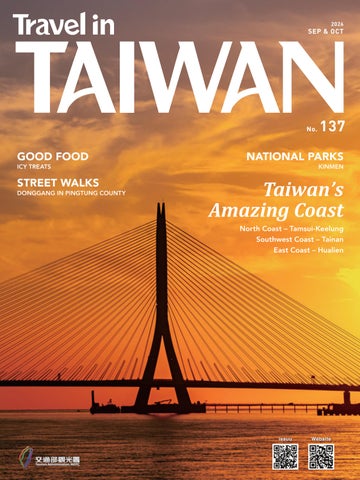
Taiwan’s Amazing Coast North Coast – Tamsui-Keelung Southwest Coast – Tainan East Coast – Hualien
issuu
Website
台灣素有「美食王國」美譽
Subtitles ZH EN JP KR
over Taiwan’s c n u d n a r a e iB Follow Ta avel secrets. tr l a c lo t p e k tbes
Subscribe
Travel in Taiwan No.137
PUBLISHER'S NOTE Dear Traveler, Welcome to Taiwan! Autumn has arrived, but in this subtropical land, the heat takes its sweet time leaving. In this issue, we provide you with many “cool” things to do by spending time on the breezy North Coast, Southwest Coast, East Coast, and offshore Kinmen Islands. We also provide an intro to classic heat-beating Taiwan ice treats, available everywhere you’ll go.
There’s more island f un in this issue’s National Parks section, with a whirlwind tour of the Kinmen Islands, on the western side of the Taiwan Strait mere kilometers off the China coast. Kinmen National Park’s tourism-brand icons include “traditional ‘Minnan’ architecture in ancient villages, military history and now-open-for-tourism military facilities, protected forests and wetlands.”
Our North Coast feature takes you through a region that “encompasses sandy beaches linked by seafront bikeways, wildf lower-filled headlands, and history as layered as its geology” – the fishing-port town of Tamsui on one end, the ocean-port city of Keelung on the other. Another feature unveils the East Coast, where mountains run down to the Pacific, an idyll presenting a “rich blend of towering marble cliffs, verdant jungle, and endless empty beaches … hidden gorges, bizarre rock formations, and rich marine life.”
Now, about those cool-down classic ice treats – in Good Food we take you to visit five premium sellers of ice treats in Taipei/New Taipei City. Get to know the delectable beauty of Taiwan-style shaved ice, snow ice, and popsicles, with a foray into gelato. Starring at each shop is Taiwan’s delicious range of fresh-daily-from-the-farm fruits.
A third feature showcases the Southwest Coast, a land of “salt fields, mangroves, and migratory birds,” along with some of Taiwan’s oldest and most revered temples, teeming wetlands, and oldest fishing-port settlements. Follow this with a read of our regular Street Walks section, exploring the southwest port town Donggang, hub of Taiwan’s bluefin tuna trade, plus other area attractions such as the Dapeng Bay lagoon and popular tourist island of Xiao Liuqiu.
The compelling title of this edition’s Made in Taiwan article is The Sole of an Island: Taiwan’s Footwear Story; learn how the island has traveled from making cheap plastic shoes in the last century to focusing on high-quality, handcrafted footwear today. And in Little Things, learn about Taiwan’s unique “Little Green Man” traffic-signal figures, decorative manhole covers, and other whimsical small-scale public art. Enjoy!
TAIWAN TOURISM ADMINISTRATION
MOTC, R.O.C.
@tourtaiwan
@taiwan
@taiwanbesttrip
Travel in Taiwan No. 137 SEPTEMBER/OCTOBER, 2026
PUBLISHER
EDITOR IN CHIEF
Taiwan Tourism Administration
Johannes Twellmann
EDITING CONSULTANT
ENGLISH EDITOR
T. C. Chou
Rick Charette
PUBLISHING ORGANIZATION
DIRECTOR OF PLANNING & EDITING DEPT
Taiwan Tourism Administration, Ministry of Transportation and Communications
CONTACT International Affairs Division, Taiwan Tourism Administration Add: 9F, 290 Zhongxiao E. Rd., Sec. 4, Taipei City, 10694, Taiwan Tel: 886-2-2349-1500 Fax: 886-2-2771-7036 E-mail: tad@tad.gov.tw Website: http://taiwan.net.tw
PRODUCER Vision Creative Marketing & Media Co.
ADDRESS
Joe Lee
MANAGING EDITOR Kelly Sheng
EDITORS Masako Takada, Lynn Chang
CONTRIBUTORS Ami Barnes, Rick Charette, Jenna Lynn Cody, Steven Crook, Simon Foster
PHOTOGRAPHERS Ray Chang, Chen Cheng-kuo, Alan Wen
DESIGNERS
1F, No. 5, Aly. 20, Ln. 265, Sec. 4, Xinyi Rd., Taipei City 10681, Taiwan Tel: 886-2-2325-2323 Fax: 886-2-2701-5531
Ian Tsai , Hsieh Yun-jhen
Lily Wan, Hui-chun Tsai, Xiou Mieng Jiang
editor@v-media.com.tw
Danjiang Bridge in Tamsui (photo by Chen Cheng-kuo)
ADMINISTRATIVE DEPT
ONLINE Read Travel in Taiwan online at www.travelintaiwan.net. Find back issues (PDF version) on the publication platform issuu at issuu.com/travelintaiwan.
GENERAL MANAGER David Hu
台 灣 觀 光 雙 月刊 Travel in Taiwan The official bimonthly English magazine of the Taiwan Tourism Administration (Advertisement) SEPTEMBER/OCTOBER, 2026 Tourism Administration, MOTC First published Jan./Feb. 2004 ISSN: 18177964 GPN: 2009305475 Price: NT$50
中華郵政台北雜字第1286號執照登記為雜誌交寄
Copyright @ 2026 Tourism Administration. All rights reserved. Reproduction in any form without written permission is prohibited.
MAGAZINE IS SOLD AT: 1. Wu-Nan Culture Plaza, No. 6, Zhongshan Rd., Central Dist., Taichung City 40043 886-4-2226-0330 http://www.wunanbooks.com.tw/ 2. National Bookstore, 1F., No. 209, Songjiang Rd., Zhongshan Dist., Taipei City 10485 886-2-2518-0207 http://www.govbooks.com.tw/
WHERE YOU CAN PICK UP A COPY OF TRAVEL IN TAIWAN ABROAD Offices of the Taiwan Tourism Administration in Beijing, Shanghai, Hong Kong, Singapore, Bangkok, Ho Chi Minh City, Kuala Lumpur, Seoul, San Francisco, New York, Los Angeles, Frankfurt, and London. Overseas Offices of the Ministry of Economic Affairs; Overseas Offices of the Central News Agency; EVA Air, and other selected international airlines; selected travel agencies in Asia, North America, and Europe; and other organizations.
IN TAIWAN Tourism Administration Visitor Center; Tourism Administration; Taiwan Visitors Association; foreign representative offices in Taiwan; Tourism Administration service counters at Taiwan Taoyuan Int’l Airport and Kaohsiung Int’l Airport; major tourist hotels; Taipei World Trade Center; VIP lounges of international airlines; major tourist spots in Taipei; visitor centers of cities and counties around Taiwan; offices of national scenic area administrations; public libraries
issuu (PDF)
Website
This magazine is printed on FSC® COC certified paper. Any product with the FSC® logo on it comes from a forest that has been responsibly maintained and harvested in a sustainable manner.
This magazine was printed with soy ink. Soy ink is said to be more environmentally friendly than petroleum-based ink and to make it easier to recycle paper.
01
CONTENTS
PUBLISHER'S NOTE
04
TAIWAN TOURISM EVENTS
06
TRAVEL NEWS WHAT’S NEW IN TAIWAN
08
CULTURE & ART
10
NATIONAL PARKS KINMEN NATIONAL PARK
12
TAIWAN’S COAST | NORTH COAST NOTES FROM THE NORTH COAST Where to Wander and Roam in the Seaside Districts of Tamsui, Sanzhi, and Shimen
22
TAIWAN’S COAST | EAST COAST WHERE THE MOUNTAINS MEET THE SEA A Drive along Taiwan's Most Dramatic Coastal Route
26
TAIWAN’S COAST | SOUTHWEST COAST MIRRORS OF THE SOUTHWEST Salt Fields, Mangroves, and Migratory Birds along the Tainan-Chiayi Coast
30
STREET WALKS | DONGGANG TUNA TOWN Exploring Donggang in Southwest Taiwan
36
GOOD FOOD | FRUIT ICE ICE TO MEET YOU! Cooling Down with Some Fine Frozen Treats
42
MADE IN TAIWAN
THE SOLE OF AN ISLAND Taiwan's Footwear Story
44
LITTLE THINGS
THE FAMOUS LITTLE GREEN MAN … and Other Streetside Peculiarities in Taiwan
46
TAIWAN PASS
TAKE THE RAILWAY! … and Save Money by Using the Taiwan PASS – TRA Edition!
48
TRANSIT TRAVEL
TAIWAN TAOYUAN How to Spend Time Inside and Outside the International Airport
12
36 22 26 42
TAIWAN TOURISM EVENTS
September-November
Autumn Celebrations AROUND TAIWAN Sep 1 ~ Nov 30
1
Taiwan Cycling Festival 臺灣自行車旅遊節
The Taiwan Cycling Festival brings together an island-wide series of themed rides across counties and cities, showcasing Taiwan’s diverse landscapes – from North Coast cliffs and East Rift Valley pastoral panoramas to coastal wetlands and Hakka hillside villages. New for the 2026 edition is the introduction of the Taiwan Cycling Route No. 2 (expected to be officially completed this year), a scenic, attraction-focused route around the island linking scenic spots along the coasts, lush valleys, and characterful small towns. Designed as an ideal weeklong itinerary, it combines cycling with opportunities to discover local culture, cuisine, and photogenic stops along the way. With returning favorites such as the Taiwan KOM Challenge race and Formosa 900 tour, the festival offers riders of all levels accessible and rewarding ways to experience Taiwan on two wheels. taiwanbike.tw/en/travel/festival
TAIPEI CITY
2
Oct 30 ~ Nov 2
Art Taipei
台北國際藝術博覽會
Art Taipei is Asia’s longest-running international art fair, initiated by the Taiwan Art Gallery Association in 1992. Held at Taipei World Trade Center Exhibition Hall 1, it brings together galleries from Taiwan and abroad to showcase leading modern and contemporary works, serving as a key platform for artistic exchange across the Asia-Pacific region. New for 2026, the fair is moving to a fully digital VIP pass system, allowing visitors to register online and receive a digital VIP pass instead of a physical card. The fair also serves as the centerpiece of Taipei Art Week, running from October 24 to November 7, with exhibitions and programs taking place across the city. 2026.art-taipei.com/taipei/en/
TAINAN CITY
3
©Taiwan Art Gallery Association
Nov 7 ~ 8
Kunshen Wangye's Salt for Peace Festival 鯤鯓王平安鹽祭
Held annually at Nankunshen Daitian Temple and the historic Jingzaijiao Tilepaved Salt Fields in Tainan City’s Beimen District, the Kunshen Wangye’s Salt for Peace Festival is widely regarded as the world’s largest salt festival. Wangye, plague-warding deities central to folk belief along Taiwan’s southwest coast, have traditionally been invoked to protect communities from disease and misfortune. The invocation unfolds in three ritual stages – inviting the salt, blessing the salt, and returning the salt – tracing a ceremonial journey between the 200-year-old salt fields and the temple, Taiwan’s foremost center of Wangye worship. Alongside the religious rites, visitors can experience folk performances, a divination-block competition with cash prizes, local markets, and cultural tours, offering a rare glimpse into the deep connection between Taiwan’s salt-making heritage and folk-belief traditions. www.swcoast-nsa.gov.tw
4
SEP/OCT 2026
©Southwest Coast NSA Admin.
KAOHSIUNG CITY
4
Oct 9 ~ 12
Kaohsiung Zuoying Wannian Folklore Festival 高雄左營萬年季
Held every October since 2001 around Zuoying District’s scenic Lotus Pond, the Kaohsiung Zuoying Wannian Folklore Festival highlights its temple-lined waterfront and its distinctive local traditions. The celebration’s signature activity is the Fire Lion Parade, in which a giant lantern lion, believed to carry people’s wishes to the heavens, is paraded among the surrounding temples before being ceremonially burned. Another highlight, the “Cannon Fortress Assault,” recreates a military drill said to date back to Ming loyalist Koxinga, now transformed into a lively firecracker-tossing competition. With night markets, folk performances, and processions around the pond, the festival has become one of Kaohsiung’s most celebrated cultural events. www.facebook.com/FireLion.Kaohsiung
MIAOLI COUNTY
5
©Civil Affairs Bureau, Kaohsiung City
Oct 9 ~ 11
Sanyi Wood Carving Art Festival 三義木雕藝術節
Held annually since 2001 in Miaoli County’s Sanyi Township – Taiwan’s center of wood carving and a certified Cittaslow (“International Slow City”) village – the Sanyi Wood Carving Art Festival celebrates the region’s centuries-old carving heritage. The festival program combines international wood-carving competitions and exchange exhibitions, live carving demonstrations, hands-on workshops such as handsawing and ice sculpting, tea ceremonies, and creative markets, all set against Sanyi’s relaxed village atmosphere. Traditionally opening with a ceremony honoring Lu Ban, the patron deity of craftsmen, the festival celebrates both the artistry of wood carving and the continued transmission of skills from master carvers to a new generation, making it a highlight of Taiwan’s craft tourism calendar. www.sanyi-woodart.com.tw ©Sanyi Wood Sculpture Museum
TAICHUNG CITY
6
Oct 16 ~ 25
Taichung Jazz Festival 臺中爵士音樂節
Staged annually since 2003, this festival transforms Taichung City’s Civic Square and Calligraphy Greenway into Taiwan’s largest openair jazz stage, attracting more than a million visitors each year and earning recognition alongside Tokyo, Bangkok, and Seoul as one of Asia’s leading jazz festivals. Free to attend, the ten-day music party combines improvisational performances by international and local musicians with the city’s vibrant urban atmosphere, extending into nearby shops, cafés, and other public spaces. This year’s edition, themed When Giants Play, promises a lineup encompassing some of jazz’s most influential voices across the festival’s signature outdoor theater-style stage. www.taichungjazzfestival.tw ©Taichung Jazz Festival
SEP/OCT 2026
5
TRAVEL NEWS
What’s New in Taiwan
From a revived railway line to a brand-new metro connection, Taiwan has seen a wave of transportation openings and upgrades in recent months. Here's a look at what's new for travelers this season.
Cruise Travel
Penglai International Cruise Terminal Expanded Earlier this year, Kaohsiung City’s Penglai International Cruise Terminal reopened following an expansion that merged two former 1950s warehouses into a single integrated facility near the Pier-2 Art Center. The upgrade added nearly 900m² of passenger processing space, 14 immigration counters, and four e-Gates, enabling the port to accommodate up to four cruise ships simultaneously.
khh.travel ©Taiwan International Ports Corp., Ltd.
Tourist Bus
New Taipei Metro
Mountain and Sea DoubleDecker Bus Tours Along the North Coast
MRT Sanying Line
©Tourism and Travel Dept., New Taipei City Govt. The New Taipei City Government has launched the “Youth Mountain and Sea Line,” an open-top double-decker bus tour showcasing the scenic North Coast. Running on weekends, the tour is priced at NT$2,188 and stops at Wanli Happiness Plaza, Yehliu Geopark, Jinshan Old Street, and Fugui Cape Lighthouse. The route also offers close-up views of the newly completed Danjiang Bridge in Tamsui port town.
jbltravel.com.tw
6
SEP/OCT 2026
©Dept. of Rapid Transit Systems, New Taipei City Govt. The Greater Taipei area has a new metro line! The MRT Sanying Line, which began operating on June 30, connects the New Taipei City districts of Tucheng, Sanxia, and Yingge via 12 stations, reducing travel times to central Taipei by about 20 minutes. For visitors, it offers a convenient new way to reach Yingge, famous for its ceramics, and Sanxia, known for its historic Old Street. Shown in light blue on metro maps, meaning it is also known as the Light Blue Line (LB), it connects with the Blue Line (BL) at Dingpu Station.
ntmetro.com.tw
TRAVEL NEWS Nature & Recreation
Houhu River Eco Park in Taoyuan Taoyuan City’s Houhu River Eco Park, located on the Xinwu District coast beside a calm, semi-enclosed lagoon-like waterway, officially opened earlier this year. Visitors can enjoy kayaking, stand-up paddleboarding, and sunset paddling sessions, stroll along a nearly 1-km restored seawall, or relax at a lakeside café. The park has quickly become a popular destination, attracting up to 20,000 visitors each month.
travel.tycg.gov.tw
Railway
©Houhu River Eco Park
Jiji Line Returns to Full Service Good news for railway enthusiasts! The scenic Jiji Line in central Taiwan’s Nantou County resumed full operations in late June after a landslide in 2021 forced the closure of a tunnel section, causing tourism in Jiji to drop by roughly 80%. The NT$3.58 billion reconstruction project upgraded tracks, stabilized slopes, and improved drainage along the 29.7-km railway, a branch line connecting the towns of Ershui, Jiji, Shuili, and Checheng.
Theme Park
New Kaohsiung Amusement Park A former Taiwan Railway repair yard in Kaohsiung City has been transformed into Taiwan’s largest indoor/semi-outdoor children’s park. The 1.5-hectare “Kaohsiung Parent-Child Amusement Park,” located near the Kaohsiung Light Rail Kaisyuan Wuchang Station, opened in early August. It features more than 30 free attractions, including the city’s first bubble-cloud trampoline, a pump track, aerial ziplines, and a splash zone. The park also preserves elements of the site’s historic railway architecture, blending industrial heritage with modern play spaces.
khh.travel
©Kaohsiung City Govt.
Mountains
New Qilai Cabin Taroko National Park’s new Qilai Cabin, perched at 3,345m near Qilai North Peak, was completed earlier this year and began trial operations in August. Nicknamed the “Breathing Cabin” for its untreated, moisture-wicking wood cladding, it provides 40 beds and is equipped with solar and wind power, rainwater collection, and eco-friendly toilets. Together with other nearby mountain shelters, the new cabin helps improve safety for hikers in the area.
www.taroko.gov.tw
©National Park Service, MOI
©National Park Service, MOI
SEP/OCT 2026
7
Culture & Art 1 3
2
©Live Nation Taiwan
1 K-Pop/K-Drama
2 Music
3 Festival
ASIA ARTIST AWARDS 亞洲明星盛典
HENRY MOODIE: MOOD SWINGS WORLD TOUR
TAIPEI ARTS FESTIVAL 臺北藝術節
Returning to Kaohsiung for its second consecutive year, the Asia Artist Awards brings together the biggest names from K-pop and K-drama for two nights of performances and honors achievements across music, television, and film. Organized by South Korean media company Money Today under its MTN and Star News brands, the awards recognize the year’s standout accomplishments by South Korean artists, drawing top idols, actors, and rising stars to one of the region’s most starstudded celebrations of Korean entertainment. This December’s edition promises another high-energy showcase of the artists shaping today’s K-pop and K-drama scene.
British rising star Henry Moodie brings his Mood Swings World Tour to Kaohsiung, marking his return to Taiwan following a previous sold-out show in 2025. Touring behind his debut album Mood Swings, the 22-year-old singer-songwriter has amassed more than a billion streams with e motiona lly c a ndid hits su ch a s D r un k Tex t, You Wer e Ther e for Me, and Closur e. Known for coming-of-age songwriting that resonates with young audiences, Moodie brings his full headline set to the Live Warehouse (managed by the Kaohsiung Music Center) for an intimate, allstanding performance.
December 5-6 Kaohsiung National Stadium ( Kaohsiung City )
tpac.org.taipei
8
SEP/OCT 2026
September 28 Live Warehouse ( Kaohsiung City )
kpmc.com.tw
September 4 – October 25 Taipei Performing Arts Center ( Taipei City )
Since 1998, the Taipei Arts Festival has been one of the city’s leading platforms for contemporary per formance, showcasing bold new works at the intersection of theater, dance, music, and interdisciplinary experimentation. Each edition brings together local and international artists under a distinct curatorial theme, inviting audiences to experience unconventional and thought-provoking live performances. The festival is presented at the Taipei Performing Arts Center, the striking spherical-cube venue opposite MRT Jiantan Station in Shilin District designed by OMA/Rem Koolhaas. The center’s flexible stages allow productions to unfold in innovative configurations across its three theaters.
tpac.org.taipei/festival-taipei
4
6 5
4 Exhibition
5 Exhibition
6 Exhibition
OLD MASTERS FROM REMBRANDT TO GOYA: TREASURES FROM THE TOLEDO MUSEUM OF ART I 古典光影大師 : 林布蘭到哥雅─托雷多美 術館珍藏展
MINJIAN / PHOTOGRAPHY: DOCUMENTARY VISION AND ITS REALIST INFLECTION 民間/攝影:紀實影像的敘事生成
TAIWAN CONTEMPORARY SCULPTURE EXHIBITION: “INVARIANT FORM | SCULPTURE AS METHOD” 臺灣當代雕塑展《恆形—雕塑作為方法》
July 18 – October 19 Fubon Art Museum ( Taipei City )
This exhibition brings together master works spanning three centuries from the Toledo Museum of Art’s renowned European collection, tracing the evolution of light, technique, and portraiture from Rembrandt’s psychological depth to Goya’s incisive realism. Featuring paintings by some of history’s greatest masters, it offers a rare opportunity to experience core works from this celebrated American collection in Taiwan. The exhibition is being presented at the Fubon Art Museum, a private museum in Taipei’s Xinyi District designed by Pritzker Prize-winning architect Renzo Piano. Known for its light-filled galleries and seamless integration of natural elements, the museum provides a fitting setting for these timeless works.
www.fubonartmuseum.org
July 18 – November 15 New Taipei City Art Museum ( New Taipei City )
This exhibition explores how minjian (folk / vernacular) photography has shaped documentary vision in Taiwan, tracing the narrative strategies through which realism emerges from ever yday image - making. D rawing on b oth a rchival a nd contemporar y works, it examines photography not simply as a record, but as a medium through which collective memory and social narratives take shape. Opened in 2025 in the town of Yingge – known for its pottery heritage – the New Taipei City Art Museum was designed by Taiwanese architect Kris Yao. Its striking concrete façade and openair art village arrangement echo the surrounding riverbed landscape at the confluence of the Yingge and Dahan rivers.
ntcart.museum
May 9 – December 20 Juming Museum ( New Taipei City )
This exhibition brings together leading voices in Ta iwa n’s conte mp o r a r y sculpture sce ne to explore what remains constant when form is treated as a process rather than a fixed outcome. Spanning wood, stone, metal, and mixed media, it shows how artists transform materials, processes, and gestures into enduring works, inviting visitors to reconsider sculpture as an ongoing exploration of form. Founded by renowned Taiwanese sculptor Ju Ming (19382023), best known for his iconic Taichi Series, the Juming Museum is nestled in the hills of Jinshan District on Taiwan’s North Coast. Its expansive open-air sculpture park seamlessly blends art with the surrounding landscape.
www.juming.org.tw
SEP/OCT 2026
9
Kinmen National Park Multi-Island Park Loaded with Historical and Natural Treasures TEXT R I C K C H A R E T T E
PHOTOS V I SI O N, N AT I O N A L PA R K S ERV I C E ( M .O. I.)
Taiwan’s nine national parks have wonderfully distinct individual brands. Dramatic marble canyons in Taroko National Park, hot-spring soaks and fumaroles in Yangmingshan above Taipei, monsoon forest and pristine beaches in Kenting…. On these two pages, you will get to know the brand icons of Kinmen National Park: traditional “Minnan” architecture in ancient villages, military history and facilities now open for tourism, protected forests and wetlands – and China in full view just a few kilometers away.
K
inmen National Park is in the Kinmen Archipelago, floating just off the coast of China’s Fujian Province. The Taiwan mainland lies roughly 280 kilometers to the east. The park measures about 35 square kilometers, nearly one-quarter of the full archipelago footprint. It’s not one continuous plot of land, instead encompassing five distinct geographic zones across the two largest islands, Greater Kinmen and its smaller neighbor, Lieyu (also called Little Kinmen).
Deyue Tower, one of Kinmen's iconic landmarks
Park History and Mission Stepping onto these islands feels like stepping through a portal where ancient traditions, dramatic military history, and resilient ecosystems seamlessly converge. The national park was established in October 1995, becoming the sixth in Taiwan. It is the only one dedicated to the permanent preservation and sustainable management of a location’s historic Cold War military sites and fortifications, the preservation of centuries-old Minnan cultural and physical architecture, and thriving, protected natural landscape, notably rare wetland ecosystems. For travelers seeking an unforgettable blend of historical intrigue and tranquil natural beauty, this island sanctuary right off the China mainland is pure pleasure.
View of Xiamen City in China from Little Kinmen
Headquarters and Visitor Center The park’s gateway is Kinmen National Park Headquarters and adjacent Zhongshanlin Visitor Center, near Kinmen Airport within the sprawling, peaceful Zhongshan Memorial Forest evergreen oasis. The attractive visitor center’s multimedia installations, exhibits, and audio-visual theater showcase the archipelago’s natural evolution, wartime history, traditional architecture, recentdecade demining operations, and park establishment. Hop aboard a bike at the bicycle-rental facility to explore the forest’s walking/cycling trails.
10 SEP/OCT 2026
Kinmen Bridge, connecting Kinmen with Little Kinmen
NATIONAL PARKS
Kinmen
Terrain, Nature, and Geology
Island History
Kinmen’s islands are primarily forged from an extensive 100~200-million-year-old basement of granite and granite gneiss, uplifted by ancient tectonic activity. Weathering has sculpted this hard-rock foundation into rolling hills, which give way to low-lying, red-earth tablelands and winding whitesand coastal beaches. There are no rivers, and, historically, the short rivulets often ran dry during seasonal droughts. During the last century’s ROC-PRC Cold War, soldiers and locals collaborated to dam waterways and excavate basins that now hold today’s lovely artificial lakes. These serve a dual purpose: as critical freshwater reservoirs and as scenic, peaceful wetlands that reflect the surrounding hills. This solid-granite foundation also made Kinmen the ultimate subterranean fortress. Soldiers laboriously blasted out massive defensive underground networks, including the awe-inspiring Zhaishan Tunnel (open to tourists), into which small naval vessels entered directly from the sea, shielded from artillery f ire. Today, the magical annual Kinmen Tunnel Music Festival is staged in this globally celebrated subterranean acoustic marvel.
For centuries, these islands were vulnerable to pirate raids. During the height of the last century’s Cold War, Kinmen found itself on the literal front lines of global political tension, the theater for f ierce confrontations bet ween Chinese Nationalist and Communist forces, enduring intense bombardments during events like the 1949 Battle of Guningtou and the devastating 1958 August 23 Artillery Battle (both of which can be "witnessed" today through tourism-dedicated sites and relics). For decades, the military restricted local private-sector development. When martial administration was finally lifted in the early 1990s, Taiwan’s government recognized an extraordinary opportunity. Kinmen National Park was created with the mandate to restore and open the unique military installations for tourism, safeguard the architecture of cent uries-old Minnan (souther n Fujian) residential set t lements, a nd develop g reen spaces for ecolog ica l education and recreation, including turning former military zones into protected sanctuaries.
Natural Environment: Flora and Fauna
Zhaishan Tunnel
Blue-tailed Bee-eater
Kinmen beach
As of the mid-20 th century, historical clearing and heavy military deforestation had left much of the landscape bare. The militar y and civilian sectors launched a massive, decades-long greening campaign, planting millions of trees. Today the national park boasts thick forests of salt/windresistant beefwood trees, Chinese red pines, and fragrant camphor t rees, protec t i ng agai nst power f u l seasona l monsoons and anchoring the sandy soil. This rich green canopy and network of pristine coastal wetlands have turned the park into a haven for precious wildlife. Local f lora/fauna celebrities include the Eurasian Otter, an endangered species that has vanished from Taiwan proper; these nocturnal mammals are thriving in Kinmen’s clean streams and reservoirs. The Horseshoe Crab is often called a “living fossil” – a species born over 400 million years ago that inhabits the park’s intertidal mudf lats. And over 300 bird species have been recorded (200+ migratory), with the big stars being the gorgeous sapphire-winged Blue-tailed Bee-eater, called the “summer fairy,” and massive flocks of overwintering cormorants. ENGLISH AND CHINESE August 23 Artillery Battle | 八二三砲戰 Battle of Guningtou | 古寧頭之役 Greater Kinmen | 大金門 Kinmen Archipelago | 金門群島 Kinmen Tunnel Music Festival | 金門坑道音樂節 Lieyu | 烈嶼 Little Kinmen | 小金門 Minnan | 閩南 Zhaishan Tunnel | 翟山坑道 Zhongshanlin Visitor Center 中山林遊客中心 Zhongshan Memorial Forest 中山紀念林
Eurasian Otter
SEP/OCT 2026
11
TAIWAN’S COAST
North Coast
from the Where to Wander in the Seaside Districts of Tamsui, Sanzhi, and Shimen TEXT A M I B A R N ES
PHOTOS V I SI O N, R AY C H A N G
Cutting a sweeping arc from the Tamsui River estuary through four New Taipei City districts before arriving at the harbor city of Keelung, Taiwan’s North Coast encompasses sandy beaches linked by seafront bikeways, wildflower-filled headlands, and history as layered as its geology – in other words, rich pickings for travelers of all stripes.
12 SEP/OCT 2026
TAIWAN’S COAST
North Coast
T
aiwan’s parabolic North Coast occupies something of a Goldilocks zone. For maximizers and itinerary hawks, it’s just close enough to Taipei City. Swift Taipei Metro (MRT) access from the city’s downtown area means Tamsui District’s heritage architecture, seaside scenery, and riverside bikeways are guaranteed their spots on tightly packed schedules. Meanwhile, a short bus ride east along the coast, the slower-paced rural districts of Sanzhi and Shimen appeal to a different kind of traveler, the kind drawn to the just-far-away-enough. Here you’ll find the loungers, loafers, drifters, and soakers, the people who like to steep in the scenery and think the best way to spend a day involves beaches and coffee shops and windswept headland walks.
Barrier-free North Coast
Low-floor buses (routes 862, 863, and 716) connect the port town of Tamsui with places of interest along the North Coast, where thoughtfully engineered facilities ensure barrier-free travel for all. The Qianshuiwan and Linshanbi boardwalks, both sections of the Shuangwan Bikeway, offer kilometers of relaxing step- and traffic-free (st)rolling along, while ocean-faring beach wheelchairs are available for rent at both Baishawan and Keelung’s Heping Island. For more info, visit www.northguan-nsa.gov.tw.
Candlestick Beach in Jinshan District
SEP/OCT 2026
13
Ferry boat on Tamsui River
Tamsui Situated at the northernmost terminus of the MRT TamsuiXinyi Line, the town of Tamsui occupies a well-thumbed page of the Taiwan day tripper’s handbook – a position it’s earned by dint of its river-to-seaside scenery, convenient transport links, and varied abundance of historic sites. Tamsui Old Street, which – despite the name and the above just-given promise of history – does not feel particularly old, is the first port of call for most arrivals. A mere hop, skip, and jump away from the MRT Tamsui Station, it’s a good place to grab a wander-fueling snack, but don’t weigh yourself down with souvenirs yet – there’s a lot more to see first. At the far (nor th) end of the Old Street, you have a choice. To the left lies the scenic option, the flaneur’s favorite – an estuary-adjacent promenade where tables spill from restaurants and everyone and his dog (literally) heads to enjoy an afternoon stroll. Alternatively, sticking with Zhongzheng Road takes you past a series of culturally and/or historically significant spots. In Fuyou Temple – Tamsui’s oldest religious establishment – residents leave oblations for Mazu, the sea goddess, while nearby, a bust of Dr. George Leslie Mackay – beloved Taiwanese son-in-law, bringer of Jesus and improved oral hygiene – presides over the three-way junction beside the still-standing clinic he established in the 1880s and a beautiful red-brick Gothic-style Japanese-era remodeling of his Tamsui
14 SEP/OCT 2026
Danjiang Bridge in the evening
Tamsui Presbyterian Church
TAIWAN’S COAST
North Coast
Presbyterian Church. Just a few doors down are cultural hubs in the form of the Chi Po-lin Museum, which honors the legacy of late aerial photographer Chi Po-lin, director of the acclaimed documentary Beyond Beauty: Taiwan from Above, and the old warehouse of an imperial-era British trading company, Douglas Lapraik & Co., now a museum dedicated to outlining the ebb and flow of Tamsui’s economic fortunes. Just northwest of where Zhongzheng Road reconvenes with the promenade, it’s a short walk uphill to Fort San Domingo. Resting on a naturally raised terrace just upriver from the mouth of the Tamsui River, Spanish settlers seized on this as the obvious defensive position when they claimed the Tamsui area in 1628. Wise though this decision may have been, their tenure was short-lived, and after they were ousted in 1642, their Dutch successors built the cubic fort you see today. An astute eye may also pick up a few British-flavor notes in the form of the adjoining neoclassical red-brick residence, added when the Brits leased the land for their consulate in the 1800s. An NT$80 ticket covers access to the museum and gardens, plus the nearby attractions of Hobe Fort and the Little White House. Continue heading northwest, and you’ll eventually find yourself at Fisherman’s Wharf, a small fishing port featuring a row of restaurants, snack shops, and cafés wedged snugly into the space beneath the harbor wall. Until recently, travelers flocked to see the lights of Lovers’ Bridge ripple across the dusk-darkened waters, but as of 2026, its status as Tamsui’s most tourist-popular structure has been usurped by the starkly elegant Danjiang Bridge, which leaps across the river’s mouth. Designed by the late world-renowned architect Zaha Hadid, it embodies the graceful physicality of performers from the celebrated Tamsui-based Cloud Gate modern-dance company, the two feet of its wishbone-shaped single concrete mast resembling a pair of dancers locked together in a mid-air embrace. Even if you’re no passionate pontist, a ramble or ride across the 920-meter-long span is a pleasant end to a Tamsui day.
CHI PO-LIN MUSEUM | 齊柏林空間 (02) 2692-1996 No. 316-1, Zhongzheng Rd., Tamsui Dist., New Taipei City ( 新北市淡水區中正路 316-1 號 ) www.chipolin.org/chipolin-space Wed-Mon 10am-6pm DOUGLAS LAPRAIK & CO. | 得忌利士洋行 (02) 2629-9522 No. 316, Zhongzheng Rd., Tamsui Dist., New Taipei City ( 新北市淡水區中正路 316 號 ) www.tshs.ntpc.gov.tw Mon-Fri 9:30am-5pm, Sat/Sun 9:30am-6pm FORT SAN DOMINGO | 紅毛城 (02) 2623-1001 No. 1, Ln. 28, Zhongzheng Rd., Tamsui Dist., New Taipei City ( 新北市淡水區中正路 28 巷 1 號 ) www.tshs.ntpc.gov.tw Mon-Fri 9:30am-5pm, Sat/Sun 9:30am-6pm Lovers' Bridge at Fisherman's Wharf
Fort San Domingo
Chi Po-lin Museum SEP/OCT 2026
15
Qianshuiwan
Baishawan Beach
Sanzhi Heading eastwards from Tamsui, Provincial Highway No. 2 noses its way into Sanzhi District. Bounded by the open ocean on one side and the (more often than not cloudcovered) peaks of Yangmingshan National Park on the other, the landscape here confers such a sense of calm that even the buildings – released from the city’s sky-chasing urban sprawl – seem to relax, spreading themselves out among scruffy farmland. By the beach at Qianshuiwan (“Shallow Water Bay”), a cluster of water-facing cafés marks the starting point of the Shuangwan Bikeway and provides a logical gateway for deeper exploration. After pre-fueling with coffee and purchasing provisions, you can set off along the 8-kilometer cycling (or walking) trail bound for Baishawan (“White Sand Bay”). The scenery en route comes in several shades of seaside, but my favorite sections are the stretches of boardwalk where the water is visible through feathery branches of she-oak and sandy trails track down to the shoreline. (Anyone with beachcombing predilections will enjoy the intriguing wealth of tile fragments and beach glass on offer.)
16 SEP/OCT 2026
TAIWAN’S COAST Shuangwan Bikeway ©Northguan NSA Admin.
North Coast
Artwork along the bikeway
Linshanbi
Linshanbi (Linshan Cape) is where the hikers separate from the bikers (it also marks the point at which Sanzhi segues into Shimen District, but let’s not worry about such particulars). Those on two wheels will need to leave the waterfront path at the fishing harbor here, while walkers can follow a quiet trail around the cape. Passing alongside the harbor on a recent visit, I watched shoals of rabbit fish nibble at mooring ropes, and spied a flock of bigfin reef squid hiding beneath a tangled mass of seaweed – my first wild-squid sighting. On weekends, locals walk their grannies and small dogs around the headland, but on weekdays, its pebble-strewn coves belong mostly to fisherfolk and seabirds; pausing to explore one, I watched a Kentish plover scurrying in a cartoonishly purposeful fashion after a series of camouflaged crabs, none of which it managed to catch. The most memorable section of the trail comes as you round a corner and catch your first glimpse of Baishawan, framed by a border of scraggly screw pine. Extending between two volcanic promontories, this almost 1-kilometer-long stretch of fine coral sand is not quite as white as the name suggests, but it’s not far off. With clear, inviting waters, it should come as no surprise that the designated swimming zones are regularly filled with Taipei folk seeking respite from the humidity of their city-shaped steam room. It’s not just swimmers and sunseekers who are drawn to the waters here, either. As summer tips into autumn, the bay is reliably windy, making it popular with surfers, kite flyers, and people who like to combine the two into the sport of kite surfing – there’s even an annual kite flying festival every September or October. And travelers keen to catch a few waves without the hassle of lugging kit around don’t need to feel left out – situated among the collection of businesses clustered near the beach’s east-end shoulder, CU Surf Paradise offers board rentals (surf, body, SUP) and coaching. Note: It’s worth calling ahead or contacting the store through its socials to confirm availability and check the water conditions. Post-dip, pay-to-use showers can be found beside the visitor center, and if you want a few pointers on where to head next, the center’s blissfully air-conditioned exhibits cover attractions in Sanzhi, Shimen, and the broader North Coast area … or you could just turn the page in this article and keep reading. CU SURF PARADISE | 西元海上休閒樂園 (02) 2638-2733 No. 1-9, 8 Jia, Demao Borough, Shimen Dist., New Taipei City ( 新北市石門區德茂里八甲 1-9 號 ) www.instagram.com/cusurfparadise Tue-Sun 9am-6pm, Sun until 5pm
SEP/OCT 2026
17
TAIWAN’S COAST
North Coast
Shimen Fugui Cape marks both the eastern boundary of Baishawan and the northernmost point of Taiwan’s mainland. A headland trail leads to the octagonal black-andwhite lighthouse, which has become an unofficial check-in point for people hoping to visit all four cardinal extremities – in spring, the path is bordered by the nodding bell-like heads of Formosan lilies, and in early summer, by carpets of descriptively named firewheels. On its east lies Laomei beach, which – though not a swimming beach like its neighbor – has a draw of its own in the form of Laomei Green Reef, which is made of dark-gray andesite smoothed by the passage of time into knobbly phalanges. Every April through May, just as the weather begins yo-yoing over the 30°C threshold, a shaggy, velveteen fuzz of sea lettuce and green hair algae covers the rocks, bright as an astroturf blanket. This transient scenery is a hit with local tripod-toting folks, who flock here at sunrise and sunset to catch long exposures that cast the encroaching tide as an ethereal mist. A short bus ride from Laomei sits Shimen Arch, the area’s second-biggest photography magnet. This 10-meter-high natural stone gate was formed by waves scouring the Deer Café rockface before uplift gradually rearranged the scenery to where it sits slightly inland today. The arch frames a slice of shoreline full of the kind of fish-filled tidal pools that are perfect for kids to prod and probe, and at some point in the past, the structure was augmented with steps and a viewing platform, meaning you have multiple viewpoints from which to shoot your perfect shot. Still, not everyone enjoys sand in their shoes and wind in their hair, and for t unately for such souls, the coastal road is essentially a 52-kilometer café crawl with air-conditioned summer havens (or cozy winter refuges) to suit almost every aesthetic preference. Deer Ya and Deer Café (no relation, as far as I can tell) are two options within striking distance of Shimen A rch. The for mer occupies a whitewashed, blue-detailed building, and between its crowdpleasing menu (pasta, waffles, shaved ice, lattes topped with cute art) and its second-f loor kids’ playroom, it’s a hit with families looking for a pit stop to keep everyone happy. Deer Café,
18 SEP/OCT 2026
Deer Café
Fugui Cape Lighthouse
Rice dumplings
meanwhile, is a pit stop in the more literal sense. Located hard up against the road and operating out of what looks like converted trams, this spot has evolved into a biker hangout where road trippers enjoy fried snacks, hot drinks, and thick toast with a backdrop of ocean views until the wee hours. (Rest assured, Taiwanese bikers are merely garrulous, and not even a little menacing.) For something more portable, Shimen’s go-to snack is the humble rice dumpling. Thanks to an association with the nearby coastal Temple of the Eighteen Lords (apparently worshippers who offer rice dumplings stand a better chance of getting their prayers heard), stalls offering these savory snacks have proliferated throughout the area, each with its own signature blend. One such shop is Yu Family Rice Dumplings, which makes all its dumplings in-house. The brief menu offers northern-style and southern-style (northerners stir-fry their rice first for a rich, unctuous bite, while southerners opt for steaming it en-leaf ), both studded with various combinations of minced pork, preserved radish, and mushroom (vegetarians are catered for, too). The queue for this popular stall is long, but service is fast, and at least you can watch the lightning-fingered staff deftly wrapping dumpling after dumpling as you wait.
DEER YA | 鹿野咖啡 No. 3-5, Laobengshan, Shimen Dist., New Taipei City ( 新北市石門區老崩山 3 號之 5) www.instagram.com/deer_ya1001 DEER CAFÉ | 鹿邊咖啡 0963-339-402 Weekdays 1pm-3pm, weekends 12pm-3pm YU FAMILY RICE DUMPLINGS | 俞家肉粽 (02) 2638-3961 No. 104, Jingong Rd., Shimen Dist., New Taipei City ( 新北市石門區淡金公路 104 號 ) 24h
SEP/OCT 2026
19
TAIWAN’S COAST
North Coast
HIGHLIGHTS 1. Situated on a narrow cape in Wanli District, Yehliu Geopark is renowned for
its surreal landscape of mushroom rocks and other sea-eroded geological formations shaped by wind and waves over thousands of years.
2. The Zhilan Park Ocean Viewing Platform in Sanzhi District features
a 57-meter sky-blue walkway that extends over the water, offering panoramic sea views and spectacular sunsets. It has earned a reputation as one of the most beautiful viewing platforms on Taiwan's North Coast.
3. Tucked away in Fugui Cape Park in Shimen District, the Laomei Maze is a
striking small-scale labyrinth built with curved red-brick walls. Its interlocking circular design resembles an alien launchpad when viewed from above, making it a popular photo spot for travelers exploring the North Coast.
4. Located in Shimen District, Laomei Green Reef is a rare natural wonder. It
consists of ancient volcanic stone troughs that are covered in vibrant green algae each spring. From March to May, the lush marine growth carpets the wave-carved trenches, creating a picturesque coastal landscape that attracts photographers and nature lovers alike.
5. Rising off the coast of Jinshan District, the Twin Candlestick Islets are a pair
2
of 60-meter-tall sea stacks sculpted by wave erosion that resemble two candlesticks standing side by side. Steeped in local folklore as a symbol of marital fidelity, this striking natural landmark is best viewed from the scenic trails of Shitoushan Park or the nearby Mystery Coast.
4 3
1
ENGLISH AND CHINESE Baishawan | 白沙灣 Chi Po-lin | 齊柏林 Danjiang Bridge | 淡江大橋 Fisherman's Wharf | 漁人碼頭 Fugui Cape | 富貴角 Fuyou Temple | 福佑宮 Laomei Green Reef | 老梅石槽 Linshanbi | 麟山鼻 Lovers' Bridge | 情人橋 Qianshuiwan | 淺水灣 Shimen Arch | 石門洞 Shitoushan Park 獅頭山公園 Shuangwan Bikeway | 雙灣自行車道 Tamsui Old Street | 淡水老街 Tamsui River | 淡水河 Temple of the Eighteen Lords | 十八王公廟 Twin Candlestick Islets | 雙燭台 Yehliu Geopark | 野柳地質公園
20 SEP/OCT 2026
MAP
5
TAIWAN’S COAST
North Coast
SEP/OCT 2026
21
TAIWAN’S COAST
East Coast
oute R l a t s a tic Co a m a r D 's Most n a w i a along T e v i r D A
TE X T SI M O N FOST ER
P H OTOS V I SI O N
Hualien County’s routes 9 and 11 are two of Taiwan’s most iconic roads, presenting coastal travelers with a rich blend of towering marble cliffs, verdant jungle, and endless empty beaches. Taking the time to stop and delve deeper will reveal hidden gorges, bizarre rock formations, and rich marine life.
Taking in the coastal views from 48 Highland
TAIWAN’S COAST
SUP b o
North of Hualien City Driving south along Highway 9 from the Yilan County port town of Su’ao, the dramatic Qingshui Cliff that spills down from mighty Mt. Qingshui (2,408 m) is one of the first signs that you have entered the marble lands of Hualien County. Spanning 5 km of coastline, comprised of marble, gneiss, and green schist, the cliff drops vertically for 800 meters (on average) into the epic blue of the Pacific, demanding that you stop at multiple viewpoints to fully appreciate its majesty. Whilst some of the best lookout spots were destroyed by an April 2024 earthquake, a number of worthwhile observation decks have been reopened. To really get up close and personal with this incredible environment, however, book an SUP tour with one of a number of licensed operators in Hualien City, such as Brothers Hangout. Paddling out into the Pacific is an adventure in itself, and the perspective afforded from the water makes these giant cliffs seem even more imposing. A different view of the Qingshui Cliff can be enjoyed from gorgeous Qixingtan, an expansive crescent-shaped stone and shingle beach just north of Hualien City proper. The beach gets its name from a collection of lakes (in the shape of the Big Dipper, which consists of “seven stars,” i.e. qixing) previously found just inland from here. The lakes were drained in the 1930s in preparation for the construction of Hualien’s airport, and residents were relocated to this beautiful stretch of coastline. There are a couple of car parks along County Road 193 where you can stop to explore the beach and buy an ice cream or a refreshing coconut juice. This is also a great place from which to watch fighter jets take off and land, although the noise can be deafening and taking photos of the airbase itself is prohibited. Qixingtan
a r d s o n a b e a c h c l o s e to Q i n g
s hui
Cliff
(©Br o
East Coast
th e r s H
a n g o u t)
Qingshui Cliff
Paddling toward the sunrise (©Brothers Hangout)
A bike path runs alongside the beach, passing the small village of Qixingtan, home to a convenience store, B&Bs, cof fee shops, and t he interesting Chihsing Tan Katsuo Museum, which details the history of the site’s former bonito factory. The bike path continues from the village towards 48 Highland, once the site of an important military base, approximately 48 meters above sea level (hence the name). There are some steps to negotiate along the way, but once you reach the summit you’ll be greeted by impressive views along the coastline, and you can also explore the network of military tunnels now open to the public. BROTHERS HANGOUT | 相挺兄弟水上活動 www.instagram.com/brothershangout SEP/OCT 2026
23
TAIWAN’S COAST
East Coast
Niu Shan Huting
South of Hualien City Highway 11 is the coastal road running south from Hualien City. After passing the fishing village of Yanliao, it quickly ascends through a series of tunnels towards Niushan (“Cow Mountain”) and the highest elevation along the whole route. A steep, narrow road leads down to Niu Shan Huting, a magical stretch of sand used as the backdrop in scenes from Martin Scorsese’s 2016 film Silence. A token entry fee (NT$100) is payable to visit the beach and explore the grazing meadow above, which is dotted with driftwood art. The entry fee is redeemable against purchases at the onsite café, and if you’re really taken with the place, there are even a couple of rustic cabins in which you can stay overnight. A few kilometers south of the beach turnoff, you could drive across bridge #18 without even noticing, but it’s def initely worth a stop to wander across the old bridge below, which reveals the impressive 100 -meterdeep Fanshuliao Gorge. Look for the vertiginous steps running steeply down the side of the gorge, and the lush thickets of bamboo below. Myth has it that the bamboo grew from discarded poles used to try and vault the 50-meter-wide gorge! There are also a small café-shop and toilets here. Barely two kilometers on from the gorge, another quick stop, Baqi Rest Area, is perched high above the ocean and presents some of the best views along the whole East Coast. A small store sells indigenous crafts and tourist knick-knacks, as well as coffee, ginger tea, and soft drinks, and there are also toilets. Aerial view from near Baqi Rest Area
24 SEP/OCT 2026
TAIWAN’S COAST
East Coast
White cliffs at Shitiping
Dashibi Mountain trail
Descending back to sea level, Highway 11 soon brings you to pretty Jiqi Beach, a 3-kilometer-long strip of black sand. Although it’s touted as a bathing beach, swimming is only safe here when the sea is calm, and it’s often better suited to surfing. There are toilets, washing facilities, and lifeguards on duty at peak times. Overlooking the southern end of the beach, Dashibi Mountain is a headland that juts out into the Pacific. A short trail ascends to around 70 meters above sea level to a spot providing good views to the north and south, and there are a couple of pavilions of fer ing shade along the way. There are also some restaurants near the car park. Half an hour south of Jiqi, Highway 11 passes by the harbor near Shitiping, one of Taiwan’s prettiest, in an area home to the Makotaay people, a sub-group of the Amis tribe. The harbor area is also a mecca for seafood lovers, and during the summer serves as the start point for dolphin- and whale-watching tours. The renowned Shitiping, in the Shitiping Scenic Recreation Area immediately south of the harbor, is a kilometer-long stretch of eroded volcanic headland featuring bizarre rock outcrops, potholes, and blowholes connected by wooden boardwalks and paths. On calm days it’s possible to get into the ocean and snorkel, which is rewarded by sightings of a surprising diversity of coral and marine life – brightly colored reef and tropical fish, sea urchins, sea snakes, and even giant clams! As well as a decent collection of hotels, there’s also an attractive campsite within the scenic area, making Shitiping a good place to break your journey along the coast.
Installation art along the Hualien coast
ENGLISH AND CHINESE 48 Highland | 四八高地 Baqi Rest Area | 芭崎休息區 Chihsing Tan Katsuo Museum | 七星柴魚博物館 Dashibi Mountain| 大石鼻山 Fanshuliao Gorge | 蕃薯寮峽谷 Jiqi Beach | 磯崎沙灘 Mt. Qingshui | 清水山 Niu Shan Huting | 牛山呼庭 Qingshui Cliff | 清水斷崖 Qixingtan | 七星潭 Shitiping | 石梯坪 Yanliao | 鹽寮 MAP
SEP/OCT 2026
25
TAIWAN’S COAST
Southwest Coast
Mirrors of the Southwest Salt Fields, Mangroves, and Migratory Birds along the Tainan-Chiayi Coast TE X T ST E V EN C ROO K
P H OTOS A L A N W EN, V I SI O N
Beyond the buzz of the big cities and the dramatic landscapes that fill the island’s mountainous interior, there’s a side to Taiwan many visitors never get to experience. The southwest coast blends nature, history, and human efforts to carve out a living, offering entirely different glimpses into the island’s soul.
Jingzaijiao Tile-paved Salt Fields
O
verlapping yet distinct entities, the Southwest Coast National Scenic Area and Taijiang National Park both deliver unique rewards for the traveler. The scenic area is a unit of the nationallevel Tourism Administration, its management charged with safeg uarding and promoting cultural and industrial heritage in the littoral par ts of Tainan Cit y, Chiayi Count y, and Yunlin County. At the same time, it coordinates t he d e ve lo p me nt of s u s t a i n a ble t o u r i s m practices that benefit local economies without compromising the region’s delicate ecosystems. The administration of the national park – seven-eighths of which is ocean, the remainder being parts of Tainan around Qigu Lagoon and the Zengwen and Luerman rivers – prioritizes the preser vation of sensitive bird-f riendly habitats and the broader coastal environment.
26 SEP/OCT 2026
Jingzaijiao Tilepaved Salt Fields
If you’re deep into planning your Taiwan trip, chances are you’ve already come across striking photos of the Jingzaijiao Tile-paved Salt Fields. When conditions are just right, the sunset here is nothing short of spectacular. The shallow water transforms the salt pans into mirrors, reflecting the blues and reds of the sky and the whites and grays of clouds. There’s much more to this location than pretty pictures, however. Capitalizing on the region’s sunny weather and its lengthy dry season, thousands of hectares of land in Tainan and Chiayi were long used for turning seawater into table salt. Until the dawn of the 21st century, local laborers spent their days raking, shoveling, and piling salt crystals, then portering hefty sacks of the commodity to the nearest road or narrow-gauge railway. Visitors to Jingzaijiao will come away with a keen appreciation of the effort and sweat expended to produce something most people take for granted.
TAIWAN’S COAST
Sicao Green Tunnel
Southwest Coast
Green Tunnel raft tour
Not far from the historic urban neighborhood where the Dutch East India Company established its Taiwan trade outpost back in the 17th century, Sicao Green Tunnel is a stretch of canal within Taijiang National Park. The mangroves growing on either side form a low verdant canopy, giving those who float down the waterway on a bamboo raft the sense they’re exploring a tributary of the Amazon.
Thirty-minute boat tours of the Green Tunnel are very popular, but hardcore ecotourists might want to also sign up for the considerably longer, widerranging Taijiang excursions on larger craft. The latter provide good opportunities to see fiddler crabs, mudskippers, and waterbirds, and learn something about the oyster farming and other human activities that have influenced the environment.
Hands-on fun
Refreshments are sold near the salt fields
TAIWAN’S COAST
Southwest Coast
Aogu Wetlands
In the northwestern corner of Chiayi County, human residents are few here. Come at the right time of year, however, and you’ll find waterbirds in the thousands, among them the endangered Black-faced Spoonbill. This wintertime visitor has an endearing way of sweeping its outsized beak through shallow water as it searches for food. The stubby peninsula that’s now the 1,465-hectare Aogu Wetlands and Forest Park isn’t a pristine wilderness. In the middle of last century, the authorities tried to transform the area’s coastal swamps into farmland. Land subsidence and seawater intrusion soon began to derail this plan, but the resulting brackish lagoons were eventually recognized as a paradise for fish, crustaceans, mollusks, and the creatures that feed on them. A crucial stopover on the East Asian-Australasian Fly way (along which millions of birds migrate each year), Aogu’s avian population begins to multiply around autumn’s end as the resident Black-crowned Night Herons, Crested Goshawks, and Common Moorhens are joined by Northern Shovelers, Northern Pintails, Tufted Ducks, and others. Many of these feathered treasures arrive from as far away as Siberia. No fewer than 306 bird species have been recorded at Aogu. Some of these have only appeared in the past two decades, after an afforestation program boosted the amount of tree cover. To explore expa nsive Aog u, you’l l need a set of wheels. A logical place to begin is the Seaview Pavilion, aka Guanhai Observation Tower, where knowledgeable volunteers happily share details of recent avian sightings. The pavilion is near the peninsula’s northwestern extremity; from there, it makes sense to follow the dike road in a counterclockwise direction, before continuing southward.
Chiayi to Tainan
A 25-minute drive from Aogu, the port town of Budai is synonymous with fish. The town’s harbor is home to a sizable fishing f leet, and its seafood market is one of the liveliest in south Taiwan. Pe r h a p s B u d a i’s mo s t p o p u l a r pho t o o p i s t he translucent High-Heel Church. This memorable 18-meterhigh structure isn’t an official house of worship, although it’s sometimes used for weddings and other events. Another 20 minutes along the road to Tainan’s urban core brings coast-tracking motorists to Nan k unshen Daitian Temple. This sprawling religious complex is best visited on weekends, when pilgrims and performance troupes from affiliated temples come to sacrifice incense to the multiple deities honored here. From the temple, it’s about an hour to Tainan’s Anping District.
Nankunshen Daitian Temple
©Southwest Coast NSA Admin.
High-Heel Church
Egrets at Aogu Wetlands
28 SEP/OCT 2026
Aogu Wetland Ecological Exhibition Center
Yuguang Island
For most of its history, this 2.3-kilometer-long strip of land wasn’t an island. Like Cijin Island in Kaohsiung City, it was severed from Taiwan proper for the sake of economic development. By the 1970s, the old entrance to Tainan’s Anping Harbor was too shallow for modern cargo vessels, so the authorities created a deeper entrance between the ocean-facing communities of Sankunshen and Sikunshen. Accepting the new geographical reality, residents of what had long been known as Yuguang (“Fishing Lights,” a nod to the traditional practice of using bright nighttime lamps to draw catches to the surface) began calling this place Yuguang Island. The single bridge that links the island to the rest of Anping District is wide enough for buses, although the only service is the infrequent #102. Much of the island is covered by windbreak forest and f ish farms, and except for the sheltered northern part of Moon Bay there’s nowhere suitable for swimming. Nevertheless, day-trippers come here in large numbers to enjoy what’s often a spectacular sunset. Boardwalks connect the main island road to the bay – and thanks to the thick tree cover between the two, by the time you reach the silvery-gray sand, you may well forget that you’re not far from the bustle of downtown Tainan. The calm coastal waters here are dotted with oyster racks, windsurfers, and stand-up paddleboarders (SUPers). At dusk, the sea is like a glassy mirror, reflecting various hues of orange, pink, and purple. If at all possible, come when the setting of the sun coincides with a receding tide, as the wetness of the sand enhances the effect. Note: The website of the Central Weather Administration (www. cwa.gov.tw) has both sunset times (click on “Outreach”) and tidal forecasts (go to “Marine” and find the data for Tainan City-Anping).
Sunset on Yuguang Island
Aogu, Sicao, and Yuguang Island prove that no matter how mankind alters the landscape, nature has a way of adapting to these adjustments and giving us places of quiet wonder.
Windbreak forest ENGLISH AND CHINESE Anping Harbor | 安平港 Aogu Wetlands | 鰲鼓溼地 Aogu Wetlands and Forest Park | 鰲鼓濕地森林園區 Budai | 布袋 Cijin Island | 旗津島 Guanhai Observation Tower | 觀海樓 High-Heel Church | 高跟鞋教堂 Jingzaijiao Tile-paved Salt Fields | 井仔腳瓦盤鹽田 Moon Bay 月亮灣 Nankunshen Daitian Temple | 南鯤鯓代天府 Sankunshen | 三鯤鯓 Sicao Green Tunnel | 四草綠色隧道 Sikunshen | 四鯤鯓 Yuguang Island | 漁光島
Fish pond swing
MAP
SEP/OCT 2026
29
STREET WALKS
Donggang
Exploring Donggang in Southwest Taiwan TE X T ST E V EN C ROO K
P H OTOS A L A N W EN, V I SI O N
Few towns in Taiwan are as closely associated with the ocean and with fisheries as Donggang in Pingtung County. The center of the bluefin tuna trade and the gateway to the nearby island of Xiao Liuqiu, it’s home to 45,000 people, whose religious and culinary traditions promise both local and international visitors rich, immersive experiences.
Donggang Fishing Harbor
30 SEP/OCT 2026
STREET WALKS
Donggang
I
n a town shaped by the sea, the fishing harbor is central to both Donggang’s economy and its personality. Zoom in on a satellite image, and you’ll see dozens of boats tethered to the docks. If you want to take a closer look, go ahead – nothing stops curious outsiders from enjoying a wharfside stroll, during which you’ll see Taiwanese and Southeast Asian crew members cleaning and carrying out maintenance between voyages. As you’d expect, the town’s major seafood market is adjacent to this neighborhood of nets and floats. Huaqiao Market attracts home culinarians seeking the best ingredients, gourmands who buy fresh catch and have it cooked on the spot, and those who just want a top-notch meal to land on the table in front of them. Not everyone likes eating surrounded by market hubbub, but if you prioritize flavor and freshness over ambiance and décor, this is a perfect lunch spot. Tseng Xian Bluefin Tuna Shop has a solid reputation. During peak bluefin tuna season – mid-May into June – it serves up countless portions of tuna sashimi and tuna bone marrow soup, as well as golden pomfret, yellowtail pomfret, salmon, and swordfish. Much like a prime side of beef, a single bluefin tuna yields distinct cuts, with prices dictated by fat content, texture, and rarity. At Tseng Xian you’ll see these different types of tuna meat on display; the variation in hue and marbling is obvious. As at many other seafood restaurants, prices here can jump around, so confirm costs when ordering. Just a shor t walk from the market, Xuding Delicious Cuttlefish Balls is ideal for a quick bite. This business channels its energy into a narrow range of products, and focuses on selling bags of its signature edibles to people who’ll deep-fry them at home. As a drop-in customer, however, you can purchase a hot, freshly fried portion of cuttlefish balls (NT$60) or cuttlefish-andshrimp cutlets (NT$50) – perfect fuel for your walk to Donglong Temple, the next stop on our tour. Because Donggang’s most famous place of worship is nearly a kilometer away, you might want to use one of the YouBike shared bicycles available at stations throughout the town.
Tuna statue
Huaqiao Market
Pingtung Bluefin Tuna Cultural Tourism Festival
From May through July, Donggang’s Pingtung Bluefin Tuna Cultural Tourism Festival celebrates the tuna harvest and the attention and wealth it brings to the town. The program includes concerts, banquets, markets, and promotions in conjunction with local businesses. Event details can be found online or by asking at any Pingtung visitor information center.
Fresh tuna sashimi
TSENG XIAN BLUEFIN TUNA SHOP | 曾鮮黑鮪魚專賣店 0925-295-206 No. 220-221, Donggang Huaqiao Market, Donggang Township, Pingtung County ( 屏東縣東港鎮東港華僑市場 220, 221 號 facebook.com/tsengfresh 10:30am-8pm XUDING DELICIOUS CUTTLEFISH BALLS | 旭仔花枝丸 No. 131, Xinsheng 3rd Rd., Donggang Township, Pingtung County ( 屏東縣東港鎮新生三路 131 號 ) (08) 833-9589 www.xuding-food.com 10:30am-6pm, Sat. & Sun. until 6:30pm Cuttlefish balls SEP/OCT 2026
31
©Donglong Temple
Donglong Temple during the King Boat Festival
Central Donggang Given Donggang’s close relationship with the ocean, it’s no surprise that the founding myth of the town’s most famous temple involves the sea. More than 300 years ago, it’s said, a huge batch of logs washed up on a nearby beach. Mysterious markings on some of them, along with the results of divination rituals, convinced the townsfolk that a deity called Marshal Wen, a.k.a. Wen, Lord of A Thousand Years, wished this timber be used to build a shrine in his honor. Wen is among the hundreds of Wang Ye worshipped in Taiwan. This category of supernatural personalities has a convoluted history, but they’re now regarded as among the good guys. If shown respect, they’re inclined to protect the faithful from misfortune. Over the centuries, Donglong Temple has been relocated and rebuilt. Stepping inside the current structure, you may notice that the ceiling of the first floor – where Marshal Wen occupies the place of honor – is almost entirely black. You should never describe a sacred chamber in a Chinese temple as dirty, however. The pious see these soot deposits as a positive; they’re proof a great deal of incense has been sacrificed to the resident deities, showing beyond doubt that these gods are potent. The second floor is devoted to China’s great sages. In the center is Cangjie, the putative inventor of the characters Han people write with. He’s flanked by Mencius (on the left as you face the statues) and Confucius (on the right). Cangjie is usually depicted with four eyes, to symbolize his extraordinary powers of observation, but here he has six. Throughout the week, a steady stream of supplicants flows through the doorways. If you see a car stopped very close to the front of the temple, it isn’t a case of lazy parking – the owner is waiting for their vehicle to undergo a ritual cleansing. Donglong Temple’s fame is due not to the unusual phenomenon of cars being blessed here, however, but to the ornate wooden boats it delivers to the flames.
32 SEP/OCT 2026
STREET WALKS
Inside the Pingtung King Boat Museum
The modern museum seen from the outside
Donggang
Even in Taiwan, where raucous parades are part of the faith landscape, the triennial K ing Boat Festival is considered an uncommon spectacle. The climax of this eight-day celebration sees a richly decorated purposebuilt watercraft, a replica of a traditional Chinese junk, undergo final preparations in the crowd-packed forecourt of Donglong Temple. It’s then dragged to the beach, surrounded by a mountain of joss paper, and set afire in the early hours of the morning. To better understand this rite – the next edition will be held in fall 2027 – you should allot an hour or more to the Pingtung King Boat Museum. It’s a 20-minute walk from Donglong Temple, but a hop and a skip from the town’s bus station. Opened in 2025, this four-floor facility contains a wealth of information in both English and Chinese. You’ll learn about the festival’s history, various rituals that must be completed in the days leading up to the boat burning, and the provisions loaded aboard Donggang’s sacrificial vessels. Displays explore the differences between boatburning traditions in various regional locations, and the taboos participants must observe. The collection includes more than a dozen highly photogenic models of king boats, including a stunning replica almost 13 m in length. Even though it’s some distance from the liveliest part of town, the museum is close to an excellent dining option. If you’re looking for sustenance after touring the museum, use your smartphone navigational aid to point you to Xin Dong Jin Tuna Shop, tucked away within a sleepy residential neighborhood. Lacking air-conditioning or an appealing view, it nonetheless thrives – like so many other restaurants in Taiwan – by offering reliably good food at attractive prices. You can’t go wrong with the item listed at the top of the menu, Tuna Rice Soup (NT$80). This rich seafood medley features sakura shrimp, fish balls, a couple of oysters, and a strip of calamari as well as tuna flakes. The tuna-filled boiled dumplings (NT$7 each) are a rare and tasty twist on a local pork-filled staple. There are also a few non-seafood options. DONGLONG TEMPLE | 東隆宮 No. 21-1, Donglong St., Donggang Township, Pingtung County ( 屏東縣東港鎮東隆街 21-1 號 ) (08) 832-2961 www.66.org.tw PINGTUNG KING BOAT MUSEUM | 王船文化館 No. 9, Chuantou Rd., Donggang Township, Pingtung County ( 屏東縣東港鎮船頭路 9 號 ) (08) 833-1680 www.cultural.pthg.gov.tw/kingboat Tue- Sun 9am-6pm XIN DONG JIN TUNA SHOP | 新東津鮪魚飯湯 No. 23-96, Chuantou Rd., Donggang Township, Pingtung County ( 屏東縣東港鎮船頭路 23-96 號 ) 0989-003661 9:30am-7pm
Tuna Rice Soup
SEP/OCT 2026
33
STREET WALKS
Donggang
Outside Donggang
Dapeng Bay Bridge
For travelers who like to base themselves in one place and set off on halfday or day-long jaunts, Donggang offers two notable getaways: Visible from the mainland coast, the tiny island of Xiao Liuqiu is accessible by regular ferr y ser vice from Donggang. For generations, the island’s inhabitants subsisted by f ishing, g rowing peanuts and sweet potatoes, and tak ing temporary jobs elsewhere in Taiwan. In recent decades, however, tourism has become a key industry. And no wonder! This 6.81-square-kilometer nub of dry land offers a delightful combination of beaches, dramatic uplifted coral-reef landscapes, and ecological wonders – with few of the downsides that afflict many similar popular destinations. Whether you’re aiming for the slowest of slow-travel experiences or looking to pack a day trip to the brim, a snorkel and a sturdy pair of sandals (or neoprene water shoes) are essential. It’s nearly impossible to resist the island’s sublime coves, but those gorgeous shorelines are littered with sharp coral shards. While a single admission ticket grants entry to all major on-land attractions, joining an ecotour of the intertidal zone requires a separate, modest conservation fee. Visitor numbers are strictly capped to protect Xiao Liuqiu’s most sensitive habitats, so it pays to book excursions ahead of time. With the help of a local guide, amid the rockpools and shallows you’ll discover a world teeming with crabs, sea cucumbers, sea hares, rock-boring urchins, and – if you’re lucky – sparkling bioluminescent plankton. You might not notice it immediately, but whether watching green sea turtles bob just offshore under the midday sun, or stargazing long after the last ferry has returned to Donggang, you’ll find there’s something about Xiao Liuqiu that lets you leave your worries elsewhere. A short drive or bike ride southeast of downtown Donggang, Dapeng Bay is a 532-hectare saltwater lagoon. Previously the hub of a military base, and later covered by oyster racks, it’s now a magnet for water-sports enthusiasts and ecotourists.
Vase Rock off Xiao Liuqiu
34 SEP/OCT 2026
Snorkeling on the island
Maritime Building
STREET WALKS
Donggang
National Freeway 3 ends just a few hundred meters from the lagoon’s eastern edge, so if you’re driving to Pingtung County, it makes sense to explore the bay before heading into Donggang itself. That said, late afternoon is arguably the best time to be here, especially if you want to break out your binoculars and study the avifauna. During the cooler months, the brackish ponds that fringe Dapeng Bay attract migrating waterbirds. Over 150 bird species have been spotted in the vicinity, with Qifeng Wetlands being a true avian hotspot. While you can drive all the way around the lagoon, cycling the 13.3 kilometers is even better. If you’d rather not use a YouBike, rental businesses close to the Dapeng Bay National Scenic Area headquarters and adjoining visitor center (beside the bay, and accessible by bus) have a range of alternatives, including e-bikes. Near these facilities, the Maritime Building isn’t actually a church, despite what its Chinese name suggests (lit. “church on the sea”). However, its church-like architecture and special location – “floating” in the bay at the end of a pier – have made it a massive hit with Instagrammers. The outlet separating bay and ocean is spanned by the soaring Dapeng Bay Bridge, an elegant structure with a span that lifts up when larger craft need to access the lagoon. You also may want to halt at the southeastern end of the bridge and set off on foot. This corner of the scenic area, known both as Qingzhou Coastal Recreation Area and Qingzhou Bay, has facilities including picnic tables, a café, a bar perfectly situated for sunset cocktails, and beach volleyball courts. Be sure to wander as far as Yunguang Island, an awardwinning public art installation. The solar-powered sculptures here recharge during the day, then take on a self-illuminating, dreamy glow after dark. There’s perhaps no more serene spot to wrap up your tour. ENGLISH AND CHINESE Cangjie | 倉頡 Confucius | 孔子 Dapeng Bay 大鵬灣 Dapeng Bay Bridge | 鵬灣跨海大橋 Dapeng Bay National Scenic Area | 大鵬灣國家風景區 Donggang Fishing Harbor | 東港漁港 Huaqiao Market | 華僑市場 King Boat Festival | 東港迎王 Pingtung Bluefin Tuna Cultural Tourism Festival | 屏東黑鮪魚文化觀光季 Maritime Building | 海上教堂 Marshal Wen | 溫鴻 Mencius | 孟子 Qifeng Wetlands | 崎峰濕地 Qingzhou Bay | 青洲灣 Qingzhou Coastal Recreation Area | 青洲濱海遊憩區 Wang Ye | 王爺 Wen, Lord of A Thousand Years | 溫府千歲 Xiao Liuqiu | 小琉球 Yunguang Island | 雲光島 MAP Qifeng Wetlands
SEP/OCT 2026
35
Naniwa Maru
Frozen Treats e in F e m o S n with ulent Cooling Dow dollops of succ ith glistening pped w options, shaved ice to e, cream-based yl st nea From piles of p ro , to Eu Ta iw an. W it h tyle popsicles an d size s in s e fruit and old-s ap sh l al in a bowl of ss er ts co m e set of autumn, on l ia fic of ice -b as ed d e e th espite the delicious still soaring, d u down. With yo g temperatures in ol co r fo s s! works wonder e the taste bud icy goodness dishes tantaliz e es th , ix m e fruit in th CHANG locally sourced O TO S R AY B A RO TE X T J A M ES
36 SEP/OCT 2026
N
PH
GOOD FOOD
Naniwa Maru
Fruit Ice
Mango ice in the shape of a chick
Overlooking the tiny Hobe Fishing Harbor in New Taipei City, this Japanese-style shaved-ice shop started life in Penghu (an archipelago in the Taiwan Strait), before branches were added in Yilan County’s Luodong Township and here at Tamsui, the port town to the north of Taipei City. On a hill just to the immediate northwest, Fort San Domingo presides over the scene. In keeping with its location by the coast, the shop takes its name from a famous replica of an imperial-era Japanese trading ship found in the Osaka Maritime Museum. “Naniwa” is the old name for Osaka and, appropriately, the first two characters of the name in Chinese translate as “sea spray.”
Teddy bear ice
The first thing you’ll notice is the unmistakably Japanese influence on the shop’s colorful design. The mascot is a cutesy dinosaur with a human face, clutching a cup of shaved ice topped with fruit, while the pale-blue walls depict another personification: a rather glum-looking, mountainshaped wave with a human face surging from the sea with its own tub of ice in one hand and a spoon in the other. Rising from a layer of sea spray, the tsunami-like creature calls to mind the iconic painting The Great Wave off Kanagawa by Katsushika Hokusai. The ice-based offerings comprise similarly cute designs – one of the most popular being a teddy bear with a small sour plum for a nose, chocolate balls for eyes, and a pair of Ritz-type crackers for ears. The ice is f lavored with condensed milk, giving the bear’s fluffed-up “fur” a cream-colored hue, and once you break through the crunchy exterior, a milky filling awaits inside. The ursineshaped ice treat comes with a small piece of mochi, submerged in milky syrup. The squishy texture is an excellent complement to the grittiness of the ice. Perhaps the biggest attraction, though, is the shop’s location. Tamsui is not short of perches from which to people-watch or enjoy the sunset; on the edge of Hobe Fishing Harbor, with its sampans gently rocking to the sea’s undulations, this is one of the very best! NANIWA MARU | 浪花丸かき氷 (02) 2628-2727 1F, No. 233-2, Zhongzheng Rd., Tamsui Dist., New Taipei City ( 新北市淡水區中正路 233-2 號 1樓 ) Mon-Fri 1pm-8pm (weekends from 12pm) www.facebook.com/naniwamaru68
SEP/OCT 2026
37
GOOD FOOD
Fruit Ice
Kakigori Toshihiko This small but swank establishment on Kinmen Street, about midway between MRT Guting and Taipower stations in central Taipei City, takes shaved ice to new heights, with a selection of mouthwatering dishes that are piled high with top-notch ingredients. Simply put, these are gourmet desserts crafted with exquisite care and attention – a testament to owner Wu Chun-yen’s training at culinary institutions and high-end restaurants in both Taiwan and Japan, culminating in a spell at a Michelin-starred French-cuisine venue in Taipei. This background also offers a clue to the eatery’s name: “Kakigori” is the Japanese term for “shaved ice,” and “Toshihiko” is the Japanese rendering of Wu’s given name, “Chun-yen.” The creations provide sensory overload from both an aesthetic and gustatory perspective, with a range of seemingly incongruous ingredients featured in each selection. Topped with a vanilla tuile, a peanut butter offering, for example, is sprinkled with cilantro leaves to give it an authentic aroma of Taiwan and accompanied by a side of nuts presented in a dainty, flower-shaped dish. A Thai milk tea option combines shavings of sea salt with a disc of creamed coconut to offset the rich chai-type taste of the ice. Taking advantage of Taiwan’s bountiful supply of luscious seasonal fruits, the mango lassi ice expertly balances the sweetness of the golden fruit with the sour yogurt taste of the popular Indian beverage. A petite jug of the mango syrup is on hand, allowing diners to drizzle an extra dose of fruitiness over the whole. Employing contemporar y slatted wood cladding for the counters and furnishings and suspended lighting with patina shades, the décor is understated and elegant. Placed in the center of the service counter, surrounded by pinecones and plants, a chunky ice shaver from renowned Japanese manufacturer Hatsuyuki provides a contrast to the otherwise rustic environment and allows patrons to observe the first stage in the dessert-making process.
KAKIGORI TOSHIHIKO No. 2-2, Kinmen St., Zhongzheng Dist., Taipei City ( 台北市中正區金門街 2-2 號 ) Tue-Sun 1pm-8pm www.instagram.com/kakigori.toshihiko www.facebook.com/kakigori.toshihiko
Mango lassi ice
38 SEP/OCT 2026
GOOD FOOD
Fruit Ice
Snow Flower Ice Amid the hustle-bustle of Taipei’s Shilin Night Market, this ice shop offers a chill refuge from the throngs flowing by outside. The interior has a sleek, minimalistic design that contrasts with the generally ramshackle feel of the market stalls that surround the premises. Faux-marble furnishings gleam under the beams of track-rail spotlights, with a long, narrow corridor running alongside the kitchen and serving area, providing a surprising amount of seating. A small side counter at the head of this corridor allows customers to grab their orders without having to return to the main counter – particularly convenient when the place is packed. Serving up hefty portions of snow ice, which, unlike the shaved variety, is already infused with ingredients, the shop presents classic combos such as matcha and adzuki bean alongside innovations such as sesame with Oreo cookie. Other choices include Thai bubble milk tea and a creation in which the malted drink powder Milo is used to f lavor the ice. The piece de resistance, though, is the Fresh Watermelon Snow Ice. Presentation is prized here, with the swirling mound of ice buttressing pieces of succulent watermelon that have been carved into spheres and stacked up like a pile of mini cannonballs. The dishes are served on a small wooden tray, and a small jug of milky syrup is provided for those customers inclined to go whole hog in saturating their dessert in sweetness. Thanks to its location in Taipei’s most iconic nig ht market, Snow Flower Ice is open unti l 9pm –relatively late compared to most similar establishments. This makes it the perfect place to cool down after working up a sweat while shopping, snacking on hot treats, and mingling with the market hordes. Fresh Watermelon Snow Ice (©Snow Flower Ice)
©Snow Flower Ice
SNOW FLOWER ICE | 花藏雪 (02) 2883-3807 No. 27, Dabei Rd., Shilin Dist., Taipei City ( 台北市士林區大北路 27 號 ) 1pm-9pm www.instagram.com/snowflowerice www.facebook.com/snowflower.shihlin
Sesame snow ice with adzuki beans, cream, and taro chunks
SEP/OCT 2026
39
GOOD FOOD
Fruit Ice
Arjan Gelato With its tricolor scheme and signage advertising “Gelato Artigianale Italiano,” this small spot in Taipei’s Datong District looks every inch an authentic Italian gelateria. However, a couple of telltale signs indicate the more complicated origins behind the ownership. Firstly, there’s the name – Arjan – popular in male Albanian nomenclature; then, inside, the perceptive customer might notice an ornate plate on the wall behind the counter. On this decorative dish is a map of Albania – remarkably similar in shape to Taiwan’s sweet-potato-leaf form. This is sandwiched between the blood-red-framed, black double-headed eagle of the Balkan country’s flag and a golden rendering of its national hero, Skanderbeg, in habitually equestrian form. “We’re a little smaller than Taiwan,” says the eponymous Arjan. “But there are a lot more people here!” This population density is exemplified on weekends and during peak hours when queues snake along the length of this shop’s alley location, a few minutes’ walk from the Y21 and Y23 exits of Taipei City Mall, with sweet-toothed customers desperate for a taste of the top-notch gelato. Before settling in Taipei with his Taiwanese wife seven years ago, Arjan Rica had lived in Genoa, Italy, for many years. His reason for opening a gelato shop was simple. “So many places [in Taipei] say ‘gelato,’ but it’s really just ice cream,” he says. “I knew I could do better.” Eschewing excess cream, Ar jan and his cousins instead use minimal milk and finely processed natural ingredients. The state-of-the-ar t equipment for the manufacturing process was imported from Italy. To fulfill demand, two weekly trips to the fruit wholesalers are required to stock up with carloads of fresh produce. Flavors include nutty options such as pistachio, novelties such as avocado, and nods to local tastes, in the form of oolong tea. For a real burst of local fruit flavor, the mango and lychee flavors are sublime. ARJAN GELATO | 阿洋義式冰淇淋 1F, No. 17, Ln. 66, Sec. 1, Yanping N. Rd., Datong Dist., Taipei City ( 台北市大同區延平北路一段 66 巷 17 號 1 樓 ) Tue-Sun 1pm-8pm www.instagram.com/gelato_arjan
Italian-style gelato
40 SEP/OCT 2026
Fruit Ice
GOOD FOOD
Tamsui Popsicle Back in Tamsui and a bit further afield from the town’s central area, but now easily accessible via the Tamsui District Office stop on the Danhai Light Rail Transit line, this purveyor of traditional ice pops is something of a venerable institution in these parts. With its low, red-brick wall, topped by a façade of auburn wooden slats, the exterior perfectly captures the “1950s style” vibe referenced on the signs surrounding the doorway. A pair of cartoon siblings is depicted slurping away at the shop’s popsicles, while a hapless toddler desperately tries to get his hands on an icy treat. These trademarked mascots reappear inside. In front of the building sits a traditional functioning water pump. Inside, varnished timber framing divides the walls into panels of sepia scenes from Tamsui’s past – a train hurtling down the line before the red arches of the Tamsui Riverspanning Guandu Bridge, the verdant curves of Mt. Guanyin beyond; a pair of pristinely uniformed schoolgirls descending the hill on Mackay Street, with the spire of Tamsui Church protruding from the foliage ahead; a pedicab driver for a kindergarten heaving his fully laden vehicle into action. In addition to a straight-ahead list menu, the store’s wares are displayed on wooden menu paddles above the serving counter and on a row of tasseled bamboo hangings. A range of discounts is available for bulk buys, customers who bring their own containers, and those who have accrued sufficient points through a loyalty card system. A sign next to the counter details the range of conditions, while assuring patrons of the impeccable hygiene standards that the business maintains. Using locally manufactured equipment and a combination of fresh fruit and syrup, the same family has been serving up the refreshing popsicles here for over 20 years. Standout choices are the zesty passionfruit and juicy pineapple – perfect for cooling off on a hot afternoon.
Tamsui Popsicle TAMSUI POPSICLE | 淡水舊鎮 50 年代枝仔冰 (02) 2625-2267 No. 270-1, Sec. 2, Danjin Rd., Tamsui Dist., New Taipei City ( 新北市淡水區淡金路二段 270-1 號 ) Mon-Fri 11am-6:30pm, Sat-Sun 10am-7pm www.facebook.com/fifty.year.gab ENGLISH AND CHINESE Fort San Domingo | 紅毛城 Guandu Bridge | 關渡大橋 Hobe Fishing Harbor | 滬尾漁港 Mt. Guanyin | 觀音山 Wu Chun-yen | 吳俊彥 Traditional-style Taiwanese popsicles
MAP
SEP/OCT 2026
41
MADE IN TAIWAN
©Hanamikoji
©HTHREE
©Hanamikoji
f a o n e l Island o S e h T 's Foot wear Taiwan
TE X T V I SI O N
Stor y
From the 1960s through the late 1980s, cheap products labeled “Made in Taiwan” — including plastic toys, electronics, and shoes — were sold worldwide. Today that role has largely shifted to countries like Vietnam and Bangladesh, but shoemaking still exists in Taiwan — now with a focus on high-quality, handcrafted footwear.
B
efore industrialization, footwear in Taiwan was entirely handmade. Han Chinese settlers and the local indigenous peoples used cloth, straw, leather, and wood to create shoes suited to local needs. Japanese rule (1895–1945) introduced modern machinery, factory organization, and new footwear styles, laying the groundwork for the industry’s later development. In the wake of the Chinese Civil War, families arriving from China in the late 1940s brought a rich tradition of cloth shoemaking. Elderly women who had learned the craft in childhood often sewed shoes from fabric scraps to support their families. Stores and workshops frequently operated in the same space, with a strong focus on customization – individual shoemakers typically produced only one or two pairs a day. Mass production began to take off in the 1950s, when the government used American aid to operate a former Japanese oil refinery in the city of Kaohsiung, processing crude petroleum into plastics. Manufacturers, having first experimented with weaving plastic fibers into straw hats, adapted the technique to produce shoe uppers. Combined with cheap plastic insoles, this led to the fully plastic shoe and paved the way for large-scale manufacturing. In the mid-1960s, Japanese shoe manufacturers facing labor shortages at home relocated factories from the Kobe and Himeji regions to Taichung in central Taiwan, which became the center of the island’s footwear industry. Local manufacturers adopted Japanese mass-production techniques, separating manufacturing from retail. In the late 1960s, the industry pivoted toward Western markets; American companies began sourcing sandals from Taiwan, triggering an export boom.
42 SEP/OCT 2026
MADE IN TAIWAN Through the 1970s and 1980s, Taiwan was one of the world’s leading footwear exporters, driven by low labor costs, a skilled workforce, and strong government support. Entire towns specialized in footwear production, forming dense supply networks for soles, uppers, laces, and molds. At its peak, the industry exported hundreds of millions of pairs annually, with major brands like Nike, Adidas, and Reebok increasingly manufacturing in Taiwan. This export success reshaped Western manufacturing too: t he su rge of foot wea r i mpor ts f rom East A sia beginning in 1966 contributed to a shar p decline in American factory employment. Political pressure led Taiwan to sign a 1977 agreement capping footwear exports to the U.S. at 1976 levels, with only 3% annual growth allowed. During this boom, small manufacturers evolved into global giants — Pou Chen Group, for instance, grew into the world’s largest athletic footwear producer, manufacturing for nearly every major sports brand. By the late 1980s, rising wages, labor shortages, and a strong New Taiwan Dollar had eroded profit margins. To stay competitive, Taiwan’s footwear giants relocated labor-intensive assembly to China, Vietnam, Indonesia, and Cambodia, while keeping headquarters, strategic management, and finance in Taiwan. Today, Taiwan has moved away from physical mass production to become the intellectual and managerial hub of the global footwear supply chain. The industry now spans three sectors: R&D labs engineering highperformance materials, foam midsoles, carbon-f iber components, and sustainable materials; specialty factories focused on rapid prototyping, small runs, and premium technical or orthopedic footwear; and a growing artisanal
revival of small workshops – personnel often trained in Europe and Japan – crafting bespoke hand-welted leather shoes. Among these are the following: SDN — Founded by Jiao Ya Zi Studio in Tainan, the brand draws on two generations and over 20 years of family shoemaking experience. It creates handmade leather sandals and slippers using LWG gold- and silvercertified leather, prized for all-day comfort. Its products are exhibited and sold through a distributor in Japan, and available locally at two Tainan locations (Yongkang and Annan districts, by appointment via the LINE app). www. sdn.com.tw HTH R EE — This Taipei brand emerged in 2014 as the designer offshoot of Huang San-Chi’s Chuan Hong Leather (established 1986). Known for hand-dyed leather that deepens uniquely with wear, paired with pared-back silhouettes. Stocked at Eslite Spectrum, Taipei; sold online internationally. www.hthreeshoes-online.com Hanamikoji — Established in 2013 in Tainan, named after a real Kyoto laneway. Makes handmade f lat shoes from colorful Japanese patterned fabric, each pair assembled by a craftsman with 40+ years’ experience, for women wanting comfort, femininity, and craft. Stocked at the Hayashi Department Store, Tainan, plus Eslite pop-ups in Taipei; popular in Taiwan and Japan. www.hanamikojis.com ENGLISH AND CHINESE Annan District | 安南區 Chuan Hong Leather | 全弘皮鞋行 Eslite Spectrum | 誠品生活 Hayashi Department Store | 林百貨
Huang San-Chi | 黃三奇 Jiao Ya Zi Studio | 腳丫子工作室 Pou Chen Group | 寶成國際集團 Yongkang District | 永康區
©HTHREE
©SDN
©SDN SEP/OCT 2026
43
LITTLE THINGS
THE FAMOUS LITTLE GREEN MAN … and Other Streetside Peculiarities in Taiwan TEXT AND ILLUSTRATIONS V I SI O N
For people living in or visiting Taiwan who wait at traffic lights every day and are familiar with the local pedestrian signals, it may come as a surprise that the animated walking “Little Green Man” is unique to Taiwan. His popularity has even inspired some local governments to 石虎出沒 add other, cuter characters. Similar touches of warmth, playfulness, Watch out for and and creativity can also be found on house number signs Leopard Cat manhole covers – small details that add character to a city and reward visitors who take the time to explore its streets.
注
意
T
aiwan’s Little Green Man is one of those small details that catches the attention of nearly every person from overseas exploring the island. First introduced in 1999 at the intersection of Songshou and Songzhi roads in Taipei City, the animated pedestrian signal quickly became popular, and soon replaced the older, static pedestrian lights across Taiwan. The idea behind this pedestrian signal feat uring a human character has its roots abroad. In 1961, East German traff ic psychologist Karl Peglau created the original Ampelmännchen (“little traffic light man”) to make pedestrian signals easier to recognize and fun to look at. Taiwan took the concept a step further by adding animation and a countdown timer. The Little Green Man has since become something of a cultural icon. In Pingtung County, pedestrian signals were redesigned to feature him with a girlfriend and, later, a baby. The red light shows the proposal and pregnancy, while the green light depicts a happy three-member family walking together. Google even celebrated the animated figure’s 17th anniversary in Taiwan with a dedicated homepage Doodle on March 18, 2016.
44 SEP/OCT 2026
櫻
LITTLE THINGS
櫻
Another charming design detail can be found on Taipei’s house number signs. Introduced ahead of the 2010 Taipei International Flora Exposition, the larger green-and-white plates incorporate the representative f lower of each district, giving every neighborhood its own subtle floral identity while also making addresses easier to spot. Each of Taipei’s 12 districts has its own designated flower: Songshan, for example, is represented by the vibrant hibiscus, Xinyi by the native Indian rhododendron, Zhongshan by the elegant Phalaenopsis orchid, and Beitou by the cherry blossom, reflecting the area’s famous spring displays. Together, these f loral motifs turn ordinary house number signs into small works of public art. Taipei’s decorative man hole covers are anot her cool example of how the city transforms everyday infrastructure into public art and local storytelling. Launched in 2020, the Taipei Gorgeous Manhole Covers project invited artists and designers to create unique covers representing the culture, landscapes, and industries of the city’s 12 districts. Using a distinctive bottom-up perspective, the designs aim to turn manhole covers into works of ar t representative of each neighborhood. Each district has its own story: Wanhua’s manhole covers highlight historic temples and The Red House; Zhongzheng’s feature Liberty Square and famous local schools; Datong’s reflect the Dadaocheng community’s temple culture and traditional industries; and Nangang’s showcase the Taipei Music Center and its High Speed Rail station. With more than 20 designs across Taipei, the project has initiated a popular urban treasure hunt, with online maps and special stamps encouraging residents and visitors to discover these small objets d’art hidden beneath their feet. A not he r ex a mple of Ta iwa n’s c re at ive ap proach to everyday design can be found on its animal warning signs. In the hillside village of Houtong, a famous feline haven in New Taipei City, the local government installed custom traffic signs specifically to protect its four-legged residents. Instead of a standard hazard symbol, the yellow triangular signs feature a cute silhouette of a leaping cat alongside the message, in Chinese, “Cats frequently appear here – please slow down.” Such localized animal-crossing signs are now found across Taiwan, ref lecting a growing public awareness of wildlife conservation. Rather than generic warning templates, many areas feature custom illustrations of the actual species living nearby, from leopard cats in Miaoli and Taichung to frogs in Sanxia, and land crabs in Kenting National Park. In a way, these signs are more than warnings—they are small invitations to discover Taiwan’s rich fauna. Follow one, and you may just catch a glimpse of the animals they were created to protect.
櫻
注 石虎出沒 意 Watch out for Leopard Cat
注 石虎出沒 意 櫻
Watch out for Leopard Cat
注 石虎出沒意 意 注 石虎出沒
ENGLISH AND CHINESE Liberty Square | 自由廣場 Watch Little Green Man 小綠人 Watch out out Taipei Gorgeous Manhole Covers for for | 臺北蓋水 Leopard Taipei Music Center | 臺北流行音樂中心 Leopard Cat Cat The Red House | 西門紅樓
SEP/OCT 2026
45
TAIWAN PASS
Duoliang Station in Taitung
… and Save Money by Using the Taiwan PASS – TRA Edition! TEXT AND PHOTOS V I SI O N
The Taiwan Railway (TR) system is modern, convenient, affordable, and generally punctual, taking you close to most of the island’s top attractions. A Taiwan PASS comes with a range of perks, making your rail journeys even more convenient and enjoyable. 46 SEP/OCT 2026
TAIWAN PASS Beach in Kenting National Park
Jinlun Station in Taitung
A
vailable for NT$2,500, the Taiwan PASS – TR A Version is more than just a railway ticket – it gives you unlimited rides on the conventional railway system (excluding Taiwan High Speed Rail services) for three days. It also includes two days of unlimited rides on a city’s metro system (choose Taipei, Taoyuan, Taichung, or Kaohsiung), plus either one ride on a scenic shuttle bus (connecting a railway station with a scenic area) or a voucher worth NT$300 toward car/scooter rental or Uber rides. For example, if you’d like to travel from Taipei City in the north all the way to the southernmost tip of the island (Kenting National Park), you could buy the pass and opt for the Kenting Express Round-trip Ticket, plus either the Taipei or Kaohsiung metro option. This would let you take the train from Taipei to Kaohsiung, then the Kenting Express onward to the far south, where sandy beaches await. Depending on the metro option you choose, you could also conveniently fit in a city tour of Taipei or Kaohsiung using the pass. There are a few things to note. While the Taiwan PASS is valid for seven days from first use of any of its included services, validity for the railway service is three days and for the metro service two days (each counted from its own first use). For example, you could stagger utilization, using the railway ticket for the first three days, then the metro ticket for the following two days. The pass is available for purchase online through five authorized platforms: Klook, KKday, Lion Travel, Alishan Easy Go, and Trip.com. After purchase, you’ll receive a redemption code for an electronic ticket. You’ll need to download the Taiwan PASS app and enter the redemption code to activate the ticket. The transportation tickets and vouchers can then be used by scanning the QR code displayed in the app. Requirements may vary slightly depending on the transportation service – for example, for the TR ticket, you need to present the QR code at a station to receive
National Museum of Marine Biology & Aquarium near Kenting
a physical ticket, while for MRT service, the QR code can be scanned directly to enter a station in some systems. W hi le t he pass adds conven ience when usi ng t he available services, it’s advisable to plan your trip and make reservations before using it during busy periods, such as weekends and holidays. Note: If you prefer using the Taiwan High Speed Rail system, there is a similar Taiwan PASS option (Taiwan PASS – THSR Edition) available at NT$2,800. That pass, however, is available exclusively to foreign visitors, whereas the TRA edition can also be purchased by Taiwanese citizens and local residents. For more detailed information, visit the official website at twpass.tw/tr.
Railway line along the East Coast
TR-Pass
Apar t from the Taiwan PASS, the Taiwan Railway Corporation also issues a separate TR-Pass, available in 3-day and 5-day options for general travelers, and 5-day and 7-day options for local and international students. Foreign students can also opt for a 10-day pass, which, at NT$1,400, is very affordable. You can purchase this pass (a physical ticket, not an e-ticket; no app downloads necessary) at the ticket counters of most larger railway stations around Taiwan. More info at tip.railway.gov.tw/ tra-tip-web/tip/tip003/tip311/view10.
SEP/OCT 2026
47
TRANSIT TRAVEL
Taiwan Taoyuan How to Spend Time Inside and Outside the International Airport TEXT & PHOTOS V I SI O N
T
aiwa n Taoy ua n I nter nat iona l A i r por t (www. taoyuan-airport.com) is the main gateway to the island of Taiwan, and one of the most important aviation hubs in East Asia. This year, passenger traffic is expected to reach 50 million, and with the completion of the Terminal 3 building and the Southern Concourse (slated for completion in 2027), the airport’s capacity will increase significantly in the future. Not everyone arriving at the airport has Taiwan as their final destination, however. Many travelers spend time in the departure areas while waiting for connecting f lights. Taoyuan International Airport has built a strong reputation for mak ing layovers wor thwhile, whether passengers choose to stay airside or briefly explore beyond the airport. The ter minals feat ure several f ree qui rk y-t hemed waiting areas, including a Sanrio Hello Kitty Area and Metaverse Waiting Room, and environmentally themed seating areas scattered throughout the air port. These spaces are popular photo spots as much as they are places to relax. Beyond these unique attractions, TPE offers the usual airport-hub amenities, including paid lounges, shower facilities, duty-free shopping, and food courts. It’s worth checking the latest terminal maps, as the opening of Terminal 3 will be shifting the location of some facilities and services. The airport also stands out for offering transit passengers the chance to leave the facility during longer layovers. A Free Half-Day Tour is available to transit and transfer passengers with 7-24-hour layovers who hold a valid ROC visa or are from a visa-exempt country. Passengers can choose between a guided or self-guided option. The guided tour runs twice daily, lasts around four hours, and visits attractions such as Taipei City’s Yongkang Street and Bangka Longshan Temple and Taoyuan City’s Daxi Old Street, with itineraries updated periodically. Each tour is limited to 18 participants, with online registration available 5-90 days in advance and limited same-day registration at the Tourist Service Centers in Terminals 1 and 2, subject to availability. For more details, visit halfdaytour.taiwan.net.tw. Passengers with longer layovers can also sk ip the organized tour and take the Airport MRT; trains reach central Taipei in 35-40 minutes. Popular areas such as Ximending, Xinyi District (Taipei 101), and the MRT Zhongshan and Dongmen station neighborhoods are all easily explored in a few hours – but take care to ensure you have provided enough time for immigration, security, and the return journey.
48 SEP/OCT 2026
Food court in the airport
Daxi Old Street
Soup dumplings
Taiwan tea experience
Longshan Temple
ENGLISH AND CHINESE Bangka Longshan Temple | 艋舺龍山寺 Daxi Old Street | 大溪老街 Dongmen | 東門 Ximending | 西門町 Yongkang Street | 永康街
Lego miniature model of Taoyuan Int'l Airport
HOT! STAY / EAT / BUY FOOD Taoyuan City
FOOD Around Taiwan
Woosa
Lakeshore Hotel Group Introduces an All-New Brunch with 13 Surf-and-Turf Delights
Woosa 洋食パンケーキ
Woosa offers an all-day Japanese-Western dining experience, featuring creative dishes such as Chazuke Risotto, Omurice with Curry, Pasta, and Japanese Hamburger Steak. A true highlight is the signature Cloud Pancake, a one-of-a-kind creation from Taiwan. Crafted with premium Japanese ingredients and the freshest local produce, these pancakes are celebrated for their incredibly soft, fluffy texture that melts in your mouth. At Woosa, we blend the charm of Japanese-Western comfort food with the joy of our Cloud Pancakes — turning everyday meals into moments of happiness.
Shop 1012, No. 159, Chunde Rd., Zhongli Dist., Taoyuan City (Gloria Outlets Branch) Tel: (03) 287-7026 Hours: Mon-Thu 11am-9pm; Fri-Sun until 10pm
STAY
Taipei City
Evergreen Laurel Hotel (Taipei)
長榮桂冠酒店 ( 台北 )
A luxury craft has moored in Taipei. The Evergreen Laurel Hotel (Taipei) is located in the heart of the international finance and commerce centers, steps from Songjiang Nanjing and Zhongxiao Xinsheng MRT stations—making business and pleasure only one step away.
Lakeshore International Hotel Group ( 煙波國際觀光集團 ) Taroko Hualien, Hsinchu Lakeshore, Hsinchu Metropolis, Hualien, Suao, Yilan, Tainan, The Moment Hotel Yilan, The Moment Hotel Hualien www.lakeshore.com.tw
STAY Our 95 spacious rooms are equipped with fine Italian furniture, gold-plated Dutch washbasins, LED TVs and free wireless connection; we offer all the convenience you need, including the pampered feeling of 32 dB of ambient sound.
The hotel features a maritime theme: oarshaped doorknobs, ubiquitous anchor emblems, ceilings that resemble waves or are decorated with star-like Swarovski crystals, and 19th-century paintings of the Thames.
No. 63, Songjiang Rd., Taipei City ( 台北市松江路 63 號 ) Tel: (02) 2501-9988 www.evergreen-hotels.com
STAY
The hotel brunch that went viral on Threads and sparked lively online discussions is back with a fresh surprise. In July, Lakeshore Hotel Group introduced 13 brand-new brunch dishes. Several themed dishes are now served on a rotating basis during breakfast hours. Among the must-try dishes is the Grilled Squid Shepherd’s Pie, which recently won a Gold Award at the Asia-Pacific Gold Culinary Awards. The popular brunch is now available at all eight Lakeshore Hotel Group properties. For more information, visit the Lakeshore Hotel Group website.
New Taipei City
Taipei City
Just Sleep Taipei Zhongshan
捷絲旅台北中山館
Just Sleep Taipei Zhongshan is located in Zhongshan District, a neighborhood that blends historical charm with modern vibrancy. Just a short walk from Zhongshan MRT Station, it offers excellent transport convenience. Travelers can easily explore the bustling Tiaotong area and Zhongshan shopping district on foot, experiencing the unique blend of oldtown charm and contemporary fashion. It's an ideal choice for both domestic and international travelers seeking a relaxed, immersive Taipei getaway.
No. 39, Ln. 135, Sec. 1, Zhongshan N. Rd., Zhongshan Dist., Taipei City ( 台北市中山區中山北路一段 135 巷 39 號 ) Tel: (02) 7725-0088 www.justsleephotels.com/zhongshan/tw
OTHER
Taipei City
Fullon Hotel Tamsui Fisherman’s Wharf
AquaHex Hydrotherapy Solution — Rejuvenating, Hydrating Your Skin, Revitalizing
The opening of the Danjiang Bridge marks the beginning of a “dual-landmark era” for Tamsui tourism. The Fullon Hotel’s distinctive “cruise ship” exterior, together with the new bridge’s world-class cable-stayed structure, creates a striking visual signature. Located within the Fisherman’s Wharf scenic area, the hotel has more than half of its rooms facing the sea, offering views of Mt. Guanyin, the mouth of the Tamsui River, Danjiang Bridge, and Fisherman’s Wharf. From the river by day and sunset at dusk to the illuminated bridge at night, the changing vistas make “living inside the scenery” one of the hotel’s most distinctive features.
Hydrotherapy harnesses water’s natural buoyancy, resistance, and warmth to support rehabilitation and wellness. AquaHex elevates this with HKE Physical Resonance Technology, transforming water into stable hexagonal clusters with enhanced permeability and activity. Its dual vortex resonance system optimizes water structure to support deep skin hydration, improved circulation, and overall comfort – delivering a smoother, more refreshing experience that promotes relaxation, recovery, and healthier-looking skin. Low-maintenance and versatile, AquaHex suits rehabilitation centers, spas, wellness resorts, and premium home systems. Experience a new level of hydrotherapy with AquaHex!
No. 83, Guanhai Rd., Tamsui Dist., New Taipei City ( 新北市淡水區觀海路 83 號 ) Tel: (02) 2628-7777 www.fullon-hotels.com.tw/fw/tw/
10F, No. 61, Yanping S. Rd., Taipei City ( 台北市延平南路 61 號 10 樓 ) Tel: (02) 2371-1171 www.aquahex.com.tw
福容大飯店淡水漁人碼頭店
Contains a blend of polyphenol-rich proanthocyanidins to support overall wellness
died
ull-bo f h t i w notes th palate n i s e o Pine-r and a smo s tannin
Pine Bark Extract
Cabernet sauvignon