2026
JAN & FEB
No.
Majestic Mountains
The Great Alishan National Scenic Area The Taipei Grand Trail High-Mountain Hikes
133
GOOD FOOD
TAIPEI’S TRENDING HYBRID CAFÉ-BARS
STREET WALKS
THE COASTAL TOWN OF DONGSHI IN CHIAYI COUNTY
MADE IN TAIWAN UNIQUE BATH PRODUCTS
issuu
Website
TAIWAN EVERYTHING EVERYTHING YOU NEED TO KNOW ABOUT TRAVELING IN TAIWAN!
Find Travel in Taiwan articles published in earlier issues, complemented with colorful images, Google maps, and links to our social media sites, including Youtube, Facebook, and Instagram, and informative sites of other bloggers in Taiwan. Check out TAIWANEVERYTHING before you plan your next trip to Taiwan! taiwaneverything.cc Website
Youtube
Hot! Stay / Eat / Buy
Travel in Taiwan No.133
PUBLISHER'S NOTE Dear Traveler, Taiwan is a land rich with mountain beauty, and in this issue’s trio of feature articles, we show you just how easy it is to get up among the peaks – even if you’re brand-new to the island and just finding your footing. We also bring you a feast of articles on fun and interesting things to discover during your lowland excursions. Many travelers from abroad come specifically to visit the enchanting Alishan mountain-tourism area in the island’s center, celebrated in regionally renowned poetry and song. In our main feature, learn about the Alishan National Forest Recreation Area – perhaps Taiwan’s premier ecotou r ism dest i nat ion – and t he su r roundi ng A lishan National Scenic Area. Our theme: “rails, trails, and brews with views.” Next, an introduction to four high-mountain hik ing destinations on the bucket list of an experienced Taiwan peaks conqueror who happens to be part of Travel in Taiwan’s writing team. And finally, a grand overview of Taipei’s “green-jeweled crown,” the Taipei Grand Trail. This eightsection, 92km network of easily accessible trails circles the low-mountain-ringed city, each scenic, well-signposted section requiring 4-6 hours. Now, back down on f lat land! In our regular Street Walks feature, dive into the unique water-centric world in and around the proud fishing-port town of Dongshi on the west
coast in Chiayi County – a region of “old fishing ports, aquaculture heritage, wetlands touring, and great seafood feasting.” Discover Taiwan’s new café-bar trend in Good Food, visiting several Taipei hotspots that operate as chic cafés by day and transform into atmospheric bars as night falls. And in Little Things, learn to recognize the various colors intimately tied to cherished local cultural icons, such as the yellow of taxis and the red and green of mailboxes. Elsewhere, two short articles provide valuable practical information on gift and transportation purchases. Made in Taiwan unwraps a selection of artisanal soap makers and their unique Taiwan-themed offerings. Taiwan Pass walks you through the many transportation, attraction-entry, and shopping benefits of the inexpensive Taipei FunPASS – “your all-access card to greater Taipei and beyond.” Welcome to this island – enjoy your wanderings, a copy of Travel in Taiwan in hand as your trusty guide!
TAIWAN TOURISM ADMINISTRATION
MOTC, R.O.C.
@tourtaiwan
@taiwan
@taiwanbesttrip
Travel in Taiwan No.133 JANUARY/FEBRUARY, 2026
PUBLISHER
EDITOR IN CHIEF
Taiwan Tourism Administration
Johannes Twellmann
EDITING CONSULTANT
ENGLISH EDITOR
T. C. Chou
Rick Charette
PUBLISHING ORGANIZATION
DIRECTOR OF PLANNING & EDITING DEPT
Taiwan Tourism Administration, Ministry of Transportation and Communications
CONTACT International Division, Taiwan Tourism Administration Add: 9F, 290 Zhongxiao E. Rd., Sec. 4, Taipei City, 10694, Taiwan Tel: 886-2-2349-1500 Fax: 886-2-2771-7036 E-mail: tad@tad.gov.tw Website: http://taiwan.net.tw
PRODUCER Vision Creative Marketing & Media Co.
ADDRESS
Joe Lee
MANAGING EDITOR Anna Li
EDITORS Masako Takada, Lynn Chang
CONTRIBUTORS Ami Barnes, Rick Charette, Han Cheung
PHOTOGRAPHERS Chen Cheng-kuo, Ray Chang, Alan Wen
DESIGNERS
1F, No. 5, Aly. 20, Ln. 265, Sec. 4, Xinyi Rd., Taipei City 10681, Taiwan Tel: 886-2-2325-2323 Fax: 886-2-2701-5531
Ian Tsai , Hsieh Yun-jhen
Lily Wan, Hui-chun Tsai, Xiou Mieng Jiang
editor@v-media.com.tw
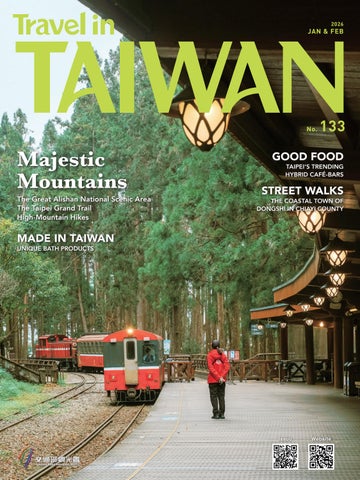
Shenmu Station of the Alishan Forest Railway (photo by Alan Wen)
ADMINISTRATIVE DEPT
ONLINE Read Travel in Taiwan online at www.travelintaiwan.net. Find back issues (PDF version) on the publication platform issuu at issuu.com/travelintaiwan.
GENERAL MANAGER David Hu
台 灣 觀 光 雙 月刊 Travel in Taiwan The official bimonthly English magazine of the Taiwan Tourism Administration (Advertisement) JANUARY/FEBRUARY, 2026 Tourism Administration, MOTC First published Jan./Feb. 2004 ISSN: 18177964 GPN: 2009305475 Price: NT$50
中華郵政台北雜字第1286號執照登記為雜誌交寄
Copyright @ 2026 Tourism Administration. All rights reserved. Reproduction in any form without written permission is prohibited.
MAGAZINE IS SOLD AT: 1. Wu-Nan Culture Plaza, No. 6, Zhongshan Rd., Central Dist., Taichung City 40043 886-4-2226-0330 http://www.wunanbooks.com.tw/ 2. National Bookstore, 1F., No. 209, Songjiang Rd., Zhongshan Dist., Taipei City 10485 886-2-2518-0207 http://www.govbooks.com.tw/
WHERE YOU CAN PICK UP A COPY OF TRAVEL IN TAIWAN ABROAD Offices of the Taiwan Tourism Administration in Beijing, Shanghai, Hong Kong, Singapore, Bangkok, Ho Chi Minh City, Kuala Lumpur, Seoul, San Francisco, New York, Los Angeles, Frankfurt, and London. Overseas Offices of the Ministry of Economic Affairs; Overseas Offices of the Central News Agency; EVA Air, and other selected international airlines; selected travel agencies in Asia, North America, and Europe; and other organizations.
IN TAIWAN Tourism Administration Visitor Center; Tourism Administration; Taiwan Visitors Association; foreign representative offices in Taiwan; Tourism Administration service counters at Taiwan Taoyuan Int’l Airport and Kaohsiung Int’l Airport; major tourist hotels; Taipei World Trade Center; VIP lounges of international airlines; major tourist spots in Taipei; visitor centers of cities and counties around Taiwan; offices of national scenic area administrations; public libraries
issuu (PDF)
Website
This magazine is printed on FSC® COC certified paper. Any product with the FSC® logo on it comes from a forest that has been responsibly maintained and harvested in a sustainable manner.
This magazine was printed with soy ink. Soy ink is said to be more environmentally friendly than petroleum-based ink and to make it easier to recycle paper.
CONTENTS
01
10
PUBLISHER'S NOTE
04
TAIWAN TOURISM EVENTS
06
TRAVEL NEWS What's New in Taiwan
08
CULTURE & ART
10
MOUNTAINS | ALISHAN
RAILS, TRAILS, AND BREWS WITH VIEWS Exploring Alishan’s Layered Landscapes
22
MOUNTAINS | TAIPEI
TRULY A GRAND TRAIL Hiking Taipei’s Green-Jeweled Crown
30
STREET WALKS | CHIAYI COUNTY WHERE THE LAND ENDS A Visit to Chiayi County’s Coast
36
GOOD FOOD | CAFÉ-BARS COFFEE MEETS COCKTAILS Taipei’s Trending Hybrid Café-Bars Sling Brews and Booze Under One Roof
42
MADE IN TAIWAN SOAPS FOR THE SOUL Taiwan Bath Products – Good for the Environment, Great as Gifts for Loved Ones
44
LITTLE THINGS
COLORS OF TAIWAN Common Hues Seen Around the Island
46
TAIWAN PASS
TAIPEI FUNPASS Your All-Access Card to Greater Taipei and Beyond
26
48
LOFTY DREAMS Popular and Challenging High-Mountain Hikes
IN TAIPEI ON BUSINESS Spending Time Inside and Outside Exhibition Centers
MOUNTAINS | HIGH MOUNTAINS
SPECIAL PLAN
22 36
26
46
TAIWAN TOURISM EVENTS
January-March
The Festive Season CHIAYI COUNTY Mar 3-15
1
©Taoyuan City Govt.
Taiwan Lantern Festival 台灣燈會
The Taiwan Lantern Festival is the highlight of Lantern Festival celebrations across Taiwan each year. The 2026 edition will be held in Chiayi County from March 3-15, marking the third time (after 2007 and 2018) this spectacular event has taken place in Taibao City. Venues include the Southern Branch of the National Palace Museum, Taizi Boulevard, and a large open area in front of the county government building. Access is convenient via the nearby Taiwan High Speed Rail Chiayi Station, with free shuttle-bus service available to the venues. As in previous editions, the festival is expected to showcase a blend of traditional lantern displays alongside cutting-edge lighting entertainment using the latest high-tech equipment. tbocc.cyhg.gov.tw
AROUND TAIWAN
2
Jan-Apr
Cherry Blossom Season
櫻花季
Taiwan’s cherry blossom season is a winter-spring spectacle that runs from mid-January through early April, with peak blooming typically occurring in February and March. The earliest blooms appear at lower elevations, and as the season continues through spring, different varieties in higher-altitude locations come into peak bloom. One of the most accessible viewing locations is Yangmingshan National Park, where the annual Yangmingshan Flower Festival showcases a variety of cherry blossoms, alongside blooming azalea and camellia bushes. Other major festivals surrounding the sakura bloom are the Sun Moon Lake Cherry Blossom Festival, which features over 5,000 cherry trees inside the Formosan Aboriginal Culture Village theme park; the Wuling Farm Cherry Blossom Festival, which showcases an impressive 21,000 cherry trees on the grounds of the high-mountain recreation farm; and the Alishan Cherry Blossom Season, during which more than 30 different varieties of beautiful cherry blossoms attract large numbers of flower lovers to the high-mountain Alishan Forest Recreation Area. More info on the official websites of the respective areas
TAIPEI CITY Feb 3-8
3
Taipei International Book Exhibition 台北國際書展
The annual Taipei International Book Exhibition (TIBE) will be held for the 34th consecutive year, with Thailand serving as the Guest of Honor and showcasing its vibrant publishing scene, featuring over 400 publishers, at the fair. Organized by the Taipei Book Fair Foundation, TIBE is one of Asia’s most renowned book trade fairs, expected to welcome more than 500,000 attendees and over 890 publishing professionals this year. Offering six days of literary exchange, professional networking, cultural celebration, and retail book sales, the event serves as a crucial platform for authors, publishers, copyright agents, booksellers, and book enthusiasts from Taiwan and around the world to discover new titles, explore literary trends, and foster cultural exchange. www.tibe.org.tw
4
JAN/FEB 2026
©TiBE
MATSU (LIANCHIANG COUNTY)
4
Feb-Mar
Matsu Baiming Cultural Festival 馬祖擺暝文化
This is one of Taiwan’s most unique religious celebrations, originating from China’s Fuzhou area with over a century of history. The term “Baiming” literally means to arrange offerings at night to honor and thank the gods, with festivities taking place around the Lantern Festival period. For Matsu residents, this celebration is considered even more important than the Lunar New Year itself, prompting families to return home for reunion during this time, with elaborate rituals and activities strengthening a profound connection between deities and people. The festival spans several days, with more than 60 temples across Matsu’s five main islands participating in the celebrations. Key activities include the spectacular “burning horse fodder” ritual, temple processions with spirit mediums, and divine gatherings where gods from different temples meet. www.matsu-nsa.gov.tw
©Matsu NSA
Photos ©Taipei City Govt.
AROUND TAIWAN Feb
5
Lantern Festival Events 燈會活動
Apart from the Taiwan Lantern Festival in Chiayi, there are numerous other lantern festival celebrations happening around Taiwan. Events in major cities include the Taipei Lantern Festival, New Taipei Lantern Festival, and Kaohsiung Lantern Festival, all featuring elaborate lantern displays and performances. Other distinctive traditional happenings that draw visitors seeking unique experiences are the Pingxi Sky Lantern Festival (New Taipei City), during which thousands of glowing sky lanterns are released into the night sky; the Yanshui Beehive Fireworks Festival (Tainan City), known for its thrilling launch of thousands of mini rockets; the Fire Dragon Festival (Miaoli City), featuring dragon dancing among firecrackers; the Bombing of Master Han Dan (Taitung City), involving participants throwing firecrackers at parading volunteers; and finally, the Beigang Lantern Festival (Yunlin County), a more solemn event featuring beautiful light-art installations. More info on the travel websites of the respective city/county governments
JAN/FEB 2026
5
TRAVEL NEWS
What’s New in Taiwan
Another year has arrived, and Taiwan is ready to welcome you with a host of new and old attractions. Come and explore!
Tourism Promotion
New Tourism Information Center in Sydney The opening of the Taiwan Tourism Information Center (TTIC) in Sydney last September marked a significant milestone for Taiwan tourism promotion in Australia. Strategically located near Darling Harbour and the city’s business hub, the center serves travelers from Australia and New Zealand interested in visiting Taiwan, while also strengthening collaboration with industry partners and the media. The TTIC provides the latest travel information and assistance for visiting Taiwan, reflecting the growing bilateral tourism exchanges between the countries.
www.facebook.com/TaiwanTourismANZ
Qalang Smangus in Hsinchu County
Great Harbor Bridge in Kaohsiung
Tourism Promotion
Taiwan Tourism Spotlight Awards The Tourism Administration, in collaboration with central ministries, local governments, and private partners, staged the 2nd Taiwan Tourism Spotlight Awards last year to celebrate the island’s most inspiring destinations. From 191 nominated attractions recommended by 52 organizations across Taiwan, the awards were determined through a mix of public votes and expert evaluations, recognizing the Top 10 Tourism Spotlights along with honors for Best International
6
JAN/FEB 2026
Recommendation, Best Domestic Innovation, and Most Popular Spotlights – totaling 32 outstanding achievements. These awardwinning highlights are showcase places and experiences where culture, creativity, and sustainability converge – some reviving traditional heritage, others pioneering eco-friendly travel, and many inspiring visitors with innovative encounters.
spotlightaward.taiwan.net.tw
Tourism Promotion
TRAVEL NEWS
Passenger Incentive Program Last year, the Tourism Administration introduced a new transit passenger incentive program offering consumption vouchers worth NT$600 (approximately US$19) to eligible travelers (non-citizens of Taiwan). The vouchers are specifically designed for international transit passengers who have layovers at Taoyuan International Airport, the main gateway to Taiwan, aiming to encourage them to explore shopping and dining offerings during their stopover. To qualify for these vouchers, travelers must be transiting through the airport with a layover (less than 24 hours) between their connecting international flights, rather than having Taiwan as their final destination. Eligible passengers can claim their vouchers at designated service counters within the airport during their transit period, and the vouchers can be used at participating shops, restaurants, and duty-free stores throughout the terminal.
New Taipei City
National Archives The new National Archives in Linkou District, New Taipei City, is a striking landmark that began trial operations last November. Housed in a structure featuring ten above-ground floors and two below, the building’s architectural design was inspired by Linkou’s unique redsoil geology. This inspiration is conveyed through a subtle gradient of brick-red glass and matte steel, which evokes the layering of time. Notably, a significant portion of the building’s site has been preserved as green space. This area includes native trees, an ecological pond, a forested slope, and a woodland theater, collectively providing a calm, contemplative atmosphere. The Archives’ interior functions as more than just a storage facility. It features a permanent exhibition hall, special exhibition spaces, the children’s “A-kai House” interactive room, a reading center, the Walk-In Café, and a cultural shop.
Hualien County
Nautilus Bibliotheca Nestled on the first floor of the TCC DAKA Renewable Resource Recycling Center in Xiulin Township, Hualien County – about 35km north of Hualien City – the Nautilus Bibliotheca forms part of a striking new landmark: a spiral-shaped building inspired by the golden-ratio nautilus shell, symbolizing memory, imagination, and exploration. Set in the shadow of an imposing cement factory of the Taiwan Cement Corporation (TCC), the library is more than a place for books. It houses a curated collection of artifacts from world civilizations, including a replica of Egypt’s Rosetta Stone and Sumerian clay tablets believed to contain some of humanity’s earliest love poems. Many of the pieces on display are replicas crafted from TCC’s own highperformance concrete, transforming industrial material into delicate works of art.
www.tccgroupholdings.com/en/daka-recycling-center
www.archives.gov.tw
©National Archives
©TCC GROUP HOLDINGS LTD.
Taichung City
Taichung Green Museumbrary This new innovative cultural landmark in Taichung, which opened last December, is located on the north side of Central Park in the Shuinan Economic and Trade Park. Designed by the renowned SANAA firm (Kazuyo Sejima & Ryue Nishizawa) in collaboration with local firm Ricky Liu & Associates Architects + Planners, the building features eight interconnected, staggered-formation volumes. These are wrapped in a delicate mesh of glass, metal, and aluminum to evoke lightness and transparency. As Taiwan’s first building featuring the integration of a public art museum and a city library, it embodies the vision of “art, reading, and nature in symbiosis.” With its generous open spaces, multiple entrances, and corridors bathed in natural light, it truly feels like a “cultural forest” where people can freely explore, reflect, and connect.
tgm.taichung.gov.tw
©Taichung Green Museumbrary
JAN/FEB 2026
7
Culture & Art 1 3
2
©Taipei City Govt.
1 Exhibition
2 Music
3 Exhibition
NINAGAWA MIKA WITH EIM: LIGHTS OF THE BEYOND, SHADOWS OF THIS WORLD
POP CONCERTS
PHARAOH: KING OF EGYPT
蜷川實花展 WITH EIM:彼岸之光,此岸之影 Jan 17 – Apr 19 Huashan 1914 Creative Park ( Taipei City )
This is the largest-scale overseas solo exhibition by Japanese contemporary artist Mika Ninagawa to date, created in collaboration with Japan’s digital art team EiM (Eternity in a Moment). Moving beyond her characteristic vivid and saturated photography, the exhibition features eight major themed areas that integrate video works, installations, and innovative digital technology to fashion a fully immersive experience of light, mirrors, and fantasy.
www.huashan1914.com
Jan-Mar Taiwan’s concer t scene in early 2026 features an impressive lineup of international and local acts. The season kicks off on January 7 with soft rock legends Air Supply – celebrating their 50th anniversary this year – performing at the Taipei International Convention Center, followed by popular Mandopop boyband Energy on stage at the Taipei Arena on January 10-11. Local pop queen Cyndi Wang headlines two nights at the same venue on January 23-24, while British singer Calum Scot t and K-pop sensation Tomorrow X Together both perform on January 31 – Scott at the Kaohsiung Arena and T X T launching their world tour at the Taipei Dome, continuing through February 1. International pop-rock band OneRepublic closes out this exciting period with their From Asia, With Love concert at the Taipei Arena on March 4.
埃及之王:法老
Jan 29, 2026 – Jan 10, 2027 Chimei Museum ( Tainan City )
T h i s u n p r e c e d e n te d b l o c k b u s te r ex h i b i t i o n marks the largest display of ancient Egyptian pharaonic ar tifacts ever assembled in Taiwan. A collaboration between the Chimei Museum in Tainan and the British Museum, it brings together 280 precious artifacts, including colossal stone statues, gold jewelry, clay tablets with diplomatic correspondence, and temple architectural elements. Organized around seven major themes, the exhibition focuses on the power, beliefs, and artistic achievements of Egypt’s rulers rather than mummies or funerary culture. Visitors can explore the multifaceted roles of the pharaohs and learn about the myths they cultivated and the political realities they faced. Notable pieces include the fist from a colossal statue of Ramses II and ornaments depicting royal throne names.
www.chimeimuseum.org
8
JAN/FEB 2026
4
6
5
4 Exhibition
5 Musical
6 Exhibition
BLENDING SCENERY, RECASTING WORLDS
ROMEO & JULIETTE
ETERNAL PICASSO: ART, MUSES, AND COMPANIONS
融景.造境—沉浸體驗展
Oct 17 – Mar 8 National Museum of History ( Taipei City )
This exhibition was inspired by Ma Paishui’s large-scale ink painting The Beauty of Taroko, which is in the museum’s collection. It invites visitors to go on a sensory journey that blends memory, light, shadow, and creative imagination. Following the rhythm of spring breezes, summer rains, autumn leaves, and winter snow, the viewer is taken through scenes bathed in sunlight and moonlight, experiencing the poetic imagery and renewed interpretations of Taiwan’s landscapes. Utilizing immersive projection, 3D modeling, and generative AI technologies, the exhibition transforms the painting of Taroko Gorge into a shared space – one that can be entered, perceived, and even co-created.
羅密歐與茱麗葉
Jan 15 – 18 ( National Kaohsiung Center for the Arts, Weiwuying ) Jan 22 – 25 ( National Taichung Theater ) Jan 30 – Feb 8 ( Taipei Music Center )
This beloved lavish musical, with music by Gérard Presgurvic, is the only production to present the timeless Shakespearean tragedy in French musical form, blending pop and classical styles. The 2026 Taiwan engagement is par t of the show’s 25 th anniversary global farewell tour with the original leads. These cast members, in place since the 2001 premiere, include the original Romeo, Damien Sargue, and the original Juliet, Cécilia Cara.
www.npac-weiwuying.org www.npac-ntt.org www.tmc.taipei
永恆畢卡索 : 藝術、繆思與知己 Jan 1 – Apr 6 Chiang Kai-shek Memorial Hall ( Taipei City )
This is the first immersive showcase in Taiwan dedicated to the Spanish master painter Pablo Picasso. The aim is to let the audience “walk into Picasso’s creations” by combining high-quality reproductions with 360 -degree light and shadow projections, animation, and m u s i c . S eve n t h e m e d a r e a s a r e f e a t u r e d , which explore his revolutionary artistic periods – from the Blue and Pink to Cubism – and highlight the profound influence of his seven central muses on his creative life, including a dedicated section that recreates his famous anti-war masterpiece, Guernica.
www.cksmh.gov.tw
www.nmh.gov.tw
JAN/FEB 2026
9
Shuishan Sacred Tree Trail in the Alishan National Forest Recreation Area
MOUNTAINS
Alishan
RAILS, TRAILS, AND BREWS WITH VIEWS Exploring Alishan’s Layered Landscapes TEXT A M I B A R N ES
PHOTOS A L A N W EN, V I SI O N
The Alishan National Forest Recreation Area is often hailed as Taiwan’s premier eco-tourism destination – and deservedly so. Its dual cultural and ecological richness means that if thinking of exploring the area itself or venturing into the wider surrounding Alishan National Scenic Area, travelers will discover no shortage of reasons to visit this beguiling region.
I
magine you were a benevolent travel god tasked with designing the perfect mountain-abode escape. What would you create? Perhaps you’d throw down a base layer of ancient woodland, adding variety with bamboo cathedrals and higgledy-piggledy tea farms stacked one atop the next. Threading through these, why not plot a century-old heritage railway, gentle boardwalks, and trails that chase ghost trains over moss-padded sleepers? You may also choose to swaddle the whole creation with an enchanting layer of mist and sprinkle a scattering of cozy cafés and teahouses where your appreciative subjects can sip a fortifying local cuppa or pot of joe. And the best part? This too-good-to-be-true destination isn’t fiction – you’ve just designed the Alishan National Scenic Area.
Alishan Forest Railway
JAN/FEB 2026
11
MOUNTAINS Alishan An old steam locomotive and wooden carriages of the Alishan Forest Railway (©Alishan Forest Railway and Cultural Heritage Office)
The Alishan Forest Railway In 1899, surveyors tasked with cataloging the bounty of Japan’s new colony discovered a metaphorical gold mine hidden in the Alishan Mountain Range. These mountains were home to a primeval virgin forest full of giant cypresses, and hinoki (as the fragrant wood is known in Japanese) was precisely the kind of sturdy material needed to build an empire. There was just one problem: with over 2,000 meters of elevation gain from the west-side plains and a whole load of pesky peaks between these forests and the ports, extracting any of that lumber was not going to be smooth sailing. Enter the Alishan Forest Railway. Opened in 1912, it covers about 37 kilometers as the crow flies, but trains climbing the whopping 2,186-meter vertical differential between the two terminal stations travel over 70 kilometers of serpentine track, cross 77 bridges, plunge through 50 tunnels, pass 23 stations, climb several switchbacks, and shimmy round the world’s longest railway spiral. In its heyday, US-built steam-powered Shay locomotives – engineered to handle steep grades and tight curves – shuttled back and forth, extracting unimaginable volumes of precious timber. Commercial logging later slowed, but as the outbound flow of wood dwindled, diesel engines began bringing in the tourists, and those now-iconic red-and-white liveried workhorses still travel the rails today. Starting off from Chiayi City (30m above sea level), the train trundles at a measured pace through sun-bleached farmland. Sugarcane and banana palms parallax past until, bit by bit, the plains give way to tropical greenery, the humid jungle breath permeating the carriage. As the engine begins climbing slightly, it grumbles, and the outside
12 JAN/FEB 2026
MOUNTAINS
Alishan
temperature dips. Subtropical vegetation interspersed with bamboo forest and mountain villages now lines the rails, and the shrill trills of white-eared sibia cut above the engine clamor. An hour-long pause at the village of Fenqihu (1,403m) allows passengers to alight for lunch (perhaps also a wasabi-flavored ice cream; wasabi is a local specialty crop), and then the train begins its final ascent through temperate forest. Now a noticeable 6-8 degrees Celsius cooler than down in the city, the air up here among the thick tree growth possesses a crisp clarity that causes sounds to hang and carry in odd ways – even the light seems somehow finer. It’s a journey I’ve made twice, and on both occasions, I’ve found myself lulled into a pleasant stupor by the rhythmic clacking and rolling, my attention escaping via the carriage windows to fly over the landscape like a tendril of mist. It really puts you in the right frame of mind to greet the forests when you get there. With that in mind, it’s worth saying that competition for the NT$600 one-way tickets is fierce. Seriously fierce. If you want to guarantee yourself a seat, the only way to do so is to be on the ball. Web reservations open at 6am Taiwan time, a fortnight ahead, and swift action is required – within minutes, every one of the 85 daily tickets gets snapped up. More flexible travelers have other options. Unclaimed tickets become available again three days out from the date of departure, and those who’re happy to fly by the seat of their pants might be able to snag a spot by turning up early on the day. And if after all that you’re still seatless, all is not lost. Taiwan Tourist Shuttle buses (www.taiwantrip.com.tw) can bring you to the forest recreation area, and once there, tickets for the Zhaoping/Zhushan (sunrise) and Shenmu branch lines can be bought at Alishan Station, and – thanks to a spot of ingenious camera rigging and a service cart – Google Street View now allows you to experience a driver’s-eye view of the whole journey from anywhere in the world. For more info and tickets, visit: afrts.forest.gov.tw/TP01_1_E.aspx
Train tickets
Alishan Station
Obstacle-free Environment In recent years, many of Taiwan’s leisure facilities have been upgraded to better accommodate travelers with disabilities, and the Alishan National Forest Recreation Area is no exception. Sections of trails have been made barrier-free, while other adaptations – ramps, specially outfitted bathrooms, and wheelchair-friendly train stations and accommodation options – have been retrofitted to make the park increasingly accessible to those with disabilities, and later this year a new premium Chiayi-Alishan train service with two dedicated wheelchair spaces will begin operation.
JAN/FEB 2026
13
MOUNTAINS Alishan
Alishan Trails Fenqihu, located in Zhuqi Township, within the Alishan National Scenic Area’s boundaries, is an important staging post for Alishan travelers. For merly a sleepy h i l lside Ha k ka v i l lage, its position roughly halfway up the railway line meant it became the de facto lunch stop for workers shuttling between lumber mill and logging grounds, serving as a train service and maintenance depot. Today, tourists still flock to sample the traditional bento boxes and indulge in a spot of nostalgia. Train passengers will have time to have lunch and hit up the station-adjacent Fenqihu Old Street, but for travelers with a little longer, the Fenqihu Circular Trail offers a more in-depth introduction to the village and its surroundings. Woven together from several shorter trails, this 4-kilometer loop encircles the village via a series of boardwalks suspended above the forest floor. A dreamy landscape of moso bamboo dominates the northern, uphill portion, while the segment to the south passes through a wonderfully moody world of towering cedars with Taiwan liocichla (a small passerine bird) flitting heard but unseen through the underbrush. There’s even a small section where – at dusk – you can reliably spot fireflies year-round. Completing the entire loop takes 90-120 minutes, but if you find your energy f lagging at any point, there are several shortcuts back into the village. I could easily dedicate several articles’ worth of text to the Alishan National Forest Recreation Area’s trails. However, since space is limited, I’ll pick just one: the Shuishan Sacred Tree Trail. Named for the Formosan red cypress that sits along its length – a grand old dame that survived the woodchopper’s axe – the route was recently rechristened Shuishan Healing Trail, and is the first path in Taiwan to receive official designation as a forest therapy walk. Starting two kilometers up the road to Zhushan Station from Alishan Station, it’s probably the quietest walk you can do in the park. Along the way, hikers are invited to listen to the forest’s song, lie down and watch the clouds scudding across a gap in the canopy, breathe deep lungfuls of phytonociderich air, and unburden their minds by whispering secrets to the trees. (If this sounds a touch crunchy for your liking, I’d say don’t knock it until you’ve tried it – we could all benefit from a little forest therapy from time to time.) The trail doubles back along a stretch of the former Shuishan Line, one of 20-plus branch lines that once radiated from the main railway. With
JAN/FEB /AUG 2026 14 JUL
Formosan red cypress along the Shuishan Sacred Tree Trail
Boardwalk stretch of the trail
Traditional railway boxed lunch sold at Fenqihu
MOUNTAINS
Alishan
Walking on the tracks of the former Shuishan Line
its trestle bridge and rusting rails, it’s a safe (and permitfree) version of the thrilling Mianyue Line trek, and on most afternoons, shafts of sunlight pierce the gathering mists to create a poetic interplay of light and shadow as exquisite as a Rembrandt painting. For those traveling to the forest recreation area by road, Shizhuo presents a convenient stopping point for a few hours (or more). Clustered around the 63-kilometer marker on the Alishan Highway (Provincial Highway 18), this cloudshrouded tea village has small hotels, restaurants, tea shops, and a network of scenic interconnected hiking trails. The six routes all bear nature-inspired names (Tea, Mist, Sunset, Sakura, Cloud, and Romantic – love is a force of nature, right?), and can be combined in any number of configurations to create loops of varying lengths. But be warned: whichever way you pick, it’s bound to be steep. Fortunately, the scenery offers ample distraction – daily afternoon mists march over close-cropped plantation bushes like an army of spectral tea-pickers, beading the leaves with dew as they go – and if you happen to find yourself in the area for sundown, I encourage you to head to higher ground to watch the afterglow paint the sky with a pastel wash. Close-cropped rows of tea bushes in the Shizhuo area
JAN/FEB 2026
15
MOUNTAINS Alishan
ALISHAN HIGHLIGHTS 1. Watching the sun rise above the peaks of Mt. Jade is one
of the most cherished experiences of an Alishan National Forest Recreation Area visit.
2. While the Alishan area is known for high-mountain tea,
high-quality coffee beans are also produced.
3. Eryanping Trail is one of numerous steep trails close to
the Alishan Highway that take you past tea plantations and reward you with enchanting mountain views.
4. The thatched-roof pavilion that sits on the larger of the two
Sister Ponds is an iconic sight in the forest recreation area.
5. At Alishan�s Yuyupas Cultural Park, you can enjoy cultural
performances by members of the indigenous Tsou people.
2 4 3
1
©Alishan Forest Railway and Cultural Heritage Office
16 JAN/FEB 2026
5
MOUNTAINS
Alishan
JAN/FEB 2026
17
Ajang Home
Fine coffee and bread
Daguma Alishan Coffee
MOUNTAINS
Alishan
Alishan Coffee Despite being a nation of tea drinkers, Taiwan has a well-established coffee scene, and Alishan is one of the hubs of a new wave of Taiwanese bean producers. Young enterprises like Zou Zhou Yuan Coffee Estate (www.facebook.com/alsccp) and Alishanwin (www.facebook. com/www.alishanwin.com.tw) are quietly producing world-class coffee, and it seems every mountain hamlet has a café or two serving up bold brews. During my most recent Fenqihu exploration, while on a Travel in Taiwan fact-finding tour, my wanderings – and caffeine habit – led me to Daguma Alishan Coffee. Seats spill out to occupy facing storefronts lining Fenqihu’s original commercial artery – “Fenqihu Old Old Street,” as it’s now known. Before the railway line was blazed, this narrow, sloping lane was the heart of a tiny mountainside settlement, but then the trains came, bringing people and progress, and pulling the village center northward to where tourists now queue for bento boxes and millet donuts on a newer commercial artery, the aforementioned Fenqihu Old Street. Today, a visit to the older Old Street feels like stepping back in time. Many of the buildings lay dormant, dust gathering in the interiors and weathered timber seeming to daydream of returning to the forest. Daguma Alishan Coffee fits perfectly with this sleepy atmosphere. A former general store, it bears characters dating its construction to the third year of the Taisho Era (1914), and its scuffed, mismatched furniture lounges beneath bamboo-supported awnings. When I visited, gentle instrumental versions of popular old songs f loated out from speakers, punnets of chayotes sat beside an honesty box, and an elderly black dog dozed on the porch. The menu’s brevity and lack of pretensions are decidedly not the kind of thing you’ll find in Taipei’s upmarket cafés, but it offers plenty for coffee purists to get excited about. The husband-and-wife owners grow their own beans locally and process them in several ways to coax out different characteristics: bold, fruity sun-dried beans, bright and clear washed beans, and honey-processed beans with sweetly fruity notes. (In a small act of concession to those averse to proper coffee, they also offer lattes made with Alishan beans and a short selection of local teas.) If you’re hoping to enjoy Fenqihu without the crowds, this is precisely where you belong. For something altogether different, whimsy-loving caffeine friends should venture to Ajang Home, a coffee shop in the Tsou tribal village of Lelauya, a 10-minute drive into the hills south of the Alishan Highway. Leaning hard into its mean bean credentials, the menu text beside the three single-origin Alishan coffees rather sternly informs guests that coffee is served freshly ground and without sugar or milk to showcase its superior qualities. But don’t worry, those less enamored by quality coffee don’t need to go thirsty – the store also offers a selection of teas, including milk teas, and hot cocoa. However, as delectable as the drinks and snacks undoubtedly are, the primary reason travelers make the trip out to Ajang Home is to experience the café’s weirdly wonderful surroundings. Owner-architect Ajang is a member of the Tsou community, who, in response to Typhoon Herb leaving him homeless in 1996, built a fantastical cluster of houses using recollections of ancestral architecture and scavenged odds and ends. His style is perhaps best described as indigenous Taiwanese meets Miyazaki meets steampunk elven encampment, and guests will find many quiet nooks and seating areas secreted away throughout the grounds. A daily cap on visitor numbers (arrive early on a weekday or book via the LINE app to get a spot on weekends) ensures the facility and its free-roaming cats never get overwhelmed, and allows guests to indulge in the fantasy that they’re residents of a fairytale mountainside utopia. DAGUMA ALISHAN COFFEE | 大姑媽阿里山咖啡 (05) 256-1253 No. 20, Fenqihu, Zhonghe Village, Zhuqi Township, Chiayi County ( 嘉義縣竹崎鄉中和村奮起湖 20 號 )
Daguma serves good coffee and tea
AJANG HOME | 阿將的家 0933-328-086 No. 129-6, Neighborhood 4, Leye Village, Alishan Township, Chiayi County ( 嘉義縣阿里山鄉樂野村四鄰 129 號之 6) www.facebook.com/ajanghome
JAN/FEB 2026
19
MOUNTAINS Alishan
Mountain Ali Tea No. 35
Alishan Tea Alishan’s coffee scene is currently going through a renaissance, but coffee is not generally the first beverage that comes to mind when thinking of this lofty domain. That distinction goes to tea. Scooter the twisting roads at the right time of year, and the vegetal perfume of sun-withering leaves is omnipresent. Indeed, the region is so synonymous with tea growing that it has spawned a whole category – high-mountain tea, or gao shan cha. Yet despite this close relationship, Alishan’s tea industry is barely half a century old. Before the 1970s, few thought growing tea – notoriously cold-shy – was viable at higher altitudes in Taiwan. The hills around Shizhuo, where much of Alishan’s tea comes from, sit 1,200-1,500 meters above sea level, and finding varietals suited to growing so high took persistence. Elevation aside, Shizhuo’s landscape and unique weather patterns are ideal for growing tea. It has well-drained, nutrient-rich soil and abundant clean water, but the magic ingredient is the region’s persistent fog. Rolling in like clockwork each afternoon, gauzy clouds bring a gentle, diffused light that protects leaves from becoming bitter. Someone who knows more than most about Alishan’s tea industry is David Wu, chairman of the Alishan Eco-Tourism Association. Wu, who, along with his sister Sophia, runs Mountain Ali Tea No. 35, was born into a tea-growing family and actually grew up inside the boundaries of the Alishan National Forest Recreation Area. Both spent periods living
20 JAN/FEB 2026
further afield, but never escaped the pull of their forested home area. So, when the park administration sought vendors capable of doing something with an empty property beside the prime sunrise-viewing location (Mt. Ogasawara Lookout), they decided to draw on their tea-growing heritage and give it a try. That was nearly nine years ago, and the two seem to be in their element. Their café-cum-exhibition-space opens early to cater to the sunrise crowd, and often enough, you’ll find Sophia or David introducing the scenery to guests from all over the world. Many visitors hurry straight back down to the train station after having taken in one of those mesmerizing sunrises over distant Mt. Jade, but the wiser ones linger to sample Wu’s teas, enjoy a nourishing brunch, and watch Mikado pheasants strut regally through the sharp morning air. As Wu told us during our recent visit, drinking a cup of tea, much like encountering the forest, should not be a hurried affair. If you’re doing it right, it is restorative – you should walk away feeling eased in mind, body, and spirit.
MOUNTAIN ALI TEA NO. 35 | 茶田 35 號 (05) 267-9764 No.103, Alishan Township, Chiayi County ( 嘉義縣阿里山鄉 103 號 ) ag.alishan18-35.com www.facebook.com/alishan1835
After watching the sunrise, Mountain Ali Tea No. 35 is the perfect place to have a light meal and sample tea from the region
Tea expert David Wu
Apart from quality tea and coffee, Zengin also crafts excellent cakes
As much as I am a wholehearted subscriber to Wu’s philosophy, the freedom to sit and warm the soul with cups of freshly brewed tea can feel like a luxury in today’s busy world. Thankfully, even time-strapped travelers can enjoy some of Alishan’s finer teas. For those who need to combine a cuppa with a roadside pit stop, Zengin is a convenient option. Another family-run business, the establishment was opened by the son of tea farmers as a way to keep his parents out of mischief in their senior years. The tea/coffee store sits right beside the Alishan Highway, so anyone visiting by car can easily pop in and sample their three signature teas: oolong, jinxuan (aka milky oolong, on account of its buttery-smooth mouthfeel), and honey-scented black tea, which derives its particular flavor profile from the tea leaves’ reaction to being bitten by leafhopper bugs. If you hit upon one you particularly like, Zengin doubles as a tea boutique, so you can grab some leaves to take home and enjoy a cup of mountain calm long after you’ve returned to your daily grind.
ZENGIN | 然井茗露 (05) 256-2257 No. 123-18, Neighborhood 4, Leye Village, Alishan Township, Chiayi County ( 嘉義縣阿里山鄉樂野村 4 鄰 123 之 18 號 ) www.facebook.com/zengincafetea
ENGLISH AND CHINESE Alishan Forest Railway | 阿里山森林鐵路 Alishan Mountain Range | 阿里山山脈 David Wu | 吳志靖 Fenqihu | 奮起湖 Fenqihu Circular Trail | 奮起湖環狀步道 Fenqihu Old Street | 奮起湖老街 Fenqihu Old Old Street | 奮起湖老老街 gao shan cha | 高山茶
Mianyue Line | 眠月線 Mt. Ogasawara Lookout | 小笠原山觀景台 Shenmu | 神木 Shizhuo | 石棹 Shuishan Giant Tree Trail | 水山巨木步道 Shuishan Healing Trail | 水山療癒步道 Tsou tribe | 鄒族 Zhaoping | 沼平 Zhushan | 祝山 JAN/FEB 2026
21
MOUNTAINS
Taipei
Truly a Grand
22 JAN/FEB 2026
Qingtiangang Grassland in Yangmingshan National Park (Section 3 of the Taipei Grand Trail)
MOUNTAINS
Taipei
Hiking Taipei’s Green-Jeweled Crown When it comes to the many merits of Taipei, the three “C’s” — Convenience, Cuisine, Culture — often take top billing. But if you ask this writer, the city’s greatest draw is its abundance of easily accessible hiking trails and natural scenery. Adventures to suit all ability levels lace the conurbation’s green borderlands. For those planning an exploration of the hills and mountains of Taiwan, the Taipei Grand Trail makes an excellent first step. TEXT A M I B A R N ES
Trail
PHOTOS R AY C H A N G, V I SI O N
I
n 2018, the Taipei City Government was on the hunt for creative ways to get its population more physically active. Among the ideas put forward was a long-distance trail stitched together from some of the city’s many existing walks. The city authorities were convinced, and the idea was realized. The route spans 92 kilometers of well-kept and well-signposted footpaths split into eight discrete sections, each served by public transport and each doable within 4~6 hours. Since its launch, the Taipei Grand Trail (TGT) – as it was christened – has offered residents and visitors a gateway to health and happiness.
In 2019, the government began collaborating with Hiking Note (a popular local hiking website/app; hiking.biji.co) to boost participation. Hikers who download the app on their phone can amass digital gemstones as they go, and anyone who collects all 56 can use them to apply for a certificate of completion. The year 2024 saw over 7,000 walkers complete the route in its entirety, and over 1,900 of those walked it more than once. The paths are easy enough and short enough that minimal planning or preparation is required. Grab a pair of shoes suitable for hiking, an EasyCard, a water bottle, and a few snacks, and you’re good to go. Section 2 is the one exception to this; some hikers prefer to wear gloves to protect their hands when using the ropes that aid you through the section. You may also want to download copies of the maps from the Taipei Grand Trail website (taipeigrandtrailen.gov.taipei); however, the signage is generally clear enough that you should be fine without them.
Section 6 can be accessed by taking the creekside Hushan Trail
Sections 1 to 5 traverse Taipei’s northern hills. From near MRT Guandu Station (Section 1 here), the trail climbs to meet Taipei’s tallest peak (Mt. Qixing). It passes through a broad swath of Yangmingshan National Park (www.ymsnp. gov.tw) before dipping down to greet the gods at Bishanyan Kaizhang Shengwang Temple and finishing close to MRT Jiantan Station. Meanwhile, on the south of the city, Sections 6 and 7 scale the ridge that shelters Elephant Mountain and pass through the tea farms of Maokong. Section 8 connects the end of Section 7 with the start of Section 1. The 38-kilometer Section 8 bike ride bisects the Taipei Basin, linking up the trailheads to form a full, 130-kilometer loop. If you want a well-rounded introduction to the city’s wild ways, you really couldn’t ask for more.
Section 7 traverses the Maokong area
JAN/FEB 2026
23
MOUNTAINS
Taipei
The park-like area of Erziping (Section 1)
Guandu – Zhuzihu (Sections 1 & 2) MRT Guandu Station is, as said above, the jumping-off point for Section 1. From here, signage bearing the TGT logo – a hiker approaching a summit with Taipei 101 in the background – directs walkers through the sculpturefilled grounds of the Taipei National University of the Arts. Emerging from the university’s rear gates, the route dives under the cover of trees, making its way onwards and upwards past an oversized grave site, a golf course, remnants of orange groves (the Tamsui area’s orange industry was ravaged by citrus greening disease in the 1980s), and irrigation canals until it reaches Qingtian Temple. Despite being on the small side, this temple holds outsized importance for TGT hikers because it’s the last pitstop with toilets and a water dispenser before reaching the visitor center at Erziping, an hour or two further along. From the temple, the path climbs steeply, stone steps guiding your feet, while overhead the bamboo knits together to form a green tunnel – half-hidden amidst their whispering stalks are remnants of stone terrace farms and the tumbledown dwellings of the people who once farmed them. At the top of the steps the trail begins to level out, and hikers will soon find themselves at Miantianping Pavilion.
24 JAN/FEB 2026
Section 1 continues straight along a gentle track until it reaches Erziping’s hill-hugged mountain pond and, further on, the aforementioned visitor center and the Ba la ka Highway, marking the end of the section. Section 2 doubles back from Erziping to the Miantianping Pavilion and then goes up to the peaks of Mt. Datun. Be warned, though, this option is for the uber-fit only – the steps that came before are but a gentle warm-up for what comes next. From the pavilion, a rope-assisted scramble (a muddy mess in wet weather) brings you to Mt. Datun’s West Peak, then the trail slides down the far side. This pattern – climb, slide, climb, slide – repeats as the trail passes f irst the mountain’s South Peak and then the Main Peak (1,076m). And though the final ascent is less muddy than the first two, the steps feel especially brutal, coming as they do when your legs are already screaming for mercy. As a final gift to weary walkers, Section 2 concludes by passing through the café- and flower-filled landscape of Zhuzihu, where each April graceful white calla lilies lift their hooded faces to the sky, while in May hydrangeas burst showily with blue, pink, and lilac blooms.
MOUNTAINS
Taipei
Zhuzihu – Fengguizui (Section 3) Beyond the floral fields of Zhuzihu, hikers follow Yangming Creek up to a roadway, then head onwards to Xiaoyoukeng Visitor Center, where Section 2 segues into Section 3. Steps (more steps!) lead up through dense arrow bamboo and past smoldering fumaroles to the very top of Taipei, Mt. Qixing (1,120m). The views are cracking (in clear weather), and if you’re lucky, you might meet the resident f lock of bamboo partridges. The descent is steeper but equally pretty, and if you visit in November you’ll be treated to the glorious sight of shimmering, wind-mussed silvergrass blanketing the slopes. To cap off its Yangmingshan romp, the TGT plows on past Lengshuikeng, over the Jingshan Suspension Bridge, and onwards via the water-buffalo-trimmed meadows of Qingtiangang bound for Fengguizui. As you go, look out for a quirky little part of local hiking culture – fellow trekkers will plant sticks in piles of buffalo poo to help prevent the unobservant from stepping in them.
Hydrangea bloom in Zhuzihu (Section 2)
CUST – MRT Linguang Station (Section 6) Skipping Sections 4 and 5 and f lipping south, Section 6 of the TGT explores the ridgeline that rises like a protective arm cradling Xinyi District’s shiny high-rises. Starting from China University of Science and Technology, steps (yes, again) take you away from a built-up urban area back into the green. Unlike Yangmingshan’s mix of windswept grasses and hardy forest, the lower-elevation shrubbery here is lush and jungle-like, full of frilly ferns and trailing vines. A 30-minute uphill step-fest gives way to a gentler up, up, down, down ridge-back ride. Tidy temples and tea pavilions serve as resting areas, and the further west you go, the more spectacular the scenery becomes. Highlights of this section are the 95 Peak (375m; the highest point of Mt. Nangang) and Mt. Muzhi (320m; “Thumb Mountain”). Located a short detour off the main trail, the rocky bald spot of the latter pokes out from the trees and offers sweeping 360-degree views, and if you know how to read the landscape, you’ll spot many of the peaks covered in earlier sections. For the remainder of its length, Section 6 falls in step with part of the Tamsui-Kavalan Trails (another of Taiwan’s long-distance routes). It first cuts through a mountainside cemetery and then Fuyang Eco Park before depositing you back in the urban-core streets within striking distance of MRT Linguang Station, where – of course – Taipei’s famed three “C”s are close at hand to reward you handsomely for your efforts. ENGLISH AND CHINESE 95 Peak | 九五峰 Bishanyan Kaizhang Shengwang Temple | 碧山巖開漳聖王廟 Elephant Mountain | 象山 Erziping | 二子坪 Fengguizui | 風櫃嘴 Fuyang Eco Park | 富陽自然生態公園 Hiking Note | 健行筆記 Jingshan Suspension Bridge | 菁山吊橋 Lengshuikeng | 冷水坑 Maokong | 貓空
View of central Taipei from Mt. Muzhi (Section 6)
Miantianping Pavilion | 面天坪涼亭 Mt. Datun | 大屯山 Mt. Muzhi | 拇指山 Mt. Nangang | 南港山 Mt. Qixing | 七星山 Qingtian Temple | 清天宮 Qingtiangang | 擎天崗 Taipei Grand Trail | 台北大縱走 Xiaoyoukeng Visitor Center | 小油坑遊客服務站 Yangming Creek | 陽明溪 Zhuzihu | 竹子湖
JAN/FEB 2026
25
MOUNTAINS
High Mountains
Lofty Dreams
TEXT A M I B A R N ES PHOTOS R AY C H A N G
Popular and Challenging High-Mountain Hikes My first impression of Taiwan came at 30,000 feet. Looking out of the window of my airplane as it tracked up the west coast, I experienced a sense of awe as I glimpsed the towering giants of Taiwan’s interior. Over the intervening years, I have dedicated countless pairs of hiking shoes to learning her mountain paths, and yet I carry around a perpetually overflowing bucket list of unexplored trails. What follows is just a small fraction of the many highmountain adventures I hope to have in the future.
Nenggao Historic Trail
26 JAN/FEB 2026
MOUNTAINS
High Mountains
Nenggao Historic Trail Somewhere near the top of my bucket list is the Nenggao Historic Trail. This 26-kilometer route stretches from the highlands of Nantou County’s Ren’ai Township down to Tongmen Village on the banks of the Mugua River in Hualien County’s Xiulin Township, and although I detest the word breathtaking (criminally overused in travel writing), I’m afraid it’s by far the most apt descriptor in this instance. Ranging for much of its most visually dramatic length between 2,000 and 3,000 meters above sea level, passing through spectacular high-mountain scenery – think cloud waterfalls and alpine grasslands dyed orange by the rising sun – it truly is the kind of place that is capable of taking one’s breath away, in both senses. Walked into existence by members of the Sediq indigenous people, it initially served as a tribal hunting and trading route. The Japanese era (1895~1945) saw colonial authorities co-opt the trail, building guard posts all along its length to monitor tribal communities. The Taiwan Power Company later repurposed some of these outposts during rural electrification efforts, and they eventually became overnight stops for trekkers. Today, hikers typically complete the route as either a two-day, one-night trek (overnighting at the Huilin Station campsite) or a three-day, two-night journey (adding an extra stop at Tianchi Lodge, which offers both cabins and camping with meals available). As with all high-mountain adventures, the logistics can get a bit tricky – Tianchi Lodge requires prebooking, the route requires a Mountain Entry Permit, and since it is what’s known locally as an “A in, B out” route, transport support is required at both ends. Consequently, working with a hiking-tour company is by far the easiest way for first-timers to enjoy this experience.
JAN/FEB 2026
27
MOUNTAINS
High Mountains
Jiaming Lake
Pond-side campsite on the way to Mt. Snow
Hiking up Nanhudashan
Jiaming Lake
Nanhudashan
Backdrop to a thousand profile pictures, Jiaming Lake has haunted my I-need-to-escape-this-city daydreams since I first learned of it. This high-mountain pool occupies a lofty spot on the southern side of Taitung County’s Mt. Sancha, and is nicknamed the Angel’s Teardrop because of how, on clear days, its surface forms a perfect blue mirror of the heavens. It’s also famed for attracting Formosan sambar deer – hikers answering nocturnal calls of nature are likely to find a small army of glowing eyes staring illuminated in the beam of their headlamps. After securing accommodation at Xiangyang Cabin (night one) and Jiaming Lake Cabin (night two), hikers should then apply for a Mountain Entry Permit and arrange their own transport to the trailhead.
Tallest among the majestic summits of Taroko National Park (www.taroko.gov.tw), Nanhudashan (like Mt. Snow) is one of Taiwan’s Bai Yue (literally “Hundred Peaks”; a list of one hundred peaks over 3,000 meters that Taiwanese alpinists dream of conquering). Typically climbed as part of a four-day, three-night, 50-kilometer assault that scoops up several Bai Yue summits over intensive 8~10-hour hiking days, this trek is not for the unfit or inexperienced (especially during snow season). Part of the route sits within an ecological protection area, so both a Park Entry Permit and Mountain Entry Permit are required (along with cabin/campsite reservations), but hikers who brave the physical and bureaucratic challenges are rewarded with some of the most dramatically beautiful scenery Taiwan has to offer.
Mt. Snow Rising an imposing 3,886 meters above sea level, Mt. Snow (aka Xueshan) is Taiwan’s second-highest peak. Situated within the scenic environs of Shei-Pa National Park (www.spnp.gov. tw), this mountain is home to endemic species like the Taiwan serow and is known for its spectacular dark sky stargazing opportunities. The most common route is a challenging twoday, one-night climb starting from Xueshan Trailhead Service Station (where hikers must present their Park Entry Permit), with an overnight at 369 Lodge (reservation required; meals available), although if you’re attempting the climb using only public transport, a three-day, two-night trip with an extra stop at Qika Lodge works best.
ENGLISH AND CHINESE 369 Lodge | 三六九山莊 Bai Yue | 百岳 Huilin Station | 檜林保線所 Jiaming Lake | 嘉明湖 Jiaming Lake Cabin | 嘉明湖山屋 Mt. Sancha | 三叉山 Mt. Snow | 雪山 Mugua River | 木瓜溪 Nanhudashan | 南湖大山
Nenggao Historic Trail | 能高越嶺道 Qika Lodge | 七卡山莊 Sediq tribe | 賽德克族 Shei-Pa National Park | 雪霸國家公園 Taroko National Park | 太魯閣國家公園 Tianchi Lodge | 天池山莊 Tongmen Village | 銅門村 Xiangyang Cabin | 向陽山屋 Xueshan Trailhead Service Station | 雪山登山口服務站
JAN/FEB 2026
29
STREET WALKS
Chiayi County
WHERE THE
LAND ENDS A Visit to Chiayi County’s Coast TEXT R I C K C H A R E T T E
The coastal towns of Chiayi County are on upraised oases along an ever-shifting world of land and sea, sculpted by silting on a large scale at the edge of the wide, alluvial, and fecund Jianan Plain. The use of great swaths of just-above-sea-level land for aquaculturefarm grids adds to the dramatic effect of being in a world of water.
30 JAN/FEB 2026
PHOTOS V I SI O N
Walking on the "water road" at Baishuihu, south of Dongshi
STREET WALKS
Chiayi County
D
ong sh i i s a ce nt u r ies - old f i sh i ng-por t v i l la ge, which has of late become a highly popular tourist destination. It is found on a jut of land extending out into the Taiwan Strait on the north side of the wide and shallow Puzi River estuary. More specifically, it is the large Dongshi Fishing Harbor and Dongshi Fisherman’s Wharf, on the town’s most seaward point of land, that are the big attractions. You pass by a legion of aquac ult ure far ms on the long causeway-like road that leads into the settlement, and from the harbor area you’ll take pic after pic of the armada of oyster racks filling up the estuary. Dongshi Township has the island’s highest oyster production volume. Both Taiwan and China entered the WTO in the early 2000s, and Taiwan government authorities decided to help the local fishing industry face the stiff Chinese competition by creating more tourism/recreationoriented businesses. In Dongshi, the large-scale, multipurpose Fisherman’s Wharf facility has been crafted around the harbor, providing full-day entertainment for tourists. The most eye-catching point of interest is a row of shops with façades painted in pastel colors like the seafront houses in a Mediterranean port. In front of it is a large dryland sand “beach,” splash park, and beach volleyball court. A long promenade runs along the estuary/sea-facing edge of the area (combination boardwalk/ceramic-tile pavement), with the sunset views especially titillating. Ocean-theme art installations abound – frolicking killer whales, a scale version of a Dutch windmill adorned with images of marine beings and sailing craft at sea, etc.).
Oyster racks off the coast of Dongshi Water fun park at the harbor (©Chiayi County Govt.)
The harbor’s daily catch auction, in which you can participate, starts at 2pm; the kitchen at any of the harborside restaurants will prepare your selections for you. Raft eco-tours also launch from the harbor, upriver past the busy Puzi Estuary Wetlands and out to Waishanding Islet, a huge sandbar that shields the great oyster-rack flotilla from rough waters.
Fireworks during the Dongshi Summer Festival (©Chiayi County Govt.)
Viewing platform
Dongshi Special Festivities
The annual Dongshi Summer Festival, held at the harbor/wharf, features pop music evenings, varied parent-child activities, and a fantastical fireworks show launched from six offshore platforms. The yearly Dongshi Dragon Boat Festival presents exciting dragon boat races offshore from the wharf, a traditional preracing dragon boat eye-dotting ceremony, and such other traditional festival fun as egg-balancing contests. Fish market JAN/FEB 2026
31
STREET WALKS
Chiayi County e Pi n
Ke Laoda Seafood BBQ
The prodigious Xiantian Temple is located just east of the harbor area on the west edge of the village. Towering over the rest of the low-rise settlement, it’s visible from a long distance away, and as you approach Dongshi along the aforementioned causeway-like road, water to left and right all the way to the village periphery, it appears as though a great magical castle f loating distant atop the sea. Founded over three hundred years ago, the temple is dedicated to the Wangye, commonly called the Plague Gods. These were originally believed to punish human wrongdoing by bringing pestilence. Communities around southern coastal China, and eventually Taiwan, began taking proactive protective action by worshiping them, putting their effigies on sailing craft and setting them both alight and adrift, taking plague with them. In turn, unlucky settlements where a craft might run
32 JAN/FEB 2025
le sh
rimp balls
Fresh plump oysters
Taiwan folk love feasting with family and friends; they love it even more when traveling. Dongshi obliges with scores of eateries – and considering the location, guess whether their culinary focus is on turf or on surf. You cannot possibly get fresher and tastier seafood than eating it just after the catch has reached dockside. According to online eatery reviews, Ke Laoda Seafood BBQ is at the top of the local food chain. Right by the harbor, in a long, rectangular two-floor building occupied by seafood joints and boasting a façade of 60%-plus windows and big, color-loud signs competing for your money attention, the irresistible temptation at Ke Laoda – which translates as “Oyster Boss” – is fresh all-you-can-eat grilled Dongshi oysters for just NT$200 per person. Other most-in-demand goodies from the wide-ranging menu are the pepper fish and the pineapple shrimp balls. The latter is a Taiwan specialty: deep-fried plump shrimp coated with sweet-potato starch, tossed in a sweet-ish mayonnaise sauce, and served with fresh Taiwan-pineapple chunks. The restaurant offers both an indoor airconditioned area and an outdoor eating area. Dining time is unlimited on weekdays but not on the far busier weekends/holidays.
Xiantian Temple
app
Inner courtyard of Xiantian Temple
KE LAODA SEAFOOD BBQ 蚵老大海鮮碳烤 (05) 373-0355 No. 307, Guanhai 3rd Rd., Dongshi Township, Chiayi County ( 嘉義縣東石鄉觀海三路 307 號 )
STREET WALKS
Chiayi County
aground would erect a temple to worship them and ward off trouble. This is what happened at Dongshi (the aforementioned Waisanding Islet). Today, a grand Wangye Boat-burning Ceremony is held every five years – replica traditional-style ships came to be ritually burned on shore, not sent out to sea to possibly terrorize others, symbolically sending pestilence away.
Xiantian Temple Mouth 60-Year Oyster Fritter Shop T h roug h t he ce nt u r ies, it ha s bee n a com mon phenomenon for markets to form in front of popular Chinese temples, typically the heart of a community. In Dongshi, a f lagstone market street of two short block s leads to X ia nt ia n Temple, shop ow ners narrowing the artery’s width considerably by putting up wide shade awnings out front, classic Taiwan roadside-stall-style simple food-preparation equipment and seating underneath them. You’ll immediately spot the shop that gets the most online “can’t miss” tourist reviews by the thickness of the lineup outside – its many-character name translates directly as seen in our entry title above. Today run by the third generation of the proprietor family, as the eatery’s ground-level shop sign proclaims, “fresh oyster cuisine” is king here. Beyond the crispy oyster fritters, test your cholesterol numbers with the comparatively inexpensive – especially so compared to Western-market prices – oyster rolls (fritter runner-up bestseller), oyster vermicelli, and oyster omelets. Other seafood notables include crispy-fried shrimp rolls, fried squid rolls, and milkfish belly thick soup (this sweet potato-starch thickened soup is a southern specialty). The new-generation owners have also added a lineup of stir-fry dishes, including staple selections such as seafood fried rice/fried noodles.
XIANTIAN TEMPLE MOUTH 60-YEAR OYSTER FRITTER SHOP 先天宮廟口六十年蚵嗲老店 (05) 373-2771 No. 199-1, Dongshi Village, Dongshi Township, Chiayi County ( 嘉義縣東石鄉東石村 199 號之 1)
Transportation: Take a Taiwan High Speed Rail train to Chiayi Station and transfer to Chiayi County Bus 179, which has a Dongshi Fisherman's Wharf stop; note this is a weekend/holiday-only route.
Xiantian Temple
Xiantian Temple Mouth 60-Year Oyster Fritter Shop Deep-fried seafood
STREET WALKS
Chiayi County
In-the-Area Attractions A short distance south of Dongshi is the small village of Baishuihu. It is dramatically situated, completely surrounded by water – fish farms – and protected from the sea by a long levee. Where fish farms today exist, salt pans were operated in days gone by. The seawall, constructed during the 1895~1945 Japanese colonial period, in its initial period failed to block typhoon surges, and white waves would appear in the flooded saltpan. Baishui means “white water.” In Taiwan hu, which means “lake,” is also used in place names indicating a terrain depression/basin – here, the leveeprotected salt pan low area. Off the Baishuihu area’s southwest tip is Shoudao (“Longevity Island”), a large sandbar with oyster racks all about on the inland side that has of late become a tourist hit. Years of surrounding ground subsidence, a phenomenon going on at various spots along this region’s coast, leaves the single-lane causeway road connecting the sandbar to the mainland underwater at high tide. Tourists come to “stand in the sea,” walking the road with water no higher than knee level, enjoying the stark feeling of isolation and the desolate beauty of the sunset landscapes.
Aogu Wetlands This nature-classroom tract is a short distance north of Dongshi, on the south side of the Beigang River estuary. Spread over 1,470 hectares, it takes up a peninsula that juts far out into open water, the site of a disused Taiwan Sugar Corporation sugarcane farm, levee protecting it on three sides. Afforestation has been carried out in some sections and a return to natural wetland in others; as at Shoudao, significant ground subsidence has been experienced here. Over 120 bird species have been spotted here, a place declared by the Taiwan International Birding Association to be Taiwan’s best-preserved wetland. Taiwan is a key station on the East Asian-Australasian Flyway, and this is a favored stop for the migratory birds, who stay the summer in Siberia, Japan, and Korea. The eco-park is laced with well-maintained boardwalks and lookouts fitted out with helpful, clear Chinese/English info boards. You’re also well advised to leave good time for the first-rate Ecological Exhibition Center (a short distance outside the park entrance), which has edifying displays on the local human history and natural ecology – mangrove forest to beefwood trees, stagnant to fast-running waters, and intertidal freshwater/seawater zone that serves as larder for the birds, providing fish, crabs, and snails in super-abundance. AOGU WETLANDS (ECOLOGICAL EXHIBITION CENTER) 鰲鼓溼地 ( 生態展示館 ) (05) 360-0959 No. 54, Sigu, Neighborhood 12, Aogu Village, Dongshi Township, Chiayi County ( 嘉義縣東石鄉鰲鼓村 12 鄰四股 54 號 )
34 JAN/FEB 2026
Inundated road at Baishuihu
Ecological Exhibition Center Aogu Wetlands
STREET WALKS
Chiayi County
Xianghe Leisure Fishing Farm Immediately outside the park entrance, beside a long drainage channel that runs beside a long, thin grid of aquaculture farms stretching north to south across the peninsula, is Xianghe Leisure Fishing Farm. The entrance area looks like a beachcomber’s abode on some remote South Seas isle – but in fact this place is a “pirate’s hideaway lair,” and visitors are outfitted with pirate costumes and related gear for their stay, with famed pirate Cai Qian (1761-1809) as the thematic star. The ow ners of t his aquac ult ure operation, or iginal ly engaged in commercial clam farming, have given it a new mission as an environmental education classroom focused on the surrounding mangrove-forest wetland ecology. Indepth tours are provided, along with f riendly familyoriented DIY experiences such as clam digging, seaweed harvesting, fishing, boat-rowing outings, oyster grilling, and treasure hunts. The rowing experience is for groups, in “dragon-boat races” on pontoon craft cutely decked out with colorful cartoon-like dragons at the head. Half-day and full-day activity programs are offered. The farm also offers meals, providing delicious post-activity seafood feasting; reservations are strongly advised. XIANGHE LEISURE FISHING FARM | 向禾休閒漁場 (05) 360-0959 No. 67-6, Sigu, Dongshi Township, Chiayi County ( 嘉義縣東石鄉四股 67-6 號 ) ENGLISH AND CHINESE Baishuihu | 白水湖 Beigang River | 北港溪 Cai Qian | 蔡牽 Dongshi | 東石 Dongshi Dragon Boat Festival | 東石端午龍舟賽 Dongshi Fishing Harbor | 東石漁港 Dongshi Fisherman's Wharf | 東石漁人碼頭 Dongshi Summer Festival | 東石海之夏 Puzi Estuary Wetlands | 朴子溪口溼地 Puzi River | 朴子溪 Shoudao | 壽島 Waisanding Islet | 外傘頂洲 Wangye | 王爺 Xiantian Temple | 先天宮 Entrance to Xianghe Leisure Fishing Farm
Shop selling local produce
Clam digging
JAN/FEB 2026
35
GOOD FOOD
Café-Bars
Coffee Meets Cocktails Taipei’s Trending Hybrid Café-Bars Sling Brews and Booze Under One Roof TEXT H A N C H EU N G
PHOTOS C H EN C H EN G - K U O
The buzzing “C (coffee) by day, A (alcohol) by night” concept is reshaping Taipei’s dining scene. Many of the city’s cafés now offer extended hours, shifting from bright daytime hangouts and work spaces to rela xed, atmospheric bars at dusk. Some serve coffee and cocktails all day, even offering specialty drinks that creatively blend the two.
Open-faced sandwich with avocado and bacon
36 JAN/FEB 2026
GOOD FOOD
Boneless fried chicken
Café-Bars
Spicy clam and pepper pasta
PPM Café & Bar Blending industrial details with American retro-chic and Korean sensibilities, PPM (short for “Parking Personal Mood”) evokes the atmosphere of trendy cafés found in Seoul’s fashionable Hannam-dong district. Nestled in a quieter neighborhood just outside Taipei’s glamorous and ritzy East District, this stylish yet cozy spot draws daytime diners and coffee drinkers before transforming into a cocktail bar as the sun sets. Its name is a playful nod to the venture’s location next to a large parking lot. The café's minimalist concrete façade contrasts with the warm tones of its compact interior. Wooden accents, soft lighting, area rugs, vintage decorations, and eclectic furniture create a space that’s both nostalgic and modern at the same time. Every corner is thoughtfully arranged, offering plenty of photo opportunities. Opened in December 2022 by the same team that is behind the successful American-style restaurant Double Single in Zhongshan District, PPM provides a laid-back, intimate experience. On the menu you’ll find a mix of small bites, pasta, grilled items, sandwiches, and desserts. The signature dish, the boneless fried chicken, received a 500 Dishes award in 2025 – an honor determined by noted Taiwanese professionals across various fields. Juicy with a light crunch, it comes with a refreshing yogurt sauce and
Warm interior
is balanced with celery stalks and onion slices. Heartier options include the spicy clam and pepper pasta with tomatoes and grated parmesan. Other highlights include Korean-style chicken wings with rice cakes, and brunch items such as French toast with pistachios, caramelized banana and ice cream, and an open-faced sandwich with avocado and bacon. Drinks range from tea, cocoa, and coffee to cocktails, wine, and beer. The fruity drinks are especially popular, including the two-toned sour fruit Americano and the iced fruit tea, in which homemade pineapple sugar, passion fruit, kumquat, and Taiwanese tea are used. Among the alcoholic options, the watermelon cocktail topped wit h a layer of Yak ult cream is a crowd favorite. PPM CAFÉ & BAR (02) 2778-0225 No. 10, Ln. 97, Yanji St, Da’ an District, Taipei City ( 台北市大安區延吉街 97 巷 10 號 ) 12pm-9:30pm www.instagram.com/ppm.taipei French toast
Outside seating JAN/FEB 2026
37
GOOD FOOD
Café-Bars
Fake Sober At 6pm sharp every day, Fake Sober stops serving coffee and lets the cocktails f low. The transition is almost ceremonial, marked by the rise of metal gates revealing the beer bar and drink lounge. The lights dim, and the music shifts from soft ambient tracks to a lively mix of familiar hip-hop and Taiwanese, Western, and Korean pop – sing-alongs are encouraged. The expansive venue occupies two adjacent streetlevel storefronts in the heart of Xinyi District’s party zone. Closing at 2am, it positions itself as a warmup spot for revelers, a place to get an early start before hitting the clubs. There is no minimum charge, and g uests are invited to settle in and unwind in the relaxed, inclusive atmosphere. Founder Roy, who runs several nightclubs and is a self-professed coffee addict, launched Fake Sober in 2022, combining the two interests. He came up with the curious name after noticing how people rely on coffee in the morning to feel awake, while folks tipsy and beyond often insist they’re sober – both attempts to appear clear-headed. The interiors behind the two storefronts each offer a distinct vibe. The one on the left, with the sign “Fake Sober” on the exterior, features a cozy, wood-toned décor. The focus here is on classic café drinks such as flat whites, caramel macchiatos, and the signature “cloud” latte, topped with a pillow of creamy foam. Matcha, cocoa, and teas are also available. The one on the right, the high-ceilinged, industrialchic Sober Bakery, mainly serves pour-over coffee alongside salt bread – a buttery roll that originated in Japan and has recently surged in popularity in South Korea. It also sells coffee beans and merchandise branded with the slogan, “Being Sober is So Boring.”
38 JAN/FEB 2026
Coffee-making during the day
Fake Sober's prominent slogan
GOOD FOOD
Café-Bars
Cloud latte
Baked fresh on site, the salt bread is soft and f luffy with a crisp bottom, and comes in more than ten flavors. Popular picks include adzuki bean with cream, garlic cream cheese, and bacon with cheese and mashed potatoes. Af ter 6pm, both stores ser ve handmade pizza, with the double chili beef being the big crowd-pleaser. Each store has its own mixed drinks on tap. Fake Sober’s star is the Strawberry No. 5, a berry-vodka concoction with a layer of milk cream on top. Over at Sober Bakery, the Basil Breeze – a mix of basil, Jinxuan tea, gin, and grapefruit – is a hit, as is the Sober Ice Tea, a cherry, rum, gin, and vodka mix that is the strongest option at 23 percent ABV. Fake Sober also produces its own line of canned cocktails, currently with two flavors: osmanthus apple black tea with vodka, and roselle oolong honey gin. With multiple pickup points at night, even from a cart outside the bar, they are ideal for avoiding long lines at the taps on busy evenings. The beer is f rom local craf t brewer y Ugly Half Beer, known for its use of locally sourced ingredients and quirky cult ural
Sober Bakery
references. The Guava Gose is made with local wheat, fruit, and coral reef salt, and comes with plum powder as traditionally served at street markets. Another standout option is TOASTea, an amber lager with black tea and cut-off crusts from breakfast shops that would otherwise go to waste. Unlike the cocktails, the beers are available all day, catering to those who prefer to get tipsy in the afternoon. Just a few steps south of Fake Sober, the company recently opened a third shop, Sober & Burger, which sells burgers.
Fresh bread in different flavors
FAKE SOBER (02) 2722-0723 No. 20, Songshou Rd., Xinyi Dist., Taipei City ( 台北市信義區松壽路 20 號 ) 8am-6pm coffee, 6pm-2am cocktails www.instagram.com/fakesobertaipei www.facebook.com/fakesobertaipei JAN/FEB 2026
39
GOOD FOOD
Café-Bars
SunDay Café At SunDay Café, customers are welcomed to kick off their afternoon with an espresso m a r t i n i. Sp e c i a l i z i n g i n cof fe e -i n f u s ed cocktails, the café aims to transcend the trending “coffee by day, alcohol by night” model, offering a space where both can be enjoyed from 1pm to 1am. “Some people can’t drink alcohol in the morning, and some can’t have coffee at night. We want everyone to be able to try these coffee cocktails regardless of the time,” owner Arthur Huang says. As the store’s slogan goes, “Life is what happens between coffee and cocktails.” The store’s Chinese name – 酉日 – is a clever wordplay. The character 酉 is associated with both “awake” and “tipsy,” and when combined with 日, the characters can form 晒 , which means “to dry in the sun.” “We want to give customers a feeling of warmth,” Huang says.
Originally, SunDay operated as two separate businesses – a café and a bar – sharing the same space, with a clear division between morning coffee and evening drinks. About four years ago, they began combining their e x p e r t i s e a nd e x p e r i me nt i n g w it h ne w c re at ion s. Tod ay, t he me nu fe at u re s a n extensive selection, and guests can personalize t hei r exper ience by choosing f rom t h ree types of beans: fruity and sweet Ethiopian, a rotating light roast, and low-caffeine Caturra from Colombia. The menu also includes pure coffee and alcohol options, mocktails, and a selection of small bites and desserts. Located in a busy alley in Xinyi District, SunDay welcomes visitors with an outdoor seating area of white gravel, acrylic tables, and wooden-board seats set atop stacked hollow concrete bricks. Potted plants add a touch of greenery, creating a relaxed yet stylish gardenstyle setting, great for people-watching. At night, a large circular light is projected onto the wall, symbolizing the sun. The softly-lit interior is cozy and inviting, featuring an eclectic
"Adult" tiramisu
40 JAN/FEB 2026
Classic coffee cocktails
Pouring a latte
GOOD FOOD selection of f urniture and decorations. Windowside seating built on wooden pallets requires people to take off their shoes, adding a homey touch. The atmosphere is suitable for both work sessions and casual gatherings. By mixing and matching carefully selected beans and coffee styles, the café harnesses diverse and complex flavor profiles. In addition to espresso shots, cold brew, ice drip, and other coffee preparations are used, adjusted for each drink’s f lavor and alcohol content. Typical coffee cocktails incorporate nutty, cocoa, or caramel flavors, but Huang favors specialty coffees with fruity and floral tones. “Quality beans are naturally multifaceted in f lavor,” Huang explains. “We don’t need to rely on liqueurs or fruit juices, as the beans themselves bring the fruity notes.” The alcohol menu features classic coffee cocktails such as Irish Coffee and White Russian, alongside SunDay’s signature creations, caffeinated twists on familiar favorites, as well as coffee-free options, including craft beer. A standout item is the Coffee Bee’s K nee, made with Hayman’s gin, espresso, honey, and lemon. The Irish Coffee is warming in the winter, a medley of Bushmills 12-year whiskey, long black, and fresh cream. Beans are not used in all the coffee-theme drinks – some are made with coffee leaves, dried coffee cherries, or coffee flowers procured from the Alishan area in southern Taiwan, offering another low-caffeine alternative. Alcoholic desserts are also on the menu, such as the sake-soaked grape caramel pudding and “adult” tiramisu.
Café-Bars
SunDay also offers seasonal cocktail f lights. The current selection pairs coffee with dairy products such as milk, cheese, yogurt, butter, and cream. One creation features an ice-drip with berry tones reminiscent of red wine, aptly topped with soft cheese. The non-alcoholic options are just as varied, ranging from single-origin espressos to f lavored coffees, including a coffee-matcha-shiso concoction. Teas and mocktails round out the menu, ensuring there’s something for each customer. SUNDAY | 酉日咖啡吧 (02) 8786-7652 No. 143, Hulin St., Xinyi Dist., Taipei City ( 台北市信義區虎林街 143 號 ) Mon-Sat 1pm-1am, Sun 1pm-7pm www.facebook.com/SunDay.Cafe.Bar www.instagram.com/sunday_cafe_bar
Preparing a cocktail
Outside the café/bar JAN/FEB 2026
41
MADE IN TAIWAN
R O F SOAPS L U O S THE t, the Environmen r fo d o o G – s ct du Taiwan Bath Pro r Loved Ones fts Great as Gifts fo time, practical gi
the same thoughtful and, at e ak m ts uc enterpri se’s od pr l heritage and an d other bath ca an ni s ta ap bo so h al ric an d’s tis Ar reflect the islan ider on your next pecially when they cal brands to cons lo g in nd ta ts from Taiwan – es ou e are thre stainability. Here commitment to su C H EN G - K U O PHOTOS C H EN TE XT V I SI O N souvenir hunt.
Test washing with soap at a YUAN store (©YUAN)
Solid and liquid soaps (©YUAN)
Chiang Jung-yuan’s journey into soap-making began with a personal health crisis. Suffering from severe eczema in the early 2000s, he left his advertising career to study traditional Chinese medicine (TCM), following in the footsteps of his g randfather, a traditional Chinese doctor. Through his studies, he learned to craft pure, natural soaps that wouldn’t irritate his sensitive skin. After founding Yuan Soap Workshop Co. (YUAN) in 2005, one of his first creations was a soap made with wild mugwort, a n he r b w it h d e e p r o o t s i n Ta i w a ne s e traditional medicine. It became one of his bestsellers and remains so today. Y UAN’s distinction lies in its commitment to
local sourcing. In 2007, Chiang established an organic farm in Yangmingshan National Park, where natural farming methods are used that exceed even organic certification standards. His soaps feature ingredients from this farm, Yangmingshan’s pristine spring water, and produce from around Taiwan, including organic lemon from Taitung County and aloe vera from the Penghu Islands. The firm avoids imported ingredients whenever possible, even when they cost less. The enterprise produces tens of thousands of soaps monthly, each hand-stamped creation free from preservatives, artificial fragrances, and synthetic colors. YUAN operates dedicated shops and department-store counters around Taiwan, including a branch on Taipei’s tourist-popular Yongkang Street (MRT Dongmen Station).
YUAN
42 JAN/FEB 2026
MADE IN TAIWAN Dachun Soap While YUAN represents Taiwan’s new wave of artisan soap makers, another brand carries the island’s soap-making legacy back more than a century. Step into Dachun’s flagship store on Dihua Street in Taipei’s historic Dadaocheng neighborhood, and you’ll encounter an old brand that spans three generations of a local family. Founded in 1923 during the Japanese era by entrepreneur Junichi Inoue, Dachun launched Taiwan’s modern soap industry. In 1950, Lee ShuiTu acquired the business and continued its soap-making tradition. His grandson, Dawson Lee, brought the brand back to its Dadaocheng roots in 2016 with a complete relaunch. Unlike other artisan soap makers, Dachun combines traditional values with modern manufacturing precision. B e c a u s e i t s s o a p s a r e m a c h i ne - m a d e , t h e y f e a t u r e exceptional structural stability and longer shelf life while high quality is maintained through the use of natural and organic ingredients. Some of Dachun’s soaps pay homage to Dadaocheng’s heritage, with locally sourced rice, tea leaf, Chinese medicinal herbs, and reishi mushroom incorporated – ingredients that reflect the neighborhood’s historical role as a regional trading hub. Apart from Dachun’s main shop on Sec. 1, Dihua Street (No. 190), there is also a second shop a short walk further north (No. 234); the soaps are also sold at numerous department-store counters around the island.
Dachun charcoal soap
Cha Tzu Tang Where Dachun preserves soap-making traditions through moder n met hods, Cha Tzu Tang has made savi ng an endangered botanical ingredient its mission. Founded in 2004 by Chao Wen-hao, who transformed his father’s 1992-originated detergent business, the company celebrates Taiwan’s botanical heritage through camellia seed oil – an ancient culinary/nutritional ingredient now threatened by decli n i ng demand and chem ica l a lter nat ives. T he company works with local farmers to preserve camellia tree cultivation. Cha Tzu Tang manages three pesticide- and herbicide-free farms, including one in Yilan County’s Nan’ao Township that has helped revitalize the coastal Zhaoyang fishing village. Camellia oil produced in Taiwan is naturally nourishing for the skin. Its high oleic acid content allows for superior absorption, helping nutrients penetrate deeper into the skin. This makes it an excellent base for body lotions, hand creams, and lip balms. Cha Tzu Tang gained wider recognition when its products were selected as official gifts for filmmakers at the Golden Horse Awards in 2014 and 2015. Through partnerships with boutique hotels and design-forward retailers, the brand has also successfully positioned its products as premium souvenirs for discerning travelers. Not far from YUAN’s Yongkang branch, Cha Tzu Tang operates a shop on Yongkang Street as well, and there is also a shop in the above-mentioned Zhaoyang fishing village; its products are also widely available in department stores and boutiques around Taiwan.
Cha Tzu Tang hand creme (©Cha Tzu Tang) YUAN | 阿原 (Yongkang Branch) No. 2, Ln. 8, Yongkang St., Da'an Dist., Taipei City ( 台北市大安區永康街 8 巷 2 號 ) 10am-9pm www.yuancare.com DACHUN SOAP | 大春煉皂 No. 190, Sec. 1, Dihua St., Datong Dist., Taipei City ( 台北市大同區迪化街一段 190 號 ) Mon-Fri 9am-6pm, Sat-Sun 9am-7pm www.dachunsoap.com CHA TZU TANG | 茶籽堂 (Yongkang Branch) No. 11-1, Yongkang St., Da'an Dist., Taipei City ( 台北市大安區永康街 11-1 號 ) 10:30am-9:30pm www.chatzutang.com ENGLISH AND CHINESE Chao Wen-hao | 趙文豪 Chiang Jung-yuan | 江榮原 Dadaocheng | 大稻埕 Dawson Lee | 李國榮 Dihua Street | 迪化街 Lee Shui-Tu | 李水土 Zhaoyang | 朝陽
JAN/FEB 2026
43
LITTLE THINGS
Colors of Taiwan
Common Hues Seen Around the Island TEXT & ILLUSTRATIONS V I SI O N
From yellow taxis to red-and-green mailboxes, Taiwan’s culture speaks in color. Blue mini trucks navigate narrow alleys while blue-and-white slippers shuffle through night markets. Each color tells a story of daily life on this vibrant island where practicality meets unexpected charm.
44 JAN/FEB 2026
Yellow Taiwan’s taxis are an unmistakable bright yellow, a standardized shade known as “Yellow hue no. 18.” Required for all newly registered cabs since 1991, this vivid color makes them visible even through torrential typhoon rain. Sometimes affectionately called xiao huang (“little yellows”), these traditional taxis now face growing competition from ridehailing services like Uber, which may lead to fewer plying the streets. Still, yellow is sure to remain prominent in Taiwan’s urban streetscapes; it’s also the color of garbage trucks and the rear section of the ubiquitous YouBike public-rental bikes.
LITTLE THINGS Blue Navigating Taiwan’s narrow lanes, you’ll likely find yourself behind a blue mini tr uck sooner or later. These functional vehicles deliver everything from fresh produce to construction materials, and are the backbone of the island’s small-business economy. Blue appears again in Taiwan’s beloved blue-andwhite slippers, known locally as lan-bai-tuo. Available for around NT$60 at convenience stores and daymarket stalls, these simple slippers shuffle through night markets, line up outside apartment doors, and appear on students’ feet. They’ve become an unofficial symbol of Taiwanese identity – what locals wear when taking out the garbage, going for breakfast, or heading to the beach.
Green In recent years, green-painted pedestrian walkways have become increasingly common in cities around Taiwan. These marked sidewalks are sections of existing road simply painted green and designated for pedestrians. The initiative was introduced to address situations where people are forced into busy streets due to a lack of proper sidewalks, responding to public safety concerns. Research has shown that these green walkways can significantly reduce traffic accidents. As part of Taiwan’s effort to make its cities more pedestrian-friendly, the distinctive color has become a prominent feature in urban street grids. Green is also the color of Taiwan’s postal service. Post offices, postal workers’ uniforms, and their e-scooters all feature the same distinctive hue. Look closely at a street-side mailbox and you’ll notice it’s divided into red and green sections: red for urgent mail and airmail, green for regular domestic delivery within Taiwan. Like traditional taxis, the postal service now faces stiff competition, from private courier and delivery companies. While the courier and delivery services come in various colors, two have become especially prominent on Taiwan’s streets: Uber Eats (green) and Foodpanda (magenta).
Pink Traditional markets and small stores once handed out pink-and-translucent-striped plastic bags virtually everywhere in Taiwan. Though growing environmental consciousness has changed consumer behavior – with many people now bringing reusable bags for grocery shopping – these iconic bags persist in many markets. They serve as cheerful reminders of an era when a free plastic bag was simply part of the shopping experience.
Color Combos Taiwan has the second-highest density of convenience stores worldwide (after South Korea), and each major chain has claimed its own color territory. The signature orange, green, and red stripes of 7-Eleven mark its 7,000plus locations. FamilyMart presents a fresh blend of green, white, and blue across its 4,300-plus stores. The other two of Taiwan’s “Big Four” convenience chains, Hi-Life (around 1,400 stores) and OK Mar t (900), both feature bright-red schemes. Far more than simple shops, these establishments serve as vital community anchors where daily life unfolds: bills are paid, packages retrieved, and cravings for such hot foods as beloved tea eggs and for good-quality coffee are satisfied. Arrayed on virtually every busy artery, their branded colors have woven themselves into the fabric of Taiwan’s streetscapes. ENGLISH AND CHINESE lan-bai-tuo | 藍白拖 xiao huang | 小黃 "Yellow hue no. 18" | 18 號純黃色
JAN/FEB 2026
45
TAIWAN PASS
Taipei FunPASS
Your All-Access Card to Greater Taipei and Beyond TEXT & PHOTOS VISION
Planning a trip to northern Taiwan? The Taipei FunPASS might just be your new best companion. This card provides access to major attractions and public transport, making your travels both more convenient and more affordable.
N
orthern Taiwan, with the capital Taipei at its center, offers visitors an incredible mix of attractions. From old temples to sleek, moder n skyscrapers, from traditional night markets to fashionable department stores, from busy street-and-alley grids to tranquil mountains, windswept coastal cliffs, and natural rock-sculpture shorelines, this part of Taiwan is full of surprises. With so much to see, you certainly don’t want to spend much time on purchasing tickets. This is where the Taipei FunPASS comes to the rescue. This pass is like an all-access card to greater Taipei, a card that gets you tickets to many of the area’s biggest tourist attractions and that can give you unlimited rides on the Taipei Metro (MRT), public city buses, and Taiwan Tourist Shuttle buses. Without the need to buy single tickets at vending machines and ticket counters, you will be able to go straight to the entrance gates and just tap the card at the sensor to gain access. The aim for the Taipei FunPASS is to make it easier for visitors to experience the best attractions in Taipei, including man-made sites such as the towering Taipei 101 and the global-
46 JAN/FEB 2026
He
pi
ng
Isl
an
d in
Keel un
g
elite National Palace Museum, but also natural highlights like the unique rock formations at Yehliu Geopark on the North Coast and fun activities such as sending paper lanterns up to the heavens in the Pingxi Valley. You can find more detailed info online and purchase the Taipei FunPASS at funpass.travel.taipei. Buying a card before arriving in Taiwan, then picking it up when you get here, is recommended. The cards are also sold at major stops within the Taipei Metro system, major railway stations, and at Taoyuan International Airport and Taipei Songshan Airport (look for service counters in the arrival halls). The pass is activated the first time you use it, either when you tap it to enter an attraction (a museum, for example) or when you use it for public transport. The validity is based on calendar days, not on 24-hour periods. If, for example, you activate a 1-day card at 3pm, the card will only be valid until midnight of the same day, not until 3pm on the next day. Therefore, to take full advantage, be sure to start making use of it early in the day.
Jiu
fe n
Also note that the pass only grants you a single entry for each included attraction; you cannot use the card to ride the Miramar Ferris Wheel multiple times, for instance. There is no refund once a card has been activated. The following card options are available: Pi n g x i
Unlimited: This card includes unlimited rides on the MRT system (excluding LRT and Taoyuan Airport MRT lines), public city buses, the Taiwan Tourist Shuttle service, and the Pingxi-Shen’ao railway line. It also provides tickets to more than 30 attractions and experiences in Taipei City (incl. Taipei 101 Observatory and Maokong Gondola), New Taipei City (Yehliu Geopark and Tamsui’s Fort San Domingo; Pingxi Sky Lantern experience), and Keelung City (Heping Island Park). This version of the Taipei FunPASS also brings you shopping discounts and a free souvenir (a “LONG HO Nightmarket glass”). It is perfect for visitors who wish to pack in as many sights as possible during their time here. 1-, 2-, and 3-day; NT$1,300-2,000 (adults; discounted cards available for children aged 6-11) Exploring: This option is similar to the Unlimited version but also provides tickets to attractions farther away, in Taoyuan City (incl. Daxi Tea Factory and Hengshan Calligraphy Art Center). Cardholders also enjoy discounts on tickets for Taoyuan’s Xpark aquarium and the Window On World theme park. 2-, 3-, and 4-day; NT$650-1,050
-S
'ao he n
rai
l wa
y
National Palace Museum
Transportation: As its name suggests, this card focuses on transportation and does not include tickets to any tourist attractions. It supplies unlimited rides on the Taipei Metro, public city buses, and Taiwan Tourist Shuttle buses in Taipei City, New Taipei City, and Keelung City. 1-, 2-, 3-, and 5-day; NT$210-730 Classical: The Classical version is perfect for visitors who have limited time. It grants you access to two of Taipei’s biggest draws, the Taipei 101 Observatory and the National Palace Museum. The card comes with an attractive design and can be used as a normal EasyCard (www.easycard.com.tw). Since free transport is not part of this card, however, you need to add value yourself (inside MRT stations and convenience stores). 1-day; NT$950 (adults)
Fort San Domingo in Tamsui JAN/FEB 2026
47
SPECIAL PLAN
In Taipei on Business Spending Time Inside and Outside Exhibition Centers TEXT V I SI O N
Time between meetings at a Taipei trade show, looking to explore a bit? You’re in luck. The city’s efficient metro system and concentrated attractions mean you can pack meaningful experiences into even the shortest breaks.
A Hub for Global Business
i Ta ©
Taipei is one of Asia’s premier destinations for international trade shows and exhibitions, offering world-class infrastructure for global business events. The city hosts some of the most significant annual industry gatherings, including COMPUTEX and Taipei Cycle. The city’s two main trade fair venues, the Taipei World Trade Center and Taipei Nangang Exhibition Center, are both located in the eastern part of the city. If staying at one of the many high-quality international hotels near these venues, you can explore a host of attractions in the adjoining Xinyi and Nangang districts. The convenient Taipei Metro (MRT) system also connects you to almost all places of interest in the city quickly.
pe iN an ga ng Ex hi
Around Taipei World Trade Center
bi ti o n C
If you prefer staying close to your base when attending a trade fair at the Taipei World Trade Center, you’ll find plenty to explore in the surrounding modern and vibrant area. The Taipei 101 tower is just a short walk away, offering world-class shopping, excellent dining, and panoramic views. Numerous high-end department stores and malls are perfect for browsing and picking up souvenirs. Many cafés and bars are available as well, making it easy to unwind. Places easily reached by taking the MRT Red Line: Daan Park, Yongkang Street, Chiang Kai-shek Memorial Hall, 228 Peace Memorial Park, Zhongshan Shopping District, Shilin Night Market.
en te r
©
M
in
is
tr
y
of
C
ul
tu
re
Around Nangang Exhibition Center
w an Ar tG al le ry As so ci at io n
48 JAN/FEB 2026
i Ta ©
If attending a trade fair at the Taipei Nangang Exhibition Center, you’ll find abundant a me n it ie s w it h i n c o nve n ie nt reach. The newly opened Mitsui Sho p pi n g Pa rk L a l ap or t Na n g a n g feat ures inter national brands, familyfriendly facilities, and restaurants perfect for spending some leisure time. The CITYLINK Shopping Center. at Nangang Station, offers theme restaurants, casual cafés, fashion boutiques, and more. Head to the Taipei Music Center for live music performances and an interesting exhibition about Taiwan’s pop music scene. Places easily reached by taking the MRT Blue Line: Dr. Sun Yat-sen Memorial Hall, Taipei Dome complex, Songshan Cultural and Creative Park, Huashan 1914 Creative Park, Ximending shopping district, Longshan Temple.
HOT! STAY / EAT / BUY UNIVERSITY
Taipei
TRAVEL Nantou County
National Taiwan Normal University
Dance of Sun and Moon – Experiencing Tribal Culture
1.Founded in 1922; a well-known school for secondaryschool teachers and a comprehensive university
At the Matamasaz village of the Bunun tribe, nestled among the mountains, the journey begins with a welcoming blessing ceremony. Walk across the Shuanglong Suspension Bridge and along a water canal trail, discovering the history of coexistence with mountain forests through interpretive story walls. Tree climbing brings you closer to the forest's perspective, while the fragrance of maqav (magao; mountain pepper) infuses everyday life with a fragrant aroma.
國立臺灣師範大學
日月共舞・部落尋光
2.Placed 435th worldwide in the QS World University Rankings 2026 3.Home of the Mandarin Training Center, which is well known domestically and abroad Semesters
Application Period
First Round: Nov. 3-Dec. 15, 2025
Fall 2026 Spring 2027
Announcement of Admission Results
February 2026
Second Round: Jan. 12-Mar. 2, 2026
May 2026
Aug. 3-Sept. 14, 2026
November 2026
No. 162, Section 1, Heping E. Rd., Da-An Dist., Taipei City 106308, Taiwan Tel: 02-7749-1111 www.ntnu.edu.tw
OTHER
New Student Registration
September 2026 February 2027
•Online application •YouTube •Instagram
yourself in a culture born from life by the water. In a hands-on learning studio, weave owl lucky charms and wear traditional clothing to experience the Thao way of life. Let the lake's mountains and waters guide you into the most captivating depths of indigenous cultural landscapes!
At Sun Moon Lake, take a boat to visit an ancient Thao tribal site and stroll the lakeside Takrahaz Trail, immersing Sun Moon Lake NSA Administration, Tourism Administration, MOTC ( 交通部觀光署日月潭國家風景區管理處 ) No. 599, Zhongshan Rd., Yuchi Township, Nantou County ( 南投縣魚池鄉中山路 599 號 ) Tel: (049) 2855-668 www.sunmoonlake.gov.tw/zh-tw/explore/tribe#
TRAVEL Nantou County
Taipei City
AquaHex Hexagonal Water
Structured, High-Energy, Long-Lasting
Walking and Listening to Mountain Forest Stories: A Journey into Nature with the Bunun Tribe
Why AquaHex? AquaHex’s HKE resonance technology produces stable hexagonal water that lasts 72 hours, and up to 12 months when stored in stainless steel. Its small clusters offer strong penetration, rich dissolved oxygen, and high energy—helping transport nutrients, remove waste, activate cells, boost metabolism, and strengthen immunity.
Legends of the Bunun tribe's close relationship with nature have been passed down to this day. Stories of the hundred-pacer snake as a spiritual guardian and fire-bringing birds saving lives lie deep within the mountain forests. The Bunun people cherish music – song is both the pulse of everyday life and the voice of ceremonies. The most renowned of these is the "Pasibutbut" (Eight-Part Harmony), performed to pray for a bountiful millet harvest. In the village, one can hear songs and legends while experiencing the forest's essence through the fragrance of mountain pepper. The fresh, spicy aroma with earthy lemon notes feels like a gentle embrace, conveying the Bunun tribe's natural wisdom and warmth.
10 FL., No. 61, Yan-Ping S. Road. Taipei 100 ( 台北市延平南路 61 號 10 樓 ) Tel: (02) 2371-1171 www.aquahex.com.tw
Danda Bunun Ecotourism Association No. 18-3, Kaixin Ln., Dili Village, Xinyi Township, Nantou County Tel: 049-274-2808 https://reurl.cc/XaE9aM
Hexagonal water forms naturally as small, highly ordered clusters, similar to the structured water present in newborns’ cells. With age, this structured water declines, impacting metabolism, circulation, detoxification, skin condition, and overall vitality.
FOOD
Long-term drinking may benefit constipation, hyperuricemia, gout, and overall wellness. Discover how AquaHex can elevate your daily wellness.
Taipei City
Hana Teppanyaki Hana 錵鐵板燒
TRAVEL Nantou County
Thao Tribal Stories from the Shores of Sun Moon Lake
Hana Teppanyaki blends a French fine dining approach with a supreme teppanyaki experience. The chef, with over forty years of experience, carefully selects only the freshest, top-tier ingredients. Combining French culinary delicacy with precise heat control, each dish is crafted to create a rich, multi-layered flavor. Every bite is a treat for your taste buds, reflecting the chef's dedicated craftsmanship and attention to detail. From the aroma to the taste and presentation, the entire experience embodies a blend of skill and elegance. This is all to meet your high expectations for exceptional cuisine, offering a luxurious French teppanyaki feast that's a true work of art.
The Thao people are among the earliest inhabitants of the area around Sun Moon Lake. Their tribal name comes from the Thao word "thau," meaning "person." Step into Ita Thao village and experience the rich, nuanced cultural vitality of this small community. The pestle-pounding rhythms of the Ancestral Spirit Festival represent the most distinctive sound of Thao music and dance, embodying prayers for blessings and the spiritual bond with ancestors. Legend of the Owl – the owl is believed to bring blessings of new life and guide hunters on their path. At the Lutai studio, weave your own owl lucky charm and take home this symbol of protection and blessing.
2F, No. 32, Nong’an St., Zhongshan Dist., Taipei City ( 台北市中山區農安街 32 號 2F) Tel: (02) 2596-7204 www.hana.net.tw
Thao Cultural Development Association, Yuchi Township, Nantou County No. 62, Yiyong St., Riyue Village, Yuchi Township, Nantou County Tel: 049-2850-036 ext. 25 (Mon-Fri) https://reurl.cc/6b5kYr