How to Get Your Business Cited in Google AI Overviews
Introduction
Ever searched for something on Google and seen an AI answer at the top with a few websites cited underneath? If your business isn’t one of those sources, you’re missing a new stream of high-trust visibility. This step-by-step guide explains how to get your business cited in Google AI Overviews, what Google looks for, and exactly what to fix on your website and content to earn citations (not just rankings).
Table of Contents
1. What it means to be cited in Google AI Overviews
2. Why citations matter more than ever
3. Step-by-step: How to get cited in Google AI Overviews
4. Tools and checks to improve your chances
5. Trends and common mistakes in Australia
6. Final thoughts
7. FAQs
What It Means to Be Cited in Google AI Overviews
Google AI Overviews are AI-written summaries that appear at the top of some search results. When Google creates these summaries, it often lists sources (links) it used to build the answer. If your website appears there, your business is being cited.
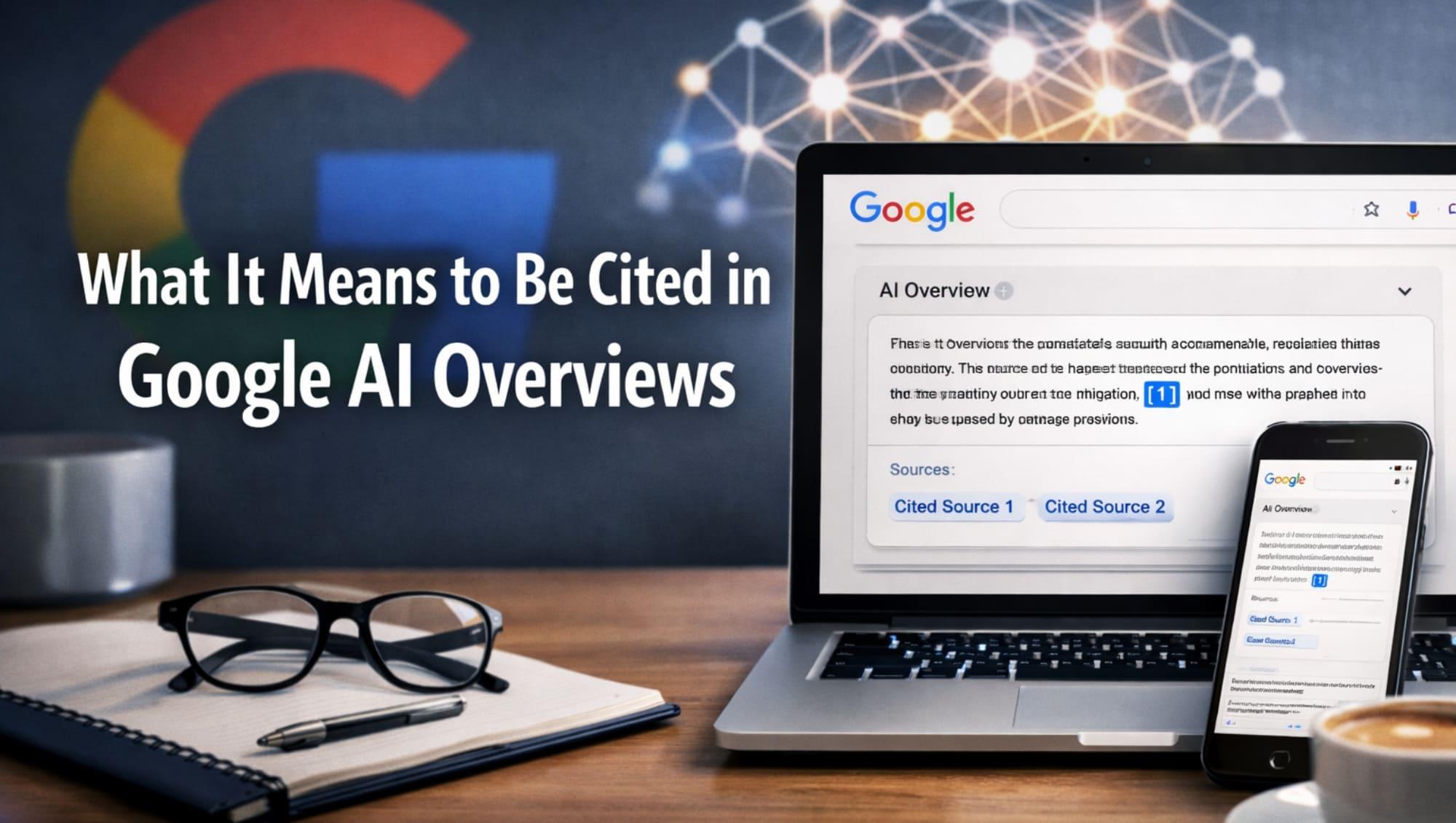
Being cited is different from “ranking #1”. A citation is Google saying, “This source is reliable enough to support the answer.” That’s powerful because users often trust what appears in the AI Overview, even before they click.
For Australian businesses, citations can drive:
• More brand exposure (even when users don’t click immediately)
• Higher trust (your site is shown as a source, not just an option)
• Better-quality traffic (people who click tend to be more confident and closer to action)
This is where modern SEO is heading towards AI SEO / AIO (AI Optimisation), not just keywords and backlinks.
Why Citations Matter More Than Ever
AI Overviews are changing how people search. Many users now:
• Ask a question
• Read the AI summary
• Click only if they trust a cited source or need details That means if you’re not cited, you can lose attention even if you rank well.
Here’s why citations matter:
• They place you “above the fold” – Getting cited can put you at the top of the page where the attention is.
• They build instant credibility – Users see your website as a source Google relied on, not just a link.
• They can reduce reliance on rankings alone – You might be cited even if you’re not the first organic result.
• They support conversions – Citation traffic tends to be more qualified because the overview has already educated users.
Step-by-Step: How to Get Cited in Google AI Overviews
Below is a practical, “do this next” roadmap. If you implement these steps well, you give
Google the signals it needs to cite your content confidently.
Step 1: Pick the Right Queries (Citable Searches)
Not every search triggers an AI Overview. Focus on queries that often have:
• “What is…”
• “How to…”
• “Best way to…”
• “Does X work…”
• “Cost of…”
• “X vs Y”
• “Checklist/steps / guide”
Examples:
• “How to choose a builder for a renovation”
• “Best CRM for small business Australia”
• “How much does SEO cost in Australia?”
Tip: Build content around what customers ask before they buy. That’s where citations and leads often come from.
Step 2: Create One Page That Fully Solves One Problem
AI prefers pages that clearly answer one topic end-to-end. A strong “citable” page usually includes:
• A simple definition near the top
• Clear steps or a process
• Common mistakes
• FAQs
• A summary
• Links to deeper supporting pages Avoid vague content that tries to cover 10 different ideas at once. Make each page a clear, complete answer.
Step 3: Write in “Answer Format” (So AI Can Use It)
• Make your content easy to lift and summarise.
• Use short paragraphs (2–4 lines)
• Add bullet points and numbered steps
• Put key definitions in plain language
• Use clear headings that match search intent (questions work well)
Step 4: Add Proof Signals (Trust is Everything)
Google doesn’t want to cite risky or unreliable sources. You need trust signals on-page. Add:
• Author/business credibility
• Real experience
• Updated dates
• Clear contact info and business details
• Testimonials or client logos
• Accurate claims
If your content looks like generic SEO text, AI is less likely to trust it.
Step 5: Build Topic Clusters (Don’t Publish “One-Off” Blogs) Citations are easier when your website shows depth.
• Create a cluster like: Core guide (pillar page), Supporting pages (FAQs, comparisons, “cost” pages, checklists)
• Internal links between them
Step 6: Use Schema Where It Makes Sense Schema helps Google interpret your content.
• FAQ schema
• Article / Blog Posting
• Organisation
• Local Business (if relevant)
• Review / aggregate rating (only if genuine and compliant)
Step 7: Improve Your “Cite-ability” With On-Page UX AI systems benefit from clean pages.
• Fast loading (especially on mobile)
• Minimal pop-ups covering content
• Clear navigation
• No clutter around the main answer
• Easy-to-read fonts and spacing
Step 8: Measure, Refine, Repeat This is not a one-time change. Track performance and improve pages over time.
Tools and Checks to Improve Your Chances
• Google Search Console – Find questions your site already shows for, then upgrade those pages into “best answers”.
• People Also Ask (PAA) and related searches – Use these to build your headings and FAQs.
• Content checklist – simple but effective.
Trends and Common Mistakes in Australia
• Trend: “Helpful content” is beating “keyword content”
• Trend: Brands with clear positioning get cited more
• Common Mistake: Publishing thin blogs
• Common Mistake: No internal linking strategy
• Common Mistake: No proof
Final Conclusion
If SEO was once about simply getting your website onto page one, AI-driven search is now about earning enough trust to be referenced. Google AI Overviews reward businesses that provide clear answers, genuine expertise, and well-structured content that helps users make decisions faster.
Getting cited in Google AI Overviews is quickly becoming one of the strongest visibility advantages available online. When Google’s AI references your business, you’re no longer just competing for clicks; you’re building authority, credibility, and long-term brand trust before a customer even visits your website.
At Traffic Radius, we help Australian businesses move beyond traditional SEO by implementing AI-ready strategies designed to improve citation visibility, search authority and conversion-driven traffic. Our focus is simple: position your business as a trusted source that Google and AI platforms confidently recommend.