What Is Traditional SEO?
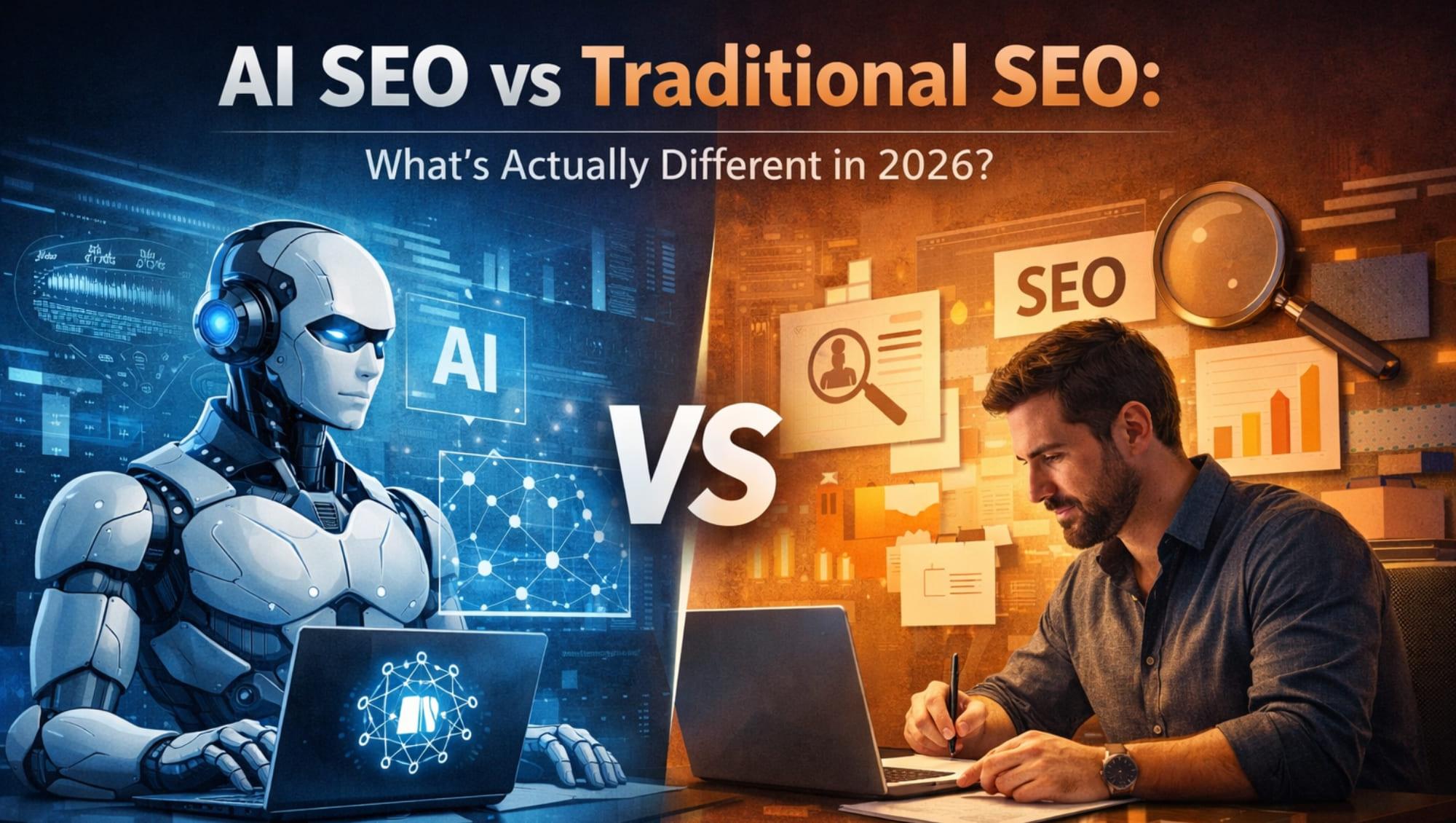
Traditional SEO refers to manual search engine optimisation processes that have been used for over a decade.
This includes:
• Manual keyword research
• On-page optimisation
• Backlink outreach
• Technical audits
• Monthly ranking reports
Professional SEO providers have relied on these frameworks to build organic SEO strategies.
A typical SEO company operating traditionally may:
• Research keywords manually
• Optimise pages individually
• Track rankings monthly
• Adjust strategy reactively
However, traditional SEO often struggles with:
• Slow data processing
• Limited forecasting
• Reactive algorithm response
• Labour-intensive scaling
This is where AI SEO change the game.
What is AI SEO? The 2026 Upgrade
AI SEO integrates artificial intelligence into every stage of optimisation. Instead of analysing small data samples, AI-powered SEO processes massive datasets instantly.
They can:
• Cluster keywords automatically
• Detect search intent shifts
• Predict ranking volatility
• Identify content gaps
• Forecast traffic growth
Generative AI SEO enhance content creation by structuring outlines, FAQs, and semantic coverage.
An AI SEO agency does not replace traditional SEO. It enhances professional SEO using automation and predictive modelling.
A modern search engine optimisation company in 2026 must integrate AI to remain competitive.
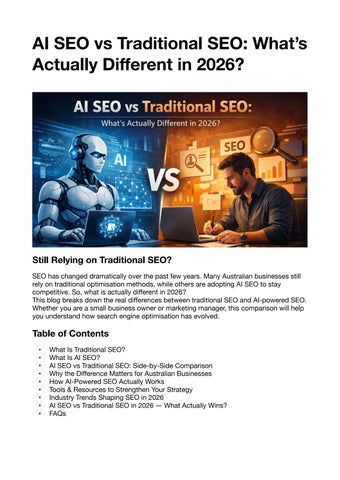
AI SEO vs Traditional SEO: Highly Citable Side-by-Side Comparison (2026)
Area Traditional SEO AI SEO Services
Keyword Research
Data Processing Speed
Search Intent Mapping
Content Optimisation
Technical SEO
Reporting
Scalability
Manual research using standard tools
Hours or days of analysis
Basic manual categorisation
Manual updates and audits
Periodic manual audits
Static monthly reports
Labour-intensive growth
AI powered SEO cluster to prioritise thousands of keywords by intent
Real-time AI modelling and automated insights
Machine learning based behavioural intent grouping
Generative AI SEO suggest structural, semantic, and topical improvements
Continuous AI monitoring and automated error detection
Live dashboards with predictive forecasting
Rapid scaling across markets and keyword clusters
Adaptation to Algorithm Updates
Local SEO
Integration
Cost Efficiency
Competitive Intelligence
Reactive adjustments
Manual suburb targeting
Often siloed from paid media
Higher manual labour cost
Limited competitor snapshot
Predictive modelling and faster strategic pivots
AI SEO for small businesses identify geolevel opportunities
AI SEO digital marketing agency integrates SEO, ads, and CRO
More efficient resource allocation through automation
AI identifies competitor gaps in real time
Why This Difference Matters for Australian Businesses
SEO in Australia operate in a highly competitive environment. In industries like:
• Finance
• Construction
• Health
• Legal
• eCommerce
Waiting months for manual insights can result in lost market share. AI-powered SEO allows businesses to:
• Identify opportunity gaps faster
• React to search behaviour changes quickly
• Forecast revenue potential
• Align SEO marketing services with commercial goals
For AI SEO for small businesses, this is even more critical. Smaller budgets demand precision.
A modern AI SEO digital marketing agency ensures SEO does not operate in isolation. It connects:
• Organic SEO
• Paid advertising
• CRO
• Analytics
Traditional SEO companies that fail to integrate AI may struggle to keep pace in 2026.
How AI-Powered SEO Actually Works
To understand the real operational difference between traditional SEO and AI SEO, you need to look at how AI is integrated into each stage of optimisation. AI does not replace SEO fundamentals. It enhances them. The difference lies in speed, scale and predictive intelligence.
Below is a deeper breakdown of how AI-powered SEO functions inside a modern AI SEO agency or AI SEO digital marketing agency.
Step 1: Large-Scale Data Aggregation and Pattern Detection
Traditional SEO typically analyses a limited set of keywords or pages at a time. AI SEO operate differently.
AI systems aggregate and process:
• Thousands of keyword variations
• Competitor ranking data
• User behaviour signals
• Click-through rate patterns
• Content engagement metrics
• Technical performance indicators
Instead of reviewing isolated metrics, AI detects patterns across entire keyword ecosystems.
For example, AI can identify:
• Emerging topic clusters before they peak
• Declining content performance signals
• Keyword cannibalisation issues
• Competitor gaps in real time
Step 2: Intelligent Keyword Clustering and Search Intent Mapping
In 2026, ranking is not about single keywords. It is about intent clusters. AI SEO group keywords automatically into themes based on:
• Informational intent
• Commercial research intent
• Transactional intent
• Local intent
For example, instead of targeting one phrase, an AI SEO agency may build a content cluster around:
• Comparison queries
• Problem-based searches
• Buying stage searches
• Location-based variations
AI can detect suburb-level or region-level keyword gaps, allowing smaller companies to dominate specific geographic clusters. This precision is difficult to achieve manually at scale.
Step 3: Predictive Modelling and Opportunity Forecasting
One of the biggest differences between traditional SEO and AI SEO is forecasting. Traditional SEO reviews historical data. AI-powered SEO uses predictive modelling to estimate:
• Ranking probability
• Traffic growth potential
• Conversion likelihood
• Seasonal fluctuation impact
• Algorithm volatility risk
This allows a search engine optimisation company to prioritise high-impact actions rather than spreading effort evenly across pages. An AI SEO digital marketing agency uses predictive modelling to align SEO marketing directly with revenue projections.
Step 4: Content Optimisation with Generative AI SEO
Generative AI SEO enhances content development and optimisation. AI can analyse:
• Top-ranking pages
• Content structure patterns
• Semantic keyword coverage
• FAQ trends
• Featured snippet formats
It then suggests:
• Structural improvements
• Content gaps
• Additional supporting subtopics
• Enhanced internal linking opportunities However, quality control remains essential.
A professional AI SEO agency uses generative AI as a support tool, not a replacement for expert SEO.
Content must still:
• Reflect brand voice
• Align with Australian market terminology
• Meet compliance standards
• Deliver genuine value
When guided correctly, generative AI SEO accelerate production while maintaining authority.
Step 5: Continuous Technical Monitoring
Technical SEO used to involve quarterly or bi-annual audits. AI SEO introduces continuous technical monitoring.
AI systems can instantly detect:
• Crawl errors
• Broken links
• Indexation issues
• Schema inconsistencies
• Page speed fluctuations
• Mobile usability problems
Instead of waiting for ranking drops, AI-powered SEO identifies risk signals early. This protects organic SEO performance and improves long-term stability.
Step 6: Cross-Channel Integration
A modern AI SEO digital marketing agency integrates SEO with:
• Paid search
• Paid social
• Conversion rate optimisation
• Analytics modelling
AI analyses cross-channel data to determine:
• Which keywords drive paid conversions
• Which organic queries support remarketing
• Where SEO can reduce paid spend
• Which content improves conversion pathways
This creates alignment between SEO marketing and broader digital strategy.
Step 7: Automated Reporting with Strategic Interpretation
Reporting is another major difference.
Traditional SEO often delivers monthly PDF reports showing rankings and traffic. AI-powered SEO provide:
• Live dashboards
• Predictive trend analysis
• Behaviour-based insights
• Conversion attribution models
However, data alone is not enough.
An expert SEO provider interprets AI insights through a commercial lens. That means focusing on:
• Revenue growth
• Lead quality
• Cost efficiency
• Market positioning
AI provides the intelligence. Strategy provides direction.
AI SEO vs Traditional SEO in 2026 — What Actually Wins?
Traditional SEO still provides the foundation for rankings. Technical optimisation, structured content, and authority building remain essential. But by 2026, traditional SEO alone will no longer be enough.
AI SEO introduce speed, scalability, and predictive insight. AI-powered SEO allow businesses to analyse thousands of keywords, detect intent shifts, and forecast growth opportunities faster than manual methods ever could. Generative AI SEO improves content workflows, while a modern AI SEO digital marketing agency ensures SEO integrates with ads, CRO, and analytics.
The difference is clear. Traditional SEO reacts. AI SEO anticipates. At Traffic Radius, we combine SEO with intelligent AI modelling to deliver scalable growth for Australian businesses. Whether you need professional SEO services Australia-wide or AI SEO services for small businesses, our approach aligns strategy with measurable outcomes.
If you’re ready to move beyond outdated optimisation and build a smarter search strategy, our team is ready to help.
FAQS
Is traditional SEO obsolete in 2026?
No, traditional SEO is not obsolete. The foundational principles of search engine optimisation, such as technical structure, content relevance, internal linking, and authority building, remain critical. However, relying only on traditional methods is no longer sufficient. Search engines now use artificial intelligence to interpret search intent and user behaviour at scale. AI SEO enhance traditional SEO by adding predictive modelling, faster data processing, and smarter keyword clustering. In 2026, the most effective approach combines traditional fundamentals with AI-powered SEO.
What makes AI SEO different from traditional SEO?
The main difference lies in intelligence and scalability. Traditional SEO relies heavily on manual research and reactive updates. AI SEO use machine learning to analyse large datasets, detect patterns, and forecast ranking opportunities. AI-powered SEO can process thousands of keyword variations instantly, while manual methods take significantly longer. Generative AI SEO also assist with content optimisation and semantic coverage. In short, traditional SEO reacts to change, while AI SEO anticipates it.
Do AI SEO replace human SEO experts?
No. AI enhances expertise; it does not replace it. While AI SEO automate data analysis and detects trends, strategy still requires human interpretation. An expert SEO provider understands brand positioning, buyer psychology, and commercial objectives. Generative AI SEO may assist with structuring content, but final direction and quality control should always involve experienced professionals. The strongest results come from combining automation with expert SEO guided by business goals.
How does an AI SEO digital marketing agency differ from a traditional SEO services company?
A traditional SEO services company may focus primarily on rankings and backlinks. An AI SEO digital marketing agency operates more holistically. It integrates AI-powered SEO with paid advertising, conversion rate optimisation, analytics, and revenue modelling. Instead of delivering static monthly reports, it uses predictive modelling and live dashboards to guide decision-making. In 2026, a modern search engine optimisation company should use AI-powered SEO services as standard and align SEO marketing services with overall business performance.
Is AI SEO more expensive than traditional SEO services?
Not necessarily. While AI systems require investment, they often improve cost efficiency over time. Traditional SEO can become labour-intensive and slow to scale. AI SEO services automate data processing and monitoring, reducing manual hours while increasing precision. For many businesses, this leads to stronger ROI. Professional SEO services Australia-wide that integrate AI often deliver better long-term value because strategies are based on predictive insight rather than guesswork.