The Necessary Voice
Urban Uprisings and Police Violence
A series of riots and uprisings occurred in cities across the c response to police brutality, poverty, and institutional racism Watts Rebellion (1965) in Los Angeles saw six days of unres violent police encounter. Other major uprisings happened in Harlem, Newark, Detr Chicago throughout the late 1960s.
These uprisings revealed the explosive frustration of African living under oppressive conditions. Vietnam War and Draft Disparities African Americans were disproportionately drafted and sent in Vietnam.
Many questioned why they were fighting for “freedom” abroad didn’t have it at home.
Assassinations of Black Leaders
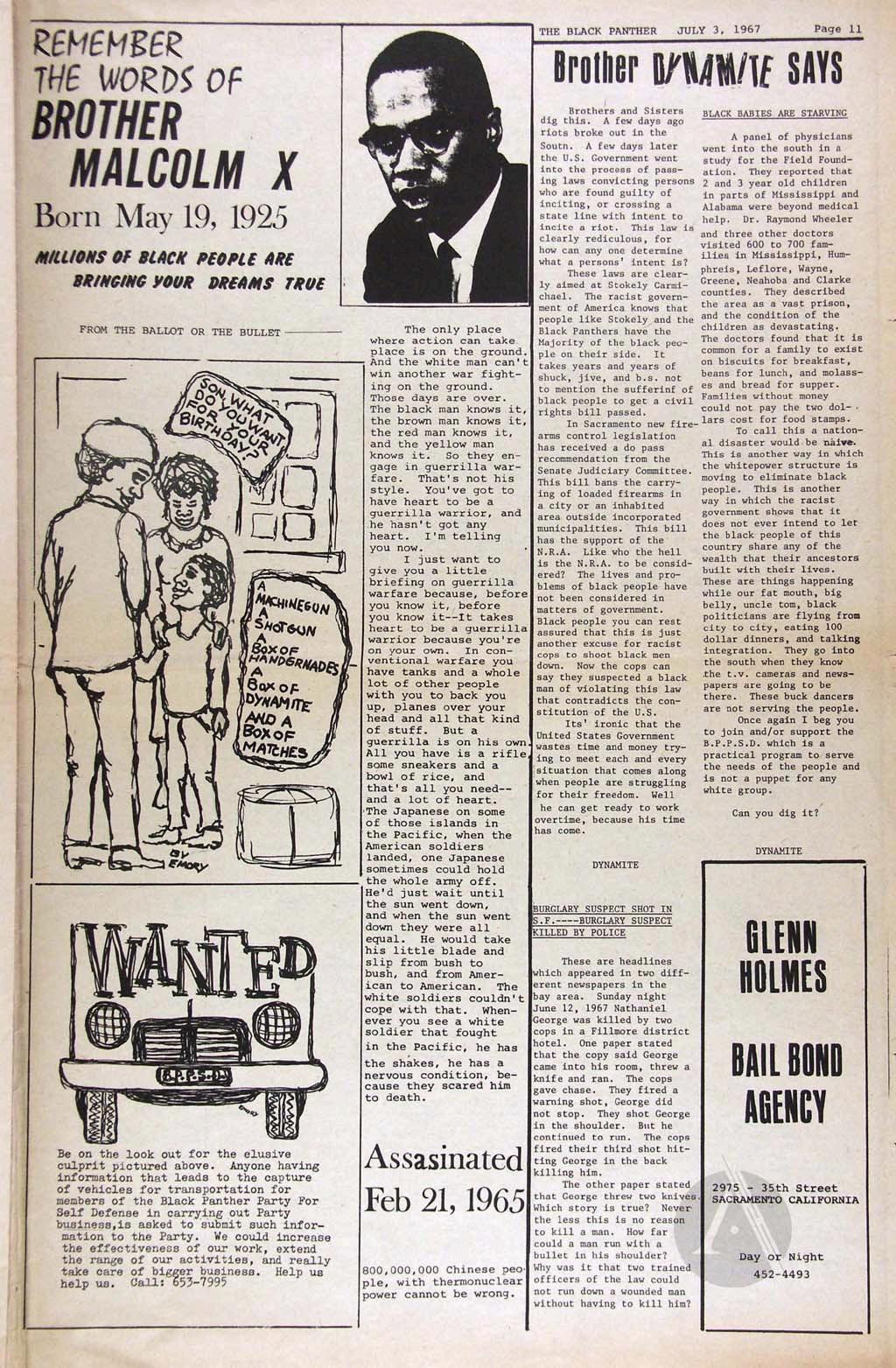
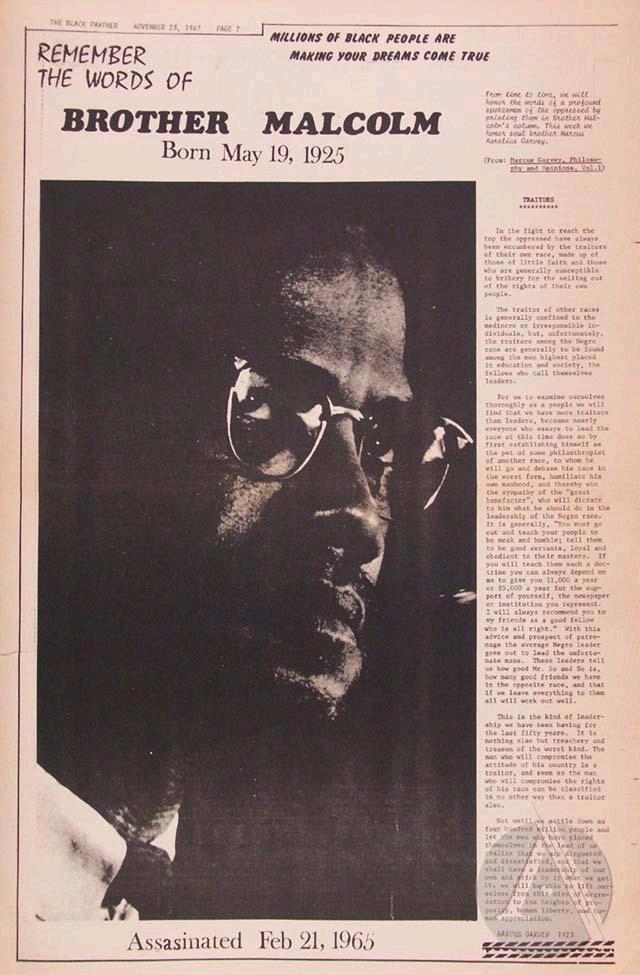
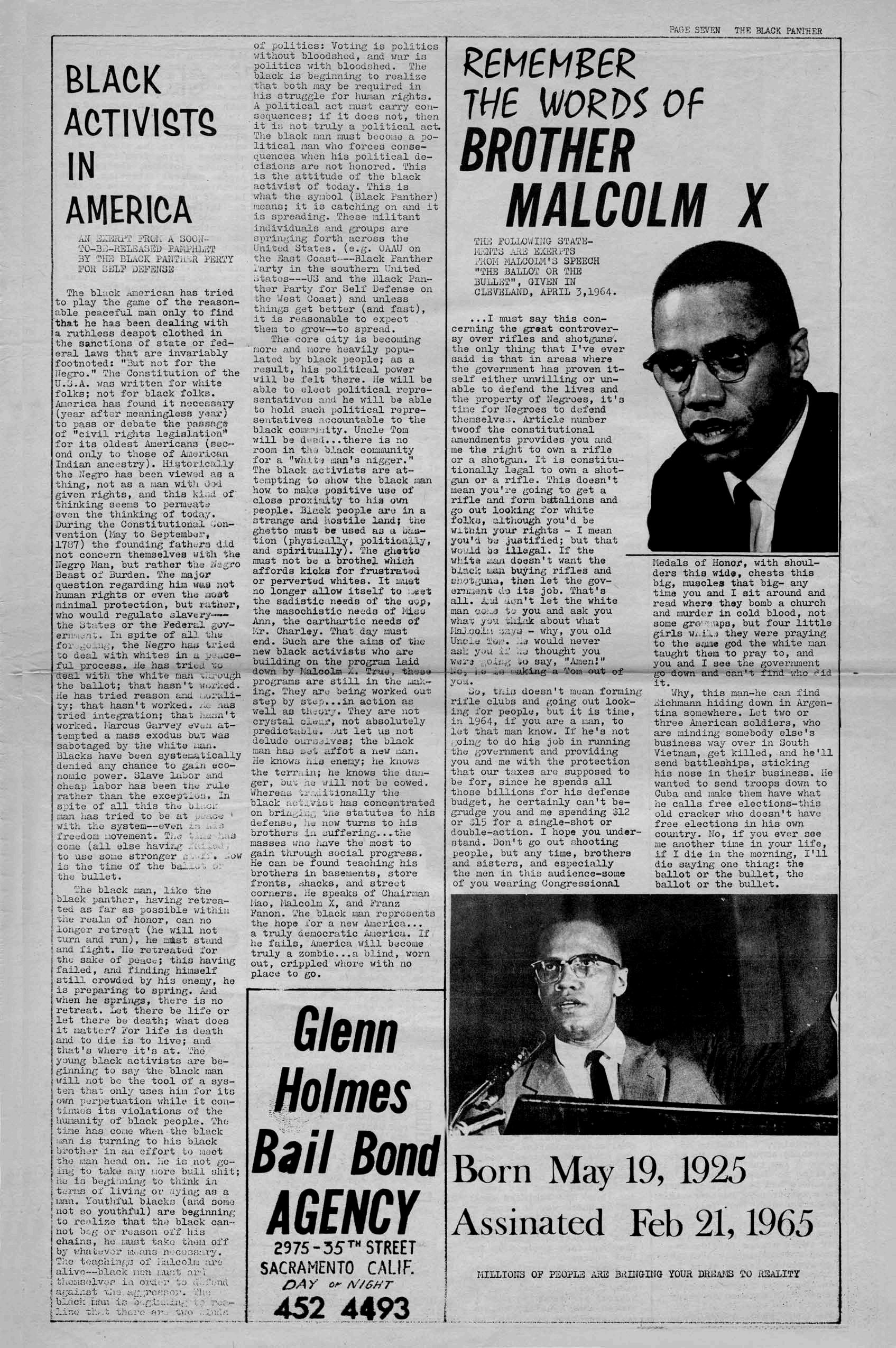
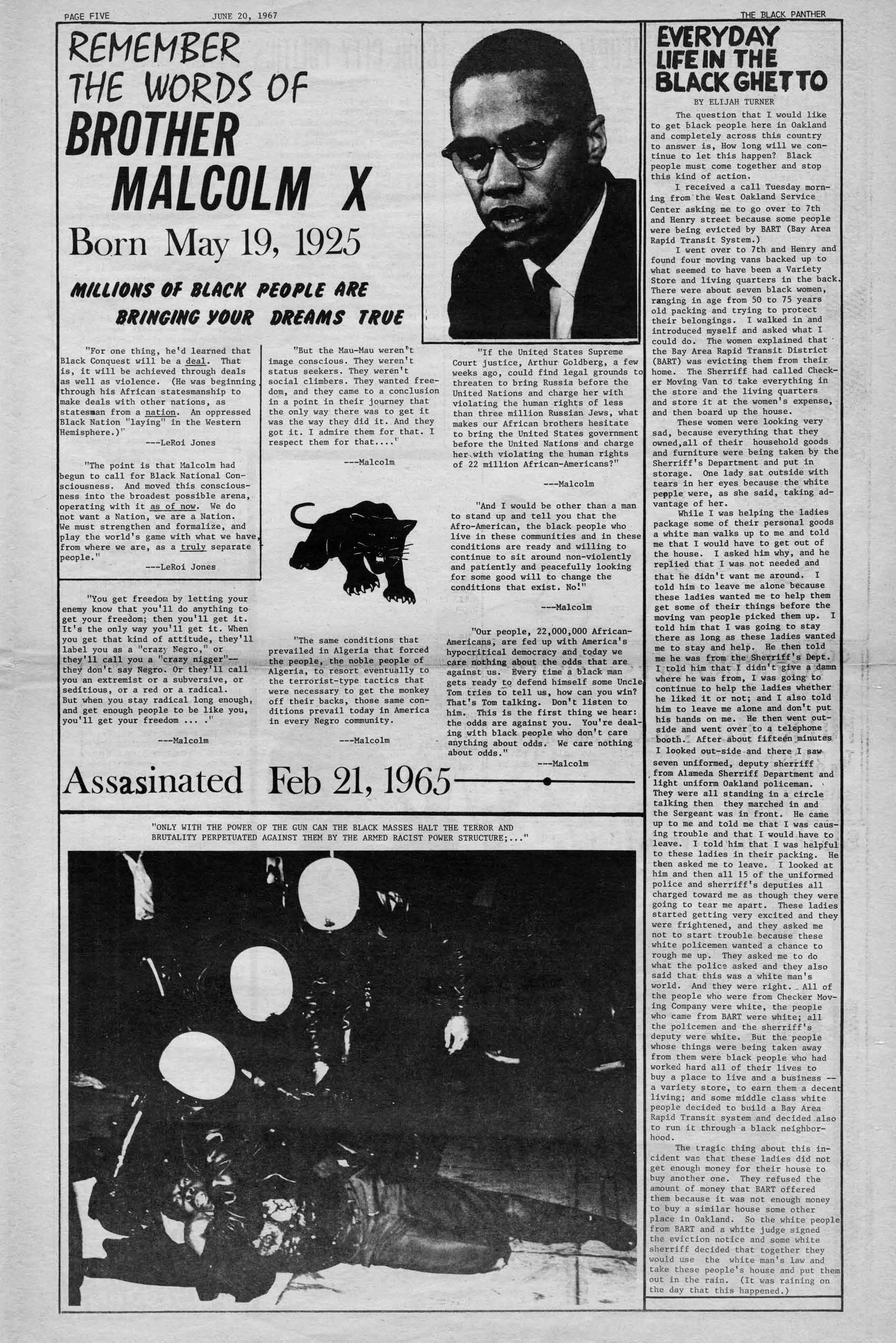
Malcolm X was assassinated in 1965.
Martin Luther King Jr would be assassinated in 1968 The deepened feelings of disillusionment and urgency within t community
Race Relations in the Country
Segregation and Discrimination: Though formal segregation was being dismantled, informal segregation persisted in housing, education, and employment.
Systemic Racism: African Americans faced entrenched racism in law enforcement, the justice system, and economic systems.
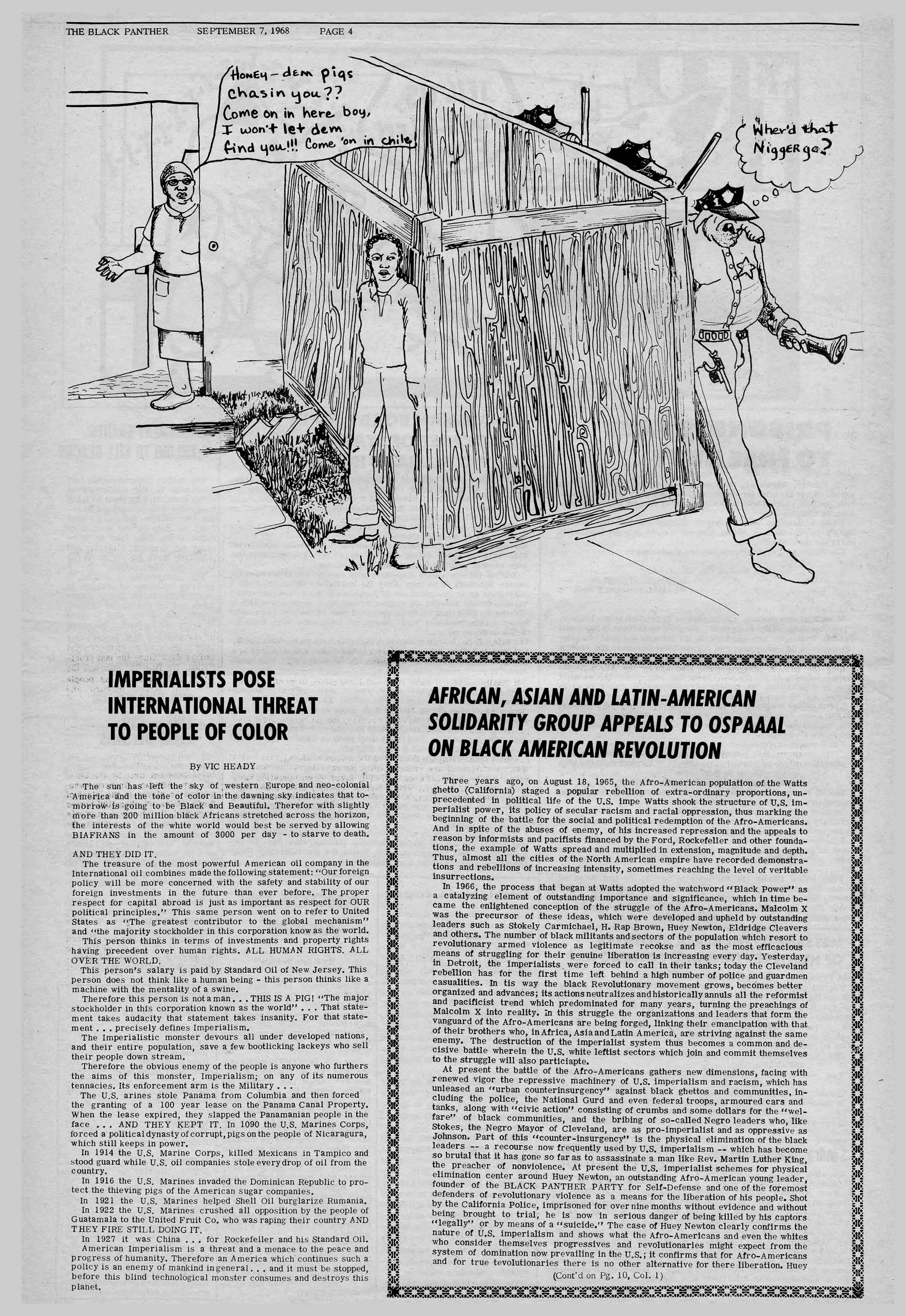
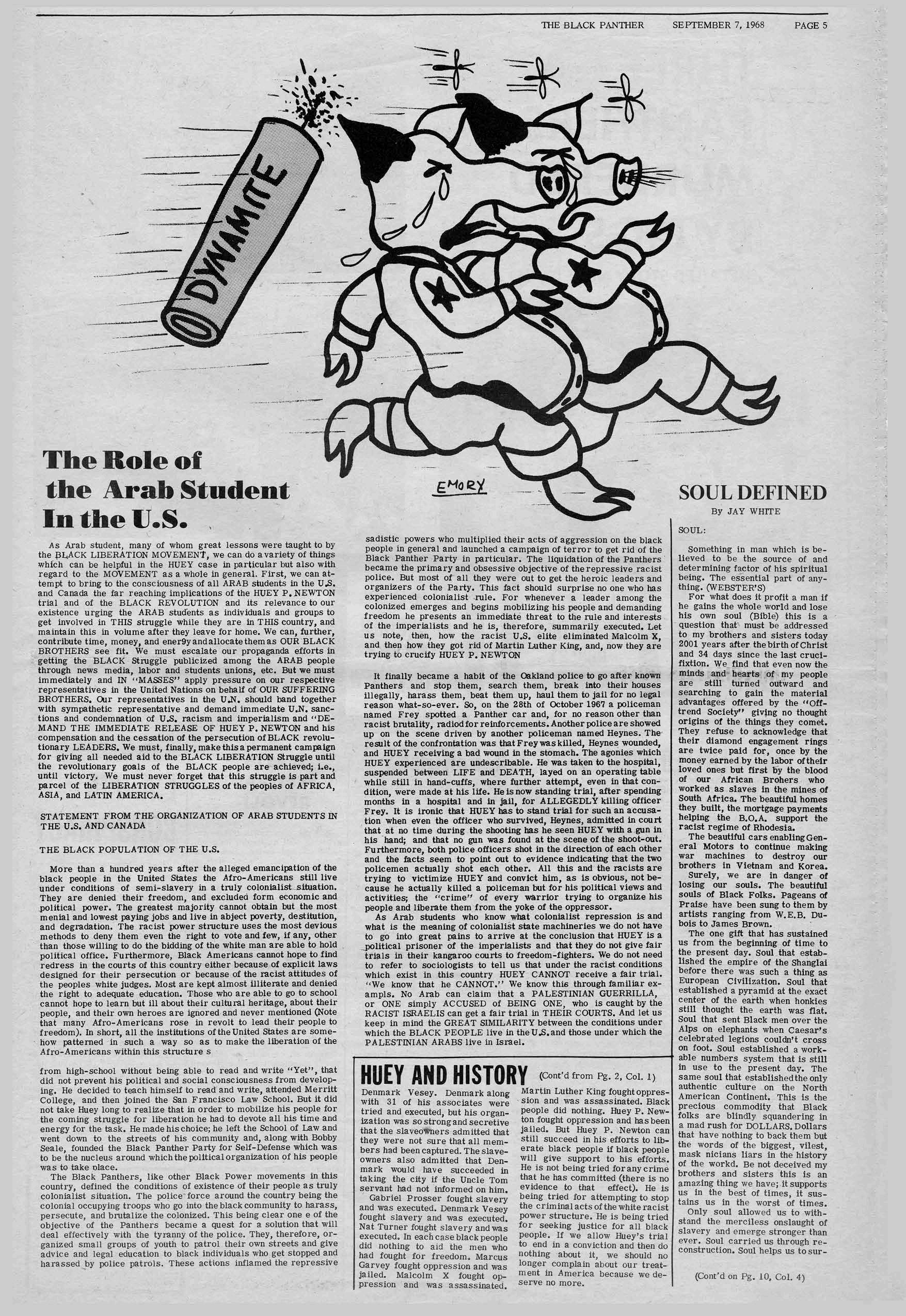
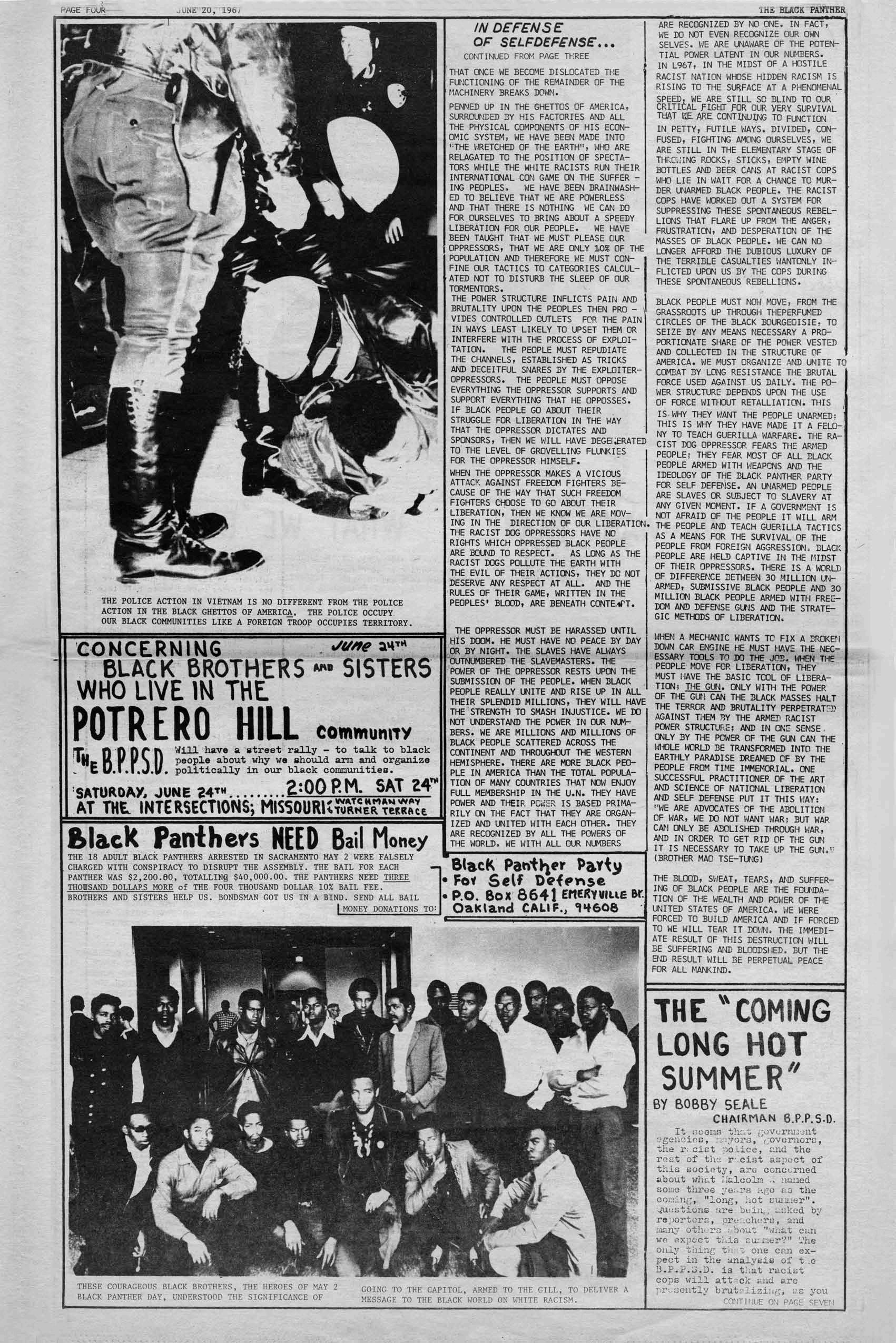
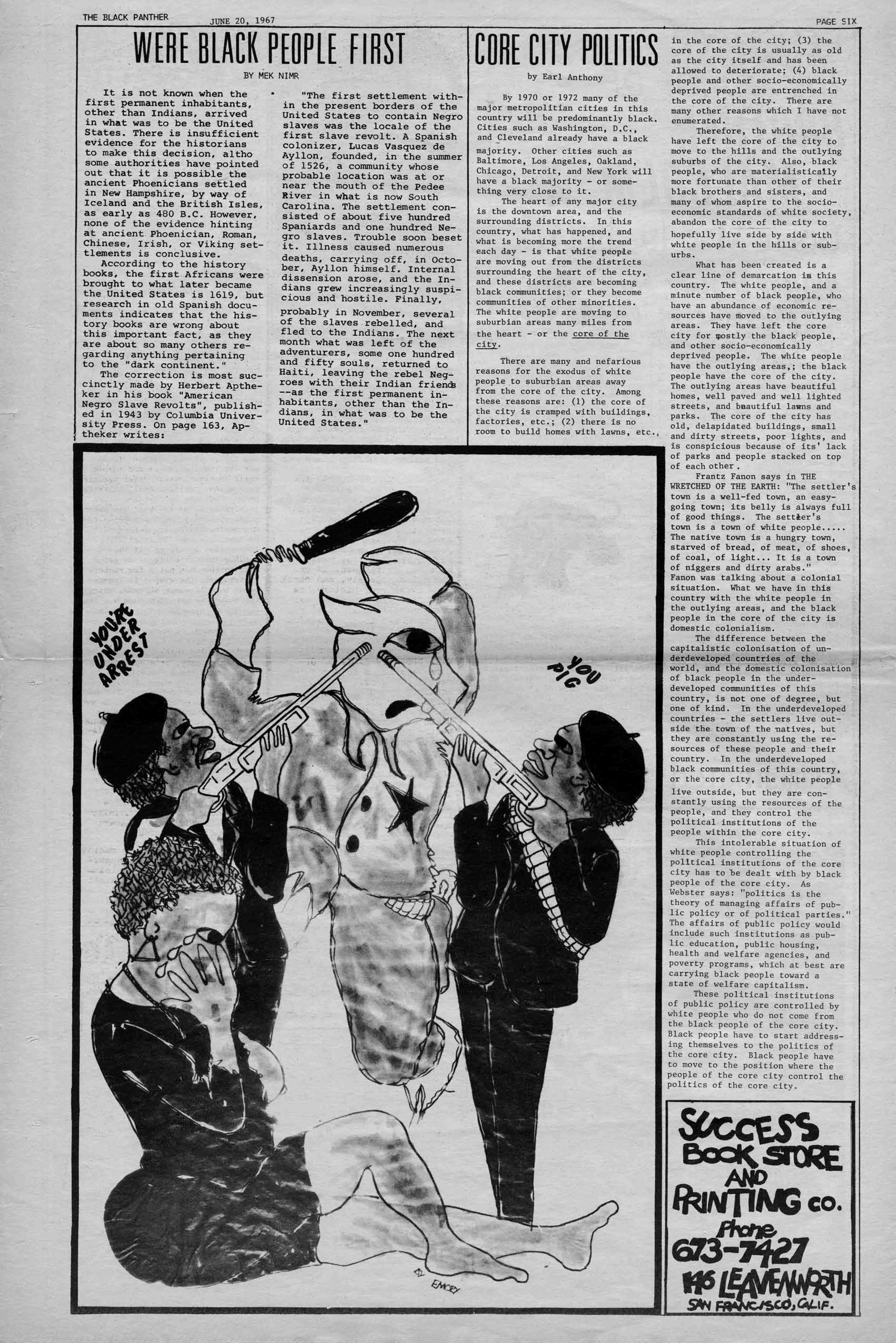
Police Brutality: Law enforcement agencies were often seen as occupying forces in Black neighborhoods. Incidents of excessive force and killings of Black people went largely unpunished.
African American Responses to Systemic Racism and Police Brutality
Formation of the Black Panther Party
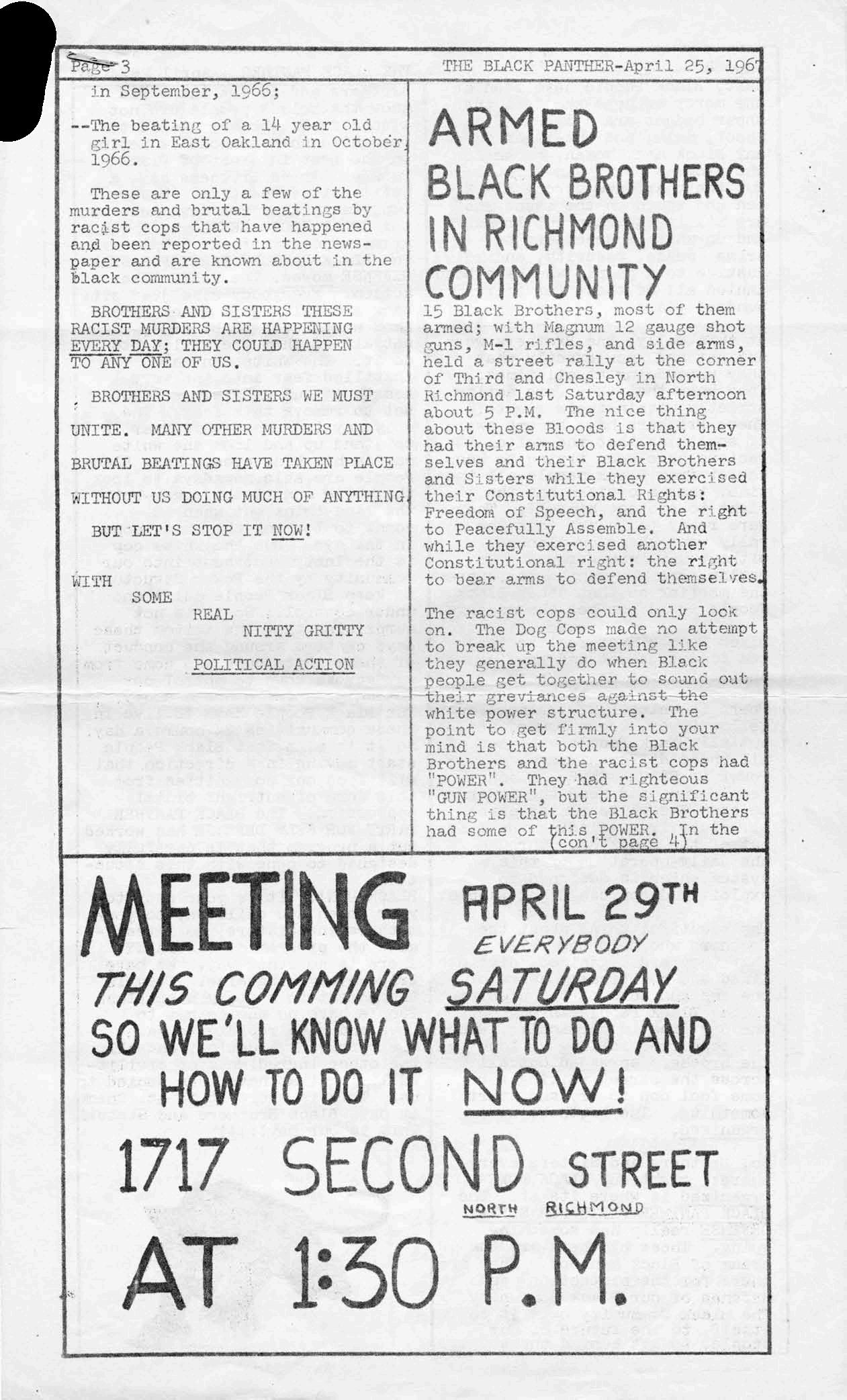
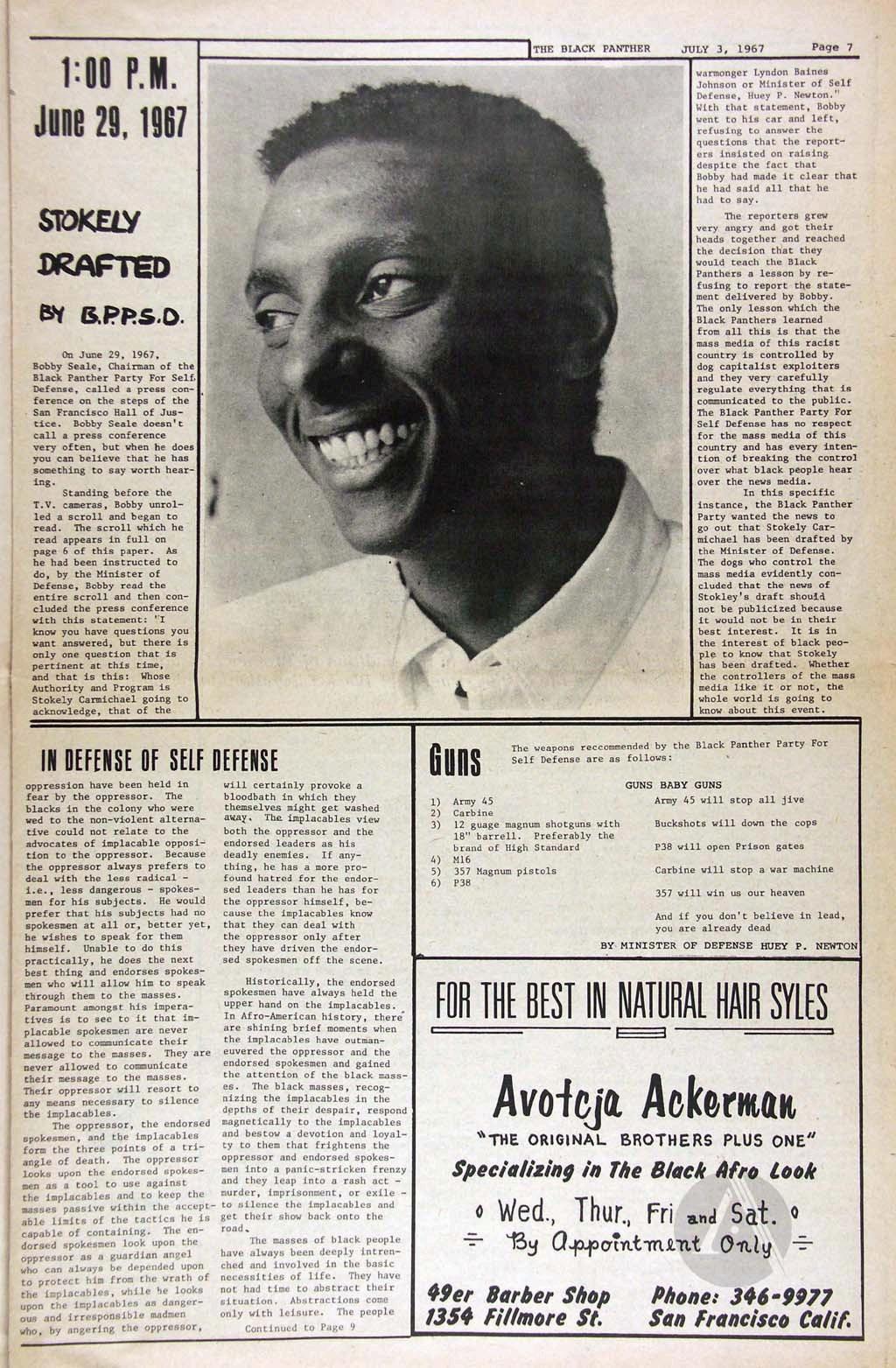
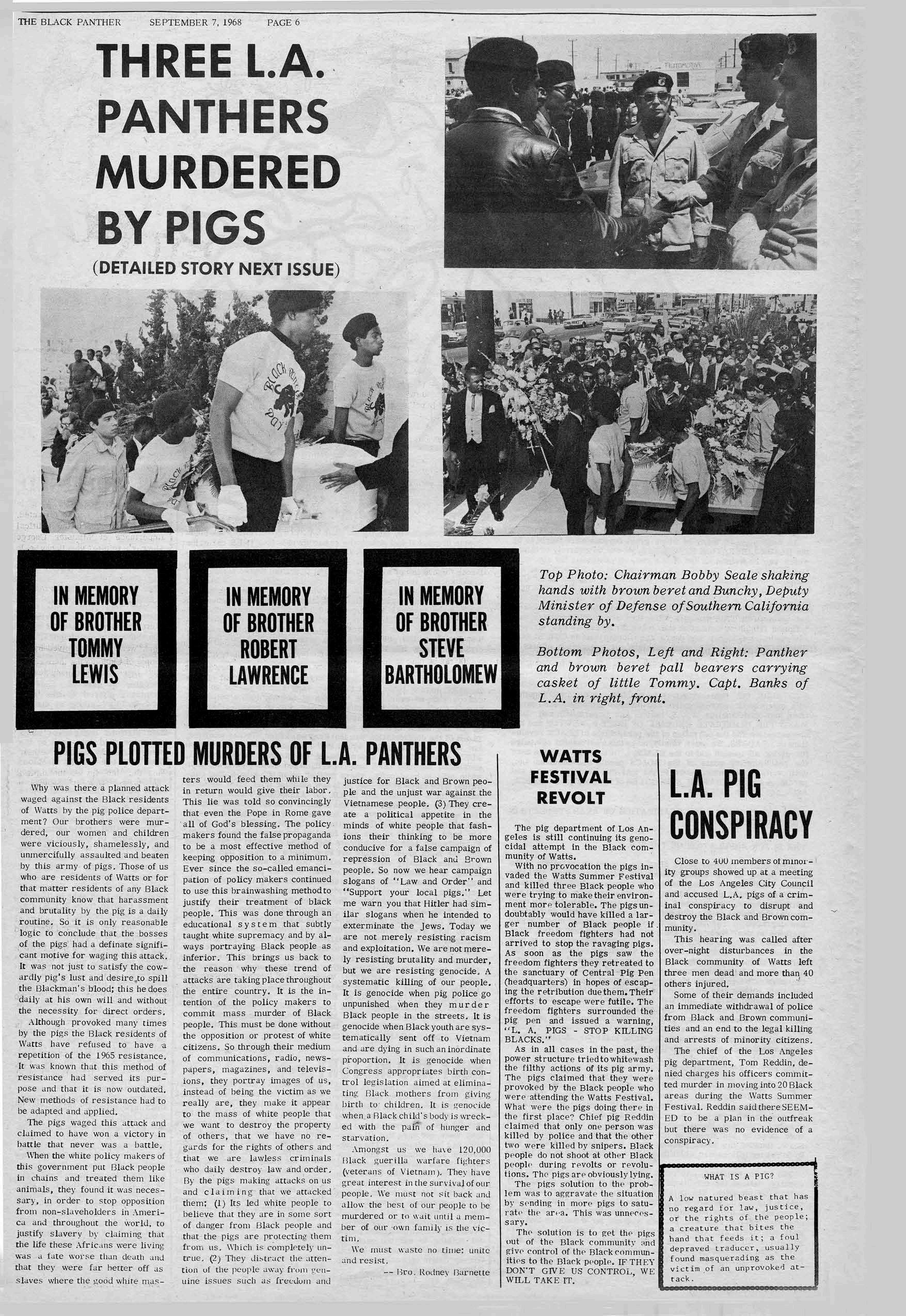
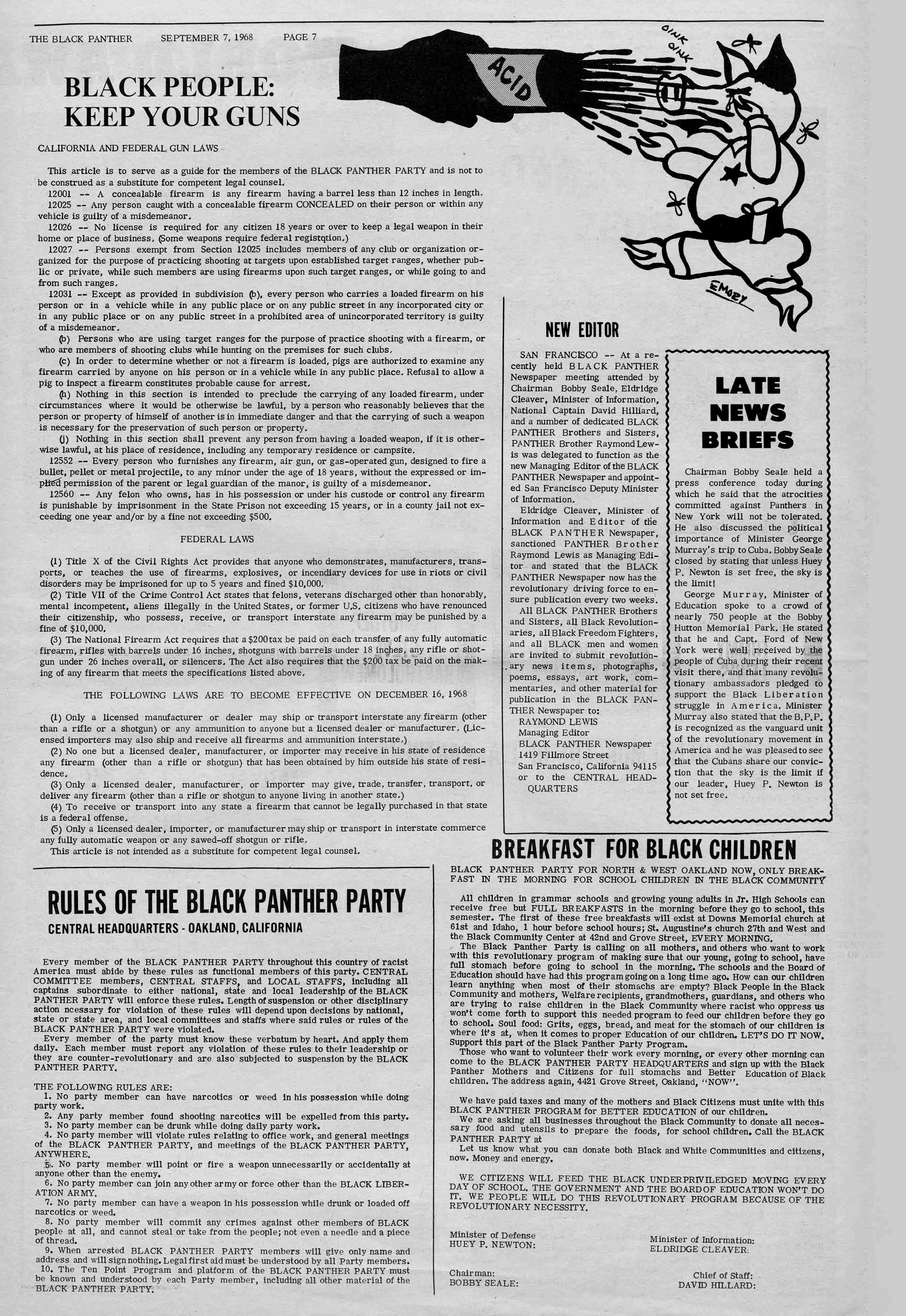
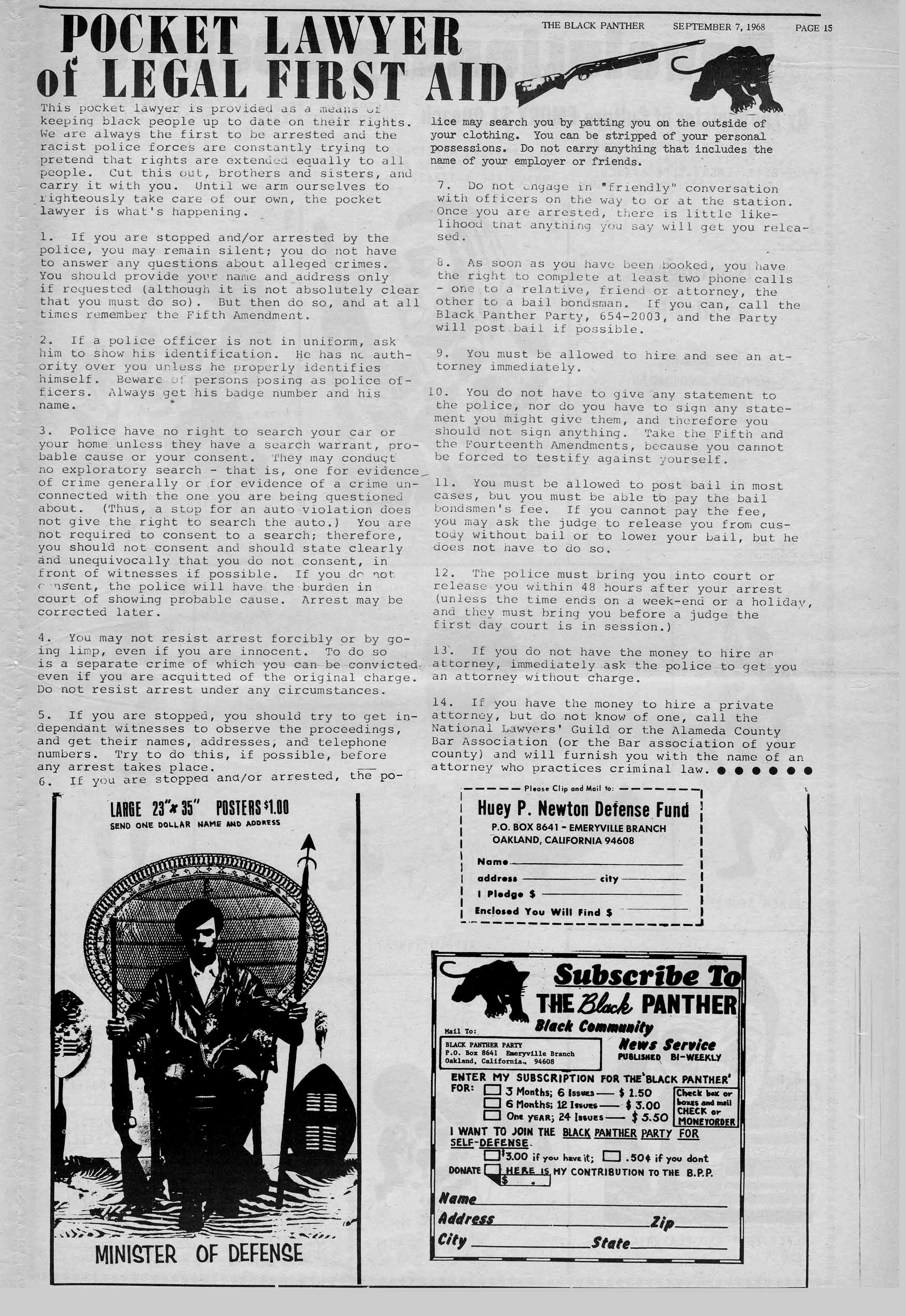
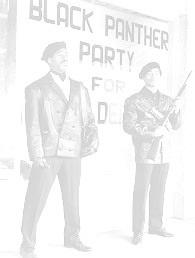
The Panthers organized community patrols to monitor police behavior and defend residents. They openly carried firearms (legal under California law at the time) as a statement of self-defense.
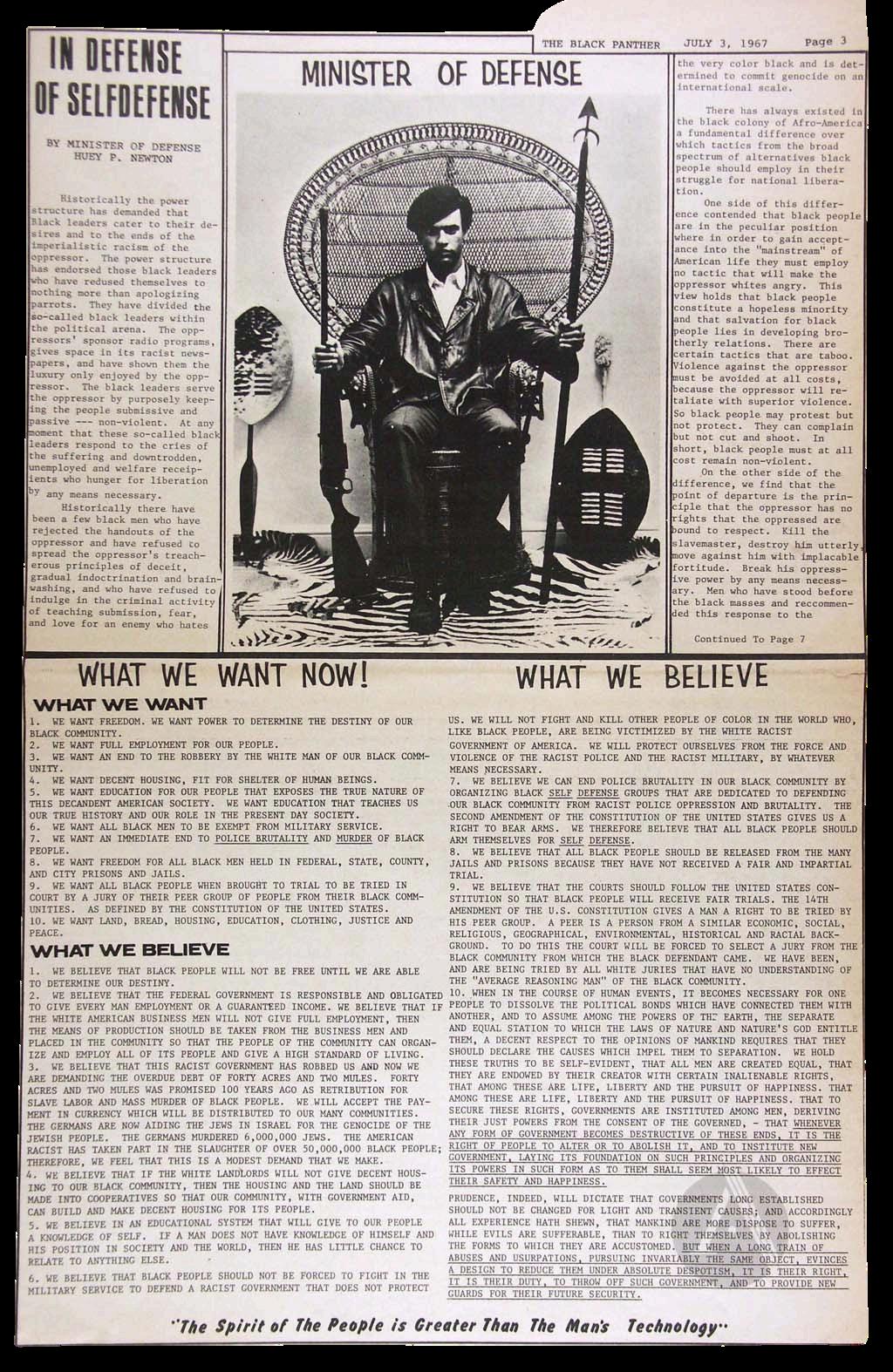
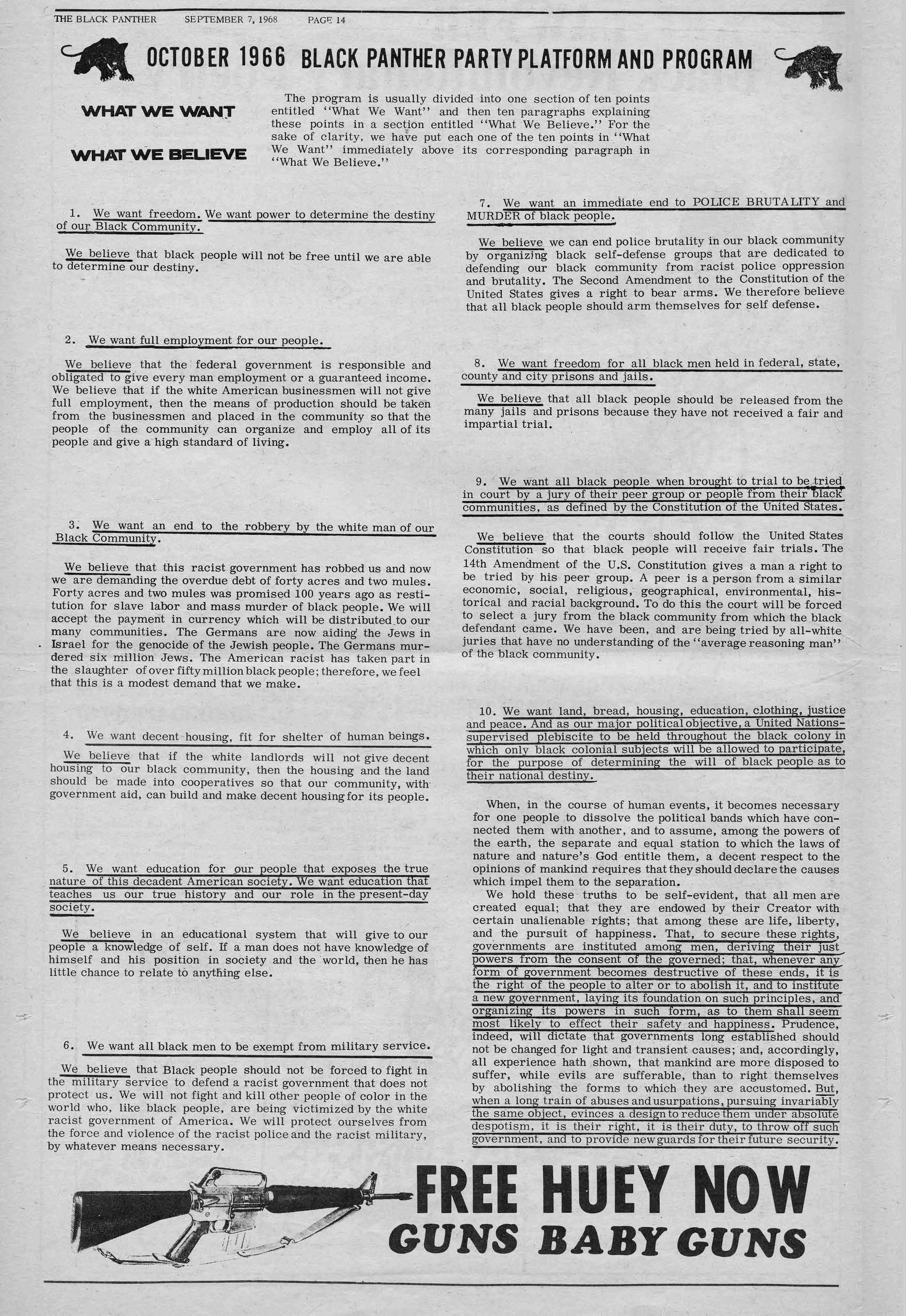
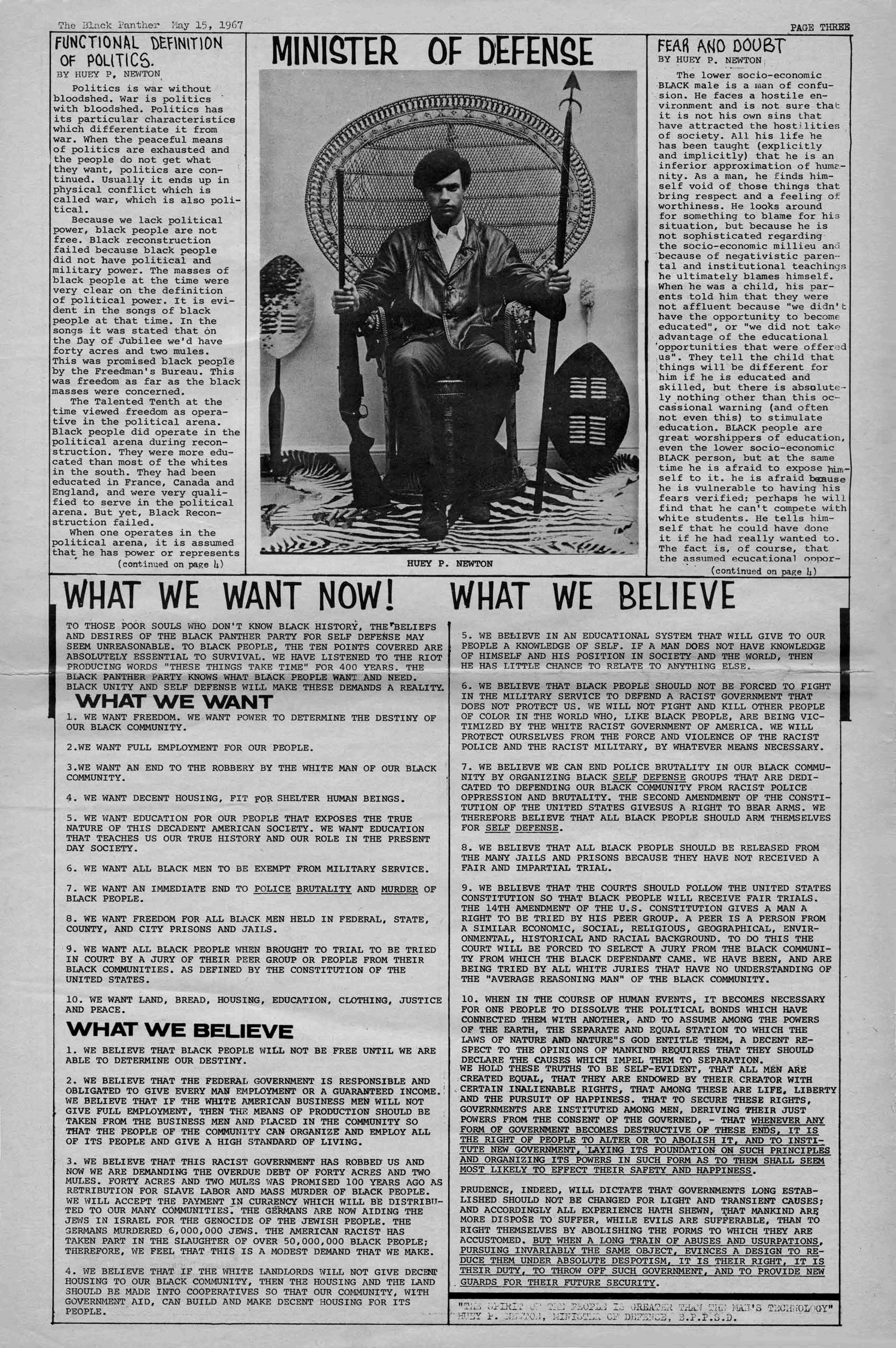
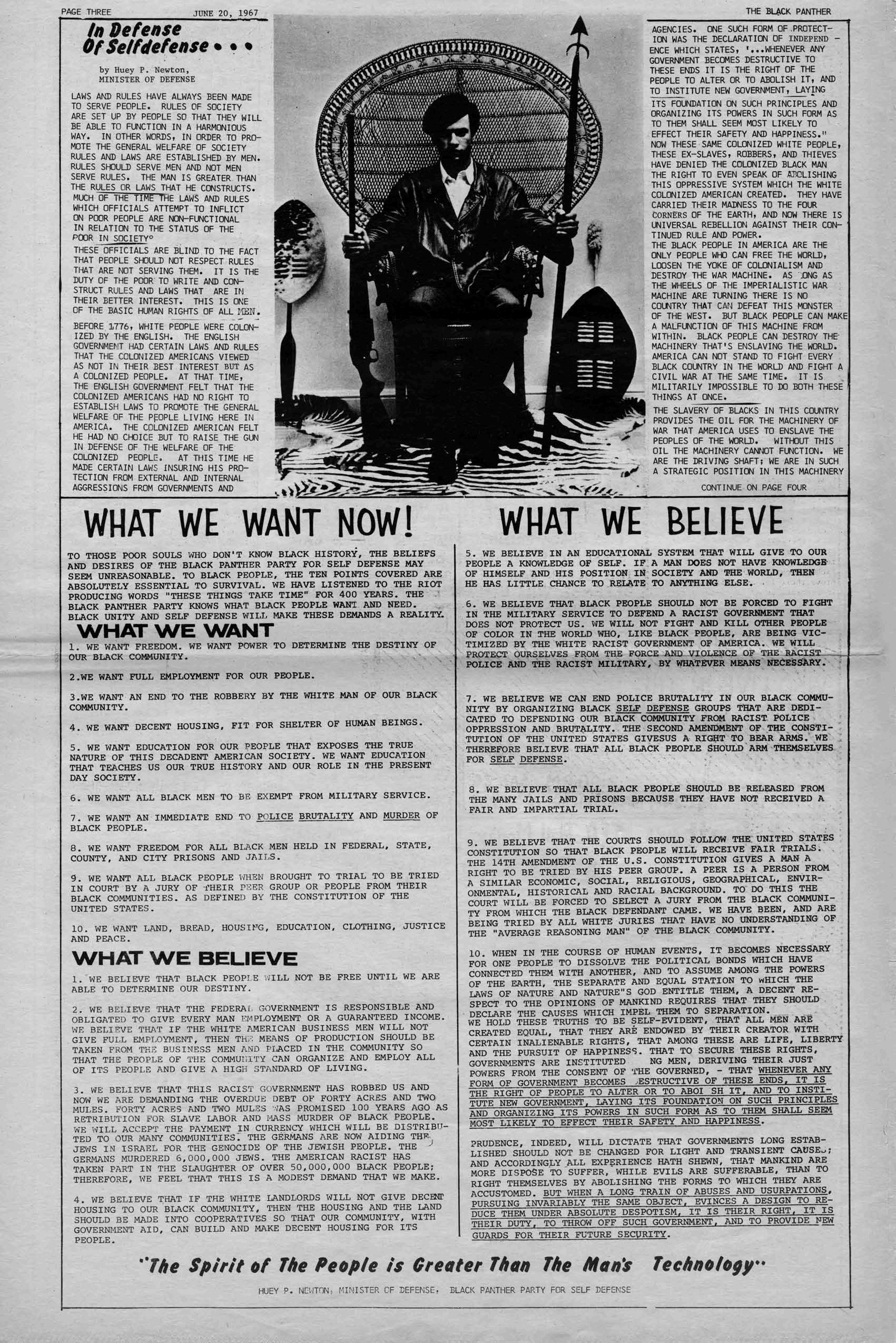
Their 10-Point Program demanded freedom, employment, decent housing, education, an end to police brutality, and justice.
Community Empowerment Programs
The Panthers launched “survival programs” like free breakfast for children, health clinics, and educational initiatives. These programs addressed the root causes of inequality while building solidarity and political consciousness.
Black Power Movement
Emerging alongside the Civil Rights Movement, the Black Power movement emphasized racial pride, self-determination, and economic empowerment.
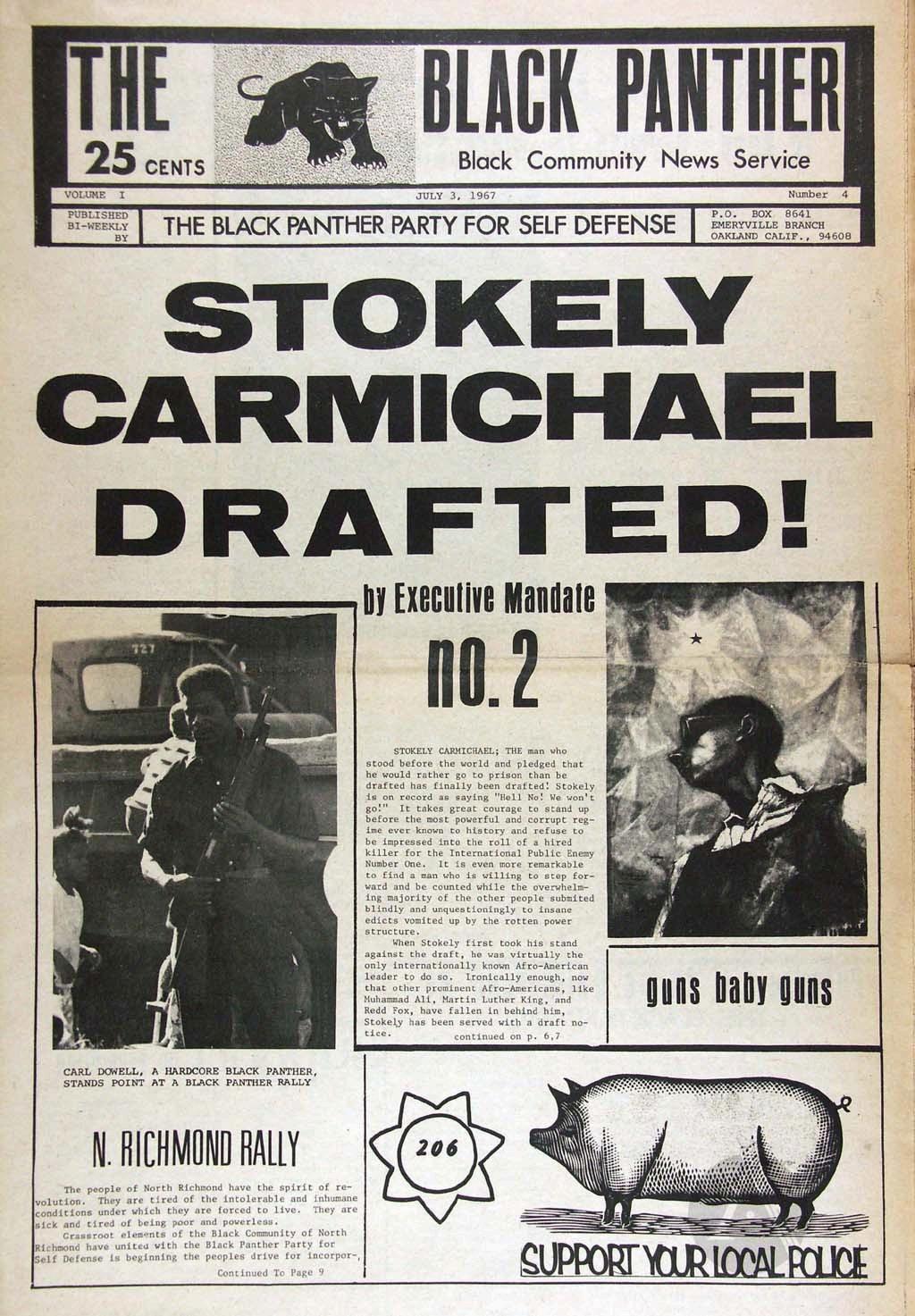
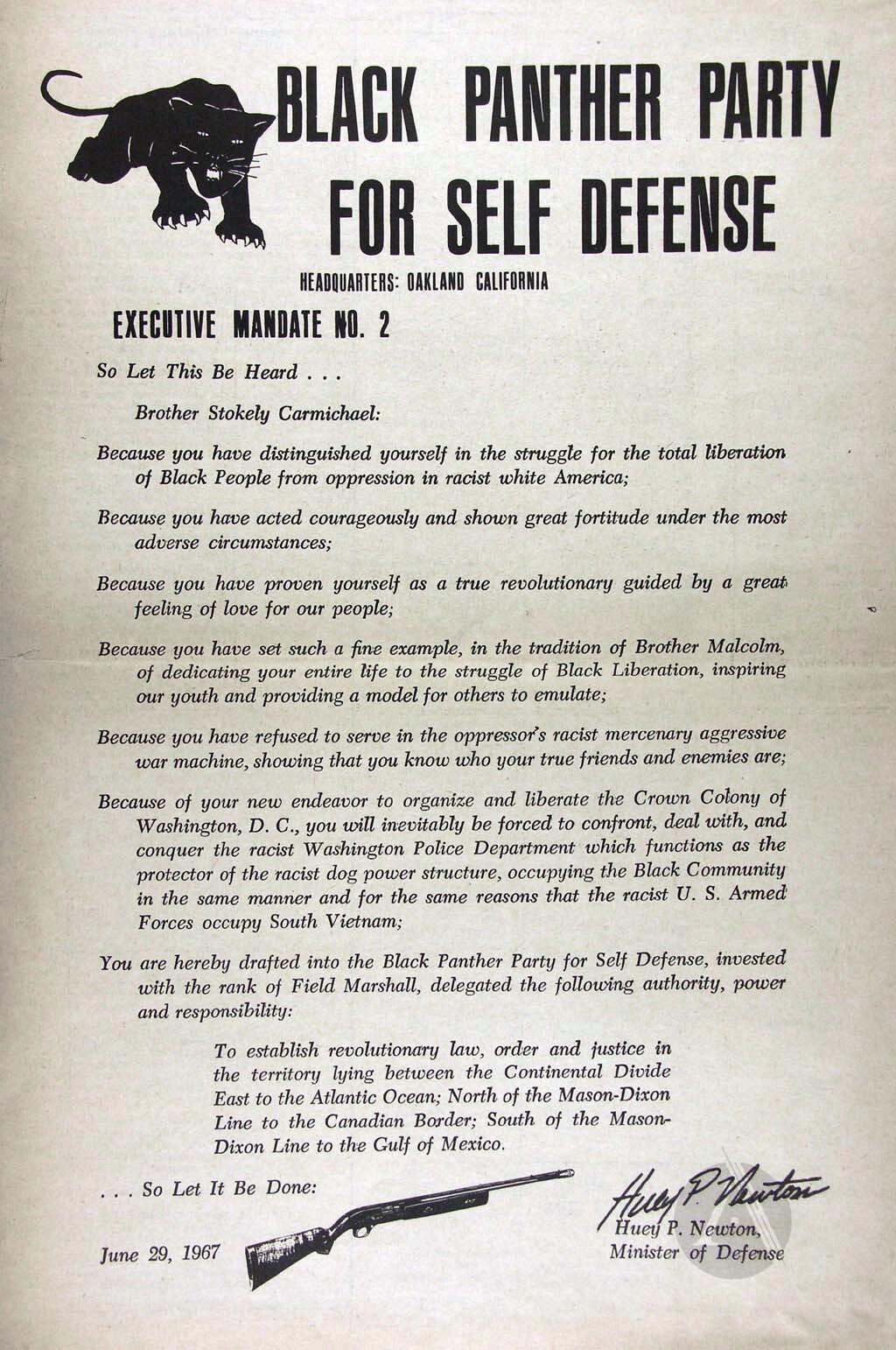
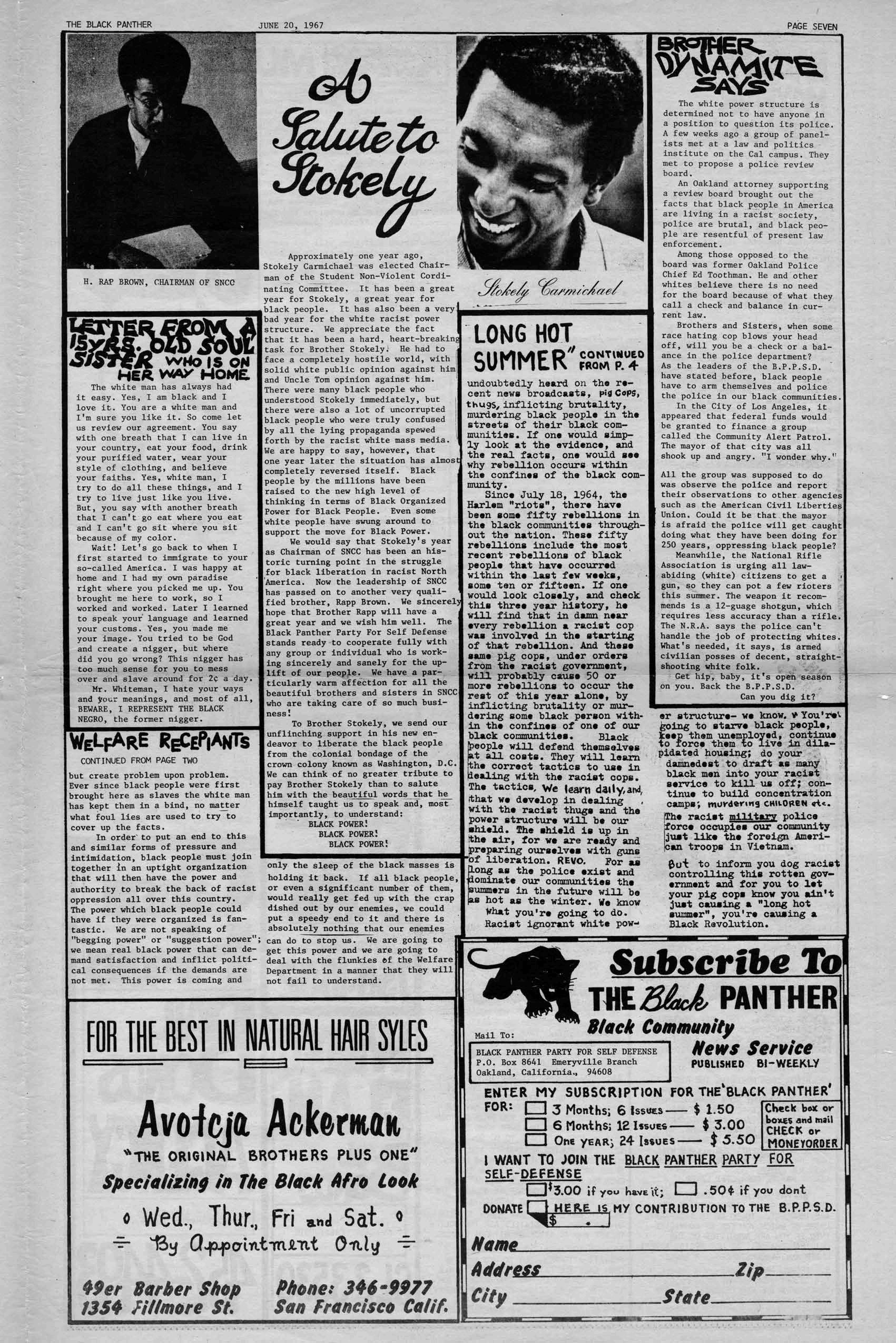
Leaders like Stokely Carmichael (Kwame Ture) advocated for a more militant and self- reliant approach to liberation.
Cultural Expression
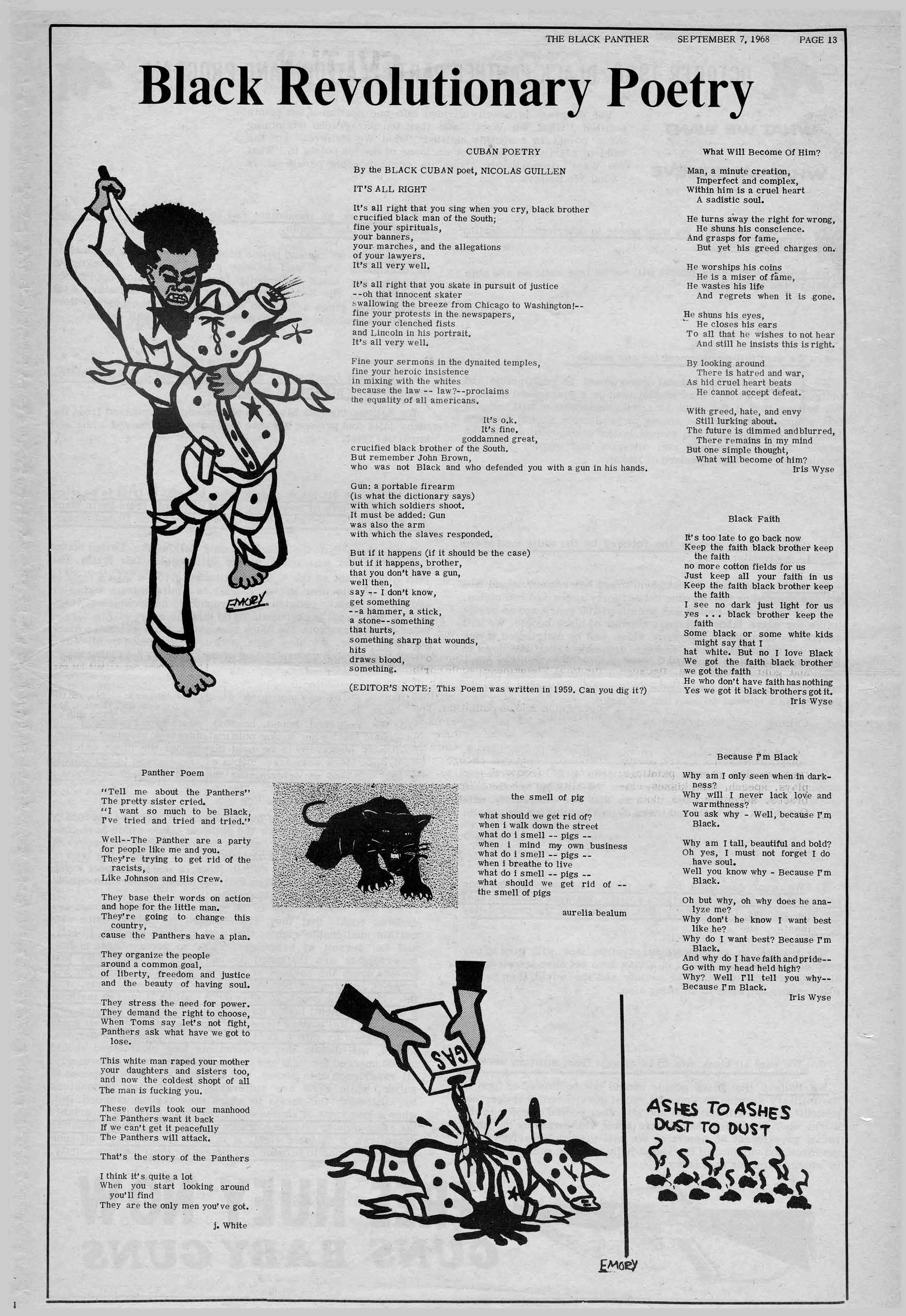
Black artists, poets, musicians, and writers used their work to highlight racial injustice and celebrate Black identity.
The Black Arts Movement paralleled political activism by reshaping narratives about African American life and history.
In summary, the Black Panther Party arose during a time of intense racial injustice, political repression, and grassroots organizing. African Americans responded to systemic racism with a mix of protest, political mobilization, community programs, and cultural pride refusing to remain silent in the face of oppression. The Panthers embodied this defiance with their bold stance on selfdefense, justice, and Black liberation.
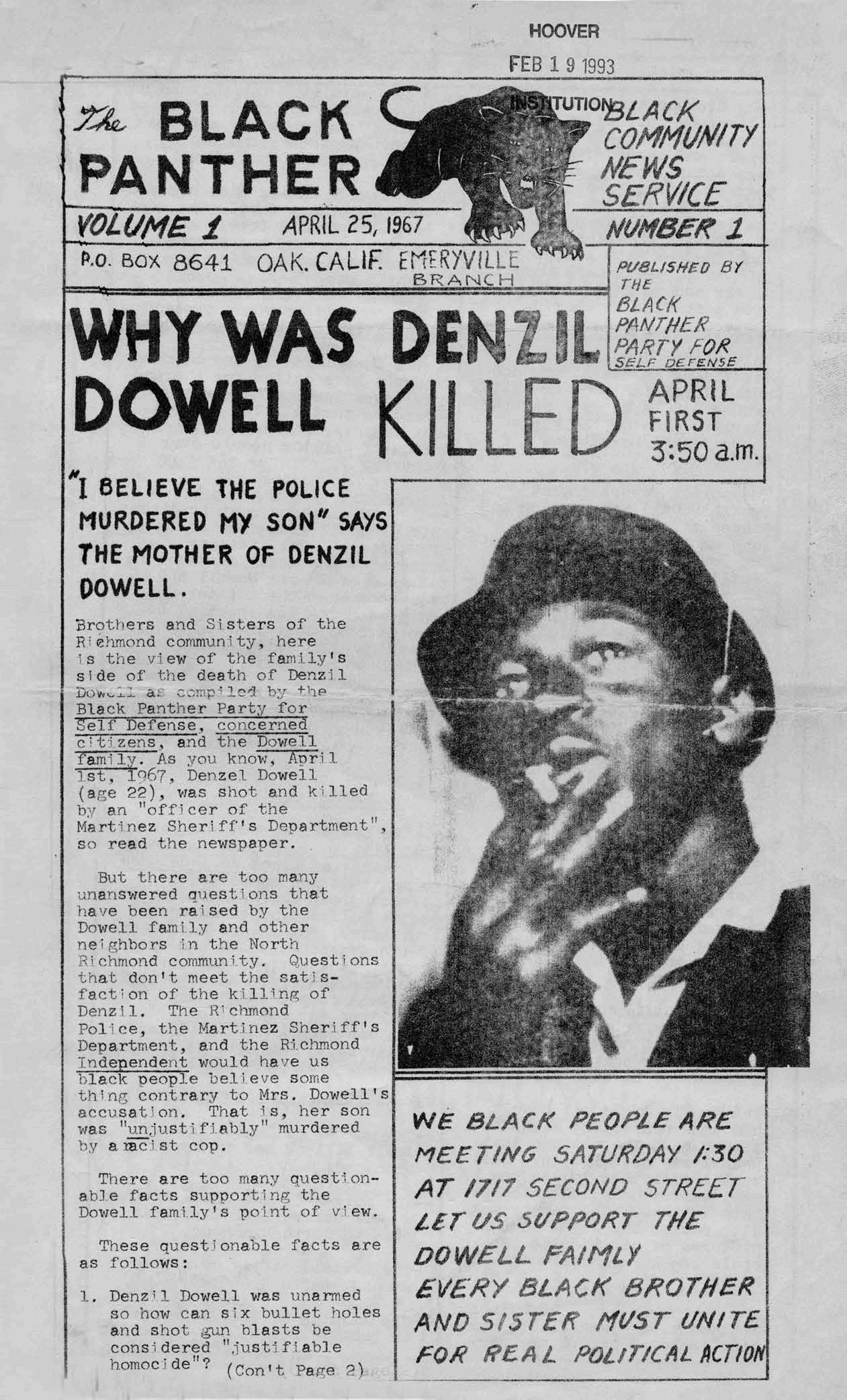
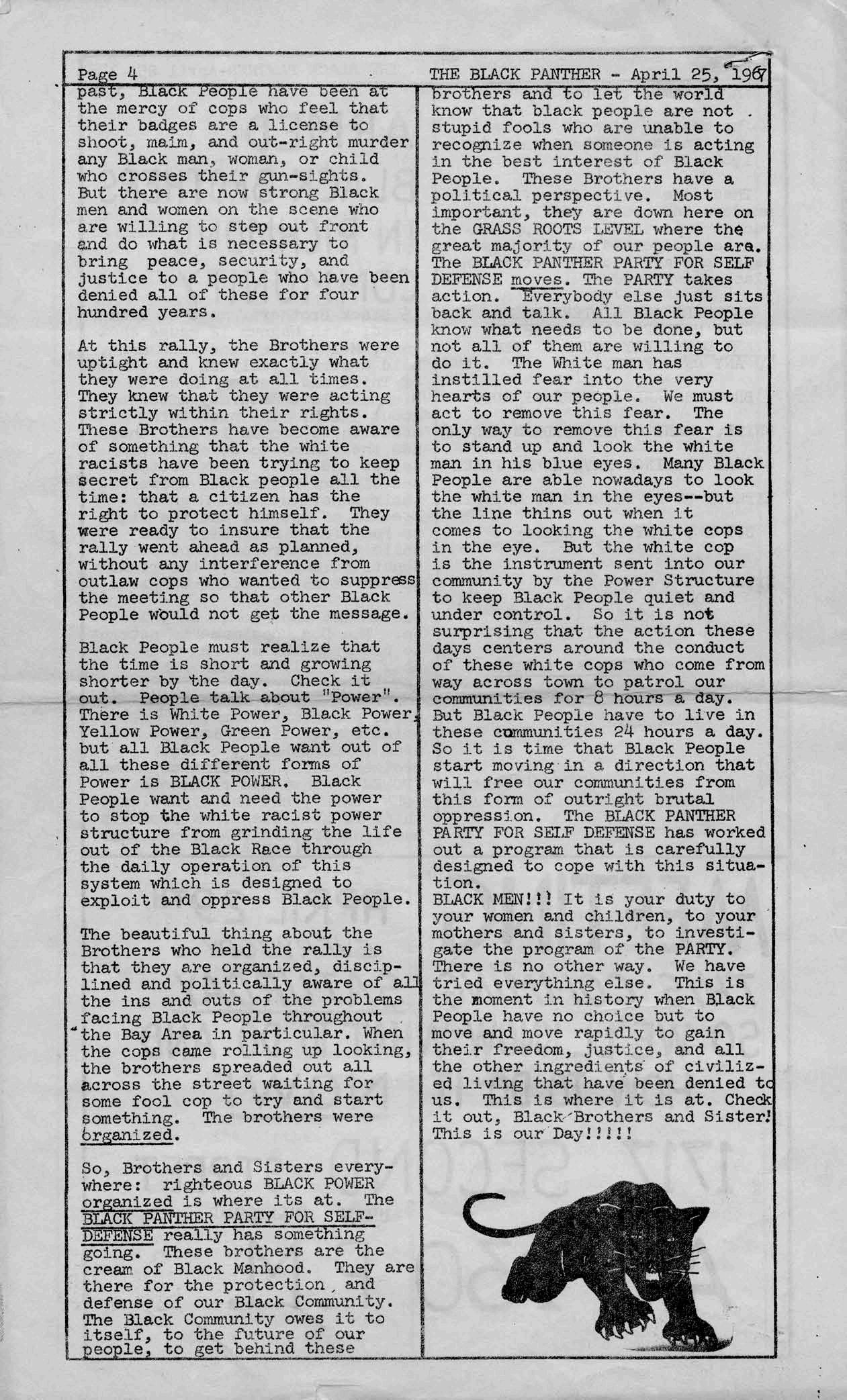
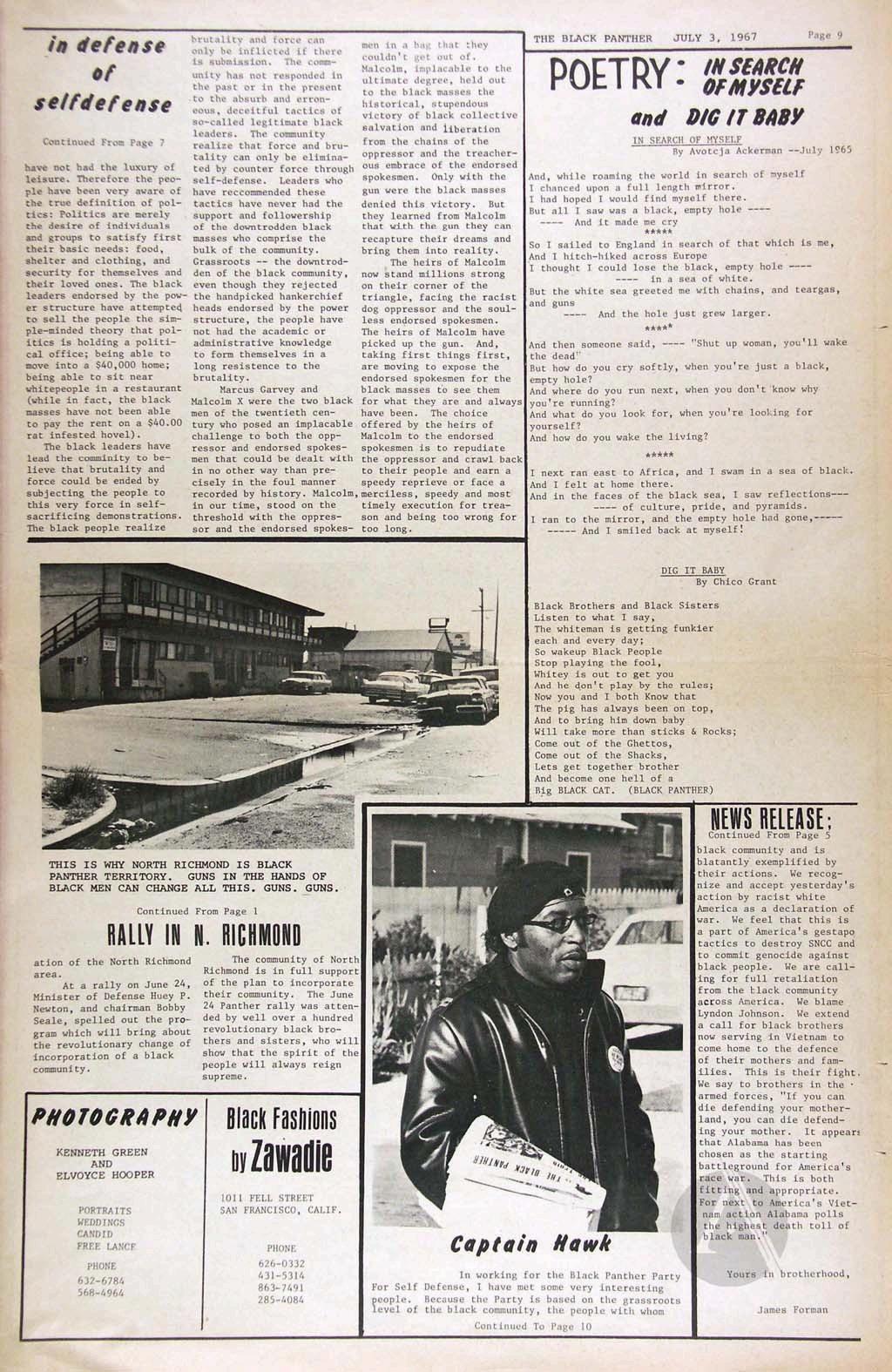
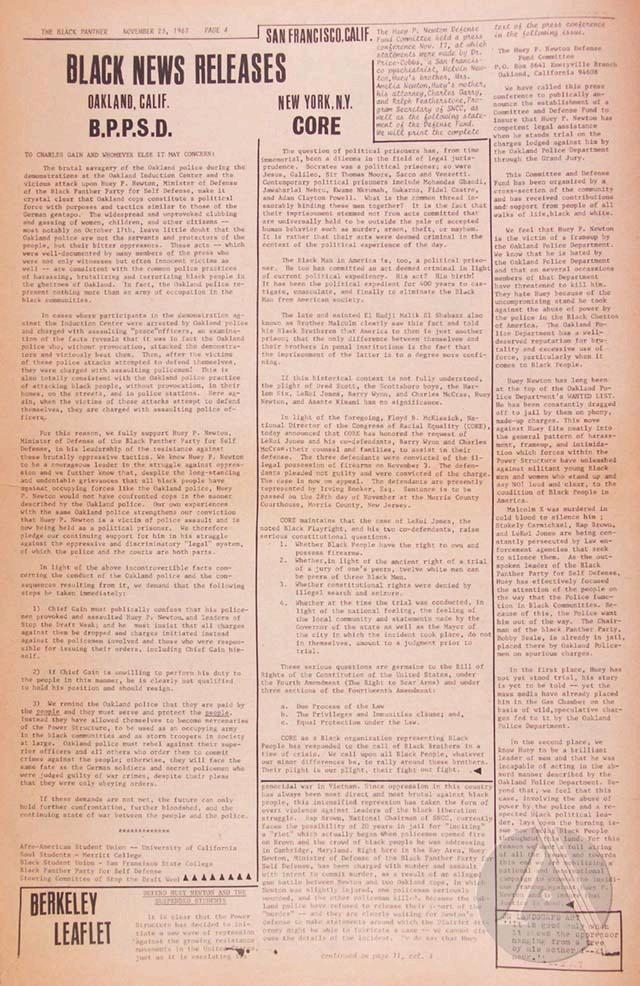
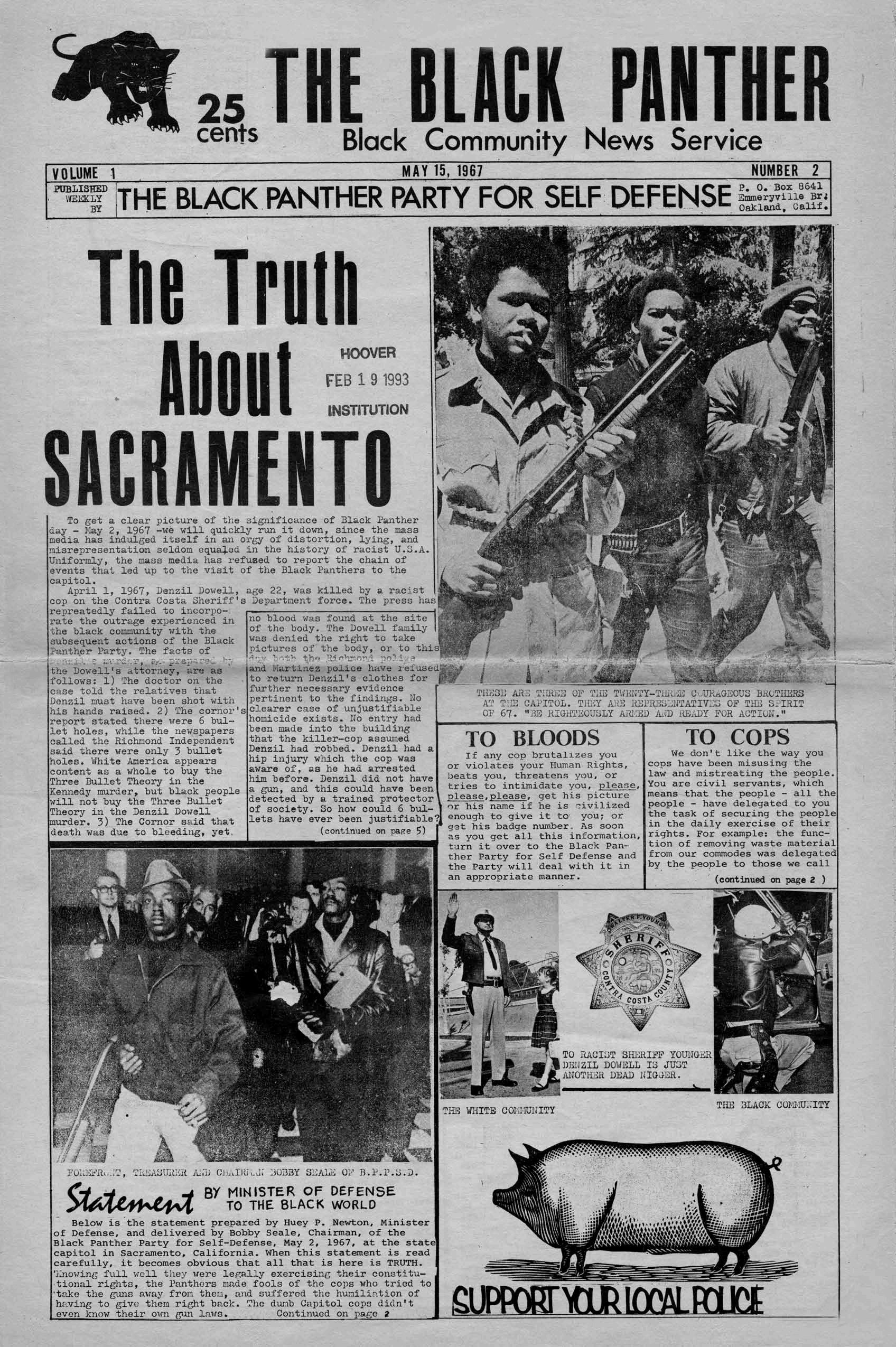
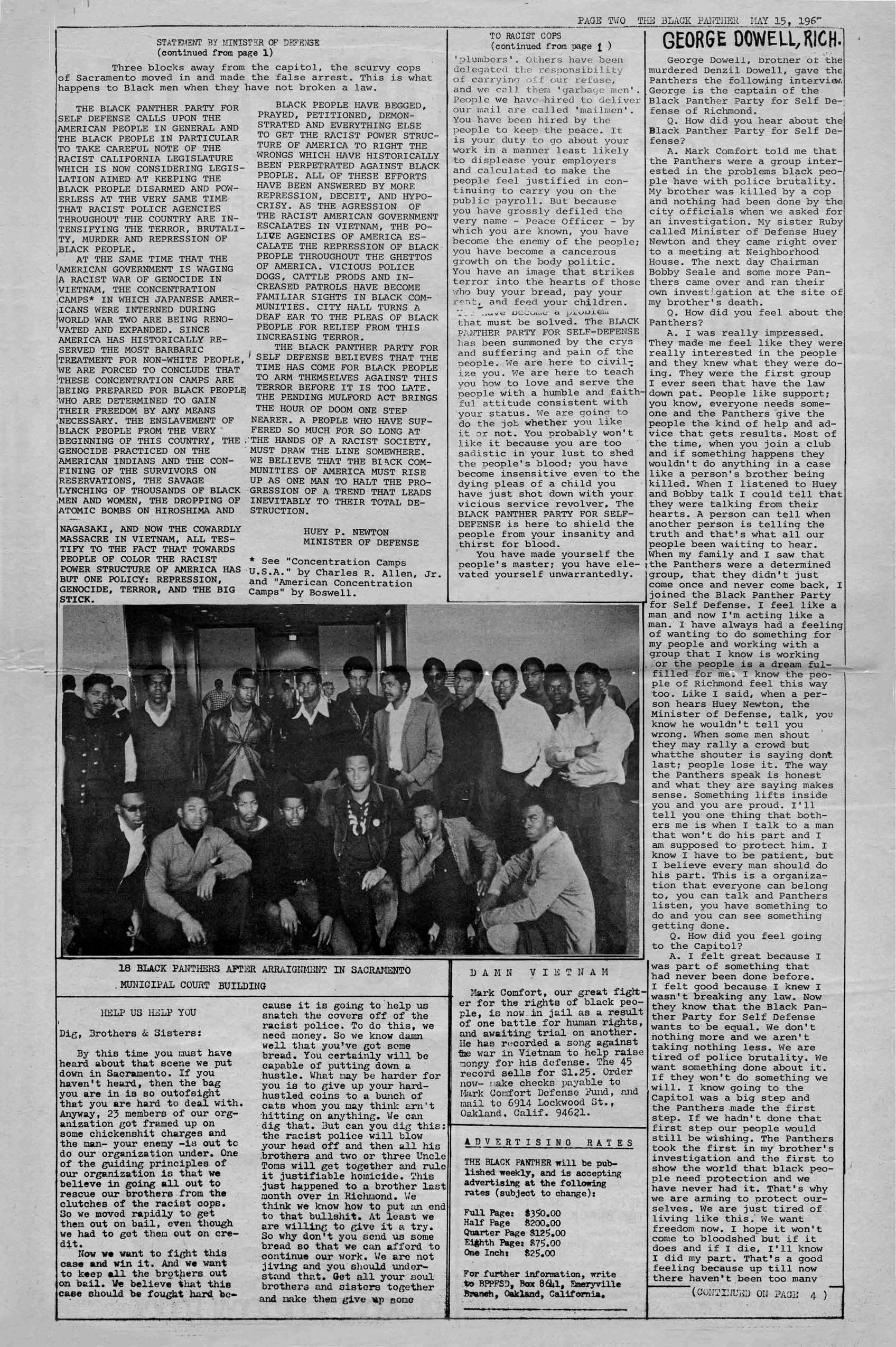
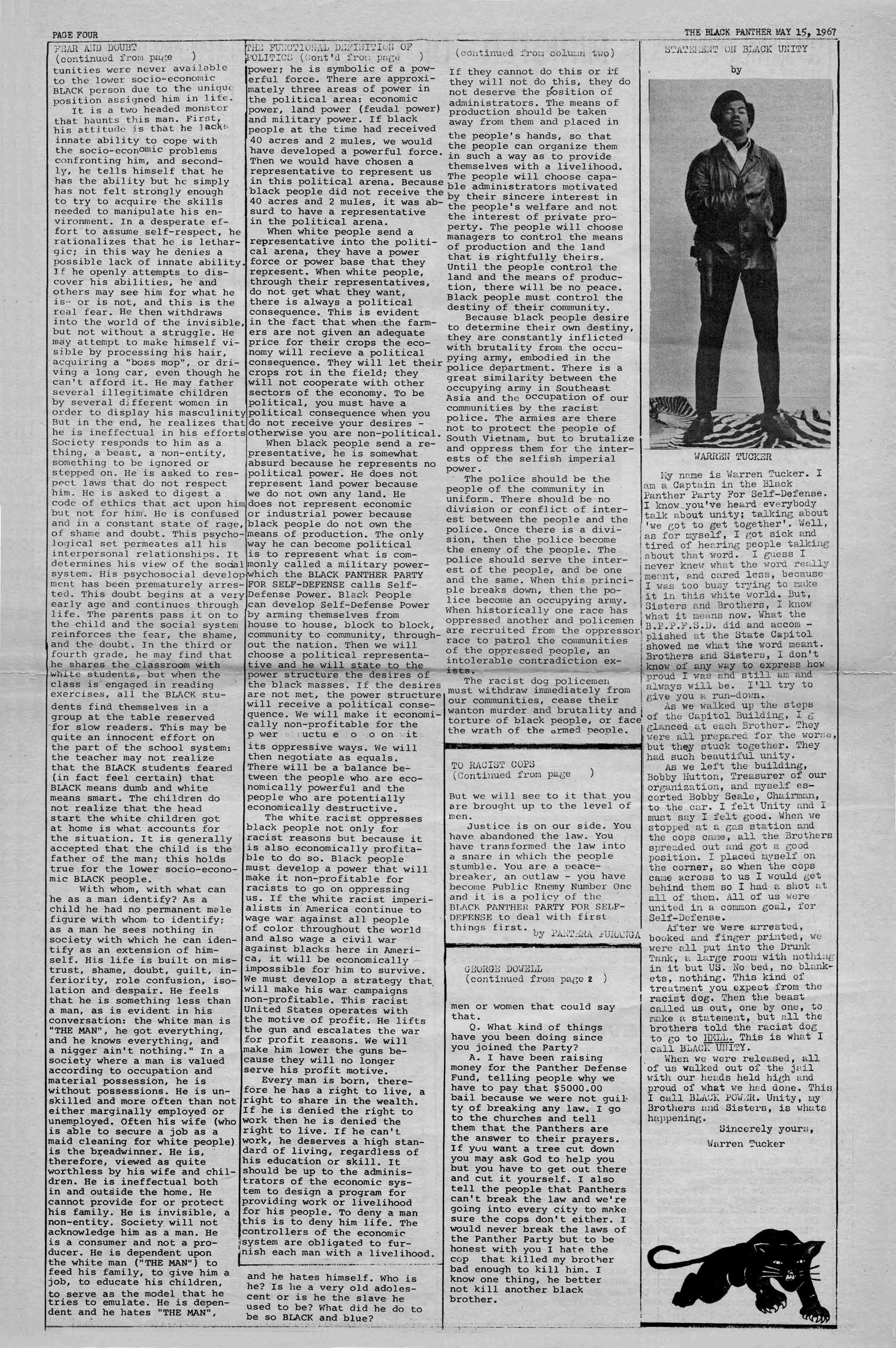
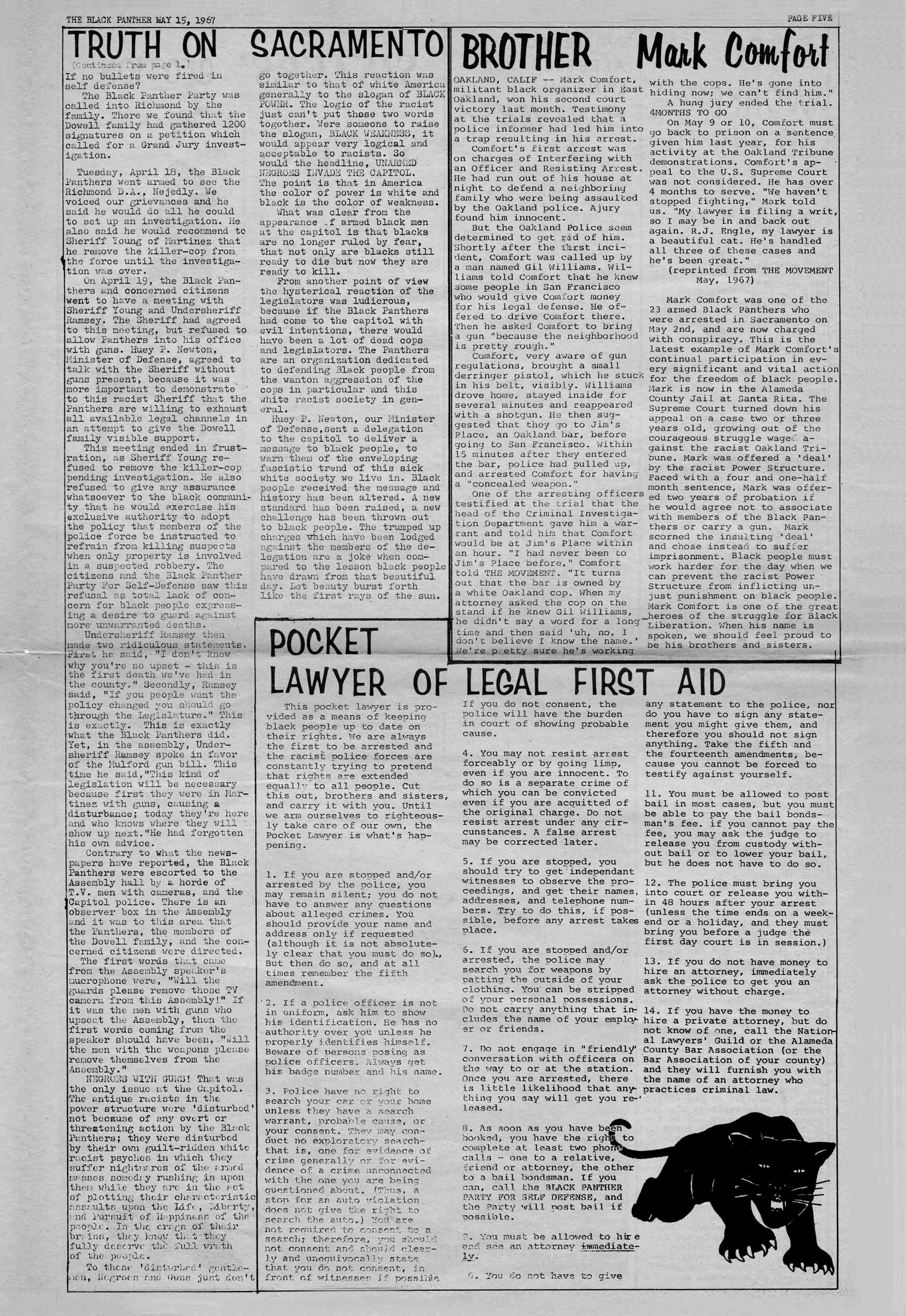
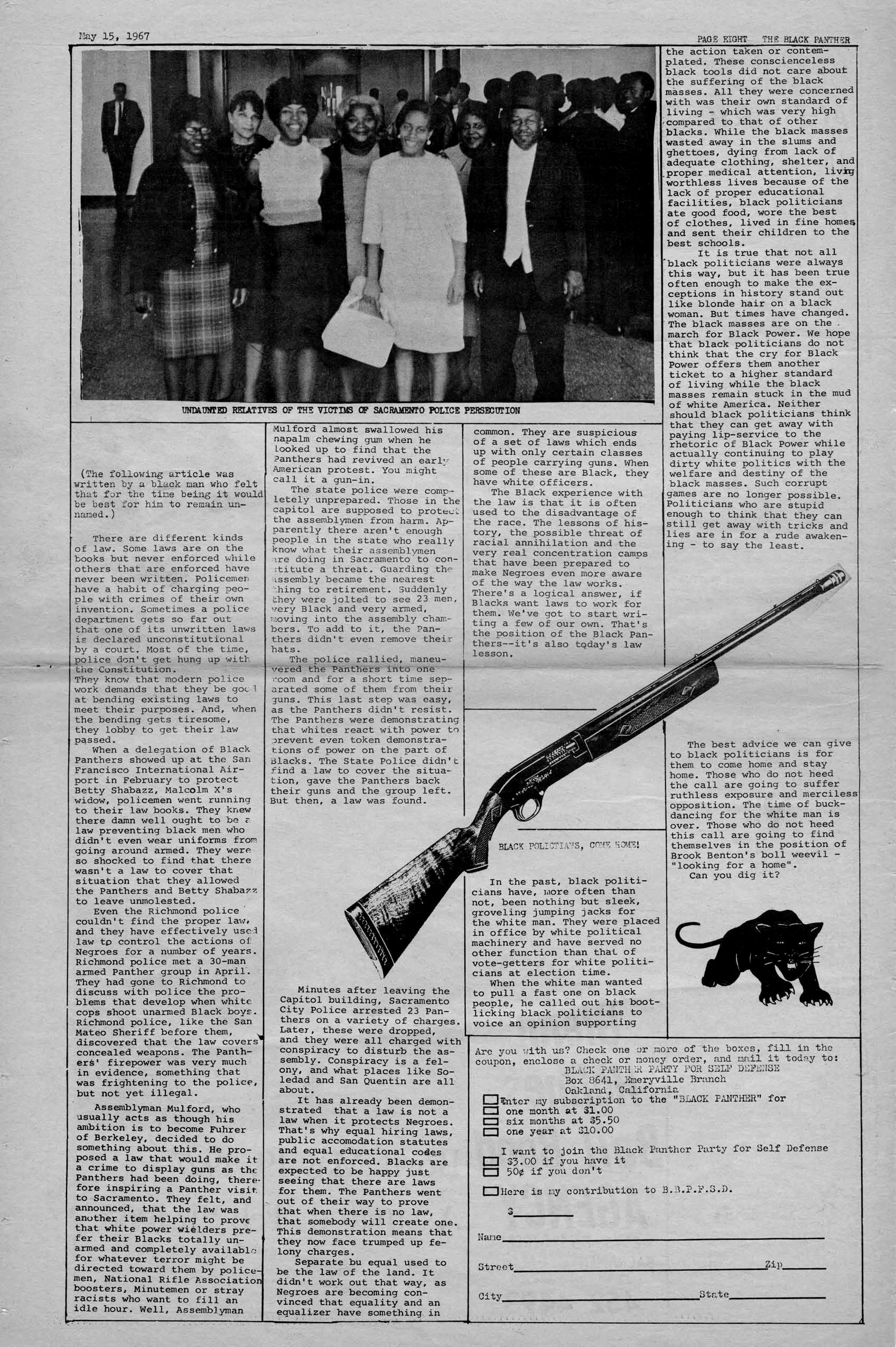
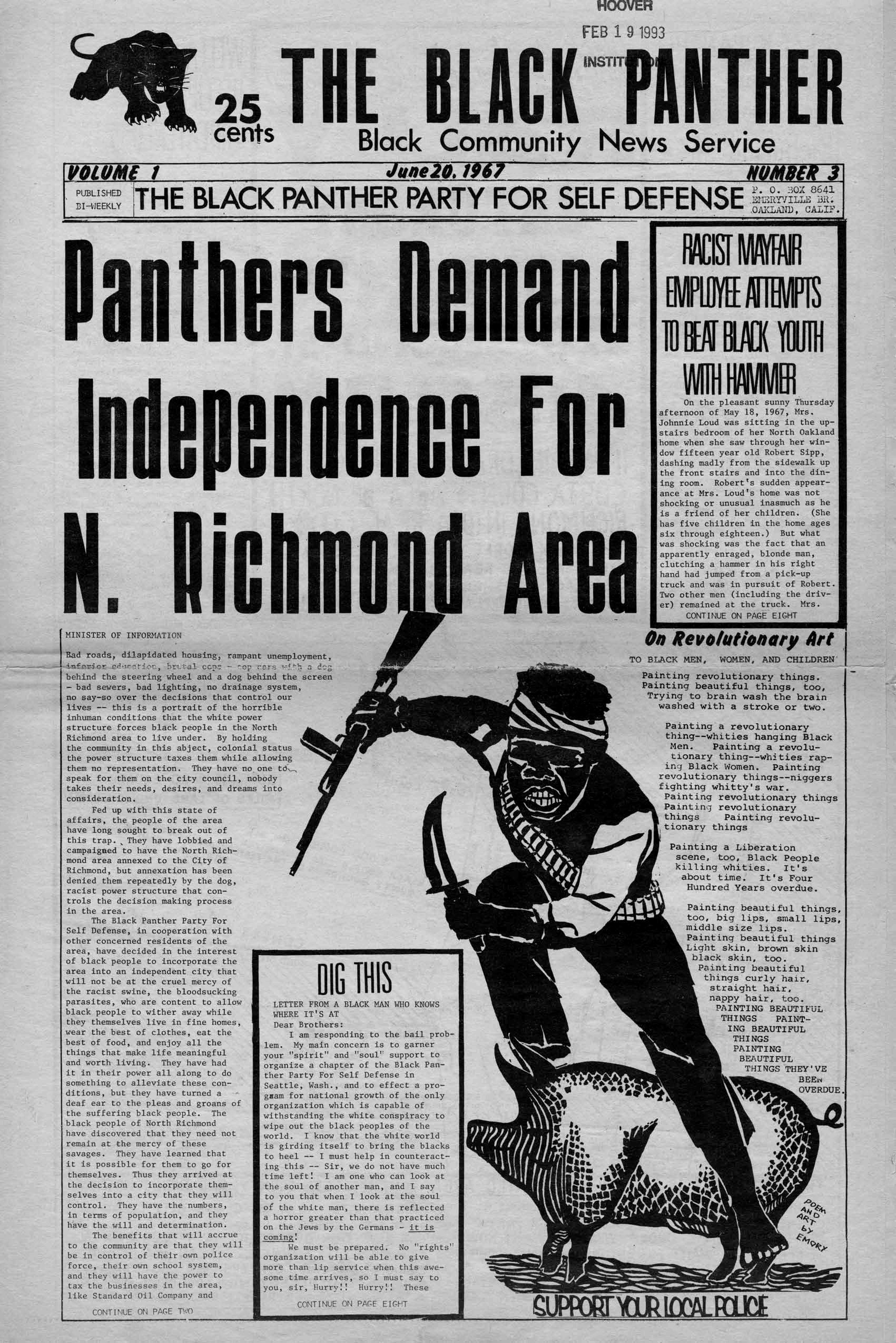
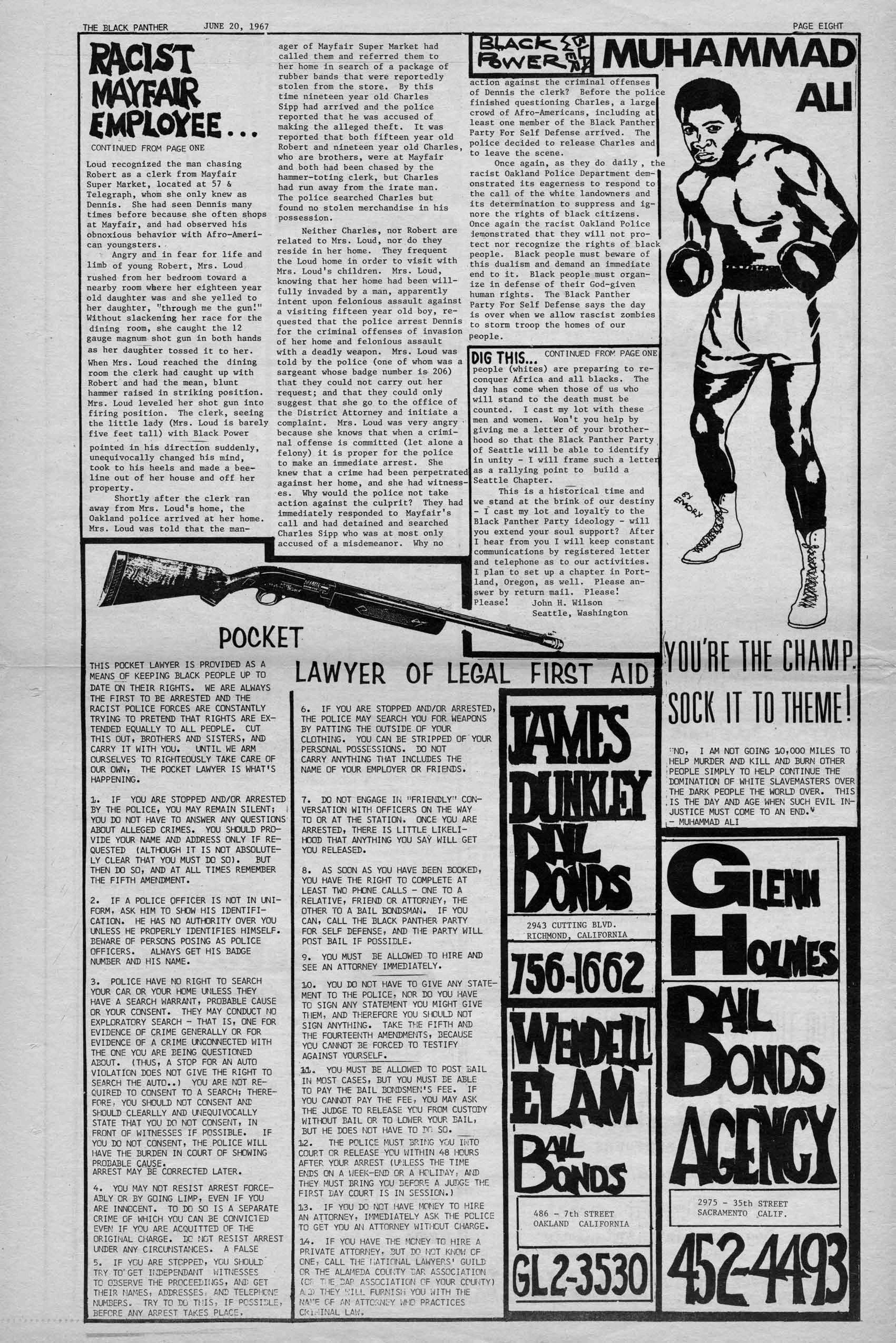
Originally a four-page newsletter, its initial purpose was to inform the public about the police killing of Denzil Dowell, a Black man in Richmond, California, and to promote the Panthers’ stance on police brutality and self-defense.
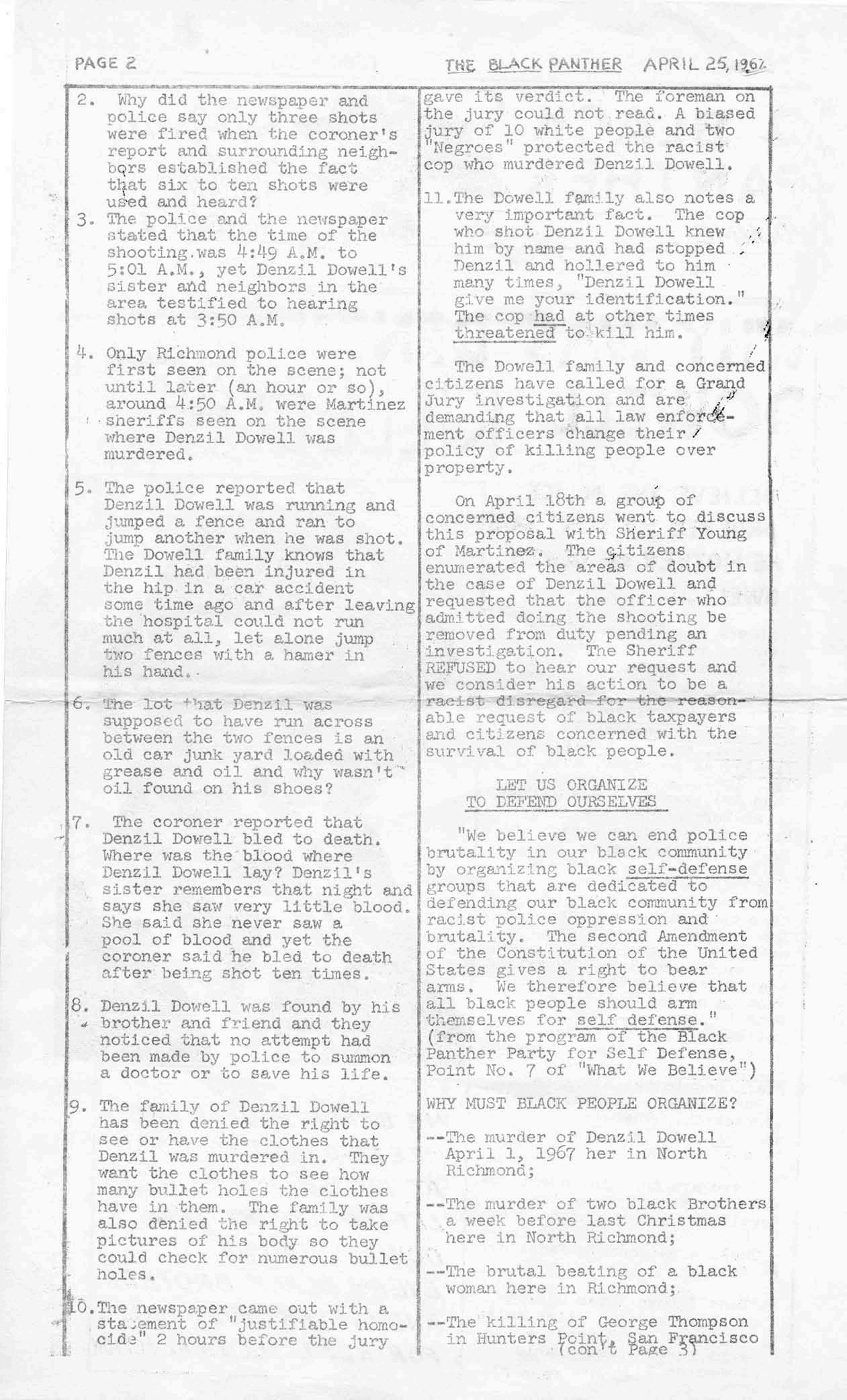
“On Monday April 1, 1967 “George Dowell and several neighbors from North Richmond, California . . . heard 10 gunshots. Sometime after 5:00 a.m., George came upon his older brother Denzil Dowell lying in the street, shot in the back and head Police from the county sheriff ’s department were there, but no ambulance had been called. . . . [The] sheriff ’s office reported that deputy sheriffs Mel Brunkhorst and Kenneth Gibson had arrived at the scene at 4:50 a.m. on a tip from an unidentified caller about a burglary in progress. They claimed that when they arrived, Denzil
Dowell and another man ran from the back of a liquor store and refused to stop when ordered to halt. Brunkhorst fired one blast from a shotgun, striking Dowell and killing him. . . . “For the Dowells, the official explanation did not add up, and community members helped the family investigate. . . . There was no sign of entry, forced or otherwise, at Bill’s Liquors, the store that Dowell had allegedly been robbing Further, the police had reported that Dowell had not only run but also jumped two fences to get away before being shot down.
But Dowell had a bad hip, a limp, and the family claimed that he could not run, let alone jump fences. . . . A doctor who worked on the case told the family that judging from the way the bullets had entered Dowell’s body, Dowell had been shot with his hands raised. . . Mrs. Dowell publicly announced, ‘I believe the police murdered my son.’ A white jury took little time deciding that the killing of unarmed Dowell was ‘justifiable homicide’ because the police officers on the scene had suspected that he was in the act of committing a felony. Outraged, the Black community demanded justice ”
—Joshua Bloom and Waldo E. Martin Jr., Black Against Empire: The History and Politics of the Black Panther Party
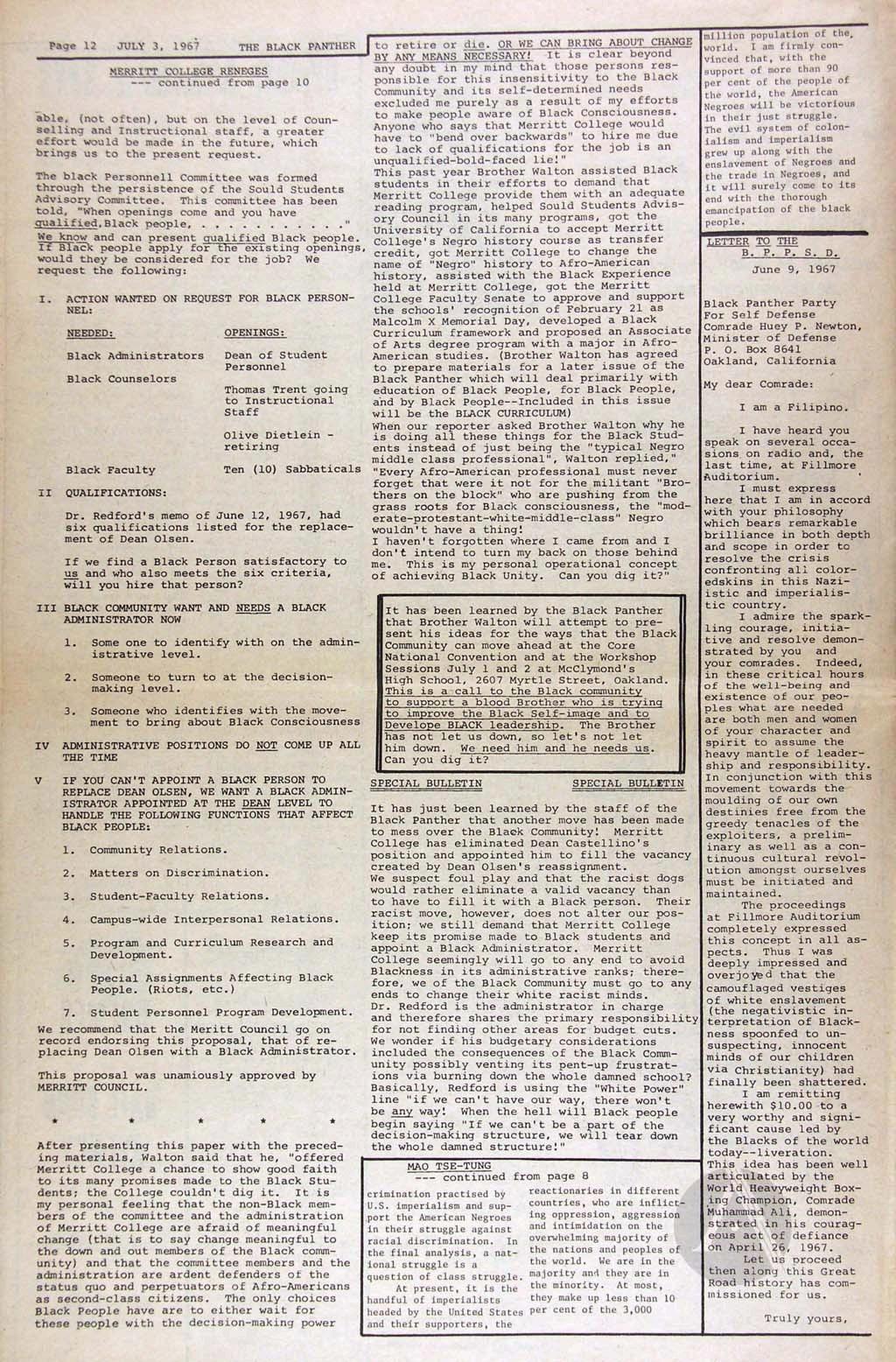
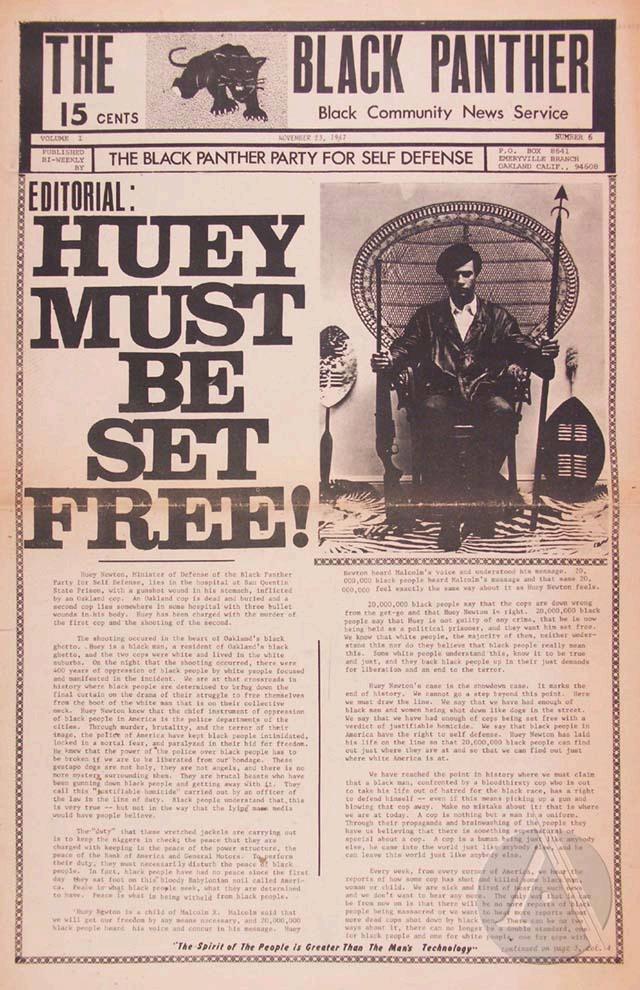
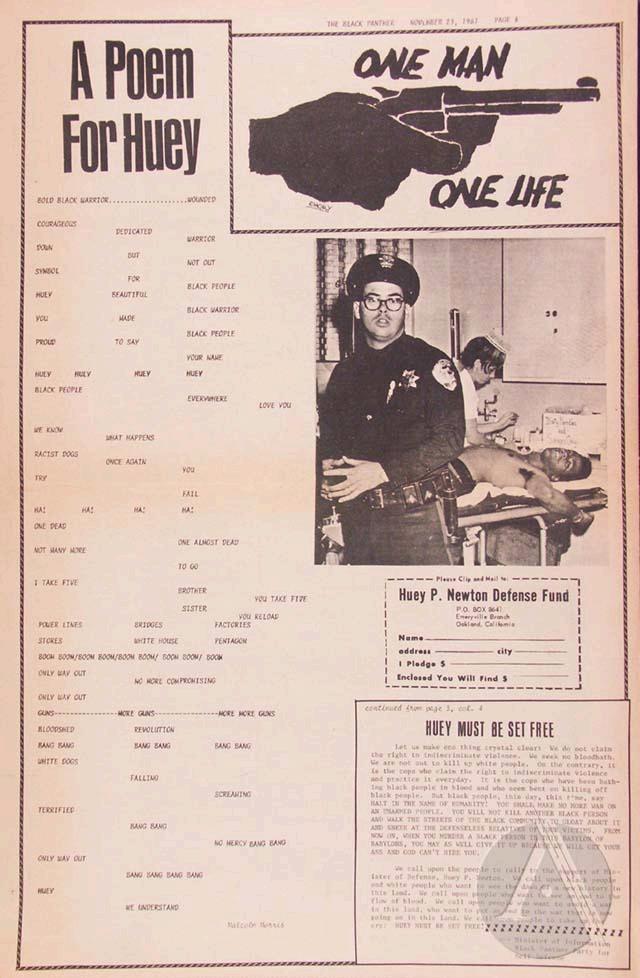
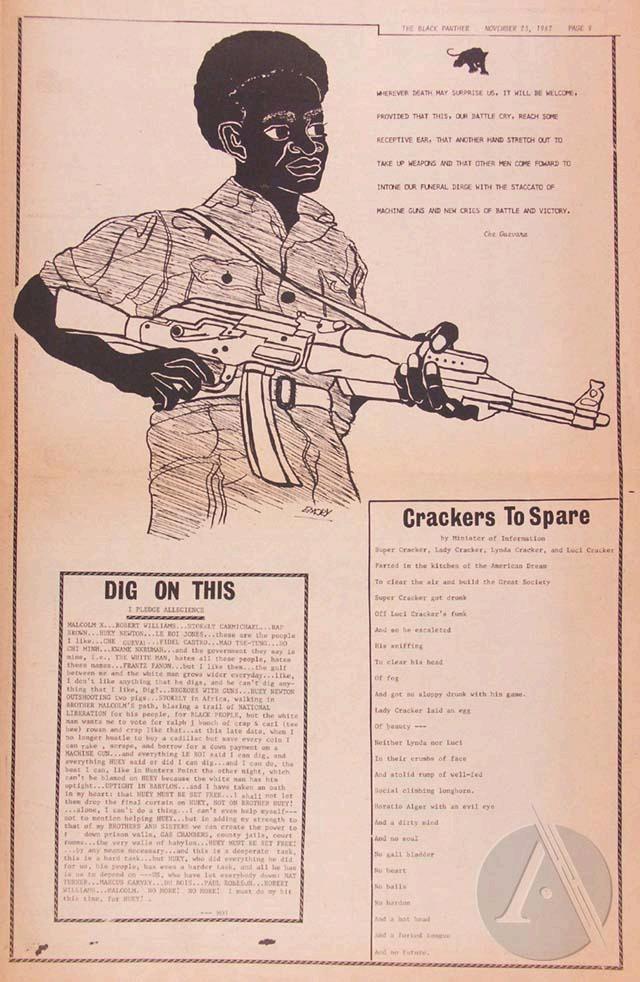
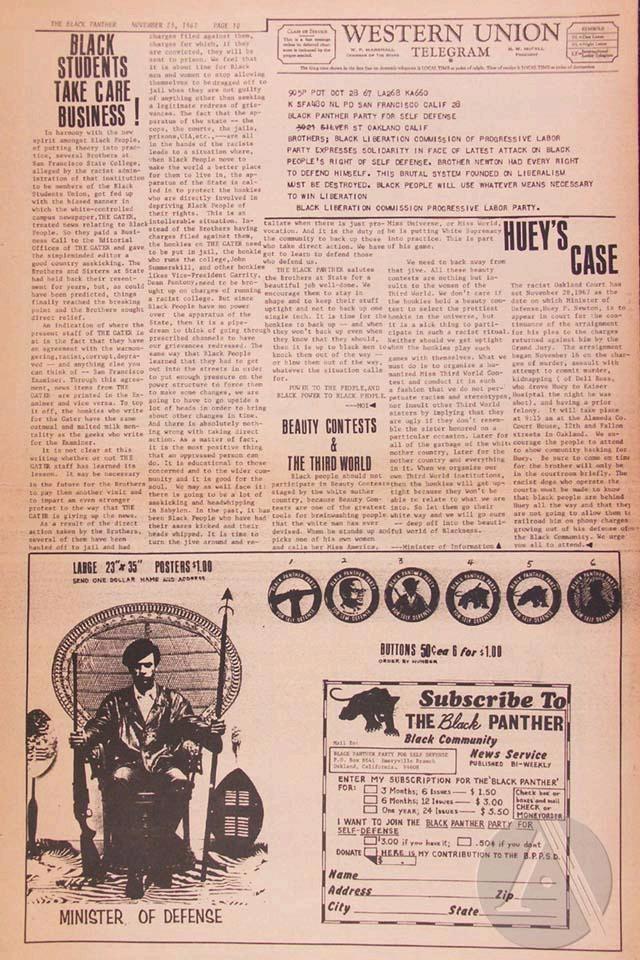
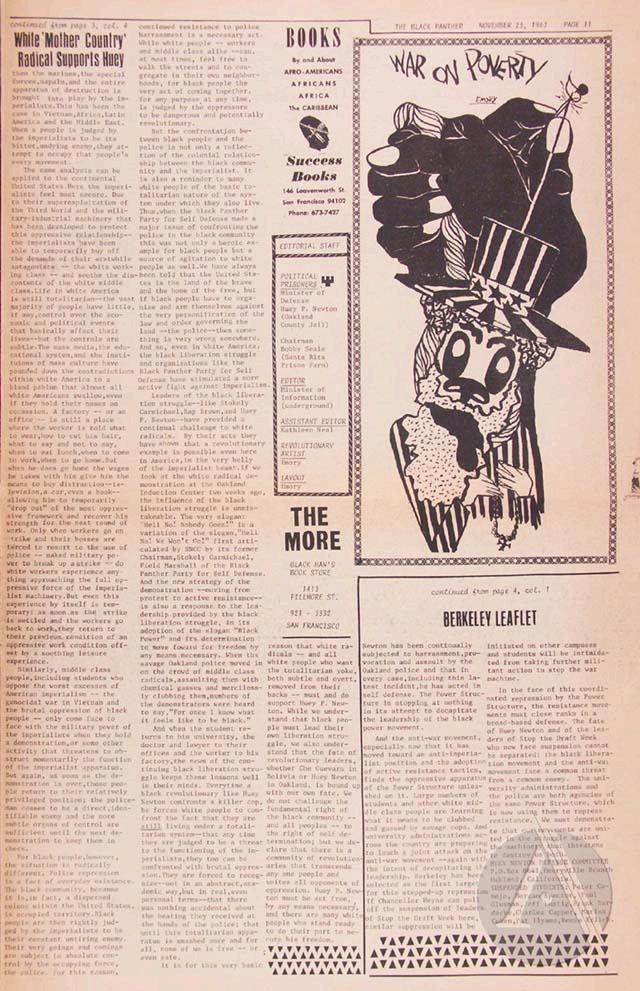
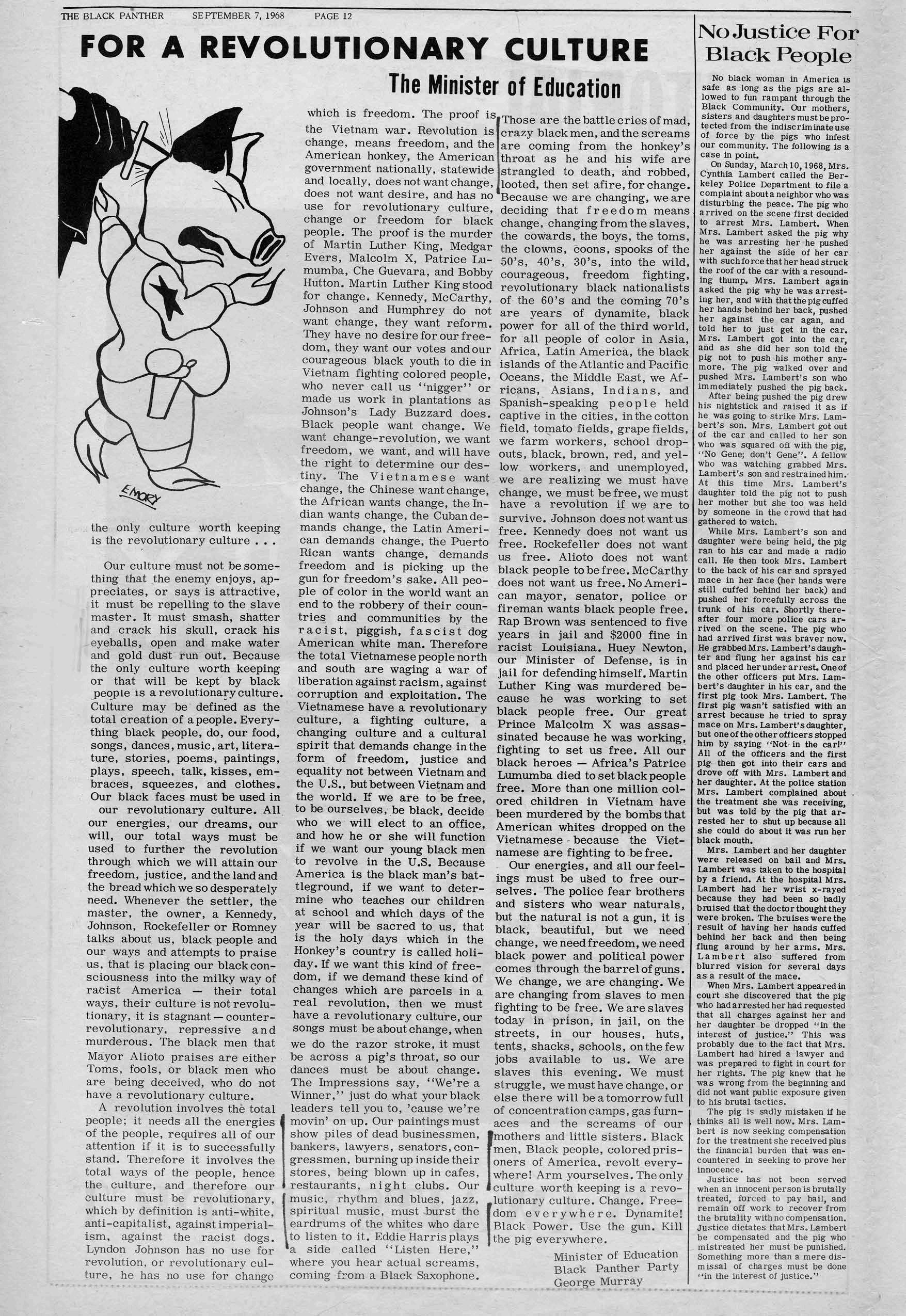
PREFACE The Voice of Revolution—The Black Panther Newspaper, 1967-1976
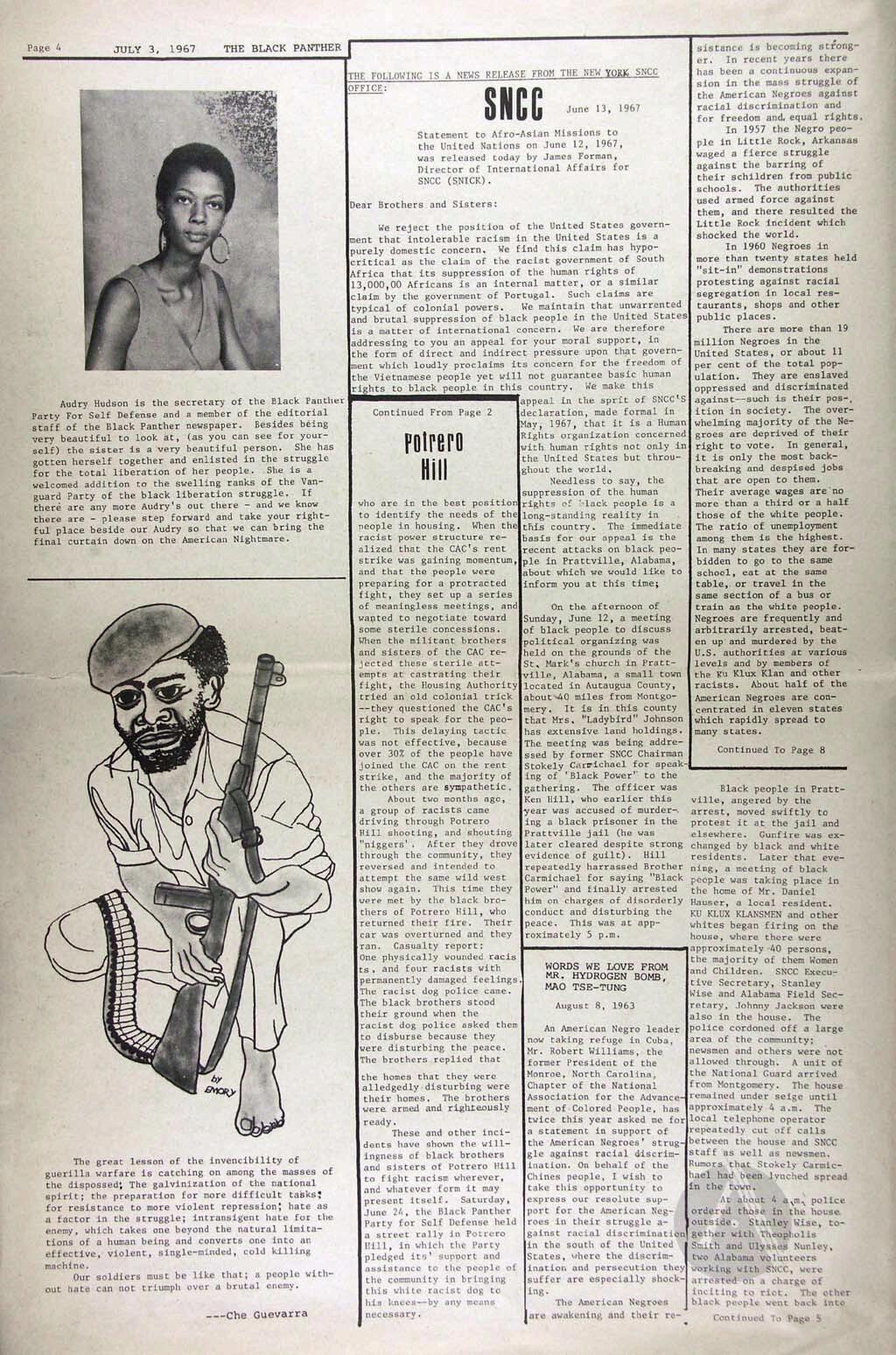
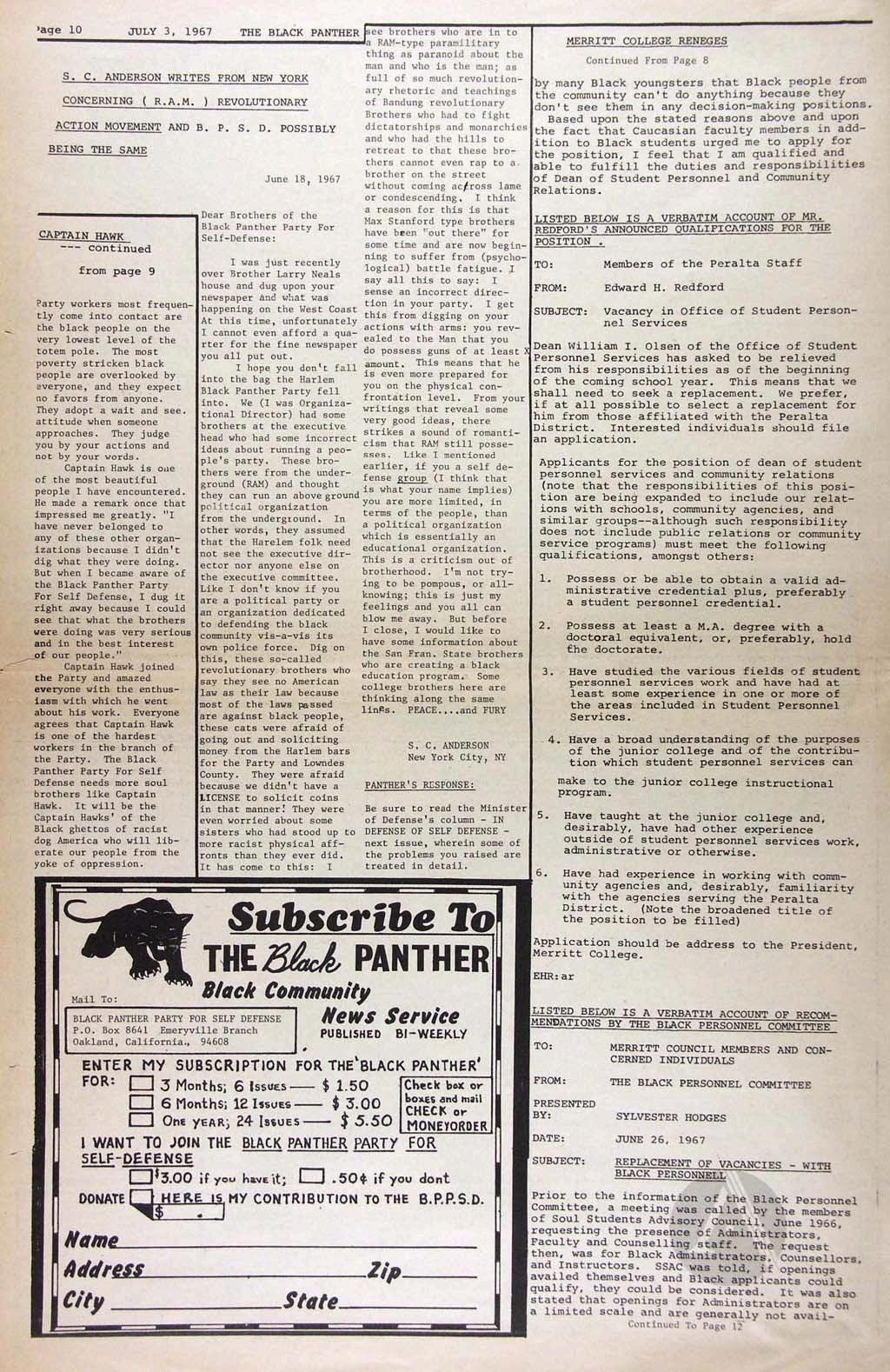
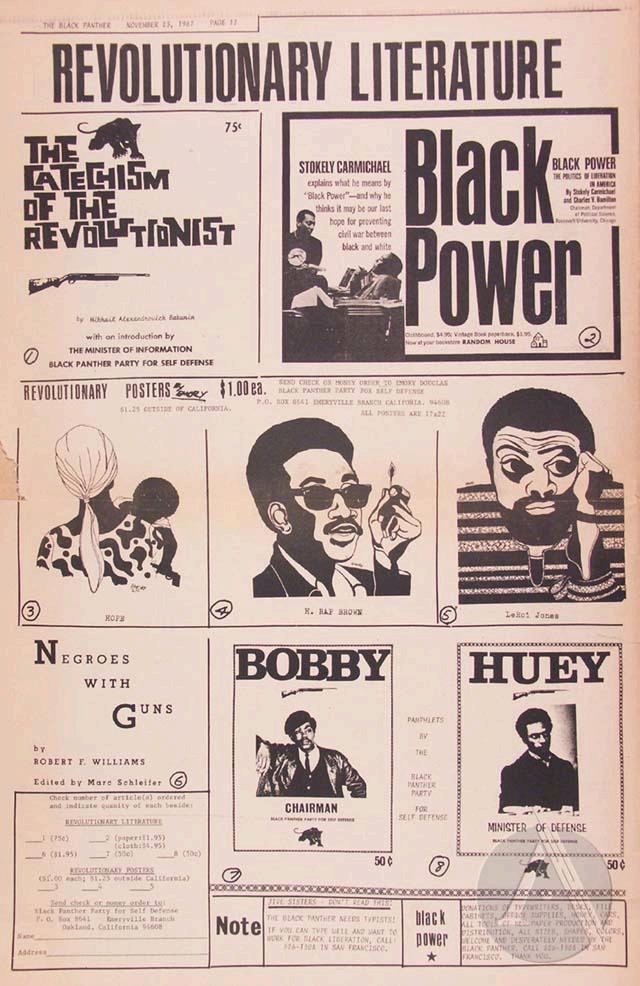
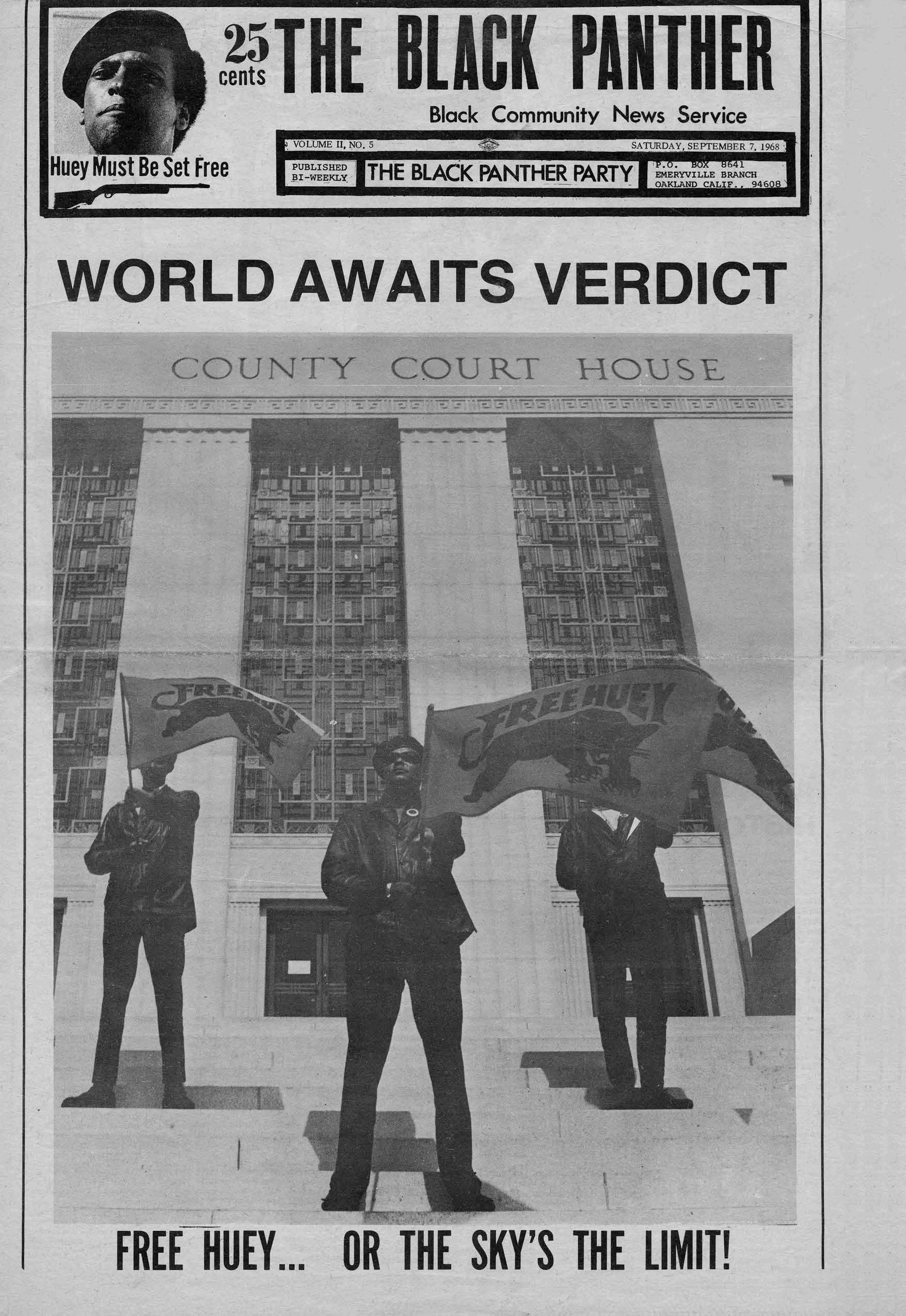
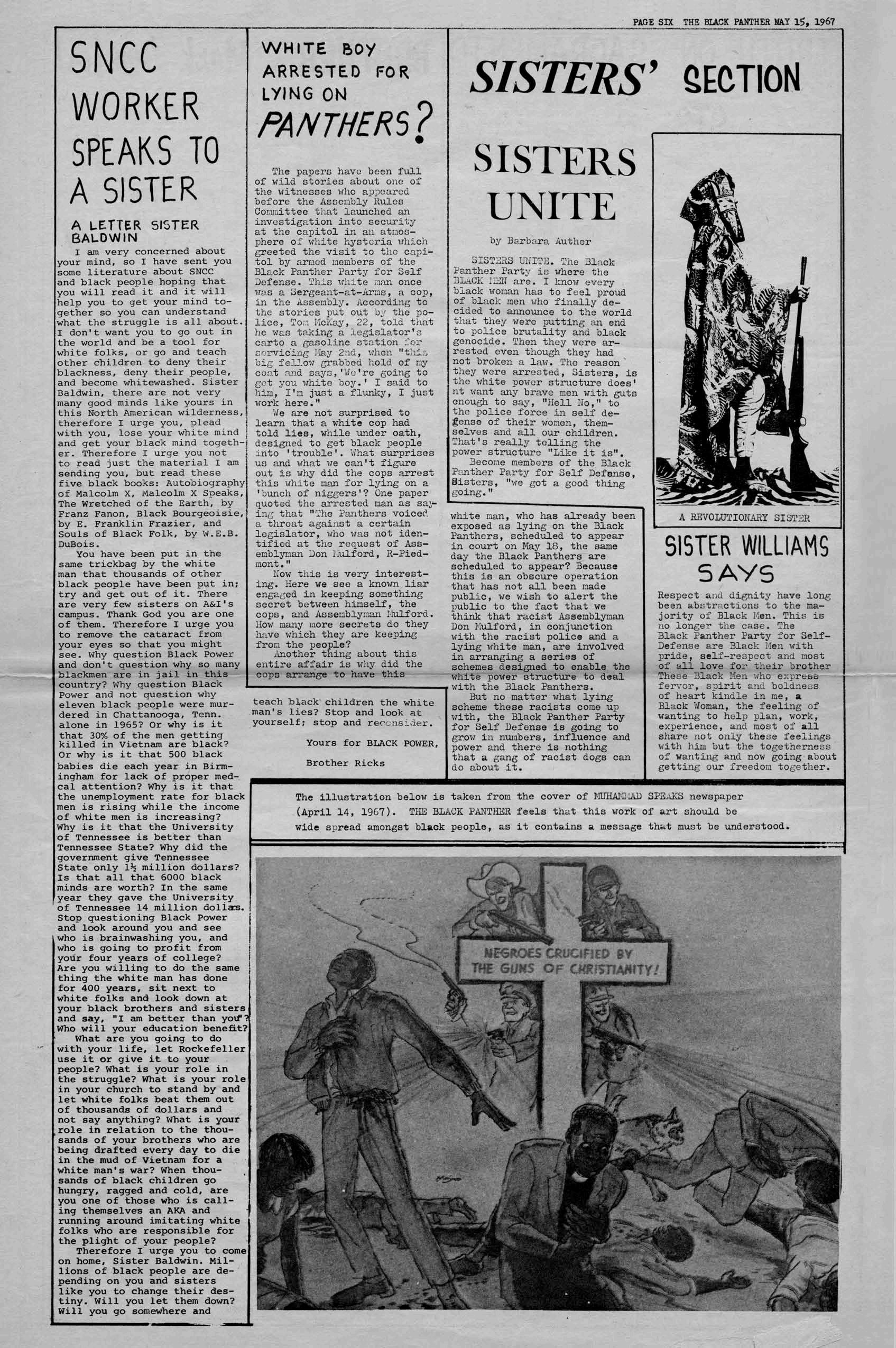
Circulation was both national and international, with distribution c San Francisco (which served as the national hub), Chicago, Kansas Angeles, New York, and Seattle At its height between 1968 a newspapers were sold in major cities across the United States an readers abroad, making the Panthers' perspectives part of conversation about revolution and self-determination. Every Party member was required to read and study the newspaper before se underscoring the paper's function as an n internal educational curr well as an external communication tool. The task of production and ci was itself an
from nationalism to a theory of "revolutionary inter-communalism" p the paper under several closely related titles, including The Black The Black Panther Intercommunal News Service, Black Panther Black C News Service, and Black Community News Service. These variations r ongoing efforts to clarify the intended audience and the Party's conception of its relationship to Black communities in the United St oppressed peoples worldwide
Community Programs and the "Serve the People" Line
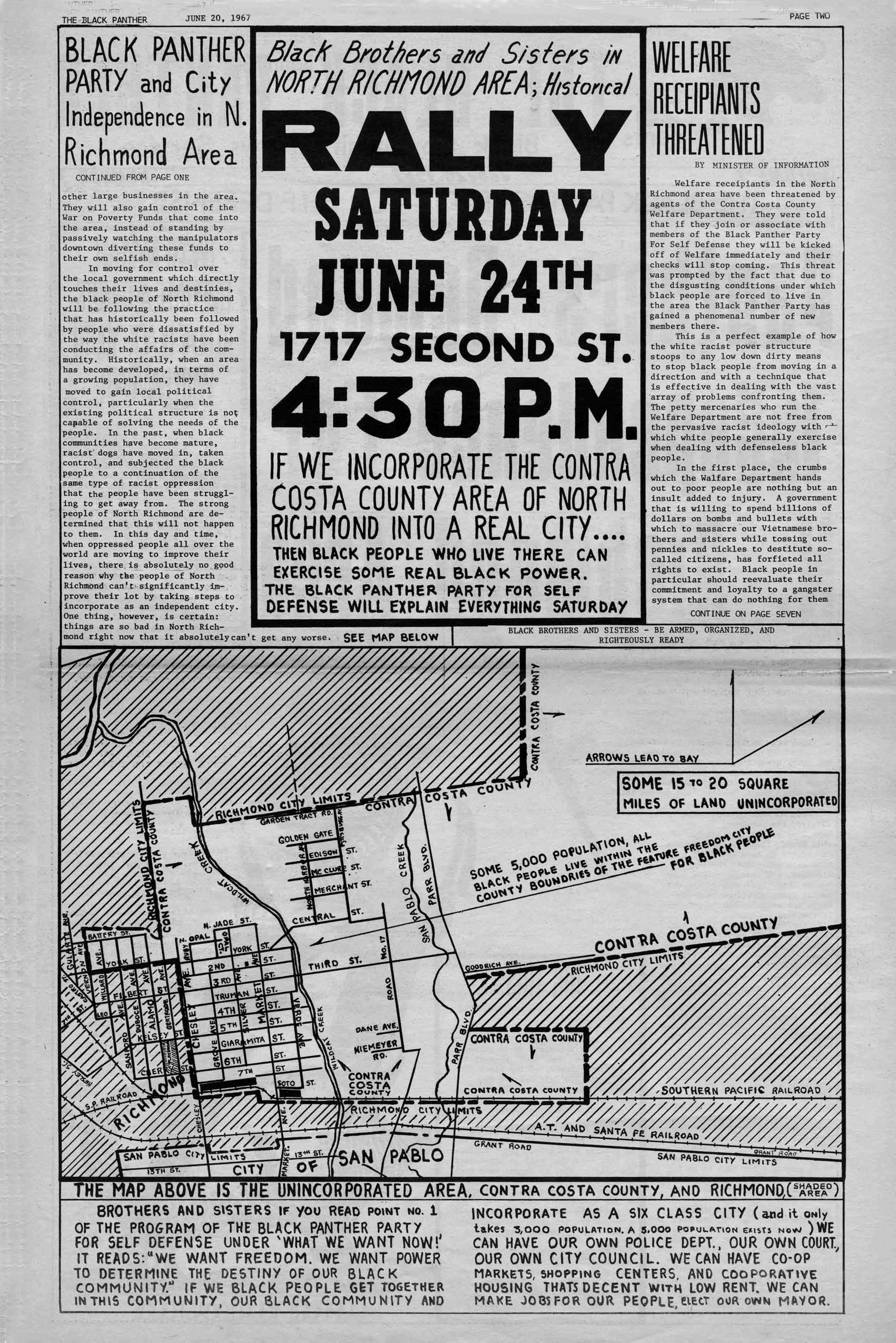
From early on, The Black Panther devoted significant space to the community survival programs, which ranged from the Free Breakf Children Program and free medical clinics to clothing drives, campaigns, and transportation for families of prisoners. By 1969, these efforts were organized nationally under the banner of the "serve the people program," which linked the provision of basic services to broader goals of political education and grassroots org
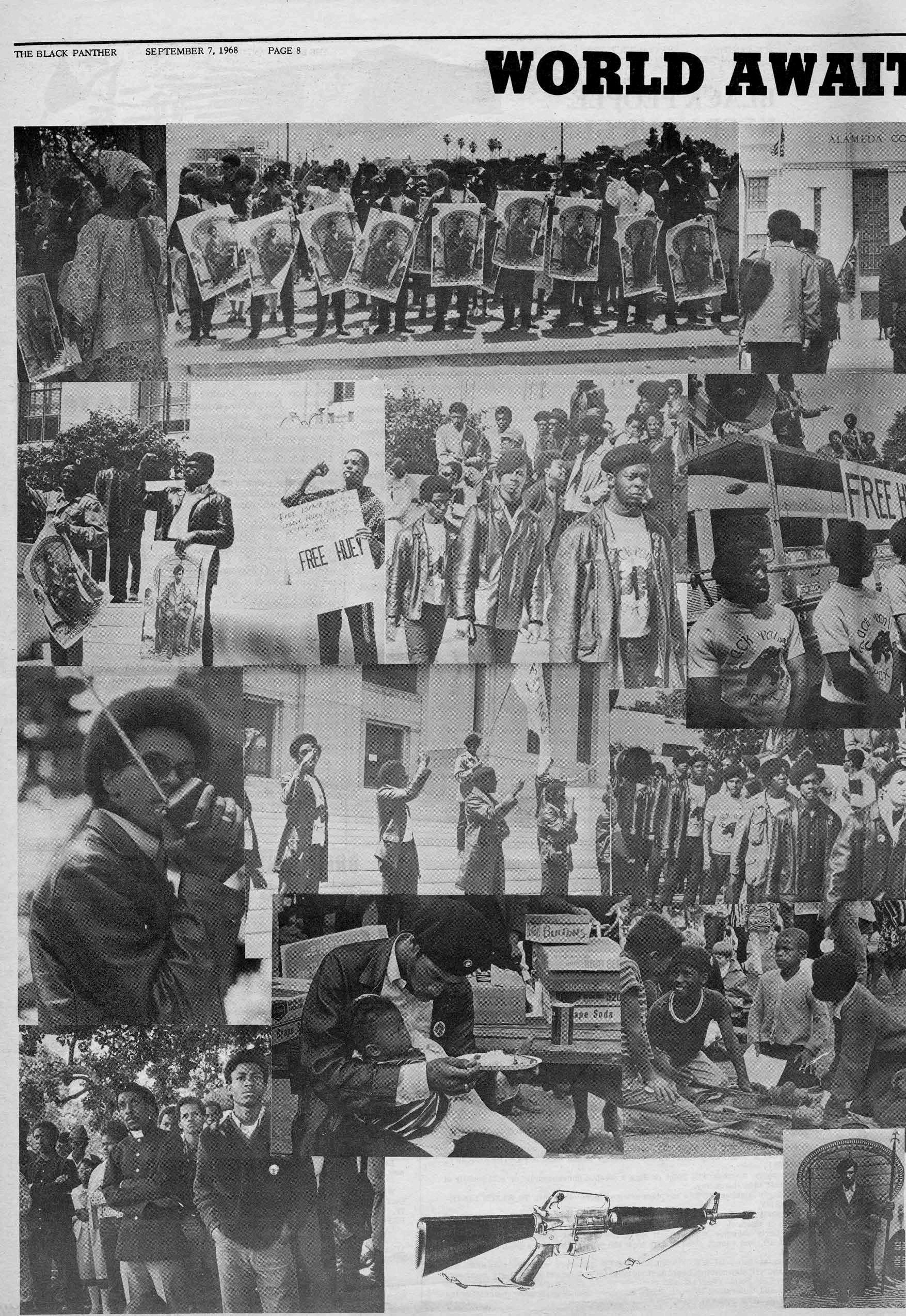
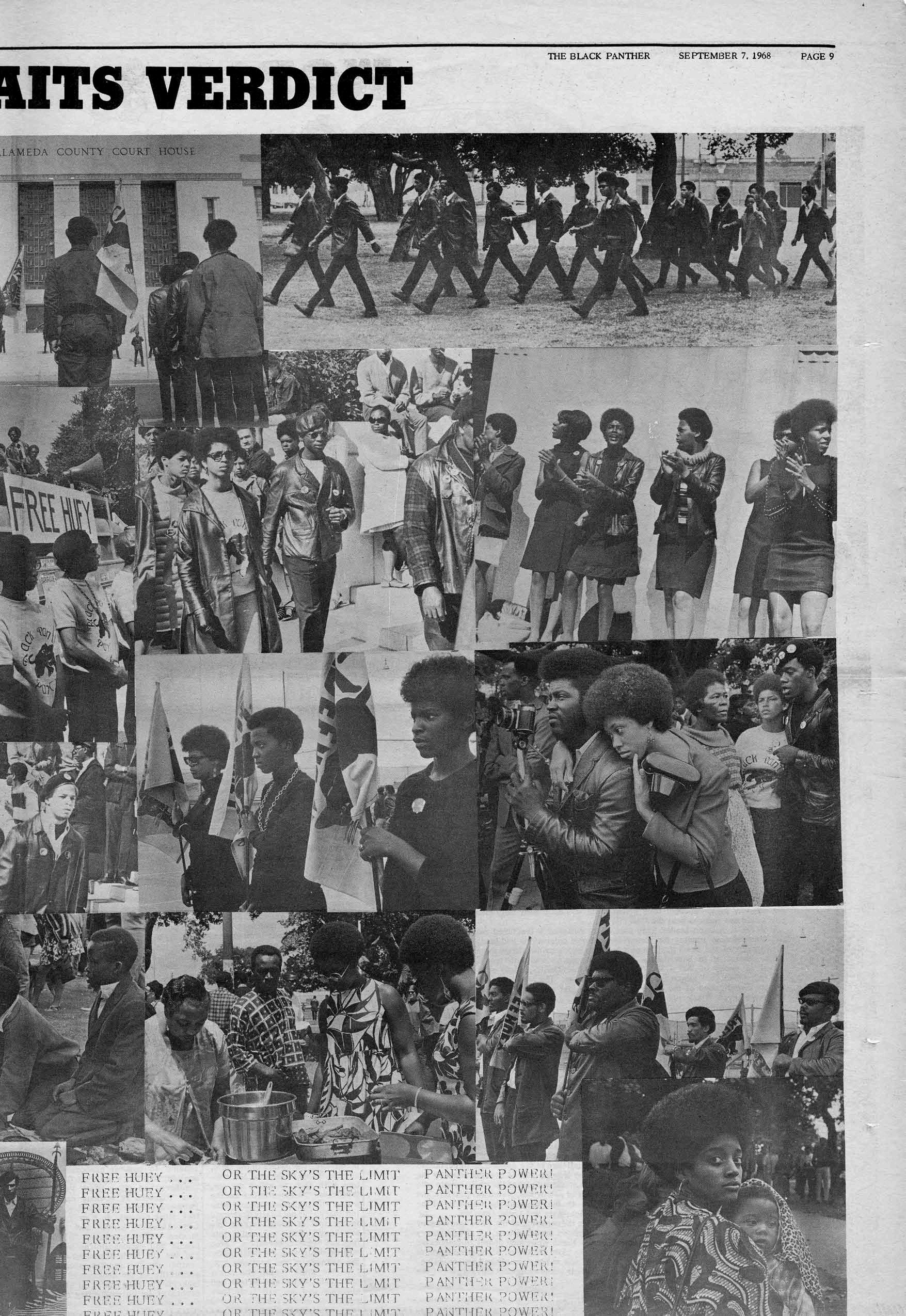
The newspaper documented the expansion of these programs across cities, using photographs, testimonials, and reports to mod revolutionary community work could look like in practice.
Community Programs and the "Serve the People" Line
From early on, The Black Panther devoted significant space to the community survival programs, which ranged from the Free Breakf Children Program and free medical clinics to clothing drives, campaigns, and transportation for families of prisoners. By 1969, these efforts were organized nationally under the banner of the "serve the people program," which linked the provision of basic services to broader goals of political education and grassroots org
The newspaper
and dating of the newspaper as preserved in the
Internet Archive collection. While gaps and irregul remain, some issues are missing, some dates or volume printed on the original papers are known to be incorrect arrangement preserves the logic of the surviving arch makes it possible to track both continuity and change time. The archive contains approximately 466 scanned issu the estimated 537 published between 1967 and 1980 approximately 50 issues missing from the collection.
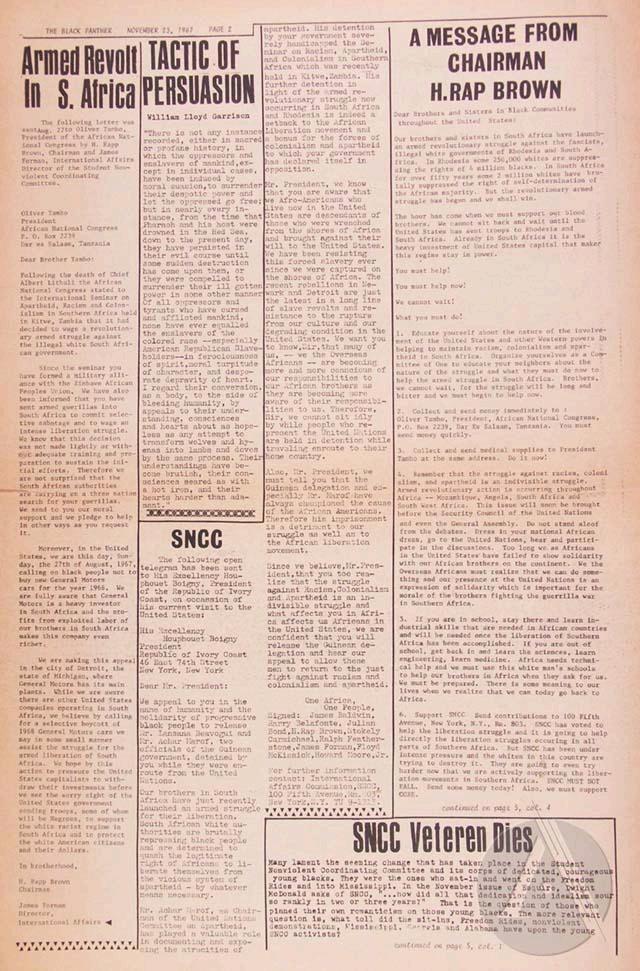
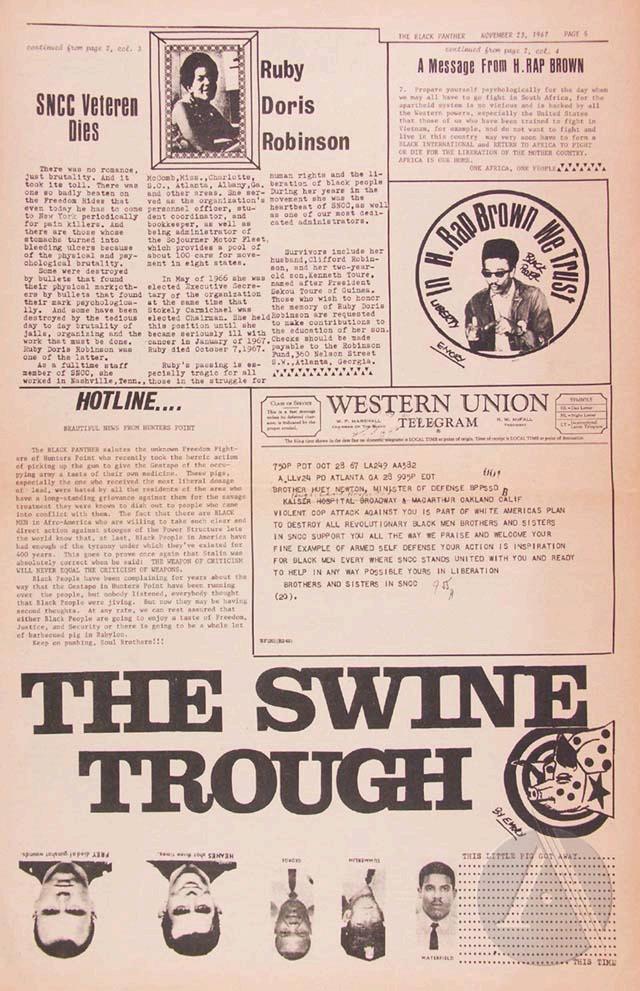
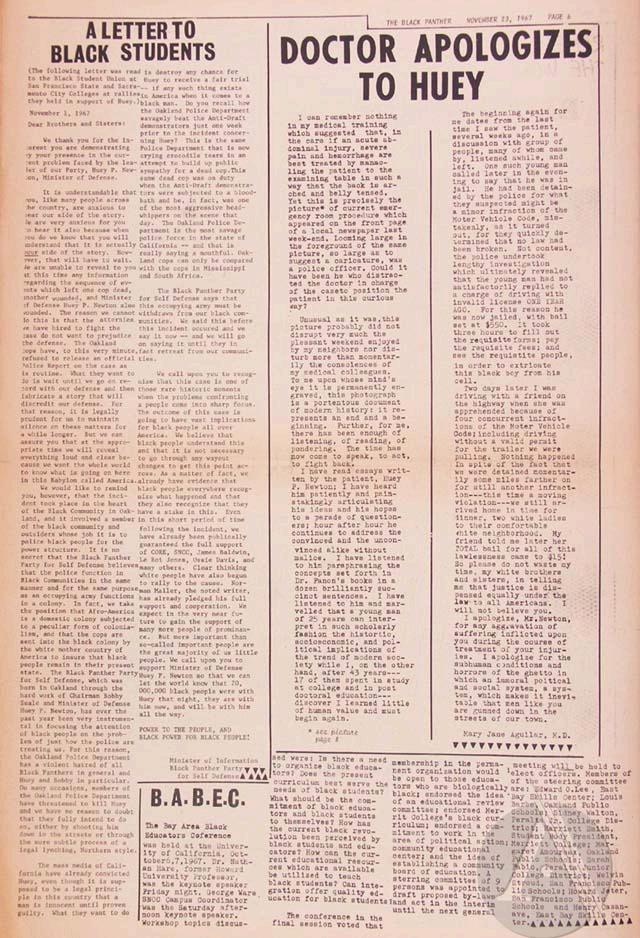
Volume 1 (1967) contains Issues 1--6 (complete), beginning with Vol. 1, No. 1 (April 25, 1967), capturing the paper's origins in Oakland and the initial framing of the Black Panther Party's program and demands.
Volume 2 (1968--1969) gathers Issues 2--30, covering late 1968 into early 1969. Missing issues: 1, 4, 13, 16, 17,and29. Note: There are two different Issue 9s dated October 12 and October 19. This period over laps with the Party's rapid growth and the national attention surrounding the trial of Huey P Newton
Volume 3 (1969) covers Issues 1--32 (complete), a period marked by both expanded programs and escalating confrontations with law enforcement.
Volume 4 (1969--1970) presents Issues 1--30, reflecting the Party's national consolidation and the intensification of federal counterintelligence efforts. Missing issues: 11, 22, and 26.
Volume 5 (1970--1971) includes Issues 1--30, a period in which the community survival programs expanded and internal debates sharpened. Missing issue: 12.
Volume 6 (1971) contains Issues 1--30, illustrating the transition into a new phase of Party activity after years of intense confrontation. Missing issues: 10, 14, and 19.
Volume 7 (1971--1972) gathers Issues 1--30, documenting both ongoing campaigns and the Party's reorientation toward more formal political engagement and institution-building. Missing issue: 21.
Volume 8 (1972) presents Issues 1--30 (complete), a stretch that highlights the Party's focus on local elections, alliances, and the consolidation of its Oakland base.
Volume 9 (1972) continues through the end of 1972, with Issues 1--11 (complete), October 21 to December 30, 1972, as the Panthers intensified their emphasis on municipal politics and community institutions in Oakland.
Volume 10 (1973) spans Issues 1--30, reflecting a period when the paper chronicled campaigns around education, health care, and the defense of imprisoned leaders. Missing issues: 21 and 29.
Volume 11 (1974) consists of Issues 2--30, providing a window onto the mid-1970s Party as it sought to sustain its programs amid declining national membership and ongoing surveillance Missing issues: 1, 23, and 26. Note: Issue 2 is the earliest available for this volume.
Volume 12 (1974--1975) continues from Issues 2--30, illustrating how the Party used the paper to maintain national coherence despite shrinking resources and intensified legal pressures. Missing issue: 1. Note: Issue 2 begins August 3, 1974, and Issue 30 concludes February 15, 1975.
Volume 13 (1975) follows the newspaper through Issues 1--30 (complete), documenting the continued emphasis on social programs, electoral strategies, and campaigns around prisons and policing Note: Two scans of the same Issue 10 are present in the archive.
Volume 14 (1975--1976) contains Issues 1--30, revealing both the persistence of the Party's core themes and the mounting strain of repression, attrition, and political isolation. Missing issues: 8 and 11. Note: Two scans of the same Issue 4 are present in the archive.
Volume 15 (1975--1976) includes Issues 1--30, by which point the newspaper had become more focused on the Party's Oakland base, local campaigns, and the defense and commemoration of longstanding members. Missing issue: 16. Note: Two scans of the same Issue 2 are present in the archive
Volume 16 (1976) presents Issues 8--30, a period of significant organizational transition. Missing issues: 1, 2, 3, 4, 5, 6, 7, 17, and 18 (9 issues missing total). This volume shows substantial gaps in the archival record.
Volume 17 (1977) contains Issues 1--28 (complete), with the last issue dated December 31, 1977, documenting the Party's activities during a year of continued community work and political organizing.
Volume 18 (1978) spans Issues 1--29, though with severe archival gaps. Missing issues: 9, 10, 11, 13, 14, 15, 16, and 18--25 (15 issues missing total). This represents one of the most incomplete volumes in the collection, with more than half the issues unavailable.
Volume 19 (1979) includes Issues 2--11, covering a limited portion of 1979's publication. Missing issues: 1, 4, and 5. Note: Issue 2 is the earliest available for this volume.
Volume 20 (1980) concludes the series with Issues 1--9 (complete), with the final issue dated September 16, 1980, marking the end of The Black Panther newspaper's thirteen- year publication run.
Throughout these volumes, the reader will encounter irregularities in issue numbering and dates that reflect the conditions under which the paper was produced. Some issues were printed under the wrong volume or issue number, and in several cases, the archive confirms that the date printed on the original paper is incorrect. Editorial notes in the underlying collection identify such discrepancies but preserve the original identifiers, and the present volumes follow this practice to maintain fidelity to the historical record.
Historical Significance and Use of This Collection
Between 1967 and 1980, an estimated 537 issues of The Black Panther were published, forming one of the longest-running and most substantial documentary records produced by any Black revolutionary organization in the United States.
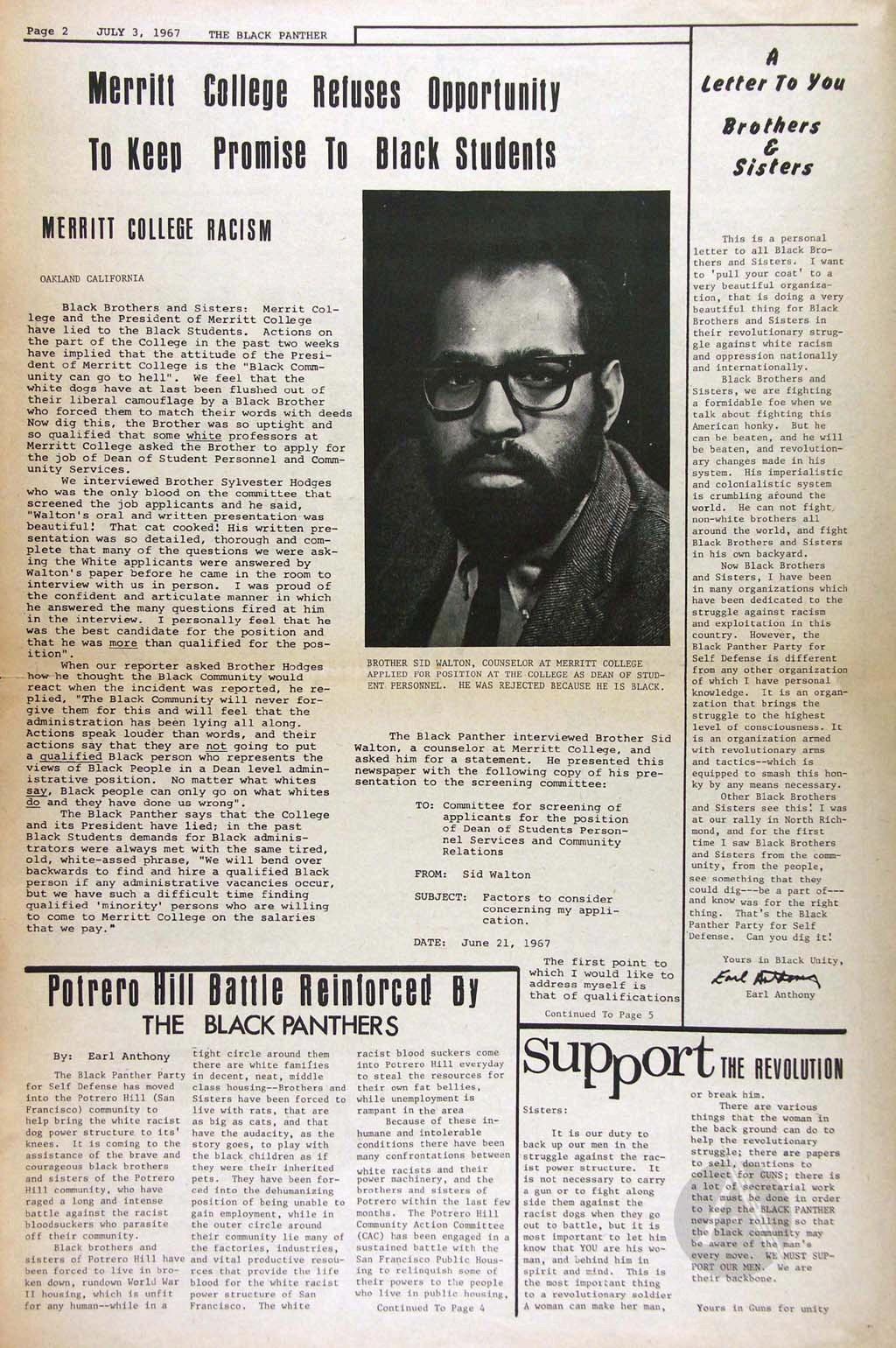
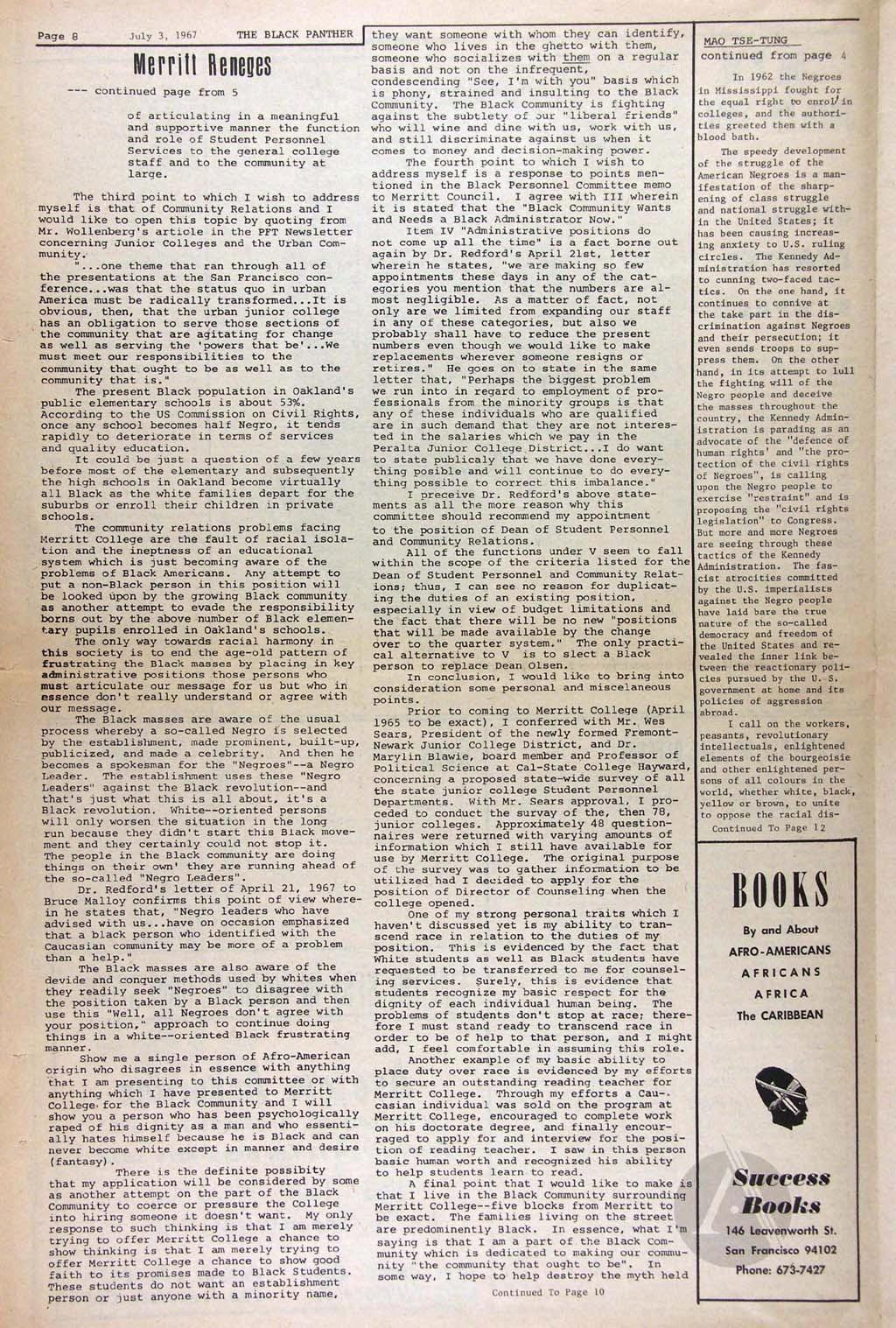
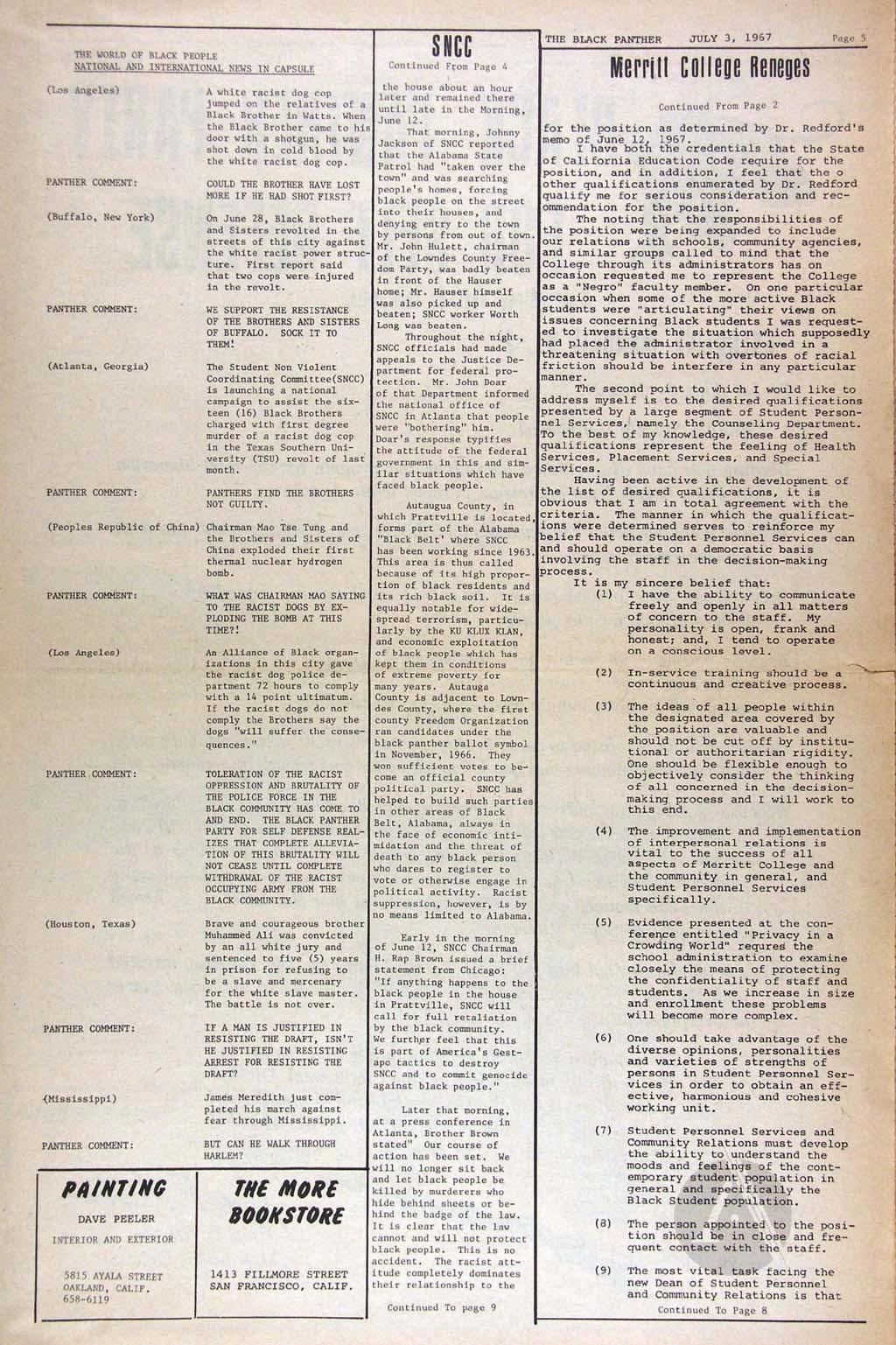
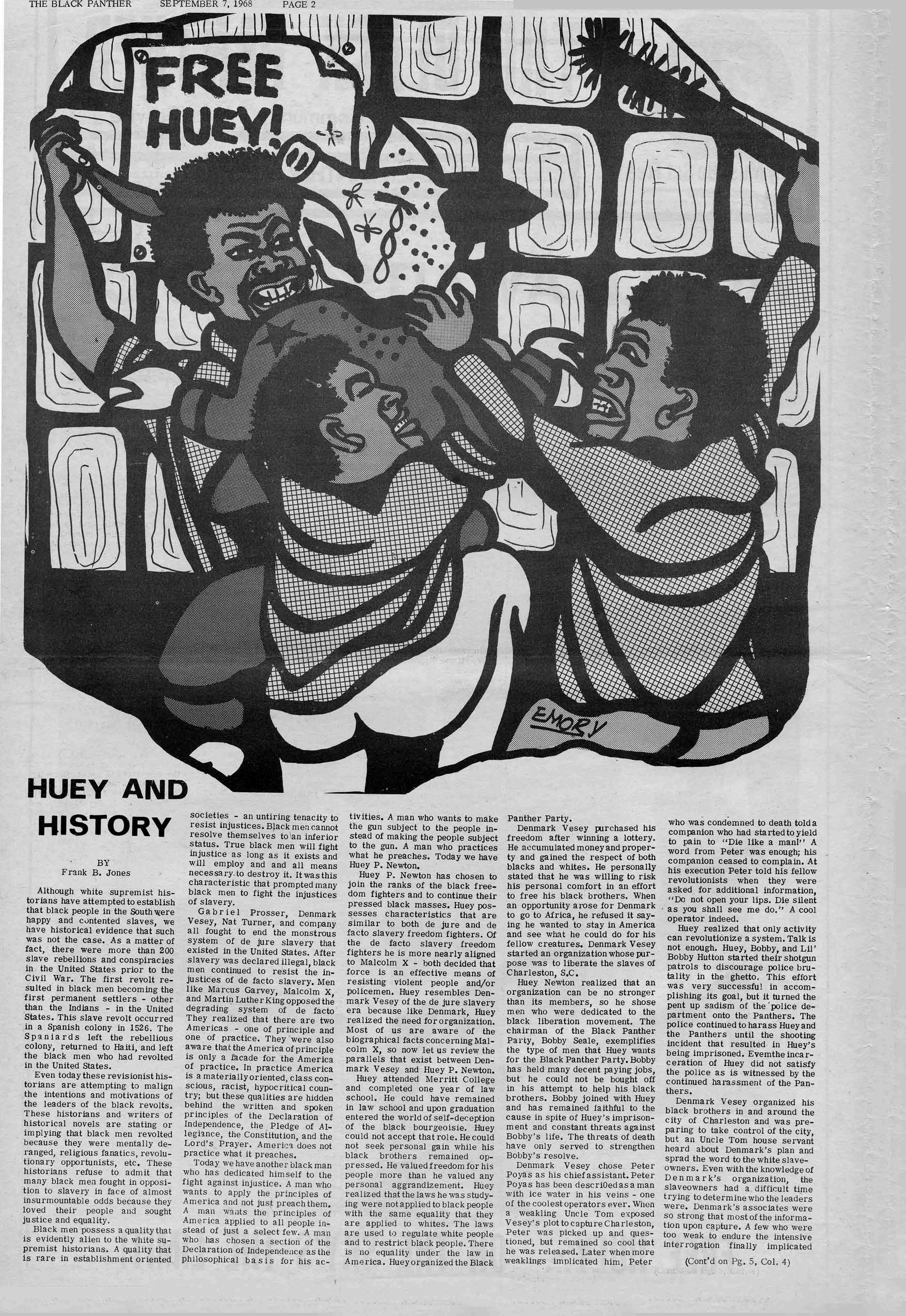
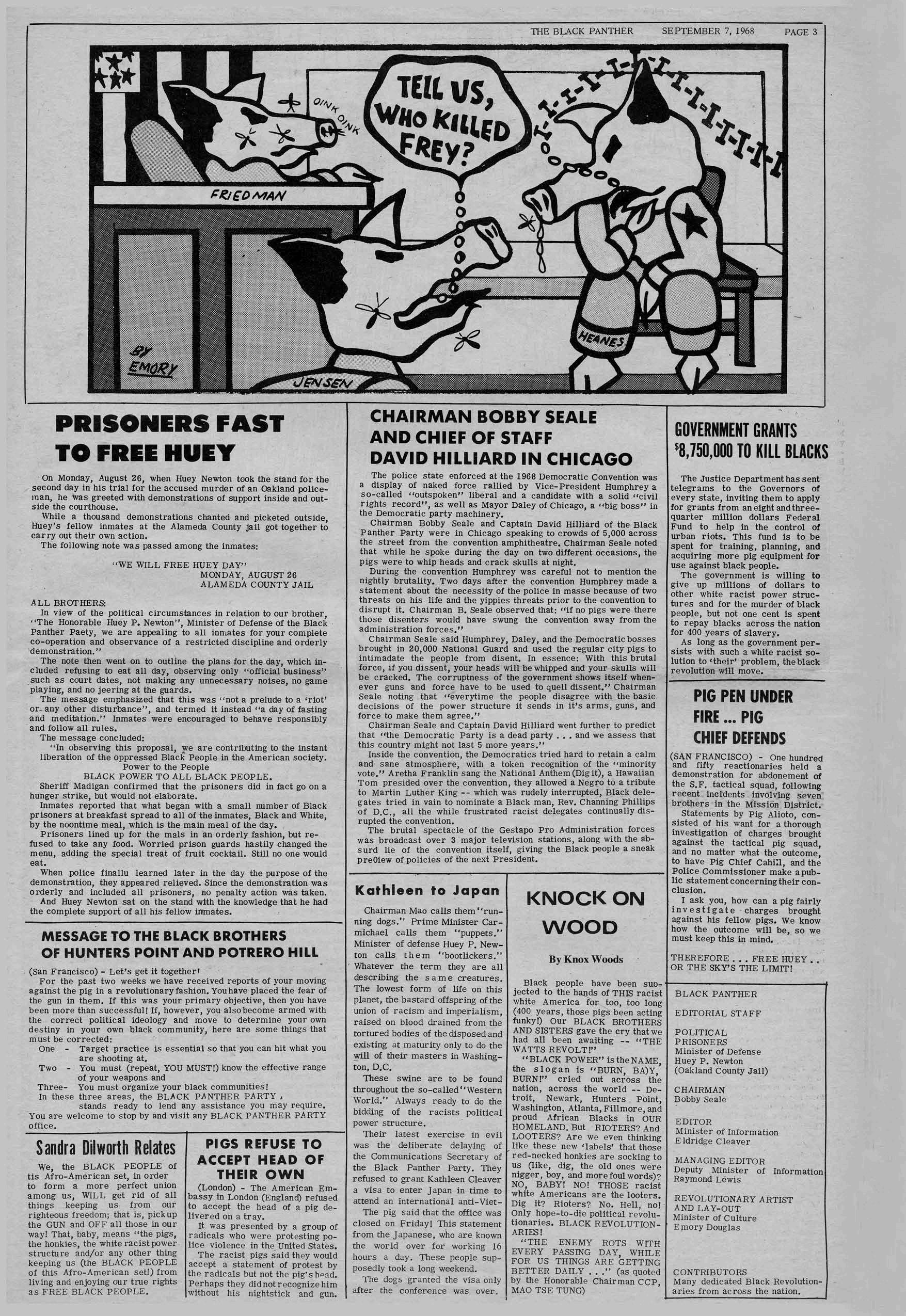
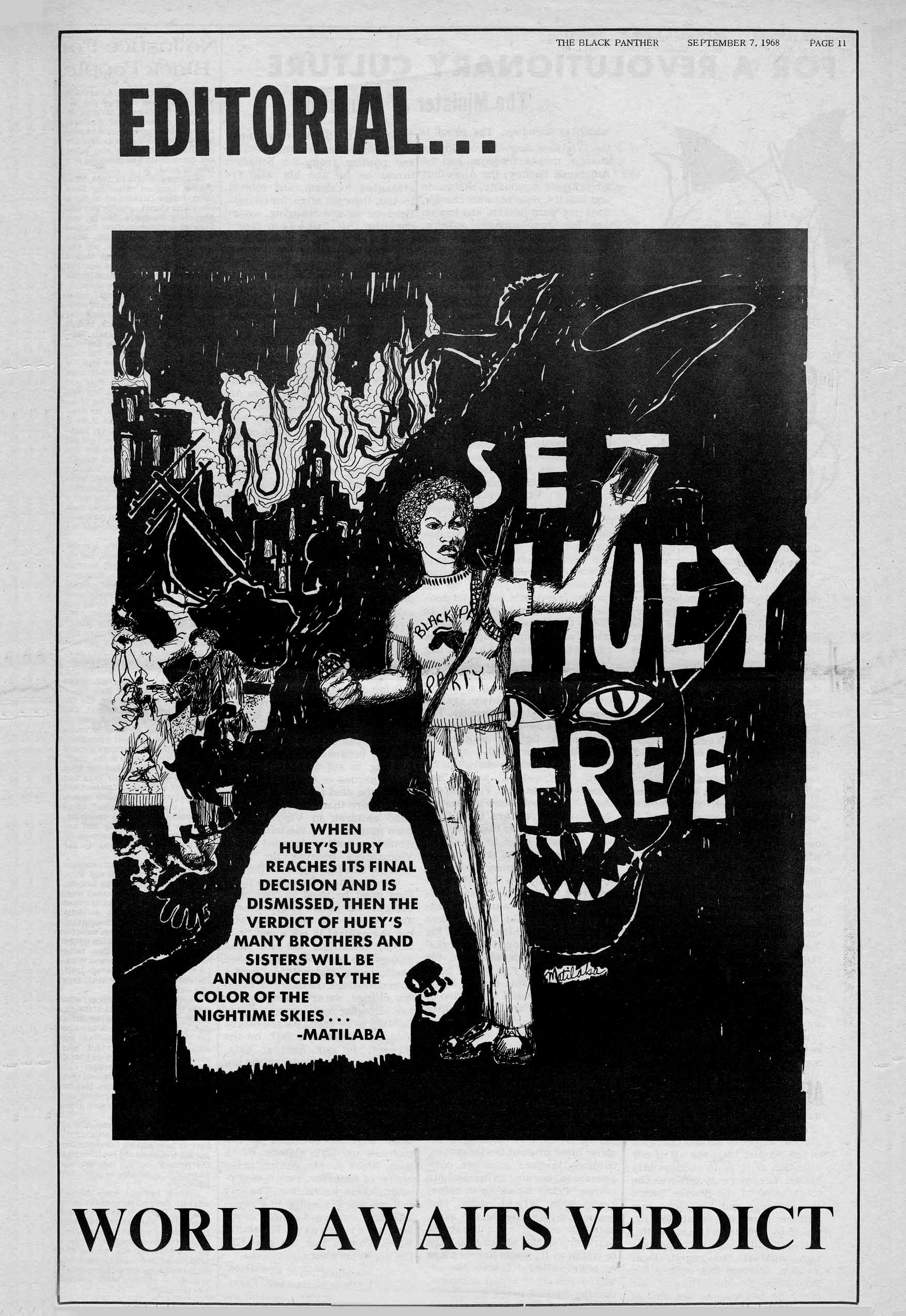
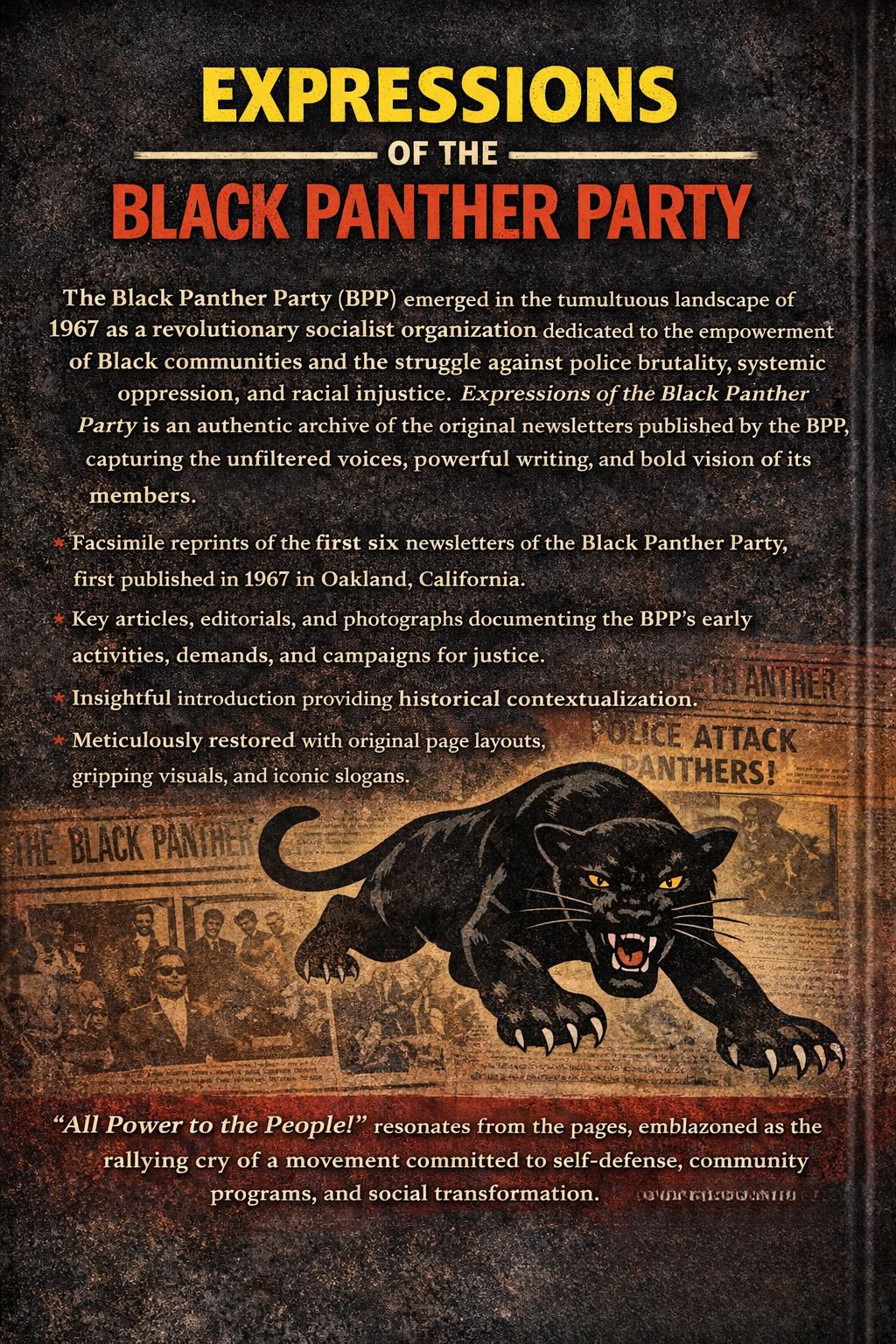
At its peak in the late 1960s and early 1970s, the newspaper sold for twenty-five cents a copy and reached readers far beyond formal membership, making it a central medium through which the Panthers' TenPoint Program, analyses of domestic and international politics, and visions of self-determination became widely known The paper's combination of bold artwork, uncompromising editorials, community reportage, and theoretical reflection offers a uniquely rich archive for understanding the political imagination of the era. The present collection is made possible in part because surviving copies of The Black Panther have been digitized and assembled into a public archive, from which this series draws its structure and contents.
The digitized collection notes that a copyright symbol began appearing on the newspaper masthead in 1968, but later research suggests that any such claims were not consistently maintained, and the hosting archive treats the issues as effectively in the public domain, while inviting discussion of the underlying legal questions. That status has enabled researchers, students, and community members worldwide to access and study the paper, ensuring that the voices, analysis, and aspirations contained in these pages remain available to future generations. Readers approaching these volumes should keep in mind both the conditions under which the newspaper was produced and the purposes it was meant to serve. The Black Panther was not a neutral or detached record; it was a partisan organ of a revolutionary organization, crafted to inspire, educate, and mobilize. Its reportage and commentary must therefore be read critically and contextually, in conversation with other sources on the period as well as with the lived experiences of the communities about which it spoke. At the same time, the newspaper offers perspectives, details, and connections that are rarely preserved in official archives or mainstream coverage, making it indispensable for any serious understanding of the Black Panther Party, the
Black freedom movement, and the broader landscape of radical politics in the late twentieth-century United States.
These twenty volumes are offered as a guide and companion to that archive. They do not attempt to resolve the debates that surround the Panthers or the movements of which the Party was part.
Instead, they aim to make the documentary record more accessible, to highlight the internal continuity of the newspaper across thirteen years of publication, and to honor the work of those who wrote, edited, illustrated, distributed, and preserved these pages under conditions of extraordinary pressure and risk. Whether read sequentially as a narrative of organizational change, consulted selectively for particular campaigns or themes, or used in classrooms and study groups for collective discussion, the issues gathered here testify to a period in which people sought, with remarkable clarity and courage, to remake the world.
TABLE OF CONTENTS PER VOLUME
Volumes of The Black Panther Newspaper (1967–1980)
Black Panther: Volume 1, 1967
Issues: 1-6
Dates: April 25 –November 23, 1967
Black Panther: Volume 2, 1968-1969
Issues: 2–30 (missing 1, 4, 13, 16, 17, 29; includes two Issue 9s)
Dates: May 4, 1968 – February 17, 1969 (approx.)
Black Panther: Volume 3, 1969
Issues: 1 - 32 (complete)
Dates: 1969
Black Panther: Volume 4, 1969-1970
Issues: 1–30 (missing 11, 22, 26)
Dates: Approx. 1969 – 1970
Black Panther: Volume 5, 1970-1971
Issues: 1 - 30 (missing 12)
Dates: 1970 - January 23, 1971
*Vol 5, No 1, July 4, 1970 (issue date printed on paper is incorrect)
*Vol. 5, No. 2, July 11, 1970 (issue No. printed on paper is incorrect)
Black Panther: Volume 6, 1971
Issue: 1- 30 (missing 10, 14, 19
Dates: 1971
Black Panther: Volume 7, 1971-1972
Issues: 1 - 30 (complete)
Dates: August 28, 1971–March 18, 1971 (calendar progression)
Black Panther: Volume 8, 1972
Issues: 1- 30 (complete)
Dates: March 25 –October 14, 1972
Black Panther: Volume 9, 1972
Issues: 1- 11 (complete
Dates: October 21 - December 30, 1972
Black Panther: Volume 10, 1973
Issues: 1–30 (missing 21,29)
Dates: May 19 – December 8, 1973
Black Panther: Volume 11, 1974
Issues: 2–30(missing 1, 23, 26)
Dates: January 5 –July 20, 1974
Black Panther: Volume 12, 1974
Issues: 2-30 (missing 1)
Dates: August 3, 1974 - February 15, 1975
Black Panther: Volume 13, 1975
Issues: 1-30 (complete)
Dates: February - September 15, 1975
Black Panther: Volume 14,1975
Issues: 1-30 (missing 8, 11; duplicates of Issue 4 present)
Dates: September 22, 1975 - April 10, 1976
Black Panther: Volume 15, 1976
Issues: 1-20 (missing 16: duplicates of Issue 2 present)
Dates: April 17, 1976
Black Panther: Volume 16 1976
Issues: 8–30 (1, 2, 3, 4, 5, 6, 7, 17, 18 all missing)
Dates: 1976
Black Panther: Volume 17, 1977
Issues: 1-28 (complete)
Dates: 1077
Black Panther: Volume 18, 1978
Issues: 1-29 (9, 10, 11, 13, 14, 15, 16 all missing)
Dates: Likely 1978
Black Panther: Volume 19
Issues: 2-11 (1, 4, 5 missing Dates: 1979
Black Panther: Volume 20
Issues: 1-9
Dates: 1980
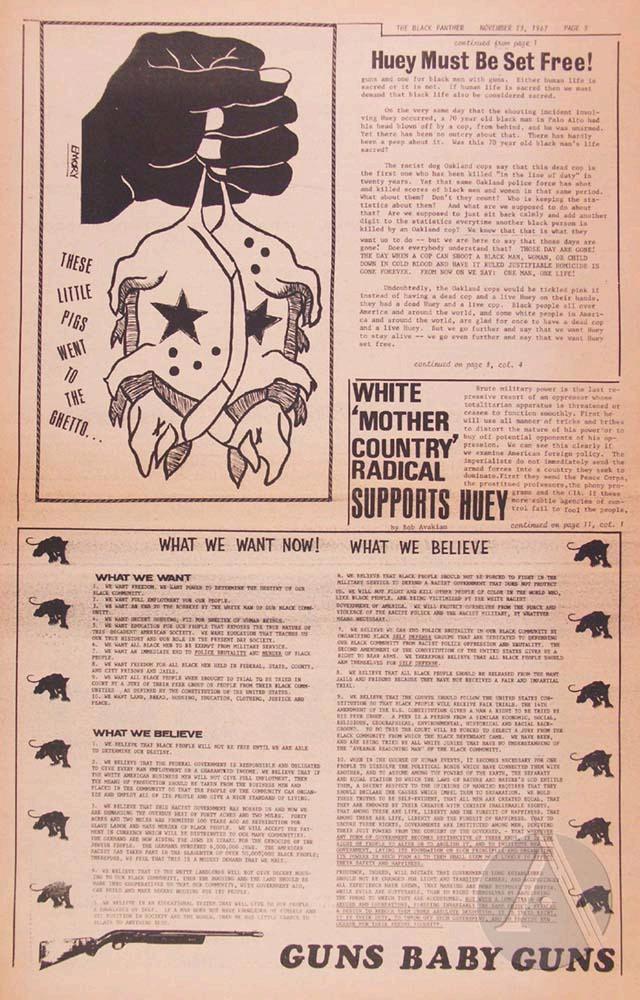
The 10-Point Program Authored by Huey P. Newton and Bobby Seale (October 1966)
The Black Panther Party for Self-Defense was established to advocate for racial justice and economic empowerment, guided by a specific set of demands known as the 10-Point Program. The program begins with this foundational mandate:
1 We want freedom. We want power to determine the destiny of our Black Community.
2.We want full employment for our people.
3.We want an end to the robbery by the capitalists of our Black Community.
4.We want decent housing, fit for shelter of human beings.
5 We want education for our people that exposes the true nature of this decadent American society. We want education that teaches us our true history and our role in the present-day society.
6.We want all Black men to be exempt from military service.
7.We want an immediate end to POLICE BRUTALITY and MURDER of Black people.
8 We want freedom for all Black men held in federal, state, county and city prisons and jails.
9.We want all Black people when brought to trial to be tried in court by a jury of their peer group or people from their Black Communities, as defined by the Constitution of the United States.
10.We want land, bread, housing, education, clothing, justice and peace.