SPRING/SUMMER 2023 • SPECIAL EDITION A BENEFIT TO MEMBERS OF TRUST FOR PUBLIC LAND
Celebrating 50 years of connecting everyone to the outdoors
NATURE SUSTAINS US EVERY DAY Return the Favor: Become a Monthly Donor Help us connect everyone to the benefits and joys of the outdoors with a recurring monthly gift. It’s easy, automatic, and secure. Trust for Public Land partners with communities to create parks and protect public land where they’re needed most.
START TODAY
tpl.org/monthly
t i d e w ay c r e at i v e
A · L AND&PEOPLE · SPRING /SUMMER 2023
F E AT U R E S
c o n t en t s
abigail lafleur-shaffer
tpl archives
26 38 “A lot of us realize that nature is the source of life and happiness.”
The Growth of Something Great in the Golden State ........................................................................... 26 From Second Street in San Francisco to 4 million acres of public land
d av e c o x /m o u n ta i n m e d i a
~ TA N YA H O D G ES , I N T H E M E A N I N G W I T H I N, P G . 5 0
50
protected nationwide, TPL’s 50-year legacy started in California with a novel idea and a commitment to improve lives.
Cultivating Land Protection Pros ................................................. 38 Meet some of TPL’s next generation of conservationists who are changing the face of land protection across the country.
The Meaning Within .............................................................................................. 50 From a Black history museum in Florida to grand landscapes in Wyoming and New Mexico, explore the deep connection—and affection—we feel toward impactful places and the meaning land holds for all of us. T P L .O R G · 1
GIVE GUIDE DOUBLE YOUR IMPACT : To celebrate our first 50 years of connecting everyone to the outdoors, all gifts* made by May 31, 2023, will be matched dollar for dollar. Make a gift today, and double your commitment during this milestone year. With a variety of ways to give, we offer something to suit everyone.
Monthly Giving Support Trust for Public Land’s mission with convenient, automatic, and secure set-it-andforget-it giving. Visit tpl.org/monthly, call 800.714.5263, or email donor.outreach@tpl.org to get started.
Conservation Champions Donate $2,000 or more annually and receive the recognition due a champion, such as invitations to special events and insider updates on our projects and conservation strategies. Visit tpl.org/champions, call 415.495.4014, or email champions@tpl.org.
Planned Giving Consider including us in your will or estate plan, learn about the benefits of designating retirement funds to TPL, and explore other taxwise ways to give. Call 202.856.3748, email plannedgiving@tpl.org, or visit tpl.planmygift.org to learn more.
Mail Your Gift Use the handy envelope bound inside this magazine to send us your gift.
Give Online It’s simple, easy, and secure. Visit tpl.org/membership to make a gift of any amount today.
TRUST FOR PUBLIC LAND depends on your support. Our work wouldn’t be possible without you. *Excludes planned gifts 2 · L AND&PEOPLE · SPRING /SUMMER 2023
DE PA R T M E N T S
anniversary, one constant emerges:
12
20
land has meaning.
jerry & marcy monkman
Reflecting at the time of our golden
tpl archives
From the President · 11
c o n t en t s
Retrospective · 12 A look back at TPL’s first 50 years and some of our proudest moments and milestones.
Board Spotlight · 16 Get to know Keith Weaver, chair of our Black History and Culture Advisory Council.
First Look · 17 engagement, TPL’s impressive roster of rail trails, and schoolyards that double as climate change combatants.
Member Center · 62 Offices · 63
22
t p l s ta f f
How meals foster community
Trail’s End · 64 Get to know some of the TPL family through stories about their connections to our work—told in their own words.
on t he cove r
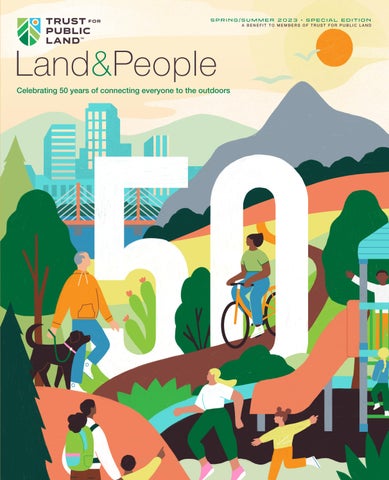
Trust for Public Land is celebrating 50 years of connecting everyone to the outdoors—and looking forward to our next 50 with high expectations. Illustration: Abbey Lossing
T P L .O R G · 3
4 · L AND&PEOPLE · SPRING /SUMMER 2023
c o n t en t s
Florida Legacy Trail Sarasota, Florida When it comes to creating great trails, TPL is on a roll—or riding the rails, more precisely. Defunct railways are a great starting point for building trails in developed areas. Such is the case with our 18.5-mile Florida Legacy Trail, part of the in-progress Florida Gulf Coast Trail, which will ultimately stretch an epic 336 miles from Tampa to Naples. Existing segments like this one are already providing safe, connected routes for cycling, walking, skating, and other outdoor fun. Explore TPL’s prolific rail trail portfolio in this issue.
20
da rcy k iefel
Page · 20
T P L .O R G · 5
6 · L AND&PEOPLE · SPRING /SUMMER 2023
c o n t en t s
Ackerson Meadow Yosemite National Park, California Forests may be grand, but meadows are worth their weight in the gold we know as water—a vital resource to wildlife in Yosemite National Park, where TPL preserved 400 acres at Ackerson Meadow. Home to a variety of bird species—including endangered great gray owls and willow flycatchers—as well as bats, insects, and mammals, the area’s saturated ground also helped it survive the devastating 2013 Rim Fire. Read about TPL’s origins and work in California in this issue.
26
ro b b hir sch
Page · 26
T P L .O R G · 7
8 · L AND&PEOPLE · SPRING /SUMMER 2023
c o n t en t s
Chiloquin Elementary Schoolyard Chiloquin, Oregon A newly renovated schoolyard at Chiloquin Elementary in southern Oregon provides a high-quality place to play and a chance to honor and preserve the history and culture of the Klamath Tribes and their ancestral homelands. The space was designed with the help of students and community members and doubles as a public park. It will also serve as a model for the Tribal Community Schoolyard Pilot Program, a new partnership between TPL and the Bureau of Indian Education (BIE). Meet TPL’s Anna Hadlich, a Generation Now staffer who helped plan the playground’s grand opening, in this issue.
38
s pay n e m a r t in e z
Page · 38
T P L .O R G · 9
Lead the Way Become a Conservation Champion and help Trust for Public Land connect even more people to nature. With your annual leadership-level contribution of $2,000 or more, you will receive invitations to special events and insider updates on our projects and conservation strategies.
Learn more about the impact you will have as a Conservation Champion. Contact us at 415.495.4014 or champions@tpl.org.
Join the Conversation As we continue our yearlong 50th anniversary celebration, stay connected on your favorite social media channels. We’ll be sharing breathtaking pics, news about events and giveaways, and inspiring stories about how we’re connecting everyone to the outdoors. @trustforpublicland @TheTrustforPublicLand @the-trust-for-public-land @tpl_org TrustforPublicLand Share your own pictures and stories about how you find joy outside—tag us in your posts and use our anniversary hashtag: #TPL50. 10 · L A N D & P E O P L E · S P R I N G / S U M M E R 2 0 2 3
adair rutledge
tpl.org/champions | champions@tpl.org
fro m t he pr es id en t
nichol as lea bruno
LAND MEANS CONNECTION; LAND MEANS HOPE When we think about the outdoors, the way we feel comes first: breathing crisp executive editor
I Ling M. Thompson publisher
Jennifer Ramsey editorial director
Deborah Williams managing editor
Amy McCullough s ta f f w r i t e r s
Lisa W. Foderaro Amy McCullough Deborah Williams designers
Rachel Andrade Miya Su Rowe Ben Whitesell media production manager
Elyse Leyenberger d i g i ta l p r o d u c e r
Jeremy Sammons
© 2023 Trust for Public Land. All rights reserved. 10-Minute Walk, Community Schoolyards, Conserving Land for People, Conserving Nature Near You, Creating Parks and Protecting Land for People, Fitness Zone, Land for People, Land&People, LandVote, Northwoods Initiative, Our Land, Outside For All, Parks for People, Parks Unite Us, ParkScore, The Trust for Our Land, Trust for Public Land, TPL, and all other names and logos of Trust for Public Land programs referenced herein, as well as their logos, are registered or common-law trademarks of Trust for Public Land.
mountain air, smelling fresh-cut grass in a park, hearing children giggle in a schoolyard or the steady rhythm of footfalls on a trail. It’s through our senses that we feel our connection to land and the world around us. As we mark our 50th anniversary, let’s celebrate that we’ve helped to bring those experiences to nearly 9.4 million people through measurable, tangible work—4 million acres of protected land and nearly 5,400 parks, schoolyards, trails, and greenways in communities where they are needed most. Read about some of the most notable projects through the years starting on page 12, including our early work at Bee Canyon in Los Angeles or our Parks for People Program in San Francisco, where we developed the community-led park design process we still use today. Along the way, we’ve also learned to deeply appreciate the meaning of land, not only in telling stories of our past but also in writing the stories of our future. Take, for example, our early work in Oakland, California (page 26), and our more recent project in South Oak Cliff in Dallas. Both communities were once defined by redlining and segregation. Or places like Greeley and Colorado Springs, Colorado, where decades of disenfranchisement meant residents were chronically last in line for investments in green space. But by envisioning, advocating for, and designing South Oak Cliff Renaissance Park, Greeley’s Delta Park (page 18), and Colorado Springs’ Panorama Park (page 38), those communities demonstrate how even relatively small pieces of land can be catalysts for dismantling decades of inequity and for building healthier, happier next chapters. Speaking of next chapters, we have big goals and high expectations for our second half century. To achieve them, we need to scale our impact beyond a one-park-at-a-time approach by supporting others to elevate and advocate for parks. Our Generation Now program (page 38) is developing a
more diverse community of land protection pros who come from and understand the needs and visions of the communities where we work. Through our Black History and Culture program, which is being led by expert staff and advisors, and our renewed commitment to tribal and Indigenous land protection, we are identifying, protecting, and preserving more spaces that represent the full American experience: projects like the Wells’Built Museum of African American History and Culture in Orlando, Florida, or the L Bar property in New Mexico, whose past stories recall grave injustices, but whose present and future hold the promise of connection with culturally important sites (page 50). Looking back and looking forward, we can see that land has meaning. So too does time. This is a significant moment because our mission cuts across critical issues our society is facing today— such as climate resilience, mental and physical health, and community well-being—that will define our future. When we create, protect, and restore land to the public and build new parks, trails, and schoolyards, we’re improving people’s quality of life, and each of our projects helps tell a proud and honorable story. When I look back, I’m gratified. When I look forward, I’m hopeful. Over the next 50 years, the land we protect—and the way we do it—will deliver more stories of justice, equity, resilience, and hope.
diane regas president & ceo
T P L .O R G · 11
r e t ro s pect i v e
A LOOK BACK AT
TPL’S FIRST 50 YEARS On our 50th anniversary, we’re celebrating some of our proudest moments— all achieved with the support of donors, partners, and advocates. Together, we’ll have an even greater impact moving forward.
By Amy McCullough and TPL staff
1972
1973
1974
1975
1976
1977
1978
1979
1980
1981
1982
1983
1984
1985
iv
h c
TPL collaborates with Oakland residents and the Black Panthers on our Oakland Land Project, which turned vacant properties into miniparks and gardens—a testament to our deep and long-standing commitment to working with marginalized communities to advance outdoor equity. Read more on page 26.
tp
l
a
r
h
iv
“We all started out thinking very locally . . . You find out that the most important backyard is everybody’s backyard.”
c r
“What has been missing in environmental policy is the link between environmental restoration and economic growth. With restoration, over time will come the economic growth to eliminate poverty and build societies that value human rights.” — Huey Johnson, Cofounder & President (1972–1977)
— Douglas Ferguson, Cofounder & National Board Chair (1984–1994)
We complete our first six projects, including Bee Canyon in Los Angeles, which became part of O’Melveny Park (the city’s second-largest municipal park), and Wilkins Ranch, which became part of the Golden Gate National Recreation Area. Read more on page 26. Beginning with San Francisco’s Parks for People program, TPL develops our community-centric design process, setting the course for our next 50 years and ensuring the parks we create address health needs, reflect local culture, meet residents’ aspirations, and support economic revitalization.
12 · L A N D & P E O P L E · S P R I N G / S U M M E R 2 0 2 3
es
a
iv
l
Work begins in the Columbia River Gorge along the Oregon-Washington border, where we have now protected more than 17,000 acres through 60-plus land projects.
h
tp
First project in the Appalachian Trail landscape is completed in New Jersey, leading to more than 319,000 acres now protected, most recently 482 acres at Dark Ridge in North Carolina.
TPL donates five row homes in Atlanta, Georgia, to the National Park Service, saving an important piece of American history that is now part of Martin Luther King, Jr. National Historical Park.
c
es
TPL is founded by Huey Johnson, Greg Archbald, Martin Rosen, and Douglas Ferguson. Read more on page 26.
es
MID-1970s
tp
l
a
r
“I am so proud of TPL . . . we’ve got [millions of] acres out there in public ownership that will be enjoyed for generations.” — Greg Archbald, Cofounder
se
o
Work begins in Arizona’s Saguaro National Park, leading to the protection of 2,237 acres in and around the park, improving access and connectivity to Tucson’s big backyard. Since our founding, we’ve expanded the National Park System by nearly 65,000 acres, through 220 land conservation projects across almost 70 park sites.
r
We establish our first tribal partnership, with the Nez Perce Tribe, leading to the landmark effort to acquire and restore 10,000 acres of Oregon’s Wallowa Valley back to the Nez Perce. Read more on page 26.
n
TPL completes the protection of the Monroe School in Topeka, Kansas, which becomes the Brown v. Board of Education National Historic Site.
The first issue of Land&People magazine is published.
jo
an
“It was very important, to me, to look for those opportunities where we could do both conservation and social justice.” — Martin Rosen, Cofounder & President (1979-1998)
1988
1989
OU PL LL
BI RT
ES
Y
O
F
ds
u
1995
TPL helps preserve a piece of literary and cultural history with the protection of Walden Woods, including 112 acres surrounding Henry David Thoreau’s Walden Pond plus a historic homesite.
We launch our national Community Schoolyards™ program in New York City, resulting in nearly 300 schoolyard transformations across the country to date—plus a new goal to create 28 high-quality green playgrounds in L.A. by 2028. Read more on page 22.
1996
1997
1998
1999
We begin transforming an 8.5-acre industrial site in Seattle, Washington, which opens as Olympic Sculpture Park, a landmark representing the city’s rich culture and artistic identity, in 2007. TPL advances our 20-year vision for the Chattahoochee RiverLands, a community-led effort that will culminate in a 100-mile greenway, greatly increasing access to nature for millions of Atlanta-area residents.
n
“ What TPL has done, whether it be urban or rural, is to really harness the energy of local leadership and people who care about where they live.” — Lisa Cashdan, Former Organizer of Community Gardens in NYC
TPL begins our conservation finance efforts, which have since passed 646 measures—at an 83 percent success rate—for $93 billion in public funding for projects across the country.
rg
a
1994
.o
h
1993
ff
ep
1992
— Bill Plouffe, Cofounder of the Maine Appalachian Trail Land Trust
h st
1991
“We keenly recognize that all these lands are the traditional territory of Indigenous peoples.”
on
COU
1990
u
1987
FFE
1986
w
oo
d
r
“TPL helped us understand the possibility [along] the Chattahoochee . . . it was an audacious concept that has been wildly successful.” — P. Russell Hardin, President, Robert W. Woodruff Foundation
T P L .O R G · 13
N
We help Randolph, New Hampshire, acquire over 10,000 acres of forest in the first of 30 Community Forest projects, now totaling over 30,000 acres.
AT
UT
AU
STI
We join Atlanta in its effort to create the Atlanta BeltLine greenway, a 22-mile “emerald necklace” passing through 45 neighborhoods and with a host of new parks.
LBJ
H SC
OO
L
“I have never seen a more compelling project than the BeltLine. [It] will transform Atlanta—connecting its people and places, its past and future.”
TPL starts using geographic information systems (GIS) to help cities and counties identify high-need locations for conservation.
TPL celebrates the redesign and reopening of San Francisco’s Boeddeker Park, bringing green space to a diverse, low-income neighborhood with the city’s highest population density. Climate-Smart Cities™ program begins with work in New York City and Kirkland, Washington, later expanding to metro areas nationwide; through it, TPL partners with residents and civic leaders to plan, fund, and create greener, healthier, and more equitable communities.
— Shirley Franklin, Former Mayor of Atlanta
2000
2001
2002
2003
2004
2005
2006
TPL and partners cover the Hollywood Sign with “SAVE THE PEAK,” rallying support to preserve one of the world’s most iconic landmarks. Read more on page 26.
2008
2009
2010
ParkScore® index launches, ranking the most populous U.S. cities on equity, access, investment, amenities, and acreage—plus park access levels for nearly 14,000 cities and towns across the country.
2011
2012
2013
The 606 opens, transforming an unused rail line into an urban trail in northwest Chicago. Read more on page 20. The Kashia Band of Pomo Indians reclaims nearly 700 acres of ancestral land as the Kashia Coastal Reserve. Read more on page 26.
en
be
rg
er
Our work begins in Utah’s Zion National Park, ensuring uncompromised recreational access to such beloved places as the Narrows, Kolob Terrace, and Tabernacle Dome in the years that follow.
2007
le
y
“If not for [TPL], this would be a much different country. It would be a grayer, sadder place. Our communities would certainly not have the access to nature and the joy it brings, the places to play for our health, for our connection to one another, for our spiritual well-being, for our climate.” — Will Rogers, President & CEO (1998–2018)
14 · L A N D & P E O P L E · S P R I N G / S U M M E R 2 0 2 3
TPL strikes a $45-million deal to preserve 634 acres of wild shoreline in Hawai‘i, known as our Kahuku Kawela Forever project. ff
e
ta
ys
s
el
tp
l
“When we go into a community, we don’t go in with a blueprint. We go in with a question, which is, ‘What do you want? What do you need? What are your goals?’” — Thomas S. Reeve, National Board Member & Hawai‘i Advisory Board Member
Protection of 469 acres on Mount Ascutney is secured, saving the mountain from development and providing residents of West Windsor, Vermont, with 30 miles of trails and a future of economic growth.
de
r
TPL partners with CityHealth to advance urban green space policies through the lens of community health.
fi
lm
s s
A renovated Kiwanis Methow Park opens in Wenatchee, Washington, transforming an underused area into a vibrant green space and cultural center.
“Everybody has something creative within them, and being in nature helps inspire that.” — Allegra “Happy” Haynes, National Board Member & Executive Director, Denver Parks & Recreation
2014
2015
2016
2017
2019
2020
2021
2022
y
2023
After 30 years of TPL-led advocacy, Congress approves full and permanent funding for the Land and Water Conservation Fund— $900 million a year.
NB
YE
L
E
c
o
x
EL
YS
E
v
e
da
lm
“This outcome is the culmination of an inclusive, disciplined, and fair-minded campaign that united the American people around our shared values, rather than splitting us along our differences.
fi
— Martin Heinrich, U.S. Senator (D-NM)
s
“[L Bar] was the single greatest addition to public lands in New Mexico in a generation.” ta
lu
s
“I have hope that [my children] are going to be in this space and are going to understand and love this the same way that I did.” — Taylor Toynes, National Board Member, Community Leader, Founder of For Oak Cliff (a community nonprofit along Five Mile Creek in Dallas, Texas)
ta
n
— Diane Regas, President & CEO
TPL conveys 19,200 acres of land in Trinidad to Colorado Parks and Wildlife, leading to the creation of Fishers Peak State Park.
TPL collaborates with hundreds of Dallas, Texas, residents to develop a bold vision for a network of parks and trails known as the Five Mile Creek Urban Greenbelt.
it
“At 50 years in, we’re just getting started. Our vision for the future is possible because we are working together.”
ER
TPL protects 400 acres of critical wetland and meadow habitat by acquiring Ackerson Meadow as part of Yosemite National Park, the largest addition to the national park since 1949. Read more on page 6.
2018
br
Celebrating our 50th anniversary—and the protection of 4 million acres in perpetuity.
TPL hires its first Black History and Culture Director, Dr. Jocelyn Imani, to accelerate our historic preservation work and tell a more complete American story. In Southern California, TPL saves 387 acres from development, providing access to nature within an hour’s drive for more than 8 million people at what will become Frank and Joan Randall Preserve.
R
lu
Award-winning Rodney Cook Sr. Park opens in Atlanta, Georgia. A model of smart design, it’s capable of capturing 10 million gallons of stormwater.
GE
ta
g
ry
Our 10-Minute Walk® program, which is currently working with more than 300 mayors to close the park equity gap, debuts.
— Kathy DeCoster, Former Director of Federal Affairs
Midway Peace Park in St. Paul, Minnesota, opens, providing residents with a safe outdoor space that they helped design. A new strategic plan focuses TPL’s efforts through the lenses of health, equity, climate, and community— and sets ambitious goals for the next 25 years.
New Mexico’s 54,000-acre L Bar property is protected. Read more on page 50. The community-led renovation of Colorado Springs’ Panorama Park is completed, providing 13 acres of highquality green space to historically underserved residents. We launch the Tribal Community Schoolyards Pilot Program with the Bureau of Indian Education (BIE) to create nature-rich schoolyards that honor tribal culture. Read more on page 8.
T P L .O R G · 15
Get to Know
boa r d s p ot lig h t
Chair, Black History and Culture Advisory Council, since 2021
joseph smith
Board of Directors
Keith Weaver National Board of Directors since 2020 California Advisory Board since 2018
chair
Lucas St. Clair Luis Benitez J. Franklin Farrow Mickey Fearn Jody S. Gill F. Whitney Hatch Allegra “Happy” Haynes Ben Jealous Jennifer Jones Chris Knight Christopher G. Lea Joseph E. Lipscomb Ignacia S. Moreno Caroline P. Niemczyk Michael Parish David Poppe Thomas S. Reeve Diane Regas
KEITH WEAVER is a busy guy. When he’s not helping TPL preserve sites that tell an inclusive American history, he works as the executive vice president of global policy and external affairs for Sony Pictures Entertainment. He also makes time for fishing and learning to golf, as well as supporting his wife’s whiskey company, Uncle Nearest Premium Whiskey; the company takes its name from Nathan “Nearest” Green, a formerly enslaved man who became the country’s first African American distiller on record. On our 50th anniversary, we’re asking what TPL means to him.
Laura Richards Ted Roosevelt V Lex Sant Sheryl Crockett Tishman F. Jerome Tone Taylor Toynes Keith E. Weaver Susan D. Whiting Florence Williams
What initially brought TPL to your attention? I was first compelled by TPL’s work to develop projects in urban areas in deeply underserved communities. Quite frankly, the communities served reflected the places where I grew up, and the constituencies looked like me. Furthermore, the approach was respectful and invited true community participation. What’s been one crystallizing moment during your involvement with TPL that’s indicative of why you contribute time and energy to our organization? There are several moments, but one that stands out was a phone call with [President and CEO] Diane Regas about the importance of the Black History and Culture preservation work. Her enthusiasm was infectious and reflective of the way in which she leads the organization, as well as the appropriate focus on impact versus credit. What speaks to you about our mission more than other worthy causes? There’s an ethos of equity and inclusion at TPL—where in the public
16 · L A N D & P E O P L E · S P R I N G / S U M M E R 2 0 2 3
land realm there typically isn’t as much mindfulness or representation. What are you most excited about for TPL’s future? Right now, I’m squarely focused on the effort to preserve and, where appropriate, reimagine Black historical sites throughout this country. Few people know about or fund this work, and, as a result, there’s a great deficiency, and prominent sites are at risk. le a r n m or e @ TPL.ORG/BHC
Legendary yoga teacher Vanda Scaravelli famously said, “Movement is the song of the body.” If so, then the
First Look
Bloomingdale Trail at The 606 in Chicago is conducting a symphony. On any given day, walkers, joggers, skaters, and cyclists can be found commuting, running errands, or just enjoying nature—all from the safety of an elevated track. Read more on page 20.
Breaking Bread; Making Parks Creating Trails Along Rails Schoolyards for Climate Resilience
adam ale x ander
le a r n m or e @ TPL.ORG/606
T U R N T H E PAG E FO R :
T P L .O R G · 17
fo o d & d r in k
delta park | greeley, color ado
Coffee Talk
Food, drink, and conversation are the building blocks of great parks. By Amy McCullough
Gloria Galindo always wanted to open a coffee shop. “I still want to do
community members at picnic tables in Delta Park or, if the
that,” she says, “sell coffee and teas from around the world.”
apartment complexes.
For now, she is sharing coffee and tea—and food—in a less entrepreneurial fashion.
weather is less friendly, at communal spaces in nearby The group’s efforts so far have included planning park outreach events and engagement activities to gather resident
As part of TPL’s Community Outreach with Resident Experts (CORE) program in Greeley, Colorado, Galindo’s role is to engage with residents who live near the city’s Delta Park
input and ideas for the park and to celebrate the neighborhood’s cultural identity through food, sports, art, and music. Galindo—who, ironically, is not a big coffee drinker herself—
as they envision what they’d like their neighborhood green
takes inspiration from something a pastor once told her, that
space to be. Galindo has worked with the quickly growing
coffee beans transform from the inside out. “So your power is
city’s Somali and Latinx immigrant populations in various
inside of you,” she explains, adding that she wants to help
capacities for over 20 years, so the job is a natural fit. “This is
Greeley residents “be the coffee bean.”
totally my cup of tea,” she says in all earnestness.
And she’s seeing it happen, noting that community members
One of her first tasks with TPL was to conduct a survey
who might be intimidated by formal interviews open up at a
with residents about the park, but she felt the survey itself
table together. Attendees are “really becoming empowered
needed community input. So she proposed what she knew
and using their voices,” she says. “I’ve never believed that you
would bring people together: food and drink. And the Coffee
empower anybody. You give them the tools, and they become
Chat Group was formed. “When you go to someone’s house,
empowered themselves.”
what do they do?” she asks. “They offer you something to drink.”
For residents who live near Delta Park, the tool is conversation—which caffeine doesn’t hurt. One drink they
Initial members were recruited at a community event,
regularly share is shaah: similar to chai, it’s flavored with
where Galindo and other resident experts asked interested
ginger, cardamom, cinnamon, and cloves and served
parties to sign up, but it’s spread by word of mouth since.
during casariya, a traditional Somali afternoon tea.
Now, on Friday afternoons, Galindo hosts roughly a dozen
Drinking shaah and eating malawah, thin Somali pancakes
More Grub-Fueled Community Engagement Phil Dube, a TPL senior project associate and Generation Now cohort member, shares a relevant proverb from his home country of Zimbabwe: “Relationships are hardly complete until you’ve shared a meal together,” he says. Following that lead, he worked with Feel Good Portland and Norumbega Cidery on an all-day festival in New Gloucester, Maine, celebrating local food, drink, and music that raised funds in support of our ongoing effort to protect 193 acres at Talking Brook Public Land, a nearby natural area.
tp
l
st
af
f
Along with public art installations, our Heat Response program in Philadelphia, Pennsylvania, deployed a “Popcycle” (left) to help raise awareness around extreme heat and environmental justice. The mobile popsicle stand visited three of Philly’s most affected communities, offering cool treats and engaging residents in conversation. (Popsicles were by Philabundance, a local nonprofit that works to alleviate hunger.) 18 · L A N D & P E O P L E · S P R I N G / S U M M E R 2 0 2 provided 3
that the group likes to spread with Nutella, naturally leads to talk of home. It’s not uncommon for a chat group member, many of whom are refugees, to pull out their phone and show photos of an open space back in Ethiopia, for instance, or for a Mexican immigrant to recall the beautiful gazebo at the center of the public park in their hometown. Trust for Public Land’s design team occasionally wondering what kind of material the gazebo should be made of and what type of entertainment it should host. In this way, sharing food and drink is generating a way for refugees and immigrants to
e ly s e l e y e n b e r g e r
joins the group and asks more in-depth questions,
work toward creating a home away from home through their public outdoor spaces. Initially, residents didn’t even know Delta Park was public due to a confusingly placed fence and the park’s proximity to an apartment complex. Now they’re taking ownership, says Galindo. The attitude
SHAAH CADAYS (Somali Spiced Tea with Milk)
is, “This is our neighborhood; this is going to be our park.” But, Galindo observes, “It’s not just about a
(Somali Sweet Pancakes) •
2 cups all-purpose flour
•
2 pieces cinnamon stick (about 2 inches each)
•
2 1/2 cups milk
•
2 large eggs
•
5 green cardamom pods
•
1 tablespoon sugar Pinch kosher salt
park. It’s really about building community.” Antonnio Benton, TPL Parks for People project
MALAWAH
manager in Colorado, explains that the City of
•
5 whole cloves
•
Greeley tried to engage the community around the
•
1 teaspoon black peppercorns
•
2 tablespoons canola oil or butter, for frying
•
2 cups cold water plus 2 cups whole milk
•
Honey, butter, sugar, or Nutella for topping
•
3 tablespoons loose black tea (or 4 black tea bags)
•
3 tablespoons sugar, plus more to taste
same green space prior to TPL’s involvement but failed. “None of the work that we’ve been able to do at Delta Park would have happened without the Coffee Chat Group,” he says. Yesenia Garcia, a Mexican immigrant and college student at the University of Northern Colorado in Greeley, is another part-time resident expert working with Galindo to engage residents in planning Delta Park. She's also helping with Shur View, a nearly 1,000-acre natural area on the other side of the city, about 25 minutes from Delta Park. When Galindo talks about Garcia, she sounds like a proud parent, which fits her nickname in the community: “They call me Mama Gloria,” she says. Like a good mother, she ends our conversation with a nurturing touch, warmly extending an invitation to Greeley to share food, drink, and— more importantly—ideas. Turn to page 38 for more on our CORE program and Generation Now cohort. le a r n m or e @
TPL.ORG/CO-PARKS
Crush the cinnamon, cardamom, cloves, and peppercorns until coarsely ground. Add them to a medium saucepan and cook over medium heat for about one minute, stirring, until very fragrant. Add the water, tea, milk, and sugar and increase heat to high. Once bubbles form at the edge, immediately reduce heat to low and let the mixture simmer for five minutes. Strain through a fine-mesh sieve and serve immediately. Add more sugar to taste if desired.
Whisk all ingredients together in a bowl. Heat a frying pan to medium with enough butter or oil to lightly coat the surface. Ladle some batter into the pan and swirl to make a thin layer extending to the curved sides of the pan. Fry for about a minute or until lightly golden, then flip over and fry another minute or so on the other side. Serve with toppings of choice.
Recipes provided by Shukri Abdi Farah of Tawakal East African Restaurant in Greeley.
F I R S T L O O K · 19
m a pping o u r impact
Walking the Lines of America’s Rail Trails Over the past 50 years, TPL has amassed the country’s second-most prolific portfolio of rail trail projects. From our earliest projects, we’ve looked for opportunities to bring more trails to communities in order to connect everyone to outdoor experiences close to home. Sometimes, that means building new paths from scratch. Other times, it means saving smallbut-critical segments that increase connectivity and create longer overall routes. And often, it means repurposing existing infrastructure corridors and rights-of-way, especially rail lines. These are a few of our most iconic rail trails.
By Deborah Williams Illustration by Nate Padavick
Olympic Discovery Trail Olympic Peninsula, WA
Total trail length: 138 miles Multimodal carbon-free transportation spine that connects several remote communities on the Olympic Peninsula to each other and to the Great American Rail-Trail.
Bizz Johnson National Recreation Trail Northern California
Total trail length: 25.4 miles Considered by the Rails-to-Trails Conservancy to be one of the best rail trails in the country, it follows 16 miles of the Susan River and winds through rugged semiarid canyons and pine forests. Connects Westwood and Susanville, two towns with deep mining/pioneering histories.
In an urban landscape, existing linear features such as rail lines and utility rights-of-way are some of the best ways to connect people, get them out of their cars, achieve climate benefits, and increase access. Plus, when we are doing our best work, we can reunite communities by changing the original narratives written by many rail lines that historically divided communities.” — TPL Trails Initiative Director J.T. Horn
2 0 · L AND&PEOPLE · SPRING /SUMMER 2023
Santa Fe Railyard Park and Plaza Santa Fe, NM
Total area: 11 acres Not the rail corridor itself but the former railyard, the property has been repurposed into a gathering place for residents and visitors with a farmers’ market, art galleries, restaurants, live music, and park features.
Arkansas River Trail Little Rock, AR
Total trail length: 88.5 miles This pedestrian and cycling loop is popular with birders and connects downtown Little Rock to Pinnacle Mountain, several major city parks, the Clinton Library, and the nation’s first outdoor linear health museum.
Bloomingdale Trail (a.k.a. The 606)
Cuyahoga–Lake Link Trail
Total trail length: 3 miles A former elevated rail line through an industrial stretch of the city’s northwest side, the raised linear park connects four neighborhoods (Logan Square, Humboldt Park, Bucktown, and Wicker Park), each with ground-level access.
Total trail length: 1.3 miles The main alternative transportation route between downtown Cleveland and Lake Erie to the north and Cuyahoga Valley National Park to the south, it provides walkable/bikeable access to the waterfront.
Chicago, IL
Cleveland, OH
Three Rivers Heritage Trail Pittsburgh, PA
Total trail length: 33 miles Extending from the city’s well-known riverfront where the Allegheny, Ohio, and Monongahela converge, this paved and gravel path serves as a transport and recreation trail that connects major cultural and historic sites, downtown, several neighborhoods, and the 150-mile Great Allegheny Passage rail trail.
Eastern Promenade and
Bayside Trails | Portland, ME
Total trail length: 3 miles The Eastern Promenade multiuse trail crosses a 68-acre historic oceanside park designed by the Olmsted Brothers firm (formed by sons of famed landscape architect Frederick Law Olmsted). This connects to the Bayside Trail, which traverses a former industrial neighborhood now teeming with breweries and restaurants. Along the way, pedestrians and cyclists pass pocket parks, gardens, and public gathering areas.
QueensWay | New York, NY Total trail length: 3.5 miles A linear park in the center of Queens will transform a blighted rail corridor into a cultural greenway that will connect millions of people—including 73,000 kids—to the outdoors while reducing traffic congestion and safety issues.
Florida Legacy Trail | Sarasota, FL Total trail length: 18.5 miles, with more to come A carbon-free, safe, alternative-transport corridor for residents of the North Port–Sarasota–Bradenton metro area, the Legacy Trail—part of our much larger Florida Gulf Coast Trail project, which will eventually stretch 336 miles from Tampa to Naples— serves more than 9,000 low-income households. F I RT SP T LL.O OR OG K · 21
new york cit y pl aygrounds
in t he sch o o lya r d
new york , ny
Playground or Sponge? In NYC, well-designed schoolyards are water utilities in disguise. By Bradford McKee
The Harriet Tubman Learning Center before (left) and after its renovation. t p l s ta f f
For years, the playground at the Harriet Tubman Learning Center
the DEP gave the Tubman Center (also known as C.S. 154) a
in Harlem was more ground than play, just a couple of climber
little plaza with permeable paving laid in cantaloupe orange
sets stranded on a square of old, cracked asphalt. In 2016, one
around a ring of huge sitting rocks. It has a small pavilion
fourth-grade student scoffed about the playground’s poor
with a green roof, garden beds thick with shrubs, and,
state to the New York Amsterdam News. “I think it’s absurd,”
overhead, young shade trees filling out against the hot sun.
the student said. “It’s really bad.”
vibrant green playing field, track lanes in vivid blues, and a
Less visible, though, is how the playground became what
By 2022, the same playground looked totally different. Early
is essentially a giant sponge. The renovation by TPL and the
that summer, the school hosted a visit by Dr. Alondra Nelson,
DEP turned it into a water utility in camouflage, a piece of
a top science and technology policy advisor to President Biden.
green infrastructure that serves as a sink for 700,000 gallons
Nelson went for a look around with White House colleagues
of stormwater a year.
and staff from New York City’s Department of Environmental
Joan Keener, the deputy director of TPL’s NYC Playgrounds
Protection (DEP) and the Mayor’s Office of Climate and
program, says schoolyards that are renovated to include
Environmental Justice, or MOCEJ.
green infrastructure “manage water on site much better
The White House team saw how this public school property
than asphalt.” The sites are reshaped strategically on the
has become part of citywide efforts to protect New Yorkers
surface to “pour [rain] into the trees, the gardens, or the
against the effects of climate change, namely the kind of
turf field,” Keener says. “Rainfall also filters into the
torrential rainstorms that have hit the city in recent years,
ground, where some projects store it in barrels or buried
which cause flooding and badly pollute streams and rivers.
cisterns for use in irrigation.”
As for that new look, the former asphalt flat has been lit up with color. A 2017 renovation by Trust for Public Land with 2 2 · L AND&PEOPLE · SPRING /SUMMER 2023
Previously, those 700,000 gallons of stormwater would become runoff to the nearest sewer drain and join toxic flows
of septic water normally piped to a treatment plant. Heavy rainstorms overload those combined sewers and send the whole mess gushing into the city’s waterways, where it kills aquatic life and makes those waters untouchable to everyone. Now, at the Tubman Center, the stormwater remains where it falls, and some of it is used to irrigate the plantings on the grounds. The Tubman Center renovation is among 50 climate-adaptation projects TPL and the DEP have completed since 2013 to build green infrastructure on public school grounds in New York City. These green schoolyards serve multiple needs at once: They become kid-worthy places to play. They cut water pollution and prevent nearby flooding. And they create cooler spaces amid urban heat, with heat-deflecting surfaces and shade trees. The schoolyards also become community parks: known as Community Schoolyards™ projects, they stay open to neighbors after school hours and on weekends, giving people who would otherwise lack park space access within a 10-minute walk. In the case of the Harriet Tubman Learning Center, 48 percent of households in that radius have low incomes, and 56 percent identify as Black—both characteristically underserved groups when it comes to green space. “We always want to evolve and look at how we can make these spaces better,” says Mary Alice Lee, director of TPL’s NYC Playgrounds program, “and also look at ways we can educate communities and kids about the environment, climate change, and sustainability.” As the White House visitors learned, the stacked benefits of green infrastructure around schools also play into environmental education. Lee shares a telling anecdote about a student thinking they’d made an error tending a schoolyard garden upon discovering green strawberries, not realizing that’s how young fruits begin. At TPL, Tiffany Briery creates stewardship, community, and educational activities as program manager for the NYC Playgrounds program. Students learn about the green infrastructure retrofitted at their own schools, and they also study maps of similar projects in other neighborhoods, says Briery, “to show the kids how their schoolyards are part of the solution of these bigger city efforts to capture stormwater.” An environmentally alert generation of students is in the works—another enduring benefit, as nature lovers know, because curiosity and learning become the path to caring and stewardship. Bradford McKee has written about architecture, landscape, and the public realm since 1993. From 2010 to 2020, he was editor-in-chief of Landscape Architecture Magazine. He lives
le a r n m o r e @
in Washington, DC, where he serves as vice chair on the board
TPL.ORG/NYC-PLAYGROUNDS
of Rock Creek Conservancy. FIRST LOOK · 2 3
TRUST FOR PUBLIC LAND would like to thank our corporate partners for their support. We could not achieve our commitments to climate, equity, community, and health without their generous financial contributions to our mission and our work. Thank you for helping us connect everyone to the outdoors.
For supporting TPL’s work in underserved communities with a grant to improve climate resilience through parks, trails, and Community SchoolyardsTM projects. This nationwide partnership builds on TPL’s commitment to climate action by advocating for the power of parks to address climate change, with initial projects in New York City, Chicago, and Los Angeles, and more to come.
For supporting our Deer Creek Beach project in Southern California, which protects 2.2 miles of California coastline, beach access, and 1,241 acres of coastal mountains with critical biodiversity and wildlife habitat. This land will serve nearly 6 million people who live within an hour’s drive, providing breathtaking views of the Pacific Ocean and recreation opportunities while improving climate resilience.
Woody Branch Park | Dallas, Texas
Equitable Communities Fund | Nationwide
Elementary School Gardens | Newark, New Jersey
Judge Charles R. Rose Community Park | Dallas, Texas
24 · L AND&PEOPLE · SPRING /SUMMER 2023
Here Now Here Always Because of You
ADAIR RUTLEDGE
SHARE YOUR LOVE OF NATURE WITH FUTURE GENERATIONS. Through a bequest, life-income gift, or other taxwise option, TPL can help you secure your financial future and support our shared goal of creating parks, protecting land, and ensuring livable communities for all. Leave a legacy of equity, protection, and community. Leave a legacy with Trust for Public Land. Contact us to learn more: Call 202.856.3748 Email plannedgiving@tpl.org Visit tpl.planmygift.org T P L .O R G · 2 5
of Something Great in the
Golden State Founded in California 50 years ago, TPL began with a bold perspective on land and people. By Shantal Riley At 2,000 feet, the view from O’Melveny Park stretches from the clay rooftops of Grenada Hills to the hazy outline of downtown Los Angeles. On a chilly January morning, muddy mountain streams rage with runoff from recent storms. And the smell of sage and wet earth wafts through the air as hikers ascend the winding Bee Canyon Trail. The mountainous park encompasses almost 700 acres of rugged trails that traverse rocky ledges, shrubland, grassy meadows, and citrus groves on the eastern end of the Santa Susana Mountains. It’s a haven for local urbanites and home to abundant wildlife. “I love it out here because you get a very different perspective on the city of Los Angeles,” says hiker Mary Forgione. Indeed, a different perspective—the idea to marry land conservation and public accessibility—led to the preservation of this very ground. Fifty years ago, part of this majestic park, Bee Canyon, became the first property protected by Trust for Public Land. Like so many awe-inspiring sites around the country, it stands as a testament to the enduring impact of TPL’s work. At the time, Angelenos couldn’t possibly have known the scope of what was to come and the effect it would have on the lives of people across California and the nation.
2 6 · L AND&PEOPLE · SPRING /SUMMER 2023
SH A N TA L RILE Y
The Growth
The founders of TPL saw the value of securing access to green spaces— like Bee Canyon in Los Angeles—close to where people live.
T P L .O R G · 2 7
Johnson had been working as regional director of The
It all started in a small office in San Francisco. It was 1972,
Nature Conservancy when he met Archbald, one of the first
and the city was alive with music, art, and social change.
environmental attorneys in California, while biking to catch a
A new consciousness had emerged: young people were
ferry. Similarly, he met TPL cofounder Douglas Ferguson, also
protesting in the streets—championing civil rights and
a lawyer, on a bus headed into the city.
women’s liberation—and minds were changing about the environment. The scene was ripe for new ways of thinking and new ways of doing business. On Second Street, staffers rode a bicycle around the bare floors at a new nonprofit. “I remember sitting on the floor of an empty office,” said Huey Johnson, Trust for Public Land’s
They exchanged ideas about land conservation on their commutes. “There was a real need for a focused, disciplined, professional presence that didn’t exist at the time, to guide complicated land transactions that wouldn’t occur otherwise,” said Johnson, who passed away in 2020. An idea was ignited, and momentum began to build. The group needed a name; Johnson liked "Project Lorax,"
visionary and first president. “One of us would take turns
a nod to a nature-loving Dr. Seuss character. “We knew to
going around and around on a bicycle because there was noth-
go fundraising, we probably needed to have something that
ing in the way. We thought it was a wonderful thing.”
sounded a little more dignified,” says Archbald, and they even-
“One thing we had back then was a tremendous feeling
tually settled on The Trust for Public Land.
of excitement,” says Greg Archbald, a TPL cofounder. “We’d
The business started out with “no money,” said Johnson.
come out of the ’60s, out of the Vietnam War . . . we’d seen
Before the year was out, however, they had $700,000 in the bank.
people walk on the moon. There’s was a feeling of you can
Still, it wasn’t always smooth sailing. Just when the financial ball began to roll, there was stinging rejection.
TPL A RCHIV ES
do almost anything.”
TPL A RCHIV ES
Of Humble Beginnings
2 8 · L AND&PEOPLE · SPRING /SUMMER 2023
In what could be interpreted as a nod to the art of Dr. Seuss, TPL’s first national office at 82 Second Street in San Francisco featured a painted tree trunk at the door and branches across the face of the building (opposite). Huey Johnson, seated second from left above, appears both thoughtful and jovial at an early TPL meeting in 1974.
Johnson recalled being “full of this vision” when he applied
Archbald went to Los Angeles to work out a deal with
for a loan from the Ford Foundation. They didn’t like the
O’Melveny’s attorneys and the city council. Ultimately, the
pitch, he said: “They brought in their accountants and they
600-plus-acre cattle ranch was turned into a nature preserve.
said, ‘This will never work.’”
Today, O’Melveny Park, including Bee Canyon, is the second-
That didn’t stop Huey Johnson. Soon, he summoned the nerve to ask Bank of America for
largest city-owned park in Los Angeles. It was the first project TPL completed, in 1973, and the start
a $10 million loan. “Everybody laughed at me, including the
of a remarkable journey that would ultimately lead to the
board,” Johnson remembered. “They said, ‘You can’t get a $10
conservation of 4 million acres of land—from the salty, wind-
million loan without collateral; banks don’t work that way.’”
swept California Coast to the busy streets of the South Bronx.
He came away with a $10 million line of credit. “I got lucky,” he said. Johnson’s skill as a salesman didn’t hurt, yet he insisted, “It was a blessed operation. Mystical things kept happening.” One day, a call came from an attorney for John
We’d come out of the ’60s,
O’Melveny, who owned a large ranch on the north side of
out of the Vietnam War . . . we’d
the San Fernando Valley.
seen people walk on the moon.
“He got in touch with us and said, ‘We have a proposition to make,’” recalls Archbald. The attorney told him that O’Melveny was doing some estate planning and wanted to protect his ranch from future development—in fact, he wanted a
There’s was a feeling of you can do almost anything.” – GREG ARCHBALD
park created on the property. T P L .O R G · 2 9
Early Inspiration and Risky Business
Marincello was one such project. It was a large-scale devel-
A few years earlier, in 1970, the first Earth Day had been held.
opment, planned on 2,100 acres in the Marin Headlands. The
National parks were being founded. And people were becom-
complex would include a dozen or so high-rise buildings, a
ing more aware of the need for open space.
mall, and multilane highways to serve 30,000 residents.
Yet, at that time in California’s Marin County, there was
According to Ferguson, there was “no consideration given
little thought given to the environmental impacts of develop-
to traffic, no consideration given to water, no consideration
ment. “It was taken as a given that development was good,
given to anything that we today take for granted,” he adds.
that all development was good, that some development was
“There was just progress and progress was good, and progress
better than other development and usually that was the big-
was right.”
ger development,” says Ferguson. 3 0 · L AND&PEOPLE · SPRING /SUMMER 2023
But the project ran into zoning problems and died under
The protection of the Marin Headlands occurred prior to TPL’s inception, but the project came to loom large in the organization’s consciousness as a precursor to its founding— and as an inspirational moment for its founders. Enabling access to outdoor spaces for public use and appreciation adjacent to and within populous cities became a signature of TPL’s work.
It’s never been only about birds and bunnies. Risk is inherent in our work.” – MARTIN ROSEN
It was a huge win for Johnson, whose reputation was sealed with the venture. The experience also showed him what was possible—inspiring the idea for his transformational nonprofit. Despite such auspicious beginnings, by the early ’80s, the outlook for land conservationists became dire. The Reagan administration had ushered in an era of big business, deregulation, tax cuts, and severe reductions in public spending—so deep that senior staff wondered if TPL would survive. The organization inevitably endured hardship from time to time, and there were people who questioned the legitimacy of TPL’s work. More than once, they had to fight to maintain ROBERT CA MPBELL
their tax-exempt status, says Rosen. “It’s never been only about birds and bunnies,” he explains. “Risk is inherent in our
the weight of lawsuits, some of which were filed by Ferguson and a young lawyer named Martin Rosen, another cofounder who would become TPL’s third president. Johnson saw an opportunity and swung into action, secur-
work. That’s just the way it is.” When TPL’s board of directors met at La Fonda Hotel in Santa Fe, New Mexico, in late 1981, they openly questioned the future of the organization and whether they should call it quits. Rosen
ing an option to buy the Marincello property for The Nature
made the case to persevere: “I felt in my being of being, my
Conservancy, which then sold the land to the state. Three years
soul of souls, that we had the character, we had the talent, we
later, the property became part of the newly founded Golden
had a window of opportunity, and that we would prevail.”
Gate National Recreation Area—to which TPL would soon add
His instinct was right. In the decades since, TPL has gone
its own piece, known as Wilkins Ranch (with more GGNRA
on to help raise $93 billion in public funding and build 5,364
projects to follow).
green spaces across the country. T P L .O R G · 3 1
TPL A RCHIV ES
could establish that there was real community interest. That’s when the community organizing really began kicking in,” says
Trust for Public Land did most of its work around the San
Costa. It was the beginning of TPL’s long-standing commit-
Francisco Bay Area in those early years. Though the team
ment to advance outdoor equity by combining social justice
managed to acquire large swaths of land for nature preserves,
with conservation.
they could see that many people were city-bound; in fact, 80
Within a few years, TPL had acquired dozens of properties,
percent of the U.S. population would be living in metropolitan
which were then transformed into miniparks and commu-
areas by the year 2000, according to the U.S. Census Bureau.
nity gardens—among the first in Oakland. “The land trust
“Going out and getting a Yosemite is great,” says Arch-
movement didn’t exist back in the ’70s,” says Costa. “The fact
bald. (TPL did acquire 400 acres of meadowland at Yosemite
that here were the first urban land trusts in which inner-city
National Park in 2016.) “But if you live in the inner city, you
residents were owning, controlling, managing, and improving
don’t have any way to get out there.”
lots was really pretty remarkable.”
The organization was honing its techniques for land
Different groups partnered with TPL on these projects,
acquisition, but its founders started to ask, “What if we could
including churches, charities, and the Black Panther Party—
use those same techniques to get a park that’s closer to the
the latter drawing a connection between Black liberation and
people?” says Archbald.
different forms of oppression. In the words of former Black
This was the seed of the organization’s future mission to
Panther Party chairperson Elaine Brown: “We said, ‘How can
give people—particularly those who can’t afford to travel far from their homes in underserved areas—better access to the outdoors. That focus led TPL to look across the bay, at Oakland. The group began to acquire vacant properties through bank
The fact that here were the
donations and payments of back taxes, in what later became
first urban land trusts in which
the Oakland Land Project. When Steve Costa, a former TPL
inner-city residents were
program director, came aboard, there were over a thousand
owning, controlling, managing,
vacant lots lying idle in Oakland. “These savings and loans institutions had foreclosed these properties and demolished houses and were sitting on close to 150 properties,” he says. TPL came up with a strategy to convince them to donate the vacant lots. “We weren’t going to accept a property unless we 32 · L AND&PEOPLE · SPRING /SUMMER 2023
and improving lots was really pretty remarkable.” – S T E V E C O S TA
TPL A RCHIV ES
The Black Panthers and Equitable Access to the Outdoors
we talk about Black people being free when we’re living in
dense Tenderloin neighborhood to a network of public green
a polluted environment?’ . . . because all of our communities
spaces along 51 miles of the Los Angeles River.
were the most polluted.”
Beyond parks and gardens, TPL’s work also broadened
Shortly after joining forces with TPL, the Panthers started its
to include the preservation of historic and cultural sites—
Gardens in the Ghetto project, an urban gardening program in
especially those of underrepresented groups—to help tell a
West Oakland that became a model for future urban gardens in
more accurate American story.
the Bay Area. Trust for Public Land’s push to build green, urban
Securing land for a visitor center in Nicodemus, Kansas, the
space slowly grew into the Urban Land Program, which spread
oldest remaining Black settlement west of the Mississippi; pro-
eastward throughout the ’70s, all the way to cities in New York
tecting the once-segregated schoolhouse in Topeka where, in
and New Jersey, where vacant lots were emptied of garbage and
1951, a third-grader was turned away from an all-white school
debris and turned into green spaces. And, in the state of Califor-
in the case of Brown v. Board of Education; and donating historic
nia itself, TPL went on to support the community-led creation
buildings to Martin Luther King, Jr. National Historical Park in
of dozens of parks, from Boeddeker Park in San Francisco’s
Atlanta, Georgia, are just a few shining examples.
In the mid-1970s, TPL collaborated with Oakland residents and the Black Panther Party to turn vacant properties into neighborhood gardens like the one marked by this sign (opposite); this early work is a testament to TPL’s long-standing commitment to partnering with marginalized communities to advance outdoor equity. Outdoor education often goes hand in hand with the creation and maintenance of green spaces; below, children learn how to plant seeds at a community garden in Oakland.
T P L .O R G · 3 3
Returning Ancestral Homelands But long before all of this, Indigenous peoples lived in North America as they had for millennia. On the West Coast, these included the Pomo, Yurok, and Nez Perce. Over time, Trust for Public Land collaborated with all three. Today, TPL has worked with more than 70 tribes and Indigenous groups to protect more than 200,000 acres of ancestral land. The first of these partnerships began north of California, in eastern Oregon.
Our staff in Oregon realized that this land wasn’t going to the U.S. Fish and Wildlife Service anymore.” – WILL ROGERS
In 1877, the Nez Perce were driven out of their ancestral home, which stretches across what we now know as Oregon,
Valley, the heart of the Nez Perce homeland. “It was going to
Idaho, and Washington. More than a century later, TPL was
the U.S. Fish and Wildlife Service,” says former TPL President
working to acquire a 10,000-acre cattle ranch in the Wallowa
and CEO Will Rogers.
3 4 · L AND&PEOPLE · SPRING /SUMMER 2023
TERR AY SY LV ESTER PHIL SCHER MEISTER
Then, one day in the mid-1990s, members of the Nez Perce Tribe walked into a TPL office to talk about the property. The team was dumbstruck. “Our staff in Oregon realized that this land wasn’t going to the U.S. Fish and Wildlife Service anymore,” Rogers says. In 1997, TPL conveyed the property back to the tribe. The project inspired TPL’s ongoing work with tribal and Indigenous communities, which includes 2,000 acres returned to the Yurok Tribe in Northern California and 700 acres of towering redwood forest and dramatic shoreline in Sonoma County, home of the Kashia Band of Pomo Indians.
Three Nez Perce men stand on their ancestral land at Chief Joseph Ranch in Oregon’s Wallowa Valley (opposite). In California, the Kashia Coastal Reserve is home to stunning oceanside cliffs (above) and provides members of the Kashia Band of Pomo Indians with access to cultural and natural resources, such as plants traditionally used for tea (below).
Now the Kashia Coastal Reserve, those 700 acres are permanently protected. “This is not just a piece of land to
TERR AY SY LV ESTER
us,” says Billyrene Pinola, a member of the Kashia, the first people known to have lived in the area. As its stewards, the tribe manages the property for habitat restoration, sustainable forestry, cultural preservation, and public access along a planned extension of the California Coastal Trail. “If you don’t know your cultural history, your language, your land, you lose your identity. This property brings us back home,” says Pinola. As with other projects, TPL’S commitment to Indigenous land protection has reached across the country, from the preservation of Snake Warrior’s Island in Florida and Alakoko Fishpond in Hawai‘i to a new, culturally informed schoolyard at Chiloquin Elementary in southern Oregon. T P L .O R G · 3 5
JON ATH A N A LCOR N
A unique view of the Hollywood Sign.
Land Protection in La La Land Hundreds of miles south of the Kashia Coastal Reserve, TPL protected an entirely different cultural site: the Hollywood Sign. Shimmering in the sun, its 45-foot letters loom large
The Hollywood Sign is L.A.” – PA S CA L I N E D E R R I C K
world over, the sign is one of the most iconic landmarks of the 20th century. First erected in 1923, its letters spelled “Hollywoodland”—
it was suddenly threatened by encroaching development, it
the name of an upscale real estate development in nearby
sent an electric jolt through the community. The people of Los
Beachwood Canyon.
Angeles took action.
The sign went through many changes over the years; the
In 2010, Trust for Public Land announced a campaign to
letters inevitably deteriorated with age and had to be replaced
raise funds to buy the property, covering the sign with letters
several times, with a major renovation in 1978 that was paid
that read, “SAVE THE PEAK.” Neighbors raised money at bake
for by a slew of celebrities.
sales and concerts. Hollywood moguls including Steven Spiel-
A chunk of land next to the sign had been owned by busi-
berg and George Lucas contributed generously to the cause.
ness tycoon Howard Hughes, who, it was rumored, wanted
In the end, more than $12 million was raised to purchase the
to build a home there for his onetime paramour, actress and
property, which TPL conveyed to the city.
dancer Ginger Rogers. But the relationship ended, Hughes
The sign now sits, in all its glory, inside more than 4,000
died in 1976, and the 138-acre parcel was sold to a group of
acres of wild, urban land in Griffith Park, a crown jewel in the
investors. The property was eventually zoned for luxury devel-
sun-kissed Los Angeles landscape.
opment and put on the market in 2008. The sign is legendary, a beloved American symbol, and a
The Road Ahead
nostalgic emblem that harkens back to the golden age of Hol-
Along the Pacific Coast Highway, west of Malibu, sea-foam
lywood. Locally, it’s a source of civic pride and regional iden-
skips along the sand, whipped free from waves by strong
tity. In the words of Pascaline Derrick, a onetime TPL project
winds. Pieces of seaweed drape over rocks like lace, and the
manager in Los Angeles, “The Hollywood Sign is L.A.” When
ocean roars with savage swells.
3 6 · L AND&PEOPLE · SPRING /SUMMER 2023
JOE SORREN TIN O / TPL STA FF
from atop Cahuenga Peak in Los Angeles. Recognized the
Deer Creek Beach is a rare gem of undeveloped land in an
and an increase in outdoor equity for Southern California,
area dominated by sprawling mansions and private estates.
is immense,” says Guillermo Rodriguez, TPL’s California state
The beach is flanked by the regal Santa Monica Mountains;
director and vice president for the Pacific region.
carpeted with grasses and sage, and dotted by freshwater
Rodriguez describes the expansion as a “once-in-a-lifetime
ponds, they harbor mountain lions, deer, coyotes, and hun-
conservation opportunity” for TPL and the people of the state.
dreds of species of birds.
The acquisition also supports federal and state goals to protect
But much of the land is still healing from a devastating fire that ripped through the mountain range in 2018, burning
a third of America’s lands and coastal waters by 2030. More immediate is the impact it will have for the 6 million
almost 90 percent of the Santa Monica Mountains National
Californians who live within an hour's drive of the property.
Recreation Area. The scope of the fire speaks to the fragil-
In the near future, they’ll be able to reap the health benefits
ity of ecosystems found along the coast and other fire-prone
of fresh air and exercise and commune with a breathtaking
environments.
piece of the Pacific Coast.
Last November, TPL acquired the massive property, span-
Fifty years after Huey Johnson and his partners founded
ning 1,241 acres of coastline and surrounding mountains at
Trust Public Land on a mission to provide everyone with equi-
Deer Creek Beach. If all goes according to plan—that is, with
table access to nature, the oceanside property is a true exam-
support from donors and successful collaboration with state
ple of a green space that not only protects habitats for plants
and federal partners—over the next two years, the property
and animals, but for us, as people—regardless of income or
will transfer to the National Park Service, greatly expanding
social status—to go outside and return to ourselves.
public access to the mountains and permanently protecting 2.2 miles of pristine shorefront land. The public will be able to hike through it along the planned 70-mile Coastal Slope Trail, connecting Topanga State Park to the south and Point Mugu
Shantal Riley is an award-winning environmental reporter,
State Park to the north.
who covers pollution in communities of color. Her work has
“What Deer Creek Beach represents, not only for coastal conservation, regional biodiversity, but outdoor recreation,
been featured by the Washington Post Magazine, Audubon magazine, and NOVA.
What Deer Creek Beach represents . . . is immense.” – GUILLERMO RODRIGUEZ
T P L .O R G · 3 7
Coastal wildflowers bloom at Deer Creek Beach.
CULTIVATING LAND PROTECTION PROS How TPL is investing in resident experts, a new generation, and community partners in order to secure a bright future for the outdoors—and its protection and enjoyment by all. By Lisa W. Foderaro
CHRIS URIAS IS STRIDING THROUGH MONTBELLO OPEN SPACE PARK in Colorado, showing off the
tects who were seeking input from the community. “I’ve always been interested in astronomy and space,” Urias,
climbing boulder, ropes course, and buffalo grasses that
27, explains, standing under the outdoor classroom’s shade
have now faded to parchment in the winter sun. The
structure, artfully etched with Orion and the Big Dipper. “I
new 5.5-acre green space in northeast Denver even has
wanted to see a sundial, and that manifested in the theme of
an outdoor classroom that nods to the heavens. Urias
celestial imagery, with planets, the sun, and constellations.
recalls how a decade ago, as a teenage participant in the
And there are descriptions in both Spanish and English to
nonprofit Environmental Learning for Kids (ELK), he had
reflect the community’s diversity.” TPL became acquainted
brainstormed ideas for the park with landscape archi-
with Urias while teaming up with ELK to create Montbello
3 8 · L AND&PEOPLE · SPRING /SUMMER 2023
A BIG AIL L A FLEUR-SH A FFER
Open Space Park, which replaced a vacant lot littered with trash in a neglected corner of the city.
As Trust for Public Land enters its 50th year, the organization has much to celebrate: 4 million acres protected, 5,364 outdoor spaces
Today, Urias, whose parents emigrated from El Salvador, is a
created, and $93 billion in funding for parks, conservation, and
CORE fellow with Trust for Public Land in Colorado—and part
climate resilience approved by voters. While keeping its focus on all
of a growing cohort of young, diverse conservationists TPL is
three areas over the next half century, TPL intends to accomplish
cultivating from Hawai‘i to Washington, DC. CORE stands for
even more, which means hiring more staff, championing partners
Community Outreach with Resident Experts, which describes
and volunteers, and investing in resident experts. And that, in turn,
Urias’s particular role, but CORE fellowships are just one way
presents an opportunity—one that allows more and more people to
TPL is engaging with a new generation.
play a role in the protection and activation of outdoor spaces. T P L .O R G · 3 9
MICHELLE MISHIN A
4 0 · L AND&PEOPLE · SPRING /SUMMER 2023
FINDING MEANINGFUL WORK
KAMUELA KAAPANA
BUILDING BENCH STRENGTH WITH TPL’S “GEN NOW”
laser-focused on preserving the Indigenous culture of Hawai‘i,
As Rodger Krussman, TPL’s director of field programs,
“For us, land is not a piece of property; land is family,”
which includes land.
explains, a few years ago he and some colleagues were study-
he explains. “When we talk about ‘ohana, or family, we are
ing TPL’s strategic plan and wondering how they were going
not just talking about human beings, but also the elements
to meet its ambitious benchmarks. “There was no way,” he
around us—the winds that blow, the waters we swim in, the
notes. “We had no bench strength. And from a diversity stand-
land that takes care of us. For me, the best thing is being able
point, everyone was mostly white and male,” adds Krussman
to return that ‘āina, or land, to the lāhui [community].”
(who is white and male himself). “That led to a desire to hire
Before joining TPL, Kaapana worked in a few fields, all
more staff and to make sure they reflect the communities
of which informed his approach to conservation. He was a
where we work across the country.”
kumu (instructor) for several nonprofits that provide Native
To that end, the Next Generation program debuted in
Hawaiian culture-based education. Kaapana—who is fluent
2021. The idea was to hire early career conservationists and
in Hawaiian—was exposed to his language as a child through
teach them everything from the complex art of real estate
mele (songs) and has been dancing hula for years. He also had
negotiation to the ins and outs of conservation finance. TPL
a stint with the state’s Children & Adolescent Mental Health
raised $2 million for the initiative, which currently counts 13
Division, where he incorporated Native Hawaiian cultural
staffers, mostly in their 20s and 30s. In a sign of their eager-
practices into therapy.
ness to bring a new energy to TPL, the group’s members have renamed themselves “Gen Now” instead of “Next Gen.”
Finally, he took a job with a company that conducted archaeological and cultural surveys. “In Hawai‘i, we have
MICHELLE MISHIN A
laws and regulations about the type of surveys that must be
Finding Meaningful Work: Kamuela Kaapana
completed before any development happens on our land,” he
A Generation Now project associate in Honolulu, Kamuela
it alter the landscape from a cultural perspective? But as much
Kaapana grew up immersed in his Native Hawaiian culture
as I loved the work, I was still doing it for a developer. It felt
and learned to appreciate the outdoors—and what it has to
like some of them were just checking a box. That wasn’t the
offer—early. Now 36, he’s spent much of his career so far
impact I was looking for.”
says. “If this bridge or apartment complex is built, how would
For me, the best thing is being able to return that ‘āina, or land, to the lāhui [community].” – K A M U E L A K A A PA N A
Another TPL project, the Hāwea Heiau Complex and
T P L .O R G · 41
Keawāwa Wetland, on O‘ahu, was completed in 2014
and is currently stewarded by Livable Hawai‘i Kai Hui.
Then, while scouting opportunities online, he “ended up
“What was unique to my coming on board at TPL is that we
stumbling on TPL” and found the Next Generation program.
were launching a Northwest Decision Support Tool, which
“When I looked at the position, I thought, ‘Oh this is cool,’” he
allows us to look at ownership footprints and search by
recalls. “I thought, maybe this will lead me on a path that is
property IDs,” she explains. “Being able to understand title
more what I’m looking for.”
documents gave me a foot in the door.”
And it did. Since joining TPL in September 2021, he has
Hadlich is now focused on Trust for Public Land’s growing
worked on a major conservation project on the Big Island of
mission to help tribal nations and Indigenous communi-
Hawai‘i that holds special meaning for his family. Known as
ties recover and protect ancestral lands. In particular, she is
Kiolaka‘a, the undeveloped 1,838-acre property in Ka‘ū was
working alongside Kristin Kovalik, TPL’s Oregon state director,
protected last fall when TPL transferred it to the Ala Kahakai
to understand the land acquisition priorities of the Klamath
Trail Association. “My Dad was born and raised in Ka‘ū, and
Tribes and Cow Creek Tribe of southern Oregon.
I can trace my ancestry back several generations there,” Kaapana says. The protection of Kiolaka‘a maintains miles of open space
“We are talking to the tribes and using the relationships we have with private landowners,” explains Hadlich. “We want to see if there are opportunities to assist tribes by reacquiring
and guarantees public access to coastal lands surrounding
their homelands.’’ She also helped plan the grand opening
Ka‘alu‘alu Bay. The land also includes a freshwater spring, a
of Chiloquin Elementary’s new schoolyard, a model for the
complex of anchialine ponds (brackish ecosystems formed
Tribal Community Schoolyard Pilot Program, a new partner-
when water pools over lava), a native dryland forest, a cave
ship between TPL and the Bureau of Indian Education (BIE).
system, and important cultural sites.
The past year found Hadlich deep in study, as well. She has
Among other things, Kaapana helped with the closing,
educated herself about tribal lands and tribal history through
including an appraisal, an environmental site assessment, and
a program called the Oregon Land Justice Project. Spearheaded
obtaining approvals from county and state public funders.
by the Coalition of Oregon Land Trusts, the initiative includes
“It was the most stressful thing I’ve ever done,” he says.
presentations and readings such as Roxanne Dunbar-Ortiz’s
It was also one of the most rewarding, he insists. His men-
influential An Indigenous Peoples’ History of the United States.
tor, Reyna Ramolete Hayashi, TPL’s Aloha ‘Āina project man-
“It really challenged the way I think about land conserva-
ager, entrusted Kaapana with a number of critical elements
tion,” she observes. “The things I learned, I will carry through
before she went on maternity leave. “We have a saying, ‘Ma ka
the rest of my career. The overarching goal is to encourage
hana ka ‘ike,’ which means, ‘You learn by doing,’” he explains.
land protection staff to engage with tribes early in the process.
“The best way to do anything is to throw yourself in and do it.
It’s important for us to understand whether a property we are
Reyna set me up for success.”
working on has cultural significance and what that means.” Hadlich says watching Kovalik in action is an education in
Prioritizing Cultural Significance: Anna Hadlich
itself. “She has 25-plus years of experience in conservation,
Thousands of miles of ocean may separate Kaapana from his
TPL’s mission,” she says of her mentor. “So that’s been a great
Generation Now colleague Anna Hadlich, a project associate
process for me.”
but she also prioritizes projects that are in alignment with
in Oregon, but the two have much in common: Hadlich, who learning to hunt and fish alongside her father, who worked as
CHAMPIONING PARTNERS AT ALL STAGES
a logger. “There are pictures of me as a baby in a backpack out
While infusing its ranks of project managers with new
on the river,” she says. “I now fly fish year-round.”
perspectives, TPL is also working to ensure that community
grew up in Oregon, also honed her love of the outdoors early,
She also echoes Kaapana’s sentiment that becoming part
partners have the resources they need and the acknowledg-
of TPL’s Gen Now was a natural next step in her career. After
ment they deserve. That is especially true when community
graduating from Eastern Washington University, Hadlich,
members lend their time and expertise. As Tennessee State
35, held a number of jobs in the title and escrow industry,
Director Noel Durant puts it, “We make it a priority to value
including working as a GIS analyst building property database
our community partners’ time. Too often, charitable storytell-
platforms and custom maps. Those skills have served her well
ing within communities of color is an extractive industry, and
in the two-plus years she has been at Trust for Public Land.
we’re determined to chart a different path.”
42 · L AND&PEOPLE · SPRING /SUMMER 2023
TIDE WAY CRE ATIV E
PRIORITIZING CULTURAL SIGNIFICANCE
ANNA HADLICH
T P L .O R G · 4 3
K EREN TRE VIÑ O
4 4 · L AND&PEOPLE · SPRING /SUMMER 2023
COMMUNICATING EFFECTIVELY
FAVIANA GASPAR AND CLARIBEL HERNANDEZ
Communicating Effectively: Faviana Gaspar and Claribel Hernandez In Chattanooga, Tennessee, two sisters—Faviana Gaspar
was more lighting since many get off work at seven or eight o’clock. The only time they have to enjoy a park is at night.” Gaspar’s younger sister, 29-year-old Hernandez (opposite
and Claribel Hernandez—offered valuable help as multilin-
page, right), heard similar feedback. In addition to lighting,
gual community members eager to make a difference. They
residents asked for “more soccer fields, more water parks, bet-
surveyed residents in Spanish to gauge what they want from
ter security, and more comfortable seating in order to watch
their parks. Each woman approached scores of Latino peo-
kids play.” A mother of four, whose children range in age from
ple—in a hair salon, a church, a food market, and, of course,
2 to 12, Hernandez could relate to another item on residents’
parks—and asked them to dream big about green spaces.
wish lists: easier access. “They want to see parks that are
They also translated the survey into their Indigenous Gua-
closer to their communities, closer to their homes,” she says.
temalan dialect, Q’anjob’al, so they could reach even more
The sisters were among a dozen Park Listeners in the state’s
people. (The surveys were collected as part of the city’s Parks
fourth-largest city. “It’s a simple idea,” says TPL’s Daniela Paz
and Outdoors Plan, a refreshing diversion from civic planning
Peterson, senior advisor for community strategies in Chatta-
that often isn’t very inclusive.)
nooga, “neighbors talking to neighbors about parks.” Clearly,
The two women, whose parents emigrated from Guatemala,
what’s simple can also be profound.
were participating in Trust for Public Land’s Park Listeners Gaspar, 34, works for two different nonprofits that help Chat-
Putting Neighbors and Forest First: The Page Family
tanooga’s Latino community, which consists mainly of families
Though not exactly looking to build his resume, Stephen
of Guatemalan, Venezuelan, Mexican, and Colombian descent.
Page, 76, is also a community expert in a manner of speaking,
An avid hiker, longboarder, and percussionist, she is frequently
as familiar as anyone with the forest of poplars, white pines,
seen soaking up nature in the city’s parks.
and birch trees just outside his door in the Green Mountains
program, for which they were both trained and compensated.
Most of the people Gaspar (opposite page, left) approached
of Vermont. “We look out on Goose Hill, which is the highest elevation of the property,” he says of the land surrounding the
they would like parks to look more like those in their home
Cape Cod–style house he has shared with his wife, Debbie,
countries,” she says. “When they say ‘parks,’ it’s not what we
since 1986. “From there, you have a great view of Burlington
picture here. They are used to gathering in public squares
to the west, and to the east are the major climbing peaks of
and plazas with fountains and flowers. People also wish there
the Green Mountains.”
BRIA N M OHR
were eager to share their thoughts. “A lot of residents said
We called every one of our friends—and then some.” – S T E P H E N PAG E
Young mountain bikers enjoy a trail at Catamount Community Forest, where 393 acres of green space will remain available to the public forever.
T P L .O R G · 4 5
In 2019, Trust for Public Land helped the Town of Williston,
COMMUNITY AT THE CORE
Vermont, buy 393 acres of that land, now known as the Cata-
In another mountain community, nearly 2,000 miles to the
mount Community Forest. A conservation easement on the
southwest, a new park made its debut last summer in Colorado
property protects it from development, guaranteeing that one
Springs. Jeresneyka Rose, an artist and activist there, helped TPL
of the last large chunks of open space in the Burlington metro
create two murals in the newly renovated, 13.5-acre Panorama
area remains available to the public forever.
Park. Managing the development of the murals, which are com-
Trails beckon hikers, mountain bikers, and cross-country
posed of thousands of tiles crafted by local residents, catapulted
skiers. “Catamount has a huge educational component too,”
Rose into a leadership position at the green space. That, in turn,
says Kate Wanner, a TPL senior project manager in Vermont.
made her a natural fit for a CORE (Community Outreach with
“With summer camps and outdoor education on the property,
Resident Experts) fellowship.
there is a lot of value added to the community, especially local schoolchildren.” Without the generosity of people like the Page family, Trust
The advent of the CORE program in Colorado took what has long been TPL’s approach—asking communities what they want their green spaces to be and inviting them to take
for Public Land would be hard-pressed to achieve its wide-
part in their creation—a bit further. It places local people
ranging goals—which include more community forest projects
in leadership positions and funds their contributions for
in the works. During the campaign to buy the forest, Stephen,
two-year periods. It also gives a name to those who know
who holds a master’s degree in community planning, served
their communities best: resident experts. TPL recognizes the
on the fundraising committee. “We called every one of our
power to improve neighborhoods comes from within and is
friends—and then some,” says Page, who works part time as a
supporting those who want to make positive change with the
boatwright, making wooden boats by hand.
tools to do so.
In addition to donating their time, Stephen and Debbie donated 17 acres of their property to the community forest,
Stepping to the Mic: Jeresneyka Rose
plus a conservation easement on 8 of their remaining 10 acres,
Rose, 31, was previously a volunteer with RISE Southeast, a
preventing any future development. Making it a true family
community-led nonprofit in Colorado Springs that teamed up
affair, even their far-flung son Morgan, a Los Angeles–based
with TPL on the $8.5-million Panorama Park project. She first
DJ, made a monetary gift toward the forest’s purchase.
learned about TPL when Emily Patterson, managing director of
Stephen, who also served on the community forest's stew-
TPL’s Parks for People program in Colorado, spoke at a com-
ardship committee and was tasked with writing the manage-
munity meeting about plans for the park. Those plans grew
ment plan and soliciting public input, reflects on the rewards
ever more ambitious, and the final park design included 250
of the hard work and outcome of the project: “I enjoy hearing
new trees and 20 shade structures; a bike park, splashpad,
people just having a good time and kids laughing,” he says.
skateboarding area, hammock zone, climbing boulder, and fitness station; on-site bathrooms, a universally accessible playground, sports fields, and a great lawn—all within view of Pikes Peak and the surrounding mountains. “We wanted all of those things because we had nothing before,” Rose recalls. “We decided to shoot for the moon. We know we have health disparities here. Our community is, on
If you give people a microphone, they will show you what they can do.”
average, living 10 to 12 years shy of our neighbors literally 4
– JERESNEYK A ROSE
struck by the way Trust for Public Land engaged with the com-
miles up the road. Having healthy ways to de-stress, both mentally and physically, really does help with health equity.” After becoming a CORE fellow in 2021, Rose saw Panorama Park through to its opening last August. She was particularly munity. “Before TPL, the process was more like, ‘We are going to design a park with our landscape architect, and we’ll go to two community meetings and whoever shows up, shows up, and that’s it.’ But from day one, this was so organic and grass-
4 6 · L AND&PEOPLE · SPRING /SUMMER 2023
A BIG AIL L A FLEUR-SH A FFER
STEPPING TO THE MIC
JERESNEKYA ROSE
T P L .O R G · 47
A BIG AIL L A FLEUR-SH A FFER
4 8 · L AND&PEOPLE · SPRING /SUMMER 2023
PAYING IT FORWARD
CHRIS URIAS
roots and community driven. If you give people a microphone,
ing to develop some artwork and engagement, whether that’s
they will show you what they can do.”
new murals or markers along the trail. Artwork is just that visual,
As a fellow, Rose is also undertaking what TPL calls Project Management 101, in which each CORE fellow works with a
physical reminder—‘Hey, let’s think big, let’s be together.’” Working with young people has also given Urias the chance
group of young people in their community on a project, from
to pay it forward. The first time he experienced the outdoors
conception to execution. Rose knows she didn’t necessarily fit
was when ELK took him ice fishing at age 15. “My parents
the mold of a future conservationist. “I don’t have a degree,”
worked two jobs and didn’t have the capacity to drive out to
she says. “I’m just really out here advocating for myself and
the mountains,” he remembered. “Getting to go outside was
my community, and TPL gave me a chance with this fellow-
a game changer for me. I didn’t know I loved the outdoors.
ship.” Gesturing toward the park’s amenities, she adds: “Look
We went to a frozen lake. I had never been fishing before, let
at all the great things that have come from that. TPL met
alone ice fishing. I was terrified, but it was awesome.”
people where they were and trusted their expertise, and now we have this.”
Like Rose, he embraces the idea that organizations like Trust for Public Land succeed when they listen to a community and then stick around. “Growing up here, there were
Paying It Forward: Chris Urias
many groups that wanted to help Black and brown folks,” he
An hour and a half north in Denver, Chris Urias had risen
observes. “I think the thing about Trust for Public Land that
through the ranks at Environmental Learning for Kids, going
makes us different is that we really engage and really care.
from youth participant to urban ranger to program coordina-
“I’m a testament to that,” he continues. “Ten years ago, TPL
tor. That’s where he first learned about TPL’s CORE fellowship.
came to help us create Montbello Park, and they are still here
Through the fellowship, Urias says he is getting a crash
investing in the community. They were able to hire me as a
course in all things outdoors: trail development, schoolyard
CORE fellow, and now I get to work with the urban rangers.
renovations, land conservation, and parks. For his Project
It’s a cycle of continuous engagement, which is amazing. It’s
Management 101 venture, he is leading a group of urban rang-
hard work and it takes time. But that’s how you do it right.”
ers from ELK on a project at the nearby Civic Center Park. Adjacent to a public library and Boys & Girls Club, the park has a rolling lawn and walking path, but not much else.
Lisa W. Foderaro is a senior writer and researcher for Trust for Public Land. Previously, she was a reporter for the New
need for more activities,” says Urias. “The urban rangers are look-
York Times, where she covered parks and the environment.
A BIG AIL L A FLEUR-SH A FFER
“With the amount of people using that park, there is high
Jeresneyka Rose, a TPL CORE fellow, enjoysT PaL .O play RG · 49 structure at the newly renovated Panorama Park.
The places TPL preserves are much more than land or buildings, parks or trails. They embody America’s cultural history; they are final resting places and sources of inspiration; to some, they are even as dear as family members. They hold a weight that cannot be measured— but it can be shared, in memories and personal stories. By Amy McCullough Illustrations by River Scales
5 0 · L AND&PEOPLE · SPRING /SUMMER 2023
BMSWANSON /ISTOCK
Topophilia is something you’ve likely felt, even if you didn’t
know it. The term, coined by influential geographer Yi-Fu Tuan, means “love of place.” He defined it as “the affective bond between people and place.” We experience it in places that hold special meaning to us or elicit feelings of pride, joy, or love. These impressions can be fleeting, like the pleasure of a scenic view, or even tactile: “a delight in the feel of air, water, earth,” writes Tuan. Likewise, our connections to places can be profound and lasting: rooted in emotional life events or poignant memories. In the three profiles to follow, we examine how topophilia takes shape—and just how important it can be to individuals, to communities, and to society at large.
TRAINING GROUNDS
Wind River Range | Wyoming IF NATURE IS THE GREATEST TEACHER, then Wyoming’s Wind River Range is the school of hard knocks. And that’s exactly why Vaughn Fetzer loved it. “They call it ‘the Winds’ for a reason,” says Bill Cole, a longtime friend and frequent climbing partner of Fetzer’s. “The storms come up without any warning. It dishes out everything that nature can—such a raw place.” An accomplished climber, Fetzer—who died in 2021—lived life with a nearobsessive zeal for the outdoors and the challenges it affords. When forced to bivouac (make a temporary camp en route up a mountain) in the cold, for example, Fetzer would flash a wry grin even as other climbers groaned: “He wanted to bivvy,” says Cole. “He thought it was neat to suffer like that.” To Fetzer, it wasn’t suffering, though; it was something closer to enlightenment. A practicing Buddhist, he was drawn back to the solitude of the Wind River Range time and time again. “He was always planning a trip to the Winds; he would go there at least once a year,” says Cole, who adventured with Fetzer for 15 years, including a stint in the Himalayas. Cole also accompanied Fetzer on his final trip, so to speak. Fetzer died while climbing alone on Colorado’s Blanca Peak, a “Fourteener” in Colorado’s Sangre de Cristo Range, about three hours from his home in Durango. He was 57. Afterward, Cole and fellow climber Chad Diesinger hiked out to Titcomb Basin in Fetzer’s beloved Wind River Range, climbed Winifred Peak, and spread Fetzer’s ashes, along with those of his longtime canine companion, Gaylu. “He got Gaylu when he was teaching in the [Alaskan] bush,” notes Hank Billings, another close friend of Fetzer’s. Of the name, he says it’s a Yup’ik word. “It might mean ‘barks a lot,’” he recalls with a chuckle. In fact, many memories of Fetzer come with a smile or a laugh. “He was really funny,” says Billings, a general contractor based in Fairbanks, adding that Fetzer had a secure sense of self that allowed him to laugh at himself—a trait Billings admired. Something else he admired was Fetzer’s humility. Despite his many trips and an incredible climbing resume, “he didn’t really brag on himself,” says Billings. He and others describe Fetzer as curious, kind, thoughtful, selfless, and service-oriented— qualities well-exhibited by his chosen professions of elementary school teacher and, later, nurse. T P L .O R G · 51
Friends credit Fetzer’s admirable qualities, in part, to a great
Trust for Public Land has protected land all around Titcomb
deal of time spent outdoors: “It kept him grounded,” says Bill-
Basin: In the Southern Wind River Range, TPL staff worked
ings. “It helped him reconnect with who he was . . . and look
with the local ranching community to remove domesticated
at what he wanted in life.”
sheep from 64,000 acres in the Bridger–Teton National Forest,
Luis Benitez, a mountaineer and member of TPL’s National
which had “profound impacts on the landscape and critical
Board of Directors, says climbing offers self-reflection in a way
habitat for native wildlife,” according to Chris Deming, TPL’s
other sports cannot: “There is no faking your way up a climb,”
director of land protection in the Northern Rockies. Bighorn
he explains. “It truly is an opportunity to get past ego and
sheep, mule deer, and other animals now use the space as a
identity and come face to face with who you are and what you
migration corridor, and hikers and climbers can reach such
are capable of.”
iconic destinations as the Cirque of the Towers. At Hoback
On trips into the Wind River Range, says Cole, “Vaughn
Basin, TPL bought and retired oil and gas leases over 100,000
would really be particular about finding a proper campsite so he
acres of national forest, ensuring recreational access to the
could meditate on a rock and be able to see the Titcomb Basin
area in perpetuity.
peaks in the horizon.” This orientation helped him “psyche up his mind” and prepare for the next challenging climb. 52 · L AND&PEOPLE · SPRING /SUMMER 2023
In keeping with his generous spirit and love of the outdoors, Fetzer made TPL the primary beneficiary of his estate.
JEREMY CHRISTENSEN /ISTOCK
His gift will support TPL’s work in Wyoming and Montana—
favorite book you get something new out of with each read-
ensuring others will be able to experience the landscape
ing, the Wind River Range revealed new pieces of itself to
that inspired and trained him for decades. “A lot of us realize
Fetzer over the years, luring him back, teaching him more
that nature is the source of life and happiness,” says Tanya
with every visit.
Hodges, a friend and coworker of Fetzer’s. “I believe Vaughn
“It wasn’t just a playground,” says Cole in agreement. “It
had the same sentiment, and that is why he donated to the
was also a school.” The Wind River Range is where Fetzer
Trust for Public Land.”
developed his climbing skills—be it on ice, snow, or rock. “It
A South Carolina native, Edgar Vaughn Fetzer moved to Montana to attend graduate school and fell in love with the Northern Rockies. Even after relocating to Alaska—hardly
has everything,” says Cole, “the steep rock, the glaciers, the crevasses, the snow fields.” Fetzer’s connection to the Wind River Range is now cemented
short on natural beauty—he returned to the area during
in time; he’s become a part of the landscape he loved. And
summer breaks. “He would take Gaylu down there, and they
Cole says Winifred Peak felt like the perfect final resting
would spend multiple weeks hiking,” says Billings.
place: “It all worked out really well,” he reports, including
Once Fetzer began climbing, he grew to appreciate the
“two days of rain pelting us like we were in a car wash”—just
region’s advanced mountaineering opportunities. Like a
as Fetzer would have liked it. “That’s the way the Winds are.” T P L .O R G · 5 3
Wells’Built Museum of African American History and Culture | Orlando, Florida
outline the amount of obstacles he encountered,” Teneal says of Dr. Wells, noting his persistence and courage must have been incredible. The South Street Casino—which, despite the name, was an entertainment venue and community event center rather than a gambling establishment—was damaged by a fire and demolished in 1987. But the hotel remains. Located in
“MUSICIANS ARE LIKE WEEDS,” says Jeff Rupert. “You can’t
the Holden-Parramore Historic District, what some term
stop them. They just keep growing through the cracks of the
Orlando’s Harlem, and situated directly across the street from
sidewalk, you know?” This is how Rupert, a saxophonist and
the Amway Center (where the Orlando Magic play), it almost
director of Jazz Studies at the University of Central Florida,
wasn’t saved at all.
explains the tenacity of Black musicians who toured the South
“It was a bit of a stretch,” says Will Abberger, an Orlando
during the Jim Crow era of legalized segregation. In Orlando,
native and director of TPL’s conservation finance program.
one of the only places these artists could safely perform and
“The building was in horrible shape, dilapidated; the roof was
lodge was at the South Street Casino and Wells’Built Hotel,
falling in. I think we ended up hauling 13 dumpster loads of
respectively.
garbage out of it. There were homeless people living there. It’s
The latter is now a museum of African American history
a wonder it didn’t burn down.”
and culture, and the building (right) is still standing today
But former Florida Representative Alzo J. Reddick and cur-
thanks in part to Trust for Public Land. Opened by its name-
rent Florida State Senator Geraldine Thompson had a vision
sake, Dr. William Monroe Wells, in 1929, the Wells’Built
for the hotel—and they knew TPL could help see it through.
hosted an almost absurdly impressive list of talents, including
“We were known in the historic preservation world here in
Ray Charles, Count Basie, Ella Fitzgerald, Lionel Hampton,
Florida,” says Abberger, who was a TPL project manager in
Dinah Washington, Duke Ellington, B.B. King, Illinois Jacquet,
Florida at the time. Reddick connected Abberger with Thomp-
Cab Calloway, Memphis Slim, Billie Holiday, and Louis Arm-
son, who is also founder of the Association to Preserve African
strong. (And its list of famous lodgers goes beyond musicians;
American Society, History and Tradition (PAST), the nonprofit
Supreme Court Justice Thurgood Marshall and baseball star
that runs the Wells’Built Museum.
Jackie Robinson also stayed there.) These influential musicians played what was known as the
In a previous, administrative position at Orlando’s Valencia College, Thompson started collecting artifacts and memora-
Chitlin’ Circuit, a tour route through the South that author
bilia related to Black history. She says it got to the point where
Preston Lauterbach described on NPR’s Code Switch as “African
her collection was taking over the shipping and receiving
Americans making something beautiful out of something
department, so she started thinking about a museum.
ugly, whether it’s making cuisine out of hog intestines or
“Then I learned about Dr. Wells and how important both
making world-class entertainment despite being excluded
of those structures were in terms of the history of Central
from all of the world-class venues.”
Florida,” she says. So she wrote a grant proposal to acquire the
CeCe Teneal, an Orlando-based soul singer who travels
hotel, but there wasn’t much time: it was slated for demoli-
worldwide with her Aretha Franklin tribute act, says visiting
tion. In 1994, Trust for Public Land purchased the building.
the museum and seeing evidence of those who paved the way
Meanwhile, PAST raised funds to cover the cost plus repairs.
for musicians of color gives her own role as a performer new
(TPL and PAST later received various grants to fund renova-
meaning: “They jeopardized their lives to play music, to do
tions and acquire exhibits.)
the thing they loved,” she says. “Because of the things that
After being abandoned for 25 years, the Wells’Built Muse-
these people did for me, I am required to give it my all.”
um—which displays memorabilia of Orlando’s African Ameri-
From 1936 to 1966, Black travelers relied on The Negro Motor-
can community and the civil rights movement as well as Afri-
ist Green Book, a publication that listed restaurants, gas stations,
can art and artifacts—opened in February 2001, in celebration
hotels, and other establishments that served African Ameri-
of Black History Month. “This is my calling,” says Thompson,
cans. The Wells’Built Hotel, a two-story brick building opened
“I’ve been given the privilege to share this information. There
by one of Orlando’s first African American physicians, was
are so many stories that have been obscured and omitted, and
the only lodging listed in Orlando. “I’m sure there’s no way to
they need to be brought to the forefront.”
5 4 · L AND&PEOPLE · SPRING /SUMMER 2023
EBYABE / WIKIMEDIA (CC BY-SA 3.0)
THE HEART OF ORLANDO’S HARLEM
T P L .O R G · 5 5
Dr. Jocelyn Imani, TPL’s director of Black history and
to the Orange County Regional History Center.
culture, says good preservation work “goes down to the
Thompson’s favorite part of the collection? Dr. Wells’s
individual players, individual people.” TPL is creating a
ledgers, which were discovered in his former home. Also
national mosaic of stories, but it’s “hyperlocal pieces” like the
slated for demolition, the house was saved and relocated
Wells’Built Museum that make up the greater narrative.
next to the museum (and will eventually become part of it).
And it’s not just the interior of the hotel that holds mean-
“The Wells’Built was one of Ray Charles’s favorite places,”
ing: the Wells’Built’s geography tells a racial story, too.
says Thompson, pointing to a record of the venue’s per-
“Like in so many other cities in the United States,” explains
formers and guests. “He would come into the building, reg-
Abberger, “the interstate cuts right through downtown—on
ister for his room . . . climb the stairs to the second floor,
one side you’ve got the white, affluent, old Orlando, and
and enter the hallway. He would turn left, and he knew
on the other side is Parramore, which, like many African
that when he ran into the wall, his room was right there to
American urban areas, has suffered from years and years of
the left. We know when he was there and when Louis Arm-
disinvestment.” And Parramore is bordered to the east by
strong was there. That’s one of my favorites because those
South Division Avenue, a street “long associated with the
books were intact.”
dividing line between white and Black Orlando,” according
Jeff Rupert mentions the ledgers, too: “It’s incredible seeing
Count Basie
Ella Fitzgerald
LIBRARY OF CONGRESS
5 6 · L AND&PEOPLE · SPRING /SUMMER 2023
LIBRARY OF CONGRESS
some of the legendary names on there,” he says. “Count Basie
to take in, such as countless “mammy” figurines depicting a
and Duke Ellington, Louie Armstrong—a lot of important
toxic stereotype of Blackness.
vocalists. Count Basie’s band was the first band I ever heard
“You feel this sense of heaviness,” says Teneal, “but then
when I was 10 years old,” he adds. “To me, the Wells’Built is as
you also feel a sense of freedom.” Expressing gratitude for the
vital as going to Beethoven’s house in Bonn or Wagner’s home
people and stories represented by the museum, she adds, “As
in Lucerne. It’s really important. This is a profound place. This
a Black woman, they’ve given me the opportunity to have a
is America’s music.”
better life.”
Beyond the stack of ledgers, exploring the museum feels
At the time of the Chitlin’ Circuit, this was no easy feat. But
like walking through a Black history textbook—a raw, honest
musicians, like weeds, are also tenacious—hard to keep down.
textbook. Many displays are inspiring: paintings by Floridian
Teneal, who’s opened for Wells’Built lodger B.B. King, agrees:
Odell Etim depicting performers and crowds at the South
“That’s the thing about music,” she says. “It kind of chooses
Street Casino; an epic panoramic photo of an early African
you. If you don’t do it, you may not die a physical death,
Methodist Episcopal (AME) gathering in Chicago; or a plain
but you die inside. So I can imagine that drive in them. It’s
white shirt covered in campaign buttons for Thompson,
probably what made them brave enough to actually just push
Reddick, Jesse Jackson, and Barack Obama. But much is hard
forward and keep doing it.” ORANGE COUNTY REGIONAL HISTORY CENTER
T P L .O R G · 5 7
5 8 · L AND&PEOPLE · SPRING /SUMMER 2023
L Bar Property | New Mexico
for a number of reasons. A lot of these cultural resources have not been accessible while this land has been in private hands.” The transfer from private to public ownership, “along with a commitment to understand how such acquisitions can be
TO THERESA PASQUAL, MOUNT TAYLOR ISN’T JUST A
inclusive and perhaps heal the trauma of lost land and access,”
MOUNTAIN. It’s a family member. It’s also a landscape—and
says Pasqual, are worth celebrating. She adds that several
a legacy. “When you talk to land-based people, in this case
members of her family are “really anxious to get up there
the Pueblo people like mine, about what is considered the
. . . to see [it] and just make that personal connection with
mountain, it’s more than just the peak itself,” says Pasqual,
that place. There is this anticipation—almost like a family
director of the Pueblo of Acoma’s Tribal Historic Preservation
reunion where you anticipate seeing relatives you haven’t
Office. “It goes out into the slopes and mesas and the volcanic
seen before.”
field that surrounds it, into the valleys and the canyon.”
At this point, even older generations can only recall stories
This is why Trust for Public Land’s acquisition of more than
(rather than firsthand accounts) of trips to the L Bar property.
54,000 acres northwest of Albuquerque, New Mexico—known
It’s not uncommon, says Pasqual, to hear Acoma community
as the L Bar property—is so vitally important. Secured in the
members say, “I remember my grandpa or my uncle talking
summer of 2022, half of the land lies within the Mount Taylor
about how that land was used at one time.”
Traditional Cultural Property and has significance to members
For Martin Kowemy Jr., former governor of the Pueblo of
of up to 30 Native American tribes, including the Pueblos
Laguna, rediscovering those land uses and sharing traditional
of Acoma, Laguna, and Zuni; the Hopi Tribe; and the Navajo
knowledge with younger generations is paramount. “My hope
Nation. “We’re honored to play a role in working with Native
is . . . to continue to create that connection,” he says. To that
American communities . . . to preserve this sacred landscape,”
end, tribes that supported the acquisition are pursuing an eth-
says Jim Petterson, TPL’s Mountain West region vice president.
nographic study that aims to identify pilgrimage routes and
“All of the Mount Taylor region is considered ancestral lands
cultural sites; New Mexico Senator Martin Heinrich recently
to the Acoma people,” says Brian Vallo, former governor of the Pueblo of Acoma. “My ancestors and my elders utilized this area
announced that funding has been secured for the effort. Harvesting plants for medicinal use, cultivating crops, raising
ANA LACOB/ISTOCK
LEE M A R M ON /CEN TER FOR SOU THWEST RESE A RCH / UNM
A SACRED FAMILY REUNION
T P L .O R G · 5 9
sheep, and hunting and skinning wild animals are all ways
ing pages in a book: “It starts to erode and chip away at these
Indigenous tribes have used the land. “My father would take us
chapters of that collective history,” she explains.
to gather pinyon nuts during the fall, while the men and boys
A dangerous result is generations of children who are no
would gather wood,” says Pasqual, recalling visits her family
longer able to recall portions of their tribe’s migration history
made to areas that were accessible during her childhood, but
or origin story “because they’ve never been able to connect [a]
noting their collective longing to set foot on parts that weren’t
place to what they’re hearing and learning in the community,”
open to them. “A lot of my childhood memories and connection
says Pasqual. “The acquisition of the L Bar is restorative because
to that mountain really began at a young age.”
it connects the physical place to that origin narrative.”
Age is an important factor, especially for communities that
While the Acoma people generally don’t discuss religious
rely on oral histories. Pasqual, who is 52, notes the effect
beliefs with the public, Pasqual allows an explanation of the
COVID-19 had on her pueblo and others, where losing older
importance of Mount Taylor, or Kaweshtima in her pueblo’s
generations also meant losing their collective wisdom. She
language, as a directional landmark: “Mountains were created
likens the loss of land—or restricted access to it—with miss-
for each of the cardinal directions,” she says, “and the begin-
6 0 · L AND&PEOPLE · SPRING /SUMMER 2023
DAV E COX / M OUN TAIN MEDIA
ning direction for Acoma people is always going to be north.”
rado and Southwest director of land protection. The land was
Mount Taylor—an extinct volcano rising to 11,301 feet—lies to
recently added to the adjacent Marquez Wildlife Area, making
the north of the pueblo, signifying the tribe’s place of origin
it the largest state-owned recreation property in New Mexico.
and other historic locations of significance. Pasqual describes
“Protection of these places is much more than just their
the conspicuous peak as a “constant visual reminder to live a
beauty,” says Pasqual. “It goes deeper than that. It means the
good life, to remain in balance, to pray, to offer up things in
health of your community. Because we see ourselves as part of
gratitude, to be gracious to one another.”
that environment and not separate from it, acquisitions like L
At L Bar, there is much to be grateful for, including new opportunities for hiking, hunting, and birding, as well as significantly improved connectivity for wildlife: “Because of its size and elevation, the property protects a variety of habitats and allows species to move through zones that will mitigate the impacts of climate change,” says Greg Hiner, TPL’s Colo-
Bar mean the world to us. And so we hope to share that with the public—what that landscape means to us.” Amy McCullough is senior writer and editor for Trust for Public Land and managing editor of Land&People magazine. She is also the author of The Box Wine Sailors, an adventure memoir. T P L .O R G · 6 1
Member Center OUR MISSION: TRUST FOR PUBLIC LAND CREATES PARKS AND PROTECTS
CHARITABLE SOLICITATION DISCLOSURE
LAND FOR PEOPLE, ENSURING HEALTHY, LIVABLE COMMUNITIES FOR
A copy of our latest financial report may be obtained by writing to The Trust for Public Land, 23 Geary St., Suite 1000, San Francisco, CA 94108. Telephone number (415) 495-4014. The Trust for Public Land has been formed to facilitate the transfer of privately held land into protective public and not-for-profit ownership, and to promote other ways to ensure healthy livable communities for generations to come. If you are a resident of one of these states, you may obtain financial information directly from the state agency: FLORIDA – A COPY OF THE OFFICIAL REGISTRATION AND FINANCIAL INFORMATION MAY BE OBTAINED FROM THE DIVISION OF CONSUMER SERVICES BY CALLING TOLL-FREE, 1-800-435-7352 (800-HELP-FLA) WITHIN THE STATE OR VISITING www.800helpfla.com. REGISTRATION DOES NOT IMPLY ENDORSEMENT, APPROVAL, OR RECOMMENDATION BY THE STATE. Florida Registration number CH104; GEORGIA – A full and fair description of the programs of (The Trust for Public Land) and our financial statement summary is available upon request at the office and phone number indicated above; MARYLAND – For the cost of copies and postage, Office of the Secretary of State, State House, Annapolis, MD 21401; MISSISSIPPI – The official registration and financial information of (The Trust for Public Land) may be obtained from the Mississippi Secretary of State’s office by calling 1-888-236-6167. Registration by the Secretary of State does not imply endorsement; NEW JERSEY – INFORMATION FILED WITH THE ATTORNEY GENERAL CONCERNING THIS CHARITABLE SOLICITATION AND THE PERCENTAGE OF CONTRIBUTIONS RECEIVED BY THE CHARITY DURING THE LAST REPORTING PERIOD THAT WERE DEDICATED TO THE CHARITABLE PURPOSE MAY BE OBTAINED FROM THE ATTORNEY GENERAL OF THE STATE OF NEW JERSEY BY CALLING (973) 504-6215 AND IS AVAILABLE ON THE INTERNET AT http://www. state.nj.us/lps/ca/charfrm.htm. REGISTRATION WITH THE ATTORNEY GENERAL DOES NOT IMPLY ENDORSEMENT; NEW YORK – Office of the Attorney General, Department of Law, Charities Bureau, 120 Broadway, New York, NY 10271; NORTH CAROLINA – FINANCIAL INFORMATION ABOUT THIS ORGANIZATION AND A COPY OF ITS LICENSE ARE AVAILABLE FROM THE STATE SOLICITATION LICENSING BRANCH AT 1-888-830-4989. THE LICENSE IS NOT AN ENDORSEMENT BY THE STATE; PENNSYLVANIA – The official registration and financial information of (The Trust for Public Land) may be obtained from the Pennsylvania Department of State by calling tollfree, within Pennsylvania, 1-800-732-0999. Registration does not imply endorsement; VIRGINIA – Virginia State Office of Consumer Affairs, Department of Agricultural and Consumer Services, PO Box 1163, Richmond, VA 23218; WASHINGTON – Charities Division, Office of the Secretary of State, State of Washington, Olympia, WA 98504-0422, 1-800-332-4483; WISCONSIN – a financial statement of (The Trust for Public Land) disclosing assets, liabilities, fund balances, revenue, and expenses for the preceding fiscal year will be provided upon request; WEST VIRGINIA – Residents may obtain a summary of the registration and financial documents from the Secretary of State, State Capitol, Charleston, WV 25305. Registration with any of these state agencies does not imply endorsement, approval or recommendation by any state.
GENERATIONS TO COME. As a Trust for Public Land member, you’re a leader in the movement to create healthier, more resilient, and more equitable communities for all. Together, we’re connecting everyone to the outdoors. Since 1972, supporters like you have helped protect 4 million acres of public land; create more than 5,300 parks, trails, schoolyards, and iconic outdoor places; raise $93 billion in public funding for parks and public lands; and connect nearly 9.4 million people to the outdoors. Our work depends on the generous contributions of people like you. Renew your membership today! Land&People magazine is a benefit to members of Trust for Public Land.
Other Ways to Support Our Mission: Donate
Contact Us For questions about our work, call 800.714.5263 or email donor.outreach@tpl.org.
Use the envelope inside this magazine or visit tpl.org/membership to make an additional gift. Connect Follow us on social media. Sign up for our emails at tpl.org/newslettersignup. And share our stories and updates with your network.
Charity Ratings Trust for Public Land is a registered 501(c)(3) public charity. Because we spend so little to connect everyone to the outdoors—conserving $11 worth of land for every $1 donated—TPL is one of the country’s top-rated
Share
nonprofit organizations. Explore our
When you’ve finished reading this
standings at tpl.org/stewardship.
issue, pass it on!
62 · L AND&PEOPLE · SPRING /SUMMER 2023
Offices NATIONAL OFFICES National Office 23 Geary St. Suite 1000 San Francisco, CA 94108 415.495.4014
Executive Leadership
Federal Affairs 100 M St. SE Suite 700 Washington, DC 20003 202.543.7552
president & chief executive officer
Diane Regas
STATE AND LOCAL OFFICES
executive vice president
califo r nia
of field programs
Jeff Danter executive vice president o f s t r at e g y & e n g a g e m e n t
I Ling M. Thompson executive vice president & director of l and & people l ab
Howard Frumkin senior vice president
& general counsel
D. Malcolm Carson senior vice president o f p o l i c y, a d v o c a c y
& g o v e r n m e n t r e l at i o n s
Bill Lee senior vice president
& chief philanthropy officer
Patricia Watson senior vice president
& chief financial & a d m i n i s t r at i v e o f f i c e r
Jim Obendorf
California State Office 23 Geary St. Suite 1000 San Francisco, CA 94108 415.495.4014 Also serves: Nevada Pasadena Office 135 W. Green St. Suite 200 Pasadena, CA 91105 323.223.0441 Sacramento Office 1107 9th St. Suite 1050 Sacramento, CA 95814 916.557.1673 colo r ado
Colorado State Office 1410 Grant St. Suite D210 Denver, CO 80203 303.837.1414 Also serves: Kansas, Nebraska, South Dakota connecticut
Connecticut State Office 101 Whitney Ave. 2nd Floor New Haven, CT 06510 203.777.7367 flo rida
Florida and Gulf Coast Office 306 N. Monroe St. Tallahassee, FL 32301 850.222.7911 Also serves: Alabama, Arkansas, Louisiana, Mississippi, the Caribbean g eo rg ia
Georgia State Office 600 W. Peachtree St. NW Suite 1840 Atlanta, GA 30308 404.873.7306
h awai ‘ i
o h io
Hawai‘i State Office 1164 Bishop St. Suite 1512 Honolulu, HI 96813 808.524.8560
Ohio State Office 1250 Old River Rd. Suite 202 Cleveland, OH 44113 216.928.7518
illinois
o r egon
Illinois State Office 120 S. LaSalle St. Suite 2000 Chicago, IL 60603 312.750.9820
Northwest Field Office 15 SW Colorado Ave. Suite 100 Bend, OR 97702 541.322.0133
m aine
pennsy lvania
Maine State Office 30 Danforth St. Suite 106 Portland, ME 04101 207.772.7424
Pennsylvania State Office 1608 Walnut St. Suite 302 Philadelphia, PA 19103 215.240.7710
m assach u setts
tennessee
Massachusetts State Office 6 Beacon St. Suite 615 Boston, MA 02108 617.367.6200 Also serves: Rhode Island
Tennessee State Office P.O. Box 3240 Chattanooga, TN 37404 423.265.5229
m innesota
Minnesota State Office 2610 University Ave. Suite 300 St. Paul, MN 55114 651.917.2240 Also serves: Indiana, Iowa, Michigan, Missouri, North Dakota, Wisconsin m ontana
Northern Rockies Office 1007 E. Main St. Suite 300 Bozeman, MT 59715 406.522.7450 Also serves: Idaho ne w j e r se y
te x as
Texas State Office 3000 Pegasus Park Dr. Suite 752 Dallas, TX 75247 469.615.5448 v e r m ont
Vermont State Office 3 Shipman Pl. Montpelier, VT 05602 802.223.1373 Also serves: New Hampshire was h in gton
Northwest Regional Office 1218 Third Ave. Suite 1700 Seattle, WA 98101 206.587.2447 Also serves: Alaska
New Jersey State Office 60 Park Pl. Suite 901 Newark, NJ 07102 973.998.9440
Northwest Field Office 18 North Wenatchee Ave. 2nd Floor Wenatchee, WA 98801 509.888.0844
ne w m e x ico
was h in gton , dc
New Mexico State Office 607 Cerrillos Rd. Suite F1 Santa Fe, NM 87505 505.988.5922 Also serves: Arizona and Utah ne w yo r k
New York State Office 632 Broadway Suite 902 New York, NY 10012 212.677.7171
Chesapeake and Carolinas Office 100 M Street SE Suite 700 Washington, DC 20003 202.543.7552 Also serves: Delaware, Kentucky, Maryland, North Carolina, South Carolina, Virginia, West Virginia w yo m in g
Northern Rockies Office 690 W Broadway Suite 200 Jackson, WY 83001 307.739.3941 T P L .O R G · 6 3
t r a il’s en d
We Are TPL OUR MISSION HAS ALWAYS BEEN CENTERED AROUND COMMUNITIES. As an organization, Trust for Public Land is supported by a community of its own. As we celebrate our 50th anniversary, we recognize the people who have made our work possible. Thanks to our staff, supporters, volunteers, donors, and advocates, we are closer than ever to ensuring everyone, everywhere, has access to the outdoors. Here, a few members of the TPL family share their stories.
ta l u s f i l m s
Christopher Glenn Sawyer National Board Chair (1996–2003) & Emeritus Board Member “You know, in perpetuity is a very long time. This work is so important because it’s forever. A mutual friend introduced me to TPL. That was 32 years ago. Parks have always been an important part of my life. I never thought about what it would mean to build parks. Like most people, I thought, God just put them on the planet. I was excited to be part of TPL and the work they were doing. I realized that, as a society, we needed to conserve land better and to do development better. Land must be conserved for us to thrive. And I got to be part of that, and it reaffirmed what I believed was necessary to live happily.”
theo stroomer
Emily Patterson Parks for People Managing Director, Colorado “Honestly, this is my dream job. I heard about the work that TPL was doing in Colorado to bring parks to people everywhere, and it fit with my personal values and what my passions were. Ten years later, and I still believe that. The work we do is all about relationships. And when you’re building relationships and community, you put a lot of yourself out there. If you’re doing it the right way, it’s about building partnerships around a shared goal—whether that’s building a new park or renovating a schoolyard or planning a trail. Your partners become your friends and your collaborators. That’s the reward.”
Being part of TPL is so important because I can actively . . . witness the transformation that happens in people and communities when they have access to the outdoors.” – LU CA S S T. C L A I R
6 4 · L AND&PEOPLE · SPRING /SUMMER 2023
At its core, TPL is people who are thinking about creative ways to build community around public places and land.”
Martha M. Wyckoff Emeritus National Board & Northwest Advisory Board Member “At TPL, we get to take on challenges like climate change and equity and working
sa r a c ozo lin o
– M A R T H A M . W YC KO F F
with communities that have historically not had a voice to help bring them forward and be heard. I’m really proud of TPL’s Black History and Culture work, in particular. It’s work that we've been doing for the full time we’ve been in business, but now we have a strong national advisory committee and a program determined to celebrate the places that recall our shared history. It is truly substantial for each community. I’m very excited that TPL is living its mission with a focus on Black history and culture as well as working to protect and return the ancestral lands of Indigenous peoples. At its core, TPL is people who are thinking about creative ways
t p l s ta f f
to build community around public places and land.”
Lucas St. Clair National Board Chair “I grew up in rural Maine and I spent most of my life outside, and I took it for granted, to be perfectly honest. I assumed that was what everyone got to do. And as I’ve been exposed to more urban settings and even rural settings, where there isn’t the infrastructure to go outside and to be able to be safe and to have recreational opportunities, I’ve learned about the negative effects that come from that. Being part of TPL is so important because I can actively participate in changing that reality and witness the transformation that happens in people and communities when they have access to the outdoors.”
Visit tpl.org/leadership to learn more about our staff, experts, and board members.
National Office 23 Geary St. Suite 1000 San Francisco, CA 94108
nonprofit us postage
paid
the trust for public land
TPL.ORG/DONATE Gifts made by May 31, 2023, will be matched dollar for dollar (excludes planned gifts).
ADAIR RUTLEDGE
Support 50 more years of connecting everyone to the outdoors.