SPRING/SUMMER 2021 A BENEFIT TO MEMBERS OF THE TRUST FOR PUBLIC LAND
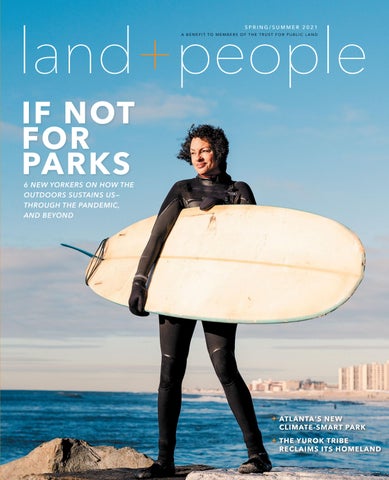
IF NOT FOR PARKS 6 NEW YORKERS ON HOW THE OUTDOORS SUSTAINS US— THROUGH THE PANDEMIC, AND BEYOND
+ ATLANTA'S NEW CLIMATE-SMART PARK + THE YUROK TRIBE RECLAIMS ITS HOMELAND
with future generations.
Three ways to improve parks and open spaces tomorrow, while enjoying retirement savings today: 1. Those aged 72 or older must take a Required Minimum Distribution from their IRAs in 2021. Distributing these funds directly to The Trust for Public Land is a tax-wise way to give. 2. Donors aged 70½ and older can make a Qualified Charitable Distribution of up to $100,000 directly from their IRAs to The Trust for Public Land and save on taxable income. 3. Name The Trust for Public Land as the beneficiary of your IRA or other retirement plan, which would otherwise be taxed heavily if passed on to your heirs.
learn more about the benefits of designating your retirement funds to the trust for public land at
tpl.planmygift.org or contact our office of planned giving at
202.856.3748 or plannedgiving@ tpl.org
ƚ Ɲƚ Ƣƫ ƟƫƞƞƦ ƚ Ƨ ƫƮ ƭƥƞƝƠƞ
share your love of nature...
Ǝƍ
ƌƉ
ƩƚƮƥ ƫƨƛƞƫ ƭ ưƨƥƟ ưƢƥ ƬƨƧ
ƜƨƧƭƞƧƭƬ
“We’re not complete until we gain back that land.” ~ ƫ ƨ Ƭ Ƣ ƞ Ɯ ƥ ƚƲ ƛ Ʈ ƫ Ƨ Ƣ Ƨ ơ ƞ ƚ ƫ ƭ ƥ ƚ Ƨ Ɲ Ʃ Ơ Ƃ ſ
ƭƚ ƫ ƚ ƫƢƜ ƞ
ƚ ƥƞ Ʊ ƣƚƜƤ ƬƨƧ
FE AT U R E S
Heartland 30 The Yurok Tribe reclaims its ancestral territory in Northern California.
How We Coped 42 Six New Yorkers reflect on life during the pandemic, and how the outdoors helped see them through.
Before and After 54 In the wake of a neighborhood tragedy, can a new park help a community rebuild?
ƍƋ TPL .ORG · 1
JAN
FEB
MAR
APR
M AY
JUN
JUL
AUG
SEP
OCT
NOV
DEC
Through uncertain times, monthly donors sustain our work protecting land for people today, tomorrow, and for generations to come. Become a monthly donor today.
tpl.org/monthlygiving 2 · L AND&PEOPL E · SPRING/SUMMER 2021
D EPA R T M EN T S
ƜƨƧƭƞƧƭƬ
$OO LQ IRU WKH RXWGRRUV
Board Spotlight · 13
ƣƨƫƠƞ ƫƢƯƚ Ƭ
From the President · 11
Ɗƒ
*HW WR NQRZ :KLWQH\ +DWFK
Contributors · 14
First Look · 17 :K\ FRORUIXO PXUDOV DUH EORVVRPLQJ
ƟƃƝ Ƭ ƭ ƮƝƢƨ
Mailroom · 15
LQ LQWHUVHFWLRQV DFURVV 'HQYHU ZKHQ WR KDUYHVW PDSOH V\UXS DQG KRZ ZHōUH XQORFNLQJ DFFHVV WR PLOOLRQV RI DFUHV RI SXEOLF ODQG
ƋƋ Ƥ ƢƧƠ ƜƨƮƧƭ Ʋ Ʃƚ ƫƤ Ƭ
Insight · 25 7KH RXWGRRU LQGXVWU\ DQG FRQVHUYDWLRQLVWV DUH MRLQLQJ IRUFHV LQ :DVKLQJWRQ '&
Member Center · 62 2IƓFHV · 63 Trail’s End · 64 $ PXVLFDO YR\DJH LQWR WKH *UDQG &DQ\RQ ZLWK WKH ODWH JUHDW %DUU\ /RSH]
ƨƧ ƭơƞ ƜƨƯƞƫ :ULWHU 'LDQH &DUGZHOO VD\V VXUƓQJ DW 5RFNDZD\ %HDFK NHSW KHU DŴRDW WKURXJK D GLYRUFH D FDUHHU FKDQJH DQG D \HDU RI OLIH GXULQJ WKH SDQGHPLF 3KRWR 7DUD 5LFH
J O I N U S O N FA C E B O O K 6WD\ WXQHG WR RXU ODWHVW QHZV YLGHRV FRQWHVWV DQG PRUH IDFHERRN FRP WKHWUXVWIRUSXEOLFODQG
Ƌƍ TPL .ORG · 3
ƜƨƧƭƞƧƭƬ
HUNTINGTON COMMUNITY FOREST, VERMONT 7DNLQJ FODVV RXWVLGH JLYHV WKHVH IRXUWK JUDGHUV DW %UHZVWHU 3LHUFH 0HPRULDO 6FKRRO D FKDQFH WR SUDFWLFH SUREOHP VROYLQJ FROODERUDWLRQ SK\VLFV IRUHVWU\ DQG GHVLJQ ř EXW PRUH LPSRU WDQWO\ EXLOGLQJ D VQRZ IRUW LQ WKH ZRRGV ZLWK \RXU IULHQGV LV really IXQ 7UXVW IRU 3XEOLF /DQG GRQRUV KHOSHG VHFXUH SXEOLF DFFHVV WR WKH IRUHVW QH[W GRRU WR WKH VFKRRO LQ +XQWLQJWRQ 9HUPRQW HQVXULQJ WHDFKHUV DQG VWXGHQWV KDYH SOHQW\ RI VSDFH IRU RXWGRRU OHDUQLQJ DQG DOO +XQWLQJWRQLDQV KDYH PRUH DFFHVV WR QDWXUH FORVH WR KRPH 2Q SDJH ƋƉ VHH KRZ VFKRROV DFURVV WKH FRXQWU\ KDYH ORRNHG EH\RQG WKH FODVVURRP WR VROYH VRFLDO GLVWDQFLQJ FKDOOHQJHV SRVHG E\ &29,' Ɗƒ
Ɓſ
peter cirilli
Page · 20
TPL .ORG · 5
ƜƨƧƭƞƧƭƬ
BRAINERD LAKES REGION, MINNESOTA %DFN LQ ƋƉƉƑ 0LQQHVRWD YRWHUV DSSURYHG D FRQVWLWXWLRQDO DPHQGPHQW WR UDLVH WKH VWDWH VDOHV WD[ WR IXQG FOHDQ ZDWHU KDELWDW SURWHFWLRQ SDUNV WUDLOV DUWV DQG FXOWXUH 7KH 0LQQHVRWD /HJDF\ )XQG KDV VLQFH EHHQ SXW WR ZRUN WR LPSURYH SXEOLF DFFHVV WR WKH JUHDW RXWGRRUV DOO DFURVV WKH 1RUWK 6WDU 6WDWH 7RGD\ LW̸V RQH RI WKH PRVW LPSRUWDQW VRXUFHV RI SXEOLF IXQGLQJ ZH UHO\ RQ WR FUHDWH SDUNV DQG SURWHFW SXEOLF ODQG LQ 0LQQHVRWD 2XU FRQVHUYDWLRQ ƓQDQFH H[SHUWV KHOSHG OHDG WKH ƋƉƉƑ &OHDQ :DWHU /DQG DQG /HJDF\ $PHQGPHQW FDPSDLJQ LQ 0LQQHVRWDŋRQH RI RYHU ƏƉƉ VXFFHVVIXO FRQVHUYDWLRQ ƓQDQFH PHDVXUHV ZHōYH VXSSRUWHG LQ WKH SDVW ƋƎ \HDUV
Ɓƀ
richard hamilton smith
Page · 21
TPL .ORG · 7
ƜƨƧƭƞƧƭƬ
COOK PARK ATLANTA, GEORGIA :LWK D SDLU RI URFN FOLPELQJ ERXOGHUV D IXWXULVWLF SOD\JURXQG DQG SOHQW\ RI RSHQ VSDFH WR UXQ DURXQG LWōV HDV\ WR VHH ZK\ $WODQWDQV ORYH WKH QHZ &RRN 3DUN %XW LWōV ZKDW \RX FDQōW VHH WKDW PDNHV WKLV SDUN WUXO\ VSHFLDO WKH HQWLUH ƊƏ DFUHV KDV EHHQ FDUHIXOO\ HQJLQHHUHG WR DEVRUE DQG FOHDQ VWRUPZDWHU UXQRII UHGXFLQJ WKH ULVN RI FKURQLF ŴRRGLQJ WKDW KDV SODJXHG WKLV QHLJKERUKRRG IRU JHQHUDWLRQV $V FOLPDWH FKDQJH PDNHV IRU PRUH IUHTXHQW DQG VWURQJHU VWRUPV 7UXVW IRU 3XEOLF /DQG VXSSRUWHUV DUH DGYDQFLQJ WKH XVH RI FOLPDWH VPDUW JUHHQ LQIUDVWUXFWXUH DW SDUNV DQG SXEOLF ODQGV DFURVV WKH FRXQWU\ EXLOGLQJ PRUH UHVLOLHQW FRPPXQLWLHV IRU DOO
Ƅƃ
alex jackson / jpfr amework.com
Page · 54
TPL .ORG · 9
O FFICERS president and chief e xecutive officer
Diane Regas vice president and d i r e c t o r o f c o n s e r vat i o n f i n a n c e
Will Abberger s e n i o r v i c e p r e s i d e n t, g e n e r a l c o u n s e l , a n d c o r p o r at e s e c r e ta r y
D. Malcolm Carson senior vice president of field progr ams
Jeff Danter senior vice president of p o l i c y a n d g o v e r n m e n t r e l at i o n s
Bill Lee v i c e p r e s i d e n t a n d a s s o c i at e gener al counsel
Margaret Madden senior vice president and c h i e f f i n a n c i a l a n d a d m i n i s t r at i v e o f f i c e r
James Obendorf vice president and direc tor of finance and accounting
Michelle Pandori vice president and direc tor of human resources
Carrie Speckart senior vice president and c hief m a r k e t in g a nd co mm u ni c at i o n s o ffi c er
I Ling Thompson
our mission:
THE TRUST FOR PUBLIC LAND CREATES PARKS AND PROTECTS LAND FOR PEOPLE, ENSURING HEALTHY, LIVABLE COMMUNITIES FOR GENERATIONS TO COME.
senior vice president and chief phil anthropy officer
Patricia Watson v i c e p r e s i d e n t, p h i l a n t h r o p y
Rebecca Weaver
h o w yo u c a n h e l p : Our work depends on the generous support of people like you. d o n at e: Use the envelope inside this magazine, or visit tpl.org/donate for other easy ways to give. l e a r n m o r e: Get timely updates on our park and conservation work near you. Sign up for our e-newsletter at tpl.org/enews. s h a r e: Help us make the case for parks and open space. When you’ve finished reading this issue, pass it on! Land&People magazine is a benefit to members of The Trust for Public Land.
10 · L A N D & P E O P L E · S P R I N G / S U M M E R 2 0 2 1
from the president
nichol as lea bruno
ALL IN FOR THE OUTDOORS throughout the pandemic, our parks and public lands have been there for us. And when the worst of the COVID-19 crisis is safely behind us, it will be time to return the favor. publisher Eliza Sarasohn managing editor Julia Busiek designers Rachel Barnes Miya Su Rowe Ben Whitesell media produc tion manager Elyse Leyenberger d i g i ta l produc tion Jennifer Ramsey Jeremy Sammons
In this issue of Land&People you’ll read unforgettable stories of everyday New Yorkers who, when the virus was raging, turned to their city’s great outdoors to find solace and strength. While parks will eventually shed their peculiar role as the safest place to avoid and endure the virus, they’ll never stop being a crucial component of community health. Studies show a strong
benefits of parks and open space—and voting to
connection between green space and physical
strengthen them. In the 2020 elections, voters
activity, reduced stress, sharpened concentration,
from Montana to Massachusetts approved 31 ballot
and heightened sense of well-being.
measures put forward by The Trust for Public
And yet, more than 100 million Americans, including 28 million kids, do not have a park within a 10-minute walk of home. What’s more,
All rights reserved. 10-Minute Walk, Conserving Land for People, Conserving Nature Near You, Creating Parks and Protecting Land for People, Fitness Zone, Land for People, Land&People, LandVote, Northwoods Initiative, Our Land, Outside For All, Parks for People, Parks Unite Us, ParkScore, The Trust for Our Land, The Trust for Public Land, TPL, and The Trust for Public Land and LandVote logos and all other names of The Trust for Public Land programs referenced herein, as well as their logos, are registered or commonlaw trademarks of The Trust for Public Land.
Land that together will generate over $3 billion for land, water, wildlife, parks, and trails. The fabric of American society and the future
Trust for Public Land researchers analyzed
of the planet demand that we build on this
census data from 14,000 American cities and
momentum. That’s why The Trust for Public
towns and found that parks serving low-income
Land, backed by supporters like you, is leading a
communities and people of color are smaller
coalition of more than 200 environmental and
and more crowded than parks in predominantly
community organizations to urge Congress to
white neighborhoods.
© 2021 The Trust for Public Land.
More and more Americans are recognizing the
invest in local parks and close the park equity
It’s time to right these generational wrongs.
gap. On page 25, a coalition partner shares why
It’s time to build new parks, and to invest more
she’s joining our campaign for the Parks, Jobs,
equitably in those we already have. As we do,
and Equity Act, which would create a one-time
we’ll create jobs and economic opportunity, and
investment of $500 million that our parks and
energize our ailing economy, since parks and
communities need right now.
conservation projects return $4 to $10 for every dollar invested. Meanwhile, climate change is unleashing ever more menacing wildfires, heat waves, and
If you agree, visit tpl.org/parks-jobs-equityact and sign our petition to urge investment in the parks and open spaces we all love. As you’ll see in this issue of Land&People, the work we
storms. On page 54, read about a new park in
are doing together is making a life-changing
Atlanta that’s protecting people from floods,
difference for people and communities nation-
keeping the Chattahoochee River running clean,
wide. Thank you for being the engine that
and creating opportunities for neighbors to
powers this incredibly important mission.
connect. And on page 30, you’ll meet members of the Yurok Tribe who are regaining ownership of their ancestral Northern California homelands and putting those lands to work to avert
Diane Regas
climate catastrophe.
president and ceo T P L . O R G · 11
MEET YO UR MATCH
This year, an anonymous donor will generously match your gift—dollar-for-dollar—if you send it before May 31. Your donation will go even further to help The Trust for Public Land protect more parks, gardens, and other natural places. That’s one good thing made that much better.
Give your EarthShare.
12 · L A N D & P E O P L E · S P R I N G / S U M M E R 2 0 2 1
An EarthShare payroll deduction is one simple way to donate to The Trust for Public Land or more than 400 other environmental and conservation charities. Many corporate and government employers support EarthShare payroll giving. If yours doesn’t, ask them to start. If they do, simply decide on a single deduction or a recurring small one from every paycheck. Then designate us, member number 11440, as one of your conservation charities. For more information visit earthshare.org or email donor.outreach@tpl.org.
terray sylvester
800.714.5263 · donor.outreach@tpl.org · tpl.org/match
Get to know
board spotlight
Whitney Hatch whitney was a founder and chairs the
sar a cozolino
BOA R D O F DIREC TORS
board of Issue One, the leading crosspartisan political reform group in Washington uniting Republicans, Democrats, and independents in the movement to fix our broken political system. He worked as New England director
chair
at The Trust for Public Land from 1998 to 2011
Thomas S. Reeve
and as vice president of regulatory affairs at
Stephen W. Baird
GTE Corporation. Whitney chairs the John
George Bell
Merck Fund and Conservation Law Foundation’s
Page Knudsen Cowles
(CLF) Massachusetts advisory board and serves on the boards of CLF, Rx Foundation, and the
Mickey Fearn
Ipswich Electric Department. Previously he Jody S. Gill
served on the boards of the School for Field
F. Whitney Hatch
Studies (founder), American Rivers (chair), Management Assistance Group (chair), and the
Ben Jealous
Massachusetts DCR Stewardship Council (chair). Christopher G. Lea Joseph E. Lipscomb Ignacia S. Moreno
I BELIE VE IN PROTEC TING L AND AND CRE ATING
health, equity, and climate benefits to our commu-
PARK S BEC AUSE … everybody needs a place to play,
nities, we take our lead from our partners—helping
Caroline P. Niemczyk
a place to recreate, and natural places to roam
clarify their vision and then bringing it to reality.
Michael Parish
where we connect back to ourselves and to each
David Poppe Diane Regas Jeffrey A. Resnick
other. Those lands, playgrounds, gardens, and
THE KE Y CHALLENGE FACING THE TRUS T FOR PUBLIC
park benches should be there when we need
LAND IS … amassing the resources and collaborations
them—available, maintained, and nearby to all.
necessary to bring our work to scale. Ensuring our communities continue as healthy, livable, and even
I SUPPOR T THE TRUS T FOR PUBLIC L AND BEC AUSE …
beautiful places for future generations is a mighty
Laura Richards
there is no more effective organization helping
task, but with our strong and growing phalanx of
Lex Sant
communities and neighborhoods develop partner-
philanthropic partners, we will deliver that outcome.
ships, conserve land, raise funds, and create parks. Lucas St. Clair Sheryl Tishman F. Jerome Tone Taylor Toynes Keith E. Weaver Susan D. Whiting
The organization’s track record is as awe-inspiring
I FIRS T FELL IN LOVE WITH THE NAT UR AL WORLD
as it is vital to the health of our country.
WHEN … I sat on a stinging ant hill in Vermont and refused, as an easily embarrassed young boy,
M Y PROUDE S T ACCOMPLISHMENT A S A BOARD
to lower my pants to “de-ant” in view of my grand-
MEMBER WA S … being elected to our board after
mother. Once the pain of nature’s bite subsided
serving 13 years on staff, and being asked to chair
I sat (elsewhere!) to take in the beautiful summer
the conservation committee, through which we
evening colors over the Green Mountains and
began to define priorities and programmatic lenses
Taconics—so peaceful and so soothing.
for our work. That effort ultimately resulted in our terrific 2020–2025 Strategic Plan.
? THE TRUS T FOR PUBLIC L AND’S WORK IS UNIQUE BEC AUSE ... while we dedicate ourselves to deliver
WHAT ABOU T YOU? Tell us how you connect with nature. Join the conversation on Facebook: facebook.com/thetrustforpublicland T P L . O R G · 13
ƜƨƧƭƫƢƛƮƭƨƫƬ
Anna V. Smith
Paul Robert Wolf Wilson
Tianna Faulkner
story:
story:
Heartland
Before and After
story:
Heartland 30
54 30
Anna V. Smith is an award-winning
Paul Robert Wolf Wilson is a photographer
Tianna Faulkner is a freelance journalist
journalist from the Pacific Northwest,
based in his ancestral territories of
in Atlanta, Georgia. She covers arts and
where she writes and edits for High
Southern Oregon and Northern California.
entertainment, business, health, and
Country News as assistant editor on the
He is a member of the Klamath and Modoc
lifestyle features. In her free time, Tianna
Indigenous affairs desk. Her work has
tribes, and his works focus primarily on
enjoys reading, writing, traveling, volun-
appeared in outlets such as the New York
visual sovereignty and land practice, the
teering, cooking, and spending time with
Times, Audubon, Undark, and Slate.
intersections of peoples and place.
her friends and family.
@annavtoriasmith
maqlaqsmedia.com
Ʃơƨƭƨ Ƭ ƚ Ʀ ƠƞƫơƤ ƞ
Ʃơƨƭƨ ƩƚƮƥ ƫƨƛƞƫ ƭ ưƨƥƟ ưƢƥ ƬƨƧ
Ʃơƨƭƨ ƭƨƦƦ Ʋ ƜƨƥƥƢƞƫ
WANT EVEN MORE LAND&PEOPLE? The digital edition of Land&People includes all the stories you love, optimized for your device—plus bonus content like video, easy social media sharing, and instant links to learn more. Explore the digital edition at tpl.org/magazine. Wherever you see the pointer icon in this issue, you’ll find bonus content in the digital edition. Go online to dive deeper into the difference you make as a Trust for Public Land donor.
ƥƞƚƫƧ Ʀƨƫƞ @ TPL.ORG/MAGAZINE
14 · L A N D & P E O P L E · S P R I N G / S U M M E R 2 0 2 1
ƦƚƢƥƫƨƨƦ
ƣƨơƧ ƛƢƥƝƞƫƛƚƜƤ
CO M E A N D G E T I T )LQG XV RQ VRFLDO PHGLD IRU RXWGRRU LQVSLUDWLRQ ELJ QHZV DERXW WKH SXEOLF ODQGV \RX ORYH ř DQG VR
ƣ ƨ ơ Ƨ ƛ Ƣ ƥ Ɲ ƞ ƫ ƛ ƚ Ɯ Ƥ
PDQ\ FXWH GRJV
SHARE THE LOVE
‘A‘DOD 3DUN KDV EHHQ D IDYRULWH JDWKHULQJ SODFH IRU JHQHUDWLRQV RI +RQROXOX UHVLGHQWV 7RGD\ ZHōUH ZRUNLQJ ZLWK ORFDO IDPLOLHV WR LGHQWLI\ PXFK QHHGHG XSJUDGHV DQG SURJUDPPLQJ IRU WKLV KLVWRULF GRZQWRZQ SDUN
We want to know what you think of the stories, artwork, and photographs you’ll find in this issue of Land&People magazine. Drop us a line at mailroom @ tpl.org.
Outside voices
+ I’m not generally a writer of
Reactions to our latest issue,
letters to magazines. But COVID
which explored equity in parks
has led us all to do new things, or
and conservation.
old things in new ways. Kudos for
+ One of the things I like best
2020. I particularly was taken by
an important issue in Fall/Winter about the magazine is the
the stories about “Unlikely Hikers”
coverage of your work of creating
and others who have not always
parks and open space in urban
been noticed or recognized along
areas. In the 2020 election, my
the trails. Hooray for those who
city passed a funding measure to
are advocating to help everyone
encourage the creation of parks,
get out and enjoy this beautiful
open space, and the preservation
world, whether in a city park or a
of historic landmarks. A win
national park.
for conservation!
Nancy Arny Pi-Sunyer
Paul Winters
T P L . O R G · 15
ƜơƫƢƬ ƛƞƧƧƞ ƭ ƭ
LAND&PEOPLE IS LISTENING!
ƦƚƢƥƫƨƨƦ
6HQG OHWWHUV WR WKH HGLWRU RU FKDQJH \RXU PDLOLQJ DGGUHVV PDLOURRP# WSO RUJ
that these lands provide for us. We’ve already lost so much that we didn't know we had until it was gone. Please preserve and create new spaces for the future. Patricia Armstrong
+ Great buckets of fish, there are some good people in our government. Especially you who worked tirelessly to get this win and also to the senators and representatives who understood
Your Maine squeeze
+ I grew up loving that region, spending
<RX VKDUHG \RXU PHPRULHV RI %DOG
every summer at the foot of Katahdin.
0RXQWDLQ 3RQG D UHFHQWO\ SURWHFWHG
All good news about the trail, lakes,
JHP DORQJ WKH $SSDODFKLDQ 7UDLO
and the Katahdin area being cherished
LQ 0DLQH
and protected is of interest. Thank you!
the major importance of these outdoors areas. Everyone give yourselves and the one standing next to you a great big well-earned pat on the back. Brenda Hixenbaugh
Patricia Chandler
+ I hiked through here at the start of a backwards hike of the Appalachian
A job well done
Trail when I was 14. I remember it like
5HDGHUV FHOHEUDWHG IXOO DQG
yesterday … some of that hike made
SHUPDQHQW IXQGLQJ IRU WKH /DQG DQG
me who I am today. And I’m just fine
:DWHU &RQVHUYDWLRQ )XQG /:&)
with a small pile of dirty grandchildren
DQG WKH ƌƉ \HDUV RI DGYRFDF\ WKDW JRW
that think barefoot and trails are
WKLV LPSRUWDQW ELOO DFURVV WKH ƓQLVK
“way better than TV.” Thank you all.
OLQH LQ VXPPHU ƋƉƋƉ
Tim
+ Thanks to those at The Trust for Public Land who have persisted and ƬƢƦƨƧƞ Ʀƚƫ ƭƢƧ Ƨƞ ưƛƞƫƫƲ
who have done the work that not everyone can do full-time. For quality of life for all—the quality not possible without our public lands and outdoors—
1,078 likes
we thank you, and also salute who you
Now more than ever, kids need safe and high quality outdoor spaces. Thank you to our partners @trustforpublicland for this incredible playground renovation. Court artwork by @timothygoodman.
are and what you've accomplished. Polly Hart
+ This bill is important to each American for multiple reasons. We owe our children’s children the right to visit open, preserved lands. We owe our own health, both mental and physical, 16 · L A N D & P E O P L E · S P R I N G / S U M M E R 2 0 2 1
1%$ VXSHUVWDU .HYLQ 'XUDQW #ƌƎ9HQWXUHV SLWFKHG LQ WR KHOS XV UHQRYDWH WKH SOD\JURXQG DW 3 6 ƊƊƎ LQ %URRNO\QŋDQG VKRZHG RII WKH UHVXOWV WR KLV IDQV RQ ,QVWDJUDP
t u r n t h e pa g e f o r … f u t u r i s t i c fa r m s c r e at i v e c l a s s r o o m s massive mur al s
sometimes it’s worth risking it all for a dream only you can see.
ƜơƫƢƬ ƛƞƧƧƞ ƭ ƭ
megan r apinoe
Trust for Public Land supporters are connecting Clevelanders to the outdoors along the Lake-Link Trail, which follows the Cuyahoga River through the heart of the city to its mouth at Lake Erie, passing by parks, schools, and businesses along the way. F I R S T L O O K · 17
ƞƝƢƛƥƞ ƨƮƭƝƨƨƫƬ
Home sweet home
Ʃƞƚƫƥ ƟƚƫƦ ƥƨƮƝƨƧ Ƨƞư ơƚƦƩƬơƢƫƞ
picture, if you will, a maple sugar
otherwise need to be boiled off. “That
days, The Trust for Public Land is
harvest. It’s a storybook scene: a snowy
cuts down significantly on our fuel,”
helping the Town of Loudon protect
forest, a bucket hanging on every tree,
Pearl says. “And I can make as much in
Pearl’s farm from development and
and a vat simmering sweetly over a fire.
an hour using osmosis as it would take
create opportunities for public recre-
“Nope, mine doesn’t look like that at
me in a whole day of boiling.”
ation on his land.
all,” says Howard Pearl, whose family
But maple technology isn’t the only
The sale of the easement will help
has been farming the same land in
change that’s come to Loudon since
Pearl stay in business, and make for a
Loudon, New Hampshire, since the late
Pearl was a kid. “There used to be six
smoother financial transition to the
1800s. “What we’ve got going is a much
farms along our road, and throughout
next generation of farmers who will
more technological type of operation.”
my lifetime, they’ve all gone,” he says.
care for this land. This stability is
Pearl’s farm is a proving ground for
In Loudon and across New England,
especially important for maple growers,
maple industry innovation. Each of his
more small producers like Pearl are
says Pearl, noting that trees don’t
11,000 taps is connected by a network
struggling to make ends meet, and many
even start producing sap until they’re
of vacuum tubing—450,000 feet in all—
have been forced to sell their farms.
40 years old. “I’ve spent a lot of my life
that induces the tree to produce more
“As close as we are to Concord and
planting, weeding, and cultivating.
sap and pipes it to a centralized location.
Boston, we’re growing very fast,” says
There’s just now a lot of growth potential
The collected sap then passes through
Julie Robinson. She chairs the Loudon
here,” he says. “The next generation
a reverse osmosis system that filters
Conservation Commission, which has
after me is going to have one hell of
out 80 percent of the water that would
saved family farms across town. These
an orchard.”
“There used to be six farms along our road, and throughout my lifetime, they’ve all gone,” says Howard Pearl. Trust for Public Land supporters are helping secure the future of Pearl's farm.
ƣƞƫƫƲ ƚƧƝ ƦƚƫƜ Ʋ ƦƨƧƤƦƚƧ ƞƜƨƩơƨƭƨƠƫ ƚƩơƲ
ƟƃƝ Ƭ ƭ ƮƝƢƨ
ưƨƫƝ ưƚƭƜơ
Maple ice cream 0DSOH KDUYHVW KDSSHQV LQ ODWH ZLQWHU EXW WKH 1HZ +DPSVKLUH 0DSOH 3URGXFHUV $VVRFLDWLRQ KDV JUHDW UHFLSH LGHDV IRU HYHU\ VHDVRQ OLNH WKLV VZHHW WUHDW IRU D VXPPHU GD\ O
Ɗ FXSV PLON
O
Ɗ WEVS FRUQVWDUFK
O
Ƌ HJJV
O
Ɗ FXS FUHDP
O
FXS PDSOH V\UXS
O
{ŝƇ WVS VDOW
6FDOG PLON 6HSDUDWH HJJV %HDW HJJ \RONV DGG V\UXS DQG FRUQVWDUFK VWLU DQG FRPELQH ZLWK PLON &RRN RYHU KRW ZDWHU ƋƉŊƋƎ PLQXWHV VWLUULQJ RFFDVLRQDOO\ &RRO %HDW HJJ ZKLWHV XQWLO VWLII $GG VDOW DQG
Via Verde /ϭvīə-ϭvər-dē\ A new network of parks and trails growing in Denver’s Westwood neighborhood. $UWLVW 6DQWLDJR -DUDPLOOR FRQWULEXWHG WR D VHULHV RI PXUDOV LQ LQWHUVHFWLRQV
IROG LQWR FRROHG PL[WXUH 3RXU LQWR
WKURXJKRXW :HVWZRRG WR JXLGH NLGV DQG IDPLOLHV DORQJ WKH :HVWZRRG 9LD
IUHH]HU WUD\ DQG FKLOO WR D KHDY\
9HUGH 6SDQLVK IRU ŏ*UHHQ :D\Ő 7KH URXWH FRQQHFWV SDUNV VFKRROV JURFHU\
PXVK %HDW XQWLO ŴXII\ :KLS FUHDP
VWRUHV DQG RWKHU GHVWLQDWLRQV FUHDWLQJ D VDIHU FRROHU DQG PRUH IXQ SDWK
DQG IROG LQ 5HWXUQ WR WUD\ DQG IUHH]H
IRU SHRSOH WR H[SORUH WKH QHLJKERUKRRG E\ IRRW DQG ELNH
ƥƞƚƫƧ Ʀƨƫƞ # TPL.ORG/PEARL-FARM F I R S T L O O K · 19
THINKING OUTSIDE
the classroom HOW OUTDOOR LEARNING HAS HELPED STUDENTS AND TEACHERS THROUGH THE PANDEMIC sophia yuen eyed the skyline, practicing her perspective
Whether in the heart of New York or the woods of Vermont,
drawing while sketching a tree and two apartment buildings
outdoor learning has become a public health necessity in
across the street from her schoolyard in Manhattan. This
the age of COVID-19. But students’ experiences have varied
was art class COVID-style at P.S. 184, where a recently
widely: of the 90,000 public schoolyards in America, as few
renovated schoolyard was providing a welcoming, flexible
as one percent are designed with green space, play areas, and
space for students and teachers to take learning outside. “It’s
curriculum-friendly features like outdoor classrooms.
nice to get fresh air when you’re stuck inside for months,”
So we’re scaling up our work to transform underused outdoor
said 12-year-old Yuen.
space at public schools across the country into healthy,
Outdoor school looks a little different up in Huntington,
welcoming public parks for all to enjoy. By 2025, we’ve
Vermont, where we recently helped create the Huntington
pledged to expand our schoolyards program to 20 more
Community Forest. The 245-acre public forest is right next
school districts—and it’s all thanks to supporters like you.
door to the local school, giving students and teachers a great big outdoor classroom where they can learn about the natural world throughout the year.
huntington communit y forest, vermont 20 · L AND&PEOPL E · SPRING/SUMMER 2021
WATCH THE FILM @ TPL.ORG/HUNTINGTON
p.s. 184 in manhat tan ƥƞƟ ƭ Ʃƞ ƭ ƞƫ ƜƢƫƢƥƥƢ ƫƢƠơƭ ƚ ƥƞ Ʊ ƚ ơƨƲ ƞƫ
ƛƨƛ ưƢƜƤ ƛƥƦ
ƛƮƳƳưƨƫƭơƲ
ươƚƭ ƜƨƮƧƭƬ
25 YEARS since THE TRUST FOR PUBLIC LAND’s first conservation finance campaign
604
Successful conservation funding campaigns since 1996
$83.9 BILLION
“Suddenly, the gate had a lock on it, and you couldn’t get through.” — Janet Drake
Janet Drake has hunted in Arizona’s Sky Island mountains for 25 years. But she lost access to 40,000 acres of public land in the Aravaipa Canyon Wilderness when an adjacent private ranch changed hands a decade ago,
Public funding generated for trails, parks, clean water, and climate resilience
100 % Our success rate in 2020 (31 for 31!)
and the new owners gated their road. We’re working to transfer the Cross F Ranch to the Bureau of Land Management, so people like Drake can once again reach the wild country that lies beyond.
ƥƞƚƫƧ Ʀƨƫƞ # TPL.ORG/CONSERVATION-FINANCE
F I R S T L O O K · 21
ƣƨƫƠƞ ƫƢƯƚ Ƭ
Ʀƞƞƭ ƨƮƫ ƬƭƚƟƟ
ŏ,WōV P\ MRE WR OLVWHQ WR ZKDW WKH FRPPXQLW\ QHHGV Ő DAYANA MOLINA
OUR LOS ANGELES COMMUNIT Y ORGANIZER ON NAVIGATING CHANGE.
What’s your approach to organizing for change?
How has the pandemic changed the way you work?
What was it like to start organizing virtually?
As a Trust for Public Land staff member,
Early on, I shifted the time we’d
There’s a digital divide in Los Angeles—
I can go directly to a council member
normally spend on our projects—like
many people don’t have internet at
or even the mayor and tell them what
building a tool lending library to
home or a big enough data plan to
I think. But I am not the expert in
support our community clean-up
do video calls. So a big part of my job
what South Los Angeles communities
days—to pandemic response and
this past year has been learning and
need—people who live, work, and raise
wellness check-ins. Our meetings went
teaching these tools, ensuring we
families in the neighborhood are
all-virtual and became a platform
continue to be as inclusive as possible
the experts. So my goal is to bring
for residents and service providers
in our engagement and outreach …
community members to the tables
to connect with each other to meet
even if it means taking extra time to
where decisions are made, as opposed
people’s immediate needs, be that
answer tech questions or reaching out
to speaking on their behalf.
renter’s rights, access to food, navigat-
to individuals for their feedback.
ing the unemployment system,
What difference does it make for residents themselves to be at the table?
tracking down stimulus checks, or remote schoolwork. Recently, we've
We’ve actually been able to reach more
It means our work for parks becomes
also been able to help many of our
people, especially young people. In the
a pathway for people who are the
community members get a COVID-19
future I imagine more of a hybrid model
most affected by disinvestment and
vaccine. That is a big deal, considering
of organizing, sort of like what people
inequities of all kinds to gain access to
that families in South Los Angeles have
are envisioning for the future of schools.
the power it will take to change the
disproportionately low access to the
system—regardless of their status in
vaccine, even as they’ve been among
What has been challenging?
this country today.
those most impacted by the virus.
I still feel like digital engagement is
22 · L AND&PEOPL E · SPRING/SUMMER 2021
sharing ideas for helping kids with
Are there benefits to digital organizing?
Ɯ ƥ ƨ Ɯ Ƥ ư Ƣ Ƭ ƞ Ɵ ƫ ƨ Ʀ ƥ ƞ Ɵ ƭ ƭ Ʃ ƥ Ƭ ƭƚ Ɵ Ɵ ƣ ƨ ƞ Ƭ ƨ ƫ ƫ ƞ Ƨ ƭ Ƣ Ƨ ƨ ƣ ƨ ƫ Ơ ƞ ƫ Ƣ Ưƚ Ƭ Ɯ Ƣ ƭ Ƣ Ƴ ƞ Ƨ ƨ Ɵ ƭ ơ ƞ Ʃ ƥ ƚ Ƨ ƞ ƭ ƚ ƥ ƚ Ʀ Ʋ Ƭ ƭ ƨ Ɯ Ƥ Ʃ ơ ƨ ƭ ƨ
The pandemic hit the city hard, and the
than getting together in person! As an
What are some park projects you’ve been working on?
organizer, I can be more attentive to a
We have a lot of work left to do toward
many of whom are women of color and
community’s needs in person. Nothing
equitable parks in Los Angeles, but if
immigrants—have faced disproportion-
replaces human contact and being
the number of people who’ve shown up
ate impacts. But from my own personal
physically present with each other.
to our Zoom meetings is any indication,
experience going to parks with my
there’s such a desire for projects like
family and seeing how busy they’ve
What hasn’t changed?
the network of green alleyways we’re
been, and from the continuing enthusi-
It’s still my job to listen to what the
helping create in South Los Angeles, or
asm of our community leaders, I know
community’s needs are and be respon-
our Urban Orchard project, a future
that the work we’re doing to ensure
sive to how those needs change. When
park on the banks of the Los Angeles
everyone in Los Angeles has access to
we initially scoped it in late 2019, for
River in the city of South Gate. Residents
the outdoors—and feels a sense of
instance, the tool lending library was
have helped come up with features like
belonging and ownership of their public
going to be much larger, so more people
a fruit orchard, paths, fitness equip-
spaces—is essential to our communities'
could join clean-up days. Now our
ment, and a playground honoring the
mental health and well-being.
members want to make sure partici-
history of the Tongva, the Indigenous
pants are protected from the virus. So
people of this area.
about a hundred times more difficult
community leaders we work with—
we’re redirecting funds to stocking up on PPE. It’ll mean equipping fewer people, at least in the short run, but doing so in a safer way.
Has it been tougher to rally support for parks during the pandemic?
Clockwise, from left: Bradly Green Alley in Pacoima. Community clean-up day in South Los Angeles. When it’s complete, the 30-acre Urban Orchard will transform the L.A. River in South Gate. FIRST LOOK · 23
ƩơƨƭƨƬ ƜƨƮƫ ƭ ƞ Ƭ Ʋ ƦƨƮƧ ƭƚ ƢƧƬ ƭƨ ƬƨƮƧƝ ƠƫƞƞƧ ưƚƲ ƭ ƫƮƬ ƭ
ươƲ ưƞ ƠƢƯƞ
I GIVE TO …
finish what he started jim ellis
if you’ve taken a hike anywhere
president of the Greenway Trust and
within an hour’s drive of seattle,
donor to The Trust for Public Land. “He
chances are, you have Jim Ellis to thank
always deflected credit, and he always
for it. A legendary civic leader who
told the best stories.”
passed away in 2019 at age 98, Ellis was
McClelland, Ellis, and many others
ƦƨƮƧƭƚƢƧƬ ƭƨ ƬƨƮƧƝ ƠƫƞƞƧưƚƲ ưƞƬƭƞƫƧ ưƚƬơƢƧƠƭƨƧ Ƭƭƚƭƞ
the force behind an extraordinary
worked together for decades to call
range of public projects throughout the
attention to the region’s wildlands—and
Puget Sound region. As a young lawyer
to their shared vision for a greenway
leading to 95 miles of existing trails. To
in the 1950s and 60s, Ellis led the
that would ensure public access as the
make more of these projects possible,
drive to clean up Lake Washington.
region’s population grew. The Trust for
The Trust for Public Land and the
He rallied support for public invest-
Public Land helped launch the
Mountains to Sound Greenway Trust
ments in city parks, pools, and transit
Greenway Trust 30 years ago, and we’ve
recently launched the Jim Ellis Fund
throughout the 70s and 80s. And in the
since ensured public access to over
for Land Conservation.
early 1990s, he headed up the creation
10,000 acres within the greenway.
McClelland supports The Trust for
of the Mountains to Sound Greenway
Ellis worked hard to preserve most
Public Land in part to see Jim’s greenway
Trust, the nonprofit that stewards a
of the large open lands within the
vision through, and also to honor his old
100-mile corridor of public lands and
greenway—places like the Raging River
friend’s model for making change. “In
trails stretching from Seattle to the city
State Forest and the Middle Fork
today’s world when we all find so many
of Ellensburg in the eastern Cascade
Snoqualmie River Valley. The next
reasons to divide ourselves, it’s just as
foothills.
generation’s task? Conserving the
important to perpetuate the spirit of
Whatever the task, “Jim worked
smaller properties that could make a
collaboration and hard work that Jim
incredibly hard behind the scenes and
big difference for public access, like a
brought to every project,” he says.
figured out how to bring people
five-acre parcel on Tiger Mountain that
together, get beyond labels, and find
The Trust for Public Land preserved last
common ground,” says Doug McClelland,
year, making space for a new trailhead
24 · L A N D & P E O P L E · S P R I N G / S U M M E R 2 0 2 1
ƥƞƚƫƧ Ʀƨƫƞ # TPL.ORG/JIM-ELLIS-FUND
A force for nature
insight
We asked policy expert Jessica Wahl Turner how she makes the case for park equity and public lands in Washington, DC. For more than a decade, Jessica Wahl Turner has been working behind the scenes of government, nonprofits, and outdoor industry brands, building a political force to be reckoned with. She started her Beltway career on the inside, with roles at
the landmark law that guarantees full and dedicated funding for the Land and Water Conservation Fund and allocates more than $9 billion to fix the maintenance backlog on federal land. And now, as American families grapple with widening economic disparities supercharged by the “COVID recession,” Turner’s group is one of more than 200 backing The Trust for
the Bureau of Land Management and the Department of the
Public Land’s push for the Parks, Jobs, and Equity Act. The
Interior, before going to work as chief lobbyist for the Outdoor
bipartisan bill introduced in Congress in March would allocate
Industry Association, and today she directs a coalition of
$500 million in federal funding for local parks in the most
outdoor trade groups called the Outdoor Recreation Roundtable.
underserved communities. This critical funding could save
The Trust for Public Land worked closely with organizers
100,000 at-risk seasonal jobs or create 8,000 new ones, while
like Turner to advocate for the Great American Outdoors Act—
generating $1.37 billion in economic activity. We sat down with Turner to talk about the economic benefits of public lands and how our deeply divided nation can find common ground in the Great Outdoors.
T P L. O R G · 25
Why is it an important time to be investing in parks and public lands? From oil and gas drilling to coal mining to timber harvesting, the industries that have been the foundation of many rural economies are waning. So rural communities are looking around for what resources they do have: dense forests, big mountains, rivers, lakes, wildlife … the elements that lay the foundation for an economy powered by outdoor recreation.
Can outdoor recreation make up for the decline of these more traditional economic drivers? Outdoor recreation is a major economic engine in America. It accounts for 2.1 percent of GDP, 3.3 percent of U.S. employees, and 5.2 million jobs—many of which are in the rural communities whose economies are in transition. It contributes $788 billion to the economy, which is more than utilities, mining,
Jessica Wahl Turner
or agriculture. That’s not to say that these traditional industries are going to go away overnight—they’re still very important parts of rural economies. But by investing in outdoor
Why d Wh do you support the h Parks, P k JJobs, b and d Equity Act?
recreation, communities can smooth the transition to a new,
First of all, investing in local parks just makes people’s lives
more sustainable economy.
better. As elected leaders restricted travel this past year because of COVID-19, they also said, “Hey, get outside close to
What's behind the push to assign a dollar value to nature?
home, use your local parks for exercise, and do your gather-
If it’s your first term in Congress, and you’re weighing spend-
ings outdoors where the virus is less transmissible.” But a
ing your constituents’ tax dollars on public lands, especially
lot of leaders seemed to ignore the fact that over 100 million
with so many competing priorities for limited resources,
people don’t have a park close to home. That disparity is
then this data is crucial to your making an informed choice
appalling, and this year was a real wake-up call to the fact that
and defending it. Ten years ago, the government didn’t have
the park gap contributes to the health gap.
that data. Outdoor industry and public lands groups worked to change that, so decision makers could have an apples-to-
What data are you using to make the case for this bill?
apples way to compare investments in recreation with invest-
State and local budgets are in really bad shape because of
ments in any other industry, be it oil and gas or manufactur-
the economic downturn caused by the pandemic. We saw it
ing or whatever. This data has changed the game for public
during the Great Recession, and we’re seeing it again now:
lands and the outdoor industry when it comes to prioritization
when cities and states have to cut their budgets, parks and
and policy development.
recreation are the first things to go—even though parks are key drivers of public health, and they contribute to local busi-
How does good data inform good policy?
nesses and power local economies. Federal stimulus spending
I worked on the substance of the Great American Outdoors Act
on parks could have so many health and economic benefits
in one job or another for over a decade before it passed. Once
that can help our society bounce back from COVID-19.
economic data became available, we could finally educate our
2 6 · LAND &PE OPL E ·SPR I NG /SUMMER 2021
coalition about how this bill could affect their livelihoods,
Is everyone embracing these changes?
employees, and local economies. So when the time came for
There have been growing pains, and the pandemic has put
concerted advocacy, thousands of business owners—from a
that into overdrive in some places. Especially in ski towns,
motorcycle manufacturer in Wisconsin to a hiking apparel
housing prices are skyrocketing, and families who’ve lived
company in Colorado—could talk in very specific terms to
there for generations are getting priced out. People who’ve
their representatives about how meaningful investment in
lived all their lives in small towns are asking, “Where are
our public lands benefits their business and their customers.
all these people coming from? You’ve never paid us any attention before.”
What about the people who don’t want to work in tourism? Communities that are making this transition successfully are
What are some ways to mitigate those growing pains?
using the lure of recreation as a recruitment and retention
Not every place is vying to be the next Moab. Look at Farming-
tool for a diversified workforce. We’re not just talking about
ton, New Mexico. Their coal plant is closing, so by 2022 they’ll
guides or local retailers that sell outdoor gear. Those are great
lose 1,800 jobs. These are good-paying jobs that are going away,
jobs, but the potential for economic growth doesn’t stop at
and so as they retool and retrain, the community has started
visitor-facing roles. We’re also talking about the evolution of
to home in on the Bureau of Land Management lands in
remote work, and the number of people who are flocking to
their backyard. They’re working with the agency to improve
mountain towns for the access to the outdoors. Between 2010
those places for bikes and ATVs. But beyond recreation access,
and 2016, counties with more outdoor recreation opportuni-
they’re working to get an ATV manufacturer to relocate to
ties saw faster wage and job growth and attracted more new
Farmington and make their product right there in town. This
residents than their counterparts.
multifaceted transition to a recreation economy is being driven by residents, thoughtfully, in a way that’s authentic to that community.
T P L. O R G · 27
What can state and federal policymakers do to help
session in the afternoon with the cabinet officials to address
places like Farmington?
a group of students who live in downtown Los Angeles. I was
Another thing that Farmington has going for it is New Mexico
chatting with the kids before the members showed up, and
Senator Martin Heinrich, who’s very supportive of public
to break the ice I asked them, “Which do you like better, the
lands and outdoor recreation, and Axie Navas, the state direc-
mountains or the beach?” When the students looked at me
tor of outdoor recreation. New Mexico is one of 18 states that
like I had three heads, I realized very quickly that many had
have created this new role in state government. Traditionally,
never been to either the mountains or the beach, even though
that responsibility rested in a natural resources agency or a
they lived within forty minutes of both. Growing up, I took for
parks department. But outdoor recreation crosses so many
granted the fact that my family spent a lot of time outdoors,
silos: transportation, labor and workforce development, trea-
in state and national parks. But meeting those students made
sury, and public health, to name a few. The ability to coor-
clear for me the amount of work we have left to do to create
dinate those sectors within each state—and for state leaders
the equitable access to the outdoors that every kid in this
to share information and best practices with each other and
country deserves.
with the federal government—has been an important force in thoughtfully expanding outdoor recreation to more people
We’re working to bring more parks to more people
and places in just the past five years.
in more places, and we need all hands on deck. Tell Congress that you’re all in for the outdoors—sign the
How do you navigate conflicts between public lands
petition for a $500 million investment in local parks at
user groups?
tpl.org/parks-jobs-equity-act.
At the Outdoor Recreation Roundtable, we only work where there’s common ground. And there’s so much. In the business community, we understand that we all need sustainable recreation systems, we all want safe, healthy experiences for customers, and we all value beautiful, accessible places. Even “trailhead conflicts” among user groups are rooted in some kind of agreement: that these are amazing resources, and we love these places and want to spend time here. Trailhead conflicts are about fighting for your slice of the pie. What if we could make the pie bigger and better? If the maintenance backlog is eradicated so you’re guaranteed a quality experience on public lands, and we’re opening access to more public lands to users of all kinds, everyone has access to the activities that bring them joy. When we invest in public lands and recreation infrastructure, I think we’ll see those fights over the slices of pie diminish.
Pushing for policy change can be grueling. What motivates you? A decade ago, I was on a public lands policy tour with cabinet members to Los Angeles. I spent the morning in the San Gabriel Mountains and then headed to the beach before a listening 2 8 · LAND &PE OPL E ·SPR I NG /SUMMER 2021
"Federal spending on parks can help our society bounce back from COVID."
rachid dahnoun
BE A LEADER. Become a Conservation Champion and help The Trust for Public Land connect even more people to nature. With your annual leadership-level contribution of $2,000 or more, you will receive insider updates on our park and conservation strategies.
Learn more about the impact you will have as a Conservation Champion. Contact Emily Falk at 415.800.5193 or champions@tpl.org.
co ns er vat i o n ch ampi o ns t p l .or g / c hampi o n s | champi o n s@tpl.o r g
T P L. O R G · 29
The Klamath River meets the Pacific Ocean on the Yurok Indian Reservation in remote Northern California. ·SSSPR ·SP SPPPRR ING I NG NG G///SUMMER SU SUM SSUMM UMM U UM MM M M ER MER E R 22021 021 002 21 3 0 · LLAND 30 AND AAN ND N D& &PPPEE OPL &PE O PL P L E ·SPR
The Yurok Tribe reclaims its ancestral territory in Northern California.
By Anna V. Smith Photography by Paul Robert Wolf Wilson
T
he Klamath River runs like an artery through the ancestral homelands of the Yurok Tribe. From its headwaters in the foothills of southern Oregon’s Cascade
Mountains, the river courses past rocky cliffs and sloping
coastal forests, crossing the Oregon-California state line as it flows through six dams, eventually spilling out into the Pacific Ocean at a wide, rocky beach in far Northern California. The Yurok Tribe’s lands—which once spanned over a million acres—are now centered on the Klamath; their reservation runs 44 miles along the river’s lower reach, extending a mile from the Klamath’s banks on either side. In a boat heading down the river, you pass by gravel bars and fishing holes that would be unidentifiable to an outsider, but that hold generations of stories and meaning to Yurok tribal members, descendants of the name-holders. Places like McCovey Riffle or Brooks Riffle. Stories of parents teaching children how to fish, or grandparents—as children in the 1940s—fishing at night to avoid game wardens. As Yurok tribal member and attorney Amy Cordalis says, “If you know the river, you know the people.”
T P L. O R G · 31 TP
3 2 · LAND &PE OPL E ·SPR I NG /SUMMER 2021
who learned from his own dad, at their family’s fishing
hole at Pecwan Creek. Myers, who lives in Weitchpec—a small upriver community on the reservation—has filled a variety of roles with the tribe over the last 20 years: He worked in the tribal fisheries department during a devastating fish kill in 2002,
when the tribe says 60,000 dead salmon washed up on the riverbank, and then he led the ensuing advocacy efforts to remove four dams on the Klamath. He served as a tribal heritage preservation officer. He testified before Congress on the climate crisis.
F
rankie Joe Myers grew up on the Yurok Reservation, sans
electricity or telephone, and learned to fish from his dad,
If your culture has been deemed illegal, that really plays into how we view ourselves as individuals, as people, as a community.
And since 2018, he’s been vice chair of the Yurok Tribe. Over Myers’s lifetime, the tribe has expanded its land ownership from around 5,000 acres to 60,000 acres. And that number is still growing. This spring, the Yurok
The Yurok Tribe’s push to regain their land base is nested
Tribe partnered with The Trust for Public Land to acquire
within a national effort to return lands to Indigenous stew-
more than 2,000 acres of forestlands and prairie surrounding
ardship. That effort has been led by activists within the
Ke’pel Creek, a remote tributary of the Klamath River. “Ke’pel
decentralized Land Back movement and supported by climate
Creek is prime for hunting and gathering and ceremonial use,”
scientists who are increasingly recognizing that Indigenous
says Rosie Clayburn, a member of the Yurok Tribe who works
land management is critical to maintaining biodiversity and
as the tribal heritage preservation officer. And Ke’pel Creek is
carbon stores. Myers says that for the Yurok, the reclamation
a piece of the larger puzzle of Yurok ancestral lands, Clayburn
of dispossessed lands is a way to reaffirm cultural lifeways
says. “We’re not complete until we gain back that land and
while also building financial resilience through the carbon
gain back the ability to manage that land.”
storage market.
Importantly, tribal members will be able to hunt, fish, and
This era of expansion marks a shift from just a few decades
hold ceremonies at the Ke’pel Creek property without trespass-
ago, when Myers was learning to hunt, fish, and gather while
ing on private timberlands or facing intrusions from tourists or
growing up on the reservation. In those days, the surround-
park rangers on public lands. For example, the tribe has to go
ing land was almost entirely owned by private landowners or
through a permit process and request a partial closure in order
timber companies. “To access these lands, we had to break
to hold ceremonies in Redwood National Park. “It’s always hard
the law. We had to cut gates. We had to go at night. We were
having to explain why your religion is important, or why your
criminals,” Myers says. “If your culture has been deemed ille-
ceremony is important, or why you existing is a higher priority
gal, that really plays into how we view ourselves as individu-
than someone’s vacation,” Myers says.
als, as people, as a community.”
Yurok Tribe vice chair Frankie Joe Myers at Ke’pel Creek. The Trust for Public Land and the Yurok Tribe worked together to protect 2,000 acres of timberland here. T P L. O R G · 33
Today, the Yurok Indian Reservation encompasses 60,000 acres of forests, streams, and mountains surrounding the lower Klamath River.
T
he history of tribal lands in what is now California is
assigned tribal citizens plots of land within reservations—and
complicated, and painful. Until 1871, treaties were the
opened the rest up as “surplus” for settlers.
primary means for the federal government to legally
Nationwide, 60 million acres of reservation lands were
claim Indigenous lands, which tribes ceded in exchange for
taken from tribal nations and given or sold to non-Natives
reservations and other agreements. In California, 134 Indig-
and corporations by the federal government. The General
enous bands and tribes signed treaties with federal agents
Allotment Act was, according to the Indian Land Tenure Foun-
starting in 1851, but the Senate refused to ratify the treaties
dation, “the single most destructive piece of legislation aimed
as settlers poured in during the Gold Rush. Instead, the Sen-
at tribal land.” For the Yurok, that meant that of the 55,000
ate put an injunction of secrecy on the treaties, which lasted
acres that made up their reservation at the time of allotment,
for the next half century. As a result, Indigenous signatories
fewer than 30,000 were allotted to tribal members.
received neither the lands nor support the treaties guaranteed. Meanwhile, Congress ceased the treaty process with all tribal nations in the U.S. (Hundreds of “unrecognized” tribes, who did not sign treaties or cede their land and are not recognized as tribal nations by the federal government, remain today.) Beginning in 1890, the federal government reserved millions of acres in California for national forests and parks. Elsewhere in the state, settlers claimed land and set up commercial operations of logging, fishing, and mining on Indigenous lands illegally taken by the U.S. government. “I am not surprised that as far as possible the whole matter has been kept secret,” wrote one director in 1905 at the Northern California Indian Association (NCAI), a non-Native organization that advocated for the just compensation of lost tribal lands. In the early 1900s, NCAI searched for the missing treaties in the records of the Department of Interior with the help of some congressional members. “Even Congressmen seem to have had some shame," the NCAI director concluded of the scandal. Congress never ratified its treaty with the Yurok Tribe, though the federal government did establish the 55,000-acre Yurok Indian Reservation by executive order in 1855. A generation later, in 1887, Congress passed the General Allotment Act, which broke up tribal ownership of reservations. The act
3 4 · LAND &PE OPL E ·SPR I NG /SUMMER 2021
yurok indian reservation
T P L. O R G · 35
3 6 · LAND &PE OPL E ·SPR I NG /SUMMER 2021
We’re not complete until we gain back that land and gain back the ability to manage that land.
That number declined drastically over the following century. In 2007, the tribe owned roughly a quarter of the reservation’s original land base. Another quarter of the reservation’s lands were privately owned, and the timber company Green Diamond owned most of the rest. As Myers told members of Congress in a 2019 hearing on the climate crisis: “In a matter of 130 years, the Yurok people lost over 1.49 million acres of land.” From that history came a resolve to regain what was lost,
he Yurok Tribe has used its newer land acquisitions
a bedrock principle. And in the years since, the tribal govern-
T
ment has made strides in fulfilling their constitutional pledge.
of agricultural land, with plans to use it to grow food, as the
In 2006, for example, the tribe partnered with Western Rivers
effects of the COVID-19 crisis have caused food shortages and
Conservancy to buy back ancestral lands from Green Dia-
economic havoc. The tribe is also leading an effort with state
mond, including the watershed of Blue Creek, a vital cold-
and conservation group partners to reintroduce the California
water refuge for salmon. The tribe completed the deal in 2019,
condor to the Pacific Northwest, and is one of the primary
gaining ownership of 50,000 acres that they’re beginning to
forces behind undamming and restoring the Klamath River.
Myers says now. When the Yurok Tribe wrote their constitution in the 1990s, reclaiming a tribal land base was included as
manage as a salmon sanctuary and community forest.
to tackle present-day problems facing its citizens and the greater community—from food insecurity to
climate change. In late 2020, the tribe bought a 40-acre parcel
And with thousands of acres of forest under their care, the
“As Yurok people who have been literally locked out of these
Yurok have joined the fight against climate change. Through
lands, some for up to a hundred years, just the ability for our
California’s cap-and-trade market, the tribe has sold offsets for
members to go out and to access these lands and to harvest
the carbon that’s sequestered by forests they sustainably man-
and gather, interact with the forest; the shift in land man-
age. That helps the state meet its emissions reduction goals,
agement itself, to allow Indigenous people back onto their
while generating funding that the tribe has used to repatriate
landscapes ... I think that’s absolutely key,” says Myers.
both land and cultural items.
Left: Ke’pel Creek threads through a thriving forest before it flows into the Klamath River. Above: Yurok Tribal Heritage Preservation Officer Rosie Clayburn. T P L. O R G · 37
“I would say the Yurok has really been one of the most strategic tribes in the Lower 48 to use both carbon finance and a lot of different mechanisms for recovering ancestral territory,” says Brian Shillinglaw, managing director of New Forests, Inc., a forestry company that has worked alongside the Yurok and other tribal governments across the U.S. to use the California carbon market to protect and enhance forests for their climate benefits. In 2018, 7,000 acres along Ke’pel Creek went up for sale. New Forests bought the tract, intending to repatriate the 2,424 acres of Yurok ancestral land within it to the tribe. With technical support from The Trust for Public Land, the Yurok Tribe applied for funding from the State of California to fund the acquisition. The tribe officially regained ownership of the land this spring. “It’s a privilege to be able to partner with the Yurok Tribe and support their strategic efforts to acquire and manage more lands within their ancestral territory,” says John Bernstein, a California project manager at The Trust for Public Land. “The Yurok are the original stewards of these lands and resources, and their forestry expertise and vision for the future of this area benefits the health of land, water, resources, and the environment for all Californians.” The Ke’pel Creek project is the latest in the organization’s long history of partnership with tribes. With help from The Trust for Public Land, the Nez Perce Tribe acquired a 10,000acre ranch in Oregon’s Wallowa Mountains in 1996. In 2007, the organization helped the Confederated Tribes and Bands of the Yakama Indian Nation reclaim fishing grounds at the confluence of the Columbia and Klickitat Rivers in Washington State. And in Northern California in 2015, The Trust for Public Land transferred 688 acres to the Kashia Band of Pomo Indians
to create the Kashia Coastal Reserve.
The Yurok are the original stewards of these lands and resources.
3 8 · LAND &PE OPL E ·SPR I NG /SUMMER 2021
Above: The patchwork of land ownership in the lower Klamath River basin poses challenges for forest management. Left: Ke’pel Creek tumbles steeply from ridgetop to river’s edge.
The organization has worked with more than 70 tribes and Indigenous groups to conserve some 200,000 acres across the United States. These days, The Trust for Public Land is partnering with the Native Hawaiian–led Ala Kahakai Trail Association to preserve three properties on the Big Island and working alongside the Klamath Tribe to create a green schoolyard at an elementary school on the tribe’s ancestral land in Chiloquin, Oregon. The Ke’pel Creek tract is remote and mountainous, reaching from the banks of the Klamath River to the top of the ridge. Much of the land is coated in Douglas fir, plus a mix of bear grass, tan oaks and their acorns, coast redwoods, and salal, each offering materials and foods that are important to the Yurok Tribe. An expanse of open prairie along the creek, bowl-shaped and grassy, is perfect for playing a Yurok traditional stick game (a mix of “lacrosse and mixed martial arts,” as Myers puts it). That’s special, says Myers, since there are few places upriver that are big enough to hold a playing field.
T P L. O R G · 39
A ceremony site and gathering place at the mouth of the Klamath River.
From relatively small parcels used for agriculture all the way up to the 50,000-acre acquisition at Blue Creek, the Yurok approach to stewardship puts the people back in the landscape. Access for tribal members to hunt, fish, and gather on lands reacquired by the tribe is paramount, Myers says, balanced with ceremonial needs, habitat restoration, active fire management, and some logging. “Whether through our carbon sequestering program or a forestry program or a watershed restoration program or fisheries program, we now have dozens of members who are making their livelihoods off of this land again, like they always did, traditionally.” The tribe’s reclamation of land goes hand in hand with efforts to buy back cultural items from private collectors and repatriate objects from museums, says Clayburn. Over the years, the tribe has reacquired hundreds of woven basket caps, condor feathers, funerary objects, ancestral remains, and traditional clothing like white deerskins and headdresses made of bright red woodpecker feathers. So much of the Yurok identity—language, ceremony, food—is inseparable from the land they persist on, Clayburn says. “The whole foundation of repatriation and that movement is to bring things home,” Clayburn says. “My world is repatriation and the repatriation of sacred objects. I look at land as the same thing.”
4 0 · LAND &PE OPL E ·SPR I NG /SUMMER 2021
Yurok Tribe Natural Resources Director Tim Hayden manages a rapidly growing team of foresters, ecologists, and biologists who are stewarding and restoring the tribe‘s lands and waters.
“EVERY GREEN, NATURAL PLACE WE SAVE SAVES A FRAGMENT OF OUR SANITY AND GIVES US A LITTLE MORE HOPE THAT WE HAVE A FUTURE.” — WALLACE STEGNER
THE PLACES YOU LOVE Ensure healthy land and livable communities for all by naming The Trust for Public Land as a beneficiary of your will, living trust, retirement account, or donor advised fund. For more information visit our website at tpl.planmygift.org Or contact our Office of Planned Giving at 202.856.3748 or plannedgiving@ tpl.org
4 2 · LAND &PE OPL E · SPR I NG /SUMMER 2021
SIX NEW YORKERS REFLECT ON LIFE DURING THE PANDEMIC, AND HOW THE OUTDOORS HELPED SEE THEM THROUGH.
BEFORE IT WASHED OVER THE COUNTRY IN
and to nature to endure this harrowing time. They applauded
THE SPRING OF 2020, THE CORONAVIRUS WAVE
from their balconies each night, covered their front sidewalks
BROKE ON NEW YORK CITY FIRST. In March experts
in blooming chalk artwork, and played music on their rooftops.
advised anyone who could to shelter in place, leaving millions
And they sought out the little pockets of green close to home,
of people stuck in small apartments, stewing in fear, illness,
reacquainting themselves with the neighborhood spots that had
and grief. Some left town. Others ventured out each day into
always been important—but which had now become lifelines.
an eerily silent city, risking exposure to the virus to carry out their essential work. New Yorkers turned to their families, to their communities,
From a city with so many stories, we met six New Yorkers whose ties to the outdoors saw them through the pandemic. This is what they had to say.
BY LISA W. FODERARO PHOTOGRAPHS BY TARA RICE
T P L. O R G · 43
ROWSHANARA RAFIQUE VAN CORTLANDT PARK THE BRONX
4 4 · LAND &PE OPL E ·SPR I NG /SUMMER 2021
his year, nature was Rowshanara Rafique’s solace. She’d
Ten minutes later, a coworker told Rafique the patient was
always been an avid hiker, venturing into the Hudson
crashing. Her pulse oximeter reading had plunged, and a doctor
Valley with friends on weekends, visiting places like Bear
agreed she needed to be placed on a ventilator. That required a
Mountain and Harriman State Park. But as the pandemic
spot in the intensive care unit, but only one room was available,
tightened its grip on New York City in the spring of 2020,
and three patients needed it. Rafique made an impassioned plea
Rafique, a registered nurse, started working 16-hour shifts
for her patient to get the bed, and the doctor approved.
at her hospital. She didn’t have enough time for weekend
The next day, she arrived at work and went to check on her
getaways, and at any rate it didn’t seem safe to leave the
patient, only to find the room empty. The patient had passed
city. So she began to rely on the nature that flourishes in her
away overnight. Rafique was crushed. Many months later,
native Bronx.
relating the episode brings her to tears.
She hoped that breathing in fresh air would keep her lungs
“My manager was like, ‘You did good for her,’ and I was like,
healthy. And the peace she found in the parks soon became
‘Yeah, but she passed and those two other patients passed,’”
an important counterweight to her night shifts in the acute
recounted Rafique, her voice catching. “The doctor called the
medical surgery unit at the hospital, which was swamped
family because he saw I was too distraught to speak to them.”
with very sick patients.
Rafique lives with her mother in the Bronx. On top of the
“It was very calming,” she said of her near-daily walks
stresses of her job, she worried constantly about her mother’s
through Van Cortlandt Park. “In March, it was cold, but you
health. Because Rafique was exposed to COVID-19 day in and
saw things blooming and the sun was on your skin. It’s just
day out, she carefully orchestrated time in the kitchen to avoid
so nice to be in nature and feel something living. I didn’t
close contact with her mother.
hear any codes going off or coworkers asking, ‘Can you
Rafique found that spending time in nature was remark-
get me this, can you get me that?’ Those walks gave me
ably healing. She’s become a regular on the 40-minute bus
strength. I felt, ‘Okay, I can do this.’”
ride from her own neighborhood to Van Cortlandt Park in
Before COVID-19 upended life in the city, she would go
the northwest Bronx. She usually walks the trail around the
months without seeing a patient die, since her unit handles
park’s parade ground, where residents play cricket, soccer,
relatively mild cases and routine surgeries. But last year her
and baseball on weekends.
unit became overwhelmed, and death became a constant,
She has also taken to volunteering on her days off in parks
frightful reality. One patient in particular still haunts her,
across the Bronx, picking up trash, removing invasive species,
a woman in her late 40s whom Rafique cared for late last
and planting bulbs. Throughout this devastating year, Rafique
spring. She recalls checking on the patient and then calling
says volunteering and spending time in her local parks have
the woman’s husband and daughter to say she was doing
kept her grounded and given her hope. “It’s the opposite of
fine—breathing normally and able to walk on her own to
what I saw and experienced at the hospital,” she said. “It was
the bathroom.
bringing life.” T P L. O R G · 45
RUBEN RAMALES THE QUEENSWAY 4 6 · LAND &PE OPL E ·SPR I NG /SUMMER 2021
hen Ruben Ramales goes for walks with his pit bull, Lily, they head for the network of trails that winds through the eastern end of Forest Park. Forest Park—165 acres of tulip trees, scarlet oaks, shagbark hickories, and black cherry trees—is one of the largest open spaces in Queens. Considering he can walk there in about 15 minutes from his home in the borough’s bustling Woodhaven neighborhood, Ramales says the forest is surprisingly wild … a place where Lily can sniff and explore and where Ramales can escape the hubbub and step out of his newly circumscribed life of Zoom meetings. “What I love about Forest Park is that it does have a lot of untouched space, meaning you actually have real nature,” said Ramales, who’s executive director of the Queens chapter of the American Institute of Architects. Their regular route to Forest Park runs not far from an overgrown viaduct, which holds the forgotten tracks of the Rockaway Beach branch of the Long Island Rail Road. The line once ferried people across Jamaica Bay and onto the Rockaway
The Trust for Public Land and Friends of the QueensWay
Beach peninsula, but the tracks have sat silent for nearly six
published a study in 2014 that presented a vision for the trail
decades. Now the rusting structure snakes behind tidy homes,
as a hub for walkers, bicyclists, and yes, foodies. “It’s kind
past auto parts stores, alongside schools, and right through For-
of the beauty of Queens: different cultures, ethnicities, and
est Park. Its rail bed is covered with weeds, but also handsome
languages,” says Ramales, who helped move the plan for the
oaks and Norway maples, self-sown over decades.
QueensWay forward when he worked at The Trust for Public
Today the abandoned railway is an empty slash through
Land from 2014 to 2018. “When I’m in this area, there’s no
Ramales’s neighborhood. But when Ramales looks at it, he
way I’m not going to try Guyanese and Trinidadian food.”
sees the potential beneath the weeds. He sees over three
If the vision for the QueensWay is ever realized, it will likely
miles of public right-of-way and 47 acres of city-owned land.
be long after the pandemic has receded into memory. The
He thinks of the 322,000 people who live within a mile of the
joint study estimated a $120 million cost to build the park. But
railway’s path through Queens—many of whom don’t cur-
the project’s backers say its grand scale is exactly the point—
rently have a park close to home. In the abandoned railway,
that Queens has been too long overlooked for investments
Ramales sees a future park with tons of potential to connect
from the ambitious to the ordinary. The devastating effects of
people to the outdoors throughout Queens.
decades of underinvestment and structural racism can be seen
He believes the so-called QueensWay could be his borough’s
in the severity of the COVID-19 outbreak in Queens, where
answer to the High Line, the elevated park that runs through
a crowded housing market and an inadequate health care
some of the priciest neighborhoods in Manhattan. But the
system have contributed to disproportionately high rates of
QueensWay would offer park access to low- and middle-
infection and death from the virus.
income families in areas like Ozone Park, Woodhaven, Rich-
“Queens has a clear need for equitable investment of all kinds,
mond Hill, and Rego Park. Ramales, who’s on the board of the
including in parks, which offer significant health and economic
nonprofit Friends of the QueensWay, says that the linear park
benefits,” said Carter Strickland, state director for New York
would be twice as long as the High Line and have seven times
and New Jersey at The Trust for Public Land. “It’s a big job, but
its acreage.
it’s no less than what every kid growing up in Queens deserves.”
T P L. O R G · 47
JEN NELSON, KRISTIN SEDIVEC, AND CHARLIE SEDIVEC-NELSON PROSPECT PARK, BROOKLYN
4 8 · LAND &PE OPL E ·SPR I NG /SUMMER 2021
f you think sheltering in place during the worst of COVID-19
for their long months of indoor isolation. First thing in the
was difficult, you should try it with a one-year-old.
morning, they’d head to the Nethermead, a large meadow in
So say Jen Nelson and Kristin Sedivec, who live in Brooklyn with their son, Charlie. Charlie’s first birthday was March 4, 2020,
the heart of the 526-acre park, which boasts waterfalls, woodlands, bridle paths, and stone arches.
and as winter turned to spring, the family was looking forward
“We would always set up our blanket under the same tree
to his first steps. Nelson and Sedivec had big plans to bring him
and there was a stump or log there so he had things to climb,”
to Prospect Park, a 10-minute walk from their apartment, so he
Sedivec said. “He could run as far as he could run and he still
could run across meadows and spot painted turtles.
wasn’t close to being within 20 feet of people.” Later in the
Two weeks later, as the extent of New York City’s outbreak
day, the meadow would fill with other people seeking a patch
became horribly clear, the governor ordered all nonessential
of sun or a relatively safe way to hang out with friends and
services to close and urged New Yorkers to mask up. But
loved ones. But in the quiet hours of the early morning, the
because Charlie was too young to wear a mask, Nelson and
family cherished the sense of solitude. “It felt like we had an
Sedivec holed up for two months instead, unsure whether it
acre to ourselves,” Sedivec said—something especially pre-
was even safe to venture outside.
cious for people living in the nation’s densest metropolis.
“We were definitely on lockdown in our apartment from the middle of March until May,” said Sedivec, a bookkeeper. Nelson, a nanny, massage therapist, and doula, explained that their concern was as much for others as themselves. “We felt Charlie was not protected,” she said, “but he also could have been asymptomatic and exposing people in our building. We started to get really, really pent up.”
Still, the pandemic took its toll. It wasn’t only the anxiety surrounding the disease. It was also the interruption of the rhythms of their life together. Nelson’s solution? Watching the sunrise in Coney Island most days of the week last summer. She’d catch the first Q train of the morning and ride it twenty minutes south. At that hour, Coney Island’s famous
On Mother’s Day, in an act of desperation, they rented a car,
amusement park and boardwalk evinced an eerie stillness—
wiped down every inch of it in Clorox, and drove to Westchester
and beauty. “I would watch the sun rise on the beach because
County, just north of the city. There, they visited Croton Point
it was the only thing that helped me stay out of my head,” she
Park, a 508-acre peninsula that juts into the Hudson River.
remembered. “Things were just really gloomy and nature defi-
Charlie had indeed taken his first step in the early weeks of
nitely played a huge part in bringing me out of my fog.”
quarantine, a moment his moms say was one of the bright spots in an otherwise terrifying time. But the trip north
The family says they’ve survived the long months of the pandemic by sticking together and by savoring deep-green vistas,
yielded another long-awaited milestone. “That was the first
the scent of wet leaves on a spring breeze, the crash of waves at
time Charlie ever walked on grass,” Sedivec recalled.
daybreak. “Parkland,” Nelson said, “was a saving grace.”
As spring turned to summer, COVID-19 cases fell in New York City, making it safer to venture outside. Prospect Park beckoned, and the three went almost every day, making up
T P L. O R G · 49
SHAUN COMMODORE EAST HARLEM FITNESS ZONE® EXERCISE AREA MANHATTAN 5 0 · LAND &PE OPL E ·SPR I NG /SUMMER 2021
ven before COVID-19 shuttered indoor gyms around the country, too many people in East Harlem faced barriers to exercise. In a 2019 survey of five public housing communities
sanitized the equipment and handed out gloves, masks, and hand sanitizer,” Commodore says. “There was a chain on the gate and we opened it back up.”
in the neighborhood, residents reported lower rates of regular
Commodore says exercise helped him maintain his equi-
physical activity than the city as a whole and higher rates of
librium during the difficult months of the pandemic. He is a
conditions linked to physical inactivity, including diabetes and
finance manager for Metropolitan Hospital’s welcome center,
hypertension. Community members cited cost and competing
and during the worst of the outbreak, he encountered many
responsibilities as obstacles to exercise. “I tried to go to the
victims of COVID-19. Meanwhile, by January 2021, five of his
gym,” one respondent said. “But it was too expensive.”
Carver Houses neighbors had died from the virus, including a woman in her 50s who lived in his building. Many others have been hospitalized. Amid so much despair, Commodore turned to his family to stay centered. His wife, Kayona, is an assistant teacher, and the couple have two children, a 6-year-old girl and a 13-yearold boy. “I would go home from work and see my family and it would turn my day around,” he said. He relied on the new Fitness Zone area as well, both to boost his spirits and to stay healthy. “It’s convenient,” he said. “It’s right there and you don’t have to pay for a gym membership. It gives our residents somewhere to go and relieves stress. We can bond with each other and motivate each other.” Even his children like to use the equipment. His 6-yearold is partial to the elliptical machine, while his 13-year-old practices pull-ups and push-ups on the bars. Shaun does it all, spending about 45 minutes to an hour going through the entire circuit a few times a week. Before the exercise area opened, residents improvised ways to keep fit. Commodore said some of his neighbors used to use scaffolding as a pull-up bar, and others headed a few blocks over to Central Park to run around the Reservoir. But as New York
So The Trust for Public Land teamed up with residents of
City’s parks filled up with people seeking space during the pan-
the Carver Houses, a public housing community home to
demic, and with indoor gyms off limits, the new Fitness Zone
2,500 people in East Harlem, to lower a few of those barriers.
exercise area at the Carver Houses proved its worth.
In early 2020, the community celebrated the grand opening of
“When we first opened, there were five or six people using it,”
the new East Harlem Fitness Zone® exercise area—an outdoor
Commodore noted. “Then last summer, there’d be ten to fifteen
gym complete with an elliptical machine, a stationary bike, a
people at a time.” He’s used to seeing people of all ages—from
push-up station, a rowing machine, and plyometric steps.
young teenagers to seniors—using the gym throughout the day.
The fitness area was an immediate hit, says Shaun Commodore, president of the Carver Houses Resident Association. But
In recent years, stationary exercise equipment has popped up in city parks, drawing fitness buffs and curious onlookers. But
just two months after it opened, COVID-19 forced its closure.
the East Harlem Fitness Zone exercise area was the first in New
So Commodore formulated a plan for his community to
York City to open in a public housing community. “That’s what
regain access. “A group of us came out and power-washed and
makes it so dope,” Commodore said with a proud chuckle.
T P L. O R G · 51
DIANE CARDWELL ROCKAWAY BEACH, QUEENS
5 2 · LAND &PE OPL E ·SPR I NG /SUMMER 2021
n a still morning in mid-January, Diane Cardwell decided to go surfing. The waves at Rockaway Beach in Queens
walking on the beach at sunset, the glassy ocean surface mirroring the peach and silver sky. “I have seen that sense of com-
weren’t huge, but the beach was empty and the sky clear.
munity play out during the pandemic as well. There are mutual
She pulled on her burliest wetsuit, grabbed one of her six
aid networks and people connecting through WhatsApp, with
surfboards—foam, royal blue, 9'8" long—and strolled to the
messages like ‘Rite Aid on 108th Street has toilet paper.’”
water’s edge.
But mostly, surfing the Rockaway waves has helped Cardwell
With seven miles of public beach on the Atlantic Ocean,
cope with the uncertainty and feelings of confinement brought
the Rockaways have long been New York City’s favorite sum-
on by COVID-19. The expansive views, close encounters with
mer playground. While much of the city is hyperkinetic and
dolphins and whales, and the fresh air and sunshine were
densely populated, the Rockaways feel more like a small town.
salves to the anxiety brought on by the pandemic. “Surfing
Neighbors know one another by name and meet up after
allows you to experience nature in a very different way than
work at local taverns or go beachcombing together in the
almost anything else,” she says.
spring and fall, after the summer crowds disperse.
Every Sunday night, she scopes out the week by checking
“We get whales, we get seals,” said Cardwell, a former New
the surf forecast, figuring out which days hold promise. “I see
York Times reporter. “It’s the most amazing wilderness. I’ve
when there might be some waves I can handle,” she said, “and
valued it so much ever since I discovered it and moved here.
when the wind would be good.” With the empty waves, the
But since the pandemic, it has become a real lifesaver.”
still beach, and the intense color of the sunsets, she loves to
Cardwell moved from the Bedford-Stuyvesant section of Brooklyn to a century-old bungalow a block off Rockaway
surf in winter. But she looks forward to the cacophony of summer, especially this year as the pandemic slowly retreats.
Beach in 2012, shortly before Hurricane Sandy steamrolled the
“There’s this social cohesion that happens because everybody
city. She chose the Rockaways in part because of her new-
is having a good time,” she said. “Part of what makes it work
found love of surfing. A longtime runner, Cardwell discovered
is that it’s a public beach; you can take public transportation
the sport in her mid-40s while reporting a story in Montauk,
to get here. There are so few places where people of all dif-
at the tip of Long Island. In her new memoir, Rockaway: Surf-
ferent backgrounds—socioeconomic, race, religion, politics,
ing Headlong Into a New Life, she writes that the sport helped
whatever—hang out in proximity with each other, and specifi-
her find a joyful path forward after her divorce.
cally to have a good time.”
Hurricane Sandy also made her appreciate the tight-knit
No matter the season, she intends to keep surfing, unde-
community she had adopted as her new home. The storm,
terred by occasional mishaps like a broken ankle or shoulder
which killed 43 people across the city, wiped out the mechani-
injury. “I’m always working my way back,” she says. “But surf-
cals in her house, leaving her without hot water, heat, and
ing just brings me so much joy and makes me feel so centered
electricity for weeks.
and kind of at one with the universe in a way that almost
“Part of what Sandy did was bring us all together,” she said,
nothing else can.” T P L. O R G · 53
B Y TIA N N A FAU L KN ER PHOTOG RA PHS B Y A L EX JACKSON
5 4 · LAND &PE OPL E · SPR I NG /SUMMER 2021
C H E RYL HO O D Vi n e C it y re sid e nt
I N THE WAKE OF A NE IGHBO R HOOD T RAGEDY, CAN A NE W PARK HELP A COMMUNITY REB UILD?
C
heryl Hood says the day of the flood started out like any other. “It was a Saturday afternoon. I had gone to the
grocery store because I was getting ready to cook for Sunday dinner,” she remembers. She was at home on Tyler Street in Atlanta’s Vine City neighborhood, looking after a rambunctious group of eight grandkids, hers and her best friend’s. “It had been raining for about three days at that time, but it was just a regular rain,” she says. She was getting ready to put the grandkids to bed when the waters started to rise. First she watched out the window while a trash can floated down the street. Then water started to seep into her home through the gap under the front door. “I took a quilt and put it there to draw the water, but by that time water was coming through every drain in the house—the sinks, the bathtubs, the dishwasher, the washing machine— everything,” Ms. Hood remembers. Before long, her home was surrounded in six feet of rising floodwaters. Two neighbors came by and broke down the door, and Ms. Hood’s two eldest grandkids helped shepherd her and the other children to safety. “One got one arm, and the other got the other arm, and I had two babies on my hips, and they got me out,” she says.
It was September 21, 2002. Tropical Storm Hanna had been lashing the Southeast with heavy rainfall for days, when a sudden cloudburst overwhelmed the sewer system in Vine City, a residential neighborhood just west of downtown Atlanta. Thankfully, no lives were lost, but the flood—a toxic mixture of stormwater and untreated sewage—damaged hundreds of homes, many beyond repair. In the aftermath, city leaders decided the cost of rebuilding the flooded homes was too great—and the likelihood of future flooding was too high. So Ms. Hood’s house was among the 60 properties that the City razed after helping residents relocate. It would be nearly a year until she settled down in a new permanent home—this one a few blocks south of the home she’d owned on Tyler Street. Today, the 16 acres where Cheryl Hood’s house once stood—where tragedy ruined homes, changing the course of life for dozens of local families—are virtually unrecognizable. This spring, Vine City celebrated the opening of a brand-new park—Cook Park. It’s a gleaming new space of trees sprouting and gardens of native grasses and plants filling in their beds. Walking paths wind past new playground and exercise equipment centering a two-acre pond ringed with wildlife-friendly wetlands. The Trust for Public Land led fundraising and community engagement and managed construction over five yearss to bring the new park to life. Reverend Leroy Wright is senior pastor of First Thessalonian Missionary Baptist Church, just across the street. Wright says the “beautiful” new park will serve as a “focal point” for investment that residents hope will lead to a thriving future for Vine City.
R EV I TA L IZATIO N Co o k Park blu ep ri n t
5 6 · LAND &PE OPL E · SPR I NG /SUMMER 2021
RE REVERE ND LEROY LE WRI WR GH T Fi rst First Th The e ssa s lo nia n M i sssi s onary Ba p ti t st Ch u urrch
I
n the late 1860s, on the southern end of Vine City, builders laid the foundations for what would become the nation’s
largest and oldest group of historically Black colleges and universities. These institutions—including Clark Atlanta University, Morehouse College, and Spelman College—have helped anchor the area as a home for generations of Black scholars, business owners, and activists. Atlanta’s west side was likewise a center of gravity for activism and leadership during the civil rights movement of the 1950s and 1960s. Maynard Jackson, who’d become Atlanta’s first Black mayor in 1973, lived a block away from present-day Cook Park as a kid. Dr. Martin Luther King Jr. lived nearby with his family in the 1960s, not far from the family home of Julian Bond, who helped create the Student Nonviolent Coordinating Committee while he was a student at Morehouse in the early 1960s. But alongside the neighborhood’s proud history, the lives and livelihoods of Vine City residents have been shaped by the same forces of discrimination and disinvestment that people like King fought to overcome. Today, the neighborhood has among the lowest incomes and worst public health outcomes in Atlanta. Abandoned buildings and vacant lots share blocks with occupied homes. Despite its world-changing legacy, more recent memories reflect the outcomes of decades of disinvestment and inequality, residents say.
Through the 1960s, racist housing policies known as “redlining” legally codified housing discrimination. As a result, Black homeowners throughout Atlanta were largely relegated to the
infrastructure. Together, the community identified the land that is now Cook Park as an area of vast potential. The plan they put forth is another example of west side resi-
lower-lying areas along the creeks, putting them at increased
dents driving the change they know their communities need.
risk during heavy storms.
“There has been a history of activism around environmental
That’s the case in Vine City, which occupies low ground
issues in Atlanta, from illegal dumping to water quality,”
along Proctor Creek. Surrounded by parking lots and mega-
says Dr. Na’Taki Osborne Jelks. She chairs the West Atlanta
structures, Proctor Creek rises in the heart of downtown
Watershed Alliance, a community-based nonprofit that works
Atlanta where the landscape is so heavily paved, it’s almost
for environmental justice and stewardship. The organization
impossible for the ground to absorb and slow stormwater.
cut its teeth in the mid-1990s with a campaign to overturn the
During storms, runoff rushes downstream, picking up dirt, oil,
sort of discriminatory development and wastewater treatment
and other pollutants. Those floodwaters then rush into streets,
practices that led to the 2002 flood.
yards, and even homes in low-lying areas of Vine City and nearby English Avenue. In the years after the 2002 tragedy, residents teamed up to ensure the devastation Ms. Hood and her neighbors experienced would never happen again. Through dozens of community events, meetings, and in-depth conversations over 18 months, residents articulated their priorities for future public spending on flood prevention, identifying nine sites throughout the neighborhood that could be transformed into public
“ Th ere h a s b een a h istory o f act iv is m a ro u n d en v iro n m en ta l iss u es in At la n ta , f ro m illega l du m pin g to wat er q qual ua lit it y.”
green space that could double as stormwater management
N A 'T ' TA KI O OSB SB O R NE JE L LKS, K PHD West Atla n ntta Watershed Wate r Allli a n ce
Addressing the causes of flooding—like an archaic combined sewer and stormwater system that can’t handle the burdens of a growing population and bigger, more frequent rainstorms associated with climate change—calls for big investments. And The Trust for Public Land and the City of Atlanta are working hard to prioritize those investments where they’re needed most. But how, exactly, can new parks help stop the flooding that had so long plagued the neighborhood? “Instead of only building big vaults and installing pipes and drain inlets, which are expensive and really only serve the aim of flood control, we look for opportunities to use parks and natural systems to manage flooding and improve water quality,” says Jay Wozniak, landscape architect and Georgia director of urban parks at The Trust for Public Land. He’s talking about “green infrastructure,” or stormwater management systems that rely on natural processes to reduce flood risk, while providing all the other benefits of a great city park.
5 8 · LAND &PE OPL E · SPR I NG /SUMMER 2021
TH E T R U ST FO R PU B LIC LA N D'S VI SI ON F OR AT LANTA 1
A great p ark w i thi n a 1 0 -mi nu te w a lk o f e v e ry re si de n t
2
A trai l network con n ecti n g e v e ry n e i g h b o rh o o d
3
A 100- mile greenway a lon g th e Ch atta h o o ch e e Ri v e r fo r ca m p i n g , h ik ing , a n d p a dd li n g, con n ecti n g Atla n ta to th e Ap p a la ch i a n Tra i l
4
C limate-sma rt p ub lic school y a rds th at do u b le a s co m mu n i ty p a rks
3 Tr a il
2
1
Ri
ve
rG
ree
nw
ay
B e lt li n e
ta
ho
oc
he
e
Louise G. Howard Park
Ch
1
at
1 Historic Fourth Ward Park Cook Park
4 Kimberly Community Schoolyard
With a trusted history of connecting people to the great outdoors, we're working to make sure every Atlanta resident has access to the benefits of nature. L E ARN M O R E @
tpl.org/georgia
To see the effects of well-designed green infrastructure in Atlanta, all you need to do is look a few miles east. In the 1990s, Atlanta’s Old Fourth Ward, a neighborhood just east of downtown, was struggling with frequent flooding. Engineer and community organizer Bill Eisenhauer saw a win-win solution in vacant land in the floodplain of Clear Creek. He envisioned a system that would channel stormwater into a pond—which would in turn form the centerpiece of a brandnew park, all while bringing beautiful green space to a neighborhood that sorely needed it. The Trust for Public Land helped the city buy the property, and by 2010, Historic Fourth Ward Park was managing stormwater—and welcoming neighbors to play—throughout the neighborhood. “Community activism changes public policy,” says Eisenhauer of the years-long campaign to create the park. “The City of Atlanta is dedicated to managing stormwater, and we’ve invested significantly in green infrastructure to support these goals across the city,” says Todd Hill, a deputy commissioner with the Atlanta Department of Watershed Management. Hill’s department was planning a green infrastructure project to reduce flooding in Vine City, and joined forces with the Department of Parks and Recreation to create a space that would meet the neighborhood’s need for a park, too. Guided by the plan put forward by English Avenue and Vine City residents,
Explainer Explainer
in 2015, the parks department approached The Trust for Public Land to tap the organization’s proven expertise with community engagement, fundraising, and construction management. Just like Historic Fourth Ward Park, green infrastructure features are imbued throughout Cook Park’s design. Rain gardens provide natural, porous areas where stormwater can absorb into the soil. Around the boundary, planters capture runoff from the surrounding neighborhood. And the two-acre pond isn’t just a beautiful spot to meet up for a walk with a friend—it’s part of an engineered system that can store up to nine million gallons of stormwater from 160 surrounding acres that would otherwise flood streets and overflow sewers. Reducing flood risk is just one benefit that the new park will offer to Vine City and English Avenue residents. “As a community, we were concerned about what would be in the park,” says Linda Adams, vice chair of the Vine City Civic Association. Adams was among the hundreds of residents who came forward to share their ideas and perspectives about the future park throughout the multiyear planning process. But The Trust for Public Land “listened to what the residents would like to see in the park,” she said.
6 0 · LAND &PE OPL E · SPR I NG /SUMMER 2021
“When you include residents in a meaningful way, it ensures that people won’t get disconnected, [and that the park] will be a benefit to them,” Dr. Osborne Jelks says. “The goal is that it is created for the community, as it draws on their needs and desires by listening and acting on their concerns.” D. Aparicio Thompson works for CHRIS180, a community services organization that works on the west side of Atlanta. He helped make sure neighborhood youth had a say in the park’s creation. In 2018 students in the organization’s afterschool program teamed up with professional rock climbers to help design a pair of custom climbing boulders, made possible by a partnership with The North Face. “When they get older, they can always go back to the park and say that they had a part in it and can show what they are a part of and can see what they contributed,” Thompson says. For her part, Ms. Hood says she’s looking forward to spending a lot of time in the new park. “I have some books I want to set out and read, and communicate with nature,” she says. Still, watching the decades-long transformation of the neighborhood where she spent most of her life in Atlanta has been “bittersweet,” she says. “The bitter is because of the flood. But seeing the wonderful creation that has been made out of our devastation, I am so inspired.”
D. APARI A PA C IO T HOM HO P S O N Yo u tth h se rv iicce s lea leade de r
Member Center When you become a member of The Trust for Public Land, you join a community of outdoor advocates who care deeply about protecting the places that make our country special—from small neighborhood parks to vast wilderness escapes. As a member, you’ll receive benefits including: • Insider updates on our work in your community and beyond • A subscription to Land&People, the awardwinning magazine for people who love the land Join or renew your membership today!
Ways to give Monthly giving Support The Trust for Public Land’s mission with convenient, automatic, and secure monthly giving. Visit tpl.org/
contact us For questions about our work or to change your Land&People subscription address, call 415.495.4014, or email donor.outreach@tpl.org.
monthlygiving, call 800.714.5263, or email donor.outreach@tpl.org.
Charity ratings The Trust for Public Land is a registered
Conservation Champions
501(c)(3) public charity. We’re among the
Donate $2,000 or more annually and
nation’s most efficient nonprofits, conserv-
receive the recognition due a champion.
ing $5 worth of land for every $1 donated.
Visit tpl.org/champions, or contact Emily
We are Gold Star rated with GuideStar.
Falk at 415.800.5193 or champions@tpl.org.
Charity Watch (formerly the American Institute of Philanthropy) gives The Trust
Gift and estate planning
for Public Land an “A” for efficiency.
Please let us know if you have remembered The Trust for Public Land in your
For all our charity ratings, go to
will or estate plans so we can welcome you
tpl.org/efficiency.
to our Stegner Society of legacy donors. Contact Christine Lambert Pentino at 202.543.7552 or plannedgiving@tpl.org. See more giving options at tpl.org/ways-to-give.
6 2 · LAND &PE OPL E ·SPR I NG /SUMMER 2021
CHARITABLE SOLICITATION DISCLOSURE A copy of our latest financial report may be obtained by writing to The Trust for Public Land, 101 Montgomery, 9th Floor, San Francisco, CA 94104. Telephone number (415) 495-4014. The Trust for Public Land has been formed to facilitate the transfer of privately held land into protective public and not-for-profit ownership, and to promote other ways to ensure healthy livable communities for generations to come. If you are a resident of one of these states, you may obtain financial information directly from the state agency: FLORIDA – A COPY OF THE OFFICIAL REGISTRATION AND FINANCIAL INFORMATION MAY BE OBTAINED FROM THE DIVISION OF CONSUMER SERVICES BY CALLING TOLL-FREE, 1-800-435-7352 (800-HELPFLA) WITHIN THE STATE OR VISITING www.800helpfla. com. REGISTRATION DOES NOT IMPLY ENDORSEMENT, APPROVAL, OR RECOMMENDATION BY THE STATE. Florida Registration number CH104; GEORGIA - A full and fair description of the programs of (The Trust for Public Land) and our financial statement summary is available upon request at the office and phone number indicated above; MARYLAND – For the cost of copies and postage, Office of the Secretary of State, State House, Annapolis, MD 21401; MISSISSIPPI – The official registration and financial information of (The Trust for Public Land) may be obtained from the Mississippi Secretary of State’s office by calling 1-888-236-6167. Registration by the Secretary of State does not imply endorsement; NEW JERSEY – INFORMATION FILED WITH THE ATTORNEY GENERAL CONCERNING THIS CHARITABLE SOLICITATION AND THE PERCENTAGE OF CONTRIBUTIONS RECEIVED BY THE CHARITY DURING THE LAST REPORTING PERIOD THAT WERE DEDICATED TO THE CHARITABLE PURPOSE MAY BE OBTAINED FROM THE ATTORNEY GENERAL OF THE STATE OF NEW JERSEY BY CALLING (973) 504-6215 AND IS AVAILABLE ON THE INTERNET AT http://www.state.nj.us/lps/ca/charfrm.htm. REGISTRATION WITH THE ATTORNEY GENERAL DOES NOT IMPLY ENDORSEMENT; NEW YORK – Office of the Attorney General, Department of Law, Charities Bureau, 120 Broadway, New York, NY 10271; NORTH CAROLINA – FINANCIAL INFORMATION ABOUT THIS ORGANIZATION AND A COPY OF ITS LICENSE ARE AVAILABLE FROM THE STATE SOLICITATION LICENSING BRANCH AT 1-888-8304989. THE LICENSE IS NOT AN ENDORSEMENT BY THE STATE; PENNSYLVANIA – The official registration and financial information of (The Trust for Public Land) may be obtained from the Pennsylvania Department of State by calling toll-free, within Pennsylvania, 1-800-732-0999. Registration does not imply endorsement; VIRGINIA – Virginia State Office of Consumer Affairs, Department of Agricultural and Consumer Services, PO Box 1163, Richmond, VA 23218; WASHINGTON – Charities Division, Office of the Secretary of State, State of Washington, Olympia, WA 98504-0422, 1-800-332-4483; WISCONSIN – a financial statement of (The Trust for Public Land) disclosing assets, liabilities, fund balances, revenue, and expenses for the preceding fiscal year will be provided upon request; WEST VIRGINIA – Residents may obtain a summary of the registration and financial documents from the Secretary of State, State Capitol, Charleston, WV 25305. Registration with any of these state agencies does not imply endorsement, approval or recommendation by any state.
Offices connecticut
massachusetts
new york
vermont
Connecticut State Office
Massachusetts State Office
New York State Office
Vermont State Office
National Office
101 Whitney Ave.
6 Beacon St.
666 Broadway
3 Shipman Place
101 Montgomery St.
2nd Floor
Suite 615
9th Floor
Montpelier, VT 05602
Suite 900
New Haven, CT 06510
Boston, MA 02108
New York, NY 10012
802.223.1373
San Francisco, CA 94104
203.777.7367
617.367.6200
212.677.7171
Also serves: New Hampshire
NATIONAL OFFICES
Also serves: Rhode Island
415.495.4014
ohio
washington
Federal Affairs
Florida and Gulf Coast
minnesota
Ohio State Office
Northwest Regional Office
100 M Street SE, Suite 700
Office
Minnesota State Office
1250 Old River Rd.
901 5th Ave.
Washington, DC 20003
306 North Monroe St.
2610 University Ave.
Suite 202
Suite 1520
202.543.7552
Tallahassee, FL 32301
Suite 300
Cleveland, OH 44113
Seattle, WA 98164
850.222.7911
St. Paul, MN 55114
216.928.7518
206.587.2447
STATE AND LOCAL
Also serves: Alabama, Arkansas,
651.917.2240
OFFICES
Louisiana, Mississippi, the
Also serves: Indiana, Iowa,
oregon
Caribbean
Michigan, Missouri, North
Northwest Field Office
Northwest Field Office
Dakota, Wisconsin
15 SW Colorado Ave.
18 North Wenatchee Ave.
Suite 100
2nd Floor
florida
california
Also serves: Alaska and Oregon
California State Office
georgia
101 Montgomery St.
Georgia State Office
montana
Bend, OR 97702
Wenatchee, WA 98801
Suite 900
600 W. Peachtree St. NW
Northern Rockies Office
541.322.0133
509.888.0844
San Francisco, CA 94104
Suite 1840
1007 E. Main St.
415.495.4014
Atlanta, GA 30308
Suite 300
pennsylvania
washington, dc
Also serves: Nevada
404.873.7306
Bozeman, MT 59715
Pennsylvania State Office
Chesapeake and
406.522.7450
1608 Walnut St.
Carolinas Office
Also serves: Idaho
Suite 302
100 M Street SE, Suite 700
Philadelphia, PA 19103
Washington, DC 20003
215.240.7710
202.543.7552
Los Angeles Office
hawaii
135 West Green St.
Hawaii State Office
2nd Floor
1164 Bishop St.
new jersey
Pasadena, CA 91105
Suite 1512
New Jersey State Office
323.223.0441
Honolulu, HI 96813
60 Park Place
tennessee
Maryland, North Carolina, South
808.524.8560
Suite 203
Tennessee State Office
Carolina, Virginia, West Virginia
Newark, NJ 07102
P.O. Box 3240
973.998.9440
Chattanooga, TN 37404
wyoming
423.265.5229
Northern Rockies Office
Sacramento Office
Also serves: Delaware, Kentucky,
1107 9th St.
illinois
Suite 1050
Illinois State Office
Sacramento, CA 95814
120 S. LaSalle St.
new mexico
916.557.1673
Suite 2000
New Mexico State Office
texas
Jackson, WY 83001
Chicago, IL 60603
607 Cerrillos Rd.
North Texas Office
307.739.3941
312.750.9820
Suite F1
325 N. St. Paul Street
colorado
PO Box 917
Santa Fe, NM 87505
Suite 2210
1410 Grant St.
maine
505.988.5922
Dallas, TX 75201
Suite D210
Maine State Office
Also serves: Arizona and Utah
469.615.5448
Denver, CO 80203
30 Danforth St.
303.837.1414
Suite 106
Also serves: Kansas,
Portland, ME 04101
Nebraska, South Dakota
207.772.7424
Colorado State Office
T P L. O R G · 63
ƭƫ ƚƢƥōƬ ƞƧƝ
GONE BACK INTO THE EARTH We’re remembering author Barry Lopez, who passed
and played her oboe before a storm we could see hanging
away in December. His 50-year career explored the
over Nevada. Sterling Smyth, who would return to program-
ways people connect with the land and how each
ming computers in 24 hours, created a 12-string imitation of
shapes the other. Here’s an excerpt from his 1988 essay
the canyon wren, a long guitar solo. David Darling, revealed
collection, Crossing Open Ground, which recounts a
suddenly stark again against a white lightning sky, bowed
rafting voyage down the Grand Canyon with a group of
furious homage to the now overhanging cumulonimbus.
musicians making an album along the way.
In the morning we touched the far shore of Lake Mead, boarded a bus and headed for the Las Vegas airport. We were still wrapped in the journey, as though it were a Navajo blanket. We departed on various planes and arrived home in various cities and towns and at some point the world entered again and the hardest thing, the translation of what we had touched, began. I sat in the airport in San Francisco, waiting for a connecting flight to Oregon, dwelling on one image. At the mouth of Nankoweap Canyon, the river makes a broad turn, and it is possible to see high in the orange rock what seem to be four small windows. They are entrances to granaries, built by the Anasazi, who dwelled in the canyon more than a thousand years ago. This was provision against famine, to ensure the people would survive. I do not know, really, how we will survive without places a lifetime, even, is enough. To feel the stripping down, an ebb of the press of conventional time, a radical change of ekol ar a /istockphoto
proportion, an unspoken respect for others that elicits keen emotional pleasure, a quick, intimate pounding of the heart.
the last evening it rained. We had left the canyon and
Some parts of the trip will emerge one day on an album.
been carried far out onto Lake Mead by the river’s current.
Others will be found in a gesture of friendship to some
But we stood staring backward, at the point where the
stranger in an airport, in a letter of outrage to a planner of
canyon had so obviously and abruptly ended.
dams, in a note of gratitude to nameless faces in the Park
A thought that stayed with me was that I had entered a
Service, in wondering at the relatives of the ubiquitous wren,
private place in the earth. I had seen exposed nearly its oldest
in the belief, passed on in whatever fashion—a photograph,
part. I had lost my sense of urgency, rekindled a sense of what
a chord, a sketch—that nature can heal.
people were, clambering to gain access to high waterfalls
The living of life, any life, involves great and private pain,
where we washed our hair together; and a sense of our endless
much of which we share with no one. In such places as the
struggle as a species to understand time and to estimate the
Inner Gorge the pain trails away from us. It is not so quiet
consequences of our acts.
there or so removed that you can hear yourself think, that
It rained the last evening. But before it did, Nancy Rumbel moved to the highest point on Scorpion Island in Lake Mead 6 4 · LAND &PE OPL E · SPR I NG /SUMMER 2021
you would even wish to; that comes later. You can hear your heart beat. That comes first.
reprinted by permission of sll /sterling lord literistic, inc. © 1988 by barry holstun lopez.
like the Inner Gorge of the Grand Canyon to visit. Once in
t h at ’s a l l f o r t h i s i s s u e o f l a n d & peo pl e, e xc ep t a g r e at b i g
thank you.
Ʋ ƨ Ʈ Ʀ ƚ Ƥ ƞ ƭ ơ ƞ Ƭ ƞ Ƭ ƭ ƨ ƫ Ƣ ƞ Ƭ ƩƨƬƬƢƛƥƞ ƭƨ ƬƮƩƩƨƫƭ ƨ Ʈ ƫ ư ƨ ƫ Ƥ Ư Ƣ Ƭ Ƣ ƭ t p l .o r g /d o n at e .
t h a n k yo u f o r a l l yo u d o t o c r e at e pa r k s a n d p r o t e c t l a n d for people. For almost 50 years, we’ve relied on members like you to protect 3.7 million acres of land, develop 2,000 miles of trails, create nearly 500 parks, and transform 250 public schoolyards into healthy, green havens for play and learning. Together, we’ve generated over $80 billion in public funding for parks and conservation, and
ƛƫƨƨƤƞ ƛƫ ƚƠƠƞƫ ƩơƨƭƨƠƫ ƚƩơ Ʋ
fought for the policies that will ensure America’s magnificent public lands stay whole, healthy, and thriving for generations to come. Because a just and vibrant society is built on
l and for people. e ast l ake park chat tanooga , tennessee
nonprofit us postage
National Office 101 Montgomery St. Suite 900 San Francisco, CA 94104
paid
TA K E A STAND Ou ur pub ubli licc lan a dss are e the he prid riide of the he e natio ion n. Butt pow n. o erfu full pol olittic cians ians are re working g to con onve vert rrtt thiis publi ub bl c pro ope pertty to pri riva ivat vva ate te profit fit. We belie eve e th hiis age enda is outt of step tte ep wit ith h the he nee eedss of eve v ryyd da ay Ame meri r ca can nss. I F YOU OU AGR GR R EE , D O N ATE A T E N O W. AT W.
tpl.org/donate
YOUR GIF T B E F ORE M AY 31 W ILL BE M ATC HE D TO PROTE CT PUB LIC LAN D.
istoc k use r edb3_1 6
the trust for public land