SPRING/SUMMER 2020 A BENEFIT TO MEMBERS OF THE TRUST FOR PUBLIC LAND
+ TEN YEARS AFTER DEEPWATER HORIZON + COLORADO‘S NEXT STATE PARK + A RIVERFRONT REVIVAL FOR CHATTANOOGA
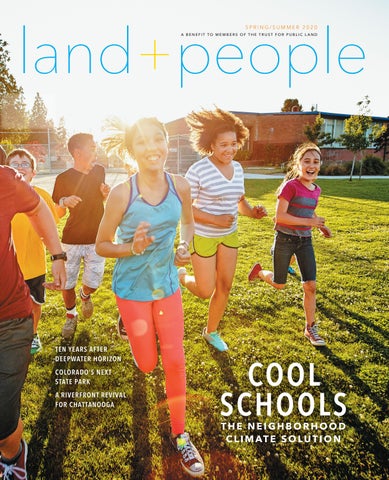
COOL SCHOOLS THE NEIGHBORHOOD C L I M AT E S O L U T I O N
6 6 · L AND &PE OPL E · SPR I NG /SUMMER 2020
adair f reeman r u t l e dg e
conserve land ...
and your retirement.
charitable gift annuity rates by age A charitable gift annuity with The Trust for Public Land can provide you with income for life while helping to conserve
65
70
75
80
85
90
5.1%
5.6%
6.2%
7.3%
8.3%
9.5%
land for generations to come. Here’s how: 1. Make a gift to The Trust for Public Land. 2. Receive a charitable deduction. 3. We invest your gift. 4. We pay you a percentage of the original gift for the rest of your life. 5. We apply the remainder toward achieving our mission of creating parks and protecting land for people.
to learn more, please contact: Christine Lambert Pentino, Director of Planned Giving 202.543.7552 or plannedgiving@tpl.org
contents
30
c h a r lo t t e k e s l
the trust for public land
F EAT U R E S
“We can’t leave other Chattanoogans behind.”
42
doug strickland
min d th e g a p, p g . 5 2
52
Beyond the Horizon................................................................................................... 30 Ten years after the worst environmental disaster in U.S. history, Gulf Coast communities return to the waterfront.
Hot Spots....................................................................................................................................... 42 As the planet heats up, public schoolyards will be part of the problem … or part of the solution.
Mind the Gap. ........................................................................................................................ 52 Trails powered Chattanooga’s revival—but some neighborhoods have yet to see the benefit. T P L. O R G · 1
JAN
FEB
MAR
APR
M AY
JUN
JUL
AUG
SEP
OCT
NOV
DEC
Through uncertain times, monthly donors sustain our work protecting land for people today, tomorrow, and for generations to come. Become a monthly donor today.
tpl.org/monthlygiving 2 · LAND &PE OPL E · SPR I NG /SUMMER 2020
D E PA RT M E NTS
of change.
istock user ivan-96
An invaluable constant in times
j o s h u a d o b ay
From the President · 11
contents
Board Spotlight · 13 Get to know Jody S. Gill.
Contributors · 14 Mailroom · 15 First Look · 17
21
Just how narrow are Zion National Parkʼs “Narrows”? Whatʼs growing at do you get organized?
Insight · 25
Tackling the thorniest questions about climate change through art.
Member Center · 62
c o u r t e s y m a ' o o r g a n i c fa r m
Hawai‘iʼs biggest organic farm? How
24
Offices · 63 Trail’s End · 64
When camping with your kids is an act of defiance.
o n t h e cover
America has over 100,000 public schoolyards. How many of them are protecting kids from climate change? Photo: Getty
JOI N U S ON FAC EB O O K
Stay tuned to our latest news, videos, contests, and more. facebook.com/thetrustforpublicland
18
T P L. O R G · 3
4 · LAND &PE OPL E · SPR I NG /SUMMER 2020
cameron davidson, courtesy of the nature conservancy
contents
FISHER’S PEAK RANCH, TRINIDAD, COLORADO The 9,600-foot Fisher’s Peak is the
backdrop to daily life in Trinidad, a small town in southern Colorado. “That mountain is the symbol of
our town,” says Cy Michaels, president of the local tourism board.
“The view from the top is so beautiful it makes me cry.” But the land between the town and the peak
has always been off-limits … until
now. Trust for Public Land supporters helped protect a 30-square-
mile ranch, and we’re working with Trinidad residents to transform it
into Colorado’s newest state park.
Page · 20
20
T P L. O R G · 5
i s t o c k u s e r fa t c a m e r a
6 · LAND &PE OPL E · SPR I NG /SUMMER 2020
contents
ZION NATIONAL PARK, UTAH Talk about getting your feet wet:
in some spots, the so-called Zion Narrows—a slot canyon popular with hikers—are so narrow that
hikers share the trail with the river itself. Thanks to Trust for Public
Land supporters, the whole Zion
Narrows Trail is now protected and open to the public forever.
Page · 24
24
T P L. O R G · 7
joe martinez
8 · LAND &PE OPL E · SPR I NG /SUMMER 2020
contents
P.S. 156/M.S. 392, BROOKLYN, NEW YORK For too many communities in
America, school is the opposite of cool: asphalt yards, brick
facades, and not enough shade mean that over a third of U.S. schoolyards are significantly
hotter than their surrounding
neighborhoods. Trust for Public
Land supporters are powering a growing movement to fight the
“heat island effect” in our cities, starting with cooler, greener,
more welcoming schoolyards.
Page · 42
42
T P L. O R G · 9
OFF I C E R S pre si d e n t an d c hi e f exec u t i v e o ff i c er
Diane Regas vice p re s i d e n t an d dire cto r o f co n s e rvat i o n f i n a n c e
Will Abberger s e n i o r vi c e p re s i d e n t o f n atio n al p ro g rams
Adrian Benepe s e n i o r vi c e p re s i d e n t , g en era l couns e l, an d co rp o rat e sec reta r y
D. Malcolm Carson s e n i o r vi c e p re s i d e n t of f i e ld p ro g rams
Jeff Danter vice p re s i d e n t an d d i recto r o f philan t hro p y p ro g ram s
Jeff Hauk s e n i o r vi c e p re s i d e n t o f poli c y an d g ove rn me n t rel at i o n s
Bill Lee vice p re s i d e n t an d ass o c i at e ge n e ral co un s e l
Margaret Madden s e n i o r vi c e p re s i d e n t a n d c hie f fi n an c i al an d ad m i n i st rat i v e o ff i c er
James Obendorf vice p re s i d e n t an d dire cto r o f fi n an c e a n d acco u n t i n g
Michelle Pandori
our mission:
THE TRUST FOR PUBLIC LAND CREATES PARKS AND PROTECTS LAND FOR PEOPLE, ENSURING HEALTHY, LIVABLE COMMUNITIES FOR GENERATIONS TO COME.
vice p re s i d e n t an d d i recto r o f human re s o urc e s
Carrie Speckart s e n i o r vi c e p re s i d e n t a n d c hie f marke t i n g an d co m m u n i cat i o n s o ff i c er
I Ling Thompson
how you can help: Our work depends on the generous support of people like you. donate: Use the envelope inside this magazine, or visit tpl.org/donate for other easy ways to give. lea rn more: Get timely updates on our park and conservation work near you. Sign up for our e-newsletter at tpl.org/enews. share: Help us make the case for parks and open space. When you’ve finished reading this issue, pass it on! Land&People magazine is a benefit to members of The Trust for Public Land.
1 0 · L AND &PE OPL E · SPR I NG /SUMMER 2020
executive editor Eliza Sarasohn
AN INVALUABLE CONSTANT IN A TIME OF CHANGE
managing editor Julia Busiek
i’m writing this in march, and you won’t
art director Gerardo Garcia-Jurado
changed in the last few weeks alone, it’s folly to
media production manager Elyse Leyenberger designer Rachel Barnes digital production Whitney Kolterman Jeremy Sammons
read it until may. Given how fast the world has make any predictions. But through the tumult of this uncertain time, I am finding solace in the constant of nature. All my life, no matter the challenge at hand, spending time outside—even just a quick walk in the fresh air—remains the fastest and surest way to clear my head and calm my mind. As a Trust for Public Land member, I know you feel the same. Many of you have reached out in recent days to tell me you’re more grateful than ever for your neighborhood park or trail. It is said that adversity strips away the inconsequential and helps us focus on what’s really important, and I believe we are all finding that to be true now. Perilous times like these show us how interconnected we all are, how we’re only as strong as the weakest among us. Now imagine what it means that 100 million people—including 28 million kids—don’t have a park close to home. Maybe you’re one of them,
© 2020 The Trust for Public Land. All rights reserved. 10-Minute Walk, Conserving Land for People, Conserving Nature Near You, Creating Parks and Protecting Land for People, Fitness Zone, Land for People, Land&People, LandVote, Northwoods Initiative, Our Land, Parks for People, ParkScore, The Trust for Our Land, The Trust for Public Land, TPL, and The Trust for Public Land and LandVote logos and all other names of The Trust for Public Land programs referenced herein, as well as their logos, are registered or common-law trademarks of The Trust for Public Land.
nicholas lea bruno
from the president
and you know exactly what it feels like not to have a place to get outside and find respite. The driving goal of our mission at The Trust for Public Land is to create healthy, livable com-
Our commitment to you is that Trust for Public Land staff, volunteers, partners, and the extraordinary communities we serve are working harder than ever to rise to the challenge of this unprecedented moment, and to bring parks and green spaces where they’re needed most. You’ll read some of these stories in this issue of Land&People. Having visited many of these communities around the country, I have been heartened by the power of people to overcome impossible odds, and I hope you’ll find inspiration in their triumph. As a valued contributor, you are the fuel that makes this success possible. So as you’re reading, consider joining The Trust for Public Land as a monthly sustaining member at tpl.org/monthlygiving. Your continued support of our urgent and meaningful work will make a difference now that will resonate for generations to come. Wishing you well,
munities, and we know that great communities are built around great parks. In the weeks and months to come, our nation’s parks, trails, and green spaces will be integral to how we cope and recover. Every child, every family—indeed every person in America—deserves access to the out-
Diane Regas president and ceo
doors and the countless benefits parks provide.
T P L. O R G · 11
M EET YO UR MATCH
This year, an anonymous donor will generously match your gift—dollar-for-dollar—if you send it before June 15. Your donation will go even further to help The Trust for Public Land protect more parks, gardens, and other natural places. That’s one good thing made that much better.
Give your EarthShare.
1 2 · L AND &PE OPL E · SPR I NG /SUMMER 2020
An EarthShare payroll deduction is one simple way to donate to The Trust for Public Land or more than 400 other environmental and conservation charities. Many corporate and government employers support EarthShare payroll giving. If yours doesn’t, ask them to start. If they do, simply decide on a single deduction or a recurring small one from every paycheck. Then designate us, member number 11440, as one of your conservation charities. For more information visit earthshare.org or email donor.outreach@tpl.org.
terray sylvester
800.714.5263 · donor.outreach@tpl.org · tpl.org/match
Get to know
board spotlight
Jody S. Gill
jody is a graduate of Northwestern Univer-
eric l au r it s
B OA R D OF D I R E CTO R S
sity and Boston University Law School. She’s worked as an estate planner at Choate, Hall and Stewart; a prosecutor at the Middlesex County Court House in Cambridge; and a
chair
sole practitioner, specializing in criminal
Thomas S. Reeve
defense and civil rights litigation. She
Stephen W. Baird
retired in 1998 to sail across the Pacific with her husband. Jody has served on the boards
George Bell
of Connecticut Bank & Trust Company;
Page Knudsen Cowles
Nantucket Cottage Hospital; NAACP Legal
William Cronon
Defense Fund; Milton Academy; Cambridge College; the Museum of Fine Arts, Boston;
Jody S. Gill
and the Esplanade Association. She and her
F. Whitney Hatch
husband, Tom, reside in Boston and West
Christopher G. Lea
Palm Beach.
Joseph E. Lipscomb Ignacia S. Moreno Caroline P. Niemczyk Michael Parish Michael E. Patterson
I BELIEVE IN PROTECTING LAND AND CREATING
school playground, or creating an urban park, the
PARKS BECAUSE … access to green space should be
commitment to engaging the community in the
a fundamental right enjoyed by every single person
design process ensures that every park will reflect
in America.
the needs and culture of the people it serves.
I SUPPORT THE TRUST FOR PUBLIC LAND BECAUSE …
THE KEY CHALLENGE FACING THE TRUST FOR PUBLIC
Diane Regas
of its commitment to put a climate-smart park
LAND IS … ensuring the parks we create contribute
Jeffrey A. Resnick
within a 10-minute walk of everyone in America.
first and most meaningfully to the well-being of
With social equity as a core principle, The Trust
long-term neighborhood residents.
Laura Richards Lex Sant Lucas St. Clair Sheryl Tishman F. Jerome Tone Susan D. Whiting
for Public Land builds parks in underserved urban areas, making a daily difference in millions of lives.
I FIRST FELL IN LOVE WITH THE NATURAL WORLD WHEN … I was a small child. Growing up in a rural
MY PROUDEST ACCOMPLISHMENT AS A BOARD
area isolated from other children, I was never
MEMBER HAS BEEN … participating in the creation
lonely climbing trees, damming brooks, watching
of the organization’s 2020–2025 strategic plan. With
spiders, or going wherever my imagination would
social equity, climate resilience, and human health
take me. My wonderment of the outdoors remains,
as primary drivers in decision-making, the plan’s
and is central to my decision-making in our
focus will bring land to people on a much greater
retirement years.
scale and to those most in need. THE TRUST FOR PUBLIC LAND’S WORK IS UNIQUE BECAUSE ... community is central to its mission. Whether developing a town forest, refurbishing a
?
WHAT ABOUT YOU? Tell us how you connect with nature. Join the conversation on Facebook: facebook.com/thetrustforpublicland
T P L. O R G · 13
contributors
Rebecca Burtonssss
Kate Harrison Belzsssssssstttt
Doug Stricklandt
story:
story:
story:
Beyond the Horizon
Mind the Gap
Mind the Gap
30
52
52
Rebecca Burton is a Pensacola, Florida, native
Kate Harrison Belz is a Tennessee-based
Doug Strickland is a documentary and edito-
whose love for her hometown beaches in-
freelance journalist. A former newspaper
rial photographer based in Chattanooga,
spired her to become a science writer with a
reporter, she is most interested in the
Tennessee. A former daily newspaper photo-
focus on our natural environment. She is the
relationships between public health, the
journalist and native southerner, he focuses
cofounder of The Marjorie, a women-owned
environment, sustainability, and localism.
on social, economic, and environmental
reporting nonprofit that promotes a greater
She is happiest when she is puttering in
issues facing communities in the southeast-
understanding of issues related to women
her garden or hiking a mountain trail with
ern United States.
and the environment in Florida through
her family.
dougstrickland.com
storytelling and community building.
kateharrisonbelz.com
themarjorie.org
WANT EVEN MORE LAND&PEOPLE? The digital edition of Land&People includes all the stories you love, optimized for your device—plus bonus content like video, easy social media sharing, and instant links to learn more. Explore the digital edition at tpl.org/magazine. Wherever you see the pointer icon in this issue, you’ll find bonus content in the digital edition. Go online to dive deeper into the difference you make as a Trust for Public Land donor.
learn more @ TPL.ORG/MAGAZINE
1 4 · L AND &PE OPL E · SPR I NG /SUMMER 2020
mailroom
richard freeda
LOOK CLOSE R Join us online to explore the latest in outdoor inspiration, big news for public lands fans, and unforgettable stories about the communities where
st even g n am
your support is making a difference.
ALL ABOARD!
Room to grow: Trust for Public Land supporters are helping Connecticut residents triple the size of Mono Pond State Park.
Tell us what’s on your mind! We want to know what you think of the people and places in this issue of Land&People magazine. Send us a letter, email
bruce muhlbradt
mailroom@tpl.org, or find us on social media.
The Story begins
Teaching the kids how rewarding
Bozeman, Montana, residents chime in
it is to grow food is so awesome. I
on the new Story Mill Community Park.
hope the rest of the country can be inspired by this project and create
+ Thank you for creating such a won-
their own parks.
derful and versatile outdoor space in
E. Voght
Bozeman. We know it was a tremendous undertaking, and a labor of love,
+ Story Mill Community Park is a
for many people over many years.
confluence between a park as a com-
Paula Clearly
munity gathering place and a park as an ecological preserve. If parks are
+ I love the park Bozeman has created.
expressions of local culture, Story Mill
You had the scenic beauty already and
expresses Montana’s culture very well.
cleaning up the water and incorporating
Pat Byorth
something for everyone is wonderful.
T P L. O R G · 15
mailroom
rachid dahnoun
+ What an amazing gift you are leaving to your community now and the generations to come. You are all an inspiration! Thank you for your hard work and dedication. Jamie Brown
+ I love to see our people getting involved in making our neighborhoods cleaner, greener, and safer for our families. This is a great project on many levels. I’d love to see it spread throughout L.A. P’alante! Querido Galdo
+ Que bueno por lo que estan hacienda! Es un buen ejemplo para nuestros niños y la comunidad en general y ojala
A walk to remember
+ And this is why your organization is
Readers relayed their own trail tales
in my will! Thank you for all you do.
when they heard we protected 17
Carolyn Trimble Botell
Good for what they are doing! It is a good
miles of the Pacific Crest Trail along
example for our children and the commu-
¡Sí, se puede!
Trinity Divide in Northern California.
nity in general and hopefully more people
You loved reading about the Parque + Thank you for protecting this area PCT from Mexico to Canada, once in
Padrinos (Park Godparents) and Equi-
Iris
uniting their communities behind the
+ Congratulations to the Equipo Verde!
power of parks.
1979 and once in 1981. Our daughter
You have done an excellent job and I
hiked the PCT four years ago. It is
am sure you are an inspiration to many
important to preserve and maintain special areas such as this.
join. Congratulations!
po Verde (Green Team)—two groups
along the PCT. I have twice hiked the
more people who would like to see nonprofit us postage
National Office 101 Montgomery St. Suite 900 San Francisco, CA 94104
mas personas se unan. Felicidades!
paid
F A L L / W I N T E R 2 0 19 A BENEFIT TO MEMBERS OF THE TRUST FOR PUBLIC LAND
the trust for public land
their alleys improved so that they may become useful!
Tim Higginson
Karen Kauffman
F OR PUBLIC For now, I continue north LAND. on the PCT! Our public lands are the pride of the nation. But powerful politicians are working to convert this public property to private profit. We believe this agenda is out of step with the needs of everyday Americans. IF YOU AG RE E , TAK E ACT I ON NOW.
N EIG HB ORHOOD AT A T IME
+ Thank you so much for helping to clean up our world! It won’t EVER get done if we don’t do it. Madeline Loder
VOL. 31, Nº2
+ Future PCT'ers will appreciate the
ON E
F A L L / W I N T E R 2 0 19
Laurie Ann
HOW TO BUILD A MOVEMENT
THE TRUST FOR PUBLIC LAND
TA K E A STAND
return to explore more on future trips.
land + people
What a stunningly beautiful area. I will
m ike sc hir f
+ We just finished that section yesterday.
protection and preservation of our beautiful country. Thank you to everyone involved.
tpl.org/donate
LAND&PEOPLE IS LISTENING!
YO U R G I F T B E F O RE D E C E M B E R 31 W I LL B E M ATC H E D TO P ROT E CT P U B LI C LA N D.
Marlin Miller 1 6 · L AND &PE OPL E · SPR I NG /SUMMER 2020
+VERMONT'S FRIENDLIEST TRAIL RACE
+HIKING NYC
+GOOD NEWS FOR THE PACIFIC CREST TRAIL
Send letters to the editor or change your mailing address: mailroom@tpl.org.
turn the page for … aloha ‘āina brave backflips colorful colorado
i’m not afraid of storms, for i’m learning to sail my ship.
In Spokane, Washington, residents weren’t content to let Dutch Jake’s Park fall into disrepair. So 1,700 people pitched in to reinvigorate the park, which recently reopened to a very enthusiastic audience.
mae wolfe
lo ui s a m ay a lcott
T P L. O R G · 17
edible conservation
PRIDE an d PRODUCE
ma ‘o organic farms wai ‘anae, hawai ‘i
the first shift at ma‘o organic
to travel a long way in search of fresh,
by 11 acres in 2008 and seven acres in
farms starts at 5 a.m. It’ll be a few
healthy food.
2010. And late last year, we helped MA‘O
hours until the sun rises over O‘ahu’s
MA‘O farmers are fighting this prob-
acquire 21 more acres.
leeward coast, but the farmers—
lem through CSA shares and at farmers
It’s now the largest organic farm in
mostly in their late teens and early
markets around the island. Along the
Hawai‘i, employing over fifty local
twenties—are awake and ready to
way, the farm has shaped a future for
youth. “We wouldn’t be able to do what
work. They fan out into the rows of
the hundreds of local youth who’ve
we are doing if it wasn’t for The Trust
beets and kale and through orchards
worked the soil.
for Public Land,” says the farm’s founder
of citrus and ‘ulu (breadfruit) trees,
Since the farm’s inception as a five-
Kukui Maunakea-Forth. “They’ve provided
dragging hoses, pulling weeds, and
acre operation in 2001, demand for its
us the space to focus on innovation,
harvesting and packing produce.
produce—and the pathways to opportu-
which for us means returning to the
Fruits and veggies can be hard to come
nity it offers Wai‘anae youth—has tended
traditional practices that are inherently
by here on O‘ahu’s western coast, home
to outstrip supply. So over the years,
so simple. The impact we have on the
to one of the largest Native Hawaiian
Trust for Public Land members have
students is because of the land you’ve
populations in the islands—and, accord-
pitched in to help the farm expand,
helped provide.” arna photography, inc.
ing to the U.S. Census Bureau, some of the highest rates of obesity and diabetes in the nation. Not coincidentally, health researchers describe the nearby community of Wai‘anae as a “food desert,” where fast-food chains outnumber
arna photography, inc.
grocery stores and families might have
1 8 · L AND &PE OPL E · SPR I NG /SUMMER 2020
istock user studio light and shade
word watch
i s t o c k u s e r s m i n d k lo n g d a n , o l e k s a n d r h r u t s , a n d w u n d e r v i s u a l s
Veggie sushi with pickled roots This refreshing snack goes great with MA‘O’s own “Farm 2 Fork” dressing. Ingredients ●
1 bunch each: turnips, carrots, daikon radish, kale
●
1 cup each: white vinegar, sugar, hot water
●
2 tbsp sesame oil
●
1 cucumber, sliced into long matchsticks
parkour
●
1 avocado, sliced
●
Minced garlic
(n.) \ pär-ˈkur
●
Cooked rice 1 package sushi nori (seaweed)
A sport in which athletes traverse the built environment by running, climb-
●
ing, and leaping.
Grate turnips and carrots. Dissolve
Parkour originated on city streets. But if you’re just starting out, it’s nice to
sugar in hot water and vinegar. Mix
have a purpose-built space to build strength, flexibility, and confidence.
in root veggies and refrigerate overnight. Slice kale and daikon.
That’s the idea behind the parkour course at WOONASQUATUCKET
Sauté with garlic until tender.
ADVENTURE PARK in Providence, Rhode Island. The new park—created
Turn off heat and add sesame oil.
with help from supporters like you—is a space for local teens to test their
Cover a sheet of nori with a layer
limits through parkour, skateboarding, BMX, or cyclocross.
of rice. Arrange veggies in a line. Roll tightly, sealing edge with water. Slice rolls into 1-inch rounds and arrange on a plate to serve.
learn more @ TPL.ORG/WOONASQUATUCKET P L. OORK G ·· 19 19 F I R ST TLO
buzzworthy
Making
c ha n ge weir farm national historic site wilton, connecticut heads up, coin collectors: In April the U.S. Mint unveiled the latest in its “America the Beautiful Quarters” program, commemorating WEIR FARM NATIONAL HISTORIC SITE. J. Alden Weir’s farm was the inspiration for a generation of American impressionist painters. But by the 1980s, developers planned to pave rachid dahnoun
over this legendary landscape. Through dozens of land deals, we reassembled the original farm and advocated for its designation as Connecticut’s first national park.
“Fisher’s Peak is a big win for Colorado. Now get ready to explore.” – The Denver Post “Colorado is built for adventure,” the Post wrote. “But as more folks u.s. mint
discover the magic, the need for open space grows.” Thanks to you, we’re working with The Nature Conservancy to create COLORADO’S NEXT STATE PARK: a 30-square-mile wildland three hours south of Denver, with miles of roads and trails that will soon be open to all. 2 0 · L AND &PE OPL E · SPR I NG /SUMMER 2020
learn more @ TPL.ORG/WEIR-FARM
good news
ALLEY-OOP!
lakeview terrace basketball courts cleveland, ohio
j o s h u a d o b ay
j o s h u a d o b ay
“I’m trying to get everybody to interact with each other— that’s my goal.”
Coach Jeffrey “Shorty” Lee
the way coach jeffrey “shorty” lee
munity. Basketball teaches teamwork
his Wildcats got together to help The
sees it, at least one good thing came
and respect, Lee says—and by getting
Trust for Public Land design a vibrant
of the old, neglected basketball court
kids together for games, he’s creating
mural for the surface of their freshly
at LAKEVIEW TERRACE: “It used to
opportunities for families from differ-
repaved court.
be all un-level, with big chuck-holes
ent buildings to get to know each other.
Now, Lee says, he looks out his win-
everywhere,” he says. “They constantly
“We all live down here together. I’m
dow and sees six or seven kids out on
had to be avoiding obstacles, so my
trying to get everybody to interact with
the court any day of the week—and
players learned to dribble.”
each other—that’s my goal.”
their families are getting together to
Lee is the volunteer head coach of the
Ball-handling benefits notwithstand-
watch. “More kids are coming out to
Lakeview Terrace Wildcats, a basketball
ing, the outdoor spaces around Lake-
play ball!” he says. “By the court being
club for kids aged 7 to 18 growing up
view Terrace have long been in need
fixed up, I feel as though these Wildcats
in this Cleveland public housing com-
of a little T.L.C. So “Coach Shorty” and
can only get greater.” P L. OORK G ·· 21 21 F I R ST TLO
meet our staff
buzzworthy
istock user tetiana lazunova
joshua kissi
“A good organizer keeps the community’s needs at the center.”
“We really just
DID NOT GIVE UP.” – Kay Haynes Save Cougar Mountain volunteer It took over two years, 2,600 petition signatures, and 20 city council meetings—but a grassroots group of neighbors in the Seattle suburb of Issaquah managed to block plans for a luxury subdivision on the slopes of COUGAR MOUNTAIN REGIONAL WILDLAND PARK.
AAMINA MOHAMED
THE TRUST FOR PUBLIC LAND'S AMERICORPS INTERN BUILDS MOMENTUM FOR PARKS IN THE TWIN CITIES.
Big picture, what does a community organizer do? Organizing is all about getting people headed in a direction toward some sort of change—whether it’s building momentum behind a political cam-
Now, thanks to donors like you, weʼre help-
paign to change who represents you, or catalyzing your own community
ing transfer the property to public owner-
to advocate directly for what you need. That can mean organizing meet-
ship, making way for a new transit-accessible trailhead leading into the 3,000-acre park.
ings, showing up at community events, or going door-to-door. As a digital organizer, I’ve even helped create a hashtag that went viral. At The Trust for Public Land, we’re organizing for equity, climate justice, and health, through parks and public lands.
2 2 · L AND &PE OPL E · SPR I NG /SUMMER 2020
What are you working on?
and have led a three-year participatory
These days I’m helping organize a
design process, to make sure the park
Why are parks and public land important to you?
stewardship group for MIDWAY PEACE
reflects the priorities of the people who
I’m passionate about land justice—in
PARK, a new park in St. Paul that will
first dreamed it up. Now, after a decade
America, decisions about how we use
open this summer. It’s next door to Sky-
of organizing, neighbors are so excited:
land and who has access to it are at the
line Tower, one of the largest affordable
there will be a walking path, a stream,
foundation of society. As someone who’s
housing buildings in Minnesota. Almost
an amphitheater, and the biggest slide
been displaced multiple times through-
ten years ago, Skyline residents started
I’ve ever seen! But the thing I’ve heard
out my life, I’ve always been looking for
talking about parks in their neighbor-
from the most people is what a big deal
a genuine connection to the land—and
hood, because basically, there weren’t
it will be to have a safe, shared place
as I’ve grown up and expanded my
any. Kids were stuck playing soccer in
where people can meet their neighbors.
horizons, I’ve been able to find that con-
the hallways. Meanwhile, these three acres in all—sat just across the street,
Why did you come to organize for parks and nature?
fenced off and unused. Residents started
I grew up in a low-income refugee com-
big vacant parcels of land—about five
nection, and it’s been so valuable for my understanding of myself.
asking, “Could we turn that space into
munity in Washington State, right on
What skills do you bring as an organizer?
a park?”
a highway, with nowhere near enough
Sometimes I feel like I’m a detective. All
access to parks and nature. I know what
day I’m out talking to people, asking
it’s like to not have that source of relax-
questions, listening, gathering perspec-
What has The Trust for Public Land’s role been?
ation, that place to imagine or play or
tives, and improving my understanding
just take a break from the stress of your
of the community I’m representing,
The Trust for Public Land got involved to
daily life. Now, I want to help people
and how I can best support them—or
bring our resources and expertise to help
who come from communities like mine
if I can’t, I’ll try to connect them with
meet the need. We raised money to buy
overcome those barriers and have their
someone who can. A good organizer is
the vacant land and transfer it to the city,
own connection with nature.
a collaborator who helps put the pieces
The community identified the need, and
andy richter
together and keeps their community’s needs at the center.
What do you like about being an organizer? The humanity of it all. It’s a very emotionally engaged job: every day I’m asking for people’s trust and for them to share their experiences with me. That ability to be vulnerable makes it so rewarding. If I’m doing it right, I can offer resources, or connections to resources, that will help people thrive.
We’re organizing for new parks along the Green Line—a new light rail route that’s driving investment and development in St. Paul neighborhoods that have historically lacked access to green space. P L. OORK G ·· 23 23 F I R ST TLO
istock user andrew opila
why we give
“We wanted to do our part for clean water—as brewers and as Mainers.” – Rob Tod, founder of Allagash Brewing This beloved Portland brewery pitched in to help create the new TIGER HILL COMMU-
NITY FOREST in Sebago, Maine. The region’s
forests filter water flowing into Sebago Lake,
the water source for one in six Mainers … and every Allagash beer.
22feet
The width of the aptly named “Zion Narrows.”
We recently protected the last private property along the ZION slices through the heart of Utah’s Zion National Park. So while the hike may feel a little cramped at times, youʼll never again have to worry about “No Trespassing” signs blocking your access to this unforgettable adventure. 2 4 · L AND &PE OPL E · SPR I NG /SUMMER 2020
istock user homunkulus28
NARROWS TRAIL—the famed 1,300-foot-deep canyon trek that
insight
"Climate how do we reckon with chAnGE Is the global scale of HaPpeNing this new reality? rIght now." To tackle the defining challenge of our time, we’re going to need to get a lot more creative, says artist and activist Eve Mosher.
# T P L. O R G · 25
It all started with a thin blue line.
j ay m e g e r s h e n
Eve Mosher had been following the news, studying the science, and burrowing into the reports: The planet was warming, and the seas that surrounded her New York City home would rise. Areas of the city that had been known to flood once in a century—areas now ten feet above sea level—could start to expect inundation every four years. Mosher had a successful career as a studio artist. But the more she learned about climate change, the more she worried about how her city would suffer. In 2007, she drew a chalk line 70 miles through Brooklyn and Manhattan, following a map marking ten feet above sea level. The project—which she titled “HighWaterLine”—was a vivid, approachable depiction of New York’s future on a warmer planet, a line of demarcation showing the parts of the city predicted to be under water. She’s since grappled with the climate crisis through participatory art, partnering with scientists, storytellers, and communities from Miami to Honolulu to Bristol, U.K. Closer to home, her ten-year-old son is following in her footsteps, becoming a climate striker in his own right. Now, Mosher is collaborating with The Trust for Public Land on a new public art project called “Heat Capture,” to call attention to rising temperatures in three Philadelphia neighborhoods. We caught up with her to talk about creative approaches to the climate crisis.
"Art can build social resilience." HighWaterLine participants push a chalk-marking device—normally used for drawing lines on sports fields—through city streets
2 6 · L AND &PE OPL E · SPR I NG /SUMMER 2020
to draw attention to sea level rise.
Why did you create HighWaterLine? Government and media portray climate change as if it’s both
Eve Mosher
huge and distant: polar ice caps, atmospheric carbon, future projections. But we know it’s affecting people already, right where they live. New York City is a coastal community, and I wanted to use art to show how sea level rise will affect New Yorkers in the future.
That future ended up being nearer than you’d imagined. When Superstorm Sandy hit in 2012, the neighborhoods I’d drawn this line through flooded, as the reports predicted they would. Even back in 2007, when I was walking through Brooklyn, I talked to people who already knew about the risk because their flood insurance had been revoked the year before.
Why do you think HighWaterLine made such an impression? In part because it was so approachable, and it sparked curiosity. At first some people who encountered me were sort of antagonistic, like, “What are you doing? Are you with the city or something?” But many people were just genuinely curious. And we could connect because I’m the same way: I’m not a scientist. I just want to find out: what do you know? And how can I use what I’ve learned, and the resources I can bring, to help you? There is a deep knowledge that exists in communities about the effects of climate change. Decision-makers need this information, as do other impacted communities and activists who can use these stories and knowledge as a tool
Philadelphia, and Fairhill. These three neighborhoods have
to advocate for policy improvements. Art is one more way
less shade and more concrete than the city average, or happen
we can share the community’s hard-earned knowledge and
to be in low spots that trap heat.
perspective more widely.
We’re starting with a hypothesis that public space is a resource that can be used to build social resilience. We’re not
What do you have planned for your next project in Philadelphia?
going into this project with a predefined outcome in mind
In Philadelphia, climate change is an environmental chal-
yet. It really is about the community and strengthening their
—so we’re not really sure how the work is going to turn out
lenge stacked on top of a history of pollution, disinvestment,
ability to advocate for themselves. I can’t wait to see what
and discrimination. And people there are already suffering
direction this work takes.
its effects. ing affect the city. Through data and the relationships the
Why approach climate threats with art, instead of science or policy?
organization has developed in its years of working in public
Art can facilitate valuable conversations that build social resil-
The Trust for Public Land has mapped how heat and flood-
space, we know that not all Philadelphia neighborhoods
ience within communities and between communities. And
experience heat equally. We’re in three neighborhoods where
social resilience is a key factor in weathering the changes that
The Trust for Public Land has built parks: Gray’s Ferry, South
we’re facing.
T P L. O R G · 27
What does social resilience have to do with weathering climate change?
It seems like you’ve had an impression on your son. Zayne has been hanging around me his whole life so he’s
When you’re in times of stress, that’s when you need stronger
picked up some awareness, but he’s also been learning about
relationships most. I get a little woo-woo about some of this
climate change in school and through podcasts—he’s ten—
stuff, but I really believe that whatever happens in the future,
and it all added up to some anxiety for him. At the same time,
it won’t be scientific breakthroughs or government policy
he was undergoing diagnosis for autism and had recently
that will make the most difference for people—though those
been diagnosed with ADHD. So he’s been asking, “Does this
are critically important. It’ll be our relationships. Our relation-
person have autism? Does this person?” Kind of looking for
ships will see us through.
other people like him.
Take Occupy Sandy: these were people who'd gotten to
In 2018, I read him a news story about this Swedish girl
know each other through the Occupy Wall Street protests
named Greta Thunberg, who’d been striking for climate
the year before and established a way of working together
action in front of the Parliament House in Stockholm. The
and communicating. Because of that they were able to
article talked about how Greta’s Asperger syndrome informed
mobilize so efficiently. After Hurricane Sandy, they got out
her view of the world and contributed to her decision to
to the Rockaways on cargo bikes loaded with food and water
strike. My son immediately said, “I want to do that.”
and were able to respond faster than the government. Then
So since December 2018, Zayne has been striking every
there are the studies that show neighborhoods with higher
single Friday, holding a sign in front of City Hall. He was one
measures of social resilience have fared better during heat
of the first activists in the United States for what’s become
waves—in part because if you know your neighbors, you’re
the global Fridays for Future climate protests.
likelier to go knock on the door and see if everything is okay.
How does that make you feel as a parent? j e n n a s ta m m
I’m so incredibly proud of him. But it’s also heartbreaking. Because it really shouldn’t be up to the kids. But there’s precedent for this: think about the Birmingham Children’s Crusade during the civil rights movement, when the bravery and activism of incredibly young kids shocked Americans out of their entrenched beliefs.
What do you think the world will be like when he’s your age? We’re at the point where so much change has been locked in already. Regardless of whether we stop emitting carbon tomorrow, sea levels and temperatures will rise. That’s a lot to grapple with! You can’t find all the answers for this in science or in the media. Art can create space to express this radical grief. That isn’t necessarily just sadness, though it’s important to be sad, or mad even. Radical grief means recognizing that the future we might have expected for ourselves when we were growing up may no longer exist. We have to let go of it. And then let’s start thinking really differently. Sometimes the way to get generative is to walk in your neighborhood with someone else, learn from each other, and start brainstorming ideas. Art can be an integral part of our society’s response to climate change. Art can show inspiration for what’s possible, given what’s really true.
2 8 · L AND &PE OPL E · SPR I NG /SUMMER 2020
rachid dahnoun
BE A LEADER. Become a Conservation Champion and help The Trust for Public Land connect even more people to nature. With your annual leadership-level contribution of $2,000 or more, you will receive invitations to special events and insider updates on our park and conservation strategies.
Learn more about the impact you will have as a Conservation Champion. Contact Emily Falk 415.800.5193 or champions@tpl.org.
conservation champions t p l .or g/ champi o n s | champi o n s@tpl.o r g
T P L. O R G · 29
Beyond the
Horizon
t e n y e a r s a f t e r t h e d e e p wat e r h o r i z o n o i l s p i l l , pa r k s h e l p g u l f c o a s t c o m m u n i t i e s r e c o v e r — a n d s u s ta i n — t h e i r way o f l i f e .
By Rebecca Burton Photos by Charlotte Kesl
3 0 · L AND &PE OPL E · SPR I NG /SUMMER 2020
F
On a sunny, seventy-degree day in December, I met Destin
ishing is in dewey destin’s dna.
In 1835, fed up after a poor fishing season, Destin’s great-
great-grandfather Leonard left New England and set his sails
on the boardwalk outside the restaurant to talk about his town’s history, its luck, and the ways that luck continues to
south, seeking richer waters. After surviving some trials and
be tested. A tall, slender man with white hair, polarized sun-
tribulations—a hurricane, a shipwreck, and a dreaded yellow
glasses, and a relaxed manner, Destin gently shooed a seagull
fever season—he eventually made his way to a tiny peninsula
trying to snatch a shrimp from a nearby plate before joining
on the Gulf of Mexico, sixty miles east of the Florida-Alabama
me at a picnic table.
line. There he built a home on a sandy strip of land facing the
“You take fishing out of Destin and it wouldn’t be what it
translucent emerald waves of Choctawhatchee Bay.
is today,” he told me, looking out over Choctawhatchee Bay
This spit of sand would eventually come to be known as
while we snacked on fried gulf shrimp and hushpuppies. Easy
Destin—the “world’s luckiest fishing village.” And for Leon-
access to a productive fishery is the reason the largest recre-
ard Destin, these waters were certainly a fortunate find. Just
ational charter fishing fleet in North America docks right here
offshore, the gulf drops precipitously to deeper waters that
in Destin. The chance to hook a huge sailfish combined with
nurture schools of red snapper and Spanish mackerel—a sea
the opportunity to enjoy white sand beaches and sparkling
of plenty for a fisherman like Destin to build a business, sell-
waters is what draws millions to visit the town each year.
ing his catch to market in nearby Pensacola.
Today, tourism accounts for nearly a third of the jobs in this
Growing up in the lucky fishing village named for his
county of 68,000 residents.
forebearer, Dewey Destin followed in his family’s footsteps,
“Our natural resources are what built this economy,” says
learning to catch crabs and mullet. Today, he owns a string of
Kathy Marler Blue, director of the Destin History and Fishing
local seafood restaurants, including one next door to the spot
Museum. “Having good water, a good fishery, and beautiful
where his great-great-grandfather Leonard first settled.
beaches helped us become the world-class resort we are today.”
p h oto : a to x i c s h e e n o f o i l f ro m a ru p t u r e d w e l l c i r c u l at e s i n to t h e g u l f o f m e x i c o o n m ay 12 , 2010 . credit: noaa
T P L. O R G · 31
You take fishing out of Destin and it wouldn’t be what it is today.
So you can imagine how Destin residents felt when they woke on the morning of April 21, 2010, to news of a disaster unfolding just offshore. The night before, the Deepwater
President Obama declared it the worst environmental disaster in U.S. history. As the slick spread, the National Oceanic and Atmospheric
Horizon oil rig had exploded out in the gulf, killing 11 crew-
Administration closed more than a third of the gulf ’s
men. The complicated machinery that had tapped into an oil
fishery to protect consumers from contaminated seafood.
deposit deep under the sea floor collapsed. Crude oil gushed
Instead of hauling in their catches that summer, gulf fisher-
from the hole and seeped into the currents circulating around
men put their boats to work installing floating barriers,
the Gulf of Mexico.
trying to prevent oil from reaching their home shores. The
Satellites would eventually capture horrifying images of an oily sheen extending across an estimated 68,000 square miles
region’s commercial fishing industry lost $1.6 billion in the first eight months.
of the gulf. Oil coated the beaches from Louisiana to Alabama,
“Fishing seasons are good and bad. Hurricanes come and go,”
causing mass mortality among fish, seabirds, and marine
Destin said. “But that’s the first time in my life that I realized
mammals. In Louisiana, oil choked the plants that were
we had the potential to really ruin Destin and what it was—
holding together the state’s already-disappearing coastline.
perhaps permanently.”
3 2 · L AND &PE OPL E · SPR I NG /SUMMER 2020
g e n e r at i o n s o f d e s t i n r e s i d e n t s h av e r e l i e d o n a c lo s e c o n n e c t i o n w i t h t h e sea. dewey destin (left) runs a s e a f o o d r e s ta u r a n t n e x t to h i s a n c e s t r a l h o m e s t e a d . k at h y m a r l e r b l u e ( a b ov e ) k e e p s h e r i ta g e a l i v e at t h e d e s t i n h i s to r y a n d f i s h i n g m u s e u m .
T P L. O R G · 33
jeff hutchens/getty images
c a r o ly n c o l e / lo s a n g e l e s t i m e s v i a g e t t y i m a g e s
People stopped going to the beach. They stopped fishing.
o i l e v e n t u a l ly wa s h e d u p o n s h o r e l i n e s f r o m l o u i s i a n a to f l o r i d a , a n d t h e f i s h i n g i n d u s t r y l o s t $1.6 b i l l i o n i n t h e f i r s t e i g h t m o n t h s .
3 4 · L AND &PE OPL E · SPR I NG /SUMMER 2020
O O
n July 15, 2010, 87 days after the explosion, crews finally capped the well. But that was just the first step
funds from BP to compensate for those lost recreational uses.” Rick O’Connor is an educator and naturalist in Pensacola.
in a complex and hard-fought recovery that has played out in
When BP money began flowing into the area, he feared it
courts, statehouses, and communities across Alabama, Florida,
would be used to put up more high-rise condominiums with
Louisiana, Mississippi, and Texas ever since. In 2011, the Deep-
private beach fronts—as he’s watched happen elsewhere in
water Horizon Natural Resource Damage Assessment Trustee
Florida, particularly in Destin.
Council reached an agreement with BP, the company that had
“We had to convince decision-makers that keeping [the water-
hired Deepwater Horizon. BP agreed to front a billion dollars
front] wild was just as economically viable,” O’Connor says. His
for restoration, research, and land protection throughout the
colleagues conducted a study showing that 40 percent of the
region. And in 2016, a federal judge in New Orleans ordered
region’s visitors sought nature-based experiences as part of
BP to pay $20 billion to help Gulf Coast communities recover.
their vacation packages. Armed with those findings, he’s been
It was the largest environmental settlement in U.S. history.
promoting ecotourism in the area and has helped established a
The Florida Panhandle—the part of the state stretching
new paddling trail along the Perdido River. “The nature-based
roughly from Tallahassee west to the Alabama border—is far
tourism economy is critical to many Panhandle communities,”
enough from the spill’s epicenter that its beaches escaped
says O’Connor. “Parks are the key to sustaining it.”
severe contamination. But the disaster still brought the
The Trust for Public Land has helped Floridians create and
economy to a halt, says Phil Coram, program administra-
protect great places to get outside for more than 40 years.
tor for the Florida Department of Environmental Protection.
Since 2015, the organization has drawn on funding from BP’s
Florida’s beaches and waterways are the primary attraction for
settlement to build or expand waterfront parks in six commu-
the more than 100 million tourists who flock to the Sunshine
nities in western Florida. This winter, I took a drive along the
State each year. After the spill, “People stopped going to the
Panhandle, visiting these new parks and meeting with locals
beach. They stopped fishing,” Coram says. “And so we sought
who are envisioning a more resilient future for the Gulf Coast.
bp’s settlement funded i n n e r a r i t y p o i n t pa r k in pensacola.
T P L. O R G · 35
We finally got back to normal. And then HurricaneMichael hit.
FF
loridians are no strangers to disaster—and recovery. And
our parks were truly, truly damaged. [Before the storm], that’s
as the climate changes, many are reckoning with the
where folks spent most of their time.”
threat of a new, more hazardous normal. That’s true in Lynn
As Michael brewed out in the Gulf of Mexico, crews had
Haven, a small city sixty miles east of Destin. The city’s hard-
already broken ground on the new Lynn Haven Bayou Park and
working, residential way of life sits in sharp contrast to the
Preserve, one of the waterfront parks made possible by Deep-
perma-spring break vibe in neighboring Panama City Beach.
water Horizon settlement funding. Along with so many other
Even still, the oil spill upset the status quo.
aspects of life, the storm threw the project into chaos, pushing
“When the oil spill hit, we spent millions of dollars trying to
its scheduled opening back into late 2020—another blow for
clean up beaches everywhere,” says Vickie Gainer, city manager
the already-battered community.
for Lynn Haven. “It felt like a never-ending story, but we finally got back to normal. And then Hurricane Michael hit.” On October 10, 2018, the eye of Hurricane Michael came
When I visited this winter, the park was still under construction. But as I toured the 97-acre site, I imagined the day when people will be able to meander the palmetto-lined trails
ashore at Mexico Beach, Florida. It was the first storm to make
through the tall pine forests sprinkled with fragrant magnolias.
landfall in the United States as a Category 5 hurricane since
Families will climb to the top of the wildlife overlooks to spot
Andrew in 1992. The storm claimed 16 lives and caused $25
manatee, bear, and deer. Kayakers will use the docks and ramps
billion in damage, including destroying 85 percent of Lynn
to access North Bay. This will be a place where residents and
Haven’s homes and 50 percent of its businesses.
visitors alike can take a break from their daily challenges and
“To this day, there are still people who have not moved back
find solace and inspiration in the natural world.
into their homes,” says Gainer. “I’m one of those folks. But 3 6 · L AND &PE OPL E · SPR I NG /SUMMER 2020
silver linings Six new parks in western Florida are keeping people connected to their home coast.
i n n e r a r i t y p o i n t pa r k
i s l a n d v i e w pa r k
Kayakers can put in at new docks on the Old River in Pensacola and head for the open waters of Perdido Bay.
This park in Carabelle opened just weeks before Hurricane Michael devastated the region. It remains closed while the county gathers FEMA funding to rebuild.
n ava r r e b e a c h m a r i n e pa r k
This vast white sand beach is already a mainstay for Santa Rosa County locals and visitors alike. BP’s settlement funded a five-acre expansion.
ly n n h av e n b ay o u pa r k a n d p r e s e r v e
This 97-acre landscape was once slated for subdivision and development. Instead, it will remain a waterfront haven where people and wildlife meet.
c a p ta i n l e o n a r d d e s t i n pa r k
A much-needed patch of public land on an increasingly developed waterfront ensures equitable access to Choctawhatchee Bay.
s a l i n a s pa r k
A half-mile boardwalk winds through coastal wetlands and pine forests, paralleling the shore of St. Joseph Bay in Gulf County. T P L. O R G · 37
“ w h e n y o u s e e p l a c e s b e i n g r e s to r e d , i t b r i n g s b a c k n o r m a l c y , ” s ay s d way n e p i e r g i o va n n i .
Aq
s you leave Lynn Haven and drive along Highway 98, the
blue crabs, marsh wrens, and seaside sparrows, he tells me
storm’s impact is still brutally apparent. Boarded-up
his grandfather raised nine children as a commercial fisher-
pastel houses sit on stilts waiting to be fixed. Most of the trees
man on this bay. When he was old enough, Yeager helped his
are snapped into splinters. But for many residents, addressing
grandfather reel in his catch. “To say this park holds a special
this physical toll is just one aspect of the long, challenging
place in my heart would be an understatement,” he says.
recovery ahead.
Lifelong Cape San Blas resident Dwayne Piergiovanni agrees.
“People from outside don’t really realize how deep the
He stuck it out through both the oil spill and Hurricane
scars are,” says Patricia Hardman, who lives in the small
Michael, which closed the restaurant he owns and operates
town of Cape San Blas. “There is a lot of hidden depression
for six months. “When you see places being restored after
in this community.” Hardman is one of the many residents who’ve provided input and ideas for an addition to nearby Salinas Park, another BP-funded park project delayed by Hurricane Michael. I strolled along the park’s fresh boardwalk parallelling St.
being destroyed, it brings back some normalcy and helps people see that things will get better,” he says. Back in Destin, people counted their blessings. The brunt of the hurricane—like the worst of the oil spill— had spared them.
Joseph Bay with Warren Yeager, a Gulf County administrator.
But in a region where prosperity is intertwined with visi-
As we passed signage educating park visitors about the local
tors’ perceptions, there’s no such thing as escaping unscathed.
3 8 · L AND &PE OPL E · SPR I NG /SUMMER 2020
“Even though we didn’t have oil here, they showed oil on the
munity’s plan to ensure everyone benefits equitably from the
water everywhere on the news,” Destin says. “It scared people
area’s natural riches. These days, private condos, restaurants,
and they just didn’t come.” A 2010 study found that lost tour-
and shops line much of Destin’s waterfront. Paying customers
ism was projected to cost the Gulf Coast up to $22.7 billion
can find plenty of places to reserve a fishing boat for a day on
over three years. Dewey Destin estimates his restaurants lost
the deep sea, but those looking to launch a kayak into Choc-
more than 60 percent of their usual business that summer.
tawhatchee Bay can be hard-pressed to find public access.
In his lifetime, Destin has seen the town named for his fore-
“Access to the waterfront: that’s the main thing we need,”
bearers grow from a remote fishing village to a vacation desti-
says Captain Jerry Anderson. He’s owned a commercial and
nation that draws millions of visitors annually. Many of those
recreational fishing charter business in western Florida since
visitors—and the people who live in Destin year-round—will
1978. “All over the East Coast, our working waterfront is van-
welcome the new Captain Leonard Destin Park, created with
ishing—investors come in and build subdivisions on lowlands
funding from the Deepwater Horizon recovery settlement.
and wetlands, instead of making a park there for the aver-
The new park—built on the same spot where Leonard Destin first built his home in the mid-1800s—is part of the com-
age Joe. That’s where The Trust for Public Land came in, and thank God for that.”
Access to the waterfront: that’s the main thing we need.
t h e w o r l d ’ s l u c k i e s t f i s h i n g v i l l a g e i s g r o w i n g u p fa s t , a n d p r e s e r v i n g p u b l i c a c c e s s to t h e wat e r f r o n t i s to p o f m i n d . T P L. O R G · 39
Back at the Destin History and Fishing Museum, Kathy
City Manager Vickie Gainer worked long hours passing out
Marler Blue affirmed that life here revolves around a shared
supplies to her neighbors in need. Likewise, Cape San Blas
connection to the gulf, and to each other. “The families
resident Pat Hardman helped organize a holiday toy drive
who founded Destin knew the sea could provide for them,
for the Gulf County families who lost their belongings. And
and they knew it could take them just as quick. They
they’re two of the many who’ve given their time and input to
shared and rallied and helped each other meet their basic
shape the future of their new shared waterfront parks.
needs,” she said.
“Sometimes we become very jaded to the beauty of nature
This interdependence is part of the reason Gulf Coast com-
because we’re so busy trying to clean up and rebuild,” Gainer
munities have been able to bounce back from both natural
says. “These types of parks show that there’s still hope. That
and manmade disasters. After Hurricane Michael, Lynn Haven
there’s beauty even after a storm.”
4 0 · L AND &PE OPL E · SPR I NG /SUMMER 2020
melina meyer
They shared and rallied and helped each other meet their basic needs.
T P L. O R G · 41
WANT TO PREPARE YOUR CITY FOR CLIMATE CHANGE? START HERE.
B Y J UL I A B U S IE K PHOTOS BY AN G E L A D E C E N Z O 4 2 · L AND &PE OPL E · SPR I NG /SUMMER 2020
© mapbox, © openstreetmap
HOT SPOTS
ASPHALT SCHOOLYARDS TRAP HEAT FRO M THE SUN , EVEN ON MILD DAYS.
N W
e register the pain of burning when our skin touches surfaces hotter than 111 degrees Fahrenheit. Prolonged
contact with a 118-degree surface puts us at risk of first-degree burns. At 130 degrees, a second-degree burn can happen in under ten seconds. Around noon on a sunny day in late October, three students stood in a tight circle on the yard at International Community School in Oakland, California. “109!” yelled a fifth grader named Emmanuel, pointing a surface temperature thermometer at the concrete under his feet. He walked over to the
jungle gym and aimed the device at the plastic slide. “115!” As his classmate Angelica recorded the measurements on her clipboard, another student, 10-year-old David, studied a map of the schoolyard and then sprinted across a wide stretch of asphalt to the next spot to take a reading. There, in the shade of a lone tree growing a few feet outside the fence line, he pointed his device. “72!” he yelled, reading the thermometer’s digital screen. At recess the big yard was a sea of activity. Kids were swinging, sliding, tagging, and climbing, while a few adults with whistles around their necks kept an eye out from the perimeter. Every few minutes, a commuter train screeched through the elevated rail line paralleling Interstate 880, across a busy street from the school. It was a beautiful Bay Area autumn day, not a cloud in the sky, just 63 degrees. But despite the mild weather, the parts of the playground sitting in direct sun were almost hot enough to be dangerous. T P L. O R G · 43
trees, swap hot concrete with soft grass, and build garden beds to grow fresh vegetables. The yard at International
direct sun. “There are only like two trees here,” says David. “It
Community School is one of the first in Oakland The Trust
gets pretty hot when we’re outside all recess.” On one hot day
for Public Land is helping to transform throughout the city,
a few weeks earlier, students measured surface temperatures
part of an effort to remake asphalt yards nationwide into cool,
on the yard as high as 132 degrees.
green places to play and learn.
“Right now it’s like: concrete, concrete, concrete,” says Prin-
“The default for schoolyard design in America is pave-
cipal Eleanor Alderman. “At recess I get kids crowded around
ment,” says Sharon Danks, director of the nonprofit Green
the door to my office, because it’s one of the only places on
Schoolyards America, a partner in The Trust for Public Land’s
the yard with shade.”
Oakland program. “And as the climate continues to warm, the
Angelica, David, and Emmanuel were gathering data to inform some important choices: exactly where to plant more
“THE DEFAULT FOR SCHOOLYARDS IN AMERICA IS PAVEMENT.”
4 4 · L AND &PE OPL E · SPR I NG /SUMMER 2020
need for more green space in our cities—anywhere we can put it—only grows more urgent.”
© mapbox, © openstreetmap
And here—like many sites throughout Oakland Unified School District—almost every part of the playground sits in
INTERNATIONAL COMMUNITY SCHOOL SITS IN ONE OF OAKLAND’S HOTTEST NEIGHBORHOODS.
Ss
language International Community
feel welcome. We feel loved. My kids
School special. She mentions small
are safe in this school.” But since her
classes helmed by deeply committed,
eldest son started here in kindergarten
veteran teachers who cover everything
seven years ago, she has always worried
from gardening to capoeira to hip-hop
about the playground.
dance to art. At least a third of the
“Because it’s horrible. Especially when
triding down the long main hall-
students have siblings at the school, and
it’s hot weather, the kids are out there
way at International Community
parents are attentive and involved in
playing, they’re thirsty, there’s no
School in dark jeans, colorful tattoos
extending beyond the cuffs of her gray
administrative decisions. Since she took the head job here four
shade,” says Escobar. “When I ask them, ‘How was your day, baby?’ They say, ‘Oh
blazer, Principal Eleanor Alderman is a
years ago, Alderman has wished the
walking, talking command center. She
school’s grounds better reflected and
Mommy, it was so hot.’” Escobar is one of the many parents
stops to chat with the janitor about an
nurtured the community she’s worked
who’ve helped plan improvements to
upcoming community event, switches
so hard to build. “This is a high-need
the schoolyard, which will likely go
to Spanish to take a call from a parent
area for environmental health,” she says.
to construction this summer. “We’re
on her cell phone, then puts her hand
“There are too few grocery stores, poor
going to get more trees, more shade,
over the receiver to slow two boys who
air quality, a lack of access to parks. The
take away some of the concrete, I
probably didn’t expect to encounter
schoolyard is the only safe place for kids
think, and make a soccer field,” she
their principal as they sprinted through
to play in the neighborhood.”
says. “We’re happy to have been a part
the doors at the end of the hall.
“This is a wonderful school,” says
of it, because we have to do something
Sonia Escobar, whose daughter is in
to help our kids.”
Alderman can talk at great length about the qualities that make the dual-
fourth grade. “We feel comfortable. We T P L. O R G · 45
Be
urns from hot surfaces are just one unintended health hazard of the standard asphalt schoolyard design. “Our kids were coming home sunburned and
dehydrated, even from just being out there for a short time at recess. They had headaches. We worried about heat stroke,” says Ricardo Cortes. He’s the parent of a kindergartener and a third grader at Melrose Leadership Academy in East Oakland. Cortes loves his kids’ school and says they’re getting a great education. But just like at International Community School, the yard at Melrose is mostly concrete, surrounded by a tall chain-link fence. Cortes works as a policeman. “I’ve spent some time in prisons. When we first started at this school, I thought, ‘Oh my god, it looks like a prison,” he says. “We say we care for our kids? Why are we putting them on slabs of asphalt that get horribly hot, with nothing for them to do?” Researchers are learning more about how rising temperatures will affect all aspects of our lives—including kids’ ability to succeed in school. A recent study from UCLA’s Department of Public Policy and the Luskin Center for Innovation found that every one-degree increase in average outdoor temperature over a school year reduces student performance on standardized tests by one percent. So Cortes joined a group of Melrose parents who’d long been fighting for a safer, more engaging schoolyard. “The administration was very supportive of us getting involved, but they made it very clear they didn’t have the bandwidth to do anything—we were on our own,” says Kim Walker, who helped organize Melrose parents around this issue when her daughter started kindergarten nine years ago. “I understand! We’re pushing for significant changes, and the district is strapped. They can’t take it on alone either. This should be a concern for the whole community,
RISING TEMPERATURES WILL AFFECT ALL ASPECTS OF OUR LIVES— INCLUDING ACADEMIC ACHIEVEMENT.
4 6 · L AND &PE OPL E · SPR I NG /SUMMER 2020
VOLUNTEER DAY AT MELROSE LEADERSHIP ACADEMY
and not just up to the school district, when public education is already struggling so much.” Walker has had to dissuade parents who, at wits’ end, imagined scaling the fence under the cover of darkness and taking a jackhammer to the concrete. “I understand their desperation, but we were able to work a little more systemically instead,” she says. Parents applied for grants and lobbied at the district and state levels. They gathered input from teachers, neighbors, and the community to create a playground master plan. And they devoted hours of their weekends to making what changes they could: building garden boxes, planting, watering, and weeding. “We were like the sea hitting against the seawall trying to find a crack. We went years without much progress,” says Walker. “Until we got connected to The Trust for Public Land.”
“THIS SHOULD BE A CONCERN FOR THE WHOLE COMMUNITY.”
T P L. O R G · 47
Since 2017 The Trust for Public Land has been working alongside the Melrose school community to plan, fund, and build a greener schoolyard. “They gave us a big boost in terms of funding, technical expertise, and community organizing capacity,” Walker says. “They helped us take many more voices and perspectives into account.” In late 2018, The Trust for Public Land completed the first phase of green upgrades at Melrose, replacing pavement with gardens full of native plants and planting 16 new trees that will grow to cover much of the yard in shade. “The Trust for Public Land’s effort is a step in the right direction,” says Cortes. “But we still have a lot of work to do.” He means in terms of upgrades to his kid’s school but also a broader rethinking of schoolyard design, funding, and
resources to get deeply involved for years at a time. “The way it is now, change only happens at the schools where parents can afford that level of commitment,” he laments. “That’s not right.”
i s t o c k u s e r a n d r e i s ta n e s c u
accountability. So much of the impetus for transforming the schoolyard came from parents like him—with the time and
AS TEMPERATURES RISE, IT’S TIME TO RETHINK SCHOOLYARD DESIGN, FUNDING, AND ACCOUNTABILITY.
4 8 · L AND &PE OPL E · SPR I NG /SUMMER 2020
EAST OAKLAND OAKLAND HILLS
Vv
oid of trees, grass, and shade,
red, indicating they’re among the hot-
badly designed schoolyards—
test spots in the city.
along with blacktop highways, dark
“In Oakland, there’s that hills-and-flats
rooftops, and other city infrastructure—
dynamic,” says Cortes. The city reaches
trap heat from the sun, increasing
from the ports and docks of the bay
temperatures throughout the entire
shore, across miles of coastal plains, and
neighborhood. This is known as the
up the steep, forested front of the East
“heat island effect,” and it’s part of why
Bay Hills. “As you go uphill, you notice
cities are often much hotter than sur-
the houses and trees get bigger. The
rounding rural areas.
“IN AMERICA TODAY, WEALTH EQUALS RESILIENCE. WE'LL SEE THIS EXACERBATED IN COMING DECADES.”
schools don’t have fences around them. They have greenery. It’s literally cooler
home ownership is not equally distrib-
widely. Neighborhoods with more
up there,” he says.
uted, and that is by design.”
mature trees, bigger lawns, and green
“In America today, wealth equals resil-
Even within a city, heat risk varies
Holmes is talking, in part, about
parks stay noticeably cooler than
ience,” says Matt Holmes. He’s director
redlining—the federal government’s
neighborhoods with more pavement,
of Groundwork Richmond, a youth
practice in the mid-20th century of rat-
denser buildings, and less shade. The
services and environmental justice non-
ing neighborhoods for mortgage lenders
Trust for Public Land has mapped the
profit in Richmond, California, a city in
by “risk” of investing, largely based on
heat island effect at a neighborhood
the flats a few miles up the east shore of
the number of African Americans and
scale for over 14,000 municipalities
San Francisco Bay from Oakland. “We’ll
immigrants living in a neighborhood.
in the United States. On the map of
see this [problem] exacerbated world-
“The fact is that federal policy caused
Oakland, the neighborhoods around
wide in coming decades, as tempera-
wealth to accumulate for the benefit of
International Community School and
tures rise. Wealth in the U.S. is created
white people, at the expense of people
Melrose Leadership Academy are dark
by home ownership—and access to
of color,” says Holmes. “We are battling T P L. O R G · 49
#
#
THE TRUST FOR PUBLIC LAND HAS TRANSFORMED 250 PUBLIC SCHOOLYARDS INTO GREEN PUBLIC PARKS.
ACROSS THE COUNTRY, BADLY DESIGNED SCHOOLYARDS ARE FUELING THE URBAN HEAT ISLAND EFFECT.
the effects of generations of discriminatory housing policies to this day.” A recent study in the journal Climate found that across the country, redlined
AFTER
more people in America than any other
Well-designed schoolyards with
weather disaster, and heat waves are
plenty of trees and green space have the
growing in intensity and frequency as
power to combat heat risk throughout
the climate changes.
the neighborhood. But schoolyards like
neighborhoods are hotter than their
The reasons for this green space
this tend to be more expensive to build
counterparts by an average of almost
disparity—everywhere from yards to
and maintain, explains Sharon Danks.
five degrees. The U.S. Forest Service led
sidewalks to parks and schoolyards—are
And because public schools are funded
another study showing that predomi-
many. “One result of that original sin
in part by property taxes in America,
nately white neighborhoods have twice
of racist zoning is that white folks are
access to all kinds of resources—from
as many trees as formerly redlined
much likelier to own their homes, and
safe schoolyards to extracurricular
neighborhoods.
people of color rent,” says Holmes.
activities—depends to some extent on
“That extra heat can be the difference
“Landlords aren’t always in the busi-
the local tax base.
between discomfort and illness, or even
ness of maintaining outdoor properties.
“Believe it or not, ours is a system that’s
death—especially for the elderly, kids,
Trees lift up sidewalks, and a poorer city
going to plan. This is not a system gone
and people with existing health issues,”
can’t afford to manage them. So rather
awry. We’ve set it up from the beginning
says Trust for Public Land Climate Direc-
than paying to keep trees healthy, land-
to be unequal,” says Danks.
tor Brendan Shane. Extreme heat kills
lords or city crews will cut them down.”
5 0 · L AND &PE OPL E · SPR I NG /SUMMER 2020
t p l s ta f f
BEFORE
Tz
he Trust for Public Land has been helping schools make the most of their outdoor space for decades. From New York to Philadelphia to
Dallas, the organization has transformed over 250 formerly asphalt school-
yards into green and leafy public parks. “There are over a hundred thousand public schoolyards in America, and every single one has the potential to address climate injustice,” says Alejandra Chiesa, Bay Area program director for The Trust for Public Land. But in too many cities, badly designed schoolyards are actually making the problem worse, putting students at risk and contributing to higher temperatures throughout the neighborhood. The organization recently analyzed data showing that more than one-third of public schools in the U.S. are in a heat island. Protecting people from the risks of a changing climate is one of the reasons The Trust for Public Land is sharpening its focus on transforming neglected schoolyards into greener, healthier hubs for the whole community. The organization is working with longtime experts like Sharon Danks and public agencies like Oakland Unified School District and the California Coastal Conservancy to advance policies and funding for green schoolyards. “The physical environment at a school makes a huge difference for our students’ health—physically, socially, and emotionally,” says Michelle Oppen, wellness coordinator for Oakland Unified School District. In 2019, the district adopted a new policy outlining how it will build and maintain greener yards for every school, in every neighborhood. In the next five years, The Trust for Public Land aims to build green schoolyards in 20 more school districts, using cutting-edge data and mapping to pinpoint the neighborhoods at greatest need for cooling infrastructure. “Public schoolyards are public land. It is a misuse of our public land to not use every bit of it we can to protect people from climate risks,” says Chiesa. Back at International Community School, Sonia Escobar’s daughter Allison is looking forward to seeing her schoolyard transform. “I’m always thinking to myself, ‘Oh this is going to be so fun. It’s going to be nice for a
“PUBLIC SCHOOLYARDS ARE PUBLIC LAND.”
change!’” She’s a little sad that she’ll only be at the school for another year, before she heads off to sixth grade at a private academy in north Oakland where her mom has a job preparing food. “The playground at my next school is amazing. They have two play structures, swings, tree houses, a place where you can build stuff out of wood, and it’s cool and breezy,” says Allison. At work, her mother Sonia harvests fresh herbs from the kitchen garden to use in the day’s lunch, which the students eat outside at benches in the shade of a tall redwood tree growing in the middle of the yard. “I’m lucky and grateful that I can have my kids in that school, but it’s really expensive, and not all the people in this neighborhood have that opportunity,” Sonia says. “So I’m hoping we can have something like that, at least a quarter or half of that, here at International Community School. Because our kids need it.”
T P L. O R G · 51
istock user kruck20
5 2 · L AND &PE OPL E · SPR I NG /SUMMER 2020
Waterfront trails powered C h at ta n o o g a’ s r e v i va l— but some neighborhoods have yet to see the benefit. by kat e ha rrison belz photos by doug st ric k la nd
T P L. O R G · 53
Oi
n a sunny afternoon last April, a dozen elementary-aged children traipsed onto the Tennessee Riverwalk on the
west side of downtown Chattanooga. They reached a bend in the river called Blue Goose Hollow, where they sat on rocks and took in the view. To the south, Lookout Mountain ascended above the trees.
Across the river, barges lay moored against the shore. Behind
“
This is just a couple of miles from your house, but you had no idea it was here.
them, rows of new condos lined the path that led northeast
Today Chattanooga is at a crossroads. For thirty years, the
to the city’s center. Two large, colorful sculptures anchored
city—with help from The Trust for Public Land—has steadily
the trailhead, and the kids posed for a photo among the steel
grown its trail system, transforming the bones of its indus-
whorls of green, purple, red, yellow, and blue.
trial past into a thriving greenway network that has sparked
“They kept saying, ‘It’s so pretty,’” recalls Raquetta Dotley,
a remarkable urban renaissance. But many Chattanoogans—
who led the field trip. “I just watched them take pictures
especially those living in low-income communities of color—
and I kept thinking: ‘This is just a couple of miles from your
can’t access these trails and still don’t meaningfully benefit
house, but you had no idea it was here.’”
from the significant investments their city has made.
The children live in Alton Park, a neighborhood less than a mile from the Riverwalk, but the busy roads that surround
Now, The Trust for Public Land is helping Chattanoogans prioritize park investments and community engagement
the neighborhood make it difficult and dangerous to walk
with an eye to closing these gaps in access and opportunity.
to downtown. “These kids live so close to this trail, but they
The goal? Ensuring that all kids growing up in Alton Park,
are still so disconnected from it,” says Dotley, who directs
and every neighborhood throughout this city of 180,000, have
an Alton Park–based community organization called Net
a safe, healthy, convenient way to get where they’re going—
Resource Foundation.
and feel proud, welcome, and at home on their trails.
5 4 · L AND &PE OPL E · SPR I NG /SUMMER 2020
Ji
eannine Alday Grogg grew up near the Tennessee River in the 1940s and ’50s but can’t remember ever spending
time at the waterfront. Back then, that realm belonged to the booming foundries and factories that gave Chattanooga its moniker, “the Dynamo of Dixie,” and its reputation as one of the most polluted cities in the nation. As coal furnaces died out and factories shuttered over the next decades, they formed a long barrier of warehouse hulls, wire fences, and boarded-up windows. Downtown commerce drained to suburban malls, and by the early 1980s local leaders worried about the city’s future. Where had they gone wrong? “We realized we had turned our backs on our greatest asset,” says Grogg. “The river.” As chief of staff for the county mayor’s office in the 1980s, Grogg joined the coalition creating a vision for a future
a ba nd one d ind ustria l infra structure l ines chatta nooga’s wate rfronts.
riverside park. Throughout the decade, hundreds of people showed up at planning meetings to share their ideas. And
“There were people there to exercise, and people there
in 1989, the first section of the Tennessee Riverwalk opened
to fish for supper. And I just thought—this, this is what we
northeast of downtown. Grogg remembers surveying the
wanted to do. One of our goals was to bring people together
crowd that opening weekend, her eyes welling with tears.
from all walks of life.”
T P L. O R G · 55
moon rive r music festival
i s t o c k u s e r e pa n t h a
stewart christian
south of downtown
riverwalk trail 5 6 · L AND &PE OPL E · SPR I NG /SUMMER 2020
south chicka mauga cre e k g reenway
Over the years, the Riverwalk stretched north to the Chickamauga Dam and south into downtown. In 1994, the Trust for Public Land opened an office in Chattanooga to support the expansion. Soon, the organization took the lead on creating the South Chickamauga Creek Greenway, a trail that runs perpendicular to the Riverwalk, reaching 13 miles into the southeastern outskirts of town. Together the Riverwalk and the South Chickamauga Creek Greenway form a 25-mile network of off-street trails winding along waterways, old rail lines, business districts, and residential neighborhoods throughout the metro area. Today this trail network hosts high-profile events like the Ironman triathlon, which generates approximately $11 million for the city with each race. Music festivals, the Tennessee Aquarium, a children’s museum, and new hotels draw thousands to the waterfront each season. This riverfront revival is a case study for city planners worldwide, who call it the “Chattanooga Way.” But even as Chattanooga’s transformation is held up as a model, stark disparities persist in measures of mobility, education, and health. White households in Chattanooga earn twice as much as black households. Black residents are 30 percent more likely to die from strokes or heart disease. For working-class residents and minorities, wages have remained stagnant and housing prices have ballooned. “Downtown has really been developed more for tourists and for attracting people to move here,” says Raquetta Dotley with the Net Resource Foundation. “We’re trying to help our kids to reclaim ownership of these spaces.”
Ii
nside the community center at Cromwell Hills, a public housing
l atoni a gra nt
community in northeast Chattanooga, Latonia Grant points to a big map of the city depicting the two halves of South Chickamauga Creek Greenway. For 25 years, The Trust for Public Land has led the creation of this 13-mile trail, gradually cobbling together and paving abandoned rail lines and vacant lots to form a near-continuous route that cuts diagonally through the city from southeast to northwest. All that remains is a single one-mile gap, scheduled to be completed later this year. It’s marked on the map by a dotted yellow line—running right past Cromwell Hills.
at l e ft: re stored an d rec l ai m e d wat erf ronts a re n ow th e fo u n dat i o n to c h attan o o g a’s publ ic l ife . T P L. O R G · 57
cro m wel l h ill s res ide nt s a re s e e k i ng s a f e r, easier ways to g et aro u nd to w n.
“The map shows both how extensive the trails are, and how so many neighborhoods are cut off from them, even in the core of town,” says Jenny Park, The Trust for Public Land’s Tennessee state director, tracing a finger around the belt of busy roadways and industrial zones that isolate Cromwell Hills from the rest of the city. Here, residents are surrounded by a quarry, a concrete manufacturer, and a FedEx facility—which means gravel trucks and 18-wheelers barrel 50 miles per hour down the road that’s also the main passage for people walking to the nearest grocery store. Grant, the longtime manager of the Cromwell Hills community center, has picked up residents on the side of the road because she is concerned for their safety. Traffic and infrastructure contribute to a sense of alienation for residents, especially kids, seniors, and others who don’t drive. “People here want to be more a part of their community,” says Grant in her office at the community center. “It’s just hard because of how we’re situated.” That’s why a completed greenway “could be a really big deal for folks here,” Grant says. Residents need safer routes for shopping, getting to Chattanooga State Community College, or commuting to jobs downtown. “It gets us connected to the rest of the city.”
Mn
ost mornings, Nelson Barrios bikes across the Walnut Street Bridge at sunrise. He lives in the North Shore
neighborhood, just a short ride from the Riverwalk. He has used the trail to commute to work for ten years—after dropping his children off at school, he rides the four miles to his job at a packaging manufacturer on Amnicola Highway. “It changes my day. I arrive at work, and I’m smiling,” he says. As he rolls into work flush with endorphins, many of his
“
People here want to be more a part of their community. It’s just hard because of how we’re situated. 5 8 · L AND &PE OPL E · SPR I NG /SUMMER 2020
colleagues enter battle-weary from the morning’s traffic. The interstate interchange in Chattanooga is considered one of the worst bottlenecks in the country, and still, 82 percent of commuters in the county drive themselves to work solo. Barrios has come to recognize many of his fellow weekday commuters—some in medical scrubs, others in business wear— as they begin and end their workdays. One fellow commuter heading farther up the road is Chris Lykins, who regularly bikes seven miles from his home downtown to his work as a design instructor at Chattanooga State Community College. In one of his classes, Lykins polled his students and found that most hadn’t ridden a bike in fifteen or more years, largely
because they were concerned about safety in traffic. The
access along a river long obstructed by industrial sprawl.
Riverwalk and South Chickamauga Creek Greenway provide
“We meet people who have chosen to pick up and move
that safety, but he contemplates how the city could make it a
close to the Riverwalk,” says Jenny Park, with The Trust for
viable transportation option for more people.
Public Land. “And then we find many longtime residents who
“One of the things we think about a lot at the college is
have never stepped foot on it, or even heard of it.”
how we lift up every person in this community,” he says. “If
That’s why, Park says, the next frontier of trail building is
you have a degree but don’t have a means of getting around
right in the heart of the city. With the South Chickamauga
and connecting, the education is meaningless. We can’t leave
Creek Greenway nearly complete, Park's team is turning its
other Chattanoogans behind. We have to find different ways
focus to creating a series of shorter greenways as Riverwalk
to connect, or else the Riverwalk will primarily be used by
“tributaries,” threading deeper into neighborhoods that are cut
people like me—someone who has a choice.”
off from the main stem of the trail by highways, rail lines, or
Oi
industrial zones. n one hand, that trailhead at Blue Goose Hollow shows
In Alton Park, Dotley and her neighbors are helping plan
how far the city has come since the 1980s, when work on
a mile-long path to the Riverwalk. The Alton Park Connector
the park began. The greenery, the views, the $200 million resi-
will follow an abandoned CSX rail line that arcs north of the
dential development, the direct link to downtown, the sculp-
neighborhood, creating a safe bypass of the five-lane thor-
tures—all are the fruit of decades of effort to carve out public
oughfare that is currently the main access to the trail.
co ol, cal m , an d co nne ct e d : ne l s o n ba r r i o s has a com m ut e to a s p i re to.
T P L. O R G · 59
raq u etta dot l ey
“
We want to break down those social barriers and help people feel welcome on trail.
6 0 · L AND &PE OPL E · SPR I NG /SUMMER 2020
outd oor a mba ssa d ors hike on the south chicka m auga cre e k gre e nway.
Dotley said that as news of the connector spreads in the neighborhood, excitement is growing about better access to grocery stores, pharmacies, and jobs along in the city’s burgeoning south side. But physical barriers like highways and train tracks aren’t the only hurdles The Trust for Public Land is working with Alton Park residents to overcome. “It’s not enough to have this extensive trail system if people don’t feel welcome and comfortable once they’re there, or if our parks and public lands aren’t meeting the needs of all communities,” says Jenny Park. The Trust for Public Land has convened advisors from underserved neighborhoods to lead its next stage of trails planning. The organization is also helping with events—from after-school programs to church services—at Southside Community Park, the planned entry point for the Alton Park Connector Trail. “Alton Park has been its own little bubble, and this finally offers hope that we get to be a part of our city,” Dotley says. “We need our kids to know that their neighborhood is important, but it’s also a part of a greater Chattanooga.”
Ti
he sun was finally shining after a week of rain, and three women strolled
While we navigated a flooded section of the trail, Lozano and Peterson told
along a bridge overlooking the swollen
me about an Outdoor Ambassador
South Chickamauga Creek.
who’d spent a bunch of time outside
“I would have never known this trailhead
before he emigrated from Mexico—
was back here,” said Vivian Lozano, who
but felt less comfortable on the trails
guided her dog, Gary, to a bend where the
around Chattanooga because he never
women paused to pass around a trail map.
saw anyone who looked like him.
They were each there as part of a Trust for
“He encountered this common nar-
Public Land–supported program called Out-
rative of, ‘We don’t do that, we don’t
door Ambassadors, which equips commu-
belong there,’” said Peterson, who
nity leaders with a broad knowledge of the
moved to Chattanooga from Chile. “We
city’s parks through hikes, paddling trips,
want to break down those social bar-
and other outings. “We’re sharing some of
riers and help people build familiarity
what we know, and inviting ambassadors
and feel welcome on trail.”
to go out and share with their communi-
I thought back to something Raquetta
ties—especially those who feel isolated
Dotley told me about her visit to the
from Chattanooga’s outdoor opportunities,”
Riverwalk last year: she pointed out how
said Daniela Peterson, an Outdoor Ambas-
special it was to see residents in the con-
sador leader who works for The Trust for
dos along the river hanging out with her
Public Land.
students, and people stopping to let the
That often includes immigrant families,
kids pet their dogs. It’s reminiscent of
said Lozano. “We all have parents or fami-
what Jeannine Grogg saw that first day
lies back in home countries who are really
on the Riverwalk thirty years ago: people
connected to the land. But somehow in the
of many ages and backgrounds all enjoy-
process of moving here, many of us have
ing a day at the park.
lost that,” said Lozano. “I think for most
“To me, it was what a community
families it’s just understanding where these
could look like,” Dotley said. “Should
spaces are, and how to get here.”
look like.”
T P L. O R G · 61
Member Center When you become a member of The Trust for Public Land, you join a community of committed conservationists who care deeply about protecting the places that make our country special—from small neighborhood parks to vast wilderness escapes. As a member, you’ll receive benefits including:
• Insider updates on our work in your community and beyond • A subscription to Land&People, the awardwinning magazine for people who love the land Join or renew your membership today!
Ways to give Monthly giving Support The Trust for Public Land’s mission with convenient, automatic, and secure monthly giving. Visit tpl.org/
contact us For questions about our work or to change your Land&People subscription address, call 415.495.4014, or email donor.outreach@tpl.org.
monthlygiving, call 800.714.5263, or email donor.outreach@tpl.org.
Charity ratings The Trust for Public Land is a registered
Conservation Champions
501(c)(3) public charity. We’re among the
Donate $2,000 or more annually and
nation’s most efficient nonprofits, conserv-
receive the recognition due a champion.
ing $5 worth of land for every $1 donated.
Visit tpl.org/champions, or contact Emily
We are Gold Star rated with GuideStar.
Falk at 415.800.5193 or champions@tpl.org.
Charity Watch (formerly the American Institute of Philanthropy) gives The Trust
Gift and estate planning
for Public Land an “A” for efficiency.
Please let us know if you have remembered The Trust for Public Land in your
For all our charity ratings, go to
will or estate plans so we can welcome you
tpl.org/efficiency.
to our Stegner Society of legacy donors. Contact Christine Lambert Pentino at 202.543.7552 or plannedgiving@tpl.org. See more giving options at tpl.org/ways-to-give.
6 2 · L AND &PE OPL E · SPR I NG /SUMMER 2020
CHARITABLE SOLICITATION DISCLOSURE A copy of our latest financial report may be obtained by writing to The Trust for Public Land, 101 Montgomery, 9th Floor, San Francisco, CA 94104. Telephone number (415) 495-4014. The Trust for Public Land has been formed to facilitate the transfer of privately held land into protective public and not-for-profit ownership, and to promote other ways to ensure healthy livable communities for generations to come. If you are a resident of one of these states, you may obtain financial information directly from the state agency: FLORIDA – A COPY OF THE OFFICIAL REGISTRATION AND FINANCIAL INFORMATION MAY BE OBTAINED FROM THE DIVISION OF CONSUMER SERVICES BY CALLING TOLL-FREE, 1-800-435-7352 (800-HELPFLA) WITHIN THE STATE OR VISITING www.800helpfla. com. REGISTRATION DOES NOT IMPLY ENDORSEMENT, APPROVAL, OR RECOMMENDATION BY THE STATE. Florida Registration number CH104; GEORGIA - A full and fair description of the programs of (The Trust for Public Land) and our financial statement summary is available upon request at the office and phone number indicated above; MARYLAND – For the cost of copies and postage, Office of the Secretary of State, State House, Annapolis, MD 21401; MISSISSIPPI – The official registration and financial information of (The Trust for Public Land) may be obtained from the Mississippi Secretary of State’s office by calling 1-888-236-6167. Registration by the Secretary of State does not imply endorsement; NEW JERSEY – INFORMATION FILED WITH THE ATTORNEY GENERAL CONCERNING THIS CHARITABLE SOLICITATION AND THE PERCENTAGE OF CONTRIBUTIONS RECEIVED BY THE CHARITY DURING THE LAST REPORTING PERIOD THAT WERE DEDICATED TO THE CHARITABLE PURPOSE MAY BE OBTAINED FROM THE ATTORNEY GENERAL OF THE STATE OF NEW JERSEY BY CALLING (973) 504-6215 AND IS AVAILABLE ON THE INTERNET AT http://www.state.nj.us/lps/ca/charfrm.htm. REGISTRATION WITH THE ATTORNEY GENERAL DOES NOT IMPLY ENDORSEMENT; NEW YORK – Office of the Attorney General, Department of Law, Charities Bureau, 120 Broadway, New York, NY 10271; NORTH CAROLINA – FINANCIAL INFORMATION ABOUT THIS ORGANIZATION AND A COPY OF ITS LICENSE ARE AVAILABLE FROM THE STATE SOLICITATION LICENSING BRANCH AT 1-888-8304989. THE LICENSE IS NOT AN ENDORSEMENT BY THE STATE; PENNSYLVANIA – The official registration and financial information of (The Trust for Public Land) may be obtained from the Pennsylvania Department of State by calling toll-free, within Pennsylvania, 1-800-732-0999. Registration does not imply endorsement; VIRGINIA – Virginia State Office of Consumer Affairs, Department of Agricultural and Consumer Services, PO Box 1163, Richmond, VA 23218; WASHINGTON – Charities Division, Office of the Secretary of State, State of Washington, Olympia, WA 98504-0422, 1-800-332-4483; WISCONSIN – a financial statement of (The Trust for Public Land) disclosing assets, liabilities, fund balances, revenue, and expenses for the preceding fiscal year will be provided upon request; WEST VIRGINIA – Residents may obtain a summary of the registration and financial documents from the Secretary of State, State Capitol, Charleston, WV 25305. Registration with any of these state agencies does not imply endorsement, approval or recommendation by any state.
Offices connecticut
massachusetts
new york
vermont
Connecticut State Office
Massachusetts State Office
New York State Office
Vermont State Office
National Office
101 Whitney Ave.
6 Beacon St.
666 Broadway
3 Shipman Place
101 Montgomery St.
2nd Floor
Suite 615
9th Floor
Montpelier, VT 05602
Suite 900
New Haven, CT 06510
Boston, MA 02108
New York, NY 10012
802.223.1373
San Francisco, CA 94104
203.777.7367
617.367.6200
212.677.7171
Also serves: New Hampshire
NATIONAL OFFICES
Also serves: Rhode Island
415.495.4014
ohio
washington
Federal Affairs
Florida and Gulf Coast
minnesota
Ohio State Office
Northwest Regional Office
100 M Street SE, Suite 700
Office
Minnesota State Office
1250 Old River Rd.
901 5th Ave.
Washington, DC 20003
306 North Monroe St.
2610 University Ave.
Suite 202
Suite 1520
202.543.7552
Tallahassee, FL 32301
Suite 300
Cleveland, OH 44113
Seattle, WA 98164
850.222.7911
St. Paul, MN 55114
216.928.7518
206.587.2447
STATE AND LOCAL
Also serves: Alabama, Arkansas,
651.917.2240
OFFICES
Louisiana, Mississippi, the
Also serves: Indiana, Iowa,
oregon
Caribbean
Michigan, Missouri, North
Northwest Field Office
Northwest Field Office
Dakota, Wisconsin
15 SW Colorado Ave.
18 North Wenatchee Ave.
Suite 100
2nd Floor
florida
california
Also serves: Alaska and Oregon
California State Office
georgia
101 Montgomery St.
Georgia State Office
montana
Bend, OR 97702
Wenatchee, WA 98801
Suite 900
600 W. Peachtree St. NW
Northern Rockies Office
541.322.0133
509.888.0844
San Francisco, CA 94104
Suite 1840
1007 E. Main St.
415.495.4014
Atlanta, GA 30308
Suite 300
pennsylvania
washington, dc
Also serves: Nevada
404.873.7306
Bozeman, MT 59715
Pennsylvania State Office
Chesapeake and
406.522.7450
1608 Walnut St.
Carolinas Office
Also serves: Idaho
Suite 302
100 M Street SE, Suite 700
Philadelphia, PA 19103
Washington, DC 20003
214.240.7710
202.543.7552
Los Angeles Office
hawaii
135 West Green St.
Hawaii State Office
2nd Floor
1003 Bishop St.
new jersey
Pasadena, CA 91105
Suite 740
New Jersey State Office
323.223.0441
Honolulu, HI 96813
60 Park Place
tennessee
Maryland, North Carolina, South
808.524.8560
Suite 203
Tennessee State Office
Carolina, Virginia, West Virginia
Newark, NJ 07102
202 Tremont St.
973.998.9440
Chattanooga, TN 37405
wyoming
423.265.5229
Northern Rockies Office
Sacramento Office
Also serves: Delaware, Kentucky,
1107 9th St.
illinois
Suite 1050
Illinois State Office
Sacramento, CA 95814
120 S. LaSalle St.
new mexico
916.557.1673
Suite 2000
New Mexico State Office
texas
Jackson, WY 83001
Chicago, IL 60603
607 Cerrillos Rd.
North Texas Office
307.739.3941
312.750.9820
Suite F1
325 N. St. Paul Street
colorado
PO Box 917
Santa Fe, NM 87505
Suite 2210
1410 Grant St.
maine
505.988.5922
Dallas, TX 75201
Suite D210
Maine State Office
Also serves: Arizona and Utah
469.615.5448
Denver, CO 80203
30 Danforth St.
303.837.1414
Suite 106
Also serves: Kansas,
Portland, ME 04101
Nebraska, South Dakota
207.772.7424
Colorado State Office
T P L. O R G · 63
trail’s end
WHEN CAMPING WITH YOUR KIDS IS AN ACT OF DEFIANCE we were walking along a trail sandwiched
the woods are silent. Would I serve him better
into a narrow strip of woods along the Tucan-
by spending my weekends, say, volunteering
non River. In a pack on my husband’s back, in
with climate justice campaigns, rather than
front of me, was our 13-month-old son. In the
teaching him to make s’mores and identify
moist air along the river, the mosquitoes were
constellations and bird songs?
out in force. One landed on the baby’s left ear
I try to justify it to myself with data. Re-
as I watched, and I wondered why the hell were
searchers have found a connection between
we doing this, but then a veery began sing-
early experiences in nature and environmen-
ing somewhere nearby, I caught sight of the
istock user frankramspott
sunlight glinting on the water through the brush, and for a moment everything felt okay.
tal activism later in life; kids who play in the
woods become adults who invest their time and energy in taking care of the planet. There’s also evidence that kids who
This was our first time taking our son camping. Not hav-
spend time in nature do better in school, are healthier men-
ing any experience doing this with a tiny human in tow, we
tally and physically, and are even more generous and altruistic
thought it would be sensible to start small, with a single night
than their peers.
at a state park about 30 minutes from our home in south-
That’s the kind of kid I want to raise. But ultimately, it
east Washington. It was really just a patch of trees by a river
wasn’t the statistics that made up my mind. It was a feeling—
surrounded by rippling green wheat fields, the campground
hope. Taking our son camping has become my stubborn way
populated mostly by RVers stopping over on cross-country
of hanging on to hope that a beautiful future is still possible.
treks. But in addition to the mosquitoes, it had yellow war-
So we went to the woods.
blers flying through our campsite, muskrats swimming in a
For the most part, it turns out, camping with a one-year-
side creek, and a reputation as a good spot for trout fishing.
old is not particularly relaxing. I struggled to entertain our
We figured it would do as well as anywhere for a test run of
energetic little boy while my husband put up the tent and
sleeping in a tent with an almost-toddler.
made dinner, and later it was a huge relief when he finally fell
It took me a while to decide for certain that I wanted to
asleep. But the weekend wasn’t really about relaxing; it was
do this at all. Nothing else in my life is quite as effective as a
about setting the tone for the kind of family we want to be.
walk in the woods for calming the clamor of my anxieties or
How can I help my son build a strong relationship with
quieting the never-ending to-do list in my brain. I never feel
something that’s changing before his eyes? How can I tell him
more content, more myself. I want my son to see that part of
to build his sense of self on something that won’t be there for
me, and I hope that a sense of kinship with the natural world
him in the same way in five years, ten, fifty? I’m still figuring it
might enrich his life, as it has mine.
out. But here’s the thing—change and loss are part of parent-
But I worry. By encouraging him to cultivate that same connection, am I only setting him up for a painful future? He’ll
hood, too. My son is changing every day, the tiny baby I held last year already has gone for good, and I can’t know what the
live to see the unfolding climate crisis diminish our planet’s
future holds for him. All I can do is try to take good care of him,
living beauty in ways that will be permanent and painful. I’m
advocate for him, love him, and teach him how to hope.
afraid that by teaching him to love streams full of salmon and woods full of songbirds, I’m betraying him, dooming him to a bitter, grieving adulthood when the streams are empty and 6 4 · L AND &PE OPL E · SPR I NG /SUMMER 2020
rebecca heisman is a science communicator and writer who lives in walla walla, washington. this story was originally published in high country news (hcn.org) on september 18, 2019.
thank you for reading this issue of land&people, and
thank you
you make the s e s torie s p oss ible . to s u p p ort ou r w ork, vis it tpl.o rg /d o nate.
for supporting The Trust for Public Land.
With your help, we’re creating parks and green schoolyards and connecting people to trails and the outdoors all across the country.
jerry and marcy monkman
As a Trust for Public Land member, you’re contributing to healthy, equitable, resilient communities. Because a just and vibrant society is built on
land for people. T P L. O R G · 65
nonprofit us postage
National Office 101 Montgomery St. Suite 900 San Francisco, CA 94104
paid
TAK E A STAND FOR P U B LI C LA ND.
Our public lands are the pride of the nation. But powerful politicians are working to convert this public property to private profit. We believe this agenda is out of step with the needs of everyday Americans. IF YOU AGR EE, TA KE ACT I O N NO W.
tpl.org/donate
YOUR GIF T B E F ORE J UNE 15 W ILL BE M ATC HE D TO PROTE CT PUB LIC LAN D.
mike schirf
the trust for public land