S P R I N G / S U M M E R 2 0 19 A BENEFIT TO MEMBERS OF THE TRUST FOR PUBLIC LAND
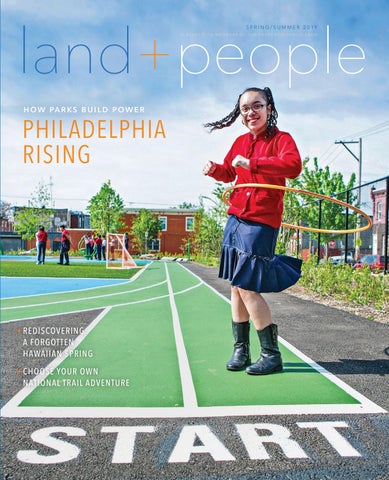
how parks build power
PHILADELPHIA RISING
+ RE REDISCOVERING A FORGOTTEN HAWAIIAN SPRING + CHOOSE YOUR OWN CH NA NATIONAL TRAIL ADVENTURE
adair f reeman r u t l e dg e
conserve land ...
and your retirement.
charitable gift annuity rates by age A charitable gift annuity with The Trust for Public Land can provide you with income for life while helping to conserve
65
70
75
80
85
90
5.1%
5.6%
6.2%
7.3%
8.3%
9.5%
land for generations to come. Here’s how: 1. Make a gift to The Trust for Public Land. 2. Receive a charitable deduction. 3. We invest your gift. 4. We pay you a percentage of the original gift for the rest of your life. 5. We apply the remainder toward achieving our mission of creating parks and protecting land for people.
to learn more, please contact: Christine Lambert Pentino, Director of Planned Giving 202.543.7552 or plannedgiving@tpl.org
ƞ ƥƲ Ƭ ƞ ƥ ƞ Ʋ ƞ Ƨ ƛ ƞ ƫ Ơ ƞ ƫ
ƌƊ
ƜƨƧƭƞƧƭƬ
ƎƋ “Everybody needs a place like this.” a ƝƞōưƚƲƧ ƞ Ɲƫ ƮƦ Ʀ ƨ ƧƝ ƢƧ ƜƨƦƦƨƧ Ơ ƫƨƮ Ƨ Ɲ Ʃ Ơ Ƅ Ɓ
ƦƮƭƢ
ƦƞƚƠƚƧ ƬƮƳƮƤƢ
F EAT U R E S
Love is a Spring That Flows Freely 31 Honolulu residents unite to revive a near-forgotten freshwater spring.
Choose Your Own Adventure 40 Looking back on 50 years of our National Trails System—and ahead to 50 more.
Common Ground 52 In Philadelphia, parks lay a foundation for equitable redevelopment.
ƍƉ T P L. O R G · 1
JAN
FEB
MAR
APR
M AY
JUN
JUL
AUG
SEP
OCT
NOV
DEC
Help conserve land for people every month of the year. It’s easy, automatic, and secure. Join today.
tpl.org/monthlygiving
2 · LA ND &PE OPL E · SPR I NG /SUMMER 2019
D E PA RT M E NTS
Board Spotlight · 13
Ʀ Ƣ Ɯ ơ ƚ ƞ ƥ ƞ Ƭ ƭ ƫ ƚ Ɲ ƚ
7UDLOKHDGV WR D OLIH LQ WKH RXWGRRUV
ƣƞƫƫƲ ƦƨƧƤƦƚƧ
From the President · 11
ƜƨƧƭƞƧƭƬ
*HW WR NQRZ /H[ 6DQW
Contributors · 14 Mailroom · 15 First Look · 17 :DWHU UHWXUQV WR WKH GHVHUW SDUNV
ƊƑ
ZLQ ELJ LQ '& DQG ZH JHW WKH EOXHV
Insight · 26
ƋƏ
Member Center · 62
ƬƭƞƯƞƧ ƠƧƚƦ
&ORVLQJ RXU ŏLPDJLQDWLRQ JDSŐ
2IƓFHV · 63 Trail’s End · 64 (YHQ LI %LJIRRW GRHVQōW H[LVW ZH VWLOO QHHG KLP
ƨ Ƨ ƭ ơ ƞ ƜƨƯƞƫ :KDW JRRG LV D QHZ SDUN WR D QHLJKERUKRRG WU\LQJ WR RYHUFRPH GHFDGHV RI GLVLQYHVWPHQW SRYHUW\ DQG FULPH" <RXōG EH VXUSULVHG WKHVH UHVLGHQWV VD\ 5HDG PRUH RQ SDJH ƎƋ
JOI N U S ON FAC EB O O K 6WD\ WXQHG WR RXU ODWHVW QHZV YLGHRV FRQWHVWV DQG PRUH IDFHERRN FRP WKHWUXVWIRUSXEOLFODQG
ƋƉ T P L. O R G · 3
ƭƢƦƨƭơƲ ƬƜơƞƧƜƤ
4 · LA ND &PE OPL E · SPR I NG /SUMMER 2019
ƜƨƧƭƞƧƭƬ
P.S. 213 BROOKLYN, NEW YORK New York City once had less green space per person than almost anywhere in America. But over the years, with help from supporters like you, we’ve WUDQVIRUPHG PRUH WKDQ ƋƉƉ schoolyards and underused lots into healthy, green parks. Now ƍ PLOOLRQ 1HZ <RUNHUV OLYH ZLWKLQ D ƊƉ PLQXWH ZDON RI D SODFH WR run, play, and dance.
Page · 22
ƁƁ
TP L. ORG · 5
ƦƞƚƠƚƧ ƬƮƳƮƤƢ
6 · LA ND &PE OPL E · SPR I NG /SUMMER 2019
ƜƨƧƭƞƧƭƬ
.Â1(:$, 635,1* +212/8/8 +$:$,, :LWK D ZULQNOHG FRS\ RI DQ ROG PDS 2‘DKX UHVLGHQWV VHW RXW LQ VHDUFK RI D QHDUO\ IRUJRWWHQ IUHVKZDWHU VSULQJ 7KH\ IRXQG WKH VRXUFHŋDQG VR PXFK PRUH WRGD\ .ÃQHZDL 6SULQJ LV KRVW WR VWXGHQWV DQG FRPPXQLW\ JURXSV ZKR ŏZDON DZD\ XQGHUVWDQGLQJ WKH UHVSRQVLELOLW\ RI FDULQJ IRU WKLV VSHFLDO SODFHŋDQG WKH LPSRUWDQFH RI DGYRFDF\ Ő VD\V ORFDO VFKRRO GLUHFWRU 'HQLVH (VSDQLD
Page · 31
Ƃƀ
T P L. O R G · 7
ƫƚƜơƢƝ ƝƚơƧƨƮƧ
8 · LA ND &PE OPL E · SPR I NG /SUMMER 2019
ƜƨƧƭƞƧƭƬ
7+( 3$&,),& &5(67 75$,/ $7 75,1,7< ',9,'( 1257+(51 &$/,)251,$ +DOI D FHQWXU\ DJR &RQJUHVV SDVVHG D ODZ WKDW UHFRJQL]HG RXU SULPDO LWFK WR H[SORUH 7KH 1DWLRQDO 7UDLOV 6\VWHP $FW ZDV DQ H[SUHVVLRQ RI SRVWZDU $PHULFDōV GDZQLQJ UHDOL]DWLRQ WKDW RXU ZLOG SODFHV DUH ƓQLWH DQG DW ULVNŋDQG WKDW HYHU\RQH HYHU\ZKHUH GHVHUYHV DFFHVV WR QDWXUH
Page · 40
ƃſ
T P L. O R G · 9
OFF IC E R S pre si d e n t an d c hi e f exec u t i v e o ff i c er
Diane Regas vice p re s i d e n t an d directo r o f co n s e rvat i o n f i n a n c e
Will Abberger s e n i o r vi c e p re s i d e n t o f n ati o n al p ro g rams
Adrian Benepe s e n i o r vi c e p re s i d e n t , g en era l couns e l, an d co rp o rat e sec reta r y
D. Malcolm Carson s e n i o r vi c e p re s i d e n t of fi e ld p ro g rams
Jeff Danter vice p re s i d e n t an d directo r o f fe d e ral affa i r s
Kathy DeCoster vice p re s i d e n t an d d i recto r o f phila n t hro p y p ro g ram s
Jeff Hauk vice p re s i d e n t an d d i recto r o f f ie ld p ro g rams fo r pa r k d ev elo pm en t
Jennifer Isacoff s e n i o r vi c e p re s i d e n t an d c hi e f p hi lan t hro py o ff i c er
Margie Kim vice p re s i d e n t an d asso c i at e ge n eral co un s e l
Margaret Madden
our mission:
THE TRUST FOR PUBLIC LAND CREATES PARKS AND PROTECTS LAND FOR PEOPLE, ENSURING HEALTHY, LIVABLE COMMUNITIES FOR GENERATIONS TO COME.
c hie f o f staff
Simone McGurl s e n i o r vi c e p re s i d e n t a n d chie f fi n an c i al an d ad m i n i st rat i v e o ff i c er
James Obendorf vice p re s i d e n t an d directo r o f fi n an c e an d acco u n t i n g
Michelle Pandori vice p re s i d e n t an d c hief resea rc h an d i n n ovat i o n o ffi c er
Breece Robertson vice p re s i d e n t an d d i recto r o f hum an re s o urc e s
Carrie Speckart
how you can help: Our work depends on the generous support of people like you. donate: Use the envelope inside this magazine, or visit tpl.org/donate for other easy ways to give. learn more: Get timely updates on our park and conservation work near you. Sign up for our e-newsletter at tpl.org/enews. share: Help us make the case for parks and open space. When you’ve finished reading this issue, pass it on! Land&People magazine is a benefit to members of The Trust for Public Land.
1 0 · LAND &PE OPL E · SPR I NG /SUMMER 2019
nicholas lea bruno
from the president
TRAILHEADS TO A LIFELONG RELATIONSHIP WITH NATURE
publisher Eliza Sarasohn managing editor Julia Busiek
the trust for public land is a land-for-people
Outside our cities, close-to-home nature might
art director Gerardo Garcia-Jurado
organization. From neighborhood parks to
be a community forest in Maine or a Florida
national parks—and all the gardens and trails
waterfront park where people can fish or launch
media production manager Elyse Leyenberger
and hills and vales in between—we work to
a boat. Or nature might be discovered in one
make sure that all Americans have access
of our wonderful national parks or trails—
to nature.
“America’s best idea.”
designers Rachel Barnes Sterling Stovall
As humans, we know intuitively how important nature is to health and well-being. And
digital production Lindsay Mamula con tributing editor Bill Poole
All rights reserved. 10-Minute
lived close to Rocky Mountain National Park and
yet, according to the EPA, the average American
other nearby public parks and forests—places
spends 93 percent of his or her life indoors. And
where I could get out with my family, relax, and
one-third of all Americans don’t have a park
breathe. These lands inspired in me a lifelong
close to home. That’s 100 million people, includ-
connection to the land, which is now shared by
ing 28 million kids.
my own children.
Working together with partners like you, we
© 2019 The Trust for Public Land.
Growing up in Denver, I was lucky that we
We want to help create a nation where people
can change that. Just imagine if in the next ten
of all ages, sizes, races, and income levels—no
years we could create 10,000 new parks and
matter where they live—feel connected to
green spaces. That would give 30 million people
nature, to parks, and to our public lands. As a
access to a park within a 10-minute walk
Trust for Public Land member, your support is
of home.
vital in this important work. Our America is a
In my first year as president and CEO of The
place where a playground in Philadelphia or a
Trust for Public Land, I’ve been excited to wit-
park in Denver becomes a trailhead to a lifetime
ness firsthand the profound difference quality
of experience in nature and to exploring and
parks can bring. In Philadelphia, a new play-
protecting the parks and public lands we all
ground slashed school disciplinary problems by
own and love.
Walk, Conserving Land for People, Conserving Nature Near You, Creating Parks and Protecting Land for People, Fitness Zone, Land for People, Land&People, LandVote, Northwoods Initiative, Our Land, Parks for People, ParkScore, The Trust for Our Land, The Trust for Public Land, TPL, and The Trust
providing a welcoming place where students could work out their differences. At a New York
for Public Land and LandVote logos and all other names of The
City school, students received a visit from a
Trust for Public Land programs referenced herein, as well as their logos, are registered or common-law trademarks of The Trust for Public Land.
turtle—as magical for them as if it were a unicorn. And in my own hometown of Denver, new
Diane Regas
parks are providing a hardworking community,
president and ceo
including tens of thousands of kids, a place to forge their own relationship with nature. T P L. O R G · 11
MEET YO UR MATCH
This year, an anonymous donor will generously match your gift—dollar-for-dollar—if you send it before June 15. Your donation will go even further to help The Trust for Public Land protect more parks, gardens, and other natural places. That’s one good thing made that much better.
Give your EarthShare.
1 2 · LAND &PE OPL E · SPR I NG /SUMMER 2019
An EarthShare payroll deduction is one simple way to donate to The Trust for Public Land or more than 400 other environmental and conservation charities. Many corporate and government employers support EarthShare payroll giving. If yours doesn’t, ask them to start. If they do, simply decide on a single deduction or a recurring small one from every paycheck. Then designate us, member number 11440, as one of your conservation charities. For more information visit earthshare.org or email donor.outreach@tpl.org.
terray sylvester
800.714.5263 · donor.outreach@tpl.org · tpl.org/match
board spotlight
Get to know
B OA R D OF D I R E CTOR S
sara cozol in o
Lex Sant Lex has served on the board of The Trust for Public Land since 2013. He is a former cofounder of Persimmon Tree Capital, an investment fund focused on renewable energy and energy
chair
Thomas S. Reeve
efficiency, and was a director in the alternative
Stephen W. Baird
energy group at AES Corporation. He is
George Bell
president of The Summit Foundation. Lex
Page Knudsen Cowles
earned an MBA with high distinction from Harvard Business School and lives in Washing-
William Cronon
ton, DC, with his wife and two daughters.
Douglas Durst Jody S. Gill F. Whitney Hatch Christopher G. Lea Joseph E. Lipscomb Ignacia S. Moreno Caroline P. Niemczyk Michael E. Patterson Diane Regas Jeffrey A. Resnick Laura Richards Roy Richards Jr. Lex Sant Lucas St. Clair Sheryl Tishman F. Jerome Tone Susan D. Whiting
I SUPPORT THE TRUST FOR PUBLIC LAND BECAUSE …
the planet’s biodiversity. But The Trust for Public
It takes great skill and deep knowledge to provide
Land protects places that are meaningful to people
and protect the natural and special places, small
and the way we use and cherish the outdoors.
and large, that we depend on for our well-being. For 47 years, The Trust for Public Land has focused on
THE KEY CHALLENGE FACING THE TRUST FOR PUBLIC
this important work with an enviable entrepreneur-
LAND IS … that progress is not inevitable. The
ial spirit and a deep commitment to conservation,
act of protecting a place requires us to engage in
which benefits us all.
fundamental acts of citizenship. Our individual energy still matters and there is much in the world
I BELIEVE EVERYBODY DESERVES TO LIVE WITHIN A
to distract us from our obligations as citizens. Our
10-MINUTE WALK OF A PARK BECAUSE … we need
actions and voices must speak for a future that will
natural places to be ourselves. Whether it’s a small
serve all Americans and their shared and equal right
city park that provides a quiet refuge from a busy
to natural spaces.
day or a wild landscape with a broad vista to inspire awe, our interactions with nature are made possible
I FIRST FELL IN LOVE WITH THE NATURAL WORLD
by the places we protect for ourselves and for all
WHEN … I realized that we are not apart from
those who will follow us.
nature—we are a part of it. I think the resonance in our hearts when we see a beautiful sunset, or watch
MY PROUDEST ACCOMPLISHMENT AS A BOARD
our children run in a neighborhood park, reminds
MEMBER WAS … being a part of the group that
us we belong to this world and have an obligation
transferred the Coast Dairies property to the State
to care for it.
of California and the Bureau of Land Management, securing permanent public access to a stunningly beautiful four-mile stretch of the Pacific Coast. THE TRUST FOR PUBLIC LAND’S WORK IS UNIQUE
?
WHAT ABOUT YOU? Tell us how you connect with nature. Join the conversation on Facebook: facebook.com/thetrustforpublicland
BECAUSE ... its focus is on people. We should all value the work of scientists to identify and protect T P L. O R G · 13
ƜƨƧƭƫƢƛƮƭƨƫƬ
Meagan Suzuki
Catharine Lo Griffin
story:
story:
story:
Love is a spring that flows freely
Love is a spring that flows freely
Trinity Divide
31
Rachid Dahnoun
31
9
Meagan Suzuki is a Honolulu-based free-
Catharine Lo Griffin has been writing stories
Rachid Dahnoun is a photographer and
lance photographer and writer. Her degree
about people, places, and culture in Hawaii
director who draws viewers into the earth’s
in environmental science and experiences
since 1998. She was also communications
wildest places. His work has appeared in
living and traveling abroad have inspired
director at Blue Planet Foundation, editor-
hundreds of publications across the globe.
her editorial work, which focuses on the
at-large at Honolulu Weekly, and Washington
With studios in Lake Tahoe and Healdsburg,
environment, arts, community resources,
bureau manager at Wired. Catharine enjoys
California, he logs frequent trips into
and travel. Her work has been published
volunteering with Wanana Paoa, a sailing
the Sierra and along Sonoma’s picturesque
in FLUX, Kikaha, and Palm.
canoe that teaches Hawaii’s youth about
coastline—often accompanied by his wife,
meagansuzuki.com
Polynesian voyaging and community-based
Regina, and dog, Avery.
resource management.
rachidphoto.com
catharinelogriffin.com
EVEN MORE LAND&PEOPLE Did you know you can view this issue—and past issues—of Land&People magazine online? The digital edition includes all the stories you love in high resolution, plus bonus content like video, search tools, easy social media sharing, and instant links to learn more. Access the digital edition at tpl.org/lpdigital. Whenever you see the pointer symbol below, you’ll find bonus content in the digital edition. Go online to dive deeper into the story.
learn more @ TPL.ORG/LPDIGITAL 1 4 · LAND &PE OPL E · SPR I NG /SUMMER 2019
ƦƢƤƞ ƛƨƧƧƢƜƤƬƞƧ ƭơƞ ưƞƧƚƭƜơƞƞ ưƨƫƥƝ
ƦƚƢƥƫƨƨƦ
TA K E A CLOSE R LOOK -RLQ XV RQ VRFLDO PHGLD IRU WKH ODWHVW RXWGRRU LQVSLUDWLRQŋDQG EUHDNLQJ QHZV WKDW DIIHFWV WKH SXEOLF ODQGV ƫƢƜơ ƚƫƝ Ɵ ƫƞƞƝƚ
\RX ORYH
STEP RIGHT UP!
0DQ\ UHVLGHQWV RI :HQDWFKHH :DVKLQJWRQ PDNH D OLYLQJ LQ WKH UHJLRQōV IDPHG IUXLW RUFKDUGV 1HLJKERUV JDWKHUHG IRU WKH ILUVW DQQXDO &KHUU\ )HVWLYDO DW .LZDQLV 0HWKRZ 3DUN WR FHOHEUDWH WKH HQG RI DQRWKHU SURGXFWLYH KDUYHVW VHDVRQ
We want to hear from you! Let us know what you think of the stories and photos in this issue of Land&People, or tell us about the parks and playgrounds you love most. You can reach us by mail, on social media, or at mailroom@tpl.org.
Logging on
+ Cheers to Rick Alger and others,
$ KLVWRULF WLPEHU WRZQ IRUJHG D IXWXUH
and the City of Milan and The Trust
IRU LWV IRUHVW
for Public Land. This is a true success for the forest and the community.
+ I absolutely loved the article on
I hope that this effort sets a standard
Milan, New Hampshire! It was an out-
and provides an example for others
standing tribute to people who love
to learn from and go by to develop
and are respectful of the outdoors and
sustainable practices that can be
creation. It also is representative of
modified for their own communities.
the good that can be accomplished
Ossie Brewer, via the blog
when people and communities work together for the general good. It was
+ Congratulations to Milan, New
such an engaging article that I wanted
Hampshire! Towns and communities
to experience it all—even the “old-
throughout the USA should try to
timey way” of logging with a horse-
construct a similar method custom-
drawn sled!
ized to their respective land condi-
Mary Lou, via the blog
tions. Trees and forests are vital to the economy. Well done! Patsy Huston, via the blog T P L. O R G · 15
women on wheels for wild lands
ƦƚƢƥƫƨƨƦ
+ Although my father first introduced me to parks, my niece is now the reason to go! To help her build a connection with parks for her health and development! #PowerofParks #ParksForAll @calparks Luis Jimenez (@komodo_kid) via Twitter
+ Nothing is more beneficial to mental and physical health than getting and staying active. NYRR love to help and inspire people thru running and walking so they can get blood flowing, clear their minds, make friends and stay healthy. Let’s all #GetOutToRun! #PowerofParks #10MinWalk New York Road Runners (@nyrr) via Twitter
On a roll
educated people in the White House
An interview with four young women
and Interior. Ride on!
who biked across the country in the
Brenda Christensen
name of public lands got our readers’ gears turning.
+ I am so very proud of the four of
:DONLQJ LQ QDWXUH ZLWK
you! Life has changed so very much
SHRSOH \RX ORYH DQG
+ I grew up in Minnesota with con-
for women during the 74 years I
temporaries similar to you wonderful
have walked this earth. I love your
SHRSOH \RX ZRUN ZLWK LV
women. Go forth and slay the dragons
passion and dedication to what you
of contempt for public lands. Don’t
are committed to. You go girls!
D KHOSIXO DQG HDV\
stop after this ride—we want you in
Linda Brown
WR UHGXFH WHQVLRQ
the House, Senate, and governorships and cabinets—and we certainly need
+ I am cheering you on all the way! Thank you for educating and raising
e ly s e l e y e n b e r g e r
ZD\ WR RSHQ D GLDORJXH :RUOG0HQWDO+HDOWK'D\ :DON7R$3DUN'D\
awareness about the importance and value of American public lands and the threats they face today. Lisa Carey
alpinist conrad anker (@conradanker) weighed in on twitter when we asked
Walking the walk Thanks for lacing up your comfiest
“how does nature nurture your mind and spirit?”
shoes and joining us for the first annual National Walk to a Park Day! We asked why you believe everyone deserves a park within a 10-minute walk—and thousands of you shared your thoughts! 1 6 · LAND &PE OPL E · SPR I NG /SUMMER 2019
LAND&PEOPLE IS LISTENING! Send letters to the editor or change your mailing address: mailroom@tpl.org.
ƭƮ ƫƧ ƭơ ƞ ƩƚƠ ƞ Ɵƨ ƫ ř ƬƦ ƨƨƭơ ƦƨƯƞ Ƭ ƛƥƮ ƞ ƬƤ Ƣƞ Ƭ ƬƦ ƚƫƭ Ơƫƨ ư ƭ ơ
ƚ ƭƫƞƞ ơƚƬ ƫƨƨƭƬ ƢƧ ƭơƞ ƬƨƢƥ Ʋƞƭ ƫƞƚƜơƞƬ ƭƨ ƭơƞ ƬƤƲ ř ƢƧ ƨƫƝƞƫ ƭƨ ƚƬƩƢƫƞ ưƞ ƧƞƞƝ ƭƨ ƛƞ ƠƫƨƮƧƝƞƝ ƚƧƝ Ƨƨ Ʀƚƭƭƞƫ ơƨư ơƢƠơ ưƞ Ơƨ Ƣƭ ƢƬ ƟƫƨƦ ƨƮƫ ƫƨƨƭƬ ƭơƚƭ ưƞ Ɲƫƚư ƬƮƬƭƞƧƚƧƜƞ ŧưƚƧƠƚƫƢ ƦƚƚƭơƚƢ
T P L. O R G · 17
ƭơƨƦƚƬ ƛƚƫƭƨƧ
%R\ 6FRXWV UDPEOHG DURXQG WKH IRUHVW DW &DPS +DKREDV IRU ƑƉ \HDUV 1RZ WKLV ƍƌƉ DFUH SURSHUW\ RQ WKH VKRUHV RI 3XJHW 6RXQG LQ :DVKLQJWRQ 6WDWH LV SURWHFWHG IRUHYHU DQG RSHQ WR WKH SXEOLF
ƞƝƢƛƥƞ ƜƨƧƬƞƫƯƚƭƢƨƧ
7UXH EOXH around this time of year, a strange
ƛƚƥƝ ƦƨƮƧƭƚƢƧ ƩƨƧƝ ƬƨƦƞƫƬƞƭ ƜƨƮƧƭƲ ƦƚƢƧƞ
But it’s not just foragers who benefit
syndrome starts to spread among
from the area’s bounty. The cold,
the inhabitants of central Maine.
clear waters of nearby Bald Mountain
During long summer days outside,
Pond welcome paddlers and anglers
their mouths turn blue. Along with
from around the state. And hikers on
a slower-than-average hiking speed
the Appalachian Trail skirt the shore,
and a repetitive stooping motion, the
taking in views of the summit reflected
tinted teeth can mean only one thing:
on the pond’s placid surface.
wild blueberries are ripe and ready for harvest. If you’ve ever spent an afternoon
The timber company that owns the 1,200-acre pond and much of the surrounding forest has historically
ambling in blueberry territory, you
allowed recreational access to
know the wild kind bears only a pass-
the area—but it’s more of a tradition
State of Maine, and the National
ing resemblance to its domesticated
than a guarantee. And because the
Park Service to purchase 2,620 acres
cousins. Maine’s wild blueberries are
region’s timber economy is in flux
surrounding Bald Mountain Pond.
tinier, plumper, and packed with a
Mainers have started to hit more
Once the project is complete, the
flavor so bold and sweet it’s almost
locked gates and “No Trespassing”
pond, its nine miles of rugged shore-
electrifying. And according to locals,
signs where they’re accustomed to
line, a stretch of the Appalachian
there are few places wild blueberries
free reign for hiking, hunting, fishing,
Trail, and countless wild blueberry
grow better than on the sunny slopes
and snowmobiling.
bushes will remain protected
of Moxie Bald Mountain, a 2,630-foot
ƣƞƫƫƲ ƦƨƧƤƦƚƧ
peak in Somerset County.
1 8 · LAND &PE OPL E · SPR I NG /SUMMER 2019
So The Trust for Public Land is working with local conservationists, the
from development and open to the public, forever. Sweet!
Easy berry smoothie Refreshing enough for a summer
Show up, speak out!
ƠƨƨƝ ƧƞưƬ
WKLV VPRRWKLH LV JUHDW ZLWK DQ\ NLQG RI VZHHW EHUULHV ZKHWKHU \RX
ƚƧƧƢƞ ƛƚƧƠ
GD\ DQG ƓOOLQJ HQRXJK IRU EUHDNIDVW
“
KDUYHVW WKHP IURP WKH WUDLO RU WKH
Buenos días. Mi nombre es Sofía Girón. Soy parte del Equipo Verde, un grupo de líderes que trabajamos en el Sur Centro
JURFHU\ DLVOH
de Los Ángeles, abogando por callejones verdes, parques, y espacios verdes en
,QJUHGLHQWV O
FXS PLON
O
FXS YDQLOOD \RJXUW
O
FXS EHUULHV IUHVK RU IUR]HQ
O
EDQDQD IUR]HQ
O
~ FXS UDZ RDWV
O
+DQGIXO RI LFH FXEHV
O
nuestra comunidad.
“
Good morning. My name is Sofía Girón. I am part of the Green Team, a group of leaders who work in South Central Los Angeles, advocating for green alleys, parks, and green spaces in our community.
/HPRQ ]HVW
„
3ODFH DOO LQJUHGLHQWV LQ D EOHQGHU
kids growing up in some areas of south los angeles are much less likely to
DQG EOHQG XQWLO VPRRWK
have access to a park than the national average. So in March, a group of grass-
„
roots park advocates from South Los Angeles gathered at the county supervisors’ office in front of TV cameras and reporters to demand their representatives right this wrong. Up for a vote that day: a bill guaranteeing a minimum of 30 percent of funding from Measure A—a parks bond passed in 2016—be spent in areas like Girón’s home neighborhood, where too few kids have a safe park close to home. After the Equipo Verde and other park advocates made their case, the L.A. county board of supervi-
ƭ ơ ƞ ƨ Ɵ Ɵ Ƣ Ɯ ƞ ƨ Ɵ Ƭ Ʈ Ʃ ƞ ƫ Ư Ƣ Ƭ ƨ ƫ ơ Ƣ ƥ Ɲ ƚ ƥ Ƭ ƨ ƥ Ƣ Ƭ
sors voted unanimously to approve the bill. That’s democracy in action!
F I R ST LO O K · 19
ƠƨƨƝ ƧƞưƬ
ADVOCACY UPDATE ƚƧƧƢƞ ƛƚƧƠ
$ SHUPDQHQW IXWXUH IRU WKH /DQG DQG :DWHU &RQVHUYDWLRQ )XQG
want proof that your voice matters?
in parks and open space. LWCF
We’ll be relying on your energy in
Look no further than Capitol Hill,
expired in 2018; this bill renews the
the months to come. LWCF is perma-
where this spring Congress voted
program forever.
nently renewed, but this bill doesn’t
overwhelmingly to pass the “John D.
Getting Congress to agree on any-
Dingell, Jr. Conservation, Management,
thing these days is worth celebrating.
and Recreation Act”—the biggest
As a Trust for Public Land supporter,
at it on Capitol Hill, making the
legislative victory for parks and public
you deserve a pat on the back! You
case for specific places that need
lands in a decade.
guarantee Congress will allocate funding for it. So we’re already back
contacted your representatives, wrote
LWCF funding. But knowing that
letters, donated, signed petitions ...
we have a force like you behind us,
future of the Land and Water Conser-
and generally made it impossible for
we’re ready for the fight.
vation Fund (LWCF), a longstanding
your elected officials to ignore how
The heart of the legislation is the
federal program that directs fees from
important this program is for you and
oil and gas drilling to investments
your community.
2 0 · LAND &PE OPL E · SPR I NG /SUMMER 2019
ƥƞƚƫƧ Ʀƨƫƞ # 73/ 25* /:&)
ưƨƫƝ ưƚƭƜơ
Ɯơ ƫ ƢƬ ơ ƢƧ Ƥ ƥ ƞ
/:&) DW :25. ƦƢƤƞ ƬƜơƢƫƟ
ciénega
%211(9,//( 6+25(/,1( 75$,/ 6DOW /DNH &LW\ PHWUR DUHD 8WDK Ɯ ơ ƫ Ƣ Ƭ ƛ ƨ Ʋ ƞ ƫ Ƥ ƞ Ƭ ƭ ƫ ƞ ƥ ƚ ƞ ƫ Ƣ ƚ ƥ
-2+1621 2$. 3$5. %ULGJHSRUW &RQQHFWLFXW
(n.)ԤV\ÌQҀJҀ $ JUDVV\ PDUVK XQLTXH WR WKH $PHULFDQ 6RXWKZHVW +HDOWK\ FL«QHJDV DUH KDYHQV IRU ZLOGOLIH WKURXJKRXW WKH KRW GHVHUW VXPPHU 7RGD\ LQWDFW FL«QHJDV DUH UDUHU WKDQ D UDLQVWRUP LQ WKH GHVHUWŋ PRVW KDYH EHHQ GHVWUR\HG E\
67,//:$7(5 67$7( )25(67 :KLWHILVK 0RQWDQD
RYHUJUD]LQJ %XW UDQFKHUV OLNH -RVLDK $XVWLQ DUH FDULQJ IRU WKHLU ODQG ZLWK DQ H\H WR XQGRLQJ
ƧƢƜƤ ƛƞƧƬƨƧ
&+$77$+22&+(( 5,9(5 1$7,21$/ 5(&5($7,21 $5($ $WODQWD PHWUR DUHD *HRUJLD
FHQWXULHV RI HURVLRQ :H KHOSHG $XVWLQ FRQVHUYH KLV Ɗƒ ƉƉƉ DFUH &LHQHJD 5DQFK LQ VRXWKHUQ $UL]RQD VR KH FDQ NHHS XS KLV PLVVLRQ WR EULQJ LWV QDPHVDNH FL«QHJDV EDFN WR OLIH
ƥƞƚƫƧ Ʀƨƫƞ # 73/ 25* &,(1(*$ ơƨƥƥƢƬ ƛƞƧƧƞƭƭ
P L. OORK G ·· 21 21 F I R ST TLO
ơ ƮƧ ƭ ƜƚƩƭ Ʈƫƞ Ʃơ ƨƭƨ Ơ ƫƚƩơ Ʋ
ƛƮƳƳưƨƫƭơƲ
Ʀƞƞƭ ƨƮƫ ƬƭƚƟƟ
ƚƧƝƫƞư ƩƫƨƩƩ
ŏ3DUNV SURWHFW SHRSOH IURP D FKDQJLQJ FOLPDWH Ő
“In Minneapolis-St. Paul, the nation’s healthiest urban region, almost everyone lives within a 10-minute walk of a good public park. Shouldn’t we all?” – New York Times columnist Jane Brody, “The Secret to Good Health May Be a Walk in the Park”
BRENDAN SHANE THE TRUST FOR PUBLIC LAND’S NEW CLIMATE DIRECTOR ON WHY CURBING CARBON EMISSIONS IS ONLY PART OF THE CLIMATE CHANGE BATTLE
<RXōYH ZRUNHG ZLWK WKH ZRUOGōV ODUJHVW FLWLHV WR PHHW WKH JRDOV RI WKH 3DULV &OLPDWH $JUHHPHQW E\ WKH \HDU ƋƉƋƉ :K\ ƋƉƋƉ" The overarching ambition of the Paris Agreement is to limit global warming to 2 degrees Celsius. Acting by 2020 will help put us on the right path for the rest of the century. Even so, since the Paris targets were set in 2015, we’ve witnessed global change happening in real
6LQFH ZH ODXQFKHG WKH ƊƉ 0LQXWH :DONŠ LQLWLDWLYH LQ ƋƉƊƐ ZHōYH KHOSHG HOHFWHG RIƓFLDOV LQ KXQGUHGV RI FLWLHV XQGHUVWDQG KRZ SDUNV FDQ KHOS VROYH VRPH RI WKH ELJJHVW FKDOOHQJHV WKHLU FRQVWLWXHQWV IDFH ,V \RXU PD\RU FRPPLWWHG WR SDUN HTXLW\"
time. Hurricanes like Florence and Michael were on the severe end of what was predicted just a few years ago. Today, it’s widely accepted that 2 degrees of warming isn’t safe, so we’re trying to limit warming to 1.5 degrees.
:KHUHōV WKH PRVW SURPLVLQJ OHDGHUVKLS RQ FOLPDWH FKDQJH ULJKW QRZ" Local governments are in a unique position: they tend to get the first
ƥƞƚƫƧ Ʀƨƫƞ # 0,187(:$/. 25*
call from citizens when anything goes wrong—even if the root of the problem is way beyond their control, like a flood, heat wave, or smoke from wildfires. The price of climate change in loss of life
2 2 · LAND &PE OPL E · SPR I NG /SUMMER 2019
and property is paid locally. That’s
There’s no question that our climate
The choice between reducing emis-
why local action on climate tends to
is changing. So as we curb carbon
sions and planning for adaptation
come from a more bipartisan group
emissions, we have to adapt to rising
is a false dichotomy. We have to do
than at the national level.
seas, stronger storms, and higher
a lot more of both, at the same time.
temperatures. That’s where so much
In the parks and conservation world,
+RZ FDQ 7KH 7UXVW IRU 3XEOLF /DQG KHOS WKH 8 6 PHHW JRDOV OLNH WKH 3DULV &OLPDWH $JUHHPHQW"
of the work that The Trust for
that means we need to dramatically
Public Land already does will become
expand green space in cities, and
increasingly important.
make sure that as we are designing
The way the United States developed
+RZ FDQ SDUNV KHOS FRPPXQL WLHV DGDSW WR FOLPDWH FKDQJH"
in the 20th century—in sprawling
new parks and updating existing
communities, where people have no
Investing in parks will make cities
choice but to get in their cars to go
greener and safer. Melbourne, Austra-
anywhere—means we have some of
lia, has a goal to cool the entire city
the largest carbon footprints in the
down by four degrees. Their mayor
ones, we’re doing so in a way that maximizes their climate benefits.
world. We’re helping communities
can’t control how much the planet
,V FOLPDWH DFWLRQ PRVWO\ KDS SHQLQJ DW WKH SROLF\ OHYHO RU LV WKHUH VWLOO D IRFXV RQ FKDQJLQJ LQGLYLGXDO EHKDYLRUV"
develop in ways that shrink potential
will warm, but she has some control
It’s both. We should consider climate
carbon consumption by encouraging
over how residents will experience
in transportation policy, urban plan-
active transportation. Plus, good open
that warming. So they’re building
ning, and the way we grow our food
space management can pull excess
parks and planting lots of trees,
and manage our forests. We need
carbon out of the air. So when we pro-
because green space and a healthy
climate policies at all levels of govern-
tect working forests and plant trees
urban tree canopy cool the air
ment to support everyone’s transition
in cities, we don’t just protect wildlife,
on hot days, protecting people from
to cleaner energy and greener, health-
water quality, and treasured public
increasing risk of heat illness.
ambitious global targets.
0RVW RI WKH WDON DURXQG FOLPDWH FKDQJH IRFXVHV RQ UHGXFLQJ FDUERQ HPLVVLRQV 6KRXOG ZH EH IRFXVLQJ PRUH UHVRXUFHV DV D VRFLHW\ RQ DGDSWDWLRQ"
where policies alone can deliver the change we need: what we buy and how we live our lives truly does make a difference.
ƚƝƚƦ ƚƥƞƱƚƧƝƞƫ
,I ZH FDQ NHHS JOREDO ZDUPLQJ DW RU EHORZ Ƌ GHJUHHV ZKDW PLJKW WKH IXWXUH KROG"
ier communities. But there aren’t very many pathways to a sustainable future
spaces—we are also aiming at these
F I R ST LO O K · 23
ươƚƭ ƜƨƮƧƭƬ
ƚƧƧƚƛƞƥƥƞ ƦƚƫƜƨƯƢƜƢ
ƦƢƤƞ ƬƜơƢƫƟ
ƛƮƳƳưƨƫƭơƲ
“When your system is stiff, that creates friction. Flexibility makes the whole thing run smoother. Looseness makes it robust.” –Brandon Brown, artist, engineer, and entrepreneur
3,400
$FUHV RI SULYDWH ODQG ZLWKLQ WKH ERXQGDULHV RI 8WDKōV =LRQ 1DWLRQDO 3DUN
%URZQ LV NQRZQ WKURXJKRXW WKH 7ZLQ &LWLHV IRU KLV LQYHQWLYH ULIIV RQ WKH EDVLF LGHD RI
7KHVH LVODQGV RI SULYDWH SURSHUW\ RU ŏLQKROGLQJV Ő DIIHFW ZLOGƓUH
D ELF\FOH +H GHVLJQHG DQG EXLOW D SHGDO
PDQDJHPHQW ZDWHU DQG ZLOGOLIH QRW WR PHQWLRQ LQWHUUXSWLQJ
SRZHUHG FDURXVHO WR OLYHQ XS D SRFNHW SDUN
\RXU KLNH :HōUH FKLSSLQJ DZD\ DW LQKROGLQJV DFURVV WKH 1DWLRQDO
LQ KLV 1RUWK 0LQQHDSROLV QHLJKERUKRRG
3DUN 6\VWHPŋLQFOXGLQJ DW =LRQ ZKHUH ZH UHFHQWO\ SURWHFWHG ƌƎ PRUH DFUHV DORQJ WKH SRSXODU +RS 9DOOH\ 7UDLO
ƥƞƚƫƧ Ʀƨƫƞ # 73/ 25* %,.(&$5286(/
2 4 · LAND &PE OPL E · SPR I NG /SUMMER 2019
ƥƞƚƫƧ Ʀƨƫƞ # 73/ 25* =,21
thank you, l.l.bean! We’re working for a future where everyone, on every block, in every community in America has a great park within a 10-minute walk of home. It’s a big goal, and we’re grateful for partners like you who share our vision. Thanks to your support, we’re creating more parks in the neighborhoods that need them most. Learn more at tpl.org
al ex an der w in slo w mccu rdy
Together, we’re dreaming big.
insight
the storyteller “our society has an imagination gap. how do we see ourselves? how do other people see us?” 2 6 · LAND L AND&PE &PEOPL OPLEE · · SPR SPRI ING NG/SUMMER /SUMMER 2019 2017
teresa yu
michael a. estrada
JOURNALIST AND PHOTOGRAPHER MICHAEL A. ESTRADA DOESN’T SHY AWAY FROM THE BIG QUESTIONS. And right now the biggest question driving his art and work is how our relationship with nature—and our selfperception—are influenced by the mainstream depiction of the Great Outdoors: an esoteric realm, far from home, requiring fancy gear … and mostly inhabited by white people. People of color and Indigenous people are and have always been profoundly connected to nature, Estrada thought … why aren’t our stories being told? Recognizing a need to shift the narrative, Estrada launched Brown Environmentalist. Through the multimedia project, Estrada has made it his mission to “uproot and replace traditional environmental thought with narratives that acknowledge Black, Indigenous, and people of color as the leaders and caretakers of the environment, amplify the content that already exists, and create what doesn’t.” You can find Estrada’s work on social media using the hashtag #BEEN. We caught up with him to hear more about the stories he’s helping to tell. “Jolie Varela is from the Yokut and Paiute Nations. She leads Indigenous Women Hike, a movement to help women in her community reconnect with the land,” Estrada says. “Her approach is genuine
You started a storytelling campaign on social media, to celebrate the ways Black, Indigenous, and people of color have spent time in the outdoors. You asked a couple questions to kick things off, and we wondered how you’d answer them: How has your family historically #BeenOutside? I started that conversation after I unearthed some old family
and focused on her community. She’s using her voice and the lens of the land to bring awareness to issues that affect Indigenous people all over North America. Here, she’s at the front of the Rise for Climate March last fall.” photographed in s an francis co o n th e t radit ional t erritory of t he o h lo ne p eo p l e.
photos from El Salvador, where both of my parents grew up. I know my grandma raised chickens and had to get her water from a well— it made me realize she was probably by necessity way more connected to nature than I’ve ever been. But in these old photos, my grandma is standing on top of
side was not necessarily a luxury … coming to the U.S. and
La Puerta del Diablo, a mountain near her home in El Salva-
pursuing education was a way to not have to work outside.
dor. In that picture, I see proof that I am connected to past
Mainstream outdoor media have tended to portray this
generations of my family through nature, that they likely
idea that a remote wilderness is better or more valuable
enjoyed the same things I do now, and that our separate
than a city park or the garden between the sidewalk and the
stories could cross paths in how we touched nature, or how
street. But I rarely had wilderness experiences growing up.
nature touched us.
As a kid, most of my time outside was in a park, surrounded
How have you #BeenOutside?
don’t remember ever setting foot on a trail until high school,
by buildings and noise, or playing soccer in the driveway. I My experience of the outdoors has been a lot different from
and “hiking” didn’t enter my vocabulary until college: a
my family’s experience. In part I think that’s because my
friend invited me on a hike, and I was like, “What’s that?
parents emigrated from a country where spending time out-
You mean we’re just going to walk to the top of something?”
I N SI G H T · 27
I don’t ever want to be limited by what someone else tells me is a “true outdoor experience”—like, it only counts if you get far enough from the city, or if you can make it so far on a trail, or if you’re carrying a certain kind of backpack. Once you start assigning different values to outdoor experiences, or even just putting specialized words like “hike” on them that might not resonate with people who didn’t grow up with access, it makes the outdoors more exclusive, and that is a barrier. Maybe not a physical barrier, but a mental barrier to everyone getting to experience the outdoors. So for me now, whether I’m biking around the city or head-
“
m o st o ft e n , i s e e diversity applied as a ba n d - a i d, i n st ea d o f d o i n g t h e rea l , h a rd w o r k to c h a n g e a b ro ke n s y st e m .
ing out to the woods, anytime I’m outside, it counts.
micha el a. estrada
Why did you launch Brown Environmentalist? So much of what we think of the world is based on what we see in the media. Whether you’re watching the Oscars, reading the newspaper, or following outdoor industry media— most of it is produced and controlled by white people. I’ve been sharing stories about Brown and Black outdoor athletes, activists, and organizers, because yes, we need more diverse representation in media. But I’m also looking to put athletic feats into the context of what it means to be a person of color in this space, and in this country—what it means to our families and communities, how it relates to our history.
Why is it important that people of color be represented in the media—not just as the focus of stories, but as storytellers? Even if you are putting people of color on the cover of your magazine, even if you are bringing people of color in as employees at your company or organization, it’s still mostly white people doing the inviting, holding the power, and controlling the narrative. Brown and Black people are constantly “Faith Briggs is a trail runner based in Portland, Oregon,” Estrada says. “I’ve noticed her humble approach to both life and people from the beginning. Through her always-stoked mannerisms and happy face, it’s easy to feel like you’ve known her your entire life. She told me about a few of her experiences as a biracial woman of color, as an athlete and creative who has faced injury and disappointment, and as a human being who, through humor and a positive attitude, always keeps her head up.”
asked to fit into a white narrative and structure. As a person of color, it’s exhausting to operate solely in that “diversity” space, where white people are in a position to invite Brown and Black people in, but not really giving up any of the power. Most often, I see diversity applied as a band-aid, instead of doing the real, hard work to change a broken system. I’m focusing my energy on organizations led by people of color who are already here, doing great work around environmental issues, and especially issues of environmental justice. It’s not hard at all to find people of color whose stories can drive change and deserve telling, but their work hasn’t been amplified. While I’m interviewing people, they’ll start to
photo g ra ph ed in p ortlan d on the trad it i o n a l t e r r i tory of the chinook p e op le . 2 8 · LAND &PE OPL E · SPR I NG /SUMMER 2019
reflect and go, “Huh, I guess my story is cool,” and I’m like,
the environmental studies courses I took. I learned a lot about, like, trash and pollution, and what a great environmentalist John Muir was, but there was never anything on Indigenous history and uses of the land, or discussion of their removal. That doesn’t make sense to me! People of color are the original environmentalists, the original eco-warriors, but the narrative I got growing up was all about white Americans’ history, voice, and thought. If our history hadn’t been erased, you’d hear much more about the environmental movements led by people of color—and women of color, specifically.
What’s an example of that erasure? Take the term “tree hugger.” I bet anyone who’s identified as michael a. estrada
an environmentalist has, at some point, called themselves a tree hugger—whether proudly or with a little self-deprecation. But how many people have the backstory? In India in the
“This picture of Greg captured a moment of return-
1700s, soldiers representing Maharaja Abhai Singh ordered a
ing,” says Michael. “You can see trepidation in his
forest near a village named Khejarli to be cut down for a new
approach to the water, but it’s intentional, too. For
palace. Villagers stood in front of the trees to protect them, so
a lot of people who’ve seen this photograph, that
soldiers just killed them. This continued until over 300 people
sense of surrendering to nature and returning to
were dead, at which point the maharaja relented, and the for-
that original relationship—whatever that means for
est was saved.
the viewer—has really resonated.”
In the 1970s, that history inspired nonviolent protests against deforestation in northern India. For years, women took
ph oto g ra phe d in ve ntu ra, california, on the t ra di t i o n a l te rritory of the chu mash p e op le .
turns guarding trees day and night, until the Indian government ceased logging in the area. The progress these women made—which came to be called the Chipko movement, meaning to hug or embrace—directly informed the actions of antilogging activists in the U.S. and Canada in the 1980s.
“Yeah, you’re getting way more done than most people out here, and you’ve been doing it for years, and nobody knows!” Social media has democratized storytelling by light years, but the world of mass media is still very exclusive. That’s why I create media that’s Brown and Black focused, and why more people of color are starting groups around spending time together outdoors, or starting their own media platforms. We’re trying to completely take something apart, start anew, with a different structure.
What aspects of the environmental movement most need to be taken apart and started anew? The legacy of environmentalism contains philosophies that are the antithesis of Brown and Black people living well. Take the idea of “wilderness”: well, first you removed all the Native
Those were the folks who gained a sort of fame for sitting in trees and standing in front of bulldozers? Yes. That’s the image I think most people get when they even stop to consider where the term “tree hugger” comes from. But those people took their lead from the Chipko movement, which took its lead from Khejarli. This is the kind of story I want to keep telling, because it asks people who’ve already proudly claimed some identity as environmentalists to go back and question, and learn more about what exactly it is they’ve claimed. Until folks of color and marginalized people in general control their own narratives completely, we’ll always be in some way exploited, misrepresented, or tokenized. In the end, there’s no substitute for being able to tell your own story.
people from that land. But that history never entered any of
I N SI G H T · 29
rachid dahnoun
BE A LEADER. Become a Conservation Champion and help The Trust for Public Land connect even more people to nature. With your annual leadership-level contribution of $2,000 or more, you will receive invitations to special events and insider updates on our park and conservation strategies.
Learn more about the impact you will have as a Conservation Champion. Contact Emily Falk 415.800.5193 or champions@tpl.org.
co ns er vat i o n c h ampi o ns t p l .or g / c hampi o n s | champi o n s@tpl.o r g
T h e h i storyy, t r a ditt ion n s , a n d e v e n t h e e x a c t l o catii o n o f a r a r e f r e sh h w a t er sprin n g w e r e n e a r l y lostt too thee agee s —u until a coo m m un n itt y dugg in n t o savv e a p i e c e of its H awaiian n hee r i t a g e . BY CATHARINE LO GRIFFIN T P L. O R G · 31
3 2 · LAND &PE OPL E · SPR I NG /SUMMER 2019 meagan suzuki
CHRIS CRAMER WAS JUST FINISHING ANOTHER DAY’S WORK WHEN HE FIRST HEARD THE SOUND, FAINT BUT UNMISTAKABLE: A GURGLING FROM SOMEWHERE BENEATH THE SURFACE.
“I
t was the most beautiful noise,” Cramer recalls. “Water
“People who are just two generations older than me can
rippling from the spring, through the stone gate, and
remember when they would walk down the shore and see
out into the ancient fishpond. It meant Kānewai was
clouds and clouds of fish in the water,” says Max Mukai
flowing again.”
Reeves, a descendant of a family that’s lived along Maunalua
An avid local historian, Cramer says from time immemo-
Bay since 1912. “They share stories of fishermen who could
rial, this stretch of O‘ahu’s coastline was home to abundant
feed whole villages and not even know how to swim. That’s a
freshwater springs, fertile estuaries that made life possible
testament to the abundance of this area.”
for animals and people alike. “There’s an ancient story from
All that changed in the 1940s, when development in Hono-
this area about the gods Kāne and Kanaloa, how they once
lulu began to encroach on this formerly rural area. Bulldozers
walked down this coastline and established the life-giving
filled in the freshwater springs, paving the way for modern
springs,” he says. “As the story goes, Kāne struck the earth
subdivisions. Kānewai Spring wound up in the backyard of a
with his staff and water gushed forth. The name ‘Kānewai’
lavish estate along a busy thoroughfare through East Honolulu.
means ‘water of the god Kāne.’” As president of the Maunalua Fishpond Heritage Center,
For the Hawaiians who’d tended them for generations, losing these springs was emblematic of a harsh new real-
Cramer works to preserve and restore cultural sites along
ity. After Hawai‘i became a state in 1959, places and streets
Maunalua Bay in East Honolulu. In the summer of 2017, The
were renamed; as the traditional names faded from use, the
Trust for Public Land helped the community organization
locations and knowledge of the old freshwater springs and
purchase and protect Kānewai Spring, one of the last remain-
fishponds were relegated to history.
ing freshwater springs on the island of O‘ahu. Throughout the 1800s, East Honolulu was a patchwork of
For Kānewai Spring, things would get worse—or at least weirder—before they got better. In the 1980s, the estate was
farms and pastures that snaked up the deep valleys of the
owned by Ronald Rewald, an infamous con artist who made
Ko‘olau Mountains. Farmers grew sweet potato. Ranchers
national headlines defrauding investors. “Rewald was said
raised pigs and cattle. Fishermen cast nets into the abundant
to have thrown some crazy parties here,” says The Trust for
waters of Maunalua Bay.
Public Land’s Laura Kaakua. “It’s hard to fathom, but I guess
Each freshwater spring was tended by a local family, every
he used Kānewai Spring as his own private swimming pool.”
generation passing down its knowledge and traditions to the
When Rewald got caught and sentenced to federal prison, his
next. Throughout the arid Maunalua summer, the carefully
home was abandoned—Cadillac still parked in the driveway,
maintained springs provided drinking water and irrigation
paintings on the walls, weeds growing unchecked in the
to nearby fishing villages. The mixing of fresh and salt water
once-lavish yard. Kānewai Spring, choked by 15-foot man-
created vital habitat for fish, limpets, mollusks, and birds like
groves, sat stagnant and largely forgotten.
Hawaiian stilts.
T P L. O R G · 33
mo n t e co sta
Using a copy of an old map to guide them, Chris Cramer and his fellow spring-protectors located the source of Kānewai Spring—in the overgrown backyard of an abandoned estate in East Honolulu.
A
nd that’s more or less how it
caretakers of the Maunalua area, the
still. “At that time, we couldn’t see all
stayed for the next 25 years, until
group set out to match the old map to
the beer bottles and cans,” Cramer
the day in 2009 when an elder named
the modern landscape—no mean feat
says. That discovery would come later—
Tad Hara showed Cramer a wrinkled
in this exclusive neighborhood typified
along with golf balls, pipes, and other
piece of paper … a Xerox of a 1935 map
by privacy fences and high hedges.
refuse. “We had no idea the journey
of the Maunalua Coast. Marked on the
Eventually, Cramer and his fellow
and life changes we were about to
map—the lo location of Kānewai Spring.
spring-protectors asked a neighbor’s
embark on that first day.”
Right awa away, Cramer knew the map
permission to peek into the backyard
was a big de deal. “A big part of our mis-
of the old Rewald estate.
Over the next few years, hundreds of people would labor to bring Kānewai
sion is to preserve traditional knowlpre
Peering over the fence, they could
edge and be sure it gets handed down.
barely make out an outline of a pool,
about this important discovery, volun-
we so few places left we But there were
boxed in by scratchy sourbushes that
teers from local schools, military and
could point to, where you could experi-
smelled like mothballs. They pushed
church groups, and the YMCA flocked
hi ence that history,” he says. “A few local
through the brush and entered the gate,
to the site to help restore the spring,
Spring back to life. As word spread
elders a spring in the area, elde d rs remembered remem
swatting away swarms of hungry mos-
using pick axes, machetes, and chain-
but b t many people bu pe believed there were
quitos and armies of red ants.
saws to hack through thickets of weeds.
n places with wi historic and cultural no
“It was like a fairy tale, where an
They busted up the cement and extracted
value this side of the island.” vaalue on thi
enchantment covers everything with
the rubble and rubbish that was suffo-
thick vines,” Cramer recalls. The water
cating the mosquito-ridden pool.
wi descendants of Max Joining with Mukai M kai Reeves’s Mu Reeve family, longtime
3 4 · LAND &PE OPL E · SPR I NG /SUMMER 2019
in the spring was black, lifeless, and
meag an su z u k i
“A FEW LOCAL ELDERS REMEMBERED A SPRING IN THE AREA, BUT MANY PEOPLE BELIEVED THERE WERE NO PLACES WITH HISTORIC AND CULTURAL VALUE ON THIS SIDE OF THE ISLAND.” T P L. O R G · 35
N
iu Valley resident Kai Hoshijo devoted her high school internship to reviving Kānewai Spring. She helped
organize youth “fishing derbies” to catch and remove the invasive tilapia from the pond and make way for native fish— and the birds that prey on them—to return. “As we removed more and more invasive plants, old seeds of native plants started to sprout again,” she recalls. Slowly, the water turned from sooty brown to sparkling clear, and the upwelling from a trickle to a gush. “All the stones in the spring turned gold. To see it reawakening was really something special.” Elders visited to share their traditional knowledge. “We learned a lot from them about how to work a fishpond,” Cramer says. Fred Takebayashi brought handmade fish traps and taught kids how to throw a net. Waiola Higa demonstrated how to build stone walls using the Hawaiian dry stack method. When an elder named Henry Chang Wo visited, he pointed to a sandy bed where the walls of the spring meet the fishpond and told Cramer, “Where the freshwater meets the sea, that is where we see the hānau—the birthing.” Cramer recalls: “We didn’t see it until we cleared this section. [But now,] every day this [part of the spring] is filled with baby fish. Seems like hundreds of them.” Denise Espania is the director of Mālama Honua Public Charter School, one of the many schools that visit the site. On field trips to the spring, her students get to experience firsthand how Kānewai provides a nutrient-rich nursery for baby meagan suzuki
fish. They witness how the sluice gate works at the entry of the fishpond, and how the flow of fish and water varies with the tide. And they get their hands dirty, planting, weeding,
“THEY WALK AWAY UNDERSTANDING THE RESPONSIBILITY OF CARING FOR THIS SPECIAL PLACE—AND THE IMPORTANCE OF ADVOCACY.” 3 6 · LAND &PE OPL E · SPR I NG /SUMMER 2019
and fishing for invasive species. “They walk away understanding the responsibility of caring for this special place—and the importance of advocacy,” Espania says. One student was so inspired that she created a pop-up book about Kānewai. Another group of students wrote and performed a play for the community. “The spring may be only one small resource, but the true gi ift f is in its inspiration,” says Angela Lokalia Correa-Pei. A gift descendant of the Reeves family, Correa-Pei is vice president de es off tthe Maunalua Fishpond Heritage Center. “‘What can I do in my y community?’ We can all start doing something.” Despite the blood, sweat, and tears the community had D invested in transforming Kānewai, the spring’s future was far inv from f o certain. The site remained privately owned, subject to fr sale ssa l at any time. le
T P L. O R G · 37
Hundreds of volunteers from across the islands have pitched in to revive Kānewai Spring … work that continues today, now that the property is owned by the Maunalua Fishpond Heritage Center.
top left: monte costa others: meagan suzuki
I
n 2012, Cramer crossed paths with Laura Kaakua at The
For five years, The Trust for Public Land met regularly to
Trust for Public Land, and the two got to talking. “Origi-
talk through negotiations with the landowner and strategize
nally they were looking for our help to negotiate some sort
fundraising. Community members made films and rallied
of community perpetual right of access to continue caring
local donors, eventually raising $370,000 from contributions
for the spring,” Kaakua remembers. “But most people—and
large and small.
understandably so—don’t want to sell property that allows community groups in every weekend.” The best way to protect the spring forever, they realized,
In 2017, that diligence paid off: the Maunalua Fishpond Heritage Center secured ownership of Kānewai Spring. “It was a moon shot,” says Cramer. “But we had no choice. We
was to buy the property outright—however daunting the
couldn’t fail. It was too important.”
task. “We said, ‘If not us, who?’” Correa-Pei remembers. “We
“Our connection to ‘āina [the land] often exists without us
stepped up to the task knowing that akua [God] and our
even understanding it,” says Correa-Pei. “When you learn
kūpuna [elders] would guide us and see us through—one task
about the history of a place, your connection deepens and
at a time, one grant at a time, one challenge at a time. And
your responsibility to mālama [care for] that ‘āina is evident.”
we knew that we could not accomplish this without the help
Places like Kānewai Spring, she says, create critical connec-
of The Trust for Public Land. Their capacity, knowledge, and
tions for every island resident between history, nature, and
expertise were invaluable.”
culture. “When mālama ‘āina is practiced, our people thrive.”
3 8 · LAND &PE OPL E · SPR I NG /SUMMER 2019
Kai Hoshijo, the former intern, passes by the site most days. “I know it is feeding its fresh water to the bay as I stand-up paddle the swells or catch waves along the Maunalua reef. Living in Niu Valley is something I hold dear, and having the opportunity to positively impact my home is timeless and lasting.” The Maunalua Fishpond Heritage Center continues to host volunteer workdays at the site. As community members come together to sustain the spring, they’re learning about their island’s ecology and history, and passing down what they’ve learned to their children and grandchildren—just as Hawai‘i’s people have done for thousands of years. “Someday, the fishpond might feed us again. Until that day comes, we’re learning so much and gaining as a community from it. Those are our most immediate returns for the restoration work,” says Max Mukai Reeves. “I think of when the sailors were traveling from Hawai‘i to Tahiti, navigating by the stars,” he says. “Sometimes they’d have to sail through cloudy nights, but eventually the sky would clear, and they’d see that one star through the clouds. For us, Kānewai is that guiding star.”
T P L. O R G · 39
4 0 · LAND &PE OPL E · SPR I NG /SUMMER 2019
very epic journey starts with the same basic ingredients: an origin, a destination, and a reason to go. Those simple elements are at the heart of some of our most enduring narratives—the stories of adventure and 01>>5:3 0; @4-@ 4-B1 /-<@5B-@10 4A9-:5@E ?5:/1 @41 ŋ>?@ @-81 C-? @;80 ->;A:0 @41 ŋ>?@ /-9<ŋ>1 Half a century ago, Congress passed a law that recognized our primal itch to explore. The National Trails System Act of 1968 established a framework for protecting and marking the routes that tell our nation’s stories. Today, the National Trails System encompasses more than a thousand recognized routes, crossing every state and spanning 50,000 miles. Since The Trust for Public Land’s earliest days, we’ve helped locals <>;@1/@ <8-/1? -8;:3 :-@5;:-8 @>-58? ? C1 41-0 5:@; @41 :1D@ ŋ2@E E1->? ;2 adventure, here are a few standout stories from people who’ve accepted the invitation to explore. T P L. O R G · 41
THE PACIFIC CREST TRAIL Every year, a handful of dedicated thru-hikers walk from Mexico to Canada on the Pacific Crest Trail. The physical challenge is grist for creative expression.
Travels 2,650 miles from the U.S.-Mexico border in Southern California to the Canadian border in northern Washington State.
TT
hru-hikers on the Pacific Crest Trail go to elaborate lengths to lighten their loads. Over a six-
days, he used his iPhone to record the rhythms of daily life on the trail. “I sampled rocks, sticks, and handclaps.
month journey, things like eating mostly freeze-dried
The sounds of my feet in the dirt, of pinecones, leaves, an
foods, ditching the tent and sleeping out in the open,
echo in a cave I passed by. Rivers, storms, a creaky gate,
even cutting the handles off toothbrushes make a big
and a water tank out in the middle of the desert that
difference. So James Bishop stood out from his fellow
when I banged on it, it made a sound like a big
hikers as he ambled down the trail last summer …
bass drum.”
with an acoustic guitar strapped to his pack.
Bishop says hiking the P.C.T. is “humbling,”
“I carried that thing through the desert,
and he was one of many hikers he met using
the High Sierra—it got snowed on, it got
art—photography, drawing, writing, and
rained on. The guitar was kind of a wreck
more—to reckon with it. “Creating an album
by the end of the hike,” says Bishop, a
along the way helped me process what I was
music producer from San Diego. But it was
learning from the journey: from the challenge,
worth the extra weight: “I played every day.
the time alone, and my place in the world.”
Once I got into camp, I’d sit in the tent and
“Restraint breeds creativity, and there’s no
play music—it was a way to process, and it felt like
better inspiration than the beauty of the P.C.T.,” he says.
having a friend.”
Among the more enduring lessons he received from his
His guitar was the most conventional instrument Bishop used to write and record an original album during his five-month journey along the P.C.T. Most
4 2 · LAND &PE OPL E · SPR I NG /SUMMER 2019
time on trail? “There’s a lot of music out there if you know how to listen for it.” learn more @ TPL.ORG/PCT
“Once I got into camp, I’d sit in the tent and play music— it was a way to process, and it felt like having a friend.”
T P L. O R G · 43
THE OREGON TRAIL
Runs over 2,000 miles from Kansas City, Missouri, to Oregon City, Oregon.
“It was my first time driving across the Rocky Mountains … Kind of like the pioneers, come to think of it.”
4 4 · LAND &PE OPL E · SPR I NG /SUMMER 2019
The Oregon National Historic Trail retraces the main routes migrants followed as the nation’s border expanded westward in the mid-1800s. Travelers are still finding innovative ways to make this journey today.
II
n the 19th century, the Conestoga wagon—
third-year engineering student at the University
with its spoked wooden wheels and swooping
of Minnesota who piloted her team’s solar car in
canvas top—was hailed as a high-tech machine:
this year’s race. “Kind of like the pioneers, come
the modification of a heavy, clunky farm wagon
to think of it.” The team spent two years building
into something light enough for a small team of
their car, the EOS II, from scratch, designing and
oxen to pull up and over mountains, and sturdy
machining everything from the motor mount to
enough to withstand all 2,000 rutted, rocky miles
the door hinges—not to mention the four-square-
of the Oregon Trail. “Technological advances like
meter solar array that powers the vehicle.
the Conestoga wagon were key to settle-
During the race, drivers made stage stops
ment west of the Rocky Mountains,”
at historical waypoints along the Oregon
says Jeff Denney, a National Park Ser-
Trail, like Scott’s Bluff, an 800-foot
vice historian who helps administer
mesa that helped pioneers navigate
the Oregon National Historic Trail.
across the flat expanse of western
The Western landscape—and
Nebraska, and South Pass in Wyo-
how we get across it—have changed
ming, one of the lowest mountain
in the 175 years since traders and fur
passes over the Continental Divide.
trappers established the Oregon Trail,
Before the race, Carpenter-Graffey
but that spirit of innovation and explora-
says everything she knew about the Oregon
tion lives on. Last summer, the American Solar
Trail she learned from playing the eponymous
Challenge—a biennial solar car event that pits
computer game as a kid. Driving the EOS II along
colleges and universities from around the world
the Oregon Trail “made the race more interest-
against each other in a nine-day cross-country
ing,” she says. “I liked the idea of bringing these
race—followed the Oregon National Historic Trail
experimental, futuristic cars along this route that
from Omaha, Nebraska, to Bend, Oregon.
has such a rich history of making first steps and
“It was my first time driving across the Rocky
reaching for new horizons.”
Mountains,” says Dina Carpenter-Graffey, a learn more @ TPL.ORG/OREGONTRAIL
T P L. O R G · 45
THE FLORIDA TRAIL
Traces a 1,300-mile course from the Everglades to the end of the Florida Panhandle.
“When I go out and work hard, I know I accomplished something that will not only benefit me, but untold numbers of people to come.”
4 6 · LAND &PE OPL E · SPR I NG /SUMMER 2019
FF
lorida’s hot summers, mild winters, and
dirty, buggy, all the other stuff”—but the rewards
abundant rainfall make it a great place to grow
outweigh the sore muscles and close encounters with
oranges. But what’s good for citrus farmers poses
creepy-crawlies. “Working on the trail is a definite
a particular challenge to hikers along the Florida
good feeling,” he says. “I know someone came before
National Scenic Trail: “In some sections the vegeta-
me so I can enjoy this trail now. When I go out and
tion grows so fast, if you don’t get out there with a
work hard, I know I accomplished something that
mower and some loppers at least
will not only benefit me, but untold numbers of
every two or three months,
people to come.”
the trail is going to all but
“And it’s good exercise,
disappear,” says volunteer trail worker Joe Howard. “The palm fronds are the main thing,” he says. “They grow so long and heavy that they hang over the trail. And I don’t know about you, but
From the depths of the Everglades to the end of the Panhandle, the Florida National Scenic Trail traverses the green heart of the Sunshine State. It’s no mean feat to keep the trail separate from the jungle.
I don’t like brushing up or
Howard says many hikers he meets on the Florida Trail don’t know the role of volunteer labor in keeping the trail open—so conversations and invite people to join his crew. “I tell ’em: we can
because you never know what’s on top—bugs, lizards, Howard retired from the Florida State Parks two
and do some trail maintenance!”
he’s always happy to strike up
ducking under palm fronds, spiders, snakes, scorpions …”
definitely,” he says with a laugh. “Why go to the gym? Go to a trail,
always use more help, anyone can make a difference, and it’s a lot of fun. The money for trail maintenance
years ago, and now he’s one of the hundreds of
comes and goes. If it weren’t for our tireless volun-
dedicated volunteers keeping the Florida Trail open
teers, there might not be a Florida Trail to speak
and welcoming for the thousands of people who hike
of at all.”
along it each year. He admits it’s hard work—“Hot,
learn more @ TPL.ORG/FLORIDATRAIL
T P L. O R G · 47
THE NORTH COUNTRY TRAIL Though it traverses some of the most populous states in the country, the North Country National Scenic Trail finds the peaceful places— whether on a windblown shore of a Great Lake, or a forested path just a few minutes from home.
A 4,600-mile trail connecting seven states between New York and North Dakota.
LL
aurie and Andrea Kass are on a mission. The
good at it! She’s a great hiker, she likes doing it,
mother-daughter duo from Marquette, Michi-
and I can tell how good it is for her mind and body.”
gan, aims to hike at least 100 miles on the North
Stretching 4,600 miles from eastern New York
Country Trail this year. “When we first started hiking
to the middle of North Dakota, the North Country
together a few years ago, Andrea could go maybe half
Trail is the longest national scenic trail designated
a mile—a mile, tops,” says Laurie. “Now she’s up to
by Congress. It passes through ten national forests,
seven miles at a time, so she’s really made huge
four national parks, two national wildlife refuges,
strides in distance, endurance, adventure, and initiative.” Andrea, 29, has autism and doesn’t
57 state parks … and within a quarter-mile of Laurie’s house. To reach their hundred-mile goal, Laurie
speak or write. “And I surely don’t talk
and Andrea sometimes take weekend trips
much on our hikes, so the silence and the
to places like Grand Marais or the Pictured
rhythm of our footsteps make for a very peaceful and calming experience,” says Laurie.
Rocks National Lakeshore on Michigan’s Upper Peninsula. But their favorite sections,
“Andrea lives in a house with five other ladies and
which they revisit time and again, are close to home.
round-the-clock staff, so life can be hectic with con-
“Andrea does a little better when she’s familiar with
stant activity most of the time. It can be overwhelm-
the route,” says Laurie. “When it’s a place we know,
ing, and the quiet of the woods is a comfort.”
she’ll even take the lead, and it’s neat to see her
“Hiking is one of the few things we can really make
know her way around and be confident in the woods.”
a connection doing together,” says Laurie. “And she’s
learn more @ TPL.ORG/NORTHCOUNTRYTRAIL
4 8 · LAND &PE OPL E · SPR I NG /SUMMER 2019
“The silence and the rhythm of our footsteps make for a very peaceful and calming experience.”
T P L. O R G · 49
THE TRAIL OF TEARS
A 5,000-mile network of highways and byways, from North Carolina to Oklahoma.
“On a bike, you get a feel for the terrain and just how steep some of these hills are.”
5 0 · LAND &PE OPL E · SPR I NG /SUMMER 2019
W W
hen Will Chavez Jr. was in school in Oklaho-
Tennessee, and how he imagined what it would have
ma in the 1970s and ’80s, his history text-
been like to make the climb pulling a wagon or carry-
books barely mentioned the Trail of Tears. He learned
ing young children. “It’s tough to ride, and that’s on a
that the Cherokee were driven from their homes in the
road. Back then they were just cutting their own
Southeast by the U.S. government, and that the forced
way through.”
marches resulted in thousands of deaths—but that was
Thanks to the work of advocates like Chavez, in
about all. “They maybe had a paragraph or two about it,
1987 Congress established the Trail of Tears National
but it was not very detailed,” Chavez remembers.
Historic Trail—which spans nine states and more
But Chavez would come to know the Trail of Tears
than 5,000 miles of roadways. And the bike ride is
firsthand when in 1984 he joined a group of Chero-
now an annual event called “Remember the Removal.”
kee youth retracing the historic route by bike. Within
Chavez’s son participated in the Remember the
the Cherokee Nation and among historians, there
Removal ride in 2016, and his daughter completed
was a growing interest in preserving the route and
it in 2018. Chavez himself mentors and rides with
some of the historic buildings along it. “We wanted
participants, watching them gain strength, confid-
to bring attention to the trail in hopes that the fed-
ence, and an understanding of what it means to be
eral government would release the funds to mark it,”
a member of the modern Cherokee Nation.
Chavez says.
“When they visit these sites back east during the
“On a bike, you get a feel for the terrain and just
ride, they can know exactly where they came from,”
how steep some of these hills are.” Chavez remem-
says Chavez. “It’s pretty moving when the riders are
bers the slow grind up the Cumberland Gap in
able to place their feet where their ancestors stood.”
learn more @ TPL.ORG/TOT
In the 1800s, the U.S. government forced the removal of the Cherokee, Chickasaw, Choctaw, Creek, and Seminole people from their historical homes in the Southeast. Today, the Trail of Tears National Historic Trail offers an opportunity for descendants to walk in their ancestors’ footsteps.
T P L. O R G · 51
COMMON
GROUND BY JULIA BUSIEK
5 2 · LAND &PE OPL E · SPR I NG /SUMMER 2019
jen n a stam m
From the offices of municipal government to the streets of its far-flung, tight-knit communities, one of America’s poorest big cities is building social capital out of an unassuming asset— the neighborhood park.
A
t 3:30 p.m. on the first scorching hot day of summer, the new sprinklers at Jose Manuel Collazo Playground are the place to be. School let out a week ago, so kids from all over the North Philadelphia neighborhood of
Kensington are here, splashing in puddles or just standing still, cooling off between games of pick-up basketball or laps around the jungle gym. “These sprinklers are a hit,” says Raymond Gonzalez. In a crisp white t-shirt, white ball cap, and shades, Gonzalez is keeping cool under a leafy oak tree in the middle of the park. “But it looks like maybe we need to adjust the way they’re draining … see right here how the water is making this rubber surface warp? We’re going to have to get that fixed.” Like a lot of his neighbors, Gonzalez—who lives across the street from the newly renovated Collazo Playground—looks after this park like he owns it: he picks up litter, calls the city if a light burns out, and gently shoos kids on bikes and scooters out
T P L. O R G · 53
RAYMOND GONZALEZ is a mainstay in North Philadelphia’s thriving handball scene. He’s coached hundreds of kids on the courts at Collazo Playground and helps organize leagues and tournaments around the city. elyse leyenberger
of the garden. Before The Trust for Public Land completed the renovation, the park was a sunken expanse of blacktop with some rusty basketball hoops and a crumbling, graffitiscarred wall for a handball court. “It used to be drugs and crime here in Collazo Park,” Gonzalez says, recalling the frequent sight of used hypodermic needles left on the asphalt. So when the opportunity arose to improve this green space, Gonzalez was one of many who jumped at the chance to join the revitalization effort. He knocked on doors and rallied neighbors to attend meetings and offer their input on the park’s design—and their vision for how it might help enhance neighborhood quality of life. When construction wrapped up and the park reopened,
jenna stamm
Gonzalez knew his job was nowhere near done. Kids in Kensington don’t always have a safe place to go, he says. “So when this park reopened, I went around to the drug dealers, the bosses, and said to each of them, ‘I don’t care what your people do, but just don’t do it here. Because this park is for our kids, and it’s a lot of people like me that watch out to keep it beautiful.’ “And look around, what do you see?” He sweeps his hand around the park—the freshly painted basketball courts where a dad and his son are shooting hoops despite the heat, the sturdy new handball wall, the lush plants coming up in the garden, the kids splashing in the sprinklers. “You don’t see any needles here today. My heart is content. I get goosebumps. That’s the heart we put into this park.”
5 4 · LAND &PE OPL E · SPR I NG /SUMMER 2019
“My heart is content. I get goosebumps. That’s the heart we put into this park.”
ely se l ey en b erg e r
“How do we advance the broad interests of all residents and all neighborhoods as the city grows?”
Since 2014, The Trust for Public Land has built or revitalized 13 parks and schoolyards in Philadelphia, and is at work on three more. Today nearly 220,000 Philadelphians live within a 10-minute walk of a place like Collazo Playground. This park-by-park transformation of Philadelphia’s public space comes at a pivotal moment in the city’s recent history. Long one of the poorest major cities in the country, Philadel-
MIKE DIBERNARDINIS
phia is at a turning point. The population is growing for the
oversaw the launch of a massive and much-needed investment in Philadelphia’s public spaces. The Rebuild Initiative will invest hundreds of millions of dollars in parks, recreation centers, and libraries.
first time since the 1950s, real estate values are up, and investment is on the rise. That momentum is evident in Philadelphia’s downtown—Center City—where construction cranes share the skyline with the 37-foot-tall statue of William Penn that tops City Hall. “For a bureaucrat, managing growth is fun,” says former City Managing Director Mike DiBernardinis. A fixture of public life in Philadelphia since his days as a grassroots community organizer in the ’70s, DiBernardinis could look out the window of his fourteenth-floor corner office and see the promising results of recent investments in Center City’s public spaces: LOVE Park teems with people, from kids racing through the fountain to office workers playing ping-pong on lunch break to couples posing under the park’s famous LOVE sculpture. “But our challenge now is, how do we advance the broad interests of all residents and all neighborhoods as the city grows?”
For city leaders, investing in neighborhood parks is key to a more equitable, prosperous future for all. “You invest in high-quality public space, and you can start building on it programmatically, you can start building on it socially and economically,” says DiBernardinis, who retired in January. A neighborhood park can be everything from an outdoor classroom where kids can learn hands-on environmental science, to a free gym where neighbors can work out, to an economic engine that can power investment in local businesses. “A park becomes a much more powerful tool in the kind of redevelopment and growth we need in this city: growth based on equity, fairness, and opportunity,” he says.
T P L. O R G · 55
5 6 · LAND &PE OPL E · SPR I NG /SUMMER 2019
“Everybody needs a place like this—where you can just sit and breathe, open your heart and mind.”
Outside Center City, Philadelphians express mixed feelings about the waves of change coming to their neighborhoods. Yes, growth means economic opportunity in areas that have suffered disinvestment for generations. But increasing investment can drive up property values, which can also put pressure on lower-income residents. De’Wayne Drummond is a lifelong resident of Mantua, a predominately African American neighborhood on the west bank of the Schuylkill River, where half of residents live below the poverty line. For the past seven years, he’s headed the Mantua Civic Association, a volunteer group with a mission to increase residents’ participation in planning, zoning, and development decisions. “The way I see it, it’s either plan or be planned for.” When it comes to decisions about how the neighborhood develops, he says, “You’re either at the table, or you’re on the menu.” From his seat on a bench at the 37th and Mt. Vernon Playground in the heart of Mantua, Drummond has to raise his voice to be heard over the construction noise from the next block. It’s standard background din these days in Mantua, where rents are on the rise and private developers have bought up single-family homes and vacant lots with intent to build upmarket condos and student housing for nearby universities. “It’s a transformation coming to Mantua. I’m optimistic about it, but it’s critical that the current residents and the people who’ve lived here a long time have a say in how these changes come.” That’s why Drummond and his fellow volunteers joined elyse leyenberger
DE’WAYNE DRUMMOND
jenna stamm
grew up tagging along with his grandfather to committee meetings for the city’s 24th Ward. “When my grandfather retired, he said, ‘You’re taking my spot,’” says Drummond. “Organizing and activism is in my DNA.”
the neighborhood effort to rebuild 37th and Mt. Vernon Playground. “This park is very, very important,” he says. “Everybody needs a place like this—where you can just sit and breathe, open your heart and mind. No matter who you are, you can feel this is a safe haven.” Drummond says this place owes its success in part to the way it came to be. As with every park The Trust for Public Land helps build, 37th and Mt. Vernon is the result of a years-
T P L. O R G · 57
ely se l e y e n b e rg e r
LANIER PLAYGROUND was once “ground zero for racism” in the South Philadelphia neighborhood of Grays Ferry. Over a fouryear renovation, residents redesigned the park—and redefined what this shared community space can do.
long process of community engagement. “Before a shovel hits the dirt, even before a design is drawn, our first job is to listen to as many people as possible,” says The Trust for Public Land’s Philadelphia Program Manager Gretchen Trefny. “We go to schools, churches, senior centers, libraries, clinics, block parties—anywhere we can meet people.” She prompts conversations among neighbors that—on first glance—seem to have little to do with the specifics of park design: “What are your community’s challenges and priorities? What are your strengths?” says Trefny. “How does a high-quality park fit in with your vision for your neighborhood?” jenna stamm
With some other developments coming to Mantua, “it felt like the people behind them have tried to force-feed the community a plan,” says Drummond. “We’ve had to be vigilant and make sure our interests are represented.” But working with The Trust for Public Land, “The community had input, the community had say-so, the community was at the table for this whole process. We never had to ask ourselves, ‘Well who is this really for?’ People know what this place is, and they own it.” The Trust for Public Land’s participatory, community-led approach to city parks is “the right model,” says DiBernardinis. From a city government standpoint, deep engagement is critical to creating public spaces that become beloved neighborhood landmarks. “There’s wisdom everywhere in the neighborhood, in folks who care and who’ve lived there all their lives, and are struggling to hold on to their community and take care of their kids. And the process of community engagement finds the wisdom.” Beyond the success of creating a great park, Drummond says the 37th and Mt. Vernon project was good practice for residents to build on Mantua’s proud history of activism and civic engagement. The process of recreating the park instilled confidence and a sense of unity, which residents are now drawing on to tackle
5 8 · LAND &PE OPL E · SPR I NG /SUMMER 2019
“There’s wisdom everywhere in the neighborhood.” other challenges—from zoning to growing local businesses. For
And those tensions played out nowhere more fiercely
example, when recent plans for redevelopment threatened an
than at Lanier Playground. “The park was ground zero for
iconic mural of Martin Luther King Jr. a few blocks from the
racism in Grays Ferry,” Outlaw says. “You have black people
park, the group that led the park’s renovation rallied to save
that live on one side and white people that live on the other
the mural from destruction.
side. If the black people were in the park, the white people wouldn’t go in there. If the white people were in the park, the black people wouldn’t go in there.” After decades of
In a bare-bones gymnasium in Grays Ferry one summer
violence between neighbors in and around the park, the city
evening, twenty people are planning a party. This South
intervened, locking the park’s gates in 2007. And that’s how
Philadelphia neighborhood’s largest park is set to reopen with
it stayed: four acres of green space in the heart of a dense
a big celebration in a few weeks, following a four-year reno-
residential neighborhood, off-limits and unused.
vation. But the people gathered on folding chairs arranged
Outlaw has worked alongside her neighbors to reopen
around center court say Lanier Playground’s reopening has
the park since 2014. In the beginning, she remembers, the
actually been generations in the making.
meetings to plan the park’s design mirrored the dynamics
“The sad thing is that when you Google ‘Grays Ferry’ the
throughout the neighborhood. “It was just really separated,
majority of what you read is not so much about the great
with black people on one side of the table, and white people
things that have happened here through the years, but the
on the other,” she says.
racism that’s been in Grays Ferry for longer than me,” says resident Meeka Outlaw. “And I was born here.” She talks about
But over time, through thoughtful conversations about what the park could be, and why it mattered to everyone there, the
what it was like to grow up in a neighborhood that, perhaps
hard feelings began to soften. “As it went on, then you started
more than anywhere else in Philadelphia, has been plagued by
seeing the mixing of everybody. And everybody got to realize,
racial divisions and violence.
okay, we all want the same thing,” says Outlaw, who lives with
T P L. O R G · 59
her nine-year-old son a few blocks from Lanier Playground. “I
when he was 11, and he recalls walking home past Lanier Play-
don’t want violence, just like you don’t want violence. I love
ground, dodging rocks and bottles hurled by neighbors. Today,
this neighborhood, just like you love this neighborhood. You
Glasgow, 35, heads a neighborhood youth development orga-
might have just moved here, and I might have lived here all my
nization—a calling which grew out of his own history of gun
life, but Grays Ferry is your home, just like it’s my home.”
violence and serving time behind bars when he was younger.
“This process has been much more than a forum for the development of the Lanier property,” agrees neighbor Jim Helman. “A racially mixed community meeting in Grays Ferry is quite rare, quite an accomplishment.” The renewed Lanier Playground, which opened to the public in August 2018, represents the culmination of years of work
Glasgow says historically there haven’t been many places in Grays Ferry where anyone is welcome at any time. He’s looking forward to having a place to host sports leagues and block parties for Grays Ferry kids, but he also hopes the renewed Lanier Playground will allow everyone—black or white, young
from a coalition of longtime residents who are deeply com-
or old, lifelong neighborhood resident or new arrival—to feel
mitted to their neighborhood growing beyond its divided past.
at home, and part of a community. “This park is the place
“We’re presenting this park to the community like it’s a new
where families can walk after a long day of work. If parents
beginning, like it’s something they’ve never seen before,” says
can’t afford day care, they can take their kids to a place where
Tyrique Glasgow. He moved with his family to Grays Ferry
it’s safe to play.”
jenna stamm
6 0 · LAND &PE OPL E · SPR I NG /SUMMER 2019
ely se l e y e n b e rg e r
“You might have just moved here, and I might have lived here all my life, but Grays Ferry is your home, just like it’s my home.”
TYRIQUE GLASGOW AND MEEKA OUTLAW
“This one park won’t be the thing that solves racism in
Gonzales. They’re just a few of the countless Philadelphians
Grays Ferry,” Outlaw acknowledges. “There’s a lot of hurt and
who don’t shy away from the challenges facing their com-
a lot of pain, and for some people their memories of Lanier
munities, but who—through patience, openness, courage, and
Playground are the center of that.” But she believes the new
time—are finding real and lasting ways to help their neigh-
space—and the diverse group of neighbors who’ve worked
borhoods thrive.
together to make it happen—are “a step in the right direction.”
“This park gives me hope that the kids that are coming up
“It’s disheartening to see the divisions that still exist in
now won’t have to go through what we all did,” says Outlaw.
Grays Ferry,” Outlaw says. “But what would be even more dis-
“Not that you want to forget a history, but you actually want
heartening is if you allow that to scare you away. If once you
to be able to learn from that history. I think and I hope and I
see division, you say, ‘Okay, I see this ain’t going to change, let
really believe that this park will bring people together.”
me leave it alone.’ But the truth is, we all want to see the best for the neighborhood and we all want to stay in the neighborhood. And I think when you hold on to that and realize that—and I know it’s going sound cliché—but we have more in common than we have not in common. Once you find that
RAYMOND GONZALEZ passed away shortly before this issue went to print. This
common ground, that’s where you begin to work together.”
story is dedicated to his memory, and to the community
Across Philadelphia, the parks, playgrounds, and school-
he helped create around Collazo Playground.
yards that The Trust for Public Land is helping residents create have become flexible, powerful resources for people like Outlaw and Glasgow, and De’Wayne Drummond and Raymond
T P L. O R G · 61
Member Center When you become a member of The Trust for Public Land, you join a community of committed conservationists who care deeply about protecting the places that make our country special—from small neighborhood parks to vast wilderness escapes. As a member, you’ll receive benefits including: • Insider updates on our work in your community and beyond • A full-color wall calendar filled with beautiful photos of places protected with your help • A subscription to Land&People, the awardwinning magazine for people who love the land Join or renew your membership today!
Ways to give Monthly giving Support The Trust for Public Land’s mission with convenient, automatic, and secure monthly giving. Visit tpl.org/
contact us For questions about our work or to change your Land&People subscription address, call 415.495.4014, or email donor.outreach@tpl.org.
monthlygiving, call 800.714.5263, or email donor.outreach@tpl.org.
Charity ratings The Trust for Public Land is a registered
Conservation Champions
501(c)(3) public charity. We’re among the
Donate $2,000 or more annually and
nation’s most efficient nonprofits, conserv-
receive the recognition due a champion.
ing $5 worth of land for every $1 donated.
Visit tpl.org/champions, call 415.800.5193,
Charity Watch (formerly the American
or email champions@tpl.org.
Institute of Philanthropy) gives The Trust for Public Land an “A” for efficiency.
Gift and estate planning Please let us know if you have remem-
For all our charity ratings, go to
bered The Trust for Public Land in your
tpl.org/efficiency.
will or estate plans so we can welcome you to our Stegner Society of legacy donors. Contact Christine Lambert Pentino at 202.543.7552 or plannedgiving@tpl.org. See more giving options at tpl.org/ways-to-give.
6 2 · LAND &PE OPL E · SPR I NG /SUMMER 2019
CHARITABLE SOLICITATION DISCLOSURE A copy of our latest financial report may be obtained by writing to The Trust for Public Land, 101 Montgomery, 9th Floor, San Francisco, CA 94104. Telephone number (415) 495-4014. The Trust for Public Land has been formed to facilitate the transfer of privately held land into protective public and not-for-profit ownership, and to promote other ways to ensure healthy livable communities for generations to come. If you are a resident of one of these states, you may obtain financial information directly from the state agency: FLORIDA – A COPY OF THE OFFICIAL REGISTRATION AND FINANCIAL INFORMATION MAY BE OBTAINED FROM THE DIVISION OF CONSUMER SERVICES BY CALLING TOLL-FREE, 1-800-435-7352 (800-HELPFLA) WITHIN THE STATE OR VISITING www.800helpfla. com. REGISTRATION DOES NOT IMPLY ENDORSEMENT, APPROVAL, OR RECOMMENDATION BY THE STATE. Florida Registration number CH104; GEORGIA - A full and fair description of the programs of (The Trust for Public Land) and our financial statement summary is available upon request at the office and phone number indicated above; MARYLAND – For the cost of copies and postage, Office of the Secretary of State, State House, Annapolis, MD 21401; MISSISSIPPI – The official registration and financial information of (The Trust for Public Land) may be obtained from the Mississippi Secretary of State’s office by calling 1-888-236-6167. Registration by the Secretary of State does not imply endorsement; NEW JERSEY – INFORMATION FILED WITH THE ATTORNEY GENERAL CONCERNING THIS CHARITABLE SOLICITATION AND THE PERCENTAGE OF CONTRIBUTIONS RECEIVED BY THE CHARITY DURING THE LAST REPORTING PERIOD THAT WERE DEDICATED TO THE CHARITABLE PURPOSE MAY BE OBTAINED FROM THE ATTORNEY GENERAL OF THE STATE OF NEW JERSEY BY CALLING (973) 504-6215 AND IS AVAILABLE ON THE INTERNET AT http://www.state.nj.us/lps/ca/charfrm.htm. REGISTRATION WITH THE ATTORNEY GENERAL DOES NOT IMPLY ENDORSEMENT; NEW YORK – Office of the Attorney General, Department of Law, Charities Bureau, 120 Broadway, New York, NY 10271; NORTH CAROLINA – FINANCIAL INFORMATION ABOUT THIS ORGANIZATION AND A COPY OF ITS LICENSE ARE AVAILABLE FROM THE STATE SOLICITATION LICENSING BRANCH AT 1-888-8304989. THE LICENSE IS NOT AN ENDORSEMENT BY THE STATE; PENNSYLVANIA – The official registration and financial information of (The Trust for Public Land) may be obtained from the Pennsylvania Department of State by calling toll-free, within Pennsylvania, 1-800-732-0999. Registration does not imply endorsement; VIRGINIA – Virginia State Office of Consumer Affairs, Department of Agricultural and Consumer Services, PO Box 1163, Richmond, VA 23218; WASHINGTON – Charities Division, Office of the Secretary of State, State of Washington, Olympia, WA 98504-0422, 1-800-332-4483; WISCONSIN – a financial statement of (The Trust for Public Land) disclosing assets, liabilities, fund balances, revenue, and expenses for the preceding fiscal year will be provided upon request; WEST VIRGINIA – Residents may obtain a summary of the registration and financial documents from the Secretary of State, State Capitol, Charleston, WV 25305. Registration with any of these state agencies does not imply endorsement, approval or recommendation by any state.
Offices connecticut
massachusetts
new york
vermont
Connecticut State Office
Massachusetts State Office
New York State Office
Vermont State Office
National Office
101 Whitney Ave.
6 Beacon St.
666 Broadway
3 Shipman Place
101 Montgomery St.
2nd Floor
Suite 615
9th Floor
Montpelier, VT 05602
Suite 900
New Haven, CT 06510
Boston, MA 02108
New York, NY 10012
802.223.1373
San Francisco, CA 94104
203.777.7367
617.367.6200
212.677.7171
Also serves: New Hampshire
NATIONAL OFFICES
Also serves: Rhode Island
415.495.4014
ohio
washington
Federal Affairs
Florida and Gulf Coast
minnesota
Ohio State Office
Northwest Regional Office
100 M Street SE, Suite 700
Office
Minnesota State Office
1250 Old River Rd.
901 5th Ave.
Washington, DC 20003
306 North Monroe St.
2610 University Ave.
Suite 202
Suite 1520
202.543.7552
Tallahassee, FL 32301
Suite 300
Cleveland, OH 44113
Seattle, WA 98164
850.222.7911
St. Paul, MN 55114
216.928.7518
206.587.2447
STATE AND LOCAL
Also serves: Alabama, Arkansas,
651.917.2240
OFFICES
Mississippi, the Caribbean
Also serves: Indiana, Iowa,
oregon
Michigan, Missouri, North
Northwest Field Office
Northwest Field Office
Dakota, Wisconsin
15 SW Colorado Ave.
18 North Wenatchee Ave.
Suite 100
2nd Floor
florida
Also serves: Alaska and Oregon
california
georgia
California State Office
Georgia State Office
101 Montgomery St.
600 W. Peachtree St. NW
montana
Bend, OR 97702
Wenatchee, WA 98801
Suite 900
Suite 1840
Northern Rockies Office
541.322.0133
509.888.0844
San Francisco, CA 94104
Atlanta, GA 30308
1007 E. Main St.
415.495.4014
404.873.7306
Suite 300
pennsylvania
washington, dc
Bozeman, MT 59715
Parks for People—
Chesapeake and
hawaii
406.522.7450
Philadelphia
Carolinas Office
Los Angeles Office
Hawaii State Office
Also serves: Idaho
1608 Walnut St.
100 M Street SE, Suite 700
135 West Green St.
1003 Bishop St.
Suite 302
Washington, DC 20003
2nd Floor
Suite 740
new jersey
Philadelphia, PA 19103
202.543.7552
Pasadena, CA 91105
Honolulu, HI 96813
New Jersey State Office
214.240.7710
Also serves: Delaware, Kentucky,
323.223.0441
808.524.8560
20 Community Place
Also serves: Nevada
Maryland, North Carolina, South
Suite 7
tennessee
Carolina, Virginia, West Virginia
Sacramento Office
illinois
Morristown, NJ 07960
Tennessee State Office
1107 9th St.
Illinois State Office
973.292.1100
202 Tremont St.
wyoming
Suite 1050
120 S. LaSalle St.
Chattanooga, TN 37405
Northern Rockies Office
Sacramento, CA 95814
Suite 2000
Parks for People—
423.265.5229
PO Box 917
916.557.1673
Chicago, IL 60603
New Jersey
312.750.9820
60 Park Place
texas
Suite 203
North Texas Office
colorado
Jackson, WY 83001
Colorado State Office
maine
Newark, NJ 07102
325 N. St. Paul Street
1410 Grant St.
Maine State Office
973.998.9440
Suite 2210
Suite D210
30 Danforth St.
Denver, CO 80203
Suite 106
new mexico
303.837.1414
Portland, ME 04101
New Mexico State Office
Also serves: Kansas,
207.772.7424
607 Cerrillos Rd.
Nebraska, South Dakota
307.739.3941
Dallas, TX 75201 469.615.5448
Suite F1 Santa Fe, NM 87505 505.988.5922 Also serves: Arizona and Utah
T P L. O R G · 63
trail’s end
EVEN IF BIGFOOT ISN’T REAL, WE STILL NEED HIM
i brace myself as i open my email: Another note from some-
Patterson-Gimlin film (the famous clip allegedly showing a
one who listened to my Bigfoot podcast and felt compelled
Bigfoot walking away through the woods), I met John
to write me. Most of the time, it’s a nice fan letter. Every so
Mionczynski, a longtime wildlife biologist. Decades ago, as
often, it’s an angry diatribe. And then there are letters like
he was on a survey in Wyoming’s Wind River Mountains, he
this one: “I know they exist—beyond a doubt, I have been
awoke to the sound of heavy breathing and the shadow of
physically touched on the shoulder by one on a mini-expedi-
what resembled a bear on the wall of his tent. Mionczynski
tion in northeast Washington State. They are good folk, the
tried to scare it off, but it came back a second time, and then
Sasquatch people.” I’m relieved it’s not hate mail, but the letter leaves me
a third. This time, the creature’s silhouette was over the top of the tent and it looked like it was walking on two legs. So
cringing, embarrassed, asking why, exactly, I got myself into
he hit it, and hit something hard as a rock. “And as soon as I
this. I’m a serious journalist who has worked for NPR, cover-
did,” he says, “this shadow came over the top of the tent, and
ing subjects from foreign policy and politics to technology and
it was a hand that was about twice the width of mine with
literature. I believe in logic and rational thought, not spirits
an opposed thumb and hair between the fingers. Bears don’t
or magic. But then I went chasing Bigfoot. For two years. I
have that kind of a paw.”
talked with wildlife scientists, anthropologists, and psycholo-
Mionczynski lived to tell the tale, but the encounter has
gists. I hiked all over the Pacific Northwest. I attended Bigfoot
puzzled him ever since; despite all his scientific training, it
symposiums and lectures. My eyes rolled (internally) at some
eluded any explanation. I spoke with dozens of people like
people’s stories, and my jaw dropped at others. And in the
him, like me—rational, logical people who subscribe to the
end, I could never completely eliminate the idea of Bigfoot
laws of physics and biology, who have experienced something
from my mind.
beyond their understanding, and just have to figure it out.
I’m not crazy. And I’m not alone. Half-wild creatures have
They keep going out into the woods, hoping to catch another
fed the human imagination for thousands of years. We have
glimpse, to make more astute observations, to get a better
evolved with them, and away from them. In the grand scheme
sense of what is and what isn’t. Bigfoot makes outdoor enthu-
of evolution, we rarely lived without monsters at the edges.
siasts of people who might never have taken an interest. If
Gilgamesh’s city-state, Beowulf’s mead hall—these exist in
the natural world needs anything right now, it’s more people
opposition to Enkidu and Grendel. But for Bigfoot to exist,
taking an interest. Does it matter how they get there?
even in our imaginations, we need a landscape that can carry
I spent the last two years chasing a shadow, suspending
him. In a modern world that is so tamed, so pruned and paved,
disbelief to imagine a world wild enough to hold something
we are losing something that has long defined us.
as extraordinary as Bigfoot. I didn’t expect to find the idea of
In fact, cryptozoology (the study of animals whose existence
Bigfoot so integral to what it means to be human. But that
is unproven) shares a common goal with its vaunted academic
electric, alive feeling I get when I look at the black wall of wil-
cousin: conservation. Some of the world’s great conservation-
derness beyond the campfire light—that’s Bigfoot. To look at
ists have been interested in cryptozoology, including the
the stars and wonder what’s out there; to gaze into the ocean
founder of the World Wildlife Fund, Peter Scott, who fought
and imagine its depths; to imagine a better future for our
for classification of the Loch Ness monster. Bigfoot enthusi-
planet, and come up with solutions—that’s Bigfoot, too. And
asts are, at heart, naturalists. One guy I talked to refers to the
one other thing: No one has proven that Bigfoot doesn’t exist.
search as “hiking with a purpose.” Like fishermen and hunters
So keep your eyes open, just in case.
(many Bigfooters are both), they are keen to protect wilder-
laura krantz is a journalist, editor, and producer, in both radio and print. she’s the host, creator, and producer of the new podcast wild thing. this story was originally published in high country news (hcn.org) on april 1, 2019.
ness—a place where the unexplained still happens. At a conference celebrating the 50th anniversary of the
6 4 · LAND &PE OPL E · SPR I NG /SUMMER 2019
we hope you enjoyed this issue of land&people.
Thank you. andy richter
Thank you for all you do for parks and conservation in your community — and for your ongoing support of The Trust for Public Land.
As a Trust for Public Land member, you’re a leader in the effort to save the places we all love — from neighborhood parks to national parks. For 47 years, we’ve worked with members like you to protect more than 3 million acres from the inner city to the wilderness, and to generate over $72 billion in public funds for healthy land and water. Today, millions of Americans live within a 10-minute walk of a park, garden, or natural area created with your help, and countless more visit these sites each year.
t h e trust for pu blic la n d creati n g pa r ks a n d prot e ct i n g la nd fo r p e op l e
you ma ke great p la c es poss ible . to su p p o rt ou r work , v i si t tp l .o rg /d on at e.
nonprofit us postage
National Office 101 Montgomery St. Suite 900 San Francisco, CA 94104
paid
mike schirf
the trust for public land
TAK E A STAN D FOR PU B LI C LA ND.
Our public lands are the pride of the nation. But powerful politicians are working to convert this public property to private profit. We believe this agenda is out of step with the needs of everyday Americans. IF YOU AGR EE, TA KE ACT I O N NO W.
tpl.org/donate
YOUR GIF T B E F ORE J UNE 15 W ILL BE M ATC HE D TO PROTE CT PUB LIC LAN D.