S P R I N G / S U M M E R 2 0 18 A BENEFIT TO MEMBERS OF THE TRUST FOR PUBLIC LAND
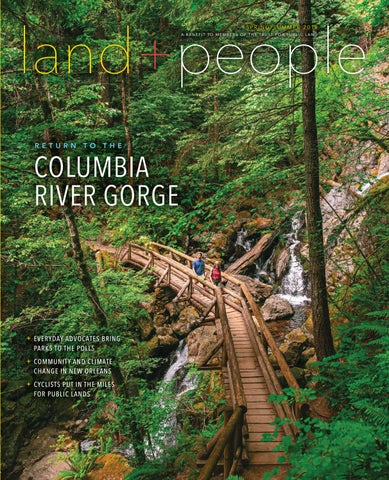
RE TU R N
TO
T H E
COLUMBIA RIVER GORGE
+ EVERYDAY ADVOCATES BRING PARKS TO THE POLLS + COMMUNITY AND CLIMATE CHANGE IN NEW ORLEANS + CYCLISTS PUT IN THE MILES FOR PUBLIC LANDS
adair f reeman r u t l e dg e
two easy ways to
ensure your values live on.
Two simple and powerful ways to support our mission:
to learn more,
• Name The Trust for Public Land as a beneficiary of your retirement plan or life
please contact:
insurance policy. You can review and adjust beneficiary designations anytime. • Those 70½ years or older can give up to $100,000 from your IRA annually,
(East) Colleen Spivey at 207.619.8054,
without paying income taxes on the money. If you have not yet taken your
(West) Dana Thomas
required minimum distribution for the year, your IRA charitable rollover gift can
at 415.800.5278, or
satisfy all or part of that requirement.
plannedgiving@tpl.org
F EAT U R E S t er ray sy lv est er
b r yan tar n o w sk i
contents
44
“The water is your friend. You can’t just fight it.” ~ s i st er j oan la p lace in ta ki n g o n water
I V
ED I VOT
Want a win for parks and conservation? Look beyond the Beltway.
d
I
te o V
Taking On Water .................................................. . . . . . . . . . . . . . . . . . . . . . . . . . . . . . . . . . . . 44 A flood-prone neighborhood in New Orleans becomes a proving ground for climate resilience.
TED I
D
Vote Local ........ ............................................................ . . . . . . . . . . . . . . . . . . . . . . . . . . . . . . . . . . . 33
O
VO T E
54
33
IV ot ed 投 了 Yo 票 Vo té 我
I VOTED
I Vo
ted
Foresight ......... ............................................................ . . . . . . . . . . . . . . . . . . . . . . . . . . . . . . . . . . . 54 A generation after the controversial effort to protect it as a national scenic area, we revisit the Pacific Northwest’s Columbia River Gorge. T P L. O R G · 1
JAN
FEB
MAR
APR
M AY
JUN
JUL
AUG
SEP
OCT
NOV
DEC
Help conserve land for people every month of the year. It’s easy, automatic, and secure. Join today.
tpl.org/monthlygiving
D E PA RT M E NTS
court esy of w omen on w h eel s for w il d l an ds
A journey of discovery
darcy k ief el
From the President · 11
contents
Board Spotlight · 13 Sheryl Crockett Tishman
Contributors · 14 Mailroom · 15 First Look · 17 A falcon takes flight, a garden gives back, and a father’s legacy lives on
18
Insight · 26 the land they love
Member Center · 62 Offices · 63 Trail’s End · 64
jay dash
Four friends putting in the miles for
26
25
Sometimes we are blind to the beauty of this world
o n t h e cover It’s been more than 30 years since the battle to protect the Columbia River Gorge on the Oregon-Washington border. Was it worth it? Learn more on page 54.
JOI N U S ON FAC EB O O K Stay tuned to our latest news, videos, contests, and more. facebook.com/tpl.org
T P L. O R G · 3
mi ke schi rf
4 · LA ND &PE OPL E · SPR I NG /SUMMER 2018
contents
KOLOB TERRACE ZION NATIONAL PARK, UTAH Utah’s deserts draw millions of visitors each year with endless vistas and striking geology. But the state’s public lands are also the site of controversy: when President Trump announced his intention to shrink national monuments at Bears Ears and Grand Staircase– Escalante, Trust for Public Land supporters like you made their voices heard.
Page · 25
25
T P L. O R G · 5
b ryan tarn ow sk i
6 · LA ND &PE OPL E · SPR I NG /SUMMER 2018
contents
LONDON AVENUE CANAL NEW ORLEANS, LOUISIANA “New Orleans is a floating city,” says architect David Waggonner. As the low-lying metropolis grapples with the effects of a changing climate, he and other planners are joining forces with community advocates and The Trust for Public Land to rethink how parks and green space can help keep residents safe.
Page · 44
44
T P L. O R G · 7
i saac lan e koval
8 · LA ND &PE OPL E · SPR I NG /SUMMER 2018
contents
LATOURELL FALLS GUY W. TALBOT STATE PARK, OREGON More than 30 years ago, the communities in the Columbia River Gorge stood at a crossroads between two models for growth. In one direction: unchecked development. In the other: an ambitious attempt to balance growth and conservation. A controversial law set them on the path less traveled—and that has made all the difference.
Page · 54
54
T P L. O R G · 9
OFF IC E R S pre si d e n t an d chie f exe c ut i ve o ffi c er
Diane Regas vice p re s i d e n t an d d i recto r of co n s e rvat i o n fi n anc e
Will Abberger s e n i o r vi c e p re s i d e n t a n d directo r o f c i t y park dev elo pm en t
Adrian Benepe s e n i o r vi c e p re s i d e n t , ge n eral co un s e l, an d sec reta r y
D. Malcolm Carson s e n i o r vi c e p re s i d e n t a n d directo r o f co n s e rvat i o n st rat eg i es
Ernest Cook s e n i o r vi c e p re s i d e n t an d d i vi s i o n d i re cto r
Jeff Danter vice p re s i d e n t an d directo r o f fe d e ral affa i r s
Kathy DeCoster vice p re s i d e n t an d d i recto r o f phila n t hro p y p ro g ram s
Jeff Hauk
our mission:
THE TRUST FOR PUBLIC LAND CREATES PARKS AND PROTECTS LAND FOR PEOPLE, ENSURING HEALTHY, LIVABLE COMMUNITIES FOR GENERATIONS TO COME.
vice p re s i d e n t an d d i recto r o f park d e s i g n an d d e ve lo pm en t
Jennifer Isacoff s e n i o r vi c e p re s i d e n t an d c hi e f p hi lan t hro py o ff i c er
Margie Kim s e n i o r vi c e p re s i d e n t an d d i vi s i o n d i re cto r
Ann Morgan vice p re s i d e n t an d directo r o f g i s an d p l a n n i n g
how you can help: Our work depends on the generous support of people like you. donate: Use the envelope inside this magazine, or visit tpl.org/donate for other easy ways to give.
Breece Robertson vice p re s i d e n t an d d i recto r of lan d p rot e ct i o n
Brenda J. Schick s e n i o r vi c e p re s i d e n t an d c hi e f marke t i n g o ff i c er
Shannon Morgan Stearns s e n i o r vi c e p re s i d e n t an d c hi e f o p e rat i n g o ff i c er
Tim Wohlgenant
1 0 · LAND &PE OPL E · SPR I NG /SUMMER 2018
learn more: Get timely updates on our park and conservation work near you. Sign up for our e-newsletter at tpl.org/enews. share: Help us make the case for parks and open space. When you’ve finished reading this issue, pass it on! Land&People magazine is a benefit to members of The Trust for Public Land.
A JOURNEY OF DISCOVERY Access to the outdoors for all—all ages, all abilities, all interests, all communities. Since its
plus m productions
from the president
founding in 1972, The Trust for Public Land has publisher Shannon Morgan Stearns editorial director Eliza Sarasohn
remained focused on safeguarding places for people to get outside and experience the natural world. This work—our “land for people” mission—is what draws so many supporters to the organization, whether as staff, partners, or donors. And
art director Matt Mullin
it’s what motivates me as I take the helm as The Trust for Public Land’s new president and CEO.
managing editor Alia Salim staff writer Julia Busiek media production manager Elyse Leyenberger senior designer Rachel Wuerstlin digital production Carrie Gotch Adele Wilson con tributing editor Bill Poole
© 2018 The Trust for Public Land. All rights reserved. Conserving Land for People, Conserving Nature Near You, Creating Parks and Protecting Land for People, Fitness Zone, Land for People, Land&People, LandVote, Northwoods Initiative, Our Land, Parks for People, ParkScore, The Trust for Our Land, The Trust for Public Land, TPL, and The Trust for Public Land and LandVote logos and all other names of The
My own life and work have been profoundly
parks. In a time when our country can feel more
shaped by connection to place. As a child grow-
divided than ever, this is work that Americans
ing up in the foothills of the Rockies, I hiked,
everywhere—in red states and blue—whole-
fished, and hunted with my family. My mother,
heartedly support.
passing along the wisdom she’d inherited from her mother and grandmother, taught us how
But the fact remains that everyone’s life is shaped by place, and in too many cities and
to forage for wild mushrooms and berries and
towns, entire communities—more than 100 mil-
which plants could be used to make tea. These
lion people—don’t have a park within a 10-min-
formative experiences in nature led me to a
ute walk of home. How can we expect future
career in advocacy for a cleaner, greener planet,
generations to protect our planet if they never
first at the Environmental Protection Agency
experience the magic of being outdoors?
and then at Environmental Defense Fund. And
That’s why I’m so excited to join The Trust
I raised my three children cycling, picnicking,
for Public Land. Over the next year, I will travel
stargazing, and camping, hoping to inspire in
across the country getting to know the commu-
them the same connection to the wild that so
nities we serve, experiencing the parks and land-
inspired me.
scapes we’ve protected, and collaborating with
The benefits of time spent outdoors have
members like you to build on this organization’s
been confirmed by science in study after study.
phenomenal momentum. I invite you to join me
Research shows that people are healthier and
on this journey of discovery. Grab a friend, lace
happier when they can stroll through a grove
up your hiking boots, and let’s head outside!
of trees, gaze out of a window on a forest or meadow, or just relax on a park bench. Parks and green spaces boost local economies. And they improve air and water quality and make communities more resilient to the effects of
Trust for Public Land programs referenced herein, as well as their logos, are registered or common-law trademarks of The Trust for Public Land.
climate change. Members like you have helped The Trust for Public Land create more than 5,000 treasured
Diane Regas president and ceo
places, from neighborhood parks to national
T P L. O R G · 11
M EET YO UR MATCH
This year, an anonymous donor will generously match your gift—dollar-for-dollar—if you send it before May 31. Your donation will go even further to help The Trust for Public Land protect more parks, gardens, and other natural places. That’s one good thing made that much better.
Give your EarthShare.
An EarthShare payroll deduction is one simple way to donate to The Trust for Public Land or more than 400 other environmental and conservation charities. Many corporate and government employers support EarthShare payroll giving. If yours doesn’t, ask them to start. If they do, simply decide on a single deduction or a recurring small one from every paycheck. Then designate us, member number 11440, as one of your conservation charities. For more information visit earthshare.org or email donor.outreach@tpl.org.
terray sylvester
800.714.5263 · donor.outreach@tpl.org · tpl.org/match
board spotlight
Get to know
Sheryl Crockett Tishman Sheryl Tishman has served on the board of
ab iral rai
B OA R D OF D I R E CTOR S
The Trust for Public Land since 2010, and is also a trustee of Telluride Mountainfilm and her family foundation. Sheryl formerly served on
chair
Thomas S. Reeve
the boards of the Open Space Institute, the
Stephen W. Baird
National Audubon Society’s Expedition Institute,
George Bell
Mianus River Gorge Preserve, Teton Valley Ranch Camp, the George Mitchell Scholarship
Page Knudsen Cowles
foundation, and The Meade School. She has
William Cronon
taught at the National Audubon Society’s Douglas Durst
Expedition Institute and the Weymouth House. F. Whitney Hatch
Sheryl is an avid outdoorswoman who enjoys Christopher G. Lea
travel with her husband and two sons.
Ignacia S. Moreno Caroline P. Niemczyk Michael E. Patterson Diane Regas Jeffrey A. Resnick Laura Richards Roy Richards Jr. Lex Sant Sheryl Tishman F. Jerome Tone Ana Valdez Susan D. Whiting
I SUPPORT THE TRUST FOR PUBLIC LAND BECAUSE …
and healthier. From city parks to iconic landscapes,
my greatest teacher has been and continues to be
The Trust for Public Land’s work enhances people’s
the natural world. I feel honored, as well as respon-
exposure to the natural environment.
sible, to do what I can to enable future generations to have nature in their lives. The Trust for Public
THE KEY CHALLENGE FACING THE TRUST FOR PUBLIC
Land’s professional staff has created hundreds of
LAND IS … a worsening shortage of federal funds
parks in urban areas and protected lands and water-
available to assist with projects. It is very encouraging
ways throughout the United States. The ability to
that thousands of private citizens, believing in the
get projects done and bring communities together
critical need that we all have for public lands, have
at the same time is remarkable.
come forward in wonderful, philanthropic ways.
MY PROUDEST ACCOMPLISHMENT AS A BOARD
I FIRST FELL IN LOVE WITH THE NATURAL WORLD
MEMBER WAS … the protection of two special places.
WHEN I WAS… growing up in a small town in
The first was at Katahdin Lake in Maine, where we
Maine. I was camping and climbing mountains,
added 4,000 acres of beautiful land to Baxter State
swimming in lakes, canoeing rivers, and skiing
Park. Also, The Trust for Public Land transferred a
throughout the winters for as long as I can remem-
14,000-foot mountain near Telluride, Colorado, to
ber. The most connected place for me is on top of a
the U.S Forest Service, so its trails could once again
mountain. I have been lucky enough to have these
be open to the public.
experiences throughout my life. I know what John Muir meant when he said, “The mountains are call-
THE TRUST FOR PUBLIC LAND’S WORK IS UNIQUE
ing and I must go.”
BECAUSE ... although many environmental advocacy organizations do amazing work, what sets The Trust for Public Land apart for me is its focus on the belief that all people have the right to experience the natural world every day—making our planet stronger
?
WHAT ABOUT YOU? Tell us how you connect with nature. Join the conversation on Facebook: facebook.com/tpl.org T P L. O R G · 13
contributors
Julia Kamari Drapkin
Heather Hansman
Terray Sylvester
story:
story:
story:
Taking On Water
Foresight
Foresight
54
54
44
Julia Kumari Drapkin is the CEO and founder
Heather Hansman is a Seattle-based freelance
Terray Sylvester is a freelance photographer
of ISeeChange, a community-sourced climate
writer who covers science, the outdoors,
whose work has been published by outlets
reporting platform. Drapkin created
and the way people interact with the world
ranging from Orion magazine to Reuters.
ISeeChange after more than a decade report-
around them. Her work has appeared in
In 2015, he was awarded a fellowship from
ing on climate. She consults for Resources
Outside, The Guardian, California Sunday, and
the Human Rights Center at the University
for the Future and NASA, and is a board
Sunset; her book about the Green River and
of California, Berkeley, to document housing
member for the National Federation of
water in the West will be published in 2019.
shortages in Native American communities
Community Broadcasters.
heatherhansman.com
on the middle Columbia River.
ISeeChange.org
terraysylvester.com
EVEN MORE LAND&PEOPLE Did you know you can view this issue—and past issues— of Land&People magazine online? The digital edition includes all the stories you love in high resolution, plus bonus content like video, search tools, easy social media sharing, and instant links to learn more. Access the digital edition at tpl.org/lpdigital. Whenever you see the pointer symbol below, you’ll find bonus content in the digital edition. Go online to dive deeper into the story.
learn more @ TPL.ORG/LPDIGITAL
1 4 · LAND &PE OPL E · SPR I NG /SUMMER 2018
mailroom
james wat k in s
JOI N OUR COMMUNI TY We’re a one-stop shop for inspiration and information, too: we’ll keep you up to speed on political developments
rach id dah n oun
that may affect the lands you love.
COME OUT AND PLAY!
San Francisco turned out to celebrate the grand opening of the Helen Diller Civic Center Playgrounds in February. More than 3,600 kids live within a 10-minute walk of the new park.
We want to hear from you! Let us know what you think about the stories in this issue of Land&People, or tell us about the parks and playgrounds in your community. You can reach us by mail, on Facebook, or at mailroom@tpl.org.
Mysteries of the pueblo F A L L / W I N T E R 2 0 17 A BENEFIT TO MEMBERS OF TH
E TRUST FOR PUBLIC LAND
+ Santa Fe and the environs grabbed my
A story about ancient ruins
heart when I was six years old, traveling
at Burnt Corn Pueblo in New
on train from Ohio to our new home
Mexico piqued many readers’
in California. I have visited whenever
curiosity.
I could since our train stopped there
+ When I was a kid, I wanted to
and looked at so many photographs. But
in 1952, have walked wherever I could,
EVERYONE . DESERVES A PARK
+ BOSTON’S CAN-DO TAKE ON CLIMATE READINESS + PUTTING PARKS TO WORK FOR PUBLIC HEALTH + THE UNFINISHED PICTURE OF AN INCLUSIVE OUTDOORS
be an archaeologist. I don’t know
the pictures you sent with this article
that I was cut out for the tedious
have struck so deep in me. That spot,
work; however, I still find this
those rock drawings. Life pouring out
fascinating. Thanks for the work
from there right into my soul. Ancient
you do!
stirrings. Thank you for revealing this
Kelly Warner, via the blog
to all of us lucky enough to read your article, and for all the work you do. May you receive the aid you need to preserve this somehow-sacred site. Mary Teuter, via the blog T P L. O R G · 15
loren z o daw k in s
mailroom
intricate galaxy of vast chambers and labyrinthine tunnels, at turns lavish and spooky, always damp, always cold. It’s often silent enough to hear the gentle drip of water. The formations are extraordinary: spires and spikes and curtains and chimneys and gentle ruffles, dramatic towers, fragile folds, and gnashing, waxy teeth. Charlotte, via Facebook + O Zion! Would that we could stroll along your valley trail, together again, as the sun crested the rain clouds. Footsteps and tire marks in the loam as the frogs awakened and began their ancient song. Michelle Carbon (@ladolcevitaone), via Twitter
Learning the ropes
The land we love
Students at Environmental Learning
We asked our social media community
for Kids in Denver joined The Trust for
for love letters to parks—and the results
Public Land and our partners at
were poetic.
The North Face to brainstorm park designs—and get their climb on.
+ I’m always asked when the best time to visit the Grand Canyon is. And while
+ In Montbello, not a lot of people go
the answer is “anytime,” there’s always
out much. Having a park there with a
something I like to add: hope there’s
rock climbing wall is going to get their
a storm. I don’t care if it’s a winter
interest up and they will be able to try
snowstorm or late summer monsoon.
it. Once you do it, you will want to do
A couple inches of snow or an afternoon
it more.
of lightning. There’s something magical
Daisy Madera, 15, speaking with CBS 9News
about watching a storm miles away
Everyone should have a #10minwalk to a public park! This awesome campaign supports access to parks for all!
matt jo hnso n
in its entirety, slowly moving up the canyon. Maybe you’re above it. Maybe
singer-songwriter carole king
you’re stuck in the middle of it. The
(@carole_king) joined the chorus
light changes constantly. The smell
of our campaign for close-to-home
changes. The feeling changes.
parks for all. learn more at
Matt Johnson (@twoeightnine),
tpl.org/10minutewalk.
via Instagram + Carlsbad Caverns: From the road,
LAND&PEOPLE IS LISTENING!
you’d have no idea that beneath those
Send letters to the editor or change your mailing address: mailroom@tpl.org.
unassuming limestone hills sprawls an 1 6 · LAND &PE OPL E · SPR I NG /SUMMER 2018
In Philadelphia, we’re helping renovate schoolyards and recreation centers—like this one at 37th and Mt. Vernon—into great places to get outside and play.
i would not waste my life in friction when it could be turned into momentum.
jenna stamm
f ra n ces e. w i lla rd
turn the page for … campfire songs handshake deals generous harvests T P L. O R G · 17
coogan farm, mystic, connecticut
denison pequot sepos n at ure cen t er
At 400 years old, a farm still feeds the hungry
edible conservation
Growing food at coogan farm in Mystic, Connecticut, is nothing new: the rich soil here has been providing produce to locals since at least the mid-1600s. These days the property is home to the Denison Pequotsepos Nature Center, which worked with The Trust for Public Land to purchase and protect more than 30 acres as a park and preserve on the banks of the Mystic River in 2013. Since securing the quiet woods and picturesque meadows for the public, staff and volunteers have given a lot of thought about how best to continue Coogan Farm’s legacy of sustainable agriculture. “Hunger is a growing issue globally, but we also know that 23,000 people face food insecurity right here in New London County,” says Maggie Jones, executive director at the nature center. “We decided that Coogan Farm should be part of the solution, so we launched Floyd, the Giving Garden’s full-time
The fruit and vegetables grown at
farmer. Floyd’s family has been farming
the Giving Garden are distributed at 90
along the Mystic River since the early
food banks across New London County.
1700s, so he brings generations of local
Though it spans less than an acre, the
know-how with him to Coogan Farm.
garden is punching above its weight:
“Folks are pretty happy to take home
last year, volunteers picked and pulled
our spinach, kale, tomatoes, or carrots,”
15,000 pounds of produce here.
says Floyd. “There’s a big need in our
“Food banks typically distribute shelfstable food, so it’s important to also provide fresh, healthy, in-season vegetables to our neighbors in need,” says Craig
1 8 · LAND &PE OPL E · SPR I NG /SUMMER 2018
area, and the Giving Garden is helping meet it.”
Last year, volunteers harvested more than 15,000 pounds of produce from the Giving Garden for local food banks. Jerry Monkma n
the Giving Garden.”
WE GIVE TO ... share, just as Dad would have wanted
why we give
Easy tomato gazpacho With each delivery from the Giving Garden to the food banks, Farmer Craig includes printouts of seasonal recipes like this one. Ingredients O
2 large tomatoes, peeled
O
1 large cucumber, peeled and
A generous, gregarious man, Oran “Bud” Baker wasn’t one to keep a
“We decided we couldn’t keep the farm, but we knew we didn’t want it to turn into a subdivision.”
halved
good thing to himself. As residential
O
1 onion, peeled and halved
neighborhoods spread toward the Ohio
O
1 bell pepper, seeded and
farm he’d bought back in the ’60s, he
quartered
welcomed his new neighbors to explore
O
24 oz. can tomato juice
his land whenever they wanted—even
O
¼ cup olive oil
putting gates in the fence every hun-
O
¹⁄ ³ cup red wine vinegar
dred yards to make access easy. Families
Belpre Township to permanently
O
1 ½ tsp. kosher salt
came to hike and wander, or sit and
protect the land. The new park on the
O
¼ tsp. black pepper
watch the river from benches Bud built
Little Hocking River will offer public
O
Dash of hot sauce
access to the water for kayaking, swim-
O
1 clove garlic, minced
along the banks.
O
¼ cup chives, finely minced
Blend tomatoes, cucumber, onion, bell pepper, and half of the tomato juice until smooth. Transfer to a bowl and add remaining tomato juice, olive oil, vinegar, salt, pepper, and
We worked with Bud’s family and
When Bud passed away in 2015, his
ming, and fishing—rare in a region
daughter Terry and her siblings were
where most of the riverbank is walled
faced with a dilemma. “We decided we
by high bluffs.
couldn’t keep the farm, but we knew
“I wanted my grandkids to be able to
we didn’t want it to turn into a subdivi-
see the farm the same way I had,” says
sion,” Terry says.
Terry. “If we’d sold the land to some
“That was when my younger brother
developer, that wouldn’t have been a
found out about The Trust for Public
possibility. Since it’s a public park, I
2 hours. Before serving, stir in garlic
Land. Their mission matched with our
can take the boys out there anytime.
and sprinkle with chives. Leftovers
mission: to preserve the farm exactly
“And it’s a great way to remember
keep 5 days refrigerated.
as it’s always been, and make sure that
Dad. It’s what he would’ve wanted.”
hot sauce. Cover and chill for at least
anyone who wanted to enjoy it would Recipe courtesy Giving Garden
still be welcome.”
volunteer Sherrill Janerio F I R ST LO O K · 19
lafayette street school, newark, new jersey
a n toin e smit h / ads ph otog raph y
Dreams take wing at a green schoolyard
good news
The mural at Lafayette Street School is one of many eye-catching works by artist Gera Lozano—also known as GERALUZ. See more at geralozano.com.
in Mr. McMahon’s class,” she remem-
big. “Even if I didn’t want to be an artist,
to create a mural at Lafayette Street
bers. “When I turned in my painting, he
just knowing that someone from my
School in Newark, a falcon design was
said, ‘Geraldine, you know you’re an art-
school had gone on to an established
a natural choice. Today Lozano is well
ist, right? You have to keep making art.’
career doing what they loved, and then
known in the world of street art, but it
So I call him my first angel.”
came back and shared that with their
wasn’t so long ago that she was a stu-
Today Lozano—who goes by the name
dent here—wishing, at times, that she
GERALUZ—creates works on city streets
had wings of her own.
perfect complement to the new school-
her family from Peru to the Ironbound
yard at her alma mater, completed in
District of Newark, a dense, diverse
November with help from The Trust for
neighborhood along the Passaic River.
Public Land. The renovation transforms
She remembers struggling to fit in—but
a barren asphalt lot into a lively space
it was also here at Lafayette Street
with gardens, a jungle gym, and a run-
School that she was first encouraged to
ning track.
“We were learning to use watercolors
2 0 · LAND &PE OPL E · SPR I NG /SUMMER 2018
inspired by that?”
and walls. Her bold, colorful style is the
At nine years old, Lozano moved with
consider a future in the arts.
neighborhood—how could you not be
Watching over it all is Lozano’s falcon: a reminder, she hopes, to dream
antoine smith/ad s photograp hy
When artist Gera Lozano was asked
word watch
whispering hills, yucatan township, minnesota
Where camp memories linger
savannah c ummin s
court esy g irl sco u t s r iv er val l ey s
good news
On a cool fall day, dozens of alumnae gathered at Camp Whispering Hills in Minnesota to honor its transition from Girl Scout retreat to public open space. Women came from as far as California and England to share scrapbooks full of photos, pins,
crag (n.) `kræg
and badges. They sang their favorite campfire songs and lowered the flag for the last time. The 840-acre property is beloved by generations of campers from around the Midwest. But after heavy flooding damaged the facilities, the Girl Scout council made the difficult decision to sell.
In rock climbing, a cliff or other collection of routes. North Face athlete Anna Pfaff has scaled
“That’s when The Trust for Public Land came to the table to help us make
some of the planet’s gnarliest crags, even
sure the property was protected,” says Tisha Bolger, CEO of the Girl Scouts
venturing to Antarctica this past winter.
River Valleys. “If we can’t hold on to it, we’re at least happy to see that
But you shouldn’t have to go to the ends
people will be able to enjoy it.” Now managed by the Minnesota Department of Natural Resources, the former camp is open to everyone as the Yucatan Wildlife Management
of the earth to try a new sport: that’s why Pfaff and The North Face are partnering
Area—creating much-needed recreation opportunities in a part of the country
with The Trust for Public Land to bring
where only five percent of the land is in public ownership.
the crag to the city, building free outdoor
“I was sad to hear that camp was closing because it’s such a special, beauti-
climbing walls in public parks.
ful place,” says camp alumna Allison Walker. “But I’m relieved to know that other people will now be able to experience it, and I know they’re going to love it like we do.”
learn more @ TPL.ORG/ANNAPFAFF
f u n din g wa s p rovid ed by the minnes ota ou t door heritage fu nd as re com m en d ed by th e l ess ard- s ams ou t door heritage cou ncil. F I R ST TLO P L. OORK G · 21
meet our staff
buzzworthy
christopher t. ma rtin
t h eo st roomer
“In my line of work you live and die by your reputation.”
“The very essence of this neighborhood tells the story of the struggle of the civil rights movement.” —Representative John Lewis
WADE SHELTON THE TRUST FOR PUBLIC LAND’S LONGTIME COLORADO DEALMAKER FINDS RURAL AND URBAN COMMUNITIES HAVE MORE IN COMMON THAN NOT.
How do you describe what you do? It might surprise people to hear it put this way, but my job is a lot like being a commercial real estate agent. The transactions are complex, negotiations can last for years, and the price tags can be in the tens of millions of dollars. But instead of buying land to build a mall, or a gas station, or
Georgia congressman John Lewis honors
condos, or a hotel, we buy land so it can become or remain public open
Dr. Martin Luther King Jr.’s birthplace, the
space for everyone’s benefit.
Sweet Auburn neighborhood of Atlanta. it’s one of several places protected by
You work mostly in Colorado. Is protecting land there all about the mountains?
The Trust for Public Land included on the
That’s just one aspect of it. In ten years at The Trust for Public Land, my
new U.S. Civil Rights Trail.
work has run the gamut from the city to the wilderness. In Denver, we
Now preserved as a national historic site,
helped create New Freedom Park, now a gathering place for the neighborhood’s refugee communities. I’ve also worked with ranchers in places like learn more @ TPL.ORG/CIVILRIGHTSTRAIL
Chaffee County to preserve open rangeland. Or I’ll partner with the federal government to protect sites within iconic landscapes like Rocky Mountain National Park. One day I’ll show up to work in a suit and tie to meet with city officials, and the next, I’ll be in my cowboy hat and boots!
2 2 · LAND &PE OPL E · SPR I NG /SUMMER 2018
Is it hard to be effective in all these different kinds of places?
What are some of the biggest hurdles you face in that process?
relying on your relationships—but it
The longer I do this job, the more I
It’s not uncommon to encounter some
takes a long-term commitment. I’m at
realize how much urban and rural com-
skepticism, initially. It makes sense that
a place now where if I meet with a new
munities have in common: they both
people are going to ask, “Who is this
landowner in the Upper Arkansas Val-
Point being, over time, you can start
face challenges that access to parks and
random guy out from Denver sitting in
ley, I can say, “Don’t take my word for
open space can help address. I think
my kitchen telling me he wants to help
anything. Ask Joe Cogan, ask Geraldine
about our work on the Rio Grande Farm
preserve my land?” A lot of ranchers
Steel, ask any of a half-dozen of your
Park in Alamosa, a town in rural west-
are accustomed to being approached by
neighbors—they’ll tell you if I’m full of
ern Colorado. The community chose to
people who want to buy their property,
crap or not.”
create a public farm instead of a private
but usually those people come with a
trailer park because they knew their
profit-driven offer—not for the express
kids have the same need for access to
purpose of conserving the land and
healthy food and a safe place to play as
keeping it in the family.
In my line of work you live and die by your reputation. If you treat everyone
kids in Denver do.
So, your basic approach is the same no matter where you work.
What makes you successful at the work you do?
How do you overcome that skepticism?
as equals, tell the truth, and follow through—even if it takes years to get
I’ll never forget my first deal in the
the job done—you’ll become part of
Whether I see mountains, barns, or
Upper Arkansas Valley. I was working
the family. A few years ago I had back
skyscrapers on the horizon, it’s my first
with a rancher, Joe Cogan, and at the
surgery, and the people most concerned
job to listen, and then to ask questions.
end of our conversation he stuck out his
about me outside of my immediate fam-
I don’t have all the answers, but I can
hand and said, “I’ve been living in this
ily and friends were all ranchers I work
be a partner with a playbook and
valley my whole life, and a handshake
with. They called me up to check on me
a certain expertise. That process of
is good enough for me.” I said, “Thanks
… and to rib me a little bit, of course,
building trust with people is critical
Joe—that means a lot to me. But I’m
because a lot of them had had the same
from the East Coast, so … I’m going to
surgery themselves. They told me to just
need something in writing!”
suck it up, get tough, and I’d be back in
no matter where you are.
andrew e. russell via flickr
the saddle in no time.
Our work in Colorado runs the gamut from city parks and family ranches to national parks.
F I R ST LO O K · 23
“Timber is our heritage up here” rick alger reckons that when he
Mike Galuszka, another longtime resi-
good news
milan community forest, milan, new hampshire
community forest could bring in reve-
arrived in the New Hampshire town of
dent. He and other local leaders started
nue to support the town. “Our eventual
Milan in the mid-1960s, up to two-thirds
looking to surrounding communities for
goal is five to ten thousand acres,” says
of his neighbors worked in the timber
ideas—and found that many were taking
Galuszka. “And when we harvest, we’re
industry. Alger himself decided to do it
the forest into their own hands. In small
employing local loggers and truckers,
a little differently than most: he used
towns like Randolph and Freedom, tracts
and selling to local mills. If we treat the
draft horses to harvest “the old-timey
of timberland were in public ownership,
land right, we can have the goose and
way”—dragging felled trees out of the
harvested sustainably, and open to every-
the golden egg.”
forest on a sled instead of a truck.
one for outdoor recreation.
He and the horses still work in the
Alger says that with Milan’s proud
“We had the idea that this could really
history of forestry, you’d be hard-
woods, but since he began logging, Alg-
make a difference for our town,” says
pressed to find a community more up
er has seen the region’s once-ubiquitous
Galuszka, who along with Alger jumped
for the challenge. “I have dozens of
mills shuttered one by one. As corpora-
to volunteer for Milan’s community for-
friends still in the timber industry, and
tions buy up much of the surrounding
est committee. “But we needed a lot of
every one of them has as strong a con-
land, access to favorite trails, campsites,
help.” So they called The Trust for Public
servation ethic as anyone,” says Alger.
and fishing spots is put in jeopardy, and
Land—old hands at helping communities “We care about the forest, and it’s an
timber profits are funneled away from
protect working forest—to help plan and
informed caring. We know how a forest
the community.
acquire the first several properties.
ebbs and flows, how it can be ruined,
“The past few decades have dealt a
With timber practices that support
tough economic blow to Milan,” says
clean water, wildlife, and recreation, the
2 4 · LAND &PE OPL E · SPR I NG /SUMMER 2018
and how we can help it thrive.”
buzzworthy
jay dash
what counts
In December, President Trump announced his decision to drastically downsize two national monuments in Utah. The two-million-acre reduction is the largest in history, shrinking the Bears Ears National Monument by 85 percent and Grand Staircase-Escalante National Monument by half. But as the debate over the future of these and other national monuments continues, those aren’t the only numbers that matter. Between July 2017 and March 2018, Trust for Public Land supporters sent more than …
168,384 letters
“It’s important to bring in new, younger, and diverse voices to keep the conservation movement relevant and vibrant.” —Will Rogers, Trust for Public Land President Emeritus After two decades at the helm, Will Rogers
… by email and fax to government officials, urging them to protect Bears
retired as president and CEO of The Trust for
Ears and Grand Staircase-Escalante, defend the Antiquities Act, and pro-
Public Land in March. He leaves a legacy of
vide critical support in the federal budget to the Land and Water Conser-
parks and protected land across the country,
vation Fund—the lifeblood for parks and open space across the country. If
as well as the Will Rogers Fellowship—a new
you’re passionate about public lands, take action today.
program to recruit and train the next generation of conservation leaders.
learn more @ TPL.ORG/TAKE - ACTION
F I R ST LO O K · 25 T P L. O R G · 25
photos courtesy women on wheels for wild lands
insight
N
N AN AGE WHEN CROSS-COUNTRY TRAVEL NEED BE NO HARDER THAN A RED-EYE, it’s easy to forget just how big America is. But the jour-
ney from sea to shining sea by bicycle reveals the landscape for what it is: vast, varied, and … definitely not flat. That’s what cyclists Ariana Amini, Alex Benjamin, Hannah Field, and Katie Ledermann found when they took the long way across the country last fall. Friends from summer camp
and their high school ski team, the four young Minnesotans share an appetite for a good challenge and a lifelong love of the outdoors. Calling themselves the Women on Wheels for Wild Lands, they plotted a route through some of the most loved—and most contested—parks in America: a 5,312-mile pedal-powered journey in the heat of a national debate over the lands we share.
KATIE: So we tried to meet with land management personnel, conservationists, and volunteer groups at all the parks we passed through. And as the trip went on, we started talking
When did you first decide to bike across the country?
to anyone we could reach—like people we met on the trail, or
ARIANA: We were all staring down our college gradua-
people at campgrounds and restaurants where we stopped.
tions and wanting to do something big before we went on
As often as we could—when we weren’t totally worn out
to the next thing. And we wanted to use that time to make
from moving ourselves and our gear by bike every day—we
a difference, not just do something totally for ourselves. So
tried to share what we were learning and seeing on Facebook
we started texting each other about doing a bike trip to raise
and Instagram, and by pitching our story to local media ev-
awareness for a cause—then we had to decide what exactly
erywhere we went. That was a big priority, because we didn’t
that cause would be.
want to just preach to the choir through our own personal channels. We wanted to reach people who don’t already know
So why public lands?
about threats to public lands.
HANNAH: Wilderness has always been an important part of our lives. We’re all big on paddling, biking, skiing, and
ALEX: One theme we heard from just about everyone we
backpacking. As our trip was coming together last summer,
talked to was that one of the best ways to support and protect
Congress was talking budget cuts, national monuments were
public lands is to get out and enjoy them, and be good users
up for review by the Department of the Interior, and there
and stewards. We were lucky to be able to do that ourselves,
was this growing movement to transfer federal lands to state
every day, for 94 days.
control. A cross-country ride through the places being affected seemed like a good way to engage with all those issues.
Did you get sick of riding all day, every day?
What did you hope to accomplish?
get into a rhythm. But mentally, you learn so much about
ALEX: Our mission was to raise awareness of the value of
yourself: how you function with other people, how you han-
public lands in America and the threats that they face. That
dle obstacles and solve problems. There were definitely times
being said, once we were actually out on the road we realized
when we were all so fed up with each other that the biggest
we didn’t know exactly how we would do that!
challenge was just remembering to be a good person, even
HANNAH: Physically, you get used to it—after a while, you
I NT SI P L.G OH R GT · · 27 27
ARIANA: In Louisiana, one of our bikes started making some strange noises—we found out why when the rear derailleur snapped clean off! That’s the part that shifts the chain through the gears, so it was pretty debilitating. On the side of the road, we did a quick fix good enough to get us to the next town. Then a guy in Opelousas gave us a derailleur from an old road bike—which worked well enough, once we got it attached—that held up all the way to the end of the trip. It turns out bikes don’t necessarily need perfectly functioning parts to work. Sometimes they just need a certain amount of care and some creativity to keep them pedaling.
You met so many different people on your trip. How did they react to you and your message? HANNAH: Everyone we met was helpful, kind, and supportive, and almost everyone was fired up about protecting public lands. I say “almost” … there was one evening we were invited to dinner by a family of ranchers in Utah. Toward the end of the meal we ended up talking about our mission, and when you’re cold, wet, hungry, tired, or in the worst
one gentleman was pretty fierce in his opinions. He believes
mood ever. I like to challenge myself, and this trip was the
the national monuments are a government overreach, and
ultimate challenge. I loved every second of it … even when
asked how we’d feel if people from outside tried to tell us
it was terrible!
what we can and can’t do on our home turf.
ARIANA: In Minnesota I guide wilderness canoe trips, so being outside, using my body, and growing stronger every day by traveling and carrying everything I need has become an important part of my life. Traveling with a small group of women is one of my favorite things in the world. And biking in particular is the perfect way to see this country—you’re not going too fast to appreciate the beauty and the details, but it also won’t take you a whole year to get across.
What about your bikes? How did they hold up? KATIE: We got pretty good at fixing flats. Here’s a neat trick: if your tire rips open and you don’t have a spare, you can fold up a dollar bill, put it between the inner tube and the tire wall, and it’ll serve as a patch until you make it to a shop. We didn’t have a major breakdown until West Texas, when one of Hannah’s spokes snapped. None of us had replaced a spoke before, so it was a learning experience. Thankfully, we were well stocked with spare parts and tools, and it was a pretty straightforward fix.
2 8 · LAND &PE OPL E · SPR I NG /SUMMER 2018
ARIANA: We don’t agree with him, but at that table it was
the towns that remain all have something special and remark-
our turn to listen and understand where he was coming from.
able about them that have allowed them to make it through
Especially these days, having difficult conversations is so
challenging years.
important. It can be uncomfortable, but it forces you to open your mind and see things from other perspectives, instead
HANNAH: I loved Bears Ears and Grand Staircase-Escalante
of putting people in a box based on what the media tells you.
National Monuments. The landscape is insanely varied, which
That was one thing I loved about the ride: seeing the incred-
makes the biking really fun. And we were there in October,
ible diversity and breadth of experience that informs people’s
during the height of the Department of the Interior’s review
beliefs and values in this country. You can’t really experience
of national monuments. We rode right into the heart of that
that unless you go see it for yourself.
controversy, talking with people on all sides. It was a crash course in all the disciplines and issues that affect public
We won’t ask you to play favorites ... but what were the most memorable parks on your route?
lands: religion, history, archaeology … scientists finding dinosaur skeletons, ranchers running cattle, rock
ALEX: I was really surprised by West Texas. The mountains
climbers … there’s so much happening there. Everyone
around Big Bend National Park are gorgeous, and also the
wants a piece, and everyone wants something different from
hardest climbing we did on the trip. And there were all these
the same landscape.
little roadside signs—like the one pointing out a rock that looked just like Abraham Lincoln in profile—random things
KATIE: That made it all the more personal later when the
that aren’t on Google and you’d never notice unless you
administration announced it was cutting those two monu-
passed at bike speed. It’s also a region that suffers from eco-
ments by more than half. That news came the day before
nomic depression: we passed through a lot of ghost towns. But
we finally reached the Atlantic Ocean. The timing was really weird and heavy.
I NT SI P L.G OH R GT · · 29 29
How did that make you feel? ARIANA: My heart sank when I saw the headline on my phone. We’d talked to so many people who live there, and the administration’s decision felt to me like the voice of the people wasn’t heard. The decision to reduce these monuments was made high up by people who want to open the land up for energy exploration, even though the vast majority of the land’s owners—that’s all Americans—don’t want to see that happen. ALEX: I think it was in that moment that I truly realized how much we take public lands for granted in this country. We think because parks and monuments have been here for as long as we can remember, they’ll always be here—but the farther we rode and the more people we talked to, the more we realized that’s just not true. It was heartening to discover this huge community of people all across the country who dedicate their lives to keeping these places safe and healthy. The trip gave me a great understanding of the work that goes on behind the scenes of our public lands—so the decision to slash the monuments felt like an attack on everyone we’d met and everyone who’d supported us.
What’s next for you? HANNAH: We have a ton of momentum from this trip. There’s interest from park personnel and other advocates for us to engage around issues at home in Minnesota—like the controversy around mining in the Boundary Waters. The state’s Department of Natural Resources wants us to do a ride through Minnesota’s public lands, and we’re talking with people at parks way up in the northern part of the state about doing a ride there from the Twin Cities. KATIE: The national monuments controversy just makes it clear that even though our ride is over, our real work is just beginning. I don’t know what I’m going to do next, but I know this issue—protecting public lands and making it easier for people to experience them—is something I’ll always care about and fight for.
3 0 · LAND &PE OPL E · SPR I NG /SUMMER 2018
co l in co o ke
Everyone deserves a park.
thank you prudential! With your support, we’ve created 13 new parks across Newark, New Jersey, putting more than 95,000 people within a 10-minute walk of a great place to play, exercise, relax, and connect to nature—and each other. Together, we’re building a greener, healthier, and more equitable Newark for generations to come. Learn more at tpl.org
rachid dahnoun
BE A LEADER. Become a Conservation Champion and help The Trust for Public Land connect even more people to nature. With your annual leadership-level contribution of $2000 or more, you will receive invitations to special events and insider updates on our park and conservation strategies.
Learn more about the impact you will have as a Conservation Champion. Call Haley Nielsen at 415.800.5189.
co ns er vat i o n ch ampi o ns t pl . o r g/ c h a m p ions | cham p ions@tp l.org
OTE
I
ED
D
I V
OTED
OT
IV
IV YO VOT
OTE
D OTE
É
OT
VOTE LOCAL IV
D I
IV
TE
我投
了票
t Vo
ED
I Voted
D
I VO
V
I
D I
I VOTED
Want a win for parks and conservation? Look beyond the Beltway.
I V O TE D
ted I Vo 了票 我投 é Vot Yo
INTERVIEWS BY JULIA BUSIEK
h e 2 011 6 ele e ctt io o n c ha a n g ed d t he e co o n v ersatt i on n
the importance of parks and open space—the idea that a
a bo o ut pu u bll ic c la a nd d s i n a m e r ic c a , ushering in an
shared love of the land can transcend even the deepest
administration that would soon roll back environmental
political divisions in this country. But it also speaks to the
protections and begin an unprecedented review of national
understated power of local advocates for conservation. If
monuments.
all politics is local, the real change-makers may not be the
T
V
ED
ed
I
TE
TE
O
But something else happened at the polls that November.
politicians whose names you see in the headlines, but your
Across the country—in red states and blue, in cities, suburbs,
neighbors—the small-business owner who donates supplies
and rural communities alike—voters in that very same election
for a park cleanup, the parents who knock on your door with
approved more than $6.9 billion in public funds for parks,
homemade cookies and a campaign flyer, kids in tow.
conservation, and restoration. Though those results may seem at odds, parks’ success at
Since 1996, The Trust for Public Land has helped everyday advocates raise more than $68.2 billion in funds for
the polls in 2016 fits a longtime trend. Given the opportunity,
everything from playground renovations and trail-building
people of all political persuasions will choose to invest in the
to establishing community forests and protecting water
health and livability of their own communities. In fact, state
supplies. We’re proud to stand with the local advocates
and local conservation measures have enjoyed a 76 percent
making a difference for parks and open space in their
passage rate since 1988.
communities—no matter what happens in Washington, DC.
That figure reflects Americans’ broad recognition of
T P L. O R G · 33
OTED
CHRISTINE DENNY
co-founder and president, first magnitude brewing co. gainesville, florida
`
on the ballot
3 4 · LAND &PE OPL E · SPR I NG /SUMMER 2018
passed with 60% approval a drienne fletc her
An extension of the half-cent Alachua County Wild Spaces and Public Places sales tax, which supports land conservation, parks, and recreation
matt h ew w ro b l ew sk i
I Voted 我 投了 票
O
TED
VO D I
oté
I VO
Yo V
I VOT
TE
Yo Voté
ED
ur business’s connection to conservation
“We want our customers springs—those with the highest flows—anywhere on Earth. to have a great experience, When we founded the brewery four years ago, we made a commitment to support local environmental causes: we want but it’s important that we our customers to have a great experience and drink great beer, but it’s important that we give back, too. give back, too.“ One way we do that is by making our tasting room available is right in the name: north-central Florida is home
to the highest concentration of first magnitude freshwater
for events put on by local conservation groups. We hosted information sessions during the campaign and teamed up
I think our low-key, laid-back vibe helped the campaign reach
with a local land trust to throw a “Wild Spaces, Public Places”
people who otherwise wouldn’t necessarily have voted for
Halloween Ball, complete with themed costumes. It’s one of
the measure. You might feel like you’ve got all this momen-
our biggest parties of the year and we had a ton of people that
tum, and then discover at the polls that there were huge
night, mostly just because it’s fun. But they got a chance to
swaths of people that you didn’t engage, and whose concerns
learn about the benefits of the ballot measure along the way—
weren’t addressed. Having a space for those conversations is
right before the election.
important, and we try to make the brewery welcoming and appealing to all different kinds of people. Beer brings people together. Everybody loves to gather over a pint. I think the success of this measure is going to be good for our bottom line. For one thing, we brew using City of Gainesville water, which is very clean, thanks in part to the protections around our freshwater springs. But more than that, the fund supports wildland and urban parks—the kinds of things that make Gainesville a healthy place where people want to come raise families, where communities mix and mingle. Small businesses like ours thrive in a town like this.
adrienne fletcher
`
VOT E LO CA L
T P L. O R G · 35
WINSTON PIERRE community organizer boston, massachusetts
`
on the ballot
3 6 · LAND &PE OPL E · SPR I NG /SUMMER 2018
passed with 74% approval ian mac lella n
The Boston Community Preservation Act (Ballot Question 5), a 1% property tax surcharge to support affordable housing, parks and open space, and historic preservation
I Voted Yo V
ian macl el l an
oté
I
live in the dorchester section of boston,
Take me, for instance. I came to this from an interest in
but i was born and raised in haiti . I immigrated
affordable housing, but I also believe that parks are one of
to the United States and settled in Boston following the
the most important things that make Boston special. One
earthquake in 2010, so this city is special to me because it
of my favorite things to do is walk through the park late at
means a second chance at life. It’s the only place on Earth
night, feeling the breeze. How can I describe this feeling?
where my story and journey could have been possible. But
It’s part of the essence of life. Being in nature connects your
part of that journey has been the struggle to find affordable
inner being and creates a sense of community.
housing. I know firsthand the need for us to solve the housing
Being a full-time field organizer on a campaign like this
shortage in Boston, and in cities across the country.
means working 60 and 70 hour weeks for months on end.
The Community Preservation Act succeeded because it
There’s always more to be done: more volunteers to recruit,
brought so many different advocates and groups from across
more phone calls to make, more doors to knock on, more
the city together. Affordable housing activists, parks and open
meetings. But passion is contagious. It is like a light that
space backers, and historic preservationists trusted each other
cannot be hidden. It motivates others and builds trust—
to work toward a shared vision for a city that serves all its
whether between groups that have traditionally advocated
people. It wasn’t one side fighting for its own interests—it
for different things, or between me as a field organizer and
was all of us uniting behind a campaign for the resources
small business owners I was asking for support. If you can
we need to make sure Boston can meet the challenges of
build trust with people, nothing is impossible.
the next ten years.
“If you can build trust with people, nothing is impossible.“ bill damon
`
VOT E LO CA L
T P L. O R G · 37
SCOTT CHAN
direc tor of asian pacific isl ander forward movement san gabriel valley, los angeles
`
on the ballot
3 8 · LAND &PE OPL E · SPR I NG /SUMMER 2018
passed with 75% approval annie ba ng
Parks, Open Space, Beaches, Rivers Protection, and Water Conservation Measure (Measure A), a 1.5-cent per square foot parcel tax levy
YO VOTÉ I VO TE D
I
“An open field is a gift to a child with an imagination.“
I Vo
ted
grew up in a town in the san gabriel valley. We had a little park around the corner from our house—
it wasn’t much, there wasn’t even really a playground, just an open field with a few tall trees. But an open field is a gift to a child with an imagination. When I wasn’t going there to ride my bike or play catch with my dad, I was searching for treasure, or hiding from monsters. It’s where I developed my sense of adventure. As I have gotten older and my career has taken me into servannie bang
ing my community, I’ve realized what a privilege it was to have that park within a 10-minute walk of my front door. So many people in Los Angeles County—especially in low-income communities of color—don’t get to have adventures like I did. I’m now the director of a nonprofit that focuses on public health and environmental justice issues for Asian and
sure that all communities are healthy places to be, and
Pacific Islander communities in Los Angeles. We know we
parks and green space are a huge part of that. That’s why
need to address inequities in the built environment to make
we’re involved in movements like Measure A. For example, we work in the community of Lennox, adjacent to LAX. Lennox has just one tiny park: it’s right off the freeway and for years it wasn’t even lit at night. Would you want to take your kids there? Would you feel safe letting them go there alone? We can easily tell someone to go on a hike or to take the kids to the park. But if there’s no trailhead nearby, or the park is in bad shape, how can we expect people to take our advice? Our communities are clamoring for more and better parks, and I think you can tell by the overwhelming voter support that we’re willing to tax ourselves to address the gaps in park access between wealthier areas and low-income areas. It’s time to change policy, spending, and institutions so everyone in Los a nnie ba ng
`
VOT E LO CA L
Angeles has equal access to opportunities to thrive.
T P L. O R G · 39
ANNA DREXLER-DREIS
environmental consultant gr and count y, color ado
`
on the ballot
4 0 · LAND &PE OPL E · SPR I NG /SUMMER 2018
passed with 60% approval theo stroomer
Measure 1A, a 10-year, 0.3% sales tax increase to support open space, rivers, trails, and wildlife habitat protection
`
VOT E LO CA L
G
rand county is an interesting place,
the measure and even wrote a letter to the editor about it. I’ll
politically. In the east we have Winter Park, one
never forget her opening line: “As a lifelong fiscal conserva-
of the closest big ski areas to Denver: outdoor recreation is
tive, I can’t believe what I’m about to say … but I’m voting
at the center of things there. West Grand County is a lot of
yes on 1A.” Her endorsement helped the measure gain the
fourth– and fifth-generation ranchers running cattle, and in
traction we needed.
general that half of the county has a different set of priori-
In the big picture, having this measure on the ballot was
ties. Our challenge was to unite those two constituencies.
like our community asking itself: what’s our goal? Do we
From phone surveys we knew something important to
want to develop as fast as possible and make money off
everyone was water, so we made that issue front and center.
tourists, or are we out here to be enriched by nature, enjoy
We figured, if our local land trust can work with the land-
open space, and keep our working lands healthy and whole?
owners to put conservation easements on their ranches, that
I’ve seen so many ski towns get overrun with crazy-fast
will protect their water rights and help them stay solvent—
development, and I don’t want that to happen in Grand
so they don’t have to sell off chunks of property every gen-
County. I think the fact that the measure passed means
eration. For that to work, you need public funds.
that most people agree.
I was on the campaign committee, going out to meet with voters in west Grand County to tell them about how this relatively small tax increase could help their businesses in a big way. But I wasn’t making much headway. So I called up a well-respected rancher who’d done a conservation easement on her land and asked for her support. Once I had the chance to have a one-on-one conversation with her, she quickly saw this would be a good deal for her neighbors. She spoke up for
“Having this measure on the ballot was like our community asking itself: what’s our goal?“
I V O T E D I Vote
I VOTED
我 投了
Yo V o
d 票
té
T P L. O R G · 41
JIM MEYER retired business manager clermont county, ohio
on the ballot
4 2 · LAND &PE OPL E · SPR I NG /SUMMER 2018
passed with 63% approval sherri ba rber
The Clermont County Park District Tax Levy, a 10-year property tax to support park operations, growth, and facilities upgrades
sh er r i bar b e r
VOT E LO CA L
T
here was a community survey a few years
“Parks provide experiences ple felt passionately about was the need to balance growth we remember and pass on. with preserving the natural areas that make this such a great place to live. But the park district could barely keep pace Getting folks to think about with the facilities they already managed—let alone being those experiences helps.“ able to protect new land. So some citizens got together and back that asked people what they wanted for the
future of the county. Just about the number one thing peo-
decided the time was right to try for a parks ballot measure. I managed manufacturing businesses for 30 years, but when I got closer to retirement age I decided I was ready to spend more time doing what I love. I’d gotten involved in the county parks’ volunteer trail crew, and when I found out about the campaign for the levy I jumped in and joined the committee. I’m glad I did, because it was one of the best experiences I’ve had in years.
skipped rock spreading out across the water. What do you want to bet that dad had once been out on a riverbank with his own dad, doing the same thing? And that kid who skipped the rock—he’s likely to teach his kids when he grows up. Parks provide experiences we remember and pass on. Getting folks to think about those experiences helps them
I’m a people-person, so I talked about the measure at Rotary Clubs, the county commissioners, senior homes … even just struck up conversations at the parks. Here’s a story I’d tell: One day I was finishing up some trail work and I noticed a man with a group of kids playing on the
get past, “I’m not voting for any tax increase, no way.” I knew this issue was something special when I saw a picture in the paper with the chairs of both the County Republicans and the County Democrats smiling with one of our campaign’s yard signs. It’s one thing that everyone can agree on.
riverbank. All of a sudden this huge roar went up. All the kids were jumping up and down, and I saw the ripples of a
ED I VOT
I Vo
ted
Learn more about upcoming conservation ballot measures at tpl.o org/b balllot.
D
I V
TED I VO T E
我
O 投了 票
T P L. O R G · 43
Taking On water By Julia Kumari Drapkin 4 4 · LAND &PE OPL E · SPR I NG /SUMMER 2018
In New Orleans, a flood-prone neighborhood becomes a proving ground for climate resilience
photo courtesy iseechange
The sun has returned to New Orleans after a storm, and on a busy corner in the Gentilly neighborhood, Destiney Bell’s yard is flooded again. The rain has transformed Bell’s lawn into a lake
years since, approximately 80 percent of
and her home into an island. She’s not surprised:
Gentilly’s housing has been rebuilt or repaired.
she knows from experience that just 30 minutes
But flooding from rainstorms remains fre-
of downpour means wading through water—
quent—a fact of life.
sometimes floating with trash and debris—just
With 64 inches of rain a year on average,
to get out of the house. Her roommate can’t back
New Orleans is one America’s wettest cities.
her car out of the driveway during floods. And
But even for longtime residents accustomed
when the rains are really bad, city buses stop
to the region’s weather, the summer of 2017
running, too.
stood out. Afternoon storms supercharged by
“I used to love the rain, really love it,” Bell says. “But lately I feel it’s my enemy.” Bell, pictured left, lives in a neighborhood that was once the site of a wetland on the edge of Lake Pontchartrain. In the first half of the
record-high surface temperatures in the Gulf of Mexico damaged homes, cars, and confidence during what would prove to be the rainiest summer on record. Climate researchers believe this could be the
20th century, the land was drained and a grid
new normal for the Gulf Coast region. While
of single-family homes sprang up on the former
some politicians continue to debate the science,
swamp.
New Orleans residents aren’t waiting to address
When the walls of the London Avenue Canal failed during Hurricane Katrina, muddy water
the evidence they see in the rivers flowing down their own streets. They can’t afford to.
rushed into the low-lying neighborhood, leaving unprecedented devastation in its wake. In the 12
T P L. O R G · 45
photos (top and inset): bryan tarnowski
Half of New Orleans lies below sea level.
photo courtesy iseechange
The city relies on pumps and canals to stay dry, but planners worry this “gray infrastructure”— which already fails to prevent flooding— won’t keep people safe as the climate changes.
4 6 · LAND &PE OPL E · SPR I NG /SUMMER 2018
GREEN INFRASTRUCTURE
D
avid Waggonner is an architect who helped author the Greater New Orleans Urban Water Plan. He
knows more than most about what makes New Orleans so vulnerable to the effects of climate change. water come to ground,” Waggonner says. The Cajun people call the land flotant—alluvial soils mixed with water left by the Mississippi Delta. With half of the city below sea level, Waggonner explains, residents rely on
bryan tarnowski
“New Orleans is a floating city—but we don’t let the
an aging, inefficient, and insufficient network of pumps and canals to push rainwater back out with every storm. Decades of pumping the water away has dried out the spongy soils beneath the city, causing them to shrink, sink, and collapse. But Waggonner and other planners see a way forward.
Paul Habans schoolyard Students at Paul Habans Charter School go to class in a state-of-the-art new building. But the hurricane recovery
With the right network of green spaces, he believes the
grants that funded construction didn’t cover any landscap-
city can capture and store stormwater runoff naturally, at
ing or play areas—so come recess, they’d be left to stretch
once protecting residents and beautifying its waterfronts.
their legs on a featureless blacktop and an empty field.
“Water is the lifeblood of this land,” he says. “Our canals can be part of a circulatory system.” Improvements like these—parks that double as reten-
It wasn’t much fun—but that wasn’t the only issue. “The problem with our playground was that when it rained, it always flooded,” says sixth grader Elijah Cueva. That’s why
tion basins or street medians that function as canals—fall
last year, Cueva’s class helped The Trust for Public Land
under the umbrella of “green infrastructure.” Unlike
design and build a new playground for his school: one that
traditional “gray infrastructure”—the city’s crumbling
does double-duty as green infrastructure. Features like rain
canal walls, pumps, and drains—green infrastructure
gardens help relieve flooding not only at the school itself,
offers multiple benefits: green spaces designed to absorb
but also for nearby streets and homes.
stormwater can also offer cooling shade, mitigating the
The playground is open to the public outside of school
“heat island” effect, while providing residents the health
hours, giving 2,500 more people a place to get outside
benefits of a place to enjoy nature, exercise, and gather.
within a 10-minute walk of home. The Paul Habans project
Building green infrastructure on the scale needed
is the first of its kind in New Orleans, but it won’t be the
to keep New Orleans residents safe from flooding will
last: guided by its mapping tools, The Trust for Public Land
require hundreds of millions of dollars in public invest-
is connecting with partners in other flood-prone areas of
ment—and it has to start somewhere. In 2016, The Trust
the city where the green schoolyard strategy—already suc-
for Public Land helped the City of New Orleans secure a
cessful in cities like New York and Philadelphia—might be
$141 million grant from the U.S. Department of Housing
put to good use. “Schoolyards offer a ton of potential for
and Urban Development to fund a pilot project in Des-
stormwater management,” says The Trust for Public Land’s
tiney Bell’s neighborhood. Called the Gentilly Resilience
Sarah Olivier. “We’re excited to get to work building more.”
District, it will include new, water-absorbing parks and
T P L. O R G · 47
bryan ta rnow ski
“If it works and we have good results, it could be a template for the rest of the city.” medians, permeable pavement, and incentives for residents to invest in stormwater retention on their own properties, too.
I
t’s a high bar to clear. “We know we need to transform our city’s approach to water. But
“If it works and we have good results, it could
it’s a huge challenge to plan solutions to a prob-
be a template for the rest of the city,” says Josh
lem as complex as climate change,” says Sarah
Lewis, an urban ecologist at Tulane University’s
Olivier, The Trust for Public Land’s New Orleans
ByWater Institute. Lewis and his colleagues
program director. “It’s a hydrology problem to
are among those charged with evaluating the
know where flooding will happen and when;
impact of the investment, and they’re look-
it’s a modeling problem to anticipate how that
ing for three measures of success: proof that
might change in the future; and it’s an issue of
the infrastructure projects efficiently intercept
social justice—how do we make sure that the
stormwater; proof that they support the eco-
green infrastructure we build will serve the
system and public health; and proof that they
people who face the greatest threats?”
benefit the local community where they’re built.
The Trust for Public Land’s approach to this multifaceted problem uses powerful Geographic Information Systems (GIS) technology to help the city get the most bang for its buck. Like a super-powered version of Google Maps, the mapping tool combines spatial data on the physical
4 8 · LAND &PE OPL E · SPR I NG /SUMMER 2018
The Trust for Public Land measures the success of green infrastructure not only by the amount of stormwater it diverts from overburdened pumps and canals, but by whether it serves the city equitably.
leave a
LEGACY.
Protect the places you love by making a gift to The Trust for Public Land in your estate plans. By naming The Trust for Public Land as a beneficiary of your will, living trust, or retirement account, you can make a visionary gift that will conserve land for generations to come. For more information, please contact Colleen Spivey at 207.619.8054 in the East or Dana Thomas at 415.800.5278 in the West.
t p l . o rg / p l an n e d g i v i n g · p l a n n e d g i v i ng@t pl. o rg
“You have to get on the ground in a community to understand why the data is showing you what it’s showing you.” conditions in each neighborhood—from flooding history to tree cover—with demographic data such as residents’ age, income level, and health outcomes. It even shows how far people have to travel to reach existing parks. The tool is available free online, so anyone from neighborhood p hoto courtesy iseechange
activists to the mayor herself can access the same
ISeeChange and The Trust for Public Land have used storytelling events, pop-up block parties, and even street art to gather and share information about climate change in the community.
5 0 · LLAND 50 AND &PE OPL E · SPR I NG /SUMMER 2018
information to explore where green infrastructure would have the greatest impact. “The tools that The Trust for Public Land created enable us to zero in on sites where green infrastructure can bring in multiple benefits,” says Colleen McHugh, a city program officer with the Mayor’s Office of Resilience and Recovery. “We’re using the data as a first step, but then you have to get on the ground in a community to understand why the data is showing you what it’s showing you.”
photo courtesy iseechange
T
he city’s effort to ground-truth its maps
Carretta Cooke writes she’s worried about
and models benefits from The Trust for
flooding at the local senior residence. Allison
Public Land’s partnership with ISeeChange,
Albert reports she’s stranded with neighbors.
an online platform designed to help everyday
Izzy Berry says her kids’ mattresses are soaked
people—not just researchers and officials—
in filthy water. Cynthia Rhode realizes that
document the ways in which climate change
water is bubbling up backwards out of her
is affecting their everyday lives. During and
drains. Eighty-year-old Clementine Cager,
after the rains, residents can use their phones
pictured above, stands in the water with an
to record, share, and geo-tag scenes from their
injured leg on St. Bernard Avenue, clutching a
neighborhood, blending citizen science with
bag of chicken she bought at the grocery store
storytelling.
four hours earlier. The flood is too deep for the
The ISeeChange tool is in heavy use when an afternoon storm stalls between the Mississippi
fire trucks to ford, so rescue workers commandeer a kayak to paddle her to safety.
River and Lake Pontchartrain in August. As the
Down the street, Destiney Bell reports her
rain clouds hover over the lowest-lying neigh-
rain gauge rose 4.3 inches in 90 minutes—more
borhoods of New Orleans, waters rise, trapping
than six times what the city’s pumping system
residents in their cars on flooded streets. An
can handle. As a final inch of rain falls over the
hour later, half of the city is flooded.
T P L. O R G · 51
GREEN INFRASTRUCTURE
The Mirabeau Water Garden Since 1855, the Sisters of St. Joseph lived and served in the heart of Gentilly, their congregation based on a With developers lining up to
25-acre oasis of pines and maples. But
purchase the property, the sisters
the hurricane changed everything.
gathered to divine a solution in line
“Once Katrina hit, the convent was
with their calling to serve. “Just make
under eight feet of water,” says Sister
it clear, Lord,” says Sister Pat Bergen,
Joan LaPlace, pictured below. The pews
recalling their prayers. “Tell us how
floated away, along with the organ
you want us to use this land to minis-
and the altar. Just getting the water
ter to the people of New Orleans.”
out cost a quarter of a million dollars.
The answer to the sisters’ prayers
Less than a year later, the convent was
took the unlikely form of the architect
struck by lightning and burned to the
David Waggonner. He shared the plan
ground.
for the Gentilly Resilience District and a vision for how the congregation’s property—one of the largest unpaved spaces in the neighborhood—might fit in. Convinced, the sisters decided
charitable, to say the least: a 99-year lease for a dollar. When the Mirabeau Water Garden
bryan tarnowski
to allow the city to transform the land into a new park. Their terms were
is complete, it will retain up to an estimated 10 million gallons of stormwater, reducing flood impacts throughout Gentilly. “The water is your friend. You can’t just fight it,” Sister LaPlace says. “You can see from the [empty] streets and the terrible conditions of many houses just falling apart—the land sinks when there isn’t enough water. If we can provide this place it would help this neighborhood—our p hoto courtesy ise ec hange
neighborhood.”
5 2 · LAND &PE OPL E · SPR I NG /SUMMER 2018
Unlike the old pumps and canals, new approaches to stormwater management benefit from community input. The Trust for Public Land facilitates meetings to gather neighbors’ ideas for parks in development, including the Mirabeau Water Garden (left).
A transition to green infrastructure requires investment—and it has to start somewhere.
course of the evening, she ferries granola bars
this problem, from voters who are empowered
and water bottles to dozens of drivers stranded
to tell their leaders why this is important to
in front of her house.
them.”
“The stories from the community reporters
Destiney Bell, for one, is determined to keep
are essential,” says Sarah Olivier. “The HUD
up her reporting efforts. “I’ll even check the rain
grant can only go so far: once that first infusion
gauge when I’m sick,” she says. “[Monitoring
of federal resources is spent on the Gentilly
the data] made me aware of just how much [the
Resilience District pilot project, we’re going to
flooding] was happening—I think it’s done a lot
have to build on the momentum to apply the
of good. Everyone on my whole block is affected
lessons learned in Gentilly to other vulnerable
by this. [Documenting the stories] can help not
parts of the city. And we won’t be able to do
only me—but my whole community.”
that without support from people affected by
T P L. O R G · 53
2018
1901
By Heather Hansman
Foresight
photos this page: left–george m. weister, right–terray sylvester photo opposite page: terray sylvester
5 4 · LLAND 54 AND &PE OPL E · SPR I NG /SUMMER 2018
W
here conservation is controversial, the debate often presumes a choice between environmental protection and economic
growth—and a distinct cultural difference between city-dwellers who value the land for recreation and rural communities who rely on it to make a living. But in the Columbia River Gorge on the OregonWashington border, the reality is more complex. A generation after its much-contested designation as a national scenic area, we revisit an iconic ODQGVFDSH²QHDUO\ ORVW WR XQFKHFNHG VSUDZO²WR ¿QG out what’s there instead.
OUTDOOR ADVENTURE Rewarding hikes such as the ascent of Beacon Rock help draw more than two million visitors to the Columbia River Gorge each year. T P L. O R G · 55 TP
photos: top-terray sylvester, inset-ralph eddy
1939
T
NATURAL BEAUTY Proactive conservation efforts have preserved much of the gorge’s viewshed and trail network over time.
ake the long view of the land and you’ll find a map
turning the north side of the river into a bedroom community.
rewritten many times over. In an uncertain world—
The lax zoning laws in Washington’s previously rural Skama-
where cities stand on former orchards and boomtowns
nia County did little to counter sprawl: already, developers
return to dust—protecting the places we love often depends
were snatching up land on the bluffs for subdivisions, raising
less on preserving the past than on predicting the future. Can
the possibility that the best trails and views in the gorge
any community anticipate how or where the next generation
would become inaccessible to the public.
will live, work, and play?
Russell and her supporters knew they had to act quickly to
That was the question facing Nancy Russell, a mother of
prevent the gorge from being overrun. She could see that the
five, when she co-founded Friends of the Columbia Gorge in
complexity of the challenge at hand—balancing development
the early 1980s. The homemaker had fallen in love with the
and conservation across two states and six very different coun-
canyon, which runs from the confluence of the Deschutes and
ties—meant success depended on securing federal protection
Columbia Rivers to the eastern edge of the Portland metro area.
for the land, similar to a national park or monument.
It offered airy views from wildflower-strewn bluffs, cascading waterfalls, and winding trails through quiet woods. But the landscape was changing, and quickly. A new bridge connecting Portland, Oregon, and Vancouver, Washington, was
But Russell could also see, as she walked out of the community meeting where she’d gone to make her case to residents of the gorge’s timber towns, that someone who disagreed with her had slashed her tires. Next time, she thought to herself, I’ll drive a rental.
5 6 · LLAND AND &PE OPL E · SPR I NG /SUMMER 2018
“It was an enormous gamble. But the gorge was simply too important to lose.”
R
ussell’s crippled car was not uncharacteristic of the heat
sides of the Columbia River. Leaning on personal connections,
of the debate over the gorge at the time. Those against
Russell also gained the support of three conservation-minded
restricting development were in the minority, but their
Republican congressmen whose committee seats gave them
opposition was fierce—and personal. Galvanized by false
outsized influence over President Ronald Reagan.
rumors that existing homes in a new national scenic area
On November 17, 1986, after hours of debate on the floor of
would be condemned, they posted billboards and bumper
the House nearing the end of the session, President Reagan
stickers calling out Russell by name.
signed the act establishing the Columbia River Gorge National
The objections were philosophical, in part: some residents
Scenic Area. The 290,000-acre protected area was one of the
questioned what say a politician in Washington, DC—or for
only significant pieces of conservation legislation during his
that matter, a hiker from Portland—should have over the use
tenure—some reported the president signed the act while
of land elsewhere. Others feared for jobs in timber harvesting,
holding his nose—but the power of the bipartisan voting bloc
or wanted industrial development along the river instead. The
assembled by Russell and The Trust for Public Land forced his
common undercurrent in the opposition was a certainty that
hand.
economic health and conservation in the gorge were fundamentally at odds. It would take time to convince anyone otherwise, and it
“Nancy charmed the politicians,” Wozniak says. “She was the godmother of the Columbia River Gorge. It’s a testament to how one very driven person can make things happen.”
was time Russell knew the gorge did not have. She joined
1867
The Trust for Public Land and other conservation groups in a race against developers to purchase the most vulnerable properties—including some of today’s most popular recreation sites, like Beacon Rock and Cape Horn. It was a hedge, and a risky one at that. “We were betting on the success of the Columbia River Gorge Act, acquiring these properties on the assumption we’d eventually be able to transfer them to federal government,” says Owen Wozniak, a project manager at The Trust for Public Land. But if the act failed, the organization was overextended to the point it risked total collapse. “It was an enormous gamble,” Wozniak too important to lose.” The Trust for Public Land had the appetite for risk and the expertise to deftly close complex real estate deals. Russell, meanwhile, supplied a relentless energy and the rare ability
car leton watkins
says. “But the leadership at the time felt the gorge was simply
to navigate across political boundaries: a doggedness without dogma. The initial Friends of the Gorge steering committee included both Democratic and Republican former governors and a number of city and county commissioners from both
Learn more about The Trust for Public Land’s work in the Columbia River Gorge at tpl.org/gorge.
T P L. O R G · 57 TP
“I need this place to keep its rustic, northwestern identity.”
I
t’s been a decade since Nancy Russell’s death in 2008, and more than 30 years since the passage of the Columbia River Gorge
National Scenic Area Act. The legislation established regulations to discourage sprawl, concentrating growth in designated urban areas and protecting views from the highlands. About a third of the 85-mile-long stretch covered by the act is in public ownership with agencies like the U.S. Forest Service, but the rest of the gorge remains in private hands— meaning that while the designation permanently altered conversations about development in the gorge, it certainly didn’t end them. Real estate broker and former Hood River County commissioner Maui Meyer first came to the gorge in 1985 as a professional windsurfer. He says that while controlling development has helped protect natural resources and recreation opportunities, it can be tricky to reconcile regulations with other needs, such as housing. “It’s a terrific place to live, but we’re super resource-constrained and it’s hard to exist equitably within the confines [of the act],” he says. Now, he says, the challenge is to continue to conserve land without pushing out diverse populations that want to make a home here. “I think it was a fantastic idea, and it’s a truly glorious place, but it needs to grow and mature.” The question of how best to do that often falls to the Columbia River Gorge Commission, which adjudicates property disputes and makes zoning decisions on both sides of the state line. Today it’s headed by Bowen Blair, who directed the Friends of the Columbia Gorge in the 1980s and also served on staff at The Trust for Public Land. With three decades of study and involvement in the region’s economic development, Blair has the advantage of hindsight and experience in reflecting on the old debate over the scenic area designation. The property-value crash and wave of condemned homes feared by its opponents never came to pass, but the timber industry—impacted by changing regulations within the gorge and larger economic forces at work beyond it—has indeed declined. The scenic act legislation provided funds to stimulate job growth in other industries. They’ve been used on the Washington side of the gorge to build the high-end Skamania Lodge and conference center, now the biggest employer in the county. The facility was just one of the earliest investments in what’s now a thriving tourism and outdoor recreation
5 8 · LLAND 58 AND &PE OPL E · SPR I NG /SUMMER 201 20188
terray sylvester
industry fueled by more than two million visitors to the gorge each year.
T P L. O R G · 59 TP
ph otos: top- t erray sy lvest er, b ott 0m- car l eto n wat k in s
Local spending by visitors to Oregon state parks within the gorge topped $33 million in 2013, while a study by Headwaters Economics the following year found that spending from bicycle tourism in the gorge accounted for $21.1 million. If those numbers sound implausible, consider first the imposing size of the outdoor industry nationally—$373 billion in 2016— and second the case of former commissioner Meyer’s town of Hood River. The community of under 8,000 people boasts six bike shops, five breweries, and fair claim to the title of “Windsurfing Capital of the World.” Rafe Lehner owns one of those bike shops. “More population growth could help my business grow,” he says. “But honestly, I don’t need more business as much as I need this place to keep its rustic, northwestern identity.” Lehner took over Hood River’s Mountain View Cycles after a decade in the Rocky Mountains, and he draws a contrast between the gorge and the changes he saw along the I-70 corridor connecting Denver to the ski areas in Summit County, Colorado. “That used to be the most beautiful area,” he says, “but now it’s just resort on development on resort. It’s insane.” Meanwhile, says Blair, “many people come to the gorge because it is a protected landscape. Many of the business owners, who were traditionally pro-development, see the competitive advantage [of the scenic area designation].” Aspects of the the designation were controversial in the past, he says, but time has borne it out. “The future intertwined with protecting the landscape. Now, one of the prime things businesses look for is quality of life.”
I
n fact, Oregon’s economic development agency reports the counties on the south side of the gorge have experi-
enced the fastest job growth of any region—nearly twice the
1867
state average. Opponents once argued that enacting protections for the most scenic parts of the gorge would permanently stymie LOCAL JOBS )URP ¿VKHULHV WR EUHZHULHV small businesses depend on the health of the Columbia River and the surrounding landscape.
industry elsewhere. But the 19 percent uptick in jobs on the Oregon side of the gorge between 2005 and 2015 came only in part from tourism and outdoor recreation. Today the region’s employers represent a range of sectors, including manufacturing and agriculture as well as health care and tech: a billiondollar Google data center at The Dalles recently expanded and employs more than 200 people. Though conversation around the economic health of the gorge often focuses on these large employers, the region also supports small businesses, new and old. Terrie Brigham manages her family’s fish market in Cascade Locks, about 20 miles
6 0 · LLAND AND &PE OPL E · SPR I NG /SUMMER 2018
terray sylvester
“Now, one of the prime things businesses look for is quality of life.”
Brigham’s and other small businesses that depend on the health of the river challenge the old assumption of a neat trade-off between protecting natural resources and providing jobs. Three decades after the creation of the scenic area, the distinction between blue– and white-collar work in the gorge is not so distinct, either. When Lori Middleton bought a 40-year-old orchard on a few acres in Hood River 12 years ago, she was a graphic designer
west of Hood River. A member of the Confederated Tribes
with no farming experience. Today she operates a certified
of the Umatilla Indian Reservation, she’s been fishing since
organic farm where visitors can pick their own cherries
childhood—like her father and grandfather before her. Today,
and apples. “I’m a YouTube farmer,” she says. “I learned every-
she sells salmon, steelhead, and sockeye to hungry locals and
thing I know off the internet and from hiring a few guys to
tourists as well as restaurants and commercial buyers.
help me.”
She didn’t think much about land use planning before she
Middleton’s farm hosts a range of visitors, from tourists
caught wind of a proposal for a commercial bottling plant that
from Japan to day-tripping Portlanders seeking an escape from
would have diverted water from a nearby spring. The plan
the city. “They come here for the fruit,” she says, “but they
ultimately folded under pressure from tribes concerned the
also get to walk around my orchard and feel like they’re at
facility would hurt fisheries, but the close call made Brigham
home. They get double mountain views of Mt. Hood and Mt.
take notice. “I’ve become a lot more aware of what’s taking
Adams. They revitalize from the congestion of the city.”
place and what people are trying to do in our area,” she says.
“We all know the scenic area here,” she says. “It works for
“Without the national scenic area, there’d be too many things
me because it preserves the land for everyone—it’s clean and
like that in this town, more big companies with no business
beautiful. I can’t imagine what the gorge would be like with-
being here. We’d be just an industrial town, or might not even
out that.”
be here at all.” T P L. O R G · 61 TP
Member Center When you become a member of The Trust for Public Land, you join a community of committed conservationists who care deeply about protecting the places that make our country special—from small neighborhood parks to vast wilderness escapes. As a member, you’ll receive benefits including: • Insider updates on our work in your community and beyond • A full-color wall calendar filled with beautiful photos of places protected with your help • A subscription to Land&People, the awardwinning magazine for people who love the land Join or renew your membership today!
Ways to give Monthly giving Support The Trust for Public Land’s mission with convenient, automatic, and secure monthly giving. Visit tpl.org/
contact us For questions about our work or to change your Land&People subscription address, call 415.495.4014, or email donor.outreach@tpl.org.
monthlygiving, call 800.714.5263, or email donor.outreach@tpl.org.
Charity ratings The Trust for Public Land is a registered
Conservation Champions
501(c)(3) public charity. We’re among the
Donate $2,000 or more annually and
nation’s most efficient nonprofits, conserv-
receive the recognition due a champion.
ing $5 worth of land for every $1 donated.
Visit tpl.org/champions, contact Haley
Charity Watch (formerly the American
Nielsen at 415.800.5189, or email
Institute of Philanthropy) gives The Trust
champions@tpl.org.
for Public Land an “A” for efficiency.
Gift and estate planning
For all our charity ratings, go to
Please let us know if you have remem-
tpl.org/efficiency.
bered The Trust for Public Land in your will or estate plans so we can welcome you to our Stegner Society of legacy donors. Contact Colleen Spivey at 207.619.8054 in the East, Dana Thomas at 415.800.5278 in the West, or plannedgiving@tpl.org. See more giving options at tpl.org/ways-to-give. 6 2 · LAND &PE OPL E · SPR I NG /SUMMER 2018
CHARITABLE SOLICITATION DISCLOSURE A copy of our latest financial report may be obtained by writing to The Trust for Public Land, 101 Montgomery, 9th Floor, San Francisco, CA 94104. Telephone number (415) 495-4014. The Trust for Public Land has been formed to facilitate the transfer of privately held land into protective public and not-for-profit ownership, and to promote other ways to ensure healthy, livable communities for generations to come. If you are a resident of one of these states, you may obtain financial information directly from the state agency: FLORIDA – A COPY OF THE OFFICIAL REGISTRATION AND FINANCIAL INFORMATION MAY BE OBTAINED FROM THE DIVISION OF CONSUMER SERVICES BY CALLING TOLL-FREE, 1-800-435-7352 (800-HELPFLA) WITHIN THE STATE OR VISITING www.800helpfla. com. REGISTRATION DOES NOT IMPLY ENDORSEMENT, APPROVAL, OR RECOMMENDATION BY THE STATE. Florida Registration number CH104; GEORGIA - A full and fair description of the programs of (The Trust for Public Land) and our financial statement summary is available upon request at the office and phone number indicated above; MARYLAND – For the cost of copies and postage, Office of the Secretary of State, State House, Annapolis, MD 21401; MISSISSIPPI – The official registration and financial information of (The Trust for Public Land) may be obtained from the Mississippi Secretary of State’s office by calling 1-888-236-6167. Registration by the Secretary of State does not imply endorsement; NEW JERSEY – INFORMATION FILED WITH THE ATTORNEY GENERAL CONCERNING THIS CHARITABLE SOLICITATION AND THE PERCENTAGE OF CONTRIBUTIONS RECEIVED BY THE CHARITY DURING THE LAST REPORTING PERIOD THAT WERE DEDICATED TO THE CHARITABLE PURPOSE MAY BE OBTAINED FROM THE ATTORNEY GENERAL OF THE STATE OF NEW JERSEY BY CALLING (973) 504-6215 AND IS AVAILABLE ON THE INTERNET AT http://www.state.nj.us/lps/ca/charfrm.htm. REGISTRATION WITH THE ATTORNEY GENERAL DOES NOT IMPLY ENDORSEMENT; NEW YORK – Office of the Attorney General, Department of Law, Charities Bureau, 120 Broadway, New York, NY 10271; NORTH CAROLINA – FINANCIAL INFORMATION ABOUT THIS ORGANIZATION AND A COPY OF ITS LICENSE ARE AVAILABLE FROM THE STATE SOLICITATION LICENSING BRANCH AT 1-888-8304989. THE LICENSE IS NOT AN ENDORSEMENT BY THE STATE; PENNSYLVANIA – The official registration and financial information of (The Trust for Public Land) may be obtained from the Pennsylvania Department of State by calling toll-free, within Pennsylvania, 1-800-732-0999. Registration does not imply endorsement; VIRGINIA – Virginia State Office of Consumer Affairs, Department of Agricultural and Consumer Services, PO Box 1163, Richmond, VA 23218; WASHINGTON – Charities Division, Office of the Secretary of State, State of Washington, Olympia, WA 98504-0422, 1-800-332-4483; WISCONSIN – a financial statement of (The Trust for Public Land) disclosing assets, liabilities, fund balances, revenue, and expenses for the preceding fiscal year will be provided upon request; WEST VIRGINIA – Residents may obtain a summary of the registration and financial documents from the Secretary of State, State Capitol, Charleston, WV 25305. Registration with any of these state agencies does not imply endorsement, approval, or recommendation by any state.
Offices connecticut
massachusetts
new york
vermont
Connecticut State Office
Massachusetts State Office
New York State Office
Vermont State Office
National Office
101 Whitney Ave.
6 Beacon St.
666 Broadway
3 Shipman Place
101 Montgomery St.
2nd Floor
Suite 615
9th Floor
Montpelier, VT 05602
Suite 900
New Haven, CT 06510
Boston, MA 02108
New York, NY 10012
802.223.1373
San Francisco, CA 94104
203.777.7367
617.367.6200
212.677.7171
Also serves: New Hampshire
NATIONAL OFFICES
Also serves: Rhode Island
415.495.4014
ohio
washington
Federal Affairs
Florida and Gulf Coast
minnesota
Ohio State Office
Northwest Regional Office
100 M Street SE, Suite 700
Office
Minnesota State Office
1250 Old River Rd.
901 5th Ave.
Washington, DC 20003
306 North Monroe St.
2610 University Ave.
Suite 202
Suite 1520
202.543.7552
Tallahassee, FL 32301
Suite 300
Cleveland, OH 44113
Seattle, WA 98164
850.222.7911
St. Paul, MN 55114
216.928.7518
206.587.2447
STATE AND LOCAL
Also serves: Alabama, Arkansas,
651.917.2240
OFFICES
Mississippi, the Caribbean
Also serves: Indiana, Iowa,
oregon
Michigan, Missouri, North
Northwest Field Office
Northwest Field Office
Dakota, Wisconsin
119 NE 6th Ave
18 North Wenatchee Ave.
Portland, OR 97232
2nd Floor
503.206.5243
Wenatchee, WA 98801
florida
Also serves: Alaska
california
georgia
California State Office
Georgia State Office
101 Montgomery St.
600 W. Peachtree St. NW
montana
Suite 900
Suite 1840
Northern Rockies Office
San Francisco, CA 94104
Atlanta, GA 30308
1007 E. Main St.
pennsylvania
415.495.4014
404.873.7306
Suite 300
Parks for People—
washington, dc
Bozeman, MT 59715
Philadelphia
Chesapeake and
hawaii
406.522.7450
1501 Cherry St.
Carolinas Office
Los Angeles Office
Hawaii State Office
Also serves: Idaho
Philadelphia, PA 19102
100 M Street SE, Suite 700
135 West Green St.
1003 Bishop St.
267.519.5306
Washington, DC 20003
2nd Floor
Suite 740
new jersey
Pasadena, CA 91105
Honolulu, HI 96813
New Jersey State Office
tennessee
Also serves: Delaware, Kentucky,
323.223.0441
808.524.8560
20 Community Place
Tennessee State Office
Maryland, North Carolina, South
Suite 7
202 Tremont St.
Carolina, Virginia, West Virginia
Also serves: Nevada
509.888.0844
202.543.7552
Sacramento Office
illinois
Morristown, NJ 07960
Chattanooga, TN 37405
1107 9th St.
Illinois State Office
973.292.1100
423.265.5229
Suite 1050
120 S. LaSalle St.
Sacramento, CA 95814
Suite 2000
Parks for People—
texas
PO Box 12200
916.557.1673
Chicago, IL 60603
New Jersey
North Texas Office
Jackson, WY 83002
312.750.9820
60 Park Place
325 N. St. Paul Street
307.739.3942
Suite 203
Suite 2210
colorado
Northern Rockies Office
Colorado State Office
louisiana
Newark, NJ 07102
Dallas, TX 75201
1410 Grant St.
Louisiana State Office
973.998.9440
469.615.5448
Suite D210
2645 Toulouse St.
Denver, CO 80203
New Orleans, LA 70119
new mexico
utah
303.837.1414
504.620.5142
New Mexico State Office
Utah State Office
607 Cerrillos Rd.
850 S. 400 W., #119
maine
Suite F1
Salt Lake City, UT 84101
Maine State Office
Santa Fe, NM 87505
801.333.8526
30 Danforth St.
505.988.5922
Suite 106
Also serves: Arizona
Also serves: Kansas, Nebraska, South Dakota
wyoming
Portland, ME 04101 207.772.7424
T P L. O R G · 63
trail’s end
SOMETIMES WE ARE BLIND TO THE BEAUTY OF THIS WORLD Sometimes we are blind. Sometimes even looking at a thing
as blue as china, as blue as a bluebird, cerulean blue, the blue
we do not see it. We look at a bog meadow flowering with
of the Caribbean, blue as the bluest eye; it arched like a cathe-
pitcher plants, dotted with sundews, and we see streets and
dral over me, vaulted over everything I love, and I was in love
street lamps and curbside recycling bins. We see truckloads of
with everything it covered, whether I wanted to love or not. A
fill dirt arriving.
hawk bent low over an electric line, shoulders flashing red.
Sometimes we awaken and then we see a world before
The feeling of awe and wonder was so strong in me that
human intention. Before even humans ourselves. Before
I began to think my morning coffee somehow was causing
avarice.
it. Could the coffee be psychedelic? And it could, surely it
When we awaken, we marvel at creation, the mineral
could, and I also thought that perhaps this must be what an
bedrock, the mother lode. We see a place magnetic, operat-
out-of-body experience is like where I was the golden fields,
ing on evolutionary time, geologic time, botanic time. All of
the blue sky, the gray road unfolding like an invitation ahead.
the places where we have labored and will labor again are far
And I thought how so much of life is this moment-to-moment
away. All of the destruction is beyond the frame.
unfolding of a world.
Then we can gaze with delight and wonderment on the
I have seen a lifetime of destruction. I have seen also a
world, with its slender reeds waving in wind, its forests of
lifetime of marvelous beauty. I have seen wilderness, moun-
trees, its leaping orange and blue flames, its night sky, its
taintops, the untouched hand of evolution, animals wild and
sensuous, gilded coinage of moon.
free. I have seen old-growth cypresses so big I could walk into
Sometimes we get too accustomed to the world of humans.
their boles. I have been face-to-face with bears. I have admired
This became clear to me one morning as I journeyed from
the tiniest of frogs.
my home in South Georgia to a dairy for cream. The highway
All this has taught me that behind the modern is the
from Metter to Millen is straight north, through vast fields of
ancient; that beyond the breach is the trust; that if you take
cotton and soybeans—industrial landscapes.
some secret trail and walk far enough, you can move back-
But on this morning the world was beautiful. Everything
ward in time, back through history and prehistory, into the
was glowing. In the cotton fields, the round green leaves were
stunning spectacle of the earth untrammeled. And sometimes
starting to transform to yellow, and the sun was less high
you can get there on a straight road through cotton fields,
and garish than it had been all summer. I should be hating
with a blue bowl overturned and the summer sun rising on a
these, I was thinking of the cotton fields, sprayed so intensely
new day.
with glyphosate that not a weed could be found except in the ditches. I should be hating the clearcuts and the awful thickets of new growth. I should be remembering the lost species, lost habitats, lost pollinators. On this morning the sky was a transparent blue-and-white bowl, resting upside down on the far horizon. Situated within this bowl was my heartland, my beloved Georgia. The sky was
6 4 · LAND &PE OPL E · SPR I NG /SUMMER 2018
janisse ray is the author of six books, including ecology of a cracker childhood, a memoir of growing up on a junkyard in the longleaf pine forests of the southeast. ray lives on a farm in southern georgia. this piece originally appeared in atlanta magazine.
mike schirf
we hope you enjoyed this issue of land&people.
Thank you. Thank you for all you do for parks and conservation in your community — and for your ongoing support of The Trust for Public Land. As a Trust for Public Land member, you’re a leader in the effort to save the places we all love — from neighborhood parks to national parks. For 45 years, we’ve worked with members like you to protect more than 3 million acres from the inner city to the wilderness, and to generate nearly $68 billion in public funds for healthy land and water. Today, millions of Americans live within a 10-minute walk of a park, garden, or natural area created with your help, and countless more visit these sites each year.
the trust for public land c reating pa r ks a n d p rot e ct i n g l and for p e op l e
yo u make great p laces po ssible. to sup p or t o ur work, visit tp l .o rg / do n at e .
nonprofit us postage
National Office 101 Montgomery St. Suite 900 San Francisco, CA 94104
paid
TAK E A STAND FOR PU B LI C LA ND.
Our public lands are the pride of the nation. But powerful politicians are working to convert this public property to private profit. We believe this agenda is out of step with the needs of everyday Americans. IF YOU AGR EE, TA KE ACT I O N NO W.
tpl.org/donate
YOUR GIF T B E F ORE M AY 31 W IL L BE M ATC HE D TO PROTE CT PUB LIC LAN D.
mike schirf
the trust for public land