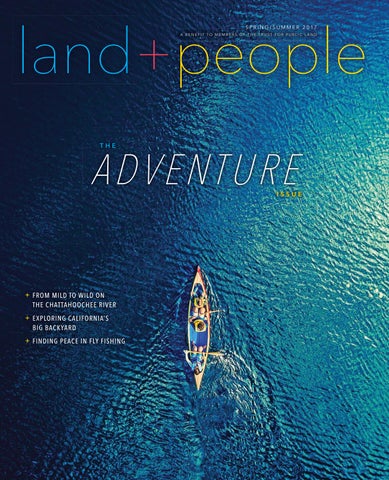
S P R I N G / S U M M E R 2 0 17 A BENEFIT TO MEMBERS OF THE TRUST FOR PUBLIC LAND
ADVENTURE THE
ISSUE
+ FROM MILD TO WILD ON THE CHATTAHOOCHEE RIVER + EXPLORING CALIFORNIA’S BIG BACKYARD + FINDING PEACE IN FLY FISHING
From famous landmarks to hidden backcountry, our public lands are the pride of the nation. But in statehouses and the halls of Congress, powerful politicians are working to convert this public property to private profit. The Trust for Public Land believes the agenda to dismantle our public lands is out of step with the needs of everyday Americans. If you agree, take action now.
WRITE YOUR OFFICIALS
SIGN THE PETITION
SUPPORT OUR WORK
SPREAD THE WORD
h o l l is b en n ett
32
contents
39 “We want to blow their minds with how amazing our landscape is.” ~ m o rg an g o o d w i n v ic e m ayo r o f t ru cke e , cal i fo r ni a
50 ian maclellan
rach id dah n o u n
F EAT U R E S
Work Hard, Play Hard .................................... . . . . . . . . . . . . . . . . . . . . . . . . . . . . . . . . . . . 32 Sierra Nevada communities thrive by offering up every mountain sport under the sun—but locals don’t take conservation for granted.
The Blueway Forward .................................... . . . . . . . . . . . . . . . . . . . . . . . . . . . . . . . . . . . 39 The onetime industrial towns of the Chattahoochee River Valley hope to put their river to work again.
Owning Ascutney .............................................. . . . . . . . . . . . . . . . . . . . . . . . . . . . . . . . . . . . 50 When the people of one Vermont town stood to lose their ski spot, they took matters—and the mountain—into their own hands. T P L. O R G · 1
JAN
FEB
MAR
APR
M AY
JUN
JUL
AUG
SEP
OCT
NOV
DEC
Help conserve land for people every month of the year. It’s easy, automatic, and secure. Join today.
tpl.org/monthlygiving
D E PA RT M E NTS
Board Spotlight · 13
18
meg an mcco r mick
Adventure awaits — outside
sarah l adu ke
From the President · 11
contents
Page Knudsen Cowles
Contributors · 14 Mailroom · 15 First Look · 17 Monumental gains, young
21
farmers, and one proud lobbyist
Insight · 28 Chad Brown, the river is a place of healing
Member Center · 62
jim brandenburg
For angler, artist, and veteran
Offices · 63 Trail’s End · 64
o n t h e cover On land and on water, the places we go to find adventure need your help now more than ever. Learn how you can take a stand for public land on page 11.
JOI N U S ON FAC EB O O K Scan the QR code with your mobile device to stay tuned to the latest news, videos, contests, and more. facebook.com/tpl.org
23 T P L. O R G · 3
an n i e ban g
4 · LAND &PE OPL E · SPR I NG /SUMMER 2017
contents
LOS ANGELES RIVER, LOS ANGELES, CALIFORNIA In November, Angelenos enthusiastically approved a ballot measure to fund parks and playgrounds in the neighborhoods that need them most. During an election that often underscored the nation’s divisions, conservation measures performed well with voters across the political spectrum.
Page · 21
21
T P L. O R G · 5
holli s b e n n e tt
6 · LAND &PE OPL E · SPR I NG /SUMMER 2017
contents
COLUMBUS WHITEWATER PARK, COLUMBUS, GEORGIA The urban whitewater experience is a little different from running rivers in the wilderness: here, the rapids are built from the rubble of decommissioned dams, the water level—and difficulty—can be adjusted throughout the day, and spectators catch the action while enjoying a cold one at a waterside brewery.
Page · 39
39
T P L. O R G · 7
je rry mon k man
8 · LAND &PE OPL E · SPR I NG /SUMMER 2017
contents
MT. ASCUTNEY, WEST WINDSOR, VERMONT For small towns, offering yearround recreation is a way to boost local business. Long known for its ski hill, West Windsor is rebounding from tough years of low snow by courting mountain bikers: new flow trails and fatbike rentals provide more options for adventure in all seasons.
Page · 50
50
T P L. O R G · 9
OFF IC E R S pre si d e n t an d chie f exe c ut i ve o ffi c er
William B. Rogers vice p re s i d e n t an d d i recto r of co n s e rvat i o n fi n anc e
Will Abberger s e n i o r vi c e p re s i d e n t a n d directo r o f c i t y park dev elo pm en t
Adrian Benepe s e n i o r vi c e p re s i d e n t an d d i vi s i o n d i re cto r
Raymond Christman s e n i o r vi c e p re s i d e n t a n d directo r o f co n s e rvat i o n st rat eg i es
Ernest Cook vice p re s i d e n t an d d i recto r of p ro g ram d e ve lo p me n t
Jad Daley s e n i o r vi c e p re s i d e n t an d d i vi s i o n d i re cto r
Jeff Danter vice p re s i d e n t an d directo r o f fe d e ral affa i r s
Kathy DeCoster s e n i o r vi c e p re s i d e n t , ge n eral co un s e l, an d sec reta r y
D. Malcolm Carson s e n i o r vi c e p re s i d e n t an d c hi e f p hi lan t hro py o ff i c er
our mission:
THE TRUST FOR PUBLIC LAND CREATES PARKS AND PROTECTS LAND FOR PEOPLE, ENSURING HEALTHY, LIVABLE COMMUNITIES FOR GENERATIONS TO COME.
Margie Kim s e n i o r vi c e p re s i d e n t an d d i vi s i o n d i re cto r
Ann Morgan vice p re s i d e n t an d directo r o f g i s an d p l a n n i n g
how you can help: Our work depends on the generous support of people like you.
Breece Robertson s e n i o r vi c e p re s i d e n t , c h i ef f in an c i al o ffi c e r, an d t rea su rer
Cynthia Scherer
donate: Use the envelope inside this magazine, or visit tpl.org/donate for other easy ways to give.
vice p re s i d e n t an d d i recto r of lan d p rot e ct i o n
Brenda J. Schick vice p re s i d e n t an d directo r o f human re so u rc es
Barbara Smith s e n i o r vi c e p re s i d e n t an d c hi e f marke t i n g o ff i c er
Shannon Morgan Stearns s e n i o r vi c e p re s i d e n t an d c hi e f o p e rat i n g o ff i c er
Tim Wohlgenant
1 0 · LAND &PE OPL E · SPR I NG /SUMMER 2017
learn more: Get timely updates on our park and conservation work near you. Sign up for our e-newsletter at tpl.org/enews. share: Help us make the case for parks and open space. When you’ve finished reading this issue, pass it on! Land&People magazine is a benefit to members of The Trust for Public Land.
ADVENTURE AWAITS — OUTSIDE Where do you go to find adventure? Maybe you heed the call of the mountains,
elyse leyenberger
from the president
drawn to the challenge of sheer walls, steep publisher Shannon Morgan Stearns editorial director Eliza Sarasohn
slopes, and lofty summits. Or perhaps you seek out whitewater, for the rush and roar of running the rapids and the triumph of emerging into stillness on the other side. You might also find adventure closer to home— in a neighborhood park or local open space, or
art director Matt Mullin
on the winding route of an urban greenway. These are the everyday places we go to test our-
managing editor Alia Salim
selves against our goals: whether it’s a new personal best on our daily run, adding a hard-to-find
photography coordinator Elyse Leyenberger
warbler or tanager to a birding life-list, or, for the youngest among us, simply reaching the top
But whatever adventure means to you, chances are, you’ll find it outdoors.
writers Julia Busiek Allie Ferguson
of the jungle gym. The definition of adventure is
marketing Kristen Anderson
it outdoors.
of experience in almost every state in the union.
digital production Carrie Gotch Adele Wilson
This issue of Land&People features stories about
con tributing editor Bill Poole
© 2017 The Trust for Public Land. All rights reserved. Conserving Land for People, Conserving Nature Near You, Creating Parks and Protecting Land for People, Fitness Zone, Land for People, Land&People, LandVote, Northwoods Initiative, Our Land, Parks for People, ParkScore, The Trust for Our Land, The Trust for Public Land, TPL, and The Trust for Public Land and LandVote logos and all other names of The
personal—the product of our individual curiosi-
choice by offering our expertise in conservation
ties, boundaries, and aspirations. But whatever
planning and financing, park design, and land
adventure means to you, chances are, you’ll find
acquisition—all informed by more than 40 years We couldn’t do this work without the sup-
adventures near and far. While the settings are
port of people like you. Wherever you go for
very different—from a meandering river in Geor-
adventure, we hope you’ll continue to help us
gia to a mountain range in California—you’ll
make the case for the ongoing protection of our
find that the people working to protect them
treasured and increasingly endangered public
have a lot in common. In each story, residents
lands. At tpl.org/publiclands, you’ll find more
are striving to support their neighbors while also
information on how to help us preserve our
reaching out to adventure seekers farther afield.
national parks, forests, wildlife refuges—and all
And each community is finding that land conser-
the places we go to find adventure.
vation has practical benefits beyond the personal satisfaction we find in the great outdoors. As one Sierra Nevada business leader told us, “Our natural resources aren’t just critical for the recreation economy, but for the entire economy of the region.” At The Trust for Public Land, we believe invest-
Trust for Public Land programs referenced herein, as well as their logos, are registered or common law trademarks of The Trust for Public Land.
ing in parks and public land is a sensible and
Will Rogers
sustainable strategy for creating healthy, livable
president and ceo
communities for generations to come. We’re proud to assist towns and cities that make that
T P L. O R G · 11
BE A LEADER. Connect more people to nature by becoming a Conservation Champion today. With your annual leadership-level contribution of $2,000 or more in general support you will receive invitations to special events and insider updates on our park and conservation strategies.
Learn more about the impact you will have as a Conservation Champion. Call Haley Nielsen at 415.800.5189.
conservation ch a mpions tpl . org/ champion s | ch ampion s @tpl.org
board spotlight
Get to know BOARD O F D I RECTO RS
Thomas S. Reeve
Page Knudsen Cowles has served on the
sarah derag o n
chair
Page Knudsen Cowles national board of The Trust for Public Land since 2000 and recently concluded her term
Stephen W. Baird
as chair. She has also served on the boards of George Bell
the Children’s Theater Company, Planned Page Knudsen Cowles
Parenthood Minnesota/South Dakota, St. Paul William J. Cronon
Academy and Summit School, Graywolf Press, Douglas Durst
and Unity Avenue Foundation, and is president F. Whitney Hatch
of the Madison Valley Park Foundation. A
Ignacia S. Moreno
Chartered Financial Analyst, she is a director of
Caroline P. Niemczyk
Lawrence Creek, LLC, a private investment
Michael E. Patterson
company, and managing director of Knudsen
Jeffrey A. Resnick
Vineyards in Oregon’s Willamette Valley.
Laura Richards Roy Richards Jr. William B. Rogers Lex Sant Sheryl Tishman F. Jerome Tone Ana Valdez Susan D. Whiting
I JOINED THE BOARD BECAUSE … my childhood
ownership—empowering them to be committed,
friend Martha Wyckoff invited me to a board meet-
long-term stewards.
ing in the Twin Cities. What really drew me in was the energy and enthusiasm of the board: I came for
THE KEY CHALLENGE FACING THE TRUST FOR PUBLIC
the work, but I stayed for the people.
LAND IS … the reauthorization and full funding of
MY PROUDEST ACCOMPLISHMENT AS A BOARD
fortunate to grow our level of private philanthropic
the Land and Water Conservation Fund. We’ve been MEMBER WAS … meeting the philanthropic goals
support, and we’re excited about the possibilities
of our first comprehensive campaign, the Power
of public-private partnerships. But public funding
of Place.
still is and always will be critical to our work, and the LWCF is the most significant source of national
A GREEN ER READ Land&People is printed in the United States on chlorine-free, 30 percent postconsumer recycled paper and manufactured using Envirotech™ ink, which contains a high percentage of ingredients derived from renewable resources. Printed by Quad/ Graphics Inc., Wisconsin.
THE TRUST FOR PUBLIC LAND’S WORK IS UNIQUE
public funding available.
BECAUSE ... we’re the national organization that’s been working to create parks and open space in
I FIRST FELL IN LOVE WITH THE NATURAL WORLD
urban areas ever since our founding in 1972.
WHEN … the dads in our family took my broth-
That sets us apart from other groups with large-
ers, cousins, and me on a backpacking trip in the
landscape conservation as their core mission. Our
Oregon Cascades. We slept out on tarps, scrambled
work has always been about land for people, and
up scree fields, and drank right out of mountain
people increasingly live in cities—so our urban
streams. I’ll always remember the sense of freedom,
work is becoming ever more important.
awe, and respect for the natural world I gained on that trip.
I SUPPORT THE TRUST FOR PUBLIC LAND BECAUSE … the work is relatively permanent in an everchanging world. We ask communities what is important to them and help them realize their vision. When the space is complete, people feel a sense of
?
WHAT ABOUT YOU? Tell us how you connect with nature. Join the conversation on Facebook: facebook.com/tpl.org T P L. O R G · 13
contributors
Hollis Bennett
Ian MacLellan
Jonathan Mingle
story:
story:
story:
The Blueway Forward
Owning Ascutney
Owning Ascutney
50
39
50
Hollis Bennett is an award-winning
Ian MacLellan is a photographer and film-
Jonathan Mingle is a Vermont-based free-
photographer based in Nashville, Tennessee.
maker based in Somerville, Massachusetts—
lance writer whose work has appeared in The
Originally from Knoxville, he’s lived in big
he can often be found exploring the woods
New York Times, Slate, The Boston Globe, Undark,
cities and remote communities on three
of New England. In between assignments and
Atlas Obscura, and Quartz. His 2015 book Fire
different coasts—East, West, and Alaskan—
editing, Ian rock climbs, runs, canoes, surfs,
and Ice: Soot, Solidarity, and Survival on the Roof
and can find common ground with almost
and bikes; he has a practiced eye for images
of the World examines the global health and
anyone: his work has appeared everywhere
of people enjoying the outdoors.
climate impacts of black carbon pollution.
from The Hollywood Reporter to Field&Stream.
maclellanimages.com
jonathanmingle.com
EVEN MORE LAND&PEOPLE Download the free Land&People iPad app—available now at the App Store. The digital edition includes all the stories you love in high resolution, plus bonus content like video, search tools, easy social media sharing, and instant links to learn more. If you don’t have an iPad, you can access the digital edition online at tpl.org/lpdigital. Wherever you see the pointer symbol below, you’ll find bonus content in the digital edition. Download the app or go online to dive deeper into the story.
1 4 · L AND &PE OPL E · SPR I NG /SUMMER 2017
ipa d is a registered tra demark of ap ple inc ., registered in the u.s. and other countries. app store is a service mark of apple inc.
hollisbennett.com
mailroom
sh asta g ren ier
JOI N OUR COMMUNI TY Count on Olympian Kara Winger to make a point of public lands! Join us on social media for inspiration from athletes, artists, and everyday
court esy kara w in g er
advocates for parks and open space.
LOVE PARKS? TAKE NOTE!
Last summer, we asked these kids to imagine their dream park. This summer, we’re building it: groundbreaking for Story Mill Community Park in Bozeman, Montana, is right around the corner.
We want to hear your ideas, too: tell us about your perfect park—or let us know what you think about the people and places in this issue of Land&People. You can reach us by mail, on Facebook, or at mailroom@tpl.org.
F A L L / W I N T E R 2 0 16 A BENEFIT TO MEMBERS OF TH
E TRUST FOR PUBLIC LAND
Now, more than ever …
+ Federal lands are the birthright of all
Our readers believe in land
Americans, not just the powerful and
for people.
well placed. We need these lands to remain under federal management and
Why we believe in the
10-minute walk
+ YOSEMITE GAINS 400 ACRES + A TRIBE RETURNS TO THE COAST + TERRY TEMPEST WILLIAMS ON TELLING THE WHOLE STORY
+ I love the work you do! It is so
ownership as they are for all genera-
important, so humane—and so
tions to come.
human. The completed projects
Shari Kearney, via the blog
affect the lives of so many everyday, ordinary people of all kinds,
+ Land&People magazine is excellent,
in so many positive ways. The
and I’m hoping it will be a recruiting
Trust for Public Land’s publica-
tool during this time of public lands
tions are the only ones I really
crisis. The Trust for Public Land saved
read. They’re compelling, inter-
my backyard at Early Winters, Washing-
esting, and focused on people.
ton—I carved the sign that stands at the
Thank you for the marvelous
primary trail intersection there.
work you are doing.
Eric Burr, Mazama, Washington
Judy Kirman, via email T P L. O R G · 15
rach id dah n o u n
n ich ol as l ea b r u n o
mailroom
The spirit of aloha In Hawaii, The Trust for Public Land works to protect places that honor Hawaiian heritage — like the Ala Kahakai National Historic Trail. + The Island of Hawaii is our adopted home. I work in the community as a healthcare provider, and we have been blessed to be welcomed with aloha to our new home. In becoming members of the community, we respect the traditions of those people who have lived here for hundreds of years, and who had such intimate relationships with the land and the ocean. We feel fortunate that these traditions are kept alive
A tribe returns to the California coast
Protecting ‘America’s best idea’
by current generations of Hawaiians.
Readers were moved by the story of
+ Thanks for the great article on the
We look forward to walking portions of
the Kashia people, reunited with their
marvelous addition to Saguaro National
the trail and maybe hearing some of the
ancestral land after being forced inland
Park. I live next to the Rincon Moun-
stories being told in the waves, the land,
more than a century ago.
tains, surrounded by these amazing
and the wind.
cacti. Being situated on the top of a hill,
Ross Hardwick, via the blog
+ This does my heart and soul good. We
I love watching the monsoon thunder-
are, as a global community, becoming
storms roll in—but, sadly, our two big-
wiser and more respectful of each other
gest saguaros were killed by lightning.
and our surroundings. Thanks to all of
We had a snowstorm and week-long
those that made this wonderful accom-
freeze a few years ago during which the
plishment happen.
park lost a number of the “ancients.”
Doug Dawson, via Facebook
They’re not invincible, and they must be protected.
WATCH THE VIDEO @
TPL.ORG/KASHIA
Karen Christian, via the blog
robb hirsch
+ Reading about how The Trust for
Vote #YesOnA to make sure our #LosAngelesParks stay safe, clean, and healthy!
Public Land helped Yosemite grow by 400 acres sparked my interest, so I went to your website—where I saw that you
actor julia louis-dreyfus
also recently helped Saguaro National
(@officialjld) tweeted her support for
Park expand. This kind of work, helping
measure a — which went on to win in
preserve land for parks, is exactly why
november. learn more on page 21.
I make donations … a small token of thanks and appreciation for what your organization does. Michele Aubry, Alexandria, Virginia 1 6 · L AND &PE OPL E · SPR I NG /SUMMER 2017
LAND&PEOPLE IS LISTENING! Send letters to the editor or change your mailing address: mailroom@tpl.org.
adventure is worthwhile in itself. a m eli a ea r h a rt
Talk about good problems: the Saddle Boulders are a climber’s dream. Sierra Nevada gems (and granite) like this are protected thanks to your support. Learn more on page 32.
turn the page for … an artist ’s inspiration a real celebrity workout 50-foot-tall cacti T P L. O R G · 17
edible conservation
Starting fresh
zena springs farm school, salem, oregon
Unlike a lot of kids their age, the
developed. Today, she teaches gardening
to cook with what they harvest, kids
students at the Zena Springs Farm
and cooking to students aged 5 to 14,
get a hands-on education in ecology by
School in Oregon’s Willamette Valley
many of whom have struggled to suc-
exploring the property’s varied habitats.
know exactly where their food comes
ceed in traditional classroom settings.
from—because they grow it themselves.
“Throughout the harvest cycle,
By immersing the valley’s youth in the day-to-day work of sustainable farm-
And once they pick their produce, they
there’s a task for every kid, at every
ing, Walton aims to bolster the region’s
know where it’s headed, too: they carry
age. We’d have five-year-olds who are
network of small farms. “I know a lot of
the harvest about 20 steps from the
the best at starting a tray of seeds—it’s
the small farmers in the area, and they
garden to a kitchen built into an old
that kind of meticulous work that really
always need skilled labor,” she says. “I’d
barn, rinse off the mud and bugs, and
appeals to that age group. Ten-year-olds,
like the farm school to be a place where
get cooking.
just give them a shovel and they’ll dig
kids can learn those skills, and maybe
“Kids love to be in the garden, and
all day.”
get a job nearby once they graduate.”
they love to cook,” says Anne Walton,
The Trust for Public Land has helped
Even if her students opt for a less
who started the school at Zena Springs
gardens grow at schools across the
muddy career path, Walton knows that
in 2014. Walton worked with The Trust
country. But at Zena Springs, the garden
lessons learned from a season of farm-
is the school—and so are the creeks,
ing will stick with them. “If you can tell
pastures, forests, and wetlands that
people you have farm experience, they
in her family for more than a century—
make up Walton’s 160-acre farm. Along
know you’ve had to really work,” she
so that it will never be subdivided or
with tending to crops and learning how
says. “That commands respect.” sarah laduke
for Public Land to create a conservation easement for the farm—which has been
1 8 · L AND &PE OPL E · SPR I NG /SUMMER 2017
f ran k s. bat h is
buzzworthy
Vegetable fritters O 1-1/2 lbs. zucchini or any summer squash O Salt and pepper O 2 or 3 ears of corn O 2 eggs O 1/3 cup cold water O 1/3 cup flour O 3 tbsp. finely diced onions O 1/4 tsp. ground cumin O 2 tbsp. oregano, parsley, or basil,
Development plans for this stretch of coast once included a subdivision and a nuclear power plant. Today, it’s protected as a national monument.
chopped (optional) O Olive oil
Using the largest teeth of a grater, grate zucchini onto a clean kitchen towel. Sprinkle with salt and let rest while you prepare remaining ingredients. Cook the ears of corn in boiling water for 1–2 minutes. Cut the kernels off the cob.
LEARN
“It is not only the prayers and ceremonies of the native people that are needed to save Mother Earth. It is the prayers and ceremonies of all people.”
MORE @
TPL.ORG/ COASTDAIRIES
Wrap zucchini in the kitchen towel and remove excess liquid.
—Valentin Lopez, chair of Amah Mutsun Tribal Band
In a medium bowl, whisk eggs, water, and flour. Add the zucchini, corn, onion, cumin,
Ancestors of the Amah Mutsun once walked
pepper, and herbs. Mix well and salt to taste.
the Cotoni-Coast Dairies property, which was
Heat a tablespoon of oil in a skillet on medium-high. Spoon 2-tablespoon mounds of batter into the pan and flatten gently with
designated part of the California Coastal National Monument by outgoing President
spatula. Cook until the fritters are golden
Obama in January. When development threat-
brown, 4 to 6 minutes each side.
ened this seven-mile stretch of open meadows
Makes 14–16 4-inch fritters. Serve with fresh salsa or Greek yogurt, or enjoy them plain. (Adapted from Katherine Deumling’s recipe at cookwithwhatyouhave.com)
and shady redwood groves, supporters of The Trust for Public Land stepped up to protect it. Today, we’re thrilled to see this special place get the recognition it deserves. F I R ST LO O K · 19
david diaz n g
So L.A.
good news
READY TO SEE OR BE SEEN AT RUNYON CANYON? HERE ARE FOUR TIPS FOR MAKING THE MOST OF THIS L.A. LANDMARK. B E AT THE HE AT The steep hillsides sport wild chaparral and vibrant wildflowers in the spring, but there’s little tree cover for shade: bring plenty of water
1
and get an early start to avoid hiking in the heat of the day.
B .Y. O. G L A MOUR Runyon’s location makes it prime for celebrity spotting. But why spend your trail time scouting out stars when you can be one yourself?
2
All you need is a ball cap, big sunglasses, and an air of mystery to keep your fellow hikers guessing.
HE E L , SI T, STAY You can expect a sizable canine
In a city as enormous and diverse as Los Angeles, it’s debat-
contingent on the trails at almost
able whether there’s any such thing as the quintessential park
any time of day: part of the park is
experience. But if it exists, you’ll find it at Runyon Canyon: 150 acres of open space just blocks from Hollywood Boulevard. At this popular hiking spot on the east end of the Santa
an off-leash area. If you bring four-
3
legged friends, make sure they’re comfortable running with the pack.
Monica Mountains, a variety of routes—from stroller-friendly fire roads to daring rock scrambles—reward visitors with views that stretch from the downtown skyline to Griffith
STRI K E A P OSE
Observatory. (Also in frame: the Hollywood Sign and, on clear
Outdoor yoga offers an alter-
days, the Pacific Ocean.)
native — or a warm-up — to a
With a backdrop like that, it’s no wonder the park is
Runyon hike or run. Classes are
a favorite of Angelenos from all walks of life. But even Runyon regulars seldom realize that until earlier this year, a good chunk of the canyon was privately owned. When the property came up for sale and was threatened by development, The Trust for Public Land was able to protect it.
2 0 · L AND &PE OPL E · SPR I NG /SUMMER 2017
offered daily and are free, though
4
donations in the $5–$15 range are a welcome addition to your “Namaste.”
word watch
B ILLION
what counts
saguaro /s '·(g)wär·ō/ … in park and conservation funding was approved by voters across
(n.) A species of cactus that can grow up to
the country in the November 2016 election. In all, 86 state and local ballot
50 feet tall — and the namesake of one of the
measures got the go-ahead—proving once again that love of the land can unite Americans of all political stripes. The Trust for Public Land pitched in on 31 of those winning initiatives,
few national parks to border a major metro. Located just outside Tucson, Arizona, Saguaro
including Boston’s Community Preservation Act. Boston established its
National Park expanded by almost 300 acres
first park back in 1634, and a rich heritage of public spaces has been a part
last fall thanks to supporters of The Trust
of the city’s identity ever since. But today, population and housing prices are soaring—forcing tough choices about land use—while climate change and sea level rise pose threats to low-lying neighborhoods. Passage of
for Public Land. That’s good news for city dwellers seeking a desert escape, and for
the measure creates new funding for affordable housing, historic preserva-
thirsty plants and wildlife: the addition pro-
tion, and parks—including green infrastructure solutions that can help
tects a segment of Rincon Creek, the park’s
alleviate flooding.
largest seasonal stream.
learn more @ TPL.ORG/FUNDING
learn more @ TPL.ORG/CACTUSFACTS
F I R ST LO O K · 21
do u g l as bar n es ph oto g raph y
buzzworthy
“We, as a species, are meant to be moving. I can’t overemphasize for
Without public access points for paddlers and anglers, the Teton River would be out of reach.
my patients the importance of getting out and walking in a park. It makes all the difference in the world.” —Dr. Grace Alfonsi, MD
Keeping summer fun afloat The most popular access point to the Teton River has long been a gravel boat ramp located on private land just west of Driggs, Idaho. On summer days, this spot is a bustle of canoeists, paddleboarders, and families floating
Dr. Alfonsi leads health-focused walks at
on inner-tubes—all looking to cool off on the river’s lazy curves through
neighborhood parks all over the city of
the plains near the Wyoming border. It’s also a hub for fly-fishing guides
Denver — including Mestizo-Curtis Park,
and local anglers hoping to snare a Yellowstone cutthroat trout.
recently rebuilt with help from The Trust for
“The boat ramp is a wonderful access to a legendary, blue-ribbon fishery
Public Land. A new Fitness Zone® area, play-
that we’re lucky to have,” says Perk Perkins, CEO of the sporting brand
ground, and walking paths offer an array of
Orvis. “At the same time, it could be a lot better—there’s never enough
options for outdoor workouts that the doctor says can lower the risk of hypertension, diabetes, and other ailments.
parking, it’s all rutted out, and nobody really takes care of it.” When Perkins heard that the boat ramp was on the market last year, he was one of the many anglers who pitched in to protect it for the public. Thanks to their support, The Trust for Public Land was able to purchase the
LEARN MORE ABOUT MESTIZO-CURTIS PARK @ TPL.ORG/MESTIZOCURTIS
80-acre property and transfer it to Teton County. Work is now under way on the first phase of the future Bates Teton River Access Park: improved parking and a better boat ramp are expected to open this summer.
2 2 · LAND &PE OPL E · SPR I NG /SUMMER 2017
good news
A PHOTOGRAPHER HONORS HIS MUSE: a lake Jim Brandenburg has traveled to the ends of the earth
bears, otters, ducks, eagles, owls, and even wolves roaming
as a photographer on assignment for National Geographic. But
the forests nearby.
wherever his camera takes him, Brandenburg’s heart is on the shores of Judd Lake in the Northwoods of Minnesota.
“People tend to think of the Midwest as this vast expanse of flat, homogeneous land, with nothing wild left to offer us,”
“It’s my home, and it’s the center of my universe,” Bran-
says Brandenburg. “But I think the success I’ve had as a pho-
denburg says. “When I’m traveling, I always think back to
tographer is proof of the richness that’s everywhere in this
Judd Lake and it makes me happy.”
part of the country … if you know how to look for it.”
Brandenburg and his wife, Judy, have worked for nearly
Judd Lake now enjoys strong protections that will prevent
their entire adult lives to piece together the properties sur-
it from being subdivided or developed. It will forever welcome
rounding Judd Lake into one protected landscape. Late last
paddlers and hikers to experience the place in much the same
year, after more than a decade of work with The Trust for
way that Brandenburg has: patiently, quietly, in search of mo-
Public Land and local partners, the Brandenburgs conserved a
ments of breathtaking natural beauty.
seamless complex of hundreds of acres of wildlands adjacent to the Boundary Waters Canoe Area. Brandenburg says he felt driven to protect Judd Lake because it was the place that launched his career as one of America’s most acclaimed nature photographers. He has spent
The wild Midwest: it’s out there, if you know where to look.
countless hours over the decades waiting, camera in hand, in all seasons, for the right light to shine on its rippling waters,
jim brandenburg
rocky shores, and tumbling waterfalls. He has photographed
F I R ST LO O K · 23
what counts
meet our staff
a n drew propp
“Whatever your politics, it’s a human impulse to be calmed, refreshed, and rejuvenated by nature. It’s how we’re built.”
10.9 MILLION PEOPLE
BRITNI RILLERA WHY THE TRUST FOR PUBLIC LAND’S SENIOR LEGISLATIVE REPRESENTATIVE IS PROUD TO BE A LOBBYIST MAKING THE CASE FOR PARKS
… will live in the Dallas-Fort Worth area by the year 2040, according to population projec-
What are you up to in Washington, D.C.?
tions, making this the second-fastest-growing
The Trust for Public Land’s Federal Affairs team makes the case to elected
metro in the country. To ensure that residents
officials that conservation matters—and their constituents deserve and
have somewhere to get outside as the community grows, the city is working with The Trust for Public Land to plan ahead for parks and open space. The Smart Growth for Dallas
benefit from a strong, well-funded system of public lands. We’re a resource for lawmakers who want to do more with public land, and we’re part of the strong national coalition that’s out here defending it from legislative attacks and defunding.
plan kicked off with community workshops
How did you get into this line of work?
and GIS mapping. Both will help identify
I got hooked on policy as an undergraduate and tried a little bit of every-
where parks can do double-duty as protec-
thing in the political world after I graduated—I worked for a Senate com-
tion against flooding and the urban heat
mittee, then the White House, then did some grassroots organizing. All of
island effect—so Dallas can get the most
that confirmed that I’m a policy wonk at heart! I came back to D.C. and
bang for its buck.
began working for Georgia Congressman John Lewis. My biggest accomplishment as part of his team was writing the legislation for expanding the
2 4 · LAND &PE OPL E · SPR I NG /SUMMER 2017
Site—which The Trust for Public Land
on Capitol Hill lobbying in support of
helped establish back in the 1970s.
that bill. We want lawmakers to know
How can everyday people become advocates for parks and conservation?
that their constituents, no matter their
There are as many ways to make a dif-
What does a typical day look like for you?
political affiliation, value the parks and
ference as there are places that need
open space that LWCF makes possible—
your help. No matter where you live,
Lobbyists get a bad rap, but at its heart,
and that if the program is cut, their
there is a park nearby that could use
lobbying just means making an argu-
constituents will remember that come
you as a volunteer—and local organiza-
ment to the government—so, I’m a
the next election.
tions that can help you get started. We
Martin Luther King, Jr. National Historic
right now, so we’re out in the field and
lobbyist for parks and public land. Some
also need people to pick up the phone
times I act as a bridge between local
What’s one strategy you’ve used to get representatives to take note of LWCF?
bucket, but having worked on all sides
conservation activists from around the
Well, take my former boss, Congress-
of the process I can promise that your
country and their representatives in D.C.
man Lewis. He’s an icon of the civil
calls are counted. Even if your represen-
These folks might not know the ins and
rights movement, and environmental
tative has a great record on public lands,
outs of Congress, so I try to take that
issues weren’t always a top priority for
call them and let them know you like
days I meet with Congressional staffers to advise them on legislation. Other
and call their representatives. You might feel like you’re just a drop in the
part off of their plate so they can focus
his constituency. But the work that The
what they’re doing! It makes their back-
on telling their story.
Trust for Public Land is doing to put a
bones a little stronger when they’ve got
park within a 10-minute walk of every-
to stand up for these places.
Tell us about the most important thing you’re working on.
one in America’s cities really resonates with him. So I try to communicate
Definitely the permanent reauthoriza-
that LWCF doesn’t just protect wild or
What’s the most rewarding part of your job?
tion and full funding of the Land and
undeveloped land—it’s a crucial part of
I’ve had the chance in the past year to
Water Conservation Fund (LWCF), which
our work to build parks in cities across
travel to many of the sites The Trust for
is currently set to expire in 2018. There’s
the country.
a bill to reauthorize it in the House
Public Land is working to protect—like Ackerson Meadow, a 400-acre addition
kyle lanzer
to Yosemite National Park, and the Ala Kahakai National Historic Trail in Hawaii. It’s exciting to visit places I never experienced growing up in Los Angeles, and to meet community members there who are working so hard to preserve their cultural connections to the land. It means so much to hear from people about the impact that our work has on their lives.
Though it’s better known for supporting national parks and forests, the Land and Water Conservation Fund is also key to urban parks and greenways — like this one in Cleveland, Ohio.
F I R ST LO O K · 25
WE GIVE TO …
why we give
mich ael matt i
finish what she started
the achtermans, salem, oregon
“Gail was brilliant, fearless, and wouldn’t take ‘no’ from anybody.” courtesy chris achterman
Siblings Chris and Gail Achterman in 2010.
Elowa Falls, Columbia River Gorge, Oregon
Conservationist, environmental lawyer,
walk out with a deal.
transportation expert, scholar, athlete,
“She never set out intent on destroy-
Their marching orders received, Achterman’s loved ones began by team-
outdoorswoman … Gail Achterman was
ing the opposition or getting exactly
ing up with The Trust for Public Land.
many things, but her family and friends
what she wanted—for her, it was about
Together, they drummed up the funds
tend to describe her the same way: a
arriving at the best possible solution for
needed to purchase a 290-acre island in
force of nature.
everyone.”
the Willamette River, just a few miles
In a career spanning four decades, Achterman was the driving force be-
Achterman was working to preserve the Willamette Valley’s forests and
upstream of Gail’s childhood home in Salem. Now cared for by the Oregon
hind some of Oregon’s bedrock envi-
rivers when she was diagnosed with
Department of Fish and Wildlife, the
ronmental laws—including the bill that
pancreatic cancer. She passed away in
new Gail Achterman Wildlife Area will
established the Columbia River Gorge
2012 at the age of 62.
National Scenic Area.
But before she died, Achterman
someday serve as a boat-in park and campground.
“Gail was brilliant, fearless, and
gathered her family and friends to
wouldn’t take ‘no’ from anybody,” says
her bedside and gave them some very
her brother, Chris Achterman. “She had
specific instructions. “She told us what
that now bear her name. It’s a fitting
a unique ability to walk into a room of
her goals were for the future of the Wil-
place to honor her memory, he says: an
Chris knows his sister would have loved to kayak along the forested banks
people who were not prepared to agree
lamette Valley. Then she deputized each
island shaped by the rise and fall of the
with each other on anything—highway
of us to carry on a piece of that work.”
river, still wild thanks to the forces of
contractors on one side of the table,
Chris laughs remembering the scene. “It
nature—Gail included.
salmon habitat folks on the other—and
was so Gail!”
2 6 · L AND &PE OPL E · SPR I NG /SUMMER 2017
Double your impact today! This year, an anonymous donor will generously match your gift—dollar-for-dollar—if you send it before May 31. Your donation will go even further to help The Trust for Public Land protect more parks, gardens, and other natural places. That’s one good thing made that much better.
fig. 2
good.
better.
Give your EarthShare.
800.714.5263 donor.outreach@tpl.org tpl.org/match
An EarthShare payroll deduction is one simple way to donate to The Trust for Public Land or more than 400 other environmental and conservation charities. Many corporate and government employers support EarthShare payroll giving. If yours doesn’t, ask them to start. If they do, simply decide on a single deduction or a recurring small one from every paycheck. Then designate us, member number 11440, as one of your conservation charities. For more information visit earthshare.org or email donor.outreach@tpl.org.
F I R ST LO O K · 27
alex diekmann
fig. 1
insight
the
2 8 · L AND &PE OPL E · SPR I NG /SUMMER 2017
matt h ew dah l
Was nature a part of your childhood? I’m from Texas, and I grew up in the city. But on weekends my family would head out to see the grandparents, who had some property outside of town. My dad’s side is hunters, so I spent a lot of time outdoors with my dad and my grandfather and learned a lot about nature and wildlife from them. Age
The river accepts everybody.
eight, nine, ten, I thought I was a little Daniel Boone or Teddy Roosevelt, mounting expeditions by myself in the woods behind my grandparents’ house, setting traps that never caught anything. I was a tough, wild little kid. I didn’t realize it at the time, but now I recognize that mine was not a typical childhood for a young African American boy in that era.
THAT’S WHAT CHAD BROWN likes to tell his teenage
You’re an artist and a designer as well as an outdoorsman. How did you get into that?
students as they follow him into the water. In those moments,
My mom had an artistic, creative energy: she balanced out
these are words of encouragement to first-timers — a
that GI Joe mentality I got from running around in the woods
talisman against the foreign feel of the fly fishing rods and
as a kid. She had a sort of Woodstock hippie style in those
the unfamiliar pull of invisible currents. But for Brown himself,
days—involved in theater, always writing poems or singing—
it’s a belief that saved his life.
anything creative moves her.
Brown is a U.S. Navy veteran who in the 1990s served in
As I grew up, I knew I wanted to pursue a career in the
the Middle East, Guantanamo Bay, and Somalia. Years after
arts. I got into some art schools and started classes, but it just
he returned home to the states, the symptoms of posttrau-
wasn’t affordable. So after a lot of soul-searching I made the
matic stress disorder caught up with him. He struggled with
choice to enlist in the Navy. I signed up because I had my eye
alcohol and homelessness. He contemplated suicide.
on that diploma and I knew the GI Bill would help me pay for
But at his lowest point, Brown discovered fly fishing and
it. I made a promise to myself that I would come back and fin-
the rivers of the Pacific Northwest. “Whatever medication I
ish—and after my tours of service, that’s what I did. I earned
was on at the time,” he says, “I remember wading into the
my degree and worked in the advertising world in New York
middle of that beauty and feeling really alive for the first time
for several years before I came out here to Portland.
in I don’t know how long.” Brown chased that feeling, returning to the rivers until his
That was a tough time for you.
head started to clear. A few years after he first picked up a fly
Yes. Moving to Portland—the slower pace and the distance
rod, he launched what would become a successful business,
from my family—it dislodged some of the darkness that I’d
designing fly-fishing gear that reflects his urban roots and
been carrying around with me from my time in the navy. I
military experience. He named the venture Soul River Runs
started drinking; I lost my job and then my housing. I was on
Deep — an homage to all he’s discovered on the water.
and off heavy medications.
And he didn’t stop there. With profits from the business,
I started going fishing in part because I didn’t have a lot else
Brown started a program that brings fellow military veterans
to do. I’d done some rod and reel fishing with my dad when I
together with students from predominately African American
was younger—where we’d dig up a can of worms and go fish
and Latino neighborhoods in his home city of Portland. To-
for perch—but I learned to cast a fly from watching YouTube
gether, they study the art, science, philosophy, and discipline
and reading books. I spent hours and days hanging around in
of fly fishing.
fly shops. They became like my living room: good conversa-
Though busy preparing for a summer packed full of these
tion, people coming around to talk about this fly and that
“deployments” — river trips from Portland to Michigan and
river. People there didn’t necessarily know my story, but they
all the way up to Alaska — Brown took some time out to talk
accepted me for who I was, and they were down to share what
about what he found when he went looking for fish.
they knew. My friends on the river became like my family.
I N SI G H T · 29
Do you remember your first catch? The first time I ever hooked into a salmon on a fly rod was
What is it about fly fishing that makes it a good introduction to the natural world?
down on the Sandy River. It was a crazy run—all these salmon
Fly-fishing is something that kids from Portland’s predomi-
were jumping and splashing and raising a ton of noise. For a
nately black and Hispanic neighborhoods have not typically
good four or five years, moments like that were what I had to
been exposed to. It’s a totally new environment, which helps
live for. I’m saying, I was selling my blood down at the blood
set the stage for learning about themselves and their relation-
bank so I could buy gas for my truck just to get me to the
ship to the natural world.
river. All I knew was that at a time when I was trying to figure
To be a keyed-in angler, you need to approach it from a sci-
things out and cope with what I was dealing with, fishing
entific perspective—but also as an art and as a devotion. If you
made me happy.
care about catching a fish, then you better care about that fish having clean water to swim in. So we start by talking about
How did you get back on your feet?
ecology and conservation and climate change. Fly fishing is a
One thing I did learn from my military service was to never
thread that weaves so many of these important aspects of our
give up the fight. Life has dealt me an interesting deck of
lives together out on the river.
cards, not all of them good. I can say that life has stripped me ability to punch through to the other side of the pain. And I
What do you hope the students take away from their time on the river with you and the other veterans?
tend to fall back on that discipline the military has given me
There is a certain bond that develops when kids and veterans
to persevere.
are out in nature together, but that weekend deployment on
down to the skin, to the point where all I’ve had left was that
Things changed for me when I launched my business,
the river is just the start. We’re forming a tribe of people that
which melds my two passions: design and fly fishing. Now
stick around for each other. As a veteran, that means going above and beyond the call of duty to stay involved in that kid’s life, their family’s lives. Our vets are showing up to the
Portland with volunteer leaders who are military veterans.
kids’ school assemblies, football games—even a court date. photos pages 30 & 31: chad brown
I’m able to direct a lot of the profits from that toward supporting our program that brings together kids from inner-city
3 0 · L AND &PE OPL E · SPR I NG /SUMMER 2017
And for their part, when kids come home from the program, they’re talking about their conversations with the veterans and what they’ve experienced in nature, and they’re bringing that like a bottle of medicine and dumping it right into the nucleus of the living room. They are becoming advocates for the environment and bringing their families along with them. I had one parent tell me, “My daughter, when she came back she taught me how to recycle. I’m 55, and for the first time in my life we’re actually practicing that in our house.”
All that from a fishing trip? I’m not really out there pushing fly fishing. My soul river is fly fishing, but your soul river could be backpacking, or it could be mountain biking, or writing a poem, or getting real into birds. What I want to highlight for people is that there’s a place in the outdoors where you can find your healing. It’s about knowing where to go that you can find the strength to
Do you have a favorite fishing hole?
deal with whatever life might send your way.
Absolutely I do, but I’m sure not trying to let that information
I think that’s why I like fishing for steelhead. It’s not for the
get out in the world—that’s not how anglers work!
faint of heart. You’ve got to be a little nuts to go out there in the dead of winter, submerge yourself in freezing water waist-
Fair enough. How about a favorite river?
deep so that half your body goes numb while sleet and ice
I do love to go to the Deschutes River, so if I had to pick a
blow in your face. You’re standing there for eight hours trying
favorite that would be it. But I’m always open to exploring
to hook into that one fish, and chances are you won’t catch
new places across the nation, in search of whatever species
it. Guys go three, four years of not even hooking one. It took
I’m caught up in. But there’s this thing among anglers—it’s
me five years before I hooked a steelhead. But you remain
kind of like the fish becomes the by-product. Going fishing
consistent in your approach, getting back to that river every
becomes spiritual. You’re searching for fish, but you’re also
opportunity you can get, regardless of the weather. It’s kind
searching for happiness. You’re searching within yourself
of like the wild is calling you and you’ve got to be constantly
when you’re on the river. You’re searching for something
answering that phone.
you’ll probably never truly obtain.
I N SI G H T · 31
rachi d dahn ou n
3 2 · L AND &PE OPL E · SPR I NG /SUMMER 2017
WO R K
HA RD
PL AY
HA RD
story by julia busiek
S I E R R A N EVA DA COM M U NI TI ES T H R I V E BY OF F ER I NG U P EVERY M O U N TA I N SP ORT U ND ER TH E S U N — B U T LOCA L S D ON’T TA KE CO N S E RVATI ON F OR GR A NTED.
T P L. O R G · 33
SADDLE BOULDERS
Castle Valley Trailhead is the gateway to popular destinations including the Donner Rim Trail, the Pacific Crest Trail, and the Peter Grubb Hut. protected: 2016
3 4 · L AND &PE OPL E · SPR I NG /SUMMER 2017
R OYA L G O R G E
Straddling the Sierra Crest at Donner Summit, 3,000-acre Royal Gorge is the largest cross-country ski resort in North America. protected: 2012
photos, page 34, c lockwise: r ich re id, rachid da hno un, david galson, scot hampton.
West of Truckee, the Saddle Boulders offer an array of challenging bouldering problems on quality Tahoe granite. protected: 2003 CASTLE VALLEY TRAILHEAD
SIERRA BUTTES
In summer, anglers trawl the placid Sardine Lakes while hikers and mountain bikers test themselves on steep and rocky trails. protected: 2011
On the Fourth of July, you’ll find Morgan Goodwin—mayor of Truckee, California—camped out with his friends
To “close the checkerboard,” The
and a heap of cooking gear somewhere
Trust for Public Land has worked for
in the Cold Lakes Basin.
decades to conserve the most vulner-
“We all pitch in and feed the thru-
able parcels, transferring them to the
hikers on the Pacific Crest Trail,” he
national forests or local land trusts or
explains, grinning. “We want to blow
protecting them with conservation easements. Since 2007, the organization has
their minds: not just with great food and a friendly welcome, but also with
G AM IN G THE
pursued this work as part of the North-
how amazing our landscape is.”
CHECKERB OA RD
ern Sierra Partnership, a diverse alliance that also includes the Feather River
Even without the surprise meal, this stretch of trail is hardly a tough sell to
In the 19th century, the federal govern-
Land Trust, The Nature Conservancy,
visitors. One can only assume the Sierra
ment surveyed and divided much of
the Sierra Business Council, and Truckee
Nevada has been dropping jaws since
the public domain into parcels, each
Donner Land Trust.
the first time anyone set eyes on it—cer-
a square mile. To support the still-
tainly long before John Muir’s ecstatic
young nation’s westward expansion,
acquired and helped to restore thou-
odes first dubbed it “the range of light.”
it then granted railway companies a
sands of acres throughout the region,”
Here the mountains beckon in all sea-
right-of-way, plus outright ownership
says Fran Herbst, with the Tahoe
sons, peaks promising a playground of
of alternating parcels within a certain
National Forest. “The Trust for Public
snow-filled couloirs in winter and alpine
distance of the tracks. The legacy of
Land is the entity we’ve worked with
lakes that mirror the boundless sum-
this approach in the Tahoe region—and
the longest to mitigate the impact of
mer sky. From lazy afternoons to all-day
much of the mountain west—is a check-
the checkerboard. In recent years the
epics, there is something for everyone
erboard pattern of public and private
partnership has been huge in terms of
in the Sierra.
ownership: national forest interspersed
coordinating all the conservation efforts
with logging tracts, vacation homes, and
in the region. The focus they’ve brought
other development.
to this area is really remarkable.”
Their appeal is so broad, in fact, that the region’s popularity as an outdoor recreation destination seems only
“The Northern Sierra Partnership has
The checkerboard presents an array
natural, an inevitability written in the
of challenges for land stewards. It’s
granite. But locals and the conservation
costly and inefficient to plan one square
groups that serve them know their
mile at a time, whether the goal is
community’s success is no accident—
to harvest a forest or restore it. From
and the future is not set in stone.
mountain biking to deer hunting, most outdoor recreation—and the jobs and revenue that come with it—requires unbroken expanses of public land. And then there’s wildlife, wildfire, and
photos, page 35: ric h reid .
water: interdependent natural systems whose impacts are felt well beyond the Tahoe region.
T P L. O R G · 35
In addition to its savvy deal makers, The Trust for Public Land offers special expertise in Geographic Information Systems, or GIS. Detailed mapping— incorporating “layers” of data about everything from wildlife populations A LA N DS CA P E -S IZ ED
to timber yields—helps the partnership
Jameson Stafford, a recent transplant
BALA N C I N G ACT
direct its resources where they’ll have
to the ski town of Incline Village, counts
the greatest impact.
himself among such people. “Back in
“Land conservation is a very oppor-
Los Angeles, people love to say you can
has protected more than 100,000 acres
tunistic game,” says Perry Norris of
go to the beach and the mountains in
for the public. Its success is due in part
Truckee Donner Land Trust. “In recent
the same day. But I’ve never known
to the complementary strengths of
years, a number of key parcels came
anyone who ever did—it’s basically
its member organizations: from trail
for sale at the same time, and because
impossible,” says Stafford. “Here, you
building and landscape restoration to
we were prepared we were able to
can totally do that. I can go skiing in
fundraising and tricky negotiations, a
protect them.”
the morning and relax by the lake in
forte of The Trust for Public Land since
Part of that groundwork is bringing
its founding by a group of conservation-
everyone to the table—ranchers, timber
While Stafford moved in search of a
minded lawyers and real estate profes-
companies, small-business owners, and
less urban lifestyle, Rachel McCullough
sionals back in 1972.
more—to triage sometimes competing
and her husband, Garrett, relocated to
land-use needs. “Ranching and timber
Truckee after years of living and work-
is able to move quickly when govern-
production are an important part of the
ing in Yosemite National Park. “We
ment agencies can’t,” says Trust for
culture and economy,” Bavinger says.
were sort of heartbroken to have to
Public Land project manager Markley
So is recreation: that’s worth more than
leave Yosemite,” she says. “But we liked
Bavinger. She points to Royal Gorge—
$85 billion a year statewide. It’s impor-
that Truckee was big enough to give us
a popular cross-country ski area pro-
tant to strike the right balance.”
professional opportunities without
“By working together, the partnership
the afternoon. You can’t beat that.”
tected with Truckee Donner Land Trust
Steve Frisch, executive director of
and others in the partnership—as an
the Sierra Business Council, agrees. “Our
When I show up to work in my
example.
natural resources aren’t just critical for
hiking clothes, no one bats an eye,”
losing access to amazing wilderness.
“At one point the seller was asking
the recreation economy, but for
McCullough says. “It’s totally normal.
more than $75 million, but ultimately
the entire region,” he says. “People
I definitely wouldn’t do that in
market forces and bankruptcy negotia-
come here for the natural beauty, they
downtown San Francisco.”
tion brought the price to about a fifth of
move here, they start businesses here—
that value,” Bavinger says. “It was a tiny
so it’s not just recreation, but also real
window of opportunity, but we were
estate, retail, professional services, you
able to make it happen. Our national
name it.”
forests really need nonprofit partners to take advantage of opportunities like that: we’re more nimble and able to take risks.”
3 6 · L AND &PE OPL E · SPR I NG /SUMMER 2017
photos, page 36, c lockwise: r ich re id, emily scannell, rich reid.
For the past decade, the partnership
SCHALLENBERGER RIDGE
From the summit of this rocky ridge, hikers and mountain bikers who make the 1,000-foot climb are rewarded with a striking view of Donner Lake. protected: 2003
SECRET LAKE
W E B B E R FA L L S
photos, page 37, c lockwise: e lizabeth ca rm el, em ily scannell, p hil schermeister, william poole.
FORNI RANCH
If protected, Forni Meadows could serve as a new access point to Desolation Wilderness — one of the most popular backpacking destinations in the country. in progress
Near its headwaters, the Little Truckee River plunges through a granite canyon— scouring out a string of natural swimming holes perfect for a lazy summer afternoon. protected: 2009
Secret Lake offers a quiet spot for fishing and reflection not far off the beaten track of the Pacific Crest Trail. protected: 2010
T P L. O R G · 37
N EX T M OV E S
drilling toward protecting land and supporting community parks. Though it
In Frisch’s view, consolidating the
uses no taxpayer money and has strong
checkerboard is vital to economic sus-
bipartisan support, the fund is fre-
tainability well beyond the Sierra com-
quently raided for other purposes—and
munities he represents. “The Trust for
will expire altogether if not renewed by
Public Land’s effort to make manage-
Congress in 2018.
ment more efficient is really important
Uncertainty over how much—or even
to the entire state,” he says. “This re-
one of the most-visited wilderness area
whether—the Land and Water Conser-
gion is a source of water for two-thirds
in the country. Little wonder it has been
vation Fund will contribute adds a layer
of Californians. As the Sierra forests go,
on the Forest Service’s conservation
of complexity to conservation in the
so goes the water supply.”
wish list for more than 50 years.
Sierra. Nonetheless, Bavinger remains
As the partnership plans for the
There’s a catch, though: the same
optimistic that the partnership’s close
years ahead, water is increasingly
meadowlands valuable for preserving
coordination and data-driven approach
the determining factor in identifying
water quality, wildlife habitat, and rec-
can continue to close the checker-
conservation priorities. Years of drought
reation access are also prime locations
board—and help communities get the
and wildfire—followed by a season of
for development—and demand is high.
most out of the land.
landslides and flash flooding—have un-
Just as the downturn put places like
“Conservation is not about simply
derscored the importance of protecting
Royal Gorge within reach for conserva-
changing ownership from private to
the natural systems that capture, store,
tionists, boom times in the Reno-Sparks
public,” she says. “Together, we’re also
and release water over time.
metro and the San Francisco Bay Area
supporting restoration, trail building,
are driving up land prices in the Tahoe
and management approaches that can
in on sites that will contribute to the
region. Though the local workforce
help meet people’s needs for income,
resiliency of the larger landscape as the
faces a housing crunch, most new
recreation, and escape.”
climate changes. Of particular interest
construction is for second homes—like
to The Trust for Public Land are alpine
a billion-dollar expansion of the resort
on the support of locals and visitors
meadows, which act as fire breaks and
community at Squaw Valley.
alike—a conviction that whether the
natural filtration systems and provide habitat for diverse plants and wildlife. The organization is working with the
“It can feel insatiable,” says Bavinger.
In these efforts, the partnership relies
Sierra is your long summer vacation or
“Whenever you think the needs have
quick weekend ski trip, your training
been met, the pressure increases.”
ground, your workplace, or your home,
Forest Service to protect Forni Mead-
you have a stake in its survival. In a
ows, more than a hundred acres of
place where natural forces are fickle
former ranchland within the Eldorado
D O W N TO B ED ROCK
National Forest. Though it has seen
and conservation opportunities can appear and disappear overnight, peo-
grazing and logging in the past, the
As market forces and weather patterns
ple’s love for these mountains, Bavinger
land has been untouched for the past 20
shift, the funding climate is chang-
says, is a constant.
years and is in good health—it even sup-
ing, too. Much of the Northern Sierra
“So many people care about this
ports a population of the endangered
Partnership’s accomplishments have
place,” she says. “When it comes down
Sierra Nevada yellow-legged frog. Forni
benefited from the Land and Water
to it, they’ll step up to protect it. This is
Meadows is also the last private holding
Conservation Fund, a federal program
California’s big backyard.”
with access to Desolation Wilderness,
that for half a century has funneled oil and gas companies’ fees for offshore
3 8 · L AND &PE OPL E · SPR I NG /SUMMER 2017
photo, page 3 8: emily scannell.
In the Sierra, that means zeroing
THE BLUEWAY FORWARD
THE CHATTAHOOCHEE RIVER ONCE POWERED AN INDUSTRIAL BOOM, AND ABSORBED THE UNCHECKED POLLUTION THAT CAME WITH IT. NOW, THESE LOCALS HOPE TO PUT THEIR RIVER TO WORK AGAIN — THIS TIME, AS A PLACE TO PLAY. STORY: ROBYNNE BOYD. PHOTOS: HOLLIS BENNET T.
T P L. O R G · 39
HERE’S A BIG RIVER AROUND HERE SOMEWHERE …
or so says Dawson Ingram. He’s leading me through the sprawling maze of the old Langdale Mill in Valley, Alabama. The abandoned textiles complex sits right on the Chattahoochee—a major waterway that runs along the border with Georgia—but from where I stand all I can see are tall weeds and crumbling brick. Ingram works for electrical utility Georgia Power, which owns about 200 miles of Chattahoochee riverfront. “The Chattahoochee is Georgia’s greatest natural resource,” he says, unlocking a gate at the head of a gravel path. “Nearly three million people drink the water, and its dams generate about six percent of Georgia Power’s energy.” Sure, I think to myself as I step through the gate. But where is it? Just as I’m beginning to question Ingram’s route, the trail opens up to reveal the river: a shimmering, lazy expanse about 200 feet across. Tall ash trees and alders lean out over the water, and lush willows crowd the banks across from the new boat ramp. It’s a pretty basic setup—just a floating aluminum dock and a concrete causeway sloping into the water, where paddlers and motorboat pilots can safely pull ashore ahead of the dam that’s just downstream. Around here, it can be hard to reach or even catch a glimpse of the Chattahoochee, much less get boats on and off the water. Trails down to the riverbank are unmarked and typically cross private property; developed public access points are few and far between. But this modest boat ramp is one part of an ambitious plan to change that: the Chattahoochee Valley Blueway. Just as a greenway carves out a route for pedestrians and cyclists on land, a “blueway” provides a system of boat launches, portages, campgrounds, and riverside parks to make it safer and simpler to travel long distances on water. With help from The Trust for Public Land, locals hope the Chattahoochee Valley Blueway will one day draw boaters, paddlers, and anglers to explore the still-wild river—and breathe new life into once-industrial communities yet to find a replacement for their shuttered mills.
4 0 · L AND &PE OPL E · SPR I NG /SUMMER 2017
A “BLUEWAY” PROVIDES A SYSTEM OF BOAT LAUNCHES, PORTAGES, CAMPGROUNDS, AND RIVERSIDE PARKS
T P L. O R G · 41
HUNDRED YEARS AGO, the Chatta-
hoochee Valley was a thriving hub of the U.S. textile industry. As the river passed through booming mill towns like West Point, Lanett, and Langdale, its steady current powered mills where raw cotton was woven into cloth, then shipped downstream to the Gulf of Mexico and on to consumers at home and abroad. But as manufacturers moved overseas in the latter half of the 20th century, the valley’s industrial engine sputtered to a halt. Travis Carter is the planning director for Valley, Alabama, and he doesn’t sugarcoat his answer when I ask him what that’s like: “Growth here is really, really slow,” he says. Median household income in the city of 9,500 is still more than $10,000 below the national average. Only five or six new homes are built each year. A few years ago, The Trust for Public Land got together with Carter and a handful of other civic leaders in the Chattahoochee Valley to kick around ideas for revitalizing the region. They represented communities with similar goals: boosting the local economy, improving public health outcomes, attracting young people—and carving out an identity as a place with something to offer. Talk kept coming back to the river, the region’s most significant natural resource. A century ago, it was the engine that powered the valley’s industrial growth. But there’s more to the Chattahoochee than raw power: it offers both mellow paddling and whitewater rapids—“mild to wild,” locals like to say—plus vibrant forests, a rich cultural history, and moderate water temperature year-round. With these assets in mind, Carter and the others wondered if their river could be harnessed again—this time, as a recreation destination. “Recreational development could jump-start jobs and wages,” Carter says. “Growth could snowball, bringing people to the town, and then industry, and maybe even schools— since we don’t have a school system here in Valley. I don’t want to exaggerate, but the blueway is the kind of thing we need to get this city going.”
4 2 · L AND &PE OPL E · SPR I NG /SUMMER 2017
THE BLUEWAY OFFERS BOTH MELLOW PADDLING AND WHITEWATER RAPIDS — FROM “MILD TO WILD.”
the countryside we’re passing through. Seaver Taylor, also a guide, keeps busy scanning the water—he’ll detour for even the smallest riffle, shimmying over with a loud whoop. We pass small islands that look like they’d make great camping spots for an overnight float trip, but the riverbank is lined with dense stands of ironwood, sumac, and oak: you’d need to scout for a good spot to come ashore. To portage around Crow Hop Dam, we beach our kayaks in a nondescript stand of trees and carry them on our backs along a faint, muddy trail that winds through the woods to the bottom of the dam. I never would have found it without my guides. “This stretch of the Chattahoochee is raw,” says Chambliss. “That’s the most basic way of saying it.” And it’s true: the trip is as notable for what we don’t see as for what we do. There are no other boats or people on the water, no roads or cars on the shore. The trees stand silhouetted against an empty blue sky. The silence feels like treasure. It’s part of the river’s appeal. But even the most basic signage and trail maintenance would go a long way toward making it more feasible for visitors to experience this side of the TO SEE FOR MYSELF whether the blue-
Chattahoochee for themselves. Like
way plan might hold water, I need to get
Ingram and Carter, Chambliss believes
out on the river. That’s how I find my-
there’s value to be found in striking the
self wedged into the cockpit of a little
balance between the river’s wild nature
red kayak, just downstream from the
and accessibility: both for communities
Langdale Mill. I’m staring up at the slick
in need of an economic boost, and for
stone face of a dam as water gushes over
visitors who want a chance to share the
its edge. It may only be 15 feet high, but
region’s beauty.
from where I sit bobbing in the water, it feels like Niagara Falls.
As we continue downstream, I wonder whether that balance point might
My guide, Will Chambliss, helps run
be the blueway. Immersed in thought, I
a raft and kayak outfitter called White-
almost miss the lone bald eagle hover-
Water Express. As we paddle, he reels
ing overhead.
off facts about the river, each rapid, and
T P L. O R G · 43
S AN ARGUMENT for the
river’s potential, blueway believers point to Columbus, Georgia, a city of almost 200,000 people about 50 miles downstream from Valley. In the 1980s, Columbus looked a lot like any other mill town along the Chattahoochee. The riverbanks—and the job market—were dominated by hydropower and faltering textile factories. People shied away from downtown, where the combined sewer-stormwater system flushed foul-smelling effluent straight into the river. “Columbus turned its back to the river,” explains Mathews Swift, president of a local real estate company. The turning point came in the late 1980s, when the federal government introduced requirements for treating wastewater before releasing it into rivers and streams. To meet the new standards, the city of Columbus installed a new sewer system under the banks of the Chattahoochee—and while they were at it, began construction on what would become a 15-mile linear park on top. The combined effect of cleaner water and easier access for pedestrians and cyclists was a revival that built on itself. After the RiverWalk came a footbridge to Phenix City, Columbus’s neighbor across the river in Alabama. Condos, restaurants, bars, and shops gradually transformed the postindustrial uptown district from a no-go zone into an attraction. “It used to be just a dirt road and a stench down here,” says a man I meet out walking his dog on the pathway. “No one used to live downtown, but now it can be a real hoot on a summer night.”
4 4 · L AND &PE OPL E · SPR I NG /SUMMER 2017
T P L. O R G · 45
“FOR THE FIRST TIME, EVERYBODY FELT OWNERSHIP IN THE RIVER.”
4 6 · L AND &PE OPL E · SPR I NG /SUMMER 2017
SUCCESS ON THE SCALE THAT COLUMBUS has achieved
takes time and planning—the slow and often painstaking Swift would agree. “Beyond the
work of coalition building, fundraising, and investment
economics of it, what the RiverWalk did
required to break ground on a project like the RiverWalk
for us is hard to measure. For the first
or whitewater park. To navigate the long road to a finished
time, everybody felt ownership in the
blueway, civic leaders from Chattahoochee Valley towns are
river,” he says. “They could bring Aunt
looking to The Trust for Public Land for help.
Suzie from Minnesota and show it off. It
“The idea and desire to reclaim the river for people to enjoy
instilled pride. And that pride brought
came from the communities on its banks,” says The Trust
people together to ask, ‘What else can
for Public Land’s Susan Patterson. “They know how much
we do to enhance the area?’”
potential the Chattahoochee holds. And we have more than
Their answer: the Columbus White-
four decades of direct experience helping people unlock that
water Park. In 2012, The Trust for Public
potential—to date, we’ve conserved 18,000 acres along the
Land helped the city purchase the land
river and created more than 20 new parks in 15 cities.”
under two outdated dams. Crews demol-
In its early stages, one of the biggest hurdles ahead for the
ished the dams and used the rubble to
Chattahoochee Valley Blueway is the complexity of property
build a course of whitewater rapids on
ownership along the river. Land for boat ramps, portage
the river, right in the middle of town.
trails, and other basic facilities currently belongs to an
Adjustable flow rates mean the park can
array of city and state governments, private individuals, and
offer different experiences at different
companies—like Georgia Power. In addition, the distance
times of day: from beginner-friendly
from the region’s economic center in Atlanta has made it
waves to the only urban Class V rapid
tougher to raise the significant private funds needed to
in the country. The variety helped draw
jump-start the planning process.
30,000 kayakers, rafters, paddleboarders,
Nevertheless, Patterson and her colleagues are working
and even surfers in the past year—not
to rally key stakeholders behind the idea of a river revival.
to mention spectators who gather to
They’re applying for grants and turning the expertise of The
catch the action from the shore.
Trust for Public Land’s GIS mapping team toward identifying
The Chattahoochee Brewing
potential sites for blueway infrastructure. And they’re gather-
Company is a stone’s throw from the
ing examples from across the country to help make the case
water’s edge and a favorite spot for
for support.
paddlers recapping the day’s adventures
“Communities that invest in their waterways see great
over a beer. (The bar’s motto: “It ain’t
returns,” says Lelia Mellen, a project director for the National
gonna drink itself.”) “The whitewater
Water Trails System, the National Park Service program that
park and the RiverWalk have definitely
works to support blueway development on rivers all across the
impacted my business,” says owner
country. “Look at what’s happening on the Bronx River, the
Derrell Winowich. “The foot traffic has
North Forest Canoe Trail in the Northeast, or the Rock River
picked up dramatically. People walk in
in Illinois, to name just a few. Water trails generate spending
wearing bathing suits, water shoes, you
and jobs at outfitters, gear shops, restaurants, inns, and other
name it.”
touch points for the tourism industry. And we see indirect
“I would consider the investment in the river one of the best things if not the best thing that has happened
benefits, too, because people want to live in and move to towns that have these kinds of amenities.” With that in mind, planner Travis Carter is making head-
to the area in a long time,” says
way one property at a time: he’s convinced the city to acquire
Winowich. “It has put us on the map.”
800 feet of riverfront next door to the hospital, which owns another 600 feet. A quarter-mile stretch might not seem like much, but Carter believes it could be enough to make a start at reconnecting his community with the Chattahoochee. T P L. O R G · 47
ack on the river, Will Chambliss, too, is keeping the faith. “If we can get the blueway afloat, there will be a time when thousands of people a year come down this river,” the guide says. “I’m as local as they get around here, and I’ve got as much of a stake in this as anybody. I’d love to see my hometown do something that cool.” A finished blueway is a long way off, to be sure. But there’s something about the stillness on this stretch of water that puts the years of effort to come in perspective. The Chattahoochee has powered its communities’ prosperity before. In the silence that settles around us as we drift downstream, there seems time enough for these waters to help the valley thrive again.
4 8 · L AND &PE OPL E · SPR I NG /SUMMER 2017
leave a
LEGACY.
Protect the places you love by making a gift to The Trust for Public Land in your estate plans. By naming The Trust for Public Land as a beneficiary of your will, living trust, or retirement account, you can make a visionary gift that will conserve land for generations to come. For more information, please contact Gardner Trimble at 415.800.5208.
t p l. o rg / p la n n e d g i v i n g · p l a n n e d g i v i ng@t pl. o rg
Owning
story: jonathan mingle. photos: ian maclellan.
5 0 · L AND &PE OPL E · SPR I NG /SUMMER 2017
Ascutney
When the people of one Vermont town stood to lose their ski spot, they took matters—and the mountain—into their own hands.
T P L. O R G · 51
Jim Lyall is heading up Mt. Ascutney again,
and I’m trying to keep up. It’s a cold December day in south-
and oak, noting that such a mix of species is rare: Ascutney’s
ern Vermont, but just a few inches of crunchy snow coat
unusual geology makes it a biodiversity hot spot.
the ground—not quite enough for the ski tour we’d planned.
There is in fact a lot to discover on this backyard mountain,
Instead, we’re hiking a winding route up the mountain’s
Lyall says—not only a range of plants and wildlife, a healthy
western flank.
watershed, and working timberland—but adventure, too. Two
The trail is called Cloud Climber, and the name suits: at
winters ago, thanks to a string of snowstorms, he logged a
3,130 feet, Ascutney looms over the low-lying Upper Con-
whopping 70,000 vertical feet of skiing on Ascutney. That’s
necticut River Valley. The mountain is a monadnock, Lyall
especially impressive considering he earned his turns: there
explains—a peak rising alone over a level plain—and it’s one
hasn’t been lift-access skiing here since Ascutney Mountain
of the highest points in southern Vermont. In this flat part of
Resort went out of business in 2010.
the state, Ascutney is a beacon for hikers, bikers, and skiers— anyone seeking elevation for the views or the challenge. Lyall himself is a local. A longtime resident of West Windsor, Vermont, he’s spent 30 years exploring the mountain and
The ski hill had been the town’s wintertime hub since the mid-1930s, and when it closed, Lyall and his neighbors feared losing more than just the chairlifts. The resort owned 468 acres of open space adjacent to the West Windsor Town Forest.
more than a decade caring for it as part of the group Sport
Sale to a developer would have threatened not only wildlife
Trails of the Ascutney Basin. Its volunteers hand-built much of
and water quality, but the integrity of the trail system they’d
the region’s 35 miles of trail, and Lyall has an easy familiarity
poured work into for years.
with the land that comes of long hours in the dirt. When we
But today Ascutney stands over the valley as it always has,
stop in a copse of trees to consult the map (which he designed
its trails still the threads that bind this small community
himself), he points out hophornbeam, hemlock, red spruce,
together. Lyall and I are walking in a forest that belongs to everyone. As we climb, he tells me how that came to be.
5 2 · L AND &PE OPL E · SPR I NG /SUMMER 2017
J IM LYA L L
cofounder, sport tr ails of the ascutney basin
T P L. O R G · 53
GL EN N SEWA R D
former chair of w e s t w i n d s o r ’s selec tboard
5 4 · L AND &PE OPL E · SPR I NG /SUMMER 2017
Lyall and his trail-building crew are part of a long outdoors
The ripple effect of the resort’s closure spread quickly to
tradition in West Windsor. The Ascutney Mountain Asso-
other local businesses. Rich Thomas had opened Paradise
ciation is one of the oldest hiking societies in the country,
Sports, a bike and ski shop, in 2008—only to face the market
founded here in 1903. The Civilian Conservation Corps cut the
crash in 2009 and the resort’s closure a year later. He watched
first ski trail down the mountain in 1935; the first rope tow
the flow of winter customers slow to a trickle. “As a small
went up about ten years later.
business, if people aren’t heading up the mountain, we see
But winter is fickle at these latitudes. Situated east of the main spine of the Green Mountains, Ascutney doesn’t always
that impact pretty fast,” he explains. Home values around the base of Ascutney fell as much as 60
get enough snow for a full ski season. Following two bad
percent, dealing a blow to the town’s tax base. But anyone in
years in a row, the resort made its first bankruptcy claim
West Windsor will tell you the loss cut deeper than jobs and
around 1950—the first of what would be many over the de-
revenue—the mountain is part of their identity, a place for
cades to follow. Locals learned to live with the ebb and flow of
the community to come together.
business as the ski hill closed, changed hands, and reopened
“There was such a sadness when the mountain closed this
again and again.
last time,” says longtime resident Laura Stillson. “We’d been
Glenn Seward was the chair of West Windsor’s city council,
through closures before, but this time it was dismantled. It
the selectboard, when the resort shut its doors in 2010. He
looked for a long time that there was absolutely no hope for it
managed operations at the ski hill in the 1980s and had seen
to ever be a ski area again.”
the mountain change hands several times before—so he reck-
Worse than the sting of the resort’s closure was the
oned (or at least hoped) it would reopen. But as the seasons
prospect that the land might be developed or clear-cut. “We
passed, a new and unwelcome possibility entered his head:
were hearing mention of a salvage timber harvest around the
what if Ascutney was closed for good?
property. That would have destroyed the landscape that we’re
After foreclosing on the bankrupt resort, the lender ex-
so fond of,” Seward says. The town was getting desperate. “We
plored various options for recouping its investment—includ-
needed to stabilize property values, secure the trail system,
ing a members-only ski club. When that option didn’t check
and keep some sort of recreational activity in West Windsor.
out, the lender began gutting the ski hill, selling off equip-
We had to do something about Ascutney.”
ment to other businesses.
That’s when they had a crazy idea …
“Once we saw the lift towers coming off the mountain, it really got our attention,” says Seward. “We saw the likelihood of commercial skiing at Ascutney vanish.”
… what if we bought it? T P L. O R G · 55
On a trip to Burke, Vermont,
Seward checked out a network of mountain bike trails that
a three-to-one margin, West Windsor voted yes.
was luring visitors from as far away as Quebec, New York,
“It was by far the largest turnout for any public vote I’ve ever
and Boston. Officials there estimated that 40,000 people a
seen,” says Seward. “It was incredible.”
year came to ride singletrack in Burke—a town of fewer than 2,000 people—and that each contributed about $100 to the
Though the state and town had approved almost half a mil-
local economy. Seward left wondering whether West Windsor
lion dollars toward the purchase of Ascutney, Wanner and her
could have the same success.
team needed a grant from the U.S. Forest Service to finish the
He and the rest of the selectboard approached The Trust for Public Land for help. “The town had a vision for Ascutney as
job. But that funding fell through, leaving a six-figure shortfall—just months before the deadline to purchase the land.
a four-season recreation destination,” says Kate Wanner, one
Undeterred, West Windsor and The Trust for Public Land
of the organization’s project managers. “They wanted public
launched a feverish fundraising campaign to close the gap.
ownership of the mountain, so that the whole region could
“Many locals gave generously to make this happen,” Wanner
benefit from the open space and economic benefit that more
says. “And once the story got out nationally, we started get-
visitors would bring. They knew that was the key to reviving
ting donations from everywhere—Colorado, Wyoming, Ohio,
their community.”
Florida—people who had no connection to Ascutney, but were
Wanner and her team got to work. They met (and skied,
moved by the story of a little town that wanted to save their
and biked, and hiked) with hundreds of people, gathering in-
ski area.” With help from neighbors, private foundations, and
put and support from state and local officials, retirees, parents,
the local businesses, Wanner’s team sealed the deal in the
small-businesses owners, and more. Working together, a coali-
nick of time. Seward’s crazy idea was at last on the map.
tion of Ascutney loyalists drummed up support for their plan among West Windsor’s thousand-or-so residents.
Even then, questions remained. What would the new Ascutney look like? Could it attract people and investment to the
In October 2014, hundreds gathered in the West Windsor
area? And who would manage it? After all, town officials had
Town Hall for the crucial vote: should the town put up money
no interest or expertise in operating a ski area. “You know,
to purchase the ski area, add it to the town forest, and then
we’ve already shown how many people can go bankrupt try-
place the entire 1,112 acres under a conservation easement to
ing to run a resort up there,” says Lyall, the trail builder. “Last
protect its streams and forests from development forever? By
thing we wanted was to bankrupt the town, too.”
5 6 · L AND &PE OPL E · SPR I NG /SUMMER 2017
T P L. O R G · 57
R ICH T HOM A S
owner, pa r a d i s e s p o r t s
5 8 · L AND &PE OPL E · SPR I NG /SUMMER 2017
West Windsor’s solution was Ascutney Outdoors, an independent nonprofit launched in 2015 to manage the mountain on the town’s behalf. The new organization secured the benefit of experience in the form of executive director Laura Farrell. A passionate advocate for accessibility in the outdoors, she founded Vermont Adaptive Ski and Sports at Ascutney back in 1987, as well as two popular fixtures on the New England adventure-race circuit: the Vermont 100 Endurance Run and Ride and the Vermont 50 mountain bike race. Both draw thousands of visitors to Ascutney. Today, Ascutney Outdoors runs on donations and volunteer muscle. About 50 people have put in time to help install a new rope tow, refurbish the warming hut, clear some of the old trails, and install lights for night skiing. Farrell says the organization hopes one day to restore lift access to mid-mountain, granting both skiers and mountain bikers easier access to more terrain. Meanwhile, Lyall and others are working on a plan for flow trails: smooth mountain bike tracks with berms and jumps, accessible by the lift. Wanner predicts this community-driven approach to an all-season mountain could become a model for ski hills across the Northeast. In the face of warming winters, most of the region’s resorts are projected to close by the end of the century.
T P L. O R G · 59
Whatever comes next for West Windsor, the town has proved
Hoisington is enthusiastic about the mountain’s future.
its ability to adapt while staying true to its roots. Down at
“People are pretty pleased with the direction it’s going in,
Paradise Sports, Rich Thomas says mountain biking is now his
and that it’s going to be developed for the benefit of the
shop’s mainstay. “Vermont is reinventing itself as a mountain-
whole town. It’s a special mountain, and people will discover
biking destination,” he says—and Ascutney has the potential
that, and they’ll come.”
to become one of its best venues. Thomas even knows of a few people who have moved to West Windsor specifically for the trails.
On the first day of the new year, I pull into the parking lot at Ascutney, taking my place alongside dozens of other cars.
As we talk, Thomas tunes the drivetrain of a beefy “fat
The two groomed slopes near the base of the mountain are
bike.” With extra-wide tires and a burly build, they’ve gained
crowded with skiers—a few of the more ambitious climbing
in popularity over the last few low-snow winters. Despite his
higher in search of fresh snow from a recent storm. Families
business’s pedal-powered turnaround, Thomas says skiing’s
cluster around a stove in the barn-red warming hut, clutching
not dead, either. As if to prove his point, the shop door swings
mugs of hot chocolate.
open to reveal a customer with a pair of skis in tow. Jane Hoisington grew up in Windsor and moved to nearby
It looks, frankly, like just another good day of skiing. You’d never guess from this bustling scene how close the commu-
Brownsville with her family 21 years ago. Her daughters
nity came to losing Ascutney, the big ideas and long hours
learned to ski at Ascutney—just as she and her four sisters did
it took before these neighbors could truly call the mountain
a generation before. She’s here for help mounting her skis
their own. You can’t see the sport shop’s bottom line, or how
with alpine touring bindings that will allow her to get up the
property values have rebounded. But you can see the smiles.
mountain under her own power, without using a lift. “When we were kids, it was wicked busy,” Hoisington says.
As I ski to the base of the hill, I encounter a pair of retirees showing kids how to use the new towrope: one by one, they
“There were lines snaking halfway up the mountain, and
grab hold and let it pull them up the groomed slope. As the
you couldn’t find a parking space. It was a dark day when it
line shuffles forward, I hear a father call out to his son:
closed.” As someone who knew Ascutney in its heyday,
“It’s good to ski in our backyard again, isn’t it?”
6 0 · L AND &PE OPL E · SPR I NG /SUMMER 2017
T P L. O R G · 61
Member Center When you become a member of The Trust for Public Land, you join a community of committed conservationists who care deeply about protecting the places that make our country special—from small neighborhood parks to vast wilderness escapes. As a member, you’ll receive benefits including: • Insider updates on our work in your community and beyond • A full-color wall calendar filled with beautiful photos of places protected with your help • A subscription to Land&People, the awardwinning magazine for people who love the land Join or renew your membership today!
Ways to give Monthly giving Support The Trust for Public Land’s mission with convenient, automatic, and secure monthly giving. Visit tpl.org/
contact us For questions about our work or to change your Land&People subscription address, call 415.495.4014, or email donor.outreach@tpl.org.
monthlygiving, call 800.714.5263, or email donor.outreach@tpl.org.
Charity ratings The Trust for Public Land is a registered
Conservation Champions
501(c)(3) public charity. We’re among
Donate $2,000 or more annually and
the nation’s most efficient nonprofits,
receive the recognition due a champion.
conserving $4 worth of land for every
Visit tpl.org/champions, contact Haley
$1 donated. Charity Watch (formerly the
Nielsen at 415.800.5189, or email
American Institute of Philanthropy)
champions@tpl.org.
gives The Trust for Public Land an “A” for efficiency.
Gift and estate planning Please let us know if you have remem-
For all our charity ratings, go to
bered The Trust for Public Land in your
tpl.org/efficiency.
will or estate plans so we can welcome you to our Stegner Society of legacy donors. Contact Gardner Trimble at 415.800.5208 or gardner.trimble@tpl.org. See more giving options at tpl.org/ways-to-give.
6 2 · L AND &PE OPL E · SPR I NG /SUMMER 2017
CHARITABLE SOLICITATION DISCLOSURE A copy of our latest financial report may be obtained by writing to The Trust for Public Land, 101 Montgomery, 9th Floor, San Francisco, CA 94104. Telephone number (415) 495-4014. The Trust for Public Land has been formed to facilitate the transfer of privately held land into protective public and not-for-profit ownership, and to promote other ways to ensure healthy livable communities for generations to come. If you are a resident of one of these states, you may obtain financial information directly from the state agency: FLORIDA—A COPY OF THE OFFICIAL REGISTRATION AND FINANCIAL INFORMATION MAY BE OBTAINED FROM THE DIVISION OF CONSUMER SERVICES BY CALLING TOLL-FREE, 1-800-435-7352 (800-HELPFLA) WITHIN THE STATE OR VISITING www.800helpfla. com. REGISTRATION DOES NOT IMPLY ENDORSEMENT, APPROVAL, OR RECOMMENDATION BY THE STATE. Florida Registration number CH104; GEORGIA—A full and fair description of the programs of (The Trust for Public Land) and our financial statement summary is available upon request at the office and phone number indicated above; MARYLAND—For the cost of copies and postage, Office of the Secretary of State, State House, Annapolis, MD 21401; MISSISSIPPI—The official registration and financial information of (The Trust for Public Land) may be obtained from the Mississippi Secretary of State’s office by calling 1-888-236-6167. Registration by the Secretary of State does not imply endorsement; NEW JERSEY—INFORMATION FILED WITH THE ATTORNEY GENERAL CONCERNING THIS CHARITABLE SOLICITATION AND THE PERCENTAGE OF CONTRIBUTIONS RECEIVED BY THE CHARITY DURING THE LAST REPORTING PERIOD THAT WERE DEDICATED TO THE CHARITABLE PURPOSE MAY BE OBTAINED FROM THE ATTORNEY GENERAL OF THE STATE OF NEW JERSEY BY CALLING (973) 504-6215 AND IS AVAILABLE ON THE INTERNET AT http://www.state.nj.us/lps/ca/charfrm.htm. REGISTRATION WITH THE ATTORNEY GENERAL DOES NOT IMPLY ENDORSEMENT; NEW YORK—Office of the Attorney General, Department of Law, Charities Bureau, 120 Broadway, New York, NY 10271; NORTH CAROLINA— FINANCIAL INFORMATION ABOUT THIS ORGANIZATION AND A COPY OF ITS LICENSE ARE AVAILABLE FROM THE STATE SOLICITATION LICENSING BRANCH AT 1-888-8304989. THE LICENSE IS NOT AN ENDORSEMENT BY THE STATE; PENNSYLVANIA—The official registration and financial information of (The Trust for Public Land) may be obtained from the Pennsylvania Department of State by calling toll-free, within Pennsylvania, 1-800-732-0999. Registration does not imply endorsement; VIRGINIA— Virginia State Office of Consumer Affairs, Department of Agricultural and Consumer Services, PO Box 1163, Richmond, VA 23218; WASHINGTON—Charities Division, Office of the Secretary of State, State of Washington, Olympia, WA 98504-0422, 1-800-332-4483; WEST VIRGINIA—Residents may obtain a summary of the registration and financial documents from the Secretary of State, State Capitol, Charleston, WV 25305; WISCONSIN— A financial statement of (The Trust for Public Land) disclosing assets, liabilities, fund balances, revenue, and expenses for the preceding fiscal year will be provided upon request. Registration with any of these state agencies does not imply endorsement, approval, or recommendation by any state.
Offices connecticut
massachusetts
new york
North Texas Office
Connecticut State Office
Massachusetts State Office
New York State Office
325 N. St. Paul Street
National Office
101 Whitney Ave.
10 Milk St.
666 Broadway
Suite 2210
101 Montgomery St.
2nd Floor
Suite 810
9th Floor
Dallas, TX 75201
Suite 900
New Haven, CT 06510
Boston, MA 02108
New York, NY 10012
469.615.5448
San Francisco, CA 94104
203.777.7367
617.367.6200
212.677.7171
NATIONAL OFFICES
utah
Also serves: Rhode Island
415.495.4014 florida
ohio
Utah State Office
Federal Affairs
Florida and Gulf Coast
minnesota
Ohio State Office
850 S. 400 W., #119
100 M Street SE, Suite 700
Office
Minnesota State Office
B.F. Keith Building
Salt Lake City, UT 84101
Washington, D.C. 20003
306 North Monroe St.
2610 University Ave.
1621 Euclid Ave.
801.333.8526
202.543.7552
Tallahassee, FL 32301
Suite 300
Suite 1600
850.222.7911
St. Paul, MN 55114
Cleveland, OH 44115
vermont
STATE AND LOCAL
Also serves: Alabama, Arkansas,
651.917.2240
216.928.7518
Vermont State Office
OFFICES
Mississippi, the Caribbean
Also serves: Indiana, Iowa,
3 Shipman Place
Michigan, Missouri, North
oregon
Montpelier, VT 05602
Dakota, Wisconsin
Northwest Field Office
802.223.1373
808 SW 3rd Ave.
Also serves: New Hampshire
california
georgia
California State Office
Georgia State Office
101 Montgomery St.
One Georgia Center
montana
Suite 570
Suite 900
600 W. Peachtree St. NW
Northern Rockies Office
Portland, OR 97204
washington
San Francisco, CA 94104
Suite 1840
1007 E. Main St.
503.228.6620
Northwest Regional Office
415.495.4014
Atlanta, GA 30308
Suite 300
Also serves: Nevada
404.873.7306
Bozeman, MT 59715
Northwest Field Office
Suite 1520
406.522.7450
15 SW Colorado Ave.
Seattle, WA 98164
Also serves: Idaho
Suite 100
206.587.2447
Bend, OR 97702
Also serves: Alaska
901 5th Ave.
Los Angeles Office
hawaii
135 West Green St.
Hawaii State Office
2nd Floor
1003 Bishop St.
new jersey
Pasadena, CA 91105
Pauahi Tower, Suite 740
New Jersey State Office
323.223.0441
Honolulu, HI 96813
20 Community Place
pennsylvania
18 North Wenatchee Ave.
808.524.8560
Suite 7
Parks for People—
2nd Floor
Morristown, NJ 07960
Philadelphia
Wenatchee, WA 98801
973.292.1100
1501 Cherry St.
509.888.0844
Sacramento Office 1107 9th St.
illinois
Suite 1050
Illinois State Office
541.322.0133 Northwest Field Office
Philadelphia, PA 19102 267.519.5303
Sacramento, CA 95814
120 S. LaSalle St.
Parks for People—
916.557.1673
Suite 2000
New Jersey
Chicago, IL 60603
60 Park Place
tennessee
Carolinas Office
312.750.9820
Suite 203
Tennessee State Office
100 M Street SE, Suite 700
Newark, NJ 07102
202 Tremont St.
Washington, D.C. 20003
973.998.9440
Chattanooga, TN 37405
202.543.7552
423.265.5229
Also serves: Delaware, Kentucky,
colorado Colorado State Office
washington, d.c. Chesapeake and
1410 Grant St.
louisiana
Suite D210
Louisiana State Office
Denver, CO 80203
2645 Toulouse St.
new mexico
303.837.1414
New Orleans, LA 70119
New Mexico State Office
texas
Also serves: Kansas,
504.620.5142
607 Cerrillos Rd.
Texas Gulf Coast Office
Maryland, North Carolina, South Carolina, Virginia, West Virginia
Suite F1
PO Box 4285
wyoming
maine
Santa Fe, NM 87505
Lake Jackson, TX 77566
Northern Rockies Office
Maine State Office
505.988.5922
979.299.8431
PO Box 12200
30 Danforth St.
Also serves: Arizona
Nebraska, South Dakota
Suite 106
Jackson, WY 83002 307.739.3942
Portland, ME 04101 207.772.7424
T P L. O R G · 63
darcy kiefel
trail’s end
A MORNING RITUAL Los Angeles is a city of light and noise. When the morning fog lifts, the sun breaks free to glance off towers of glass and steel. Later there will be an interlude
indulge in my imagination, where the roar of traffic on the
of supersaturated orange-gold, soon replaced by a surreal
interstate below becomes a river straining against its banks,
violet dusk that no other place can claim. This illuminated
the water crashing against boulders and logs.
city pulses with its own language, communicated in bleat-
As I walk, animals dart across the trail in the waning
ing horns and cumbia rhythms, helicopter blades and police
blue light. The cottontails are out, scurrying beneath fallen
sirens, barking dogs and crowing roosters.
branches when startled by my footfalls. Farther up, a cluster
There are other sounds, too: the sweet trill of springtime
of trees offers a perch for passing birds—less troubled by my
songbirds, the low rush of the Los Angeles River after a heavy
presence, but just as fascinating to observe. I love to listen
rainfall, the echo of coyote yips multiplied between canyon
as they chat with one another, privileged to hear their secret
walls. These are also part of our language, a reminder that
language, their chirps and chortles a performance piece with
even here, amidst this tamed territory, the wild survives.
only me in the audience.
You’ll find it at Griffith Park—named for Griffith J. Griffith,
Sometimes it’s deer I encounter, heads lowered to nibble at
a mining tycoon who gifted just over 3,000 acres (and later, a
damp grass against an incongruous backdrop of skyscrapers.
sizable trust) to the city of Los Angeles. He said that he wanted
Just as skittish as the rabbits, they disappear into the chapar-
to create “a place of recreation and rest for the masses, a
ral as soon as they hear me. The coyotes are much braver,
resort for the rank and file, for the plain people”: in short,
jogging alongside me in a predawn camaraderie.
an urban paradise for us regular folks. For the millions who call Los Angeles home, finding a space of one’s own is a necessity. In a city constantly clamoring for
Eventually I arrive at Beacon Hill, a small lump on the park’s eastern edge that overlooks a wide swath of Los Angeles to the north, east, and south. I can see the concrete
development, many of us find that sanctuary in Griffith Park.
funnel of the Los Angeles River, but also the sharp pitch of the
Its chaparral-clad slopes, craggy cliffs, and deep canyons offer
Verdugo and San Gabriel mountains, often in silhouette, their
not only entertainment (a golf course, tennis court, live con-
edges smoothed by morning haze.
certs!), but also respite and renewal.
Here, I watch the sun rise. Like the city, I, too, am reborn.
That’s especially true in the earliest hours of the day. Just-
In this quiet part of Griffith Park, at this early hour, I am
awakened Angelenos spend their mornings scattered around
almost always alone. But sometimes I encounter other people
the park, kicking up dust on hikes or trail runs, practicing tai
in the midst of their own morning rituals. When we lock
chi on tufts of dewy grass, or paying witness to the sunrise
eyes, there is a brief, shared moment of understanding: a
from a vantage point at the Griffith Observatory.
quick nod, maybe a muted “hello.” Then we disengage, off
My ritual is different. I slip into the park from a sleepy resi-
to enjoy our shared sanctuary in our own way, emerging into
dential street, gooseflesh raised on my arms by the predawn
the possibilities of the day, centering ourselves in this city of
chill. I make my way up the shaded canyon; parts of the city
light and noise.
are simultaneously unveiled and made distant as I rise above the houses and cars and the people inside both. This part of the park is quiet and uncrowded, and I’m often left alone to
6 4 · L AND &PE OPL E · SPR I NG /SUMMER 2017
shawnté salabert is a los angeles–based writer who’s as much at home in the mountains as in the city. her guidebook, hiking the pacific crest trail: southern california, is due out this year.
rachid dahnoun
we hope you enjoyed this issue of land&people.
Thank you. Thank you for all you do for parks and conservation in your community — and for your ongoing support of The Trust for Public Land. As a Trust for Public Land member, you’re a leader in the effort to save the places we all love — from neighborhood parks to national parks. For 40 years, we’ve worked with members like you to protect more than 3 million acres from the inner city to the wilderness, and to generate nearly $68 billion in public funds for healthy land and water. Today, millions of Americans live within a 10-minute walk of a park, garden, or natural area created with your help, and countless more visit these sites each year.
the trust for public land c reating pa r ks a n d p rot e ct i n g l and for p e op l e
you m a ke great p l a c e s p oss i b l e . to s u p p or t ou r wor k, v i s i t tpl.o rg /d o nate.
nonprofit us postage
National Office 101 Montgomery St. Suite 900 San Francisco, CA 94104
paid
andy richter
the trust for public land
Conserve land … and your retirement.
A charitable remainder trust (CRT) with The Trust for Public Land can provide you with income for life while helping to conserve land for generations to come. Appreciated assets such as real estate or securities are a particularly advantageous way to fund CRTs. Here’s how a CRT works: 1. Create a CRT with The Trust for Public Land as remainder beneficiary. 2. Receive a charitable deduction. 3. The CRT pays you either a fixed percentage of your original gift (annuity trust) or a percentage of the annual value of the trust (unitrust), for the rest of your life or for a term of years. 4. You may make additional gifts to a unitrust. 5. At the end of the term, The Trust for Public Land applies the remainder toward achieving our mission of creating parks and protecting land for people.
Have you already included us in your estate plans? If so, please let us know! We’d love to welcome you as a member of the Mary and Wallace Stegner Society.
To learn more, please contact: Gardner Trimble, Director of Planned Giving 415.800.5208 or plannedgiving@tpl.org