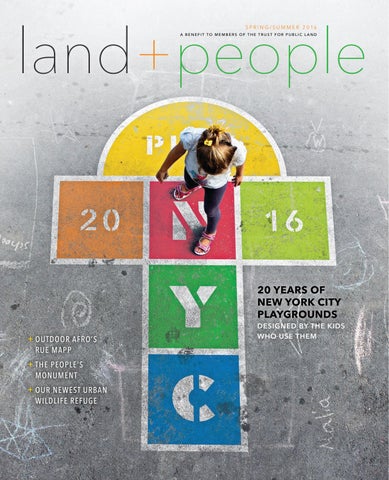
S P R I N G / S U M M E R 2 0 16 A BENEFIT TO MEMBERS OF THE TRUST FOR PUBLIC LAND
20 YEARS OF NEW YORK CITY PLAYGROUNDS + OUTDOOR AFRO’S RUE MAPP + THE PEOPLE’S MONUMENT + OUR NEWEST URBAN WILDLIFE REFUGE
DESIGNED BY THE KIDS WHO USE THEM
the longer you stay, the more we all save. save on your room
JO HN ELLIS
% 15
save
RICH REID
the land
This issue of Land&People is made possible in part by a generous grant from Kimpton Hotels. Just as The Trust for Public Land preserves the special places that give our communities their unique character, Kimpton Hotels preserves special buildings as elegant and charming one-of-a-kind hotels. Kimpton Hotels is a proud supporter of Parks for People, The Trust for Public Land’s initiative to create close-to-home parks in cities across America. The Trust for Public Land thanks Kimpton Hotels for its support, as well as for its environmentally friendly way of doing business—including innovative eco-rooms, linen reuse policies, water conservation, and recycling programs.
* B O O K & S AVE To receive 15% off the best available rate, go to kimptonhotels.com and enter “TPL” in the rate code field when making your reservation. Or call 800-KIMPTON. For every night’s stay, $10 will be donated to The Trust for Public Land.
ALEXANDRIA | ASPEN | AUSTIN | BALTIMORE BOSTON | CAMBRIDGE | CHICAGO | DALLAS DENVER | GRAND CAYMAN ISLANDS | HUNTINGTON BEACH | LA JOLLA | LOS ANGELES | MANCHESTER MIAMI | MINNEAPOLIS | NEW YORK CITY | PALM BEACH | PHILADELPHIA | PHOENIX | PITTSBURGH PORTLAND | SALT LAKE CITY | SAN DIEGO SAN FRANCISCO | SANTA BARBARA | SAVANNAH | SCOTTSDALE | SEATTLE | SEDONA | VERO BEACH | WASHINGTON DC | WINSTON-SALEM
39
contents
an n ie ban g
ch r is h in k l e
F EAT U R E S
50
“Everyone will love the new playground, so they’re going to care about it.” ~ samir s ix t h g rader at j . h .s . 1 8 9
30 Recess by Design ............................................... . . . . . . . . . . . . . . . . . . . . . . . . . . . . . . . . . . . 30 Celebrating 20 years of greening New York City, one schoolyard at a time.
Trailblazers .... ............................................................ . . . . . . . . . . . . . . . . . . . . . . . . . . . . . . . . . . . 39 Meet the women tasked with building the Southwest’s first urban wildlife refuge.
Monumental ........................................................... . . . . . . . . . . . . . . . . . . . . . . . . . . . . . . . . . . . 50 Locals knew the San Gabriel Mountains were something special— now the nation does, too. T P L. O R G · 1
JAN
FEB
MAR
APR
M AY
JUN
JUL
AUG
SEP
OCT
NOV
DEC
Help conserve land for people every month of the year. It’s easy, automatic, and secure. Join today.
tpl.org/monthlygiving
D E PA RT M E NTS
18
an n ie ban g
Three cheers for the trailblazers
l issa mo n b erg
From the President · 11
contents
Board Spotlight · 13 Ignacia Moreno
Contributors · 14 Mailroom · 15 First Look · 17
20
Insight · 26 Outdoor Afro’s Rue Mapp on inspiring new — and diverse — leaders
Member Center · 62 Offices · 63
hunt + capture
Raw oysters done right, alleys go verde, and how to turn lemons into ... playgrounds?
16
o n t h e cover What happens when you empower kids to design their dreams? Turn to page 30 to find out.
JO IN U S ON FAC EB O O K Scan the QR code with your mobile device to stay tuned to the latest news, videos, contests, and more. facebook.com/tpl.org
T P L. O R G · 3
n omi e lle n son
4 · LA ND &PE OPL E · SPR I NG /SUMMER 2016
contents
LA CIMA CHARTER SCHOOL, BROOKLYN, NEW YORK From its green-roofed gazebo to its thirsty garden planters, this schoolyard playground is built to ease strain on the city’s aging sewer system by soaking up stormwater. But for all its hardworking features, it is first and foremost a great place for recess: no surprise, once you hear who designed it.
Page · 30
30
T P L. O R G · 5
chri s hi n k le
6 · LA ND &PE OPL E · SPR I NG /SUMMER 2016
contents
VALLE DE ORO NATIONAL WILDLIFE REFUGE, ALBUQUERQUE, NEW MEXICO
With rain on the horizon, sandhill cranes and Canada geese come in for a landing at the Southwest’s first urban wildlife refuge. Valle de Oro lies at a key stopover point for long-haul flyers making their annual migration — and within a half hour’s drive of nearly half the state’s human population.
Page · 39
39
T P L. O R G · 7
ste ve n g n am
8 · LA ND &PE OPL E · SPR I NG /SUMMER 2016
contents
HASKILL BASIN WHITEFISH, MONTANA
In February, a conservation easement here safeguarded locals’ most important source of drinking water and a cherished outdoor escape. It would prove to be the last work of The Trust for Public Land’s own Alex Diekmann — a negotiator of unmatched skill and passion who leaves behind a legacy of protected places across the Rocky Mountain West.
Page · 64
64
T P L. O R G · 9
our mission: p ub l i s h e r Sean Connolly
edito r i a l d i re cto r Eliza Sarasohn
art d i re cto r Matt Mullin
m an ag i n g e d i to r Alia Salim
p h oto g ra p h y co o rd i n ato r Elyse Leyenberger
p ro d u cti o n a ss i sta n t Skye Alexander
edito r i a l a ss i sta n t Shoshannah Flach
w ri te r s Allie Ferguson Julia Busiek
m ar ke ti n g Kristen Anderson
dig i ta l p ro d u cti o n Carrie Gotch Adele Wilson-Hamaker
con tr i b u ti n g e d i to r Bill Poole
A GREEN ER READ Land&People is printed in the United
THE TRUST FOR PUBLIC LAND CREATES PARKS AND PROTECTS LAND FOR PEOPLE, ENSURING HEALTHY, LIVABLE COMMUNITIES FOR GENERATIONS TO COME. how you can help: Our work depends on the generous support of people like you.
States on chlorine-free, 30 percent postconsumer recycled paper and manu™
factured using Envirotech ink, which contains a high percentage of ingredients derived from renewable resources. Printed by Quad/Graphics Inc., Wisconsin.
© 2016 The Trust for Public Land. All rights reserved. Conserving Land for People, Conserving Nature Near You, Creating Parks and Protecting Land for People, Fitness Zone, Land for People,
donate: Use the envelope inside this magazine, or visit tpl.org/donate for other easy ways to give. learn more: Get timely updates on our park and conservation work near you. Sign up for our e-newsletter at tpl.org/enews. share: Help us make the case for parks and open space. When you’ve finished reading this issue, pass it on!
Land&People, LandVote, Northwoods Initiative, Our Land, Parks for People, ParkScore, The Trust for Our Land, The Trust for Public Land, TPL, and The Trust for Public Land and LandVote logos and
Land&People magazine is a benefit to members of The Trust for Public Land.
all other names of The Trust for Public Land programs referenced
Free trial issues are available at tpl.org/freemag.
herein, as well as their logos, are registered or common law trademarks of The Trust for Public Land.
1 0 · LAND &PE OPL E · SPR I NG /SUMMER 2016
from the president
A few years ago, I was lucky enough to visit Albuquerque, New Mexico, to attend the dedica-
sara cozolino
THREE CHEERS FOR THE TRAILBLAZERS tion ceremony for the new Valle de Oro National Wildlife Refuge, created with help from The Trust for Public Land. The first urban national wildlife refuge in the Southwest, Valle de Oro sits adjacent to densely populated neighborhoods much in need of parks and open space. It was deeply gratifying to see the crowd filled with park lovers of all stripes—from civic leaders and conservation officials to clergy, educators, moms, dads, and neighborhood kids. When U.S. Secretary of the Interior Sally Jewell cut the ribbon,
New leaders are working to
the cheers were resounding.
bring parks to the communities
At The Trust for Public Land, we create parks and protect natural lands where everyone in
that need them most.
America can get outdoors, connect with nature, and stay healthy. From the beginning, that’s
Mapp is cultivating a new cadre of African
meant working in and near cities—where
American conservation leaders. Also in this issue,
more than 80 percent of us live. We believe
you will learn how the people of Los Angeles are
that everyone—regardless of income or circum-
working to protect the San Gabriel Mountains, a
stance—should be able to find a park or natural
show-stopping wilderness on the very doorstep
area within a 10-minute walk of home.
of that dynamic, teeming city.
In this issue of Land&People you will meet
We hope you enjoy the stories you read here,
some of the new and emerging leaders who are
and we thank you for the essential role you play
working to bring parks to the communities that
in helping protect precious public lands, from
need them most. At Valle de Oro, refuge man-
neighborhood parks to national parks. Spending
ager Jennifer Owen-White is building a leader-
time in nature is a basic human need. Together,
ship team that reflects the diverse constituents
we can lead the country to equitable access to
it serves. And in New York City—where our
parks and open space for all.
schoolyards-to-playgrounds program is celebrating its 20th anniversary—Trust for Public Land staff are teaching tomorrow’s park advocates the real-world skills they’ll need to pursue careers in conservation and resource protection. This issue also includes a conversation with Rue Mapp, creator of Outdoor Afro, a national
Will Rogers president and ceo
network connecting African Americans to the outdoors. Through her work and her example,
T P L. O R G · 11
BE A LEADER. Connect more people to nature by becoming a Conservation Champion today. With your annual leadership-level contribution of $2,000 or more in general support you will receive invitations to special events and insider updates on our park and conservation strategies.
Learn more about the impact you will have as a Conservation Champion. Call Haley Nielsen at 415.800.5189.
co ns er vat i o n ch ampi o ns t pl . o r g/ c h a m p ions | cham p ions@tp l.org
O F F IC E R S
Ignacia Moreno sarah derag o n
p res i de n t a n d ch i e f exe c u t i v e o ff i c e r William B. Rogers s en i o r v i c e pre si de n t an d d i re cto r o f c i t y pa r k d e ve lop me n t Adrian Benepe
board spotlight
Get to know
CEO and a principal of The iMoreno Group, PLC, Ignacia Moreno is a nationally recognized leader in environmental and
s en i o r v i c e pre si de n t a n d di v i si o n di re cto r Raymond Christman
natural resources law. From 2009 to 2013,
s en i o r v i c e pre si de n t a n d c h i e f m a r ke t i n g off ice r Sean Connolly
ment and Natural Resources Division of
she served as the Senate-confirmed assistant attorney general for the Environthe U.S. Department of Justice. She was previously in-house environmental counsel
s en i o r v i c e pre si de n t a n d di re cto r o f co n se r vat i o n st rat e g ie s Ernest Cook
at the General Electric Company and practiced at two prominent Washington, D.C., law firms, including as a partner. Moreno was born in Cartagena, Colombia,
s en i o r v i c e pre si de n t a n d di v i si o n di re cto r Jeff Danter
and grew up in New York City. She now lives in McLean, Virginia, with her husband and son. She joined The Trust for Public Land’s
v i ce pre si de n t a n d di re cto r o f f e deral affairs Kathy DeCoster s en i o r v i c e pre si de n t, gen e ra l co u n se l , a n d se cre tary D. Malcolm Carson s en i o r v i c e pre si de n t a n d c h i e f ph i l a n t hrop y off ice r Margie Kim
national board in 2015.
I JOINED THE BOARD BECAUSE … The Trust
I SUPPORT THE TRUST FOR PUBLIC LAND
for Public Land works on issues that have
BECAUSE … I believe in its core mission: to
long been important to me. The more I
create parks and protect land for people.
learned about the mission to create parks
I believe it is our civic duty to protect our
and protect land for people, the more
environment for future generations.
s en i o r v i c e pre si de n t, chie f fi n a n c i a l o ff i c e r, a nd treasu re r Cynthia Scherer
certain I became that this would be a good fit—and I was right!
THE KEY CHALLENGE FACING THE TRUST FOR
v i ce pre si de n t a n d di re ctor o f co n se r vat i o n t ra nsactions Brenda Schick
MY PROUDEST ACCOMPLISHMENT AS A
expertise to continue to lead the way in
BOARD MEMBER WAS … moderating an
addressing climate change. Climate-Smart
energizing panel discussion on diversity
Cities™ is a remarkable program that
with Hilary Tompkins, the solicitor of the
should be deployed nationally.
v i ce pre si de n t a n d d i re cto r o f hu m a n re sou rce s Barbara Smith s en i o r v i c e pre si de n t a n d c h i e f o f sta ff Tim Wohlgenant
B OA R D OF D I R E CTOR S Page Knudsen Cowles (Chair), Stephen W. Baird, George Bell, William J. Cronon, Douglas Durst,
PUBLIC LAND IS … how to leverage its
Department of the Interior, and Avi Garbow, general counsel of the Environmental
I FIRST FELL IN LOVE WITH THE NATURAL
Protection Agency.
WORLD WHEN … as a child growing up in New York City I would walk with my
THE TRUST FOR PUBLIC LAND’S WORK IS
sister and brother to Riverside Park on the
UNIQUE BECAUSE ... it works to make a dif-
Hudson River. The park’s calm and natural
ference in the lives of all Americans. The
beauty offered a respite from the hectic,
Trust for Public Land has long understood
concrete world in which we lived. It made
that all people—regardless of income,
us all very happy!
ethnicity, or geography—deserve parks,
F. Whitney Hatch, Ignacia S. Moreno, Caroline P.
and that all people need a place to rest,
Niemczyk, Michael E. Patterson, Thomas S. Reeve,
rejuvenate, and connect with nature and
Jeffrey A. Resnick, Laura Richards, Roy Richards Jr.,
each other.
William B. Rogers, Lex Sant, Sheryl Tishman, F. Jerome Tone, Ana Valdez, Susan D. Whiting
?
WHAT ABOUT YOU? Tell us how you connect with nature. Join the conversation on Facebook: facebook.com/tpl.org T P L. O R G · 13
contributors
April Reese
Chris Hinkle
George B. Sánchez-Tello
story:
story:
story:
Trailblazers
Trailblazers
Monumental
39
39
50
Milwaukee-based journalist April Reese is
Photographer Chris Hinkle got his start
Sánchez-Tello is an award-winning reporter
an associate editor at Discover, where she
behind the camera in Flagstaff, Arizona,
from Los Angeles’ San Gabriel Valley. In 2011,
writes on topics including environmental
through a love of outdoor sports—especially
he was hired by The Wilderness Society to
science and medicine. She holds a master’s
mountain biking and rock climbing. His
work with San Gabriel Mountains Forever, a
degree from the Yale School of Forestry and
commercial and editorial work has appeared
coalition working to permanently protect the
Environmental Studies and has contributed
in Sunset, Running Times, Bicycling, and The New
region’s mountains and rivers. He teaches
to publications including High Country
York Times, among others.
environmental justice at California State
News, The Christian Science Monitor, and
chrishinkle.com
University, Los Angeles.
Smithsonian.com.
follow him on twitter @sancheztello
EVEN MORE LAND&PEOPLE Download the free Land&People iPad app—available now at the App Store. The digital edition includes all the stories you love in high resolution, plus bonus content like video, search tools, easy social media sharing, and instant links to learn more. If you don’t have an iPad, you can access the digital edition online at tpl.org/lpdigital. Wherever you see the pointer symbol below, you’ll find bonus content in the digital edition. Download the app or go online to dive deeper into the story.
1 4 · LAND &PE OPL E · SPR I NG /SUMMER 2016
ipa d is a registered tra demark of ap ple inc ., registered in the u.s. and other countries. app store is a service mark of apple inc.
follow her on twitter @areesesantafe
mailroom
an n ie ban g
JOI N OUR COMMUNI TY Looking for a virtual community that really gets you? You’ll find lots to like— and share—when you follow The Trust for Public Land online.
There are some gifts only
ALL SMILES
Kids love monkeying around at Patton Street Park and Garden, our newest outdoor play space in the Echo Park neighborhood of Los Angeles.
can provide.
We love hearing from you! Tell us what you think of the stories you read here, and you just may find yourself in the next issue. You can reach us by mail, on Facebook, or at mailroom@tpl.org.
#My606Story F A L L / W I N T E R 2 0 15 A BENEFIT TO MEMBERS OF TH
E TRUST FOR PUBLIC LAND
Adventures abound on
trail will be used for cross-country
Chicago’s new elevated
skiing in the winter; if that’s the case,
park and trail.
it’s almost like I never left home! Tori Mason, via Instagram
I recently moved from Maine to
WELCOME TO THE 606:
A PARK YOU CAN LOOK UP TO
+ RECLAIM THE WOODS + A CALIFORNIA CITY BREAKS ITS IRON TIES
Chicago. I thought I would be
Since The 606 opened it has brought
sacrificing all my “green” time.
health to me and my family. We run,
But The 606 keeps me connected
walk, and bike more often than ever.
to my work, home, and most
We do not have to worry about cars
importantly, the natural world.
at all, and that is wonderful. It does
With hundreds of plant species
not matter if it’s raining, cold, hot—
and even some critter friends,
it is uplifting.
I didn’t lose touch with nature
Miguel, via Facebook
after all. I heard a rumor that the
+ 2015 YEAR IN REVIEW
T P L. O R G · 15
jer r y an d marcy mo n k m an
jerr y mo n k man
mailroom
I appreciate that the locals had input into this project. I hope they will benefit from the food the farm produces and be able to sell some to local restaurants and businesses. Urban green space is vital to all communities. Bob Bartlett, via the blog WATCH THE VIDEO @
TPL.ORG/FROGTOWN
This is fantastic. Where in L.A. is it and can we expect to see more?
Walkers, joggers, cyclists, dog-walkers,
Think positive
strollers, wheelchairs, faster, slower,
I’m a longtime donor. I admire what
old, young, rainbow-hued, multilin-
you have been doing with the maga-
gual—we all find outdoor joy along
zine—talking about what’s working
The 606 path.
versus showing the horrors. I teared up
Xanthoceph, via Instagram
several times reading the issue, amazed
soap star greg rikaart — better known to fans as kevin on the young and the restless — tweeted his praise for green alleys in south central los angeles. learn more on page 20. annie bang
Randolph Community Forest, New Hampshire
at the grandeur of humans caring for
The town forest grows up
others and making a difference.
Our story about reclaiming woodlands
William Wittmann, via email
for community forests resonated with readers across the country.
A one-of-a-kind park for Frogtown
Here in Oregon, we have many national
With dancing and drummers, St. Paul
forests, but I fear my grandchildren
celebrated the opening of Frogtown
will never see the wide open spaces
Park and Farm — now home to one of
and beautiful country that I have been
the largest urban demonstration farms
blessed to experience. There has to be
in the country.
a way to keep our open spaces from greedy business and government sell-
This sounds wonderful! Not surprised
offs. Keep up the great work you do!
it is in St. Paul!
Kate Strohm-Priesman, via the blog
Lorna Jansen-Schultz, via Facebook
1 6 · LAND &PE OPL E · SPR I NG /SUMMER 2016
LAND&PEOPLE IS LISTENING! Send letters to the editor or change your mailing address: mailroom@tpl.org.
“ YO U A R E N OT H E R E M E R E LY TO M A K E A L I V I N G . YO U A R E H E R E TO E N A B L E T H E W O R L D TO L I V E W I T H A FINER SPIRIT OF HOPE AND A C H I E V E M E N T. YO U A R E H E R E TO E N R I C H T H E W O R L D.” woodrow wilson
A family explores North of Highland Camping Area, a short walk from Cape Cod National Seashore in North Truro, Massachusetts. Thanks to your support, this beloved vacation spot is permanently protected.
t u r n t h e pag e fo r … so m e sau c y a d v ic e · an l . a. m ake ov e r · a m o u n tain yo u can d r in k to T P L. O R G · 17
S E A W AT E R and S U N S H I N E
edible conservation
hamma hamma river olympic peninsula, washington
Washington’s Hamma Hamma River
berg and her brothers took over the
owes its interesting moniker to the
family business a decade ago. Today,
Coast Salish, a Native American tribe
they employ about 30 people, and Hama
helped protect more than 8,000 acres of
that lived along its banks. According
Hama oysters are a prized delicacy in
working forest along Hood Canal from
to local lore, hamma hamma means
restaurants and markets throughout
further development. The deal was good
“stinky stinky”—a reference to the
the region.
news for the timber industry, a corner-
each spawning season.
Last year, The Trust for Public Land
Dominated by federal wilderness
stone of the region’s economy—and
and carefully managed timberland,
for shellfish. “Timberland is a safer bet
the Olympic Peninsula is still a wild
than development,” says Monberg. She’d
down the West Coast, the name means
landscape. The eleven rivers that tumble
rather contend with logging than septic
something else entirely: fresh, delicious
from the interior are among the most
tanks or farm runoff. “It’s harvested on
oysters.
pristine streams on the West Coast,
a 40– to 60–year rotation, which means
bringing cold, clean water that’s critical
it’s quiet most of the time.”
But for adventurous eaters up and
“Our oysters don’t need anything but clean seawater and sunshine,” says Lissa James Monberg. She’s a fifth-generation
to growing healthy oysters.
If you love oysters, Monberg says, you have a job to do. “Each of our customers
shellfish farmer at the Hama Hama
microscopic nutrients from seawater. If
is a potential advocate for clean water,”
Oyster Company in Lilliwaup, just west
that water is polluted, the oysters grow-
she says. “By protecting habitat you’re
of Seattle—and she’s downplaying the
ing in it can get sick. “It can be scary—
also protecting a successful, sustainable
tough, wet work required to raise and
we really rely on other people to help us
business that ties together love of place,
harvest shellfish commercially. Mon-
keep the water clean and the ocean safe
environmentalism, and quality of life.”
je nn repp
w yoming aero photography
Oysters are filter feeders—they get
jeff scott shaw
salmon carcasses that filled the river
for food production,” says Monberg.
1 8 · LAND &PE OPL E · SPR I NG /SUMMER 2016
rin a jo rdan
buzzworthy
How to eat raw oysters “When you’ve carefully sourced fresh oysters, the best way to taste them is to keep condiments as simple as possible,” says Monberg. She eats hers with just a few drops of lemon—but for those looking to mix it up, she recommends these three classic pairings. MIGNONETTE Add chopped shallots and a hit of freshly cracked black pepper to some red wine vinegar, and you’ve got yourself a basic mignonette. From there, get creative with different vinegars, white pepper, or a squeeze of lime.
—Reno Keoni Franklin chairman of the kashia band of pomo indians of stewarts point rancheria The newly established Kashia Coastal
HORSERADISH
Reserve in Northern California restores ocean-
The grassy bite of freshly grated horseradish
front land to the native Kashia people, forced
is a great complement to the fruity saltiness of a fresh raw oyster.
WATCH THE VIDEO@
TPL.ORG/KASHIA
inland more than a century ago. The reserve’s bluffs and redwoods will allow the tribe to
BREAD AND SALTED BUTTER
resume traditional gathering and forestry
Make like the Europeans do, and eat your
practices—while the public gains access to
oysters with slices of thick and chewy bread (brown or white) topped with farmstead
dramatic Pacific vistas through an extension of
butter and salt.
the California Coastal Trail. F I R ST LO O K · 19
good news
JA
C
Q
U
E
LI
N
C
R
U
GI
Z
FIA
E
SO
SON
IA R
OD
RO
N
RIG
UEZ
an n ie ban g
Allies for alleys N
U
R
IN
M
IR
A
N
PE DR O
SONIA
AR IA S
SANT ANA
Sonia Rodriguez: Through the Equipo Verde,
them — for their safety. Before the alley was
we’ve built close friendships — and we’ve also
rebuilt, we never walked through. It was too
built relationships with city officials. I see that
dirty and scary. Now we like coming here.
people care and want to make the community better. That gives me confidence and makes me feel safer. Pedro Arias: When I was young, the alley was just disgusting. You’d see stray dogs and graffiti everywhere. My favorite part now is the murals. They bring out my inner artist.
Sophia Giron: I’m setting an example for my
kids to participate and improve the community. My daughter comes too—she plants trees and helps keep the alley clean. Nurin Miranda: People used to dump old furniture and mattresses in the alley. Now we work hard to keep this place clean for our
Sonia Santana: I have seven children and five
children. It was a great idea to plant fruit trees —
grandchildren. I joined the Equipo Verde for
they are beautiful!
2 0 · LAND &PE OPL E · SPR I NG /SUMMER 2016
Members of the Equipo Verde meet monthly to help keep the newly renovated alley clean and green.
WATCH THE VIDEO @
TPL.ORG/VERDE
D
A
what counts
“This alley is in front of my house. It used to be like a garbage dump. Now my kids can ride their bikes and scooters here until they are tired.” — Freddy Martinez, pictured below
Even in the densest cities, there’s room for green space if you know where to look. Take Los Angeles: the sprawling streets are interlaced with 900 miles of alleyways—the majority unused and unsafe.
87 … cups of lemonade sold by nineyear-old Parker Robinson, a fourth-grader at Lafayette Street Elementary School in Newark, New Jersey.
So why not turn that dead space—an area twice the size of New York’s Central Park—into an asset? That’s the idea behind our Avalon Green Alley
Parker’s schoolyard is a half acre of plain
demonstration project, which aims to repurpose nearly a mile of neglected
asphalt—not much fun at recess. So when
alleyways in South Los Angeles into walkable, bikeable, beautiful public
he heard that The Trust for Public Land was
space. Lush plantings and permeable pavement will keep alleys cool and en-
working to transform it into a real park, he
able them to absorb and filter stormwater—diverting thousands of gallons
took a refreshing approach to helping out.
of runoff a year before it can pollute local waterways.
From a makeshift stand built from refrig-
A group of dedicated locals are stepping up to make the vision a reality. Calling themselves the Equipo Verde (Green Team), they’ve been meeting monthly to organize cleanup days and knock on doors to recruit their neighbors. We recently joined the team to plant fruit trees, paint a mural,
erator boxes, he set up shop on a warm Friday afternoon. By the time the pitchers of fresh-squeezed lemonade ran dry, Parker had made $87 to donate to his school’s new playground.
and talk about their progress so far.
F I R ST LO O K · 21
word watch
meet our staff
nich ol as l ea b run o
“My work is about bringing nature to where the people are.”
JEN ISACOFF THE OPERATIONS DIRECTOR FOR CITY PARK DEVELOPMENT KNOWS
land swap /land'·swäp'/
THE BEST PARKS ARE BUILT ON TRUST.
When did you get your start with The Trust for Public Land? I was practicing landscape architecture, but what appealed to me most about the profession wasn’t the design details—like whether pathways
Trading spaces can be a handy approach to
should be brick or slate—but working with communities to help them
conservation when high property values make
make those decisions. I was drawn to The Trust for Public Land’s focus on
it difficult for communities to buy land outright.
that engagement process, so in 2004 I began working on our park develop-
In December, one such swap became the final step in The Trust for Public Land’s long effort to restore full access to Colorado’s Wilson Peak. At 14,023 feet, the mountain is far from the tallest of the state’s beloved “Fourteeners,” but
ment projects throughout the San Francisco Bay Area.
You recently took on a new leadership position as operations director for city park development. What does that entail?
it’s among the most recognizable: the summit
We know there are many benefits to being in nature, but not everyone has
is visible from the world-famous ski slopes of
the transportation, funds, or time to really get outside. So my work is about
Telluride — and, for that matter, on every can of
bringing nature to where the people are. In urban areas we want everyone
Coors beer.
to have access to a quality park within a 10-minute walk from home. My new role is to help staff nationwide create parks that provide the biggest possible impact for the local community.
2 2 · LAND &PE OPL E · SPR I NG /SUMMER 2016
jeremy b e e to n
Boeddeker Park in the heart of the Tenderloin, San Francisco, California
dozen different languages, really diverse. Over the winter holiday, vandals burned down the play structure. It was coming up on Martin Luther King’s birthday, and so instead of just being sad, the kids asked, well, what would he have done? And they staged a protest—the whole student body marched around the block singing. It was so powerful to see tiny kindergarteners standing up for their little patch of green.
What about your own kids? What do they think of the work you do? How did you first become interested in the public-access side of environmental work?
is established. When people begin to
My children are very young—four and
trust, they open up about real prob-
six. So they know I build parks, I just
lems—and we can start designing real
don’t get into the details with them. But
My parents raised me with a strong
solutions.
the other day, they asked what meeting
sense of equity, peace, and justice.
I was going to and I said, “Well, today I have to tell some people why parks are
we were growing up feeling the threat
What do you try to learn in these design sessions?
of nuclear war. I remember thinking
We try to get past just asking about
I know why parks are important—be-
that if people could just get out and
what color swing-sets and slides people
cause kids like to play in them!” And
see the world, they wouldn’t want to
want. We want to build deeper con-
then my daughter chimed in with,
destroy it—they would be moved to
nections by asking more about their
“And because they have nature.” And
protect it. That’s what drew me to parks
childhood memories of parks, and their
I thought, wow! I’ve never explained
and placemaking.
vision for their park’s future. We hear
that to them. Our work has to be pretty
things like, I want to have my child’s
powerful and fundamental if even kids
What’s the best part of designing parks alongside the people who use them?
birthday party here, or our family re-
understand it intuitively.
When we start a project, communities
I had my first kiss in a park. It’s these
What do you love most about your job?
can be wary—even if they want a park.
kinds of stories that inspire us to design
I feel really grateful to have found an
They want to know who we really are
a really special place that will be central
organization whose mission matches
and why we’re really there. Sometimes
to people’s lives.
my values. We all deserve nature, not
When I was in high school in the ’80s,
important.” And my son said, “Mama,
union. Or, my friends and I used to lie in the grass and look for lucky clovers. Or,
divorced from our daily lives but inte-
they see us as just another outsider
Those are experiences that make people invested in their parks.
grated into it—whether that’s going to
what’s best. But that’s not what we’re about. I live for the moment that people
Right—even a tiny park can play a huge
smelling the flowers in bloom, or even
realize, oh, you’re actually listening
role in people’s daily lives. The first park
just looking at it, for a moment of calm.
to us, you’re really here to help us get
I ever worked on was next to a school
Everyone deserves that.
what we need: that moment when trust
with about 600 students, speaking a
coming in thinking that we know
the park to exercise, or walking by and
F I R ST LO O K · 23
WE GIVE TO …
why we give
court esy t h e s. d. b ech t el , jr. foun dat ion
create opportunity
lauren bechtel dachs, san francisco, california
“The Trust for Public Land brings special places to people all across the country — and people to special places.”
WATCH THE VIDEO @
TPL.ORG/WHYWEGIVE
Before the tech boom, the Santa
tion—started by her father Stephen D.
to the person who best embodies our
Clara Valley was a fertile patchwork
Bechtel, Jr.—supports educational and
mission to create parks and protect land
of orchards and oak-shaded ranchland
environmental efforts across the state,
for people. Past recipients include Sally
rolling down to the south shore of the
including The Trust for Public Land’s
Jewell, U.S. secretary of the interior;
San Francisco Bay. As a child, Lauren
Parks for People program. Dachs and
Douglas Durst, chair of Durst Organiza-
Bechtel Dachs and her siblings roamed
her colleagues at the foundation believe
tion; and Michael Kowalski, chair of the
free there all summer. “We had our
the parks and public spaces created by
board of Tiffany & Co.
own outlaw gang,” she recalls. “We built
The Trust for Public Land are critical to
forts, rode horses, gathered cattle, and
community health and well-being.
As she expressed at the award ceremony, “The work of The Trust for Public
“We need to preserve some of the
Land is hugely important and increas-
land that provides our food and our
ingly urgent. Children need outdoor
clean water, and that is increasingly
places to learn, and to develop values
is better known as Silicon Valley, and
playing a role in providing resiliency in
such as a sense of self and responsibility
much of the region where Dachs first
the face of climate change,” says Dachs.
for others. Adults also need a place to
fell in love with nature has been paved
“We also need to preserve the right
gather, to become a real community by
over to make way for data centers and
for all people to connect to the natural
planning, building, and sharing a sense
housing developments. As president of
resources which feed our souls in this
of place where they live.
the S. D. Bechtel, Jr. Foundation, Dachs
fast-moving and urbanized world.”
fished in streams. We were outside from dawn to dusk and then some.” These days, the Santa Clara Valley
is working to ensure that future genera-
Late last year, in appreciation of her
“The Trust for Public Land brings special places to people all across the
tions of California kids don’t miss out
long record of service, The Trust for
country—and people to special places. I
on the life-changing opportunity to play
Public Land awarded Dachs the orga-
wish for some of this for every child, as
and explore in nature close to home.
nization’s highest honor, the Land for
I know it was a huge part of making me
Under her leadership, the founda-
People Award—presented annually
who I am today.”
2 4 · LAND &PE OPL E · SPR I NG /SUMMER 2016
Double your impact today! This year, an anonymous donor will generously match your gift—dollar-for-dollar—if you send it before December 15. Your donation will go even further to help The Trust for Public Land protect more parks, gardens, and other natural places. That’s one good thing made that much better.
fig. 2
good.
better.
Give your EarthShare.
800.714.5263 donor.outreach@tpl.org tpl.org/match
An EarthShare payroll deduction is one simple way to donate to The Trust for Public Land or more than 400 other environmental and conservation charities. Many corporate and government employers support EarthShare payroll giving. If yours doesn’t, ask them to start. If they do, simply decide on a single deduction or a recurring small one from every paycheck. Then designate us, member number 11440, as one of your conservation charities. For more information visit earthshare.org or email donor.outreach@tpl.org.
T P L. O R G · 25
alex diekmann
fig. 1
insight
A
C O N V E R S A T I O N
W I T H
RUE MAPP
THE
C
R O
T
N
O
E
N
2 6 · LAND &PE OPL E · SPR I NG /SUMMER 2016
C
court esy o u t do o r af ro
In the five years since those first few strokes of the keyboard, Mapp has become one of the nation’s most influential voices on diversity and the outdoors. When she’s not at a speaker’s podium, she’s on the trail amid the redwoods and rolling hills of the San Francisco Bay Area. We caught her in a rare moment of stillness at Outdoor Afro headquarters in uptown Oakland.
How did you first form a connection to the natural world? I was raised to be outside all the time—and frankly I took it for granted. It wasn’t until I was an adult that I realized just how special my experiences were. I grew up on a deadend street in Oakland, and the unused end of the block was claimed exclusively by the neighborhood kids. We’d pilfer wood and nails from our garages and build hidden perches in the oak trees that grew back there. My parents also had a small ranch up near Clear Lake, north of Napa. Out there I could just be a kid: ride my bike on country roads, play around in the creek, watch the seasons change and the wildlife come and go.
So the outdoorsy trait runs in the family. I get it from my dad. He was a black cowboy who came from Texas to California and brought his love of the outdoors with him. He hunted and fished—I caught my first fish with him In years of hiking, biking, paddling, and exploring
when I was three years old. He taught me this everyday way
the outdoors, Rue Mapp found herself asking the same
of being in nature: it wasn’t an event, it was a way of life. We
question over and over:
made wine, jams, and preserves. We had pigs and cows. My dad built a smokehouse for sausages and hams and delicacies
Why am I the only black person here?
that we couldn’t buy in a store.
When she put the question to social media, Mapp found
Sounds like Little House on the Prairie.
her experience resonated with African Americans across the country. What started as a personal blog grew quickly into Outdoor Afro, a national network connecting and creating a new cadre of outdoor leaders.
You know what? I used to read those Laura Ingalls Wilder books while we were up on the ranch. I really connected to her characters in some ways, but there weren’t any stories about little girls who looked like me. That’s one reason Outdoor Afro exists—for me to tell my story so that black and brown girls can see themselves in nature and the outdoors.
I N SI G H T · 27
t eresa bake r
An attendee at a 2013 Outdoor Afro event explores the Consumnes River Preserve in California’s Central Valley
What other stories are out there? Who has inspired you? Well, African Americans have historical role models, but we don’t necessarily connect them with conservation or outdoor leadership. So what I’ve been doing is rebranding people. Think about Harriet Tubman. She was every bit a wilderness leader: how else could she have brought hundreds of people to freedom under cover of night? She knew how to read the landscape and navigate by the stars. When you think about someone like her as a wilderness leader, it situates us in nature—and as leaders in nature—in a way that we don’t typically have the opportunity to tap into.
Right. Because for much of your life in the outdoors, you were the only black person on the trail. Growing up, I was always with people who looked like me in nature because I was with my family. But as I got older and
Why do you think that was?
When you created Outdoor Afro, you were finishing your bachelor’s degree at UC Berkeley while also working full-time at Morgan Stanley. Not to mention being a mother of three kids. How did you get your idea off the ground?
I was privileged because I had networks of friends who sup-
I was trying to figure out what would come next. A mentor
ported me getting out in nature. I could borrow gear, or ride
asked me, “If time and money were not an issue, what would
along with them. But if you don’t have that know-how or
you be doing?” And without really thinking about it, I said,
those networks, it can make it hard to do some things in the
“Oh, I’d probably start a website to reconnect African Ameri-
outdoors. When I hear people ask questions like, how come
cans to the outdoors.” It was like I opened my mouth and my
only white people go to Yellowstone?—I’m like, chill, it’s in
life fell out.
started getting out of the city, I’d join the hiking groups, go on biking trips, and find I was always the only African American woman there.
Wyoming! It’s about where people can access. There’s a myth that people who look like me don’t have a
In two weeks, I registered the website and started writing and posting pictures, just telling my story. But Outdoor Afro
connection to nature. When we talk about communities of
was really born on social media. It wasn’t complicated; it
color in nature, the question tends to be, “Why don’t they go
didn’t take a focus group. It was simply the only way I could
out?” or “Why are they not doing these very specific activi-
get a message out to thousands of people from my kitchen
ties?” I ask different questions. How are people getting out?
table. I just started talking about why I love being outdoors,
What are they doing when they go? Busy working families
and pretty quickly, people started to say, “Hey, you’re not the
have a lot going on, so how do we make it easy for people to
only one.” Soon, Outdoor Afro became a place for people to
connect to nature, close to where they live? We need to lower
find each other and share and post their experiences. Wonder-
the barriers between communities of color and the outdoors,
ful things started to happen. In the first year, we were invited
whether they’re psychological barriers, or practical barriers
to the White House for President Obama’s signing of the
like gear and transportation.
America’s Great Outdoors initiative.
2 8 · LAND &PE OPL E · SPR I NG /SUMMER 2016
used co u rt esy n o rt h caro l in a stat e un iversit y , ral eig h , n o rt h caro l in a
“THERE’S A MYTH THAT PEOPLE WHO LOOK LIKE ME DON’T HAVE A CONNECTION TO NATURE.”
Camp Whispering Pines in Wake County, North Carolina, 1941.
What do your kids think about all this? I think a lot about the sacrifices they’ve made. Back when I was in school, they’d cry when I left to go to class. We had no idea what was on the other side of that, that it would become something as transformative as Outdoor Afro. My kids are 19, 14, and 13 now. They have been by my side, championing
You began by training trip leaders by conference call, and now you hold an annual retreat. What makes a great Outdoor Afro trip leader?
me, telling the story. My work allows me to include them in
Someone who has a heart and can connect. Participants on these trips may be going to a place they’ve never been, to do
What’s your advice to other parents for raising natureloving kids?
an activity they’ve never done, with people they’ve never met.
Trust them. And trust nature. We can be overprotective: we
They trust us with these firsts, and we want to honor that by
don’t want our kids to take risks, we don’t want them to get
making everybody feel welcome, seen, and cared for. That’s a
hurt. But kids are going to test their limits. Little scrapes and
key to our success.
moments of uncertainty are there to help kids learn who they
almost everything that I do—and they love the outdoors!
are. Nature is a generous teacher; it’s there for all of us.
Why do you focus on leadership training—versus just getting people exposed to the outdoors?
What are you working toward now?
People tell me time and time again that they appreciate hav-
My big, audacious goal for Outdoor Afro is to bring outdoor
ing leadership that looks like their community. There are
leadership back to the home. You can take a kid from a low-
many nature-based school groups and programs with black
income area and offer them one high-adventure experience in
and brown participants, but the trip leaders or class teach-
pristine nature—but then what happens when it’s over? I’m
ers—the ones with all the knowledge—are not people from
not hearing good enough answers, and that’s why Outdoor
the community. We’re here to shake that up a bit. It’s inspir-
Afro is focused on empowering everyday people—moms, dads,
ing to learn about birds, wildlife, and native plant restoration
grandmas—to lead in the outdoors.
from African Americans. We’re starting to shift the visual
We’re in the business of culture shift. There are all these
representation of what getting out into nature looks like—not
little indicators that we’re moving in the right direction—even
only who can be in nature, but who can lead.
this conversation wouldn’t have happened 10 years ago. I’m
I have seen so many examples of people who come out of
seeing a change in how we’re talking about communities of
Outdoor Afro leadership awakened to a whole different set of
color in the outdoors and whose voices are getting heard. But I
possibilities. They’ve been turned on to conservation, ecology,
think true success will happen so quietly that you won’t even
public speaking, and working for nonprofit organizations. We
notice. No balloons, no parade … just a moment of transfor-
are helping to change the face of conservation, one relation-
mation. We’ll see all communities enjoying nature as a part of
ship at a time.
everyday life, and it’ll be no big deal.
I N SI G H T · 29
3 0 · LAND &PE OPL E · SPR I NG /SUMMER 2016
BY ANDY ISAACSON Illustrations by the third-graders of The Harriet Tubman Learning Center—P.S. 154, Harlem, New York
T P L. O R G · 31
an drew f ede r m an
C Y P R E S S H I L L S , B R O O K LY N
3 2 · LAND &PE OPL E · SPR I NG /SUMMER 2016
Even if your memories of grade school have faded, you can probably still picture the playground. Large or small, asphalt or grass, it was your world and you knew every nook and cranny, from the quietest corner to whisper a secret to the straightest stretch to run a race. Where adults saw an empty schoolyard, you looked out on the landmarks of your own private map: the squeakiest swing-set, the most treacherous puddles, the fastest route back to class when the last bell chimed.
Nobody knows a playground like a child.
hat’s the idea behind The Trust for Public Land’s New York City playgrounds program,
picture of a square flowerbed. “Pollen makes my eyes go ‘bleh’!” counters another. Like a
which taps students to help transform their recess
lot of city kids, she’s a little wary of the natural world. “We
areas into vibrant gathering spaces for the whole
shouldn’t have too many flowers because some people might
neighborhood.
be allergic.”
Among the most recent schools to enter the playground
The Trust for Public Land’s environmental education consul-
program is J.H.S. 189, a junior high in Flushing, Queens. Here,
tant Maddalena Polletta overhears the discussion and assures
the barred windows of a three-story, ’50s-era building over-
the group they can find plants that go easy on allergies. Pol-
look an acre of barren asphalt surrounded by a chain-link
letta and landscape architects from the firm SiteWorks often
fence. On a typical day, much of the schoolyard is used for
step in to guide the students’ conversation this way. But it’s
parking. There’s a section left over that’s big enough for kids
mostly about broadening their perspective: in general, she
to run or toss a football—but teachers say they rarely see kids
says, kids rarely have to be told to keep the focus on learning.
playing there. Asked how it feels to be in the yard, sixth-grad-
Chatty 11-year-old Rosaura shares her diagram of an outdoor
er Samir answers only, “Lame.” Samir’s class is one of four taking part in the playground
classroom surrounded by greenery. She thinks it’ll be an inspiring setting for all their lessons—not just science. “Social
design curriculum. At seven weeks in, they’ve covered the
studies also has plants,” she points out, “and it helps math,
basics—measuring the schoolyard’s dimensions, recording
because you can say, ‘Okay, there are three plants in this row
shade patterns, and observing how water drains off the black-
and fourteen in this row, how many plants are there in all?
top. They know the space they’re working with. Now it’s time
And for English, we can make up stories based on the plants.”
to get creative. Seated around a table cluttered with colored pencils,
Most kids jump at the chance to help guide their own education, Polletta says, and they understand intuitively that
markers, and blank paper, Samir and his classmates are busy
a space they create themselves is one they’ll want to take care
sketching their latest ideas. For inspiration, Trust for Public
of. Samir, who’s carefully drawing a climbing structure made
Land staff have provided photographs of schoolyard renova-
of netting, explains it this way.
tions that have come before theirs: playgrounds with turf
“I see people throwing garbage on the ground because they
fields and green-roofed gazebos, outdoor classrooms and
don’t even like the playground. But the new playground is
climbing walls, custom benches and murals.
going to be colorful and will have a lot of room. Everyone will
“How about this?” suggests one student, holding up a
love it, so they’re going to care about it.”
T P L. O R G · 33
an dy isaacso n
FLUSHING, QUEENS
rainstorming sessions like these are at the heart of The Trust for Public Land’s three-month-long
set of benches or another drinking fountain? Once students and teachers have come to a consensus,
participatory design process, which involves students
professional designers compile the classroom sketches into
every step of the way.
technical renderings of what their new space might look like.
“As an educator, I’m constantly trying to tie in the curriculum to the real world,” says J.H.S. 189 science teacher Erica
SiteWorks principal designer Melissa Potter Ix has helped create these concept drawings for 20 years—and never tires of it.
Wahba. “With the emphasis on STEM these days, The Trust for
“What I find inspirational as a designer is that although
Public Land found ways to integrate all those aspects—science,
many of these schoolyards are devoid of any amenities at all,
technology, engineering, and math. The students aren’t just
the students can see beyond the empty asphalt lot. Other cli-
sitting at their desks learning about design; they’re actually
ents don’t have the unbridled enthusiasm and creativity of the
involved.”
kids who are going to use the park themselves. That’s what
That involvement extends to the toughest part of any project on a budget: compromise. Students typically begin
pushes the boundaries of a conventional design project.” The Trust for Public Land supplies the technical expertise
with a long wish list of features, everything from roller coast-
to realize some of the kids’ more novel ideas. At P.S. 242 in
ers, go-karts, and zip lines to swimming pools, petting zoos,
Harlem, for instance, a group of girls wanted benches of
and chocolate fountains. Without dismissing anyone’s ideas
different heights specifically for braiding hair—a popular
outright, staff help students pare it down to what’s feasible.
recess activity at that school. The class scoured industry cata-
There’s a lot of voting, and an emphasis on negotiation and
logs of standard play equipment, but nothing on the market
trade-offs. Can the class live with a smaller track to make
matched the girls’ vision—so the architects designed a custom
room for the garden? Would they prefer to spend on an extra
structure that did.
3 4 · LAND &PE OPL E · SPR I NG /SUMMER 2016
n an a taim o r
before
KINGSBRIDGE, THE BRONX
after
In the mid 1990s, New York City had less green space per person than almost anywhere else in America. To address the shortage, The Trust for Public Land initially looked to build playgrounds on vacant lots. But as the city’s housing market heated up, that strategy faltered—and staff shifted their attention to a different type of real estate: schoolyards. Most public schools’ recess areas were (and remain) featureless asphalt, uninviting to students and closed to the rest of the community altogether. Taken as a whole, they represented a big opportunity to green neighborhoods without competing for pricey property. The city embraced the idea. When Mayor Michael Bloomberg took office in 2001, he included schoolyards in his 30-year livability plan. “PlaNYC” tapped The Trust for Public Land as its nonprofit partner, in part because the organization recognized the opportunity to involve children as co-creators. Installing “cookie-cutter” parks might be faster, but staff believed that incorporating the design process into school curriculum would motivate students—and produce better playgrounds. “There’s a schoolyard culture that adults have no idea about,” says The Trust for Public Land’s Joan Keener. “Instinctively, kids know where the light is, where it’s cold, where it’s noisy. If you give them the autonomy to suggest their own improvements, they come up with ideas that adults couldn’t imagine.”
T P L. O R G · 35
3 6 · LAND &PE OPL E · SPR I NG /SUMMER 2016
reating playgrounds that reflect the unique culture of each school means thinking about the surrounding community, too. The renovated schoolyards are open to the public after school hours, over the weekend, and during holidays—so Trust for Public Land staff attend PTA events and hold public meetings to gather input from locals who’ll use the space when classes aren’t in session. For their part, the student designers take their responsibility to their neighbors seriously. “They understand it’s a community project,” says Joan Keener, “that it’s not just for them.” They map and compare which portions of the schoolyard are
“The The kids kids understand unders rstand it s a community it’s it s project, that it’s them.” not just for them. joan keener
most inviting to different user groups, from younger siblings to residents in the nursing home nearby. They discuss how design choices like accessibility features and the languages used on signage can affect who feels welcome in the space.
Anticipating an uptick in severe weather as an effect of
A focus on inclusiveness and equity anchors not only the
climate change, the city is seeking ways to relieve pressure
content of the design curriculum, but the process of choosing
on its combined stormwater-sewer system—which is prone to
which schoolyards get renovated in the first place.
overflowing during periods of heavy rain. Compared to storage
“From the beginning, we’ve looked for the areas that are
tanks or other conventional infrastructure, greening school-
most in need of a safe place to play,” says The Trust for Public
yards is a cost-efficient option for managing stormwater. By
Land’s Mary Alice Lee. As the program director, she works
replacing asphalt with more permeable surfaces like gravel,
with the organization’s GIS mapping team to identify can-
turf, or other greenery, a renovated schoolyard can keep up to
didate schools. Using data from government agencies, they
700,000 gallons of rainwater per year out of sewers.
pinpoint low– to moderate-income neighborhoods, short on
Angela Licata of the city’s Department of Environmental
parks, with a large student body and a half acre or more of
Protection (DEP) is pragmatic about her agency’s growing
undeveloped, underutilized outdoor space.
involvement with the playgrounds program. “The partner-
A more recent factor in site selection is environmental.
ship allows New York City a way to improve water quality in adjacent waterways while also providing community benefits through play spaces,” she says. “The Trust for Public Land ties it all together.” Of course, the green infrastructure features—whether that’s rain barrels, flower gardens, or tree groves—have to pass muster with the student designers before they can be included in playground plans. Fortunately for the DEP, it’s rarely a tough sell, especially once kids hear some of the gorier details of how the sewer system works. “Most people, children and adults, have never thought about where water goes when you flush a toilet or leave a faucet running,” says Lee. “But kids especially are willing to learn.”
T P L. O R G · 37
H E L L’ S K I T C H E N
ncorporating the DEP’s stormwater strategy is just the
Fellow teacher Michelle Sedlmaier teaches third grade at P.S.
latest evolution of a long and productive partnership
33. She’s had some time to observe the impact of the redesign
between the city and The Trust for Public Land. By the
on life at the school. “I think the kids are very proud of the
end of 2016, the program will have transformed 200
schoolyard,” she says. “We don’t just use it at recess—it gives
barren asphalt schoolyards into dream playgrounds, adding
them extra space for learning: the gym teacher uses it for
more than 150 acres of recreational space. Nearly 3.5 million
physical education, teachers bring kids out for gardening proj-
New Yorkers now live within a 10-minute walk of one of these
ects. We even have a lunchtime walking club. It’s a great thing
renovated sites.
because the girls will talk to me walking around the track
New schools sign on to the curriculum every year, with
more than they would talk to me in the classroom.”
each completed playground inspiring the next class of student
There’s a world of new possibilities on the playground—
designers. At the outset of their design work, the sixth graders
among them, the hope that this won’t be the last place its
at J.H.S. 189 took a field trip to the renovated playground at
young designers pitch an idea, negotiate a deal, or watch a
P.S. 33, a Queens elementary school. J.H.S. 189’s Jamie Zucker
product of their imaginations built and realized. Wherever the
recalls the moment her visiting class arrived. Some kids
students’ lives take them, The Trust for Public Land’s first ob-
rushed on to the field and rolled around on the turf, “like pup-
jective is assured: their memories of the schoolyard will be of
pies.” Some gravitated to the web-climbing nets, while others
more than an asphalt lot. When they return to the space—in
beelined for badminton rackets or the basketball court. One
person or in mind’s eye—they’ll be able to say: Here is where
group clustered around the outdoor tables with books and
I walked with my teacher, where I scored a basket, where I
board games. “You really saw their personalities,” she says.
planted a tree. This was my playground—and I made it myself.
3 8 · LAND &PE OPL E · SPR I NG /SUMMER 2016
at the southwest’s first urban wildlife refuge, one pioneering scientist is restoring the land — and nurturing the next generation of conservation leaders
by April Reese
photos by Chris Hinkle T P L. O R G · 39
J
ennifer Owen-White
neighbor over everything from water rights to college football.
is running a national
But to the 36-year-old Owen-White, it’s a dream job. “I still pinch myself every
wildlife refuge—but
day,” she says. She’s sitting on a faded couch in a one-story stucco that will soon be
you might not know
torn down to make way for a new office and visitor center. Today, Owen-White and
it from the view out
her team are busy preparing crafts for a public open house—bird feeders fashioned
the window of her makeshift office.
from pinecones and mandala designs made out of seeds. Outside the building,
The land she oversees, 570 acres along
cranes and Canada geese pick at stubbly grass in fields that shine in the early morn-
the Middle Rio Grande in Albuquerque’s
ing sun. The community chose to name the refuge Valle de Oro—it means “valley
South Valley, gained federal protection
of gold.”
in late 2011. Today it still looks more
In her three years as manager, Owen-White has drafted a long-range plan for the
like the dairy farm it used to be than
refuge and built a support network of more than a hundred partners, from the Na-
the outdoor destination it’s striving
tive American community of the neighboring Isleta Pueblo to The Trust for Public
to become.
Land, which worked to protect the refuge site. She’s orchestrated the demolition
To fully transform the property into
of old farm buildings and removed rows of nonnative Siberian elms. But perhaps
Valle de Oro National Wildlife Refuge
her proudest achievement is assembling her six-member staff—cobbled together
will take an army of dedicated conser-
despite receiving funding for just two full-time positions. All young women, with
vationists, mostly volunteers. During
backgrounds as diverse as the community they now serve, they’re not your typical
her first year at the refuge, Owen-White
conservation professionals. And that’s no accident.
was its sole employee. As manager of
Despite environmental organizations’ attempts to diversify, white males still
one of the country’s few urban wildlife
dominate the ranks, Owen-White says. “So many young women and young people
refuges and the first in the Southwest,
of color might love a career in conservation, but they never get a chance to pursue
she’s under pressure from all sides—
it—in many cases because they’re not even aware it’s an option,” she explains. Her
local residents, government officials,
hiring strategy was as much about creating opportunities for visitors as for the staff
environmental groups—to succeed. And
themselves. “One of our goals at Valle de Oro is to make the public feel like this
she’s a Texan, which raises eyebrows
is their refuge—because it is. Hiring a team that reflects the broader community
in a state that has clashed with its
makes sense.”
jennifer owen-white
Entrance to the 17-mile Paseo de Bosque trail
4 0 · LAND &PE OPL E · SPR I NG /SUMMER 2016
T P L. O R G · 41
migrating sandhill cranes
T
julia bernal, 24, serves as the refuge’s water resources technician through the bureau of indian affairs native american water corps.
he Valle de Oro National Wildlife Refuge was an aspiration long before it was a place. For years, locals had sought protection for the onetime dairy farm, one of Albuquerque’s larg-
est undeveloped riverside tracts in private hands. The property came with water rights—crucial for restoring wetland habitat. Most importantly, it was perfectly situated to make nature more accessible to people in New Mexico’s most populous city. “Residents here were very vocal. They told us, ‘We want to
see this happen,’” says The Trust for Public Land’s Greg Hiner. “Historically, the South Valley was where businesses put everything that nobody wanted to live next to—salvage yards, a fuel depot. This community has been forced to contend with an unfair share of environmental justice issues, and it was in dire need of green space.” Conserving the land was a “no-brainer” for the U.S. Fish and Wildlife Service, says its southwest regional director, Dr. Benjamin Tuggle. “We had a lot of partners, a lot of community support, and it was in line with our focus on urban constituents.” After The Trust for Public Land helped negotiate and execute the land transaction, the next step was for Fish and Wildlife to find the right refuge manager to take the helm—someone up for the challenge of restoring the property, with experience connecting city dwellers to nature. Tuggle didn’t have to look far. A few hundred miles down the river in neighboring Texas, Owen-White, then manager of Santa Ana National Wildlife Refuge, was ideally qualified. “This is a calling for her, and she’s been a godsend,” says Tuggle. “Her ability to talk to a variety of people, to attract youth and youth programs to the refuge—that’s why she’s the right person for the job.” The outdoor classroom
4 2 · LAND &PE OPL E · SPR I NG /SUMMER 2016
T P L. O R G · 43
Education specialist Teresa Skiba, 28, grew up in the South Valley.
O
wen-White took a few detours along the way to finding her calling. As a
child growing up in Houston, she spent her afternoons exploring the bayous, catching snakes, frogs, and bugs. An A+ science student, she enrolled in the pre-
After some soul-searching, Owen-
med track at Texas Tech at the urging of
White found the confidence to switch
her parents and teachers. But by senior
majors, earning a bachelor’s degree in
year, she was floundering.
biology and then a master’s in wildlife
Lab work, she discovered, was isolat-
and museum science. She went on to
ing and lonely. As she recounted in a
work as a birding tour guide, park biolo-
widely circulated 2015 TEDx talk cheer-
gist, and state park outreach and educa-
fully titled, Why I Gave Up On Becoming a
tion specialist before Fish and Wildlife
Doctor to Play in the Dirt, “I was far more
tapped her to manage the Santa Ana
excited about my weekend hiking,
National Wildlife Refuge.
birding, and volunteer adventures than
“I think we are doing a disservice to
the genetics and chemistry I studied in
our girls and young women by pushing
class. But I thought everyone would be
them into careers in engineering and
disappointed that I didn’t want to be a
medicine,” Jennifer continues. “Don’t
doctor—disappointed that I was giving
get me wrong, I certainly think we need
up on my ‘potential.’”
more women in all of the science, technology, engineering, and math fields. But I think we’re missing one crucial contingent of STEM—one field that has more impact on our daily lives and the future of life on this planet. We need more women in conservation.”
4 4 · LAND &PE OPL E · SPR I NG /SUMMER 2016
T P L. O R G · 45
“we need more women in conservation.”
Jennifer Owen-White
4 6 · LAND &PE OPL E · SPR I NG /SUMMER 2016
t Valle de Oro, Owen-White found the opportunity she had been looking for—the chance to mentor young people finding their way in the conservation world, just as she once had. Ariel Elliott, a recent graduate of the University of Tennessee, joined the Valle de Oro team this past summer as a wildlife biologist. The 22-year-old sees Owen-White as a kindred spirit. “I learn a lot from her every day—she’s what I envision a refuge manager should be. Most managers are focused on the biological work, but she’s focused on talking to the public.” Elliott knows from personal experience how chance encounters with nature can make a big difference. “When I was a kid, I spent most of my time indoors. I didn’t go outside a lot, but I watched nature documentaries on TV,” says Elliott. “Then one day in elementary school, a guy brought some parrots to show my class. They were flying around the room, and I thought, ‘This is amazing!’” Years later, a college advisor set the budding bird enthusiast on the right career path. “He said, ‘You know we have a wildlife and fisheries program, right?’” Elliott recalls. “I changed my major the next day.” Albuquerque local Teresa Skiba, 28, was one of OwenWhite’s first hires. “Growing up here in the South Valley, we didn’t have much money, so we spent a lot of time in the outdoors,” Skiba explains. “We went mushroom hunting, we visited the river and the mountains. I spent a lot of time
She envisions a trail for cyclists and
playing on this property as a kid, so it has a special place in
pedestrians along the refuge’s eastern
my heart.”
edge, convenient to a nearby elemen-
Today, Skiba is the refuge’s environmental education
Valle de Oro is a haven for migratory birds.
tary school. A separate project would
specialist, guiding young visitors as they discover the natural
extend the Paseo de Bosque trail, which
world. “Many of the kids have never been to the river, even
runs along the river, through a stretch
though they live less than a mile away. We bring them out
of low woodland adjacent to the refuge.
and there’s a lot of oohs and aahs. Some of them are even
“At Valle de Oro, the nearest bus stop
afraid—they don’t know what to expect—so we reassure them
is two miles away,” Parrish says. “And
that it’s a safe place. But by the end of the day, they’re having
I don’t blame people for not walking
so much fun, they want to come back with their families.”
or biking here—I do it, and I’ve almost
Making it easier for those families to visit—especially if
been hit by a car. I think accessibility is
they don’t own a car—is Corrie Parrish’s job. Parrish, 26,
a big part of the challenge here, and for
serves as the refuge’s outreach coordinator through the
many public lands. People need to know
Americorps Volunteers in Service to America (VISTA) program,
not only that they have beautiful places
applying a background in transportation planning toward
in their own communities, but that they
building connections between the refuge and the surrounding
can get there.”
neighborhoods.
T P L. O R G · 47
from left to right: julia bernal, ariel elliott, corrie parrish, jessica allen, teresa skiba.
T
hose who do visit the infant refuge are welcomed with the full attention of Owen-White and her team. At the open house, 11-year-old Sarah spent hours running through the bosque forest and playing under the cottonwoods with Skiba, Elliott, and the
rest of the staff. Now, she’s back inside the stucco house with a fistful of crayons, focused intently on drawing a tree. It’s a scene to make Jennifer Owen-White proud: one more South Valley girl who won’t have to wait until she grows up to discover a passion for the outdoors, or to meet other young women who’ve turned that passion into a rewarding career. Valle de Oro still has a long way to go to fulfill its potential. There are old gas lines to decommission, trails and facilities to build, and years of habitat restoration ahead. But Owen-White is confident they’ll get there. “Every day I step back and see little things that have made a difference,” she says. “We are growing this refuge together.”
4 8 · LAND &PE OPL E · SPR I NG /SUMMER 2016
YOUR LEGACY
Protecct th Protect the he places you love by making a gift to The Trust for Public Land in you your o r es esta estate ate plans. By naming The Th he Trust Trus Tr u t for Public Land as a beneficiary of your will, living trust, trust st, orr rretirement etirement account, you can n make m ke a visionary gift that will conserve land for generations ma genera ge rati tions to come. For more information, infforma mati tion on,, pl pplease ease contact Gardner Gardn dner er Trimble Trimble b at 415.800.5208. t pl . o rg /pl ann ed g i v i n g · p la n n ed g i v i n g @ tp l.org rg/pl
The Trust for Public Lan Land d
T P L. O R G · 49
MONUM For years, Los Angeles communities fought to gain national monument status for the San Gabriel Mountains. This is why.
BY G E O R G E B . S A N C H E Z - T E L LO . P H OTO S BY A N N I E B A N G
5 0 · LAND &PE OPL E · SPR I NG /SUMMER 2016
MENTAL T P L. O R G · 51
G
rowing up, Brenda Kyle could see the San Gabriel Mountains from her backyard. But she wouldn’t set foot in them until she was 40. Her parents had chosen to settle in Duarte, California—a quiet community at the base of the range—because the chaparral, oaks, and willows of the San Gabriels reminded them of their native Mexico. But to Brenda and her siblings, all wilderness looked the same. Born in Chihuahua and raised in Los Angeles County, Kyle thought of the mountains as little more than a point of reference—the backdrop to a Dodgers game, a familiar silhouette on her drive home. “They weren’t real,” she says. “The mountains were right there, but it seemed like a faraway place.” Slowly, though, her perception changed. A chance visit to the waterfall at Eaton Canyon led her to take her daughter on weekend hikes. Then Kyle started jogging in the canyon after work. In 2010, she enrolled in a field
biology class at a local community college and brought into focus what had been right in front of her face since childhood. “It was an ‘a-ha!’ moment,” says Kyle. “I discovered I like this kind of work.”
Kyle is now a volunteer docent with Eaton Canyon Nature
Center and a staffer at Amigos de Los Ríos, a local nonprofit dedicated to connecting underserved Angelenos to parks. I met her through San Gabriel Mountains Forever, a coalition of environmental justice organizations, youth and immigrant advocates, and national environmental groups like the Wilderness Society, my employer at the time. Together, we worked to create a national monument in the San Gabriels—to channel the community’s love for the natural wonder at our back door into a plan to protect it for future generations. Through the coalition, I’ve met hundreds of people with stories like Kyle’s. A first foray into the mountains inspires return visits. Day hikes lead to backpacking trips. And gradually, as each visitor falls in love with the mountains—the escape they provide from the pollution, concrete, and gridlock below—a conservationist is born.
5 2 · LAND &PE OPL E · SPR I NG /SUMMER 2016
“THEY WEREN’T REAL. T H E M O U N TA I N S W E R E R I G H T T H E R E , B U T I T S E E M E D L I K E A FA R AWAY P L AC E . ”
National monument designations protect America’s most celebrated and iconic destinations—from the Grand Canyon to the Statue of Liberty. Monuments can be established by Congress through legislation or created by the president through the Antiquities Act, signed by President Theodore Roosevelt in 1906.
T P L. O R G · 53
5 4 · LAND &PE OPL E · SPR I NG /SUMMER 2016
“You can still find woodpeckers, wild cats, bighorn sheep — even black bears.
L
ike Brenda Kyle, I also grew up in the San Gabriel Valley. Home to a fifth of the population of Los Angeles County, it’s a spectacularly diverse place—both demographically and geographically. Here, 45 percent of the 2 million residents identify as Latino and 28 percent identify as Asian; in many of the region’s cities, more than half of residents are foreign born. Towering above them all is the San Gabriel mountain range, as varied and idiosyncratic as the neighborhoods below. A vast and wild collection of streams, waterfalls, old mines, steep gorges, and rolling peaks—the highest, Mount Baldy, topping out at 10,069 feet—the San Gabriels represent more than 70 percent of Los Angeles County’s public open space and supply a third of the region’s fresh water.
For 20 years, The Trust for Public Land has worked to
conserve key sites throughout the San Gabriels and the surrounding Angeles and San Bernardino national forests. “The
A L L J U ST A F E W M I L E S F R O M D OW N TOW N PA SA D E N A . ”
naturalist John Muir once described these mountains as ‘pure and untamable … ruggedly, thornily savage,’” says Trust for Public Land Project Manager Paulo Perrone. “A lot has changed since Muir’s day, but you can still find woodpeckers, wild cats, bighorn sheep—even black bears. All just a few miles from downtown Pasadena.” Angeles National Forest welcomes more than three million people each year—more visitors than icons like Mount Rushmore or the Grand Tetons. But local advocates saw its potential to play an even greater role. “Some 17 million people live within a 90-minute drive of the San Gabriels. That makes it one of America’s most important open spaces,” says Trust for Public Land Program Director Tori Kjer. “With the right investment—improved facilities, better programming and publictransit connections, more extensive community outreach—it could easily become one of the nation’s most well used.” But, Kjer says, that investment doesn’t happen just because it’s a good idea. It happens when people come together and push for it.
T P L. O R G · 55
I
n October of 2014, Brenda Kyle stood alongside President Barack Obama at a podium at a park in San Dimas. The
Los Angeles, many neighborhoods have no green space at all. “Large open spaces and federal lands are key to alleviating
president was there to sign a proclamation designating
some of the most serious issues facing our community,”
the San Gabriel Mountains a national monument. And he
says Omar Gomez, director of programs and public policy
was telling her story.
for El Consejo de Federaciones Mexicanas en Norteamérica.
“We heard from the community that for a lot of
COFEM is not an environmental organization—its mission is
urban families this is their only big, outdoor space,” the
to create opportunities for Latino immigrants. Yet it galva-
president told the crowd. “And too many children in L.A.
nized hundreds of its members—many from densely populat-
County, especially children of color, don’t have access to
ed Los Angeles neighborhoods like Pico Union, Southeast Los
parks where they can run free and breathe fresh air, expe-
Angeles, and Ramona Gardens—in the fight to safeguard the
rience nature, and learn about their own environment.
San Gabriels, by framing the issue of conservation around the
“That was Brenda Kyle’s experience. Today she devotes her
time to taking Latino youth to discover the San Gabriels, many
concerns facing working families. Rather than the standard environmental call for wilderness
for the first time in their lives. She takes her nephews up
protection, COFEM members gravitated to a different rally-
there to wade in the river and play in the waterfall, and spot
ing cry: familia. “We talked about la madre tierra, preserving
new birds, and learn from the incredible natural classroom
Mother Earth and the San Gabriel Mountains for our children
that surrounds them. And she hopes that one day they’ll take
and grandchildren,” says Gomez. “People would say ‘When
their own families to the San Gabriel Mountains and say,
I was a kid in Mexico, I went to the forest or the river every
‘We’re thankful our forest is a national monument. We always
day.’ Today, maybe they’re not going on a 10-mile hike, but
knew it was awesome.’”
they’re having a picnic or carne asada, which you need after a
In his speech, the president called the national monument designation “an issue of social justice.” His words were a vindication for many of us who advocate for chronically park-poor
60-hour workweek. We also see a spiritual connection, with churches doing baptisms in the San Gabriel River. “In our communities there are not enough parks, and not
neighborhoods. By definition, to be “park poor” is to have less
enough access to them,” Gomez continues. “There are the
than three acres of green space per thousand residents. In
high rates of obesity, diabetes, and asthma. When we put it in terms of wellness, there was overwhelming support.”
5 6 · LAND &PE OPL E · SPR I NG /SUMMER 2016
In Los Angeles, many neighborhoods have
NO GREEN S PAC E AT ALL.
T P L. O R G · 57
J
onar Rodrigo knows from personal experience: the
is, ‘Tell me which national park or national forest is closest to
mountains can change your life. Growing up in High-
where you live,’” Rodrigo says. “Most kids name a local park
land Park, just south of Pasadena, the only national
like Griffith Park. How can we get our future leaders to care
parks he knew were the ones he heard about on TV.
about a place they’re so unfamiliar with?”
“Like Yellowstone or Yosemite,” Rodrigo remembers.
The answer can be as simple as taking them there, says
“Those places seemed like they weren’t for me be-
Rodrigo. Once on the trail, the students come alive. “I’ve per-
cause—as a Filipino kid from the city—I didn’t fit the
sonally witnessed youth who seemed to have no direction in
description of the typical park visitor.”
life take on challenges they never thought possible,” Rodrigo
But he did spend plenty of time in the outdoors. Rodrigo’s
father, a 27-year Navy veteran, had once dreamed of becoming
recounts. “They set a personal goal and they’re able to raise not only their grades, but their self-esteem.”
a forest ranger. On weekends, the whole family would pile into the car to visit what Rodrigo later learned was Angeles
It’s hard to visit the San Gabriel Mountains and not feel
National Forest. “One of my earliest memories of the San
moved in some way. The smell of the white sage, the sound of
Gabriels is driving along State Route 2 to look at the snow—
a red-tailed hawk beating the air with its wings, the view from
a very L.A. wilderness experience,” he recalls.
Henninger Flats of the Los Angeles basin sprawled out 2,600
In the mountains, Rodrigo felt energized and connected to something bigger. It was a feeling he rarely had in the
feet below—these moments are powerful. But for all of their majesty, the mountains also serve practi-
classroom—and a marked counterpoint to the gang violence
cal purpose. For Brenda Kyle, they’re a great place to take her
and crime he saw in his neighborhood. “I learned life lessons:
niece and nephews. On a hike in Eaton Canyon, Vicente, age
be happy with what you have, make do with what is available,
7, scouts for interesting rocks while Viviana and Angel, both
take time to breathe in the fresh air and enjoy your surround-
age 6, examine animal tracks. “I teach them the English name,
ings, and always strive to be your best,” Rodrigo says. “They’re
the Spanish name, and the Tongva name,” says Kyle. “We
some of my most vivid memories.”
talk about how the native cultures used each plant for food
Those early teachings carried Rodrigo through a rocky ado-
or medicine.” If Brenda has her way, these kids will grow up
lescence. Today, he’s an urban outreach coordinator with the
thinking of the San Gabriels as the boundless adventure just
Forest Service, providing leadership training and paid outdoor
outside their door.
work to local youth. “I spend more time at my old high school
“One time they told me they wanted to touch the moun-
now than when I was a student,” Rodrigo jokes. “If I had these
tain, so we went up behind the meadow and they just kept
opportunities growing up, I might not have gotten expelled.”
running and running until there was nowhere for them to
In the classroom, Rodrigo’s first task is to remind city kids
run,” says Kyle. “They were wondering where the mountain
that they live next to one of the most spectacular national
went. I said, ‘Think real hard. We saw it. We went closer.’
forests in the country. “One of the first questions I always ask
Then it dawned on them: we’re here.”
Brenda Kyle, niece Viviana, and nephews Angel (left) and Vicente.
5 8 · LAND &PE OPL E · SPR I NG /SUMMER 2016
SPECIAL THANKS TO LOS ANGELES–BASED OUTDOOR EDUCATOR ROBERTO MORALES, WHO LED THE HIKE PICTURED IN THIS STORY. LEARN MORE @ TPL.ORG/LPDIGITAL
They were wondering where the mountain went. Then it dawned on them:
WE’RE HERE.
T P L. O R G · 59
The Power of Place
6 0 · LAND &PE OPL E · SPR I NG /SUMMER 2016
At The Trust for Public Land, we don’t just save land—we save land for people to enjoy. That’s why we’ve launched our first-ever comprehensive fundraising campaign to connect more people to nature and the outdoors. We call it The Power of Place—the power of parks and open spaces to improve our cities, our communities, and ourselves. Help us transform communities across the nation by making a private investment in the public good.
Learn more at tpl.org/powerofplace.
T P L. O R G · 61
Member Center When you become a member of The Trust for Public Land, you join a community of committed conservationists who care deeply about protecting the places that make our country special—from small neighborhood parks to vast wilderness escapes. As a member, you’ll receive benefits including: • Insider updates on our work in your community and beyond • A full-color wall calendar filled with beautiful photos of places protected with your help • A subscription to Land&People, the awardwinning magazine for people who love the land Join or renew your membership today!
Ways to give Monthly giving Support The Trust for Public Land’s mission with convenient, automatic, and secure monthly giving. Visit tpl.org/
contact us For questions about our work or to change your Land&People subscription address, call 415.495.4014, or email donor.outreach@tpl.org.
monthlygiving, call 800.714.5263, or email donor.outreach@tpl.org.
Charity ratings The Trust for Public Land is a registered
Conservation Champions
501(c)(3) public charity. We’re among the
Donate $2,000 or more annually and
nation’s most efficient nonprofits, conserv-
receive the recognition due a champion.
ing $4 worth of land for every $1 donated.
Visit tpl.org/champions, contact Haley
Charity Watch (formerly the American
Nielsen at 415.800.5189, or email
Institute of Philanthropy) gives The Trust
champions@tpl.org.
for Public Land an “A” for efficiency for putting 84 cents of every dollar donated
Gift and estate planning
directly into our land conservation
Please let us know if you have remem-
programs.
bered The Trust for Public Land in your will or estate plans so we can welcome you
For all our charity ratings, go to
to our Stegner Society of legacy donors.
tpl.org/efficiency.
Contact Gardner Trimble at 415.800.5208 or gardner.trimble@tpl.org. See more giving options at tpl.org/ways-to-give.
6 2 · LAND &PE OPL E · SPR I NG /SUMMER 2016
CHARITABLE SOLICITATION DISCLOSURE A copy of the latest financial report of this organization can be obtained by contacting The Trust for Public Land, 101 Montgomery Street, 9th Floor, San Francisco, CA 94104. In addition, residents of any of the following states may obtain the latest information on our registration in that state by contacting: Florida—A COPY OF THE OFFICIAL REGISTRATION AND FINANCIAL INFORMATION MAY BE OBTAINED FROM THE DIVISION OF CONSUMER SERVICES BY CALLING TOLL-FREE, 1-800-435-7352, WITHIN THE STATE OR VISITING www.800helpfla.com. REGISTRATION DOES NOT IMPLY ENDORSEMENT, APPROVAL, OR RECOMMENDATION BY THE STATE (#CH104). Georgia—The following information will be sent upon request: (A) A full and fair description of the charitable program for which the solicitation campaign is being carried out and, if different, a full and fair description of the programs and activities of the charitable organization on whose behalf the solicitation is being carried out; (B) A financial statement or summary which shall be consistent with the financial statement required to be filed with the Secretary of State pursuant to code Section 43-17-5. Maryland—For the cost of copies and postage: Office of the Secretary of State, State House, Annapolis, MD 21401, 410-974-5534. Michigan—MICS-12834. Mississippi—The official registration and financial information of The Trust for Public Land may be obtained from the Mississippi Secretary of State’s Office by calling 1-888-236-6167. Registration by the Secretary of State does not imply endorsement. New Jersey—INFORMATION FILED WITH THE ATTORNEY GENERAL CONCERNING THIS CHARITABLE SOLICITATION MAY BE OBTAINED FROM THE ATTORNEY GENERAL OF THE STATE OF NEW JERSEY BY CALLING 973504-6215 AND IS AVAILABLE ON THE INTERNET AT http:// www.state.nj.us/lps/ca/charfrm.htm. REGISTRATION WITH THE ATTORNEY GENERAL DOES NOT IMPLY ENDORSEMENT. New York—Upon request, a copy of the latest annual report can be obtained from the organization or from the Office of the Attorney General by writing to the Charities Bureau at 120 Broadway, New York, NY 10271. North Carolina—Financial information about the organization and a copy of its license are available from the State Solicitation Licensing Branch at 1-888-8304989. This license is not an endorsement by the State. Pennsylvania—The official registration and financial information of The Trust for Public Land may be obtained from the Pennsylvania Department of State by calling toll free, within Pennsylvania, 1-800-732-0999. Registration does not imply endorsement. Virginia—State Division of Consumer Affairs, Department of Agricultural and Consumer Services, P. O. Box 1163, Richmond VA 23218. Washington—Charities Division, Office of the Secretary of State, State of Washington, Olympia, WA 98504-0422, 1-800-332-4483. West Virginia—Residents may obtain a summary of the registration and financial documents from the Secretary of State, State Capitol, Charleston, WV 25305. Registration does not imply endorsement. Wisconsin—a financial statement of The Trust for Public Land disclosing assets, liabilities, fund balances, revenue, and expenses for the preceding fiscal year will be provided upon request. The Trust for Public Land was formed in California. REGISTRATIONS IN THE ABOVE STATES DO NOT IMPLY ENDORSEMENT, APPROVAL, OR RECOMMENDATION OF THE TRUST FOR PUBLIC LAND BY THE STATE.
Offices florida
massachusetts
new york
North Texas Office
Florida State Office
Massachusetts State Office
New York State Office
2902 Floyd St.
National Office
306 North Monroe St.
10 Milk St.
666 Broadway
Dallas, TX 75204
101 Montgomery St.
Tallahassee, FL 32301
Suite 810
9th Floor
469.615.5448
Suite 900
850.222.7911
Boston, MA 02108
New York, NY 10012
San Francisco, CA 94104
Also serves: Alabama, Arkansas,
617.367.6200
212.677.7171
415.495.4014
Mississippi, the Caribbean
Also serves: Rhode Island
NATIONAL OFFICES
utah Utah State Office
ohio
850 S. 400 W., #119
Federal Affairs
South Florida Office
minnesota
Ohio State Office
Salt Lake City, UT 84101
100 M Street SE, Suite 700
8603 S. Dixie Highway
Minnesota State Office
B.F. Keith Building
801.333.8526
Washington, D.C. 20003
Suite 410
2610 University Ave.
1621 Euclid Ave.
202.543.7552
Miami, FL 33143
Suite 300
Suite 1600
vermont
305.667.0409
St. Paul, MN 55114
Cleveland, OH 44115
Vermont State Office
651.917.2240
216.928.7518
3 Shipman Place
STATE AND LOCAL OFFICES
georgia
Also serves: Indiana, Iowa,
Georgia State Office
Kansas, Michigan, Missouri,
oregon
802.223.1373
california
One Georgia Center
Nebraska, North Dakota, South
Oregon State Office
Also serves: New Hampshire
California State Office
600 W. Peachtree St. NW
Dakota, Wisconsin
808 SW 3rd Ave.
101 Montgomery St.
Suite 1840
Suite 570
washington
Suite 900
Atlanta, GA 30308
montana
Portland, OR 97204
Washington State Office
San Francisco, CA 94104
404.873.7306
Northern Rockies Office
503.228.6620
901 5th Ave.
Montpelier, VT 05602
1007 E. Main St.
415.495.4014
Suite 1520
hawaii
Suite 300
Bend Office
Seattle, WA 98164
Hawaii State Office
Bozeman, MT 59715
805 SW Industrial Way
206.587.2447
Los Angeles Office
1003 Bishop St.
406.522.7450
Suite 1
Also serves: Alaska
135 West Green St.
Pauahi Tower, Suite 740
Also serves: Idaho
Bend, OR 97702
2nd Floor
Honolulu, HI 96813
Pasadena, CA 91105
808.524.8560
Also serves: Nevada
541.322.0133
Eastern Washington Office 18 North Wenatchee Ave.
new jersey New Jersey State Office
pennsylvania
2nd Floor
illinois
20 Community Place
Parks for People—
Wenatchee, WA 98801
Sacramento Office
Illinois State Office
Suite 7
Philadelphia
509.888.0844
1107 9th St.
120 S. LaSalle St.
Morristown, NJ 07960
1501 Cherry St.
Suite 1050
Suite 2000
973.292.1100
Philadelphia, PA 19102
washington, d.c.
Sacramento, CA 95814
Chicago, IL 60603
267.519.5303
Chesapeake and
916.557.1673
312.750.9820
323.223.0441
Parks for People—
Carolinas Office
New Jersey
tennessee
100 M Street SE, Suite 700
colorado
louisiana
60 Park Place
Tennessee State Office
Washington, D.C. 20003
Colorado State Office
Louisiana State Office
Suite 203
202 Tremont St.
202.543.7552
1410 Grant St.
1137 Baronne St.
Newark, NJ 07102
Chattanooga, TN 37405
Also serves: Delaware, Kentucky,
Suite D210
New Orleans, LA 70113
973.998.9440
423.265.5229
Maryland, North Carolina, South
Denver, CO 80203
504.620.5142 new mexico
texas
303.837.1414
Carolina, Virginia, West Virginia
maine
New Mexico State Office
Texas State Office
wyoming
connecticut
Maine State Office
607 Cerrillos Rd.
2579 Western Trails Blvd.
Northern Rockies Office
Connecticut State Office
30 Danforth St.
Suite F1
Suite 130
690 S. Hwy. 89
101 Whitney Ave.
Suite 106
Santa Fe, NM 87505
Austin, TX 78745
Suite 200
2nd Floor
Portland, ME 04101
505.988.5922
415.269.4231
Jackson, WY 83001
New Haven, CT 06510
207.772.7424
Also serves: Arizona
307.739.3941
203.777.7367
T P L. O R G · 63
photo courtesy the diekmann family
REMEMBERING
ALEX DIEKMANN
A
lex and I were the same age, living on the same street, raising kids who went to the same schools. He died from a rare form of cancer in February, a
week before he would have turned 53. I still can’t believe he’s gone. Thinking about him, I’ve been
Trust for Public Land Project Manager Alex Diekmann
Rancher Jeff Laszlo collaborated with Alex to protect O’Dell
wrestling with this question: In the highest public sense—in
Creek, a habitat critical for trout and trumpeter swans. He
the way we strive to be good neighbors, engaged citizens,
says the agreements Alex forged solidified the Madison Valley
patriots, joint stakeholders in the future of the world our kids
as a miracle of open space protection in the West. Fly-fisher
will inherit—what does “in perpetuity” mean?
and conservationist Craig Mathews ranks Alex among the
Alex delighted in providing answers by taking you to places on maps, reminding you that you—we—hold title to the deed.
greatest protectors of public land our region has ever seen. Whitefish, Montana Mayor John Muhlfeld cites Alex’s nego-
He wasn’t widely known outside Bozeman, but the work
tiations with a lumber company to protect the source of his
Alex did for The Trust for Public Land in greater Yellowstone
town’s drinking water. Alan Front, one of Alex’s former col-
and the Rockies was extraordinary. He graduated from Yale,
leagues, says that Alex, by force of personality, financial savvy,
where he was a nationally ranked varsity swimmer, and went
and charm, completed land deals that no one else could.
on to earn a master’s from UCLA. Along the way, he worked
Alex’s fans included the late U.S. Senator Craig Thomas
on Wall Street and brokered real estate in Seattle. He was an
of Wyoming, who worked with him to safeguard land on the
unrivaled deal-maker. He could have easily become a cocky
flanks of the Bighorn Mountains, and former U.S. Senator
hotshot. Instead, he discovered conservation. Lucky for us.
Conrad Burns of Montana. Both senators served on Capitol Hill
Ten years ago, I was hiking with Alex and his then-eight-
as Republicans, but Alex always said that when it comes to
year-old son, Logan, through a rugged valley called the Taylor
experiencing nature with loved ones, politics don’t matter.
Fork. The drainage is a passageway for wildlife, including
“So often you read about intractable environmental prob-
elk moving seasonally between the Gallatin Range and
lems,” Alex said as we wandered the Taylor Fork a decade ago.
Madison Valley.
“But protection of the greater Yellowstone region is about
“Isn’t this place great?” Alex said. “We’re standing at the spot where it all comes together.” “Who owns this land, Dad?” Logan asked. “You do,” Alex said. “We do. We all do.”
finding win-win solutions. We have a lot of work to do, but I’m optimistic. You have to be optimistic if you want to accomplish anything worthwhile.” Every one of us wants to do something that will outlive us.
I was there to research a story about land purchases and
Alex wasn’t seeking immortality or accolades for his efforts;
exchanges to protect the Taylor Fork—transactions in which
he believed in public lands and access to them. He invited us
Alex was instrumental. The deal consolidated public owner-
to think beyond generations for the public good. He showed
ship, preventing the valley from becoming checkered with
us what “in perpetuity” means. My dear friend’s spirit is re-
development.
flected in the extraordinary parts of terra firma he protected.
The Taylor Fork alone would have made Alex’s career, but it was just the beginning. In 16 years, he would oversee 55 projects that conserved more than 100,000 acres for the public.
6 4 · LAND &PE OPL E · SPR I NG /SUMMER 2016
todd wilkinson has been writing about the environment for 30 years. he is author of several books, including grizzlies of pilgrim creek, an intimate portrait of 399, the most famous bear of greater yellowstone.
nomi ellenson
we h opp e yo you en n jo joye yed th t iss issu is s e off la su a nd d &p &peo eopll e .
Thank you. Thank you for all you do for parks and conservation in your community — and for your ongoing support of The Trust for Public Land. As a Trust for Public Land member, you’re a leader in the effort to save the places we all love — from neighborhood parks to national parks. For 40 years, we’ve worked with members like you to protect more than 3.3 million acres from the inner city to the wilderness, and to generate more than $57 billion in public funds for healthy land and water. Today, millions of Americans live within a 10-minute walk of a park, garden, or natural area created with your help, and millions more visit these sites each year.
the trust for public land c reating pa r ks a n d p rot e ct i n g l and for p e op l e
nonprofit us postage
National Office 101 Montgomery St. Suite 900 San Francisco, CA 94104
paid
andy richter
the trust for public land
Conserve land … and your retirement.
charitable gift annuity rates by age A charitable gift annuity with The Trust for Public Land can provide you with income for life while helping to conserve
65
70
75
80
85
90
4.7%
5.1%
5.8%
6.8%
7.8%
9.0%
land for generations to come. Here’s how: 1. Make a gift to The Trust for Public Land. 2. Receive a charitable deduction. 3. We invest your gift. 4. We pay you a percentage of the original gift for the rest of your life. 5. We apply the remainder toward achieving our mission of creating parks and protecting land for people.
To learn more, please contact: Gardner Trimble, Director of Planned Giving 415.800.5208 or plannedgiving@tpl.org