S P R I N G / S U M M E R 2 0 15 VOL. 27, Nº1
THE
ISSUE
A BENEFIT TO MEMBERS OF
+ INNOVATIONS IN URBAN PARKS + HOW TO RAISE A YOUNG EXPLORER + PUTTING CLIMATE CHANGE ON THE MAP
the longer you stay, the more we all save. save on your room
JO HN ELLIS
% 15
save
RICH REID
the land
This issue of Land&People is made possible in part by a generous grant from Kimpton Hotels. Just as The Trust for Public Land preserves the special places that give our communities their unique character, Kimpton Hotels preserves special buildings as elegant and charming one-of-a-kind hotels. Kimpton Hotels is a proud supporter of Parks for People, The Trust for Public Land’s initiative to create close-to-home parks in cities across America. The Trust for Public Land thanks Kimpton Hotels for its support, as well as for its environmentally friendly way of doing business—including innovative eco-rooms, linen reuse policies, water conservation, and recycling programs.
* B O O K & S AVE To receive 15% off the best available rate, go to kimptonhotels.com and enter “TPL” in the rate code field when making your reservation. Or call 800-KIMPTON. For every night’s stay, $10 will be donated to The Trust for Public Land.
ALEXANDRIA | ASPEN | AUSTIN | BALTIMORE BOSTON | CAMBRIDGE | CHICAGO | CUPERTINO DALLAS | DENVER | HUNTINGTON BEACH | LA JOLLA LOS ANGELES | MIAMI | MINNEAPOLIS NEW YORK CITY | PALM BEACH | PHILADELPHIA PITTSBURGH | PHOENIX | PORTLAND | SALT LAKE CITY SAN ANTONIO | SAN DIEGO | SAN FRANCISCO SANTA BARBARA | SAVANNAH | SCOTTSDALE SEATTLE | SEDONA | VERO BEACH | WASHINGTON DC
F EAT U R E S jaso n my er s
32
ju l ia stot z
contents
50
“We’re in a new golden age of park design in American cities.” ~ adr ian b e ne p e ov er, aro u n d, an d t h ro u g h
39 Survive and Thrive ............................................ . . . . . . . . . . . . . . . . . . . . . . . . . . . . . . . . . . . . 32
Over, Around, and Through .................... . . . . . . . . . . . . . . . . . . . . . . . . . . . . . . . . . . . . 39
kate evans
Urban strategies for a changing climate.
Where innovative cities put their parks.
The Once and Future River ..................... . . . . . . . . . . . . . . . . . . . . . . . . . . . . . . . . . . . 50 Reflections on restoration in Los Angeles.
T P L. O R G · 1
JAN
FEB
MAR
APR
M AY
JUN
JUL
AUG
SEP
OCT
NOV
DEC
Help conserve land for people every month of the year. It’s easy, automatic, and secure. Join today.
tpl.org/monthlygiving
D E PA RT M E NTS
21
n ick b u rch el l
Today’s frontiers, tomorrow’s parks
kev in b r u sie
From the President · 11
contents
Board Spotlight · 13 F. Jerome Tone
Contributors · 14 Mailroom · 15 First Look · 17 Sure shots, the right to roam, and how the frog crossed the road
23
Michael Lanza on raising outdoorsloving kids in a changing world
Member Center · 62 Offices · 63 Trail’s End · 64
jeremy beeton
Insight · 26
20
First tracks
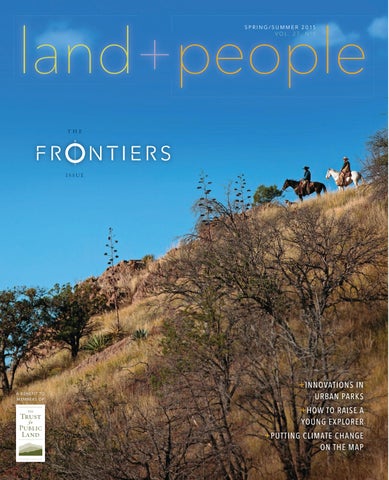
o n t h e cover On this cattle ranch in the Sky Island region of Arizona, landowners are working to restore native grassland and preserve a conservation corridor. photo: chris hinkle
JOI N U S ON FAC EB O O K Scan the QR code with your mobile device to stay tuned to the latest news, videos, contests, and more. facebook.com/tpl.org
T P L. O R G · 3
ke vi n b ru si e
4 · LA ND &PE OPL E · SPR I NG /SUMMER 2015
contents
KNIGHT’S POND, CUMBERLAND, MAINE
Dragonflies and salamanders, turtles, fish, and frogs—who knows what the day’s exploration will turn up? Every kid needs a place to discover the natural world. That’s why we’re working with local conservationists to protect woods and waterways within easy reach of Portland.
Page · 21
21
T P L. O R G · 5
je re my b e e ton
6 · LA ND &PE OPL E · SPR I NG /SUMMER 2015
contents
BOEDDEKER PARK, SAN FRANCISCO, CALIFORNIA
Just as playing on the swings can feel like flight, a perfectly designed park seems a world away from the bustle and worry of the city streets. In the heart of the Tenderloin, the newly reopened Boeddeker Park serves children and families living in the densest part of the city.
Page · 20
20
T P L. O R G · 7
je rry an d marcy mon k man
8 · LA ND &PE OPL E · SPR I NG /SUMMER 2015
contents
HIGHLAND FARM, YORK, MAINE
Intrepid parents want nothing more than to share the joys of the outdoors with their kids—but it’s not always easy. In this issue, writer and father Michael Lanza shares his tips for raising happy campers (including the big one: how to get them to carry their own packs).
Page · 26
26
T P L. O R G · 9
our missio n :
pu blish er Sean Connolly ed itor ial d irecto r Eliza Sarasohn art d irector Matt Mullin man ag in g ed itor Alia Salim photog rap h y co o rd i nato r Elyse Leyenberger ed itor ial ass ista nt Shoshannah Flach staff w r it er Allie Ferguson mar ket in g Kristen Anderson dig ital prod uct i o n Carrie Gotch Adele Wilson-Hamaker con t r ib ut in g edi to r Bill Poole con t r ib ut in g w r i te r Jessica Carew Kraft
A GREEN ER READ Land&People is printed in the United
THE TRUST FOR PUBLIC LAND CREATES PARKS AND PROTECTS LAND FOR PEOPLE, ENSURING HEALTHY, LIVABLE COMMUNITIES FOR GENERATIONS TO COME. how you can help: Our work depends on the generous support of people like you.
States on chlorine-free, 30 percent postconsumer recycled paper and manu™
factured using Envirotech ink, which contains a high percentage of ingredients derived from renewable resources. Printed by Quad/Graphics Inc., Wisconsin.
© 2015 The Trust for Public Land. All rights reserved. Conserving Land for People, Conserving Nature Near You, Creating Parks and Protecting Land for People, Fitness Zone, Land for People, Land&People, LandVote, Northwoods Initiative, Our Land, Parks for People, ParkScore, The Trust for Our Land, The Trust for Public
donate: Use the envelope inside this magazine, or visit tpl.org/donate for other easy ways to give. learn more: Get timely updates on our park and conservation work near you. Sign up for our e-newsletter at tpl.org/enews. share: Help us make the case for parks and open space. When you’ve finished reading this issue, pass it on!
Land, TPL, and The Trust for Public Land and LandVote logos and all other names of The Trust for Public Land programs referenced herein, as well as their logos, are registered or common law trademarks of The Trust for Public Land.
1 0 · LAND &PE OPL E · SPR I NG /SUMMER 2015
Land&People magazine is a benefit to members of The Trust for Public Land. Free trial issues are available at tpl.org/freemag.
from the president
From abandoned railway lines to active freeway overpasses, parks are popping up in spaces that yesterday’s urban planners could never have envisioned going green. Experts in GIS are using innovative computer mapping techniques to help cities prepare for rising seas, rising temperatures, and other imminent effects of global climate change. Social media platforms unknown or obscure a decade ago are now essential tools in advocating for land conservation. And creative combinations of public and private funding are empowering underserved communities to create parks where they are needed most—from Chicago’s Logan Park to San Francisco’s Tenderloin. These are just a few of the latest developments on the frontiers of our conservation efforts—some of which you will read about in this issue of Land&People. But for The Trust for Public Land, working on the cutting edge is nothing new. More than 40 years ago, our founders proclaimed a goal “to pioneer and share new techniques of land preservation.” Back then, we were just a handful of conservationists with an idea for a new and nimble kind of nonprofit, one that borrowed the best techniques from business, law, and real estate and put them to work protecting land for people—especially in and around cities. We had no idea how far the pursuit of that goal would take us. We couldn’t have anticipated that parks would become a critical weapon in battling the 21st-century scourge of obesity, or that we would have—or even need—an entire program dedicated to helping cities cope with the climate crisis.
sara cozolino
TODAY’S FRONTIERS, TOMORROW’S PARKS
But while the frontiers are always shifting, our mission has remained the same: to enrich human lives and build stronger, healthier, and more livable communities by connecting people to nature. The Trust for Public Land believes that everyone deserves to live within a ten-minute walk of a park, playground, or protected natural area—and we are always ready to push our own limits to make that vision a reality. We hope you enjoy this issue of Land&People and thank you for joining in our land-forpeople mission. With your support, we can continue to bring a spirit of innovation to the challenge of creating and protecting places people care about—no matter what the future holds. Onward to the next frontier!
Will Rogers president
T P L. O R G · 11
Be a leader. Support our land-for-people mission by becoming a Conservation Champion today. With your annual operating gift of $2,000 or more, you will receive the recognition due a champion—including invitations to special events and updates on our current projects. Get an insider’s look at how your contribution is making a difference.
For more information, call Kiley Lucan at 415.800.5190.
Conservation Champions The Trust for Public Land
t pl . o r g/ c h a m p ions | cham p ions@tp l.org
O F F IC E R S
F. Jerome Tone
p res i de n t a n d ch i e f exe c u t i v e o ff i c e r
Adrian Benepe
sara cozol in o
William B. Rogers s en i o r v i c e pre si de n t an d d i re cto r o f c i t y pa r k d e ve lop me n t
board spotlight
Get to know
Jerry Tone joined The Trust for Public Land board in 1991. He also serves on the board for—and is past president of—the
s en i o r v i c e pre si de n t a n d di v i si o n di re cto r
Seattle Parks Foundation. His former
Raymond Christman
roles include executive positions with
s en i o r v i c e pre si de n t a n d c h i e f m a r ke t i n g off ice r
Hellman Properties LLC, Montgomery
Sean Connolly
Capital Corporation, BRIDGE Housing
s en i o r v i c e pre si de n t a n d di re cto r o f co n se r vat i o n st rat e g ie s
Corporation, and Wells Fargo Bank. An
Ernest Cook
alumnus of Williams College, he received
s en i o r v i c e pre si de n t a n d di v i si o n di re cto r
his MBA from the University of California,
Jeff Danter
Berkeley. He is originally from Cleveland.
s en i o r v i c e pre si de n t, gen e ra l co u n se l , a n d se cre tary
After years in the San Francisco Bay Area,
M. Holly Haugh
he now lives in Seattle.
s en i o r v i c e pre si de n t a n d c h i e f ph i l a n t hrop y off ice r
Margie Kim s en i o r v i c e pre si de n t an d d i v i si o n di re cto r
Deborah Love s en i o r v i c e pre si de n t, chie f fi n a n c i a l o ff i c e r, a nd treasu re r
I FIRST HEARD OF THE TRUST FOR PUBLIC
THE TRUST FOR PUBLIC LAND’S WORK IS
LAND … in the 1970s, when I read about a
UNIQUE … because we’ve developed an
community garden project in downtown Oakland. I thought, “How great is that? A conservation group working in the heart of the city? Fantastic!” I had to learn more.
extraordinary skillset in real estate transactions, public and private funding, and park planning. That expertise helps us reliably deliver results in all sorts of communities around the country.
Cynthia Scherer v i ce pre si de n t a n d di re cto r o f f e deral affairs
Kathy DeCoster v i ce pre si de n t a n d di re ctor o f co n se r vat i o n t ra nsactions
Brenda Schick v i ce pre si de n t a n d d i re cto r o f hu m a n re sou rce s
Barbara Smith
MY PROUDEST ACCOMPLISHMENT AS A BOARD MEMBER … has been to chair our
THE KEY CHALLENGE FACING THE TRUST FOR
committee on land transactions for many years, including through a number of challenging real estate and political cycles. Each time we’ve come through stronger and wiser. Our project team is second to none. I have major respect for the people here—they’re an inspiration.
PUBLIC LAND … is staying focused in order to direct our most valuable assets— our people—toward the projects that will do the most to create and protect parks and open space for the benefit of communities. I FIRST FELL IN LOVE WITH THE NATURAL
B OA R D OF D I R E CTOR S Page Knudsen Cowles (Chair), Stephen W. Baird, Brian M. Beitner, George Bell, William J. Cronon, Douglas Durst, Whitney Hatch, Ignacia Moreno, Caroline P. Niemczyk, Michael E. Patterson, Thomas S. Reeve, Laura Richards, Roy Richards Jr., William B. Rogers, Lex Sant, Sheryl Tishman, F. Jerome Tone, Ana Valdez, Susan D. Whiting
THE WORK OF THE TRUST FOR PUBLIC LAND
WORLD … when I was very young. My
IS IMPORTANT BECAUSE … while previous
family would spend part of our summers up in Quebec fishing, canoeing, and swimming. I always looked forward to drinking straight from the lake with my face in the water. To this day, nearly all of our travels involve the outdoors— and fly fishing remains one of my favorite activities.
generations did us huge favors with their park-making—from Yellowstone, Yosemite, and Acadia to Central and Golden Gate parks—our generation needs to do its part, too. It’s our turn to make our cities healthier and more fun—and to ensure that our wild places are protected for future generations to enjoy.
T P L. O R G · 13
contributors
Jeremy Beeton
James Edward Mills
Bonnie Tsui
story:
story:
story:
At Last, a Place to Play
The Once and Future River
Over, Around, and Through
20
39
50
Jeremy Beeton moved to San Francisco
James Edward Mills is the producer
From Queens, New York, Bonnie Tsui is a
in 2000 to pursue a career in photogra-
of The Joy Trip Project podcast and a
frequent contributor to The New York Times,
phy and make the most of Northern
journalist covering conservation and
Pacific Standard, and The Atlantic’s CityLab.
California’s great outdoors. You can often
outdoor recreation—from big-wall
Her interests range from swimming and
find him trail running in the Presidio,
climbing to urban-river fly fishing. His
triathlon to American history. Among her
cycling Hawk Hill, skiing at Tahoe, or
book The Adventure Gap chronicles the
books, A Leaky Tent Is a Piece of Paradise is a
backpacking in Yosemite—all with a
first all-African-American summit
collection of essays by young writers on
camera (or two) in tow.
attempt on Denali, the highest point
finding a place in the natural world.
jeremybeeton.com
in North America.
bonnietsui.com
EVEN MORE LAND&PEOPLE Download the free Land&People iPad app—available now at the App Store. The digital edition includes all the stories you love in high resolution, plus bonus content like video, search tools, easy social media sharing, and instant links to learn more. If you don’t have an iPad, you can access the digital edition online at tpl.org/lpdigital. Wherever you see the pointer symbol below, you’ll find bonus content in the digital edition. Download the app or go online to dive deeper into the story.
1 4 · LAND &PE OPL E · SPR I NG /SUMMER 2015
ipa d is a registered tra demark of ap ple inc ., registered in the u.s. and other countries. app store is a service mark of apple inc.
joytripproject.com
mailroom
t eg ra sto n e n u ess
JOI N OUR COMMUNI TY Canine contenders from across the country vied for the title of #OurLand spokes-dog in our “Bark for Parks” contest. You can find all the entries—
sean orourkeph oto.com
and our latest news—on Facebook.
WE DIG IT
Volunteers help restore native plants at a newly protected site on Squak Mountain, just a half hour from Seattle, Washington.
We love to hear from our readers! Tell us what you think of this issue of Land&People—or give us the dirt on your favorite park. You can reach us by mail, on Facebook, or at mailroom@tpl.org.
Conservation inspiration
I have been spending a lot of time lately trying to decide what my purpose in life is. I woke up this morning and started reading my copy of Land&People and everything became perfectly clear. It reminded me that I want to devote my time to helping to encourage others to take care of the planet. I am a proud member of the Stegner Society and many other wonderful organizations that help to preserve land. What greater purpose is there than that? Betsy Franz, via the blog
Land&People goes to class A professor at Saint Mary’s College in Moraga, California, made the Art Issue required reading for a course called “Slow Down and Go Outside.” That’s a lesson we could all learn!
My students loved Land&People. They read the Art Issue before a visit to Lake Merritt, a tidal estuary surrounded by the Oakland cityscape. For three hours, the students walked around observing the dynamic interactions of nature
T P L. O R G · 15
dav id st u b b s
an dy r ich t er
mailroom
St. Croix Headwaters, Wisconsin Northwoods
I cannot explain my excitement for @The606Chicago! I love New York City’s High Line and this is going to be just as beautiful. jordy sirkin, via twitter (the 606 is slated to open this june!)
Recess, reinvented
the seemingly imminent crash into the boulder-strewn shore that the three-foot swells pushed you toward, without killing each other, then you belong together. Forever. Love you, Joel Skogen. And I’ll paddle a canoe with you anywhere. Deirdre Stevens Skogen, via Facebook jenna stamm
and culture among people and wildlife along the lakeshore and in gardens and play areas. Then they used the magazine stories to develop community-building ideas for their own neighborhoods. They wanted greener public spaces—but they also wanted them to be places to participate, “unplugged” from technology, in art, music, food, sports, and education. Many thanks for your role in helping them see how nature and people can coexist in a meaningful way. Jana Carp, Oakland, California
Our green schoolyards are designed for kids, by kids—especially inspiring for supporters who remember how break-time used to be.
Starting school in East Harlem in 1945 we had a choice of playing on a concrete surface or indoors in the gym area, which consisted of white circles painted on a blacktop floor. No grass, and not much fun, either! Glad to hear that kids in Philly are better treated—with real green! Helen Santiago, Media, Pennsylvania
True love floats A blog post on canoeing the St. Croix River inspired readers to share their own stories from the water—including this high praise for a paddling partner.
If you can canoe, together, off the coast of Maine, where the Atlantic and the harbor meet (a metaphor for marriage, perhaps?) and make it to the “south end,” managing to avoid 1 6 · LAND &PE OPL E · SPR I NG /SUMMER 2015
LAND&PEOPLE IS LISTENING! Send letters to the editor or change your mailing address: mailroom@tpl.org.
i wi s h t h at ev ery hum an l ife m ight b e p u re tr anspar ent fr eed om . — Simone de Beauvoir
With your help, we’re working to protect this land in Hoback, Wyoming.
first look
edible conservation
Let there be farms! Lloyd’s vision of Boston as a farm waiting to happen wasn’t purely the product of his entrepreneurial eye: the city owns an estimated 1,200 acres of unused, arable land. But under existing laws, farming an urban plot was illegal. To change that, Lloyd and other advocates teamed up with the Boston Redevelopment Agency to pass Article 89—the “Right to Farm” law. The amendment cleared the way for Garrison-Trotter Farm, Boston’s first new foray into growing its own food. Mayor Marty Walsh was at the groundbreaking last summer. “Farmers make good neighbors,” he said. “Urban agriculture is an innovative
way to improve city life.” The Trust for Public Land worked with community groups to purchase and prepare the half-acre site, adding new soil and an irrigation system. Now, locals trained by the Urban Farming Institute will grow produce to sell to farmers markets and restaurants. State Director Kevin Essington says it’s only the first such collaboration planned for Roxbury and Dorchester—and neighbors are excited to see the vacant lots put to good use. “We’re creating opportunities for people to work green jobs in their neighborhood. It’s converting negative space into a positive space.” maureen white
When Glynn Lloyd cofounded City Fresh Food in the mid-nineties, it was with the belief that everyone, regardless of income, deserves access to healthy food. By 2010, his company was distributing meals to schools, childcare centers, and the homebound elderly across Boston. While purchasing supplies, Lloyd often found himself wondering why he was buying produce that had been shipped long distances from out of state—when everywhere he looked, there were empty lots in the city that might easily be put to agricultural use. “I thought, we can grow greens and vegetables and herbs here,” Lloyd says. “So why aren’t we?”
garrison-trotter farm boston, massachusetts
1 8 · LAND &PE OPL E · SPR I NG /SUMMER 2015
jo e par ks
FLORIDA VOTES YES
good news
Baby bok choy in tangy sesame-soy vinaigrette A favorite with staff at the Urban Farming Institute, this recipe from thecozyapron.com makes a tasty late-spring salad. Most of the nutrients in bok choy are in the stems, so be sure to use the whole plant! INGREDIENTS Salad O 8 baby bok choy, rinsed and dried, then thinly sliced O ½ cup shredded carrot O 1 tablespoon toasted sesame seeds, for garnish Vinaigrette 1 clove fresh garlic, pressed through garlic press O 2 teaspoons toasted sesame seeds O 1 tablespoon honey O 1 tablespoon low-sodium soy sauce O 3 tablespoons rice wine vinegar O 1 tablespoon toasted sesame oil O 3 tablespoons vegetable oil O
Place sliced bok choy and carrot into a large bowl. Refrigerate while vinaigrette is prepared. In a small bowl, combine vinaigrette ingredients and whisk together. Pour vinaigrette over salad, toss well to coat. Garnish with sesame seeds and serve.
Over the next two decades, the population of Florida is expected to grow by up to 25 million people. And while the state’s got plenty of sunshine to go around, residents are concerned for its other natural resources—and taking unprecedented steps to protect them. In November, Florida voters approved a constitutional amendment setting aside $22 billion for land and water conservation—the largest such measure in U.S. history. The new law uses an existing real estate transfer tax to safeguard drinking water, establish urban parks, and support restoration efforts in the Everglades. “When we asked Florida voters if this is a priority, 75 percent of them said yes,” says The Trust for Public Land’s Will Abberger. His Conservation Finance team led the bipartisan effort to get the amendment on the ballot. “There is a logical connection between real estate transactions, which relate to development, and setting aside land for conservation as the state grows,” Abberger says. “The key is to make decisions based on conservation priorities, not on politics.”
WATCH HOW WE HELP COMMUNITIES SECURE PUBLIC FUNDS FOR CONSERVATION @
TPL.ORG/FUNDPARKS
F I R ST LO O K · 19
good news
At last, a place to play Few places need a good park more than the Tenderloin. In the densest of San Francisco neighborhoods, many residents live in single rooms—making public open space critical to the community’s health and happiness. For years, the site that should have served as the local hub was anything but. Though it sits in walking distance of 50,000 potential visitors, the grim and imposing design of Boeddeker Park offered few options for play and did little to discourage crime. But at the reopening celebration in December, there was little to suggest the park’s past. Shouts from a basketball game mixed with the chimes of a giant xylophone as grinning schoolkids swarmed a new climbing structure.
Neighbors toured the remodeled clubhouse, Fitness Zone® area, and garden. There’s still a perimeter fence—but it’s now threaded with wrought-iron flowers. For the neighbors who’ve watched Boeddeker’s transformation, the opening was the culmination of a long fight for the park they deserve—including an extensive community workshop process to identify the features locals wanted most. Though there’s plenty to impress in the final product—from green infrastructure elements to custom artwork—Boeddeker’s reinvention is more than a textbook entry for good design. San Francisco Mayor Ed Lee put it this way: “It’s not just about the space—it’s about the people. It is a tremendous investment in equity.”
The new design includes an energyefficient community clubhouse.
WATCH THE VIDEO @
jeremy beeton
TPL.ORG/ TENDERLOIN
2 0 · LAND &PE OPL E · SPR I NG /SUMMER 2015
50
word watch
what counts
kevin brusie
… and rain. That’s the forecast for a good thaw, nature’s cue for frogs and salamanders to emerge from winter hibernation to mate in the ponds of Cumberland, Maine. There’s just one problem: they’ve got to cross the road. Alerted by text message and equipped with Tupperware containers, dozens of neighbors converge to help their amphibian friends bypass the asphalt. It’s a celebration of community and an eagerly anticipated sign of spring to come. Vernal pools are critical habitat for wildlife—and a source of wonder for curious kids. There are eight on the property at Knights Pond and Blueberry Hill, where we’re working with local conservationists to protect woods and wetlands just a mile from the town center.
All·e·mans·rätt /ôl'·e·mens·ret'/ (n.) The Swedish word for “every man’s right”—specifically, every man’s right to roam—is a fitting name for a much-loved nature reserve outside St. Paul. Last fall, The Trust for Public Land helped expand the park to include a historic cabin and more lakeshore fishing access. Funding was provided by the Environment and Natural Resources Trust Fund as recommended by the Legislative Citizen Commission on Minnesota Resources.
F I R ST LO O K · 21
park people
A MATCH MADE IN PARKS 3
12 22
5
21 1
7
13
6
11
H 2 O 101 Jossie Ivanov is a graduate student in urban planning. Her thesis topic? Drinking fountains. “Free drinking fountains, yielding pure, cold water, would confer a boon on all classes.” So read a resolution of the London Metropolitan Drinking Fountain and Trough Society, which unveiled its first fountain to an enthusiastic crowd in 1859. The humble drinking fountain has come a long way since then, evolving for improved hygiene and accessibility. The newest design innovations reflect growing concern for resource conservation. mouth guard A response to public-health concerns in the 1920s, the addition of a mouth guard to the “arc bubbler” design helped prevent the spread of germs. bottle fillers Spigots designed to top off refillable canteens help encourage sustainable alternatives to bottled water. graywater drainage Fountains can direct excess water to irrigation systems or toilets instead of directly into sewers—but municipal codes rarely allow this.
2 2 · LAND &PE OPL E · SPR I NG /SUMMER 2015
mikota photography
2 4
Trust for Public Land donors Kenny Leftin and Jossie Ivanov spent one of their first dates exploring Golden Gate Park. A few years later—after many weekend trips to Muir Woods and other favorite spots—Kenny would propose outside the Dahlia Garden at San Francisco’s Conservatory of Flowers. “Parks were the places where we realized we liked the same things— to be outside and wander and just see what we’d come across,” says Ivanov. “That’s one of the greatest things about the city of San Francisco: in any direction you walk, you’re going to discover something beautiful and unexpected.” For their wedding last fall, the pair picked Lithia Park in Ashland, Oregon. Since the 1900s, locals have touted the health properties of the park’s spring water—a subject often on Ivanov’s mind these days. As a graduate student in urban planning at MIT, she’s studying the changing role of public drinking fountains. Of course, the park’s appeal was more than academic. It’s across the street from her grandparents’ home and featured in her very earliest wedding plans. “When I was a kid I’d say that I was going to get married there,” Ivanov remembers. “I jokingly told Kenny about it the first time I took him to visit my grandparents, and after we got engaged that was the first thing he said: obviously we have to get married in that park!”
WE GIVE TO …
annie oakley shooters, atlanta, georgia
n ick b urch el l
make our mark
why we give
“Women of my generation were not encouraged to compete in sports,” Since helping start the Annie Oakley Shooters, Huntz has participated in tournaments all over the country.
The sport of clay shooting is sometimes called “golf with a shotgun”—both for the wandering outdoor courses and the social atmosphere.
Never been clay shooting? If you ask Mary Huntz, there’s nothing quite like it. “You lift your gun and you call, ‘Pull!’ The orange disc flies up. You shoot—and the air changes. The clay explodes into pieces. And you think, wow—I did that!” Huntz is a founding member of the Annie Oakley Shooters, an all-women’s club based in Atlanta, Georgia. They’re named for the 19th-century exhibition sharpshooter—in her time as well known as an advocate for gender equality as for her impeccable aim. In that spirit, the club offers instruction and practice hours to a diverse group of female clay shooters, emphasizing safety and camaraderie as well as skill development. “We’re pea shooters and sharpshooters, working professionals and stay-at-home moms, young and not so young,” says Huntz. “We’re women who’ve discovered a secret
many of our husbands and fathers and brothers had known for a long time—that shooting together with friends is very enjoyable.” For more than a decade, the club has hosted a popular clay-shooting tournament as a benefit for The Trust for Public Land. In addition to prizes for the top-scoring shooters, the tournament awards the Annie Oakley trophy to a participant who, in Huntz’s words, “rejoices in the achievement of others and is passionate about her own growth.” A belief that everyone deserves access to the challenge, fun, and friendship of an outdoor sport drives the club’s commitment to parks and conservation. Now in its twelfth year, the tournament is nearing a half-million dollars raised for projects ranging from city parks on the Atlanta Beltline to boating access on the Chattahoochee River. And for the Annies, that’s right on target. F I R ST LO O K · 23
buzzworthy
meet our staff
f lor b l ake
“We need to think about how we connect the people to the land.”
JASON CORZINE “It is the rare chance to plug a spectacular park into a densely built streetscape that really needs it. Where there’s a way, there should be a will.” The New York Times gets on board with the QueensWay in a December editorial. The proposed rail-to-trail project would provide green gathering spaces and a safer route for people-powered transit.
CHECK OUT PROPOSED PARK DESIGNS @
THEQUEENSWAY.ORG
2 4 · LAND &PE OPL E · SPR I NG /SUMMER 2015
THE TRUST FOR PUBLIC LAND’S SOUTHWEST DIRECTOR SEES THE FUTURE OF CONSERVATION IN QUALITY, NOT QUANTITY
What first drew you to conservation work? How did you get started at The Trust for Public Land? The love of all things outdoors was planted in me as a kid. I grew up in the South and spent a tremendous amount of time outdoors. As I made my way through college, I had this notion that I wanted to do something in the natural resources field. While I was in graduate school in Texas, I got my first job working for a water supply district. I started out in a cubicle working on wastewater treatment plants. One day, a Trust for Public Land project manager came to visit and told me, “You know, you could actually protect drinking water by protecting land.” That project, which began in the 1990s, was called Government Canyon. Not only did it safeguard a major drinking water supply for more than a million people in San Antonio and Austin, it also provided the community with access to thousands of acres of open space. That really opened my eyes as to how you could make a career out of con-
w h it r ich ardso n
Colorado’s Wilson Peak towered out of reach for hikers and climbers until The Trust for Public Land successfully negotiated for public access.
servation. The thought of being able to protect these incredible resources and connect people to land through conservation was so novel and fun and inspiring that I made it my ambition to work for this organization. Eventually I was hired to work in Texas. From there I moved on to Colorado, where I worked to conserve a landscape I had fallen in love with as a kid. Today, as Southwest director and JEPS Conservation Fellow, I oversee our work throughout New Mexico, Arizona, and Utah. I can’t think of a better place to be pursuing my passion than in the Southwest. How do you spend your time? What does your job entail? I work with project directors in three states, but I spend most of my time thinking about the future of the Southwest as a whole—and how The Trust for Public Land will evolve to advance our mission here. I’m based in Santa Fe but travel a great deal to meet in person with partners across the region. I also work with our philanthropy team to generate the support that makes our work possible. We’re fortunate to have donors who believe
so much in what we’re doing that they’re investing in our work. It’s their dedication that allows us to be bold and think about the next steps in conservation. What motivates you? Has that changed over time? I’ve often looked at land protection as a race against the clock—trying to protect the most beautiful and special places before they’re gone. We’ve accomplished an incredible amount living by that motto. But increasingly I’m seeing conservation as one among many tools this organization can use to fulfill its mission. More and more I am driven to make sure that everybody has equal access to the incredible landscapes that we have fought for so many years to protect. Today’s conservationists need to think about how we connect the people to the land. What are your favorite projects— or ones that exemplify that connection between land and people? One that was very personal for me was the protection of trail access to Wilson Peak-a “Fourteener” [14,000foot peak] that was previously cut
off from the public. That was very significant because of what it meant for the outdoor community to restore access to one Colorado’s most iconic mountains. I’m also proud of what we’ve achieved recently in helping to create the Valle do Oro National Wildlife Refuge. It’s the first urban national wildlife refuge in the Southwest. To me, that project embodies the idea of providing parks and open space in the communities that need it most—such as Albuquerque’s South Valley. It sounds as though the important thing about these projects is their location, rather than their size. Yes, more and more it’s about the quality and not the quantity of the land that’s protected—land near where people live or that helps them get out into nature. Another example is at Zion National Park in Utah, one of 60 national parks and monuments across our region. One special project there secured a public access point to the Zion Narrows Trail through the canyon of the Virgin River. This trail allows you to immerse yourself in wildland in one of the nation’s more heavily visited national parks. For 16 miles you hike the river bottom and end up where all the tour busses dump their passengers. So, like at Wilson Peak, sometimes connecting people to land is as simple as providing them with a trailhead, giving people the opportunity to visit places they would not be able to visit without our work. Zion Narrows embodies that vision. It was not a big project by acreage, but it was a very challenging one—and the result was quality access that wasn’t there before. F I R ST LO O K · 25
ely se l ey en b e rg e r
insight
th e
family man Michael Lanza has made a life and a living exploring the world’s most celebrated natural landscapes—and helping others do the same. His blog The Big Outside is a trusted manual for families seeking to experience the outdoors together, offering thoughtful recommendations on everything from winning the attention of a screen-bound teen to the best backpacking gear for toddlers. But in recent years, Lanza has found himself confronting a new and far greater challenge to outdoorsoriented families like his. As even the hallowed ground of the U.S. national parks begins to show the effects of global climate change, he and other parents must ask with growing urgency: Will this place be here for my kids? Lanza’s award-winning book Before They’re Gone documents a year of travel with his own family to the frontiers of the changing climate—from the waterfalls of the Yosemite Valley to the icy Alaskan coast. He joined us to share his perspective on raising kids with a connection to the outdoors on a changing planet that needs them more than ever.
2 6 · LAND &PE OPL E · SPR I NG /SUMMER 2015
co u rt esy o f mich ael l an z a
they’re baking on a rock when the tide’s out. Warmer temperatures can hurt them. So, we’d talk about the issue as much as they wanted to. Forcing it usually doesn’t work. But climate change is truly the reality for them. We’ve got to call on the younger generation to save this planet—because our generation hasn’t done a good job of it. Your kids have had many opportunities to engage with the natural world. But do you remember what first sparked your own passion for the outdoors?
There are a lot of books on climate change—but yours illustrates the urgency of the issue in a way that’s very tangible to people who value their experiences in the outdoors.
We tend to think that the impact of climate change will be in the distant future, but that’s not the case. By some predictions, the glaciers of Glacier National Park will be gone by 2020—and virtually every national park has its own story about effects that are visible today. It’s powerful stuff to think that by the time my kids are my age these places will be radically different. They were just nine and seven years old when you started to work on Before They’re Gone. How did you talk to them about climate change?
I was surprised by how much they were able to understand and by how interested they were in the subject: we’d be out hiking and they would bring it up out of the blue. Or we’d see something, say, a tidewater boulder—coated with mussel shells and sea anemones—which is both an incredible sight and an opportunity to explain, well, a lot of these creatures spend half the day exposed to the sunlight, so
I didn’t grow up camping or anything like that. But when I was college age, I had a few experiences that changed my perspective. The summer before my sophomore year I noticed on a map that there was a road all the way to the top of Mount Greylock, the highest mountain in Massachusetts. It was about a hundred miles from my hometown. So I said to two of my best friends, “Hey, let’s go on a bike trip.” We had no idea what we were doing—we had those huge old synthetic sleeping bags the size of hay bales and no real jackets. It rained on us the whole first day. We got absolutely soaked. And then we just kind of walked off the road into the woods to camp. We didn’t have a tent, but we had brought these two sheets of clear plastic. So we put one of them on the ground and the other one on top of us, and we just lay there all night with water pooling around us. It was pathetic, just laughable. But we got up in the morning and we got on our bikes and we finished the ride. And you know, even today it’s still among the most memorable trips I’ve ever had, because it was one of the first times I stepped outside my comfort zone and my own experience. The outdoors can open mental doors for you. You realize, wow, there’s so much more out there than what I know. Which serves as encouragement to keep exploring, to keep pushing your own boundaries. It’s self-reinforcing.
Right. In fact, one of the things I remember most clearly about that trip is another rider we met going the other direction. He had panniers and a helmet with a little mirror on it—you know, a real bicycle guy. He said he was headed to the New Hampshire coast, which we gave him some credit for, and then we asked, “Where are you coming from?” And he said, “Seattle.” We were just floored. We thought it was a big deal that we were taking a four-day trip—like we were really getting I N SI G H T · 27
mich ael l an z a
insight
Now 14 and 12, Nate and Alex are still enthusiastic explorers. See Lanza’s tips (next page) for raising kids with a lifelong love of the outdoors.
after it. It never occurred to us until that moment that you could ride your bike across the entire United States. Does that mean an outdoor trip has to go to extremes to be valuable?
It’s about context. I hope what people can draw from reading my stories is that your experience in the outdoors is about your own path and your own abilities and limits. I remember years ago I met a very accomplished climber, Jeff Lowe. He’s a guy who’s done things that I look at and just think, oh, that’s terrifying. But the comment he made to me was that he actually envied 5.7 climbers—5.7 being a fairly easy rating in rock climbing—because every time they go out, they get scared. And what he meant by that was that every time a novice climber goes out, they have the experience of being on the biggest adventure of their life. The point is, you can have the same emotional experience without going miles and miles into the wilderness— you could be on a day hike in the Middlesex Fells outside Boston, any little park or any state forest. All that matters is your own frame of reference. 2 8 · LAND &PE OPL E · SPR I NG /SUMMER 2015
That’s useful to keep in mind when introducing a child to the outdoors.
Absolutely. I’ve been doing this stuff for years, so I don’t feel all the time the way I did on that first bike trip at Mount Greylock. But it happens for my kids a lot, and I get to live that feeling vicariously, through them. The first time I backpacked with my son he was five. We hiked about a mile. We pitched our tent near a tiny creek—I could step across it, it’s that small. But he thought we were in the middle of nowhere. The wonderful thing about being a child is in climbing to the top of the hill or a cliff where there’s nobody around and believing you’re the first person who’s ever been up there. As adults we know that’s probably not true, but as a child you can still believe it. That’s what you make possible when you take a child into nature. You can give them an emotional experience that’s real magic. Are there also practical aspects to encouraging kids to get out into nature?
There are great lessons that kids can derive from the outdoors. Take the social pressure on girls. My
5 TIPS FOR RAISING OUTDOORS-LOVING KIDS michael lanza’s advice is tried and tested from rocky mountain peaks to the depths of the everglades. if you want to raise a family as passionate about the outdoors as you are, here’s some help getting started.
1 TA K E B A B Y S T E P S
upon them, they might resist or resent it.
Don’t push your kids too hard. It’s tough
If they perceive it as something an expe-
for parents who have always been very ac-
rienced, grown-up, strong hiker (like you)
tive, but remember that what’s familiar and
does, they will want to emulate you.
easy to you may seem scary and intimidat- 4
2
ing to a kid. Evaluate your child’s readiness
D O N ’ T G I V E I N T O F R U S T R AT I O N
for something new based not just on its
Let’s face it: hiking, camping, or doing
physical difficulty, but how well your child
almost anything outdoors with babies, tod-
handled previous experiences that pre-
dlers, and preschoolers is often more work
sented comparable stress.
than fun. Don’t get discouraged; take them out anyway. If you introduce children to
W O R K Y O U R P. R .
the outdoors while they’re very young, you
Engage your kids in trip planning—it gets
can make it part of your family lifestyle and
them excited and builds anticipation.
nurture a long-term love for the outdoors.
Compliment them when they do well and encourage them when they’re challenged:
5
TA K E C A R E O F Y O U R S E L F
they crave your attention, so shower them
Maintaining your own fitness is important
with positive reinforcement. Tell your kids
for taking your kids on bigger adventures
they’re good hikers, skiers, climbers, pad-
as they get older. You inspire and provide
dlers, or cyclists, and they will take pride in
a role model for your kids when you take—
being good at it. You will help them self-
and talk about—your day hikes, trail runs,
identify as a kid who likes the outdoors.
or bike rides. Kids want to emulate their parents; they will perceive whatever you
3 LET THEM ASK TO CARRY MORE
do as normal and fun and eventually ask
Don’t ask your kids to carry a daypack or a
you to bring them along. The best way to
backpack; wait until they tell you they want
get them to love the outdoors is to set a
to. If they perceive it as a chore imposed
good example.
adapted from the big outside. get more tips and stories at thebigoutside.com.
I N SI G H T · 29
mich ael l an z a
THE WONDERFUL THING ABOUT BEING A CHILD IS IN CLIMBING TO THE TOP OF THE HILL OR A CLIFF WHERE THERE’S NOBODY AROUND AND BELIEVING YOU’RE THE FIRST PERSON WHO’S EVER BEEN UP THERE. Lanza recommends allowing kids decide what gear (or toys!) they want to carry themselves. In time, they’ll want their own full pack.
daughter’s 12 now, and I think the confidence she’s gained outdoors—from climbing and exploring and from carrying a backpack for ten or twelve miles in the wilderness—that translates to a confidence that can help her stand up to peer pressure. Whatever other kids have been trying to get her to do, we can say to her, you know that you’re smart and capable and can do things those kids can’t do. You don’t have to give in to that. And of course, time spent camping or exploring together can help families become closer.
Yes. Part of what’s so valuable about experiencing the outdoors with my kids is the one-on-one time, the opportunity just to talk to them. Younger kids thrive on that direct parental attention—and older kids, too, even if they don’t show it as much. And everybody knows that it doesn’t generally happen in everyday life, when we’re constantly interrupted by other responsibilities—or by the phone, our texts, and e-mails. Quality time can be difficult with so many distractions.
Kids and adults have this constant stream of stimulation coming from their environment, electronic and otherwise. But when you’re in the wilderness and you’re taking a break on a hike, you can’t flip open your phone or check into your Facebook or Instagram account. So you’ll actually look at what’s around you and spend some time inside your own head—and that’s an important thing for kids’ emotional and creative development. It’s something both adults and kids are deprived of these days.
3 0 · LAND &PE OPL E · SPR I NG /SUMMER 2015
Do you feel it’s getting more difficult to provide children with that kind of experience?
When I was a kid the woods were nearby. Today, the neighborhood I grew up in is like a subdivision—kids can’t just wander in the woods. They can’t cut through yards to the next neighborhood anymore because everybody’s put up fences and no trespassing signs. We’ve created an urban and suburban environment where kids are discouraged from being outside and encouraged to be indoors more. So we can’t blame our kids for following the path of least resistance and wanting to play a game online instead. Nature is endlessly fascinating to a child, once they get out there. The biggest obstacle children have to discovering that right now is that they don’t get exposed to it. What can be done to overcome that obstacle?
We have to create more opportunities for kids to get outside—and not just out in the wilderness. My family lives near the Boise foothills, about a half mile from a trailhead with miles and miles of trails. Close-to-home options like that are critical, both because these are the places where people get their regular nature fix and rejuvenation and because it’s how many kids first get introduced to the outdoors. So when we think about protecting nature—whether from the effects of climate change or whatever else—protecting these close-to-home places is as important as protecting big tracts of wilderness. If we lose the local access, we begin to lose the connection to the bigger wilderness. We lose the understanding of why we need to protect nature in the first place.
Does your company support gift matching? Ask your human resources department. With corporate gift matching, your donation will go even further to help The Trust for Public Land protect more parks, gardens, and other natural places. That’s one good thing made that much better. fig. 2
good.
better.
Give your EarthShare.
800.714.5263 donor.outreach@tpl.org tpl.org/corporatematch
An EarthShare payroll deduction is one simple way to donate to The Trust for Public Land or more than 400 other environmental and conservation charities. Many corporate and government employers support EarthShare payroll giving. If yours doesn’t, ask them to start. If they do, simply decide on a single deduction or a recurring small one from every paycheck. Then designate us, member number 11440, as one of your conservation charities. For more information visit earthshare.org or email donor.outreach@tpl.org.
T P L. O R G · 31
alex diekmann
fig. 1
riding bmx is a lot harder than it looks. Gripping the
CLIMATE CHANGE’S URBAN FRONTIER
handlebars of my borrowed bike, I roll cautiously around the
With their glowing lights, gridlocked traffic, and crowded streets, you might think that cities are the worst offenders when it comes to climate change. But that’s not the case. As The Trust for Public Land’s Jad Daley points out, studies show that the suburbs produce more greenhouse gasses per capita. For example: the average resident of New York City accounts for nearly 13,500 fewer pounds of carbon emissions than someone living in the suburbs. Why? Because people in cities can walk or take public transportation more often, and the smaller footprint of their more densely built housing is typically more energy-efficient than, say, sprawling single-family homes in Westchester.
banked turn, crest a small rise, and plummet down again—only to find myself stuck in the trough on the other side. Swearing under my breath, I look up to see 45-year-old Rick Wood swoop past me. “Pedal once right before you hit the bottom!” he calls encouragingly. “It’ll get you over the hump!” Wood, The Trust for Public Land’s Tennessee state director, is taking me on a two-wheeled tour of Stringer’s Ridge. The leafy hills of the hundred-acre park contain some of the best mountain biking within riding distance of downtown Chattanooga. Six years ago, The Trust for Public
SURVIVE Land helped protect this land from a proposed condo development. Today, it’s the site of the city’s first green infrastructure project: the pump track we’re riding on. The word “infrastructure” conjures up a picture of pavement and pipelines. But done right, infrastructure can also look like fun. The pump track—an all-ages bike skills area named for the pumping action of riders’ arms as they negotiate the hills and dips—has been specially designed to help manage stormwater runoff, reduce flooding, and recharge the city’s water supply. This kind of versatility is more important than ever. As cities begin to feel the effects of climate change, planners are asking their parks to work a little harder—to help safeguard residents from storms and heat waves as well as providing a place to play. It may sound like a lot to ask of a neighborhood bike park. But with careful planning, it’s possible—no BMX skills required.
3 2 · LAND &PE OPL E · SPR I NG /SUMMER 2015
From the standpoint of a climate scientist, this means the planet benefits when people move to the city, because they end up producing less carbon. “Making cities more attractive places to live is a climate strategy,” says Daley. But while city-dwellers play an important role in combatting climate change, they are also uniquely vulnerable to its effects. Paved-over landscapes can produce a “heatisland” effect in warm weather and exacerbate flooding in storms—as evidenced by the devastating aftermath of Hurricane Katrina and Superstorm Sandy. With climate scientists predicting an increase in the frequency of such extreme weather events, planners must decide how best to prepare communities for the challenges to come. That’s where The Trust for Public Land’s Climate-Smart Cities™ program comes in. Led by Daley, it applies the organization’s expertise in conservation planning and urban park creation to four strategies for climateresilient cities.
jaso n m y e r s
U R B A N PA R K S T R AT E G I E S F O R A C H A N G I N G C L I M AT E
BY LESSLEY ANDERSON
T P L. O R G · 33
the trust for public land focuses on
FOUR STRATEGIES FOR CLIMATE-SMART CITIES. CO N N ECT Even in Chattanooga—which has become a magnet for outdoorsy types—most residents still depend on cars to get around. Creating better networks of walking and biking routes encourages people to ditch driving, reducing carbon emissions as well as the health care costs associated with lack of exercise. “A resident might ask, ‘So what if my city has a beautiful rail-trail—how do I get there from my house?’” Daley says. “It’s about advancing from a simple spine to a network that looks more like veins and capillaries.” In Kirkland, Washington, the Climate-Smart Cities team helped design an ambitious network of connector trails to feed into the regional Eastside Rail Corridor. Planners used transportation data to determine where access points and greenways can maximize connections between schools, residential hubs, and businesses—including Google, whose Kirkland campus is a major employer. Fully implemented, the plan would reduce the city’s carbon emissions by hundreds of thousands of pounds every year.
AB S O R B Like many U.S. cities, Chattanooga relies on a combined wastewater and stormwater system that allows runoff from the streets to mix with raw sewage. Treatment plants can handle only so much: during heavy rains, any overflow is sent—unprocessed—straight into the Tennessee River. With more intense storms predicted in the years to come—and new federal regulations imposing stiff fines on pollution—urban communities need new ways to reduce the amount of rainwater going down the drains. Rather than spending billions on new treatment plants, cities are looking to the ground they walk on: every opportunity to replace asphalt with porous pavement or thirsty plants reduces the burden on the sewers. The Trust for Public Land helps cities incorporate this green infrastructure into schoolyards, playgrounds, and parks—like the Stringer’s Ridge pump track. Specially selected vegetation in the right spots can help filter and absorb runoff before it ever reaches the aging sewers.
3 4 · LAND &PE OPL E · SPR I NG /SUMMER 2015
COOL Materials like concrete and steel absorb and radiate heat, causing late-afternoon temperatures to soar as much as seven degrees Fahrenheit higher than surfaces covered in greenery. At night, that difference can jump to more than 20 degrees. With some studies predicting a tenfold increase in heatrelated deaths by the middle of the century, mitigating this heat island effect is an issue of equity as much as climate science: vulnerable populations—such as the elderly and lower-income households without air-conditioning— bear disproportionate risk. But green space such as parks, tree canopies, and even small rooftop gardens can help cool the urban landscape. In Los Angeles, The Trust for Public Land is working to transform the city’s 900 miles of unused alleyways to provide some respite from the heat. The “green alleys” replace dark pavement with light-colored, permeable paving, as well as drought-tolerant plants for greenery and shade.
PROT ECT In coastal and river cities, climate-savvy planners must contend with the prospect of rising seas and higher storm surges. Placing parks and green space where they can act as natural buffers helps shelter vulnerable communities, while also providing a place for people to get outdoors. Planning for this kind of flood protection can mean conserving natural landscapes, such as bluffs, sand dunes, wetlands, or even barrier islands. Or it can mean creating something new: smart city parks built to flood—so that surrounding neighborhoods don’t. In Newark, for example, Riverfront Park was still under construction when Superstorm Sandy hit. But it emerged relatively unscathed from the ensuing floods, because its landscaping and durable boardwalk were designed with rising water in mind. Now open to the public, the park offers nearby residents the best of both worlds: a connection to the river when conditions are good, and protection from it when the weather turns ugly.
T P L. O R G · 35
h o l l is b en n e tt
3 6 · LAND &PE OPL E · SPR I NG /SUMMER 2015
h o l l is b en n e tt
PUTTING CLIMATE RESILIENCE ON THE MAP
“Each of these factors in their own right presents an opportunity to create a more climate-resilient city,” says Daley. “But you want to get the most bang for your buck, you need to identify the opportunities to meet multiple goals at once.” To do that, the Climate-Smart Cities program uses sophisticated mapping software—Geographic Information Systems, or GIS—to reveal where investment in parks and green space will yield the biggest payoff. Working with a partner city, The Trust for Public Land assembles a local team of policymakers and researchers to supply data from their fields of expertise. In Chattanooga, for example, officials provided The Trust for Public Land with detailed information about the region’s floodplains. Satellite data on land-surface temperature helped pinpoint heat islands. Population density, income levels, the location of existing trails and bike lanes, and even social and healthrelated data—such as likelihood of heart disease in a given neighborhood, or the number of children or seniors—all came together in one system. With this master map, Daley and Wood can help Chattanooga evaluate where parks and green space can do the most to help protect its most vulnerable residents from the effects of climate change—while serving the city’s long-term goals for transportation, recreation, and even housing. It’s a powerful resource for visualization and collaboration: with city agencies and their community partners all accessing the tools through one online portal, the map provides a common language for planning decisions that affect the entire community.
The Trust for Public Land’s Climate-Smart Cities program works closely with field staff—like the Tennessee team—to apply big-picture strategy with local expertise.
Last summer, Wood says, he and an engineer walked the length of Spears Avenue together and had to stop every few minutes to rest in the beating sun—hardly an encouraging sign for planners hoping to convince residents to ditch their cars. To help transform the road into a viable bikeway, the city will plant trees (that’s the “cool” strategy) and rain gardens with thirsty plants (“absorb”). And Spears Avenue won’t be a bike path to nowhere: it will “connect” the downtown district—site of several public housing projects, large employers, and the University of Tennessee—to the trails of Stringer’s Ridge and existing bike and pedestrian corridors that extend into the suburbs.
PLANNING AT STREET LEVEL
Back in the office, Wood spreads a printout of a GIS map across a large table. Red dots mottle the downtown area like a bad case of chicken pox. “The red here is ‘high need,’” Wood says. “If you think about it, it makes sense: lots of pavement, people, and density.” Wood traces his finger along the blue line of the Tennessee River and stops on the NorthShore district. From here, the main road climbs from the waterfront up to the Hill City neighborhood, site of Stringer’s Ridge. As it travels away from the river, Spears Avenue transitions from a row of trendy boutiques to a narrow stretch of single-family homes covered in aluminum siding. There are few trees. “As you can see, Spears Avenue isn’t red, it’s orange,” says Wood, pointing to the map. “But believe me, it gets hot.”
A NEIGHBORHOOD ON THE RISE
For the residents of Chattanooga’s Hill City district, the Climate-Smart Cities plan is the next level of a long-range parks plan that’s already brought welcome change. Residents Pamela and Jason Havron remember the old Stringer’s Ridge as a dubious site for illegal encampments and a dumping ground for discarded junk. But The Trust for Public Land’s purchase of the property for the city— and the massive, community-led cleanup and trail-building effort that followed—has made the forest a destination. “The park has revitalized the neighborhood,” says Jason Havron. Their neighbor, 79-year-old Hattie Darby, was born and raised in Hill City. She graduated from the segregated T P L. O R G · 37
h o l l is b en n e tt
jason myers
called the “dirtiest city in America.” By all accounts, Chattanooga has pulled off an impressive transformation, from decaying industrial river town to a regional standout for urban quality of life. Now, Chattanooga must turn its attention to protecting the ground it’s gained, optimizing its celebrated park system as armor against rising temperatures and intensifying storms. The value of green space as infrastructure is not as easy to see as its beauty: after all, natural systems for managing water and heat often do their work in thin air or below the surface, visible only when charted on a map. But with a climate-smart strategy, forward-thinking cities can harness parks’ potential to meet the challenges of a changing climate—creating livable communities for generations to come.
“Chattanooga is a great place to work,” says Tennessee State Director Rick Wood. “There’s a culture of getting outdoors and embracing new ideas.”
mandy rhoden
Spears Avenue School, which once stood on the site of the Stringer’s Ridge pump track. When builders broke ground to start shaping the track’s jumps and berms, they found the remains of the school buried underneath—and incorporated its old stone walls into the track’s design. When developers targeted Stringer’s Ridge for an extensive condo project, Darby was among their most vocal opponents. The building plan required leveling the ridgeline, and Darby and her neighbors feared that erosion and runoff would foul the houses below. The successful conservation of the property was a relief, its transformation into a much-loved park a bonus. “I think it looks good with all the green around us,” Darby says. “When you cross the bridge coming this way and look up, it looks real nice.” Chattanooga’s lush backdrop is often one of the first thing visitors notice—and no wonder: it’s easy to appreciate green space for its beauty, especially in a place once top: The Spears Avenue pump track. bottom: The overlook at Stringer’s Ridge.
3 8 · LAND &PE OPL E · SPR I NG /SUMMER 2015
There’s space for parks in every city—if you know where to look. by bonnie tsui · illustration by kate evans adapted from urban green by peter harnik
in young, expanding cities, park planners have the
of park design and creation in American cities,” he says.
luxury of acting as land conservationists: find an undevel-
“It’s the kind of thing we haven’t seen since Frederick Law
oped piece of pasture or forest on the urban fringe, set it
Olmsted and Calvert Vaux in the mid-1800s and the Works
aside as a park, repeat. But today’s American metro can
Progress Administration in the 1930s.”
be a relentlessly paved-over place. In the “built-out” city,
On this modern frontier of park design, the challenge is
expanding residents’ access to green space calls for an act
finding ways to use what’s already there. Where land values
of transformation.
are high and budgets tight, there can be economic advan-
Peter Harnik at The Trust for Public Land’s Center for City
tages to cities adding green space without actually acquiring
Park Excellence tracks trends in urban parks across the coun-
new property. Moreover, parks built from existing infrastruc-
try. Where there are no longer large tracts of open space
ture can represent the best chance of healing industrial scars
to work with, he says, cities are using the remnant space for
on the landscape.
small parks and sinuous greenways with outsized value to
“With these innovations, you’re adding value,” says
the communities they serve. And these opportunities can
Benepe. “A highway only has one purpose: moving cars
present themselves in some unexpected—even counterintui-
through neighborhoods. But if you put a park over that
tive—places: freeways, garbage dumps, even cemeteries.
highway, you can take a negative in a community and make it
The Trust for Public Land’s Director of City Park Develop-
a positive.”
ment, Adrian Benepe, witnessed the results of these efforts
For creative planners and advocates, the city abounds with
during his tenure as head of New York City’s parks depart-
opportunities disguised as eyesores. There is always a place
ment. “It’s very exciting: we’re actually in a new golden age
for parks—if you know where to look. T P L. O R G · 39
Railway lines are an urban trail-builder’s dream. They’re long, wide, and level. They’re routed between city centers and outlying communities, with a minimum of interruption by car traffic. And because they’re built on rights-of-way that often predate the highway system, they can harbor unique historical and ecological features—such as native plant species, undisturbed and thriving, that grow almost nowhere else. By some accounts, there are more than 100,000
In Minneapolis, regular snowplowing
miles of abandoned rail line criss-crossing the coun-
helps hardy cyclists make use of the
try—nearly 15,000 miles of which have already been
Midtown Greenway rail-to-trail even
converted into trails for pedestrians, cyclists, and
in brutal Minnesota cold: a third
even skiers. Urban rail-trails’ usage numbers are a
of bike commuters report at least
compelling endorsement: two million visitors annual-
occasionally pedaling to work during
ly on Boston’s Minuteman Trail, one million on Wash-
the winter.
ington, D.C.’s Capital Crescent Trail, and five million on New York City’s High Line, to name a few. In Chicago, The Trust for Public Land’s biggest project will transform nearly three miles of unused rail line into The 606, an elevated park and trail named for the portion of the city’s zip code that all residents share. After a decade of real-estate wrangling, community design meetings, and creative construction—including the wholesale relocation of the Ashland Bridge—the nation’s most ambitious new rail-to-trail project is slated to open in June 2015. When complete, The 606 will connect six ground-level neighborhood parks, boosting access for communities on the city’s Northwest Side, where green space is especially scarce. “The 606 will mean that my daughters can ride their bikes for 38 blocks safely above traffic,” says Huu Nguyen. Nguyen is a community advocate with the Quilombo Cultural Center, adjacent to the old rail line. “It will connect our family to diverse neighborhoods and people in an open and exciting way.”
4 0 · LAND &PE OPL E · SPR I NG /SUMMER 2015
T P L. O R G · 41
4 2 · LAND &PE OPL E · SPR I NG /SUMMER 2015
all photos tpl archive or tpl staff, except “nature” and “hang”: mim adkins; “kid”: jonathan alcorn; “grow”: anna kuperberg
T P L. O R G · 43
The best school playgrounds can feel a lot like parks. But many of them offer little more than crumbling asphalt—hardly an enticement to exercise or explore. To help get kids moving again, The Trust for Public Land partners with schools to transform these barren lots into vibrant green spaces that can serve the whole community once school’s out. “There was a great opportunity to use this land that Apart from expanding community access to green space, converting schoolyards can help cities manage runoff. Before its big makeover, the asphalt lot at Philadelphia’s William Dick Elementary often held a puddle so large that students called it “the pond.”
no one else was using outside of school, to make it something that both students and people in the neighborhood could use every day,” says Mary Alice Lee, director of The Trust for Public Land’s playgrounds program in New York City. This double-duty model demands coordination between the school, the city, and the neighborhood. Their needs may differ, but they share responsibility for keeping playgrounds clean and safe—which is why
The Trust for Public Land uses a participatory design process that gets everyone involved from the very beginning. “Every neighborhood is different,” says Lee. “We spend three to four months talking to students, custodians, teachers, neighbors, and parents to find out what they want to see.” Incorporating the design work into the classroom curriculum is a teaching opportunity for mathematics and measurement as well as communication and compromise. What’s more, student involvement can lead to one-of-a-kind park features the professionals might not have considered. “Because of the kids,” Lee says, “we’ve created murals and mosaics, a hairbraiding area, a jump-rope zone, performance stages, outdoor classrooms, and bowling lanes.”
4 4 · LAND &PE OPL E · SPR I NG /SUMMER 2015
T P L. O R G · 45
4 6 · LAND &PE OPL E · SPR I NG /SUMMER 2015
Conservationists advocate for elevating nature over cars— increasingly, cities are taking the suggestion literally. Freeway-deck parks conceal traffic while creating much-needed pedestrian connections, helping to remediate a legacy of 1960s highway planning that cut off communities from their waterfronts and downtowns. In his design for Klyde Warren Park, the award-winning landscape architect James Burnett conjured a five-acre oasis by bridging the gap over the eight-lane recessed freeway that long separated one side of Dallas from the other. “The city essentially had a moat around
Along the Lake Superior shoreline
downtown,” says Tara Green, the park’s
in Duluth, Minnesota, a compromise
president. “We like our cars in Dallas,” she
between conservationists and trans-
acknowledges. “We had to figure out how
portation planners resulted in three
to get people out of buildings and walk-
separate park decks over I-35—one a
ing instead of driving two blocks.”
transplanted English-style garden with
Public agencies own the “air rights” over
more than 3,000 rosebushes.
freeways, meaning the sites themselves may cost nothing. To foot the bill for park construction, Klyde Warren benefitted from fundraising by boosters who saw the project as an investment in surrounding neighborhoods—a form of public-private partnership common for freeway-deck projects. In Trenton, where the popular South Riverwalk Park covers a portion of U.S. 29, city planner Andrew Carten thinks the payoff is clear. “After all, would you rather look over 600 trucks barreling past every day, or a scenic park and river?”
T P L. O R G · 47
L A NDFIL L S If you think this idea stinks, consider that landfills are often the only large pieces of undeveloped space left within a dense metro area. As Harnik points out, creating a community hub from a dumping ground can be a chance to “correct longstanding environmental injustice to the surrounding residents.” Converting mounds of trash into a place you’d want to picnic can be an expensive undertaking, but the site itself is likely to cost little or nothing. And although decomposing solid waste emits gas, methane can be vented, captured, and CEME T E R I E S
sold: Oregon’s former St. John’s Landfill, now part of a wet-
If you like exploring new cities, you’ve probably had this
land natural area, earns more than $100,000 a year this way.
experience: you venture through an intriguing set of stone
Savvy landfill-park planners situate park buildings over
gates and onto the manicured grounds of what looks to be
ground never actually used for waste disposal, while cover-
a plum of an urban park—until you see the headstones. Then
ing areas that may “slump” as buried waste settles with resil-
you wonder if it’s OK for you to be there at all.
ient natural elements like grass and tree cover. The affection-
The answer varies. Not all cemeteries are suitable for park
ately named Mount Trashmore in Virginia Beach models this
use—after all, no bereaved family wants a Frisbee match at a
mix well, offering an extensive skate facility as well as acres
funeral—but older sites with few new burials can offer a green oasis already equipped with gardens, benches, and pathways for running and biking. “Cemeteries are for the living,” says Mark Smith, sexton of the publicly owned Salt Lake City Cemetery. Smith rejects the idea that his facility is only for somber reflection. Rather, it’s “a hidden gem within the city,” he says, an open-space resource that can and should be used for something other than burial. In Atlanta, the Oakland Cemetery has become a true cultural attraction. Thanks to the local historical society, visitors can enjoy concerts, classes, and a popular Halloween festival featuring mausoleum tours by Victorian-era reenactors. (Ever mindful of sensitivities unique to event-planning on a burial ground, the
A Nebraska park board approached a cemetery director about hosting a performance of King Lear on the grounds. The director, whose own mother and father are buried on the site, had no objection. His reply to the raised eyebrows: “I asked my parents, and they didn’t say anything.”
4 8 · LAND &PE OPL E · SPR I NG /SUMMER 2015
organizers adopted a motto: “Enlighten, don’t frighten.”)
of open fields.
An early example of trash-totreasure: New York City’s Corona Dump—dubbed the “valley of ashes” by F. Scott Fitzgerald in The Great Gatsby—was transformed to host the 1939 World’s Fair. Today, the site is Flushing Meadows Park.
In combination, these resources draw more than a million visitors a year.
YOUR LEGACY
Protect the places you love by making a gift to The Trust for Public Land in your estate plans. By naming The Trust for Public Land as a beneficiary of your will, living trust, or retirement account, you can make a visionary gift that will conserve land for generations to come. For more information, infforma mati tion on,, pl pplease ease contact Gardner Gar ardn dner er Trimble Trimble b at 415.800.5208. t pl . o rg /pl anne d g i v i n g · p la n n ed g i v i n g @ tp l.org rg/pl
The Trust for Public Lan Land d
THE ONCE AND FUTURE RIVER
5 0 · LAND &PE OPL E · SPR I NG /SUMMER 2015
reflections on re storation in los angele s by james edward mills · photos by julia stotz
T P L. O R G · 51
WE SHALL NOT CEASE FROM EXPLORATION, AND THE END OF ALL OUR EXPLORING WILL BE TO ARRIVE WHERE WE STARTED AND KNOW THE PLACE FOR THE FIRST TIME.
boots slip on the loose rocks underfoot. True, the unsigned trail I followed up from the paved road had seemed sketchy from the outset. Just before it disappeared completely I noticed a scattering of droppings left behind by some four-legged creature better equipped for rough terrain. It wouldn’t be the first time I’d followed a deer path by mistake. As the ground gives way I slide down the slope in a rush, tearing a gash into my right thigh. A trickle of blood runs down my leg. I’m going to ruin my favorite hiking shorts, I think, and then—there must be an easier way to get to the Griffith Park Observatory! 5 2 · LAND &PE OPL E · SPR I NG /SUMMER 2015
you r do nat io n at wo r k
the earth crumbles beneath my fingers. I look down to see my weathered
connect urban communities to nature—and each other.
T
In cities across the country, The Trust for Public Land works to realize rivers’ unique potential to
— t. s. eliot
r ich re id
T P L. O R G · 53
I
i grew up in Los Angeles. “The Park,” as we called it, was where I enjoyed many of my earliest outdoor experiences. With their commanding views of downtown and the Hollywood Sign, Griffith’s steep hillsides instilled me with a deep curiosity and longing to discover what might be over the next ridge.
own nature, as human beings eager to be free in the world outside. But for all my early exploring, I never knew that the dry landscape also held water. Surrounded by a chain-link fence, its banks encased in concrete, the Los Angeles River hugs the eastern boundary of Griffith Park. As the river cuts a meandering path of 50 miles from the hills of Pasadena to the ocean in Long Beach, it’s a conduit for urban runoff, a dumping ground for garbage, and, occasionally, a course for illegal drag racing. If Los Angeles is a beating heart, off to the communities around it.
5 4 · LAND &PE OPL E · SPR I NG /SUMMER 2015
yo ur do natio n at wor k : pa ssa ic r iver
the river of my childhood was a failed artery, clogged with refuse and closed
once closed-off river. An expansion will connect the park to a network of waterfront paths.
preserve, exploring not only the labyrinth of rocks, oaks, and chaparral—but our
For many residents, the opening of Newark Riverfront Park provided their first-ever access to the
My brothers and friends and I would tramp through the woods of this urban
T P L. O R G · 55
5 6 · LAND &PE OPL E · SPR I NG /SUMMER 2015
a legacy of Florida’s Tequesta Indian heritage.
The Miami River Greenway begins at the 2,000-year-old Miami Circle archaeological site,
today, the effort to restore the lifeblood of the river to Los Angeles is gaining momentum. Community activists—and, increasingly, government agencies—are reimagining the waterway as more than a mere drainage system. Instead, its supporters see the river’s potential to provide a living, flowing connection between parks and green spaces for the neighborhoods that need it most. “The Los Angeles that my daughters grow up in is going to be very different than the Los Angeles that I grew up in,” says Omar Brownson, executive director of the Los Angeles River Revitalization Corporation. “They are going to be urban, city kids—but that doesn’t mean that they shouldn’t have the chance to develop an appreciation of nature and the environment, to have that breathing space.” Advocates for both the natural resources and human communities along the river, Brownson and others like him envision a far-reaching greenway that will make all of Los Angeles more livable. They believe that by emphasizing continuity, access, and features that reflect the cultural diversity of the city it traverses, the Los Angeles River Greenway—slated for completion in 2020— could become a model of restorative urban planning. “We have an opportunity to redefine what a global city looks like in the 21st century,” says Brownson. It’s within our capabilities and it’s definitely our responsibility. “What’s exciting to me these days is that when we cross the Los Angeles River, my daughters point it out,” he says. “It’s part of their vocabulary, which means it’s part of their identity—part of what it means to be an Angeleno.”
yo ur do natio n at wor k : mi am i r iver
T
T P L. O R G · 57
W
hat being an Angeleno means to me has shifted since my days as a young black kid in Leimert Park. Born in 1966—the year immediately following the civil unrest of the Watts Riots—I grew up in a racially charged era. Much is different now, but what remains are cultural artifacts, social cues that define the unwritten set of expectations we have for what people of a certain racial or ethnic background are supposed to do as part of “normal behavior.” For many minorities in this country, these expectations do not include embracing the outdoors, whether for sport or work. There remains a racial divide between those who participate in outdoor activities and those who don’t, a yawning chasm I call “the adventure gap.” As a professional journalist, I have bridged it. My work has taken me to distant parts of this remarkable blue-green planet, from the jungles of Central America to the high alpine lakes of the Andes, the deserts of Eastern Africa and the fjords of Norway below the Arctic Circle. In the United States I have hiked through many national parks, from the Great Smoky Mountains to the Grand Canyon. I’ve climbed the granite walls of Yosemite Valley and trekked deep into the heart of Alaska’s Denali. But along the way, I have also explored the urban frontier, venturing into the small preserves and manmade parks that pay homage to the concept of wilderness. Though still within reach of WiFi and warm beds, they provide a space where even those often confined by culture and socioeconomic status to asphalt, glass, concrete, and steel can indulge a primal need for fresh air, green trees, and free-flowing water. I have dedicated much of my career to telling stories of outdoor adventure, encouraging the apprehensive to explore the divide between the safety of the city and the wonders of nature. Through my work and life as a person of color—with roots in one of America’s biggest and most formidable metros—I know from experience the value that urban green space can have in creating a profound appreciation and love for nature in all its forms. For me, it began at Griffith Park. For the next generation of adventurers, it may begin on the Los Angeles River.
5 8 · LAND &PE OPL E · SPR I NG /SUMMER 2015
T
his city is far too vast for a single green hub like more densely developed New York’s Central Park. Instead, the proposed Los Angeles River Greenway will create a network of satellite parks across the county. The river and its tributaries will link open spaces together like a strand of pearls, a treasure for residents and visitors alike. The more than 30 river parks already established are oases of beauty and calm. Some are named for their wild past: Steelhead Park and Egret Park honor species that once thrived there. At Marsh Street Park—among almost 80 acres of riverfront protected by The Trust for Public Land—children play on colorful sculptures of a rattlesnake and a frog. Lewis MacAdams heads Friends of the Los Angeles River. For three decades, he’s worked toward a vision of the river restored to its former vitality, wetland habitat that can support not only human life but also the birds and wildlife of the river’s past—and, he hopes, its future. “When the steelhead trout runs return to the Los Angeles River,” he says, “that’s when our work will be done.” A celebrated poet as well as an activist, MacAdams describes his work as a 40year art project. “It’s an expression I plucked out of the air,” he says. “But it’s a way to look at the big picture. The river becomes a symbol of how people live in the watershed. It’s nothing if not an ambitious project.”
I HAVE EXPLORED THE URBAN FRONTIER, VENTURING INTO THE SMALL PRESERVES AND MANMADE PARKS THAT PAY HOMAGE TO THE CONCEPT OF WILDERNESS.
T P L. O R G · 59
THE RIVER AND TRIBUTARIES WILL LINK OPEN SPACES TOGETHER LIKE A STRAND OF PEARLS.
6 0 · LAND &PE OPL E · SPR I NG /SUMMER 2015
for the canoeists, paddleboarders, and kayakers whose business supports local economies.
We’re working with cities along the river to establish a blueway trail—including access points
yo ur do natio n at wor k : chatta ho o che e r i ve r
M
acAdams is right: the scope of the project is enormous. But the effort to revive the river received a major boost last summer when the U.S. Army Corps of Engineers recommended a management proposal called Alternative 20—the most extensive of the options under review. The strategy outlines major restoration work on an 11-mile portion of the river north of downtown. In addition to wetland habitat, it calls for more public access points, large-scale concrete removal, and the conversion of a 130-acre railyard into a new park space. Though there’s much to be done before that vision can be realized, the selection of Alternative 20 opens up new possibilities for crucial federal funding— and represents a major shift in the Army Corps’ approach to managing urban waterways. Historically, the agency has viewed the Los Angeles River in terms of stormwater management: after major flooding in the 1930s, it spent decades paving over almost the entire river channel. Today, it’s beginning to take a more holistic view. “The mission of the Army Corps is mandated by Congress, and it has been augmented to include ecosystem restoration,” says Omar Brownson. “The corps is now trying to better balance the needs of habitat with flood control.” Among the many organizations working to transform the river, there’s an unprecedented optimism that the Army Corps’ new position heralds a major investment of its capital and engineering might—as well as the recognition, Brownson says, that “urban rivers are unique, and need to also include recreational, economic, and cultural improvements.” As it winds its way through more than a dozen Los Angeles municipalities, the river traces a common thread through public land and across the lines of race, culture, and status that often divide us. When I envision this concrete culvert restored to a thriving ecosystem, I see more than infrastructure to divert water from city streets and gutters—I see a river of shared purpose, bringing communities together. MacAdams, the poet, puts it this way: “Rivers don’t want to run in straight lines, they want to bend. And we are the wend in the river. It’s about creating a space where people can gather, just like in the gospel hymn: Come down by the river, and the river will tell you what to do next.”
W
iping the dust from my hands, I scramble up a few hundred feet until I gain a narrow ridgeline. Continuing on, I spot the low fence beneath the observatory’s copper dome. Like a thief I hop over the barrier, looking left and right to make sure no one sees me enter. Kneeling by the fence, I pull a water bottle from my backpack, rinse the gravel from my hands, and wet my bandana to staunch the bleeding that stains the leg of my shorts. A group of schoolchildren laugh and chatter as they walk past me. Maybe they’re surprised to see a grown-up brush dirt from his knees—or perhaps they’re looking at something else. As I turn toward the Los Angeles basin I, too, marvel at the view of the city below. Through the haze I can make out broad patches of green and the occasional shimmer of flowing water. As I return down the mountain—this time on a marked trail—I see hundreds of people of every age and race on their way up. Mothers carry babies. Entire families pose for photographs. Elderly men walk slowly with canes. Joggers pass by, sweat gleaming on their skin. Every beat of their hearts expresses love for their park—and their city. I smile to myself. Before my eyes, the adventure gap is closing.
James Edward Mills is the author of The Adventure Gap and producer of The Joy Trip Project podcast.
T P L. O R G · 61
Member Center CHARITABLE SOLICITATION DISCLOSURE
When you become a member of The Trust for Public Land, you join a community of committed conservationists who care deeply about protecting the places that make our country special—from small neighborhood parks to vast wilderness escapes. As a member, you’ll receive benefits including: • Insider updates on our work in your community and beyond • A full-color wall calendar filled with beautiful photos of places protected with your help • A subscription to Land&People, the awardwinning magazine for people who love the land Join or renew your membership today!
Ways to give Monthly giving
Support The Trust for Public Land’s mission with convenient, automatic, and secure monthly giving. Visit tpl.org/ monthlygiving, call 800.714.5263, or email donor.outreach@tpl.org. Conservation Champions
Donate $2,000 or more annually and receive the recognition due a champion. Visit tpl.org/champions, contact Kiley Lucan at 415.800.5190, or email champions@tpl.org. Gift and estate planning
Please let us know if you have remembered The Trust for Public Land in your will or estate plans so we can welcome you to our Stegner Society of legacy donors. Contact Gardner Trimble at 415.800.5208 or gardner.trimble@tpl.org. See more giving options at tpl.org/ways-to-give.
6 2 · LAND &PE OPL E · SPR I NG /SUMMER 2015
contact us For questions about our work or to change your Land&People subscription address, call 415.495.4014, or email donor.outreach@tpl.org. Charity ratings
The Trust for Public Land is a registered 501(c)(3) public charity. We’re among the nation’s most efficient nonprofits, conserving $4 worth of land for every $1 donated. Charity Watch (formerly the American Institute of Philanthropy) gives The Trust for Public Land an “A” for efficiency for putting 84 cents of every dollar donated directly to our land conservation programs. For all our charity ratings, go to tpl.org/efficiency.
A copy of the latest financial report of this organization can be obtained by contacting The Trust for Public Land, 101 Montgomery Street, 9th Floor, San Francisco, CA 94104. In addition, residents of any of the following states may obtain the latest information on our registration in that state by contacting: Florida—A COPY OF THE OFFICIAL REGISTRATION AND FINANCIAL INFORMATION MAY BE OBTAINED FROM THE DIVISION OF CONSUMER SERVICES BY CALLING TOLL-FREE, 1-800-435-7352, WITHIN THE STATE OR VISITING www.800helpfla.com. REGISTRATION DOES NOT IMPLY ENDORSEMENT, APPROVAL, OR RECOMMENDATION BY THE STATE (#CH104). Georgia— The following information will be sent upon request: (A) A full and fair description of the charitable program for which the solicitation campaign is being carried out and, if different, a full and fair description of the programs and activities of the charitable organization on whose behalf and the solicitation is being carried out; (B) A financial statement or summary which shall be consistent with the financial statement required to be filed with the Secretary of State pursuant to code Section 43-17-5. Maryland—For the cost of copies and postage: Office of the Secretary of State, State House, Annapolis, MD 21401, 410-974-5534. Michigan—MICS-12834. Mississippi—The official registration and financial information of The Trust for Public Land may be obtained from the Mississippi Secretary of State’s Office by calling 1-888-236-6167. Registration by the Secretary of State does not imply endorsement. New Jersey—INFORMATION FILED WITH THE ATTORNEY GENERAL CONCERNING THIS CHARITABLE SOLICITATION MAY BE OBTAINED FROM THE ATTORNEY GENERAL OF THE STATE OF NEW JERSEY BY CALLING 973-504-6215 AND IS AVAILABLE ON THE INTERNET AT http://www. state.nj.us/lps/ca/charfrm.htm. REGISTRATION WITH THE ATTORNEY GENERAL DOES NOT IMPLY ENDORSEMENT. New York—Upon request, a copy of the latest annual report can be obtained from the organization or from the Office of the Attorney General by writing to the Charities Bureau at 120 Broadway, New York, NY 10271. North Carolina—Financial information about the organization and a copy of its license are available from the State Solicitation Licensing Branch at 1-888-8304989. This license is not an endorsement by the State. Pennsylvania—The official registration and financial information of The Trust for Public Land may be obtained from the Pennsylvania Department of State by calling toll free, within Pennsylvania, 1-800-732-0999. Registration does not imply endorsement. Virginia—State Division of Consumer Affairs, Department of Agricultural and Consumer Services, P. O. Box 1163, Richmond VA 23218. Washington—Charities Division, Office of the Secretary of State, State of Washington, Olympia, WA 98504-0422, 1-800-332-4483. West Virginia—Residents may obtain a summary of the registration and financial documents from the Secretary of State, State Capitol, Charleston, WV 25305. Registration does not imply endorsement. Wisconsin—a financial statement of The Trust for Public Land disclosing assets, liabilities, fund balances, revenue, and expenses for the preceding fiscal year will be provided upon request. The Trust for Public Land was formed in California. REGISTRATIONS IN THE ABOVE STATES DO NOT IMPLY ENDORSEMENT, APPROVAL, OR RECOMMENDATION OF THE TRUST FOR PUBLIC LAND BY THE STATE.
Offices florida
massachusetts
new york
North Texas Office
Florida State Office
Massachusetts State Office
New York State Office
2902 Floyd St.
National Office
306 North Monroe St.
10 Milk St.
666 Broadway
Dallas, TX 75204
101 Montgomery St.
Tallahassee, FL 32301
Suite 810
9th Floor
469.615.5448
Suite 900
850.222.7911
Boston, MA 02108
New York, NY 10012
San Francisco, CA 94104
Also serves: Alabama, Arkansas,
617.367.6200
212.677.7171
415.495.4014
Mississippi, the Caribbean
Also serves: Rhode Island
NATIONAL OFFICES
utah Utah State Office
north carolina
850 S. 400 W. #119
Federal Affairs
South Florida Office
minnesota
North Carolina State Office
Salt Lake City, UT 84101
100 M Street SE, Suite 700
8603 S. Dixie Highway
Minnesota State Office
1200 E. Morehead St.
801.333.8526
Washington, DC 20003
Suite 410
2610 University Ave.
Suite 250
202.543.7552
Miami, FL 33143
Suite 300
Charlotte, NC 28204
vermont
305.667.0409
St. Paul, MN 55114
202.543.7552
Vermont State Office
651.917.2240
Also serves: South Carolina
3 Shipman Place
STATE AND LOCAL OFFICES
Montpelier, VT 05602
georgia
Also serves: Indiana, Iowa,
Georgia State Office
Kansas, Michigan, Missouri,
ohio
802.223.1373
california
One Georgia Center
Nebraska, North Dakota, South
Ohio State Office
Also serves: New Hampshire
California State Office
600 W. Peachtree St. NW
Dakota, Wisconsin
B. F. Keith Building
101 Montgomery St.
Suite 1840
1621 Euclid Ave.
washington
Suite 900
Atlanta, GA 30308
montana
Suite 1600
Washington State Office
San Francisco, CA 94104
404.873.7306
Northern Rockies Office
Cleveland, OH 44115
901 5th Ave.
Emerson Cultural Center
216.928.7518
Suite 1520
415.495.4014 hawaii
111 South Grand Ave.
Hawaii State Office
Suite 203
oregon
206.587.2447
Los Angeles Office
1003 Bishop St.
Bozeman, MT 59715
Oregon State Office
Also serves: Alaska
135 West Green St.
Pauahi Tower, Suite 740
406.522.7450
808 SW 3rd Ave.
2nd Floor
Honolulu, HI 96813
Also serves: Idaho
Suite 570
Eastern Washington Office
Pasadena, CA 91105
808.524.8560
Portland, OR 97204
18 North Wenatchee Ave.
503.228.6620
2nd Floor
Also serves: Nevada
new jersey
323.223.0441
Seattle, WA 98164
Wenatchee, WA 98801
illinois
New Jersey State Office
Sacramento Office
Illinois State Office
20 Community Place
Bend Office
1107 9th St.
120 S. LaSalle St.
Suite 7
805 SW Industrial Way
Suite 1050
Suite 2000
Morristown, NJ 07960
Suite 1
washington d.c.
Sacramento, CA 95814
Chicago, IL 60603
973.292.1100
Bend, OR 97702
Chesapeake Office
916.557.1673
312.750.9820
541.382.2092
100 M Street SE, Suite 700
509.888.0844
Washington, DC 20003
Parks for People— colorado
louisiana
New Jersey
pennsylvania
202.543.7552
Colorado State Office
Louisiana State Office
60 Park Place
Parks for People—
Also serves: Delaware, Kentucky,
1410 Grant St.
1137 Baronne St.
Suite 203
Philadelphia
Maryland, North Carolina, South
Suite D210
New Orleans, LA 70113
Newark, NJ 07102
1501 Cherry St.
Carolina, Virginia, West Virginia
Denver, CO 80203
504.620.5142
973.998.9440
Philadelphia, PA 19102
maine
new mexico
connecticut
Maine State Office
New Mexico State Office
tennessee
Office
Connecticut State Office
30 Danforth St.
607 Cerrillos Rd.
Tennessee State Office
690 S. Hwy. 89
101 Whitney Ave.
Suite 106
Suite F1
202 Tremont St.
Suite 200
2nd Floor
Portland, ME 04101
Santa Fe, NM 87505
Chattanooga, TN 37405
Jackson, WY 83001
New Haven, CT 06510
207.772.7424
505.988.5922
423.265.5229
307.739.3941
267.519.5303
303.837.1414
203.777.7367
wyoming Northern Rockies
Also serves: Arizona
texas Texas State Office 2579 Western Trails Blvd. Suite 130 Austin, TX 78745 415.269.4231 T P L. O R G · 63
trail’s end
FIRST TRACKS Naperville, Illinois. September 25, 1963. We are human beings. We are able to walk upright on two feet. We need a footpath. Right now there is a chance for Chicago and its suburbs to have a footpath, a long one. The right-of-way of the Aurora electric road lies waiting. If we have the courage and foresight, such as made possible the Long Trail in Vermont, and the Appalachian Trail from Maine to Georgia, and the network of public footpaths in Britain, then we can create from this strip a proud resource. Look ahead some years into the future. Imagine yourself going for a walk on an autumn day. Choose some part of the famed Illinois footpath. Where the highway crosses it, you enter over a stile. The path lies ahead, curving around a hawthorn tree, then proceeding under the shade of a forest of sugar maple trees, dipping into a hollow with ferns, then skirting a thicket of wild plum, to straighten out for a long stretch of prairie, tall grass prairie, with big blue stem and blazing star and silphium and goldenrod. You must go over a stile again, to cross a highway to another stile. This section is different. The grass is cut and garden flowers bloom in great beds. This part you may learn, is maintained by the Chicago Horticultural Society. Beyond the garden you enter a forest again, maintained by the Morton Arboretum. At its edge begins a long stretch of water with mud banks, maintained for water birds and waders, by the Chicago Ornithological Society. You notice an abundance of red-fruited shrubs. The birds have the Audubon Societies to thank for those. You rest on one of the stout benches provided by the Prairie Club, beside a thicket of wild crab apple trees planted by the Garden Club of Illinois. Then you walk through prairie again. Four Boy Scouts pass. They are hiking the entire length of the trail. This fulfills a requirement for some merit badge. A troop of scouts is planting acorns in a grove of cottonwood trees. Most of the time you find yourself in prairie or woodland 6 4 · LAND &PE OPL E · SPR I NG /SUMMER 2015
of native Illinois plants. These stretches of the trail need little or no upkeep. You come to one stretch, a long stretch, where nothing at all has been done. But university students are identifying and listing plants. The University of Chicago ecology department is in charge of this strip. They are watching to see what time and nature will do. You catch occasional glimpses of bicycles flying past, along one side. The bicycles entered through a special stile admitting them to the bicycle strip. They cannot enter the path where you walk, but can ride far and fast without being endangered by cars, and without endangering those who walk. That is all in the future, the possible future. Right now the right of way lies waiting, and many hands are itching for it. Many bulldozers are drooling. may theilgaard watts (1893–1975) was a naturalist and educator. her letter to the chicago tribune in support of the illinois prairie path helped spark the rail-to-trail movement, and foresaw the model of publicprivate partnership that would make it possible. as we prepare to open the 606— chicago’s next great park and trail—we honor her vision.
kate evans · www.folioart.co.uk
we hope you enjoyed
The Frontiers Issue Thank you for all you do for parks and conservation in your community—and for your ongoing support of The Trust for Public Land. As a member of The Trust for Public Land, you’re on the cutting edge of conservation. For 40 years, we’ve worked with people like you to protect more than 3.3 million acres from the inner city to the wilderness, and to generate more than $57 billion in public funds for healthy land and water. Today, millions of Americans live within a 10-minute walk of a park, garden, or natural area created with your help, and millions more visit these sites each year.
the trust for public land c reating pa r ks a n d p rot e ct i n g l and for p e op l e
nonprofit us postage
National Office 101 Montgomery St. Suite 900 San Francisco, CA 94104
paid
josh schachter
the trust for public land
Conserve land … and your retirement.
C H A R I TA B L E G I F T A N N U I T Y R AT E S B Y A G E
A charitable gift annuity to The Trust for Public Land can provide you with income for life while helping to conserve land for generations to come. Here’s how: 1. Make a gift to The Trust for Public Land. 2. Receive a charitable deduction. 3. We invest your gift. 4. We pay you a fixed percentage of the original gift for the rest of your life. 5. We apply the remainder toward achieving our land-for-people mission.
65
70
75
80
85
90
4.7%
5.1%
5.8%
6.8%
7.8%
9.0%
To learn more about these benefits, please contact: Gardner Trimble, Director of Planned Giving 415.800.5208 or plannedgiving@tpl.org