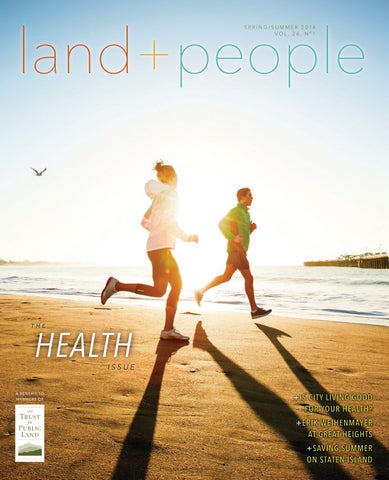
S P R I N G / S U M M E R 2 0 14 VOL. 26, Nº1
the
HEALTH
ISSUE
A BENEFIT TO MEMBERS OF
+IS CITY LIVING GOOD FOR YOUR HEALTH? +ERIK WEIHENMAYER AT GREAT HEIGHTS +SAVING SUMMER ON STATEN ISLAND
the longer you stay, the more we all save. save on your room
JO HN ELLIS
% 15
save
RICH REID
the land
This issue of Land&People is made possible in part by a generous grant from Kimpton Hotels. Just as The Trust for Public Land preserves the special places that give our communities their unique character, Kimpton Hotels preserves special buildings as elegant and charming one-of-a-kind hotels. Kimpton Hotels is a proud supporter of Parks for People, The Trust for Public Land’s initiative to create close-to-home parks in cities across America. The Trust for Public Land thanks Kimpton Hotels for its support, as well as for its environmentally friendly way of doing business—including innovative eco-rooms, linen reuse policies, water conservation, and recycling programs.
* B O O K & S AVE To receive 15% off the best available rate, go to kimptonhotels.com and enter “TPL” in the rate code field when making your reservation. Or call 800-KIMPTON. For every night’s stay, $10 will be donated to The Trust for Public Land.
ALEXANDRIA | ASPEN | BALTIMORE BOSTON | CAMBRIDGE | CHICAGO DALLAS | DENVER | LA JOLLA LOS ANGELES | MIAMI | MIAMI BEACH MINNEAPOLIS | NEW YORK CITY PHILADELPHIA | PHOENIX | PORTLAND SALT LAKE CITY | SAN DIEGO | SAN FRANCISCO | SAN JOSE | SANTA BARBARA SAVANNAH | SCOTTSDALE | SEATTLE SEDONA | VERO BEACH WASHINGTON DC
52
contents
mich ael h av ey
34 “A lot goes on when you’re not afraid of the traffic.”
45
~ pe t e r ha rn i k t h e n e w u r ba n a dva n tage
Lost and Found...................................................... . . . . . . . . . . . . . . . . . . . . . . . . . . . . . . . . . . . . 34 Stories of growth and healing in the outdoors.
The New Urban Advantage ..................... . . . . . . . . . . . . . . . . . . . . . . . . . . . . . . . . . . . . 45 How once-polluted cities became places to thrive.
La Farmacia Hermosa ..................................... . . . . . . . . . . . . . . . . . . . . . . . . . . . . . . . . . . . . 52 Gardens yield a bumper crop of community health benefits.
sabine heine sabine heine
an n a ku per b erg
F EAT U R E S
T P L. O R G · 1
jerry and marcy mo nkman
tpl.org/monthlygiving
The Trust for Public Land depends on reliable, monthly support from donors like you to sustain our land-for-people mission. It’s easy, automatic, and secure. Join today.
D E PA RT M E NTS
darcy k ief el
Prescription: Parks
matt n ag er
From the President · 11
contents
22
Board Spotlight · 13 Carolyn Niemczyk
Contributors · 14 Mailroom · 15 First Look · 17 Merit badges, local brews, and a second life for rusting railroads.
27
Insight · 27
Member Center · 62 Offices · 63
anna kuperberg
A conversation with blind adventurer Erik Weihenmayer
Trail’s End · 64 A dose of nature to ease urban ills
Land&People is published in November and May by The Trust for Public Land, 101 Montgomery St., Suite 900, San Francisco, CA 94104. Postmaster: Send address changes to: The Trust for Public Land, Member Services, 101 Montgomery St., Suite 900, San Francisco, CA 94104.
JOI N U S ON FAC EB O O K Scan the QR code with your mobile device to stay tuned to the latest news, videos, contests, and more. facebook.com/tpl.org
25 T P L. O R G · 3
mi m ad k i n s
contents
ROBIE FARM, PIERMONT, NEW HAMPSHIRE
Robie Farm has been in the family for six generations—but the seventh will face challenges their ancestors would have never imagined. With your help, we’re supporting family farms’ innovative efforts to protect their land and livelihoods.
Page · 18
18
T P L. O R G · 5
lau ra bari son zi
contents
POUCH CAMP, STATEN ISLAND, NEW YORK
A deep breath, a big jump, and the first splash of summer. It’s a feeling city kids treasure year-round. The protection of Pouch Camp means these treasured woods and trails are permanently conserved for the tens of thousands of Boy Scouts and other campers who visit each year.
Page · 23
23
T P L. O R G · 7
ri chard fre e da
contents
COOGAN FARM, MYSTIC, CONNECTICUT
Hiking by flashlight, visitors to Coogan Farm feel its history close at hand—from early American settlers to the wildlife that thrived here before any human walked the woods. Now protected from development, the land will host environmental educational programs and an expanded network of trails.
Page · 24
24
T P L. O R G · 9
our missio n :
THE TRUST FOR PUBLIC LAND CREATES PARKS AND PROTECTS LAND FOR PEOPLE, ENSURING HEALTHY, LIVABLE COMMUNITIES FOR GENERATIONS TO COME.
pu bli sh er
Sean Connolly e d ito ri al di rector
Eliza Sarasohn a rt di rector
Matt Mullin a ss o ci ate edi tor
Alia Salim e d ito ri al assi stant s
Shoshannah Flach Yasaman Golban producti o n and re s earch assi stant
Sarah Avery photo research
Nancy Biskovich ma r keti ng
Kristen Anderson d igital producti o n
Carrie Gotch Adele Wilson-Hamaker con tri buti ng edi tor
Bill Poole
A GREEN ER READ Land&People is printed in the United
how you can help: Our work depends on the generous support of people like you.
States on chlorine-free, 30 percent postconsumer recycled paper and manu™
factured using Envirotech ink, which contains a high percentage of ingredients derived from renewable resources. Printed by Quad/Graphics Inc., Wisconsin.
© 2014 The Trust for Public Land. All rights reserved. The Trust for Public Land, TPL, Land&People, Parks for People, Fitness Zone, Conserving Land for People, Conserving Nature Near You, ParkScore, LandVote, Northwoods Initiative,
donate: Use the envelope inside this magazine, or visit tpl.org/donate for other easy ways to give. learn more: Get timely updates on our park and conservation work near you. Sign up for our e-newsletter at tpl.org/enews. share: Help us make the case for parks and open space. When you’ve finished reading this issue, pass it on!
and The Trust for Public Land and LandVote logos and all other names of The Trust for Public Land programs referenced herein are registered or common law trademarks of
Land&People magazine is a benefit to members of The Trust for Public Land.
The Trust for Public Land.
Free trial issues are available at tpl.org/freemag.
1 0 · LAND &PE OPL E · SPR I NG /SUMMER 2014
from the president
It’s an idea that dates back to the oldest parks: outdoor exercise and time spent in nature are good for your health. Nineteenth-century urban parks were extolled as the “lungs of the city,” offering fresh air and a refuge from crowded neighborhoods. And pioneer conservationists like John Muir believed that everyone needed places where “nature may heal and give strength to body and soul.” This common-sense notion has experienced a revival as the nation faces an expensive epidemic of obesity, type 2 diabetes, and other conditions associated with inactivity—and as modern science confirms how important exercise and nature are to our health and wellbeing. We now know that parks and nature can help heal everything from heart disease to depression and attention deficit disorder. A few years ago, I was privileged to attend the Healthy Parks Healthy People conference, a National Park Service meeting on the relationship between parks, nature, and health. The park service feels so strongly about this connection that it has launched a “parks prescription” program: doctors can order exercise in a national park, just as they would prescribe a drug. As park service director Jonathan Jarvis puts it, it’s as if a patient were told, “Take a hike and call me in the morning.” Thought about in this way, parks really are “PaRx”—prescriptions for health. The Trust for Public Land is now working with the National Park Service to install one of our Fitness Zone® exercise areas near a popular playground and picnic area in Anacostia National Park in Washington, DC. Our health is influenced by how we live, and how we live is shaped by where we live. The nation’s prescription for better health must include communities where people can get
sara cozolino
PRESCRIPTION: PARKS
around on foot or by bike and enjoy close-tohome access to outdoor places to stay healthy. At The Trust for Public Land, we believe that no one should live more than a ten-minute walk from a playground, park, trail, or natural open space. People also need wholesome food—one reason we work to protect gardens and local farms. In fact, our work promotes all kinds of health: physical health, mental and spiritual health, environmental health, and the economic health of communities. Parks and conserved lands are good for us in so many ways! I hope you enjoy this special health issue of Land&People. In it you will hear stories of people who have experienced dramatic healing in nature, and about how cities are changing to improve the health of their residents. Exciting transformations like these are made possible by your support. Thank you for helping us create and protect the places people need to get fit and stay healthy. We couldn’t do it without you.
Will Rogers president
T P L. O R G · 11
j e rry an d m arc y m o n k m an
Be a leader. Support our land-for-people mission by becoming a Conservation Champion today. With your annual operating gift of $2,000 or more, you will receive the recognition due a champion—including invitations to special events and updates on our current projects. Get an insider’s look at how your contribution is making a difference.
For more information, call Kiley Lucan at 415.800.5190.
Conservation Champions The Trust for Public Land
t pl . o r g/ c h a m p ions | cham p ions@tp l.org
O F F IC E R S
Caroline Niemczyk
s en i o r v i c e pre si de n t an d d i re cto r o f c i t y pa r k d e ve lop me n t
Adrian Benepe
sara cozol in o
p res i de n t a n d ch i e f exe c u t i v e o ff i c e r
William B. Rogers
board spotlight
Get to know
A member of The Trust for Public Land board since 2010, philanthropist Caroline Niemczyk also serves as chair
s en i o r v i c e pre si de n t a n d c h i e f ph i l a n t hrop y off ice r
of The Conservation Campaign and the
Margie Kim Bermeo
Open Space Institute, as well as on the
s en i o r v i c e pre si de n t a n d di v i si o n di re cto r
advisory board of the Yale School of
Raymond Christman
Forestry and Environmental Studies, the
s en i o r v i c e pre si de n t a n d c h i e f m a r ke t i n g off ice r
Yale Institute for Biospheric Studies, and the Land Trust Alliance. A former staffer
Sean Connolly
for the late senator Daniel P. Moynihan,
s en i o r v i c e pre si de n t a n d di re cto r o f co n se r vat i o n st rat e g ie s
Caroline also taught as an adjunct profes-
Ernest Cook
sor of history at Barnard College. She
s en i o r v i c e pre si de n t a n d di v i si o n di re cto r
has three children and resides in
Jeff Danter
Bedford, New York.
s en i o r v i c e pre si de n t, gen e ra l co u n se l , a n d se cre tary
M. Holly Haugh s en i o r v i c e pre si de n t an d d i v i si o n di re cto r
Roger Hoesterey s en i o r v i c e pre si de n t, chie f fi n a n c i a l o ff i c e r, a nd treasu re r
Cynthia Scherer v i ce pre si de n t a n d di re cto r o f f e deral affairs
Kathy DeCoster v i ce pre si de n t a n d di re ctor o f co n se r vat i o n t ra nsactions
Brenda Schick v i ce pre si de n t a n d d i re cto r o f hu m a n re sou rce s
Barbara Smith
I JOINED THE BOARD BECAUSE … The Trust for Public Land has stunning success conserving the land people love. By being here, I’m part of a national team that strengthens community bonds.
tion Amendment on the November 2014 ballot. If it passes, this state constitutional amendment will finance conservation of the Florida Everglades, rivers, beaches, and forests for 20 years to come.
MY PROUDEST ACCOMPLISHMENT AS A
THE KEY CHALLENGE FACING THE TRUST FOR
BOARD MEMBER WAS ... when I heard
PUBLIC LAND IS ... picking up the pace,
from an eager 11-year-old in Newark who’d joined his school’s Trust for Public Land–led park design team. He told me, grinning, “I know what it takes to make a park. It takes commitment!”
especially in cities, where people depend on nearby parks to get outdoors. I’m an urban person, raised in Philadelphia among William Penn’s park squares. Now I’m a New Yorker and I love the Olmsted parks and the new waterfront trails. I believe our generation, too, can use open space to keep our cities healthy.
THE WORK OF THE TRUST FOR PUBLIC LAND IS IMPORTANT BECAUSE … we deliver
B OA R D OF D I R E CTOR S Page Knudsen Cowles (Chair), Stephen W. Baird, Brian M. Beitner, George Bell, William J. Cronon, Douglas Durst, Whitney Hatch, Caroline P. Niemczyk, Michael E. Patterson, Thomas S. Reeve, Roy Richards Jr., William B. Rogers, Lex Sant, Sheryl Tishman, F. Jerome Tone, Susan D. Whiting
what people ask for, whether it’s a trail, a playground, a historic site, a community garden, or a family farm. THE TRUST FOR PUBLIC LAND IS UNIQUE BECAUSE ... when a community calls for
help, we respond and we get the job done. For instance, in Florida, we led a coalition to put the Water and Land Conserva-
I FIRST FELL IN LOVE WITH THE NATURAL WORLD … camping as a child. My family
was traveling cross-country. I remember scampering over the rocks of a stream bed in the Great Smoky Mountains, light sparkling off the water as sun fell through the forest leaves. I felt happy, energized, independent, and peaceful.
T P L. O R G · 13
contributors
E.B. Boyd
Daphne Miller, MD
Anna Kuperberg
feature:
feature:
feature:
The New Urban Advantage
La Farmacia Hermosa
La Farmacia Hermosa
E.B. Boyd is a contributing writer at Fast Company and San Francisco magazine. Reporting from all over the world, she has written about everything from Silicon Valley hotshots to the rise of ecosystem services. She is currently at work on a project about the end of the war in Afghanistan. about.me/ebboyd
52
52
Daphne Miller is a family physician and
Anna Kuperberg started out as a photo-
professor at the University of California,
journalist, but fell in love with photo-
San Francisco. Long interested in farming,
graphing people’s happy moments: she’s
traditional diets, and medical ecology, she
now been a wedding and family photog-
explores the relationship between internal
rapher for more than 20 years. She has a
and external ecosystems in her books,
small urban garden in her San Francisco
most recently: Farmacology: Total Health From
backyard, which she shares with her wife,
the Ground Up (HarperCollins 2013).
Carla, and assorted dogs and cats.
drdaphne.com
kuperberg.com
EVEN MORE LAND&PEOPLE Download the free Land&People iPad app—available now at the App Store. The digital edition includes all the stories you love in high resolution, plus bonus content like video, search tools, easy social media sharing, and instant links to learn more. If you don’t have an iPad, you can access the digital edition online at tpl.org/lpdigital. Wherever you see the pointer symbol below, you’ll find bonus content in the digital edition. Download the app or go online to dive deeper into the story.
1 4 · LAND &PE OPL E · SPR I NG /SUMMER 2014
ipa d is a registered tra demark of ap ple inc ., registered in the u.s. and other countries. app store is a service mark of apple inc.
45
mailroom
an drew f eder man
JOI N OUR COMMUNI TY Dozens of readers nationwide submitted love letters to their favorite parks during our “I y Parks” contest on Facebook. Don’t miss our next contest: join us online!
JUMP FOR JOY
Students at Brooklyn’s JHS 218 celebrate the opening of their new school playground, created with help from The Trust for Public Land.
Our online community is growing by leaps and bounds—many Land&People readers have joined us on Facebook or at tpl.org/blog. However you prefer to keep in touch, we want to hear from you— you can always reach us at mailroom@tpl.org.
Tomorrow’s environmentalists F A L L / W I N T E R 2 0 13 VOL. 25, Nº2
family the
A BENEFIT TO MEMBERS OF
issue
+THE PERFECT PARK DAY +NEWARK RECLAIMS ITS RIVER +WHY KIDS NEED NATURE
In [the Fall/Winter 2013 feature] “Last Family in the Woods,” author Katherine Ozment writes that “Louise Chawla’s research has shown that people who took action to protect the environment as adults were more likely to have played outside regularly as children.” But the first research to propose this relationship was published by me in 1979 and 1980. Chawla frequently cited this work, as did Richard Louv, whom Ozment references earlier in her article. In fact, in the early 1970s, I published writings hypothesizing the relation-
ship and asked the question: “Where will future environmentalists come from, now that 75 percent of our children are raised in cities and suburbs?” Thomas Tanner, professor emeritus of environmental studies, Iowa State University, via email A good question. We think neighborhood parks have a big role to play in raising kids who care about the planet. That’s why we’re working to make sure every child has a park, playground, or other natural area within a ten-minute walk from home.
T P L. O R G · 15
st ev e simo n sen
mailroom
Virgin Islands National Park, St. John
Such a great cause and an unbelievable effort! I love seeing people make a difference in land conservation.
eryka reid via the blog
Praise for L.A.’s Fittest Grandmas
Our “Year in Conservation” slideshow featured
Did you know we work in the tropics,
Viewers loved our short film about a
our favorite photos of your donations at work
too? We recently celebrated the con-
group of seniors using their local Trust
across the country in 2013.
servation of one of the most gorgeous
for Public Land Fitness Zone® exercise
white-sand beaches in the world.
area to train for a 5K. Haven’t seen it? Watch this and other inspiring stories at
The work done at Maho Bay is inspiring. It is great to know that despite the pressures to develop coastal areas in the Caribbean, the preserved beach and forest will remain open to the public for years to come. It’s a great example of how people are working together to protect landscapes. Amanda Hollenbeck, via the blog
katherine collins via twitter
What a wonderful celebration of life at any age! Looks like so much fun! Monica Benassi Larkin, via Facebook I’ll be 80 this year. My wife and I have walked two miles every evening for the last 15 years. We don’t have to lose our fitness to age—but it’s use it or lose it! Edgar Gillham, via the blog
No batteries required Many of you agreed with our take on
allana wesley white
“What a difference this would make for Queens—three cheers for @tpl.org!”
tpl.org/our-impact.
jerry and marcy monkman
Bay watch
what the outdoors has to offer: this image was our most-shared Facebook post of the year.
Kids love nature! Plastic toys come and go (and break), but nature is always just outside the door. Joe Jennings, via Facebook
Author of The Nature of Investing: Resilient Investment Strategies Through Biomimicry, Collins is just one of many looking forward to the results of our feasibility study for
LAND&PEOPLE IS LISTENING!
the Queensway, New York City’s next great
Send letters to the editor or change your mailing address: mailroom@tpl.org.
linear park. 1 6 · LAND &PE OPL E · SPR I NG /SUMMER 2014
“ T HE F I RST WE A LT H I S HE ALTH .” ralph wald o emers on, poet
first look
edible conservation
Better with age: a heritage dairy diversifies robie farm, piermont, new hampshire
mim adkins
Visit Robie Farm to meet the cows and taste fresh milk and cheese. Check out the rustic farm store, open seven days a week— or order cheeses online at robiefarm.com.
Robie farm is a true family business. Stop by on any given day, and you might spot Grandma Betty Sue harvesting cucumbers and snap peas in the garden, or Grandpa Lee out manning the tractor. Their son Mark, the cheesemaker, can often be found coaxing tangy Piermont and nutty Toma to age on planks made from white ash. And the youngest Robies—fouryear-old Eli and two-year-old Lisette—well, they could be anywhere: they love to play hide-andseek against a backdrop of green hills dotted with grazing Holsteins. The 150-acre property on the banks of the Connecticut River has been in the Robie family for six generations: Lee’s great-great-grandparents first homesteaded the farm in 1870. Lee and Betty Sue raised four sons in the same house where Lee’s father and grandfather grew up. Two, Mark and Freeman, still live and work on the property. But while their land is steeped in history, the family is not bound by tradition—they can’t be. “We’ve seen too many of our friends and neighbors lose their farms,” says Betty Sue. “They want to hold on so bad—but with fluctuating milk prices and competition from the big agribusinesses, they just can’t afford to. It’s heartbreaking.”
1 8 · LAND &PE OPL E · SPR I NG /SUMMER 2014
mim adk in s
Grilled cheese sandwich With Robie Farm toma cheese and cider jelly
The food writers at Vermont weekly Seven Days devised this sublime sandwich to showcase Robie Farm’s “exquisite” golden toma. INGREDIENTS O O
Like many small farms, Robie Farm had to adapt to survive. In 2006 the Robies decided to shift their business model away from wholesale milk production in favor of supplying local restaurateurs with humanely raised meat, eggs, cheese, and raw milk. Robie goods now grace the menus of more than 50 restaurants and groceries across New England. The handcrafted products are local favorites with national appeal—they’ve even won praise from the food writers at the Wall Street Journal. Despite their newfound success, the Robies still struggled with the farm’s debt, left over from the old wholesale business. Last year, they turned to The Trust for Public Land to help
structure a conservation easement that would permanently protect their farm from development while providing them with the means to keep it in production. Fundraising for the easement will continue through 2014. Once in place, the easement would enable the Robies to diversify even further by expanding their agricultural tourism operations. Betty Sue envisions farm tours, riverside camping, educational workshops, and apprenticeships to aspiring farmers. “We want to give more people a chance to see the farm,” she says, “to pat the cows, feed the pigs, see how cheese gets made—and experience a lifestyle that’s almost extinct.”
O O O O
Arugula Olive oil Salt and pepper Fresh, crusty bread Cider jelly—or sliced green apple Robie Farm toma—or any meltable, Alpine-style cheese
Turn on broiler. In a bowl, toss a handful of arugula with a dribble of olive oil and salt and pepper. Place a slice of bread on foil under broiler until it begins to toast—about three minutes. Flip and slightly toast the other side—about two minutes. Remove bread from the oven and slather on a layer of cider jelly, or layer slices of green apple. Then pile on arugula and top with sliced Robie Farm toma. Sprinkle with salt and pepper and broil again until cheese melts and begins to bubble—about four minutes. Remove and enjoy.
F I R ST LO O K · 19
word watch
q+a
darcy kief el
“When you include the community in park planning, they embrace it.”
HEAR HIS STORY @
TPL.ORG/ KARTOON Ronald “Kartoon” Antwine at the Monitor Avenue Park groundbreaking in the Los Angeles community of Watts.
place·mak·ing /plās´·mā´·king/ (v.) A people-centered approach to the planning, design, and management of public space. The term first emerged in the 1970s among architects and city planners intent on shaping public spaces to
interview by allie ferguson
TORI KJER BUILDING PARKS TO LOVE AND LAST FOR PEOPLE IN LOS ANGELES
Where did you grow up? How did you first connect with the outdoors? I’m a city girl now, but I’m originally from the Pacific Northwest— Olympia, Washington. As a child I spent a lot of time playing outside, barefoot in the backyard or in cow fields or apple orchards. I had the luxury of growing up in places where I could just run out my door and go play.
promote community health and a more vibrant public life.
2 0 · LAND &PE OPL E · SPR I NG /SUMMER 2014
What about now, living and working in Los Angeles? Here and in other big cities around the country, people don’t have that same access to nature. Some can get in their cars and drive to the mountains and go hiking. But if you don’t have a car, or you’re a kid
darcy k ie f e l
sara coz o l in o
the design, they participated during construction. Now they’re the ones calling the city to ask for cleanup or repairs. They’re making sure the space is being used how it needs to be used.
Custom art—like this mosaic dedication—reflects each park’s unique character.
Senior Program Manager Tori Kjer oversees Los Angeles park projects for The Trust for Public Land.
whose parents are working, you rely on neighborhood parks for that kind of unstructured play and exploration. How did you discover The Trust for Public Land? I originally came to Los Angeles to work on food access issues. I saw how fast-food restaurants tended to be located in low-income neighborhoods, and it got me thinking about how communities weren’t planned equitably. I wanted to do something to change that, so I got my master’s degree in landscape architecture. When I saw the job posting for the Parks for People–Los Angeles program it was one of those moments where you rub your eyes and, you’re like, “Am I dreaming? Is this even real?” I feel so lucky because this job is exactly what I went back to school for: to make a difference. How would you explain participatory design to someone who’s never heard of it? Basically, people know what they need. Participatory design is asking
people about their priorities—what’s missing from their neighborhood and what they’d like to see. It’s so much easier if you start by talking to the community instead of spending all this time on a plan and only sharing it when it’s finished. It’s about going in with an open process and an open mind and letting people shape their own space. Anyone can design a playground— you can plant some grass, throw in a play structure and a couple of benches and I’m sure it will get lots of use. But our team thinks carefully about designing these spaces, incorporating community input and finding ways to bring in creative play elements and art and other special touches that give our parks a sense of meaning, of place. Why is that important? When you include the community in park planning, they embrace it. They love it, they visit it, they use it. We’re working in areas where budgets for park maintenance are tight. So the more we can involve people from the beginning and create that sense of ownership, the better. We have a park in Northeast Los Angeles called El Sereno Arroyo Playground. The community was pushing for this space even before we started working on it—they gave input on
What do you think drives people to get involved like that? In neighborhoods that need so many improvements, why are people willing to fight for parks? Every person needs a park. Maybe it’s a tiny little pocket park or maybe it’s a couple acres, but everybody needs a space where they can take a moment to pause and just be in the world. In the communities where we work, people are often holding down multiple jobs and have a lot of stressors in their lives just trying to meet their family’s basic needs. And I think that makes the spaces that we’re building even more important. You’ve been described by coworkers as a bulldog, someone who doesn’t take no for an answer. What motivates you? It’s challenging, complicated work, but I know that it pays off. Yes, our approach involves multiple steps, and it takes time to build really special parks—but I try to stay focused on the end result and the reasons why we’re doing it. When we held the ribbon-cutting for El Sereno—well, you never know when you plan a community event what you’re going to get. We were expecting maybe a hundred people, but we had close to 850 show up. Now I’ll go by in the morning and see people doing tai chi, or I’ll go in the evening and see kids playing, seniors sitting on benches, and people exercising and walking laps around the park. That’s the payoff. It’s magical to me. F I R ST LO O K · 21
At Stringer’s Ridge, a rotation system on multi-use trails keeps traffic tame: cyclists go one way, hikers and runners the other—the next day, they switch. Quirky trail names reflect their designers’ Chattanooga pride:
GI G CITY A techie nickname for Chattanooga. The city says its 1-gigabit-per-second Internet access is the “fastest in the Western Hemisphere.”
ST RU T Part of the city’s annual Riverbend Festival, the Bessie Smith Strut honors Chattanooga’s “Empress of the Blues” with street food and live music.
NEG LEY’S KNOLL Named for Union General James Negley, whose troops fired the first shots on Chattanooga in 1862.
2 2 · LAND &PE OPL E · SPR I NG /SUMMER 2014
READY TO RIDE
It’s a poster-child for river-city revival. Once among the most polluted metros in the country, Chattanooga has undergone a green-space makeover so dramatic it earned Outside magazine’s endorsement as “Best Town Ever.” Now Chattanooga can count another urban park in its list of outdoor amenities: Stringer’s Ridge, a hundred-acre forest just five minutes from downtown. Officially opened last fall, the park has something to suit every mood—from heart-pounding singletrack to quiet views of the city from the overlook deck. Its easily accessible location meant locals had used Stringer’s Ridge as an unofficial park for decades. When developers announced plans to construct 500 condominiums on the ridgeline, Chattanoogans turned to The Trust for Public Land for help. With a long history of converting the city’s old industrial riverfront to greenways, we were more than up to the task. After hundreds of hours of cleanup, trail building, and community fundraisers—including donated sales of a Stringer’s Ridge–themed craft beer—the land is now permanently protected. Cheers to that! darcy kiefel
good news
l aura bariso n z i
SAVING SUMMER merit badges
A child’s summer-camp firsts become cherished memories: first bull’s-eye at archery practice, first tipped canoe, first perfect s’more. Now, the protection of a forest retreat on Staten Island means campers will be making their own memories for generations to come. The hundred-acre Pouch Camp is the only Boy Scout camp in New York City, serving tens of thousands of scouts and other visitors every year. Its wooded trails and quiet lake are many city kids’ first experience in the outdoors—and an important resource for wildlife habitat and water quality. So when a tightening budget forced the Greater New York Councils Boy Scouts of America to consider selling the property, we were eager to help them find an alternative. The Trust for Public Land worked with the council, government agencies, and an alliance of committed community groups, raising $11 million from different funding sources to protect Pouch Camp with conservation easements—special legal protections that prevent development. It’s a solution we’ve used at camps around the country, including the Girl Scouts’ Camp Conowingo in Maryland. “Conservation is the best solution whenever possible,” says Peg Smith, CEO of the American Camp Association. “The preservation of land is part of our value system.”
animal science
search and rescue
mining in society
american business
pets
nuclear science
inventing
collecting
salesmanship
sustainability
geocaching
reptile and amphibian study
THE BOY SCOUTS’ OUTDOOR CODE As an American, I will do my best to: Be clean in my outdoor manners Be careful with fire Be considerate in the outdoors Be conservation-minded
“Pouch Camp has given generations of Boy Scouts access to the great outdoors. We must do everything we can to keep this iconic camp going.” —New York Governor Andrew Cuomo
m e r i t ba d g es a re tra d emarks of the boy s cou ts of america. u s e d w i t h perm i ss i o n . F I R ST LO O K · 23
good news
Rich past, bright future Locals call coogan farm in Mystic, Connecticut, the place where “the country meets the coast”—acres of grassy meadows and peaceful woods in view of the Mystic River near Long Island Sound. There’s a feeling of timelessness here: you can sense it in the sound of songbirds and the old stone walls that crisscross the pastures, reminders of the early American settlers who farmed the land in the 17th century. Now, thanks to the support of more than 700 passionate donors and volunteers, Coogan Farm can remain a place of refuge for years to come. The Trust for Public Land helped purchase more than 30 acres of the property—which lies close to town and was vulnerable to development—for the Denison Pequotsepos Nature Center.
Though it serves more than 50,000 visitors a year, the nature center has never before had land to call its own. As an “outdoor classroom,” Coogan Farm will provide the perfect setting for introducing both children and adults to the region’s birds and wildlife, varied habitats, and more than 350 years of American history. These hands-on experiences help build the sort of lasting connections hard to get from a science or history textbook. Friends and neighbors envision the farm as the heart of a trail system linking other open space to community landmarks like the seaport and aquarium—favorite spots for residents as well as tourists, who support the local economy. In the future, you’ll be able to hike, bike, or even crosscountry ski from the nature center to downtown Mystic. A grand opening is planned for the fall. We can’t wait!
Programs at the Denison Pequotsepos Nature Center are many kids’ introduction to local wildlife—such as the beautiful barred owl.
SEE MORE PHOTOS @
richard freeda
TPL.ORG/ LPDIGITAL
2 4 · LAND &PE OPL E · SPR I NG /SUMMER 2014
The healthiest place in town
8 parks
what counts
ways
that
improve
your
health
W
here do people go to get fit? We’ll give you a hint: they’re fun and free, and you might have a few favorites right in your own neighborhood.
We’re talking about public parks. If you live near a good
one, you already know the vital role it plays in keeping your community happy and healthy. According to a recent study in Preventive Medicine, parks are America’s preferred destination for breaking a sweat: research shows that the more parks there
44 SEGMENTS OF ABANDONED
RAIL LINE THE TRUST FOR PUBLIC LAND HAS HELPED ACQUIRE FOR
are in a community, the more people exercise—and that people
CONVERSION TO TRAILS AND
who live closer to parks exercise more.
GREENWAYS
If you want to help spread the word about the power of parks, visit tpl.org/healthy for free copies of “8 Ways That Parks
… making us among the nation’s most prolific recycler of railways. We’re currently
Improve Your Health,” a beautiful, full-color booklet highlight-
full-steam-ahead on two major efforts to
ing the latest research.
reinvent rail corridors as elevated parks: The 606 in Chicago and the Queensway
SEE HOW PARKS BOOST HEALTH @
in New York City.
TPL.ORG/HEALTHY
F I R ST LO O K · 25
Hey, want to go for a hike?
YOU’RE OUT OF CELL PHONE RANGE. YOU FEEL …
A picnic in the park is more my speed.
How about we ride bikes instead? WHICH CLASSIC SONG LYRIC BEST DESCRIBES YOU?
CHECKS CELL PHONE (AGAIN).
KIND OF RELIEVED, ACTUALLY.
Yes. For 150 miles. With 40-lb. packs on.
Donors like you have helped The Trust for Public Land save more than three million acres of parks and wild places since 1972. The least we can do is help you choose which one to visit.
Let’s go!
SWEATY AND PANICKED.
(GOOGLES “BELAY.”)
“I want to wake up in a city that never sleeps … ”
DID YOU REMEMBER THE SUNSCREEN?
“Country roads, take me home ... ”
BEAR!
HOLD UP. I WANT TO DOUBLECHECK THE BETA.
HUH?
WHAT WOULD YOU NAME YOUR BAND?
(Show-off.)
AHHHHHHHHHHHHHHH !
IT’S WITH THE MAP AND THE EMERGENCY WHISTLE.
“I have 12¢, a USB charger … ”
ON BELAY!
(PHOTOGRAPH, INSTAGRAM, TWEET.)
Angel’s Landing
“… a protein bar wrapper … ”
The Buckeyes
COOL.
OOPS.
CITY PARK LOUIS IA NA
Founded in 1854, the 1,300acre City Park in New Orleans is one of the oldest and largest urban parks in America. Stop for a picnic underneath centuries-old oaks or bike the path around Big Lake, created with help from The Trust for Public Land.
2 6 · LAND &PE OPL E · SPR I NG /SUMMER 2014
Road to the Sun
ZION NATIONAL PARK
CUYAHOGA VALLEY NATIONAL PARK
GLACIER NATIONAL PARK
U TA H
O HIO
M O N TA N A
You can hike, climb, or stargaze for days here and never get bored. Don’t miss the Zion Narrows, named one of the top five American adventures by National Geographic Adventure. With your help, we protected access to this trail for the public.
Just a short drive from Cleveland and Akron you'll find 8,000 square miles of hills, forests, and waterfalls ripe for hiking, biking, and exploration. Your support helped us protect more than 20 sites for this Midwestern park gem.
Home to more than 700 lakes, 25 glaciers, and yes, around 300 grizzlies, this majestic park offers some of the wildest adventures in the lower 48. We’re working to conserve inholdings here; most recently, the historic Doody Homestead.
I N S I G HT · 2 7
the
Illuminator a co n v e r s a t i o n w i t h b l i n d a d v e n t u re r
ERIK WEIHENMAYER Interview by allie ferguson Photos by matt nager
insight
“Weihenmayer,” he says. “Like a wine you drink and a mayor of a town: Weihenmayer.”
Alright, so now you can pronounce his name. but the answer to what’s probably your next question—how a blind man can summit everest, climb el capitan, and kayak the grand canyon—might take some explaining.
erik weihenmayer is the sort of athlete for whom the label “disabled” approaches farce: since losing his vision as a teenager, he’s set records on some of the most challenging terrain on Earth. But as diligently as he accumulates firsts, Weihenmayer works to ensure that his accomplishments don’t remain only’s. An author, motivational speaker, and expedition leader, he’s committed to helping others overcome their own personal challenges by cultivating an inner strength he calls the “adversity advantage.” Weihenmayer is also a vocal advocate for wilderness conservation—and for the small local parks and open spaces where so many Americans get their first taste of the outdoors. As a longtime friend of The Trust for Public Land, he’s helped us rally support for the protection of places like Colorado’s Bridal Veil Falls and Utah’s Zion Narrows. We met Weihenmayer at his home in Golden, Colorado, to discuss his advocacy work, his training, and the “bring it on” philosophy that’s taken him to the top of the world.
2 8 · LAND &PE OPL E · SPR I NG /SUMMER 2014
sky l er w il l iam s
When ice climbing, Weihenmayer listens to the sound of the tools to help find the best route upward.
When people said I couldn’t do this or that, I didn’t say anything to them—I responded by going and doing it. What is the typical reaction you get when you tell people what you do?
There are always people who share your vision and there are those who don’t. When I was younger I would tell people I wanted to climb Everest. Some people would say, that’s so cool, I’d love to get behind that and help you. Other people—of course I couldn’t see them, but I envisioned them looking at me like, are you crazy? They’d say, you’re going to kill yourself, you’re going to slow everyone down. You’re going to have to take massive amounts of risk. I guess that’s how I’d split the world up: either you’re a believer or you’re a naysayer. So what do you tell the naysayers?
When people said I couldn’t do this or that, I mean, I didn’t say anything to them—I responded by going and doing it. I don’t try to do things in the mountains or on the rivers just to prove that blind people can; I try to be motivated by friendship, by great teams, by figuring out how to problem-solve and innovate around barriers. I think our country was founded on this pioneering mind-set—people finding passes over the mountains,
starting homesteads, and figuring out how to survive and flourish with their families and their communities. That’s our history, and I think in the modern world it’s still important to see ourselves as pioneers: to discover, to innovate, to create. This kind of attitude can make our lives harder because it brings adversity. When you’re striving and reaching your life will be clearly harder—but it will be more fulfilling as well. The most exciting moments of our lives are when we break through those barriers standing between us and the things that other people see as impossible or improbable, but we believe in our hearts to be possible. How did you arrive at this approach to adversity in your own life?
I went blind from a very rare eye disease just before my freshman year in high school. At first, I was being led from class to class, being led all around, and I hated that. I remember sitting in the cafeteria alone and listening to people—all the kids around me laughing and telling jokes—and wondering, is the adventure and the happiness of my life gone? Is it over? Is this it? Am I going to I N SI G H T · 29
insight
be swept to the sidelines to listen to life go by from a dark place? And I know it sounds negative, but that fear motivated me to not ever let myself be left out. I made a decision that I was going to get in the middle of everything, try anything and everything.
The outdoors put me on this wonderful trajectory of growth and evolution. The greatest things in
Do you think that nature and the outdoors helped you come to terms with going blind?
my life have come from
One hundred percent. For me the outdoors was transformative. There was a weekend when this blindness center was taking blind kids rock climbing. I read the announcement in braille and I said, I’m going to sign up. It’s totally insane, trying to stick to a rock face, but I’m going to try. I remember feeling my way up the rock with my hands and feet as my eyes, smelling this beautiful pine forest, reaching the top for the first time. And I thought, this is the adventure of my life. I thought my life was over, but it’s just starting. The outdoors put me on this wonderful trajectory of growth and evolution. The greatest things in my life have come from the outdoors.
the outdoors.
Can you describe a particularly inspiring moment you’ve had in nature?
I don’t know how I’d limit it to one thing! But I remember sitting at Camp 2 on Everest and waking up to a big storm. The snow was coming down and it had a beautiful, soft sound. Every time I heard the thunderclap it was like sonar, this echo across the mountains. And for me, being blind, I could sort of hear the mountains through that flash of sound—this brief moment of being able to see the entire mountain chain of the Himalayas. I experience the beauty of the outdoors in my own way: even though I can’t see it, I’m touching it, I’m hearing it, I’m sensing it. Sound has a feel and a density to it. When you’re up high on a mountain like one of the seven summits, sound seems to move out infinitely through space. It’s awe-inspiring. It’s like you’ve been swallowed by sky. You’re just a tiny little speck in this giant, empty sky.
3 0 · LAND &PE OPL E · SPR I NG /SUMMER 2014
You’ve spent a lot of time in the mountains, but your next big adventure is on the water—kayaking the Grand Canyon. How is whitewater different from your previous undertakings?
In the mountains, when the wind is howling and you’re getting sketched out, you can go back. If you’re skiing and you’re in over your head, you can stop. In rock climbing you can put in a piece of gear and you can clip in and hang and take a moment. But when you’re kayaking, you’re reacting to rapids, to waves smashing you from every direction. And you can’t stop—you have to perform. I’ve never done something in the outdoors that’s required so much quick thinking in the midst of so much chaos. It’s a sport that I enjoy, but it’s definitely still pretty scary to me. How do you navigate the rapids without sight?
I’m always developing alternative systems in order to function and flourish in the outdoors as a blind person. For example, when I’m climbing ice I’m using my ice tools to tap the ice and listen for the sound to know whether it’s going to be good or not. But it also depends on working with my team, great people who can think nimbly and communicate the things I need to know. When I kayak I have a person behind me talking to me via radio, saying turn left, turn right, hold your line, charge, brace right, brace left. That person has to be an amazing kayaker, because they’re not even thinking about their own kayaking—they’re just looking at me as this little remotecontrol blind guy going down the rapids. If I’m a foot to
Weihenmayer and his guide dog, Uri, at home in Golden, Colorado.
the left or a foot to the right, it’s the difference between getting through a rapid or getting hammered. If I don’t brace at the right moment or if I don’t charge at the right moment I’m going to get flipped. That’s a huge challenge for them—but it also demands immense trust from you.
I’ve learned a lot about trust from the mountains and the rivers. These are places where you have each other’s lives in your hands, you build bonds that you can’t in any other way. My climbing partners and I are like brothers, more like family than we are friends—and we built these connections through our experiences in nature. You know, I had wrestled and done lots of sports as a blind person by the time I graduated from high school. And wrestling is a wonderful sport, but you walk off the mat either a winner or a loser. Part of the sense of adventure in outdoor sports is that everyone wins. You’re helping each other to reach the summit. You’re helping each other to get down the river. And you’re having all these awesome moments along the way.
What do you think makes a great team?
I know when I’m in the mountains or on the river, I’m not going to be the best climber or kayaker, I’m not going to be the fastest or the strongest. But I can still look inside myself and ask, how do I get my team a little farther up the mountain, a little farther down the river every day? What am I doing to help this team? What I think makes a great team is not the fact that every person on that team is great. All of us have our weaknesses; it’s about getting people with different skillsets to help each other and believe in the outcome— believe to the summit. I have great friends and I’ve been able to surround myself with people who believe in me. A lot of the challenges I’ve taken on have been because of people planting seeds in my head, people who said, you know, I think you can do that. And in turn, you’re inspiring others.
In turn, yeah. I have a friend named Kyle Maynard who’s a quadruple amputee. He told me he used to see a poster of me on the summit of Everest and think, wow, I want to be like that guy. And a few years ago he went out and in just ten days he reached the summit of Kilimanjaro without I N SI G H T · 31
insight
arms or legs. And I had that experience, too, when I was a kid, barely able to see and pressing my face up against the TV screen to watch single-leg amputee Terry Fox run across Canada. So we all have people who inspire us and push us on, and then we in turn push others. I love the idea that I’m opening doors and nudging people forward through what I do. Which is what you’re doing through No Barriers. (Erik’s organization runs a variety of outdoor challenge programs,
Erik with his children, Arjun and Emma, and guide dog, Uri.
including “Soldiers to Summits” for wounded veterans.)
Yes. The idea is to help people tap into the human spirit to break through barriers. Our motto is, “What’s within you is stronger than what’s in your way.” When you encounter adversity, at some point you realize that you have a choice: either you let that brick wall stop you in your tracks and crush you, or you use it to be a better person, to be stronger, to have more courage, to understand how to rope up with good people and collaborate in your life, how to innovate your way through problems. The outdoors have this amazing therapeutic ability to help people to find peace, to find meaning, to find joy again. The outdoors can be the greatest laboratory, the greatest classroom that we have on Earth.
we’re enjoying ourselves and running around and playing, and they’ll be sitting on a rock, thinking, “What do I do? I don’t know what to do.” So it’s sort of a cultural thing that I fear that we’re losing as a nation.
Do you find that nature’s been a classroom for your own children?
Is there a place like that that’s made a difference in your life?
I think nature has a lot to teach us because it makes us feel like we’re part of something important and beautiful— we’re maybe not the most important part of the natural landscape, but we are part of it. What brings me the most joy is to see my family out in the forest, and my son Arjun is skipping stones across a pond and my daughter Emma is running around catching tadpoles and comparing their sizes—they’re just never bored. Nature leads them to all the things that I want them to have in their lives. I want them to have imagination. I want them to have curiosity. I want them to be able to problem-solve and figure out how to do the things that they want to do. But a lot of kids don’t get that privilege. I think as open space starts to get more scarce, kids are growing up in cities where they don’t experience the outdoors. Even kids in our neighborhood—we’ll invite them into the outdoors where
When I was training for Everest there was a beautiful little peak called Chief Mountain behind our house. My daughter was a little baby at the time and I would climb it with her in my backpack. I’ve climbed that mountain in the howling wind and cold and on beautiful summer days when you could take your shirt off and sunbathe at the summit. When you ask me what the most beautiful mountain is, sure, Everest and Carstensz Pyramid and McKinley, they’re great, but Chief Mountain—that’s the ticket, because I’ve stood on that summit 20 or 30 times with my family. Mt. Everest is 29,035 feet, but it’s more of a symbol. I like to see people out on a trail for the first time, or riding a bike, or taking a group of neighborhood kids up a hill behind their house. I think Everest comes in all shapes and forms. I encourage people to get out and go for their own Everest, whatever that may be.
3 2 · LAND &PE OPL E · SPR I NG /SUMMER 2014
What can we do to counteract that loss?
Well, it’s one thing to have this rugged wilderness halfway around the world in the Himalayas, but I think it’s so important to have open space within walking distance of where you live, of your community. Every child should be able to get to a park—some beautiful stand of trees or a little creek to play and explore, to use imagination and become the leaders they’re meant to be.
Grow your legacy. We invite you to make land conservation a part of your personal legacy by including a gift to The Trust for Public Land in your estate plans. Every day, America loses 6,000 acres of open space—irreplaceable wildlands, historic sites, and dwindling urban and suburban open space. Your legacy can be part of the solution. Let us welcome you into the Stegner Society, which honors individuals who make legacy gifts to The Trust for Public Land through their will, living trust, retirement plan, or life income plan. Contact Gardner Trimble, director of planned giving, to learn how you can make a lasting gift that supports land conservation for generations to come. 415.800.5208 · planned.giving @ tpl.org · tpl.org/plannedgiving
The Trust for Public Land
lost & author cheryl strayed’s 2012 memoir, Wild: From Lost to Found on the Pacific Crest Trail, recounts the author’s thousand-mile solo hike from the Mojave Desert, through California and Oregon, to Washington State. Something elemental in Strayed’s story—about nature as a kind of medicine, a curative dose of perspective and solace—rang so intuitively true to readers that the book sold more than a million copies and inspired a soon-to-be-released feature film starring Reese Witherspoon. At The Trust for Public Land, our staff passed around a copy from colleague to colleague until the pages were dog-eared and stained. Here was a lovingly told account of how the Pacific Crest Trail—which The Trust for Public Land works to protect—profoundly altered the course of a young woman’s life. No survey, study, or report could be a better rallying cry for saving land and creating parks.
m atth ieu pa l ey/g ettyi mages
3 4 · LAND &PE OPL E · SPR I NG /SUMMER 2014
found Not surprisingly, Strayed’s book has motivated legions of readers—many of them inexperienced, first-time backpackers like her—to pack up, tie on a pair of boots, and follow in her footsteps on the Pacific Crest Trail and others like it.
And the trail is far from the only place where Americans are experiencing the healing effects of spending time in nature: every park, garden, and wild place has countless such tales to tell. We sent writer Andy Isaacson to speak with folks who’ve found their own outdoor cures—in places protected with help from Trust for Public Land supporters like you. Here are their stories.
+ story & photos by a n dy i s a acs on
T P L. O R G · 35
“I WANTED TO FIND SOMETHING … I JUST DIDN’T KNOW WHAT.” linda bl aney, ag e 5 3 + Las Vegas, Nevada
Linda was burned out. After two decades working the blackjack tables of Las Vegas, she was ready for a change—from cigarette smoke blowing in her face, from down-on-their-luck customers’ sob stories, from long shifts wearing a forced smile. Back then, her idea of “hiking” was walking the paved pathway at Red Rock Canyon National Conservation Area. She’d meet her boyfriend for a picnic, followed by a short stroll around the sculpted boulders. But she soon found herself asking, “Is there more to these trails?” At 50 years old, she joined a local hiking group, eventually huffing and puffing to the top of Kraft Mountain. There she proudly recorded her name in the summit register, then scanned the horizon, surveying the distant peaks. She imagined her name in every one of their summit books. “It was a goal, right from the get-go,” Linda says. Day hikes led to overnight backpacking trips. She climbed dozens of nearby peaks, then spent three days in Bryce Canyon National Park. But she felt driven to go longer: the idea of reaching places you couldn’t simply drive to was compelling. “Not just anyone can do it,” she says. “You’re special because you can do it.” Around then she learned about the Pacific Crest Trail, often nicknamed the PCT. She picked up Cheryl Strayed’s book, Wild, and the story moved her. “I wanted to find something,” Linda recalls. “I just didn’t know what. I thought, well, shoot, if this woman can do this, anyone can do this. I can do this.”
3 6 · LAND &PE OPL E · SPR I NG /SUMMER 2014
The memory of mailing out her resupply packages from the Las Vegas post office still gives Linda chills. In preparation for her trip, she combed over maps and read all the tips, choosing Southern California as her starting point. When it finally came time to set off on the first day, she was so excited that she forgot to sign the logbook at the trailhead. Over the next 266 miles, Linda encountered fierce dogs and rattlesnakes. She also met helpful “trail angels” and fellow through-hikers, companions who nicknamed her “Holland-Days”—because she was raised in Holland, Michigan, and also for her reputation as a tough hiker who could travel the trail all day without a break. Usually a bit of a chatterbox, Linda found she was just as content to trek alone, singing songs from The Wizard of Oz at the top of her lungs: You’re out of the woods … step into the sun, step into the light ... . “I found myself,” Linda says. For months afterward, all she could talk about was the PCT. Her blackjack customers rolled their eyes, but it didn’t bother her. “I was glowing,” she recalls. Married and divorced three times, Linda went a full year without bothering to go on a single date. “It was like, you know what? I’m in control of my life for once. I can have fun without anybody.” With her first segment of the PCT completed, Linda thinks constantly about the next stretch on her list—a 377mile grind from Big Bear to Walker Pass. Meanwhile, with trails on the brain, she’s eager to share her newfound passion: she’s designed and sold “passport” books to a hundred different hikes in the Las Vegas area.
N
wa
2,650
miles
Your donation at work: The Trust for Public Land has conserved more than 100,000 acres within ten miles of the Pacific Crest Trail, protecting public access and the wilderness experience hikers cherish. Our latest successes include conservation of nearly 500 acres at Washington’s Pyramid Peak that
pac if ic c re st trail
safeguard the trail’s stunning views of the Cascades. ca
T P L. O R G · 37
“BEING ON THE TRAIL TOOK MY LIFE DOWN TO A PACE AT WHICH I COULD REFLECT.” sean g obin , ag e 3 8 + Charlottesville, Virginia
War took its toll on sean gobin. The Rhode Island native enlisted in the Marines during college. Only ten days after being assigned to active duty as a tank officer, he rumbled into Iraq with the U.S. forces who toppled Saddam Hussein. Sean helped seize Baghdad, and later took part in the bloody Battle of Fallujah. But when he returned to the states in 2005, Sean found it had become difficult to maintain normal relationships. He distanced himself from family and friends. “I didn’t want to be bothered with anybody. So I just unplugged,” he says. In 2011, Sean was sent to Afghanistan to train local military and police forces. During a resupply mission, his lieutenant lost both legs due to an improvised explosive device blast. That’s when it began to dawn on Sean that he wanted out. “The military is a nonstop assembly line, and [as I went] further down the line I started to see the unraveling of my own personal life and well-being. I couldn’t put my finger on it, but I knew I needed a different life.” Sean left the military and applied to business school. But he felt like he needed something in between—and he’d always wanted to hike the Appalachian Trail. He convinced his friend Mark Silvers, a fellow Marine, to join him. Together, they decided to make their hike a fundraiser to help injured vets pay for adaptive vehicles. Starting in Georgia, the two men headed north. They hiked for eight hours a day, for four-and-a-half months. For Sean, it was the time he needed to come to terms with 3 8 · LAND &PE OPL E · SPR I NG /SUMMER 2014
ten years at war. “Your brain has nothing to do but process past experiences,” he says. “On active duty military, you’re in sensory overload—all day, every day. Being on the trail took my life down to a pace at which I could reflect.” Along the way, Sean stopped in 35 different towns to hold fundraisers and connect with other veterans, who told of their own transitions from earlier wars. Locals came out in droves to support his hike. “After so many combat deployments, witnessing the horrors of war, you really lose your faith in humanity. You no longer look at people as having default goodness,” Sean says. “The communities along the trail—cheering you on, taking you home, thanking you for your service, asking how they can help— it restores that faith.” The trail’s transformative effect on his own life inspired Sean to launch Warrior Hike, a transition program for veterans returning home after multiple combat deployments. Last spring, he organized an Appalachian Trail hike for 13 warrior hikers, inspiring interest from dozens more—including a WWII veteran who would become the oldest hiker ever to complete the trail. Sean envisions treks down the Pacific Crest and Continental Divide trails, too—and for veterans with lower-extremity injuries, even paddling trips of the entire Mississippi River. “When you get out on the other side, it’s almost like a reset button,” Sean says of the through-hike experience. “You’ve come to terms with what’s happened in the past, and you’re ready to move on.”
N
me
Your donation at work: The Trust for Public Land has
2,180
conserved more than 250,000 acres within ten miles of the Appalachian Trail. We’re currently raising funds to protect a
miles
350-acre property in Vermont that encompasses one of the trail’s most vulnerable sections—as well as the Seth Warner Shelter, used by thousands of hikers every year. appalachian t rail
ga T P L. O R G · 39
“EVERYBODY HERE HIKES. EVERYBODY GOES OUT INTO THE WOODS.” j ennif er cro w ell , ag e 3 1 , a nd l aura cl ar k , ag e 3 0 + Greenfield, New Hampshire
Laura’s accident was first, in 2003. She was driving on a country road and the moose came out of nowhere. The crash left her a quadriplegic. She’d been studying to become a nurse and was only a year away from an RN. Instead, for the next five years, she was a patient. In 2008, Jenny was working as an elementary school teacher in Michigan. It was a hot summer; the lake was shallower than it looked. She dove. After the spinal cord injury, she moved back home to New Hampshire. Laura lived just down the road—though the two women had been practically neighbors as children, only now did their lives converge. “I helped her figure out this new life she was about to have,” Laura recalls. “We’ve been best friends ever since.” In New Hampshire, the mountains are everyone’s playground. “It’s part of the culture of this area,” says Laura. Her dad taught her early to appreciate the beauty of the outdoors, to bask in the awesome silence of the woods. “Everybody here hikes. Everybody goes out into the woods,” she says. “When I was injured, it was like another part that got taken away.” But Jenny and Laura happen to live near Crotched Mountain, home to a 60-year-old foundation that runs rehabilitation and educational programs for people with disabilities. With help from The Trust for Public Land, Crotched has built and protected the nation’s longest wheelchair-accessible mountain trails—a two-mile loop of 4 0 · LAND &PE OPL E · SPR I NG /SUMMER 2014
hard-packed gravel pathway and boardwalk that circles a wetland, and a shorter, steeper trail that gradually ascends past wild blueberry fields and open grasslands to a knoll that affords panoramic views of the mountains nearby. Jenny and Laura were two of the first to hit the trails when they opened in 2011. And at least once a week, they still do—usually around midday, when they can bask in the sun with a picnic lunch. In places the trail is wide enough for them to roll their motorized wheelchairs side-by-side; Jenny will often go in reverse so they can talk face-to-face. It’s a chance for them to take their friendship out into the fresh air, to escape the constant “nagging” of their wellmeaning caretakers and the feeling that they’re always in people’s way. The trail is their turf. “It’s independence,” Jenny explains. “In situations like ours, depression slaps you out of nowhere. It’s really hard to avoid. When we get out on the trail, that bummed-out feeling is gone.” Above all, Jenny says, the trails provide her and Laura with a sense of normality and a chance to do something that anybody else would do. It’s a place that’s accessible to them without feeling especially adapted to their disabilities, a middle ground that can be shared with and enjoyed by their able-bodied friends and family, too. Which is important, Jenny says again—because in New Hampshire, everybody hikes. “Here we get to join.”
michael havey
Jenny (at left) and Laura, on Crotched Mountain.
N
Your donation at work: In 2012, The Trust for Public Land to g re en fiel d
helped The Crotched Mountain Foundation permanently protect more than 1,000 forested acres—including the
1,400 acres
longest wheelchair-accessible mountain trails in the United States. They’re now open to the public and include an overlook deck and wildlife-viewing area.
crotc hed mountain T P L. O R G · 41
“EMMA TAKES ME PLACES I CAN’T GO ALONE.” sue watt, age 6 5 + North Andover, Massachusetts
“Wherever i go, i look for horses,” Sue Watt says—and she means it. From the roadside pastures near her home in Massachusetts to the open country of her relatives’ farm in New Zealand, they are always the first thing to capture her eye and her heart. At 62, Sue looked forward to enjoying her lifelong passion for horses well into her retirement. “I was thinking I would ride forever,” she says. The horse that put Sue in a coma was named Scout. She doesn’t remember what exactly happened that day of the accident—only that Scout spooked. Sue suffered a traumatic brain injury, emerging from the three-week coma without mobility in her legs. If anyone thought the fall would put an end to Sue’s enthusiasm for riding, they were mistaken. Getting back in the saddle was a top priority, and Windrush Farm was just the place. Set on 35 acres of woods and fields in northeast Massachusetts, the farm is also surrounded by 160 acres of protected land perfect for trail-riding. Windrush offers therapeutic horseback riding classes as well as hippotherapy, which uses equine movements to aid posture and balance and improve mobility, flexibility, and fine motor control. It is one of the oldest such programs in the country, and hosts equestrian events for the state’s Special Olympics. Three times a week, one of Sue’s helpers wheels her up the ramp of the farm’s indoor arena, where Sue’s favorite 4 2 · LAND &PE OPL E · SPR I NG /SUMMER 2014
horse, Emma, awaits. Even on days when she doesn’t have class, Sue likes to visit Emma in the stables, feeding her carrots from her wheelchair. If she can’t make it to the barn, she’ll check in by e-mail: a quick note to ask the staff, “How’s Emma?” Sitting atop Emma, it’s as if Sue has strong legs again. “I feel empowered,” she says. “Emma takes me places that I can’t go alone.” Sue Watt atop Emma in the indoor arena.
N
to georgetown
Your donation at work: When the Windrush Farm property came up for sale in 2009, The Trust for Public Land worked with local partners to permanently protect the land from
160
acres
development, allowing the renowned therapeutic riding program to continue uninterrupted.
windru s h farms T P L. O R G · 43
Does your company support gift matching? Ask your human resources department. With corporate gift matching, your donation will go even further to help The Trust for Public Land protect more parks, gardens, and other natural places. That’s one good thing made that much better. fig. 2
good.
better.
Give your EarthShare.
800.714.5263 donor.outreach@tpl.org tpl.org/corporatematch
An EarthShare payroll deduction is one simple way to donate to The Trust for Public Land or more than 400 other environmental and conservation charities. Many corporate and government employers support EarthShare payroll giving. If yours doesn’t, ask them to start. If they do, simply decide on a single deduction or a recurring small one from every paycheck. Then designate us, member number 11440, as one of your conservation charities. For more information visit earthshare.org or email donor.outreach@tpl.org.
alex diekmann
fig. 1
STORY BY E.B. BOYD ILLUSTRATION BY SABINE HEINE · WWW.HEINWELT.DE
THE NEW
URBAN
ADVANTAGE
or much of history, cities have been
more reasons to walk or bike instead of drive.
seen as unhealthy places: grimy, con-
Research has shown that each hour spent in
gested, polluted, and dangerous. In the
a car per day is associated with a six percent
industrial age, cramped conditions and poor hygiene systems put city dwellers at greater risk from infectious disease.
increase in the likelihood of obesity. Cities are taking note. Instead of designing streets and developments around cars, plan-
But today’s biggest health challenges are
ners are looking for ways to maximize residents’
chronic, not infectious—diseases of lifestyle.
opportunities to get moving—in greener, better-
And according to many measures, urbanites
equipped neighborhood parks, and on innova-
are now actually healthier than their suburban
tive networks of urban trails that allow people
and rural counterparts, with lower rates of heart
to exercise on their way to work or school.
disease and type 2 diabetes.
From San Francisco to Memphis, here are
That’s in part because city dwellers tend to
four ways parks and green space keep resi-
be more active: their environment gives them
dents healthy, happy, and at home in the city.
T P L. O R G · 45
PUSHING FOR PEDAL-POWER Memphis is famous for many things— Elvis, barbecue, music festivals. But bikes? Not until recently. Four years ago, Memphis had less than two miles of bike lanes. Today, it’s a poster child for the way even the least likely cities are embracing cycling. Urban biking used to be a fringe activity—the province of only the most determined environmentalists. Why sweat out your commute on two wheels when driving was faster and
easier? That’s changing. Prompted first by the awareness of climate change, then by increasing traffic congestion, more and more city dwellers are choosing to leave the cars at home. In Memphis, city officials have responded by pledging to include bike planning in every repaving project. “The BBQ Capital of the World” is now planning one of the country’s most innovative bike projects—a nine-mile thoroughfare connecting the city’s two best-loved green spaces, the Shelby Farms Greenline and Overton Park. Health concerns are also a motivating factor—for Memphis, and for
cities across the country. Research has shown that biking can increase life expectancies and boost health. A 2010 study in Copenhagen—where an overwhelming one-third of all daily commutes are by bicycle—found that cycling results in fewer sick days and lowered health care costs at a savings of $1.62 for every mile pedaled. Cities are encouraging the move to bicycles by investing in infrastructure that makes the option more appealing. The number of protected bike lanes—which place physical buffers like curbs or plastic posts between cyclists
and passing cars—has almost tripled nationwide since 2011, from 62 to more than 200. In 2013, more than a hundred cities competed for just six slots in a free program from PeopleForBikes, which offers consulting services to help cities build new protected lanes.
Bike-sharing programs—which offer access to a fleet of rental bikes on a subscription or hourly basis—are also spreading. New York City’s bike share program received 90,000 signups within six months of its debut last year. With 6,000 bikes in use and another 4,000 on the way, it’s the largest bike share program in the United
States. But the Big Apple is far from alone: about 50 American cities currently have share programs in place or in planning—from cycling meccas like Portland and Boulder to surprising spots like Fort Worth, Kansas City, and Omaha.
RECLAIMING INDUSTRIAL SPACES The decline of the railways left hundreds of miles of disused tracks and rights-of-way crisscrossing cities across the country. By the 1980s, communities began to see the potential in the abandoned lines as trails. Back then, there were fewer
than 200 converted railways. Today there are more than 1,600. The Minneapolis Midtown Greenway is one example. It’s a 5.5mile path that cuts through the city from east to west. In places sunk 20 feet below street level, the corridor allows cyclists and pedestrians to cross town without tangling with traffic. There are 1.5 million trips on the greenway every year—many by people commuting to work. At rush hour, it can get as busy as a freeway. The Greenway is open 24/7 and lit at night. It even gets plowed in winter.
T P L. O R G · 47
PARKS, RX
CITIES ARE
SAY YOU’RE A DOCTOR and you’ve got patients who are overweight. You can tell
LOOKING TO
them to get more exercise, and then watch them nod obediently while you wonder if they’ll actually try it out. But what if you could hand them an actual prescription for exercise—one that included a map to a park within walking distance of the patient’s home, along with recommendations on what kind of activity to try once
ROADWAYS TO PROVIDE REAL
they got there? That’s the idea behind “park prescriptions,” an emerging movement that’s pairing the health care system with the park system to fight the obesity epidemic. “This connects people not just to physical activity, but to nature,” says Zarnaaz Bashir, the director of strategic health initiatives for the National Recreation and Park Association. “Once they’ve made that connection, they’re more likely to con-
ESTATE FOR MORE HUMAN INTERACTIONS.
tinue [exercising outdoors].” In Washington, DC, volunteers rated 350 area parks and put them into a database for doctors to reference when advising their patients. In San Diego, parks
TAKING BACK THE STREETS
provide free recreation programs and fitness classes to children with prescriptions.
In 2009, New Yorkers woke up one day to discover that a portion of the city’s famous Times Square had been cordoned off with orange traffic barrels. Cheap lawn furniture was strewn about like a stateside Riviera waiting for sunbathers. It was a pilot project: the city had decided it didn’t have enough open space for people to congregate and socialize. So why not carve some out from the streets? It didn’t take long for New Yorkers to warm to the idea and the pilot soon went permanent, with concrete planters replacing the barrels and the lawn furniture swapped out for stylish café tables. In the following years, about 50 other pedestrian plazas have proliferated throughout the five boroughs. “[Streets are] an asset that’s largely hidden in plain sight,” said New York City’s then-transportation chief Janette Sadik-Khan at a TED Talk last year. “The lesson from New York
And in South Carolina, where two-thirds of the population is overweight or obese, a prescription gets you free entry to one of 30 state parks. As independent efforts like these gather momentum, park and health leaders are looking to a national standard for park prescriptions as the next logical step. “As our world becomes more urbanized, people are going to move into tighter and tighter spaces,” says Kristin Wheeler of the Institute at the Golden Gate, a parks research group. “We’re going to need green spaces to make us healthier.”
Transforming railways is an especially attractive option in “builtout” cities where space for new parks is hard to come by. “With urban areas, it’s hard to find 20, 30, or 40 acres of wide-open space,” says Peter Harnik, director of The Trust for Public Land’s Center for City Park Excellence. “Finding a rail trail is more feasible.” Riverfronts offer another opportunity to convert disused industrial areas into public spaces that people 4 8 · LAND &PE OPL E · SPR I NG /SUMMER 2014
can use. Once trash-strewn and polluted, urban waterways have benefited from federal clean-water regulations. Now, cities can reclaim their rivers: The Buffalo Bayou in Houston is being transformed into a network of green space and bicycle paths, dotted with music venues and dog parks. Denver’s South Platte River has been reinvigorated with more than 100 miles of hiking and biking trails. Even Los Angeles is creating riverfront parks—some even open for fishing.
T P L. O R G · 49
over the past six years is that … you can remake your streets quickly and inexpensively, [and they] can provide immediate benefits.” Research shows that gathering places like these are important for city dwellers’ mental health and foster a sense of community belonging. A growing appreciation of their importance is changing how planners think about city streets: after decades of asking, “How can we make this more convenient for cars?,” cities are looking to roadways to provide real estate for more human interactions. In San Francisco, the focus is on parking spaces. Communities and businesses can petition to convert parking spaces into “outdoor living rooms,” or “parklets.” More than three dozen such parklets have been set up around the city. Each is unique: some have creative seating carved out of wood or metal; others feature art installations. At least one has been fashioned out of a minibus.
5 0 · LAND &PE OPL E · SPR I NG /SUMMER 2014
“Open streets” programs go one step further, designating days for roadways to be closed to cars altogether. Families stroll in groups. Children come out on their bicycles. Some cities even set up musical performances or mini street fairs. “You’ll see people riding unicycles and flying windup airplanes,” says The Trust for Public Land’s Peter Harnik. “A lot goes on when you’re not afraid of the traffic.”
BRINGING THE GYM TO THE PARK For many people, the hardest part about exercise isn’t hitting the gym— it’s finding a gym. Not everyone lives near a health club, and even more simply can’t afford one. For others, trying to get fit indoors just isn’t all that fun. Indeed, research shows that people are happier when they exercise outside. Just living near a park can improve people’s mental health—even if they never actually use it. With this peculiar power of green space in mind, the CDC’s National Center for Environmental Health added a new
standard to its measures of public health: whether people live within a half mile of a park. CDC recognition of parks’ potential is just the beginning. “There’s a greater awareness of the connection between better parks and trails and people getting more exercise,” says Adrian Benepe, The Trust for Public Land’s Director of City Park Development. Cities everywhere are working not just to create parks, but to make the ones they have more conducive to outdoor exercise. One way to do that? Bring the gym to the park. The Trust for Public Land Fitness Zone® program outfits neighborhood parks with durable outdoor workout equipment—everything from sit-up benches to stationary bikes. The simple machines suit
users of varying ages and abilities, and they’re free to use. Plus, Fitness Zones’ proximity to playgrounds allows parents to work out while their children play. An initial study from policy thinktank RAND Corporation shows that the free equipment encourages people to visit parks more frequently and enables them to get more exercise when they do. With Fitness Zones now installed in cities from Los Angeles to Miami, neighborhood parks are an increasingly attractive alternative to the gym—and the couch.
T P L. O R G · 51
The beautiful pharmacy
A physician learns how one garden can improve the health of a whole community
Story by daphne miller, md Photos by anna kuperberg
T P L. O R G · 53
Two years ago, we broke ground on the Canal Community Garden. Dr. Daphne Miller stopped by to see what’s taken root.
Walking into the popular Picante eatery in San Rafael, California, I found lunch patrons clustered in the corner of the dining room, intently watching the scene unfolding before them. Had they been enjoying a football playoff or a soccer match, this would have been nothing out of the ordinary. But there was no television screen, only a plateglass window—and the action captivating these diners was taking place outside in the lot next door. There, oblivious to their audience, gardeners of all ages and ethnicities were digging, chatting, laughing, and ferrying seedlings and soil in all directions. This was planting day for Canal Community Garden, and members were kicking off their winter season with record attendance. “This is so great,” restaurant patron Kathleen Walker told me, peering out the window. The last time she ate at Picante, the lot had been a litter-strewn eyesore. “Watching this would definitely make me want to come back here,” she said. Her teenage daughter nodded in agreement. What could be so mesmerizing about a group of people tending garden beds? Salmon tacos in hand, I found 5 4 · LAND &PE OPL E · SPR I NG /SUMMER 2014
the last free table with a garden view and settled in to reflect on the morning I had just spent on the other side of the glass. V I TA L S I G N S : G R E E N Earlier that day, using a cell phone to plan my route to the garden, I’d been struck by how easy it was to spot the gray expanse of the Canal neighborhood against the mostly green map of the rest of Marin—a county consistently ranked as one of the healthiest and wealthiest in America. As a practicing family physician, I have come to believe that these bird’s-eye assessments of the landscape are as important as the tests I run on patients in my exam room. In fact, given the mountain of data demonstrating a correlation between greater neighborhood “greenness” and a range of positive health outcomes—from reduced rates of depression to longer life expectancies—I now believe that maps outperform my stethoscope and blood pressure cuff as a piece of diagnostic equipment. I also believe that public health depends as much on the community environment as it does on doctors dispensing pills or convincing
T P L. O R G · 55
patients to modify their lifestyles. This is a relatively new way of thinking about health— and certainly not one that I learned in medical school. But the connection between individual health and the health of the natural environment is now so compelling that it’s spurring community organizers, city planners, and public health officials to advocate for a new kind of neighborhood. Across the country, from New York City to Detroit to Oakland, we’re witnessing the transformation of communities from gray to green with growing networks of gardens, parks, and urban trails. Greening projects can have an especially big impact in disadvantaged areas like the Canal neighborhood, where 86 percent of residents qualify as “very low income.” The goal is to mitigate health disparities between poorer communities and affluent ones—and research shows that increasing access to nature can help. T H E E DIBLE R EWAR D In community gardens, the most obvious health benefits come with the harvest. It’s hard to believe that a “food desert” could exist in Marin County, an area so well known for organic farming and bountiful markets that it’s often called the “food basket of San Francisco.” But as I pulled off Highway 101 and made my way to the Canal neighborhood, foodie Marin was nowhere to be seen. Instead, check-cashing centers and car repair shops lined the roadway. The first people I met after stepping through the garden gates were Elsa and Gabino, a middle-aged couple in the midst of watering their raised-bed plot. They told me that their main motivation for joining the garden was to grow their own fresh vegetables. “You go buy these organic in the market and they are three to five dollars a pound,” said Elsa, pointing at the last of her habaneros. “Who can afford that? So we grow our own. This summer we had so many we had to give them away.” Elsa said that before becoming gardeners, she and Gabino ate far fewer vegetables because the produce sold at the grocery store was often both expensive and of poor quality. According to recent studies, gardens may accomplish what grocery stores cannot: getting people to actually eat their veggies. Simply building new supermarkets in areas with low access to healthy, affordable food does little to boost vegetable consumption among residents. But eating habits change when people grow their own produce. 5 6 · LAND &PE OPL E · SPR I NG /SUMMER 2014
Jill Litt, a public health professor at the University of Colorado, compared the diets of gardeners to nongardeners in some of Denver’s lowest-income areas. Litt found that 56 percent of community gardeners ate the recommended five or more servings of vegetables per day, while only 25 percent of non-gardeners hit this target. Other researchers have documented the same pattern among varied age groups in other urban areas, including Detroit, the Bronx, and Toronto. One study at a schoolbased garden in Berkeley, California, showed that communal gardening is especially effective at developing a child’s appreciation for “difficult” vegetables, such as spinach, beets, and squash. While these findings are observational (as opposed to experimental), they suggest that the hands-on experience of gardening—regardless of factors such as income or education level—can improve the way people eat. And yet, I still wonder if gardens like Canal might do more than just get people to eat their vegetables—providing deeper nourishment than each crop’s per-serving dose of vitamin C or beta-carotene. Consider the fact that most of the studies linking gardening to vegetable consumption took place in areas where most outdoor plots lie dormant for six or more months a year. Even at the Canal garden in sunny San Rafael, where food crops grow year-round, it seems unlikely that the five-by-ten-foot beds—mostly managed by novice gardeners—could possibly produce enough fruit and vegetables to significantly boost the supply of fresh food for the surrounding community. Furthermore, many of the studies I’ve found surveyed gardeners who grow flowers and ornamentals, not produce. How could gardens of seasonal or even inedible crops do more for community health than a supermarket offering fruits and vegetables seven days a week, twelve months a year? Spending time among the Canal gardeners offered some clues. “ T H I S PLAC E I S G O O D F O R T H E BODY A N D S O UL” “Here are some plants that can grow in the winter. Aquí están algunas plantas que pueden crecer en el invierno,” said Daniel Werner, addressing a circle of gardeners in both English and Spanish. Daniel is a former AmeriCorps volunteer who now holds a permanent position with the Canal Alliance as a project coordinator. As his audience looked on, he set out seed packets, seedlings, and organic soil in
Daniel Werner, project manager for the Canal Alliance.
T P L. O R G · 57
“If you don’t think your surroundings are beautiful, then you won’t go outside, move, connect with others, or be active.”
the shade of the garden’s gazebo. The group chatted about which plants might grow best in the Northern California climate. As the midmorning meeting continued, a regular nicknamed Frenchy introduced an impromptu agenda item. “The Vietnamese community is not represented at the garden,” he said. “We have a special urban situation here, with different cultures all getting along—but where are the Vietnamese?” Frenchy is a retired structural iron worker who Daniel had described to me as “unofficial mayor of the garden.” The group joined Frenchy in a brainstorm about how to reach out to their Vietnamese neighbors. They discussed potential obstacles, including language barriers and the fact that temple hours conflicted with gardening hours. Next, another garden member shared her concerns about the inadequacy of the compost bin, triggering animated discussion about the merits of vermicompost— composting with worms—as well as techniques for smarter bin design. Without any formal closure, conversations began to splinter off. I heard two women talking about 5 8 · LAND &PE OPL E · SPR I NG /SUMMER 2014
a PTA meeting. Nearby, two others were still debating vermiculture. Marina, a member of the Canal Community Council, conferred with a fellow gardener. Her granddaughter, Arianna, danced off toward the vegetable beds to play with the other children. Frenchy, whose given name is Robert, turned and began telling me how he credits the exercise and fresh vegetables he gets at the garden for radically improving his Parkinson’s symptoms. “This place is good for the body and soul,” he said. “It’s also given me the best tomatoes I’ve eaten since I was 14 years old.” His friend Julio came over to join our conversation. Last year, Julio’s doctor told him he should adopt a plant-based diet to try and lower his cholesterol. “I’ve lost 23 pounds in nine months,“ he told me proudly. “Frenchy is a real inspiration to me. He is reversing his Parkinson’s disease. He rides his bike here every day to tend his plot. So I know I can fix my health problem.” By then, the gazebo meeting had transformed into a potluck social. Tinfoil and Saran wrap were peeled back to reveal homemade offerings for an early lunch. Compli-
ments were exchanged along with recipes. Eventually the gardeners packed up the little buffet and returned to their vegetables. But the meeting and eating had energized the group: advice, jokes, and planting techniques bounced from plot to plot and the garden was abuzz with shared purpose. P LANTING CR O P S , G R O W I N G COMMU NITY Researchers have a technical term for the energy and interconnection I saw in the garden that day. They call it “collective efficacy”—the social cohesion among neighbors that makes them more willing to act on behalf of the common good. The term was first coined by Robert Sampson, a sociologist who studied crime patterns in Chicago in the late 1990s. Sampson and colleagues were perplexed by the dramatic variance in crime rates they observed from neighborhood to neighborhood, even within the same socioeconomic groups. Some low-income communities experienced virtually no violent crime, while others were plagued by it. Similarly, although crimes occurred less often
in wealthier areas, some affluent neighborhoods consistently saw more assaults and burglaries than others. The researchers surveyed thousands of Chicago residents to better understand this variability. They concluded that what makes the biggest difference in crime rates is not a community’s economic status but its collective efficacy—a social cohesion that fosters a community-held belief that residents can make a difference by working together. A neighborhood with a high degree of collective efficacy is more likely to have a volunteer community crime watch, to report suspicious activities to the police, or to alert a parent if a child is skipping school. University of Colorado researcher Jill Litt believes the public health benefits associated with community gardening—increased vegetable consumption, but also a range of other health outcomes, including lower rates of alcoholism, work absenteeism, and dementia—all stem from a garden’s power to foster this sense of cohesion. Even more intriguing, Litt’s research suggests that collective efficacy can be viral, spreading to community members who never even step through the garden gates. T P L. O R G · 59
“But you know,” Litt said in our phone interview, “at the end of the day I’m not even sure whether it needs to be gardening.” “Really?” I asked, surprised. “What we’ve found in our studies is that neighborhood beauty is strongly related to phenomena like collective efficacy, which in turn relate to self-reported health,” she told me. “If you don’t think your surroundings are beautiful and worth engaging with on a daily basis, then you won’t go outside, move, connect with others, or be active. The bottom line is that it’s all about aesthetics. A public park or a wildlife refuge might have a similar positive effect.” I considered Jill’s point. Nine months earlier, the Canal Garden site was barren and uninviting, no place for a gathering. But now it’s a hub of activity, with each garden member telling me how much he or she valued the land’s beauty. Frenchy called it his “retreat,” Marina referred to it as her “temple,” and Raquel, who devoted her plot to teas and herbs, called the garden her “farmacia hermosa” (beautiful pharmacy). Rosa, a gardener who also works at 6 0 · LAND &PE OPL E · SPR I NG /SUMMER 2014
Picante, credited the attractiveness of the restaurant’s new neighbor for drawing in more customers. For my part, I saw all kinds of beauty in the Canal Community Garden: the multigenerational, multiethnic collaboration; the storytelling, shared meals, and recipes; the physical labor in the sunshine; the kindness to neighbors; the counseling and support; the volunteerism, the connection to cultural traditions; and the sense of pride about what was being grown. As a physician, I believe that any space that can encourage these things is as worthy an investment in public health as a pharmacy or clinic. Canal gardener Marina has her own take on the connection between community gardens and public health. In her day job, she’s an outreach worker for Covered California, California’s new medical insurance marketplace. “This should be a covered mental health benefit in our new insurance plans,” she said, her hand sweeping over the garden plots. “Everyone should be able to come to a place like this.”
T P L. O R G · 61
Member Center When you become a member of The Trust for Public Land, you join a community of committed conservationists who care deeply about protecting the places that make our country special—from small neighborhood parks to vast wilderness escapes. As a member, you’ll receive benefits including: • Insider updates on our work in your community and beyond • A full-color wall calendar filled with beautiful photos of places protected with your help • A subscription to Land&People, the awardwinning magazine for people who love the land Join or renew your membership today!
Ways to give Monthly giving
Support The Trust for Public Land’s mission with convenient, automatic, and secure monthly giving. Visit tpl.org/ monthlygiving, call 800.714.5263, or email donor.outreach@tpl.org. Conservation Champions
Donate $2,000 or more annually and receive the recognition due a champion. Visit tpl.org/champions, contact Kiley Lucan at 415.800.5190, or email champions@tpl.org. Gift and estate planning
Please let us know if you have remembered The Trust for Public Land in your will or estate plans so we can welcome you to our Stegner Society of legacy donors. Contact J. Gardner Trimble at 415.800.5208 or gardner.trimble@tpl.org.
contact us For questions about our work or to change your Land&People subscription address, call 415.495.4014, or email donor.outreach@tpl.org. Charity ratings
The Trust for Public Land is a registered 501(c)(3) public charity. We’re among the nation’s most efficient nonprofits, conserving $4 worth of land for every $1 donated. Charity Watch (formerly the American Institute of Philanthropy) gives The Trust for Public Land an “A” for efficiency for putting 84 cents of every dollar donated directly to our land conservation programs. For all our charity ratings, go to tpl.org/efficiency.
See more giving options at tpl.org/ways-to-give.
®
give.org
6 2 · LAND &PE OPL E · SPR I NG /SUMMER 2014
CHARITABLE SOLICITATION DISCLOSURE A copy of the latest financial report of this organization can be obtained by contacting The Trust for Public Land, 101 Montgomery Street, 9th Floor, San Francisco, CA 94104. In addition, residents of any of the following states may obtain the latest information on our registration in that state by contacting: Florida—A COPY OF THE OFFICIAL REGISTRATION AND FINANCIAL INFORMATION MAY BE OBTAINED FROM THE DIVISION OF CONSUMER SERVICES BY CALLING TOLL-FREE, 1-800-435-7352, WITHIN THE STATE. REGISTRATION DOES NOT IMPLY ENDORSEMENT, APPROVAL, OR RECOMMENDATION BY THE STATE (#CH104). Georgia—The following information will be sent upon request: (A) A full and fair description of the charitable program for which the solicitation campaign is being carried out and, if different, a full and fair description of the programs and activities of the charitable organization on whose behalf and the solicitation is being carried out; (B) A financial statement or summary which shall be consistent with the financial statement required to be filed with the Secretary of State pursuant to code Section 43-17-5. Maryland—For the cost of copies and postage: Office of the Secretary of State, State House, Annapolis, MD 21401, 410-974-5534. Michigan— MICS-12834. Mississippi—The official registration and financial information of The Trust for Public Land may be obtained from the Mississippi Secretary of State’s Office by calling 1-888-236-6167. Registration by the Secretary of State does not imply endorsement. New Jersey—INFORMATION FILED WITH THE ATTORNEY GENERAL CONCERNING THIS CHARITABLE SOLICITATION MAY BE OBTAINED FROM THE ATTORNEY GENERAL OF THE STATE OF NEW JERSEY BY CALLING 973-504-6215. REGISTRATION WITH THE ATTORNEY GENERAL DOES NOT IMPLY ENDORSEMENT. New York—Upon request, a copy of the latest annual report can be obtained from the organization or from the Office of the Attorney General by writing to the Charities Bureau at 120 Broadway, New York, NY 10271. North Carolina—Financial information about the organization and a copy of its license are available from the State Solicitation Licensing Branch at 1-888-830-4989. This license is not an endorsement by the State. Pennsylvania—The official registration and financial information of The Trust for Public Land may be obtained from the Pennsylvania Department of State by calling toll free, within Pennsylvania, 1-800-732-0999. Registration does not imply endorsement. Virginia—State Division of Consumer Affairs, Department of Agricultural and Consumer Services, P. O. Box 1163, Richmond VA 23218. Washington—Charities Division, Office of the Secretary of State, State of Washington, Olympia, WA 98504-0422, 1-800-332-4483. West Virginia—Residents may obtain a summary of the registration and financial documents from the Secretary of State, State Capitol, Charleston, WV 25305. Registration does not imply endorsement. REGISTRATIONS IN THE ABOVE STATES DO NOT IMPLY ENDORSEMENT, APPROVAL, OR RECOMMENDATION OF THE TRUST FOR PUBLIC LAND BY THE STATE.
Offices NATIONAL OFFICES
florida
massachusetts
new york
texas
Florida State Office
Massachusetts State
New York State Office
Texas State Office
national office
306 North Monroe St.
Office
666 Broadway
2579 Western Trails Blvd.
101 Montgomery St.
Tallahassee, FL 32301
10 Milk St.
9th Floor
Suite 130
Suite 900
850.222.7911
Suite 810
New York, NY 10012
Austin, TX 78745
San Francisco, CA 94104
Also serves: Alabama,
Boston, MA 02108
212.677.7171
415.269.4231
415.495.4014
Arkansas, Mississippi, the
617.367.6200
Caribbean
Also serves: Rhode Island
north carolina
utah
North Carolina State
Utah State Office
federal affairs 660 Pennsylvania Ave. SE
South Florida Office
minnesota
Office
850 S. 400 W. #119
Suite 401
7900 Red Rd.
Minnesota State Office
1200 E. Morehead St.
Salt Lake City, UT 84101
Washington, DC 20003
Suite 26
2610 University Ave.
Suite 250
801.333.8526
202.543.7552
Miami, FL 33143
Suite 300
Charlotte, NC 28204
305.667.0409
St. Paul, MN 55114
202.543.7552
vermont
651.917.2240
Also serves: South Carolina
Vermont State Office
STATE AND LOCAL OFFICES
georgia
Also serves: Indiana, Iowa,
Georgia State Office
Kansas, Michigan, Missouri,
ohio
Montpelier, VT 05602
california
One Georgia Center
Nebraska, North Dakota, South
Ohio State Office
802.223.1373
California State Office
600 W. Peachtree St. NW
Dakota, Wisconsin
B. F. Keith Building
Also serves: New Hampshire
101 Montgomery St.
Suite 1840
Suite 900
Atlanta, GA 30308
montana
Suite 1600
washington
San Francisco, CA 94104
404.873.7306
Northern Rockies Office
Cleveland, OH 44115
Washington State Office
Emerson Cultural Center
216.928.7518
901 5th Ave.
415.495.4014
3 Shipman Place
1621 Euclid Ave.
hawaii
111 South Grand Ave.
Hawaii State Office
Suite 203
oregon
Seattle, WA 98164
Los Angeles Office
1136 Union Mall
Bozeman, MT 59715
Oregon State Office
206.587.2447
Los Angeles River Center
Suite 202
406.522.7450
808 SW 3rd Ave.
Also serves: Alaska
570 West Ave. 26
Honolulu, HI 96813
Also serves: Idaho
Suite 570
Suite 300
808.524.8560
Also serves: Nevada
Los Angeles, CA 90065 323.223.0441
new jersey
Suite 1520
Portland, OR 97204
Eastern Washington
503.228.6620
Office
illinois
New Jersey State Office
Illinois State Office
20 Community Place
Bend Office
2nd Floor
Sacramento Office
120 S. LaSalle St.
Suite 7
805 SW Industrial Way
Wenatchee, WA 98801
1107 9th St.
Suite 2000
Morristown, NJ 07960
Suite 1
509.888.0844
Suite 1050
Chicago, IL 60603
973.292.1100
Bend, OR 97702
Sacramento, CA 95814
312.750.9820
916.557.1673
18 North Wenatchee Ave.
541.382.2092 Parks for People—
washington d.c. Chesapeake Office
louisiana
New Jersey
pennsylvania
660 Pennsylvania Ave. SE
colorado
Louisiana State Office
60 Park Place
Parks for People—
Suite 401
Colorado State Office
1137 Baronne St.
Suite 203
Philadelphia
Washington, DC 20003
1410 Grant St.
New Orleans, LA 70113
Newark, NJ 07102
1501 Cherry St.
202.543.7552
Suite D210
504.620.5142
973.998.9440
Philadelphia, PA 19102
Also serves: Delaware,
267.519.5303
Kentucky, Maryland, Virginia,
Denver, CO 80203 303.837.1414
maine
new mexico
Maine State Office
New Mexico State Office
tennessee
connecticut
30 Danforth St.
607 Cerrillos Rd.
Tennessee State Office
wyoming
Connecticut State Office
Suite 106
Suite F.1
202 Tremont St.
Northern Rockies
101 Whitney Ave.
Portland, ME 04101
Santa Fe, NM 87505
Chattanooga, TN 37405
Field Office
2nd Floor
207.772.7424
505.988.5922
423.265.5229
690 S. Hwy. 89
New Haven, CT 06510 203.777.7367
Also serves: Arizona
West Virginia
Suite 200 Jackson, WY 83001 307.739.3941
T P L. O R G · 63
trail’s end
A DOSE OF NATURE TO EASE URBAN ILLS
R
esults from the explosion of research into the benefits of nature suggest that green spaces in cities shouldn’t be considered an optional luxury. Rather, they’re a crucial part of a healthy human habitat. Daily exposure is essential. If you don’t see it or touch it, then nature can’t do you much good. Proximity matters. But every little bit of nature helps. This means we need to build nature into the urban system, and into our lives, at all scales. Yes, cities need big, immersive destination parks. But they also need medium-sized parks and community gardens within walking distance of every home. They also need pocket parks and green strips and potted plants and living, green walls. As world-renowned city planner Gil Peñalosa once put it: cities need green in sizes S, M, L, and XL. Otherwise the human ecosystem is incomplete. The modern example was set in 2005 by Lee Myungbak, a daring mayor of Seoul, South Korea, who demolished five miles of elevated downtown freeway to restore daylight to the ancient waterway that ran beneath it. Liberated from the concrete shadows, the Cheonggyecheon River now flows through a thousand-acre ribbon of meadows, reeds, landscaped nooks, and mini-marshes. The summer this area opened, seven million people came to stroll, lie on the grass, or dangle their feet in the stream’s pools. Birds, fish, and insects not seen in years appeared, too. With new bus services, cars that once clogged the freeway disappeared and the city found a new biophilic soul. Soon after, the freeway-demolishing mayor was elected president of his country. New research takes the proximity argument further. Extreme intimacy—not just looking at nature, but actually touching or working with plants and dirt—is good for us in ways we never imagined. Biologists have discovered that the bacteria found naturally in soil boosts serotonin and reduces anxiety in lab mice, and they suspect that it has the same effect when breathed in or ingested by humans. 6 4 · LAND &PE OPL E · SPR I NG /SUMMER 2014
This alchemic discovery is fascinating, but we already knew that the act of gardening heightens the biophilic benefits of nature—in part because gardening demands more focus than simply observing nature. The evidence is out there: people who do “green” volunteer work stay healthier and happier over time than people who do other kinds of volunteer work. One study in Alameda, California, found that retirees who do environmental work were half as likely as non-volunteers to show depressive symptoms after 20 years, while people who did other forms of volunteering only had their risk lowered by 10 percent. Every time a slice of urban land is transformed into a community garden, the salubrious effects flow through the brains and bodies of the people who work it and those who just pass by. Meanwhile, all of these green insertions double as environmental system interventions. Plants and water work as urban air conditioners. (During Korea’s sweltering summers, temperatures along Seoul’s reborn river are now about 6.5 degrees Fahrenheit lower than in surrounding neighborhoods.) Vegetation cleans the air of toxic particulates. It makes oxygen. It captures and stores carbon. City efforts to manage storm water by creating bioswales (or semi-wild, curbside water-catchment zones) can also create micro-wildernesses that shrink the city’s ecological footprint while easing the urban mind. So we know that nature in cities makes us happier and healthier. We know it makes us friendlier and kinder. We know it helps build essential bonds with other people and the places in which we live. If we infuse cities with natural diversity, complexity, and, most of all, opportunities to feel, touch, and work with nature, we can win the biophilic challenge. Quite simply, biological density must be the prerequisite for architectural density. excerpted from happy city: transforming our lives through urban design by charles montgomery. published in november by farrar, straus and giroux, llc. copyright © 2013 by charles montgomery. all rights reserved.
sabine heine
we hope you enjoyed
The Health Issue Thank you for all you do for parks and conservation in your community—and for your ongoing support of The Trust for Public Land. As a Trust for Public Land member, you help keep us fit to tackle communities’ toughest conservation challenges. For 40 years, we’ve worked with people like you to protect more than 3 million acres from the inner city to the wilderness, and to generate more than $34 billion in public funds for healthy land and water. Today, nearly ten million Americans live within a ten-minute walk of a park, garden, or natural area created with your help, and millions more visit these sites every year.
the trust for public land c reating pa r ks a n d p rot e ct i n g l and for p e op l e
nonprofit us postage
National Office 101 Montgomery St. Suite 900 San Francisco, CA 94104
paid
josh schachter
the trust for public land
Conserve land … and your retirement.
C H A R I TA B L E G I F T A N N U I T Y R AT E S B Y A G E
A charitable gift annuity to The Trust for Public Land can provide you with income for life while helping to conserve land for generations to come. Here’s how: 1. Make a gift to The Trust for Public Land. 2. Receive a charitable deduction. 3. We invest your gift. 4. We pay you a fixed percentage of the original gift for the rest of your life. 5. We apply the remainder toward achieving our land-forpeople mission.
65
70
75
80
85
90
4.7%
5.1%
5.8%
6.8%
7.8%
9.0%
Try our online annuity gift calculator at tpl.org/giftcalc.
To learn more about these benefits, please contact: J. Gardner Trimble, Director of Planned Giving 415.800.5208 or plannedgiving@tpl.org