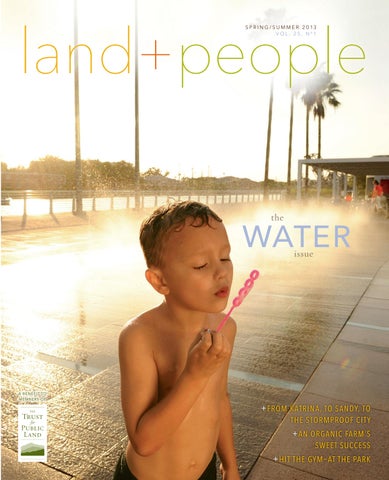
S P R I N G / S U M M E R 2 0 13 VOL. 25, Nº1
water the
issue
A BENEFIT TO MEMBERS OF
+ FROM KATRINA, TO SANDY, TO THE STORMPROOF CITY + AN ORGANIC FARM’S SWEET SUCCESS + HIT THE GYM — AT THE PARK
the longer you stay, the more we all save. save on your room
JOHN ELLIS
% 15
save
RICH REID
the land
This issue of Land&People is made possible in part by a generous grant from Kimpton Hotels. Just as The Trust for Public Land preserves the special places that give our communities their unique character, Kimpton Hotels preserves special buildings as elegant and charming one-of-a-kind hotels. Kimpton Hotels is a proud supporter of Parks for People, The Trust for Public Land’s initiative to create close-to-home parks in cities across America. The Trust for Public Land thanks Kimpton Hotels for its support, as well as for its environmentally friendly way of doing business—including innovative eco-rooms, linen reuse policies, water conservation, and recycling programs.
* B O O K & S AV E To receive 15% off the best available rate, go to kimptonhotels.com and enter “TPL” in the rate code field when making your reservation. Or call 800-KIMPTON. For every night’s stay, $10 will be donated to The Trust for Public Land.
ALEXANDRIA | ASPEN | BALTIMORE BOSTON | CAMBRIDGE | CHICAGO DALLAS | DENVER | LA JOLLA LOS ANGELES | MIAMI | MINNEAPOLIS NEW YORK CITY | PHILADELPHIA PHOENIX | PORTLAND | SALT LAKE CITY SAN DIEGO | SAN FRANCISCO SAN JOSE | SANTA BARBARA SCOTTSDALE | SEATTLE | VERO BEACH WASHINGTON, DC
F E AT U R E S chris granger
allana wesley white
contents
54
“Sandy was a game-changer.” ~ adrian benepe s h e lt e r f ro m t h e sto r m
34
46
1 Park, 1,000 Stories. . . . . . . . . . . . . . . . . . . . . . . . . . . . . . . . . . . . . . . . . . . . . . . . . . . . . . . . . . . . . . . . . . . . . . . . . . . 34 Every park has stories to tell. City Park in New Orleans speaks volumes.
Shelter from the Storm . . . . . . . . . . . . . . . . . . . . . . . . . . . . . . . . . . . . . . . . . . . . . . . . . . . . . . . . . . . . . . . . . . . 46 Five ways to build climate-resilient cities.
Fit for All . . . . . . . . . . . . . . . . . . . . . . . . . . . . . . . . . . . . . . . . . . . . . . . . . . . . . . . . . . . . . . . . . . . . . . . . . . . . . . . . . . . . . . . . . . . . . . . . . . . . . . . . . . 54 Fitness Zone® exercise areas are turning city parks into outdoor gyms that anyone can use. m a r k h o ff m a n
TPL.ORG · 1
jerry and marcy monkman
tpl.org/monthlygiving
The Trust for Public Land depends on reliable, monthly support from donors like you to sustain our land-for-people mission. It’s easy, automatic, and secure. Join today.
D E PA RT M E N T S
27
darcy kiefel
A new look—and a new challenge
sean gilligan
From the President · 9
contents
Board Spotlight · 13 Roy Richards Jr.
Contributors · 14 Mailroom · 15 First Look · 17 Desert cities, miniature parks, and strawberry rhubarb pie
18
Insight · 27
Member Center · 62 Offices · 63 Trail’s End · 64 Building a community from a park
brian tietz
A conversation with urban park innovator Adrian Benepe
19
o n t h e cov e r A boy blows bubbles at Curtis Hixon Waterfront Park in Tampa, Florida. photo: darcy kiefel
J O I N U S O N FAC E B O O K Scan the QR code with your mobile device to stay tuned to the latest news, videos, contests, and more. facebook.com/tpl.org
TPL.ORG · 3
dave showalter—aerial support provided by lighthawk
contents
HOBACK BASIN, WYOMING
For years, people who love this landscape poured their hearts into protecting its wildlife, waters, and scenic beauty. When the land was threatened by natural gas exploration, they wrote letters, sent emails, and showed up at public meetings to tell the world that the Hoback is too special to drill.
Page · 22
22
TPL.ORG · 5
avery wham
contents
P.S. 66, THE BRONX, NEW YORK CITY
The Trust for Public Land helped students create their own design for this playground, transforming a bare asphalt lot into a great place to play. Turf makes it far more fun to run—and fewer paved surfaces means less flooding when it rains. As cities seek creative solutions to stormwater challenges, schoolyard reinventions like this one are more important than ever.
Page · 46
46
TPL.ORG · 7
jerry and marcy monkman
Be a leader. Support our land-for-people mission by becoming a Conservation Champion today. With your annual operating gift of $2,000 or more, you will receive the recognition due a champion—including invitations to special events and updates on our current projects. Get an insider’s look at how your contribution is making a difference.
For more information, contact Katy Lebow at 415.800.5190.
Conservation Champions The Trust for Public Land
tpl.org/champions | champions@tpl.org
A NEW LOOK — AND A NEW CHALLENGE Welcome to the redesigned Land&People! Along with our new look, we are dedicating a portion of each issue to a theme important to our work. We begin by focusing on one of our most basic human needs: water. For 40 years, The Trust for Public Land has worked to conserve the land around coasts, lakes, and rivers in order to safeguard drinking water supplies and protect the beautiful shorelines that provide us with recreation and respite. While our efforts to protect water supplies continue, today we are facing a new challenge: too much water. In many cities, watertreatment facilities are regularly overwhelmed by stormwater, sending waste and sewage into nearby rivers and streams. And as we saw in the aftermath of Superstorm Sandy, coastal communities are increasingly vulnerable to severe weather caused by climate change. The Trust for Public Land is turning our conservation expertise to these challenges, leading the charge to use green infrastructure to help cities manage their water woes. From Philadelphia to Los Angeles, we are creating and renovating parks and playgrounds to capture, absorb, and store stormwater, keeping it out of sewers and water treatment plants. In coastal areas like New Jersey’s Barnegat Bay, we are conserving natural buffers along shorelines to lessen the damage caused by floodwaters. Often, these lands can double as much-needed waterfront parks—and habitat for our fellow species.
darcy kiefel
from the president
By enlisting nature as a partner, we are creating healthy human habitat for us all. In this way—in addition to the health and enjoyment they already bring to our communities—parks and conserved lands can help cities manage water and become more climate resilient. By enlisting nature as a partner, we are creating what I like to call “healthy human habitat” for us all. Thanks, as always, for your interest in Land&People and your support of The Trust for Public Land. Nationwide, nearly ten million people live within a ten-minute walk of a park, playground, or natural area created with our help—which means with your help, because we couldn’t do this without you. Our magazine may change, and new threats to healthy human habitat are always emerging. But our mission to create parks, conserve land, and connect people to nature endures—and has never been more important.
Will Rogers president TPL.ORG · 9
Not all gifts are created equal.
Give your Earthshare.
10 · LAND&PEOPLE · SPRING/SUMMER 2013
An EarthShare payroll deduction is one simple way to donate to The Trust for Public Land or more than 400 other environmental and conservation charities. Many corporate and government employers support EarthShare payroll giving. If yours doesn’t, ask them to start. If they do, simply decide on a single deduction or a recurring small one from every paycheck. Then designate us, member number 11440, as one of your conservation charities. For more information visit earthshare.org or email donor.outreach@tpl.org.
andrew dillon
What do you give the person who has everything? What about a community garden, public playground, or dog park? Forget the socks—The Trust for Public Land’s Gift Guide is full of meaningful gift ideas for friends and family who care about clean water, combating climate change, and connecting people to nature. Now that’s a warm and fuzzy feeling that’ll really last. tpl.org/giveagift
publisher
Sean Connolly e d i to r i a l d i re cto r
Eliza Sarasohn a rt d i re cto r
Matt Mullin a ss o c i at e e d i to r
Alia Salim e d i to r i a l a ss i sta n t s
Shoshannah Flach Yasaman Golban p ro d u ct i o n a ss i sta n t
Sarah Avery p h oto re s ea rc h
Nancy Biskovich m a r ke t i n g ipad is a registered trademark of apple inc., registered in the u.s. and other countries. app store is a service mark of apple inc.
Kristen Anderson d i g i ta l p ro d u ct i o n
Carrie Gotch Adele Wilson-Hamaker co n t r i b u t i n g e d i to r
Bill Poole
A B E N E F I T TO M E M B E R S Land&People magazine is a benefit to members of The Trust for Public Land. Not a member? Join today and never miss an issue. tpl.org/lp
A GREENER READ Land&People is printed in the United States on chlorine-free, 30 percent postconsumer recycled paper and manufactured using Envirotech™ ink, which contains a high percentage of ingredients derived from renewable resources. Printed by Quad/Graphics Inc., Wisconsin.
EVEN MORE LAND&PEOPLE Download the free Land&People iPad app—available now at the App Store. The digital edition includes all the stories you love in high resolution, plus bonus content like video, search tools, easy social media sharing, and instant links to learn more. If you don’t have an iPad, you can access the digital edition online at tpl.org/lpdigital. Wherever you see the pointer symbol below, you’ll find bonus content in the digital edition. Download the app or go online to dive deeper into the story.
© 2013 The Trust for Public Land. All rights reserved. The Trust for Public Land, TPL, Land&People, Parks for People, Conserving Land for People, ParkScore, LandVote, LandLink, Greenprint for Growth, Fitness Zones, and The Trust for Public Land and LandVote logos are registered trademarks of The Trust for Public Land. TPL.ORG · 11
thanks
Thank you, MetLife Foundation! You’re helping us build
healthy communities all across the country. Since 1996, with
MetLife Foundation’s invaluable support, The Trust for Public
Land has created more than 50 parks, playgrounds,
and Fitness Zone® exercise areas.
p h o t o s : e r i c b e g g s , a l l e n b r i s s o n - s m i t h , r e b e k a h e . b u t l e r, k a r e n c l a r k e , s h a u n e l l i s , n i t a h o r w i t z , d a r c y k i e f e l , j e r r y a n d m a r c y m o n k m a n , t e d p u r a l e w s k i , n a n a t a i m o u r, h a l l e v a n d e r g a a g , m i c h a e l w r a y
(from all of us)
OFFICERS
Roy Richards Jr.
s e n i o r v i c e p re s i d e n t a n d d i re cto r o f c i t y pa r k d e v e lo p m e n t
Adrian Benepe
david mandel
p re s i d e n t a n d c h i e f exe c u t i v e o ff i c e r
William B. Rogers
board spotlight
Get to know
A member of The Trust for Public Land board since 1999, Roy Richards Jr. is the chairman of Southwire Company, one of North America's largest producers of
s e n i o r v i c e p re s i d e n t a n d c h i e f p h i l a n t h ro p y o ff i c e r
Margie Kim Bermeo
electrical power cable. He has served
s e n i o r v i c e p re s i d e n t a n d d i v i s i o n d i re cto r
as past president of the International Cablemakers Federation and past chair of
Raymond Christman
the Georgia Chamber of Commerce and
s e n i o r v i c e p re s i d e n t a n d c h i e f m a r ke t i n g o ff i c e r
was named “Georgia’s Most Respected
Sean Connolly
CEO” by readers of Georgia Trend
s e n i o r v i c e p re s i d e n t a n d d i re cto r o f co n s e r vat i o n st rat e g i e s
magazine. He is an active fly fisherman, downhill skier, and reader. He currently
Ernest Cook
resides with his family in Charleston,
s e n i o r v i c e p re s i d e n t a n d d i v i s i o n d i re cto r
South Carolina.
Jeff Danter s e n i o r v i c e p re s i d e n t , g e n e ra l co u n s e l , a n d s e c re ta r y
M. Holly Haugh s e n i o r v i c e p re s i d e n t a n d d i v i s i o n d i re cto r
Roger Hoesterey s e n i o r v i c e p re s i d e n t , c h i e f f i n a n c i a l o ff i c e r, a n d t rea s u re r
I JOINED THE TRUST FOR PUBLIC LAND BOARD BECAUSE ... I was introduced by
another committed board member and have been attached ever since.
natural space for our health and happiness, and I pray that we have the foresight to conserve it. MY PROUDEST ACCOMPLISHMENT AS A
Cynthia Scherer
I BELIEVE PARKS AND GREEN SPACE ARE
BOARD MEMBER WAS ... raising money for
v i c e p re s i d e n t a n d d i re cto r o f f e d e ra l a ffa i r s
VITAL TO QUALITY OF LIFE BECAUSE ...
the conservation of the Chattahoochee River Corridor in Georgia. This project is now the “spine” for an entire body of land conservation there, and has been emulated by a half-dozen other states.
Kathy DeCoster v i c e p re s i d e n t a n d d i re cto r o f co n s e r vat i o n t ra n s act i o n s
Brenda Schick v i c e p re s i d e n t a n d d i re cto r o f h u m a n re s o u rc e s
Barbara Smith
B OA R D O F D I R E CTO R S Page Knudsen Cowles (Chair), Stephen W. Baird, George Bell, William J. Cronon, George P. Denny III, Douglas Durst, F. Whitney Hatch, Caroline P. Niemczyk, Michael E. Patterson, Thomas S. Reeve, Roy Richards Jr., William B. Rogers, Ron Sims, Sheryl Tishman, F. Jerome Tone, Susan D. Whiting
without access to the land, we would be a lesser people. I truly identify with our organization’s land-for-people mission. I think of the outdoors as my place of origin and try to consciously separate myself from my city life and responsibilities to get outside and maintain my primal connection to nature. THE WORK OF THE TRUST FOR PUBLIC LAND IS IMPORTANT BECAUSE ... In our country
we have a deeply set commitment to private property rights and a history of land exploitation. But as the country becomes more urbanized, I believe it’s time to rethink exploitation before all our wild land is gone, and before parkland becomes too expensive to wrest from the path of development. We are creatures that need open,
THE KEY CHALLENGE FACING THE TRUST FOR PUBLIC LAND IS ... reminding our commu-
nities of the importance of saving green space. There is near-unanimous support for its protection, once we remind people that it should be done. So the burden is on us to advocate for conservation and provide the tools and financing to make it possible. WHEN I WANT TO CONNECT WITH NATURE I ... go hunting. Every day of the year, that
is where I’d rather be.
TPL.ORG · 13
contributors
Andy Isaacson
Julia Scott
Mark Hoffmann
feature:
feature:
feature:
1 Park, 1,000 Stories
Shelter from the Storm
Shelter from the Storm
34
Andy is a New York–based writer and photographer whose work has appeared in The New York Times, The Atlantic, and many other publications. This was his first trip to New Orleans, where he was delighted by the tropical air and historic architecture, as well as the po-boys and fried oysters—but he left craving a salad. andyisaacson.net
46
Julia is an independent radio producer, journalist, and essayist whose work has been featured in Best American Science Writing. Her radio stories have aired on the BBC World Service, Marketplace, and NPR. Her features, essays, and investigative work have appeared in The New York Times, Salon, Maclean’s, and Canadian Geographic. She lives in San Francisco.
46
Mark is an award-winning illustrator whose work is influenced by southern folk art and Americana. He was raised in Minnesota (go snow!), but now lives in New Hampshire (go snow, again!). When Mark is not creating, he spends his free time looking for old junk and wood boxes at antique fairs (go old stuff!). studiohoffmann.com
juliascott.net
Does your company support gift matching? Ask your human resources department. With corporate gift matching, your donation will go even further to help The Trust for Public Land protect more parks, gardens, and other natural places. That’s one good thing made that much better. fig. 1
fig. 2
good.
better.
14 · LAND&PEOPLE · SPRING/SUMMER 2013
800.714.5263 donor.outreach@tpl.org tpl.org/corporatematch
mailroom
allen brisson-smith
J O I N O U R CO M M U N I T Y Elise Sterck’s photo “Wild Alaska” was an entry to our Land You Love Facebook photo contest. It caught our eye for its stunning color and composition. Want to see your shot in the next issue of Land&People? Join the conversation online and stay tuned to
elise sterck
the latest news, contests, and more.
EAGLE EYES
Birders tour the Bruce Vento Nature Sanctuary at The Trust for Public Land’s 40th anniversary celebration in St. Paul, Minnesota.
You’ve spotted our new mailroom section—the place we’ll showcase your letters and comments. Read a Land&People story that soared? Did our writing ruffle your feathers? Drop us a line and share your perspective at mailroom@tpl.org.
A forest for the kids
Elwen’s artwork for the campaign.
I think it is important to preserve Canco Woods because there aren’t many wild forests left in Portland to play in and go for walks in. This one has worn-down bike paths and a pond that you can ski on in the winter. There are ancient, towering pines with large, sturdy branches that are great for climbing. The path down the middle provides a border for games like Capture the Flag, and the perimeter path is another good way to create boundaries for active games. The brambles make good hiding spots, and a stream runs on either side of the center path. Some of the trees
are over two hundred years old and no one here would live to see any tree reach that age if it was planted now, so we cannot easily replace them. It is a wonderful and magical place and should not be disturbed. Elwen Bernard, Portland, ME Nine-year-old Elwen read this letter to the local City Council—a speech that helped convince the officials to grant unanimous approval for a plan to purchase Canco Woods for the public. Learn more about The Trust for Public Land’s campaign to protect this family’s neighborhood green space on page 25. TPL.ORG · 15
andy isaacson
mailroom
“What a wonderful thing to turn a blight into usable space that will help people get off the couch and go outside. Kudos!”
liz duncan-gilmour via facebook
A royal family
Snap-happy
I was very pleased to see the article on Royal Gorge (“Landmarks,” Land&People Fall/Winter 2012). We went skiing at Royal Gorge every year from 1978 to 1999 when we lived in the Bay Area. Our two boys learned to ski there before they were in elementary school. We used to stay at the Royal Gorge lodge over Christmas week with our boys. The same families came back year after year. I am glad to hear it will be preserved and improved. Rita Moore, Mercer Island, Washington
I want to share how much I appreciate the quality of the photography in Land&People. I know how hard it is to get great shots of smiling people in action. I have passed copies of Land&People on to boards on which I serve as an example of how to employ photos to tell the story of an organization. So if you’re going to redesign Land&People, my only advice is: preserve the photo budget! Jamie Trowbridge, Dublin, New Hampshire
Straddling the crest of the Sierra Nevada mountain range in California, Royal Gorge is the largest cross-country ski facility in North America—now per-
mark nadell
manently protected from development.
“Sally Jewell is a businessperson as well as an environmentalist. We need people who understand both.”
Buzz is building around the QueensWay, an ambitious proposal to convert 3.5 miles of abandoned railway in Queens into New York City’s next great linear park. Stay tuned to tpl.org to watch this project unfold.
The land she loves
I wish so much that I could afford to send in a larger donation. I am old—97—and I live like a church mouse. But I love what The Trust for Public Land is doing. I grew up in the mountains of North Carolina and I know those leaves, trees, and lakes better than most. Marie Runyon, New York, New York A heartfelt welcome to new member Marie, who made her first donation to The Trust for Public Land at age 97. Thank you, Marie! We couldn’t do this work without the generosity of supporters like you.
sylvia jones via facebook
LAND&PEOPLE IS LISTENING! President Obama’s pick for secretary of the interior was a winner to us even before she got the nomination: Jewell’s conservation work earned her our Land for People award in 2012. 16 · LAND&PEOPLE · SPRING/SUMMER 2013
Send letters to the editor or change your mailing address: mailroom@tpl.org.
brian tietz
“This is the real secret of life—to be completely engaged with what you are doing in the here and now. And instead of calling it work, realize it is play.”
a l a n wat t s, author and philosopher
first look
edible conservation
An organic landmark’s sweet success
swanton berry farm, davenport, california
can order jams online at swantonberryfarm.com, and make this Swanton farmstand dessert at home. see recipe at right
Swanton Berry Farm occupies a stunning piece of California coast once slated for a subdivision. The Trust for Public Land helped conserve the property, portions of which are now leased for sustainable agriculture.
18 · LAND&PEOPLE · SPRING/SUMMER 2013
swanton berry farm
You’ll have to visit the farm for the ocean views—but you
Perched above the pacific, Swanton’s “U-Pick” fields provide the perfect place to get your hands dirty gathering your own fresh food. From kiwis to broccoli, there’s almost always something in season—but the farm’s signature strawberries are where it all began. When owner Jim Cochran first proposed an organic strawberry farm on this site—conserved by The Trust for Public Land in the late 1990s—many people told him it couldn’t be done. The finicky fruit is usually grown with chemical pesticides and fertilizers. But careful use of techniques like crop rotation have helped Cochran set an example for organic growers everywhere. “We’ve proven that you can farm organically and still make money,” says Cochran. “It’s been extremely rewarding to see it all come together, both from an agricultural and a business perspective.” Today, the Swanton farm stand is a favorite destination for city-dwellers from nearby San Francisco and tourists winding their way down iconic Highway 1. “It’s an experience,” says Cochran. “People can come for a few hours or an entire day to let the kids run around, pick strawberries from the ground, enjoy the ocean views, have dessert, and take home some jam.”
CRICKET CAPITAL, USA brian tietz
first look
Swanton strawberry rhubarb pie C R U ST O 2½ cups organic all-purpose flour O ½ teaspoon salt O 1 cup chilled butter, cut into small pieces O ½ cup ice water
FILLING O 2½ cups organic strawberries with
tops removed, cut in quarters O 1 cup organic rhubarb, sliced into
¼-inch to ½-inch sections O 3 tablespoons organic orange zest O Juice of one organic orange O ¼ cup tapioca flour (as a thickener) O 2 tablespoons organic all-purpose flour O 1 cup organic sugar
GLAZE O 1 egg yolk O 1 teaspoon of water or milk O Sprinkle of sugar (optional)
Combine dry ingredients for crust in a large bowl. Cut in butter until mixture reaches a crumbly consistency. Slowly incorporate the water until dough balls easily and uniformly. Cover and chill for at least five hours. Roll out dough onto a floured surface. Cover pie pan evenly with dough. In a separate bowl, combine filling ingredients until uniform. Fill pie shell and cover with remaining dough, sealing the edges with a fork. Whisk egg yolk and water, then paint onto the crust. Bake at 400°F for 20 minutes, then reduce to 350°F for 20 to 25 minutes or until pie is golden and bubbling.
There’s just one officially sanctioned cricket stadium in the country—at Central Broward Regional Park in south Florida (pictured on page 17). While cricket is the world’s second most popular sport, it’s long been underrepresented in the United States. But the small city of Lauderhill, home to a large Caribbean immigrant population of ardent cricket fans, is vying to change that. Since opening in 2007, the stadium has hosted a number of historic firsts, from the first U.S. Cricket Open to the first professional world cricket match held on American soil. At that event, 16,000 screaming spectators showed up to watch the West Indies crush New Zealand, proving that cricket can draw crowds stateside, too. The stadium stands on the site of a former AT&T antenna farm conserved by The Trust for Public Land in 2001. City officials say the property’s transformation has rejuvenated the local economy, bringing welcomed tourist dollars and international attention to “the Cricket Capital of the United States.”
SEE A PHOTO GALLERY @
TPL.ORG/ LPDIGITAL
F I R ST LO O K · 1 9
q+a
tim coburn
“Making cities more livable is an effective climate strategy in itself.”
sf planning—wells campbell photography
sf planning—kay cheng
word watch
park·let /pahrk'·let/
interview by allie gardner
(n.) A community gathering space tempo-
JAD DALEY
rarily installed in public right-of-ways like
THE TRUST FOR PUBLIC LAND’S CLIMATE CONSERVATION PROGRAM
parking spaces and unused bus stops. With
DIRECTOR TALKS TREES, TAILPIPES, AND TRANSFORMING CITIES
plantings, artwork, and creative outdoor seating, parklets create greener and more pedestrian-friendly streetscapes. Pioneering San Francisco is home to more than three dozen parklets—like the two above. Cities from Philadelphia to Los Angeles are now following suit.
20 · LAND&PEOPLE · SPRING/SUMMER 2013
What drew you to a career in conservation? As a child, I was fortunate enough to spend summers on MacMahan Island in Maine. It’s a very special place, only reachable by boat, with just 30 cottages scattered across it. I roved the island like a wild animal—it was an idyllic outdoor existence. I wanted to work to make sure others could have the same kind of experiences in nature. A couple of other people who grew up spending time on that island have also gotten into conservation. There must have been something in the water!
Forest restoration efforts along the Mississippi help absorb carbon dioxide from the atmosphere.
When did you make the connection between land conservation and climate change?
In college I read Bill McKibben’s The End of Nature. It had such an impact on me that I sold the gas guzzler I was driving and committed to some major changes in my own life. Back then, in the late ’80s, most of us were focused on the connection between climate and emissions from smokestacks and tailpipes. It wasn’t until later that I learned that forests take so much carbon out of the atmosphere. That’s when it dawned on me that conserving forests was actually a critical climate strategy. How so?
Forests in this country—not tropical forests, not international, but just U.S. forests—absorb about 12 percent of all the carbon that we emit every year. So every time we conserve a forest, we’re protecting the planet’s ability to act like a sponge and suck up all that carbon that our cars and factories put into the atmosphere. For example: In the rich bottomland hardwood forests of the Mississippi—what some people call the North American Amazon—we’re restoring forests that were cleared for agriculture decades ago. As it turns out, it’s not good agricultural land
because it floods. So we’re acquiring properties from private landowners, replanting and restoring the native forests, and returning them to the public. Within 70 years, when the forest matures, it will end up absorbing up to 350 tons of carbon dioxide per acre, ultimately keeping millions of tons out of the atmosphere. What about cities? How does urban conservation fit into the picture?
Our work in cities promotes a more energy-efficient country. Making cities livable, attractive places is an effective climate strategy in and of itself. People who live in urban areas produce dramatically less carbon than people who live in far-flung areas: they drive less; they live in smaller, more energy-efficient spaces and so forth. And with access to walking and biking corridors—like those The Trust for Public Land helps create— they’re more inclined to use carbonfree transportation. But as Superstorm Sandy reminded us, cities are uniquely vulnerable to the extreme weather that climate change is creating. If we’re going to attract more people to cities, how do we ensure that they’re safe? We’ve built our cities in certain places, and now the environment is
changing around us. Addressing sealevel rise and creating more protective green buffers along our shorelines— these are urgent, nonnegotiable actions, and there seems to be real consensus in the country that this is what we need to do. But we don’t just want to survive. We want to thrive. A key question for our work moving forward is: how do we stack more public benefits onto a single site? Putting parkland along the water’s edge doesn’t just create a safety buffer between people and the sea, it creates a beautiful place for families to go and relax. Parks make vulnerable coastal cities more attractive, more livable, and safer, all at the same time. What inspires you most about your work?
I am most inspired when I see people so happy to get out on the parks and trails that we’ve created. I’m now working in Washington, D.C., and it’s the first time I’ve lived in the city for a sustained period. I enjoy city living, but it’s a big change and it’s not always easy. I now know what it means for kids to finally have a safe place to play in their neighborhood, or for people to be able to walk along the waterfront that they’ve lived next to all of their lives but have never had access to. I can’t stop picturing the looks of joy on my neighbors’ faces when they come to a park opening. So that’s what I find the most soulstirring about my job. And when I think about adding a climate dimension to that work—building parks that make these cities more climate-smart, that make them safer places to live—I couldn’t be more excited to get up in the morning and get to work. F I R ST LO O K · 2 1
Saved!
good news
in wyoming, a beloved landscape spared from drilling
After years of town-hall meetings, petitions, letterwriting, and wrangling, Wyoming residents are breathing a sigh of relief. There will be no oil and gas drilling in the Hoback Basin. Conservationists have struggled for years to protect the Hoback from the industrial development that scars similar western landscapes. But to seal the deal—in which The Trust for Public Land purchased and retired oil and gas leases from the Plains Exploration & Production Company (PXP)—required a fundraising effort that one local paper dubbed “fast and furious.” The community rallied. Locals lent their voices to a benefit concert, while an adopt-an-acre program drew donations from across the country. A kayaking club, a brewery, union steelworkers, hunters, hikers, anglers—in less than 90 days, more than a thousand donors chipped in to the $8.75 million campaign. The diversity of the Hoback’s supporters reflects the practical spirit of conservation in a state where a strong
cultural connection to the land coexists with tough economic realities. “It’s not that Wyoming residents oppose drilling,” said Deb Love, The Trust for Public Land’s Northern Rockies director. “Folks recognize the state is benefiting from the extraction economy. They just don’t want large-scale industrial development in places that are frankly too special to drill.” The 58,000 acres conserved includes the headwaters of the Hoback River, named America’s fifth-most endangered in 2012. With drilling of the unspoilt wilderness now off the table, the river basin’s rugged backcountry will continue to provide a haven for wildlife like pronghorn antelope and elk—and a treasured outdoor escape for people. “What this whole experience has taught me is that citizens can make a difference,” said Hoback supporter Carl Bennet, a miner from Rock Springs. “We are the ‘public’ in ‘public land.’”
When we searched Instagram for snapshots of different ways people enjoy the Hoback, we caught newlywed climbers Sarah and Brock Jackson mid-smooch. “We picked out the Hoback because it looked super fun—and it was!” Sarah says. “We love that place.”
SEE VIDEO @
TPL.ORG/ LPDIGITAL
22 · LAND&PEOPLE · SPRING/SUMMER 2013
Colonel Charles Young
trailblazers
the black archives of mid-america in kansas city
buffalo soldier
1864
1889
Born into slavery
Graduates West Point Military Academy
BILL PULLMAN PULLS RANK FOR PARKS
1903
He’s not the president, but he plays one on TV—in
As first black superintendent of Sequoia National Park, oversees construction of roads that still serve visitors today
the NBC sitcom 1600 Penn—and on the silver screen in Independence Day. Now the actor is lending his leading-man gravitas to make the case for close-tohome open space in The Power of Parks, The Trust for Public Land’s new animated short. The two-minute
1904 Appointed military attaché in Haiti
film features narration by Pullman and illustrations by award-winning Seattle-based artist Stacey Rozich. SEE VIDEO @
1917
YOUTUBE.COM/TRUSTFORPUBLICLAND
Becomes the first African American to attain the rank of colonel
1922 Dies while on reconnaissance mission in Nigeria, buried at Arlington National Cemetery
T
his year, The Trust for Public Land was proud to help establish the Charles Young Buffalo
Soldiers National Monument in Wilberforce, Ohio. Though his distinguished career took him across the world—from California national parks to foreign wars— Young’s family home was where he mentored other aspiring black leaders and taught military strategy to university students. The monument designation, signed by President Obama in March, ensures the Young legacy will live on.
KNOW THE SCORE Which American city has the best park system? The answer may surprise you. Last spring, we launched The Trust for Public Land ParkScore® index, the most comprehensive tool ever developed for comparing urban park systems. This year, we’re expanding the rankings to include new cities. Will San Francisco hold on to its top spot? Find out—and see how your city measures up—at parkscore.tpl.org.
F I R ST LO O K · 2 3
Waste not, want not
what counts
Water wisdom from the nation’s driest cities
while other regions wrestle with storms and flooding, the West’s water woes are all about scarcity. From savvy landscaping to high-tech irrigation systems, city parks in arid climates take a variety of approaches to conserving the region’s most precious resource. Here are the five driest major U.S. cities—and a few ways they’re working to do more with less.
1 Las Vegas nevada
2 Phoenix arizona
3 El Paso texas
4 Albuquerque new mexico
av e rag e y ea r ly ra i n fa l l
Some like it hot
4.49 inches
av e rag e y ea r ly ra i n fa l l
8.29 inches
av e rag e y ea r ly ra i n fa l l
9.43 inches
av e rag e y ea r ly ra i n fa l l
The right plants for the job “Xeriscaping” comes from the Greek word for dry—which Albuquerque certainly is. It means water-smart landscaping, like choosing desert flowers and native grasses instead of traditional lawns. The city uses these techniques in public parks, and offers rebates to residents who do the same in their own gardens.
9.47 inches
5
av e rag e y ea r ly ra i n fa l l
San Diego
10.77
california
It’s not all quicksand and cow skulls. Rather than water its way to a greener look, Phoenix embraces a desert identity, celebrating its unique natural beauty with protected landscapes like South Mountain Preserve. Boasting 50 miles of rugged trails across more than 16,000 acres, this metropolitan park is one of the largest in the country.
inches
A recycled resource With up to 90 percent of the water supply imported from outside the city, San Diego strives to put every drop to good use—sometimes twice. In city parks, distinctive purple sprinkler heads mark the spots where reclaimed wastewater is used to irrigate lawns and playing fields.
On the other end of the spectrum is New Orleans, the nation’s wettest major metropolis with an average rainfall of 64 inches a year. Learn how the city’s biggest park weathered Hurricane Katrina on page 34.
24 · LAND&PEOPLE · SPRING/SUMMER 2013
I GIVE TO …
save our woods
First-time donors to The Trust for Public Land, the Kostadinova-Bernard family—mother Victoria, father Ben, son Julian (12), and daughter Elwen (9)—live in Portland, Maine. One of their favorite things about their home is that it’s just down the street from Canco Woods, a 13-acre pocket forest beloved by generations of visitors as a place to hike, mountain bike, walk their dogs, and even ice-skate. Though privately owned by the local power company, Canco Woods had long served as a de facto neighborhood park. So when “For Sale” signs started popping up around the property, the entire community was rattled. “Canco Woods is about quality of life—it’s a little bit of wild space in our otherwise urban environment,” says Victoria. “When we realized the woods could be developed, it was like the bottom dropped out of our lives.” Heartbroken by the prospect of the community-maintained trails and streams being paved over to make way for offices and parking lots, the family banded together with neighbors to form Friends of the Canco Woods. The group reached out to The
why i give
canco woods, maine
Trust for Public Land for help in raising the $350,000 needed to buy and permanently protect the forest. In addition to donating funds, the Kostadinova-Bernards and their neighbors spread the word both online and throughout the neighborhood. The kids drew signs in the spirit of Dr. Seuss’s The Lorax and acted as media ambassadors, telling anyone who would listen how much they loved their backyard woodland. In fact, Elwen’s spirited defense of Canco Woods (see page 15), delivered to a standing-room-only crowd at a city council meeting, helped convince the city to contribute $75,000 toward conserving it for good. “It was such a valuable lesson for the kids,” says Ben. “It brought the whole community together. If you care enough about something and work together and put your back into it, anything can happen.” “We are so glad and grateful we were able to conserve Canco Woods,” says Victoria. “It’s truly amazing what communities can accomplish with help from The Trust for Public Land.”
“Unless someone like you cares a whole awful lot, nothing is going to get better. It’s not.” —Dr. Seuss, The Lorax
The KostadinovaBernards of Portland, Maine, made conservation a family affair: all four chipped in to help save a local forest.
F I R ST LO O K · 2 5
A HAPPY ENDING IN HAWAII
good news
christina aiu
buzzworthy
Last fall, The Trust for Public Land conserved another 30 acres in Utah’s Zion National Park, protecting a key site from development.
“You don’t think of national parks as places where you could build a vacation home. But people are now putting up McMansions in the middle of some of the most pristine places in the United States.” —Ben Tracy, CBS correspondent Tucked inside the protected lands of U.S. national parks are more than 11,500 inholdings—privately owned properties within park boundaries. As CBS This Morning recently reported, The Trust for Public Land works to conserve inholdings when they come up for sale, preserving the parks’ unspoilt beauty for all to enjoy.
SEE VIDEO @
TPL.ORG/ZION
26 · LAND&PEOPLE · SPRING/SUMMER 2013
Heirs to a onetime pineapple plantation in Oahu faced a difficult choice: sell the property to developers at a tidy profit, or conserve it as farmland, preserving its fertile soil for future generations. If this storyline sounds familiar, it might be because you’ve seen The Descendants, the Oscar-winning George Clooney film with more than a few parallels to the debate over the 1,750-acre Galbraith Estate. We won’t spoil the movie, but we will share the outcome of our true-life tale: last December, after a long back-and-forth with the trustee for roughly 600 far-flung heirs to the property, The Trust for Public Land helped the community permanently protect the land for farming. The Galbraith Estate, named for Irish immigrant turned rancher George Galbraith, occupies one of the largest undeveloped parcels on the island. Its location just 20 miles from downtown Honolulu has long made it an attractive prize for developers eager to extend the capital’s suburbs. But the economic downturn created a window of opportunity to revive the once-thriving agricultural community of Wahiawa—and ensure that the estate’s prime growing land is put to good use. Under a deal brokered and funded in part by The Trust for Public Land, the state has assumed ownership of the property and will lease parcels to independent farmers. They’ll grow food crops usually imported from the mainland, bucking a decades-long trend of the islands’ agricultural lands being developed for housing. The Trust for Public Land’s state director Lea Hong hopes the estate’s return to production will boost Hawaiian food security. “Hawaii imports 85 percent of its food,” says Hong. “But a lot of people here are having a wake-up call. We have been growing houses instead of food, and that has to stop.”
The
commish
a co n v e r s a t i o n w i t h
ADRIAN BENEPE PHOTOS BY SEAN GILLIGAN
insight
as head of the new york city parks department, adrian benepe presided over the most ambitious transformation of public space since the age of robert moses. now he’s turning his eye for urban innovation to cities nationwide.
Adrian Benepe knows parks. As a high school student in the summer of 1973,
The New York Times characterized as “the most ambitious
Benepe took a job cleaning bathrooms and locker rooms
program of building and refurbishing New York City’s parks
for the City of New York’s park system. It was the begin-
since the era of Robert Moses.” Under Benepe’s leadership,
ning of a working relationship that would last, on and off,
the city created and restored parks in every borough, includ-
for nearly 40 years. Benepe went on to serve as one of the
ing the High Line in lower Manhattan and Brooklyn Bridge
department’s first park rangers, eventually helping to run the
Park. In 2012, New York magazine named Benepe number 58
ranger program, then the press office, the division of natural
on its list of 100 reasons to love New York, crediting him for
resources, and the division of art and antiquities. In 2002,
“the transformation of parks from places you avoid to places
he was serving as commissioner of Manhattan’s parks when
you go.”
newly elected Mayor Michael Bloomberg tapped him for the
Last June, Commissioner Benepe announced he was leav-
department’s top job—parks and recreation commissioner for
ing the park system to join The Trust for Public Land as direc-
the entire city of New York.
tor of city park development. In this interview, he reflects on
For the next decade, Benepe oversaw a system of 29,000 acres, as many as 10,000 employees, and more than 1,700 parks, playgrounds, and recreation facilities during a tenure 28 · LAND&PEOPLE · SPRING/SUMMER 2013
lessons learned in New York—and the vital role of parks in creating and sustaining livable cities.
city of new york
private partnerships, a lot of citizen participation and advocacy, and also a mayor who loves parks and thinks that they’re very good places to invest public dollars. Why does the mayor believe parks are a good investment?
Adrian Benepe with New York City Mayor Ed Koch (center) and the rest of the Urban Park Rangers class of 1979.
Both your parents had a professional interest in cities. How did this influence your career path?
My father is a city planner and architect, and my late mother was an urban anthropologist. So from my father I got an appreciation for the built environment—both landscapes and cityscapes—and from my mother I got an appreciation for people. You put the landscape and the people together and you get parks. And I really did depend on parks as a kid—to get away from the noise and confusion of the city, for sports, and for a lot of other things.
If you build a great park and it’s well maintained and has active programs, people will want to live near it, which makes for healthy neighborhoods and spurs economic development. There’s a lot of tourism in New York that’s centered on parks. Central Park is one of the most-visited parks in the world, not just because it attracts the locals, but also because it’s a tourist destination. Places like Washington Square, Bryant Park, Battery Park, and so on—they’re full of tourists.
“
Parks were sort of the wild west in those days. if you weren’t committing a major crime, the police weren’t interested.
”
Which parks did you visit growing up?
My main childhood park was Riverside Park, which I later learned was a Frederick Law Olmsted and Calvert Vaux design from the 1880s with a Works Progress Administration expansion from the 1930s. As a child I played in one of the great WPA playgrounds, and then eventually my own children played in those same playgrounds. And, of course, I spent time in Central Park. That was where we went to play touch football, or for concerts, to play Frisbee, or hang out with other teenagers.
But that wasn’t always the case. The parks were in pretty rough condition back when you first got your start.
Oh, yes. The first summer I worked in the parks, in 1973, they were in terrible shape, after a full decade of decline. Later, in college, I had a pushcart in Central Park selling soups and interesting breads. It was technically illegal, because we didn’t have a concessions license, but parks were sort of the Wild West in those days. If you weren’t committing a major crime, the police weren’t interested.
How often do you get out to the parks these days?
I’m usually out on a bicycle in a park whenever I have a free moment. Of course, the city now offers many more opportunities to enjoy parks than when I was a kid. The transformation of the West Side from derelict shipping piers and an elevated highway to Hudson River Park, a spectacular waterfront park and bicycle path, is the most profound transformation of Manhattan in 75 years. The same thing has happened all over New York City. I was very fortunate to be at the helm of the parks department when so many things were coming together: public-
And then you became a sheriff.
Then I became a sheriff. Just as I got out of college, the new parks commissioner, Gordon Davis, was trying to reestablish some sense of control in the parks by starting the Urban Park Rangers program—unarmed ambassadors who would explain how to use the parks and give environmental tours and so on. Joining the urban park rangers was a great introduction to the parks, because you got paid to walk around and talk to people, which seemed like a pretty great thing. INSIGHT · 29
insight
You’ve said that public-private partnerships are key to the success of parks. Why?
I believe that New York’s park system might not have been revived but for the public-private partnership, first modeled by the Central Park Conservancy and now replicated in parks across the city. These nonprofit partnerships raise and spend more than $160 million a year for New York parks. But even more important, they give citizens a role to play in the life of the parks. Some people criticize public-private partnerships as privatizing parks. I would argue that the opposite is true: they make parks more public. More people are involved in the life of the park. Across the country there are now hundreds of nonprofit groups working side-by-side with government to help parks. In many cases, they’re not raising a lot of money—but they’re raising visibility, doing advocacy work.
“
I’m convinced that one reason new yorkers are living longer than they used to is that there are so many good places to exercise.
”
What other park trends do you see on the horizon?
One that The Trust for Public Land is quite involved in is using parks to promote public health—for example, in neighborhoods where people can’t afford gym memberships. We’ve been involved in creating Fitness Zone® exercise areas in parks as a free, social way for people to exercise. Another big trend is trails—like the ones we’re working on in Chicago, Atlanta, Seattle, and now Queens. These are crucial, because if they’re attractive and safe, they get used for commuting, for recreation, and for fun. I’m pretty convinced that one reason New Yorkers are living on average a year-and-a-half longer is that there are now so many trails and other good places to exercise. 30 · LAND&PEOPLE · SPRING/SUMMER 2013
We’re also using parks to help cities manage stormwater. In almost 800 American cities, the sanitary sewers that process wastewater are in the same network as stormwater sewers. In a heavy rain, the combined effluent flow to the sewage treatment plants is shut down so the plants don’t get overwhelmed, and the sanitary and street waste goes into rivers and harbors, which is a violation of the federal Clean Water Act. Many of these cities are under orders to clean up. They can spend a huge amount of money on gray infrastructure—big holding tanks, larger sewers, and upgraded sewage treatment plants—or they can spend part of it on parks and green playgrounds that can capture stormwater. The Trust for Public Land is working with the water departments in both New York and Philadelphia to convert concrete schoolyards into green playgrounds. These are not only beautiful new neighborhood amenities—fun places for kids to play and exercise—but they’re also good for the environment and help cities meet their legal obligation to keep waterways clean.
james estrin
Benepe eyes an eagle owl at the Central Park Falconry Extravaganza in 2004.
In addition to the services that parks provide, you often reference the value inherent in making cities more beautiful places to live.
Certainly we shouldn’t overlook the role of beauty in urban life, even though it’s hard to put a specific dollar value on it. It’s important to keep advocating for parks as places of respite, as oases, as places of beauty and really good urban design. Parks encourage mental health and happiness. I often joke that I’ve never seen a fistfight in front of a flowerbed. Flowers and plants and greenery make people slow down and relax. It’s quite clear to me that you can’t have a great park system unless it is also beautiful. What past lessons are you bringing to your new role with The Trust for Public Land?
Well, we can’t grant every city a healthy economy, a mayor who loves parks, and the ability to put literally billions of dollars into the park system. But some things we have worked on in New York, such as public-private partnerships, are replicable elsewhere. Signature projects of The Trust for Public Land, such as Fitness Zones and transforming part-time schoolyards into full-time playgrounds—those can be done across the country. Every city has to manage stormwater; it’s not even an option. Some
cities—particularly smaller ones—may need our help to figure that out. What I bring to the table is I’ve been on the other side. I’ve been that harried public sector official who’s overwhelmed by rules and regulations and procurements and budget cuts. I can speak the language of the bureaucrat and understand how budgets are made and how mayors and city councils have to work together. And because I’ve had the benefit of working with organizations like The Trust for Public Land, I can encourage city officials to be open minded about partnerships with nonprofits, corporations, and foundations. In tough economic times, how do you make the case that parks are important?
Fortunately the case mostly makes itself. Like the Staten Island bluebelt—where instead of building a huge, expensive stormwater capture system they built a beautiful one that looks for all the world like a natural woodland and wetland—other cities look at that and understand the benefits from a dollars-and-cents point of view. Or you simply compare the cost of lifetime treatment for somebody with an advanced case of diabetes to the cost of providing exercise programs in a park. INSIGHT · 31
insight
What lessons stand out from your first year on the job with The Trust for Public Land?
What’s been really interesting for me is to travel around to the different offices and see how much expertise we have among our staff. I’m learning that this is a very nimble organization, able to do things faster and sometimes better than government can do them. My travels have reinforced my belief that there’s no other national organization doing what we’re doing in cities: creating parks, advocating for parks, and using parks in cutting-edge ways—such as to promote public health and for water management.
in a garbage can. Then I noticed that the construction of the new park building seemed to have come to a standstill, so I called my old friend who runs the design engineering division and gave her a heads-up that maybe the contractor wasn’t as active as he should be. So I can’t resist. And it was very difficult for me to not be involved with the response to Superstorm Sandy. Parks and boardwalks and beaches were just erased, and thousands of park and street trees came tumbling down. I have watched in admiration as my successor, Veronica White, and her team have worked 24/7 since the storm to restore the park system. It’s a big job to rebuild, and also to ask: Do you simply go back to the way things were or do you do something radically different?
“
We shouldn’t overlook the role of beauty in urban life. i often joke that i’ve never seen a fistfight in front of a flowerbed.
”
Addressing the looming challenges of climate change and extreme weather might be another direction for The Trust for Public Land.
Coming to work for The Trust for Public Land was the logical next step for me: to be able to play a role across the country, helping cities to create and nurture parks and parks organizations. Still, after more than 20 years as a hands-on parks manager, it must be hard to break your park-ranger habits.
Actually, I was walking through Washington Square Park today, just to get some sun, and there was a bit of litter under a bench, and I stopped and picked it up and put it 32 · LAND&PEOPLE · SPRING/SUMMER 2013
It’s top of my mind right now, because we have to be part of the solution. The risk is that cities like New York, which are concerned about their physical survival, may put all of their money and energy into building physical barriers to prevent flood damage. But if you surround a city with a giant wall, will it still be livable? Green space can also be part of the physical solution to making cities more sustainable—and it’s absolutely essential to urban quality of life. When they aren’t serving a protective function, natural buffers can also act as parks, trails, and bikeways. So, we’re at a crucial stage.
Yes. How we solve these problems will determine whether cities will continue to be good places for people to live for the next few centuries. The way I see it, parks are essential to cities’ survival.
Grow your legacy. We invite you to make land conservation a part of your personal legacy by including a gift to The Trust for Public Land in your estate plans. Every day, America loses 6,000 acres of open space—irreplaceable wildlands, historic sites, and dwindling urban and suburban open space. Your legacy can be part of the solution. Let us welcome you into the Stegner Society, which honors individuals who make legacy gifts to The Trust for Public Land through their will, living trust, retirement plan, or life income plan. Contact Gardner Trimble, director of planned giving, to learn how you can make a lasting gift that supports land conservation for generations to come. 4 1 5 . 8 0 0 . 5 2 0 8 · p l a n n e d . g i v i n g @ t p l . o rg · t p l . o rg / p l a n n e d g i v i n g
Th e Tr u s t f or Pu b l ic L a n d
1
park
34 · LAND&PEOPLE · SPRING/SUMMER 2013 photos: top and bottom rows, chris granger; middle row, andy isaacson
1,000 stories
every park has stories to tell. city park speaks volumes. It’s a place for birthday parties and weddings, first touchdowns and first kisses. But a standout city park is more than the green backdrop to fond memories—it’s the heart of the community, a place to get outside, get active, and get together. Even the devastation of Hurricane Katrina couldn’t close the book on New Orleans’s City Park. After a monumental restoration effort, park regulars today note more, and more varied, visitors than ever before. You’ll see them jogging the paved loop around Big Lake on foggy winter mornings or retreating to the shade of stately oaks on sweltering summer afternoons—birdwatchers and dog walkers, runners and golfers, parents and children. Here, in their own words, they tell the story of why beautiful green spaces are vital to city life. St o r y a n d p h o t o s b y a n dy i s a ac s on
TPL.ORG · 35
name:
Alexander Thomas ag e : 5 0 p ro f e ss i o n : p o ol m a i n t e na nc e wor k e r lo cat i o n : b ig l a k e t r a i l
Every time I try to take a picture of Alex Thomas stretching, he gets a serious look on his face. “I can’t help it!” he protests. Indeed, Thomas is a serious runner, formerly one of the city’s best; after Katrina and an injury, he’s getting his mojo back. He’s become a bit of a City Park legend, known for running all corners of the park, day and night. As we chat, a man approaches him to pay his respects. Thomas says that happens all the time. “I love this park because you get so much encouragement,” he tells me. They know him as the running guy, but usually he’s never met them before. They tell him how much he inspires them. “I try to give them some info,” he says, “some advice on how they can go forward in life.”
36 · LAND&PEOPLE · SPRING/SUMMER 2013
“I’ve run this park for over 25 years. I love the morning runs. You watch the day come to life. A slightly foggy morning, the coolness in the air. It’s a calmness—more of an innocence. Then you see the lights of golf course workers trimming the grass. I run different courses—a five-mile loop farther in the park, or sometimes I finish here at Big Lake. I used to train for marathons with five to eight guys. I’d run in the morning and evening. After Katrina, our group dispersed. Some moved away. But the park has come a long way since Katrina—it’s come back from nothing. The improvement has been amazing—a remarkable feat. It’s now a social scene; [the restoration] really helped bring out the community. Before, there weren’t as many blacks walking and exercising. For me, one of the greatest moments was when the park workers installed the new lights. The whole park became illuminated. I called my friend in Dallas and said, ‘The park is lit up!’ It was just that kind of a moment. On hot summer days, this is where you want to be. The number-one place. The park is our safe haven. The beauty, the serenity you get from running underneath the trees. And you meet a lot of great people. It’s not easy being self-motivated all the time, and days when I’m feeling tired, they help me go forward. I tell them, ‘It’s not what you can’t do, it’s what you can do.’ That’s what all of these people out here do for me.”
TPL.ORG · 37
name:
D E R E K C U M M I S K E Y, W I T H C H R I ST I A N B R OT H E R S ST U D E N T S age: 45 profession: physical education teacher location: city park fitness zone ® exercise area
Students at the 52-year-old Christian Brothers School, the only school lucky enough to be located inside the park, explore the newly opened Fitness Zone like kids in a candy store. This is their backyard, after all. The outdoor gym, built by The Trust for Public Land, is located just a short walk from their school building, and on this drizzly day they have it all to themselves. As the kids try out the new equipment, I chat with coach Derek Cummiskey.
38 · LAND&PEOPLE · SPRING/SUMMER 2013
chris granger
F
ounded in 1854, City Park is one of the oldest in the country, a New Orleans fixture that has endured the shells of the Civil War and the wrath of Hurricane
Katrina. It is also one of the nation’s largest urban parks—50 percent bigger than New York’s better-known Central Park. Unlike most parks of its kind, City Park receives very little tax revenue; as a private park, it must generate income to
survive. From the canine paradise of the NOLA Dog Bark
“One of the great things about attending this school is being located in the park. There’s a different feel having all of this green space around us. I’ve heard fifth graders tell their parents, ‘I don’t feel like I’m going to school everyday, but I’m still learning.’ We encourage getting outside. Often, teachers will take kids to the pond nearby to give lectures. Once a week, for P.E. class, the kids run around the Big Lake path. It’s nice to have that safe, open space for them to run where we can see them. We’ll also wander out back and use the fields to play flag football, soccer, softball, kickball. I wouldn’t say the kids take it all for granted, but when the fields were closed for construction, they really missed it. They were like, ‘When can we use the park again?’ You could see what having that space means to them— you don’t know what you’ve got until you don’t have it anymore. This is the first time the kids are using the Fitness Zone. As you can see, they think it’s really cool. They’re fitness-savvy kids: they know a lot about being in shape and healthy diets. So we’re excited to have access to this Fitness Zone, to actually make it fun for them to work out.”
to Storyland, a dreamlike children’s amusement park, City Park’s amenities have to be so good that visitors are willing to pay for them. These attractions—along with the rest of the park—were ravaged by Hurricane Katrina. In the aftermath of the 2005 storm and levee failures, a sheet of knee-high muck blanketed the park’s southern end; its northern reaches were submerged in 10 feet of standing water. Fish swam out of the lagoons. Magnolia trees died from the intrusion, as did many of the park’s centuries-old live oaks. In all, more than 2,000 trees were lost. “There was fundamental ecological trauma,” recalls Tulane University geographer Rich Campanella. “And that was in addition to the social, cultural, economic, and infrastructure trauma all around.” The park incurred $43 million in damages. Fish had to be restocked, structures rebuilt, trees replanted, debris carted away. It was a classic chicken-and-egg dilemma, says Campanella: people wouldn’t come back until the park was repaired, but repairs couldn’t happen without public support. “All the more critical was The Trust for Public Land’s intervention,” notes Campanella. “What they did goes beyond the aesthetic, to the very survival of this place.” Beginning in 2007, The Trust for Public Land oversaw the transformation of Big Lake from a little-used 25-acre tract— part of a golf course that was destroyed by the storm—to a favorite spot for picnics, festivals, and exercise that attracts
“When the park was closed, the kids really missed it. You don’t know what you’ve got until you don’t have it anymore.“
a cross-section of New Orleans residents. Last winter, TPL unveiled City Park’s first Fitness Zone, an 18-piece outdoor circuit gym that’s free and open to the public. To learn more about The Trust for Public Land’s ongoing work across New Orleans, visit tpl.org/neworleans.
—Coach Derek Cummiskey TPL.ORG · 39
name:
Joelle Finley ag e : 6 6 p ro f e ss i o n : r e t i r e d lo cat i o n : c ou t u r i e f or e s t
Katrina wiped out most of the large trees in Couturie Forest, a 33-acre sanctuary of southern hardwood in City Park, just south of Harrison Avenue. After the storm, volunteers replanted more than 2,000 trees, and in the years since, Couturie has rebounded into a true wild space. Today it attracts birds like sharpshinned hawk and yellow-bellied sapsuckers—along with the city’s devout birdwatchers. Joelle Finley likes to come out around mid-morning, especially after a rain. She’s hoping for surprises. As I take her picture, two bald eagles—bald eagles!—suddenly fly over our heads, one gripping a fish in its mouth. “See?” she exclaims. “That’s what it’s all about!”
40 · LAND&PEOPLE · SPRING/SUMMER 2013
“I like to come here in spring during migration. Songbirds are flying north across the Gulf of Mexico to get back to their nesting ground. In April, they’ll hit cold fronts in the middle of the Gulf, so they’re really exhausted. If they make it across, they’re going to land in the first trees they see. They refuel with insects and other bugs they find in the trees, and then they fly on. So Couturie Forest is a great ‘migrant trap.’ The best time to come here is after a torrential rain. You’ll see birds everywhere because they have no energy to go on—birds like painted buntings, the most incredible North American songbird we have, and also scarlet tanagers, summer tanagers, indigo buntings, and Baltimore orioles. You could see an array of 25 different birds—just at one spot! So when you come to Couturie, that’s what you hope for: to find these birds that have suffered massively coming across the Gulf of Mexico, finally having a chance to rest. There’s always the thrill of the unknown. I encounter birds I’d never expect, such as a scissor-tailed flycatcher—rare birds I just find once every six years or so. When an area is left alone, nature reclaims it and attracts all of the critters. This was going to be a golf course. Thank God Couturie is here instead.”
TPL.ORG · 41
name:
Sean LeBeaouf, with Goose ag e : 3 1 p ro f e ss i o n : p ol ic e of f ic e r lo cat i o n : n ol a d o g b a r k
There are dog parks, and then there’s the NOLA Dog Bark: a pastoral, 4.6-acre canine heaven on Earth. After passing through two entrance gates, dogs have a choice: they can make new friends on a central knoll while their owners mingle and relax on plastic chairs, they can walk the quarter-mile paved loop, or they can run the obstacle course, exploring the puddles, before wrapping up with a shower from their owner on their way out. Smaller dogs needn’t feel intimidated: they’re allotted a spacious, fenced-off area of their own. The park even maintains a website that dispenses training tips.
42 · LAND&PEOPLE · SPRING/SUMMER 2013
“This is almost like our backyard. I come here about five days a week, usually in the evenings. It’s part of our routine. Goose is a very ADD dog—so we come here to relieve some energy. We do the same thing every time: it’s two laps around, but we’ll stop at different places. She likes to play with the ball. She loves the pools. Occasionally I’ll run her through the obstacle course to establish obedience. And then she gets a bath at the end. You see the same faces here. I know a lot of people by their dog’s name. Running into people outside of here is always awkward. I’m like, I know that I know this person from somewhere ... Every time you come out here something exciting happens. Maybe someone you know gets a new puppy. The new dogs show up and see this place. Most dog parks are the size of someone’s backyard, but then dogs come here and they’re like, ‘This is so large!’ It would be the equivalent of being home-schooled and then going to Mardi Gras. Like, you’ve never known anyone else but your own family, and then all of a sudden you go to a place where all these people are happy and going crazy. For three years, everyone was waiting for [the dog park] to open, and I’m thinking, It’s a dog park—why is it taking so long—it’s just putting up a fence! But when it finally opened, it was huge, with all of these amenities. It really was worth the wait.”
TPL.ORG · 43
name:
R O S A LY N ST E E L E , W I T H DAU G H T E R A N YA KA age: 53 profession: school bus driver location: big lake trail
I meet Rosalyn Steele and her daughter on a balmy morning as they stroll the three-quartermile-long paved loop that surrounds Big Lake, a manmade lagoon and the park’s largest body of water. The path, which meanders along one side of the New Orleans Museum of Art, is popular with cyclists, joggers, and dog walkers. On this day, a yoga teacher is leading a lakeside class and paddleboats are lined up for rental. By the lake, wind chimes hang from a sprawling live oak tree that was named “The TPL Oak,” in appreciation for The Trust for Public Land’s efforts to revitalize this area after Katrina.
44 · LAND&PEOPLE · SPRING/SUMMER 2013
“We used to picnic in the park, but this is only my second week walking here. It’s relaxing and beautiful. You get caught up in the scenery, you don’t even realize how many laps you’ve walked. It is a blessing for me to even be out here. For years, I’ve watched people use this trail, and watched their accomplishments. I have seen people walk this park and achieve amazing things: losing weight or just relieving themselves of stress. I see my elders walking—they outdo me! I
see young people. All shapes and sizes and races. People are out walking their dogs, which are well behaved. I see people meditating out in their cars, just enjoying the view. I’m feeling stronger and healthier just from enjoying the breeze as it blows and getting the oxygen I need. It’s going to be my routine. I’m making it a part of my daily life. I’m going to make a T-shirt: Walking for Life.”
name:
R I C H CA M PA N E L L A age: 46 profession: geographer location: popp bandstand
A geographer with the Tulane School of Architecture and the author of six critically acclaimed books on the geography of New Orleans, Campanella sees City Park— its role in city life, its ecological importance, and its enduring history—through a slightly different lens than most. We meet at the Morning Call Coffee Stand, a beloved NOLA institution that receives busloads of tourists who stream in for the famous beignets and café au lait.
“New Orleans would be incomplete without City Park. It’s the lungs of the city, and you can trace the city’s geophysical origins here. The oak trees are incredible monarchs— they’re eyewitnesses and living links to the city’s entire life span—and in some cases, a few hundred years before. The park preserves a swath of the old geography. This lagoon is the vestige of a tributary created by the Mississippi River 300 years ago. You
can bike along Bayou St. John and see where the colonials, following the instructions of the indigenous population, followed the portage that would link them to the French Quarter. I’m amazed by what it looks like now compared to the autumn of 2005. It was debris-strewn. It was beaten. City Park has been a beacon and model for post-Katrina recovery. You can come here and be inspired.”
TPL.ORG · 45
Shelter
F I V E WAY S N AT U R E CA N H E L P U S B U I L D C L I M AT E - R E S I L I E N T
storm from the
CITIES
As superstorm sandy laid waste to homes in New York and New Jersey last October, residents of Brooklyn’s Marine Park sat high and dry behind some surprisingly efficient infrastructure: a salt marsh, which absorbed the seawater like a sponge. Flood risk is a fact of life for millions of Americans who live in coastal zones. But if Sandy exposed the vulnerability of waterfront cities in the age of the superstorm, it also demonstrated the capacity of green infrastructure—like Marine Park’s recently restored salt marsh—to absorb water, filter pollutants, and help communities weather the deluge.
46 · LAND&PEOPLE · SPRING/SUMMER 2013
s tory by Julia Scott i l l u s t r at ion s by Mark Hoffman TPL.ORG · 47
S
a n dy a n d ot h e r r e c e n t e x t r e m e w e at h e r e v e n t s h av e k i c k - s t a r t e d a v i t a l n a t i o n a l c o n v e r s a t i o n a b o u t t h e b e s t way s t o protect citie s from future storms. Sandy was “a game-changer,” says Adrian Benepe, director of city park de-
velopment at The Trust for Public Land. “It’s forcing cities to reexamine what
they’re doing to manage the effects of climate change.” Benepe believes the answer lies in a mix of “gray” (manmade) and “green”
(natural) infrastructure solutions. While traditional gray infrastructure employs
devices like pipes and floodgates to bend nature to the engineer’s will, green
infrastructure enlists nature as a partner to help cities manage water. When
placed in and along waterways, green infrastructure can help blunt the effects
of storm surges; inside the city, it can absorb and retain runoff that might otherwise overwhelm the sewer system. New York Mayor Michael Bloomberg has also advocated a balanced green and gray approach. In a speech after the hurricane, he rejected the possibility of erecting seawalls, suggesting the city consider more creative tools, like berms and dunes. “It would be nice if we could stop the tides from coming in,” Bloomberg said, “but King Canute couldn’t do it—and neither can we.” While the national interest in green infrastructure may be new, The Trust for Public Land has long specialized in creating parks, greenways, and natural areas that do double duty as water management tools. Starting in the late 1980s, the organization began using Geographic Information Systems (GIS) software to map the marshlands of the New York-New Jersey Harbor Estuary, identifying more than 2,600 acres where conservation could help protect coastal communities—including Marine Park. That the neighborhood fared well in the storm is a reminder that the right green infrastructure in the right places can go a long way. But in New York and other waterfront communities across the country, many neighborhoods remain highly vulnerable. Organizations like The Trust for Public Land are identifying the areas at highest risk—and applying green infrastructure solutions to protect them. Here’s how.
48 · LAND&PEOPLE · SPRING/SUMMER 2013
1. HARDWORKING WETLANDS
A
mong the hard truths of Superstorm Sandy is this: many of the hardest-hit neighborhoods stand on former wetlands that, if left undeveloped, might have protected the rest of the shoreline from the storm’s worst effects. In the past century, roughly 80 percent of the New York-New Jersey Harbor Estuary’s freshwater wetlands have been plowed and filled to make way for homes—that’s 224,000 acres of wetland destruction, according to the Environmental Protection Agency. But public perception of wetlands is starting to shift. Once considered worthless wasteland, marshes and estuaries are increasingly regarded as a valuable resource. Wetlands can reduce a storm’s impact by mitigating
storm surge, absorbing urban runoff, and preventing pollutants from moving out to sea. New York Harbor’s undeveloped wetlands proved their worth in Sandy by buffering sensitive areas, according to Marit Larson, director of wetlands and riparian restoration for the City of New York Department of Parks and Recreation. “Our wetland ecosystems performed excellently,” reports Larson. “On erodible slopes where there was no wetland, we saw more pronounced deterioration. But the slopes with several-hundred feet of wetlands before them remained stable.” Other flood-prone communities are reintroducing wetlands in pursuit of the same benefits seen in New
York. In Louisiana, the $50 billion Comprehensive Master Plan for a Sustainable Coast will gradually restore a series of historic marshes and beaches over the next five decades. It’s an expensive undertaking, but officials say it’s a small price to pay to prevent the loss of life and property seen after Hurricane Katrina. The Trust for Public Land is complementing the wetland restoration on New Orleans’s urban fringe with green infrastructure inside the city itself. The organization is creating a GIS Greenprint to identify the areas of the city most likely to flood and using it to encourage the development of new parks that capture rain and floodwater.
TPL.ORG · 49
2. BEACHSIDE BARRIERS
T
he sea inundated dozens of inhabited barrier islands along the New Jersey coast during Superstorm Sandy. The flooding devastated thousands of residents, but experts weren’t surprised. Barrier islands are formed as sea levels rise, moving sand and sediment into offshore formations. In their natural state, barrier islands can act as shock absorbers in a storm by blunting the force of waves before they hit the shore. But on the East Coast, many of these natural formations have been paved over and developed—which amplifies the effects of flooding. The story of New Jersey’s Barnegat Bay provides a lesson in contrasts. Hurricane Sandy displaced thousands of homeowners along the Barnegat Bay estuary, a 42-mile-long lagoon that hugs the suburban enclaves of 50 · LAND&PEOPLE · SPRING/SUMMER 2013
Brick and Tom’s River down through Forked River and beyond. But they still fared better than residents of Mantoloking, a barrier island on the ocean side of the bay that was nearly wiped from the map. The estuary residents benefited from the buffering effect of Island Beach State Park—the largest undeveloped barrier island in New Jersey, says Stanton Hales, director of the Barnegat Bay Partnership. “There’s no doubt in my mind that had it not been for the protections provided by the intact dunes and wetlands in places like Island Beach State Park, many spots along the bay would have been much more extensively damaged,” says Hales. Starting in 1990, The Trust for Public Land began marshaling the funds to purchase more than 12,000 acres of land on and around Barnegat
In their natural state, barrier islands can act as shock absorbers in a storm by blunting the force of waves hitting the shore. Bay for conservation. Of that land, more than 3,000 acres were inundated by the storm surge during Sandy. If those acres had housed townhomes instead of open space, the impact of the storm could have been that much worse. Keeping these kinds of low-lying areas undeveloped is a viable strategy for protecting coastal communities, says Adrian Benepe. Already, The Trust for Public Land has begun using GIS mapping to determine where the Sandy storm surge penetrated the coastline. With this information, planners can understand which areas are most vulnerable—and develop a strategy to protect them from future storms.
R
ainy days are a drag at William Dick School in North Philadelphia, where kids take recess on a stark asphalt lot. There’s nowhere for the water to escape. The schoolyard becomes a wet mess—an obstacle to the kids who want to play there and a source of runoff that can pollute the city water supply. “We have puddles that sit in the schoolyard,” says Amy Williams, the principal. “If it rains on a Friday, it will still be there on a Monday. We literally have to squeegee it out for kids to play.” Next year that will change. The Trust for Public Land—a key player in the City of Philadelphia’s push to create 500 acres of new green space by 2015—selected William Dick as the first of many schools to undergo renovations. When complete, the William Dick playground will include new play equipment, a basketball court, a kickball area, and an athletic field, bringing much-needed community space to a neighborhood with few outdoor places to relax. Water-smart design elements—from synthetic turf installed over a cistern-like gravel base, to a rain garden positioned at the receiving end of several storm drains—will capture and retain the first inch and a half of rain in every storm, helping prevent wastewater from overwhelming the sewer system and inundating water treatment facilities. “It’s getting to the point where it’s malpractice not to design your parks and open space to capture and divert water,” says Trust for Public Land president Will Rogers. The organization is currently at work planning similar water-smart playgrounds in cities from New York to Los Angeles.
BUILD GREEN, SAVE GREEN Thinking outside the box—or seawall—makes financial sense. By some estimates, erecting walls in New York’s harbor would cost taxpayers up to $10 billion. By contrast, green infrastructure costs a fraction to design, install, and maintain. “The economic advantages of green infrastructure are particularly appealing now, in a time of tight budgets,” says Jad Daley, director of The Trust for Public Land’s Climate Conservation Program. “There is clearly a new thirst in cities for using green infrastructure to meet their needs.” Communities with combined stormwater and wastewater sewer systems have a big incentive to adapt: they must comply with runoff pollution requirements in the Clean Water Act—or pay stiff penalties. “Cities increasingly face legal and public demands for cleaning up urban waters,” notes Adrian Benepe. “Green infrastructure has become a lead strategy to filter the day-today runoff that fouls our urban rivers and coastlines.” New York City is a green infrastructure leader, with a plan in place to spend $2.4 billion on water-storage projects over the next 18 years. It’s a move that will save taxpayers some $4.4 billion by avoiding the costs associated with gray infrastructure such as floodgates. Cities like Cleveland, Ohio, and Portland, Oregon, are following suit, embracing green infrastructure to meet legally mandated stormwater cleanups. Their strategies include installing stormwater-capture devices like street-level planters, porous concrete pocket parks, and “blue roofs” that store rainwater.
VISIONARY PLAYGROUNDS
3.
TPL.ORG · 51
T
here’s no precedent for parks along the shores of Newark’s Passaic River, an area marked by a history of heavy industry and serious water pollution. But here, The Trust for Public Land has partnered with the city to lead the development of Newark Riverfront Park, a seven-acre strip of greenery that spans the waterfront and opens up new public space for locals to enjoy. Although park construction was still in progress when Superstorm Sandy tore through New Jersey, flooding parts of Newark, the park sustained minimal damage—because it was designed to go underwater. The park features a new boardwalk made out of recycled plastic. It took a beating in Sandy and survived—
4. STORMPROOF PARKS
52 · LAND&PEOPLE · SPRING/SUMMER 2013
unlike many other boardwalks in the area. “It was completely submerged in the storm” says Anthony Cucchi, New Jersey state director for The Trust for Public Land, “yet even in its partially constructed state it fared very well. Seeing it withstand that test was a big relief to us all.” When complete, Newark Riverfront Park will include biking trails, a floating dock, a performance pavilion, and shrubs and other plantings specially selected to prevent erosion at the water’s edge, even during a flood. You can find similar park planning under way in New Orleans. Before Katrina, “water” was a dirty word, says Jeffrey Hebert, executive director of the New Orleans Redevelopment Authority. Prior to the storm,
New Orleans relied on walls to keep the city dry, closed off its canals, and pumped away stormwater wherever they found it. “Everyone thought our engineers would save us from anything we might face,” Hebert says. But after the storm, city leaders had a change of heart. “Nature became the first line of defense,” Hebert explains. In 2012, the city adopted a plan called “Living With Water,” which aims to transform water into a public asset. Central to that vision is the Lafitte Greenway, a three-mile linear park that runs through the heart of several historic neighborhoods. The greenway—in progress with help from The Trust for Public Land—will create new places to store water, reducing flooding in adjacent neighborhoods.
M
ost city dwellers think of the back alley as a place to take out the trash. But one Los Angeles neighborhood is poised to reclaim these longneglected spaces. Several years ago, the city approached The Trust for Public Land about greening the back alleys of South Los Angeles, an area with few places to recreate but more than 300 linear miles of empty alleys ripe for repurposing. Green alleys combine trafficcalming measures like public art with natural landscaping like fruit trees and permeable pavement, making neighborhoods more walkable and beautiful while helping manage runoff. “Rainwater that falls in this neighborhood goes to the Los Angeles River,” explains Trust for Public Land project manager Laura Ballock. “Every drop of motor oil or pet waste—all of that pollution is carried to the ocean.” To capture and treat some of that rainwater as it falls, The Trust for Public Land is helping locals design the Avalon Green Alley Network, a one-mile pilot project. After it’s built, neighbors will care for the plantings and enjoy the bike paths. And instead of polluting the river, rainwater that falls there will drain into the Los Angeles aquifer to be renewed as drinking water. Officials hope success of the pilot project will inspire residents in Los Angeles and other cities to see the potential for ribbons of green just outside their backdoors.
5.
GREEN ALLEYS IN A CONCRETE JUNGLE
AN OYSTER IN THE STORM Green infrastructure need not be the size of an island: nature provides storm protection in smaller packages, too. One creative idea gaining currency in the wake of Hurricane Sandy is to grow oysters in the harbor bordering New York and New Jersey—not to dine on, but to help shield the city against the next serious tidal surge. The hardy bivalves used to proliferate throughout the harbor, but disappeared during the 20th century due to industrial pollution. In 2010, New Jersey officials banned oyster research and restoration projects over concerns that contaminated oysters could be poached and sold on the black market. But support is on the rise to restore the succulent shellfish to its former glory. In addition to helping blunt storm surges, each oyster can filter up to 50 gallons of water per day, removing dirt, algae, and urban runoff pollutants like nitrogen. Students at the New York Harbor School on Governor’s Island are testing oysters’ mettle with an experimental reef built under a floating dock in the harbor. “For thousands of years, oysters protected coastal regions from strong waves and storms,” the students wrote on The New York Times Dot Earth blog. “If we bring oysters back to New York Harbor, we restore the life that was once here and make our city more resilient to rising water levels and warming oceans.”
TPL.ORG · 53
rich reid
54 · LAND&PEOPLE · SPRING/SUMMER 2013
FIT for
ALL
FREE OUTDOOR GYMS ARE SWEEPING THE COUNTRY AND
PEOPLE FROM ALL WALKS OF LIFE ARE JOINING IN Story by Sarah Sekula
TPL.ORG · 55
MICHAEL PERRYMAN WANTS TO LIVE TO
rich reid
andy isaacson
AGE 100 and he’s doing his best to see that goal through. It’s 10 a.m. on a balmy day in St. Petersburg, Florida, and Michael—now age 64—is already working up a sweat on the cross-country ski machine at Gladden Park.
56 · LAND&PEOPLE · SPRING/SUMMER 2013
william lorenzen
This is perryman’s home turf— Astroturf, to be precise. He’s standing on a 35- by 40-foot field surrounded by nine pieces of workout equipment. Unlike the brightly colored children’s play structure nearby, equipment in this section of the park is painted in mellower shades of forest green and beige. Officially, Gladden Park’s year-old
depressed, because I had a lot of people around caring for me. I just wasn’t thrilled with the situation I was in. It was a huge change.” The inactivity took its toll: Perryman lost muscle mass and felt zapped of energy. “It had been about a year and a half since I’d had anywhere to work out,” he says. “I walked every day, but that’s about all that I could
made a date to try it out,” she says. “It was like an answered prayer.” Today, the Fitness Zone is a key component of Perryman’s recovery regimen. He joins DeVaney at Gladden Park several times a week. As they do leg presses side by side, a middle-aged woman in colorful workout attire jogs by, calling out a greeting. That’s typical of the
THE FITNESS ZONE IS A KEY COMPONENT TO P E R R Y M A N ’ S R E C O V E R Y.
“It was like an answered prayer.” sue devaney and michael perryman, pictured at left. to watch michael’s story, visit tpl.org/lpdigital.
outdoor gym is a Fitness Zone® exercise area, but the media has dubbed it an “adult playground.” Whatever you call it, the best part about it is that it doesn’t cost a dime to use. Otherwise, Perryman says, he wouldn’t be exercising at all. A Vietnam veteran on a fixed income, Perryman can’t afford a gym membership. Times were tough already when in 2010 he suffered a stroke that required a three-month hospital stay and an extended athome recovery. “I stayed indoors a lot,” says Perryman. “I don’t want to say I was
find fitness zones in your city at tpl.org/fitnesszones. none near you yet? no problem. read on for simple exercises you can do with just a park bench.
do. I just didn’t feel good.” “Once Michael was out of the hospital, he no longer qualified for physical therapy benefits,” explains Perryman’s sister Sue DeVaney. “I checked around to see if any of the fitness clubs had specials for veterans or low-income folks, and they didn’t.” That’s when DeVaney discovered the Gladden Park Fitness Zone. “I went home and called Michael and we
The Sit-and-Stand: • Place your arms outstretched and stand with your back to the bench as if you’re going to sit down. • Squat slowly to a sitting position, barely allowing your weight to rest on the bench. • Slowly stand up again, lifting with your legs and core muscles as you rise.
TPL.ORG · 57
cessibility standards outlined by the Americans with Disabilities Act. “Fitness is key for people with mobility impairments, but it’s difficult to find accessible fitness outlets,” says French. “Your typical gym isn’t accessible. A Fitness Zone with accessibility is extremely valuable to the mobility-impaired population.” French agrees that Fitness Zones
provide the right environment. Staffer Brenda McClymonds helped lay the groundwork for The Trust for Public Land’s first Fitness Zones in South Florida. “We work with our partners to install the equipment in areas where it’s likely to help the most residents,” she says. “The MiamiDade Parks, Recreation and Open Spaces Department used the rates of
2012 PARALYMPIAN SILVER MEDALIST JEN FRENCH:
greenfields outdoor fitness
atmosphere at the Fitness Zone, Perryman says. People are just friendly here. “The new parks are creating spaces for neighbors to meet and families to spend time together, for people to exercise and for everyone to play,” says The Trust for Public Land’s Tori Kjer. Kjer manages park projects in Los Angeles, home to 41 of TPL’s
“It’s free, fun, and outdoors. Can you ask for anything else?” Fitness Zone installations. “The equipment is very user-friendly and intuitive. That’s one of the reasons it’s so popular.” IT’S ABOUT ACCESS The Trust for Public Land has installed 52 Fitness Zones across the country since 2009, with 22 more installations planned for cities from North Carolina to Northern California. Because they’re free and located in public parks, Fitness Zones are inviting to users who might not join a private gym—either because they’re too expensive, or because they don’t 58 · LAND&PEOPLE · SPRING/SUMMER 2013
cardiovascular mortality—the only health records that are public—along with income information to put parks in the areas with the highest health and economic need.” Low-income populations aren’t the only group for whom a Fitness Zone can provide a game-changing alternative to the gym. Paralympian Jen French is a quadriplegic who won the silver medal in sailing at the 2012 London Paralympics. French squeezes in lunchbreak workouts at Azalea Park in St. Petersburg, Florida, where the Fitness Zone was specially built to meet ac-
The Park Pushup: • Grip the back edge of the bench in a pushup position with your hands shoulder-width apart and your legs extended behind you. • Engaging your core and keeping your body in a straight line from head to heels, lower yourself into a pushup position. Support your weight with your arms and shoulders.
FITNESS ZONES ARE ABOUT AS MUCH AS
EXERCISE.
andy isaacson
CAMARADERIE
The Morgan Park Fitness Zone senior workout group celebrates after a successful 5K run.
A Fitness Zone user at City Park in New Orleans.
P E O P L E A R E J U ST F R I E N D LY H E R E . The Trust for Public Land has installed 52 Fitness Zones since 2009, with 22 more installations planned for cities across the country. Find the Fitness Zone nearest you at tpl.org/fitnesszones.
TPL.ORG · 59
encourage the kind of socializing that’s unusual in a traditional gym. Especially as a wheelchair user, she finds that Fitness Zones provide her with an opportunity to feel included in community life. “I have yet to be at a Fitness Zone without at least one person stopping and joining in,” she says. “I think they are intrigued. It is free, fun, and outdoors. Can you ask for anything else?” She loves that the equipment attracts such diversity of users—from mothers with young children in tow, to couples trying to lose a few pounds, to personal trainers putting clients through their paces. Deborah Cohen, a researcher with the RAND Corporation, conducted a comprehensive study of 12 Fitness Zone facilities. Her conclusion? “The bottom line is that Fitness Zones attract new users to parks.” A PRESCRIPTION FOR PUBLIC HEALTH Irma Garcia, a 57-year-old city program coordinator, was thrilled when The Trust for Public Land installed a Fitness Zone in Los Angeles’s Morgan Park. Garcia now uses the Fitness Zone to lead a workout group for
The Bench Dip: • Sit on the bench facing forward. • Slide forward, supporting all of your weight on your hands as you grip the edge of the bench. • Bend your elbows, bringing your upper arms almost parallel to the ground, then return to the starting position.
60 · LAND&PEOPLE · SPRING/SUMMER 2013
seniors, some of whom are in their mid-80s. Prior to joining the group, few of the members exercised regularly. But when Garcia suggested they train for a 5K race, they readily committed to a training plan, meeting up four mornings a week to stretch, walk, and strength-train at the Fitness Zone. To Garcia’s delight, all of her students—even one octogenarian with a walker—completed the 5K and were eager to resume training for a new athletic challenge. The regular workouts have become a beloved pastime for all involved; Garcia’s students tell her they look forward to the camaraderie as much as the exercise. “I love seeing the seniors enjoying the morning with sunshine and smiling faces,” Garcia says. “They are out there doing it and not giving up.” Medical experts agree that it’s never been more important to get people— young and old—excited and motivated to exercise. One-third of U.S. adults and 17 percent of children and adolescents are obese. Chronic diseases related to obesity and inactivity are on the rise, and so are costs: in 2008, obesityrelated medical spending was an estimated $147 billion nationally, up from $78.5 billion in 1998. Public health officials everywhere are looking for practical, affordable ways to make a difference in their communities, and Fitness Zones fit the bill. “Everyone wants to solve the problem of physical inactivity and obesity,” says Deborah Cohen. “Fitness Zones look like a tangible solution.” According to Cohen’s research, Fitness Zone users engage in substantially more frequent moderate to vigorous physical activity than visitors to other areas of the park. Her
THE FAMILY THAT PLAYS TOGETHER, STAYS HEALTHY TOGETHER Because Fitness Zones are often located next to playgrounds, they provide a unique opportunity for parents to model healthy habits for their children. “When you tell patients to exercise, they often say, ‘I’m not getting on a treadmill for half an hour. I hate it. It’s boring,’” said University of Miami associate professor of pediatrics Sarah Messiah to American Medical News. “But when you say, ‘Take the family to the park this weekend. Do the Fitness Zone, walk the trails,’ it just sounds different,” she said. “It’s more appealing.” Messiah, who counsels patients at the university’s obesity clinic, encourages parents to lead by example. “Exercise is our first line of defense against so many preventable diseases. Even better is when the entire family can engage in fitness activities and healthy eating together, because then everyone in the family benefits.”
research also shows that Fitness Zone users report coming to the park more frequently and engaging in more exercise sessions per week than other park-goers. Back at Gladden Park, Perryman’s personal experience matches Cohen’s findings. He proudly points to each piece of equipment, describing his workout routine. “You can feel the difference after a while,” he says. “I know my strength has improved, my balance has improved. I’m still a little shaky, but I think if I can do this on a regular basis, I’ll turn out all right.”
TPL.ORG · 61
allana wesley white
Member Center When you become a member of The Trust for Public Land, you join a community of committed conservationists who care deeply about protecting the places that make our country special—from small neighborhood parks to vast wilderness escapes. As a member, you’ll receive benefits including: • Insider updates on our work in your community and beyond • A full-color wall calendar filled with beautiful photos of places protected with your help • A subscription to Land&People, the awardwinning magazine for people who love the land Join or renew your membership today!
Ways to give Monthly giving
Support The Trust for Public Land’s mission with convenient, automatic, and secure monthly giving. Visit tpl.org/ monthlygiving, call 800.714.5263, or email donor.outreach@tpl.org. Conservation Champions
Donate $2,000 or more annually and receive the recognition due a champion. Visit tpl.org/champions, call Katy Lebow at 415.800.5190, or email champions@tpl.org. Gift and estate planning
Please let us know if you have remembered The Trust for Public Land in your will or estate plans so we can welcome you to our Stegner Society of legacy donors. Contact J. Gardner Trimble at 415.800.5208 or gardner.trimble@tpl.org.
contact us For questions about our work or to change your Land&People subscription address, call 415.495.4014, or email donor.outreach@tpl.org. Charity ratings
The Trust for Public Land is a registered 501(c)(3) public charity. We’re among the nation’s most efficient nonprofits, conserving $4 worth of land for every $1 donated. Charity Watch (formerly the American Institute of Philanthropy) gives The Trust for Public Land an “A” for efficiency for putting 84 cents of every dollar donated directly to our land conservation programs. For all our charity ratings, go to tpl.org/efficiency.
See more giving options at tpl.org/ways-to-give.
®
give.org
62 · LAND&PEOPLE · SPRING/SUMMER 2013
CHARITABLE SOLICITATION DISCLOSURE A copy of the latest financial report of this organization can be obtained by contacting The Trust for Public Land, 101 Montgomery Street, 9th Floor, San Francisco, CA 94104. In addition, residents of any of the following states may obtain the latest information on our registration in that state by contacting: Florida—A COPY OF THE OFFICIAL REGISTRATION AND FINANCIAL INFORMATION MAY BE OBTAINED FROM THE DIVISION OF CONSUMER SERVICES BY CALLING TOLL-FREE, 1-800-435-7352, WITHIN THE STATE. REGISTRATION DOES NOT IMPLY ENDORSEMENT, APPROVAL, OR RECOMMENDATION BY THE STATE (#CH104). Georgia—The following information will be sent upon request: (A) A full and fair description of the charitable program for which the solicitation campaign is being carried out and, if different, a full and fair description of the programs and activities of the charitable organization on whose behalf and the solicitation is being carried out; (B) A financial statement or summary which shall be consistent with the financial statement required to be filed with the Secretary of State pursuant to code Section 43-17-5. Maryland—For the cost of copies and postage: Office of the Secretary of State, State House, Annapolis, MD 21401, 410-974-5534. Michigan— MICS-12834. Mississippi—The official registration and financial information of The Trust for Public Land may be obtained from the Mississippi Secretary of State’s Office by calling 1-888-236-6167. Registration by the Secretary of State does not imply endorsement. New Jersey—INFORMATION FILED WITH THE ATTORNEY GENERAL CONCERNING THIS CHARITABLE SOLICITATION MAY BE OBTAINED FROM THE ATTORNEY GENERAL OF THE STATE OF NEW JERSEY BY CALLING 973-504-6215. REGISTRATION WITH THE ATTORNEY GENERAL DOES NOT IMPLY ENDORSEMENT. New York—Upon request, a copy of the latest annual report can be obtained from the organization or from the Office of the Attorney General by writing to the Charities Bureau at 120 Broadway, New York, NY 10271. North Carolina—Financial information about the organization and a copy of its license are available from the State Solicitation Licensing Branch at 1-888-830-4989. This license is not an endorsement by the State. Pennsylvania—The official registration and financial information of The Trust for Public Land may be obtained from the Pennsylvania Department of State by calling toll free, within Pennsylvania, 1-800-732-0999. Registration does not imply endorsement. Virginia—State Division of Consumer Affairs, Department of Agricultural and Consumer Services, P. O. Box 1163, Richmond VA 23218. Washington—Charities Division, Office of the Secretary of State, State of Washington, Olympia, WA 98504-0422, 1-800-332-4483. West Virginia—Residents may obtain a summary of the registration and financial documents from the Secretary of State, State Capitol, Charleston, WV 25305. Registration does not imply endorsement. REGISTRATIONS IN THE ABOVE STATES DO NOT IMPLY ENDORSEMENT, APPROVAL, OR RECOMMENDATION OF THE TRUST FOR PUBLIC LAND BY THE STATE.
Offices NATIONAL OFFICES national office 101 Montgomery St. Suite 900 San Francisco, CA 94104 415.495.4014 federal affairs 660 Pennsylvania Ave. SE Suite 401 Washington, DC 20003 202.543.7552
STATE AND LOCAL OFFICES california California State Office 101 Montgomery St. Suite 900 San Francisco, CA 94104 415.495.5660 Also serves: Nevada
Los Angeles Office Los Angeles River Center 570 West Ave. 26 Suite 300 Los Angeles, CA 90065 323.223.0441 Sacramento Office 1107 9th St. Suite 1050 Sacramento, CA 95814 916.557.1673 colorado Colorado State Office 1410 Grant St. Suite D210 Denver, CO 80203 303.837.1414 connecticut Connecticut State Office 101 Whitney Ave. 2nd Floor New Haven, CT 06510 203.777.7367
new york New York State Office 666 Broadway 9th Floor New York, NY 10012 212.677.7171
texas Texas State Office 2579 Western Trails Blvd. Suite 130 Austin, TX 78745 415.269.4231
Arkansas, Mississippi,
massachusetts Massachusetts State Office 10 Milk St. Suite 810 Boston, MA 02108 617.367.6200
the Caribbean
Also serves: Rhode Island
South Florida Office 7900 Red Rd. Suite 26 Miami, FL 33143 305.667.0409
minnesota Minnesota State Office 2610 University Ave. Suite 300 St. Paul, MN 55114 651.917.2240
north carolina North Carolina State Office 118 South Person St. Raleigh, NC 27601 919.836.0571
utah Utah State Office 323 South 600 East Suite 250 Salt Lake City, UT 84102 801.333.8526
georgia Georgia State Office One Georgia Center 600 W. Peachtree St. NW Suite 1840 Atlanta, GA 30308 404.873.7306
Also serves: Indiana, Iowa,
florida Florida State Office 306 North Monroe St. Tallahassee, FL 32301 850.222.7911 Also serves: Alabama,
Kansas, Michigan, Missouri, Nebraska, North Dakota, South Dakota, Wisconsin
montana Northern Rockies Office Emerson Cultural Center 111 South Grand Ave. Suite 203 Bozeman, MT 59715 406.522.7450
Also serves: South Carolina
Charlotte Office 1200 E. Morehead St. Suite 250 Charlotte, NC 28204 704.376.1839
vermont Vermont State Office 3 Shipman Place Montpelier, VT 05602 802.223.1373 Also serves: New Hampshire
washington Washington State Office 901 5th Ave. Suite 1520 Seattle, WA 98164 206.587.2447
Also serves: Idaho, Wyoming
ohio Ohio State Office B.F. Keith Building 1621 Euclid Ave. Suite 1600 Cleveland, OH 44115 216.928.7518
new jersey New Jersey State Office 20 Community Place Suite 7 Morristown, NJ 07960 973.292.1100
oregon Oregon State Office 808 SW 3rd Ave. Suite 570 Portland, OR 92704 503.228.6620
Eastern Washington Office 18 North Wenatchee Ave. 2nd Floor Wenatchee, WA 98801 509.888.0844
louisiana Louisiana State Office 1137 Baronne St. New Orleans, LA 70113 504.620.5142
Parks for People– New Jersey 1 Washington St. Suite 1401H Newark, NJ 07102 973.718.7338
Bend Office 115 NW Oregon Ave. Suite 9 Bend, OR 97701 541.322.0133
washington, d.c. Chesapeake Office 660 Pennsylvania Ave. SE Suite 401 Washington, DC 20003 202.543.7552
new mexico New Mexico State Office 607 Cerrillos Rd. Suite F1 Santa Fe, NM 87505 505.988.5922
pennsylvania Parks for People– Philadelphia 1501 Cherry St. Philadelphia, PA 19102 267.519.5303
Also serves: Delaware,
maine Maine State Office 30 Danforth St. Suite 106 Portland, ME 04101 207.772.7424
hawaii Hawaii State Office 1136 Union Mall Suite 202 Honolulu, HI 96813 808.524.8560 illinois Illinois State Office 120 S. LaSalle St. Suite 2000 Chicago, IL 60603 312.750.9820
Also serves: Arizona
Also serves: Alaska
Kentucky, Maryland, Virginia, West Virginia
tennessee Tennessee State Office 202 Tremont St. Chattanooga, TN 37405 423.265.5229
TPL.ORG · 63
trail’s end
BUILDING A COMMUNITY FROM A PARK
O
ver the past year I served as a citizen member of a committee planning the renovation of the park at the end of my street. Like having my kids in the nearby public school, helping to fix up our wellused park has given me a fresh appreciation for public life at the face-to-face level of the neighborhood. The renovation first struck me as a pretty straightforward proposition. The park’s not broken; it’s just a little too broken-in. So, I figured, we should just plan to do the obvious things—install new playground equipment, regrade the field to solve flooding problems, maybe put in a loop path—and be sure not to do anything stupid like messing up the lovely grass slope that attracts sunbathers and sledders. We’d be done in no time, right? Not so fast. The public meetings to discuss the design offered a primer in the dynamics that give a community its inner life. Parents of older kids didn’t want the same things as parents of younger kids. No matter how sensitive the dog people and skateboarders were to the positions of non–dog people or non-skaters, they couldn’t quite accept that the facilities they wanted would make the park less pleasant for everyone else. Abutters prioritized peace and quiet, especially after dark, which tended to pit them against skaters, basketball players, and teenagers in general. During our deliberations I was repeatedly reminded how important parks are to the very young and very old. This natural alliance of the park’s heaviest daily users wielded a potent combination of practical and moral authority that usually carried the day against all comers. Nobody wants to be seen as steamrolling preschoolers and grandparents. I was also reminded that I’m kind of intolerant in my views about public meetings. I see them as exercises in horse-trading pluralism in which participants choose their objectives and then drive toward them, bargaining whenever those interests come into conflict with others’. So I grew impatient when people treated the open meetings as occasions to philosophize, make off-topic suggestions 64 · LAND&PEOPLE · SPRING/SUMMER 2013
about how to improve the world, wax nostalgic, decry the downfall of all that was once good, identify nefarious conspiracies, or indulge fantasies of personal heroism. But I came to see that my impatience was misplaced. There was value in all that apparent digression. Longtime residents reminiscing about long-ago concerts or long-agoremoved play equipment showed me how the park figures in local routines and traditions that give shape to lives. While I was inclined in principle to dismiss overprotective parents’ and fearful abutters’ concerns, I learned to listen to speakers who could locate the point where their own excessive worries touched legitimate questions of public safety. I could even discern a purpose in rambling monologues about what’s wrong with people today or what some terrible kids did to the neighbors’ entryway. It was all part of the process of a community explaining to itself not only why it cared about its park but what it cared about, period. We got to the finish line eventually, agreeing on a reasonable plan, comprehensive but not too fancy, that addressed the needs of most of the park’s many different users. Our shared objective was a satisfying landscape, an essential amenity and quality-of-life issue, especially in a nose-to-screen age that encourages us to retreat from public space and the public life it makes possible. While our elected representatives in Washington seem to be going out of their way to make it harder to identify with the abstraction of national identity, it still feels easy and natural to belong to a neighborhood, a school district, a city. The park belongs to the community, but it’s just as true that a community takes shape on the frame of the park. carlo rotella is director of american studies at boston college and a columnist for the boston globe, where this essay first appeared. his most recent book is playing in time: essays, profiles, and other true stories.
ryan schierling
w e h o p e yo u e n j oy e d
The Water Issue Thank you for all you do for parks and conservation in your community—and for your ongoing support of The Trust for Public Land. Just as community health depends on clean water, The Trust for Public Land depends on your support. For 40 years, we’ve worked with members like you to protect more than 3 million acres from the inner city to the wilderness, and to generate more than $34 billion in public funds for conservation. Today, nearly ten million people live within a ten-minute walk of a park, garden, or natural area created with our help, and millions more visit these sites every year.
t h e t r u st fo r p u b l i c l a n d co n s e r v i n g l a n d fo r p e o p l e
National Office 101 Montgomery St. Suite 900 San Francisco, CA 94104
nonprofit us postage
paid
josh schachter
the trust for public land
Conserve land … and your retirement.
C H A R I TA B L E G I F T A N N U I T Y R AT E S B Y A G E
A charitable gift annuity to The Trust for Public Land can provide you with income for life while helping to conserve land for generations to come. Here’s how: 1. Make a gift to The Trust for Public Land. 2. Receive a charitable deduction. 3. We invest your gift. 4. We pay you a fixed percentage of the original gift for the rest of your life. 5. We apply the remainder toward achieving our land-forpeople mission.
65
70
75
80
85
90
4.7%
5.1%
5.8%
6.8%
7.8%
9.0%
Try our online annuity gift calculator at tpl.org/giftcalc
To learn more about these benefits, please contact: J. Gardner Trimble, Director of Planned Giving 415.800.5208 or plannedgiving@tpl.org