FALL/WINTER 2022 A BENEFIT TO MEMBERS OF TRUST FOR PUBLIC LAND
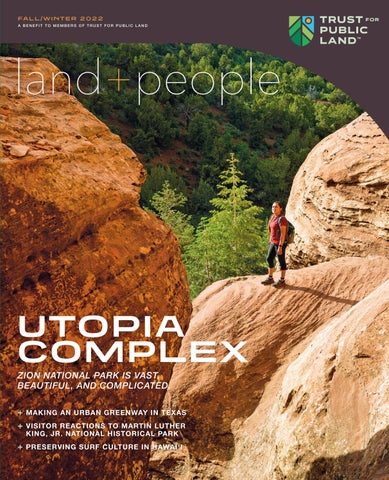
UTOPIA COMPLEX ZION NATIONAL PARK IS VAST, BEAUTIFUL, AND COMPLICATED. + MAKING AN URBAN GREENWAY IN TEXAS + VISITOR REACTIONS TO MARTIN LUTHER KING, JR. NATIONAL HISTORICAL PARK
+ PRESERVING SURF CULTURE IN HAWAI‘I
NATURE SUSTAINS US EVERY DAY Return the Favor: Become a Monthly Donor Trust for Public Land works to connect everyone to the benefits and joys of the outdoors. We collaborate with communities to create parks and protect public land where they are needed most. Help support this important work with a recurring monthly gift. It’s easy, automatic, and secure.
START TODAY
tpl.org/monthly
A · L A N D & P E O P L E · FA L L / W I N T E R 2 0 2 2
bea crespo
c o n t en t s
jason flowers
42
50 Views from the Edge ............................................................................................ 28
“There’s one place that we all belong and that’s outside.” ~ TAY LO R TOY N ES , IN WHEN WINNING BECOMES C O N TAG I O U S, P G . 5 0
Explore TPL’s work securing pieces of Zion—plus the fauna and flora that call it home. j e n n y s at h n g a m
rebecca stumpf
F E AT U R E S
Where the Story Begins ................................................................................. 34 Get inspired by visitor testimonials from Martin Luther King, Jr. National Historical Park in Atlanta.
Protecting the Peaks ........................................................................................... 42 Securing access to iconic mountain landscapes in Colorado and Maine.
When Winning Becomes Contagious ................................... 50 For communities in southern Dallas, outdoor investments have a tendency to spread.
Making Waves—and Defending Them .............................. 54 Keeping the gorgeous coastline of O‘ahu open to the public is one of TPL’s greatest achievements.
54 T P L .O R G · 1
GIVE GUIDE TRUST FOR PUBLIC LAND depends on your support. Our impactful work connecting everyone to the outdoors wouldn’t be possible without you. Make a gift today. With a variety of ways to give, we offer something to suit every budget and personality. So, what’s your giving style? You enjoy spending time outside on a regular basis and want to give a little back each month to ensure everyone has access to nature.
You’re ready to take your support of TPL to the next level—where it will help us make a deeper impact in communities everywhere.
You want to leave a meaningful legacy and share your love of nature with future generations.
You prefer giving annually and like the personal touch of writing a check. Drop your gift in a mailbox today.
Monthly Giving Support Trust for Public Land’s mission with convenient, automatic, and secure set-it-and-forget-it giving. Visit tpl.org/monthly, call 800.714.5263, or email donor.outreach@tpl.org to get started.
Conservation Champions Donate $2,000 or more annually and receive the recognition due a champion, such as invitations to special events and insider updates on our projects and conservation strategies. Visit tpl.org/champions, call 415.495.4014, or email champions@tpl.org.
Planned Giving Consider including us in your will or estate plan, learn about the benefits of designating retirement funds to TPL, and explore other taxwise ways to give. Call 202.856.3748, email plannedgiving@tpl.org, or visit tpl.planmygift.org to learn more.
Mail Your Gift Use the handy envelope bound inside this magazine to send us your gift.
You’re feeling inspired and want to
Give Online
give quickly and easily—we’re talking
It’s simple, easy, and secure. Visit tpl.org/membership to make a gift of any amount today.
just a few taps on your phone.
MEET YOUR MATCH: The end of the year comes with perks. And we don’t mean confetti and champagne. All gifts* made before December 31, 2022, will be matched dollar for dollar. Make a gift today to double your money—and your commitment to connecting everyone to the outdoors. *Excludes planned gifts 2 · L A N D & P E O P L E · FA L L / W I N T E R 2 0 2 2
DE PA R T M E N T S
cultivating hope.
jeremy beeton
Planting the seeds of change and
t e r r ay s y lv e s t e r
From the President · 11
c o n t en t s
23
Board Spotlight · 12 Get to know author and advocate Florence Williams.
Mailroom · 13 First Look · 15 Munching on mesquite, celebrating a little-known Black history site in Reserve—past and future.
Insight · 23 A conversation with a psychologist on the importance of outdoor play to children’s health and happiness.
Member Center · 62 Offices · 63
18
19
Trail’s End · 64 Humans and nature have a long and important relationship.
on t he cove r
Protecting access to Zion National Park has been a challenge, but persistence pays off, and visitors can now reach astounding views like this one. Read more on page 28. Photo: Chris Hinkle
T P L .O R G · 3
h i s t o r i c a m e r i c a n b u i l d i n g s s u r v e y/ l i b r a r y o f c o n g r e s s
Kansas, and exploring Kashia Coastal
4 · L A N D & P E O P L E · FA L L / W I N T E R 2 0 2 2
c o n t en t s
Martin Luther King, Jr. National Historical Park Atlanta, Georgia Auburn Avenue—known colloquially as “Sweet Auburn”—is the birthplace of Martin Luther King Jr. and where he spent the first 12 years of his life. Trust for Public Land helped preserve the area’s architecture and character by purchasing several properties in the historic neighborhood. Today, visitors are able to experience the street as Dr. King would have remembered it, connecting them more deeply to his legacy.
34
a lys s a p o in t er
Page · 34
T P L .O R G · 5
6 · L A N D & P E O P L E · FA L L / W I N T E R 2 0 2 2
c o n t en t s
South Oak Cliff Renaissance Park Dallas, Texas South Oak Cliff Renaissance Park is exactly that—a revival. Community partners worked with TPL to turn what was once a dumping ground into a vibrant creekside park and outdoor learning space. Part of our Five Mile Creek Urban Greenbelt, it’s conveniently located next to an area high school and educational nonprofit. It also has space to cut loose for a quick trot across the lawn!
50
jaso n flower s
Page · 50
T P L .O R G · 7
8 · L A N D & P E O P L E · FA L L / W I N T E R 2 0 2 2
c o n t en t s
Kawela Bay O‘ahu, Hawai‘i Gohawaii.com says, “If the perfect wave exists, you’ll find it on O‘ahu’s North Shore.” But TPL’s Kahuku Kawela Forever project preserved more than stellar surf spots: it preserved a way of life. Thanks to our efforts, a great deal of teamwork, and support from donors like you, locals can enjoy stand-up paddleboarding, picnicking, hiking, and good old-fashioned rope swings along 5 miles of coast that have been forever protected from development.
54
jen n y s at h n g a m
Page · 54
T P L .O R G · 9
Become a Conservation Champion and help Trust for Public Land connect even more people to nature. With your annual leadership-level contribution of $2,000 or more, you will receive invitations to special events and insider updates on our projects and conservation strategies.
Learn more about the impact you will have as a Conservation Champion. Contact us at 415.495.4014 or champions@tpl.org. tpl.org/champions | champions@tpl.org
COMPLETE OUR READER SURVEY (PAGE 16) FOR A CHANCE TO WIN! The Trust for Public Land “Land&People Reader Survey” Giveaway OFFICIAL RULES
or greater value. The Winner may waive their right to receive the Prize. The Prize is non-exchangeable,
Sponsored by The Trust for Public Land, 101 Montgomery Street, 9th Floor, San Francisco,
non-refundable, has no cash value, and must be accepted by the Winner as awarded. Winner is solely
CA 94104. NO DONATION OR PURCHASE NECESSARY TO ENTER OR WIN. PARTICIPATION
responsible for complying with any applicable federal, state and local laws and regulations applicable to
IN THIS GIVEAWAY DOES NOT REQUIRE ENTRANT TO MAKE A DONATION. MAKING A DONATION
the Prize. All costs associated with acceptance or use of the Prize, except as expressly set forth in the
WILL NOT INCREASE YOUR CHANCES OF WINNING. 1. Who is eligible: This Giveaway is open only
Official Rules, are the sole responsibility of the Winner. To the extent required by law, Sponsor will issue
to legal U.S. residents who are 18 or older as of August 31, 2022. Employees of The Trust for Public
an IRS Form 1099 to the Winner to report the value of the Prize received. Sponsor will be responsible
Land, subsidiaries and affiliates, or of other entities associated with the promotion of the Giveaway, as
to pay all federal, state, and local taxes for the value of the Prize on behalf of the Winner. 7. Winners
well as the immediate family (spouse, parents, siblings, and children) and household members of each
Notification and Conditions: Winners will be notified via the phone number or email provided with
such employee, are not eligible. Other eligibility requirements and conditions of participation are set forth
the completed survey within two weeks of the giveaway closing date of September 30, 2022. At the sole
below in these Official Rules for the Giveaway (“Official Rules”). All federal, state, municipal, and local
discretion of the Sponsor, disqualification, forfeiture and the selection of an alternate winner may result
laws and regulations apply. 2. Entry Period: The Giveaway begins at 9:00 a.m. Eastern Time (“ET”) on
from any of the following: (a) the Winner’s failure to timely respond to the notification; (b) the Winner’s
September 1, 2022, and ends at 11:59 p.m. Eastern Time (“ET”) on September 30, 2022 (the “Entry
failure to validly and timely claim the Prize; or (c) any other non-compliance with the Official Rules. In
Period”). 3. How to enter: Complete the survey bound between pages 16 and 17 of the fall/winter 2022
the event of Prize forfeiture, the Sponsor will award the forfeited Prize to an alternate Winner. 8. Odds
issue of Land&People magazine and return it by mail (no postage needed), postmarked no later than
of Winning: The odds of winning depend on the number of Entries received during the Entry Period.
September 30, 2022. Or, complete the survey online at tpl.org/lp-survey by 11:59 p.m. ET September 30,
9. Release and Indemnification: By participating in the Giveaway, participants agree to release,
2022. Use of agencies or robotic, repetitive, programmed or similar entry methods is prohibited. Sponsor
discharge, and hold harmless Sponsor and their affiliates, subsidiaries, advertising and promotion
is not responsible for lost or delayed submissions. 4. Selection of Prize Winner: There will be 5
agencies, and other individuals engaged in the promotion of this Giveaway, from any liability, claims,
winners (“Winners”) in this Giveaway. The Winners of the Giveaway will be selected in a random drawing
losses, and damages arising out of or relating to their participation in this Giveaway or the acceptance,
(“Drawing”), which will be held on or about October 6, 2022. Winners will be notified via phone or email
use, misuse, or possession of any prize received in this Giveaway. 10. Sponsor Reservation of Rights:
within two weeks of the giveaway closing date of September 30, 2022. The Drawing will be conducted
Sponsor reserves the right, in its sole discretion, to modify or terminate this Giveaway in the event of any
by Sponsor or its representatives, whose decisions are final and binding in all matters relating to this
act, occurrence, or reason that it believes would corrupt the integrity, administration, or fairness of the
Giveaway. Each person may only win one prize. 5. Prize and Approximate Retail Value (“ARV”): The
Giveaway. 11. Publicity Release: Except where prohibited, by accepting a Prize, the Winner grants
prize package (“Prize”) awarded to each winner in this Giveaway has an approximate retail value of 140
permission for Sponsor and its agents to use his/her/their name, voice and/or likeness, for advertising,
dollars ($140) and contains a MiiR Flip Traveler mug with an approximate retail value of 25 dollars ($25), a
merchandising, promotion and/or publicity purposes in any and all media now known or hereinafter
Trust for Public Land baseball cap with an approximate retail value of 20 dollars ($20), a Trust for Public
invented without territorial or time limitations and without additional compensation. 12. Privacy Policy:
Land-patterned bandana with an approximate retail value of 15 dollars ($15), and a one-year America the
Information submitted in connection with the Giveaway will be treated in accordance with these Official
Beautiful national parks pass with an approximate value of 80 dollars ($80). 6. Prize Conditions: Lost,
Rules and Sponsor’s Privacy Policy (as may be amended from time to time); provided that, in the event of
stolen or damaged prizes will not be replaced or exchanged. No substitution of prizes will be permitted.
any conflict between these Official Rules and such Privacy Policy, the terms and conditions of the Official
If the Prize cannot be awarded for any reason, Sponsor reserves the right to substitute a prize of equal
Rules shall prevail.
10 · L A N D & P E O P L E · FA L L / W I N T E R 2 0 2 2
chris bennet t
Lead the Way
fro m t he pr es id en t
executive editor
I Ling Thompson publisher
Jennifer Ramsey editorial director
Deborah Williams managing editor
Amy McCullough s ta f f w r i t e r s
Lisa W. Foderaro Amy McCullough Deborah Williams designers
Rachel Andrade Miya Su Rowe Ben Whitesell media production manager
Elyse Leyenberger d i g i ta l p r o d u c e r
Jeremy Sammons
© 2022 Trust for Public Land. All rights reserved. 10-Minute Walk, Community Schoolyards, Conserving Land for People, Conserving Nature Near You, Creating Parks and Protecting Land for People, Fitness Zone, Land for People, Land&People, LandVote, Northwoods Initiative, Our Land, Outside For All, Parks for People, Parks Unite Us, ParkScore, The Trust for Our Land, Trust for Public Land, TPL, and all other names and logos of Trust for Public Land programs referenced herein, as well as their logos, are registered or common-law trademarks of Trust for Public Land.
a breath of fresh air, the cooling shade of trees, a gravel trail crunching beneath your feet. The outdoors provides respite; it inspires, heals, and restores us. Our purpose—to protect public land and create parks where they’re needed most—is simply stated, but the work takes time, commitment, and deep collaboration among networks of experts and community leaders. When we partner with communities to connect everyone to the joys and benefits of the outdoors, we are planting the seeds of hope. In 2023, we will mark TPL’s 50th anniversary. It will be a time to celebrate the hundreds of green schoolyards we’ve transformed around the country, the thousands of parks and trails we’ve created, the 3.9 million acres of land we’ve protected for public access, and the 9 million people who now have a quality park within a 10-minute walk of home. We will celebrate the 300 mayors who have committed to our 10-Minute Walk® goal and the elected leaders who have improved access to nature at federal, state, and local levels. Equally important are the ways we are bridging divides through civic engagement around parks and public lands: citizens who, after helping design their neighborhood schoolyard, volunteer in local parks or register voters; communities that become stronger and more resilient thanks to outdoor gathering spaces; towns that revive their economies by creating new trails or community forests. I was fortunate to see those outcomes on a recent visit to St. Paul’s Midway Peace Park, a TPL project in the heart of a diverse community of immigrants and refugees. The park was envisioned by local kids and adults, many of whom were previously cut off from green space by an interstate and light-rail line. A bustling communal gathering place, Midway Peace Park is now an area where residents and visitors can meet, play, and breathe fresh air. (Read more on pages 13 and 22.) As we look ahead, we know 100 million people—including 28 million children—still lack a quality nearby park. Climate change grows more urgent. Too many communities have waited too long for funding or been left behind by
nichol as lea bruno
SOWING SEEDS, CULTIVATING HOPE
underinvestment, which has perpetuated social, environmental, and economic disparities. We cannot wish away these tough realities. Midway Peace Park is but one example of the potential for local heroes, supported by TPL and donors like you, to uplift our future by catalyzing hope. In May, we launched our Community Partner Network of local organizations from around the country that are grappling with questions about environmental and public health (read more on page 21). Trust for Public Land is equipped with expertise and relationships to offer support, unlock funding, and elevate the power of communities with shovel-ready investments that help address long-standing inequities. When we look back, we can see that success is possible. The question as we move forward: How do we scale our success to bring the benefits of public land to everyone? We plant more seeds. We continue to build coalitions and green spaces that advance health, equity, and climate outcomes. We continue to activate hope everywhere we work. Thank you for continuing to be part of TPL and supporting our efforts. It is fitting that our recently refreshed brand and logo, which you’ll see throughout this issue, takes the shape of a shovel. If there’s one thing we know how to do, it is roll up our sleeves and dig in. I hope you’ll join us.
Diane Regas president and ceo T P L .O R G · 11
Get to Know
boa r d s p ot lig h t
FLORENCE WILLIAMS is a journalist, author, and podcaster with a passion for the outdoors. She is a contributing editor at Outside magazine and a freelance writer for the New York Times, New York Times Magazine, National Geographic, and numerous other publications. A fellow at the Center for Humans and Nature and a visiting scholar at George Washington University, Williams participated in her first TPL fundraiser as a guest speaker in 2019 and joined our National Board of Directors in 2021. Her work focuses on the environment, health, and science. She is the author of The Nature Fix: Why Nature Makes Us Happier, Healthier, and More Creative and, most recently, Heartbreak: A Personal and Scientific Journey.
ben rosser
Board of Directors
Florence Williams
chair
Lucas St. Clair Stephen W. Baird George Bell Luis Benitez Mickey Fearn Jody S. Gill F. Whitney Hatch Allegra “Happy” Haynes Ben Jealous Jennifer Jones Chris Knight Christopher G. Lea Joseph E. Lipscomb Ignacia S. Moreno Caroline P. Niemczyk Michael Parish David Poppe Thomas S. Reeve Diane Regas Jeffrey A. Resnick Laura Richards Lex Sant Sheryl Crockett Tishman F. Jerome Tone Taylor Toynes Keith E. Weaver Susan D. Whiting Florence Williams
What sets TPL apart from other environmental nonprofits? The “people” part of the TPL mission, front and center, is what makes this organization unique. It doesn’t take away from the importance of biodiversity and conservation, which I also care about, but it acknowledges that we live in reciprocity with nature, that we all have a right to access it and receive its benefits, and that without strong, connected, and compassionate communities we cannot have an effective and sustainable conservation ethic. Read more on the importance of considering people a part of nature on page 64. What are you most proud of that you’ve seen TPL achieve since becoming involved? I get really excited about many of TPL’s projects, but perhaps none more so than the Community Schoolyards™ initiative. This aims to provide safe and green play spaces for millions of kids in underserved school districts, as well as neighboring communities. One example is the Alain Locke School in West Philadelphia. It will eventually provide 10-minute walk access to the park for 6,000 residents, half of whom live in poverty. In your writing, you approach topics through a variety of lenses. What about TPL’s work appeals to you from a big-picture viewpoint? I respect that the staff at TPL are thoughtful, forward thinking, and wildly effective. They are
12 · L A N D & P E O P L E · FA L L / W I N T E R 2 0 2 2
interested in Black history, public health, park construction, and sophisticated financial deals. There’s a recognition that the value of land reaches far beyond which plants and animals may take up residence there—that nature spaces are in fact central to our civic identities, our cultural values, our democracy itself. Toward the beginning of the pandemic, you talked with TPL President Diane Regas about the importance of parks to personal health and community resilience. What are your thoughts now? These values are now stronger and more necessary than ever. Public health in this country has only grown more compromised in the last two years. Anxiety, depression, malaise, and loneliness have all deepened, especially among young people. So, unfortunately, has a sense of division in our communities. At the same time, there’s growing recognition that green space is helpful for combating these ills, and that social inequities abound with environmental determinants to health. TPL’s mission is more urgent than ever before. The challenge will be continuing to get this message out, to build consensus when it comes to improving green space and access to it, and to capitalize on the momentum that currently exists. – A.M. le a r n m or e @ TPL.ORG/COMMUNIT Y-SCHOOLYARDS and TPL.ORG/NATURE-FIX
m a il ro o m
Peace Out
A Southwark in the Park
Check out this reaction to our
Readers celebrated the playground
previous issue’s cover story
transformation TPL facilitated
about Midway Peace Park in
at Southwark School in South
St. Paul, Minnesota, where the
Philadelphia, Pennsylvania.
community worked with TPL and the city to create a place to gather, play, and learn.
+ I love the colorful shelter—and the trees! Mary Chicoine on Facebook
+ It’s so important for people in urban areas to have green
+ This is truly wonderful. I don’t
spaces for their health and
think we can underestimate the
well-being that results from
importance of play in a child’s day!!
connecting to nature.
Yvonne Norby on Facebook
Christine Freeland via LinkedIn
For more on the importance of play in childhood development, see page 23.
darcy kiefel
Read more on pages 11 and 22.
Lessons from the Past Our article about the Japanese American Exclusion Memorial on Washington’s Bainbridge Island got strong reactions.
+ I’ve been watching the internment camp stories on PBS . . . and now we're doing this again at the border. When will we learn that we are all human and treat each other like the gift of God we are? Vera Lynn on Facebook
+ Years ago [I] took the ferry and walked to a nursery that had a family memorial. At that time there was a small museum telling the story. Have never forgotten. Martha Jewell on Facebook
+ Never forget Saila Verghese on Facebook T P L .O R G · 13
d o u g l a s s 18 p a r t n e r s / l i n c o l n p a r k z o o
Bird Is the Word An avian-themed mini-golf course in Chicago’s North Lawndale
S E E YO U O N L I N E , SOCIAL BUT TERFLIES
neighborhood brought the love on social media. Join us on your favorite social media
+ What a great example of the power of collaboration! The course sounds like a lot of fun, which residents of North Lawndale need. Kudos to everyone involved!
channel(s) for nature pics, inspiring stories, giveaways, and news about how we’re connecting everyone to the outdoors.
+ What a fun way to get folks out and engaging in play. Dave Lavender via LinkedIn
WE ARE LISTENING Letters to the editor or address changes can be directed to mailroom@tpl.org—and don’t forget to share your thoughts via our reader survey. Turn to page 16 or visit tpl.org/lp-survey.
14 · L A N D & P E O P L E · FA L L / W I N T E R 2 0 2 2
lucy schaeffer
J.T. Morand via LinkedIn
When it comes to balancing climate-smart engineering with joy-bringing design, Atlanta’s Cook Park wins big—literally. Since its completion, the park has received 10 local and national awards, including a prestigious Grand Award from the American Council of Engineering
First Look
Companies. Its ability to capture up to 10 million gallons of stormwater runoff, significantly reducing flooding in nearby neighborhoods, is particularly brag-worthy. le a r n m or e @ TPL.ORG/COOK-PARK
T U R N T H E PAG E FO R : Cooking with Versatile, Edible Mesquite Nearly 700 Acres Returned to Native Stewardship
ale x jackson
Preserving Black History in Kansas
T P L .O R G · 15
ed ib l e outdoors
j e n n i f e r ya k e y - a u lt / i s t o c k
Shake, Rattle, and Eat Mesquite
saguaro national park , arizona
By Amy McCullough PICTURE THE DESERT. Along with sprawling
Public Land has protected over 2,230 acres of Saguaro National
earth-toned hills, barred plateaus, and stunning sunsets,
Park since 1993—including 326 acres around Rincon Creek,
chances are you also envision tall saguaro cacti and shrubby
the park’s only body of water. Mesquite has notably long
trees. Many of the latter are mesquite, and they provide a
taproots and can live on the desert’s minimal precipitation,
host of provisions for humans and animals.
but it also takes advantage of low-lying areas and thrives
Mesquite wood is used for smoking meats as well as
along creeks. This propensity for survival—not to mention
building and heating; its seeds can be ground into flour for
that fact that mesquite seeds are nutrient and protein rich—
baking, making tortillas, and thickening soups; its sweet
make it an important edible plant for Indigenous people of the
pods can be eaten when ripe; and its flowers yield nectar and
Southwest, such as the Tohono O’odham.
pollen that support a variety of pollinators (including bees,
In 2018, Saguaro National Park Superintendent Leah
which produce mesquite honey). And artisans use mesquite
McGinnis signed a first-of-its-kind agreement allowing the
wood and other plant matter to make furniture and crafts.
Tohono O’odham to gather plants for traditional purposes at
Native mesquite species thrive in extremely hot, dry
the park. As TPL Senior Land Protection Project Manager
climates like that of the Sonoran Desert, where Trust for
Michael Patrick points out, it was a model for agreements
16 · L A N D & P E O P L E · FA L L / W I N T E R 2 0 2 2
Service, two of which have followed (between the Cherokee and Great Smoky Mountains National Park in 2019 and Buffalo National River in 2022). Mesquite beans, known as wihog in O’odham, join the ranks
superfoode volution.com
between Native American tribes and the National Park
of saguaro and prickly pear fruit, cholla buds, pinyon nuts, jojoba fruit, and acacia seeds, among others, on the list of native fruits that may be collected at the park. But Jeff Conn, Saguaro’s chief of science and natural resources, says mesquite isn’t typically harvested at the park, likely due to the tree’s ubiquity in the Southwest. Nonetheless, mesquite—like the park’s namesake cactus—is a culturally and historically important native species. And, as in so many of the places TPL works to protect, plants are a critical part of the story, made even more poignant when you can taste them. In the park itself, mesquite trees grow along Rincon Creek; along with cottonwoods and willows, they provide important bird habitat. These stripes of vegetation in an otherwise sparse landscape are also movement corridors for peccaries, bobcats, mountain lions, mule deer, and other native species, providing cover along with food. When asked to provide a recipe for human consumption, Barbara Rose of Tucson’s Desert Harvesters was quick to
Amy’s Apple Crisp FILLING: •
2 pounds apples, local organic heirlooms if possible
•
2 tablespoons orange or apple juice
suggest an apple crisp made with mesquite flour (see right).
TOPPING:
Desert Harvesters is a nonprofit that works to rewild urban
•
1 cup mesquite flour
and suburban places where Sonoran Desert food forests
•
1 cup rolled oats
once thrived; it’s also the publisher of Eat Mesquite and More:
•
1/4 cup amaranth seeds
A Cookbook for Sonoran Desert Foods and Living. The recipe’s
•
1/4 cup brown sugar
author, Amy Valdés Schwemm, says the crisp isn’t overly
•
1/4 cup chopped pecans (optional)
sweet and recommends serving it warm with ice cream or
•
1/4 teaspoon cinnamon, ground
•
1/4 teaspoon cardamom, ground
•
1/2 cup (1 stick) butter
•
2 tablespoons milk (or nondairy substitute)
trying it for breakfast with yogurt or kefir. If you’re ready to try harvesting and eating mesquite yourself, make sure you have permission, and brush up on your plant identification skills; popular opinion says native mesquite pods are best for eating. Three types grow in the Sonoran Desert: honey, screwbean, and velvet mesquite. Pods ripen in late spring to early summer, turning from green to tan or purple, and seeds become loose inside. Give one the shake test: if it rattles—or if pods are beginning to drop to the ground—they’re ripe for snacking. For more on our work in national parks of the Southwest, turn to page 28. le a r n m or e @
TPL.ORG/SAGUARO and TPL.ORG/SAGUARO-FRUIT
Preheat oven to 375 degrees. Core and thinly slice the apples (no need to peel them). Place sliced apples in an 8-by-8-inch greased baking dish and sprinkle with juice. Bake for 15 minutes. Meanwhile, combine all topping ingredients in a food processor and pulse until mixed and slightly moist. Add more liquid if necessary. Remove the apples from the oven, spread the topping over the apples, and return to the oven. Bake for 30 minutes more or until the apples are tender and the topping is browned. Makes six to nine servings. Recipe contributed by Desert Harvesters and Amy Valdés Schwemm of Mano y Metate.
F I R S T L O O K · 17
l a n d l a nguag e
by t he n umb er s
150 YEARS the Kashia spent without access to the coast
688 ACRES of land returned to the tribe in 2015
1.1 MILES of California Coastal Trail to open on Kashia land
350 ACRES of redwood forest to be managed by the tribe and used as a demonstration forest
860
Kashia (or Kashaya)
KASHIA TRIBE MEMBERS who benefit from this land acquisition
(n.) /kə • ’shī • ə/
70+ TRIBES
The Kashia Band of Pomo Indians were the first people known to
have regained access to more than 200,000 acres with help from TPL
have lived in the area of California along the Pacific coast of Sonoma County. They are a federally recognized tribe whose name means “people from the top of the land.” In 2015, Trust for Public Land helped the Kashia regain ownership of their ancestral land along the coast, establishing the Kashia Coastal Reserve. The reserve protects important cultural sites and provides a place for present and future generations of Kashia to connect with their heritage. The California Coastal Trail–much of which is already open to the public—will eventually extend north from Salt Point State Park into the reserve, allowing public access to this stretch of coast for the first time. It will also give the tribe an opportunity to share their culture through
le a r n m or e @ TPL.ORG/K ASHIA
18 · L A N D & P E O P L E · FA L L / W I N T E R 2 0 2 2
p h o t o s : t e r r ay s y lv e s t e r
site interpretation. – A.M.
Read more about the history of land management by Indigenous people on page 64.
g o o d n e ws
nicodemus national historic site , k ansas
There’s No Place Like Nicodemus It’s likely you haven’t heard of Nicodemus, Kansas, but we’re working to fix that. Founded in 1877, it’s the oldest and only—yes, only—remaining historic Black settlement west of the Mississippi River. And as Angela Bates, executive director of the Nicodemus Historical Society and a descendent of original settlers, puts it, “What the people who came out and settled there did was significant.” Formerly enslaved African Americans, they made the difficult journey from Kentucky to Kansas in the years
h i s t o r i c a m e r i c a n b u i l d i n g s s u r v e y/ l i b r a r y o f c o n g r e s s
By Amy McCullough Trust for Public Land is helping to secure a location for this muchneeded addition, which will host more than 5,000 visitors a year and give the town back its community gathering place. Bates, who helps with tours, programming, and field trips in addition to her historical preservation work, is excited for the educational opportunities the new center will afford. “It’s a great triumph,” she says. “Nicodemus is an icon of the African American experience in the West.” As such, it deserves a place dedicated to telling its story that is separate from the historic buildings that comprise it.
following the Civil War. Once there, they built a free, safe,
Bates attributes the site’s progression to partnership and
and flourishing community. Bates, who grew up in California
collaboration: “Nothing happens in a vacuum. It takes the
but visited Nicodemus every summer for the annual
concerted effort of a lot of different entities and individuals
Emancipation/Homecoming Celebration, says her childhood
involved to make this happen,” she says. “I’m grateful that
friends were awestruck. “We have our own all-black town,”
TPL stepped up to the plate.”
she’d tell them. “They didn’t believe it,” she says, laughing. Bates’s interest in Nicodemus began early. Both of her parents are from there, and she relocated to the nearby town
Today, just 2 percent of sites listed in the National Register of Historic Places focus on the experiences of Black Americans. This collective oversight deprives us of a full
of Bogue to be nearer family in 1989, making it her mission
understanding of our nation’s history, and it’s why TPL is
to tell the area’s story: “I have a passion,” she says. “This is
working to lift up the stories of places like Nicodemus. “We
my family. This is our history.”
are committed to communities and equity,” says Starr Woods,
Trust for Public Land helped preserve part of that history.
a TPL project associate, “and a very important piece of that
Shortly after the settlement was designated a National Historic
work is collaborating with sites that preserve and tell the
Site in 1996, we helped protect the African Methodist Episcopal
story of Black life in America.”
(AME) Church, one of the town’s five historic structures (see
“I’m glad there are organizations like TPL that can help
page 3). Built in 1885, the church was in disrepair. “It had a
facilitate this type of thing,” shares Bates. “I’m ecstatic. A new
gaping hole in one side,” says Bates, who turns 70 this year.
visitor center is going to breathe new life into [our] community.
It has since been restored and reopened in 2021.
More than anything, I am grateful to be part of this legacy.”
Next up is a new visitor center—a permanent place for guests to learn about Nicodemus’s history. The site’s Township Hall (pictured above) has been acting as a temporary, makeshift visitor center in the meantime, a reality Bates says “interferes with tradition,” since the historic building would typically be used for celebrations, dances, funerals, and the like.
Turn to page 34 to read inspiring visitor reactions to Martin Luther King, Jr. National Historical Park, another site TPL helped preserve that tells the story of Black life in America. le a r n m or e @ TPL.ORG/NICODEMUS
F I R S T L O O K · 19
brooke br agger
mee t o u r sta ff
I particularly value how we prioritize investing in resident experts who would not ordinarily find themselves working in conservation, despite having so much to contribute.”
RONDA LEE CHAPMAN OUR EQUITY DIRECTOR ON INSPIRATION, ENGAGEMENT, AND THE FUTURE OF TPL’S DIVERSITY WORK. By Lisa W. Foderaro
this field. Diversity, equity, and
opportunities, providing access to
inclusion (DEI) were not elevated as
training resources that advance their
How did you become interested in the environment and conservation?
functional principles of the
technical knowledge, or building new
environmental workplace in the late
relationships that strengthen their
’80s. Being TPL’s first equity director
capacity of leadership in their own
I’m a child of the 1970s and grew up in
has given me the opportunity to bring
communities, the equitable outcomes
the suburbs of Washington, DC. Back
all of my personal and professional
are evident. For more on community
then, we had big open spaces:
experiences into one place.
engagement and park building, see page 50.
the decade gap between my siblings
How is TPL moving the needle on equity in the outdoors and in communities where we are active?
and me. So nature became my
When I first came to the organization
playmate. I was a free-range kid.
in January 2021, I heard about how we were putting community at the center
Trust for Public Land was founded around the belief that everyone fundamentally needs nature, and we focused on those who lack access to it. How are we working to close the outdoor equity gap now?
Can you talk about the career experiences that led you to becoming TPL’s first equity director?
of our work and focusing on closing the
This has always been our mission, and
park equity gap, and I just needed to see
we’ve made great progress and impact
for myself. I started with a mid-Atlantic
over the years. Sixty-nine percent of
tour to talk with communities directly.
our work directly supports Black,
Environmental justice and diversity
Then and now, our community
Hispanic, Asian, and other communities
have always been a part of it. My
partners continue to uplift the positive
of color. And we’ve made a deep
introduction to environmental work
impact our teams have had in their
commitment to equity in our strategic
was as a canvasser for Greenpeace in
own neighborhoods and surrounding
plan, including such advances as adding
DC. That was also my first exposure to
areas. Whether it’s about creating
an equity measure to our annual
what it meant to be a Black person in
pathways to federal funding
ParkScore® index—which allows us to
wetlands, horse farms, and all kinds of beautiful places to engage with the outdoors. Our house sat on 2 acres, and I was more or less an only child given
2 0 · L A N D & P E O P L E · FA L L / W I N T E R 2 0 2 2
make informed decisions about where
themselves reflected among staff, and
with TPL. I particularly value how we
to add parks. Now we’re implementing
for our national and advisory boards to
prioritize investing in resident experts
even more programs to continue
also reflect that. By being inclusive in
who would not ordinarily find them-
strengthening our capabilities, like
this way, we are sending the message to
selves working in conservation, despite
investing in resident experts who are
our community partners that we
having so much to contribute.
leading local work, engaging the next
understand their perspectives and can
generation of land protection
connect with their needs. It’s a
coleading called the Community
professionals, and furthering our Black
foundational element of how we build
Partner Network, a peer-to-peer
History and Culture program that is
trust. Feeling safe and experiencing a
leadership and learning community.
helping preserve sites and public spaces
sense of belonging—not only your
While it’s fairly new, we have already
that tell the story of Black life in
physical safety, but your emotional and
witnessed the ways in which our
America. Also see pages 19 and 34.
intellectual safety as well—is imperative
partners become energized when they
for the positive outcomes of our work. At
meet their peers across the country,
TPL, we take our partnerships seriously,
learn what strategies other leaders are
and that means we honor the trust,
deploying, and experience comradery.
How is TPL making progress toward becoming more inclusive, diverse, and forward thinking?
collaboration, and responsiveness that result from diverse representation.
We have been mindful of our efforts
I am also excited about an effort I’m
What makes this network different is that it’s intimately linked to frontline park and green space advocates and leaders. Beyond providing financial
inclusion in the work we do with
What TPL projects do you think best highlight our equity work?
communities for a while. And it’s
I am very drawn to our Community
that can fill gaps they might have. The
something that our senior leadership—
Outreach and Resident Expert (CORE)
result is that we’re bringing community
President and CEO Diane Regas, in
program in Colorado, which brings the
leaders who have long operated in very
particular—was passionate about
community in, amplifies their vision,
localized circles—with great success—
continuing to invest in. Take my role,
and then provides funds directly to
into the national realm, giving them an
for instance; a staff person dedicated
resident experts so those visions can be
opportunity to share what they’ve
to driving our equity work forward is a
sustained over time. Resident leaders
learned and learn from others. It feels
big step. We just finalized our DEI
participate in a fully funded two-year
like a fundamental, important shift for
Action Plan, which I’m very excited
conservation leadership opportunity
all of us.
regarding diversity, equity, and
resources, we bring technical assistance
collaborating with our human resources team as well as establishing a steering committee and working groups to implement the plan. It won’t be an idea that sits on a shelf. It will
scape l andscape architecture
about; it is quite robust. I am
have measurable outcomes, transparency, and accountability.
Why is it critical that our staff and board resemble the communities where we are engaged? When we’re talking about putting community at the center, it’s important for us to be representative of the places where we work. That includes the need for community members to see
Community members provide input at an engagement event for our Chattahoochee RiverLands project in Atlanta, Georgia. FIRST LOOK · 21
u . s . d e pa r t m e n t o f t h e i n t e r i o r
buz z wo r t h y
“Nature is essential to the health, well-being, and prosperity of every family and every community in America, but not everyone has the same access to nature. We are committed to ensuring that everyone, no matter where they are from, can enjoy the benefits of nature.” — U.S. Secretary of the Interior Deb Haaland, speaking at Midway Peace Park in St. Paul, Minnesota, in May 2022 Trust for Public Land President and CEO Diane Regas and several members of the TPL family joined Secretary Haaland in championing the Outdoor Recreation Legacy Partnership (ORLP) and the importance of equitable access to parks. Launched in 2014, due in large part to TPL’s advocacy, ORLP is a federal program directed at increasing the number of parks in urban and low-income communities. Funding from ORLP was instrumental in the creation of Midway Peace Park, and three more TPL projects—in New Jersey, Maine, and California—were awarded ORLP funding in the latest round of recipients, ensuring parks will be created where communities need them most. – A.M.
t p l s ta f f a n d a l e x j a c k s o n
le a r n m or e @ TPL.ORG/MIDWAY-PEACE-PARK
From Asphalt to Extraordinary A LE X JACKSON
We know that access to the outdoors is essential for healthy, happy people and communities. But today, 100 million people in America—including 28 million kids—don’t have a park close to home. Our Community Schoolyards™ projects are helping close this gap, one neighborhood at a time. We’ve worked alongside communities across the country to transform more than 260 public schoolyards into great public parks—full of trees, shade, and places to learn, exercise, and play. Plus, they stay open to neighbors after school, on weekends, and over the summer. If every public schoolyard in America functioned as a shared outdoor space, 20 million more people would have access to a close-to-home park. 2 2 · L A N D & P E O P L E · FA L L / W I N T E R 2 0 2 2
tpl.org/community-schoolyards
jeremy beeton
in s ig h t
Safe to Play in San Francisco’s Tenderloin PSYCHOLOGIST AND AUTHOR DR. PETER GRAY ON THE VALUE OF PLAY— AND THE SPACE TO DO IT.
By Deborah Williams
MORE THAN 4,000 KIDS LIVE IN SAN FRANCISCO’S TENDERLOIN, a diverse, low-income neighborhood with a high homeless population. In fact, it has the highest population density of any area in the city and the most children per capita. And its open spaces are often underutilized or unknown—or don’t meet the needs of residents. A model of TPL’s community-led approach, Father Alfred E. Boeddeker Park—once ranked the city’s worst playground—has become a point of pride for Tenderloin residents since its redesign and reopening in 2014. And it has given the neighborhood’s children, many of whom have minimal space at home, let alone a lawn or yard, something invaluable: a safe place to play. T P L .O R G · 2 3
We spoke with Dr. Peter Gray, psychologist and author of
they have decided to do, as opposed to what they feel coerced
Free to Learn: W hy Unleashing the Instinct to Play Will Make Our
to do, they do it with much more joy, and they do it better.
Children Happier, More Self-Reliant, and Better Students for Life,
[When] you let students pursue their own interests . . . they
about why community play and room to explore outdoors are
learn really deeply. They don’t all learn the same things,
so critical to healthy childhood development.
of course not, because they’re interested in different things. But in a world where there’s so much to know, why would
As a psychologist, can you begin by talking about the mechanisms and functions of play? Play is how children learn to take control of their own lives,
we want everyone to learn the same thing?
And the same is true for play?
to make decisions, to negotiate with their peers without
Yes. Play should be self chosen and self directed. One of the
some authority figure stepping in to solve problems. It’s
big difficulties today is that children rarely get away from
also how children make friends and learn to get along
adults, and adults seem not to be able to refrain from telling
with one another.
children what they can and cannot do. Children are not able to simply play freely.
Tell us about self-determination theory.
One of the offshoots of self-determination theory is the idea that there are certain basic psychological needs—
It’s based in a large realm of research that initially focused on
autonomy, competence, and relatedness—that are almost as
the idea and the evidence that when people are doing what
important as the physical needs of food, water, and oxygen.
Open play spaces are crucial to healthy mental and physical development in children; Boeddeker Park in San Francisco’s Tenderloin provides exactly that.
2 4 · L A N D & P E O P L E · FA L L / W I N T E R 2 0 2 2
free will. Competence is the sense that I am able to do the things I want to do. And if I’m not able now, I’m capable of
jer em y bee ton
Autonomy is the sense of volition—the ability to act out of
learning how to do them. As we’ve taken play and other self-determined abilities away from children, what we see is an incredible rise in anxiety, depression, suicidal thoughts, [and] actual suicides, which are now eight times higher than when I was a kid in the ’50s.
What advice would you give community planners to ensure that they are thinking and investing holistically in play so children are empowered to develop their self-determination and so parents can release their grip and their anxieties about free-ranging their kids? There’s a book by Mike Lanza called Playborhood. In it, Lanza describes six or seven very different communities where the people themselves figured out a way for their children to
jer em y bee ton
play freely. One of those was a housing project, I think in the Bronx, where the parents quite legitimately were afraid to let the kids out to play because of crime and drug pushers and traffic. At the initiative of probably one parent who got other parents involved, they got the city to close off the street at certain hours after school and on weekends, so that did away with the traffic. They got grandmothers—who have a certain authority—to sit out there to drive the drug pushers away. They created a time when it was safe to play. There’s another lesson there: if you’re going to go into a neighborhood and make a playground, you want to let the community plan it. Bring the kids and adults to the table. What do they want?
Play is how children learn to take control of their own lives . . . without some authority figure stepping in to solve problems.”
Why is it important that play spaces honor and fit into a community’s narrative?
– D R . P E T E R G R AY
It’s important that the community feel invested in it and that
some critical number of kids there. The most important
it’s theirs. When the community wants it to work because
element to encourage play is other kids who are in control
they’ve created it out of their own self-determination, they
of themselves and their play.
have ownership in managing it and ensuring its success. They’ll use it and take care of it. I would love every neighborhood in the country to have a play committee made up of adults and kids, where they’re in
Since reopening Boeddeker Park, TPL has also celebrated the opening of Sergeant John Macaulay Park and Turk-Hyde Mini Park in the Tenderloin, among other projects in the area.
touch with people [and] hold regular meetings to ask what they can do in the neighborhood to facilitate play and to make it safe. We have to find a way that parents feel safe and involved, and we have to find a way that there’s going to be
le a r n m or e @
TPL.ORG/BOEDDEKER-PARK TPL.ORG/ TENDERLOIN-PARKS and TPL.ORG/COMMUNIT Y
T P L .O R G · 2 5
TRUST FOR PUBLIC LAND would like to thank our corporate partners for their support. We could not achieve our commitments to climate, equity, community, and health without their generous financial contributions to our mission and our work. Thank you for helping us connect everyone to the outdoors.
For helping transform playgrounds in Atlanta, Georgia, into exceptional parks through their support of our Community Schoolyards™ program. These schoolyards provide opportunities for improved health and wellness to students and neighbors in the community—plus stronger climate resilience for their cities.
For their longtime support of TPL and, specifically, our 10-Minute Walk® vision; L.L.Bean created the Outdoor Access Award to fund projects that increase access to the outdoors and enable environmental stewardship across the nation, which is helping us achieve our goal to put a quality park within a 10-minute walk of everyone’s home.
For supporting our Community Schoolyards™ program, which transforms asphalt-heavy playgrounds into high-quality parks that serve schools as well as their communities. Macy’s raised nearly $1.5 million by inviting customers to round up purchases during April in support of this program.
For their support of Community Schoolyards™ projects in New York City and green alley revitalization in Los Angeles, as well as contributions to our Park Bench Chat virtual events, where panelists discuss everything from inclusion in the outdoors and Black history to using green space to fight climate change.
For investing in environmental health and equitable access to urban parks—from the Chattahoochee RiverLands and Community Schoolyards™ projects in Atlanta, Georgia, to a greenway on the south side of Chattanooga, Tennessee, to Community Schoolyards™ projects in New York, New York. 2 6 · L A N D & P E O P L E · FA L L / W I N T E R 2 0 2 2
For their help enhancing ‘A‘ala
For supporting the Chattahoochee
For their support of our Chattahoochee
Park so it can become a thriving
RiverLands, an epic riverside
RiverLands, a 100-mile greenway trail
green space in the heart of a
greenway that is helping connect
with parks and blueway access along
densely populated and underserved
everyone in the Atlanta metro area to
the Chattahoochee River through
community in Honolulu, Hawai‘i.
the outdoors.
metro Atlanta.
For their support of our Boston Parks
For their support of Community
For supporting Community
for People program, which strengthens
Schoolyards projects in Los Angeles,
Schoolyards™ projects in New York
health, equity, and climate resilience in
California, where we are increasing
City and New Jersey that promote
™
Boston through community-informed
community health and resilience
student health and learning and
parks and green spaces.
through access to vital green space.
increase park equity for neighbors.
For supporting natural climate For their support of Downeast Lakes
solutions with innovative technology
Community Forest in Maine, which
that guides strategic landscape
conserves precious forest while
conservation and urban greening
providing recreation and supporting
to mitigate climate change and its
local economies.
effects on people.
For their support of our Black History and Culture initiative, which works to tell the story of and preserve sites relevant to the Black For their support of TPL’s Sierra
experience in America.
Nevada land conservation program
For their support of TPL that helps
and its director, whose leadership
bring nature and outdoor experiences
drives TPL’s efforts across the region.
to communities across the U.S. T P L .O R G · 2 7
Views from the Edge Protecting America’s Zion—and perspectives you won’t find anywhere else. By Susan J. Tweit
The erosive power of the Virgin River, which is responsible for Zion’s dramatic landscape, stems from its tremendous drop—it tumbles 80 feet per mile in places—combined with the grinding slurry of sediment carried in flash floods. 2 8 · L A N D & P E O P L E · FA L L / W I N T E R 2 0 2 2
mike schirf
What is now Zion National Park was named for the biblical city of David by Mormon settlers in the 1860s, a tribute to the awe-inspiring landscape. This spectacular collection of massive sandstone canyons and cliffs topped by templelike domes and buttes also reflects the connotations of the word zion: highest point, holy place, utopia, refuge. The park’s vertiginous topography, carved from 2,000-footthick layers of Navajo sandstone by the Virgin River, has provided a refuge in the desert for humans as far back as 9,000 BCE and shelters Utah’s greatest diversity of wild plants and animals. Today, this protected land is threatened: Zion National Park’s 229 square miles of plateaus, domes, and canyons host 5 million visitors a year, more than either Yellowstone or the Grand Canyon—it is the second most visited national park in the U.S. Its very popularity makes Zion vulnerable to development from inside and outside park boundaries, not to mention complicating access to its iconic trails. To grasp why Zion is vulnerable we must understand its unique history. Utah’s oldest national park was originally established as Mukuntuweap National Monument by President Taft in 1909 (the name is thought to be Paiute for “straight canyon”). In 1919, Congress enlarged the national monument and renamed it Zion National Park. In 1956, the neighboring Zion National Monument was appended to it, enlarging the park yet again. That redrawing of boundaries created a national park with an unusually high number of inholdings, chunks of private land islanded within the official boundaries, including more than 30 private parcels totaling nearly 3,500 acres. As southern Utah’s population has exploded, both inholdings and private land around the park have become valuable. St. George, the largest nearby town, was home to around 5,000 people in the 1950s; its population is over 95,000 today. That growth, plus an uptick in visitors, has created conflicts with access to the park from outside and development from inside. This is where Trust for Public Land comes in, using its real estate savvy and oldfashioned persistence to help keep this very special national park intact biologically and accessible to millions of visitors. It does so by purchasing inholdings within park boundaries and conserving land adjacent to the park to enhance public access and limit incompatible development. The process involves patience and persistence, developing relationships with landowners, cultivating trust, working with willing sellers, engaging in due diligence— including environmental surveys—to make sure each property is free of environmental issues, and having funding available for the purchase and transfer of land. The payoff: TPL’s work is critical to keeping Zion accessible to visitors and maintaining healthy and unfragmented ecosystems, says Cassity Bromley, the park’s head of resource management and research. “Animals don’t recognize boundaries,” she adds. “The key thing for me is having a partner we can work with when opportunities come up. I love knowing that there are people who care about Zion enough to put up a lot of resources to protect it.” In other words, people (and organizations) who are helping keep Zion the refuge it has always been—for humans and its unique wildlife and plants. Turn the page to glimpse some of Zion’s most spectacular and iconic places.
T P L .O R G · 2 9
The Narrows: Securing public access to the
Trust for Public Land began working on securing access to
Zion Narrows Trail may be TPL’s most dramatic project. “The
this iconic trail more than a decade ago, first negotiating with
Narrows Trail is one of the top ten trails in the country,” says
Chamberlain Ranch for access to the trailhead, then with
Greg Hiner, Colorado and Southwest director of land protection
another landowner in Simon Gulch, where the canyon (and
at TPL. “It’s on people's bucket lists.” The 16-mile-long walk-
the trail) winds from public to private land and back again.
wade route threads the upper canyon of the Virgin River, a
Success took years and persistence. “The project died, came
winding slot canyon where shadowy sandstone walls narrow to
back, died, and finally came together,” says Hiner. Trust for
a few arm spans apart in places, yet rise to over 2,600 feet high.
Public Land also secured access in Orderville Gulch, a side
But there’s a hitch: the canyon and the trail both begin outside
route into the Narrows. “It’s the greatest feeling when you
the park; to get to them, you have to cross private land whose
secure keystone pieces like these,” Hiner says.
owners could have legally closed off trail access at any time.
3 0 · L A N D & P E O P L E · FA L L / W I N T E R 2 0 2 2
mike schirf chris hinkle
Tabernacle Dome: Named for its resemblance to a massive temple dome, Tabernacle Dome rises from the plateau above the canyon of Left Fork, a tributary of the Virgin River. Trust for Public Land acquired two inholdings at the base of this iconic landmark, with a spectacular view of the park’s backcountry; another nearby inholding now holds a mega-mansion. “A small inholding that is developed can have outsized impacts on the surrounding area in terms of increased traffic and infrastructure development, fragmenting the habitat,” notes Bromley.
Lamb’s Knoll: Trust for Public Land recently acquired a 50-acre, roughly triangular inholding that borders the park boundary along Kolob Terrace Road at the base of Lamb’s Knoll, a sandstone butte eroded into slots and hoodoos that is popular with rock climbers. Protecting this property ensures development will not obscure this entrance to the
chris hinkle
park’s backcountry.
T P L .O R G · 3 1
Critters and Flora That Call Zion Home Ranging in elevation from 3,000 feet at its southern edge to over 8,000 feet on the highest domes—more than a vertical mile—
t w i l d l i f e /i s to c k
l u c a s t e w a r t/i s t o c k
d av i d h e r a s i m t s c h u k / f r e s h w at e r s i l l u s t r at e d
Zion National Park spans a huge range of habitats and, thus, hosts uniquely diverse flora and fauna.
California Condors
Native Fish
Mexican Spotted Owl
North America’s largest and one of our
The Virgin River is unique among desert
With impressive 4-foot wingspans,
rarest birds, California condors are soar-
rivers: it retains healthy populations of
Mexican spotted owls are one of North
ing scavengers with 9-foot wingspans.
its native fish species, in part because
America’s largest owl species. These
A condor nest on a cliff in Zion Canyon
the river’s flows—which can oscillate
secretive birds nest or roost in tight
has produced two chicks in the past
from low and clear to torrential flash
canyons and hunt nocturnally, cruising
three years. The best place to see them
floods in mere hours—are not altered by
plateau forests for small mammals.
is around Big Bend. Peregrine falcons
main-stem dams. All four native fish are
Bromley says TPL projects have helped
also nest on cliffs in Zion; the park
superbly adapted to the river’s fluctuat-
preserve habitat corridors for these
closes cliffs with nests to climbers until
ing conditions. They include endemic
rare owls.
the young birds are fledged.
Virgin spinedace, speckled dace, desert suckers, and flannelmouth suckers
va l l a r i e e / i s t o c k
n at u r e s t h u m b p r i n t / i s t o c k
j e f f g o u l d e n /i s to c k
(pictured above).
Bighorn Sheep
Fremont Cottonwood
Claret Cup Cactus
Zion’s herd of about 450 bighorns graze
Fremont cottonwoods shade the Virgin
These clump-forming, long-lived cacti
their way uphill in spring, following
River in Zion Canyon, along with box elder
grow at the lowest elevations in the
the emergence of new green grasses.
and single-leaf ash trees. This rustling forest
park, storing water in special reservoir
They are easiest to spot, says Bromley,
is a refuge for most desert wildlife at some
cells in their stems. Their brilliant scar-
from the exit of the tunnel on the Zion–
point in their lives, from endangered south-
let flowers open in April, offering nectar
Mount Carmel Highway to the East
western willow flycatchers—small song-
to fuel spring-migrating hummingbirds’
Entrance, or in Zion Canyon in fall.
birds that nest in willows and forage for
journeys and pollen to feed native bees
insects—to mule deer and canyon tree frogs.
and beetles.
3 2 · L A N D & P E O P L E · FA L L / W I N T E R 2 0 2 2
Firepit Knoll: Firepit Knoll, a rare volcanic feature in Zion, is a cinder cone inside the Zion Wilderness. With support from partners including the National Park Founj ay s t u r n e r
dation, TPL acquired a 35-acre inholding bordering both the knoll and the wilderness boundary, in an area clearly visible
chris hinkle
from the popular Hop Valley Trail.
Zion Snail Pinhead- to pea-sized, Zion snails epitomize living local: they are found only in a several-mile stretch of Zion Canyon where water percolating through joints in the porous sandstone emerges on canyon walls to create miniature oases, sprouting ferns and mosses, monkeyflowers, columbines, shooting stars, and other water-dependent plants. Zion snails have a powerful, enlarged “foot” that allows them to cling to their vertical
r e d h u m v/i s to c k
habitat as they nibble algae on wet rocks.
Sego Lily Sego lilies “hide” underground as bulbs most of the year; in spring their graceful tulip-like flowers open atop slender stalks throughout the park’s sagebrush
Susan J. Tweit is an award-winning writer and plant ecolo-
country. Sego lilies vanish again as the
gist. Her 13 books include the award-winning memoir Bless
soil dries out, leaving three-parted seed
the Birds: Living with Love in a Time of Dying, hailed by
pods that rattle in the wind.
reviewers as “courageous” and “heart-opening.” She lives in and writes from the sagebrush sea in the American West. T P L .O R G · 3 3
Where the Story Begins Appreciating MLK’s legacy starts with understanding
says Dusenbury. “And it was really important that we were able to tell the story of Dr. King to the world. We were having the world coming to our doorstep. It was Atlanta’s moment to shine. And we had this old, outdated visitor center.” Where the visitor center and parking lot now stand used to be a pen factory, owned by a conglomerate in Japan. The land was sold to Trust for Public Land and later the National Park Service. Annually, more than a million visitors trek to the national park and the nearby King Center, where Coretta and
his origin. That’s why we
Martin have been laid to eternal rest over a reflection pool. The
preserved the neighbor-
work to preserve and interpret the area is a commitment to
hood that raised him.
honoring history—and to elevating hope for an equitable future for African Americans, a dream Dr. King so often expressed. Judy Forte, the park’s superintendent for the past 16 years,
By Nneka M. Okona Photos by Alyssa Pointer Atlanta’s reputation as a haven for Black people in the South and Martin Luther King Jr.’s legacy are closely tied. The same streets where he grew up and later raised his own family, along Auburn Avenue—known colloquially as “Sweet Auburn”—is a local African American stronghold. It’s also the site of Martin Luther King, Jr. National Historical Park.
heartily believes in the mission both present and past. “I consistently hear how much this park has inspired visitors to not give up and [to] find a deeper meaning of love and peace,” she says. “It is important for everyone who visits to understand the journey of liberty and justice, together with forces that barred or opened the ways for our ancestors. The opportunity to visit the actual locations where a historically significant event took place allows visitors to reflect, be inspired, and to remember the struggle for civil rights and freedom in America.”
Protected in partnership with Trust for Public Land, the park includes a visitor center, a rose garden, historic Ebenezer Baptist Church where Dr. King often gave sermons and other speeches,
In Their Own Words
a fire station, King’s birth home, and a monument that his wife,
In the vignettes to follow, those walking the streets surround-
Coretta, unveiled in 1990 in tribute to her late husband.
ing Martin Luther King, Jr. National Historical Park in Atlanta’s
Georgia State Director George Dusenbury has been with TPL
Old Fourth Ward neighborhood shared their insights. We
for almost a decade. In that time, he’s steered the organiza-
found them milling around after touring the family home or
tion’s overarching dedication to preserving and maintaining
leaving the visitor center, experiencing the interactive exhib-
sites that illustrate King’s work, voice, and vision. Trust for
its as a grounding for what else they would learn.
Public Land’s work at the property, however, goes much further back, before Dusenbury’s tutelage.
Hailing from all over the country (and in some cases the world), these visitors journeyed to Atlanta for different
Beginning in the early 1980s, Trust for Public Land pur-
reasons. All had in common one prevailing thing: a thirst for
chased five row homes situated along Auburn Avenue. The
knowledge and to understand more deeply the life Martin
houses were across from the family home where King spent
Luther King Jr. lived and what lessons he left behind.
the first 12 years of his life, the same house where park rangers lead guided tours today. Later, in 2008, TPL secured one
We study the history of Dr. Martin Luther King Jr.,
of the last properties in the historic district—an important
but to actually see these sites and be here? It makes me
step in preserving the neighborhood as Dr. King would have
feel closer to him as an African American woman. Because
remembered it.
if he had not done what he did, we would still be sitting
According to Dusenbury, the mid-’90s marked a pivotal
on the back of the bus. There would still be Jim Crow laws.
tipping point. It was then that plans to solidify a brand-new
It’s different being in the South—in the North we have our
visitor center were first discussed. At the time, he was work-
prejudices and racism, too. [They] are just not as evident. To
ing for the late Congressman John Lewis. “The Olympics were
know that he stood for something without seeing it come to
coming to town, and the current visitor center did not exist,”
fruition? We’re still a part of that.”
3 4 · L A N D & P E O P L E · FA L L / W I N T E R 2 0 2 2
– Renee Haynie | Bronx, New York
T P L .O R G · 3 5
I learned a lot of things when I visited the house of MLK. I’m coming from France, from far away. And usually when they are talking about the civil rights movement in France, when they mention MLK, they can’t explain everything, and you leave those conversations confused. This was an opportunity to discover the real atmosphere. I learned about his family, his struggles, and all the things that happened during segregation. I feel really proud—it was exciting to learn about the Black community here in Atlanta.” – Lionel Naude | Paris, France
3 6 · L A N D & P E O P L E · FA L L / W I N T E R 2 0 2 2
It was amazing to go in the center and reflect
I hope they continue to restore and preserve this
on his life and the lives of others who really wanted to
neighborhood because it is truly such an emotional and
see justice in the world. And to also see the hope that
impactful part of this country’s history. When you’re in the
generations will carry that on. It was stunning and beautiful—
center of it, it’s so much more impactful than watching it on
something I’ll remember for the rest of my life and return to.”
TV or learning about it in school.”
– Kathryn Smyth | Phoenix, Arizona
– Colton Joralmon | Phoenix, Arizona
T P L .O R G · 3 7
It was inspirational to see and to get a
We were interested in the history of the civil rights
feel of what took place here. I think that everyone
movement, since in Atlanta there was a lot that happened.
should experience it.”
It’s more the personal impact and hearing the individual
– Jevaris Evans | Fort Lauderdale, Florida
stories of people who are here. We were in high school in the ’60s, and we didn’t learn the right stuff. It’s just so impactful. Somehow, we want everyone to know and learn about this.” – Susan & Paul Dragsten | Minneapolis, Minnesota
3 8 · L A N D & P E O P L E · FA L L / W I N T E R 2 0 2 2
Being here definitely humanized Martin Luther
Being able to see a glimpse of [King’s]
King Jr. for me. I knew very little about him other than the
personhood—who he was as a person—outside of what
great things he’s done. But to be able to walk down the actual
we learned in school drove home the more challenging
streets that he grew up on as a child and [see] the house he
parts of his story. Seeing him as a real person and . . . not
grew up in was very touching. I was moved by that. I think
only a figure. For instance, the fact that he was a pacifist and
everyone should come here.”
had such a violent ending seems absurdly unfair.”
– Frank Evan Hawn | Houston, Texas
– Maryhelen Murray | Houston, Texas
T P L .O R G · 3 9
I wanted to come here because when you think of
I live in Virginia, and in Virginia all the streets are
Atlanta, that’s one of the things you think about: it being
named after Confederate soldiers. Being here and seeing
the birthplace of Martin Luther King Jr. Him as a person
all these Black names? I never took it in until this trip. The
and being able to actually see where he was born and where
history of Atlanta is inspiring. It feels good to see Blackness
he lived. That’s the reason I wanted to come here.”
reflected.”
– Dorian Williams | Richmond, Virginia
– Jennifer Brown | Richmond, Virginia
4 0 · L A N D & P E O P L E · FA L L / W I N T E R 2 0 2 2
Coming to this site was incredibly moving. It’s a reminder not just of history but of how far we still have to go: that there still is tremendous inequality in America, that there are people who don’t believe there is or think we should ignore it. And it’s a reminder to me that we have so much farther to go until we can truly say we shall overcome. We need to tell our children, our grandchildren, our family and We just finished up at the visitor center, and it was definitely one of the most moving museums I’ve been to
friends, about what Martin did and what we still need to do.” – David Biderman | Alexandria, Virginia
in my life. I was born in 1963, which is a year where a lot of big things happened. And it really resonates with me that a lot of this took place during my lifetime. When I was young, my parents used to talk to me about the Freedom Riders and everything that was going on. So, it’s vivid not only in my head as history but as memory. This day has been incredible. And it’s not something I realized would be so poignant when I arrived.” – Donna Biderman | Alexandria, Virginia
Nneka M. Okona writes about travel, food, books, and wellness. She is the author of Self-Care for Grief and The Little Book of Self-Healing. A budding tarot enthusiast and lover of hours-long cooking projects, Nneka recently relocated from Atlanta to Fort Worth, Texas. T P L .O R G · 41
Protecting
4 2 · L A N D & P E O P L E · FA L L / W I N T E R 2 0 2 2
the Peaks
A pair of mountain landscapes forever preserved in Colorado and Maine. By Lisa W. Foderaro Illustrations by Bea Crespo
T P L .O R G · 4 3
More than 2,000 miles separate two iconic mountain landscapes that Trust for Public Land recently protected, and in many ways, the properties could not be more different. Fishers Peak—in Trinidad, Colorado, on the New Mexico border—was long a private game-hunting reserve, rising above an old mining town in the arid Southwest. With rocky ledges and stands of pinyon, it teems with elk, mule deer, and mountain lions. On the other side of the country, deep in the dense forests of Central Maine, Moxie Bald Mountain lies far from any human habitation, surrounded by timberland and sparkling lakes that draw moose, Canada lynx, and bobcats. But in other important respects, the mountains bear striking similarities. Both were beloved by local residents who for decades had sought their protection. Both were privately owned yet accessible to the public—though that access ranged from minimal and tricky, in the case of Fishers Peak, to broad and effortless, in the case of Moxie Bald Mountain. Finally, the two mountains are now forever protected: rewarding adventurers with spectacular views from their respective summits, connecting to adjacent conservation lands, preventing development, and guaranteeing access in perpetuity.
Protected access is crucial. Even though hikers could cross through the properties, there was no assurance that a future owner would have the same laissez-faire attitude. Often, such informal access vanishes when a property changes hands and a new owner no longer wishes to share it. Fishers Peak itself was hit or miss: “The former owner did allow access to climb the peak on occasion, but she was kind of fickle,” explains Tim Crisler, an ardent hiker who helped found the Facebook group Trinidad Trails, with more than 2,000 members. “It wasn’t difficult to get permission, but it wasn’t easy. You always had to sign a waiver.” Here’s a look at how conservation of the two mountains unfolded, with help from local partners, government agencies, and a bit of luck.
Fishers Peak Rising some 3,000 feet over the city, Fishers Peak has always loomed large for Trinidad, a city of over 8,000 people. It would be an understatement, in fact, to say the distinctive flat-topped peak is the city’s symbol, given that it figures in business logos and artists’ renderings. But until its protection, only the most determined outdoors people, such as Crisler, 4 4 · L A N D & P E O P L E · FA L L / W I N T E R 2 0 2 2
T P L .O R G · 4 5
and down again. And there are places on it that are scary, that are exposed.”
The overall sentiment is absolute ecstasy—like, ‘Oh my god, this finally happened in our lifetime and now it’s open to the public.’” – TIM CRISLER
But the payoff is considerable: “Once you get up there, the top is just a big, open, flat area, and in the springtime and summer, it’s covered with wildflowers,” says Crisler, referring to the signature mesa on the summit. “And there’s an amazing view. To the north and northwest, you see all the way to Pikes Peak and the Spanish Peaks; to the west, the Sangre de Cristo Mountains, and, to the south, Raton Mesa.” Purchase of the property had something of a multiplier effect for conservation in the Mountain West region. Two
had ever made the ascent, which tops out at 9,633 feet above sea level. Wade Shelton, a senior project manager with Trust for Public Land, started to explore protecting Fishers Peak nearly a decade ago. Conservation of the mountain, which is a three-hour drive from Denver, was running into resistance. “When I first started looking at the property in 2014, there was no way for the state of Colorado to buy more land for state parks,” Shelton says. “So originally, we were going to transfer it to Trinidad.” But after Trust for Public Land partnered with The Nature Conservancy to acquire the enormous property, containing 19,200 acres (or 30 square miles), politics shifted and the impossible suddenly seemed possible. “Once we bought and held it with The Nature Conservancy, the logic of it becoming a state park became very evident,” Shelton adds, “and the governor agreed.” In early 2020, the land was conveyed to Colorado Parks and Wildlife; that fall, Fishers Peak State Park opened to the public, albeit with a limited trail network. Work is now underway to extend those trails. Despite the fact that the former reserve had 60 miles of roads for big-game hunting, most were not suitable for hiking trails and are being restored to their natural state. Crisler says that even though the state park remains a work in progress, the feeling among hikers and recreationists is one of overwhelming relief. “This is a huge thing for people here,” he notes. “The overall sentiment is absolute ecstasy—like, ‘Oh my god, this finally happened in our lifetime and now it’s open to the public.’ I can’t wait to be able to take my friends from Denver on a hike up there.” A resident of Trinidad for 22 years, Crisler has climbed all 55 peaks in the state of Colorado that exceed 14,000 feet. Of Fishers Peak, he says: “It’s not an easy climb. This mountain takes a long full day of hiking, from the bottom to the top 4 6 · L A N D & P E O P L E · FA L L / W I N T E R 2 0 2 2
protected properties—the Lake Dorothey and James M. John State Wildlife Areas—extend along the eastern edge of Fishers Peak State Park in Colorado. Immediately to its south, in New Mexico, is Sugarite Canyon State Park. “When you add those properties to Fishers Peak, then it’s 50 square miles of protected land,” Shelton points out. Trinidad’s mayor, Phil Rico, says the new state park has the potential to put Trinidad on the outdoor recreation map. “We believe the city of Trinidad is going to develop into a destination area,” he says. “We have a river that runs right through our community, and we are working to develop the whole
outdoor recreation sector. One study that looked at the potential said we could get 50,000 to 100,000 tourists annually, with an economic impact of $12 million a year.” For Shelton, making sure Trinidad derives all the benefits from the newly protected Fishers Peak is paramount. Indeed, Trust for Public Land remained on the scene after the conservation deal, helping the city draft a recreation management plan. “We want to set up our municipal partners so they can take advantage of the park to catalyze the economy,” he explains. “The city is going to need physical infrastructure like hotels, restaurants, bars, and parking—things that keep tourists around,” Shelton adds. “To create a diverse economy, Trinidad will also need human infrastructure, so that people can live and work there. The idea is to create a playbook other rural communities can look at and say, ‘How can we take the lessons of Fishers Peak and apply them here?’” In the end, meaningful change for Trinidad will, hopefully, translate into successes for similar areas, which means greater access to nature for more people—the long game TPL is continually playing (and, in many cases, winning).
Bald Mountain Pond Ten states and two time zones to the northeast, in Bald Mountain Township, Maine, the concern was less about generating commercial activity than keeping it at bay. The Appalachian National Scenic Trail runs along the property at Moxie Bald Mountain that Trust for Public Land recently helped protect.
J.T. Horn, director of Trust for Public Land’s national trails
And like many areas around the trail, especially in Maine,
initiative, first learned about Moxie Bald Mountain in 2002
development and industrial-scale timber harvesting have crept
when he was with the Appalachian Trail Conservancy.
closer in recent decades. According to Simon Rucker, executive director of the Maine Appalachian Trail Land Trust, the Appalachian Trail (AT) was laid out starting in the late 1920s. The portion in Maine was
“I thought, ‘Wow, this is really cool,’ but it wasn’t the right moment,” he recalls. “The timber company that owned it at the time wasn’t ready to sell.” Fast-forward a dozen years, and the owner was receptive to
protected via “handshake deals” with timber companies. But
a conservation deal. The forest surrounding the trail, along
in 1968, the federal government appropriated funds to the
with Bald Mountain Pond, had long been available to hikers
National Park Service to buy the trail. There was only enough
and paddlers through an informal agreement. But future
money to acquire a strip of land, however. “Down south, the
access wasn’t assured. “It’s a classic Maine adventure—a
AT goes through Great Smoky Mountains National Park,”
paddle-hike combination,” Horn points out. “It’s not for the
Rucker says. “In Maine, there is very little of that kind of pro-
faint of heart. It is a wilderness experience, and it’s way out
tection. A lot of the trail is 500-feet wide, just a corridor.” Such was the case in Somerset County, about three and a
there. But it’s also one of those experiences that really makes your jaw drop.”
half hours north of Portland by car. For years, various timber
In 2020, Trust for Public Land announced the permanent
companies had owned several hundred thousand acres of for-
protection of more than 2,620 acres of land at Bald Mountain
est there. But conservationists set their sights on a 2,600-acre
Pond. The conservation deal included three phases—and three
corner of the vast timberland, which included the majestic
different owners. The National Park Service assumed owner-
Moxie Bald Mountain, as well as Bald Mountain Pond, and a
ship of 1,356 acres of the mountain. The Maine Appalachian
stretch of the Appalachian Trail that crosses over the summit.
Trail Land Trust took possession of more than 1,000 acres T P L .O R G · 47
4 8 · L A N D & P E O P L E · FA L L / W I N T E R 2 0 2 2
Lucas St. Clair is president of the Elliotsville Foundation, which focuses on conservation in Maine. He describes Moxie
It’s a classic Maine adventure—a paddle-hike combination. It’s not for the faint of heart. . . . But it’s also one of those experiences that really makes your jaw drop.” – J .T. H O R N
Bald Mountain as a classic northern hardwood forest, with fir and spruce mixed in. “It’s a great trail,” says St. Clair, who also chairs Trust for Public Land’s National Board of Directors. “You see evidence of moose, and there are Canada lynx and bobcats and a whole host of songbirds, especially if you are there in the spring during migration.” In the late 1990s, St. Clair and his twin sister hiked the length of the Appalachian Trail, from Georgia to Maine. (Tellingly, the AT’s first full thru-hiker was a World War II veteran seeking to “walk off the war,” a testament to nature’s healing power.) “Maine is one of the most wild places along the whole stretch, where you really feel like you are in wilderness,”
around the pond, including 9 miles of shoreline. And the state
explains St. Clair. “But there are subtle reminders that you are
of Maine acquired acreage at the pond’s southern tip, where
hiking through industrial forestland. You cross logging roads
there is now a parking area and boat launch.
and you hear machinery and pulp trucks in the distance. Not
Conservation of the property created an important buffer
that we are opposed to forestry, but it can feel disorienting
along 5 miles of the AT and guaranteed public access to Bald
when you are there for an outdoor wilderness experience.”
Mountain Pond via private logging roads. To access the pond,
His family foundation (started by St. Clair’s mother and
you either need to be a thru-hiker on the Appalachian Trail—
Burt’s Bees cofounder, Roxanne Quimby) has devoted its
the nearest paved road is days away on foot—or strap a kayak
resources to preserving a sense of wilderness, protecting
to an all-wheel drive vehicle and navigate the logging road.
some 20,000 acres along the AT in Maine. The foundation gave
Either way, the experience is remote, wild, and pristine.
$1.1 million, for instance, toward conservation of Moxie Bald
“You are on a dirt road that’s in pretty rough shape for 15
Mountain. “We work to protect the AT’s treadway and the
miles to reach Bald Mountain Pond,” Rucker says. “That’s an
experience for thru-hikers, but also to provide access points,”
area where there are still active logging operations. But the
he says. “The majority of users of the Appalachian Trail are
conservation land forms enough of a buffer, so that when
not thru-hikers, but people who are experiencing it some-
you’re on the pond, you don’t hear any of that.”
where along the way.”
A day trip might include kayaking or canoeing north across
For TPL, the project at Moxie Bald Mountain was the latest
the pond, which is home to landlocked Arctic char. At the
in a string of conservation efforts along the Appalachian Trail.
opposite shore is a lean-to, near where you can pick up the
Trust for Public Land has completed more than 140 such proj-
Appalachian Trail for the 2,630-foot climb up Moxie Bald
ects, protecting 310,000 acres. The Maine Appalachian Trail
Mountain. The hiking app AllTrails describes the 4-mile out-
Land Trust had described Bald Mountain Pond as the highest
and-back trail as “moderately challenging,” adding that “it’s
priority conservation project on the AT in Maine.
unlikely you’ll encounter many other people while exploring.”
“The whole reason why people fall in love with the Appa-
“From the top, you can see the Bigelow Range, Sugarloaf and
lachian Trail extends far beyond the narrow footpath,” Horn
Saddleback Mountains, and the 100-Mile Wilderness,” Rucker
says. “Where you have this old-growth forest, these big views
notes. “When you are up there on a clear day, you can see
and these big lakes, expanding the buffer of protected area is
well into Canada. And then you hike down and get back in
really important so that people can immerse themselves in
your canoe and you can be home by dinner.”
wilderness.” Now, thankfully, such wilderness experiences are
In addition to identifying sources of public money for
protected indefinitely in Colorado and Maine.
the conservation project, Trust for Public Land helped raise private funds. Support came from the National Park Trust,
Lisa W. Foderaro is a senior writer and researcher for Trust
the National Park Foundation, and the Elliotsville Foundation,
for Public Land. Previously, she was a reporter for the New
among others.
York Times, where she covered parks and the environment.
T P L .O R G · 4 9
When Winning Becomes Contagious A student walkout leads to 124 acres of green space in southern Dallas. By Amy McCullough
A local family enjoys green space at South Oak Cliff Renaissance Park (this page); Taylor Toynes speaks at a community luncheon held shortly after the park’s opening (opposite).
It’s morning, but the sun is already shining bright and hot
Mile Creek Urban Greenbelt. In other words, creating parks—
on a field in southern Dallas. It’s the kind of Texas day that
and an urban greenbelt to connect them—is a major group
wilts hairdos. It’s not the most comfortable, but there are
effort. And that teamwork extends well beyond the agencies
still nearly 20 people on site, making arrangements for the
involved; in fact, the most important aspect of this project's
forthcoming groundbreaking ceremony at Judge Charles R.
success has been the residents’ vision and their deep commit-
Rose Community Park.
ment to realizing it.
“It feels like a long time,” says Robert Kent, Trust for Public
When completed, the greenbelt will link a historically
Land’s Texas state director, “but it’s actually pretty short to
underserved, largely Black population in Dallas to 23 miles of
go from idea to breaking ground in six years.” Kent attributes
trails, three parks, and 124 acres of outdoor space. Strange as
that speed to the collaboration and teamwork of the various
it sounds, this ambitious concept sprang from a pile of detri-
stakeholders involved with this project, many of whom are at
tus littering a creek behind a high school—and a community
the future park site with him.
that demanded better for itself.
They include Dallas Park and Recreation staff, landscape architects, an event planner, land stewards, other TPL staff,
Oak Cliff Genesis
and a variety of local contractors. There’s even a Dallas city
Murals projecting neighborhood pride in Oak Cliff are not
marshal on the scene, blocking a lane of traffic so everyone
uncommon: a prominent one reads “Oak Cliff Raised!” and
can park along Simpson Stuart Road.
depicts Yvonne Craig, costumed as Batgirl from the 1960s
The main event, the actual groundbreaking, is still a month
Batman series, a role for which she is best known. That sense
away, in early June. But today’s well-attended planning session
of local dignity permeates South Oak Cliff High School, where
is a testament to the level of coordination and detail that
another mural, designed by students, pronounces “Still We
defines not only this 40-acre park but the entire network of
Rise” in capital letters across a parking lot wall, a nod to a
green spaces and trails that will ultimately become the Five
poem by Maya Angelou.
5 0 · L A N D & P E O P L E · FA L L / W I N T E R 2 0 2 2
assured self-image. One sore spot was Alice Branch Creek, a tributary of Five Mile Creek that runs behind South Oak Cliff High School—and, now, along South Oak Cliff Renaissance Park. The creek had become a dumping ground for old tires, empty beer cans, and other refuse. Data from the city’s safety and economic reports showed poor health and high crime rates in the area. And a report
Once you start winning, it becomes a mindset.” – DR. WILLIE JOHNSON Creek Urban Greenbelt project aims to improve on that, and if South Oak Cliff High School is any indication, positive change can happen quickly.
from TPL revealed that South Oak Cliff was a park desert: “We
Johnson and Battie said people thought it would take a
were shocked to find out that our zip code, 75216, had one of
while to see the success related to the new school and nearby
the least amounts of green space within a 10-minute walk of
park. “We had a 100 percent graduation rate that first year,”
residents nationwide,” says Derrick Battie, a towering former
says Battie. “Then a state [football] championship. I think we
NBA player and South Oak Cliff alumni who serves as the
know a little something about winning in 75216.”
school’s community liaison. In 2015, students protested poor conditions at the high school
Serendipity in Highland Hills
by staging a walkout; their outcry gained national attention,
Randy Bowman, founder of educational nonprofit At Last!,
ultimately leading to a $52 million investment in a new facility.
knows the regenerative power of the outdoors—for children
And the community didn’t stop with indoor improvements. To
especially. The organization provides kids from less prosper-
hear Principal Dr. Willie Johnson tell it, students here were
ous families with resources, academic coaching, and a nurtur-
just waiting for their first victory: “Once you start winning,”
ing environment to help them excel in school and life. The At
he says, “it becomes a mindset.” When students and alumni raised concerns about the
Last! boarding facility, where kids live during the school week, neighbors South Oak Cliff Renaissance Park.
polluted creek, Dr. Johnson got in touch with TPL, and plans
“What we have across the creek in that park is not replicated
for what is now South Oak Cliff Renaissance Park were
in this area,” says Bowman, who previously owned the park
hatched. “Trust for Public Land was very significant in getting
site and helped TPL acquire it. “It also provides an outdoor sort
this thing accomplished,” says Johnson (known to students as
of biology lab for South Oak Cliff High School and for our kids
“Dr. J”). Battie adds that TPL staff came in with the under-
here, if we want to demonstrate things to them. There was no
standing that the steering committee for the project needed
good reason not to do it,” he says of his decision to sell the land.
to reflect the demographics of the community. “It can’t be . . . some non-Black faces in the Black community putting in a park,” he says. So TPL empowered locals to lead the effort. The resulting 1.8-acre park, a mere six-minute walk from
Given the demographic At Last! serves, Bowman says kids often have hard days. “Sometimes, that malaise spreads throughout the group,” he explains, “and you can say, ‘All right, tablets down, pencils down. We’re going to walk over
the high school down Overton Road, opened in November b r i t ta n y g r y d e r
jason flowers
But it wasn’t long ago that the community conveyed a less
2021, the miraculous timing of which was not lost on Taylor Toynes, founder of For Oak Cliff, a nonprofit that works to combat systemic oppression through education. “We got the park in the midst of a pandemic,” he says of working with TPL on community engagement. “That’s dedication.” Toynes, who joined TPL’s National Board of Directors last year, sees green spaces as essential to well-being. “Everyone, no matter the age or person, race, creed, whatever, there’s one place that we all belong and that’s outside,” he says. “It’s the most natural space for you to be in. It provides you everything that you need to be in harmony, to be healthy.” Currently, more than 186,000 people live within the Five Mile Creek watershed, but only about half have access to a park or trail within a 10-minute walk of home. Our Five Mile T P L .O R G · 51
EST
AR
AR C R
DALLAS
CE D
FORT WORTH
BLV D
OKLAHOMA CITY
OK
LA
TX AUSTIN
HOUSTON
F
M
EX
IC
O
C I T Y O F DA L L A S Cedar Crest Golf Course Chalk Hill Trail
IE
EK
K AL ER
S POLK ST
§ ¦ ¨
AND RD RE L EST MO
E CAMP WISDOM RD
LO
VE
FW
Y
35E
W CAMP WISDOM RD
§ ¨ ¦ 45
DR
Cr
TR
Runyon Creek Greenbelt
SIM
PS
ON
R UA ST
V U
D
Tommie M. Allen
Proposed
LE
PH
ON
E
STER
CITY OF LANCASTER
NCA
CITY OF DESOTO
N LA
Existing Planned (funded)
TE
342
RD
HU T C HI N
S RL T H ORNTON FWY N I-3 5E
V U VE SA
Private conservation land
20
CITY OF HUTCHINS
Trails
Existing park
§ ¨ ¦
DON B JOHNSON FWY
Railroad
Future Five Mile Creek Greenbelt Park
310
342
A AL L
City/town area
V U
ND
Study area
River
ake
D
E WHEATLAND RD
YN
L
§ ¨ ¦ 20
nL
Joppa Preserve
Judge Charles R. Rose Community Park J.J. Lemmon
7 -6 US
W WHEATLAND RD
T r i n it y mo
k
N VI AR
CITY OF DUNCANVILLE
Le m
Glendale
ee
S
M
Y WA
RD
ile
Woody Branch Park W RED BIRD L N
ST
PY
ER
RE
EX
TT
R
PE
FO
AL
ER
M
BE
OO
ITY
TR
A ST NC
Five
£ ¤
ED
EL
2 -L
RIN
EN
S LA
SW
SG TX -1
TT EA
SC
VD BL
N COCKRELL HILL RD
ST
W
V U 342
B O N N I E V IE W R D
N
Five Mile Creek Greenbelt
E RED BIRD LN
E
V U
South Oak Cliff Renaissance Park
Kiestwood Trail
Dallas Executive Airport
I-2 0
Interurban Trail
67
67
E
VD BL ST
BorenHilseweck AV E
£ ¤ Honey Springs Cedar Crest Trail
Boulder
OI S
310
Ki es t
W KIEST BLVD
W LEDBETTER DR
L IN
E AL YV
TO AL
Oak Cliff Nature Preserve
UNIVERSITY HILLS BLVD
W
DUNCANVILLE RD
E IL
NN SU
S
S COCKRELL HILL RD
W ILLINOIS AVE
S RD
O
N
LF
US -6 7
GU
S HAMPTON RD
SAN ANTONIO
On-street
0
1
2
Miles
±
Copyright © The Trust for Public Land
Five Mile Creek Urban Greenbelt
Parks in the Five Mile Creek Urban Greenbelt
PA R K A N D T R A I L V I S I O N
South Oak Cliff Renaissance Park
Judge Charles R. Rose Community Park
Acres: 1.8
Acres: 40.4
Neighborhood: South Oak Cliff
Neighborhood: Highland Hills
Neighborhood: Glen Oaks
Opened: November 2021
Broke ground: June 2022
Opening: To be determined
Woody Branch Park Acres: 82 (the largest addition to the Dallas Park System in over 20 years)
Features: All-weather exercise equip-
Features: An outdoor classroom, views
Features: Amenities under consider-
ment, an outdoor classroom, a basket-
of downtown Dallas, public Wi-Fi, an all-
ation include a playground, gardens,
ball half-court, native plants and rain
abilities playground, community-inspired
picnic pavilion, paved walking paths,
gardens, solar-powered lighting, public
art, and multiple spacious lawns.
and nature trails.
Wi-Fi, and climbing boulders.
Bonus: Several acres of Blackland
Bonus: This park will conserve impor-
Bonus: The park connects to the city’s
Prairie, an endangered ecoregion rich
tant habitat, including more than 1 mile
5-mile Honey Springs–Cedar Crest
with native habitat, will be restored while
of creekside land and over 16,000 trees
Trail, making it even more accessible to
preserved woodland will offer a scenic
capable of capturing 3,700 metric tons
area residents.
walking trail.
of carbon a year.
5 2 · L A N D & P E O P L E · FA L L / W I N T E R 2 0 2 2
jason flowers
to the park, and we’re going to take 15 minutes. And I want you to have as much fun as you can in that 15 minutes. Then we’re going to come back and get back on our stuff.’” Judge Charles R. Rose Community Park is the next project to be completed in the Five Mile Creek Urban Greenbelt (to be followed by Woody Branch Park, an 82-acre forest in Glen Oaks). It’s happening in stages, as funding becomes available. “We’re motivated that there are kids in that neighborhood right now who could benefit from that park,” says Robert Kent. “So let’s do the best we can, with what we can, now.” When Judge Charles R. Rose Community Park is completed, the 3,567 Highland Hills residents who live within a 10-minute walk of it will have a place to exercise, breathe fresh air, and, “have a different perspective find [them],” as Bowman puts it. The first stage, which features an outdoor classroom and views of downtown Dallas, will open in 2023.
Highland Hills residents help break ground at Charles R. Rose Community Park.
The park’s genesis was spurred by an unexpected triumph: around the time TPL bought the land for the park, the Texas
of community members who were used to broken promises.
legislature appropriated $1 million for a Judge Charles R. Rose
Relationships, they all say, are the foundation for positive
Park to be created somewhere in Dallas County. Judge Rose,
change in southern Dallas. “That’s how Trust for Public Land
who passed away in 2019, was a beloved figure in Highland
operates,” says Battie. “None of us. All of you guys.”
Hills, where his namesake park will exist. He served as a
When asked if the progress in his neighborhood signifies a
school board member and justice of the peace and “had a
breaking down of barriers, a challenge to the oppression he
good impact on the neighborhood,” according to Kent.
saw growing up, Toynes is thoughtful. “I’ve seen progress; can’t
This opportunity not only supplied funding to build the
say that I've seen a breakdown,” he says. “Success is an effort.
park, but it also strengthened ties between TPL and Highland
Those things we’re talking about are so deep rooted. That’s
Hills residents, who workshopped the park design over two
going to take a lot. But what better place to do it than outside?”
years of community engagement to ensure the resulting green
A month later, at the groundbreaking for Judge Charles R.
space matches their vision. In another serendipitous turn, the
Rose Community Park, the air is thick with more than humid-
area is now represented in the Texas legislature by Rose’s
ity: the excitement from the gathering community—more
daughter, State Representative Toni Rose. “Representative
than 350 attendees, including dozens of Judge Rose’s extended
Rose has been a great champion for the project,” says Kent.
family and his widow—is palpable. The bilingual event invita-
“She’s been very involved”—just like residents.
tion reads, “We are so excited to celebrate this milestone with
None of Us, All of You
life,” and the mood reflects this positive energy.
the Highland Hills community and see your designs come to Involvement is empowering; it cultivates pride in place and
It’s a memorable day. Laughter accompanies beats from a
ownership. And, as Battie puts it, “When you give voice to
local African drum ensemble. Hugs are shared between neigh-
disenfranchised communities, it gives other people the power
bors who’ve known each other their whole lives. Speeches yield
and the confidence to speak out, too.”
cheers and tears—evidence of this project’s meaning, the fulfill-
Toynes says enriching outdoor spaces like those along Five Mile Creek indicates to young people they are cared for by
ment of a promise to provide a place for unity and connection. “The ceremony was such a powerful moment of community
their community, which reflects positively on where they’re
spirit,” says Kent. For Highland Hills—and southern Dallas—the
from—and, in turn, on their perceptions of themselves.
wheels of change are turning. And it feels like winning.
Partners and collaborators across the Five Mile Creek project emphasize the importance of listening and building trust by forming alliances. Toynes, Battie, Johnson, and Bow-
Amy McCullough is senior writer and editor for Trust for
man agree TPL’s spirit of engagement set it apart in the eyes
Public Land and managing editor of Land&People. T P L .O R G · 5 3
Thanks to TPL’s efforts, locals and visitors to the North Shore of O‘ahu can enjoy stand-up paddleboarding and other outdoor activities along miles of open coastline. 5 4 · L A N D & P E O P L E · FA L L / W I N T E R 2 0 2 2
j e n n y s at h n g a m
Making Waves— and Defending Them Preserving 5 miles of irreplaceable coastline for North Shore recreationists and residents in Hawai‘i. By Maria Kanai
As a Honoluluan, the drive up to the North Shore of O‘ahu isn’t one I make often, but it’s always a welcome escape to visit the rugged coastline that’s home to some of the world’s most iconic surf spots and pristine beaches. It takes about an hour from Salt Lake in my blue Forester, give or take. The scenery changes from condominiums, crowded roads, and transit-rail construction to sweeping pineapple fields, giant white windmills, and residential “Keep the Country Country” signs. I turn onto a palm-lined road that leads to Turtle Bay Resort, a fivestar luxury oceanfront property that sprawls over 1,300 acres. In the resort parking lot, I overhear a couple of twentysomething locals in midconversation. Clad in slippers and hats, one of them asks, worriedly, “Eh, you sure we’re allowed to be here?” His friend responds with confidence while balancing towels under his arm, “We should be, it’s a public beach.” He’s right. Thanks to Trust for Public Land’s Kahuku Kawela Forever project, these 5 miles of coast are indefinitely preserved for public use, and I’m here to meet the woman who spearheaded the deal. Lea Hong, state director of TPL Hawai‘i, is waiting for me at the resort’s golf shop, wearing a long-sleeved blue sun shirt, a hat, and walking shoes. Before we embark, she gives me a navy-gray shirt that has a list of successful projects completed by TPL against a backdrop of the Hawaiian Islands: Waiāhole Beach Park, Kīlauea Point National Wildlife Refuge, Hālawa Valley, Hawai‘i Volcanoes National Park, and many, many more. It’s an age-old tale across Hawai‘i: the bitter conflict over land development between Hawai‘i residents and foreign developers. For three decades, North Shore residents, surfers, and community groups like the Defend O‘ahu Coalition (which sells signs and shirts with the aforementioned “country” slogan) protested fiercely against the resort’s massive plans to build five new hotels, thousands of resort units, and several commercial and shopping centers. As tension rose, TPL entered the fray in 2006 to help negotiate a conservation agreement with the state of Hawai‘i, the city and county of Honolulu, and the landowner. In 2015, TPL was finally able to strike a $45 million deal to preserve 634 acres of the windswept coastline.
T P L .O R G · 5 5
No Speeches, Just Beaches
Trust for Public Land Hawai‘i State Director Lea Hong in the North Shore’s Waimea Valley.
Kahuku Kawela Forever was one of the nonprofit’s most highprofile cases—and, Hong admits, probably the most stressful. “It was a grueling process with many setbacks, going through three mayors and three governors,” she says. But as a result of her and her colleagues’ perseverance, the resort’s development plans were majorly scaled back, to only two hotels and down to 750 hotel and residential units from the original 3,500. The resort maintains ownership of the land and can use the area for recreation, too—there’s a surf and stand-up paddleboard school led by pro surfer Jamie O’Brien for hotel guests. Meanwhile, the resort is required to provide maintenance, security, and recreational access for the public. That’s why there are up to 80 public parking stalls at the resort lot and, along with beach access, 8 miles of trails open to the public. “The Kahuku Kawela Forever project was one of the largest in terms of dollars we’ve had in Hawai‘i, and there were many frustrating moments, having to engage in shuttle diplomacy and talk to state and county elected officials to convince them why this deal was a good idea. But it was an incredibly worthy project,” says Hong. “I just remember when it was all finished, the community didn’t want any more speeches. No speeches, just beaches!” she exclaims, laughing. Hong and I embark on a resort golf cart along marked trails that take us to Kahuku Point through a thick forest by the coast. It’s not crowded at ten o’clock on a weekday morning, but we pass families on bicycles, visitors on Segways, and an elderly couple strolling for their morning exercise. When we make it to Kahuku Point, Hong takes off to look for monk seals. “Is that one?” she asks. “Sometimes you can’t tell a seal from the black rocks.” Waves break against jagged rocks, and white water reflects the early light as we climb up a sandy incline for a better view. Alas, no monk seals, just rough waves. Hong herself is a surfer on the south shore and says you should be experienced if you want to surf here. Hong, who grew up in Wahiawā, worked for years in environmental law before joining TPL. She says working for TPL
There’s a permanence with the work that we do. It’s satisfying knowing that this land is going to be protected forever.” – LEA HONG
has provided her with much more satisfaction than litigation ever could. “There’s a permanence with the work that we do.
with the U.S. Fish and Wildlife Service to restore the coastal
It’s satisfying knowing that this land is going to be protected
dune ecosystem and protect the birds. They’ve tirelessly toiled
forever,” says Hong. “It is an amazing feeling to see families
to remove invasive species, reintroduce and cultivate native
going to the beach, enjoying the hiking trails, and surfing—
species, and trap aggressive predators like mongooses.
and to know that will continue.”
As a result of their efforts, the wildlife is flourishing. Visitors
A large black-and-white albatross soars above us as we chat,
and locals can now regularly see (but not touch) rare species
and she tells me there are nests nearby—one of a few nesting
such as the Laysan albatross, four endemic and endangered
spots on the entire island. Kahuku Point is under stewardship
Hawaiian waterbirds, endangered monk seal pups on the
of the North Shore Community Land Trust, which partners
beach, and even threatened nesting sea turtles.
5 6 · L A N D & P E O P L E · FA L L / W I N T E R 2 0 2 2
j e n n y s at h n g a m
j e n n y s at h n g a m
arna johnson
j e n n y s at h n g a m
Aerial views of Keiki Pool (top) and Kahuku Point (bottom) showcase the North Shore’s remarkable beauty while a Laysan albatross (inset) soars above Kīlauea Point National Wildlife Refuge, another successful TPL project on the T P L .O R G · 5 7 neighboring island of Kaua‘i.
Lea Hong, TPL’s Hawai‘i state director, and her dog, Milo, are just two locals who regularly enjoy the stunning views and recreation opportunities afforded by access to Kawela Bay.
5 8 · L A N D & P E O P L E · FA L L / W I N T E R 2 0 2 2
Keeping Country, Country
limestone island about 100 feet from Kawela Beach—he could
After a stint on Kamehameha Highway, I park across from
buy a surfboard with his newspaper route money. He completed
farm stands selling corn, bananas, and coconuts. There’s a
the challenge, got himself a $35 surfboard, and has been rid-
path here that leads to Kawela Bay—you could also walk one
ing the waves ever since.
of the trails from the resort, but this is faster. It’s a short
“With surfing, you’re not always catching waves—you end up
three-minute trek from the highway before I emerge onto the
. . . waiting around,” Manley explains. “During that time, we
glistening, crescent-shaped bay. The water is peaceful, lapping
[talk] with friends. When we were young, we’d talk about who
gently onto the shore where a family holds a picnic. A group
broke up with who. Now, we talk about how old we’re getting.”
of pink kayaks are about a mile out in the water, and a couple with surfboards gets ready to paddle out. The secluded bay is exempt from the towering waves the
He’s grateful to TPL for the work they did to preserve his neighborhood. “I remember thinking back then, if they developed and built all those hotels, we would lose Kawela,” says
North Shore is known for. Experienced surfers flock from
Manley. “It wouldn’t matter if our family owned a house here
around the world between November and February to ride the
or not. It wouldn’t have been the same Kawela that we knew
awe-inspiring waves at spots like Sunset Beach, Pipeline, or
as kids. We would have lost some of the soul of Kawela.”
Rocky Point. Many participate in international competitions
Today, he still goes out to the bay as often as he can,
such as the Vans Triple Crown of Surfing, the Eddie Aikau Big
sometimes up to five times a week. He’s switched his
Wave Invitational, and the Billabong Pro Pipeline. But there’s a
surfboard for stand-up paddleboarding, together with his
plethora of lesser-known surf spots along this stretch of land—
beloved dog, Snoopy. Although the neighborhood’s changed
if you know, you know. At Kawela Bay, the waves are more
since he was a kid—“there are lots more rich folk”—he’s
ideal for beginners and keiki (children); if you take the time to
able to rest easy knowing that the shore will never be over-
paddle farther out, you can find more intermediate waves.
run by resorts and hotels.
Or so I hear from Mark Manley, a Kawela Bay surfer and resident since 1958. He was a staunch supporter of the Kahuku Kawela Forever project, knowing his family’s way of life was threatened by the resort’s development plans. As a child, he played at the bay with friends until sundown, holding summer bonfires on the sand, catching hammerhead j e n n y s at h n g a m
sharks, sailing on rafts, and being next-door neighbors with pro surfer Gerry Lopez. “I wanted to be a surfer just like him,” says Manley. When he was 12, his father told him that if he could swim to and back from Kūka‘imanini Island—a small
It wouldn’t have been the same Kawela that we knew as kids. We would have lost some of the soul of Kawela.” – MARK MANLEY T P L .O R G · 5 9
marco garcia
Local produce is available at farmers’ markets near Kawela Bay. Much of it is grown on land preserved by TPL and the North Shore Community Land Trust for dedicated agricultural use.
A Symbolic Battle
many special places and shorelines,” says Cole, “and how
One friend Manley might be chatting with while waiting for a
important it was to preserve the places we do have left for the
wave is Doug Cole, one of Hong’s partners during the Kahuku
entire island population and beyond to enjoy.”
Kawela Forever project. At the time, Cole was the executive
Cole belongs to a family of surfers: his father, Peter Cole,
director of the North Shore Community Land Trust. He and
moved to Hawai‘i from California in 1957 and became a
Hong were in the trenches together for years, attending task
legendary big wave surfer who won the Mākaha International
force and community meetings, meeting legislators and tak-
the following year. Peter was well known for his conserva-
ing them on visits to the site. Many state and county elected
tion work along the North Shore, and Doug remembers many
officials had concerns about the cost of the land, especially
nights as a child, watching his father return home tired after
when much of it wasn’t going to be under direct state or
community meetings. “He was always opposing resort expan-
county ownership.
sion in the ’80s and, some days, he’d come home grumpy,”
“The point we were trying to make to the legislators was
Doug remembers. “I would say he was a major influence in
that we’re preserving shoreline and ocean experience along
my life and how I got involved with the project.”
an undeveloped portion of the island,” says Cole. “People can paddle, go [to the] beach, and hike even if we don’t own the land. And that was the hardest hurdle to convince people—it would cost this much for land that they don’t have total ownership [of]. But our point was that we would get all the benefit of owning this land without the burden of needing to manage it. The primary benefit was recreational enjoyment and wildlife preservation.” It’s clear that for everyone involved, the fight was much bigger than just this particular property on the North Shore. “It was symbolic of the entire state of Hawai‘i having lost so
[This project] was symbolic of . . . how important it was to preserve the places we do have left for the entire island population and beyond to enjoy.” – DOUG COLE
Time spent in nature is known to have a positive impact on mental and physical wellness; access to Kawela Bay provides healthful opportunities for residents and tourists alike (above and right). Lea Hong, TPL’s Hawai‘i state director, and her dog, Milo, stand-up paddleboard across Kawela Bay (inset). 6 0 · L A N D & P E O P L E · FA L L / W I N T E R 2 0 2 2
j e n n y s at h n g a m
j e n n y s at h n g a m
He has fond memories of biking along the trails, surfing
He adds, “There’s no way we would have succeeded in
at Kawela Bay, and fishing in area ponds. In fact, his first job
conserving this land if it weren’t for TPL and Lea Hong in
in high school was handing out towels at the resort pool. He
particular. We couldn’t have accomplished this without them.
recalls coming across construction along the old trails through
I’m so thankful that I can still experience this place in the
Turtle Bay as a teenager and seeing concrete pilings as the
way I’ve come to love it, and my kids can do it too, and that
resort was preparing to build the new hotels.
gratefulness will extend for generations.”
j e n n y s at h n g a m
His favorite time to surf the bay is before sunset. “It’s not just the waves that you catch and how many waves you catch,”
Maria Kanai is a freelance journalist and editor based in
he says. “It’s getting away from work or other stresses in life,
Honolulu. Her writing has appeared in Hana Hou!, the
the experience of paddling out into the ocean and looking at
Honolulu Star-Advertiser, HONOLULU Magazine, MidWeek,
the beautiful shoreline. We surfers have a real appreciation
and more. She was born in Yokohama, Japan, but moved to
for our natural environment, and that played a role in the suc-
Hawai‘i a lifetime ago and married a local boy, with whom she
cess of the Kahuku Kawela Forever project.”
now has two kids. T P L .O R G · 6 1
Member Center OUR MISSION: TRUST FOR PUBLIC LAND CREATES PARKS AND PROTECTS LAND FOR PEOPLE, ENSURING HEALTHY, LIVABLE COMMUNITIES FOR GENERATIONS TO COME. As a Trust for Public Land member, you’re a leader in the movement to create healthier, more resilient, and more equitable communities for all. Together, we’re connecting everyone to the outdoors. Since 1972, supporters like you have helped protect more than 3 million acres of public land, created more than 5,000 parks, trails, schoolyards, and iconic outdoor places, raised $84 billion in public funding for parks and public lands, and connected more than 9 million people to the outdoors. Our work depends on the generous contributions of people like you. Renew your membership today! Land&People magazine is a benefit to members of Trust for Public Land.
Other Ways to Support Our Mission: Donate
Contact Us For questions about our work, call 800.714.5263 or email donor.outreach@tpl.org.
Use the envelope inside this magazine or visit tpl.org/membership to make an additional gift. Connect Follow us on social media. Sign up for our monthly newsletter, Outside Matters, at tpl.org/outsidematters. And share our stories and updates with your network.
Charity Ratings Trust for Public Land is a registered 501(c)(3) public charity. Because we spend so little to connect everyone to the outdoors—conserving $11 worth of land for every $1 donated—TPL is one of the country’s top-rated nonprofit organizations. Explore our
Share
standings at tpl.org/support/
When you’ve finished reading this
our-ratings.
issue, pass it on!
6 2 · L A N D & P E O P L E · FA L L / W I N T E R 2 0 2 2
CHARITABLE SOLICITATION DISCLOSURE A copy of our latest financial report may be obtained by writing to The Trust for Public Land, 101 Montgomery, 9th Floor, San Francisco, CA 94104. Telephone number (415) 495-4014. The Trust for Public Land has been formed to facilitate the transfer of privately held land into protective public and not-for-profit ownership, and to promote other ways to ensure healthy livable communities for generations to come. If you are a resident of one of these states, you may obtain financial information directly from the state agency: FLORIDA – A COPY OF THE OFFICIAL REGISTRATION AND FINANCIAL INFORMATION MAY BE OBTAINED FROM THE DIVISION OF CONSUMER SERVICES BY CALLING TOLL-FREE, 1-800-435-7352 (800-HELP-FLA) WITHIN THE STATE OR VISITING www.800helpfla.com. REGISTRATION DOES NOT IMPLY ENDORSEMENT, APPROVAL, OR RECOMMENDATION BY THE STATE. Florida Registration number CH104; GEORGIA – A full and fair description of the programs of (The Trust for Public Land) and our financial statement summary is available upon request at the office and phone number indicated above; MARYLAND – For the cost of copies and postage, Office of the Secretary of State, State House, Annapolis, MD 21401; MISSISSIPPI – The official registration and financial information of (The Trust for Public Land) may be obtained from the Mississippi Secretary of State’s office by calling 1-888-236-6167. Registration by the Secretary of State does not imply endorsement; NEW JERSEY – INFORMATION FILED WITH THE ATTORNEY GENERAL CONCERNING THIS CHARITABLE SOLICITATION AND THE PERCENTAGE OF CONTRIBUTIONS RECEIVED BY THE CHARITY DURING THE LAST REPORTING PERIOD THAT WERE DEDICATED TO THE CHARITABLE PURPOSE MAY BE OBTAINED FROM THE ATTORNEY GENERAL OF THE STATE OF NEW JERSEY BY CALLING (973) 504-6215 AND IS AVAILABLE ON THE INTERNET AT http://www. state.nj.us/lps/ca/charfrm.htm. REGISTRATION WITH THE ATTORNEY GENERAL DOES NOT IMPLY ENDORSEMENT; NEW YORK – Office of the Attorney General, Department of Law, Charities Bureau, 120 Broadway, New York, NY 10271; NORTH CAROLINA – FINANCIAL INFORMATION ABOUT THIS ORGANIZATION AND A COPY OF ITS LICENSE ARE AVAILABLE FROM THE STATE SOLICITATION LICENSING BRANCH AT 1-888-830-4989. THE LICENSE IS NOT AN ENDORSEMENT BY THE STATE; PENNSYLVANIA – The official registration and financial information of (The Trust for Public Land) may be obtained from the Pennsylvania Department of State by calling tollfree, within Pennsylvania, 1-800-732-0999. Registration does not imply endorsement; VIRGINIA – Virginia State Office of Consumer Affairs, Department of Agricultural and Consumer Services, PO Box 1163, Richmond, VA 23218; WASHINGTON – Charities Division, Office of the Secretary of State, State of Washington, Olympia, WA 98504-0422, 1-800-332-4483; WISCONSIN – a financial statement of (The Trust for Public Land) disclosing assets, liabilities, fund balances, revenue, and expenses for the preceding fiscal year will be provided upon request; WEST VIRGINIA – Residents may obtain a summary of the registration and financial documents from the Secretary of State, State Capitol, Charleston, WV 25305. Registration with any of these state agencies does not imply endorsement, approval or recommendation by any state.
Offices NATIONAL OFFICES National Office 101 Montgomery St. Suite 900 San Francisco, CA 94104 415.495.4014
Executive Leadership
Federal Affairs 100 M St. SE Suite 700 Washington, DC 20003 202.543.7552
president & chief executive officer
Diane Regas
STATE AND LOCAL OFFICES
s e n i o r v i c e p r e s i d e n t,
califo r nia
general counsel
& c o r p o r at e s e c r e ta r y
D. Malcolm Carson senior vice president of field programs
Jeff Danter senior vice president & director of l and & people l ab
Howard Frumkin senior vice president o f p o l i c y, a d v o c a c y
& g o v e r n m e n t r e l at i o n s
Bill Lee
California State Office 101 Montgomery St. Suite 900 San Francisco, CA 94104 415.495.4014 Also serves: Nevada Pasadena Office 135 W. Green St. Suite 200 Pasadena, CA 91105 323.223.0441 Sacramento Office 1107 9th St. Suite 1050 Sacramento, CA 95814 916.557.1673 colo r ado
senior vice president
& chief financial & a d m i n i s t r at i o n o f f i c e r
Jim Obendorf senior vice president
& chief marketing & c o m m u n i c at i o n s o f f i c e r
I Ling Thompson senior vice president
& chief philanthropy officer
Patricia Watson
Colorado State Office 1410 Grant St. Suite D210 Denver, CO 80203 303.837.1414 Also serves: Kansas, Nebraska, South Dakota connecticut
Connecticut State Office 101 Whitney Ave. 2nd Floor New Haven, CT 06510 203.777.7367 flo rida
Florida and Gulf Coast Office 306 N. Monroe St. Tallahassee, FL 32301 850.222.7911 Also serves: Alabama, Arkansas, Louisiana, Mississippi, the Caribbean g eo rg ia
Georgia State Office 600 W. Peachtree St. NW Suite 1840 Atlanta, GA 30308 404.873.7306
H awai ‘ i Hawai‘i State Office 1164 Bishop St. Suite 1512 Honolulu, HI 96813 808.524.8560
ohio
illinois
o r egon
Illinois State Office 120 S. LaSalle St. Suite 2000 Chicago, IL 60603 312.750.9820
Northwest Field Office 15 SW Colorado Ave. Suite 100 Bend, OR 97702 541.322.0133
m aine
pennsy lvania
Maine State Office 30 Danforth St. Suite 106 Portland, ME 04101 207.772.7424
Pennsylvania State Office 1608 Walnut St. Suite 302 Philadelphia, PA 19103 215.240.7710
m assach u setts
tennessee
Massachusetts State Office 6 Beacon St. Suite 615 Boston, MA 02108 617.367.6200 Also serves: Rhode Island
Tennessee State Office P.O. Box 3240 Chattanooga, TN 37404 423.265.5229
m innesota
Minnesota State Office 2610 University Ave. Suite 300 St. Paul, MN 55114 651.917.2240 Also serves: Indiana, Iowa, Michigan, Missouri, North Dakota, Wisconsin m ontana
Northern Rockies Office 1007 E. Main St. Suite 300 Bozeman, MT 59715 406.522.7450 Also serves: Idaho ne w j e r se y
Ohio State Office 1250 Old River Rd. Suite 202 Cleveland, OH 44113 216.928.7518
te x as
Texas State Office 3000 Pegasus Park Dr. Suite 752 Dallas, TX 75247 469.615.5448 v e r m ont
Vermont State Office 3 Shipman Pl. Montpelier, VT 05602 802.223.1373 Also serves: New Hampshire washin gton
Northwest Regional Office 1218 Third Ave. Suite 1700 Seattle, WA 98101 206.587.2447 Also serves: Alaska
New Jersey State Office 60 Park Pl. Suite 901 Newark, NJ 07102 973.998.9440
Northwest Field Office 18 North Wenatchee Ave. 2nd Floor Wenatchee, WA 98801 509.888.0844
ne w m e x ico
washin gton , dc
New Mexico State Office 607 Cerrillos Rd. Suite F1 Santa Fe, NM 87505 505.988.5922 Also serves: Arizona and Utah ne w yo r k
New York State Office 666 Broadway Suite 902 New York, NY 10012 212.677.7171
Chesapeake and Carolinas Office 100 M Street SE Suite 700 Washington, DC 20003 202.543.7552 Also serves: Delaware, Kentucky, Maryland, North Carolina, South Carolina, Virginia, West Virginia w yo m in g
Northern Rockies Office 690 W Broadway Suite 200 Jackson, WY 83001 307.739.3941 T P L .O R G · 6 3
t r a il’s en d
HUMANS BELONG IN NATURE, AND THAT’S A GOOD THING Why do so many of us think nature is at
species around their respective landscapes, and their hunting
its best when people are absent? The idea
regulated the abundance of many animal species.
that nature and people should be separate ignores history and
Today’s ecosystems still rely on human management, and
is counterproductive. It also sets a tone that makes conserva-
withholding that management usually turns out poorly. There
tion efforts much more difficult.
are numerous examples of beautiful natural areas declining
North America was not “pristine, untouched wilderness”
in ecological health after being put under conservation
(as it is often and erroneously described) when Europeans
“protection” that removed active human management. Forests
arrived on the scene. The ecosystems of the continent were
become too dense, prairies get swallowed up by brush, and
populated and being intentionally and thoughtfully managed
invasive species run rampant and reduce the diversity and
by Indigenous people. Plants, animals, and the communities
resilience of plant and animal communities. In spite of all
they lived in were adapted to human activity.
that, we’ve created a wilderness ideal declaring that nature is
Advocating that people and nature should be separate is problematic in multiple ways. First and foremost, saying
better off without us. It’s absolutely true that much human activity, especially
nature is better without humans is disrespectful and dismis-
after industrialization, has had terrible consequences for
sive of Indigenous people who have been land stewards for
plant and animal species. Our ability to cause damage, though,
thousands of years. It also falsely absolves all of us of our
doesn’t eliminate our responsibility to do good. If you have an
responsibility to continue that stewardship.
overweight pet, your veterinarian doesn’t tell you to stop
We also need to avoid separating humans and nature
feeding it altogether. Instead of trying to remove people from
because, if people don’t feel connected to nature or see it as
nature, we should concentrate on how to be better caretakers.
relevant to their daily lives, the conservation movement is
We should seek ways to bring nature and people together,
doomed. For those of us who enjoy hiking, birding, hunting,
not try to push them apart. Conservation efforts—like those of
or other nature-based recreation, it’s easy to forget that many
Trust for Public Land—won’t succeed unless they have public
Americans think of nature as uninviting, or even frightening.
support, and that won’t happen unless people see nature as
Worse, some don’t think about nature at all.
relevant to their lives, which it very much is. Countless
About 12,000 years ago, the last ice age ended and glaciers
studies show that exposure to nature is critical for human
receded from most of North America. As the climate changed,
wellness: reducing anxiety, stress, and depression and
ecosystems did too, but those changes were also strongly
improving physical health.
influenced by the management of humans, who had already
The relationship between people and nature has existed for
been on the continent for at least 10,000 years by that point.
as long as humans have been around. Trying to disconnect
Widespread use of fire by Indigenous people regulated the
the two is both fruitless and unproductive. As a species with
density of woodlands and allowed diverse wildflower and ani-
the power and intellect to have outsized influence on our
mal communities to thrive between the trees. Similar fire
surroundings, we must focus on making that influence as
management gave grasses a competitive edge and helped
positive as we can. All the species on earth, including our
drive the emergence and perpetuation of tallgrass prairie and
own, are depending upon us.
oak savanna habitats in what is today the midwestern U.S. In fact, around the globe and for millennia, Indigenous people have used fire to control the foraging patterns of large grazers and to maintain an abundance of plants used for medicine or food. Their management included far more than just fire, however. People actively cultivated and moved plant 6 4 · L A N D & P E O P L E · FA L L / W I N T E R 2 0 2 2
CHRIS HELZER writes The Prairie Ecologist blog and is the author of The Ecology and Management of Prairies in the Central United States and Hidden Prairie: Photographing Life in One Square Meter.
chris bennett
Our ability to cause damage doesn’t eliminate our responsibility to do good.”
National Office 101 Montgomery St. Suite 900 San Francisco, CA 94104
nonprofit us postage
paid
the trust for public land
Complete our reader survey by September 30, 2022, and be entered to win* the following gift package: • Trust for Public Land baseball cap • MiiR Flip Traveler mug with our new logo • One-year America the Beautiful national parks pass ($80 value) • TPL-patterned bandana (looks great on dogs!)
Turn to page 16 to submit by mail (no postage needed) or visit tpl.org/lp-survey.
*NO DONATION OR PURCHASE NECESSARY TO ENTER OR WIN. PARTICIPATION IN THIS GIVEAWAY DOES NOT REQUIRE ENTRANT TO MAKE A DONATION. MAKING A DONATION WILL NOT INCREASE YOUR CHANCES OF WINNING. For full rules, see page 10 or visit tpl.org/lp-giveaway-official-rules.
chris hinkle
Love Land&People? Help us make it even better.