FA L L / W I N T E R 2 0 2 1 A BENEFIT TO MEMBERS OF THE TRUST FOR PUBLIC LAND
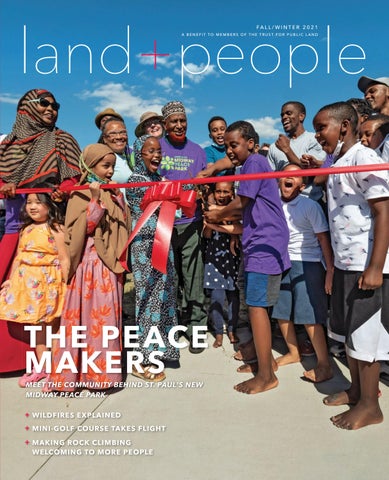
THE PEACE MAKERS MEET THE COMMUNITY BEHIND ST. PAUL'S NEW MIDWAY PEACE PARK + WILDFIRES EXPLAINED + MINI-GOLF COURSE TAKES FLIGHT + MAKING ROCK CLIMBING WELCOMING TO MORE PEOPLE
with future generations.
Three ways to improve parks and open spaces tomorrow, while enjoying retirement savings today: 1. Those aged 72 or older must take a Required Minimum Distribution from their IRAs in 2021. Distributing these funds directly to The Trust for Public Land is a tax-wise way to give. 2. Donors age 70½ and older can make a Qualified Charitable Distribution of up to $100,000 directly from their IRAs to The Trust for Public Land and save on taxable income. 3. Name The Trust for Public Land as the beneficiary of your IRA or other retirement plan, which would otherwise be taxed heavily if passed on to your heirs.
learn more about the benefits of designating your retirement funds to the trust for public land at
tpl.planmygift.org or contact our office of planning giving at plannedgiving@ tpl.org
adair freeman rutledge
share your love of nature...
ƜƨƧƭƞƧƭƬ
ƚ ƝƫƢ ƚ Ƨ Ƭƚ ƧƜơƞƳ ƠƨƧƳ ƚ ƥƞƳ
ƥƨƫƞƧƳƨ ƝƚưƤƢƧƬ
FE AT U R E S
ƍƋ Ǝƍ “Climbing is about place, and it’s about the people we find in our places. ”
Ɯ ƚ ƫ ƨ ƥ Ƣ Ƨ ƞ Ʋƚ Ƨ Ơ
~ ƞ Ƨ Ɲ ƫ Ƣ ƚ ƫ Ƣ Ɯ ơ ƚ ƫ Ɲ Ƭ ƨ Ƨ Ƣ Ƨ ƭ ơ ƞ Ʃ ƫ ƨ ƛ ƥ ƞ Ʀ Ƭ ƨ ƥƯ ƞ ƫ Ƭ Ʃ Ơ ƃƁ
Making Midway Peace Park ................................................................... 30 Great parks, like Midway Peace Park in St. Paul, start with community.
The Problem Solvers ............................................................................................ 42 Climbers of color find their place within a sport that’s not always welcoming.
A Never-Ending Story ........................................................................................ 54 In fast-growing Bozeman, voters come together in support of parks for the future of their town.
ƌƉ TPL .ORG · 1
JAN
FEB
MAR
APR
M AY
JUN
JUL
AUG
SEP
OCT
NOV
DEC
Help conserve land for people every month of the year. It’s easy, automatic, and secure. Join today.
tpl.org/monthlygiving
2 · L AND&PEOPL E · FALL / WIN T ER 2021
D EPA R T M EN T S
The importance of equitable access to parks.
ƜơƫƢƬ ƛƞƧƧƞ ƭ ƭ
From the President · 11
ƜƨƧƭƞƧƭƬ
ƋƎ
Board Spotlight · 13 Get to know Happy Haynes.
Contributors · 14 Mailroom · 15 First Look · 17 $Q H[WUDRUGLQDU\ ƎƉ PLOOLRQ JLIW D PLQLDWXUH JROI FRXUVH LQVSLUHG E\
Ɗƒ
ORFDO ELUGV DQG DQ DPELWLRXV YLVLRQ becomes a reality.
ƚ ƚ ƫƨƧ Ʀ ƚƠ ƚ Ǧ ƚ
Insight · 25 $ ZLOGƓUH H[SHUW WDONV DERXW ZKDW WKH future holds.
Member Center · 62 2IƓFHV · 63 Trail’s End · 64 $ VWURQJ VWRUP SURPSWV D VHDUFK IRU ZLOGƓUH LQ WKH %RUHDO )RUHVW
ƨƧ ƭơƞ ƜƨƯƞƫ Community members celebrate the RSHQLQJ RI 0LGZD\ 3HDFH 3DUN ZKLFK QRZ VHUYHV PRUH WKDQ ƌ ƎƉƉ residents of St. Paul. Read about it RQ SJ ƌƉ 3KRWR &DUROLQH <DQJ
J O I N U S O N FA C E B O O K 6WD\ WXQHG WR RXU ODWHVW QHZV YLGHRV FRQWHVWV DQG PRUH IDFHERRN FRP WKHWUXVWIRUSXEOLFODQG
ƋƊ TPL .ORG · 3
Ɓſ
ƜƨƧƭƞƧƭƬ
BANNING RANCH, NEWPORT BEACH, CALIFORNIA %DQQLQJ 5DQFK LV WKH ELJJHVW SULYDWHO\ RZQHG RSHQ VSDFH RQ the Southern California coast. Thanks to an extraordinary ƎƉ PLOOLRQ JLIW IURP SKLODQWKURSLVWV )UDQN DQG -RDQQ 5DQGDOO The Trust for Public Land is under contract to purchase the land and transform it into California’s newest oceanfront park.
reuben herzl /groundmaking, llc
Page · 20
TPL .ORG · 5
ƜƨƧƭƞƧƭƬ
BLUE GOOSE HOLLOW TRAILHEAD, CHATTANOOGA, TENNESSEE 'DWD LV NH\ WR FORVLQJ WKH SDUN HTXLW\ JDS LQ $PHULFD 7KDWōV ZK\ The Trust for Public Land publishes its annual ParkScore® LQGH[ WKH JROG VWDQGDUG RI SDUN FRPSDULVRQ DFURVV WKH ƊƉƉ ODUJHVW 8 6 FLWLHV 7KLV \HDU ZH looked at the data in a new way. 7KH UHVXOWV UHYHDO DODUPLQJ UDFLDO and economic disparities in who has access to quality parks and JUHHQ VSDFHV /HDUQ KRZ ZH UH XVLQJ WKHVH FULWLFDO LQVLJKWV WR EULQJ TXDOLW\ SDUNV WR HYHU\RQH
ƁƁ
doug strickl and
Page · 22
TPL .ORG · 7
ƜƨƧƭƞƧƭƬ
STORY MILL COMMUNITY PARK, BOZEMAN, MONTANA %R]HPDQ LV JURZLQJ UDSLGO\ DQG its residents wanted to ensure their access to parks and the RXWGRRUV VXUYLYHG ZLWK WKH GHYHORSPHQW 7KH 7UXVW IRU 3XEOLF /DQGōV FRQVHUYDWLRQ ƓQDQFH SURJUDP VDYHG ƏƉ DFUHV VHW IRU GHYHORSPHQW DQG FRQYHUWHG WKH land into the Story Mill Community 3DUN ZKLFK LQFOXGHV D ƍƉ DFUH QDWXUH VDQFWXDU\ D PLOH RI UHVWRUHG ULYHU D FOLPELQJ ERXOGHU DQG D FRPPXQLW\ JDUGHQ
Ƅƃ
adrian sanchez-gonz alez
Page · 54
TPL .ORG · 9
O FFICERS president and chief e xecutive officer
Diane Regas s e n i o r v i c e p r e s i d e n t, g e n e r a l c o u n s e l , a n d c o r p o r at e s e c r e ta r y
D. Malcolm Carson senior vice president of field progr ams
Jeff Danter senior vice president of p o l i c y a n d g o v e r n m e n t r e l at i o n s
Bill Lee senior vice president and c h i e f f i n a n c i a l a n d a d m i n i s t r at i v e o f f i c e r
James Obendorf senior vice president and c hief m a r k e t in g a nd co mm u ni c at i o n s o ffi c er
I Ling Thompson senior vice president and chief phil anthropy officer
Patricia Watson
our mission:
THE TRUST FOR PUBLIC LAND CREATES PARKS AND PROTECTS LAND FOR PEOPLE, ENSURING HEALTHY, LIVABLE COMMUNITIES FOR GENERATIONS TO COME. h o w yo u c a n h e l p : Our work depends on the generous support of people like you. d o n at e: Use the envelope inside this magazine, or visit tpl.org/donate for other easy ways to give. l e a r n m o r e: Get timely updates on our park and conservation work near you. Sign up for our e-newsletter at tpl.org/enews. s h a r e: Help us make the case for parks and open space. When you’ve finished reading this issue, pass it on! Land&People magazine is a benefit to members of The Trust for Public Land.
10 · L A N D & P E O P L E · F A L L / W I N T E R 2 0 2 1
from the president
nichol as lea bruno
ONWARD TO EQUITY if you’re feeling overwhelmed by the news, you’re not alone. The pandemic continues to stretch our resilience while communities on one side of the country reel from damaging floods and hurricanes, and communities on the other publisher and managing editor Jennifer Ramsey produc tion manager Hannah Kohut s ta f f w r i t e r s a n d editors Joanna Fisher-Whilden Laurie Isola Miya Brown
side grapple with the impacts of multiyear-long droughts and devastating wildfires. At the same time, millions of Americans continue to face countless barriers and prejudices in their daily lives. We’re a nation in need of healing—from the pandemic, for our climate, and as a society against inequality and division. At The Trust for Public Land, we believe in the healing power of nature. Every park, trail, and
designers Rachel Andrade Miya Su Rowe Ben Whitesell
wilderness is an opportunity for each of us to
media produc tion manager Elyse Leyenberger
challenges we face. This is why we’ve committed
d i g i ta l produc tion Jeremy Sammons Laurie Isola
renew and reconnect. The parks we create illuminate a path through some of the greatest to creating more places that bring us outdoors from parks to trails and playgrounds to open spaces, while making them available and welcoming to everyone. Since our founding, we have created hundreds of parks, playgrounds, and gardens; developed thousands of miles of trails; and put a quality park within a 10-minute walk of home for more than nine million people across nearly all 50 states. Half of the people who reside near a park
© 2021 The Trust for Public Land. All rights reserved. 10-Minute Walk Community Schoolyards, Conserving Land for People, Conserving Nature Near You, Creating Parks and Protecting
created by The Trust for Public Land live at 75 percent below the median household income and more than two-thirds identify as Black, Hispanic and Latinx, Asian, or Indigenous. Our work is
Land for People, Fitness Zone, Land for People, Land&People, LandVote, Northwoods Initiative, Our Land, Outside For All, Parks for People, Parks Unite Us, ParkScore, The Trust for Our Land, The Trust for Public Land, TPL, and The Trust for Public Land and LandVote logos and all other names of The Trust for Public Land programs referenced herein, as well as their logos, are registered or commonlaw trademarks of The Trust for Public Land.
focused on ensuring that everyone has access to nature, but to close the park equity gap we need to better understand where those gaps are.
complete look at our park systems in America shows major disparities across race and income. In our largest cities, residents of neighborhoods with majority people of color have access to an average of 44 percent less park space per capita than residents of neighborhoods that are predominantly white. Mounting research shows that the way a city distributes resources and invests in parks directly affects the well-being of residents. We know that access to green space has implications for physical and mental health and in shaping our quality of life. Green spaces also offer protection from the effects of climate change, including extreme heat and flooding. Access to quality parks isn’t just a nicety, it is a necessity. In this issue of Land&People magazine, you’ll read how we are working with communities to address these inequities head on. Now that we have the data to pinpoint where parks are needed most, the time has come to set a new standard for outdoor access. And, with the help of supporters like you, we can continue to bring the healing power of nature to communities today and long into the future.
That’s why earlier this year, we added a new measure, equity, to our annual ParkScore® index. The ParkScore rating system measures how well the 100 largest U.S. cities are meeting the need for parks and is a go-to resource for communi-
Diane Regas
ties, cities, states, and researchers. This more
president and ceo T P L . O R G · 11
M EET YO UR MATCH
This year, an anonymous donor will generously match your gift—dollar-for-dollar—if you send it before December 31. Your donation will go even further to help The Trust for Public Land protect more parks, gardens, and other natural places. That’s one good thing made that much better.
Give your EarthShare.
12 · L A N D & P E O P L E · F A L L / W I N T E R 2 0 2 1
An EarthShare payroll deduction is one simple way to donate to The Trust for Public Land or more than 400 other environmental and conservation charities. Many corporate and government employers support EarthShare payroll giving. If yours doesn’t, ask them to start. If they do, simply decide on a single deduction or a recurring small one from every paycheck. Then designate us, member number 11440, as one of your conservation charities. For more information visit earthshare.org or email donor.outreach@tpl.org.
terray sylvester
800.714.5263 · donor.outreach @ tpl.org · tpl.org/match
Get to know
board spotlight
Happy Haynes allegra “happy” haynes is the
courtesy of allegr a haynes
BOA R D O F DIREC TORS
executive director of Denver Parks and Recreation and a Denver native. She served two years as deputy mayor, thirteen years on the Denver City Council, and eight years on
chair
the Denver Public Schools Board of Education.
Thomas S. Reeve
She chaired The Trust for Public Land’s
Stephen W. Baird
Colorado Advisory Board for six years and
George Bell
serves on the boards of the Denver Museum of
Luis Benitez
Nature & Science, Denver Zoological Foundation, Denver Botanic Gardens, and
Page Knudsen Cowles
City Parks Alliance. She was a founding board
Mickey Fearn
member of Mile High Youth Corps and the
Jody S. Gill
Sand Creek Regional Greenway and served for
F. Whitney Hatch
four years on the Colorado State Parks Board.
Allegra “Happy” Haynes Ben Jealous Christopher G. Lea Joseph E. Lipscomb Ignacia S. Moreno Caroline P. Niemczyk Michael Parish
I BELIE VE IN PROTEC TING L AND AND CRE ATING
THE TRUS T FOR PUBLIC L AND’S WORK IS UNIQUE
PARK S BEC AUSE … parks and open spaces play
BEC AUSE ... our singular focus on partnerships and
a critical role in the health and vitality of
community-driven projects sets us apart from other
communities by enhancing the physical and
organizations, and our expertise has set national
mental well-being of individuals and protecting
standards, such as ensuring that all people live
and enhancing ecological and environmental
within a 10-minute walk or roll of a park. These
health. Parks are an important part of every
strategies leverage far greater impact than we
community’s basic infrastructure.
could achieve on our own.
Jeffrey A. Resnick
I SUPPOR T THE TRUS T FOR PUBLIC L AND BEC AUSE …
THE KE Y CHALLENGE FACING THE TRUS T FOR PUBLIC
Laura Richards
putting people at the center of our mission and our
LAND IS … growing our brand awareness and
work recognizes that not only are people the chief
increasing our financial capacity while being true
David Poppe Diane Regas
Lex Sant
beneficiaries of our work to protect land and create
to our community-driven approach and broadening
Lucas St. Clair
quality parks and open spaces, but that their
our efforts to become more diverse and inclusive.
Sheryl Tishman
stewardship and advocacy and engagement are key
F. Jerome Tone
to our success.
I FIRS T FELL IN LOVE WITH THE NAT UR AL WORLD
Taylor Toynes
MY PROUDE S T TRUS T FOR PUBLIC L AND MOMENT S
gardening with my grandmother, climbing the
Keith E. Weaver
ARE … making a pitch at the organization’s
perfect tree, and from a mother who encouraged
Susan D. Whiting
National Leadership Conference along with a staff
outdoor activities and adventure. In a park just a
Florence Williams
colleague to lift the voice of a community partner
few blocks away a small box culvert that became
and her community’s needs, and being invited
my personal jungle playground sealed the deal!
WHEN … in my backyard growing up, through
to engage with the Black History and Culture Sites Advisory Council. Both are testaments to our commitment to partnership and equity. As a board member, I’m focused on contributing to our steady progress toward those commitments.
?
WHAT ABOU T YOU? Tell us how you connect with nature. Join the conversation on Facebook: facebook.com/thetrustforpublicland T P L . O R G · 13
ƜƨƧƭƫƢƛƮƭƨƫƬ
Ibrahim Hirsi
Endria Richardson
Sophie Tsairis
story:
story:
Making Midway Peace Park
A Never-ending Story
story:
The Problem Solvers
30
54 42
Ibrahim Hirsi is a Minneapolis-based
Endria Richardson is a writer, climber,
Sophie Brett Tsairis is a freelance journalist
journalist and doctoral candidate in history
and lawyer living and working on Ohlone
and writer specializing in conservation
at the University of Minnesota. He’s covered
Land in Oakland, California.
and outdoor adventure. Hailing from the
immigration and communities of color
@ endriaraa
coast of Maine, she set down roots in
for various news outlets in the Twin Cities,
Montana in 2015. Sophie has a master’s
including MinnPost, Minnesota Public Radio,
degree in Environmental Science and
and Sahan Journal. Ibrahim’s writing has
Natural Resource Journalism from the
also appeared in such national publications
University of Montana and writes to help
as Politico, Truthout, and PRI’s The World.
bridge the communication gap between
@ iHirsi
scientists and the public. @ sbtsairis
Caroline Yang story:
Making Midway Peace Park 30
Caroline Yang is a documentary photographer based in St. Paul, Minnesota, who strives to create photographs that reflect the depth and complexities of the
and connection to our communities. She works with clients such as the New York Times, the Washington Post, and many others. @ carolineyangphoto
14 · L A N D & P E O P L E · F A L L / W I N T E R 2 0 2 1
TE TR A IMAGES
human experience and bring understanding
Let’s make cities part of the climate change solution. Thanks to a gift from RBC, we’re harnessing the power of data to pinpoint how city parks can absorb greenhouse gases, slow global warming, and protect people from rising heat and stronger storms.
The Trust for Public Land is an official charity partner of RBC’s 2021 Tech for Nature program.
ƦƚƢƥƫƨƨƦ
ƝƨƮƠ Ƭ ƭƫƢƜƤ ƥ ƚ ƧƝ
CHECK US OUT! Join us on social media for outdoors LQVSLUDWLRQ IXQ IDFWV H[FLWLQJ JLYHDZD\V DQG ELJ QHZV DERXW WKH
ƚ ƧƝƲ ƫƢƜơƭƞƫ
SXEOLF ODQGV \RX ORYH
TALK WITH US
:HōUH ZRUNLQJ ZLWK WKH &LW\ RI &KDWWDQRRJD WR FRPSOHWH WKH LQFUHGLEOH ƊƋ PLOH ORQJ 6RXWK &KLFNDPDXJD &UHHN Greenway this winter.
We want to hear from you! Let us know what you think of the stories, artwork, and photographs you’ll find in this issue of Land&People magazine. Drop us a line at mailroom @ tpl.org.
Good for the soul Our spring cover story explored how access to the outdoors has helped people navigate the pandemic—and beyond.
+ Ailments are limiting my physical enjoyments right now, but years of climbing, working for Outward Bound, kayaking, biking, etc., make me a strong supporter of parks and outdoor recreation. Our souls do not resonate with buildings, streets, traffic, and other unavoidable detritus of towns and cities. Our souls find sustenance in the wind, sunlight, flowing streams of open uncontorted land. Keep up the good work. And thanks! Pete Young, via tpl.org
T P L . O R G · 15
ƩƚƮƥ ƫƨƛƞƫ ƭ ưƨƥƟ ưƢƥ ƬƨƧ
ƦƚƢƥƫƨƨƦ
+ Community forests offer another model for public outdoor space; they complement The Trust for Public Land’s creation of new parks, schoolyards, and trails. Nice to see!
ƚ ƥƞ Ʊ ƣƚƜƤ ƬƨƧ
Ronald C. Weston on LinkedIn
Heartland love
+ I am grateful and thankful that you
5HDGHUV FHOHEUDWHG WKH <XURN 7ULEH V
have made it happen. It’s an inspiration
reclamation of their ancestral territory
seeing others determine to preserve
in Northern California.
our precious resources for all, and generations will be able to know what
+ Great story of Tribal Nations regaining
matters most. Take care, stay well,
ancestral land and repatriation of
healthy, safe and sound.
funerary and ceremonial objects with
Jimmy Ching on tpl.org
the help of The Trust for Public Land. I will share this article with friends,
+ Love this! Hope to see more natural
relatives, and THPOs [Tribal Historic
classrooms pop up around the country
Preservation Programs] in the Midwest.
post Covid as more people took a natural
Carole Standing Elk, via tpl.org
turn into the welcome arms of nature.
+ This article makes me so happy! Finally, things seem to be moving in the direction of love. Lori Bailey, via tpl.org
+ Thank you for sharing this. After centuries of abuse, the return is happening. Robin Baldwin, via tpl.org
ƚ ƥƞ Ʊ ƚ ơƨƲ ƞƫ
Dave Lavender on LinkedIn
Before and after The creation of Cook Park is just one RI WKH ZD\V ZHōUH ZRUNLQJ WR PDNH VXUH HYHU\ $WODQWD UHVLGHQW KDV DFFHVV WR WKH EHQHƓWV RI QDWXUH + It’s such a great space! Glad we could be a part of this monumental moment for Vine City and ATL! Astra Group, LLC (@astragroup_llc) on Instagram
+ This is a fantastic way to make climate change visible and promote climateresilient community construction going forward. Samuel Cuthell on LinkedIn
Thinking outside the classroom 2XU VWRU\ DERXW WKH EHQHƓWV RI RXWGRRU FODVVURRPV PDGH WKH JUDGH with readers.
LAND&PEOPLE IS LISTENING! 6HQG OHWWHUV WR WKH HGLWRU RU FKDQJH \RXU PDLOLQJ DGGUHVV PDLOURRP@ WSO RUJ
16 · L A N D & P E O P L E · F A L L / W I N T E R 2 0 2 1
t u r n t h e pa g e f o r … ocean views birdies pe acemakers
wilderness is two things—fact and feeling. it is a fund of knowledge and a spring of influence. it is the ultimate source of health—terrestrial and human. b e n t o n m a c k ay e
Ʀƃ ƫ ƚƧƜơ ƠƫƨƮƩ
Located in the San Juan Mountains at an elevation of 9,003 feet, Lake San Cristobal is the second-largest natural lake in Colorado. In June 2021, we cut the ribbon on a project that will increase and improve public access to this spectacular jewel.
T P L . O R G · 17
ƞƝƢƛƥƞ ƨƮƭƝƨƨƫƬ
PRESERVING FARMLANDS,
ƟƢƧƧƫƢƯƞƫ ƟƚƫƦ ƚƧƝ ƜƢƝƞƫƲ ƜơƢƦƚƜƮƦ ưƚƬơƢƧƠƭƨƧ
imagine you’re enjoying a bike ride
relationships that grow up and through
on a hot sunny day on the North
the food system.” By growing an orchard
Olympic Peninsula of Washington
and sourcing regional organic fruit, and
State. You set out from Port Townsend—
fermenting and selling their artisan
enjoying breezes off Port Townsend Bay
ciders on the North Olympic Peninsula,
and catching views of the forests as you
Finnriver is providing a place for the
go—and you end at Finnriver Farm and
community to gather, protecting valuable
Cidery in Chimacum. There, you catch
farmland, creating more than 60 full-
up with neighbors over locally made
time and seasonal jobs, and fueling the
cider, then swing by the Chimacum
local economy.
ƜƨƮƫ ƭƞƬ Ʋ ƨƟ ƟƢƧƧƫƢƯƞƫ
connecting communities
Corner Farmstand for some blueberries
Jefferson Land Trust, with which The
to enjoy on the ride home—all while
Trust for Public Land has partnered
“Preserving farmland is a way to
supporting the local economy.
for many years, made the protection
really approach the triple bottom
Finnriver’s motto is “For the love of
of this land possible with permanent
line—environment, economy, and social
land, the art of farming, and the spirit of
agricultural conservation easements.
network of agriculture and culture,”
community.” Crystie Kisler, a self-titled
“We thought of land trusts as being
added Sarah Spaeth, Jefferson Land
“farmwife” and cofounder of the Farm
the people who saved the woods and
Trust’s director of conservation. “It’s
and Cidery, says they aim to “be a part of
wildlife, so when Sarah at Jefferson
good for the environment and critical
reconnecting communities to food
Land Trust started talking about
for a healthy community.”
sources—not just localizing what’s on the
farmland, we were like, ‘Well, that’s
Research from The Trust for Public
plate but localizing the whole network of
us,’” Crystie explained.
Land has reinforced the power of ƜƨƮƫ ƭƞƬ Ʋ ƨƟ ƟƢƧƧƫƢ Ư ƞƫ
conserved land in driving the North Olympic Peninsula economy. According to a recent economic benefit study, farmland conservation helps to keep working farms active, allowing the area to generate $29.4 million from farm products each year. David Patton, Northwest regional director for The Trust for Public Land, explains, “This new data quantifies what many of us already knew to be true: the region’s conserved and public lands are what make the North Olympic Peninsula a great place to live and work.”
ƥƞƚƫƧ Ʀƨƫƞ # TPL.ORG/OLYMPIC-REPORT 18 · L A N D & P E O P L E · F A L L / W I N T E R 2 0 2 1
ƦƚƫƢơƚ ƤƢƭƜơƞƧ
ươƚƭ ƜƨƮƧƭƬ
100 years 2,190 miles
1 idea Finnriver O
Ɗ FXS SROHQWD
O
ƌ ŝƍ FXS DOPRQG PHDO
O
Ɗ WHDVSRRQ EDNLQJ SRZGHU
O
Ɗ ŝƋ WHDVSRRQ VHD VDOW
O
Ɗ ƌ FXS )LQQULYHU +RQH\ Meadow Cider
O
ƜơƫƢƬ ƛƞƧƧƞ ƭ ƭ
Honey Meadow polenta cake
Ɗ ƌ FXS ROLYH RLO SOXV DGGLWLRQDO IRU FRDWLQJ WKH SDQ
One hundred years ago this October, planner and forester Benton MacKaye
O
Ɗ Ƌ FXS KRQH\
published an article that inspired the creation of the Appalachian Trail. A century
O
Ƌ HJJV
later, we celebrate the impact of his vision—one that grew into a 2,190-mile trail that passes through 14 states and welcomes more than two million people each year. 3UHKHDW WKH RYHQ WR ƌƋƎ GHJUHHV 3UHSDUH D ƒ LQFK FDNH SDQ
Thanks to our supporters, we have worked for nearly 50 years with communities along the “A.T.” and secured permanent public access to more than 310,000
:KLVN WRJHWKHU SROHQWD DOPRQG PHDO
acres along the trail, helping to improve and ensure public access to the wild
EDNLQJ SRZGHU DQG VDOW
mountains and deep forests along the route.
,Q DQRWKHU ERZO ZKLVN WRJHWKHU FLGHU
Visit our blog to check out ten amazing places on the A.T. where Trust for Public
ROLYH RLO KRQH\ DQG HJJV &RPELQH WKH
Land supporters have made a difference—and where opportunities abound for
GU\ DQG ZHW LQJUHGLHQWV
outdoor adventures of all kinds.
Transfer the batter to the cake pan and EDNH XQWLO JROGHQ DERXW ƋƎ PLQXWHV &RRO IRU ƊƉ PLQXWHV
ƫƞƚƝ ƭơƞ ƛƥƨƠ # TPL.ORG/APPAL ACHIAN-TRAIL F I R S T L O O K · 19
ươƲ ưƞ ƠƢƯƞ
Ƭƚ Ʀ ƜƨƦƞƧ
“I hope that what I’ve done to preserve open space for the public inspires other people in my position to do the same.” as highway 1 crosses the santa ana
communities where parks are few and
“It has gotten our state and local agencies
river into the city of Newport Beach,
far between.
excited, has gotten other donors excited.
California, it passes an unexpected
It’s an important moment in the
It’s not just a dream anymore.”
open space. Buildings and roads briefly
decades-long, community-driven fight to
give way to a stretch of scrubby dunes
close the park equity gap in Southern
Looking toward the future
lined with a chain-link fence. Beyond,
California and open Banning Ranch to all.
Over the next year, we’ll work alongside Banning Ranch Conservancy to raise
sandstone outcroppings are studded with massive prickly pear cacti, and
An extraordinary gift
public funding from the State of
leafy trees sprout in shady arroyos.
“When we first started this project,
California and private donations with
Here and there, rusty oil derricks dot
we sat back and asked ourselves: how
support from the Orange County Com-
the horizon.
in the heck are we going to raise this
munity Foundation for the remaining
This is Banning Ranch. Covering
money?” says Trust for Public Land
cost of the land. Then we’ll begin to
401 acres, it is the biggest private open
California State Director Guillermo
remove hundreds of oil wells, clean
space on the whole coast of Southern
Rodriguez about the $97 million
up decades of pollution, and restore
California. Thanks to an extraordinary
purchase price. “Then Frank and
natural ecosystems.
$50 million gift from philanthropists
Joann Randall stepped forward and
Frank and Joann Randall, The Trust
committed a $50 million gift.”
After that? “Then we can begin to dream with
for Public Land is under contract to
Bolstered by the Randall’s donation,
purchase the land and transform it
The Trust for Public Land was able to
the community,” says Rodriguez. From
into California’s newest oceanfront
secure exclusive rights to purchase and
campgrounds to trails to playgrounds,
park—an outdoor wonderland within
protect Banning Ranch.
and with intention to honor the
an hour’s drive of 8.4 million people, half of whom live in low-income
“The Randall’s generosity has opened so many more doors,” Rodriguez says.
Tongva and Acjachemen people whose ancestral territory includes Banning
ƫ ƞƮ ƛ ƞƧ ơ ƞƫ Ƴƥ Ơ ƫ ƨ Ʈ Ƨ Ɲ Ʀ ƚ Ƥ Ƣ Ƨ Ơ ƥ ƥƜ
Ranch, the future of this land is up to people like you to decide. “I hope that what I’ve done to preserve open space for the public inspires other people in my position to do the same,” said Frank Randall on a recent visit to Banning Ranch. “I'm just amazed at how beautiful all of this is. I hope to be able to come here and enjoy watching the public enjoy this park. That's what I hope.” Camping on the property will be possible when we've turned this former oilfield into a park. 20 · L AND&PEOPL E · FALL / WIN T ER 2021
ưƚƭƜơ ƭơƞ ƟƢƥƦ Ż ƥƞƚƫƧ Ʀƨƫƞ # TPL.ORG/BANNING-R ANCH
ƠƨƨƝ ƧƞưƬ
Let it not happen again
That’s the idea Clarence Moriwaki hopes visitors take away from the Bainbridge Island Japanese American Exclusion Memorial.
Ɯ ƚ ƫƥƨƬ ƚ ƚ ƫƨƧ Ʀ ƚƠ ƚ Ƨ ƚ
Nidoto nai yoni
“‘Let it not happen again’ is our message of aspiration and inspiration,” said Moriwaki, president of the Bainbridge Island Japanese American Community. “We want the memorial to stand as proof that in times of fear, citizens can choose to come together and look out for one another, instead of turning against each other.” The memorial, which stands on land The Trust for Public Land helped transfer to public ownership in 2005, commemorates the racist and unconstitutional internment of the island’s Japanese and Japanese American residents during World War II. Alongside the heartbreaking history, Moriwaki said the site also celebrates the strength of the tight-knit community that has long called this island home, and the support this community showed for its Japanese members throughout their ordeal. “Our community did not succumb to the tide of fear, and our community built this memorial to serve as a reminder—both of the fearful actions that so many Americans took and to suggest that there could be a different
ƣƨƞ Ʀƚƛƞƥ ƜƜ ƛƲ Ƭƚ Ƃ ſ
destiny,” Moriwaki said.
It’s for the birdies Douglass 18 • Chicago, Illinois
A Cooper’s hawk hovers over a mouse, a squirrel, and other prey. Nearby, a Baltimore oriole looks longingly at the berries that fuel its migration. And a red-winged blackbird sits beneath cattails in a marshy area that constitutes its preferred habitat. This wasn’t a fruitful day of birding. Rather, it was three of the 18 obstacles in a new miniature golf course in Douglass Park in Chicago, designed by a group of teenagers with help from professional artists. While designing the course, the teens also worked with the Lincoln Park Zoo, learning about all aspects of local birds, from their migrations to habitats. Thanks to the support of L.L.Bean and matching funding from the city, The Trust for Public Land was able to fund the newly revived mini-golf course, which reopened in August. The course is a positive development for families in North Lawndale, a once-thriving Chicago neighborhood that has faced its share of challenges in recent decades. “This is a community where structural racism has taken its toll,” said Caroline O’Boyle, The Trust for Public Land’s Chicago program director. “Douglass 18 adds a vibrancy to the park that will continue to unfold exponentially as people visit the park more often and spend more time there. We were proud to be part of that.”
ƥƞƚƫƧ Ʀƨƫƞ # TPL.ORG/BAINBRIDGE
ƥƞƚƫƧ Ʀƨƫƞ # TPL.ORG/DOUGL ASS18 F I R S T L O O K · 21
Ƭ ƚ ơƫ ƚ ơ ƚ ƥƩƞƫƧ
Ʀƞƞƭ ƨƮƫ ƬƭƚƟƟ
ŏ7KLV QHZ ZD\ RI ORRNLQJ DW WKH GDWD LV KHOSLQJ XV PHDVXUH SDUN GLVSDULWLHV QDWLRQZLGHŋDQG WKH UHVXOWV DUH DODUPLQJ Ő LINDA HWANG
THE TRUST FOR PUBLIC L AND’S DIRECTOR OF RESEARCH AND INNOVATION ON HOW DATA IS HELPING TO CLOSE THE PARK EQUIT Y DIVIDE.
What does our research and innovation team do?
person in America having a great park
Altogether, these data sets allow us to
close to home—but we had no way of
accurately compare how well our
We are a team of spatial analysts, data
measuring who did and didn’t have
largest cities are meeting their residents’
scientists, planners, and conservation
access to a park, or what makes a park
needs for parks and open spaces.
economists that provide a backbone of
or park system great. So our researchers
data to guide almost everything the
began reaching out to city park staff
organization does. Data informs what
and leaders across the country, asking
land we protect, where parks are
them things like how many parks their
Until this year, the ParkScore index rated
needed most, why we reinvest in a
city had, and where they were.
and compared cities on four categories:
How does the ParkScore index rank cities?
park acreage, park access, park invest-
local trails project, how we make the and who we prioritize projects to
Where does the parks data come from?
serve. Without this information, I think
That initial research has since evolved
it would take us a lot longer to get
into a detailed annual survey that we
where we’re going, which is driving
send to park officials in each of the
toward healthier, more equitable,
100 largest U.S. cities, asking for all
Our researchers compared the amount
more resilient communities.
kinds of qualitative and quantitative
of park space per person and the overall
case for conservation funding to voters,
ment, and park amenities. In 2021, we added a fifth category: park equity.
How did you formulate a measure of park equity?
information—everything from how
percentage of people within a 10-minute
How does this data get put to use?
many acres of parkland they manage to
walk of a park in neighborhoods where
the level of investment and about things
residents identify predominantly as
One of our bigger data-informed efforts
like basketball hoops and playgrounds.
people of color versus majority white
is the ParkScore® index, which is the
On that base of information, we also
neighborhoods. We also compared park
gold-standard comparison of park
overlay publicly available demographic,
acreage and park access in low-income
systems across the largest U.S. cities.
health, and environmental data, along
and high-income neighborhoods. Cities
The Trust for Public Land launched
with our own data showing where the
with fewer disparities between racial
this analysis ten years ago, back when
urban heat island effect creates higher
groups and income levels scored higher
we had identified the goal of every
risk of heat within a given city.
in the equity metric.
22 · L AND&PEOPL E · FALL / WIN T ER 2021
If not, how might that affect your
also helping us measure park disparities
experience—and during the pandemic
nationwide—and the results are
specifically, what might that mean for
alarming. Across the 100 largest
your health?
U.S. cities, neighborhoods that are
Even in cities that have always ranked
predominately home to people of color
highly in the ParkScore index, our
have access to 44 percent less park
colleagues work every day with commu-
acreage per person than majority
nities whose park systems aren’t
white neighborhoods. The problem is
meeting their needs. So as technology
most pronounced for predominantly
and data management have evolved
Hispanic and Latinx communities, who
to where this kind of analysis is even
have access to 54 percent less park
possible, our own colleagues have been
acreage than white communities.
telling us, “The ParkScore index is great
ƣƮƥ Ƣƞ ƭƚ Ư ƞƫƠƢƧƢ
This new way of looking at the data is
for so many things—but it doesn’t
What spurred your team to include an equity lens in the ParkScore analysis?
capture the ways resources are distrib-
there tell us they’re using that informa-
uted within cities.”
tion to galvanize more support and
The organization was founded almost 50 years ago on the conviction that
Why round up and publish all this data in the first place?
but we also have data to back it up.
all people need access to nature close
Because having good data is crucial to
Since we began tracking this statistic,
to home. And since then we’ve been
making good decisions. We hear how
we’ve seen a 15 percent increase in the
continually working to improve our
the ParkScore data is being put to use
number of people who live within a
understanding of and commitment to
from park managers all the time. In
10-minute walk of a park in just the
equity. The COVID-19 pandemic
Houston, Texas, the parks department
100 largest U.S. cities. That’s six million
accelerated our thinking about not just
is using it to pinpoint which neighbor-
more people who now have access to
the importance of having a park close
hoods will benefit most from new
the outdoors. That’s great progress, and
to home, but also once you get to the
parks. Charlotte, North Carolina, has
I don’t think it would have happened if
park, what’s your experience like? Do
historically ranked fairly low on the
decision-makers and citizens didn’t
you have enough space to spread out?
ParkScore list—but park managers
have access to the data pointing the way.
resources for parks citywide.
Ɲƚ ƫƜ Ʋ ƤƢƞƟƞƥ
So we have lots of anecdotal evidence—
FIRST LOOK · 23
ƛƮƳƳưƨƫƭơƲ
“The students love it. They went running out in a giant wave the first time we opened it.” — Andrew Lukov, principal of the Southwark School in South Philadelphia When Andrew Lukov took the helm of the Southwark School nine years ago, he promised the ƭ ƨ Ʃ ƭ Ʃ ƥ Ƭ ƭƚ Ɵ Ɵ ƛ ƨ ƭ ƭ ƨ Ʀ ƣ ƞ Ƨ Ƨ ƚ Ƭ ƭƚ Ʀ Ʀ
students, teachers, and staff he would give them a proper schoolyard, one with trees and flowers, play equipment and recreation courts, and bright colors and artwork. Thanks to your support, last year we helped make that promise a reality.
ƫƞƚƝ Ʀƨƫƞ ƚƭ # TPL.ORG/SOUTHWARK-SCHOOLYARD
From asphalt to extraordinary A LE X JAC K SON
We know that access to the outdoors is essential for healthy, happy people and communities. But today, 100 million people in America—including 28 million kids—don’t have a park close to home. Our Community Schoolyards™ projects are helping close this gap, one schoolyard at a time. We’ve worked alongside communities across the country to transform nearly 300 public schoolyards into great public parks—full of trees, shade, and places to exercise, play, and enjoy the outdoors—that stay open to neighbors after school and on weekends. If every public schoolyard in America functioned as a shared outdoor space, 20 million more people would have access to a close to home park. 24 · L A N D & P E O P L E · F A L L / W I N T E R 2 0 2 1
tpl.org/community-schoolyards
insight
A “new age” of wildfires Professor Tony Cheng talks wildfires and climate change BOOTLEG. CALDOR. DIXIE. THIS SUMMER, RECORD-BREAKING WILDFIRES RAVAGED FORESTS AND COMMUNITIES ACROSS THE WEST. We checked in with a wildfire expert at Colorado State University to find out why fires have grown so fierce, what communities can do about them, and what the future holds. Tony Cheng, a professor in the Department of Forest and Rangeland Stewardship at Colorado State University, directs the Colorado Forest Restoration Institute. The institute is one of three that were established by an act of Congress in 2004 in response to the massive wildfires that had devastated western states in the early 2000s. Cheng, who is also the principal for the Southern Rockies Fire Science Network, works with the U.S. Forest Service and Bureau of Land Management, as well local governments, private landowners, and others to help them anticipate and prepare for the worsening fires that have arisen with climate change. T P L. O R G · 25
ƜƨƮƫƭƞƬƲ ƨƟ ƭƨƧƲ ƜơƞƧƠ
The question isn’t ‘yes fire, no fire.’ The question is what kind of fire do you want, where, and under what conditions. How important is that history of fire suppression to the situation we find ourselves in? These policies are in place not only at the federal level, but at the state and local levels. There has been a buildup of fire-suppression institutions and machinery to be able to put out fires wherever and whenever they occur. That policy has actually loosened up. But because fires are now igniting
Tell us about the wildfires that prompted Congress to
and spreading into areas with human habitation and built
create the three institutes, including your own.
infrastructure, there is still a strong policy to make sure to
The fires of 2000 and 2002 were very uncharacteristic and
suppress those fires and keep them small.
surprising in terms of their size, how fast they grew, and how severe the impacts were. Large fires were burning all across
There has been a lot of discussion about the importance
the West. In Colorado, the Hayman fire burned southwest of
of prescribed burns to make wildlands less prone to
Denver in 2002. It was 138,000 acres. Back in those days, a big
severe fires. What do you think of those approaches?
fire, especially in Colorado, was 10,000 acres. Today, a 10,000-
For us, the way we try to communicate with a variety of audi-
acre fire wouldn’t even make headlines. That was, in many
ences is that fire is inevitable. We need fire. Fire is such an
ways, the beginning of a new age of very large wildfires. And
essential force of regenerating nature. The question isn’t “yes
a lot of the management and planning practices were not
fire, no fire.” The question is what kind of fire do you want,
accounting for fires this large or this severe.
where, and under what conditions. And that becomes a different conversation from, you know—all these fires are horrible.
Why are fires growing so large and powerful, and what is
For many of these fires, if you go back even to some of these
the role of climate change?
20-year-old fires, there are areas where the fires did a lot of
We have seen multiple years of severe or exceptional drought
good, ecologically and, therefore, socially and economically.
and high temperatures. But we have also had wet periods, which gets the vegetation growing. One of the predictions of
What are some impediments to prescribed burns?
climate change is that when you get wet weather, you get a
It takes many days for firefighting resources to be deployed to
lot of it. But then you get periods of 100 degree-plus weather
a lot of these areas. Even if the conditions were really good to
in Seattle, which back in the 1990s was virtually unheard of.
let a fire maybe do its thing and have a resource benefit, local
These cycles really drive the unpredictability of when, where,
officials have to take a risk-averse position because they never
how large, and how long a fire is going to last. And then the
know when the next heat wave or windstorm will come and
policy since the turn of the last century has been to fight fires
the fire will jump their jurisdiction and blow into the next
wherever they break out.
county and take out a bunch of homes.
26 · L A ND& PEOPL E · FA L L / WIN T ER 2021
What about the wildland-urban interface, or WUI, in
have opportunities to manage it in a different way. On the
which people are moving from suburbs into rural areas?
WUI side of things, the basic message is don’t start fires. We
Does that trend impact fires?
need consistent education and burn bans that get enforced.
That’s a huge driver of the continuation of this active fire-
There is also work to be done in terms of land-use planning
suppression policy. The majority of fires that ignite are
and development. In the United States, counties and munici-
human-caused. So that is a wildland-urban interface problem.
palities get to set the rules for where land can be developed,
WUI isn’t just a confined geographic area. It is transportation
how homes are built, and a lot of times those decisions are
networks. It is power lines that can start fires. The power lines
made independent of fire risk.
wouldn’t be there if the people weren’t there. You have this massive amount of infrastructure to transport people and elec-
Finally, as far as wildfire is concerned, is it important to
trons and natural gas and water, and then there are obviously
avoid a checkerboard pattern of protected lands, with various
the people themselves who are going out and doing whatever
government agencies and nonprofits holding title?
they do that ignites fires. Fire forensics people say that when
It would certainly make management planning and imple-
people attach an RV to a vehicle, there is a chain that drags on
mentation more efficient if you had one jurisdiction that was
the road and sets off sparks. Cigarette butts still cause an enor-
able to say, “This is what we are going to do,” rather than
mous number of fires. Recreational shooting, gender-reveal
having 15 different owners with different missions, capacities,
parties. It’s across the board.
resources, and values. If it’s just you deciding what to eat for dinner versus a family of 12 deciding what to eat for dinner,
What are some solutions to the wildfire crisis?
that’s the analogy. More and more philanthropies are look-
At this point, we are really just managing the situation. We are
ing at prescribed fire in particular. They can bring a variety of
trying to identify areas where there are options for thinning
those nonprofits together and say, “Hey, give us a plan; give us
and prescribed burns. Then when a natural fire ignites, you
a strategy and let’s see what we can do together.”
T P L. O R G · 27
ƫ ƚ ƧƤ Ƭ ƭ ƮƝƢƨƬ
An investment in schoolyards is an investment in the future. Supporting The Trust for Public Land’s work to transform America’s underserved schoolyards into exceptional parks designed by the communities they serve is part of our commitment to healthier families. — Tad Hutcheson, Managing Director of Community Engagement, Delta Air Lines
We are proud to partner with Delta Air Lines to create and transform schoolyards as part of the Atlanta Community Schoolyards™ project. Thanks to their support, we are bringing the benefits of the outdoors to school children and the communities who need them most.
LEADER. Become a Conservation Champion and help The Trust for Public Land connect even more people to nature. With your annual leadership-level contribution of $2,000 or more, you will receive invitations to special events and insider updates on our park and conservation strategies.
Learn more about the impact you will have as a Conservation Champion. Contact Emily Falk at 415-800-5193 or champions@tpl.org.
co n s e r vat i o n ch am p i o n s tpl.org/champions | champions@ tpl.org
CHRIS BENNET T
Be a
30 · L AND&PEOPL E · FALL / WIN T ER 2021
Making Making Midway Midway Peace Park Even America’s best city park systems come up short on equity. At St. Paul’s new Midway Peace Park, neighbors came together to change that. By Ibrahim Hirsi Photos by Caroline Yang IF THERE’S ONE THING THAT 13-YEAR-OLD YAKUB YUSSUF DOES ON A DAILY BASIS, IT’S HANG OUT WITH HIS SIBLINGS AND FRIENDS AT THE NEWEST PARK IN ST. PAUL, MINNESOTA. The teens get to do anything they’re in the mood for at Midway Peace Park—things like playing basketball, riding bikes, or just roaming around. The best part about the daily ritual for Yakub? He doesn’t have to travel long distances or cross busy roads to reach the park. The five-acre facility sits right at the foot of Skyline Tower in the Midway neighborhood, where he’s shared an apartment with his family since emigrating from Kenya in 2018. But before Midway Peace Park opened to the public in November 2020, access to nearby green space had been out of reach for Yakub and other predominantly East African dwellers—most of whom are immigrants and refugees from Somalia and Ethiopia—of the low-income high-rise. On a recent summer afternoon, Yakub told me about the challenges he and his peers faced before Midway Peace Park came into being. His go-to outdoor space at the time was Skyline’s on-site playground, which has two sets of spiral slides, a few swings, and metal benches—a perfect spot for little kids. But for older ones, the playground lacked the things they needed most: a basketball court, an open field for soccer or football, or enough space to run around.
While St. Paul and Minneapolis park systems have consistently ranked among the best in the nation, residents of neighborhoods with a majority of people of color, like Skyline, struggle with access to green space. Midway Peace Park is helping close that gap. T P L. O R G · 31
whether parks have such amenities as playground equipment, basketball hoops, splashpads, and recreation centers. The ParkScore index also rates cities on their per capita park spending, their park acreage and median sizes, the number of residents living within a 10-minute walk of a park, and, starting in 2021, new measures of equity. Since The Trust for Public Land began to publish its annual report ten years ago, the Twin Cities have scored pretty high in most of the categories. According to the 2021 ParkScore rankings, 99 percent of St. Paul residents and 98 percent of Minneapolis dwellers live within a 10-minute walk of a park. But those rosy numbers obscure the fact that—here in the Twin Cities and in communities across the country—many people of color live in neighborhoods that lack access to adequate green space. Indeed, residents of neighborhoods in St. Paul with a majority of people of color have access to 30 percent less park space than residents of majority-white neighborhoods. In Minneapolis, that number is 58 percent. That leaves tens of thousands of people, and especially people of color, shut out of the proven health benefits that parks provide. As Kathleen L. Wolf, a University of Washington professor and nature expert, notes, parks and open spaces can improve one’s physical and mental health. “Nearly 40 years of research evidence confirms that nearby nature, including parks, gardens, the urban forest and green spaces, support[s] human health and wellness,” Wolf writes. “The research about active living and opportunities to avoid chronic diseases ... is particularly relevant to large parks where people can enjoy walking and bike paths, and playing fields.”
the narrow hallways of Skyline. Here, they played soccer and rode their bikes. Sometimes, the young-
sters would accidentally smash the balls or bikes on the walls.
“They used to crack open walls, and then just leave it there,” Yakub said. “People used to get angry at the kids.” The dearth of open space in the area wasn’t only a problem for teenagers in Skyline. Adults, too, often opted to stay in their apartments since they couldn’t easily walk to a nearby green space. This is partly because Skyline Tower is sandwiched between the Interstate 94 freeway and the Green Line light rail, cutting off area residents from accessing parks and green spaces. Even as the Skyline community struggled to access green space, St. Paul and Minneapolis park systems have consistently ranked among the best in the nation. The Trust for Public Land’s 2021 ParkScore® index places the St. Paul park system
Mindful of these benefits, high school students, neighbors,
A
s an alternative, some of the young teens turned to
and advocates in St. Paul embarked on a journey to bring a
park to Midway a decade ago. To realize their ambitious vision, these advocates got in touch with The Trust for Public Land.
The result was Midway Peace Park.
Research evidence confirms that nearby nature, including parks, gardens, the urban forest and green spaces, support[s] human health and wellness.
second, behind Washington, D.C., and Minneapolis third. Onee criterion on which the annual report bases its rankings is 32 · L A ND& PEOPL E · FA L L / WIN T ER 2021
— Kathleen L. Wolf
High school students, neighbors, and advocates in St. Paul embarked on a journey with The Trust for Public Land a decade ago to realize their ambitious vision for a Midway park.
T P L. O R G · 33
I
n 2011, a group of students from Gordon Parks High School,
figuring out how to transform all that underused space right
which sits half a block north of the new park, contacted
out the backdoor into a public park?
The Trust for Public Land about the five acres of vacant,
Around the same time that students at Gordon Parks were
fenced-off lots that students passed by every day on their way
in conversation with The Trust for Public Land, Skyline
to and from campus. These were three lots that belonged to
residents were asking the City of St. Paul about creating a
car dealers and auto repair shops with businesses on Univer-
park on the same underused lots. “It’s pretty fascinating
sity Avenue. They used the lots as storage for old vehicles and
and pretty inspiring that the dream of some sort of park or
abandoned equipment surrounded by chain-link and barbed-
outdoor space came from two different neighbors,” said Susan
wire fencing.
Schmidt, Minnesota director of The Trust for Public Land.
Students at Gordon Parks High—which is named for the
Midway Peace Park is one of three parks that the organization
prominent St. Paul civil rights leader, filmmaker, and pho-
has helped cocreate and bring to life in St. Paul. The other two
tographer—follow a curriculum that encourages real-world,
are Bruce Vento Nature Sanctuary, 27 acres that became open
community-based projects and activism. They knew their cam-
to the public in 2005, and Frogtown Park and Farm, a 13-acre
pus, and the whole neighborhood surrounding it, was short
park, also home to a community-run urban organic farm, that
on green space. What better project, students figured, than
opened in 2015.
34 · L AND&PEOPL E · FALL / WIN T ER 2021
Soon after, what started as quiet phone conversations about the idea to create green space became a rallying cry that united residents, students, advocates, and neighborhood associations for one common goal: park equity in Midway. These groups included Gordon Parks students and teachers, Skyline residents, and representatives from Union Park District Council, Hamline-Midway Coalition, and Lexington-Hamline Community Council. In the spirit of their school’s namesake, Gordon Parks students produced advocacy videos and wrote to local newspapers about the need to bring green space to the area. In 2015, two students reminded Pioneer Press readers of the potential green space behind the school and accentuated their unrelenting support for the project. “Our school,” they wrote, “has championed this green space through grants, films, presentations and websites.” In the same year, Skyline residents wrote more than 400 postcards to then mayor Chris Coleman. In these messages, they persuaded the mayor that the neighborhood was in dire need of green space and that the underused lots could serve as a space for thousands of people living in the high-rise to get in touch with nature. T P L. O R G · 35
This park is an example of what can happen when people come together. — Melvin Carter, St. Paul mayor
Meanwhile, The Trust for Public Land was working with
“This park is an example of what can happen when people
residents, neighbors, community advocates, and the city of
come together,” Carter told the crowd. “We have to depend
St. Paul through a planning process to ensure that the end
on resident leaders in our community who know how to just
product would represent what communities wanted in the
push, and push, and push, and push, and push, and never give
park. For this information-gathering process, The Trust for
up on a big dream.
Public Land hired community members to talk to their neigh-
“The Trust for Public Land,” Carter continued, “is an organi-
bors about the park idea, on the streets, at community centers,
zation that we rely on and will continue to work with as they
and in their homes. The organization also worked with neigh-
just keep on coming through.”
borhood district councils to host listening sessions that drew neighbors to the vacant lots for input. Through these outreach efforts, The Trust for Public Land learned that the community wanted a walking path, a playground, a basketball court, an open field, an amphitheater,
M
idway Peace Park now serves more than 3,500 residents living within a half mile. The park is particularly loved by the hundreds of immigrants and
refugees who live in Skyline Tower, which is surrounded by
and trees—all of which today make up the core of Midway
physical barriers—a highway on one side and light-rail on the
Peace Park.
other—that prevent residents from easily visiting the parks
In the meantime, The Trust for Public Land raised money
and open spaces in other parts of the city.
and negotiated with the owners of the three lots. By 2016, the
This was a gap that Skyline residents and Gordon Parks
organization had acquired the five-acre space and transferred
students were trying to fill, noted Eric Weiss, The Trust for
it to the City of St. Paul, which later constructed the park with
Public Land program director in St. Paul. “You don’t want to
funds raised by The Trust for Public Land and investments
cross busy streets or the highway to go to a park,” Weiss said.
by the city and then incorporated it into its park system. A
“So people wanted something close to home: a place they felt
grand opening celebration, postponed due to the COVID-19
like it was theirs, that they belong, that they didn’t have to
pandemic, took place in June 2021. The party drew 500 people,
rush across the streets trying not to get hit by a car on their
including Melvin Carter, mayor of St. Paul.
way to the park.”
36 · L AND&PEOPL E · FALL / WIN T ER 2021
Midway Peace Park now serves more than 3,500 residents living within a half mile.
T P L. O R G · 37
We come here just to have fun and get connected with the community…. I come here here e every very day. — Yakub Yussuf
38 · L AND&PEOPL E · FALL / WIN T ER 2021
O
n a recent afternoon, Megan Frank watched her
their apartments. “No one wanted to go outside,” he told me.
four-year-old son and seven-year-old daughter as
“There was no motivation.”
they dangled from monkey bars at the park. Before
Midway Peace Park has changed that, Yussuf added. Now, not
Frank and the kids arrived at Midway Peace Park, they had
only does he come out to the park for fresh air, but his mother
looked up an outdoor space around their neighborhood where
and younger siblings do so every day. “We come here just to
they could get some fresh air and run around outside. Google
have fun and get connected with the community,” he said.
gave them a list of options that included Midway Peace Park,
For Yakub, the creation of Midway Peace Park is a solution
one of a few parks in the area the Frank family hadn’t visited.
to the longstanding problem he witnessed among his peers
“These guys, everywhere we drive, they point out parks,”
who brought their balls and bikes to the hallways of Skyline.
Frank said of her children. “They like to visit lots of parks.”
Now that there’s a great big park next door, Yakub said, the
A few steps away from where Frank sat watching the
youngsters he watched practice their biking or soccer skills
kids, some half a dozen Skyline residents sat relaxing on the
in the hallways have much more room to spread out. “It has a
benches while others took a walk around the park.
nice area,” Yakub said of Midway Peace Park. “It has a climb-
Yakub Yussuf’s older brother, Ridwan, scanned the park
ing thing, it has a slide, and it also has a [hilly] area where you
from a bench, admiring the open green space that caught
can ride a bike or just sit around. I come here every day. Play-
his eyes. He thought of the nearly two years of the COVID-19
ing basketball is my favorite thing to do here.”
pandemic that locked down many of his Skyline neighbors in
T P L. O R G · 39
For 10-year-old Hayu Haji, the new park serves as a social hub that connects him to friends and classmates. Before Midway Peace Park was opened to the public this June, Hayu often used to ask his father, Hussein, to take him to Como Park, which is about three miles away from his house. But Hayu struggled to make friends there. “He felt lonely,” his father said. At Midway Peace Park, things have been different. Hayu has at least ten friends living in Skyline Tower. When he comes to the park, he meets most of them for soccer, football, and basketball games. “It has a big yard,” Hayu said. Hussein said he’s happy to have a new park close by and see his son socialize with friends he likes. “There are a lot of Somalis, Oromo, and Ethiopians who live here,” Hussein said, pointing to Skyline. “Nice children play at this park. My child learns from them. I’m so happy to be here.” Like Hayu, 12-year-old Stephanie Rodriguez makes new friends and meets old ones at Midway Peace Park. Stephanie, born and raised in Skyline Tower, said she comes to the park a few times a week to hang out with friends and family. “I feel happy, and I feel like it’s a good park because a lot of people can come here and have fun,” Stephanie said. “Thank you for building the park because it not just brings joy to Skyline; it brings joy to the community.”
It brings joy to the community. — Stephanie Rodriguez
40 · L AND&PEOPL E · FALL / WIN T ER 2021
“EVERY GREEN, NATURAL PLACE WE SAVE SAVES A FRAGMENT OF OUR SANITY AND GIVES US A LITTLE MORE HOPE THAT WE HAVE A FUTURE.” — WALLACE STEGNER
THE PLACES YOU LOVE Ensure healthy land and livable communities for all by naming The Trust for Public Land as a beneficiary of your will, living trust, retirement account, or donor advised fund. For more information visit our website at tpl.planmygift.org Or contact our Office of Planned Giving at 202.856.3748 or plannedgiving@ tpl.org
EN D RI A R I C HA R DSO N Author and Recreational Climber 42 · L A ND&PEOPL E · FA L L / WIN T ER 2021
The Problem Solvers Outdoor sports like rock climbing have long been the domain of the privileged few. Meet five climbers of color who are forging connections, lowering barriers, and finding ways to make their sport—and the public lands we all share—accessible to everyone. By Endria Richardson I SPENT THIS SUMMER RUNNING THROUGH OTHER PEOPLE’S YARDS. I was visiting my mom in Worcester, Massachusetts, where I grew up. Almost every day, I went for a run along the trails that stretch luxuriously across the city. This network, sections of which are linked together by skinny easements through private property, is one reason why I was a runner as a kid, not a rock climber. Running on public trails, I felt like the most allowed, joyful, and welcomed version of myself. Which is not to say I never climbed. I spent sweaty, slow, dense summer days climbing the doorway to the kitchen, the doorway to the living room, the doorway to my bedroom. I climbed the tree that bent over the landlord’s garage in our backyard. I climbed the side of the house. When my older brother was home, he would take my sister and me to the wooded lot that began at the dirt end of our street, a quarter acre of jumbled trees, layers of leaf litter, and the rocky foundations of a house that had slid in some prehistoric past partway down the hill; we climbed all over that. The act of climbing is a joyful contortion that many different types of bodies can do. It is public, as much or more so than running, if public means open to a lot of people. But climbing can feel private if private means closed to most people. The entry point is often a gym that you have to pay to
ƥ ƫ ƞ Ƨ ƞ ƞ ƛ ƥƨ Ʈ Ƨ ƭ
use, wearing climbing-specific gear. I didn’t come to climbingas-a-sport until I was in law school and could pay the price of private admission when I enrolled in an introductory climbing class. I loved it, but I didn’t necessarily feel like the most allowed, joyful, or welcomed version of myself. T P L. O R G · 43
Climbing culture is fun, exclusive, and elite. Currently, 85
playing hide and seek, running through the rows, chewing
percent of climbers are white; only 1 percent identify as Black,
and sucking on stalks they’d break off from some farmer’s
1 percent as Indigenous, 3 percent as Latinx, and 6 percent as
crop. At night, they would explore the canals by their house,
Asian or Pacific Islander. Further, 61 percent of climbers report
looking for snakes, alligators, and toads. “This is how we play,
an income of higher than $50,000 per year.
how we engage in the world,” Summer tells me.
With this in mind, I talked to four climbers, all people of
Brittany Leavitt is the cofounder of Brown Girls Climb, a
color, who are trying to make climbing more welcoming. Each
network that connects women of color climbers around the
found joyful ways to contort their bodies as children, on pub-
world and offers mentorship, skill shares, and regional meet-
lic lands, though none started climbing-as-a-sport until their
ups. She told me she spent her childhood in parks in Washing-
twenties or thirties. We talked about how, for many people in
ton, D.C., farms in upstate New York, and hanging out in tide
the U.S., and specifically for people of color, public spaces are
pools outside Boston. She loved spending time in nature but
where our earliest relationships with our bodies, our commu-
often felt alienated. As a transracial adoptee—Brittany is Black,
nities, and our senses of safety, joy, and play are shaped.
her parents are white—Brittany was used to being the only
The land we play on has been shaped by industrialization,
Black person outside. “I was so used to being surrounded by
environmental degradation, and pollution. In 2018, the Envi-
white,” she reflects. “My family is white. [I thought] being in
ronmental Protection Agency reported that Black Americans
nature was a thing that only white people did, and I got to be
and people of color are disproportionately more likely than
a part of it. Until I got older and understood much more of my
white people to live near landfills and industrial plants that
culture and history—not only our connection to the outdoors
lead to water and air pollution, to live near hazardous waste
but the trauma that has come from the outdoors.”
sites, and to die from the effects of air and water pollution. My conversations with these climbers spanned whether
When Brittany started climbing, she realized that if she was going to advance in the sport, she would need a community
climbing can become more playful and more public, what
beyond “the boys’ club” of climbers she met in her college
it will take for the sport to be truly welcoming to different
gym. None of them seemed particularly interested in taking
bodies, and whether being public might be another word for
the time to teach her. She reluctantly put climbing to the
being connected.
side; she hadn’t yet met the community that made her feel welcome. Eventually, she would decide to create it herself.
M
ore than four thousand miles of canals cut through
With a boulder in Denver’s Montbello Open Space Park as
coastal Louisiana, dredged to make way for boats,
the catalyst, Yesica Chavez and her friends created Chi-
rigs, and equipment to float through the marshy
cas Que Escalan to create a community that might make
land. The canals let saltwater seep inland; the salt throttles
climbing feel more joyful and welcoming to everyone in the
the native plants that keep the wetlands from eroding away.
Denver area.
Slightly inland, in Labadieville, Louisiana, sharp green slivers of sugarcane blow in the salty breeze. At one point, over
For Fred Campbell, a professional rock and ice climber, being outside mostly meant at the parks and the playgrounds
300,000 acres here were planted with sugarcane, making it
around his childhood home in Oakland, California. “We loved
the primary plantation crop in southern Louisiana; enslaved
playing in the park, playgrounds, and playing out in the rain.
Black Americans worked the fields. Summer Winston, who grew up in Labadieville, didn’t
I liked running around, the freedom and the exploration, and seeing new things,” he says.
climb as a kid. Louisiana was too flat for outside climbing, and
The people he knew played football, both in Oakland and
Summer’s family didn’t have money for “any extracurricular
later in New York, where his family moved when he was 12.
anything,” as they put it. “There were no gyms. No climbing
“It was much easier to be a part of that, than climbing. [Climb-
resources. No fairground walls. That didn’t even happen,”
ing] wasn’t visible,” he said. Fred played football competitively,
Summer says.
becoming a middle linebacker at Stanford until a serious
As a kid, Summer would take out their bike, collect their friends, and spend the day exploring the sugarcane fields:
4 4 · L AND&PEOPL E · FALL / WIN T ER 2021
accident sidelined him.
Your impact: climbing access around the country The Trust for Public Land was founded in 1972 on the conviction that all people need access to the outdoors. Along the way we’ve worked with local climbers and communities to ensure public access to much-loved rock-climbing areas like these: PESHASTIN PINNACLES – WASHINGTON STATE These striking sandstone formations have drawn generations of climbers throughout the Pacific Northwest—but most of the best climbs were on private land, and in the 1980s, the landowner closed the property to the public over liability concerns. The Trust for Public Land led the effort to purchase the land and create Peshastin Pinnacles State Park, which opened in 1991.
OWL’S HEAD CLIFF – NEW HAMPSHIRE This 600-foot granite escarpment draws rock climbers from across New England. In 2007, climbers, locals, and The Trust for Public Land banded together to transfer the spot to the White Mountains National Forest, ensuring permanent public access to this much-loved outdoor adventure destination.
THE GUNKS – NEW YORK Shawangunk Ridge—or “the Gunks,” to generations of Northeastern climbers—is a landscape of waterfalls, lakes, forests, and rocky outcrops in upstate New York. In 2006, DONNER SUMMIT – CALIFORNIA Our supporters have helped ensure public access to tens of thousands of acres in the Northern Sierra Nevada,
Trust for Public Land supporters helped add 2,500 acres to Minnewaska State Park Preserve, preventing a planned luxury development.
making it easier for climbers to reach places like the Saddle Boulders, a cluster of giant granite features laced with dozens of short, challenging climbing routes that dot the ridge above Donner Lake.
MOUNT YONAH – GEORGIA The climbing website Mountain Project calls this granite dome 90 minutes north of Atlanta “the state’s climbing school,” for the number of first-time climbers who’ve learned the ropes on its slopes. The summit was once completely surrounded by private land, until Trust for Public Land supporters stepped up to help
FREE CLIMBING WALLS IN CITY PARKS
transfer a key property to the U.S. Forest Service in 2003.
The Trust for Public Land is teaming up with The North Face to build free climbing walls in parks around the country—starting in neighborhoods where kids face the highest barriers to the outdoors. So far we've cut the ribbon on custom boulders in Denver, Chicago, Atlanta, and Tacoma.
T P L. O R G · 45
SU M M ER W I N STO N Cofounder of The Brown Ascenders
46 · L AND&PEOPL E · FALL / WIN T ER 2021
ƥ ƫ ƞ Ƨ ƞ ƞ ƛ ƥƨ Ʈ Ƨ ƭ
S
ummer discovered rock climbing on a camping trip in
look at me but not say anything. There were no Brown or
Texas in their thirties. Scrambling nervously down a
Black people. A bunch of white dudes with their shirts off,
steep slope after wandering off-trail, Summer looked
grunting. A really uncomfortable place,” Summer says. Famil-
up and saw people swinging, on ropes and gear, from the
iar with making what had been built and shaped by others
steep canyon walls overhead—the same rocks Summer and
into their own—those dubious Louisiana canals and sugarcane
their partner were trying so desperately not to tumble from.
fields—Summer decided to make the private landscape of
Summer thought it looked amazing—not to mention a lot
climbing feel like it could belong to anyone.
safer than the off-trail predicament they found themself in.
In 2017, after attending Color the Crag, a climbing festival
Eventually, they got down safely and immediately searched
for people of color in Alabama, Summer and their friend Dar-
online for coupons for “rock climbing” in the area when they
rick Brody founded The Brown Ascenders, a group for people
got home. They found a gym and bought a 30-day pass.
of color to climb together. In gyms and at outdoor meetups,
Climbing itself brought familiar feelings from childhood. But the community and belongingness were missing. “The
climbers can get to know the land through climbing while surrounded by community.
ƭơƞƨ ƬƭƫƨƨƦƞƫ
first gym I started climbing in, I’d walk in and people would
A rock-climbing field trip for neighborhood youth was part of the participatory park design process The Trust for Public Land led with The North Face to design the boulder that will soon be installed in Colorado Springs‘ Panorama Park.
T P L. O R G · 47
shining green spatterdock, and slim gold-and-green
ascend short, hard routes without ropes—doesn’t require as
stalks of wild rice. Pebbling the river itself, imported
much gear as climbing taller walls. Just shoes, chalk, and a
mussels siphon gallons of water through their gill cham-
crash pad (a soft pad placed beneath the boulder that can be
bers, doing their part to undo centuries of pollution. The
shared among many climbers).
Anacostia’s watershed drains an increasingly urbanized land.
Climbing can be prohibitively expensive. Day passes at
It includes Washington, D.C., Prince George’s County, and
climbing gyms can cost $30 and renting gear can run you
Montgomery County: regions that are home to some of the
another $15, while buying your own (climbing shoes, harness,
financially poorest communities in the country. These resi-
crash pad, rope, quick draws, belay devices, helmets, and
dents have long borne the brunt of the toxins, heavy metals,
more) can cost $1,000. Then there’s the cost of transporta-
and raw sewage that have polluted the river through the early
tion to and from climbing destinations, taking time off from
twenty-first century.
work, or any of the little luxuries that can make you feel like
And yet, the area is beautiful and fecund, home to 43 spe-
you really belong. Groups like The Brown Ascenders negoti-
cies of fish and 200 species of birds. Scattered along the banks
ate with local gyms to waive the cost of admission during
of the river’s Northwest Branch, just outside Silver Spring,
their meetups and offer subsidized monthly membership
Maryland, are hundreds of garage-size boulders that draw
rates, while building a gear library to help decrease the cost of
climbers from around the region.
outdoor trips.
This is where Brittany Leavitt and her friend Bethany
The Brown Ascenders and Brown Girls Climb attempt to
Lebewitz held the first meetup for Brown Girls Climb. Open
make newcomers feel welcome enough that they can experi-
to all, sun-drenched, and scrappy, the Northwest Branch Boul-
ence climbing, without being distracted by anything else. “That
ders could hardly be more different from the exclusive gym
first initial thing is comfort,” Summer says. “Just make it feel
where Brittany first tried to climb. She and Bethany chose this
really natural, like a natural thing to go in and try. Because
spot because it is a short drive from major metro areas and
the act of climbing is such a natural human thing to do.”
The costs associated with climbing often make it an exclusive sport. Groups like The Brown Ascenders and Brown Girls Climb work to make climbing more inclusive, accessible, and welcoming to all.
48 · L AND&PEOPL E · FALL / WIN T ER 2021
ƚƥƞƱƢƬ ƤƫƚƮƬƬ
because bouldering—a type of climbing in which climbers
ƭơƞƨ ƬƭƫƨƨƦƞƫ
T
he Anacostia River tumbles past pale brown cattails,
B RITTAN Y L EAVITT Cofounder of Brown Girls Climb
T P L. O R G · 49
YE S ICA CHAV EZ Founder of Chicas Que Escalan (Girls Who Climb) 50 · L AND&PEOPL E · FALL / WIN T ER 2021
ƝƢƞƠƨ ƦƞƝƫƚƧƨ
Y
esica Chavez tried climbing for the first time three or
The new Montbello Open Space Park sits just a mile from
four years ago at her college’s wellness center. Yesica
the refuge’s border, in the heart of one of Denver’s most
recalls her first impressions: “It was intimidating.
densely populated neighborhoods. Today the park’s five acres
No one looked like me. [It was] all these bulky white men
of prairie are studded with native plants and threaded with
going up this wall like it was nothing.” She didn’t try climb-
walking trails. The Trust for Public Land has worked closely
ing again for another couple of years until she attended a
with Environmental Learning for Kids (ELK), a community-
meetup hosted by Brown Girls Climb in Denver. After that,
based education nonprofit, to transform the land into a city
she was hooked.
park, which opened to the public this summer.
Yesica says Brown Girls Climb also taught her that she
Montbello Open Space Park was envisioned, among other
didn’t have to be a super-tough athlete who climbs for a living.
things, as “a gateway” into the wildlife refuge. It is also a gate-
She could climb as a hobby. “Climbing, in general, is intimi-
way to climbing for young people, thanks to the convincingly
dating,” she says. “If you’re scared of heights, that’s something
craggy artificial boulder that juts up in the center of the park.
you’ll have to push through.” She says the community she’s
The 11-foot structure is one of a half-dozen climbing boulders
met through climbing has helped her overcome that sense of
that The Trust for Public Land has installed in city parks across
intimidation. “You may not know the person climbing, but
the country, in partnership with The North Face.
someone is going to cheer you on.”
“[The boulder] may not be a 20-foot wall or a big old gym, but it gives people the idea that this sport is accessible to
O
ne of the largest public green spaces in Denver,
them, climbing on walls, gripping on them, is doable,” Yesica
Colorado, is the 15,000-acre Rocky Mountain Arsenal
says. A few years ago, ELK began taking students to climb
National Wildlife Refuge. Throughout the 20th cen-
at a local gym to get them excited for the boulder; often,
tury, this land was used to manufacture and dispose of chemi-
Brown Girls Climb leaders Montserrat Alvarez Matehuala,
cal weapons, petroleum, and pesticides. By 1984, it was listed
Sasha McGhee, Chela Garcia Irlando, Noelia Aponte-Silva,
as one of the most contaminated areas in the United States
and Ariana Antonio would come to share skills and provide
and then it was transformed into a wildlife refuge. In 1986, a
encouragement and support. In 2018, Yesica launched Chicas
roost of bald eagles was discovered at the Arsenal; between
Que Escalan (Girls Who Climb), a group for teenage girls who
2004 and 2010, thousands of acres of the refuge were cleaned
attend ELK programming.
ƥƨ ƫ ƞ Ƨ Ƴ ƨ Ɲ ƚ ư Ƥ Ƣ Ƨ Ƭ
of contaminants and opened to the public.
Giving kids the opportunity to climb builds excitement for the sport. This hands-on experience is part of The Trust for Public Land’s participatory design process.
T P L. O R G · 51
to Mt. Kilimanjaro with his dad. When Fred moved
safe public spaces where we learn how to love ourselves.
to Houston afterward, he looked into rock-climbing
But mostly I think about young people like Yesica, grow-
gyms. When I asked Fred what made climbing stick, he said,
ing up in Denver today who will play on a boulder built on a
“I walked into a group of climbers who were pretty welcoming.
reclaimed lot now lush with native grasses and plants, down
It would have been so much harder without people who were
the street from a wilderness area. I think of Summer collect-
patient, who could help teach me things. There’s so much
ing their friends to steal stalks of sugarcane, crawling through
to learn that I couldn’t imagine doing it without a group of
treacherous canals to look for creatures that are contorting
people who were excited to reach out to new people.”
their bodies in spaces that are as much theirs as anyone else’s.
Now, Fred leads mountaineering clinics for people of color.
I think of Fred finding his people on a football field, on top
As a member of The North Face’s team of elite climbers, he’s
of Mt. Kilimanjaro, and in a climbing gym in Houston, Texas.
also teamed up with The Trust for Public Land to help kids in
I think of Brittany and Bethany and other women of color
cities from Atlanta to Dallas to Tacoma connect with climbing
launching their bodies at boulders as mollusks suck up nasti-
at local gyms and free boulders at city parks.
ness from the Anacostia River.
Ultimately, public spaces allow us access to each other. After
I feel grateful for the narrow spaces that link us together
talking with Summer, Brittany, Yesica, and Fred, I think about
across the U.S., allowing us to play gleefully where we do belong.
Fred Campbell, a member of The North Face’s team of elite climbers, leads mountaineering clinics for people of color.
52 · L A N D & P E O P L E · F A L L / W I N T E R 2 0 2 1
ƚƮƬƭƢƧ ƬƜơƦƢƭƳ
what it means for so many people of color to have access to
Ɲ ƞ Ʊ ƭ ƞ ƫ Ɲ ƚ Ư Ƣ Ƭ ƭ ơ ƞ Ƨ ƨ ƫ ƭ ơ Ɵƚ Ɯ ƞ
A
fter his football injury, Fred went on an expedition
FRE D CA MP B EL L Professional Rock and Ice Climber
T P L. O R G · 53
54 · L AND&PEOPL E · FALL / WIN T ER 2021
A NeverEnding Story As mountain towns grapple with growth, voters in this Montana community are putting local tax dollars to work for a future that everyone can agree on. By Sophie Tsairis Photos by Adrian Sanchez Gonzalez MADDY POPE SKIMS HER FINGERS ALONG THE CUTOUT LETTERS ON A SIGN OVERLOOKING A SMALL FISHING HOLE AT THE CONFLUENCE OF BOZEMAN CREEK AND THE EAST GALLATIN RIVER IN BOZEMAN, MONTANA. Once forced through culverts and ditches, inhospitable to both fish and humans, the streams are now healthy, flowing rivers shaded by aspen and cottonwood trees; it’s a quiet spot to meditate, fish, or—as many Montanans prefer—both, simultaneously. The sign reads “Be Kind.” “Here. I can’t choose just one—it’s like asking which of my children I like best—but this is a significant spot in the park to me,” Pope says. The sign is in memory of Alex Diekmann, a conservationist who preserved more than 100,000 acres in the Northern Rockies during his time with The Trust for Public Land, before passing away in 2016. For Pope, who was a Trust for Public Land project manager until her 2019 retirement, this is just one of countless special places within the 60-acre Story Mill Community Park. The park opened in 2019 following a seven-year community effort supported by The Trust for Public Land. Today, as residents of this once-small cowboy town grapple with the challenges and opportunities of being one of the fastest-growing cities in the nation, this sign—and the park it sits in—is a constant
The 60-acre Story Mill Community Park opened in 2019 following a seven-year community effort supported by The Trust for Public Land. T P L. O R G · 55
reminder to the growing county to listen to one another, and
“The portion of the federal budget allotted to parks and con-
to be kind. “The longer I worked on this park, the more I
servation has been in decline for at least a generation,” says
realized that this was really about Bozeman coming together
Bill Lee, senior vice president of policy, advocacy, and govern-
collectively to think about what our ‘best self’ is, and with
ment relations at The Trust for Public Land. “In that time, our
that in mind, creating a place that we all share,” Pope says.
success at helping communities plan and pass local and state
But creating a 60-acre multiuse park also costs money. So
funding measures has been a very important force for creating
during the 2012 election, Pope and her colleagues at The Trust
and upgrading parks and trails, giving more and more people
for Public Land helped Bozeman residents put a measure on the
access to a quality park.”
ballot that would raise funding for the park and other projects
Lee supervises a team of campaign strategists with deep
through local taxes. The bond measure, which was the first of
expertise in the process of designing and passing ballot mea-
its kind for Bozeman, passed with 73 percent support and
sures. Their experience runs the gamut from targeted local
generated over $4 million in public funding to create the park.
campaigns to fund specific parks like Story Mill to statewide initiatives like Proposition 68, a $4 billion multiyear bond
T
he 2012 vote that helped fund Story Mill Community
that California voters approved in 2018. Whatever the scale of
Park was a product of The Trust for Public Land’s long-
the campaign, months of research, polling, coalition building,
standing expertise in conservation finance. Now in its
and voter outreach culminate on Election Day, when voters
25th year, the organization’s conservation finance program is
decide if they’re willing, in many cases, to raise their taxes
responsible for over 600 such voter- and legislator-approved
to improve their close-to-home parks, trails, and open spaces.
measures across the country, which have cumulatively gener-
Since 1996, that decision has been an overwhelming “yes”:
ated over $80 billion in funding for parks, trails, open spaces,
over 80 percent of the measures supported by The Trust for
farmland, clean water, and wildlife.
Public Land have passed.
This was really about Bozeman coming together collectively to think about what our ‘best self’ is. — Maddy Pope
56 · L AND&PEOPL E · FALL / WIN T ER 2021
25 years of conservation finance success Thanks to support from people like you, The Trust for Public Land has helped pass more than 600 conservation ballot measures since 1996. Read about some of our biggest wins yet. SAFE NEIGHBORHOOD PARKS ACT OF 1996 Miami-Dade County, Florida
PROPOSITION C: CLEAN WATER, SAFE PARKS,
$200 million bond for neighborhood and regional parks
AND COMMUNITY TRAILS INITIATIVE OF 2000
One of The Trust for Public Land’s first two ballot campaigns
AND PROPOSITION P: THE SAFE AND ACCESSIBLE
generated stable funding that local communities have since
ARCH AND PUBLIC PARKS INITIATIVE OF 2013
invested in parks across the city, from the Spring Garden Point
St. Louis metro area
Park serving Miami’s urban core to historic Lummus Park.
Over $1 billion for the creation of parks and trails Voters on both sides of the Mississippi River approved Proposition C, a sales tax increase that created the Great
COMMUNITY PRESERVATION ACT OF 2000 Massachusetts
Rivers Greenway Regional Park District in 2000. City of St. Louis and St. Louis County voters approved an additional sales
$2.5 billion to date for open space, parks, affordable
tax in 2013 to continue to fund the greenways, improve the
housing, and historic preservation
Arch grounds, and connect the Arch to downtown St. Louis.
This legislation passed in 2000 allows voters in municipalities across the state to opt in via popular vote to
Great Rivers Greenway now provides over 110 miles across its 1,200-square-mile district.
a local tax surcharge that draws matching state funding. To date, 187 communities have adopted CPA for local priorities. THE CLEAN WATER, LAND AND LEGACY AMENDMENT OF 2008 RURAL AND CRITICAL LANDS PROGRAM OF 2000, 2006, 2012, 2014, 2018 Beaufort County, South Carolina $160 million for water quality protection, wildlife habitat, and scenic vistas We know voters in the “Lowcountry” of coastal South Carolina love their natural areas and wildlife habitat because
Minnesota $6.9 billion for land and water conservation and the arts When voters approved it in 2008, this 3/8th cent sales tax increase was the nation’s largest state land conservation measure ever created, and it’s since become a main source of public funding used by The Trust for Public Land to improve access to the great outdoors all across the North Star State.
they’ve voted to fund them five times in a row, protecting 112 special places and over 23,900 acres since 2000.
PROPOSITION 68 OF 2018 California
MEASURE 2A OF 2020 Denver $40 million annually for climate resiliency Denver voters realized they can’t wait for the federal government to act on climate. So they passed the nation’s first municipal sales tax to fight the sources of climate
$4.1 billion for state and local parks, environmental protection, water infrastructure, and flood protection The largest investment in natural resources in California state history, this voter-approved measure is already funding a community-focused effort to create healthy parks where they’re needed most.
change and protect residents from rising heat and stronger storms. Half the funds are earmarked for projects in communities of color, low-income communities, and those most vulnerable to climate change. T P L. O R G · 57
There is a clear through-line for [conservation] funding, from the people straight to the places they love. — David Weinstein
“Despite the increasing divisions and heated rhetoric around
their ideal playgrounds that a “yes” vote could help bring to
politics in America over the last decade, we continue to see that
reality. “Here in Montana, the outdoors fuels our economy by
voters agree on the importance of funding parks, trails, and nat-
way of tourism and recreation. And access to parks and public
ural areas,” says David Weinstein, Western conservation finance
lands is linked with better mental and physical health out-
director in The Trust for Public Land’s Bozeman office. The 2012
comes across the state,” says Weinstein. “Voters in Bozeman
measure was a first for the City of Bozeman, Weinstein notes,
understand these benefits really well, and know that investing
but residents have been voting in support of conservation
their tax dollars in a project like Story Mill Community Park
for a long time. Gallatin County voters approved county-wide
will pay off in so many ways in the future.”
funding for conservation in 2000, 2004, and 2018. And Bozeman residents approved a district-wide parks measure in the 2020 election. “There is a clear through-line for [conservation] funding, from the people straight to the places they love. It’s an incredibly meaningful and powerful way for voters to make a statement about what’s important for their communities.”
T
oday, Bozeman is among the fastest-growing municipalities in the nation. But it hasn’t always been that way. With its fertile soil and abundance of water, the Gallatin
Valley has sustained Indigenous peoples, including the Blackfeet, Sioux, and Crow, for thousands of years. It wasn’t until the
In addition to a successful 2012 ballot campaign, the effort
early 1860s, when nonnative travelers in the region discovered
to create Story Mill Community Park relied on generous dona-
gold, that permanent settlements sprang up. Many longtime
tions from people around Montana and across the country.
residents remember living in a remote, tight-knit community,
Community engagement for the park included everything
surrounded by farmland as far as the eye could see.
from workshops and public meetings to community tours of
The latest population boom began in earnest about 20 years
the future park site. Schoolchildren even shared visions of
ago, as the local economy began to diversify from its farming
58 · L AND&PEOPL E · FALL / WIN T ER 2021
and ranching roots. Since then, Bozeman has emerged as a
form Story Mill into a park—and from the beginning, the
hub for tech companies, manufacturing, and tourism, and it
group pushed to include affordable housing in the plan.
has been the fastest-growing “micropolitan” area in the nation
“Every resident of Bozeman deserves a place to call home, and
for four consecutive years. The city’s 4.25 percent growth
every resident of Bozeman deserves access to all the benefits
rate has intensified during the pandemic as remote workers
of parks and the outdoors,” says Weinstein. “The 2012 vote to
around the country jump on the opportunity to live and recre-
fund Story Mill was our community’s chance to do both.”
ate in the picturesque valley. Meanwhile, the community is wrestling with the challenges
Today, eight acres at the edge of the park are set aside for affordable housing in response to the intensifying housing
of fast-paced development: where there was once competi-
crunch that continues to squeeze families out of the valley.
tion for jobs, local businesses are now struggling to keep
Crews broke ground on a 62-unit mixed-income development
employees who can’t afford housing in town. Trails that once
in April—a promising step toward closing the growing gap in
provided solitude are crowded every day of the week, and
Bozeman’s affordable housing supply.
the time it takes to drive across town has tripled due to the increase in traffic. By 2012, “Our community was reaching the realization that Bozeman was at a tipping point,” Pope says. Was the city on a one-way path to inequality and opportunistic development, at risk of losing the very values that are attracting new residents in the first place? Or could the community grow in a way that creates economic opportunities for longtime residents while welcoming new people who share a very Bozeman-like desire to connect with the outdoors? A 60-acre site on the outskirts of town known to longtime locals as Story Mill presented a great opportunity for Bozeman residents to ensure access to parks and the outdoors as the region continues to develop. Originally a wetland, the area has historically been a corridor for wildlife to move between the Bridger and Gallatin mountains. In 1882 Nelson Story, an early pioneer and one of the first nonnative settlers of Bozeman, built a water-powered mill here, along with the largest grain elevator in the state, draining and filling in much of the wetlands to make way for barns. Operators abandoned the mill in the 1950s and it sat in disrepair for several decades. Meanwhile, a mobile home community arose on the site, providing affordable housing for over 100 families. But in 2006, a developer bought the Story Mill property with plans to build 1,200 houses and 140,000 square feet of commercial space. The families living in mobile homes on the property were evicted. The 2008 recession scuttled the project, and the bank foreclosed on the property, leaving the future uncertain for the land and its former residents. “After the developers went bankrupt, the land was just sitting there,” recalls Deb Love, Northern Rockies director of The Trust for Public Land at the time. “You would drive past and see all these vacant, abandoned trailers blowing around in the wind. It was a painful reminder of what this community had lost.” Love was among the early advocates of the plan to transT P L. O R G · 59
B
rian Best sits in a bird blind in Story Mill Community Park’s 40-acre nature preserve. He lowers his binoculars that have been focused on a chickadee popping
in and out of a birdhouse in an aspen tree. “I used to live just
over there,” he says, pointing toward an open field. Best has been a Bozeman resident for 16 years and has witnessed this land change drastically. He knows this area like the back of his hand. “I’ve been coming out here to watch the birds just about every day for as long as I can remember,” says Best. Along with the 40-acre nature sanctuary with almost a mile of restored river, Story Mill visitors can stroll through wetlands, past multiple playgrounds, a climbing boulder, community garden, fishing access, and a dog park. Each part of the park reflects the desires and priorities of the community, says Mitchell Overton, director of parks and recreation for the City of Bozeman. “After the bond passed, we spent a solid twelve months designing, visioning, collecting public input, and holding public meetings and workshops before breaking ground on the project.” Deb Love remembers how Maddy Pope hosted a group of kids out on the land to envision what they wanted in the park. “The land was littered and in need of restoration, but all the kids could see were the cattails and sandhill cranes—they were all focused on the possibility,” she says.
Brian Best, a longtime Bozeman resident, helps maintain the bird blind in the park's 40-acre nature preserve. 60 · L AND&PEOPL E · FALL / WIN T ER 2021
Visitors can stroll through wetlands and enjoy multiple playgrounds, the community garden, fishing access, and even a dog park.
A
group of elementary-aged children walks in between
“I’m just happy the land ended up being conserved in some
raised beds filled with a variety of vegetable plants
way,” says Brian Best, back at the bird blind. “It’s very peace-
from kale to cucumber to summer squash. It’s early
June and the lettuce and kale are sprouting. One of the kids
ful, and wildlife is still able to use it as a corridor.” Right on cue, a black bear saunters into the aspen grove, looking back
leans over, examining how an insect has chewed through a
toward Brian before scrambling up a tree. A man passing by
kale plant. Another takes a bite of a chive. It’s a hot day and
on his bicycle stops on the trail and watches from afar. “Wow,
the kids soon retreat to the back of the community garden,
we are so blessed to get to witness this,” he says.
where the flower beds turn to mulched ground and young fruit trees, shrubs, and bushes provide more shade. Jill Holder is director of the Gallatin Valley Food Bank,
That’s part of what sets this park apart from others. Just as it is the confluence of two rivers, it’s a place where Montana’s wild spaces meet with a growing population in a shared space.
which helps feed an average of 1,160 households each week
It doesn’t always work perfectly, but it’s an important step
throughout Southwest Montana. The organization also man-
to keep Bozeman connected to its natural surroundings and
ages the garden at Story Mill, and since the park opened in
bring a growing community together.
2019, Holder’s group has used the space as one of several
“Public parks like this are amazing because no matter where
locations for distributing free lunches to children and teens
you’re from or what your background is, you get this beautiful
18 and under. “The park provides a safe place where kids can
public space to enjoy,” says Overton, Bozeman’s parks director.
stay active,” says Holder. “And for those who may not have
“In such a short time the park has become an integral part of
access to it at home, they get a free and healthy meal.”
our community. It’s hard to believe it hasn’t been here forever.” T P L. O R G · 61
Member Center When you become a member of The Trust for Public Land, you join a community of outdoor advocates who care deeply about protecting the places that make our country special—from small neighborhood parks to vast wilderness escapes. As a member, you’ll receive benefits including: • Insider updates on our work in your community and beyond • A subscription to Land&People, the awardwinning magazine for people who love the land Join or renew your membership today!
Ways to give Monthly giving Support The Trust for Public Land’s mission with convenient, automatic, and secure monthly giving. Visit tpl.org/
contact us For questions about our work or to change your Land&People subscription address, call 415.495.4014, or email donor.outreach@tpl.org.
monthlygiving, call 800.714.5263, or email donor.outreach@tpl.org.
Charity ratings The Trust for Public Land is a registered
Conservation Champions
501(c)(3) public charity. We’re among the
Donate $2,000 or more annually and
nation’s most efficient nonprofits, conserv-
receive the recognition due a champion.
ing $5 worth of land for every $1 donated.
Visit tpl.org/champions, or contact Emily
We are Gold Star rated with GuideStar.
Falk at 415.800.5193 or champions@tpl.org.
Charity Watch (formerly the American Institute of Philanthropy) gives The Trust
Gift and estate planning
for Public Land an “A” for efficiency.
Please let us know if you have remembered The Trust for Public Land in your
For all our charity ratings, go to
will or estate plans so we can welcome you
tpl.org/efficiency.
to our Stegner Society of legacy donors. Contact Christine Lambert Pentino at 202.543.7552 or plannedgiving@tpl.org. See more giving options at tpl.org/ways-to-give.
62 · L AND&PEOPL E · FALL / WIN T ER 2021
CHARITABLE SOLICITATION DISCLOSURE A copy of our latest financial report may be obtained by writing to The Trust for Public Land, 101 Montgomery, 9th Floor, San Francisco, CA 94104. Telephone number (415) 495-4014. The Trust for Public Land has been formed to facilitate the transfer of privately held land into protective public and not-for-profit ownership, and to promote other ways to ensure healthy livable communities for generations to come. If you are a resident of one of these states, you may obtain financial information directly from the state agency: FLORIDA – A COPY OF THE OFFICIAL REGISTRATION AND FINANCIAL INFORMATION MAY BE OBTAINED FROM THE DIVISION OF CONSUMER SERVICES BY CALLING TOLL-FREE, 1-800-435-7352 (800-HELPFLA) WITHIN THE STATE OR VISITING www.800helpfla. com. REGISTRATION DOES NOT IMPLY ENDORSEMENT, APPROVAL, OR RECOMMENDATION BY THE STATE. Florida Registration number CH104; GEORGIA - A full and fair description of the programs of (The Trust for Public Land) and our financial statement summary is available upon request at the office and phone number indicated above; MARYLAND – For the cost of copies and postage, Office of the Secretary of State, State House, Annapolis, MD 21401; MISSISSIPPI – The official registration and financial information of (The Trust for Public Land) may be obtained from the Mississippi Secretary of State’s office by calling 1-888-236-6167. Registration by the Secretary of State does not imply endorsement; NEW JERSEY – INFORMATION FILED WITH THE ATTORNEY GENERAL CONCERNING THIS CHARITABLE SOLICITATION AND THE PERCENTAGE OF CONTRIBUTIONS RECEIVED BY THE CHARITY DURING THE LAST REPORTING PERIOD THAT WERE DEDICATED TO THE CHARITABLE PURPOSE MAY BE OBTAINED FROM THE ATTORNEY GENERAL OF THE STATE OF NEW JERSEY BY CALLING (973) 504-6215 AND IS AVAILABLE ON THE INTERNET AT http://www.state.nj.us/lps/ca/charfrm.htm. REGISTRATION WITH THE ATTORNEY GENERAL DOES NOT IMPLY ENDORSEMENT; NEW YORK – Office of the Attorney General, Department of Law, Charities Bureau, 120 Broadway, New York, NY 10271; NORTH CAROLINA – FINANCIAL INFORMATION ABOUT THIS ORGANIZATION AND A COPY OF ITS LICENSE ARE AVAILABLE FROM THE STATE SOLICITATION LICENSING BRANCH AT 1-888-8304989. THE LICENSE IS NOT AN ENDORSEMENT BY THE STATE; PENNSYLVANIA – The official registration and financial information of (The Trust for Public Land) may be obtained from the Pennsylvania Department of State by calling toll-free, within Pennsylvania, 1-800-732-0999. Registration does not imply endorsement; VIRGINIA – Virginia State Office of Consumer Affairs, Department of Agricultural and Consumer Services, PO Box 1163, Richmond, VA 23218; WASHINGTON – Charities Division, Office of the Secretary of State, State of Washington, Olympia, WA 98504-0422, 1-800-332-4483; WISCONSIN – a financial statement of (The Trust for Public Land) disclosing assets, liabilities, fund balances, revenue, and expenses for the preceding fiscal year will be provided upon request; WEST VIRGINIA – Residents may obtain a summary of the registration and financial documents from the Secretary of State, State Capitol, Charleston, WV 25305. Registration with any of these state agencies does not imply endorsement, approval or recommendation by any state.
Offices connecticut
massachusetts
new york
vermont
Connecticut State Office
Massachusetts State Office
New York State Office
Vermont State Office
National Office
101 Whitney Ave.
6 Beacon St.
666 Broadway
3 Shipman Place
101 Montgomery St.
2nd Floor
Suite 615
9th Floor
Montpelier, VT 05602
Suite 900
New Haven, CT 06510
Boston, MA 02108
New York, NY 10012
802.223.1373
San Francisco, CA 94104
203.777.7367
617.367.6200
212.677.7171
Also serves: New Hampshire
NATIONAL OFFICES
Also serves: Rhode Island
415.495.4014
ohio
washington
Federal Affairs
Florida and Gulf Coast
minnesota
Ohio State Office
Northwest Regional Office
100 M Street SE, Suite 700
Office
Minnesota State Office
1250 Old River Rd.
901 5th Ave.
Washington, DC 20003
306 North Monroe St.
2610 University Ave.
Suite 202
Suite 1520
202.543.7552
Tallahassee, FL 32301
Suite 300
Cleveland, OH 44113
Seattle, WA 98164
850.222.7911
St. Paul, MN 55114
216.928.7518
206.587.2447
STATE AND LOCAL
Also serves: Alabama, Arkansas,
651.917.2240
OFFICES
Louisiana, Mississippi, the
Also serves: Indiana, Iowa,
oregon
Caribbean
Michigan, Missouri, North
Northwest Field Office
Northwest Field Office
Dakota, Wisconsin
15 SW Colorado Ave.
18 North Wenatchee Ave.
Suite 100
2nd Floor
florida
california
Also serves: Alaska and Oregon
California State Office
georgia
101 Montgomery St.
Georgia State Office
montana
Bend, OR 97702
Wenatchee, WA 98801
Suite 900
600 W. Peachtree St. NW
Northern Rockies Office
541.322.0133
509.888.0844
San Francisco, CA 94104
Suite 1840
1007 E. Main St.
415.495.4014
Atlanta, GA 30308
Suite 300
pennsylvania
washington, dc
Also serves: Nevada
404.873.7306
Bozeman, MT 59715
Pennsylvania State Office
Chesapeake and
406.522.7450
1608 Walnut St.
Carolinas Office
Also serves: Idaho
Suite 302
100 M Street SE, Suite 700
Philadelphia, PA 19103
Washington, DC 20003
215.240.7710
202.543.7552
Los Angeles Office
hawaii
135 West Green St.
Hawaii State Office
2nd Floor
1164 Bishop St.
new jersey
Pasadena, CA 91105
Suite 1512
New Jersey State Office
323.223.0441
Honolulu, HI 96813
60 Park Place
tennessee
Maryland, North Carolina, South
808.524.8560
Suite 203
Tennessee State Office
Carolina, Virginia, West Virginia
Newark, NJ 07102
P.O. Box 3240
973.998.9440
Chattanooga, TN 37404
wyoming
423.265.5229
Northern Rockies Office
Sacramento Office
Also serves: Delaware, Kentucky,
1107 9th St.
illinois
Suite 1050
Illinois State Office
Sacramento, CA 95814
120 S. LaSalle St.
new mexico
916.557.1673
Suite 2000
New Mexico State Office
texas
Jackson, WY 83001
Chicago, IL 60603
607 Cerrillos Rd.
North Texas Office
307.739.3941
312.750.9820
Suite F1
325 N. St. Paul Street
colorado
PO Box 917
Santa Fe, NM 87505
Suite 2210
1410 Grant St.
maine
505.988.5922
Dallas, TX 75201
Suite D210
Maine State Office
Also serves: Arizona and Utah
469.615.5448
Denver, CO 80203
30 Danforth St.
303.837.1414
Suite 106
Also serves: Kansas,
Portland, ME 04101
Nebraska, South Dakota
207.772.7424
Colorado State Office
T P L . O R G · 63
ƭƫ ƚƢƥōƬ ƞƧƝ
EXCERPT: MY LIFE AS A FIRE LOOKOUT A storm was brewing to the southwest of my tower, but my expectations for wildfires were low. The intensity of lightning in late August was minute in comparison with the violent storms of June and July. But this storm had conviction. The cloud
The winds churned and I heard the violent whirring of
Away they flew. My heart sank.
the anemometer. The cupola began to rattle back and forth
“It was a smoke,” I said to nobody.
atop the tower. The storm was going to come right overhead, I realized. The trees flattened and my laundry, hung on a clothesline below, went flying in every direction. The sky began to hurl hail, the white ice ricocheting off
Suddenly, a column of white popped back up. I grabbed the radio to inform dispatch and listened to my westerly neighbour call in a
the windows like gunfire. I jumped on the radio to report the
cross-shot on the smoke. I scribbled
weather shift.
down his bearing, then went to the cross-shot map to pull the
Minutes later, the storm had pushed off to the east and the rain relaxed to a drizzle. A colony of ghosts proliferated in the distance, spooky grey columns of moisture rising from the forest. No smokes.
sewing thread from his tower to mine, fixing their intersection with a tack. Aha! A precise location of the smoke. “Confirmed wildfire,” said the crew leader. “What’s the next fire number, please?”
Suddenly, I spied a stab of white light—dry lightning! The cloud
It was a small fire, only 0.2 hectares, and burning a path
opened up and the rain formed a solid curtain of blue. I looked
towards a meandering creek. It wouldn’t take the crew long
away then glanced back, and there it was: a column of white
to get it under control. I watched the smouldering drama
smoke, pushed low to the treetops with the surging winds.
through my binoculars and felt an odd sense of ownership.
Why did it always feel like a small miracle—seeing smoke? I radioed in the smoke location, though the smoke quickly disappeared, doused by rain. “No smoke in sight,” said a crew leader. “But we’re seeing a
I’d kept watch, patiently, willing the wildfire to the surface with my eyes. What was it about being the first to observe nature in action? Witnessing what the forest had done for millennia?
lot of spooks out here.”
It made me feel small and insignificant, and yet also like a
“It was definitely not a spook,” I replied, although not over
quiet hero. I was proud to be a small part of the collective
the radio. “XMA567, this is Yankee Whisky Bravo on 202.”
effort to spot the beginnings of wildfire, joining the legacy of
I reached for my mic. “Go for 567.”
the women and men who watched before me. It was lonely
“Good afternoon, we’re just coming up on your detection,”
and thankless work, and in the moment of reporting a
said the crew leader. “We’re not seeing anything. What
smoke there was no one with whom I could share the glory—
was your bearing on the smoke? We’ll fly the bearing from
no one but myself. The smoke would fade into nothingness,
your tower.”
the wildfire into a black scar on the landscape that few would
I passed along my bearing and detection and watched them
ever fly over. Yet I’d never forget this moment.
through my binoculars. I was confident I’d seen a wildfire and figured it must be hidden, barely burning somewhere below the treeline. “We’ve had a good look around, but nothing found,” said the crew leader to the dispatcher. 64 · L AND&PEOPL E · FALL / WIN T ER 2021
EXCERPTED FROM LOOKOUT: LOVE, SOLITUDE, AND SEARCHING FOR WILDFIRE IN THE BOREAL FOREST BY TRINA MOYLES. COPYRIGHT 2021 TRINA MOYLES. PUBLISHED BY RANDOM HOUSE CANADA, A DIVISION OF PENGUIN RANDOM HOUSE LIMITED. ALL RIGHTS RESERVED.
ƜƨƮƫ ƭƞƬ Ʋ ƨƟ ƭƫƢƧ ƚ ƦƨƲ ƥƞƬ
doubled and kept rolling towards me, so I closed up the cupola windows.
w e h o p e yo u en j oy ed t h i s i s s u e o f l a n d & peo pl e.
thank you. t h a n k yo u f o r a l l yo u d o t o c r e at e pa r k s a n d p r o t e c t l a n d f o r p e o p l e . As a Trust for Public Land member, you’re a leader in the movement to create healthier, more resilient, and more equitable communities for all. For almost 50 years, supporters like you have helped protect 3.7 million acres of land, create nearly 500 parks, and transform 280 schoolyards into healthy, green havens for play and learning. Together, we’ve generated more than $83 billion in public funding for parks and conservation and fought for the policies that will ensure America’s magnificent public lands stay whole, healthy, and thriving for generations to come. Because a just and vibrant society is built on
l and for people.
Ʋ ƨ Ʈ Ʀ ƚ Ƥ ƞ ƭ ơ ƞ Ƭ ƞ Ƭ ƭ ƨ ƫ Ƣ ƞ Ƭ ƩƨƬƬƢƛƥƞ ƭƨ ƬƮƩƩƨƫƭ ƨ Ʈ ƫ ư ƨ ƫ Ƥ Ư Ƣ Ƭ Ƣ ƭ
ƚƧƝƲ ƫƢƜơƭƞƫ
t p l .o r g /d o n at e .
nonprofit us postage
National Office 101 Montgomery St. Suite 900 San Francisco, CA 94104
paid
TAK E A STAND FOR P U B L I C LA ND.
Our public lands are the pride of the nation. But powerful politicians are working to convert this public property to private profit. We believe this agenda is out of step with the needs of everyday Americans. IF YOU AGR EE, D O NAT E NO W.
tpl.org/donate
YOUR GIF T B E F ORE DE C E M B E R 31 W ILL BE M ATC HE D TO PROTE CT PUB LIC LAN D.
istock user edb3_1 6
the trust for public land