FA L L / W I N T E R 2 0 2 0 A BENEFIT TO MEMBERS OF THE TRUST FOR PUBLIC LAND
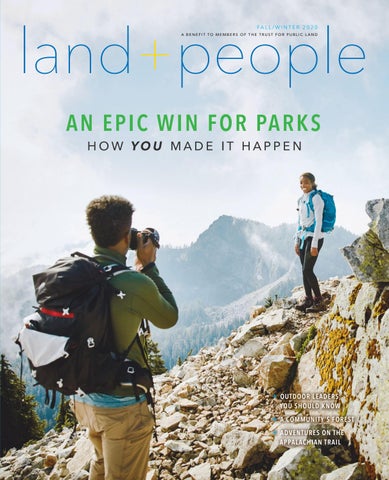
A N EPI C WIN F OR PARK S h o w you mad e it hap p en
+ OUTDOOR LEADERS YOU SHOULD KNOW + A COMMUNITY’S FOREST + ADVENTURES ON THE APPALACHIAN TRAIL
adair f reeman r u t l e dg e
conserve land ...
and your retirement.
charitable gift annuity rates by age A charitable gift annuity with The Trust for Public Land can provide you with income for life while helping to conserve
65
70
75
80
85
90
5.1%
5.6%
6.2%
7.3%
8.3%
9.5%
land for generations to come. Here’s how: 1. Make a gift to The Trust for Public Land. 2. Receive a charitable deduction. 3. We invest your gift. 4. We pay you a percentage of the original gift for the rest of your life. 5. We apply the remainder toward achieving our mission of creating parks and protecting land for people.
to learn more, please contact: Christine Lambert Pentino, Director of Planned Giving 202.543.7552 or plannedgiving@tpl.org
ƜƨƧƭƞƧƭƬ
ƍƉ ƬƢƦƨƧƞ ƦƚƫƭƢƧ ƧƞưƛƞƫƫƲ
ƌƉ “It’s an investment in a more equitable, democratic future for rural communities.” ƞ Ưƞ ƫƥƚ Ƭ ƭ Ƣ Ƨ Ơ , Ʃ Ơ ƃ ſ
The Long Road to Victory 30 A 30-year advocacy battle ends with an epic win for America’s public lands.
Everlasting 40 In New Hampshire, a small town’s future grows with its forest.
A New Normal 51 Five leaders share their visions of how the outdoors can help us create a more inclusive society.
ƎƊ T P L. O R G · 1
ƬơƚưƧ ƥƢƧƞơƚƧ
ƣƞƫƫƲ ƦƨƧƤƦƚƧ
F EAT U R E S
JAN
FEB
MAR
APR
M AY
JUN
JUL
AUG
SEP
OCT
NOV
DEC
Through uncertain times, monthly donors sustain our work protecting land for people today, tomorrow, and for generations to come. Become a monthly donor today.
tpl.org/monthlygiving 2 · LA ND &PE OPL E · FAL L /W I NTER 2020
D E PA RT M E NTS
3DUNV LQ IRFXV
Board Spotlight · 13
ƣ ƚ Ƭ ƨ Ƨ Ɵ ƥƨ ư ƞ ƫ Ƭ
From the President · 11
ƜƨƧƭƞƧƭƬ
ƋƊ
*HW WR NQRZ /XFDV 6W &ODLU
Contributors · 14 Mailroom · 15 ƱƚƯƢƠƦ
First Look · 17 $ QHZ OLIH IRU DQ ROG KRW VSULQJ WKH
ƋƏ
ODVW SUDLULH VWDQGLQJ DQG SDUNV KHOS 1HZ <RUNHUV UROO ZLWK WKH SXQFKHV
Insight · 26 3DUNV DUH D VWHSSLQJ VWRQH IRU WKLV 'DOODV QHLJKERUKRRG RQ WKH ULVH
ƥ ƞ Ƭ ƥ Ƣ ƞ Ʈ Ʃ ƭƚ Ƣ Ƨ
GXULQJ &29,' Ɗƒ
Member Center · 62 2IƓFHV · 63 Trail’s End · 64 /LVWHQLQJ IRU WKH PRPHQW WKH VHDVRQV FKDQJH
ƨ Ƨ ƭ ơ ƞ ƜƨƯƞƫ *RRG QHZV IRU IDPLO\ YDFDWLRQV 7UXVW IRU 3XEOLF /DQG VXSSRUWHUV KHOSHG VDYH $PHULFDōV PRVW LPSRUWDQW SXEOLF ODQGV SURJUDPŋWKH /DQG DQG :DWHU &RQVHUYDWLRQ )XQG 5HDG DERXW LW RQ SJ ƌƉ 3KRWR 7KRPDV %DUZLFN
JOI N U S ON FAC EB O O K 6WD\ WXQHG WR RXU ODWHVW QHZV YLGHRV FRQWHVWV DQG PRUH IDFHERRN FRP WKHWUXVWIRUSXEOLFODQG
ƋƎ T P L. O R G · 3
Ƨƚƭƞ ơƨƯƞƞ
4 · LA ND &PE OPL E · FAL L /W I NTER 2020
ƜƨƧƭƞƧƭƬ
SWEETWATER PRESERVE, TUCSON, ARIZONA 1H[W WR WKH WHQ JDOORQ KDW DQG WKH FRZER\ ERRW WKHUH LV QR PRUH ZLGHO\ UHFRJQL]HG V\PERO RI WKH 6RXWKZHVW WKDQ WKH JLDQW VDJXDUR FDFWXV $QG QRZKHUH HOVH LQ WKH UHJLRQ FDQ \RX ƓQG PRUH RI WKHVH IDPRXV ƓJXUHV WKDQ LQ WKH 6RQRUDQ 'HVHUW VXUURXQGLQJ 7XFVRQ $UL]RQD 7KLV VXPPHU ZH DGGHG Ƒƍ DFUHV WR 6DJXDUR 1DWLRQDO 3DUN PDNLQJ ZD\ IRU D QHZ KLNLQJ WUDLO OLQNLQJ WR 6ZHHWZDWHU 3UHVHUYH DQ RSHQ VSDFH ZH KHOSHG FUHDWH LQ ƋƉƉƍ 7KLV LV WKH IRXUWK WLPH 7UXVW IRU 3XEOLF /DQG VXSSRUWHUV KDYH KHOSHG JURZ WKH QDWLRQDO SDUN LQ UHFHQW \HDUV
Page · 18
ƀƇ
T P L. O R G · 5
ƜƨƮƫƭƞƬƲ ƨƟ ƭƢƦƨƭơƲ ƠƨƨƝƦƚƧ
6 · LA ND &PE OPL E · FAL L /W I NTER 2020
ƜƨƧƭƞƧƭƬ
P.S. 152/315, BROOKLYN, NEW YORK 7LPRWK\ *RRGPDQōV PXUDOV VKDSH XS SXEOLF VSDFHV DFURVV 1HZ <RUN &LW\ DQG ,QVWDJUDP IHHGV DURXQG WKH JOREH 7KH DUWLVW DQG GHVLJQHU UHFHQWO\ WHDPHG XS ZLWK VWXGHQWV DW 3 6 ƊƎƋ ƌƊƎ DQG WKH .HYLQ 'XUDQW &KDULW\ )RXQGDWLRQ WR FUHDWH D PDVVLYH PXUDO IRU WKH VFKRROōV EDVNHWEDOO FRXUW ŏ&UHDWLQJ SXEOLF DUW IRU NLGV DQG FRPPXQLWLHV KDV EHHQ P\ FRQWLQXHG JRDO DQG DV D ELJ EDVNHWEDOO IDQ WKLV ZDV D GUHDP SURMHFW Ő *RRGPDQ VDLG 7KH 7UXVW IRU 3XEOLF /DQG SLWFKHG LQ WR UHQRYDWH WKH RQFH QHJOHFWHG \DUG ZLWK QHZ VKDGH WUHHV D WXUI ƓHOG DQG D WUDFN ,WōV WKH ODWHVW RI RYHU ƋƉƉ SXEOLF VFKRRO\DUGV ZHōYH WUDQVIRUPHG LQWR KHDOWK\ FOLPDWH VPDUW SDUNV IRU DOO 1HZ <RUNHUV WR HQMR\
Page · 21
Ɓƀ
T P L. O R G · 7
ƛ ƣ ƨ ƫ Ƨ ƛ ƚ Ƥ Ƭ ƭƚ Ɲ
8 · LA ND &PE OPL E · FAL L /W I NTER 2020
ƜƨƧƭƞƧƭƬ
WASHINGTON SQUARE, SAN FRANCISCO, CALIFORNIA 7KH FRURQDYLUXV ŏFU\VWDOOL]HG WKH XUJHQF\Ő RI PDNLQJ VXUH DOO $PHULFDQV KDYH DFFHVV WR D SDUN VD\V RXU FRPPXQLW\ KHDOWK GLUHFWRU 6DGL\D 0XTXHHWK 'XULQJ WKH SDQGHPLF SHRSOH ZKR KDYH SDUNV FORVH WR KRPH KDYH D VDIHU SODFH WR H[HUFLVH VRFLDOL]H DQG UHOD[ŋDQG SHRSOH ZKR GRQōW GRQōW $FURVV WKH FRXQWU\ SDUN GHSDUWPHQWV KDYH UHVSRQGHG WR WKH LQFUHDVHG GHPDQG IRU WKH RXWGRRUV ZLWK DOO NLQGV RI LQQRYDWLYH FKDQJHV IURP RQH ZD\ WUDLO ORRSV WR SHGHVWULDQ IULHQGO\ VWUHHW FORVXUHV WR ŏVRFLDO GLVWDQFLQJ FLUFOHV Ő
Page · 22
ƁƁ
T P L. O R G · 9
OFF IC E R S pre si d e n t an d c hi e f exec u t i v e o ff i c er
Diane Regas vice p re s i d e n t an d dire cto r o f co n s e rvat i o n f i n a n c e
Will Abberger s e n i o r vi c e p re s i d e n t , g en era l couns e l, an d co rp o rat e sec reta r y
D. Malcolm Carson s e n i o r vi c e p re s i d e n t of f i e ld p ro g rams
Jeff Danter vice p re s i d e n t an d d i recto r o f philan t hro p y p ro g ram s
Jeff Hauk s e n i o r vi c e p re s i d e n t o f poli c y an d g ove rn me n t rel at i o n s
Bill Lee vice p re s i d e n t an d asso c i at e ge n e ral co un s e l
Margaret Madden s e n i o r vi c e p re s i d e n t a n d chie f fi n an c i al an d ad m i n i st rat i v e o ff i c er
James Obendorf vice p re s i d e n t an d directo r o f fi n an c e a n d acco u n t i n g
Michelle Pandori vice p re s i d e n t an d d i recto r o f hum an re s o urc e s
our mission:
THE TRUST FOR PUBLIC LAND CREATES PARKS AND PROTECTS LAND FOR PEOPLE, ENSURING HEALTHY, LIVABLE COMMUNITIES FOR GENERATIONS TO COME.
Carrie Speckart s e n i o r vi c e p re s i d e n t a n d chie f marke t i n g an d co m m u n i cat i o n s o ff i c er
I Ling Thompson s e n i o r vi c e p re s i d e n t a n d chie f p hi lan t hro p y o ff i c er
Patricia Watson
how you can help: Our work depends on the generous support of people like you. donate: Use the envelope inside this magazine, or visit tpl.org/donate for other easy ways to give. learn more: Get timely updates on our park and conservation work near you. Sign up for our e-newsletter at tpl.org/enews. share: Help us make the case for parks and open space. When you’ve finished reading this issue, pass it on! Land&People magazine is a benefit to members of The Trust for Public Land.
1 0 · LAND &PE OPL E · FAL L /W I NTER 2020
PARKS IN FOCUS through this tumultuous year, I’ve been making a practice to count blessings. And the
nicholas lea bruno
from the president
parks and trails here in the San Francisco Bay Area are near the top of my list. Since the start publisher Eliza Sarasohn managing editor Julia Busiek designer Rachel Barnes media production manager Elyse Leyenberger digital production Jennifer Ramsey Jeremy Sammons
of the pandemic, spending time outdoors has become an even more important part of my daily ritual. And it’s not just me: open spaces across the country are fielding twice and even three times their normal demand. The Washington Post reported a spike in Google searches for terms like “trails near me.” It’s the results of those searches that concern
the country to ensure that investments in parks
us. When you’re looking to get outside, maybe
go where they’re needed most. Almost 300 may-
your browser comes up with a list of options: a
ors have signed onto the 100% Promise to achieve
peaceful woodland, a convenient bike trail, or a
100 percent park access by 2050. I am incredibly
neighborhood playground. But for the 100 mil-
excited about the possibilities to truly move the
lion people in America who don’t have a park
needle on our goal of a park within a 10-minute
close to home, finding a place to experience the
walk of everyone in America.
outdoors has always been a challenge, and never more so than during COVID-19.
Walk, Conserving Land for People, Conserving Nature Near You, Cre-
conflict about where our country is headed. But we have rallied around America’s great outdoors.
spending time outside is critical to mental and
The power of parks to make our communities
physical health. We won’t rest until everyone
healthier, more equitable, and more resilient has
in America has an equal opportunity to feel at
motivated Trust for Public Land supporters for
home in the outdoors.
nearly half a century. So today, we’re in the exact
issue, you’ll read about the effort to save the All rights reserved. 10-Minute
It’s been a year of tough challenges and deep
As we have been so often reminded in 2020,
Together, we’re making great progress. In this
© 2020 The Trust for Public Land.
We are also working with communities across
Land and Water Conservation Fund (LWCF), the
right place to help solve some of the most urgent issues facing our communities. Thank you for being a part of the transforma-
longstanding federal program that funds parks
tional change to come. As a Trust for Public Land
and open spaces across the country. We’ve led
member, you are an essential contributor to the
this fight from the beginning, and—spoiler
parks, trails, schoolyards, and open spaces that
alert!—our supporters powered us across the
are strengthening neighborhoods and helping
finish line this summer, when a bipartisan
people thrive.
ating Parks and Protecting Land for People, Fitness Zone, Land for People, Land&People, LandVote, Northwoods Initiative, Our Land, Outside For All, Parks for People, Parks Unite Us, ParkScore, The Trust for Our Land, The Trust for Public Land, TPL, and The Trust for Public Land and LandVote logos and all other names of The Trust for Public Land programs
majority in Congress voted to fully fund LWCF every year, forever. This 240 percent increase in the program’s funding shows how our common
referenced herein, as well as their logos, are registered or commonlaw trademarks of The Trust for Public Land.
commitment to conservation can help bridge the divides in our nation.
Diane Regas president and ceo T P L. O R G · 11
M EET YO UR MATCH
This year, an anonymous donor will generously match your gift—dollar-for-dollar—if you send it before December 31. Your donation will go even further to help The Trust for Public Land protect more parks, gardens, and other natural places. That’s one good thing made that much better.
Give your EarthShare.
1 2 · LAND &PE OPL E · FAL L /W I NTER 2020
An EarthShare payroll deduction is one simple way to donate to The Trust for Public Land or more than 400 other environmental and conservation charities. Many corporate and government employers support EarthShare payroll giving. If yours doesn’t, ask them to start. If they do, simply decide on a single deduction or a recurring small one from every paycheck. Then designate us, member number 11440, as one of your conservation charities. For more information visit earthshare.org or email donor.outreach@tpl.org.
terray sylvester
800.714.5263 · donor.outreach@tpl.org · tpl.org/match
Get to know
board spotlight
B OA R D OF DI R E CTO R S
court esy of lucas st . cl air
Lucas St. Clair
lucas was born and raised in the North Woods of Maine. He pursued a Culinary Arts degree at Le Cordon Bleu and began his career in the restaurant and wine industry, before taking over his family’s operating
chair
foundation, Elliotsville Plantation, Inc. (EPI),
Thomas S. Reeve
in 2011. EPI owns and manages 125,000 Stephen W. Baird
acres of timberland in Maine. In 2016, EPI gifted 89,000 acres to establish the Katah-
George Bell
din Woods and Waters National Monument.
Page Knudsen Cowles
Today EPI works to enhance the commuJody S. Gill
nity’s ability to capitalize on this new public
F. Whitney Hatch
resource. Lucas enjoys paddling, hiking,
Christopher G. Lea
climbing, and fly fishing. He lives in Hampden, Maine, with his wife and two children.
Joseph E. Lipscomb Ignacia S. Moreno Caroline P. Niemczyk Michael Parish
I BELIEVE IN PROTECTING LAND AND CREATING
pond and protects wilderness along five miles of
PARKS BECAUSE … parks are portals into wild places,
the Appalachian Trail.
freedom, imagination, and adventure. Parks build Diane Regas
on themselves, are scalable, are paramount for
THE TRUST FOR PUBLIC LAND’S WORK IS UNIQUE
Jeffrey A. Resnick
human understanding of the natural order, and are
BECAUSE ... we are able to work in so many
the jumping-off place for a world of adventure. We
different communities and landscapes across the
Laura Richards
need land protected in order for us to continue
country with the single focus of creating more
flourishing on Earth.
public land for the people of this country.
I SUPPORT THE TRUST FOR PUBLIC LAND BECAUSE …
THE KEY CHALLENGE FACING THE TRUST FOR PUBLIC
Lex Sant Lucas St. Clair Sheryl Tishman F. Jerome Tone Keith E. Weaver Susan D. Whiting
the organization knows that starting at the local
LAND IS … choosing which projects to engage on.
level can lead to massive change. The Trust for
There are so many opportunities and we only have
Public Land also realizes that future environmental
the bandwidth to do so many things.
leaders can come from anywhere—they just need the spark of inspiration. Connecting people to the
I FIRST FELL IN LOVE WITH THE NATURAL WORLD
environment has always been at the heart of the
WHEN … I was growing up in northern Maine. My
work, and I believe it’s some of the most important
parents didn’t have electricity in our house growing
work we can do.
up so we were left to our imaginations and the great outdoors. It was the best way to grow up!
MY PROUDEST ACCOMPLISHMENT AS A BOARD MEMBER HAS BEEN … the work I’ve been able to do to assist with protecting Bald Mountain Pond, a pristine 1,200-acre pond in the mountains of central Maine. The project creates new public access to the
?
WHAT ABOUT YOU? Tell us how you connect with nature. Join the conversation on Facebook: facebook.com/thetrustforpublicland
T P L. O R G · 13
ƜƨƧƭƫƢƛƮƭƨƫƬ
Shawnté Salabertsssstttt
Joe Klementovich
story:
story:
story:
The Long Road to Victory
The Long Road to Victory
Everlasting
Simone MartinNewberryss
30
30
40
Simone Martin-Newberry is an illustrator
Shawnté Salabert is a Los Angeles–based free-
Joe Klementovich thrives on creating authen-
and graphic designer whose work is guided
lance writer interested in the connections
tic imagery for clients in difficult locations.
by a love of color, texture, movement, and
between humans and the natural world.
His photographs from the subzero ravines
rhythm. She has created art for REI Co-op,
Her work has appeared in Adventure Journal,
of Mount Washington to the bug-infested
the New York Times, the Guardian US, Emer-
AFAR, Alpinist, Backpacker, the California
mangrove islands of the Everglades have
gence Magazine, Chronicle Books, and many
Sunday Magazine, Outside, and Sierra, among
appeared in print nationally. Mountains,
others. She currently lives, works, and
other outlets. She is the author of Hiking the
rivers, and oceans always play an important
gardens in Chicago, Illinois.
Pacific Crest Trail: Southern California.
part in Joe’s work.
heysimone.com
shawntesalabert.com
klementovichphoto.com
WANT EVEN MORE LAND&PEOPLE? The digital edition of Land&People includes all the stories you love, optimized for your device—plus bonus content like video, easy social media sharing, and instant links to learn more. Explore the digital edition at tpl.org/magazine. Wherever you see the pointer icon in this issue, you’ll find bonus content in the digital edition. Go online to dive deeper into the difference you make as a Trust for Public Land donor.
learn more @ TPL.ORG/MAGAZINE
1 4 · LAND &PE OPL E · FAL L /W I NTER 2020
ƦƚƢƥƫƨƨƦ
ƣ ƨ Ƭ ơ Ɲ ƨ ƛ ƚƲ
P L E NTY MORE )LQG XV RQ VRFLDO PHGLD IRU RXWGRRU LQVSLUDWLRQ IXQ IDFWV DQG EUHDNLQJ QHZV DERXW WKH SDUNV DQG SXEOLF
Ɯơ ƫƢƬ ƛ ƞƧ Ƨ ƞƭƭ
ODQGV \RX ORYH
ASK US ANYTHING
2XU 2KLR WHDP KHOSHG GLVWULEXWH RYHU ƏƉ ƉƉƉ IDFH PDVNV WR &OHYHODQGHUV LQ QHHG WKLV VXPPHUŋDORQJ ZLWK LQIR RQ YRWLQJ WKH FHQVXV DQG VWD\LQJ VDIH GXULQJ &29,' Ɗƒ
Tell us what’s on your mind! We want to know what you think of the stories and photos in this issue of Land&People magazine. Send us a letter, email mailroom@tpl.org, or find us on social media.
Smarter schoolyards
+ Green schoolyards are a reasonable
SPRING/SUMMER 2020 A BENEFIT TO MEMBERS OF THE TRUST FOR PUBLIC LAND
2XU VSULQJ FRYHU VWRU\ VSDUNHG LGHDV
solution to helping to address deficien-
RQ KRZ WR PDNH WKH PRVW RI VFKRROVō
cies in park access and opportunities,
RXWGRRU VSDFHV
but the idea comes with challenges. When schools get crowded, their play-
+ TEN YEARS AFTER DEEPWATER HORIZON + COLORADO‘S NEXT STATE PARK + A RIVERFRONT REVIVAL FOR CHATTANOOGA
COOL SCHOOLS
+ This article achieved an important
grounds and sports fields are the first
goal of building public awareness
places administrators look for class-
regarding the benefits of transforming
room space. Some risk assessment and
antiquated school grounds into vibrant
public commitment to maintaining
living schoolyards. During this pan-
these sites as parks must precede
demic, this system change perspective
investment by a community.
is now even more vital.
Elisabeth Morgan via tpl.org
Dr. Raymond R. Isola via email
THE NEIGHBORHOOD C L I M AT E S O L U T I O N
T P L. O R G · 15
mike schirf
ƦƚƢƥƫƨƨƦ
+ All of us who worked at The Trust for Public Land, founded by Huey Johnson out of a ragtag collection of recent college graduates—kids, really—cherished the time we spent saving the world as part of Huey’s compassionate mission, one vacant lot at a time. He was at heart an environmentalist and he knew very well the forest and rivers and the ocean because that’s where he went to play. He always brought us back some fish. We love the legacy he left for us—to protect the land and protect life. May we, for the sake of all beings, do more than wish to make it so. Fu Schroeder
Virtual vacation
+ Public lands are becoming increas-
:LWK WUDYHO SODQV RQ KROG UHDGHUV DUH
ingly difficult to access because of the
GD\GUHDPLQJ DERXW QDWLRQDO SDUNV OLNH
surrounding private ownership. This
=LRQ ZKHUH ZH SURWHFWHG DQ DW ULVN
shows how important the work you did
VHFWLRQ RI WKH IDPRXV 1DUURZV 7UDLO
is for maintaining public rights, protecting public lands, and ensuring all of us
+ Enjoyed hiking Zion Narrows a few
have access to our park system. Thanks
years ago. I was soaking wet and worn
for your work!
out by the time I got back to where I
Nicole S. Parker on LinkedIn
started! Can't beat the national parks for beauty and adventure!
+ Outstanding news. Zion is one of our
Judy Griffie on Facebook
national treasures and unlocks the explorer in all of us.
7KH 7UXVW IRU 3XEOLF /DQG WHDP FD ƊƒƐƎ
Dave Lavender on LinkedIn
A fond farewell
+ I was constantly learning from Huey,
)ULHQGV VKDUHG WKHLU PHPRULHV RI
and he would take the time to teach,
7UXVW IRU 3XEOLF /DQG FRIRXQGHU +XH\
without judgment and with humor
-RKQVRQ ZKR SDVVHG DZD\ LQ -XO\ DW
so you could really learn … The best
DJH ƑƐ
thing, the thing I think that saves me daily, is to have a North Star and let
1 6 · LAND &PE OPL E · FAL L /W I NTER 2020
+ RIP, Huey. Thank you for a life of
it guide you every day. You will learn
hitting it out of the park. Blessings and
more, be more useful to all, and have a
condolences to the Johnson family.
much better life.
Lauren Klein on tpl.org
Jodie Evans on rri.org
Sunrise is stunning at Bald Mountain Pond in central Maine. Long owned by a timber company, the pond, its rugged shoreline, and a vast old-growth forest that surrounds it are now protected forever and open to all.
there is something infinitely healing in the repeated refrains of nature— the assurance that dawn comes after night, and spring after winter.
ƜơƫƢƬ ƛƞƧƧƞƭƭ
rac he l carso n
turn the page for … appalachian adventures family photos rest and relaxation T P L. O R G · 17
Preserving a
ƞƝƢƛƥƞ ƜƨƧƬƞƫƯƚƭƢƨƧ
traditional harvest
ƬƚƠƮƚƫƨ ƧƚƭƢƨƧƚƥ ƩƚƫƤ ƭƮƜƬƨƧ ƚƫƢƳƨƧƚ
the towering, many-armed silhou-
sprout from the very tops of the cactus’s
she harvests for friends and family to
ettes of giant saguaro cacti may be
raised arms. “After the blooms close up,
use throughout the year.
one of the most recognizable sights of
the bud goes from this tight green stage
Tucker says members of the Tohono
the Sonoran Desert. But few people are
and gradually turns red. Then the pod
O’odham Nation still harvest saguaro
so well acquainted with the saguaro as
will burst open, and you can see the
fruits this way throughout the cactus’s
Tanisha Tucker. She’s a descendant of a
fruit coming out,” Tucker says.
range. But nowhere else can you find
lineage of Tohono O’odham people who
To get at them, she wields a kuipad, a
more of these phenomenal plants than
have long harvested saguaro fruit from
long pole made from the ribs of a giant
Saguaro National Park outside Tucson.
cacti growing in what’s now Saguaro
saguaro, with a short crosspiece at one
This summer, we added 84 acres to the
National Park.
end to dislodge the fruits. Then she
national park, marking the fourth time
Dark red and naturally sweet, saguaro
uses the knife-like husk of the dried
we’ve helped expand it.
fruits have been an important—and
cactus blossom to scoop out the pulpy
The new addition isn’t far from the
delicious—food for generations of desert
fruit within. She says the fresh fruit
camp where Tucker’s family has har-
dwellers. Each summer, Tucker keeps a
tastes great—“Naturally sweet, lots of
vested saguaro fruits every year since
close eye out for signs the harvest sea-
minerals and antioxidants, like a desert
her great-great-aunt Juanita Ahil was
son is near: the fruits start as a bud at
superfood!”—but it only keeps for a day
young—well before this land was added
the base of the plant’s blossoms, which
or two. So she preserves most of what
to what was then Saguaro National
ƬƭƞƯƞƧ ƦƞƜƤƥƞƫ
Monument in 1961. Tucker says Juanita showed up to harvest the next summer and encountered resistance from the National Park Service. The agency’s typical rules forbade harvesting and gathering within their boundaries. “We don’t do damage or overharvest,” Tucker says. “As tribal members, we’ve always seen saguaro as family, as people. That comes in creation stories and our songs.” So the family organized a letterwriting campaign to change the rules so Tohono O’odham people could continue harvesting within the monument. Today, Tucker runs the harvest camp with her cousin and sister and shares her family’s traditions with the public— including the importance of taking good care of the saguaro. “Saguaros grow nowhere else in the world,” Tucker says. “We’ve always seen it as sacred. I’m glad the law does too.” 1 8 · LAND &PE OPL E · FAL L /W I NTER 2020
ƟƞƫƧƚƧƝƚ ƫƞƲƞƬ
ƛƮƳƳưƨƫƭơƲ
ƬƭƞƯƞƧ ƦƞƜƤƥƞƫ
Saguaro salsa &DFWL JURZLQJ RQ SXEOLF ODQG DUH RII OLPLWV IRU KDUYHVWLQJ EXW LI \RX NQRZ VRPHRQH ZLWK D PDWXUH VDJXDUR LQ WKHLU \DUG WU\ DGGLQJ VRPH RI WKH ULSH IUXLW WR WKLV UHIUHVKLQJ VDOVD RU VXEVWLWXWH DQRWKHU ŴDYRUIXO IUXLW OLNH UDVSEHUULHV RU VWUDZEHUULHV
O
Ɗ Ƌ FXS VDJXDUR IUXLW GLFHG
O
ƌ ƍ FXS ZDWHUPHORQ GLFHG
O
Ɗ Ƌ FXS FDQWDORXSH GLFHG
O
Ɗ ƍ FXS UHG RQLRQ ƓQHO\ FKRSSHG
O
Ɗ Ƌ FXS ULFH ZLQH YLQHJDU
O
ƍ 7EVS KRQH\
O
Ɗ Ƌ WVS GULHG FUXVKHG UHG FKLOL SHSSHU
&RPELQH DOO LQJUHGLHQWV DQG WRVV XQWLO ZHOO PL[HG &KLOO DQG VHUYH ZLWK ƓVK FKLFNHQ RU FKLSV Courtesy: DesertUSA
“Parks are the most valuable resource in the city at this point.” – “Amid Protest and Pandemic, Urban Parks Show Their Worth,” CityLab, June 4, 2020
- 1LFKRODV :LOOLDPV GLUHFWRU RI WKH 2DNODQG 3DUNV 'HSDUWPHQW WDONHG WR CityLab DERXW KRZ UHVLGHQWV DUH UHO\LQJ RQ WKHLU VKDUHG SXEOLF VSDFHV IRU HYHU\WKLQJ IURP H[HUFLVH WR IDPLO\ JDWKHULQJV WR SURWHVWLQJ IRU UDFLDO MXVWLFH
ƥƞƚƫƧ Ʀƨƫƞ # TPL.ORG/SAGUARO
P L. OORK G · 19 F I R ST TLO
APPALACHIAN TRAIL hiking all 2,190 miles of america’s most famous footpath is a daunting challenge—even without the threat of locked gates, “No Trespassing” signs, or scarce access points.
ƠƨƨƝ ƧƞưƬ
ƛƚƥƝ ƦƨƮƧƭƚƢƧ ƩƨƧƝ ƬƨƦƞƫƬƞƭ ƜƨƮƧƭƲ ƦƚƢƧƞ
ƜơƫƢƬ ƛƞƧƧƞƭƭ
A win for the
We can’t make the trek itself easier (and really, would you want us to?), but we’re making great progress against barriers to accessing it: we’ve protected 140 special places along the A.T. between Georgia and Maine. We scored another A.T. victory this summer at Maine’s remote Bald Mountain Pond. We transferred trans nsfe ferr rred ed the p ond on d and its pond ownership, ensuring surrounding forest to public own wner ersh ship ip, ens nsu uring access forever. Upgrades to the boa at ramp ram amp p will m ake it easier to get out boat make on the water and pad ddl dlee to to the the ffar ar shore, where a section of paddle the A.T. climbs to tthe he summit sum umm mit off Moxie Bald Mountain—one
ƜơƫƢƬ ƛƞƧƧƞƭƭ
off the most scenic sce ceni nicc spots on the whole trail.
2 0 · LAND &PE OPL E · FAL L /W I NTER 2020
ƜƨƮƫƭƞƬƲ ƨƟ ƤƞƥƥƞƲ ơƞƲƞƫ
ƭƫƞƧƝƢƧƠ
plain talk: Of the 18
million acres of prairie that once blanketed Minnesota ... ... about 1 percent remains.
Great skates!
$W SODFHV OLNH WKH QHZO\ H[SDQGHG 7XUWOH 3UHVHUYH
at the start of new york city’s coronavirus quarantine, Kelley
6FLHQWLILF DQG 1DWXUDO $UHD RQ WKH
Heyer bought herself a pair of roller skates. She wasn’t alone: skate
&DQQRQ 5LYHU LQ 5HG :LQJ 7UXVW
sales spiked this summer as millions of Americans turned to new hob-
IRU 3XEOLF /DQG VXSSRUWHUV DUH
bies. “Once it was safer to get outside, skating became my break from
KHOSLQJ SUHVHUYH 0LQQHVRWDōV
the COVID madness,” Heyer says.
\ YLWDO HFRV\VWHPV IRUHYHU
She first learned to skate on the smoothly paved schoolyard at
plenty of trees for shade, a running track, and a turf field, Heyer says the schoolyard is an outdoor haven for the whole neighborhood when school isn’t in session.
ƥƞƚƫƧ Ʀƨƫƞ # TPL.ORG/CANNON-RIVER
Ƭƚƫƚ ƫƮƛƢƧƬƭƞƢƧ
P.S. 111 in Manhattan—one of 210 school playgrounds we’ve helped rebuild and open to the public throughout New York City. With
F I R ST LO O K · 21
Ʀƞƞƭ ƨƮƫ ƬƭƚƟƟ
address these individual behaviors, to educate patients in the doctor’s office about the importance of their own actions.
ŏ(TXLWDEOH SDUNV JLYH DOO SHRSOH WKH RSSRUWXQLW\ WR OLYH KHDOWKLHU OLYHV Ő
But so much of behavior is not actually a matter of individual choice. Are there grocery stores within walking distance of your house, and do they sell affordable, healthy food? Do you live in a neighborhood where it’s safe to go out for a jog? Do you have a park or a trail to visit or are
Ƭơƚƞ ƦƜƜƨƲ
you exercising along a busy street?
:K\ DUH VRPH QHLJKERUKRRGV KHDOWKLHU WKDQ RWKHUV" It’s the effect of generations of inequitable investment. Across the country, low-income communities and communities of color have less access to healthy food, stable housing, and transportation. Over 100 million people in America don’t have a park within a 10-minute walk of home. We published new data analysis this summer showing that, across the country, parks in communities of color are, on average, about half as big as parks in white neighborhoods and serve five times as many people. And parks serving majority lowincome households are, on average, a quarter the size of parks in high-income neighborhoods.
:KDW GRHV WKDW PHDQ IRU FRPPXQLWLHV IDFLQJ WKH FRURQDYLUXV" The coronavirus crystallized the urgency of addressing these structural inequities. So many of the places where we care for ourselves and our communities have been limited or closed— your gym, your place of worship, your coffee shop. What that means is, if you live within walking distance of a park, if your neighborhood’s streets are cool and shaded, you could safely get outside wearing a mask and get the
SADIYA MUQUEETH
you could maintain those social connections that
THE TRUST FOR PUBLIC LAND’S COMMUNITY HEALTH DIRECTOR SAYS PARKS
are so important for mental health.
CAN HELP STOP HEALTH PROBLEMS BEFORE THEY START.
exercise you need, and you had a place where
+RZ GRHV LQIUDVWUXFWXUH OLNH SDUNV DIIHFW FRPPXQLW\ KHDOWK"
:KDW LI \RX GRQōW KDYH D SDUN FORVH WR KRPH"
Take any negative health outcome, like diabetes. Your risk of diabetes is
You are vying for the same outdoor space as
correlated with whether you eat a nutritious diet and get enough exercise.
many of your neighbors. And since our data show
So the traditional, clinical approach to diabetes prevention has been to
parks are not equally distributed, we know that’s
2 2 · LAND &PE OPL E · FAL L /W I NTER 2020
likelier to be the situation in low-income
all of these things. It’s a matter of
we partner with neighborhood residents
neighborhoods and communities of
focusing our support among communi-
and health experts to make sure that the
color. These are the same communities
ties who are already working to fix the
parks we design reflect both the needs
who’ve been most affected by COVID-19—
social and structural conditions that
and desires of the community, and are
in part because of historical and current
cause health problems in the first place.
grounded in principles of good health.
resource deprivation, people of color
The United States spent $3.5 trillion on
The Colorado Health Foundation has
experience higher rates of health condi-
health care in 2017—but spending on
funded park development projects in
tions that are risk factors for getting seri-
public health made up only 2.5 percent
Denver and Colorado Springs, because
ously sick from a coronavirus infection.
of that. That’s a sign that our approach
those investments have been shown to
to health is still so concentrated “down-
benefit public health. They also fund our
:K\ VSHQG PRQH\ RQ D SDUN WR LPSURYH KHDOWK LQVWHDG RI EDVLF QHFHVVLWLHV OLNH KRXVLQJ RU IRRG"
stream,” on reacting to the consequenc-
community engagement efforts, help-
es of structural inequities in a clinical
ing to create health-focused design and
setting—instead of investing “upstream”
inclusive programing at parks through-
I actually think that’s a false choice.
on interventions like equitable parks,
out the region. Because it’s not just
People need access to health care and
which give all people the opportunity to
whether or not you have a park nearby:
education. People need affordable food
live healthier lives.
and well-paying jobs. And people need
it’s the safety, quality, and inclusiveness of these spaces that promote health.
enfranchised communities have had to
+RZ GR \RX DSSURDFK WKRVH VWUXFWXUDO FRQGLWLRQV"
send resources upstream. This sum-
choose which benefit they’re “allowed”
You cannot make a difference at a struc-
mer, Congress passed a bill that fully
to have. But as a society, we can afford
tural level if you’re acting all alone. So
funds the Land and Water Conservation
access to nature. For far too long, dis-
We also advocate for policies that will
ƣ ƞ Ƨ Ƨ ƚ Ƭ ƭƚ Ʀ Ʀ
Fund, a crucial source of public funding for parks and open space across the country. Now, communities have more stable and dependable funding they can use to fix these longstanding environmental inequities.
+RZ GR ZH NQRZ ZKDW LQYHVWPHQWV ZLOO PDNH WKH ELJJHVW GLIIHUHQFH" Five years ago, there was no nationwide database for analyzing the relationships between environmental inequities like too little open space or too few trees, and health risks like high heat, sedentary activity, and air pollution. So our research department built that database, and we use it to guide our work and to equip others—from community members to elected leaders—to advocate for the parks they need.
Residents of Philadelphia’s Grays Ferry neighborhood formed a walking group that meets at Lanier Playground, recently rebuilt and reopened with help from The Trust for Public Land. P L. OORK G · 23 F I R ST TLO
“We see you, and you belong here in this park, whoever you are.”
ươƚƭ ƜƨƮƧƭƬ
ƚƬƭƨƫƢƚ ơƨƭ ƬƩƫƢƧƠƬ ƩƚƫƤ ƣƚƜƤƬƨƧ ưƲƨƦƢƧƠ
3HWHUVRQ RUJDQL]HG D IUHH IDPLO\ SKRWR GD\ LQ &KDWWDQRRJDōV (DVW /DNH 3DUN LQYLWLQJ SDVVHUV E\ WR VLW IRU SRUWUDLWV ZLWK D SURIHVVLRQDO SKRWRJUD SKHU ŏ7KHUH V D ORW RI SRZHU LQ VHHLQJ \RXUVHOI SRUWUD\HG WKLV ZD\ LQ D SXEOLF VSDFH Ő 3HWHUVRQ VDLG &29,' GHUDLOHG SODQV WR GLVSOD\ WKH SKRWRV LQ D SRS XS JDOOHU\ DW WKH SDUN ODWHU LQ WKH \HDU VR ZHōUH VKDULQJ VRPH RI RXU IDYRULWHV ZLWK \RX KHUH LQVWHDG
ƜƚƫƝƮƮƬ ƚƧƝ ƬƚƞƦƢƥƞƞ
– Daniela Peterson with The Trust for Public Land’s Tennessee team
105
°
The hottest pool at ASTORIA HOT SPRINGS PARK. $IWHU DQ HLJKW \HDU ILJKW WR VDYH WKH KLVWRULF VSULQJV IURP SULYDWH GHYHO RSPHQW ZH KHOSHG $VWRULD 3DUN &RQVHUYDQF\ UHEXLOG LW DV DQ DIIRUG DEOH OX[XU\ ZKHUH ORFDO IDPLOLHV FDQ ƛƫƨƨƤƞ ƛƫƚƠƠƞƫ
UHOD[ DQG XQZLQG
2 4 · LAND &PE OPL E · FAL L /W I NTER 2020
ưƨƫƝ ưƚƭƜơ
ơƚƤƢƩƮ‘Ʈ ƥƨ‘Ƣ Ƥƚƥƨ ƨ‘ƚơƮ ơƚưƚƢ‘Ƣ
Living history as a teenager, martin luther king, jr., joined a vast seasonal workforce on Connecticut’s tobacco farms. The relative freedoms King experienced in the north—like worshipping at an integrated church and riding in the train car of his choosing—made a lasting impression: “After that summer in Connecticut, it was a bitter feeling going back to segregation,” King later wrote. Today, we’re working to preserve the land and historic structures where King worked as a place where people can connect with the outdoors and learn about this little-known chapter in civil
Ƨ ƚ Ƭ ƭƚ Ƭ Ƣ Ɯ
ƤƞƬơƚ ƥƚƦƛƞƫƭ
rights history.
Kalo (n.) \ kah-loh $ VWDUFK\ YHJHWDEOH DOVR NQRZQ DV WDUR WKDWōV D WUDGLWLRQDO VWDSOH RI GLHWV WKURXJKRXW 3RO\QHVLD $Q DQFLHQW NDOR IDUP LQ 2ʒDKXōV UHPRWH +DNLSXʒX 9DOOH\ ZDV DW ULVN VR ZH ZRUNHG DORQJVLGH WKH IDPLO\ WKDWōV IDUPHG WKHVH ƓHOGV IRU WHQ JHQHUDWLRQV WR SURWHFW WKH ODQG DQG VHFXUH LWV IXWXUH DV D VRXUFH RI ORFDOO\ JURZQ IRRG DQG D OLYLQJ FRQQHFWLRQ WR 1DWLYH
Some of the property’s old tobacco barns are still in use.
+DZDLLDQ WUDGLWLRQV ƥƞƚƫƧ Ʀƨƫƞ # TPL.ORG/MEADOWOOD
F I R ST LO O K · 25
THE ORGANIZER Neighborhood activist Taylor Toynes on parks and community power.
toynes wears the words of angela davis close to his heart: “prisons do not disappear social problems, they2 6disappear · LAND &PE OPL E · human FAL L /W I NTER beings.” 2020
ƝƨƧ ƭơƨƦƚƬ ƢƢ
insight
If you really want to see change, be as radical as you possibly can. As a kid growing up in the South Oak Cliff section of Dallas, Taylor Toynes remembers long afternoons spent exploring the creek that cuts through the neighborhood. Sunk below street level, undeveloped, and overgrown, Alice Branch Creek was a “hidden jewel … it could actually be beautiful down in there,” Toynes says. But without any trails or maintenance, the creek became a place most folks avoided, more of an eyesore than a place to connect with the outdoors— something Toynes says is needed in a neighborhood with too few parks and high rates of chronic illness. When Toynes came back to Oak Cliff after college to teach elementary school, he started to see how this pattern of unrealized potential played out in so many aspects of his students’ lives. They were bright, kind, and hardworking kids, but their families too often struggled to afford their basic needs. So in 2014 Toynes started For Oak Cliff, a community organization with a mission to liberate Oak Cliff from systemic oppression through a culture of education, social mobility, and social capital. Today, we’re working alongside For Oak Cliff and other community organizations to build new parks throughout the neighborhood—including a greenway along Alice Branch Creek. We sat down with Toynes to learn more about his leadership, and how parks are key to what he calls “the upcoming Oak Cliff Renaissance.” What’s your vision for Oak Cliff?
How do you get rid of those razor blades?
When you look at a thriving neighborhood, there are a few
We emphasize building capacity within the community and
things that have to be in place for everything to play out
involving the community intentionally. This neighborhood is
well. One, you need a space for economic development: a hub
a resilient place and our people have been fighting for equal-
where dollars can be spent and circulated, and where business
ity for a long time. Our high school was so rundown that our
owners can work within the community. Two, you need great
students actually staged a walkout in protest. That’s what it
educational opportunities, with resources and facilities to help
took to get money for a renovation, so finally our kids can go
students achieve their best. And three, you need parks—a
to school in a building they deserve. We’ve also been a food
place for people to recreate and play.
desert, but we’re making progress on a plan to rebuild a shopping center and open a nonprofit grocery store. All this change
How does For Oak Cliff approach these goals?
is coming from within the community.
All these issues we face—from lack of park space, lack of eduin racism. It’s a long history of policies that were specifically
Given all the serious issues you’re taking on, why are parks a priority?
designed to oppress African American communities. Don’t
Parks are part of this broader renaissance that’s going on in
cational investment, poverty, crime—they have a root cause
forget it wasn’t too long ago that the mayor of Dallas was a
the neighborhood right now. Having those play spaces is really
member of the Ku Klux Klan.
important for our environmental health, which affects our
My dad used to say, “A drowning person will reach for a
physical health, and our mental health too: say you’re a kid in
rope full of razor blades to pull himself to safety.” For Oak
a tense situation, and you don’t have anywhere to go to exert
Cliff is trying to remove some of those razor blades so people
that energy in a positive way. Mentally, that could really faze
don’t get so cut up by the struggle to get free.
you! That can harm you. You can go out and explode. We have T P L. O R G · 27
youth that are doing that, because they don’t have a space
and raise families here. We have a wealth of knowledge, and
they can go to express themselves in any other way.
it needs to be honored more. Sometimes when an outside group comes in, it’s like: you
What’s the current situation with parks in Oak Cliff?
could be having a holiday meal and a guest comes into your
I’ve served on the Dallas Parks Board, so I’ve been all over the
house and says, “This looks good, but we brought something
city to see parks in different neighborhoods. In the history of
else and you should eat that instead.” It’s been generations
park investments across Dallas, there’s never been a fair pro-
that we’ve been pushed aside like that. Maybe you even could
cess for deciding how dollars are spent. The same creek that’s
have brought in a much better meal, but you didn’t acknowl-
a dilapidated area in Oak Cliff, in other neighborhoods there’s
edge or receive what we already have on the table.
a beautiful trail along it. The issue in our neighborhood isn’t a lack of open space.
What are some ways to honor that knowledge?
We’re in Texas—we have plenty of that. But we need more
The process of creating this greenway with The Trust for
than space. We need intention, investment, and amenities
Public Land has been a success because the community has
that make these spaces really work. How can we create a park
been involved every step of the way, and we’ve been making
that could hold our kids’ attention spans, help teach them
decisions about what this place can be. So it will be a place
about engineering or ecosystems? How can we design these
that’s representative of our community.
spaces to bring energy that everyone can enjoy? That’s what we want to bring to our neighborhood. I’m really looking
What does solidarity look like to you?
forward to what’s going to come out of it.
If you have some power in society, use it to advocate for the
How can other organizations support you?
you can put your power behind: defunding the criminal jus-
Anyone who wants to be involved in our neighborhood
tice system, abolishing prisons, abolishing the police.
issues that we advocate for. There’s a laundry list of things
I’ve been in South Oak Cliff almost all of my life, and I can
needs to wholeheartedly embrace the knowledge that our community members are the experts. I don’t care who you
tell you that nothing has really changed since I was a kid. Some
are, what your background is. You could have ten advanced
of the changes I just listed might sound radical to you, but the
degrees, it doesn’t matter. These issues you want to help
system we live in now has always been radical in the way it has
address, from education to incarceration rates to the envi-
oppressed marginalized communities like ours. So if you really
ronment? They’re our reality and our upbringing. It’s been
want to see a change, be as radical as you possibly can.
ƣ ƚ Ƭ ƨ Ƨ Ɵ ƥƨ ư ƞ ƫ Ƭ
generations of people that have been able to live, breathe,
The community has been involved every step of the way.
Alice Branch Creek is a source of pure potential for Oak Cliff. 2 8 · LAND &PE OPL E · FAL L /W I NTER 2020
rachid dahnoun
BE A LEADER. Become a Conservation Champion and help The Trust for Public Land connect even more people to nature. With your annual leadership-level contribution of $2,000 or more, you will receive insider updates on our park and conservation strategies.
Learn more about the impact you will have as a Conservation Champion. Contact Emily Falk 415.800.5193 or champions@tpl.org.
co ns er vat i o n ch ampi o ns t p l .or g / c hampi o n s | champi o n s@tpl.o r g
T P L. O R G · 29
3 0 · LAND &PE OPL E · FAL L /W I NTER 2020
long road to victory Behind the 30-year fight to save America’s m o st i m p o rtan t parks p ro g ram : t h e Lan d an d Wat e r Co n s e rvat i o n F u n d. By Shawnté Salabert Illustrations by Simone Martin-Newberry
Ss
tacke d behind Los Angeles like an o utsize d Ho lly wo o d film backdro p, the San Gabriel Mountains
exert a magnetic force. The pull is strong on a warm Saturday in early March, when I join what feels like half the city to wander the boulder-filled wash at the mouth of Eaton Canyon, a verdant cleave in the foothills. That attraction to the places where concrete dissipates into dirt and sagebrush, streams and oaks, has only amplified during the coronavirus pandemic. Time in nature is suddenly an urgent necessity, the best way to tend to our well-being amid the turbulence. So it was a fitting time for the Great American Outdoors Act to debut. The bill, which senators introduced in early March and which became law in early August, provides over $9 billion to start fixing the maintenance backlog at federal lands like national parks and forests. And it guarantees full funding for the Land and Water Conservation Fund (LWCF), the longstanding federal program that directs fees from oil and gas drilling to land conservation and recreation development. The law that established LWCF in 1964 made it possible for Congress to eventually take in $900 million for parks and open spaces every year. But the program, which has benefited Eaton Canyon and many more locations in the San Gabriel Mountains and across the nation, has been allotted its full funding by Congress only twice since Lyndon B. Johnson signed the program into law. A fully funded, permanently authorized LWCF has been the top policy goal for The Trust for Public Land for three decades. Making it happen was a colossal endeavor that required a diverse, visionary coalition of allies—from nonprofits to small-business owners, legislators to concerned citizens—working across decades to fight for one of the most important conservation wins of our lifetime. T P L. O R G · 31
3 2 · LAND &PE OPL E · FAL L /W I NTER 2020
Ds
ave Arn o ld was smit te n with W est Vir g i nia’s Gau ley Rive r after he first dipped his
paddle in it back in 1976. A decade later, the waterway offered Arnold, by then owner of a paddle sports guiding company, another potent lure: the opportunity to advocate on its behalf. After a pair of drought years in the mid-1980s threatened his livelihood, Arnold joined a group of commercial guides and recreational boaters dubbed Citizens for the Gauley River to rally legislators to ensure a regulated flow of whitewater each fall. Thanks to their efforts, the waterworks crank on every September to drain upstream Summersville Lake, creating the adrenaline-soaked delights of what’s now known as “Gauley Season.” Recreation on the Gauley and the nearby New River proved a boon for the local economy—one of the main reasons Congress established the Gauley River National Recreation Area in 1988, with the support of Representative Nick Rahall, who’d been instrumental in codifying Gauley Season. There was one
Since its inception, funding for LWCF has undulated nearly
big problem, however: the Gauley’s banks had only a single
as wildly as the Gauley itself. Most years Congress has appro-
public access point. And though the National Park Service had
priated less than half of the $900 million the fund makes
a presence in the area, since the New River had come under
available for parks and conservation. And sometimes much
its management in 1978, the agency wasn’t exactly flush with
less, as was almost the case in 1981, when then Secretary of
cash—at least not the kind that would entice timber compa-
the Interior James Watt suggested essentially defunding the
nies to hand over their acreage.
program (an idea thwarted by congressional champions).
While he’d scrapped to purchase his own access points over
Ensuring that what’s deposited in the fund is funneled back
the years, Arnold knew that once logging began closer to the
to the American people in full has long been a priority of The
river, it would affect the immersive natural experience that
Trust for Public Land’s legislative efforts—in part because the
had first drawn him to the area—and that kept his custom-
organization relies on this funding to protect land and create
ers coming back. He sought a way to protect those views and
parks. “We wouldn't have been able to get nearly as much
open up crucial public access. Arnold began talking with the
done in the past 50 years without LWCF,” says Jordan Schreiber,
park’s superintendent about tapping the Land and Water Con-
director of national advocacy and outreach at The Trust for
servation Fund, and soon became one of its loudest advocates.
Public Land. “That being said, we're not just pushing for LWCF
“It’s the fuel that will continue to make this park grow and
in order to keep our own doors open; we're pushing for LWCF
mature,” he says.
because it's an incredibly important resource for communities
Now an estimated 60,000 paddlers float the Gauley each
across the country.”
year, and all of the public access points, including three secured by The Trust for Public Land, were funded by LWCF. Thanks in large part to this recreational tourism, Fayette County escaped the hardship that plagues much of southern West Virginia in the wake of coal mining’s decline. While LWCF helped bolster his community’s livelihood, it wasn’t pure economics that drove Arnold’s advocacy. “If you have something that’s diamond class, you better take care of it,” he
If you have something that's diamond class, you better take care of it.
says. “And here, Congress had passed something that was supposed to do that, but the money was getting jerked around.”
T P L. O R G · 33
Alan Front joined The Trust for Public Land’s staff in 1984.
Alas, that was another strikeout. Still, each attempt offered
Sobered by Watt’s 1981 attempt to abolish the fund, Front and
a shimmer of hope, and advocates kept at it. Meetings on the
his colleague Harriet Burgess partnered with The Wilderness
Hill. Phone calls. Email campaigns. Fly-ins. Op-eds. All the
Society to present to Congress a wish list of places around the
while, The Trust for Public Land and others kept using what
country that would benefit from LWCF appropriations. Thanks to efforts like these, support for LWCF grew in both
LWCF money they could shake loose year after year to make a difference on the ground.
the White House and on Capitol Hill. Rhode Island Republican
But in 2015, the unthinkable happened. At the end of its sec-
Senator John Chafee and Arizona Democratic Representative
ond 25-year authorization, LWCF was due for renewal. Despite
Mo Udall introduced the first bill attempting to fully fund
the program’s long track record and history of bipartisan sup-
LWCF back in 1988. During the Clinton administration, Con-
port, a vocal minority in Congress that opposed the expansion
gress even appropriated full funding for the program—twice.
of federal land ownership managed to block legislation that
Though the 1988 bill fizzled, the attempt “set the stage for
would reauthorize the funding. When the deadline ran out,
future bipartisan efforts,” Front says. It also galvanized a coali-
LWCF expired.
tion of conservation organizations, outdoor recreation groups, business owners, and local officials who used their broad reach to educate the public about LWCF and seek passage of
Wq
i t h t h i ck fo re sts p o p u lat e d w i t h grizzly bears, creeks flowing with cutthroat
promising legislation like the Conservation and Reinvestment
trout, and an undergrowth flush with mushrooms and berries,
Act of 1998.
Montana’s Haskill Basin is an escape for residents of nearby Whitefish, who hike, bike, ski, hunt, fish, and forage amid its natural splendor. The basin is also home to threatened wildlife—and is the source for much of Whitefish’s drinking water, as well as a steady supply of timber that supports the local logging economy. The public’s right to explore Haskill Basin had long been secured on nothing more than what Chuck Roady calls a “handshake deal.” Roady is vice president and general manager of F.H. Stoltze Land & Lumber Company, which has operated in Haskill Basin for over a century. While the company’s relationship with the city was positive, it still faced pressure to offload parcels to private developers. “Probably a week or a month didn't go by that somebody said, ‘Well, can I buy this 160 acres up by the ski area, or could I buy this?” says Roady. Whitefish mayor John Muhlfeld worked alongside Trust for Public Land staff to protect the Haskill Basin and ensure public access. Half of the $16.7 million asking price came through LWCF; the City of Whitefish rustled up the rest by levying a resort tax increase. The deal was finalized in 2016, securing critical habitat, water rights, and recreational access, while keeping much of the land as working forest. Everybody had chipped in—and everybody won. “It’s been the most rewarding and biggest accomplishment I’ve worked on in my fourteen years in city government,” Mayor Muhlfeld says. “It’s going to be something that people can look back on in a hundred years and say, ‘Wow, that was visionary.’”
3 4 · LAND &PE OPL E · FAL L /W I NTER 2020
T P L. O R G · 35
3 6 · LAND &PE OPL E · FAL L /W I NTER 2020
Ji
u st as it to ok collab o rati on to p rotect Haski ll Basi n , so, too, did it take a diverse collec-
tion of voices to ensure LWCF wasn’t lost forever after its 2015 expiration. “They always say that defense kind of focuses people’s minds, right?” says Amy Lindholm, who manages the Land and Water Conservation Fund Coalition, launched in 2009. “The program being on life support really got people's attention, and I think caused a lot of folks to join the cause.” The coalition offered its members—from national groups like The Trust for Public Land, The Wilderness Society, and The Nature Conservancy to local groups from across the country—shared messaging and support, as well as an opportunity to strengthen the case for LWCF. Kaci Preston participated in the American Hiking Society’s NextGen Trail Leaders program, which introduces young people to public lands advocacy. By the end of her tenure last year, Preston received the ultimate payoff—Schlanger Park, in her hometown of Pittsburg, Kansas, would receive LWCF funds for improvements. Preston was thrilled. “I advocated for that. I helped push that through, and now I'm seeing the effects in my own town,” she says. “It really made me feel like elected officials do understand us, and they do hear us.” necessary to visit them, or live in communities without much green space of any kind.
I advocated for that. Now I'm seeing the effects in my own town.
LWCF has helped Denver shrink its park access gap, creating places like Montbello Open Space Park. Once a vacant lot tucked between an industrial area and a low-income community, today it’s a native prairie landscape that features an outdoor classroom, a climbing boulder, play equipment, and trails. The Trust for Public Land drew funding from LWCF to create the park, in partnership with Environmental Learning for Kids, a nonprofit that connects youth with experiences in
Happy Haynes, executive director of Denver Parks and Recreation, knows firsthand the importance of increasing close-
science and outdoor learning. Haynes envisions a future in which young people start con-
to-home outdoor access. She grew up in the city; her own
necting with nature as soon as they walk outside, and grow
story of connection to the land began at a neighborhood park
into adult stewards of those same places. She’s advocated for
she used as a shortcut while walking to school. The nearby
full LWCF funding to realize that dream. “Having that long-
Rocky Mountains, however, seemed a world away—just as
term vision, continuity, connectivity, and predictability with
they do for many Denverites who lack the transportation
the funding allows us to think big,” she says.
T P L. O R G · 37
Ti
hese dive rse but u n i fi e d vo i ces rang
Pastor Martin Martinez is a member of Por La Creación, a
clear. Congress voted in 2015 to extend LWCF for
public lands advocacy program rooted in faith-based steward-
three years; when the fund expired again in 2018, the coali-
ship whose members spoke up for LWCF. Growing up in east-
tion kept the pressure on Congress, until legislators voted to
ern Los Angeles County, he sought refuge from difficulties at
permanently authorize it in February 2019.
home in nearby San Gabriel Canyon. As an adult, he returned
Still, it would be another year before Congress addressed
with his congregation to worship, conduct baptisms in the San
full funding. Senators introduced the Great American Out-
Gabriel River, and lift their voices in song, feeling the reverber-
doors Act on March 9, 2020; though temporarily sidelined by
ations of the canyon walls as the mountains sang back.
the pandemic, it passed the Senate on June 17 and the House
Martinez knew the healing power of the mountains; he saw
a month later. The bill—and full funding for LWCF—was
it not only in himself, but in the young people he mentored
signed into law on August 4.
as a youth pastor, many of them gang members, whose
California Representative Nanette Diaz Barragán hopes that
resolves softened in nature’s embrace.
more of that money flows into cities. She cosponsored legisla-
Like so many people I talked to who’ve given years of
tion which provides LWCF funding to create outdoor access
time, creativity, and energy to achieving the long-held goal
in densely populated areas that need it most. “It’s my belief
of a permanent, fully funded LWCF, Martinez is savoring this
that regardless of where you live, regardless of your zip code,
victory and reveling in the power of his community showing
you should have access to open space, you should have access
up and making themselves heard.
to clean air,” she says. “In so many communities of color and
“It was a tremendous blessing for us to say, ‘Wow, we
low-income communities, quality parks and green spaces are
spoke out,’” Martinez said. “‘We did something and it cre-
considered a privilege when they should be a right.”
ated the change.’”
3 8 · LAND &PE OPL E · FAL L /W I NTER 2020
ƩơƨƭƨƬ ƥƨƫƞƧƳƨ ƝƚưƤƢƧƬ ƫƢƜơƚƫƝ ƟƫƞƞƝƚ ƧƢƜƤ ƛƞƧƬƨƧ ƛƫƢƚƧ Ʀƨơƫ ƚƧƠƞƥƚ ƝƞƜƞƧƳƨ ƚƧƧƢƞ ƤƮƬƭƞƫ ơƮƧƭ ƜƚƩƭƮƫƞ ƝƨƮƠ ƬƭƫƢƜƤƥƚƧƝ ơƨƥƥƢƬ ƛƞƧƧƞƭƭ ƫƚƜơƢƝ ƝƚơƧƨƮƧ ƚƧƧƢƞ ƛƚƧƠ ƜơƫƢƬƭƨƩơƞƫ ƭ ƦƚƫƭƢƧ ƣƨƫƠƞ ƫƢƯƚƬ ƧƢƜƤ ƛƞƧƬƨƧ ƛƫƢƚƧ Ʀƨơƫ ƬƭƞƯƞƧ ƠƧƚƦ
Parks have always been a source for community health, equity, and resilience. During COVID-19, they’re essential lifelines connecting us with nature, each other, our neighborhoods, and our world. Because #ParksUniteUs — it is on US to unite for parks. We need your help to create more parks, for more people, in more places.
Learn more: tpl.org/parks-unite-us
tm
EVERLASTING A N E W E N G L A N D TO W N ’S F U T U R E G R O WS W I T H I TS F O R E S T
jerry and marcy monkman
By Lisa Foderaro Photography by Joe Klementovich
4 0 · LAND &PE OPL E · FAL L /W I NTER 2020
Jx
ason and Kara Hunter run Hub North, a rustic resort in
to explore and enjoy the trails they love so much (a few of
the tall timbers of northern New Hampshire. Throughout
which they even helped build). So when a former scout camp
the year, the Hunters point their guests toward the area’s still-
came on the market in 2016, they worked up the funding to
wild forests, mountains, and rivers in search of all kinds of
buy the place. It was a big job to shore up or tear down the
adventures: “In the summertime, we cater to mountain bikers
camp’s crumbling structures, build a new kitchen, install an
because they can ride in and ride out,” Jason says. “In winter,
outdoor shower, put up a yurt, and pitch a few sturdy canvas
the glade skiing is now a big draw. That’s a huge benefit for us
tents. But since Randolph residents took collective ownership
as a business.”
of their community forest 20 years ago, buying the land from
The Hunters’ business is a few miles down the road from
a private timber company with help from The Trust for Public
Randolph Community Forest, which The Trust for Public
Land, the Hunters have watched the steady increase in visitors
Land helped establish in 2001. This 13,000-acre expanse is a
who come to explore it. Tapping into that potential, the Hunt-
landscape of dense green mountains, their slopes covered
ers reasoned, was a pretty safe bet.
with maple, birch, ash, and pine. Delicate wildflowers like
Today, Randolph Community Forest is the cornerstone of
bluebead lily and flat-topped aster greet visitors at trailheads
the area’s growing outdoor recreation economy, which sup-
to destinations like Lookout Ledge and Mount Crescent. In late
ports families like the Hunters across the region. At the same
June, a patch of snow still shone white on one summit. Randolph Community Forest is a big part of the reason the Hunters decided to open Hub North. They’d long dreamed of owning a business where they could welcome new people
time, this vast and productive forest supplies a sustainable source of timber for local mills, protects clean water and wildlife, and helps the town balance its budget. But two decades ago, the fate of this land—and the future of the people who rely on it—was a lot less clear.
JASON AND KARA HUNTER OWNERS: HUB NORTH
T P L. O R G · 41
The land that’s now Randolph Community Forest once
This was the situation Randolph residents faced, just as a
belonged to a local timber company. Its owners hired local
brutal ice storm in 1998 decimated the region’s most profit-
loggers and allowed the public to hunt, hike, and fish on
able standing timber. The corporation that owned 13,000
the property. But by the late twentieth century, this forest
acres surrounding the town sought to cut its losses and
was one of many across the region that had ended up in the
announced its intention to sell its holdings in northern
hands of far-flung investment firms.
New Hampshire.
Marcy Lyman, former coordinator of the Community Forest
Back then, Randolph resident John Scarinza worried that
Collaborative, said timber investment firms started buying
people would be kicked off the land if it were to fall into
forests in New Hampshire, Vermont, and Maine in the 1980s.
the hands of a housing developer. “There was always public
“In some cases, they would own it for seven to fifteen years,
access here,” says Scarinza. “It [could] dramatically change
harvest the timber, and then sell the land into smaller parcels
the town if, all of a sudden, you developed 13,000 acres into
for development,” Lyman says. Meanwhile, rural communities
five-acre house lots.”
for whom forests are an economic lifeblood were suddenly
What’s more, the easiest land to build on sat on the other
watching revenues flow to far-off boardrooms more con-
side of the mountains from Randolph’s town center. “Logisti-
cerned about shareholders than townspeople.
cally, if you are the municipality of Randolph, you can’t get
R A N D O L P H C O M M U N I T Y F O R E S T B L A N K E TS S LO P E S O V E R LO O K I N G
T H E TO W N S O F G O R H A M A N D R A N D O L P H , N E W H A M P S H I R E .
4 2 · LAND &PE OPL E · FAL L /W I NTER 2020
DAV I D W I L LC OX A N D J O H N S C A R I N Z A , E A R LY P R O P O N E N TS O F R A N D O L P H C O M M U N I T Y F O R E S T
“
W E H A D N O M O D E L S . T H I S WA S T H E F I R S T C A S E O F I TS K I N D IN NEW HAMPSHIRE.
”
your garbage trucks, plow trucks, or maintenance trucks up
“Naturally there were concerns,” recalls Scarinza, a former
and over,” says Scarinza, who chairs Randolph’s planning
state police officer who’s lived in New Hampshire most of his
board. “It could dramatically change your tax base.”
life. “Are you going to buy land that traditionally was logged
So the solution slowly came into focus: the town itself could buy the land. Town forests weren’t exactly a new idea at the time. In New
and lock it up so you won’t be able to do anything except hike and look at birds? It was my job to go out and talk to those people and say, ‘You know what I’m about. This is going to be
England, it’s a tradition with roots in the colonial era, when
working forest … You’re still going to be able hunt and we’re
surveyors set aside public commons for grazing livestock and
going to harvest wood.’”
wood lots to provide fuel for schools and churches. But by the late twentieth century, the community forest
As The Trust for Public Land helped secure public funding, residents pitched in $600,000 in private donations. In
model had become a relic of a time before global economic
late 2001, the Town of Randolph became the proud owner of
forces began chipping away at the region’s forest-based economy
10,200 acres of forest.
and way of life. So in the late 1990s, Scarinza and another Ran-
In the two decades since, The Trust for Public Land has
dolph resident, David Willcox, got together with Dave Hough-
helped create more than 30 community forests, from New Eng-
ton, a Trust for Public Land project manager, to hammer out
land to the Pacific Northwest. The organization also advocated
an updated version of this time-honored tradition.
with lawmakers to create a federal program to fund commu-
“We decided that ‘Well, we won’t know whether we can do
nity forests, which over 60 American communities have so far
it unless we try,’” says Willcox, then a member of the plan-
tapped to gain local control of their surrounding woodlands.
ning board. “We had no models. This was the first case of its
“Today, these town forests are still sustaining local timber
kind in New Hampshire.”
economies,” says Shelby Semmes, the organization’s Northern
As Willcox set about writing letters to state and federal representatives and identifying potential sources of funding to
New England director. “But they’re also proving beneficial in ways earlier generations didn’t anticipate: protecting water-
acquire the land, Scarinza embarked on a homegrown public
sheds, attracting tourists, and safeguarding green space as
relations campaign.
communities grow.” T P L. O R G · 43
A GROWING MOVEMENT
C O M MUNITY MUN IT Y F O R E S TS With roots in New England, the community forest movement is branching out across the country. Keep an eye out for upcoming projects like these.
BUTTE FALLS F O RE S T NAME G O ES HER E COMMUNITY FOREST OREGON
430 ACRES
“When Randolph Community Forest was created, we wanted the highest priority to be good forest management,” says Scarinza, who’s long held a seat on the town’s forest commission, which makes decisions about the forest’s future with the community’s benefit—economic, social, and environmental—in mind. Malcolm Washburn has cut trees in the community forest
BEAR RIDGE F O RE S T NAME G O ES HER E COMMUNITY FOREST
in recent years. A third-generation logger, Washburn grew up in Pittsburg, the northernmost town in New Hampshire. As a veteran of the timber trade, he is keen to see working forests remain active and intact in New Hampshire, where the forest
WA S H I N GTO N
800 ACRES
products industry contributes $1.4 billion annually to the state’s economy. “It’s nice to know that it’s going to be available as a timber resource and managed for that,” he said of Randolph Community Forest. “It’s important for logging jobs.”
DOWNEAST LAKES F O RE S T NAME G O ES HER E COMMUNITY FOREST MAINE
2, 025 ACRES
In addition to providing livelihoods for local timber workers, revenues from timber harvests provide a steady source of funding to towns, contributing to much-needed economic stability. “This is a very depressed area in northern New Hampshire,” Scarinza says. Median incomes in the county are about $13,000 below the national average, and one in five children is living in poverty. Last year, the town made $105,000 on the forest’s har-
SI N CE 2001 Trust for Public Land supporters have helped create 34 community forests, guaranteeing public access to 29,000 acres in 9 states. 4 4 · LAND &PE OPL E · FAL L /W I NTER 2020
vest—plus $20,000 in revenues from maple syrup production. Across New England, revenues from community forests are directly benefiting locals’ pocketbooks, funding important municipal investments: a new school bus here, a new fire truck there—without costing local taxpayers. In Randolph, most revenue from the community forest is reinvested in the land itself: maintaining 26 miles of roads and six bridges, building new trails, and improving wildlife and fish habitat.
M A LC O L M WA S H B U R N
“
T H I S I S G O I N G TO B E A WO R KI N G FO R EST .
”
T P L. O R G · 45
“
T H E M O R E O PT I O N S FO R P E O P L E TO G E T O U T A N D E X P LO R E , T H E B E T T E R .
4 6 · LAND &PE OPL E · FAL L /W I NTER 2020
”
S H O P O W N E R M I K E C H A B OT
ƣƞƫƫƲ ƚƧƝ ƦƚƫƜƲ ƦƨƧƤƦƚƧ
T H E P R ES I D E N T I A L RA N G E F R O M A V I E W P O I N T O N T H E RA N D O L P H CO M M U N I T Y FO R EST
“The Trust for Public Land’s work to create community
some trees and underbrush to create glades for skiing, the com-
forests shows the economic benefits of strategic conservation
mission gave a green light—and expanded a trailhead parking
guided by locals’ priorities,” says Trust for Public Land board
lot at the end of Randolph Hill Road.
member Sheryl Tishman, who’s also on the board of North-
“Now, if there are five inches of new snow, there are 30 cars
Light Foundation, which supports the organization’s commu-
up there at the end of the road, packed in,” says Scarinza,
nity forest program. “It’s an investment in a more equitable,
who lives along the road to the trailhead and watches cars
democratic future for rural communities.”
drive by all winter bearing plates from New York, New Jersey,
By promoting a vibrant forest, the town is aiding another key driver of the region’s economy: tourism. Three hours from
Connecticut, and Massachusetts. Then there is the Randolph Ramble, a ten-kilometer trail race
Boston, the region is gaining steam as a weekend destination.
in the community forest that draws hundreds of athletes in late
The shelves of Gorham Hardware and Sport Center are
October. They climb 2,025 feet up Mount Crescent, where they
divided between traditional hardware and outdoor gear. Mike
are rewarded with views of the Presidential Range. The event
Chabot, the owner, sells trail maps, wool socks, cast-iron
provides an economic pick-me-up during the shoulder season,
camping stoves, fishing tackle, snowshoes, and “the little
falling between peak fall foliage and fresh winter powder. (The
odds and ends you forget when you come up here,” he says.
race was suspended in 2020 due to the pandemic.)
Chabot took over the store from his father, who opened it in 1964. He applauds Randolph’s decision to take control of
These projects point to another benefit of community forests: local control over the land. Around Randolph, the
the forest, rather than let it slip away to a developer. “As far
federally managed White Mountain National Forest spans
as business is concerned, the more options for people to get
over 750,000 acres. But some special events and projects that
out and explore, the better,” he explains. “The people who
contribute to the local economy are easier to make happen
come up and visit, they stay at an Airbnb or go to the local
in a community forest than on federal land, says J.T. Horn,
diner down the street. And then the people who own those
a senior project manager with The Trust for Public Land.
businesses buy my hardware.”
“Things like cutting backcountry ski glades or running a trail
Randolph residents have welcomed ideas to boost recreation-
race are hard to do in the national forest. There is lots of
al use of the community forest. When the Granite Backcountry
red tape. Whereas the Randolph Community Forest can say,
Alliance approached the forest commission about clearing
‘We’d love to host you.’”
T P L. O R G · 47
ƞ Ʀ ƛ ƞ ƫ Ʃ ơ ƨ ƭ ƨ Ơ ƫ ƚ Ʃ ơ Ʋ ƛ ƫ Ƣ ƚ Ƨ ƚ Ƨ Ɲ ƞ Ʀ Ƣ ƥƲ Ʀ ƨ ơ ƫ
“
I F YO U H A R V E S T M O R E T H A N W H AT YO U G R O W , S O O N E R
O R L AT E R YO U W O N ’T H AV E ANYTHING LEFT,
”
Many families have come to rely on the Randolph Commu-
“Yes, it’s important to generate revenue on the forest, but
nity Forest for their economic well-being—which is exactly
it’s also important that we do the best job we can ecologi-
why the town has eschewed opportunities for short-term
cally,” Scarinza says. “There should never be a tendency for
profit since gaining ownership of the land 20 years ago. The
our forester to say, ‘Let’s cut that tree because it’s worth a lot
forest commission fosters a diversity of tree species, rather
of money, even though it would be better for forest health to
than the monoculture of maples preferred by paper compa-
keep it.’ Our choices are driven by what’s best for the forest
nies. That way, if an invasive pest attacks one species, many
and what’s best for the wildlife.”
others will remain. “If you harvest more than what you grow,
“Maybe that costs us a little more than if we were harvest-
sooner or later you won’t have anything left,” says logger
ing only on a profit-driven basis," Scarinza continues. “But
Malcolm Washburn.
it’s worth it.”
D O W N TO W N G O R H A M , NEW HAMPSHIRE
4 8 · LAND &PE OPL E · FAL L /W I NTER 2020
T P L. O R G · 49
the best parks are created
by community, for community.
Hand-painted murals liven up Westwood Park in Denver, Colorado. ƭơƞ ƭƫƮƬƭ Ɵƨƫ ƩƮƛƥƢƜ ƥƚƧƝ
thank you to the vf foundation! We’re grateful for partners who share our commitment to creating outdoor access where it’s needed most. Thanks to The VF Foundation, we’re working with communities in Denver, Dallas, Los Angeles, and Atlanta to plan and build healthy, resilient parks for all. 5 0 · LAND &PE OPL E · FAL L /W I NTER 2020
ƭơƨƦƚƬ ƛƚƫƭƨƧ
A NEW NORMAL Our everyday lives went sideways in 2020. Where do we go f rom here? Meet f ive leaders with a vision for how the outdoors can help us heal, and a plan to build a more eq uitable future for all.
BY JENNY BRUSO T P L. O R G · 51
A NEW NORMAL o utdo o r “Thei nd ust r y ver s i on o f who i s o utdo o r sy do es n ’ t r ep r es ent most o f us .
’
”
Ʃƞƭƞƫ ơƚƧƬƨƧ
‘
JENNY BRUSO CREATOR OF UNLIKELY HIKERS
W
hen I was a kid, I used to spend all day in the ocean. My
While my whiteness is a calling card of outdoor culture,
mom would have to get up from where she was sunbath-
my size and queerness were at odds with what I was seeing.
ing to make me eat or put on more sunscreen, and then it was
Comments from other hikers referencing my size frequently
right back out to the water. I’d float on the surface and let the
puncture(d) the sense of place I felt while hiking.
swells gently bob me around and dare waves to crash into me,
I needed people to talk to about this. I needed commu-
like I could tame them. They’d tumble me, sometimes danger-
nity. In 2016, I started Unlikely Hikers—a diverse, antiracist,
ously. I’d finally break free and gasp for air, salt water burning
body-liberating outdoor community featuring the underrep-
my nostrils and going down my throat. This was when I felt
resented outdoorsperson. We’re an Instagram community, a
most alive. When my lips turned blue and my teeth wouldn’t
nationwide hiking group and, now, a podcast. The outdoor
stop chattering, it was time to go home.
industry version of who is “outdoorsy” doesn’t represent
Those days in the ocean, or coasting my bike down the
most of us. We are people of size, Black, Indigenous, People
biggest hills, or gardening with my mom, are my best child-
of Color, queer, trans, and nonbinary. We are people with dis-
hood memories. My childhood was hard, and as I grew up, life
abilities and people who use the outdoors to aid our mental
became harder. I forgot how to access that joy. At some point,
health. We talk about access, politics, and conservation while
I didn’t notice like I used to. Have you ever been immune to
we honor the land and its Indigenous stewards. We explore
mountains? To sunsets? I have. I forgot how beauty can break
and build community at these intersections.
me apart and fix me up even better than I was before.
This summer, I interviewed outdoor leaders who aren’t
About eight years ago, I began dating someone who loved
simply diversifying the status quo, but creating a whole new
the outdoors. I found my way outside again in the form of day
outdoor culture from the ground up that is for everybody
hikes and I rediscovered that wonder, that inherent sense of
and every body. I asked them about their outdoor careers and
place I knew when I was a kid. My world opened back up, but
lifestyles, how they experience parks and public lands, how
this rediscovered freedom to be was conditional.
COVID-19 has shifted plans, and their hopes for the future. I
I noticed very early on that outdoor culture was something
hope their stories inspire you to take inventory of your own
else entirely. In the Pacific Northwest, particularly around
outdoor experiences. Each of us has a responsibility to use our
Portland, Oregon—the whitest big city in the U.S.—it wasn’t
privilege to benefit those who have less access. How can you
exactly surprising that most of the people on trail were white.
be part of creating this change?
This image of the outdoorsperson was even more pervasive on social media and in advertising.
T P L. O R G · 53
A NEW NNORMAL OR MAL
t he ways t hat peo ple do . We don ’ t have to b e l i ke t hi s .
”
5 4 · LAND &PE OPL E · FAL L /W I NTER 2020
ƥƨ Ʈ Ƣ Ƭ ƚ ƚ ƥ ƛ ƚ Ƨ ƞ Ƭ ƞ
e do es n ’t “dNi satcur r i m i nate i n
AMANDA JAMESON C O M M U N I T Y R E L AT I O N S D I R E CTO R B I G C I T Y M O U N TA I N E E R S “W
e can be better than the systems that we grew up in, the systems that we inherited.” Asking Amanda Jameson
it’s taught me that nature doesn’t discriminate in the ways that people do. We don't have to be like this.” What she’s
about thru-hiking is like hitching a ride to a place you didn’t
gained from hiking, along with her work with organizations
know you needed to be until you get there.
like the Leave No Trace Center for Outdoor Ethics and Camber
“I like walking. Preferably, for long distances. Day hikes
Outdoors, has given her an advantage for translating deep
don’t really do it for me. I need at least a few days to really
experiences and passing on knowledge into her work with
be able to settle into my body,” says Jameson, who uses the
youth through Big City Mountaineers.
pronouns she, her, and hers. “Before the pandemic, I started
I asked her how outdoor culture, land management agen-
climbing, but mostly, I just like walking and existing in nature
cies, and parks can do better for youth. For starters, she urges
and being reminded of how small I am.”
decision-makers to just take them seriously. “Young people rise
Jameson is a writer, a long-distance hiker (she got her “trail
to the occasion when they’re asked to,” she says. “Not only is
name,” Zuul, on the Pacific Crest Trail), and the community
there a lot that young people can learn from older people, but
relations director for Big City Mountaineers, a nonprofit pro-
there’s a lot that older people can learn from youth.”
viding free access to outdoor experiences for youth from dis-
COVID-19 has made it harder to support youth in the
invested communities. Her experience of walking over 3,500
outdoors for the time being. Big City Mountaineers had to
miles on long trails has been just as formative as the degrees
cancel their trips this summer. But they’re using this time
she’s received from Vassar and Oxford.
to look inward. “We’ve committed the organization to being
Each of these journeys has revealed what Jameson describes
antiracist, which is a lot of work,” Jameson explains. “We’re
as “multiple ways of knowing … There are the things you
not always going to get it right. It’s going to be three steps
have been taught, that you cerebrally know. You can know
forward, four steps back.”
a statistic and you still don’t know what that means for the
Jameson also says it’s past time for people in power to
lived experience of someone.” Long-distance hiking, on the
choose who they’re really serving: “If you are trying to cater
other hand, is Jameson’s source for an “embodied sense of
to both people with marginalized identities and people who,
knowledge about the world. About truth. About perspective.
whether knowingly or unknowingly, are a part of systems of
Long-distance hiking has shown me just how much our reality
oppression who aren’t actively working to break down those
is socially constructed.”
systems of oppression, what you're going to be left with is
While the outdoors is far from the apolitical space the
the latter group,” she says. “The people that are oppressing
culture has pushed for so long, Amanda believes in the power
people. The former group should not be expected to tolerate
nature provides. “As a Black queer woman living in the U.S.,
their own oppression.”
T P L. O R G · 55
A NEW NORMAL We have to “ d i s m a nt le t he systems o f ablei s m .
Ɯ ƨ Ʈ ƫ ƭ ƞ Ƭ Ʋ ƨ Ɵ Ư ƚ Ƭ Ʈ Ƭ ƨƣ Ƣ ƭ ƫ ƚ
”
5 6 · LAND &PE OPL E · FAL L /W I NTER 2020
VASU SOJITRA ATHLETE AND DIVERSIT Y, EQUIT Y, AND INCLUSION STRATEGIST
Y
ou will probably find Vasu Sojitra (he/him/his) outside.
As an activist, I know it can be exhausting to be asked
The North Face–sponsored athlete loves to connect with
how to be a good ally. People have a world of knowledge at
the natural world through whatever means, from skiing to
their fingertips every day via the internet, but we’re asked to
trail running, packrafting to biking. With his motto, “ninja-
defend our experiences and educate, while enduring oppres-
sticking through the woods to bring intersectionality to the
sion and mistreatment. When I asked Sojitra what non-
outdoors,” Sojitra is challenging the biases facing a person
disabled people can do to be better allies, he gamely offered
of color with a disability. He is a cofounder of Earthtone
ideas. “Take the time and initiative to understand these issues.
Outside, a nonprofit that elevates the visibility of Montana’s
Volunteer with organizations working with people with dis-
outdoorspeople of color, and a member of the In Solidarity
abilities. Break out of your bubble. You will likely feel uncom-
Network, a new initiative building a better, stronger, more
fortable because you might not know how to handle someone
diverse outdoor industry. He’s also worked for Eagle Mount
with autism or someone in a wheelchair, but I personally
Bozeman, an organization empowering children and adults
think most people learn through either personal experience
with disabilities through outdoor adventure.
or storytelling.”
Meanwhile, you might be wondering what the heck “ninja-
Sojitra lost his job with Eagle Mount because of COVID-19,
sticking” is. “I use crutches all the time, but when I reframe
but he’s ready for the next chapter. He’s planning to get a
my activities as ‘ninjasticking,’ it’s kind of this more positive,
master’s degree in public administration, to learn about some
active, dynamic, powerful thing,” says Sojitra, who lost his
of the inner workings of the outdoor industry. From there, he
right leg to a blood infection when he was nine months old.
wants to start consulting on diversity, equity, and inclusion
“Whether it be on trail or going grocery shopping, whatever
issues for outdoor brands and agencies, to put some of his
form of mobility I’m taking part in can be ninjasticking.”
ideas into action.
Sojitra says that despite stigma around the term, “the word
Disability is diverse. It can be visible or invisible, and you
‘disability’ for me is actually very prideful. It’s okay to have a
can’t know someone’s needs just by looking at them. While
disability, we just have to make sure the barriers that are put
Sojitra doesn’t have many accessibility needs to consider, his
on us by systems of ableism are being dismantled and people
experience with those who do through his work at Eagle
are actively working to help support folks with disabilities.
Mount influences how he sees the world. “I was down in
“Throughout history, the most marginalized people are left
Rocky Mountain National Park and out of the 355 miles of
out of these conversations,” Sojitra says. “We’re seen as dispos-
trails there, only four miles are accessible,” he says. “If we can
able. COVID-19 has been a prime example that people don’t
build a super highway, we can do better!”
take disabled and marginalized people seriously.”
T P L. O R G · 57
A NEW NORMAL ple ca n “Peo c o me i nto t hes e s p ac es as t hey a r e . W hateve r way t hey i nteract with nat ur e i s va l id.
ƬơƚưƧ ƥƢƧƞơƚƧ
”
5 8 · LAND &PE OPL E · FAL L /W I NTER 2020
MERCY M’FON C REATOR O F WILD DIVERSIT Y “A
s a queer African woman, there are so many ways that we don’t get to just be. We’re so heavily stereotyped. We
conquering mentality—the narrative that compels us to go faster, stronger, harder, longer, crush, conquer, etc. “I think
don’t ever get the benefit of the doubt. People are intimidated
outdoor recreation is also centered around profit-driven
by us whether we’re aggressive or not and it makes just walk-
activities,” M’fon says. “Can’t we just go relax? In this capital-
ing through society like walking on eggshells.” That’s Mercy
ist country, working hard is what makes you ‘good,’ so when
M’fon (she/her/hers), founder of Wild Diversity, an outdoor
you're recreating, you have to be working hard there as well,
organization centering Black, Indigenous, and People of Color
because it's ‘good.’”
(BIPOC) and LGBTQ+ communities in Portland, Oregon. Wild Diversity focuses on reinvesting in community knowl-
I asked M’fon how the outdoor industry and public lands agencies can show up better for BIPOC and LGBTQ+ communi-
edge expansion through outdoor education and skillshare. The
ties. She says that funding and access have tended to accrue to
group limits barriers to outdoor adventure through sliding-
established, longstanding conservation organizations, short-
scale fees for adventures and education, scholarships, and a
ing community-based groups like Wild Diversity. “We still
gear-lending library. They offer all kinds of activities, from
can't get permitting in these spaces because the system parks
day hikes to movie nights to bird watching. Regardless of the
and wilderness areas use puts orgs like mine at the mercy of
setting, M’fon believes it’s enormously important for mem-
nondiverse organizations supporting diverse organizations,”
bers of underrepresented groups to have a safe, intentional
she says. “And then they go on to talk about how they can’t
community of peers to experience the outdoors with. “To be
get Brown people into the backcountry. I think they just need
able to be part of an affinity group feels like being at home,
to get a little bit creative.”
where you’re able to take your pants off. You feel safe. You can
M’fon acknowledges the weight of inertia she’s been work-
be yourself.”
ing against for years: “The way-things-have-always-been-done
“We face so many challenges regularly as communities of
mentality is really heavy in the outdoor industry and not much
color and queer and trans people. Doing something that's
has evolved in a long time,” she says. But she’s not giving up
challenging in our free time can be a deterrent,” says M’fon,
on her vision for a future where the outdoors can nourish and
who has over 15 years in community leadership as an educa-
sustain BIPOC and LGBTQ+ communities. In that future, “We
tor and facilitator. “I want people to know that they can
have access to safe spaces, summer camps for our communities,
come into these spaces as they are and whatever way they
permits, the things other groups have had, historically, as part
interact with nature is completely valid. Things don’t have
of their introduction to the outdoors,” she says. “Outside, I see
to be rigorous or wildly adventurous. They can be, but it can
no dominant outdoor culture, no specific thing taking up all
also be really chill.”
of the space. I see infinite outdoor activities and styles of being
M’fon says it’s past time to dismantle outdoor culture’s
outdoors that feed the mind, body, and soul.”
T P L. O R G · 59
A NEW NORMAL
I ca n j ust “ stand i n t he l i g ht and tel l peo ple who I am .
ƭƚ ơ Ư ƨ ƫ Ʋ ƛ Ʈ Ƨ ƭ Ƣ Ƨ Ơ # Ɲ ƞ Ƨ Ư ƞ ƫ Ƣ Ʀ ƚ Ơ ƞ Ʃ ơ ƨ ƭ ƨ Ơ ƫ ƚ Ʃ ơ Ʋ
”
6 0 · LAND &PE OPL E · FAL L /W I NTER 2020
ERIN PARISI MOUNTAINEER AND LEADER AT TRANSENDING7
E
rin Parisi (she/her/hers) is a stepmother, a partner, a lover of the outdoors and—in her own words—she “happens to be trans.”
In 2018 she launched TranSending7, a nonprofit breaking down stereotypes of trans people through athleticism. Since then, we’ve shared space in many outdoor arenas where she
and people in their advertising,” Parisi says, aiming to break up the dominant ethos of masculinity in mountaineering. “For decades, I heard men—my own friends—saying things like ‘Don’t be such a woman.’” Parisi says allyship means speaking up in situations like
spreads her mission and goal of climbing the so-called Seven
these. “Often, people feel like they need to be silent or agree
Summits—the highest point on each continent. “When I came
with a bully in order to not be singled out themselves,” she says.
out, I decided it was important for me to be seen,” she says.
“When you speak up, especially when other people are present,
Growing up, Parisi says she internalized negative representa-
you isolate the bully and celebrate the person being othered.”
tions of trans people, to the point that she denied her own truth. The fix? “Going to the highest point on every continent
As it has for so many of us, COVID-19 has challenged her approach. Typically, she pushes back against negative ste-
where there are no more shadows, where I can just stand in
reotypes by showing up in person, connecting with as many
the light and tell people who I am and not hide.”
people as she can, dismantling ignorance and invisibility with
Fewer than 500 people have reached all Seven Summits, and
her presence. Without these connections, “It’s too easy [for
of those, fewer than a hundred are women. Parisi is doing one
others] to accept the media’s portrayal of trans people being
better: she will be the first known trans person to accomplish
punchlines,” she says.
this feat. (So far, she’s reached Aconcagua, Elbrus, Kosciuszko, and Kilimanjaro—twice.) This despite the tall odds stacked against trans athletes in the
Changing individual minds matters—but few things change without institutional change. She calls for gender-neutral approaches to infrastructure like restrooms, programs like
outdoor industry, who Parisi says struggle to get funding to take
team sports, and even the language outdoor leaders choose.
on their most ambitious dreams. “Why do you think no other
“When you go to a national park and you sit down at the
trans person has climbed Mt. Everest? It’s because we don’t
fireside chat and they start with, ‘Hello, ladies and gentlemen,’
have the support the industry has given cisgender athletes.”
a person like me thinks, ‘Well, I better keep my mouth shut,’”
But TranSending7 isn't just about her. “I want to help trans people in the outdoors … I’d love to see a trans person sail
Parisi says. Parisi’s accomplishments and advocacy are all the more
around the world, or be the first to go to the North and South
impressive because she’s faced such challenges to get this far.
Poles, or bike across the United States.”
Mountaineering is a hazardous passion—but too many trans
Parisi acknowledges that outdoor culture is becoming more
athletes face injustice and danger before they even lace up
inclusive, but queer and trans people are still left out. “I’d like
their boots. “We need to prioritize making people feel safe,”
to see more clubs and brands celebrating diverse partnerships
she says.
T P L. O R G · 61
Member Center When you become a member of The Trust for Public Land, you join a community of committed conservationists who care deeply about protecting the places that make our country special—from small neighborhood parks to vast wilderness escapes. As a member, you’ll receive benefits including: • Insider updates on our work in your community and beyond • A subscription to Land&People, the awardwinning magazine for people who love the land Join or renew your membership today!
Ways to give Monthly giving Support The Trust for Public Land’s mission with convenient, automatic, and secure monthly giving. Visit tpl.org/
contact us For questions about our work or to change your Land&People subscription address, call 415.495.4014, or email donor.outreach@tpl.org.
monthlygiving, call 800.714.5263, or email donor.outreach@tpl.org.
Charity ratings The Trust for Public Land is a registered
Conservation Champions
501(c)(3) public charity. We’re among the
Donate $2,000 or more annually and
nation’s most efficient nonprofits, conserv-
receive the recognition due a champion.
ing $5 worth of land for every $1 donated.
Visit tpl.org/champions, or contact Emily
We are Gold Star rated with GuideStar.
Falk at 415.800.5193 or champions@tpl.org.
Charity Watch (formerly the American Institute of Philanthropy) gives The Trust
Gift and estate planning
for Public Land an “A” for efficiency.
Please let us know if you have remembered The Trust for Public Land in your
For all our charity ratings, go to
will or estate plans so we can welcome you
tpl.org/efficiency.
to our Stegner Society of legacy donors. Contact Christine Lambert Pentino at 202.543.7552 or plannedgiving@tpl.org. See more giving options at tpl.org/ways-to-give.
6 2 · LAND &PE OPL E · FAL L /W I NTER 2020
CHARITABLE SOLICITATION DISCLOSURE A copy of our latest financial report may be obtained by writing to The Trust for Public Land, 101 Montgomery, 9th Floor, San Francisco, CA 94104. Telephone number (415) 495-4014. The Trust for Public Land has been formed to facilitate the transfer of privately held land into protective public and not-for-profit ownership, and to promote other ways to ensure healthy livable communities for generations to come. If you are a resident of one of these states, you may obtain financial information directly from the state agency: FLORIDA – A COPY OF THE OFFICIAL REGISTRATION AND FINANCIAL INFORMATION MAY BE OBTAINED FROM THE DIVISION OF CONSUMER SERVICES BY CALLING TOLL-FREE, 1-800-435-7352 (800-HELPFLA) WITHIN THE STATE OR VISITING www.800helpfla. com. REGISTRATION DOES NOT IMPLY ENDORSEMENT, APPROVAL, OR RECOMMENDATION BY THE STATE. Florida Registration number CH104; GEORGIA - A full and fair description of the programs of (The Trust for Public Land) and our financial statement summary is available upon request at the office and phone number indicated above; MARYLAND – For the cost of copies and postage, Office of the Secretary of State, State House, Annapolis, MD 21401; MISSISSIPPI – The official registration and financial information of (The Trust for Public Land) may be obtained from the Mississippi Secretary of State’s office by calling 1-888-236-6167. Registration by the Secretary of State does not imply endorsement; NEW JERSEY – INFORMATION FILED WITH THE ATTORNEY GENERAL CONCERNING THIS CHARITABLE SOLICITATION AND THE PERCENTAGE OF CONTRIBUTIONS RECEIVED BY THE CHARITY DURING THE LAST REPORTING PERIOD THAT WERE DEDICATED TO THE CHARITABLE PURPOSE MAY BE OBTAINED FROM THE ATTORNEY GENERAL OF THE STATE OF NEW JERSEY BY CALLING (973) 504-6215 AND IS AVAILABLE ON THE INTERNET AT http://www.state.nj.us/lps/ca/charfrm.htm. REGISTRATION WITH THE ATTORNEY GENERAL DOES NOT IMPLY ENDORSEMENT; NEW YORK – Office of the Attorney General, Department of Law, Charities Bureau, 120 Broadway, New York, NY 10271; NORTH CAROLINA – FINANCIAL INFORMATION ABOUT THIS ORGANIZATION AND A COPY OF ITS LICENSE ARE AVAILABLE FROM THE STATE SOLICITATION LICENSING BRANCH AT 1-888-8304989. THE LICENSE IS NOT AN ENDORSEMENT BY THE STATE; PENNSYLVANIA – The official registration and financial information of (The Trust for Public Land) may be obtained from the Pennsylvania Department of State by calling toll-free, within Pennsylvania, 1-800-732-0999. Registration does not imply endorsement; VIRGINIA – Virginia State Office of Consumer Affairs, Department of Agricultural and Consumer Services, PO Box 1163, Richmond, VA 23218; WASHINGTON – Charities Division, Office of the Secretary of State, State of Washington, Olympia, WA 98504-0422, 1-800-332-4483; WISCONSIN – a financial statement of (The Trust for Public Land) disclosing assets, liabilities, fund balances, revenue, and expenses for the preceding fiscal year will be provided upon request; WEST VIRGINIA – Residents may obtain a summary of the registration and financial documents from the Secretary of State, State Capitol, Charleston, WV 25305. Registration with any of these state agencies does not imply endorsement, approval or recommendation by any state.
Offices connecticut
massachusetts
new york
vermont
Connecticut State Office
Massachusetts State Office
New York State Office
Vermont State Office
National Office
101 Whitney Ave.
6 Beacon St.
666 Broadway
3 Shipman Place
101 Montgomery St.
2nd Floor
Suite 615
9th Floor
Montpelier, VT 05602
Suite 900
New Haven, CT 06510
Boston, MA 02108
New York, NY 10012
802.223.1373
San Francisco, CA 94104
203.777.7367
617.367.6200
212.677.7171
Also serves: New Hampshire
NATIONAL OFFICES
Also serves: Rhode Island
415.495.4014
ohio
washington
Federal Affairs
Florida and Gulf Coast
minnesota
Ohio State Office
Northwest Regional Office
100 M Street SE, Suite 700
Office
Minnesota State Office
1250 Old River Rd.
901 5th Ave.
Washington, DC 20003
306 North Monroe St.
2610 University Ave.
Suite 202
Suite 1520
202.543.7552
Tallahassee, FL 32301
Suite 300
Cleveland, OH 44113
Seattle, WA 98164
850.222.7911
St. Paul, MN 55114
216.928.7518
206.587.2447
STATE AND LOCAL
Also serves: Alabama, Arkansas,
651.917.2240
OFFICES
Louisiana, Mississippi, the
Also serves: Indiana, Iowa,
oregon
Caribbean
Michigan, Missouri, North
Northwest Field Office
Northwest Field Office
Dakota, Wisconsin
15 SW Colorado Ave.
18 North Wenatchee Ave.
Suite 100
2nd Floor
florida
california
Also serves: Alaska and Oregon
California State Office
georgia
101 Montgomery St.
Georgia State Office
montana
Bend, OR 97702
Wenatchee, WA 98801
Suite 900
600 W. Peachtree St. NW
Northern Rockies Office
541.322.0133
509.888.0844
San Francisco, CA 94104
Suite 1840
1007 E. Main St.
415.495.4014
Atlanta, GA 30308
Suite 300
pennsylvania
washington, dc
Also serves: Nevada
404.873.7306
Bozeman, MT 59715
Pennsylvania State Office
Chesapeake and
406.522.7450
1608 Walnut St.
Carolinas Office
Also serves: Idaho
Suite 302
100 M Street SE, Suite 700
Philadelphia, PA 19103
Washington, DC 20003
215.240.7710
202.543.7552
Los Angeles Office
hawaii
135 West Green St.
Hawaii State Office
2nd Floor
1003 Bishop St.
new jersey
Pasadena, CA 91105
Suite 740
New Jersey State Office
323.223.0441
Honolulu, HI 96813
60 Park Place
tennessee
Maryland, North Carolina, South
808.524.8560
Suite 203
Tennessee State Office
Carolina, Virginia, West Virginia
Newark, NJ 07102
202 Tremont St.
973.998.9440
Chattanooga, TN 37405
wyoming
423.265.5229
Northern Rockies Office
Sacramento Office
Also serves: Delaware, Kentucky,
1107 9th St.
illinois
Suite 1050
Illinois State Office
Sacramento, CA 95814
120 S. LaSalle St.
new mexico
916.557.1673
Suite 2000
New Mexico State Office
texas
Jackson, WY 83001
Chicago, IL 60603
607 Cerrillos Rd.
North Texas Office
307.739.3941
312.750.9820
Suite F1
325 N. St. Paul Street
colorado
PO Box 917
Santa Fe, NM 87505
Suite 2210
1410 Grant St.
maine
505.988.5922
Dallas, TX 75201
Suite D210
Maine State Office
Also serves: Arizona and Utah
469.615.5448
Denver, CO 80203
30 Danforth St.
303.837.1414
Suite 106
Also serves: Kansas,
Portland, ME 04101
Nebraska, South Dakota
207.772.7424
Colorado State Office
T P L. O R G · 63
Ɲ ƚ Ư ƞ Ƭ ơ ƨ ư ƚ ƥƭ ƞ ƫ
trail’s end
THE LAST CRICKET blame it on october. A nor’easter blows rain for three straight days and the gleam of blackened tree trunks lifts every summer thought from my head. Then one night I find myself by an open window after dark and realize the only sound in the woods behind the house is wind rustling the leaves, the clack of bare branches. I’ve missed it. Again. My intention every year is to listen for the last cricket, the explosion of silence after its ridged wings have struck their final chirp. I imagine it as somehow akin to Bashō’s temple bell whose sound, after the bell has stopped ringing, comes pouring out of the flowers. I have no reason for wanting to mark the occasion other than a poetic temperament and a feeling that the mindfulness required of such a task is its own reward. The idea usually arrives in September when the crickets are
the smell of cut grass in the outfield around him, the oil
at their most frantic. I toy with the thought of camping out
darkening the mitt he absently jabs a fist into while waiting
the night it seems likely they’ll stop. I imagine myself keenly
for a pitch, the coolness oozing from the deep woods beyond
attuned to the hypnotic lull, aware that if I fall asleep, even
the parking lot. That boy’s parents are young and strong,
for a moment, I could miss it. The novelty appeals to me. The
and time hasn’t grayed their hair and carved lines into their
invention of such an inconsequential drama. It would make
faces. That boy’s grandparents smile and blink and breathe.
no difference to anyone whether I succeeded, or if it took
To have him back, if only for a moment, is a restoration of
me years to accomplish. The achievement would be mine
innocence, the melancholy of which sings to me. I want
alone. Sometimes to up the ante, I imagine decades of failed
to rise to the last cricket’s call and inhabit a quiet empty
attempts until maybe one night—when I’m an old man, stum-
enough to contain my every contradiction.
bling, bearded, blind, bereft of all hope—a Zen-like oneness
All the noise I make in this life isn’t mine but rather part of
with the woods sets in and from nearby, under the bark of a
some discordant harmonizing to which, season after sea-
rotten log, I hear the teeth of a cricket wing crackling the air,
son, I hum along. Nothing is inconsequential. Nothing. But
and listen, knowingly, as the world resolves itself in silence.
somehow in the rush and bustle of my days, I lose the thread.
It’s easy to think so fancifully when the crickets are going
October comes along with its dazzling, razor-edged contrasts—
gangbusters. A time of abundance props up the fiction that
warmth and cold, light and dark, color and gray— and other
you’ll always have enough. In September the sun shines on
stories start singing. By the time I remember my intention to
trees full of apples. The first stars of frost on the lawn feel
listen for the last cricket, the silence is already everywhere.
as far off as real stars, wintergreen and blinking. In Septem-
Come the spring, I think, I’ll listen for the first.
ber, the crickets deliver to me every lost dream of childhood. From the depths of my love and loneliness, the boy I once was emerges again to lie awake all night listening. His insomniac mind conjures impressions from a late ballgame:
6 4 · LAND &PE OPL E · FAL L /W I NTER 2020
steve edwards lives in massachusetts and is author of the memoir breaking into the backcountry. this essay appeared in the autumn 2020 issue of orion magazine.
we hope you enjoyed this issue of land&people.
Thank you. Thank you for all you do to create parks and protect land for people. As a Trust for Public Land member, you’re a leader in the movement to create healthier, more resilient, more equitable communities for all. For almost 50 years, we’ve relied on members like you to protect more than 3 million acres of land, develop 2,000 miles of trails, create nearly 500 parks, and transform 280 public schoolyards into healthy, green havens for play and learning. Together, we’ve generated $80 billion in public funding for parks and conservation, and put a great place to get outside within a 10-minute walk of more than 9 million people.
Because a just and vibrant society is built on
land for people.
you m a ke t h e s e s to r ie s p oss i b l e . to s u p po r t ou r wor k, v i s it
ƚƧƧƚ ƤƮƩƞƫƛƞƫƠ
tpl.o rg /d o nat e .
T P L. O R G · 65
nonprofit us postage
National Office 101 Montgomery St. Suite 900 San Francisco, CA 94104
paid
TA K E A STAND FOR PU B LI C LA ND.
Our public lands are the pride of the nation. But powerful politicians are working to convert this public property to private profit. We believe this agenda is out of step with the needs of everyday Americans. IF YOU AGR EE, D O NAT E NO W.
tpl.org/donate
YOUR GIF T B E F ORE DE C E M B E R 31 WILL B E M ATC HE D TO PROTE CT PUB LIC L AN D.
istock user edb3_1 6
the trust for public land