F A L L / W I N T E R 2 0 19 A BENEFIT TO MEMBERS OF THE TRUST FOR PUBLIC LAND
HOW TO BUILD A MOVEMENT ON E
+ VERMONT'S FRIENDLIEST TRAIL RACE
+ HIKING NYC
N EI GH B OR H O O D AT A T IM E
+ GOOD NEWS FOR THE PACIFIC CREST TRAIL
adair f reeman r u t l e dg e
conserve land ...
and your retirement.
charitable gift annuity rates by age A charitable gift annuity with The Trust for Public Land can provide you with income for life while helping to conserve
65
70
75
80
85
90
5.1%
5.6%
6.2%
7.3%
8.3%
9.5%
land for generations to come. Here’s how: 1. Make a gift to The Trust for Public Land. 2. Receive a charitable deduction. 3. We invest your gift. 4. We pay you a percentage of the original gift for the rest of your life. 5. We apply the remainder toward achieving our mission of creating parks and protecting land for people.
to learn more, please contact: Christine Lambert Pentino, Director of Planned Giving 202.543.7552 or plannedgiving@tpl.org
ƛƫƢƚƧ Ʀƨơƫ
ƌƉ
ƜƨƧƭƞƧƭƬ
ƍƋ
ŏ, GLGQōW H[SHFW WR ƓQG PXFK RI WKH QDWXUDO ZRUOG UHPDLQLQJ LQ D FLW\ VR WKRURXJKO\ FODLPHG E\ KXPDQV Ő a ƥ ƢƳ ƭ ơ ƨ Ʀ ƚ Ƭ ƢƧ Ơ ƫƞƚƭ Ƭƭƫ ƢƝ ƞƬ Ʃ Ơ Ƅ Ɓ
ƭƢƦƨƭơƲ ƬƜơƞƧƜƤ
ƣƨƫƠƞ ƫƢƯƚƬ
F EAT U R E S
The Sky’s the Limit 30 A quest for green space becomes a movement for social change.
Take Your Marks 42 A family-friendly trails center in Vermont gets a fresh start as a community forest.
Great Strides 52 A veteran thru-hiker takes on her biggest challenge yet: New York City.
ƎƋ T P L. O R G · 1
JAN
FEB
MAR
APR
M AY
JUN
JUL
AUG
SEP
OCT
NOV
DEC
Help conserve land for people every month of the year. It’s easy, automatic, and secure. Join today.
tpl.org/monthlygiving
2 · LA ND &PE OPL E · FAL L /W I NTER 2019
D E PA RT M E NTS
Board Spotlight · 13 *HW WR NQRZ 'RXJODV 'XUVW
Contributors · 14
ƛƫƮƜƞ ƦƮơƥƛƫƚƝƭ
7KH SRZHU RI ODQG IRU SHRSOH
Ɲ ƞ Ʊ ƭ ƞ ƫ Ɲ ƚ Ư Ƣ Ƭ ƭ ơ ƞ Ƨ ƨ ƫ ƭ ơ Ɵƚ Ɯ ƞ
From the President · 11
ƜƨƧƭƞƧƭƬ
Mailroom · 15 First Look · 17 0HHW WKH JXDUGLDQV RI D VDFUHG YDOOH\
ƋƊ
LQ +DZDLL OHDUQ WKH URSHV RI URFN FOLPE-
Insight · 26 7KH ŏGUHDP WHDPŐ EUHDNLQJ GRZQ EDUULHUV HQ URXWH WR D Ɗƍ ƉƉƉ IRRW VXPPLW
ƋƎ
ƚƚƫƨƧ ƜƨƥƮƬƬƢ
LQJ DQG SLFN \RXU IDYRULWH SXPSNLQ
Member Center · 62 2IƓFHV · 63 Trail’s End · 64 $ SODFH ZKHUH VSHFLDO QHHGV IDPLOLHV DUH VHHQŋDQG DFFHSWHG
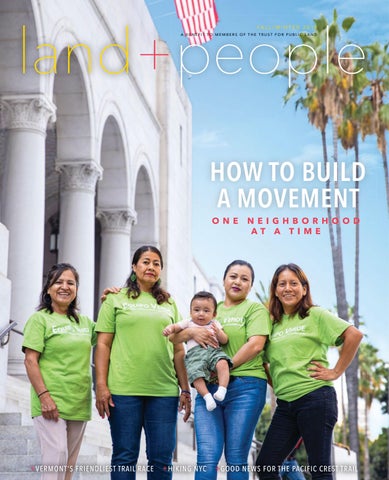
ƨ Ƨ ƭ ơ ƞ ƜƨƯƞƫ ,Q /RV $QJHOHV PRPV DQG JUDQGPDV DUH UDOO\LQJ IRU JUHHQ VSDFHŋDQG FRQQHFWLQJ ZLWK HOHFWHG RIƓFLDOV WR VROYH FKDOOHQJHV EH\RQG WKH ERXQGDULHV RI WKHLU ORFDO SDUNV 3KRWR -RUJH 5LYDV
JOI N U S ON FAC EB O O K 6WD\ WXQHG WR RXU ODWHVW QHZV YLGHRV FRQWHVWV DQG PRUH IDFHERRN FRP WKHWUXVWIRUSXEOLFODQG
ƋƏ T P L. O R G · 3
ƦƞƥƢƧƚ ƦƲƞƫƬ
4 · LA ND &PE OPL E · FAL L /W I NTER 2019
ƜƨƧƭƞƧƭƬ
SUGAR SANDS PICKLEBALL CLUB, GULF COUNTY, FLORIDA +XUULFDQH 0LFKDHO GHYDVWDWHG WKH WRZQ RI 0H[LFR %HDFK ODVW 2FWREHU ,Q LWV DIWHUPDWK UHVLGHQWV ZHUH JUDWHIXO IRU DQ\WKLQJ WKDW IHOW OLNH D FRPIRUWDEOH URXWLQH ŏ6R LW ZDV D EOHVVLQJ WKDW ZLWKLQ D PRQWK DIWHU WKH VWRUP ZH ZHUH DEOH WR FOHDQ HYHU\WKLQJ XS RII WKH FRXUWV DQG VWDUW SOD\LQJ DJDLQ Ő VD\V 5LFN 0DWHOD SUHVLGHQW RI WKH ORFDO 6XJDU 6DQGV 3LFNOHEDOO &OXE ŏ, WKLQN LW KHOSV D ORW RI WKH SHRSOH ZKR ZHUH VXIIHULQJ WR VSHQG D FRXSOH KRXUV QRW WKLQNLQJ DERXW WKH KXUULFDQH Ő
Page · 24
Ɓƃ
T P L. O R G · 5
ƛƫƢƚƧ Ʀƨơƫ
6 · LA ND &PE OPL E · FAL L /W I NTER 2019
ƜƨƧƭƞƧƭƬ
CATAMOUNT COMMUNITY FOREST, WILLISTON, VERMONT *HQHUDWLRQV RI DWKOHWHV KDYH JURZQ XS RQ WKH WUDLOV DW &DWDPRXQW D ƍƉƉ DFUH IRUHVW RQ WKH RXWVNLUWV RI %XUOLQJWRQ %XW DV WKH PHWUR DUHD JURZV VR GRHV WKH QHHG WR UHLPDJLQH WKH RSHQ VSDFH WKDW UHPDLQV ŏ'HYHORSHUV KDG ZRUQ WKH VKHOODF RII RXU GRRU NQRFNLQJ WR EX\ WKH SODFH Ő VD\V WKH ODQGōV ORQJWLPH RZQHU -LP 0F&XOORXJK %XW KH DQG KLV ZLIH /XF\ KHOG WKHP RII H[SORULQJ ZD\V WR SURWHFW &DWDPRXQW IRU WKHLU FRPPXQLW\ WR HQMR\
Page · 42
ƃƁ
T P L. O R G · 7
ƭƢƦƨƭơƲ ƬƜơƞƧƜƤ
ƄƁ
8 · LA ND &PE OPL E · FAL L /W I NTER 2019
ƜƨƧƭƞƧƭƬ
THE BRONX, NEW YORK CITY <RX FDQ WDNH WKH ZRPDQ RXW RI WKH ZLOGHUQHVV EXW \RX FDQōW WDNH WKH ZLOGHUQHVV RXW RI WKH ZRPDQ 7KLV VSULQJ H[SHUW ORQJ GLVWDQFH KLNHU /L] 7KRPDV WXUQHG KHU H[SORUDWRU\ LQVWLQFWV WR WKH VWUHHWV RI WKH %LJ $SSOH RQ D QLQH GD\ WUHN WUDYHUVLQJ RQH KXQGUHG SOD\JURXQGV FUHDWHG E\ 7KH 7UXVW IRU 3XEOLF /DQG
Page · 52
T P L. O R G · 9
OFF IC E R S pre si d e n t an d c hi e f exec u t i v e o ff i c er
Diane Regas vice p re s i d e n t an d directo r o f co n s e rvat i o n f i n a n c e
Will Abberger s e n i o r vi c e p re s i d e n t o f n ati o n al p ro g rams
Adrian Benepe s e n i o r vi c e p re s i d e n t , g en era l couns e l, an d co rp o rat e sec reta r y
D. Malcolm Carson s e n i o r vi c e p re s i d e n t of fi e ld p ro g rams
Jeff Danter vice p re s i d e n t an d d i recto r o f phila n t hro p y p ro g ram s
Jeff Hauk s e n i o r vi c e p re s i d e n t an d c hi e f p hi lan t hro py o ff i c er
Margie Kim s e n i o r vi c e p re s i d e n t o f polic y an d g ove rn me n t rel at i o n s
Bill Lee vice p re s i d e n t an d asso c i at e ge n eral co un s e l
Margaret Madden c hie f o f staff
Sloan McGurl
our mission:
THE TRUST FOR PUBLIC LAND CREATES PARKS AND PROTECTS LAND FOR PEOPLE, ENSURING HEALTHY, LIVABLE COMMUNITIES FOR GENERATIONS TO COME.
s e n i o r vi c e p re s i d e n t a n d chie f fi n an c i al an d ad m i n i st rat i v e o ff i c er
James Obendorf vice p re s i d e n t an d directo r o f fi n an c e an d acco u n t i n g
Michelle Pandori
how you can help: Our work depends on the generous support of people like you.
vice p re s i d e n t an d d i recto r o f hum an re s o urc e s
Carrie Speckart s e n i o r vi c e p re s i d e n t a n d chie f marke t i n g an d co m m u n i cat i o n s o ff i c er
I Ling Thompson
donate: Use the envelope inside this magazine, or visit tpl.org/donate for other easy ways to give. learn more: Get timely updates on our park and conservation work near you. Sign up for our e-newsletter at tpl.org/enews. share: Help us make the case for parks and open space. When you’ve finished reading this issue, pass it on! Land&People magazine is a benefit to members of The Trust for Public Land.
1 0 · LAND &PE OPL E · FAL L /W I NTER 2019
THE POWER OF LAND FOR PEOPLE in the environmental movement, we are
nicholas lea bruno
from the president
often concerned about land versus people — about the prairies and oceans and species under threat from humans. And those threats are very publisher Eliza Sarasohn
real and critical. But understanding conserva-
managing editor Julia Busiek
because it frames human beings as fundamen-
tion in only this adversarial way is troublesome,
art director Gerardo Garcia-Jurado media production manager Elyse Leyenberger designers Rachel Barnes Sterling Stovall digital production Whitney Kolterman Lindsay Mamula Jeremy Sammons con tributing editor Bill Poole
tally in conflict with our planet. With our home. What if, instead, we think about this country and this earth as a place where the health of the people is inextricably linked with the health of
Consider Wenatchee, a bustling agricultural
the land? Where we can’t fix the prairies and
city in central Washington. For years, the park
oceans and protect species without addressing
in the heart of the city’s most densely popu-
the health and prosperity of the human spe-
lated neighborhood was neglected by officials
cies, and the landscapes and neighborhoods we
and avoided by locals, until The Trust for Public
inhabit. A place where stewarding the earth
Land—thanks to the support of impassioned
includes creating opportunities for everyone to
advocates like you—stepped in to help residents
experience and fall in love with nature—every
realize their vision for change. Now, as 22-year-
child, every family.
old Wenatchee resident and park volunteer
As a valued Trust for Public Land member, you are a critical part of our effort to reimagine and realize the power of land for people. Together we’ve learned from thousands of communities—from small towns to big cities— how activating that power can serve as a cohe-
© 2019 The Trust for Public Land. All rights reserved. 10-Minute Walk, Conserving Land for People, Conserving Nature Near You, Creating Parks and Protecting Land for People, Fitness Zone, Land for People, Land&People, LandVote, Northwoods Initiative, Our Land, Parks for People, ParkScore, The Trust for Our Land, The Trust for Public Land, TPL, and The Trust for Public Land and LandVote logos and all other names of The Trust for Public Land programs referenced herein, as well as their logos, are registered or
begun a movement that will impact lives.” Our aim is to leave you inspired by what you read in these pages, and by the people—like you—who are turning to the power of parks and
sive force that opens portals to extraordinary
public land to solve problems that once seemed
opportunity. To health. To climate resilience.
intractable. I am so proud of everything we’ve
To equity.
accomplished so far—but more than that, I am
In this issue of Land&People, you’ll meet
excited for all of the transformation yet to come.
people—in Wenatchee, in Los Angeles, in Ver-
Thank you for being a vital part of this story
mont, in New York, and all around the country—
and thank you for your support of The Trust for
who are partnering with us to envision not just
Public Land.
a park, a trail, or a new climbing wall … but a brighter future. And you’ll see how the seemingly simple act of creating that park or trail can lead to so much more … a domino effect of strengthened social bonds and increased democratic participation that leads to more vibrant,
Diane Regas
more resilient, and more just communities.
president and ceo
common-law trademarks of The Trust for Public Land.
Teresa Bendito puts it, “I’m confident we have
T P L. O R G · 11
M EET YO UR MATCH
This year, an anonymous donor will generously match your gift—dollar-for-dollar—if you send it before December 31. Your donation will go even further to help The Trust for Public Land protect more parks, gardens, and other natural places. That’s one good thing made that much better.
Give your EarthShare.
1 2 · LAND &PE OPL E · FAL L /W I NTER 2019
An EarthShare payroll deduction is one simple way to donate to The Trust for Public Land or more than 400 other environmental and conservation charities. Many corporate and government employers support EarthShare payroll giving. If yours doesn’t, ask them to start. If they do, simply decide on a single deduction or a recurring small one from every paycheck. Then designate us, member number 11440, as one of your conservation charities. For more information visit earthshare.org or email donor.outreach@tpl.org.
terray sylvester
800.714.5263 · donor.outreach@tpl.org · tpl.org/match
Get to know
board spotlight
B OA R D OF D I R E CTOR S
mich ael priest
Douglas Durst
douglas has served on the board of The Trust for Public Land since 2006. He is a member of the third generation of his family to run The Durst Organization, a pioneer of environmentally responsible design and building practices in New York City. Douglas
chair
is a graduate of the Fieldston School and
Thomas S. Reeve
the University of California, Berkeley. He’s
Stephen W. Baird
on the board of directors of the Roundabout George Bell
Theatre, Primary Stages, Earth Day New
Page Knudsen Cowles
York, and The New School, and serves on the Real Estate Board of New York. Douglas
William Cronon
is part-owner of the largest organic farm in
Douglas Durst
New York State and cofounder of New York
Jody S. Gill
Water Taxi.
F. Whitney Hatch Christopher G. Lea Joseph E. Lipscomb Ignacia S. Moreno Caroline P. Niemczyk Michael E. Patterson
I BELIEVE IN PROTECTING LAND AND CREATING
THE TRUST FOR PUBLIC LAND’S WORK IS UNIQUE
PARKS BECAUSE … as an urban builder and resident,
BECAUSE ... few organizations have so much of
parks and open space are essential to the success of
an impact on so many different types of places,
my family’s health and business. Building big, tall,
whether you are looking for a place to throw a
and dense is how we preserve the green space that
baseball around in Brooklyn or to hike in Colorado.
makes our cities livable and our environment viable
The Trust for Public Land makes sure you can
for generations to come.
connect to the outdoors no matter where you are or what you want to do.
Diane Regas
I SUPPORT THE TRUST FOR PUBLIC LAND BECAUSE …
Jeffrey A. Resnick
it is the premier land conservation and public green
THE KEY CHALLENGE FACING THE TRUST FOR PUBLIC
space developer in the United States. Their mission
LAND IS … growing and expanding, but not straying
Laura Richards
is clear, their staff is motivated and informed, and
too far from our mission or getting spread too thin.
Roy Richards Jr.
their results are extraordinary.
It takes vigilance, but we as a board must constantly ask how we plan to take on more and why.
Lex Sant
MY PROUDEST ACCOMPLISHMENT AS A BOARD
Lucas St. Clair
MEMBER WAS … raising the organization’s profile
I FIRST FELL IN LOVE WITH THE NATURAL WORLD …
so we get the credit that we deserve. The Trust for
as a kid, when I always preferred to be outdoors.
Sheryl Tishman
Public Land is dynamic, adapts to new challenges,
Now that I build skyscrapers, I try to make the
F. Jerome Tone
and is not afraid to change course when necessary.
inside be as much like the outside as I can and to
It has been tremendously rewarding to work with
educate people on the importance of density. If we
my fellow board members and staff in managing
want to preserve the natural world, we need to stay
that change and ensuring the organization is
out of as much of it as we possibly can.
Susan D. Whiting
effective and relevant today, tomorrow, and in perpetuity.
?
WHAT ABOUT YOU? Tell us how you connect with nature. Join the conversation on Facebook: facebook.com/thetrustforpublicland
T P L. O R G · 13
ƜƨƧƭƫƢƛƮƭƨƫƬ
Brian Mohr
Liz Thomas
story:
story:
story:
The Sky’s the Limit
Take Your Marks
Great Strides
Jorge Rivas
30
42
52
Jorge Rivas is a firm believer in the power of
Photographers Brian Mohr and Emily
Liz Thomas has backpacked over 15,000
storytelling and visual communications to
Johnson have spent over 1,000 nights in
miles across the United States. In 2011, she
inform and move people into action. He has
a tent together. They have shaped their
broke the women’s unsupported speed
been recognized with a GLAAD Media Award
lives and work around human-powered
record on the 2,181-mile Appalachian Trail.
and medals from the National Association
forays in Vermont and beyond, which now
She’s an author, speaker, conservationist,
of Hispanic Journalists for his investigative
include their two young daughters, Maiana
and coach. When not hiking, Liz splits her
work focused on issues impacting Latinos in
and Lenora. Their work is diverse, licensed
time between Denver and Los Angeles.
the United States.
globally, and shared via fine-art galleries and
eathomas.com
@thisisjorge
their own presentations and workshops. emberphoto.com
Thank you, Lyft! Together, we’re creating a greener, more livable future for every city. Create parks and protect land for people whenever you ride with Lyft. Just tap "Donate" in your Lyft app menu. Lyft will round your payment to the nearest dollar and donate the difference to The Trust for Public Land.
1 4 · LAND &PE OPL E · FAL L /W I NTER 2019
ƣƞƫƫƲ ƦƨƧƤƦƚƧ
ƦƚƢƥƫƨƨƦ
CHE CK US OUT! -RLQ XV RQ VRFLDO PHGLD IRU RXWGRRU LQVSLUDWLRQ IXQ IDFWV DQG EUHDNLQJ QHZV RQ LVVXHV WKDW DIIHFW WKH SDUNV ƣƞƧ Ƨ ƚ ƬƭƚƦƦ
DQG SXEOLF ODQGV \RX ORYH
SEE SOMETHING GOOD?
7KHUHōV VR PXFK WR GLVFRYHU DW WKH QHZ %HWKHO &RPPXQLW\ )RUHVW LQ 0DLQH ,Q -XQH ZH KHOSHG %HWKHO UHVLGHQWV SURWHFW DOPRVW Ɗ ƉƉƉ DFUHV RI SXEOLF ODQG IRU WUDLOV WLPEHU DQG ZLOGOLIH
We want to hear from you! Let us know what you think of the stories in this issue of Land&People. You can reach us by mail, on social media, or at mailroom@tpl.org.
SPRING/SUMME A BENEFIT TO M
how park s build powe
r
land + people
IA H HIA LPPH ELP D DEEL ILAAD PH IL RIS ING
THE TRUST FOR PUBLIC LAND SPRING/SUMME R 2 0 19 VOL. 31, Nº1
REDISC OVERI NG + RE A FORGO TTEN HAWA IIAN SPRIN G E YOUR OWN CH + CHOOS TURE NATIO NA NAL TRAIL ADVEN
EMBERS OF THE
TRUST FOR PUB
R 2 0 19
$ ULGH WR UHPHPEHU
and learn even more. Congratulations
LIC LAND
0HPEHUV RI WKH &KHURNHH 1DWLRQ
and may you have many more
RUJDQL]H DQ DQQXDO ELNH ULGH DORQJ WKH
successful years!
7UDLO RI 7HDUV
Karin Schumacher
+ I am deeply moved by this story of
+ I was the Assistant Director of the
remembering the Trail of Tears annually.
1984 original Remember the Removal
I admire all those who are retracing
trip. The honor of being with these
their ancestors’ steps and awakening
teenagers and watching their dedica-
so many Americans to the full truth of
tion and determination and watching
that shameful event promulgated by
as they changed and learned was one
the U.S. government. I am now eager
of the great experiences of my life.
to travel on the trail myself, perhaps
Leta Rector
not by bike, but to see the historic sites
T P L. O R G · 15
ƦƚƢƥƫƨƨƦ
meagan suzuki
I hope everyone at some time gets to see our country and the beauty. Please keep fighting to save them. Pat Dreifor
+ These parks represent the most beautiful areas in the United States. We must save them to conserve the best of America and the best of ourselves. David Holloway
+ Protection of the parks is extremely necessary and critical for the health of humans, wildlife, trees, and plants. Without these protections, greedy, short-sighted corporations and politi-
Hope springs eternal
+ Conservation efforts can restore
For Honolulu residents, reviving a
historical places and renew fresh
forgotten freshwater spring is a
water that was once thought gone.
labor of love.
A great history lesson! Thank you. S. Probyn
cians will be glad to plunder them. They belong to the American people. NO ONE should have the right to abuse these protections. Sheri Minix
+ Lovely story. Thanks for publishing. Freshwater ponds were common
+ My nine-year-old grandson volun-
while I was growing up, and I often
teered on this project and for his birth-
fished in them. Very happy to see
day requested that donations be made
them being revived.
to The Trust for Public Land. If you love
Patricia Matsueda
this story, donate or become a monthly sustainer to save beautiful places like
mike schirf
this. You don’t have to pull weeds or rebuild rock walls, just click on your keyboard! Easy enough. Maureen McCarthy
Get politically involved and vote for those individuals and ballot measures that work to save our wild places. Parks and lands like Zion National Park need greater protection for this generation and generations
Parks for the people Your support helped us save an at-risk area of Utah’s Zion National Park— thanks for celebrating with us!
to come. Once they’re gone they are gone forever! ƭƨƦ ƭơƨƦ ƩƬƨƧ
+ I just got home last week from Utah and went to all of the state’s national parks. They are beautiful, breathtaking, and they belong to all the people, NOT to just a few land-grabbing people who want to make money off of them. 1 6 · LAND &PE OPL E · FAL L /W I NTER 2019
LAND&PEOPLE IS LISTENING! Send letters to the editor or change your mailing address: mailroom@tpl.org.
turn the page for … pumpkin patches dog days long trails
it is not always granted to the sower to see the harvest.
The mighty Mississippi River is the main attraction at Crow Wing State Forest near Brainerd, Minnesota … but don’t overlook the minor miracles that grow on the forest floor.
ƚƧƝƲ ƫƢƜơƭƞƫ
a lb ert s ch w ei tz er
T P L. O R G · 17
officially, the first day of autumn
Once a patch in a quilt of farms that
is september 21. But for families in
stretched up and down the valley, by
Windsor, Connecticut, it’s not really
the early 2000s, Brown’s Harvest was
fall until it’s time to visit the pumpkin
more of an island in a sea of suburban
patch at Brown’s Harvest, a historic
development. “The same things that
farm on the Farmington River. It’s the
make this land great to farm—it’s
place to be for all the hallmarks of the
flat, level, close to the river—make it
season, from snacking on apple cider
easy to develop, too,” says Martin. But
donuts to wandering in a corn maze
her family is committed to their land:
to hitching a hayride—and of course,
this year, we helped preserve 61 acres
picking the perfect pumpkin.
of Brown’s Harvest with a conservation easement, ensuring the land will never be developed and easing the
member of the sixth generation of her
family’s financial burden.
family to own this farm. “Parents with
“We share this farm with the com-
young kids will tell us that they grew
munity,” says Martin. “It’s challenging
up coming here with their parents—so
for families to take time and do some-
our farm has really become part of the
thing outdoors together. Our farm
tradition of fall for Windsor.”
makes moments like that possible.” ƞƥƢƬƚ ơƚƥƬƭƞƝ
“We’ve been doing the pumpkin patch since 1978,” says Kathi Martin, a
ƛƫƨưƧōƬ ơƚƫƯƞƬƭ ưƢƧƝƬƨƫ ƜƨƧƧƞƜƭƢƜƮƭ
ƬƭƞƯƞƧ ƠƧƚƦ
FALL f lavo rs
ƞƝƢƛƥƞ ƜƨƧƬƞƫƯƚƭƢƨƧ
1 8 · LAND &PE OPL E · FAL L /W I NTER 2019
$ KDUYHVW VHDVRQ IDYRULWH WKDW
Sea to summit
ƠƨƨƝ ƧƞưƬ
ƬƞƚƧ ƝƚƯƞƲ
Apple cider donuts \RX FDQ ZKLS XS DW KRPH
,QJUHGLHQWV O
Ɗ FXS ŴRXU
O
Ƌ FXSV EDNLQJ PL[ OLNH %LVTXLFN
O
~ FXS VXJDU
O
Ɗ WVS QXWPHJ
O
Ɗ HJJ EHDWHQ
O
Ɗ FXS DSSOH FLGHU
O
RLO IRU IU\LQJ
O
FLQQDPRQ DQG VXJDU
0L[ ŴRXU EDNLQJ PL[ VXJDU DQG QXWPHJ $GG HJJ DQG FLGHU DQG VWLU WR PDNH D VWLFN\ EDWWHU +HDW Ƌ LQFKHV RI RLO LQ D KHDY\ SRW
Waimea Valley, O'ahu
WDEOHVSRRQ VL]HG VFRRSV RI EDWWHU LQ KRW RLO )U\ WLOO JROGHQ EURZQ RQ ERWK VLGHV ŴLSSLQJ RQFH &RDW
ancient hawaiians divided the islands into sections called ahupua‘a, each encompassing a wedge of land from the mountains to the coast. For
GRQXWV LQ FLQQDPRQ VXJDU DQG
centuries, people found almost every-
VHUYH ZDUP
thing they needed within their own
Ƭ Ʈ Ƴ ƚ Ƨ Ƨ ƞ ư ƞ Ƭ ƭ ƞ ƫ ƥƲ
:RUNLQJ LQ EDWFKHV FDUHIXOO\ GURS
ahupua‘a: fish from the sea, crops from the flatlands, and medicines and foraged food on the forested slopes. Since the early 2000s, The Trust for Public Land has been working to protect an ahupua‘a on the North Shore of O‘ahu. Years ago, the Honolulu City Council approved plans to develop
Now we’re working to preserve the
the Waimea Valley. But locals blocked
forest higher up the valley, with a
the development of this valley that
plan to restore native species, prevent
many consider sacred, and between
erosion, and protect clean water for
2006 and 2019, The Trust for Public
every living thing that finds refuge in
Land protected the entire valley floor
the Waimea ahupua‘a.
and transferred it to Native Hawaiian management.
ƥƞƚƫƧ Ʀƨƫƞ # TPL.ORG/PUUKUA P L. OORK G · 19 F I R ST TLO
ƫƚƜơƢƝ ƝƚơƧƨƮƧ
ươƚƭ ƜƨƮƧƭƬ
RI WKH 3DFLƓF &UHVW 7UDLO DUH SHUPDQHQWO\ SURWHFWHG
t r a il r e p o r t : 7R GDWH \RXōYH KHOSHG XV SURWHFW
7KLV VXPPHU ZH FORVHG WKH ODUJHVW JDS LQ SXEOLF ODQG DORQJ WKH Ƌ ƏƍƉ PLOH URXWH 7KH GHDO LQ SDUWQHUVKLS ZLWK WKH 3DFLƓF &UHVW 7UDLO $VVRFLDWLRQ SUHVHUYHV RYHU ƊƉ ƉƉƉ DFUHV RQ 7ULQLW\ 'LYLGH LQ 1RUWKHUQ &DOLIRUQLD RSHQV WHQ SUHYLRXVO\ RII OLPLWV DOSLQH ODNHV DQG JXDUDQWHHV WKLV UHPRWH VWUHWFK RI UXJJHG EDFNFRXQWU\ ZLOO VWD\ ZLOG IRUHYHU
2 0 · LAND &PE OPL E · FAL L /W I NTER 2019
47,250 100 36
DFUHV DORQJ
WKH 3 & 7
PLOHV RI WKH
WUDLO̸V FRUULGRU
VLWHV ZLWKLQ D KDOI PLOH
RI WKH 3 & 7
WE GIVE TO … keep climbing
ươƲ ưƞ ƠƢƯƞ
Ɲ ƞ Ʊ ƭ ƞ ƫ Ɲ ƚ Ư Ƣ Ƭ ƭ ơ ƞ Ƨ ƨ ƫ ƭ ơ Ɵƚ Ɯ ƞ
Ʃƫƨ ƜƥƢƦƛƞƫ ƦƚƧƨƚơ ƚƢƧƮƮ
16-acre green space that’s slated to open on the west side of Atlanta in early 2020. Ainuu and Campbell were in town to help kids learn the ropes and get excited about the new climbing wall coming to their neighborhood. “Some of these little kids who’d never even heard of climbing were just crushing it!” says Ainuu. “Everyone deserves a chance to at least give it a try.” He’s proud to be part of the effort to make the sport more equitable and inclusive. “It was super cool to be there as a role model, and show how climbing has affected my life and how
it’s not easy to get into rock climb-
clicked,” he says. Fast-forward five
ing. Starting out means building
years, and he’s earned a spot on The
strength, mastering knots, and—for
North Face’s team of elite climbers,
some of us, anyway—conquering a
taking on daring expeditions in big
fear of heights. But for many would-be
mountains around the world.
climbers, the hardest part isn’t techni-
As much as he loves pushing his
cal know-how or tricky moves: it’s just
limits in remote, demanding locales,
getting to the wall.
Ainuu is equally stoked to introduce
It’s a problem Manoah Ainuu
people to the sport. “I share what I
knows well. “Where I grew up in
love,” he says. “Especially when it’s
Los Angeles, we were just locked in
something that is so fun and can help
by concrete and traffic. There was
you grow.” So earlier this year, Ainuu
not much getting out of the city, and
and his North Face teammate Fred
there was definitely no place in my
Campbell led a climbing clinic with
neighborhood to climb,” he says.
kids on Atlanta’s west side.
It wasn’t until he headed to
ƜơƫƢƬ ƠơƞƞƧ
much it means to me.”
We’re teaming up with The North
college in Montana—“an outdoor
Face to build free climbing walls in
mecca”—that Ainuu “fell in love with
parks around the country—starting in
everything about climbing. Overcom-
neighborhoods with the fewest places
ing pain and fear, spending time in
to get outside and play. A climbing
beautiful places, being part of this
boulder is just one of the features
sport’s awesome community … it just
planned for Rodney Cook Sr. Park, a
Manoah Ainuu P L. OORK G · 21 F I R ST TLO
ơ Ƣ ƥ ƚ ƫ Ʋ ƛ ƨ Ư ƚƲ
Ʀƞƞƭ ƨƮƫ ƬƭƚƟƟ
ŏ:KHQ \RX SURWHFW ODQG \RX DOVR SURWHFW FOHDQ ZDWHU Ő SHANELLE SMITH WHIGHAM THE TRUST FOR PUBLIC LAND’S OHIO STATE DIRECTOR ON THE REDEMPTIVE LEGACY OF AN INFAMOUS ENVIRONMENTAL DISASTER.
7KLV VXPPHU &OHYHODQGHUV FRPPHPRUDWHG WKH ƎƉWK DQQLYHUVDU\ RI WKH GD\ WKH &X\DKRJD 5LYHUŋZKLFK UXQV WKURXJK WKH FLW\ŋFDXJKW ILUH +RZ FRXOG WKDW KDSSHQ"
realities of living alongside industry
example behind the creation of the
are just a part of life. I grew up a block
Environmental Protection Agency in
away from an oil refinery in Lima,
1970, and the passage of the Clean
Ohio. As a kid I couldn’t tell you what
Water Act in 1972, which made it a
a petrochemical was, but I knew that
crime to dump untreated industrial
we’d get orders to boil our water every
waste into our nation’s waterways.
so often, or we’d hear loud explosions
dump untreated waste from mills and
But when the Cuyahoga caught fire
'LG WKH &OHDQ :DWHU $FW DORQH VROYH WKH SUREOHP"
factories right into the Cuyahoga. It
in 1969, a reporter from Time magazine
No single law can neutralize all the
Back in 1969 it was perfectly legal to
at the plant.
was basically a dead river, choked with
happened to be there. The story he
threats to our environment, or even to
patches of debris and full of chemicals.
wrote planted this catastrophe in the
a single river. That’s where The Trust
All it took was some little spark, prob-
national consciousness at a time when
for Public Land comes into this story:
ably from a passing train, to ignite.
the early environmental movement
When you protect land, you also
was gaining steam.
protect clean water by preventing
+RZ GLG SHRSOH UHDFW"
pollution from roads, lawns, and
It barely registered locally. The
:KDW ZDV WKH UHVXOW"
industry. We played a key role in the
Cuyahoga had burned a dozen times,
That a river could catch fire was an
creation of the Cuyahoga Valley
and it wasn’t the only industrialized
obvious indication that something
National Park, which prevented
river that caught fire in the 20th cen-
was very wrong with our environment.
development along miles of the river’s
tury. In many Ohio communities, the
This incident became a galvanizing
banks above Cleveland.
2 2 · LAND &PE OPL E · FAL L /W I NTER 2019
:KDW GLIIHUHQFH GRHV FOHDQ ZDWHU PDNH"
freeways and railroads. That isolation
use these spaces every day. They might
is a result of decades of investment
not be the most dramatic changes at
Now, people can play in and on lakes
and decisions being made by people
this stage, but the process of commu-
and rivers in Ohio. Our office is on the
in power, without taking the commu-
nity engagement has its own benefits.
riverfront, and plenty of days we see
nity’s concerns into account.
/LNH ZKDW"
people going by on kayaks or stand-up paddle boards, or just walking along
:KDW DUH \RX GRLQJ DERXW LW"
the banks. You’d never have been able
The neighborhood surrounding the
to make decisions about their sur-
to do that fifty years ago.
development is undergoing lots of
roundings is powerful. We’re using our
change and economic growth right
expertise to help Cleveland commu-
people back to the river by creating
now, but it’s hard for Lakeview Terrace
nities realize their own dreams and
and connecting waterfront parks and
residents to just get there and feel like
decide what they want their environ-
trails. And because not everyone has
they have a stake in that opportunity.
ment to look like—and how to express what’s important to them.
In Cleveland, we’re welcoming
equal access to nature, we’re working
So we’re helping build trails connect-
first with communities that have his-
ing Lakeview Terrace to make it easier
torically been denied green space and
and safer for people to walk and roll to
:KDW NHHSV \RX JRLQJ"
clean water—among so many other
the lake, and to school and jobs.
In my twenties, I was diagnosed with
Even within Lakeview Terrace, the
kinds of social capital.
Hodgkin’s lymphoma. My sister had
common space hasn’t been used or
it too—and I don’t think it’s a coinci-
:KDW GRHV WKDW ORRN OLNH"
cared for. It’s not what the community
dence, given the environment we grew
Take Lakeview Terrace, a public
needs. So we’re also working with resi-
up in. My life’s work is dedicated to
housing community near where the
dents to upgrade green spaces in the
ensuring that today’s kids have a differ-
Cuyahoga flows into Lake Erie. The
development, planting more trees and
ent reality than we did—that instead
development is less than half a mile
resurfacing the basketball courts with
of seeing smokestacks, freeways, and
from the lake as the crow flies, but
a new mural. Every decision has been
rivers on fire, they see parks and bike
residents are cut off from the lakefront,
made hand-in-hand with the people
trails, and can swim in the water.
and the surrounding neighborhood, by
who live at Lakeview Terrace and will Ɯ ƥ ƞ Ư ƞ ƥ ƚ Ƨ Ɲ Ʀ ƞ ƭ ƫ ƨ Ʃƚ ƫ Ƥ Ƭ
ƣ ƚ Ʀ ƞ Ƭ ƭ ơ ƨ Ʀ ƚ Ƭ Ʀ Ƣ Ɯ ơ ƚ ƞ ƥ Ƭ Ɯ ơ ư ƚ ƫ ƭ Ƴ ƥ Ƣ ƛ ƫ ƚ ƫ Ʋ Ɯ ƥ ƞ Ư ƞ ƥ ƚ Ƨ Ɲ Ƭ ƭƚ ƭ ƞ Ʈ Ƨ Ƣ Ư ƞ ƫ Ƭ Ƣ ƭ Ʋ
The process of getting people together
The Cuyahoga River caught fire—for the last time—in 1969. Today, after half a century of environmental cleanup and land protection, Cleveland’s waterfront is a network of welcoming parks where people can exercise, gather, and play.
P L. OORK G · 23 F I R ST TLO
ƛƮƳƳưƨƫƭơƲ
Ʀƞƥ ƢƧ ƚ ƦƲ ƞƫ Ƭ
ưƨƫƝ ưƚƭƜơ
“You have to think about other people’s opinions because it’s not just your playground. It’s
our community’s playground.” – Dezvray Beasley, 11, in the Boston Globe 'H]YUD\ DQG KLV FODVVPDWHV DUH GUHDPLQJ XS D EHDXWLIXO IXWXUH IRU WKH &KLWWLFN (OHPHQWDU\ 6FKRRO\DUG LQ %RVWRQōV 0DWWDSDQ QHLJKERUKRRG 7KH\ōUH DOVR KHOSLQJ XV FORVH %RVWRQōV ODVW JDS LQ SDUN DFFHVV ZLWK WKH VFKRRO\DUG RIƓFLDOO\ RSHQ WR WKH SXEOLF ƊƉƉ SHUFHQW RI UHVLGHQWV QRZ KDYH D SDUN ZLWKLQ D ƊƉ PLQXWH
U ԤWփR ē SI˜ڼS $ JDPH FRPELQLQJ HOHPHQWV RI WHQQLV SLQJ SRQJ DQG EDGPLQ WRQ LQ ZKLFK SOD\HUV XVH SDGGOHV WR KLW D :LIŴH %DOO RYHU D QHW
3LFNOHEDOO LV RQH RI WKH IDVWHVW JURZLQJ VSRUWV LQ WKH FRXQWU\ HVSHFLDOO\ DPRQJ VHQLRUV ŏ,WōV DOPRVW JURZLQJ too IDVWŋWKH FRXUW VSDFH ZH KDYH FDQōW NHHS XS ZLWK WKH GHPDQG Ő VD\V 5LFN 0DWHOD SUHVLGHQW RI WKH 6XJDU 6DQGV 3LFNOHEDOO &OXE LQ *XOI &RXQW\ )ORULGD 6R WKH FOXEōV ƊƋƉ PHPEHUV DUH ORRNLQJ IRUZDUG WR EUDQG QHZ SLFNOHEDOO FRXUWV DW QHDUE\ 6DOLQDV 3DUNŋRQH RI ƓYH VKRUHOLQH SDUNV LQ WKH )ORULGD 3DQKDQGOH WKDW ZHōUH EXLOGLQJ ZLWK IXQGLQJ IURP WKH 'HHSZDWHU +RUL]RQ GLVDVWHU VHWWOHPHQW
2 4 · LAND &PE OPL E · FAL L /W I NTER 2019
ƞƫƢƧ ƜƥƚƫƤ
Pickleball
ZDON RI KRPH
ươƚƭ ƜƨƮƧƭƬ
ƝƨƠ ƝƚƲƬ ƬƭƨƫƲ ƦƢƥƥ ƜƨƦƦƮƧƢƭƲ ƩƚƫƤ ƛƨƳƞƦƚƧ ƦƨƧƭƚƧƚ
You’ve helped us protect over
ƛƫƮƜƞ ƦƮơƥƛƫƚƝƭ
3
million acres
of open space.
All that natural land stores
144
million
tons
of carbon in trees and soil.
That’s equal to a year’s worth of emissions from
100 million
or
123
bozeman, montana, is a dog town. “Everywhere you go, you’re going to see a lot of happy dogs with their people,” says Spencer Williams, owner of Bozeman-based pet products company West Paw, Inc. This summer, The Trust for Public Land cut the ribbon on Bozeman’s new-
Cars
Coal-fired power plants
est spot to romp and play: Story Mill Community Park. The park offers plenty for families and their furry friends
See how we’re counting the climate benefits of saving land: tpl.org/forestcarbon
to explore, from miles of trails to a playground to an offleash dog run sponsored by West Paw.
P L. OORK G ·· 25 25 F I R ST TLO
insight
THE
DREAM T EAM
THESE OUTDOOR ATHLETES HAVE EACH OTHER’S
BACKS WHEN THE TRAIL GETS ROUGH. 2 6 · LAND &PE OPL E · FAL L /W I NTER 2019
2 6 · LAND &PE OPL E · SPR I NG /SUMMER 2019
ƚƚƫƨ Ƨ Ɯƨ ƥƮ ƬƬƢ
TREVOR HAHN AND MELANIE KNECHT ARE ADVENTURE BUDDIES EXTRAORDINAIRE.
Trevor has glaucoma and lost his sight five years ago, and Melanie was born with spina bifida and doesn’t walk. So they’ve teamed up to explore the wilderness: Trevor carries Melanie on his back, and Melanie guides Trevor, directing him where to step and alerting him to upcoming hazards. We caught up with them this summer while they were training for their first big team challenge: summiting Mt. Bierstadt, a 14,000-foot peak on the Front Range of the Rocky Mountains.
Did you both grow up being pretty outdoorsy?
because the pack we were using wasn’t designed to carry a
TREVOR HAHN: I’m a Fort Collins native, so we were always
grown woman.
out as a family camping and hiking all over the mountains. When I could still see, I was into backcountry snowboarding,
TH: So Melanie brought this idea up to me: “It’d be really
river sports, mountain biking, all that. I pretty much grew up
cool if you carried me and then you could be the legs and
in nature and it was my escape from everything.
I could guide you because I can see.” It made perfect sense. We both have the same responsibility: if one of us goes
MELANIE KNECHT: Access to the outdoors is part of what
down, the other one goes down. It shifts the whole dynamic
drew me to Colorado for grad school. I grew up in the Dallas-
from feeling like a burden, to being essential for someone
Fort Worth area, where there aren’t the same kind of oppor-
else’s experience in the outdoors.
tunities to get out like Trevor had. But my dad would still take my sister and me out tubing on the boat, and camping, and hunting and fishing.
How’d you meet and start hiking together? MK: The adaptive sports community in Fort Collins is really tight, so it’s not that uncommon to see the same people at different events. I first met Trevor at a boxing class, and then we ran into each other again a few weeks later at a rock climbing gym. As we got to talking, I was curious about how
“
IT’D BE REALLY COOL IF YOU CARRIED ME ... YOU COULD BE THE LEGS AND I COULD GUIDE YOU BECAUSE I CAN SEE.
“
he’s adapted things to keep doing what he wants to do. TH: I was telling Mel about how last spring I joined a team
MK: That always gets to me. I don’t care who you are, you
of adaptive athletes to summit a 17,500-foot peak in Nepal.
don’t really want to be responsible for carrying someone all
My teammates guided me up using a bell-and-voice system.
the time. But the fact that we’re each helping the other out
That’s mostly how I’ve been able to go hiking since I lost my
takes that pressure off. I don’t have to worry, like, “Oh god,
sight, by relying on someone to guide me. I was trying to
is this person not enjoying their hike because of me? It’d be
think of how I can have more purpose on a trail rather than
so much easier for them without me here.”
someone else doing a lot of the work.
How does it work when you’re out on trail? MK: And back in 2012, I went to Easter Island with a few
TH: I did a bunch of research last winter and came across
friends, which was so cool. But, as you can imagine, it’s this
this company that makes packs designed to carry people
tiny, remote island, and it’s not accessible in any way. So we
with special needs. They designed a pack for Melanie, where
brought a backpack for carrying toddlers around, and my
she sits on basically a bike seat and her arms and legs are
friend carried me. I saw things I’d never have seen if I’d only
free, and it’s just a regular backpack for me. It’s pretty com-
had my chair. But it was super uncomfortable for both of us,
fortable for both of us. I NTSI T · 27 P L.GOHR G
MK: Trevor is definitely a great hiker, so that makes my job
MK: It’s been great to share our story with people, and I hope
guiding him easier. Still, it’s mentally exhausting to keep up
that it encourages other people to try what we’re doing, or
a constant stream of directions, so we need to take breaks
just for anyone to think outside of whatever box they’ve been
every mile or so. So far, a lot of our time training together
put in. It goes to show that we really are stronger together.
has been me figuring out what I do and don’t need to say. than sorry.
What do you want people to know about public lands and accessibility?
TH: The things I want to know about from Melanie aren’t
and large, the outdoors just aren’t accessible, like at all. When
Even still I probably over-guide him, but I’d rather be safe
MK: Public lands should be welcoming for everyone! But by necessarily what we’re about to walk over, because I can
I go to a national park, usually the most I can expect is like
manage a lot of that stuff with my poles. But I need to know
a half-mile of paved road, and then it just ends. If I’m on my
what’s around us. Like if there’s a real serious drop-off to the
own or I don’t have a friend willing to carry me, that’s all I get.
right, I’ll want to know that if I do trip, I need to try to fall
Society makes all kinds of excuses for doing just the bare
to the left.
minimum for accessibility. It makes me so mad! The places Trevor and I have gone hiking are so vast. If I’m there in my
Has teaming up changed what you get out of spending time in the outdoors?
chair, why do you only give me half a mile? Is it because of
MK: I’d never been on a true, actual, proper hike until
speak up and say, “Hey, this isn’t right”?
cost? Or is it just because there haven’t been enough people to
Trevor came along. So for me, it’s changed everything. And the fact that it’s going really well is validating: like, yes, we
TH: I’ve always felt the best stories come from what happens
are able to do things people say we can’t do. I feel motivated
on the side of the mountain. The journey to the top, and
to try more outdoor sports, for one: I’ve always been a swim-
that sense of accomplishment, that’s what makes being up
mer, but now I’m climbing, and boxing, and doing archery,
there rewarding.
and hand-cycling. I’m good at cycling, and I love it, which is great because Fort Collins is a huge bike town.
MK: We all deserve that perspective you can only find from getting to the top of a mountain. We all need a chance to
TH: Being on trail, moving through the expansive space of wil-
step away from the daily grind and feel like we’re a little
derness, has always been an important part of my life. It makes
piece of stardust.
me so happy to be able to help someone else experience that.
ƟƥƢƜƤƫ ƮƬƞƫ ƦƢƜơƚƞƥ ƤƢƫƬƜơ
That first hike we went on, Mel was giddy.
In August, Hahn and Knecht hiked Mt. Bierstadt, their first “fourteener.” While they came up a few hundred feet short of the summit, Knecht says, “We are extremely proud of how far we were able to go, and definitely count that as a success.” 2 8 · LAND &PE OPL E · FAL L /W I NTER 2019
rachid dahnoun
BE A LEADER. Become a Conservation Champion and help The Trust for Public Land connect even more people to nature. With your annual leadership-level contribution of $2,000 or more, you will receive invitations to special events and insider updates on our park and conservation strategies.
Learn more about the impact you will have as a Conservation Champion. Contact Emily Falk 415.800.5193 or champions@tpl.org.
co ns ervat i o n c h ampi o ns t p l .or g/ champi o n s | champi o n s@tpl.o r g
T P L. O R G · 29
the
sKy's lim it the
I N R U R A L WA S H I N GTO N A N D B U ST L I N G LO S A N G E L E S , PA R K A D V O C AT E S A R E TA P P I N G INTO THE POWER OF A COMMON GOAL.
STO R Y A N D P H OTO S : J O R G E R I VA S
3 0 · LAND &PE OPL E · FAL L /W I NTER 2019
T P L. O R G · 31
ti
he first thing you notice when you
cross the bridge into Wenatchee is
the giant apple: a 16-foot-high apple-
shaped billboard, welcoming all to the “Apple Capital of the World.” Wenatchee, a small city of around 30,000 people in central Washington State, sits at the confluence of two rivers—the Columbia and the Wenatchee. Surrounded by the high-desert foothills that edge the Cascade range, the Wenatchee Valley is an ideal environment for orchards; the region produces the majority of the nation’s cherries and apples. This is where 22-year-old Teresa Bendito grew up, in a home on the banks of the Columbia River. Like many of her neighbors, Bendito’s family has worked in the farms and warehouses up and down the valley. During cherry harvest season—typically June through August— orchard workers regularly clock 12- and 15-hour days. But despite the long hours, Bendito says they always found time to ride bikes and play along the river after work, making the most of the midsummer sunlight.
3 2 · LAND &PE OPL E · FAL L /W I NTER 2019
W E H AV E A H I S T O R Y O F P R O P O S A L S L I K E T H E S E FA L L I N G T H R O U G H , F O R O N E R E A S O N O R A N O T H E R .
Teresa Zepeda-Sosa and her daughter, Teresa Bendito, are organizing for better parks in South Wenatchee.
ƚƝƚƢƫ ƟƫƞƞƦƚƧ ƫƮƭƥƞƝƠƞ
Bendito was ten years old when developers razed her neighborhood to make way for new luxury housing. Her mother had fought the changes for a year, securing promises of relocation support from the developer and city
“The needs in this community can often feel overwhelming,” says minister Misael Fajardo-Perez.
officials. But when the time came for her family to move, their promises fizzled. Her family turned to the local
Bendito’s family eventually relocated to South Wenatchee,
Catholic church, which helped them
a neighborhood of 5,000 people. While rents here are more
find a new home, miles away from their
affordable than in neighborhoods along the river and the
beloved riverfront green space. Their
foothills, the disparities are much greater. Says Misael Fajardo-
rent tripled. It was just another link in a
Perez, a local minister, most South Wenatchee families
chain of unfulfilled commitments made
make their living through farm labor, and many struggle to
to the city’s Latino community, Bendito
make ends meet. “We have poverty and drug problems, high
says. “We have a history of proposals
childhood obesity rates, and a lack of good infrastructure,”
like these falling through, for one rea-
Fajardo-Perez says. “The needs in this community can often
son or another.”
feel overwhelming.”
T P L. O R G · 33
There’s not much programing in Kiwanis Methow Park, and the park lacks basic facilities, like restrooms. “This is an injustice, but it’s our reality,” says Zepeda-Sosa.
ƚƝƚƢƫ ƟƫƞƞƦƚƧ ƫƮƭƥƞƝƠƞ
festival. “My mom was like, ‘What’s this white guy doing at a Mexican cultural event? We better see what he’s about,’” Bendito recalls. Zepeda-Sosa marched up to Simmons and introduced herself. She learned he worked as a project manager for The Trust for Public Land, an organization with a long history of helping “This is an injustice, but it’s our
conserve trails and open lands around
than at the neighborhood park down
reality,” says Bendito’s mother, Teresa
Wenatchee—improvements that have
the road from Bendito’s home. Kiwanis
Zepeda-Sosa. She wishes Kiwanis
raised the city’s profile as an outdoor
Methow Park is one of the only public
Methow Park looked as nice as the
adventure destination. Now Simmons
Those disparities are no more evident
green spaces in South Wenatchee, but
parks in the wealthier parts of town.
was in South Wenatchee because The
for decades, it had attracted the wrong
There’s not much programing in
Trust for Public Land knew this part of
kind of attention from city leaders. To
Kiwanis Methow, and the park lacks
town needed a great park.
discourage gang activity, the city cut
basic facilities, like restrooms. Back in
“Kiwanis Methow Park was a place
down trees and installed a chain-link
Mexico, Zepeda-Sosa says, she would
with lots of potential, but it was in rough
fence and towering industrial flood-
walk around her old neighborhood park
shape, and some neighbors didn’t feel
lights. For years, kids growing up nearby
every Sunday with her family. Here
safe there,” says Simmons. “I was at the
were warned away from spending time
she can’t visit Kiwanis Methow with
festival to tell residents about The Trust
there. Neighbors say the gang activity
her elderly mother, because there’s no
for Public Land’s effort to renovate the
has subsided, but the park’s reputation
wheelchair accessibility.
park, to seek their input and learn what
as an unsafe space lingers, especially among outsiders. 3 4 · LAND &PE OPL E · FAL L /W I NTER 2019
In 2016, Zepeda-Sosa encountered Cary Simmons at a local mariachi
they wanted the park to become, and to recruit volunteers to lead the redesign.”
After years of outsiders showing up and talking about
ƚƧƧƢƞ ƛƚƧƠ
making change, Bendito and Zepeda-Sosa say they’d learned to be skeptical. “We’ve had many past administrations and organizations making false promises,” says Bendito. But the chance to help lead and organize their community around an outcome as tangible as a new park was exciting. “Once we found that out, we wanted to help any way we could.” Bendito and her mother were among the first South Wenatchee residents to sign up as volunteers to revitalize Kiwanis Methow. Three years later, their group is more than 120 members strong. They call themselves the Parque Padrinos, or godparents of the park. “In our culture, everyone has lots of padrinos and madrinas. They’re people you choose to take care of you, watch over you, and support you,” Bendito explains. Padrinos and madrinas take responsibility for nurturing an extended family or community. At a big celebration, like a wedding or quinceañera, one padrino can be in charge of the cake, while another madrina can be in charge of the music. Says Bendito, “We’re
THOUGH THEY ARE THE CLOSEST T H I N G M A N Y P E O P L E H AV E T O A B A C K YA R D , S O U T H L O S A N G E L E S
ALLEYS FEEL ABANDONED.
doing that for this park.”
x a
thousand miles to the south—and what can feel like worlds away—sit the densely populated neighbor-
hoods of South Los Angeles. Here, just a short drive from
downtown L.A., cars race by on wide, four-lane roads through an interlocking grid of colorful craftsman bungalows. Front yards tell stories with flowers and plants that grow so tall they lean over metal fences and burst onto cracked city streets. Ana Martinez has called this neighborhood home for the last 15 years. Originally from El Salvador, Martinez immigrated first to Anaheim before settling her family in South Los Angeles. She says she loves her neighborhood, but it was much, much cleaner in Anaheim, and she misses that feeling. Here in South Los Angeles, residential blocks are separated by a series of unpaved alleyways. At night, they’re unlit and unwelcoming and they get muddy and flooded when it rains. People use them as dumping grounds, tossing bags of trash and old furniture. Though they are the closest thing many people have to a backyard, the alleys feel abandoned. So when Martinez learned that The Trust for Public Land was organizing a group of neighborhood volunteers to convert the alleys into public greenways, she jumped at the chance to help. For the last five years, she’s volunteered with the Equipo Verde—or Green Team. Group members—mostly local moms and grandmas—arm themselves with work gloves, masks, trash bags, brooms, rakes, and shovels. “I’m not afraid of picking T P L. O R G · 35
weeds, rocks, or trash,” says Martinez. “I’m here to clean.”
their own political will to ensure that we are moving forward
Over time, the Equipo Verde has converted the junk-filled
[is a] benefit to everyone.”
alleys into bright, shared spaces that their neighbors enjoy and feel safe walking through. Martinez now considers it her calling to urge her neighbors
More and more, the Equipo Verde is finding ways to flex its newfound political muscle. The city councilmember for District 9 invited an Equipo Verde leader named Sofía Girón to
to advocate for South Los Angeles—to push city officials to
give a speech at a groundbreaking ceremony. They’ve traveled
fix potholes, collect trash, and remove graffiti. “I start every
to the State Capitol in Sacramento to speak with lawmakers
conversation with my neighbors with the same line—‘Excuse me, did you call 311 already?’” she laughs. As the Equipo Verde has grown and gelled, it’s become a vital source for all kinds of information and support. Green Team members point each other and their neighbors to affordable healthcare options, assistance programs, and other useful resources they learn about through their work with local leadership. They’ve grown so effective at recruiting their neighbors to turn up for almost any type of project, school administrators now rely on them as community ambassadors. “They activate the parents, but they can even get people who don’t have kids to come to school meetings,” says Hugo Carlos, principal of the Dr. Maya Angelou Community High School. “[Having] productive problem-solving citizens activate
Ana Martinez convinced her father to join an Equipo Verde cleanup day this spring.
3 6 · LAND &PE OPL E · FAL L /W I NTER 2019
ƚƧƧƢƞ ƛƚƧƠ
about parks and open space, and addressed county leaders in support of a water conservation measure. And this spring, they testified before the Los Angeles County Supervisors in support of directing more funding from a county-wide parks bill to South Los Angeles, where far too few people have access to a park close to home. After Equipo Verde members made their case, the supervisors voted unanimously to approve the funding. ƚƧƧƢƞ ƛƚƧƠ
As she’s worked to bring change to her neighborhood, Ana Martinez says she’s noticed a change in herself. Before joining Equipo Verde, she only attended meetings about her kids’ education.
MARTINEZ NOW CONSIDERS IT HER CALLING TO U R G E H E R N E I G H B O R S T O A D V O C AT E F O R S O U T H LOS ANGELES—TO PUSH CITY OFFICIALS TO FIX
POTHOLES, COLLECT TRASH, AND REMOVE GRAFFITI.
Now, she says, “I’m not afraid of speaking out. I feel like I have more strength and courage. Now it’s fun. I can speak to anyone about our work.”
T P L. O R G · 37
w b
ack in South Wenatchee,
“The kiosko will be a place where the
Wenatchee has historically had low
Kiwanis Methow Park is nearly
community gathers, a central point for
Latino voter turnout, and Latinos are
unrecognizable from its former incarna-
our pachangas (parties),” says Teresa
underrepresented in government office.
tion. This fall, it reopens with a new
Bendito. In a community with so many
So when it was time to get out the vote
turf field, a bathroom, an upgraded
memories of disappointment, Bendito says,
for the 2018 midterm elections, Zambra-
playground, more seating, and more
this scale of transformation means a lot.
no called the Parque Pardrinos to help.
shade. The revitalized park is centered
“Parque Padrinos is not just about the
In the days before voters headed to
on a new kiosko—a pavilion designed
park. They’ve developed a space where
the polls, Padrinos knocked on 3,500
for performances and celebrations,
your identity is respected and elevated
doors and made 4,200 phone calls.
common in town squares in Mexico. At
so you can build community,” says Oskar
When ballots were tallied, Latino voter
Kiwanis Methow Park, the kiosko will
Zambrano. Zambrano works with the
turnout was three times what it had
host the town’s Mexican folk dance
Latino Community Fund of Washington,
been in the two most recent midterms.
troupe as well as Wenatchee High
an organization that encourages civic
“When I heard those numbers, I
School’s award-winning mariachi band.
engagement and equal representation.
couldn’t believe it,” says Zepeda-Sosa. “I realized we had the power to uplift candidates who care about our concerns and change how resources are distributed in our city.”
PA R Q U E PA D R I N O S I S NOT JUST ABOUT THE PA R K . T H E Y ’ V E D E V E L O P E D A S PA C E W H E R E Y O U R I D E N T I T Y I S R E S P E C T E D A N D E L E VAT E D .
The renovated park will have performance space for the town’s Mexican folk dance troupe and Wenatchee High School’s awardwinning mariachi band.
3 8 · LAND &PE OPL E · FAL L /W I NTER 2019
Last fall, the Parque Padrinos ventured to Los Angeles to meet the Equipo Verde.
m "w
e see this time and time again: in every community we work with around the country, parks and green space can be a spark that leads to structural
change for underrepresented communities,” says Dayana Molina, a Trust for Public Land community organizer who works alongside the Equipo Verde in Los Angeles.
The seemingly simple act of bringing people together to advocate for a common goal builds power—and that power can resonate, creating effects that go way past the boundaries of a particular park, she says. Molina and Simmons hatched a plan. “We wondered what would happen if we brought these two groups together,” says Cary Simmons, a Trust for Public Land project manager in Wenatchee. “How might they learn and build off of each other’s success?” Acting on this premise, Simmons and Molina engineered a meeting of the minds: last fall, the Padrinos ventured to Los Angeles to meet the Equipo Verde. Together, the groups strolled through alleys and visited Trust for Public Land parks throughout the city. They shared presentations on lessons learned, innovative approaches to recruiting members, event planning and organizing, and building strong relationships with city officials. It was the first time both groups had talked about their work outside their own communities without need for an interpreter. “We showed that we are experts in this work who can offer guidance to peers in our own language,” says Parque Padrinos member Lizbeth Rivera-Estrada. At a gathering at a community center, the energy was familial. Toddlers sat on laps and children busied themselves about the room. As one volunteer stood up to address the group, she handed her baby to the next. The idea of padrinos was a natural fit to the Equipo Verde members. “When we explain our goals and make familiar connections—like the padrinos—people want to join us,” says Ana Martinez.
T P L. O R G · 39
Roberto Mancilla, 13, checks in on construction progress at Kiwanis Methow Park this summer.
For Teresa Bendito, the visit to Los Angeles reminded her of her own childhood. “I remember myself in community meetings as a child,” Bendito says, recalling her mom’s work to keep their home on the Columbia River. “It makes a difference to be involved as a young person.” Now Bendito is the one organizing the meetings, making space for kids and teenagers to get involved. Bendito shared the story of 13-year-old Roberto Mancilla, who had started a group of “padrinitos”—for younger volunteers. He organized a piñata-making workshop at the park and has raised $50 in donations toward its renovation. Later, he joined the Parque Padrinos on a visit to the capital to meet with state representatives. “Kids need to see and experience the fruits of their labor and organizing,” says Bendito. “Now that I see the Padrinos leading on our own, I’m confident we have begun a movement that will impact lives wherever our people take this experience. I’ve learned that you don’t have a movement unless it can move without you.”
4 0 · LAND &PE OPL E · FAL L /W I NTER 2019
T P L. O R G · 41
Forr forty years, athletes of aall ages and abilities have found challenge, camaraderie, and communion with nature at a family-friendly forest in Vermont. By Jonathan Mingle 4 2 · LLAND AND &PE OPL E · FAL L /W I NTER 201 20199
t’s a hot and hazy Wednesday evening in July, and the parking lot at the Catamount Outdoor
across the finish line. One of the riders, a girl of about six, plops down next to her mother and father to debrief her
Family Center is filling up fast. There’s hardly a breeze,
first-ever bike race.
but there is a buzz in the air: the longest-running
“Was it fun?”
weekly mountain bike race in the U.S. is about to start.
“Yeah!”
At six o’clock, riders line up for the first heat. Tag
“Maybe next time you can try the longer loop,” her
Carpenter, the center’s operations manager, clutches a
mother says, as they walk over to high-five her older
clipboard as he faces a phalanx of determined-looking
brother. He’s all smiles as he completes a five-kilometer
riders. “Racers! Are you ready? Three. Two. One. Go!”
lap on the course for older kids. His father hoists him in
And then they’re off. A dozen “cubbies”—racers eight years old and younger—pedal furiously across a freshly mown field. A few minutes later, their
the air with a bear hug. When I ask them how they found this place, the dad smiles and says, “I first raced here 25 years ago.”
oversized helmets bob back into view, and they cruise T P L. O R G · 43
im and Lucy McCullough had two goals in sight when
Since 1990, every Wednesday all summer long, bikers of
they launched the Catamount Outdoor Family Center
all ages and abilities have gathered at Catamount. Tuesday
on their family farm in Williston, Vermont, in 1978. One
nights are a similar scene, but for runners; nearly 200 come
was keeping their land—400 acres of forests, meadows, and
each week to trace a five-kilometer loop. Wearing bibs with
jaw-dropping views of the Green Mountains that have been
numbers, racers are timed and their results posted online.
in Jim’s family since 1873—intact and undeveloped. The other
But that’s where the resemblance to most organized race
was to encourage more people to do what they themselves
events ends.
loved to do: get outside.
“You’ll see Division 1 runners lined up next to people walking their first 5K, Olympians next to kids jogging with their grandparents, middle-aged guys giving it their all,” says Kyle Darling, a Burlington resident who’s raced on the trails at Catamount for most of his life. “That’s what’s
That’s what’s special about it:
special about it: everyone competes on the same course,
everyone competes on the same
at the same time.” The season culminates in a convivial
course, at the samee time.
end-of-summer potluck dinner where racers get prizes for attendance rather than speed. Pamela Gude holds a Catamount attendance record that is unlikely to be broken anytime soon: she was on the starting line with her mountain bike every Wednesday,
Jim and Lucy McCullough opened their family farm to the community in 1978.
4 4 · LAND &PE OPL E · FAL L /W I NTER 2019
all season long, for twenty years. She started riding for the
the steep, technical routes that lead up to the Lookout, the
exercise, in the hope that it would help with the chronic
highest point on the land. Eventually she won some of the
fatigue she was experiencing from what would eventually
races in her age category—an accomplishment that “felt like
be diagnosed as lupus.
being empress of the world.”
“I started going every day,” she says. The atmosphere was
There are plenty of places in New England to find chal-
welcoming, rather than intimidating, and the riders she
lenging mountain bike terrain. But there aren’t many where
met were generous with advice. “I would change into bike
racers might find themselves lining up next to world-class
clothes at the end of a workday, drive to Catamount, open
athletes like Andy Bishop, a retired pro cyclist who lives in
the car door, roll out, and fall asleep for an hour. Then I’d get
Williston, or Olympic mountain bike racer Lea Davison,
on my bike, ride for an hour or two, and go home.”
who grew up in nearby Jericho and still rides on the
Riding regularly improved her symptoms, and her
occasional Wednesday night as a training tune-up for
strength and stamina grew until she could tackle some of
her World Cup races. T P L. O R G · 45
“And let me tell you how exciting it is that middle-aged
So they turned to other revenue-generating schemes—
ladies like me, and little boys and girls with tassels on
not all of which panned out. They hosted BMX biking
their handlebars, can ride on the same night that a World
events, fundraisers, disc golf tournaments, archery groups,
Cup rider is riding that course,” marvels Gude. “Where in
and sleigh rides, and even tried running an on-site restau-
the world does an aspiring tiny tot football player get on
rant. For many years, they operated a Christmas tree farm.
the field with a great giant? And [these kids] you’re seeing [today] may be tomorrow’s Olympic hopefuls.” rooming elite athletes was the furthest thing from the McCulloughs’ minds when they first opened their land for cross-country skiing in the late 1970s. Jim’s widowed mother needed help managing the place, which had been a dairy farm until the 1960s. They started casting
Meanwhile, the kids who came to the races grew up. ‘Some married each other and now
about for ways to pay the bills. A neighbor family suggest-
they bring their kids here,’
ed they lay out some Nordic ski trails to attract devotees of
Jim says. ‘It’s just a g gift.’
the newly popular sport. Jim assumed responsibility for maintaining and grooming the trails, and he took his task seriously. A visiting Austrian Olympic ski coach once told him Catamount had one of the best interval loops for training in the world. But some years, the snow didn’t fall, and the McCulloughs couldn’t pay for their radio advertising contracts, let alone property taxes.
4 6 · LAND &PE OPL E · FAL L /W I NTER 2019
Ask them about the speed skating oval they built and groomed for three years with a secondhand Zamboni, and they smile and shake their heads ruefully. Mountain biking was in its infancy in the early 1980s
Catamount’s varied terrain—from open pastures to steep, wooded mountains—welcomes athletes of all stripes.
when a few local diehards started riding their bikes on
All through the years, she was the chief customer service
Catamount’s ski trails in the summer months. So Jim started
representative—hauling bikes around, greeting people—
mowing some trails and building shortcuts between the
and Jim was the chief trail builder. Their three daughters
old logging roads. As the sport’s popularity grew, he cut
joined the team as soon as they were old enough: their
new single-track trails. They hosted their first mountain
daughter Abbie launched a summer camp program and
bike race in 1984.
ran it for years, and her husband, Eric, was executive direc-
“We saw how the races drove daily usage, so we decided
tor of the Catamount Outdoor Family Center. And all along,
to launch a trail running race, too,” Jim says, despite the
the family cobbled together mortgages and loans to “keep
fact that almost no one was trail running back then. Just
the plates spinning,” as Jim puts it.
six people showed up the first week, and four the second
Meanwhile, the kids who came to the races grew up.
week. It would be years before runners outnumbered bik-
“Some married each other and now they bring their kids
ers, but they stuck with it.
here,” Jim says. “It’s just a gift.”
“We thought, ‘They’ll figure it out eventually!’” says Lucy.
T P L. O R G · 47
ea Davison and her sister Sabra grew up riding Catamount’s trails before pursuing careers as competitive mountain bikers. Even as their stars rose in the sport, Sabra says they always looked forward to racing at Catamount, because the vibe is “low-pressure and fun.” Catamount is also where, in 2007, the sisters founded Little Bellas, a mountain biking program for girls aged 7 to 16. Today you can sign up for a Little Bellas program in 16 states, but Catamount remains their testing ground. “The thing that Catamount offers that other trail networks don’t is a sense of community, being in a competitive sphere that’s also a really inviting atmosphere,” Davison says. “Catamount invites so many different kinds of programs to its property. There are so many populations that place serves.” Special Olympics of Vermont athletes have been coming to Catamount for cross-country skiing and snowshoeing training for the past 30 years. And with three miles of trails designed for sit-skiing and off-road wheelchairs, Catamount is the only place in Chittenden County where disabled athletes can really get into the woods. Patrick Standen, a philosophy professor at St. Michael’s College in Burlington who lost the use of his legs in a car accident nearly forty years ago, is cofounder of the nonprofit Northeast Disabled Athletic Association. NDAA has been running Nordic sit-skiing clinics and offering equipment rentals at Catamount for nearly two decades. “For our populations of persons with disabilities and mobility impairments, and for me personally, having access to the woods in winter is priceless,” he says. “It’s regenerating.” In the venerable Catamount traditions of expanding access and embracing innovation, NDAA is now launching a program for off-road hand-cycling, modeled on their success with sit-skiing. “They’ve got wide-open old logging roads and a variety of trails,” says Standen. “Catamount is the perfect venue.”
4 8 · LAND &PE OPL E · FAL L /W I NTER 2019
atamount is a 15-minute drive from Burlington, the largest city in the fastest-growing metro area in Vermont, says Williston’s conservation planner, Melinda Scott. “It’s become increasingly important, as the town continues to develop out, to have a protected area like this for people living nearby, to have this big forest where they can go and exercise.” The property’s western edge is within shouting distance of the new houses springing up along busy North Williston Road—a specter, say the McCulloughs, of what could have been. “Developers had worn the shellac off our door knocking to buy the place,” says Jim. But he and Lucy had been holding them off and exploring ways to conserve their property for decades. “The McCulloughs have a deep, deep connection to the land,” says Kate Wanner, a project manager at The Trust for Public Land who worked with Lucy and Jim to conserve the property. As retirement neared,
Catamount offers a sense of C community ... the vibe is low-pressure and fun.
A day on trail with the “Little Bellas”
all their net worth was tied up in their land. To survive, the McCulloughs needed to sell—one way or another. They explored the possibility of turning the land into a state park, but the State of Vermont didn’t have the money. “Keeping it open to the public was one of the McCulloughs’ really important goals,” says Wanner. “They asked, ‘How can we sustain this vision of connecting people to the land in perpetuity?’” They connected with Wanner, who helped marshal public agencies, foundations, and donors to make that vision a reality. In March, the effort culminated in the transformation of 393 acres of the property into the Catamount Community Forest, owned by the Town of Williston. The land and its beloved trails will be open to the public forever, with a conservation easement held by Vermont Land Trust. T P L. O R G · 49
5 0 · LAND &PE OPL E · FAL L /W I NTER 2019
amela Gude would often ride her bike with a field guide in her backpack, stopping to examine flowers
forest and open to free pedestrian use: “There are a lot more birders, and more people just out walking.” In
and trees, to listen to the birds. She’s noticed how, coming
other words, these days there are more people enjoying
downhill from Hairpin Ledge, before you reach the log
it than ever.
bridge, the air is nearly always 15 degrees colder by the face of the rock shelf, and higher-altitude species of plants
n a sunlit Tuesday evening, I walk out to a field
thrive in its cool, moist shade. She’s registered the hickory
beyond the starting line. Yellow-headed bobolinks
trees that grow in the Three Rivers area, where there’s
flit about, their R2D2-like songs reverberating through
flowing water, but nowhere else.
the grass. A few hundred yards away, their avian bustle is
Her lupus has progressed to the point that she’s no longer comfortable racing. “I can’t train the way I used to. I have to manage inflammation pretty carefully,” Gude
mirrored by nearly 200 racers limbering up, chatting, and readying to run. The only other figure out there among the bobolinks is
says. Last year, she ended
Tyler Marshall, running laps
her record-setting twenty-
on a hill to warm up before
year attendance streak.
the race. Later that night he’ll
But there will always be a
handily take first place.
place for her at Catamount: she recently completed a master naturalist training
These kids you’re seeing today may be tomorrow’s Olympic hopefuls.
Tyler first started running at Catamount when he was eight. A decade later, he became one
program and plans to work
of the fastest distance runners
on developing a naturalist
in Vermont history, setting
program at Catamount for
multiple state records during
local youth.
his career at Champlain Val-
Catamount gives much to its devoted users, and they
ley Union High School. Now a junior at the University of
want to give back. It’s how Lucy and Jim knew it was time
Vermont, he volunteers at Catamount and regularly runs on
to retire from managing Catamount Outdoor Family Cen-
Tuesday nights to train for his NCAA events.
ter (which now operates as an independent nonprofit), and
When he won the national Gatorade Player of the Year
why they held out so long to conserve the land and keep it
Award in 2017 for track and field—which came with a
open to the public.
$1,000 grant to be donated to the organization of the win-
“Working the starting line every Tuesday and Wednesday
ner’s choosing—it wasn’t hard to decide what to do with it.
night, we made a point of saying, ‘Thank you for coming,’”
“I immediately thought of Catamount because of what it
says Jim. “The community is responsible for carrying it
did for me as a kid when I participated in summer camps
through all these years to the point it could be protected.
and the weekly races,” he says.
That lifetime goal of public access is now good beyond
“I was hoping that the donation would help Catamount
our grave.”
continue to be a place where kids like me can find their
Since the transfer to town ownership, the place—with its steady, laughing flow of summer campers, weekly rac-
own passion and love for biking, running, or anything else, for years to come.”
ers, and day users—feels much the same. But there is one change Lucy has noticed since Catamount became a town
T P L.O L. O R G · 51 1
5 2 · LAND &PE OPL E · FAL L /W I NTER 2019
T P L. O R G · 53
BY Liz Thomas PHOTOS by Timothy Schenck Liz Thomas knows how to navigate the wildest, most remote places on earth. A veteran of dozens of longdistance wilderness hikes, Thomas set a speed record on
Still, there was one place that I’ve been wary to approach on foot: New York City. I’ve always been intimidated by the Big Apple. It was too crowded, too confusing—too much. Plus, there’s one reputation it doesn’t have: green. I didn’t expect
the Appalachian Trail and has gone on to make her living
to find very much of the natural world remaining in a city so
as a trail expert, author, and conservation advocate.
thoroughly charted and claimed by humans.
Along the way, she’s become a leader in the small but growing subculture of urban thru-hiking. She’s trekked
But when I looked into it, I learned that nature is abundant in New York. More than twenty percent of the city’s land is used for parks and recreation. Nature is almost everywhere through-
hundred-plus-mile routes through Los Angeles, San
out the five boroughs ... with the exception of the one place the
Francisco, Portland, Seattle, and Denver … and this year,
city’s youngest residents are required to be: schoolyards.
she took on her biggest challenge yet: New York City.
II
As I researched New York, I started to wonder: Why did turn-of-the-century architects design schoolyards as if they were
like to see places by foot. Hiking is about discovery and
big-box store parking lots? Why are kids fenced into asphalt lots
the excitement of what’s next. Three miles per hour is a
that look more like prison yards than play areas? As a wilderness
speed where I can stop, chat, and really take the time to con-
trekker, I know just how restorative, calming, and healing it
nect to a place—its topography, history, and people.
can be to leave the pavement and soak up nature. What must it
In recent years, the focus of my wanderlust has shifted from high, lonesome trails to bustling city sidewalks. Just like the Appalachian Trail connects scenic highlights, to give
feel like to be a kid and not have that choice to make? Hiking gives me deep appreciation for the decisions and actions of those who have come before me. In the wilderness,
my city treks some structure, I’ve planned my urban hikes
I’m grateful for conservationists who protect our natural envi-
around a theme unique to the metropolis I’m visiting. I once
ronment. When I’m exploring a city, it’s the urban planners
walked a 150-mile route connecting all the public stairways
and community organizers who make the city a safer, cooler,
in San Francisco, and I covered 100 miles linking all the
more pleasant place to live and play. Turns out, hiking can
breweries in Denver.
be a form of political expression. Maybe I could use a trek through New York to create a conversation about who does
5 4 · LAND &PE OPL E · FAL L /W I NTER 2019
and doesn’t get access to parks.
T P L. O R G · 55
Ƨ ƚ Ƨ ƚ ƭƚ Ƣ Ʀ ƨ Ʈ ƫ
mered apart. But by the time I had walked to the seventh schoolyard later that day, I realized I had witnessed one stage of a complete transformation. In the coming days, I’d pass many public schoolyards in need of a little transformation (or a lot). Most were blacktop. No trees. No gardens. No color. No personality. Nothing that gave you an idea of the school, the neighborhood, or its people. But each playground rebuilt by The Trust for Public Land is unique, with murals and gardens and sports fields and equipment designed for and by the people who use it most. Over the nine days of my trip, I’d visit a hundred of these play-
O O
grounds. I’d see their beauty through a child’s eyes. Because n the first warm day of spring, I started my hike at the yard of P.S. 32 on Staten Island, where The Trust
it’s actually the kids who design these parks. Students, teachers, and neighbors weigh in on almost
for Public Land helped students and neighbors dream, design,
every aspect of their future playground. Kids in the Bronx
and build a brand-new schoolyard. It’s one of the more than
chose a soccer field. Another school in Brooklyn went with
200 sites in New York City where the organization has helped
a human-sized chess board. I walked through NASA-themed
transform asphalt lots into vibrant, green, public parks.
playgrounds. Castle-themed playgrounds. As I entered each
The day I visited, the playground was still under construction, so it wasn’t much to see: blacktop rubble all jackham-
5 6 · LAND &PE OPL E · FAL L /W I NTER 2019
schoolyard, colorful murals welcomed me, proudly declaring: “This playground was designed by the kids of P.S. 90.”
ƚƧƝƫƞư ƟƞƝƞƫƦƚƧ
x A
t the end of my third day, I watched a dad balance his
love of mud and trees. As teenagers, we organized a barbecue
five-year-old daughter as she pedaled around the track
in that park—far (but not so far) from the prying eyes of our
at P.S. 130 in the South Bronx. It reminded me of one of my
parents. Now, my best friend strollers her kid through that
earliest memories: teetering on training wheels at my school’s
same park.
basketball courts. So many years later, my stomach still
In New York City, opportunities for kids to create memories
drops at the thrill I felt when Dad let go of the bike. Defining
like these aren’t a given—especially in neighborhoods where
moments in life are made in parks.
good parks are far apart and most people don’t have cars. “I
I wouldn’t be the athlete I am today had it not been for my
remember being taken to the library, the doctor, and the
local park. I visited national parks a handful of times as a kid;
dentist,” said a New Yorker I met named Misty, who grew up
my memories of those trips are dominated by the inordinate
in Queen’s Village. “I have no memory of any park.” The Trust
amount of time in the car it took to get there. But it was the
for Public Land’s work is changing that. It’s creating a space
park down the street from my house that nurtured a lifelong
people want to be. A place kids will want to remember.
ƚƧƝƫƞư ƟƞƝƞƫƦƚƧ
T P L. O R G · 57
SCHOOLYARD ABC’s: A: DESIGNED BY THE NEIGHBORHOOD We invite the whole community— students neighbors, students, neighbors and other local groups—to weigh in on what the space can be.
B: OPEN TO THE PUBLIC Public access can mean m more maintenance costs and lliability issues. We help school ddistricts and other local agenciess reach agreements to share the ese these responsibilities.
C: GREEN We create schoolyards packed with trees, gardens, and climate-smart features that reduce flooding and keep the neighborhood cool. They double as outdoor classrooms where kids can learn about the natural world.
5 8 · LAND &PE OPL E · FAL L /W I NTER 2019
the surrounding streets feel somehow optimistic. Each
morning, I hurried to keep up with moms and dads bustling to get kids to school on time. (I have a speed record for one of the most demanding trails in the country … but New York is the first city where I struggled to keep up with the locals.) Holding hands, families walk with hope and purpose. The teachers I met taught me that the new playgrounds have all sorts of great side-effects. “Before school I see students playing basketball, running on the track, sliding down the play equipment, or just sitting on the benches talking,” said Paul Turci, the science teacher at P.S. 66X in the Bronx. “I believe the playground encourages more students to arrive early and it helps increase attendance.” Bored kids are more likely to bully or start fights, according to an after-school teacher in Harlem named Zoe. Playgrounds give kids something else to do. I watched kids plant strawberries and lemon sorrel in Harlem. I marveled at kids “trail running” (okay, maybe playing tag) on a shrub-lined rock path in the Bronx. And it’s not just the students who benefit. “It boosts my mood to see kids getting together to have fun and exercise before the school day begins,” Turci said. “I feel proud that our school can offer this opportunity to the community.” ƚƧƝƫƞư ƟƞƝƞƫƦƚƧ
ƚƧƝƫƞư ƟƞƝƞƫƦƚƧ
II
saw how the playgrounds and schools make the mood on
On a sunburn-inducing Saturday, the fourth day and a hundred miles into my trip, I stumbled into a festival at a playground in Long Island City. There were all the makings of a good fair: face painting, a popcorn machine, and a raffle for movie tickets. Adults were selling handmade soap and jewelry. I bought Thin Mints off some fifth graders in patchcovered vests. Schoolyards The Trust for Public Land creates in New York are open to the public outside of school hours. In some parts of the country—like where I grew up in Sacramento—that’s not such a novel idea. But here, I walked past too many locked-up playgrounds. In a city where space is a commodity, these community schoolyards become places where people can stretch out and be themselves. “Apartments have us all cramped up,” said a Brooklynite named Lauren as we hiked through her neighborhood. “Most of us don’t have a rooftop, never mind a back or front yard or private garden space, so the public parks close to home act as a sort of shared backyard.” T P L. O R G · 59
By my fifth day, now deep in Queens with 125 miles of hiking complete, I began to appreciate another important function of parks: restrooms. City parks made up eighty percent of my pit stops. (Believe it or not, New York City’s park bathrooms are among the cleanest I’ve found in the country.) I walked for upwards of 12 hours each day, so I found myself paying very close attention to the distance between parks. In New York City, 99 percent of residents have a park within a 10-minute walk of home, which is really saying something considering that the national average is only 54 percent. But I’d discover that just because a park exists on a map, that doesn’t mean it’s doing its job. On my hike, I witnessed major differences in park size, distribution, and amenities between neighborhoods. It’s true that you can find nature in every borough. But my trek took me far off the tourist track, away from neighborhoods known for marquee destination parks like Central Park and the High Line. Although I deliberately planned my route to pass through as much green space as possible, many communities I walked through were made up of nothing but cement and more cement. It was these treeless neighborhoods that stick out most in my memory. Heat radiated off the asphalt, meaning hiking through some parts of the city felt as toasty as the days I’ve spent trekking through a desert wilderness. Each time I reached a cool, green park, I was so grateful it was there. Walking through a park gave me a sense of relief, like finding an oasis in the desert.
6 0 · LAND &PE OPL E · FAL L /W I NTER 2019
“TI
his was a barren piece of land with broken-down basketball hoops and a single paved area for play,” Rita
As I visited more schools, I began to cherish the afternoons when class was out of session. That’s when the gates flooded
Mason told an audience at the opening ceremony of the new
open and kids frolicked with abandon. It’s when grandpas and
playground at her school, M.S. 354, on my last day of the hike.
moms with toddlers and all sorts of neighborhood folks could
“Now we have turf for playing sports, a track for running, two
meet, gossip, and relax in the schoolyard. I chatted with one
half-court basketball courts, an amphitheater, and places
such mom outside a school fence in Brooklyn on day eight of
where we can read a book, or just sit, talk, and relax with
my hike. “I’m waiting,” she told me. “The park opens at three.”
our friends.” ƚƧƝƫƞư ƟƞƝƞƫƦƚƧ
I was there alongside hundreds of students, parents, neighbors, and other celebrants. These were all people who cared about this place. People who wanted and fought for a playground in their neighborhood. Something as simple as greening schoolyards comes with such a positive ripple effect. Parks are essential not just for the body and mind, but for meeting others and creating community wherever you are.
T P L. O R G · 61
Member Center When you become a member of The Trust for Public Land, you join a community of committed conservationists who care deeply about protecting the places that make our country special—from small neighborhood parks to vast wilderness escapes. As a member, you’ll receive benefits including: • Insider updates on our work in your community and beyond • A full-color wall calendar filled with beautiful photos of places protected with your help • A subscription to Land&People, the awardwinning magazine for people who love the land Join or renew your membership today!
Ways to give Monthly giving Support The Trust for Public Land’s mission with convenient, automatic, and secure monthly giving. Visit tpl.org/
contact us For questions about our work or to change your Land&People subscription address, call 415.495.4014, or email donor.outreach@tpl.org.
monthlygiving, call 800.714.5263, or email donor.outreach@tpl.org.
Charity ratings The Trust for Public Land is a registered
Conservation Champions
501(c)(3) public charity. We’re among the
Donate $2,000 or more annually and
nation’s most efficient nonprofits, conserv-
receive the recognition due a champion.
ing $5 worth of land for every $1 donated.
Visit tpl.org/champions, or contact Emily
We are Gold Star rated with GuideStar.
Falk at 415.800.5193 or champions@tpl.org.
Charity Watch (formerly the American Institute of Philanthropy) gives The Trust
Gift and estate planning
for Public Land an “A” for efficiency.
Please let us know if you have remembered The Trust for Public Land in your
For all our charity ratings, go to
will or estate plans so we can welcome you
tpl.org/efficiency.
to our Stegner Society of legacy donors. Contact Christine Lambert Pentino at 202.543.7552 or plannedgiving@tpl.org. See more giving options at tpl.org/ways-to-give.
6 2 · LAND &PE OPL E · FAL L /W I NTER 2019
CHARITABLE SOLICITATION DISCLOSURE A copy of our latest financial report may be obtained by writing to The Trust for Public Land, 101 Montgomery, 9th Floor, San Francisco, CA 94104. Telephone number (415) 495-4014. The Trust for Public Land has been formed to facilitate the transfer of privately held land into protective public and not-for-profit ownership, and to promote other ways to ensure healthy livable communities for generations to come. If you are a resident of one of these states, you may obtain financial information directly from the state agency: FLORIDA – A COPY OF THE OFFICIAL REGISTRATION AND FINANCIAL INFORMATION MAY BE OBTAINED FROM THE DIVISION OF CONSUMER SERVICES BY CALLING TOLL-FREE, 1-800-435-7352 (800-HELPFLA) WITHIN THE STATE OR VISITING www.800helpfla. com. REGISTRATION DOES NOT IMPLY ENDORSEMENT, APPROVAL, OR RECOMMENDATION BY THE STATE. Florida Registration number CH104; GEORGIA - A full and fair description of the programs of (The Trust for Public Land) and our financial statement summary is available upon request at the office and phone number indicated above; MARYLAND – For the cost of copies and postage, Office of the Secretary of State, State House, Annapolis, MD 21401; MISSISSIPPI – The official registration and financial information of (The Trust for Public Land) may be obtained from the Mississippi Secretary of State’s office by calling 1-888-236-6167. Registration by the Secretary of State does not imply endorsement; NEW JERSEY – INFORMATION FILED WITH THE ATTORNEY GENERAL CONCERNING THIS CHARITABLE SOLICITATION AND THE PERCENTAGE OF CONTRIBUTIONS RECEIVED BY THE CHARITY DURING THE LAST REPORTING PERIOD THAT WERE DEDICATED TO THE CHARITABLE PURPOSE MAY BE OBTAINED FROM THE ATTORNEY GENERAL OF THE STATE OF NEW JERSEY BY CALLING (973) 504-6215 AND IS AVAILABLE ON THE INTERNET AT http://www.state.nj.us/lps/ca/charfrm.htm. REGISTRATION WITH THE ATTORNEY GENERAL DOES NOT IMPLY ENDORSEMENT; NEW YORK – Office of the Attorney General, Department of Law, Charities Bureau, 120 Broadway, New York, NY 10271; NORTH CAROLINA – FINANCIAL INFORMATION ABOUT THIS ORGANIZATION AND A COPY OF ITS LICENSE ARE AVAILABLE FROM THE STATE SOLICITATION LICENSING BRANCH AT 1-888-8304989. THE LICENSE IS NOT AN ENDORSEMENT BY THE STATE; PENNSYLVANIA – The official registration and financial information of (The Trust for Public Land) may be obtained from the Pennsylvania Department of State by calling toll-free, within Pennsylvania, 1-800-732-0999. Registration does not imply endorsement; VIRGINIA – Virginia State Office of Consumer Affairs, Department of Agricultural and Consumer Services, PO Box 1163, Richmond, VA 23218; WASHINGTON – Charities Division, Office of the Secretary of State, State of Washington, Olympia, WA 98504-0422, 1-800-332-4483; WISCONSIN – a financial statement of (The Trust for Public Land) disclosing assets, liabilities, fund balances, revenue, and expenses for the preceding fiscal year will be provided upon request; WEST VIRGINIA – Residents may obtain a summary of the registration and financial documents from the Secretary of State, State Capitol, Charleston, WV 25305. Registration with any of these state agencies does not imply endorsement, approval or recommendation by any state.
Offices connecticut
massachusetts
new york
vermont
Connecticut State Office
Massachusetts State Office
New York State Office
Vermont State Office
National Office
101 Whitney Ave.
6 Beacon St.
666 Broadway
3 Shipman Place
101 Montgomery St.
2nd Floor
Suite 615
9th Floor
Montpelier, VT 05602
Suite 900
New Haven, CT 06510
Boston, MA 02108
New York, NY 10012
802.223.1373
San Francisco, CA 94104
203.777.7367
617.367.6200
212.677.7171
Also serves: New Hampshire
NATIONAL OFFICES
Also serves: Rhode Island
415.495.4014
ohio
washington
Federal Affairs
Florida and Gulf Coast
minnesota
Ohio State Office
Northwest Regional Office
100 M Street SE, Suite 700
Office
Minnesota State Office
1250 Old River Rd.
901 5th Ave.
Washington, DC 20003
306 North Monroe St.
2610 University Ave.
Suite 202
Suite 1520
202.543.7552
Tallahassee, FL 32301
Suite 300
Cleveland, OH 44113
Seattle, WA 98164
850.222.7911
St. Paul, MN 55114
216.928.7518
206.587.2447
STATE AND LOCAL
Also serves: Alabama, Arkansas,
651.917.2240
OFFICES
Mississippi, the Caribbean
Also serves: Indiana, Iowa,
oregon
Michigan, Missouri, North
Northwest Field Office
Northwest Field Office
Dakota, Wisconsin
15 SW Colorado Ave.
18 North Wenatchee Ave.
Suite 100
2nd Floor
florida
Also serves: Alaska and Oregon
california
georgia
California State Office
Georgia State Office
101 Montgomery St.
600 W. Peachtree St. NW
montana
Bend, OR 97702
Wenatchee, WA 98801
Suite 900
Suite 1840
Northern Rockies Office
541.322.0133
509.888.0844
San Francisco, CA 94104
Atlanta, GA 30308
1007 E. Main St.
415.495.4014
404.873.7306
Suite 300
pennsylvania
washington, dc
Bozeman, MT 59715
Parks for People—
Chesapeake and
hawaii
406.522.7450
Philadelphia
Carolinas Office
Los Angeles Office
Hawaii State Office
Also serves: Idaho
1608 Walnut St.
100 M Street SE, Suite 700
135 West Green St.
1003 Bishop St.
Suite 302
Washington, DC 20003
2nd Floor
Suite 740
new jersey
Philadelphia, PA 19103
202.543.7552
Pasadena, CA 91105
Honolulu, HI 96813
New Jersey State Office
214.240.7710
Also serves: Delaware, Kentucky,
323.223.0441
808.524.8560
20 Community Place
Also serves: Nevada
Maryland, North Carolina, South
Suite 7
tennessee
Carolina, Virginia, West Virginia
Sacramento Office
illinois
Morristown, NJ 07960
Tennessee State Office
1107 9th St.
Illinois State Office
973.292.1100
202 Tremont St.
wyoming
Suite 1050
120 S. LaSalle St.
Chattanooga, TN 37405
Northern Rockies Office
Sacramento, CA 95814
Suite 2000
Parks for People—
423.265.5229
PO Box 917
916.557.1673
Chicago, IL 60603
New Jersey
312.750.9820
60 Park Place
texas
Suite 203
North Texas Office
colorado
Jackson, WY 83001
Colorado State Office
maine
Newark, NJ 07102
325 N. St. Paul Street
1410 Grant St.
Maine State Office
973.998.9440
Suite 2210
Suite D210
30 Danforth St.
Denver, CO 80203
Suite 106
new mexico
303.837.1414
Portland, ME 04101
New Mexico State Office
Also serves: Kansas,
207.772.7424
607 Cerrillos Rd.
Nebraska, South Dakota
307.739.3941
Dallas, TX 75201 469.615.5448
Suite F1 Santa Fe, NM 87505 505.988.5922 Also serves: Arizona and Utah
T P L. O R G · 63
trail’s end
t’s a beautiful sunday in july. We’ve already taken our
ƢƬƭƨƜƤ ƜƨƦ ƧƢƤƚƝƚ
I
AN ACCESSIBLE NEIGHBORHOOD NEEDS PARKS
son Finn to CVS to buy him his favorite Tic Tacs, and now
we’re at Trader Joe’s. On the usual Sunday line at either store, he’ll rock from one leg to the other, bounce in place, or stim, flapping his wrists up and down. He has autism spectrum disorder, and patiently waiting isn’t a skill he’s mastered, even though he’s almost 12 years old. He’s rocking now, further agitated by the level of activity and noise. His behavior draws curious stares, but I’m used to these, and am frankly past the point of caring what others think. Our cashier sees his impatience, the way he keeps touching the cart ahead of ours, and when it’s our turn she lets him help scan the items and load them into the cart, activities that ground and calm him. Nevertheless, I know where we’re
in circles, delighting in the sound of the dogs barking, or
going next. It’s the only place where all of us—my husband,
wander into a cluster of high grass. Fencing prevents him
our neurotypical daughter, our dog, and I—can truly relax as a
from leaving my sight, yet allows him enough space to run off
family: our local park, Fresh Pond.
his energy.
The park is an environment where a range of sensory input
As we walk, Finn pulls leaves from the nearest bushes
is available but is not overwhelming; it’s something children
and runs them along the fence, delighting in the sound and
with sensory disorders can manage on their own. My son’s
rhythmic sensation. In the fall and early spring, Finn’s favorite
unusual movement, his noise, his yelping, all can be as loud
thing to do is to grab big armfuls of dead leaves and lift them
or as wild or as strange as he’d like. My son is rarely the
up for the wind to blow back into his face. I never tire of this
spectacle he would be in other spaces, even playgrounds. The
activity, because the laughter it prompts exceeds anything we
openness of this mixed-use space simply surrounds us.
could produce elsewhere.
When we think about making public spaces accessible to
At the top of the hill we see Ranger Jean checking dog reg-
disabled people, we usually think about making those spaces
istration with some nearby owners. Jean has a reputation for
accessible to people with physical disabilities. But the fact is
being tough, but she softens when she sees Finn approaching
that for many families like mine—with members who are
her ranger cart. He’s rocking with excitement. She calls out
on the spectrum or have other sensory or mental disorders—
his name and invites him to sit beside her. After he’s settled
parks and playgrounds are vitally important, an affordable
and gives her a thumbs up, she rides him around the bowl.
mixed-use space that can be valuable for every member
From the distance I can see his wide smile. He doesn’t even
of the family.
know how lucky he is.
And for struggling families—families who can’t afford
There’s something to being truly seen as we are—a special-
residential schools, endless nannies, bigger apartments, or
needs family—in the outside world, and yet accepted. It’s
backyards—public parks and playgrounds are an oasis of relief,
because of moments like these that I know our family
the only affordable and safe space where they can take their
belongs in Fresh Pond. We are known here. This is our
disabled child without having to be constantly on guard.
community park.
On this beautiful July Sunday, we venture past the parking lot and the bike paths, deep into the bowl of the park, where dogs play fetch and wrestle each other into submission, and where my son Finn can finally freely explore. He might run
6 4 · LAND &PE OPL E · FAL L /W I NTER 2019
alysia abbot is a writer, teacher, speaker, and author of the acclaimed memoir fairyland: a memoir of my father. this is an excerpt of a story originally published at curbed.com.
that ’s a ll fo r t hi s i ssue o f lan d & peo pl e, exc e pt a g reat b ig …
thank you. t hank you fo r al l you do for par ks and conservat io n—and for your on g oi ng support of t h e t r u st for public la nd . As a Trust for Public Land member, you’re part of our movement to save the places that matter—from neighborhood parks to national parks. For 47 years, supporters like you have helped protect more than 3 million acres of land, generate over $72 billion in public funds for open space and clean water, and create the close-to-home parks where people connect with nature, and each other.
yo u m a ke great pl a ces po ss ib l e. to s uppo r t o ur w o r k , vis it
j o h n m . pat t e r s o n e l e m e n ta r y s c h o o l p l ay g r o u n d p h i l a d e l p h i a , p e n n s y lv a n i a
ƣ ƞ Ƨ Ƨ ƚ Ƭ ƭƚ Ʀ Ʀ
tpl . o rg/ d o n ate .
nonprofit us postage
National Office 101 Montgomery St. Suite 900 San Francisco, CA 94104
paid
TAK E A STAND FOR PU B L I C LA ND.
Our public lands are the pride of the nation. But powerful politicians are working to convert this public property to private profit. We believe this agenda is out of step with the needs of everyday Americans. IF YOU AGR EE, TA KE ACT I O N NO W.
tpl.org/donate
YOUR GIF T B E F ORE DE C E M B E R 31 W IL L BE M ATC HE D TO PROTE CT PUB LIC LAN D.
mike schirf
the trust for public land