F A L L / W I N T E R 2 0 17 A BENEFIT TO MEMBERS OF THE TRUST FOR PUBLIC LAND
EVERYONE
DESERVES A PARK. + BOSTON’S CAN-DO TAKE ON CLIMATE READINESS + PUTTING PARKS TO WORK FOR PUBLIC HEALTH + THE UNFINISHED PICTURE OF AN INCLUSIVE OUTDOORS
From famous landmarks to hidden backcountry, our public lands are the pride of the nation. But in statehouses and the halls of Congress, powerful politicians are working to convert this public property to private profit. The Trust for Public Land believes the agenda to dismantle our public lands is out of step with the needs of everyday Americans. If you agree, take action now.
WRITE YOUR OFFICIALS
SIGN THE PETITION
SUPPORT OUR WORK
SPREAD THE WORD
31
contents
t h eo st ro o mer
40 “These things matter— where public land is, and the story it tells.” ~ j am es edward m il l s , w r i t e r in g a i n i n g g roun d
54 Everyone Deserves a Park ........................ . . . . . . . . . . . . . . . . . . . . . . . . . . . . . . . . . . . . 31 We’re launching a nationwide campaign to ensure that everyone, in every neighborhood, has a park within a 10-minute walk of home.
To Your Health ........................................................ . . . . . . . . . . . . . . . . . . . . . . . . . . . . . . . . . . . 40 Public health solutions don’t stop at the doctor’s office door. See how Denver neighborhoods are putting parks to work for community wellness.
Gaining Ground ................................................... . . . . . . . . . . . . . . . . . . . . . . . . . . . . . . . . . . . 54 Advocates have worked for years to ensure that we can all see ourselves in
patrick morga n
mar ie d. de jesu s
F EAT U R E S
the outdoors. Will progress be threatened by attacks on public lands? T P L. O R G · 1
JAN
FEB
MAR
APR
M AY
JUN
JUL
AUG
SEP
OCT
NOV
DEC
Help conserve land for people every month of the year. It’s easy, automatic, and secure. Join today.
tpl.org/monthlygiving
D E PA RT M E NTS
Board Spotlight · 13
18
plus m pro du ct io n s
Parks for all
marco g arcia
From the President · 11
contents
Michael E. Patterson
Contributors · 14 Mailroom · 15 First Look · 17 A perfect score, a sweet barbecue,
31
and a darn good time
Insight · 27 cities and climate change
Member Center · 62
adam alexander
Boston’s Austin Blackmon on
Offices · 63 Trail’s End · 64
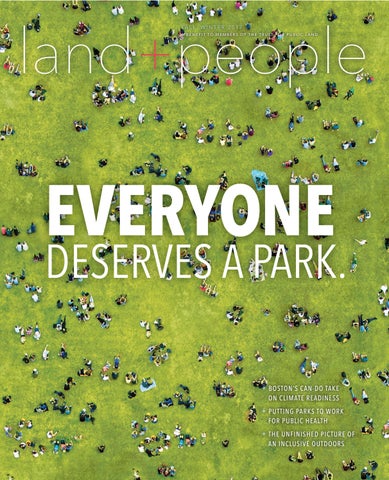
o n t h e cover Parks are where people play, exercise, and connect with nature— and each other. Everyone deserves a great park within a 10-minute walk of home. Learn more on page 31.
JOI N U S ON FAC EB O O K Stay tuned to our latest news, videos, contests, and more. facebook.com/tpl.org
20 T P L. O R G · 3
je rry an d marcy mon k man
4 · LAND &PE OPL E · FAL L /W I NTER 2017
contents
QUILL HILL, REDINGTON TOWNSHIP, MAINE Steep climbs, heavy packs, wild weather: even the toughest parts of the Appalachian Trail are worth it for views like this. We’re working to protect vulnerable land surrounding the A.T. corridor, ensuring everyone up for the challenge gets the wilderness experience they came for.
Page · 19
19
T P L. O R G · 5
p e rry smy re
6 · LAND &PE OPL E · FAL L /W I NTER 2017
contents
MILLER PARK, CHATTANOOGA, TENNESSEE Chattanooga’s reinvention as an outdoor mecca didn’t happen on its own: the city invested heavily in its parks, an effort that continues today. The city’s mayor is one of more than a hundred who’ve signed on to The Trust for Public Land’s new campaign to put a park or green space within a 10-minute walk of everyone in the country.
Page · 31
31
T P L. O R G · 7
chri stop he r t. marti n
8 · LAND &PE OPL E · FAL L /W I NTER 2017
contents
MARTIN LUTHER KING JR. NATIONAL HISTORIC SITE, ATLANTA, GEORGIA
Public lands are even more than a place to get outside—they’re a connection to our history. Sites like this one bring the past to life, put the present in perspective, and shape our vision of the future. From birthplaces to battlegrounds, The Trust for Public Land is proud to protect places that help everyone see themselves in the American story.
Page · 54
54
T P L. O R G · 9
OFF IC E R S pre si d e n t an d chie f exe c ut i ve o ffi c er
William B. Rogers vice p re s i d e n t an d d i recto r of co n s e rvat i o n fi n anc e
Will Abberger s e n i o r vi c e p re s i d e n t a n d directo r o f c i t y park dev elo pm en t
Adrian Benepe s e n i o r vi c e p re s i d e n t a n d directo r o f co n s e rvat i o n st rat eg i es
Ernest Cook s e n i o r vi c e p re s i d e n t an d d i vi s i o n d i re cto r
Jeff Danter vice p re s i d e n t an d directo r o f fe d e ral affa i r s
Kathy DeCoster s e n i o r vi c e p re s i d e n t , ge n eral co un s e l, an d sec reta r y
D. Malcolm Carson s e n i o r vi c e p re s i d e n t an d c hi e f p hi lan t hro py o ff i c er
Margie Kim
our mission:
THE TRUST FOR PUBLIC LAND CREATES PARKS AND PROTECTS LAND FOR PEOPLE, ENSURING HEALTHY, LIVABLE COMMUNITIES FOR GENERATIONS TO COME.
s e n i o r vi c e p re s i d e n t an d d i vi s i o n d i re cto r
Ann Morgan vice p re s i d e n t an d directo r o f g i s an d p l a n n i n g
Breece Robertson s e n i o r vi c e p re s i d e n t , c h i ef f in an c i al o ffi c e r, an d t rea su rer
Cynthia Scherer vice p re s i d e n t an d d i recto r of lan d p rot e ct i o n
how you can help: Our work depends on the generous support of people like you. donate: Use the envelope inside this magazine, or visit tpl.org/donate for other easy ways to give.
Brenda J. Schick vice p re s i d e n t an d directo r o f human re so u rc es
Barbara Smith s e n i o r vi c e p re s i d e n t an d c hi e f marke t i n g o ff i c er
Shannon Morgan Stearns
learn more: Get timely updates on our park and conservation work near you. Sign up for our e-newsletter at tpl.org/enews. share: Help us make the case for parks and open space. When you’ve finished reading this issue, pass it on!
s e n i o r vi c e p re s i d e n t an d c hi e f o p e rat i n g o ff i c er
Tim Wohlgenant
1 0 · LAND &PE OPL E ·FAL L /W I NTER 2017
Land&People magazine is a benefit to members of The Trust for Public Land.
from the president
a quality park within a 10-minute walk of every home in America—that’s the vision of The Trust for Public Land and the goal of a new national campaign featured in this issue of
elyse leyenberger
PARKS FOR ALL
Land&People. Already, mayors and civic leaders publisher Shannon Morgan Stearns editorial director Eliza Sarasohn
across the country have signed on to endorse this standard for park access, to ensure that every resident of every neighborhood has easy access to the countless benefits great parks provide. This issue celebrates those many benefits. On page 26, you’ll see how The Trust for Public
art director Matt Mullin
Land and The North Face are partnering to unite communities through the sport of climbing by
managing editor Alia Salim
building climbing walls in parks in cities across America. On page 41, you’ll read about how a
staff writer Julia Busiek media production manager Elyse Leyenberger senior designer Rachel Wuerstlin digital production Carrie Gotch Adele Wilson con tributing editor Bill Poole
© 2017 The Trust for Public Land. All rights reserved. Conserving Land for People, Conserving Nature Near You, Creating Parks and Protecting Land for People, Fitness Zone, Land for People, Land&People, LandVote, Northwoods Initiative, Our Land, Parks for People, ParkScore, The Trust for Our Land, The Trust for Public Land, TPL, and The Trust for Public Land and LandVote logos and all other names of The
park in Denver—recently rehabilitated by The Trust for Public Land—is encouraging health and fitness for the whole neighborhood. And on page 54, you’ll hear how the nation’s system of public
Our public lands can help everyone feel connected to our shared natural and cultural legacy.
lands can help everyone feel connected to our shared natural and cultural legacy. For nearly 20 years, it has been my privilege to lead an organization dedicated to creating parks
donors like you—we are better positioned to connect everyone to the parks and lands they need for health and well-being.
and protecting land for people. As I prepare for
Thank you for your interest in The Trust for
retirement in the spring, I am more convinced
Public Land and its work. We could not pursue
of the importance of this mission than ever.
this important mission without your support.
Whether in cities or further out of town, our
Whether you already enjoy a close-to-home
system of parks and public lands are where we
park or are working hard to create or renew
go to stretch our legs, our minds, our aspirations,
one, we hope you will raise your voice in support
our imaginations, and our sense of wonder and
of our public lands and a quality park within a
awe. These places are absolutely essential to our
10-minute walk of all. To learn more, visit
physical and mental health, the health of our
tpl.org/10minutewalk.
communities, and the health of our environment.
See you at the park!
Only a few years ago, most cities had an imperfect understanding of how well their park systems were serving residents. Today, The Trust for Public Land has mapped exactly where parks are needed to more equitably serve communities
Trust for Public Land programs referenced herein, as well as their logos, are registered or common-law trademarks of The Trust for Public Land.
and address critical public health and climate challenges. Equipped with that data—and strengthened by partnerships with civic leaders,
Will Rogers
foundations, other nonprofits, and individual
president and ceo
T P L. O R G · 11
BE A LEADER. Connect more people to nature by becoming a Conservation Champion today. With your annual leadership-level contribution of $2,000 or more in general support you will receive invitations to special events and insider updates on our park and conservation strategies.
Learn more about the impact you will have as a Conservation Champion. Call Haley Nielsen at 415.800.5189.
co ns er vat i o n ch ampi o ns t pl . o r g/ c h a m p ions | cham p ions@tp l.org
board spotlight
Get to know BOARD O F D I RECTO RS
Thomas S. Reeve
Michael E. Patterson has served on the
sara cozol in o
chair
Michael E. Patterson national board of The Trust for Public Land since 2000. He is also director of The Hastings
Stephen W. Baird
Center and USA Cycling, and serves as chair of George Bell
the board of directors of The Child School. He is Page Knudsen Cowles
a former general counsel, chief administrative William Cronon
officer, board member, and vice-chair for Douglas Durst
JPMorgan Chase & Co., and practiced law in F. Whitney Hatch
New York and Paris as a partner of Debevoise &
Christopher Lea
Plimpton. Michael graduated from Harvard
Ignacia S. Moreno
University and Columbia Law School. He lives
Caroline P. Niemczyk
with his wife, Elena, in Arizona and Connecticut,
Michael E. Patterson
and is a bicycle racer.
Jeffrey A. Resnick Laura Richards Roy Richards Jr.
I JOINED THE BOARD BECAUSE … I was inspired
THE TRUST FOR PUBLIC LAND IS UNIQUE BECAUSE ...
to join The Trust for Public Land board by a good
The impact of parks and open spaces on people’s
William B. Rogers
friend who was doing remarkable conservation
health and enjoyment of life is most pronounced in
Lex Sant
work in New York. She proved to be typical of
densely populated urban areas. The Trust for Public
the dedicated, smart, imaginative, effective, and
Land’s phenomenal accomplishments to date and po-
interesting individuals who work for the organiza-
tential for huge impact in cities distinguishes it from
Sheryl Tishman F. Jerome Tone
tion across the country. It’s a delight and inspiration
other conservation organizations—and is generating
Ana Valdez
to work with such folks and see what they can do.
enthusiasm and support across America.
Susan D. Whiting
For me, people are the key—both the people who work here, and the people in communities where
I SUPPORT THE TRUST FOR PUBLIC LAND BECAUSE …
we work.
We have a saying, “But for The Trust for Public Land”—
A GREEN ER READ
THE WORK THAT MOST INSPIRES ME IS … As an
would never have been protected.” There are so many
Land&People is printed in the United States on chlorine-free, 30 percent postconsumer recycled paper and manufactured using Envirotech™ ink, which contains a high percentage of ingredients derived from renewable resources.
exercise and health nut, I have been gratified by
“But for The Trust for Public Land” places out there
Printed by Quad/ Graphics Inc., Wisconsin.
as in, “But for The Trust for Public Land, this place
the increasing emphasis that The Trust for Public
that are the result of tenacity, ingenuity, and charm
Land is placing on the physical and psychic health
among volunteers, employees, and partners.
benefits of the parks and open space we create and protect. I believe that our emphasis is generating greater recognition of the links between parks and health in the world at large. Parks promote indispensable exercise—but also just make people feel better for being there. Green spaces are good
?
WHAT ABOUT YOU? Tell us how you connect with nature. Join the conversation on Facebook: facebook.com/tpl.org
for people in myriad ways and make a real contribution to public health.
T P L. O R G · 13
contributors
Nelson Harvey
James Edward Mills
story:
story:
story:
To Your Health
Gaining Ground
To Your Health
Theo Stroomer
54
40
Nelson Harvey is a freelance reporter and
James Edward Mills is an independent media
Theo Stroomer is a photographer from
editor who specializes in writing about food,
producer and freelance journalist cover-
Denver, Colorado. Outside of life as a photo-
agriculture, and the environment. Based
ing outdoor recreation and environmental
journalist, he enjoys hiking and mountain
in Denver, he has written for publications
conservation. He is a 2014 fellow of Mountain
biking with his family. He describes himself
including Modern Farmer and High Country
and Wilderness Writing at the Banff Centre,
as “mildly obsessed” with tumbleweeds: his
News. On the side, he works as a private
a Yosemite National Park Centennial
first book, a chronicle of the strange phe-
investigator and helps his wife, Caroline, run
Ambassador, and author of The Adventure
nomenon of tumbleweed invasions, will be
her restaurant.
Gap: Changing the Face of the Outdoors.
released in 2018.
nelsonharvey.com
joytripproject.com
theostroomer.com
EVEN MORE LAND&PEOPLE Download the free Land&People iPad app—available now at the App Store. The digital edition includes all the stories you love in high resolution, plus bonus content like video, search tools, easy social media sharing, and instant links to learn more. If you don’t have an iPad, you can access the digital edition online at tpl.org/lpdigital. Wherever you see the pointer symbol below, you’ll find bonus content in the digital edition. Download the app or go online to dive deeper into the story.
1 4 · L AND &PE OPL E · FAL L /W INTER 2017
ipa d is a registered tra demark of ap ple inc ., registered in the u.s. and other countries. app store is a service mark of apple inc.
40
mailroom
ely se l ey en b erg er
JOI N OUR COMMUNI TY We’re a one-stop shop for inspiration and information, too: we’ll keep you up to speed on political developments
rach id dah n oun
that may affect the lands you love.
GIVE US A RING!
This spring, Philadelphia staff and volunteers took city leaders and media on a grand tour of playground renovations past, present, and future—all made possible by our generous partners and supporters.
We love to listen: let us know what you think about the stories in this issue of Land&People, or tell us about the parks and playgrounds in your community. You can reach us by mail, on Facebook, or at mailroom@tpl.org.
Land for people like you S P R I N G / S U M M E R 2 0 17 A BENEFIT TO MEMBERS OF TH
E TRUST FOR PUBLIC LAND
+ In this day and age of electronics
Why the fight to save our public
and rushing to do many activities after
land is personal.
school or work, it is necessary to get away to nature. Life in the open spaces
l nd + people
+ All of our public lands, whethTHE
THE TRUST FOR PUBLIC LAND
ADVENTURE
ISSUE
S P R I N G / S U M M E R 2 0 17 VOL. 29, Nº1
+ FROM MILD TO WILD ON THE CHATTAHOOCH EE RIVER + EXPLORING CALIFORNIA’S BIG BACKYARD + FINDING PEACE IN FLY FISHING
is pure magic and refreshes the mind
er urban, suburban, rural, or
and spirit for all. Enough with the
wilderness, are treasures and
“necessity” to concrete over all things
should be cherished, protected,
wild and free. Life is too short to live
and funded generously. Likewise
surrounded by stress all the time. To
the arts and humanities. These
cross a few streets to get to a fabulous
are some of the things that
natural world is extremely special and
make life worth living.
to be treasured for all generations!
Barbara Kaye, via the blog
Kathleen Hawk, via the blog
T P L. O R G · 15
ian macl e l l an
ian macl el l an
mailroom
+ What a great true-life story! A small community with the help of The Trust for Public Land working together to create a new future. Thanks to The Trust for Public Land and to the folks in West Windsor, Vermont. This made my day. Jon Hager, via the blog WATCH THE VIDEO @
TPL.ORG/ASCUTNEY
There’s no place like home Readers tipped their hats to renowned
Owning Ascutney Many of you were inspired by the
nature photographer Jim Brandenburg,
story of West Windsor, Vermont—a
who helped us protect the Minnesota
small town that went big to save its ski
lake that inspired some of his favorite
hill.
Saw @tpl_org’s Maddy Pope leading the “10 min walk to a park” here in #Bozeman. Story Mill will have birding and bouldering!
photographs. + This approach could save many dif-
a tweet from mountaineer conrad
+ I have loved Jim’s photos for years,
ferent outdoor venues, including areas
anker (@conradanker) who joined his
and having grown up in Michigan, I too
where a single industry has been the
bozeman, montana, neighbors at a
love the upper Great Lakes. Thanks for
sole job source. If there’s a way to rein-
groundbreaking celebration for the
preserving some special areas.
vent the focus from a single snow sport
new story mill community park in june.
Lee Winslow, via the blog
to, for instance, hiking, biking, and
climb on!
+ I grew up on a grain farm on the
ture, and get people to go there to help
Canadian prairie just north of
support local economies. Doing this
Minnesota. I moved to New York City
kind of conversion beats the socks off
almost 25 years ago but I agree, the
industries that ruin the natural splendor.
beauty of tallgrass prairie and fresh
Chi, via the blog
bru ce muhlbra dt
camping … that would still maintain na-
lakes is awe-inspiring, and they are endangered. His story made me think
+ I wish many others could read this
about how to preserve some of my
message about what one Vermont
parents’ farmland as public parkland
village has accomplished—and make
when I inherit it someday. Thank you
the connection with global warming.
LAND&PEOPLE IS LISTENING!
for sharing this!
Margaret Sinclair, via the blog
Send letters to the editor or change your mailing address: mailroom@tpl.org.
Julie, via the blog 1 6 · L AND &PE OPL E · FAL L /W INTER 2017
Happy 200th birthday, Henry David Thoreau! The Trust for Public Land helped protect the Massachusetts forest celebrated in Thoreau’s classic work Walden, or a Life in the Woods.
i am grateful for what i am and have. my thanksgiving is perpetual. h enr y dav i d th o reau
turn the page for … a perfect score a sweet barbecue a darn good time T P L. O R G · 17
A taste of the tropics Just across the road from the
edible conservation
kawela bay, oahu, hawaii
food is typically more expensive here
acre swath of farmland at Kawela Bay.
clear blue waters of Kawela Bay,
than anywhere else in the country. The
“There are many reasons why it’s better
Teo Soukhaseum grows beans, peppers,
largest cargo ships belch out as much
to have more food grown here,” says
and squash in the rich soil of Oahu’s
carbon in a year as 50 million cars, and
Soukhaseum. “But if we don’t protect
North Shore. Soukhaseum and her hus-
food shipments carry pests and diseases
the farmland we have left, our industry
band have held on to a month-to-month
that have decimated Hawaii’s endemic
might not survive in this state.”
lease on their fields for more than a
wildlife and plants.
“Hawaii is at a turning point,” says
decade, selling their fresh produce at
“The push for a sustainable local food
Hong. “As land values rise, legacy pine-
roadside stands and farmers markets.
supply is gathering momentum in
apple and sugar corporations are selling
Independent growers like Soukha-
Hawaii,” says Lea Hong, Hawaii state
off their plantations across the islands.
seum have it tough here on Hawaii’s
director for The Trust for Public Land.
With every tract that changes hands, we
most populous island, where a real
“Our aim is to make sure there’s land left
risk losing more farmland to develop-
estate boom is driving up the price and
to farm.”
ment. But it’s also an opportunity to
demand for land. Most farmers don’t
That’s why in 2016 we protected the
own the fields they farm, and it’s a
fields Soukhaseum farms, part of a 469-
protect the land that sustains us, and create a healthier food future.”
money planting condos, estates, and shopping centers than papayas, mangos, and avocados. Farmers aren’t the only ones feeling the squeeze. Ninety percent of food consumed in Hawaii is grown somewhere else, then shipped in at a cost of $3 billion each year—meaning fresh, healthy
The fields Teo Soukhaseum farms on Oahu’s North Shore are now protected from development forever.
1 8 · L AND &PE OPL E · FAL L /W INTER 2017
marco garcia
struggle to find affordable, long-term leases; landowners can make more
good news
Mango barbecue sauce
jerry an d marcy mon kman
Conservationists look beyond the trail’s edge
This sweet and spicy barbecue sauce is great on pork, chicken, fish, or burgers. Ingredients O 4 ripe mangoes O 2-inch piece of fresh ginger O 2 garlic cloves O
1 Tbs. of mustard
O
1/2 cup soy sauce
O 2 Tbs. vinegar
In the Berkshire Mountains of Massachusetts, hikers on the Appalachian Trail can pause for a breath atop Warner Hill, taking in a panorama of the Housatonic Valley. But until this spring, the land just below the viewpoint was privately owned and up for sale. Developers eyed it for timber harvesting or an
O
1/4 cup orange juice
ATV park—not exactly the scene people have in mind when they set out to hike
O
1/4 cup macadamia, coconut, or olive oil
the famous trail.
O
1/4 cup honey
O 3 Tbs. brown sugar O
1 tsp. Worchestershire sauce
O 1 tsp. chopped fresh or dried rosemary O
1 hot chile pepper
O
Salt and pepper to taste
The Appalachian Trail itself is almost entirely protected. But the challenge at Warner Hill—and countless other places along the 2,190-mile corridor—is that the land beyond the 100-foot-wide right-of-way remains vulnerable to development. The Trust for Public Land has worked with communities for more than 40 years to change that. At Warner Hill, we were able to conserve the property at
Remove and discard mango skin and pit.
risk and transfer it to the National Park Service, ensuring that hikers who reach
Mince ginger and garlic. Combine all ingre-
the summit are rewarded with the unspoiled views they came for.
dients in a blender and puree. Transfer to a stock pot and heat to boiling,
In the New Hampshire town of Hanover this year, we also helped protect an Appalachian Trail access point at Hudson Farm. Says Town Manager Julia Griffin,
then lower heat to a simmer and cook until
“Thousands of people work and live near Hudson Farm. We’re proud that it will
reduced in volume and thickened to desired
become a permanent part of open space.”
consistency. Season with salt and pepper to taste. Use immediately or keep refrigerated for up to a week. Adapted from a recipe by Kumu Aina Farm
Warner Hill and Hudson Farm are part of a larger effort—250,000 acres and counting—to safeguard the Appalachian Trail. “We’re looking at it as a broader landscape,” explains The Trust for Public Land’s J.T. Horn. “We’re figuring out what we need to do to protect the wilderness experience—and the health of the ecosystems that Appalachian communities rely on.”
F I R ST LO O K · 19
For imagining better parks, art works
adair f reeman rut l edg e
good news
Kiwanis-Methow Park Some parts of park design–
are more likely to use and care for plac-
setting the right width for a walking
es they helped dream up themselves.
path, using landscaping to prevent
“When people hear ‘planning meet-
flooding—are more like a science. But
ing,’ the first picture that comes to
creating a place that feels inspired?
mind is someone at the front of a room
That’s an art.
in a suit, pointing to a chart on a poster
That’s why The Trust for Public Land
board,” says Terry Valdez, an artist
partners with artists to help neighbors
we’re working with in Wenatchee,
get creative during the planning pro-
Washington. “But when we include an
cess. Before we break ground, we host
art project at a meeting, suddenly peo-
months of block parties, brainstorming
ple are talking to each other, helping
sessions, and other gatherings—often
each other, asking questions, sharing
with more craft supplies than blueprints.
ideas—art can make planning a park a
Art fuels conversation, which pays off in
really fun, fruitful, organic experience.”
the long run: after all, we know people
2 0 · L AND &PE OPL E · FAL L /W INTER 2017
Wenatchee, WA
Bright ideas In Wenatchee, an agricultural community in eastern Washington, Terry Valdez brings hands-on art projects to planning sessions for Kiwanis-Methow Park—an underused green space slated for a redesign. At one event, neighbors painted flowers to brighten up the chain-link fence. “The mayor himself painted more flowers than anybody,” says Valdez. “He kept saying he didn’t want to put down the brush!”
word watch
gamar markarian and mateo f ern án dez- muro for t h e restored spaces initiative of mural art s ph il adel ph ia
Here are just a few Trust for Public Land projects in the works with extra creative flair.
All aboard At Philadelphia’s Southwark School, a team from Mural Arts Philadelphia invented a board game to help students, parents, and neighbors come up with ideas for the school’s future playground. It’s Monopoly and Apples to Apples—
swing
with a park-themed board and
\Ӥswiж\
been described as a cross between
fill-in-the-blank cards that prompt players to imagine the schoolyard
(n.) In the sport of crew, the blissful state
of their dreams.
when every athlete in the boat is working
Southwark School
together in perfect unison.
Philadelphia, PA
alissa boochever
When the Connecticut town of Stonington set out to create a new park and public boathouse on the Mystic River,
Bundle up
the effort benefitted from the discipline
San Francisco’s notorious fog isn’t
of the local high school crew team. “Our
the reason trees in Civic Center Plaza sported sweaters this summer: they’d
kids went to town council meetings,
been “yarn bombed” by artists Lorna
stood out front of shops and talked to
and Jill Watt, who spent a few hours
people, and held fundraisers,” says their
each week out knitting and chatting
director, Mike O’Neil. “It was a success
with curious passersby. It’s an offbeat approach to gathering input into efforts to rethink this sometimes-ma-
only because so many people worked together to see it through. We want our
ligned public space. “We’re catching
kids to see that if they can dedicate them-
people’s attention, that’s for sure,”
selves to finding their swing on the water,
says Lorna. “When they stop to ask
those lessons carry beyond the boat.”
what I’m doing, it’s a chance to fill
Civic Center Plaza
them in and get them thinking about
San Francisco, CA
what changes they’d like to see here.”
learn more @ TPL.ORG/MYSTICRIVER
F I R ST TLO P L. OORK G · 21
what counts
good news
At the end of the line, an unlikely new park
100
rich reid
quinc y stamper
eric low en bach
San Francisco Mayor Ed Lee announced the city’s perfect score from Hilltop Park, newly renovated with help from The Trust for Public Land.
be fore
%
a fte r
On Earth Day, we joined thousands of neighbors in celebrating the grand opening of the Los Angeles State Historic Park—a former rail yard converted into a 32-acre expanse of lawns, wetlands, and trails in the heart of the city. The park is the culmination of a campaign that residents of nearby Chinatown and Solano Canyon launched nearly 20 years ago to bring more green space to their dense neighborhoods. The Trust for Public Land
… of San Francisco residents now live within
helped purchase and clean up the property, an abandoned rail yard that at
a 10-minute walk of a park or open space,
the time was slated for a warehouse development.
ParkScore® index. Though it’s the first major
Artist Rosten Woo wanted to make sure that park visitors won’t forget the long journey. His installation, “A Park is Made By People,” is a cluster of colorful signs that honor
metro in the nation to hit this milestone,
the protests neighbors held
Mayor Ed Lee gave no indication the city
when they learned of plans to
plans to rest on its laurels. “We are maintaining our record investment into our
liz ohanesia n
according to the 2017 Trust for Public Land
develop the land. “When you go to a park like this, it just feels like a given, like it was
local parks so that all San Franciscans can
inevitable. What else could
continue to enjoy our wonderful natural
this ever have been?” says
environment,” he said.
Woo. “But it began as an idea— and then through so much work, struggle, and effort, it
learn more @ TPL.ORG/SFPARKSCORE2017
became reality. That this park exists today is a living embodiment of democracy.”
2 2 · LAND &PE OPL E ·FAL L /W I NTER 2017
Public art honors the spirit of grassroots protests that saved the land from development.
The mystery in the ruins of AN ANCIENT PUEBLO
good news
If you lived in the 14th century in what we now call New
the people who lived here might have decided to start over
Mexico, you would have spent countless hours gathering food
elsewhere.”
to stockpile for lean times. What would make you burn your whole storeroom down?
Snead says he favors this explanation, but, “if you ask ten archaeologists about this, you’ll find five who disagree with
That’s the mystery at Burnt Corn Pueblo, south of Santa
you.” More interesting than the answer, to Snead, is the oppor-
Fe. For James Snead, a professor at California State University,
tunity—rare in the field of archaeology—to question a single
Northridge, the site holds clues about what life was like here
moment in time.
more than 700 years ago.
Another turning point in the long history of the Burnt Corn
Using tree-ring dating, or dendrochronology, archaeolo-
Pueblo came this year, when The Trust for Public Land helped
gists tested the charred remains of pueblo roof supports and
transfer an unprotected portion of the site to the Bureau of
concluded that it was early in the 1300s when the village
Land Management. Widely supported by pueblo tribal govern-
was destroyed by fire. But though dendrochronology can tell
ments in the region, the move clears the way for future access
archaeologists when the pueblo burned, it can’t tell them why.
to adjacent public land for hikers, bikers, and horseback
Snead thinks wildfire is unlikely, because the area near the
riders from the growing Santa Fe metro area. A watch group
village would have been stripped of fuel by people gathering
made up of volunteers and retired archaeologists will work to
firewood. Plus, archaeologists have built and burned replica
keep the site secure.
pueblos—and they’re actually pretty hard to destroy. Was it an act of war? Petroglyphs in the area depict violence,
“Sites like this are vulnerable,” Snead says. “All it takes is someone with 15 minutes and a shovel to do tremendous dam-
but other indications of a battle are absent. “The site has a
age to places like this that help us understand the past. Public
neatness to it. It’s possible that the people of Burnt Corn did
ownership, management, and protections tend to be a pretty
this deliberately,” Snead says. “In some interpretations of a
good solution for caring for our archaeological resources.”
eddie moore
traditional Pueblo worldview, if bad things were happening,
Petroglyphs and tree-ring dating offer clues for curious archaeologists.
F I R ST LO O K · 23
buzzworthy
meet our staff
eric l aycock/ esri
“The tools just didn’t exist— so we built them.”
“Urban parks serve as green engines to help address nearly every critical urban need.” —Nanette Barragán
BREECE ROBERTSON THE TRUST FOR PUBLIC LAND’S GIS WHIZ PUTS PARK EQUITY ON THE MAP.
What is GIS? GIS stands for Geographic Information Systems. It’s basically Google Maps on steroids: it’s a sophisticated software that allows users to plug in any kind of spatial data you can think of—population density, demographics, natural resources, climate, land use, traffic patterns. We can then plot all that data on the same map in a way that reveals patterns, uncovers problems, and tells a cohesive story about a place.
What does it take to succeed in this field? You have to be inquisitive, innovative, and creative: it’s not enough to understand the data, it’s about presenting it so that people will understand
U.S. House Representative Nanette Barragán of California spoke up for the Land and Water Conservation Fund—and the thousands of city parks it has helped create—in a June committee meeting.
the story you’re trying to tell. And you need a sense of humor! This kind of work takes patience.
How has GIS changed the way The Trust for Public Land works? When I started here back in 2001, I’d go digging through old boxes and find maps on torn-out journal paper, maps drawn with crayons, maps on bar napkins … a far cry from GIS! The whole field of conservation was more reactive back then. We were saving land and building parks in areas that we knew needed them based
2 4 · LAND &PE OPL E ·FAL L /W I NTER 2017
on our longtime knowledge, relation-
How did you do that?
ute walk. The tool will enable anyone
ships, and experience in the places we
Our team has spent the past three
from city officials and urban planners to
work. But we didn’t have the data we
years gathering spatial data on parks
students and grassroots neighborhood
needed to be truly strategic and proac-
and population from 14,000 cities and
activists to envision and advocate for a
tive in our approach.
towns across the country, encompass-
park in their neighborhood.
How does GIS make conservation more strategic?
We’re bringing all that data together
The Trust for Public Land has always
free, comprehensive online platform for
Why is it important for people to be able to visualize data like that?
prioritized equity in park access—mean-
urban parks. Now that the data is all in
I see it all the time: when people are
ing that we strive to create parks in the
one place, we know where people have
talking about concepts and places, ev-
neighborhoods that need them most.
easy access to a park, at any scale, from
eryone has their own idea of where the
But how do you measure need? It’s a
the national down to the neighborhood
problem is or where the park should
complex issue, but GIS analysis helps us
level.
go. But when you throw a map down on
ing 80 percent of America’s population. into a tool called ParkServe—the first
the table, it brings everyone together.
zero in on the places with the highest income, greatest number of children
Seems like a lot of work to answer one question!
and seniors, and biggest public health
That’s what’s so innovative about Park-
of what they want their community to
challenges.
Serve: now that we’ve collected the data,
look like—of how they want to tackle
population density, lowest household
It helps get everyone working on the same page and creating a shared vision
When we are working with a com-
put it all online for free, and created
the challenges they’re experiencing. It’s
munity to build a park, we can also look
analytical tools that anyone can use—
like something happens to our brains
at factors like traffic, sidewalks, heat is-
there are no limits to the questions you
when we look at a map. It gives us the
lands, and public transportation—even
can ask. Doctors can use it to find parks
perspective we need to better under-
crime rates and access to healthy food.
near their patients’ homes, so they can
stand our world and each other.
GIS helps us determine exactly where in
encourage people to get more exercise
a certain community we should build a
outside. There’s a function that allows
park so that the most people can use it
you to draw a shape anywhere on the
safely. And as the technology improves,
map, then hit “Go,” and it’ll tell you—if
we’re constantly finding more ways to
you were to build a park in that shape—
ask questions of the data.
how many people live within a 10-min-
Access to data has changed the planning process, helping communities prioritize new parks in the neighborhoods that need them most.
jenna stamm
What are some of those big questions you’re asking? Our vision is to build a park within a 10-minute walk of every person in every American city, starting with the areas of greatest need. But we’ve never known the scope of the problem we’re trying to solve—that is, in the nation as a whole, how many people live within a 10-minute walk of a park and how many don’t. How can we solve a problem if we can’t even measure or describe it? The tools just didn’t exist—so we built them.
F I R ST LO O K · 25
Some people build walls. Other people climb them. We’re doing both. The North Face is donating $1 million to The Trust for Public Land to help build public climbing walls in U.S. communities. Visit thenorthface.com/walls to learn more.
insight
insight:
Austin Blackmon Boston’s climate chief on the role of cities in a global challenge
IN THE NATION’S CAPITAL, politicians are questioning the need to take action on climate change—even whether it exists at all. But travel up the coast to Massachusetts, and you’ll find a different conversation underway. In the coming years, residents here expect rising seas, more powerful storms, and dangerous heat waves— and they expect the government to act. As Chief of Environment, Energy, and Open Space for the City of Boston, Austin Blackmon is among those facing up to the task. Under Mayor Marty Walsh, he’s directing the city’s effort to prepare for a more volatile climate future. No surprise to this savvy city, parks and green space figure prominently in the plan.
What did you think when you learned about the U.S. withdrawal from the Paris climate accord? At first I was taken aback. But the more I’ve thought about it, the more I’ve come to believe that Washington, DC, won’t be able to stop what we’ve already started. We may have to go
evgenia eliseeva
down different routes to get the work done, and we might not have some federal funding that could have accelerated it, but our goals haven’t changed. It’s a setback—not a reset.
T P L. O R G · 27
Do cities have a role to play in addressing climate? Absolutely. Mayor Walsh leads a group of U.S. mayors working together on climate issues. Before the federal government withdrew from the Paris agreement, we had about 50 cities on board. Now, there are more than 300—Republicans and Democrats, all searching for opportunities for collective action. There’s been a groundswell of support for our climate
“There’s been a groundswell of support for our climate goals.”
goals from residents of Boston, and from leadership at every other level of government across the country.
How are the effects of climate change felt in Boston?
Can a city make a dent in such a global problem?
The Boston metro area is among the most vulnerable to sea
With a pretty good understanding of which areas are most
level rise—not just of cities in the United States, but in the
vulnerable to flooding, we’re now working toward shovel-
world. A third of our landmass sits on fill, and we’re finding
ready projects in places like East Boston and Charlestown to
that many of those fill areas are already getting hit with flood-
protect residents and property. Those projects will include
ing. The relative sea level in Boston Harbor is 10 inches higher
some traditional flood control features, but we’re also plan-
than it was 100 years ago—the filled areas are sinking as the
ning green infrastructure improvements like wetland restora-
waters are rising. And as global carbon emissions continue to
tion and new open space along the shoreline to absorb water.
rise, so does the high tide line.
Are your preparedness plans all about sea level rise? What are projections for the future?
Sea level rise gets the most attention, but urban heat islands
By 2070 we’re expecting seas to have risen by at least three
are also a significant concern here in Boston—especially since
feet, putting 12,000 more Boston buildings—$85 billion worth
the hottest parts of our city are home to a higher proportion
of assets—in the floodplain. Analyses suggest that by the
of low-income people, children, seniors, and folks with medi-
end of this century, we’d sustain annual flood damages of
cal conditions that are exacerbated by the heat.
$1.4 billion in today’s dollars. That’s almost half the city’s
A hundred years from now, Boston may well feel more
annual budget. That gives us an idea of what we should be
like Birmingham, Alabama, in the summer. So our citywide
willing to spend to protect ourselves—even before taking into
master plan is guiding us toward investments in heat island
account our responsibility to protect Boston residents.
mitigation strategies: planting more trees along our roadways, investing in the parks and open spaces we already have, and
Healthy wetlands provide rich habitat for wildlife—and form a buffer against flooding. As the climate changes, restoring these natural systems could help protect vulnerable, low-lying cities.
improving biking and walking infrastructure to encourage people to choose human-powered transportation.
How do you make the case for parks in the face of other priorities, like housing and transportation? jerry and marcy monkman
In the master plan, our investment in parks is actually directly tied to our goals for affordable housing and transportation. We see all these things working together, and we know our city can’t thrive without all of them. Right now, more than 90 percent of Boston residents live within a 10-minute walk of a park. That’s phenomenal. But as the city continues to grow and get denser, we know more people will be relying on our parks to meet their basic needs for space and fresh air—because backyards will be harder to find and afford.
2 8 · L AND &PE OPL E · FAL L /W INTER 2017
The City of Boston has good reason to make climate change a priority: in the next half-century, it expects thousands more of its buildings will be at risk of flood damage.
So, green space is part of public health infrastructure.
How did you get into public service?
Yes. And not only are great parks important for physical
When I was in college, I interned for a summer in the office
health, but they’re key to the civic health of neighborhoods
of a young senator from Illinois named Barack Obama. As
and the city as a whole. Parks are one of the rare places
the internship wound down, he sat down with his staff and
where neighbors can really connect—and as we plan for the
offered us some parting advice. He said, “Listen: if you really
future of the city, we need those community connections. We
want to make a difference, make sure you understand three
rely on engaged, active neighborhoods to guide our work.
things: energy, education, and national security.” I took that to heart, and throughout my career I’ve worked in each of
What do you do in your own daily life to make Boston a greener city?
by the energy industry. When I met with Mayor Walsh and
Well, I literally walk the walk: I live close to work so I can
heard what he wanted to accomplish around climate, energy,
walk there every day. When I do have to drive for my job, I
and sustainability, I knew I could make an impact.
those areas in different capacities—but I became fascinated
take one of the city’s fleet of hybrid vehicles. When I’m at home, I take the same steps that I encourage our residents to
Last question: what’s your favorite Boston park?
take—things like using LED lightbulbs.
That’s like asking a parent to pick their favorite child! We’re
But I think it’s not just what you do. It’s about inspiring
fortunate to have some world-class parks in our city. But one
people in your life who might want to take action but not
that’s special to me is Christopher Columbus Park. It’s like
know where to start. My parents fell into that category—so
the intersection of my priorities: it’s open space for people
this year for Mother’s Day and Father’s Day, they were the
to enjoy, but it’s also right up against the harbor, and will
proud recipients of programmable thermostats. Just the other
be one of the first areas in Boston affected by sea level rise.
day I got a text from my dad saying how thrilled he was that
Spending time out there is a reminder of why we need to
his kicked on to cool the house down just before he got home,
act—not only to protect our buildings and residents, but for
instead of running all day. Now that I’ve helped them take
our open spaces, too.
those first steps and they’ve seen their electric bills go down, they’re asking me, “What’s the next thing we can do?”
I NT SI P L.G OH R GT · · 29 29
Double your impact today! This year, an anonymous donor will generously match your gift—dollar-for-dollar—if you send it before December 31. Your donation will go even further to help The Trust for Public Land protect more parks, gardens, and other natural places. That’s one good thing made that much better.
fig. 2
good.
better.
Give your EarthShare.
3 0 · L AND &PE OPL E · FAL L /W INTER 2017
800.714.5263 donor.outreach@tpl.org tpl.org/match
An EarthShare payroll deduction is one simple way to donate to The Trust for Public Land or more than 400 other environmental and conservation charities. Many corporate and government employers support EarthShare payroll giving. If yours doesn’t, ask them to start. If they do, simply decide on a single deduction or a recurring small one from every paycheck. Then designate us, member number 11440, as one of your conservation charities. For more information visit earthshare.org or email donor.outreach@tpl.org.
alex diekmann
fig. 1
EVERYONE DESERVES A PARK.
s
tudies show that parks are To the people who have them, parks provide essential to the physical, social, FRXQWOHVV EHQHƓWV )URP SLFQLFV EDOOJDPHV DQG environmental, and economic health of a community. If you’re SOD\JURXQGV WR UXQQLQJ F\FOLQJ RU MXVW VLWWLQJ lucky enough to live within easy quietly on a bench in the shade, parks are where walking distance of a great one, then you’ve probably seen how SHRSOH JR WR UHOD[ SOD\ DQG FRQQHFW WR QDWXUHŋ parks improve quality of life for the whole neighborhood. But if you live and each other. in one of the many cities where
ma rie d . d e jesus
great parks are too few and far between, you know just how hard it can be to find a place to get outside. T P L. O R G · 31
1 IN 3
AMERICANS DON’T HAVE A PARK WITHIN A 10-MINUTE WALK OF HOME.
That’s according to The Trust for
more than 42 million Americans—
Public Land’s ParkServe tool, which
have already signed on.
maps park access in nearly every
In the following pages, you’ll
municipality in the country. In
hear from people in five very differ-
many cities—from Indianapolis to
ent cities across the country as they
Oklahoma City—more than half of
visit their nearest park—or, in one
residents have no parks nearby.
case, the site of a future park The
That’s why The Trust for Public
Trust for Public Land will open next
Land—in partnership with the
spring. While their experiences
National Recreation and Park
vary, each person featured shares
Association and the Urban Land
our conviction that quality parks
Institute—is launching a nationwide
are essential—and that everyone
campaign to ensure that everyone,
deserves a great park within a
in every neighborhood, in every city
10-minute walk of home.
across America, has a park within a We’re challenging mayors to commit to making the 10-minute walk to a park the standard for all residents in their city. From Los Angeles,
IF YOU AGREE, JOIN US. Visit tpl.org/10minutewalk to see how well your city meets the mark for park access—and help us bring
to Atlanta, to New York, mayors in
parks to the neighborhoods that need
more than 100 cities—representing
them most.
3 2 · L AND &PE OPL E · FAL L /W INTER 2017
c hris loupos
10-minute walk of home.
1 0 - M I N U T E WA L K
NEW YORK, NY POPULATION:
RESIDENTS WITHIN
THE LOCAL:
THE PARK:
8.5 million
A 10-MINUTE WALK
Tyghe Trimble, urban athlete and writer/editor
Prospect Park
OF A PARK: 97%
Tyghe Trimble
picnics, and paved spaces for weekly
to seek solitude. More than
farmers markets. Many of the people I
8 million people visit here every year,
see are headed for one of these gather-
and a quarter million or so, like me, live
ing spots.
within easy walking distance. As I pass
But my run today takes me to the
the 9th Street entrance, running alone,
main road around the park. Usually
enough—when most of the city is still
I am keenly aware of this. I notice: a
closed to cars, it’s a fitness superhigh-
sleeping—and you’ll find large groups
shirtless man in cutoffs, a tapestry of
way: you’ll find several sweaty tribes
of them pointing to treetops, taking
tattoos adorning his back and arms; a
here—competitive cyclists on the
notes, and conferring with each other
group of kids dragging a battalion of bal-
outside, prosaic bike commuters in the
in reverent tones.
loons; a spandex-clad man clattering
middle lane, and an army of runners
The migration season can bring
awkwardly in cycling shoes as he
on the inside. You enter the circle,
more than 100 species of birds in a day
pushes his bike down the paved path;
surrounded by people of varying speeds,
to Prospect Park. They join us—the
and a woman with a sleepless stare,
and find your orbit—then loop the park
runners, picnickers, and amblers, the
walking behind a silent stroller.
like a satellite around a planet.
people coming from subways or parking
The park has layers, like an onion. On
I peel off onto a freshly mulched trail
the outside edge you’ll find playgrounds,
leading to the park’s interior. I pass a
historic buildings, an amphitheater
couple with binoculars, casual birders
for big concerts, a Greek pavilion for
enjoying a slow afternoon. Come early
spots or homes nearby—a flock called by the same song.
photos by: chris loupos T P L. O R G · 33
GR E E N E R N E I G H B O R H O O D S A R E A S S O C I AT E D W I T H LO W E R M O RTA L I T Y R AT E S . EN VI RO NMEN TA L HE ALT H P ER SPECT I V ES, VO L.1 24, NO. 9.
P
rospect park is not exactly a place
Jose Silva
VENTURA, CA POPULATION:
RESIDENTS WITHIN
109,592
A 10-MINUTE WALK OF A PARK: 59%
3 4 · L AND &PE OPL E · FAL L /W INTER 2017
THE LOCAL: Jose Silva, father and urban planning graduate
THE PARK: Kellogg Park
1 0 - M I N U T E WA L K
M
y son, thiago, is three years old—he doesn’t sit still for a minute. He wants to be running, kicking
a soccer ball, riding his scooter, playing on the beach … anything active is what he’s all about right now. We live in Ventura, California, north of Los Angeles. My family migrated here from Mexico when I was nine years
old. What I liked best about growing up here was enjoying walks to the beach—where I came from before, I never knew what the beach was like. Even today, nature is really important to me because it’s a place where you can escape, go and be yourself, de-stress. My wife, Angelica, and I try to get outside with Thiago every day because that’s where he’s happiest—and because it gets him tired! But in our neighborhood, the closest park with a playground for kids Thiago’s age is a 40-minute walk along a four-lane road. It’s far for Thiago, and I worry about him running out in traffic. We usually get in the car and drive somewhere instead. So when I heard that The Trust for Public Land was working to build a new park right in our neighborhood, I wanted to get involved. I studied urban planning in college, and we learned how parks give people a place to get together. Our neighborhood needs and deserves that. I want Thiago and the other kids in our community to have a safe place to play in nature and make new friends. At the groundbreaking for the new park, they had a Chumash tribe blessing the land—saying thank you for the space. It was so exciting—seeing everyone who came to the event and participated. When the park opens in the spring, I think it’ll make a big difference for me, my family, and our community. photos by: plus m productions TTPPL. L.OORRGG ·· 35 35
E XP O S U RE TO G RE E N S PACE CAN BO O ST CO G N ITIVE D E VE LO P M E N T I N C H I L D R E N . PR O C E E D I N G S O F T H E N AT I O NA L ACA D E M Y O F S C I ENC ES O F T HE UNI TED STATES O F AME RI CA , VO L. 112, NO. 26.
“When I heard that The Trust for Public Land was working to build a new park right in our neighborhood, I wanted to get involved. “
1 0 - M I N U T E WA L K
CLEVELAND, OH POPULATION: 385,809
RESIDENTS WITHIN A 10-MINUTE WALK OF A PARK: 80%
THE LOCAL: Nelson Beckford, community advocate at the St. Luke’s Foundation
THE PARK: Towpath Trail trailhead
Nelson Beckford
“T
rees and parks are boring.” I have to admit—that’s some-
As an introvert, I need alone time
made it obsolete. A half-century after the
to process my world. So my walks
canal was abandoned, it was declared a
thing I might have told you, at one
and time on the trail became part of
historic landmark. And eventually, park
point. I used to say to myself, I don’t
a weekly physical and mental health
districts stepped up to manage it for
fish or hunt; parks are not for me. What
regimen. The more I paid attention
recreation.
does anyone do with a bunch of trees
to the rhythms of nature, the more I
Now when I use this trail I see its
and trails?
noticed the diversity of trees and of
past alongside its present: people biking,
But then I moved, from one Cleve-
the wildlife. I found that nature is far
fishing, picnicking, birding, geocaching,
land neighborhood to another just min-
from boring: there is more to it than
and running. I’m reminded of how the
utes from the northernmost trailhead
first meets the eye.
land adapts to the needs of the times—
of a network that connects to Cuyahoga
That’s true of the trail itself, too. It’s
and how I’ve adapted, too. These days
Valley National Park. With the trail so
called the Towpath Trail because mule
I’m used to having green space close to
easy to use, I figured I might as well …
teams once used it to tug barges up
home, and it motivates me in my work
and the more I did—to bike, to hike
the canal connecting the Ohio River to
for people in Cleveland neighborhoods
with my son and wife, to take photos—
Lake Erie. The canal helped make the
where some kids don’t even have a safe
the more I grew to love it.
state prosperous—until the railroads
place to play outside. photos by: brittany graham
3 6 · L AND &PE OPL E · FAL L /W INTER 2017
1 0 - M I N U T E WA L K
CHATTANOOGA, TN POPULATION: 177,571
RESIDENTS WITHIN A 10-MINUTE WALK OF A PARK: 36%
T
THE LOCAL: Ry Glover, outdoor travel expert at RootsRated.com
THE PARK: Miller Plaza and Miller Park
Ry Glover he story of my hometown in a nutshell is this: it was once the
“Dynamo of Dixie”—a railroad and industrial town that boomed during the first half of the 20th century, then busted. By 1969, it had been labeled the dirtiest city in America. But then something happened. In the early 1990s, like a phoenix from the ashes, Chattanooga was reborn. At the heart of the renaissance was the city’s investment in green spaces and public parks: from historic sites like Lookout and Signal Mountains, to the Tennessee Riverwalk—a linear park snaking 13 miles from Chickamauga Lake to the downtown riverfront and the old steel mills beyond. Today the city is known for outdoor recreation and attracts newcomers who want to be able to get outside without traveling far from home. From my
As a child I would play in the fountains
when I learned the reason—an upgrade
small apartment downtown, I can walk
and listen to the sounds of Nightfall, a
set to be unveiled next year—I could
to no fewer than 15 parks within 10
summer evening concert series hosted
see the temporary inconvenience as
minutes. My favorite is a block away—I
at the plaza for more than 30 years
just another part of Chattanooga’s
can see it from my window.
now. And these days, I often stroll to
reinvention: both a cause and an effect
Miller Park to read a book in the sun or
of the city’s new green identity. This
people-watch.
symbiosis between parks and progress
It’s actually two adjacent parks: Miller Plaza and Miller Park. The former is shinier and privately owned
Recently I arrived to discover Miller
(though open to the public); the latter
Park surrounded by construction fenc-
is older and more run-down. Though
ing, workers drilling and swirling up
they’re very different, I appreciate both.
dust. At first I was disappointed, but
is one I’m proud my hometown has embraced.
photos by: perry smyre T P L. O R G · 37
3 52;,0,7< 72 $ 3$5. ,6 $ 6 6 2 &,$7( ' : ,7+ $ /2 : ( 5 5,6 . 2 ) '( 3 5 ( 6 6 , 2 1 T H E J O U R NA L O F M E NTA L H E A LT H PO L I CY A ND E CO N O M I C S , VO L. 17, NO. 1.
1 0 - M I N U T E WA L K
Andrea Baldwin
HOUSTON, TX POPULATION: 2.3 million
RESIDENTS WITHIN A 10-MINUTE WALK OF A PARK: 47%
M
y steps are cautious and as heavy as the humidity on this July
THE LOCAL: Andrea Baldwin, professor and star of the one-woman show, “Lone Star Feminist”
THE PARK: Menil Park
pierce the concrete sidewalk, creating small inclines and unexpected chunks
afternoon. Within seconds of stepping
of concrete jutting up and out of place.
outside, tiny prickles of sweat emerge
The defiant trees could not be forced
on my cheeks and chest, beads that will
into submission by our desire for per-
grow and become my companions on
fect pavement. The tangle of roots and
this short walk. Whenever I pass
ruptured concrete seems to resemble
another person, I notice their compan-
our own coexistence with nature, the
ions, too: they present themselves on
careful balance—or perhaps imbalance—
faces and stained shirts. In Houston we
of the city and the wild.
all learn to carry them, this time of year. The seven-minute walk from my
When I reach my destination, I find a spot and lie out on a blanket. Menil Park
home to Menil Park is green with
is next to the museum that bears the
moss growing on buildings and palms
same name; it hosts a large sculpture
tickling the sky. The live oaks make the
and one red swing hanging from an old
journey an obstacle course. Their roots
oak tree. Today it is mostly vacant. The
3 8 · L AND &PE OPL E · FAL L /W INTER 2017
“This is my space on Sunday afternoons. Sometimes I write in my journal or read, sometimes I lie with headphones on, escaping into a podcast or audiobook, and sometimes I just … listen. “
what’s behind the
Even if you love getting outside, you know there's a big difference between a park down the street and one across town. If a trip to the park means waiting for the bus—or packing the family into the car and sitting in WUDIƓFŋLW EHFRPHV IDU OHVV SUDFWLFDO WR visit regularly. So how close is close enough? 0RVW ODUJH FLWLHVŋƐƉ RI WKH ELJJHVW ƊƉƉ E\ RXU ODVW FRXQWŋVHW D VWDQGDUG E\ GLVWDQFH RI WKRVH ƏƊ SHUFHQW GHƓQH ŏFORVHŐ DV ZLWKLQ D KDOI PLOH Though walking speeds vary, the Department of Transportation agrees that people typically walk about three PLOHV SHU KRXU FRYHULQJ D KDOI PLOH LQ DERXW ƊƉ PLQXWHV
3 MILES 1 HOUR
recent thunderstorm may have scared
=
0.5 MILES 10 MINUTES
others away. In our experience building parks
This is my space on Sunday afternoons. Sometimes I write in my
around the country, we've found that
journal or read, sometimes I lie with
makes sense—so long as we're talking
headphones on, escaping into a podcast
D KDOI PLOH RQ SXEOLF URDGV DQG SDWK
or audiobook, and sometimes I just …
ways. (A great park a hundred yards
listen. I embrace the sound of the birds,
away doesn't do you much good if
the occasional car passing by or plane
those hundred yards cross private
flying overhead. We all seem to be in
property or a busy freeway.)
negotiation, a back and forth between the urban and natural, trying to be
“We developed the 10-minute walk as the gold standard for parks. It’s a primary indicator of livability in a city.”
heard and trying to be received. In my city park, I am a witness and participant in it all.
photos by: marie d. de jesus
Adrian Benepe, Director of City Park Development, The Trust for Public Land T P L. O R G · 39 TP
story by Nelson Harvey | photos by Theo Stroomer
to your
Community wellness depends on having somewhere to get outside—but that’s harder to find in some neighborhoods than others.
4 0 · L AND &PE OPL E · FAL L /W INTER 2017
da rc y kief el
darcy k ie f e l
Though there’s a park right across the street from Geraldolyn Horton-Harris’s home, it hasn’t always been a place she wanted her grandchildren to play.
It was the spring of 2013, and Geraldolyn Horton-Harris was fed up.
H
orton-Harris was living in public housing in the
has lived in the community for more than two decades. “We
Curtis Park neighborhood, just north of downtown
actually saw a trend of families choosing to leave because they
Denver, Colorado. She shared the apartment with
felt their children didn’t have a safe place to play,” he says.
her three grandchildren and two daughters, both of whose husbands were in the U.S. Army and had recently deployed to
Even as some longtime residents moved away, a new wave of young, wealthy residents was arriving, drawn to Curtis
Afghanistan. Though Horton-Harris lived directly across the
Park’s stately architecture and proximity to restaurants, bars,
street from Mestizo-Curtis Park—the city’s oldest—she never
coffee shops, and downtown Denver. Unaware of the neighbor-
let her grandchildren play there. After decades of neglect, the
hood park’s checkered history, they used it freely. Newcomers
playground equipment had grown old and rusty. Horton-Harris
and old-timers rarely interacted in the park: with few other
and her neighbors witnessed drug deals in the park and were
public spaces, the changing neighborhood in effect had no
wary of its history: in 2008, an 8-year-old girl walking nearby
common ground.
was critically wounded in a drive-by shooting.
Nevertheless, Horton-Harris chose to stay. Through her work
“The fact that my sons-in-law were over in Afghanistan risk-
as a coordinator for the nonprofit LiveWell Colorado, she met
ing their lives for this country, and yet their children didn’t
The Trust for Public Land’s Emily Patterson. Even as the two
even have a decent place to play in their neighborhood here at
women discussed the park’s less-than-stellar reputation—and
home—that really upset me,” Horton-Harris says. Some days,
the growing disparity between longtime neighborhood resi-
the family would Google “best parks in Denver” and drive the
dents and newer arrivals—they found they shared a belief that
children to other neighborhoods; other days, dozens of neigh-
the large, historic public space still held great potential.
borhood kids would gather to play in their front yard—instead of venturing into the park across the street. Horton-Harris wasn’t the only one feeling frustrated. John Hayden, the head of the Curtis Park Neighbors Association,
T P L. O R G · 41
“The nation spends billions of dollars trying to improve people’s access to healthcare, but we also need to start looking at where people live—where they work, where they go to school, and where they play.”
4 2 · L AND &PE OPL E · FAL L /W INTER 2017
The way a neighborhood is built can encourage residents to walk, bike, and get outside—or not.
D
enver has a reputation as an outdoorsy town, the kind of city whose residents flock to the mountains to ski, bike, hike, camp, and fish. But for
those who can’t afford the weekend-warrior lifestyle, getting
outside means a trip to the local park—and that’s tougher in some neighborhoods than others.
A growing number of doctors are recognizing that regular visits to a park can actually help prevent or treat conditions
That disparity is not just an inconvenience: it has implica-
such as obesity, diabetes, and high blood pressure. Margaret
tions for residents’ health. Studies show that access to parks
Dekoven, a physician’s assistant at Kaiser Permanente’s Lake-
strongly encourages regular physical activity, particularly for
wood Medical Offices just west of Denver, often recommends
people without gym memberships. A 2002 review of 10 studies
daily time in nature to patients. When they ask her why, she
published in the American Journal of Preventive Medicine found
points to data linking time spent outdoors with lower body
that new venues for physical activity or improved access to
mass index, decreased symptoms of anxiety and depression—
existing ones—in combination with outreach to publicize
even better bone density and vision in children. “I tell kids
those changes—correlated with study subjects exercising
that nature is like medicine,” she says.
nearly 50 percent more often.
In neighborhoods like Curtis Park, though, it’s a medicine
“The way we build our cities is critical to public health,” says
that many people aren’t getting. Nearly a quarter of fami-
Hanaa Hamdi, who heads up The Trust for Public Land’s work
lies there live below the federal poverty line, so the pricey
on parks and health. “The nation spends billions of dollars
mountain sports their home state is famous for are often
trying to improve people’s access to healthcare, but we also
out of reach. In fact, in surveys conducted by the Colorado
need to start looking at where people live—where they work,
Department of Public Health and Environment between 2012
where they go to school, and where they play—and consider-
and 2015, 14 percent of respondents in Curtis Park reported
ing how that contributes to public health problems. That’s
engaging in no physical activity at all in the past 30 days.
why The Trust for Public Land works to design built environ-
Getting people moving in Curtis Park, Horton-Harris and
ments that support healthy choices rather than making them
Patterson knew, would take more than a shiny new play-
difficult.”
ground. “Simply renovating was not going to bring people back to the park,” says Patterson. “We needed to create reasons for people to use the space by programming and activating it in a way that appealed to longtime residents.”
T P L. O R G · 43
Sandy Douglas organizes classes and events that encourage people to make use of their local park.
I
n the summer of 2016, with help from The Trust for Public Land, local nonprofit Groundwork Denver hired community
organizer Sandy Douglas to pilot the Mestizo
Curtis “Park Prescription” program—or ParkRx, for short. Douglas held yoga and Zumba classes in the park, hosted monthly “Walk With a Doc” events with a local physician, and collaborated with the Denver Museum of Nature and Science on a model rocket class for neighborhood kids. The program was so successful that the Colorado Health Foundation agreed to fund it in 2017, helping Douglas collaborate with local clinics to offer services like blood pressure and diabetes checks at Mestizo-Curtis events. The program is helping locals feel safe in their park again, Douglas says, but that didn’t happen overnight. She spent thousands of hours knocking on doors to tell her neighbors about the changes at Mestizo-Curtis. “It took so much time to convince people that the park had changed,” Douglas recalls. “Safety was definitely their biggest concern.”
4 4 · LAND &PE OPL E ·FAL L /W I NTER 2017
T P L. O R G · 45
the trust fo r p ublic land
“Our goal is to get people out of the house and bring them to the park.”
4 6 · L AND &PE OPL E · FAL L /W INTER 2017
The Trust for Public Land helped renovate Mestizo-Curtis Park, replacing worn-out equipment with a new playground and Fitness Zone® exercise area.
Ana Luisa Gallardo is among the local residents Douglas has drawn back to Mestizo-Curtis since the renovations. Gallardo and her three children live around the corner from the park,
O
n a muggy afternoon in June, Norma Brambila is hacking away at weeds along the fence in an alley in Westwood, a neighborhood five miles southwest
but had been hesitant to use it—until last summer, when she
of Curtis Park. Around her, student volunteers from a nearby
noticed Douglas and other residents doing weekly Zumba
middle school gather their tools after a long day of cleaning,
classes.
gardening, and painting. Brambila, a gregarious woman with
“Sandy invited me the first time I walked by and I said no,
an easy laugh, shows no signs of slowing down. Between
but she invited me again the next week and I’ve been going
rhythmic strikes of her shovel blade, she describes the
ever since,” says Gallardo. She now has a job funded by Kaiser
Westwood she encountered when she first moved here, two
Permanente, gathering survey data about how people are
decades ago.
using the renovated park. Her daughter Karina Nieto, 18, also
“The neighborhood was full of liquor stores, bars, clubs,
worked with Douglas this summer as a “community connec-
and graffiti,” Brambila says. “You often heard gunshots. Car
tor” tasked with spreading the word about the Mestizo-Curtis
windows would get broken overnight. It was very dangerous.”
ParkRx program.
Public safety in the neighborhood has improved since then,
“Our goal is to get people out of the house and bring them to
she says, but public health remains a concern. Though
the park,” says Nieto. “People of color in particular. You often
Colorado boasts the lowest obesity rate in the nation, about
only see white people in the park, and we want people of
20 percent of children and 40 percent of adults in Westwood
color to feel comfortable using it.” In the lead-up to Colorado’s January 2018 legislative session,
are obese—twice the state average. Statistical models by the Colorado Department of Public Health and Environment sug-
The Trust for Public Land’s Hanaa Hamdi is working with
gest that about 10 percent of residents suffer from diabetes.
lawmakers to design a licensing program for community
Regular exercise can help conditions like these, but West-
health workers. The idea is to train more people like Douglas
wood is not an easy place to walk or bike. Sidewalks are
to support patients with park prescriptions and help doctors
crumbling, and Morrison Road, which cuts diagonally across
monitor their progress.
the neighborhood, has few stoplights or pedestrian crosswalks.
“When I first started recommending park time to my pa-
There is more pavement and fewer trees than in surrounding
tients, I would keep people’s names and call them six weeks
neighborhoods—so on sunny summer days, temperatures
later to make sure they’d been going,” says Dekoven, the
in Westwood soar, putting residents at higher risk of heat
physician’s assistant in Lakewood. “But it was hard to reach
exhaustion.
people and hard to keep track. Community health workers could help with that.”
This majority-Hispanic neighborhood, where 32 percent of residents live below the federal poverty line, has just 1.6 acres of parkland for every 1,000 residents—far less than many
T P L. O R G · 47
Karina Nieto Margaret Dekoven
Chandi Aldena
community connector
trust for public land program coordinator
physician’s assistant
Putting parks to work for public health calls for a holistic approach—joining medical professionals with community organizers and city government with nonprofits.
wealthier Denver enclaves. When the new Cuatro Vientos Park opened on Westwood’s north side in 2014—on a site protected with help from The Trust for Public Land—it was the neighborhood’s first new public park in more than 30 years. But for all its challenges, Westwood remains a civic-minded community, says Trust for Public Land program coordinator
“People here share the idea that Westwood deserves to be celebrated. This is an incredibly proud place.”
Chandi Aldena. “People here share the idea that Westwood deserves to be celebrated and is unique within the fabric of Denver neighborhoods,” she says. “This is an incredibly
“Right from when we first started talking to people about
proud place.”
how they wanted to improve the neighborhood, their
Aldena believes that sense of community played a part in
priorities were clear,” Brambila says. “They said, clean up
the Colorado Health Foundation’s decision to award West-
the alleys, add more streetlights, improve security, and add
wood a $1 million “Healthy Places” grant, intended to address
more parks.”
public health challenges through improvements to the built
Cecelia Sandoval, a volunteer for Westwood Unidos living
environment. The Trust for Public Land partnered with a
in central Westwood, remembers the morning that she
neighborhood group called Westwood Unidos to help the
met Brambila—who came knocking on her door with an
community put the new funding to work.
unusual question.
4 8 · L AND &PE OPL E · FAL L /W INTER 2017
leave a
LEGACY.
Protect the places you love by making a gift to The Trust for Public Land in your estate plans. By naming The Trust for Public Land as a beneficiary of your will, living trust, or retirement account, you can make a visionary gift that will conserve land for generations to come. For more information, please contact Gardner Trimble at 415.800.5208.
t p l . o rg / p l an n e d g i v i n g · p l a n n e d g i v i ng@t pl. o rg
In Westwood, neighbors came together to clear out and spruce up alleyways, creating more space to gather and play.
“She asked me what my biggest complaints about the neighborhood were,” Sandoval recalls. “I told her that I couldn’t open the window of my duplex, because of the smell and the flies from the trash in the alley outside.” After years of illegal dumping and neglect, many of Westwood’s alleys had become eyesores and health hazards. Grant
F
or The Trust for Public Land, the next step in Westwood—after helping spruce up the community’s highest-priority sites—is to connect the dots by
reunifying a neighborhood long bisected by busy Morrison Road. “More and more, we’re finding that it’s not enough to
build a great park if kids and families can’t bike or walk
funding allowed locals to launch an ambitious plan to trans-
there—or anywhere else they need to get—safely,” says Emily
form these disused spaces into an asset—a place to play, walk,
Patterson. “For a community to be able to fully realize the
and bike. Since 2015, Westwood Unidos staff and volunteers
potential health benefits, it needs to be easy for people to
have remade more than a dozen alleys, painting brightly col-
incorporate outdoor exercise into their daily routines.”
ored murals along fence lines, creating flower-filled planters
In the fall of 2015, The Trust for Public Land and Westwood
from coffee pots mounted on telephone poles, and embed-
Unidos convened an umbrella group of neighborhood leaders,
ding decorated car tires in the dirt where children can play.
city agencies, and urban design professionals from local uni-
“Before, we couldn’t even open our gates into the alleys,
versities. Calling themselves “Cool Connected Westwood,” the
there was so much trash,” Sandoval says. “It’s much better
group conceived the idea of the Via Verde—“Green Way”—a
now.”
meandering, tree-shaded path through the neighborhood
Next, the community looked to Westwood Park. At five
linking schools and health clinics with parks, improved
acres, it was the largest public space in the neighborhood—
alleyways, and the banks of Weir Gulch on the neighbor-
but, like Mestizo-Curtis Park before its renovation, Westwood
hood’s northwest edge.
was so run down that local families tended to stay away. At
Once completed, the Via Verde and its well-marked pedes-
workshops hosted by The Trust for Public Land, residents
trian crossings will help people walking and biking avoid
called for new walking trails, better lighting, and a play-
automobile traffic, providing a safer route to parks and
ground that mimics the natural world with climbing boulders
making it easier for Westwood residents to get out and move.
and a small creek. A flower garden will attract bees and hum-
“With the Mestizo-Curtis ParkRx program, we reached into the
mingbirds—and teach neighborhood kids about the role of
neighborhood to bring people to the park,” says Patterson.
pollinators in the food supply. Construction began this fall.
“In Westwood, we’re finding ways to bring the health benefits of the park out into the neighborhood.”
5 0 · L AND &PE OPL E · FAL L /W INTER 2017
“Their priorities were clear. They said, clean up the alleys.” T P L. O R G · 51
Wellness is more than physical fitness—it’s inspiration and connection, too. A quality park is a place to recharge: mind, body, and soul.
5 2 · L AND &PE OPL E · FAL L /W INTER 2017
To spread the word about the project, Cool Connected Westwood hosted a series of block parties along the proposed route this summer, featuring food, music, presentations, and even giveaways of seedlings—inviting residents to start planting the trees that will someday provide cooling shade for walkers and bikers along the route.
Westwood residents have more plans in the works, from planting trees to building better bikeways.
Today, as Brambila goes about her daily work of community organizing—attending public meetings, knocking on doors, and spreading the word about the Via Verde project— she often marvels at the extent of the neighborhood transformation now underway. To her, the difference between the Westwood she encountered two decades ago and the one that residents are now building is a testament to the value of staying involved over the long haul. “This used to be a place that didn’t get much help from the city or from outside groups,” she says, “but now there
“We’re finding ways to bring the health benefits of the park out into the neighborhood.”
is so much happening. And if you come back even a few years from now, you’ll see a very different place—an even better place.”
T P L. O R G · 53
Gaining ground Advocates have worked for years to ensure that we can all see ourselves in the outdoors. Now,
“
T
he purpose of this memorandum is to ensure that all Americans have the
opportunity to experience and enjoy our public lands and waters, that all segments of
political attacks threaten our
the population have the chance to engage in
public lands—just as they were
decisions about how our lands and waters are
beginning to feel like home.
managed, and that our federal workforce— not just the sites it manages—is drawn from the rich range of the diversity in our nation.”
Like the orders establishing new a national monument at Bears Ears in Utah, this statement was signed by President Barack Obama in the waning days of his administration. It was part of a “memorandum of understanding”—it protects no additional land, allocates no new funds—and for that reason, perhaps, it hardly made the news. But one could argue that the language of the memorandum had a significance not measurable in acreage. It was the product of many months of discussion between the White House Council on Environmental Quality, the Department of the Interior, and the Next 100 Coalition, a network of organizations dedicated to making the American system of public land accessible and sustainable in
By James Edward Mills Illustrations by Patrick Morgan
5 4 · L AND &PE OPL E · FAL L /W INTER 2017
its next century of use. Implicit in the statement’s formal title—“Promoting Diversity and Inclusion in Our National
T P L. O R G · 55
Parks, National Forests, and Other Public Lands and Waters”—was an acknowledgement the federal government hasn’t always done that.
B
ut when I found myself in Washington, DC, just six months after the signing of the
memorandum, that vision of the future had changed—
For some, that’s stating the obvious. Others wouldn’t
along, it seemed, with everything else. Capitol Hill was
agree at all. Either way, the memorandum represented a
abuzz with the eager speculation of people awaiting the
visible shift—a deliberate attempt to influence our shared
testimony of ousted FBI Director James Comey. With the
understanding of who spends time in nature and who
same anticipation typically reserved for the Superbowl
does not, to recognize and support the ongoing attempt
or Game Seven of the World Series, political insiders,
by people of color in America to rebuild a relationship
everyday locals, and tourists crowded downtown bars
with the natural world.
and taverns at 10 o’clock in the morning. The scene wasn’t for me. To escape the chattering crowds, I headed for the National Mall. The shadow of the Washington Monument was a fitting place to reflect
... the memorandum represented a visible shift— a deliberate attempt to influence our shared understanding of who spends time in nature and who does not, to recognize and support the ongoing attempt by people of color in America to rebuild a relationship with the natural world.
on another unprecedented piece of political theater— one with parks in the spotlight. A few weeks earlier, President Donald Trump had issued his own statement on the future of American public land: an executive order directing the Department of the Interior to review all national monuments larger than 100,000 acres established since 1996. The list totaled 27 sites across the American West, from Colorado’s Canyon of the Ancients to California’s Giant Sequoia. The events that followed were as unusual as the announcement itself. The Department of the Interior received a record-breaking 2.8 million responses to the call for public comment—and 99 percent of those publicly available were in favor of letting the monument designations stand. The Outdoor Industry Association decided to pull its trade show out of Utah and into publiclands-friendly (or at least, friendlier) Colorado. And as Interior Secretary Ryan Zinke blessed individual sites on the review list, conservationists found themselves in the strange position of thanking him for sparing public lands whose status they felt never should have been in question in the first place. For all the novel developments, the fundamental issues in play were nothing new. In President Trump’s suggestion that the monuments were too big, that they had been established without adequate input from the American public, was the echo of a much older question about public land in America: how much is enough, and what—and whom—is it for?
5 6 · L AND &PE OPL E · FAL L /W INTER 2017
T P L. O R G · 57
A
s a journalist who’s built a career
‘fake news’ to claim that there was not enough public
covering outdoor recreation and conservation
participation in the designation.”
issues, I’ve considered that question from
On the opposite side of the country, at Fort Monroe
many different angles over the years. Back home in
National Monument in Virginia, the sentiment is the
Southern California for a short visit, I approached it by
same. “At Fort Monroe I believe there were multiple
bike—a borrowed one, several sizes too small.
public hearings,” says Alan Spears, the director of cul-
Grinding my way up the steep western side of Mount
tural resources and government affairs at the National
Lowe, I neared the edge of the San Gabriel Mountains
Parks Conservation Association. “At times it seems that
National Monument. Designated in 2014 by President
President Obama was looking for 110 percent consensus
Obama, it spans more than 340,000 acres of open space
among the local community before he took action under
from the Angeles National Forest to just within the
the Antiquities Act.”
boundaries of San Bernardino—qualifying it for review under President Trump’s executive order. My route wound its way through chaparral and
The monument designation at Fort Monroe in 2011 was Obama’s first—not made until nearly three years into his first term. To Spears’s eye, the president’s cautious ap-
gnarled oaks. Through breaks in the trees I caught
proach was in part a reaction to the blowback from Grand
breathtaking views of the city below: bustling, dense
Staircase–Escalante National Monument, designated by
neighborhoods—including the one I grew up in—with
President Bill Clinton at the height of the 1996 campaign
high concentrations of African American and Hispanic
season.
residents. For these communities, places like Yellowstone
“The lack of consultation with local officials in Utah got
and Yosemite are a world away and often out of reach.
everybody riled up about the role of the federal govern-
But the San Gabriels are within a 90-minute drive of
ment and the use of the Antiquities Act,” Spears told me.
15 million people: 15 million people whose desire to care
“It stems from there, this notion that monuments repre-
for and defend the natural world fairly depends on their
sent an abuse of power.”
ability to access, explore, and enjoy it for themselves.
The national monument at Fort Monroe is too small to
That fact was the driving force behind the creation
make the list under President Trump’s executive order—
of the San Gabriel Mountains National Monument,
but there’s another reason conversations about power
its explicit reason for being. “That’s what makes this
may have a different feel here, perhaps, than they do in
designation so important,” President Obama said at the
Utah. Once called Point Comfort, Fort Monroe is the site
dedication ceremony. “We heard from the community
of the first recorded sale of an enslaved African in North
that for a lot of urban families, this is their only big
America in 1619. Centuries later, three enslaved men who
outdoor space. Too many children in Los Angeles County,
escaped from the Confederate South took refuge here
especially children of color, don’t have access to parks.”
with Union soldiers; in defiance of the Fugitive Slave
No surprise, then, that the community has banded
Act, which required their return, they were allowed to
together in defense of their open space. “We believe the
stay and eventually given work and wages. That so-called
review is a monumental mistake,” says Robert Garcia.
“Contraband Decision” in 1861 laid the groundwork for a
He’s founder and counsel of the City Project, an environ-
later decision prohibiting the return of enslaved people,
mental justice organization and member of the San
the 1862 Emancipation Proclamation, and finally, in 1865,
Gabriel Mountains Forever coalition. “The level of
the 13th Amendment abolishing slavery.
support by organizations working for civil rights, social justice, health equity, and youth; mainstream environmentalists, hunters, anglers, councils of government, chambers of commerce … all for the San Gabriels National Monument, it’s unprecedented. It’s simply
5 8 · L AND &PE OPL E · FAL L /W INTER 2017
For these communities, places like Yellowstone and Yosemite are a world away.
T
hese things matter—where public land is, and the story it tells. We all, regardless of our
background, build connections best with places that are accessible and meaningful to us, and it’s these place-based connections that inspire us to care about our system of public lands as a whole. That’s why there’s universal value to protecting places where people can build those connections: whether it’s a site like Fort Monroe that honors our shared history, or wild spaces in easy reach of the city, like the San Gabriels. Anthony Beard, a retired U.S. Army specialist now working for the Postal Service, has a firsthand view of public lands’ impact on communities of color. He’s a member of his local chapter of Outdoor Afro and a frequent visitor to Cuyahoga Valley National Park, which was established—in part on a recovered Superfund site— in 2000. A lifelong Ohioan, he’s seen awareness and popularity of Cuyahoga grow within the African American community in the Cleveland and Akron metro areas. “With the national park designation, there has been more attention and support—hiring rangers, creating programming, and marketing to let people visiting northern Ohio know that there’s a national park in their midst,” Beard told me. “We’re doing a lot more tours and programs in the park.”
T P L. O R G · 59
6 0 · L AND &PE OPL E · FAL L /W INTER 2017
Over the years, Outdoor Afro and other affinity
Places like this remind of us of who we really are as
groups such as GirlTrek and Latino Outdoors have
Americans, and of how we came to be: a diverse and
stepped up their efforts to create and engage com-
flawed people, struggling through tragedy and adversity,
munities of color in the outdoors. Through events and
striving to build a more perfect union.
activities that emphasize the cultural significance of the natural world, they’re providing a support network for newcomers who might not want to take their first steps onto the trail alone. But Beard worries the rhetoric from the Trump
I
considered Beard’s prediction as I walked past the towering obelisk of the Washington Monu-
administration may slow that momentum by sending
ment that day in June. I’ve been to the capital many
the message that the work of creating accessible,
times, but the National Mall still has the power to inspire
equitable, and welcoming outdoor spaces is already
me: from the Smithsonian National Museum of African
complete—that if anything, our system of public lands
American History and Culture, to the granite shrine to
could stand to shrink.
Dr. Martin Luther King Jr., to the looming steps of the
“The monument review was a sad development for
Lincoln Memorial, there’s an indelible grandeur to the
me and the chapter and all people who are interested in
places that commemorate our history and heritage—
the outdoors. The point of these groups is to get people
all we’ve accomplished as a nation, even one divided
comfortable being in the outdoors. It’s part of our
on questions as fundamental as the purpose of our
freedom and liberty as Americans,” Beard says. “Now
public land.
all of the sudden President Trump wants to come in
Time will tell whether the conservation legacy of
and reevaluate everything. That’s just going to stunt
this administration will be to undo that of the last, and
the growth.”
whether there will be repercussions for communities
Over a long career reporting on conservation and
just finding their footing in the outdoors. My hope is that
recreation, I’ve seen that growth for myself—the
though progress may be stunted, it will not be stopped.
gradual strengthening of the idea that the outdoors is
The work of ensuring that our public lands are accessible
for everyone. I travel widely to cover stories across the
and welcoming to all Americans remains unfinished. But
country, and each year it seems I notice more people of
it’s not over yet.
color on the trail and in campgrounds, on the water and on the rock. That change didn’t happen overnight, and it didn’t happen by mistake: it benefitted from a deliberate effort at the policy level to welcome all Americans onto the land. Under the Obama administration, programs like Every Kid in a Park and Let’s Move! Outside helped lower barriers to early experiences in the outdoors. Parks expanded their historical narratives to include people of color, whose stories have often gone untold. And new national monuments—places like the César E. Chávez National Monument in California and the Stonewall National Monument in New York— acknowledged the diversity of contributions to our shared history.
T P L. O R G · 61
Member Center When you become a member of The Trust for Public Land, you join a community of committed conservationists who care deeply about protecting the places that make our country special—from small neighborhood parks to vast wilderness escapes. As a member, you’ll receive benefits including: • Insider updates on our work in your community and beyond • A full-color wall calendar filled with beautiful photos of places protected with your help • A subscription to Land&People, the awardwinning magazine for people who love the land Join or renew your membership today!
Ways to give Monthly giving Support The Trust for Public Land’s mission with convenient, automatic, and secure monthly giving. Visit tpl.org/
contact us For questions about our work or to change your Land&People subscription address, call 415.495.4014, or email donor.outreach@tpl.org.
monthlygiving, call 800.714.5263, or email donor.outreach@tpl.org.
Charity ratings The Trust for Public Land is a registered
Conservation Champions
501(c)(3) public charity. We’re among the
Donate $2,000 or more annually and
nation’s most efficient nonprofits, conserv-
receive the recognition due a champion.
ing $5 worth of land for every $1 donated.
Visit tpl.org/champions, contact Haley
Charity Watch (formerly the American
Nielsen at 415.800.5189, or email
Institute of Philanthropy) gives The Trust
champions@tpl.org.
for Public Land an “A” for efficiency.
Gift and estate planning
For all our charity ratings, go to
Please let us know if you have remem-
tpl.org/efficiency.
bered The Trust for Public Land in your will or estate plans so we can welcome you to our Stegner Society of legacy donors. Contact Gardner Trimble at 415.800.5208 or gardner.trimble@tpl.org. See more giving options at tpl.org/ways-to-give.
6 2 · L AND &PE OPL E · FAL L /W INTER 2017
CHARITABLE SOLICITATION DISCLOSURE A copy of our latest financial report may be obtained by writing to The Trust for Public Land, 101 Montgomery, 9th Floor, San Francisco, CA 94104. Telephone number (415) 495-4014. The Trust for Public Land has been formed to facilitate the transfer of privately held land into protective public and not-for-profit ownership, and to promote other ways to ensure healthy, livable communities for generations to come. If you are a resident of one of these states, you may obtain financial information directly from the state agency: FLORIDA – A COPY OF THE OFFICIAL REGISTRATION AND FINANCIAL INFORMATION MAY BE OBTAINED FROM THE DIVISION OF CONSUMER SERVICES BY CALLING TOLL-FREE, 1-800-435-7352 (800-HELPFLA) WITHIN THE STATE OR VISITING www.800helpfla. com. REGISTRATION DOES NOT IMPLY ENDORSEMENT, APPROVAL, OR RECOMMENDATION BY THE STATE. Florida Registration number CH104; GEORGIA - A full and fair description of the programs of (The Trust for Public Land) and our financial statement summary is available upon request at the office and phone number indicated above; MARYLAND – For the cost of copies and postage, Office of the Secretary of State, State House, Annapolis, MD 21401; MISSISSIPPI – The official registration and financial information of (The Trust for Public Land) may be obtained from the Mississippi Secretary of State’s office by calling 1-888-236-6167. Registration by the Secretary of State does not imply endorsement; NEW JERSEY – INFORMATION FILED WITH THE ATTORNEY GENERAL CONCERNING THIS CHARITABLE SOLICITATION AND THE PERCENTAGE OF CONTRIBUTIONS RECEIVED BY THE CHARITY DURING THE LAST REPORTING PERIOD THAT WERE DEDICATED TO THE CHARITABLE PURPOSE MAY BE OBTAINED FROM THE ATTORNEY GENERAL OF THE STATE OF NEW JERSEY BY CALLING (973) 504-6215 AND IS AVAILABLE ON THE INTERNET AT http://www.state.nj.us/lps/ca/charfrm.htm. REGISTRATION WITH THE ATTORNEY GENERAL DOES NOT IMPLY ENDORSEMENT; NEW YORK – Office of the Attorney General, Department of Law, Charities Bureau, 120 Broadway, New York, NY 10271; NORTH CAROLINA – FINANCIAL INFORMATION ABOUT THIS ORGANIZATION AND A COPY OF ITS LICENSE ARE AVAILABLE FROM THE STATE SOLICITATION LICENSING BRANCH AT 1-888-8304989. THE LICENSE IS NOT AN ENDORSEMENT BY THE STATE; PENNSYLVANIA – The official registration and financial information of (The Trust for Public Land) may be obtained from the Pennsylvania Department of State by calling toll-free, within Pennsylvania, 1-800-732-0999. Registration does not imply endorsement; VIRGINIA – Virginia State Office of Consumer Affairs, Department of Agricultural and Consumer Services, PO Box 1163, Richmond, VA 23218; WASHINGTON – Charities Division, Office of the Secretary of State, State of Washington, Olympia, WA 98504-0422, 1-800-332-4483; WISCONSIN – a financial statement of (The Trust for Public Land) disclosing assets, liabilities, fund balances, revenue, and expenses for the preceding fiscal year will be provided upon request; WEST VIRGINIA – Residents may obtain a summary of the registration and financial documents from the Secretary of State, State Capitol, Charleston, WV 25305. Registration with any of these state agencies does not imply endorsement, approval, or recommendation by any state.
Offices connecticut
massachusetts
new york
utah
Connecticut State Office
Massachusetts State Office
New York State Office
Utah State Office
National Office
101 Whitney Ave.
6 Beacon St.
666 Broadway
850 S. 400 W., #119
101 Montgomery St.
2nd Floor
Suite 615
9th Floor
Salt Lake City, UT 84101
Suite 900
New Haven, CT 06510
Boston, MA 02108
New York, NY 10012
801.333.8526
San Francisco, CA 94104
203.777.7367
617.367.6200
212.677.7171
NATIONAL OFFICES
vermont
Also serves: Rhode Island
415.495.4014 florida
ohio
Vermont State Office
Federal Affairs
Florida and Gulf Coast
minnesota
Ohio State Office
3 Shipman Place
100 M Street SE, Suite 700
Office
Minnesota State Office
1250 Old River Rd.
Montpelier, VT 05602
Washington, DC 20003
306 North Monroe St.
2610 University Ave.
Suite 202
802.223.1373
202.543.7552
Tallahassee, FL 32301
Suite 300
Cleveland, OH 44113
Also serves: New Hampshire
850.222.7911
St. Paul, MN 55114
216.928.7518
STATE AND LOCAL
Also serves: Alabama, Arkansas,
651.917.2240
OFFICES
Mississippi, the Caribbean
Also serves: Indiana, Iowa,
oregon
Northwest Regional Office
Michigan, Missouri, North
Northwest Field Office
901 5th Ave.
Dakota, Wisconsin
15 SW Colorado Ave.
Suite 1520
Suite 100
Seattle, WA 98164
washington
california
georgia
California State Office
Georgia State Office
101 Montgomery St.
600 W. Peachtree St. NW
montana
Bend, OR 97702
206.587.2447
Suite 900
Suite 1840
Northern Rockies Office
541.322.0133
Also serves: Alaska
San Francisco, CA 94104
Atlanta, GA 30308
1007 E. Main St.
415.495.4014
404.873.7306
Suite 300
pennsylvania
Northwest Field Office
Bozeman, MT 59715
Parks for People—
18 North Wenatchee Ave.
hawaii
406.522.7450
Philadelphia
2nd Floor
Los Angeles Office
Hawaii State Office
Also serves: Idaho
1501 Cherry St.
Wenatchee, WA 98801
135 West Green St.
1003 Bishop St.
Philadelphia, PA 19102
509.888.0844
2nd Floor
Suite 740
new jersey
Pasadena, CA 91105
Honolulu, HI 96813
New Jersey State Office
323.223.0441
808.524.8560
20 Community Place
tennessee
Chesapeake and
Suite 7
Tennessee State Office
Carolinas Office
Also serves: Nevada
267.519.5306 washington, dc
Sacramento Office
illinois
Morristown, NJ 07960
202 Tremont St.
100 M Street SE, Suite 700
1107 9th St.
Illinois State Office
973.292.1100
Chattanooga, TN 37405
Washington, DC 20003
Suite 1050
120 S. LaSalle St.
423.265.5229
202.543.7552
Sacramento, CA 95814
Suite 2000
Parks for People—
916.557.1673
Chicago, IL 60603
New Jersey
texas
Maryland, North Carolina, South
312.750.9820
60 Park Place
Texas State Office
Carolina, Virginia, West Virginia
Suite 203
2579 Western Trails Blvd.
colorado
Also serves: Delaware, Kentucky,
Colorado State Office
louisiana
Newark, NJ 07102
Suite 130
wyoming
1410 Grant St.
Louisiana State Office
973.998.9440
Austin, TX 78745
Northern Rockies Office
Suite D210
2645 Toulouse St.
415.269.4231
PO Box 12200
Denver, CO 80203
New Orleans, LA 70119
new mexico
303.837.1414
504.620.5142
New Mexico State Office
North Texas Office
607 Cerrillos Rd.
325 N. St. Paul Street
maine
Suite F1
Suite 2210
Maine State Office
Santa Fe, NM 87505
Dallas, TX 75201
30 Danforth St.
505.988.5922
469.615.5448
Suite 106
Also serves: Arizona
Also serves: Kansas, Nebraska, South Dakota
Jackson, WY 83002 307.739.3942
Portland, ME 04101 207.772.7424
T P L. O R G · 63
trail’s end
THE JOYOUS WILDERNESS OF URBAN SWIMMING there are older
and one summer toxic algae crowded the shallows and closed
hmong women fishing
the beaches for a few weeks, but even in its grossness, even
on the edge of the dock
when creepy strands of overgrown milfoil grab at my ankles,
and I don’t think they
the open water feels like a gift.
know what to make of
Sometimes I’m not exactly sure what it is I like about wil-
me as I slip out of my
derness, if it’s the isolation or the awe, the idea that you are
shorts and flip-flops. I
onto something amazing that other people don’t really know
stand barefoot in the puddle of their bait runoff and shake off
about. But I’m learning that I don’t always need to go too
the cold for a second before diving in.
far to get that feeling. Even Thoreau in his quest for solitude
You can taste the city in the water, grit and silt and what-
could walk back to his mom’s house in Concord. And in the
ever is running off the I-90 bridge, but I’d rather not. Once
morning, when fog starts to peel off the edge of the water and
my goggles get foggy enough to blur the buildings of Bellevue
the peak of Mount Rainier is hanging in the distance, I get
in the distance I can trick myself into thinking that I’m not
that, exactly, real hard. I’d like to describe it to the fisherladies
surrounded by sprawl and people, that Lake Washington is a
on the end of the dock, but instead we smile and nod awk-
wilderness and I am alone.
wardly and I pull my cap on.
There are mountains if you keep driving east across that bridge, lakes that few people see, and dense, complicated
The lake isn’t pristine, not by a long shot, but it’s bigger than I am and unknown to me. Once, head down, brain
forests. It’s wilderness with a capital W, designated and lightly
somewhere else, I caught a flash of orange the size of a small
touched. But there are a bunch of miles between here and
dog out of the corner of my eye. Someone must have released
there, too many for a Tuesday morning. And I’ve found that a
their backyard koi into the lake. Turns out they grow in pro-
lot of the things I like about wilderness—solitude, a physical
portion to the body of water they’re kept it. Turns out you can
rhythm, even a little bit of fear—I can get underwater.
scream underwater.
I’ve been a swimmer since the second grade, but until now
But that little undercurrent of fear is a part it, too. I swim
I’ve never lived in a city where open water was a possibility.
back to the dock, dodge the filament of fishing line, and pull
When I was growing up, the water in the Charles River and
myself up the ladder. Inside of an hour I’ll be sitting at my
Boston Harbor was untouchable. We pounded laps in the
desk, lake water washed out of my hair and internet stream-
basement pool at the Y. At night we’d stand on the railings of
ing in through my eyeholes, not even a little bit wild. But I’ll
the bridge between Harvard and Allston and try to spot rats.
still feel the early morning tickle of milfoil, and the shiver
Urban legend said the chemicals in the water made them
that comes with it.
glow in the dark. Now, from my house in Seattle, I can walk four blocks and slip into something that’s murky but swimmable. People who grew up around the lake say to shower right after you get out,
6 4 · L AND &PE OPL E · FAL L /W INTER 2017
heather hansman writes at the intersection of science, nature, and culture. her upcoming book about the green river and the water systems of the american west will be published in 2018. this essay was originally published at adventure-journal.com.
christopher t martin
we hope you enjoyed this issue of land&people.
Thank you. Thank you for all you do for parks and conservation in your community — and for your ongoing support of The Trust for Public Land. As a Trust for Public Land member, you’re a leader in the effort to save the places we all love — from neighborhood parks to national parks. For 40 years, we’ve worked with members like you to protect more than 3 million acres from the inner city to the wilderness, and to generate nearly $68 billion in public funds for healthy land and water. Today, millions of Americans live within a 10-minute walk of a park, garden, or natural area created with your help, and countless more visit these sites each year.
the trust for public land c reating pa r ks a n d p rot e ct i n g l and for p e op l e
you m a ke great p l a c e s p oss i b l e . to s u p p or t ou r wor k, v i s i t tpl.o rg /d o nate.
nonprofit us postage
National Office 101 Montgomery St. Suite 900 San Francisco, CA 94104
paid
andy richter
the trust for public land
Conserve land … and your retirement.
A charitable remainder trust (CRT) with The Trust for Public Land can provide you with income for life while helping to conserve land for generations to come. Appreciated assets such as real estate or securities are a particularly advantageous way to fund CRTs. Here’s how a CRT works: 1. Create a CRT with The Trust for Public Land as remainder beneficiary. 2. Receive a charitable deduction. 3. The CRT pays you either a fixed percentage of your original gift (annuity trust) or a percentage of the annual value of the trust (unitrust), for the rest of your life or for a term of years. 4. You may make additional gifts to a unitrust. 5. At the end of the term, The Trust for Public Land applies the remainder toward achieving our mission of creating parks and protecting land for people.
Have you already included us in your estate plans? If so, please let us know! We’d love to welcome you as a member of the Mary and Wallace Stegner Society.
To learn more, please contact: Gardner Trimble, Director of Planned Giving 415.800.5208 or plannedgiving@tpl.org