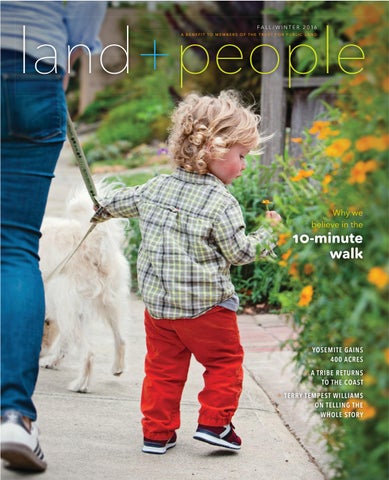
F A L L / W I N T E R 2 0 16 A BENEFIT TO MEMBERS OF THE TRUST FOR PUBLIC LAND
Why we believe in the
10-minute walk
+ YOSEMITE GAINS 400 ACRES + A TRIBE RETURNS TO THE COAST + TERRY TEMPEST WILLIAMS ON TELLING THE WHOLE STORY
From famous landmarks to hidden backcountry, our public lands are the pride of the nation. But in statehouses and the halls of Congress, powerful politicians are working to convert this public property to private profit. The Trust for Public Land believes the agenda to dismantle our public lands is out of step with the needs of everyday Americans. If you agree, take action now.
WRITE YOUR OFFICIALS
SIGN THE PETITION
SUPPORT OUR WORK
SPREAD THE WORD
52
contents
n ich o l as l ea b r u n o
30
“Activity begets activity. It’s infectious.” ~ s t a cy s a x f i t n es s in s t r u c t o r , a t la nt a
42 Home at Last ............................................................ . . . . . . . . . . . . . . . . . . . . . . . . . . . . . . . . . . . 30 After more than a century, the Kashia Band of Pomo Indians returns to the California coast.
Great Strides ............................................................ . . . . . . . . . . . . . . . . . . . . . . . . . . . . . . . . . . . 42 Imagine a city where no one lived more than a 10-minute walk from a park. Now build it.
How the West Is Won .................................... . . . . . . . . . . . . . . . . . . . . . . . . . . . . . . . . . . . 52 As the development pressure mounts, how can communities protect the
shaw nielsen
adair f reeman r u t l edg e
F EAT U R E S
places that matter most? T P L. O R G · 1
JAN
FEB
MAR
APR
M AY
JUN
JUL
AUG
SEP
OCT
NOV
DEC
Help conserve land for people every month of the year. It’s easy, automatic, and secure. Join today.
tpl.org/monthlygiving
D E PA RT M E NTS
Board Spotlight · 13
18
kel ly fo rt en er
#KeepItPublic
t h eo st ro o mer
From the President · 11
contents
Stephen W. Baird
Contributors · 14 Mailroom · 15 First Look · 17 Home-court advantage, a bridge to everywhere, and an expansion at Yosemite National Park
22
Terry Tempest Williams on putting the power of the national parks into words
Year in Review · 61
robb hirsch
Insight · 26
Member Center · 62 Offices · 63 Trail’s End · 64
o n t h e cover How close is your park? Turn to page 42 to learn about our effort to put a great park within easy reach of every person in America. photo: anna kuperberg
JOI N U S ON FAC EB O O K Scan the QR code with your mobile device to stay tuned to the latest news, videos, contests, and more. facebook.com/tpl.org
20 T P L. O R G · 3
ke lly forte n e r
4 · LA ND &PE OPL E · FAL L /W I NTER 2016
contents
GLEN HELEN NATURE PRESERVE, YELLOW SPRINGS, OHIO Just a half hour from Dayton, this lush forest is home to one of the Midwest’s first environmental education centers. For decades, it’s played host to kids’ first ecology lessons, night hikes, and wildlife encounters—it’s a place for exploration and reflection. And thanks to you, it’s protected for generations to come.
Page · 22
22
T P L. O R G · 5
j e n n a stamm
6 · LA ND &PE OPL E · FAL L /W I NTER 2016
contents
WILLIAM CRAMP ELEMENTARY SCHOOL, PHILADELPHIA, PENNSYLVANIA Students jumped for joy at the opening of their new schoolyard — and Principal Deanda Logan was just as excited. “If you could see what it looked like before, this ugly, cracked, concrete expanse … to have that transformed into a playground like this is so beautiful. Now we’re a school that clearly says, ‘Welcome, we’re glad you’re here, we value you, and we think so much of you.’”
Page · 24
24
T P L. O R G · 7
adai r fre e man ru tle d g e
8 · LA ND &PE OPL E · FAL L /W I NTER 2016
contents
SADDLE ROCK, WENATCHEE, WASHINGTON From a distance, land-use issues in the American West can seem intractable: development pressure is growing, and the politics of public land have rarely been so contentious. Take a closer look, though, and you’ll find communities where creative conservation efforts are rising above the fray.
Page · 52
52
T P L. O R G · 9
our mission:
e d i to ria l director Eliza Sarasohn
art director Matt Mullin
m a naging edito r Alia Salim
p h otogra ph y coordinator Elyse Leyenberger
e d i to ria l a ssistant Skye Alexander
w r i ters Julia Busiek Allie Ferguson
m a rketing Kristen Anderson
d i g ita l pro d uction Carrie Gotch Adele Wilson-Hamaker
co n tributing editor Bill Poole
A GREEN ER READ Land&People is printed in the United
THE TRUST FOR PUBLIC LAND CREATES PARKS AND PROTECTS LAND FOR PEOPLE, ENSURING HEALTHY, LIVABLE COMMUNITIES FOR GENERATIONS TO COME. how you can help: Our work depends on the generous support of people like you.
States on chlorine-free, 30 percent postconsumer recycled paper and manu™
factured using Envirotech ink, which contains a high percentage of ingredients derived from renewable resources. Printed by Quad/Graphics Inc., Wisconsin.
© 2016 The Trust for Public Land. All rights reserved. Conserving Land for People, Conserving Nature Near You, Creating Parks and Protecting Land for People, Fitness Zone, Land for People,
donate: Use the envelope inside this magazine, or visit tpl.org/donate for other easy ways to give. learn more: Get timely updates on our park and conservation work near you. Sign up for our e-newsletter at tpl.org/enews. share: Help us make the case for parks and open space. When you’ve finished reading this issue, pass it on!
Land&People, LandVote, Northwoods Initiative, Our Land, Parks for People, ParkScore, The Trust for Our Land, The Trust for Public Land, TPL, and The Trust for Public Land and LandVote logos and all other names of The Trust for Public Land programs referenced herein, as well as their logos, are registered or common law trademarks of The Trust for Public Land.
1 0 · LAND &PE OPL E · FAL L /W I NTER 2016
Land&People magazine is a benefit to members of The Trust for Public Land.
from the president
“America’s Best Idea.” It’s no accident that we talk about our national parks and other public lands with such superlatives. Aside from protecting some of the world’s
elyse leyenberger
#KEEPITPUBLIC
greatest natural wonders, our system of public lands is profoundly American—reflecting not only our deep and compelling relationship with the land, but the democratic principles by which we share it. Whether it’s the park down the street or a remote Alaskan wilderness, public lands afford us a connection with nature and protect the places that honor our heritage. These are the places that remind us of who we are as a people and of where we came from—hallowed ground, from the childhood neighborhood of Dr. Martin Luther King Jr. to Civil War battlefields and the view
We are all the “public” in “public lands.” It’s time to do our part to protect the lands we cherish.
from George Washington’s Mount Vernon. Our network of public parks, forests, and
lands to states, and for the removal of restric-
wildlands is the envy of the world. In this cen-
tions on mining and oil exploration. They are
tennial year of our National Park Service, it’s
also blocking the permanent reauthorization of
worth reflecting on all they offer us as individu-
the Land and Water Conservation Fund, which
als, as communities, and as a nation. It’s a time
uses money from oil and gas leases to protect
to be thankful for the foresight of those who
and expand parks and natural areas.
came before us—who safeguarded the land for
Now more than ever, the rest of us must
future generations. It’s a time to celebrate our
speak up on behalf of our public lands. After
successes—like the restoration of oceanfront
you’ve read the stories in this issue, please visit
land to native people forced inland more than a
tpl.org/publiclands and make your voice heard.
century ago (page 30); the steady improvement of Atlanta’s city park network (page 42); and the
Let’s not let America’s best idea become a sad memory.
establishment of Stonewall National Monument (page 19). Most of all, it’s a time to do our part. We must renew our commitment to protecting and stewarding the public lands we cherish: because, make no mistake, they are under threat. We are all the “public” in “public lands.” But a small, vocal minority is opposed to the idea of
Will Rogers president and ceo
sharing the land. Today, a number of elected officials are calling for the transfer of federal
T P L. O R G · 11
BE A LEADER. Connect more people to nature by becoming a Conservation Champion today. With your annual leadership-level contribution of $2,000 or more in general support you will receive invitations to special events and insider updates on our park and conservation strategies.
Learn more about the impact you will have as a Conservation Champion. Call Haley Nielsen at 415.800.5189.
co ns er vat i o n ch ampi o ns t pl . o r g/ c h a m p ions | cham p ions@tp l.org
O F F IC E R S
Stephen W. Baird
pre s i d e n t an d c hie f exe c ut i ve o ffi c er
Will Abberger s e n io r vi c e p re s i d e n t a n d dire cto r o f c i t y park dev elo pm en t
sarah cozol in o
William B. Rogers vic e p re s i d e n t an d d i re cto r of co n s e rvat i o n fi n an c e
board spotlight
Get to know
Stephen Baird is president and CEO of Chicago real estate firm Baird & Warner. A dedicated advocate for open space, Stephen has served on The Trust for
Adrian Benepe
Public Land’s national board since 2008,
s e n io r vi c e p re s i d e n t an d d i vi s i o n d i re cto r
leads our Chicago advisory board, and
Raymond Christman
has been president of Chicago conserva-
s e n io r vi c e p re s i d e n t a n d dire cto r o f co n s e rvat i o n st rat eg i es
tion groups CorLands and Openlands.
Ernest Cook
He is also on the boards of the Morton
vic e p re s i d e n t an d d i re cto r of pro g ram d e ve lo p men t
Arboretum and Children’s Memorial
Jad Daley
Hospital, and is past president of Chicago
s e n io r vi c e p re s i d e n t an d d i vi s i o n d i re cto r
Public Radio. A Harvard graduate, he
Jeff Danter
is co-chair of the Harvard Schools
vic e p re s i d e n t an d dire cto r o f fe d e ral affa i r s
Committee in Chicago. He also holds an MBA from Northwestern University.
Kathy DeCoster s e n io r vi c e p re s i d e n t , ge n eral co un s e l, an d sec reta r y
D. Malcolm Carson
I JOINED THE BOARD BECAUSE … I was
mapping and conservation planning—
s e n io r vi c e p re s i d e n t an d c hi e f p hi lan t hro p y o ff i c er
familiar with The Trust for Public Land
and we bring them together so well.
Margie Kim
from my work with Openlands, and
vic e p re s i d e n t an d dire cto r o f g i s an d p l a n n i n g
Breece Robertson s e n io r vi c e p re s i d e n t , c h i ef f in an c i al o ffi c e r, an d t rea su rer
Cynthia Scherer vic e p re s i d e n t an d d i re cto r of lan d p rot e ct i o n
because my father served on the board for
I SUPPORT THE TRUST FOR PUBLIC LAND
many years. I’ve always had a lot of respect
BECAUSE … I believe the work changes
for the organization’s work, and I wanted
lives. Whether in cities or the wilderness,
to help with land conservation on a larger
parks are where people connect and com-
and more varied scale than just in Chicago.
munity is built. The Trust for Public Land
But mostly it was because I was asked—
is helping create a healthier, more open
which I consider a great honor.
environment where children have parks
Brenda Schick vic e p re s i d e n t an d dire cto r o f human re s o u rc es
close to home, which is critical to building MY PROUDEST ACCOMPLISHMENT AS A
a healthier, more open society.
Barbara Smith
BOARD MEMBER WAS … the opening of
s e n io r vi c e p re s i d e n t an d c hi e f o p e rat i n g off i c er
and trail. I’ve also enjoyed building up
FOR PUBLIC LAND IS … figuring out how
Tim Wohlgenant
the Chicago office.
to do more with limited resources—both
The 606, Chicago’s new elevated park
THE KEY CHALLENGE FACING THE TRUST
within the organization and within the THE TRUST FOR PUBLIC LAND’S WORK IS
B OA R D OF D I R E CTOR S Page Knudsen Cowles (Chair), Stephen W. Baird,
communities we serve.
UNIQUE BECAUSE ... we have a saying: “but for The Trust for Public Land”—as in,
I FIRST FELL IN LOVE WITH THE NATURAL
it couldn’t have happened without us. We
WORLD … at birth. I have always loved
bring a unique range of skills to conserva-
the outdoors. My family took me camping,
F. Whitney Hatch, Ignacia S. Moreno, Caroline P.
tion challenges across the country—every-
skiing, fishing, and hiking from an early
Niemczyk, Michael E. Patterson, Thomas S. Reeve,
thing from land acquisition, conservation
age. Nature continues to inspire me and
Jeffrey A. Resnick, Laura Richards, Roy Richards Jr.,
finance, and community building, to GIS
bring me joy.
George Bell, William J. Cronon, Douglas Durst,
William B. Rogers, Lex Sant, Sheryl Tishman, F. Jerome Tone, Ana Valdez, Susan D. Whiting T P L. O R G · 13
contributors
Maria Dolan
Josh Green
Shaw Nielsen
story:
story:
story:
How The West Is Won
Great Strides
Great Strides
42
52
42
Seattle-based writer Maria Dolan is a regular
Josh Green is an award-winning Atlanta-based
Illustrator Shaw Nielsen’s work has ap-
contributor on environment and science
freelance writer and fiction author whose
peared in magazines, advertising, posters,
topics for Seattle magazine. She has contrib-
work has appeared in publications such as At-
and newspapers around the world, including
uted to national publications including Slate,
lanta Magazine, Indianapolis Monthly, The Atlanta
Communication Arts and 3x3, the Magazine of
Sierra, and smithsonian.com, and authored
Journal-Constitution, The Los Angeles Review, and
Contemporary Illustration. Nielsen has been
two outdoor guidebooks. When not writing,
The Baltimore Review. Accolades include top
honored by the Alliance of Illustrators and
she likes to garden, hike, dance, and enjoy
prizes in 2010 (for feature writing) and 2012
the Art Directors Club. He lives in Colorado
the Seattle art scene.
(for investigative reporting) among major
with his family.
follow her on twitter @mariaidolan
Georgia newspapers.
shawnielsen.com
follow him on twitter @joshgreen1234
show your true color
support land for people
tpl.org/shop
1 4 · LAND &PE OPL E · FAL L /W I NTER 2016
mailroom
adam al ex an der
JOI N OUR COMMUNI TY Members like you helped us hit 100,000 Facebook fans this year— with new friends joining us every day. Follow us on social media and be a
rach id dah n oun
part of the conversation.
BRIGHT IDEA
Neighbors lit up the night at a community event on Chicago’s 606 park and trail.
If you’ve got thoughts on the stories in this issue of Land&People, we want to hear from you! You can reach us by mail, on Facebook, or at mailroom@tpl.org.
S P R I N G / S U M M E R 2 0 16 A BENEFIT TO MEMBERS OF TH
E TRUST FOR PUBLIC LAND
For kids, by kids
trees and flowers and basketball
Our schoolyards-to-playgrounds
courts and green-roofed gazebos.
story won your hearts.
The stories are very inspiring. Keep up the good work!
I’m a Trust for Public Land
Patricia Rose, via the blog
member and I love your maga-
20 YEARS OF NEW YORK CITY PLAYGROUNDS + OUTDOOR AFRO’S RUE MAPP + THE PEOPLE’S MONUMENT + OUR NEWEST URBAN WILDLIFE REFUGE
DESIGNED BY THE KIDS WHO USE THEM
zine. After I’ve read it from
After helping a friend this afternoon,
cover to cover, I take it to my
I came home tired and ready for a nap.
veterinary clinic and put it in
I stopped to pick up my mail—most of
the lobby for other people to
it went right into the recycling bin—but
read. The Spring/Summer issue
there was Land&People. Opening the
was spectacular, with wonder-
magazine, I saw the gorgeous photo
ful before-and-after photos of
of LaCima Charter School playground
schoolyards in inner cities where
and was hooked. I kicked off my shoes,
concrete has been transformed
stretched out on the sofa with the
into beautiful green space with
T P L. O R G · 15
an dy r ich t e r
an drew f eder man
mailroom
Thank you for letting my voice be heard and to everyone fighting to #KeepItPublic #AmericatheBeautiful
olympic pentathlete margaux isaksen took a break from the rio games to tweet her support for our push to
P.S. 65, Brooklyn, New York
protect america’s public lands.
magazine, and read every word of the green schoolyards article. The more I read about the playground projects, the happier I was that I’ve
Real-life creatures have superpowers,
More allies for alleys
too! We got in on the Pokémon Go craze
Readers were inspired by our effort to
at tpl.org/parkpokemon.
turn miles of unused alleyways in Los Angeles into green community spaces.
supported The Trust for Public Land for several years, as modest as my support
Car-free? Yes, please!
was. I come from a family of teachers; I
Chattanoogans are rejoicing over
This gives me hope. As a former
keep thinking about what a wonderful
our latest addition to their greenway
diabetes counselor, I would often advise
project remaking a schoolground would
system — learn more on page 21.
a 20-minute walk after a meal to lower blood sugar. Many of my patients had
be. It would include just about all of the subjects I taught to sixth graders for
What a joy it was to ride my bike safely
no safe place to walk. The Equipo Verde
many years.
on this new trail instead of risking my
is lucky to create such a place. Mary Reynolds, via the blog
And the kids are right: when they
life navigating the intense traffic on
help and the community knows the
Wisdom Street at Amnicola Highway.
new park is for them as well, everyone
Thank you to The Trust for Public Land
I love to see our people getting involved
will take care of it. What a wonderful,
for making our community safe,
in making our neighborhoods cleaner,
inspiring story! Thank you.
walkable, hikeable, and bikeable!
greener, and safer for our families. This
Laura Shaida, via email
Leslie Tarvan, via Facebook
is a great project on many levels—I’d
mark gillila nd
love to see it spread throughout Los Angeles. Pa’lante! Querido Galdo, via the blog WATCH THE VIDEO @
TPL.ORG/VERDE
South Chickamauga Greenway, Chattanooga, Tennessee
1 6 · LAND &PE OPL E · FAL L /W I NTER 2016
LAND&PEOPLE IS LISTENING! Send letters to the editor or change your mailing address: mailroom@tpl.org.
i took a walk in the woods and came out taller than the trees. h enry dav id t h oreau
“Coney Island of the West” in Waconia, Minnesota, was once a private resort destination. Thanks to your support, we helped conserve it for the public.
t u r n t h e pag e fo r … ho m e -co u rt a d va n tag e · a b r id g e to e v e r y w h e re · ex pa n si o n at yo s e m it e n at io n al par k T P L. O R G · 17
A taste of the Americas
edible conservation
rio grande farm park, alamosa, colorado
The Rio Grande traces lazy curves
district. Today, it’s land where families
vision: a permanent farm on the banks
through Alamosa, a town in southwest
like the Lucases can grow vegetables to
of the Rio Grande, just blocks from the
Colorado’s San Luis Valley. On a quarter
bring home to relatives and neighbors.
center of town. The Trust for Public Land
acre of rich soil along the meander-
It’s more than a hobby garden.
worked with the San Luis Valley Local
ing river, Francisco Lucas has planted
Though the San Luis Valley is one of
Foods Coalition to buy the land for the
enough vegetables to stock a farmers
the most productive farming regions in
public and help local residents make a
market for weeks: “We’re doing corn,
Colorado, almost 90 percent of the food
plan for their new space. This spring, the
green beans, lettuce, onions, cauliflow-
grown here—mostly potatoes, wheat,
first seeds were planted in the ground
er, cilantro, pumpkins … plus, all kinds
and barley—is shipped elsewhere.
that is now the Rio Grande Farm Park.
of vegetables from Guatemala—I don’t
Despite living in the state’s breadbasket,
Lucas says the farm has already grown
know their names in English.”
many people in Alamosa struggle to find
into a source of affordable, healthy food
and afford fresh produce.
for people who need it. It’s also a place
Lucas and his wife, Lucia, immigrated
So when the school district decided
to pass on the traditional recipes and
Like many members of the large but
to sell the property about five years ago,
farming practices he learned as a boy in
close-knit Guatemalan community here,
locals like Lucas saw an opportunity.
Guatemala.
he and his family have put down roots—
The site had garnered interest from a
“We’re happy with everything that
literally—in the fertile ground of a 38-
developer who planned to build an RV
we’re growing,” he says. “Now, we’re
acre property once owned by the school
park, but the community had another
just waiting for the harvest.” theo stroomer
to the San Luis Valley from Guatemala.
1 8 · LAND &PE OPL E · FAL L /W I NTER 2016
buzzworthy
Ensalada de chiles asado (Charred pepper salad) SALAD O
6 sweet bell peppers
O
1 yellow onion, peeled, halved lengthwise
O
1 tbsp. flat leaf parsley leaves, chopped
DRESSING O
2 tbsp. red wine vinegar
O
4 tbsp. olive oil
O
1 tsp. roughly chopped garlic
O
Kosher salt and freshly ground black pepper to taste
Char bell peppers on a grill, turning fre-
The Trust for Public Land helped the City of New York transfer property for the new monument to the National Park Service.
LEARN
“I believe our national parks should reflect the full story of our country, the richness and diversity and uniquely American spirit that has always defined us. That we are stronger together. That out of many, we are one.”
MORE @
TPL.ORG/ STONEWALL
quently, until skins blister—5-8 minutes. Let them cool slightly, then peel and julienne.
—President Barack Obama
Char and cool onion, then julienne. Combine dressing ingredients in blender until smooth. Taste and adjust seasonings, if
This summer, the president declared a
necessary.
national monument at the Stonewall Inn,
In a medium bowl, toss the julienned peppers and onions with dressing and chopped
site of the 1969 riots widely recognized as
parsley. Let sit 20-30 minutes before serv-
the spark that ignited the modern LGBT
ing. Garnish with parsley sprigs.
rights movement. F I R ST LO O K · 19
Yosemite gains a lush mountain meadow Ackerson Meadow is a bright island of open grass in a sea of shady forest. It’s a gentler landscape than the imposing gran-
good news
Why is Ackerson Meadow home to so much life? It all comes back to water.
ite cliffs of Yosemite Valley, a dozen miles to the east—but in
“Ackerson Meadow holds on to a lot of water,” says
many ways it’s just as impressive: at 400 acres, it’s part of the
Yosemite wildlife biologist Sarah Stock. “Insects love wet
largest ecosystem of its kind anywhere in the Sierra Nevada.
areas, so they do really well here. Those insects feed spiders,
This year, The Trust for Public Land helped add Ackerson
birds, bats, and small mammals, which in turn feed hawks,
Meadow to Yosemite National Park.
owls, and coyotes.”
The mid-elevation meadow is the largest addition to Yosem-
Stock says it’s rare to see so many species in such a
ite in nearly 60 years—and it’s thriving. “Birds, squirrels, bear
small area in the Sierra. Her crew has even spotted a pair
sign everywhere, rare plants, and fields full of wildflowers in
of willow flycatchers—sparking hope that these endangered
spring and summer,” says Markley Bavinger, project manager
songbirds might nest in the park for the first time in more
with The Trust for Public Land. “I’ve been all over the Sierra
than two decades.
robb hirsch
and I’ve never seen a place so rich.”
During the 2013 Rim Fire, wildlife found refuge in Ackerson Meadow: the fire burned all the way around it, but wet soils here helped hold the flames at bay. 2 0 · LAND &PE OPL E · FAL L /W I NTER 2016
mar k g il l il an d
buzzworthy
The new segment leaves just three miles to go in the full South Chickamauga Greenway. When complete, it will be a 23-mile car-free corridor—with four public canoe launches.
BRI D G I NG T HE
GREENWAY GAP The latest addition to Chattanooga’s greenway system is by no means the longest we’ve completed. But if you ask the neighbors who turned up for the grand opening this year, they’ll tell you this stretch of trail has something that matters more than mileage: a bridge, linking the South Chickamauga Greenway to the Tennessee Riverwalk. Longtime resident Walter Hodges lives adjacent to the new trail segment. Before, if he wanted to use the Riverwalk, he had to drive to it. Now, he’s among the 25,000 people who live within a 10-minute walk of the South Chickamauga Greenway—so he can get there on foot or by bicycle. “My family can now ride from our home to the downtown area, staying on the greenway entirely and avoiding congested roadways,” says Hodges. For a city with ambitious climate change goals, greenways are a critical part
“You walk on the land, and you don’t have to pray. You look around and the beauty of it all lifts your spirit.” —Sister Veronica Mendez to the Nyack News and Views For more than a century, the Sisters of Our Lady of Christian Doctrine — also known as the Marydell Sisters — tended to 30 acres of woods and meadows on the Hudson River north of New York City. The sisters wanted to ensure their peace-
of the effort to reduce the number of cars on the road. Jonathan Gibbons heads
ful refuge would outlive them, so this
the city’s efforts to promote bicycle commuting and other alternative transpor-
year they worked with The Trust for Public
tation. “The South Chickamauga Greenway will connect thousands of residents,”
Land to add the property to the state
he says. “What could be better than going to work or picking up groceries sur-
park system.
rounded by Chattanooga’s natural beauty?” F I R ST LO O K · 21
what counts
meet our staff
kel ly fort en er
t eg ra ston e n uess
“We do our homework.”
DEE FRANKFOURTH THE TRUST FOR PUBLIC LAND’S WESTERN DIRECTOR OF CONSERVATION
100,000 … visitors per year to Glen Helen Nature Preserve, a half hour from Dayton, Ohio. Home to one of the Midwest’s first environmental education centers, this forest retreat was
FINANCE GETS THE LAND WE LOVE ON THE BALLOT
What is conservation finance? We work with town, city, county, and state officials to help them create funding for land and water conservation. Sometimes that means working on legislation, but our stock-in-trade is placing funding measures on the ballot and getting them approved by the voters. It’s a little counterintuitive that a nonprofit like the Trust for Public Land can do this kind of advocacy work, but we’ve been at it for 20 years, and we win more than 80 percent of the time.
permanently protected this year with help from The Trust for Public Land.
How did you get into this line of work? I started my career as a biologist, but in the mid-1970s I got involved in an
SEE MORE PHOTOS @
effort to protect new parks, wildlife refuges, and wilderness areas in Alaska.
TPL.ORG/LPDIGITAL
I helped organize dozens of community meetings in the state; then I moved to Washington, D.C., and spent three years lobbying Congress. Finally, on December 2, 1980, President Carter signed the Alaska National Interest Lands Conservation Act—protecting 100 million acres at the stroke of a pen.
2 2 · LAND &PE OPL E · FAL L /W I NTER 2016
That must have been especially meaningful for you as someone who grew up there.
with people and listening and understanding what their needs are. You have
What victories stand out in your memory?
to have the political experience to see
The era of 100-million-acre opportunities
Alaska really shaped who I am and what
the big picture, but the flexibility to
like we had in Alaska is over, but there
matters to me. It was just an amazing
zero in on the details.
are still really important wilderness
place to grow up: so much opportu-
areas that need to be purchased and protected. The wins that stand out are
suspect my Girl Scout days were quite a
How do you help make sure conservation measures succeed at the polls?
bit more rugged than they would have
We do our homework. First we research
we hoped for and we were challenged
been anywhere else. We needed Army
the available funding mechanisms and
to bring our full skillset to bear. Like in
trucks just to get to our camp-outs!
nity, so much wilderness, and so much freedom. I was outdoors all the time—I
the tough fights—when we might not have had all the support or resources
timelines. Then we contract with some
2011, in Arapahoe County, Colorado: we
I will be forever grateful for my role
of the nation’s top pollsters to find out
were working to renew a sales tax to
in that scrappy Alaska lands coalition.
what people want: is it a skate park,
fund local conservation. We didn’t even
It showed me what I really wanted to
a natural area, water features, more
expect to make it onto the ballot, since
do. After the campaign, I stayed in the
trails? How much money is the commu-
it was the middle of the recession. But
political arena as an advisor to candi-
nity willing to spend? With poll results
it passed.
dates and ballot measure campaigns and
in hand, we make a recommendation to
nonprofits, which is how I came to join
the elected officials and work with them
What motivates you?
The Trust for Public Land.
to design a ballot measure.
I want to help communities realize
You can only move the needle of
their own potential and fulfill their own
What does a typical workday look like for you now?
public opinion so far—especially since
ideals. That’s something that happens
our campaigns are run on a shoestring.
through voting on public financing for
Our team is quite lean—everybody does
But if we have a strong coalition on the
conservation that doesn’t happen any
everything. So today I worked on an
ground and the support of a passion-
other way.
engagement strategy for an upcoming
ate elected official, that’s when we can
Time and again we’ve found that
ballot measure in Los Angeles County.
catch the wave and get a measure on
voters are willing to devote more fund-
Then I turned around and edited a flyer
the ballot. We can empower locals with
ing to conservation at the polls than
for a different campaign. I make a lot of
the tools they need to win dedicated
officials can or do as part of an annual
cold calls. I like mixing it up, engaging
funding for conservation.
budget—and that that funding is more
isaac lane koval
stable. It comes straight from the people and goes straight to the landscapes they love, which is an incredibly meaningful and powerful statement for a community to make. The least we can do is get that option onto the ballot so the voters can choose to pay for what matters for them, and for future generations. It’s incredibly gratifying work.
Lower Deschutes River Ranch, Oregon.
F I R ST LO O K · 23
I GIVE TO …
what counts
why we give
dan mah on ey / okct h un der.com
jen n a stamm
play it forward “Getting to see the smiles on all of your faces is what it’s all about.” dion waiters, philadelphia, pennsylvania
WATCH THE VIDEO @
TPL.ORG/ PHILLYPLAYGROUNDS
He may play for the Miami Heat, but NBA star Dion Waiters’s heart will always be in Philly. Waiters attended Stanton Elementary School on the
15,000 … Philadelphia residents live within a 10-
city’s southwest side, and as he puts it: “Every chance I got, I would climb over the fence and spend hours shooting hoops. This is where it all started, right here on this court.” That court, though, could use an upgrade. So at a press event in March, Waiters presented the school with a $10,000 check to help revitalize his alma mater’s barren asphalt yard. His message to the students looking on: dream big.
minute walk of William Cramp Elementary
“I came from nothing,” said Waiters. “I remember sitting in the same
School, whose revamped playground is
seats as you are today—and look at me now. I want you all to continue to
open to the community after the last class
go to school, have fun, enjoy life no matter how hard it is, and never let
bell rings. Awarded a grant from the National
anybody tell you what you can or cannot become.”
Endowment for the Arts, the new schoolyard—
Waiters told a rapt audience of neighborhood kids that trouble seemed
complete with a track, garden, and perfor-
to follow him everywhere when he was young—but teachers’ support and
mance area—is a point of pride in a neighbor-
a passion for basketball set him on a course for success. “The basketball
hood where safe places to play are scarce.
program here at Stanton is how it all started. Spending time in this yard changed me.” Waiters’s generous gift will help The Trust for Public Land refurbish the
SEE MORE PHOTOS @
TPL.ORG/LPDIGITAL
court and transform the Stanton schoolyard into a vibrant gathering place for the whole community. Through a participatory design process, the students themselves will create a design incorporating green infrastructure features that do double duty managing stormwater runoff.
2 4 · LAND &PE OPL E · FAL L /W I NTER 2016
Double your impact today! This year, an anonymous donor will generously match your gift—dollar-for-dollar—if you send it before December 15. Your donation will go even further to help The Trust for Public Land protect more parks, gardens, and other natural places. That’s one good thing made that much better.
fig. 2
good.
better.
Give your EarthShare.
800.714.5263 donor.outreach@tpl.org tpl.org/match
An EarthShare payroll deduction is one simple way to donate to The Trust for Public Land or more than 400 other environmental and conservation charities. Many corporate and government employers support EarthShare payroll giving. If yours doesn’t, ask them to start. If they do, simply decide on a single deduction or a recurring small one from every paycheck. Then designate us, member number 11440, as one of your conservation charities. For more information visit earthshare.org or email donor.outreach@tpl.org.
T P L. O R G · 25
alex diekmann
fig. 1
insight
the
storyteller
a conversation with
terry tempest williams
2 6 · LAND &PE OPL E · FAL L /W I NTER 2016
z o e ro dr ig u e z
“Beauty is not optional. It is a strategy for survival.”
still argue that nature is worth defending simply because it’s
You’ve spent time in beautiful places all over the country. Why did you choose to write this book about national parks in particular?
beautiful? Terry Tempest Williams doesn’t hesitate.
Our national parks embody the soul of the nation. At a time
in a modern debate over public land—crowded with political, economic, and ecological concerns—can anyone
“Beauty is not optional. It is a strategy for survival.”
when public lands are under siege—with some politicians
As a writer, naturalist, and educator, Williams has spent her
calling for “the disposal of federal lands”—national parks
career advocating for the land. Her dreamy, lyrical prose in-
are the most accessible gateway into the conversation. Many
vites readers into her explorations of the natural and cultural
people may not understand what our public lands represent,
legacies of the American West—challenging perceptions of
but if something changes you say, specifically, “Imagine what
some of our most storied landscapes. She’s been called the
America would be without the national parks.” They under-
“natural heir” to Wallace Stegner.
stand what we would be left with would be a self-made world
Williams’s latest book is The Hour of Land: a Personal
devoid of our natural heritage.
Topography of America’s National Parks. It’s a 12-stop tour of
letters, casual conversations, and poems capturing the diver-
You write that national parks provide “breathing space for a society that’s holding its breath.” What do you mean by that?
sity and complexity of the places the American people have
An example: I was in Washington, D.C.—suffocating in the
chosen to save. As the Park Service marks its centennial year,
humidity of summer and saturated by the politics of the place.
The Hour of Land is a timely reflection on the relevance and
Then a friend offered to take me to Great Falls National Park,
significance of our public lands.
in McLean, Virginia, 15 miles from the capital. When I walked
our national parks, from the iconic (Wyoming’s Grand Tetons) to the obscure (Iowa’s Effigy Mounds)—a mix of field notes,
“I thought I was writing a book about America’s national
to the overlooks and saw the magnificent, cascading waters
parks,” Williams told us. “But it became clear very quickly that
of the Potomac River being funneled through Mather Gorge—
I was actually writing a book about America. And this was a
well, I gasped. The impact on me in that moment was equal to
daunting task.”
when I first saw Yosemite Valley. I couldn’t take my eyes off of
I N SI G H T · 27
the rapids. And I could breathe again, literally and metaphori-
United States can receive a free park pass for their family is a
cally. My friend said, “This is how I can live in D.C. This place
great step toward building future advocates for our national
keeps me sane. It’s my sanctuary.”
parks.
What can be done to make sure that national parks like Great Falls can survive — and matter — for another hundred years?
staff. They are passionate about what they do, and they do it
I also have a real soft spot in my heart for the interpretive well. They are our storytellers—and at our big western wilderness parks, they may provide many visitors with their first
I would like to see an endowment that would provide a per-
or only exposure to environmental education and ecological
manent source of funding for our national parks and monu-
literacy. I see the national park naturalists as true heroes and
ments. This to me is a much more sustainable idea than open-
heroines. I love them.
ing the doors to corporate America to fund our parks. I don’t want to see billboards or ads on buses, or natural wonders named after banks and businesses like sports arenas.
Given its limited resources, what does the National Park Service do well?
You’ve written about the history of tribes removed from land that became national parks. How do you reconcile the benefits Americans derive from the parks with this legacy of displacement? This country has a complicated history, a shadowed history—
I think the Park Service has done a terrific job of highlighting
beginning with the tribes. With the enslavement of African
the centennial and expanding the national conversation about
Americans, with migrant workers. American history within
public lands. Both Park Service Director Jon Jarvis and Secre-
our national parks has not focused on people of color. It’s only
tary of the Interior Sally Jewell have made a conscious and
been in the past decade or so that one could go to Gettysburg
compelling effort to reach out to more diverse audiences and
and hear the word “slavery” even mentioned.
communities. I think the fact that every fourth grader in the
2 8 · LAND &PE OPL E · FAL L /W I NTER 2016
We must not avert our gaze from the multiplicity of stories
“You cannot stand on the rim ticular place. I am a strong believer in the power of grassroots
of the Grand Canyon at dawn
activism and advocacy within local communities. Larger organizations can help these groundswells grow to reach people of
and not realize there is
national influence with the power to make conservation law. The Trust for Public Land is a beautiful example of this kind of
something far older and wiser
leadership, rooted in the stories of the land.
than we are. It is a sense of
future, it is going to be even more difficult to keep them. Our
It is an arduous process to establish a national park. In the public lands are our public commons: to maintain the literal
profound humility.”
open space of democracy will require our ongoing love and vigilance, patience and perseverance, and acts of imagination. We must be both fierce and compassionate, at once.
behind our national parks. For example, to look only at the
You write a lot about family members, many of whom work in energy development. Is your relationship with the natural world much different from theirs?
geologic history of Glacier National Park—and not include the
It is true that my father and I disagree on most everything
cultural history, the betrayal of the Blackfeet Nation—is to
politically. But when it comes to land itself and its intrinsic
deny the visitor the full experience of the complexity inherent
value, we see through a very similar lens: it is a spiritual issue
to each place.
for him and it is a spiritual issue for me. Where does this spiritual connection come from? I believe it comes from spending
Do you think we’re making progress toward offering visitors that kind of experience?
a lifetime outside in wild places. You cannot experience the
Yes. Wallace Stegner said that the national parks are our “best
ting chills, or stand on the rim of the Grand Canyon at dawn
idea.” I would argue that they’re an evolving idea. President
and not realize there is something far older and wiser than
Obama has contributed to the evolution of what the parks and
we are—that we are not the center of the universe, nor are
monuments look like—from the establishment of the César E.
we the only species that lives and breathes and loves on this
Chávez National Monument, to the Harriet Tubman Under-
planet. It is a sense of profound humility.
bugling of elk in the fall at the base of the Tetons without get-
ground Railroad National Historic Park, to the Stonewall Inn National Monument that honors the struggles and triumphs of the LGBT community.
Do you ever feel overwhelmed by the threats to the natural world that means so much to you?
We have broadened, deepened, and expanded our notion of
Of course. Issues like climate change and the loss of our wild-
national parks in the past hundred years as our consciousness
lands more than concern me. Love and grief are my constant
of America’s diverse histories and peoples has expanded. The
companions. Joy and resistance fuel me. When I am filled with
National Park Service is honoring their unique contributions
despair and wonder how to move forward, I am aware of the
to our identity as a nation.
limits of my own imagination. But imagination shared creates collaboration. Collaboration creates community. And in com-
What does it take to protect land in the modern era of conservation?
munity, I truly believe anything is possible.
Each one of our national parks, monuments, wildlife refuges,
what we love, to employ our gifts in the service of something
and wilderness areas has been protected because someone
larger than ourselves. If we can commit to restoring and
loved them, cared about them, and knew them—because
protecting wild nature together, I believe wild nature will
someone spent time developing a relationship with that par-
take care of us.
Engaging with others empowers us to act on behalf of
I N SI G H T · 29
Home AT L A S T
A F T E R M O R E T H A N A C E N T U RY , T H E K A S H I A B A N D O F P O M O I N D I A N S R E T U R N S TO T H E CA L I F O R N I A C OA S T .
BY : M A RY CAT H E R I N E O ’ C O N N O R P H OTO G R A P H Y : N I C H O L A S L E A B RU N O & T E R R AY S Y LV E S T E R 3 0 · LAND &PE OPL E · FAL L /W I NTER 2016
T P L. O R G · 31
C “
lose your eyes” instructs Reno
“I don’t know how else to explain it: it’s like a home I’ve
Franklin. Chairman of the Kashia
never been to before, but I can feel. I know this is where I
Band of Pomo Indians, Franklin
belong,” says Billyrene Pinola, a Kashia, her voice breaking
wears his long black hair pulled
with emotion. Later, Pinola will don traditional dress to per-
into a loose ponytail. He’s address-
form a ceremonial dance alongside her granddaughter Laila;
ing a crowd gathered to celebrate
now she’s standing and marveling at the scene around her.
the creation of the new Kashia
“This is not just a piece of land to us. It’s family. If you don’t
Coastal Reserve.
know your cultural history, your language, your land, you lose
“Close your eyes,” he repeats.
“Close your eyes….” As the
your identity. This property brings us back home.” Once, the Kashia thrived here. In colder months the tribe
audience complies, a smile plays
lived in upland villages, hunting and gathering in the abun-
across his face.
dant forests and grasslands. When the seasons turned, they
“Think back 200 years, when thousands—not hundreds,
moved their camps closer to shore to fish and harvest abalone,
but thousands—of Kashia people walked on this land. Literally
mussels, urchins, seaweed, and salt. They made jewelry from
right where you’re standing. That is where we are.
shells and wove grasses and fibers into intricate baskets. The
“Two hundred years ago, the Russians came. The ‘Undersea
People.’ Why did we call them that? Look.” He gestures to the
surrounding ocean, forest, and hills were their grocery, their pharmacy, and their university.
sweeping Pacific, stretching to the horizon behind him. “That
“Twelve thousand five hundred years,” says Chairman
view had stayed the same for thousands of years. Until a mast
Franklin. “Archaeological records show that’s how long
appeared, and then a boat. The Undersea People. From that
Kashia were on this land. And in the last 200, after the
day forward, everything changed for us.”
Russians and Europeans came, our people suffered. We died, we were murdered, we were put into slavery, forced to work in gold mines.”
Years of negotiations, fragile alliances—built, destroyed,
The arrival of the colonists forced the Kashia people inland,
repaired—and the hopes and dreams of a people have led to
where they ultimately settled on a small, water-poor res-
this day: the transfer of nearly 700 acres of Northern Califor-
ervation—40 acres, with no direct access to the coast. “My
nia coastal prairie and redwood forest back to the Kashia, its
grandmother was moved to the rez when there were no
historic caretakers.
homes there,” recounts Billyrene. “The government said they
On paper, the deal was closed last December. But today—a
were going to provide housing, but they didn’t—so she and
windy Saturday in June 2016—marks the tribe’s ceremonial
the others had to build their own brush houses to live in. Back
return to the coast. Hundreds of people, Kashia and non-
then, the coast was their primary food source. But when my
Indians alike, have congregated here along a quiet, rural
dad wanted to fish or to gather, he had to ask permission from
stretch of Highway 1 in northern Sonoma County to dance,
the landowners. They never told him no, but it really bothered
pray, and mark a defining moment 150 years in the making.
him that he had to ask.
It’s hungry work, and Kashia volunteers have prepared a tradi-
“My grandmother and my father taught me how to gather,”
tional feast for the guests—some of whom have traveled hours
she continues. “I raised my children on the 40-acre reserva-
to join the celebration.
tion, and I taught them how to live off the land. It’s a big asset for our tribe to be able to access the ocean, because that’s where we get our food and our culture.”
“12,500 years. That’s how long Kashia were on this land.” RENO FRANKLIN, CHAIRMAN OF THE K AS H I A BA N D O F P OMO I N D I A N S
3 2 · LAND &PE OPL E · FAL L /W I NTER 2016
T P L. O R G · 33
B
ill Richardson adjusts the curved brim of a red baseball cap low over his forehead. It’s embroidered with a feather and the words “Native Pride.” With the hat and sunglasses concealing his eyes, it’s hard to read his expression. “My emotions are mixed,” he says, haltingly. We’re gazing out over the family ranch his grandparents first purchased in 1925—coastal prairie of
purple needlegrass and oatgrass thrumming in the brisk summer wind, million-dollar views of the Pacific as it pummels the base of the cliffs, 70 feet high, across Highway 1. Not one morning of his life, says Richardson, has he walked out his front door without finding himself awestruck by the beauty of this land. Under the terms of the agreement he and his siblings have
brokered with the Kashia, Richardson explains, he won’t have to give up the view: their arrangement includes the provision that he’ll live out his days in his family home. As we talk, two Kashia men walk up behind him and tap his shoulder. Richardson turns—“Hey!”—and greets each with a hug. Divided by ancestry, the Richardsons and the Kashia are bound by the land they both call home. When tribal members wanted to gather seaweed or harvest abalone or perform a ceremony, it was the Richardson family who granted permission. Bill Richardson and his two sisters grew up here, attending the tribe’s one-room schoolhouse just up the road on the Kashia reservation. Their playmates were Kashia kids, too. So it was more than a decade ago that the Richardson siblings first began talking with the Kashia about selling their land to the tribe. But the Kashia could not assemble the considerable resources needed to make the purchase. A deal remained a distant hope until 2013, when the tribe’s legal council called The Trust for Public Land. The organization had a long history of working with native peoples, restoring more than 200,000 acres to tribal ownership since the late 1990s. Could they help? “From a conservation standpoint, this property was obviously important because it’s a large stretch of beautiful, undeveloped coastline right next to a state park,” says The Trust for Public Land’s Brendan Moriarty. “But when we understood the significance of the land to the Kashia, we knew we wanted to help. Everyone involved—including state and local public agencies, the tribe, and the landowners, the Richardson family—we all wanted to see something happen.”
3 4 · LAND &PE OPL E · FAL L /W I NTER 2016
bill richardson’s grandparents bought the ranch in 1925; he grew up on the property and attended school on the kashia reservation.
T P L. O R G · 35
3 6 · LAND &PE OPL E · FAL L /W I NTER 2016
b i l l y r e ne pi no l a , member of the kashia tribe
P
partnering with local agencies, The Trust for Public Land
state,” says Nina Hapner, who directs environmental planning
devised a plan that would return the land to the Kashia while
for the Kashia. “It’s traditional management by native people.”
allowing for an addition to the California Coastal Trail (CCT)—
As Hapner explains, the tribe will harvest plants for
a network of public footpaths hoped to one day span the 1,200
traditional uses: yerba buena and Labrador for tea; equise-
miles from Oregon to Mexico.
tum, madrone tree bark, and angelica root for medicine and
Then came the details: hashing out the terms of a conserva-
ceremonies. In accordance with the easement, tribal members
tion easement to permanently protect the land from develop-
will also harvest young trees, using proceeds to pay off the
ment and to ensure sustainable stewardship. “We and the
loan secured to help acquire the land. As the smaller trees and
tribe agreed the goal was to try to rehabilitate the forest,”
undergrowth are cleared, lowering the risk of wildfire, the for-
says Moriarty.
est will regain much of its pre-colonial character. “In 50 years,
Under the terms of the easement, the Kashia must follow
we’ll have healthy old-growth forest,” says Hapner.
a restorative forestry plan. “It’s a different kind of timber management,” Moriarty explains. “In other timber harvest plans, the goal is to cut the largest redwoods. But in this rehab approach, you go in and thin trees to allow remaining trees to grow bigger, with the goal of improving forest health.” “People often call what we’re planning a ‘demonstration forest,’ but we consider it returning the forest to its natural
T P L. O R G · 37
M
eanwhile, The Trust for Public Land is
and look inland, it’s all towering redwood forest. You’re cross-
collaborating with the county parks
ing over a number of creeks that run across the terrace before
department on plans to build the
dropping off into the ocean. So it’ll be pretty dramatic—espe-
new California Coastal Trail segment.
cially in winter, when the water is flowing.”
The extension—which could open to
Plans for the trail include the creation of educational dis-
the public as early as 2018—will run
plays to share Kashia history. “We’ve considered doing guided
along the Kashia Coastal Reserve’s
hikes with tribal docents,” says Franklin. “We’re also talking
west side, linking up to Salt Point State Park.
about dedicating the trail to the veterans in our tribe. We’d
“For much of this stretch of the property, there’s no forest
call it ‘The One Who Was Warrior Way.’” As Franklin notes,
cover—it’s a coastal terrace of open grassland,” says Brendan
many members of the tribe fought in the United States mili-
Moriarty. “So as you’re walking along, you have this unimped-
tary, and one was even part of Theodore Roosevelt’s famed
ed view of the endless Pacific Ocean in front of you, and you
Rough Riders.
can see Salt Point to the south in the distance. As you turn
3 8 · LAND &PE OPL E · FAL L /W I NTER 2016
THE HARDEST PART OF YOUR WORKOUT
The Trust for Public Land thanks Under Armour, proud supporters of our effort to ensure that every person in America lives within a 10-minute walk of a great place to get outside and get moving — like The 606, Chicago’s new elevated park and trail system. Learn more at tpl.org/10minutewalk. T P L. O R G · 39
“my g r an dma cr ied when w e g ot this lan d. a happy ki nd of cr y,” says kashia chri s elliott, ag e 13. “on ce i hav e my own kids, i will b ri ng them her e so they can se e this beautif ul p l ace .”
4 0 · LAND &PE OPL E · FAL L /W I NTER 2016
A
fter prayers and food, we walk up the hill to a meadow, where a small fire marks the center of a dance circle. I fall in next to a man named Jonathan Toste, a local open space advocate who was keen to show his support by attending the ceremony. “The coast is a mosaic of undeveloped and devel-
oped land,” he tells me. “What the Richardsons have done [by selling this ranch] is to create a balance: protecting the land from people while still allowing them to come to the land. The Kashia aren’t the only ones who come out here to pray. To see the coast, the birds and plants, that is a deep prayer for me.”
Gathered around the fire, Franklin and other Kashia lead
tribal dancers in song, keeping the beat with hand-hewn clapper sticks. Eight men, wearing feathers and mimicking a bird’s gait and gaze, enter the circle from the west, followed by seven women. In the distance, osprey soar over the coastline, searching for their next meal. Kashia children gather plants in the cool shade of a young redwood grove. At the foot of the driveway into the ranch, an agave Americana plant stands in full bloom. The flowers topping its 30-foot stalk signal the end of the plant’s life cycle—a moment of transition. This plant will die, but more will emerge from its roots, both replacing and propagating their predecessor. “I feel so thankful to have had the opportunity to work on this project with the Kashia,” says Moriarty. “It’s not just a story of important environmental conservation. It’s also an important social justice story—an opportunity to do right, and do well.” Chairman Franklin nods his head in agreement. “This
“This is a historic day.
Soak it in.”
experience has been not only beneficial but healing for us. We stand in this place today a complete people. We are at a moment that all of us prayed for, that we fought for, and our elders guided us through. “This is a historic day,” he adds. “Soak it in.”
T P L. O R G · 41
Imagine a city where no one lived more than a 10-minute walk from a park.
Now build it. story : josh gre e n · il l ustra tion: sha w nie ls en
4 2 · LAND &PE OPL E · FAL L /W I NTER 2016
Before the Atlanta BeltLine was green, it was pure academic theory. Atlanta’s most ambitious park plan began as a nebulous, fantastical idea dreamed up in a graduate thesis. As a Georgia Tech student in 1999, Ryan Gravel wrote a paper that launched the effort to repurpose defunct rail corridors encircling the city — then struggling with sprawl — into a network of trails, parks, and, eventually, light-rail transit. To many officials, it all sounded too extensive and too expensive for serious consideration. Gravel himself told Atlanta Magazine this year: “I never really imagined anything like the BeltLine was going to happen…. We were proposing an ambitious, transformational project on railroads that the city didn’t own.” But the BeltLine had its champions, too. In 2004, The Trust for Public Land commissioned renowned park planner Alexander Garvin to produce a feasibility study. Community advocates went neighborhood to neighborhood rallying grassroots support. Over the ensuing years, various park and conservation organizations got to work. The Trust for Public Land acquired 33 properties for the Atlanta BeltLine, negotiating deals and transferring land to the City of Atlanta one acre at a time. And in 2010, construction began.
T P L. O R G · 43
construction in May 2016. From City Hall to the front porches of the Old Fourth Ward, there’s a growing confidence that the project will deliver on its promise to boost public health, civic pride, and local economies. In the coming years, feasibility studies predict the BeltLine will create 30,000 jobs, connect 45 neighborhoods, and boost Atlanta’s green space by almost 40 percent. Behind my old condo, the BeltLine already hosts joggers, walkers, bicyclists—and one lady who diligently practices the violin. Many of my eldest daughter’s stroller rides and first steps took place on this winding ribbon of pathway, this stitch joining neighborhoods long cut off from each other by abandoned railway tracks and the accompanying blight. For my family, the trail has validated our optimism for Atlanta’s future—while literally showing us sides of the city we’d never seen. WHAT MOTIVATES a city to make this kind of long-term commitment? The potential payoff is huge. Atlanta has long been notorious for sprawl and ON PAPER, it seems a long, slow
That was 2011. Just three years after
light on parks, and what green space it
ride from concept to reality. But on the
my lizard encounter, the Atlanta BeltLine
has is not equitably distributed—factors
ground, Atlanta residents can see the
was named the best environmental reha-
contributing to its rank as only 51st in the
pace of change quickening. My own
bilitation project in the world, receiving
nation on the ParkScore index, a ranking
family used to live in a building that
the International Real Estate Federation’s
of urban park systems published by
butted up against the rail corridor. For
prestigious Prix d’Excellence award at a
The Trust for Public Land. The BeltLine
much of that time, the proximity was
ceremony in Luxembourg. And it’s not
begins to address that: when complete,
not exactly an asset: I can remember
even done.
it will provide access to green space
stomping out of the condo’s ground-
The full 22-mile loop remains many
within a 10-minute walk of more than
access gate, angrily searching for my
years from completion. But the net-
stolen mountain bike, and encountering
work is growing steadily: a three-mile
a wasteland—encampments, discarded
segment on the west side of Atlanta
factor matters. Easy access to green
truck parts, rampant kudzu, and, once, a
is scheduled to open in 2017, and an
space contributes to the quality of life
horrifyingly huge black lizard.
extension on the city’s east side began
that’s key to attracting and keeping
4 4 · LAND &PE OPL E · FAL L /W I NTER 2016
50,000 people. For park planners, that convenience
residents and businesses. Plus, it’s a public health issue: research has shown that people who regularly use parks get more and better exercise than people who don’t. A park close by can improve the well-being of everyone from a child managing ADHD to a senior recovering from hip surgery. That’s because, even for people who
The trail has validated our optimism for Atlanta’s future.
love getting outside, there’s a big difference between a park down the street and one across town. If a trip to the park means waiting for the bus—or packing the family into the car and sitting in traffic—a day on the couch can start to sound more appealing. But having green space in the neighborhood opens up possibilities: a quick jog before work, a picnic lunch break, or even sending older kids out to play on their own after school. Since its founding during the heyday of the environmental movement, The Trust for Public Land has advocated for nature in easy reach of city-dwellers—its land-for-people mission setting it apart from other groups centered on wilderness or wildlife. Four decades later, the organization is readying for a new nationwide campaign: to push American cities to commit to putting a park or other green space within a 10-minute walk of all residents, regardless of the neighborhood they live in. As the campaign gets underway, other cities weighing new investments in park infrastructure will look to the bellwether of the BeltLine. They’ll compare budgets and blueprints, read the studies and run the projections—as well they should. But in the end, no document can speak to a park’s worth as well as its neighbors.
T P L. O R G · 45
4 6 · LAND &PE OPL E · FAL L /W I NTER 2016
“I travel around the country looking at projects like this,”
KIT SUTHERLAND is a longtime
side. Back then, his impressions of the
resident of Atlanta’s Old Fourth Ward.
corridor were as unsavory as mine.
It’s an up-and-coming neighborhood
“My original experience with the
with a vibrant history—the birth and
BeltLine was walking out back of the
burial place of Dr. Martin Luther King
building into an overgrown area and en-
Jr.—but one that has struggled with high
campments,” he says. “To now see all the
crime rates and poverty in the past. A
shops, restaurants, and activity has been
community liaison for the neighbor-
pretty amazing to watch. The BeltLine is
hood’s business association, Sutherland
where everyone my age wants to live.
has been pulling for the BeltLine since
It’s going to be the driver of everything
says architect Markham Smith.
the early 2000s, back when the project
going on in Atlanta from here on out.”
He’s a founding principal with
was still a pipe dream.
Darch himself is putting money on it.
the architecture firm Smith
“Atlanta doesn’t have a waterfront, or
Dalia, which has designed
a port—but now it has the BeltLine and
bungalow in the Grant Park neighbor-
more than 75 projects on the
the associated parks,” Sutherland says.
hood, five houses up the street from a
BeltLine corridor.
“Those urban amenities aren’t going
future BeltLine extension.
“There aren’t many with as significant an impact as the BeltLine.
anywhere, so people feel comfortable
Local businesses are watching the
putting time, energy, and money into
transformation of rail to trail as eagerly
the surrounding communities.
as homeowners. Stacy Sax, general man-
Three years ago, he bought a 1920s
It’s amazing how it has altered
“The BeltLine and Historic Fourth
ager of FitWit Old Fourth Ward, opened
people’s attitudes about what it’s
Ward Park are prompting investment—
her company’s third gym in a building
like to live in Atlanta; it’s chang-
physical as well as psychological—in
alongside the BeltLine in 2015. She hosts
ing not only what we see around
communities that might have languished
frequent group workouts on the trail and
us, but how we live our lives.”
otherwise. People want to believe in
free yoga classes in the park.
community. They will care about and
From her perspective, scenes like
nurture their surroundings if they mean
these are good for everyone, not just
something to them personally. We’re
fitness enthusiasts. “Those that live in
seeing this phenomenon play out in
the community or those just passing
the Old Fourth Ward and surrounding
through see people exercising, playing
neighborhoods.”
recreational sports, playing in the park
Sutherland has always been a BeltLine believer, but most Atlanta residents have
with their kids,” she says. “Activity begets activity. It’s infectious.”
needed some convincing. Luke Darch, 27, used to work near the BeltLine’s east
T P L. O R G · 47
PRINCESS WILSON, 68, was born
out the railroad tracks to put the BeltLine
ments and services,” she says. “Everyone
and raised in the Old Fourth Ward. As a
in. We’d hold cleanups on Saturday
deserves nature near their home. If
board member with the Historic Fourth
mornings, and even after we’d emptied
we want to make that happen, it’s not
Ward Park Conservancy, Wilson helps
all of the mattresses and debris, we
enough to build one or two showcase
oversee upkeep and plan events at the
never thought it would look like this. To
parks. Cities have to listen to the needs
park—built in part on property protected
see how it has materialized, how every-
of the whole community—then think
by The Trust for Public Land. Historic
thing has come together, the beauty of
holistically about how to meet those
Fourth Ward Park was among the first
it — it’s wonderful.”
needs.”
elements of the BeltLine to reach
Even so, Wilson says, success can
Atlanta, at least, is making a start.
completion, but its 2011 debut remains
be a double-edged sword. As the Old
When planning for the BeltLine, officials
recent enough that Wilson and I can
Fourth Ward grows more desirable—as
aimed to mitigate rising housing costs
both remember what preceded it: a
trendy as its nickname, “O4W”—she’s all
by directing some bond proceeds to-
bleak, post-industrial expanse of weedy
too aware that the park’s transformation
ward 5,600 units of affordable housing
parking lots and lumpy earth covering
from eyesore to amenity is contributing
near the BeltLine over the course of 25
construction waste.
to higher rents and home prices.
years. Another incentive effort, the At-
Today, you’ll find a sweeping, 17-acre
“Any neighborhood improvement
lanta BeltLine Housing Initiative Program
space featuring two large lawns, an
project can have ripple effects through-
(HIP), offers eligible homebuyers up to
amphitheater, a wonderland of play
out the community,” says Nette Comp-
$45,000 toward a down payment for
equipment, and Atlanta’s first public
ton, who studies equity and inclusion
housing alongside the BeltLine’s trails,
skate park. The manmade lake is my
issues for The Trust for Public Land. “On
parks, and future transit lines.
daughters’ favorite spot for tossing
the one hand, rising property values can
Meanwhile, the city’s Department of
breadcrumbs to the ducks—but it’s also
give cities a stronger tax base for social
Parks and Recreation acquired 171 acres
a “detention basin,” helping prevent
programs. On the other, they can dis-
in 2014 for a total of 14 new parks—boost-
flooding. The sewer system in this low-
place the very people the infrastructure
ing the percentage of residents within a
lying neighborhood used to become
was intended to serve.”
half-mile walk of green space from 50 to
inundated after periods of heavy rain—
For Compton, concerns about dis-
64. Now, Mayor Kasim Reed has charged
so badly that stormwater would blow
placement underscore the importance
the agency with expanding the park sys-
manhole covers into the streets. Now,
of citywide projects like the Atlanta
tem so that every Atlantan is within walk-
the lake is designed to handle runoff
BeltLine — and The Trust for Public Land’s
ing distance of green space, committing
from hundred-year storms.
push for a universal 10-minute-walk stan-
$3.5 million in the last fiscal year to the
Wilson lives just a few minutes’ walk
dard for park access. “We can’t control
effort. In 2017, the city is prioritizing new
away and makes frequent trips to the
all the factors influencing local econo-
park developments and acquisitions in
splash-pad with her grandkids. Asked
mies, but we can empower residents
communities where existing green space
if she imagined the park’s success a
to get involved in comprehensive park
is limited.
decade ago, she’s emphatic. “Absolutely
planning—which in turn strengthens their
not. I remember when they were taking
ability to advocate for other improve-
vine city resident tillman ward believes in the value of a park.
“Even for people who don’t go to church, they buy homes near churches because you assume they’re good people. Same can be said of a park where people are healthy, where people exercise.”
4 8 · LAND &PE OPL E · FAL L /W I NTER 2016
YOUR LEGACY
Protecct th Protect the he places you love by making a gift to The Trust for Public Land in you your o r es esta estate ate plans. By naming The Th he Trust Trus Tr u t for Public Land as a beneficiary of your will, living trust, trust st, orr rretirement etirement account, you can n make m ke a visionary gift that will conserve land for generations ma genera ge rati tions to come. For more information, infforma mati tion on,, pl pplease ease contact Gardner Gardn dner er Trimble Trimble b at 415.800.5208. t pl . o rg /pl ann ed g i v i n g · p la n n ed g i v i n g @ tp l.org rg/pl
The Trust for Public Lan Land d
T P L. O R G · 49
5 0 · LAND &PE OPL E · FAL L /W I NTER 2016
AT THE TOP of that list is Vine City, a
the neighborhood being what it is,” said
working-class neighborhood on the
Ward. When I ask him what he’s looking
with low-density housing, and when
western fringe of Midtown.
for in a park, he’s ready with specifics.
you’re talking about new apartment
“We’d like to see some goldfish some-
buildings and all these Millennials com-
where. A natural pond, a waterfall.
ing in, 5,000 more toilets flushing, well
On a scorching day in June, I join Vine City residents gathering at the site of the future Mims Park — currently a seven-
“People are excited,” he adds. “Anxiety
“The system is already overwhelmed
…” Brown paused. “I love all the con-
block stretch of vacant land left behind
comes in when people don’t know what
cepts. But I’ll feel better when they show
when flooding destroyed hundreds of
it’s going to look like.”
what they’re going to do to sustain it all.”
homes in 2002. Girding the hilly ter-
Jay Wozniak, who directs The Trust
The city has tapped The Trust for
rain are the surviving structures, a mix
for Public Land’s city park projects in
Public Land to spearhead the search for
of houses, crumbling retail buildings,
Georgia, agrees. That’s why gatherings
solutions. Roughly half of the park’s con-
large church properties, boarded-up
like this one—part of the “participatory
struction costs will go toward a stormwa-
apartment complexes, and one weath-
design” process—are at the heart of the
ter retention pond similar to the one at
ered green shack with “HELP US …
organization’s approach to creating
Historic Fourth Ward Park. That portion
Tear Down Please!” scrawled in black
parks. “Getting the whole community in-
will be funded by the city’s Department
spray-paint across its façade. Nearby,
volved doesn’t just make for better and
of Watershed Management—a nod to
the cranes and skeletal framework of the
more sustainable parks,” Wozniak says.
the future park’s dual role as a recreation
half-built Atlanta Falcons stadium rise
“It makes for better and more sustain-
space and green infrastructure—while
like a gargantuan, deep-sea crustacean.
able neighborhoods.”
The Trust for Public Land continues to
Despite the heat—the mercury has
Participatory design is especially im-
raise private funds for the remainder. If
hit 100—neighbors have turned out
portant in vulnerable communities like
the organization is successful, construc-
in droves for a community meeting
Vine City, which have borne the brunt of
tion may begin as early as 2017.
organized by The Trust for Public Land.
poor infrastructure planning in the past.
Sheltering in the shade with her
As a DJ spins dance music, they cir-
The Environmental Protection Agency
infant grandson, swaying to the DJ’s
culate through a collection of tents to
has designated the neighborhood an
beat, Vine City resident Angela Scott
view renderings of proposed designs,
Environmental Justice Community of
is ready. She points to her apartment
placing stickers to mark the features
Concern — one with a “disproportionately
across the street.
they want — soccer fields and basketball
high burden of adverse environmental
courts, splash-pads and sculptures.
conditions.”
Tillman Ward, whose family has lived
Furniture salesman Zane Brown’s
“Every day I see this empty field. They don’t have anything over here for the kids—nowhere to go, nothing to do,” said
in Vine City for several generations, is
former house was damaged in the 2002
Scott. “This will give them something
among the attendees. He’s seen previ-
floods. The front porch of his new home
nice, where they can play, run around,
ous attempts to revamp the park sputter
overlooks the roughly 16-acre park site.
have fun. And me, too! I’ll be over there
out for lack of funds, but he remains
He likes the park’s prospects—especially
every day.”
optimistic. “With great minds working
plans to integrate education about the
on this project, this should offer ecologi-
site’s ecology — but is concerned that
cal balance and economic balance for
stormwater issues have never been
those who stay here, who contributed to
properly addressed.
T P L. O R G · 51
5 2 · LAND &PE OPL E · FAL L /W I NTER 2016
H OW T HE W ES T I S W O N .
AS THE DEVELOPMENT PRESSURE MOUNTS, HOW CAN COMMUNITIES PROTECT THE P L A C E S T H AT M AT T E R M O S T ? STORY: MARIA D O LA N PHOTOS: ADAIR F REEMAN RU T LED GE
T P L. O R G · 53
5 4 · LAND &PE OPL E · FAL L /W I NTER 2016
IN THE COURTYARD OF A COMMUNITY CENTER IN WENATCHEE, WASHINGTON, THE FIESTA EN EL JARDIN IS IN FULL SWING.
N
eighbors are gathered around a
At an adjacent craft table, a father
funding measures at the polls. Their
long banquet table covered with
and daughter are painting decorative
children, listening in as they dream
a plastic tablecloth and crowded
flowers that The Trust for Public Land
of their new park, are the community
with platters of chimichangas and taco
will use to adorn the park site during
organizers of tomorrow.
salad. The conversation’s flowing. Misael
its upcoming renovation. They’re cut
Fajardo-Perez, a young Lutheran min-
in the shape of balsamroot blossoms,
me and for my family,” says Angelica
ister and volunteer with The Trust for
wildflowers that blanket the Wenatchee
Figueroa. “I like that it’s strengthening
Public Land, is chatting with Angelica
foothills each spring. As the girl swirls a
my ties with my neighbors. When the
Figueroa and her daughter Olga—asking
paintbrush in a bucket of water, her dad
new park opens, I hope it’s a place we
how they’d improve the playground at
throws in a little art education: “Look
can get to know each other even better.”
Kiwanis-Methow Park.
at this,” he says, dipping his own brush
The park has its limitations, explains Angelica. Her kids love the wading
“This park renovation is exciting, for
A lot can come of getting to know
into blue and yellow paint. “If you mix
your neighbors—and The Trust for
these together, you’ll get green!”
Public Land is banking on it. In a time
pool—especially during north-central
Gatherings like this one—humble as
of rapid and contentious change here
Washington’s hot, dry summers—but
they are—could form the foundation of
in the Wenatchee Valley and across the
it’s closed on weekends. The play
a new community of conservationists.
West, the simple act of bringing the
structure is too close to the street to be
The neighbors discussing their local
community to the table may have
unfenced, adds Olga; it feels unsafe. And
park today over potluck dishes are the
the power to shape the landscape for
there’s just not enough fun stuff to do.
voters who’ll weigh critical open-space
generations to come.
T P L. O R G · 55
P
erez and the Figueroas are sharing
If these efforts are successful, many
supply of water flowing down from
ideas about one neighborhood
conservationists contend, the impacts
the snowcapped Cascade Mountains.
park, in one community, in one
could be severe and irreversible—both
By the 1990s, the same conditions so
small corner of north-central Washing-
for natural resources and for the quality
ripe for agriculture had begun to attract
ton. But their conversation takes place
of life in Western communities like
an influx of newcomers: the Wenatchee
at a critical moment for conservation
Wenatchee.
Valley’s beauty, climate, and affordabil-
across the entire region.
“The Disappearing West findings
ity is an enticing alternative to rainy
Every two and a half minutes in the
paint a dark picture,” says Jason Cor-
Seattle, just two hours west. As old or-
American West today, a football field’s
zine, Colorado-based director of com-
chards of apples, cherries, and pears fell
worth of natural land is lost to develop-
munity conservation for The Trust for
to cookie-cutter housing developments,
ment. That’s among a series of disheart-
Public Land. “But the project also identi-
people saw the landscape they knew
ening findings of The Disappearing
fied a trend that we’ve been seeing for
disappearing out from under them.
West, a project that measures and maps
the past several years: a groundswell of
human impact on land in 11 states:
conservation leadership emerging in the
many residents had met past conserva-
Arizona, California, Colorado, Idaho,
American West, especially in small-town
tion efforts with skepticism. If there
Montana, Nevada, New Mexico, Oregon,
America, where connections to the land
were a land-use solution to be had in
Utah, Washington, and Wyoming. A
run deep.
Wenatchee, it would have to be home-
collaboration between Conservation Sci-
“In these communities, when we talk
But in a region that values autonomy,
grown. In 2007, local officials turned to
ence Partners and the Center for Ameri-
about The Trust for Public Land’s mis-
The Trust for Public Land to host a series
can Progress, the report identifies urban
sion to ensure that everyone has access
of neighborhood meetings designed
sprawl and energy extraction as the two
to safe, green spaces for exercise and
to identify and map the community’s
most powerful drivers in the depletion
play, we’re finding that locals are ready
conservation priorities. The goal: a
of open space across the region—which
to step up. They’re willing and eager to
plan made by residents, rather than for
between 2001 and 2011 lost more than
make their voices heard.”
them.
4,000 square miles of natural land.
Both these trends—the threat to the
Out of that 2007 planning process,
As development consumes land
landscape and the grassroots response
explains Jason Corzine, came a critical
that’s not protected, powerful political
to it—are playing out in the Wenatchee
consensus: that preserving quality of life
forces are posing new threats to land
Valley.
in Wenatchee meant thinking ahead,
that is—or rather, has been. Bills before
It’s a region with a long rural
setting aside places where the grow-
Congress propose the wholesale transfer
tradition. If you’ve eaten an apple
ing population would always be able to
of federal holdings to individual states,
recently, chances are it came from
get outside. The Trust for Public Land
which could then lease or sell them to
here. Wenatchee Valley growers have
moved quickly to conserve high-priority
private interests. State legislators want
supplied the majority of the American
properties in the foothills. By 2013, the
to expand drilling, mining, and logging
apple market since the 1920s, thanks
effort had doubled the community’s
on public lands—closing them off to
to plentiful sunshine and a ready
public open space to 6,000 acres.
everyday Americans. In states where voters have gone to the polls to approve taxpayer dollars specifically for conservation, officials are diverting the money for other purposes. And politicians are moving to dismantle the nation’s most important source of conservation funding, the Land and Water Conservation Fund.
5 6 · LAND &PE OPL E · FAL L /W I NTER 2016
ONCE PEOPLE GET OUT HERE, THEY CAN’T HELP BUT CARE ABOUT IT.
T P L. O R G · 57
5 8 · LAND &PE OPL E · FAL L /W I NTER 2016
T
he success of the campaign for
and earlier this year even brought his
nity needs more safe places to exercise
the foothills didn’t just put new
87-year-old mother along.
within walking distance of home. East
parkland on the map—it altered
It was her first time getting out
Wenatchee has a population of 13,000
the community’s human infrastructure,
there, despite having lived in the area
and counting. But the newest city park
too. From a small group of volunteers,
for a half-century. She couldn’t have
was built in 1969, when the population
the local Chelan-Douglas Land Trust
picked a better day, Woods remem-
was fewer than 1,000 people.
transformed into a formidable force of
bers—it was spring, the hills blanketed
advocates, able to mobilize hundreds of
with purple lupine and yellow arrowleaf
needs will take an infusion of funding—
members across the region.
balsamroot.
and The Trust for Public Land is work-
Rufus Woods is among them. He worked with The Trust for Public Land
“Once people get out here, they can’t help but care about it,” he says.
Catching up to the community’s
ing to ensure the city finds it. In East Wenatchee, the organization is helping
to co-chair the $8 million fundraising
local officials apply for grants and craft
push that made the community’s con-
a bond measure to fund parks and rec-
servation plan a reality.
reation. Polling conducted earlier in the
“For generations, people thought of
Another partner in the campaign for the
year showed potential for widespread
the foothills as a kind of wasteland,” he
Wenatchee foothills, Columbia Valley
support for the measure—significant in
says. He’s walking along the Horse Lake
Community Health (CVCH), is work-
a place where similar requests to voters
Reserve trail, a newly established route
ing to make more such introductions.
have often fallen flat.
through the foothills that’s open to the
A nonprofit healthcare provider with
With an eye to expanding its patient
public. It’s the height of summer and
seven area clinics—serving patients
programs in parks, CVCH is doing what
the hills have an austere and uniquely
regardless of their ability to pay—CVCH
it can to support the effort, joining a se-
Western beauty—dried wildflowers and
staff saw a unique opportunity to con-
ries of Trust for Public Land community
golden, windswept grasses.
nect Wenatchee residents to their newly
festivals promoting health and wellness.
Woods knows the land through and
protected trail system: they started a
One potential site for a new park in East
through; a fourth-generation Wenatchee
popular program to take patients on
Wenatchee sits next door to a CVCH
resident, his great-grandfather was
guided hikes.
clinic. It’s a neighborhood with a high
among the founders of the City of
“People often have the will to
Wenatchee and its local paper, The
make the changes we recommend to
Wenatchee World, which Woods still
their diet and exercise,” says CVCH’s
publishes today. For most of the city’s
Patrick Bucknum. “But particularly
history, Woods says, residents took open
with low-income patients, there can be
space for granted, thinking of the hills
a lack of either access to or knowledge
Back at the community center fiesta,
as an ever-present backdrop—if they
about healthier foods, or where to get a
the vision for Kiwanis-Methow Park is
thought of them at all.
reasonable amount of exercise without
starting to take shape. Trust for Public
a gym membership. That can be what
Land program manager Cary Simmons
holds them back.”
is acting as a scribe, writing attendees’
“But today is different,” he explains. “Today, a lot of folks care about this
incidence of childhood obesity and no parks—yet.
land, and they’re interested in preserv-
Bringing patients to the foothills—a
suggestions on sticky notes and posting
ing it for generations to come. We seem
gym open to everyone—can be the push
them to a board. “Sledding hill,” reads
to have a real community ethic—not
they need. “We’ve got some great stories
one note; the next, “special-needs play
just ‘what’s in it for me?’”
of people who hiked up and down for
area”; another, “kiosko”—bandstand, a
Thanks to his neighbors’ proactive
the first time and they were sore and
classic feature in parks throughout Latin
approach to the foothills, a 10-minute
sweaty,” Bucknum says. “But they kept
America.
ride on his mountain bike is all it takes
going back, and now they’re running
for Woods to get from his front door
10Ks.”
“It’s not easy to design a park that people will truly love and embrace,”
near downtown Wenatchee to a trail-
But to scale this “park prescription”
says Simmons. “For us, the most impor-
head. He visits the foothills regularly,
approach, says Bucknum, the commu-
tant planning tool is humility: we don’t
T P L. O R G · 59
assume we know what people need;
and good for the tree, too.”
ity—of warring factions dug into their
instead, we ask them directly. The more
The neighborhood won’t have to
neighbors who weigh in on the design,
wait much longer for a place to make
conservation efforts in the West look
the better.”
these connections—with the natural
tenuous, at best.
trenches—can make the future of
A mother with three school-aged
world and with each other. Once out-
Take a look at ground level, though,
children walks up to the board. One, in
reach, design, and site engineering are
and the picture is more complex—and,
glittery sneakers, follows gripping the
complete, groundbreaking could take
The Trust for Public Land’s Jason Cor-
hem of her mother’s skirt. She likes
place as early as 2018. A community
zine believes, more promising.
slides, she tells Simmons. He points to
fixture since the mapping meetings and
“The past decade-plus in Wenatchee
a poster of some play equipment. “We
foothills campaign, Trust for Public Land
has proven there are things we can do
can build a really fun slide in the new
staff will stay on to facilitate community
to help communities strike a balance
park,” he assures her.
engagement and manage the park’s
between growth and conservation,” Cor-
construction.
zine says. “But it takes a depth of exper-
Looking on is Manuel Santos, who lives across the street from Kiwanis-
“Needs in this community can
tise: mapping conservation priorities,
Methow. He lived in Acapulco, Mexico,
often feel overwhelming,” says Misael
securing the land, talking to neighbors,
before moving to the States and play-
Fajardo-Perez, the local minister. We
designing the parks—and finding the re-
ing semi-professional soccer—so he’s
have poverty and drug problems, and a
sources to support each step. It requires
glad to see the proposed park design
lack of good infrastructure. But the park
a facilitator—one that’s committed to
includes a pitch.
improvements are bringing people into
making sure the community owns and
“I grew up kicking a ball in the dirt,
the process, giving residents a sense
drives the process.”
jumping from tree to tree, even mak-
of power and ownership. They see the
Fajardo-Perez agrees. “This is about
ing toys from the natural world,” he
park renovated, and it gives them hope.
helping people voice who they are,” he
says. That kind of childhood gave him
They ask, what’s next?” he says.
says. “You have to bring people together
a connection to nature he feels is lost
The answers for the region as whole
and honor their culture.”
in cities—but can be at least in part re-
are uncertain. In the abstract, land-
That’s no small undertaking, to be
claimed in parks. “If you touch a tree or
use issues across the West are often
sure. But put the task to someone from
if you roll in the grass, you feel it,” he
portrayed in terms of controversy, as
Wenatchee and they may first ask you:
says. “Something comes back and forth.
if residents are either for conservation
have you met your neighbors?
When you hug a tree it’s good for you
or against it. That sense of intractabil-
6 0 · LAND &PE OPL E · FAL L /W I NTER 2016
Year in review This year, we protected
We helped pass
12
62,134 ACRES That’s the equivalent of more than 129 football fields a day.
2016
The Trust for Public Land
… generating more than
$329,396,000 in public funds for parks and natural spaces.
state and local ballot measures …
We completed
We created 8 Fitness Zone® exercise areas in communities from Los Angeles to Miami, bringing our total to
HAPPY
128
projects.
b i r t h d ay
to the national park service!
(that’s about one every 3 days)
S
M
T
W
T
Sources of funds PROJECT FEES + OTHER FUNDS · 16% CONTRIBUTIONS OF LAND VALUE · 11%
DONATIONS FROM INDIVIDUALS, FOUNDATIONS + CORPORATIONS + OTHER GIFTS · 73%
F
S
78
created since 2008.
From the Appalachian Trail to Zion National Park, we’ve protected a total of 204 places throughout the national park system.
We completed
Uses of funds FUNDRAISING · 10% MANAGEMENT + SUPPORT · 13%
20
strategic conservation plans, using gis-based analysis to provide communities with a long-term vision for parks and green space.
PROGRAM SERVICES · 77%
Thank you to the
453,966 members, friends, and volunteers who donated or took action to support The Trust for Public Land in 2016.
We couldn’t do this work without you. T P L. O R G · 61
Member Center When you become a member of The Trust for Public Land, you join a community of committed conservationists who care deeply about protecting the places that make our country special—from small neighborhood parks to vast wilderness escapes. As a member, you’ll receive benefits including: • Insider updates on our work in your community and beyond • A full-color wall calendar filled with beautiful photos of places protected with your help • A subscription to Land&People, the awardwinning magazine for people who love the land Join or renew your membership today!
Ways to give Monthly giving Support The Trust for Public Land’s mission with convenient, automatic, and secure monthly giving. Visit tpl.org/
contact us For questions about our work or to change your Land&People subscription address, call 415.495.4014, or email donor.outreach@tpl.org.
monthlygiving, call 800.714.5263, or email donor.outreach@tpl.org.
Charity ratings The Trust for Public Land is a registered
Conservation Champions
501(c)(3) public charity. We’re among the
Donate $2,000 or more annually and
nation’s most efficient nonprofits, conserv-
receive the recognition due a champion.
ing $4 worth of land for every $1 donated.
Visit tpl.org/champions, contact Haley
Charity Watch (formerly the American
Nielsen at 415.800.5189, or email
Institute of Philanthropy) gives The Trust
champions@tpl.org.
for Public Land an “A” for efficiency for putting 83 cents of every dollar donated
Gift and estate planning
directly into our land conservation
Please let us know if you have remem-
programs.
bered The Trust for Public Land in your will or estate plans so we can welcome you
For all our charity ratings, go to
to our Stegner Society of legacy donors.
tpl.org/efficiency.
Contact Gardner Trimble at 415.800.5208 or gardner.trimble@tpl.org. See more giving options at tpl.org/ways-to-give.
6 2 · LAND &PE OPL E · FAL L /W I NTER 2016
CHARITABLE SOLICITATION DISCLOSURE A copy of our latest financial report may be obtained by writing to The Trust for Public Land, 101 Montgomery, 9th Floor, San Francisco, CA 94104. Telephone number (415) 495-4014. The Trust for Public Land has been formed to facilitate the transfer of privately held land into protective public and not-for-profit ownership, and to promote other ways to ensure healthy livable communities for generations to come. If you are a resident of one of these states, you may obtain financial information directly from the state agency: FLORIDA—A COPY OF THE OFFICIAL REGISTRATION AND FINANCIAL INFORMATION MAY BE OBTAINED FROM THE DIVISION OF CONSUMER SERVICES BY CALLING TOLL-FREE, 1-800-435-7352 (800-HELPFLA) WITHIN THE STATE OR VISITING www.800helpfla. com. REGISTRATION DOES NOT IMPLY ENDORSEMENT, APPROVAL, OR RECOMMENDATION BY THE STATE. Florida Registration number CH104; GEORGIA—A full and fair description of the programs of (The Trust for Public Land) and our financial statement summary is available upon request at the office and phone number indicated above; MARYLAND—For the cost of copies and postage, Office of the Secretary of State, State House, Annapolis, MD 21401; MISSISSIPPI—The official registration and financial information of (The Trust for Public Land) may be obtained from the Mississippi Secretary of State’s office by calling 1-888-236-6167. Registration by the Secretary of State does not imply endorsement; NEW JERSEY—INFORMATION FILED WITH THE ATTORNEY GENERAL CONCERNING THIS CHARITABLE SOLICITATION AND THE PERCENTAGE OF CONTRIBUTIONS RECEIVED BY THE CHARITY DURING THE LAST REPORTING PERIOD THAT WERE DEDICATED TO THE CHARITABLE PURPOSE MAY BE OBTAINED FROM THE ATTORNEY GENERAL OF THE STATE OF NEW JERSEY BY CALLING (973) 504-6215 AND IS AVAILABLE ON THE INTERNET AT http://www.state.nj.us/lps/ca/charfrm.htm. REGISTRATION WITH THE ATTORNEY GENERAL DOES NOT IMPLY ENDORSEMENT; NEW YORK—Office of the Attorney General, Department of Law, Charities Bureau, 120 Broadway, New York, NY 10271; NORTH CAROLINA— FINANCIAL INFORMATION ABOUT THIS ORGANIZATION AND A COPY OF ITS LICENSE ARE AVAILABLE FROM THE STATE SOLICITATION LICENSING BRANCH AT 1-888-8304989. THE LICENSE IS NOT AN ENDORSEMENT BY THE STATE; PENNSYLVANIA—The official registration and financial information of (The Trust for Public Land) may be obtained from the Pennsylvania Department of State by calling toll-free, within Pennsylvania, 1-800-732-0999. Registration does not imply endorsement; VIRGINIA— Virginia State Office of Consumer Affairs, Department of Agricultural and Consumer Services, PO Box 1163, Richmond, VA 23218; WASHINGTON—Charities Division, Office of the Secretary of State, State of Washington, Olympia, WA 98504-0422, 1-800-332-4483; WEST VIRGINIA—Residents may obtain a summary of the registration and financial documents from the Secretary of State, State Capitol, Charleston, WV 25305; WISCONSIN— A financial statement of (The Trust for Public Land) disclosing assets, liabilities, fund balances, revenue, and expenses for the preceding fiscal year will be provided upon request. Registration with any of these state agencies does not imply endorsement, approval, or recommendation by any state.
Offices florida
minnesota
ohio
utah
Florida State Office
Minnesota State Office
Ohio State Office
Utah State Office
National Office
306 North Monroe St.
2610 University Ave.
B.F. Keith Building
850 S. 400 W., #119
101 Montgomery St.
Tallahassee, FL 32301
Suite 300
1621 Euclid Ave.
Salt Lake City, UT 84101
Suite 900
850.222.7911
St. Paul, MN 55114
Suite 1600
801.333.8526
San Francisco, CA 94104
Also serves: Alabama, Arkansas,
651.917.2240
Cleveland, OH 44115
415.495.4014
Mississippi, the Caribbean
Also serves: Indiana, Iowa,
216.928.7518
NATIONAL OFFICES
vermont Vermont State Office
Kansas, Michigan, Missouri,
Federal Affairs
georgia
Nebraska, North Dakota, South
oregon
100 M Street SE, Suite 700
Georgia State Office
Dakota, Wisconsin
Northwest Field Office
Montpelier, VT 05602
Washington, D.C. 20003
One Georgia Center
808 SW 3rd Ave.
802.223.1373
202.543.7552
600 W. Peachtree St. NW
montana
Suite 570
Also serves: New Hampshire
Suite 1840
Northern Rockies Office
Portland, OR 97204
STATE AND LOCAL
Atlanta, GA 30308
1007 E. Main St.
503.228.6620
OFFICES
404.873.7306
Suite 300
3 Shipman Place
washington Northwest Regional Office
Bozeman, MT 59715
Northwest Field Office
california
hawaii
406.522.7450
15 SW Colorado Ave.
Suite 1520
California State Office
Hawaii State Office
Also serves: Idaho
Suite 100
Seattle, WA 98164
101 Montgomery St.
1003 Bishop St.
Bend, OR 97702
206.587.2447
Suite 900
Pauahi Tower, Suite 740
new jersey
541.322.0133
Also serves: Alaska
San Francisco, CA 94104
Honolulu, HI 96813
New Jersey State Office
415.495.4014
808.524.8560
20 Community Place
pennsylvania
Northwest Field Office
Suite 7
Parks for People—
18 North Wenatchee Ave.
illinois
Morristown, NJ 07960
Philadelphia
2nd Floor
Los Angeles Office
Illinois State Office
973.292.1100
1501 Cherry St.
Wenatchee, WA 98801
135 West Green St.
120 S. LaSalle St.
Philadelphia, PA 19102
509.888.0844
2nd Floor
Suite 2000
Parks for People—
Pasadena, CA 91105
Chicago, IL 60603
New Jersey
323.223.0441
312.750.9820
60 Park Place
tennessee
Chesapeake and
Suite 203
Tennessee State Office
Carolinas Office
Also serves: Nevada
901 5th Ave.
267.519.5303 washington, d.c.
Sacramento Office
louisiana
Newark, NJ 07102
202 Tremont St.
100 M Street SE, Suite 700
1107 9th St.
Louisiana State Office
973.998.9440
Chattanooga, TN 37405
Washington, D.C. 20003
Suite 1050
2645 Toulouse St.
423.265.5229
202.543.7552
Sacramento, CA 95814
New Orleans, LA 70119
new mexico
916.557.1673
504.620.5142
New Mexico State Office
texas
Maryland, North Carolina, South
607 Cerrillos Rd.
Texas Gulf Coast Office
Carolina, Virginia, West Virginia
Also serves: Delaware, Kentucky,
colorado
maine
Suite F1
PO Box 4285
Colorado State Office
Maine State Office
Santa Fe, NM 87505
Lake Jackson, TX 77566
wyoming
1410 Grant St.
30 Danforth St.
505.988.5922
979.299.8431
Northern Rockies Office
Suite D210
Suite 106
Also serves: Arizona
Denver, CO 80203
Portland, ME 04101
303.837.1414
207.772.7424
PO Box 12200 North Texas Office
Jackson, WY 83002
new york
2902 Floyd St.
307.739.3942
New York State Office
Dallas, TX 75204 469.615.5448
connecticut
massachusetts
666 Broadway
Connecticut State Office
Massachusetts State Office
9th Floor
101 Whitney Ave.
10 Milk St.
New York, NY 10012
2nd Floor
Suite 810
212.677.7171
New Haven, CT 06510
Boston, MA 02108
203.777.7367
617.367.6200 Also serves: Rhode Island
T P L. O R G · 63
trail’s end
BULLY FOR PARKS! the white house, washington, d.c. february 16, 1907. It is with regret that I must refuse your kind invitation to speak at your annual banquet. I have noted with pleasure the good work that your
especially set aside for them, and, since play is a fundamental
association has done in promoting playgrounds for the
need, playgrounds should be provided for every child as much
national capital. I am especially pleased with the prospect of
as schools.
Congress granting this year an appropriation for the purchase
This means that playgrounds must be distributed over the
of playground sites. I trust that the bill will go through so that
cities in such a way as to be within walking distance of every
you may be able to secure sites in the various quarters of the
boy and girl, as most children cannot afford to pay carfare. In
city now, while open spaces still exist and before the price
view of these facts cities should secure available spaces at once
upon them becomes prohibitive. I regard this as one of the
so that they may not need to demolish blocks of buildings in
most important steps toward making Washington the model
order to make playgrounds, as New York has had to do at a
city that we all feel that the capital of this nation should be.
cost of nearly $1,000,000 an acre.
I have been pleased to see also that there is a new interest
Neither must any city believe that simply to furnish open
in play and playgrounds all over the country, and that many
spaces will secure the best results. There must be supervision
cities that have not previously taken up the movement in a
of these playgrounds, otherwise the older and stronger chil-
systematic way have made a beginning this year.
dren occupy them to the exclusion of the younger and weaker
The new appreciation of the value of play in the develop-
ones; they are so noisy that people living in the neighborhood
ment of children is shown in many ways. Physical trainers
are annoyed; they are apt to get into the possession of gangs
have put a new emphasis on the importance of play and are
and become the rendezvous of the most undesirable elements
giving a larger place to it in their work. The Public School
of the population; and moreover, in all cities where the experi-
Athletic League of New York has organized athletics along
ment has been tried, it has been found that such playgrounds
sane and helpful lines for thousands of schoolchildren, and a
are not well attended.
number of other cities seem to be about to take up this movement. I hope that soon all of our public schools will provide,
Sincerely yours,
in connection with the school buildings and during school hours, the place and time for children’s recreation as well as their study. If we would have our citizens contented and lawabiding, we must not sow the seed of discontent in childhood
Theodore Roosevelt
by denying children their birthright of play. City streets are unsatisfactory playgrounds for children because of the danger, because most good games are against the law, because they are too hot in summer, and because in crowded sections of the city they are apt to be schools of crime. Neither do small backyards nor ornamental grass plots meet the needs of any but the very small children. Older children who would play vigorous games must have places 6 4 · LAND &PE OPL E · FAL L /W I NTER 2016
this letter to the head of the washington branch of the national playground association was reprinted later that year in another magazine, the forum, whose editor at the time wrote: “of course, there is president roosevelt. he does not hesitate to express his views. … this letter is so full of sound advice that i give it here almost in full for the good it may do for the cause of health and vigor.”
andy richter
we hope you enjoyed this issue of land&people.
Thank you. Thank you for all you do for parks and conservation in your community — and for your ongoing support of The Trust for Public Land. As a Trust for Public Land member, you’re a leader in the effort to save the places we all love — from neighborhood parks to national parks. For 40 years, we’ve worked with members like you to protect more than 3 million acres from the inner city to the wilderness, and to generate nearly $60 billion in public funds for healthy land and water. Today, millions of Americans live within a 10-minute walk of a park, garden, or natural area created with your help, and millions more visit these sites each year.
the trust for public land c reating pa r ks a n d p rot e ct i n g l and for p e op l e
nonprofit us postage
National Office 101 Montgomery St. Suite 900 San Francisco, CA 94104
paid
andy richter
the trust for public land
Conserve land … and your retirement.
charitable gift annuity rates by age A charitable gift annuity with The Trust for Public Land can provide you with income for life while helping to conserve
65
70
75
80
85
90
4.7%
5.1%
5.8%
6.8%
7.8%
9.0%
land for generations to come. Here’s how: 1. Make a gift to The Trust for Public Land. 2. Receive a charitable deduction. 3. We invest your gift. 4. We pay you a percentage of the original gift for the rest of your life. 5. We apply the remainder toward achieving our mission of creating parks and protecting land for people.
To learn more, please contact: Gardner Trimble, Director of Planned Giving 415.800.5208 or plannedgiving@tpl.org