F A L L / W I N T E R 2 0 15 A BENEFIT TO MEMBERS OF THE TRUST FOR PUBLIC LAND
WELCOME TO THE 606:
A PARK YOU CAN LOOK UP TO + RECLAIM THE WOODS + A CALIFORNIA CITY BREAKS ITS IRON TIES + 2015 YEAR IN REVIEW
the longer you stay, the more we all save. save on your room
JO HN ELLIS
% 15
save
RICH REID
the land
This issue of Land&People is made possible in part by a generous grant from Kimpton Hotels. Just as The Trust for Public Land preserves the special places that give our communities their unique character, Kimpton Hotels preserves special buildings as elegant and charming one-of-a-kind hotels. Kimpton Hotels is a proud supporter of Parks for People, The Trust for Public Land’s initiative to create close-to-home parks in cities across America. The Trust for Public Land thanks Kimpton Hotels for its support, as well as for its environmentally friendly way of doing business—including innovative eco-rooms, linen reuse policies, water conservation, and recycling programs.
* B O O K & S AVE To receive 15% off the best available rate, go to kimptonhotels.com and enter “TPL” in the rate code field when making your reservation. Or call 800-KIMPTON. For every night’s stay, $10 will be donated to The Trust for Public Land.
ALEXANDRIA | ASPEN | AUSTIN | BALTIMORE BOSTON | CAMBRIDGE | CHICAGO | CUPERTINO DALLAS | DENVER | HUNTINGTON BEACH | LA JOLLA LOS ANGELES | MIAMI | MINNEAPOLIS NEW YORK CITY | PALM BEACH | PHILADELPHIA PITTSBURGH | PHOENIX | PORTLAND | SALT LAKE CITY SAN ANTONIO | SAN DIEGO | SAN FRANCISCO SANTA BARBARA | SAVANNAH | SCOTTSDALE SEATTLE | SEDONA | VERO BEACH | WASHINGTON DC
29
contents
t er ray sy lv est er
49
“Community forests are our neighborhood parks.” ~ ro dg er k r u ss m a n a fo rest fo r all o f u s
40 Welcome to The 606 ...................................... . . . . . . . . . . . . . . . . . . . . . . . . . . . . . . . . . . . 29 A day in the life of Chicago’s newest park.
A Forest for All of Us ....................................... . . . . . . . . . . . . . . . . . . . . . . . . . . . . . . . . . . . 40 From coast to coast, communities are reclaiming their woodlands.
rebe cca brad ley
t im k l ein
F EAT U R E S
Game Changer ..................................................... . . . . . . . . . . . . . . . . . . . . . . . . . . . . . . . . . . . 49 A California city connects the dots between parks and public health.
T P L. O R G · 1
JAN
FEB
MAR
APR
M AY
JUN
JUL
AUG
SEP
OCT
NOV
DEC
Help conserve land for people every month of the year. It’s easy, automatic, and secure. Join today.
tpl.org/monthlygiving
D E PA RT M E NTS
Board Spotlight · 13 Susan Whiting
18
mike sch ir f
Connecting you to what matters
jerry an d marcy mo n k man
From the President · 11
contents
Contributors · 14 Mailroom · 15 First Look · 17 Mountaineer Conrad Anker, a freebie from the national parks, and how the Midwest has won
21
Rehabilitating a lost landscape— and forgotten people
Year in Review · 59 Member Center · 62 Offices · 63
tegra stone nuess
Insight · 26
20
Trail’s End · 64 Magical places
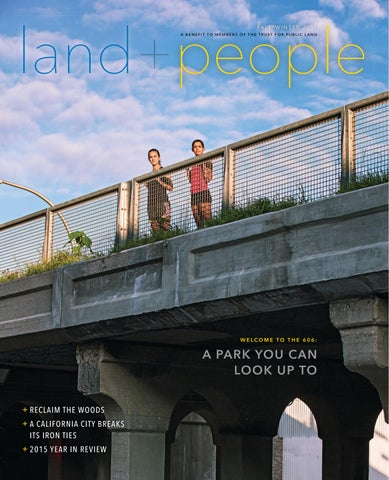
o n t h e cover Traffic? We’re over it. On page 29, get to know the new park that’s elevating Chicago. photo: tim klein
JOI N U S ON FAC EB O O K Scan the QR code with your mobile device to stay tuned to the latest news, videos, contests, and more. facebook.com/tpl.org
T P L. O R G · 3
mi ke schi rf
4 · LA ND &PE OPL E · FAL L /W I NTER 2015
contents
BONNEVILLE SHORELINE TRAIL, SALT LAKE CITY, UTAH
Bonneville Lake dried up 14,000 years ago—the dramatic canyons and terraces left behind are a fitting place for conservationists to take the long view. We started protecting land here back in the 1990s. Today, we’re a hundred miles closer to our goal of a trail connection from the Idaho border to the heart of Utah.
Page · 21
21
T P L. O R G · 5
an dy ri chte r
6 · LA ND &PE OPL E · FAL L /W I NTER 2015
contents
BURNTSIDE LAKE, ELY, MINNESOTA
The Northwoods offer solitude and space for a winter weekend away. But Minnesotans have outdoor options for Monday through Friday, too: tied this year for the nation’s best urban park system, Minneapolis and St. Paul have adopted strong strategies to provide city dwellers with green space close to home.
Page · 24
24
T P L. O R G · 7
je rry an d marcy mon k man
8 · LA ND &PE OPL E · FAL L /W I NTER 2015
contents
THE 606, CHICAGO, ILLINOIS
The Windy City’s newest park and trail is cause to sit up and take notice. Named for the zip code prefix all Chicagoans share, The 606 comprises nearly three miles of converted rail-line, as well as ground-level access parks featuring locally commissioned art.
Page · 29
29
T P L. O R G · 9
our mission: p ub l i s h e r Sean Connolly
edito r i a l d i re cto r Eliza Sarasohn
art d i re cto r Matt Mullin
m an ag i n g e d i to r Alia Salim
p ro d u cti o n co o rd i n ato r Jenny Torres
p h oto g ra p h y co o rd i n ato r Elyse Leyenberger
p ro d u cti o n a ss i sta n t Skye Alexander
edito r i a l a ss i sta n t Shoshannah Flach
staff w r i te r Allie Ferguson
m ar ke ti n g Kristen Anderson
dig i ta l p ro d u cti o n Carrie Gotch Adele Wilson-Hamaker
con tr i b u ti n g e d i to r Bill Poole
A GREEN ER READ Land&People is printed in the United
THE TRUST FOR PUBLIC LAND CREATES PARKS AND PROTECTS LAND FOR PEOPLE, ENSURING HEALTHY, LIVABLE COMMUNITIES FOR GENERATIONS TO COME. how you can help: Our work depends on the generous support of people like you.
States on chlorine-free, 30 percent postconsumer recycled paper and manu™
factured using Envirotech ink, which contains a high percentage of ingredients derived from renewable resources. Printed by Quad/Graphics Inc., Wisconsin.
© 2015 The Trust for Public Land. All rights reserved. Conserving Land for People, Conserving Nature Near You, Creating Parks and Protecting Land for People, Fitness Zone, Land for People,
donate: Use the envelope inside this magazine, or visit tpl.org/donate for other easy ways to give. learn more: Get timely updates on our park and conservation work near you. Sign up for our e-newsletter at tpl.org/enews. share: Help us make the case for parks and open space. When you’ve finished reading this issue, pass it on!
Land&People, LandVote, Northwoods Initiative, Our Land, Parks for People, ParkScore, The Trust for Our Land, The Trust for Public Land, TPL, and The Trust for Public Land and LandVote logos and
Land&People magazine is a benefit to members of The Trust for Public Land.
all other names of The Trust for Public Land programs referenced
Free trial issues are available at tpl.org/freemag.
herein, as well as their logos, are registered or common law trademarks of The Trust for Public Land.
1 0 · LAND &PE OPL E · FAL L /W I NTER 2015
from the president
For more than 40 years, The Trust for Public
sara cozolino
CONNECTING YOU TO WHAT MATTERS Land has worked to connect people to nature, parks, and each other. For every acre we conserve, every park we help create, we ask ourselves: how will this land improve people’s lives? How can we connect as many people as possible to this wonderful place? These connections are the focus of this issue of Land&People magazine. In Chicago, we helped transform a former elevated rail corridor into The 606, a park and trail linking four neighbor-
way these places improve peoples’ lives and
hoods—and 80,000 residents—to recreation, the
health—revealed in stories like the ones you’ll
outdoors, and their fellow Chicagoans. Rural
read here.
communities from New England to California
Thanks to your support, millions of people
are affirming traditional connections to their for-
now live within a 10-minute walk of a park, play-
ests by buying them for the public—protecting
ground, or protected natural area created with
jobs, close-to-home recreation, and the opportu-
help from The Trust for Public Land—a benefit
nity for future generations to learn and explore
we’re working to extend to all Americans. To
in nature. And cities like Richmond, California,
further our efforts, we recently launched our
are revitalizing green spaces in an effort to con-
first-ever capital campaign—a special opportuni-
nect residents in park-poor neighborhoods with
ty for our supporters to affirm the power of place
the resources for better health and wellness.
in their lives. See page 60 to learn more.
Both in urban centers and beyond them, it has
As we approach the year-end season of shar-
never been more important to establish and en-
ing, we hope you will consider helping us con-
hance these natural connections. In a time when
nect more people nationwide to parks, health,
more and more of us engage with each other
and the landscapes that inspire them. And we
electronically, The Trust for Public Land is proud
hope that you’ll have the opportunity to spend
to be building parks and conserving land where
time outdoors, nurturing a connection to nature
children and families can play, garden, picnic,
with the people you love.
hike, swim, and spend time together outdoors— in person. We could not do this important work without you, our donors and supporters. Page 59 of this issue of Land&People shows just some of our ac-
Will Rogers
complishments together this past year—such as
president
the number of acres conserved and parks built. But the true measure of our success lies in the
T P L. O R G · 11
Be a leader. Connect more people to nature by becoming a Conservation Champion today. With your annual leadership-level contribution of $2,000 or more in general support you will receive invitations to special events and insider updates on our park and conservation strategies.
Learn more about the impact you will have as a Conservation Champion. Call Megan O’Donoghue at 415.800.5190.
Conservation Champions The Trust for Public Land t pl . o r g/ c h a m p ions | cham p ions@tp l.org
O F F IC E R S
Susan Whiting
s en i o r v i c e pre si de n t a n d di v i si o n di re cto r Raymond Christman
A Trust for Public Land board
sara cozol in o
p res i de n t a n d ch i e f exe c u t i v e o ff i c e r William B. Rogers s en i o r v i c e pre si de n t an d d i re cto r o f c i t y pa r k d e ve lop me n t Adrian Benepe
board spotlight
Get to know
member since 2012, Susan Whiting has served as a top advisor and director for consumer, technology, and financial
s en i o r v i c e pre si de n t a n d c h i e f m a r ke t i n g off ice r Sean Connolly
services companies. In her 35-year career with Nielsen, she was known for
s en i o r v i c e pre si de n t a n d di re cto r o f co n se r vat i o n st rat e g ie s Ernest Cook
building the company’s most visible franchise in television measurement
s en i o r v i c e pre si de n t a n d di v i si o n di re cto r Jeff Danter
during the cable, telecommunications,
v i ce pre si de n t a n d di re cto r o f f e deral affairs Kathy DeCoster
She resides in Chicago and Wisconsin
and media industries’ digital transition.
with her children.
s en i o r v i c e pre si de n t, gen e ra l co u n se l , a n d se cre tary M. Holly Haugh s en i o r v i c e pre si de n t a n d c h i e f ph i l a n t hrop y off ice r Margie Kim s en i o r v i c e pre si de n t an d d i v i si o n di re cto r Deborah Love s en i o r v i c e pre si de n t, chie f fi n a n c i a l o ff i c e r, a nd treasu re r Cynthia Scherer v i ce pre si de n t a n d di re ctor o f co n se r vat i o n t ra nsactions Brenda Schick v i ce pre si de n t a n d d i re cto r o f hu m a n re sou rce s Barbara Smith s en i o r v i c e pre si de n t a n d c h i e f o f sta ff Tim Wohlgenant
I JOINED THE BOARD BECAUSE … I am
trail in Chicago to preservation of open
passionate about providing access to na-
land in Telluride, Colorado. These two
ture as well as preserving natural resourc-
examples demonstrate how we can touch
es. I’ve seen firsthand the awe and learning
American lives from coast to coast.
that comes from exploring green space and studying nature. I’ve been inspired by
THE KEY CHALLENGE FACING THE TRUST FOR
nature all of my life, and I want to make
PUBLIC LAND IS … continuing to adapt the
sure that others have that opportunity.
projects and programs to urban, suburban, and rural communities. We are learning
I SUPPORT THE TRUST FOR PUBLIC LAND
how to balance these different require-
BECAUSE … I believe in its core mission: to
ments—and building awareness of The
create parks and protect land for people.
Trust for Public Land in the process. Private
I believe it is our civic duty to protect our
support for our mission is also key, and
environment for future generations.
that’s why I’m excited to be a part of our first major fundraising campaign,
THE TRUST FOR PUBLIC LAND’S WORK IS
“The Power of Place.”
UNIQUE BECAUSE ... parks and green spaces
B OA R D OF D I R E CTOR S
transform cities and inspire people—
I FIRST FELL IN LOVE WITH THE NATURAL
both young and old—to be a part of their
WORLD WHEN … I was freely allowed to
community.
wander and explore our family farmland, woods, and lake as a child. I spent count-
Page Knudsen Cowles (Chair), Stephen W. Baird, Brian M. Beitner, George Bell, William J. Cronon,
MY PROUDEST ACCOMPLISHMENT AS A
less hours finding springs, climbing fences,
Douglas Durst, Whitney Hatch, Ignacia S. Moreno,
BOARD MEMBER WAS … witnessing the
counting wildflowers, and becoming
Caroline P. Niemczyk, Michael E. Patterson, Thomas
breadth of The Trust for Public Land’s
more curious about the seasons and the
S. Reeve, Laura Richards, Roy Richards Jr., William
work—from the opening of The 606 urban
environment.
B. Rogers, Lex Sant, Sheryl Tishman, F. Jerome Tone, Ana Valdez, Susan D. Whiting T P L. O R G · 13
contributors
Bonnie Henderson
Tim Klein
story:
story:
story:
The Healer
A Forest for All of Us
Welcome to The 606
26
29
40
James Edward Mills is the producer of
Bonnie Henderson is an Oregon-based
Photographer Tim Klein credits the natural
The Joy Trip Project podcast and a journalist
journalist interested in the intersection
beauty of his native Pacific Northwest with
covering conservation and outdoor recre-
of the natural world and the human experi-
inspiring his creativity and honing his ability
ation—from big-wall climbing to urban-
ence. Her work ranges from two popular
to capture extraordinary images from every-
river fly-fishing. His book The Adventure Gap
hiking guidebooks to interpretive signage
day moments. Now living in Chicago,
chronicles the first all–African-American
for parks and wildlife refuges. Her latest
Klein has shot for publications including
summit attempt on Denali, the highest
book is The Next Tsunami: Living on a
The Wall Street Journal Magazine, Fast Company,
point in North America.
Restless Coast.
and Newsweek.
joytripproject.com
bonniehendersonwrites.com
timkleinphoto.com
EVEN MORE LAND&PEOPLE Download the free Land&People iPad app—available now at the App Store. The digital edition includes all the stories you love in high resolution, plus bonus content like video, search tools, easy social media sharing, and instant links to learn more. If you don’t have an iPad, you can access the digital edition online at tpl.org/lpdigital. Wherever you see the pointer symbol below, you’ll find bonus content in the digital edition. Download the app or go online to dive deeper into the story.
1 4 · LAND &PE OPL E · FAL L /W I NTER 2015
ipa d is a registered tra demark of ap ple inc ., registered in the u.s. and other countries. app store is a service mark of apple inc.
James Edward Mills
mailroom
al l en b risso n - smit h
JOI N OUR COMMUNI TY We asked what songs make you want to hit the trail, then turned your picks into a playlist. Be the first to take the next poll—and get our latest
mickaël dia
news—on Facebook.
MAKE YOUR MARK
St. Paul locals are celebrating the new Frogtown Park and Farm, a nature sanctuary and demonstration farm also home to one of the city’s best sledding hills.
We want to hear from you! Tell us what you think of the stories you read here—and you just may find yourself in the next issue. You can reach us by mail, on Facebook, or at mailroom@tpl.org.
S P R I N G / S U M M E R 2 0 15 VOL. 27, Nº1
ISSUE
People-powered conservation
I am a prisoner at Belmont
The Frontiers issue beautifully
Correctional Institute in Southeast-
exemplifies why I support The Trust
ern Ohio. I will re-enter society in
for Public Land. What struck me
the not-too-distant future and I am
were the many photos showing
writing to you because the Frontiers
people, especially children, im-
issue brought me to tears. Blessings
mersed in wild places ... gaining a
to you: may your organization con-
powerful and playful experience of
tinue to strengthen.
place that will foster a lifelong love
Ken Brickman, St. Clairsville, Ohio
of nature. That love is a powerful
A BENEFIT TO MEMBERS OF
+INNOVATIONS IN URBAN PARKS +HOW TO RAISE A YOUNG EXPLORER +PUTTING CLIMATE CHANGE ON THE MAP
motivation for the core conservation
Lots to ‘like’
work that The Trust for Public Land
I am absolutely in love with the sto-
carries forward.
ries you share daily on social media.
Zach Pine, Berkeley, California
I am a professor in recreation and park management and am inspired
T P L. O R G · 15
jer r y an d marcy mo n k m an
ju l ia stot z
mailroom
away from it all and commune with the Earth. They are the promise to wildlife that we will not take all their habitat. These lands were established thoughtfully, with the understanding that nature is important. We must protect them for the future. D. Lynn Collier, via the blog Beautiful video and inspiring message. We must fight any corporation or unlawful regulation that doesn’t preserve our wild land, our waters, rivers, streams, and clean air. Our humanity depends on these. Mary in Phoenix, via the blog
WATCH THE VIDEO @
TPL.ORG/BLACKDIAMOND
and reminded of simple truths each day
A Hollywood connection
Where’s your ‘Listening Point?’
by The Trust for Public Land. Kudos and
Looking through the spring edition,
Many readers responded to our story
thank you.
I turned to page 50, and thought,
about writer and naturalist Sigurd
Kindal Shores, via the blog
Wow, that is the bridge in the movie
Olson, who found creative inspiration
Chinatown. The movie contains some of
at Listening Point on Minnesota’s
the same history of the river that James
Burntside Lake.
all the beautifully stub-
Mills’s article mentions. Thanks for a
andy richter
Congratulations to
view of the continuation of this story. Larry Crooks, Richmond, California
born people who volunteered and sacrificed
Our public lands, under attack
and changed their lives
impassioned plea for public lands
to make this happen for
Black Diamond CEO Peter Metcalf’s moved many of you to share your own concerns.
us—today and for future generations! jaclyn farnham, via facebook, celebrating the protection of the preserve, a thousand-acre connecticut forest. 1 6 · LAND &PE OPL E · FAL L /W I NTER 2015
I live in the backcountry, the hidebound hills of southern Oregon. I am fortunate
There is a sense of loss just watching
to live remotely and to find listening
the wild areas between small towns fill
points just outside my door. The world
in with row upon row of houses and
speaks to us, if only we listen.
strip malls. I want to cry when they
Jack Duggan, via the blog
“develop” big centers on lakes that add businesses and more housing. These federally protected lands are hope that far into the future you can still get
LAND&PEOPLE IS LISTENING! Send letters to the editor or change your mailing address: mailroom@tpl.org.
With your help, we’re protecting special places around the Appalachian Trail— like Bald Mountain Pond in Maine.
One to One On ouc u h off na attu urre ma make ke es th the he wh whol ole ol e wo worl worl rld d ki kin. kin. n. — w i lli lii a am m ssh a ke kess p ea re re
t urn t h e page fo r … ma p l e oat m ea l co o k ies · t h e s pirit o f a lo ha · ca rb o n- f ree co mmut ing · new jers ey’s eco - h ero T P L. O R G · 17
A sweet deal
edible conservation
big six forest somerset county, maine
The next time you dig in to a plate of
Force, has been tapping “sugar bush”
difficult, if not impossible, to rebound
pancakes, consider this: it takes 50 years
for as long as he can remember. “My
from,” says Fabien Lariviere, whose
before a maple tree is ready to tap. So
grandfather bought our farm in 1918,”
family has been harvesting the Big Six
when mature maples in northern Maine
he says. “My kids are doing it now, and
for more than a century. “But the big-
come under threat, so do the small-
my grandchildren have started helping,
gest loss would be our way of life.”
scale syrup producers—also known as
too. Five generations—that’s not uncom-
sugarmakers—who rely on the forest to
mon in this industry.”
make a living.
Unfortunately, says Trust for Public
To help keep families like Lariviere’s and Black’s in business, The Trust for Public Land is working with partners
Maine is the nation’s third-largest pro-
Land project manager Diano Circo,
like the U.S. Forest Service to perma-
ducer of maple syrup, and a full quarter
syrup producers like Black are often
nently safeguard the Big Six with a
of the state’s syrup production starts
at odds with other industries. “Many
conservation easement that will keep
in Big Six Forest. Here, sugarmaking is
sugarmakers lease their maple stands
the forest intact for maple harvesting,
a time-honored tradition, a respectful
from landowners who can make more
wildlife habitat, and recreation. Fund-
partnership with nature passed down
money if they cut down the trees, sell
raising for the easement will continue
from parent to child.
the wood, and turn the property into
through 2016; like-minded conservation-
vacation homes,” Circo explains.
ists (and syrup connoisseurs) can learn
Lifelong Mainer Russell Black, who
“Losing the sugar bush would be
more at tpl.org/bigsix. jerry and marcy monkman
chairs the state’s Maple Sugar Task
1 8 · LAND &PE OPL E · FAL L /W I NTER 2015
WE GIVE TO …
keola beamer, hawaii
marco g arcia
honor our heritage
why we give
Maple oatmeal cookies This warming treat from the Southern Maine Maple Sugarmakers Association uses maple syrup as a natural alternative to refined sugar. INGREDIENTS
A master of the slack-key guitar, Keola Beamer comes from a long line of celebrated Hawaiian musicians. This year, he joined The Trust for Public Land to work toward
O
½ cup butter
O
1 cup pure Maine maple syrup
O
½ cup milk
O
2 eggs
O
1½ cups flour
field is hallowed ground for many Hawaiians—including
O
1 teaspoon salt
the Beamers—who trace their ancestry back to warriors
O
2 teaspoons baking powder
who fought and died there in an 1819 battle over the tradi-
O
1½ cups oatmeal
tional kapu religious system.
O
½ cup raisins (optional)
O
½ cup chopped nuts (optional)
the protection of one of the Big Island’s most important cultural sites. Located on the beautiful Kona Coast, the Kuamoo battle-
Among the hundreds of warriors buried at Kuamoo was Chiefess Manono, who is said to have pleaded with her dying breath for both sides to malama ko aloha—“keep
Beat butter, maple syrup, milk, and eggs. Sift flour, salt, and baking powder. Combine wet and dry ingredients. Add oatmeal, raisins, and nuts. Drop by spoonful onto greased cookie sheet and bake
Keola Beamer (left) and his family started a nonprofit, Aloha Kuamo Aina, which aims to share aloha values with new generations.
LEARN MORE ABOUT KUAMOO @
TPL.ORG/ALOHA
your love.” It’s this spirit of aloha and reconciliation that inspired the Beamer family to advocate for preservation of the battlefield. “I’m so grateful for The Trust for Public Land’s mission:
at 350°F for 15 minutes or until browned.
It makes a real difference in peoples’ lives,” says Beamer.
Makes four dozen.
“To be able to take this beautiful area and conserve it for future generations—that would be priceless.” F I R ST LO O K · 19
good news t eg ra sto n e n u ess
what counts
SCHOOL’S OUT! (Outside, that is.)
As The National Park Service is marking its upcoming hundredth birthday with a special gift to young visitors. In a bid to get more students and families outdoors, the “Every Kid in a Park” initiative provides free entrance passes to every fourth grader in the country throughout the 2015–2016 school year. Secretary of the Interior Sally Jewell considers the initiative an investment in the next generation of environmental stewards. “We want to make sure that every American has the opportunity to develop a lifelong connection to our nation’s land, water, and wildlife.”
42
From historic sites to wildlife viewing, the national park system holds endless possibilities for hands-on learning. Not sure where to start? Here’s just a few of our favorite outdoor classrooms—all places we’ve helped protect with support from people like you.
I F THE I R FAVORI TE SUB JE CT I S …
E N G L I SH
MAT H
Boundary Waters Canoe Area Wilderness, Minnesota: The quiet lakes and forests here inspire writers of all ages—it’s a reflective setting for journaling and nature observation. Joshua Tree National Park, California: Channel ancient mathematicians and astronomers under desert skies with some of the most spectacular stargazing in the country.
SC I E N C E
Glacier National Park, Montana: Climate change can be a tough concept to grasp in the abstract, but young visitors here can see the early effects on sensitive ecosystems firsthand.
ART
Weir Farm National Historic Site, Connecticut: Once home to celebrated landscape painter J. Alden Weir, the park provides art supplies so kids can get creative en plein air.
H I STO RY
Kennesaw Mountain National Battlefield Park, Georgia: The Civil War comes to life on the hallowed ground of Kennesaw—complete with demonstrations of live cannon fire.
… miles of abandoned rail line that could
become the Seattle region’s next great linear
park—with your help! If completed, the Eastside
TRY A TRIP TO …
Rail Corridor would connect six cities and
two counties with a trail for walking, biking, and carbon-free commuting along Lake Washington.
sign the petition @ TPL.ORG/EASTSIDECORRIDOR
2 0 · LAND &PE OPL E · FAL L /W I NTER 2015
long game
In Utah, a trail traces an ancient lake Utah residents have a peculiar park predicament. On the
boom underway, residents watched in alarm as development
one hand, their state is famous for its spectacular natural
began to creep into the canyons above the city. They knew
landscapes—from the red canyons of Zion to the snowy
they had to move fast to combat sprawl and protect their
peaks of the Wasatch Range. It boasts five celebrated national
quality of life. “It’s now or never along the Wasatch Front,”
parks and world-famous skiing, mountain biking, and
said a Trust for Public Land staffer at the time. “Once these
rock climbing.
canyons are subdivided, public access to the mountains will
On the other hand, Utah’s demographics are far more ur-
be gone.”
ban than its outdoorsy image. For the two-thirds of the popu-
Since that first scramble to lock down land protection,
lation concentrated in Salt Lake City, those big-name national
we’ve partnered with local government and conservation
parks are hours away—not exactly an option for a morning
groups to protect nearly 2,000 acres for the Bonneville Shore-
jog or lunch-break picnic.
line Trail. Today, the multi-use route is an all-season asset, an
So if you actually live in Utah, where do you go to get outside? For many people, the answer is the Bonneville Shoreline Trail. If you’re looking for the corresponding lake in your road
easy-access option for snowshoeing and cross-country skiing in the winter and hiking, biking, and horseback riding when the snow clears. But the story of the Bonneville Shoreline Trail is far from
atlas, you won’t find it: the thousand-foot-deep Lake Bonn-
over. With your support and help from the Land and Water
eville disappeared more than 14,000 years ago. But it left its
Conservation Fund, we’re working to add more access points
mark on the region’s geology and the famous salt flats of the
and safeguard critical open space to surround and extend the
same name.
trail. Ultimately, we envision a 280-mile-long path between the
The trail—which currently runs 100 miles on the east side
ties and limitless possibilities for adventure.
mike schirf
of Salt Lake City—got its start in the 1990s. With a housing
Idaho border and the heart of Utah—connecting 40 communi-
F I R ST LO O K · 21
buzzworthy
meet our staff
n an a taimour
“It’s about connecting people to opportunities, so they can grow and support each other.”
“If you enjoy the outdoors, it’s your responsibility to protect it.”
DONNA KIRKLAND A NEWARK ‘SUSTAINABILITY HERO’ SEES GOOD THINGS TO COME
You’re a lifelong resident of Newark, New Jersey. What was the city like when you were growing up? When I was little, there weren’t many city parks in Newark—but most houses had a backyard where you could see and be a part of nature. I’m the third of seven children—we would all play tag, trap lightning bugs, eat
Mountaineer Conrad Anker’s career has taken him to some of the wildest places on the planet—but he’s just as passionate about his local parks in Bozeman, Montana. “I still get that essential feeling of being away from civilization. They’re a place where I can rejuvenate.”
grapes right off the vine. But beginning in the seventies, the new highways came in and they started building new infrastructure. They tore down homes and greenery— you’d come home one day and a whole row of trees would be gone. The city became a concrete jungle. Businesses closed, and many people moved away. The generation after me grew up in a different Newark.
WATCH OUR EXCLUSIVE VIDEO @
TPL.ORG/ANKERS
How did you get involved in park advocacy? It was an accident, really. A good friend of mine told me about a community meeting to discuss putting a park in the vacant lot behind the complex where I lived. I assumed the meeting would be a waste of time—I didn’t
2 2 · LAND &PE OPL E · FAL L /W I NTER 2015
think anyone would actually build a
I’ve always wondered: What is
environmentalists. You have to experi-
park there—but I went.
my purpose? What am I here to do?
ence nature in order to become passion-
Now I know: to be of service to my
ate about it and want to protect it for
community.
the future.
design groups. The experience was like
If the Parks for People program achieves its goals, how will Newark be different in ten years?
How does The Trust for Public Land help encourage that passion?
a breath of fresh air—something real
Newark will be a model city! It’s on the
When we involve children in the partici-
and truthful that had never happened
verge—we’re already changing people’s
patory design process for a park, they
before, in all my days living in Newark.
mindsets. If we’re successful, Newark
learn about much more than play-
I remember thinking: I’ve never heard
will look the way it did when I was a
ground equipment. They learn about
of The Trust for Public Land, but they’re
kid. Every person will live within a ten-
stormwater and green infrastructure,
really delivering for this community.
minute walk of a park or playground,
landscape design, and other green jobs.
so that even if they don’t have a yard,
Kids in our Summer Ranger program
When did you join The Trust for Public Land staff?
they’ll have a place to play. Parks and
learn horticulture and park mainte-
playgrounds will be the foundation of
nance, but they also get exposed to new
A staffer told me that the Newark office
our community.
career paths and conservation strategies.
At that meeting, students from a nearby elementary school presented the ideas they had created for the park. Their excitement and enthusiasm convinced me to join one of the
had an internship. I didn’t have a degree
We want to introduce people to places
criteria for the job—but they said they
Why is access to nature so critical?
would make an exception.
Seeing nature, living and touching
and I didn’t know how to type—two
they have never been and paths they haven’t yet imagined.
so important for well-being and healthy
You were recently named a “Sustainability Hero” by the Sustainable Jersey Task Force. What makes a park sustainable?
development. But it’s not just about
We do more in our parks and play-
Yes. I never could have seen myself in
physical activity—it’s about creating
grounds than just play. Parks are about
this position. But you learn as you go.
the next generation of stewards and
education, equity, conservation, and job
and being a part of it—that’s good for
That was almost ten years ago. Now you’re a senior program coordinator, helping run our Parks for People program in Newark.
everyone. For children especially, outdoor play and a connection to nature is
luke walter
creation, too. It’s about building community: enabling advocates to steward and care for their parks and to report and discourage vandalism. It’s about connecting people to opportunities so that they can grow and support each other. Empowering people with a sense of ownership and responsibility creates sustainable communities—which in turn creates sustainable cities and sustainable states, as well.
Quitman Street Community School Playground, Newark, New Jersey.
F I R ST LO O K · 23
The results are in: we’ve run the numbers on park systems in the 75 largest U.S. cities to create the fourth annual Trust for Public Land ParkScore® Index. Combining factors of park acreage, amenities, and access, the index gives planners a picture of where there’s work to be done to provide city dwellers
TWIN CITIES #1 minneapolis | st. paul the trust for public land pa r ks co re ® i n d ex
with the green space they need. This year’s debut of 15 additional cities saw St. Paul join
1
P E O P LE - P O W E R E D TR A N S I T
Minneapolis in a tie for best U.S. park system. If you expected
In Minneapolis, the nearly six-mile-long Midtown Greenway
lush Portland or outdoorsy San Francisco in the top spot,
hosts more than 1.5 million bicycle trips per year. A former
that’s no surprise—but though coastal folk may not know it,
rail line, the Greenway is largely separated from car traffic—
the Midwest is packed with successful city parks. Here are five
making it a fun (and often faster!) way to commute.
ways the Twin Cities are doing it right. 2
A STR O N G S E N S E O F P LAC E
In the best city parks, arts and culture are not just an afterthought: they’re as much a part of the planning process as permits and landscaping. At Frogtown Park and Farm in St. Paul, neighbors are using a creative placemaking approach to build a one-of-a-kind green space that combines community art and agriculture.
3
TI M E TR AVE L
Done right, a city park can double as an open-air museum. Mill Ruins Park—an intriguing labyrinth of metal catwalks and crumbling brick—is a monument to the factories that Midtown Greenway, Minneapolis
once made Minneapolis the flour capital of the world.
4 Bruce Vento Nature Sanctuary, St. Paul
C LE V E R CO LLA B O R ATI O N
Great park systems might start in City Hall, but they thrive when community groups, transit agencies, and businesses get in on the action, too. Twin Cities officials are exploring ways to create “POPS”—privately owned public spaces—at stops along The Green Line, the new light-rail corridor connecting downtown Minneapolis to downtown St. Paul.
5
A LL-W E ATHE R F U N
True, this part of the country is known for brutal winters— but the locals are just as tough. Those willing to brave the elements benefit from parks with something for every season. Transformed with help from The Trust for Public Land, Bruce Vento Nature Sanctuary in St. Paul is a onetime indusEXPLORE INTERACTIVE MAPS AND THE FULL PARKSCORE ® INDEX @
PARKSCORE.TPL.ORG 2 4 · LAND &PE OPL E · FAL L /W I NTER 2015
trial site that’s now the perfect place to spend a snow day.
photos: top, flic kr user deb ; b ottom, al l en b risson - smit h
Twin Cities tie!
what counts
The Trust for Public Land thanks The Boeing Company for its invaluable support of our work to create and preserve places where people connect to nature— including The 606, Chicago’s new elevated park and trail.
t im k l e in
THINGS ARE LOOKING UP.
Give your EarthShare.
An EarthShare payroll deduction is one simple way to donate to The Trust for Public Land or more than 400 other environmental and conservation charities. Many corporate and government employers support EarthShare payroll giving. If yours doesn’t, ask them to start. If they do, simply decide on a single deduction or a recurring small one from every paycheck. Then designate us, member number 11440, as one of your conservation charities. For more information visit earthshare.org or email donor.outreach@tpl.org.
T P L. O R G · 25
alex diekmann
tpl.org
insight
writer jarid manos on the power of a restoration mindset—from prisoners to the plains
2 6 · LAND &PE OPL E · FAL L /W I NTER 2015
jar r iel jo n e s
I N C O N V E R S AT I O N W I T H J A M E S E D W A R D M I L L S
To hear an American landscape described as a war zone is to be confronted with powerful—but predictable— images: a strip-mined Appalachian hillside, a polluted urban river, a clear-cut forest in the Pacific Northwest. But when Jarid Manos uses the term, he’s talking about someplace else: the Great Plains. The writer and activist is referring to a chapter of the nation’s natural history that even other conservationists often forget. Once, on an American Serengeti spanning 13 states, an ocean of grass supported tens of millions of bison, prairie dogs, and antelope. Today, this complex ecosystem is so far gone it has almost passed from the collective memory. Founder of the Great Plains Restoration Council, Manos has set out to protect and revive the last remnants of the battered prairie. Drawing on his own experience of personal transformation, he’s leading an effort to rehabilitate both a lost landscape and forgotten people—with the belief that a connection between the two can heal them both.
What early experiences set you on the path to the work you’re doing now?
the plains, I felt a pall of violence and hatred stretching from
I was alienated and self-hating as a kid. I struggled with
this was my personal experience.
horizon to horizon. I don’t want to be antagonistic here, but
extreme depression and anger. I had to figure out the world for myself, and the conclusion I came to was that the world was a hostile and hopeless place. I left my small, rural town in the Midwest, tried to go to school, but ended up involved in prostitution and drug dealing in New York City.
As someone who had already faced problems with depression, how did you react when you discovered the plains weren’t what you’d expected? For years I struggled to find the safe place I had dreamed of. I got angry. I became militant, went underground, and started
And you looked to the natural world to get away from all that.
cutting down barbed wire fences. And I studied—I learned
Right. Since I was a child I’d had this crazy dream—that I
sense of its embedded stories.
could escape into the fabled wilderness of the American Great
more about the history of the Great Plains and began to get a I believe the American story in particular is the story of
Plains, just disappear under hundreds of miles of sky and
people on the land. Whatever happens to that landscape,
never talk to anybody again.
those stories persist; they’re layered in like sandstone beneath our feet. There are places in the West where it still feels like
Did you find what you were looking for?
the 1870s—in the sense of both the violence and the beauty.
When I finally made that escape attempt, I started noticing that something was off. Where I had imagined a landscape
How does your own story fit in?
of openness and health, I found the Great Plains strung up in
I would say there were three major stages of my narrative. The
bristling wires, overgrazed and sore, and the remaining native
first was hopelessness and despair. The second was this anger
wildlife struggling to survive the onslaught of poisons and
and militancy. And the third is learning to love more, through
traps and bullets. In many places, even the creeks don’t flow
the work that I do.
anymore. And some ranchers and cops made it a dangerous place for people of color. I often felt safer in the inner city, because
I try to insist on an ultimate goodness in people. I believe we can have the most exhilarating life by getting healthy and giving back. I’m aware of the world’s problems and I work in
there the threats were occasional and specific—whereas on I N SI G H T · 27
g reat pl ain s resto rat io n co u n cil
Jarid Manos is working to complete the Fort Worth Prairie Park: a thousand-acre opportunity for city kids to explore a native grassland.
to make better decisions in those crisis moments. So restoration work, providing refuge, is effective for both people and wildlife in crisis.
How does the outdoor setting convey these concepts differently than a classroom? The Great Plains is a landscape that has suffered such a loss, but there are remnant spaces still expressing beauty and life. In Fort Worth, for example, we’re working to preserve more than a thousand acres of native grassland. If we’re successful, the face of what I still see as constant violence, but I step from
the Fort Worth Prairie Park could put the plains in reach of
stone to stone of good people, vitality, health, and service. I
more than 5 million urban residents. Our work is for every-
survived. What else is there for me to do but give back?
body, not just the stricken. Keeping the Earth alive and livable is an exhilarating task and an opportunity for all of us: we all
Tell me about the work you’re doing—your stepping-stones. My organization, the Great Plains Restoration Council, is
need to get outside more. Especially on the plains! How many Americans have walked a mile or more through wild prairie? In places like this, we can actually show people how this
based on the principle of interdependence of people’s health
ecosystem worked in its virgin state. When you put yourself
and local ecosystems. In this model of ecological health, help-
within that space and speak in terms of health—recover-
ing one helps the other: we combine habitat restoration with
ing what’s needed, tearing out what isn’t, and repairing and
programs for inner-city youth, HIV/AIDS-affected families,
replanting to bring the whole system back to health—you can
homeless individuals, and others.
very much see how that process can apply to your own body
The Restoration Not Incarceration program works
and life.
with young, often homeless men who have been in prison. need to work. So we challenge them to be involved in tough
If you could go back and have a conversation with your childhood self, what would you say?
ecological restoration work, and to repair their own bodies
It’s true that every part of this little planet is impacted in
and lives through that same process.
some way. It’s true that there’s hatred and ugliness and
People—and I believe especially men—have a basic, physical
violence all around the world. But within that, there are
What do you hope to teach these men?
moments of vital health and beauty: you can see it on the
One of the biggest things is learning ways to become unbreak-
plains when you watch animals like prairie dogs, who worship
able. When you’re trying to survive on the edge of society, you
the sun each day. In the midst of a war zone, on a landscape
have what I call “shatter moments”—some type of crisis when
that has suffered so much, they retain this exuberance, this
things suddenly come to a head. You can’t breathe or think;
uncontainable desire to live. You can connect to that. Live
you just react—and in a split second you can hurt others or
in gratefulness. It’s possible to love so hard this love
yourself or both.
becomes holy.
For people who are confronted with situations like these— and who will be again at some point in their future—this isn’t just about getting out into nature. It’s about developing
james edward mills is an environmental journalist and author of the adventure gap: changing the face of the outdoors.
the stamina and the resiliency and the critical thinking skills
learn more about the great plains restoration council at gprc.org.
2 8 · LAND &PE OPL E · FAL L /W I NTER 2015
adam al ex an de r
W
W
EL
CO
ME TO
TH
E
E
O ce th On the di diiv vidi iding g li line ne bet etween t ffou ur ne neiigh hborhoods, hb h d , a conv n errte ted d railwa way y iss now bri ring n in ng ing g th them em together. by ruthie kott · photos by tim klein
T P L. O R G · 29
WALKING THE 606 ON A SUMMER AFTERNOON, I T ’ S E A S Y T O F E E L L I K E T H E PA R K H A S A L W A Y S B E E N A PA R T O F C H I C A G O.
Since its opening day in June—a kaleidoscopic gathering of 50,000 first-time visitors—the 2.7-mile elevated trail has fast become a part of daily life in the four neighborhoods it connects: Wicker Park, Bucktown, Humboldt Park, and Logan Square.
SEE THE GRAND OPENING @
TPL.ORG/606VIDEO
3 0 · LAND &PE OPL E · FAL L /W I NTER 2015
david schalliol
2010
In some respects, locals’ ready embrace of The 606 seems inevitable. After all, people were walking and exploring the abandoned and overgrown tracks long before any official plan to convert them to a sanctioned park. In other ways, The 606 is an unlikely success—a feat of urban planning and partnership between the city, the park district, The Trust for Public Land, dozens of community groups, and thousands of neighbors whose input shaped the design. A month after the opening, photographer Tim Klein and I set out to walk The 606 from west to east to talk with Chicago residents getting to know their newest park.
T P L. O R G · 31
STEPHANIE GARLAND We catch up to artist Stephanie Garland (better known as “Stef Skills”) at the Graffiti Garden, the concrete embankments between Central Park and Kimball avenues. They’re the perfect canvas for the kind of bold, colorful work she’s known for.
“In the past, Chicago has been punitive toward street art. But The 606 makes me optimistic about the future: I appreciated that artists were included in the opening and that the community is allowed to curate itself. That doesn’t always happen. Graffiti artists get lumped in with gangs, but they’re often the kids who’ve chosen not join—to find another outlet. There are also a lot of people who are curious about the graffiti they see, but don’t know how to read it. I led a tour of the art on The 606 and got a great reception. It felt good to see that people appreciated the work.” We’d heard about the Graffiti Garden even before we saw it: photos of the murals in progress appeared on the Friends of the Bloomingdale Trail Facebook page earlier in the day. The advocacy group was founded in 2003; online, its members post stories and tips. “Reason 1,341,299 to love the trail ... rolling home with groceries,” wrote one neighbor. Another shared his version of a missed connections ad, describing a woman who passed him on a run. There’s a bit of self-policing, too: people remind others of trail etiquette, like keeping dogs on a short leash and passing on the left. 3 2 · LAND &PE OPL E · FAL L /W I NTER 2015
KIMBALL AVENUE W
E
YOUR LEGACY
Protecct th Protect the he places you love by making a gift to The Trust for Public Land in you your o r es esta estate ate plans. By naming The Th he Trust Trus Tr u t for Public Land as a beneficiary of your will, living trust, trust st, orr rretirement etirement account, you can n make m ke a visionary gift that will conserve land for generations ma genera ge rati tions to come. For more information, infforma mati tion on,, pl pplease ease contact Gardner Gardn dner er Trimble Trimble b at 415.800.5208. t pl . o rg /pl ann ed g i v i n g · p la n n ed g i v i n g @ tp l.org rg/pl
The Trust for Public Lan Land d
T P L. O R G · 33
GLORIA DATA (WITH SON, ETHAN)
H UM BOLDT BOULE VA R D OV ER LOOK W
Walking east, we come in sight of one of the most striking features
E
“We were going to go play basketball, but then I asked
of The 606: the Humboldt Boulevard overlook. The wide, tree-lined
Ethan if he would rather shoot some hoops or go on the
roadway is part of a 26-mile network developed in the mid-1800s—
new trail. We decided to go up on the trail.
an attempt to realize a vision of Chicago in line with its motto, “City
When Ethan was born we lived in East Village, close
in a Garden.” At the time, the boulevards were an innovation that
to this spot. I used to come up here to relax and enjoy
inspired imitators in cities across the country. Today, the overlook is
the view. Now we live right down the Boulevard, in Little
The 606’s nod to its predecessor.
Village. I like the diversity of the neighborhood—it’s good
Gloria Data and her six-year-old son, Ethan, are together on the
for Ethan to be around. He likes playing video games,
overlook’s stadium seating, which faces north down the boulevard.
but I try to take him out as much as I can to do nature
They’re watching the traffic below. “How many white cars do you
walks and outdoor activities. He keeps me young and
see?” Gloria asks Ethan. They count, and when they answer at the
agile. And entertained!”
same time, they shout, “Jinx!”
3 4 · LAND &PE OPL E · FAL L /W I NTER 2015
DEMYRON HAYNES By the access ramp at Rockwell and Maplewood, we watch a procession of runners pause to sip at the drinking fountain. The 606 is already a favorite workout spot for urban athletes: on the right side of the trail in both directions, a two-foot-wide section of blue rubber provides a springy surface similar to a track. Beats concrete. A bright bouquet of yellow sunflowers catches our attention. It’s tucked under the free arm of a young man studying a trail map. “I was at a nearby coffee shop, and I took the trail back,” he tells us. “But I don’t remember where to get off.” We ask him about the flowers.
“They’re for my girlfriend—I’m using the trail as a shortcut to her house. We met at church in Humboldt Park, and we’ve been together for about three months. She’s very passionate about God and her community. I’m an assistant at Breakthrough Urban Ministries and she’s a schoolteacher. I admire her love for her students. I just delight in her. My first time on the trail was actually with her parents, about two weeks ago. I love to walk on the trail when I need to think something through. It’s also a way to build community, to just chill out with people who are walking by.”
ROCKWE LL ACCE S S RAM P W
E
T P L. O R G · 35
MARIA IRIAS
( W I T H D A U G H T E R , K AT E )
In all, there are 38 bridges and viaducts connecting different sections of The 606. Repurposed from the old Bloomingdale Line, the massive steel arches over the bridge at Milwaukee and Leavitt weigh 55,000 pounds and are 35 feet tall—impossible to miss, even from the road below. Near the Western Avenue access ramp, the trail passes underneath the El tracks. When a Blue Line train approaches from the northwest, you can hear it coming well before it’s in sight. As we chat with Maria Irias, her curious 18-month-old daughter, Kate, keeps spinning around to find where the noise is coming from.
“My husband and son are riding their bikes somewhere way ahead of us. My husband is an ironworker: we used to live in Houston, but he was transferred to Chicago to build skyscrapers downtown. My son is 14. He likes to ride off by himself sometimes—he’s at that age where he wants to be independent. We love being out here on the trail. We live nearby, in Belmont Cragin, and we try to come every other day. It’s so family-friendly, and we can easily walk or run the whole trail. It’s friendly up here in general— we say hi to other families. It feels like one big community.”
WIN N E BAGO AVE. I NTER S ECTI ON W
3 6 · LAND &PE OPL E · FAL L /W I NTER 2015
E
W
E
DAM EN A RTS P L A Z A
PATRICK MCCAFFREY We’re about three-quarters of the way down the trail when we
“He’s a smart, neurotic dog. My mom really enjoys how
reach the Damen Arts Plaza. A large, open space with ample
feisty and argumentative he is; she says he’s very much
seating and a view of the bars and restaurants on Damen Avenue,
like me as a kid. I end up sounding like a dad every now
it’s a great place for people-watching—and dog-watching, too.
and then when he doesn’t listen to me. My girlfriend
When passers-by see medical student Patrick McCaffrey with his dog, Sherlock, they tend to ask him three questions: What breed? How old? And, is he going to get much bigger? In fact, a group of
has caught me saying, ‘Sherlock, what did I just tell you?’ when he ignores me. He’s a herding dog, so up here on the trail he wants
people on the trail approach Patrick just a few minutes before we do
to chase after cyclists and runners because he thinks
to ask him those very questions.
they should go only the speed he’s going. This is a crash-
The answers: He’s a Shetland Sheepdog. He’s four months old. And yes, he’ll get bigger—but mostly furrier, Patrick says.
course for him—bikes coming out of nowhere, small children, strollers. But he’ll get used to it.” T P L. O R G · 37
OMAR TORRESKORTRIGHT
DAM EN A RTS P L A Z A W
E
Also out on the plaza is Omar Torres-Kortright. He directs the
“Even though I’ve been here for 15 years, I still consider
Segundo Ruiz Belvis Cultural Center, a hub for the city’s Puerto
myself very close to the island and also to the newer
Rican community for almost 45 years.
generation of Puerto Ricans moving to Chicago. The 606
“We have a presence in all these neighborhoods that The 606
is a way for us all to stay connected. Commuting by bike
unites,” Omar says. No surprise, then, that the cultural center was
has gotten a lot easier—I can actually get all the way from
among the community groups asked to join the trail’s grand opening
home to the cultural center on the trail.
celebration back in June. Omar helped organize a colorful proces-
Our procession at the grand opening was an oppor-
sion of performers in handmade masks and vibrant costumes, who
tunity to show how alive our culture is. We invited the
danced the length of the trail to the infectious rhythm of Latin music.
Puerto Rican community in these neighborhoods to
It was a highly visible celebration of Puerto Rican culture, Omar says,
come out and celebrate, and they showed up in big num-
“and of what The 606 means for our community.”
bers. It just gave us another perspective on our presence in Chicago, and how much our culture is appreciated.”
3 8 · LAND &PE OPL E · FAL L /W I NTER 2015
We’re nearing the eastern end of The 606, in the old Polish neighborhood of Wicker Park. The sun has gone down, and LED lights illuminate the trail. It’s a cool, comfortable night, and many people are still out walking and biking. The neighbors we’ve met are just a handful of the millions who’ll pass under the Milwaukee Avenue arches now that the trail is open. There are two more access parks in the making; the fresh landscaping will take root and new art will replace the work we saw today. But while the faces of The 606 will change— along with the diverse and dynamic communities around it—the trail will stand as a lasting connection between them, and a welcome to each one. W
E
T P L. O R G · 39
4 0 · LAND &PE OPL E · FAL L /W I NTER 2015
hen we get past this tunnel of blackberries, we’ll get a better view,” my guide assures me. It’s an Oregon summer day, and I’m tromping up a gravel road after Owen Wozniak, a project manager for The Trust for Public Land. Ahead of us along the ridgeline, a mosaic of deep green Douglas firs nearly obscures the summit’s basalt cliffs. But as we round the bend, the view indeed opens up, and the forest thins to reveal an oak savannah and rolling pastures. This is Thurston Hills, nearly 700 acres of sprawling meadows and woodland on the outskirts of Springfield. It’s the future site of the region’s first community forest. Three years ago, The Trust for Public Land helped conserve the property; today the local parks and recreation department is working on a plan to improve public access. “That housing development is new,” says Wozniak, pointing to a small cluster of homes on the valley floor. “Come back in ten years, and that whole area will be built out. But no matter how big Springfield gets, Thurston Hills will remain open to the community to connect to nature.” While still a novelty here in the west, in New England states the communityowned forest is a venerable institution. This year, Vermont celebrates the 100-year anniversary of its Municipal Forest Act, the legislation that established the “town forest” model as a regional tradition. Modern community forests take many forms, but most towns that have one would recognize the definition Wozniak offers: “A community forest is a woodland that’s owned and managed locally, with all benefits—from timber, to tourism, to watershed protection—returned to the community, not Wall Street.” For fast-growing cities like Springfield, it’s a compelling proposition: acquire open space to safeguard residents’ quality of life, and benefit from the services that the ecosystem provides. “At its most successful, a community forest essentially pays for itself,” says Rodger Krussman, Vermont and New Hampshire state director for The Trust for Public Land. “It’s an elegant approach. You conserve undeveloped land close to town and use the revenue generated by that land for its upkeep.” Communities from Portland, Maine to Honolulu, Hawaii are getting organized to
jerry and marc y monkman
claim their forests. Here’s what they gain when they do.
T P L. O R G · 41
A place to play century ago, Barre, Vermont was a major granite quarrying town. But as mining operations have slowed, the woodlands have recovered, surrounding the abandoned quarries with sugar maple and birch—and setting the stage for some world-class mountain biking. In 2013, The Trust for Public Land helped create Barre Town Forest, now a popular destination for adventurers of all stripes—from the local high school cross-country running team, to skiers, snowmobilers, disc golf enthusiasts, and mountain bikers ready to tackle rocky trails with names like “Screaming Demon.” “Community forests are where New Englanders go to exercise and play,” says Krussman. “They’re our version of a neighborhood park.” In Eureka, California, generations of residents used the forest at the edge of Humboldt Bay as their de facto park—a place to hike, fish, or walk the dog along Ryan Creek, all within easy reach of downtown. Little did they know, the land was privately owned and they were technically trespassing. Upon discovering that the beloved old-growth redwood groves could be subdivided and sold off, local officials worked with The Trust for Public Land to buy the property and establish Humboldt Community Forest. Plans are in place to build interpretive trails that educate visitors about sustainable timber and ecology.
binomial name
Chordeiles minor migration
During migration, common nighthawks may travel 2,500 km to 6,800 km wingspan
4 2 · LAND &PE OPL E · FAL L /W I NTER 2015
jerry a nd marc y monkman
51 cm to 61 cm
VT
Five years ago, the ski resort on ascutney mountain ceased operations. Today we’re preserving the region’s recreation-based economy by turning the trails into town forest.
T P L. O R G · 43
An outdoor classroom lmost every town forest I know gets used by schools and summer camps,” says Krussman. Case in point: Rustic Moose Kids Camp in Barre Town Forest. Here, kids practice outdoor survival skills ranging from building shelters to identifying edible plants. “It’s a phenomenal opportunity to learn directly from the source.” Students at Humboldt State University use the adjacent Arcata Community Forest—the oldest city-owned forest west of the Rockies—as a laboratory for handson study of forestry methods, environmental science, and wildlife management. In Bath, Maine, schoolchildren head into the forest to tap maple trees, learning a practical skill and celebrating regional heritage. And back in Springfield, Oregon, the Thurston Hills property is also destined to serve as an outdoor classroom: a new elementary school is slated for construction right across the road.
binomial name
Plebejus acmon habitat
Desert, fields, prairie hills, weedy areas, road edges wingspan
4 4 · LAND &PE OPL E · FAL L /W I NTER 2015
angelea d ecenzo
2 cm to 2.9 cm
CA
Each summer, kids at arcata community forest Adventure Camp learn practical outdoor skills like tracking, fire safety, and orienteering.
T P L. O R G · 45
jer r y an d marcy mo n k m an
A moneymaker ike many forested communities, the city of Arcata, California has endured longstanding tensions between environmentalists and the timber industry. But community forests can be a win-win solution that unites both interests, says Trust for Public Land project manager John Bernstein. In Arcata Community Forest, second-growth trees are selectively harvested on a long rotation that both generates revenue and helps to maintain—even improve— forest health. “It’s helped demonstrate to a diverse group of stakeholders that logging can be compatible with restoration of old-growth conditions, with watershed management, with species protection, and with recreation,” says Bernstein. Arcata is also experimenting with an alternative revenue source: selling carbon offsets, which preserves trees while helping reduce greenhouse gases in the atmosphere. Elsewhere, funds generated from sustainable timber harvesting and other forest products can help towns pay off loans used to buy the land—and to fund other city services. For example, 13 Mile Woods Community Forest in Errol, New Hampshire supports the local economy by attracting tourists who visit to hike and fly-fish on the Androscoggin River. Says Krussman, “The forest has basically paid for itself through tourism and timber, and will soon be at the point of generating revenue that the town can use for whatever it wants—improving water treatment, say, or renovating the town hall.” binomial name
Oncorhynchus tshawytscha habitat
Western North America, ranging from California to Alaska weight
Up to 130 lb
4 6 · LAND &PE OPL E · FAL L /W I NTER 2015
NH
13 mile woods community forest is a regional success story: the forest will soon pay for itself with revenue generated from timber and tourism.
A natural resource abitat protection—for both people and animals—is a goal of every wellmanaged community forest. New Hampshire’s Freedom Town Forest lies atop one of the largest aquifers in the state. “If that property had been turned into subdivisions or used for industry, it could have compromised the potable water for the entire region,” Krussman explains. Instead, today it helps keep drinking water clean—while also preserving the Ossipee Pine Barrens, one of New Hampshire’s most threatened landscapes. Similarly, LaPlatte Headwaters Town Forest in Vermont protects the home of the endangered Indiana bat, as well as water quality in Lake Champlain, the main source of drinking water for more than 60,000 Vermonters. Community forests also help link critical wildlife habitat across a larger landscape. New Hampshire’s Randolph Town Forest connects two sections of White Mountain National Forest, creating a protected corridor of maple and birch, beaver ponds, vernal pools—and miles of trails for people to explore.
T P L. O R G · 47
So you want to
save your forest … Investigate the local “park” where you
Let the land speak. While meetings and
hike or walk the dog, says community
presentations are essential, nothing is
forest advocate Patricia Ayres Craw-
more inspiring than a personal connec-
ford. If you find that it’s actually private
tion to the forest. “Let the land speak,
timberland, that means you could lose
too,” says Crawford. She recommends
access if the property changes hands.
bringing potential supporters out to the
But with some help, you may be able
site to experience the place firsthand.
to protect it. “The first step is to get out there,” says Crawford. “Talk up the
Get out the vote. Formalize community
idea around town. Do some digging
support for your project in a resolution
to determine what’s been tried in the
approved by your town or city council.
past.” More tips:
“These community forests are an opportunity to participate in local
Gather local support. Get friendly
politics and observe democracy at its
with your local land trust and forestry
very best,” Semmes says.
officials. “They’ll help you formulate a strategy,” says The Trust for Public
Have fun. Don’t forget to celebrate,
Land’s Shelby Semmes—including a
Crawford adds—not just at the end of
plan for funding. Solicit feedback—from
the process but at every step along
friends, neighbors, local city and county
the path. “It’s integral to keeping up
officials, and on up the line to state leg-
momentum and building community.”
islators. Ultimately, says Semmes, you’ll need a local political supporter to be successful.
scientific name
Pseudotsuga menziesii (also known as Oregon pine)
4 8 · LAND &PE OPL E · FAL L /W I NTER 2015
matt m u l l in
A California city connects the dots between parks and public health.
By Erik Neumann Photos by Terray Sylvester
T P L. O R G · 49
5 0 · LAND &PE OPL E · FAL L /W I NTER 2015
IN THE CAVERNOUS GYMNASIUM OF JOHN F. KENNEDY HIGH SCHOOL IN RICHMOND, CALIFORNIA, 75 PEOPLE ARE REDESIGNING A PARK. It’s nine acres of patchy grass and dingy play equipment
feel a world away. In 2007, the city was ranked the ninth-most
across the street from the school, and it’s long overdue for
dangerous in America by number of homicides. The biggest
an update. The hosts of today’s event—including The Trust
employer in this majority-minority population of 107,500 is
for Public Land—are canvassing neighbors to find out what
Chevron: three years ago, an explosion at the refinery sent a
improvements the community wants most.
plume of black smoke rising miles into the air; in the after-
A half-dozen folding tables are set up around the perimeter
math, 15,000 people sought medical treatment for respiratory
of the gym, bearing title cards like “Health and Wellness” and
problems. Day and night, uncovered coal trains traveling from
“Family Zone and Children’s Play Area.” Big aerial photo-
inland states like Colorado and Utah rattle through neighbor-
graphs of the park are spread out on the tables. Prints depict-
hoods en route to the Richmond waterfront, dusting homes
ing play structures hang on the walls.
and sidewalks with black soot.
At the “Neighborhood Livability” station, Sequoia Erasmus,
Still, Richmond is a city of great pride. Crime has declined
an educator from Contra Costa Health Services, is trying to
sharply in recent years, thanks in part to new and innova-
rope in a dozen middle- and high-school students before they
tive community-policing programs. UC Berkeley is expanding
lose interest and filter out the gym’s side doors.
its Richmond research campus, and the Bay Area’s booming
“Say you’re going to the park,” Erasmus prompts them. “Which streets do you take, to be safe?” The kids pore over a street map of Richmond. They’re given
real-estate market is attracting new homebuyers. A progressive city government has set ambitious goals for community health and wellness. And neglected public spaces are finally
green and red stickers to mark good and bad intersections.
starting to get some attention: with the help of organizations
The map quickly fills with red dots.
like The Trust for Public Land, Richmond’s 32-mile shoreline,
“This is where the gas station is,” says Relandre Lincoln,
rail-trail greenways, and neighborhood parks—including John
pressing his finger to the map. “It’s pretty bad!” Another stu-
F. Kennedy—are becoming the focal point for a larger conver-
dent writes on a red sticker, “crackheads”; a dot on a nearby
sation about how to make this city a better place to live.
school is labeled “fights.” At the gas station cross-streets, the
The crowd inside the gym is a part of that conversation. By
sticker just says “ghetto.” Another dot, this one green, dubs
the end of the Kennedy Park renovation meeting, the walls
nearby Nichol Park “safe, chill.”
are covered with posters proposing big ideas in neon marker:
Richmond sits across the water from San Francisco, just
go-carts, water slides, a football stadium. But there are also
north of Berkeley. Despite its proximity to world-class univer-
more modest suggestions: bathrooms, water fountains, a place
sities and the runaway wealth of Silicon Valley startups, it can
to sit in the shade. T P L. O R G · 51
Pastor Henry Washington garden of peace ministry
On Kennedy Park’s northern edge is a squat, white stucco
the park. Most people consider them a problem, he says—
building. Beside a collection of rose bushes, poppies, and mint,
hard to engage. “I always put myself in the position as their
a sign reads: “The Garden of Peace Ministry.”
advocate.”
Pastor Henry Washington presides over the church. Wash-
In 2012, the city established its general plan, identifying
ington, 48, is a Richmond native and a self-described “hood
a long-range strategy to address its biggest challenges by
son.” He’s been hosting services—delivered in his smooth,
2030. The section on community health and wellness de-
calming baritone—for the past seven years. In 2010, after a
scribes problems all too common in Richmond—such as high
shooting took place inside another Richmond church, Wash-
incidence of death from diabetes and above-average hospi-
ington started Operation Richmond, a community effort to
talization rates for mental health disorders, substance abuse,
reduce the city’s homicides.
and childhood asthma. “The greatest risks for poor health
Washington looks out over the park that borders his
outcomes in Richmond fall disproportionately on low-income
church. “It’s nothing but an empty lot,” he says. The blacktop
residents of color, especially African-Americans,” the plan
is littered with broken glass and clumps of foot-high weeds.
states. It goes on to list factors that can improve public health
The hoops inside the basketball court are rusty and netless.
outcomes: among them safe public spaces, walkable neighbor-
Farther on sits a grim play structure, empty of children, and a
hoods, and access to recreational facilities and parks—like
sunken amphitheater where a group of men hang out, talking
Kennedy.
and drinking. Washington says the men are known as “the residents” of
“I think this park gives us something to rally around,” Washington says. “It gives us something to win at. I’m hoping. I’m praying.”
5 2 · LAND &PE OPL E · FAL L /W I NTER 2015
“THIS PARK GIVES US SOMETHING TO WIN AT.”
T P L. O R G · 53
Brendan Moriarty the trust for public land
From Washington’s church it’s about a mile to the Richmond
Trust for Public Land project manager Brendan Moriarty
Greenway, a popular biking and walking trail built from a
sees a tremendous opportunity just beyond the tracks. If the
decommissioned freight line. Richmond’s industrial identity
Richmond Greenway could be extended by just one city block,
long predates the Chevron refinery. In World War II, the city’s
it would connect to the Bay Trail, a 340-mile network of trails
shipyards were some of the first to employ the women im-
encircling the entire San Francisco Bay.
mortalized in the iconic “Rosie the Riveter” campaign; today,
“You could start in Richmond and find yourself in San
a waterside museum and national historic park honors their
Jose,” says Moriarty. “It could be an incredible way to connect
efforts. This industrial legacy is also visible on the land: train
Richmond residents to their beautiful coastline, and to their
tracks slice diagonally across the street grid, creating the cen-
neighbors, too.”
tral neighborhood called the “Iron Triangle.” Residents here are hemmed in by tracks on three sides. For
Moriarty says there’s a lot of work to be done to bring the Bay Trail in reach of the Iron Triangle—but even at its current
many, especially those without a car, the greenway along the
length, the Richmond Greenway helps connect people to
southern border of the triangle is the best way to get across
green space. After passing underneath Interstate 80, cement
the city. To the east, it connects to the Ohlone Greenway,
and gravel give way to grass. The spicy smell of cedar wood-
which runs six miles all the way to Berkeley. To the west,
chips hangs in the air. This is Harbour-8 Park, designed by the
it continues across Richmond until it dead-ends at an active
community with help from The Trust for Public Land and a
rail yard.
Richmond nonprofit called Pogo Park.
5 4 · LAND &PE OPL E · FAL L /W I NTER 2015
“IT COULD CONNECT RICHMONDERS TO THEIR COASTLINE, AND THEIR NEIGHBORS, TOO.”
T P L. O R G · 55
Standing at the edge of Harbour-8 Park, Toody Maher is wrestling with a makeshift drinking fountain fashioned out of wooden two-by-fours and a nearby hose. As executive director of Pogo Park, Maher, 54, is a major force behind the transformation of unmaintained Richmond parks into thriving community hubs. Her first project, Elm Playlot, turned a pocket park in the heart of the Iron Triangle into a nationally recognized model for park redevelopment. Harbour-8 Park followed last year. Inside a two-and-a-half-foot-high picket fence, a wooden pavilion provides shade from the afternoon sun. Children play on swing-sets and climb in and out of a fanciful rope jungle gym Maher calls “the spider web.” Buildings on either side of the park feature bright and cheery hand-painted murals. The park is small, running just two city blocks out of the entire threemile greenway—but that concentration of resources is part of Maher’s philosophy. “You have to do one thing great, instead of doing a lot of things good,” Maher says. “Otherwise there’s no breakthrough, there’s no change in thinking.”
“YOU HAVE TO DO ONE THING GREAT, INSTEAD OF DOING A LOT OF THINGS GOOD.” Toody Maher, founder of pogo park
In the sandbox, Nancy and Aurelio Armando Ybarra set out what they call “loose parts”—rope, cardboard, fabric, tape, and other building materials to encourage creative play. The Ybarras, siblings who live near the park, are employed as one of the local resident teams that manage Harbour-8, maintaining the park and keeping an eye on the kids. Maher believes that the transformation of these parks—both the vision and the labor—has to come from within the community. In a storage shed next door she proudly shows the donated materials that Pogo Park volunteers use to improve the space—the wood they’ve turned into chairs and the pallet of hundred-year-old bricks they plan to use to build barbecue pits. “These bricks have got such soul!” she says. Maher has borrowed part of her park development strategy from Silicon Valley entrepreneurs. “It’s a design principle called minimum viable product, or MVP,” she explains. “Whatever concept you have, you get it out to market as soon as possible.” Unlike time– and money-intensive business strategies that invest in long periods of study before a product release, the MVP approach calls for building the best product with the least effort, releasing it quickly, and then using initial feedback to make rapid improvements and tailor the next version to users’ needs. Explaining her philosophy, Maher likes to quote Berkeley landscape architect Susan Goltsman: “The greatest parks are in a constant state of change.” Soon, Maher has finished setting up the drinking fountain. It’s not perfect, but it’ll do for now.
5 6 · LAND &PE OPL E · FAL L /W I NTER 2015
Nancy Ybarra pogo park playworker
A few blocks north of Harbour-8 is Elm Playlot—a pocket park,
families who have since become Elm Playlot staff and volun-
modest in size but buzzing with activity. The half-acre space
teers—close at hand to watch over the space and keep it safe,
overflows with more than 50 kids and a dozen or so parents.
even after dark.
Children zoom across the park on a zipline. In one corner,
The five big sycamores inside the park are wrapped with
women and girls are dancing in a Zumba class. In another, a
LED lights. “It’s really beautiful at night,” Lee says. Staff serve
group of children heaves a giant disc swing—piled with even
free lunches to kids in the summertime, run an afterschool
more kids—high into the air.
“homework club,” and even bring in the occasional petting
“This group is lightweight,” says Carmen Lee. “Usually, the park is even busier.” Lee, an Elm Playlot neighbor, is one of a half-dozen regular “playworkers” at the park. Before the non-
zoo. They’re about to build a tot lot, especially designed for babies and toddlers. “It’s all love here,” she says. “If you could get a park like this
profit Pogo Park got involved, Lee explains, not much went
everywhere, its power would ripple out into the community.
on here besides crime and drugs. Many of the nearby homes
It’d knock down a lot of violence and racism. It’d knock down
were vacant, providing cover for illicit activity. But over seven
a lot of ‘isms’—a lot of barriers.”
years, as the community rallied to renovate the park, things
A moment later, Lee is absorbed in a swarm of children
got better. With help from Maher and Pogo Park, the vacant
demanding her attention. “We’re bustin’ out,” she says as she
homes immediately adjacent to the park were filled with
turns to greet them. “We’re going to flip Richmond.” T P L. O R G · 57
“WE’RE GOING TO FLIP RICHMOND.”
5 8 · LAND &PE OPL E · FAL L /W I NTER 2015
Year in review This year, we protected
We helped pass
19
92,978 ACRES That’s the equivalent of more than 192 football fields a day.
2015
The Trust for Public Land
… generating more than
$23,125,983,000 in public funds for parks and natural spaces.
state and local ballot measures …
To date, our Climate-Smart Cities™ effort has helped more than
We completed
140
25
U.S. CITIES
We created 8 Fitness Zone® exercise areas in communities from Washington, D.C. to Los Angeles, bringing our total to
projects.
created since 2008.
(that’s about one every 2½ days)
Mon.
Tue.
Wed.
Thu.
70
Fri.
use parks and green space to address challenges like flooding and heat waves.
Sources of funds PROJECT FEES + OTHER FUNDS · 16%
CONTRIBUTIONS OF LAND VALUE · 28%
DONATIONS FROM INDIVIDUALS, FOUNDATIONS + CORPORATIONS + OTHER GIFTS · 56%
Uses of funds FUNDRAISING · 7% MANAGEMENT + SUPPORT · 10%
We completed
24
Greenprints.
(that’s strategic planning for large landscapes in order to provide long-term vision for conservation.)
PROGRAM SERVICES · 83%
Thank you to the
192,744 members, friends, and volunteers who donated or took action to support The Trust for Public Land in 2015.
We couldn’t do this work without you. T P L. O R G · 59
The Power of Place
6 0 · LAND &PE OPL E · FAL L /W I NTER 2015
At The Trust for Public Land, we don’t just save land— we save land for people to enjoy. That’s why we’re thrilled to announce our first-ever comprehensive fundraising campaign to connect more people to nature and the outdoors. Help us transform communities across the nation by making a private investment in the public good.
Learn more at tpl.org/powerofplace.
T P L. O R G · 61
Member Center When you become a member of The Trust for Public Land, you join a community of committed conservationists who care deeply about protecting the places that make our country special—from small neighborhood parks to vast wilderness escapes. As a member, you’ll receive benefits including: • Insider updates on our work in your community and beyond • A full-color wall calendar filled with beautiful photos of places protected with your help • A subscription to Land&People, the awardwinning magazine for people who love the land Join or renew your membership today!
Ways to give Monthly giving Support The Trust for Public Land’s mission with convenient, automatic, and secure monthly giving. Visit tpl.org/
contact us For questions about our work or to change your Land&People subscription address, call 415.495.4014, or email donor.outreach@tpl.org.
monthlygiving, call 800.714.5263, or email donor.outreach@tpl.org.
Charity ratings The Trust for Public Land is a registered
Conservation Champions
501(c)(3) public charity. We’re among the
Donate $2,000 or more annually and
nation’s most efficient nonprofits, conserv-
receive the recognition due a champion.
ing $4 worth of land for every $1 donated.
Visit tpl.org/champions, contact Megan
Charity Watch (formerly the American
O’Donoghue at 415.800.5190, or email
Institute of Philanthropy) gives The Trust
champions@tpl.org.
for Public Land an “A” for efficiency for putting 84 cents of every dollar donated
Gift and estate planning
directly into our land conservation
Please let us know if you have remem-
programs.
bered The Trust for Public Land in your will or estate plans so we can welcome you
For all our charity ratings, go to
to our Stegner Society of legacy donors.
tpl.org/efficiency.
Contact Gardner Trimble at 415.800.5208 or gardner.trimble@tpl.org. See more giving options at tpl.org/ways-to-give.
6 2 · LAND &PE OPL E · FAL L /W I NTER 2015
CHARITABLE SOLICITATION DISCLOSURE A copy of the latest financial report of this organization can be obtained by contacting The Trust for Public Land, 101 Montgomery Street, 9th Floor, San Francisco, CA 94104. In addition, residents of any of the following states may obtain the latest information on our registration in that state by contacting: Florida—A COPY OF THE OFFICIAL REGISTRATION AND FINANCIAL INFORMATION MAY BE OBTAINED FROM THE DIVISION OF CONSUMER SERVICES BY CALLING TOLL-FREE, 1-800-435-7352, WITHIN THE STATE OR VISITING www.800helpfla.com. REGISTRATION DOES NOT IMPLY ENDORSEMENT, APPROVAL, OR RECOMMENDATION BY THE STATE (#CH104). Georgia—The following information will be sent upon request: (A) A full and fair description of the charitable program for which the solicitation campaign is being carried out and, if different, a full and fair description of the programs and activities of the charitable organization on whose behalf the solicitation is being carried out; (B) A financial statement or summary which shall be consistent with the financial statement required to be filed with the Secretary of State pursuant to code Section 43-17-5. Maryland—For the cost of copies and postage: Office of the Secretary of State, State House, Annapolis, MD 21401, 410-974-5534. Michigan—MICS-12834. Mississippi—The official registration and financial information of The Trust for Public Land may be obtained from the Mississippi Secretary of State’s Office by calling 1-888-236-6167. Registration by the Secretary of State does not imply endorsement. New Jersey—INFORMATION FILED WITH THE ATTORNEY GENERAL CONCERNING THIS CHARITABLE SOLICITATION MAY BE OBTAINED FROM THE ATTORNEY GENERAL OF THE STATE OF NEW JERSEY BY CALLING 973504-6215 AND IS AVAILABLE ON THE INTERNET AT http:// www.state.nj.us/lps/ca/charfrm.htm. REGISTRATION WITH THE ATTORNEY GENERAL DOES NOT IMPLY ENDORSEMENT. New York—Upon request, a copy of the latest annual report can be obtained from the organization or from the Office of the Attorney General by writing to the Charities Bureau at 120 Broadway, New York, NY 10271. North Carolina—Financial information about the organization and a copy of its license are available from the State Solicitation Licensing Branch at 1-888-8304989. This license is not an endorsement by the State. Pennsylvania—The official registration and financial information of The Trust for Public Land may be obtained from the Pennsylvania Department of State by calling toll free, within Pennsylvania, 1-800-732-0999. Registration does not imply endorsement. Virginia—State Division of Consumer Affairs, Department of Agricultural and Consumer Services, P. O. Box 1163, Richmond VA 23218. Washington—Charities Division, Office of the Secretary of State, State of Washington, Olympia, WA 98504-0422, 1-800-332-4483. West Virginia—Residents may obtain a summary of the registration and financial documents from the Secretary of State, State Capitol, Charleston, WV 25305. Registration does not imply endorsement. Wisconsin—a financial statement of The Trust for Public Land disclosing assets, liabilities, fund balances, revenue, and expenses for the preceding fiscal year will be provided upon request. The Trust for Public Land was formed in California. REGISTRATIONS IN THE ABOVE STATES DO NOT IMPLY ENDORSEMENT, APPROVAL, OR RECOMMENDATION OF THE TRUST FOR PUBLIC LAND BY THE STATE.
Offices florida
massachusetts
new york
North Texas Office
Florida State Office
Massachusetts State Office
New York State Office
2902 Floyd St.
National Office
306 North Monroe St.
10 Milk St.
666 Broadway
Dallas, TX 75204
101 Montgomery St.
Tallahassee, FL 32301
Suite 810
9th Floor
469.615.5448
Suite 900
850.222.7911
Boston, MA 02108
New York, NY 10012
San Francisco, CA 94104
Also serves: Alabama, Arkansas,
617.367.6200
212.677.7171
415.495.4014
Mississippi, the Caribbean
Also serves: Rhode Island
NATIONAL OFFICES
utah Utah State Office
ohio
850 S. 400 W., #119
Federal Affairs
South Florida Office
minnesota
Ohio State Office
Salt Lake City, UT 84101
100 M Street SE, Suite 700
8603 S. Dixie Highway
Minnesota State Office
B.F. Keith Building
801.333.8526
Washington, D.C. 20003
Suite 410
2610 University Ave.
1621 Euclid Ave.
202.543.7552
Miami, FL 33143
Suite 300
Suite 1600
vermont
305.667.0409
St. Paul, MN 55114
Cleveland, OH 44115
Vermont State Office
651.917.2240
216.928.7518
3 Shipman Place
STATE AND LOCAL OFFICES
georgia
Also serves: Indiana, Iowa,
Georgia State Office
Kansas, Michigan, Missouri,
oregon
802.223.1373
california
One Georgia Center
Nebraska, North Dakota, South
Oregon State Office
Also serves: New Hampshire
California State Office
600 W. Peachtree St. NW
Dakota, Wisconsin
808 SW 3rd Ave.
101 Montgomery St.
Suite 1840
Suite 570
washington
Suite 900
Atlanta, GA 30308
montana
Portland, OR 97204
Washington State Office
San Francisco, CA 94104
404.873.7306
Northern Rockies Office
503.228.6620
901 5th Ave.
Montpelier, VT 05602
Emerson Cultural Center
415.495.4014
Suite 1520
hawaii
1007 E. Main St.
Bend Office
Seattle, WA 98164
Hawaii State Office
Suite 300
805 SW Industrial Way
206.587.2447
Los Angeles Office
1003 Bishop St.
Bozeman, MT 59715
Suite 1
Also serves: Alaska
135 West Green St.
Pauahi Tower, Suite 740
406.522.7450
Bend, OR 97702
2nd Floor
Honolulu, HI 96813
Also serves: Idaho
541.382.2092
Pasadena, CA 91105
808.524.8560 new jersey
pennsylvania
2nd Floor
illinois
New Jersey State Office
Parks for People—
Wenatchee, WA 98801
Sacramento Office
Illinois State Office
20 Community Place
Philadelphia
509.888.0844
1107 9th St.
120 S. LaSalle St.
Suite 7
1501 Cherry St.
Suite 1050
Suite 2000
Morristown, NJ 07960
Philadelphia, PA 19102
washington, d.c.
Sacramento, CA 95814
Chicago, IL 60603
973.292.1100
267.519.5303
Chesapeake and
916.557.1673
312.750.9820 Parks for People—
tennessee
100 M Street SE, Suite 700
colorado
louisiana
New Jersey
Tennessee State Office
Washington, D.C. 20003
Colorado State Office
Louisiana State Office
60 Park Place
202 Tremont St.
202.543.7552
1410 Grant St.
1137 Baronne St.
Suite 203
Chattanooga, TN 37405
Also serves: Delaware, Kentucky,
Suite D210
New Orleans, LA 70113
Newark, NJ 07102
423.265.5229
Maryland, North Carolina, South
Denver, CO 80203
504.620.5142
973.998.9440
Also serves: Nevada
323.223.0441
Eastern Washington Office 18 North Wenatchee Ave.
Carolinas Office
Carolina, Virginia, West Virginia
texas
303.837.1414 maine
new mexico
Texas State Office
wyoming
connecticut
Maine State Office
New Mexico State Office
2579 Western Trails Blvd.
Northern Rockies Office
Connecticut State Office
30 Danforth St.
607 Cerrillos Rd.
Suite 130
690 S. Hwy. 89
101 Whitney Ave.
Suite 106
Suite F1
Austin, TX 78745
Suite 200
2nd Floor
Portland, ME 04101
Santa Fe, NM 87505
415.269.4231
Jackson, WY 83001
New Haven, CT 06510
207.772.7424
505.988.5922
203.777.7367
307.739.3941
Also serves: Arizona
T P L. O R G · 63
courtesy helen macdonald
trail’s end
MAGICAL PLACES
I
don’t own this land. But in walking it over and over again with my hawk, I’ve made it mine. I know where its animals live, and how they move about it. Know that the
larks sleep on the top of the hill, but on sunny mornings they move to warm themselves on eastward slopes. This sense of
roamed about when I was small, and I cannot do it. But
where the animals are is the coincidence of long experience
change the question, and ask me to list what was there and I
with unconsciously noted clues. The incidence of sunlight
can fill pages. The wood ants’ nest. The newt pond. The birch-
on a stubblefield, and the pressure of wind on the same. The
es by the motorway fence with fly agarics at their feet. These
precise color of the ground. I move towards the larks as if I
things were the waypoints of my world. And other places
could see them.
became magic through happenstance. When I found a huge
But the biggest field—one planted with oilseed rape—is
red underwing moth behind the electricity junction box at the
not like the others. It is a mystery. Anything could be living
end of my road, that box became a magic place. I needed to
in those thick-packed bluish leaves. Pheasants, partridges,
check behind it every time I walked past, though nothing was
hares—even a jack snape, whirring up with snappy wingbeats
ever there. I’d run to check the place where once I’d caught a
from a muddy patch near the hedge. It seems ludicrous that
grass snake, look up at the tree that one afternoon had held
anything could be invisible in a bare two inches of herbage.
a roosting owl. These places had a magical importance, a pull
But everything is. There is a sense of creation about it: when
on me that other places did not, however devoid of life they
the hare leapt up from our feet today it was as if it had been
were in all the visits since.
made by the field ex nihilo. The hare had an ally: a strong
And now, through Mabel, I’ve discovered something rather
north-easterly. Mabel tried twice to grab it, and both times
wonderful. She is building a landscape of magical places too.
it jinked across the wind and she missed. It is very strange
She makes detours to check particular spots in case the rab-
watching a hawk chase a land animal in a high wind. The
bit or the pheasant that was there last week might be there
hare has purchase: its claws and furry pads dig into leaves
again. It is wild superstition, it is an instinctive heuristic of the
and mud, and it uses the ground to propel itself against. But
hunting mind, and it works. She is learning a particular way
the hawk moves in air alone. It is like watching one element
of navigating the world, and her map is coincident with mine.
against another. One world versus another, like a gannet
Memory and love and magic. What happened over the years
diving into the sea for fish.
of my expeditions as a child was a slow transformation of my
There is the tree Mabel dived from to cosh me on the head.
landscape over time into what naturalists call a local patch,
There’s the hedge where she clung, tail fanned wide, wings
glowing with memory and meaning. Mabel is doing the same.
pressed against twigs, looking for a pigeon already gone.
She is making the hill her own. Mine. Ours.
There is the bramble bush that tripped me and pitched me into a flooded ditch. The hawk and I have a shared history of these fields. There are ghosts here—the ghosts of things that happened. It’s a child’s world, full of separate places. Give me a paper and pencil now and ask me to draw a map of the fields I
6 4 · LAND &PE OPL E · FAL L /W I NTER 2015
excerpted from h is for hawk by helen macdonald; reprinted by permission of the publisher, grove press. macdonald is a writer, poet, illustrator, historian, and affiliate at the department of history and philosophy of science at the university of cambridge. her previous books include falcon and shaler’s fish.
tim klein
we hope yo o u enjo en n jo o ye yed d th this is issu e of o la a nd d &p &peopl p e.
Thank you. Thank you for all you do for parks and conservation in your community— and for your ongoing support of The Trust for Public Land. As a Trust for Public Land member, you’re helping to connect people to nature and the outdoors. For 40 years, we’ve worked with members like you to protect more than 3.3 million acres from the inner city to the wilderness, and to generate more than $57 billion in public funds for healthy land and water. Today, millions of Americans live within a 10-minute walk of a park, garden, or natural area created with your help, and millions more visit these sites each year.
the trust for public land c reating pa r ks a n d p rot e ct i n g l and for p e op l e
nonprofit us postage
National Office 101 Montgomery St. Suite 900 San Francisco, CA 94104
paid
josh schachter
the trust for public land
Conserve land … and your retirement.
C H A R I TA B L E G I F T A N N U I T Y R AT E S B Y A G E
A charitable gift annuity to The Trust for Public Land can provide you with income for life while helping to conserve land for generations to come. Here’s how: 1. Make a gift to The Trust for Public Land. 2. Receive a charitable deduction. 3. We invest your gift. 4. We pay you a fixed percentage of the original gift for the rest of your life. 5. We apply the remainder toward achieving our land-for-people mission.
65
70
75
80
85
90
4.7%
5.1%
5.8%
6.8%
7.8%
9.0%
To learn more about these benefits, please contact: Gardner Trimble, Director of Planned Giving 415.800.5208 or plannedgiving@tpl.org