F A L L / W I N T E R 2 0 14 VOL. 26, Nº2
the
issue
+ ART FOR PARKS’ SAKE + CREATIVE PLACEMAKING IN ST. PAUL + RISING STAR ESPERANZA SPALDING
A BENEFIT TO MEMBERS OF
the longer you stay, the more we all save. save on your room
JO HN ELLIS
% 15
save
RICH REID
the land
This issue of Land&People is made possible in part by a generous grant from Kimpton Hotels. Just as The Trust for Public Land preserves the special places that give our communities their unique character, Kimpton Hotels preserves special buildings as elegant and charming one-of-a-kind hotels. Kimpton Hotels is a proud supporter of Parks for People, The Trust for Public Land’s initiative to create close-to-home parks in cities across America. The Trust for Public Land thanks Kimpton Hotels for its support, as well as for its environmentally friendly way of doing business—including innovative eco-rooms, linen reuse policies, water conservation, and recycling programs.
* B O O K & S AVE To receive 15% off the best available rate, go to kimptonhotels.com and enter “TPL” in the rate code field when making your reservation. Or call 800-KIMPTON. For every night’s stay, $10 will be donated to The Trust for Public Land.
ALEXANDRIA | ASPEN | BALTIMORE BOSTON | CAMBRIDGE | CHICAGO CUPERTINO | DALLAS | DENVER LA JOLLA | LOS ANGELES | MIAMI MINNEAPOLIS | NEW YORK CITY PHILADELPHIA | PHOENIX | PORTLAND SALT LAKE CITY | SAN DIEGO SAN FRANCISCO | SANTA BARBARA SAVANNAH | SCOTTSDALE | SEATTLE SEDONA | VERO BEACH WASHINGTON DC
contents
50
court esy t h e f iel ds
31 “The process will be slow and messy, but worth the effort.” ~ ne tte comp ton m a ki ng our p lace
38 Art Parks ....................................................................... . . . . . . . . . . . . . . . . . . . . . . . . . . . . . . . . . . . . . 31 Where to go to when you want to get out of the gallery.
Making Our Place .............................................. . . . . . . . . . . . . . . . . . . . . . . . . . . . . . . . . . . . . 38 Neighbors blend art and agriculture to create a park all their own.
Artists on the Land .......................................... . . . . . . . . . . . . . . . . . . . . . . . . . . . . . . . . . . . 50 Drawing inspiration from America’s most celebrated wilderness.
nic holas stevenson
mel in da w h ippl esmit h pl an k
F EAT U R E S
T P L. O R G · 1
jerry and marcy mo nkman
tpl.org/monthlygiving
The Trust for Public Land depends on reliable, monthly support from donors like you to sustain our land-for-people mission. It’s easy, automatic, and secure. Join today.
D E PA RT M E NTS
Board Spotlight · 13
ju l ia stot z
Nature, Culture, Community
l aura bar iso n z i
From the President · 11
contents
20
Tom Reeve
Contributors · 14 Mailroom · 15 First Look · 17 L.A.’s friendly dragon, Landscape Architecture 101, and what to do with all that kale
18
A conversation with jazz musician Esperanza Spalding
Year in Review · 60 Member Center · 62 Offices · 63 Trail’s End · 64
lincoln barbour
Insight · 28
23
Where would you go with just one week?
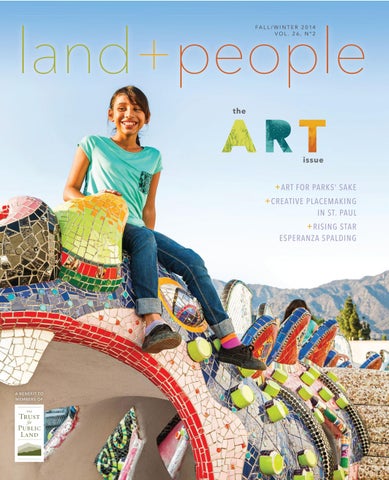
o n t h e cover There’s more to this play structure than meets the eye. Learn about Maywood Avenue Park in Los Angeles County on page 20. photo: julia stotz
JOI N U S ON FAC EB O O K Scan the QR code with your mobile device to stay tuned to the latest news, videos, contests, and more. facebook.com/tpl.org
T P L. O R G · 3
j e n n a stamm
4 · LA ND &PE OPL E · FAL L /W I NTER 2014
contents
WILLIAM DICK ELEMENTARY, PHILADELPHIA, PENNSYLVANIA
The old asphalt schoolyard was no place for acrobatics— or much fun at all. The Trust for Public Land guided students through the design of a vibrant new recess space that doubles as green infrastructure to help reduce flooding.
Page · 22
22
T P L. O R G · 5
li n coln barb ou r
6 · LA ND &PE OPL E · FAL L /W I NTER 2014
contents
POTSO DOG PARK, TIGARD, OREGON
Dog parks are good for more than a W-A-L-K—they’re a place to make friends, two- and fourlegged alike. We helped Tigard canines and their companions protect their park permanently, ensuring many long games of fetch to come.
Page · 23
23
T P L. O R G · 7
je rry an d marcy mon k man
8 · LA ND &PE OPL E · FAL L /W I NTER 2014
contents
ANDROSCOGGIN HEADWATERS, ERROL, NEW HAMPSHIRE
These woods and waters provide a wealth of opportunities for hiking, fishing, exploring, and quiet reflection—and they’re finally protected. The deal we struck to conserve the headwaters region is the third-largest in the state’s history.
Page · 26
26
T P L. O R G · 9
our missio n :
pu blish er Sean Connolly ed itor ial d irecto r Eliza Sarasohn art d irector Matt Mullin man ag in g ed itor Alia Salim ed itor ial ass ista nts Shoshannah Flach Yasaman Golban pro d uct ion an d researc h ass ista nt Sarah Avery staff w r it er Allie Ferguson mar ket in g Kristen Anderson dig ital prod uct i o n Carrie Gotch Adele Wilson-Hamaker con t r ib ut in g edi to r Bill Poole
A GREEN ER READ Land&People is printed in the United
THE TRUST FOR PUBLIC LAND CREATES PARKS AND PROTECTS LAND FOR PEOPLE, ENSURING HEALTHY, LIVABLE COMMUNITIES FOR GENERATIONS TO COME. how you can help: Our work depends on the generous support of people like you.
States on chlorine-free, 30 percent postconsumer recycled paper and manu™
factured using Envirotech ink, which contains a high percentage of ingredients derived from renewable resources. Printed by Quad/Graphics Inc., Wisconsin.
© 2014 The Trust for Public Land. All rights reserved. The Trust for Public Land, TPL, Land&People, Parks for People, Fitness Zone, Conserving Land for People, Conserving Nature Near You, ParkScore, LandVote, Northwoods Initia-
donate: Use the envelope inside this magazine, or visit tpl.org/donate for other easy ways to give. learn more: Get timely updates on our park and conservation work near you. Sign up for our e-newsletter at tpl.org/enews. share: Help us make the case for parks and open space. When you’ve finished reading this issue, pass it on!
tive, and The Trust for Public Land and LandVote logos and all other names of The Trust for Public Land programs referenced herein are registered or common law trademarks of
Land&People magazine is a benefit to members of The Trust for Public Land.
The Trust for Public Land.
Free trial issues are available at tpl.org/freemag.
1 0 · LAND &PE OPL E · FAL L /W I NTER 2014
from the president
Welcome to the arts issue of Land&People. What do parks and conservation have to do with the arts? Plenty! Like art, parks are an essential expression of our culture and a catalyst for meaningful connections. Placing art in public parks—where visitors from all walks of life can enjoy it freely—is an exciting way to celebrate community culture and create a space that encourages people to linger and interact in a way that’s rare in indoor galleries. Public art can inspire us with its beauty, speak to our cultural heritage, expand our sense of possibility, or simply tickle our funny bone. Some parks are purpose-built to showcase art. For example, in this issue you’ll read about the Seattle Art Museum’s Olympic Sculpture Park and the Caponi Art Park in Minneapolis, both created with help from The Trust for Public Land. When I visit these outdoor museums, I am struck by how the green, natural setting influences the art’s meaning and enhances the viewing experience. Surveying a soaring sculpture against the blue backdrop of Seattle’s Elliott Bay—while surrounded by families picnicking and children playing— evokes a very special blend of nature, culture, and community. But a park need not be designed specifically for art to benefit from it—and communities know it. Often, when our staff guides public workshops to plan city parks and playgrounds, art is at the top of the neighborhood’s wish list. Designed with input from local residents, custom art—such as the tile dolphin crafted by schoolchildren for Bertha Point Park in Oakland, California, and the decorative acequia reflecting Southwest culture at Santa Fe’s Railyard Park and Plaza—often ends up
sara cozolino
NATURE, CULTURE, COMMUNITY
being visitors’ favorite part of the park. Working with communities to create parks that reflect local identity is central to The Trust for Public Land’s mission. As the approaching holidays signal the end of another year, we want to thank you, our generous supporters, for making possible this important work that touches the lives of so many people. On page 60 of this magazine, you will find a Year in Review section highlighting some of our accomplishments in 2014. But the true measure of our work together is the health, inspiration, joy, and human connection that people experience in the natural areas we protect and the parks we create. Parks and nature are precious gifts that keep on giving for generations—and for these gifts, millions of Americans give you their thanks.
Will Rogers president
T P L. O R G · 11
Be a leader. Support our land-for-people mission by becoming a Conservation Champion today. With your annual operating gift of $2,000 or more, you will receive the recognition due a champion—including invitations to special events and updates on our current projects. Get an insider’s look at how your contribution is making a difference.
For more information, call Kiley Lucan at 415.800.5190.
Conservation Champions The Trust for Public Land
t pl . o r g/ c h a m p ions | cham p ions@tp l.org
O F F IC E R S
Tom Reeve
p res i de n t a n d ch i e f exe c u t i v e o ff i c e r
Adrian Benepe s en i o r v i c e pre si de n t a n d c h i e f ph i l a n t hrop y off ice r
sara cozol in o
William B. Rogers s en i o r v i c e pre si de n t an d d i re cto r o f c i t y pa r k d e ve lop me n t
board spotlight
Get to know
A member of The Trust for Public Land board since 2009, Tom Reeve is chair of our National Leadership Council and former chair of our Washington State
Margie Kim
Advisory Board. He’s also past president
s en i o r v i c e pre si de n t a n d di v i si o n di re cto r
of the Washington Wildlife and
Raymond Christman
Recreation Coalition board and serves
s en i o r v i c e pre si de n t a n d c h i e f m a r ke t i n g off ice r
on the national council of the Land Trust Alliance. In his 18-year career at Microsoft,
Sean Connolly
Reeve served in a variety of technical and
s en i o r v i c e pre si de n t a n d di re cto r o f co n se r vat i o n st rat e g ie s
management positions. Born and raised on Honolulu, Reeve is an avid traveler and
Ernest Cook
outdoorsman who lives with his family
s en i o r v i c e pre si de n t a n d di v i si o n di re cto r
on Washington’s Lopez Island—on a farm
Jeff Danter
they’ve protected with conservation
s en i o r v i c e pre si de n t, gen e ra l co u n se l , a n d se cre tary
easements.
M. Holly Haugh s en i o r v i c e pre si de n t an d d i re cto r o f spe c i a l p roje cts
Roger Hoesterey s en i o r v i c e pre si de n t, chie f fi n a n c i a l o ff i c e r, a nd treasu re r
Cynthia Scherer s en i o r v i c e pre si de n t an d d i v i si o n di re cto r
Deborah Love v i ce pre si de n t a n d di re cto r o f f e deral affairs
Kathy DeCoster v i ce pre si de n t a n d di re ctor o f co n se r vat i o n t ra nsactions
Brenda Schick v i ce pre si de n t a n d d i re cto r o f hu m a n re sou rce s
I JOINED THE BOARD BECAUSE … I’ve seen the difference that The Trust for Public Land makes in people’s lives. So many Americans still lack outdoor places to play or connect to nature. Being part of closing that gap is intensely rewarding.
Page Knudsen Cowles (Chair), Stephen W. J. Cronon, Douglas Durst, Whitney Hatch, Caroline P. Niemczyk, Michael E. Patterson, Thomas S. Reeve, Laura Richards, Roy Richards Jr., William B. Rogers, Lex Sant, Sheryl Tishman, F. Jerome Tone, Susan D. Whiting
and money we put into this organization have the potential to help more Americans, in more communities, in a broader variety of ways than any other conservation investment we could make.
BOARD MEMBER WAS … I get inspired
THE KEY CHALLENGE FACING THE TRUST FOR
every time I speak with a person who has been affected by our work. Their sense of accomplishment and ownership, the passion with which they advocate for their special places—that’s incredibly powerful.
PUBLIC LAND IS … to encourage more peo-
THE TRUST FOR PUBLIC LAND’S WORK IS
Baird, Brian M. Beitner, George Bell, William
BECAUSE … my wife and I believe the time
MY PROUDEST ACCOMPLISHMENT AS A
Barbara Smith
B OA R D OF D I R E CTOR S
I SUPPORT THE TRUST FOR PUBLIC LAND
UNIQUE BECAUSE ... the American experience is centered around place: you can’t separate the story of the American people from the story of the land. The Trust for Public Land is preserving that connection and ensuring that outdoor experiences—whether learning to ride your bike in a nearby park or visiting a farm where your food is grown—remain a part of our culture.
ple to get outdoors. Nearby nature makes communities healthier, more livable, and more vibrant. Parks and protected lands give more people reason to get out of their chairs and away from their screens— and get outside. I FIRST FELL IN LOVE WITH THE NATURAL WORLD … growing up just a few minutes
from the beach. I could walk for miles, scrambling over rocks and exploring tide pools, learning the names of the creatures I found, and connecting to the rhythms of the tides and winds. Nature is still where I go to recharge, relax, and let my curiosity lead me. Everyone deserves the opportunity to experience that. T P L. O R G · 13
contributors
Jeanne Storck story:
Art Parks
story:
story:
Father of Dragons; front cover
Making Our Place
Los Angeles- based photographer Julia Stotz is a self-described veggie addict and lover of the simple moment. She strives to capture everyday scenes with a sense of sincerity and adventure; her photography is focused on people, food, and travel. Her work appears in outlets like Elle Decor, Kinfolk, Paper, and Refinery29.
38
Jay Walljasper writes, speaks, and consults about how to create communities that thrive. Author of The Great Neighborhood Book and All That We Share: A Field Guide to the Commons, he lives in Minneapolis—where you can often find him walking, biking, or working from his local cafe. jaywalljasper.com
juliastotz.com
EVEN MORE LAND&PEOPLE Download the free Land&People iPad app—available now at the App Store. The digital edition includes all the stories you love in high resolution, plus bonus content like video, search tools, easy social media sharing, and instant links to learn more. If you don’t have an iPad, you can access the digital edition online at tpl.org/lpdigital. Wherever you see the pointer symbol below, you’ll find bonus content in the digital edition. Download the app or go online to dive deeper into the story.
1 4 · LAND &PE OPL E · FAL L /W I NTER 2014
ipa d is a registered tra demark of ap ple inc ., registered in the u.s. and other countries. app store is a service mark of apple inc.
jeannestorck.com
Jay Walljasper
20
31
Jeanne Storck is a freelance writer and web designer. She has written on sustainable living for National Geographic Traveler, The Monthly, Make, Craft, Common Ground, Artweek, and Oakland Magazine. She lives in San Francisco with her husband, Mark, and takes art-themed road trips every chance she gets.
Julia Stotz
mailroom
r h ea bail ey
JOI N OUR COMMUNI TY Hundreds of you entered, thousands voted, and four winners took home the grand prize—a GoPro camera— during our #NeverStillLife photo contest. Don’t miss our next contest:
b en w ickizer
join us online!
HAVE YOUR SAY
The community shared songs, prayers, and even some happy tears at our recent groundbreaking for Rocky Graham Park in Marin City, California.
We want to hear from you! Tell us what you think about the stories in Land&People—on Facebook, at tpl.org/blog, or by email at mailroom@tpl.org. You might find yourself in the next issue.
A real page-turner
Our Spring/Summer 2014 Health issue took top honors out of more than 1,100 entries to the 2014 Content Marketing Awards. Land&People snagged the Gold Award for best nonprofit publication, as well as an honorable mention for best editorial. People who move you Blind adventurer Erik Weihenmayer made a big impression on our readers in “The Illuminator” [Spring/
Erik Weihenmayer continues to inspire me! I so hope to meet up with him someday. His words made an incredible impact on my acceptance of life as it presents itself. Donna Wilmot Umecker, via Facebook What a true inspiration Erik is. Thank you to The Trust for Public Land for sharing this beautiful piece. Evan de la Garza, via Facebook
Summer 2014]. You can follow all of Erik’s adventures on his website,
WATCH ERIK IN ACTION @
TPL.ORG/ERIK
touchthetop.com. T P L. O R G · 15
dav id b o w m an
mailroom
sab in e h ein e
video. The piece deserves to go viral so that millions can immediately understand this new frontier and support the proliferation of this work in cities everywhere. Eliot, via the blog
The Trust for Public Land’s protection of thousands of acres for hiking, inspiration, and agriculture is a great success for the environment and all things living. Let’s keep these positive actions moving! Jeannette Langstaff, via the blog
Berry good thinking People are celebrating The Trust for
Thank you @tpl_org
Public Land’s successful conservation of one of the largest unprotected proper-
for 6,000 acres of California coast and redwoods which are now @BLMNational public lands!
ties on the California coast: a former dairy farm just north of Santa Cruz. Today, the land is home to Swanton Berry Farm (profiled in the Spring/
A postcard from Europe
Summer 2013 issue) as well as miles
Dutch artist Sabine Heine illustrated
of hiking, biking, and equestrian trails—
“The New Urban Advantage” [Spring/
with an ocean view.
Summer 2014], which explored new healthier than ever before.
A+ for climate-smart cities Our short animated film about climate-resilient cities is a hit on social
p hil dokas
After reading this, my conscience is not as troubled as I once was about raising my children in a big city. The article showed me a totally new aspect about city-dwellers and their health advantages. Thank you for that! Sabine Heine, Rotterdam, Netherlands
united states secretary of the interior sally jewell, via twitter pedro diez
Thank you to The Trust for Public Land and the Swanton Berry Farm for being wise instead of following the naysayers. I have lived in Hollister, California, since 1978 and know how fortunate we are for the courageous, outstanding organic farmers in our Northern California region. Organic farming is the traditional way our ancestors thrived: it nurtures our health and welfare.
innovations helping cities become
A winning transformation Commissioned by The Trust for Public Land, the new playground at P.S. 261 in
media. You can help spread the word
Brooklyn recently won a Municipal Art
about the many benefits of close-to-
Society (MAS) MASterworks Award for
home parks and green space by
best green design initiative. Selected
watching and sharing the film at
by a jury of architects, interior design-
tpl.org/climatesmart.
ers, and editors, the awards honor projects that make a significant contribu-
This brief, clear, memorable depiction brilliantly captures The Trust for Public Land’s work. Congratulations to those who do the work and to those who produced this stunning 1 6 · LAND &PE OPL E · FAL L /W I NTER 2014
tion to New York’s built environment. LAND&PEOPLE IS LISTENING! Send letters to the editor or change your mailing address: mailroom@tpl.org.
Art evokes the mystery without which the world would not exist. ~ rené magri tte
Caponi Art Park sets the stage for a performer from In the Heart of the Beast, a Minneapolis puppet-theater troupe. Read more about this Trust for Public Land project on page 35.
first look
edible conservation
Putting down roots But they weren’t expecting to stay for long: the property was slated for development, and the gardeners were planting on borrowed time. Reluctant to see their work paved over, the gardeners turned to another neighbor—the New Jersey office of The Trust for Public Land, headquartered a few blocks away. Project manager Greg Socha was determined to help. “The garden is the definition of ‘grassroots,’” he says, “and it’s right here in our backyard. We knew we had to save this beloved spot.” The Trust for Public Land helped the Town of Morristown purchase and protect Early Street Community Garden for everyone to enjoy. To-
day, Rothman and her fellow green thumbs are planning improvements for their permanent home—twice as many garden plots, an ADA-compliant walking path, and a parklet where neighbors can mingle. “This is a place where people from different walks of life connect with each other,” says Rothman. “We have gardeners aged 8 to 80-something, all races, plenty of nonnative English speakers, all working the land side by side. We have movie nights, workshops, solstice gatherings, and yoga and tai chi classes. It’s one of the most fun and diverse places in town—the kind of place that makes you love living here.” laura barisonzi
Trash-strewn and surrounded by a chain-link fence, the lot on Early Street sat vacant for as long as anyone could remember. So when Samantha Rothman, Myra Bowie McCready, and Carolle Huber told residents of the senior housing facility next door that they planned to transform the site into Morristown’s first community garden, the seniors were nonplussed. “They didn’t believe us,” said Rothman. “But today they’re some of our most devoted gardeners.” Fifty families—including many former skeptics from the senior center—joined Early Street Community Garden when it opened in 2009.
early street community garden morristown, new jersey
1 8 · LLAND AND &PE OPL E · FAL L /W I NTER 2013 2014
word watch
mon·u·ment /män'·yə·mənt'/ (n.) A historic landmark, historic or prehistoric structure,
rich reid
or other objects of historic or scientific interest.
Kale, avocado, and quinoa salad At Early Street Community Garden, the kale crop lasts through the first frost. This recipe featuring the powerhouse veggie is a favorite at garden potlucks. INGREDIENTS O O O O O O O O O O O
1 cup uncooked quinoa 2 cups water 2 tablespoons balsamic vinegar 1/4 cup olive oil 1 teaspoon Dijon mustard 1/4 teaspoon sea salt Fresh cracked black pepper, to taste Zest from 1 lemon 1 tablespoon fresh lemon juice 3 cups kale, chopped 1 large avocado, diced
Combine quinoa and water in a medium pot. Bring the water to a boil, then reduce heat and cover. Simmer gently for 15 minutes. Remove from heat. Let covered pot stand for 5 minutes, or until remaining water is absorbed. Remove lid and fluff quinoa before setting pot aside to cool. Prepare dressing by whisking together balsamic vinegar, olive oil, mustard, salt, pepper, and lemon juice and zest in a bowl. Set aside. In a large bowl, combine kale and avocado with cooked quinoa. Toss together with dressing. Salt and pepper to taste and serve chilled or at room temperature.
The 1906 Antiquities Act grants the U.S. president the ability to declare national monuments—an eclectic collection of protected places that includes Mt. St. Helens, the Statue of Liberty, and, as of this year, the spectacular ocean bluffs at Point Arena. Protected with help from The Trust for Public Land, these windswept cliffs are the first onshore addition to the reefs and rocky islands of the California Coastal National Monument.
The cliffs at Point Arena are a popular spot for whale-watching: gray whales pass close to the coast on their annual migration.
F I R ST LO O K · 19
trailblazers
Father of Dragons the ma ster mosa ic - m ak e r br i ng i ng f ol k art to l i f e (with a l itt l e he l p f r om the e s pr e s s o)
nam e : jo l i n o b e s e r ra · ag e: 57 · r e s i denc e: silverl ake— los angel es, ca
2 0 · LAND &PE OPL E · FAL L /W I NTER 2014
ph oto s: ju l ia stot z
To create the nearly 40-foot-long dragon, Beserra and volunteers calling themselves “the Mosaic Mafia” cut, smoothed, and handplaced thousands of pieces of broken tile, crockery, and other found materials.
profession: Mosaic artist specializing
in pique-assiette (using found objects, memorabilia, and recycled material). I think of myself as a storyteller—I assemble pieces of history to tell a story. assignment: Design and construct a climbing structure for Maywood Avenue Park in Los Angeles County. how he got his start: It was the sum-
mer of 1990, and I was a burned-out art director at CBS. I saw an article on the restoration of Watts Towers, so I volunteered to help. I fell in love with the style of Simon Rodia, the artist who created the towers. He collected bits and pieces and constructed that beautiful monument out of stuff that had been thrown away. Working on the towers inspired me to try my hand at mosaic, focusing on found objects. I never renewed my contract at CBS!
Juárez. He was from Oaxaca, so I immediately thought of the alebrijes—the Oaxacan folk art tradition of fantastical carved creatures. They wanted a structure on which kids could climb and swing and slide, so a giant dragon seemed like a fun choice. It wasn’t until the pieces were being unloaded— by a crane off a flatbed truck—that I was hit with the 40-foot reality of what I was in for. I was like, I better go get my cappuccino machine! rediscovering his roots: When I was
growing up, my family was focused on assimilation. We didn’t learn Spanish, I didn’t know much about my culture or my history. Now, through my art, I’m connecting to my heritage. Through this process, I discovered I have a relative in Oaxaca who creates these alebrijes! I have been sending him pictures of the dragon as it’s coming together and he’s very happy.
birth of the dragon: The Trust for
why public art: Public art is important
Public Land contacted me and told me the people of Maywood wanted the park to pay tribute to [Mexican politician and reformer] Benito
everywhere, but especially in communities that don’t have amenities—that don’t have beautiful, green spaces. We had a community day where the kids
got to help tile the dragon. People were shocked to see something so elaborate being created just for them. And I understood, because I also grew up in a neighborhood that was resigned to being ignored. My life changed in the fourth grade when a teacher told me I was an artist. No one had ever told me that before or encouraged me to be something. That’s why this project is so important to me—I hope that some kid plays on this piece and feels inspired to create something big. why the trust for public land: My
hope is that the Maywood dragon makes people sit up and take notice and feel proud that people cared enough to bring this amazing park to their neighborhood. I hope that it makes the community stronger and more sure-footed. That’s why The Trust for Public Land’s work is so invaluable: in this time of cutbacks on everything that doesn’t show an immediate, bottom-line profit, The Trust for Public Land is making bigger investments that will pay off in the long term. F I R ST LO O K · 21
good news
LEAPS AND BOUNDS
For kids, by kids Nobody knows playgrounds better than the kids who use them. At William Dick Elementary, we guided sixth, seventh, and eighth graders through a step-by-step participatory design process. week 1: Memory maps—analyzing the playground to find out which parts get the most use week 2: Measurements—studying scale, orientation, and dimensions week 3: Sun and shade—identifying the best spots to plant trees or grow a garden week 4: The water cycle—exploring an urban neighborhood’s role in the watershed week 5: Green infrastructure—learning how good designs can capture and use rainwater week 6: Inspiration—taking a field trip to a finished playground week 7: Brainstorms—listing favorite features and writing a survey for the whole school week 8: Design—working with landscape architects to create a new playground layout week 9: Equipment—choosing play structures and where to put them week 10: Presentation—reviewing and sharing the final design
2 2 · LAND &PE OPL E · FAL L /W I NTER 2014
jenna stamm
Crossing the playground on a rainy day at William Dick Elementary was no walk in the park: students navigated crumbling asphalt and standing water—including one notorious puddle so large that kids called it “the pond.” As part of our Parks for People–Philadelphia program, The Trust for Public Land worked with the city and school to help fix the flooding and reclaim the students’ recess spot. When the new playground opened this summer, the community celebrated its total transformation from plain pavement to a place to play kickball, gather under shade trees, or count butterflies in the rain garden. “It was a barren area that has come to life with greenery that’s not common in an inner-city playground,” Principal Amy Williams told the Daily News. “It’s something for our entire community.” The school is the first of ten sites we’re reimagining in partnership with the City of Philadelphia’s Green2015 Initiative—which aims to add 500 acres of public green space by 2015.
good news
l in col n barrour
Best in show
No bones about it: Portland loves its four-legged friends. According to the 2014 edition of City Park Facts, The Trust for Public Land’s annual compendium of park stats, the Oregon city boasts the most offleash dog parks in the nation. Here’s the full ranking of top dogs.
g oose isl an d b eer co mpan y
what counts
PINTS FOR PARKS Good news for those thirsty for more green space—or just plain thirsty: Goose Island Beer Company is supporting The Trust for Public
off-leash dog parks
off-leash dog parks per 100,000
1. Portland, Oregon
32
5.3
2. Norfolk, Virginia
11
4.5
3. Las Vegas, Nevada
25
4.2
scious manufacturing strategy that cuts carbon
4. Henderson, Nevada
11
4.1
emissions and packaging waste.
5. Arlington, Virginia
8
3.6
6. Madison, Wisconsin
8
3.3
Windy City, be sure to raise a glass to The 606.
7. San Francisco, California
27
3.3
When complete, this nearly three-mile-long
8. Tampa, Florida
9
2.6
an abandoned rail line—will connect thousands
9. St. Petersburg, Florida
6
2.4
of northwest Chicago residents to new neigh-
10. Seattle, Washington
14
2.2
city
Land’s work on The 606, Chicago’s next great park and trail, by donating a portion of proceeds from their Green Line Pale Ale. The brew’s more honey-hued than green, of course, but it earns its name with an environmentally con-
The exclusive ale is available only on draft in the Chicago area, so the next time you’re in the
elevated greenway—constructed on the site of
borhood parks and fun features like custom art. Cheers to that!
WATCH A PARK FOR DOGS BRING PEOPLE TOGETHER @
TPL.ORG/POTSO F I R ST LO O K · 23
buzzworthy
what counts
2,244
soozi n h irsch mug l
... residents of old saybrook, Connecticut, turned out this year to vote on the future of the largest piece of unprotected coastal forest between Boston and New York. That’s almost three times the town’s typical turnout for a single-issue referendum. What got locals to the ballot box? A thousand acres too special to lose. Known locally as “The Preserve,” the land plays an important role in regional air and water quality—and has been the subject of hotly contested development proposals for more than 15 years. So when the opportunity arose to set aside funds for its protection, the community rallied. When the votes were counted, a whopping 89 percent said, “Yes!”
POP-UP PARK SPARKS CONVERSATION Minneapolis artist-organizer Soozin Hirschmugl wants people to talk about parks. In partnership with The Trust for Public Land and Springboard for the Arts, she’s created sPARKit—a teardrop trailer stocked with supplies to turn any spot into a pop-up public commons. The park on wheels is getting people talking all around the Twin Cities. Everywhere they stop, Hirschmugl and other sPARKit volunteers encourage locals to share and record their thoughts about the parks and green spaces that make their neighborhoods great. “We set up games and hula hoops and bubbles, put on some music, and it feels like hosting a party,” says Hirschmugl. “People often approach cautiously and ask us how much it costs to enter. Then we tell them it’s free, because green community spaces should be free and accessible to everyone.”
2 4 · LAND &PE OPL E · FAL L /W I NTER 2014
mim adkins photography
Equipped with bistro tables, loudspeakers, and art supplies, the sPARKit trailer keeps the conservation conversation rolling.
WE GIVE TO …
anne and will smart, seattle, washington
of us hold a romantic idea of ‘the last best place,’” Will says, “but quality of life is primarily determined by our environment closer to home. Because of that, we can make a bigger impact for more people by focusing on landscapes closer to or in urban centers.” As Will and Anne continue to enrich their own lives with the beautiful landscape of the Pacific Northwest, they draw deep satisfaction from their partnership with The Trust for Public Land. Through their annual support and board service, they are helping build better communities today—and through their legacy gift, they can be confident that their love of the land will benefit others tomorrow.
f ion a marg o ph otog raph y
leave a legacy
why we give
nature into the lives of people who aren’t as lucky as we are,” says Will, the board’s chair. Recently, Will and Anne took another step to champion outdoor access for others by making a legacy gift to The Trust for Public Land. By including this gift in their estate plan, they are extending their support for conservation well beyond their own lifetimes and helping make sure that the special places they love will be protected for others to enjoy. “It is critical to preserve shared places to ensure quality of life for future generations,” Anne says. As they look to the future, the Smarts are particularly concerned about preserving livable communities as an increasing number of people move to cities. They believe that The Trust for Public Land’s focus on creating parks and trails and conserving the working lands that supply our food will help build healthy communities where people can thrive. “All
To the Smarts, loving nature means working to ensure that everyone can enjoy being outdoors. becky fishburn
Seattle lawyer Will Smart loves being outdoors—fishing, hiking, and exploring wild country. His wife, Anne, a law-firm manager, grew up in Portland, Oregon. Like many natives of the Pacific Northwest, she relished the many happy hours she spent playing in public parks, hiking and skiing in the mountains, and swimming in local lakes. Today the couple live on Bainbridge Island—where Anne enjoys gardening, raising chickens, and running on local trails. They consider themselves fortunate to live close to nature. “We’re so lucky to be surrounded by parks and trails,” Anne says, “to have Puget Sound in the foreground with a backdrop of the Olympic Mountains.” To the Smarts, loving nature means working to ensure that everyone can enjoy being outdoors. They serve on the Washington State Advisory Board of The Trust for Public Land and make regular donations. “We find great joy in our decision to help bring
Landscapes like this are part of what makes Washington a great place to live.
F I R ST LO O K · 25
good news
meet our staff
sean g il l ig an
“The most-loved places have a strong identity—a soul.”
The recently protected land includes some of the only self-sustaining, non-stocked wild trout ponds in the state.
It’s a big one! PROTECTION OF THE VAST ANDROSCOGGIN HEADWATERS MEANS GOOD FISHING—AND GOOD BUSINESS
NETTE COMPTON
In New Hampshire, conservationists of all
SELF-CONFESSED ‘WEIRD KID’ FINDS HER PLACE—AS A PLACE-MAKER
kinds are celebrating the resolution of a sixyear effort to safeguard the forests and streams of the Androscoggin Headwaters. A deal with Plum Creek Timber this fall completes the permanent protection of more than 30,000 acres—the third-largest such deal in the state’s history. The same tranquil beauty that lures adventurous fishermen, paddlers, and hikers has long made the region attractive to private buyers seeking sites for second homes. Brokered by The Trust for Public Land, the new agreement will shield the property from development while ensuring the majority of the land remains open to public recreation and sustainable timber harvesting—both critical to the local economy.
2 6 · LAND &PE OPL E · FAL L /W I NTER 2014
What first drew you to work in planning and design? I would say a lot of it actually started with my grandmother. She was really into gardening and design, and when I was little she and I would hang out with pads of graph paper and draw layouts for homes and gardens. Maybe I was a weird kid, but even then it wasn’t just about what would it look like, but how people would use the space. It helped me think about design in terms of interactions, and that really influenced how I think about public space. How did you first get involved with The Trust for Public Land? I’m passionate about sustainable cities. Before starting this job, I worked for the parks department in New York City. One of my first projects there involved collaborating with The Trust for Public Land on a schoolyard in the Bronx. I taught the kids about playground design and plants—it remains one of my favorite professional experiences to this day.
darcy k ie f e l
A DENVER COMMUNITY ENVISIONS A BRIGHTER FUTURE FOR THEIR PARK@
TPL.ORG/ MESTIZOCURTIS
I wasn’t looking to leave the parks department, but then I learned that Adrian Benepe [former New York City parks commissioner and current director of city park development for The Trust for Public Land] was hiring a team to focus on using parks to transform cities around the country. It was an opportunity too good to pass up. The Trust for Public Land’s mission of connecting people to nature— particularly in urban areas—is unique and compelling to me. Your position, associate director of city park development, is a new one. What does it entail? I’m tackling five different issues: public health and fitness, green infrastructure, climate change, creative placemaking, and general park design and administration. My first task is to identify and disseminate best practices that we’ve developed through our Parks for People initiative. As part of that process, I’m visiting Trust for Public Land park projects nationwide, meeting with community members and our partners to learn more about what does and doesn’t work.
Is there a park you’ve visited on your travels that especially stands out to you? So many! I was just in Denver visiting Mestizo-Curtis Park. It’s actually the city’s oldest public park—created in 1868. But over the years, it has fallen into disrepair: the site gets minimal use today because people in the neighborhood perceive it as unsafe, and in truth, there are few amenities and very little to do. But a woman named Geraldolyn Horton-Harris and her young granddaughter have been fighting to clean up the park. They started with grassroots efforts—painting benches, planting flowers—to encourage their neighbors to care about and reclaim Mestizo-Curtis. Partnering with The Trust for Public Land allowed them to pursue larger-scale improvements and a new design that will reflect the look and feel and interests of the neighborhood. Once we reach our fundraising goal, the new park will have a Fitness Zone® area where residents can work out for free, as well as a community garden. It won’t be just an assemblyline playground straight out of a
box—but a space with local flavor, a park they can be proud of. I find stories like this especially powerful. We work with communities that don’t have access to as many resources as some of their neighbors, communities with a history of disinvestment—and together we create the kind of world-class spaces that can transform an entire neighborhood. What would you tell people who want to improve their neighborhood, but don’t know where to start? Nature exists in your neighborhood. It may be hard to find, but it’s there— a tiny backyard, or a tree on the sidewalk in front of your apartment— little pockets of green space that have an outsized impact on a community. If you’re willing to stand up for these spaces, it can be tremendously rewarding. Start small, with local clean-up days. Or call your parks department to find a volunteer group in your area. Get involved at any level you can. What do you think makes a great park? In professional circles, we talk a lot about “creative placemaking”—but in simpler terms, it’s about soul. The most-loved places have a strong identity created through a mix of art, community, and culture: they’re places with soul. Everyone can tell when a place is inviting, when a place feels safe, when it’s being used by a diverse array of people of all ages and backgrounds enjoying themselves in different ways. You don’t need technical terms to know what makes a place great—as a user of public space, you can just sense it. F I R ST LO O K · 27
insight
T HE
Photos by carlos pericas
2 8 · LAND &PE OPL E · FAL L /W I NTER 2014
But as an adult in New York, now you have to actively seek those places out.
The tempo is rising for Esperanza Spalding. In the decade since she became a Trust for Public Land supporter, Spalding has released a top-ten album, performed for the president, and won four Grammy Awards—including Best New Artist. Her infusion of jazz with everything from gospel and funk to Portuguese ballads has hit the sweet spot between critical acclaim and popular appeal.
A longtime advocate for city parks, Spalding turns to the natural world as a source of inspiration for the artful, buoyant compositions that have brought her success— and as a place of respite from the pressure that comes with it. She met us at her favorite spot in New York City’s
Right, like here in Prospect Park. There’s a spot close to my house where you can look out across the lake, and the way the trees are, you can’t see any buildings. It’s one of the few places that you can’t tell that you’re in the middle of this intensely dense, bustling, crazy urban mecca. There have been many times in the midst of an intense project—like when I was writing a libretto, I’d be stuck in my house working for hours and I’d just hit a wall—and I would come here and just sit. It’s like a reset button. That must be especially important—and especially challenging—as a professional artist. How do you manage on the road?
Traveling, sometimes it feels like all I see is airports, vans, hotels, and venues. I reach a limit where I haven’t been outside and I have to hunt down a park. I’ll find them and go to them—even if it’s just five minutes or ten minutes—and it’s crucial for my well-being. For me, having a green place to spend time in is as crucial as having a bed to rest in. My body and my brain need it as much as they need sleep.
Prospect Park to share why these green retreats are
Why do you think that is?
more important to her now than ever.
I think an investment of time spent in nature is an investment in your health. I don’t know why that’s medically true or scientifically true, but I experience it regularly: visiting a park relieves stress. And it’s important to know that you can find relief that simply, without a prescription. You can feel more relaxed, you can think clearer, and all the stuff that was buzzing around in your head—you can have a moment of respite from that just by going to the park. If you learn that early on, you can use it your whole life.
Imagery from nature features in many of your lyrics. Was the outdoors always a big part of your life?
As a child in Oregon I was surrounded by lush, vibrant, pristine, and protected open space. Even the city neighborhood where I grew up was so verdant: on my block, from the edges of the sidewalk to people’s yards, whether they were kept or unkempt, everything was very green and alive. My mom taught me to be conscious of the beauty of nature in the city. She took the time to observe changes in nature, things like crocuses coming up in the spring. Wherever we went, we’d choose the “green” route: if we were headed to the bus stop, we would go a little out of our way to walk through the park—which in Portland isn’t a big deal, because there are parks everywhere. I feel like my whole life in that city was an exploration of green spaces, so until I left I assumed the whole world was like that!
How does nature influence your music?
The music of nature is the root of manmade music. All of these “rules” of composition—about balance and movement and resonance, and when something sounds like it’s well organized—all these overarching themes that musicians work with are present organically in nature, in the sounds you hear, and in landscapes themselves. Even the melodies that these birds were singing just now—man, that’s hip! That’s way cooler than any old melody I could write, you know? I think artists are trying to express their ideas in a way that’s similar to the sounds of nature: to create something I N SI G H T · 29
Streets lined with red brick and green branches Wet and rainy days might seem bleak Our rain is the paint that makes the land lush and the folks unique City parks, wild berries and old bridges Rolling river bringing good to and from the sea A mountain hooded in snow silently watching over me Anywhere I go these roots are with me, and I find I take along a little piece of heaven With these memories of mine from the grammy award–winning album radio music society
WATCH OUR EXCLUSIVE INTERVIEW @
TPL.ORG/ESPERANZA
as effortless and as captivating. In the natural world there’s resistance and conflict—the push and pull of different species, there’s the breaking through the ground of a sprout—but there’s also a sense that it’s all growing toward harmony and coexistence. In a musical arrangement or in a poem, artists are trying to re-create that balance between dissonance and consonance. On the subject of balance—how do you handle the pressure of success? You’ve achieved a lot very quickly.
Concepts of wealth and success have a lot to do with what drives an artist’s career. You can pursue a version of wealth and well-being that has to do with a lot of people knowing your name, and appealing to an image-marketing strategy, or following the rules that might enable your music to reach a broader mainstream audience. Or you can just be yourself—whatever that might be right this minute, for better or for worse—and pursue some crazy idea that may or may not work. What gives me the courage to pursue ideas that may not come back to me as more money or more success or more 3 0 · LAND &PE OPL E · FAL L /W I NTER 2014
fame is a general sense of, “I’m okay.” The adventure in my life and art has been over and over again taking the risk and finding out that I don’t need to make sacrifices artistically to have what’s more important to me. And nature is a part of that?
Yes—it’s the wealth of nature, the bounty of the natural world that I want. And maybe that’s something I learned from my mother: I’ve always identified doing well as feeling good and being able to enjoy the things that are really free, like the natural world. Maintaining green spaces is not free, and protecting them is not free, but they are wealth to me. I don’t feel a taste or a hunger in my mouth for gleaming, glittering, big mansions, or power, or money. I have a taste in my mouth for calm and subtle and beautiful. That’s a serenity and confidence that’s evident when you perform.
I try! I have a song called “Apple Blossom,” and when I sing it I sometimes can see the scene that it describes. It’s a scene in the countryside, and I try to experience the air and the light and the sound and the calm of that place and imagine the story unfolding. And when I can go there, it’s a better performance of the song: I forget that I’m in a club or a theater, and all my concern about the show—are they getting the story? Is my voice going to hit that note well?—it melts away.
10 places to enjoy public art in the great outdoors by jeanne storck
T P L. O R G · 31
VIEWING A MASTERPIECE in a museum can be exhilarating, but discovering art in the open air brings its own rush of delight. Walls drop away, hovering guards disappear, and the view expands to include blue skies and leafy trees. Public art can be big, bold, and iconic—like at Chicago’s Millennium Park, where the reflective surface of Anish Kapoor’s massive silver Cloud Gate mirrors and makes an instant community of captivated viewers below. Or it can be more quiet—an Andy Goldsworthy sculpture waiting around the bend on a solitary wooded trail. Whatever the setting, access to art has a liberating effect. “Art can bring beauty and hope into public spaces and transform people’s perceptions,” says Ellen Ryan, program director for creative placemaking at The Trust for Public Land. “Moving art out of the museum and making it free to everyone opens up a flow of ideas and a sense of belonging.” As researchers have found, time in nature and time with art both have positive effects on mood and well-being. So if you’re ready for a double dose, check out these ten art parks where you can exercise both mind and body for free. all photos courtesy of their respective arts organizations
3 2 · LAND &PE OPL E · FAL L /W I NTER 2014
T P L. O R G · 33
2
Socrates Sculpture Park Queens, New York
1
1
Millennium Park Chicago, Illinois
Once a grimy railyard on the Lake Michigan shorefront, Millennium Park has transformed an eyesore of a site into a celebration of urban renewal—and public art has played a huge part in the reinvention. Pieces like Spanish artist Jaume Plensa’s Crown Fountain represent the new face of the city quite literally: the 50-foot glass towers glow with video of Chicago residents pursing their lips and, like modern gargoyles, spouting plumes of water into a black granite pool below. British artist Anish Kapoor’s Cloud Gate, a 110-ton, bean-shaped sculpture beloved by art critics and tourists alike, entertains with its funhouse reflections of passersby shimmering against the city skyline. Crowds pack the Frank Gehry–designed Jay Pritzker Pavilion for symphonies, festivals, and movie nights—and if visitors need to stretch their legs, they can always try free tai chi on the Great Lawn or a guided plant walk in the Lurie Garden.
3 4 · LAND &PE OPL E · FAL L /W I NTER 2014
2
In 1986, sculptor and Queens local Mark di Suvero spearheaded the conversion of an abandoned East River landfill into an outdoor art experiment. In a nod to the surrounding Greek community, di Suvero named the spot after Socrates, the classical philosopher. Today the park serves as a public square where cutting-edge art coexists with farmers’ markets, film nights, and cooking classes. Exhibits change frequently. One season, a giant inflatable Buddha bobbed serenely on the park’s shoreline; the next, three giant industrial cherry-picker machines loomed on the grass, their buckets full of tropical bamboo and palm plants. Look for provocative pieces, too—these artists don’t shy away from social commentary. After the park flooded during Superstorm Sandy, climate change became the topic du jour. Here, though, the sweeping vistas and open skies encourage a contemplative view of even the most contentious issues.
Cornerstone Gardens
South Carolina Botanical Garden
Sonoma, California
Clemson, South Carolina
Cornerstone’s nine acres contain more than a dozen gardens by noted California landscape architects. Strolling through the grounds, you’ll find much more than tea roses and picket fences. In the Mediterranean Meadow, grasses of varied height and colors move in the breeze like a living sculpture, while a sweeping windscreen woven from eucalyptus bark and branches creates an elegant sightline to the Sonoma hills. Look for whimsy, too: hundreds of kitschy, spinning pinwheels blossom from a plot of AstroTurf, and when the holidays roll around, a field of hundreds of glowing snowmen lights the night. The grounds also include galleries, shops, and—this being Sonoma— wine-tasting rooms. When it’s time to put your feet up, look for the Big Blue Chair, a towering Adirondack at the entranceway that dwarfs anyone intrepid enough to climb in.
4
Fans of innovative environmental artist Andy Goldsworthy will appreciate the Nature-Based Sculpture Program at the South Carolina Botanical Garden. Local and international talent have used the space to mold a dozen site-specific works from materials found on-site—stones, vegetation, and soil. The result is sculptures that seem to sprout from the landscape, like the impressive Clemson Clay Nest, a whirling tangle of pine logs rising from a deep pit in the red Carolina clay. This is one museum where curators don’t have to worry about wear and tear on the collection: decay and rebirth just come with the territory. Almost 20 years ago, artist Patrick Dougherty re-created a famous Renaissance temple by twisting dry tree branches tightly around a framework of saplings. Today, the young trees have pushed through the walls, transforming what once resembled an elegantly woven bird’s nest into a verdant crown of leaves.
3
3
5
Caponi Art Park Eagan, Minnesota
In the 1950s, Italian-born sculptor Anthony Caponi built himself a house on a wooded plot 20 minutes south of St. Paul and filled the backyard with his distinctive stone carvings. Caponi had a lifelong mission to “bring art to the people”: during his years as an art professor at Macalester College, he often invited students to find inspiration in his outdoor studio, and in 1987 he opened a full 60 acres to the public. Permanently conserved with help from The Trust for Public Land in 2005, the Caponi property now invites visitors to stroll on miles of wooded trails, discovering foliage and fine art in seamless combination. A concrete serpent curls up on a grassy slope, while a stone bust nestles halfhidden among wild columbine. At the Theater in the Woods, a circular stage blends into a leafy grove where spectators lounge and revel in Shakespeare, poetry slams, and symphonies.
5
T P L. O R G · 35
The Fields Sculpture Park
Laumeier Sculpture Park
Ghent, New York
St. Louis, Missouri
by the dairies and apple orchards of upstate 6Surrounded New York, The Fields Sculpture Park produces a fresh crop of unique pieces each year. More incubator than museum, the center’s exhibits change frequently, with artists from around the world taking up residence and opening their studios to the public. Nearly 80 works dot the meadowlands: favorites range from an elegant (but none too comfy) chaise-lounge crafted from steel and river stones to a cluster of skeletal white towers, toppled in a field like the ruins of an alien civilization. A special architecture program spotlights structures that really push the envelope, such as a space-age RV and a spooky, subterranean maze of cinderblock tunnels. The LEED-certified visitors center hosts summertime concerts, readings, and dance, while the park itself is open year-round. In wintertime, adventurous art-lovers can even glide the grounds on groomed crosscountry ski tracks.
6
3 6 · LAND &PE OPL E · FAL L /W I NTER 2014
7
Dubbed a “living lab,” Laumeier offers curious visitors a place to contemplate the natural chemistry between art and environment. The iconic red cylinders of the park’s prize piece, Alexander Liberman’s The Way, greet visitors in a central meadow. From there, more than a hundred acres offer something for everyone: crowd-pleasers like Niki de Saint Phalle’s mosaic-encrusted cat (named Ricardo) and Tony Tasset’s spooky, 12-foot-high eyeball mix with abstract work by Ernest Trova, Donald Judd, and Mark di Suvero. Don’t miss Donald Lipski’s whimsically named Ball? Ball! Wall? Wall! a 300-foot-long parade of massive steel buoys that wind along a tree-lined trail. For an insider’s perspective, take the “How’d They Do That?” tour and learn about the creation, care, and installation of large-scale work—or enjoy the multisensory experience of the “Site/ Sound” audio tour, which pairs each sculpture with an experimental soundscape from a local musician.
THE FENCE New York, Boston, Atlanta
8 Olympic Sculpture Park Seattle, Washington
In 1998, the Seattle Art Museum teamed up with The Trust for Public Land to turn a defunct petroleum transfer site into a striking open space. When the Olympic Sculpture Park opened on the waterfront a decade later, locals secured a front-row seat to both big-name art and a city shoreline that had long been closed off from the public. Today, an elegant promenade zigzags across green lawns and artwork, passing over a highway and train tracks before sloping down to the waters of Elliott Bay. The collection settles comfortably into the harbor landscape and features works by Richard Serra, Alexander Calder, Mark di Suvero, and Louise Nevelson. When pleasure-seekers have their fill of sculpture, they can head down to the beach to relax, explore a salmonhabitat restoration project, or climb a platform for views of Puget Sound and the Olympic Mountains.
8
9
There’s a traveling gallery you’ll only find along a chain-link fence. The centerpiece of this peripatetic event is a thousand-foot-long banner of images by photographers from around the globe, displayed in various public green spaces. Begun in 2012 by a coalition of photography organizations, “THE FENCE” has appeared in New York’s Brooklyn Bridge Park, Boston’s Rose F. Kennedy Greenway, and the Atlanta Beltline. The project celebrates all kinds of diversity, with past shows spotlighting unique communities from Russian bodybuilders to the vanishing tradespeople of Hoboken, New Jersey. At a distance, passersby might mistake this pop-up sspectacle for a glossy ad campaign— bu but up close they’ll discover candid, om commercial-free imagery in a delightfully ly unexpected spot.
The Fran and Ray Stark Sculpture Garden at the Getty Center Los Angeles, California
Perched in the Santa Monica Mountains and with sweeping views of downtown Los Angeles, the Getty Center feels a world away from the tangled freeways below. Its creamcolored travertine walkways wind between galleries and lush greenery, giving the complex a Mediterranean feel. The Stark Sculpture Garden, a gift from Hollywood producer Ray Stark and his wife, offers arriving visitors a peaceful spot to transition from the bustle of the city to the contemplative mood of the museum. The garden’s designers have created an intimate outdoor room, with trees and myrtle hedges suggesting walls and tufted fescue grass for a carpeted floor. It’s the perfect setting to survey sculptures by Isamu Noguchi, Elisabeth Frink, and Barbara Hepworth— arranged like actors on a stage—and take in the massive bronze by Henry Moore towering serenely above the reflecting pool.
10
10
T P L. O R G · 37
3 8 · LAND &PE OPL E · FAL L /W I NTER 2014
making
our place The secret to creating vibrant public spaces where people want to go … and linger? Don’t design for the community— design with the community. STO R Y: JAY WAL L JAS P E R I L LUST R AT I ON: NI C H OL AS ST E V E NS ON
T P L. O R G · 39
A
rt was once dismissed by city planners and community activists as a frill—a “nice-tohave,” perhaps, but certainly not a “need-tohave,” a much lower priority than the serious business of saving neighborhoods, building affordable housing, and creating jobs. But over the last decade, success stories like Philadelphia’s Village of Arts and Humanities, New York City’s High Line, and Indianapolis’s Cultural Trail have demonstrated that designing a space around the arts can yield returns far beyond the aesthetic. It’s an approach that planners call “creative placemaking.” The term was popularized in a 2010 report for the Mayor’s Institute on City Design, an initiative led by the National Endowment for the Arts. In the report, researchers Ann Markusen and Anne Gadwa Nicodemus
4 0 · LAND &PE OPL E · FAL L /W I NTER 2014
documented how incorporating local artists into the urban design process “animates public and private spaces, rejuvenates structures and streetscapes, improves local business viability and public safety, and brings diverse people together to celebrate, inspire, and be inspired.” Putting arts and culture at the center of revitalization strategies helps people imagine a better future for the place they live, says Ellen Ryan, creative placemaking program director at The Trust for Public Land. Though the term is recent, Ryan points out that the idea has existed for decades—and for good reason. “It’s not just the icing on the cake,” she says, quoting Maria Rosario Jackson of the Kresge Foundation. “It’s in the recipe for the batter of community change.” While researching for The Great Neighborhood Book: A Do-ItYourself Guide to Placemaking, I saw this change under way in
Where nature’s needed most We’re tromping through a field of rough scrub grass when Seitu Jones suddenly motions skyward. I spot a large bird soaring above. “It looks bigger than a hawk,” Jones says. “It might even be an eagle—all kinds of birds use this area as a flyway down to the Mississippi River.” Keen-eyed Jones is the perfect guide to introduce me to Frogtown Park and Farm. A St. Paul resident for 18 years, he knows the city’s soon-to-be newest park down to the last detail: 13 acres of fields and woods in the heart of Frogtown, St. Paul’s poorest and most ethnically diverse neighborhood. A foundry stands adjacent to the site; across the street rises a low-income apartment complex and a tattered 1960s-era shopping plaza now home to the Al-Ihsan Islamic Center, the Hmong American Travel agency, and a car wash. But to locals’ surprise, this particular parcel of land has managed to escape intensive development—for 140 years. “Those may have been planted by the sisters,” Jones says, pointing to a row of day lilies on the edge of a hill—bright orange dabs on a canvas of midsummer green and blue. He’s referring to the Catholic Contemplative Sisters of the Good Shepherd, who built a convent and girls’ home here in the 1880s. In 1969, the Wilder Foundation took over the site as headquarters for its social services programs. In 2007, when the foundation decided to move on to larger offices, the future of the land was unclear. con ti n u e d o n p a g e 4 4
© ryan siemers 2014
cities from Los Angeles to Detroit. All across the country, I witnessed people coming together to roll up their sleeves and restore a sense of place and possibility to their communities—even in neighborhoods devastated by disinvestment, poverty, and crime. For a look at creative placemaking in action, I visited the future site of Frogtown Park and Farm in St. Paul, Minnesota, where locals are blending green space with arts, agriculture, and play areas to create a neighborhood masterpiece all their own.
Local artist Seitu Jones is a tireless advocate for Frogtown Park and Farm.
HOW TO MAKE THE NEXT GREAT PLACE Nette Compton, associate director of city park development at The Trust for Public Land and former director of green infrastructure for New York City parks, offers tips for creative placemaking success.
1 Listen: Designers, artists, public officials, and other professionals are there to help the community articulate its concerns and ideas—not necessarily to offer their own.
2 Prioritize process: The “how” in creative placemaking is more important than the “what.” “The right process ensures local ownership, a sense that what is being built is meaningful to the community,” Compton explains.
3 Diversify: Community representatives and project teams should reflect the makeup of the neighborhood. Strive for diversity in age, background, and professions.
4 Be patient: “The process will be slow and messy, but the end result is worth the extra effort.”
T P L. O R G · 41
4 2 · LAND &PE OPL E · FAL L /W I NTER 2014
all photos tpl archive or tpl staff, except “nature” and “hang”: mim adkins; “kid”: jonathan alcorn; “grow”: anna kuperberg
T P L. O R G · 43
con ti n u e d fr o m pag e 4 1
G
enerations of Frogtown residents had enjoyed the area as an unofficial neighborhood commons, their go-to spot for strolling through the woods and racing bikes and sleds down the steep hillside. Nobody wanted to lose it—especially because, according to the St. Paul park district’s own research, the neighborhood already contained less public green space for kids than any other part of town: just 0.006 acres per child. Jones and three of his friends and neighbors arranged a meeting with the Wilder Foundation where they announced their intention to buy the land, valued between four and nine million dollars. “It was only afterwards, riding our bikes home, that we realized we had no more than 20 bucks in our pockets between us,” Jones laughs. Art meets urban agriculture Undaunted, the Frogtown neighbors sought help from The Trust for Public Land to turn their dreams into reality.
4 4 · LAND &PE OPL E · FAL L /W I NTER 2014
“We immediately saw the property’s potential as a public park,” says state director Susan Schmidt. Combining public funds and private donations, The Trust for Public Land assembled the money needed to purchase the property from the Wilder Foundation, design the space, and sustain it as a permanently protected community resource. Now, planning is under way to transform the site into a groundbreaking example of what creative placemaking can be. Besides a playground, amphitheater, sledding hill, and the quiet sanctuary of the oak savannah, the new park will offer a unique urban agricultural education center run by a new local nonprofit, Frogtown Farm. Rather than operating as a community garden—a more common model, in which families tend their own assigned plots—the site will serve as a demonstration farm to educate local green thumbs and encourage food production in backyards and vacant lots throughout the neighborhood. It’s a process that’s begun ahead of the farm’s completion with a series of popular summer composting classes.
Does your company support gift matching? Ask your human resources department. With corporate gift matching, your donation will go even further to help The Trust for Public Land protect more parks, gardens, and other natural places. That’s one good thing made that much better. fig. 2
good.
better.
Give your EarthShare.
800.714.5263 donor.outreach@tpl.org tpl.org/corporatematch
An EarthShare payroll deduction is one simple way to donate to The Trust for Public Land or more than 400 other environmental and conservation charities. Many corporate and government employers support EarthShare payroll giving. If yours doesn’t, ask them to start. If they do, simply decide on a single deduction or a recurring small one from every paycheck. Then designate us, member number 11440, as one of your conservation charities. For more information visit earthshare.org or email donor.outreach@tpl.org.
T P L. O R G · 45
alex diekmann
fig. 1
“I was always digging around in my grandmother’s little garden. She grew a lot of vegetables and had plum trees. My aunt called me ‘Little George Washington Carver.’”
4 6 · LAND &PE OPL E · FAL L /W I NTER 2014
jeff johnson
P
lans also call for greenhouses, a farmhouse, fruit and nut orchards, a produce stand, and even beehives. Jones imagines art projects integrated into each of these various farm activities, helping establish Frogtown Park and Farm as a gathering spot for the whole neighborhood. “From the very beginning, the community said they want a farm up here and they want an arts program,” he says. “And they don’t mean just painting kids’ faces at events. They mean a whole range of arts.” Among the first artists to sign on were sculptor Gita Ghei, who usually works in cast bronze or copper but is contemplating ice sculptures for the park, and papermaker Mary Hark, who wants to grow and produce some of her materials right on site. Art and agriculture may seem an unlikely pairing outside the Minnesota State Fair (where pictures made of seeds are a big hit). But as a professional artist himself, Jones believes it’s a compelling combination. “My work is about creating a sense of place in an interdisciplinary way,” he says. “My dream job is to be an artist-inresidence at a farm, blending art and nature.” Jones has been drawn to farming as long as he can remember. “I was always digging around in my grandmother’s little garden,” he says. “She grew a lot of vegetables and had plum trees. My aunt called me ‘Little George Washington Carver.’” “I hated that,” Jones admits. The pioneering scientist’s politics weren’t exactly his own. “But I later came to appreciate him. He actually started his career as a painter— doing botanical art.”
The future site of Frogtown Park and Farm.
Park power to the people As we gaze out from atop the hill at the modest homes of Frogtown, Jones taps my arm. “See that guy down there getting his bike out of the garage? That’s Jason, our local vintner—he grows grapes in his yard and in a lot across the street to make wine.” He motions to another house just down the block. “That’s the Vang family house. They sell produce from their yard. It’s more than just gardening—they’re farmers. That’s our mission: to promote and expand and celebrate that kind of urban agriculture.” The design for Frogtown Park and Farm emerged from a series of neighborhood meetings over the past four years. Often packed to capacity, the assemblies drew participants as diverse as Frogtown itself: the Vietnamese and Hmong communities, African Americans, East African immigrants, Latinos, and whites—both newcomers and Polish families who settled here a century ago. Though their backgrounds differed, attendees shared a sense of the park’s potential. “A lot of these people come from farming traditions,” Jones says, “and they are aching to get back to the land.” Jones credits Frogtown Farm’s Ambassadors program for the strong public participation in planning the project. Ambassadors—local volunteers of all ages—went door-todoor asking their neighbors what they wanted to see in the park and farm. Ian Marquez, 16, came to one meeting and immediately applied to become an ambassador. “I thought it was amazing how much input they got from the community,” says Marquez. “So often all the decisions are made by the higher-ups.”
T P L. O R G · 47
T
rust for Public Land creative placemaking director Ellen Ryan says that this type of hands-on community participation is a critical step in the process. “Successful creative placemaking begins with conversations,” says Ryan, “with neighbors telling us about their community, their families, their needs and goals for a place. Through these talks, walks, and workshops, we translate the story of the community into a park that flourishes and endures.”
4 8 · LAND &PE OPL E · FAL L /W I NTER 2014
Continuing our walk through the new park, I notice a huge cottonwood tree felled by a recent storm. “When that happened,” Jones tells me, “people got really fired up on Twitter and in the neighborhood with concern about the ‘the oldest resident in Frogtown.’” That shows me that even before any work has begun, Frogtown Park and Farm has already passed the first test of creative placemaking: locals feel that it belongs to them.
Grow your legacy.
We invite you to make land conservation a part of your personal legacy by including a gift to The Trust for Public Land in your estate plans. Every day, America loses 6,000 acres of open space—irreplaceable wildlands, historic sites, and dwindling urban and suburban open space. Your legacy can be part of the solution. Let us welcome you into the Stegner Society, which honors individuals who make legacy gifts to The Trust for Public Land through their will, living trust, retirement plan, or life income plan. Contact Gardner Trimble, director of planned giving, to learn how you can make a lasting
gift that supports land conservation for generations to come. 415.800.5208 · planned.giving @ tpl.org · tpl.org/plannedgiving
The Trust for Public Land
ON THE
ARTISTS LAND from the light-infused landscapes of the Hudson River School to Ansel Adams’s stark renderings of the wilderness that now bears his name, American art has long served the conservation movement—inspiring us to protect the places that in turn inspire art. It’s a symbiotic pairing fostered by the National Park Service artist-in-residence programs. For more than 40 years, and in more than 40 locations, the parks have offered visual artists, writers, and even musicians the opportunity to live and work in the midst of the nation’s most celebrated natural places. In return, the service says, “An artist-in-residence serves as an ambassador, and the public becomes the beneficiary of a new kind of interpretative experience through the arts.” Here, five recent residents share works and wisdom from their national park studios—and how nature can bring out the artist in everyone.
a m e r i ca n w h i t e oa k . 201 4. 3 9”x9”. p e n cil and wate rco lor on paper.
5 0 · LAND &PE OPL E · FAL L /W I NTER 2014
pat clark
Lilian Cooper weir farm national historic site, connecticut
“I am a site-specifıc artist. My choice of medium is part of my response to the place I’m in.” Although I live in a city now, I grew up in a tiny village in rural England, so I have always enjoyed being still and quiet in nature. My idea of fun is to look at trees! One of the reasons I like them is that they are, for many of us living in urban environments, the only thing that reminds us of the time of year—or sometimes even the weather. I catch myself watching branches wave in the wind to decide if I need a scarf. I’m working on a project that’s about the life and death and the husbandry of trees. With climate change, trees are much more susceptible to disease. In the U.K., for example, they recently discovered the arrival of ash dieback, which has already killed up to 90 percent of ash trees in Denmark. So I think it’s particularly important now to make people aware of the beauty and the vulnerability of trees, of that dual nature—both solid and fragile, although they look immensely strong and as if they will be there forever. I had completed a residency at Weir Farm nearly a decade ago, and it remains the best place I know to draw American trees. I returned for a second residency specifically for the American white oak, and to study disease in beech roots and beech trees. Weir Farm is a small park, and in a way it emphasizes just how important parks are: as you walk the grounds you actually edge the bottom of other people’s gardens. It’s a peculiar experience, and it makes you realize the value of the park to the people who use it. They seem so happy, and you can tell they feel, “This is my park.” It’s great to be a part of it. One day during my residency I met a man who was walking his dog. Dogs are always curious about me when I’m working—I’m often kneeling with two meters of paper rolled out on the ground, which is odd behavior, really—so they stopped and the man asked me what I was drawing. When I had explained, he told me that he walked past that spot every day but had never noticed the tree I was drawing. He said, “You’ve made me look. You’ve given me a different eye.” I thought that was the most wonderful compliment. I thought, if I can do that for somebody, even if it’s only one person, that’s a tremendous privilege.
T P L. O R G · 51
Steven Walker herbert hoover national historic site, iowa
A friend once asked me what made me happy. I was in my early 20s, and it was a question that stopped me in my tracks because—although it’s simple—I hadn’t actually heard it before. So I had to think about it. When was I most at ease? And my answer was: on road trips, and when I was camping—those were the best times in my life. Big skies, open fields, peace and quiet, going off the grid a little bit. That can be a challenge as an artist. When I was getting started—just selling paintings in coffee shops and libraries, anywhere I could get my work seen—I’d work a job at a warehouse from 9 to 5, go home and paint until midnight, and then do the whole thing over again. Even once you’ve established yourself, it’s tough. By the time I applied for the residency I was getting maxed out as far as my creative potential: I had ideas, but I didn’t have the time between teaching classes and day-to-day business. I knew I needed a break. I had no idea what I was getting into at Herbert Hoover, honestly. I drove to the residency with my entire truck-bed full of canvasses—from 30˝x40˝ down to 8˝x10˝—because I didn’t know what I would need. It took me a while to figure out what I wanted to do. Because of the lighting I like to have, I’d go out in the early morning or late afternoon. I’d take my compass with me and determine what time to be there so that the light’s going to hit just right, take photos, and sketch thumbnails to determine the best composition. The park is built around the birthplace of President Hoover, and I’m sure thirty or forty—if not a hundred—artists have already painted that house. So the challenge became to do something different. I opted to paint the farmhouse that was on the property but often went unnoticed. It was beautiful and unlike anything along the normal tour. The residency allowed me to slow down and experiment, to work without feeling like it was a factory where I had to turn out so many pieces per hour. Often, where I live, I can miss out on capturing a beautiful sunset because it takes too long to get outside and away from power lines and buildings. On the park grounds I could simply walk out the door—and there was my inspiration.
5 2 · LAND &PE OPL E · FAL L /W I NTER 2014
evelyn davis-walker
“The prairie has so many different views—full moon, sunset, light hitting off the grass. I could look in any direction and see something new.”
e dg e o f t he prairie . 201 2. 24”x 1 8”. oil on pan e l .
T P L. O R G · 53
w e ston lake . 201 4. 4” x 6”. oil on panel.
“In my work, I focus on the tension between the fragility of the environment and the power of the natural forces of earth and water.”
5 4 · LAND &PE OPL E · FAL L /W I NTER 2014
Mary Gilkerson Most people think of Congaree as one big old swamp, but it’s much more than that. It’s got some of the largest trees on the East Coast—they’re the redwoods of the East, and they’re accessible to almost anyone. There’s a nearly three-mile loop of boardwalk right through the middle of the park that you can take a wheelchair on. There just aren’t that many wild places like that. The other thing is the diversity of the landscape— the tremendous range of plants and wildlife. And this is a place that changes dramatically with the seasons. The winter is pristine and cold; the bottomland forest floods and the ice on the water makes these strange and intricate patterns. In the summer, it’s a great, shining emerald world. Because of the canopy of leaves in the upper story, the light that makes it through is literally green—it’s magical. When I paint, I’m looking for light: the way it plays across the surface of the landscape, the relationships between shapes that it creates. Any place you look will be completely different depending on the time of day and the weather. I’m fascinated by how those things change, so I’ll keep going back to the same spots over and over again. I prefer to paint scenes that I pass all the time, that I’m familiar with. I have a hard time working from somebody else’s photograph because I need to feel some kind of relationship to the scene. I grew up exploring the forests around Congaree; it’s a very familiar place in my life. So the residency for me was more about connection with the visitors, the rangers, and volunteers. I most enjoyed leading the art walks through the park and sharing with other people the things that I find special about this place. It was a form of interaction I don’t think I could have had without the official status at the park as a resident artist. It’s rewarding to see visitors learning to look at the landscape in the way that artists look—seeking out subtle differences, like a tracker looking for footprints. When people slow down a little, they can begin to see more color, more shapes, more of everything. And once you start looking like this, you can’t stop—it stays with you. It helps people appreciate the park in a different way.
mary bentz gilkerson
congaree national park, south carolina
T P L. O R G · 55
Shonto Begay Before I was a professional painter, I spent about 12 years as a park ranger. It was invaluable because it firmed up my own belief and practice of stewardship— of conserving the land, for seven generations and beyond. That concept is very much in line with my traditional philosophy. I grew up in Arizona, on the Navajo nation. Being from a very Earth-based culture, our stories are tied to the land and our lives are guided by the seasons. Most of our ceremonies and religious practices are about maintaining balance, so that there is no division between yourself and the Earth that you care for. It’s one and the same. When I paint a landscape, I am also looking for balance—in the composition, in the synchronicity of the color palette. I ask myself how I belong to that landscape, and what I wish to share: I can’t just throw something personal on the wall and hope people get it. I have to touch our shared narrative in some manner, touch on something we have in common.
5 6 · LAND &PE OPL E · FAL L /W I NTER 2014
photo courtesy of the artist
grand canyon national park, arizona
If I can do that, when a park visitor sees my painting, I hope they’re inspired to put away their camera phone. Perhaps they’ll think, I can create this landscape in my memory, in my mind, instead of just taking a quick selfie and moving along. I hope that my work gives them the idea that there are more than a few ways to document and express beauty—whether it be in the form of paint, as I do, or in the form of music, or movement, or words. These are all ways that we can give a voice to the land, to enhance what’s compelling about a place. I think the role of artists is to provide visitors with another window of reality where they can peek through at the landscape—so that they find there is more than one way of seeing the world. Everybody has that sense somewhere within them. Artists just help coax it out.
“WHAT YOU GET IS AN IMPRESSION OF TIME— THE GENERATIONS AND EONS THAT IT TOOK FOR THIS BEAUTIFUL MAGIC TO HAPPEN. YOU’RE HUMBLED AS AN ARTIST.”
war mi n g day s . 2 01 4 . 3 6”x 1 2”. acrylic on can vas.
T P L. O R G · 57
mo u n ta i n goat. 201 4. 6”x4”. w ood b lock p rint .
“In printmaking, images have a more powerful presence as nonessential elements are removed to clearly convey a feeling.”
b l ac k b ea r. 201 4. 6”x4”. w ood b lock p rin t.
5 8 · LAND &PE OPL E · FAL L /W I NTER 2014
Melinda Whipplesmith Plank It stays light until 10 o’clock here during the summer, but the time still goes quickly. I try to get out and hike and sketch something new each day, but because of the distances in the park it can be a challenge—for me as a resident artist, and for most other visitors, too. Every day people come to Glacier National Park and they’re overwhelmed. They feel they have only a day to see the whole thing, and so they rush through and then they try to take a piece of the park with them. Some of them will sneak out a leaf or a flower or a pebble—the other day I actually saw someone rolling a huge rock into his car—but most of the time it means taking little snapshots. Really quickly—drive up, jump out, click-click-click-click-click! Done. But truthfully, the only way that I’ve been able to retain a landscape of this magnitude, something that I can look at later and it will give me a sense of that place, is by stopping to sit and soak it in. In a place like Glacier it’s not difficult to come up with images—you think, that’s a pretty picture, that’s a pretty picture—but it takes time to hear what it’s saying to you, and what you want to say back in return. Being an artist in our society is a very strange thing. When you tell people you’re an artist, either they’ll say, “Sure, yeah right!” or they’ll say, “Oh, I wish I could draw. I couldn’t even draw a stick figure.” But it’s not about that. I think it’s important for people to open themselves up to the possibility of doing those things—drawing, painting, writing—and just not worrying about it being a masterpiece. That’s what I like about printmaking. There are so many errors involved that it takes some of the preciousness away from it. You learn at a certain point to throw up your hands and just go with it. Often the things you didn’t plan on turn out to be better than what you had intended. Colors that made you go, yuck! when you first used them, you might look at a week later and really like. There’s this misconception that being an artist is about talent and perfection, and that’s not it at all. Art is like a sport or any other endeavor: it’s about what you put into it. It’s about taking the time to breathe: to breathe in the experience, and breathe out an expression that’s personal to you.
e.g. plank
glacier national park, montana
your donation at work: The Trust for Public Land protects national parks across the country—including Congaree National Park, Glacier National Park, and Weir Farm National Historic Site.
T P L. O R G · 59
nearly 10,000,000 peo ple now live w ith in a
this year, we protected
75,916 AC R E S of land.
that’s the equivalent of
156
walk of a park, garden, or natural area protected by the trust for public land.
football fields a day.
YEAR IN
96
we completed
t h e t r u st f o r pu bl i c l a n d · 2 014 we helped pass
7
state and local ballot measures.
projects.
th
( t ha t ’ s a b o u t one e ve ry f ou r d ays. )
we completed
16
6 0 · LAND &PE OPL E · FAL L /W I NTER 2014
GREENPRINTS.
long-term vision for conservation.)
w
landscapes in order to provide a
t
(That’s strategic planning for large
vote. m
pay to the order of
#ourland $80,000,000
0 8
$
generating more than
m il l io n
in public funds for land protection.
SOURCES OF F U N DS
US ES OF F UNDS
d on a t i o n s f r o m i n d i v i du a l s, f o un da t ion s, a n d c o r po r a t i o n s; and other gifts
con trib u tion s of lan d valu e
fundrais ing
7% 9
19% 65%
management and s upport
16%
%
84%
p roje ct f e e s an d othe r income
thank you
program services
4102 · dnal cilbup rof tsurt eht
to the
135,717
WEIVER
members, friends, and volunteers who donated or took action to support the trust for public land in 2014. we couldn’t do this work without you.
this year’s projects included included::
The first
Establishment
Permanent
Safeguarding
onshore
of Valle de Oro,
protection of
the base of
addition to
New Mexico’s
New York City’s
the iconic
the California
first urban
only Boy Scout
Tabernacle
Coastal
wildlife refuge
Camp
Dome in Zion
National Monument
National Park
Creation of eight new Fitness Zone® areas nationwide
T P L. O R G · 61
Member Center When you become a member of The Trust for Public Land, you join a community of committed conservationists who care deeply about protecting the places that make our country special—from small neighborhood parks to vast wilderness escapes. As a member, you’ll receive benefits including: • Insider updates on our work in your community and beyond • A full-color wall calendar filled with beautiful photos of places protected with your help • A subscription to Land&People, the awardwinning magazine for people who love the land Join or renew your membership today!
Ways to give Monthly giving
Support The Trust for Public Land’s mission with convenient, automatic, and secure monthly giving. Visit tpl.org/ monthlygiving, call 800.714.5263, or email donor.outreach@tpl.org. Conservation Champions
Donate $2,000 or more annually and receive the recognition due a champion. Visit tpl.org/champions, contact Kiley Lucan at 415.800.5190, or email champions@tpl.org. Gift and estate planning
Please let us know if you have remembered The Trust for Public Land in your will or estate plans so we can welcome you to our Stegner Society of legacy donors. Contact J. Gardner Trimble at 415.800.5208 or gardner.trimble@tpl.org. See more giving options at tpl.org/ways-to-give.
6 2 · LAND &PE OPL E · FAL L /W I NTER 2014
contact us For questions about our work or to change your Land&People subscription address, call 415.495.4014, or email donor.outreach@tpl.org. Charity ratings
The Trust for Public Land is a registered 501(c)(3) public charity. We’re among the nation’s most efficient nonprofits, conserving $4 worth of land for every $1 donated. Charity Watch (formerly the American Institute of Philanthropy) gives The Trust for Public Land an “A” for efficiency for putting 84 cents of every dollar donated directly to our land conservation programs. For all our charity ratings, go to tpl.org/efficiency.
CHARITABLE SOLICITATION DISCLOSURE A copy of the latest financial report of this organization can be obtained by contacting The Trust for Public Land, 101 Montgomery Street, 9th Floor, San Francisco, CA 94104. In addition, residents of any of the following states may obtain the latest information on our registration in that state by contacting: Florida—A COPY OF THE OFFICIAL REGISTRATION AND FINANCIAL INFORMATION MAY BE OBTAINED FROM THE DIVISION OF CONSUMER SERVICES BY CALLING TOLL-FREE, 1-800-435-7352, WITHIN THE STATE. REGISTRATION DOES NOT IMPLY ENDORSEMENT, APPROVAL, OR RECOMMENDATION BY THE STATE (#CH104). Georgia—The following information will be sent upon request: (A) A full and fair description of the charitable program for which the solicitation campaign is being carried out and, if different, a full and fair description of the programs and activities of the charitable organization on whose behalf and the solicitation is being carried out; (B) A financial statement or summary which shall be consistent with the financial statement required to be filed with the Secretary of State pursuant to code Section 43-17-5. Maryland—For the cost of copies and postage: Office of the Secretary of State, State House, Annapolis, MD 21401, 410-974-5534. Michigan— MICS-12834. Mississippi—The official registration and financial information of The Trust for Public Land may be obtained from the Mississippi Secretary of State’s Office by calling 1-888-236-6167. Registration by the Secretary of State does not imply endorsement. New Jersey—INFORMATION FILED WITH THE ATTORNEY GENERAL CONCERNING THIS CHARITABLE SOLICITATION MAY BE OBTAINED FROM THE ATTORNEY GENERAL OF THE STATE OF NEW JERSEY BY CALLING 973-504-6215. REGISTRATION WITH THE ATTORNEY GENERAL DOES NOT IMPLY ENDORSEMENT. New York—Upon request, a copy of the latest annual report can be obtained from the organization or from the Office of the Attorney General by writing to the Charities Bureau at 120 Broadway, New York, NY 10271. North Carolina—Financial information about the organization and a copy of its license are available from the State Solicitation Licensing Branch at 1-888-830-4989. This license is not an endorsement by the State. Pennsylvania—The official registration and financial information of The Trust for Public Land may be obtained from the Pennsylvania Department of State by calling toll free, within Pennsylvania, 1-800-732-0999. Registration does not imply endorsement. Virginia—State Division of Consumer Affairs, Department of Agricultural and Consumer Services, P. O. Box 1163, Richmond VA 23218. Washington—Charities Division, Office of the Secretary of State, State of Washington, Olympia, WA 98504-0422, 1-800-332-4483. West Virginia—Residents may obtain a summary of the registration and financial documents from the Secretary of State, State Capitol, Charleston, WV 25305. Registration does not imply endorsement. REGISTRATIONS IN THE ABOVE STATES DO NOT IMPLY ENDORSEMENT, APPROVAL, OR RECOMMENDATION OF THE TRUST FOR PUBLIC LAND BY THE STATE.
Offices NATIONAL OFFICES
florida
massachusetts
new york
texas
Florida State Office
Massachusetts State
New York State Office
Texas State Office
national office
306 North Monroe St.
Office
666 Broadway
2579 Western Trails Blvd.
101 Montgomery St.
Tallahassee, FL 32301
10 Milk St.
9th Floor
Suite 130
Suite 900
850.222.7911
Suite 810
New York, NY 10012
Austin, TX 78745
San Francisco, CA 94104
Also serves: Alabama,
Boston, MA 02108
212.677.7171
415.269.4231
415.495.4014
Arkansas, Mississippi, the
617.367.6200
Caribbean
Also serves: Rhode Island
north carolina
utah
North Carolina State
Utah State Office
federal affairs 660 Pennsylvania Ave. SE
South Florida Office
minnesota
Office
850 S. 400 W. #119
Suite 401
7900 Red Rd.
Minnesota State Office
1200 E. Morehead St.
Salt Lake City, UT 84101
Washington, DC 20003
Suite 26
2610 University Ave.
Suite 250
801.333.8526
202.543.7552
Miami, FL 33143
Suite 300
Charlotte, NC 28204
305.667.0409
St. Paul, MN 55114
202.543.7552
vermont
651.917.2240
Also serves: South Carolina
Vermont State Office
STATE AND LOCAL OFFICES
georgia
Also serves: Indiana, Iowa,
Georgia State Office
Kansas, Michigan, Missouri,
ohio
Montpelier, VT 05602
california
One Georgia Center
Nebraska, North Dakota, South
Ohio State Office
802.223.1373
California State Office
600 W. Peachtree St. NW
Dakota, Wisconsin
B. F. Keith Building
Also serves: New Hampshire
101 Montgomery St.
Suite 1840
Suite 900
Atlanta, GA 30308
montana
Suite 1600
washington
San Francisco, CA 94104
404.873.7306
Northern Rockies Office
Cleveland, OH 44115
Washington State Office
Emerson Cultural Center
216.928.7518
901 5th Ave.
415.495.4014
3 Shipman Place
1621 Euclid Ave.
hawaii
111 South Grand Ave.
Hawaii State Office
Suite 203
oregon
Seattle, WA 98164
Los Angeles Office
1003 Bishop St.
Bozeman, MT 59715
Oregon State Office
206.587.2447
135 West Green St.
Pauahi Tower
406.522.7450
808 SW 3rd Ave.
Also serves: Alaska
2nd Floor
Suite 740
Also serves: Idaho
Suite 570
Pasadena, CA 91105
Honolulu, HI 96813
323.223.0441
808.524.8560
Also serves: Nevada
new jersey
Suite 1520
Portland, OR 97204
Eastern Washington
503.228.6620
Office 18 North Wenatchee Ave.
New Jersey State Office Sacramento Office
illinois
20 Community Place
Bend Office
2nd Floor
1107 9th St.
Illinois State Office
Suite 7
805 SW Industrial Way
Wenatchee, WA 98801
Suite 1050
120 S. LaSalle St.
Morristown, NJ 07960
Suite 1
509.888.0844
Sacramento, CA 95814
Suite 2000
973.292.1100
Bend, OR 97702
916.557.1673
Chicago, IL 60603 312.750.9820
colorado
541.382.2092 Parks for People—
washington d.c. Chesapeake Office
New Jersey
pennsylvania
660 Pennsylvania Ave. SE
Colorado State Office
louisiana
60 Park Place
Parks for People—
Suite 401
1410 Grant St.
Louisiana State Office
Suite 203
Philadelphia
Washington, DC 20003
Suite D210
1137 Baronne St.
Newark, NJ 07102
1501 Cherry St.
202.543.7552
Denver, CO 80203
New Orleans, LA 70113
973.998.9440
Philadelphia, PA 19102
Also serves: Delaware,
303.837.1414
504.620.5142
267.519.5303
Kentucky, Maryland, Virginia,
new mexico
West Virginia
connecticut
maine
New Mexico State Office
tennessee
Connecticut State Office
Maine State Office
607 Cerrillos Rd.
Tennessee State Office
wyoming
101 Whitney Ave.
30 Danforth St.
Suite F.1
202 Tremont St.
Northern Rockies
2nd Floor
Suite 106
Santa Fe, NM 87505
Chattanooga, TN 37405
Field Office
New Haven, CT 06510
Portland, ME 04101
505.988.5922
423.265.5229
690 S. Hwy. 89
203.777.7367
207.772.7424
Also serves: Arizona
Suite 200 Jackson, WY 83001 307.739.3941
T P L. O R G · 63
tom vezo
trail’s end
A WINDOW
I
f i were imprisoned in a windowless cell and allowed out for just one week a year, I’d choose seven days centered in September. I’d come home to my Alaska cabin-in-the-woods and clean a few pounds of spruce needles out of my neglected kayak, oil up a fishing reel, pack a three-day lunch, and paddle upriver. I’d float to the top of the tide, tie the boat to an alder, and follow the bear-scat-splattered trail upstream. I’d sit on the wet grass, listen to the rain tap away on my sou’wester, and watch for the deep flash of coho in a dark pool. I’d then pray for luck, unwrap a sandwich, and wait. The luck I pray for and the answer I await is the voice of cranes. Though on the wing, the answer comes not so much from above as from behind: behind time, back before primates even existed with their insane potential to burden their brains with thoughts like being imprisoned in a windowless cell; before time was even a thing to be named, served, lived out, endured, or enjoyed. At any given moment, through ice ages and asteroid strikes, sun flares and volcanic eruptions, night and day, fall and winter, there has been one if not a thousand cranes calling somewhere on the planet. That long lineage of sound drops from the sky each fall as sandhills migrate from Alaska tundra to California cornfields. Only when that ten-million-year-old procession of prayers reaches my ear would I set down my sandwich, rig the pole, stand up, and fish. The moon, using that inexplicable, invisible force called gravity, bulges the ocean’s surface like a newly pregnant belly. When the Earth spins through that bulge we call it high tide. A coho is a ten-pound distillation of herring, needle-fish, plankton bits, near misses with the ivory teeth of killer whales and sea lions, and a thousand revolutions through that moon-induced bulge. When the Earth tilts away from the sun each fall a million cohos slide from the ocean and slip up any stream still clean enough to support life. When one of those sleek, tight bodies grabs the other end of a monofilament strand it’s hard to know 6 4 · LAND &PE OPL E · FAL L /W I NTER 2014
precisely who is tugging on what. Most of the year I don’t even think of the Earth spinning at a bazillion miles per hour. But the confluence of cranes and cohos, the simultaneous flush of fish upstream and birds down south changes everything; during an otherwise normal afternoon I’ll suddenly become gloriously dizzy with awareness of our careening planet. When I lie on my back to watch the cranes I tell myself I’m doing so to alleviate strain on my neck. I trick myself into believing I could stand up if I wanted to, that I am not afraid of being flicked into space like a muddy drop of water off a bicycle tire. The tension of a coho pulling your arms down while cranes draw your senses up is like electroshock therapy. Things like presidential debates, insurance deductibles, and urgent e-mails get fried first. If the coho is big and the flock bigger, the amperage cranks and starts burning through models of global warming and tallies of corporate greed. If the fish just came in with the tide and still has the full vitality of the sea, if the cranes are skimming just above the treetops, their voices so close and loud that the sound tickles our long-neglected reptilian brainstem, then the voltage can burn even our sodden obsession with mortality. Those few seconds, before the line breaks or the birds pass, are the window I am constantly trying to retrofit into my cell. Such remodeling is hard work, but with enough cranes, cohos, and luck I believe it possible to live in a glass house. And, with even more cranes, cohos, and luck I believe it possible to break all those carefully constructed panels and let the wind blow on through. hank lentfer is the author of faith of cranes: finding hope and family in alaska (mountaineer books, 2011). he’s currently ear-deep in a project recording the whistles, moans, bellows, and whispers of his wild neighbors in alaska’s backcountry.
courtesy caponi art park
we hope you enjoyed
The Art Issue Thank you for all you do for parks and conservation in your community—and for your ongoing support of The Trust for Public Land. As a Trust for Public Land member, you’re protecting the natural beauty that inspires the artist in all of us. For 40 years, we’ve worked with people like you to conserve more than 3 million acres from the inner city to the wilderness, and to generate more than $34 billion in public funds for healthy land and water. Today, nearly 10 million Americans live within a 10-minute walk of a park, garden, or natural area created with your help, and millions more visit these sites every year.
the trust for public land c reating pa r ks a n d p rot e ct i n g l and for p e op l e
nonprofit us postage
National Office 101 Montgomery St. Suite 900 San Francisco, CA 94104
paid
josh schachter
the trust for public land
Conserve land … and your retirement.
C H A R I TA B L E G I F T A N N U I T Y R AT E S B Y A G E
A charitable gift annuity to The Trust for Public Land can provide you with income for life while helping to conserve land for generations to come. Here’s how: 1. Make a gift to The Trust for Public Land. 2. Receive a charitable deduction. 3. We invest your gift. 4. We pay you a fixed percentage of the original gift for the rest of your life. 5. We apply the remainder toward achieving our land-forpeople mission.
65
70
75
80
85
90
4.7%
5.1%
5.8%
6.8%
7.8%
9.0%
Try our online annuity gift calculator at tpl.org/giftcalc.
To learn more about these benefits, please contact: J. Gardner Trimble, Director of Planned Giving 415.800.5208 or plannedgiving@tpl.org