F A L L / W I N T E R 2 0 13 VOL. 25, Nº2
family the
A BENEFIT TO MEMBERS OF
issue
+THE PERFECT PARK DAY +NEWARK RECLAIMS ITS RIVER +WHY KIDS NEED NATURE
the longer you stay, the more we all save. save on your room
JO HN ELLIS
% 15
save
RICH REID
the land
This issue of Land&People is made possible in part by a generous grant from Kimpton Hotels. Just as The Trust for Public Land preserves the special places that give our communities their unique character, Kimpton Hotels preserves special buildings as elegant and charming one-of-a-kind hotels. Kimpton Hotels is a proud supporter of Parks for People, The Trust for Public Land’s initiative to create close-to-home parks in cities across America. The Trust for Public Land thanks Kimpton Hotels for its support, as well as for its environmentally friendly way of doing business—including innovative eco-rooms, linen reuse policies, water conservation, and recycling programs.
* B O O K & S AVE To receive 15% off the best available rate, go to kimptonhotels.com and enter “TPL” in the rate code field when making your reservation. Or call 800-KIMPTON. For every night’s stay, $10 will be donated to The Trust for Public Land.
ALEXANDRIA | ASPEN | BALTIMORE BOSTON | CAMBRIDGE | CHICAGO DALLAS | DENVER | LA JOLLA LOS ANGELES | MIAMI | MINNEAPOLIS NEW YORK CITY | PHILADELPHIA PHOENIX | PORTLAND | SALT LAKE CITY SAN DIEGO | SAN FRANCISCO SAN JOSE | SANTA BARBARA SCOTTSDALE | SEATTLE | SEDONA VERO BEACH | WASHINGTON, DC
46
contents
an g el a j. bass
39 “Sweetie,” I said gently, “that’s a goat.” ~ kat h e r ine oz m en t l a st fa m ily in t h e wo o ds
30
Last Family in the Woods ........................... . . . . . . . . . . . . . . . . . . . . . . . . . . . . . . . . . . . 30 A growing body of research suggests that time spent in nature is an investment in health and well-being.
Park It Here ............................................................... . . . . . . . . . . . . . . . . . . . . . . . . . . . . . . . . . . . . 39 Where to go and what to do in America’s top five park-friendly cities.
son of ala n
dav e l au r idsen
F EAT U R E S
No Place Like Home ........................................ . . . . . . . . . . . . . . . . . . . . . . . . . . . . . . . . . . . 46 Protecting land and livelihoods in the last of the American West.
T P L. O R G · 1
jerry and marcy mo nkman
tpl.org/monthlygiving
The Trust for Public Land depends on reliable, monthly support from donors like you to sustain our land-for-people mission. It’s easy, automatic, and secure. Join today.
D E PA RT M E NTS
Contributors · 12
mim adk in s
All in the family
al ex diek man n
From the President · 8
contents
17
Board Spotlight · 13 George Bell
Mailroom · 14 First Look · 16 Trans-border conservation, new wildlife refuges, and a ’70s flashback
20
Insight · 27
Year in Review · 59 Member Center · 62
jerry monkman
A conversation with dinosaur hunter Scott Sampson
Offices · 63 Trail’s End · 64 Boyhood, airborne
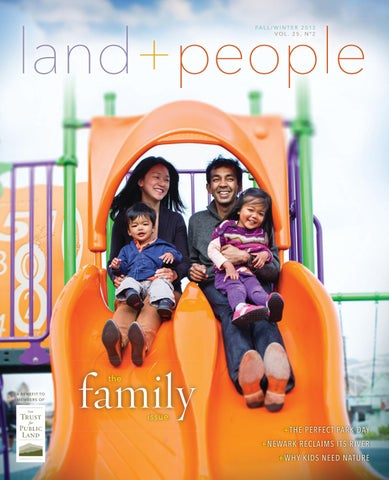
o n t h e cover The Iyer family enjoys the play structures at San Francisco’s Balboa Park, newly renovated by The Trust for Public Land. photo: anna kuperberg
J OIN U S ON FAC E B O O K Scan the QR code with your mobile device to stay tuned to the latest news, videos, contests, and more. facebook.com/tpl.org
18 T P L. O R G · 3
dave lau ri d se n
contents
HUTCHINSON RANCH, SALIDA, COLORADO
The Hutchinson family has raised cattle here since before Colorado was even a state. But like many ranchers, they’re under increasing pressure to sell out to developers. Easements are one way we’re helping people keep doing the work they love—while conserving Western landscapes we all treasure.
Page · 46
46
T P L. O R G · 5
ray mathi s
contents
HACKMATACK NATIONAL WILDLIFE REFUGE
Hard to believe, but this peaceful morning scene was captured within a few hours’ drive of bustling Chicago. On the IllinoisWisconsin border, the new wildlife refuge is the product of our push to protect open space in reach of urban populations—for whom public lands provide a critical connection to nature.
Page · 25
25
T P L. O R G · 7
from the president
I grew up in the Northeast, developing a strong connection with New England’s forests and coastline. But one summer when I was a boy, our family piled into our Ford station wagon for a two-month journey through western national parks and public lands. I will never forget my first exposure to the big skies, wide-open spaces, and stunning landscapes of the West. That trip gave me a whole new appreciation for America’s great outdoors and became one of my most treasured childhood memories. Years later, when my wife, Kate, and I started our own family, we wanted to give our boys, Wiley and Cooper, plenty of time outside in nature. Together our family grew vegetables and raised honeybees in our backyard, explored the parks and wild places around the San Francisco Bay Area, camped and backpacked in the Sierra Nevada, cross-country skied in the Rockies, and took our own family road trip in our minivan to explore the forests and coastlines of New England. As this issue of Land&People makes clear, spending time outside as a family is more than just fun—it’s therapeutic. Time in nature gives us a chance to connect to each other and to teach our children that places matter. As we all spend increasing time indoors and in thrall to our digital devices, it’s more important than ever to create parks and protect close-to-home spaces where families— everyone, for that matter—can get outside. Here our children can stretch their limbs, shed excess pounds, build muscles, and exercise their imaginations. For a while, anyway, they abandon their screens and keyboards to enjoy in-the-flesh social networks of family and friends while exploring the World Wide Web of nature.
darcy kiefel
ALL IN THE FAMILY
Spending time outside as a family is more than just fun—it’s therapeutic. Improving lives by creating parks and connecting people to the natural world is at the heart of our mission at The Trust for Public Land. As the holidays approach and we mark the end of another year, we want to thank you—our generous members—for helping advance this work that benefits so many people. On page 59 of this magazine, you will find a Year in Review section enumerating some of our accomplishments together. But the real value of our work lies in the daily experiences of the millions of people across America who are enjoying parks, playgrounds, exercise areas, gardens, trails, and inspiring wilderness because of your support. We hope that you enjoy this issue of Land&People and that these stories inspire you to help create parks and protect the lands you love. Thanks for being a member of our own land-for-people family.
Will Rogers president 8 · LA ND &PE OPL E · FAL L /W I NTER 2013
Grow your legacy. We invite you to make land conservation a part of your personal legacy by including a gift to The Trust for Public Land in your estate plans. Every day, America loses 6,000 acres of open space—irreplaceable wildlands, historic sites, and dwindling urban and suburban open space. Your legacy can be part of the solution. Let us welcome you into the Stegner Society, which honors individuals who make legacy gifts to The Trust for Public Land through their will, living trust, retirement plan, or life income plan. Contact Gardner Trimble, director of planned giving, to learn how you can make a lasting gift that supports land conservation for generations to come. 415.800.5208 · planned.giving @ tpl.org · tpl.org/plannedgiving
The Trust for Public Land
Not all gifts are created equal.
Give your EarthShare.
1 0 · LAND &PE OPL E · FAL L /W I NTER 2013
An EarthShare payroll deduction is one simple way to donate to The Trust for Public Land or more than 400 other environmental and conservation charities. Many corporate and government employers support EarthShare payroll giving. If yours doesn’t, ask them to start. If they do, simply decide on a single deduction or a recurring small one from every paycheck. Then designate us, member number 11440, as one of your conservation charities. For more information visit earthshare.org or email donor.outreach@tpl.org.
alex diekmann
What do you give the person who has everything? What about a community garden, public playground, or dog park? Forget the socks—The Trust for Public Land’s Gift Guide is full of meaningful gift ideas for friends and family who care about clean water, combating climate change, and connecting people to nature. Now that’s a warm and fuzzy feeling that’ll really last. tpl.org/giveagift
pu bli sh er
Sean Connolly e d ito ri al di rector
Eliza Sarasohn a rt di rector
Matt Mullin a ss o ci ate edi tor
Alia Salim e d ito ri al assi stant s
Shoshannah Flach Yasaman Golban producti o n and re s earch assi stant
Sarah Avery photo research
Nancy Biskovich
ipad is a registered tra dema rk of ap p le inc. , registered in the u.s. and ot her countries. app store is a service mark of apple inc.
ma r keti ng
Kristen Anderson d igital producti o n
Carrie Gotch Adele Wilson-Hamaker con tri buti ng edi tor
Bill Poole
A BE N EF IT TO M EM B E R S Land&People magazine is a benefit to members of The Trust for Public Land. Not a member? Join today and never miss an issue. tpl.org/lp
A GREEN ER READ Land&People is printed in the United States on chlorine-free, 30 percent postconsumer recycled paper and manufactured using Envirotech™ ink, which contains a high percentage of ingredients derived from renewable resources. Printed by Quad/Graphics Inc., Wisconsin.
EVEN MORE LAND&PEOPLE Download the free Land&People iPad app—available now at the App Store. The digital edition includes all the stories you love in high resolution, plus bonus content like video, search tools, easy social media sharing, and instant links to learn more. If you don’t have an iPad, you can access the digital edition online at tpl.org/lpdigital. Wherever you see the pointer symbol below, you’ll find bonus content in the digital edition. Download the app or go online to dive deeper into the story.
© 2013 The Trust for Public Land. All rights reserved. The Trust for Public Land, TPL, Land&People, Parks for People, Conserving Land for People, ParkScore, LandVote, LandLink, Greenprint for Growth, Fitness Zones, and The Trust for Public Land and LandVote logos and all other names of The Trust for Public Land programs referenced herein are registered or common law trademarks of The Trust for Public Land.
T P L. O R G · 11
contributors
Katherine Ozment
Son of Alan
Heather Hansen
feature:
feature:
feature:
Last Family in the Woods
Last Family in the Woods
No Place Like Home
30
Katherine is a journalist whose work has appeared in such publications as The New York Times, National Geographic, Salon, and Fitness. Her first book, Losing Our Religion: The Quest for Grace Without God, will be published by HarperWave in 2015. She lives in Cambridge, Massachusetts, with her husband and three kids. katherineozment.com
30
Son of Alan is an alter ego of the illustrator also known as Lee Woodgate. He grew up in the English countryside, where he spent many a day in a Land Rover with his father, who worked a forestry job. He now lives on the south coast of England, where he’s been a fulltime illustrator for 14 years. He loves nature and running in the hills.
46
Heather is a reporter based in Boulder, Colorado. She has backpacked, kayaked, and bushwhacked her way around the globe, most recently focusing on natural resource issues affecting the Intermountain West. She is co-author of Disappearing Destinations, a critically acclaimed guide to the world’s most endangered places. heatherhansenwrites.com
folioart.co.uk
Does your company support gift matching? Ask your human resources department. With corporate gift matching, your donation will go even further to help The Trust for Public Land protect more parks, gardens, and other natural places. That’s one good thing made that much better. fig. 1
fig. 2
good.
better.
1 2 · L AND &PE OPL E · FAL L /W I NTER 2013
800.714.5263 donor.outreach@tpl.org tpl.org/corporatematch
O F F IC E R S
George Bell
s en i o r v i c e pre si de n t an d d i re cto r o f c i t y pa r k d e ve lop me n t
Adrian Benepe
set h sh erman
p res i de n t a n d ch i e f exe c u t i v e o ff i c e r
William B. Rogers
board spotlight
Get to know
A member of The Trust for Public Land board since 2008, George Bell is the president and CEO of Jumptap, a leading mobile ad network. With 25 years of
s en i o r v i c e pre si de n t a n d c h i e f ph i l a n t hrop y off ice r
experience creating and growing con-
Margie Kim Bermeo
sumer businesses, George is a recipient
s en i o r v i c e pre si de n t a n d di v i si o n di re cto r
of the Ernst & Young Entrepreneur of the
Raymond Christman
Year award in both California and New
s en i o r v i c e pre si de n t a n d c h i e f m a r ke t i n g off ice r
England as well as four Emmy awards as
Sean Connolly
a producer and writer of documentaries
s en i o r v i c e pre si de n t a n d di re cto r o f co n se r vat i o n st rat e g ie s
on adventure, wildlife, and vanishing cultures. He resides with his family in Boston,
Ernest Cook
where he has fond memories of hiking
s en i o r v i c e pre si de n t a n d di v i si o n di re cto r
and sledding with his three sons at Larz
Jeff Danter
Anderson Park.
s en i o r v i c e pre si de n t, gen e ra l co u n se l , a n d se cre tary
M. Holly Haugh s en i o r v i c e pre si de n t an d d i v i si o n di re cto r
Roger Hoesterey s en i o r v i c e pre si de n t, chie f fi n a n c i a l o ff i c e r, a nd treasu re r
Cynthia Scherer v i ce pre si de n t a n d di re cto r o f f e deral affairs
Kathy DeCoster v i ce pre si de n t a n d di re ctor o f co n se r vat i o n t ra nsactions
I JOINED THE TRUST FOR PUBLIC LAND BOARD BECAUSE … The Trust for Public
Land is a major force in the conservation movement, and the scope of our mission inspires me. Now more than ever, there’s urgency for this work. At the end of the day it’s going to take a collective effort to make significant strides in land conservation.
Brenda Schick
MY PROUDEST ACCOMPLISHMENT AS A
v i ce pre si de n t a n d d i re cto r o f hu m a n re sou rce s
BOARD MEMBER WAS … helping The
Barbara Smith
B OA R D OF D I R E CTOR S Page Knudsen Cowles (Chair), Stephen W. Baird, George Bell, William J. Cronon, George P. Denny III, Douglas Durst, Whitney Hatch, Caroline P. Niemczyk, Michael E. Patterson, Thomas S. Reeve, Roy Richards Jr., William B. Rogers, Ron Sims, Sheryl Tishman, F. Jerome Tone, Susan D. Whiting
Trust for Public Land muster funding and support to protect Katahdin Lake in Maine. THE WORK OF THE TRUST FOR PUBLIC LAND IS VITAL BECAUSE ... as a population, we are
turning our backs on the countryside in an inexorable march toward the city. It’s important that we ensure the presence of open space in urban areas—as a reminder to all of us of the power of the land. THE BIGGEST CHALLENGE FACING THE TRUST
of our quiet—perhaps too quiet—and exceptional work. I WOULD ENCOURAGE OTHERS TO SUPPORT THE TRUST FOR PUBLIC LAND BECAUSE ...
opportunities to affect major, lasting transformations across the country don’t come around that often. I support The Trust for Public Land because I know our work will ripple across countless families and communities in America, for today and for generations to come. WHEN I WANT TO CONNECT WITH NATURE, I ... go for a long bike ride, a swim in the ocean, or a barefoot walk in my own backyard where the Earth speaks to me through my feet.
?
WHAT ABOUT YOU? Tell us how you connect with nature. Join the conversation on Facebook: facebook.com/tpl.org
FOR PUBLIC LAND IS ... to create awareness T P L. O R G · 13
laura barisonzi
JOI N OUR COMMUNI TY Jack MacSlarrow’s photo of Mount Shuksan, Washington, was an entry to our latest Facebook photo contest. When we asked friends to share photos of how they enjoy the outdoors, we got everything from hammock naps to big-wave surfing. Don’t miss
jack macslarrow
the next contest: join us online.
DROP US A LINE
Boy Scouts fish from the deck above the lake at Staten Island’s Pouch Camp, now permanently protected from development.
Thanks to readers who took our survey or wrote to share their thoughts on Land&People stories and our new design. We read every one of your letters and we hope you’ll keep them coming—you can always reach us at mailroom@tpl.org.
Y O U R FA V O R I T E F E A T U R E
44
8%
%
38%
10% ● 1 Park, 1,000 Stories
● Fit for All
● Shelter from the Storm
● Other
Magazine makeover
We debuted a new look for Land&People in the Spring/Summer 2013 issue.
1 4 · L AND &PE OPL E · FAL L /W I NTER 2013
I was staying at the Harbor Court Hotel—a Kimpton property—and found Land&People magazine in my room. Immediately, my experience of being in a city hotel room was shifted to the world of the outdoors in a way that was so diversified, elegant, and beautifully presented in pictures, design, and words. I am just in love with this magazine—what it deals in but
also how it is done. There is so much focus and integrity and dedication to the subject, and the articles seemed to speak directly to me. Then I looked up The Trust for Public Land online and was even more excited to become aware of this organization. Nature is my biggest passion and I was so glad to have this reflected back to me by the magazine and organization. Jill Herbers, New York City, New York The new format for Land&People conveys a vibrant and inviting organization doing good—or more accurately, great—work for all of us. Thanks to the many whose work and organizational support makes the publication and the programs possible. Polly Hart, via email
While I love the quality of what you have presented in the magazine, and definitely share the values, I wonder about the use of resources [required] to produce it. Can we choose to receive it online? Anonymous
mailroom
Right on par In the ’60s, developers turned a vibrant natural wetland just north of Santa Barbara into the Ocean Meadows Golf Course. Today we’re working with part-
We’re proud to print Land&People
ners to restore the Devereux Slough
magazine on chlorine-free, 30 percent
back to its former glory—and open it
post-consumer recycled paper using
to the public for hiking, bicycling, and
™
Envirotech ink. You can access the
bird-watching.
full issue online at tpl.org/lpdigital or featuring bonus multimedia content— to your iPhone or iPad.
Hayes Valley Playground is a recipient of a 2013 Design Award from the American Institute of Architects. Great work, Trust for Public Land! We love this place!
linda lucille plate via facebook
Ocean Meadows is awesome work. I can’t wait to visit this site after it is restored—it will provide a muchneeded reserve for the Pacific Flyway! Sheryl Mudersbach-Hamblin, via Facebook
Earlier this year, The Trust for Public Land helped the city of Ventura, California, acquire much-needed parkland. We’re now guiding the community through design workshops to help
Wetlands are the filtering system to all of our drinking water. The more you remove them by filling and draining, the worse you make our already polluted water supply. Debbi Cobern, via Facebook
bring their park dreams to life.
LAND&PEOPLE IS LISTENING! Send letters to the editor or change your mailing address: mailroom@tpl.org. rich reid
download the Land&People app—
We need more parks in Ventura. This is great news for my grandson and my whole family!
pat mazzera
san francisco parks alliance via twitter Hayes Valley Playground—San Francisco, California
Ocean Meadows—Santa Barbara, California
T P L. O R G · 15
pau l vi an t/ g e tty i mag e s
“The informality of family life is a blessed condition that allows us to become our best while looking our worst.”
margaret kennedy, novelist and playwright
first look
skylar williams
luke walter photography
buzzworthy
BRICK CITY MEETS ITS RIVER Though they live within a stone’s throw of the mighty Passaic, many Newark residents have never seen the river up close. How could they? Contaminated by an industrial history—Agent Orange was manufactured here during the Vietnam War—the Passaic was declared one of the most severely polluted rivers in the nation and listed as a Superfund site. It festered, neglected and inaccessible, for decades. But locals never gave up hope of reclaiming their river—for recreation and as a symbol of the Brick City’s revival. This past summer, they celebrated a major step toward that goal with the opening of the first phase of Newark Riverfront Park. The four-acre park features rolling green hills, lighted paths for walking and biking, and a performance space. For the first time, residents can stroll along the Passaic—on an eye-popping orange boardwalk constructed from recycled plastic—or launch kayaks from a floating dock. A planned second phase will expand the park to seven acres, connecting it to a network of riverfront paths that will extend even closer to downtown Newark. The Trust for Public Land partnered with the City of Newark, Essex County, and the Ironbound Community Corporation to bring Newark Riverfront Park to life. All point to the park’s potential to boost the local economy, drawing visitors to the restaurants and businesses of the historic Ironbound district and other downtown Newark destinations. “This is the beginning of a realization of a dream,” said East Ward Councilman Augusto Amador to the Star-Ledger. “A healthy river means a healthy city.” WATCH HOW NEWARK RECLAIMED ITS RIVER @
“When I’m an old man and my kids are carrying my pack for me, I’d like to come back and know that this will be the same pristine, undeveloped place.” —Erik Weihenmayer, adventurer Best known as the first blind climber to summit Mt. Everest, Erik Weihenmayer recently joined The Trust for Public Land on a hike through Utah’s Zion Narrows—number five on National Geographic Adventure magazine’s ranking of the top 100 American adventures. In June, The Trust for Public Land completed conservation of the Narrow’s main access trail, which has repeatedly come under threat from development. With the land now permanently protected, the beloved hike will remain accessible for future generations of explorers. TAG ALONG WITH ERIK AS HE EXPLORES THE CANYON @
BIT.LY/ZIONNARROWS
YOUTUBE.COM/TRUSTFORPUBLICLAND F I R ST LO O K · 17
edible conservation
From a simple ambition, a bountiful harvest
northampton community farm, florence, massachusetts
jerry monkman
Special programs put the farm to work for the whole community, providing hunger-relief garden plots, subsidized CSA shares for low-income families, and donations of fresh produce to the local soup kitchen.
When the trust for public land helped a group of locals protect 121 acres in western Massachusetts for farming, we knew the land was fertile. But now, three years later, we’re still marveling at all that has grown there. “As we round out our third season, every acre is spoken for—either in production or rotation,” says Lilly Lombard, executive director of Grow Food Northampton, the nonprofit that owns and manages the land. “Our farmers are meeting or exceeding their business goals. For folks to be able to make a living raising food in a world dominated by big agriculture is remarkable.” A diverse mix of green thumbs now call Northampton Community Farm home, including Crimson & Clover—a 37-acre food farm that sustains a popular Community Supported Agriculture (CSA) program; Slow Tractor Farm—which grows organic grains for malting into beer; and the Florence Organic Community Garden, a 400-plot community garden where neighbors nurture everything from pumpkins to sunflowers. But the land’s most valuable commodity is the spirit of community it fosters. “It’s such a glowing example of successful citizen activism. Folks had a vision, they worked hard, and they realized it,” says Lombard. “People still almost can’t believe that we did it—we got our farm.”
1 8 · L AND &PE OPL E · FAL L /W I NTER 2013
mim adk in s
GET OUT AND PLAY!
good news
Root vegetable gratin “Served with a salad or sautéed greens, this dish makes for a simple, beautiful fall dinner,” says Crimson & Clover’s Jen Smith. INGREDIENTS O
O O O O O
4 pounds of mixed root vegetables (potatoes, sweet potatoes, rutabaga, turnips, etc.) 1 ¼ teaspoon dried thyme Salt and pepper to taste 1 ¼ cup heavy cream ½ cup chicken broth 6 ounces Gruyère cheese
Preheat oven to 400 degrees. Thinly slice root vegetables with veggie slicer or mandoline. Toss with thyme and season generously with salt and pepper. Layer sliced vegetables in a 9”x13” glass or ceramic baking dish. Pour cream and chicken broth over vegetables. Bake for 45 minutes. Remove dish from oven. Press vegetables down into liquid with the back of a spoon, and cover with shredded Gruyère. Bake another 45 minutes or until roots are cooked through (test with fork) and top is browned.
Heading on an east coast adventure? Download our Places to Play guide, featuring some of our favorite protected lands across the region—from sandcastle-friendly beaches in Maine to fun forest trails in Virginia. We created the guide in partnership with The Fresh Air Fund, which provides thousands of New York City children with free summer vacations at nature camps and with host families. We think you’ll enjoy it, too.
This past summer, we welcomed Fresh Air kids and families to their own Day on the Land events at Trust for Public Land– protected places along the Eastern Seaboard.
DOWNLOAD YOUR FREE GUIDE @
TPL.ORG/ PLAYGUIDE
F I R ST LO O K · 19
tpl archives
q+a
Deb Love with daughter Sabine and son Alex.
“Now that I’m a mom, our mission inspires me more than ever.” DEB LOVE FOR THE TRUST FOR PUBLIC LAND’S NORTHERN ROCKIES DIRECTOR, CONSERVING LAND AND CREATING PARKS IS A FAMILY AFFAIR
interview by allie ferguson
What drew you to a career in conservation? It all started in the fifth grade, when my two best friends and I spent two years researching, designing, and ultimately building a nature trail behind our elementary school. As an adult, I went to business school at UC Berkeley and then worked for an investment banking firm in Boston. I took an environmental management night class at Harvard, and I fell in love with it. I was doing a study on the recycling potential for the high-rise office building where I worked and my boss caught me dumpster-diving. She really sweetly and profoundly changed my life by saying, “You know, you really should pursue your passion for the environment.” 2 0 · L AND &PE OPL E · FAL L /W I NTER 2013
How did you discover The Trust for Public Land? After the dumpster-diving incident, I interviewed for a job at The Trust for Public Land and saw an Aldo Leopold quote on the wall: “The weeds in a city lot convey the same lesson as the redwoods.” It struck me that this organization understood the power of close-tohome nature. That connection is so critical. How can you expect people to advocate for the global environment if they’re not connected locally? This philosophy has resonated with me for the 23 years I’ve been with the organization.
Your husband used to work for The Trust for Public Land, too. Together you closed the largest land conservation deal in U.S. history—protecting 300,000 acres in Montana surrounding the Swan Valley—an incredible achievement. What was that like? He was actually Northern Rockies director before I was; we worked very closely together for 15 years. Because of the Montana Legacy Project, the Swan Valley has become our family place. We take the kids there every summer to swim and paddle in the lakes and just be out in nature. I look around at the land we’ve protected together and I’m just in awe.
meg haywood-sullivan
Does your work rub off on your kids? The job has become who I am. There’s no real distinction between work and home life or work and play. It’s all kind of blurred together. Part
of how I manage being a working mom is that I engage my kids in my work so they’re excited about it and advocate for it, instead of feeling like it takes me away from them. We live in downtown Bozeman, just down the trail from a parcel of land that was slated for condo development until The Trust for Public Land stepped in and made it into a pocket park. The kids are out on that trail almost every day, biking, running, and climbing trees. My nine-year-old son caught a brook trout there a couple of weeks ago—right downtown! Having a Trust for Public Land project in my backyard definitely helps. I asked my son if he knew why I do this work, and he said, “Because you know one person can make a difference.” That was pretty cool. What are the best ways for busy urban families to connect to nature? All cities have some kind of park system. Good programming is a great way to get families and kids excited about the outdoors. For example, we developed a curriculum to teach local
christi cooper-kuhn
How does being a parent inform your perspective on your work? Now that I’m a mom, The Trust for Public Land’s mission is more inspiring to me than ever. I say I started on my career path in fifth grade: I know from personal experience how formative these early experiences in nature can be. I’m motivated to leave my children a legacy of land and wild places, and in that way, I don’t think I’m different from many parents. I hear the same thing from community members all the time—they want their kids and grandkids to have the same outdoor opportunities that they had growing up. Montanans love the outdoors— it’s how we define ourselves. It’s the primary reason I chose to raise my children here and I think everyone deserves the same opportunities we have.
Story Mill—Bozeman, Montana
kids about the Story Mill property, a 61-acre site The Trust for Public Land purchased in downtown Bozeman to turn into a park. We just recently hosted summer camp for 200 school kids from the Boys and Girls Club, the YMCA, and the Montana Outdoor Science School. They loved it, especially the wetlands. What is the most rewarding part of your job? I love taking a hike and looking around and knowing that, but for The Trust for Public Land, this place would have had houses, or condominiums, or oil and gas rigs all over it. And now it’s public land, forever open for others to enjoy. That’s incredibly powerful. But the most rewarding part, for me, is getting to meet so many people whose lives have been changed by the work we do. Over and over again, people have come up to me with tears streaming down their faces, so profoundly grateful that we’ve helped them save the lands that they love. I often say I came to this job for the land—and I stayed for the people.
Sabine and Alex make candied apples at Rocky Creek Farm—one of many protected places in the Bozeman area.
F I R ST LO O K · 21
why we give
WE GIVE TO … run the rivers
Rafters are dwarfed by the Grand Canyon’s Redwall Cavern in Craig Dahl’s shot from a CFF trip in 1983. Carved out from the limestone cliff walls over time, the cavern is a popular spot to view fossils and rock formations.
central fantasy funding cooperative
In the early ’70s—just as The Trust for Public Land was getting its start—a group of young post-doc researchers took a rafting holiday on the Colorado. In the cool shadow of the high canyon walls, they caught a bad case of “river fever”: they vowed to run the rapids again, next time on boats they’d own and guide themselves. Their vision took shape as a cooperative they called Central Fantasy Funding. Though glibly named, the club made short work of turning a dream to reality: its members incorporated, pooled resources, bought equipment, and set about teaching themselves the ways of whitewater rafting—then only just gaining popularity as a recreational sport. Craig Dahl joined the group while he was still in college. “What members had in common was that we were people who liked to be in the driver’s seat,” he recalls. “New rafters would come into it not knowing anything, but pretty soon they’d be guiding boats. Everybody got to be the captain.” Though many members had other outdoor hobbies—backpacking, skiing, climbing—they found that running rivers held a unique and addictive appeal. More than other sports, rafting fostered friendships that formed fast and lasted long. “Rafting put me deep into the wilderness at a level I’d never experienced before,” Dahl says. “The adrenaline is unlike any other wilderness sport. And it takes teamwork to survive and be safe, so you can build a level of trust in people very quickly.”
2 2 · L AND &PE OPL E · FAL L /W I NTER 2013
n ice r ide mn
word watch
Co-op members on a 1981 trip on the Colorado River. Photo courtesy former CFF communications secretary William Rodarmor (back left), whose first trip with the group was on the same river in 1972. “It was a hell of beginning,” he says. “Some people’s first car is a Maserati.”
At the height of its activity in the 1980s, the cooperative boasted nearly 50 members and ran up to 15 river trips a year—from U.S. classics like Oregon’s Rogue River and Idaho’s Salmon to adventures abroad, like the Rio Usumacinta in Guatemala. But as the rafters’ commitments to career and family grew, trips became less and less frequent. This year, the last remaining members decided to officially disband the co-op, selling off the gear and donating the proceeds to charities whose work reflected the CFF spirit. “The [environmental] movement has changed,” says David Moyal. As the group’s last president, he helped facilitate the discussion of distributing the funds. “It used to be that eco-activism was small organizations, often issue-dependent, very local. Nowadays it’s also about national policy: fuel and energy and transportation.” CFF members saw that balance well reflected in The Trust for Public Land, which works to apply national conservation expertise to local challenges—including the protection of several of the group’s bestloved whitewater spots. Despite closing the books on the collective, Dahl, Moyal, and many other former members remain active in the outdoors—still prone to occasional bouts of that same river fever. “It goes through stages,” says Moyal. “When you start rafting, you tend to think in metaphors: ‘This is how I want to live my life, flowing like a river.’ Then you get into the technical aspects: trip-planning, the gear. You do it for the sense of accomplishment. Eventually it becomes a social thing, something you do with your best friends.” “But it always comes back to that initial thought,” he adds. “Rafting is a metaphor for a life well lived.”
Minneapolis Mayor R. T. Rybak takes a spin with the city’s Nice Ride program. Read more about this park-friendly city on page 40.
bike·share /bık'·shər'/ (n.) Short-term bicycle rental from an automated station, often open 24 hours a day. Although the concept has existed for decades and has been widely adopted abroad, 2013 was a boom year for bike sharing stateside: new programs launched in more than a dozen U.S. cities, from New York to San Francisco.
F I R ST LO O K · 23
buzzworthy
randall benton
When land’s a lifesaver
“Someone always suggests ‘Candy Land.’ We ask the students to think about whether that’s the best theme for a healthy outdoor playground. One group of fourth-graders came up with ‘Fruityland’ as an alternative— to which we said, fair game. It did not win the vote, however.” — Joan Keener, Trust for Public Land program manager In New York City classrooms, playground design becomes part of the curriculum as students help pick out landscaping elements, play equipment, and themes for artwork. Other themes that didn’t quite make the cut include SpongeBob SquarePants™, kittens, and ninja space turtles.
2 4 · L AND &PE OPL E · FAL L /W I NTER 2013
It might not look like urban infrastructure, but there’s more to this farm than meets the eye. Fertile grounds for crops from wheat to walnuts—as well as cheery flowers—these low-lying fields are also part of a plan to protect a half-million nearby Sacramento residents from flooding. In the largest such deal in California history, The Trust for Public Land helped place an agricultural conservation easement on almost 3,000 acres of Sacramento River Ranch earlier this fall. By ensuring that the property stays in production—rather than being paved over for development—the easement preserves the land as an outlet for floodwaters should the river overflow its levees during a major storm. The logic: better to flood fields than homes. This kind of trade-off makes sense to planners at the California Department of Water Resources. “We don’t want it to ever flood,” the DWR’s Earl Nelson told The Sacramento Bee. “But if something happens that’s beyond everyone’s control, we don’t want [the] urban areas [to be] at risk.”
room to roam
“I see mothers who can … bring their kids down here and share this with them—whether they have a car that can make it 15 miles south or not.” The Trust for Public Land helped establish both of these close-to-home refuges in the past few years. Their names reflect their regional heritage. “Hackmatack” is the Algonquin word for the tamarack tree that blankets the upper midwest in green each spring. “Valle de Oro” was chosen by the public in an online vote: it means “Valley of Gold”—the perfect description for a landscape New Mexico families are sure to treasure.
GET A SNEAK PEEK AT NEW MEXICO’S NEWEST WILDLIFE REFUGE @
BIT.LY/VALLEDEORO
ray mathis
They’re called wildlife refuges—and it’s true that they shelter animals from cottontails and coyote to migrating cranes. But the species benefitting most from these places may well be our own: Hackmatack National Wildlife Refuge is just a short drive away for millions of people in Chicago, Milwaukee, and Madison, while Valle de Oro National Wildlife Refuge is actually inside the Albuquerque metro area—and within an hour of nearly half the population of New Mexico. “When I look at Valle de Oro,” says Albuquerque resident Angela West,
Hackmatack National Wildlife Refuge
F I R ST LO O K · 25
A FOREST WITH DUAL CITIZENSHIP
good news
56 V FITNESS ZONE ® EXERCISE AREAS NOW IN PARKS
AROUND THE COUNTRY The Trust for Public Land opened its first Fitness Zones in 2007. As of this year, we’ve helped create 56 of these free outdoor gyms in 25 cities from Los Angeles to New Orleans, with 17 more currently in the works. To find the Fitness Zone nearest you, visit tpl.org/fitnesszones.
SEE A FITNESS ZONE IN ACTION @
YOUTUBE.COM/TRUSTFORPUBLICLAND
2 6 · L AND &PE OPL E · FAL L /W I NTER 2013
ermont’s Jackson Valley runs along the U.S.Canadian border, and it’s long been a top priority for conservationists on both sides. Last year, The Trust for Public Land helped place an easement over nearly a thou-
sand acres here, safeguarding both sustainable timber harvesting and an international habitat corridor for wildlife like bobcat, marten, and moose—none of which have passports. Just the latest effort in our conservation work along the border, the newly protected land also buffers more than a mile of the Long Trail. This challenging route through the Green Mountains is the oldest long-distance trail in the country and attracts adventurers of all stripes—from day-tripping families to solo backpackers attempting the entire 273-mile span. Time it just right, and a long-haul hiker can use the path to follow autumn’s onset from north to south, enjoying a vibrant show of changing leaves all the way from Canada to Massachusetts.
nick sirotich
allana wesley white
what counts
The
DINOSAUR HUNTER A CONVERSATION WITH SCOTT SAMPSON INTERVIEW BY ALLIE FERGUSON
I N SI G H T · 27
insight
A
outside, because all birds are dinosaurs. There are more dinosaurs around today than mammals—about 10,000 species of birds versus 6,000 species of mammals. n evolutionary biologist and paleontologist who recently discovered an
Did you spend a lot of time outdoors as a kid?
unknown type of dinosaur, Scott Sampson
I was a child of the ’60s—after school, I was kicked outside to play and told not to come back until the streetlights came on. I definitely attribute my passion for nature to my parents. My family went camping multiple times a year. If I had not spent so much time sleeping in tents as a child, I’m almost certain I would not be a paleontologist today. By the time my mother gave me my first dinosaur book, I was already hooked on the natural world.
is the new chief curator and vice president of research and collections at the Den-
ver Museum of Nature and Science. But to millions of kids around the world, he’s just “Dr. Scott,” host of the popular PBS children’s series Dinosaur Train. The show is broadcast in more than 100 countries and was nominated for an Emmy. For Sampson, it’s an opportunity to work toward a goal close to his heart—connecting children to nature. “When I started Dinosaur Train, I had no idea if a TV show could encourage kids to turn off the tube and go outdoors,” says Sampson. “But I negotiated so that my final line in every episode is ‘Get outside, get into nature, and make your own discoveries.’” His fans seem to be listening: since Dinosaur Train launched in 2009, Sampson has heard from hundreds of families who say the show has inspired them to explore the outdoors.
You led a research team in southern Utah that recently discovered a new type of dinosaur. Tell us about it.
Yes—we named it Nasutoceratops—which means “big nose, horn face.” It sounds like an insult, but it’s actually quite descriptive. Nasutoceratops lived in southern Utah 76 million years ago. At that time it was a hothouse world, with no polar ice caps and much higher sea levels. Utah had a Mediterranean-type climate and spectacular beachfront property, thanks to a shallow sea that divided North America. That’s fascinating. Kids must love to hear these stories.
Yes! The kids are entranced by tales of these ancient worlds. And I tell them that if you want to be a scientist when you grow up, the most important thing to remember is that there are still plenty of amazing discoveries to be made. People think we’ve already found most of the dinosaurs that are out there, but in fact, the opposite is true. We’ve discovered more dinosaurs in the past generation than in all prior history—and the rate of discovery is not abating. The other cool thing I always tell kids is that dinosaurs aren’t extinct. You don’t have to go get a PhD to study dinosaurs in some far-off country; you simply need to step 2 8 · L AND &PE OPL E · FAL L /W I NTER 2013
What about people who didn’t have these types of early experiences? Is there a basic human need to connect to nature, regardless of background?
Absolutely. For early humans, passing on an intimate understanding of local plants and animals and natural history to the next generation was a matter of survival. So I think that a genetic bias toward forming a bond with place would have been critical in the same way that a mother-infant bond is critical for healthy human growth. We know that children who lack the mother-infant bond have difficulties as adults. I think the same thing is true of people who never bond with nature—it leads to cascading negative effects throughout their lives. How are those effects visible in the United States today?
Kids currently spend an average of seven to ten hours a day looking at screens and just four minutes a day outdoors— that’s more than 90 percent less time outside than their parents had. Childhood has literally been transformed within a single generation. This is an experiment we’ve never run before—and so far, the results don’t look good. Our kids are contending with skyrocketing rates of serious health issues—among them diabetes, heart disease, obesity, and depression. This is the first generation that may have a life expectancy less than that of their parents. We’re constantly barraged with news of threats to our land, air, and water. How does our children’s changing relationship to nature relate to these other environmental problems?
I’d go so far as to say that our disconnect from nature is one of the three greatest challenges of our time, together with climate change and the loss of biodiversity and habi-
jedrzej borowczk
tat. Depending on which science you believe, we’ve got something like 20 years to turn the ship around and start heading in a sustainable direction. But we’ll never get there unless we care about the places we live—and why would we ever care if we don’t spend any time outside in those places? What scares me the most is that many of today’s parents did not grow up outside—they’re young enough that their parents kept them indoors. So we’re now into the second generation of children who are effectively growing up under house arrest. The average kid can recognize over a thousand corporate logos, but fewer than a dozen plants native to where they live. If this trend persists, we risk losing our cultural memory of nature connection altogether. So we need a cultural change.
The environmental movement has been unsuccessful in part because we’ve focused overwhelmingly on people’s minds rather than their hearts, and the message has been one of doom and gloom. I confess to being part of this echo chamber. As a scientist, I have spent years making dire predictions about global warming and species extinctions based on present-day trends. But the reality is, people don’t respond to doom and gloom. What changes behavior is emotional engagement with nature. How can conservationists help make that happen?
Programs that take underserved kids up to a national park so that they can spend a night or two camping are great, but that’s not where real nature connection is going to occur. It’s going to happen locally, so we need to find ways to “re-nature” backyards, schoolyards, and parks so people can have these experiences daily. Seeing a bull elk or a bear once is less transformative than seeing the same place
If I had not spent so much time sleeping in tents as a child, I’m almost certain I would not be a paleontologist today.
every day with new eyes because you’ve learned to look at it differently—for example, watching the flowers and birds come and go with the seasons. People from less advantaged socioeconomic backgrounds in particular often lack access to nature. Right now the children-in-nature movement is largely a white, affluent movement—but it needs to be everybody’s movement. We need to break down the silos between organizations working on these challenges and form alliances. I’m talking about coordinated programs where partners leverage each other’s assets; where, for example, natural history museums and school districts team up with nature centers and land trusts to engage kids from toddlerhood through adolescence. How does your current work fit in to that solution?
I recently moved to Denver in large part to help develop an urban-scale solution to the human-nature disconnect. I love to use dinosaurs and mammoths and rocks to help get kids excited about the place that they live in, to understand how it came to be, and how it’s going to change moving forward. Most important, I tell them that the story is unfinished, and that the decisions they make today are going to change the outcome in some way. We must understand that we are powerful actors in this amazing, multibillionyear narrative. If you don’t have any sense of your place in history, why would you ever care about the future? I N SI G H T · 29
LAST
STO RY BY KATHE R INE OZM ENT ILLUSTR ATIO NS BY SON OF ALAN
3 0 · L AND &PE OPL E · FAL L /W I NTER 2013
FAMILY
in the
WOODS A growing body of research suggests that time spent in nature is an investment in health and well-being. But can a big-city family like mine truly let go?
T P L. O R G · 31
T H E F IRST SI GNS O F T RO UBLE presented themselves several years ago during a visit to a small farm in Northern California.
As we rounded the fence, clutching our scraps of
And though they were learning to read a subway map,
wilted lettuce to feed the goats, I saw several families with
give spare change to the homeless, and cultivate an
kids as young as ours marching out of the woods that
urbanite’s blank, “Don’t mess with me” stare, their lack
adjoined the farm. Cheeks ruddy and hair mussed, the
of familiarity with greener pastures made them seem like
children wore backpacks stuffed with overnight gear and
tourists in nature.
walked with confidence. Kids who camp, I thought, feeling twin pangs of guilt and envy.
Those camping kids were the opposite: so self-composed they looked like they could start a fire, pitch a tent,
My own children’s experience with the great outdoors
or catch a fish. They looked—how do I put this?—like they
consisted of playing in the two-car parking space behind
could kick our city kids’ subway-riding, graffiti-admiring,
our Boston townhouse, helping me weed our postage-
townhouse-living butts. As if to prove my point, as the
stamp-sized garden out front, and walking to the play-
camping kids tromped down the path beside us, my four-
ground five blocks away. Truth be told, they were growing
year-old daughter tentatively approached the farm pen,
up without the hours of wild abandon I’d experienced
held out her lettuce, and called, “Here, cow!”
every day of my suburban Connecticut childhood, run-
“Sweetie,” I said gently, “that’s a goat.”
ning, playing, and exploring with friends until our moth-
“Moooo!” yelled my daughter, undaunted, as the goat’s
ers called us home for dinner. My kids spent their days at
tongue darted in and out to take the lettuce from
home, in school, or participating in organized extracur-
her hand. I had to wonder: What else were my city kids
ricular activities.
missing?
3 2 · L AND &PE OPL E · FAL L /W I NTER 2013
T P L. O R G · 33
A F T E R W A L K I N G I N T H E PA R K , T H E K I D S S H O W E D
improved cognitive function and reduced inattention— AS MUCH AS IF THEY’D BEEN DOSED WITH A
top-selling ADHD drug.
I
n his 2005 bestseller Last Child in the Woods, journalist Richard Louv coined the term “Nature Deficit Disorder” to describe the symptoms of a generation of children being raised as hothouse flowers, so carefully scheduled and managed that they had no time for, or access to, the natural world. In the decade since, more and more families like mine have moved to the city, staying indoors and growing ever more dependent on the 24-hour availability of digital devices. As this trend continues, experts worry that we’re depriving our kids—not to mention ourselves—of the vital benefits that nature provides. A growing body of evidence suggests that exposure to nature is an essential component of human health and well-being. The mere sight of trees or indoor plants lowers levels of the stress hormone cortisol and decreases blood pressure. In 2007, Qing Li, an immunologist at Nippon Medical School in Tokyo, made the staggering discovery that a walk in the woods—or shinrinyoku (“forest bath”) as it’s known in Japan—elevates counts of the white 3 4 · L AND &PE OPL E · FAL L /W I NTER 2013
blood cells responsible for resisting tumors and viruses. Scientists attribute the effect to phytoncide, an aromatic substance given off by trees. The more phytoncide that a person inhales, the stronger the immune boost, with effects lasting for up to a month after exposure.
Researchers at the University of Illinois at Urbana-Champaign have found that time spent in urban forests also appears to reduce ADHD symptoms in children. Researchers placed kids in different settings—a lush urban park, a mostly concrete downtown area, and an area clustered with houses. In each setting, the kids walked for 20 minutes and then took a series of tests to measure their attention and executive functioning. After walking in the park, kids showed improved cognitive functioning and reduced inattention and impulsivity—as much as if they’d been dosed with a top-selling ADHD drug. But why? In Your Brain on Nature, physician Eva Selhub and naturopath Alan Logan theorize that since humans evolved in the natural world,
j erry and m arcy m o nkm an
Be a leader. Support our land-for-people mission by becoming a Conservation Champion today. With your annual operating gift of $2,000 or more, you will receive the recognition due a champion—including invitations to special events and updates on our current projects. Get an insider’s look at how your contribution is making a difference.
For more information, call 800.714.5263.
Conservation Champions The Trust for Public Land
tpl.org/ch a m p io ns | cha m p io ns@ tp l.o rg
I N TO DAY ’ S T E C H N O LO G I C A L LY D R I V E N W O R L D,
parents face a whole new set of barriers
to being emotionally
available and responsive TO T H E I R
our brains have to work harder to navigate built Selhub i b il environments. i S lh b and Logan cite the difference between voluntary attention—the sustained focus needed to work on a computer, for example—and involuntary attention—the softer focus we employ when walking outside in nature, allowing our senses to do the “thinking” for us. A brain that employs voluntary focus for too long without a break is quicker to anger and show impulsive behavior. But involuntary attention gives the brain a chance to restore itself. I talked with Mia Moran, a graphic designer and blogger in Arlington, Massachusetts, who’s raising her three 3 6 · L AND &PE OPL E · FAL L /W I NTER 2013
children.
kid with kids i h minimal i i l screen time i and d plenty of unstructured free time in nature. On the odd occasion she takes her kids to a playground, she says they tend to bypass the play structures and “gravitate to the bushes to set up imaginary games.” Moran thinks her kids will get the hang of technology—as well as how to play on a jungle gym—in time. But she appreciates that they’re learning to entertain themselves on their own. “I think it’s about them figuring out how to solve their own problems,” she says, “which we’re doing less and less of.” Research backs her up. A recent study by psychologists from the
University of Kansas and the University of Utah showed that people who spent four days hiking and away from their electronic devices scored 50 percent better on creative problemsolving tests after they returned. These findings make sense to Louise Chawla, a professor at the University of Colorado at Boulder and co-editor of the journal Children, Youth & Environments. “We know that children play more creatively in natural environments,” she says. “There are just more ‘loose parts’ out there for them to exercise their creative imaginations. A stick can serve 100 different purposes, as can a stone, earth, or water.” (As she spoke, I recalled my toddler’s glee collecting acorn “hats” and planting rock “vegetables” at the park.) Kids who spend ample time outdoors also develop the kind of resilience and confidence that comes from figuring out how to solve problems without the direct assistance of caregivers or teachers. Greg Lais, whose Minneapolis-based organization Wilderness Inquiry has been taking kids and families into nature for 35 years, says nature is the perfect confidence-builder. “Many kids these days don’t want to go outside. They’re afraid,” he says. And their over-structured schedules only reinforce that feeling. “Every parent now thinks they have to have their kid at the hockey camp or repetitive skill drilling. Just the idea of going outside and playing alone is foreign.” But when he brings families into nature, Lais watches all that fear and protective bubble-wrap fall away—
and something more powerful take its place. “When they show up [at the river] they’re scared to death,” he says. “But after about two hours of paddling, they’re much more comfortable. They’re laughing, they’re joking, they’re watching mink and bald eagles. Kids feel they’ve conquered something important, not just out in the wilderness but also inside themselves.” That confidence can last long after leaving the trail. Bay Area psychotherapist Susanna Moore has been hiking with her two teenage daughters since they were babies. “They’re very physically confident, and I think a lot of that has to do with having grown up hiking,” Moore says. “There are certain things you learn if you’re outside a lot: You know how to keep
warm, how to start a fire, how to read a trail map.” There’s also a subtler kind of confidence that comes from escaping the scourge of competitive parenting. “You get to the beach, you’ve walked two miles, and you just flop on the ground. You know you’re going to be there a few hours and there’s nothing in particular that anybody needs to do,” Moore says. “I just think that’s a really great thing to build in a child.” Marti Erickson, an expert on child-parent attachment theory and professor emerita of psychology at the University of Minnesota, believes that getting out in nature may be one of the best ways for families to bond in the digital age. She tells me, “In today’s technologically driven world, parents face a whole new set of barri-
ers to being emotionally available and responsive to their children.” Erickson recognizes how hard it is for children and their parents to unplug—but I still cringe, thinking of my sevenyear-old, who regularly puts her hand over my laptop screen before asking me a question. Parent-child bonding isn’t the only connection strengthened in nature. A recent study by psychologists from the University of Rochester and the University of Essex found that people exhibit greater empathy and generosity after being primed with images of nature as opposed to images of the built world. Andrew Przybylski, coauthor of the study, theorizes that being in nature helps people connect to their authentic selves, which he believes are inherently communal. Separated from the pressures of the manmade world, worries like wealth and reputation diminish. For some, that connection in nature can feel spiritual. As Marti Erickson puts it, “Those moments of ‘Oh, wow!’ are precious and can lead to a powerful discovery of how we’re connected to all living things.” For children, that discovery can prove life-altering. Louise Chawla’s research has shown that people who took action to protect the environment as adults were more likely to have played outside regularly as children. “Childhood nature-play predicted caring actions for the environment and environmental protection in adulthood,” she says—adding that such experiences can have a transformative effect as late as adolescence. Our oldest is ten, I think as I hang up the phone. We still have time. T P L. O R G · 37
A
few weeks ago, we returned to the little farm in Northern California, this time with our third child, three-year-old Annie, in tow. We were going to feed the animals again, but we were also going to take the kids on a hike. To say they were not pleased is an understatement. On the ride there, ten-year-old William was having a lowlevel meltdown in the backseat, while his seven-year-old sister Jessie kept asking if there would be benches along the trail for resting. I knew we had our work cut out for us. When we parked and climbed out of the car, Annie heard a whistle from a distant steam train—a popular park attraction—and crouched down in the dirt, yelling “I don’t want to get hit by the train!” I had to coax her onto the path by pointing out a tree just ahead, its branches arching down to form a low canopy. Soon her small legs were bearing her forward as the older two kids ran ahead and my husband and I sauntered behind. The small forest gave way to gentle hills covered in dry grass and a view of the perfect blue sky. And with each step up the low switchbacks, we unfolded. The kids laughed, my jaw unclenched, Annie stopped worrying about the train. Somewhere near the peak, William found the black-
3 8 · L AND &PE OPL E · FAL L /W I NTER 2013
berry bushes. He offered to forage for us, diving into the brambles for minutes at a time to emerge with handfuls of berries so purple they were almost black. We gobbled them hungrily, then climbed higher. At the top we found a wooden swing slung on thick ropes from a branch of a lone tree. The kids took turns swinging off what looked like the top of the world. Walking back down, our fingers stained with wild blackberry juice, our cheeks flushed, we radiated the same confidence I’d seen in those camping kids several years before. William turned to me and asked, “Is this the Himalayas?” “No,” I laughed. “It’s Tilden Park, in Berkeley.” “Oh,” he said. “Is that part of the Himalayas?” I knew we had a long way to go. We still lived and worked in the city, and our children wouldn’t be giving up their gymnastics and basketball teams anytime soon. Back at home, emails, texts, and status updates awaited, and we’d soon fall back into our busy city lives. But now, armed with an understanding of why being in nature always made us feel so good, I vowed to get us out more often—whether on a hike like this one or a simple visit to one of Boston’s many urban parks. I was motivated to change. “It’s not the Himalayas,” I said to William. “But today it feels like it is.”
K
IT
What is the ParkScore® Index?
PA R
Where to go in America’s top five park-friendly cities
WE’RE AN INCREASINGLY URBAN NATION.
rich reid
Of course, we treasure our occasional escapes to famous parks like Yellowstone and the Grand Canyon. But for the 80 percent of Americans who live in an urban area, it’s unsung city parks that offer the closest dose of nature. From tiny playgrounds to crosstown trails and greenways, a great park system can make or break any metropolis: it’s the difference between a livable, lovable city and a concrete jungle you spend most of your time plotting to escape. The best park systems offer endless opportunities for adventure without ever leaving city limits. To see what’s possible in the places that are getting it right, we asked savvy locals from the top five ParkScore* cities to plan a day packed full of visits to their favorite urban parks. The only rule? No cars: just people-power and public transit.
T P L. O R G · 39
LA
#1: MINNEAPOLIS
TN
44° 58.1
This year, The Trust for Public Land
0 6 1 ' LO
expanded the ParkScore index to (up from 40 in 2012). The shift enabled
5.
5'
the nation—to nab the top spot. “We
° 5
.312
Minneapolis—the 47th-largest city in
LAT N44
NG W093° 17
include the top 50 largest U.S. cities
68 79
are unique from the standpoint that the
'
park system was built as an economic
LO
NG
W0
93° 18.4632'
Park and Recreation Board superintendent Jayne Miller. “The city was built around the park system, not the other way around.”
Jon Spayde History buff, culture hound
W
ON
G
9 W0
3°
15.
506'
LAT N
44°
58
.8
02
9'
L
here do you begin a day of park-hopping in a city with close to 7,000 acres of options? My pick is a place that celebrates how the city got its start: Mill Ruins Park, a monument to the factories that once made Minneapolis the flour capital of the world. I descend the stairway onto metal catwalks with views of the millraces—the great stone inlets,
4 0 · LAND &PE OPL E · FAL L /W I NTER 2013
now dry, that diverted river water to power the mills. Much of the park is dotted with history placards and great chunks of stone—it’s the ideal place for reading, thinking, and meditating on things past. I clamber back up to street level for a two-bus jaunt to the Walker Art Center’s Minneapolis Sculpture Garden, home to more than 40 works by internationally famous artists. A series of serene, tree-lined outdoor galleries featuring smaller pieces yields to open fields and more massive artworks, like the city’s iconic Spoonbridge and Cherry sculpture by Claes Oldenburg and Coosje van Bruggen. And I can’t visit the garden without stopping by Brower Hatcher’s Prophecy of the Ancients, a whimsical wire dome over four stone pillars, under which I was married 16 years ago. The Walker is one of many sites in town where you can rent a bike through the city’s Nice Ride program, so I hop aboard one of the
little green machines for a ride down to Lake Harriet, my favorite of the great urban lakes that give parts of the city a seacoast feel. Here boats bob at anchor, bicyclists glide on hilly park paths, and I lunch on another Minnesota icon—a walleye sandwich, done and sauced to perfection, from locavore hotspot Bread and Pickle, the official park commissary. I hop back on my bike for a trip into the heart of inner-city Minneapolis and the unexpectedly vast and gorgeous green space of Powderhorn Park. Powderhorn is best known as the site of the colorful Return of the Sun pageant that caps the city’s funky
The Trust for Public Land ParkScore® index measures how well the largest U.S. cities are meeting the need for parks. Our experts rank city park systems based on three criteria. ACCESS: The percentage of residents living within a ten-minute walk of a park ACREAGE: The median park size and the percentage of total city area dedicated to parks SERVICES AND INVESTMENT: The number of playgrounds per 10,000 city residents and per capita spending on parks Learn more—and see how your city measures up—at parkscore.tpl.org.
clockwise from top left: flickr users dougtone, jumbledpie, eric wilcox
driver for the city,” says Minneapolis
LAT N40° 5 0.99
64
' L
7' .75 W074° 0
' LO N G
N
40
° 4
3.9
907
#2: NEW YORK CITY In the most populous city in the
LA
T
country, 96 percent of residents live within a ten-minute walk of a park. That impressive access, along with high park spending per resident, propelled New York City to second place in 2013. “The latest ParkScore rankings are further evidence that New York City is the ‘Queen of Green,’” said New York City Mayor Michael Bloomberg. “Look out, Minneapolis. We may be number two, but not for long.”
Tyghe Trimble Cyclist, outdoor explorer
A
fter my third lap around the block, the locals on this Yonkers street corner start to stare. I’m lost, pedaling through the hilly, potholed streets on my bright orange road bike, looking for entry into Van Cortlandt Park. I finally find the turnoff on a small road that ends, Narnia-like, in a wall of trees. Here I eagerly off-road onto a narrow dirt path, trading the urban wilds for the forest. New York City parks are full of such revelations. Despite what you might imagine, the city has never fully divorced itself from nature. It’s still the place where
woods and rock meet two rivers, an ocean, and a sound—578 miles of coastline, 168 species of trees, ample dunes, and acres of marshland. The park system encompasses and protects every kind of habitat, and concrete connects it all. This is why the perfect way to experience the parks is by bike. If you’re overly ambitious—as I often am—you can ride from the Bronx to Manhattan, Brooklyn, and Queens all in one 60-mile day. After Van Cortlandt, I cycle through wooded Spuyten Duyvil Park, with its unparalleled views of the Hudson River. Spandex-serious cyclists usually opt for the Jersey side of the Hudson—specifically, River Road, a wooded, 18-mile stretch that offers a hilly workout. But Hudson River Park, on the New York side, has something for everyone. There’s free kayaking at Pier 96; the WWIIera USS Intrepid, which doubles as a military museum; a floating bar, the Frying Pan; and the golfing and batting cages at Chelsea piers. At Battery Park, overlooking the Statue of Liberty, I turn east across
ON G
W 07
top: tyghe trimble; bottom: wikipedia user anthony22
May Day parade. The rest of the year, the park offers residents from nearby neighborhoods—including many students, activists, and immigrants— a place to stretch their legs. I could hear Somali and Spanish spoken from the playing fields as I walked my bike around an urban park designed to seem a hundred miles from any city. Having begun my park day with industrial history, I had to wind it up with romantic-literary history at Minnehaha Park. I leave my bike at a Nice Ride station and hop on a Hiawatha-line light-rail car for the quick southward trip. This vast and rambling park includes a vintage railway station and a restored pioneer house—but the main attraction is Minnehaha Falls, a 50-foot cataract to which you descend on a series of switchback stairways. The falls became Minneapolis’s premier 19th-century tourist attraction after Henry Wadsworth Longfellow celebrated them in “The Song of Hiawatha.” They still attract plenty of visitors, including locals like me who love to experience parks that are more than green spaces—parks that are spaces to explore history, aesthetics, gastronomy, politics, and life itself.
3°
52
.2
71
4'
T P L. O R G · 41
SAN FRANCISCO 41.6
395 ' LO NG
W
07 3°
5
9.
95 6' the skyscraper-studded southern tip of Manhattan. I stop for a gouda grilled cheese at a food truck in the historic South Street Seaport district, then make my way to Brooklyn Bridge Park, the city’s newest. Located right under the iconic bridge, its pop-up pool, 90-year-old carousel, outdoor wine bar, and gelato carts overlooking the Manhattan skyline are worth a full day. But I press on to Prospect Park, home to the “picnicker’s mile”—one of the longest city park meadows in the country. In fair weather, the rolling stretch of grass and trees fills with neighbors cutting local cheeses, flying kites, and playing lawn games. From here, cyclists usually head onto the protected bike lanes of Ocean Parkway. These lead straight to the Atlantic Ocean—and the roller coasters of Coney Island. My
#3: THREE-WAY TIE Three cities share the number-
Eric Smillie DIY guy, art aficionado
I
n the 1940s, Filbert Street on the east side of Telegraph Hill was a dumping ground. So steep that it’s a stairway, the street collected old box springs, stoves, and other waste—a scene hard to imagine now as I stand at Grace Marchant Garden. Alongside the wooden steps overlooking the bay, a lush tangle of jasmine and wild roses pulses in the sunlight filtering through tendrils of San Francisco’s infamous fog. Marchant cleared and tended this garden for three decades; neighbors still care for it today. That spirit of creativity defines San Francisco, and I’m seeking it out in the city’s parks. From the steps, I bike along the waterfront to Marina Green. The paths bustle with pedestrians, but at the end of Yacht Road, on a jetty overlooking Alcatraz Island and the Golden Gate Bridge, I find a peaceful spot—though not a quiet
three spot this year: Sacramento, Boston, and last year’s champion, San Francisco. Out of a possible 100 points, each city received a score of 72.5, compared with New York’s 73.5 and Minneapolis’s 81.0. LAT N37
3° 4
07 W
O
G
'L
N
01
4 2 · L AND &PE OPL E · FAL L /W I NTER 2013
0
.35
8.69'
° 48
LAT N40° 35.2
35
O ' L
N
G
W
12
2°
26.
9525
'
clockwise from top left: tyghe trimble, flickr user steve rhodes, flickr user wildcoasts
LAT N40°
goal, however, is Rockaway Beach, a subway-accessible surf spot a few miles down the road. I lock up my bike and jump into a long line of chatty beach bums and tattooed Brooklynites at Rockaway Taco. With a spicy chipotle mayo, fresh radish, and greens, the crispy fish taco is worth the wait. I eat while watching the ocean lap the boardwalk, now undergoing repairs after Superstorm Sandy. As the sun begins to set and I stand to leave, I spy an adolescent osprey attempting to catch its own fish dinner—a New Yorker after my own heart: always hungry, always on the move.
22
' LAT N37° 4 6.
8
9'
LO
NG
W 122° 27.
24
35
'
.0202' LON
0 G W
° 21
42 T N
LA
BOSTON Kim Foley MacKinnon Intrepid mom
I
’ve got a patch of grass in my backyard. That makes me pretty lucky, for a city-dweller—but my daughter, Sadie, and I need more room to roam than that! Thankfully we’re just a half-mile from the Arnold Arboretum, a 281-acre gem in Boston’s “Emerald Necklace” of green spaces designed by legendary landscape architect Frederick Law Olmsted. When Sadie was a toddler, we’d have our Easter egg hunts here. Now, 14 years old, she prefers the park in winter, when the hills are perfect for sledding. But snow is far from mind on this bright and sunny day. We opt for the shade of Conifer Path on our way to the Forest Hills subway station, just across the street from the park. It’s nine stops and a couple blocks’ walk to our destination, Copley Square. This public space is surrounded by the Boston Public Library, Trinity Church, and the John Hancock
44
'
28
clockwise from top right: flickr user nc in dc, eric smillie, flickr user ian fuller
71
°
4.
51
one. An ethereal gurgling fills the air, thanks to the 25 concrete and plastic pipes of the Wave Organ, created by artist George Gonzalez to bring the music of the surf to the surface in a 24-hour symphony climaxing every high tide. There’s more art nearby, too. Scattered across Crissy Field, 50-foot steel-beam sculptures by Mark di Suvero look like a giant’s lost handful of jacks. And, in a grove humid with the smell of eucalyptus in the nearby Presidio’s southeastern corner, a massive snake of logs spills down a hillside in broad curves: Andrew Goldsworthy’s Wood Line. From the waterfront, I head for the hills: I take MUNI bus 43 past Golden Gate Park to Mount Sutro Open Space Reserve to meet Jason Annecone, owner of San Francyclo bicycle store. We whiz by vine-choked eucalyptus and Monterey cypress as he guides me down steep singletrack mountain bike trails. To escape the fog, I next head east to the bare, rocky peaks of Corona Heights Park. This dog-walkers’
favorite offers unobstructed views of downtown and Mission Dolores Park, where kids swarm the sprawling new jungle gym and adults loll and picnic on the grass. It would be easy to give in to Dolores’s gravitational pull, but instead I drop down Market Street to Please Touch Community Garden, an improbable park in a sunken lot next to City Hall. Just a few years ago, artist Gk Callahan and farmer Rob Joyce rallied volunteers to turn this vacant lot into a garden inviting to everyone: a ramp of porous pavers welcomes wheelchair-users, while fuzzy lamb’s ear and fragrant lavender plants are favorites of visitors to the Lighthouse for the Blind next door. The goal was to create a place where people could connect. It’s working: as the garden’s apple trees blossom and its beehive hums to life, the sense of community around it is growing, too. “I think of this place as a stage,” says Callahan, “and what people do here is the art.”
LAT N 37° 46.761
2' L
ON
G W
12
2 2°
5.
12
T P L. O R G · 43
LAT N
42°
19.
97
'L
ON
G
W
07
1 °
9. 56 68
'
LAT N38° 34.
1° 27.6872
O
N
4' .68
'L
121° 29
33
8°
34
.8
46
180'
ONG W
1.3 04.
4' L
2° 2
1°
acramento’s got some bragging rights: no other city in the world boasts more trees per capita. (Bow down, Paris!) I set out early with my mom, Shelly, to soak up the spirit of the city in our favorite tree-laden parks. We bus it to Frederick N. Evans Memorial Rose Garden in historic
McKinley Park. Founded in 1928, the garden was named for the city’s first parks superintendent, who set out to make it “a showplace of the city park system.” We rove the aisles, inhaling the sweet aroma of 1,200 roses. But we’re not here just for the flowers, stunning as they may be. It’s nearing 9 a.m. and our free Vinyasa yoga class is getting under way on the vast lawn behind the garden. My mom and I unfurl our yoga mats as instructor Gina Garcia, founder of Yoga Across America, welcomes some 100 barefooted recruits of all levels and ages. After class, we catch the 34 bus to Cesar Chavez Plaza, where the splash of Coleman Fountain distracts from the din of downtown traffic. It’s quiet today, but on in-season Wednesdays a bustling farmers’ market swarms with hungry state workers and local chefs seeking fresh ingredients—from plump nectarines and sun-ripened
LA
4 4 · L AND &PE OPL E · FAL L /W I NTER 2013
T
N3
clockwise from top left: kim foley mackinnon, flickr user katie, angela j. bass, kim foley mackinnon
'
LAT N 4 07
'
W12
SACRAMENTO
S W
82
NG
Boston Harbor Islands National Park. Sadie loves exploring Fort Warren, built in the 1800s. Some of the old rooms and tunnels are quite spooky, so my phone flashlight came in handy! A sign for Jasper White’s Summer Shack reminds us of an upcoming sunset clambake—and our grumbling stomachs remind us to make plans to return soon.
Angela J. Bass Urban sophisticate, shutterbug
G
47
LO
Tower, so there’s always something going on—today, a busy farmers’ market and kids splashing in the fountain. We wander down the leafy, elegant Commonwealth Avenue Mall to the Public Garden, where we linger on the tiny suspension bridge over the lagoon, watching the swan boats float by. Next, a quick visit to another flock of iconic Boston birds: the bronze brood of my fellow Boston mom Mrs. Mallard, from Robert McCloskey’s Make Way for Ducklings. Just across the street is Boston Common, the country’s oldest park and the centerpiece of the Emerald Necklace. It’s centuries old and busy all year: warm weather brings Shakespeare plays, informal softball games, and concerts; winter means iceskating, sledding, and holiday lights. Today we dip our toes in the pond before heading for a real waterfront at Long Wharf. It’s just 20 minutes by ferry to Georges Island, one of 34 in
LAT N3
8°
28
.5
4 45
'L ON
12
2.
50
25
Want to explore these parks for yourself? Download the Land&People app from the iTunes store for a closer look at our local experts’ itineraries.
'
LAT N38°
32.3585' LO NG
W1 21
° 3 0.
top: flickr user radiobread; bottom left and right: angela j. bass
LAT
N3
8°
28
.7
51
4'
LO
NG
W
3 1°
6'
ater, and a couple of lakes. By the time we leave the zoo, I’ve gazed into the yellow eyes of a ruffed lemur and my mom has laughed at the lopsided grin of an inquisitive giraffe. My sister, niece, and nephew join us at Garcia Bend Park, last stop of the day. We share a picnic table on the banks of the Sacramento River. As the sun dips behind the trees, the park still buzzes with joggers, dog walkers, bicyclists, and even water-skiers. Tomorrow morning, I’ll power-walk the two-mile levee trail that leads to one of my favorite landmarks: the UFO-shaped water tower reminding everyone that Sacramento is truly “The City of Trees.”
G W121° 30.353
berries to Detroit dark red beets and crisp cucumbers. But since it’s not a market day, my mom and I split a raspberry scone from the plaza’s popular Café Soleil. One word: delish. We stroll to nearby Capitol Park. Within minutes, we find ourselves gazing up at a coast redwood planted in memory of the longest-serving chief clerk of the California Assembly, Arthur Ohnimus. Across the way, my mom spies a sculpture of the Sisters of Mercy, who once owned the land beneath the Capitol Building. Nearby, the California Firefighters Memorial stands etched with more than 1,000 names of the fallen. The monuments just go to show that in the capitol’s backyard, service is everything. Our next stop is 166-acre William Land Park, backdrop to many of my family reunions, picnics with friends, and impromptu naps on shady plots of grass. But today my mom and I are hitting up the Sacramento Zoo, which shares one of the city’s largest green spaces with an amusement park, a golf course, a rock garden, an amphithe-
14
25
'
T P L. O R G · 45
4 6 · L AND &PE OPL E · FAL L /W I NTER 2013
No place l ike
home p r ot e c t i ng l a nd a nd l ive l iho ods i n t h e l a s t o f the am e rica n we s t
story by heather hansen photos by dave lauridsen
T P L. O R G · 47
Six generations
of the Hutchinson family have worked this land, 700 acres between the towns of Poncha Springs and Salida in south-central Colorado. Here, 7,000 feet up, the Arkansas River makes a turn to the southeast like an arm folding at the elbow, and the South Arkansas River flows off the Continental Divide to join it. Some places—the old cattle chutes, the high juniper forest overlooking the valley—seem little altered since the Hutchinsons first settled here in the 1860s, before Colorado was even a state. But like much of the American West, the landscape here is changing fast. New houses are rising from former farms and ranches, now subdivided, all along this stretch of Highway 50. “For Sale” signs feature prominently on neighboring properties. “Every year there are more challenges,” says Abby Hutchinson, current ranch manager. Increasingly, expenses outpace the ranch’s earnings—and there’s the specter of inheritance taxes somewhere down the road when the land passes from her grandfather’s hands. But for the Hutchinsons, selling off the ranch and walking away from their community and heritage is not an option. Instead, she says, “We have to diversify.” It’s a strategy the family always turned to in tough times. Annabelle Hutchinson—Abby’s greatgreat-great-grandmother—had four mouths to feed when her husband, Joseph, died in 1882: she continued to run cattle but also dressed chickens and turkeys for her neighbors to make ends meet. Two of Annabelle’s sons worked for the railroad, supplementing ranch income with shifts on the narrow gauge. And when Abby’s grandfather Wendell Hutchinson took over the ranch, he also served as the region’s most trusted veterinarian. The neighbors still call him “Doc.” Now, the Hutchinsons have chosen a modern solution to keep their business afloat. Working with conservation groups, they’ve protected more than half their property with easements that permanently safeguard the land from development—while giving the family the financial resources they need to keep it in production.
4 8 · L AND &PE OPL E · FAL L /W I NTER 2013
T P L. O R G · 49
5 0 · L AND &PE OPL E · FAL L /W I NTER 2013
The Hutchinsons have six brands. Abby’s, in the shape of a wine goblet, once belonged to Annabelle Hutchinson. “My grandpa gave it to me when I was little,” Abby says. “I grew up coming to the ranch in the summer and on holidays.” Doc would take her out on horseback to check on the cows. “I loved riding with grandpa. It was exciting.”
C
onservation easements allow landowners to sell certain development rights while retaining ownership of their property and continuing to ranch, farm, or harvest. One advantage of the easement approach is its flexibility: landowners can opt to protect specific natural resources, such as a wetland area or wildlife corridor, or to allow for some types of structures—like new barns or storage areas—while preventing others. Today, more than 400 acres of the Hutchinson property are covered by easements established with help from The Trust for Public Land and now held by the Land Trust of the Upper Arkansas and Colorado Cattlemen’s Agricultural Land Trust. One of those easements safeguards Pond Patch, a lush, 224-acre meadow shaded with cottonwoods. The terms allow for continued grazing on the tall grass by the river, spanned by a new bridge and a road that rises to a tidy corral. Huddled together there are three pregnant heifers and a “mama,” as Abby affectionately calls her, with a calf not yet two weeks old. Abby walks slowly and deliberately into the corral, boots sinking into ankle-deep mud, and approaches a cow whose belly is heavy with her first offspring. “She’s getting really close,” Abby says. When they’re this far along, either Abby or her part-time ranch hand, Mike Brazil, will check them regularly, night and day. With an animal science degree from Colorado State University, Abby monitors the heifers closely through each stage of pregnancy and birth, giving the newborns their shots within 12 to 24 hours of their entering the world—not easy, with protective mothers on high alert. Abby’s ancestors would travel along the route of a defunct narrow-gauge railroad toward a cabin in the hills, where they’d spend the summer keeping an eye on their herd. Like them, Abby can identify individual cows even from a distance, tell you all about their histories, and assess their wellbeing from their movements. “You know cows as good as Uncle Bailey did,” her grandpa tells her. “The fact that she chose to keep up the tradition means everything to the family,” says Abby’s father, Art. “Abby is smart and tough, and she has a knack for ranching not everyone has. We know the place is in good hands.”
T P L. O R G · 51
I
n the summer, while most of the ranch property is dedicated to growing hay for winter feed, dozens of Hutchinson cows graze on public land. One allotment in the San Isabel National Forest has been in the family for generations. After a 20-minute ride from the ranch over 9,000-foot-high Poncha Pass, Abby drives across a Bureau of Land Management allotment and stops to open a gate leading onto the U.S. Forest Service parcel. She’s relieved to see the gate closed—she spent most of the day before on horseback, rounding up 33 head of cattle that took advantage of a gate left open by a passerby. Abby scans through trees, up hillsides and down gullies for signs of her cows. Up here they graze on a “dry-line mix” of blue grama and sagebrush that grows among the aspen and ponderosa pine. To the northwest are sweeping views of a trio of rock-topped summits: Mount Shavano (14,157 feet), Tabeguache Peak (14,028 feet), and Mount Antero (14,119 feet). The herd will graze in this area until the end of September. During that time, Abby will continue to monitor them, maintain their drinking troughs, and pack in—by mule or on horseback— 50-pound blocks of salt to supplement their diet. When the days grow cooler, most of the cows will come down off the pass on their own. But there are always strays. Take the case of a bull she spent about a week trying to round up along slick, steep slopes in a foot-and-a-half of snow. “I was at wit’s end. I thought I’d have to just shoot him and sell the meat. Then a lightbulb went on,” says Abby. She loaded Stella the milk cow into a trailer and drove her up the hill. “He got one whiff,” she says, and all but bolted into the trailer. Branding is how ranchers prove ownership of their stock: designs are bought, sold, and legally registered. The simplicity of the “Y” brand makes it the Hutchinson’s most valuable.
5 2 · L AND &PE OPL E · FAL L /W I NTER 2013
T P L. O R G · 53
The circular hay fields are watered with a sprinkler system with long arms that sweep around the curves delivering water from an irrigation ditch.
I
n the winter months, the Hutchinson herd depends on hay: native grasses—mostly brome and timothy—and alfalfa. When the crop is ready to harvest, it will be mowed and gathered into bales weighing up to 800 pounds. “Right now we’re waiting to hay. We’re basically watching the grass grow,” Abby says, looking across the gleaming green fields. But the process is more complicated than that: the crop is sensitive to environmental factors; knowing when to cut and to bale it takes skill. The grass needs to grow high enough to last the herd through winter without drying out and losing nutrients—and it can’t be harvested wet because it won’t cure properly. “We have to strike a balance between ripe and rotten,” Abby says. To water the crop, the Hutchinson Ranch uses a combination of irrigation ditches and overhead sprinkler systems. Because the family’s ownership of the land stretches back nearly 150 years, the property has senior water rights—always a valuable asset in the arid West, but especially important as encroaching development places new demands on available resources.
Now 88 years old, Doc is the Hutchinson family patriarch. He retired several years ago, but can still be found out on the ranch making visits to the gravesite of his late wife, Mary Sue Swallow Hutchinson. She’s buried among the pinyon-juniper forest above the hay fields, near the “grandma loop” where she liked to take her daily walks.
5 4 · L AND &PE OPL E · FAL L /W I NTER 2013
Art, Doc, Kathy, and Abby Hutchinson
T P L. O R G · 55
5 6 · L AND &PE OPL E · FAL L /W I NTER 2013
O
n t h e north side of Highway 50 is the Hutchinson Homestead Ranch and Learning Center, a 2.5-acre plot that includes Annabelle and Joseph’s original home—the first in the valley to be built with milled lumber. There’s also a blacksmith shop, a barn, a now rickety cattle chute, and Uncle Art’s old “bachelor cabin.” Doc donated these 2.5 acres—along with tools, photos, and other memorabilia—to Salida-Area Parks, Open Space and Trails to refurbish and maintain as a museum and educational center, a way for visitors to experience a connection to the region’s past.
The “J.H.” stands for Joe Hutchinson. This is the family’s original brand.
T P L. O R G · 57
the center also hosts ranch-themed children’s camps— a departure from the usual regimen of tag and tie-dye in favor of horseshoeing demonstrations, animal care, and even leathertooling. Abby can relate to the young visitors’ enthusiasm for the history-laden corners of the old homestead. As a child spending her own summer vacations on the ranch, she loved to camp out in the cabin. As an adult, she still gets goosebumps every time she steps inside—this place is full of tangible reminders of the ranchers who came before her. “It’s very powerful to be in here,” she says. “I’m still doing what they intended. I’m honoring them by trying to carry it on to the best of my abilities.”
5 8 · L AND &PE OPL E · FAL L /W I NTER 2013
THE TRUST FOR PUBLIC LAND
2013
T P L. O R G · 59
SOURCES OF FUNDS Contributions of land value
146 M
T
W
T
F
Project fees and other income
Program services
Management and support
Fundraising
10%
22% 8% 11% 67%
82%
S
1
2
3
4
5
6
7
8
9
10
11
12
13
14
15
16
17
18
19
20
21
22
23
24
25
26
27
28
29
30
31
Nearly 10 million people now live within a
12 3
9 We completed
10
G R E E N PRI NT S
6 0 · L AND &PE OPL E · FAL L /W I NTER 2013
6 minute walk and landscape analyses.
F O O T B A L L F I E L D S A D A Y.
250
USES OF FUNDS
Donations from individuals, foundations, and corporations and other gifts
projects. (THAT’S ABOUT ONE EVERY THREE DAYS.) S
TOU C HD OWN !
acres of land.
We completed
TOU C HD OW N !
That’s equivalent to more than
121,182 This year, we protected
of a park, garden, or natural area protected by The Trust for Public Land.
We helped pass
25
state and local conservation ballot measures across the country …
… generating more than
$
566 M I L L I ON
in public funds for land protection.
T H A N K YO U TO T H E
107,000
members, friends, and volunteers who donated or took action to support The Trust for Public Land in 2013.
We couldn’t do this work without you.
Where we worked
This year’s projects included:
5 new
playgrounds
8 new
gardens
22 new Fitness Zone® exercise areas 1 national monument 1 world-famous cross-country ski resort 58 thousand
acres of retired oil and gas leases
T P L. O R G · 61
Member Center When you become a member of The Trust for Public Land, you join a community of committed conservationists who care deeply about protecting the places that make our country special—from small neighborhood parks to vast wilderness escapes. As a member, you’ll receive benefits including: • Insider updates on our work in your community and beyond • A full-color wall calendar filled with beautiful photos of places protected with your help • A subscription to Land&People, the awardwinning magazine for people who love the land Join or renew your membership today!
Ways to give Monthly giving
Support The Trust for Public Land’s mission with convenient, automatic, and secure monthly giving. Visit tpl.org/ monthlygiving, call 800.714.5263, or email donor.outreach@tpl.org. Conservation Champions
Donate $2,000 or more annually and receive the recognition due a champion. Visit tpl.org/champions, call 800.714.5263, or email champions@tpl.org. Gift and estate planning
Please let us know if you have remembered The Trust for Public Land in your will or estate plans so we can welcome you to our Stegner Society of legacy donors. Contact J. Gardner Trimble at 415.800.5208 or gardner.trimble@tpl.org.
contact us For questions about our work or to change your Land&People subscription address, call 415.495.4014, or email donor.outreach@tpl.org. Charity ratings
The Trust for Public Land is a registered 501(c)(3) public charity. We’re among the nation’s most efficient nonprofits, conserving $4 worth of land for every $1 donated. Charity Watch (formerly the American Institute of Philanthropy) gives The Trust for Public Land an “A” for efficiency for putting 84 cents of every dollar donated directly to our land conservation programs. For all our charity ratings, go to tpl.org/efficiency.
See more giving options at tpl.org/ways-to-give. ®
give.org
6 2 · L AND &PE OPL E · FAL L /W I NTER 2013
CHARITABLE SOLICITATION DISCLOSURE A copy of the latest financial report of this organization can be obtained by contacting The Trust for Public Land, 101 Montgomery Street, 9th Floor, San Francisco, CA 94104. In addition, residents of any of the following states may obtain the latest information on our registration in that state by contacting: Florida—A COPY OF THE OFFICIAL REGISTRATION AND FINANCIAL INFORMATION MAY BE OBTAINED FROM THE DIVISION OF CONSUMER SERVICES BY CALLING TOLL-FREE, 1-800-435-7352, WITHIN THE STATE. REGISTRATION DOES NOT IMPLY ENDORSEMENT, APPROVAL, OR RECOMMENDATION BY THE STATE (#CH104). Georgia—The following information will be sent upon request: (A) A full and fair description of the charitable program for which the solicitation campaign is being carried out and, if different, a full and fair description of the programs and activities of the charitable organization on whose behalf and the solicitation is being carried out; (B) A financial statement or summary which shall be consistent with the financial statement required to be filed with the Secretary of State pursuant to code Section 43-17-5. Maryland—For the cost of copies and postage: Office of the Secretary of State, State House, Annapolis, MD 21401, 410-974-5534. Michigan— MICS-12834. Mississippi—The official registration and financial information of The Trust for Public Land may be obtained from the Mississippi Secretary of State’s Office by calling 1-888-236-6167. Registration by the Secretary of State does not imply endorsement. New Jersey—INFORMATION FILED WITH THE ATTORNEY GENERAL CONCERNING THIS CHARITABLE SOLICITATION MAY BE OBTAINED FROM THE ATTORNEY GENERAL OF THE STATE OF NEW JERSEY BY CALLING 973-504-6215. REGISTRATION WITH THE ATTORNEY GENERAL DOES NOT IMPLY ENDORSEMENT. New York—Upon request, a copy of the latest annual report can be obtained from the organization or from the Office of the Attorney General by writing to the Charities Bureau at 120 Broadway, New York, NY 10271. North Carolina—Financial information about the organization and a copy of its license are available from the State Solicitation Licensing Branch at 1-888-830-4989. This license is not an endorsement by the State. Pennsylvania—The official registration and financial information of The Trust for Public Land may be obtained from the Pennsylvania Department of State by calling toll free, within Pennsylvania, 1-800-732-0999. Registration does not imply endorsement. Virginia—State Division of Consumer Affairs, Department of Agricultural and Consumer Services, P. O. Box 1163, Richmond VA 23218. Washington—Charities Division, Office of the Secretary of State, State of Washington, Olympia, WA 98504-0422, 1-800-332-4483. West Virginia—Residents may obtain a summary of the registration and financial documents from the Secretary of State, State Capitol, Charleston, WV 25305. Registration does not imply endorsement. REGISTRATIONS IN THE ABOVE STATES DO NOT IMPLY ENDORSEMENT, APPROVAL, OR RECOMMENDATION OF THE TRUST FOR PUBLIC LAND BY THE STATE.
Offices NATIONAL OFFICES
florida
massachusetts
new york
texas
Florida State Office
Massachusetts State
New York State Office
Texas State Office
national office
306 North Monroe St.
Office
666 Broadway
2579 Western Trails Blvd.
101 Montgomery St.
Tallahassee, FL 32301
10 Milk St.
9th Floor
Suite 130
Suite 900
850.222.7911
Suite 810
New York, NY 10012
Austin, TX 78745
San Francisco, CA 94104
Also serves: Alabama,
Boston, MA 02108
212.677.7171
415.269.4231
415.495.4014
Arkansas, Mississippi,
617.367.6200
the Caribbean
Also serves: Rhode Island
north carolina
utah
North Carolina State
Utah State Office
federal affairs 660 Pennsylvania Ave. SE
South Florida Office
minnesota
Office
850 South 400 West
Suite 401
7900 Red Rd.
Minnesota State Office
1200 E. Morehead St.
#119
Washington, DC 20003
Suite 26
2610 University Ave.
Suite 250
Salt Lake City, UT 84101
202.543.7552
Miami, FL 33143
Suite 300
Charlotte, NC 28204
801.333.8526
305.667.0409
St. Paul, MN 55114
202.543.7552
651.917.2240
Also serves: South Carolina
georgia
Also serves: Indiana, Iowa,
Georgia State Office
Kansas, Michigan, Missouri,
ohio
3 Shipman Place
california
One Georgia Center
Nebraska, North Dakota, South
Ohio State Office
Montpelier, VT 05602
California State Office
600 W. Peachtree St. NW
Dakota, Wisconsin
B. F. Keith Building
802.223.1373
101 Montgomery St.
Suite 1840
1621 Euclid Ave.
Also serves: New Hampshire
Suite 900
Atlanta, GA 30308
montana
Suite 1600
San Francisco, CA 94104
404.873.7306
Northern Rockies Office
Cleveland, OH 44115
washington
Emerson Cultural Center
216.928.7518
Washington State Office
STATE AND LOCAL OFFICES
415.495.4014
vermont Vermont State Office
hawaii
111 South Grand Ave.
Hawaii State Office
Suite 203
oregon
Suite 1520
Los Angeles Office
1136 Union Mall
Bozeman, MT 59715
Oregon State Office
Seattle, WA 98164
Los Angeles River Center
Suite 202
406.522.7450
808 SW 3rd Ave.
206.587.2447
570 West Ave. 26
Honolulu, HI 96813
Also serves: Idaho, Wyoming
Suite 570
Also serves: Alaska
Suite 300
808.524.8560
Also serves: Nevada
Portland, OR 97204 new jersey
Los Angeles, CA 90065
901 5th Ave.
503.228.6620
Eastern Washington
illinois
New Jersey State Office
Illinois State Office
20 Community Place
Bend Office
18 North Wenatchee Ave.
Sacramento Office
120 S. LaSalle St.
Suite 7
115 NW Oregon Ave.
2nd Floor
1107 9th St.
Suite 2000
Morristown, NJ 07960
Suite 9
Wenatchee, WA 98801
Suite 1050
Chicago, IL 60603
973.292.1100
Bend, OR 97701
509.888.0844
Sacramento, CA 95814
312.750.9820
323.223.0441
Office
541.322.0133 washington d.c.
Parks for People—
916.557.1673 louisiana
New Jersey
pennsylvania
Chesapeake Office
colorado
Louisiana State Office
1 Washington St.
Parks for People—
660 Pennsylvania Ave. SE
Colorado State Office
1137 Baronne St.
Suite 1401H
Philadelphia
Suite 401
1410 Grant St.
New Orleans, LA 70113
Newark, NJ 07102
1501 Cherry St.
Washington, DC 20003
Suite D210
504.620.5142
973.718.7338
Philadelphia, PA 19102
202.543.7552
267.519.5303
Also serves: Delaware,
Denver, CO 80203 maine
new mexico
Maine State Office
New Mexico State Office
tennessee
connecticut
30 Danforth St.
607 Cerrillos Rd.
Tennessee State Office
Connecticut State Office
Suite 106
Suite F.1
202 Tremont St.
101 Whitney Ave.
Portland, ME 04101
Santa Fe, NM 87505
Chattanooga, TN 37405
2nd Floor
207.772.7424
505.988.5922
423.265.5229
303.837.1414
New Haven, CT 06510
Kentucky, Maryland, Virginia, West Virginia
Also serves: Arizona
203.777.7367
T P L. O R G · 63
trail’s end
BOYHOOD, AIRBORNE
Y
ou waste no time getting started at the swimming hole. You strip down to your briefs and shimmy up the trunk of the sycamore that hovers over the bank. Bark bites into your bare chest as you clamber higher, nose full of the lush woods around you. All you know is now. The tree, the rope, the water below. The stillness and swelter have lulled you into a trance. The day has come to a standstill, as if it will never end, as if nothing will ever end, as if you have all the time in the world. You will be in the eighth grade for the rest of your life and everyone you know and love will live forever. You yank the rope back and hold tight, launching away from the tree and into the air, heart thrumming in your ears. You swoop out high over the water, then, at peak ascent, you let go—look, Ma, no hands!—and leap, flinging yourself into flight. A second or two later, you drop, splashing feet-first into cool, welcoming water, sinking until your toes touch the chill, velvety mud. Then you spring to the surface, gasping for air. The sun refracts through droplets of water on your eyelashes, the world around you—woods, sky—a rainbow kaleidoscope. Whoa. You went a little wild at the swimming hole in Dunkerhook Park in the summer of 1966. You and your friends went airborne, competing to see who could swing highest, create the biggest splash. You made like Tarzan and your favorite American astronauts, freeing yourselves from terra firma, weightless in your defiance of gravity. You could have hurt yourself at the swimming hole of course. None of you ever bothered to measure how deep the water went until you decided to dive in. You could have snapped your ankles or cracked your skull. Someone could have drowned. But that never happened. You were all boys then, doing what boys do. You strayed away from the sidewalks toward the marsh, the railroad tracks, the swimming hole. You played with an abandon absolute and uncompromising, 6 4 · L AND &PE OPL E · FAL L /W I NTER 2013
strangers to danger, hurtling into swimming holes and playing chicken with trains. Your parents never knew about your escapades. You never told because no one else had to know. You were a 14-year-old boy, and nothing could ever hurt you. Never again can you recall behaving with quite that degree of abandon and spontaneity. To your surprise, you grew up. Soon enough, you would be 20 years old and later 30, and then in a blink you would arrive at 40 and 50, and before you knew it you’d be pushing 60. Whoa, indeed. Your hometown would change. One night the fire department would burn down the old barn the next block over. A flood would wash out the stone bridge to Dunkerhook Park. Bulldozers would plow over some of the last traces of the rural. And you would change, too. The dead raccoon you found on the tracks one day taught you in no uncertain terms what a train could do. From then on you learned to be a little afraid. You learned responsibility. Your newfound caution coalesced into habit and you started to suffer from hardening of the attitudes. Before any decision you weighed every variable, performing a risk-benefit analysis. Oh, you’ve swung on other ropes since then. Marriage. Children. Jobs. As an adult, you keep taking leaps of faith. And every once in a while, you still pull a little stunt. You tiptoe along a curb as if balancing on a tightrope. You hop onto the back of a shopping cart and ride it down an empty aisle, or—if you’re feeling really acrobatic—you leapfrog over a parking meter. In those rare moments, you imagine yourself back in 1966, back with your friends, forever 14. You’re roaming free, a daredevil reborn. You’re airborne again. bob brody, an executive and essayist, lives in new york city. a longer version of this piece originally appeared in the atlantic.
cultura/moof/gettyimages
we hope you enjoyed
The Family Issue Thank you for all you do for parks and conservation in your community—and for your ongoing support of The Trust for Public Land. As a member, you’re part of our conservation family. For 40 years, we’ve worked with members like you to protect more than 3 million acres from the inner city to the wilderness, and to generate more than $34 billion in public funds for conservation. Today, nearly ten million Americans live within a ten-minute walk of a park, garden, or natural area created with our help, and millions more visit these sites every year.
the trust for public land cons ervi n g l a n d for p e op l e
National Office 101 Montgomery St. Suite 900 San Francisco, CA 94104
nonprofit us postage
paid
josh schachter
the trust for public land
Conserve land … and your retirement.
C H A R I TA B L E G I F T A N N U I T Y R AT E S B Y A G E
A charitable gift annuity to The Trust for Public Land can provide you with income for life while helping to conserve land for generations to come. Here’s how: 1. Make a gift to The Trust for Public Land. 2. Receive a charitable deduction. 3. We invest your gift. 4. We pay you a fixed percentage of the original gift for the rest of your life. 5. We apply the remainder toward achieving our land-forpeople mission.
65
70
75
80
85
90
4.7%
5.1%
5.8%
6.8%
7.8%
9.0%
Try our online annuity gift calculator at tpl.org/giftcalc
To learn more about these benefits, please contact: J. Gardner Trimble, Director of Planned Giving 415.800.5208 or plannedgiving@tpl.org