![]()


This year marks another significant milestone in Sealy’s recent history, with a whole new program of product launches, centred on unique technology, product performance, and commercial viability.
The first chapter begins this April at the INDX Spring Show, where Sealy will unveil a brand-new collection, providing the first preview of these exciting developments.
INDX Beds Show | 28–29 April | Stand P8
Sealy Sky Lounge | 28 April – 22 May* | Cranmore Park
*31 April – 22 May - By appointment only


01424 776101
paul.farley@lewisbusinessmedia.co.uk
@FurnitureNewsED
@Furniture News
www.furniturenews.net
“It’s been a long time since any Government felt truly on the side of business
Labour came to power in July 2024 promising to restore economic stability, Keir Starmer calling his the “natural party of business”.
It’s hard to see much evidence of that today. Business rates are at their highest since 2019, and support is dwindling (for retailers, that is – read Andrew Goodacre’s column on p51). Retail jobs are in freefall, inflation is poised to rise, alongside energy and transport costs, and just as businesses get to grips with higher wage and taxation demands, here comes the Employment Rights Act (and don’t forget the ominous threat of global recession).
I’m not suggesting the alternative parties can deliver anything any better. While some of these hurdles are nothing new (turn to p24 to see the minimum wage debate in context), it’s been a long time since any Government felt truly on the side of business.
When Tony Attard, the group chairman of fabric innovator Panaz, was named chair of the British Furniture Confederation (BFC), he delivered an impassioned speech at the Houses of Parliament, outlining his priorities for the industry’s lobby group – among them, challenging “damaging” Government legislation, achieving “equitable and sustainable” business rates and energy tariffs, and reframing the debate around productivity.
While I may not have agreed with every word, here was clearly someone with fire in their belly, promising to take our industry’s concerns to the policymakers in question. I caught up with Tony at the January Furniture Show and challenged him to elaborate on his manifesto – read his responses from p12.
In this month’s issue you’ll also find interviews with Get Laid Beds’ Scott Shields (p16) and Baker Furniture’s Ian Priestley (p22), feedback from the recent trade shows and a look ahead at INDX Beds (from p28), opinion pieces on everything from selling built-in tech to accountable marketing (from p50), and details of how to vote in this year’s Readers’ Choice Awards (p8).
With the geopolitical climate far from ideal, I’m hearing from plenty of furniture professionals looking to revise their sourcing strategies – thanks to everyone who offered feedback on last month’s lead feature.
The wealth of domestic suppliers at last month’s Furniture Component Expo made me think again about where the British furniture manufacturer sits amid all this upheaval. If demand and opportunity did swing back this way, would our regulatory framework be ready for it? Might there be action from those in power, rather than just words?
Hopefully, the efforts of those like Tony may help channel a little change in our industry’s favour (too late for Westbridge, it seems – horrible news). But without a more robust growth strategy, and more favourable conditions, it looks like every business will just have to dig deep and keep making its own destiny, regardless of how uneven the playing field may feel.
Paul Farley


Paul Farley 01424 776101 paul.farley@lewisbusinessmedia.co.uk
SALES
SALES AND MARKETING DIRECTOR
Sam Horscroft 07764 650655
sam@lewisbusinessmedia.co.uk
COO
Emma Sharp emmas@lewisbusinessmedia.co.uk
PRODUCTION
COPY ADMINISTRATOR Steve Merrick steve@lewisbusinessmedia.co.uk
DIGITAL MANAGER Nyall McCurrach nyall@lewisbusinessmedia.co.uk
ART EDITOR Sarah Crowhurst sarah@lewisbusinessmedia.co.uk
DESIGNER Tony Godwin
PRODUCTION EDITOR Allan Norbury allan@lewisbusinessmedia.co.uk
SUBSCRIPTIONS
Kay O’Brien
kay@lewisbusinessmedia.co.uk
PUBLISHER AND CEO Simon Lewis
SUBSCRIPTIONS
(UK-£65, Europe-£85, RoW-£95)
REPRO, PRINT AND DISTRIBUTION Stephens & George
LEWIS BUSINESS MEDIA (ARTS) LTD
Suite A, Arun House, Office Village, River Way, Uckfield, East Sussex TN22 1SL, UK 01825 983105
info@lewisbusinessmedia.co.uk
WWW.FURNITURENEWS.NET


Bensons for Beds reports that, in the 52 weeks to 27th September 2025, it delivered its strongest profitability performance since it was acquired in 2019, alongside sustained sales growth and market share gains, despite a challenging consumer environment.
Its adjusted EBITDA reached £4.8m – a £5.7m YoY improvement and the group’s (retail and manufacture) strongest EBITDA performance since 2019. Gross ordered sales increased by 4% to £324.8m, marking 13 consecutive quarters of sales growth, with the business continuing to outperform the wider bedding and furniture market and grow market share (according to Global Data).
This trading momentum has carried into FY26, says Bensons. Performance for the first four months of the new FY, including the peak trading period from Boxing Day through to the end of January, has surpassed the 4% sales growth delivered in FY25, with EBITDA also ahead of the prior year.
FY25 highlights include: continued market share growth in core categories; strong improvements in conversion and ATV; the addition of 21 new stores, moving closer to the group’s long-term target of
200+ locations; certification as a Great Place to Work; and over 300,000 Trustpilot reviews with an average ‘excellent’ rating of 4.7 out of 5.
Bensons continued to strengthen its store footprint during the year, including the opening of its Tottenham Court Road flagship. The retailer says its new and refurbished stores are delivering strong returns within six months of opening, supporting further targeted investment across the estate in FY26. Meanwhile, investment in staff training and customer care has driven Bensons for Beds’ Net Promoter Score (NPS) to its highest level since measurement began.
CEO Nick Collard (pictured) says: “This has been a really important year for Bensons for Beds. It’s still a tough market and there’s no getting away from that, but what’s genuinely changed is how we show up every day for our customers and for each other.
“We’ve invested in our people, our stores and the overall customer experience, and stayed focused on what we can control. The improvement in EBITDA and cash generation reflects that, but behind the numbers is a business that feels more confident, more capable and more consistent.
“I’m especially proud of our colleagues and their dedication and expertise. Being recognised as a Great Place to Work and winning industry awards during the year really matters, because it reflects the culture we’re building and the standards we set ourselves. That shared sense of purpose – helping customers get a better night’s sleep – is now coming through in stronger performance and a more resilient business.”
John Lewis Partnership (JLP) has reported an improvement in financial performance for 2025/26. Partnership sales increased to £13.4b, up 5% YoY.
Operating profit margin improved slightly to 2.1%, and cash generated from operations was £595m, up £63m YoY. PBT, bonus and exceptional items increased to £134m, up 6% from £126m in 2024/25, “supported by strong customer metrics and a disciplined approach to operating performance”.
The partnership says YoY profit growth was held back by headwinds of £53m from non-LFL taxation, comprising £13m from the new Extended Producer Responsibility packaging levy and £40m from higher National Insurance Contributions, as well as higher promotional mix as customers spent more cautiously, especially in the run-up to peak.
JLP’s ultimate loss before tax of £21m (from a profit of £97m in 2024/25) included exceptional charges of £120m, primarily relating to write-downs of legacy systems, as the partnership modernised technology.
It says its John Lewis business continued to execute its customer-focused omnichannel strategy, delivering sales of £4.9b, up 3% YoY. Customer
engagement strengthened through the year, with NPS reaching a record level. Adjusted operating profit was £58m, up £13m.
During 2025/26, JLP invested 26% more YoY in its stores, technology, supply chain and wider brand initiatives, while exiting the Build-to-Rent property business it launched in 2020, blaming today’s higher cost of borrowing and building. It also launched on TikTok Shop, and made a significant investment in AI-powered shopping, with the ambition to be “one of the first UK retailers to fully adopt and integrate the technology”. Customers will ultimately be able to transact and purchase items via apps including Google Gemini and ChatGPT within a few clicks, says the retailer. Online now accounts for 60% of John Lewis’ total sales.
JLP chairman Jason Tarry says: “Our multi-year plan to invest in customers and our brands for the long term is working – we have grown customer numbers and achieved record satisfaction. Despite a subdued market, a challenging lead into the crucial peak period and increased taxes, we took the decision to continue investing in the business, and have delivered cash and profit growth.”
Sofa Club has appointed Stephanie Rackley (ex-Medik8, bareMinerals, Champneys) as group marketing director.
OKA says it plans to extend beyond its traditional furniture and accessories ranges into new home decoration categories, starting with wallcoverings.
Associated Independent Stores (AIS) has paid tribute to former MD Sheila Cooper, who has passed away following an illness. Sheila worked with the buying group for more than four decades, from 1979 to 2020.
Prestigious Textiles has welcomed sister company PT Blinds to its HQ on Cross Lane, Bradford. The move sees the two businesses merge under one roof for the first time.
Marks & Spencer is investing over £70m to lift its UK retail staff pay by at least 6.4%.
Loxa, an FCA-authorised embedded insurtech, has raised £2.7m in seed funding to scale its insurance solution, which embeds accidental damage protection at the point of purchase.
MattressNextDay has appointed clinical sleep therapist and performance coach Natalie Pennicotte-Collier as its first external resident sleep expert.
SCP will move from its 40-year home in Shoreditch to a new showroom and HQ on Clerkenwell Green this spring.
Fairway Furniture plans to expand to north Devon, opening its fifth store late this summer on Brannams Retail Park in Roundswell, Barnstaple.
Sofa Brands International has appointed James Thompson (exHjort Knudsen, Ekornes) its new CEO, commencing 1st May.

Kyoto Futons has confirmed the appointment of Paul Little (exAirsprung Group, Relyon) as sales and marketing director.
Mattressman opened its largest store to date (728m2) last month, at Lakeside, Thurrock.
Hilding Anders Group, under new owner Golden Square Capital, has appointed Thomas Pinnau as CEO and Xavier Thiry as CFO.
IKEA has opened a Plan and Order Point on Kingsway West Retail Park, Dundee.
Bedkingdom has appointed Katherine McNamee (ex-Furniture 123) as head of brand and creative.
Nursery Connections, owned by Raskelf Group, has acquired a £2m manufacturing facility in Corby, where it plans to establish a Baby Sleep Innovation Centre and showroom.
Land of Beds has been named Cheshire’s Outstanding Family Business of the year, picking up the High Sheriff’s Award for Enterprise.
ufurnish.com opened its 2026 ufurnish.com Home Awards for entries last month.
DFS Furniture has announced its interim results for the 26 weeks ended 28th December 2025 (H1 FY26), noting that “strategic execution” is “driving robust earnings growth and cash generation”.
In H1, DFS achieved 2.3% YoY order intake growth, against a strong comparator of +10.1%. It adds that revenue growth of 8.6% reflects this growth in order intake, and the benefit of a stronger opening order bank. Underlying profit performance, PBTu(A), was up significantly (by £13.9m) YoY to £30.9m, “reflecting the impact of operational leverage”, says DFS.
The group attributes this performance to several factors: exclusive brand partnerships reaching record sales levels and now being utilised in DFS’ growing Home (non-upholstery) proposition, cost of goods optimisation driving gross margins up, and the logistics platform now being leveraged to deliver for third parties; technology-based product
innovation driving up AOVs, with AI being utilised to optimise the online customer journey and operational efficiency; and a continued focus on staff diversity and inclusion, driving engagement scores, with the seventh employee network now launched and a new enhanced employee value proposition developed for rollout in H2.
Since H1 the retailer says it has seen some softening in footfall linked to adverse weather conditions, while consumer confidence remains “delicately balanced”.
“We remain focused on executing our strategy, and in combination with our disciplined approach to gross margin and cost management we are comfortable reiterating our guidance of full year PBTu(A) in the range of £43-50m. This assumes no material supply chain disruption resulting from current geopolitical events impacting the timing of delivery of customer orders. The board remains confident in achieving our £1.4b full year revenue and 8% PBT medium-term targets.”
Group CEO Tim Stacey concludes: “We delivered robust financial results in a subdued market environment and improved our financial position. As we look to the second half of the year and beyond, we remain focused on executing our strategy, driving profitable growth, strengthening our balance sheet and delivering long-term value for our shareholders, customers and colleagues.”
Interpath’s Chris Pole and Will Wright were appointed joint administrators to The Belfield Groupowned businesses Westbridge Furniture Ltd and Belfield Leisure Ltd on 23rd March.
Westbridge employs around 300 people at its base in Holywell. Based in Ilkeston, and employing around 200, Belfield Leisure is a manufacturer and supplier of soft furnishings to the UK leisure market. Both companies were incorporated in February 2025 when the business and assets of Westbridge Furniture Designs Ltd and Belfield Furnishings Ltd were acquired, alongside other trading entities of The Belfield Group Ltd, via a pre-pack transaction. Westbridge subsequently suffered operational disruption which had a greater impact than originally anticipated, says Interpath: “This, combined with the loss of a key customer and weak trading in early 2025, placed significant pressure on cash flow. Separately, the trading performance of Belfield Leisure was impacted by fragile consumer confidence impacting the wider UK leisure market. This frustrated the business’ ability to return to a breakeven position, despite significant cost savings being made and a regaining of market share. As a result, Belfield also required a capital injection to manage short-term cash requirements.
“In response to these challenges, the directors of the businesses undertook an exploration of
their investment and refinancing options. However, when a solvent solution could not be found, they took the difficult decision to seek the appointment of the administrators.”
The administrators say they will continue to trade the businesses, working through certain orders in progress, while exploring options for a sale of the businesses and their assets. The majority of the employees will be retained to assist during this period, yet there has been “a limited number of redundancies” across both businesses.
Interpath MD Chris Pole says: “While Westbridge and Belfield Leisure had made positive progress on their respective turnaround journeys, both companies required further injections of capital. Unfortunately, and despite the best efforts of management to secure funding, this has not been possible, which has sadly resulted in the companies going into administration. As we start to explore options for both businesses, our immediate intention is to trade the Belfield Leisure business as a going concern, as well as maintaining operations at Westbridge for a period as we fulfil work already in progress.”
The other companies in The Belfield Group –Tetrad Furniture Ltd and Clinchplain Foam and Fibre Ltd – are not in administration, and continue to trade as normal.
At Furniture News, we try not to play favourites – but we’re quite happy to share yours! Our Readers’ Choice Awards are back this month, giving you another chance to tip your hat to the suppliers, agents and reps making a difference to your business …

The Readers’ Choice Awards were created to recognise the industry’s stand-out suppliers, as chosen by you. This annual seal of approval reflects the achievements of the people behind the business, from product design, assembly and testing to sales, administration, management and beyond – as well as the agents and reps best making their mark.
Voting is simple. Just access our online form (at bit.ly/fn-readers-choice-awards-2026), nominate your favourite business/individual in each category, or choose one of our suggestions. Ask your colleagues, contacts and customers to do the same (just one submission per person please), then keep an eye out for news of the winners in August’s issue.
Please cast your votes, in as many applicable categories as possible, by Friday 5th June. Good luck to those under consideration!
bit.ly/fn-readers-choice-awards-2026
Best (complete) Bed Supplier: Sleepeezee
Best (supplier) Training Support: Emmiera Group
Best Bed Component Supplier: Spinks
Best Bedroom Cabinet Supplier: Wiemann
Best Boxed Mattress Brand: Simba Sleep
Best Boxed Sofa Brand: Swyft Home
Best Buying Group: Associated Independent Stores (AIS)
Best CGI Visualisation Provider: Chilli
Pepper Designs
Best Children’s/Nursery Furniture Supplier: Julian Bowen
Best Decorative Accessories Supplier: Coach House
Best Dining Furniture Supplier: Gallery
Direct
Best Display Support Provider: Reborn Marketing & Design
Best European Exhibition: imm cologne
Best Fabric Supplier: Warwick Fabrics
Best Fabric Upholstery Supplier:
Whitemeadow Furniture
Best Flatpack Furniture Supplier: Furniture
To Go
Best For Innovation: Orbital
Best For Staff Welfare: Lebus Upholstery
Best For Sustainable Thinking: Harrison Spinks


Best Fulfilment Provider: F Edmondson
Best Furniture Care/Repair Provider: Emmiera Group
Best Furniture Component/Material Supplier: Peak Converters
Best Furniture Packaging Provider: Woods Packaging
Best Garden/Outdoor Furniture Supplier: Bluebone Imports
Best Home Office Furniture Supplier: ercol Furniture
Best Importer: Global Home
Best Insurance/Aftersales Support: Guardsman
Best International Exhibition (outside Europe): High Point Market
Best Leather/Leather-Look Upholstery Supplier: Tetrad
Best Lighting Supplier: Elstead Lighting
Best Living Room Cabinet Supplier: Devonshire
Best Machinery Manufacturer: Leggett & Platt
Best Machinery Technology Provider: Lectra
Best Marketing Support: Iconography
Best Mattress Supplier: Hypnos
Best Mobility Furniture Supplier: Celebrity
Motion Furniture
Best Newcomer: Sofa Connections
Best Occasional Chair/Recliner Supplier: Ekornes (Stressless)
Best Product Protection Supplier: Staingard
Best Retail Finance Support: Novuna
Best Retail Point Of Sale: La-Z-Boy UK
Best Retail Technology (in-store) Support: Iconography
Best Retail Technology (online) Support: Sci-Net
Best Rug Supplier: Asiatic Carpets
Best Sale/Promotion Support:
Greenwood Retail
Best Sofabed Supplier: Kyoto
Best Soft Furnishings Supplier: Scatter Box
Best Staff Training Provider: Furniture
Sales Solutions
Best Testing Services/Certification
Provider Supplier: FIRA International
Best Trade Body/Association: National Bed Federation (NBF)
Best Trade Showroom: Alexander & James/ Ashley Manor
Best UK Bed Manufacturer: Silentnight Group
Best UK Exhibition: January Furniture Show
Best UK Upholstery Manufacturer: Buoyant Upholstery
Best Upholstered Bed Supplier: Hypnos
Best Vehicle Manufacturer: Maxi Mover
Best Agent/Rep (North West): James Leach
Best Agent/Rep (North East): Mike Brown
Best Agent/Rep (South West): Anthony Palmer
Best Agent/Rep (South East): Rob Moore
Best Agent/Rep (Midlands): Debbie Jenkins
Best Agent/Rep (Scotland): Peter Westbrook
Best Agent/Rep (Northern Ireland): Alan White
Best Agent/Rep (Republic of Ireland): Phil Cotton
Best Agent/Rep (Wales): Dilwyn Waymouth
Best (complete) Bed Supplier:
Best (Supplier) Training Support:
Best Bed Component Supplier:
Best Bedroom Cabinet Supplier:
Best Boxed Mattress Brand:
Best Boxed Sofa Brand:
Best Buying Group:
Best CGI Visualisation Provider:
Best Children’s/Nursery Furniture Supplier:
Best Decorative Accessories Supplier:
Best Dining Furniture Supplier:
Best Display Support Provider:
Best European Exhibition:
Best Fabric Supplier:
Best Fabric Upholstery Supplier:
Best Flatpack Furniture Supplier:
Best for Customer Service
Best for Innovation:
Best for Staff Welfare:
Best for Sustainable Thinking:
Best Fulfilment Provider:
Best Furniture Care/Repair Provider:
Best Furniture Component/Material Supplier:
Best Furniture Packaging Provider:
Best Garden/Outdoor Furniture Supplier:
Best Home Office Furniture Supplier:
Best Importer:
Best Insurance/Aftersales Support:
Best International Exhibition (outside Europe):
Best Leather/Leather-Look Upholstery Supplier:
Best Lighting Supplier:
Best Living Room Cabinet Supplier:
Best Machinery Manufacturer:
Best Machinery Technology Provider:
Best Marketing Support:
Best Mattress Supplier:
Best Mobility Furniture Supplier:
Best Newcomer:
Best Occasional Chair/Recliner Supplier:
Best Product Protection Supplier:
Best Retail Finance Support:
Best Retail Point of Sale:
Best Retail Technology (In-Store) Support:
Best Retail Technology (Online) Support:
Best Rug Supplier:
Best Sale/Promotion Support
Best Sofabed Supplier:
Best Soft Furnishings Supplier:
Best Staff Training Provider:
Best Testing Services/Certification Provider Supplier:
Best Trade Body/Association:
Best Trade Showroom:
Best UK Bed Manufacturer:
Best UK Exhibition:
Best UK Upholstery Manufacturer:
Best Upholstered Bed Supplier:
Best Vehicle Manufacturer:
Please also nominate your favourite agents/reps for 2026:
Best Agent/Rep (North West)
Best Agent/Rep (North East)
Best Agent/Rep (South West)
Best Agent/Rep (South East)
Best Agent/Rep (Midlands)
Best Agent/Rep (Scotland)
Best Agent/Rep (Northern Ireland)
Best Agent/Rep (Republic of Ireland)
Best Agent/Rep (Wales)
Cast your votes by 5th June at bit.ly/fn-readers-choice-awards-2026


Tasked with ensuring the UK furniture industry’s needs are heard at the highest levels, Tony Attard OBE, frequent sector figurehead and group CEO of textile manufacturer Panaz, was appointed chairman of the British Furniture Confederation (BFC) last year. In his acceptance speech, he made it clear that he intended to tackle the barriers standing in the way of enterprise – Furniture News’ Paul Farley pushed him for details …
Congratulations on your appointment! Are you looking forward to getting stuck in?
Thank you. I’m ready to hit the ground running. Politics shapes the decisions we make in the boardroom, but I’ve always advised executives to cut through the noise and focus on long-term strategy.
You’re used to wearing many ‘hats’ and representing the industry at various levels. How does your appointment as BFC chair differ to what you’ve done before?
I’ve been fortunate to serve across many parts of the industry and public life. I started on the board of the BCFA (now CIUK) and later became its chairman. I served as president of our industry charity, the FTBA, for eight years, before it merged with the Furniture Makers, and was master of the Worshipful Company of Furniture Makers [The Furniture Makers’ Company] in 2022.
My public appointments have included chairman of Marketing Lancashire, chairman of the Institute of Directors (IoD) in the North West, and High Sheriff of Lancashire in 2018.
There’s an old saying: “If you want something doing, ask a busy person.” I’ve certainly enjoyed it, and the experience has helped my company navigate a range of business challenges. Along the way, I’ve also made many lasting friends, which I think is the hallmark of a productive life.
Do you feel the BFC (as a lobby group) and the All-Party Parliamentary Furniture Industry Group (APPFIG) truly have the potential to effect meaningful change?
It’s clear to me that you must be actively involved to make a difference. The APPG reflects both our size and importance, providing an official conduit to MPs and the workings of Government. It’s up to us to make it work for our industry.
Our public affairs strategy is based around four pillars: skills and education, trade and exports, standards and regulations, and the environment and the circular economy.
Five of our board members are from our five trade associations [FIRA, BFA, NBF, CIUK and the UK Sustainable Flooring Alliance] and they advise on these pillars. We leverage this insight to raise issues with the APPG accordingly and provide informed commentary on current and future Government policy.
Based on your incoming speech as chair, you’re a critic of Government policy. What, in your opinion, are the three biggest policy missteps our current ruling party has made?
If I had to pick three, they would be: Business succession and reinvestment: Changes in business property taxation mean that family-owned companies need to plan carefully to ensure longterm continuity. It’s a complex area that can affect decisions on investment, growth, and succession.
Employment and workforce planning: New employment regulations make it more important

than ever for businesses to think strategically about hiring, training and retaining talent. There’s a growing emphasis on automation and digital tools, which can complement human skills rather than replace them. Cost pressures and competitiveness: Rising wage, employer National Insurance Contributions, insurance, compliance, and energy costs all affect the cost of doing business. At the same time, companies are operating in an increasingly global market with competitive imports. Businesses need to be agile and innovative to remain competitive while managing these pressures.
Do you take issue with their intent, their implementation, or both?
There remains a gap in how some measures translate into the day-to-day reality of running a business. In particular, there can be limited appreciation of how different ownership models operate and what motivates business owners and shareholders. Bridging that gap is essential to ensure policy supports longterm investment and sustainable growth.
What are your thoughts on the changes to inheritance tax on family businesses in particular?
Changes to inheritance tax are a major consideration for family-owned businesses, as they influence decisions around long-term investment, growth and succession planning. For many business owners, it’s a prompt to reassess how they structure their companies to ensure continuity and sustainability. It’s an area of personal and professional interest to me and one where careful planning and strategic advice can make a real difference in securing the future of a family business.
“Politics shapes the decisions we make in the boardroom
“You must be actively involved to make a difference

What are the biggest legacy issues the Government inherited from previous leaders, and how do these continue to hinder the furniture industry?
The furniture industry faces several long-term structural challenges that have carried over from past economic decisions. Exchange rate fluctuations, trade barriers and regulatory changes have all had an impact on export opportunities and the competitiveness of UK-made furniture, for example. These factors highlight the importance of strategic planning and industry advocacy to ensure businesses can adapt, grow, and take full advantage of global markets.
As a British fabric specialist, flammability regulations are understandably close to your heart. What would be your preferred outcome of the long-awaited UK FR review?
My commitment to safe fabrics began as a student at Manchester University. In 1979, I witnessed the Woolworths fire, which tragically killed 10 people and injured many firefighters. That experience inspired me to dedicate my career to creating
fabrics that are not only beautiful but enhance safety in homes and workplaces.
Current flammability laws date back to 1988, yet technology has moved on. Fires remain a serious risk, as the recent incident in Switzerland shows, but modern materials and treatments mean furniture can now be both attractive and safe.
For the review, I would like to see regulations reflect current technology – removing outdated testing requirements for materials no longer used, and embracing the PFAS-free flame-retardant technologies that are both cost-effective and environmentally responsible. This approach ensures safety without compromising design or innovation.
Do you feel the policymakers’ approach to this issue has been mishandled?
The current regulations have been under review for some time, and naturally, ministers responsible have changed over the years. We are now awaiting guidance from the most recent ministerial appointment, and it will be important to see how the review progresses under their leadership.
The British Furniture Confederation (BFC) maintains regular dialogue with Government and other influential stakeholders, and strives to ensure that all policies and initiatives support a thriving furniture, textile floorcoverings, furnishings and bed sector.
Many of its activities are channelled through the All Party Parliamentary Furniture Industry Group (APPFIG). APPGs are established to represent specific collective interests in government circles, as opposed to purely constituency matters. The UK furniture industry’s is currently chaired by Adam Thompson, Labour MP for Erewash.
Have you made any progress at the helm of the BFC thus far, and what’s in the pipeline?
I’d like to think so. One of my priorities is to strengthen our Public Affairs Advisory Committee (PAAC), which brings together senior business leaders from our trade associations. My aim is for the PAAC to become the heart of our policymaking, and I’m keen to ensure its members have a real say in what will make a tangible difference for the industry.
Since taking up the role, I’ve held several meetings in Westminster with cross-party representatives, and attended party conferences to network and understand broader perspectives. These engagements are helping shape the next steps in our advocacy and policy priorities.
Although our industry is large – with 33,000 companies, 250,000 employees, and a combined turnover of £40b – our influence could be even greater if we work alongside like-minded organisations. To that end, I’ve been in contact with the UK Fashion and Textile Association and Family Business UK to explore opportunities for cooperative action.
If you could achieve only one thing during your tenure as BFC chairman, what would it be?
To ensure that the UK furnishing industry has a robust industrial base and an economic environment in which it can truly thrive.
How can others in the industry best make their views heard? Where should any passionate would-be lobbyists begin?
The PAAC is the ideal starting point. Members have a real opportunity to influence strategy and engage directly with the APPG, and we are actively looking for new voices to join.
Upon his appointment as BFC chair, Tony pledged to focus the confederation’s efforts on the following:
Defend British business: “We must ensure that enterprise is not treated as low-hanging fruit for ever-increasing taxation.”
Reframe the productivity debate: “Productivity is not an industrial problem alone – it’s a societal one. Too many people in our country are simply not contributing to the economy. Numbers out today [11th November 2025] show that unemployment is at 5% a post-Covid high.”
Challenge damaging legislation: “We must ensure Government understands the real-world consequences of measures such as the non-dom reforms, increased taxes on young professionals, and the failure to extend Business Property Relief.”

We are also planning more exhibitions in Westminster to showcase our industry and facilitate networking with policymakers. Looking ahead, we hope to bring MPs to UK exhibitions, such as Clerkenwell Design Week, to give them first-hand insight unto our sector.
What gives you the most cause to be optimistic when faced with this responsibility?
I’m naturally optimistic – I wouldn’t be in business otherwise. My wife says I’m relentlessly cheerful. Perhaps that – along with, “He could never say no” –will make it onto my tombstone!
www.britishfurnitureconfederation.org.uk
Champion the creative industries: “We cannot allow further erosion of arts education – creativity is one of Britain’s greatest assets.”
Make business rates and energy tariffs competitive and fair: “They must be equitable and sustainable for all enterprises.”
Align education with industry: “Our educators must equip young people with the skills our industries need to thrive.”
Promote sensible regulation: “Especially around issues like flammability standards, which must be both safe and workable.”
Build partnerships: “We will work closely with other trade bodies and All-Party Parliamentary Groups to turn these priorities into progress.”
“I would like to see regulations reflect current technology
Founded by an architect and a carpenter in 2012, Get Laid Beds promises quality furniture that’s built to last – and if the Leicestershire vertical’s latest FY is anything to go by, there’s clear demand for its expertise. Here, CEO Scott Shields talks breaking records, investment in people, and new directions …
How is Get Laid Beds structured?
Get Laid Beds was founded 14 years ago by Jonny [Haskins] and Jean [Lombard], who built the business around a commitment to handcrafted quality and UK manufacturing. Since 2024, they have stepped back from day-to-day operations, entrusting me with leading the company through its next phase of growth.
We operate as a vertically integrated business, with our design, manufacturing, customer service and fulfilment functions closely aligned. This structure allows us to maintain strict quality control, respond quickly to customer needs, and preserve the craftsmanship and values that the business was founded on.
Can you describe a typical customer?
They are design-aware and quality-focused. Most are based in the UK, although our international customer base continues to grow.
They’re looking for furniture that combines strong design with long-term durability.
They’re not simply shopping on price. Instead, they’re making a considered purchase and investing in something that will last for many years. They value solid hardwood, thoughtful design, and the reassurance that comes from buying a product that’s made responsibly and built to endure daily life.

Manufacturing in the UK does present challenges, particularly when competing against import-based models that benefit from lower labour costs. However, producing locally gives us significant advantages. We have complete control over quality, we can respond quickly to demand, and we’re able to maintain shorter and more reliable lead times.
“Imported products often compete primarily on price, whereas our customers are making a long-term investment
Making wooden furniture in the UK these days seems a brave move …
The UK has a long and respected heritage in furnituremaking, interior design and architecture, and we’re proud to continue that tradition.


It also allows us to remain close to our product and our customers. That proximity enables continuous improvement and ensures that every bed leaving our workshop meets the standards we’ve built our reputation on.
With that in mind, can you share some of your recent financial wins?
Black Friday has been a particularly strong recent milestone for us. Over the Black Friday period, we generated more than £500,000 in revenue, with Black Friday itself becoming the single biggest sales day in the company’s history.
This performance reflects both the strength of our brand and continued consumer demand for well-made, durable furniture. Even in a challenging economic climate, customers are still willing to invest in quality products that offer genuine long-term value.
So, what’s your recipe for success? How has Get Laid Beds thrived when others have failed?
A key factor is our vertically integrated model. Because we control so much of the process in-house, we can adapt quickly to changes in demand, adjust production efficiently, and maintain consistent quality.
Equally important is our commitment to customer experience. While many mass-market retailers are moving toward fully automated service models, we’ve deliberately maintained a human-centred approach. Customers can easily speak to knowledgeable team members who understand the product and can provide meaningful support.
We also embrace technology where it adds value,
whether in manufacturing, logistics or customer experience, but always in a way that strengthens, rather than replaces, the personal and handcrafted nature of our brand.
How did the business navigate material and component shortages during the pandemic?
Our manufacturing model helped us remain resilient during that period. Because our beds are built using traditional joinery techniques and solid hardwood, they don’t rely on a complex network of specialised components sourced from multiple suppliers.
Our in-house production also allowed us to remain agile. We could adjust quickly to fluctuations in material availability and demand, ensuring continuity while maintaining efficiency. This flexibility was a major advantage compared to businesses that were heavily dependent on global supply chains and imported finished goods.
What’s been the biggest challenging in scaling up?
The greatest challenge has been scaling while preserving the craftsmanship, quality and identity that define our brand. It would be easy to accelerate growth by compromising on materials or manufacturing methods, but that’s not a path we’re willing to take. Our reputation is built on quality and authenticity, and protecting that remains our priority.
As we grow, we also compete more directly with large national and international retailers with significantly greater marketing resources. Our strategy is to differentiate through product quality, craftsmanship and customer experience, rather than attempting to compete purely on scale.
How do you balance technology and craft in your manufacturing process?
Technology plays an important role in ensuring consistency, efficiency and precision, but craftsmanship remains at the heart of everything we do.
We invest selectively in equipment that enhances our capabilities. For example, last year we introduced a new turning lathe, which allows our craftsmen to produce components with greater accuracy and consistency. However, this technology supports the craft, it doesn’t replace it.
The skill, judgement and attention to detail of our team are what ultimately define the finished product. Technology simply enables them to work more effectively and maintain the highest standards.
How do you approach staff training and development?
People are central to our business. We provide continuous training and development, particularly at our Leicester workshop, where we actively recruit and train individuals who may have no prior carpentry experience. This allows us to develop new talent and preserve traditional skills.
We also support ongoing development for experienced team members, creating clear progression opportunities. We’re especially proud that our first-ever

employee, Dave, remains with the company today, which speaks to the culture we’ve built.
Can you summarise your CSR progress?
From a sustainability perspective, we focus on durability and responsible sourcing. Our partnership with the International Tree Foundation has been a key part of this. To date, we’ve helped plant more than 114,000 trees, supporting reforestation and environmental restoration projects. Sustainability and social responsibility will remain fundamental to our long-term strategy.
What sort of growth are you looking for from your contract side?
Our contract division is an exciting area of growth. We’ve seen very positive momentum in 2025, and our goal is to more than double its performance in the coming year.
We’re working with hotels, serviced accommodation providers and student housing operators who want to offer a higher-quality experience. Our UK-based manufacturing allows us to provide reliable lead times, responsive aftercare, and durable products designed for high-use environments. This combination of quality, responsiveness and local production is highly valued in the contract sector.
“We can adapt quickly to changes in demand, adjust production efficiently, and maintain consistent quality

“We see significant long-term opportunity in expanding our global footprint


What does your export plan look like?
Export has always been an important part of our business. We’ve delivered beds to customers in over 200 countries, and we’re proud to represent British manufacturing internationally.
The US is already a well-established market for us, and more recently, we’ve been expanding our presence across western and central Europe. We’ve seen strong demand from customers who value authentic, UK-made products.
International growth remains a major focus, and we see significant long-term opportunity in expanding our global footprint.
How is the changing import market impacting your approach? Are you facing any fresh competition? The growth of ecommerce has lowered barriers to entry, so there are certainly more competitors in the market today, particularly those operating on an import-led model.
However, our focus has always been on quality, durability and craftsmanship. Imported products often compete primarily on price, whereas our customers are making a long-term investment. Our UK manufacturing, quality control and brand reputation allow us to operate in a different segment of the market, where customers value longevity and authenticity.
What guiding principles are in place to ensure you don’t compromise the brand’s vision?
We remain deeply committed to the principles established by our founders. Craftsmanship, quality and integrity are non-negotiable.
We will continue to manufacture our products using solid timber and handcrafted methods, and we will not compromise on material quality or construction standards.
Sustainability, responsible growth and customer trust are equally important. By staying true to these principles, we ensure that Get Laid Beds continues to offer something genuinely distinctive in the market.
Southampton combines coastal elegance with Scandinavian - inspired design for modern living for everyday life. Strong consumer appeal, reliable availability and easy-to-sell, flatpack solutions for retailers.


FTG is your one-stop shop, with high-quality, best-selling furniture pieces. All in stock for next-day delivery. No MOQ.
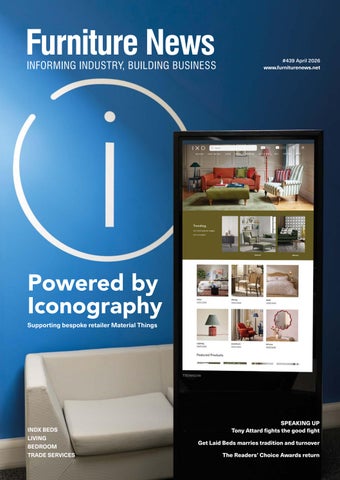
Material Things launched OMNIS Retail in its Portsmouth store two years ago, and continues to grow with the help of Iconography’s unified commerce system. Here, the retailer’s sales director Matt Gingell shares his experience of handling everything from custom orders and customer service to warehousing and delivery schedules …

Why did you choose Iconography?
People in furniture said to me: “I’m told that Iconography make the best websites.” We changed primarily because our Shopify website was very lacking. We started to outgrow what we had and, looking back to the way we were doing things, it’s night and day.
What are the biggest differences?
Our website – we get so many compliments on how it looks. I’d have to get somebody to change simple things before. Now if we spot an incorrect lead time or a blurry image, I’ll change it. When you really think about it, we know our business better than anybody, so being able to react and make changes ourselves is brilliant.
Is that the only change?
We’ve converted from using emails to using the tasks module. Seeing the full history of it is so transparent, I love that aspect of it. It’s horrible getting a customer say, “Somebody said they’d call me back and they haven’t,” so having this information to hand means anyone in the team can respond (especially if the original person is sick or on holiday).
Can you walk us through the in-store sales process? First and foremost, we understand the customer’s
needs. Getting into the nitty gritty, we sit down, grab a laptop and build the order together. We’ve uploaded all the relevant options to choose from so there’s a journey to follow, but we can also skip them as necessary. Custom options can be added to any product – we use that functionality a lot.
How does that carry through to purchase ordering? When things change, we can amend purchase orders without losing information. Waiting on customers to chase for updates normally ends in cancellation, which costs us money. OMNIS lets us easily check on POs that haven’t been sent or acknowledged in a certain timeframe to stop this.
What about understanding the stock you have in the business?
Seeing what is on display versus free stock, so we don’t have to go looking through the showroom or the warehouse, is vital. If a customer cancels last minute, the stock doesn’t just vanish, it has to go somewhere, keeping us accountable. For stock take, it’s never been more accurate, which is so refreshing.
Are your deliveries more organised?
“We started to outgrow what we had and, looking back to the way we were doing things, it’s night and day

On the journey planner we assign orders daily to a specific vehicle and log if the delivery is morning, afternoon, or a set timeframe. It’ll also show any payments due, which is really important for ensuring we follow up before delivering.
How impactful is the reporting?
It’s been invaluable. We get a clear and simple snapshot on the dashboard but can also drill down further into the data – and that’s on my phone, my iPad, my laptop.
Watch the full interview on Iconography’s website, and visit its stand at the Spring Furniture & Bed Show next month. www.iconography.co.uk/material-thingsomnis-interview
Furniture+ Insurance is now live in Ireland
Designed for Living. Protected with Confidence.


We’re live. Scan to protect what matters most.

Furniture technologist Ian has worked with some of the biggest brands in the business. He started his furniture degree in the mid-90s, and joined Ducal upon graduating. After a few operational roles there, and with Nathan, he moved into field sales around 2014, before becoming a self-employed agent. In 2023, Ian returned to a development, quality and legislative role at Baker Furniture, and says he feels “honoured and privileged” to be part of another strong team.
How might a child describe what you do?
Someone who talks to people that design furniture, talks to people that make furniture, talks to people that buy furniture, and talks to people that sell furniture. Sometimes he goes on ‘holiday’ to see factories.
What’s the biggest long-term challenge you face?
Personally, changing my mindset and understanding capsule collections/smaller ranges. Cabinet ranges are now much smaller in offering, consisting of a wide variety of mixed materials. House designs are changing, dining habits have evolved, consumers want more flexible living, and the technology around us is constantly developing.
Put simply, gone are the days of a catalogue containing 150 pieces of matching furniture from solid soft/hardwoods incorporating telephone tables, magazine racks, computer workstations, HiFi units, cassette/video storage, etc.
If you had 10 x your working budget, what would you spend it on?
Products are the lifeblood of any manufacturer/ importer, so I would have to say investing heavily in every new development – but, of course, whilst operating within market constraints. The higherpriced factories are often so for a reason – better materials, superior equipment and finer hardware. Typically, those with an established quality infrastructure will also be those that have similar infrastructures that can respond to increasing social, ethical and environmental requirements.
What would be the title of your autobiography?
From Little Acorns (I owe a lot to the Ducal logo!).
What does ‘work/life balance’ mean to you?
Ducal adopted a total quality management (TQM) programme in 1998, and one early teaching that stuck with me was the Japanese philosophy of Ikigai, a concept to blend passion, talent, purpose and fulfilment. Put simply into four pillars it asks: Do you enjoy what you do? Are you good at what you do? Does the world need it? And does it pay to support your lifestyle?
I think I achieve at least a couple of the above, and as a consequence, my job never feels like work.
Who’s been your most influential professional mentor?
There were almost 1,000 people who worked at Ducal
when I first joined on industrial placement, all of whom I watched, listened to, and learned from. Many years later I visited an account in the North West and they showed me a postcard from the late Mr [Jeffrey] Wiseman, dated around 1987. It was a thank you and well wish that he’d written on the train home after a day visiting his customers.
The professionalism he’d fostered across the business, coupled with the above personal gesture, stuck with me, and reinforced my attitude of leading by example and treating everyone equally well.
What advice would you give your younger self?
The disciplines and routines were rigid at the time, but the bigger picture has become clear the older I get. I’d tell myself to look around and fully appreciate how lucky you are to have begun your journey at this business.
What’s been your best day in business to date?
Amongst various tricky challenges, I’ve also had many incredible highs and pleasing achievements. Receiving my first-ever display order (from retailer Paul Adams of Hull, a Sutcliffe Trafalgar Teak dining set!) remains a personal favourite from being out on my own representing the company – having to make commercial decisions quickly and independently.
What’s the biggest myth about our industry?
That it’s a closed network dominated by old men in light brown overcoats.
Where do you see the industry going in the next 5-10 years?
Rightly, there is a lot of legislation on the horizon regarding product lifecycles and environmental impacts. I expect product development to reflect companies embracing and adopting this requirement into their designs and materials. Ecommerce will only get stronger as well, having, in my view, both positive and negative impacts.
What question do you wish we’d asked? How would you have answered?
Q: Having seen both elements at close quarters, Ian, what do you support the most – manufacturing or importing?
A: I honestly don’t think there would be room in this edition for a considered answer!
www.bakerfurniture.co.uk
“The higherpriced factories are often so for a reason
“Ducal adopted a total quality management (TQM) programme in 1998, and one early teaching that stuck with me was the Japanese philosophy of Ikigai
From the minimum wage debate to copyright infringement, Furniture News puts today’s issues in perspective, looking back at what happened in the industry five and 10 years ago today …

Five years ago (April 2021)
In the news, as a longawaited National Living Wage and National Minimum Wage uplift came into effect and retail stores reopened from lockdown, costs and material availability continued to plague Britain’s bedmakers, reported the NBF. The BFM also cited supply chain shortages and price increases as the biggest issues facing the industry as pandemic restrictions lifted, with material and fuel costs continuing to rise.

“A long-awaited National Living Wage and National Minimum Wage uplift came into effect

In retail, Next reported a sales decline of 17% for the FY, stating “profit lost from a longer-than-expected retail lockdown has been offset by the benefit of the extension of business rates relief, but online sales have been stronger than expected”.
Barker and Stonehouse commenced its 75th year by becoming the first UK furniture retailer of scale to achieve Carbon Neutral Plus status (reducing emissions above and beyond its own carbon footprint). Savoir opened a flagship showroom in Mayfair’s Berkeley Square, Sofa Club joined Westfield Stratford, and Park Furnishers opened a new Bristol store. JYSK launched a global recruitment drive after hitting the 3,000 store milestone (21 of them in the UK), and set its next goal of 5,000 stores.
In exhibition news, despite reduced international attendance, CIFF Guangzhou reported a visitor increase of 20.17% compared to 2019’s show, yet Germany’s Tendence, which was due to take place at the end of June, was cancelled for a second year.
We paid tribute to long-time industry consultant and the editor-in-chief of German trade magazine MÖBELMARKT, Helmut ‘Max’ Merkel, while Paula Vennells, CEO of the Post Office from 2012-19, stepped down from Dunelm’s board amid scrutiny for the former’s role in the wrongful convictions of numerous former postmasters.
In the magazine, as stores prepared to re-open, we focused on store training and presentation. On the other side of the retail coin, we looked at how to deliver the perfect video pitch, and looked at how
CGI marketing, ecommerce and online search had evolved during the pandemic.
We also chronicled Breasley’s return to the marketplace, explored how our industry views and utilises social media, and discussed the development of search platform ufurnish.com.

10 years ago (April 2016) In the news, MPs attacked George Osborne’s National Living Wage scheme in Parliament, highlighting the attempts of UK businesses, including large retailers, to mitigate the enforced pay increases by cutting staff benefits.
In retail, Lee Longlands acquired stores in Kidderminster, Grantham, Sheffield and Doncaster from the beleaguered Furniture Barn Group, Habitat unveiled its £1.5m flagship store on Tottenham Court Road, and Oak Furniture Land opened its 70th store, on Manchester’s White City Retail Park. ScS revealed double-digit LFL sales growth in H1 sales, plus plans to open a further three stores. BHS filed for administration, putting some 11,000 jobs at risk, after talks with Sports Direct to purchase a number of its 164 stores collapsed.
The Shire Bed Company invested nearly £750,000 in expanding its manufacturing facility in Dewsbury, creating work for an additional 20 members of staff. The 55th Salone del Mobile.Milano attracted an unprecedented 372,151 attendees, up 4% on 2014’s edition (the latest to feature its biennial Kitchen and Bathroom exhibitions).
After losing one of its major customers, Kingswinford’s Ultra Furniture threatened 84 members of staff with redundancy before the manufacturer was acquired by PPKidd 56, saving 116 jobs.
In the magazine, we featured interviews with Peter Spinks, CMYK Living, BuyDirect4U, Collins and Hayes and designer Chris Hughes, plus the (then) president of I Saloni, Roberto Snaidero. Copyright law was in the spotlight, with articles exploring rulings at Bluebone and Trunki.


The British Furniture Association (BFA) has hailed its 2026 Furniture Component Expo a “major success” after the event attracted an 11% rise in visitor numbers, reinforcing its place as the “goto show for the UK’s furniture manufacturing supply chain”.

More than 80 exhibitors shared innovations, new products and live demonstrations at Telford’s International Centre on 11-12th March.
The BFA says the edition saw many businesses put together stands that were “bigger, bolder and busier this year, underpinning the sense of energy, collaboration and innovation that is paving the way to a more sustainable, efficient future, with many conversations taking place around circular design and digital transformation”.

“The show offered insight, inspiration and the invaluable human connection that only a live event can deliver
The 2026 expo built on the momentum of a successful debut in 2024, with exhibitors praising both the visitor quality and the relaxed, yet businessfocused atmosphere, with buyers, designers and manufacturers coming from across the UK and beyond to explore the latest in components, materials, and technology.
“With a more immersive look and feel, many brands created space for hands-on interaction and live demonstrations,” the BFA adds. “From fittings and foams to fabrics and finishes, there was plenty to explore, with comfort technology, sustainable materials and automated manufacturing which drew particular interest from attendees keen to streamline production and reduce environmental impact.”
For the first time, the show included an Innovation Trail, sponsored by Blum. Designed to draw visitors toward the most forward-thinking developments on the show floor, the trail featured 10 exhibitors, each

presenting a product or concept purportedly pushing the boundaries of furniture component design and making its debut at FCE. Judges spent time with each company, exploring the thinking behind their innovations and the potential impact on the wider market.
After much deliberation, two companies received Highly Commended recognition: Mobus Fabrics, for its continued advancement in fabric performance and aesthetics; and Cirtex UK (Re-born, The Sustainable Manufacturer) for its work in transforming waste textiles into new resources.
The overall Innovation Trail winner was Comfortex, for its Softcure Cushion, a well-engineered piece combining comfort, durability and sustainability. The product impressed judges with both its technical sophistication and its relevance to the evolving needs of furniture manufacturers seeking more sustainable yet high-performance components.
As the first day drew to a close, exhibitors and visitors gathered for a drinks reception. Among the highlights of the evening were the awards for best stand design, reflecting not just visual appeal but the clever ways exhibitors used space to draw in visitors and showcase their products effectively.
Tokyo Fabrics took home the prize for Best Shell Scheme Stand, catching the judges’ eyes with an inventive approach that made good use of a compact footprint. Assyst Bullmer was named Best Open Space Stand, praised for its thoughtful balance of visibility and privacy, achieved through the clever use of windows and flooring to frame products and invite exploration.
Adding a little extra friendly competition to proceedings, a bottle of champagne awaited the
exhibitor that registered the most visitors during the show. This year, it went to Ciar, whose engaging stand experience “clearly struck a chord with attendees”, says BFA.
“From the opening of the expo to the final conversations on the show floor, the spirit of FCE 2026 was one of opportunity,” says the BFA. “Visitors commented on the ease of connecting with suppliers and the relevance of the exhibitors’ offerings, while many exhibitors highlighted how the show attracted decision-makers ready to do business.
“The steady rise in attendance reflected a broader confidence in the UK furniture manufacturing sector, with supply chain resilience, sustainability and technological innovation all central talking points. New materials, digitised production workflows and environmentally conscious designs were among the dominant themes, mirroring the shifts shaping the global furniture market.
“What perhaps stood out most was the sense of community. Whether catching up with familiar faces or forming new partnerships, everyone at FCE shared a commitment to strengthening the UK furniture sector and exploring the opportunities of a fastevolving supply chain landscape.
“Organisers and exhibitors alike are already looking forward to 2027. This year’s growth in visitor numbers, expanded floorplan and greatly enhanced Innovation

Trail demonstrate that FCE has matured into an essential event on the furniture industry calendar.
“For those who attended, the show offered insight, inspiration and the invaluable human connection that only a live event can deliver, and next year’s expo promises to be even bigger, busier, and filled with the same forward-looking energy that made 2026 such a success.”
www.fcexpo.co.uk
“Paving the way to a more sustainable, efficient future
The (BFA) also celebrated achievements across education and training, ESG reporting and sustainability at the Future of Furniture Awards, presented at the FCE, and highlighting businesses and individuals embedding sustainability principles and social value into their day-to-day operations.
The Excellence in Sustainability award was presented to Whitemeadow, recognising a long-term strategy which includes a roll-out of solar power and biomass facilities, along with improvements to packaging, ISO accreditations and investments in electric vehicles.
DFS Group was the winner of the Excellence in ESG Reporting category, having embedded sustainability more deeply across operations, using the ‘Sofa Cycle’ framework as the basis for its environmental strategy, established transparent reporting aligned with recognised frameworks to ensure its ESG priorities are evidence-based, and underpinning social commitments with its ‘Everyone Welcome’ culture.
A cornerstone of its long-term skills strategy, ercol’s apprenticeship programme secured the Excellence in Education award.

The programme provides structured handson experience across key departments within the business, blending traditional craftsmanship with modern production techniques, underpinned by wide-ranging engagement with schools and colleges.
Finally, Jacob Lane, sustainability manager at Silentnight, was named Sustainability Champion in recognition of his science-based approach to product innovation, which aims to address furniture industry challenges around sustainability, and his role in developing a net-zero plan, carbon product passports and annual carbon reports at the company.
Phil Spademan says: “Congratulations to all the winners – this year was an incredibly close competition, with all entrants putting forward some exceptional stories about the work they are doing.
“These businesses are at the forefront of best practice in education and sustainability, and our panel of independent judges returned some very high scores across all categories. It is important to recognise and celebrate the work that will make our sector more sustainable, create social value and provide opportunities for the development of people working in our industry.”
This year’s Meble Polska trade fair, which ran from 24-26th February, confirmed the event’s standing as one of Europe’s key furniture-buying shows.

The fair was visited by professional furniture buyers from all over the world, with international visitors accounting for nearly two-thirds of all attendees.
Organiser MTP Group says the total number of trade fair participants was 15,266: “An international representation of buying groups, wholesalers and furniture retail chains from various continents filled the exhibition halls from the very first hours of the event.
“The fair in Poznań – traditionally opening the European buying season for the furniture industry –once again became the place where global furniture trade met the broad offering of manufacturers. This year, international visitors accounted for as much as 62% of all attendees.”
Furniture buyers from a record 73 countries attended this year’s show, MTP continues. As in previous years, the largest foreign group was made up of visitors from Germany, accounting for 16.9% of international attendees.
“Surprisingly, despite the weaker market conditions, the number of buyers from our western neighbour increased this year by 5.3%,” adds MTP.


“International visitors accounted for as much as 62% of all attendees
The next largest groups came from the Czech Republic (6.6%) and Ukraine (6.5%). Among the most strongly represented markets were also Lithuania and France (5.5% each), followed by the UK (5.1%), Romania and the Netherlands (4.9% each), Slovakia (4.4%), and Belgium (3.7%). Compared with last year’s visitor structure, notable increases were recorded in the number of visitors from the Czech Republic (+46%) and Slovakia (+31%), as well as from Italy (+19%), Lithuania (+12%) and the UK (+11%). At the same time, slightly fewer visitors attended from Belgium (-12%) and Ukraine (-10%).
Meble Polska is the world’s most comprehensive platform for Polish-made furniture, at the same time increasingly attracting foreign exhibitors. The
exhibition covered around 60,000m2 across 10 halls, and the number of exhibitors increased again to 387. Companies from 22 countries took part in the fair, including strong exhibitor representation from France, Turkey, Slovakia and China. Ukrainian furniture manufacturers again prepared a national exhibition. The trade fair was also a platform for gaining knowledge. The lecture programme focused on key challenges and development directions for the industry, from online sales and international expansion to the growing role of regulatory compliance and certification.
The next edition will be held in Poznań from 23rd-26th February 2027.
www.meblepolska.pl/en
“As the global home-furnishing supply chain undergoes rapid transformation, the industry is shifting from scale expansion to value enhancement, driven by digital reconstruction, sustainability goals and global industrial integration,” states CIFF Guangzhou’s management.
“Manufacturing technologies, material innovation and hardware systems are becoming central to the competitiveness of the furniture sector worldwide” …

In this context, CIFM/interzum guangzhou, which took place during phase 2 of the 57th CIFF Guangzhou (from 28th-31st March) at the Canton Fair Complex, sought to confirm its position as a leading international platform for furniture production technologies and upstream supply-chain innovation.
Under the theme ‘Connect the World’, the exhibition integrated global innovation resources with the industrial chain, and sought to present a comprehensive vision of the future home furnishing supply ecosystem.
This year’s edition strengthened the event’s role as an innovation engine through three major platforms dedicated to intelligent manufacturing, materials innovation and hardware technology.
supporting customisation, upholstery and wholehome design solutions, with an emphasis on recyclability, environmental performance and aesthetic innovation.
Finally, the Platform for Home Hardware Innovation Experience explored intelligent hardware systems and IoT integration, sharing solutions such as intelligent hinges, hidden slide systems, electric lifting mechanisms and adaptive locking technologies, demonstrating the fusion of functionality, durability and design.
“The upstream supply chain is becoming a strategic driver of the furniture industry’s future development
The Platform for Intelligent Production Equipment brought together global leaders in woodworking machinery, upholstery machinery, laser technologies and digital production systems, which showcased advanced solutions including digital production lines, flexible intelligent processing centres and laser edgebanding technologies, demonstrating a transition toward intelligent, flexible and low-carbon manufacturing.
A new initiative, the Global Debut Gala, highlighted strategic product launches from leading equipment manufacturers, reinforcing the exhibition’s role as a global stage for innovation in furniture production technologies.
The Platform for Home Design Material Selection, meanwhile, focused on innovation, sustainable materials and functional surface solutions, with international presenting new material technologies
CIFM/interzum guangzhou also continues to expand scenario-based experiences that connect technology, materials and design across the production-toapplication chain… the upgraded CIFF Luminous Path 2.0 transformed manufacturing processes into interactive experiences through data testing, material exploration and multi-sensory demonstrations, while the CMF Trends International Material Gallery 2026 presented four environments exploring materials, colours and textures through collaborations between international suppliers and curators.
At the same time, the upgraded Design ‘Originality’ Hall continued to serve as an incubator for innovative material brands, reinforcing the connection between material innovation and original design development.
“By integrating intelligent manufacturing, material innovation and global co-operation, the exhibition demonstrates how the upstream supply chain is becoming a strategic driver of the furniture industry’s future development,” concludes the event’s organiser.
The countdown has begun to this year’s Spring Furniture & Bed Show, hosted by the Minerva Furniture Group, which returns to Telford International Centre on 20th-21st May.

inviting atmosphere.”
“This year’s spring exhibition is set to be our most vibrant and successful yet
With every stand space now secured, the exhibition floor will showcase an impressive crosssection of the market, from established, highprofile brands through to innovative newcomers, all presenting their latest collections, ideas and developments for the season ahead.
In addition, the show will welcome a broad array of service providers, bringing further depth to the event. Through a series of group seminars, these specialists will share insights into profit-focused initiatives designed to help retailers strengthen margins, improve efficiencies and contribute directly to the bottom line of their businesses. Visitors can also enjoy free entry, parking and lunch.

“We warmly encourage retailers and industry professionals to register,” Minerva continues. “The event has grown YoY to become one of the key highlights of the furniture industry calendar, offering valuable opportunities to discover new products, meet suppliers, exchange ideas, place important new display orders and strengthen long-standing relationships.
“With exhibitor space now fully booked and excitement building across the sector, this year’s spring exhibition at the Telford International Centre is set to be our most vibrant and successful yet. Make sure you are part of it – register now and join the industry in Telford for what promises to be an exhibition not to be missed.”
For the full list of exhibitors and to register attendance, visit the show website.
www.springfurnitureshow.co.uk


In May’s issue, we’re putting beds and bedding in the spotlight.
From new filling and spring technologies, to game-changing re-use and delivery solutions, we’re looking at what’s new in our annual Innovation in Bedding special feature, plus:
• Spring Furniture & Bed Show and Long Point previews
• The latest in Living, Dining, Bedroom, Dining and Trade Services
We’re also revisiting the furniture businesses in and around Long Eaton in the second edition of our dedicated supplement, Long Eaton – Furniture Hub. Get in touch for details!


Contact Sam Horscroft on 07764 650655 or email sam@lewisbusinessmedia.co.uk
Cy Fogel, M.D., You’re Furnished, Takeley, Essex. 2026
“Our second Greenwood Sale has generated around a quarter of a year’s sales in one month! Your Event Manager was brilliant, extremely professionalhe went above and beyond. I could not have asked for better!”
Gary Cooney, M.D., Cooney’s Home Interiors, Letterkenny, Co. Donegal. 2026
“Our second Greenwood Sale has been very successful! We took the equivalent of a double January Sale! Your Event Manager was a real diamond – he fitted in with our team perfectly and was really helpful. We will book again!”
Samantha Stephenson, Accountant and Store Manager, Sinclair’s of Scarborough. 2026
Grow your business, build your order book and win future market share with a Greenwood Promotional Sale or, realise the enormous value of your brand using a Greenwood Business Closing / Retirement strategy. Either way you can generate record-breaking sales and profits.
Greenwood Sales work. To find out more, call me, Bernard Eaton, now on 07771 700247, and I’ll explain the exciting options and possibilities for your Greenwood Sale without obligation.
NOW BOOKING INTO 2027 CALL TODAY - 07771 700247 “Three months sales in a month! Happy Days! What more do you want, especially in this dreadful economy? After 18 Greenwood Sales they’re still flying! Roll on the 19th Sale!”

UK & Ireland’s Leading Experts in Retail Sales Promotion sales@greenwoodretail.com www.greenwoodretail.com
As the retail landscape evolves, INDX Beds – which returns to Cranmore Park, Solihull, on 28-29th April – continues to be an important compass for the sleep industry …

Organised by Associated Independent Stores (AIS), the upcoming show promises to remain true to the format’s ‘for buyers, by buyers’ ethos, with day one offering exclusive access for AIS members, and day two opening the floor to the wider industry.
Gathering some of the industry’s best bed, sofabed and bedroom furniture suppliers under one roof, the show is set to provide a streamlined environment in which retailers can secure exclusive deals and compare the latest design trends, tech advancements, and sustainable developments side by side, says AIS.
“Attendees can expect a strong exhibitor line-up
Attendees can expect a strong exhibitor lineup including Hypnos, Harrison Spinks, Sealy UK, Vispring, Highgrove, Sleepeezee, Rest Assured, Silentnight, Relyon, G Plan Sleep, Millbrook Beds, Alstons, Disselkamp and Willis & Gambier.
Visit the show website to register and to see the full exhibitor list.
www.indxshows.co.uk/shows/beds


Sealy is preparing to enter another significant year in its recent history – not with a single launch, but with a “carefully orchestrated wave of innovation” that will reach retail floors throughout 2026 and beyond …

By introducing meaningful new product ranges at multiple points throughout the year, Sealy’s strategy is designed to give retailers wider trading opportunities and sustained momentum throughout the trading calendar.
The first chapter begins this month at INDX Beds, where Sealy will offer an early glimpse into the next phase of its product development.
“This isn’t just a range refresh,” says the bedmaker, “it marks the beginning of a new development cycle centred on unique technology, product performance and commercial viability. Each introduction for 2026 has been developed to bring something genuinely new to the category.
interest and give retail teams the widest Sealy product and price offering to date.”
Behind this ambitious schedule is Sealy’s global R&D resource, an advantage that continues to set the brand apart. With world-class engineering expertise and testing facilities, Sealy’s innovation programme is continuous, the brand’s global R&D centre enabling proprietary innovation, faster development cycles, and a depth of technical knowledge that influences every mattress and component proposition brought to market.
“This isn’t just a range refresh
“And April is only the beginning. Across the remainder of the year, further technologies and range developments will be introduced, giving retail partners a consistently refreshed floor and offering consumers something new in category.
“This purposeful cadence of innovation has been designed to support sell-through, spark continued

In the UK, the programme is led by Natalie Armstrong, who helped the business earn further recognition at last year’s Bed Show, the Elevate Edison Luxury Plush Mattress winning the NBF’s Bed Product of the Year award. This addition to the successful Elevate collection broadened the range of comfort feels available, extending the breadth of the product offer.
This year marks another step forward for the brand, Sealy continues: “Not simply a ‘new launch’, but a reflection of the significant investment, the clear longterm vision, and a commitment to helping retailers meet the needs of today’s consumers with confidence.”
Retailers will be able to explore the first wave of Sealy’s 2026 lineup across two destinations this spring. On stand P8 at INDX Beds, on 28-29th April, the bedmaker will provide an initial viewing of the first range in development. This will be supported by a showcase in the Sky Lounge, with the space remaining open on an appointment-only basis from 31st April to 22nd May. Those wishing to secure a viewing are encouraged to contact their Sealy representative.
www.sealy.co.uk


The 10th annual Yorkshire Curry Night, organised by the Yorkshire Region of The Furniture Makers’ Company, welcomed more than 100 guests from across the sector, raising £2,900 for the industry charity.
Guests enjoyed an evening of networking which began in the Tournament Gallery – where the suit of armour made for Henry VII for his meeting with the King of France at the Field of the Cloth of Gold in 1520 is on display – and was followed by a curry meal.
Jay-Be and Litmus Furniture sponsored the drinks reception, while other companies and individuals sponsored the event or donated prizes for the raffle.
Jessica Alexander, chair of the company’s Yorkshire Region, says: “It was wonderful to see so many familiar faces and new supporters come together to celebrate, network, and raise funds for such an important cause.”
www.furnituremakers.org.uk


This year’s January Furniture Show proved an “outstanding moment” for Scatter Box, reaffirming the strength of its design direction and the growing demand for thoughtfully curated, trend-led soft furnishings …

“The energy across the show was exceptionally positive, with visitors responding strongly not only to the visual impact of the stand, but to the versatility, colour stories and cohesive collections presented throughout,” the furnishings specialist explains.
“A stand-out highlight was the Idris cushion from our Velvet Reverie collection. Its refined Art Deco influence, combined with a rich blend of on-trend tones, immediately drew attention. The layered palette of warm neutrals, soft, metallic-inspired hues and contemporary accents gives Idris a distinctive decorative presence, while remaining remarkably adaptable. It resonated as a piece that feels statement-led yet accessible – equally suited to modern interiors seeking warmth and texture, or more classic settings looking for a subtle contemporary lift.

Its combination of soft sheen, rich texture and sophisticated colour placement reflects the continued move toward calm, tonal interiors enriched by tactile finishes rather than bold pattern alone.”
“Customers are seeking designs that blend strong visual identity with genuine styling ease

“Styled alongside the timeless Elodie cushion, the pairing demonstrated how decorative statement pieces can sit effortlessly beside enduring core designs, offering retailers strong styling flexibility for in-store displays and customer homes alike.”
Scatter Box’s Gilded Heritage collection –particularly the Monaco and Grace cushions – also generated significant interest, the brand continues: “These designs captured attention through their understated elegance and luxurious finish.
“Offered in three carefully considered colourways, the range balances classic pattern with a refined, tactile quality that feels both premium and classic. The reception reflected a clear appetite for pieces that combine longevity with visual sophistication – cushions that feel investment-worthy while still accessible for everyday styling. The Monaco and Grace designs embody this balance beautifully, delivering a timeless aesthetic that enhances both traditional and contemporary upholstery.
“Equally well received was the Lunetta cushion from our Eternal Luxe collection. Presented in three colourways, Lunetta stood out for its striking textured finish and elevated, monochromatic visual effect, where tonal contrasts and subtle metallic-style detailing create depth without overwhelming a space.
“This refined palette approach makes the design particularly versatile, allowing it to function as either a hero accent or part of a layered cushion story.
Throughout the wider showcase, a consistent theme emerged, says Scatter Box: “Customers are seeking designs that blend strong visual identity with genuine styling ease. Pieces that feel decorative yet practical, luxurious yet adaptable, and trend-aware while remaining timeless. This philosophy runs across our full product and category range, where cohesive collections, considered colour options and layered textures allow retailers to confidently build complete in-store stories, rather than individual moments. The response at JFS reinforced how important it is to offer ranges that work both as stand-out features and as part of a broader, co-ordinated interior scheme.
“The success of JFS has set a confident tone for the year ahead. It provided an invaluable platform to connect with both longstanding partners and new customers, while showcasing the heart of the Scatter Box offering beyond any single collection. The enthusiasm across the stand reflected a wider recognition of Scatter Box’s commitment to creating collections that balance creativity and style.
“The momentum coming out of the show reflects not just a successful event, but a clear alignment between our design vision, our expanding collection portfolio, and what the market is actively seeking for the seasons ahead.”
Visit Scatter Box’s website to discover the complete collection of cushions, art, lighting, rugs and more.
www.scatterbox.ie


Following a strong showing at this year’s January Furniture Show, Buoyant Upholstery is carrying that momentum into the spring season with a series of new product launches and a busy schedule of upcoming trade events …

The Lancashire-based manufacturer says it received excellent feedback at the NEC show earlier this year, particularly around its evolving leather collections and refreshed fabric stories – and Buoyant says that response has reinforced its continued focus on delivering commercially relevant upholstery that combines style, comfort and long-term durability, all key considerations for today’s retail environment.
“We are really looking forward to showing off some of the amazing new models
Among the latest introductions is the Matteo, a standout new model within the Ashley Manor Collection. Designed to offer a contemporary yet accessible look, the Matteo balances clean, modern lines with a soft, inviting profile that lends itself well to a wide range of interior settings, says Buoyant.
The model is available in an extensive selection of configurations, including chairs, sofas and corner groups, giving retailers flexibility across both display and customer requirements. Its adaptable design makes it equally suited to compact living spaces

and larger, open-plan environments, ensuring broad consumer appeal.
Crucially, the Matteo also delivers on practicality. Built with durability in mind and supported by a wide choice of fabric options, it allows retailers to tailor the offer to suit their customer base, while maintaining confidence in product longevity. As with all Ashley Manor pieces, the emphasis remains on quality craftsmanship, with attention to detail evident throughout, says the sofamaker.
Alongside the Matteo, Buoyant is also introducing a more technology-driven proposition with the Virgo Music Sofa, part of its new Prestige Collection. Reflecting the growing demand for multifunctional furniture, the Virgo has been designed to enhance the home entertainment experience while retaining the comfort and reliability expected from a Buoyant product.
Available as both two- and three-seater powered recliners, the Virgo incorporates a range of integrated features, including an integrated sofa screen console, with power head tilt and lumbar support. Bluetooth connectivity allows users to easily link their devices, while built-in vibrating cinema-style seating creates a more immersive and engaging experience.
This combination of comfort and technology positions the Virgo as a forward-thinking addition to the market, appealing to consumers who are increasingly looking for furniture that supports both relaxation and entertainment within their home.
The model is offered in both fabric and leather finishes, enabling retailers to present it across different showroom environments and price points. Bouyant says that, as part of its wider Prestige Collection, the Virgo signals its “continued investment in product innovation and its responsiveness to changing lifestyle trends”.


Both the Matteo and Virgo, along with a number of additional new and updated models, can be explored in more detail via Buoyant Upholstery’s website, providing customers with a useful reference point ahead of the next round of trade events.
Buoyant is set to exhibit at three key shows over the next few months, offering further opportunities for retailers to experience the latest collections first hand: the first is the Long Point show, taking place in Long Eaton from 11-13th May; followed by the Minerva Spring Furniture & Bed Show on 20th-21st May; and Manchester Furniture Show on 5-6th July.
Buoyant says these events remain important fixtures in the industry calendar and provide an ideal platform for it to engage with both existing customers and new contacts. Visitors to the Buoyant stands will be able to view the Matteo and Virgo models alongside a broader selection of designs, including established ranges updated with new fabric options.
Commenting on the upcoming exhibitions, MD Mike Aramayo says: “We are really looking forward to showing off some of the amazing new models that we have had in development for some time, and hope to build on the fantastic feedback we received in January when we launched models from the new Prestige and Ashley Manor Collections as well as some old favourites in our new fabrics.”

Buoyant says this blend of innovation and continuity continues to underpin its approach: “By introducing new models that respond to emerging consumer trends, while simultaneously refreshing proven bestsellers, the company ensures it maintains a wellbalanced and commercially effective product portfolio.
“At the core of Buoyant’s offering is a commitment to thoughtful design and reliable manufacturing. Each collection is developed to appeal to a broad spectrum of tastes, while maintaining consistent standards of comfort, durability and functionality – qualities that remain essential in driving repeat business and customer satisfaction.
“As retailers prepare for the busy spring and summer trading period, Buoyant’s latest launches provide a timely opportunity to refresh showroom floors with products that combine visual appeal with practical selling points. With strong foundations built at the start of the year and a clear pipeline of newness, the company is well positioned to support its retail partners in the months ahead.”
With three trade exhibitions fast approaching, Buoyant Upholstery looks set to continue its positive trajectory, offering “a compelling mix of design, innovation and commercial awareness that keeps it firmly aligned with the needs of today’s furniture retail market”. www.buoyant-upholstery.co.uk
“A compelling mix of design, innovation and commercial awareness
www.louisdepoortere.com
Louis De Poortere has added a new standard shape and custom shapes and sizes to its EcoRugs Collection 2026.
Along with new designs, Louis De Poortere has introduced a striking new organic shape, peanut, now available on selected styles. Introducing a playful yet refined form, its gently curving lines “add warmth and a sense of ease to interiors”.
Featuring on the new Aquarelle design in the Meditation Collection, a fluid design inspired by the dispersal of watercolour paint in water, the new shape is available in 170 x 235cm and 235 x 340cm.
Joining the circular shape introduced in 2024,
peanut expands the EcoRugs collection beyond the constraints of rectangular forms, says Louis De Poortere, creating “a subtle statement that harmonises effortlessly with furniture, allowing homeowners to experiment with a less structured room layout that feels more organic”.
Louis De Poortere has also expanded shape and size options elsewhere in the collection with a custom size programme on its Coral, Boabob and Berber signature designs. Woven on expansive 3m rolls, these can be cut to unique shapes, enabling “form, proportion and a sense of movement to come together in a personalised rug”.


As the UK marked Heart Month in February, British bed manufacturer Sleepeezee donated £25,000 to the British Heart Foundation (BHF) following another successful year of Travelodge Dreamer mattress sales.
Sleepeezee supports the BHF in partnership with Travelodge. Since 2017, Sleepeezee has committed to donating £20 from every Travelodge Dreamer mattress sold. To date, the partnership has raised more than £220,000 to support the BHF’s life-saving research, focused on improving heart health across the UK.
Research continues to highlight the role that consistent, good-quality sleep plays in supporting cardiovascular health. Sleepeezee says studies have found that taking two daytime naps per week was associated with a significantly lower risk of heart attack or stroke, and that six to eight hours of sleep per night may be optimal for heart health.
Emily McGrath, senior cardiac nurse at the BHF, says: “Sleep plays a key role in wellbeing – we all feel a bit better and brighter after a good night’s sleep. We also know that getting enough good-quality sleep is important for maintaining heart health. Around seven
“Reaching another significant donation milestone is incredibly rewarding


to nine hours a night is generally optimal for adults, and having a consistent sleep routine can help.
“But when it comes to looking after your heart health, it’s always important to consider your lifestyle as a whole. Alongside good sleep, regular physical activity, not smoking, maintaining a healthy weight, eating a balanced diet and being mindful of your salt and alcohol intake are all key. Getting your blood pressure and cholesterol levels checked, especially if you are over 40, is also important, so any potential problems can be detected as early as possible and, if necessary, treated.”
Amy Curtis, marketing director at Sleepeezee, adds: “We’re proud to continue supporting the BHF through our ongoing partnership with Travelodge. Reaching another significant donation milestone is incredibly rewarding.
“Quality, restorative sleep is critical to overall health and wellbeing, and we’re pleased that sales of the Travelodge Dreamer are helping to fund vital research that benefits so many people across the UK.”
The BHF funds over £100m of research each year into cardiovascular diseases, supporting breakthroughs in the prevention, diagnosis and treatment of conditions affecting millions of people in the UK. Partnerships with organisations like Sleepeezee play an important role in enabling this work.
Travelodge also helps the BHF raise awareness of CPR by promoting RevivR, the charity’s free, online CPR training tool.
For more information about Sleepeezee’s charity initiatives, visit the bedmaker’s website.
www.sleepeezee.com/charitable-initiatives


www.sci-net.co.uk

In the world of bedding and upholstery, the right component can be the catalyst for a stand-out product, whether adding functionality, aesthetics, or environmental benefits.
“At Handy Ltd, our procurement team sits at the core of our operations, responsible for sourcing and supplying over 1,700 components within the Handy range,” says Rasim Karakin, Handy’s procurement manager at components supplier.
“Procurement today isn’t just about buying. It’s about understanding what our customers truly

The Sci-Net team says it is looking forward to “getting its retail on” at this year’s disco-themed Retail Technology Show, which returns to ExCeL London on 22nd-23rd April.
“For furniture retailers managing complex product ranges, long lead times and high service expectations, the spotlight on unified commerce couldn’t be more relevant,” says Sci Net – now part of the ANS group – which will showcase ERP>Retail, its solution for retailers built on Microsoft Dynamics 365 Business Central, on stand K30 at the event.
ERP>Retail unifies PoS, ecommerce, warehousing, finance and reporting in one system for retailers with multi-touchpoint customer journeys.
“With rising customer expectations for seamless in-store, online and delivery experiences, retailers are focusing on technology that improves stock accuracy, minimises manual processes, and ensures real-time visibility throughout the organisation,” says Sci Net. “ERP>Retail supports these needs, improving operational control and enabling a consistent omnichannel service.
“As the show invites retailers to explore the ‘future of innovation’, take the opportunity to visit the Sci Net stand and learn more about ERP>Retail and how unified systems can drive efficiency, accuracy and a better customer experience for your retail business.”
need, and putting the right processes and supplier relationships in place to exceed expectations. We not only source, but work closely with our customers, listening to their needs and offering our expertise and design solutions.
“The key reason we work so efficiently with new customer projects is our global network of supplier partners, from Europe to the Far East. In today’s global market, customers are asking for components with specific certifications, compliance with different international standards, and may require quicker lead times, meaning we require strong communications with our suppliers and need to be agile.
“As a team, we actively work with our suppliers to find solutions that deliver on sustainability without compromising on quality. Whether that’s sourcing recycled materials or improving packaging, we’re committed to ongoing progress. In fact, one of my proudest achievements here at Handy was helping the business switch to 100% recyclable packaging in 2023.
“Despite increasing complexity in the industry –rising material costs, geopolitical shifts, and growing regulatory demands – I believe we’re uniquely positioned to support our customers through it. Our procurement team doesn’t just respond to change –we drive it.”
One unified system for retail excellence

Our ERP>Retail solution, built on Microsoft Dynamics 365 Business Central, is designed specifically for retail.
• Real-time stock visibility
• Integrated Tablet and POS sales
• Automated Orders
• Power ful reporting across all business functions
• After sales care
• Item configurator
• Full E-commerce capabilities
• Manage all retail channels from one platform
Whether you’re looking to increase margins, improve efficiency, or create seamless customer experiences, the Sci-Net team are here to help.
www.sci-net.co.uk

Visit us at the Retail Technology Show. Stand K30.

One of the biggest margin opportunities in furniture retail right now is something customers often cannot see at first glance, writes The Retail Champion, Clare Bailey, who explores how technology is helping furniture retailers trade customers up …
By Clare Bailey

Motion mechanisms. Powered headrests. Built-in chargers. Heated seating. Adjustable lumbar support. Temperature control in mattresses.
Innovation is transforming comfort well beyond fabric or frame. But unlike colour or design, technology is invisible until someone brings it to life. And that is where the opportunity sits.
Customers do not walk into a showroom asking for dual motors or integrated USB ports. They ask for comfort, style and something that will last. Technology sits beneath the surface, yet when demonstrated properly it becomes one of the most effective tools for trading customers up and increasing AOV.
The problem? It does not sell itself. If a motion sofa is not plugged in, it is just a sofa. If the charging port is not pointed out, it goes unnoticed. If adjustable features are not demonstrated, customers cannot feel the difference. If they do not experience it, they will not pay for it.
Too many retailers are leaving money on the shop floor because they rely on specification instead of sensation.
Demonstration is the sale. Encourage customers to sit, recline and adjust. Let them pause and feel the change in support. When they physically interact with the product, the conversation shifts from price comparison to personal comfort.
And language matters. Customers do not emotionally connect with voltage or motor type. They connect with lifestyle.
A USB port is not about power output – it is about never having to leave your seat when your phone battery runs low. Motion technology is not engineering – it is everyone getting the best seat in the house. Heated seating becomes a Sunday evening luxury the moment someone feels it. Sell the outcome, not the mechanism.
The same principle applies in sleep. Adjustable beds, temperature-regulating mattresses and anti-snore positioning are no longer niche medical products. They are mainstream wellbeing upgrades. Yet many customers remain unaware of what is possible until it is shown to them.
When a customer lies back and adjusts the bed themselves, feeling the support respond, the conversation changes. It moves from ‘do I need this?’ to ‘why would I go without it?’ That is a very different commercial position.

Showroom execution plays a critical role. Powered displays must be working. Comfort zones should make comparison easy. Bedroom-style settings help customers visualise how technology fits into daily life. Then there is your team. Salespeople who can demonstrate features naturally and confidently will always outperform those relying on brochures. If technology feels awkward on the shop floor, that is a training issue, not a product issue.
From a commercial perspective, the impact is clear. Integrated technology differentiates product in a crowded market. It reduces direct price comparison because you are no longer selling LFL boxes. Most importantly, it increases ticket value in a way that feels justified, because the customer has experienced the benefit.
This is not about pushing add-ons. It is about reframing the purchase from buying furniture to investing in comfort, wellbeing and everyday quality of life.
Furniture retail has always been about helping customers imagine how a product will enhance their home. Technology simply deepens that story. When customers can feel the benefit rather than just hear about the feature, the upgrade stops feeling indulgent and starts feeling logical.
What begins as an invisible mechanism becomes a visible driver of value. In today’s market, that difference matters.
Subscribe to Clare’s Retail Reckoning podcast at https://bit.ly/3MEqSXR. www.retailchampion.co.uk
“Furniture retail has always been about helping customers imagine how a product will enhance their home. Technology simply deepens that story
Andrew Goodacre, CEO of the British Independent Retailers Association (bira), argues that if the Government seriously wishes to save the high street, it needs to take another look at its policy …
By Andrew Goodacre

When the Government announced £150m for high streets and promised a new high street strategy, I allowed myself a moment of cautious optimism. Perhaps, finally, ministers were listening. Perhaps they understood that communities across Britain genuinely care about their town centres and the businesses that serve them.
Then came January’s business rates announcement. Pubs would receive a 15% discount. Music venues too. But independent retailers? Nothing.
In our latest High Street Matters podcast, I sat down with Jeff Moody and John Jones, whose family has run Philip Morrison Sons department store in Hereford for over 150 years, to discuss why this policy is fundamentally misdirected. The conversation revealed something striking – only 32% of pubs are actually on high streets.
Let that sink in. The Government claims this relief is about supporting communities and high streets, yet the vast majority of businesses benefiting from it are not even located on those high streets.
This is not about diminishing the importance of pubs. They are valuable community assets, and I spent years working in the pub sector myself. But why should they receive support at the expense of every other business on the high street?
When business rates relief first started in 2019, it covered retail, hospitality and leisure together. The Government at the time recognised that these sectors occupy the same space, face the same challenges, and need the same support. This new policy abandons that sensible approach for something far narrower and, frankly, politically motivated.
John Jones put it perfectly during our podcast. Retailers face all the same pressures as pubs –minimum wage rises, national insurance increases, spiralling utilities costs. But independent shops also contend with something pubs largely avoid – the retail crime epidemic. Thousands of pounds worth of stock walking out the door unpaid for, on top of all the other costs. Where is the support for that?
For furniture retailers specifically, the situation is particularly acute. These businesses often operate from larger premises with correspondingly higher business rates bills. They carry substantial stock, require showroom space, and provide the kind of customer service and expertise that cannot be replicated online.
When a customer needs advice on choosing the right sofa for their space, understanding fabric

durability, or planning a bedroom layout, they turn to their local independent furniture retailer. Yet these very businesses, which invest heavily in both property and expertise, are the ones being overlooked by this selective relief package.
The Government talks about delivering thriving high streets. It promises permanently lower multipliers. Yet the reality is 87% vacancy rates in some areas, shops closing daily, and business rates at their highest levels since 2019. Ministers are reducing business rates support from £2.5b in 2024 to £900m in 2026, despite Labour’s manifesto promise to create a fairer system for high street businesses. Apparently that promise only applies if your business is a pub. Research from Southampton University warns that voters rank high streets as the third most important local issue. People care deeply about having places to go, to socialise, to meet, to feel safe. Two-thirds of all retail transactions still happen in physical shops. This is not a dying sector that we can afford to neglect. It is the fabric of community life.
Independent retailers cannot plan, invest, or sign long-term leases based on uncertain, stop-start support. They need meaningful, lasting business rates reform that creates a level playing field. Our latest podcast explores these issues in depth, and I encourage anyone interested in the future of Britain’s high streets to listen.
This is not about special treatment for independents. It is about fairness, consistency, and policy that matches the Government’s own rhetoric. Our high streets, and the businesses that sustain them, deserve better.
Listen to the podcast by searching for ‘High Street Matters Bira’ online, or visit www.bira.co.uk for more information about bira’s business rates campaign.
“This new policy abandons that sensible approach for something far narrower and, frankly, politically motivated
From ‘solid oak’ to ‘eco-friendly’, spurious product claims have long been a point of contention in the furniture sector, but the mechanisms to punish them are now growing teeth. This month, our regular legal contributor, The Interior Design Lawyer Natalia Samodina, charts the rise of accountable marketing in the sector, and urges retailers to check that their product descriptions ring true …
By Natalia Samodina

Step into a British furniture showroom – the vibrant geometry of Heal’s, the rustic glow of Neptune, the stylish swagger of Barker & Stonehouse – and you enter a world built as much from language as from timber, glass, concrete, textiles and joinery.
Names whisper promises – ‘solid oak’, ‘marble’, ‘Italian leather’, ‘hand- crafted’, ‘sustainable’. These words are not mere labels – they are spells cast over the consumer imagination.
But in 2026, those spells are being examined with a colder eye. The Digital Markets, Competition and Consumers Act 2024 (DMCCA) is sharpening the legal teeth around product descriptions and misleading claims. The British furniture industry – long accustomed to a little poetic licence – now finds itself navigating a stricter, more scrutinised landscape.
The legal spine behind the sales patter

For years, the legal framework governing product descriptions rested primarily on the Consumer Protection from Unfair Trading Regulations 2008 (CPRs) and the Consumer Rights Act 2015. These remain important, but DMCCA has changed the temperature of enforcement. It strengthens the hand
of regulators, increases penalties, and places a renewed emphasis on misleading actions, misleading omissions and unsubstantiated claims.
Under DMCCA, a product description must not only be accurate – it must be fully accurate, unambiguous, substantiated and presented in a way that does not distort the consumer’s decision-making. DMCCA gives the Competition and Markets Authority (CMA) direct fining powers for breaches, meaning a retailer can now face penalties of up to 10% of the offender’s global turnover for misleading claims.
In furniture, where materials and construction methods directly influence price and longevity, this matters enormously. A ‘solid oak’ table that is actually veneered MDF is not a harmless flourish, it is a legally actionable misrepresentation. A sofa described as ‘leather’ when only the seat cushions are leather and the rest is PU is not clever marketing, it is a breach of consumer law.
DMCCA’s message is clear – if a description would cause the average consumer to make a different purchasing decision, it must be treated with forensic care.
“The British furniture industry – long accustomed to a little poetic licence – now finds itself navigating a stricter, more scrutinised landscape
Where the industry bends the truth (and sometimes breaks it)
Most British furniture retailers operate with integrity. But the pressure to differentiate products in a crowded market, or (sometimes) ignorance, has led some businesses to stretch naming conventions to the point of distortion.
One of the most persistent offenders is the word ‘solid’. Consumers reasonably assume that ‘solid wood’ means wood through and through. Yet some retailers use ‘solid’ to describe only the legs or frame, while the tabletop – the part that does the heavy lifting – is veneer. The ASA has condemned this practice repeatedly, and under DMCCA the consequences are now far more serious.
Another slippery term is ‘leather.’ The British Leather Confederation (BLC) has long campaigned against the casual use of the word to describe bonded leather, reconstituted leather or leather-look materials – ‘vegan leather’ being the perfect oxymoron. Some retailers, particularly in the lower-mid market, headline a sofa as ‘leather’ while clarifying only in the small print that the sides and back are synthetic.
Under DMCCA, burying material information is treated as a misleading omission, and the CMA has made clear that it will not tolerate it.
Even ‘handmade’ has become a battlefield. A genuinely hand- crafted piece – the kind you might find in ercol’s Buckinghamshire workshops – is a world away from a mass-produced item that has merely been hand finished. Yet both are sometimes marketed under the same romantic banner.
And then there is the booming vocabulary of sustainability. ‘Eco -friendly’, ‘green’, ‘sustainable’, ‘planet-positive’ … these claims are now squarely within the DMCCA’s crosshairs. A chair cannot be described as ‘sustainable’ simply because it contains bamboo. A sofa cannot be ‘eco -friendly’ because it uses recycled packaging.
Environment-focused claims must be specific, evidence -based and proportionate. Vague virtue signalling is no longer merely sloppy, it is unlawful.
Why naming conventions matter more than ever
The British furniture industry is entering a new era of scrutiny. Consumers are more informed, more sceptical, more careful with their spending and more willing to challenge. Social media has become a real-time tribunal for misleading claims. And regulators, emboldened by the DMCCA, now have the power – and the appetite – to intervene decisively.
But beyond the legal risk lies a deeper commercial truth – trust is a competitive advantage, much more so in a saturated sector operating in a struggling economy. And breaking it is the shortest path towards reputational damage.
Brands like Loaf, Neptune and The Cotswold Company have built loyal followings not merely through aesthetics but through clarity. When they say ‘oak’, they mean oak. When they say ‘linen’, they mean linen. Their customers know what they are buying,
and that confidence is part of the product. By contrast, retailers who rely on linguistic sleight of hand may win a sale but lose a customer. In an industry where repeat business and word- of-mouth are vital, that is a costly trade.
How businesses can stay on the right side of the law (and the customer)
The solution is not to strip product descriptions of charm or character. The British furniture industry thrives on storytelling – the romance of craftsmanship, the nobility of working with impoverished communities, the heritage of materials, the promise of longevity. But the story must be true.
A few principles now matter more than ever: Keep the headline description literary –but accurate: Describe materials and other fundamentals in a scrupulous language in a different sub-section of the description (immediately visible and not ‘buried’) if you do not want to detract from the romance of the headline.
Be precise: If a table is oak veneer on MDF, say so plainly.
Avoid umbrella terms: ‘Leather’ should mean leather. If it is bonded, corrected- grain or split leather, name it. And be careful with ‘vegan leather’ – even with the ‘vegan’ pre-cursor, it still contains the word ‘leather’ where, in fact, it is nothing of the sort. Whatever the source of it is – PU, PVC, microfibre composites or pineapple fibre – say so plainly.
Explain hybrid constructions: Many modern pieces combine materials for strength or sustainability. There is no shame in this – only in hiding it.
Use sustainability claims sparingly and specifically: ‘Frame made from FSC- certified timber’ is credible. ‘Eco -friendly sofa’ is not.
Train sales teams rigorously: A beautifully accurate product description is useless if the in-store explanation contradicts it.
Audit suppliers: Retailers are legally responsible for the accuracy of their descriptions, even if the error originates upstream.
A name is a legal representation
In the end, product descriptions are not merely labels – they are legal representations. They tell the customer what they are bringing into their home, what they are paying for, and what they can expect over time. When those promises are kept, the industry thrives. When they are broken, the entire sector suffers reputational harm.
The law does not ask the furniture industry to abandon creativity. It simply asks it to do what good makers have always done – accurately describe the thing you have made.
This article is for information purposes only and does not constitute legal advice. For legal advice concerning returns policy and practices, email natalia@interiordesignlawyer.co.uk. www.interiordesignlawyer.co.uk
“Product descriptions are not merely labels – they are legal representations
Bed retailers struggling to connect with their customers could do with reminding themselves that they are selling much more than just an object, suggests our US correspondent Gordon Hecht, writing for trade magazine Your Source News
By Gordon Hecht

It’s awesome to live in a time with streaming TV. For just a small fee you can watch the latest movies from the comfort of your Barcalounger. And there is an amazing amount of free content available, if you don’t mind viewing programmes that are a bit dated.
I got hooked on a platform called Buzzr. Despite their inadequate spelling capabilities, they provide an array of mid-20th century game shows like The Price is Right and Password. I get a kick out of the prizes that were ‘must-haves’ decades ago.
One of the major awards was a product called the Kodak Carousel. This was like having Instagram in 1965. The Carousel projected your photos onto a screen via a small square ‘slide’ made of cardboard and a strip of film (ask grandpa.) That way, mom and them could all see your vacation or wedding photos at the same time.
Fans of the television show Mad Men may remember the immortal pitch for the projector delivered by Don Draper. The ad exec explains that the Carousel is more than a box with lights and a lens. It’s a time machine that can take you back to happier years just by pushing a button. His words (and slides) paint a powerful picture, and the client can’t say no.
We too sell a magical device. It’s called a mattress set, or a sleep system. It’s more than just fabric, foam, springs, wood and metal.
The mattress set is a place of refuge. When this crazy world seems to be spinning off its axis, your bed is a safe and comfortable place. On the worst days you might say, “I want to go home, get in bed and pull the covers over my head.” It’s the space where you can be alone and sort things out.
If you’re feeling OK, just tired, your bed provides an environment for restoration through this enchanted process called sleep. You always wake up feeling better.
Your bed is also a place of recovery. Aches, pains and illness seem to melt away in a comfortable, supportive bed. And rest assured, adjustable beds are not hospital beds. They are the beds that can keep you out of the hospital.
Many people attain enlightenment in bed. They make it a nightly process to stretch out, adjust the head portion to a partial sitting position, and lift the bed’s lower section to take the strain off their backs. Then they crack open a book and commence reading. Mystery. Action. Romance. Spiritual. It doesn’t matter. They open their minds and relax it at the same time.

It’s also a connection zone. Best when in person, but sometimes via phone, Facetime or text. It’s a late-night chat with someone close to you. They understand you. You’ll exchange sympathy when it’s deserved and advice when required. You may not solve the world’s problems or even solve your own. But you’ll drift off to sleep knowing someone else on planet Earth cares about you.
That comfy rectangle in the centre of your bedroom can also be a place of action and excitement. And no, not just that kind – some people also like to watch TV in bed. With all the late-night sports action, most major events don’t end until midnight in the eastern US. Chances are, sports fans may witness the final out, buzzer-beater goal or Hail Mary pass while resting on their mattress. If they don’t doze off first.
And of course, the mattress is a place of love. The psychologist Abraham Maslow listed love third in his hierarchy of human needs, along with a sense of belonging. People also crave touch, which is a powerful elixir.
Your bed … it’s the place your kids run to when it thunders overnight. Where your pets take over when they want to hibernate. Where you struggle to zip those too-tight jeans. It’s the landing ground where you flop in exhaustion, mental or physical. And the place you start each morning on a day filled with endless possibilities.
We sell more than just beds. We sell the place where dreams begin.
This article was originally published by Your Source News. Gordon can be reached at gordon.hecht@aol.com.
“We too sell a magical device. It’s called a mattress set, or a sleep system. It’s more than just fabric, foam, springs, wood and metal


In
this month’s extract from her book The Science of Shopping, consumer expert Kate Hardcastle explains why retail pricing is about
much more than numbers
…
By Kate Hardcastle

Pricing is far more than a mathematical equation – it is a strategic narrative that shapes consumer behaviour, builds loyalty and defines brand identity.
At its best, pricing is a dialogue between retailers and consumers – a blend of perception, psychology and storytelling. From the allure of £9.99 to the exclusivity of luxury price points, pricing has the power to evoke emotions, influence decisions and foster long-term trust.
In today’s rapidly evolving retail landscape, pricing strategies have become increasingly sophisticated. They are not static – they respond to cultural shifts, technological advancements and consumer expectations.
Every price tells a story – one that appeals to our instincts, aspirations and subconscious biases. Understanding these narratives enables both retailers and consumers to engage in more meaningful transactions.
The emotional impact of pricing
Pricing is not just about logic – it appeals to our emotions and instincts. Techniques like charm pricing (£9.99 instead of £10) and decoy pricing (introducing a slightly inferior option to make a more expensive one seem reasonable) leverage cognitive biases to make choices feel intuitive. These strategies highlight how pricing can guide decisions without overt persuasion.
Scarcity as a driver of value and loyalty
Limited editions, exclusive collections and ‘last chance’ sales thrive on the psychology of scarcity. By creating urgency, these tactics encourage immediate action. More importantly, they foster loyalty by making consumers feel like part of an exclusive group – a key factor in premium branding.
Dynamic pricing in the digital age
With advancements in AI and real-time data analytics, retailers can now adjust prices dynamically to reflect market trends, consumer behaviour and inventory levels.
While this creates personalised experiences, it also raises the need for transparency. Trust is essential –consumers need to feel that dynamic pricing serves their interests, not just the retailer’s bottom line.
The risks of perpetual discounts
Endless sales and markdowns can undermine a brand’s value, as seen in the struggles of legacy retailers

Debenhams. Effective pricing strategies strike a balance between short-term gains and long-term confidence in a product’s worth. Consumers are more likely to stay loyal to brands that maintain consistent value rather than relying on constant discounts.
The future of pricing – ethical, transparent and innovative
As pricing continues to evolve, sustainability and fairness will play a growing role. Consumers increasingly demand transparency in pricing, as well as practices that reflect social and environmental responsibility. Brands that prioritise these values – while leveraging technology to innovate – will lead the way in building stronger, trust-based consumer relationships.
Pricing as a living dialogue
Pricing is not static – it is a living, evolving tool that reflects the intersection of consumer psychology, market dynamics and cultural values. As we move forward, the most successful brands will be those that understand pricing as an emotional and ethical dialogue – one that fosters trust, loyalty and value. For consumers, understanding the psychology behind pricing is empowering. It allows us to see beyond the numbers, recognising the strategies at play and making more informed decisions. In the world of retail, every price tells a story, and by decoding that story, we gain the clarity and confidence to navigate an increasingly complex marketplace.
Excerpt from The Science of Shopping, courtesy Kogan Page. To buy a discounted copy, visit bit.ly/3Jo5xQb and enter code KOGANPAGE25 at checkout.
“Pricing is not static – it is a living, evolving tool that reflects the intersection of consumer psychology, market dynamics and cultural values
Although Anti Copying in Design (ACID) welcomes the Government’s rethink on artificial intelligence (AI) and intellectual property (IP), there’s little sign of any long-term resolution, leaving the creative industries in limbo – writes ACID’s co-founder, Dids Macdonald OBE …
By Dids Macdonald


The UK’s creative industries remain in a state of uncertainty following the Government’s long-awaited response to the Copyright and AI Consultation. Published 13 months after receiving an unprecedented 11,500 submissions, the report marks a significant shift in direction. Thankfully, a previously proposed ‘opt-out’ model, where creators would have had to actively prevent AI companies from using their work, has been abandoned after widespread backlash.
For many, this reversal is a short-term victory, but it leaves a longer-term question unresolved – how will IP be protected in the age of AI?
The Government has now paused legislative action and committed to further consultation over the next year. Instead of pushing forward with a single approach, it has outlined priority areas including greater control for creators, improved licensing frameworks (particularly for smaller rights holders), transparency around AI training data, protections against ‘digital replicas’, and potential labelling of AIgenerated content.
While these signals are broadly welcomed, the absence of a clear framework prolongs uncertainty for creators across sectors.
This uncertainty comes at a time when AI is rapidly transforming industries, particularly retail and design. Major retailers are already integrating AI into their business models, offering consumers highly personalised and efficient shopping experiences.
While this innovation delivers convenience and speed, it raises serious concerns for designers and manufacturers. AI systems often rely on vast datasets that may include copyrighted works scraped without permission, attribution or payment. As a result, original designs can be replicated or reinterpreted at scale, undermining the value of creative labour.
At the heart of the issue is a fundamental tension between technological advancement and the protection of originality. Copyright has long provided the foundation for creative investment, giving individuals and businesses the confidence to develop new ideas. If AI systems are allowed to use protected
works freely, that incentive structure is weakened. Over time, this could erode the economic model that underpins the UK’s £124b creative sector.
Many argue that, at a minimum, AI developers should be required to obtain licences for copyrighted material and operate within transparent systems. Current ‘text and data mining’ exceptions must not become loopholes that enable large-scale, uncompensated use of creative work.
Transparency is equally critical – creators need visibility over whether and how their work is being used in AI training datasets.
Alongside copyright reform, attention is also turning to design law. The Government’s Design Consultation has raised questions about whether existing protections are fit for purpose in a digital age. There are growing calls for stronger deterrents against copying, including making intentional infringement of unregistered designs a criminal offence. For many creators, accessible and affordable legal redress remains out of reach, further compounding the risks posed by AI-driven infringement.
The Government’s decision to step back from the opt-out model preserves existing copyright protections for now, giving creators some reassurance. However, the lack of immediate reform creates practical challenges. Artists, writers, and designers face ongoing difficulty in monitoring and enforcing their rights, particularly against large, often opaque technology companies. Without clear rules, planning, licensing and investment decisions become increasingly complex.
Ultimately, policymakers face a pivotal choice. They can allow the rapid evolution of AI and globalised production to dilute the rights of creators, or they can reaffirm the principle that innovation thrives when originators retain control over their work. Striking the right balance between opportunity and protection will determine not only the future of AI, but the sustainability of the UK’s creative economy itself.
www.acid.uk.com
“While these signals are broadly welcomed, the absence of a clear framework prolongs uncertainty for creators across sectors


•
Don’t ask me – ask everyone who’s ever worked for me! Take a vote on it!
Jan Duckworth, Cox & Cox
Yes, I guess! I don’t have direct employees, but my team are loyal and very invested in our success – as a group. I work with people who are all independent experts and trust them to deliver, I can’t micromanage – too little time –but we all know what we have to do and get on with it
Clare Bailey, The Retail Champion
Absolutely – although I am biased. I would hope I’m considered fair, but with high expectations
Steve Adams, Mattress Online
That’s not for me to decide! I lead my teams with positivity, empathy, appreciation and support, creating opportunities for growth and innovation without fear. If that’s a good ‘boss’, then so be it
Andy Stockwell, Kuhn Rikon UK
That’s not really a question for me to answer, but if pressed, I’d like to think that our teams consider me very approachable, compassionate, motivating and fun (most of the time!), and that they feel they are each most definitely a person, not a number
Peter Harding, Fairway Furniture
•
•
•
• For anything else, see p5
Yes. At least I think so!
Bernard Eaton, Greenwood Retail
I think so, although I could probably always do better. We have a great team that have all been with us a long time. The people I have around me keep me on track, as I’m not really one for detail. I would like to think I’m fair and I would never ask anyone to do something that I wasn’t prepared to do myself – make the tea, hoover the carpet …
Kathryn Lukehurst, Lukehursts
I don’t like the word boss – so yes!
Wayne Robbins, Iconography
I try to be. I lead with clarity and fairness, and endeavour to listen more than I speak. But I also believe good leadership means making hard decisions – and doing so with integrity. I’m always learning
Steve Pickering, Sussex Beds
My employee (me) doesn’t complain, he gets paid on time and does value-added work …
Gareth Mayhew, Roundhill Consultancy


Build relationships, share ideas and discover cutting-edge technology in the world of beds
• Unrivalled gathering of UK & Irish bed manufacturers
• Leading suppliers in components, fillings and services
• Prime networking opportunities
• Latest products, offers and promotions in one place
• Prestigious Gala Dinner & Awards Ceremony with VIP host
• Free entry and parking

With so many leading manufacturers under one roof, it gave us the opportunity to see the latest innovations, compare ranges, and gather fresh ideas for our stores.”
We’re award winning! Voted ‘Best Furniture Exhibition (UK)’ 2025