



Fire and Ambulance
Emergency Phone: 9-1-1
Upper Merion Area School District
This publication is an effort to keep the community informed with what is actually happening in your area. For future editions, I welcome your thoughts on topics that affect the community. I'd be happy to publish your opinions on any relevant topics.
Do you have an event that you'd like to publicize? Let me know, and I'll do my best to incorporate your event into the newsletter.
This is your community. This is your home. Use this publication to share your thoughts and ideas with your neighbors. Are you ready to get involved in your community?
David Amsterdam franklinmaps@aol.com
175 W. Valley Forge Road
King of Prussia, PA 19406
Phone: 610-265-2600
Fax: 610-265-0482 www.umtownship.org
Mon - Fri 8:15 am to 5 pm
Township Police
175 W. Valley Forge Road
King of Prussia, PA 19406
Emergency and Call for Service: 9-1-1
Phone: 610-265-3232
Anonymous Tip Line: 484-636-3888
Animal Control ...610-265-3232 Courthouse .........610-278-3000
King of Prussia Volunteer Fire Company 170 Allendale Road King of Prussia, PA 19406
Non-Emergency Ph: 610-265-1063 www.kpvfc.com
Swedeland Fire Co. 609 A Street
King of Prussia, PA 19406 Non-Emergency Ph: 610-275-0177 www.swedelandfire.org
Swedesburg Volunteer Fire Company 310 Jefferson St. Bridgeport, PA 19405
Non-Emergency Ph: 610-272-9853 www.swedesburgfire.com
435 Crossfield Road
King of Prussia, PA 19406
Phone: 610-205-6400
Fax: 610-205-6433 www.umasd.org
Upper Merion Community Cetner
431 West Valley Forge Road King of Prussia, PA 19406 Phone: 610-265-1071
www.umtownship.org/departme nts/parks-recreation/ community-center
Upper Merion Senior Service Center
431 W. VALLEY FORGE ROAD (in the Community Center Bldg.) Phone: 610-265-4715 www.umssc.org
& Rec.........610-265-1071
Works.......610-265-2606 Safety & Codes....610-265-2608





By now, many of you are aware that this year, 2026, the United States is celebrating its Semiquincentennial. The word itself is quite a mouthful, and not very self-evident, so in plain English, this is the 250th anniversary of the signing of the Declaration of Independence and the birth of our nation. It is commonly referred to as “America 250.” In addition to national festivities and commemorations, there are also state (america250pa.org), county, and local happenings.
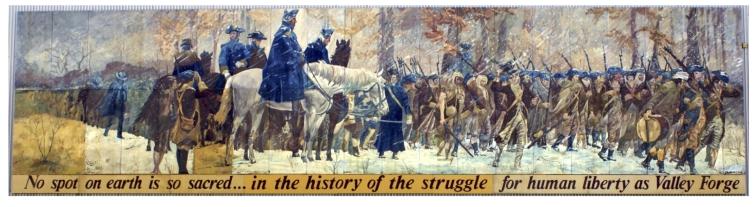
One of the most special historical artifacts, and unique to Upper Merion,is a mural commissioned for the Bicentennial in 1976. You may have seen the giant painting which is currently on the side the Colonial corporate building along Henderson Road near the intersection with Church Rd. In 2013, it was refurbished and installed in its current location for the Township's Tricentennial.
In the 1970s, Lewis Louderback of Louderback Transportation wanted to make a personal contribution to the Bicentennial Celebration. The project he envisioned was an 80 foot by 20 foot mural based on the William T. Trego painting “Washington Reviewing His Troops at Valley Forge.” At that time, the Louderback Company was located at 500 American Avenue, overlooking the Pennsylvania Turnpike and just about two miles from Valley Forge. Visible to millions riding along the turnpike, the mural was also easily visible from Goddard Boulevard.
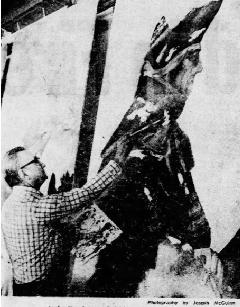
To create the mural, Louderback commissioned Ted Kunda, who at the time operated the Kunda Sign Company. Mr. Kunda said of his masterpiece,” I always hoped to do one great big painting.” And what an accomplishment it is! He included many local people as models for the faces. The dimensions of the mural are longer than the original 3ft by 6 ft painting, so Kunda added 25 figures to make it longer The mural is made up of 40 panels, each 4x10 ft. At the bottom, Lewis Louderback
had Kunda paint these words, “No spot on Earth is so sacred in the history of the struggle for human liberty as Valley Forge.”
The mural remained on the side of the Louderback building for two years before it was moved to the International Terminal at Philadelphia Airport. The mural remained there until the early 1980s when the terminal was renovated. After the mural was removed from the International Terminal, it was carefully stored for thirty yearsby the Kunda Family. It was restored in 2013. The mural was only supposed to be on the side of the Colonial building for about 18 months but has remained in place for over a dozen years.
Exposure to the elements has taken a toll, and the mural is once again in need of restoration. According to Amanda Lafty, Upper Merion Township Assistant Manager, the Township has not had much success in finding an artist to restore it. Estimates range from $10,000 to $40,000. In a quote from Main Line Today, Jim Pinheiro, Vice Chair of the Upper Merion Historical Commission, believes that the Township should be able to find enough money to fund the project. “Upper Merion Township loves the idea of working out the details and figuring out the right way to reproduce it,” he says. The 2013 restoration was due to the efforts of many people and organizations, including Supervisor Carole Kenney and UMT Tricentennial Committee Member Eileen Rodrique, Skip and Chris Kunda and the Kunda Family, artist Jane Hill
Golas, Sherwin-Williams Company, Home Depot, Fastenal, Colonial Electric, the UMT Board of Community Assistance and more.
Perhaps the Township Supervisors and the Upper Merion America 250 Committee could once again obtain grant money and rally corporate and community support to restore and preserve this amazing and special part of our history. To learn more about Upper Merion America 250, visit the Township website at www.umtownship.org /553/Upper-Merion-America-250






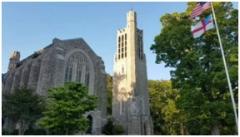
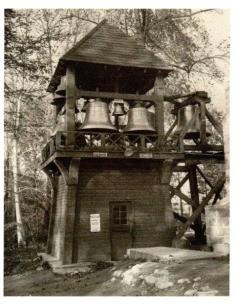
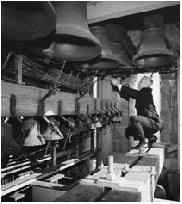
Inspired by Washington Memorial Chapel's founder, the Rev. W. Herbert Burk, the Washington Memorial National Carillon developed from an earlier installation known as the “Star-Spangled Banner National Peace Chime.”This initial chime consisted of 14 bells: one for each of the 13 colonies and a 14th bell, the National Birthday Bell. This bell bears a star and inscription for every colony not among the colonies.
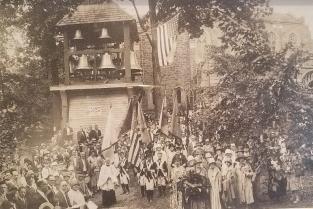
Cast by Meneely & Company of Watervliet (West Troy), New York then the nation's leading bell foundry these fourteen bells ranged in weight from approximately 225 lbs. to 3,500 lbs. The bells and keyboard were housed in a temporary wooden structure on the northwest corner of the Chapel Cloisters. The chime was dedicated on July 4, 1926, commemorating the 150th anniversary of American independence. The first piece performed at the dedication ceremony was “The Star-Spangled Banner.”
Bigelow, an engineering professor and campanologist, oversaw the casting and tuning of the new French bells to assure that their sound would perfectly match the
The 1926 installation was conceived as just the first stage in assembling a grand National Carillon, centrally located, with a bell for each state. Through the 1920's and 1930's 14 additional bells were cast by the Meneely bell foundry and placed into an enlarged bell tower. Bell size was determined by the state's population at that time.
Construction of the new bell tower began in 1941, but was suspended for the duration of World War II. Once construction was resumed in 1950, it took three years to complete. An additional 30 bells were cast by the Paccard Bell Foundry of Annecy, France and added to the earlier bells cast by Meneely. The carillon's designer, Arthur
bells. The National Society Daughters of the American Revolution funded the new stone tower and the additional bells, and the Pennsylvania State Society DAR continues to fund special
projects and maintenance of this tower. Like at the dedication of the first 14 bells in 1926, the first piece performed at the 1953 tower dedication ceremony was “The StarSpangled Banner.”
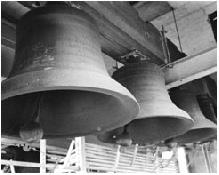
The 110 ft. tall tower currently holds a carillon of 58 bells: one bell representing each of the U.S.States, seven bells representing our U.S. Territories, and the c.1926 National Birthday Bell.
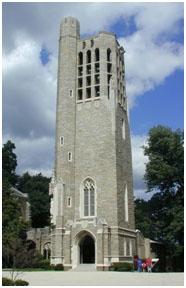
The instrument is played by Doug Gefvert, who has been the Chapel's Carillonneur for 27 years. The bells are played for Sunday Chapel services, weddings and funerals, and Sunday afternoons April-June and September-November. There are 112 steps up a winding stairway to the keyboard where Carillonneur Gefvert manually plays the bells from a keyboard similar to that of a piano only larger and fist and feet (pedals) are used instead of fingers.
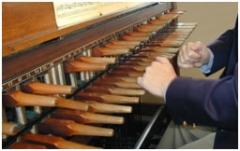
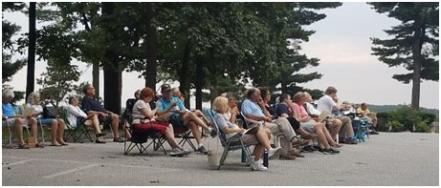
Since 1953, the Chapel's summer carillon concerts have featured outstanding performances by leading carillonneurs from America and around the world. Bring dinner or snacks and listen to the world's best carillonneurs present hour-long outdoor concerts every Wednesday evening at 7:30 PM during July and August. Rain or Shine. Come enjoy world-class carillonneurs playing this world-class carillon.




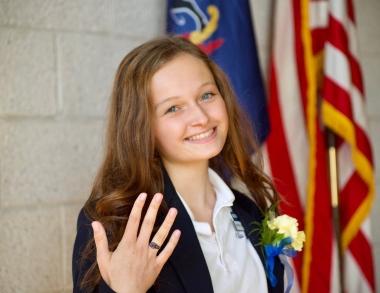
From her deathbed, suffering from the debilitating ravages of an inoperable brain tumor, 18-year-old Maria Middleton made a final entry in her journal: “Think Hope.” Two words that summed up Marsa's remarkable life, became the title of an inspirational book and a rallying call for her parents and the thousands of people around the world who prayed for her
In my interview with Maria's parents, Suan and Brian Middleton, for MLTV21, they described the unyielding faith in God of a young girl who believed “You don't have to be weird to be holy.”
According to the accounts in “Think Hope,” the book written by her parents, Maria was a teacher, mostly by her example, but also by her words. In a speech she gave at an eighth-grade graduation ceremony, she said: “In a world where many teenagers struggle to find real meaning and purpose, we know that our purpose in life is to know, love and serve God so we can be happy with him in heaven. This understanding calls us to lead others to Him through our words and actions.”
In another passage from the book, a friend describes Maria as “Funny, hopeful, smart, faithful, witty, and resilient. - traits that attracted friends and, eventually, led her friends and others from despair to hope.”
When I asked her parents why the book did not contain a definition of hope, they said it wasn't necessary because “Maria was a witness to hope. She lived it.”
In anexample of her indomitable faith, 17year-old Maria sent an email to Philadelphia's Archbishop Perez chastising him for closing the churches during Covid.” Your decision to suspend the Mass and Sacraments is preventing me from going t Church and receiving the Sacraments — which are graces I need.” Within 15 minutes, the Archbishop replied telling Maria that he would personally bring Holy Communion to her, which he did. He la said that Maria's email lit up his computer screen. After a three-hour visit with Maria in the sunroom of her home, he said he had the most profound conversation he'd ever had in his life about the role of the Eucharist and grace and suffering. They remained friends until her death.
In the Forward in the book, the Archbishop wrote: “'Think Hope' was the simple phrase used by Maria Middleton as she faced the immense challenge of dealing with terminal brain cancer, a diagnosis that came during her sophomore year of high school. She, and the family, faced this challenge with steadfast hope — a hope rooted in faith and expressed in love.”
Whether the Catholic Church, after scrupulously examining her life, proclaims Maria a saint will take years to determine. Nonetheless, in the hearts and minds of thousands of people around the world, Maria's life was unquestionably saintly Think Hope.org




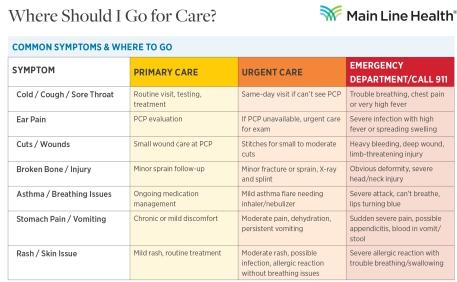
Making quick choices is tough, especially when you or someone in your family needs fast medical attention. When it comes to getting treatment for injury or illness, where should you be going: an urgent care center or the emergency department (ED)? Urgent care centers and EDs both offer similar services, but depending on your medical need, one facility might be a better option than the other. Although split-second decisions are typical in medical emergencies, it's helpful to familiarize yourself with what constitutes a trip to urgent care or the ED before you need to make the trip. Check out the lists below to see what facility is the right option in an emergency.
Urgent care centers are for accidents and illnesses that require a physician or nurse practitioner's attention, but not a trip to the emergency department. Common conditions and treatments provided at an urgent care center include:
• Minor cuts, lacerations and burns
• Muscle aches, strains and sprains
• Splints and stitches
• Colds, viruses and the flu
• Stomach ailments and respiratory illnesses
• Strep throat, ear infections and allergic reactions
• Flu and tetanus shots; physicals for work, camp, sports and drivers' licenses
• X-ray and EKG
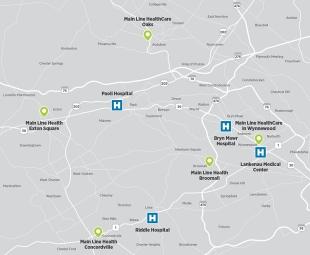
Urgent care centers provide excellent quality of care for patients who need help with injuries and illnesses when most doctors' offices are typically closed. Main Line Health Urgent Care, with locations in Broomall, Concordville, Exton, Oaks and Wynnewood, offers a variety of options for after-hours and emergency care and has hours on nights, weekends and holidays. “Urgent care provides the right level of care for non-life-threatening needs, giving patients an alternative to both waiting for an office visit and heading straight to the ED. We're here for the times when your doctor's office is closed, but you still need medical attention whether it's a sprain on the soccer field, a child's fever on a Sunday evening or a cut that needs stitches on a holiday. Our goal is to provide safe, timely care when you need it most at a location convenient to you,” said Jennifer Campbell, DO, a Main Line Health physician who specializes in both urgent care and emergency medicine. Additionally, Main Line Health hospitals are near these urgent care locations, which allows patients to be easily transferred to the emergency department if they require a higher level of care.
Emergency Departments
Emergency departments are for lifethreatening conditions and symptoms like:
• Heart attack
• Major trauma
• Numbness in the face, arm or leg
• Difficulty speaking
• Coughing or vomiting blood
• Severe shortness of breath
• Uncontrolled or excessive bleeding
• Severe headache or burns
• Poisoning
• Confusion, lethargy and changes in mental status
• Changes or loss of vision
• Chest pain
• Significant abdominal pain
• Behavioral emergencies, such as suicidal or homicidal feelings
While urgent care centers and emergency departments provide different levels of care, don't take too long to decide which one you should go to. While many people's first thought is to head to the emergency department, what you should do is head to whatever facility is closest. And if you're experiencing symptoms like chest pain, shortness of breath or any of the other symptoms listed above, call 911 to be transported. “The most important thing to remember is to not delay your care,” said Campbell. “If you're experiencing serious symptoms like chest pain, shortness of breath or signs of a stroke, the emergency department is always the safest place to be. But for so many other health concerns from minor injuries and infections to fevers or stomach bugs urgent care is a convenient option.”
Main Line Health is home to four emergency departments at Lankenau Medical Center, Bryn Mawr Hospital, Paoli Hospital and Riddle Hospital. Main Line Health serves patients at hospitals and health centers throughout the Philadelphia region. Virtually jump in line and join the waitlist at mainlinehealth.org/urgentcare.
For life-threatening conditions, visit an emergency department or call 911. Conditions include heart attack; numbness in face, arm or leg; difficulty speaking; coughing or vomiting blood; major trauma; severe shortness of breath; uncontrolled or excessive bleeding; severe headaches; severe burns; poisoning; suicidal or homicidal feelings.

Main Line Health urgent care and emergency department locations







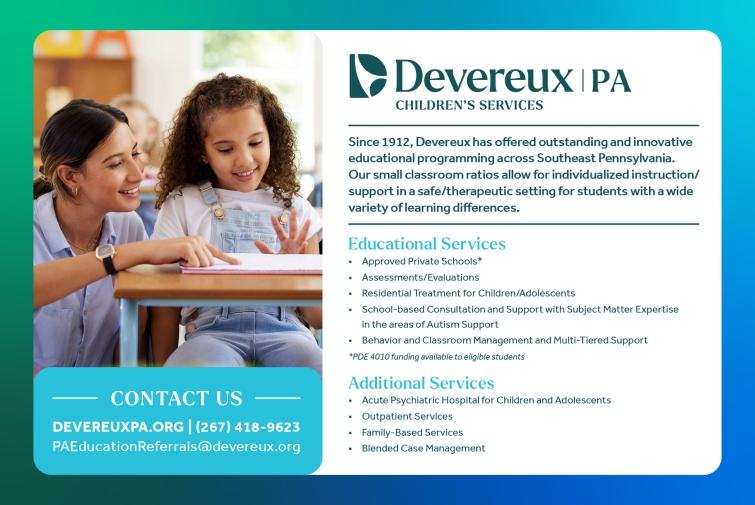
Devereux Pennsylvania Children's Services operates six Approved Private Schools throughout Chester and Montgomery Counties that offer high-quality, innovative special education programming for students who need care, compassion and support to succeed and thrive. All schools are licensed by the PA State Board of Private Academic Schools and accept 4010 placements.
Children, adolescents and young adults may come to Devereux as day students, or as a part of residential treatment. Each student has an Individualized Educational Plan, which outlines goals for skill development and the best strategies by which the student can reach his/her goals. A multi-disciplinary team, including the individual's parent(s) or guardian, regularly reviews the plan to discuss challenges, progress and adjustments to goals as appropriate.
600 Boot Road Downingtown, PA 19335
Full-time placement: Co-ed youth, ages 5-21, with autism; intellectual disabilities; speech and language disorders.
390 East Boot Road West Chester, PA 19380
Full-time placement: Co-ed youth, ages 5-21, with autism; intellectual/multiple disabilities; emotional disturbances; speech and language disorders.
2650 Eisenhower Ave, Suite A101
Norristown, PA 19401
Full-time emotional support placement (day):Co-ed youth, grades 4-8, with emotional, behavioral and cognitive differences.
20 McMaster Blvd, Suites 3 and 4
Landenberg, PA 19350
Full-time emotional support placement (day): Co-ed youth, grades K-8, with emotional disturbances, learning disabilities and autism.
390 E. Boot Road
West Chester, PA 19383
Full-time emotional support placement (day/residential): Co-ed youth, grades 6-12, with learning disabilities and emotional disturbances.
655 Sugartown Rd., Building 100
Malvern, PA 19355
Full-time emotional support placement (day/residential): Co-ed youth, grades K-12, with emotional disturbances, learning disabilities and autism.
Contact Devereux at PAEducationReferrals@devereux.org or 267-418-9623. Admissions team members will help you determine which program is most appropriate for your child. Visit www.devereuxpa.org for more information about Devereux's Approved Private Schools and other services for children.




Jay Goldsleger, DDS
Scott Goldsleger, DDS
Natalie De Barros, DMD
David Kim, DMD
Marcela Herrera, DMD



Andrew Rush, DMD
Kristine Rushby, DMD
Bryan Ruda, DMD
Serena Colletti, DMD ORTHODONTISTS ENDODONTICS



Immigration is in the news! Many people wonder why immigrants just don't become U.S. Citizens. To many, it seems like citizenship would solve many of the current issues we see and hear immigrants struggling with each day. However, the road to citizenship is not without its potholes and detours. Many immigrants, at their own expense, obtain an immigration lawyer to navigate their journeys to citizenship.
• One must be 18 or older to file Form N-400, “Application for Naturalization.” This paperwork is accompanied by a general filing fee of $765 that can be waived for military service. There can also be other fees and requirements detailed by the U.S. Citizenship and Immigration Service (USCIS) depending on the applicant's situation.
• One needs to have a “Green Card” that immigrants sometimes call the “ticket to the American Dream.” These cards (officially a “Permanent Resident Card”) are issued by USCIS and look like creditcard-sized pieces of beige or light green plastic. They feature a red, white, and blue flag design along with the holder's photo, biographical data, and security holograms. These cards grant foreign nationals the right to live, work, and study anywhere in America, travel freely in and out of the county, and to pursue a path to citizenship. Green cards are not just issued to anyone coming into the country. They are generally obtained through family sponsorships, offers of employment, refugee/asylee status, or the annual Diversity Visa Lottery. Those with green cards cannot vote in federal elections and may be restricted from holding certain government jobs.
• The permanent card must be valid and current. Green cards expire every ten years (or two years for conditional residents) and must be renewed. (Visas, on the other hand, are temporary, used
for travel, and divided into categories such as immigrant and nonimmigrant with a set length of time determined by several variables).
• One must prove continuous permanent residence in the United States for at least five years, or three years if married to a U.S. citizen. Further, you must have lived for at least three months in your current state of residence.
Next, there is the test given by USCIS
•
•
• officers.
Applicants are interviewed to assess their ability to read, write, speak, and understand English. They are asked personal questions about their background.
To test speaking ability, officers share photos of typical activities that immigrants need to explain.
After studying materials to prepare for an assessment of their knowledge of U.S. history and government, applicants need to know vocabulary on history and civics topics. To pass, the immigrant must answer six out of ten questions drawn from a list of 100 study questions. Questions can include topics such as “What is the supreme law of the land?” or “Who wrote the Declaration of Independence?”. (Questions are available on-line if you wish to test yourself!)
Finally, there is the Naturalization Ceremony that may be held in a park, arena, or courthouse. Each immigrant takes the Oath of Allegiance in which they

•
•
• give up allegiance to their country of origin,
promise to defend and protect the United States and its Constitution against all enemies,
• agree to
bear arms on behalf of the U.S., and
perform work of national importance under civilian direction when required by law.
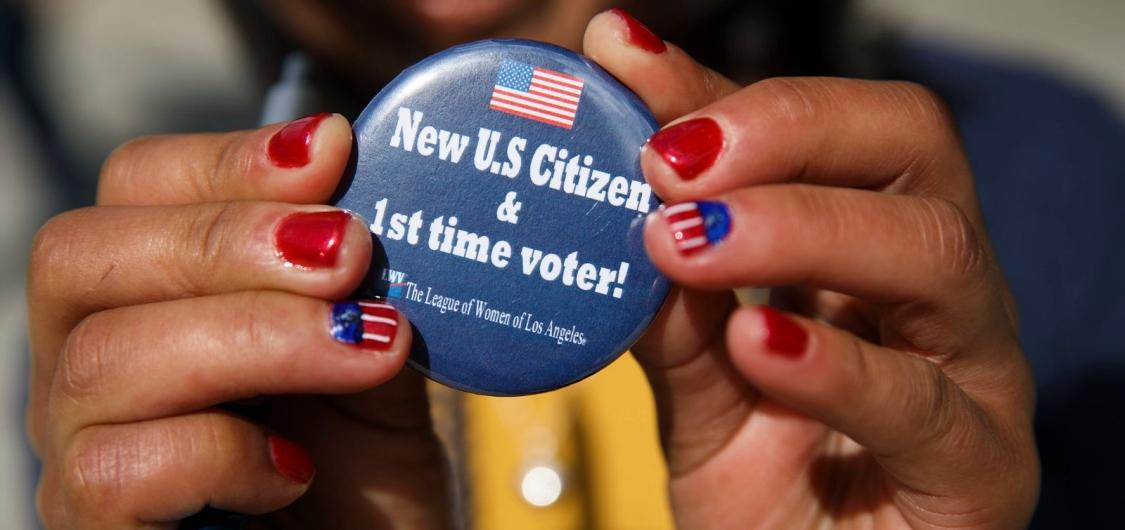
Friends and families also attend these inspirational events to support and celebrate new citizens who have reached their destination: the attainment of all the rights, responsibilities, freedoms, and privileges of every American. Members of the League of Women Voters are a part of these ceremonies that mark the culmination of years of time and effort. When League members welcome each new citizen, they share voter registration materials to assure that everyone has the opportunity to make their voice heard through voting. Voting is an American right (and responsibility) envied around the world.
The League of Women Voters is a nonprofit, nonpartisan organization that encourages the informed and active participation of citizens in government and influences public policy through education and advocacy.