This section of the report examines the existing inventory of casket lots, cremation lots, and columbaria niches at Lakeview Cemetery. The purpose is to compare the amount of inventory currently available with the projected demand for inventory over the next 25 years.
Inventory Years Remaining
The following table summarizes Lakeview Cemetery’s inventory that is available for sale, the projected average number of sales per year over the next 25 years, and the estimated number of years of sales remaining.
Table 1: Summary of Lakeview Cemetery Inventory Available for Sale, Source: Osoyoos Cemetery Records.
Note: Remaining inventory is determined by sales rather than interments, as the rights of interment can be pre-purchased or reserved. This means that even after the last lot or niche is sold, there may be many years of interments remaining at the cemetery.
New Supply
If past sales and service patterns continue, the Town of Osoyoos will have sufficient casket lot inventory to accommodate sales over the next 25 years, but will need to develop:
• 240–250 cremation lots, and
• 120–130 columbaria niches.
Based on standard lot layouts Osoyoos will need to develop approximately 500m2 (0.12 acres) of land to ensure it will be able to meet the expected community demand for cremation lots over the next 25 years.
Best practice recommends maintaining approximately 50 years of interment inventory. Based on current projections and assuming historic sales and interment patterns continue, the current casket lot inventory is expected to sell out in approximately 25–30 years. If the Town intends to continue providing burial services to residents over the long term, future land acquisition will need to be considered.
KEY FINDINGS CEMETERY DEMAND
Over the next 25 years, Lakeview Cemetery is projected to sell the right-of-interment for:
100
CASKET LOT SALES
avg. 4 per year
Over the next 25 years, Lakeview Cemetery is projected to inter:
180 130 470 125
CASKET LOT BURIALS avg. 7 per year
290 350
IN-GROUND
CREMATION SALES
avg. 12 per year
URN BURIALS IN CASKET LOTS
avg. 12 per year
COLUMBARIUM NICHE SALES
avg. 5 per year
CREMATION LOT BURIALS avg. 19 per year
COLUMBARIA NICHE INTERMENTS
avg. 5 per year
To meet the 25 year demand, the Town of Osoyoos will need to develop:
CREMATION LOTS
120 240 COLUMBARIA NICHES
Inventory Expansion Strategies
Best practice dictates that cemeteries should have 50+ years of available inventory at all times. This section summarizes each possible strategy for increasing a cemetery’s interment inventory. These strategies will be assessed for their potential use at Lakeview Cemetery in Chapter 3: Site Inventory and Analysis.
Infill and Densify Strategy
There are often opportunities at cemetery sites to develop space not historically allocated for interments, and to densify site capacity through a range of strategies. These may include:
• Closing low-traffic paths, roads, and other nonutilized areas for use as added interment space;
• Strategically replacing new in-ground lots with a smaller, more flexible land footprint (e.g., small cremation lots and ossuaries), and
• Adding above-ground interment options such as family vessels or columbaria and memorial wall niches.
Reclamation Strategy
Some cemeteries seek to increase their capacity and conserve land through the reuse and resale of unclaimed or abandoned pre-purchased lots. These are usually lots that have been purchased several decades ago, but whose owners have not had any contact with the cemetery since the time of purchase. Thorough investigation and significant staff time may be required to determine if unclaimed lots are available. The best practices for execution of this strategy include:
• Identifying individuals and families who have purchased burial plots more than 50 years ago;
• Attempting to find the last known lease/lot owner, and
• Advertising in the local media (e.g., newspapers) to find them.
Precise terms surrounding the circumstances and expiration of the right-of-interment in an unclaimed lot need to be stated in the Cemetery Bylaw. Unclaimed lots that are determined to be available can then be resold, typically at the current fair market value.
Cemetery Expansion Strategy
Some cemeteries have the opportunity to expand into adjacent, undeveloped land. This opportunity is ideal because it allows the municipality to develop the new section for optimized efficiency and programming. While planning and developing a new cemetery section is costly and takes time, it will often serve the community for much longer than either infill or reclamation will.
Figure 4: Cemetery Driveway Infilled with Cremation Garden, Grand Centre Cemetery, Cold Lake, AB, Source: LEES+Associates.
Chapter 3: Site Inventory and Analysis
Introduction
This chapter provides an overview of the existing cemetery and outlines the key opportunities and challenges identified through a site visit, desktop review, site photos, and interviews with cemetery staff. The findings outline existing conditions, operational considerations, and physical constraints observed on site, and help to inform future planning and recommendations.
Inventory and Analysis
Neighbourhood Context
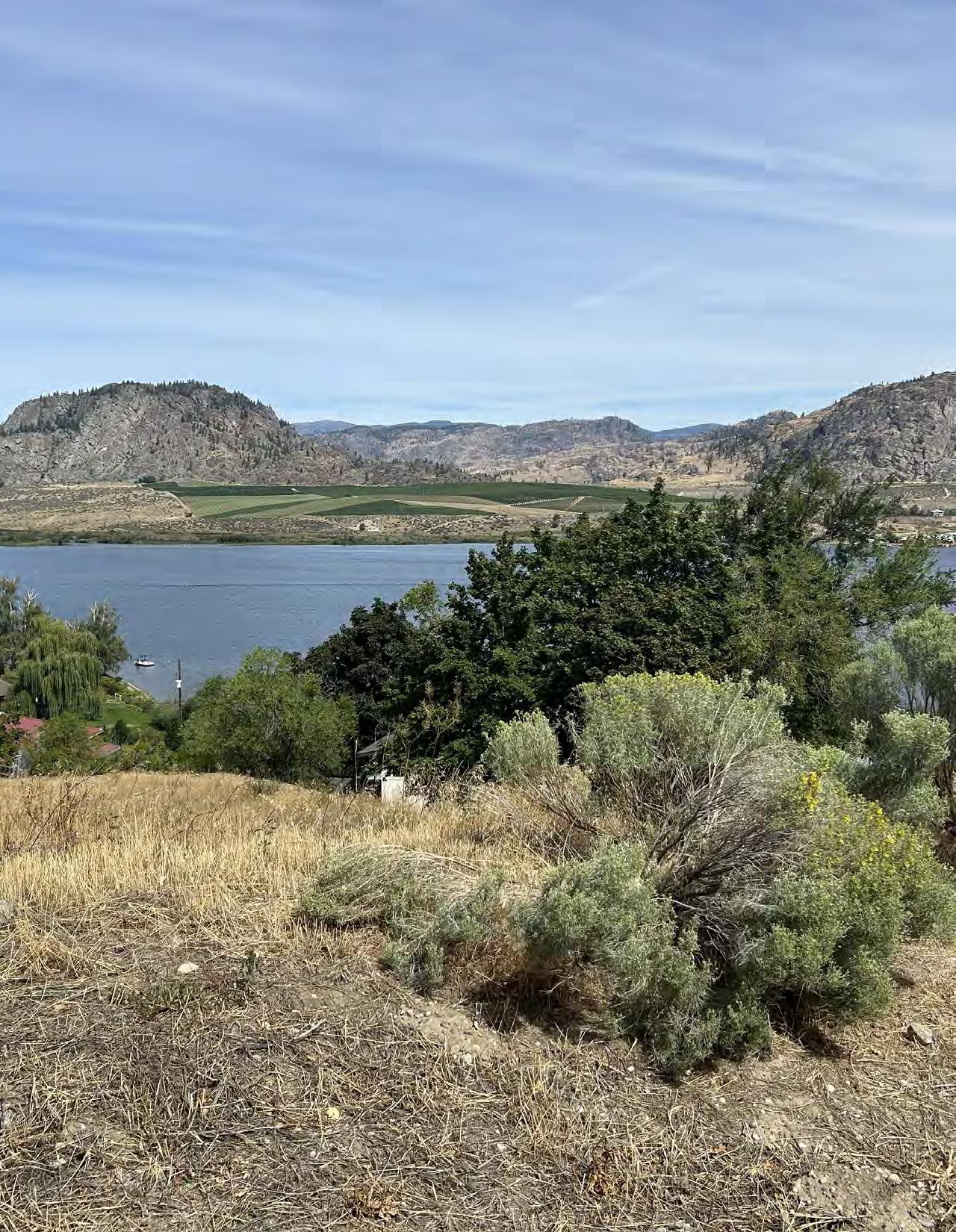
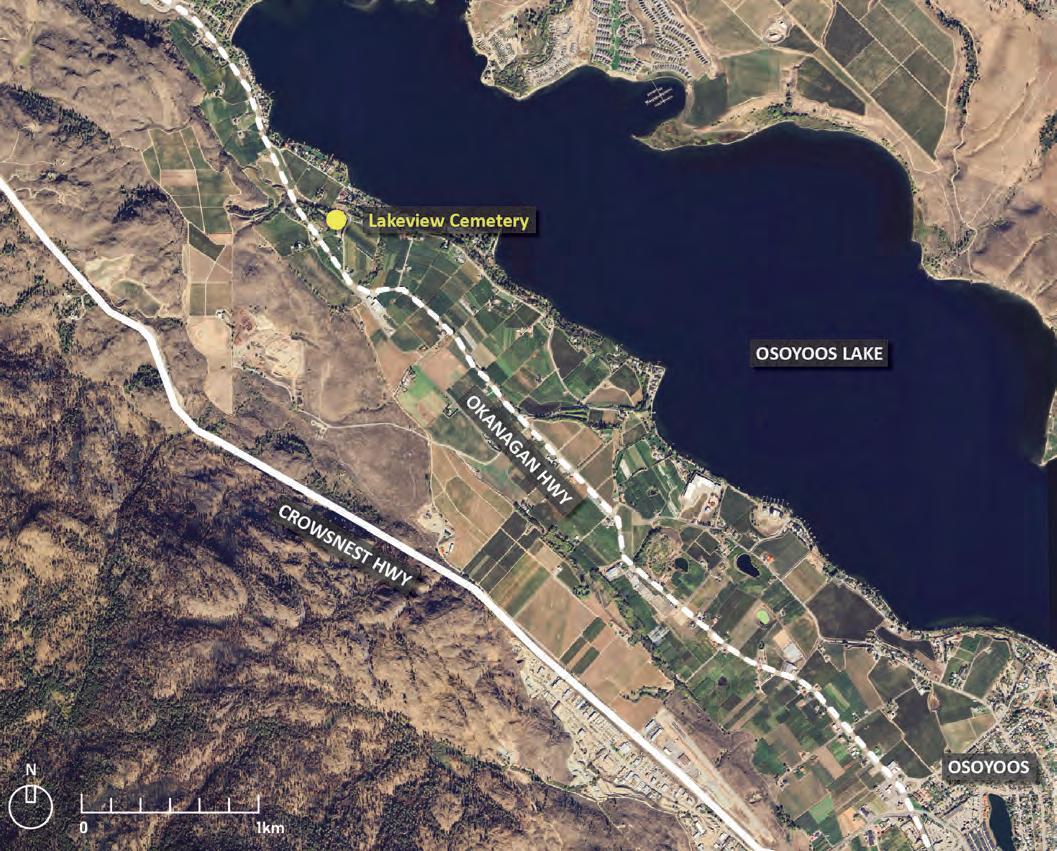
Lakeview Cemetery is located northwest of the Town in a rural setting overlooking Osoyoos Lake. The site benefits from elevated views and is surrounded by a mix of orchards and natural desert landscape. These surrounding land uses contribute to the cemetery’s sense of seclusion and peaceful character.
Figure 5: Town of Osoyoos - Lakeview Cemetery Location, Source: LEES+Associates and Google Earth.
Access and Circulation
Inventory
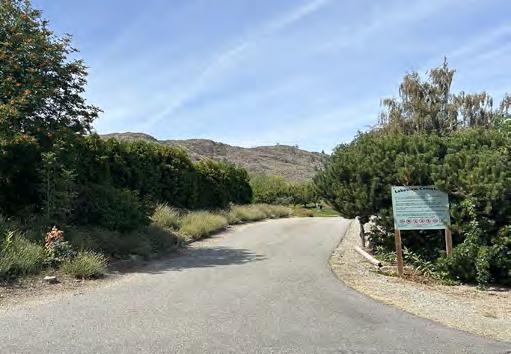
• There are three entrances and exits to the cemetery, all located along its eastern boundary on 176 th Avenue, with no clear hierarchy between them.
• Some of the cemetery driveways are paved, while others are gravel. Overall, the gravel driveways are in fair condition; however, the section adjacent to the spoil pile has experienced drainage issues during the winter months.
Signage and Wayfinding
Inventory
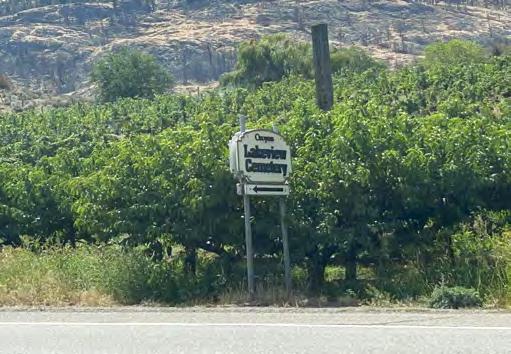
• There is a small sign on the highway identifying the turnoff point for access to the cemetery. It is difficult to see from a distance and showing signs of wear.
• Each entrance has a sign outlining cemetery regulations, hours of operation, and contact information; however, there is no clear main entrance or cemetery sign.
• There is no information kiosk, section markers, or map available on site.
Opportunities and Challenges
• The cemetery gates were broken and subsequently removed. There is an opportunity to replace the gates.
• There is an opportunity to consolidate entrances by removing one and formalizing one as the main entry point.
• There is opportunity to improve the condition and drainage of gravel surfaces, or to replace with paved driveways.
Opportunities and Challenges
• There is opportunity to replace the highway sign with an updated design and improved visibility.
• There is an opportunity to enhance the transition from public to sacred cemetery space by adding an entrance sign and gateway to indicate and define a main entry.
• There is an a opportunity to add a cemetery kiosk and map with digital mapping accessed by a posted QR code.
Figure 7: One of the Three Entrances to the Cemetery, Source: LEES+Associates.
Landscape Character Inventory
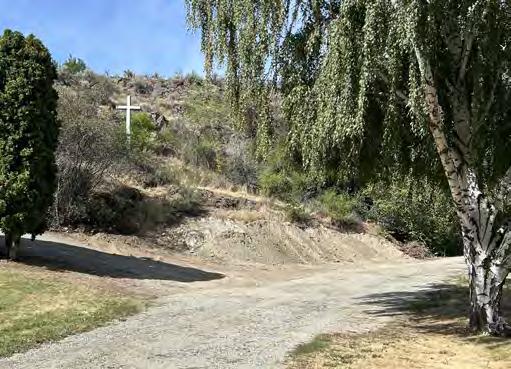
• The cemetery is backed by a steep, rocky hillside on its western boundary. A large white cross is located on the slope, overlooking the cemetery.
• The northern edge of the cemetery drops away sharply, providing views to the lake below.
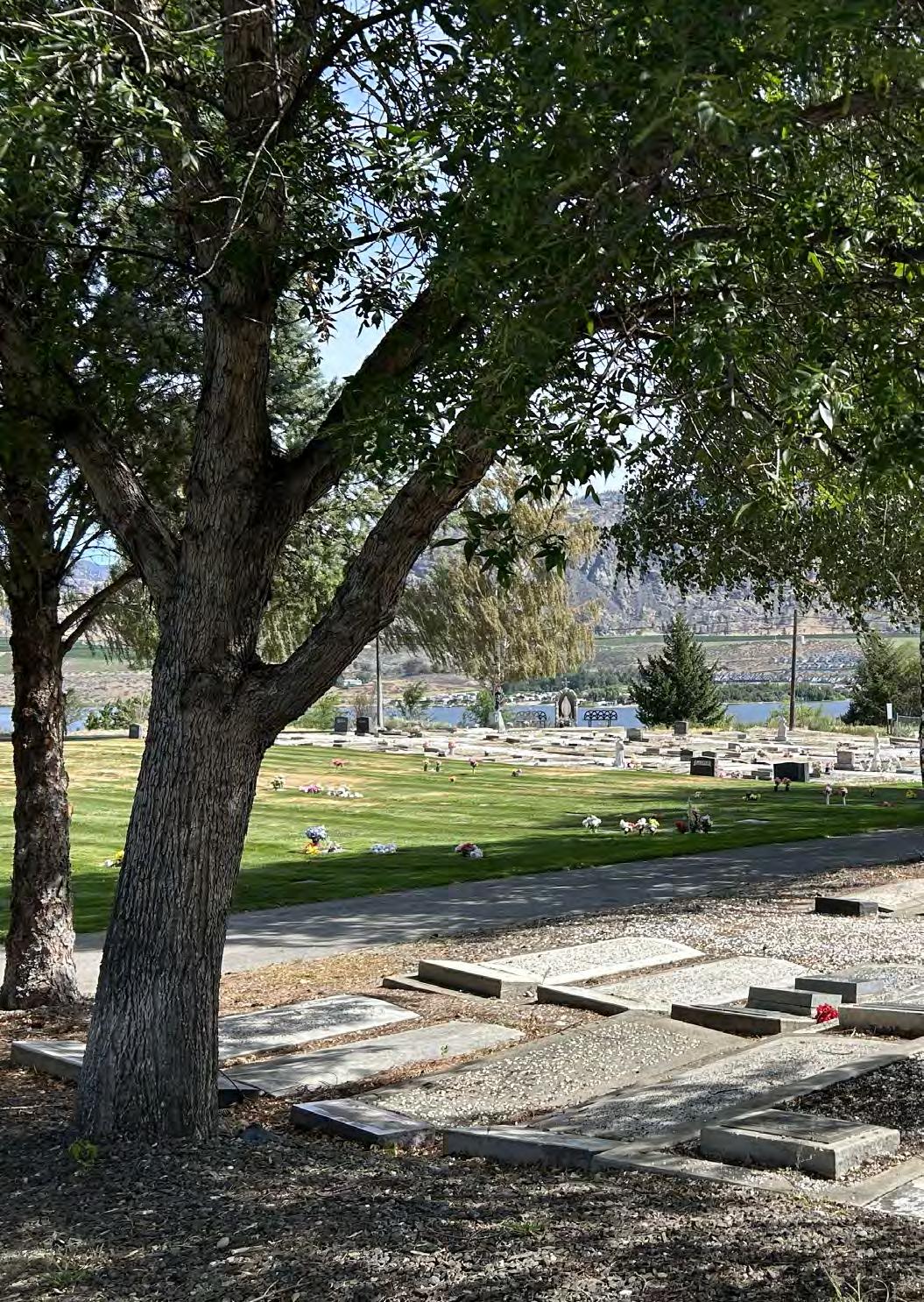
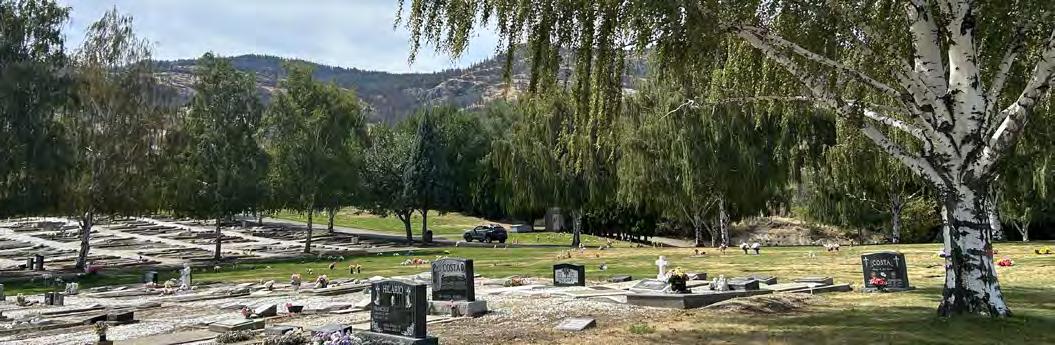
• The cemetery is comprised of both lawn and dry sections with gravel surfacing. Overall, it is well maintained, with manicured lawns.
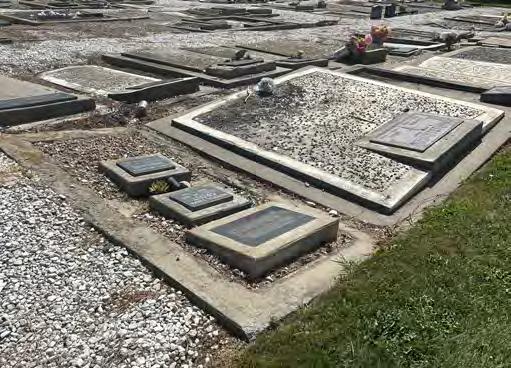
• In the older areas of the dry section, concrete covers and vaults show signs of deterioration, including cracking and sinking. Although the City is not responsible for maintaining these vaults, they present a safety hazard.
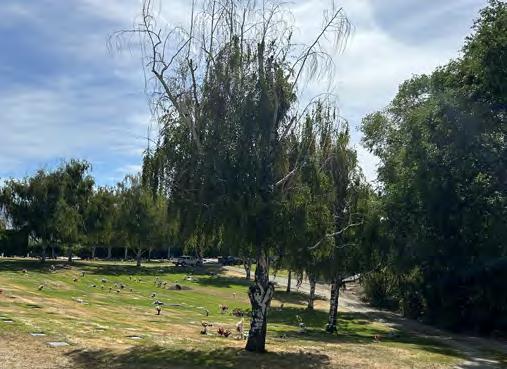
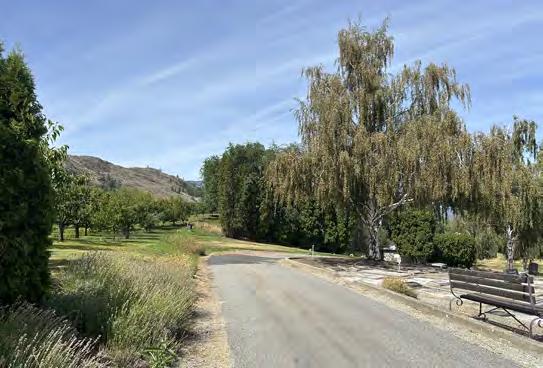
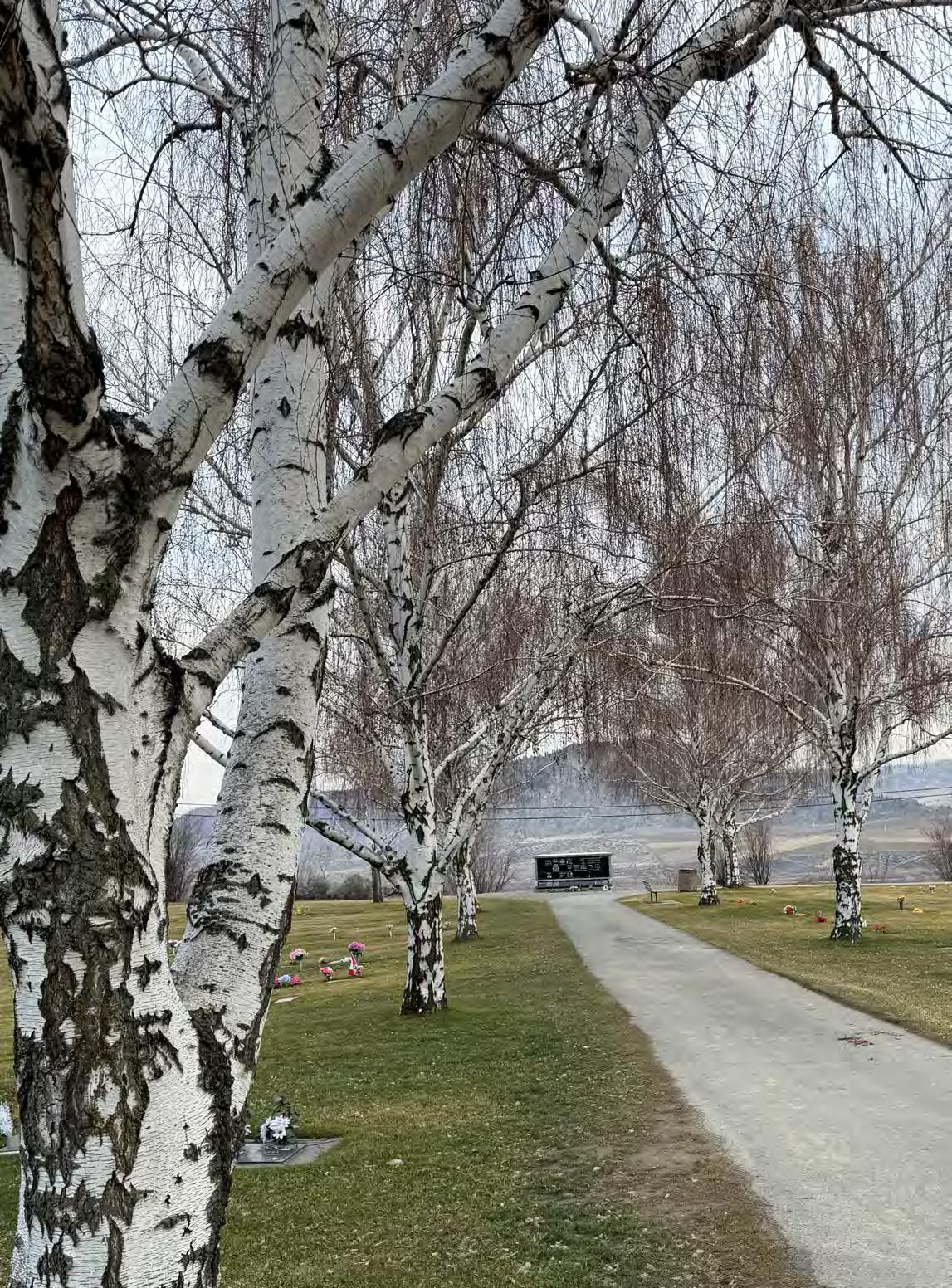
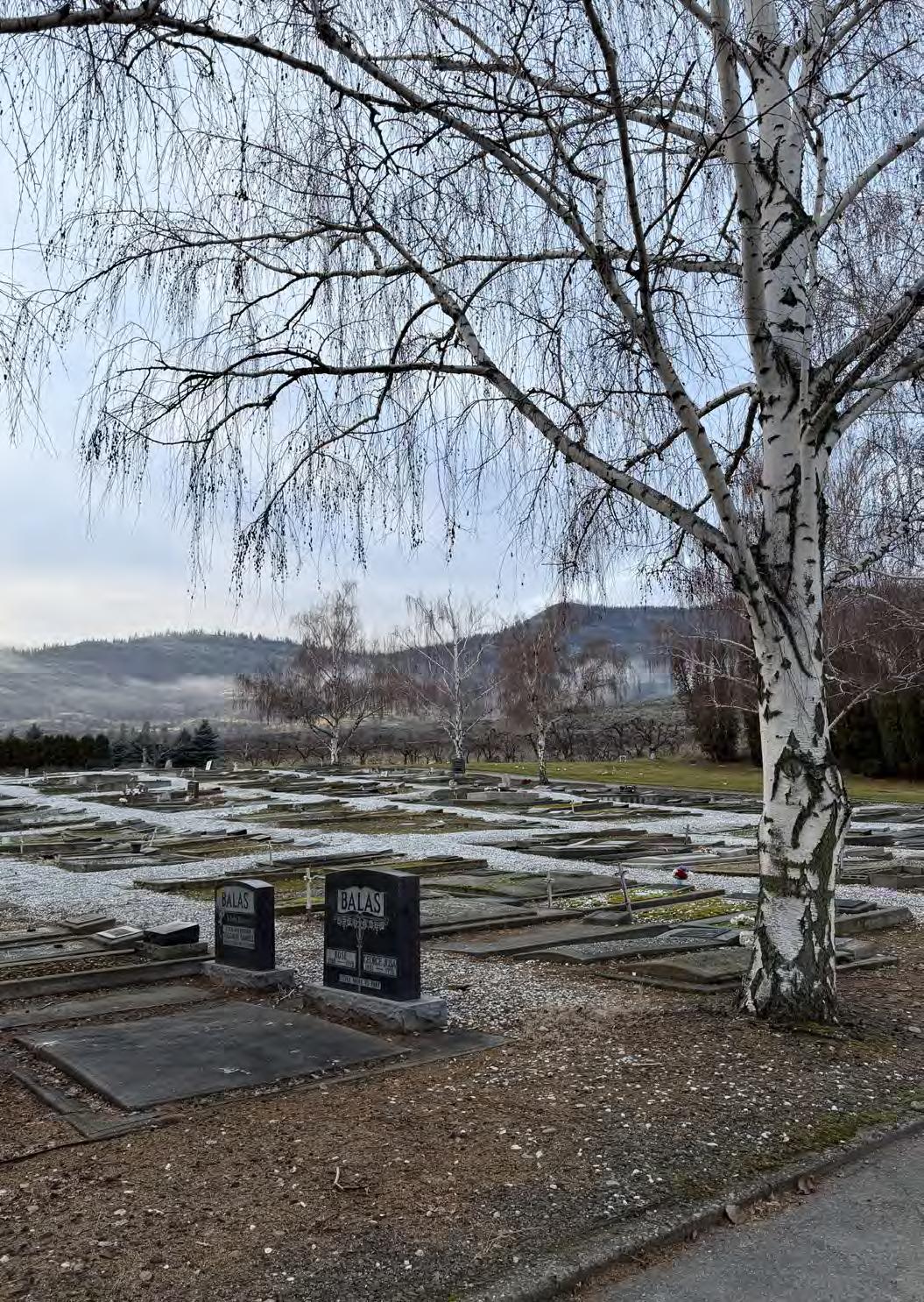
• The cemetery character is defined by a number of mature birch trees offering shade, included tree alleés lining the cemetery driveways. Many of the trees are showing signs of crown thinning and decline.
Accessibility
Inventory
• The cemetery is gently sloped, with some steeper areas that may present challenges for providing accessible pathways to some sections (such as behind the Pioneer and Veterans sections).
• Some of the internal driveways are paved, providing easier access for vehicles and individuals using mobility devices.
• There are no formal internal walking paths.
• There are no designated parking areas within the cemetery.
Opportunities and Challenges
• To ensure the longevity of the landscape character, a tree management plan should be implemented. This should include a strategy for the removal and replacement of the cemetery’s deteriorating birch trees.
• There is a need to explore options to clean up and repair the concrete covers and vaults in the older sections of the cemetery.
• There is an opportunity to improve the transition between the cemetery driveway and burial sections in some areas by repairing curbs and adding xeric and native plantings.
• There are opportunities for infill and columbaria along the road edges and the northern boundary.
Opportunities and Challenges
• Expansion areas should consider design solutions to offer accessible routes to burial areas.
• Enhancing the wayfinding and signage will help mitigate confusion and users navigate more accessible routes
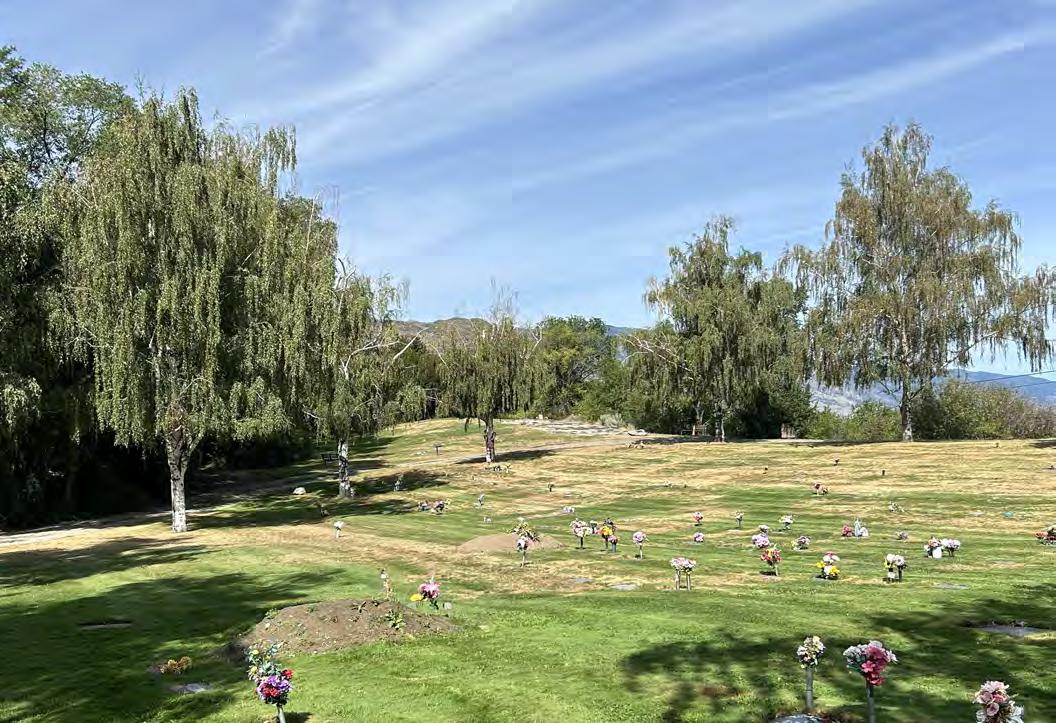
Figure 8: View Southwest Across Lakeview Cemetery, Source: LEES+Associates.
Amenities
Inventory
Seating:
◦ Several memorial benches throughout the cemetery provide seating opportunities.
Gathering Spaces:
◦ There are no dedicated gathering spaces.
Edges:
◦ Hedges and a ubiquitous chain-link fence border the cemetery’s eastern edge.
Operations
Inventory
Operations:
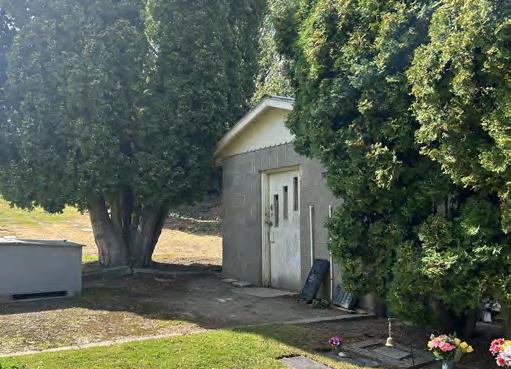
◦ There is a small maintenance shed for storage and a portable toilet located near the spoil piles. Some hedges screen the shed but the spoil piles are not contained or screened.
Markers:
◦ Full-sized casket lots currently have no limits on marker size, which can result in placement and maintenance challenges when cremated remains are also interred.
◦ Low-set markers are at risk of machinery damage and markers are sometimes positioned separately from the actual interment.
◦ Up to six cremated remains can be interred in one casket lot.
Opportunities and Challenges
Gathering Spaces:
◦ There is an opportunity to establish a small gathering space within the cemetery to accommodate on-site services and provide families with a dedicated area for reflection and connection.
Edges:
◦ There is opportunity to improve the fencing and vegetation buffers surrounding the cemetery.
Opportunities and Challenges
Operations:
◦ There is an opportunity to enclose and contain the spoil piles.
Markers:
◦ There is an opportunity to update the bylaw to regulate marker size and placement.
Ornamentation:
◦ There is the opportunity for vases or tubes for flowers to be sold as part of the lot and more education on the ornamentation regulations to customers up front.
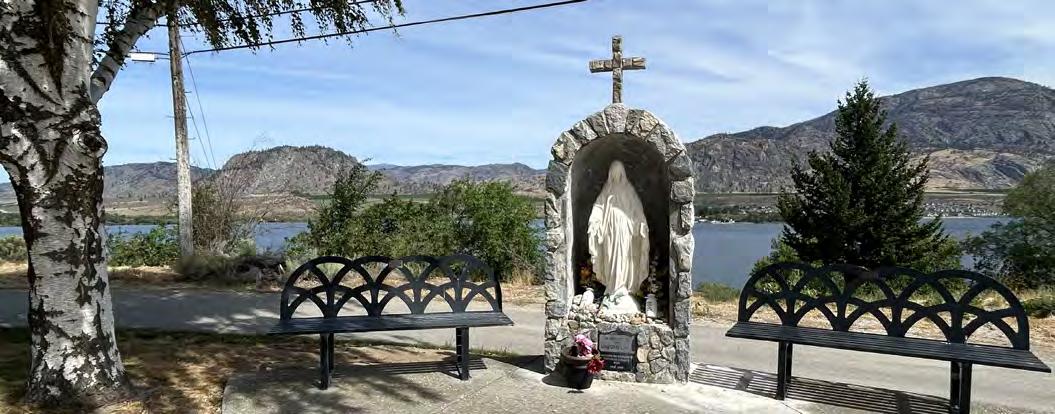
Figure 9: Statue of the Virgin Mary with the Inscription, “In Memory of the Unborn Child,” Source: LEES+Associates.
Figure 11: Stockpiles and White Cross along the Western Boundary, Source: LEES+Associates.
Figure 12: Maintenance and Storage Shed, Source: LEES+Associates.
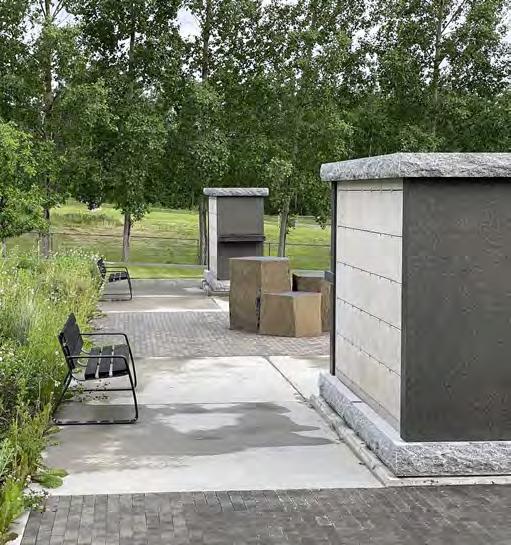
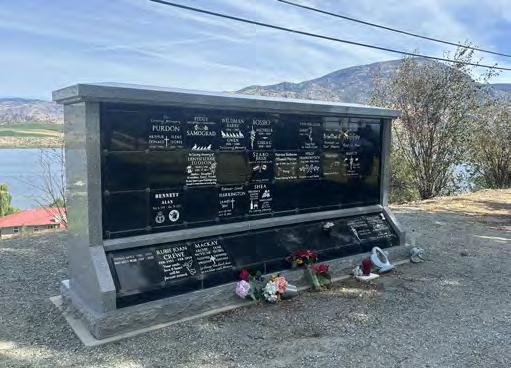
Figure 13: Columbarium Along the Northern Edge Overlooking Lake Osoyoos, Source: LEES+Associates.
Figure 14: Cemetery Birch Trees Showing Signs of Crown Thinning and Decline, Source: LEES+Associates.
Figure 15: Cracked and Sinking Concrete Vaults in Older Sections of the Cemetery, Source: LEES+Associates.
Site Inventory Diagram
Extents of property to be confirmed
(available land)
(road edge)
(existing road)
Steep slopes and views towards Osoyoos Lake
Columbarium
Infill Area A:
Approx. 150m2 of unutilized land
Veterans section with flagpole and bench
Infill Area B:
Potential for infill with columbaria, a small scattering garden, and/ or gathering space.
Opportunity to contain and screen spoils pile White cross Portable toilet Operations shed
Trees appear to be in a state of decline.
Opportunity for a tree management/ replacement plan
Opportunity to improve highway signage
Infill Area C: Terrace above steep slopes. Opportunity for additional columbaria and seating
Infill Area D: Potential for additional columbaria or cremation lots between existing trees
Statuary and seating
Opportunity to make primary entrance with entry kiosk
Grave covers and vaults in dry sections are in disrepair and are a safety hazard
Chain-link fence
Infill Area E: Opportunity to reduce number of entrances and infill road
Hedges
Land Needs Analysis
The Demand and Needs Analysis chapter identified that the Town has sufficient casket lot inventory, but will need to develop approximately 500m2 (0.12 acres) for 240–250 cremation lots and space for 120–130 cremation niches to ensure it will be able to meet the expected community sales demand over the next 25 years.
It is recommended that cemeteries have enough inventory to meet the needs of the community for the next 50 years. With this in mind the town should consider acquiring adjacent parcels for future cemetery development. If these are not available, the Town should look at other available land to meet the needs of the community for the next 50 years.
Existing Cemetery
There are several potential areas of opportunity for infill and expansion in the existing cemetery.
Infill Area A:
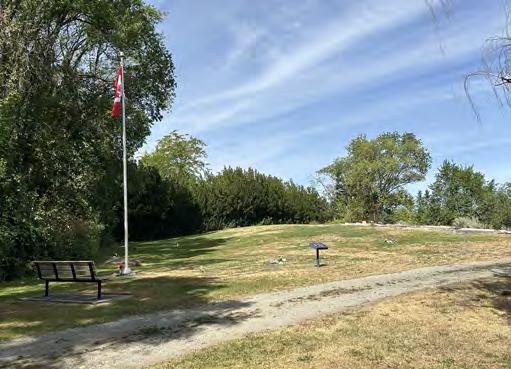
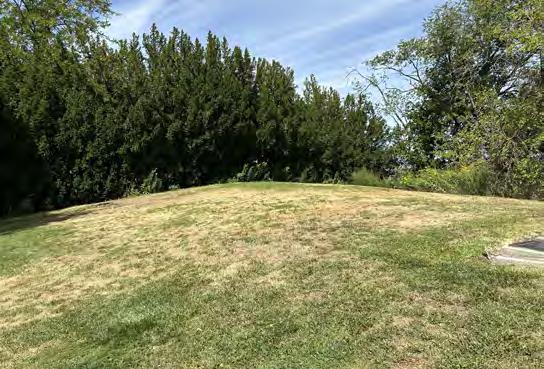
• There is approximately 150m2 (0.04 acres) of unutilized land behind the Veterans and Pioneer sections that has the potential to be used for cemetery expansion.
• This area could accommodate a small burial area, cremation garden, or gathering space. If dedicated to cremation lots, Area A would provide approximately 70–80 cremation lots and an additional 5–7 years of cremation lot sales.
• Access to this area is steep and would benefit from an accessible pathway.
• The extents of the property boundary in this area needs to be confirmed.
• There is opportunity to initiate discussions with the Legion on the future of this space and the reallocation of some of their adjacent unutilized land.
Infill Area B:
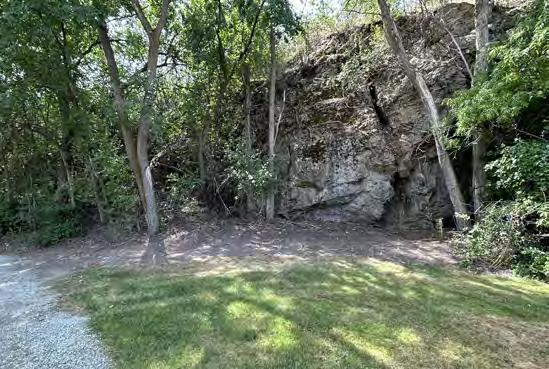
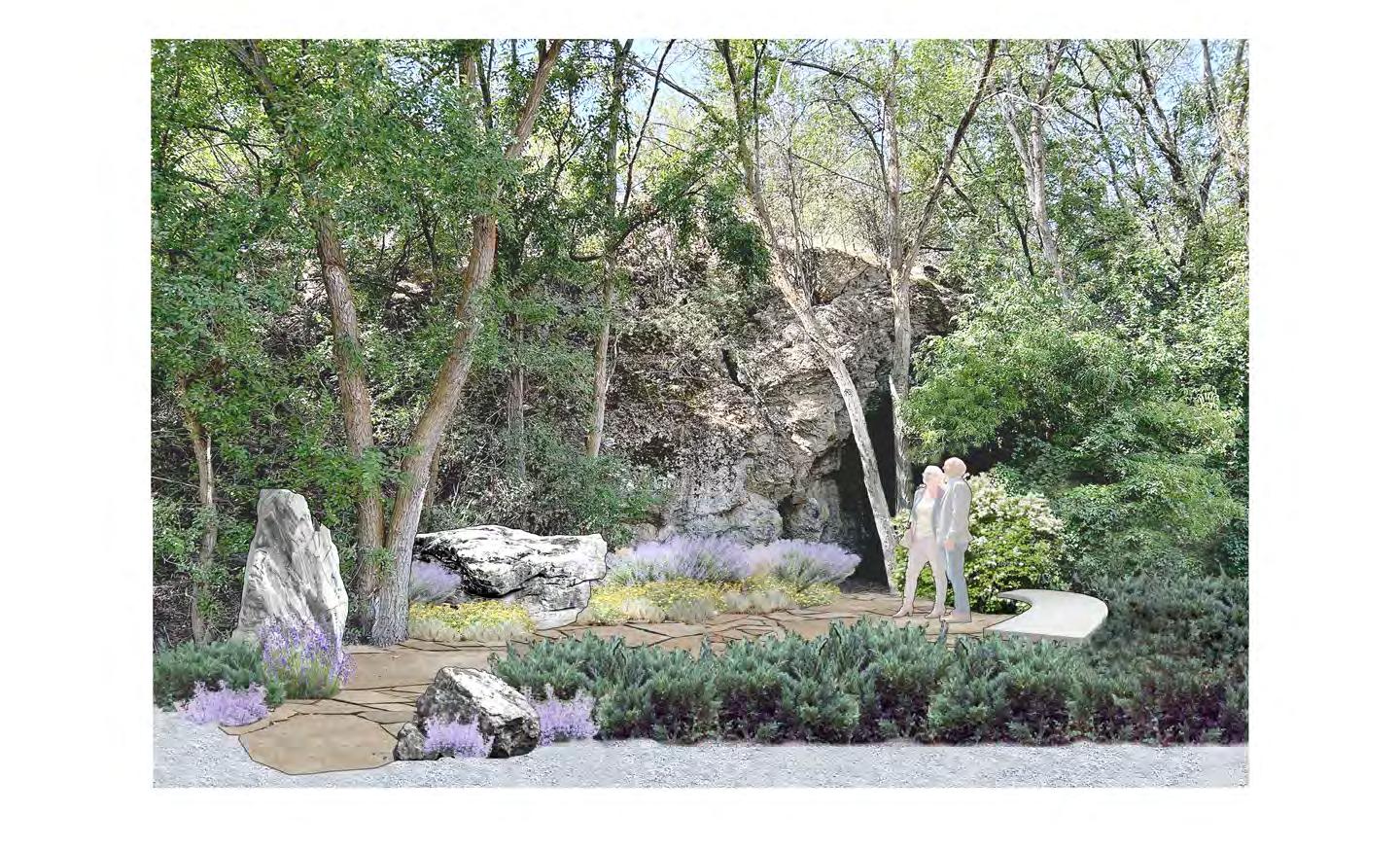
• The forested edge along gravel driveway and the steep rocky slopes at the western boundary offers opportunities for infill with a small scattering garden, columbaria, and/ or gathering space.
Figure 16: Infill Area A - Unutilized Land Behind the Veterans and Pioneer Sections, Source: LEES+ Associates.
Figure 17: Infill Area B - Forested Edge Along the Western Boundary, Source: LEES+Associates.
Infill Area C:
• The terrace along the northern boundary overlooks a steep drop-off, offering scenic views of Lake Osoyoos.
• There is one existing columbarium and an opportunity to add additional columbaria and seating along this edge, as well as additional forms of interment such as family estate lots.
Infill Area D:
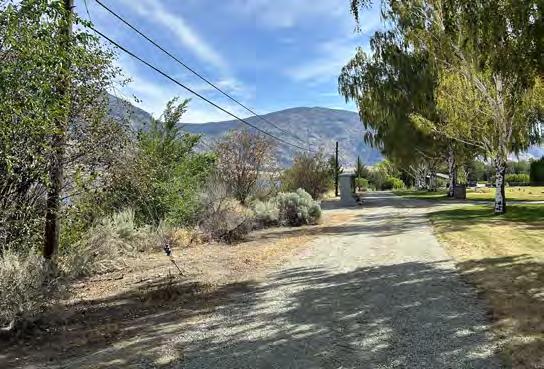
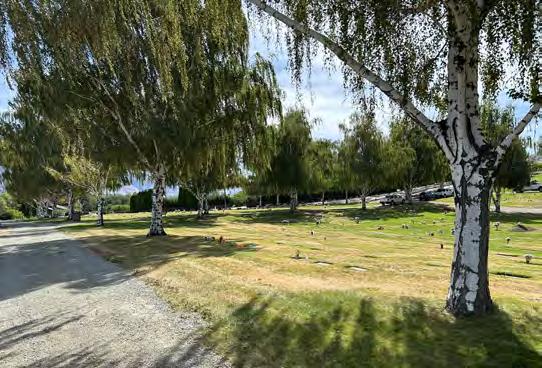
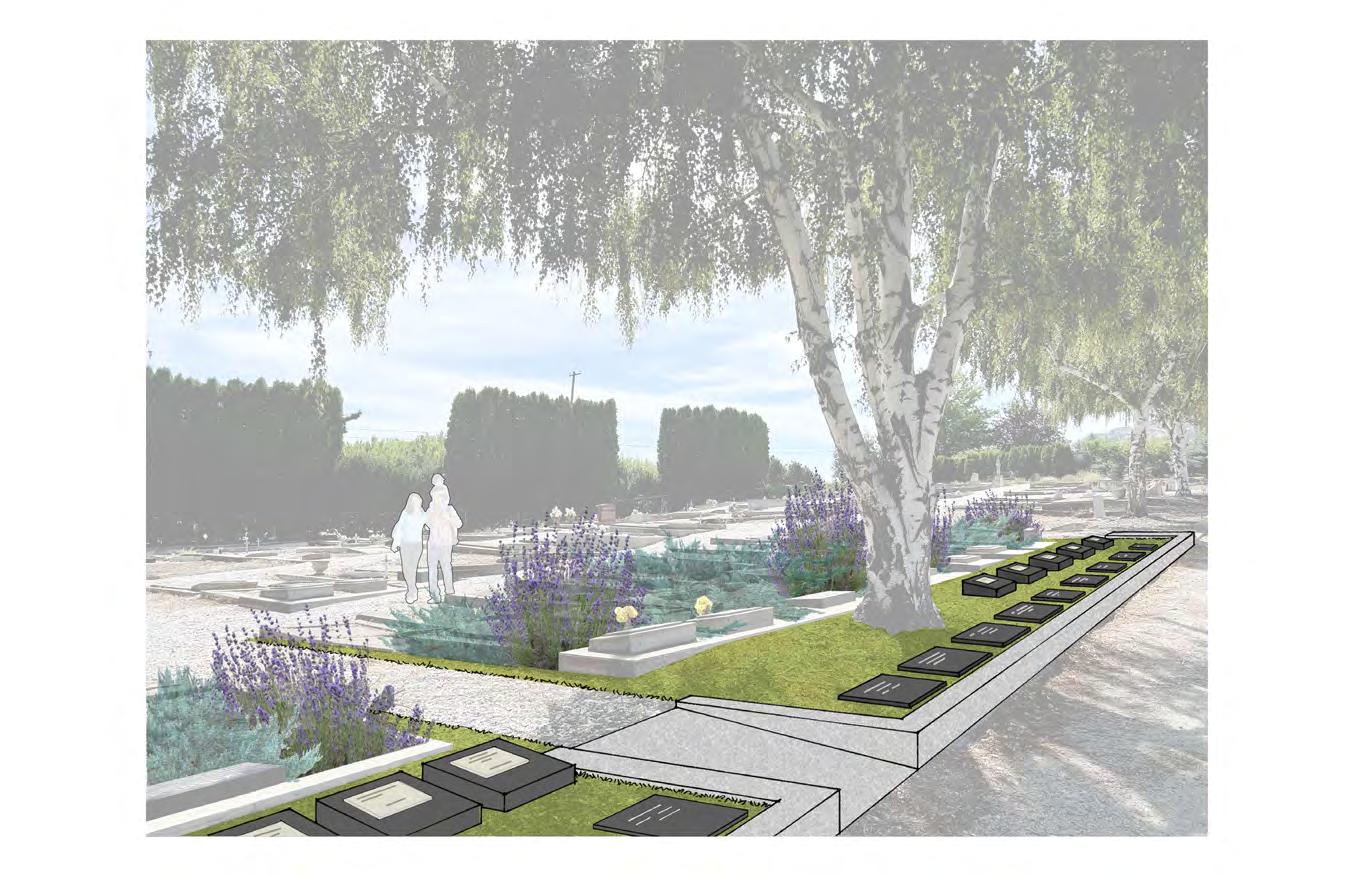
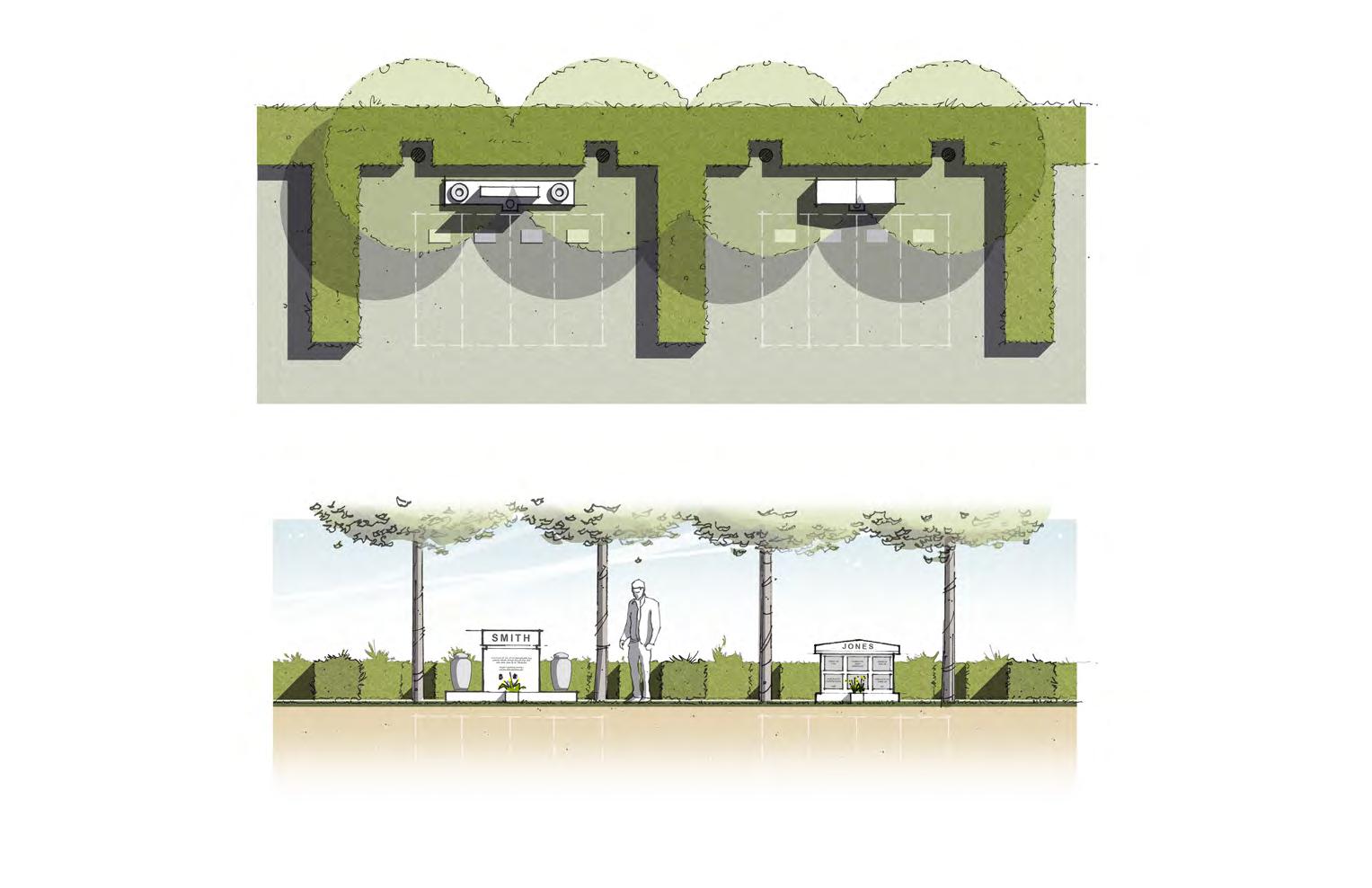
• Site observations suggest that spacing between cemetery trees would allow 1–3 rows of cremation lots or columbaria in areas that do not inhibit operations equipment. However, a tree re-planting strategy should be put in place prior to allocating these areas for cremation lots.
• To determine capacity, a survey should be conducted prior to further planning or development.
Infill Area E:
• There is opportunity to reduce the number of entrances and infill the road with columbaria and interment options.
Figure 18: Infill Area C - Along the Northern Cemetery Boundary, Source: LEES+Associates.
Figure 19: Infill Area D - Between Cemetery Trees, Source: LEES+Associates.
Figure 20: Infill Area D - Cemetery Road Infill, Source: LEES+Associates.
Chapter 4: Engagement Summary
Engagement Summary
The Town of Osoyoos Cemetery Review was supported by a three-part community engagement process, consisting of a cemetery workshop with Town staff, stakeholder interviews, and broader public engagement through a public open house and a survey.
Using the IAP2 Spectrum of Public Participation as a guide, engagement aimed to ‘Involve’ the public. Involving the public means working directly with the public throughout the process to ensure that public concerns and aspirations are understood and considered. These levels include transparency and a commitment to report back on how engagement results influenced project outcomes.
This chapter summarizes the engagement activities and feedback gathered during consultations with Town of Osoyoos staff, senior leadership, and cemetery stakeholders, including community members who participated in the open house and survey.
To better understand community needs and desires, the project team developed a public survey focused on existing cemetery services at Lakeview Cemetery and future interests. The survey was available online through the Town’s website and remained open to the public for two weeks, from January 26 to February 6, 2026.
The survey featured 12 questions, including both multiple-choice and open-ended formats. Participation in the survey was actively promoted by the Town of Osoyoos through a range of digital platforms. The survey was shared via the Town’s website, including both a news item and a dedicated webpage, and was further supported through posts on the Town’s social media pages. In addition, the survey was featured in the Town’s eNews distribution. Calls were also made directly to funeral home representatives requesting their participation in the survey.
Survey Key Themes
Strong Community Connection
Many respondents have a direct personal connection to Lakeview Cemetery, most commonly through having a loved one interred there. Others expressed future intentions to be buried there or general familiarity with the cemetery as a valued community space and historical site.
Cremation and Flexible Interment Options
Cremation-based options were more commonly identified than traditional casket burial. In-ground cremation lots and columbarium niches were the most frequently selected intended interment options, and there was interest in expanding memorialization choices to include scattering gardens, memorial walls, and ossuaries.
Environmentally Sensitive Practices
Respondents expressed support for sustainable burial practices, land conservation, protecting the cemetery’s natural setting, and minimizing environmental impact. Interest included green or natural burial methods, biodegradable materials, and tree planting.
Amenity and Landscape Enhancements
There was strong appreciation for the cemetery’s peaceful atmosphere, maintenance, and staff. Many respondents emphasized the importance of preserving its natural setting and avoiding unnecessary or overly urban changes. At the same time, participants identified practical enhancements to improve the visitor experience, including modest amenity additions and landscape and maintenance improvements, particularly within the older sections of the cemetery.
“Looking to the future, protecting the environment is important for our children, grandchildren, and the many generations to come.”
“Public education is essential to help open people’s minds to the consequences of their choices.”
“It is a beautiful, peaceful place that allows me to visit deceased loved ones.”
“Keeping it natural and organic would be a wonderful way to honour this community and all of the families who use the space.”
“Osoyoos manages a very wellsituated, well-appointed, and wellserviced cemetery [...] The people working at the cemetery are great.”
“I have visited [the cemetery] to look at graves and to see a portion of the history of the community.”
Survey Response Summary
Who Answered the Survey
• The survey had 51 participants, including online and hard copy submissions.
• A variety of age groups participated in the survey, with respondents aged 65 and older representing the largest share.
• Nearly all respondents (90%) identified as residents of Osoyoos, including the Regional District of Okanagan-Similkameen Electoral Area A.
• Nearly half of respondents (49%) reported no religious affiliation, while 16% preferred not to say. Among those who identified with a religion (35%), all denominations cited were Christian, including Anglican, Catholic, United Church, and other unspecified Christian affiliations.
• A majority of respondents (80%) indicated that they do not identify as a visible minority. Of those who did, 6% identified as First Nations or Métis, 2% as South Asian, and 12% selected “Other,” citing European, Canadian, Middle Eastern, and Caucasian (White) backgrounds.
Cemetery Connection and End-of-Life Plans
• When asked about their connection to Lakeview Cemetery, 43% of participants indicated they have a loved one buried there, 17% have pre-purchased or plan to purchase a burial plot, and 10% visit recreationally. An additional 11% selected “Other,” which included:
◦ Residents expressing a wish to be buried there
◦ Individuals who have attended interments
◦ Service providers (e.g., florists)
◦ Those with historical or genealogical interest
◦ Connections through the Legion
◦ Respondents reporting general awareness of the cemetery but no direct personal connection
• When asked which interment option they intend to use, 27% indicated they have not yet considered their end-of-life plans. Among those who have, 25% intend to use an in-ground cremation lot, 19% a columbarium niche, and 8% a casket burial lot. An additional 13% indicated they do not plan to use a lot or niche, while 8% have reserved or intend to reserve a lot or niche elsewhere.
• When asked which additional interment and memorialization options they would consider, interest was highest in a scattering garden, memorial wall, and cremation ossuary (each 25%). Green burial/natural burial was selected by 17% of respondents, while 9% expressed interest in a family columbarium option.
• When asked whether they plan to incorporate any faith-based, cultural, or secular practices not currently accommodated by the cemetery, nearly all respondents who responded to the question indicated no additional practices. A small number expressed uncertainty or noted they were unsure of what is currently offered.
Amenities, Products, and Services
• When asked which amenities or features would support their ideal end-of-life arrangements, the highest interest was in:
◦ An information kiosk with a cemetery map (26%)
◦ A sheltered gathering space (24%)
◦ A small gathering place (16%)
◦ Access to water (9%)
◦ An altar stone or reliquary shelf (9%)
◦ Specific burial methods, such as no-casket options (5%)
◦ Specific grave orientation (2%)
Other responses primarily reflected interest in green or natural burial practices (e.g., biodegradable materials and shrouds, no casket, tree planting), scattering options, and the provision of on-site washroom facilities.
• When asked to rate the most important features they would like to see in the cemetery:
◦ 40% rated an attractive perimeter fence and entry gate as “Important”
◦ 38% rated an increased number of benches and places to sit as “Important”
◦ 30% rated the addition of a shelter structure (e.g., gazebo) as “Important”
◦ Ratings for an expanded range of interment options were more evenly distributed across importance levels
Other responses identified additional priorities, including:
◦ Public education regarding burial options and long-term land sustainability
◦ Temporary shelter during interments
◦ Washroom and drinking fountain facilities
◦ Improved cemetery mapping
• When asked whether community events at Lakeview Cemetery (e.g., candle lighting, music, All Souls’ Day, Mother’s Day) would appeal to them, 88% indicated no, while 12% expressed interest, primarily in candle lighting or commemorative community gatherings.
Other Comments and Suggestions
• Additional comments reflected strong appreciation for the cemetery’s peaceful character, staff, and maintenance, with several respondents emphasizing the importance of preserving its natural setting and avoiding unnecessary changes.
• Suggestions included enhancing maintenance in older areas, adding sustainable and environmentally sensitive burial options, incorporating gathering spaces or pollinator meadows, maintaining affordability, and providing modest aesthetic improvements such as natural landscaping, improved amenities, and protecting the views.
Public Open House
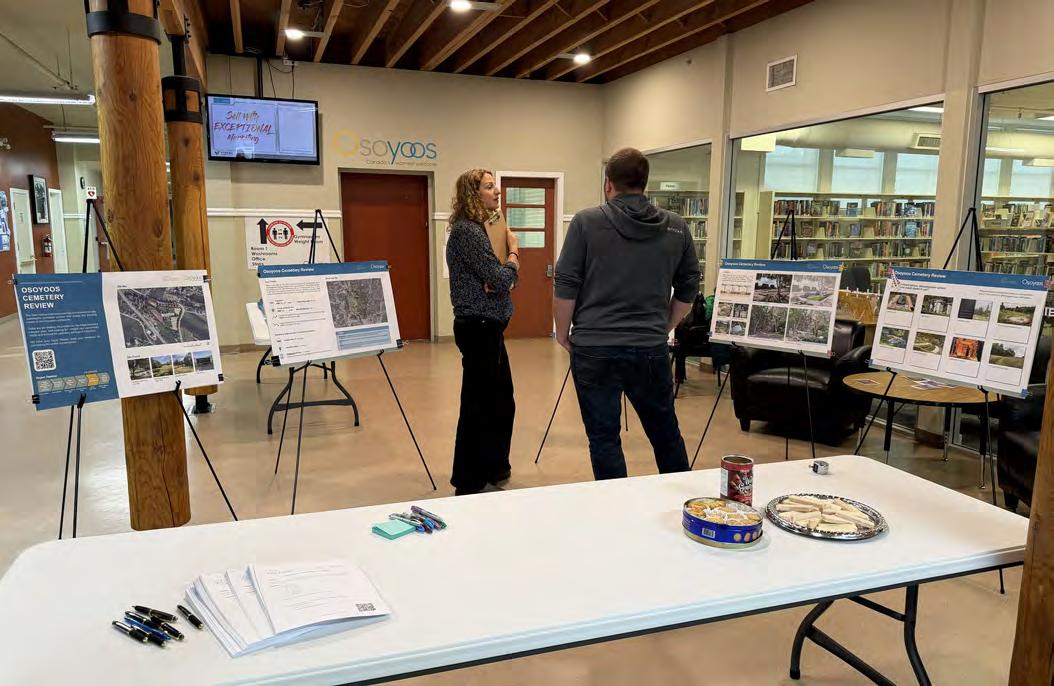
One in-person public open house was held on February 4, 2025. The purpose of the open house was to share information about the project and gather insights into community needs and interest in the initial concept plan for Lakeview Cemetery in Osoyoos. Graphic boards were displayed, and City staff and LEES+Associates representatives were available to answer questions and engage in discussion.
Feedback from the in-person open house indicated a positive overall response to the Town’s project and initial concepts, with participants emphasizing the importance of having a place for families to visit loved ones and uphold traditions in their own community. There was strong interest in environmental and sustainable disposition methods and interment options, and appreciation for the site’s natural setting.
Participants provided feedback on desired amenities and features by placing dots on the Open House boards. In order of interest, the most popular features were green burial and a scattering garden, followed by a memorial wall and pollinator meadows. Additional columbaria, community events, family estate lots, and an outdoor gathering space also received interest.
Figure 22: Public Open House Setup, Source: LEES+Associates.
Conclusion
Overall, the engagement process provided valuable insight into community preferences, priorities, and expectations for Lakeview Cemetery. Feedback from staff, stakeholders, and the broader public highlighted a strong connection to the cemetery as a place of remembrance, while also identifying evolving needs related to cremation, flexible interment options, and environmentally sensitive practices.
Participants consistently emphasized the importance of preserving the cemetery’s natural setting and peaceful character, while supporting modest enhancements to amenities, accessibility, and maintenance. Interest in green burial, scattering options, and additional memorialization choices reflects broader trends and will be important considerations in future planning.
The stakeholder engagement with Nunes-Pottinger Funeral Service and Crematorium revealed that there are requests from the community for other offerings that Lakeview Cemetery does not currently offer, including: upright marker lots, a scattering garden, family plots, and commemoration on a memorial wall for those people that scatter their ashes elsewhere but would like a place for their loved one’s names to be commemorated in the cemetery.
The findings from this engagement process will inform the development of the concept plan and future service offerings, ensuring that Lakeview Cemetery continues to meet the needs of the community while maintaining its valued character.
Chapter 5: Pricing Study and Financial Analysis
Introduction
This chapter includes a review of Lakeview Cemetery’s historic financial performance, assesses its projected trajectory, and determines how the Town could achieve sustainability for its cemetery operations.
Two important performance indicators used to assess the short-term and long-term financial health of a cemetery’s operating model are its proximity to:
• Operating Break-Even Point: The point in time when a cemetery can fund itself while meeting the service expectations of the community. This indicates whether a cemetery can cover its operating costs with its reliable sources of annual revenue.
• Perpetual Care Fund Stability Point: The point in time when a Perpetual Care Fund (PCF) is fully funded and expected to generate enough investment income to meet its long-term site care and maintenance costs.
This chapter concludes with multiple future scenarios for Lakeview Cemetery’s finances. It includes recommendations on how the Town can accelerate its progress toward full operating cost recovery, as well as achieve a fully-funded PCF capable of supporting the ongoing care of the cemetery in perpetuity.
The chapter is organized into four subsections:
• Price Benchmarking
• Historical Operating Fund
• Financial Projections
• Perpetual Care Fund
OBJECTIVES
The primary objectives of the recommendations in this Financial Analysis are to:
• Refine the Town’s financial tracking systems to produce more actionable data for planning and decision-making related to cemetery operations and sustainability.
• Optimize the funding strategy for Lakeview Cemetery’s current operations and future development.
• Provide clear guidance on accelerating the growth of the Perpetual Care Fund (PCF) to support the cemetery’s long-term financial sustainability.
Cemetery Price Benchmarking Study
This section analyzes the prices of Lakeview Cemetery’s primary products and services. It compares them to the offerings in similar neighbouring communities in the region, some of which may compete with the Town of Osoyoos to serve its community members. It also provides context for Canadian cemetery pricing trends and recommends changes based on best practices in the bereavement sector.
Market Trends
Most municipal cemeteries aim to provide families with basic products and efficient services at a competitive price. These offerings meet the average community member’s needs and represent the standard products and services that make up a cemetery’s core inventory. This is referred to as a “cost leadership” business model.
Private and some religious cemeteries use a “differentiation” business model, offering customized and premium services that set them apart from competitors. By addressing specific ethnic, religious, or aesthetic preferences, these cemeteries attract families with unique, high-value options, allowing them to charge higher prices and appeal to those seeking more than just affordability.
Those who pre-purchase their interment spaces often make decisions based on their ethnic and religious needs, as well as the aesthetics and location of a cemetery’s offerings. They are typically willing to visit multiple cemeteries in person to compare their options.
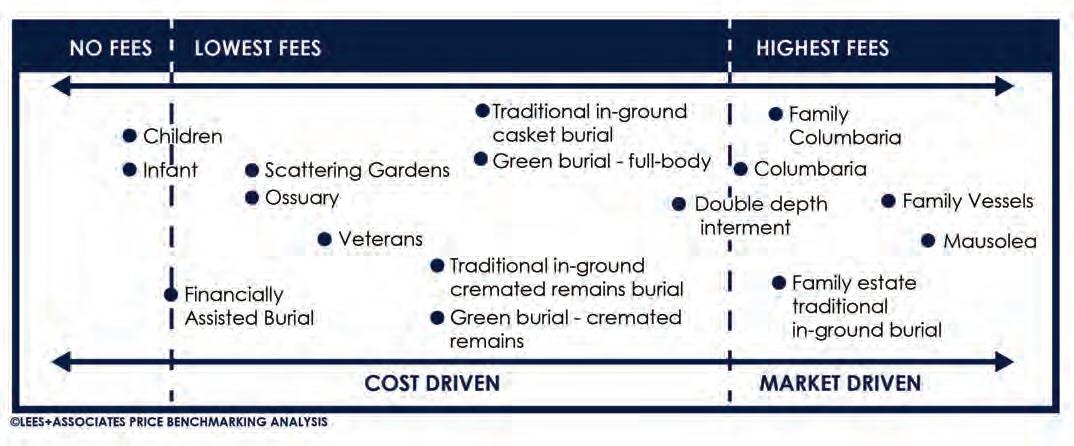
The following figure shows the pricing continuum for typical British Columbia cemetery offerings and which products and services are cost- and marketdriven.
Figure 23: Pricing Continuum for Typical British Columbia Cemetery Offerings, Source: LEES+Associates.
Cemetery and Community Benchmarks
Best practices for cemetery pricing involve comparing product and service rates annually with those of cemeteries with similar demographics, climate conditions, and operations. Cemeteries within a onehour driving radius should be reviewed in particular, as surveys of British Columbia communities show that residents are generally willing to travel up to one hour for cemetery services. This willingness is often due to pricing considerations or the availability of specific products or services that meet their needs.
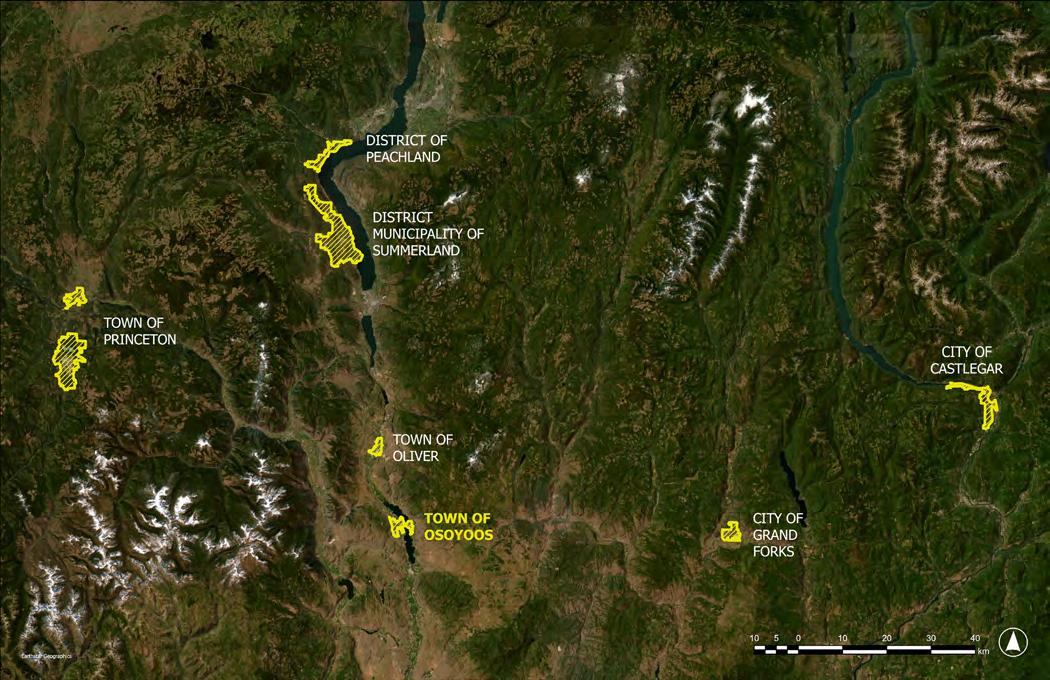
This price benchmarking study includes cemeteries in the communities of Princeton, Oliver, Castlegar, Grand Forks, Peachland, and Summerland.
The quality, size, and attractiveness of the products and services offered by cemetery operators vary, making like-for-like comparisons challenging. This price study represents the current market spectrum of offerings available to community members.
Table 2 compares and summarizes the spectrum of resident rates for the most common offerings available at the cemeteries in this study, including the Perpetual Care Fund (PCF) contribution but excluding applicable taxes.
Appendix B: Detailed Price Benchmarking Study includes a detailed breakdown of the price comparison analysis.
Osoyoos Lakeview Cemetery’s rates are on par with or below the regional rate, and below the maximum rate for most cemetery services and offerings in adjacent communities. With the exception of the Town’s rates for columbaria niches and for its cremation lot interments, which are on par with the maximum rate.
It is best practice for municipalities to set a minimum annual price increase of 2% to counter inflation, as well as an additional 1% to 3% to enhance cost recovery, resulting in a total annual increase of 3% to 5%. Since price changes rarely impact demand for cemetery services, municipalities can confidently raise rates without risking revenue loss, provided the rates stay within the region’s expected range.
To ensure financial sustainability, it is best practice for municipalities to align their rates with the average fair market value for cemetery services. With exceptional demand and a significant cost recovery gap, rates should be set at the higher end of the regional spectrum while maintaining a rate below the maximum amount that other cemeteries charge. This approach aligns with the common municipal philosophy of “individual user payment” and moves cemetery operations towards financial selfsustainability. Many municipal cemeteries prefer this position rather than the whole community paying for a service subsidized by tax dollars in perpetuity.
Annual Price Increase Findings
The Town raises cemetery fees on February 1st of every year based on the Consumer Price Index (CPI). At the time of this analysis, the most recent increase, implemented in February 2025, was 2.6%. The Town has not undertaken a comparative regional rate assessment within the past five years.
As most of the Town’s cemetery rates are currently lower than those of neighbouring communities, Lakeview Cemetery has the opportunity to increase many of its fees beyond the inflation rate in 2026 in order to maintain equitable pricing with other cemeteries and communities in the region.
Appendix B — Detailed Price Benchmarking provides the detailed results of this plan’s cemetery price benchmarking study and includes a summary of the recommended 2026 price increases. These adjustments are intended to align Osoyoos with the regional market while reflecting best practices in cemetery pricing and financial planning.
Non-Resident Pricing
Most British Columbian cemeteries accommodate non-residents if they have available land, often charging a premium above resident rates for lots and niches. Some cemeteries also apply the non-resident premium to interment services. In British Columbia, non-resident premiums typically range from a 25% to 100% mark up on resident rates. This practice ensures long-term financial support for the cemetery, acknowledging that residents support the cemetery maintenance through annual tax contributions. Nonresidents interred in a municipal cemetery typically have not made a comparable contribution.
Surveys show that residents generally support higher fees for non-residents, especially in areas with limited cemetery land.
Cemeteries that charge a non-resident fee typically define a “non-resident” as someone who did not live or own property in the municipality for at least one year before death. Less commonly, some communities choose to extend the residency or property ownership period, requiring five or ten years of local residence. This longer period enables former residents to return to the community and pay the same rate as current residents. The term “nonresident” should be clearly defined in the Cemetery Bylaw.
Non-Resident Pricing Findings
The Town’s Cemetery Bylaw 1337, 2017 defines residents and non-residents based on continuous residency or property ownership in Osoyoos during the six months prior to purchasing interment rights.
Currently, the Town does not apply a non-resident premium at Lakeview Cemetery, and sales and interment services are not tracked by resident versus non-resident status.
In comparison, most benchmarking communities apply a non-resident premium between 33% and 55%, with the Town of Princeton notably applying a significantly higher premium of over 500%.
Introducing a non-resident premium of approximately 50% and tracking non-resident use of cemetery services would provide the Town with better insights into land use and revenue impacts.
Dedicated Group Pricing Discounts
Some communities have specific pricing policies that offer free service or a discounted rate to select residents. This commonly includes discounted rates for:
• Infants
• Children
• Veterans
Dedicated Group Pricing Discount Findings
The Town and all benchmark communities, except the Town of Princeton, currently offer discounted rates for interment rights and opening/closing services for infants and children. None provide discounted rates for veterans, although the City of Castlegar offers a reduced rate for the interment of a veteran’s cremated remains in an ossuary.
The Town maintains a dedicated Legion section for veterans. As a gesture of recognition and community support, the Town may wish to consider offering discounted rates to veterans who choose interment within this section.
These dedicated groups typically represent a small proportion of the community members served by municipal cemeteries. Offering discounted rates to members of these groups is not expected to significantly affect the financial sustainability of a cemetery’s operations.
COST RECOVERY
Most municipal cemeteries are run as a service to their communities, and these municipalities support their cemetery system, subsidizing them with tax dollars to some degree. The Town will need to decide where its business model sits on this spectrum of cost recovery. Currently, few municipal cemeteries operate a full breakeven cost recovery model. It is even more unusual for a municipal cemetery to operate a “for-profit” model.
KEY FINDINGS PRICE BENCHMARKING
Pricing
• Osoyoos Lakeview Cemetery’s rates are on par with or below the regional average rate, and below the maximum rate for most cemetery services and offerings in the benchmarking communities.
Annual Price Increases
• The Town raises the cemetery fees on February 1st of every year by the Consumer Price Index (CPI) rate. The last increase in February 2025 was 2.6%. The Town has not undertaken a comparative regional rate assessment within the past five years.
Dedicated Group Pricing Discounts
• The Town offers discounted rates for infant and child burials, but it does not currently provide reduced rates for veterans.
RECOMMENDATIONS PRICE BENCHMARKING
Benchmarking Study
• Plan to re-examine the position of Lakeview Cemetery’s prices relative to cemeteries in adjacent communities every five years to determine whether the Town’s rates remained aligned with its neighbours.
Non-Resident Tracking
• Introduce a non-resident premium of 50% on all inventory and sales to non-residents.
• Consider increasing the term limit for residency listed in the Bylaw from six months to one year.
• Tracking non-resident cemetery usage to better understand its revenue impact and support more informed, data-driven financial planning.
Dedicated Group Pricing
• Consider adding a 50% veterans discount for lots and interment services in the Legion section.
RECOMMENDATIONS PRICE BENCHMARKING
Pricing Increases
• Continue to increase cemetery rates each year by the Consumer Price Index (CPI) rate to offset inflation (a minimum of 2% per year).
• Implement a one-time increase to the Lakeview Cemetery’s prices in 2026 to better align the Town’s cemetery fees with the current price range for cemetery services and offerings in the region.
• The Town should be prepared to justify cemetery price increases that exceed the rate of inflation. The Town should proactively communicate the rationale behind pricing adjustments to community members and key stakeholders, such as funeral homes, by clearly outlining and explaining:
◦ The gap between the cemetery system’s operating revenues and expenses.
◦ The actual cost to deliver services compared to the current listed prices.
◦ How Osoyoos Lakeview Cemetery’s rates compare to those of neighbouring cemeteries.
◦ The current balance of the Perpetual Care Fund (PCF) and the future balance required to adequately fund long-term site maintenance and care.
◦ The Town’s commitment to develop and improve the cemetery’s infrastructure, aesthetics, and interment offerings.
• The table below outlines key recommended price increases. A full list of services and proposed price increases is provided in Appendix C: Recommended 2026 Price List.
This Historical Operating Fund overview analyzes Lakeview Cemetery’s past financial performance, including revenue streams, expenditures, and trends. Examining these factors helps identify patterns to guide future financial planning and sustainability strategies.
The following graph summarizes the historic operating financial performance of Lakeview Cemetery by calendar year, as reported by Town staff, from 2020 to 2024.
$66,000
$56,000
$46,000
$36,000
$26,000
$16,000
$6,000
-$4,000
-$14,000
TERMS
Total Revenue includes the gross revenue earned before contributions to the Town’s PCF, as well as funding from Regional District Contributions and Federal Grants.
Operating Revenue includes the net sales and service revenue earned after contributions to the Town’s PCF.
Operating Expense includes all costs directly attributable to cemetery operations, that are reported in the Town’s cemetery accounts.
Figure 25: Osoyoos Lakeview Cemetery’s Historic Operating Financials, Source: Town of Osoyoos Financial Records.
Cemetery Revenue Analysis
The following graph summarizes the operating revenue at Lakeview Cemetery over the past five years.
Cremation Lot Sales
Cremation Interments
Casket Interments
Other Services
Other Sales
Casket Lot Sales
Grant Revenue
PCF Interest
Drivers of Cemetery Revenue Growth
Pre-Need Sales
Pre-need sales play a vital role in a cemetery’s financial health, supporting both immediate cash flow and long-term sustainability. These advance purchases allow for earlier contributions to the Perpetual Care Fund (PCF), which benefit from greater compound growth than at-need sales.
Historically, the Town has not tracked at-need versus pre-need sales revenue data in its accounting system, although this information is recorded in its interment and sales records.
Over the past five years (2020-2024), 13% of casket lot sales, 16% of cremation lot sales, and 41% of columbaria niche sales were pre-need.
There is less than five years of cremation lot sales and less than three years of columbaria niche sales remaining. This low inventory will make it challenging for the Town to continue to offer pre-need sales, unless new inventory is added in the next few years. A reduction in pre-need sales would significantly decrease the Cemetery’s annual revenue.
Marketing
Marketing is important for long-term revenue growth. Most BC cemeteries spend 1% to 5% of their annual revenue on promotion and community outreach, recognizing that public awareness supports stronger sales. The Town has not historically set aside a budget or staff time for cemetery promotion, such as advertising, a website, or community events.
Revenue Records Management
Clear financial reporting is essential for effective cemetery management. Best practices include tracking revenue by interment type (e.g., casket, cremation, niche), time of sale (pre-need or atneed), and purchaser residency. This helps identify trends, forecast revenue, and plan inventory based on community preferences.
Currently the Town tracks revenue by larger categories such as liners sold, opening and closing, memorials, and sale of lots. The Town could expand its categories to include more detailed accounts.
Creating a more detailed account structure and introducing tracking codes for interment type, sale timing, and residency would allow staff to better track trends in community member preferences and the impact of non-resident demand on the cemetery’s operations and financial performance.
Figure 26: Osoyoos Lakeview Cemetery’s Revenue Sources, Source: Town of Osoyoos Financial Records.
Cemetery Expense Analysis
The following graph summarizes the expense sources at Lakeview Cemetery over the past five years.
Operating Costs
Operating costs vary widely depending on the size of the active area, visitor activity, staff expertise, and the cemetery’s landscape characteristics.
Large urban cemeteries and older, fully developed sites ranging from 30 to 50 acres typically cost between $1 million and $2 million annually to operate. In contrast, smaller rural and municipal cemeteries between five and 30 acres generally operate on annual budgets ranging from $100,000 to $500,000.
Osoyoos Lakeview Cemetery operates on 3 acres, and has averaged $44,000 per year in operating costs, equating to approximately $14,700 per acre of active land. This places it below average for the expected cost range for a municipal cemetery of its size.
There may be efficiencies to be gained and cost savings to be found by streamlining the cemetery’s processes and introducing new technology (such as robotic lawn mowers) into its operations.
The Town would also benefit from enhanced tracking and more comprehensive reporting of the time and resources staff spend on tasks. This additional information would enable staff to do a comparative cost analysis of the different elements of its cemetery’s operations.
Figure 27: Osoyoos Lakeview Cemetery’s Expense Sources, Source: Town of Osoyoos Financial Records.
Operational Cost Tracking
There may be opportunities to further improve efficiency and reduce costs through streamlined processes and the integration of new technologies. The Town would also benefit from enhanced tracking and reporting of staff time and resource use, which could support comparative cost analysis across different aspects of cemetery operations.
The best practice for tracking time, resources, and expenses at municipal cemeteries includes creating distinct account groups or cost centres for the following three categories:
• Operational Overhead
• Service Delivery
• Care and Maintenance
While the Town currently tracks expenses using broad cost categories, it would benefit from expanding its accounts to include more detailed expense classifications. This would support more precise cost tracking and improved financial analysis.
It is especially important for a cemetery to track care and maintenance costs separately from all other operating expenses. This makes it easier for staff to extract and analyze the value of a site’s care and maintenance expenses, which can then be compared to the revenue generated by its PCF.
This number can be used to determine how close it is to its PCF stability point – the point at which the fund is deemed to be large enough to generate enough income to fully cover the cemetery’s ongoing care and maintenance costs in perpetuity.
Municipalities across Canada typically spend between 50% and 70% of their cemeteries’ operating budget on site care and maintenance. It is estimated that 45% of Osoyoos Lakeview Cemetery’s operating costs are related to site care and maintenance. This is below what we would expect for a municipal cemetery of this size.
The Town has an opportunity to enhance the value of its financial reports by creating distinct cost centers, and grouping its expense accounts by these three categories to better track the expenses attributed to each key aspect of the cemetery operations.
This refined account structure would provide the Town with a more accurate picture of the ongoing cost of care that its PCF will be needed to support. This will improve the accuracy of its future financial projections and sustainability assessments of its cemetery’s PCF.
KEY FINDINGS HISTORICAL OPERATING FUND OVERVIEW
Historic Operating Financials
From 2020 to 2024, Osoyoos Lakeview Cemetery:
• Earned an average of $44,500 per year in operating revenue.
• Increased its revenue by an average of 14% per year.
• Earned an average of $7,000 per year in non-operating revenue, primarily from Perpetual Care Fund income, as well as regional government grants and support operations.
• Spent an average of $44,000 per year in operating costs.
• Cemetery expenses increased by an average of 6% per year.
• Reported an average net income of $7,500 per year.
• The cemetery has recorded a positive, total net income every year during this period, except in 2023.
Operating Cost Recovery
• Over the past five years, Osoyoos Lakeview Cemetery has typically exceeded break-even, recording an average net income of $7,500 per year.
• Osoyoos Lakeview Cemetery’s operating financials are expected to maintain above break-even over the next 50 years.
• Osoyoos Lakeview Cemetery’s PCF is on a current trajectory to fund and self sustain a minimum level of site care by 2058. To maintain the cemetery at its current level of care, the PCF will need to grow further, requiring an additional contribution of $5,000 per year until 2066.
RECOMMENDATIONS HISTORICAL OPERATING FUND
OVERVIEW
Revenue Records Management
• Add new accounts and account groups to track all sales and service revenue by intermenttype (casket lot, cremation lot, niche, etc.), the time-of-sale (at-need/preneed), and residency of the community member.
Operating Cost Tracking
• Implement enhanced tracking of staff time and resource use to enable comparative cost analysis and improve operational oversight.
• Establish a standardized cost centre structure in the Town’s financial system by organizing expenses into three key categories, including Operational Overhead, Service Delivery, and Care and Maintenance.
• Track care and maintenance expenses separately to evaluate long-term site obligations and ensure the Perpetual Care Fund (PCF) remains adequate to meet future needs.
• Improve financial reporting by aligning expense accounts with cost categories to support more accurate forecasting and sustainability assessments.
Operating Financials Projection : Status Quo
The projection in this section provides an analysis of Lakeview Cemetery’s future financial performance under status quo conditions, in which the Town’s practices and operating patterns continue unchanged.
On the revenue side of the equation, projections are related to the number of families who choose to be interred in the Town’s cemetery and the adjusted price of its offerings. On the expense side of the equation, costs are primarily related to inflation.
The primary drivers of revenue growth in this scenario are the annual price changes, as well as the population patterns, death rate, disposition and interment trends expected over the next 25 years. The Town’s projected population growth and increasing death rate (due to the upcoming passing of the Baby Boomer generation) is expected to boost the cemetery’s revenue in the future.
This scenario does not include projections for new revenue streams adopted by the Town, extraordinary operating costs, or expenditures for developing new land or updating its supporting infrastructure. Introducing new offerings could attract more residents to the cemetery. This and other initiatives implemented to make the Town’s site and services more attractive could materially change the future market capture rate and amount of revenue earned by the cemetery.
ASSUMPTIONS
Assumptions to this scenario:
• Revenue Sources: No new products, services, or funding sources will be added to the cemetery.
• Operational Costs: Expenses will increase by the annual rate of inflation, which has historically averaged 2% over the past two decades.
• Pricing Changes: Prices will increase annually at the rate of inflation, by an average of 2% per year in the long term, to offset the anticipated increase in expenses due to inflation.
• Market Demand: Population growth and an increasing death rate are expected to increase the Town’s future cemetery revenue. Forecast disposition, interment, and sales trends will shift the proportion of demand from casket to cremation-related offerings in the future.
• Market Capture: The proportion of Lakeview Cemetery’s market area served will not change.
• Land Development: The Town will develop additional inventory by developing more cemetery land to continue serving its residents for the next 50 years.
The following graph summarizes the projected operating financial performance of Lakeview Cemetery over the next 50 years, under status quo operating conditions.
$300,000
$250,000
$200,000
$150,000
$100,000
$50,000
$0
28: Osoyoos Lakeview Cemetery Operating Financial Forecast Status Quo Scenario, Source: LEES+Associates.
Figure
KEY FINDINGS FINANCIAL PROJECTIONS
Operating Financials
• Lakeview Cemetery’s revenue is expected to grow as aging Baby Boomers increase regional mortality rates, driving future demand and strengthening long-term financial sustainability.
• The cemetery’s net income is expected to remain positive and above break even.
• The trend towards cremation among community members has been slowing in the Town of Osoyoos and its impact on the cemetery’s revenue is expected to stabilize over the next 10 years.
RECOMMENDATIONS FINANCIAL PROJECTIONS
Operating Financials
There are opportunities to grow the cemetery’s revenue further. Additional income could contribute to covering the Town’s future capital costs for new land expansion and development. New measures could include:
• Increasing the available interment inventory.
• Implementing a one-time increase in 2026 (see Appendix B: Recommended 2026 Price List) to ensure the cemetery’s key rates better align with the current regional market value for cemetery services and offerings.
• Attracting more community members to the cemetery by:
◦ Investing in the promotion of the site’s offerings, heritage features, and public events at the cemetery to increase community engagement.
◦ Diversifying the cemetery’s services and offerings further in a way that appeals to community member’s preferences, values, religious and ethnic traditions.
• Encouraging early planning and purchasing by:
◦ Developing a proactive marketing and sales strategy.
◦ Partnering with service providers and organizations to raise awareness. This could include funeral homes, senior housing groups, estate planners, historical and genealogical societies, and local schools.
• Reducing operating costs by:
◦ Analyzing and improving processes, staffing, and resourcing. This includes assessing the budget, tools, and equipment available to the cemetery.
RECOMMENDATIONS FINANCIAL PROJECTIONS
Records Management
• Group all cemetery expense accounts by three cost centres: Administration, Service Delivery, and Care and Maintenance.
• Reviewing and documenting the Town’s cost allocation practices. Ensure that all staff time and other direct costs of operations related to the cemetery is recorded in the Town’s cemetery expense accounts. These allocations should be supported by timesheet and transaction records.
• Identifying and introducing new tools, technology, and practices that could improve efficiency and reduce costs.
Perpetual Care Fund (PCF)
The obligation to maintain a cemetery begins at its establishment, continues through its active revenuegenerating period, and extends long after it no longer produces income.
Contribution Rates
Provincial Requirements:
Perpetual Care Funds are designed to ensure the cemetery’s ongoing maintenance, repair, and preservation, keeping it in good condition indefinitely without relying on future sales or additional funding.
• 25% of the price of a right of interment for casket burial or in-ground cremation burial.
• 10% of the price of a right of interment in columbaria or mausoleum.
• $10 for each memorial installed.
• Appendix D outlines the provincial legislation regarding care and maintenance fund requirements for cemetery sales contributions in British Columbia.
Best Practices
• Contribute more than the minimum required. Higher contributions strengthen long-term financial stability and help ensure the cemetery can be maintained for future generations.
Investment Income
Provincial Requirements:
• Funds must be held in a trust.
• The principal must remain untouched, only the interest or investment income can be used for maintenance.
• The interest of dividend earning form a PCF can only be used to cover the cost of maintaining the cemetery.
Best Practices:
• Funds are invested with specialized financial organizations, such as Guaranteed Funeral Deposits and Funeral Services. The invested PCF principal earns returns through interest or dividends. Typical returns: 1% - 5% per year.
• A municipal cemetery’s PCF should generate income annually and retain it until the fund is materially funded, meaning it can cover at least 75% of annual care and maintenance costs. Retaining earnings allows the fund to grow faster through compound interest.
• Do not withdraw from the PCF for major projects. Instead, establish a Cemetery Development Fund to cover capital expenses like infrastructure upgrades and site improvements.
Maintenance Cost Coverage
Best Practices:
• To be sustainable, a cemetery’s PCF must generate enough income to cover future maintenance after lot sales end.
• Standard planning assumes maintenance costs drop to 50% when inactive, but best practice is to fund a higher level of care with a buffer for unexpected expenses.
• Many municipalities maintain inactive cemeteries to park standards, supporting community use and heritage preservation.
Contribution Rates
The Town is currently following the required contributions rates mandated by Provincial legislation. Like the Town of Osoyoos, the majority of communities in British Columbia (BC) contribute only the mandatory minimum amounts.
There is an increasing number of communities in BC who are proactively contributing above the provincial minimum to their PCF. They are commonly adding 35% to 40% of plot sales, 20% to 30% of columbaria and 10% to 20% of mausolea sales.
These communities have determined that the mandatory minimums are insufficient to grow the PCF to a level that can reliably generate the income required to maintain their cemetery to an appropriate standard of care over the long term.
Investment Income and Withdrawls
The Town’s PCF earned an annual interest rate of 3.6% per year, from 2020 to 2024. This rate is on par with the average rate of returns from a PCF typically received by municipal cemetery operators in Canada during this period.
The Town has not historically withdrawn money from its PCF. The exception is in 2023, when $4,000 was withdrawn to pay for extraordinary irrigation maintenance work that was completed early in 2025, with materials bought late in 2024.
Maintenance Cost Coverage
The Town’s care and maintenance costs currently exceed the value of the annual income currently earned by the PCF. From 2020 to 2024 The Town recorded an average $19,800 per year in cemetery care and maintenance cost and the PCF’s investment income averaged $3,200 per year. This is 16% of the cemetery’s average care and maintenance costs during this period.
Maintenance needs typically decline once a cemetery becomes inactive, as visitation and community expectations for site care decrease. As a result, future maintenance costs are expected to fall in proportion to reduced use. At a minimum, the Town should continue to maintain the cemetery to a standard that ensures public safety, accessibility, and an appearance that upholds the dignity of the site and honours those interred.
PCF Financial Records Management
Detailed and documented information regarding the Town’s PCF activity, processes, and management practices were not readily accessible at the start of this study. Availability of accurate PCF performance reports and documented practices was limited, highlighting an opportunity to develop more comprehensive documentation and reporting to support future planning and decision-making.
Following some initial difficulty, the data for the cemetery’s PCF analysis was provided through a review of the Town’s account data, transaction records, and bank statements. The review identified areas where standard PCF practices could be more consistently applied and where contributions to the PCF were not fully aligned with the Town’s statutory requirements.
The Town would benefit from strengthening records management of its PCF by documenting financial methodology, practices, and standard journal entries related to the Town’s PCF.
The Town requires an annual internal audit to fully reconcile its PCF related transactions and investment activity, as well as identify and document any unusual transactions (such as the 2024 withdrawal used to fund irrigation maintenance).
These measures will help to improve the accuracy and transparency in the Town’s financial reporting and allow it to more effectively monitor the performance and more accurately measure the trajectory of its PCF growth in the future.
PCF Historical Performance
The following table lists all the elements that contributed to the Town’s Perpetual Care Fund balance from 2020 to 2024.
1 The Town has not yet deposited its cemetery sales contributions for 2023 and 2024 into the PCF. Staff are aware of this and plan to complete the required deposits in 2025.
The following graph provides a general summary of the historic performance of the Town’s PCF from 2020 to 2024. In this graph, the Perpetual Care Fund’s historic end balance aligns with the left vertical axis. The Perpetual Care Fund’s investment income and maintenance costs align with the right vertical.
It is important for the Town to prioritize reducing the Income-Cost gap. This is the difference between the investment income earned by its PCF and the expected cost to maintain the site, at the level of care the Town designates for its cemetery site after it becomes inactive.
Figure 29: Osoyoos Lakeview Cemetery PCF Activity 2020 - 2024, Source: Town of Osoyoos Finance Department.
Table 4: The Town’s Perpetual Care Fund Activity from 2020 to 2024, Source: Town of Osoyoos Finance Department.
PCF Projection 1: Status Quo
In this section, we continue with the analysis of the Status Quo scenario for the cemetery over the next 50 years, specifically examining its impact on Lakeview Cemetery’s PCF.
ASSUMPTIONS
Assumptions that apply to both scenarios:
• Revenue Sources: No new products, services, or funding sources will be added to the cemetery.
• Operational Costs: Expenses will increase by the annual rate of inflation, which has historically averaged 2% over the past two decades.
• Pricing Changes: Prices will increase annually at the rate of inflation, by an average of 2% per year in the long term, to offset the anticipated increase in expenses due to inflation.
• Market Demand: Population growth and an increasing death rate are expected to increase the Town’s future cemetery revenue. Forecast disposition, interment, and sales trends will shift the proportion of demand from casket to cremation-related offerings in the future.
• Market Capture: The proportion of Lakeview Cemetery’s market area served will not change.
• Land Development: The Town will develop additional inventory by developing more cemetery land to continue serving its residents for the next 50 years.
• Sales Contribution: Historic sales contribution will continue, as was historically done over the past 5 years.
• Perpetual Care Fund Interest: Historic PCF interest rates will continue, as was historically earned over the past 5 years.
• Perpetual Care Fund Withdrawal: The Town will not withdraw any funds from its PCF over the next 50 years, leaving it in the PCF to compound over time.
The following graph summarizes the projected position of the Town’s PCF over the next 50 years under this status quo scenario. In this graph, the projected PCF end balance aligns with the left vertical axis. The projected investment income and maintenance costs align with the right vertical axis.
$1,400,000
$1,200,000
$1,000,000
$800,000
$600,000
$400,000
$200,000
Figure 30: Osoyoos Lakeview Cemetery’s 50 Year PCF Projection 1 - Status Quo Scenario, Source: LEES+Associates.
This is a long-term snapshot of the PCF status. In this scenario, it is assumed the Town will continue to develop additional land and serve the community well beyond the next 50 years. However, 50 years is considered to be the maximum period of projection for a PCF analysis with a reasonable degree of precision. Projecting further into the future is significantly less certain.
In 50 years, the PCF is projected to reach a balance of $1,153,000 and generate investment income of $41,500 per year. By comparison, the current site care costs (amplified 3% per year by inflation), are expected to increase to $52,400 per year during the same period.
In the scenario, the PCF is projected to generate enough interest income to cover 80% of costs at its current level of care by 2074.
The Town’s PCF is forecast to be able to self-sustain and substantially support the cemetery at its minimum level of care within 33 years, by 2058.
PCF Projection 2: Fully Funded
In this section, we continue with the analysis of the Cost Recovery scenario for the cemetery over the next 50 years, specifically examining its impact on Osoyoos Lakeview Cemetery’s PCF.
ASSUMPTIONS
Assumptions that apply to both scenarios:
• Revenue Sources: No new products, services, or funding sources will be added to the cemetery.
• Operational Costs: Expenses will increase by the annual rate of inflation, which has historically averaged 2% over the past two decades.
• Pricing Changes: Prices will increase annually at the rate of inflation, by an average of 2% per year in the long term, to offset the anticipated increase in expenses due to inflation.
• Market Demand: Population growth and an increasing death rate are expected to increase the Town’s future cemetery revenue. Forecast disposition, interment, and sales trends will shift the proportion of demand from casket to cremation-related offerings in the future.
• Market Capture: The proportion of Lakeview Cemetery’s market area served will not change.
• Land Development: The Town will develop additional inventory by developing more cemetery land to continue serving its residents for the next 50 years.
• Sales Contribution: Historic sales contribution will continue, as was historically done over the past 5 years.
• Perpetual Care Fund Interest: Historic PCF interest rates will continue, as was historically earned over the past 5 years.
• Perpetual Care Fund Withdrawal: The Town will not withdraw any funds from its PCF over the next 50 years, leaving it in the PCF to compound over time.
Assumptions apply to Scenario 2 - Fully Funded:
• Pricing Changes: There will be a one-time increase in 2026 (Appendix C: Recommended 2026 Price List) to align the Osoyoos Lakeview Cemetery rates with the region’s market rates.
• PCF Contribution: There will be an extraordinary contribution of $5,000 per year to the PCF’s principal, in addition to the legislative mandated annual sales contributions.
The following graph summarizes the projected position of Lakeview Cemetery’s PCF over the next 50 years under this faster cost recovery scenario. In this graph, the projected PCF end balance aligns with the left vertical axis. The projected investment income and maintenance costs align with the right vertical axis.
Minimum Level of Care Covered by 2044 Current Level of Care Covered by 2066
Figure 31: Osoyoos Lakeview Cemetery’s 50 Year PCF Projection 2 - Towards Cost Recovery Scenario, Source: LEES+Associates.
In 50 years, the PCF is projected to reach a balance of $1,853,000 and generate investment income of $66,700 per year. By comparison, the current site care costs (amplified 3% per year by inflation), are expected to increase to $52,400 per year during the same period.
In this alternate scenario, the Town’s PCF is forecast to be able to self-sustain and substantially support the cemetery at a minimum level of care within 20 years, by 2044.
In addition, the Town’s PCF is forecast to be able to self-sustain and substantially support the cemetery at its current level of care within 40 years, by 2066.
A phased succession management approach is recommended for the cemetery’s older dry sections, outlined in Chapter 6: Concept Plan. This strategy involves gradually transitioning these areas from hardscape conditions to low-maintenance, drought-tolerant planting, while undertaking selective removal of concrete covers or vaults, restoration of monuments, and ongoing monitoring to ensure long-term stability. Work would be implemented incrementally, with reasonable efforts made to review records and notify families in advance, minimizing disruption.
To support this initiative, it is recommended that an additional annual allocation of $5,000 be incorporated into care and maintenance costs.
Changes to the PCF projection under this scenario include:
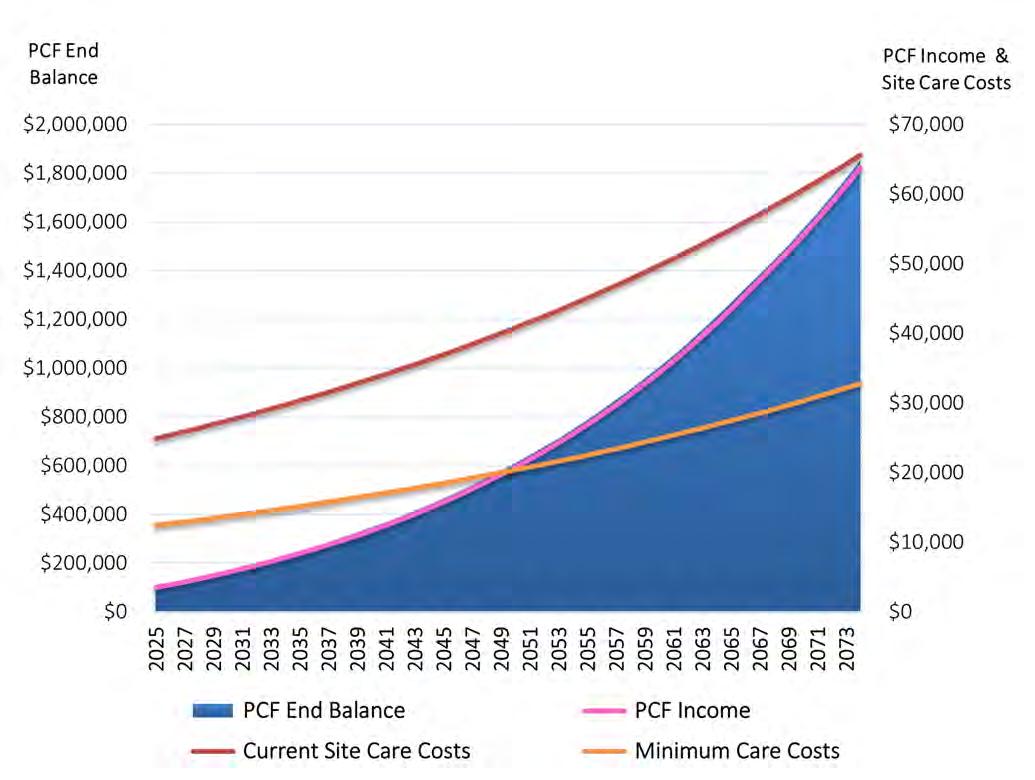
• Minimum Care Cost coverage is achieved by approximately 2050 (within 25 years);
• Current Care Cost coverage reaches 97% coverage within 50 years, and
• 100% Current Care Cost coverage projected at approximately 52-53 years.
This contribution is recommended to fund incremental improvements over time, supporting enhanced safety, improved aesthetics, and reduced long-term maintenance demands.
Figure 32: Osoyoos Lakeview Cemetery’s 50 Year PCF Projection 2 - Cost Recovery Scenario with the inclusion of contributions for phased dry section succession management, Source: LEES+Associates.
KEY FINDINGS PERPETUAL CARE FUND
Perpetual Care Fund
• The Town’s PCF is forecast to be able to self-sustain and substantially support the cemetery at its minimum level of care within 33 years, by 2058.
• With a one time price increase and an extraordinary contribution of $5,000 per year, in addition to the legislative mandated annual sales, the Town can expect:
◦ Minimum level of care within the next 20 years, by 2044.
◦ Current level of care within the next 40 years, by 2066.
RECOMMENDATIONS FINANCIAL PROJECTIONS AND PCF FUND
Perpetual Care Fund
• Each year compare the care and maintenance cost centre balance to the PCF’s income annually, to track and monitor the growth in the PCF’s cost coverage.
• Review and document the Town’s PCF investment and accounting practices, and process flows.
• Create an annual report, for reconciliation, and review of the Town’s PCF related transactions.
◦ This should include a calculation of the cemetery’s annual sales contributions, their date of deposit, a summary of the income earned by the PCF, and detailed information on any extraordinary withdrawals made from the PCF.
• Accelerate PCF growth further by making an additional minimum contribution of $5,000 per year to the PCF’s principal. This could come from an increase in the percentage of its annual sales contributions (reducing the cemetery’s annual net income) or from another Town revenue source outside of its cemetery operations.
• Contribute an additional annual allocation of $5,000 into care and maintenance costs to fund a phased succession management approach for the cemetery’s older dry sections to improve their safety, aesthetics, and long-term maintenance.
• Revisit this Financial Plan in five years to evaluate community members’ response to the new prices, new offerings, and the results of other changes implemented as a result of this report.
Conclusion
Osoyoos Lakeview Cemetery’s financial performance is stronger than similar-sized cemeteries across British Columbia. Over the past five years, the Town has covered all reported cemetery operating costs with its cemetery sales and service revenue, supplemented by a minimal amount of government grants amounting to $4,000 per year.
Most municipalities in Canada run their cemeteries at an operating loss and support their operations, to some extent, with tax dollars. Municipal cemetery sales and service revenue rarely fully cover a municipal cemetery’s operating costs – much less its capital expenditures. Capital cemetery infrastructure and land development costs are almost always supported by a municipalities’ property or other tax revenues.
Most of the municipalities that LEES+Associates has assessed over the past decade prioritize supporting their cemeteries as a community service to residents. They also strive to improve the financial performance of their operations to move towards break-even and eventually fully cover their operating costs. The main objective with this strategy is to steadily reduce the demand on the community tax base.
Demographic trends in the Town’s cemetery market are providing strong momentum and demand for its services. This has the potential to accelerate the cemetery’s revenue growth, provided that the Town responds quickly to growing community demand for new inventory by developing its land and installing new interment and memorial spaces at Lakeview Cemetery.
Lakeview Cemetery’s greatest short-term financial challenge is its limited remaining inventory available for sale. This constrains the Town’s ability to fulfill potential pre-need sales demand in the community and maximize the value of its cemetery land. Therefore, it will need to prioitize future cemetery land development in order to maintain its short-term financial sustainability.
In addition, the Town would benefit from improvements to its chart of accounts structure, cemetery revenue and expense records, and financial management systems. The proposed initiatives in this report will help to increase the accuracy and transparency of the Town’s data, as well as enhance the usability of the Town’s cemetery financial reports.
These improvements are expected to save staff time in retrieving information, facilitate better service to the community, and improve decision-making for future cemetery site development.
In addition to its robust short-term financial performance, Osoyoos Lakeview Cemetery’s is on a good trajectory for long-term financial sustainability. The Town’s PCF has maintained strong, steady growth and is expected to be able to self-fund the cemetery’s maintenance costs at 80% of its current level of care within the next 50 years. The Town only needs to invest approximately another $5,000 per year to ensure Lakeview Cemetery will be fully selfsustainable with respect to site care in perpetuity. This is exceptional compared with other cemeteries across Canada.
Osoyoos Lakeview Cemetery’s greatest long-term financial challenge will be ensuring the completeness and accuracy of its PCF performance data and its site care costs. Improving the Town’s tracking and reporting of this data will be necessary to effectively manage the expected growth in the cemetery’s care and maintenance costs and to ensure that the PCF growth keeps pace. To that end, it will be important for the Town to revisit this analysis every five years to ensure that its PCF remains on target to achieve full cost coverage before the cemetery sells its last grave.
Improvements in these areas will provide Town staff with more timely information in comprehensive reports that can guide planning, budgeting, investing, and land development decisions. These measures will help the Town to “course correct” in a timely manner when needed and ensure Lakeview Cemetery maintains its current trajectory towards short- and long-term financial sustainability.
Chapter 6: Concept Plan
Design Principles
The following Design Principles were developed to guide the cemetery concept plan. These principles were informed by staff, stakeholder, and community engagement, as well as site analysis and project objectives.
• Protect and preserve the cemetery’s peaceful and natural setting.
• Improve the access, wayfinding, and circulation of both pedestrians and vehicles.
• Expand the interment capacity and increase the interment and memorialization options.
• Prioritize environmentally sensitive practices including land conservation, improving ecological habitat, and xeriscaping.
• Enhance safety, appearance, and long-term maintenance in the cemetery’s older sections.
• Enhance and refresh the cemetery’s perimeter and entrances to improve overall appearance and presence.
Concept Plan
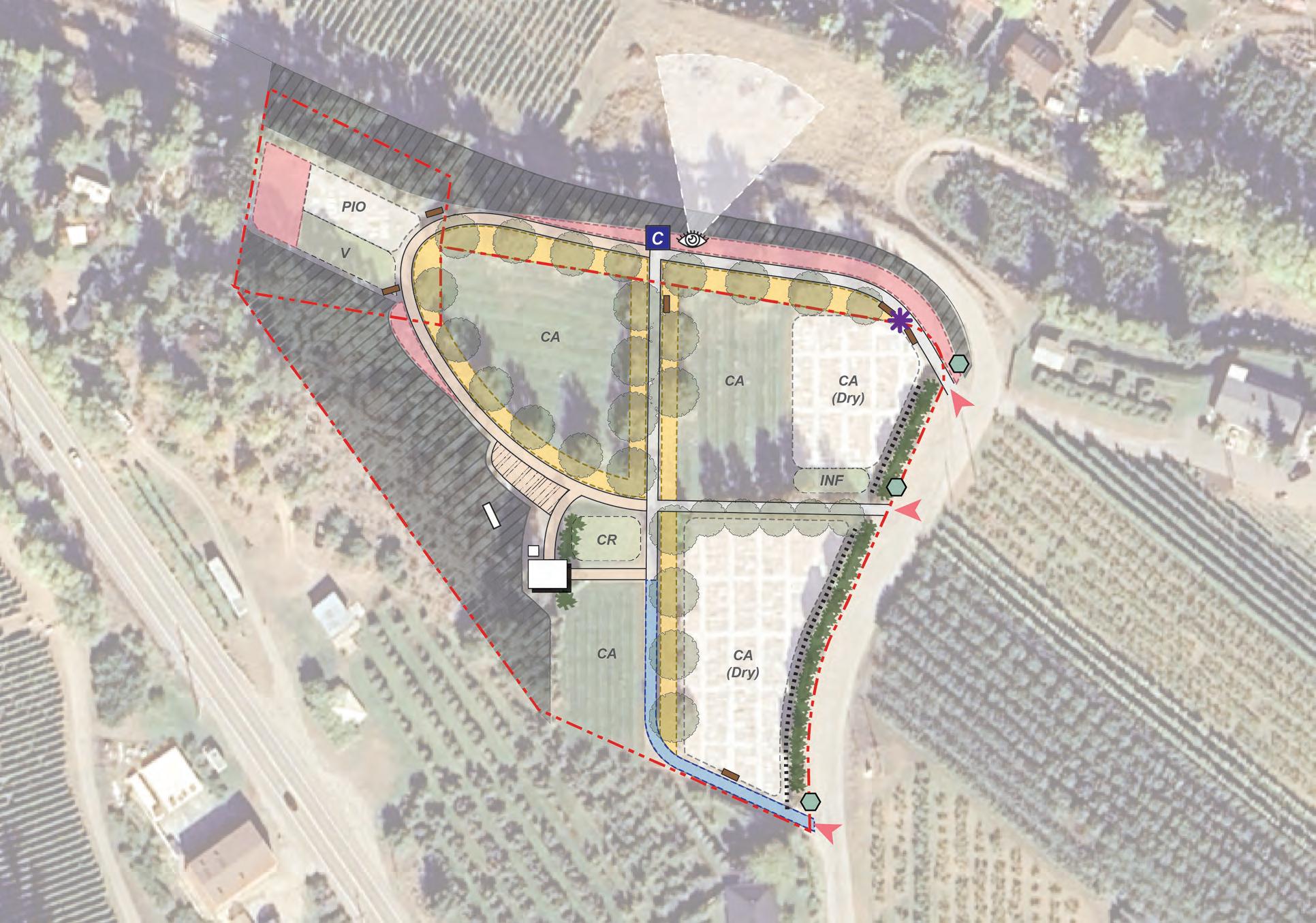
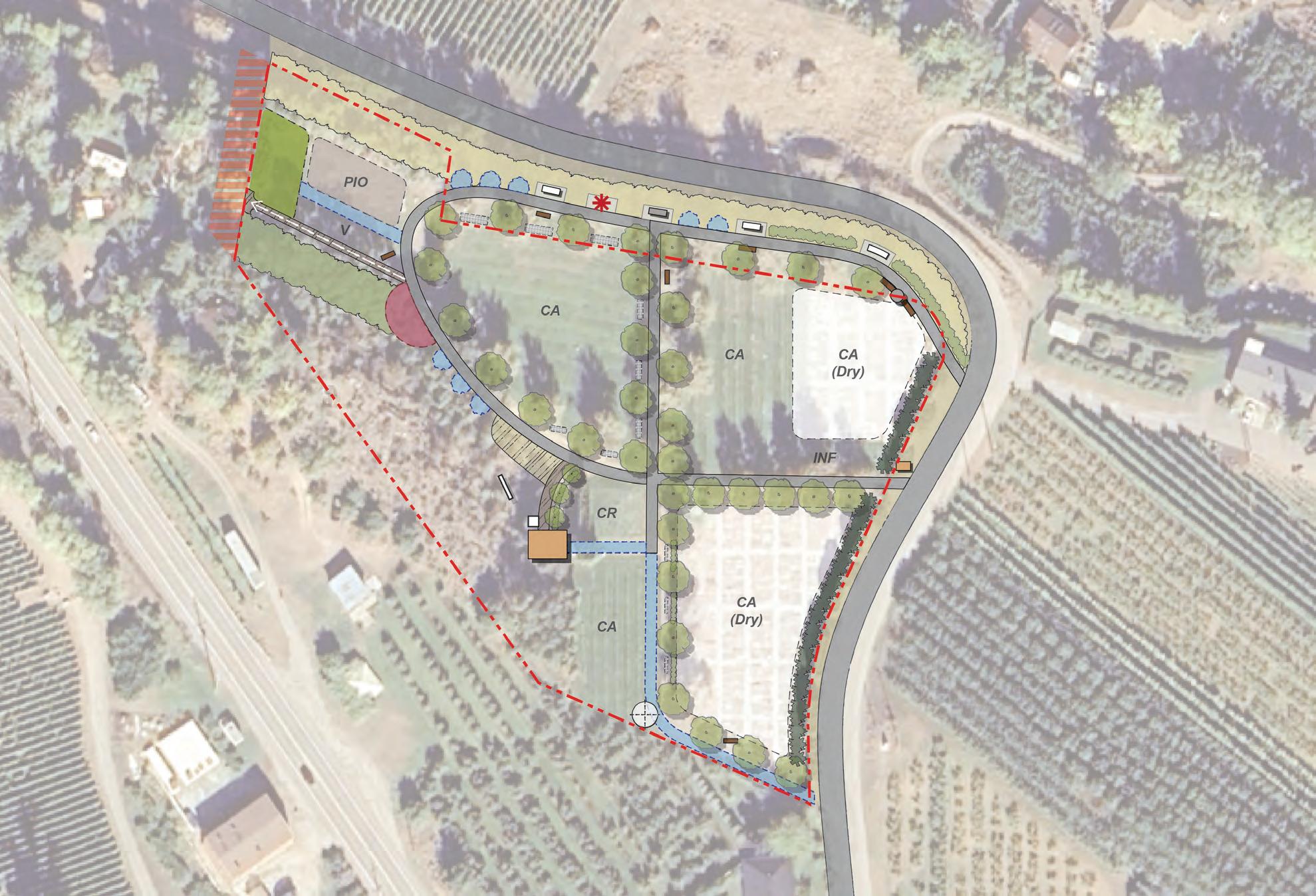
CONCEPT PLAN
Extents
Additional columbaria and seating
Existing statuary and seating
Low ornamental planting
Primary entrance with entry kiosk
Implement succession management of dry sections (see recommendations)
Existing hedge and fence to be replaced with new planting buffer Infill with premium upright cremation lots and planting
Reduce number of entrances and infill road
Cemetery-Wide Improvements
This section describes the physical cemetery-wide improvements recommended in this Concept Plan, and is laid out under the following headings:
• Wayfinding, Access, and Circulation
• Landscape Character
• Amenities
• Operations and Maintenance
Task Description Priority
WAYFINDING, ACCESS, AND CIRCULATION
To enhance the cemetery’s presence, and to improve access and circulation for both vehicles and pedestrians, the following is recommended:
Improve Highway Signage
Entrance Information Kiosk
Enhance Primary Entrance
• Install a new highway sign with updated design and improved visibility to enhance wayfinding and access from the road.
• Install an information kiosk at the primary entrance including a cemetery map, circulation routes, burial sections, key amenities, and a QR code linking to digital wayfinding resources.
• Enhance the middle access point as the primary entrance to strengthen the sense of arrival and mark the transition from public space to sacred cemetery grounds.
• Potential improvements could include an entrance sign or arch, gate, decorative fence, or planting.
High (1-5 years)
High (1-5 years)
High (1-5 years)
Consolidate Cemetery Entrances
Cemetery Driveway Improvements
Accessible Pathway/ Operations Access
• Close the southern access point to vehicular traffic and establish the middle access point as the primary cemetery entrance.
• Pave the remaining cemetery driveway to complete the main loop road following closure of the southern vehicular access.
• Implement drainage improvements adjacent to the existing spoil pile.
• Construct an accessible pathway and operations access route to serve the proposed green burial section.
Medium (5-10 years)
Medium (5-10 years)
Medium (5-10 years)
LANDSCAPE CHARACTER
To protect and enhance the cemetery’s landscape character and maintain its peaceful and natural atmosphere, the following is recommended:
Tree Replacement Strategy
Improve Planting Behind Cremation Lot Section
Dry Section Succession Management
• Prepare a tree management strategy identifying deteriorating birch trees requiring removal and establishing a long-term succession and replacement plan.
• Coordinate tree replacement with interment infill along road edges.
• Note: Coordinate all cemetery tree planting with a Landscape Architect to ensure appropriate species selection, placement, and long-term performance.
• Replace the existing hedge along the back row of cremation lots bordering the northern maintenance shed driveway with ornamental planting and trees set further back from the lot row.
• Gradually transition older dry sections of the cemetery from hardscape conditions to lowmaintenance planting through a phased approach.
• Prior to work, review historical records and make reasonable efforts to contact families.
• Improvements should proceed section by section to minimize disruption.
• This work may include:
» Removing concrete grave covers or vaults where appropriate
» Introducing drought-tolerant groundcovers, grasses, or meadow-style planting
» Raising and restoring monuments after improvements
» Monitoring areas for long-term stability.
Enhance Northern Access Landscape
Improve Boundary Conditions
• Improve the area around the northern access point with low ornamental planting using droughttolerant and low-maintenance species.
• Replace the existing hedge and chain-link fence along the 146th Avenue perimeter with decorative fencing and boundary planting to enhance the cemetery edge.
High (1-5 years)
High 1-5 years)
High (1-5 years)
* Phased Approach
Medium (5-10 years)
Medium (5-10 years)
AMENITIES
To offer the best user experience possible and ensure that visitors feel welcome and comfortable in the cemetery the following is recommended:
Seating
Sheltered Gathering Space
• Provide additional seating adjacent to the columbaria to allow visitors to enjoy views over Osoyoos Lake.
• Provide additional seating within new interment and memorialization sections.
• Seating could be implemented through a term lease memorial bench program, with predetermined bench styles and locations to maintain a cohesive design while allowing families a range of placement options.
• Create a small, sheltered gathering space within the southern portion of the cemetery, integrated with the future infill area, to accommodate on-site services and provide a dedicated place for reflection and connection.
Medium (5-10 years)
Medium (5-10 years)
Public Toilet
• Install a public washroom (such as a composting pit toilet) accessible during ceremonies, events, and regular working hours. The location should be clearly identified on the cemetery map to support visitor wayfinding.
OPERATIONS AND MAINTENANCE
Medium (5-10 years)
In order to facilitate easier operations and maintenance of the cemetery the following is recommended:
Update Cemetery Bylaw
Contain Spoil Pile Area
• Update the cemetery bylaw to clarify and regulate marker size and placement to support consistent maintenance and appearance throughout the cemetery.
• Integrate and standardize the sale of flower vases or tubes as part of burial lot purchases to simplify maintenance and ensure consistency across burial areas.
• Consider partially enclosing and defining the existing spoil pile area. While the rear edge is contained by a bedrock slope, the remaining sides could be defined with boulder retaining walls or other clear visual boundaries to separate the area from the maintenance shed driveway and surrounding cemetery space.
High (1-5 years)
Medium (5-10 years)
Interment and Memorialization
The Concept Plan has been carefully designed to be flexible and capable of accommodating the potential changing preferences of families in the future. New interment services proposed include the addition of a green burial section, a scattering garden, memorial wall, and family estate lots for cremation or burial.
Best practice recommends maintaining approximately 50 years of interment inventory. Based on current projections and assuming historic sales and interment patterns continue, the current casket lot inventory is expected to sell out in approximately 25–30 years. If the Town intends to continue providing burial services to residents over the long term, future land acquisition will need to be considered.
This section describes the interment and memorialization recommendations in this Concept Plan, and is laid out under the following headings:
• Cremation Lot Infill
• Green Burial Expansion Area
• Columbaria
• Scattering Garden
• Premium Upright Family Estate Lots
• Memorial Wall
Task Description
CREMATION LOT INFILL
To meet projected demand over the next 25 years, the cemetery will need to add approximately 240-250 cremation lots, which can be accommodated through the proposed infill areas in the Concept Plan. To maximize the use of space in the cemetery, the following is recommended:
Cemetery Mapping and Topographic Survey
Cremation Lot Infill (Along Driveways)
• Conduct a survey prior to further design development to confirm property boundaries and identify areas with potential capacity for cremation lot infill.
• Site observations suggest that the current spacing from roads and trees may allow for 1–3 rows of cremation lots along portions of the interior cemetery driveway, provided they do not interfere with maintenance or operational access.
High (1-5 years)
High (1-5 years)
Pockets of Cremation Lots
• Introduce small pockets of cremation lots integrated with ornamental, drought-tolerant planting throughout the cemetery, including along the northern boundary overlooking Osoyoos Lake and within the forested edge adjacent to the spoil pile area.
High (1-5 years)
Cremation Lot Infill (Pioneer and Veterans Sections)
Cremation Lot Infill (Maintenance Shed Road)
Convert Southern Access to Pathway and Infill with Mixed Interment
• Site observations suggest a potential infill area between the pioneer section and the veterans section.
• Close and infill the existing maintenance shed road with additional inventory, extending the adjacent cremation lot section.
• Close the southern vehicular access point and convert the area to a pathway with mixed interment options, including cremation and burial infill, to be determined as capacity needs and interment preferences evolve.
This new expansion area is proposed behind the veteran’s and pioneer sections of the cemetery and would follow Green Burial Principles, offering a sustainable option that prohibits embalming, vaults, and liners. This burial type is designed to appeal to individuals seeking environmentally-conscious alternatives, as well as certain ethnic and religious communities. This expansion area would provide a new offering at Lakeview Cemetery.
Cemetery Mapping and Topographic Survey
Confirm Regulatory and Bylaw Requirements
Establish Standard Operating Procedures
Establish Green Burial Offering
• Conduct a survey to confirm the property boundary for the proposed green burial expansion area located behind the veterans’ and pioneer sections of the cemetery (approximately 150 m² / 0.04 acres).
• Review provincial regulations and the cemetery bylaw to confirm green burial is permitted. Update the bylaw if needed to establish rules regarding green burial, memorialization options, and any associated fees.
• Determine operational procedures for green burial services, maintenance, and record keeping.
• Design development and construction drawings should be done to define the green burial area, accessible pathways and operations access, seating, planting, signage, and communal memorials.
• Area to be developed in accordance with green burial principles, prohibiting embalming, vaults, and liners to provide a sustainable burial option and broaden the cemetery’s range of interment offerings.
• Arrange burial lots using a “paint yourself out of the room” approach, where burials occur in the next available lot rather than allowing families to select specific locations.
• Limit individual markers and consider a single communal memorial marker made from locally sourced stone.
• Area is to be designed for minimal maintenance with no irrigation and limited mowing, allowing native grasses and wildflowers to establish and contribute to urban biodiversity.
• Layout to be designed so the area can be converted to the standard burial format used elsewhere in the cemetery if future operational needs change.
High (1-5 years)
High (1-5 years)
High (1-5 years)
Medium (5 - 10 years)
COLUMBARIA ADDITIONS
To meet projected demand over the next 25 years, the cemetery will need to add approximately 120–130 columbarium niches. The existing columbarium on site provides capacity for approximately 40 niches, indicating a need for an additional 3–4 columbarium units of similar size, or a combination of units providing a comparable number of niches.
Establish Additional Columbaria
• New columbaria should be integrated into the cemetery landscape and developed in phases as demand increases.
• Materials and colours should complement the overall character of the cemetery and maintain visual consistency throughout the grounds.
• To support a cohesive cemetery design, columbaria should not be installed as standalone structures. Instead, they should form part of a cremation garden, creating a meaningful and attractive setting that enhances the visitor experience and supports demand. These areas should also incorporate seating and drought-tolerant plantings that provide seasonal interest.
• If space allows, designs should consider providing double sided units, allowing niches to face the view over Osoyoos Lake.
SCATTERING GARDEN
High (1-5 years)
* Phased Approach
The cemetery does not currently offer a designated scattering option. During public engagement, several participants expressed interest in the addition of a scattering garden as a more informal and affordable cremation memorialization option. Scattering gardens provide a dedicated and respectful location where cremated remains can be dispersed, typically within a landscaped setting that may include natural planting, seating, and a communal memorial element.
Cemetery Mapping and Topographic Survey
Confirm Regulatory and Bylaw Requirements
• Map out the existing cemetery, property boundaries, and topography.
• Review provincial regulations and the cemetery bylaw to confirm that scattering of cremated remains is permitted. Update the bylaw if needed to establish rules regarding where scattering may occur, memorialization options, and any associated fees.
High (1-5 years)
High (1-5 years)
Establish Standard Operating Procedures
• Determine operational procedures for scattering services, including whether scattering is staff-assisted or familyperformed, scheduling protocols, maintenance, and recordkeeping practices.
High (1-5 years)
Establish the Scattering Garden
• A potential location for a scattering garden has been identified adjacent to the veterans section, where the area is naturally defined by rock cliffs. This setting could provide a quiet and contemplative environment, while integrating naturally with the existing landscape character of the cemetery.
• Design development and construction drawings should be done to define the scattering garden area, accessible pathways, seating, planting, communal memorial element, and signage explaining the purpose of the space.
HighMedium (1-10 years)
34: Scattering Garden, Source: LEES+Associates.
Figure
PREMIUM UPRIGHT FAMILY ESTATE LOTS
Introducing a small number of family estate lots would expand the range of interment options available and respond to families seeking larger, more prominent spaces for multiple interments. These lots could accommodate both casket and cremation burials, providing flexibility as interment preferences evolve.
Establish Premium Upright Family Estate Lots
• Family estate lots could be phased in alongside the planned tree replacement program to help coordinate spacing.
• Integrate ornamental, drought-tolerant planting that defines the spaces and help enhance the cemetery’s natural landscape character.
• Additional opportunities to establish family estate lots within the future southern access infill area, where a mix of interment options, including cremation, casket lots, and columbaria, should be established.
Medium - Low (510+ years)
Figure 35: Family Estate Lots, Source: LEES+Associates.
MEMORIAL WALL
Memorialization can occur with or without interment at a cemetery. With increasingly mobile families, many people are choosing not to inter the cremated remains of their loved ones in a cemetery; however, they are still interested in memorializing them in some way in communities to which they feel attachment. Public engagement showed an interest from the community in the addition of a memorial wall to the Town’s products and services. A memorial wall provides a place for engraved plaques commemorating individuals whose remains may be scattered, interred elsewhere, or kept by family members. Retaining a Landscape Architect for design development of a cohesive vision for the memorial wall, columbaria, and cremation garden along Lakeview Drive would ensure future interment needs are met in an enduring place.
Establish a Memorial Wall
• The wall should be constructed using natural materials that complement the character of the cemetery and its surrounding landscape.
• The Concept Plan proposes a location that takes advantage of views over Osoyoos Lake and would provide a quiet and contemplative setting, integrated with seating and landscape planting to create a small memorial space for reflection.
Medium (5-10 years)
Figure 36: Memorial Wall Precedent, Royal View Cemetery, Lethbridge, AB, Source: City of Lethbridge
Figure 37: Memorial Wall Precedent, Lake View Cemetery, AB, Source: LEES+Associates
Conclusion
Osoyoos Lakeview Cemetery has an estimated 25 to 30 years of remaining casket lot sales; however, best practice recommends maintaining approximately 50 years of interment inventory. Additional land acquisition should be considered if the Town intends to continue providing burial services over the long term. In contrast, there is an immediate need to expand cremation inventory, with in-ground cremation lots projected to be sold out within 3 to 4 years and columbaria niches within 1 to 2 years.
To meet projected demand over the next 25 years, the Town will need to develop approximately 240 to 250 cremation lots and accommodate 120 to 130 columbaria niches. This would require approximately 500 m² (0.12 acres) of land and is expected to be achievable on site through targeted infill and development. This includes confirming available capacity through a detailed survey, introducing cremation lot infill along internal roadways where feasible, and integrating small pockets of cremation lots and new columbaria within underutilized areas. Additional long-term capacity could be made available through the closure and infill of select internal roadways, such as the maintenance shed road and southern access road.
In addition to increasing inventory, the Concept Plan introduces new interment and memorialization options to support evolving community preferences identified through engagement. These include the establishment of a green burial area, a scattering garden, premium upright family estate lots, and a memorial wall. These new offerings would help to broaden the range of services available to the community, provide more flexible and affordable options, and support environmentally sensitive practices, ensuring the cemetery remains responsive to changing needs over time.
Cemetery-wide improvements focus on enhancing functionality, accessibility, and overall site character. Key recommendations include improving circulation and wayfinding through the consolidation and upgrade of the primary entrance, the addition of an information kiosk, and enhancements to the cemetery’s perimeter conditions. Landscape improvements include the preparation of a tree management strategy to identify deteriorating trees and establish a long-term succession and replacement plan, coordinated with the proposed interment infill along internal driveways and with the support of a Landscape Architect. Additional improvements include the introduction of amenities such as a small sheltered gathering space, a public washroom, and additional seating, as informed by public engagement.
An important component of the recommendations is the succession management of the older dry section, with a focus on improving safety, aesthetics, and long-term maintenance. Annual funding should be allocated to support the phased implementation of these improvements.
Overall, with timely implementation of these recommendations, the Town can ensure that Lakeview Cemetery continues to provide a diverse range of interment options, remains financially sustainable, and evolves to meet the changing needs of the community over the next 25 years and beyond.
Appendix A: Religious and Ethnic Preferences
Religious and Ethnic Preferences
Individual preferences determine a person’s disposition and interment choices. Personal values, family traditions, and socio-economic considerations shape these preferences. Religious affiliations and ethnic groups also have cultural practices that can significantly influence an individual’s end-of-life choices.
Common Religious Cultural Influences
Catholic Faith
Traditionally when a person of catholic faith dies their body is buried in the ground. Since Vatican II in 1962,1 cremation has been allowed by the Catholic Church provided the cremated remains are kept together and are not scattered. Catholics are more likely to choose interment in a cemetery due to its church-mandated funeral and burial customs.2 Some other branches of Christianity, however, oppose cremation, including minority Protestant and Orthodox groups, such as Greek and Serbian Christians. Most notably, the Eastern and Asian Orthodox Churches still forbid cremation.
Jewish Faith
The following funeral practices usually take place when a person of Jewish faith dies:
• Private burial in the presence of a rabbi;
• Stones are often placed on graves instead of flowers, and
• Eating, drinking, or smoking are forbidden in the presence of the dead.
The Jewish faith discourages cremation for its members. Reform and Conservative Jewish authorities also frown on the practice, although the cremation rate is increasing within the Jewish community, worldwide.3
Hindu and Sikh Faith
Hindu and Sikh death rituals and practices are similar in many ways. Both religions mandate the cremation of the deceased and the disposal of ashes in a river or flowing water. For Hindus living outside of India, any water feature purposed for ash disposal should ideally connect to a river in some way.
Muslim Faith
Although rituals and needs vary, depending on the community, the following funeral practices take place when a person of the Muslim faith dies:
• The minimal use of any type of ornamentation;
• There is the presence of a prayer stone (Qibla stone);
• The burial in a place separate from the children who died at a young age;
• The placing of the bodies takes place in a particular orientation and inclination, and
• The burial area is in a protected section of the cemetery or in a “square” with trees, hedges or fences.
1 Changing Catholic Attitudes about Cremation, http://www.catholicworldreport.com/2012/11/03/changing-catholic-atti des-about-cremation/ 2 Vatican issues new rules on Catholic cremation - Remains cannot be scattered, divided, or kept at home, http://www.cbc.ca/news/world/vatican-catholic-cremation-1.3820336
3 Cremation Becoming Increasingly Popular Among Jews, Funeral Professionals Say, http://www.haaretz.com/jewish/news/cremation-becoming-increasingly-popular-among-jews-funeral-professionals-say-1.447873
Buddism Faith
Most Buddhist societies cremate their dead to purify and free the soul, and aid in the attainment of enlightenment. Cremated remains are usually interred at temples or cemeteries, where offerings such as incense, food, candles, and flowers are presented at altars to honor and remember the deceased.4
Common Ethnic Cultural Influences
Traditional burial is most often preferred by Hispanics, particularly those with strong Catholic ties, and cremation is uncommon. However, cremation is gradually becoming more accepted due to factors such as cost, convenience, and personal preference. Another common Hispanic preference is to buried in their place of origin.5
Asian interment and memorialization practices are deeply influenced by cultural, religious, and familial values. Traditionally, both burial and cremation have been accepted practices. These preferences can vary across different Asian communities, depending on geographical location, a family’s religion, and factors such as age, social status, and cause of death.
In traditional Chinese culture, the design and size of grave markers are significant and there is a preference for large, upright monuments or elaborate altars at which to provide offerings.
Italian and Portuguese families also often have a higher preference for columbaria niches and mausolea crypt interment options.
4 Funeral Traditions in East Asian Religions: Buddhism, Taoism, and Confucianism, https://anubiscremations.com/funeral-traditions-in-east-asian-religions-buddhism-taoism-and-confucianism/
5 Honoring Multicultural Cremation Traditions: Celebrating the Day of the Dead, https://www.cremationassociation.org/blog/honoring-multicultural-cremation-traditions-celebrating-the-day-of-the-dead
Appendix B: Detailed Price Benchmarking Study
Interment Services
District of Peachland Regional Average
Town of Osoyoos Price Benchmarking - Rates Comparison
Right of Interment for Lots + Niches
Town of Oliver
Town of Osoyoos
City of Castlegar District of Summerland City of Grand Forks Town of Princeton
Town of Osoyoos Price Benchmarking - Rates Comparison
Town of Osoyoos Regional Average City of Castlegar District of Summerland
City of Grand Forks Town of Princeton District of Peachland Town of Oliver Memorialization + Other Fees
Appendix C: Recommended 2026 Price List
Opening / Closing Services
Town of Osoyoos - Proposed Cemetery Rate Changes
Right of Interment for Lots + Niches
Appendix D: Perpetual Care Fund Addendum
Perpetual Care Fund Addendum
Provincial legislation intends for the interest generated by a PCF to help offset the effect of inflation and therefore provide the required monies for what will eventually be more expensive site to maintain in the future.
BRITISH COLUMBIA
In British Columbia, PCFs must be managed in accordance with the Cremation, Interment and Funeral Services Act, Part 71. PCF contributions requirements are delineated by Part 2 of the BC Cremation, Interment and Funeral Services Act, Services Regulation2. BC provincial legislation, mandates that all cemeteries contribute the following minimum proportions of interment rights to a Perpetual Care Fund:
(1) In subsections (2) and (3), “right of interment” does not include a right of interment of cremated remains or human remains in a columbarium niche or mausoleum crypt.
(2) Except as provided in subsection (3), an operator that has a care fund for a cemetery must, for each right of interment at the cemetery that is sold, make a deposit to that fund of not less than 25% of the selling price of the right of interment.
(3) An operator of a place of interment listed in Column 1 of Schedule 1 to this regulation must, for the type of right of interment set out opposite in Column 2 that is sold by the operator, make a deposit to the care fund of not less than the percentage of the selling price of the right of interment set out opposite in Column 3.
(4) Except as provided in subsection (3), an operator that has a care fund for a mausoleum or columbarium must make a deposit to the care fund of not less than 10% of the selling price for each right of interment related to a mausoleum or columbarium.
(5) An operator that has a care fund for a place of interment must make a deposit to the care fund of not less than $10 for each memorial installed at the place of interment.