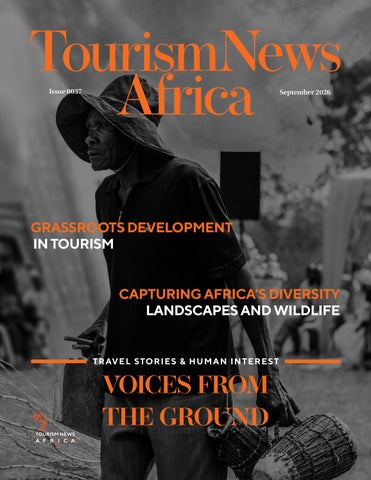
TourismNews Africa Issue 0037
September 2026
GRASSROOTS DEVELOPMENT IN TOURISM CAPTURING AFRICA’S DIVERSITY LANDSCAPES AND WILDLIFE
T R AV E L STO R I E S & H U M A N I N T E R E ST
VOICES FROM THE GROUND
Internal Advert
Table of
Contents
06 08 10 12 16 18 20
First Person Travel Narative Across the Continent Importance of Grassroots Development in Tourism Cultural Deep-Dive: Where Africa Tells Its Story The Photographs Journals, Capturing Africa’s Diversity The Multiplier-Effect of Tourism On Local Communities Tourism Beyond the Paycheck: The People Behind the Place Standard Bank Joy of Jazz 2026 3
Editor’s Note
T
ourism is often measured through arrivals, occupancy and visitor spend, but behind every statistic is a person — a guide sharing a story, a chef preparing a meal, an artisan creating something unique, or a local business benefiting from a thriving visitor economy.
This month’s theme, Travel Stories & Human Interest — Voices from the Ground, looks beyond the traditional tourism experience to celebrate the people and communities that give Africa’s destinations their identity. Throughout this issue, we explore tourism’s impact beyond the paycheck — from the multiplier effect that allows visitor spending to circulate through local economies, to grassroots development that connects hotels and tourism businesses with local suppliers, guides, artisans and entrepreneurs. We also celebrate Africa’s living culture through its festivals, food, craft and traditions, while exploring how photography can capture not only spectacular landscapes and wildlife, but the people and unexpected moments that make a journey memorable. Our contributors take us across the continent, sharing personal perspectives on destinations from Kenya and South Africa to the gorilla forests and volcanic landscapes surrounding Mount Nyiragongo. We also turn our attention to Johannesburg as the Standard Bank Joy of Jazz returns, demonstrating how music, culture and events contribute to a city’s tourism economy. As South Africa celebrates Tourism Month, this edition reminds us that successful tourism is about more than numbers. It is about creating opportunities, preserving culture and ensuring communities have a meaningful place in both the story and the economy of tourism. So, as you explore these pages, look beyond where to take the perfect photograph and consider the people you might meet along the way. Thank you for travelling with us. Happy reading.
Derek Martin Editor
4
First Person Travel Narative Across the Continent The places I would visit would be: 1.Gorilla trekking Definitely one of the things I’d want to do. Hiking through the rainforest and getting up close to gorillas. 2.Mount Nyiragongo It’s an active volcano and you can hike up to the crater to see the lava glowing at night. EL KANAH KABASELE
Democratic Republic of the Congo
I would highly recommend meeting the locals and eat your way around the island. Mauritian people and Mauritian food is a mix of the many cultures that have shaped our island, and you can feel and taste that diversity everywhere. Try dholl puri, farata, mine frit, boulettes, gato piments and a good Mauritian curry. Don’t be afraid of the small local restaurants and street-food stalls — some of my favourite meals have come from places that don’t look particularly impressive from the outside. Enjoy the beaches, of course. You can’t come to Mauritius and not spend time by the ocean. But don’t just stay on one beach. Explore the different coasts because each has its own character. Take a swim, go snorkeling, get on a boat, or simply find a quiet spot and enjoy the view. And if you get the chance to watch a Mauritian sunset by the sea, take it. BOOSHAN V. BELUT
Mauritius
6
When you visit South Africa, Cape Town is a must. You should take on Table Mountain, either by hiking the trails or taking the cable car and spot some of the most spectacular views you’ll ever see. I would also highly recommend you head out on an unforgettable safari in Kruger National Park located in Mpumalanga, where you can spot Africa’s legendary Big Five roaming wild. South Africa truly has it all, so make sure it is your next vacation spot! KAMOHELO MAROGA
South Africa
For me, what makes Kenya special is the contrast. You can have breakfast in a vibrant city, see wildlife in the afternoon and be by the Indian Ocean the next day. It’s that combination of adventure, culture, nature and warm Kenyan hospitality that makes the country unforgettable. LAKEISHA MUGO
Kenya
For me, Sossusvlei and Deadvlei will always be at the top of the list. There is something so surreal about standing among the red dunes and ancient trees, and even as a Namibian, it never gets old. I would also recommend Etosha for the wildlife, Swakopmund for its coastal charm and adventure, and the Skeleton Coast if you want to experience Namibia at its most wild and untouched. Namibia has so much to offer, and I love that every destination gives you a completely different experience. ROUX-CHÉ SHIDUTE
Namibia
7
Importance of Grassroots Development in Tourism
T
ourism is often measured in big numbers: international arrivals, hotel occupancy, visitor spend and the contribution the industry makes to national economies GDP. But behind every statistic are real people, real communities and small businesses that help make a destination what it is. For tourism to deliver meaningful, long-term value, development cannot only happen at the top. It needs to start at the grassroots.
Elements such as: languages, traditions, crafts, cuisine, music, storytelling and indigenous knowledge can all become part of a destination’s tourism offering. When communities are empowered to share these elements on their own terms, tourism can create an incentive to preserve them for future generations. This is particularly valuable at a time when globalisation is creating increasingly similar experiences around the world. Travellers are looking for authenticity and something distinctive that connects them to the place they are visiting. (USE THIS LAST SENTENCE AS A QUOTE). The strongest tourism experiences are often those that could not simply be replicated somewhere else.
Grassroots tourism development is about creating opportunities for local people to participate in, contribute to and benefit from tourism. It means recognising that a destination is more than its major attractions, hotels and tour operators. It is also the local restaurant owner, craft producer, guide, farmer, driver, community organisation, cultural practitioner and entrepreneur.
GIVING COMMUNITIES A VOICE Grassroots development is not simply about making communities beneficiaries of tourism. It is about making them participants in the decisions that affect their destinations. Local residents understand their environment, culture and challenges in ways that outside investors or planners may not. Their involvement can help ensure that tourism development is appropriate, responsible and aligned with local priorities.
When these individuals and businesses are included in the tourism value chain, the economic benefits of tourism can reach much further into communities. This is particularly important across Africa, where tourism has the potential to support development well beyond traditional tourism hubs. Rural and smaller communities often possess some of the very assets that travellers are increasingly looking for: authentic culture, local stories, traditional knowledge, food, crafts, landscapes and meaningful human experiences.
This approach also helps create greater community support for tourism. When people can see tangible benefits from visitors coming to their area, tourism becomes something they have a stake in rather than something being imposed upon them.
The challenge is ensuring that these assets are developed with communities rather than simply for them.
SUPPORTING CONSERVATION Many rural communities live alongside the landscapes and natural resources that attract visitors. When local people can benefit from tourism linked to conservation, there is a stronger incentive to protect those resources. Wildlife, forests, wetlands, coastlines and cultural landscapes become more than attractions, they become assets with long-term value.
CREATING LOCAL ECONOMIC OPPORTUNITIES One of the most obvious benefits of grassroots tourism is job and business creation. Tourism can provide opportunities for people to become guides, accommodation providers, chefs, artists, drivers, producers and entrepreneurs. Importantly, the benefits can extend beyond direct tourism employment. A hotel purchasing vegetables from a local farmer, a lodge sourcing crafts from nearby artisans or a tour operator using locally owned transport creates a wider economic ripple effect. This local circulation of tourism income can help strengthen communities and create opportunities for people who may otherwise have limited access to formal employment or business opportunities. PROTECTING CULTURE AND IDENTITY Tourism can also play an important role in protecting cultural heritage.
Vuyo Maboe News Correspondent
8
Convery Travel Ad
Cultural Deep-Dive: Where Africa Tells Its Story
S
ome trips give you photographs. Others give you stories.
FOLLOW THE CELEBRATION Ethiopia’s Timkat, the Ethiopian Epiphany, is a perfect example. Celebrated across the country, the festival commemorates the baptism of Jesus Christ and is recognised by UNESCO as intangible cultural heritage. Colourful processions and religious ceremonies transform streets and public spaces into something far greater than a conventional sightseeing experience.
There is a difference between visiting a place and actually feeling like you were there. You can stand in front of an important monument, take the picture, tick it off the list and move on. Or you can sit at a table with people you have just met, eat something you cannot pronounce properly yet, listen to a story you would never find on Google Maps and suddenly understand the destination in a completely different way.
Move west and the atmosphere changes completely. Among Ghana’s Ga people, Homowo carries a story of survival. The festival recalls a period of famine followed by successful harvests and is today an important cultural homecoming and tourism attraction in Greater Accra. Ghana Tourism Authority specifically advises visitors to remember that Homowo is not staged for tourists. Certain traditions, including periods when drumming is prohibited, deserve the same respect visitors would expect for their own customs.
THIS KIND OF TRAVEL IS WHERE AFRICA SHINES Across the continent, culture is not confined to museums and heritage sites. It is worn, cooked, sung, danced, woven and passed between generations. UNESCO describes intangible cultural heritage as the traditions, knowledge and skills communities recognise as part of their cultural identity, highlighting its role in maintaining cultural diversity and encouraging respect between different ways of life.
That small distinction matters. The best cultural traveller does not arrive asking, “What can you perform for me?” They arrive wondering, “What can I learn here?” LISTEN BEFORE YOU LEAVE In Morocco, Gnawa culture combines music, performance, spiritual traditions and ritual. UNESCO inscribed Gnawa on its Representative List of the Intangible Cultural Heritage of Humanity in 2019. Its music has become internationally recognisable, but its importance reaches beyond a soundtrack for a holiday. Gnawa represents a deeper cultural practice carrying history, belief and identity. Marrakech offers another reminder that culture is often hiding in plain sight. Jemaa el-Fna is more than a famous square. Its cultural space has been recognised by UNESCO for traditions including storytelling, poetry, music and performance. The person telling a story in the square may therefore be as important to your experience of Marrakech as the building you photographed that morning.
For travellers, that means some of Africa’s most memorable attractions cannot simply be looked at. \They have to be experienced.
“The best cultural traveller does not arrive asking, “What can you perform for me?” They arrive wondering, “What can I learn here?” 1
10
THEN, OBVIOUSLY, EAT Food might be the easiest doorway into culture because everybody understands hunger. Senegal’s Ceebu Jën, often prepared with fish, rice and vegetables, is recognised by UNESCO as a culinary art and has roots in the fishing communities of Saint-Louis. It is not simply something to order because a guidebook says you should. Its preparation carries knowledge, tradition and social meaning. The same idea plays out across Africa. South African Tourism notes how food sits at the centre of many of the country’s ceremonies and traditions. From shared meals and braais to dishes shaped by migration and generations of cultural exchange, eating locally can reveal more about a destination than another hour spent scrolling through reviews.
TRAVEL WITH CURIOSITY, NOT A CHECKLIST A cultural deep-dive does require a little more from the traveller. Ask before photographing people or ceremonies. Learn a few words in the local language. Use community guides. Eat somewhere locally recommended. Research customs before arriving at a festival. If something is sacred, treat it as sacred even when nobody is watching you.
“Most importantly, slow down.” Africa’s greatest travel stories are often not hiding at the next attraction. They are happening around the table you are already sitting at, inside the music coming from the next street or in a conversation you almost did not stop for. Perhaps that is what “voices from the ground” really means. Not travelling across Africa merely to see how people live, but allowing the people you meet to tell you themselves. Because years later, you may forget the room number, the flight time and half the photographs. But you rarely forget the person who welcomed you in, passed you a plate and said, “TRY THIS.”
And sometimes the memorable plate is not served in a fancy restaurant. It is bought at a market, offered at somebody’s home or cooked over a fire while you stand nearby pretending you absolutely know what is happening.
“There is a difference between visiting a place and actually feeling like you were there.”
BRING SOMETHING HOME, BUT UNDERSTAND IT FIRST Culture also lives in what people make. In Ghana’s Ashanti Region, Adanwomase has a long tradition of kente weaving. The patterns are not merely colourful designs. Many carry names and meanings connected to proverbs, historical events, plants and important figures. Visitors can watch the weaving process and even try the craft themselves. This is where souvenirs become something better. Buying directly from the maker gives the object a face, a story and context. Suddenly the cloth, carving or piece of jewellery in your suitcase is not just proof that you went somewhere. It reminds you who you met.
Jesse Morris News Correspondent
11
The Photographs Journals, Capturing Africa’s Diversity
A
frica is a continent made for stories ,with its vast landscapes, extraordinary wildlife, diverse cultures, vibrant cities and unforgettable people, all of which provide an endless collection of moments waiting to be captured. For generations, photographs have helped travellers preserve those moments, allowing us to revisit a place, a feeling or an experience long after the journey has ended.
THE SEARCH FOR THE “INSTAGRAMABLE MOMENT” There is no denying that social media has changed the way we travel. For many travellers, the photograph is now part of the experience itself. We search for viewpoints, landscapes, restaurants, accommodation and attractions that provide the perfect backdrop for a photograph. Destinations have embraced this trend, creating viewing decks, murals, installations, pools, walkways and other features specifically designed to be photographed and shared. The “Instagramable moment” has become a tourism asset.
Today, however, travel photography has taken on a new dimension. The humble holiday photograph has evolved into the photo journal, the travel reel and the instantly shareable social media post. The rise of Instagram and other visual platforms has created a generation of travellers who are not only exploring destinations, but actively searching for the perfect “Instagramable moment” - And Africa has no shortage of them.
A single compelling photograph can inspire thousands of people to add a destination to their travel wish list. A spectacular image of a safari experience, an infinity pool overlooking a dramatic landscape or a beautifully presented local dish can generate interest that traditional advertising could struggle to achieve. Social media has effectively turned travellers into destination marketers.
From the golden light of an African sunrise to elephants crossing a river, from dramatic mountain landscapes to colourful local markets, there is something undeniably photogenic about the continent. Yet, while the perfect photograph might attract likes and followers, the real value of travel photography lies somewhere much deeper: in its ability to create and preserve memories.
Every time a visitor shares a photograph, tags a destination or recommends an experience, they contribute to the story being told about that place. Their followers see the image, engage with it and, potentially, begin imagining themselves there.
MORE THAN JUST A PHOTOGRAPH If you take a moment, to pause and think back to some of your favourite travel memories. Chances are, there is a photograph attached to many of these. It might be a family photograph taken outside a national park, a picture of friends enjoying a sunset, a candid moment captured around a campfire or a photograph of a spectacular animal encounter. The image itself may only occupy a few megabytes on a phone, but the memory attached to it can last a lifetime…This is the power of photography. A photograph freezes a moment in time. It allows us to return to a particular place and remember not only what we saw, but how we felt. Years after a trip, an image can transport us back to the sounds, smells, conversations and emotions of that experience. In this sense, a photo journal becomes much more than a collection of beautiful images. It becomes a personal record of a journey. It tells the story of where we went, who we travelled with, what we discovered and the unexpected moments that made the trip special.
12
For destinations across Africa, this represents a significant opportunity. But there is an important distinction between capturing a photograph because a moment is genuinely beautiful and travelling solely to create content. The best photographs are often those where the camera simply happens to be there.
Experience the destination without worrying about how it will look online.
CAPTURING THE UNEXPECTED In our experience, as a TNA team, some of the best travel photographs are not planned. We may set out looking for a spectacular landscape but instead capture a spontaneous interaction. We may plan the perfect sunset photograph only to discover that the most memorable moment was a conversation with a local resident. We may spend hours waiting for a leopard to appear, only to find that the photograph we treasure most is of the guide who patiently shared the experience with us. These unexpected moments are what turn photographs into memories.
CREATING MEMORIES THAT LAST A decade from now, the Instagram post may have disappeared into an endless feed of content. The number of likes may no longer matter. The algorithm will certainly have moved on.
A good photo journal should therefore not be judged solely by its technical quality. The most important question is not whether the image is perfectly composed, but whether it means something. A slightly blurred photograph of friends laughing together may have greater emotional value than a technically perfect landscape photograph. A picture taken on a smartphone can become more important than an expensive professional image simply because it captures something personal. Photography is subjective. Memories are personal. PHOTOGRAPH RESPONSIBLY With the growing importance of travel photography comes a responsibility to consider how we capture and share images. Wildlife should never be disturbed simply to obtain a photograph. Visitors should respect distance, follow the guidance of guides and park authorities, and remember that animals should never be placed under unnecessary stress for the sake of content. The same principle applies to people. Not every person wants to be photographed, and not every cultural experience should automatically become social media content. Asking permission, respecting cultural sensitivities and considering how an image represents the people within it are essential elements of responsible travel photography. The photograph should enhance the experience, not exploit it.
Then, when the moment feels right, pick up the camera and capture it. Because ultimately, photography should complement travel, not replace it.
But the memory will remain… That is what makes travel photography so powerful. The photograph becomes a doorway back to a moment in our lives. It reminds us of the people we were with, the places we visited and the experiences that shaped our understanding of the world. For Africa, these images also contribute to something bigger. Collectively, they create a visual journal of a continent in all its complexity and beauty; its landscapes, wildlife, cultures, people and extraordinary diversity. You do not need to be a professional photographer. You do not need the most expensive camera. You simply need to be present, observant and ready to capture the moment. So, take the photograph. Capture the sunrise. Photograph the wildlife. Record the laughter. Find the perfect viewpoint. Share your spectacular “Instagramable moment”. Check out page 14 of the magazine and see how your photo could be featured on the cover of the November issue of TNA Magazine.
“Social media has effectively turned travellers into destination marketers.”
PUT DOWN THE CAMERA — OCCASIONALLY There is an irony to modern travel photography. We have never had more powerful cameras. Almost everyone carries a high-quality camera in their pocket. We can instantly edit, enhance and share an image with audiences around the world. Yet sometimes, in the pursuit of capturing the perfect moment, we risk missing the moment itself. There is value in putting the phone down. Watch the sunset without looking through a screen. Listen to the sounds of the bush. Stand quietly as an elephant herd passes. Enjoy the conversation around the dinner table.
13
Chris Midgley News Correspondent
1
The Multiplier-Effect of Tourism On Local Communities
W
hen we talk about the impact of tourism, the conversation often starts with the most obvious benefit: jobs. A hotel opens, a lodge expands, a restaurant welcomes more visitors and people are employed. But the real impact of tourism can be far greater than a single salary or a single business. When tourism is developed responsibly and connected to the local economy, that initial opportunity can create a ripple effect that reaches families, businesses, schools, infrastructure and entire communities. Tourism money rarely stops with the person who receives it. Consider a local tourism employee who earns a salary at a lodge. That income may pay for groceries from a nearby shop, transport to work, school fees for children, household expenses or services from another local business. The shop owner then uses part of that income to purchase stock, pay employees or support their own family. A farmer supplying the lodge benefits from increased demand, while a local mechanic may service the vehicles transporting guests. One tourism opportunity can therefore create multiple economic connections. Research conducted throughout Southern Africa has demonstrated just how significant this “multiplier effect” can be. A study of high-end tourism lodges found that for every person employed by certain lodges, seven people could benefit from the downstream flow of that income. In some remote communities, tourism wages can circulate through local shops and services, support childcare and livestock care, and contribute towards children’s education. This is exactly why tourism should not be viewed simply as an industry providing accommodation, restaurants, attractions and experiences. It can become an economic ecosystem.
MOVING BEYOND THE PAYCHEQUE The most successful tourism destinations create connections between tourism businesses and the wider community. A lodge that buys vegetables from local farmers is supporting agriculture. A hotel that purchases locally produced furniture is supporting manufacturing and artisans. A restaurant sourcing ingredients locally is supporting farmers, transporters and food producers. A tour operator using local guides is keeping more tourism expenditure within the destination. These connections matter because they help reduce economic leakage (the money that leaves a destination rather than circulating within it). The greater the number of local connections, the greater the potential impact.
FAMILIES BECOME PART OF THE TOURISM STORY Perhaps the most important “multiplier effect” happens at household level. A tourism job can mean more than one person earning an income. It can mean children attending school, a family improving its home, access to better transport, greater food security or the ability to start a small business. It can provide a level of financial stability that enables families to plan for the future rather than simply meet immediate needs. Over time, those benefits can accumulate. A child whose education is supported by a parent’s tourism income may eventually enter the workforce with new skills. A family that has been able to save may establish a small enterprise. A local entrepreneur who grows a successful tourism-related business may employ other people. The original tourism opportunity has now created another opportunity, and potentially another after that. This is the true meaning of the “multiplier effect”.
1 16
BUILDING A DESTINATION, NOT JUST A BUSINESS Ultimately, the strongest tourism destinations understand that their success is connected to the prosperity of the surrounding area. A successful lodge needs a functioning community around it. A thriving attraction needs transport, food suppliers, guides, artisans and service providers. A growing tourism region needs infrastructure, skills, investment and people who have a reason to believe in its future. When tourism businesses invest in their communities, and communities are given opportunities to participate in tourism, the relationship becomes mutually beneficial. The visitor gets a better, more authentic experience. The business gains stronger local relationships and supply chains. Families gain opportunities. Entrepreneurs gain customers. Communities gain economic activity. And destinations become more resilient. The “multiplier effect” of tourism is therefore much bigger than the number of people employed. It is about what happens after the salary is paid, after the tourist leaves the hotel and after the business closes for the day.
INVESTMENT CHANGES PLACES The impact of tourism can also extend beyond individual households and businesses. When a destination becomes economically active, there is greater incentive to invest in the area. Roads may be improved. Telecommunications and internet connectivity can expand. Public spaces can be upgraded. New restaurants, shops and services can emerge. Private investors may see opportunities to develop accommodation, attractions and supporting businesses. Infrastructure developed to support tourism can also benefit residents.
It is the school fees paid, the groceries purchased, the local supplier who grows their business, the entrepreneur who hires their first employee, the road that gets upgraded and the family that begins to see a future in the place they call home. That is when tourism becomes more than an industry. It becomes an investment in people, places and the future of the destination itself.
Better roads can improve access to schools, healthcare and markets. Improved connectivity can open opportunities for education, entrepreneurship and remote work. Increased commercial activity can create demand for services that benefit both visitors and local communities. Tourism, therefore, can become a catalyst for broader regional development, particularly in rural and previously underserved areas.
Perhaps the most important “multiplier effect” happens at household level.
KEEPING THE MONEY LOCAL Of course, tourism does not automatically deliver these benefits. A destination can attract thousands of visitors while local communities receive very little of the economic value. If accommodation, food, transport, supplies and services are sourced from outside the area, much of the money generated by visitors can leave the destination. This makes local participation and local procurement critical to delivering success via the “multiplier effect”. The goal should not simply be to bring tourists into a community. It should be to ensure that tourism expenditure creates meaningful opportunities within that community.
Perhaps the most important “multiplier effect” happens at household level.
Jonty Bruggen News Correspondent
17
Tourism Beyond the Paycheck: The People Behind the Place
P
icture an old man sitting beneath the shade of a tree in a small rural community. A group of travellersapproaches, curious about the place they have travelled so far to see. He smiles. He begins to tellthem about his home, its history, its traditions, the stories passed down through generations.
If visitors are benefiting from an experience while the people whose culture, land and stories createthat experience are excluded from its economic benefits, tourism can quickly become a source offrustration rather than opportunity. People should not have to watch others profit from the very thingsthat make their home worth visiting.
For a moment, he is not simply a local resident. He is the storyteller. The welcome. The livingconnection between a visitor and a place.
When local people are meaningfully included, however, everyone benefits. The visitor receives a more genuine experience, while the community receives an opportunity to build livelihoods, preserve its identity and participate in the story being told about its home.
And perhaps, most importantly, he is proud. Tourism is often measured in arrivals, revenue, hotel bookings and jobs created. But beyond thenumbers is something harder to quantify: the feeling of knowing that people have travelled across theworld because they want to know you. Tourism can give communities an opportunity to share what makes them unique. It can encouragepeople to take pride in their culture, their food, their traditions and their stories. Imagine a visitor sittingdown to eat the food a family traditionally prepares on a Sunday, learning why it is prepared that wayand taking a photograph to remember the experience long after they have returned home. There is something powerful about that exchange. For many communities, particularly rural ones, tourism can also create a sense of possibility. A youngperson who sees visitors arriving to learn about their culture may begin to see their identity not assomething ordinary or outdated, but as something valuable. They may become interested in becominga guide, storyteller, entrepreneur, chef, artist or conservationist. The impact can extend beyond the individual. When a community knows that people are coming toexperience their home, there can be greater motivation to protect its surroundings, preserve traditionsand create a welcoming environment. Tourism, when done thoughtfully, can give people anotherreason to invest in the place they call home.
“But there is an important distinction: a community should not simply be the backdrop tosomeone else’s holiday.” 1 18
Perhaps that is what tourism beyond the paycheck really means. It is about the tour guide who proudly shares a story that has lived in their family for generations. Thechild who begins to see their culture differently. The grandmother whose traditional recipe becomes someone’s favourite memory. The community that realises its home is not simply somewhere peoplelive, it is somewhere people have travelled thousands of kilometres to understand. A destination isn’t truly successful when visitors only see its attractions. It is successful when they leave having experienced the love, life and people behind the place. And perhaps, when they return home, they carry more than photographs with them. They carry gratitude for the welcome they received, the stories they were trusted with, and the people who reminded them that sometimes the most unforgettable part of travelling is simply being invited into someone else’s world.
Lorencia Smuts News Correspondent
Standard Bank Joy of Jazz 2026
J
ohannesburg will once again celebrate the best of African and international jazz when the Standard Bank Joy of Jazz 2026 returns to the Sandton Convention Centre from 25 to 26 September 2026. Now in its 27th edition, the festival remains one of Africa’s leading live music events, bringing together world-renowned performers and South Africa’s finest jazz talent.
Since its launch in 1998, the festival has grown into a cornerstone of South Africa’s cultural calendar, attracting more than 25,000 festivalgoers annually. Beyond the music, it contributes to Johannesburg’s visitor economy by driving demand for accommodation, restaurants, transport, and local attractions while reinforcing the city’s reputation as a leading destination for business events and cultural tourism. The festival has also become an important meeting point for music lovers, industry professionals, media, and creatives from across the continent and beyond, creating valuable opportunities for cultural exchange and collaboration. Its long-standing success reflects Johannesburg’s growing influence as a destination capable of hosting world-class events that celebrate African creativity on an international stage. The 2026 programme features performances across four stages, with a single ticket providing access to all venues. This year’s line-up includes international stars Angélique Kidjo, Kamasi Washington, Floetry, Nubya Garcia, and Ibrahim Maalouf, alongside celebrated South African artists including Thandiswa Mazwai, Judith Sephuma, McCoy Mrubata, Khaya Mahlangu, and Ndabo Zulu. A special tribute marking the centenary of legendary saxophonist Kippie Moeketsi will also be a festival highlight.
Known for celebrating both jazz heritage and contemporary innovation, the festival offers audiences an opportunity to experience everything from Afro-jazz and soul to modern fusion and experimental performances. It also provides an important platform for emerging African musicians to perform alongside internationally recognised artists. The diverse programme ensures that both long-time jazz enthusiasts and first-time visitors can enjoy a rich musical experience while discovering new artists and genres. The festival’s unique blend of established legends and rising talent continues to inspire audiences and strengthen the legacy of jazz across Africa.
EVENT INFORMATION Event: Standard Bank Joy of Jazz 2026 Dates: 25–26 September 2026 Venue: Sandton Convention Centre, Johannesburg, South Africa Tickets: One-day passes from R1,250 and weekend passes from R2,250, with access to all four festival stages. As one of Africa’s premier jazz festivals, the Standard Bank Joy of Jazz continues to celebrate musical excellence while strengthening Johannesburg’s position as a vibrant cultural and tourism destination.
Roux-Che Shidute News Correspondent
1 20