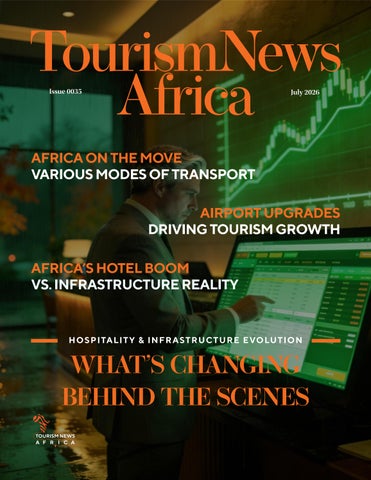
AFRICA ON THE MOVE
VARIOUS MODES OF TRANSPORT

AIRPORT UPGRADES
DRIVING TOURISM GROWTH
AFRICA’S HOTEL BOOM VS. INFRASTRUCTURE REALITY
HOSPITALITY & INFRASTRUCTURE EVOLUTION
AFRICA ON THE MOVE
VARIOUS MODES OF TRANSPORT
AIRPORT UPGRADES
DRIVING TOURISM GROWTH
AFRICA’S HOTEL BOOM VS. INFRASTRUCTURE REALITY
HOSPITALITY & INFRASTRUCTURE EVOLUTION


08 10 12 14 15 06

Airport Upgrades Driving Tourism Growth
Africa’s Hotel Boom vs. Infrastructure Reality
Africa on the Move: Various Modes of Transport
Sustainable Infrastructure: From Concept to Standard Rugby’s Greatest Rivalry Returns Upcoming Events
Africa’s tourism and hospitality sector stands at a pivotal moment. While the spotlight often falls on breathtaking landscapes, iconic wildlife, and vibrant cultural experiences, the real transformation is happening behind the scenes, in the roads, rails, airports, ports, energy systems, and digital networks that make these experiences possible.
In this July edition, we delve into the evolving relationship between infrastructure development and hospitality growth. Across the continent, improved connectivity is no longer a nice-to-have; it is becoming the foundation upon which sustainable tourism and economic expansion are built.
Our cover story, “Africa on the Move: The Rise of Rail, Road and Cruise Travel”, explores how modernised transport networks are reshaping travel patterns, creating new tourism corridors, and enabling more immersive, multidestination journeys. From high-speed rail in Morocco and Kenya to scenic road trips in Southern Africa and expanding cruise itineraries along our coasts, mobility is unlocking previously hard-to-reach destinations.
Complementing this, “Airport Upgrades Boost Tourism” highlights landmark projects such as Rwanda’s Bugesera International Airport, Kenya’s Jomo Kenyatta redevelopment, and ongoing enhancements at key gateways like O.R. Tambo and Cape Town International. These investments are not merely expanding capacity, they are strengthening entire tourism ecosystems by improving access, attracting new routes, and supporting both leisure and business travel.
Yet growth brings challenges. In “Hotel Growth Meets Infrastructure Challenges”, we examine the rapid expansion of international and local hotel brands across key markets and the critical need for supporting infrastructure, reliable energy, water security, transport links, and digital connectivity, to keep pace. The article
underscores how public-private collaboration is essential to turn new room stock into thriving, resilient businesses.
Sustainability emerges as a central thread throughout this issue. Our feature “Sustainable Infrastructure: From Concept to Standard” shows how green building practices, renewable energy solutions, water efficiency, and community-focused development are shifting from competitive advantage to industry benchmark, driven by both traveller demand and operational necessity.
We also celebrate the power of major events to drive tourism in “Rugby’s Greatest Rivalry Returns”, which previews the historic 2026 Springboks vs All Blacks tour. Such spectacles demonstrate how world-class sporting infrastructure and hospitality readiness can put destinations firmly on the global map.
Together, these stories paint a picture of a continent in motion, one where infrastructure is evolving from a constraint into a powerful enabler of tourism growth, economic inclusion, and long-term resilience. The message is clear: the future of African hospitality will be defined not only by the quality of our hotels and attractions, but by the strength and sustainability of the systems that connect them.
As editors and observers of this dynamic industry, we remain optimistic. The investments being made today, in transport, airports, energy, and sustainable practices, are laying the groundwork for a more connected, competitive, and responsible tourism sector.
We hope this edition provides valuable insights, sparks fresh ideas, and reinforces the critical importance of integrated infrastructure planning in Africa’s tourism story.
Warm regards,

Derek Martin
Editor


Across Africa, airports are becoming far more than transport hubs. They are increasingly recognised as strategic economic assets that influence tourism growth, investment attraction and regional development. As countries compete to attract international visitors, governments and private sector stakeholders are investing heavily in airport infrastructure to improve connectivity, passenger experience and operational efficiency.
For the tourism and hospitality sectors, the impact of these upgrades extends far beyond the runway. Modern airports create stronger links between destinations and global markets, making it easier for travellers to access hotels, resorts, conference centres and tourism attractions. In many cases, airport development is acting as a catalyst for wider investment in hospitality and tourism facilities, helping destinations position themselves for long-term growth.
Several African countries have already demonstrated the positive relationship between airport investment and tourism expansion. Rwanda’s continued investment in aviation infrastructure, including the development of the new Bugesera International Airport, supports the country’s ambition to become a leading tourism and business events destination. Similarly, Ethiopia has expanded capacity at Addis Ababa’s Bole International Airport, strengthening its position as one of Africa’s most important aviation gateways.
O.R. Tambo International Airport remains Southern Africa’s primary aviation gateway, supporting both domestic and international tourism flows. Ongoing investments in terminal modernisation, passenger facilities and operational efficiency are helping to improve the traveller experience while maintaining the airport’s competitiveness.
These improvements support the broader tourism ecosystem, benefiting hotels, restaurants, attractions and conference venues that rely on a steady flow of visitors. By maintaining high infrastructure standards, South Africa remains well positioned to attract international travellers and support the recovery and growth of its tourism sector.
RWANDA’S
One of the most ambitious aviation projects currently underway is Rwanda’s Bugesera International Airport. Developed in partnership with Qatar Airways, the new airport is expected to accommodate millions of passengers annually and significantly expand the country’s international connectivity. Rwanda has successfully
positioned itself as a premium tourism destination, attracting visitors through its renowned conservation tourism experiences and growing business events sector.
The airport project is expected to stimulate further investment in hotels, conference facilities and supporting tourism infrastructure while creating employment opportunities throughout the aviation and hospitality value chain. As Rwanda continues to build its reputation as a leading destination for both leisure and business travellers, improved air access will play a critical role in sustaining tourism growth.
The growth of low-cost carriers and expanded regional airline networks has further amplified the benefits of improved airport infrastructure. Travellers are increasingly seeking convenient, affordable travel options, while tourism businesses benefit from a larger and more diverse customer base. For destinations looking to grow visitor numbers, improved accessibility remains one of the most effective drivers of tourism demand.
Sustainability is also becoming a key consideration in airport development projects. Many new and upgraded facilities are incorporating energy-efficient systems, water-saving technologies and environmentally responsible construction practices. These initiatives align with broader sustainability goals being adopted throughout the tourism industry.
Several leading hospitality groups operating in Africa have already embraced green building and sustainability principles within their developments. Hotel groups such as Radisson Hotel Group, Marriott International and Hilton have implemented programmes focused on energy efficiency, water conservation and responsible resource management across many of their African properties. These efforts complement the growing emphasis on sustainable infrastructure throughout the wider tourism ecosystem.
In regions where resources are limited, sustainability is often driven by necessity. Hotels and tourism facilities in countries such as Kenya, Namibia and Rwanda increasingly utilise solar energy, water recycling systems and efficient waste management solutions to reduce
“In regions where resources are limited, sustainability is often driven by necessity.”

operational costs while minimising environmental impact. These practical measures demonstrate how sustainability and business performance can work hand in hand.
Further south, Cape Town International Airport provides an excellent example of how route development can directly stimulate tourism growth. Through strategic collaboration between airlines, tourism authorities and economic development agencies, the airport has significantly expanded its international route network over the past decade.
Increased direct access has contributed to record passenger volumes and strengthened Cape Town’s position as one of Africa’s leading leisure destinations. The resulting growth in visitor numbers has delivered substantial benefits to the hospitality sector, driving demand for accommodation, dining experiences and tourism services throughout the Western Cape.
KENYA’S
In East Africa, Kenya’s Jomo Kenyatta International Airport is undergoing major redevelopment aimed at supporting long-term passenger growth. Plans include expanded terminal capacity, upgraded infrastructure and the development of an Airport City that will incorporate hotels, business facilities and commercial developments.
As Nairobi strengthens its role as a regional aviation hub, improved airport infrastructure is expected to support Kenya’s safari, conference and business tourism sectors while generating new employment opportunities and attracting additional private sector investment. The project demonstrates how airport development can stimulate broader economic activity beyond the aviation sector itself.
Airport development is not without its challenges. Largescale infrastructure projects require substantial capital investment, lengthy planning processes and ongoing operational management. Many airports must also address issues such as congestion, capacity constraints and evolving passenger expectations.
Competition between regional hubs remains intense, with airports continually seeking ways to attract airlines, expand route networks and improve service delivery. Balancing growth ambitions with financial sustainability will remain a key consideration for many airport operators across the continent.
Technology continues to play a central role in shaping the future airport experience. Digital check-in systems, biometric screening, smart security solutions and realtime passenger information services are improving efficiency while enhancing convenience for travellers. As visitor expectations evolve, technology-enabled airports are becoming critical to maintaining destination competitiveness in an increasingly connected world. Airports that successfully embrace digital innovation will be better positioned to deliver seamless travel experiences and attract both airlines and passengers.
Airport infrastructure will remain a vital enabler of tourism growth across Africa. Countries are increasingly recognising that successful tourism development depends not only on attractions and accommodation but also on efficient, reliable and accessible transport networks. The airports that are investing today in expansion, technology and sustainability are positioning themselves to capture future growth opportunities.
“Technology continues to play a central role in shaping the future airport experience. Digital check-in systems, biometric screening, smart security solutions...”

Roux-Ché Shidute News Correspondent

frica’s hospitality sector continues to attract significant investment as international and regional hotel groups expand their presence across the continent. Rising tourism demand, urbanisation, business travel and growing interest from investors have contributed to an impressive pipeline of new hotel developments in many African markets. However, while hotel construction is accelerating, infrastructure challenges continue to present obstacles to long-term growth.
From major cities to emerging tourism destinations, new hotels are reshaping the hospitality landscape. International brands such as Radisson Hotel Group, Marriott International, Hilton, Accor and Hyatt have announced expansion plans across several African countries, recognising the continent’s long-term tourism and business potential. At the same time, locally owned hospitality brands are strengthening their position by investing in new properties and upgrading existing facilities.
The growth is particularly evident in countries such as South Africa, Kenya, Rwanda, Ghana and Morocco, where tourism development strategies and investment incentives have encouraged new hospitality projects. These developments create employment opportunities, stimulate local economies and contribute to the expansion of hospitality and tourism facilities that support broader destination growth.
Despite this momentum, hotel development often advances faster than the infrastructure required to support it. Reliable transport networks, energy supply, water security, waste management systems and digital connectivity remain ongoing challenges in many regions. While investors may be willing to build hotels, long-term success depends on the quality and reliability of the surrounding infrastructure.
Transport accessibility remains one of the most important factors influencing hotel performance. Visitors expect efficient connections between airports, hotels and tourism attractions. In destinations where road networks are underdeveloped or public transport options are limited, the visitor experience can be negatively affected. This is particularly relevant for emerging tourism destinations seeking to compete with more established markets.
MOZAMBIQUE PROVIDES A NOTABLE EXAMPLE
The country has experienced growing investment in hotels and beach resorts, particularly in destinations such as Vilankulo and the Bazaruto Archipelago. However, transport infrastructure remains a challenge. Limited domestic flight options, inconsistent road conditions in some tourism regions and lengthy travel times between airports, hotels and attractions can affect the visitor experience. While demand for accommodation continues to grow, the tourism sector’s full potential depends on continued investment in roads, airports and regional transport connectivity to improve accessibility for both international and domestic travellers.Zanzibar, Tanzania, provides a notable example. The island has experienced significant growth in tourism and hotel development, attracting international hospitality brands and new resort investments. However, transport infrastructure has struggled to keep pace with demand.
Road congestion around key tourism areas and limited public transport options can result in longer travel times between hotels, attractions and Abeid Amani Karume International Airport. As visitor numbers continue to rise, both government authorities and tourism stakeholders have prioritised road upgrades and airport improvements to support the island’s growing hospitality sector and enhance the overall visitor experience.
ENERGY SUPPLY AND OPERATIONAL RELIABILITY
Energy supply presents another significant challenge. In several African countries, hotels must invest in backup power systems to maintain uninterrupted operations. While these additional investments increase operating costs, they have also encouraged innovation. Many hospitality businesses have adopted renewable energy solutions to improve resilience and reduce dependence on national power grids.


Across Africa, travel is entering a defining era of transformation. The continent’s vast landscapes, expanding urban centres and increasing regional connectivity are reshaping how people move for business, leisure and trade. Rail, road and cruise travel are no longer simply modes of transport. They are becoming strategic enablers of tourism growth, economic integration and hospitality development.
The evolution of transport across Africa has followed different trajectories over the decades. Rail networks were among the continent’s earliest large-scale transport systems, developed primarily during the colonial era to connect ports with mining and agricultural regions. As road infrastructure expanded and vehicle ownership increased throughout the later half of the twentieth century, road transport became the dominant mode of travel in many countries. More recently, growing urbanisation, infrastructure investment and regional integration initiatives have renewed interest in rail travel, while cruise tourism has emerged as a niche but rapidly growing segment of the travel market.For the hospitality sector, this shift is significant. As mobility improves, destinations become more accessible, travel patterns diversify and demand for integrated guest experiences increases. Organisations such as Tourism News Africa closely follow these developments, highlighting industry trends, sharing market insights and supporting hospitality stakeholders as they adapt to evolving traveller expectations and identify new opportunities for growth across the tourism value chain.
RAIL: THE REVIVAL OF A CLASSIC CONNECTOR
Rail’s renewed popularity reflects a broader shift in how travellers view transportation. Once regarded primarily as a functional means of moving goods and people, rail is increasingly valued for its comfort, reliability and lower environmental impact. In many parts of the world, including Africa, investment in modern rail systems has been driven by the need to reduce congestion, improve connectivity and support sustainable economic growth.Rail travel in Africa is experiencing renewed attention, driven by infrastructure


investment, urban expansion and a growing interest in sustainable transport. While historically underutilised in some regions, rail is increasingly being repositioned as a reliable, efficient and experience-driven mode of travel.
Countries such as Morocco, Kenya, Egypt and South Africa are investing in rail infrastructure to improve connectivity and support economic growth. Morocco’s Al Boraq high-speed rail service has demonstrated how modern rail networks can reduce travel times while enhancing regional mobility. Kenya’s Standard Gauge Railway has strengthened links between key economic centres, while South Africa continues to attract international visitors through iconic rail tourism experiences such as Rovos Rail and the Blue Train.
The resurgence of rail travel also mirrors global tourism trends. Travellers are increasingly seeking slower, more immersive journeys that allow them to engage with landscapes, cultures and communities along the route. Luxury rail experiences, in particular, have become sought-after tourism products, combining transportation, accommodation and destination experiences into a single offering.
From a hospitality perspective, rail offers a unique advantage. It encourages slower, more immersive travel, where guests engage more deeply with destinations along the way. Boutique hotels, lodges and urban stays located near rail hubs are well positioned to benefit from this trend, particularly as travellers seek convenience without compromising experience.
Rail tourism also aligns with sustainability goals. Compared to air and road transport, rail can offer lower emissions per passenger, making it increasingly attractive to environmentally conscious travellers.

Road transport’s dominance across much of Africa can largely be traced to the expansion of national highway networks during the latter half of the twentieth century. As governments prioritised road development to connect growing populations and support trade, road travel became the most flexible and accessible transport option for both residents and visitors. Today, continued investment in road infrastructure remains critical to tourism development, particularly in rural and remote destinations.

Despite advancements in other transport modes, road travel remains the backbone of mobility across Africa. It continues to play a critical role in connecting communities, supporting logistics networks and enabling tourism experiences that extend beyond major cities and transport hubs.
The rise of self-drive tourism, cross-border road trips and private shuttle services reflects a broader shift towards personalised travel experiences. Travellers increasingly seek flexibility and the freedom to explore destinations at their own pace. This trend is particularly evident in countries such as South Africa, Namibia and Botswana, where scenic driving routes and wildlife tourism attract both domestic and international visitors.
For the hospitality industry, this shift has direct implications. Properties located along major highways, tourism corridors and popular driving routes are experiencing increased demand from road travellers. Hotels, guesthouses and lodges that provide convenience, security and quality service are particularly well positioned to benefit. Road infrastructure development is also improving travel experiences across many regions. Upgraded highways, improved signage, digital navigation tools and expanded roadside services are making long-distance travel more efficient and comfortable. At the same time, road travel
remains essential because many of Africa’s most soughtafter tourism attractions, including national parks, heritage sites and remote lodges, cannot be reached through rail or air transport alone.
Cruise tourism is emerging as one of the most exciting growth segments within Africa’s travel industry. With extensive coastlines along the Atlantic and Indian Oceans, as well as access to iconic waterways such as the Nile, the continent is well positioned to expand its cruise offering.
While cruise tourism has a long history globally, its growth in Africa has accelerated over the past two decades as international cruise operators seek new destinations and travellers increasingly look for unique cultural and naturebased experiences. Improvements in port infrastructure, destination marketing and regional tourism collaboration have contributed to the continent’s growing appeal within the global cruise industry.
Destinations including Cape Town, Durban, Mombasa, Zanzibar and Port Louis are increasingly being integrated into international cruise itineraries. These destinations offer a compelling combination of cultural heritage, natural beauty and authentic visitor experiences that appeal to global travellers.


Chris Midgley News Correspondent
“The resurgence of rail travel also mirrors global tourism trends. Travellers are increasingly seeking slower, more immersive journeys that allow them to engage with landscapes.”

ustainability is no longer an ambition for the hospitality sector, but rather a business necessity. As travellers become more environmentally conscious and regulations, hospitality businesses are being forced to rethink how they design, build and operate their facilities. What was once considered a competitive advantage is now becoming an industry standard.
EXCEPTIONAL EXPERIENCES WITH GREATER EFFICIENCY AS AN EXPECTATION
Hospitality businesses are among the world’s largest consumers of energy and water. From heating and cooling systems, to kitchens, laundry facilities and transportation networks, infrastructure has a direct impact on both operating costs and environmental impact.
Across Africa, the shift toward sustainable infrastructure is accelerating. Properties increasingly recognise that environmentally responsible projects are often more resilient, cost-effective and attractive in the long term. Green building certifications, renewable energy systems, smart water management and sustainable sourcing are becoming core elements of hospitality developments and assist in countries with unreliable water and energy supply. Major hotel groups such as Radisson, Marriott, Hilton and Accor have embedded sustainability into their operations, reflecting a wider industry move toward resource efficiency and responsible tourism.
BOOKING.COM’S SUSTAINABILITY REPORT
A major driver of this change is evolving traveller behaviour. According to Booking.com’s Sustainable Travel Report, 84% of travellers consider sustainable travel important, while 93% want to make more sustainable travel choices. Guests are increasingly looking for properties that demonstrate genuine commitments to reducing waste, conserving water, lowering energy consumption and supporting local communities.
TECHNOLOGY AND ADOPTION
Technology is helping accelerate this transformation. Smart building systems allow operators to monitor and optimise resource consumption in real time. Automated lighting, climate controls and occupancy sensors reduce unnecessary energy use, while greywater recycling, rainwater harvesting and low-flow fixtures improve water efficiency.
Renewable energy adoption is also growing rapidly. Solar power and battery storage are becoming increasingly common. In South Africa, ongoing energy challenges have encouraged significant investment in solar and backup power solutions to improve energy security and business continuity. Water conservation has become equally important, particularly in destinations where resources are limited.
Sustainable infrastructure extends beyond environmental concerns. Social and economic sustainability are equally important. Hospitality developments that prioritise local employment, skills development, community partnerships and locally sourced products often create stronger, more resilient business ecosystems. Across Africa, many properties are incorporating local materials, indigenous design influences and community-led tourism experiences that support economic growth while preserving cultural identity.
THESE CHANGES ARE NOT WITHOUT CHALLENGES
Challenges remain. Sustainable infrastructure often requires significant upfront investment, and access to affordable financing can be limited. Additional training, operational changes and specialised skills can also slow adoption. While international travellers increasingly value sustainability, some local markets continue to prioritise affordability, creating uncertainty around returns on investment.
For Africa, the opportunity is significant. As tourism grows across the continent, developers have the chance to build modern, resilient and environmentally responsible infrastructure from the outset. Sustainable infrastructure is no longer simply about reducing environmental impact, it is about improving resilience, enhancing guest experiences, supporting communities and creating longterm commercial value.

Jonty Bruggen News Correspondent

There are few sporting contests capture the imagination quite like a clash between the Springboks and the All Blacks. It is more than just a rugby fixture. It is a rivalry built on over a century of history, excellence and mutual respect. In 2026, that rivalry takes centre stage through Rugby’s Greatest Rivalry, an eight-match tour that marks the return of the traditional multi-match touring format between South Africa and New Zealand for the first time in nearly three decades.
The tour will feature four highly anticipated Test matches, with encounters scheduled for Johannesburg, Cape Town, Johannesburg again, and a historic finale in Baltimore, USA. In addition, the All Blacks will face South Africa’s leading provincial franchises – the Stormers, Sharks, Bulls and Lions – creating a festival of rugby across the country.
The significance of the series extends beyond the field. With the Rugby Championship paused in 2026 to accommodate changes to the international calendar, this tour becomes the standout event of the global rugby season. It also arrives at a time when South Africa and New Zealand are widely regarded as the sport’s dominant forces, occupying the top two positions in the world rankings.
For South Africa, the tourism impact could be substantial. Matches in Johannesburg, Cape Town, Durban and Pretoria are expected to attract thousands of travelling supporters, driving demand for accommodation, hospitality, transport and local attractions. Official travel packages have already generated strong interest, highlighting the event’s appeal as both a sporting spectacle and a travel experience.
Adding further value, the 5 September fixture at FNB Stadium will include a women’s international between the Springbok Women and the Black Ferns, broadening the event into a celebration of rugby across all levels.
More than a Test series, Rugby’s Greatest Rivalry 2026 represents the revival of a cherished rugby tradition while showcasing South Africa as a world-class destination for major sporting events. For rugby fans and travellers alike, it promises to be one of the defining sporting experiences of the year.
Discover more by watching the video below: