Fundado en 1986, TOURING es uno de los mejores y más aceptados periódicos de turismo de la República Dominicana, por su interesante y variado contenido que abarca los diferentes renglones, lugares y sitios de la industria turística dominicana.
La casa editora de TOURING es Alfa y Omega, empresa que desde sus inicios ha sido suma de voluntades, testimonio de trabajo y excelente dirección. Desde sus inicios, desafiante en sus objetivos, que le han permitido cumplir con su misión y compromiso con la educación y la cultura.
Founded in 1986, TOURING is one of the best and most accepted tourism newspapers in the Dominican Republic, for its interesting and varied content that covers the different lines, places and sites of the Dominican tourism industry.
TOURING’s publishing house is Alfa y Omega, a company that since its inception has been the sum of wills, work testimony and excellent management. Since its inception, challenging in its objectives, which have allowed it to fulfill its mission and commitment to education and culture.
3 / 6
LAS BALLENAS JOROBADAS
Regresaron a su santuario
11 / 12 THE HUMPBACK WHALES
Are back to their sanctuary
Febrero, 2026 • Dominican Republic 13 / 14 / 15 Febrero de
MAPA CENTRAL CENTRAL MAP
February, 2026 • República Dominicana
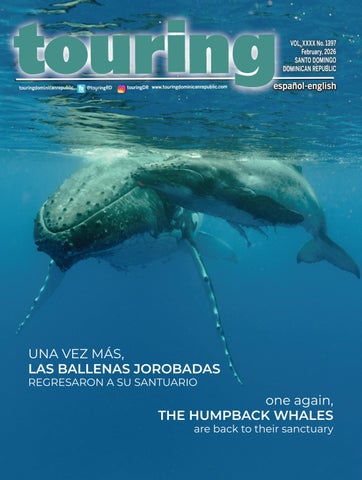
UNA VEZ MÁS, LAS BALLENAS JOROBADAS REGRESARON A SU SANTUARIO
Por Victoria Curiel
El comienzo del año se caracteriza por el maravilloso encuentro con ballenas jorobadas en Cayo Levantado, Samaná. Este asombroso encuentro solo se puede disfrutar durante la temporada de apareamiento; las ballenas llegan desde mediados de diciembre, o quizás antes, hasta finales de abril. Algunos esperan aquí la primavera, que comienza el 21 de marzo, cuando el frío del invierno comienza a amainar.
En República Dominicana han llegado a tiempo y el miércoles 15 de enero inicia la temporada de avistamiento de ballenas jorobadas, un atractivo natural que aporta a la economía de las zonas costeras de Samaná, donde se concentra una gran cantidad de turistas locales y extranjeros que arriban al Banco de la Plata y al Santuario de Mamíferos Marinos.
Cada año, cientos de ballenas llegan a la costa norte de la República Dominicana para aparearse y dar a luz a sus crías en las cálidas aguas del intenso azul del Atlántico, que les brindan refugio en el templado clima tropical. Este es el inicio de su ciclo vital: apareamiento, procreación, crianza y protección. Son cetáceos gigantes, cariñosos y unidos, que recorren miles de kilómetros cada invierno en un viaje cuya ruta parece haberse transmitido de generación en generación. Esta migración, una de las más grandes del mundo en su tipo, parte de Noruega, Islandia, Groenlandia, Canadá y Estados Unidos hacia las cálidas aguas de la provincia de Samaná, donde se pueden avistar en los meses indicados.
La llegada de estas ballenas, cuyo nombre científico es “megaptera novaeangliae”, a las costas de República Dominicana nos cuenta una historia de amor,
perseverancia y supervivencia: estos cetáceos, que habitan las distantes y frías aguas del Norte, llegan al extenso Santuario de mamíferos marinos del Banco de la Plata, el Banco de Navidad y la Bahía de Samaná, que les brinda sus 33.000 kilómetros para realizar sus ritos con total tranquilidad. Aquí, podrás presenciar un espectáculo sin igual: los machos saltan intentando llamar la atención de las hembras, les cantan, se enamoran entre la coreografía y el romance, hasta que aceptan y se aparean.
Otras vienen a dar a luz a sus crías (lejos de las gélidas aguas de otros continentes), las amamantan y esperan a que se fortalezcan lo suficiente para resistir el viaje de regreso a casa; esa es la misma ternura y protección que nosotros mismos intentamos brindarles a nuestros recién nacidos. Aquí aman a sus crías y las acompañan en sus primeros aleteos, y todo esto ocurre cada año desde que las vimos por primera vez. Oficialmente, fue en 1979, cuando un grupo de científicos que seguía la ruta de estos mamíferos que notificaron los primeros avistamientos en la Bahía de Samaná.
Las ballenas jorobadas pertenecen a las grandes ballenas. Miden quince metros y pesan un promedio de 40 toneladas.
Otras razones por las que vienen a dar a luz a sus crías por aquí. Simplemente, porque la cría, al nacer, tiene una capa de grasa demasiado fina para soportar el agua fría. Al nacer, miden entre 3,50 y 5 metros y pesan una tonelada. Luego, para constituir esta capa protectora y adquirir la fuerza suficiente para seguir a sus madres en el viaje de regreso, consumen diariamente unos 200 litros de leche materna... Esta leche es muy rica y nutritiva, ¡las “pequeñas” ganan hasta 45 kilos al día! Es un verdadero placer y una gran emoción ver a la madre jugar con su cría. La ballena solo puede tener una cría cada
dos años. La gestación dura de 11 a 12 meses. ¡Pues viene a dar a luz a su cría justo donde la conciben! Aunque es raro, a veces ocurre que algunas crías se aparean durante la misma temporada del parto.
En cuanto a los machos, para seducir a las hembras, cantan y saltan fuera del agua. Las ballenas tienen un oído muy desarrollado (su principal sentido) y pueden oír cantos a hasta 35 kilómetros de distancia. ¿Te imaginas cómo se sentiría saber que compartes espacio con cientos de ballenas que surcan las aguas? ¿Te imaginas tener el privilegio de ver sus saltos, sus palpitaciones, observarlas bucear o escuchar los sonidos que emiten para atraer y/o convencer a las hembras?
Las he observado muchas veces y les aseguro que me provocan una emoción indescriptible. Personalmente, he llevado a mi nieto, quien ha disfrutado muchísimo. A pesar de cierto mareo, este puede afectar especialmente a quienes no toman precauciones o a quienes no están acostumbrados a navegar. Es una experiencia que hay que vivir para creer, y dependiendo de la sensibilidad de cada uno, es diferente...
Febrero, 2026 • Dominican Republic
Afortunadamente, el avistamiento de ballenas está regulado. Por ello, y para cumplir con las normas de respeto a estos maravillosos animales, y también por razones de seguridad, es necesario embarcar con proveedores reconocidos y que cuenten con las autorizaciones necesarias del Ministerio de Medio Ambiente. Además, se deben respetar las precauciones al acercarse para observarlas a ciertos metros de altura, y se debe tener en cuenta la hora de salida, siendo ideal y límite, a más tardar, las 9 de la mañana, debido a las condiciones del mar y a que por la tarde hay mayor afluencia. Se recomienda tomar una pastilla de dramamina u otro medicamento con componentes para combatir las náuseas y los mareos. También existe un observatorio, promovido por los Ministerios de Medio Ambiente, Turismo y el clúster turístico de esa provincia, desde donde se pueden observar las ballenas con binoculares. Esta es una opción para quienes no deseen embarcar.
¡Vive la aventura!
Parque Nacional
Antropológicas de Cuevas de Borbón o Pomier
43. Cerro de San Francisco
44. Cerro de L os Cacheos
A. Refugios de
45. Monumento 46. Cueva de los 47. Río Chacuey
48. Lagunas Redonda
49. Bahía Luperón
50. Manglares de 51. Cayos Siete
52. Laguna Saladilla
53. Humedales
54. Laguna Cabral
55. La Gran Laguna 56. Manglares de 57. Laguna de Báv 58. Río Soco
Río Maimón
OCEÁNO ATLÁNTICO
Vida Silvestre
Monumento Natural Miguel Domingo los Tres Ojos de Sto.Dgo.
Redonda y Limón perón de Puer to Viejo
CANAL DE LA MONA
TOURING, S.R.L. www.touringdominicanrepublic.com
E-mail: touring86@gmail.com
Editora Alfa y Omega
C/José Contreras No. 69, Zona Universitaria Tel.: 809.535.4305 Fax.: 809.535.4927
Arroyo Cano
63. Carros de Chacuey 64. Loma Novillero 65. Cabeza de Toro 66. Loma du 20 67. Villarpando
Guento
Las Matas
Cayuco
Hatillo
A. Vía Panorámica
75. Mirador del Atlantico
76. Mirador del Paraíso
77. Carretera El Abanico-Constanza
78. Carretera Cabral-Polo
79. Carretera Santiago-La Cumbre-Puer to Plata
80. Carretera Bayacanes-Jarabacoa
81. Costa Azul
82. Santa Cruz de Mao
83. Carretera Nagua-Sánchez y Nagua-Cabarete
B. Área Nacional de Recreo
84. Cabo Rojo Bahía de las Águilas
85. Guaraguao – Punta Catuano
86. Guaiguí
Este mapa de la República Dominicana es propiedad del periódico turístico TOURING, S.R.L
Áreas Protegidas Cuevas
Lugares Arqueológicos
Restos de Galeones Puerto Playa Balneario Salto de Agua
Aeropuerto Internacional
Aeropuerto Nacional
Puntos de Información Turística
Vehículos de Doble Tracción Caminatas
Sitios de Buceo Sur f
Kitesur f
Campo de golf
Paseo a Caballo
Lugares para Acampar Miradores
Recorrido en Bote
Teleférico
Sitios de Pesca
Observación de Ballenas
Observación de Reptiles
Observación de Aves
Observación de Manatíes
Observación de Delfines
Observación de Tortugas
Capital de provincia
Distrito Municipal Municipios
Sección o Parage
Autopistas
Puntos de Interes
Isla Catalinita
PUNTA CANA Museo
Permanecer en el tiempo es cosa de trabajo, de voluntades, de producir recursos para crecer y progresar.
Reafirmamos nuestro compromiso de seguir siendo ejemplo de superación año tras año.
February, 2026 • República Dominicana
once again, THE HUMPBACK WHALES are back to their sanctuary
ByVictoria Curiel
The beginning of the year is marked with the wonderful encounter with humpback whales in Cayo Levantado, Samaná. This amazing rendezvous can only be taken advantage of during the mating season, the whales arrive from mid-December, or perhaps earlier, to the end of April. Some wait for spring here, which begins on March 21th, when the cold of winter begins to subside.
In the Dominican Republic, they have arrived on time and on Wednesday, January 15, the humpback whale watching season begins, a natural attraction that contributes to the economy of the coastal areas of Samaná, where a large number of local and foreign tourists that arrive to the Silver Bank and Navidad Marine Mammal Sanctuary.
Every year they come to the North Coast of the Dominican Republic, hundreds of whales are mating and give birth to their babys in the warm waters of the intense blue of the Atlantic Sea, which provide shelter in the temper tropical climate, the beginning of their life cycle: mating, procreation, breeding protection. They are gigantic
cetaceans, loving and united, they travel thousands of kilometers every winter on a trip whose route seems to have been transmitted from generation to generation. This migration, one of the largest in the world of its kind, starts from Norway, Iceland, Greenland, Canada and the United States to this extremely cozy waters of the province of Samaná, where you can see them in the months indicated above.
The arrival of these whales, whose scientific name is “megaptera novaeangliae”, on the shores of the Dominican Republic tells us a story of love, perseverance and survival: these cetaceans, who live in the distant and cold waters of the North, come to the extensive Sanctuary of marine mammals of Banco de la Plata, Banco de Navidad and Samana Bay, which gives them their 33,000 kilometers to perform their rites at ease. Here, you can witness a show like no other: the males jump around, trying to get the female’s attention, they “sing” to them, they fall in love between choreography and romance, until they accept and mate.
Others come to give birth to their calves, (far from the icy waters of other continents), breastfeed them and wait
for them to be strengthened enough to resist the trip back to their home, that is the same tenderness and protection we try to provide to our newborns ourselves. Here they love their calves and accompany them in their first flutters out, and all this happens every year since we first noticed them, officially, it was back in 1979, when a group of scientists who followed the route of these mammals notified the first sightings in the Bay of Samana.
Humpback whales are part of the great whales. They measure a fortnight of meters and weigh 40 tons on average.
Other reasons why they come to give birth to their little ones around here. Simply, because the calf, at birth, has a layer of fat too thin to withstand cold water. When they are born, they measure between 3.50 and 5 meters, and weigh a ton. Then, to constitute a protective greasy layer and to acquire enough strength to follow their mothers for the return trip, they will consume, daily, about 200 liters of breast milk ... This milk is very rich and very nutritious, the “little ones” will gain up 45 kilos a day! It is
Febrero, 2026 • Dominican Republic
a real pleasure and a very emotional to see the mother playing with her offspring. The whale can only have one calf and this, every 2 years. The gestation duration is 11 to 12 months. Well, she comes to give birth to her baby right where its conceived! Although it is rare, sometimes it happens that some are coupled during the same season as childbirth.
As for the males, in order to seduce the females, they sing and make jumps out of the water. Whales have a very developed ear (their main sense) and can hear singing up to 35 kilometers away. Imagine how it would feel to know that you share the space with hundreds of whales that travel the waters? Imagine having the privilege of seeing them jumps, their throbbing, watching them dive or listening to the sounds they make with which the males attract, and / or convince the females?
I have observed them many times, and let me tell you that it creates an unspeakable emotion. Personally, I have taken my grandson who has enjoyed them a lot, despite a certain dizziness, it can occur especially to those who do not take any kind of precaution to avoid it or those who are not used to sailing. This is an experience that “you have to live it, to believe it”, and depending on the sensitivity of each one, it is different ...
Fortunately, whale-watching is regulated. For this reason, and in order to follow these rules on the respect of these wonderful animals, and also for safety reasons, it is necessary to take or embark with recognized providers and that have the necessary authorizations from the Ministry of Environment. In addition, the precautions of approaching to observe them at certain meters must be respected, and the departure time must be taken into consideration, being the ideal and the limit, at the latest at 9 o´clock in the morning due the conditions of the sea and being afternoon hours more busy. I suggest taking a pill of dramamine or another medication with components to combat nausea and dizziness. There is also an Observatory, promoted by the Ministries of Environment, Tourism and the tourist cluster of that province, from which you can see the whales with binoculars. This is an option for those who do not wish to embark.
Live up the adventure!
February, 2026 • República Dominicana
Febrero de Carnavales
Por Victoria Curiel
Durante más de treinta años, la República Dominicana ha celebrado carnavales en todas las provincias del país, cada una con sus propias características visuales, tanto en la creatividad de su gente como en su expresión cultural. El carnaval, dentro de la sociedad dominicana, se ha convertido cada vez más en una expresión artística para el deleite del turismo nacional e internacional.
Toda la sociedad ya se disfraza desde principios de febrero: de Punta Cana a Samaná, de Santiago a La Vega, de Cotuí a Monte Cristi, de Río San Juan y Cabrera a Puerto Plata, todos los pueblos y ciudades se convierten en un auténtico proyecto de creatividad popular. En este escenario de talleres de máscaras, confección de disfraces, grupos de baile, talleres de costura, artesanos de papel maché y grupos musicales, todo el país cobra vida al ritmo de los pequeños cencerros que adornan los disfraces de los “Diablos Cojuelos” que recorren las calles inflando globos y blandiendo sus látigos… Este ambiente exclusivo y la auténtica cultura popular dominicana convierten su carnaval en uno de los más esperados de todo el Caribe.
Cada provincia tiene su propio calendario y dinámica, lo que permite a los animadores turísticos organizar y estimular la integración de nuestros visitantes extranjeros, siendo Santo Domingo y Punta Cana las más conocidas por este motivo. Disfrute de personajes cómicos como “Roba-la-gallina”, en el que un hombre se disfraza de
mujer, con un pecho y trasero exuberantes. También los “diablitos” y “Califé”, un extraño personaje creado hace más de 100 años en el barrio de Villa Francisca de la capital. En resumen, estos y otros personajes del Carnaval dominicano han sido creados con el sello de su barrio. No podemos olvidar la comparsa de “Los Indios” y “Los Africanos”, “La muerte en bicicleta”, “Los Platanuses”, “Roba la Gallina”, etc.
Ahora con la participación de más de 140 escuelas y personajes de diferentes provincias del país, el Ministerio de Cultura anunció finalmente la celebración del Desfile de Carnaval 2022, que se llevará a cabo el domingo 6 de marzo en el malecón del Caribe de Santo Domingo.
Fotos por Mariano Hernández.
February of Carnivals
ByVictoria Curiel
For more than thirty years, the Dominican Republic has celebrated carnivals in all the country´s provinces, each of them with its own visual characteristics, both in their people´s creativity and in their cultural expression, the carnival within the Dominican society has become more and more an expression art for the delight of both domestic and international tourism.
The entire society is already in disguised from the first days of February, from Punta Cana to Samaná, from Santiago to La Vega, from Cotuí to Monte Cristi, from Rio San Juan and Cabrera to Puerto Plata, all the towns and cities become an authentic project of folk´s creativity.
Within this scenario of mask workshops, costume making, dance troupes, sewing centers, maché-paper artisans, musical groups, the whole country comes alive to the rhythm of thetiny cowbells attached to the costumes of the “Diablos Cojuelos” (grabber devils) running through the streets blowing balloons and whipping their whips…, this is such an exclusive mood and authentic popular Dominican culture that turns its carnival into one of the most anticipated one in the whole Caribbean.
Each province has its own calendar and its own dynamics, which allows tourist entertainers in each province to organize and stimulate the integration of our foreign visitors, being the great Santo Domingo and Punta Cana the best well known for this reason.
Enjoy comical characters like “Roba-la-gallina” (chicken thief), in which a man disguises himself as a woman, with an abundant chest and rear. Also “diablitos” (little devils), “Califé” a strange character created more than 100 years ago in the Villa Francisca neighborhood of the capital. In short, these and other characters of the Dominican Carnival have been created with their neighborhood stamp on it. It is not possible to forget the comparsa (dance school) of “Los Indios” and “Los Africanos”, “La muerte en bicicleta”, “Los Platanuses”, “Roba la Gallina”, etc.
Now with the participation of more than 140 schools and characters from different provinces of the country, the Ministry of Culture finally announced the celebration of the 2022 Carnival Parade, which will take place on Sunday, March the 6th on the Santo Domingo´s Caribbean boardwalk .
Photos by Mariano Hernández.
https://www.editoraalfayomega.com.do/ Avenida Francia, No. 41, Esq. Rocco Cochia, San Juan Bosco, Santo Domingo, Rep.Dom. Tels: 809.532.5577. Email: info@editoraalfayomega.com.do