QUEER JOY
Allyship, Affirmative Care, & Queer Joy as Resistance
“Even if you eat and sleep and fuck in the watery shadowlight of straight suburbia, to engage with joy is a radical act.”
This is for the Helpers - the social workers, students, new clinicians, experienced providers, educators, and community members.
For those wanting to better support 2SLGBTQIA+ people in real, practical ways.
For those who care about doing affirming work but may not always have the time, training, understanding, or language to feel confident doing it.
Designed as a quick reference -
● Return to it when you need it.
● Flip through it between sessions.
● Share it with colleagues.
● Bring it into the classroom.
● Use it to spark conversations with people!
It’s intentionally created to be accessible, easy to read, and flexible because learning about affirmative care should not require perfection or a lot of extra time.
This is important because many helping professionals receive very limited education on 2SLGBTQIA+ affirmative practice, even though many regularly serve these clients and communities (Morrow & Messenger, 2006; Argüello 2019).
Additionally, 2SLGBTQIA+ experiences are often framed in clinical and service settings primarily through trauma, risk, or pathology. While these realities are important to recognize, they don’t encompass the whole story.
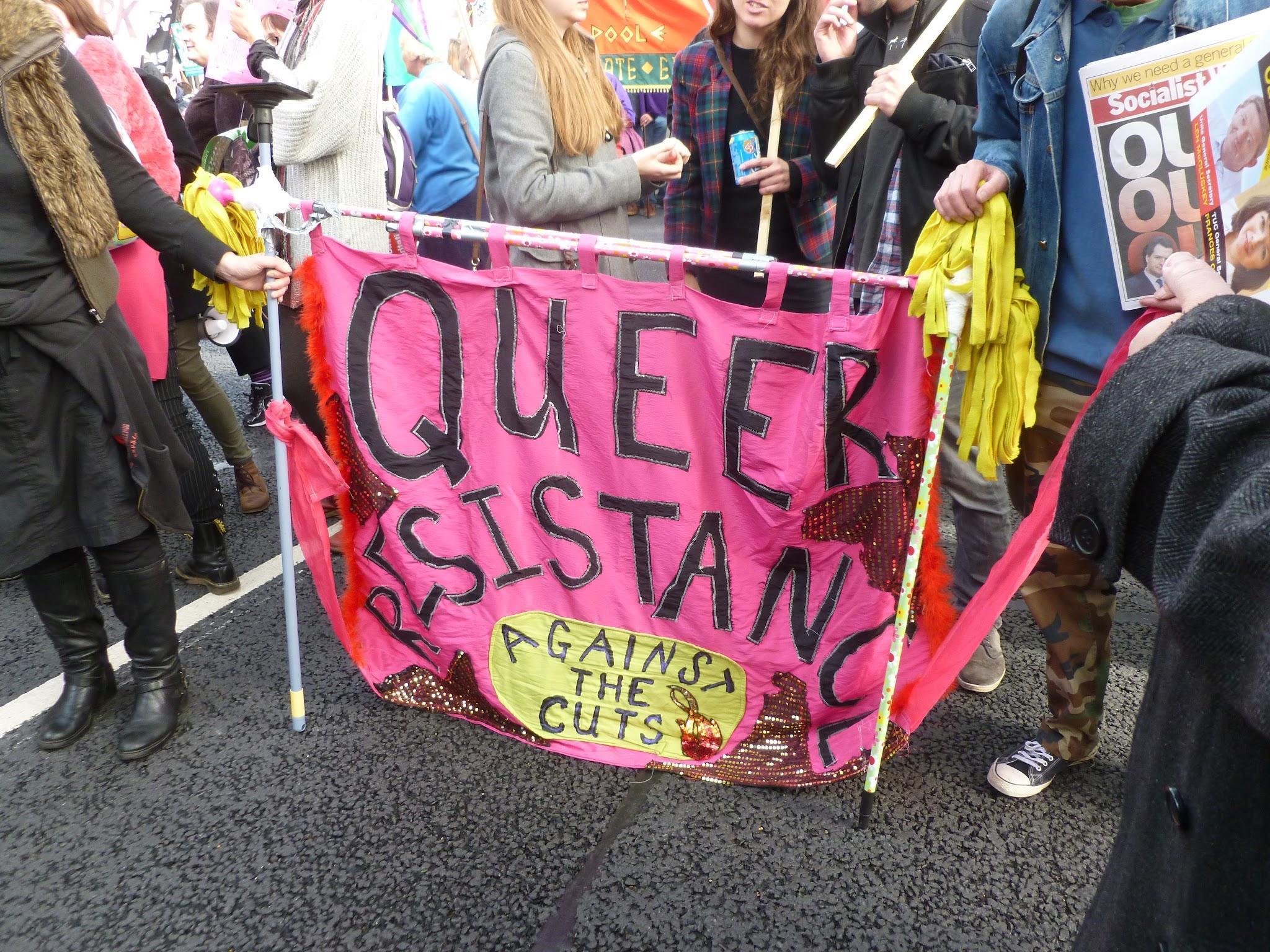
Queer lives also include Joy, Connection, Resistance, Creativity, and Community.
Queer theory reminds us to question the assumptions and systems that shape how care is delivered, especially regarding heteronormativity and the idea that certain identities are the default (Barker & Scheele, 2016).
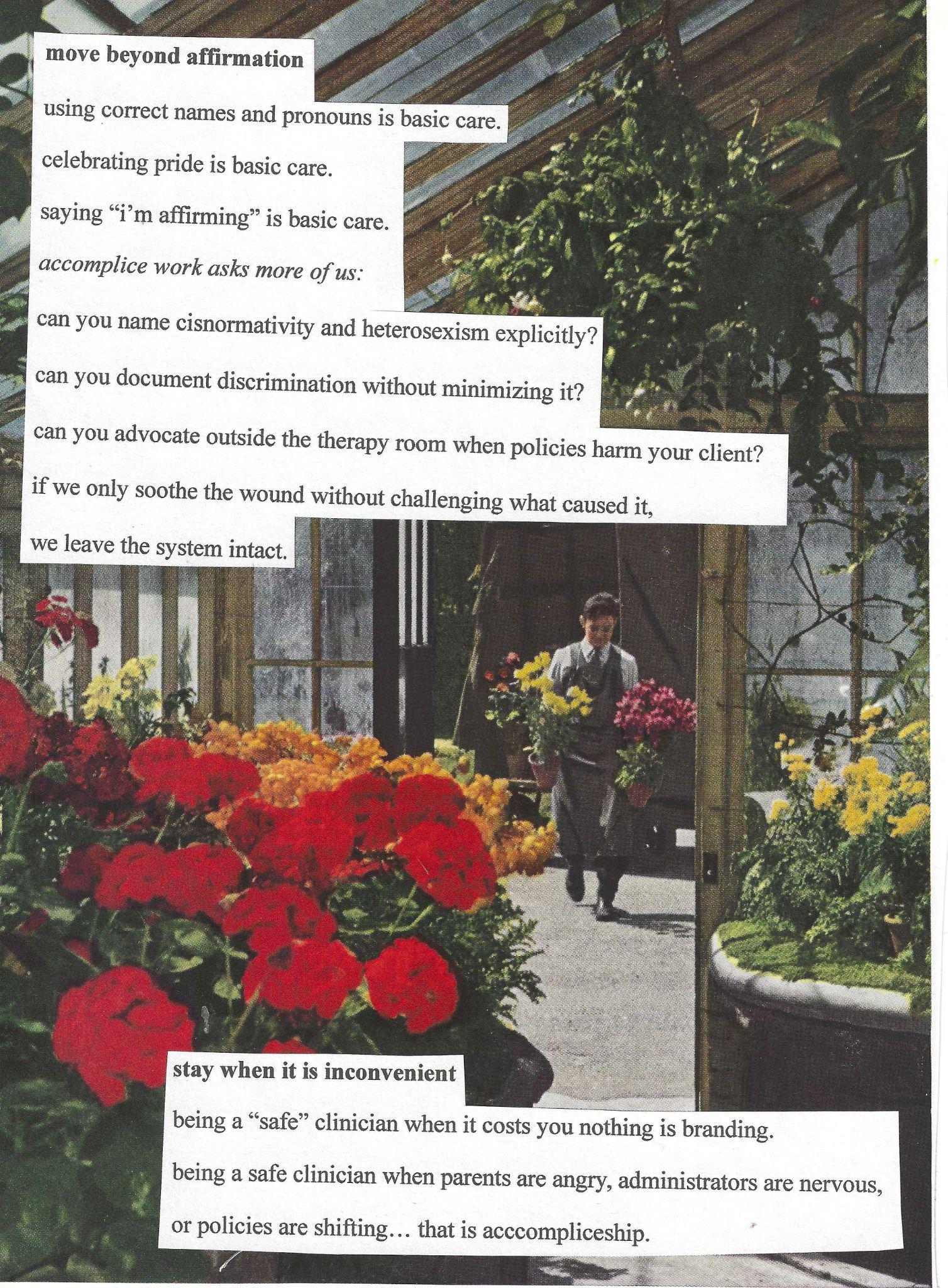
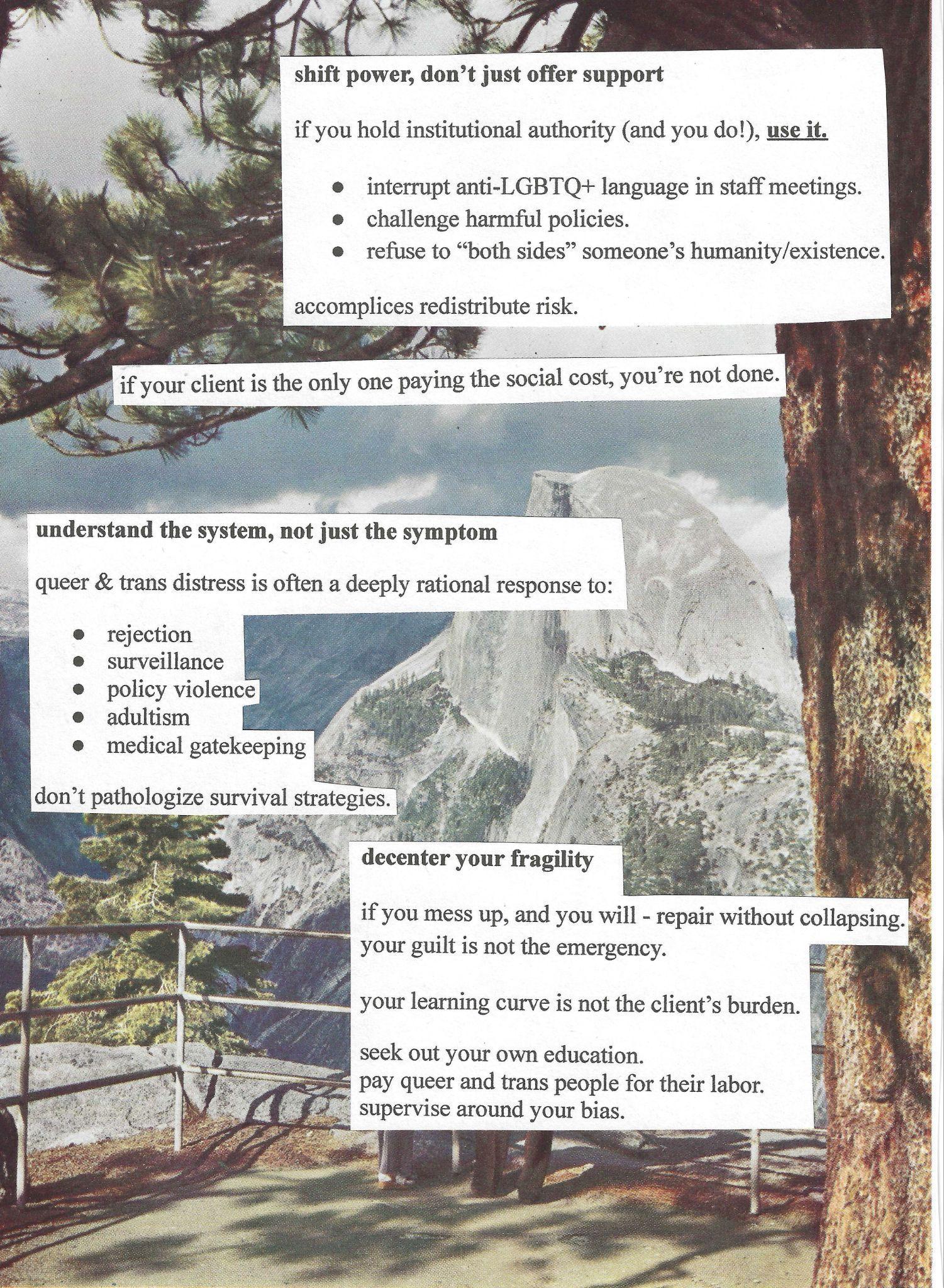
We invite you to pause, reflect, and consider how your practice can move beyond basic allyship and toward more active, accountable support.
Let’s also center Queer Joy alongside Trauma-informed Care and think about how our everyday actions can help create safer, more affirming systems for 2SLGBTQIA+ people.
The Joy of Queering: Why Queer Joy
Belongs in Clinical Practice .
Part of queering clinical work affirms identity, questions inherited norms, and unsettles the binaries that organize suffering in the first place. Binary thinking—male/female, healthy/pathological, normal/deviant—has shaped both science and psychotherapy, often under the guise of neutrality (Barker & Scheele, 2016). Contemporary biopsychosocial and neuroendocrinological perspectives complicate this determinism, demonstrating that biology, behavior, and social context are intertwined rather than causally linear or fixed (Barker & Scheele, 2016; van Anders, 2015). Queer and critical sexology further challenge the medicalization of difference by centering lived experience, consent, and the reality that many people do not inhabit gender or sexuality in binary ways (Barker & Scheele, 2016). In this sense, queering is not anti-science; it is anti-reductionism. It aligns with crip theory’s insistence that all bodies are interdependent rather than autonomous in isolation (Barker & Scheele, 2016). Clinically, this reframes our task from correcting deviation to interrogating the norms that produce shame.
Queer joy emerges at the point where these norms loosen. It is the affective experience of possibility—of relational configurations beyond compulsory marriage, of gendered lives not dictated at birth, of intimacy negotiated through consent rather than assumption (Butler, 2004; Barker & Scheele, 2016). Pride, queer art, chosen family, kink, and polyamory are not fringe phenomena but examples of cultural world-building that model explicit communication, interdependence, and embodied aliveness. In the therapy room, centering queer joy interrupts trauma-only narratives and expands the window of tolerance toward pleasure, creativity, and belonging. Affirming environments are demonstrably protective for LGBTQIA2S+ (Oregon Alliance to Prevent Suicide, 2022), but beyond protection, joy restores agency. Queer joy belongs in clinical practice because it is not indulgent—it is reparative, relational, and a necessary counterweight to the pathologizing histories from which both queer people and psychotherapy are still emerging.

“Hmm.. being comfortable being truly myself proudly and openly in a community that celebrates ALL of our diversity in the alphabet soup lol. Being able to recognize and connect with other openly queer folks and sharing in that experience together!”
Photo: Student visit to PDX ice rink creates new memories and engagement with hobbies
“Joy- unbridled, embodied, is transgressive.”
“IF,
you live beyond the bounds of convention. Say you eat and sleep and fuck in the verdant chaos of the queer, then joy - its rhythm and rapture - after the compression of societal threat, is capable of wonders.”
“As a gay AAPI immigrant, Queer Joy means (finally) sitting together for dinner with my family and my partner. I grew up Catholic, and I saw my family go through different emotions when I came out. They're in a better spot now. And in Filipino culture, food means connection and love, and my mom floated the idea of someday having dinner with my partner and me.”
References
Argüello, T.M. (2019). Queer Social Work: Cases for LGBTQ+ Affirmative Practice.
Barker, M.J., and Scheele, J. (2016). Queer: A Graphic History. London: Icon Books.
Morrow, D. F., & Messenger, L. (Eds.). (2006). Sexual orientation and gender expression in social work practice: Working with gay, lesbian, bisexual, and transgender people. Columbia University Press.
Oregon Alliance to Prevent Suicide. (2022). LGBTQIA2S+ youth & suicide prevention: Public comment guide. https://www.oregonalliancetopreventsuicide.org
van Anders, S. M. (2015). Beyond Sexual Orientation: Integrating Gender/Sex and Diverse Sexualities via Sexual Configurations Theory. Archives of Sexual Behavior, 44(5), 1177–1213. https://doi.org/10.1007/s10508-015-0490-8