À. î³ñÇ ÂÇõ 8 (93), ÚàôÈÆê 2013 Øß³ÏáõóÛÇÝ, ÀÝÏ»ñ³ÛÇÝ, ²Ûɳ½³Ý ä³ñµ»ñ³Ã»ñÃ
Volume 8, No. 8 (93), JULY 2013 Toronto Armenian Community Newspaper
§î³Ã»õÇ Â»õ»ñ¦Á ÎÁ êå³ë¿ ²Ùñ³Ý ¼µûë³ßñçÇÏÝ»ñáõÝ ²Ûë ³Ùñ³Ý µ³óáõÙÁ åÇïÇ Ï³ï³ñáõÇ §î³Ã»õÇ Â»õ»ñ¦ ×áå³ÝáõÕÇÇÝ Ýáñ Íñ³·ñÇÝ£ î³Ã»õÇ ½µûë³ßñçáõû³Ý ·ñ³ë»Ý»³ÏÁ åÇïÇ µ³½Ù³óÝ¿ Çñ ͳé³ÛáõÃÇõÝÝ»ñÁ. Û»ï³Ûëáõ ½µûë³ßñçÇÏÝ»ñÁ åÇïÇ Ï³ñ»Ý³Ý í³ñÓ»É É»éݳÛÇÝ Ñ»ÍÇÏ, ϳ½³ÛÇÝ ÷áõãÇÏÝ»ñ, ÉëáÕ³Ï³Ý áõÕ»óáÛóÝ»ñ, ï»ëÝ»É Íñ³·ñÇ Ù³ëÇÝ óáõó³¹ñáõÃÇõÝ »õ ³Ûó»É»É Ûáõß³Ýáõ¿ñÝ»ñáõ ˳Ýáõã ¼µûë³ßñçÇÏÝ»ñÁ åÇïÇ Ï³ñ»Ý³Ý ݳ»õ û·ï³·áñÍ»É ÑÇÝ· É»½áõÝ»ñí Video áõÕ»óáÛóÝ»ñ, áñáÝù Çñ»Ýó åÇïÇ û·Ý»Ý ׳ÝãݳÉáõ ÙÇç³í³ÛñÁ »õ ³ñ³Ñ»ïÝ»ñÁ ÙÇÝã»õ àñáï³Ý ·»ïÁ »õ ÑÇÝ ·ÇõÕÁ: γñ»ÉÇ åÇïÇ ÁÉÉ³Û Ý³»õ Û»ï³Ûëáõ ÙáõïùÇ ïáÙë»ñÁ ·Ý»É áõÕÕ³ÏÇ Ñ³Ù³ó³Ýó¿Ý£ Üáñ Íñ³·ÇñÁ ÏÁ Ýå³ï³Ï³¹ñ¿ ½µûë³ßñçáõÃÇõÝÁ ½³ñ·³óÝ»É ³Ùñ³Ý »Õ³Ý³ÏÇÝ£ ²Ýó»³É ï³ñÇ ×áå³ÝáõÕÇÝ ³Ûó»É»ó³Í »Ý 100,000 ³Ûó»ÉáÕ, ÇëÏ ³Ûë ï³ñÇ ÏÁ ëå³ëáõÇ, áñ ³Û¹ ÃÇõÁ ѳëÝÇ 150,000 ½µûë³ßñçÇÏÇ, áñáÝù åÇïÇ ·áñͳͻݧî³Ã»õÇ Â»õ»ñ¦Á£ î³Ã»õÇ 5.7 ùÙ. û¹³ÛÇÝ ×áå³ÝáõÕÇÝ, áñ гÉÇÓáñ¿Ý î³Ã»õÇ ì³ÝùÁ Ï°»ñϳñÇ, ³ß˳ñÑÇ ³Ù»Ý¿Ý »ñϳñÝ ¿£ ÐáÏï»Ùµ»ñ 2010-ÇÝ, ³ÝÇϳ ǵñ»õ ³Û¹åÇëÇÝ å³ßïûݳå¿ë ·ñ³Ýóáõ»ó³õ ³ß˳ñÑÇ Ùñó³ÝÇßÝ»ñáõ Guinness ·ÇñùÇÝ Ù¿ç£
λ½Ç ²Û·ÇÇÝ Ñ³ÛÏ³Ï³Ý ³Ýó»³ÉÁ ¿çª 9
ì»ñÁ° î³Ã»õÇ Â»õ»ñ ×áå³ÝáõÕÇÝ: ì³ñÁª гÉÇÓáñÇ ï»ë³ñ³ÝÁ ×áå³ÝáõÕÇ¿Ý ¹Çïáõ³Í:
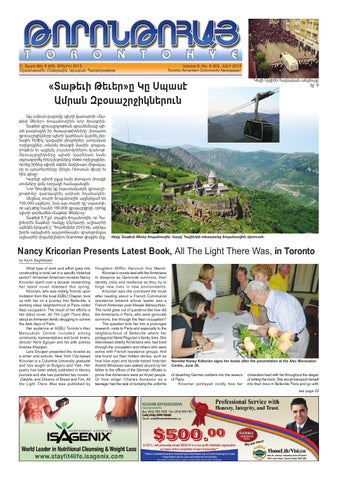
Nancy Kricorian Presents Latest Book, All The Light There Was, in Toronto by Karin Saghdejian What type of work and effort goes into constructing a novel set in a specific historical period? Armenian American novelist Nancy Kricorian spent over a decade researching her latest novel released this spring. Kricorian, who was visiting Toronto upon invitation from the local AGBU Chapter, took us with her on a journey into Belleville, a working class neighborhood of Paris under Nazi occupation. The result of her efforts is her latest novel, All The Light There Was, about an Armenian family struggling to survive the dark days of Paris. Her audience at AGBU Toronto s Alec Manoukian Centre included among community representatives and book lovers, director Atom Egoyan and his wife actress Arsinee Khanjian. Lara Sroujian presented the novelist as a writer and activist. New York City-based Kricorian is a Columbia University graduate and has taught at Rutgers and Yale. Her poetry has been widely published in literary journals and she has published two novels Zabelle, and Dreams of Bread and Fire. All the Light There Was was published by
Houghton Mifflin Harcourt this March. Kricorian s novels deal with the Armenians in diaspora as Genocide survivors, their identity crisis and resilience as they try to forge new lives in new environments. Kricorian said she conceived the novel after reading about a French Communist resistance network whose leader was a French Armenian poet Missak Manouchian. The novel grew out of questions like how did the Armenians in Paris, who were genocide survivors, live through the Nazi occupation? The question took her into a prolonged research, visits to Paris and especially to the neighbourhood of Belleville where her protagonist Maral Pegorian s family lives. She interviewed elderly Armenians who had lived through the occupation and others who were active with French resistance groups. And she found out their hidden stories, such as how blue eyed and blonde-haired historian Anahid Minassian was walked around by her father to the offices of the German officials to prove that Armenians were an Aryan people. Or how singer Charles Aznavour as a teenager had the task of dumping the uniforms
Novelist Nancy Krikorian signs her books after the presentation at the Alec Manoukian Centre, June 26.
of deserting German soldiers into the sewers of Paris. Kricorian portrayed vividly how her
characters lived with her throughout the stages of writing the book. She would transport herself into their lives in Belleville Paris and go with see page 29
2
ÚàôÈÆê 2013 À. î²ðÆ, ÂÆô 93
& Charters Ltd.
Þðæ²äîàÚî ¹¿åÇ
вڲêî²Ü »õ
²ðò²Ê
ê»åï»Ùµ»ñ 13 ¿Ý 28
سÝñ³Ù³ëÝáõû³Ýó ѳٳñ ¹Çٻɪ ´»Ýݳ ³ñ½ÇÇÝ 416-494-0606 ϳ٠416-494-4067
ÚàôÈÆê 2013 À. î²ðÆ, ÂÆô 93
3
4
ÚàôÈÆê 2013 À. î²ðÆ, ÂÆô 93
ÂàðÂàÜÂàÐ²Ú Îº²Üø
سÛÇë 28-Ç ²ÝϳËáõû³Ý ä³ßïûÝ³Ï³Ý ÜßáõÙ ÂáñáÝÃáÛÇ Ø¿ç ²ñßû ²ñ³å³Ã»³Ý
ÚáõÝÇë 2-ÇÝ, Û»ï ê. ä³ï³ñ³·Ç, µ³½Ù³ÃÇõ ÃáñáÝóѳۻñ Ð³Û Î»¹ñáÝÇ ßñç³÷³Ï¿Ý Ý»ñë Ý»ñÏ³Û ·ïÝáõ»ó³Ý Ñ᷻ѳݷëï»³Ý »õ ¹ñûß³ÏÇ ³ñ³ñáÕáõû³Ý, áñáÝó Çñ»Ýó Ù³ëݳÏóáõÃÇõÝÁ µ»ñÇÝ ê. ²ëïáõ³Í³ÍÇÝ »Ï»Õ»óõáÛ ¹åñ³ó ¹³ëÁ ³Ý¹³ëï³Ýáí »õ ÐØÀØÇ ý³Ýý³ñÁ ³½·³ÛÇÝ »ñ·»ñáõ ß³ñù ÙÁ Ýáõ³·»Éáí£ ÐÚ¸ §ê© ¿ÑÉÇñ»³Ý¦ ÏáÙÇï¿Ç ËûëùÁ ³ñï³ë³Ý»ó èáõµ¿Ý Ö³Ýå³½»³Ý, áñ ß»ßï»ó سÛÇë 28-Ç áõÝ»ó³Í Ù»Í ¹»ñÁ Ñ³Û ÅáÕáíáõñ¹Ç Ï»³ÝùÇÝ Ù¿çª ³½³ï ³åñ»Éáõ á·ÇÝ í³ñ å³Ñ»Éáõ ³éáõÙáí£ ²Ý¹ñ³¹³ñÓ³õ ÂáñáÝÃáÛÇ Ð³Û Î»¹ñáÝÇ Ù³ñÙÇÝÝ»ñáõ ѳõ³ù³Ï³Ý ³ß˳ï³ÝùÇ áÛÅÇÝ »õ Ñ³Û ÅáÕáíáõñ¹Ç ¹ÇÙ³·ñ³õ³Í ù³Õù»ÝdzóÙ³Ý »õ ÓáõÉÙ³Ý íï³Ý·Ý»ñáõ Ù³ëÇÝ£ ²ÛÝáõÑ»ï»õ, Ï¿ëûñ¿ »ïù ųÙÁ 5£00ÇÝ Ï³ï³ñáõ»ó³õ èáëïáÙÇ ÏÇë³Ý¹ñÇÇ µ³óáõÙÁ£ ê³ñ·Çë ²Õå³ß»³Ý Çñ Ëûëùáí ³Ý¹ñ³¹³ñÓ³õ øñÇëï³÷áñ ØÇù³Û¿É»³ÝÇ, èáëïáÙ ¼ûñ»³ÝÇ »õ êÇÙáÝ ¼³õ³ñ»³ÝÇ Ý»ñ¹ñáõÙÇݪ Ù»ñ ³½³ï³·ñ³Ï³Ý å³Ûù³ñÇ Ï³½Ù³Ï»ñåÙ³Ý Ù¿ç£ ²å³ ³Ý Ý»ñϳ۳óáõó èáëïáÙÇ Ï»Ýë³·ñ³Ï³ÝÁ£ èáëïáë ջϳí³ñÇ ¹»ñ áõÝ»ó³Í ¿ ϳٳõáñ³Ï³Ý ß³ñÅÙ³Ý Ï³½Ù³Ï»ñåÙ³Ý Ù¿ç£ 1918-ÇÝ ´³ùáõÇ ÇÝùݳå³ßïå³Ýáõû³Ý Ï»¹ñáÝ³Ï³Ý ¹¿ÙùÝ áõ á·ÇÝ »Õ³Í ¿£ èáëïáÙÇ Ï³ÙùÇ »õ ³Ý¹áõÉ ·áñÍáõÝ¿áõû³Ý ¹ñûßÙÁ ½·³ÉÇ ¿ ÐÚ¸ ϳ½Ù³Ï»ñåáõû³Ý »õ ·áñͻɳϻñåÇ íñ³Û£ §Ú»Õ³÷áËáõÃÇõÝÁ, Ï°Áë¿ñ èáëïáÙ, Ý³Ë ·áñÍ ¿, Û»ïáÛ ·³Õ³÷³ñ, ³Ûë ¿ ×ßÙ³ñïáõÃÇõÝÁ£ ²õ»ÉÇ ×Çß¹ª Û»Õ³÷áËáõÃÇõÝÁ ·áñÍ ¿ ·³Õ³÷³ñÇ Ñ³Ù³ñ¦£ Üß»Ýù, ÿ ÏÇë³Ý¹ñÇÝ å³ïñ³ëïáõ³Í »õ ÝáõÇñáõ³Í ¿ ³ÉÇÝ Æëù¿×»³ÝÇ ÏáÕÙ¿, áñ Û³×³Ë³Í ¿ ³ñáõ»ëïÇ ï³ñµ»ñ í³ñųñ³ÝÝ»ñ£ ²Ýáñ ·áñÍ»ñÁ óáõó³¹ñáõ³Í »Ý ½³Ý³½³Ý ³éÇÃÝ»ñáí£ Ð³Ý¹Çëáõû³Ý ³õ³ñïÇÝ §ê© ¿ÑÉÇñ»³Ý¦ ÏáÙÇï¿Ç Ý»ñϳ۳óáõóÇã ì³ñ³Ý¹ ä³ñë³Ù»³Ý »õ Æëù¿×»³Ý ϳï³ñ»óÇÝ èáëïáÙÇ ÏÇë³Ý¹ñÇÇÝ µ³óáõÙÁ£ ²å³ Ý»ñÏ³Û ÏÕ»ñ³Ï³ÝÝ»ñÁ »õ µáÉáñ ÑÇõñ»ñÁ áõÕÕáõ»ó³Ý Ð³Û Î»¹ñáÝÇ ëñ³Ñ, Ý»ñÏ³Û ·ïÝáõ»Éáõ »½ñ³÷³ÏÇã ѳݹÇëáõû³Ý£ гݹÇë³í³ñ î³ñûÝ ø¿ëùÇÝ»³Ý µ³ñÇ ·³Éáõëï Ù³Õûó, ÐÚ¸ §êáÕáÙáÝ Â¿ÑÉÇñ»³Ý¦ ÏáÙÇï¿Ç, §²ñÙ¿Ý ¶³ñû¦ àõë³ÝáÕ³Ï³Ý ØÇáõû³Ý »õ ¶ºØ §êÇÙáÝ ¼³õ³ñ»³Ý¦ Ù³ëݳ×ÇõÕÇ ³ÝáõÝáí, Ñá·»õáñ ѳÛñ»ñáõÝ Ð³Û³ëï³ÝÇ ¹»ëå³Ýª ²ñÙ¿Ý º·³Ý»³ÝÇÝ »õ Ý»ñϳݻñáõÝ£ ²å³ Ññ³õÇñ»ó гٳ½·³ÛÇÝÇ §¶É³Óáñ¦ Ù³ëݳ×ÇõÕÇ Ù³Ýϳå³ï³Ý»Ï³Ý »ñ·ã³ËáõÙµÁ г۳ëï³ÝÇ ûñÑÝ»ñ·áí ѳݹÇëáõû³Ý µ³óáõÙÁ ϳï³ñ»Éáõ: ²å³ ³Ý ³Ý¹ñ³¹³ñÓ³õ ä³ñáÛñ ê»õ³ÏÇ §ºñµ ãÇ ÙÝáõÙ »Éù áõ ׳ñ, Ë»ÝûñÝ »Ý ·ïÝáõÙ Ñݳñ¦ ïáÕ»ñáõ ÷ÇÉÇëá÷³Û³Ï³Ý ËáñùÇÝ£ §²ñ³Ù سÝáõÏ»³Ý, ¸ñû, ¶³ñ»·ÇÝ ÜŹ»Ñ, ¼ûñ³í³ñ ²Ý¹ñ³ÝÇÏ áõ ѳ½³ñ³õáñ ³½³ïáõû³Ý Ù³ñïÇÏÝ»ñ, ³ÛÝ Ë»ÝûñÝ ¿ÇÝ, áñáÝù 95 ï³ñÇÝ»ñ ³é³ç ´³ß ²å³ñ³ÝÇ, Ô³ñ³ùÇÉÇë¿Ç »õ ê³ñ¹³ñ³å³ïÇ è³½Ù³×³Ï³ïÝ»ñáõÝ íñ³Û ·ï³Ý §Ð³ÛÏ³Ï³Ý ÑݳñÁ¦ »õ ÍáõÝÏÇ µ»ñÇÝ Ãñù³Ï³Ý µ³Ý³ÏÁ, ¹³ñ»ñáõ ëïñÏáõÃ»Ý¿Ý ³½³ï³·ñ»Éáí Ù»ñ ÅáÕáíáõñ¹Á¦ Áë³õ ³Ý£ Ìݳõ ÿÏáõ½ ÷áùñ, ë³Ï³ÛÝ ³½³ï »õ ²ÝÏ³Ë Ð³Û³ëï³ÝÁ, áñ ÏÁ ·áÛ³ï»õ¿ ÙÇÝã»õ ³Ûëûñ, Áë³õ ³Ý »õ ³Ýϳ˳óÙ³Ý Çñ³Ï³Ý³óáõÙÁ ѳٳå³ï³ëË³Ý Ñ³Ù³ñ»ó Ññ³ß³·áñÍáõû³Ý£ ºõ ѳñó ïáõ³õ, ÿ DZÝã åÇïÇ ÁÉɳñ Ñ³Û ÅáÕáíáõñ¹Ç ׳ϳﳷÇñÁ, »Ã¿ Щک¸³ßݳÏóáõÃÇõÝÁ ãù³Ý¹³Ï¿ñ г۳ëï³ÝÁ ³ß˳ñÑÇ ù³ñï¿ëÇ íñ³Û£
¶»Õ³ñáõ»ëï³Ï³Ý Û³Ûï³·ñáí ²ñ³ ÔáõÏ³ë»³Ý »õ γñ¿Ý гëÁñ×»³Ý ϳï³ñ»óÇÝ Ø³ÛÇë»³Ý ³ÝϳËáõû³Ý 95-³Ù»³ÏÇ ÝáõÇñáõ³Í ½áõ·»ñ· ÙÁ£ ²å³ ¹»ëå³Ý º·³Ý»³Ý ÷á˳Ýó»ó Çñ å³ï·³ÙÁ: ²Ý ³Ý¹ñ³¹³ñÓ³õ å³ïÙ³Ï³Ý Çñ³¹³ñÓáõÃÇõÝÝ»ñáõÝÝ Áë»Éáíª §Ã¿å¿ï ²é³çÇÝ Ð³Ýñ³å»ïáõÃÇõÝÁ »ñÏáõáõÏ»ë ï³ñáõ³Û Ï»³Ýù áõÝ»ó³õ ÙdzÛÝ, ³ÛÝ ¹³ñÓ³õ ÑÇݳëÇõÝÁ å»ïáõû³Ý, áñ áõÝÇÝù ³Ûëûñ£ ì»ñ³åñ»Éáí å³ïÙ³Ï³Ý ³Ý¹ñ³¹³ñáõû³Ý »ñϳñ ųٳݳϳßñç³Ýª ³ÝϳËáõû³Ùµ ׳ݳå³ñÑ Ñ³ñûóÇÝù ¹¿åÇ ³½·³å³Ñå³ÝáõÃÇõݦ£ ²Ý ѳëï³ï»ó áñ ²© ѳÝñ³å»ïáõÃÇõÝÁ ÏÁ ¹³ë³õ³Ý¹áõÇ Ñ³ÛÏ³Ï³Ý ÏñÃû׳ËÝ»ñáõ Ù¿ç, ³Ýáñ ÷áñÓÁ Ï°áõëáõÙݳëÇñáõÇ »õ áõë³ÝáÕÝ»ñáõ »°õ ³Ï³¹»Ù³Ï³ÝÝ»ñáõ »õ å³ïÙ³Ï³Ý ·áñÍÇãÝ»ñáõ ÏáÕÙ¿£ ¸»ëå³ÝÁ Ëûë»ó³õ г۳ëï³ÝÇ »õ ¶³Ý³ï³ÛÇ Ý»ñÏ³Û Û³ñ³µ»ñáõû³Ýó Ù³ëÇÝ, »ñ³Ëï³·ÇïáõÃÇõÝ Û³ÛïÝ»Éáí ¶³Ý³ï³ÛǪ гÛáó ò»Õ³ëå³Ýáõû³Ý ׳ݳãÙ³Ý Ñ³Ù³ñ£ ²Ý ѳëï³ï»ó, áñ »ñÏáõ »ñÏÇñÝ»ñáõ Û³ñ³µ»ñáõÃÇõÝÝ»ñÁ ÏÁ ½³ñ·³Ý³Ý ù³Õ³ù³Ï³Ý, ïÝï»ë³Ï³Ý »õ Ùß³ÏáõóÛÇÝ Ù³Ï³ñ¹³ÏÝ»ñáí, áñáõ Ù¿ç ·³Ý³ï³Ñ³Û»ñáõ Ý»ñ¹ñáõÙÁ Ù»Í ¿£ ¸»ëå³ÝÁ Çñ ËûëùÁ ³õ³ñï»ó Áë»Éáí© §ÐÐÇ Ñ³Ù³·áñͳÏó³ÛÇÝ Û³ñ³µ»ñáõÃÇõÝÝ»ñÁ ³ß˳ñÑÇ µ³½Ù³ÃÇõ å»ïáõÃÇõÝÝ»ñáõ Ñ»ï, Ýñ³ ÁÝϳÉáõÙÁª ǵñ»õ íëï³Ñ»ÉÇ ·áñÍÁÝ»ñ, ϳñÍáõÙ »Ù, áñ ï»Õ³õáñõáõÙ ¿ ³ÛÝ ï»ëɳϳÝáõÙ, áñ áõÝ¿ÇÝ Ù»ñ ²© гÝñ³å»ïáõû³Ý ÑÇÙݳ¹ÇñÝ»ñÁ, ï»ëɳϳÝ, áñáí å¿ïù ¿ ß³ñÅáõ»Ýù ³õ»ÉÇ Ï³ÛáõÝ áõ ³õ»ÉÇ ½³ñ·³ó³Í ѳÛñ»ÝÇù áõݻݳÉáõ Ýå³ï³Ïáí¦£ ²å³ª гٳ½·³ÛÇÝ §¶É³Óáñ¦ سëݳ×ÇõÕÇ ·ñ³ë¿ñÝ»ñáõ ËÙµ³ÏÇ ³Ý¹³ÙÝ»ñ¿Ýª èáõµ¿Ý Ö³Ýå³½»³Ý, ì³ñ³· ä³å»³Ý »õ γñÇÝ º³·áõå»³Ý ³ëÙáõù»óÇÝ §ÂáõÕà ³é ºñ»õ³Ý¦¿Ý ѳïáõ³Í ÙÁ£ ¶»Õ³ñáõ»ëï³Ï³Ý Û³Ûï³·ñÇÝ Ù³ë ϳ½Ù»ó ݳ»õ Ü»ñëÇÏ ÆëåÇñ»³Ý ³½·³ÛÇÝ ù³ÝÇ ÙÁ »ñ·»ñáí£ ²ÛÝáõÑ»ï»õ Ú³Ïáµ Ö³Ýå³½»³Ý ݳËù³Ý µ³Ý³Ëûë ØÇÑñ³Ý øÇõñïûÕÉ»³ÝÁ µ»Ù Ññ³õÇñ»ÉÁª Ý»ñϳ۳óáõó ³Ýáñ Ï»Ýë³·ñ³Ï³ÝÁ: øÇõñïûÕÉ»³Ý ½áõ·³Ñ»é Çñ ÏñóϳÝ, áõëáõÙÝ³Ï³Ý »õ ³½·³ÛÇÝ ³ß˳ï³ÝùÝ»ñáõ, Ñ»ÕÇÝ³Ï³Í ¿ гÛáó ä³ïÙáõû³Ý ¹³ë³·ñù»ñ »õ ³ÛÉ Ññ³ï³ñ³ÏáõÃÇõÝÝ»ñ£ ²Ý Ñ³Û Ù³ÙáõÉÇ Ù¿ç áõÝÇ µ³½Ù³µÝáÛà Ûû¹áõ³Í³·ñáõÃÇõÝÝ»ñ£ ºõñáå³Ï³Ý ËáñÑñ¹³ñ³ÝÇ ÏáÕÙ¿ гÛÏ³Ï³Ý ò»Õ³ëå³Ýáõû³Ý µ³Ý³Ó»õÇ ùáõ¿³ñÏáõû³Ý ³ß˳ï³ÝùÝ»ñáõÝ Ù¿ç áõÝ»ó³Í ¿ ϳñ»õáñ Ý»ñ¹ñáõÙ£ øÇõñïûÕÉ»³Ý Çñ ËûëùÁ ëÏë³õ Áë»Éáí áñ ëñ³ÑÇÝ Ý»ñϳݻñÁ ³Ýå³ÛÙ³Ý ÏÁ Ïñ¿Ý ³ÝϳËáõÃ»Ý¿Ý Ù³ëáõÝù ÙÁ Çñ»Ýó ÙïùÇÝ áõ Ñá·ÇÇÝ Ù¿Ï ³ÝÏÇõÝÁ£ ÊáñÑáõñ¹¿Ý ѳÕáñ¹áõ»Éáõ å¿ïùÁ ·»ñ³½³Ýó³å¿ë µ³ó³Ï³Ý»ñÁ áõÝÇÝ, áñáÝó ÃÇõÁ ï³ñáõ¿ ï³ñÇ ÏÁ µ³½Ù³Ý³Û£ ƱÝãå¿ë ÁÝ»É, áñ å³ï·³ÙÁ ѳëÝÇ µ³ó³Ï³Ý»ñáõÝ£ ƱÝã ÁÝ»É, áñ ³Ûëûñáõ³Ý Ý»ñÏ³Û Ñ³ÛÁ ãÁÉÉ³Û í³Õáõ³Ý µ³ó³Ï³Ý, ³ÛÉ Áݹѳϳé³ÏÝ, ³Ûëûñõ³Ý µ³ó³Ï³Ý ¹³éÝ³Û í³Õáõ³Ý Ý»ñÏ³Û ³½·³ÛÇÝÁ, Áë³õ ³Ý£ ´³Ý³ËûëÁ Ç ÙÇïÇ áõݻݳÉáí áõͳóÙ³Ý áõ ÓáõÉáõÙÇ ë÷ÇõéùÇ å³ÛÙ³ÝÝ»ñÁ, Ïáã áõÕ»ó ³Ûëûñáõ³Ý å³ï·³ÙÁ Ëï³óÝ»É îàÎ²È µ³éÇ Ù¿ç£ ²Ý ³é³ç³ñÏ»ó, áñ ·³ÕáõóÛÇÝ Û³çáñ¹ ѳõ³ùÇݪ »Ã¿ Çõñ³ù³ÝãÇõñ Ý»ñÏ³Û µ³ó³Ï³Û Ñ³Û ÙÁ Ý»ñÏ³Û ¹³ñÓÝ¿, ÏÁ ÏñÏݳå³ïÏ»Ýù Ù»ñ ¹ÇÙ³¹ñ³Ï³ÝáõÃÇõÝÁ »õ ïáϳÉáõ áõÅÁ£ ²Ý ËûëùÁ Ñá·»õáñ ѳÛñ»ñáõÝ, µ³ñ»Ï³ÙÝ»ñáõÝ »õ ÁÝÏ»ñÝ»ñáõÝ áõÕÕ»Éáí ѳñó ïáõ³õ ÿ DZÝãáõ ѳٳ½·³ÛÇÝ Ñå³ñïáõû³Ùµ ÏÁ ÝßáõÇ Ø³ÛÇë 28Ç ï³ñ»¹³ñÓÁ£ ƱÝãÇ Ù¿ç ÏÁ Ï³Û³Ý³Û ³-
³ÉÇÝ Æëù¿×»³Ý Çñ ù³Ý¹³Ï³Íª èáëïáÙÇ ÏÇë³Ý¹ñÇÇÝ Ñ»ï:
´³Ý³Ëûë ØÇÑñ³Ý øÇûñïáÕÉ»³Ý
Ýáñ Ù»Í ËáñÑáõñ¹Á£ ²Ý ѳëï³ï»ó, áñ Ù»ñ Ýáñ³·áÛÝ å³ïÙáõû³Ý Ù¿ç Ï³Û Ù¿Ï §»Ã¿¦, áñáõÝ Ñ»ï»õáõÃÇõÝÁ ³ÛÝù³Ý Çñ³Ï³Ý ¿, áñù³Ý Ù»Ýù »Ýù, áñ ϳÝù ³Ûë ëñ³ÑÇÝ Ù¿ç£ ²Ý Éáõë³µ³Ý»ó. ºÂ¾Ù»Ýù ê³ñ¹³ñ³å³ïÇ Ù¿ç í×é³Ï³Ý ۳ճóÝÏÁ ãáõݻݳÛÇÝ, ÂáõñùÇ³Ý ³ÙµáÕç ²ñ»õÙï³Ñ³Û³ëï³ÝÁ ³ÝͳÛñ³ÍÇñ ·»ñ»½Ù³ÝáóÇ í»ñ³Í»É¿ »ïù, ëå³Ý¹Ç åÇïÇ »ÝóñÏ¿ñ ѳÛáõû³Ý Ùݳóáñ¹³óÁª ³ñ»õ»õɳѳÛáõÃÇõÝÁ »õ г۳ëï³Ý áõ ѳÛáõÃÇõÝÁ ·áÛáõÃÇõÝ åÇïÇ ãáõݻݳÛÇÝ©©© ûñ»õë Ñáë-ÑáÝ Ñ³Û»ñ í»ñ³åñ¿ÇÝ, µ³Ûó ѳÛáõÃÇõݪ ǵñ»õ ³½· áõ å»ïáõÃÇõÝ, à⣠àõñ»ÙÝ Ø³ÛÇë 28 Ù»ñ ·áÛáõÃÇõÝÁ ÷ñÏáÕ, Ù»ñ í»ñ³åñáõÙÁ ³å³ÑáíáÕ Û³ÕóݳÏÇ ûñáõ³Ý ï³ñ»¹³ñÓÝ ¿£ ²ÝÏ¿ ³é³ç Ù»ñ ѳÛñ»ÝÇùÇÝ Ù¿çÝ ¿ÇÝù, µ³Ûó ѳÛñ»ÝÇùÁ Ù»½Ç ã¿ñ å³ïϳݿñ£ г½Çõ ï³ñÇ ÙÁ »ïù ûñáõ³Ý ϳé³í³ñáõÃÇõÝÁ »ñ»ù µ³é»ñáõ Ù¿ç Ëï³óáõó Ù»ñ Ù»Í Ýå³ï³ÏÁª ²½³ï, ²ÝÏ³Ë áõ Ødzó»³É г۳ëï³ÝÇ ï»ëɳϳÝÁ£ ²Ý Áë³õ© ¸³ßݳÏóáõÃÇõÝÝ ¿ñ áñ ÷ñÏ»ó ݳ»õ ë÷ÇõéùÇ Ñ³ÛáõÃÇõÝÁª ·Ýãáõ ¹³éݳÉáõ, ·ÝãáõÇ Ñá·»µ³Ýáõû³Ùµ ³åñ»Éáõ íï³Ý·¿Ý, ³Ýáñ Ý»ñßÝã»Éáí ³ÝϳËáõû³Ý áõ Ùdzó»³ÉÇ ï»ëɳϳÝÁ£ ê÷ÇõéùÇ Ù³ß»óÝáÕ å³ÛÙ³ÝÝ»ñáõ Ù¿ç, ¹åñáóÝ»ñáõ ßáõÝãáí »õ ³Ïáõٵݻñáõ ÙÃÝáÉáñïÇÝ Ù¿ç ï»ëÇÉù Ñ»ï³åݹáõ»ó³õ, ³Û¹ ï»ëÇÉùáí Ñá·»Ï³Ý Ñ³Ûñ»ÝÇùÇ Ï»ñïáõ»ó³õ »õ Çñ»ñ³Û³çáñ¹ ë»ñáõݹݻñ ѳõ³ï³ñÇÙ ù³Õ³ù³óÇÝ»ñÁ ¹³ñÓ³Ý ³Û¹ Ñá·»Ï³Ý Ñ³Ûñ»ÝÇùÇÝ£ ²Ý ³õ»Éóáõó, áñ ê»åï»Ùµ»ñ 21-Á å³ñ½³å¿ë ï³ñ»¹³ñÓÝ ¿ г۳ëï³ÝÇ íñ³Û µéݳóáÕ 70 ï³ñáõ³Ý ѳٳÛݳí³ñ³Ï³Ý í³ñã³Ï³ñ·Ç ÷³Ï³·Í³ÛÇÝ ïËáõñ ßñç³ÝÇ ³õ³ñïÇÝ »õ ÝáñÇ ÙÁ ëÏǽµÇÝ, áñ ËáñùÇÝ Ù¿ç ûÕ³ÏáõÙÝ ¿ ³Ýç³ïáõ³Í ßÕóÛÇÝ£ Àëï ¿áõû³ÝÝ, ³ÝÇϳ ÅáÕáíñ¹³í³ñ³óÙ³Ý ûñ ¿, Ñ³Û ù³Õ³ù³óÇÇÝ Ù³ñ¹Ï³ÛÇÝ Édzϳï³ñ Çñ³õáõùÝÝ»ñáõ ïÇñ³óÙ³Ý ÉáÛëÇ ûñÝ ¿,
µ³Ûó á㪠³ÝϳËáõÃÇõÝÁ ÷á˳ñÇÝáÕ ï³ñ»¹³ñÓ£ ²ÛÝáõÑ»ï»õ µ³Ý³ËûëÁ Ý»ñϳ۳óáõó г۳ëï³ÝÇ Ý»ñÏ³Û Çß˳Ýáõû³Ý »õ ÅáÕáíáõñ¹Ç í»ñ³µ»ñáÕ Çñ³Ï³ÝáõÃÇõÝÝ»ñ, ûñÇÝ³Ï µ»ñ»Éáí, áñ µÝ³Ï³ãáõû³Ý 70%Á Ï°áõ½¿ Éù»É »ñÏÇñÁ£ ²Ûë µáÉáñÁ Ç ÙÇïÇ áõݻݳÉáí ³Ý Ñ³ñó ïáõ³±õ, ÿ ³ñ¹»ûù å¿ïù ¿ »½ñ³Ï³óÝ»±Ýù, áñ ³ÝϳËáõÃÇõÝÁ ã³ñ Çù ¿ »õ áã ÿ µ³ñÇù£ àõñ»ÙÝ Ññ³Å³ñDZÝù ³ÝϳËáõÃÇõÝÁ µ³ó³ñÓ³Ï ³ñÅ¿ù ѳٳñ»Éáõ ·³Õ³÷³ñ¿Ý, ѳñó ïáõ³õ ³Ý£ ²Ý Ûëï³Ï³óáõó, áñ ³½·Ç ÙÁ ϳ½Ù³Ï»ñåáõ³Íáõû³Ý ·»ñ³·áÛÝ Ù³Ï³ñ¹³ÏÝ ¿ å»ï»Ï³ÝáõÃÇõÝÁ, áñÙ¿ ¹³ñ»ñáí ½ñÏáõ³Í ¿ÇÝù£ гñó ïáõ³õ ÿ ë÷ÇõéùÁ ÇÝã忱ë ÏñÝ³Û û·ï³Ï³ñ ¹³éÝ³É å»ï³Ï³Ýáõû³Ý ³Ùñ³Ï³Ûٳݣ ä¿ïù ¿ Ãûó÷¿ ë÷ÇõéùÁ Çñ í³ñ³Û¿Ý Ïñ³õáñ³Ï³ÝáõÃÇõÝÁ »õ ·áñÍ¿ áõ ¹³ï¿ ÇÝùݳíëï³Ñ£ øÇõñïûÕÉ»³Ý Ý»ñϳÛÇ íñ³Û Ï»¹ñáݳݳÉáí Ãáõ»ó Ù³ñï³Ññ³õ¿ñÝ»ñ, áñáÝó ¹ÇõÙ³·ñ³õáõÙÁ Ññ³Ù³Û³Ï³Ý ÏÁ ¹³ñÓÝ¿ ѳٳ½·³ÛÇÝ áõÅ»ñáõ ѳõ³ù³·ñáõÙ, ÝáõÇñáõ³ÍáõÃÇõÝ, ³Ý¹áõÉ å³Ûù³ñÇ ïñ³Ù³¹ñáõ³ÍáõÃÇõÝ£ ²Ý ѳëï³ï»ó ÿ ë÷ÇõéùÁª Ù³ñ¹áõÅ ¿, áñ ÏÁ Ý߳ݳϿ áõÕ»ÕÇ Ñ³ñëïáõÃÇõÝ£ ¿å¿ï ѳÛñ»ÝÇùÁ ë³ÑÙ³ÝÝ»ñáí ÏÁ ׳ÝãóáõÇ, µ³Ûó ѳÛñ»Ý³ëÇñáõÃÇõÝÁ ë³ÑÙ³Ý ãáõÝÇ£ Îñݳ±Ýù ѳݷÇëï ËÕ×áÕ Áë»É, ÿ Ù»Ýù ³É ÉdzñÅ¿ù Ï°û·ï³·áñÍ»Ýù Ù³ñ¹áõÅÇ Ù»ñ ѳñëïáõÃÇõÝÝ áõ ϳñáճϳÝáõÃÇõÝÁ, ѳñó ïáõ³õ ³Ý£ ²Ý Çñ ËûëùÁ ³õ³ñ»ï»ó Áë»Éáí, áñ ÁÉɳÝù ɳõ³ï»õ áõ ïáϳÝù, Ùdzëݳµ³ñ ½ûñ³óÝ»Ýù ·³ÕáõóÛÇÝ Ñ³ëï³ïáõÃÇõÝÝ»ñÁ, áñå¿ë½Ç Ù»½Ù¿ ³Ù¿Ý Ù¿Ïë ³é³ÝÓÇÝ »õ µáÉáñë ÙdzëÇÝ »ñ³½»Ýù ³ÛÝ, áñáõÝ ÏÁ Ó·ïÝÇù£ ²ÛÝáõÑ»ï»õ §ê. ¿ÑÉÇñ»³Ý¦ÏáÙÇï¿Ç Ñ»ñóå³Ñ ì³ñ³Ý¹ ä³ñë³Ù»³Ý ¹³ë³ËûëÇÝ Û³ÝÓÝ»ó Ûáõß³Ýáõ¿ñ ÙÁ: Ðá·»õáñ ѳÛñ»ñÁ å³Ñå³ÝÇãáí ÷³Ï»óÇÝ Ó»éݳñÏÁ:
ÚàôÈÆê 2013 À. î²ðÆ, ÂÆô 93
ÂàðàÜÂàÐ²Ú Îº²Üø
5
ÚÇß³ï³Ï»ÉÇ Û»ïÙÇçûñ¿ ÙÁª ²ßáõÕ æÇí³ÝÇÇ Ñ»ï ³ٳñ îûݳå»ï»³Ý-¶áõ½áõ»³Ý
г۳ëï³Ý ³ß˳ñÑÁ ³ßáõÕ³Ï³Ý µ³ñÓñ Ùß³ÏáÛÃÇ ï¿ñ »ñÏÇñ ÏÁ ѳٳñáõÇ: ¿»õ ³ßáõÕ³Ï³Ý ³ñáõ»ëïÁ ѳٳ³ñ»õ»É»³Ý ³õ³Ý¹ ¿ »õ áã Û³ïáõϪ Ñ³Û ÅáÕáíáõñ¹ÇÝ« ë³Ï³ÛÝ ³ñÙ³ïÝ»ñÁ Ëáñ³Ã³÷³Ýó »Ý Ñ³Û Ùß³ÏáÛÃÇ ÍÇñ¿Ý Ý»ñë áõ ë³Õ³ñÃÝ»ñÁ ë»ñáõݹ¿ ë»ñáõݹ ÷á˳Ýóáõ»Éáí »Ï³Í Ñ³ë³Í »Ý Ù»½Ç: ²Ûëûñ« Ñ³Û »ñ·³ñáõ»ëïÇ ³å³Ï³Ý³ó³Í ÙÃÝáÉáñïÇÝ Ù¿ç« ³ßáõÕ³Ï³Ý »ñ·»ñÁ ÏÁ ß³ñáõÝ³Ï»Ý Ûáõ½»É Ù»½ Çñ»Ýó ³é³Ýóݳ۳ïÏáõû³Ùµ« Ëáñùáí áõ ѳñ³½³ïáõû³Ùµ: ºñµ §Ð³Ù³½·³ÛÇÝ¦Ç ¶É³Óáñ Ù³ëݳ×ÇõÕÇ ¶ñ³ë¿ñÝ»ñáõ ÊÙµ³ÏÇ Ñ³õ³ùÝ»ñáõÝ Çñ Ù³ëݳÏóáõÃÇõÝÁ ³å³Ñáí»Éáõ ѳٳñ ¹ÇÙ»óÇÝù Ù»ñ Ùß³Ïáõóë¿ñ »ñÇï³ë³ñ¹Ý»ñ¿Ýª ê»õ³Ï Ú³ñáõÃÇõÝ»³ÝÇÝ« Çñ §³Ûá¦ÛÇÝ ³ÝÙÇç³å¿ë Û³çáñ¹»ó §²ßáõÕ æÇí³ÝǦ ³ÝáõÝÁ: Ðáë ÷³Ï³·ÇÍ ÙÁ µ³Ý³Éáí ÛÇß»óÝ»Ýù« áñ ѳõ³ùÝ»ñáõÝ ÁÝóóùÇÝ Ý»ñϳ۳óáõ³Í ¹¿Ùù»ñáõ ÁÝïñáõÃÇõÝÁ Ï'ÁÝ¿ Ý»ñϳ۳óÝáÕ »ñÇï³ë³ñ¹Á ÇÝùÁ: ê»õ³ÏÇ ÁÝïñáõÃÇõÝÁ Ù»½ ã½³ñÙ³óáõó« ïñáõ³Í ÁÉɳÉáí áñ ê»õ³Ï Ù»Í ë¿ñ »õ Ñ»ï³ùñùñáõÃÇõÝ áõÝÇ Ñ³Û »ñ·³ñáõ»ëïÇÝ Ñ³Ý¹¿å: ¶³Ý³ï³ÛÇ Ù¿ç« 16 ÚáõÝÇëÁ ÏÁ ½áõ·³¹ÇåÇ §Ð³Ûñ»ñáõ úñ¦áõ³Ý: ²ñ»õáï ûñ ÙÁÝ ¿© Áëï ëáíáñ³Ï³ÝÇÝ« ÂáñáÝÃáÛÇ Ð³Û Î»¹ñáÝÇ §Ú³ñáõÃÇõÝ Ø³ÝáõÏ»³Ý¦ ·ñ³¹³ñ³ÝÁ ѳõ³ùáõ³Í »Ý ßáõñç 50 ³ñáõ»ëï³ë¿ñÝ»ñ« Ý»ñ³é»³Éª ËáõÙµ ÙÁ »ñÇï³ë³ñ¹Ý»ñ: ØÇÝã ê»õ³ÏÝ áõ ·ñ³Ï³Ý Û³ÝÓݳËáõÙµÇ í³ñã³Ï³Ý Ý»ñϳ۳óáõóÇ㪠èáõµ¿Ý Ö³Ýå³½»³ÝÁ ãݳ˳ï»ëáõ³Í §Ã»ùÝÇù¦ ˳ݷ³ñáõÙÝ»ñÁ ѳñûÉáõ ÙÇçáóÁ ³Ù»Ý³ÛÝ ×³ñï³ñáõû³Ùµ ÏÁ ·ïݻݫ Ý»ñϳݻñÁ ÏÁ ½ñáõó»Ý ëáõñ×Ç áõ ϳñϳݹ³ÏÇ ßáõñç: ijÙÁ 2:30-Á ³Ýó« Øáõß»Õ ¶³ñ³·³ß»³Ý« ·ñ³Ï³Ý Û³ÝÓݳËáõÙµÇÝ ³ÝáõÝáí Ï'áÕçáõÝ¿ µáÉáñÁ ·ñ³ë¿ñÝ»ñáõ ËÙµ³ÏÇ Ä¸ ѳõ³ùÇÝ áõ ÏÁ Ý»ñϳ۳óÝ¿ ÐúØ-Ç ²Ù¿Ýûñ»³Û í³ñųñ³ÝÇ Çñ ³ß³Ï»ñïÝ»ñ¿Ýª ê»õ³Ï Ú³ñáõÃÇõÝ»³ÝÁ« áñå¿ë µ³½Ù³ï³Õ³Ý¹ »ñÇï³ë³ñ¹« áñáõÝ ½³Ý³½³Ý Ñ»ï³ùñùñáõÃÇõÝÝ»ñáõÝ Ù³ë ÏÁ ϳ½Ù¿ ³ßáõÕ³Ï³Ý ³ñáõ»ëïÁ: ê»õ³Ï ÂáñáÝÃû ÍÝ³Í ³ÛÝ ë³Ï³õ³ÃÇõ »ñÇï³ë³ñ¹Ý»ñáõ ÷³Õ³Ý·ÇÝ ÏÁ å³ïϳÝÇ« áñáÝù ûñÝ Ç µáõÝ Ñ³Ûñ»ÝÇùáí Ï'³åñÇÝ áõ ÏÁ ßÝã»Ý áõ Çñ»Ýó áñáßÇã Ý»ñ¹ñáõÙÁ áõÝÇÝ Ñ³Û³å³Ñå³ÝÙ³Ý ÍÇñ¿Ý Ý»ñë« Çñ»Ýó µ³½Ù³ÃÇõ ݳ˳ӻéÝáõÃÇõÝÝ»ñáí: ê»õ³Ï Û³õáõñ å³ïß³×Ç ßÝáñѳõáñ»É¿ »ïù µáÉáñ ѳÛñ»ñÝ áõ Ù»Í Ñ³Ûñ»-
ñÁ« Ï'³ÝóÝÇ ÝÇõÃÇÝ: ²Ý ѳÏÇñ× Ý»ñ³Í³Ï³Ýáí ÙÁ Ï'³Ý¹ñ³¹³éÝ³Û ³ßáõÕ³Ï³Ý ³ñáõ»ëïÇ Çõñ³Û³ïáõÏ Û³ïϳÝÇßÝ»ñáõÝ: ²ßáõÕ³Ï³Ý ³ñáõ»ëïÁ Çñ Ù¿ç ÏÁ å³ñ÷³Ï¿ ùݳñ»ñ·áõÃÇõÝ« »ñ³ÅßïáõÃÇõÝ« Ýáõ³·³ÏóáõÃÇõÝ »õ ϳï³ñáõÙ© Ñ»ï»õ³µ³ñ« ³ßáõÕ ÙÁ µ³½Ù³ÃÇõ ï³Õ³Ý¹Ý»ñáí ûÅïáõ³Í Ï'ÁÉɳÛ: Ð³Û ³ßáõÕ³Ï³Ý ³ß˳ñÑÇÝ Ù¿ç« Ä ¹³ñáõ ³Ù»Ý³Ù»Í ³ßáõÕÁ ÏÁ ѳٳñáõÇ Î³ñͳËÇ ÍÝáõݹª (³ÛÅÙ ²Ë³Éù³É³ùÇ ßñç³Ý) ²ßáõÕ æÇí³ÝÇÝ- µáõÝ ³ÝáõÝáíª ê»ñáµ êï»÷³ÝÇ È»õáÝ»³Ý (18461909): ê»õ³Ï Ï'³Ý¹ñ³¹³éÝ³Û æÇí³ÝÇÇ Ï»Ýë³·ñ³Ï³Ý ·ÇÍ»ñáõÝ »õ ëï»Õͳ·áñÍ³Ï³Ý ³ß˳ñÑÇÝ« Ý»ñϳݻñáõÝ Ññ³ÙóÝ»Éáí ѳٵ³õ³õáñ ²ßáõÕÇÝ ÛûñÇÝáõÙÝ»ñ¿Ý ͳÝûà áõ ³ÝͳÝûà ·áñÍ»ñáõ ·»Õ»óÇÏ áõ ³Ûɳ½³Ý ѳõ³ù³ÍáÛ ÙÁ: æÇí³ÝÇÝ ÍÝ³Í ¿ ÑáÕ³·áñÍÇ ÁÝï³ÝÇùÇ Ù¿ç© áõà ï³ñ»Ï³ÝÇÝ Ùݳó³Í ¿ Ñûñ»Õµûñ ËݳÙùÇÝ ï³Ï: ²ßáõÕ³Ï³Ý ³ñáõ»ëï Ùáõïù ·áñÍ³Í ¿ ѳٵ³õ³õáñ Ô³ñ³-Ô³½³ñÇ Ñáí³ÝÇÇÝ Ý»ñù»õ« áõñ ³Ý Çõñ³óáõó³Í ¿ ³ßáõÕ³Ï³Ý »ñ·Ç ϳÝáÝÝ»ñÁ: êáñí³Í ¿ Ýáõ³·»É ø»³Ù³Ý »õ çáõóϫ ÛûñÇÝ³Í ¿ Ãñù»ñ¿Ýáí »õ ѳۻñ¿Ýáí »ñ·»ñ: ڻﳷ³ÛÇÝ Ù»ÏÝ³Í ¿ ÂÇýÉÇë« ³å³ ²É»ùë³Ý¹ñ³åáÉ áõ ¹³ñÓ»³É ÂÇýÉÇë: ì³ÛÉ³Í ¿ ѳٵ³õ³õáñ ³ßáõÕÝ»ñáõ ѳٳÏñ³ÝùÝ áõ Ñá·³ï³ñáõÃÇõÝÁ: Æñ ëï»Õͳ·áñÍáõÃÇõÝÝ»ñáõ ß³ñùÇÝ Ù¿Ï Ï³ñ»õáñ Ù³ëÁ ÏÁ ϳ½Ù»Ý ³½·³ÛÇÝ« ѳÛñ»Ý³ëÇñ³Ï³Ý µÝáÛà áõÝ»óáÕ ÛûñÇÝáõÙÝ»ñÁ© ³Ý ݳ»õ »ñ·³Í ¿ ѳٳٳñ¹Ï³ÛÇÝ ³ñÅ¿ùÝ»ñáõ Ù³ëÇÝ: Î'ÁëáõÇ, ÿ æÇí³ÝÇÇ ëï»Õͳ·áñÍáõÃÇõÝÝ»ñÁ Çñ ¹³ñ³ßñç³ÝÇ Ñ³Û Çñ³Ï³Ýáõû³Ý ѳۻÉÇÝ »Ý© ³Ýáí ѳݹ»ñÓ ë³Ï³ÛÝ« ÝÇõûñÝ áõ Ëñ³ïÝ»ñÁ ÏÁ ÙÝ³Ý ³ÛÅÙ¿³Ï³Ý: æÇí³ÝÇÇ Ù»Í³·áÛÝ ³ñųÝÇùÝ»ñ¿Ý ÙÇÝ ³ÛÝ ¿« áñ ³Ý ûï³ñ µ³é»ñ¿ Ù³ùñ»ó Ñ³Û »ñ·Á: ²Ý ³ßáõÕ³Ï³Ý ³ñáõ»ëïÇ ³½·³ÛÇÝ ¹åñáóÇÝ ÑÇÙݳ¹ÇñÝ ¿: î»ë³ÑáÉáí³ÏÇ ÙÇçáóáí Û³çáñ¹³µ³ñ Ï'áõÝÏݹñ»Ýù ½³Ý³½³Ý ѳÝñ³×³Ý³ã ³ñáõ»ëï³·¿ïÝ»ñáõ ϳï³ñáõÙÝ»ñÁ© §ÆÙ æ³õ³Ëù¦ÇÝ Áݹٿç¿Ý Ç Û³Ûï Ïáõ ·³Û æÇí³ÝÇÇ Ëáñ ë¿ñÁ Çñ ÍÝݹ³í³ÛñÇÝ Ýϳïٳٵ© §ø³Ýù³ñ³õáñ ÁÝÏ»ñ¦áç å³ïÙáõÃÇõÝÁ áõñÇß ¿ - ï»ÕõáÛÝ íñ³Û ÛûñÇÝáõ³Í ³Ý¹ñ³¹³ñÓÝ ¿ ²õ»ïÇù Æë³Ñ³Ï»³ÝÇ Ù¿Ï µ³ó³ë³Ï³Ý ÝϳïáÕáõû³Ýª æÇí³ÝÇÇ Ñ³Ý¹¿å: §ø³Ýù³ñ³õáñ ÁÝÏ»ñ¦Á Û³ïáõÏ ï»Õ ÏÁ ·ñ³õ¿ Ý»ñϳݻñáõÝ Ùûï© Ñáë Ûëï³Ï ¿ æÇí³ÝÇÇ Ñ³Ù»ëïáõÃÇõÝÝ áõ Ù³ñ¹áõ ѳõ³ë³ñáõû³Ý Ù³ëÇÝ Çñ Ëñ³ïÁ:
ê»õ³Ï Ú³ñáõÃÇõÝ»³Ý ÏÁ Ý»ñϳ۳óÝ¿ ²ßáõÕ æÇí³ÝÇÝ:
гٳ½·³ÛÇÝÇ ¶ñ³Ï³Ý ËÙµ³ÏÇ ³Ý¹³ÙÝ»ñ
§²ÝÇ¦Ý æÇí³ÝÇÇ Ñ³Ûñ»Ý³ëÇñáõû³Ý óáɳóáõÙÝ ¿© §ê³ëáõݳë³ñ¦Á ê³ëÝáÛ ³é³çÇÝ ³åëï³Ùµáõû³Ý ûñ»ñáõÝ ·ñáõ³Íª ê³ëÝáÛ ÅáÕáíáõñ¹ÇÝ Û»Õ³÷áË³Ï³Ý áõ ³ñÇ Ï»óáõ³ÍùÇÝ ¹ñë»õáñáõÙÝ ¿: §Êñ³ï ÁÝÏ»ñáç¦ÇÝ Áݹٿç¿Ý Ç Û³Ûï Ïáõ ·³Û æÇí³ÝÇÇ Ëñ³ï³Ï³Ý á×Á: ê»õ³Ï Ù»ñà Áݹ Ù»ñà ï»ë³Ï¿ïÝ»ñ ÏÁ µ³ÅÝ¿ áõ ½ñáÛóÇ ÏÁ Ññ³õÇñ¿ Ý»ñϳݻñÁ, áñ Çñ»Ýó Ý»ñ¹ñáõÙÁ áõݻݳÝ: ²å³« ê»õ³ÏÇ Ëݹñ³ÝùÇÝ Áݹ³é³ç»Éáí« Ú³Ïáµ Ö³Ýå³½»³Ý Çñ ·»Õ»óÇÏ Ó³ÛÝáí ÏÁ Ý»ñϳ۳óÝ¿ §´³ñÇ ·»Õ»óÇÏ ³é³ùÇÝÇ ÁÝÏ»ñÁ Ù³ñ¹áõ¦, áñ ÏÁ í»ñ Ï°³éÝ¿ Ç·³Ï³Ý ë»éÇÝ ³ñųÝÇùÝ»ñÁ: γñ·Á ÏÁ ѳëÝÇ ê»õ³ÏÇÝ« áñ Áݹ³é³ç»Éáí Ý»ñϳݻñáõÝ µáõéÝ ÷³÷³ùÇÝ ÏÁ Ý»ñϳ۳óÝ¿ §Ò³Ëáñ¹ ûñ»ñÁ¦« Ó³ÛݳÏóáõû³Ùµ Ö³Ýå³½»³ÝÇ »õ Ý»ñϳݻñáõÝ: æ»ñÙ ¿ ÙÃÝáÉáñïÁ©©© ϳñ»ÉÇ ¿ »ñϳñ ß³ñáõݳϻÉ: Øáõß»Õ ¶³ñ³·³ß»³Ý ·ñ³Ï³Ý Û³ÝÓݳËáõÙµÇÝ ÏáÕÙ¿ Ûáõß³Ýáõ¿ñ ÙÁ ÏÁ Û³ÝÓÝ¿ ê»õ³ÏÇÝ« ÛáÛÅ ·Ý³Ñ³ï»Éáí ï³ñáõ³Í ³ß-
˳ï³ÝùÁ: ÐëÏ³Û ³ß˳ñÑ ÙÁÝ ¿ æÇí³ÝÇÝ© ¶³ÝÓ ÙÁª áñáõÝ å¿ïù ¿ ͳÝûÃ³Ý³É áõ ï¿ñ ϳݷÝÇÉ: Æñ ëï»Õͳ·áñÍáõÃÇõÝÝ»ñáõÝ Ù¿ç ï»Õ ·ï³Í »Ý ÊñÇÙ»³Ý гÛñÇÏÝ áõ êÙµ³ï ޳ѳ½Ç½Á« Ô»õáݹ ²ÉÇß³ÝÁ« ð³ýýÇÝ áõ Ì»ñ»ÝóÁ©©©: ºñ·³Í ¿ ØáõßÝ áõ ê³ëáõÝÁ« ´³ë»ÝÝ áõ ÞáõßÇÝ« γñÇÝÁ« ºñ»õ³ÝÝ áõ ÂÇýÉÇëÁ© »ñ·³Í ¿ Ñ³Û ³½·Á©- §²½· ÇÙ áñù³Ý ÝÏáõÝ ÙÝ³ë« ëÇñïë ù»½³ÝÇó ãÇ ½³ïáõÇ©©©¦: ¶áí»ñ·³Í ¿ ÏÇÝ ³ñ³ñ³ÍÝ áõ ѳõ³ï³ñÇÙ ÁÝÏ»ñÁ©©© áõ ï³Ï³õÇÝ ³Ûëûñª ÏÁ Ûáõë³¹ñ¿ Ù»½ Çñ §Ò³Ëáñ¹ ûñ»ñÁ Ïáõ ·³Ý áõ Ï'»ñóݩ©©©íѳï»Éáõ ã¿« í»ñç Ï'áõݻݳݩ©©¦áí: æÇí³ÝÇÇ 800-¿ ³õ»ÉÇ ëï»Õͳ·áñÍáõÃÇõÝÝ»ñáõÝ íñ³Û ï³Ï³õÇÝ Ï'³õ»ÉÝ³Ý ³ñáõ»ëï³·¿ïª ÂáíÙ³ë äûÕá뻳ÝÇ ÏáÕÙ¿ í»ñç»ñë Û³Ûïݳµ»ñáõ³Í ѳñÇõñ³õáñ ·áñÍ»ñ©©©: ¿»õ Çñ µ³é»ñáíª §²Ýûõ ÃéãÝ³Ï ¿ ³ßáõÕÁ - ²Ûëûñ ³Ûëï»Õ« í³ÕÁ ³ÛÉ ï»Õ©©©¦ µ³Ûó æÇí³ÝÇÇ µáÛÝÁ Ù»ñ ëñï»ñáõÝ Ù¿ç ¿:
²ñ»õ»É³Ñ³Û»ñ¿ÝÇ ¸³ëÁÝóóÝ»ñ
ÂáñáÝÃáÛÇ Ð³Û ²ÏáõÙµÇ ì³ñãáõÃÇõÝÁ »ÉÝ»Éáí Çñ ³é³ù»ÉáõÃÇõÝÇó 1999 Ãõ³Ï³ÝÇÝ Ï³½Ù³Ï»ñå»ó ѳۻñ¿Ý É»½õÇ (²ñ»õ»É³Ñ³Û»ñ¿Ý) ¹³ëÁÝóóÝ»ñª Toronto District School Board-Ç Ý»ñùáÛ, ³ÛÝ »ñ»Ë³Ý»ñÇ Ñ³Ù³ñ, áñáÝù ³éÇÃÁ ãáõÝ»Ý Û³×³Ë»Éáõ ï»ÕÇë ѳÛÏ³Ï³Ý ¹åñáóÝ»ñáõÙ áõ ½ñÏõ³Í »Ý ÙÝáõ٠ѳۻñ¿Ý ϳñ¹³É áõ ·ñ»Éáõó, ݳ»õ Ï³Ù³Û - ³Ï³Ù³Û Ùáé³ÝáõÙ »Ý ѳۻñ¿Ý Ëûë»ÉÁ: êáÛÝ ¹³ë³ñ³ÝÝ»ñÁ ï»ÕÇ »Ý áõÝ»ÝáõÙ Þ³µ³Ã ûñ»ñÁ ³é³õûï»³Ý 9-Çó ÙÇÝã»õ 11:30-Á, 3-Çó -13 ï³-
ñ»Ï³Ý ³ß³Ï»ñïÝ»ñáí: ¸³ë³õ³Ý¹áõû³Ý ³é³ñϳݻñÝ »Ýª ·ñ³Ï³ÝáõÃÇõÝ, ß³ñ³ÑÇõëáõÃÇõÝ, ù»ñ³Ï³ÝáõÃÇõÝ, ѳÛáó å³ïÙáõÃÇõÝ, óï»ñ·áõÃÇõÝ, »ñ·, Ùï³ÛÇÝ áõ ýǽÇù³ÛÇÝ Ë³Õ»ñ: ²Ûë ¹³ëÁÝóóÝ»ñÁ ³é³õ»É ã³÷áí Ýå³ëïáõÙ »Ý µ³ñÓñ ٳϳñ¹³ÏÇ ¹³ëïdzñ³ÏáõÃÇõÝ, ³½ÝÇõ ³ÝÓݳõáñáõÃÇõÝ »õ ѳÛáõû³Ý å³ñï³Ï³Ýáõû³Ý ½·³½áõÙÝ»ñÇ Ï»ñïáõÙ: 15 ÚáõÝÇëÇÝ Donview Middle School-Ç ëñ³ÑáõÙ ï»ÕÇ áõÝ»ó³õ ì³ñųñ³ÝÇ ï³ñ»í»ñçÇ Ñ³Ý¹¿ëÁ: Ìñ³·ÇñÁ ÁÝóó³õ »ñ·, ³ñï³ë³ÝáõÃÇõÝ áõ óï-
ñáÝÝ»ñáí, ϳ½Ù³Ï»ñåõ³Íª Ù³Ýϳå³ñ� áõ ݳ˳Ïñóñ³Ý »õ ³é³çÇÝÇó ÙÇÝã»õ 8-ñ¹ ¹³ë³ñ³ÝÇ ³ß³Ï»ñïÝ»ñáí: ì»ñ»õª ÝϳñÝ»ñ: Þ³µ³Ãûñ»³Û ì³ñųñ³ÝÁ ß³ñáõݳÏáõÙ ¿ Çñ ëáõñµ Ýå³ï³ÏÁª ׳ٵ»É ѳۻóÇ ¹³ëïdzñ³ÏáõÃÇõÝÁ Ù»ñ Ù³ï³Õ ë»ñáõݹÇÝ, áñ ÉÇÝÇ ÙÇ ³éáÕç ѳ۪ Ñá·áí, Ùïùáí áõ ëñïáí »õ ·Çï³ÏÇó »Ýù áñ Ýñ³Ýù »Ý ųé³Ý·áñ¹Ý Ù»ñ å³ïÙáõû³Ý áõ Ùß³ÏáÛÃÇÝ:
6
ÚàôÈÆê 2013 À. î²ðÆ, ÂÆô 93
ÂàðÂàÜÂàÐ²Ú Îº²Üø
гñó³½ñáÛó úÝóñÇáÛÇ ¶³Ý³ï³Ñ³Û ´ÅßÏ³Ï³Ý ÀÝÏ»ñ³Ïóáõû³Ý ì³ñã³Ï³Ý Ü»ñϳ۳óáõóÇãÝ»ñáõ лï úÝóñÇáÛÇ ¶³Ý³ï³Ñ³Û ´ÅßÏ³Ï³Ý ÀÝÏ»ñ³Ïóáõû³Ý 25-³Ù»³ÏÇÝ ³éÃÇõ ѳñó³½ñáÛó ÙÁ áõÝ»ó³Ýù ÀÝÏ»ñ³Ïóáõû³Ý ì³ñã³Ï³Ý Ý»ñϳ۳óáõóÇãÝ»ñ îáùÃ. ²ÝÇ Ð³ëÁñ×»³ÝÇ »õ ì³ñ¹·¿ë êÇÙáÝ»³ÝÇ Ñ»ï: êïáñ»õ ѳïáõ³ÍÝ»ñ. гñóáõÙ. Øûï³õáñ³å¿ë 25 ï³ñÇÝ»ñ ³é³ç ϳ½Ùáõ»ó³õ úÝóñÇáÛÇ ¶³Ý³ï³Ñ³Û ´ÅßÏ³Ï³Ý ÀÝÏ» ñ³ÏóáõÃÇõÝÁ. Ïñݳ±ù ³Ý¹ñ³¹³éÝ³É ³Ýáñ å³ïٳϳÝÇÝ Ù³ëÇÝ: ä³ï³ë˳Ý. úÝóñÇáÛÇ ¶³Ý³ï³Ñ³Û ÀÝÏ»ñ³ÏóáõÃÇõÝÁ (Armenian Canadian Medical Association of OntarioACMAO) µ³ñ»ëÇñ³Ï³Ý ϳ½Ù³Ï»ñåáõÃÇõÝ ÙÁÝ ¿, áñ ÍÝáõݹ ³é³Í ¿ г۳ëï³ÝÇ 1988-Ç ¸»Ïï»Ùµ»ñ 7-Ç »ñÏñ³ß³ñÅÇ ³Õ¿ï»³ÉÝ»ñáõÝ Ýå³ëï ѳëóÁÝ»Éáõ ³ß˳ï³ÝùÝ»ñáõÝ Ñ»ï»õ³Ýùáí: ÊáõÙµ ÙÁ ÝáõÇñ»³É µÅÇßÏÝ»ñ, ¹»Õ³·áñÍÝ»ñ, ÑÇõ³Ý¹³å³ÑáõÑÇÝ»ñ, ³ï³ÙݳµáÛÅÝ»ñ ¨ ³éáÕç³å³Ñáõû³Ý Ù³ñ½Ç Ù¿ç ³ÛÉ Ù³ëݳ·¿ïÝ»ñ Ù¿Ïï»Õáõ»Éáí ÂáñáÝÃáÛÇ Ð³Û Î»¹ñáÝÇÝ Ù¿ç, ÃáñáÝÃáÑ³Û µáÉáñ ϳ½Ù³Ï»ñåáõÃÇõÝÝ»ñáõÝ Ñ»ï ûųݹ³ÏáõÃÇõÝÁ ѳٳ¹ñ»Éáõ ³ß˳ï³ÝùÁ ï³ñÇÝ: ²Û¹ Ãáõ³Ï³Ý¿Ý ÙÇÝã»õ ûñë ï³Ï³õÇÝ µÅÇßÏÝ»ñáõ ³Û¹ ËÙµ³ÏÁ, áñå¿ë ¶³Ý³ï³Ñ³Û ´ÅßÏ³Ï³Ý ÀÝÏ»ñ³ÏóáõÃÇõÝ, ß³ñáõÝ³Ï³Ï³Ý Ó»õáí ÏÁ Ýå³ëï¿ Ð³Û³ëï³ÝÇ »õ ²ñó³ËÇ ³éáÕç³å³Ñ³Ï³Ý å³ÛÙ³ÝÝ»ñÁ µ³ñ»É³õ»Éáõ. ³ÝóÝáÕ 25 ï³ñÇÝ»ñáõ ÁÝóóùÇÝ ÙÇáõû³Ý Ïǽ³Ï¿ïÁ ³Û¹ »Õ³Í ¿: ÀÝÏ»ñ³Ïóáõû³Ý Ýå³ï³ÏÁ ÏÁ Ï»¹ñáÝ³Ý³Û Ð³Û³ëï³ÝÇ »õ ²ñó³ËÇ ³ááÕç³å³Ñ³Ï³Ý »õ ³ï³ÙݳµáõÅ³Ï³Ý Ï³ñÇùÝ»ñáõÝ ë³ï³ñ»É, åÇïáÛùÝ»ñ, ·áñÍÇùÝ»ñ, ¹»Õáñ³Ûù ѳÛóûÉáí »õ ¹³ëïdzñ³Ïã³Ï³Ý ¹³ëÁÝóóùÝ»ñ ϳ½Ù³Ï»ñå»Éáí: ´ÅßÏ³Ï³Ý ÁÝÏ»ñ³Ïóáõû³Ý ³á³çÇÝ ³ï»Ý³å»ïÁ »Õ³Í ¿ îáùÃ. ÄÇñ³Ûñ Âáݳٻ³Ý áñáõÝ ÏáÕùÇÝ ³ß˳ï³Í »Ý ËáõÙµ ÙÁ í³ñã³Ï³Ý ³Ý¹³ÙÝ»ñ »õ ϳ½Ù³Ï»ñåáõ³Í ¿ úÝóñÇáÛÇ ¶³Ý³ï³Ñ³Û ´ÅßÏ³Ï³Ý ÀÝÏ»ñ³ÏóáõÃÇõÝÁ Çñ Íñ³·Çñ-ϳÝáݳ·ñáí: îáùÃ. ²ñ³ ¶»ñ»ëÿ×Ç, îáùÃ. ä»ñ× ØÇݳ뻳Ý, îáùÃ. ²õ»ïÇë äûÕá뻳Ý. îáùÃ. Ö¿ù ê³ù³ñdz »õ îáùÃ. ä»ñ× ²ñÃÇÝ»³Ý Û³çáñ¹³µ³ñ áñå¿ë ³ï»Ý³å»ïÝ»ñ ³á³çÝáñ¹³Í »Ý ÀÝÏ»ñ³ÏóáõÃÇõÝÁ Çñ»Ýó ÏáÕùÇÝ áõݻݳÉáí í³ñã³Ï³Ý ϳٳõáñÝ»ñáõ ß³ñù ÙÁ: ÀÝÏ»ñ³ÏóáõÃÇõÝÁ áõÝÇ Ý³»õ »ñÏáõ µ³Å³ÙáõÝùÝ»ñ ²ï³ÙݳµáõÅ³Ï³Ý ¨ ÐÇõ³Ý¹³å³ÑáõÑÇÝ»ñáõ (Armenian Dental and Armenian Nurses Association - Division of ACMAO.) Ð. Îñݳ±ù Ù»½Ç ËûëÇÉ Ó»ñ ·áñÍáõÝ¿áõû³Ý Ù³ëÇÝ ¨ Ù³Ýñ³Ù³ëÝ»Éáí, ÿ DZÝã Íñ³·ÇñÝ»ñ ϳï³ñ³Í ¿ù г۳ëï³ÝÇ »õ ²ñó³ËÇ Ù¿ç: ä. ÆÝãå¿ë ÛÇß»óÇÝù, »ñÏñ³ß³ñÅÇ ûñ»ñáõÝ ÀÝÏ»ñ³ÏóáõÃÇõÝÁ ³é³õ»É³µ³ñ ßï³å û·ÝáõÃÇõÝ Ñ³ëóÁÝ»Éáí ½µ³Õ»ó³õ, »ñµ ϳñ»õáñ³·áÛÝÁ ¹»Õáñ³Ûù áõÕÕ³ñÏ»ÉÁ ÏÁ ѳݹÇë³Ý³ñ: ²Û¹ Ù¿ÏÁ ß³ñáõݳÏáõ»ó³õ, µ³Ûó ݳ»õ ³Ýáñ Û³çáñ¹»óÇÝ Ñá·»µáõÅÝ»ñáõ ³Ûó»ÉáõÃÇõÝÝ»ñÁ »õ г۳ëï³ÝÇ µÅÇßÏÝ»ñáõÝ í»ñ³å³ïñ³ëïÙ³Ý ³ß˳ï³ÝùÝ»ñÁ: ´ÅßÏ³Ï³Ý Ù»ñ ÀÝÏ»ñ³Ïóáõû³Ý Û³ïáõÏ Íñ³·ñ»ñáí г۳ëï³Ý¿Ý ï³ëÝ»³Ï ÙÁ µÅÇßÏÝ»ñ Ññ³õÇñáõ»ó³Ý ¶³Ý³ï³ »õ ÑÇõ³Ý¹³ÝáóÝ»ñáõ áõ ѳٳÉë³ñ³ÝÝ»ñáõ Ù¿ç ¹³ëÁÝóóùÝ»ñáõ
Ñ»ï»õ»ó³Ý. ³ÝáÝóÙ¿ ß³ï»ñ í»ñ³¹³ñÓ³Ý: ²Ûë ³ß˳ï³ÝùÇ ³Ù»Ý³ó³ÛïáõÝ ûñÇݳÏÁ Neurology-Ç Ù³ëݳ·¿ï îáùÃ. ì³Ñ³Ý ¸³ñµÇÝ»³ÝÝ ¿: 25 ï³ñÇÝ»ñ ³é³ç ACMAO-Ý »ñ³ß˳õáñ³Í ¿ñ Çñ ÂáñáÝÃáÛÇ ³Ûó»ÉáõÃÇõÝÁ îáùÃ. ¶³ëå³ñ Æëñ³Û¿É»³ÝÇ ³é³çÝáñ¹áõû³Ùµ: ²Ý í»ñ³¹³ñÓ³õ »õ г۳ëï³ÝÇ Ù¿ç ÑÇÙÝ»ó ³é³çÇÝ Neurology-Ç ¹åñáóÁ, áñ Ý»ñϳÛÇë ÏÁ ѳݹÇë³Ý³Û µáÉáñ ÏáíϳëÇ Ù¿ç ³Ù»Ý³µ³ñÓñáñ³ÏÁ ³Ëï³×³Ý³ãÙ³Ý »õ ¹³ñÙ³ÝáõÙÇ Û³ñÙ³ñáõÃÇõÝÝ»ñáí: àõëáõÙÝ³Ï³Ý Ù³Ï³ñ¹³ÏÇ íñ³Û ÀÝÏ»ñ³Ïóáõû³Ý ³Ý¹³ÙÝ»ñ¿Ý áÙ³Ýù г۳ëï³Ý »õ ²ñó³Ë ³Ûó»É»Éáí ûųݹ³Ï³Í »Ý Continuing Education Course»ñáõ ¹³ë³Ëûë³Ï³Ý ß³ñù»ñ ϳ½Ù³Ï»ñå»Éáí ²éáÕç³å³Ñ³Ñ³Ï³Ý ܳ˳ñ³ñáõÃÇõÝÝ»ñáõÝ Ñ»ï ѳٳ·áñͳÏó»Éáí: ACMAO-Ý Ý³»õ г۳ëï³ÝÇ »õ ²ñó³ËÇ Ù¿ç ³õ»ÉÇ ÙݳÛáõÝ Ý³Ë³Ó»éÝáõÃÇõÝÝ»ñ áõÝÇ, áñáÝóÙ¿ ϳñ»ÉÇ ¿ ÛÇß»É Ñ»ï»õ»³ÉÝ»ñÁ. 1992-ÇÝ »ñµ ²ï³ÙݳµáõÅ³Ï³Ý Ù»ñ Ù³ëݳ×ÇõÕÁ ϳ½Ùáõ»ó³õ, ¾çÙdzÍÇÝÇ Ù¿ç ·áÛáõÃÇõÝ áõÝ»óáÕ Ø³ÝÏ³Ï³Ý ²ï³Ùݳµáõųñ³ÝÇ ÙÁ ͳËë»ñÁ Ñá·³Éáí ëÏë³Ýù ÓñÇ ¹³ñÙ³ÝáõÙ ï³É ÷áùñ»ñáõÝ: ²Ûë ÑÇÙ³Ý íñ³Û, 1998 سÛÇë 8-ÇÝ ²ñó³ËÇ ÞáõßÇ ù³Õ³ùÇÝ Ù¿ç µ³óáõ»ó³õ ê÷ÇõéùÇ ûųݹ³Ïáõû³Ùµ ѳëï³ïáõ³Í ³é³çÇÝ ³ï³ÙݳµáõÅ³Ï³Ý ¹³ñٳݳïáõÝÁ: ê³ñù³õáñáõÙ-Ý»ñáõ ¹³ë³õáñáõÙÁ ÐÇõëÇë³ÛÇÝ ²Ù»ñÇϳÛÇ Ù³Ï³ñ¹³Ïáí Ù»ñ ݳ˳ӻéÝáõÃÇõÝÝ ¿ »õ µáÉáñ ͳËë»ñÁ, Ý»ñ³é»³É ³ï³ÙݳµáõÅ»ñáõ »õ û·Ý³Ï³Ý-Ý»ñáõ ³Ùë³í׳éÝ»ñÁ ݳ»õ ¹»Õáñ³ÛùÁ Ù»Ýù ÏÁ Ñá·³Ýù, ë³Ï³ÛÝ ß¿ÝùÁ ïñ³Ù³¹ñáõ³Í ¿ ²ñó³ËÇ ²ááÕç³å³-Ñáõû³Ý ܳ˳ñ³ñáõû³Ý ÏáÕÙ¿: ²ÝóÝáÕ 15 ï³ñÇÝ»ñáõ ÁÝóóùÇÝ ÞáõßÇÇ µÝ³ÏãáõÃÇõÝÁ ³Ûë Ó»õáí Óñdzµ³ñ ³ï³ÙݳµáõÅ³Ï³Ý ¹³ñÙ³ÝáõÙ ëï³ó³Í ¿: ²õ»ÉÇ áõß Ð³¹ñáõÃÇ, سñïáõÝÇÇ »õ سñï³Ï»ñïÇ Ù¿ç »õë ÝÙ³ÝûñÇÝ³Ï ¹³ñٳݳïáõÝ»ñ µ³óáõ»ó³Ý »õ ß³ñÅáõÝ ¹³ñٳݳïáõÝ ÙÁ (mobile clinic) ѳÝñ³Ï³ñ·ÇÝ Ù¿ç, ·ÇõÕ»ñ ³Ûó»É»Éáí ÓñÇ ¹³ñÙ³ÝáõÙ ÏÁ ѳÛóÿ: êï»÷³Ý³Ï»ñïÇ Ù¿ç ϳݳóÇ Ñ³ñó»ñáõ Û³ïáõÏ ¹³ñٳݳïáõÝ ÙÁ ÂáñáÝÃáÛ¿Ý ù³ÝÇ ÙÁ ³ÝѳïÝ»ñáõ Ýáõ¿ñÝ»ñáí µ³óáõ»ó³õ »õ ³ÝóÝáÕ ï³ëݳٻ³ÏÇÝ Ñ³½³ñ³õáñ ÏÇÝ»ñ ½³Ý³½³Ý ѳñó»ñáõ ×ß·ñÇï ³Ëï³×³Ý³ãáõÙ »õ ¹³ñÙ³ÝáõÙ ëï³ó³Í »Ý: Ð. 25-³Ù»³ÏÇ ³éÃÇõ DZÝã »Ý Ó»ñ Ó»éݳñÏÝ»ñÁ£ ä. سÛÇë 4-ÇÝ ¶³ñݳݳÛÇÝ Û³ïáõÏ Ö³ßÏ»ñáÛÃ-ä³ñ³Ñ³Ý¹¿ëáí 25-³Ù»³ÏÇ ïûݳËÙµáõÃÇõÝ ï»ÕÇ áõÝ»ó³õ ȳñ³ ֳ߳ñ³ÝÇÝ Ù¿ç£ Ð³Ý·³Ý³Ï³ÛÇÝ µÝáÛà áõÝ¿ñ Ó»éݳñÏÁ, ÇÝãå¿ë ³Ù¿Ý ï³ñÇ£ ê³Ï³ÛÝ ¹ñ³Ù³Ñ³õ³ùÇ ÏáÕùÇÝ ù³ñáñ¹ ¹³ñáõ ³ß˳ï³ÝùÁ í»ñ³ñÅ¿õáñ»Éáõ ËÝ×áÛùÇ »ñ»ÏáÛ ÙÁÝ ¿ñ£ Ü»ñÏ³Û ¿ÇÝ Ý³»õ ¶³Ý³ï³ÛÇ Ùûï г۳ëï³ÝÇ Ð³Ýñ³å»ïáõû³Ý ¹»ëå³Ýª ²ñÙ¿Ý º·³Ý»³Ý »õ ïÇÏÇÝÁª سñdz º·³Ý»³Ý£ ¸»ëå³ÝÁ ٻͳå¿ë ·Ý³Ñ³ï»Éáí µßÏ³Ï³Ý ÁÝÏ»ñ³Ïóáõû³Ý ï³ñÇÝ»ñáõ ÝáõÇñáõÙÁ, »ñ³Ëï³·Çïáõû³Ý Çñ ½·³óáõÙÝ»ñÁ ³ñï³Û³Ûï»ó£ òáõó³¹ñáõ»ó³õ ï»ë³»ñǽ ÙÁ å³ïñ³ëïáõ³Í ²ñó³ËÇ Ù¿ç ACMAO µáÉáñ ³ß˳ï³ÝùÝ»ñáõÝ Ù³ëÇÝ, áõñ Ï'³ñï³óáɳñ ÅáÕáíáõñ¹Ç »ñ³Ëï³·Ç-
²ï³ÙݳµáÛÅÝ áõ Çñ û·Ý³Ï³ÝÁ ß³ñÅ³Ï³Ý ¹³ñٳݳï³Ý ÙÁ Ù¿ç ÏÁ Ù³ïáõó»Ý ³ï³ÙÝ»ñáõ ³Ýí×³é ¹³ñÙ³ÝáõÙ Ô³ñ³µ³ÕÇ ·ÇõÕ³óÇÝ»ñáõÝ:
ïáõÃÇõÝÁ »õ ·áÑáõݳÏáõÃÇõÝÁ£ ´ÅßÏ³Ï³Ý ÀÝÏ»ñ³Ïóáõû³Ý ݳ˳·³Ñª îáùÃ. ä»ñ× ²ñÃÇÝ»³Ý Ëûëù ³é³õ »õ Çñ ïå³õáñáõÃÇõÝÝ»ñÁ ÷á˳Ýó»ó£ ²Ý ßÝáñѳϳÉáõÃÇõÝ Û³ÛïÝ»ó µáÉáñ ÝáõÇñ³ïáõÝ»ñáõÝ, áñáÝù ÏÁ Ýå³ëï»Ý ACMAO-Ç Íñ³·ÇñÝ»ñáõ ÏÇñ³ñÏٳݣ îáùÃ. ²ÝÇ Ð³ëÁñ×»³Ý ³Ý¹ñ³¹³ñÓ³õ ACMAO-Ç å³ïٳϳÝÇÝ íñ³Û »õ Ú³ïáõÏ ¶Ý³Ñ³ï³·ñ»ñ Û³ÝÓÝ»ó µáÉáñ µÅÇßÏÝ»ñáõÝ, áñáÝù ³ï»Ý³å»ïÇ å³ßïûÝáí ͳé³Û³Í »Ý ÀÝÏ»ñ³Ïóáõû³Ý ³ÝóÝáÕ 25 ï³ñÇÝ»ñáõ ÁÝóóùÇÝ£ ܳ»õ ·Ý³Ñ³ï³·ñ»ñ ïñáõ»ó³Ý
îáùÃ. ¼³ñ»Ñ àõ½áõÝ»³ÝÇÝ »õ îáùÃ. ä»ñ× øÇɳ׻³ÝÇÝ ²ñó³ËÇ Ù¿ç Çñ»Ýó ϳï³ñ³Í ϳ½Ù³Ï»ñåã³Ï³Ý ³ß˳ï³ÝùÝ»ñáõÝ Ñ³Ù³ñ, ¹³ñٳݳïáõÝ»ñáõ »õ ¹³ëïdzñ³Ïã³Ï³Ý ¹³ëÁÝóóùÝ»ñáõ ϳå³Ïóáõû³Ùµ: гݷ³Ý³ÏáõÃÇõÝÁ ³ñ¹¿Ý ϳï³ñáõ³Í ¿ñ ë³Ï³ÛÝ ï»ë³»ñÇ½Ç å³ñáõݳÏáõÃ¿Ý¿Ý Ë³Ý¹³í³ñáõ³Í ÏáÏÇÏ ·áõÙ³ñ ÙÁ ·áÛ³ó³õ ACMAO-Ç Íñ³·ÇñÝ»ñÁ Ñ»½³ë³Ñ ß³ñáõݳϻÉáõ ѳٳñ£ ¸»Ïï»Ùµ»ñ ³ÙëáõÝ åÇïÇ Ýß»Ýù г۳ëï³ÝÇ »ñÏñ³ß³ñÅÇ 25-ñ¹ ï³ñ»ÉÇóÁ ѳõ³Ý³µ³ñ ÃáñáÝÃáÑ³Û ·³ÕáõÃÇ ³ÛÉ Ï³½Ù³Ï»ñåáõÃÇõÝÝ»ñáõ Ñ»ï£
êàôðƲвÚàôÂÆôÜ
àÕµ³Ù ¼ù»½, гɿå ø³Õ³ù Ú³ñáõà ֻݳݻ³Ý
²ñ¹»ûù Ù³ñ·³ñ¿± ÙÁ å¿ïù ¿ñ ÁÉɳÛÇ, áñå¿ë½Ç áÕµ³ÛÇ ºñ»ÙdzÛÇ ÝÙ³Ý Çñ ëÇñ³Í ù³Õ³ùÇÝ ù³Ý¹áõÙÁ »õ ÑñÏǽáõÙÁ, ÿ± гɿå ù³Õ³ùÇ Ù»Õù»ñáõÝ Ñ³Ù³ñ ѳë³Ý ³Ûë å³ïáõѳëÝ»ñÁ. ³ÛÝ ³ï»Ý ûñ»õë å¿ïù ¿ áõݻݳÛÇ ¶ñÇ·áñ ܳñ»Ï³óÇÇ ÙÁ ëñµáõÃÇõÝÝ áõ ѳÝ׳ñÁ` Ëݹñ»Éáõ ѳٳñ »õ ³Õ³ã»Éáõ ²ëïáõÍáÛ, áñ Ý»ñ¿ ³Ûë ù³Õ³ùÇÝ »õ ³ÛÉ»õë Ñ»é³óÝ¿ ã³ñ Ó»éù»ñÁ ³Ýáñ íñ³Û¿Ý: ØÇÿ ë˳ɳ±Í »Ý ³ÝáÝù, áñáÝù Ï°Áë¿ÇÝ, ϳ٠гɿå ù³Õ³ùÇ ÑÇÝ å³ïÙáõû³Ý Ù¿ç ·ñ³Í »Ý, áñ ²ëïáõ³Í³ßáõÝãÇ Ññ»³Ý»ñáõ ݳ˳ѳÛñÁ ÝϳïáõáÕ Ð³Ûñ ²µñ³Ñ³ÙÁ ûñÑÝ³Í ¿ гɿå ù³Õ³ùÁ »õ áñ»õ¿ ã³ñÇù ãÇ Ñ³ëÝÇñ ³Ýáñ. ³Ûë Ù¿ÏáõÝ Çµñ»õ íϳÛáõÃÇõÝ ÏÁ µ»ñ¿ÇÝ Ñݳٻ³Û µ»ñ¹Á, áñ ¹³ñ»ñ ß³ñáõÝ³Ï Ï³Ý·áõÝ Ùݳó»ñ ¿, ÿ»õ ÑÇÙ³ ½³ÛÝ ³É Ëáó»óÇÝ: ì»ñçÇÝ ï³ñÇÝ»ñáõÝ ÷áËáõ»ó³Ý ³Ù¿Ý ï»ë³ÏÇ ·áíùÇ Ëûëù»ñÁ, »õ гÛñ ²µñ³Ñ³ÙÇ ûñÑÝáõÃÇõÝÁ ϳñÍ¿ù í»ñ³Íáõ³Í ¿ ³Ý¿ÍùÇ, »ñµ ³ÛÝù³Ý ѳݹ³ñï áõ µ³ñûñ гɿå ù³Õ³ùÁ »Õ³õ ¹ÅáËùÇ Ë³éݳñ³Ý ÙÁ: гñÇõñ ѳ½³ñÝ»ñáí Ù³ñ¹ÇÏ Éù»Éáí ½³ÛÝ` ݳËÁÝïñ»óÇÝ Çñ»Ýó »õ Çñ»Ýó ÁÝï³ÝÇùÝ»ñáõÝ Ï»³ÝùÇÝ ³å³ÑáíáõÃÇõÝÁ, ù³Ý` ï³ëݳٻ³ÏÝ»ñ¿ Ç í»ñ Çñ»Ýó ϳéáõó³Í ïáõÝ»ñÝ áõ ß¿Ýóáõó³Í óջñÁ. ³ÝáÝù, ϳñûïÁ Çñ»Ýó ëñïÇÝ, ÷³Ë³Ý Ïñ³ÏÝ»ñáõ Ù¿ç¿Ý` ³é³Ýó »ïÇÝ ¹³éݳÉáõ ³Ñ áõ í³Ëáí, ³Ï³Ý³ï»ë ÁÉɳÉáí ÷áÕáóÝ»-
ñáõÝ Ù¿ç å³ñ½áõ³Í ³Ñ³õáñ ï»ë³ñ³ÝÝ»ñáõÝ` Éù»³É ¹Ç³ÏÝ»ñ áõ ù³ñáõù³Ý¹ óջñ: ²Ûëûñ ³°Ûë ¿ ß¿Ý áõ Ë×áÕáõ³Í гɿåÇÝ íÇ׳ÏÁ, áñ ³Ù¿Ý ûñ Û³é³ç¹ÇÙáÕ ßáõϳݻñáí »õ ˳ÝáõÃÝ»ñáí Éùáõ³Í ¿ ÑÇÙ³ Çñ ¹Å˻٠µ³ËïÇÝ` ëå³ë»Éáí ûñ»õë ³õ»ÉÇ í³ï ·³ÉÇù ûñ»ñáõÝ: гɿåÁ ºÕ»éÝÇ ³ñѳõÇñùÇ ûñ»ñáõÝ ¹³ñÓ³Í ¿ñ í»ñçÇÝ Ï³Û³ÝÁ, î¿ñ ¼ûñ¿Ý Ù³½³åáõñÍ »õ Ññ³ßùáí áÕç Ùݳó³Í ËÉ»³ÏÝ»ñáõÝ ÷ñÏáõû³Ý ɳëïÁ. ³Ûëï»Õ ³ñ³µ ÑÇõñÁÝÏ³É ÅáÕáíáõñ¹ÇÝ ÁÝÓ»é³Í ³éÇÃÇÝ ßÝáñÑÇõ, ѳÛáõ µ»ÏáñÝ»ñÁ Ùdzï»Õáõ»Éáí, ß³ñáõݳϻóÇÝ Ï³éãÇÉ Ï»³ÝùÇÝ, ϳ½Ù»óÇÝ ÁÝï³ÝÇùÝ»ñ áõ ï³ñÇÝ»ñáõ ÁÝóóùÇÝ Í³ÕÏ»ó³Ý áõ ݳ˳ÝÓ»ÉÇ ¹ÇñùÇ Ñ³ëÝáÕ ·³Õáõà ¹³ñÓ³Ý: ²Ýßáõßï µ³½Ù³Ñ³½³ñ ·³ÕÃ³Ï³Ý ëáõñdzóÇ ÅáÕáíáõñ¹ÇÝ Ñ»ï ݳ»õ ÑáÍ ÃÇõáí Ñ³Û ³ÝѳïÝ»ñ ϳ٠³ÙµáÕç ÁÝï³ÝÇùÝ»ñ óñáõ»ó³Ý Ñáë áõ ÑáÝ, ³Ûë ³Ý·³Ù` áã ÿ µéÝÇ ï»Õ³Ñ³Ýáõû³Ùµ, ÇÝãå¿ë ÎÇÉÇÏÇáÛ å³ñ³·³ÛÇÝ, ³ÛÉ` å³ñï³¹ñáõ³Í »Õ³Ý³Ïáí ·³Õà ÙÁ, áñ ÏñÝ³Û ³éųٻ³Û ÝϳïáõÇÉ áÙ³Ýó ÏáÕÙ¿, ë³Ï³ÛÝ óÝóÁõ»ó³õ áõ ï³ñïÕÝ»ó³õ ·³ÕáõÃÁ: àÙ³Ýù ³É Ï°Áë»Ý, ÿ Ñ»éáõ¿Ý áõ Ùûï¿Ý ÃáõñùÇÝ Ó»éùÁ Ï³Û ËݹÇñÝ»ñáõÝ Ù¿ç, ÙdzÛÝ Ù¿Ï ï³ñµ»ñáõû³Ùµ, áñ µáÉáñáíÇÝ ³Ýï¿ñ ã»Ýù, û·Ýáõû³Ý ѳëÝáÕÝ»ñ Ï³Ý Ð³Û³ëï³Ý¿Ý, Èǵ³Ý³Ý¿Ý »õ ê÷ÇõéùÇ ÝáÛÝÇëÏ ³Ù¿Ý¿Ý Ñ»é³õáñ ·³ÕáõÃÝ»ñ¿Ý` ³é³Ýó ËÁïñ³Ï³Ýáõû³Ý: ²ÛÉ ·áÑáõݳÏáõÃÇõÝ ÙÁ »õë áõÝ»ó³Ýù ³Ûë ÃáÑáõµáÑÇÝ Ù¿ç, áñ Ñ³Û »ñÇï³ë³ñ¹áõÃÇõÝÁ ¹³ñÓ»³É óáÛó ïáõ³õ Çñ ù³ç »õ ³ÝÓݳ½áÑ ¹¿ÙùÁ` ÝÙ³Ý Èǵ³Ý³ÝÇ ¹¿åù»ñáõÝ ÁÝóóùÇÝ, »õ Çñ»Ýó ïñáõ³Í ϳñ»ÉÇáõû³Ýó ã³÷áí ÏÁ ѳëÝÇÝ, áõñ áñ ÏñݳÝ: ä³ïÇ°õ Çñ»Ýó »õ ç»ñ٠ѳٵáÛñÝ»ñ Çñ»Ýó ׳ϳïÇÝ: ²Ñ³ ÛáÛëÁ Ù»ñ ·áÛ³ï»õÙ³Ý: ê³Ï³ÛÝ ³Ûë ³Ýëå³ë»ÉÇ áõ ³Ýµ³Ëï ¹¿åù»ñÁ »Ï³Ý µáÉáñáíÇÝ Ë³Ý·³ñ»Éáõ ѳɿå³Ñ³Ûáõû³Ý ß¿Ý Ï»³ÝùÁ. ÇÝã忱ë ϳñûïáí ãÛÇß»Ýù ø³ñ¿Ý º÷÷¿ ×»Ù³ñ³ÝÁ, áõñ ³ÝóáõóÇÝù Ù»ñ å³ï³Ýáõû³Ý ·»Õ»óÇÏ ûñ»ñÁ, »ñµ ï³Ï³õÇÝ Ù»ñ ³Ï³ÝçÇÝ ÏÁ ÑÝã¿ ØÇݳë ¿ûÉ¿ûÉ»³ÝÇ Ù»ï³Õ»³Û Ó³ÛÝÁ áõ ï»õ³µ³ñ ß³ñÅáõÝ å³ïÏ»ñÁ, áñ Ï°³×³å³ñ¿ ¹³ë³ñ³Ý¿ ¹³ë³ñ³Ý µ³ßË»Éáõ Çñ
Ùï³õáñ ѳóÁ §¸³ñ ÙÁ ·ñ³Ï³Ýáõû³Ý¦ ßï»Ù³ñ³Ý¿Ý` ßáõïáí ѳëÝ»Éáõ Çñ ·ñ³ë»Ý»³ÏÁ »õ ³Ý¹³¹³ñ ß³ñÅ»Éáõ Çñ ·ñÇãÁ` å³ïñ³ëï»Éáõ Û³çáñ¹ ûñáõ³Ý ËÙµ³·ñ³Ï³ÝÁ §²ñ»õ»Éù¦ ûñ³Ã»ñÃÇÝ, ½áñ ¹³ñÓ»³É óñ٠ѳóÇ ÝÙ³Ý ëå³ëáÕÝ»ñ ϳÛÇÝ ³Ù¿Ý ³é³õûï: ÀݹѳÝáõñ ÑëÏÇã γñ³å»ï ê³åáõÝ×»³ÝÇ ·áé Ó³ÛÝÁ` Û³ïϳÝß³Ï³Ý ¿ñ` ˳ݷ³ñÇ㠳߳ϻñïÝ»ñÁ áõÕÕáõû³Ý Ññ³õÇñáÕ, ½µûë³ÝùÝ»ñáõÝ ³ñ³· ù³Ûɳ÷áË»ñáí Ï°áõÕÕáõ¿ñ Áݹ³ñÓ³Ï µ³ÏÇÝ Ù¿Ï Í³Ûñ¿Ý ÙÇõëÁ: ²ÛÝï»Õ ¹ñáßÙáõ³Í ¿ ݳ»õ ³ÝçÝç»ÉÇ å³ïÏ»ñÁ Ö»Ù³ñ³ÝÇ ëÇõÝ»ñ¿Ý ³é³çÝáñ¹ ¼³ñ»Ñ ºåë. ö³Û³ëÉ»³ÝÇ, áñ Çñ å³ñûõ ѳë³Ïáí Çñ Ñ»ï»õáñ¹Ý»ñáí ÏÁ Ïïñ¿ñ ³Û¹ µ³ÏÇÝ ï³ñ³ÍùÁ ·É˳õáñ ¹éÝ¿Ý ÙÇÝã»õ ï»ëã³ñ³Ý, ϳ٠½ñáÛóÇ ÏÁ µéÝáõ¿ñ áõëáõóÇãÝ»ñáõ Ñ»ï: ÐáÝ ÏÁ ·ïÝáõ¿ñ ݳ»õ Ðñ³ã ö³÷³½»³Ý, áñ ³ÝËûë ÏÁ ×»Ù¿ñ ¹³ë³ñ³ÝÝ»ñáõ ßáõñç ³ÛÝ Ý»ñùÇÝ ·áÑáõݳÏáõû³Ùµ, áñ Ø»Í »Õ»éÝÇ Ï³½Ù³Ï»ñåÇã Ññ¿ßÝ»ñÁ ½·»ïÝ»Éáõ ϳñ·Á ³Ýó³Í ¿ »õ ÑÇÙ³ Ýáñ ë»ñáõݹ ѳëóÁÝ»Éáí íñ¿ÅÁ ÏÁ ÉáõÍ¿ñ ѳÛÁ µÝ³çÇÝç Áñ³Í ϳñÍáÕ ·³½³Ý ÃáõñùÇÝ: î³ëݳٻ³ÏÝ»ñáí ÃÇûճͳÍÏ Ùݳó³Í ¹³ë³ñ³ÝÝ»ñ¿Ý ÷³é³õáñ ß¿Ýù»ñ Ù¿çï»Õ µ»ñ³Í Ö»Ù³ñ³ÝÁ ÑÇÙ³ éáõÙµ»ñáõ ïÝùáóÇÝ ï³Ï Çñ µ³ËïÇÝ ÏÁ ëå³ë¿, ÿ ³ñ¹»ûù »±ñµ ³ÝáÕáñÙ ÑñÃÇé ÙÁ Çñ á°ñ Ù¿Ï å³ïÁ åÇïÇ ù³Ý¹¿: àõ ï³Ï³õÇÝ Ù³ñ¹ÇÏ, áñáÝù Çñ»Ýó ÁÝï³Ý»Ï³Ý »õ ³ñÑ»ëïÇ ·áñÍ»ñáí ½µ³Õ³Í Ï°ÁÉɳÛÇÝ »õ ³ÙÇëÝ»ñáí ã¿Çñ Ïñݳñ ï»ëÝ»É ½Çñ»Ýù, ÑÇÙ³ Èǵ³Ý³Ý, äáõñ× Ð³ÙáõïÇ Ï³Ù ²ÝÃÇÉdzëÇ ÷áÕáóÝ»ñ¿Ý Ù¿ÏáõÝ Ù¿ç ÏÁ ѳݹÇåÇë ³ÝáÝó: ²ÝáÝù ÏÁ ßñçÇÝ Ùï³Ñá· »õ ³Ýѳٵ»ñ ¹¿Ùùáí ѳÙñ»Éáí ųٻñÁ, ÿ »°ñµ åÇïÇ ÏñÝ³Ý í»ñ³¹³éÝ³É Çñ»Ý ëÇñ»ÉÇ ù³Õ³ùÝ áõ ïáõÝÁ: ²Ûá°, ÙÇç³½·³ÛÇÝ ù³Õ³ù³Ï³Ýáõû³Ý Ùáõà »õ í³ï ѳßÇõÝ»ñÁ ³Ûë ³Ý·³Ù »Ï³Ý ˳ݷ³ñ»Éáõ ѳɿå³Ñ³Ûáõû³Ý ùáõÝÁ »õ Ï»³ÝùÁ: سÕûÝù, áñ ÁݹѳÝñ³å¿ë êáõñÇáÛ ³ÙµáÕç ÅáÕáíáõñ¹Á ï³é³å»óÝáÕ ³Ûë ÷áÃáñÏáï »õ ³Ýï³Ý»ÉÇ ¹³ñÓ³Í ×ÝßÇã ﳷݳåÁ ßáõïáí ³ÝóÝÇ ·¿ß »ñ³½Ç ÝÙ³Ý:
êáõñdzѳۻñ Øï³¹Çñ ºÝ ØݳÛáõÝ ´Ý³ÏáõÃÇõÝ Ð³ëï³ï»É Ô³ñ³µ³ÕÇ Ø¿ç ²õ»ÉÇ ù³Ý »ñÏáõ ï³ñÇ¿ Ç í»ñ êáõñÇáÛ Ù¿ç ï»ÕÇ áõÝ»óáÕ å³ï»ñ³½Ù³Ï³Ý ·áñÍáÕáõÃÇõÝÝ»ñáõÝ å³ï׳éáí ѳ½³ñ³õáñ ѳۻñ áõÕÕáõ»ó³Ý »õ ѳëï³ïáõ»ó³Ý г۳ëï³Ý: ²ÝáÝóÙ¿ áÙ³Ýù ³ñ¹¿Ý ï»Õ³õáñáõ³Í, ³ß˳ï³Ýù ·ï³Í »Ý, ÇëÏ Ù»Í³ÃÇõ ³ÝÓ»ñ ³ß˳ï³Ýù ã·ïÝ»Éáõ å³ï׳éáí ëïÇåáõ³Í »Ý »ñÏñáñ¹ ³Ý·³Ù ³ñï³·³ÕûÉ, ³Ûë ³Ý·³Ù áã ÿ ÏñÏÇÝ ¹¿åÇ êáõñdz, ³ÛÉ áõñÇß »ñÏÇñÝ»ñ: Üß»Ýù, áñ ßáõñç 37 ëáõñÇ³Ñ³Û ÁÝï³ÝÇùÝ»ñ µÝ³ÏáõÃÇõÝ Ñ³ëï³ï³Í »Ý ݳ»õ È»éݳÛÇÝ Ô³ñ³µ³ÕÇ Ù¿ç, ÑÇÙݳϳÝûñ¿Ý ø³ß³Ã³Õ ßñç³ÝÇÝ Ù¿ç: È»éݳÛÇÝ Ô³ñ³µ³ÕÇ ø³ß³Ã³ÕÇ ßñç³ÝÇ í»ñ³µÝ³Ï»óÙ³Ý í³ñãáõû³Ý å»ï èáµ»ñï سûõáë»³Ý Û³ÛïÝ³Í ¿, áñ ³õ»ÉÇ Ù»Í ÃÇõáí Ù³ñ¹ÇÏ Ï°áõ½»Ý »ñÃ³É »õ ѳëï³ïáõÇÉ Ô³ñ³µ³ÕÇ Ù¿ç, ë³Ï³ÛÝ ³Û¹ù³Ý Ñݳñ³õáñáõÃÇõÝ Çñ»Ýù »õë ãáõÝÇÝ. §ä³ïñ³ëïÇ µÝ³Ï³ñ³ÝÝ»ñ ÑÇÙ³ ¿É ãϳÝ, ϳéáõóõáõÙ »Ý, ¿ÉÇ ¹ÇÙáÕÝ»ñ ϳÝ. Ùûï 5-6 ÁÝï³ÝÇù ³Ûë å³ÑÇÝ ºñ»õ³ÝÇó ¹ÇÙ»É ¿. »Ã¿ ϳñáճݳÝù ³Û¹ ËÙµÇÝ ï»Õ³õáñ»É, ³ñ¹¿Ý ÏÁ ·³Û Û³-
çáñ¹ ËáõÙµÁ¦: ²Ý Ýß³Í ¿, áñ ³ÝËïÇñ µáÉáñÁ ³ß˳ï³Ýù áõÝÇÝ ³ñ¹¿Ý. §ºÃ¿ áõ½áõÙ »Ý ³ß˳ï»É, »Ã¿ ÑáÕ³·áñÍáõû³Ùµ ã»Ý ½µ³ÕõáõÙ, ù³Õ³ùÝ»ñáõÙ »Ý µÝ³ÏõáõÙ, ³ß˳ï³Ýùáí ³å³ÑáíáõÙ »Ýù¦: سûõáë»³Ý ³õ»Éóáõó³Í ¿, áñ È»éݳÛÇÝ Ô³ñ³µ³ÕÇ Çß˳ÝáõÃÇõÝÝ»ñÁ ÏÁ ÷áñÓ»Ý ³Ù¿Ý Ó»õáí ûųݹ³Ï»É, ù³ç³É»ñ»É ëáõñdzѳۻñáõ ·³ÉáõëïÁ£ êáõñdzѳۻñ Ùï³¹ñáõÃÇõÝ áõÝÇÝ Ô³ñ³µ³ÕÇ Ù¿ç ÙݳÛáõÝ µÝ³ÏáõÃÇõÝ Ñ³ëï³ï»É, ³ÝáÝó Ù»Í Ù³ëÁ ³ñ¹¿Ý ³ñӳݳ·ñáõ³Í ¿, »ñ»Ë³Ý»ñÁ ¹åñáó ÏÁ ۳׳˻Ý. §Ú³ïáõÏ ³é³ÝÓݳóáõ³Í áõëáõóÇãÝ»ñ ϳÝ, áñ »ñ»Ë³Ý»ñÇ Ñ»ï ³é³ÝÓÇÝ ¹³ë³Å³Ù»ñáí ½µ³ÕõáõÙ »Ýª É»½áõ³Ï³Ý ³ÝѳñÃáõÃÇõÝÝ»ñÁ ßïÏ»Éáõ ѳٳñ: سñ¹Ï³Ýó ÙÇ Ù³ëÁ ãÇ Ï³ñáÕ³ó»É г۳ëï³ÝáõÙ Çñ Ï»³ÝùÝ ³å³Ñáí»É. ³ß˳ï³ÝùÇ ËݹÇñ ϳñ, µÝ³Ïáõ»Éáõ í³ÛñÇ ËݹÇñ: ÆëÏ ÙÇõë Ù³ëÝ ¿É Çñ³Ï³ÝáõÙ ³ëáõÙ ¿, áñ Ù³ÝÏáõó »ñ³½»É ¿ Ô³ñ³µ³ÕáõÙ ³åñ»É¦:
ÚàôÈÆê 2013 À. î²ðÆ, ÂÆô 93
7
êáõñdzѳÛáõû³Ý ¼ûñ³ÏóáõÃÇõÝÁ гٳ½·³ÛÇÝ ²é³çݳѻñÃáõÃÇõÝ ¿ ²ÝÃÇÉdzëÇ Ø³Ûñ³í³ÝùÇÝ Ù¿ç ²ñ³Ù ². γÃáÕÇÏáëÇÝ Ý³Ë³·³Ñáõû³Ùµ ·áõÙ³ñáõáÕ ²½·³ÛÇÝ ÀݹѳÝáõñ ÄáÕáíÁ, Çñ ùÝݳñÏáõÙÝ»ñáõÝ áõ áñáßáõÙÝ»ñáõÝ Ù¿ç ϳñ»õáñ ï»Õ Û³ïϳóáõó ëáõñdz-ѳÛáõû³Ý: ²ñ¹³ñ»õ, ì»Ñ³÷³é гÛñ³å»ïÇÝ áõ ²½·³ÑÇÝ Î»¹ñáÝ³Ï³Ý ì³ñãáõû³Ý ÏáÕÙ¿ ïñáõ³Í ½»ÏáÛóÝ»ñáõ, ÇÝãå¿ë ݳ»õ ëáõñdzѳÛáõÃÇõÝÁ Ý»ñϳ۳óÝáÕ å³ïáõÇñ³ÏÝ»ñáõ ÷á˳Ýó³Í ï»Õ»ÏáõÃÇõÝÝ»ñáõÝ áõ Ùï³Ñá·áõÃÇõÝÝ»ñáõÝ ÉáÛëÇÝ ï³Ï, ²½·. ÀݹѳÝáõñ ÄáÕáíÁ Ù»ñ ÅáÕáíáõñ¹Ç áõß³¹ñáõû³Ý Û³ÝÓÝ»ó Ñ»ï»õ»³É Ï¿ï»ñÁ. 1.²½·. ÀݹѳÝáõñ ÄáÕáíÁ µ³ñÓñ ·Ý³Ñ³ï³Ýùáí Ï áÕçáõÝ¿ êáõñdzѳÛáõû³Ý óáõó³µ»ñ³Í ÙdzëÝ³Ï³Ý á·ÇÝ, êáõñÇ³Ï³Ý Ñ³Ûñ»ÝÇùÇÝ ³Ùñûñ¿Ý ϳåáõ³Í ÙݳÉáõ áõ Çñ ѳٳÛÝù³ÛÇÝ Çñ³õáõÝùÝ»ñáõÝ ï¿ñ ϳݷݻÉáõ ѳõ³ù³Ï³Ý í×é³Ï³ÙáõÃÇõÝÁ: ÄáÕáíÁ Çñ Ëáñ ·Ý³Ñ³ï³ÝùÁ ÏÁ Û³ÛïÝ¿ êáõñÇáÛ Ñ³Ûáõû³Ý ͳé³Ûáõû³Ý ÉÍáõ³Í Ù»ñ Ñá·»õáñ áõ ѳٳÛÝù³ÛÇÝ å³ï³ë˳ݳïáõÝ»ñáõÝ áõ ·³ÕáõÃÇ Ï»³Ýù¿Ý Ý»ñë ·áñÍáÕ µáÉáñ ϳéáÛóÝ»ñáõÝ, áñáÝù ѳϳé³Ï êáõñÇ³Û¿Ý Ý»ñë ëï»ÕÍáõ³Í ¹Åáõ³ñ å³ÛÙ³ÝÝ»ñáõÝ, ÝáõÇñáõÙáí Çñ»Ýó ϳñ»ÉÇÝ Ï ÁÝ»Ý Ù»ñ ÅáÕáíáõñ¹Ç ½³õ³ÏÝ»ñáõÝ Ï³ñÇùÝ»ñáõÝ Áݹ³é³ç»Éáõ: 2. ²½·. ÀݹѳÝáõñ ÄáÕáíÁ »ñ³Ëï³·Çïáõû³Ùµ ³Ý¹ñ³¹³ñÓ³õ ³ÝóÝáÕ ßáõñç »ñÏáõ ï³ñÇÝ»ñáõÝ êáõñdzѳÛáõû³Ý ½ûñ³Ïóáõû³Ý áõ ûųݹ³Ïáõû³Ý ·Íáí ì»Ñ³÷³é гÛñ³å»ïÇÝ áõ ²½·. λ¹ñáÝ³Ï³Ý ì³ñãáõû³Ý ï³ñ³Í Ñ»ï»õáÕ³Ï³Ý ³ß˳ï³ÝùÝ»ñáõÝ: ²Ý ݳ»õ Çñ ßÝáñѳϳÉáõÃÇõÝÁ Û³ÛïÝ»ó г۳ëï³ÝÇ å»ïáõû³Ý, ²Ù»Ý³ÛÝ Ð³Ûáó γÃáÕÇÏáëáõû³Ý, ÇÝãå¿ë ݳ»õ Ù»ñ ûٻñáõÝ, ·³ÕáõÃÝ»ñáõÝ, ϳ½Ù³Ï»ñåáõÃÇõÝÝ»ñáõÝ áõ ³ÝÑ³ï ³½·³ÛÇÝÝ»ñáõÝ êáõñdzѳÛáõû³Ý Çñ»Ýó óáõó³µ»ñ³Í ³ç³Ïóáõû³Ý ѳٳñ: 3. êáõñdzѳÛáõÃÇõÝÁ á°ã ÙdzÛÝ å³ïÙ³Ï³Ý áõ ϳ½Ù³Ï»ñåáõ³Í ѳٳÛÝù ¿, ³ÛÉ Ý³»õ Çñ ϳñ»õáñ ï»ÕÁ áõ ¹»ñÁ áõÝÇ ê÷ÇõéùÇ Ð³Û Ï»³ÝùÇ Ùß³ÏáõóÛÇÝ, ÏñóϳÝ, Ù³ñ½³Ï³Ý, ïÝï»ë³Ï³Ý áõ å³Ñ³Ýç³ïÇñ³Ï³Ý Ù³ñ½»ñ¿Ý Ý»ñë: лï»õ³µ³ñ, êáõñÇ³Ñ³Û ·³ÕáõÃÇ í»ñ³Ï³Ý·ÝáõÙÁ ÏÁ Ýϳï»Ýù ѳٳ½·³ÛÇÝ ³é³çݳѻñÃáõÃÇõÝ: ²Ûë ѳÙá½áõÙáí ѳñÏ ¿ Ù»ñ ³ÙµáÕç³Ï³Ý áõ ³Ýí»ñ³å³Ñ ½ûñ³ÏóáõÃÇõÝÁ ·áñÍݳå¿ë ³ñï³Û³Ûï»É êáõñdzѳÛáõû³Ý Ýϳïٳٵ: 4. Ø»ÍÇ î³ÝÝ ÎÇÉÇÏÇáÛ Î³ÃáÕÇÏáëáõÃÇõÝÁ ëáõñdzѳÛáõû³Ý ûųݹ³Ïáõû³Ý ѳݷ³Ý³Ïáõû³Ý Ïáã áõÕÕ»ó: Ø»ñ ÅáÕáíáõñ¹Ç ½³õ³ÏÝ»ñÁ ëÇñáí Áݹ³é³ç»óÇÝ ì»Ñ³÷³é гÛñ³å»ïÇ ÏáãÇÝ: гõ³ùáõ³Í ·áõÙ³ñÝ»ñÁ γÃáÕÇÏáë³ñ³ÝÇ ×³Ùµáí ѳݷñáõ³Ý³ÛÇÝ Ï»ñåáí ÷á˳Ýóáõ»ó³Ý êáõñdzѳÛáõû³Ý Þï³å ú·Ýáõû³Ý سñÙÇÝÇÝ: ػͳå¿ë Ññ³Ù³Û³Ï³Ý ¿ áñ ³Ûë ·áñÍÁÝóóÁ ß³ñáõݳÏáõÇ »õ Ù»ñ ÅáÕáíáõñ¹Ç ½³õ³ÏÝ»ñÁ ß³ñáõÝ³Ï»Ý Ý»óáõÏ Ï³Ý·ÝÇÉ êáõñdzѳÛáõû³Ý û·Ýáõû³Ý ³ß˳ï³ÝùÝ»ñáõÝ: 5. êáõñÇáÛ Ù»ñ ѳٳÛÝùÁ ÙÇßï ÏÁ ÙÝ³Û »ñ³Ëï³å³ñï ëáõñÇ³Ï³Ý Ñ³Ûñ»ÝÇùÇÝ áõ Çñ ÅáÕáíáõñ¹ÇÝ: Ø»ñ ÅáÕáíáõñ¹Á »ñµ»ù ãÇ Ùáéݳñ áñ Ð³Û ÅáÕáíáõñ¹ÇÝ ¹¿Ù ÂáõñùÇáÛ ·áñͳ¹ñ³Í ò»Õ³ëå³ÝáõÃ»Ý¿Ý »ïù êáõñÇáÛ ÅáÕáíáõñ¹Á ÁݹáõÝ»ó Ù»ñ µ³½Ù³Ñ³½³ñ ½³õ³ÏÝ»ñÁ: êáõñdzѳÛáõÃÇõÝÁ ÙÇßï ÏÁ ÙÝ³Û ëáõñdzóÇ ÅáÕáíáõñ¹Ç ÏáÕùÇÝ, ç³ï³·áíª ³ñ¹³ñáõû³Ý, ˳ճÕáõû³Ý áõ ùñÇëïáÝ»³Û Çëɳ٠ѳٳϻóáõû³Ý áõ ÙÇßï å³ïñ³ëï` Çñ ·áñÍûÝ áõ ³ÙµáÕç³Ï³Ý Ù³ëݳÏóáõÃÇõÝÁ µ»ñ»Éáõ êáõñÇáÛ µ³ñ·³õ³×Ù³Ý áõ Û³é³ç¹ÇÙáõû³Ý Ó·ïáÕ ³ß˳ï³ÝùÝ»ñáõÝ: 6. ì»Ñ³÷³é гÛñ³å»ïÇÝ ·É˳õáñáõû³Ùµ Ø»ÍÇ î³ÝÝ ÎÇÉÇÏÇáÛ Î³ÃáÕÇÏáëáõû³Ý ²½·. ÀݹѳÝáõñ ÄáÕáíÁ ÏÁ íëï³Ñ»óÝ¿ êáõñÇáÛ Ù»ñ ëÇñ»ÉÇ ÅáÕáíáõñ¹ÇÝ, áñ ³Ûë êáõñµ ²ÃáéÁ Çñ ûٻñáí áõ ϳ½Ù³Ï»ñåáõÃÇõÝÝ»ñáí ÏÁ ÙÝ³Û ½ûñ³ÏÇó áõ ³ç³ÏÇó: ìëï³Ñ »Ýù, áñ êáõñÇáÛ Ù»ñ ëÇñ»ÉÇ ùáÛñ»ñÝ áõ »Õµ³ÛñÝ»ñÁ åÇïÇ ³Ùñ³åݹ»Ý Çñ»Ýó Ý»ñùÇÝ ÙdzëݳϳÙáõÃÇõÝÁ, åÇïÇ Ëáñ³óÝ»Ý Çñ»Ýó ѳõ³ù³Ï³Ý ѳõ³ïùÁ áõ Ïé³Ý»Ý Çñ»Ýó ϳÙùÁ` Ç ËݹÇñ êáõñdzѳÛáõû³Ý í»ñ³Ï³Ý·ÝáõÙÇÝ áõ í»ñ³Í³ÕÏáõÙÇÝ:
8
ÚàôÈÆê 2013 À. î²ðÆ, ÂÆô 93
²ñ³ùë ê³ý³ñ»³Ý
êöÆôèø
гÛÏ³Ï³Ý Øß³ÏáõóÛÇÝ Üáñ λÝïñáÝ ´ñÇõë¿ÉáõÙ
´»É·Ç³Ñ³Û ·³ÕáõÃÇ Ñ³Ù³ñ ÚáõÝÇëÇ 14Á ϳñ»õáñ »õ Ý߳ݳϳÉÇó ¿ñ: ºñϳñ³ï»õ ßÇݳñ³ñ³Ï³Ý ³ß˳ï³ÝùÝ»ñÇó Û»ïáÛ í»ñç³å¿ë ´ñÇõë¿ÉÇ Ä¿Ã (Jette) óճٳëáõ٠߳ѳ·áñÍÙ³Ý Û³ÝÓÝáõ»ó Ñ³Û Ùß³ÏáõóÛÇÝ Ï»ÝïñáÝÇ ß¿ÝùÁ: ²ñ³ñáÕáõû³Ý µ³óÙ³Ý ËûëùÁ í»ñ³å³Ñáõ³Í ¿ñ ´ñÇõë¿ÉÇ Ð³Û ³é³ù»É³Ï³Ý »Ï»Õ»óáõ Ñá·»õáñ ÑáíÇõ ¼³ïÇÏ í³ñ¹³å»ï ²õ»ïÇù»³ÝÇÝ: §Øß³ÏáõóÛÇÝ Ï»ÝïñáÝÁ Ñ³Û ·³ÕáõÃÇ ËáñÑñ¹³ÝÇßÝ ¿ »õ ѳݹÇë³ÝáõÙ ¿ Çõñ³ù³ÝãÇõñ ѳÛÇ ïáõÝÁ: λÝïñáÝÇ µ³óáõÙÁ µÝáñáßáõÙ ¿ ûï³ñ ³÷»ñáõÙ Ñ³Û ÅáÕáíñ¹Ç ³ÝÏáïñáõ٠ϳÙùÁ, ѳÛÏ³Ï³Ý Ùß³ÏáÛÃÁ å³Ñå³Ý»Éáõ, ½³ñ·³óÝ»Éáõ, ÇÝãå¿ë ݳ»õ ·³ÉÇù ë»ñáõݹݻñÇÝ ÷á˳Ýó»Éáõ Ñ»é³ÝϳñÝ»ñÁ¦, ѳÙá½ÙáõÝù Û³ÛïÝ»ó í³ñ¹³å»ïÁ: ´»É·Ç³Ñ³Û ѳٳÛÝùÝ áõÝÇ ï³ñÇÝ»ñÇ »ñϳñ å³ïÙáõÃÇõÝ: ä³ïÙ³Ï³Ý ï³ñµ»ñ Çñ³¹³ñÓáõÃÇõÝÝ»ñÇ Ñ»ï»õ³Ýùáí ï³ñ»ó ï³ñÇ ³×»É ¿ ѳۻñÇ ³ñï³·³ÕÃÁ ¹¿åÇ ³Ûë »ñÏÇñ: ´»É·Ç³ÛáõÙ Ñ³Û ê÷ÇõéùÇ ÑÇÙÝ³Ï³Ý ÏáñǽÁ ÂáõñùdzÛÇó ·³ÕÃ³Í Ñ³Û»ñÝ ¿ÇÝ, áñáÝù ۻﳷ³Ûáõ٠ѳٳÉñáõ»É »Ý ݳ»õ Éǵ³Ý³Ñ³Û»ñáí, ëÇñdzѳۻñáí, å³ñëϳѳۻñáí, ÇëÏ í»ñçÇÝ 10-15 ï³ñÇÝ»ñÇݪ ݳ»õ ѳ۳ëï³Ý³Ñ³Û»ñáí: ä³ßïûÝ³Ï³Ý ïáõ»³ÉÝ»ñáí »ñ»ëáõÝ Ñ³½³ñ Ñ³Û ¿ µÝ³ÏõáõÙ ³Ûëï»Õ, ÿå¿ï ³Û¹ Ãáõ³ù³Ý³ÏÝ ûñ»óûñ ÷áËõáõÙ ¿ ¹¿åÇ ëïáõ³ñ³óáõÙ: Þ³ï»ñÇ Ñ³Ùá½Ù³Ùµ ÙÇ ï»ë³Ï ³Ýµ³ó³ïñ»ÉÇ ³Ýçñå»ï, å³é³Ïïáõ³ÍáõÃÇõÝ ¿ Ýϳïõáõ٠г۳ëï³ÝÇó »õ Ø»ñÓ³õáñ ²ñ»õ»ÉùÇó »Ï³Í ѳۻñÇ ÙÇç»õ, áõëïÇ»õ Ý»ñϳݻñÁ Ûáõëáí »Ý, áñ Ï»ÝïñáÝÁ ÏÁ ¹³éÝ³Û Ý³Ë »õ ³é³ç ÙdzëÝáõû³Ý, ѳٻñ³ßËáõû³Ý û-
ç³Ë, ÇÝãÁ ÏÁ Ýå³ëïÇ Ù»ÕÙ³óÝ»Éáõ áõ ۻﳷ³ÛáõÙ í»ñ³óÝ»Éáõ ïÇñáÕ ÷á˳¹³ñÓ ³Ýíëï³Ñáõû³Ý ÙÃÝáÉáñïÁ: λÝïñáÝÇ ïÝûñ¿Ý γñ¿Ý ³¹»õá뻳ÝÇ Ëûëù»ñáí, ³Ûëï»Õ ÏÁ ·áñÍ»Ý Ñ³ÛÏ³Ï³Ý ¹åñáó, »ñ·Ç, å³ñÇ, óïñáÝÇ ËÙµ³ÏÝ»ñ, ÏÁ ϳ½Ù³Ï»ñåáõ»Ý ɳÛݳͳõ³É ÙÇçáó³éáõÙÝ»ñ: ÐÇÙÝ³Ï³Ý ß»ßïÁ ¹ñáõ»Éáõ ¿ »ñÇï³ë³ñ¹Ý»ñÇ íñ³Û: Üñ³ÝóÇó ß³ï»ñÝ ÇѳñÏ¿ ËûëáõÙ »Ý ѳۻñ¿Ý, ë³Ï³ÛÝ ·ñ»É-ϳñ¹³É ã·Çï»Ý: λÝïñáÝÇ ³é³çݳÛÇÝ ËݹÇñÁ ѳÛáó É»½áõÇ áõëáõóáõÙÝ ¿ »õ Ýáñ ë»ñݹÇÝ Ñ³Û»óÇ ¹³ëïdzñ³Ï»ÉÝ ¿: ²é³ÝÓݳÏÇ áõß³¹ñáõÃÇõÝ ÏÁ ¹³ñÓáõ»Ý »õ Ñݳñ³õáñáõÃÇõÝÝ»ñ Ï°ÁÝÓ»éÝáõ»Ý »ñÇï³ë³ñ¹³Ï³Ý ϳ½Ù³Ï»ñåáõÃÇõÝÝ»ñÇÝ »õ µáÉáñ Ýñ³Ýó, áíù»ñ ѳݹ¿ë ÏÁ ·³Ý Ýáñ Íñ³·ñ»ñáí »õ ³é³ç³ñÏáõÃÇõÝÝ»ñáí: ¼·³ÉÇ ¿ñ µ»É·Ç³Ñ³Û ѳٳÛÝùÇ å³ï³ë˳ݳïáõ ØÇß»É Ø³ÑÙáõñ»³ÝÇ Ûáõ½ÙáõÝùÁ: Ø»ñ ³é³ÝÓݳ½ñáÛóÇ ÁÝóóùáõ٠ݳ Ýß»ó, áñ áõñ³Ëáõû³ÝÁ ½áõ·ÁÝóó áõÝÇ Ý³»õ Ùï³Ñá·áõÃÇõÝ, ù³ÝÇ áñ, Áëï Ýñ³, Û³çáÕáõû³Ý ·ñ³õ³Ï³ÝÁ ÏÁ ÉÇÝÇ ³ÛÝ, áñ ݳ˳ï»ëáõ³Í Íñ³·ñ»ñÁ ϳñáÕ³Ý³Ý Ï»³ÝùÇ Ïáã»É »õ Ýå³ï³ÏÇÝ Í³é³Û»óÝ»É: Øß³ÏáõóÛÇÝ Ï»ÝïñáÝÁ ¹³ñÓÝ»É Ñ³Û»ñÇ Ñ³õ³ù³ï»Õ, áõñ ³Ù¿Ý ÙÇ Ñ³Û Çñ»Ý ½·³Û ÇÝãå¿ë Çñ ï³ÝÁ: 2004-2008 ųٳݳϳѳïáõ³Íáõ٠ѳۻñÁ ß³ï å³ëÇõ ¿ÇÝ, ϳñÍ»ë ÿ ¹»åñ»ëdz ¿ÇÝ ³åñáõÙ, »õ Ùï³í³ËáõÃÇõÝ Ï³ñ, áñ ѳٳÛÝùÁ ãÇ ·áÛ³ï»õÇ: ´³Ûó í»ñçÇÝ »ñÏáõ ï³ñáõÙ Û³ïϳå¿ë áõë³ÝáÕÝ»ñÝ ³é³õ»É ³ÏïÇõ³ó»É »Ý, Ù³ëݳÏóáõÙ »Ý ѳٳÛÝùÇ Ï»³ÝùÇÝ, ϳ½Ù³Ï»ñåáõÙ »Ý ÏáÝý»ñ³ÝëÝ»ñ: ºñÇï³ë³ñ¹Ý»ñÁ Ýáñ áõÅ »õ óñÙáõÃÇõÝ »Ý ѳÕáñ¹áõÙ, ÇÝãÁ íϳÛáõÙ ¿, áñ ѳٳÛÝùÝ ¿É ³õ»ÉÇ Ï°³Ùñ³åݹáõÇ »õ ÏÁ Û³ñ³ï»õÇ: Àëï
²Ùñ³Ý ºÕ³Ý³ÏÇÝ Ð³Ù³ñ ²ïñå³ï³Ï³ÝÇ ²é³çÝáñ¹³ñ³ÝÇ ä³ñ�Á ´³ó³õ Æñ ¸éÝ»ñÁ ²ïñå³ï³Ï³ÝÇ Ð³Ûáó ûÙÇ ²½·³ÛÇÝ ³é³çÝáñ¹³ñ³ÝÇ ßñç³÷³ÏÁª Çñ ϳݳ㳽³ñ¹ å³ñ�áí µ³ó³õ Çñ ¹³ñå³ëÝ»ñÁ, ûÙÇ ½³õ³ÏÝ»ñáõÝ ½µûë³í³ÛñÁ ¹³éݳÉáõ ѳٳñ ³Ùñ³Ý »Õ³Ý³ÏÇÝ: ¸åñáó³Ï³Ý ³Ù³í»ñçÇ ùÝÝáõÃÇõÝÝ»ñáõ ³õ³ñïÇÝ, 23 ÚáõÝÇëÇ »ñ»ÏáÛ»³Ý, µ³óáõÙÁ ϳï³ñáõ»ó³õ ³Ùñ³Ý »Õ³Ý³ÏÇÝ, Ñáí³Ý³õáñáõû³Ùµ ²ïñå³ï³Ï³ÝÇ Ã»ÙÇ ³é³çÝáñ¹ ¶ñÇ·áñ Ì. íñ¹. âÇýÃ×»³ÝÇ, »õ ϳ½Ù³Ï»ñåáõû³Ùµ §²ÉÇù¦ ѳëï³ïáõû³Ý ³õñÇ½Ç Ù³ëݳ×ÇõÕÇÝ: ²½·³ÛÇÝ í³ñãáõû³Ý ïÝûñÇÝáõÙáí áõ Ñáí³Ý³õáñáõû³Ùµ §Ð³Ù³½³ëå àëϳݻ³Ý¦ ëñ³ÑÁ ³ÙµáÕç ³Ùñ³Ý ÁÝóóùÇÝ µ³ó åÇïÇ å³Ñ¿ Çñ ËáѳÝáóÁ, ÑÇõñ³ëÇñ»Éáõ ѳٳñ ³Ù¿Ý ûñ ³Û·Ç ³Ûó»ÉáÕ µáÉáñ ѳÛáñ¹ÇÝ»ñÁ: ´³óÙ³Ý Ñ³Ù³ñ ݳ˳ï»ëáõ³Í ¿ÇÝ Ù»Í»ñÁ »õ ÷áùñ»ñÁ Ñ»ï³ùñùñáÕ Ë³Õ»ñ, ųٳÝóÇ Û³ïáõÏ Ó»éݳñÏÝ»ñ, áñáÝù ÁÝÏ»ñ³ÛÇÝ ÙÃÝáÉáñï ëï»ÕÍ»óÇÝ ³é³çÇÝ ûñáõ³Ý ÁÝóóùÇÝ: Ò»é³ÛÇÝ ³ß˳ï³ÝùÝ»ñáõ ÙñóáÛÃÝ»ñ áõ ³ÛÉ ï»ë³ÏÇ Ë³Õ»ñ, Ù»Í áõñ³Ëáõû³Ùµ ÁݹáõÝáõ»ó³Ý Ù³ÝáõÏÝ»ñáõÝ ÏáÕÙ¿, ·É˳õáñáõû³Ùµ «²ÉÇù» ѳëï³ïáõû³Ý ÷áñÓ³éáõ í³ñÇãÝ»ñáõÝ: Ò»é³ñáõ»ëïÇ ÙñóáÛÃÇ Ï³½Ù³Ï»ñå³Ï³Ý ³ß˳ï³ÝùÝ»ñÁ í³ñ»ó ²Ý³ÛÇë ʳɳý»³Ý, áñ ÝáÛÝ ×ÇõÕÇ áõëáõó-
ãáõÑÇ ¿ ³õñÇ½Ç Ñ³Ù³å³ï³ëË³Ý ÑÇÙݳñÏ¿Ý Ý»ñë: ´³óÙ³Ý Ó»éݳñÏÇ Û³Ûï³·ÇñÇÝ Ù³ë ÏÁ ϳ½Ù¿ñ ݳ»õ å³ï³Ý»Ï³Ý »ñ·ã³ËáõÙµÇ »ÉáÛÃÁ ջϳí³ñáõû³Ùµ ËÙµ³í³ñ ܳñÇÝ¿ ê³Û³¹»³ÝÇ: ä³ï³Ý»Ï³Ý »ñ·ã³ËáõÙµÇ »õ ÁݹѳÝñ³å¿ë «²ÉÇù» ѳëï³ïáõû³Ý ³õñÇ½Ç Ù³ëݳ×ÇõÕÇ ³ñ¹ÇõÝ³ß³ï ·áñÍáõÝ¿áõû³Ý Ù³ëÇÝ »ñÏáõ Ëûëùáí ѳݹ¿ë »Ï³õ ܳÛÇñÇ ¸Çɳݻ³Ý: ²Ý Û³ïϳå¿ë ß»ßï»ó Ýáñ ë»ñáõÝ¹Ç ³½·³ÛÇÝ ¹³ëïdzñ³ÏáõÃÇõÝÁ, ǵñ»õ »ñ³ßËÇù ·³ÕáõÃÇ áõ ³éѳë³ñ³Ï ³½·Ç ·áÛ³ï»õÙ³Ý: ä³ï³ÝÇÝ»ñÁ Ý»ñϳ۳óáõóÇÝ ÑÇÝ »õ Ýáñ ³½·³ÛÇÝ Ñ³Ûñ»Ý³ëÇñ³Ï³Ý áõ ëÇñáõ³Í »ñ·»ñáõ ÷áõÝç, ·Ý³Ñ³ïáõ»Éáí µáÉáñ Ý»ñϳݻñáõÝ ÏáÕÙ¿: ºÉáÛÃÇÝ »ñ·»ÑáÝáí ÏÁ Ýáõ³·³Ïó¿ñ γñ¿Ý ê³ñ·Ç뻳Ý: Ú³Ûï³·ÇñÇÝ Ù³ë ÏÁ ϳ½Ù¿ñ ݳ»õ ëɳù³Ë³ÕÁ, Ï»Ýó³Õ³ÛÇÝ áõ ·áñÍÝ³Ï³Ý µ³½Ù³åÇëÇ åÇïáÛùÝ»ñáõ Ù³ïáõóáõÙáí: ²ÙµáÕç ³Ùñ³Ý ѳٳñ ÁÝÏ»ñ³ÛÇÝ Çï¿³É ÙÇç³í³ÛñÇ É³õ³·áÛÝ ï³ñ³ÍùÁ ѳݹÇë³óáÕ ²½·³ÛÇÝ ³é³çÝáñ¹³ñ³ÝÇ å³ñ�Á, ÙÇÝã»õ áõß Å³Ù»ñ ³éÇà ϰÁÝͳۿ óõñǽ³Ñ³Û»ñáõÝ ½µûëÝ»Éáõ Çñ»Ýó ÁÝï³ÝÇùáí, Û³ïϳå¿ë Çñ»Ýó Ù³ÝáõÏÝ»ñáõÝ Ñ³Ù³ñ ˳ÕÇ ³å³Ñáí ï³ñ³Íù ¹³éݳÉáí:
2012-Ç ²åñÇÉÇÝ, äñáõùë¿ÉÇ Ù¿ç ѳۻñ ÏÁ Ï°á·»Ïáã»Ý гÛÏ³Ï³Ý ò»Õ³ëå³ÝáõÃÇõÝÁ ²åñÇÉ»³Ý ݳѳï³ÏÝ»ñáõ Ûáõß³ÏáÃáÕÇÝ ³éç»õ:
åñÝ. سÑÙáõñ»³ÝÇ, ë³Ñٳݳ÷³ÏáõÙÝ»ñ ã»Ý ÉÇÝ»Éáõ, µáÉáñÇÝ ³ÝËïÇñ Ñݳñ³õáñáõÃÇõÝ ÏÁ ïñáõ»Ý Ý»ñϳ۳óÝ»É Çñ»Ýó ³é³ç³ñÏáõÃÇõÝÝ»ñÝ áõ Ý»ñ¹ñáõÙÝ»ñÁ, ÇÝãå¿ë ݳ»õ Ï°Áݹ³é³ç»Ý Çñ³Ï³Ý³óÝ»Éáõ Çñ»Ýó ÇëÏ ÏáÕÙÇó Ý»ñϳ۳óáõ³Í Ùï³ÑÕ³óáõÙÝ»ñÁ: ê¿ñ, ѳݹÇåáõÙ, ç»ñÙáõÃÇõÝ, »ñÇï³ë³ñ¹áõÃÇõÝ, ³ñáõ»ëï, Ùß³ÏáÛÃ, ѳٻñ³ßËáõÃÇõÝ, µ³ñ»Ï³ÙáõÃÇõÝ, ³Ûë ϳñ·³ËûëÝ»ñÝ »Ý Ý»ñ¹³ßݳϻÉáõ 2013-2014Ã. Ùß³ÏáõóÛÇÝ Ï»ÝïñáÝÇ ·áñÍáõÝ¿áõÃÇõÝÁ, ѳÙá½ÙáõÝù Û³ÛïÝ»ó
Ï»ÝïñáÝÇ Ùß³ÏáõóÛÇÝ Ñ³ñó»ñÇ ïÝûñ¿Ý γñáÉÇÝ ê³ý³ñ»³ÝÁ: ºñ»ÏáÝ Ñ³Ù»Ùáõ»ó ѳÛÏ³Ï³Ý áõï»ëïÝ»ñáí: ØÃÝáÉáñïÝ ³ÛÝù³Ý ³ÝÙÇç³Ï³Ý »õ ïñ³Ù³¹ñáÕ ¿ñ, áñ Ùáé³óáõû³Ý ¿ñ Ù³ïÝáõ»É ѳÛñ»ÝÇùÇ Ñ»é³õáñáõÃÇõÝÝ áõ ûï³ñáõû³Ý ½·³óáõÙÁ, ÇÝãÁ ³Ï³Ù³Û ÛÇß»óÝáõÙ ¿ñ Ù»ñ Ù»Í ·ñáÕ ìÇÉ»³Ù ê³ñáÛ»³ÝÇ Ëûëù»ñÁ. §²ß˳ñÑáõÙ »Ã¿ »ñÏáõ Ñ³Û ÙdzÛÝ ÙݳÝ, ¹³ñÓ»³É г۳ëï³Ý ÏÁ ϳéáõó»Ý¦:
àõñ³Ë êÇñï
سÝϳÙëáõñÁ (Home Daycare) 2013-2014 áõëáõÙÝ³Ï³Ý ï³ñ»ßñç³ÝÇ Ñ³Ù³ñ ÏþÁݹáõÝ¿ Ñ³Û Ù³ÝáõÏÝ»ñÇÝ. 18 ³Ùë³Ï³Ý ÙÇÝã»õ 5 ï³ñ»Ï³Ý
²Ù»Ýûñ»³Û (full time), Ï¿ëûñ»³Û (part time)
ݳ˳¹åñáó³Ï³Ý ÉdzñÅ¿ù ¹³ëïdzñ³Ïã³Ï³Ý Íñ³·ñáí. Ö³ßÁ »õ 2 snack-Ý»ñÁ Ý»ñ³éáõ³Í »Ý ÏñóÃáß³ÏÇ Ù¿ç äïáÛïÝ»ñ, ³Ù³éݳÛÇÝ »õ ïûÝ³Ï³Ý ³ñÓ³Ïáõñ¹Ý»ñÇ Û³ïáõÏ Íñ³·ñáí (Üáñ î³ñÇ, ¼³ïÇÏ, ...) سÝñ³Ù³ëÝáõû³Ý ѳٳñ Ñ»é³Ó³ÛÝ»É 905-604-0937 ì»ñÅÇÏ ê³ý³ñ»³Ý-²µñ³Ñ³Ù»³ÝÇÝ
ÂàôðøƲ
ÚàôÈÆê 2013 À. î²ðÆ, ÂÆô 93
9
²Ýó»³ÉÁ гݷÇëï âÇ î³ÉÇë. ò»Õ³ëå³Ýáõû³Ý ²é³çÇÝ Úáõß³ñÓ³ÝÁ` λ½Ç ²Û·áõÙ
³ÃáõÉ Ú³Ïáµ»³Ý
äáÉëÇ Î»½Ç ³Û·áõ Çñ³¹³ñÓáõÃÇõÝ- ųٳݳÏÇÝ ù»Ù³É³Ï³ÝÝ»ñÁ λ½Ç ³ÛÝ»ñÁ ³éÇà ¹³ñÓ³Ý, áñå¿ë½Ç ÏñÏÇÝ ·ÇÝ Ï³éáõó»Éáõ Ýå³ï³Ïáí ù³Ý¹»É ¿ÇÝ ³Ý·³Ù Ëûëù µ³óáõÇ Ð³Ûáó ò»Õ³ë- ѳÛÏ³Ï³Ý êáõñµ Ú³Ïáµ ·»ñ»½Ù³ÝáóÝ å³Ýáõû³ÝÁ ÝáõÇñáõ³Í ³é³çÇÝ Ûáõ- áõ Êáñ ìÇñ³å »Ï»Õ»óÇÝ: äáÉëÇ Ð³ß³ñÓ³ÝÇ Ù³ëÇÝ: ä³ñ½õáõÙ ¿, áñ ³ÛÝ Ûáó å³ïñdzñùáõÃÇõÝÁ µ³½Ù³ÃÇõ ³Ýϳݷݻóáõ»É ¿ ù³Õ³ùÇ Ï»ÝïñáÝ³Ï³Ý ·³ÙÝ»ñ ¹ÇÙ»É ¿ Çß˳ÝáõÃÇõÝÝ»ñÇÝ` ³ùëÇÙ Ññ³å³ñ³ÏÇÝ ÏÇó ³Û¹ ³Û- ѳÛÏ³Ï³Ý Ï³Éáõ³ÍùÁ Û»ï ëï³Ý³Éáõ ·áõÙ` 1919- ÇÝ, ë³Ï³ÛÝ ï³ñÇÝ»ñ ³Ýó ³ÏÝϳÉÇùáí, ë³Ï³ÛÝ ³å³ñ¹ÇõÝ: Àëï ³ÛÝ ù³Ý¹»É »Ý Çß˳Ýáõû³Ý »Ï³Í ù»- å³ïÙ³Ï³Ý ïáõ»³ÉÝ»ñÇ` λ½Ç ³Û·áõ ï³ñ³ÍùÁ 1550-³Ï³Ý Ãáõ³Ï³ÝÝ»ñÇÝ Ù³É³Ï³ÝÝ»ñÁ: λ½Ç ³Û·áõ Çñ³¹³ñÓáõÃÇõÝÝ»ñÇÝ Ñ³Û Ñ³Ù³ÛÝùÇÝ ¿ Û³ïϳóñ»É êáõÉ»ÛÙ³Ý ³é³çÇÝÝ»ñÇó Ù¿ÏÁ ³Ý¹ñ³¹³ñÓ³õ γÝáõÝÇ ëáõÉóÝÁ` Ç »ñ³Ëï³·ÇïáõѳÝñ³Û³Ûï éáù »ñ·Çã »õ ѳë³ñ³Ï³- ÃÇõÝ ³½·áõû³Ùµ Ñ³Û Çñ Ëáѳñ³ñ Ï³Ý ³ÏïÇõÇëï ê»ñŠ³Ýù»³ÝÁ: êÇ- سÝáõÏ ø³ñ³ë»ý»ñ»³ÝÇ, áí ëáõÉóñáõ³Í »ñ·ÇãÁ ÛÇß»óñ»ó, áñ λ½Ç ³Û·ÇÝ ÝÇÝ ï»Õ»³Ï ¿ñ å³Ñ»É ëå³ëáõáÕ ¹³Ï³éáõóáõ»É ¿ ÑÇÝ Ñ³ÛÏ³Ï³Ý ·»ñ»½Ù³- õ³¹ñáõû³Ý Ù³ëÇÝ: §àã é³ëǽÙÇÝ »õ ³½·³ÛݳÙáÉáõݳï³Ý ï»ÕáõÙ: §¼³ñٳݳÉÇ ã¿, áñ ÂáõñùdzÛÇ Ï³é³í³ñáõÃÇõÝÁ, áñÁ ³- û³ÝÁ» ݳ˳ӻéÝáõû³Ý ³Ý¹³ÙÝ»é³Ýó ¹³ï áõ ¹³ï³ëï³ÝÇ Éñ³·ñáÕ- ñÇó Ö»ÝÏǽ ²ÉϳÝÁ í»ñç»ñë λ½Ç ³ÛÝ»ñÇÝ µ³Ýï³ñÏáõÙ ¿ »õ Ñ»ñùáõÙ ¿ 1.5 ·áõÙ Çñ »ÉáÛÃáõÙ ÛÇß»óñ»ó, áñ 1919-ÇÝ ÙÇÉÇáÝ Ñ³Û»ñÇ, ÛáÛÝ»ñÇ áõ ³ëáñÇÝ»ñÇ ³Û·áõ ï³ñ³Íùáõ٠ϳݷݻóáõ»É ¿ гó»Õ³ëå³ÝáõÃÇõÝÁ, ãÇ í³ñ³ÝáõÙ áõÅ Ûáó ò»Õ³ëå³Ýáõû³Ý ÛÇß³ï³ÏÇÝ ÝáÏÇñ³é»É Ë³Õ³Õ óáõó³ñ³ñÝ»ñÇ Ýϳï- õÇñáõ³Í ³é³çÇÝ Ûáõß³ñÓ³ÝÁ, áñÁ Âáõñٳٵ: ³ùëÇÙÇ Î»½Ç ³Û·ÇÝ` Û³ñ³ÏÇó ùdzÛáõ٠ѳÝñ³å»ï³Ï³Ý ϳñ·»ñ ѳëï³ï»Éáõó Û»ÙÇç³½·³ÛÇÝ ÑÇõñ³Î»½Ç ³Û·áõ ï³ñ³ÍùÁ 1550-³Ï³Ý ïáÛ ù³Ý¹»É »Ý: §àõÝáóÝ»ñáí, ϳéáõóáÃáõ³Ï³ÝÝ»ñÇÝ Ñ³Û Ñ³Ù³ÛÝùÇÝ ¿ Û³ï½áõÙ »Ýù, áñ λ½Ç õ»É ¿ ÑÇÝ Ñ³ÛÏ³Ï³Ý Ï³óñ»É êáõÉ»ÛÙ³Ý Î³ÝáõÝÇ ëáõÉóÝÁ` ³Û·Ç ³Ûó»ÉáÕÝ»ñÁ ·»ñ»½Ù³ÝáóÇ ï»Ç »ñ³Ëï³·ÇïáõÃÇõÝ ³½·áõû³Ùµ Õ á õ Ù : ² Ý Ñ Ý ³ ñ ¿ Ñ³Û Çñ Ëáѳñ³ñ سÝáõÏ ø³ñ³ë»ý»- ï»Õ»³Ï ÉÇÝ»Ý, áñ óùóÝ»É Ó»ñ ³Ý- ñ»³ÝÇ, áí ëáõÉóÝÇÝ ï»Õ»³Ï ¿ñ å³- ³Ûëï»Õ 1919-ÇÝ ó»³ÉÇ áëÏáñÝ»ñÁ Ñ»É ëå³ëáõáÕ ¹³õ³¹ñáõû³Ý Ù³ëÇÝ: ϳݷݻóáõ»É ¿ гÛáó ò»Õ³ëå³ÝáõÓ»ñ Ý»ñÏ³Û í³ñù³·Íáí: ºë óÝóáõ³Í »Ù úå³Ù³ÛÇ Ù»ñ- û³Ý Ûáõß³ñÓ³Ý: Úáõë³Ýù, áñ ÙÇ ûñ Ó³õáñáõÃÇõÝÇó ³ÛÝåÇëÇ ÷³ñÇë»óÇ ÝáÛÝ ï»Õáõ٠гÛáó ò»Õ³ëå³Ýáõû³Ý Ù³ñ¹áõ Ñ»ï, ÇÝãåÇëÇÝ ÂáõñùdzÛÇ í³ñ- Ýáñ Ûáõß³ñÓ³Ý ÏÁ ϳéáõóáõǦ: äáÉëÇ §Ø³ñÙ³ñ³¦ ѳÛÏ³Ï³Ý ûã³å»ï ¾ñïáÕ³ÝÝ ¿¦, ·ñ»É ¿ñ ³Ýñ³Ã»ñÃÁ Çñ ÚáõÝÇëÇ 7-Ç Ñ³Ù³ñáõÙ ù»³ÝÁ: λ½Ç ³Û·áõ å³ßïå³Ýáõû³Ý óáõ- Ù¿çµ»ñ»É ¿ λ½Ç ³Û·áõÙ »ÉáÛà áõÝ»ó³Í ó³ñ³ñÝ»ñÇ ß³ñùáõÙ ³ÏïÇõ ¿ åáÉë³- ÙÇ óáõó³ñ³ñÇ ËûëùÁ, áí ³ë»É ¿, áñ ѳۻñÇ §Üáñ ¼³ñÃûÝù¦ Ýáñ³ëï»ÕÍ §³Ûë ½µûë³Û·áõ ï³Ï ѳۻñÇ áëÏáñÝ»ñ »ñÇï³ë³ñ¹³Ï³Ý ÙÇáõÃÇõÝÁ: Üñ³ ³Ý- ϳÝ, Çñ³Ï³ÝáõÙ` »ñÏñÇ ·ñ»Ã¿ µáÉáñ ¹³ÙÝ»ñÁ ï³ñµ»ñ å³ëï³éÝ»ñáí ÑáÕ»ñÇ ï³Ï ó»Õ³ëå³Ýáõû³Ý ½áÑ Ãáõñù ѳë³ñ³Ïáõû³ÝÁ ï»Õ»Ï³óÝáõÙ ·Ý³ó³Í ѳۻñÇ áëÏáñÝ»ñ ϳݦ: λ½Ç ³Û·ÇÝ ³ñ¹¿Ý ·ñ»Ã¿ »ñ»ù ß³»Ý, áñ ³Û·áõ ï³ñ³ÍùáõÙ 1551-Çó Ç í»ñ ÙÇÝã»õ 20-ñ¹ ¹³ñÇ ëÏǽµÁ ·áñÍ»É ¿ ѳÛ- µ³Ã ß³ñáõݳÏõáõÙ ¿ ·ïÝáõ»É óáõó³Ï³Ï³Ý êáõñµ Ú³Ïáµ ·»ñ»½Ù³Ý³ïáõ- ñ³ñÝ»ñÇ í»ñ³ÑëÏáÕáõû³Ý ï³Ï: ÝÁ: §Ø»ñ ·»ñ»½Ù³ÝÁ í»ñóñ»óÇù, Ù»ñ Üñ³Ýù ѳñÇõñ³õáñ íñ³ÝÝ»ñ »Ý ½»ï»³Û·ÇÝ ã¿ù ϳñáÕ³Ý³Û í»ñóݻɿ, ³ëáõÙ Õ»É ³Û·áõÙ »õ Û³Ûï³ñ³ñáõÙ »Ý, áñ ã»Ý ¿ñ §Üáñ ¼³ñÃûÝù¦Ç å³ëï³éÝ»ñÇó Ñ»é³Ý³Û, ù³ÝÇ ¹»é ÂáõñùdzÛÇ Çß˳ٿÏÁ: ´³óÇ ³Û¹, Ýñ³Ýù λ½Ç ³Û·áõÙ ÝáõÃÇõÝÝ»ñÁ ã»Ý Ññ³Å³ñáõ»É ³Û·ÇÝ ³µ³ó»É »Ý Ðñ³Ý¹ îÇÝùÇ ËáñÑñ¹³Ýß³- õ»ñ»Éáõ »õ Ýñ³ ï»ÕáõÙ å³ïÙ³Ï³Ý §ê»ÉÇÙÇ¿¦ ½ûñ³ÝáóÁ í»ñ³Ï³Ý·Ý»Éáõ »õ Ï³Ý ÷áÕáó: äáÉëÇ §Ð³Ûûñæ ϳÛù¿çÁ Çñ Ññ³- Ýáñ Ù½ÏÇà ϳéáõó»Éáõ Ùï³¹ñáõÃÇõÝÇó: سÛÇëÇ í»ñç»ñÇÝ äáÉëáõÙ ëÏëáõ³Í å³ñ³ÏáõÙÝ»ñÇó Ù¿ÏáõÙ ÛÇß»óñ»ó, áñ
µÝ³å³Ñå³Ý³Ï³Ý ß³ñÅáõÙÁ í»ñ³Íá- ºñ»ÏáÛ»³Ý ųٻñÇÝ, »ñµ Ù³ñ¹ÇÏ í»õ»ó ѳϳϳé³í³ñ³Ï³Ý ß³ñÅÙ³Ý ñ³¹³éÝáõÙ »Ý ³ß˳ï³ÝùÇó, λ½Ç ѽûñ ³ÉÇùÇ, áñÁ Ý»ñ³é»ó ݳ»õ Âáõñ- ³Û·ÇÝ »õ ³ùëÇÙ Ññ³å³ñ³ÏÁ ѻջÕùdzÛÇ ßáõñç »ûà ï³ëÝ»³Ï ù³Õ³ù- õáõÙ ¿ ï³ëÝ»³Ï ѳ½³ñ³õáñ Ù³ñ¹Ï³ÝÝ»ñ: àëïÇϳÝáõÃÇõÝÁ ³Ýѳٳã³÷ óáí: áõÅ ÏÇñ³é»ó, ³ñ¹ÇõÝùáõÙ »ñ»ù Ù³ñ¹ êϽµÝ³Ï³Ý ßñç³ÝáõÙ ¾ñïáÕ³ÝÁ ëå³ÝÝáõ»óÇÝ, ÙÇ ù³ÝÇ Ñ³ñÇõñÁ` íÇ- ËÇëï íÇñ³õáñ³Ï³Ý µ³é³å³ß³ñ ¿ñ ñ³õáñáõ»óÇÝ: û·ï³·áñÍáõÙ óáõó³ñ³ñÝ»ñÇ Ñ³ëó¿ÇÝ` ²ÏÝÛ³Ûï ¿, áñ λ½Ç ³Û·ÇÝ ³é³çÇÝ Ýñ³Ýó ³Ýáõ³Ý»Éáí Éáõë³Ýóù³ÛÇÝ: ²Ñ»ñÃÇÝ å³Ûù³ñ ¿ áã ÿ ÙÇ ù³ÝÇ Í³- å³ Ý³ λ½Ç ³Û·ÇÝ Éù»Éáõ ѳٳñ Ù¿é»ñÇ Ï³Ù ³Û·áõ ÷ñÏáõû³Ý ѳٳñ, Ïûñ»³Û í»ñçݳ·Çñ Ý»ñϳ۳óñ»ó, ³ÛÉ Ëáñù³ÛÇÝ ÏéÇõ ÇßËáÕ ã³÷³õáñ Çë- ëå³éݳÉáí, áñ ³ÝÑñ³Å»ßïáõû³Ý ɳٳٿïÝ»ñÇ »õ ųٳݳϳÏÇó Âáõñ- ¹¿åùáõÙ áõÅ ÏÁ ÏÇñ³éáõÇ: ê³Ï³ÛÝ í»ñùdzÛÇ ÑÇÙݳ¹Çñ Øáõëóý³ ø»Ù³É ²- çÇÝ å³ÑÇÝ ÂáõñùdzÛÇ Çß˳ÝáõÃÇõÝóÃáõñùÇ ÏáÕÙݳÏÇóÝ»ñÇ ÙÇç»õ: ì³ñ- Ý»ñÁ ·Çï³Ïó»óÇÝ, áñ áõÅÇ ÏÇñ³éáõÙÁ ã³å»ï è»×»÷ ³ÛÇ÷ ϳñáÕ ¿ µ»ñ»É Ýáñ §àõ½áõÙ »Ýù, áñ λ½Ç ³Û·Ç ³Û- ³Ýϳñ-·áõÃÇõÝÝ»ñÇ ¾ñïáÕ³ÝÁ ³Ù¿Ý ³éÇÃáí ÛÇß»óÝáõÙ ¿, áñ óáõ- ó»ÉáÕÝ»ñÁ ï»Õ»³Ï ÉÇÝ»Ý, áñ ³Ûë- áõ ëå³ÝáõÃÇõÝÝ»ñÇ` ï»Õ 1919-ÇÝ Ï³Ý·Ý»óáõ»É ¿ гÛáó ó³ñ³ñÝ»ñÇ ÃÇÏáõÝëå³éݳÉáí áõ ò»Õ³ëå³Ýáõû³Ý Ûáõß³ñÓ³Ý: ùáõÙ Áݹ¹ÇÙ³¹Çñ Äá- Úáõë³Ýù, áñ ÙÇ ûñ ÝáÛÝ ï»Õáõ٠˳ñËÉ»Éáí §²ñ¹³Õáíñ¹³Ñ³Ýñ³å»ï³- гÛáó ò»Õ³ëå³Ýáõû³Ý Ýáñ Ûáõ- ñáõÃÇõÝ »õ ½³ñ·³Ï³Ý Ïáõë³ÏóáõÃÇõÝÝ ¿: ß³ñÓ³Ý ÏÁ ϳéáõóáõǦ: óáõÙ¦ ÇßËáÕ Ïáõë³ÏÀݹ³Ù¿ÝÁ »ñÏáõ óáõû³Ý ٻݳïÇñáõß³µ³Ã ³é³ç ¹Åáõ³ñ ¿ñ ³Ý·³Ù »ñ»- û³ÝÁ: Üñ³Ýù ѳٳӳÛÝ»óÇÝ Û»ï³Óõ³Ï³Û»É, áñ ¾ñïáÕ³ÝÇ áõ Ýñ³ ã³÷³- ·»É äáÉëÇ` ³ÙµáÕç »ñÏñáõ٠ѳϳϳõáñ Çëɳٳٿï ϳé³í³ñáõû³Ý ¹¿Ù é³í³ñ³Ï³Ý óáÛó»ñÇ ¿åÇÏ»ÝïñáÝ å³Ûù³ñÁ ϳñáÕ ¿ ³Ûëù³Ý µ³½³Ù³¹³ñÓ³Í Î»½Ç ³Û·áõ í»ñ³Ï³éáõóÙ³Ý ß»ñï ÉÇÝ»É: λ½Ç ³Û·áõÙ ÏáÕù ÏáÕùÇ ³ß˳ï³ÝùÝ»ñÁ ÙÇÝã»õ ³Ûë ѳñóáí ë»é³Ï³Ý ÷áùñ³Ù³ëÝáõÃÇõÝÝ»ñÇ, ӳ˳ÏáÕÙ»³Ý »õ ³ç³ÏáÕÙ»³Ý ß³ñÅáõÙ- ¹³ï³Ï³Ý áñáßÙ³Ý Ï³Û³óáõÙÁ: ºÃ¿ Ý»ñÇ, ѳۻñÇ áõ ùñï»ñÇ, µ³½Ù³ÃÇõ ¹³ï³ñ³ÝÝ ³ç³ÏóÇ Ï³é³í³ñ³Ï³Ý ѳë³ñ³Ï³Ï³Ý áõ µÝ³å³Ñå³Ý³Ï³Ý Íñ³·ñÇÝ, ³å³ ݳ˳·ÇÍÁ ÏÁ ¹ñáõÇ Ï³½Ù³Ï»ñåáõÃÇõÝÝ»ñÇ íñ³ÝÝ»ñÝ »Ý: ѳÝñ³ùáõ¿Ç:
äáÉëáÛ Ø¿ç Î³Ë³Õ³Ý Ð³Ýáõ³Í 20 ÐÝã³Ï»³ÝÝ»ñáõ ÚÇß³ï³ÏÇ Ò»éݳñÏ ÚáõÝÇë 13-Ç »ñ»ÏáÛ»³Ý, γɳóë³ñ³ÛÇ §Ö»½³ÛÇñ¦ ѳݹÇë³ëñ³ÑÇÝ Ù¿ç ϳ۳ó³õ ³ÝûñÇÝ³Ï Ñ³õ³ùáÛà ÙÁ, áñ ÝáõÇñáõ³Í ¿ñ 1915-ÇÝ Ï³Ë³Õ³Ý Ñ³Ýáõ³Í ùë³Ý ÑÝã³Ï»³ÝÝ»ñáõ ÛÇß³ï³ÏÇÝ: гõ³ùáÛÃÁ Ù»Í Ñ»ï³ùñùñáõÃÇõÝ ëï»ÕÍ»ó: ÀÝóóùÇÝ Ëûëù ³éÇÝ è³ÏÁå ¼³ñ³ùûÉáõ, سëÇë øÇõñù×ÇõÏÇÉ, Øáõëóý³ ø»Ñdz »õ ÐÝã³Ï»³Ý Ïáõë³Ïóáõû³Ý ³Ý¹³Ù ²É»ùë³Ý ø¿ûßÏ¿ñ»³Ý, áñ »Ï³Í ¿ñ ³ñï³ë³ÑٳݿÝ: гݹÇë³í³ñÝ ¿ñ ü. ö»ñÇûÕÉáõ: ¼³ñ³ùûÉáõ Áë³õ, ÿ ß³ï áõñ³Ë ¿, áñ Ý»ñÏ³Û ÏÁ ·ïÝáõÇ ³Ûë å³ïÙ³Ï³Ý Ñ³õ³ùáÛÃÇÝ: §ÀÝÏ»ñí³ñ³Ï³Ý ß³ñÅáõÙÇ ·áÛáõû³Ý Ù³ëÇÝ ³é³çÇÝ ³Ý·³Ù Éë³Í ¿Ç 1970-³Ï³ÝÝ»ñáõÝ: úëٳݻ³Ý ßñç³ÝÇ ³é³çÇÝ ÁÝÏ»ñí³ñ³Ï³ÝÝ»ñÁ ѳۻñÁ »Õ³Í ¿ÇÝ: úëٳݻ³Ý ßñç³ÝÇÝ Ù¿ç ³É ³é³çÇÝ ù³Õ³ù³Ï³Ý ù³Ûɳñß³õÝ»ñÝ áõ óáÛó»ñÁ ϳ½Ù³Ï»ñåáõ³Í ¿ÇÝ Ñ³Û ÁÝÏ»ñí³ñ³Ï³ÝÝ»ñáõ ÏáÕÙ¿: 1890-ÇÝ å³ï-
ñdzñù³ñ³Ý¿Ý »É³Ý áõ ù³É»óÇÝ ¹¿åÇ ä³å ²ÉÇ: ÆÃÃÇѳï³Ï³ÝÝ»ñÁ Ùûï³õáñ³å¿ë 140 Ñ³Û ÁÝÏ»ñí³ñ³Ï³ÝÝ»ñ ëå³ÝÝ»óÇÝ: 15 ÚáõÝÇë 1915-ÇÝ ùë³Ý Ñ³Û ÁÝÏ»ñí³ñ³Ï³ÝÝ»ñ ä³Û³½ÇïÇ Ï»¹ñáÝÁ ¹ñáõ³Í ϳ˳ճÝÝ»ñáõ íñ³Û Ù³Ñáõ³Ý ¹³ï³å³ñïáõ»ó³Ý¦, Áë³õ ¼³ñ³ùûÉáõ »õ Û³ÛïÝ»ó, ÿ Û³ñ·³Ýùáí ÏÁ ËáݳñÑÇ ³ÝáÝó ÛÇß³ï³ÏÇÝ ³éç»õ: Ú»ïáÛ Ëûëù ³é³õ سëÇë øÇõñù×ÇõÏÇÉ, áñ å³ïÙ³Ï³Ý ï»Õ»ÏáõÃÇõÝÝ»ñ ÷á˳Ýó»ó` ÛÇß»óÝ»Éáí, áñ ÙÇçáó ÙÁ Ñ³Û ÁÝÏ»ñí³ñ³Ï³ÝÝ»ñ áõ ù³Õ³ù³·¿ïÝ»ñ ·áñͳÏó³Í ¿ÇÝ ÇÃÃÇѳï³Ï³ÝÝ»ñáõ Ñ»ï, µ³Ûó ÇÃÃÇѳï³Ï³ÝÝ»ñÁ ³õ»ÉÇ áõß Ñ³Û»ñáõ ¹¿Ù »É³Ý` ·áñͳ¹ñ»Éáí ³Ñ³õáñ ëå³Ý¹Ý»ñ: úëٳݻ³Ý ßñç³ÝÇ Ñ³Û»ñáõÝ Ù³ëÇÝ ï»Õ»ÏáõÃÇõÝÝ»ñ ïáõ³õ ݳ»õ Øáõëóý³ ø»Ñdz: ²ñï³ë³ÑÙ³Ý¿Ý Û³ïϳå¿ë ³Ûë ³éÃÇõ Å³Ù³Ý³Í ²É»ùë³Ý ø¿ûßÏ¿ñ»³Ý
Áë³õ, áñ ß³ï Ûáõ½áõ³Í ¿ »õ »ñç³ÝÇÏ, áñ ÏÁ ·ïÝáõÇ ù³ç³ñÇ Ù³ñ¹áó ßñç³Ý³ÏÇ ÙÁ Ù¿ç: ²Ý µáÉáñÇÝ ßÝáñѳϳÉáõÃÇõÝ Û³ÛïÝ»ó: ²Ûë ³éÃÇõ Ññ³ï³ñ³Ïáõ³Í ¿ñ ݳ»õ ·ñùáÛÏ ÙÁ, áõñ Ù¿Ï ³é Ù¿Ï ÏÁ ͳÝûó-
óáõ¿ÇÝ Ï³Ë³Õ³Ý Ñ³Ýáõ³Í 20 ÑÝã³Ï»³ÝÝ»ñÁ` ·É˳õáñáõû³Ùµ ö³ñ³Ù³½Ç (سïÿáë ê³ñ·ë»³Ý): ²ÝáÝó ѳۻñ¿Ýáí áõ Ãñù»ñ¿Ýáí ïåáõ³Í Ï»Ýë³·ñáõÃÇõÝÝ»ñáõÝ Ï°ÁÝÏ»ñ³Ý³ÛÇÝ ³ÝáÝó å³ïÏ»ñÝ»ñÁ:
2013 î²ðÆ, ÂÆô 93 10À.ÚàôÈÆê
Ð²Ú ¸²î
³ùÝáõ³Í ѳۻñ....
¸ñáõ³·Ý»ñª ²ñ»õÙï»³Ý Ð³Û³ëï³ÝÇ áõÕ»õáñáõÃÇõÝÝ»ñ¿ë... ì³½·¿Ý ¶³É×»³Ý
Ø»Ññ³Ý (²õû)
γñë¿Ý ¹¿åÇ ì³Ý Ù»ñ ׳ٵáñ¹áõû³Ý ÁÝóóùÇÝ Û³×³Ë Ï³ñ× ¹³¹³ñÇ ÙÁ ѳٳñ ϳݷ Ï'³éÝ»Ýù ÷áùñ áõ ³Ýßáõù ëñ׳ñ³ÝÇ ÙÁ ³éç»õ, áõñÏ¿ ÓÙ»ñáõÏ, §ã³Û¦ »õ çáõñ Ï'³éÝ»Ýù, áñå¿ë½Ç ½áí³Ý³Ýù: ²õáÝ ÙÇßï áõñ³Ëáõû³Ùµ ÏÁ ¹ÇÙ³õáñ¿ Ù»½. Éñçáõû³Ùµ, ë³Ï³ÛÝ ÅåÇïÁ »ñ»ëÇÝ: Æñ »ñ»Ë³Ý»ñÝ ³É ÙÇßï ÏÁ ßñç³å³ï»Ý Ù»½ »õ Ï'áõñ³Ë³Ý³Ý ϳ٠ٻñ Ý»ñϳÛáõû³Ùµ »õ ϳ٠߳ù³ñ ßáùáɳݻñÁ ï»ëÝ»Éáí: ¶ÇõÕÁ ²ñ³ñ³ïÇ ëïáñáï¿Ý 5 ùÇÉáÙ»Ãñ Ñ»éáõ ¿. Ø»Í Ø³ëÇëÇ í»ÑáõÃÇõÝÁ ³é³õ»É »õë ÏÁ ½·³ë ³Ûë ·ÇõÕÇÝ Ù¿ç: ²õáÝ ³ñ¹¿Ý Ù»ñ ÙÇ ù³ÝÇ ³Ûó»ÉáõÃÇõÝÝ»ñáõÝ Ñ»ï»õ³Ýùáí Ïñó³Í ¿ñ Ïáí ÙÁ ·Ý»É »õ ·áÝ¿ Çñ»Ýó ï³Ý ³éûñ»³Û ëÝáõݹ ѳÛóÛÃ»É ³Ûë Ó»õáí: Ø»ñ »ññáñ¹ ³Ûó»Éáõû³Ý ÁÝóóùÇÝ, ²õáÝ ½Çë ³ÝÏÇõÝ ÙÁ ù³ß»ó »õ Áë³õ ù»½Ç ·³ÕïÝÇù ÙÁ áõÝÇÙ Áë»ÉÇù: §ØdzÛÝ Ù»Í ïÕ³ë ·Ç₩£ ²Ýáñ Ù»Í ïճݪ 17 ï³ñ»Ï³Ý ¿: Ø»Ññ³ÝÇÝ Ù»Í Ñ³ÛñÁ Ñ³Û ¿ñ, ³ÝáõÝÁª ²õû, §µ³Ûó ÷áùñÇÏÝ»ñÁ ËݹÇñÝ»ñ Ï'áõÝ»Ý³Ý ¹åñáóÇÝ Ù¿ç »Ã¿ Çٳݳݦ, Áë³õ: Úáõ½ÙáõÝùáí »õ áõñ³Ëáõû³Ùµ É»óáõ³Í Çñ³ñáõ ÷³ÃÃáõ»ó³Ýù: ÆÝÍÇ ½·áõß³óáõó áñ ·³ÕïÝÇùÁ å³Ñ¿Ç. µ³ó³ïñ»ó áñ Çñ»Ýó ßáõñçÁ á'ã ùñÇëïáÝ»³Ý»ñ ϳÛÇÝ á'ã ³É Ñ³Û»ñáõ Ùݳóáñ¹³óÝ»ñ... Áë³õ áñ ³Ûë ·³ÕïÝÇùÁ å³Ñ»Ýù, áñáíÑ»ï»õ ùÇõñï»ñÁ »ñµ ÇÙ³Ý³Ý ³ÝÙÇç³å¿ë §Ï»³õáõñ¦ Áë»Éáí ¹Åáõ³ñáõÃÇõÝ Ïáõ ï³Ý Çñ»Ýó, áñ ·ÇõÕ¿Ý ÉñÇõ ÁÝï³Ý»ûù Ñ»é³Ý³Ý:
²õáݪ ²ñ³ñ³ï É»ñ³Ý ɳÝçÇÝ
ºñµ ²ñ»õÙï»³Ý Ð³Û³ëï³ÝÇ ÏáÕÙ¿Ý ÏÁ ¹Çï»Ýù, Ù»Í áõ ÷áùñ سëÇëÝ»ñÁ ϳñ»ÉÇ ã¿ Ùdzï»Õ ï»ëÝ»É ÇÝãå¿ë ¿ г۳ëï³Ý¿Ý: Ø»Í Ø³ëÇëÁ Çñ í»Ñáõû³Ùµ ÏÁ ·»ñ³¹³ë¿ ÷áùñ سëÇëÁ »õ Ù»Í Ø³ëÇëÁ ÂáõñùdzÛÇ ÏáÕÙ¿Ý »ñϳñ ÷¿ßáí ÙÁ ÏÁ ˳÷³Ý¿ ÷áùñ سëÇëÇ ëïáñáïÁ: ØdzÛÝ ÷áùñ سëÇëÇ ·³·³ÃÝ ¿, áñ ϳñ»ÉÇ ¿ ³é³ÝÓÇÝ ï»ëÝ»É Ù»ñ »ñÃáõÕÇÝ»ñáõ »ñϳÛÝùÇÝ: àõñ»ÙÝ, Ø»Í Ø³ëÇëÇÝ ²ñ»õÙï»³Ý ÏáÕÙÁ ͳÍÏáõ³Í ¿ ѳ½³ñ³õáñ ï³ñÇÝ»ñáõ Ññ³µáõËÝ»ñáõ ɳõ³Ûáí: ºñµ ÇÝùݳ߳ñÅáí ÏÁ µ³ñÓݳñ³Ýù í»ñ, ³ñ¹¿Ý ÏÁ ½·³Ýù ɳõ³Ý»ñáõÝ ï·»Õ áõ ·áñß Å³Ûé»ñÁ, Ù³ñ·³·»ïÇÝÝ»ñáõÝ íñ³Û ÇÝϳÍ, áõñ ÑáíÇõÝ»ñÁ Ï'³ñ³Í»Ý Çñ»Ýó Ñûï»ñÁ- ÁÉÉ³Ý ³ÝáÝù áã˳ñÝ»ñ, Ïáí»ñ ϳ٠³ÛÍ»ñ- »õ Û³×³Ë ·³Ùµñ ßáõ-
Ý»ñáõ Ñ»ï, áñáÝù ÏÁ å³Ñå³Ý»Ý ³Û¹ µáÉáñ ï³ñ³ÍùÁ: Ø»Ýù Ani Tour-áí ÇÝãå¿ë ÙÇßï ÏÁ µ³ñÓñ³Ý³ÛÇÝù ¹¿åÇ 3000 Ù»Ãñ µ³ñÓñáõû³Ý íñ³Û ·ïÝáõáÕ Ñ³Ý·ÇëïÇ í³ÛñÁ. ²õáÝ »õ Çñ 4 ½³õ³ÏÝ»ñÝ ³É Çñ»Ýó Van-áí ÏÁ Ñ»ï»õ¿ÇÝ Ù»½Ç: Ø»ñ ë³ÝïáõÇãÝ»ñ»Á áõï»É¿ »ïù, ëáíáñáõÃÇõÝ ¹³ñÓ³Í ¿ñ áñ Ù»ñ ËáõÙµÁ ѳÛÏ³Ï³Ý ßáõñç å³ñ ÙÁ µéÝ»ñ »õ ²ñ³ñ³ïÇ Ï»Ý³óÁ ËÙ»ñ` µ³Å³ÏÝ»ñÁ µ³ñÓñ³óÝ»Éáí: Üϳï»óÇ, áñ ²õáÛÇÝ 15 ï³ñ»Ï³Ý ³ÕçÇÏÁ, áñ ·ÉáõËÁ §»³½Ù³¦áí ͳÍÏ³Í Ñ»éáõÝ Ï»ó³Í Ù»½ ÏÁ ¹Çï¿ñ: Øûï»ó³Û, ù³ç³É»ñ»óÇ áñ ³é³Ýó ³ÙãݳÉáõ Ùdzݳñ Ù»ñ ËáõÙµÇÝ: ì»ñç³å¿ë Ùûï»ó³õ áõ Ùdzó³õ Ù»½Ç: ØÇ³Ï ·ÉáõËÁ ͳÍÏáõ³ÍÝ ¿ñ å³ñ³ËáõÙµÇÝ Ù¿ç: Ú³ÝϳñÍ ²õáÝ Ùûï»ó³õ ³ÕçÏ³Ý áõ §»³½Ù³¦Ý ·ÉáõË¿Ý í³ñ ù³ß»ó áõ Áë³õª §ßÇÙïÇÏ ë¿ñå¿ëï ûÛݳ¦ (ÑÇÙ³ ³½³ï å³ñ¿): ²ÕçÇÏÁ ½³ñÙ³ó³õ. ê³Ï³ÛÝ ²õáÝ áã Ù¿Ï µ³ó³ïñáõÃÇõÝ ïáõ³õ ³Ýáñ Ñ³Û ÁÉɳÉáõÝ Ù³ëÇÝ: ²õáÛÇÝ ³Û¹ §Û»Õ³÷á˳ϳݦ ³ñ³ñùÁ ÙÇïù¿ë µÝ³õ ã°»ñóñ: г۳ݳÉáõ ó³ÝÏáõÃÇõÝÁ ß³ï Ù»Í ¿, ë³Ï³ÛÝ ³éÇÃÝ»ñ ãÏ³Ý Ù»ñ ùñï³ó³Í áõ Ãñù³ó³Í ѳÛñ»Ý³ÏÇóÝ»ñáõÝ Çñ»Ýó ÇëÏ³Ï³Ý ÇÝùÝáõÃÇõÝÁ Û»ï ëï³ÝÓÝ»Éáõ, Çõñ³óÝ»Éáõ ѳٳñ:
²õáÝ ²ÕóٳñÇ êáõñµ ʳ㠻ϻջóÇÇÝ Ù¿ç
²Ûë ËáõÙµáí, ²õáÝ Ù»½Ç Ñ»ï ²ÕóٳñÇ êáõñµ ʳ㠻ϻջóõáÛ »ñÏñáñ¹ å³ï³ñ³·ÇÝ ï³ñÇÝù: ²ïÏ¿ ³é³ç, ²õáÝ »Ï»Õ»óÇ ã¿ñ Ùï³Í. ùñÇëïáÝ¿áõû³Ý Ñ»ï áã Ù¿Ï ß÷áõÙ áõÝ»ó³Í ¿ñ: ²é³çÇÝÝ»ñ¿Ý ¿ÇÝù, êáõñµ ʳãÇ ÷áùñ Ù³ïáõéÇÝ Ù¿ç ËéÝáõ³Íª »ñµ å³ï³ñ³·Á ëÏë³õ: Þ³ï ÙÁ ѳۻñ ÏÁ Ù³ëݳÏó¿ÇÝ å³ï³ñ³·Ç ß³ñ³Ï³ÝÝ»ñáõ »ñ·»óáÕáõû³Ý: ºñµ Ñ»ñÃÁ §î¿ñ àÕáñÙ»³¦ÇÝ »Ï³õ, ß³ï»ñ ÏÁ Ó³ÛݳÏó¿ÇÝ...²õáÛÇÝ ¹¿Ùù¿Ý Û³ÛïÝÇ ¿ñ, áñ »ñ³Åßïáõû³Ý ͳÝûà ¿ñ... ³ãù»ñÁ ³ñóáõÝùáí É»óáõݪ Ó»éùë µéÝ»ó áõ Áë³õ. §î¿ï¿Ù åáõ ß³ñùÇ ãáË ë¿ûÛÉ»ñïÁ¦ (Ù»Í Ñ³Ûñë ³Ûë »ñ·Á ß³ï Ï°»ñ·¿ñ) Ø»ñ Ñ»ñÃÝ ¿ñ ¹áõñë »ÉÉ»Éáõ, áñå¿ë½Ç Û³çáñ¹ ËáõÙµÇÝ ï»Õ µ³óáõÇ: ¸áõñëÁ, ²õáÝ å³ïÙ»ó, áñ ¹ñ³óÇÝ»ñÁ ųٳݳÏÇÝ Çñ Ù»Í ÑûñÁ ÏÁ ͳÕñ¿ÇÝ §Ï»³õáõñ¦ ϳÝã»Éáí. Çñ»Ýù ³Éª ÷áùñ ÁÉɳÉÝáõÝ, ³Ý·Çï³Ïó³µ³ñ ÝáÛÝ Í³Õñ³ÝùÁ Ï'ÁÝ¿ÇÝ Çñ»Ýó Ù»Í Ñûñ. Ø»Í Ñ³ÛñÁ Ï'Áë¿ñ. §åÇñ ÏáõÝ ë¿Ý ï¿ ³ÕݳñëÁÝ í¿ ³ÕɳñëÁÝ. ûÏÇõÝÁ å¿Ý Ï¿ûñٿ٦ (ûñ ÙÁ ¹áõÝ ³É ÏÁ ѳëÏÝ³ë »õ Ïáõ ɳë.
Dr. Raffi Aynaciyan
D.D.S., M.Cl.D., F.R.C.D.(C)
Orthodontist Richmond Hill (Hillcrest Mall): 9350 Yonge Street, Suite 216 905-884-4161 North York: 3333 Bayview Avenue, Suite 203 416-221-0660 Downtown Toronto: 11 King Street West, Suite C115 416-363-3018
Ara Graphics
braces for children and adults
ê. ʳ㠻ϻջóÇÝ ²Õóٳñ ÏÕ½ÇÇÝ íñ³Û: (Èáõë³ÝϳñÁ° Öáñ× ²Õ׳ۻ³ÝÇ)
³Û¹ ûñÁ »ë ã»Ù ï»ëÝ»ñ)£ ²õáÝ ß³ñáõݳϻó. §ÇÝãå¿ë áñ »ë ÏÁ ͳÍϻ٠ÑÇÙ³ ÇÙ ½³õ³ÏÝ»ñ¿ë, Ù»Í Ñ³Ûñë ³É ÝáÛÝå¿ë Ù»ñ ³å³Ñáíáõû³Ý ѳٳñ ÏÁ ͳÍÏ¿ñ Ù»ñ ÇÝùÝáõÃÇõÝÁ, áñáíÑ»ï»õ ç³ñ¹Ç Å³Ù³Ý³Ï Ù»Í Ñ³Ûñë, Çñ ÙûñÁ Ñ»ï ÙdzëÇÝ, ÑûñÁ ëå³Ýáõû³Ý ³Ï³Ý³ï»ë »Õ³Í ¿ñ. ÷áñÓ³Í ¿ñ ÷³ËãÇÉ ¹¿åÇ Ð³Û³ëï³Ý, ë³Ï³ÛÝ ï»ëÝ»Éáí, áñ ëå³ÝáõÃÇõÝÝ»ñÁ ÏÁ ß³ñáõݳÏáõÇÝ »õ ¹Ç³ÏÝ»ñÁ ï»ëÝ»Éáí í»ñ³¹³ñÓ³Í »Ý Çñ»Ýó ·ÇõÕÁ »õ ¹ñ³óÇÇ ÙÁ ï³Ý Ù¿ç å³ÑáõÁï³Í »Ý ·ñ»Ã¿ »ñÏáõ ï³ñÇ: Ú»ïáÛ, í»ñ³¹³ñÓ³Í »Ý Çñ»Ýó ïáõÝÁ, áñ ÙÇÝã ³Û¹ Çñ»Ýó ѳٳñ å³ßïå³Ý³Í ¿ñ Çñ»Ýó ¹ñ³óÇÝ. ²õáÝ ÑáÝ ÏÁ µÝ³ÏÇ ÙÇÝã»õ ûñë:
²õáÝ ºñ»õ³ÝÇ ëÇÙýáÝdzÛÇ Ñ³Ù»ñ·ÇÝ
ºñ»õ³ÝÇ Ù¿ç, ²õáÛÇÝ Ñ»ï ·³óÇÝù Ðñ³ã»³ ²õ³Ý»ë»³ÝÇ çáõóÏÇ Ñ³Ù»ñ·ÇÝ£ ¼³ñÙ³ÝùÁ »õ ÑdzóÙáõÝùÁ ³ÝÝϳñ³·ñ»ÉÇ ¿ÇÝ: ÜÙ³Ý ëñ³ÑÇ ÙÁ Ù¿ç ã»ñ ·ïÝáõ³Í. ³ãùÁ ³Ù¿Ý ÏáÕÙ ÏÁ ¹³ñÓÝ¿ñ ÑdzóÙáõÝùáí: ºñµ ѳٻñ·Á Çñ Ï¿ëÇÝ Ñ³ë³Í ¿ñ, ²õáÝ ³Ï³ÝçÇë Ùûï»Ý³Éáí ѳñó ïáõ³õ. §åáõÝɳñ Ñ¿÷ ³ãÇùï³Ý ¿ñÙ¿ÝÇÉ¿ñ, ÕáñùÙÇûñɳñ. ¾ñÙ¿Ý׿ åÇÉÇÉ¿ñ í¿ ·áÝáõßáõÉɳ±ñ¦ (²Ûë µáÉáñÁ ѳ±Û »Ý. í³Ë ãáõÝÇ±Ý Ñ³Û ÁÉɳÉÝáõÝ Ñ³Ù³ñ: гۻñ¿Ý ·Çï»Ý »õ ÏÁ ËûëÇ±Ý )£ ²å³ ³Ý ß³ñáõݳϻó. §ºë Ï»³ÝùÇë Ù¿ç ³Ûëù³Ý ѳۻñ Ù¿Ïï»Õ ã¿Ç Ïñݳñ »ñ»õ³Ï³Û»É: Ø»Ýù ǵñ»õ Ñ³Û Ù¿Ï Í³Ï¿Ý ÙÇõëÁ ½·áÛßáõû³Ùµ Ï'»ñóÝù, ÇëÏ ¹áõù ³Ýí³Ë, µ³ó³Û³Ûïûñ¿Ý ǵñ Ñ³Û Ï'³åñÇù. ³Ûë ÇÝã µ³Ëï³õáñ ¿ù »õ ÇÝã ѳñëïáõÃÇõÝ: ²Ûë ÇÝÍÇ Ñ³Ù³ñ ³Ý-
ѳõ³ï³ÉÇ »ñ³½ ÙÁÝ ¿, áñ ÙÇïùÇë Ù¿ç ã»Ù ϳñáÕ ï»Õ³¹ñ»É. Ù»Ýù Ù»ñ ·ÇõÕÇÝ Ù¿ç µ³ó³ñÓ³Ï ·³Õ³÷³ñ ãáõÝÇÝù, áñ ³Ûëå¿ë ï»Õ ÙÁ ·áÛáõÃÇõÝ áõÝÇ Çµñ»õ ¿ñÙ¿ÝÇëï³Ý (г۳ëï³Ý), áñ Ù»ñ ·ÇõÕ¿Ý Ù¿Ï Å³Ù Ñ»éáõ ÏÁ ·ïÝáõÇ: ÆÝ㠳ݵ³Ëï »Õ³Í »Ýù¦: ²ãù¿Ý ³ñóáõÝùÁ ³é³ïûñ¿Ý ÏÁ Ñáë¿ñ. лϻϳÉáí Áë³õ áñ Çñ ½³õ³ÏÝ»ñÁ ³Û¹ ùñï³Ï³Ý ·ÇõÕ¿Ý ³Ý¹ÇÝ ã»Ý ·Çï»ñ »õ ³Ý»ñ»õ³Ï³Û»ÉÇ »õ ³Ýµ³ó³ïñ»ÉÇ ¿ Çñ»Ýó ѳٳñ ÝÙ³Ý ÇñáÕáõÃÇõÝ: §²Ûë ѳÛÏ³Ï³Ý ×áËáõû³ÝÁ ³Ï³Ý³ï»ë ÁÉÉ³É¿ë »ïù ÇÝã忱ë ϳñáճݳ٠ѳݷÇëï ѳÛáõ å¿ë í»ñ³¹³éÝ³É áõñ³Ë ½áõ³ñæ£
²õáݪ ÌÇÍ»éݳϳµ»ñ¹Ç óݷ³ñ³ÝÇÝ Ù¿ç
²õáÛÇÝ Ñ»ï ³Ûó»É»óÇÝù ݳ»õ ÌÇÍ»éݳϳµ»ñ¹Ç óݷ³ñ³ÝÁ. ³Ûëï»Õ ³Ù¿Ý Ù¿Ï óáõó³÷»ÕÏÇ ³éç»õ ϳݷݻÉáí ÏÁ óñ·Ù³Ý¿Ç ç³ñ¹Ç Ñ»ïù»ñÁ ÏñáÕ ÛÇß³ï³Ï»ÉÇ ÝϳñÝ»ñáõÝ µ³ó³ïñáõÃÇõÝÝ»ñÁ£ ²õáÛÇÝ Ñ»Ï»Ï³ÝùÁ ã¿ñ ¹³¹ñ¿ñ: ÀÉɳñ ²ï³Ý³ÛÇ ç³ñ¹Á, سñ³ßÇ, îÇ·ñ³Ý³Ï»ñïÇ, ÿ ì³ÝÇ Ïáïáñ³ÍÝ»ñáõ ³å³óáÛóÝ»ñáõÝ ³éç»õ ²õáÝ ëáëϳÉÇ áËáí É»óáõ³Í ¿ñ, ѳÛÑáÛ»Éáí ݳËÏÇÝ úëٳݻ³Ý ϳÛëñáõû³Ý: Àë³õ, áñ ùÇõñï»ñÁ ѳۻñáõÝ å¿ïù áõÝÇÝ »õ ѳۻñÝ ³É ùÇõñï»ñáõÝ: §ÆëÏ »ë ³É ÁÝï³Ý»ûù ×Çß¹ Ù¿çï»ÕÁ Ùݳó»ñ »Ù¦£ ì»ñç³å¿ë Áë³õ.§ºñ³ÝÇ ³Ï³Ý³ï»ë ãÁÉɳÛÇ ³Ûë µáÉáñÇÝ. ÐÇÙ³ ïáõÝ »ñóÉáí DZÝãå¿ë ³ëáÝù åÇïÇ Ùáéݳ٠áõ ß³ñáõݳϻ٠³åñÇÉ. ß³ï óÝóáõ³Í »Ù¦: (ß³ñ. 2)
ÚàôÈÆê 2013 À. î²ðÆ, ÂÆô 93
вڲêî²Ü
11
§àëÏ¿ ÌÇñ³Ý¦ ö³é³ïûÝÁ êï³ó³Í ¾ 1200 ¸ÇÙáõÙ` 94 ºñÏÇñÝ»ñ¿ §àëÏ¿ ÌÇñ³Ý¦ »ñ»õ³Ý»³Ý ÙÇç³½·³ÛÇÝ 10-ñ¹ ß³ñųå³ïÏ»ñÇ ÷³é³ïûÝÁ ï»ÕÇ åÇïÇ áõÝ»Ý³Û 7-14 ÚáõÉÇëÇÝ: ²Ûë ï³ñÇ »õë ÷³é³ïûÝÇÝ ·É˳õáñ Ñáí³Ý³õáñÝ ¿ VivaCell MTS ÁÝÏ»ñáõÃÇõÝÁ »õ г۳ëï³ÝÇ Ùß³ÏáÛÃÇ Ý³Ë³ñ³ñáõÃÇõÝÁ: ö³é³ïûÝÇÝ ÁÝóóùÇÝ åÇïÇ ÑÇõñÁÝϳÉáõÇÝ ß³ñųå³ïÏ»ñÇ Ï»³ÝùÇÝ Ù¿ç áõÝ»ó³Í Ù»Í í³ëï³ÏÇÝ Ñ³Ù³ñ §ö³ñ³ç³Ýáí»³Ý Ã³É»ñ¦Ç ³ñųݳó³Í Ý߳ݳõáñ ·áñÍÇãÝ»ñ øßÇßïáý ¼³ÝáõëÇ, ÎáïýñÇ è»×Çû »õ Öáë êï»ÉÇÝÏ: Þ³ñÉ ²½Ý³õáõñÇ ³Ýáõ³Ý Ññ³å³ñ³ÏÇÝ íñ³Û åÇïÇ ï»Õ³¹ñáõÇ ³ß˳ñѳÑéã³Ï ³ñáõ»ëï³·¿ï, ¹»ñ³ë³Ý
Þ³ñÉ ²½Ý³õáõñÇÝ ³ëïÕÁ: ö³é³ïûÝÁ ³Ûë ï³ñÇ ëï³ó³Í ¿ Ùûï³õáñ³å¿ë 1200 ¹ÇÙáõÙ` ³ß˳ñÑÇ 94 »ñÏÇñÝ»ñ¿ (2012-ÇÝ` 67 »ñÏÇñ), ÇÝã áñ ÏÁ ѳëï³ï¿, áñ §àëÏ¿ ÌÇñ³Ý¦ÇÝ Ñ³Ý¹¿å Ñ»ï³ùñùñáõÃÇõÝÁ ï³ñáõ¿ ï³ñÇ Ï ³õ»ÉݳÛ: ö³é³ïûÝÁ ³Ûë ï³ñÇ »õë ÏÁ Ý»ñÏ³Û³Ý³Û »ñϳñ, í³õ»ñ³·ñ³Ï³Ý »õ ϳñ× Å³å³õ¿ÝÝ»ñáõ ÙÇç³½·³ÛÇÝ ÙñóáõóÛÇÝ Íñ³·ÇñÝ»ñáí, ÇÝãå¿ë ݳ»õ §Ð³ÛÏ³Ï³Ý Ñ³Ù³Ûݳå³ïÏ»ñ¦ ÙñóáõóÛÇÝ Íñ³·ñáí: ØñóáõóÛÇÝ Íñ³·ÇñÝ»ñáõÝ Ù¿ç Áݹ·ñÏáõ³Í ųå³õ¿ÝÝ»ñÁ åÇïÇ ·Ý³Ñ³ïáõÇÝ ¹³ï³Ï³Ý ãáñë ³Ý¹³ÙÝ»ñáõ ÏáÕÙ¿: §Ê³Õ³ñϳÛÇÝ Å³-
å³õ¿ÝÝ»ñáõ ÙÇç³½·³ÛÇÝ ÙñóáÛÃ¦Ç ¹³ï³Ï³Ý ϳ½ÙÁ ÏÁ ·É˳õáñ¿ ÑáõÝ·³ñ³óÇ ³Ï³Ý³õáñ µ»Ù³¹ñÇã, ѳٳß˳ñѳÛÇÝ ß³ñųÝϳñÇ ¹³ë³Ï³Ý` Æßïáõ³Ý ê³åû, ÇëÏ §ì³õ»ñ³·ñ³Ï³Ý ųå³õ¿ÝÝ»ñáõ ÙÇç³½·³ÛÇÝ ÙñóáÛÃ¦Ç ¹³ï³Ï³Ý ϳ½ÙÁ ÏÁ ·É˳õáñ¿ 2012-Ç §àëÏ¿ ÌÇñ³Ý¦Ç ¹³÷Ý»ÏÇñ, Ý߳ݳõáñ µ»Ù³¹ñÇã ê»ñ·¿Û Èá½ÝÇó³: ö³é³ïûÝÇ ûñ»ñáõÝ ÏÁ ·áñÍ»Ý Ý³»õ ß³ñųÝϳñÇ ùÝݳ¹³ïÝ»ñáõ ÙÇç³½·³ÛÇÝ ÙÇáõÃÇõÝÁ »õ ¾ùÇõÙ»ÝÇù ¹³ï³Ï³Ý ϳ½ÙÁ: гñáõëï »Ý §àëÏ¿ ÍÇñ³Ý¦Ç ³ñï³ÙñóáõóÛÇÝ Íñ³·ÇñÝ»ñÁ: ²ÝáÝó Ù¿ç ³é³ÝÓݳÏÇ Ý߳ݳÏáõÃÇõÝ áõÝÇÝ §ºñ»õ³Ý»³Ý ³Ý¹ñ³ÝÇÏ Ý»ñϳ-
Û³óáõÙÝ»ñÁ¦, §Ú»ï³Ñ³Û»³ó óáõó³¹ñáõÃÇõÝÝ»ñ¦ »õ §Ú³ñ·³ÝùÇ ïáõñù¦ Íñ³·ÇñÝ»ñÁ, áñáÝó Ù¿ç ³Ý³ÏÝϳÉÝ»ñ ÏÁ ëå³ëáõÇÝ Ñ³Ù³ß˳ñѳÛÇÝ ß³ñųÝϳñÇ í³ñå»ïÝ»ñ¿Ý: ö³é³ïûÝÇ ÍÇñÇÝ Ù¿ç Û³ñ·³ÝùÇ ïáõñù åÇïÇ Ù³ïáõóáõÇ ²ñ³Ù ʳã³ïñ»³ÝÇ 110, ²ñï³õ³½¹ ö»É»ß»³ÝÇ »õ Ü»ñë¿ë ÚáíѳÝÝÇ뻳ÝÇ 75-³Ù»³ÏÝ»ñáõÝ ³éÇÃáí: ö³é³ïûÝ¿Ý ³é³ç ÙÇç³½·³ÛÇÝ Ù³Ï³ñ¹³ÏÇ Ù³ëݳ·¿ïÝ»ñ, ß³ñųå³ïÏ»ñÇ »ñÇï³ë³ñ¹ í³ñå»ïÝ»ñ »õ ùÝݳ¹³ïÝ»ñ §Þ³ñųÝϳñÇ Éñ³·ñáõÃÇõÝ ³é³Ýó ë³ÑÙ³ÝÝ»ñ¦áõ Ëáñ³·ñáí ¹³ëÁÝóóù åÇïÇ ï³Ý:
ܳ˳·³Ñ ê³ñ·ë»³Ý ä³ñ·»õ³ïñ»ó ²ß˳ñѳÑéã³Ï êá÷ñ³Ýû ØáÝë»ñ³Ã ø³å³ÉÇ¿Ý Ü³Ë³·³Ñ ê»ñÅ ê³ñ·ë»³Ý ÁݹáõÝ³Í ¿ û÷»ñ³ÛÇÝ ³ß˳ñѳÑéã³Ï »ñ·ãáõÑÇ ØáÝë»ñ³Ã ø³å³ÉÇ¿Ý: ²Ý ßÝáñѳϳÉáõÃÇõÝ Û³ÛïÝ³Í ¿, áñ ³Ýáõ³ÝÇ »ñ·ãáõÑÇÝ Ñ³Ï³é³Ï ¹Åáõ³ñáõÃÇõÝÝ»ñáõÝ Ïñó³õ ³Ûó»É»É ÇÝãå¿ë г۳ëï³Ý, ³ÛÝå¿ë ³É ²ñó³Ë »õ ³Û¹åÇëáí ³ñ¹³ñ »õ Ù»Í ·áñÍ Ï³ï³ñ»ó: гݹÇåÙ³Ý ³ï»Ý ê³ñ·ë»³Ý ØáÝë»ñ³Ã ø³å³ÉÇ¿Ý å³ñ·»õ³ïñ³Í ¿ г۳ëï³ÝÇ å»ï³Ï³Ý µ³ñÓñ å³ñ·»õáí` å³ïáõáÛ ßù³Ýß³Ýáí` ѳٳß˳ñѳÛÇÝ »ñ³Åßï³Ï³Ý ³ñáõ»ëïÇ µÝ³·³õ³éÇÝ Ù¿ç áõÝ»ó³Í ³Ýáñ Ù»Í í³ëï³ÏÇÝ Ñ³Ù³ñ: ܳ˳·³ÑÁ Áݹ·Í³Í ¿, áñ Ù»Í Ñ³×áÛùáí »õ ѳÙá½áõÙáí Û³ÝÓÝ³Í ¿ г۳ëï³ÝÇ Ð³Ýñ³å»ïáõû³Ý ³Ù¿Ý¿Ý µ³ñÓñ ßù³Ýß³ÝÝ»ñ¿Ý Ù¿ÏÁ »ñ·ãáõÑÇÇ ÙÁ, áñ Çñ Ý»ñϳÛáõû³Ùµ, ³ÝÏñÏÝ»ÉÇ Ó³ÛÝáí »õ í³ñå»ïáõû³Ùµ å³ïáõ³Í ¿ ³ß˳ñÑÇ Û³ÛïÝÇ »õ ɳõ³·áÛÝ µáÉáñ µ»Ù»ñÁ: êå³Ý³óÇ ëá÷ñ³ÝáÝ ßÝáñѳϳÉáõû³Ùµ ÁݹáõÝ³Í ¿, Çñ µÝáñáßٳٵ, Ç Ýß³Ý ç»ñÙáõû³Ý »õ ëÇ-
ñáÛ ïñáõ³Í å³ñ·»õÁ: §Ê³Õ³Õáõû³Ý »õ ëÇñáÛ ÏÕ½Ç ¿ г۳ëï³ÝÁ: ¸áõù Ññ³ß³ÉÇ »ñÏÇñ áõÝÇù »õ á·»Õ¿Ý Ù»Í áõÅ áõÝ»óáÕ ÅáÕáíáõñ¹¦, Ýß³Í ¿ ØáÝë»ñ³Ã ø³å³ÉÇ¿Ý: ºñ·ãáõÑÇÝ ß»ßï³Í ¿, áñ ³ÝÏñÏÝ»ÉÇ ïå³õáñáõÃÇõÝÝ»ñáí åÇïÇ µ³ÅÝáõÇ Ð³Û³ëï³Ý¿Ý »õ íëï³Ñ ¿, áñ ³Ýå³ÛÙ³Ý åÇïÇ ³Ûó»É¿ ÏñÏÇÝ: ØáÝë»ñ³Ã ø³å³ÉÇ¿ ³Ûó»É»ó ݳ»õ ²ñó³Ë »õ ѳݹÇå»ó³õ ݳ˳·³Ñ ´³Ïû ê³Ñ³Ï»³ÝÇÝ Ñ»ï: ø³å³ÉÇ¿ Ýß³Í ¿, áñ ²ñó³Ë »Ï³Í ¿ áñå¿ë زÎÇ Ë³Õ³Õáõû³Ý ¹»ëå³Ý: ²ß˳ñѳÑéã³Ï »ñ·ãáõÑÇÝ ß»ßï³Í ¿, áñ Çñ»Ý ѳٳñ Ù»Í Ý߳ݳÏáõÃÇõÝ áõÝÇ ùñÇëïáÝ¿³Ï³Ý ųé³Ý·áõÃÇõÝÁ »õ ÇÝù ï»Õ»³Ï ¿ ²ñó³ËÇ Ñ³ñáõëï ùñÇëïáÝ¿³Ï³Ý ³Ýó»³ÉÇÝ »õ µ³ó³éÇÏ »Ï»Õ»óÇÝ»ñáõÝ Ù³ëÇÝ: ê³Ï³ÛÝ, ä³ùáõ ø³å³ÉÇ¿Ý ³Ýµ³ÕÓ³ÉÇ ³ÝÓ Ñéã³Ï»ó ²½ñå¿Û׳ÝÇ Ù¿ç` È»éݳÛÇÝ Ô³ñ³µ³Õ ïáõ³Í Çñ ³Ûó»Éáõû³Ý å³ï׳éáí: ²õ»ÉÇ áõß ä³ùáõ Û»ïë Ïáã»ó Çñ áñáßáõÙÁ:
Ðñ³ï³ñ³Ïáõ³Í ¾ §²ÕóٳñÇ ä³ïÙ³Ï³Ý Øß³ÏáõóÛÇÝ Ä³é³Ý·áõÃÇõÝÁ¦ ²ß˳ïáõÃÇõÝÁ سÛñ ²Ãáé êáõñµ ¾çÙdzÍÇÝÇ Ññ³ï³ñ³Ïã³Ï³Ý µ³ÅÇÝÁ ÉáÛë ÁÝÍ³Û³Í ¿ ïáùÃ. γñ¿Ý سÿá뻳ÝÇ §²ÕóٳñÇ å³ïÙ³Ï³Ý Ùß³ÏáõóÛÇÝ Å³é³Ý·áõÃÇõÝÁ¦ ³ß˳ïáõÃÇõÝÁ: ¶ÇñùÇÝ Ù¿ç ÏÁ Ý»ñϳ۳óáõÇÝ ì³Ý³Û ÉÇ×Ç ²Õóٳñ ÏÕ½ÇÝ` Çñ å³ïÙáõû³Ý ϳñ»õáñ ¹ñáõ³·Ý»ñáí »õ Ùß³ÏáõóÛÇÝ Ñ³ñáõëï ųé³Ý·áõû³Ùµ, áñáõÝ µ³ÕϳóáõóÇãÝ»ñÝ »Ý` ¶³·ÇÏ ²ñÍñáõÝÇ Ã³·³õáñÇÝ Ï³éáõó³Í, ٻͳñáõ»ëï å³ïÏ»ñ³ù³Ý¹³ÏÝ»ñáí ½³ñ¹³ñáõ³Í êáõñµ ʳ㠻ϻջóÇÝ, ÏÕ½ÇÇÝ ÙÇõë »Ï»Õ»óÇÝ»ñÁ »õ ϳéáÛóÝ»ñÁ, ³Õóٳñ»³Ý ѳñÇõñ¿ ³õ»ÉÇ Ó»é³·ÇñÝ»ñÁ »õ Ùß³ÏáõóÛÇÝ ³ÛÉ ³ñÅ¿ùÝ»ñ: سÿá뻳ÝÇ ëáÛÝ ·ÇñùÁ ݳ˳ï»ëáõ³Í ¿ гÛáó å³ïÙáõû³Ùµ »õ Ùß³ÏáÛÃáí ½µ³ÕáÕ Ù³ëݳ·¿ïÝ»ñáõÝ »õ ÁÝûñóáÕ É³ÛÝ Ñ³ë³ñ³Ïáõû³Ý ѳٳñ: ä³ïÏ»ñ³½³ñ¹ ·ÇñùÇÝ Ù¿ç û·ï³·áñÍáõ³Í »Ý Ðñ³Ûñ ´³½¿ÇÝ, î³Ã»õÇÏ Ø»ÉùáÝ»³ÝÇÝ Éáõë³ÝϳñÝ»ñÁ, Ø»ëñáå سßïáóÇ ³Ýáõ³Ý Ù³ï»Ý³¹³ñ³ÝÇÝ ïñ³Ù³¹ñ³Í Ù³Ýñ³ÝϳñÝ»ñáõ Éáõë³å³ï׿ÝÝ»ñÁ: ²ß˳ïáõ-
ÃÇõÝÁ ïå³·ñáõ³Í ¿ سÛñ ²Ãáé ê. ¾çÙdzÍÇÝÇ µ³ñ»ñ³ñ ¶³µñÇ¿É â»Ùå»ñ×»³ÝÇ Ù»Ï»Ý³ëáõû³Ùµ:
To advertise
in Ontario s only Armenian Monthly Call
647-890-0762
or
416-878-0764
2013 î²ðÆ, ÂÆô 93 12 À.ÚàôÈÆê
²ðàôºêî
Ú³Ïáµ Ú³Ïáµ»³ÝÇ ²ñáõ»ëïÁ ö»ïñáõ³ñ 3-ÇÝ, Ï»³Ýù¿Ý Ñ»é³ó³õ Ù»ñ ųٳݳÏÝ»ñáõ ٻͳ·áÛÝ ·»Õ³ÝϳñÇãÝ»ñ¿Ý` Ú³Ïáµ Ú³Ïáµ»³Ý: ÌÝ³Í ¿ñ º·Çåïáë. ³õ³ñï»É¿ »ïù ²Õ»ùë³Ý¹ñÇáÛ í³ñųñ³ÝÁ, Û³×³Ë³Í ¿ñ ػɷáÝ»³Ý í³ñųñ³ÝÁ: Æñ Ù³ëݳ·Çï³Ï³Ý áõëáõÙÁ ëï³ó³Í ¿ñ Ý³Ë ¶³ÑÇñ¿Ç ¶»Õ³ñáõ»ëïÇó, ³å³ ö³ñÇ½Ç ²ù³ï»ÙÇ
ïÁ ɳ Ïñ³Ýï ÞáÙÇ¿ñÇÝ Ù¿ç: 40 ï³ñ»Ï³ÝÇÝ Ý»ñ·³ÕÃ³Í ¿ñ г۳ëï³Ý áõ ÙÇÝã»õ Çñ Ù³ÑÁ ëï»Õͳ·áñÍ³Í ¿ñ ѳÛñ»ÝÇùÇÝ Ù¿ç` ¹³éݳÉáí ³Ýáñ »ñ³Ëï³õáñ ½³õ³ÏÝ»ñ¿Ý ÙÇÝ: êïáñ»õ Ïáõ ï³Ýù Ú³ñáõÃÇõÝ Âáñá뻳ÝÇ Ù¿Ï ·Ý³Ñ³ï³Ï³ÝÁ ³ñáõ»ëï³·¿ïÇÝ Ù³ëÇÝ ·ñáõ³Íª 1994-ÇÝ.
Ú³ñáõÃÇõÝ Âáñá뻳Ý
Ú³Ïáµ»³Ý ųٳݳϳÏÇó Ñ³Û Ýϳñãáõû³Ý ѳÝñ³×³Ý³ã, ɳõ³·áÛÝ Ý»ñϳ۳óáõóÇãÝ»ñ¿Ý Ù¿ÏÝ ¿: سë ÏÁ ϳ½Ù¿ ¶³é½áõÇ »õ ijÝë¿ÙÇ ë»ñáõݹÇÝ: ê»ñáõݹ ÙÁ, áñ ÏÁ Û³çáñ¹¿ Ø»Í »Õ»éÝÇÝ »õ ÏÁ Ïñ¿ áñµáõû³Ý ÏÝÇùÁ Çñ ëñïÇÝ Ù¿ç: Ú³Ïáµ»³ÝÇ ³ñáõ»ëïÁ Ï°ÇÛݳÛ, Û»ï ´. гٳß˳ñѳÛÇÝ å³ï»ñ³½ÙÇ üñ³ÝëÇë ÎéÇõå»ñáí »õ ä»éݳñäÇõý¿Ûáí ß³ñáõݳÏáõ³Í Ãßáõ³é³å³ßïáõû³Ý »õ ÏÁ Û³ïϳÝßáõÇ å³ï»ñ³½ÙÇ ³ñѳõÇñùÝ»ñ¿Ý ѳɳͳϳÝ, Ù³Ñáõ³Ý ÙÕÓ³õ³Ýçáí ³åñáÕ Ù³ñ¹áó ³åñáõÙÝ»ñáí: ê³Ï³ÛÝ Ú³Ïáµ»³ÝÇÝ ³Ýѳï³Ï³ÝáõÃÇõÝÁ µáÉáñáíÇÝ ï³ñµ»ñ ¿ í»ñ»õ ÛÇßáõ³Í ³ÝáõÝÝ»ñ¿Ý: ²Ý ûÅïáõ³Í ¿ µ³Ý³ëï»ÕÍ³Ï³Ý ËáñáõÝÏ Ë³éÝáõ³Íùáí »õ ÏÁ å³ïϳÝÇ ï³ñµ»ñ Ùß³ÏáÛà áõÝ»óáÕ ÅáÕáíáõñ¹Ç ÙÁ, áñ É»óáõÝ ¿ ³åñ»Éáõ »õ ëï»ÕÍ»Éáõ Ññ³ß³ÉÇ Ï»ÝëáõݳÏáõû³Ùµ: ºÃ¿ ³åñ»Éáõ ³Ù¿Ý¿Ý ï³ññ³Ï³Ý ³Û¹ Çñ³õáõÝùÁ` Ï»³ÝùÁ, ½É³óáõ³Í ¿ ¹³ñ»ñ¿ Ç í»ñ Ñ³Û ÅáÕáíáõñ¹Ç ½³õ³ÏÝ»ñáõÝ, ³ÝáÝù ³å³ëï³Ý³Í »Ý ù³ÝÇ ÙÁ Ñá·»Ï³Ý ³Ùáõñ Ïéáõ³ÝÝ»ñáõ Ù¿ç. ѳõ³ïù, É»½áõ, Ùß³ÏáÛÃ, ÑáÝ ·ïÝ»Éáõ ÛáÛëáí` ë÷á÷³Ýù, ·áÛ³ï»õáõÙ »õ ùÇã ÙÁ ù³ÕóñáõÃÇõÝ: Ú³Ïáµ Ú³Ïáµ»³Ý ³Ûë »ñ»ù ïáõ»³ÉÝ»ñáõÝ ³õ»Éóáõó³Í ¿ ãáññáñ¹ ÙÁ, áñ µÝáõÃÇõÝÝ ¿, Çñ å³ñ³·³ÛÇÝ` ѳÛñ»ÝÇ µÝáõÃÇõÝÁ, áñáõÝ ·ñÏÇÝ Ù¿ç Ïñó³Í ¿ ³ñï³Û³Ûï»É Çñ Áë»ÉÇùÝ»ñÁ, ³½³ï³·ñáõÇÉ ³Ýó»³ÉÇ µ³ñ¹áÛÃÝ»ñ¿Ý áõ ·ïÝ»É ·áÛáõû³Ý Çñ ÇÙ³ëïÁ: ÐáÝ` ѳÛñ»ÝÇ µÝáõû³Ý Ù¿ç, ׳߳ϻɿ »ïù áñµáõû³Ý »õ ûï³ñáõû³Ý ¹³éÝáõÃÇõÝÝ»ñÁ, ëÏë³Í ¿ ÛûñÇÝ»É Çñ ï³Õ»ñÁ: î³Õ»ñ` ϳñûïÇ, ó³õÇ, ÷ßáï ÛÇß³ï³ÏÝ»ñáõ, ÛáÛë»ñáõ »õ ³é³ÝÓÝáõû³Ý® ²Ñ³ ³ÙµáÕç ÙÃÝáÉáñïÁ Ú³Ïáµ Ú³Ïáµ»³ÝÇ ïñïٳóóõ Ýϳñãáõû³Ý, áñ Ñ»éáõ ¿ ïËáõñ ÁÉɳɿ: Àݹѳϳé³ÏÝ, É»óáõÝ ¿ Ýñµáõû³Ùµ »õ ó÷³ÝóÏáõû³Ùµ: Æñ ËáÏáõÙÇ, »ñ³½Ç å³Ñ»ñÁ É»óáõÝ »Ý ù³Õóñáõû³Ùµ »õ áÕáÕáõ³Í` Ù»ÕÙ ÉáÛëáí ÙÁ: Æñ å³ëï³éÝ»ñáõ µ³Ý³ëï»ÕÍ³Ï³Ý ³ß˳ñÑÇÝ Ù¿ç` ͳé, ³å³é³Å,
»É»Ïïñ³Ï³Ý ëÇõÝ, ÉÇ× Ï³Ù »ñÏÇÝù ÏÁ ßÝã»Ý ѳٳï³ñ³Í Ééáõû³Ý ÙÁ å³Ûͳé áõ Ýûëñ û¹Á, ѳϳé³Ï Ý»ñϳÛáõû³ÝÁ çÕáõï »õ ß»ßïáõ³Í ·ÇÍ»ñáõ, áñáÝù ÏÁ ѳϳÏßé»Ý Ù»ÕÏáõû³Ý ³Ù»Ý³¹áÛ½Ý íï³Ý· »õ áñå¿ë ó³õÇ ÑÝãÇõÝÝ»ñ, ³ÝóÝ»Éáí ÝϳñÇãÇ »Ýó·Çï³Ïóáõû³Ý µ³õÇÕÝ»ñ¿Ý, ÏÁ í»ñ³ÍáõÇÝ Ëǽ³ËáõÙÇ, ËéáíùÇ: ²Ù¿Ý ï»Õ »Ý ³ÝáÝù, å³ëï³éÇ ³ÙµáÕç ï³ñ³ÍùÇÝ, áñå¿ë ѳٳ¹ñáõÙÇ ÙÇçáóÝ»ñ, »ÝóëÇõÝ»ñ »õ Ç í»ñçáÛ ·áñÍÁ ׳ñï³ñ³å»ï³Ï³Ý ϳéáÛóÇ í»ñ³ÍáÕÝ»ñ: ²Ù¿Ý ³é³ñÏ³Û Çñ ·áÛáõû³ÝÁ Çñ³õáõÝùÁ ÏÁ ëï³Ý³Û ·ÇÍáí, ÏÁ µ³-
ó³õÇÝ, áñ ÏÁ Û³ÛïÝáõÇ ³Ù¿Ý ³éÇÃáí, »õ áñ Ýëï³Í ¿ ³ñáõ»ëï³·¿ïÇ Ñá·ÇÇÝ ËáñùÁ: ²ÝϳëÏ³Í áñ Ú³Ïáµ Ú³Ïáµ»³ÝÇ µ³Ý³ëï»ÕÍ³Ï³Ý ¿áõû³Ý ³Ýµ³Å³Ý»ÉÇ Ù³ë»ñÝ »Ý µÝ³½³ÝóáõÃÇõÝÝ áõ ·»ñÇñ³å³ßïáõÃÇõÝÁ, áñáÝó ßÝáñÑÇõ Çñ å³ï·³ÙÁ ³õ»ÉÇ ßûß³÷»ÉÇ »õ ³½¹áõ ÏÁ ¹³éݳÛ: ²ÏݹÇñÁ ϯ³Ý¹ñ³¹³éݳÛ, áñ Ñá·»å³ñ³ñ ï»ë³ñ³ÝÝ»ñÁ ÉáÏ ·»Õ»óÏáõÃÇõÝÝ»ñ ã»Ý, ³ÛÉ ÙÇçáó ÙÁ` ѳëÝ»Éáõ Ù³ñ¹ ³ñ³ñ³ÍÇÝ Ý»ñùÇÝ Í³Éù»ñáõÝ: Æ í»ñçáÛ, ³ñáõ»ëï³·¿ïÇÝ Ñ³Ù³ñ å³ïñáõ³ÏÝ»ñ »Ý µáÉáñ ÝÇõûñÁ, »õ µáõÝ Ýå³ï³ÏÁ ÏÁ ÙÝ³Û Ù³ñ¹Á Çñ µ³ñ¹ ³åñáõÙÝ»ñáí:
ó³ïñáõÇ ³Ýáí` í»ñ³Íáõ»Éáõ ѳٳñ ·ÇÍ»ñ ϳ½Ùáõ³Í ³ß˳ñÑÇ ÙÁ: ²Û·ÇÝ»ñáõÝ Ù¿ç ¹Çï»ó¿ù áñóïáõÝÏÇ ×ÇõÕ»ñáõÝ Çµñ»õ ۻݳñ³Ý ͳé³ÛáÕ ë³ óáÕ»ñÁ, áñáÝù ÏÁ ¹ÇÙ³¹ñ»Ý ç³ñ¹Ç å³ïñ³ëïáõáÕ ³ëå»ïÝ»ñáõÝ: î»ñ»õÝ»ñáõ »õ ×ÇõÕ»ñáõ ËÇï ÑÇõëáõ³ÍùÇÝ Ù¿ç Çñ³ñ ÙÏñ³ïáÕ, Çñ³ñáõ µ³ËáÕ ·ÇÍ»ñÁ ³õ»ÉÇ ù³Ý «³Ñ³õáñ» »Ý: ºõ ³Ûëå¿ë, ³Ù¿Ý »ñ»õáÛÃ, áõß³¹ñáõû³Ý Û³ÝÓÝáõ³Í ϳ٠ͳÍáõÏ, ³ñáõ»ëï³·¿ïÁ ÏÁ µ³ó³ïñ¿ ·ÇÍ»ñáõ É»½áõáí: ºõ ³Ûë µáÉáñÁ` ³ÛÝåÇëÇ Ó»õáí ÙÁ, áñ ϳñÍ¿ù Ëáõë³÷³Í ÁÉÉ³Ý Çñ áõß³¹ñáõÃ»Ý¿Ý »õ Ù³ë ϳ½Ù»Ý ³ÛÝ ³åñ»Éáõ
àñù³Ý ³É ÝϳñÇãÁ ëÇñ¿ ³Ý³ÏÝϳÉÇ, ³Ýëå³ë»ÉÇÇ å³Ñ»ñ ëï»ÕÍ»É áñáß ·áñÍ»ñáõ Ù¿ç, Ó»éÝáóÝ»ñ` ͳÕϳٳÝÇ ÙÁ ¹åãáÕ, Ù³ÝÁù»ÝÝ»ñ` ³å³é³ÅÝ»ñáõ ÙÇç»õ, ÉÇ×Ç ÙÁ »½ñÇÝ, ³é³Ýó Ù³ñÙÝÇ Ù³ñ¹³Ï»ñå ѳ·áõëïÝ»ñ »õ ³ÛÉÝ, ã»Ýù ϳñÍ»ñ, áñ ÙdzÛÝ Ù»ñ Ñ»ï³ùñùñáõÃÇõÝÁ ëñ»Éáõ ÏÁ ͳé³Û»Ý: Ú³Ïáµ»³ÝÇ Çõñ³ù³ÝãÇõñ ·áñÍÁ Ù³ñ¹Ï³ÛÇÝ ËÕ×Ùï³ÝùÇÝ Û³ÝÓÝáõ³Í å³ï·³Ù ÙÁÝ ¿ »õ çáõñÇÝ Ù¿ç Ý»ïáõ³Í ù³ñÇ ÙÁ å¿ë ÏÁ Ù»ÍÝ³Û ï³Ï³õ: Ú³Ïáµ»³ÝÇ Ýϳñã³Ï³Ý É»½áõÝ Û³õÇï»Ý³Ï³Ý Ýϳñãáõû³Ý É»½áõÝ ¿, ³Ý, áñ ͳÝûà ¿ ù³ñ³ÛñÝ»ñ¿Ý ÙÇÝã»õ ÄÂ.
¹³ñáõ ³õ³ñïÁ, »õ áñ Æ. ¹³ñáõÝ ïáõ³Í ¿ äñ³ùÇ, î³ÉÇÇ »õ öÇù³ëáÛÇ ÝÙ³Ý ïÇï³ÝÝ»ñ (ϳåáÛï, í³ñ¹³·áÛÝ »õ Ñëϳݻñáõ ßñç³ÝÁ): ²ÛÝ, ½áñ È¿áݳñïû Ïáã³Í ¿ §Ùï³ÛÇݦ (Ù³Ýóɿ): Ú³Ïáµ»³ÝÇÝ ÝϳñãáõÃÇõÝÁ ¿³å¿ë ·Í³ÛÇÝ ¿ »õ áõÝÇ µ³ñÓñ ٳϳñ¹³Ï: î»õ³å¿ë` ϳï³ñ»Éáõû³Ý Ó·ïáÕ: ȳõ³·áÛÝë ÏÁ ·áñͳͿ ¹³ë³Ï³Ý Ýϳñãáõû³Ý ϳÝáÝÝ»ñÁ, áñáÝù ÑÇÙÝáõ³Í »Ý µÝáõû³Ý Û³õÇï»Ý³Ï³Ý ûñ¿ÝùÝ»ñáõÝ íñ³Û. Ñ»é³õáñáõÃÇõÝ, ͳõ³ÉÝ»ñáõ ·áñͳÍáõÃÇõÝ, ³é³Ýó ͳÝñ ½³Ý·áõ³ÍÝ»ñáõ Ù¿ç ÇÛݳÉáõ` ³Ùáõñ ·Í³·ñáõÃÇõÝ, Ýáõñµ »õ ½áõëå, ÙáËñ³õáõÝ ·áÛÝ»ñ: ´ÝáõÃ»Ý¿Ý ³éÝáõ³Í ï»ë³ñ³ÝÝ»ñÁ ϳ٠»ñ»õáÛÃÝ»ñÁ Ú³Ïáµ»³Ý ÏÁ ½ï¿, ÏÁ í»ñ³Ï³½Ù³Ï»ñå¿, ÏÁ ÛÕÏ¿ »õ Ïáõ ï³Û ³ÝÓÝ³Ï³Ý Çñ ÏÝÇùÁ Çõñ³ù³ÝãÇõñ ³é³ñϳÛÇ` ѳëóÝ»Éáí ½³ÝáÝù µÇõñ»Õ³óÙ³Ý: Ú³Ïáµ»³Ý ÏÁ ëÇñ¿ ·áÛÝÇ Ñ³ñà ùëáõ³ÍùÁ, ë³Ï³ÛÝ, Ç å³Ñ³Ýç»É ѳñÏÇÝ, ÏÁ ·áñͳͿ ݳ»õ ëïáõ»ñÁ, ÙÇßï å³Ñ»Éáí ٳϻñ»ëÇ Ù³ùñáõÃÇõÝÝ áõ ûûõáõÃÇõÝÁ: ΰáõ½¿, áñ ³Ù¿Ý¿Ý Û»ïÇÝ Ù³Ýñ³Ù³ëÝáõÃÇõÝÝ ³Ý·³Ù Ñݳ½³Ý¹Ç Çñ ûñ¿ÝùÝ»ñáõÝ, å³Ñ¿ Çñ ï»ÕÝ áõ ÏßéáÛÃÁ å³ëï³éÇÝ íñ³Û: à°ã Ù¿Ï å³ï³Ñ³Ï³ÝáõÃÇõÝ, á°ã Ù¿Ï ½ÇçáõÙ: ΰáõ½¿, áñ Çñ å³ëï³éÝ»ñÁ áÕáÕáõ³Í ÁÉÉ³Ý Ù»ÕÙ áõ Í÷³óáÕ »ñ³Ý·Ý»ñáí »õ áõÝ»Ý³Ý ³å³ÏÇÇ ÙÁ ó÷³ÝóÇÏáõÃÇõÝÁ: àñù³Ý ³É Çñ ¿áõÃÇõÝÁ Ïñ¿ ﳷݳåÝ»ñ áõ Ûáõë³Ë³µáõÃÇõÝÝ»ñ, ³Ý Ï°áõ½¿ ÁÉÉ³É ½áõëå, ³ÝËéáí »õ Ý»ñ¹³ßݳÏ: Ú³Ïáµ»³Ý ½ÇÝáõ³Í ·Çïáõû³ÙµÁ ³ñáõ»ëïÇ ·³ÕïÝÇùÝ»ñáõÝ` ÏÁ Û³çáÕÇ ³éÇÝùÝ»É ³ÏݹÇñÁ, ï»õ³å¿ë ½·áõ߳ݳÉáí å³ïÙáÕ³Ï³Ý »ñ»õáÛÃÝ»ñ¿, ³ñï³Û³Ûï»Éáõ ѳٳñ ³Ýë³ÑÙ³Ý ëÇñáÛ Çñ »ñ·Á` ÓûÝáõ³Í Ï»³ÝùÇ ·»Õ»óÏáõû³Ý, ïñïÙáõû³Ý: Ú³Ïáµ»³ÝÇ Ýϳñã³Ï³Ý ѳõ³ï³ÙùÁ ǽٻñ¿ Ñ»éáõ ¿, ѳϳé³Ï ³Ýáñ áñ ÏÁ Ñ»ï»õÇ »õ ï»Õ»³Ï ¿ Ï»ñå³ñáõ»ëïÇ ÙÇç³½·³ÛÇÝ ³Ýóáõ¹³ñÓ»ñáõÝ. Çñ ѳõ³ï³ÙùÁ ÏÁ ÑÇÙÝáõÇ å³ñ½ Çñ³Ï³Ýáõû³Ý ÙÁ íñ³Û. ³é³Ýó ëÇñáÛ, ³é³Ýó Ù³ñ¹áõ ·»Õ»óÇÏ »ñ³½Ý»ñáõÝ` ãÏ³Û ×ßÙ³ñÇï ³ñáõ»ëï:
äáÉë³Ñ³Û ²ß˳ñѳÑéã³Ï Èáõë³ÝϳñÇã ²ñ³ ÎÇõÉ»ñÇ Ð³Ù³ñ Ð³Û ÀÉɳÉÁ ²é³õ»ÉáõÃÇõÝ ¾ äáÉë³Ñ³Û ³ß˳ñѳÑéã³Ï Éáõë³ÝϳñÇã ²ñ³ ÎÇõÉ»ñÇ ³ß˳ñÑÇ ï³ñµ»ñ ³ÝÏÇõÝÝ»ñ »õ ½³Ý³½³Ý ųٳݳÏÝ»ñ å³ïÏ»ñáí ³õ»ÉÇ ù³Ý 100 Éáõë³ÝϳñÝ»ñÁ ³Ù÷á÷áõ³Í »Ý г۳ëï³ÝÇ ³½·³ÛÇÝ å³ïÏ»ñ³ëñ³ÑÇÝ Ù¿ç, áõñ 4 ÚáõÝÇëÇÝ µ³óáõÙÁ ϳï³ñáõ»ó³õ ³Ýáñ §´³ñ»õ Ó»½¦ Ëáñ³·Çñáí óáõó³Ñ³Ý¹¿ëÇÝ: ²Ý Û³ÛïÝ»ó, ÿ Çñ ëï»Õͳ·áñÍ³Ï³Ý Ï»³ÝùÇÝ Ù¿ç ³½·áõû³Ùµ Ñ³Û ÁÉɳÉÁ Çñ»Ý ѳٳñ »ñµ»ù ˳ݷ³ñÇã ѳݷ³Ù³Ýù ã¿ »Õ³Í, ³ÛÉ ³é³õ»ÉáõÃÇõÝ ¿: §ºë ÙÇßï »ñç³ÝÏáõû³Ý »ï»õ¿Ý í³½»óÇ, µ³Ûó »ñµ»ù ãÏñó³Û ½³ÛÝ ·ïÝ»É,
ѳõ³Ý³µ³ñ »ñç³ÝÏáõÃÇõÝÁ ³ÛÝ ¿, ÇÝã áñ »ë ï»ë³Í »Ù Éáõë³Ýϳñã³Ï³Ý ·áñÍÇùÇÝ ÙÇçáóáí¦, Û³ÛïÝ»ó ÎÇõÉ»ñ: ²Ýáñ ѳٳӳÛÝ, Çñ Éáõë³ÝϳñÝ»ñáõÝ Ù¿ç å³ïÏ»ñáõ³Í Ù³ñ¹áó, ¹»ñ³ë³ÝáõÑÇÝ»ñáõÝ ·»Õ»óÏáõÃÇõÝÁ ³ÝóáÕÇÏ ¿, ÷á˳ñ¿ÝÁ` ϳñ»õáñ ¿ ³ÝáÝó ¿áõÃÇõÝÁ, ˳éÝáõ³ÍùÁ, áñ ÙÇßï å¿ïù ¿ ³ñï³óáÉ³Û Éáõë³ÝϳñÇÝ Ù¿ç: ÎÇõÉ»ñ å³ïÙ»ó, áñ Ï»³ÝùÇÝ Ù¿ç »ñÏáõ ³Ý·³Ù µ³ñÓñ³ó³Í ¿ ²ñ³ñ³ï É»ñ³Ý ·³·³ÃÁ` Éáõë³Ýϳñ»Éáõ Ýå³ï³Ïáí: òáõó³Ñ³Ý¹¿ëÇÝ Ù³ëÇÝ Ëûë»Éáí` ³Ý Áë³õ. §ºë Ñ»ïë µ»ñ³Í »Ù áõ ÏÁ ÷³÷³ùÇÙ Ó»½Ç óáÛó ï³É 130 å³ïß³ñ. ï»ë ¿ç 29
ÚàôÈÆê 2013 À. î²ðÆ, ÂÆô 93
²ÚȲ¼²Ü
13
²é»õïáõñÇ ´áÛñÁ
ÀÝÏ»ñáõÃÇõÝÝ»ñ ´áÛñ»ñ ΰû·ï³·áñÍ»Ý ²åñ³Ýù ì³×³é»Éáõ гٳñ ²ñ¹»ûù ëáõñ×Ç µáÛñ ÙÁ Ó»½ ÏÁ ÙÕ¿± ëñ׳ñ³Ý ÙÁ áõÕÕáõ»Éáõ, ÇëÏ í³ÝÇÉɳÛÇ ÑáïÁ Ó»½ »ñϳñ ³ï»Ý ãÇ å³Ñ»ñ í³×³é³ï³Ý ÙÁ Ù¿ç£ ²é»õïñ³Ï³Ý ³ß˳ñÑÇ Ù¿ç ·áñͳï¿ñ»ñ »ñϳñ ųٳݳϿ Ç í»ñ ÏÁ ·Çï³ÏóÇÝ µáÛñ»ñáõ ½ûñáõû³Ý£ ì»ñçÇÝ 5 ï³ñÇÝ»ñáõÝ µ³½Ù³ó³Í »Ý ³ñÑ»ëï³·Çï³Ï³Ý ·áñÍÇùÝ»ñáí µáÛñ»ñ ³ñÓ³ÏáÕ Ù»ù»Ý³Ý»ñáõ ·áñͳÍáõÃÇõÝÁ í³×³é³ïáõÝ»ñáõ Ù¿ç£ Ødzó»³É ܳѳݷݻñáõ Ù¿ç 5 ÁÝÏ»ñáõÃÇõÝÝ»ñ ÏÁ ѳϳÏßé»Ý µáÛñ»ñáõ ѳٳß˳ñѳÛÇÝ ßáõϳÛÇÝ ßáõñç 80 ³é ѳñÇõñÇÝ, ÇëÏ »ñÏñÇÝ í³×³é³ïáõÝ»ñáõÝ 10-20 ³é ѳñÇõñÁ ³ÝáÝó ۳׳Ëáñ¹Ý»ñÝ »Ý: ´³½Ù³ÃÇõ ÁÝÏ»ñáõÃÇõÝÝ»ñ ÏÁ ·áñÍ³Í»Ý ³ñáõ»ëï³Ï³Ý µáÛñ»ñ, áñáÝó Ýå³ï³ÏÁ ۳׳Ëáñ¹Ý»ñÁ í³×³é³ï³Ý Ù¿ç ³õ»ÉÇ »ñϳñ å³Ñ»ÉÝ ¿` ëï»ÕÍ»Éáí ÑÇõñÁÝÏ³É ÙÃÝáÉáñï: ºõ ³ëÇϳ ÏÁ Û³çáÕÇ: سñ¹ÇÏ Çñ³å¿¯ë ³õ»ÉÇ »ñϳñ ÏÁ ÙÝ³Ý í³×³é³ï³Ý ÙÁ Ù¿ç: ²ÝáÝù ³õ»ÉÇ Ñ³Ý·Çëï ·ÝáõÙ Ï°ÁÝ»Ý, »õ Û³×³Ë µáõñáõÙݳõ¿ï ÙÃÝáÉáñïÁ å³ï׳é ÏÁ ¹³éݳÛ, áñ ³ÝáÝù ³õ»ÉÇ Í³Ëë»Ý¦: ܳÛù ÁÝÏ»ñáõû³Ý Ù¿Ï áõëáõÙݳëÇñáõû³Ý ѳٳӳÛÝ, Ù³ñ½³Ï³Ý ³ñï³¹ñáõÃÇõÝÝ»ñáõ í³×³é³ïáõÝ»ñáõÝ Ù¿ç µáÛñ»ñáõ ëñëÏáõÙÁ 80 ³é ѳñÇõñ ѳٻٳïáõû³Ùµ µ³ñÓñ³óáõó³Í ¿ ۳׳Ëáñ¹Ý»ñáõÝ ·Ý»Éáõ ïñ³Ù³¹ñáõÃÇõÝÁ: öáùñ ˳ÝáõÃÇ ÙÁ ÏÇó í³é»É³ÝÇõÃÇ Ï³Û³ñ³ÝÇ ÙÁ ÏáÕÙ¿ ϳï³ñáõ³Í ³ÛÉ ÷áñÓ³ñÏáõÃÇõÝ ÙÁ óáÛó ïáõ³Í ¿, ÿ ëáõñ× ·Ý»Éáõ ѳٻٳïáõÃÇõÝÁ µ³ñÓñ³ó³Í ¿ 300 ³é ѳñÇõñ ѳٻٳïáõû³Ùµ, »ñµ Ù³ñ¹ÇÏ ³Ýáñ µáÛñÁ ³é³Í »Ý í³é»É³ÝÇõà ɻóÝ»Éáõ ųٳݳÏ: ÎÁ ϳñÍáõÇ, ÿ ³Ûë ÙÇçáóÁ ³Ûëù³Ý ɳõ ³ñ¹ÇõÝù Ïáõ ï³Û, áñáíÑ»ï»õ Ñáï³éáõû³Ý ½·³Û³ñ³ÝÁ áõÕÕ³ÏÇ Ï³å áõÝÇ áõÕ»ÕÇÝ ³ÛÝ Ù³ë»ñáõÝ Ñ»ï, áñáÝù å³ï³ë˳ݳïáõ »Ý ½·³óáõÙÝ»ñÁ ß³ñÅÙ³Ý Ù¿ç ¹Ý»Éáõ: ´áÛñ»ñÁ áõÕÕ³ÏÇ Ï¯³½¹»Ý áõÕ»ÕÇÝ ½·³ó³Ï³Ý ѳϳÏßÇéÇ Ï»¹ñáÝÇÝ íñ³Û: лï»õ³µ³ñ ѳ½Çõ Ñáï ÙÁ ³éÝ»Ýù, ³ÝÇϳ ³ÝÙÇç³å¿ë ÏÁ Ëóݿ
½·³óáõÙ ÙÁ£ гÝñ³Ë³ÝáõÃÝ»ñáõ Ù¿ç ÷áõé»ñ¿ ³ñÓ³Ïáõ³Í óñÙ ËÙáñ»Õ¿ÝÇ µáÛñÁ ÏÁ Ëóݿ ·Ý»Éáõ ³ËáñųÏÁ: ê³Ï³ÛÝ ³ñ¹»ûù µ³ñáÛ³·Çï³Ï³Ý ¹Çï³ÝÏÇõÝ¿Ý ÁݹáõÝ»ÉDZ ¿ µáÛñ»ñáõ ·áñͳÍáõÃÇõÝÁ£ ì³×³é³ï³Ý ÙÁ Ù¿ç ïáõñÙÇ Ï³Ù Ýáñ »÷³Í ѳóÇ µáÛñ»ñ ëñëÏ»ÉÁ Ùï³Í»É Ïáõ ï³Û, ÿ ³ÝáÝù Ïáõ ·³Ý ÑáÝ í³×³éáõ³Í ³ñï³¹ñáõÃÇõÝÝ»ñ¿Ý: ê³Ï³ÛÝ Çñ³Ï³ÝáõÃÇõÝÁ ï³ñµ»ñ ¿: ²ÝÇϳ ˳µ¿áõÃÇõÝ »õ ã³ñ³ß³ÑáõÃÇõÝ ÏÁ µáõñ¿: §²Ûá°, µáÛñ»ñÁ ÷áË»ÉÁ ã³ñ³ß³ÑáõÃÇõÝ ¿¦, Ï°Áë¿ ßáõÏ³Û³Ï³Ý µ³ñáÛ³·Çïáõû³Ý ¹³ë³Ëûë ²É»ùë ÐÇÉÁñ: úñÇݳÏÁ ϳëdzÛÇ µáÛñÇ ·áñͳÍáõÃÇõÝÁ, í³×³-
é³ï³Ý ÙÁ Ù¿ç, áõñ ÏÁ ·ïÝáõÇÝ Ï³ëdzÛáí å³ïñ³ëïáõ³Í ù³Õóñ³õ»ÝÇùÝ»ñ, å³ï׳é ÏÁ ¹³éݳÛ, áñ Ù³ñ¹ÇÏ ³õ»ÉÇ Ñ³Ï³Ù¿ï ¹³éÝ³Ý ·Ý»Éáõ ½³ÝáÝù: ²Ûëáõѳݹ»ñÓ µáÛñ»ñÁ ã»Ý û·ï³·áñÍáõÇñ ÙdzÛÝ Û³ïáõÏ ³ñï³¹ñáõÃÇõÝÝ»ñáõ í³×³éùÇÝ Ù¿ç: ì³×³é³ïáõÝ»ñ, å³Ý¹áÏÝ»ñ »õ ³Ïáõٵݻñ ÏñÝ³Ý ß³ï ³õ»ÉÇ ÁݹѳÝñ³óÝ»É ³ñáõ»ëï³Ï³Ý µáÛñ»ñáõ ·áñͳÍáõÃÇõÝÁ` ëï»ÕÍ»Éáõ ѳٳñ Çñ»Ýó ۳׳Ëáñ¹Ý»ñáõÝ Ñ³×»ÉÇ ÙÇç³í³Ûñ ÙÁ£ ²ÝáÝù µáÛñ ÙÁ Ï°áñ¹»·ñ»Ý ǵñ»õ ËáñÑñ¹³ÝÇß Çñ»Ýó ѳëï³ïáõû³Ý£ ²ÛÝå¿ë ÇÝãå¿ë å³ïÏ»ñ³ë÷ÇõéÇ Í³ÝáõóáõÙÝ»ñáõ ÁÝÏ»ñ³ÏóáÕ »ñ³Åßï³Ï³Ý ÏïáñÝ»ñ Ï°³éÝãáõÇÝ ³ÛÝ ³ñï³¹ñáõû³Ý Ñ»ï, ½áñ í³×³é»Éáõ Ïáãáõ³Í »Ý, ÝáÛÝå¿ë ³É` µáÛñ»ñÁ Ù»ñ ÛÇßáÕáõû³Ý Ù¿ç Ï°³ñÃÝóÝ»Ý ÷áñÓ³éáõÃÇõÝ ÙÁ, ÇÝãå¿ë` áñáß å³Ý¹áÏÇ ÙÁ Ù¿ç ·ïÝáõ»Éáõ ÛáõßÁ, ßÝáñÑÇõ ³ÛÝ ³Ùáõñ ϳåÇÝ, áñ ·áÛáõÃÇõÝ áõÝÇ ÛÇßáÕáõû³Ý »õ Ñáï³éáõû³Ý ÙÇç»õ: ²Ûëå¿ë` µáÛñÁ ÏÁ ¹³éÝ³Û ÛÇßáÕáõÃÇõÝÝ»ñ ³ñÃÝóÝáÕ Ñ½ûñ ·áñÍûÝ ÙÁ: ´áÛñ»ñáõ ³Ûë ³õ»ÉÇ ÁݹѳÝáõñ ÏÇñ³ñÏáõÙÁ, ³ÛëÇÝùÝ` ³ÝáÝó û·ï³·áñÍáõÙÁ` ëÝݹ³Ï³Ý Û³ïáõÏ ³ñï³¹ñáõÃÇõÝÝ»ñáõ í³×³éù¿Ý ï³ñµ»ñ Ýå³ï³ÏÝ»ñáõ ѳٳñ, Û³Ûïݳå¿ë ³ñáõ»ëï³Ï³Ý µáÛñ»ñáõ ·áñͳÍáõû³Ý ·É˳õáñ Ó»õÝ ¿ Ý»ñϳÛÇë: àõ³ßÇÝÏÃÁÝ êÿÛà ºáõÝÇíÁñëÇÃÇÇ ³é»õïñ³Ï³Ý ·ÇïáõÃÇõÝÝ»ñáõ ùáÉ»×Ç ïÝûñ¿Ý ¾ñÇù Þ÷³ÝÏ»Ýå»ñÏ, áñ 1996-¿Ý Ç í»ñ Ï°áõëáõÙݳëÇñ¿ ۳׳Ëáñ¹Ý»ñáõ í³ñáõ»É³Ï»ñåÇÝ íñ³Û µáÛñ»ñáõ Ý»ñ·áñÍáõÃÇõÝÁ, Ç Û³Ûï µ»ñ³Í ¿, ÿ ³ÝÇϳ Çñ ³½¹»óáõÃÇõÝÁ ÏÁ ·áñÍ¿ ³Ù¿Ý ÇÝãÇ íñ³Û, Ùß³ÏáõóÛÇÝ ÁݹáõÝáõ³Í ëáíáñáõÃÇõÝÝ»ñ¿ ÙÇÝã»õ ë»é»ñáõ ÙÇç»õ ï³ñµ»ñáõû³Ý »õ ³ñï³¹ñáõû³Ý ÙÁ å³ïß³×áõû³Ý: §²½¹»óáõû³Ý ³ÛÉ ¹³ßï ÙÁ ·ï³Í »Ýù ÑáÝ, áõñ Û³ïáõÏ µáÛñ ÙÁ Ï°³éÝãáõÇ ï³ñáõ³Ý Ù¿Ï »Õ³Ý³ÏÇÝ Ñ»ï, Ï°Áë¿ ³Ý: §úñÇݳÏ` ·ÝáõÙ ÁÝ»Éáõ »õ »Õ³Ý³ÏÇ ÙÁ Û³ïáõÏ µáÛñ»ñáõ Ý»ñ·áñÍáõÃÇõÝÁ: سñ¹ÇÏ ê. ÌÝݹ»³Ý ûñ»ñáõÝ Ï°³ÏÝÏ³É»Ý Ï³ëdzÛÇ µáÛñÁ ϳ٠ÝÙ³Ý µ³Ý ÙÁ¦:
ÎÁ î»ëÝ¿±ù ²ÛÝ ÆÝã áñ ºë ÎÁ î»ëÝ»Ù
ì³ñ¹Á ϳñÙÇñ ¿, Ù³ÝÇß³ÏÁª ϳåáÛï, ϳ٠³ñ¹»ûù ³Û¹å¿±ë ¿ ¶áÛÝÁ Ù»ñ ³Ù¿Ý¿Ý å³ñ½ ½·³óáÕáõÃÇõÝÝ»ñ¿Ý Ù¿ÏÝ ¿® ÝáÛÝÇëÏ Íáí³Ù³Ûñ»ñÁ, áñáÝù áõÕ»Õ ãáõÝÇÝ, ÏÁ ½³Ý³½³Ý»Ý ÉáÛëÁ: ²Ûëáõѳݹ»ñÓ, »ñµ ÏÁ ÷áñÓ»Ýù ³õ»ÉÇ ÁݹѳÝáõñ ·ÇÍ»ñáõ Ù¿ç µ³ó³ïñ»É ÉáÛëÝ áõ ·áÛÝÁ, ÏÁ ëïÇåáõÇÝù µ³ó³ïñ»É, ÿ ÇÝãá°õ »õ ÇÝãå¿°ë ÏÁ ï»ëÝ»Ýù ³ÛÝ, ÇÝã áñ ÏÁ ï»ëÝ»Ýù: ¶áÛÝÁ Çñ³Ï³Ýáõû³Ý Ù¿ç ·áÛáõÃÇõÝ ãáõÝÇ® ·¿Ã áã` ï³é³óÇ ÇÙ³ëïáí: ÊÝÓáñÝ áõ Ññß¿çÝ»ñáõ ÷á˳¹ñ³Ï³éù»ñÁ ϳñÙÇñ ã»Ý, »ñÏÇÝùÝ áõ ÍáíÁ ϳåáÛï ã»Ý, áã Ù¿Ï ³ÝÓ »Ýóϳ۳ϳÝûñ¿Ý §ë»õ¦ ¿ ϳ٠§×»ñٳϦ: ¶áÛáõÃÇõÝ áõÝÇ ÙdzÛÝ ÉáÛëÁ: ÈáÛëÁ Çñ³Ï³Ý ¿: ÆëÏ ·áÛÝÁ ÉáÛë ã¿, ³ÝÇϳ ³ÙµáÕçáõû³Ùµ ÏÁ ßÇÝáõÇ Ù»ñ áõÕ»ÕÇÝ Ù¿ç: ÆÝãå¿±ë ·Çï»Ýù ³Ûë Ù¿ÏÁ. áñáíÑ»ï»õ ÉáÛë ÙÁ ÏñÝ³Û áñ»õ¿ ·áÛÝ ëï³Ý³É® Ù»ñ áõÕ»ÕÇÝ Ù¿ç: ¶áÛÝÇ ÚÇßáÕáõÃÇõÝ Î³ñ»ÉÇ ¿ íÇ×ÇÉ, ÿ ·áÛÝÁ Ù³ñ¹Ï³ÛÇÝ É³õ³·áÛÝ ëï»Õͳ·áñÍáõÃÇõÝÝ ¿. µ³Ý ÙÁ, áñ ëï»ÕÍáõ³Í ¿ Ù»ñ ³Ýó»³ÉÇ ÷áñÓ³éáõÃÇõÝÝ»ñáõÝ ÑÇÙ³Ý íñ³Û: ²Ûë å³ï׳éáí ¿, áñ ÏÁ ï»ëÝ»Ýù ï»ëáÕ³Ï³Ý Ë³µÏ³ÝùÝ»ñ: àñáíÑ»ï»õ, »ñµ ÏÁ ¹Çï»Ýù å³ïÏ»ñ ÙÁ, áñ ÏÁ ѳٳå³ï³ë˳ݿ §Çñ³Ï³Ý Ï»³ÝùǦ ³Ýó»³ÉÇ Ù¿Ï ÷áñÓ³éáõû³Ý, Ù»ñ áõÕ»ÕÁ ÏÁ í³ñáõÇ ³ÛÝå¿ë, ϳñÍ¿ù Ù»ñ ï»ë³Í å³ïÏ»ñÝ»ñáõÝ Ù¿ç ·ïÝáõáÕ Çñ»ñÁ »õë ÝáÛÝ Ó»õáí Çñ³Ï³Ý »Ý: ê³Ï³ÛÝ, »Ã¿ Ï°û·ï³·áñÍ»Ýù Ù»ñ ³Ýó»³ÉÇ ÷áñÓ³éáõÃÇõÝÁ` ÁÝϳɻÉáõ ѳٳñ ÉáÛëÁ, ³å³ áñù³±Ý³ñ³· ÏñݳÝù ·ÇïݳÉ, ÿ ÇÝã忱ë ϳñ»ÉÇ ¿ ÉáÛëÁ ï»ëÝ»É ï³ñµ»ñ Ó»õáí: ²ëÇϳ »ñÏí³ÛñÏ»³ÝÝ»ñáõ ѳñó ¿: ä³Ñ ÙÁ ÝϳïÇ áõݻݳÝù ³Ý³å³ïÇ »ñÏáõ ï»ë³ñ³ÝÝ»ñ, áñáÝù ϳ½Ùáõ³Í »Ý ×Çß¹ ÝáÛÝ ·áÛÝ»ñáí: ²ÝáÝó Ù¿ç »ñÏÇÝùÁ ϳåáÛï ¿, ³Ý³å³ïÁ` ¹»ÕݳõáõÝ: ²Ûëáõѳݹ»ñÓ, »ñµ 60 »ñÏí³ÛñÏ»³ÝÇ Ñ³Ù³ñ Ù»ñ ѳۻ³óùÁ Ï»¹ñáݳóÝ»Ýù ϳñÙÇñ »õ ϳݳã ù³é³ÏáõëÇÝ»ñáõ ÙÇç»õ Ï¿ïÇ ÙÁ íñ³Û, ³å³ Ù»ñ ѳۻ³óùÁ áõÕÕ»Ýù ³Ý³å³ïÇ ï»ë³ñ³ÝÝ»ñáõÝ ÙÇç»õ ï»Õ³¹Áñ-õ³Í Û³ñ »õ ÝÙ³Ý Ï¿ïÇ ÙÁ, åÇïÇ ³Ý¹ñ³¹³éݳÝù, ÿ áñù³¯Ý ³õ»ÉÇ »ñϳñ Å³Ù³Ý³Ï Ù»ñ
ѳۻ³óùÁ Ï»¹ñáݳóÝ»Ýù ³Ûë Ï¿ïÇÝ íñ³Û, ³ÛÝù³Ý ³õ»ÉÇ Ù»Í ï»ëáÕ³Ï³Ý Ë³µÏ³Ýù ÙÁ åÇïÇ ³åñÇÝù: ²Ý³å³ïÇ ï»ë³ñ³ÝÝ»ñÁ åÇïÇ ÷áË»Ý Çñ»Ýó ·áÛÝÁ, áñáíÑ»ï»õ ·¿Ã áñáß Å³Ù³Ý³ÏÇ Ñ³Ù³ñ Ù»ñ áõÕ»ÕÁ ϳñÙÇñÇ »õ ϳݳãÇ Ýáñ å³ïÙáõÃÇõÝ ÙÁ åÇïÇ ëÏëÇ ÏÇñ³ñÏ»É ³ÝáÝó íñ³Û, »ñµ ½³ÝáÝù ÏÁ ¹Çï»Ýù Ï¿ïÇÝ Ý³Û»É¿ »ïù: Øï³ÛÇÝ ÀÝϳÉáõÙ Ø»ñ ÁÝϳÉáõÙÁ Ó»õ³õáñ³Í ¿ Ù»ñ ¿áõÃÇõÝÁ: ¶áÛÝÁ, áñ Çñ³Ï³Ýáõû³Ý Ù¿ç ·áÛáõÃÇõÝ ãáõÝÇ, Ó»õ³õáñ³Í ¿ ÇÝùÝÇÝ ³ß˳ñÑÇ ýǽÇù³Ï³Ý ÑÇõëáõ³ÍùÁ: ¶áÛÝÇ »õ ½·³óáõÙÝ»ñáõ ÙÇç»õ ϳåÇÝ Ù³ëÇÝ ÷áñÓ ÙÁ Ç Û³Ûï »Ï³Í ¿, ÿ ·ñ»Ã¿ Çõñ³ù³ÝãÇõñ ã³÷³Ñ³ë ¹»ÕÇÝÁ Ï°³éÝã¿ áõñ³Ëáõû³Ý Ñ»ï, ϳåáÛïÁ` ïËñáõû³Ý »õ ϳñÙÇñÁ` ½³ÛñáÛÃÇ: ¿»õ Ù³ÝáõÏÝ»ñ »õë ϳï³ñ³Í »Ý ÝáÛÝåÇëÇ ³éÝãáõÃÇõÝÝ»ñ, ë³Ï³ÛÝ ³ÝáÝó ÁÝïñáõÃÇõÝÝ»ñÁ ³õ»ÉÇ Ë³éÝ ¿ÇÝ »õ Û³ñ³÷á÷áË: ØÇõë ÏáÕÙ¿` ·ñ»Ã¿ ³Ù¿Ý áù ÝÙ³ÝûñÇÝ³Ï Û³ñ³µ»ñáõÃÇõÝ ÙÁ Ýϳï³Í ¿ ·áÛÝÇ »õ Ó³ÛÝÇ ÙÇç»õ: ò³Í ˳½»ñÁ ³éÝãáõ³Í »Ý Ùáõà ϳåáÛïÇ Ñ»ï, ÇëÏ µ³ñÓñ ˳½»ñÁ` í³é ¹»ÕÇÝÇ: ²ÛÉ Ëûëùáí` ÏÁ ÃáõÇ, ÿ Ù³ñ¹ÇÏ áõÝÇÝ Ùï³ÛÇÝ
Ý»ñùÇÝ ù³ñï¿ë ÙÁ, áñ Ï°áõñáõ³·Í¿ Û³ñ³µ»ñáõÃÇõÝÁ ·áÛÝÇ »õ ÇÙ³ó³Ï³Ý ÁÝϳÉáõÙÇ ï³ñµ»ñ Û³ïÏáõÃÇõÝÝ»ñáõ ÙÇç»õ, ÇÝãå¿ë` Ó³ÛÝÇ »õ ï»ëáÕ³Ï³Ý å³ïÏ»ñÇ: ê³Ï³ÛÝ ÝÙ³Ý Û³ñ³µ»ñáõÃÇõÝÝ»ñ ·áÛáõÃÇõÝ ãáõÝÇÝ µÝáõû³Ý Ù¿ç: ²ÛÉ ÷áñÓ³ñÏáõÃÇõÝ ÙÁ, áñ Ï»¹ñáݳó³Í ¿ñ ·áÛÝ»ñ ï»ëÝ»Éáõ ÑÇÙÝ³Ï³Ý ·áñÍûÝÝ»ñáõÝ íñ³Û, ÏÁ ÙÇï¿ñ Ç Û³Ûï µ»ñ»É, ÿ ³ñ¹»ûù ·áÛÝ»ñáõ ÁÝϳÉáõÙÁ ÏÁ ï³ñµ»ñ¿±ñ å³ñ½³å¿ë ÉáÛëÇ Ý»ñ·áñÍáõÃÇõÝÁ ½·³Éáí: Æ Û³Ûï »Ï³Í ¿, ÿ ÏÇÝ»ñÁ áã ÙdzÛÝ ³õ»ÉÇ ½·³ÛáõÝ »Ý, ù³Ý` ïÕ³Ù³ñ¹ÇÏÁ, ³ÛÉ Ý³»õ ³ÛÝ ÏÇÝ»ñÁ, áñáÝù ÏÁ ½·³Ý, ÿ ѳϳÏßé»Éáõ Çñ»Ýó ½·³óáõÙÁ ³õ»ÉÇ ½ûñ³õáñ ¿, ß³ï ³õ»ÉÇ É³õ ÏÁ ½·³Ý, ù³Ý ³ÝáÝù, áñáÝù ³Ý½ûñ »Ý: àõëáõÙݳëÇñáÕÝ»ñÁ ݳ»õ ÷áñÓ³Í »Ý ·ÇïݳÉ, ÿ ³ñ¹»ûù ·áÛÝÁ Çñ³Ï³Ýáõû³Ý Ù¿ç Ïñݳ±Û ßñç»É í³ÛñÏ»³ÝÇ Ù»ñ ½·³óáÕáõÃÇõÝÁ: êÏǽµÁ Ç Û³Ûï »Ï³Í ¿, ÿ Ù¿Ï í³ÛñÏ»³ÝÁ ÙÇçÇÝ Ñ³ßáõáí 11 »ñÏí³ÛñÏ»³Ý ³õ»ÉÇ »ñϳñ ¿ñ ïÕ³Ù³ñ¹áó ѳٳñ, ù³Ý` ÏÇÝ»ñáõÝ: ê³Ï³ÛÝ Ù¿Ï í³ÛñÏ»³ÝÁ »ñÏáõùÇÝ Ñ³Ù³ñ ³õ»ÉÇ »ñϳñ ¿ñ, »ñµ ³ÝáÝù ßñç³å³ïáõ³Í ¿ÇÝ Ï³ñÙÇñ ÉáÛëáí, µ³Õ¹³ïٳٵ` ϳåáÛïÇÝ: ʳµáõ³Í »±Ýù лï»õ³µ³ñ µáÉáñë ï³ñµ»ñ Ó»õáí ÏÁ ï»ëÝ»Ýù ³ß˳ñÑÁ: Æñûù, ³ëÇϳ Ù»ñ ϳÙù¿Ý ³ÝÏ³Ë ¿, áñáíÑ»ï»õ ³ß˳ñÑÇ Ù¿ç Ù»ñ ÷áñÓ³éáõÃÇõÝÝ»ñÁ ï³ñµ»ñ »Ý: àã Ù¿Ïë ³ß˳ñÑÁ ÏÁ ï»ëÝ¿ ³ÛÝå¿ë, ÇÝãå¿ë áñ ¿: ²Ûë ³éáõÙáí` µáÉáñë ˳µÏ³Ýù ÙÁ Ï°³åñÇÝù: ÆÝã áñ ÏÁ ï»ëÝ¿ Ù»½Ù¿ Çõñ³ù³ÝãÇõñÁ` ÇÙ³ëï ÙÁÝ ¿, áñ ë»ñ³Í ¿ Ù»ñ ë»÷³Ï³Ý »õ ѳë³ñ³Ï³ó å³ïÙáõÃÇõÝÝ»ñ¿Ý: ²ëÇϳ Ï°³½³ï³·ñ¿ Ù»½, áñáíÑ»ï»õ Ù»½Ç Ïáõ ï³Û ³½³ïáõÃÇõÝÁ »õ å³ï³ë˳ݳïáõáõÃÇõÝÁ` ï¿ñ ϳݷݻÉáõ Ù»ñ ÇÝùÝáõû³Ý »õ ³ÛÉáó ³å³·³Û Ù»ñ å³ïÏ»ñ³óáõÙÝ»ñáõÝ:
2013 î²ðÆ, ÂÆô 93 14 À.ÚàôÈÆê
ÚàôÈÆê 2013 À. î²ðÆ, ÂÆô 93
15
2013 î²ðÆ, ÂÆô 93 16 À.ÚàôÈÆê
To advertise
in Ontario s only Armenian Monthly
647-890-0762 or 416-878-0764
Call
ÚàôÈÆê 2013 À. î²ðÆ, ÂÆô 93
17
2013 î²ðÆ, ÂÆô 93 18 À.ÚàôÈÆê
HomeLife / Vision
¶Ç￱Çù ÿ
Realty Inc.-Realtor Member
Rimound Babaian A.Argiti
Cell: 416-897-8261
Sales Representative
Office: 416-383-1828
Independently owned and operated
$379 379,,000 $1,498,000
³ÕÙ³Ý Í³Ëë»ñÁ ·ñ»Ã¿ ÝáÛÝÝ »Ý »õ ϳ˻³Éª ÁÝï³ÝÇùÇ Ï³ï³ñ³Í ÁÝïñáõûݿÝ
York Mills / Donmills 4 Bedroom, 4 washroom
1 Bedroom Bayview / Sheppard
LAWRENCE-WARDEN Dental Clinic
Dr. Sami Arshak Garabetian D.D.S.
in teeth whitening!
Family & Cosmetic Dentistary Dentures Crowns & Bridges New Patients Veneers Seniors Discount Student Discount
Welcome
OPEN MON- SAT. 9 AM TO 8 PM
Lawrence Ave.
Birchmount Rd.
See the results within 1 hour Warden Ave.
2:00 pm
& Associates
Latest Technology Pharmacy Rd.
1:00 pm
416-701-0600
CALL 2080B Lawrence Ave. E.
´³ñ»õ« »ë ×áÝ ø¿ÛÝÝ »Ùª R.S.Kane Funeral Home-Ç Ý³Ë³·³ÑÁ: ºÃ¿ Û³õ»É»³É û·Ýáõû³Ý å¿ïù áõÝÇù« Ëݹñ»Ù ϳåáõ»ó¿ù Ù»½Ç Ñ»ï Ð»é© 416-221-1159 γ٠e-mail: info@rskane.ca
TORONTO ARMENIANS by Anoush Frankian
ÚàôÈÆê 2013 À. î²ðÆ, ÂÆô 93
19
Portraits of Canadian Women Who Inspire
On June 11 Armenian Relief Society s Roubina Chapter with Hamazkayin Klatsor Chapter presented artist Gerda Neubacher s book, Portraits of Canadian Women Who Inspire at the main hall of the Armenian Community Centre in Toronto. The book, a collection of Neubacher s work, includes portraits accompanied with personal stories of 100 successful Canadian women from across the country. With each meeting and story, Neubacher s portraits capture the true essence of the women, not how the artist sees and interprets them, rather how the subject sees herself, Neubacher explained to an audience of 150 people: It was my big What if? moment as an artist. At a party, a woman told me she had her portrait painted several times and she didn t like any of them. No artist had captured the way she saw herself. I asked myself: What would happen if I made my subjects equal partners and painted them according to their own vision? Answering that question has been the most challenging and rewarding project of my 35 year career as an artist. A decade and hundreds of canvases later, Portraits of Canadian Women Who Inspire tells their stories in paintings and words
their own words. The event was a first of its kind for the Armenian Community Centre, which welcomed seven inspirational women featured in the book, who are established businesswomen in their fields. Each guest was introduced by one young professional woman from the community. The opening remarks on behalf of the organizing committee were made by Anoush Frankian, who introduced the co-sponsoring organizations to the guests. The evening proceeded with journalist and former CTV News anchor, event Emcee Christine Bentley, also featured in the book. She introduced Gerda Neubacher, who thanked the community and the two organizations for hosting the event and spoke about her experience of working on the portraits and the women who are featured in this one of a kind Canadian Art book. Following the introduction, Tanya Kololian, Melina Ovanessian, Selena Lucien, Hoori Chitilian, Rosaline Papissian, Pauline Mardirossian and Christine Maydossian introduced themselves and each one read the personal story of one of the seven guests: Dianne Schwalm, Maureen Shaughnessy Kitts, Donna Harris, Agnes Di Leonardi, Ani Hotoyan-Joly, Dr. Trudy Eagan, and Christine Bentley. After each story, the guests were asked two questions by Christine Bentley. One question about the experience of having
Bottom row (from left): Christine Bentley, Agnes Di Leonardi, Dr. Trudy Eagan, Donna Harris. Middle row: Hoori Chitilian, Pauline Mardirossian, Christine Maydossian, Rosaline Papissian, Melina Ovanessian, Selena Lucien Top row: Anoush Frankian, Gerda Neubacher, Dianne Schwalm, Ani Hotoyan-Joly, Maureen Shaughnessy Kitts, Tanya Kololian
her portrait painted and the second, a more personal question in reference to the story read. The evening ended with a book signing and reception arranged by the Organizing
Committee. Artist Gerda Neubacher donated 15% of the proceeds from the sale of the books from that evening to the two host organizations.
Sassoun Dance Ensemble 9th Annual Performance and More
Photo: Ara Barseghian Siroos Gspasem with Mezzo Soprano Sona
by Daron Mardirossian On June 15, the Holy Trinity Armenian Church s Sassoun Dance Ensemble held its 9th Annual Performances at the Hamazkayin Theatre in Toronto. The concerts received the praise of Armenians and the broader community, with record attendance during both performances. The sold-out theatre enjoyed a program featuring an exciting new repertoire of dances and vibrant costumes. In keeping with its reputation for innovation, Sassoun collaborated closely with the Academy of Serbian Folk Dancing under the joint direction of Artistic Directors Joe Avakian and Miroslav Bata Mar eti . Members of both ensembles performed traditional Armenian and Serbian dances together, bringing the audience to its feet. The dancers were also accompanied by the vocal talent of Soprano Sona Hovsepyan. The Sassoun Dance Ensemble was founded in 2004 by Archpriest Fr. Zareh Zargarian, and by a talented Toronto family. Under the leadership of Joe Avakian, the Artistic Director and Choreographer, Sossy Avakian, Assistant Director and Costume Co-ordinator, Sevag Avakian, Dance Instructor and Music Co-ordinator, and Sareen Avakian, Junior Instructor, Sassoun has grown from only a handful of participants to over 80 members. The Ensemble is split into three age groups: 8-10, 11-13,
Dance Ensemble & Academy of Serbian Folk Dancing
and 14 and up. For almost a decade, the Sassoun Dance Ensemble has been promoting and developing Armenian artistic tradition in Toronto. Through the medium of dance, it has brought the Armenian culture to audiences throughout Ontario and Quebec, as well as Armenia and the United States. This commitment to Canadian multicultural values was commended by Jim Karygiannis, M.P. ScarboroughAgincourt, in a message presented to Joe Avakian. The Ensemble has also caught the attention of the government of the Republic of Armenia. This year, Armenia s Minister of Diaspora Hranush Hagopian honoured Artistic Director Joe Avakian with the prestigious Ministry of Diaspora Komitas Medal. The medal was presented by Khoren Mardoyan, Advisor to the Minister of Diaspora, in recognition of Avakian s accomplishments in showcasing Armenian dance, music, and culture in the Diaspora. Having performed their annual concerts, the Sassoun Dance Ensemble continues to bring its artistry to the community. This summer, the Ensemble was featured at the Bulgarian Folklore Festival, and has upcoming performances on Canada Day at Yonge-Dundas Square in downtown Toronto, as well as the Ottawa Armenian Festival in August. In October, the Ensemble will be travelling to perform in Argentina and Uruguay, as the first Sassoun Dance Ensemble performing "Sopske" with the Academy of Armenian dance ensemble to be invited from Canada. Serbian Folk Dancing
2013 î²ðÆ, ÂÆô 93 20À.ÚàôÈÆê
TORONTO ARMENIANS
COC Production of Dialogue des Carmélites Wins Doras
Isabel Bayrakdarian as Blanche de la Force in the Canadian Opera Company s production of Dialogues des Carmélites, 2013. (Photo: Chris Hutcheson).
A scene from the Canadian Opera Company s production of Dialogues des Carmélites, 2013. (Photo: Chris Hutcheson).
Opera singer Isabel Bayrakdarian as part of the musical ensemble of the Canadian Opera Company s production of Dialogue des
Making Documentaries That Explore Beauty of Our Folk Music
by Hagop Goudsouzian It wasn t as though I did not have a choice, I did, but there was nothing more stimulating for me than making films. I never thought much about making feature films. My father made documentaries and that was the way it was and now my son continues. To me making films was the most honorable route. Well maybe not THE most honorable because I first thought writing poetry was the summit of selfexpression. Then I no longer found words to express what I felt because I had found a new way to voice my inner vision: photography, but that, too, was temporary. The independence of Armenia was also the start of my own independence, but at the time I didn t know it. I was just doing what I had to do. I knew I had to go to Armenia and explore with a camera and that stayed with me for the next twenty years. I knew the time had come to go to Armenia. This was my calling, but I was afraid. It was spring 1993. While I was getting ready to go, I was looking for people who had just come back to give me an idea of what it was like on the ground. Finally a friend of a friend of a friend returned and, coincidentally, he was a cameraman. Excited, I called him to get his impressions. The call lasted almost thirty minutes and when I hung up I was depressed. I was ready to abandon not only my journey but Armenia as well. In my mind I was selling all the equipment I had already purchased. Fruit of my disastrous phone call: I cancelled my trip in my mind. A little later, during my afternoon nap, as if it was a message from a higher power, my life was playing in my dream. I was filming in the
home of a Brazilian painter in Mexico then the film jumped to a scene of a car driving through Central America as I reached Panama. There I was photographing the Kuna Indians on remote islands near Panama. It just went on and on from one country to the other. It was a surreal and hazy movie. I could not make sense of it. I woke up filled with energy because I knew these were scenes from films I had made and I also knew Armenia could not be a hostile land for me even though it was going through extreme difficulties. They were part of my extended family. After all, I had been welcomed wherever I had travelled in the past and why would the lost son returning home be rejected? I knew I was on the right path. A few weeks later I landed in Armenia. I immediately felt connected to the people and to the land but, when I heard the music, I felt the mountains and the rivers in every song, I heard old bards and minstrels roaming this ancient land. I no longer had doubts in my mind. I knew what I had to do but it took almost 18 years for the dream to become a film. I returned to Armenia countless times to make 7 films. In 2010, hours after I arrived in Armenia, I visited the Minister of Culture but unfortunately I did not have an appointment. While I was describing why I wanted to see the Minister, it was made clear to me that no one could give me advice without prior arrangement. Serendipitously, one of the secretaries overheard my conversation and invited me to her desk. Little did I know that she was about to give me a list of the most important people in Armenian Folk Music. A few days later, I visited
Carmélites has won a Dora award for Outstanding Performance. Johannes Debus has won the Dora for Outstanding Musical
Direction. The production itself has won the Dora for Outstanding Production of the year.
A Triumphant Canadian Tour
Professor Alina Pahlivanian at the Komitas Conservatory and with her was Marqarit Sargsyan. I was telling them of my passion for music and what I was looking for. Suddenly, she interrupted the conversation, picked up the phone and said, Tovmas, I need two tickets for your concert tomorrow. and hung up. She looked at me and said, Tomorrow you are going to the concert of the Sayat-Nova Minstrel Song Ensemble and went on to give me directions. She was right! I sat for three hours watching and listening in awe! While Marqarit and I were talking at a nearby café after the concert, Professor Tovmas Poghosyan, the artistic director of the ensemble, came to our table to greet Marqarit. My love for world music pre-dates my discovery of Armenian music. For me it was a way to explore new cultures through music. I felt that it was through their music that I was getting to the very essence of a people. My interest and love became deeper as I realized that folk music - passed down through generations - was telling the story of their past through music, songs and dance. I became convinced that folk and spiritual music were the bridge to a culture s past and the way to feel the beauty of its legacy. Folk Music (joghovurtagan) by Araxie Altounian changed how I saw the world and I felt it was very important Faithful to its mission to promote to share this with the world the Armenian artists and the Fine Arts, the only way I knew how: by making Canadian Armenian Association for the entertaining documentaries that explore the beauty of ancient Performing Arts (CAAPA) hosted a series of c u l t u r e s t h r o u g h m u s i c concerts featuring three young professional (www.ArmenianEchoes.com). musicians, Miho Saegusa (violin), Karen I have personally financed Ouzounian (cello) and Tanya Gabrielian 5 of my Armenian content films, (piano). All three young women have four featuring Armenian music. completed their postgraduate studies at the Armenian filmmakers need the financial support of the very prestigious Julliard School of Music in Diasporan communities. I have New York, where they reside, and lead very chosen the crowd-funding active lives as performing musicians. Their Canadian tour took them to the method of financing my new projects as it allows the Armenian Embassy in Ottawa (June 5) opportunity to contribute with a followed by Montreal (St Gregory Armenian wide range of funding options. Cathedral, June 6) downtown Toronto (at the Itªs worth noting that while a community performance might Heliconian Hall, June 7) and finally at the get an audience of 800, a film Holy Trinity Armenian Church in Scarborough aired on mainstream television (June 9). The program consisted of classical reaches a minimum of 30,000 works that had roots in folklore, and opened viewers and each one of my with three short works by the Armenian films have aired at least 4 times. composer Aram Khatchaturian (1903-1978) To help fund new documentaries for violin and piano, Nuneh s Variation from by Hagop Goudsouzian or for more the ballet Gayane, Song-Poem, and Saber information, please visit: Dance, also from the ballet Gayane. Next www.igg.me/at/worldmusic came the music of the Czech composer Leo To contact Hagop Goudsouzian Janá ek (1854-1928), Pohádka (Fairy Tale) directly or for questions: for cello and piano, and that of Hungarian info@HagopGoudsouzian.com
composer Zoltán Kodály (1882-1967), Duo for Violin and Cello, Op. 7. The second part of the concert was dedicated to a major work by another prominent Czech composer, Antonín Dvo ák (1841-1904), namely his Piano Trio in F minor, Op. 65. The choice of the music was refreshing and colorful. Classical music derived from folklore, especially that of Eastern Europe and Armenia, is intense, rhythmic and highly expressive. The three performers took turns to introduce the various selections which helped the audience gain an insight into the background of this original music. But what created the great enthusiasm among the listeners was the engaging performance of the three young musicians: a solid technique, beautiful tone, intense expressivity, and a genuine dedication to the music they played. In response to the fervent applause, the performers concluded the evening with an exquisite version of Father Komitas Akh, Maral Jan¸ arranged for violin, cello and piano by the American composer, Lembit Beecher. Once again CAAPA offered us an opportunity to enjoy an inspiring musical concert.
ÚàôÈÆê 2013 À. î²ðÆ, ÂÆô 93
TORONTO ARMENIANS
21
Zoryan Institute Receives President of the Republic of Armenia Prize The Zoryan Institute has received the President s Prize for 2012 for significant contribution to the cause of recognition of the Armenian Genocide. The awards were handed out by President Serzh Sargsyan and Albert Boghossian, one of the founders of the Boghossian Foundation which sponsors the annual Prize. Describing the Zoryan Institute as one of the key institutions in the Diaspora, President Sargsyan declared, The Armenian Diaspora s crystallized spirit was reflected in the activities of the Zoryan Institute, allowing our people not only to survive the disaster, but also to reaffirm their determination to live on. The official citation recognizes Zoryan for research on the Armenian Genocide, publishing activities, and notable contribution to the preparation of young scholars. A second award was given to scholar and human rights activist Dr. Tessa Hoffman, cited as an, outstanding German expert in Armenian studies and genocides. The acceptance speech of K.M. Greg Sarkissian, president and one of the founders of the Zoryan
L to R: Albert Boghossian, Tessa Hoffman and president Serzh Sargsyan.
Institute, acknowledged that the Institute's achievements, honours, and awards are the result of the hard work of hundreds of Armenian and non-Armenian individuals. In describing the goals and objectives of the Institute, Sarkissian emphasized Zoryan s belief that the strongest defense of the causes
of universal human rights and the prevention of genocide is constant education. He stressed that, through the education of the Turkish people with irrefutable information, we will be able to win their hearts and minds and eventually help achieve reconciliation and coexistence
President Sargsyan hands the Medal to Zoryan president Greg Sarkissian
between our two peoples in peace and security. Towards this end Zoryan has sponsored fifteen Armenian and fifteen Turkish students, respectively, to attend the Institute s annual Genocide and Human Rights University Program, held in partnership with the University of
Toronto. Some of those students have gone on to earn their PhD s, teach, and write books and articles that add to the Institute's effort in establishing a factual history in this area, so crucial to the mutual understanding and dialogue between Turks and Armenians.
ATN - The Global Armenian Chamber ûf Commerce Holds its 3rd General Assembly in Marseille The historic city of Marseille was the location of the third general assembly of the ATN Armenian Global Chamber of Commerce that coincided with La Sémaine de l éxcellence Franco-Arménienne organized by the French-Armenian Chamber of Commerce (CCIFA). Close to 40 delegates and observers from 17 countries representing member organizations and new business communities took part in the deliberations. The Network expanded by the admission of two new members, the Argentinian Armenian Chamber of Commerce and the Romanian Armenian Chamber of Commerce. The first is among the oldest business organizations of the diaspora counting more than 30 years of operation, while the second is one of the youngest ones. Partnership and cooperation with several associations such as the Armenian Business Network founded in the East Coast of USA was also discussed and approved. Invited observes from Italy, Spain, Russia, Czech Republic, Austria, Denmark and Poland presented their business communities possibilities for establishing communication with the ATN community. The Executive Board also presented its efforts in establishing contacts with several new communities. Among other issues deliberated, the existing Executive Board of ATN was given another 2-year mandate. On June 22, the first ATN Business Forum was held at the Marseille Chamber of Commerce and Industry. Opening the forum were Armenia s Minister of Diaspora Hranush Hakobyan, ATN President Vahram Pirjanian, CCIFA President Bernard Holassian and ATN VP Jacques Avdoyan. The first session of the forum entitled Promoting Armenian Global Entrepreneurship through Innovation & Networking featured as keynote speaker Romania s Minister of Economy Varujan Vosganian whose talk on Opportunities in the Shifting Global Economic Landscape ended with a panel discussion on the significance of developing new ties and the role Armenians
can play through the ATN. The second session called Promoting Business & Investment in Armenia featured a number of speakers including the Director of External Relations of the City of Yerevan David Gevorkyan, the Governor of Gegharquniq Rafik Grigoryan, Governor of Lori Artur Nalbandyan, Beer of Yerevan President Ashot Baghdassaryan, Synopsys CEO Hovik Musayelyan. Panelists included Didier Parakian of the Didier Parakian brand, Vartan Sirmakes of Franck Muller and Armenia s Honourary Council to Marseille and HE Ambassador Vigen Chitetchyan. The forum was moderated by ATN board member H. Gaspar. On June 22, 2013, during the closing Gala event held by the CCIFA on this occasion with the presence of close to 500 business people and supporters, the first edition of the ATN awards were presented. Romanian Minister of Economy Varujan Vosganian received the highest ATN award given to a distinguished personality of Armenian origin for excellence in shaping the global economic landscape and promoting trade and investments. Presenting the Honoree Mr. H. Gaspar deliberated: "Mr. Vosganian, whose many qualifications include a Ph.D. in economics, is an ardent supporter of economic liberalism and open exchange. One can say that he is the most illustrious Diasporan Armenian occupying high government office, as well as an influential author whose philosophy and ideas resonate internationally in the political and socioeconomic spheres. The self-described "incurable unionist" in his country may also be considered an advocate of the spiritual and cultural union of Armenians worldwide and the continued tradition of contributions made by this small people to world civilization and trade." In his acceptance speech addressing, Mr. Vosganian said: "I dedicate this award to my grand-parents who not only insisted that I learn Armenian, but also taught me to excel in whatever I chose to pursue, I, therefore, stand here today in their honour." The first ATN Supporter Award was given
Vahram Pirjanian presents ATN highest award to Hon Varoujan Vosganian Minister of Economy of Romania. Hratch Kaspar on the left.
to Honourable Hranush Hakobyan for her valuable support and collaboration since the establishment of the organization in 2011. Instead, accepting the Member Award on behalf of his Board for significant efforts made towards strengthening the ATN were Mr. Bernard Holassian, president of the CCIFA and Mr. Jacques Avodyan General Secretary and ATN`s VP for Europe. ATN s Central Board also honoured, for the first time, an entrepreneur from Armenia. Mr. Ashot Baghdasaryan, President of Beer of Yerevan/Kilikia Brand products, received the Armenia Business Excellence Award for business excellence and exemplary conduct and contribution to the investment environment in Armenia. The Armenia Investor Award honouring a Diasporan for significant investments made in Armenia was instead
given to Mr. Vartan Sirmakes of Franck Muller (Switzerland) for his active engagement in several investment areas of Armenia s economy. World renowned local businessman and designer Didier Parakian was also a recipient of the Global Achievement Award for his innovations in design and branding, as well as remarkable success in international markets. Recognizing the role of ATN-GACC, Diaspora Minister Hranush Hakobyan honoured with the ministry`s gold medal Mr. V. Pirjanian and special mentions Mr. J. Avdoyan and Mr. H. Gaspar. The ATN -- Global Armenian Chamber of Commerce is an umbrella organization of Armenian business organizations operating in 14 countries including Armenia.
ÊÙµ³·ñáõû³Ý ÏáÕÙ¿
§ÂáñáÝÃáѳۦ å³ï³ë˳ݳïáõ ã¿ Çñ ¿ç»ñáõÝ Ù¿ç ÉáÛë ï»ë³Í ͳÝáõóáõÙÝ»ñáõ µáí³Ý¹³Ïáõû³Ý: Ø»½Ç ÛÕá õ ³Í µáÉáñ ÃÕóÏóáõÃÇõÝÝ»ñÝ áõ ·ñáõÃÇõÝÝ»ñÁ »ÝÃ³Ï³Û »Ý áñáß ËÙµ³·ñáõÙÇ:
2013 î²ðÆ, ÂÆô 93 22 À.ÚàôÈÆê
ARMENIANS
The Armenians of China will soon have a community center On June 15, the Armenian community of China, known as ChinaHay , gathered in Guangzhou to enjoy Arthur Apkarian s music and greet the news on opening of a dedicated Armenian community center in Hong Kong. The musician and his band flew to China from Canada to perform in front of the Armenian community following the personal invitation of Jack (Hagop) Maxian and Yercho Samuelian, long term residents of China. I would have never imagined that the Armenian community of China had such passionate young Armenians who despite being so far from Armenia or their respective countries are full of the Armenian spirit. I mean it with all my heart when I see that I have fallen in love with this community, Arthur Apkarian said after the concert. Mr Maxian and Mr Samuelian generously welcomed over 90 people, including China-born Armenian children, who came from different cities of the country, to listen to the Armenian musicians and dance all night. The hosts received the guests in a Middle Eastern restaurant, where they enjoyed numerous delicious dishes, including some Armenian favorites. I have been living in Hong Kong and China for 35 years and this is the most touching Armenian
event I have ever attended. I am confident that the community will organize more similar events in the future, confessed Maxian. Sebouh Kazarian, a resident of China for the past 8 years and representative of the Armenian Chamber of Commerce and Industry in China, added: "It is very important to have such Armenian events to bring together the Armenian community of China. This is the type of event we need to have to show to our kids what the Armenian spirit is all about." During the event, an announcement was made that the Armenian community of China would soon have a dedicated community center in Hong Kong. The center will
be the first Armenian community center in China s recent history and is made possible through the generous support of Maxian. It will serve the Armenians living in both Hong Kong and all around China and act as a meeting place for Armenian from all around the world traveling to the region. The community center will also provide a space for Chinese students as well as kids of Armenian origin living in China to learn more about the Armenian history, culture and language. The Armenian community of China frequently gets together in various cities in China, including Hong Kong, Beijing, Shanghai, Guangzhou and Shenzhen.
Music and Poetry Event Held at Sourp Giragos Church in Diyarbakir
In Vatican, Pope Francis Recognizes Armenian Genocide
Pope Francis, during a meeting on June 3 with a delegation led by Nerses Bedros XIX, Catholicos Patriarch of Cilicia of the Armenian Catholics at the Vatican, reiterated his earlier recognition of the Armenian Genocide. During the visit, the pope met with members of the delegation, when one of them said that she was a descendant of genocide victims, to which the pontiff responded, The first genocide of the 20th Century was that of the Armenians, thus reiterating his earlier recognition of the Armenian Genocide while he headed the Catholic Church in Buenos Aires as Cardinal Jorge Bergoglio. Seven years ago, during e v e n ts m a r k i n g t h e 9 1 s t anniversary of the Armenian Genocide in Buenos Aires, he had urged Turkey to recognize the genocide as the gravest crime of Ottoman Turkey against the
Armenian people and the entire humanity. The director of the Armenian National Committee of South America, Dr. Alfonso Tabakian, explained that this was the first such statement from the pontiff since being elevated to pope and leader of the Roman Catholic Church. Ta b a k i a n c a l l e d t h e statement very important since his words transcend any state or religion. This recognition of the Armenian Genocide as the first genocide of the 20th century reaffirms the statements of John Paul II, [which were made] upon his arrival in Armenia on Sept. 25, 2001, demonstrating that more and more states, parliaments, and international organizations are adopting this position against the denial of history perpetrated by the Turkish state, added Tabakian.
of the Armenian and other minorities as a child, from her father. She deepened her knowledge of the Armenian genocide after escaping from Saddam Hussein s Iraq and settling in England, she added. Jaff noted that the purpose of holding the concert at Sourp Giragos is to keep the Armenian issue in the forefront in Turkey. She said that returning churches and an apology is not enough, and that realistic and meaningful efforts should be undertaken to secure the return of the Armenians to these lands. In that, she argued, the Kurds have a huge role to
play. In turn, Pervin Çakar, who performed Armenian folk songs, noted how proud and honored she feels to be performing in the renovated Sourp Giragos Church. Poet Azad Ziya Eren said, Tonight, we sang lamentation both for Der Zor and Dersim. He noted that Sourp Giragos was, therefore, an appropriate venue for the event, and the huge crowd that attended the event is a testament to that. Eren told the Armenian Weekly that both his parents are half-Kurdish, half-Armenian.
by Gulisor Akkum
A scene from the event (Photo: Arif Temel)
Your Most Reliable Transportation Partner To/From Armenia & Worldwide · Ocean, Air & Land · · · · ·
Int'l Transportation Door to Door Services Available 20', 40', LCL and Break-Bulk Insurance Coverage Export Documentation, Letters of Credit Handling and Banking Negotiations Dedicated Agency Network Worldwide
METRAS
SHIPPING & FORWARDING INC.
2175 Sheppard Ave. E. Suite 215 Toronto ON, M2J 1W8
Tel.: 416-497-0377 Fax: 416-497-0783 info@metrasshipping.com www.metrasshipping.com
Ara Graphics
(A.W.) An evening of music and poetry was held at Sourp Giragos Church in Diyarbakir/Dikranagerd on June 11, 2013. The event, attended by more than a thousand people, featured Kurdish musicians Tara Jaff and Pervin Çakar who performed Kurdish and Armenian songs, and poet Azad Ziya Eren. In conversation with the Armenian Weekly correspondent, Harpist and singer Tara Jaff, who is from Iraqi Kurdistan, said she first learned about the genocide
ÚàôÈÆê 2013 À. î²ðÆ, ÂÆô 93
ARMENIA
23
Armenia to Sell Largest Power Generating Facility (RFE/RL) A U.S. energy company announced recently that it is close to buying three big hydroelectric stations generating a considerable part of Armenia s electricity. The New York-based ContourGlobal said it is engaged in advanced negotiations with the Armenian government over the takeover of the plants built along the fast-flowing Vorotan river in the southeastern Syunik province. While commercial terms are still being finalized the purchase price will be very significant and all of the funds will be sourced from outside of Armenia using a combination of ContourGlobal s own resources and those of prestigious international financial institutions, it said in a statement. They include the U.S. Overseas Private Investment Corporation (OPIC) and the International Finance Corporation, a World Bank Group division, according to the statement. In addition to the full purchase price, ContourGlobal will be committing to invest further in a major overhaul of the main generating equipment at the power plants, added the company. This investment is
urgently needed given the age of the plants and the under investment in recent years. Constructed in the 1970s and 1980s, the Vorotan Complex cascade is the largest power-generating facility still owned by the Armenian state. With an operational capacity of over 400 megawatts, it is nearly as powerful as the Metsamor nuclear plant that accounts for roughly 40 percent of Armenian electricity production. The Soviet-era hydroelectric plants were supposed to be refurbished with 51 million euros ($66 million) in loans that were provided by a German development bank to Armenia in 2010. Officials said at the time that the modernization will be complete by 2015. The Armenian Ministry of Energy declined to comment on their possible takeover by ContourGlobal. The Vorotan Complex management also declined a comment. Energy Minister Armen Movsisian did not deny the plants impending privatization when he was confronted by opposition lawmakers in the Armenian parliament later on. ContourGlobal operates 33 power plants in 17 countries around the world. Its
Armenia to Sell Shares to Russian Gas Giant
operational revenues exceeded $1 billion in 2011. In recent weeks the Vorotan cascade has been at the center of media speculation resulting from ongoing Russian-Armenian negotiations over the price of Russian natural
delivered to Armenia. There have been suggestions that Yerevan is ready to grant Russia s Gazprom giant control over the facility in return for a 30 percent price discount. Energy Minister Movsisian has dismissed this speculation.
Armenian Military Academies Open Doors to Women Armenia s military academies will open their doors to female students for the first time this year as part of the country s education reform program, the Defense Ministry s press office said in June. Females who have reached the age of 18 and have no health problems may enroll. Applicants must submit a state maths and physics exam certificate, the Defense Ministry said. Female applicants will be allowed to enroll at the Vazgen Sargsyan Defense Institute and the Marshal Khanferyants Aviation Institute. The reforms will contribute to strengthening the fighting efficiency of the Armed Forces and public trust, Defense Ministry spokesman Artsrun Ovanisyan wrote on his Facebook page.
Vasgen Sargsyan military academy in Yerevan.
US Geological Survey Completes Armenia Shale Gas Resources Study (RFE/RL) The Armenian government seems ready to sell its remaining 20 percent share in the domestic gas distribution network to Gazprom in order to subsidize the recently increased price of Russian natural gas delivered to Armenia. The Russian energy giant revealed recently that its chief executive, Alexey Miller, discussed the matter in Moscow with Armenian Energy and Natural Resources Minister Armen Movsisian. In the course of negotiations the aspects of Russian gas pricing for Armenian consumers were discussed, Gazprom said in a statement. The meeting also looked into the possibility of increasing Gazprom s stake in ArmRosGazprom (ARG) to 100 per cent. The announcement came amid Armenian government efforts to secure funding for subsidizing the Russian gas price, which officially rose by 50 percent to $270 million per thousand cubic meters in April. A 30 percent subsidy promised by the government has meant that the price hike will be much less drastic for Armenian households. Armenian officials have said that Yerevan is seeking a Russian grant to finance the subsidy. But they have given no details of that
arrangement so far. The Armenian Ministry of Energy and Natural Resources refused to comment on the Gazprom report. A ministry spokesperson said that only Movsisian can give relevant explanations. The government was already rumored last year to have ceded its 20 percent stake in ARG to conceal a secret rise in Russian gas price and make sure Armenian voters are unaffected by it until the February 2013 presidential election. Government officials dismissed this speculation, saying that the gas price remains unchanged. However, Armenian customs data showed that ARG paid considerably more for Russian gas than was officially reported in 2012. Opposition lawmakers were quick to criticize the government s apparent readiness to place ARG under full Russian control. Gazprom currently owns 80 percent of the gas network. This once again shows that our authorities are not capable of doing anything, said Artsvik Minasian of the Armenian Revolutionary Federation. They can declare that we will get a grant but we won t get it or will cede more state assets in return.
U.S. Geological Survey representatives have completed study of Armenia s shale gas resources, U.S. Ambassador to Armenia John Heffern said in response to a question from the ArmInfo new agency. He said that the U.S. specialists launched their work last year. Now, they are in Washington to process the data received. Thematic survey results will be presented to the Government of Armenia later, the ambassador said. On August 3 2012, a memorandum of understanding was signed between the Armenian Ministry of Energy and Natural Resources and the Isle of Man-registered International Minerals & Mines Ltd. It is paving the way for the exploration of Armenia s shale reserves. Should large-scale commercial
extraction proceed, Armenia s energy find could grant the country a measure of energy independence and, with it, newfound geopolitical freedom. The Aug. 3 deal comes on the heels of another agreement between the Energy Ministry and the U.S. State Department in June to cooperate in energy exploration, commercialization and investment. This agreement plans cooperative assessment and technical studies of Armenia s energy resources, including any potential shale gas resources. According to the Armenian energy ministry, the August agreement is the result of an international shale gas conference sponsored by the U.S. government, which has offered exploration grants to Armenia and other countries. Previous assessments suggest Armenia s hydrocarbon reserves are small. The US Geological Survey, which is identified in the June memorandum as a technical partner in the joint effort, identified 44 million tons of in-place shale oil reserves in the Aramus region based on a 1994 study. The Armenian government, however, raised the figure in a 2005 report (.pdf), listing 17 million to 18 million tons of shale oil reserves in Ijevan, Shamut and Jermanis and 128 million tons in Dilijan, reported the World Politics Review.
2013 î²ðÆ, ÂÆô 93 24 À.ÚàôÈÆê
ARMENIA
Armenian Astrophysicists Detect a Bright Star Astrophysicists at the University of Santiago de Compostela (Spain) and the Byurakan Observatory (Armenia) have detected a star of low luminosity which within a matter of moments gave off a flare so strong that it became almost 15 times brighter. The star in question is the flare star WX UMa, phys.org reported. We recorded a strong flare of the star WX UMa, which became almost 15 times brighter in a matter of 160 seconds, explains astrophysicist Vakhtang Tamazian, professor at the University of Santiago de Compostela. The finding has been published in the Astrophysics journal. This star is in the Ursa Major constellation, around 15.6 light years from the Earth, and it forms part of a binary system. Its companion shines almost 100 times brighter, except at times such as that observed, in which the WX UMa gives off its flares. This can happen
several times a year, but not as strongly as that which was recorded in this instance. Dr Tamazian and other researchers detected this exceptional brightness from the Byurakan Observatory in Armenia. Furthermore, during this period of less than three minutes the star underwent an abrupt change from spectral type M to B; in other words, it went from a temperature of 2,800 kelvin (K) to six or seven times more than that. Based on their spectral absorption lines, stars are classified using letters. Type M stars have a surface temperature of between 2,000 and 3,700 K; Type B between 10,000 and 33,000 K. WX UMa belongs to the limited group of flare stars , a class of variable stars which exhibit increases in brightness of up to 100 factors or more within a matter of seconds or minutes. These increases are sudden and irregular
Joseph Dagdigian
practically random, in fact. They then return to their normal state within tens of minutes. Scientists do not know how this flaring arises, but they know how it develops: For some reason a small focus of instability arises within the plasma of the star, which causes turbulence in its magnetic field, explains Tamazian. A magnetic reconnection then occurs, a conversion of energy from the magnetic field into kinetic energy, in order to recover the stability of the flow, much like what happens in an electric discharge. Next, kinetic energy in the plasma transforms into thermal energy in the upper layers of the atmosphere and the star s corona. This significant rise in the temperature and brightness of the star enables astronomers to detect changes in the radiation spectrum. Photometric and spectroscopic monitoring of this kind of flare stars is very relevant because it provides
us with information about the changing states and physical processes, which are in turn key to studying the formation and evolution of stars, Tamazian explains. To carry out this study, in which flares in other binary systems (HU Del, CM Dra and VW Com) have also been analysed, the SCORPIO camera of the Byurakan Astrophysical Observatory was
Unknown Heroines of Mush
In Venice, in 1512, manuscript lover Hagop Meghapart printed the first Armenian book, the Urbatagirk prayer book, giving birth to the art of Armenian printing. Prior to this Armenian manuscripts were laboriously hand written, copied, and illustrated by scribes. Last year, in 2012, Armenians celebrated the 500th anniversary of Armenian printing with a number of events. One of these events was the establishment of a monument commemorating the heroic rescue of the Msho Jarntir manuscript, Homilies of Mush, in Armenia s capital of Yerevan. During the 1915 Genocide of the Armenians, Turkey not only was intent on destroying the Armenian population in Western Armenia, it also attempted to erase from the Turkish occupied Armenian homeland any remnants of Armenian civilization - including cultural monuments, libraries, monasteries, Statue honoring heroines who rescued the and manuscripts. Two women, both from Homilies of Mush Mush, whose names as far as I know are unknown, determined that a priceless day. It is not even known if these women were Armenian manuscript which they found in the literate. The book was and is a part of Armenia s ruins of Mush s Surb Arakelots Monastery must be rescued. The manuscript was huge, cultural heritage. One woman succeeded in 22 inches wide and 27 inches long, weighing delivering her half of the book to Holy 61 pounds. The women divided the manuscript Echmiadzin. The other woman did not survive into two parts, each endeavoring to transport her journey. Reaching Erzurum, she buried their half to the relative safety of Eastern her half of the manuscript in a monastery (Caucasian) Armenia. Probably not knowing there, and subsequently died. Later a Russian if they, their families, Mush, or even Armenia soldier found this half of the book and would survive the horrors of the Genocide, ultimately both halves of the book were they determined that this religious, cultural, reunited in Armenia s manuscript repository, and literary treasure must live to see another the Matenadaran, in Yerevan.
Homilies of Mush on display at the Matenadaran in Yerevan.
In the Matenadaran s display room the Msho Jarntir - Homilies of Mush, the largest manuscript in the Matenadaran s collection, is on display next to the smallest manuscript. These and numerous other ancient manuscripts can be viewed by visitors, and photographed (without flash) for a small fee. The monument commemorating the rescue of the Homilies of Mush may be seen on the greenway near the intersection of Teryan and Moskovyan streets in Yerevan. The monument depicts the Msho Jarntir and two women rescuers.
Naregatsi Art Festival Concludes in Yerevan Naregatsi Art Institute organized the first Naregatsi Festival of the Arts from June 15-22 at the Komitas Chamber Music Hall in Yerevan. For eight consecutive days, spiritual, classical, academic, folk and jazz concerts were performed by renowned Armenian singers and musicians. The festival was also accompanied by the exhibition of paintings of famous Armenian artists -Hagop Hagopian, Vartan Tovmasian, Shota Voskanian, Armen Khojoyan, Tigran Asatrian, Ashot Avagian, Sevan Naccashian, Hovnan Sarkisian, Yevgine Martirosyan. The Institute s founder Nareg Hartounian also presented his Photaura style of photography. The Naregatsi Art Festival kicked off with a concert by the international award-winning Gurdjieff Folk Instruments Ensemble, which was followed with a joint concert by the Luys Quintet and Oshakan Trio performing Armenian
used. This camera enables both the spectrum and the brightness of these objects to be detected. Flare stars are intrinsically weak, and can therefore only be observed at relatively short distances in astronomic terms, specifically in the vicinity of the Sun, up to a distance of a few tens of light years, according to phys.org.
medieval and folk songs, works by contemporary composers and songs arranged by Komitas. On June 18th, the State Chamber Choir of Armenia conducted by Artistic Director, Robert Mlkeyan presented the works of modern Armenian composers, Tigran Mansurian, David Haladjian, and Edward Hairapetian. On June 19th, composer, pianist Artur Avanesov, Astghik Vardanyan (violin), Mary Dolmazyan (alt), and Levon Araqelyan (cello) performed chamber compositions written by A. Khachatryan, Gh. Saryan, T. Mansurian, A. Avanesov, D. Balasanyan, and H. Sardaryan. On June 20th, the concert of jazz musicians composer, pianist Vahagn Hayrapetyan and saxophonist, flutist, composer Armen Hyusnunts was held featuring jazz improvisations. On June 21, composer, songwriter Vahan
Artsruni recalled his last performance at the Komitas Chamber Music Hall a decade ago and thanked the festival that had given him the opportunity to perform there once again. He presented "Komitas: 10 Revelations , a vocalinstrumental cycle based on poetry of Komitas Vardapet and Razmik Davoyan. The festival ended on June 22 with performances by the Naregatsi Folk Instruments Ensemble and the Karin Song & Dance Ensemble, who brought the audience to their feet and danced various Armenian folk dances. Symbolic Naregatsi Art institute crossstones were handed to all the participants of the festival. Our intention is to make the Naregatsi Art Festival an annual event and include not only Armenia but also tie in the Diaspora , concluded Naregatsi Art Institute founder, Nareg Hartounian.
A homily is a story or sermon intended to set a moral example without delving into detailed religious or theological issues. The Homilies of Mush was written in the Avag Monastery in Yerzinga, Western Armenia, around 1200-1202. It was commissioned by a man named Astavatsadur, perhaps a wealthy merchant, who was killed during the Mongol Tatar invasion of Armenia. Through a series of events the manuscript ended up in Mush. It miraculously survived the Genocide, and was rescued by two women cultural heroes of Armenia.
ÚàôÈÆê 2013 À. î²ðÆ, ÂÆô 93
ARMENIA by Houry Mayissian My friend, what is your name? my husband asks the stranger sitting next to him on the bar. Dikran, the stranger responds, sipping his beer. And what do you do my friend? I m a criminal lawyer. I work as a bartender at another pub. A pause. Where are you from? he asks us. Australia, my husband says. Australia That s where I want to go. It is an awkward moment. Our visit is coming to an end and we have rarely been able to spend time alone, so we decide to have a few drinks after a family dinner. Instead, we find ourselves befriending complete strangers as you do in Armenia bonding and arguing with them, listening to their problems and hopes. Dikran has never been to Australia. I m not even sure he seriously wants to move there. He is simply looking for a way out, just like the two bartenders we meet, a young man from Beirut and a woman from Javakhk. He tells us he pays half his wages for rent and is looking for opportunities in Dubai. She says she is a teacher by profession but is unable to find employment because she can t afford to pay someone to hire her. Yes, pay someone to hire her. We learn it is common practice with some professions in Armenia, a residue of Soviet times. Not everyone can afford it but if you manage to pay a sum, you are guaranteed a job and a source of income. The only reason she is still in Armenia, she says, is because she has not had an opportunity to leave. The destination? It does not matter. A little further into the conversation, I discover she is also a mother. I look at my watch. It is 3 a.m. There are five or six of us remaining. I get up and announce it is time for our bartender to get home to her baby. We disperse. How can you sleep in peace as president when you go to bed every night knowing another 20-30 families left the country that by Maria Titizian Armenia has become a meeting point, an intersection where old friends and acquaintances meet up, sometimes through careful planning, sometimes even unexpectedly on a busy street corner in Yerevan or at an ancient church or in a forgotten, remote border village. It is not uncommon in the summer months to see groups of Diaspora Armenians enjoying a coffee at a cafe, or coming out of the Opera House where they ve just seen a performance, sightseeing or simply absorbing the sights and sounds of Yerevan. I look at them with envy sometimes because I wish I could see and experience Armenia as a tourist again. Although one can be in a process of constant discovery while living here, the exhilaration of coming to the homeland for the first time has obviously faded. While the excitement of discovery has waned, Armenia continues to be and probably always will be a hub for connections both old and new. We have met Armenians from practically every continent in the world and forged friendships with many of them. We have had the opportunity to reconnect with old friends from different countries as well, something that would have been pretty impossible if we hadn t come here. Armenia has indeed become the meeting point for all of us, whether we live here, or whether we come to visit, volunteer, or for a stopover to another destination. While my reconnections have been limited, those repatriates like my husband who grew up in the strong, vibrant Armenian communities of the Middle East, from Alexandria to Beirut, will often receive an e-
25
Two Weeks Ago in Armenia day? a good friend asks us one morning over breakfast in his humble home on the outskirts of Yerevan. Sadly, people in Yerevan these days are talking about emigration in mass numbers. It is meant to be a chat over morning coffee but we are greeted with a feast of a breakfast delicious homemade pizza and pastries and the freshest fruits. The inviting, irresistible taste of Armenia in our mouths. No, I won t leave. However bad it gets, I won t, he adds, stroking his two-year-old s chestnut hair. We leave his house, our bellies full, and our hearts full, too. We meet others like him people, who are determined to stay regardless of the hardships they face. It is not just unemployment that is driving people away. A few days into our visit, we heard of the fatal shooting outside the Goris home of the notorious governor of Syunik, Suren Khachatryan, otherwise known as Litska. It has barely been a year since the beating to death of Army Doctor Vahe Avetian by the bodyguards of then-MP Ruben Hayrapetyan, Nemets Rubo. He is still the chairman of the Armenian Football Federation. And it s only been a few months since the assassination of Artsakh war hero and Proshyan village Mayor Hrach Muradyan. There has been no serious investigation into or accountability for these crimes, at least not to the extent that pre-empts their re-occurrence. Oligarchic impunity seems to be reaching new levels in Armenia. In the midst of all these stories and experiences, I feel heart-breakingly sad one moment, illogically euphoric the next. There is inexplicable warmth in my heart. It s the warmth of the land, the unshakeable truth that it exists, it is here, I am standing on it, I need it, it needs me, it s mine, it s ours. It s the unrelenting determination and commitment of people who are staying to fight the good fight, of diasporans who have left comfortable foreign shores to build new lives in Armenia. It s the best thing we did for our family, one
Mashdots Ave.Yerevan, Armenia. Photo: Alexanyan
of them tells us. And it s the warmth in the sincere embrace of complete strangers. They take me into their arms and lives, and thank me for listening to their problems. I feel humbled beyond words; I should be thanking them. The least I can do is promise to tell some of their stories in this column. Back in the days when I used to visit Armenia, I would go looking for the positive. The flourishing Yerevan city center with its charming cafés and parks, the vibrant city life, the traditional Armenian artifacts at the Vernisage, the breathtaking beauty of the rugged mountains. These were the things I went looking for. These days when I go to Armenia, I go looking for the truth. I ve visited seven times since I first set foot in the country in 2001, and the old charms are not enough anymore. I am no longer interested in floating in and out like a tourist. I want the real with all its positives and negatives. I want to thrive on everything that is good and expose myself to everything that is bad. I want the real, because
before we understand the real, we will not be able to grasp all of the potential and opportunity the country has to offer. We will not be able to build the dream. This is also why I started writing this column six months ago. It is time to leave. As we drive to the airport, I want to forget everything and immerse myself in the majestic view of Ararat standing tall and confident, a cleansing white so clearly visible that morning. However, I can t escape the signs on what seems to be an endless row of shops and houses we pass by: For Sale, For Rent. It is a solemn reminder of that night in the pub and the many stories we heard during our 12-day visit. I can still feel that warmth in my heart, stronger than before. At this stage I know nothing will change how connected I feel to this country. It takes us 30 hours to get back to Australia and another 10 days to really get back and, needless to say, we are already planning our next trip.
Meeting Point Armenia mail from a long ago childhood friend informing them that they are finally making the voyage to Armenia, or they will receive a random phone call there will be a pause and then, Varouj?? Is that you? Where are you? And Varouj will say, I m in Yerevan! Let s meet up tonight. And then the stories, the memories tumble out over khorovadz and endless shots of vodka. I watch them reminiscing about childhood adventures and games, shared memories and bonds that can never be broken or relived and once again, I am envious. We grew up in the relatively new and very small Armenian community in Toronto in the 70s; we went to Canadian schools and had Canadian friends. Today, I can t say that I have deep connections with an Armenian community or many Armenian friends from my childhood; later on, certainly but even then not on the same level or with the depth of belonging that my contemporaries who grew up in the Middle East did. Although I was born in Beirut, I have no memories but I did grow up on the stories my parents, uncles and aunts relayed from their own youth that were accompanied by black and white photos. Beirut therefore was always a mysterious, exotic and even romantic city for me. Every few months, my sisters and I would drag out the beat up cookie tins used to store old pictures and we would go through them one by one, asking our exasperated mother who the people in the photos were, how come she had a cigarette in her hand, how she walked in those high heels The fashion, the hairstyles and carefree feeling those images evoked made me wonder why my father had brought us to the excruciatingly boring shores
The city of Yerevan as seen from Cascade. Photo: Alexanyan
of Canada. Later on, as the civil war in Lebanon brought many Lebanese-Armenians to Canada, making new friends and hearing their stories of camaraderie, adventures and their intrinsic understanding of community, which we certainly didn t have in Toronto at the time made me want to go and see Beirut with my own eyes. I got that chance only after moving to Armenia. What I felt, saw and experienced didn t come close to those early romantic notions but I finally understood what community and belonging in odarutyan could mean. These connections that go way back, which gave our lives shape, texture and depth
and that made up the fabric of our existence in the Diaspora have come to life, once again in the homeland. Our dispersion from Western Armenia to the Middle East and then to farther destinations like North and South America, Europe and Australia means that connections and reconnections amidst or despite our nomadic inclinations are possible here on our native soil. So whether you happen to bump into a long ago childhood friend at a cafe or at an ancient church, whether you organize a family reunion, or whether you decide to make it your home, there is no doubt that Mother Armenia continues to provide endless treasures and opportunities.
2013 î²ðÆ, ÂÆô 93 26 À.ÚàôÈÆê
COMMENTARY
A Frank Discussion About the ARF
by Suzanne Khardalian In analyzing a key organizational challenge for political parties in general and particularly social democracy in Armenia it is a well established fact by now that social democratic parties, including the Armenian Revolutionary Federation, are for the most part unable to engage the citizens. During the last 20 years, the ARF has been perceived as a campaign vehicle and administrator of certain stigmatized ideas rather than a core institution standing unyielding and firm with the support of an extended ideological community. I have written about this before, as to why membership in Armenian political parties is in catastrophic decline (incidentally, it is a global phenomenon). A few months ago I read about a group of young Armenians joining the ranks of the ARF. The article, true to its more than centenary tradition, was written in the familiar vernacular, so if one were to change the date of the article it would sound exactly the same whether it was written in the 60 s, 90 s or today 2013. It would read something like this: The future generation, the proud bearers of our national identity, the guardians of a national dream/vision Despite the lengthy sentences highlighting devotion and fidelity and some words of wisdom, the article conveys nothing but anonymity, shrouded in a certain mystery. I happen to know that indoctrination and membership in the party takes place through special ceremonies. Yet for some reason the new members become and stay anonymous, much to the dismay of the many newcomers. I cannot but empathize with the disappointment that the youth might feel about the long-awaited moment of becoming a member of a desired party, yet it is all so very solemn and equally unceremonious in many ways. Pride a feeling of belonging and the right to extend your new acquired identity to the public remains very anonymous. While I think celebrating ARF membership is very appropriate, and a legitimate expectation after years of loyal anticipation, the local organizational bodies should be especially mindful since such a romantic desire to become a member of an organized social democracy is certainly very rare among young people today. We all know that the majority of the youth are not keen on party membership in general and, seems to me, not very interested in social democracy.
For young people, interest in politics is already seen to be nerdy, but wanting to become a member of a party sounds worse. And of a party that is seen to be on the way to being passé? Remember, for today s youth, the 1980s are considered to be a several hundred years ago. Today, becoming a member of a party is deemed the oddest thing a teen could do, as weird as wearing school uniforms. That is perhaps one of the biggest changes that the party the ARF and its organizational institutions must respond to. Party membership or belonging to a formal or an informal social network that are ideologically committed to a party, such as the ARS, Homenetmen, the student associations (in ways similar to other popular parties) used to convey a natural sense of belonging and identity a way of engaging in and understanding the community. Even with all the individualized and mixed and opposing interpretations of its ideology (a topic that needs public discussion by itself), for generations being a member of the ARF with its ideology was a natural manifestation of who you were and what you thought about the world. But times have changed. Far fewer people today believe that membership in a political organization or even a much less formal commitment to its sister organizations, is a necessary expression of who they are. There are a several reasons for this reality, and even the ones that I do know would fill pages that I don t have here. In any case, the gambit is that less and less people will stick to their party even when they find its momentary policies displeasing. What I have in mind is of course the elections (presidential, parliamentary or municipal) in Armenia with its bizarre ways and consequences. But the interpretation has always been the same in the aftermath of the elections in Armenia. We all complained about the existence of adequate citizens. There is of course something attractive about the notion of lack of enlightened citizens and holding them accountable for their performance. But there is also something to be said for our political parties and I am more concerned about the ARF, and its social democracy which are supposed to serve as the nexus of both physical and imagined communities that command loyalty even when one is in disagreement or even mad at the
ARF. This does not imply a non-critical loyalty to one s party, but what I suggest is an enhanced commitment to it, that allows for using one s voice and seeks to institute changes from within the party before considering the transfer one s loyalty to another party. Yet those who belong to this category are largely people for whom their relationship with the party is an identity-related feature those who are on some level emotionally involved with their party those who are increasingly disappearing from politics. This is very unfortunate yet a reality that cannot be pushed aside. Today s ARF with its social democracy is clearly failing at the basic function of conquering its voters hearts in addition to their minds, of making them feel at home, emotionally as well as intellectually. There has been some useful and absolutely necessary debates within progressive circles and beyond about the right policies. We have spoken at lenght about the role of the party, its language, modernizing its image and strengthening its organizational structures and its campaign strategies. Several of these issues, however, only touch upon the issue I discuss here. Yes, it is true that language and policies impact one s sense of identity, but neither of these addresses the major issue directly or as a distinct problem of its own. A successful political organization such as the ARF should offer more to the citizens. They should try to construct communities where (especially young) people feel at home and where they find is an important expression of who they are. Identities today are more complex and multi-layered than they were 30 years ago. As you might expect, binding individuals as closely to any one single layer, as was once routinely possible, is not only traditional but almost impossible at the political fringes. Through our reductionist worldview and the primitive insider/outsider dichotomy we have often created very cohesive communities, though for the most part small ones. Clearly, the aforementioned means and strategies, if continued to be adopted today, would end in catastrophe. The goal must be one, even if the emotional involvement achieved would become weaker. However, there must be some debate about how we should weave ARF and its
social democracy with our increasingly complex patterns of identity the new Armenian identity. It should be about how to better intertwine ARF s ideology, its social democracy with other, more popular, layers of identity to which it retains an affinity with modern issues, such as civic organizations focused on human rights, environmental issues and social justice, to name a few. Unfortunately I am far better at raising the issue than at offering possible solutions, but I do believe that the answer must start with building or reinforcing community spaces, both physical and virtual. I also know that such activities require enormous investment, money and time, both of which the ARF, and its shrinking staff are increasingly are in need of. So it is no surprise that this aspect of the ARF and its social democratic organizational and ideological decline receives little attention. The challenge is enormous and even if we direct more resources to tackle the problem the returns may be very slim. One thing is certain: there is no way to recapture the golden age when the ARF was an organic part of every Armenian community life around the world. But a political organization that accepts its gradual degeneration to become a mere campaign machine is beyond doubt doomed in the long run. Suzanne Khardalian is a documentary filmmaker based in Stockholm, Sweden. Her films include Back to Ararat, I Hate Dogs, and Grandma s Tattoos. She contributes regularly to Asbarez.
Where Does My Armenia Stop and My Diaspora Begin?
by Gegham Mughnetsyan
I was born in Armenia (in Gyumri to be exact) when the Soviet Empire was taking its last breaths and Armenian independence was only months away. I belonged to a generation that had to grow up in a period of political, economic, and cultural change, which only brought confusion about who or what was to blame for that gloomy, endless transition. Fifteen years later, I found myself a world away in Glendale, Calif., in pursuit of a life that promised better opportunities for my parents, my two brothers, and me. Aside from having to learn the language and the customs of this strange land, we found ourselves conflicted about our Armenianness in the land of the diaspora; many of our peers did not speak Armenian nor had ever been to Armenia, yet they considered themselves equally Armenian. Unlike them, my childhood was not
spent at Homenetmen or youth camps, my mother did not make choreg, I did not go to Sunday School, May 28th was not that special, my grandparents were not genocide survivors, and April 24th was not a day of protest but rather a day off when we d gather around the television and watch Mayrig. For our peers who were born in the diaspora, Armenia was the promised land where everyone spoke Armenian and one could see Mount Ararat from their window. For us, Armenia was and is a collection of memories from a childhood spent in cold winters, with a shortage of everything from drinking water to textbooks to electricity 'always in a state of constant need and of less and less hope ' I have been grateful to this country for all that it has given to me and my family. I have found little Armenias in church groups and student organizations, and have
kept those Armenias close to my heart. I have walked in Little Armenia (Glendale) and chanted '931915 never again, '94 I have donated to the Armenia Fund, attended banquets, danced while Harout Pamboukjian sang. Yet, I still constantly find myself outside of the diasporan structure. I have looked at the diaspora s efforts and been critical of how it is not a unified force. I ve been equally critical of how Armenia treats the diaspora as an ATM machine that exists solely to provide monetary resources with as little involvement in Armenian affairs as possible. Today, after having graduated from Berkeley, where in my capacity as the president of the Armenian Students Association I got to meet with Armenians from different stages of the diaspora, I am at crossroads. As a member of the first generation of so-called Stantsis, who were born in independent
Armenia and left to pursue opportunities thousands of miles away, I find myself equally distant from both directions. And I m trying to figure out where my Armenia stops and my diaspora begins. Gegham Mughnetsyan was born in Gyumri, Armenia, in 1991.
He moved to the United States in 2006 and settled in Glendale, Calif., with his family. In May 2013, he graduated from the University of California, Berkeley with a B.A. in peace and conflict studies. His honors thesis was titled, 'The United States Foreign Policy toward Nagorno-Karabagh.
WESTERN ARMENIA
ÚàôÈÆê 2013 À. î²ðÆ, ÂÆô 93
27
In a Turkish town that had 10,000 Armenians, now there is only one
by Chris Bohjalian
A woman I met last month in southwestern Turkey is going to die, probably sometime soon. Asiya s death will not be covered by any news service, and for all but a few people in her small village of Chunkush, she will not be missed. Even the relatives who love her will probably think to themselves, well, she was 98 years old. Or 99. Or, if she survives until 2015, somewhere in the neighborhood of a century. She will have lived a long life. When I met Asiya in May, her daughter brought me strong Kurdish tea and fresh strawberries from their yard, and when I return to her village someday and find that she has indeed passed away, I suspect I m going to weep. Why cry for a woman I met but once, who lived a long life and who couldn t understand a word I said? Who spoke only Turkish, a language in which I know how to say only please and thank you ? Because Asiya is what some people call a hidden Armenian, and she is the last surviving Armenian in Chunkush. I met her when I was traveling with six Armenian American friends through a part of Turkey that many Armenians (including me) refer to as Historic Armenia. We were in a region that today is largely Kurdish but as recently as 98 years ago was a mixture of Kurds, Turks, Assyrians and Armenians. We were making a pilgrimage to view the ruins of Armenian churches and monasteries, the remnants of a culture obliterated from this corner of the Earth in the Armenian genocide. During the First World War, 1.5 million Armenians were systematically annihilated three out of every four living in the Ottoman Empire. On our fifth day, we visited Chunkush, where until 1915 there was a thriving community of 10,000 Armenians. The ruins of the church loom over you. The town was almost entirely Armenian. Over a few nightmarish days that summer, Turkish gendarmes and Kurdish chetes killing parties descended on the village and marched almost every Armenian two hours
away to a ravine called Dudan, where they shot, bayoneted or simply threw them into a chasm of several hundred feet. One of the gendarmes pulled Asiya s mother from the line at the edge of the ravine, however, because he thought she was pretty. He decided he d marry her. And so she was spared one of the very few Armenians who were saved that summer day in 1915. My companions and I hadn t expected to find Asiya when we journeyed to Chunkush. We simply wanted to see the ruins of the church. Most of the villagers acknowledged that once upon a time Armenians had lived in Chunkush, but they were quick to add whenever we asked what had happened to them that at some point they had all moved away. The truth was, they were still there, whatever remained of their bones deteriorating at the bottom of the Dudan chasm. We didn t think there were any living Armenians in the town. But as we were leaving, a thin fellow in his 60s, with a deeply weathered face and a ball cap, raced up to our van and banged on the door. We had been there an hour, and word had spread that Americans were in town. We had to meet his mother-in-law, he said. Our Kurdish driver worried that this was the beginning of a nasty international incident: Seven Americans kidnapped or killed. But the fellow was desperate, so we agreed to come meet Asiya. My friend Khatchig Mouradian, editor of the Armenian Weekly in the United States, speaks Turkish and translated. I have met survivors of the Armenian genocide before, including my grandparents. But meeting Asiya was different. She wasn t in Washington or Paris or Beirut. She wasn t a part of the Armenian diaspora, where we usually find the few remaining survivors of the genocide. Here was someone whose mother had been at the edge of the gorge and who was still living where, more than likely, her grandparents and her father had been executed. Where her ancestral culture had been exterminated.
Asiya is what some people call a hidden Armenian, thought to be the last surviving Armenian in Chunkush, a small village in southeastern Turkey (photo: George Aghjayan).
After the massacre, the town of 10,000 Armenians was reinvented as a town of 10,000 Kurds. Here was someone whose mother had heard the endless gunshots. The crash of the bodies on the rocks. The wails of the children. She and her mother had grown up and grown old, aware of who and what they were Armenian but forced to conform and remain silent. That was the price of survival in the days after the genocide, and it s a custom that, in small villages such as Chunkush, endures today. That is, perhaps, the very definition of a hidden Armenian. Whenever we asked Asiya about being Armenian, she would shake her head ruefully and grow silent. One time her daughter chimed in: No. We can t talk about that. Whenever we asked what her mother had told her of the chasm, she would look down and murmur: I was too young. I don t remember. Sometimes she would begin a sentence, My mother said .'3f.'3f. but then her voice would trail off.
At one of those moments when she paused, I took her hand. It was a reflex, and I had no idea if this was a cultural faux pas. But she wrapped my fingers in hers; her grip was powerful. She looked at me from beneath her headdress with eyes that were at once among the saddest and the strongest I ve ever seen. I understood instantly why her son-in-law, a very good man, wanted us to meet her: It was because she wanted to meet us. She wanted to meet other Armenians. Today there are but a handful of living survivors of the Armenian genocide. When the centennial arrives in 2015, there will be fewer still. I hope that Asiya will be with us, because I plan to return to Chunkush that year. No one from the village is going to commemorate the 10,000 who died in that chasm, so it will be up to people like me to make that effort and, yes, to embrace the Asiyas of the world who were there. (The Washington Post, June 6, 2013)
Of Ruins and Renovations: Documenting Cultural Destruction in Turkey (RW)- I recently returned from my fourth trip to Western Armenia in the last 18 months. These journeys are emotionally draining. I am not sure I could make these trips alone; it is critical to have good people, good friends, with you. Fortunately, that was the case for me again this time. There are several reasons for subjecting myself to the difficult experience. Some are easier to put in words than others like visiting my grandparents villages and doing field research for my demographic studies. In this article, I attempt to convey some of my experiences from the trip as it helped me better understand my motivations. Our first full day in Van jolted me emotionally in an unexpected way. After visiting the Van fortress, Varagavank, and Garmravank, we were returning to the hotel when I requested making a detour to a place I had visited once before, 17 years ago, on my very first trip to Western Armenia. The village of Artemid was at one time a thriving village of Armenians dating back to the pre-Christian era. When I visited the village in 1996, the ruined church was being used as a barn, and a cemetery with some Armenian inscriptions remained. On that day in 1996, I saw two recently dug up graves, and could clearly see the jaw bone of one of the deceased. Turkish soldiers who had taken a keen interest in why I was photographing such things made my experience even more unpleasant. This time, there was no cemetery. In
the 17 years since I was last there, a road had been built right through the middle of it leading to new apartment buildings on the hillside. None of the gravestones with Armenian inscriptions remained. It was raining now and my friends and I slogged through thick mud in search of any evidence: a faint cross here squared stones there that may mark graves. As the rain came down, I took off my hat and let it wash over me. My friend asked, Are you ok brother? Truthfully, I was not. We went back to the church and found that it had been renovated in 2007. It now looked more like a military bunker than a church. Again, I was not ok. Why? It is not like the church had previously been extraordinary or the cemetery had been in pristine condition. Yet, something that I had not fully understood was starting to percolate in my mind. Earlier that day, when visiting Garmravank, my friend had noted that a new hole had appeared at the entrance since he had been there only six months prior likely by treasure seekers still searching. Two days later, we were in Chunkush and my companion from all four trips, Khatchig Mouradian, was struck the same way I had been struck in Artemid. The wall of the Catholic church there, already in ruins, had collapsed almost entirely since last May when we saw it last. For months, Khatchig had a photograph of himself at this scenic location on his Facebook page, and now what had already been in ruins
was more so and it was jarring. Two days later still, we once again visited my grandfather s village of Sakrat. In this village remains one lone wall from the church, the archway where the altar once stood. This was my third time in Sakrat, and as I stand before the altar my first thoughts are always that on that spot my grandfather was baptized 100 years ago. This year, after Garmravank after Artemid after Chunkush, I thanked the man who now owns the property for preserving that archway and told him I will be back. When we had been in Varagavank, the caretaker had indicated that there had been significant damage from the earthquake. I had not understood just how much until I returned home and compared my photographs to those on the internet taken by others. So yes, little by little, with the passing of time, our heritage is being destroyed, either purposely or by nature. It would be simplistic to say that I go to document these precious monuments to our existence on our lands before they are all gone. It is more than that. I do think there is a message there for the people currently living in these areas. It is important for them to know that we still are attached to the land and the culture. We will return again and again. We are grateful when our heritage is preserved and held in proper reverence, like The Armenian Catholic Church in Chunkush Varagavank, and we will take note when (Cungus) near Diyarbakir in May 2012 and May they are not, like Garmravank and Artemid. 2013 (photo by Khatchig Mouradian).
2013 î²ðÆ, ÂÆô 93 28 À.ÚàôÈÆê
ÎÜàæ²Î²Ü
ú·ï³Ï³ñ гٻÙÝ»ñ
î³ïÇÏÇ ÊáѳÝáó ÜáõñÇÝÇ ä³ßï³ÙáõÝùÁ êáÝdz ³ß×»³Ý
ÜáõñÇÝ ÜáõñÇÝ ¿Ï»É ¿ ޳ɿ ß³åÇÏ Ñ³·»É ¿, γñÙÇñ ·ûïÇÏ Ï³å»É ¿. Ø»ñ ÜáõñÇÝÇÝ ÷³Û ïí¿ù, î³ßï»ñáí ³Éáõñ µ»ñ¿ù, سջñáí çáõñ µ»ñ¿ù, Ø»ñ ÜáõñÇÝÇÝ Ïßï³óñ¿ù, àõï»Ýù-ËÙ»Ýù, ù»ý ³Ý»Ýù: ò³Ë³õ»ÉÇ íñ³Û ßÇÝáõ³Í ÜáõñÇÝÇ ËñïáõÇɳÏÁ Ó»éù»ñÝÇÝ Ù³ÝáõÏÝ»ñÝ áõ å³ï³ÝÇÝ»ñÁ ÏÁ ßñç¿ÇÝ ÷áÕáó¿ ÷áÕáó, »ñ·»Éáí ÝÙ³ÝûñÇÝ³Ï »ñ·»ñ ¨ ѳõ³ù»Éáí Ùûñù` Ó³õ³ñ, ³ÉÇõñ, ϳÃ, ÇõÕ, ѳõÏÇÃ, ѳó, »õ³ÛÉÝ..., áñå¿ë½Ç å³ïñ³ëï»Ý ϳÃÝ³×³ß »õ §ù»ý ³Ý»Ý¦: ÆëÏ ï³ÝïÇÏÇÝÝ»ñÁ ÙûñùÁ ï³É¿ Û»ïáÛ, ï³ßïáí çáõñ ÏÁ É»óÝ¿ÇÝ ËáõÙµÇÝ íñ³Û: ²ÝÓñ»õ³µ»ñ ³Ûë åáõåñÇÏÁ ݳËÏÇÝ Å³Ù³Ý³ÏÝ»ñáõÝ »Õ³Í ¿ çáõñÇ ³ëïáõ³Íáõû³Ý á·ÇÝ. ³ÛÝ ï³ñ³Íáõ³Í ¿ »Õ³Í г۳ëï³ÝÇ µáÉáñ ßñç³ÝÝ»ñáõ Ù¿ç. Û³ïϳå¿ë ³Ùñ³Ý ï³åÇÝ, »ñµ ³ÝÓñ»õÝ»ñÁ áõß³ó³Í »Ý, ³Ñ³ ³ÛëåÇëÇ ·»Õ»óÇÏ áõ ѳÙÁݹѳÝáõñ Í¿ëáí Ù³ñ¹ÇÏ ³ÝÓñ»õ Ëݹñ³Í »Ý ³ëïáõ³ÍÝ»ñ¿Ý: ²ÛÝ áñå¿ë ïûݳÍÇë³Ï³Ý ÙݳóáõÏ å³Ñå³Ýáõ³Í ¿ ì³ñ¹³í³éÇ ïûÝÇÝ, Û³ïϳå¿ë ³ÛÝ å³ï׳éáí »ñ»õÇ, áñ ì³ñ¹³í³éÝ ³É çáõñÇ å³ßï³ÙáõÝùÇ Í¿ë ¿: ÜáõñÇÝÁ ϳݳóÇ ³ëïáõ³ÍáõÃÇõÝ ¿ »õ Ï ³éÝãáõÇ Ù³ÛñÇß˳Ýáõû³Ý Ñ»ï. ë³Ï³ÛÝ »ñµ»ÙÝ Ý³»õ »Õ³Í ¿ ݳ»õ ³ñ³Ï³Ý Ï»ñå³ñ: ÜáõñÇÝÇ ³ÛÉ ³Ýáõ³ÝáõÙÝ»ñÝ »Ý. ÊáõñÓÏáõÉáõÉáõ, ÐáõãÏáõñáõñáõ, سٳ-âÃÃÇÏ, âÇãÇسٳ, â³Ùã³-ʳÃáõÝ, àõñµ³Ã»ÏÇÝ, äáõåɳïÇÏ, äáõñå³ïÇÏ, »õ³ÛÉÝ...: ijٳݳϳÏÇó ѳۻñ¿ÝÇ µ³é³å³ß³ñÇ Ù¿ç ·áñͳÍáõáÕ §åáõåñÇϦ µ³éÁ ѳõ³Ý³µ³ñ »Ï³Í ¿ §åáõñå³ïÇϦ µ³é¿Ý, ÇëÏ ÝáÛÝÇÙ³ëï §ËñÍÇϦ µ³éÁ` §ËáõñÓÏáõÉáõÉáõ¦ µ³é¿Ý: §âÇãǦ-Ý Ñ³õ³Ý³µ³ñ §×Ç×Ç-åÇ×Ǧ = ·»Õ»óÇÏ ¿ Ý߳ݳϻÉ: ÜáõñÇÝÇÝ Û³×³Ë ³Ýáõ³Ý³Í »Ý ܳñ-ÜáõñÇÝ. §ê³ëݳ Ìé»ñ¦ ³õ³Ý¹³í¿åÇ Ù¿ç ÌáíÇݳñÁ ѳõ³Ý³µ³ñ ϳå áõÝÇ ÜáõñÇÝÇ Ï»ñå³ñÇ Ñ»ï, Û³ïϳå¿ë áñ Û³ÛïÝÇ ¿, áñ ÌáíÇݳñÁ çáõñ ËÙ»Éáí ÛÕdzó³õ, áõñ»ÙÝ ³Ý çáõñÇ ³ëïáõ³Íáõû³Ý Ñ»ï Ï ³éÝãáõÇ:
γëdz
γëdzÛÇ Ñ³Ûñ»ÝÇùÁ êñÇ È³Ýù³Ý »õ âÇݳëï³ÝÝ »Ý, ÷³ÛïÇÏÝ»ñáõ Ó»õáí ÿ ÷áßÇÇ í»ñ³Íáõ³Í` ½³ÛÝ Ï³ñ»ÉÇ ¿ û·ï³·áñÍ»É Ù»ñ ù³Õóñ »õ ³ÕÇ Ëáѳ·ÇñÝ»ñáõÝ Ù¿ç: γëÇ³Ý Ã»É³¹ñ»ÉÇ ¿ ß³ù³ñ³Ëï³õáñÝ»ñáõÝ. ³ÝÇϳ ÏÁ ѳõ³ë³ñ³Ïßé¿ ß³ù³ñÇ ù³Ý³ÏÁ` ³ñ»³Ý Ù¿ç: ´Ý³Ã»Éáí ѳñáõëï ϳëÇ³Ý ÏÁ ϳÝáݳõáñ¿ ³ÕÇùÝ»ñáõ »õ ëï³ÙáùëÇ ·áñÍáõÝ¿áõÃÇõÝÁ:
Îá׳åÕå»Õ
Îá׳åÕå»ÕÁ (×ÇÝ×Áñ) Ï°û·Ý¿ Ù³ñëáÕáõû³Ý: ²ÝÇϳ ݳ»õ ɳõ «¹»Õ» ÙÁÝ ¿ ëÇñï˳éÝáõùÇ. ûɳ¹ñ»ÉÇ ¿ ÛÕÇ ÏÇÝ»ñáõÝ »õ ݳõáí ׳ٵáñ¹áÕÝ»ñáõÝ: Îá׳åÕå»ÕÁ ݳ»õ ϳ½¹áõñÇã ¿: سñÙÝÇÝ ¹ÇÙ³¹ñáճϳÝáõÃÇõÝÁ µ³ñÓñ³óÝáÕ ³Ûë ѳٻÙÁ Û³ïϳå¿ë ûɳ¹ñ»ÉÇ ¿ ÓÙ»éݳÙáõïÇÝ, ù³ÝÇ áñ ÏÁ å³ßïå³Ý¿ ѳñµáõË¿Ý, ѳ½¿Ý®
ê»õ äÕå»ÕÁ
ܳñ = Ü³Û µ³é»ñÁ Û³×³Ë ÏÁ ÝáÛݳݳÝ. §Ü³ÛÇñǦ = çñ»ñáõ, ·»ï»ñáõ »ñÏÇñ ëïáõ·³µ³ÝáõÃÇõÝÁ ͳÝûà ¿ µáÉáñÇë: ÄáÕáíñ¹³Ï³Ý »ñ·»ñáõ ÏñÏÝáõÃÇõÝÝ»ñáõÝ Ù¿ç ÛÇß³ï³ï³ÏáõáÕ §ÑáÛ Ý³ñ¦, §Ý³Ûݳۦ, »õ ³ÛÉ ³ÝÇÙ³ëï Ãáõ³óáÕ ³ñï³Û³ÛïáõÃÇõÝÝ»ñ ë»ñïûñ¿Ý ÏÁ ϳåáõÇÝ ÑÇÝ ÍÇë³Ï³ñ·Ç »ñ·»ñáõ Ñ»ï: ÚÇß³ï³Ï»óÇÝù, áñ ³Û¹ ûñÁ ÏÁ å³ïñ³ëï»Ý ϳÃݳ׳ß, ³ÛÉ ³Ýáõ³ÝáõÙÝ»ñáí ß³ï Û³ÛïÝÇ` ϳÃÝáí ϳ٠ϳÃݳåáõñ: ²Ýßáõßï ϳÃáí å³ïñ³ëïáõ³Í ݳ»õ ³ÛÉ å³ñ½áõÝ³Ï ×³ß»ñ Ï³Ý Ñ³ÛÏ³Ï³Ý ËáѳÝáóÇ Ù¿ç. ûñÇÝ³Ï ×³Ùµ ÏáãáõáÕ ×³ßÁ, áñÁ ÝÙ³Ý ¿ ýñ³Ýë³Ï³Ý ëáëåɳÝßÇÝ: ²å³ñ³ÝÇ Ù¿ç ÏÁ å³ïñ³ëï»Ý ¹¹áõÙáí, µñÇÝÓáí, ϳÃáí »õ ã³ÙÇãáí ׳ß. ÇëÏ ¼³Ý·»½áõñÇ Ù¿ç ï³ñ³Íáõ³Í ¿ ¹¹ÙÇÏáí »õ ·»ïݳËÝÓáñáí ×³ß ÙÁ, áñÁ Ï »÷áõÇ Ï³ÃÇ Ù¿ç: Èáé»óÇÝ»ñÁ ˳ßÇÉÁ ÏÁ Ù³ïáõó»Ý ϳÃáí. »õ í»ñç³å¿ë ³Ù»Ý³å³ñ½áõÝ³Ï ×³ßÁ` ϳÃݳµñ¹áß, ϳÃÇ Ù¿ç ѳó µñ¹»Éáí Ï°áõï»Ý:
ֳ߻ñáõÝ Ñ³×»ÉÇ µáÛñ ï³Éáõ ѳٳñ ݳËÁÝïñ»ó¿ù ·Ý¹ÇÏ ë»õ åÕå»ÕÁ (Û³ïáõÏ ç³Õ³óùÇ û·ï³·áñÍáõÙáí) ÷áßÇ Ñ³Ù»Ù¿Ý. í»ñçÇÝë ųٳݳÏÇ ÁÝóóùÇÝ ÏÁ ÏáñëÝóÝ¿ Çñ µáÉáñ Û³ïÏáõÃÇõÝÝ»ñÁ` å³Ñ»Éáõ ÙÇ ÙdzÛÝ ÏÍáõ ѳ٠ÙÁ: ê»õ åÕå»ÕÁ Ï°³ßËáõųóÝ¿ çÕ³ÛÇÝ ¹ñáõÃÇõÝÁ: ÜáÛÝ ³Ûë åÕå»ÕÁ Ï°Çç»óÝ¿ ·¿ß ùáÉ»ëûñáÉÇÝ ïáÏáëÁ: ì»ñç³å¿ë, ë»õ åÕå»ÕÁ Ï°û·Ý¿ Ù³ñÙÝ¿Ý ¹áõñë ùß»Éáõ Ãáõݳõáñ ÝÇõûñÁ:
øÇÙÇáÝ
øÇÙÇáÝÁ Çñ ß»ßïáõ³Í ѳÙáí »õ µáÛñáí ³é³õ»É³µ³ñ Ï°û·ï³·áñÍáõÇ ³ñ»õ»É»³Ý Ëáѳ·ÇñÝ»ñáõÝ Ù¿ç: øÇÙÇáÝÁ Ï°û·Ý¿, áñ ³ÕÇùÝ»ñáõÝ Ï³½»ñÁ ù³ÏáõÇÝ: سñëáÕáõÃÇõÝÁ ¹Çõñ³óÝáÕ ³Ûë ѳٻÙÁ ËÇëï Û³ÝÓݳñ³ñ»ÉÇ ¿ ͳÝñ Ï»ñ³ÏáõñÝ»ñ¿ »ïù, ³Ýßáõßï` ï³ù ËÙÇãùÇ Ó»õáí:
ú·ï³Ï³ñ ´³Ýç³ñ»Õ¿ÝÝ»ñ ÈáÉÇÏÁ ÎÁ ä³ßïå³Ý¿ Ðá·»Ï³Ý ÀÝÏ×áõ³Íáõûݿ
âÇݳóÇ »õ ׳÷áÝóÇ ·ÇïݳϳÝÝ»ñ ÏÁ ѳëï³ï»Ý, ÿ ÉáÉÇÏÁ ÏÁ å³ßïå³Ý¿ Ñá·»Ï³Ý ÁÝÏ×áõ³Íáõûݿ: ²ñ¹³ñ»õ, ѳ½³ñ³õáñ ³ÝÓ»ñáõ íñ³Û ϳï³ñáõ³Í Éáõñç »õ Ñ»ï»õáÕ³Ï³Ý áõëáõÙݳëÇñáõÃÇõÝÝ»ñÁ óáÛó ïáõ³Í »Ý, áñ ß³µ³Ã³Ï³Ý 2-5 ÉáÉÇÏ áõïáÕ ³ÝÓ»ñÁ 50 ïáÏáëáí å³ßïå³Ýáõ³Í Ï°ÁÉÉ³Ý Ñá·»Ï³Ý ×Ýßáõ³Íáõûݿ: лï»õ³µ³ñ í»ñáÛÇß»³É ·ÇïݳϳÝÝ»ñÁ µáÉáñÇÝ ÏÁ ûɳ¹ñ»Ý ÷áñÓ»É ³Ûë ³Å³Ý »õ ³½¹áõ §¹»ÕÁ¦:
¸¹áõÙÁ` ø³ÕóϻճÍÇÝ ´çÇçÝ»ñáõ ¸¿Ù
øáÉáñ³ïáÛÇ ÑÇÙݳñÏÇ ·ÇïݳϳÝÝ»ñáõ ϳñÍÇùáí, Ëáßáñ ¹¹áõÙÇ ÑÇõÃÁ Ýáõ³½³·áÛÝÇ ÏÁ ѳëóÝ¿ ù³ÕóϻճÍÇÝ µçÇçÝ»ñáõ Û³é³ç³óáõÙÁ, ÙÇÝã»õ ÇëÏ ÏÁ ëå³ÝÝ¿ ½³ÝáÝù: лﳽûïáõÃÇõÝÝ»ñÁ óáÛó ïáõ³Í »Ý, ÿ ¹¹áõÙÇ ÑÇõÃÇÝ ßÝáñÑÇõ` 60 ïáÏáëáí Ýáõ³½³Í »Ý ù³ÕóϻճÍÇÝ µçÇçÝ»ñáõ ï³ñ³ÍáõÙÁ, ÇëÏ ÙÇõë ÏáÕÙ¿` áã ÙdzÛÝ ³éáÕç µçÇçÝ»ñáõ ³ß˳ï³ÝùÁ 㿠˳Ëï³Í, ³ÛÉ ÏáÕÙݳÏÇ ³Ýµ³ÕÓ³ÉÇ ³½¹»óáõÃÇõÝÝ»ñ »õë ã»Ý Ýϳïáõ³Í Ù³ñÙÝÇÝ Ù¿ç:
ÚàôÈÆê 2013 À. î²ðÆ, ÂÆô 93
29
¾í»ñ»ëÃÇ ´³ñÓáõÝùÝ»ñáõÝ ìñ³Û ÖÇß¹ 60 ï³ñÇÝ»ñ ³é³ç, ³é³çÇÝ ³Ý·³Ù ÁÉɳÉáí Ù³ñ¹ÇÏ Ïñó³Ý ѳëÝÇÉ ³ß˳ñÑÇ ³Ù¿Ý¿Ý µ³ñÓñ É»ñ³Ý` ¾í»ñ»ëÃÇ ·³·³ÃÁ: 29 Ù³ÛÇë 1953-ÇÝ, ųÙÁ 11:30-ÇÝ Ù³ñ¹ ³ñ³ñ³ÍÁ Çñ áïùÁ ¹ñ³õ ¾í»ñ»ëÃÇ ·³·³ÃÇÝ íñ³Û ³é³çÇÝ ³Ý·³Ù ÁÉɳÉáí: 33 ï³ñ»Ï³Ý Üáñ½»É³Ýï³ÛÇ ¾ïÙáõÝï ÐÇÉÉÁñÇ »õ Çñ Ý»÷³ÉóÇ ³é³çÝáñ¹, 29 ï³ñ»Ï³Ý ¿ÝëÇÝÏ ÜáñÏ¿Û »Õ³Ý ³é³çÇÝ ³ÝÓ»ñÁ, áñáÝù Çñ»Ýó ¹ñûß³ÏÁ å³ñ½»óÇÝ «³ß˳ñÑÇ ï³ÝÇùÇÝ» íñ³Û, 8848 Ù»Ãñ µ³ñÓñáõû³Ý íñ³Û: ¾ïÙáõÝï ÐÇÉÉÁñÇ »õ »ÝëÇÝÏ ÜáñÏ¿Û Ù³ë ÏÁ ϳ½Ù¿ÇÝ ³Ý·ÉdzóÇ ½ÇÝáõáñ³Ï³Ý ÖáÝ Ð³ÝÃÇ Ñáí³Ý³õáñáõû³Ùµ ·áñÍáÕ 14 É»éݳ·Ý³óÝ»ñáõ ËáõÙµÇ ÙÁ: §Ú³ÝϳñÍ ßáõñçë áãÇÝã ·áÛáõÃÇõÝ áõÝ¿ñ, µ³óÇ ïÇ»½»ñù¿Ý, ãáñë ÏáÕÙë¦: ²Ûë Ó»õáí ÏÁ Ý»ñϳ۳óÝ¿ ¾ïÙáõÝï ÐÇÉÉÁñÇ Çñ ųٳÝáõÙÁ ³ß˳ñÑÇ ï³ÝÇùÇÝ íñ³Û: ²Û¹ ù³ç³·áñÍáõÃ»Ý¿Ý »ïù ß³ï»ñ Ñ»ï»õ³Í »Ý ³ÝáÝó ûñÇݳÏÇÝ: ê³Ï³ÛÝ ¾í»ñ»ëÃÁ Ù³·ÉóÇÉÁ ß³ï íï³Ý·³õáñ ³ñϳͳËݹñáõÃÇõÝ ÙÁÝ ¿: ²Ûë å³ï׳éáí ÙdzÛÝ ÷áñÓ³éáõ É»éݳ·Ý³óÝ»ñÝ »Ý, áñáÝù ÏÁ Ù³ëݳÏóÇÝ ³Û¹ ³ñß³õ³ÝùÝ»ñáõÝ: ¶³·³ÃÇÝ Ùûï, 8000 Ù»Ãñ µ³ñÓñáõû³Ý íñ³Û, û¹Á ß³ï ÏÁ Ýûëñ³Ý³Û:
ÐáÝ ßÝã»ÉÁ ÏÁ ¹Åáõ³ñ³Ý³Û »õ Ù³ñÙÇÝÁ ÏÁ ïϳñ³Ý³Û: ²Û¹ ßñç³ÝÁ Ï°³Ýáõ³Ý»Ý §ï»Ã ½áݦ (Ù³Ñáõ³Ý ßñç³Ý): ÐáÝ 300 ³ÝÓ»ñ ٳѳó³Í »Ý: 23 Ù³ÛÇëÇÝ 80 ï³ñ»Ï³Ý ׳÷áÝóÇ ÙÁ É»éÁ Ù³·Éó³Í ¿ »õ ·³·³Ã ѳë³Í® »ññáñ¹ ³Ý·³Ù ÁÉɳÉáí: 2006 Ãáõ³Ï³ÝÇÝ 47 ï³ñ»Ï³Ý Ýáñ½»É³Ýï³óÇ ÙÁ ¹³ñÓ³õ Çñ »ñÏáõ áïù»ñÁ ÏáñëÝóáõó³Í ³é³çÇÝ ³ÝÓÁ, áñ ѳë³õ ¾í»ñ»ëÃÇ ·³·³ÃÁ: 2001 Ãáõ³Ï³ÝÇÝ ÏáÛñ ³Ù»ñÇϳóÇ ÙÁ ³ñ¹¿Ý ³Û¹ ù³ç³·áñÍáõÃÇõÝÁ ϳï³ñ³Í ¿ñ:
Nancy Kricorian Presents...
questions from the audience about her meticulous research and about why she chose this story to tell. She said she is fascinated by the Diasporan experience: how genocide survivors, their children and grandchildren cope with the environment, rebuild and resurrect from the ashes of their past. She also revealed the topic of her next novel -the Armenian community living though Lebanon s civil war. AGBU Canada Board member Knar Basmadjian thanked the author for coming and for giving us the opportunity to know more about the workings of her novels and its characters. At the end, Kricorian signed copies of her book.
äáÉë³Ñ³Û ²ß˳ñѳÑéã³Ï...
Ï°»Ýó¹ñ»Ý: §Èáõë³ÝϳñãáõÃÇõÝÁ ³ñáõ»ëï ã¿, ³ÛÉ Çñ³Ï³ÝáõÃÇõÝÝ ¿, ÏÁ Ý»ñϳ۳óÝ¿ ³Ù¿Ý µ³Ý ³ÛÝå¿ë, ÇÝãå¿ë áñ ¿¦, Ýß»ó Éáõë³ÝϳñÇãÁ: §äáÉëáÛ ³ãù¦ ³ÝáõÝÁ ëï³ó³Í 85³Ù»³Û ÎÇõÉ»ñ Ñ»ÕÇÝ³Ï ¿ ³õ»ÉÇ ù³Ý 800 ѳ½³ñ Éáõë³ÝϳñÝ»ñáõ: ²Ý г۳ëï³ÝÇÝ áõ ÂáõñùÇáÛ µ³ñ»Ï³ÙáõÃÇõÝ ÏÁ Ù³Õÿ: ¸³ñáõë ɳõ³·áÛÝ Éáõë³ÝϳñÇãÁ ѳ۳ëï³Ý»³Ý óáõó³Ñ³Ý¹¿ë¿Ý »ïù Çñ ³ß˳ï³ÝùÝ»ñÁ åÇïÇ ÝáõÇñ¿ г۳ëï³ÝÇ Ð³Ýñ³å»ïáõû³Ý:
ÊÙµ³·Çñ
Torontohye Newspaper Publisher Torontohye communications Inc. 45 Hallcrown Place Willowdale, ON M2J 4Y4 Email:torontohye@gmail.com Phone: (416) 491- 2900 ext. 3215 Fax: (416) 491- 2211
¶ð²ôàô²Ì Âàô²Î²Ü
continue from page 1
them through all the hardship and horrors of the occupation. It was a dark time for Paris in both physical and moral terms: repression, violence accompanied by food shortages and blackouts loomed over the city. The German army siphoned off all agricultural products leaving the French hungry most of the time. Describing her agony by proxy Kricorian said she would crowd the pantry of her Manhattan home with food items that her characters lacked and would feel the cold of Paris on her skin. Listening to her was a learning experience both as to how a novel is constructed in the imagination of the author and how involved the Armenian community in Paris was in French resistance movement. Following her presentation, Kricorian took
ß³ñ. ¿ç 12¿Ý Ï»ñÝ»ñ, ë³Ï³ÛÝ óáõó³Ñ³Ý¹¿ëÇÝ Ý»ñϳ۳óáõ³Í »Ý ÙdzÛÝ 100 ѳïÁ, áñáíÑ»ï»õ Ùݳó»³ÉÇÝ ï»Õ ãÙݳó óáõó³ëñ³ÑÇÝ Ù¿ç¦: ²Ý ¹Çï»É ïáõ³õ, áñ í»ñçÇÝ ßñç³ÝÇÝ ß³ï»ñ ÏÁ ß÷áÃ»Ý Éáõë³ÝϳñÇãÇ áõ Éñ³·ñáÕ¬Éáõë³ÝϳñÇãÇ Ù³ëݳ·ÇïáõÃÇõÝÝ»ñÁ, ÿ»õ ³ÝáÝù ³ÙµáÕçáíÇÝ ï³ñµ»ñ »Ý »õ ï³ñµ»ñ ³ß˳ï³Ýù
see answers reversed ûn this page
γñÇÝ ê³ÕïÁ×»³Ý
ÐúØ-Ç ÂáñáÝÃáÛÇ §èáõµÇݳ¦ سëݳ×ÇõÕÇ Ï³½Ù³Ï»ñåáõû³Ùµ
îàÐØÆÎ úð
ÜáõÇñáõ³Í §¼»ÛÃáõݦÇÝ »õ §Ð³×ÁݦÇÝ
Þ³µ³Ã 30 ÜáÛ»Ùµ»ñ 2013 ´áÉáñ ¼»ÛÃáõÝóÇÝ»ñáõÝ »õ г×ÁÝóÇÝ»ñáõ ß³é³õÇÕÇÝ å³ïϳÝáÕ Ñ³Ûáñ¹ÇÝ»ñ¿Ý ÏÁ Ëݹñ»Ýù ϳå å³Ñ»É Ù³ëݳ×ÇõÕÇë í³ñãáõû³Ý Ñ»ï Ñ»é³Ëûë»Éáí 416-491-2900 »õ ϳ٠Email-áí ArsTorontoRoubinaChapter@yahoo.com Çñ»Ýó ³ÝáõÝÝ»ñÁ ï»Õ³¹ñ»Éáõ ³Ûë ³éÇÃáí å³ïñ³ëïáõ»ÉÇù Û³ïáõÏ ·ñùáÛÏÇ Ù¿ç: ÐúØ-Ç îáÑÙÇÏ úñáõ³Û Ú³ÝÓݳËáõµ »ñáÝÃû
Are you interested to run the AYC Servery?
For inquires call Haig @ 416 499 4781 or C: 416 528 3717
ì³ñã³Ï³Ý ä³ï³ë˳ݳïáõ ÚáíÇÏ ê³ñ·Çë»³Ý Ð»é.ª 647-890-0762
²ß˳ï³ÏÇóÝ»ñ ²ñßû ¼³ù³ñ»³Ý ̳ÝáõóáõÙÝ»ñ ä»ÃÇ ö³Ýáë»³Ý ê»õ³Ï Ú³ñáõÃÇõÝ»³Ý ³ٳñ îûݳå»ï»³Ý лé.ª 416-878-0746 ø³Ãdz î¿ñ Úáí³ÏÇÙ»³Ý sales.torontohye@gmail.com
¾ç³¹ñáõÙ
²ñ³ î¿ñ Ú³ñáõÃÇõÝ»³Ý
Join us www.facebook/ Torontohye newspaper
Editor
Karin Saghdejian
Administrator
Hovig Sarkissian (647-890-0762)
Advertisements
Sevag Haroutunian (416- 878-0746)
Design & Graphics: Ara Ter Haroutunian
2013 î²ðÆ, ÂÆô 93 30À.ÚàôÈÆê
²îúÜÆê
³ñÙáõû³Ý ²ß˳ñÑ ²ñ¹¿Ý ´³óáõ³Í ¿ ´³ó »Ýùª ºñÏáõß³µÃÇ¿Ý ÎÇñ³ÏǪ ³é³õûï»³Ý 9¿Ý »ñ»ÏáÛ»³Ý10
ÚàôÈÆê 2013 À. î²ðÆ, ÂÆô 93
31
2013 î²ðÆ, ÂÆô 93 32 À.ÚàôÈÆê