The CIVIC GARDEN CENTRE Garden Topics & Events Newsletter
by Anne Marie Van Nest
JULY AND AUGUST
July is the month to sit back enjoy all the hard work of May June. The annuals have taken hold and are flowering profusely, thanks to the June rains and bright hot sunshine. All plants will be glad to receive some fertilizer during this period of high growth., Phostrogen is a very good all round fertilizer for this purpose and is suitable for everything from Amaranth to Zucchini. Flowering shrubs and perennials will benefit from a fertilization after they have set buds, to produce bigger and more numerous flowers. Heavy feeders such as tomatoes and cucumbers should be fed every two weeks when the fruits are forming at full strength. Garden fertilization should be done after the soil has been well watered to reduce the danger of root burn and when the forecast is for rain free days. Hanging baskets and houseplants set outside in the garden in their pots should also be given special fertilizations because of the small root area.
The after effect of the garden s profusion of blooms is the sad fading of the flowers and the task of deadheading. This must be done regularly and consistantly to ensure that the plants continue their merry flowering and don t do what comes naturally produce seeds. Every plant in your garden from the lilacs to the petunias and geraniums will be much healthier in the future and continue flowering
(if this is its nature) with the removal of spent flowers. Diseases will be reduced by eliminating the decaying petals, vital energy will not be wasted in seed production (unless you are planning to save the seed for The Civic Garden Centre s Seed Exchange) and the plants, especially the annuals, will continue with several more flushes of bloom.
Staking is another mid-summer task as some of the weak stemmed perennials and annuals will topple over with a strong rain or wind. The best material for staking is a natural winter pruning from your shrubs or trees. This inexpensive stake should be well branched and come to a height just below the top of the floppy plant. When the task is completed the stake is almost invisible. If a commercial stake is used, place it to the back of the plant out of sight and tie the plant with a flexible garden twine so that the plant is secure but not held rigidly in place.
Spring and early summer flowering shrubs should be pruned to keep their growth in bounds. A very good example is the forsythia, which should be cut back drastically in the early summer or it will grow to 5 - 6 ft. (2 m.). While you are pruning, don t forget to cut back your annuals such
HORT HAPPENINGS
as petunias and snapdragons, impatiens and coleus. These get spindly and leggy and they will branch out and flower again if pinched.
July s inevitable drought should not leave your garden dying of thirst. During this month and August supplemental waterings are a necessity for unchecked growth. Lawns that are a dull blue colour and show footprints are a clear sign of lack of water - remember that the roots of your grass plants are only 1% to 2 inches deep. All garden plants from lawns to trees should receive at least one inch of rainfall or irrigation each week as a minimum. This watering should be done on one occasion per week. A thorough soaking is much more beneficial than frequent shallow waterings.
August is the month to divide your Iris. New locations should be in a sunny area with good drainage. Dividing your plants in August will allow for good root growth before the arctic winds start to howl. Space the clumps about two feet apart and set the rhizomes almost on top of the soil with less than an inch of soil over them. Do not orientate the rhizomes in a circle, as the centre will never fill in, and give the leaves a trimming by one-third to compensate for tne reduced roots. Water these newly established plants well and watch the hot summer sun does not desiccate them for the next few weeks.
July and August are prime months for collecting seeds for spring sowing next year and for the Civic Garden Centre s Seed Exchange Program which is slowly collecting a base of seed for members to use. For this program to get off the ground, the support of the members is needed to collect seed from rare and wunusual plants in their garden, or old favourites rarely found in the commercial trade. Please do not save any hybridized plant seed because this will not produce the big, showy blooms of the original plant.
These highly hybridized annuals and vegetables have been cross-bred to produce a vigorous showy daughter plant and the seed from this plant will likely revert back to one of the less glamorous parents, possibly of a totally different colour! Some hybrid seeds can also be sterile as the reproductive parts of the flower may have been replaced by double flowers. The scents of flowers is another of the disappearing features not found in the Fl hybrids of today.
Seed saving is a task that requires a bit of planning and careful watching. Choose seed plants as superior ones with good vigour, colour, size, insect resistance and form.
Seed should be collected when they have matured (ripened). This can be a tricky job as some plants shatter the seed pods as soon as the seed is ripe and send the seed flying over a large area. Seed should be collected on a dry sunny day free of rain or dew and each batch should be put into a brown paper bag to allow the seeds to dry & then labelled & sealed in a glass jar. This should be stored in a dark cool location such as a refrigerator until next spring if they fall into the annual category. Perennials, trees and shrubs must go through an after ripening period (dormant) that is followed by a cold treatment similar to the natural winter conditions.
The Centre will accept any donations of seed for the exchange that have been labelled and are not hybrids.
I ll be joining everyone out on the lawn chair for a well deserved celebration of the garden during the lazy days of summer see you in Sept.
PLANT CLINIC
Doctor Anne Marie Van Nest is on call in the Horticture Area Sundays from 12 noon to 5 p.m. Bring your sick plant or identification problem to her.
The CIVIC GARDEN CENTRE
1986 PROGRAMME SCHEDULE 445-1552
July 5,6 SWEET PEA SHOW - sponsored by the Civic Garden Centre
2nd Annual Show - Open to public Sat. & Sun. 12 noon - 5 p.m.
8 Church Flowers - a one day workshop from 10 am - 3 pm
This is especially important for anyone wishing to learn How to do flowers in their church
24 Canadian Chrysanthemum & Dahlia Soc. meeting 8 p.m.
Aug.
9,10
NORTH TORONTO HORTICULTURAL SHOW
Saturday 2 pm - 8 pm and Sunday noon - 6 pm
16 CANADIAN IRIS SOCIETY SALE at 1 pm and AUCTION at 1:45
26 Blood Donor Clinic 2 - 4 pm and 5:30 - 8:30 pm
28 Canadian Chrysanthemum & Dahlia Soc. meeting 8 p.m.
Sept. 2 Mens Garden Club regular meeting 8 pm Getting Ready for the Fall
9 North Toronto Horticultural Society meeting 8 p.m.
10 Garden Therapy Group meeting 1:00 p.m. for handicapped people
10 Ikebana International meeting 7 p.m.
14 Toronto Gesneriad Society meeting 2 - 4 p.m.
14 YORK ROSE AND GARDEN SOCIETY SHOW1-5 pm
14 Tommy Thompson Memorial Walk 2 p.m.
15 Ming Tree Course for Beginners & Intermediates 6 weeks 1:30 or 7 pm
MEMBERS PROGRAMME
Some dates to put in your diary for the Fall
THURSDAY, SEPTEMBER 25 brings us Dr. Bill Nixon from Massachusetts to speak on Sempervivums and Related Genera for the Garden .
THURSDAY, OCTOBER 16 we hope to have Steve Noonan and Phil Pearson, two innovative nurserymen from the state of Washington. -That would be a Joint Meeting with The Ontario Rock Garden Society .
WEDNESDAY, OCTOBER 22 will be a big night when the 4th Annual Edwards Foundation Memorial Lecture will be given by David Tarrant from the Univ. of British Columbia. S His topic will be The Public and Private Gardens of Vancouver , so this will be a wonderful opportunity for people who visited Expo this summer to be reminded of the gardens that they saw (or should have seen), as well as for all of us who didn t get to Expo who have heard so much about the wonderful gardens of the West Coast.
ALL MEETINGS AT 7:30 p.m.
Art at the Centre
In the Link Gallery:
June 25 - July 8 - Audrey Spendiff
Music To Your Eyes
An exploration in Botanical colour
July 9 - July 22 - Denis Stevens
Impressionistic watercolours, acrylics and oils
July 23 - Aug. 5 - Loretta Pompilio hand painted silk florals and watercolours
Aug. 6 - Aug. 19 - Connie Coon
The Flora & Fauna of Edwards Gardens - photographs
Aug. 20 - Sept. 2 - B. C. Yohnson and Sybille Henrichs-Rett watercolours, landscapes & florals
Sept. 3 - Sept. 16 - Jean Burlington watercolours and oils florals and landscapes
CGC OPERATING HOURS
SUMMER HOURS
Trellis Shop and Library
Open Mon. to Fri. 10 a.m. to 4 p.m. Sat. and Sun. 12 noon to 5 p.m.
Specializes in dried and silk flower arrangements.
Arrangements for sale in The Trellis Shop Workshop will be closed during July and August
MERLINS HOLLOW
This year
David and Dierdre Tomlinson will be opening their English flower garden Merlin s Hollow, 181 Centre Crescent, Aurora, on Saturday 5th of July and Sunday 13th July 1986.
The 38/4 acre garden contains an extensive collection of over 900 hardy flowering plants, including both native Canadian flowers and many other wild flowers and rare cultivated plants from the temperate areas of the world.
The garden has been developed over the last six years. The plants have been arranged in wide curving herbaceous borders, in bold colour groups with richly textured foliage patterns.
The garden will be open from 10 a.m. until 6 p.m. and there is no charge.
Centre Cresc. is located off Centre St. & is close to the junction ofWellington Street East & the Industrial Parkway North. Please park your car on the Industrial Parkway or Centre Street.
COURSES STARTING SOON PLEASE CHECK
The centre part of this Trellis for the Fall Program Schedule.
Trellis is published ten times per year as a member s newsletter, by the Civic Garden Centre, 777 Lawrence Ave. East, Don Mills, Ontario M3C 1P2 Telephone(416) 445-1552
The Centre is located in Edwards Gardens, at Leslie St. and Lawrence Avenue East, at the geographical centre of Metropolitan Toronto. It is a non-profit, volunteer based, gardening and floral arts information organization with open membership. Opinions expressed within do not necessarily reflect those of the Centre. Printed by Munns Press Ltd., Whitby, Ont.
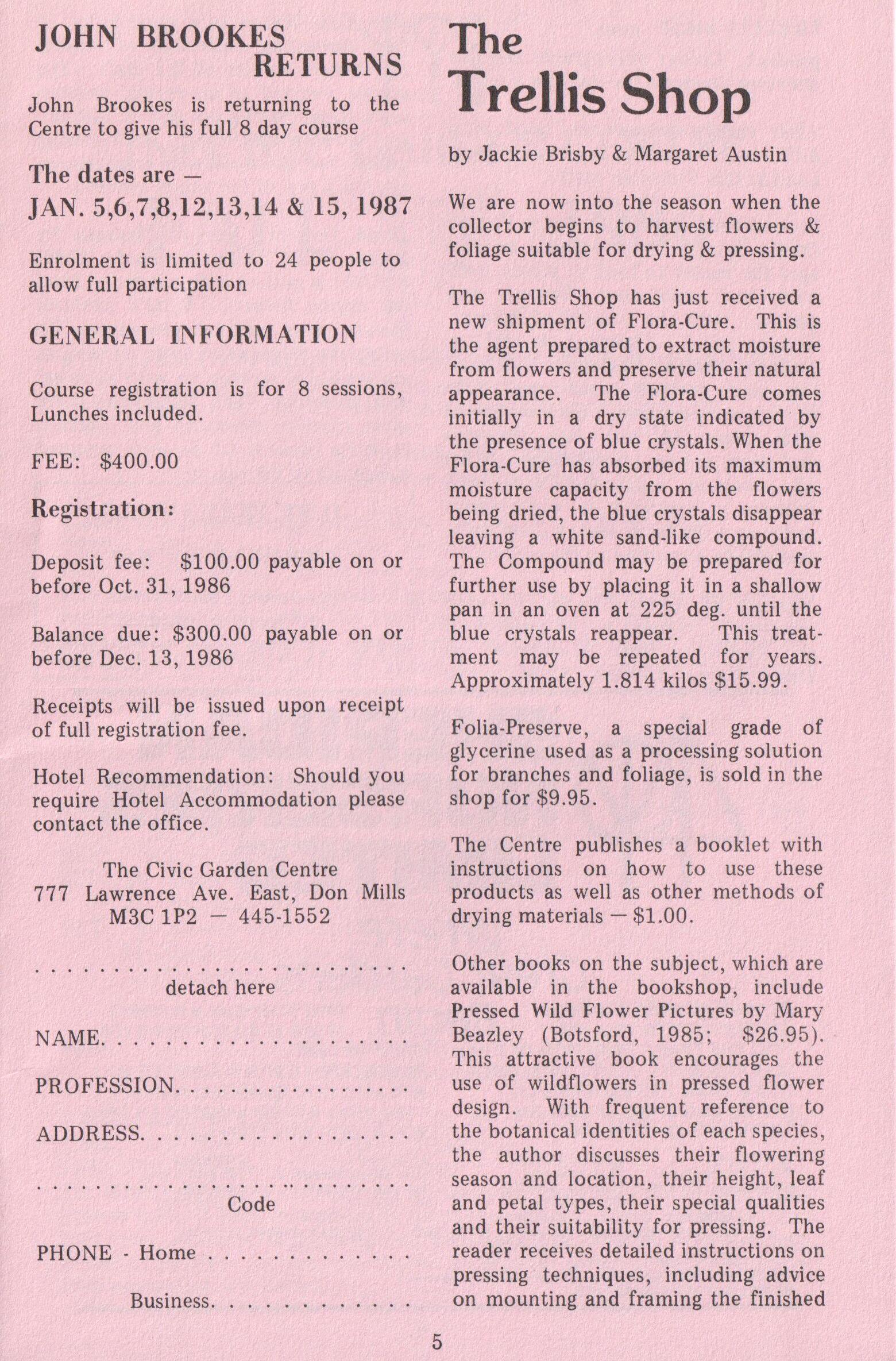
JOHN BROOKES RETURNS
John Brookes is returning to the Centre to give his full 8 day course
The dates are JAN. 5,6,7,8,12,13,14 & 15, 1987
Enrolment is limited to 24 people to allow full participation
GENERAL INFORMATION
Course registration is for 8 sessions, Lunches included.
FEE: $400.00
Registration:
Deposit fee: $100.00 payable on or before Oct. 31, 1986
Balance due: $300.00 payable on or before Dec. 13, 1986
Receipts will be issued upon receipt of full registration fee.
Hotel Recommendation: Should you require Hotel Accommodation please contact the office.
The Civic Garden Centre 777 Lawrence Ave. East, Don Mills M3C 1P2 445-1552 detach here
The Trellis Shop
by Jackie Brisby & Margaret Austin
We are now into the season when the collector begins to harvest flowers & foliage suitable for drying & pressing.
The Trellis Shop has just received a new shipment of Flora-Cure. This is the agent prepared to extract moisture from flowers and preserve their natural appearance. The Flora-Cure comes initially in a dry state indicated by the presence of blue crystals. When the Flora-Cure has absorbed its maximum moisture capacity from the flowers being dried, the blue crystals disappear leaving a white sand-like compound. The Compound may be prepared for further use by placing it in a shallow pan in an oven at 225 deg. until the blue crystals reappear. This treatment may be repeated for vyears. Approximately 1.814 kilos $15.99.
Folia-Preserve, a special grade of glycerine used as a processing solution for branches and foliage, is sold in the shop for $9.95.
The Centre publishes a booklet with instructions on how to use these products as well as other methods of drying materials $1.00.
PROEESSIONG - (o s oo by
PHONY - Home. /7 on o cp o Basihess, o vl e
Other books on the subject, which are available in the bookshop, include Pressed Wild Flower Pictures by Mary Beazley (Botsford, 1985; $26.95). This attractive book encourages the use of wildflowers in pressed flower design. With frequent reference to the botanical identities of each species, the author discusses their flowering season and location, their height, leaf and petal types, their special qualities and their suitability for pressing. The reader receives detailed instructions on pressing techniques, including advice on mounting and framing the finished
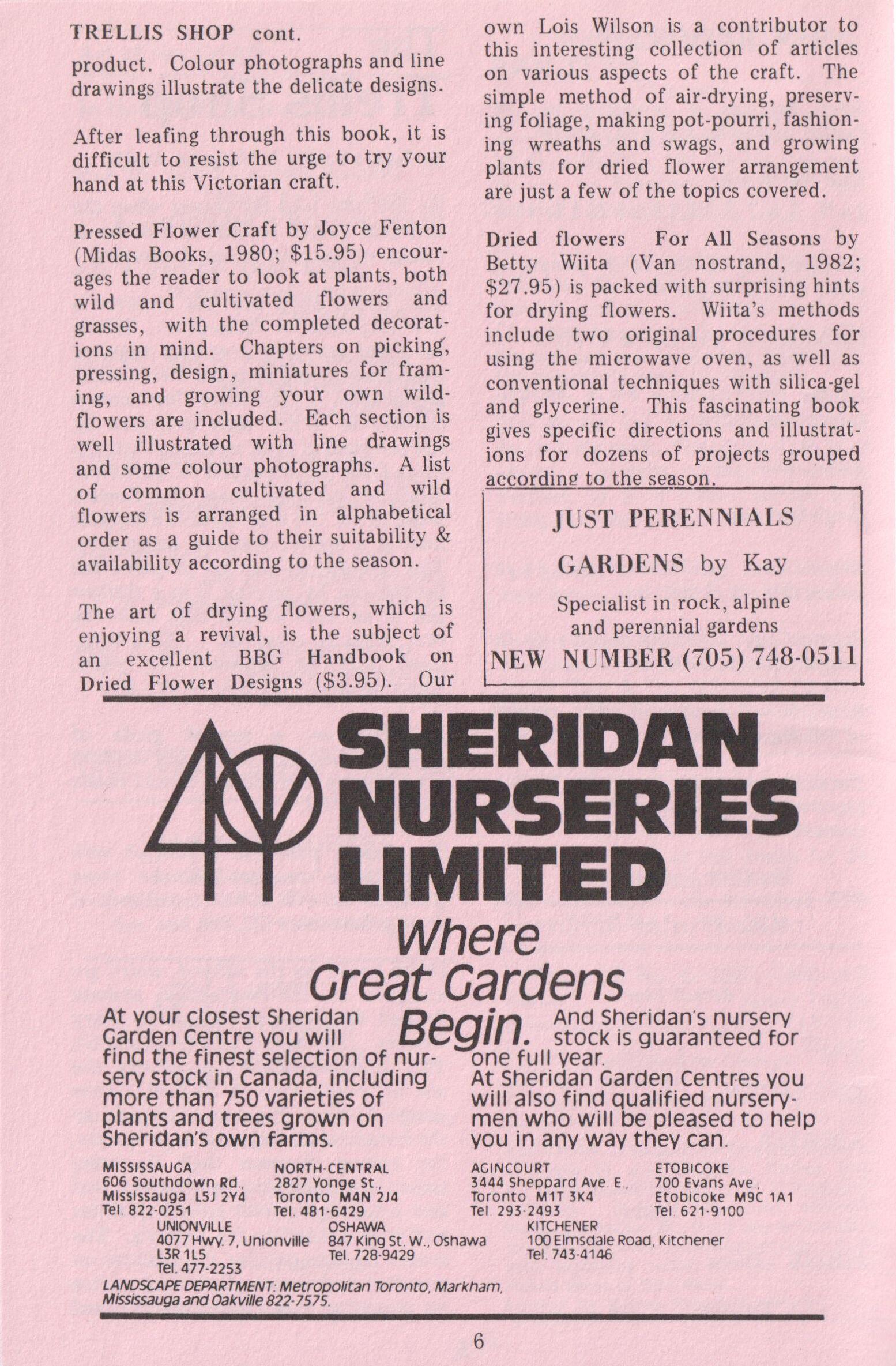
TRELLIS SHOP cont.
product. Colour photographs and line drawings illustrate the delicate designs.
After leafing through this book, it is difficult to resist the urge to try your hand at this Victorian craft.
Pressed Flower Craft by Joyce Fenton (Midas Books, 1980; $15.95) encourages the reader to look at plants, both wild and cultivated flowers and grasses, with the completed decoratjons in mind. Chapters on picking, pressing, design, miniatures for framing, and growing your own wildflowers are included. Each section is well illustrated with line drawings and some colour photographs. A list of common cultivated and wild flowers is arranged in alphabetical order as a guide to their suitability & availability according to the season.
The art of drying flowers, which is enjoying a revival, is the subject of an excellent BBG Handbook on Dried Flower Designs ($3.95). Our
own Lois Wilson is a contributor to this interesting collection of articles on various aspects of the craft. The simple method of air-drying, preserving foliage, making pot-pourri, fashioning wreaths and swags, and growing plants for dried flower arrangement are just a few of the topics covered.
Dried flowers For All Seasons by Betty Wiita (Van nostrand, 1982; $27.95) is packed with surprising hints for drying flowers. Wiita s methods include two original procedures for using the microwave oven, as well as conventional techniques with silica-gel and glycerine. This fascinating book gives specific directions and illustrations for dozens of projects grouped according to the season.
JUST PERENNIALS
GARDENS by Kay Specialist in rock, alpine and perennial gardens
NEW NUMBER (705) 748-0511
SHERIDAN NURSERIES LIMITED
Where
Great Gardens
At your closest Sheridan Garden Centre you will find the finest selection of nursery stock in Canada, including more than 750 varieties of plants and trees grown on Sheridan s own farms.
MISSISSAUGA
I'n And Sheridan s nursery . Stock is guaranteed for one full year. At Sheridan Garden Centres you will also find qualified nursery- men who will be pleased to help you in any way they can.
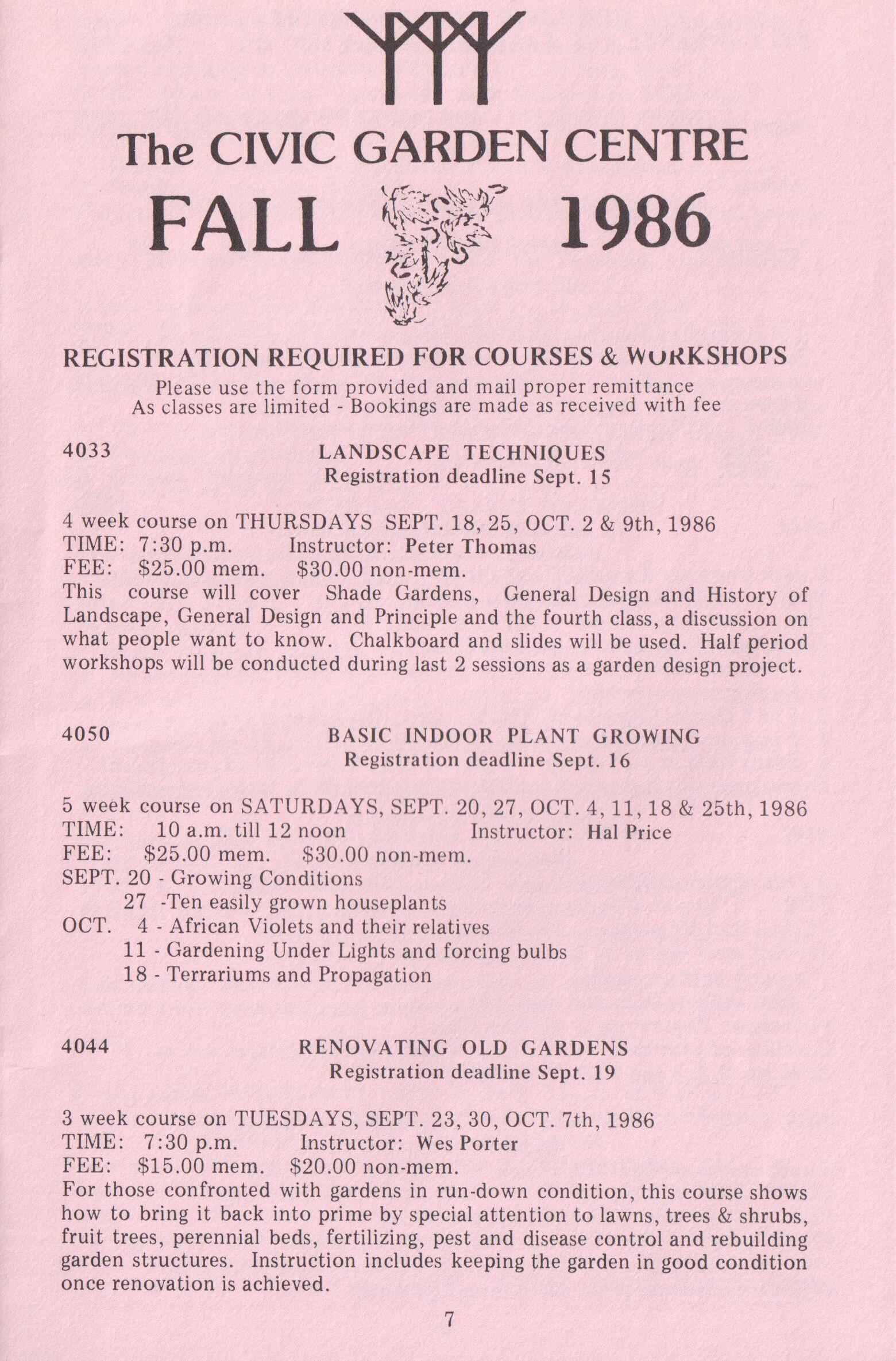
The CIVIC GARDEN CENTRE FALL **é\" 1986
REGISTRATION REQUIRED FOR COURSES & WORKSHOPS
Please use the form provided and mail proper remittance As classes are limited-Bookings are made as received with fee
This course will cover Shade Gardens, General Design and History of Landscape, General Design and Principle and the fourth class, a discussion on what people want to know. Chalkboard and slides will be used. Half period workshops will be conducted during last 2 sessions as a garden design project.
For those confronted with gardens in run-down condition, this course shows how to bring it back into prime by special attention to lawns, trees & shrubs, fruit trees, perennial beds, fertilizing, pest and disease control and rebuilding garden structures. Instruction includes keeping the garden in good condition once renovation is achieved.
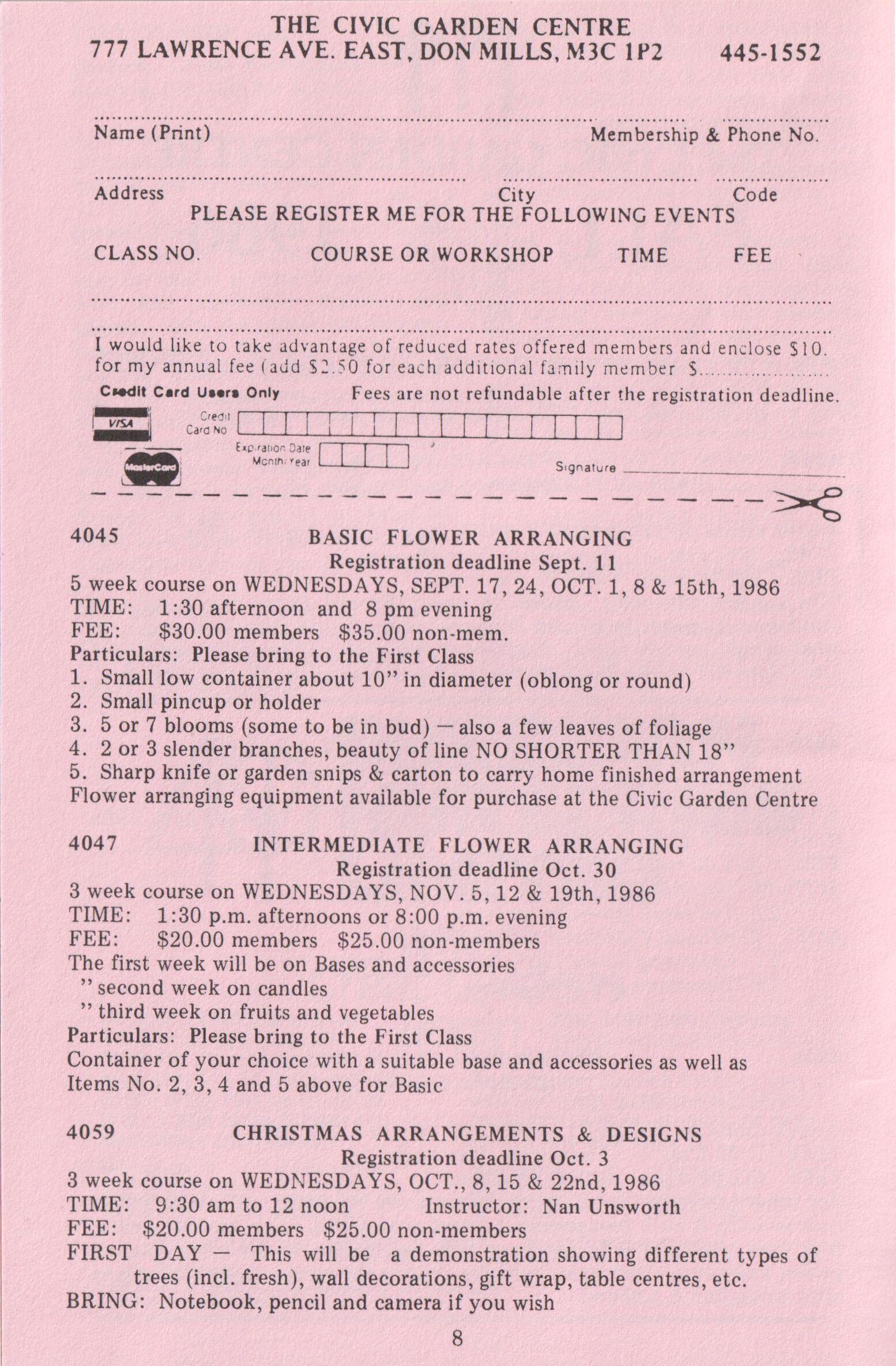
Name (Print) Membership & Phone No. S eo1ty...............................Pyo
PLEASE REGISTER ME FOR THE FOLLOWING EVENTS
CLASS NO. COURSE OR WORKSHOP TIME FEE
I would like to take advantage of reduced rates offered members and enclose $10. for my annual fee (add $2.50 for each additional family member ... ..... Credit Card Users Only Fees are not refundable after the registration deadline. oz Caféi;E ,U
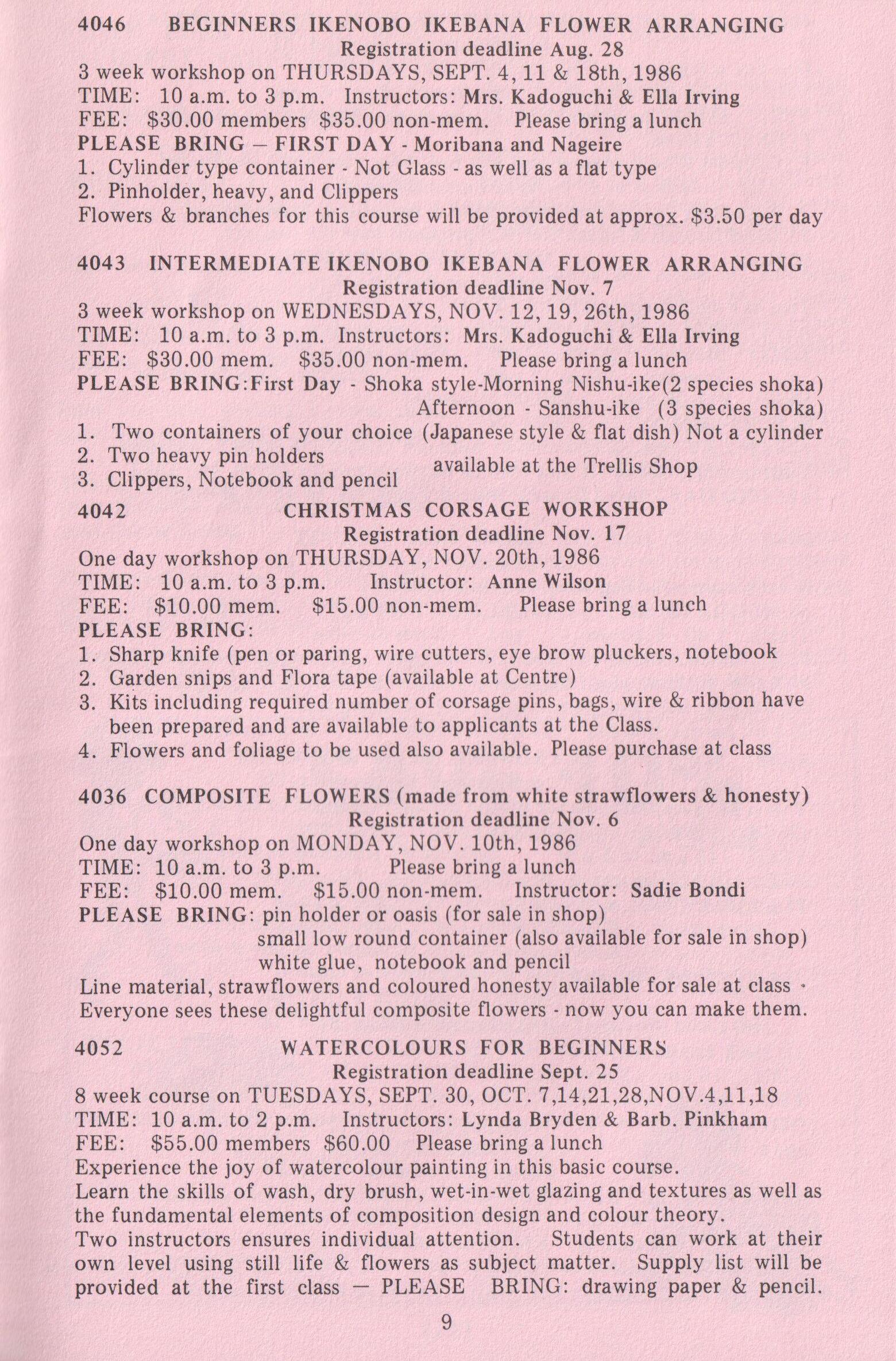
2. Garden snips and Flora tape (available at Centre)
3. Kits including required number of corsage pins, bags, wire & ribbon have been prepared and are available to applicants at the Class.
4. Flowers and foliage to be used also available. Please purchase at class
4036 COMPOSITE FLOWERS (made from white strawflowers & honesty)
Registration deadline Nov. 6
One day workshop on MONDAY, NOV. 10th, 1986
TIME: 10 a.m. to 3 p.m. Please bring a lunch
FEE: $10.00 mem. $15.00 non-mem. Instructor: Sadie Bondi PLEASE BRING: pin holder or oasis (for sale in shop)
small low round container (also available for sale in shop) white glue, notebook and pencil
Line material, strawflowers and coloured honesty available for sale at classEveryone sees these delightful composite flowers - now you can make them.
4052
WATERCOLOURS FOR BEGINNERS
Registration deadline Sept. 25
8 week course on TUESDAYS, SEPT. 30, OCT. 7,14,21,28,NOV.4,11,18
TIME: 10 a.m. to 2 p.m. Instructors: Lynda Bryden & Barb. Pinkham FEE: $55.00 members $60.00 Please bring a lunch
Experience the joy of watercolour painting in this basic course. Learn the skills of wash, dry brush, wet-in-wet glazing and textures as well as the fundamental elements of composition design and colour theory. Two instructors ensures individual attention. Students can work at their own level using still life & flowers as subject matter. Supply list will be provided at the first class PLEASE BRING: drawing paper & pencil.
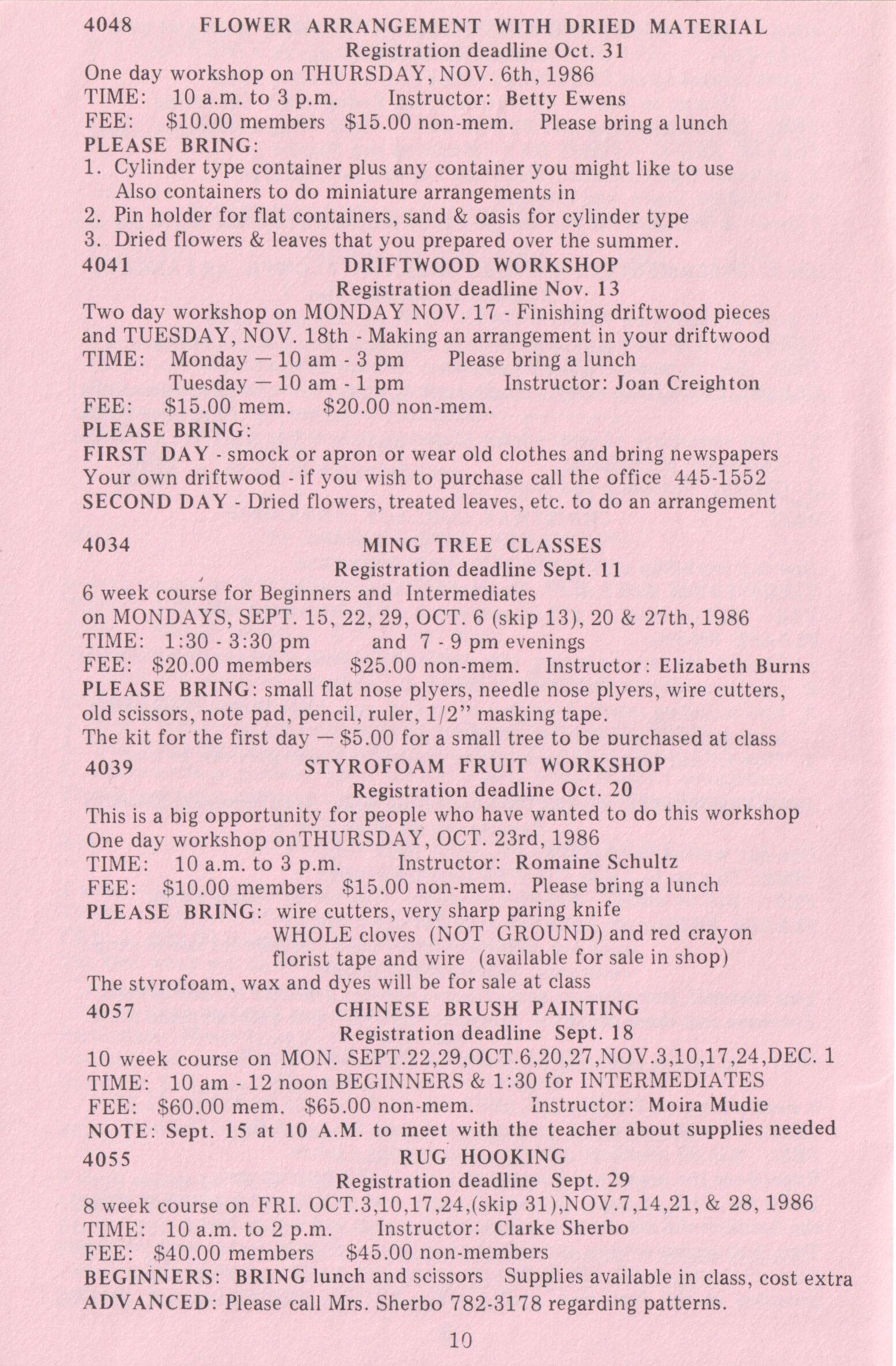
4048 FLOWER ARRANGEMENT WITH DRIED MATERIAL
Registration deadline Oct. 31
One day workshop on THURSDAY, NOV. 6th, 1986
TIME: 10 a.m.to 3 p.m. Instructor: Betty Ewens
FEE: $10.00 members $15.00 non-mem. Please bring a lunch
PLEASE BRING:
1. Cylinder type container plus any container you might like to use Also containers to do miniature arrangements in 2. Pin holder for flat containers, sand & oasis for cylinder type 3. Dried flowers & leaves that you prepared over the summer.
4041
DRIFTWOOD WORKSHOP
Registration deadline Nov. 13
Two day workshop on MONDAY NOV. 17 - Finishing driftwood pieces and TUESDAY, NOV. 18th - Making an arrangement in your driftwood
TIME: Monday 10 am - 3 pm Please bring a lunch
Tuesday 10 am -1 pm Instructor: Joan Creighton
FEE: $15.00 mem. $20.00 non-mem.
PLEASE BRING:
FIRST DAY -smock or apron or wear old clothes and bring newspapers Your own driftwood - if you wish to purchase call the office 445-1552
SECOND DAY - Dried flowers, treated leaves, etc. to do an arrangement
4034
MING TREE CLASSES
2 Registration deadline Sept. 11
6 week course for Beginners and Intermediates on MONDAYS, SEPT. 15, 22, 29, OCT. 6 (skip 13), 20 & 27th, 1986
TIME: 1:30 - 3:30 pm and 7 -9 pm evenings
FEE: $20.00 members $25.00 non-mem. Instructor: Elizabeth Burns
PLEASE BRING: small flat nose plyers, needle nose plyers, wire cutters, old scissors, note pad, pencil, ruler, 1/2° masking tape.
The kit for the first day
$5.00 for a small tree to be purchased at class 4039
STYROFOAM FRUIT WORKSHOP
Registration deadline Oct. 20
This is a big opportunity for people who have wanted to do this workshop One day workshop onTHURSDAY, OCT. 23rd, 1986
TIME: 10a.m.to 3 p.m. Instructor: Romaine Schultz
FEE: $10.00 members $15.00 non-mem. Please bring a lunch PLEASE BRING: wire cutters, very sharp paring knife WHOLE cloves (NOT GROUND) and red crayon florist tape and wire (available for sale in shop)
The styrofoam, wax and dyes will be for sale at class 4057 CHINESE BRUSH PAINTING
Registration deadline Sept. 18
10 week course on MON. SEPT.22,29,0CT.6,20,27,NOV.3,10,17,24,DEC. 1
TIME: 10 am - 12 noon BEGINNERS & 1:30 for INTERMEDIATES
NOTE: Sept. 15 at 10 A.M. to meet with the teacher about supplies needed 4055 RUG HOOKING
Registration deadline Sept. 29
8 week course on FRI. 0CT.3,10,17,24,(skip 31),NOV.7,14,21, & 28, 1986
TIME: 10 a.m. to 2 p.m. Instructor: Clarke Sherbo
FEE: $40.00 members
$45.00 non-members
BEGINNERS: BRING lunch and scissors Supplies available in class, cost extra ADVANCED: Please call Mrs. Sherbo 782-3178 regarding patterns.
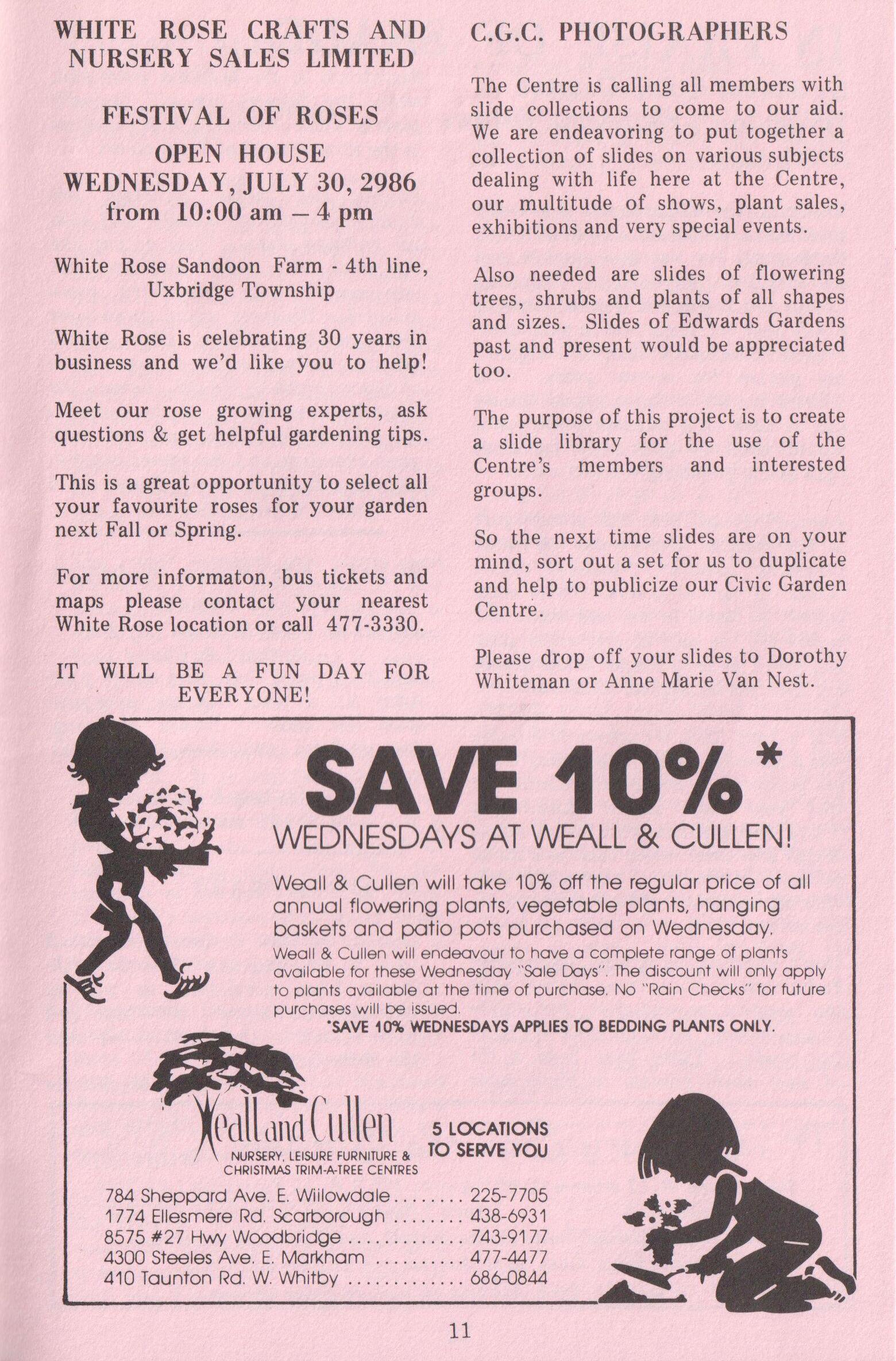
FESTIVAL OF ROSES
OPEN HOUSE
WEDNESDAY, JULY 30, 2986 from 10:00 am 4 pm
White Rose Sandoon Farm - 4th line, Uxbridge Township
White Rose is celebrating 30 years in business and we d like you to help!
Meet our rose growing experts, ask questions & get helpful gardening tips.
This is a great opportunity to select all your favourite roses for your garden next Fall or Spring.
For more informaton, bus tickets and maps please contact your nearest White Rose location or call 477-3330.
IT WILL BE A FUN DAY FOR EVERYONE!
The Centre is calling all members with slide collections to come to our aid. We are endeavoring to put together a collection of slides on various subjects dealing with life here at the Centre, our multitude of shows, plant sales, exhibitions and very special events.
Also needed are slides of flowering trees, shrubs and plants of all shapes and sizes. Slides of Edwards Gardens past and present would be appreciated too.
The purpose of this project is to create a slide library for the use of the Centre s members and interested groups.
So the next time slides are on your mind, sort out a set for us to duplicate and help to publicize our Civic Garden Centre.
Please drop off your slides to Dorothy Whiteman or Anne Marie Van Nest.
WEDNESDAYS AT WEALL & CULLEN!
Weall & Cullen will take 10% off the regular price of all annual flowering plants, vegetable plants, hanging baskets and patio pots purchased on Wednesday.
Weall & Cullen will endeavour to have a complete range of plants available for these Wednesday Sale Days . The discount will only apply to plants available at the time of purchase. No Rain Checks for future purchases will be issued.
*SAVE 10% WEDNESDAYS APPLIES TO BEDDING PLANTS ONLY.
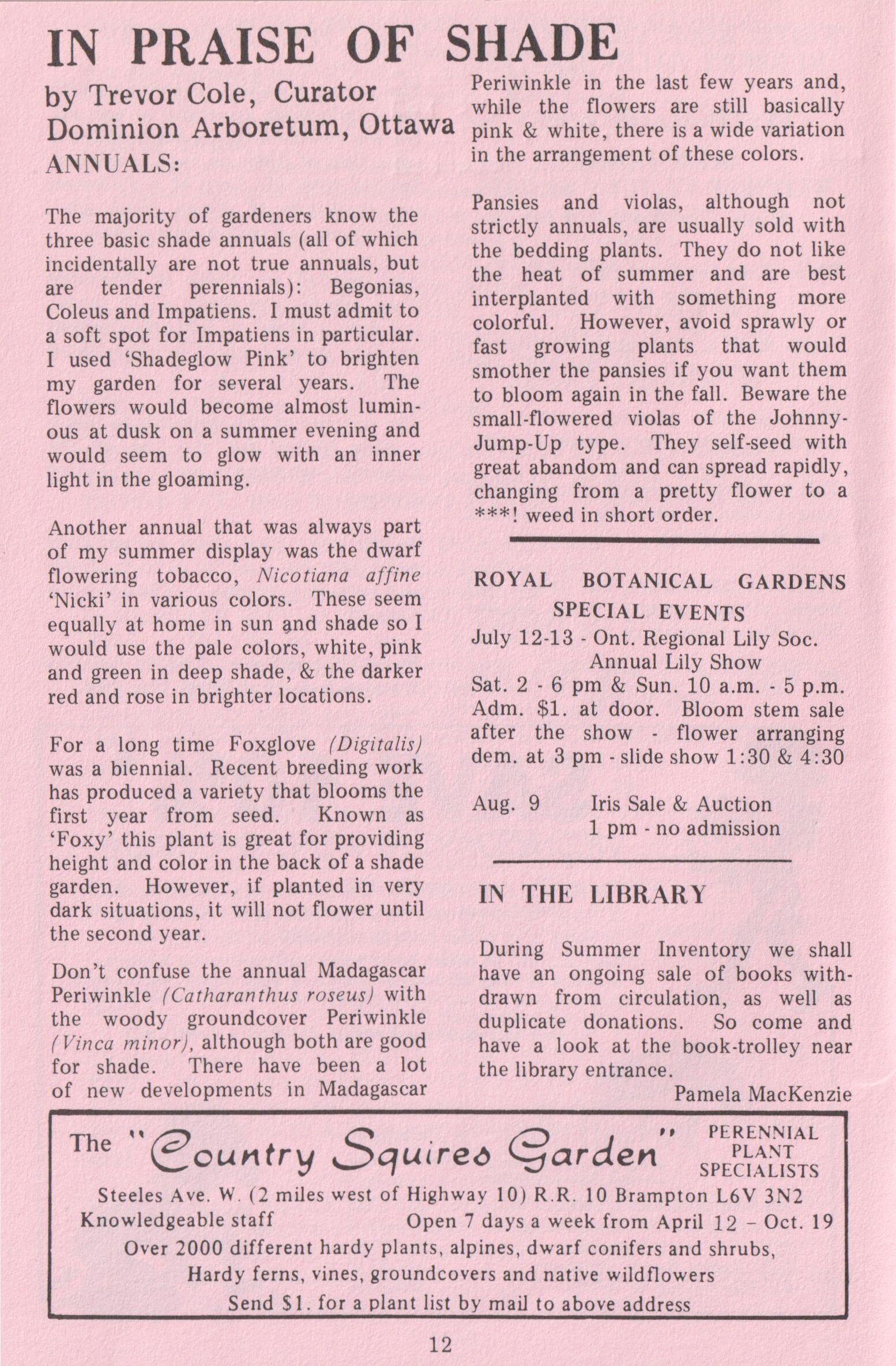
IN PRAISE OF SHADE
by Trevor Cole, Curator Dominion Arboretum, Ottawa
ANNUALS:
The majority of gardeners know the three basic shade annuals (all of which incidentally are not true annuals, but are tender perennials): Begonias, Coleus and Impatiens. I must admit to a soft spot for Impatiens in particular. I used Shadeglow Pink to brighten my garden for several years. The flowers would become almost luminous at dusk on a summer evening and would seem to glow with an inner light in the gloaming.
Another annual that was always part of my summer display was the dwarf flowering tobacco, Nicotiana affine Nicki in various colors. These seem equally at home in sun and shade so I would use the pale colors, white, pink and green in deep shade, & the darker red and rose in brighter locations.
For a long time Foxglove (Digitalis) was a biennial. Recent breeding work has produced a variety that blooms the first year from seed. Known as Foxy this plant is great for providing height and color in the back of a shade garden. However, if planted in very dark situations, it will not flower until the second year.
Don t confuse the annual Madagascar Periwinkle (Catharanthus roseus) with the woody groundcover Periwinkle (Vinca minor), although both are good for shade. There have been a lot of new developments in Madagascar
Periwinkle in the last few years and, while the flowers are still basically pink & white, there is a wide variation in the arrangement of these colors.
Pansies and violas, although not strictly annuals, are usually sold with the bedding plants. They do not like the heat of summer and are best interplanted with something more colorful. However, avoid sprawly or fast growing plants that would smother the pansies if you want them to bloom again in the fall. Beware the small-flowered violas of the JohnnyJump-Up type. They self-seed with great abandom and can spread rapidly, changing from a pretty flower to a ##%| weed in short order.
ROYAL BOTANICAL GARDENS SPECIAL EVENTS
July 12-13 - Ont. Regional Lily Soc. Annual Lily Show
Sat. 2 - 6 pm & Sun. 10 a.m. - 5 p.m. Adm. $1. at door. Bloom stem sale after the show flower arranging dem. at 3 pm - slide show 1:30 & 4:30
Aug. 9 Iris Sale & Auction 1 pm - no admission
IN THE LIBRARY
During Summer Inventory we shall have an ongoing sale of books withdrawn from circulation, as well as duplicate donations. So come and have a look at the book-trolley near the library entrance.
Pamela MacKenzie
e "eountry Squireo @arden"
PERENNIAL PLANT SPECIALISTS
Steeles Ave. W. (2 miles west of Highway 10) R.R. 10 Brampton L6V 3N2
Knowledgeable staff
Open 7 days a week from April 12 - Oct. 19
Over 2000 different hardy plants, alpines, dwarf conifers and shrubs, Hardy ferns, vines, groundcovers and native wildflowers
Send $1. for a plant list by mail to above address
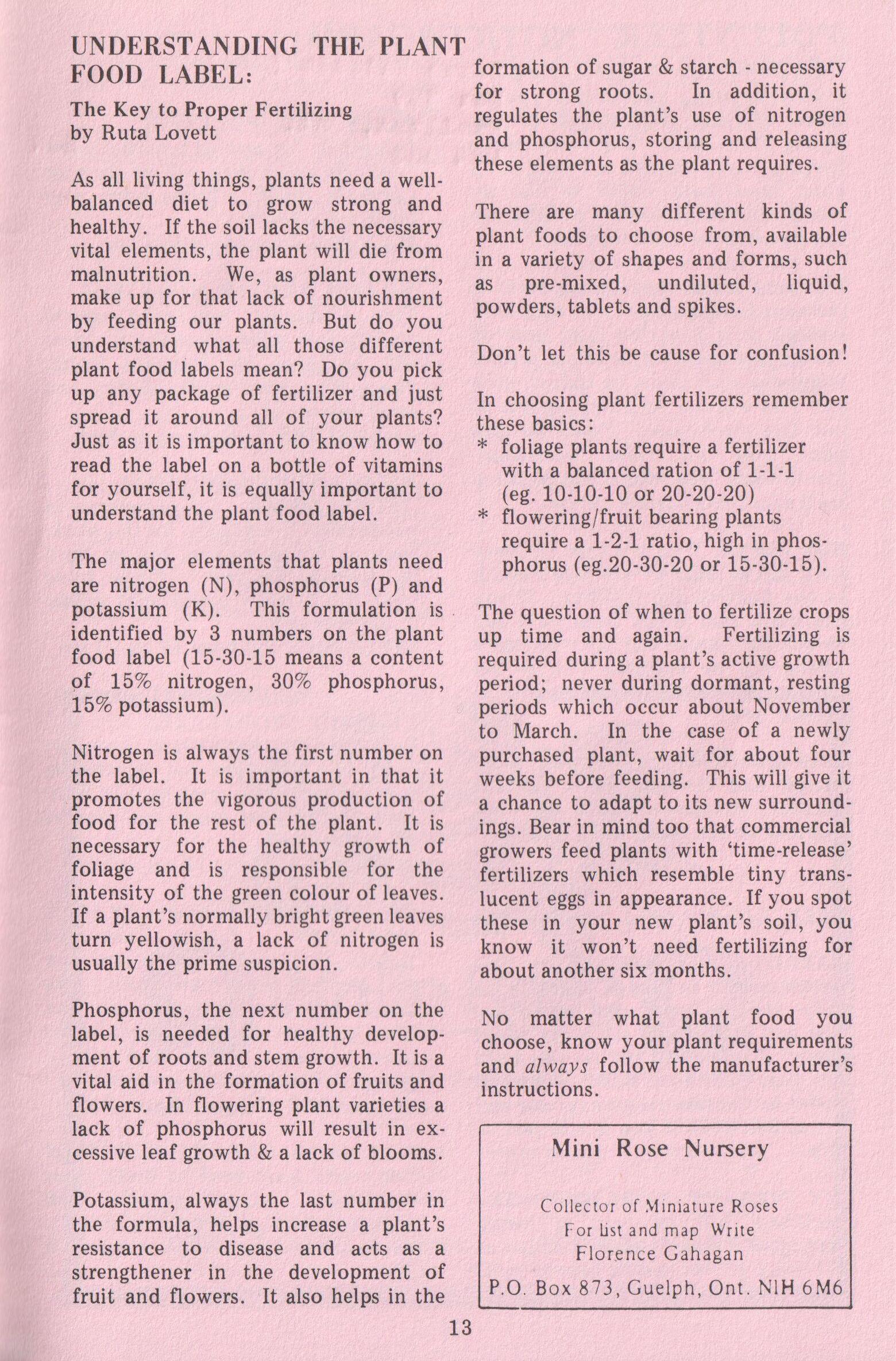
UNDERSTANDING THE PLANT FOOD LABEL:
The Key to Proper Fertilizing
by Ruta Lovett
As all living things, plants need a wellbalanced diet to grow strong and healthy. If the soil lacks the necessary vital elements, the plant will die from malnutrition. We, as plant owners, make up for that lack of nourishment by feeding our plants. But do you understand what all those different plant food labels mean? Do you pick up any package of fertilizer and just spread it around all of your plants? Just as it is important to know how to read the label on a bottle of vitamins for yourself, it is equally important to understand the plant food label.
The major elements that plants need are nitrogen (N), phosphorus (P) and potassium (K). identified by 3 numbers on the plant food label (15-30-15 means a content of 15% nitrogen, 30% phosphorus, 15% potassium).
This formulation is .
Nitrogen is always the first number on the label. It is important in that it promotes the vigorous production of food for the rest of the plant. It is necessary for the healthy growth of foliage and is responsible for the intensity of the green colour of leaves. If a plant s normally bright green leaves turn yellowish, a lack of nitrogen is usually the prime suspicion.
Phosphorus, the next number on the label, is needed for healthy development of roots and stem growth. Itisa vital aid in the formation of fruits and flowers. In flowering plant varieties a lack of phosphorus will result in excessive leaf growth & a lack of blooms.
Potassium, always the last number in the formula, helps increase a plant s resistance to disease and acts as a strengthener in the development of fruit and flowers. It also helps in the
formation of sugar & starch - necessary for strong roots. In addition, it regulates the plant s use of nitrogen and phosphorus, storing and releasing these elements as the plant requires.
There are many different kinds of plant foods to choose from, available in a variety of shapes and forms, such as pre-mixed, undiluted, liquid, powders, tablets and spikes.
Don t let this be cause for confusion!
In choosing plant fertilizers remember these basics:
* foliage plants require a fertilizer with a balanced ration of 1-1-1 (eg. 10-10-10 or 20-20-20)
* flowering/fruit bearing plants require a 1-2-1 ratio, high in phosphorus (eg.20-30-20 or 15-30-15).
The question of when to fertilize crops up time and again. Fertilizing is required during a plant s active growth period; never during dormant, resting periods which occur about November to March. In the case of a newly purchased plant, wait for about four weeks before feeding. This will give it a chance to adapt to its new surroundings. Bear in mind too that commercial growers feed plants with time-release fertilizers which resemble tiny translucent eggs in appearance. If you spot these in your new plant s soil, you know it won t need fertilizing for about another six months.
No matter what plant food you choose, know your plant requirements and always follow the manufacturer s instructions.
Mini Rose Nursery
Collector of Miniature Roses For list and map Write Florence Gahagan
P.O. Box 873, Guelph, Ont. NIH 6M6
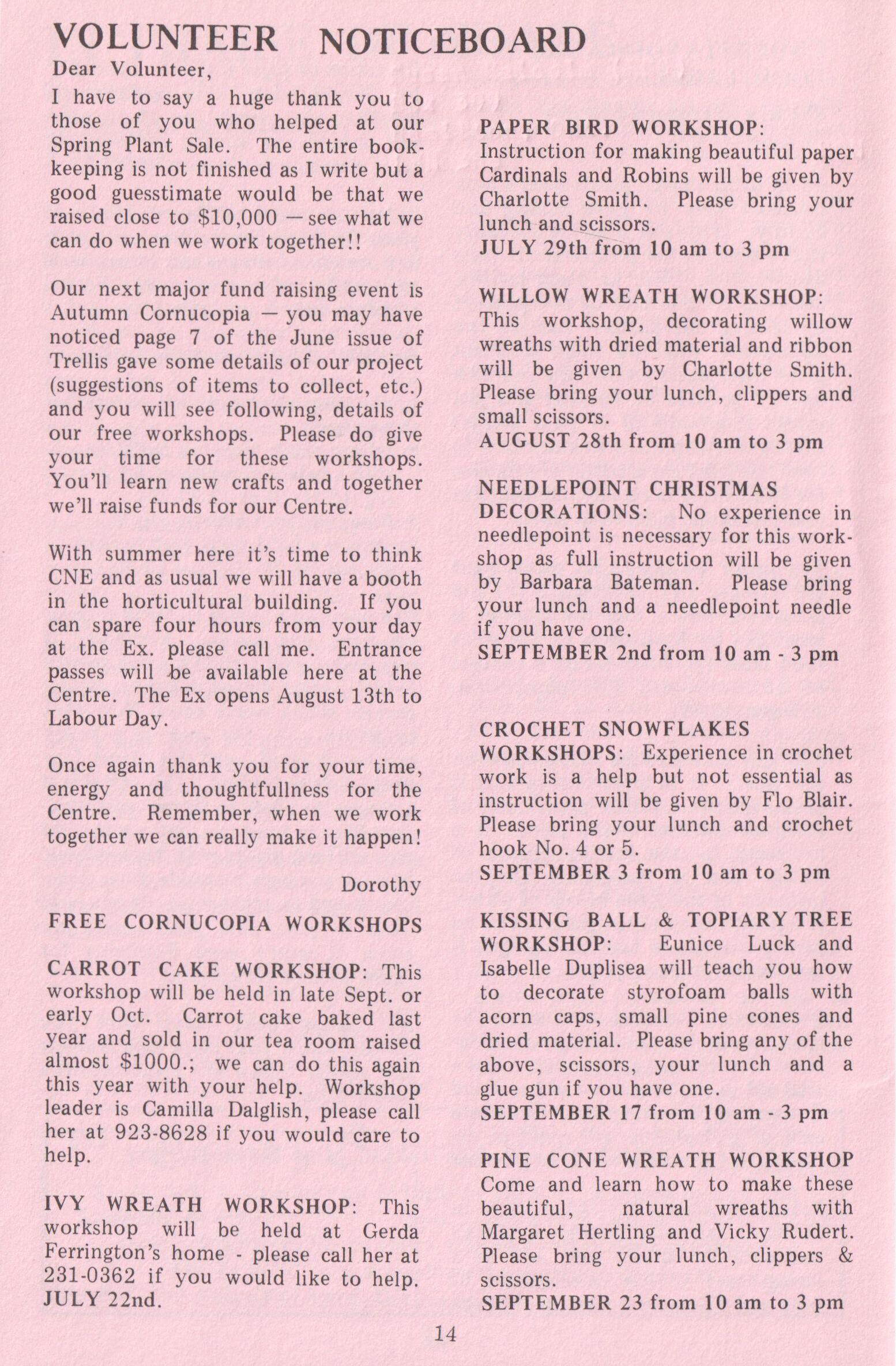
VOLUNTEER NOTICEBOARD
Dear Volunteer,
I have to say a huge thank you to those of you who helped at our Spring Plant Sale. The entire bookkeeping is not finished as I write but a good guesstimate would be that we raised close to $10,000 see what we can do when we work together!!
Our next major fund raising event is Autumn Cornucopia you may have noticed page 7 of the June issue of Trellis gave some details of our project (suggestions of items to collect, etc.) and you will see following, details of our free workshops. Please do give your time for these workshops. You ll learn new crafts and together we ll raise funds for our Centre.
With summer here it s time to think CNE and as usual we will have a booth in the horticultural building. If you can spare four hours from your day at the Ex. please call me. Entrance passes will be available here at the Centre. The Ex opens August 13th to Labour Day.
Once again thank you for your time, energy and thoughtfullness for the Centre. Remember, when we work together we can really make it happen!
Dorothy
FREE CORNUCOPIA WORKSHOPS
CARROT CAKE WORKSHOP: This workshop will be held in late Sept. or early Oct. Carrot cake baked last year and sold in our tea room raised almost $1000.; we can do this again this year with your help. Workshop leader is Camilla Dalglish, please call her at 923-8628 if you would care to help.
IVY WREATH WORKSHOP: This workshop will be held at Gerda Ferrington s home - please call her at 231-0362 if you would like to help.
JULY 29nd:
PAPER BIRD WORKSHOP:
Instruction for making beautiful paper Cardinals and Robins will be given by Charlotte Smith. Please bring your lunch and scissors.
JULY 29th from 10 am to 3 pm
WILLOW WREATH WORKSHOP:
This workshop, decorating willow wreaths with dried material and ribbon will be given by Charlotte Smith. Please bring your lunch, clippers and small scissors.
AUGUST 28th from 10 am to 3 pm
NEEDLEPOINT CHRISTMAS
DECORATIONS: No experience in needlepoint is necessary for this workshop as full instruction will be given by Barbara Bateman. Please bring your lunch and a needlepoint needle if you have one.
SEPTEMBER 2nd from 10 am - 3 pm
CROCHET SNOWFLAKES
WORKSHOPS: Experience in crochet work is a help but not essential as instruction will be given by Flo Blair. Please bring your lunch and crochet hook No. 4 or 5.
SEPTEMBER 3 from 10 am to 3 pm
KISSING BALL & TOPIARY TREE
WORKSHOP: Eunice Luck and Isabelle Duplisea will teach you how to decorate styrofoam balls with acorn caps, small pine cones and dried material. Please bring any of the above, scissors, your lunch and a glue gun if you have one.
SEPTEMBER 17 from 10 am - 3 pm
PINE CONE WREATH WORKSHOP
Come and learn how to make these beautiful, natural wreaths with Margaret Hertling and Vicky Rudert. Please bring your lunch, clippers & SCissors.
SEPTEMBER 23 from 10 am to 3 pm
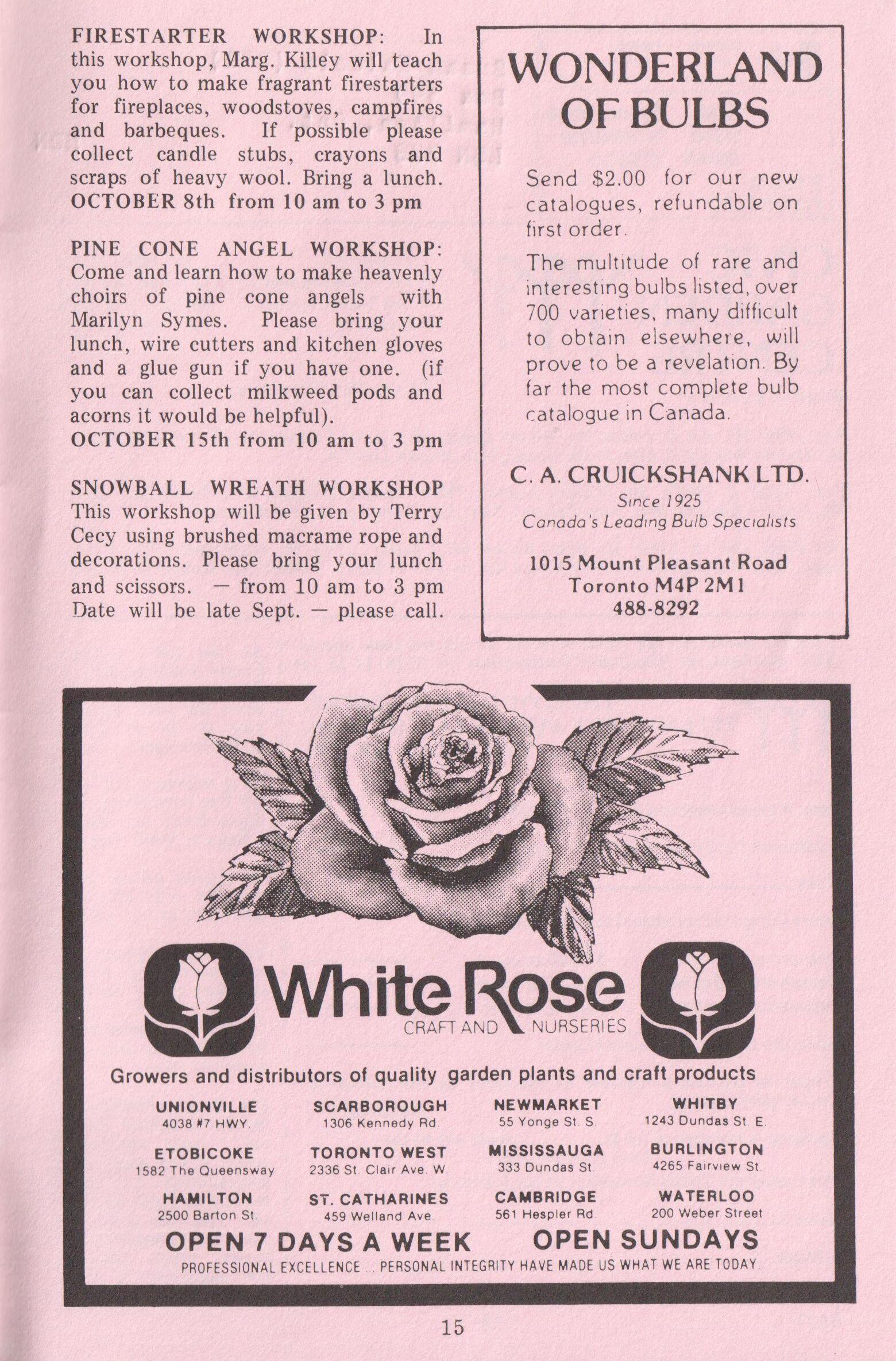
FIRESTARTER WORKSHOP: In this workshop, Marg. Killey will teach you how to make fragrant firestarters for fireplaces, woodstoves, campfires and barbeques. If possible please collect candle stubs, crayons and scraps of heavy wool. Bring a lunch.
OCTOBER 8th from 10 am to 3 pm
PINE CONE ANGEL WORKSHOP:
Come and learn how to make heavenly choirs of pine cone angels with Marilyn Symes. Please bring your lunch, wire cutters and kitchen gloves and a glue gun if you have one. (if you can collect milkweed pods and acorns it would be helpful).
OCTOBER 15th from 10 am to 3 pm
SNOWBALL WREATH WORKSHOP
This workshop will be given by Terry Cecy using brushed macrame rope and decorations. Please bring your lunch and scissors. from 10 am to 3 pm Date will be late Sept. please call.
WONDERLAND OF BULBS
Send $2.00 for our new catalogues, refundable on first order.
The multitude of rare and interesting bulbs listed, over 700 varieties, many difficult to obtain elsewhere, will prove to be a revelation. By far the most complete bulb catalogue in Canada.
C. A. CRUICKSHANK LTD.
Since 1925 Canada s Leading Bulb Specialists 1015 Mount Pleasant Road Toronto M4P 2M1 488-8292
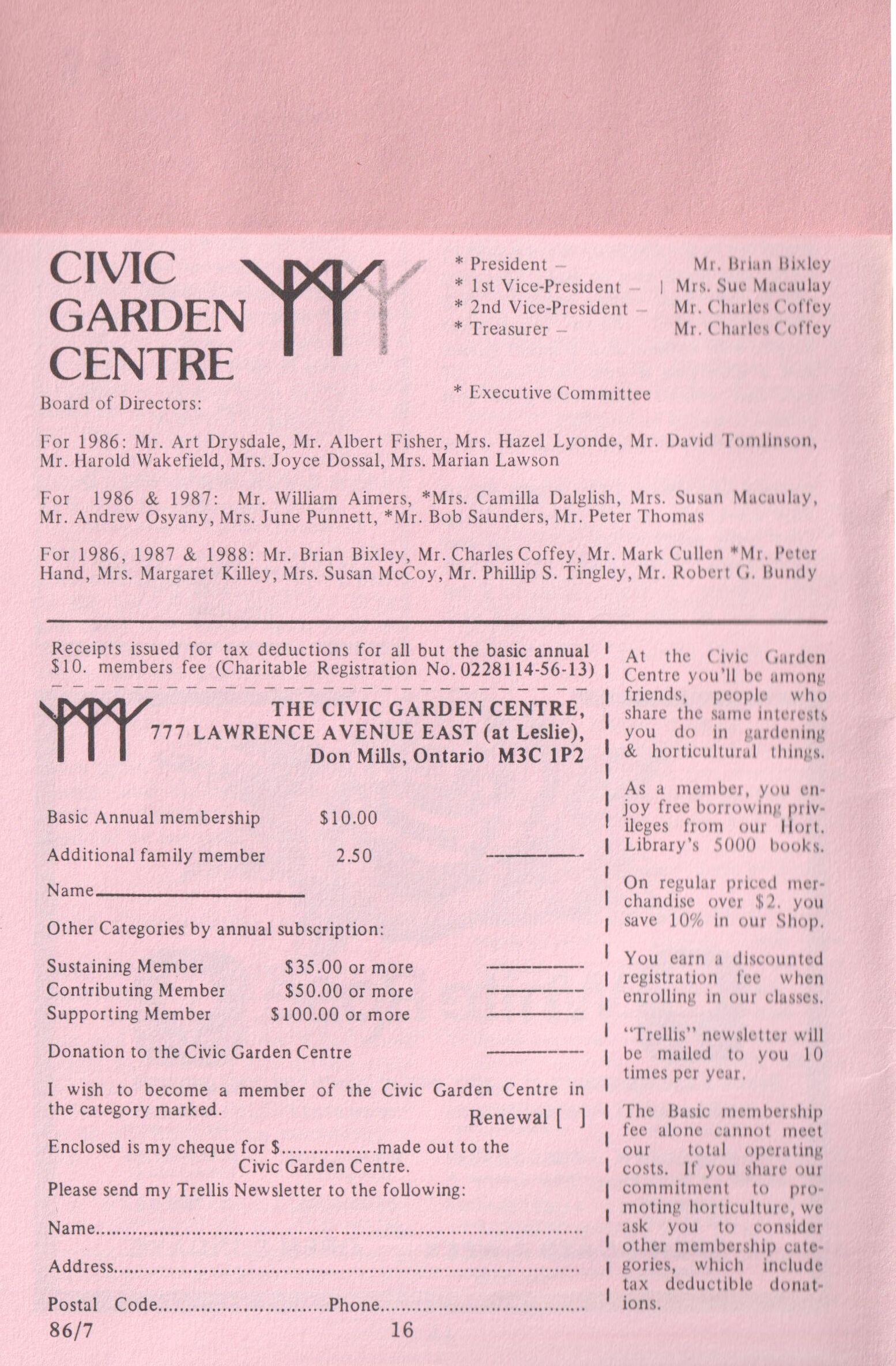
CIVIC GARDEN CENTRE
Board of Directors:
y * President
* 1st Vice-President
* Treasurer e
Mr, Brian Bixley
* 2nd Vice-President Mr. Charles Coffey
* Executive Committee
| Mrs. Sue Macaulay Mr. Charles Coffey
For 1986: Mr. Art Drysdale, Mr. Albert Fisher, Mrs. Hazel Lyonde, Mr. David Tomlinson, Mr. Harold Wakefield, Mrs. Joyce Dossal, Mrs. Marian Lawson
For 1986 & 1987: Mr. William Aimers, *Mrs. Camilla Dalglish, Mrs. Susan Macaulay, Mr. Andrew Osyany, Mrs. June Punnett, *Mr. Bob Saunders, Mr. Peter Thomas
For 1986, 1987 & 1988: Mr. Brian Bixley, Mr. Charles Coffey, Mr. Mark Cullen *Mr, Peter Hand, Mrs. Margaret Killey, Mrs. Susan McCoy, Mr. Phillip S. Tingley, Mr. Robert G, Bundy
Receipts issued for tax deductions for all but the basic annual ! $10. members fee (Charitable Registration No.(0228114-56-13) | THE CIVIC GARDEN CENTRE, 777 LAWRENCE AVENUE EAST (at Leslie), Don Mills, Ontario M3C 1P2
Basic Annual membership $10.00
Additional
Categories by annual subscription:
Donation to the Civic Garden Centre ipiags
I wish to become a member of the Civic Garden Centre in the category marked. Renewal [ ]
Enclosed is my cheque for §..................made out to the Civic Garden Centre. Please send my Trellis Newsletter to the following:
[y| AR Mo s G A A ASRS P o e i
7L L S R O R S BRI A iy R
BOStAl Code. i, slPRONE. i T s o iy 86/7 16
At the Civic Garden Centre you'll be among friends, people who share the same interests you do in gardening & horticultural things.
As a member, you enjoy free borrowing privs ileges from our Hort, Library s 5000 books.
On regular priced merchandise over $2. you save 10% in our Shop.
You earn a discounted registration fee when enrolling in our classes,
Trellis newsletter will be mailed to you 10 times per year,
The Basic membership fee alone cannot meet our total operating costs. If you share our commitment to promoting horticulture, we ask you to consider other membership categories, which include tax deductible donations.