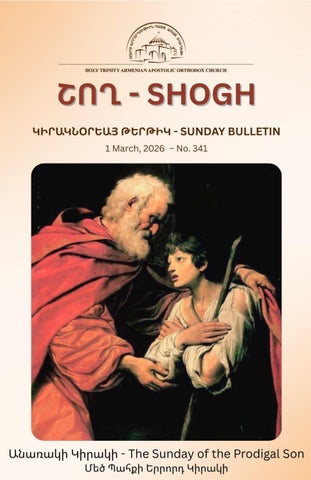
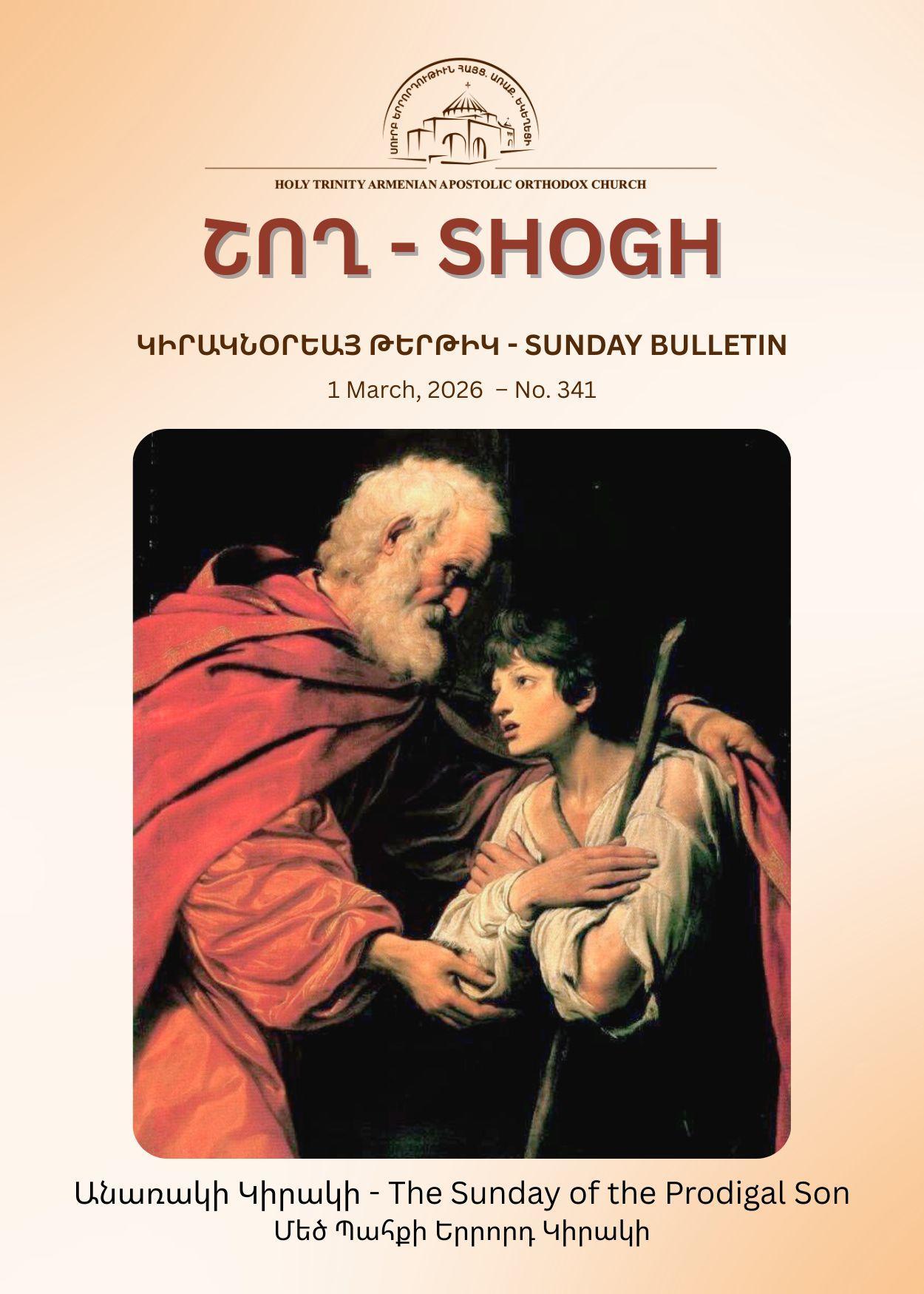

THIRD SUNDAY OF GREAT LENT
THE SUNDAY OF PRODIGAL SON
SYNAXIS READINGS
Isaiah 54.11-55.13
2 Corinthians 6.1-7.1
Luke 15.1-32
MORNING SERVICE at 9:30 am
DIVINE LITURGY at 10:30 am
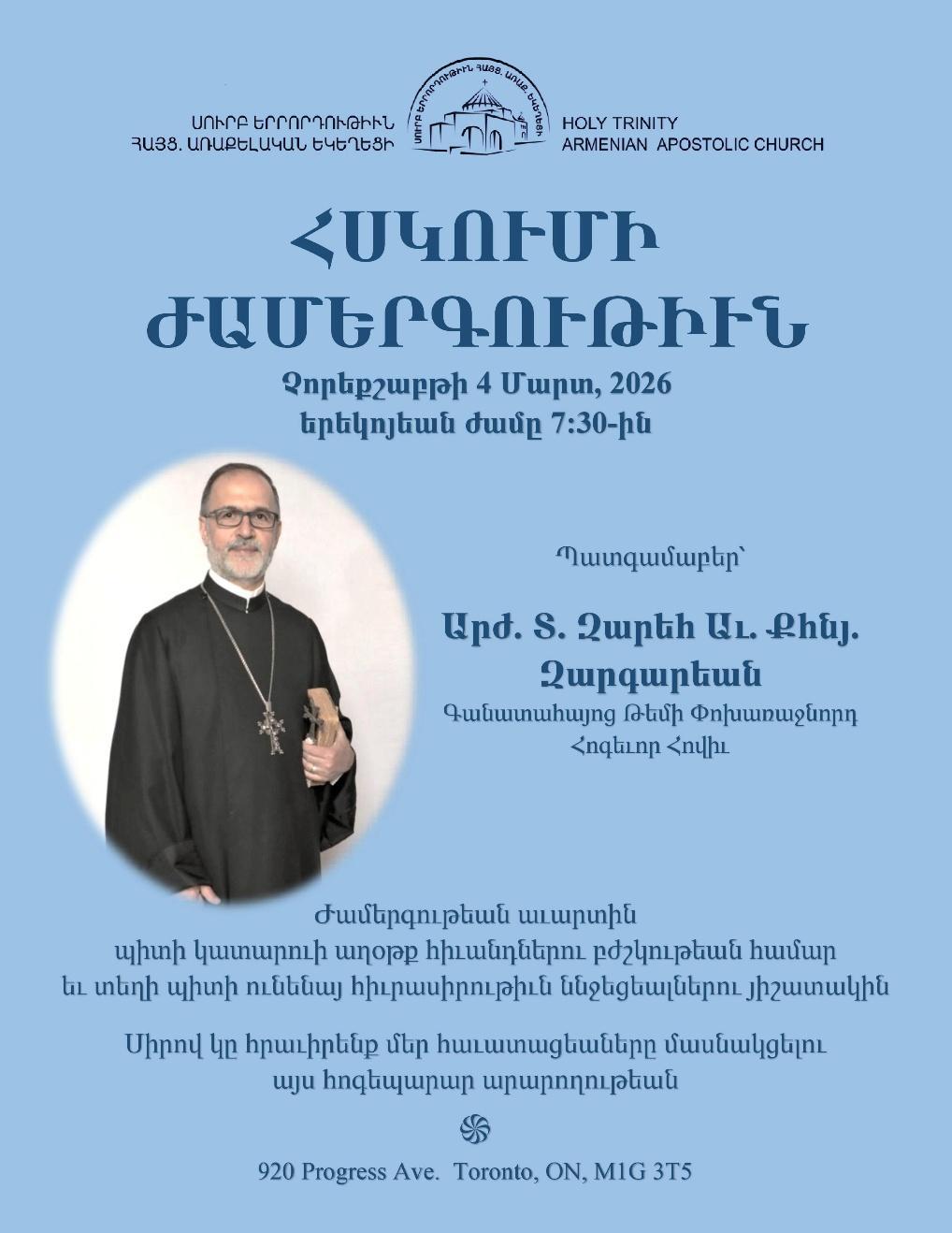
Celebrated by REV. ARCHPRIEST FR. ZAREH ZARGARIAN
Vicar and Parish Priest
Choirmaster Dn. Shahe Altounian
Organist Mrs. Sona Artinian
2 CORINTHIANS 6.1-7.1
As God’s co-workers we urge you not to receive God’s grace in vain. For he says, “In the time of my favor I heard you, and in the day of salvation I helped you.”
I tell you, now is the time of God’s favor, now is the day of salvation.
We put no stumbling block in anyone’s path, so that our ministry will not be discredited. Rather, as servants of God we commend ourselves in every way: in great endurance; in troubles, hardships and distresses; in beatings, imprisonments and riots; in hard work, sleepless nights and hunger; in purity, understanding, patience and kindness; in the Holy Spirit and in sincere love; in truthful speech and in the power of God; with weapons of righteousness in the right hand and in the left; through glory and dishonor, bad report
and good report; genuine, yet regarded as impostors; known, yet regarded as unknown; dying, and yet we live on; beaten, and yet not killed; sorrowful, yet always rejoicing; poor, yet making many rich; having nothing, and yet possessing everything.
We have spoken freely to you, Corinthians, and opened wide our hearts to you. We are not withholding our affection from you, but you are withholding yours from us. As a fair exchange I speak as to my children open wide your hearts also.
Do not be yoked together with unbelievers. For what do righteousness and wickedness have in common? Or what fellowship can light have with darkness? What harmony is there between Christ and Belial? Or what does a believer have in common with an unbeliever? What agreement is there between the temple of God and idols? For we are the temple of the living God. As God has said:
“I will live with them and walk among them, and I will be their God, and they will be my people.”
Therefore, “Come out from them and be separate, says the Lord. Touch no unclean thing, and I will receive you.”
And, “I will be a Father to you, and you will be my sons and daughters, says the Lord Almighty.”
Therefore, since we have these promises, dear friends, let us purify ourselves from everything that contaminates body and spirit, perfecting holiness out of reverence for God.
LUKE 15.1-32
Now the tax collectors and sinners were all gathering around to hear Jesus. But the Pharisees and the teachers of the law muttered, “This man welcomes sinners and eats with them.”
Then Jesus told them this parable: “Suppose one of you has a hundred sheep and loses one of them. Doesn’t he leave the ninety-
nine in the open country and go after the lost sheep until he finds it? And when he finds it, he joyfully puts it on his shoulders and goes home. Then he calls his friends and neighbors together and says, ‘Rejoice with me; I have found my lost sheep.’ I tell you that in the same way there will be more rejoicing in heaven over one sinner who repents than over ninety-nine righteous persons who do not need to repent.
“Or suppose a woman has ten silver coins a and loses one. Doesn’t she light a lamp, sweep the house and search carefully until she finds it? And when she finds it, she calls her friends and neighbors together and says, ‘Rejoice with me; I have found my lost coin.’ In the same way, I tell you, there is rejoicing in the presence of the angels of God over one sinner who repents.”
Jesus continued: “There was a man who had two sons. The younger one said to his father, ‘Father, give me my share of the estate.’ So he divided his property between them.
“Not long after that, the younger son got together all he had, set off for a distant country and there squandered his wealth in wild living. After he had spent everything, there was a severe famine in that whole country, and he began to be in need. So he went and hired himself out to a citizen of that country, who sent him to his fields to feed pigs. He longed to fill his stomach with the pods that the pigs were eating, but no one gave him anything.
“When he came to his senses, he said, ‘How many of my father’s hired servants have food to spare, and here I am starving to death! I will set out and go back to my father and say to him: Father, I have sinned against heaven and against you. I am no longer worthy to be called your son; make me like one of your hired servants.’ So he got up and went to his father.
“But while he was still a long way off, his father saw him and was filled with compassion for him; he ran to his son, threw his arms around him and kissed him.
“The son said to him, ‘Father, I have sinned against heaven and against you. I am no longer worthy to be called your son.’
“But the father said to his servants, ‘Quick! Bring the best robe and put it on him. Put a ring on his finger and sandals on his feet. Bring the fattened calf and kill it. Let’s have a feast and celebrate. For this son of mine was dead and is alive again; he was lost and is found.’ So they began to celebrate.
“Meanwhile, the older son was in the field. When he came near the house, he heard music and dancing. So he called one of the servants and asked him what was going on. ‘Your brother has come,’ he replied, ‘and your father has killed the fattened calf because he has him back safe and sound.’
“The older brother became angry and refused to go in. So his father went out and pleaded with him. But he answered his father, ‘Look! All these years I’ve been slaving for you and never disobeyed your orders. Yet you never gave me even a young goat so I could celebrate with my friends. But when this son of yours who has squandered your property with prostitutes comes home, you kill the fattened calf for him!’
“ ‘My son,’ the father said, ‘you are always with me, and everything I have is yours. But we had to celebrate and be glad, because this brother of yours was dead and is alive again; he was lost and is found.’”
The Lord is not slow in keeping his promise, as some understand slowness. Instead he is patient with you, not wanting anyone to perish, but everyone to come to repentance.
2Peter3:9
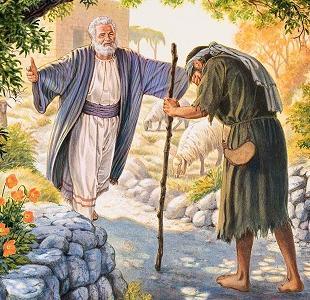
THE SUNDAY OF PRODIGAL SON
The third Sunday of Great Lent is called the Sunday of the Lost Son according to the Parable of the Lost Son told in the Gospel of Luke (Luke 15:15-32).
There was once a man who had two sons. Upon the request of the younger one he divided his property between his two sons. The younger son took his part of inheritance and left home. He went to a country far away, where he wasted his money in reckless living. He spent everything he had. In that time of trouble, he remembered his father’s house, regretted for his reckless living and returned to his father’s home with a plea 'Father, I have sinned against heaven and against you. I am no longer worthy to be called your son; make me like one of your hired servants.’ Seeing that his younger son has regretted, the father received him joyfully. But the elder son complained, saying that during all those years he had worked for his father like a slave and had never disobeyed his orders, and however, he had never deserved such honor. His father answered him: “My son, you are always here with me, and everything I have is yours. But we had to celebrate and to be happy, because your brother was dead, but now he is alive; he was lost, but now he has been found."
The father in this parabel represents God, our heavenly father. The elder and the younger sons are the righteous and the sinful souls. When the father receives his lost son, it means that in the same way God receives the regretting sinner. The older son symbolizes the all those who are righteous or think that there are righteous and the parable cautions all of them not to be self-conceited.
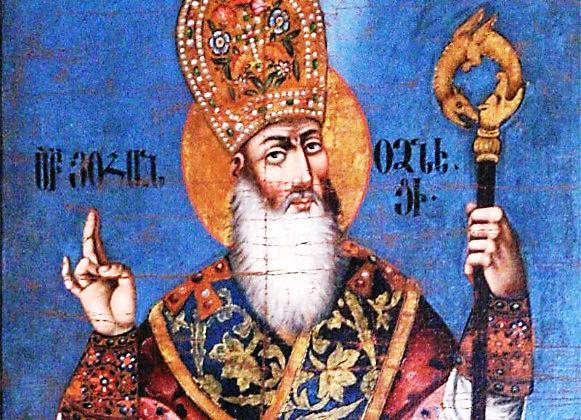
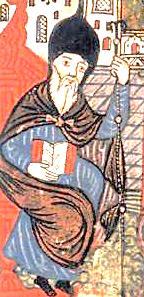
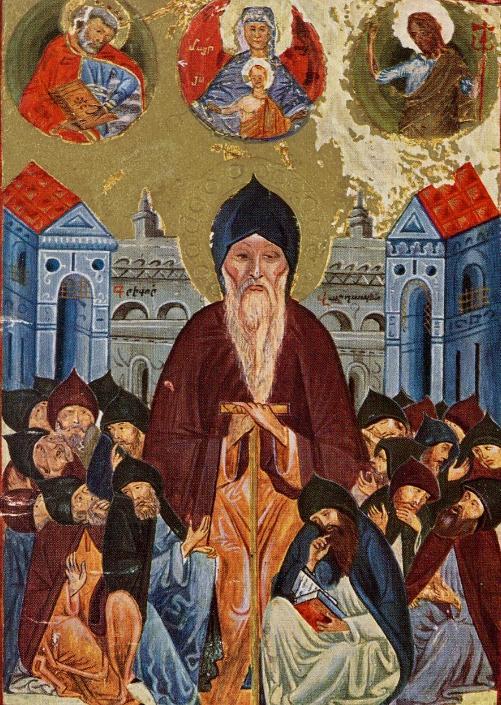
COMMEMORATION OF ST. JOHN THE PATRIARCH OF JERUSALEM,
ST. JOHN OF OTZOON, ST. JOHN OF VOROTAN AND ST. GREGORY OF DATEV
On the third Saturday of Great Lent, this year March 7, the Armenian Apostolic Church commemorates St. John the Patriarch of Jerusalem, as well as Armenian Patriarch St. John of Otzoon, and famous Christian scholars St. John of Vorotan and St. Gregory of Datev.
St. John, Patriarch of Jerusalem, succeeded St. Cyril as Patriarch of Jerusalem (386-417). He grew up with the monks at the monastery of Nitria (Egypt) where he learned about Christianity and the teachings of Origen. He is remembered for his keen intellect and for being a great orator and a defender of Christianity through his sermons.
St.HovhanOdznetsi(St. John of Odzoon) was catholicos from 717 to 728, which was a period when Armenia was under Arab rule. He was from a noble family and was born in the village of Odzun in Tashirk province of Greater Armenia (now Lori Province, Armenia) in 650 AC. He was described as being very handsome looking, tall, presented himself in luxurious vestments, but lived by fasting, praying and lead an ascetic lifestyle. According to hagiographer he possessed both spiritual and mental brilliance, hence his nickname 'Philosopher'.
As the Catholicos, St. John managed to withstand the pressures from Arabs and Byzantine. He also convened councils in Dvin and Manazkert (Manzikert) to discuss doctrinal and other important matters of the Church. His book ‘Canons of the Armenians' is the first Armenian collection in volumes containing ecclesiastical canons and laws. He was the author of many theological works, wrote sermons and sharakans (hymns).
St. Hovhannes of Odzun passed away in 728 AC and was buried near the church of Srbanes (St. Hovhannes) in the village of Ardvi, near Odzun.
HovhanVorodnetsi(St. John of Orodni) was born in 1315. St. John of Vorotan, or Hovan Vorotnetsi, was a renowned theologian, philosopher and scholar. He was the son of Noble Ivané of Syunik. Following his ordination, he served at the monasteries of Klatzor and Datev.
He dedicated most of his efforts toward the preservation of the orthodox faith, and against the attempt to merge the Armenian Church with the Latin Church. He wrote commentaries on the Gospel of John and the epistles of St. Paul. Over the years of his extensive work St. John founded the theological seminary of Datev. He was numerous philosophical works, sermons and commentaries, most of which were edited and duplicated by his great student St. Gregory of Tatev.
KrikorDatevatsi(St. Gregory of Datev), born in 1346 in the province of Vayots Tsor, is perhaps the best known of the four. His pious parents, who lost their young children, incessantly prayed God to send them another child, asking the intercession of St. Gregory the Illuminator before Lord. When the child was born, he was given a baptismal name Gregory. At seven years old Gregory began his education and soon excelled in his knowledge of Scripture. He continued his education in the Tatev monastery and was the student of St. John Vorodnetsi. He was a brilliant scholar, knew Latin fluently and had studied the Greek philosophers extensively. He is regarded to be one of the greatest teachers of the Armenian Church. His most famous work is the Book of Questions (Kirk Hartsmants), which examines questions of faith.
To this day generations of scholars and theologians study the literary heritage of Saint John of Tatev. Few of his numerous works have survived - "The Book of Questions", "Vosceporik", Summer and Winter volumes of "Book of Sermons", numerous commentaries, and other writings, as well as two Gospels illustrated by the saint.

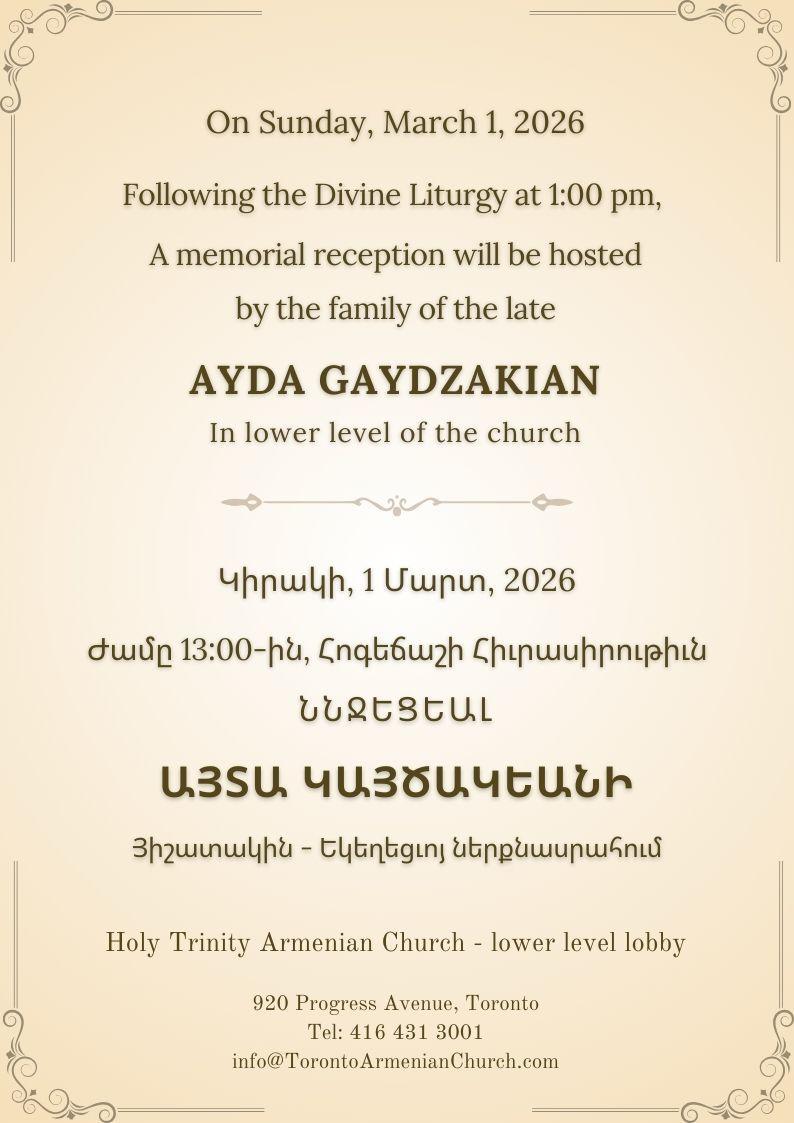
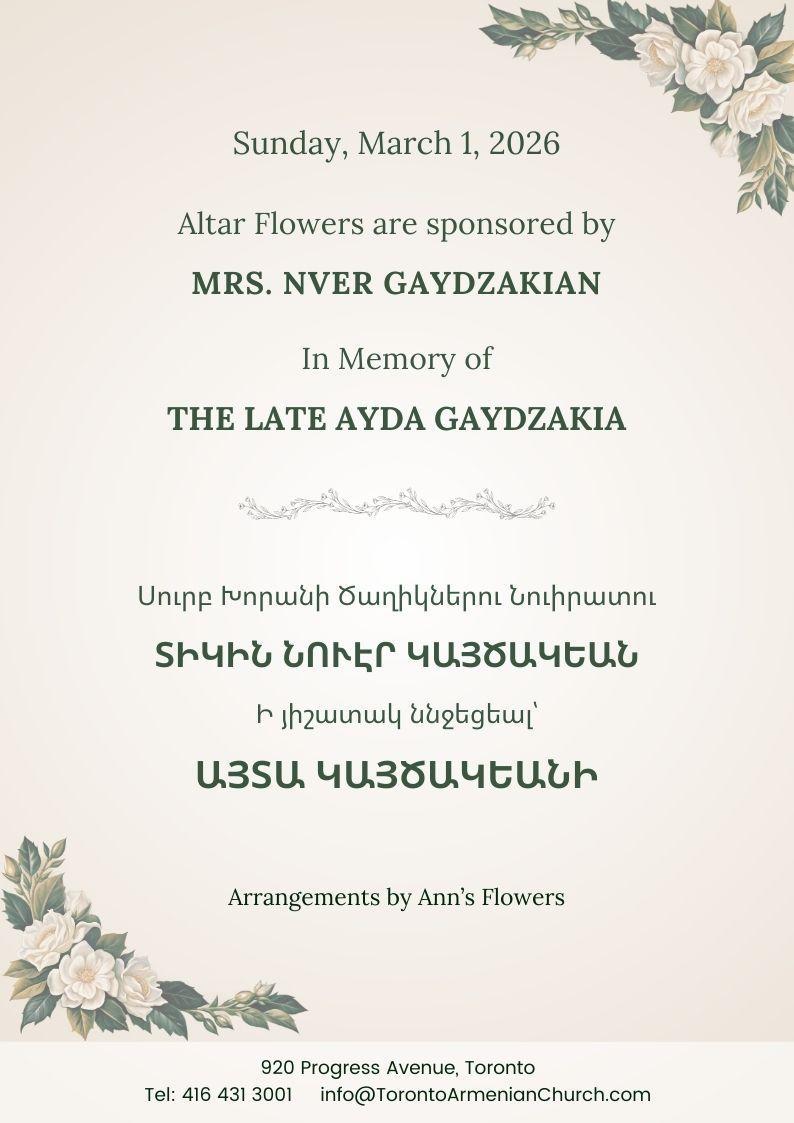
Mrs. Nver Gaydzakian and Family
In Memory of THE LATE AYDA GAYDZAKIAN on the 40th day of her passing As well as
THE LATE STEPHAN BEDROSSIAN on the 8th anniversary of his passing
Requested by Mrs. Seta Torikian and son
Edmon Torikian
In Memory of Their beloved Husband & Father THE LATE KEVORK TORIKIAN on the 5th anniversary of his passing

List of Donations February 21- 27, 2026
GENERAL
Dr. Nana Sogomonian $150
Mrs. Vicki Kesian $100
Ms. Anna Gega $100
Mr. Krikor Mirzoyan $50
Mr. & Mrs. Avedis & Ardemis Moushian $100
Mr. & Mrs. Ara & Naira Gevorkian $200
SUNDAY SCHOOL
Mr. & Mrs. Simon & Salpi Kutyan $100
LOUMA
Mr. & Mrs. Robert & Ella Sarkissian $100
Mrs. Sonia Artinian $50
IN MEMORY OF THE LATE SILVA BABAOGLU
Dr. & Mrs. Masis and Elizabeth Asik $100
THE LATE AIAADA BANOZ
Mr. Armen Setrak $600
BELOVED MOTHER
Mr. & Mrs. Arman & Anna Tsatourian $100
THE LATE ANAHID KURDIAN AND KOHAR DAMBOURADJIAN
Ms Hasmig Kurdian $100
BELOVED DEPARTED SOULS
Mr. & Mrs. Andre & Seza Nazarian $100
THE LATE DR. JOSEPH KAYOUMEDJIAN
Mrs. Margarita Odjaghian $500
MEMORIAL RECEPTION
Women'sGuild
Mr. Armen Setrak $300
MEMBERSHIP
Ms Hasmig Kurdian $100
Mr. Magar Kuzuyan $100
Mrs. Sophie Kuzuayn $100
Mrs. Jenik Khachatourian-Vartanian $100
Mr. Thomas Siraki $80
Mrs. Alvart Siraki $80
Mrs. Zaghik Siraki $80
Mrs. Betty Panossian $100
Mr. Hagop Hovsepian $100
Mrs. Satenik Hovsepian $100
Mr. Shant Hovsepian $100
Mr. Armin Leonard Schmittat $100
Mrs. Nora Kassabian Schmittat $100
Andrew Schmittat $100
Michael Schmittat $100
Natan Schmittat $50
Mrs. Ani Sarvarian $100
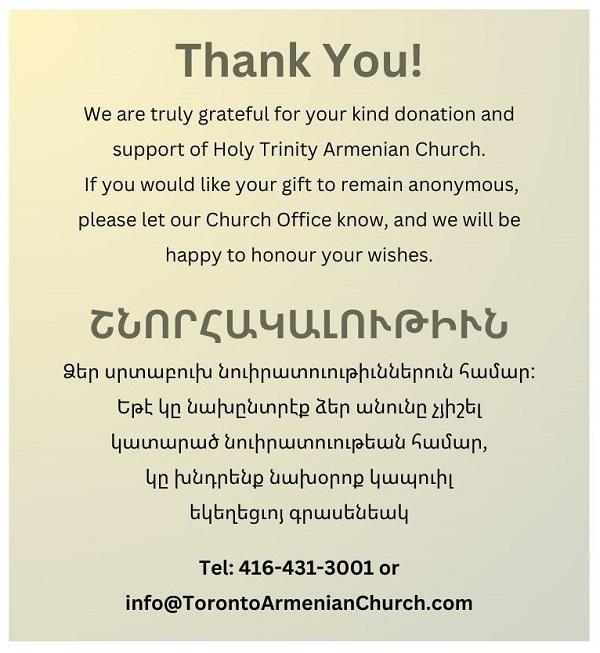
ALTAR FLOWERS
Mr. Armen Setrak $100








HOLY TRINITY
ARMENIAN APOSTOLIC CHURCH
Vicar of Armenian Church Canadian Diocese and Parish Priest
Rev. Archpriest Fr. Zareh Zargarian
Pastor’s Assistant Rev. Fr. Hayari Tanashian
Church Office Hours: Monday to Friday - 9:00 AM to 4:00 PM
Executive Secretary, Ani Sarvarian
Ani@TorontoArmenianChurch.com
Administrative Secretary, Betty Panossian
Betty@TorontoArmenianChurch.com
920 Progress Ave. Toronto, ON, M1G 3T5
Tel: 416 431 3001
www.TorontoArmenianChurch.com info@TorontoArmenianChurch.com @TorontoArmenianChurch.com