THURSDAY, MARCH 26, 2026 VOLUME 100 ISSUE 8
AIR QUALITY
Lubbock dust poses long-term health risks
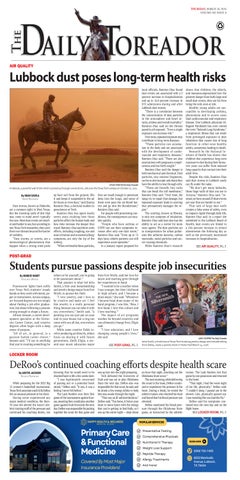
STOCK PHOTO/The Daily Toreador
A Haboob, a powerful wall of dirt which is picked up through a wind storm, rolls over the Texas Tech campus on October 17, 2011.
By NOAH DAVILA News RepoRteR
Dust storms, known as Haboobs, are a common sight in West Texas. But the towering walls of dirt that may come to mind aren’t typically the case. Most dust events are smaller and harder to see, but according to one Texas Tech researcher, they carry their own threats beyond the barrier of visibility. “Dust storms, or events, are a meteorological phenomenon that happen when a strong wind picks
up bare soil from the ground, lifts it and keeps it suspended in the air for hours or even days,” said Zyanya Ramirez-Diaz, a doctoral student in geosciences at Tech. Ramirez-Diaz has spent nearly seven years studying how those particles affect the human body and how risks increase the deeper they travel. Ramirez-Diaz said short-term effects, including coughing, eye and nose irritation and worsened allergy symptoms, are only the tip of the iceberg. “When we breathe these particles,
they are small enough to penetrate deep into the lungs, and some of them even pass the air-blood barrier and go into the bloodstream,” Ramirez-Diaz said. For people with preexisting conditions, the consequences can escalate quickly. “People who have asthma or COPD can see their symptoms increase after only one dust storm,” Ramirez-Diaz said. “Even up to 15 days later, elderly patients can still experience acute episodes.” In a January report prepared for
local officials, Ramirez-Diaz found dust events are associated with a 5 percent increase in hospitalization and up to 16.8 percent increase in ICU admissions during and after Lubbock dust storms. “There is a correlation between the concentration of dust particles in the atmosphere and heart attacks, strokes and overall mortality,” Ramirez-Diaz said on the threats posed to all exposed.. “Even a single exposure can increase risk.” Over time, repeated exposure may contribute to long-term diseases. “These particles can accumulate in the body and are associated with the development of cardiovascular and respiratory diseases,” Ramirez-Diaz said. “There are also associations with pregnancy complications and low birth weight.” Ramirez-Diaz said the danger is both mechanical and chemical. Dust particles, tiny mineral fragments, can be so microscopic and sharp they have the ability to tear through cells. “These are literally tiny rocks that can break the cell membrane,” Ramirez-Diaz said. “Over time, the lungs try to repair that damage, but repeated exposure leads to scarring that permanently damages the organ.” The scarring, known as fibrosis, is only one symptom of inhalation. Ramirez-Diaz said dust also has the ability to act as a carrier for more toxic agents. The dust particles act as transportation for urban pollutants like airborne bacteria, carbon monoxide, metal particles and cancer-causing chemicals. While Ramirez-Diaz’s research
shows that children, the elderly, and immunocompromised face the greatest danger from both large and small dust events, they are far from being the only ones at risk. Healthy young adults are susceptible to developing asthma, phenomena and in severe cases fatal cardiovascular and respiratory disease. One Lubbock physician Dr. Ragesh Panikkath has even coined the term “Haboob Lung Syndrome,” a respiratory illness that can result from prolonged exposure to dust inhalation that causes loss of lung function in other-wise healthy adults, sometimes leading to death. Research by the National Institute of Health has shown that children that experience long-term exposure to dust during their formative years can suffer from reduced lung capacity that can last into their adult lives. Despite the risks, Ramirez-Diaz said dust storms in Lubbock easily can fly under the radar. “We don’t get many haboobs, those huge walls of dust you see in Arizona,” Ramirez-Diaz said. “Instead, we have around 29 dust events per year that are harder to see.” That lack of large dust walls creates a false sense of safety, even as impacts ripple through daily life, Ramirez-Diaz said. In a report she submitted to the Lubbock Board of Health, dust events are linked to a 246 percent increase in school absenteeism the following day as well as the previously mentioned increases in hospitalization. SEE AIR QUALITY, PG. 3
POST-GRAD
Students pursue passions despite job insecurities By MANDIE HANEY FeatuRes wRiteR
Fluorescent lights hum softly over Texas Tech students’ steady hands as they work with metal, paper or instruments. Across campus, art-focused degrees are not simply about finding a job after graduation, but about following a passion strong enough to shape a future. Allison Sessom, a career development specialist at the University Career Center, said creative degrees often begin with a deep sense of purpose. “All of art, in general, is a passion-fueled career choice,” Sessom said. “I’d say in anything that you’re creating something for
others or for yourself, you’re going to be passionate about.” That passion is what led Jetta Smith, a first-year metalsmithing and jewelry design major from Fort Worth, to pursue her field. “I love jewelry, and I love to be creative and make art. I feel like jewelry is a really personal thing, because you can take it with you everywhere,” Smith said. “A painting you can just put on your wall in your house, but a ring can come with you all day, everywhere you go.” While some creative fields involve producing art directly, others focus on sharing it with future generations. Emily Eligio, a second-year music education major
from Fort Worth, said her love for music and teaching grew through her experiences in band. “I wanted to be a teacher when I was younger, but then I did band in high school, and I became a drum major,” she said. “Whenever I became head drum major of my band program, I was like, ‘Wow, I love band, I love this culture and I love teaching.’” The impact of art programs reaches far beyond creativity and can ultimately change lives, Eligio said. “I love education, and I love changing young people’s lives,” she said.
JAKE COOPER/The Daily Toreador
SEE POST-GRAD, PG. 5
Jetta Smith, a freshman at Texas Tech studying jewelry design and metalsmithing from Dallas, reads a jewelry book in Hulen Hall March 13, 2026.
LOCKER ROOM
DeRoo’s continued coaching efforts despite health scare By AUSTIN JACKSON spoRts RepoRteR
While preparing for the 2025 Big 12 women’s basketball tournament, Texas Tech associate coach Erik DeRoo felt an unusual pressure in his chest. Having never experienced any major medical condition, the then33-year-old alerted the team’s athletic training staff of the pressure and continued his coaching duties, not
knowing that he would need to be shocked back to life a few weeks later. “I was legitimately concerned of passing out or a potential heart attack,” DeRoo said. “It was, it was a feeling I never felt before.” The Lady Raiders won their first game of the tournament against Kansas, meaning they would play another game against Utah University the next day. DeRoo was responsible for putting together the scout for that game and
was up late into the night preparing. Tech defeated the University of Utah and was set to play Oklahoma State the next day. DeRoo also was responsible for that scout, he said, and he drank a few energy drinks to help him stay awake through the night. “That was an ill-advised decision,” DeRoo said. “You know, it forces your heart to move faster with the energy that you’re getting in Red Bulls, so I was up the entire night — slept about
an hour that night, knocking out the Oklahoma State scout.” The next morning, while delivering the scout to the team, DeRoo continued to experience the pressure in his heart. During a break, he texted the athletic trainer, who checked his vitals and found that his blood pressure was elevated. DeRoo monitored his blood pressure through the Oklahoma State game, as instructed by the athletic
trainer. The Lady Raiders lost that game by one possession and returned to the hotel. “That night, I had the worst night of my life, physically,” DeRoo said. “I couldn’t sleep. I passed out in the shower. Like, physically passed out. I was sweating like you had the flu.” DeRoo said his symptoms continued into the next day and on the flight home. SEE LOCKER ROOM, PG. 5
POPULAR SERVICES
Primary Care & Functional Medicine Covered By Most Major Insurance Providers!
Preventative Testing Comprehensive Physicals Nutritional IV Therapy Weight Loss Support Peptide Therapy Allergy Treatments And more!
BOOK NOW
(806) 705-7493
6633 Monticello Avenue, Lubbock, TX 79424