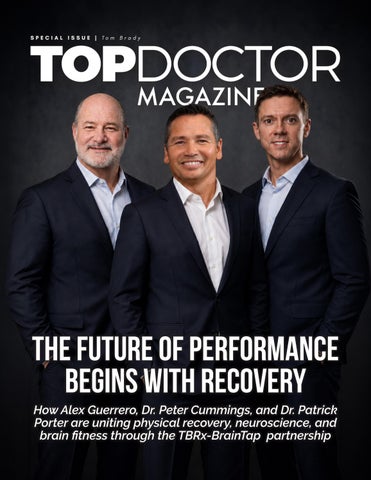
S P E C I A L I S S U E | To m B r a d y
THE FUTURE OF PERFORMANCE BEGINS WITH RECOVERY How Alex Guerrero, Dr. Peter Cummings, and Dr. Patrick Porter are uniting physical recovery, neuroscience, and brain fitness through the TBRx-BrainTap partnership
“The body doesn’t adapt while you’re training. It adapts while you’re recovering.” — Alex Guerrero
PUBLICATION TEAM Publisher: John Hyland Editor In Chief: Hannah H. Editorial Assistant: Jillian Fast
CREATIVE DEPARTMENT Senior Graphic Designer: Laura Poyner Graphic Designers: Dylan R-N, Kyleigh Holder
EXPERT CONTRIBUTORS
Biohacking & Longevity Expert: Lindsay O’Neill-O’Keefe Contributing Authors: Evelyn Flaharty, Michele Hughes, Lindsay O’Neill-O’Keefe, Ashleigh Quint, Joshua Wheeler
EXECUTIVE TEAM
Chief Digital Content Officer: David Lee Vice President of Development: Mark Carvalho Fractional Marketing Officer: Craig Handley Advisory Board: Dr. Arthur Katona, Dr. Francisco Cabal, Dr. Edmond Ng, Dr. Kianor Shah
MAGAZINE CONTRIBUTORS
A LETTER FROM THE EDITOR Our mission and purpose at TopDoctor Magazine is to foster connections within the health and wellness community and empower our readers to make wellinformed healthcare and lifestyle decisions. We pride ourselves on being the ultimate resource for interviews with health and wellness leaders, trending medical news, and healthy living topics. We understand that choosing a healthcare provider is a crucial decision. Our in-depth interviews with esteemed doctors and medical professionals aim to bridge the gap between them and their clients. By providing our readers with personal insights, philosophies, and areas of expertise, we facilitate a deeper understanding of the individuals responsible for your health and well- being. We also strive to highlight our outstanding practitioners, showcasing their dedication to their patients and contributions to the medical community. The field of medicine is constantly evolving, with new practices, therapies, and technologies emerging at a rapid pace. At TopDoctor Magazine, we strive to keep you updated on the latest advancements in the medical world. Our comprehensive coverage of trending medical news equips both doctors and patients with the knowledge they need to make informed choices about healthcare options. Building strong connections within the medical community is essential for enhancing patient care and driving medical progress. Our magazine serves as a bridge, connecting medical companies with doctors and vice versa. By facilitating these connections, we aim to catalyze collaborations that can lead to innovative solutions and improved healthcare outcomes for everyone.
It is our firm belief that well-informed individuals make better decisions about their health. By providing you with insights into established and emerging medical trends and technologies, we empower you to take an active role in your healthcare choices. Whether you are a healthcare professional seeking to stay updated on the latest advancements or a patient eager to make informed decisions about your well-being, TopDoctor Magazine is here to support you. In every issue, we strive to uphold the highest standards of journalistic integrity, accuracy, and relevance. Our dedicated team of writers, editors, and medical experts work tirelessly to bring you well-researched and compelling content that is both educational and engaging. Moreover, our graphic design team is committed to delivering an aesthetically pleasing reading experience where captivating design seamlessly merges with informative content, ensuring each issue becomes an engaging journey of discovery. As we embark on this mission to serve as your trusted source of medical information and insights, we encourage you to join us on this exciting journey. Your feedback and suggestions are invaluable to us, and we look forward to hearing from you. Thank you for being a part of the TopDoctor Magazine community. Together, let us embrace knowledge, forge connections, and make informed decisions to lead healthier lives. With warmest regards, Hannah H.
TABLE OF
CONTENTS
10
CONSISTENCY IS A SKILL - NOT A PERSONALITY TRAIT
18
BALANCE DICTATES HEALTHY AGING
28
THE FUTURE OF PERFORMANCE BEGINS WITH RECOVERY
40
THREE SHIFTS THAT IMMEDIATELY ELEVATE YOUR WELLNESS PRACTICE
48
ELECTROLYTES IN YOUR DAILY WHOLE FOODS
A New Era of Anti-Aging - Dr. Hinna Akhtar, DNP, FNP-C U.S. Army Veteran • Published Medical Author • Aesthetic & Wellness Expert
Photo: Jessica Schumacher
For Dr. Hinna, anti-aging goes far beyond aesthetics and how her patients look—it’s also about how they feel, function, and live each day. Her mission is to empower patients to take an active role in their health and approach aging with confidence. Drawing on her background in family practice, wellness, and aestheticsDr. Hinna integrates modern medicine, aesthetic treatments, nutrition, strategic fasting, physical activity, and a healthy mind and spirit to support wellness from the inside out. Her philosophy is simple:
Anti-aging begins with a healthier you.
Practicing at: BodyMD | Scottsdale, Arizona
CONSISTENCY IS A SKILL NOT A PERSONALITY TRAIT Written by Ashleigh Quint, MIM, PICP-SCC Every January, the same narrative resurfaces: some people are “just disciplined,” while others simply lack motivation. By February, when gym attendance drops and nutrition plans fall apart, inconsistency is often framed as a personal failure. But this interpretation misses the science, and this misunderstanding has real consequences. When consistency is framed as a character flaw rather than a skill, individuals internalize failure rather than adjust the system around them. Over time, this erodes confidence, increases dropout rates, and reinforces the very patterns we are trying to change. Consistency is not a personality trait. It is a skill, one shaped by physiology, environment, stress load, and behavioral design. When we understand this distinction, adherence stops being a moral issue and becomes a solvable systems problem. What often goes unexamined is why consistency collapses, even in highly capable, intelligent individuals. The answer has far less to do with discipline and far more to do with how the body and brain respond to stress, recovery, and repeated demand.
Why Motivation Is the Wrong Metric Motivation is inherently unstable. It fluctuates with sleep quality, stress exposure, hormonal balance, and cognitive load. Research in behavioral psychology shows that reliance on motivation alone leads to short-term engagement but poor long-term adherence. This is especially true in high-stress populations, where decision fatigue and nervous system overload reduce follow-through. This pattern holds true across populations, including high performers. Athletes, often perceived as highly motivated, are not consistent because of willpower; they are consistent because of structure, accountability, and stability within coaching relationships. Scheduled training, external expectations, and consistent feedback create adherence first; motivation follows as a byproduct of continuity, not as its prerequisite. In both athletic and general populations, accountability functions as a stabilizing force, reducing decision fatigue, reinforcing behavior repetition, and sustaining consistency long after motivation naturally wanes. Consistency, by contrast, is built through repetition under supportive conditions. It is learned, reinforced, and sustained — not summoned on demand. When behaviors are repeated in environments that reduce friction
10
Top Doctor Magazine /Special Issue - Tom Brady / 11
12
and cognitive load, they become neurologically efficient rather than effortful. Over time, this efficiency lowers resistance, increases follow-through, and allows adherence to persist even when motivation is low. In this way, consistency becomes a trained capacity, much like strength or endurance, developed through appropriate load, recovery, and support.
The Nervous System Drives Adherence One of the most overlooked factors in consistency is nervous system regulation. Chronic stress elevates cortisol, disrupts sleep, alters appetite regulation, and reduces cognitive flexibility. When the nervous system is overloaded, even simple routines feel overwhelming. In this state, missed workouts or dietary lapses are not failures of discipline; they are protective responses. The body prioritizes survival over self-improvement. Clinically, this explains why individuals under chronic stress often cycle between intense bursts of effort and complete disengagement. Without adequate recovery, consistency becomes physiologically unsustainable.
Consistency Thrives on Structure, Not Willpower Highly consistent individuals do not rely on willpower more than others; they rely on structure. Research in habit formation demonstrates that behaviors anchored to stable cues (time, location, routine) are significantly more likely to persist than those dependent on conscious decision-making. Try taking this approach: • Training at predictable times rather than ‘when you feel like it’ • Simplifying nutrition decisions through repetition • Reducing friction (access, preparation, complexity) The less cognitive effort a behavior requires, the more consistency occurs.
Load Management Matters More Than Intensity Another common reason consistency fails is excessive load — both physical and psychological. Programs that demand maximal effort, strict compliance, or constant novelty may work briefly, but may ultimately lead to burnout. Sustainable consistency requires load management: • Training intensity that matches recovery capacity • Nutrition strategies that stabilize blood sugar rather than restrict excessively • Expectations that align with life stress, not against it Progress does not require constant intensity. It requires continuity.
Identity Follows Behavior — Not the Other Way Around People often believe they must be consistent in order to act consistently. In reality, identity is shaped by behavioral repetition. Small, repeatable actions reinforce self-perception over time. When consistency is treated as a skill to be trained, rather than a trait to be judged, adherence improves. Missed days are viewed as feedback, not failure. Adjustments replace self-criticism. This shift is particularly important in medical and fitness settings, where shame-based narratives can undermine long-term outcomes.
Top Doctor Magazine /Special Issue - Tom Brady / 13
14
Clinical Implications for Health and Performance From a clinical perspective, reframing consistency as a skill, rather than a personality trait, fundamentally changes intervention design and outcome trajectories. When health and performance strategies are built around adherence capacity rather than compliance, patients and athletes demonstrate higher engagement, lower dropout rates, and improved long-term outcomes across training, nutrition, and rehabilitation. Programs that prioritize behavioral sustainability amplify their own effectiveness over time, creating a compounding effect in which small, repeatable actions lead to disproportionate gains in health markers, performance capacity, and injury resilience. In this model, outcomes improve not by increasing intensity or effort, but by increasing continuity, allowing physiological adaptations, neuromuscular efficiency, and metabolic regulation to accumulate predictably and with greater clinical reliability. For clinicians, coaches, and health professionals, reframing consistency has practical value. Patients and clients benefit when plans are designed around: • Nervous system capacity • Recovery availability • Behavior simplicity • Environmental support When adherence improves, outcomes follow, quite often without increasing effort. Consistency is not something people either have or lack. It is a trainable skill shaped by biology, structure, and support. When we stop asking patients to “try harder” and instead help them build sustainable systems, longterm health becomes achievable. For clinicians, this reframing matters. The consistency we bring — our steadiness, follow-through, and continued engagement — often becomes the bridge our patients need. When we remain consistent with them, especially when motivation fades, they are far more likely to internalize that stability and carry it forward themselves. In this way, consistency becomes shared, reinforced, and ultimately transformative.
1 in 4 Americans experience serious mental illness. What if you had a product that was clinically proven to significantly benefit 25% of people who walked through your door?
Backed by 70+ independent medical journal articles, including multiple double-blind, placebo-controlled studies. Clinically proven to improve: Emotional Regulation & Mood Stability
Attention & Focus
Free staff training on product features and research
Research-backed protocols for specific applications
Stress & Resilience
HardyNutritionals.com 1-855-955-1110 info@hardynutritionals.com
Cognition & Sleep
Apply for
Wholesale
Pricing
BALANCE DICTATES HEALTHY AGING WRITTEN BY: EVELYN FLAHARTY
18
W
hen we think about healthy aging, most of us immediately think about eating nutritious foods, staying active, maintaining a healthy weight, and keeping our minds sharp. While these are all important pieces of the puzzle, there is one aspect of health that often gets overlooked until it begins to decline: Balance. It isn’t something we normally think about because it quietly works in the background every moment of every day. It allows us to walk across a room without hesitation, step off a curb, climb a flight of stairs, carry groceries, work in the garden, or even stand on one foot while putting on a pair of pants. We rarely stop to appreciate it because, for most of our lives, balance simply happens. As I’ve recently learned, however, balance is far more than just the ability to stand upright. It is one of the greatest predictors of healthy aging. It influences our confidence, our independence, our mobility, and ultimately our quality of life. Without good balance, even the simplest daily activities become more difficult, and our world can gradually begin to shrink. I didn’t fully appreciate this until earlier this year. About five months ago, after a leg workout at the gym, I noticed a nagging discomfort deep in my right glute. At first, I didn’t think much of it. I’ve spent decades strength training, and aches and pains are occasionally part of an active lifestyle. I assumed it would disappear after a few days. It didn’t. The discomfort lingered for nearly six weeks. Eventually, I contacted my physician, who referred me to physical therapy, and after an evaluation, I learned I had developed Piriformis Syndrome. The piriformis is a small muscle located deep within the buttock. Although it isn’t a large muscle, it plays an important role in helping to stabilize the hip and rotate the leg. Because the sciatic nerve runs very close to the piriformis, and sometimes even through it, a tight or inflamed piriformis muscle can irritate the nerve, causing pain in the buttock and even discomfort that radiates down the leg. Thankfully, my condition was diagnosed early, and with proper treatment, stretching, and strengthening exercises, it was completely reversible. I attended physical therapy three times each week for nearly three months. My therapist focused on strengthening my gluteus medius, one of the primary muscles responsible for stabilizing the pelvis. We worked on exercises such as clamshells, side-lying leg lifts, mobility drills, stretching, and flexibility exercises designed to improve my range of motion while reducing the workload placed on the piriformis muscle. I expected physical therapy to help relieve my pain. What I didn’t expect was the lesson it would teach me about balance. During one session, my therapist asked me to stand on one leg. Simple enough, I thought. Except it wasn’t. I quickly realized I couldn’t maintain my balance for very long. Then she asked me to perform simple movements while balancing on one leg—bending forward to touch the floor, tossing a
Top Doctor Magazine /Special Issue - Tom Brady / 19
W
hen we think about healthy aging, most of us immediately think about eating nutritious foods, staying active, maintaining a healthy weight, and keeping our minds sharp. While these are all important pieces of the puzzle, there is one aspect of health that often gets overlooked until it begins to decline: Balance. It isn’t something we normally think about because it quietly works in the background every moment of every day. It allows us to walk across a room without hesitation, step off a curb, climb a flight of stairs, carry groceries, work in the garden, or even stand on one foot while putting on a pair of pants. We rarely stop to appreciate it because, for most of our lives, balance simply happens. As I’ve recently learned, however, balance is far more than just the ability to stand upright. It is one of the greatest predictors of healthy aging. It influences our confidence, our independence, our mobility, and ultimately our quality of life. Without good balance, even the simplest daily activities become more difficult, and our world can gradually begin to shrink. I didn’t fully appreciate this until earlier this year. About five months ago, after a leg workout at the gym, I noticed a nagging discomfort deep in my right glute. At first, I didn’t think much of it. I’ve spent decades strength training, and aches and pains are occasionally part of an active lifestyle. I assumed it would disappear after a few days. It didn’t. The discomfort lingered for nearly six weeks. Eventually, I contacted my physician, who referred me to physical therapy, and after an evaluation, I learned I had developed Piriformis Syndrome. The piriformis is a small muscle located deep within the buttock. Although it isn’t a large muscle, it plays an important role in helping to stabilize the hip and rotate the leg. Because the sciatic nerve runs very close to the piriformis, and sometimes even through it, a tight or inflamed piriformis muscle can irritate the nerve, causing pain in the buttock and even discomfort that radiates down the leg. Thankfully, my condition was diagnosed early, and with proper treatment, stretching, and strengthening exercises, it was completely reversible.
I attended physical therapy three times each week for nearly three months. My therapist focused on strengthening my gluteus medius, one of the primary muscles responsible for stabilizing the pelvis. We worked on exercises such as clamshells, side-lying leg lifts, mobility drills, stretching, and flexibility exercises designed to improve my range of motion while reducing the workload placed on the piriformis muscle. I expected physical therapy to help relieve my pain. What I didn’t expect was the lesson it would teach me about balance. During one session, my therapist asked me to stand on one leg. Simple enough, I thought. Except it wasn’t. I quickly realized I couldn’t maintain my balance for very long. Then she asked me to perform simple movements while balancing on one leg—bending forward to touch the floor, tossing a ball, reaching in different directions—and I struggled with every one of them. I was honestly surprised. I’ve spent years in the gym; I’m an IFBB Professional bodybuilder, and I strength-train five to six days every week, dedicating much of my time to maintaining my health and fitness. I considered myself strong. Yet despite all of that, I had neglected one important component of physical fitness: Balance. It was a humbling realization. Like many people, I had assumed that because I was physically fit, my balance would naturally be good. But strength and balance are not the same thing. They work together, but one does not automatically guarantee the other. That experience changed the way I think about healthy aging. As we grow older, our bodies naturally undergo changes. We gradually lose muscle mass, our joints become less flexible, and our reaction time slows. The communication between our brain, muscles, joints, vision, and inner ear becomes less efficient. These changes may be a normal part of aging, but they don’t mean we have to surrender our independence. This is where balance becomes so important. Balance is our body’s built-in protection system. Every time we walk across an uneven sidewalk, step off a curb, reach for something on a high shelf, or catch
ourselves after tripping over the family dog, our bodies make hundreds of tiny adjustments without us ever realizing it. Our muscles contract, our core stabilizes us, our eyes help orient us, and our brain processes all of this information in fractions of a second. When this system is working well, we barely notice it. When it isn’t, the consequences can be life-changing. Falls remain one of the leading causes of injury among adults over the age of 65. A single fall can result in broken bones, traumatic brain injuries, lengthy hospital stays, and months of rehabilitation. Unfortunately, many older adults never fully regain the level of independence they once enjoyed after a serious fall. I’ve witnessed this firsthand. Several years ago, my mother-in-law stepped off a curb and lost her balance. What appeared to be a routine misstep resulted in a traumatic head injury. Watching her health decline afterward was heartbreaking. It wasn’t simply the injury itself that changed her life. It was everything that followed. Her confidence diminished. Her independence became more limited. Everyday activities that once seemed effortless suddenly required assistance. That experience stayed with me. At the time, I viewed it as an unfortunate accident. Today, I understand that balance plays a much larger role than I once realized. Perhaps the greatest gift good balance gives us is independence. Think about your daily routine. Getting out of bed. Stepping into the shower. Walking through a parking lot. Carrying groceries into the house. Climbing stairs. Reaching into the kitchen cabinets. Gardening. Traveling. Walking on the beach. Putting luggage into the overhead compartment on an airplane. None of these activities happen without balance. Because these movements are so automatic, we rarely stop to think about them. However, each one requires our body to constantly shift weight, stabilize itself, and react to changing surfaces and environments. When balance declines, even ordinary activities become challenging. People begin avoiding situations where they feel unsteady. They stop taking walks. They avoid hiking trails or crowded places. They hesitate to travel. They become more cautious getting in and out of the bathtub or climbing stairs. Over time, fear begins replacing confidence. Ironically, this creates a dangerous cycle. When people become afraid of falling, they naturally move less. As activity decreases, muscles weaken, reaction time slows further, and balance continues to deteriorate. The less they move, the greater their risk of falling becomes. It doesn’t have to be this way. One of the most encouraging things I learned during physical therapy is that balance is a skill. Like strength, flexibility, and endurance, it can be trained. In fact, our brains and bodies are remarkably adaptable. Every time we challenge our balance, we strengthen the communication between our brain and our muscles. We improve coordination. We sharpen our reaction time. We build confidence. The key is consistency.
22
Top Doctor Magazine /Special Issue - Tom Brady / 23
Since completing physical therapy, I’ve intentionally incorporated balance into my everyday routine. Sometimes I’ll stand on one foot while brushing my teeth, washing dishes, or waiting for my morning coffee to brew. When I put on my pants, I challenge myself to remain standing instead of sitting down. This continues to be very challenging. Good thing nobody is watching me. These aren’t complicated exercises. They don’t require expensive equipment or a gym membership. They’re simply small opportunities to challenge my body throughout my day and regular routines. Those little moments add up. Of course, I continue to strength train because building and maintaining muscle remains one of the best investments we can make as we age. Strong muscles support our joints, improve bone health, and help us perform everyday tasks with greater ease. But I now understand that strength alone isn’t enough. For me personally, this has become one of the biggest reasons I continue exercising at 71 years old. Independence. I don’t train because I’m chasing a certain number on the scale or trying to look younger. I train because I want to remain physically capable in my 80s and 90s. I want to continue traveling, gardening, carrying my own groceries, hiking beautiful trails, and climbing stairs without hesitation. Most of all, I want to maintain the freedom to live life on my own terms. That, to me, is what healthy aging is really about. Research continues to reinforce the importance of balance as we age. Studies have shown that the ability to stand on one leg is closely associated with overall health, mobility, and longevity. While no single test can predict how long someone will live, maintaining good balance appears to reflect how well multiple systems within the body are working together. When I first learned about this research, it certainly caught my attention. Here I was thinking I was aging exceptionally well, only to discover there was one area of fitness I had unintentionally ignored. Instead of becoming discouraged, I chose to see it as an opportunity. The beauty of wellness is that we are always learning. No matter our age, there is always something we can improve. That’s one of the reasons I love sharing my experiences. If my journey encourages even one person to start practicing balance today instead of waiting until after a fall, then sharing my story has been worthwhile. Healthy aging isn’t about perfection. It’s about making intentional choices that allow us to continue enjoying life for as long as possible. Sometimes those choices involve preparing nutritious meals, lifting weights, or going for a walk with a friend. And sometimes they’re as simple as standing on one foot while brushing your teeth. The important thing is that we keep moving, keep challenging our bodies, keep investing in our future selves—because every healthy choice we make today is a gift to the person we hope to become tomorrow.
24
Balance may never receive the same attention as strength training or cardiovascular exercise, but it deserves a place alongside both. It quietly influences nearly every movement we make and plays an essential role in preserving the independence, confidence, and freedom we value so deeply. As I’ve learned this year, healthy aging isn’t simply about living longer. It’s about continuing to live well. It’s about remaining active enough to say “yes” to the experiences that bring us joy. It’s about having the confidence to travel, garden, exercise, play with grandchildren, and continue embracing life with enthusiasm. At 71, I still have goals, adventures I want to experience, places I want to visit, and memories I want to create. Taking care of my balance is now part of that journey, and I hope it becomes part of yours too.
Top Doctor Magazine /Special Issue - Tom Brady / 25
Transform Mental Wellness for Your Patients! In the past five years, stress levels have skyrocketed, wreaking havoc on mental well-being worldwide. Combat this rising stress epidemic with BrainTap, the revolutionary brainwave entrainment system! Research demonstrates BrainTap's impact, showing a remarkable 28.1% increase in heart rate variability and 38.5% improvement on the stress index scale* after just one session, and with no effort on the part of the participant.
For More Information braintap.com
THE FUTURE OF PERFORMANCE BEGINS
WITH RECOVERY How Alex Guerrero, Dr. Peter Cummings, and Dr. Patrick Porter are uniting physical recovery, neuroscience, and brain fitness through the TBRx–BrainTap partnership
WRITTEN BY MICHELE HUGHES CEO of Ageless and Timeless and host of the Ageless and Timeless Podcast® AND ROBERT FLETCHER Business Development Director, Top Doctor Magazine
28
For generations, athletic performance has been measured by visible effort: the weight lifted, the miles logged, the hours practiced, and the willingness to push through discomfort. Recovery was often treated as what happened after the real work was done. Alex Guerrero, Dr. Peter Cummings, and Dr. Patrick Porter are advancing a very different idea: that recovery is not the pause between periods of performance. It is the biological foundation that makes sustainable performance possible.
contributes more than three decades of practical experience helping elite athletes and other high performers move better, recover more efficiently, and extend their productive years. Cummings, a physician and neuroscientist, provides the medical framework connecting movement, cognition, stress, and resilience. Porter, the founder and Chief BrainTap Officer at BrainTap, brings a technology platform focused on brain fitness, relaxation, sleep, mental rehearsal, and cognitive performance.
Their emerging collaboration brings together the TBRx Method and BrainTap in an integrated model designed to support both physical and neurological recovery. Guerrero
Although their careers began in different arenas, all three men arrived at the same conclusion: the brain and body cannot be optimized separately. Their shared endeavor aims to create a
Top Doctor Magazine /Special Issue - Tom Brady / 29
30
more complete recovery ecosystem—one that can serve elite competitors while also helping everyday people preserve their healthspan, independence, and ability to do what they love.
RECOVERY BECOMES THE STARTING POINT Guerrero’s philosophy began with a deceptively simple observation. The athletes who performed at the highest level were not always those who trained the most; they were often those who recovered the best. Training provides the stimulus, but adaptation takes place during recovery. Once he recognized that pattern, recovery ceased to be an afterthought and became the organizing principle of performance. That insight influenced the performance philosophy that became widely known through the TB12 Method. Today, as co-founder of TBRx Sports, Guerrero is helping evolve those principles into the TBRx Method, an approach centered on movement quality, nutrition, hydration, recovery, sleep, and nervous-system optimization. The fundamentals remain recognizable, but the model has expanded as science has clarified the brain’s role in regulating movement, stress, decision-making, sleep, and adaptation.
“The body doesn’t adapt while you’re training. It adapts while you’re recovering.” — Alex Guerrero
Guerrero’s work with Tom Brady offered a highly visible demonstration of the philosophy, but he emphasizes that the lesson extends far beyond professional sports. What appeared on Sundays was supported by the decisions made Monday through Saturday: recovery, hydration, movement, sleep, and consistent preparation. Elite athletes may schedule recovery because their careers depend upon it, but the same biology applies to executives, parents, musicians, active adults, and anyone who wants to remain capable throughout life. For Guerrero, consistency is more powerful than occasional intensity. One perfect workout or one flawless day of nutrition does not create longevity. Repeated decisions do. That shift from dramatic effort to sustainable daily practice is central to TBRx and to the partnership now taking shape with BrainTap.
WHERE PRACTICAL EXPERIENCE MEETS NEUROSCIENCE Dr. Peter Cummings came to human performance through medicine, forensic pathology, neuroscience, and the study of movement. His research has examined how the brain controls balance, coordination, prediction, and motor function. As a football coach, he also began noticing subtle changes in athletes’ gait mechanics that seemed to emerge before injuries, suggesting that movement could reveal problems before pain or structural damage became obvious. While writing about concussion, Cummings learned of Guerrero’s work and became intrigued not only by the reported outcomes, but by the larger philosophy surrounding health, recovery, and performance. Their relationship grew from mutual curiosity. Guerrero had developed an applied understanding from decades of close observation and work with high-performing individuals; Cummings approached many of the same biological questions through medicine and neuroscience. In his words, they were speaking different languages while describing the same system. That complementary perspective became a foundation of TBRx. Guerrero brings the practical knowledge of what has worked repeatedly in demanding real-world environments. Cummings helps explain why it works, placing those observations within a framework of neural control, stress physiology, movement science, and evidence-based medicine. Together, they seek to optimize the whole person rather than chase isolated symptoms.
“We want to help people do what they love for as long as possible.” — Dr. Peter Cummings
Cummings often describes the brain as the true battlefield of performance. The competition may appear to take place on a field or court, but every movement, prediction, decision, and emotional response is coordinated by the nervous system. Physical strength matters, yet the athlete who processes information faster, recognizes patterns sooner, regulates stress more effectively, and recovers more fully may possess the deeper advantage.
Top Doctor Magazine /Special Issue - Tom Brady / 31
This principle also reframes longevity. TBRx is not concerned only with producing champions or extending careers at the highest level. Cummings and Guerrero speak of creating ‘elite parents and elite grandparents’—people able to hike, play golf, chase children, lift grandchildren, and remain engaged in meaningful activities as they age. The relevant measure is not only lifespan, but healthspan: the years lived with mobility, confidence, independence, and purpose.
BRINGING THE BRAIN FULLY INTO RECOVERY Dr. Patrick Porter has spent his career focused on the neurological side of performance. As founder and Chief BrainTap Officer at BrainTap, he created the company around a mission to ‘better a billion brains.’ BrainTap’s proprietary app and headset technology deliver uniquely encoded audio sessions designed to support relaxation, stress reduction, sleep, cognitive fitness, and performance. The platform includes more than 800 sessions and draws upon guided visualization, breathing, mindfulness, brainwave entrainment, and mental rehearsal. For Porter, the partnership is a natural extension of TBRx because the nervous system regulates the processes every physical recovery program is trying to influence. Better sleep, improved stress regulation, emotional steadiness, and cognitive recovery can help a person engage more consistently with movement, hydration, nutrition, rehabilitation, and other wellness protocols. In that sense, BrainTap is not intended to replace the physical work of TBRx; it is designed to strengthen the neurological conditions that help that work succeed. The partners describe the resulting Sports Resilience Series as broader than conventional motivation or visualization. The proposed programming combines mental rehearsal with relaxation, breathing, mindfulness, and neuro-conditioning to support concentration, confidence, sleep quality, emotional regulation, and recovery. The content is informed by Guerrero’s experience with athletes, aligned by Cummings with neuroscience and sports medicine, and delivered through Porter’s BrainTap platform. The intended audience is equally broad: youth, high-school, collegiate, and professional athletes; coaches and athletic
32
trainers; military personnel; active adults; and clinical patients seeking greater resilience. Specialized programs, including a championship soccer series, are being developed around real performance situations such as recovering after mistakes, maintaining composure under pressure, improving focus, and preparing the nervous system for consistent execution.
“Recovery begins in the nervous system.” — Dr. Patrick Porter
A PLATFORM FOR CLINICS, EDUCATION, AND RESEARCH The collaboration is envisioned as more than a collection of audio sessions or an equipment relationship. Its broader ambition is to build an integrated performance and wellness platform that can be used by physicians, therapists, chiropractors, athletic trainers, coaches, sports organizations, and wellness professionals. For TBRx-certified clinics and BrainTap clinics, the model could combine physical rehabilitation and performance protocols with dedicated cognitive-wellness programming. Practitioners would have access to education, patientengagement resources, certification opportunities, and specialized Sports Resilience content. Because participants can continue using the app between visits, the platform may also encourage the consistent daily engagement that episodic healthcare often lacks. Education is another important part of the plan. The team envisions professional development, continuing education, a scalable learning center, and partnerships with universities and research institutions. Academic collaboration could help formalize best practices, support structured training, and contribute to an expanding evidence base. Over time, the partners hope to study how integrated brain-and-body recovery affects stress, sleep, cognition, movement, adherence, and performance across different populations. The business structure is likewise designed for long-term alignment. Custom educational and performance content can become an ongoing asset, while subscriptions, licensing, certifications, and royalties can support recurring engagement rather than one-time transactions. The stated measure of
Top Doctor Magazine /Special Issue - Tom Brady / 33
34
success, however, reaches beyond headset sales or program enrollment. It includes improved outcomes, stronger participation, an expanding body of educational content, and a model capable of reaching clinics, teams, workplaces, and international audiences.
THE HARDWARE AND THE SOFTWARE The partnership’s central idea may be captured most simply in Guerrero’s comparison: for years, performance specialists have optimized the body’s hardware, while Porter has focused on the brain’s software. Cummings provides the bridge between those worlds, explaining how the nervous system governs movement, recovery, prediction, and adaptation. Together, the three are working toward a system in which physical readiness, cognitive fitness, and emotional resilience reinforce one another. This integrated view arrives at a moment when human performance is rapidly converging with neuroscience, wearable technology, artificial intelligence, regenerative medicine, and personalized wellness. New tools can produce extraordinary amounts of data, but data alone does not create resilience. The opportunity is to translate science into repeatable daily practices that help people sleep, recover, move, think, and respond to stress more effectively. For athletes, that may mean clearer decisions under pressure, faster emotional recovery after a mistake, and the ability to sustain performance across a long season. For patients and active adults, it may mean greater consistency, less fear around movement, improved sleep, and more years spent doing the activities that make life meaningful. The same principles serve different definitions of performance. Guerrero, Cummings, and Porter are ultimately challenging the old assumption that physical performance and mental performance belong in separate categories. Their shared endeavor proposes that the next standard in recovery will begin with the person as a complete system. The body is not merely trained and the brain separately calmed; both are prepared, challenged, and restored together. That is the larger promise of the TBRx–BrainTap partnership: not simply to help people work harder, but to help them recover intelligently, perform sustainably, and remain capable for the moments that matter most.
ABOUT THE EXPERTS Alex Guerrero is a co-founder of TBRx Sports and a leading specialist in sports recovery, movement optimization, and human performance. Over more than three decades, his work with elite athletes and other high performers has helped advance a recovery-centered approach to longevity and resilience. Peter Cummings, M.Sc., M.D., is a physician, neuroscientist, educator, and co-founder of TBRx Sports. A triple board-certified physician and former faculty member at Boston University School of Medicine, he has authored two Cambridge University Press textbooks and lectured internationally on neuroscience, forensic medicine, and brain injury. Patrick K. Porter, Ph.D., is the founder and Chief BrainTap Officer at BrainTap. He is a licensed trainer of neuro-linguistic programming, head of mind-based studies at Quantum University, and the author of six books, including Thrive in Overdrive: How to Navigate Your Overloaded Lifestyle.
About the Authors Rob Fletcher is a global entrepreneur, publisher, and business strategist focused on health, wellness, and longevity. He is the founder of Longevity Masters Global, an organization dedicated to advancing education, collaboration, and innovation in longevity medicine by connecting worldrenowned experts, entrepreneurs, and investors. Throughout his career, Rob has built an extensive international network across healthcare, media, and business, and is recognized for bringing together influential leaders to accelerate innovation in healthy aging and preventive medicine. Michele Hughes is the VP of Business Development of Longevity Masters Global, an exciting new startup by Rob Fletcher that is bringing together many of the world’s leading experts in longevity, health optimization, wellness, recovery, and peak human performance. She is also the visionary founder of Ageless and Timeless and the dynamic host of the Ageless and Timeless Podcast®. As a monthly contributor to TopDoctor Magazine, Michele offers powerful insights on wellness, longevity, and living fully
Top Doctor Magazine /Special Issue - Tom Brady / 35
at every stage of life. With a deep passion for health and vitality, and serving as a role model for timeless elegance, she empowers audiences to embrace their highest potential and live with purpose and grace. The Ageless and Timeless Podcast® was one of only 20 inaugural podcasts selected for the Muscle & Fitness+ platform when it launched in 2023, further expanding Michele’s reach as a trusted voice in the longevity and wellness space. For more information, to express interest in being a guest on the Ageless and Timeless Podcast®, to be featured in Michele’s TopDoctor Magazine column, or to inquire about podcast collaborations or having Michele Hughes as a guest on your show, please contact: Email: themichelehughescompany@gmail.com Website: www.agelessandtimeless.com Instagram: @agelessandimeless LinkedIn: https://www.linkedin.com/in/michele-hughes-83a3b935/ Facebook: https://www.facebook.com/michele.hughes.186 Ageless and Timeless podcast, on YouTube, iTunes, Spotify, and wherever podcasts are available.
36
The 3 Shifts That Immediately Elevate a Wellness Practice (None of Them Cost a Dime)
By Lindsay O’Neill-O’Keefe, Founder & CEO, Wellness Eternal Every week, I talk with brilliant providers and clinic owners—physicians, longevity specialists, biohacking pioneers, practitioners doing genuinely life-changing work. And every week, I see the same pattern: exceptional clinical outcomes paired with marketing that quietly undermines them. Here’s the uncomfortable truth: patients rarely choose a provider because of the technology in the treatment room. They choose based on trust, credibility, and how clearly you communicate the transformation you deliver. The good news? The three highest-impact fixes I recommend to nearly every practice we work with cost nothing to implement. They only require a shift in thinking.
40
Shift 1
Stop Discounting Your Way Out of Credibility Scroll through the social feeds of most clinics and you’ll find them: flash sales, percentage-off promos, and “this week only” pricing on premium services. I understand the instinct. Discounts feel like momentum. But in health and wellness, they send a dangerous signal. When you discount a $3,000 protocol to $1,500, prospective patients don’t think “great deal”; they think “Which price reflects the real value?” Low-ball offers train your audience to wait for the sale, attract price shoppers instead of committed patients, and position your expertise as a commodity. Premium outcomes deserve premium positioning. The most trusted practices we work with almost never discount publicly. Instead, they invest in communicating value so clearly that price becomes a secondary conversation. Do this instead: Audit your last 90 days of social content. Remove or archive anything built around price. Replace it with content built around outcomes.
Shift 2
Make Referrals and Testimonials Your Engine, Not an Afterthought Ask most clinic owners where their best patients come from, and they’ll say the same thing: word of mouth. Then ask what their referral system looks like, and the answer is usually a shrug. Hope is not a system.
Your happiest patients are your most persuasive marketing channel, and most practices never activate them. A structured referral and testimonial program does three things at once. It generates warm, pretrusting leads. It builds a library of social proof that works for you around the clock. And it deepens loyalty with the patients you already have, because people become more committed to the things they advocate for. Do this instead: Build a simple rhythm. Identify your moments of peak patient satisfaction, ask for the story at that moment, and create an easy path for patients to share it. Then showcase those stories consistently across your channels. Consistency beats cleverness here every time.
Shift 3
Sell the WHY and the HOW, Not the WHAT This is the biggest one, and the one most practices get backward. Most clinic marketing leads with the WHAT: the device, the modality, the protocol, the service menu. But patients don’t buy red light therapy or peptides or a diagnostic panel. They buy more energy for their kids. Confidence in their own longevity. Freedom from pain that has quietly shrunk their life. When you lead with the WHAT, you invite comparison shopping. When you lead with the WHY (the transformation) and the HOW (your unique philosophy and approach), you become the only logical choice. Nobody else has your story, your methodology, or your patient outcomes. That is your moat. Do this instead: For every piece of content you create, ask one question before you publish: does this describe
Top Doctor Magazine /Special Issue - Tom Brady / 43
my service, or does it describe my patient’s life after working with me? If it’s the former, rewrite it.
The Common Thread Positioning Is a Practice, Not a Project
None of these shifts require a bigger ad budget. They require discipline, consistency, and a clear point of view about the value you create. That’s the work we do every day at Wellness Eternal. We partner with providers, clinics, and wellness brands to anchor credibility, attract the right patients, and amplify their message locally and globally through verified expert positioning, earned media, and marketing systems that compound over time. If you’re doing exceptional work but your marketing isn’t telling that story yet, let’s change that. Book time with me and let’s chat about wellness brand and practice positioning. The work you do deserves to be seen.
44
Top Doctor Magazine /Special Issue - Tom Brady / 45
PRECISION STORAGE. BUILT AROUND YOUR ROUTINE. Dedicated temperature-controlled storage for vials and pens.
PRECISION TEMPERATURE CONTROL
Set and view your selected temperature directly on the display.
DEDICATED
PRECISION
PORTABLE
Organized storage
Temperature control
Built to move
A DEDICATED PLACE FOR WHAT MATTERS. At home, at work, or on the move.
CLINICAL PARTNERSHIPS Bring VIALYX into your clinic or professional network.
SCAN TO EXPLORE PARTNERSHIP OPPORTUNITIES
Always follow the storage instructions provided for your specific medication or product.
WWW.VIALYXOFFICIAL.COM
ADD ONE OF TODAY’S MOST TALKED-ABOUT WELLNESS SERVICES. GENERATE NEW CASH-PAY REVENUE. The H2Vantix Hydrogen Wellness System makes it easy to introduce molecular hydrogen inhalation into your practice. Simple 30-minute wellness sessions Easy implementation Fits into your existing workflow Encourages repeat client visits
Opportunity to sell home hydrogen systems Additional revenue from hydrogen water products Training, marketing materials, and ongoing support included
TURN ONE WELLNESS SERVICE INTO MULTIPLE REVENUE OPPORTUNITIES. SCHEDULE YOUR COMPLIMENTARY PRACTICE CONSULTATION.
H2Vantix.co
Call Today: (800) 964-8148
SCAN TO LEARN MORE OR SCHEDULE
Hydrogen inhalation is offered as a wellness service and is not intended to diagnose, treat, cure, or prevent any disease.
ELECTROLYTES 48
IN YOUR DAILY
Whole Foods By Joshua Wheeler Electrolytes are among the most essential factors in a healthy, hydrated lifestyle. There are multiple products out there that help you increase your electrolyte intake, but what are some natural, nutritious foods and liquids that will leave you feeling amazing? These five electrolyte sources are a healthy diet staple: watermelon, coconut water, nuts and seeds, lemons, and salt. Let’s take a deep dive into these nutrient-dense, hydrating foods.
Salt The most known form of electrolytes, salt contains magnesium, potassium and calcium. There are many sources of salt, but some of the best include Celtic Sea Salt and Himalayan Pink Salt. You can add Celtic Sea Salt to your water for an electrolyte boost before a run or a workout.
ermelon Wat
One of the most refreshing natural forms of hydration, watermelon is a go-to source of electrolytes that is low in calories (only 42 per cup) and very satisfying. Watermelon is made up of ninety-two percent water. The electrolytes watermelon consists of are potassium, magnesium, and sodium.¹ These are vital to electrolyte balance and will keep you hydrated for hours.
Top Doctor Magazine /Special Issue - Tom Brady / 49
Nuts and Seeds These sources of healthy fats contain many of these electrolytes like magnesium and phosphorous.³ Grab a handful of almonds or even sunflower seeds for a healthy snack! Peanut butter or almond butter are also excellent sources if you want something more filling.
Coconut water This island fruit is a delicious way to restore those lost electrolytes after a challenging workout. The liquid contained in coconut is bristling with great electrolyte sources such as potassium, magnesium, sodium, and calcium.2 Pour a glass of coconut water to accompany your next meal, and you’ll be feeling great!
50
These foods are easy to acquire at your local grocery store and can be incorporated in many different ways. Don’t be afraid to get creative with how you add your daily electrolytes to your meals and snacks. Stay hydrated and healthy, and stay tuned for more health tips to be the best
Le m on
and healthiest version of yourself.
This sour fruit is a refreshing
additive to water
on a hot summer’s day.
Besides the delicious taste
of lemon, the electrolytes
in them can increase sodium, calcium, magnesium, and potassium.⁴ Add lemon to your water or squeeze it over one of your high-protein meals for a pleasant, zesty taste.
Top Doctor Magazine /Special Issue - Tom Brady / 51
REFERENCES
AND
RESOURCES CONSISTENCY IS A SKILL — NOT A PERSONALITY TRAIT For inquiries regarding speaking engagements, health, wellness, and strength, please contact Ashleigh Quint at IG @ up_lift_gym or via email at Ashleigh@uplift-gym.com.
1. Baumeister, Roy F., and John Tierney. Willpower: Rediscovering the Greatest Human Strength. New York: Penguin Press, 2011.
2. Hall, Kevin D. “Energy Balance and Its Components: Implications for Body Weight Regulation.” The American Journal of Clinical Nutrition 104, no. 3 (2016): 667–678.
3. Lally, Phillippa, Cornelia H. M. van Jaarsveld, Henry W. W. Potts, and Jane Wardle. “How Are Habits Formed: Modelling Habit Formation in the Real World.” European Journal of Social Psychology 40, no. 6 (2009): 998–1009. https://doi.org/10.1002/ejsp.674.
4. McEwen, Bruce S. “Physiology and Neurobiology of Stress and Adaptation: Central Role of the Brain.” Physiological Reviews 87, no. 3 (2007): 873–904. https://doi.org/10.1152/physrev.00041.2006.
5. Sapolsky, Robert M. Why Zebras Don’t Get Ulcers. New York: Henry Holt and Company, 2004.
BALANCE DICTATES HEALTHY AGING You can find more from Evelyn through her website or social media channels:
1. Website: EvelynFlaharty.com 2. YouTube: Evelyn Flaharty 3. YouTube: Workouts With Evelyn Flaharty 4. Instagram: ffmusclesandcurves 5. TikTok: @evelynifbbpro 6. Facebook: Evelyn Flaharty
THE FUTURE OF PERFORMANCE BEGINS WITH RECOVERY For more information, to express interest in being a guest on the Ageless and Timeless Podcast®, to be featured in Michele’s TopDoctor Magazine column, or to inquire about podcast collaborations or having Michele Hughes as a guest on your show, please contact: Email: themichelehughescompany@gmail.com Website: www.agelessandtimeless.com Instagram: @agelessandimeless LinkedIn: https://www.linkedin.com/in/michele-hughes-83a3b935/ Facebook: https://www.facebook.com/michele.hughes.186 Ageless and Timeless podcast, on YouTube, iTunes, Spotify, and wherever podcasts are available.
THREE SHIFTS THAT IMMEDIATELY ELEVATE YOUR WELLNESS PRACTICE 1. Learn more about Lindsay and her mission to rewire the future of health by visiting wellnesseternal.com. 2. Find out more about the Biohacking Index at biohackingcompanies.com.
ELECTROLYTES IN YOUR DAILY WHOLE FOODS 1. Wempen, Kristi. “The Wonders of Watermelon.” Mayo Clinic Health System, July 27, 2021. https://www.mayoclinichealthsystem.org/hometown-health/speaking-of-health/the-wonders-of-watermelon.
2. Manaker, Lauren. “Skip the Sugary Sports Drinks—These 20 Electrolyte-Boosting Foods Can Help You Stay Hydrated.” Health, November 8, 2023. https://www.health.com/foods-with-electrolytes-8349000.
3. Leonard, Jayne. “Foods That Are High in Electrolytes.” www.medicalnewstoday.com, May 15, 2020. https:// www.medicalnewstoday.com/articles/electrolytes-food.
4. Cleveland Clinic Writing Team. “Rebalance, Replenish: 4 Sources of Electrolytes.” Cleveland Clinic, September 22, 2023. https://health.clevelandclinic.org/best-electrolyte-sources.