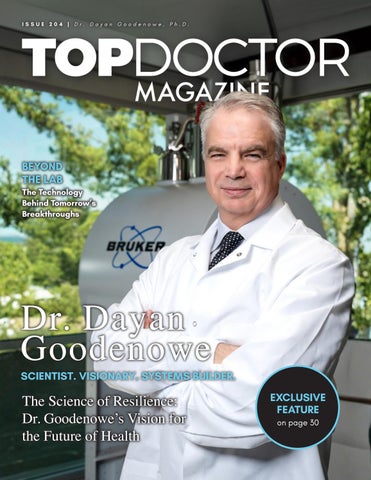
ISSUE 204 | Dr. Dayan Goodenowe, Ph.D.
BEYOND THE LAB The Technology Behind Tomorrow’s Breakthroughs
Dr. Dayan Goodenowe
SCIENTIST. VISIONARY. SYSTEMS BUILDER.
The Science of Resilience: Dr. Goodenowe’s Vision for the Future of Health
EXCLUSIVE FEATURE on page 30
“I stopped asking how to treat disease and began focusing on how to restore the biochemistry that makes health possible.” Dr. Dayan Goodenowe, Ph.D
PUBLICATION TEAM Publisher: John Hyland Editor In Chief: Hannah H. Editorial Assistant: Jillian Fast
CREATIVE DEPARTMENT Senior Graphic Designer: Laura Poyner Graphic Designers: Dylan R-N, Kyleigh Holder
EXPERT CONTRIBUTORS
Biohacking & Longevity Expert: Lindsay O’Neill-O’Keefe Contributing Authors: Evelyn Flaharty, Riley George, Dr. Dayan Goodenowe, Ph.D., Michele Hughes, Ashleigh Quint
EXECUTIVE TEAM
Chief Digital Content Officer: David Lee Vice President of Development: Mark Carvalho Fractional Marketing Officer: Craig Handley Advisory Board: Dr. Arthur Katona, Dr. Francisco Cabal, Dr. Edmond Ng, Dr. Kianor Shah
MAGAZINE CONTRIBUTORS
A LETTER FROM THE EDITOR Our mission and purpose at TopDoctor Magazine is to foster connections within the health and wellness community and empower our readers to make wellinformed healthcare and lifestyle decisions. We pride ourselves on being the ultimate resource for interviews with health and wellness leaders, trending medical news, and healthy living topics. We understand that choosing a healthcare provider is a crucial decision. Our in-depth interviews with esteemed doctors and medical professionals aim to bridge the gap between them and their clients. By providing our readers with personal insights, philosophies, and areas of expertise, we facilitate a deeper understanding of the individuals responsible for your health and well- being. We also strive to highlight our outstanding practitioners, showcasing their dedication to their patients and contributions to the medical community. The field of medicine is constantly evolving, with new practices, therapies, and technologies emerging at a rapid pace. At TopDoctor Magazine, we strive to keep you updated on the latest advancements in the medical world. Our comprehensive coverage of trending medical news equips both doctors and patients with the knowledge they need to make informed choices about healthcare options. Building strong connections within the medical community is essential for enhancing patient care and driving medical progress. Our magazine serves as a bridge, connecting medical companies with doctors and vice versa. By facilitating these connections, we aim to catalyze collaborations that can lead to innovative solutions and improved healthcare outcomes for everyone.
It is our firm belief that well-informed individuals make better decisions about their health. By providing you with insights into established and emerging medical trends and technologies, we empower you to take an active role in your healthcare choices. Whether you are a healthcare professional seeking to stay updated on the latest advancements or a patient eager to make informed decisions about your well-being, TopDoctor Magazine is here to support you. In every issue, we strive to uphold the highest standards of journalistic integrity, accuracy, and relevance. Our dedicated team of writers, editors, and medical experts work tirelessly to bring you well-researched and compelling content that is both educational and engaging. Moreover, our graphic design team is committed to delivering an aesthetically pleasing reading experience where captivating design seamlessly merges with informative content, ensuring each issue becomes an engaging journey of discovery. As we embark on this mission to serve as your trusted source of medical information and insights, we encourage you to join us on this exciting journey. Your feedback and suggestions are invaluable to us, and we look forward to hearing from you. Thank you for being a part of the TopDoctor Magazine community. Together, let us embrace knowledge, forge connections, and make informed decisions to lead healthier lives. With warmest regards, Hannah H.
TABLE OF
CONTENTS
10
FALL INTO WELLNESS: 7 WAYS TO RESET YOUR ROUTINE THIS OCTOBER
20
WELLNESS HAS A TRUST PROBLEM. WE'RE ASKING DOCTORS TO HELP SOLVE IT.
30
THE SCIENCE OF RESILIENCE: DR. GOODENOWE'S VISION FOR THE FUTURE OF HEALTH
42
WHY YOUR BODY FEELS DIFFERENT IN THE FALL: UNDERSTANDING ENERGY, MOOD, AND SEASONAL RHYTHMS
52
STRENGTH, FAITH, AND A LIFE OF PURPOSE: GERMAN J. HERNANDEZ ON MARTIAL ARTS, ENTREPRENEURSHIP, FAMILY, AND SERVICE
FALL INTO WELLNESS 7 Ways to Reset Your Routine This October WRITTEN BY: EVELYN FLAHARTY
O
ctober is more than pumpkin spice. It is a beautiful transition from the carefree days of summer and into a season that naturally invites us to slow down, settle in, and reconnect with ourselves. The days are getting shorter, the air is getting cooler, and many of us are returning to routines we may have relaxed during the summer months. I actually love this time of year because it gives us an opportunity to reset. Not because we need to start over, fix ourselves, or suddenly become perfect, but because a change in season is a wonderful reminder to check in with how we are living. How are you feeling? Are you moving enough? Are you eating in a way that makes you feel energized and strong? Are you getting enough sleep? Are you making time for yourself? Are you taking care of your mental and emotional well-being, or has your schedule become so busy that you have put yourself somewhere at the bottom of the list? Healthy living doesn't have to mean making dramatic changes. In fact, I believe some of the most meaningful changes come from simple things we can consistently incorporate into our everyday lives. As we move into fall, here are seven ways to reset your routine and make wellness part of the season ahead.
Create a Fall Routine That Works for You Summer often has a rhythm of its own. Vacations, travel, longer days, outdoor activities, family gatherings, and spontaneous plans can make our schedules less predictable. And that's okay. I believe we should enjoy those moments. But when October arrives, it can be helpful to take a look at your daily routine and decide what you want to bring with you into the new season. Maybe mornings need a little more structure. Maybe you want to re-establish a regular bedtime. Perhaps you've been eating at different times or are skipping workouts because summer activities took priority. Instead of looking at this as something you did “wrong,” think of October as a gentle reset. Start with the things that make you feel your best. A morning walk, a nutritious breakfast. A workout at a time that fits your schedule. A few quiet minutes with your coffee. Reading before bed instead of scrolling through your phone. These seemingly small choices can create a rhythm that supports you throughout the day. I also think routines become even more important as we get older. They don't have to be rigid, but having a framework for your day can help you stay active, energized, and intentional about how you spend your time. The goal isn't to create a schedule that controls your life. The goal is to create a routine that supports the life you want to live.
Keep Walking If there is one form of movement I will always encourage, it is walking. Walking is simple, accessible, and something most of us can incorporate into our lives without making it complicated. You don't need a gym membership, expensive equipment, or a complicated workout plan to get started.
Top Doctor Magazine / Issue 204 - Dr. Dayan Goodenowe, Ph. D. / 11
And fall can be one of the best times of year to walk. There is something about being outside in crisp autumn air that can make movement feel less like exercise and more like an experience. Look at the changing leaves. Notice the cooler air. Take a different route through your neighborhood. Walk with a friend. Listen to music or a podcast, or simply leave your headphones at home and enjoy the quiet. Walking can also be a wonderful way to clear your mind. Sometimes we spend so much time sitting, working, driving, or looking at our screens that we forget how good it feels to simply move our bodies. For me, movement is not just about burning calories or changing the way I look. It is about maintaining strength, mobility, and independence so I can continue doing the things I enjoy.
Make Strength Training Part of Your Routine Walking is important, but I don't believe it should be the only form of exercise we do as we age. Strength training has been an important part of my life for many years, and I believe that maintaining strength is one of the best gifts we can give ourselves. When I talk about strength training, I'm not suggesting that everyone needs to train like a bodybuilder or spend hours in the gym. It can mean lifting weights, using resistance bands, performing bodyweight exercises, or working with a trainer to develop a program that is appropriate for you. The goal is to keep using your muscles and challenging your body in safe, sensible ways. As we get older, maintaining strength can help us continue doing the things we often take for granted, like carrying groceries, climbing stairs, getting up from a chair, traveling, gardening, or simply moving confidently through our day. I also think there is something incredibly empowering about being strong. For me, strength isn't just physical. It is confidence and independence. It is knowing that I am taking an active role in my health.
Nourish Yourself Instead of Constantly Dieting October is a perfect time to return to nourishing foods that make you feel good. To me, wellness is about developing an overall way of eating that supports your health while still allowing you to enjoy your life. Think about adding food rather than taking it away. Try adding more vegetables, fruit, and high-quality protein sources. Add healthy fats. Drink more water. Prepare meals at home when you can. Choose foods that give you energy rather than leaving you feeling sluggish. As we age, maintaining muscle and strength becomes increasingly important, and nutrition plays an important role in supporting that. Instead of constantly asking, “What should I eliminate?” perhaps we should sometimes ask, “What does my body need?” That small change in thinking can make food feel less like something we have to control and more like something we can use to nourish ourselves.
12
Make Sleep and Recovery a Priority We often talk about exercise and nutrition when we discuss wellness, but there is another piece that deserves just as much attention: recovery. You can work out, eat well, and stay active, but if you aren't giving your body enough time to rest, you may not feel your best. Fall is a great time to look at your evening routine. Are you going to bed at a reasonable time? Are you giving yourself an opportunity to unwind before you climb into bed? Are you staying up late because there is always one more email, one more television show, or one more thing to accomplish? Sometimes taking care of ourselves means knowing when to stop. I have learned that wellness isn't about constantly doing more. Sometimes it is about doing less. Rest isn't being lazy. It is part of taking care of yourself. And as we get older, I think it becomes especially important to recognize that recovery is part of a healthy, active lifestyle, not something we should feel guilty about.
Make Time for Self-Care Self-care isn't necessarily a spa day, an expensive treatment, or an afternoon of shopping. Those things can certainly be enjoyable, but true self-care is much broader. It is making an appointment you have been putting off. It is taking a walk when you need some fresh air. It is spending time with someone who makes you happy. It is gardening, reading, listening to music, traveling, or simply sitting quietly with your thoughts. It is also learning to recognize when you need a break. Women are often very good at taking care of everyone else. We take care of our families, our homes, our careers, our friends, and countless responsibilities. Sometimes we become so accustomed to putting everyone else first that taking care of ourselves can feel selfish. Taking care of yourself allows you to show up more fully for the people and things you care about. I encourage you to make yourself a priority in your own schedule. Don't wait until everything else is done. There will always be something else to do.
Top Doctor Magazine / Issue 204 - Dr. Dayan Goodenowe, Ph. D. / 15
Declutter Your Schedule and Set New Wellness Goals Finally, fall is a perfect time to look not only at your home but also at your schedule. We often talk about decluttering closets and getting our homes organized for a new season. But what about decluttering our lives? Are there commitments that no longer serve you? Activities you don't enjoy? Obligations that continually leave you exhausted? Are you saying yes because you genuinely want to, or because you feel you should? Sometimes creating more room for wellness means taking something away. Once you have created a little breathing room, think about what you want the next few months to look like. Don't make a long list of things you think you should accomplish. Choose a few meaningful goals. And don't make your goals all about appearance. One of the biggest lessons I have learned about healthy aging is that wellness is so much bigger than how we look in the mirror. I want to feel strong. I want to have energy. I want to be able to travel, move, explore, experience, and enjoy my life. I want to wake up and feel capable of doing the things that matter to me. Those are the goals worth pursuing. The beauty of a seasonal reset is that you don't have to wait for January to make changes. You don't need a new year, a new diet, or a new version of yourself. You can start today. Most importantly, stop thinking that healthy aging is about trying to turn back the clock. We can't stop time. But we can influence how we live as that time passes. At 71, I don't look at aging as something I need to apologize for or hide. I see it as an opportunity to continue learning, growing, moving, and experiencing life. I want to be strong enough to enjoy the years ahead. I want to take care of my body because I plan on using it. I want to nourish myself, get enough rest, make time for the things I love, and continue saying yes to experiences. So, as October arrives and the leaves begin to change, maybe we can let the season remind us of something important: change isn't always something to fear. Fall into wellness this October, not by trying to become someone different, but by making a renewed commitment to take care of the person you are.
16
Wellness Has a Trust Problem.
Wellness is buzzing with more innovation and noise than ever before. Every week, physicians and patients are being introduced to another diagnostic test, supplement, regenerative therapy, peptide, wearable, light therapy, or longevity protocol promising to change how we age and care for our health. Some are backed by strong science. Some are producing real results in clinical practice. Some are promising, but early. And some simply have very good marketing. Most people have no reliable way to tell the difference—a problem the Wellness Index Report is determined to solve.
We're Asking Doctors to Help Solve It. Written by: Lindsay O'Neill-O'Keefe
WHY WE ASK DOCTORS INSTEAD OF BRANDS Instead of asking brands why their products work, we ask the doctors and practitioners actually using them. Through The Wellness Index Report Podcast, we interview hundreds of physicians, clinicians, researchers, and wellness experts about what they see in their practices: which technologies they use, which protocols deliver outcomes, what they recommend to patients, what still needs evidence, and what they would never use again. Most importantly: What do they trust? Each month, Wellness Eternal sends the Wellness Index survey to a practitioner network of more than 300,000 doctors and healthcare professionals, asking them to nominate, rate, and review wellness solutions across the Index.
22
WHAT THE WELLNESS INDEX TRACKS The Wellness Index currently tracks more than 1,200 wellness and longevity solutions across diagnostics, regenerative medicine, hormone health, supplements, red and near-infrared light, hyperbaric oxygen, PEMF, recovery technology, microbiome science, metabolic health, and nervous-system regulation. We don't need another list of companies with the largest advertising budgets. We need to know what the people treating patients actually trust. A physician who has used a technology across hundreds of patients can tell us something a marketing campaign cannot. A clinic owner who stopped using a product teaches us as much as one who recommends it. A researcher can separate an exciting mechanism from a clinically demonstrated outcome. And a patient can tell us what happened when a solution left the conference floor and entered real life.
Top Doctor Magazine / Issue 204 - Dr. Dayan Goodenowe, Ph. D. / 23
A LAYERED VERIFICATION PROCESS That is why the Wellness Index Report is built on multiple layers of information rather than a single vote or review. The published methodology includes expert nomination, patient and customer feedback, clinical review, and ongoing rating analysis. The goal isn't to declare that every emerging wellness technology works. In many areas, the science is still developing. The goal is transparency: what is being used, what evidence supports it, what practitioners are experiencing, and where do legitimate questions remain? Because "innovative" and "proven" are not synonymous, and neither are "popular" and "safe." That may be the most important conversation the wellness industry needs to have as longevity medicine moves from the fringes toward the mainstream.
FROM DATA TO DISTRIBUTION Recent Wellness Index Reports have examined personalized diagnostics, non-pharmaceutical approaches to pain and recovery, hormone health, regenerative medicine, the microbiome and, most recently, translational longevity: the work of moving
24
scientific discovery into responsible clinical application. Collecting the information isn't enough. It has to reach people. Each month, the Wellness Index Report turns practitioner insight and Index data into an editorial report for both the medical community and the public. Wellness Eternal distributes that reporting across a media network of more than 350 outlets with an estimated combined monthly audience of more than 1.2 billion readers, including financial-news platforms that reach far beyond the traditional wellness audience. Physicians, experts, and highly rated solutions identified through the Index also gain visibility through TopDoctor Magazine, Boston BioLife educational programming, and live medical and longevity events.
THE TRANSLATIONAL LONGEVITY SUMMIT One of the most significant examples is this happening in Boston this October. The Translational Longevity Summit, hosted October 7 to 11 at the Harvard Enterprise Research Campus, brings together clinicians, researchers, scientists, patient advocates,
Top Doctor Magazine / Issue 204 - Dr. Dayan Goodenowe, Ph. D. / 25
and industry innovators around the same question the Wellness Index is built to answer: How do we move promising longevity science from discovery into responsible real-world care?
BUILDING TRUST FROM THE BOTTOM UP For years, the wellness industry has been built from the top down. Companies created products. Marketing created awareness. Influencers created demand. Consumers were left to figure out what to believe. What happens if we build trust from the other direction?
Ask the doctors. Ask the researchers. Ask the clinicians implementing these technologies every day. Ask the patients. Compare their experiences with the evidence. Keep collecting the data. Then make it available to everyone. The future of wellness will include extraordinary technology, better diagnostics, more personalized interventions, new regenerative approaches, and tools we haven't imagined yet. However, innovation without verification only creates more noise. The Wellness Index Report is the layer of trust underneath that innovation. Not by deciding for doctors what they should use, but by asking them what they already do.
The Science of Resilience: Dr. Goodenowe’s Vision for the Future of Health Written by: Dr. Dayan Goodenowe, Ph.D. I started my career the same way almost every biomedical scientist starts. I was trained to study disease. It all started in Mrs. Eade’s chemistry classroom at Central Collegiate Institute in Moose Jaw, Saskatchewan. That’s where I fell in love with chemistry. My family and friends would often joke that I was born an adult. I grew up on a farm, spent a lot of time outdoors, and was always trying to understand how things worked. When I discovered chemistry, I realized I could ask those same questions at the most fundamental level. What could be more interesting than that? I completed my undergraduate degree in chemistry at the University of Saskatchewan before earning my PhD at the Neurochemical Research Institute in the Department of Medicine at the University of Alberta, studying the biochemical basis of psychiatric disease. Chemistry, biochemistry, synthetic organic chemistry—that was my training. Like every scientist, I inherited something else along with my education. I inherited a way of thinking. Science doesn’t begin with a blank page. Every generation builds on the discoveries of the generations before it. We inherit methods. We inherit assumptions. We inherit the questions that everyone already believes are worth asking. The underlying premise was pretty simple. If someone developed Alzheimer’s disease, then Alzheimer’s changed their biochemistry. If someone developed cancer, then the cancer changed their biochemistry. If someone developed Parkinson’s disease, then Parkinson’s changed their biochemistry. Disease came first, the biochemical changes followed, and if we could understand those biochemical changes, maybe we could diagnose disease earlier, maybe we could treat it better, or maybe we could even prevent it. At the time, it seemed obvious because that’s how everyone thought about disease. Then, in the 1990s, technology changed everything. For the first time, we could read the entire genome at once. The era of big data had begun. Instead of beginning with a hypothesis, scientists started asking a different question: let’s collect comprehensive data on diseasepositive cases and disease-negative controls first and then figure out what the data is trying to tell us about the disease. I loved that idea. But if we wanted to understand health, genomics wasn’t enough. The Human Genome Project had transformed genetics, but there was no equivalent revolution for biochemistry. If we really wanted to understand health, we needed a way to comprehensively measure the chemistry of the human body in the same way we could now comprehensively read the genome. That technology didn’t exist. I decided to build it. I called it non-targeted metabolic profiling. Using Fourier transform ion cyclotron resonance mass spectrometry, I developed a system capable of measuring thousands of molecules simultaneously. For the first time, we could observe the biochemical output of the human body—not just one pathway or one molecule, but the entire system operating in real time. I built it at my first company, Phenomenome Discoveries, in Saskatoon. It took years to develop, and it became my first major technological breakthrough. 30
Every disease we looked at had its own biochemical signature. Whether it was colon cancer, pancreatic cancer, ovarian cancer, Alzheimer’s disease, Parkinson’s disease, or autism, we could clearly distinguish people with disease from healthy individuals simply by measuring their biochemistry. Then I asked what seemed like an almost obvious question. We decided to test it. Working with surgeons at Osaka University in Japan, we measured patients’ blood before surgery. Their tumors were removed, they were declared cancer-free, and twelve to sixteen weeks later we measured their blood again. Some of the molecules returned to normal, exactly as we expected. But a large number of them didn’t. We really didn’t understand what it meant. Honestly, we didn’t believe it. So we repeated the entire study with a different group of collaborators at Chiba University, in another part of Japan. We got exactly the same results. And that’s when I realized: We’ve got this backwards. I had assumed we were measuring what the cancer was doing to the body. We weren’t. If those biochemical abnormalities were still there after the tumor had been removed, then they all couldn’t have been caused by the cancer itself. At least some of them had to be present before the cancer ever developed. We weren’t measuring cancer. We were measuring the biochemistry of the people who get cancer. Looking back, that was one of the biggest turning points of my career. Because if that was true for cancer, then the obvious follow-up question was: what else had we been getting backwards? That question eventually led me to a word that almost nobody outside medicine ever uses: prodrome. A prodrome simply means that which comes before. It’s something that’s present today that tells you something about tomorrow. Medicine usually uses the word in a negative sense, because we’re interested in disease. But a prodrome isn’t inherently good or bad. It’s simply a predictor. Biology works the same way. Your blood isn’t just telling us how healthy you are today. It’s telling us how and why you came to be where you are today and where you’re headed in the future if you stay on your current path. And once you can begin to see the future, a question naturally follows. Can you change it? If changing your biochemistry changes your prodrome, then changing your biochemistry changes your future. For years, I had been using biochemistry to identify disease. Now I found myself asking a completely different question. How do I restore human biochemistry back to its original operating specifications? Without fully realizing it, I had stopped asking how to treat disease and started asking how to restore the biology that makes health possible. That distinction matters more than it sounds. A system operating right at the minimum looks completely normal. It passes every test. But it has nothing left to draw on when something goes wrong. Reserve is what you spend when life asks more of you today than it did yesterday. But you can’t restore something unless you know what to put back. As we continued applying this technology to different diseases, one observation kept coming back. People with dementia consistently had low levels of a class of molecules called plasmalogens. The lower their plasmalogen levels, the more severe the disease tended to be. Lower levels were associated with faster progression, greater cognitive impairment, and ultimately a higher risk of death. I didn’t wake up one morning with the idea that plasmalogen deficiency might cause dementia. I wasn’t looking for plasmalogens because, quite frankly, I had never even heard of them. They weren’t part of my education. Nobody had taught me about them in graduate school. They simply appeared in the mass spectrometry data as one of thousands of molecules we were measuring. 32
Top Doctor Magazine / Issue 204 - Dr. Dayan Goodenowe, Ph. D. / 33
34
That’s how science often works. People sometimes imagine that discoveries begin with a brilliant hypothesis. In reality, many of the most important discoveries begin with an observation you can’t explain. The observation comes first. The hypothesis comes afterward. The first thing I learned was that plasmalogens weren’t rare molecules at all. They were everywhere. Roughly thirty percent of the lipids in the brain are plasmalogens. About half of the lipids in the heart are plasmalogens. They’re major structural components of cell membranes throughout the body. There is no dietary source of plasmalogens. Your body manufactures virtually all of them. You can’t simply remove them from someone’s diet to see what happens because there isn’t anything to remove. One of the compounds researchers commonly use to produce multiple sclerosis-like disease in laboratory animals is cuprizone. It’s known for causing demyelination, the loss of the myelin that insulates nerve fibers. When we looked more closely at the biochemistry of the cuprizone-treated animals, we observed that cuprizone quickly caused a depletion in blood plasmalogen levels and that this occurred before any demyelination of the brain occurred. That sequence mattered. The plasmalogen deficiency came first. That’s a very different thing than the disease leaving a footprint behind. The more we looked, the more often we saw the same pattern. Virtually every disease associated with declining health, including aging, showed some degree of plasmalogen deficiency. Alzheimer’s disease. Parkinson’s disease. Multiple sclerosis. Other neurodegenerative disorders. The evidence kept pointing in the same direction. I want to be careful here, because this is where scientists get themselves into trouble. An association is not a cause. What we had was a deficiency that showed up everywhere health was failing, and that appeared to show up early. That’s a reason to keep going. It doesn’t prove anything yet. So another question emerged. I had to design them before I could scientifically evaluate the effects of plasmalogen restoration and augmentation. When we tested them in preclinical animal models of disease, the results were remarkable. Restoring plasmalogens prevented demyelination in cuprizone-treated animals. Restoring plasmalogens prevented parkinsonism in MPTP-treated animals. MPTP is a neurotoxin that selectively destroys dopamine neurons. The biology responded exactly the way we had hoped. Only later did I realize why this mattered so much. At the time, I thought I was developing a better therapy. I had no idea that discovery would force me to rethink the entire purpose of medicine. At that point, I thought research and development was going to be the hardest part. It was only the beginning. Looking back, that’s where I ran into a wall that took me almost sixteen years to understand. The biology made sense. The chemistry made sense. The problem wasn’t the science. The problem was that I was trying to fit an entirely different way of thinking into a system that had been built to solve a different problem. Natural molecules can’t be patented. They already exist inside your body. And you can’t get FDA approval for health because, as strange as it sounds, health isn’t something the system is designed to approve. The regulatory system is built around diseases and disease symptoms. One disease symptom at a time. One intervention. One measurable outcome. That framework works remarkably well for treating disease symptoms. But by then, my question had already changed. I was no longer asking how to attack a specific disease. I was asking how to restore the underlying biology that allows the body to function, adapt, and recover. At the time, I didn’t yet appreciate how fundamentally different those two goals were. Top Doctor Magazine / Issue 204 - Dr. Dayan Goodenowe, Ph. D. / 35
The same thing happened with diagnostics. Our technology could measure where someone sat along a continuum of health, but that wasn’t what the system wanted. To approve a diagnostic test, you needed a cutoff. Positive or negative. Disease or no disease. Life isn’t really like that. Biology isn’t really like that. Health exists on a continuum. But the system needed a line. So we drew one. The problem wasn’t that the system was broken. The system was doing exactly what it had been designed to do. It had been built to diagnose and treat disease. I was trying to measure and restore health. Those are different questions. And different questions require different systems. But who is going to build an entirely new system? There is a rare genetic disease called rhizomelic chondrodysplasia punctata, or RCDP. Children born with RCDP have a genetic defect that prevents them from making plasmalogens. It’s one of the clearest examples we have of what happens when the body loses the ability to produce these molecules. It isn’t just life-threatening. It’s terminal. The severe forms are almost always fatal within the first few years of life. Milder forms may allow children to survive into their teens, but their lives are profoundly affected, because every cell in their body is trying to function without something it was designed to have. I want to be clear about what that means. Children were dying of a plasmalogen deficiency, and the molecules that could restore plasmalogens were sitting in my laboratory. And I couldn’t get them to those children. The obstacle wasn’t scientific. It was economic. That’s when the question got much bigger than plasmalogens. How many therapies are never developed, not because the biology doesn’t work, but because they don’t fit the economics? How many for Parkinson’s? For cancer? How many opportunities to restore health are simply left unexplored because the financial incentives point somewhere else? At that point I realized I had a choice. I could spend the rest of my career trying to force restorative health into a system that had never been designed for it. Or I could accept that if the question had changed, the system had to change too. So I destroyed my own patents. They had been designed to fit a pharmaceutical model, but I wasn’t trying to build another drug anymore. I was trying to build health. At first I believed the challenge was creating the right molecules. Then I realized the molecules were only one piece. Restoring health requires measurement, interpretation, education, follow-up, and relationships. It can’t be delivered in a fifteen-minute appointment. So we began building a different model of care. Eventually I realized that health isn’t created in laboratories or clinics alone. It’s created where people live—in families, workplaces, schools, and communities. That’s what brought me back to Moose Jaw, the town where I grew up. Not because Moose Jaw is unique, but because it isn’t. If we can show that an ordinary community can intentionally restore health together, then we’ve demonstrated something far more important than whether a single therapy works. We’ve shown that healthcare itself can be reimagined. Health isn’t simply the absence of disease. Removing what’s wrong doesn’t automatically create what’s right. You can remove a tumor, eliminate an infection, or lower inflammation, but none of those things, by themselves, build health. Health requires the body to have reserve capacity to keep adapting to whatever life asks of it. Watch someone lose their health and their world doesn’t disappear overnight. It slowly gets smaller. Things that once felt effortless become difficult. Then exhausting. Eventually they stop trying new things. They stop going places. They stop imagining what’s possible. 36
Health does the opposite. It expands your world. It preserves your ability to keep engaging with life. Looking back, I realized that everything I’d been searching for over the last thirty years pointed to the same idea. Life will always change. None of us can avoid every injury, disappointment, toxin, loss, or challenge. But we can build the capacity to respond. We can recover. We can adapt. That, I believe, is what health truly is. It’s not a destination. It’s not something you either have, or you don’t. It’s something you build, every day, for as long as you keep building it. The real question isn’t, How do we avoid disease? It’s, How do we build the capacity to meet whatever tomorrow brings? Everything I’ve learned over the last thirty years has pointed to the same answer: Resilience. The next challenge is learning how to measure it over time. We’ve now reached an important milestone with the approval of a new long-term observational health and wellness study in both the United States and Canada. The study will follow people over time, tracking biological, physiological, functional, and quality-of-life measures and examining how changes in those measures are associated with factors such as participation in comprehensive wellness programs, supplement use, and lifestyle. The study does not prescribe or assign those interventions. Instead, it allows us to observe how different health trajectories unfold in the real world. If we want to understand what is associated with maintaining health, losing health, or moving back toward health, we have to be able to measure those trajectories as they unfold. Over time, this kind of longitudinal data gives us a much better way to ask questions about resilience, adaptation, and the factors associated with healthier futures. This is where the future of health gets really interesting. The more we understand the biochemistry of resilience, the more we can understand what allows a person to keep adapting, recovering, learning, and functioning as the world around them changes. That’s the future I’m interested in: helping people stay on a trajectory of health and vitality for as long as possible, with the capacity and excitement to keep asking: what’s next?
38
Top Doctor Magazine / Issue 204 - Dr. Dayan Goodenowe, Ph. D. / 39
A New Era of Anti-Aging - Dr. Hinna Akhtar, DNP, FNP-C U.S. Army Veteran • Published Medical Author • Aesthetic & Wellness Expert
Photo: Jessica Schumacher
For Dr. Hinna, anti-aging goes far beyond aesthetics and how her patients look—it’s also about how they feel, function, and live each day. Her mission is to empower patients to take an active role in their health and approach aging with confidence. Drawing on her background in family practice, wellness, and aestheticsDr. Hinna integrates modern medicine, aesthetic treatments, nutrition, strategic fasting, physical activity, and a healthy mind and spirit to support wellness from the inside out. Her philosophy is simple:
Anti-aging begins with a healthier you.
Practicing at: BodyMD | Scottsdale, Arizona
PRECISION STORAGE. BUILT AROUND YOUR ROUTINE. Dedicated temperature-controlled storage for vials and pens.
PRECISION TEMPERATURE CONTROL
Set and view your selected temperature directly on the display.
DEDICATED
PRECISION
PORTABLE
Organized storage
Temperature control
Built to move
A DEDICATED PLACE FOR WHAT MATTERS. At home, at work, or on the move.
CLINICAL PARTNERSHIPS Bring VIALYX into your clinic or professional network.
SCAN TO EXPLORE PARTNERSHIP OPPORTUNITIES
Always follow the storage instructions provided for your specific medication or product.
WWW.VIALYXOFFICIAL.COM
WHY YOUR BODY FEELS DIFFERENT IN THE FALL Understanding Energy, Mood, and Seasonal Rhythms
WRITTEN BY: ASHLEIGH QUINT, M.A. IN INTEGRATIVE MEDICINE
E
very October, the body notices before the calendar does. The alarm feels earlier, the couch feels more convincing, and the motivation that came easily in June may suddenly require some negotiation. That shift is not a failure of willpower. It is the body responding to a new season of light, sleep, movement, and routine.
The first clue may arrive before breakfast. You wake at the same time, yet getting out of bed feels strangely difficult. By late afternoon, your energy is fading with the light. You want warmer food, quieter evenings, and perhaps an extra hour under the covers. Nothing obvious has changed, and yet your body feels unmistakably different. Fall is not merely a shift to colder weather. It is a change in information. The brain reads the shorter days, later sunrises, earlier darkness, and new daily routines, then adjusts the body’s systems involved in sleep, alertness, appetite, and mood. For many people, that adjustment is subtle. For others, it can feel like someone quietly turned down the body's dimmer switch.
YOUR BRAIN IS WATCHING THE SUN Light does much more than help us see. Specialized cells in the retina report environmental light to the suprachiasmatic nucleus, the brain's central circadian clock. That clock helps organize the timing of sleep and wakefulness, melatonin release, alertness, body temperature, appetite, and other daily rhythms. Morning light tends to anchor the clock earlier; bright light late in the evening can shift it later.¹ Then fall changes the signal. Sunrise arrives later, sunset comes earlier, and many people move from a dim commute to an indoor workspace and then back outside after dark. Even a welllit room is usually far dimmer than daylight. The clock on the wall may say the schedule is unchanged, but the brain is receiving a different message. This helps explain why a familiar routine can suddenly feel harder. If your internal timing drifts later while the alarm stays fixed, waking can land in a less favorable biological window. The result may feel like heavy eyelids, mental fog, or a lack of drive, even after what seemed like a full night's sleep.
WHY MORE SLEEP MAY NOT FEEL LIKE ENOUGH Sleep is not only a matter of hours; timing and structure matter, too. A 2023 analysis from a neuropsychiatric sleep clinic found seasonal differences in sleep architecture, including longer rapid eye movement sleep in winter than in spring. Because the participants were already seeking care for sleep-related concerns, the result cannot be generalized to every healthy adult. Still, it offers a useful reminder: urban life has not made the human brain completely seasonproof.² Behavior can deepen the effect. Cooler weather and early darkness often reduce walking, outdoor recreation, and the small bursts of movement woven into a summer day. Less daytime activity can weaken sleep pressure at night and remove one of the most reliable supports for
Top Doctor Magazine / Issue 204 - Dr. Dayan Goodenowe, Ph. D. / 43
mood. Fall fatigue is therefore rarely caused by one switch. It is usually a conversation among light, sleep timing, movement, stress, and routine.
A SEASONAL DIP IS NOT ALWAYS SEASONAL DEPRESSION A little more sleepiness or a temporary desire to slow down is not the same as seasonal affective disorder. Seasonal affective disorder, or SAD, is a form of depression with a recurring seasonal pattern. Winterpattern SAD can include persistent sadness, loss of interest, low energy, oversleeping, appetite changes, difficulty concentrating, and social withdrawal. Symptoms are clinically meaningful because they interfere with daily life, not simply because they appear in October.³ The distinction matters. Calling every autumn slump 'SAD' can minimize a serious illness; dismissing persistent symptoms as 'just the season' can delay care. If low mood or loss of interest is present most of the day, nearly every day, or begins disrupting work, relationships, training, or self-care, it deserves a conversation with a healthcare or mental-health professional. Bright-light therapy is an established option for winter-pattern SAD, but it is a treatment, not just a brighter household lamp. The National Institute of Mental Health describes a common approach as a 10,000-lux UV-filtered light box for roughly 30 to 45 minutes, usually first thing in the morning. Timing and medical context matter; people with certain eye conditions or medications that increase light sensitivity should seek clinical guidance before starting.³
VITAMIN D IS PART OF THE STORY As the sun sits lower in the sky, less vitamin D-effective ultraviolet B radiation may reach the skin, especially at higher latitudes. Research across Europe has found pronounced seasonal changes in UVB availability and population vitamin D levels. Yet latitude is only one variable. Skin pigmentation, age, body composition, diet, supplements, clothing, and time outdoors all affect an individual's status.⁴ Vitamin D is important for bone, muscle, and immune health, and a deficiency can coexist with fatigue or low mood. But it is not a universal explanation for feeling flat in fall, and more is not automatically better. If symptoms persist or risk factors are present, testing and an individualized plan are more useful than guessing or taking high doses without guidance.
WHY FALL CAN CHANGE HUNGER AND MOVEMENT Fall can change what is available, what feels comforting, and how often we move. In a year-long study of 593 adults, average energy intake was about 86 calories per day higher in fall than in spring, physical activity was lowest in winter, and body weight varied by roughly half a kilogram across the year. Those differences were measurable, but modest—not evidence that metabolism simply 'shuts down' when the leaves turn.⁵ The more practical explanation is also the kinder one. Earlier darkness shortens the window for activity. Celebrations and comfort foods become more frequent. Sleep and stress influence hunger. Small changes accumulate without meaning the body is broken. The answer is structure, not punishment.
44
Top Doctor Magazine / Issue 204 - Dr. Dayan Goodenowe, Ph. D. / 45
46
HOW TO HELP YOUR BODY ADJUST
1. Start with morning light.
Get outdoors soon after waking when possible. A short walk, breakfast near a bright window followed by time outside, or an outdoor portion of the commute can give the circadian system a stronger daytime signal than ordinary indoor lighting. Consistency matters more than perfection.¹
2. Keep wake time steady.
A regular wake time helps organize the rest of the circadian day. If you seem to need more sleep, try moving bedtime slightly earlier instead of repeatedly sleeping late and creating a moving target for the body clock.
3. Schedule movement before motivation disappears.
Choose a realistic indoor or daylight-hours option before the weather closes in. Walking, strength training, mobility work, or another enjoyable activity can support energy, sleep, and mood. The goal is a repeatable signal, not an exhausting comeback plan.
4. Make comfort food work harder.
Warm seasonal meals can still include protein, fiber-rich plants, satisfying carbohydrates, and healthy fats. Regular meals often provide better energy than skipping food early, and then chasing the afternoon dip with caffeine or sugar. Try the recipe for Creamy Harvest Chicken and White Bean Soup. This recipe is a perfect example! It feels like traditional comfort food but provides protein, fiber, vegetables, and satisfying carbohydrates, supporting steady energy instead of creating a quick spike and crash.
5. Create a clear day and night.
Aim for brighter days and calmer evenings. Dim unnecessary light close to bedtime, reduce stimulating screen use when practical, and keep the bedroom dark and comfortably cool. The body’s clock responds to contrast as well as clock time.¹
6. Take persistent symptoms seriously.
Fatigue can also reflect anemia, thyroid disease, sleep apnea, medication effects, nutrient deficiencies, infection, or depression. Seek care when symptoms persist, worsen, or interfere with daily life.
THE GOAL IS ADAPTATION Fall asks the body to recalibrate. The useful response is neither to ignore every change nor to treat every tired morning as a diagnosis. Instead, watch the pattern. Notice when light reaches your eyes, when you move, how consistently you sleep, and whether your mood rebounds when those signals become steadier. Your body is not betraying you when it responds to a darker season. It is doing something ancient and intelligent: reading the environment and adapting. Give it clearer daytime light, dependable sleep and movement, nourishing food, and medical support when the shift becomes more than a shift. The season may still feel different, but different does not have to mean depleted.
Top Doctor Magazine / Issue 204 - Dr. Dayan Goodenowe, Ph. D. / 47
Creamy Harvest Chicken and White Bean Soup Makes: 6 servings Time: Approximately 40 minutes
INGREDIENTS Ե Ե
1 tablespoon extra-virgin olive oil
Ե
2 carrots, sliced
Ե
3 garlic cloves, minced
Ե
thighs
Ե
1 teaspoon Italian seasoning
Ե
1 medium yellow onion, diced
Ե
2 celery stalks, sliced
Ե
1½ pounds boneless, skinless chicken breasts or 1 teaspoon dried thyme
Ե Ե
½ teaspoon salt, plus more to taste
Ե
4 cups low-sodium chicken broth
Ե
2 cans cannellini beans, drained and rinsed
Ե
½ cup plain Greek yogurt
Ե
¼ teaspoon black pepper
Ե
1 pound baby potatoes, quartered
Ե
3 cups chopped kale or spinach
Ե
Juice of half a lemon Grated Parmesan for serving, optional
½ teaspoon smoked paprika
DIRECTIONS 1. Heat the olive oil in a large soup pot over medium heat. Add the onion, carrots, and celery. Cook for five to six minutes, until they begin to soften.
2. Add the garlic, thyme, Italian seasoning, smoked paprika, salt, and pepper. Cook for approximately 30 seconds. 3. Add the chicken, broth, potatoes, and one can of beans. Bring to a gentle boil, reduce the heat, cover, and simmer for 20–25 minutes.
4. Remove the cooked chicken, shred it with two forks, and return it to the pot. 5. Blend the second can of beans with approximately one cup of broth from the soup. Stir the mixture back into the pot. This creates a creamy texture without relying on heavy cream.
6. Add the kale or spinach and simmer for another three to five minutes. 7. Remove the pot from the heat. Let it cool slightly before stirring in the Greek yogurt and lemon juice. Taste and adjust the seasoning.
8. Serve with Parmesan and a piece of whole-grain bread, if desired.
Why It Works Harder The chicken and Greek yogurt provide protein, while the beans, vegetables, and potatoes supply fiber and satisfying carbohydrates. Blended white beans create the richness people want from fall comfort food while adding nutrients and helping the meal remain filling. Each serving provides approximately 30–35 grams of protein and 8–10 grams of fiber, depending on the ingredients used.
48
Top Doctor Magazine / Issue 204 - Dr. Dayan Goodenowe, Ph. D. / 49
1 in 4 Americans experience serious mental illness. What if you had a product that was clinically proven to significantly benefit 25% of people who walked through your door?
Backed by 70+ independent medical journal articles, including multiple double-blind, placebo-controlled studies. Clinically proven to improve: Emotional Regulation & Mood Stability
Attention & Focus
Free staff training on product features and research
Research-backed protocols for specific applications
Stress & Resilience
HardyNutritionals.com 1-855-955-1110 info@hardynutritionals.com
Cognition & Sleep
Apply for
Wholesale
Pricing
STRENGTH, FAITH, AND A LIFE OF PURPOSE
German J. Hernandez on Martial Arts, Entrepreneurship, Family, and Service BY MICHELE HUGHES CEO of Ageless and Timeless and host of the Ageless and Timeless Podcast® German J. Hernandez has built a life around discipline, resilience, faith, and service. Born in Venezuela, he became a national-level swimmer and karate champion before moving to the United States at the age of 17 to train under renowned martial artist Sensei Kiyoshi Yamasaki. His path has since expanded well beyond competition: Hernandez is a martial arts master, entrepreneur, fitness professional, insurance executive, soccer coach, actor, and executive producer. Through every chapter, he says his faith and family have remained the foundation of his life.
You were born in Venezuela. What was your childhood like, and how did athletics become such an important part of your life? I was born in Venezuela, South America, and grew up with my two sisters, Carmen and Corina. My father, Dr. German V. Hernandez, was a criminal attorney and judge, and my mother, Corina Marquez, was a university professor. Athletics became part of my life very early. I began swimming at about six years old and trained every day. Eventually, my coach would pick me up from home at 5:00 in the morning and take me to the pool. I became a national champion in my category, set national junior records in the butterfly, represented Venezuela on the national team, and was named Athlete of the Year in swimming three times by the National Institute of Sports.
52
I also played soccer as a member of the Carabobo state team. There were days when I trained in swimming at 5:00 a.m., soccer at 4:00 p.m., and karate at 6:00 p.m. Looking back, that schedule taught me discipline, endurance, and the importance of committing fully to a goal.
How did you first become involved in martial arts? I began karate when I was about 11 or 12 years old. There was only one dojo in my city, called Oyama, and many of the area's leading martial artists came through it. I competed in many tournaments and eventually became a national karate champion and member of Venezuela's national karate team. Training and advancement were very demanding then. I spent two and a half years as a white belt and had to learn 12 forms before I could test for a yellow belt. That experience gave me a deep respect for patience, fundamentals, and earning each stage of progress.
What brought you to the United States at such a young age? I came to the United States on January 4, 1982, when I was 17 years old. I was already a black belt and the national champion in my category when Sensei Kiyoshi Yamasaki discovered me in Venezuela. He invited me to come to California to train and live with him.
Top Doctor Magazine / Issue 204 - Dr. Dayan Goodenowe, Ph. D. / 53
54
Sensei Yamasaki was highly respected throughout the martial arts world. I lived at his home next to the dojo in Anaheim for more than three years. Under his guidance, I continued competing and won several major events, including the AAU National Karate Championship, the UCI Open, the Long Beach International in traditional kata, and other international competitions. That opportunity changed the direction of my life.
Your accomplishments span several martial arts disciplines. What has that lifelong training meant to you? Martial arts has shaped the way I approach nearly everything. I earned a fifth-degree black belt in Shotokan under Sensei Kiyoshi Yamasaki and a sixth-degree black belt in Kempo under Master David Brock. I have also been inducted into the Masters Hall of Fame, USA Hall of Fame, Elite Black Belt Hall of Fame, Action Martial Arts Magazine Hall of Honors, and the FIMA Federation Israeli Martial Arts Hall of Fame. The honors are meaningful, but the greater value is what martial arts teaches: humility, consistency, self-control, and respect. Those principles apply to business, family, faith, and service just as much as they apply in a dojo.
You have built several businesses. Tell us about them and how they connect with your broader mission. I am the CEO of Art of Strength Insurance Solutions, Art of Strength Fitness, and Sun Global Alliance. Art of Strength Insurance Solutions is a national insurance marketing firm with representatives across the United States, and it has been in business for 35 years. Art of Strength Fitness is a 7,000-square-foot fitness and personal training facility in Irvine, California, now in its eighth year. Sun Global Alliance is a technology organization that develops and uses technology to market traditional and nontraditional insurance products in the United States. Although the organizations operate in different areas, they share a common thread: helping people create greater strength and security in their lives. My education and licenses in property and casualty insurance, life and health insurance, variable financial products, personal training, and nutrition have allowed me to serve people from several angles.
You have also worked in film. What has that experience been like, and what are you working on now? I have completed seven films as an actor, executive producer, or both. One memorable early experience was assisting my sensei and Arnold Schwarzenegger with sword movements for Conan. More recently, I worked on When Death Comes Knocking, a Danny Lopez and MVP Production film. The movie received more than 34 awards from film festivals around the world, including recognition at the Martial Arts Film Festival. We are currently filming another Danny Lopez and MVP Production project, Roaming Free. Film gives me another way to use my martial arts background, tell stories, and work with talented people. I am excited to see where this next project leads.
What are the most important things in your life today? My faith in Jesus Christ comes first, followed by my wife, Jackie, and our children, Megan and Andrew. My faith is not abstract to me. At one point, I was alone at home and bleeding internally. A series of events occurred that saved my life, and I experienced them as miracles I could not refute. That experience, along with other moments in my life, strengthened my commitment to honor God every day. My wife, Jackie, is my rock, my confidante, and a blessing I never take for granted. Our two children are miracles who changed my life for the better. I am deeply proud of both of them. Faith and family give meaning to everything else I do.
How are you using your business experience to support people in need? We now offer healthcare products through a health care sharing organization. These products may function like health insurance in some ways, but they are not insurance. Our goal is to use this work to help fund opportunities for children in need in Venezuela, and anywhere else God leads us to serve. For me, success is not only about building companies or earning recognition. It is about creating the ability to give, open doors, and make a meaningful difference in someone else's life.
Top Doctor Magazine / Issue 204 - Dr. Dayan Goodenowe, Ph. D. / 55
Where do you see yourself 10 years from now? I see myself traveling with my wife and doing God's work. I hope to continue using my experience, relationships, and resources in ways that help other people. After a lifetime of competition and business, I want the next chapter to be guided by purpose, gratitude, and service.
Is there anything else you would like readers to know? I want to thank Rob Fletcher and Dr. Robert Goldman for their friendship, leadership, and the opportunities they have given me. I do not take any of it for granted. My life has been shaped by people who believed in me, trained me, stood beside me, and opened doors. I hope to honor those relationships by continuing to grow and by doing the same for others.
ABOUT GERMAN J. HERNANDEZ German J. Hernandez is a Venezuelan-born American entrepreneur, martial artist, athlete, fitness professional, actor, and executive producer. He is the CEO of Art of Strength Insurance Solutions, Art of Strength Fitness, and Sun Global Alliance. A former Venezuelan national swimming and karate champion, Hernandez holds a fifth-degree black belt in Shotokan and a sixth-degree black belt in Kempo. His competitive achievements include AAU national and international karate titles, and he has been inducted into several martial arts halls of fame. He is also licensed in property and casualty insurance, life and health insurance, and variable financial products, as well as personal training and nutrition. Hernandez has completed seven films as an actor, executive producer, or both.
56
ABOUT MICHELE HUGHES Michele Hughes is VP of Business Development at Longevity Masters Global, an exciting new startup founded by Rob Fletcher that brings together many of the world's leading experts in longevity, health optimization, wellness, recovery, and peak human performance. She is also the visionary founder of Ageless and Timeless and the dynamic host of the Ageless and Timeless Podcast®. As a monthly contributor to TopDoctor Magazine, Michele offers powerful insights on wellness, longevity, and living fully at every stage of life. With a deep passion for health and vitality, and serving as a role model for timeless elegance, she empowers audiences to embrace their highest potential and live with purpose and grace. The Ageless and Timeless Podcast® was one of only 20 inaugural podcasts selected for the Muscle & Fitness+ platform when it launched in 2023, further expanding Michele's reach as a trusted voice in the longevity and wellness space. For more information, to express interest in being a guest on the Ageless and Timeless Podcast®, to be featured in Michele's TopDoctor Magazine column, or to inquire about podcast collaborations or having Michele Hughes as a guest on your show, please contact: Email: themichelehughescompany@gmail.com Website: www.agelessandtimeless.com Instagram: @agelessandimeless LinkedIn: https://www.linkedin.com/in/michele-hughes83a3b935/ Facebook: https://www.facebook.com/michele.hughes.186 Ageless and Timeless podcast, on YouTube, iTunes, Spotify, and wherever podcasts are available.
REFERENCES
AND
RESOURCES FALL INTO WELLNESS: 7 WAYS TO RESET YOUR ROUTINE THIS OCTOBER You can find more from Evelyn through her website or social media channels:
1. Website: EvelynFlaharty.com 2. YouTube: Evelyn Flaharty 3. YouTube: Workouts With Evelyn Flaharty 4. Instagram: ffmusclesandcurves 5. TikTok: @evelynifbbpro 6. Facebook: Evelyn Flaharty
WELLNESS HAS A TRUST PROBLEM. WE'RE ASKING DOCTORS TO HELP SOLVE IT. 1. Learn more about Lindsay and her mission to rewire the future of health by visiting wellnesseternal.com.
THE SCIENCE OF RESILIENCE: DR. GOODENOWE’S VISION FOR THE FUTURE OF HEALTH 1. To learn more about Dr. Dayan Goodenowe, visit drgoodenowe.com.
WHY YOUR BODY FEELS DIFFERENT IN THE FALL: UNDERSTANDING ENERGY, MOOD, AND SEASONAL RHYTHMS 1. Blume C, Garbazza C, Spitschan M. Effects of light on human circadian rhythms, sleep and mood. Somnologie (Berl). 2019;23(3):147-156. doi:10.1007/s11818-019-00215-x. https://doi.org/10.1007/s11818-019-00215-x
2. Seidler A, Weihrich KS, Bes F, de Zeeuw J, Kunz D. Seasonality of human sleep: Polysomnographic data of a neuropsychiatric sleep clinic. Frontiers in Neuroscience. 2023;17:1105233. doi:10.3389/fnins.2023.1105233. https:// doi.org/10.3389/fnins.2023.1105233
3. National Institute of Mental Health. Seasonal affective disorder. National Institutes of Health. Accessed September 16, 2026. https://www.nimh.nih.gov/health/publications/seasonal-affective-disorder
4. O'Neill CM, Kazantzidis A, Ryan MJ, et al. Seasonal changes in vitamin D-effective UVB availability in Europe and associations with population serum 25-hydroxyvitamin D. Nutrients. 2016;8(9):533. doi:10.3390/nu8090533. https://doi.org/10.3390/nu8090533
5. Ma Y, Olendzki BC, Li W, et al. Seasonal variation in food intake, physical activity, and body weight in a predominantly overweight population. European Journal of Clinical Nutrition. 2006;60(4):519-528. doi:10.1038/ sj.ejcn.1602346. https://doi.org/10.1038/sj.ejcn.1602346
STRENGTH, FAITH, AND A LIFE OF PURPOSE: GERMAN J. HERNANDEZ ON MARTIAL ARTS, ENTREPRENEURSHIP, FAMILY, AND SERVICE For more information, to express interest in being a guest on the Ageless and Timeless Podcast®, to be featured in Michele's TopDoctor Magazine column, or to inquire about podcast collaborations or having Michele Hughes as a guest on your show, please contact:
1. Email: themichelehughescompany@gmail.com 2. Website: www.agelessandtimeless.com 3. Instagram: @agelessandimeless 4. LinkedIn: https://www.linkedin.com/in/michele-hughes-83a3b935/ 5. Facebook: https://www.facebook.com/michele.hughes.186 6. Ageless and Timeless podcast, on YouTube, iTunes, Spotify, and wherever podcasts are available.
HOPE LIVES HERE.
A science-based community of education, support, and connection for families navigating neurodevelopmental challenges. The Dr. Goodenowe NeuroSupport Program empowers families through education, community, structured health tracking, and nutritional plasmalogen support. Our goal is to provide the tools, knowledge, and encouragement families need to stay engaged throughout their child’s journey—because meaningful progress begins with understanding, and no family should walk that journey alone.
NeuroSupport is an education and support program and is not a substitute for medical care. Our goal is to build a community centered on education, connection, and hope.
Join the NeuroSupport Community. Learn more and apply today. Call 1.951.228.2224 or visit communityhealth.drgoodenowe.com
“We truly believe they’re helping his brain and body function at a higher level. Seeing these changes, especially in such a short time, has brought us a renewed sense of hope and excitement for what’s ahead.” -Karine H.