Top HR Leaders | 4th Edition

Page 1


CELEBRATING EXCELLENCE IN THE HR PROFESSION | DECEMBER 2025

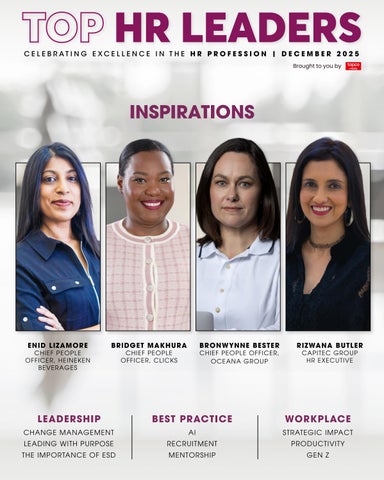
ENID LIZAMORE CHIEF PEOPLE OFFICER, HEINEKEN BEVERAGES

BRIDGET MAKHURA CHIEF PEOPLE OFFICER, CLICKS

LEADERSHIP

CHANGE MANAGEMENT

LEADING WITH PURPOSE

THE IMPORTANCE OF ESD

BRONWYNNE BESTER CHIEF PEOPLE OFFICER, OCEANA GROUP

RIZWANA BUTLER CAPITEC GROUP HR EXECUTIVE

IMPACT

C-SUITE DELEGATES |

CORPORATE SHOWCASE COUNTERS

SUMMIT 2026

Celebrating excellence across government.

The Public Sector Leaders Summit is a premier platform that celebrates the contributions of organisations and individuals, across both the public and private sectors, who continue to invest in South Africa’s growth with resilience and optimism.

The 2nd Annual PSL Summit will provide the ideal environment for engaged networking, collaboration and knowledge sharing between stakeholders who are committed to building a thriving and inclusive economy.

For more information Contact: emlyn.dunn@topco.co.za marketing@topco.co.za

INSPIRATIONS

16 | Bronwynne Bester, Chief People Officer, Oceana Group

22 | Enid Lizamore Chief People Officer, Heineken Beverages

24 | Bridget Makhura, Chief People Officer, Clicks

28 | Rizwana Butler, Capitec Group

HR Executive

LEADERSHIP

32 | CHROs driving business transformation

34 | People and culture leadership as a catalyst for business transformation

36 | The importance of ensuring Enterprise Supplier Development from a leadership perspective

38 | Putting people at the heart of progress

40 | 5 Strategies for championing gender empowerment

BEST PRACTICE

48 | Tackling talent shortages in the workplace of today

52 | Mentorship as a strategic and practical tool for HR

54 | Navigating AI challenges in the workplace

56 | Skills Development: An architecture for economic and social cohesion

58 | Cultivating a sense of belonging as a key driver of organisational change

WORKPLACE

60 | Redefining how HR leverages tech for strategic impact

62 | The silent productivity killer and toxic positivity

66 | South Africa’s Gen Z workforce: Are we setting our youth up for success?

68 | Fair pay in the workplacereimagining the status quo

70 | Procrastination: Understanding its triggers and the impact on productivity

72 | 3 workplace wellness tips for 2026

AWARD WINNERS

74 | Nomazibulo Tshanga, CEO of the Year

76 | Mondi South Africa, Employer of Choice: Large Organisation and HR Leader of the Year

78 | SALGA, Employer of Choice: Public Sector Organisation

80 | Y-Brand, Employer of Choice: Small-Medium Organisations

82 | Mieke Janse van Rensburg, Rising Star of the Year

| Future of HR Conference and Awards 2025

CREDITS

CEO Ralf Fletcher

Head of Brand

Lee-Ann Bruce

TOPCO STUDIO

Production Director

Van Fletcher

Group Editor

Fiona Wakelin

Deputy Editor

Koketso Mamabolo

Assistant Editor

Shumirai Chimombe

Traffic Manager

Daniël Bouwer

Graphic Designer

Tashwell Brown

Project Manager

Justin Daniels

Business Development

Manager

Thulani Nhlapo

Images iStock

Digital Publishing Platforms

Issuu Magzter

Media Carrier

Printers LAW Print

DISCLAIMER

CONTRIBUTORS

Amanda Cusdin Chief People Officer at Sage

Barry Jansen van Rensburg Director at BossJansen Executive Search

Bridget Makhura Chief People Officer, Clicks

Bronwyn Williams CPrac SA, ICCP, AMLC Prac SA

Bronwynne Bester Chief People Officer, Oceana Group

Bukeka Mbam

Author of “The Productive Life Guide”

Boitumelo Moselane

Human Resource Manager for Eaton South Africa.

Enid Lizamore Chief People Officer, Heineken Beverages

Joanne Bushell IWG Commercial Executive VP Middle East and Africa, Managing Director South Africa

Kim-Lee Ricketts Industrial Psychologist

Lyndy van den Barselaar Managing Director of ManpowerGroup South Africa

Nanda Scott

Group Chief Transformation and People Officer at Cassava Technologies

Nicol Myburgh Head: HR Services at CRS Technologies

Nomfundo Vilakazi Director People & Culture at Dis-Chem

Pumla Mdlalose Head of HR, FINANCIADO Dr Rajas Pillay Founder of HRSENSE

Rizwana Butler Capitec Group HR Executive

Sue Ramauthar

Corporate Wellness Practitioner and Physiotherapist at SuedeWellness

Teresa Marsicano Executive Director of ‘and Change’

Joyce Lebelo Managing Executive of LRMG

Thulani Dube

Head of Innovation and Advancement - Cornerstone Institute

Zimkhitha Mathunjwa

Digital Marketing Manager: Standard Bank South Africa

HEAD OFFICE

Top Media & Communications (Pty) Ltd T/A Topco Media

2nd Floor, Elkay House 186 Loop Street, Cape Town, 8001

+27 86 000 9590

info@topco.co.za

www.topco.co.za

(Scan QR Code to view website)

All rights reserved. No part of this publication may be reproduced, stored in a retrieval system or transmitted, in any form or by any means, electronic, mechanical, photocopying, recording or otherwise, without the prior written consent of Top Media & Communications (Pty) Ltd T/A Topco Media. Reg. No. 2011/105655/07. While every care has been taken when compiling this publication, the publishers, editor and contributors accept no responsibility for any consequences arising from any errors or emissions.

As 2025 draws to a close, it gives me great pleasure to introduce the 4th edition of Top HR Leaders - our annual celebration of the people, ideas and practices shaping the future of work in South Africa. Each year, this publication celebrates excellence in the HR profession and this edition arrives at a time when the role of the Chief People Officer has never been more strategic or more impactful. This year we explore the HR landscape in the following five sections:

INSPIRATIONS

We open with thought-leadership pieces from four leading HR executives who share their insights on purpose, resilience, transformation, and the evolving expectations placed on HR leaders:

• Keeping the “human” in Human ResourcesBronwynne Bester, Chief People Officer, Oceana Group

• Leading boldly in a world that does not stand stillEnid Lizamore, Chief People Officer, Heineken Beverages

• Building inclusion into the way we do business: A case study - Bridget Makhura, Chief People Officer, Clicks

• AI and leading for the future: 4 big ideas - Rizwana Butler, Capitec Group HR Executive

Their reflections set the tone for a publication that recognises HR not only as a business function, but as a catalyst for sustainable organisational change. We then move on to the following important pillars:

LEADERSHIP

In a world of rapid disruption, the demands on leaders continue to intensify. This section examines the challenges faced by executives today – from navigating new technology to building trust in hybrid workplaces –and highlights the rising influence of the CHRO as a strategic partner with a vital seat at the table.

BEST PRACTICE

What currently constitutes best practice in the fast-paced, ever-evolving realm of business? We look at mentorship, the art of cultivating nurturing and high-performing cultures, and the critical role of DEI in unlocking the full potential of people.

WORKPLACE

How does all this change impact the workplace? In this section we focus on what it takes for employees – and organisations – to truly thrive. From wellness and mental health to engagement and authentic buy-in, we highlight approaches that strengthen workplaces and humanise the employee experience.

we end by celebrating Future HR award winners who continue to inspire future leaders – they include the Future of HR CEO of the Year, Nomazibulo Tshanga, Founder and CEO of Ziyana Business Consulting and Training, a people management consultancy servicing clients across sub-Saharan Africa; and Mondi, Employer of Choice for Large Organisation and HR Leader of the Year.

Thank you to the amazing team who brought you these pages – we wish you an abundant 2026. 

Finally,

Rui Morais, Chief Executive Officer at Dis-Chem Group

ABOUT THE COMPANY

As South Africa’s go-to health authority, Dis-Chem carries an important responsibility: to make better health accessible, affordable, and sustainable, starting with our own people. Our employees are our priority customers, and we believe that those who serve the nation’s health every day should have seamless access to the very best health management tools themselves. From chronic condition support to everyday wellbeing, our workforce benefits from the full strength of our integrated ecosystem — our clinics, pharmacies, digital health solutions, insurance offerings and our Better Rewards programme, which drives meaningful value back into their households every month.

The same ecosystem that supports our 22,000 employees is now available to South African businesses who face rising healthcare costs, absenteeism pressure, and the challenge of building resilient workforces. Through the health centric financial services products we offer and our expanding clinical network, we are creating employer solutions that use data, innovation and everyday care pathways to reduce risk, support adherence, and lower the cost of healthcare across the working population. Our aim is simple: to empower companies with the same integrated tools we have built for ourselves, tools that improve employee health outcomes while strengthening organisational performance. Innovation sits at the centre of this work. Through X, bigly labs, our dedicated innovation hub, we are reimagining how

care is delivered, blending technology, AI-driven insights and design thinking to create smarter, more personalised health experiences. Better Rewards continues to extend this value by providing employees with savings on thousands of essentials, easing financial strain and improving health resilience at home. When people feel supported both inside and outside the workplace, they show up stronger, healthier, and more engaged.

Sustainability, for us, is deeply intertwined with health equity. We remain committed to improving access not only through the Dis-Chem Foundation and our community initiatives, but through the way we design every product, service and solution. Our purpose, Better Health Starts Here, guides how we serve our customers, how we support employers, and how we help build a healthier South Africa.

As the world of work continues to evolve, meaningful employee wellbeing is no longer a benefit, it is a strategic advantage. At Dis-Chem, we are proud to stand alongside employers who share this belief, providing proven, practical and connected ways to help their people live healthier lives. 

Contact us

Address: 23 Stag Road, Glen Austin, Midrand, 1682, Gauteng, South Africa

Telephone: +27 11 589 2200

Website: www.dischemgroup.com

Dis-Chem Life Group Cover & Medical Insurance powered by Dis-Chem Health – A smarter approach to talent and wellbeing

In a market where skilled talent is increasingly mobile, employers are expected to do more than provide a payslip, they must demonstrate a real commitment to employee wellbeing. Yet rising healthcare costs and the complexity of traditional medical schemes can make it difficult to offer meaningful benefits without stretching budgets or burdening HR/People & Culture teams. Medical Insurance powered by Dis-Chem Health offers a smarter, more sustainable solution.

Supported by our trusted national footprint of Dis-Chem Pharmacies, the cover combines comprehensive protection with everyday healthcare access. Employees can visit over 280 Dis-Chem pharmacies and clinics for primary healthcare, medication, chronic condition support, screenings and vaccinations, creating a seamless link between prevention, treatment and financial security. By enabling earlier detection through complimentary wellness screenings and convenient clinical access, companies can reduce absenteeism, presenteeism and unmanaged chronic conditions directly improving productivity. When paired with DisChem Life Group Cover, employers can provide an essential safety net that protects employees’ families.

For HR and finance teams, DisChem Life delivers clarity, value and simplicity. Our plans are cost-

effective and fully customisable to your workforce - whether you prefer flat benefits, salary-based structures, or our Dynamic Insurance Model, which uses advanced analytics to align cover to real financial needs. Administration is streamlined through digital self-service, WhatsApp onboarding, automated policy documents and dedicated support, reducing manual workload and speeding up turnaround times. Choosing Dis-Chem Life Group Cover & Medical Insurance powered by DisChem Health is more than a benefits decision; it is a strategic investment in a healthier, more engaged workforce. As an employer, you gain streamlined access to insurance solutions, clinics and wellness. Your employees gain accessible care, robust protection and everyday value that makes a real difference to their quality of life. And with our Better Rewards loyalty programme, employees enjoy meaningful monthly savings at Dis-Chem, enhancing household resilience at no additional cost to the employer.

In an evolving world of work, wellbeing is no longer a perk but a cornerstone of retention, productivity and organisational strength. Dis-Chem ensures your benefits work harder, reach further and deliver measurable impact.

Build a healthier, more secure workforce. Join Dis-Chem Life Group

Cover & Medical Insurance powered by Dis-Chem Health for cover that truly works for your employees and your business.

T&Cs apply. This is not a Medical Scheme and the cover is not the same as that of a Medical Scheme. This policy is not a substitute for Medical Scheme membership. Dis-Chem Health is not a Medical Scheme or an Insurer.

The administrator for Dis-Chem Health is Kaelo Risk (Pty) Ltd, an authorised financial services provider (FSP 36931). Medical Insurance products are insured by Centriq Insurance Company Limited, a licensed non-life insurer and an authorised Financial Services Provider (FSP 3417).

Group Life Cover is insured by Guardrisk Life Limited (FSP 76), a licensed life insurer with a Level 1 B-BBEE rating.

Terms and conditions apply.

Dis-Chem Life is an authorised financial services provider – FSP 50594. Products are underwritten by Guardrisk Life Limited, an authorised financial services provider (FSP No 76) and a licensed life insurer.

*The Better Rewards programme is a loyalty programme offered by Dis-Chem. Better Rewards is not an insurance product and a non-insurance benefit.

THE BUSINESS LANDSCAPE HAS CHANGED DRAMATICALLY SINCE YOU BECAME PEOPLE AND CULTURE DIRECTOR AT DISCHEM SIX YEARS AGO. PLEASE DESCRIBE YOUR MAIN FOCUS AREAS AND HOW YOU HAVE CREATED AN ENVIRONMENT WHERE PEOPLE FEEL VALUED AND THRIVE?

Serving as a People & Culture Director has reinforced my belief that real business transformation is driven by its people. My focus has been shifting the function from a compliance mindset to a strategic, culture-defining partner, intentionally rebranding it as People & Culture to place employee experience at the centre.

AS A TALENT TRANSFORMER, WHAT HAVE BEEN SOME OF YOUR MOST MEMORABLE MILESTONES?

My own journey, for a start, has been a meaningful milestone – initially joining to oversee Organisational Development and progressing to lead the entire function. One of my most significant achievements was rebranding HR to People and Culture, signalling a strategic shift in how we value and empower our employees. Embedding leadership development programmes and hosting leadership summits to cultivate a pipeline of young leaders have also been pivotal. Ultimately, every milestone is reflected in the behavioural transformation of our leaders, a shift that strengthens our impact across all 22,000 employees and firmly positions People and Culture as a driver of our business strategy

Nomfundo Vilakazi, People and Culture Director

WHAT HAVE BEEN SOME OF THE KEY INITIATIVES THAT HAVE SET DIS-CHEM APART AS AN EMPLOYER OF CHOICE?

Dis-Chem has always been anchored in a strong customer-centric philosophy, and that same commitment guides how we support and engage our people. We view our employees as our priority customers, the people who carry our strategy, shape our culture, and uphold the experience that defines our brand across South Africa.

We have placed our people at the centre of how we design work, develop capability, and enable performance. We create an environment where individuals feel valued, supported, and connected to meaningful impact. Over the years, we have built a comprehensive suite of employee benefits designed to ensure that our employees and their families are meaningfully supported. Our Dis-Chem Life programme strengthens this commitment by extending safety and wellbeing benefits to their households. Most recently, our Better Rewards programme was introduced to ensure employees receive significant value through health-focused rewards — reinforcing our belief that healthier employees are better equipped to serve the millions of South Africans who depend on us.

This people-first philosophy is a fundamental part of what makes Dis-Chem an employer of choice.

WHAT EXCITES YOU ABOUT WHAT YOU DO?

Every day is different; I am part of making history. What excites me most is being a people and culture leader during Dis-Chem’s ambitious transition from a pharmacy retailer to an integrated healthcare partner. This is a transformation few organisations achieve. The opportunity to ensure our culture actively drives this strategy is both deeply rewarding and a tremendous responsibility.

WITH TECHNOLOGY CONSTANTLY EVOLVING, WHAT ARE YOU LOOKING FORWARD TO IMPLEMENTING IN THE COMPANY IN THE NEAR FUTURE?

There is always a great deal to look forward to in the People space. A core driver of our strategy is ensuring that every employee has a clear, end-toend understanding of our direction as a business. Part of this work involves “reintroducing” our people to Dis-Chem in a way that strengthens connection, clarity, and confidence.

To support this, we are developing a fully integrated onboarding platform that enables new and existing employees to engage socially, access critical knowledge, and learn on the job and on the go. We are also advancing several innovations in how we attract talent and introducing efficiencies that give time back to business. All of this is designed to create a seamless employee experience that supports performance and drives our long-term growth.

PLEASE SHARE A MESSAGE OF INSPIRATION WITH OUR READERS.

I’ve always viewed my career as a generational responsibility — paving the way for those who will come after us in this profession. As HR leaders, we shoulder immense accountability, and we must carry it with confidence and courage. But equally, we must protect our wellbeing. There are moments when you need to pause, centre yourself, and prioritise your own health. Your family needs you whole, and your teams need you strongly. You owe that to yourself.

Lead with intention. Serve with humility. Never lose sight of the fact that real transformation begins with people. When we lift others, we build a memory that reaches far beyond our individual careers. 

AS A MEDICAL DOCTOR SPECIALISING IN HEALTHCARE INNOVATION AND ACCESSIBILITY, PLEASE UNPACK YOUR ROLE AS PRODUCT AND CLINICAL RISK EXECUTIVE AT DIS-CHEM

My role merges clinical expertise with data-driven strategy to redesign healthcare delivery. “Clinical risk” is our focus on preventing negative outcomes like disease complications. We identify risk early by analysing data from HealthChecks, pharmacy interactions and claims. We then design practical interventions like screening pathways, adherence support, and digital follow-ups to reduce that risk. Importantly, I ensure all Dis-Chem’s products and services are credible and evidence-backed. This work sits at the intersection of everyday care and measurable outcomes, ultimately building a more resilient and affordable healthcare system for everyone.

IN YOUR OPINION, WHAT SETS DIS-CHEM APART AS AN EMPLOYEE HEALTH AND WELLNESS LEADER?

What sets Dis-Chem apart is a deeply ingrained, shared purpose that transforms a job into a calling. Across stores, clinics and offices, every team member, from our cleaning staff to our pharmacists, is united by the mission of making better health accessible. This is supported by a fundamental investment in employee growth through continuous upskilling, bursaries, and leadership development. Combined with a culture of open communication and collaboration, it creates an environment where people are empowered partners in a purpose far bigger than themselves, truly living the “why” of their work.

PLEASE SHARE SOME OF THE EXCITING INNOVATIONS YOU ARE CURRENTLY WORKING ON.

We are pioneering a model where healthcare professionals operate at the top of their scope, ensuring tasks

Dr Jessica Hamuy-Blanco, Product and Clinical Risk Executive

are handled by the most appropriate and cost-effective provider, like nurses managing low-risk pregnancies. Technology is a key enabler: we are working on leveraging our digital tools in clinics to standardise care and guide nurses through protocols, while innovations like virtual GP consultations increase access at lower price points. We’re also using data from our entire ecosystem to proactively identify patient risk and deploy targeted support, such as digital reminders and pharmacist counselling, to prevent complications before they occur. This all goes hand in hand with innovative thinking around healthcare funding, with the ultimate goal of making healthcare more accessible and affordable for the many. Our financial services products will always be health-led, meaning that we make the most of the assets we have within the business, and stay true to our brand and mission.

Additionally, the inclusion of health behaviours and related incentives within our new Better Rewards program is an example of how we are viewing the market differently and creating meaningful value for South Africans.

WHAT HAVE BEEN SOME OF THE MOST MEANINGFUL TRANSFORMATIVE INITIATIVES YOU HAVE INITIATED? HOW DO WE MEASURE SUCCESS?

One of the key initiatives I have been leading since joining Dis-Chem was the launch of our Dis-Chem Life suite of long-term insurance products. These products are a prime example of the value we can create when we bring retail, pharmacy and clinic together in a meaningful way. We set out to bring differentiated products to the market. There was no perfect roadmap. We were designing and building the product while simultaneously figuring out how it would fit into our existing business. Every new insight sparked another possibility. Every challenge forced us to rethink and refine. These products reward healthy habits and make cover more affordable for people living with chronic conditions. It’s built for real lives and real South Africans. Another core transformative initiative is embedding operating at “the top of your scope” model, which optimises our clinical

workforce to increase access and cut costs. For example, if a nurse can handle a patient’s care more effectively for less money, that’s where that care belongs instead of escalating it unnecessarily to a GP or specialist. Success is measured through tangible outcomes: improved disease control rates, higher medication adherence and reduced mortality claims. We track customer experience and the utilisation of benefits to ensure our interventions are both effective and accessible. Ultimately, success is creating a more resilient system where we see risk factors, like the threat of diabetes complications, go down for the populations we serve.

WHAT IS YOUR “WHY”?

My “why” was forged on my first day as a doctor at Chris Hani Baragwanath Hospital, witnessing a patient wait three days for essential care. That story left a permanent mark. My work is dedicated to making such stories less frequent. I am driven by the belief that we can flip the script on conventional healthcare to create a system where all South Africans have access to quality, affordable care. It’s about channelling that early frustration into building solutions that ensure people get the right support when they need it.

On top of that, I hope that the role I play within the organisation can set a good example for others and inspire them to follow their own “why”. Purpose driven people can change the world – I hope that I contribute to that sentiment in some way.

PLEASE SHARE A MESSAGE OF INSPIRATION WITH OUR READERS.

To anyone dreaming of making a difference, remember: it’s supposed to be hard. That’s how you know you are doing something meaningful. Don’t wait to be chosen or shrink to fit in. Decide what your role means to you, own your intensity and pursue it with clarity and authenticity. Your unique perspective is crucial for challenging the status quo and building a better, more equitable future. At Dis-Chem, we see every day that when you unite behind a purpose bigger than yourself, you don’t just build a career, you answer a true calling. 

ASI Financial Services

The number of retirement funds has dropped from 15 500 in 2000 to roughly 5 000 by 2020, even as assets grew to R4.3-trillion nearly matching the country’s GDP.

In South Africa’s challenging business landscape, employers are reimagining the employee value proposition (EVP) to meet rising expectations while navigating legislative reform, economic pressure, and a profoundly transformed workforce. An EVP is far more than a set of benefits; it is the holistic promise an organisation makes in exchange for talent. And as the world changes, so too must the value we offer our people.

A SECTOR TRANSFORMED

Employee benefits in South Africa have undergone significant shifts over the past two decades. The number of retirement funds has dropped from 15 500 in 2000 to roughly 5 000 by 2020, even as assets grew to R4.3-trillion nearly matching the country’s GDP. Medical schemes have consolidated, and cost escalations have placed affordability under strain for many employees. Now, with major legislative changes such as the two-pot retirement reform and the introduction of the National Health Insurance (NHI), we stand at the brink of another seismic shift. These reforms seek to enhance longterm sustainability and access, yet they also introduce uncertainty. Expecting HR teams to navigate still-evolving legislation in isolation is unrealistic and has created understandable anxiety. Employers urgently need trusted partners, clear guidance, and benefits strategies that can adapt as the landscape unfolds. At the same time, socio-economic

pressures including skills migration, economic volatility, and persistent loadshedding heighten the strategic importance of a compelling EVP that attracts, retains, and nurtures South African talent.

A WORKFORCE SPANNING FOUR GENERATIONS

Today’s workplaces bring together an unprecedented mix of generations:

• Baby Boomers and Gen X: Value stability, security, and long-term benefits such as retirement savings and medical cover

• Millennials and Gen Z: Prioritise flexibility, purpose, personalisation, and opportunities for growth and balance

Designing benefits that resonate across these life stages is both a challenge and an opportunity. When benefits reflect the real experiences of employees, people feel seen, supported, and valued.

REDEFINING CARE AT WORK

The pandemic accelerated longstanding shifts. Flexibility became essential. Wellness broadened to include financial education, mental health support, and emotional resilience. Benefits once considered “nice to have” became lifelines for employees and their families. This led to a powerful realisation: A modern EVP must care for whole lives, not just work lives.

WHAT MODERN EMPLOYEES EXPECT

Across sectors and income levels, employees increasingly expect benefits that are:

1. Life-stage relevant

• Early career: study support, mentoring, hybrid work

• Mid-career: financial coaching, childcare flexibility, holistic wellness

• Later-career: enhanced medical support, phased retirement, legacy planning

2. Flexible and personal: One-size-fitsall approaches no longer suffice

3. Transparent and easy to navigate: Digital tools and real-time access are now baseline expectations

4. Connected to purpose and community: Employees want to contribute to something bigger than themselves

5. Inclusive and equitable: Benefits must reflect diversity, equity, and inclusion

6. Sustainable and responsible: Organisations with strong ESG practices are increasingly attractive

SIX PRINCIPLES FOR AN EVP THAT THRIVES IN TOUGH TIMES

Resilient EVPs are built around six interconnected pillars:

1. Rest and recharge

2. Growth through new perspectives

3. Lifelong learning for employees and families

4. Security and peace of mind

5. Mental and emotional resilience

6. Purpose through community impact

As remote work and gig employment expands, EVPs must evolve to offer portable, flexible benefits that support workers throughout varied career paths.

1. At the centre of these sits financial literacy, empowering employees to use their benefits wisely, understand legislative changes, and make confident long-term decisions. Globally, EVPs are evolving toward purpose-driven work, hybrid flexibility, and whole-person wellness. South Africa mirrors these trends but faces unique pressures. This makes the EVP not merely a competitive advantage, but a survival strategy.

TECHNOLOGY AND THE FUTURE OF WORK

Technology is reshaping how benefits are delivered:

• AI-driven personalisation

• Predictive analytics

• Digital platforms and chatbots offering real-time guidance

As remote work and gig employment expands, EVPs must evolve to offer portable, flexible benefits that support workers throughout varied career paths.

MEASURING SUCCESS

A future-ready EVP must be measurable. Employers should track:

• Engagement and satisfaction

• Retention and turnover

• Benefit utilisation

• Productivity and wellness outcomes

This ensures that benefits are not only offered but understood, valued, and effective.

WHAT DOES THIS MEAN FOR ASI FINANCIAL SERVICES

For ASI, this evolving landscape reinforces the importance of our role

as a trusted, locally rooted partner. The shift toward personalised, holistic, life-stage-based benefits aligns directly with ASI’s long-standing philosophy: blending independent advice, human connection, and technology to make financial wellness meaningful and accessible.

1. Education and empowerment must lead : Two-pot reform, NHI, and new benefit structures require clarity not complexity. ASI’s financial education and advisory capabilities help employees navigate uncertainty with confidence.

2. Employers need multi-layered benefit strategies: Generational diversity demands customisable, flexible solutions. ASI’s tailored approach

ensures employees’ needs are met without inflating cost.

3. Technology must bridge understanding and action: Digital platforms offering personalised insights and transparent benefit data help employees make informed decisions. ASI’s growing digital ecosystem supports this shift.

4. Community-based guidance is essential : Benefits only matter when people understand them. ASI’s “first community” philosophy ensures that support meets employees where they are from factory floors to townshipbased entrepreneurs.

5. Purpose, dignity, and humanity must be central: In the context of economic pressure and social challenges, benefits that uplift

people build loyalty and strengthen organisations. This is core to ASI’s mission: to build wealth and change lives.

BUILDING BENEFITS THAT BUILD PEOPLE

A future-ready EVP must answer three essential questions:

1. Does it reflect the needs of a multigenerational workforce?

2. Does it support the whole person financially, mentally, emotionally, physically?

3. Does it empower flexibility, choice, and dignity?

As South African businesses navigate this complex moment, ASI Financial Services stands ready as an independent, deeply human partner bringing clarity

where there is confusion, flexibility where there is rigidity, and empowerment where there is fear. 

Contact us

Address: ASI Place, 48 Grosvenor Road, Bryanston

Telephone: +27 86 1 274 377

Email: info@asi.co.za

Website: asi.co.za

LinkedIn: ASI Financial Services

Instagram: @asifinancialservices

Facebook: ASI Financial Services

Keeping the "human" in Human Resources

The HR Systems landscape is burgeoning with fantastic tools. From chatbots screening resumés to machine learning models predicting employee turnover, AI is rapidly reshaping the work we do. The implications for Human Resources (HR) are both profound and paradoxical: while technology can streamline operations and empower data-driven decision-making, it also risks automating out the very heart of HR - the “human” element that gives the discipline its purpose and value. As human resource professionals, we are confronted daily with this absolute incongruence between a need for large amounts of data, fast access to information, quick problem solving, more productivity, freeing up the HR teams from administrative burden, and the intrinsic need to be the human face of workplace policy implementation and productivity.

This is not a call to resist innovation, but an invitation to lead it mindfully and ethically.

AI AND HR

The adoption of AI in HR is accelerating at breakneck speed. Recruiters now leverage AI-powered platforms to source talent, assess skills, and even conduct preliminary interviews. Employee engagement platforms use sentiment analysis to gauge morale, and predictive analytics help organisations predict workforce trends

before they become crises. AI-driven tools are lauded for their purported ability to reduce bias in hiring, identify high-potential employees, and personalise learning and development opportunities at scale. Automation is intended to liberate HR professionals from repetitive administrative tasks, freeing them to focus on strategic planning and employee advocacy. However, are they really “thinking” partners.

As humans get cleverer in outsmarting the algorithms, which we see all the time in recruitment, how are we ensuring that our people are thinking about the AI driven output and can critically assess it for optimal use.

Insight and the ability to provide it are key to successful HR partnering to line leaders. It is all good and well that HR is able to provide fast and rich data to line, but if all is machine generated the HR function must shift to becoming one that ensures that the context and the meaning of the data is properly understood by line leaders for effective decision making.

OVERRELIANCE ON AI TOOLS RUNS THE RISK OF:

• Depersonalisation: Automated messaging and digital interfaces can erode authentic human interaction, making employees feel like data points rather than

individuals. Consider the Family Responsibility leave request, all manageable within a system, but we must ensure that it is accompanied by a message of care from an HR or line leader providing the necessary condolence message or empathy for a difficult employee situation.

• Algorithmic bias: Despite best intentions, AI systems can perpetuate or amplify existing biases if trained on flawed or incomplete data sets. It is in this area that critical thinking and evaluation of AI outputs are so important. Our systems must be built to ensure that it is asking for correct and relevant data. Consider the ATS for a large food producer that at the end of the application process asks if the applicant has experience in food manufacturing. This is a seemingly harmless question, that automatically discards all applicants that say ‘no’. Forcing all talent without this experience out of the pool of potential candidates. If the role being advertised is a highly technical operational one the question is relevant and fair, if the role being advertised is a more generic one for example a creditors clerk, is this really relevant? Are we discounting our talent pool because we haven’t really thought about the implication of the questions we ask?

• Loss of empathy: Machines can analyse sentiment, but they cannot replicate the nuance, context, and emotional intelligence of human interaction. Turning all interactions into transactions, however productive, will drive down employee engagement.

To keep the “H” in HR, organisations must approach AI adoption as more than a technical upgrade, it must enhance our capability, not thwart the critical human element of engagement with employees and critical evaluation of employee data.

WHEN CONSIDERING AI TOOLS HR LEADERS SHOULD TAKE COGNISANCE OF:

• Technology is an enabler, not a replacement Adopt a mindset where AI is seen as a tool to empower HR professionals, not substitute them. Use automation to handle high-volume, low-complexity tasks (like payroll or vacation tracking), freeing up time for staff to nurture relationships, coach managers, and build trust.

• Invest in emotional intelligence and relationship skills Coaching line leaders and ensuring interactions are not merely data driven transactions is key. The H in HR isn’t only the purview of HR professionals but for all line leader interactions.

• Prioritise employee experience Co-create AI-powered solutions with input from employees at all levels. Solicit feedback, test new tools in pilot programs, and refine based on real human experience—not just efficiency metrics. Remember, the ultimate aim of HR technology should be to enhance the employee journey, not merely to manage it.

• Safeguard privacy and build trust With great data comes great responsibility. Develop robust data governance policies that protect employee privacy and autonomy. Engage in ongoing dialogue about the ethical use of AI and listen actively to concerns.

• Humanise digital interactions

Blend digital and human touchpoints. Use video, personalised messaging, and virtual “office hours” to keep communication authentic and meaningful. Recognise moments that matter - onboarding, life events, performance reviews -and ensure a human is always present at key milestones.

• Measure what matters

Don’t let efficiency metrics overshadow human outcomes. Track measures of belonging, psychological safety, and well-being alongside traditional KPIs. Make success stories about people, not just processes.

AI will continue to reshape the nature of work, but it cannot (and should not) define what it means to work together as humans. The organisations that thrive in this new era will be those that articulate a compelling employee value proposition - one that leverages the best of technology while uplifting dignity, inclusion, and connection.

This means reimagining talent acquisition to look beyond credentials and focus on potential and purpose. It means treating learning and development as a lifelong, relational

References:

journey rather than a transactional checklist. It requires leaders who model vulnerability, curiosity, and adaptability.

Perhaps the greatest responsibility HR leaders hold is to set the ethical boundaries of AI adoption. This includes ongoing assessment of how algorithms affect human dignity, agency, and fairness. Establishing cross-functional ethics committees, consulting with affected groups, and staying abreast of evolving legal frameworks are all essential steps.

Ultimately, keeping the “H” in HR is not just about systems and processes - it’s an act of stewardship. It’s about remembering that every data point represents a person with hopes, fears, talents, and dreams.

The AI revolution is a call to action for HR leaders to reimagine their roles as architects of culture, champions of inclusion whilst meaningfully and thoughtfully engaging with employee data.

By integrating advanced technology with timeless human values, organisations can create workplaces where people and machines work in concert - where efficiency does not come at the expense of empathy nor insight. 

Why human-centric strategies are vital in the AI era | World Economic Forum

The Benefits and Challenges of Using AI in Human Resources

GLOBAL LEADER IN FISH AND FOOD PRODUCTION

GLOBAL LEADER IN FISH AND FOOD PRODUCTION

DIVERSIFIED OPERATIONS

DIVERSIFIED OPERATIONS

STRONG OPERATING PLATFORM AFFORDABLE

STRONG OPERATING PLATFORM

In South Africa, many young people face violence, poverty, and inequality. The resulting toxic stress, compounded by limited support, harms brain development, health, learning, and future opportunities, with its impact passing to future generations.

Founded in South Africa in 2009, Waves for Change (W4C) is a non-profit company that supports adolescents growing up in high-stress environments. From five beach sites across the Eastern and Western Cape, W4C has created safe, joyful “third spacesˮ where young people can practise coping skills, build resilience, and connect with caring peers and coaches.

Through research and collaboration with global partners, W4C created the Take 5 Model to extend the reach of Surf Therapy and strengthen youth mental well-being support worldwide.

Together, Surf Therapy and Take 5 advance one mission: empowering adolescents to thrive.

Healing through the ocean

Surf Therapy fuses the rush and therapeutic benefits of surfing with the Take 5 routine to create a structured, evidence-based programme

How it works:

Adolescents are referred through schools, hospitals, and child and youth care centres

They attend weekly sessions for 10 months at one of five beach hubs

Each session combines surfing with the Take 5 five step routine: Energiser, Check in, Breathing, Play, Reflection

After 10 months, participants graduate into weekend Surf Clubs, maintaining lifelong connections with coaches, peers, and the ocean

Since 2011, Surf Therapy has supported more than 10,000 adolescents, trained 215 local coaches, and provided over 100,000 nourishing meals annually

OUR IMPACT

Scaling resilience through physical activity and play

Developed and rigorously refined within Surf Therapy, Take 5 is a teaching framework that helps organisations scale physical activity and play-based mental health programmes with confidence and ease

How it works:

Coaches and facilitators learn nine essential protective coaching skills for working with vulnerable youth

Coaches learn to integrate the Take 5 routine into their existing work

Waves for Change is working with the Department of Arts and Culture to integrate Take 5 into after-school programmes across the Western Cape The partnership will reach over 800 coaches and 100,000 children in the coming year Outside of South Africa, Waves for Change is working in partnership with UNICEF to integrate Take 5 into government-led after-school and in-school mental health programmes in 5 countries across the African continent.

Peer-reviewed studies show that Surf Therapy improves stress management and social behaviour outcomes for youth

Where W4C has a presence, Surf Therapy programmes are now integrated with city-wide health referral systems

A Case Study with the Western Cape Government shows that Take 5 makes coaches more effective at building resilience with vulnerable youth. There is increased demand from government ministries and civil society partners to use the Take 5 model in 2026.

How can you help?

Sponsor a Surf Therapy site and connect hundreds of vulnerable children to the power of the ocean: R2,000,000 per year

Sponsor the training of a partner to use the Take 5 model: R250,000

Leading boldly in a world that does not stand still

A WORLD IN MOTION

The pace of change in our world is relentless. Economies shift overnight, technologies advance in exponential leaps, and societies demand progress on justice, inclusion, and sustainability. Locally, South Africa continues to wrestle with deep inequalities, a volatile labour market, and the urgent need for growth. Globally, organisations navigate the rapid rise of artificial intelligence, geopolitical uncertainty, climate crises, and new expectations of leadership accountability.

In this context, to lead is not simply to manage. To lead is to step into the unknown with courage and clarity. To lead boldly is not to ignore risk, but to make principled choices despite it. It is to hold steady when the ground beneath us moves.

WHAT IT MEANS TO LEAD BOLDLY

Bold leadership is not defined by fearlessness, but by conviction. It is the ability to translate vision into action, values into policies, and promises into lived experience. At its heart, bold leadership rests on four anchors:

• Clarity with courage. Leaders must provide direction even when answers are incomplete. People do not look for certainty; they look for honesty, transparency, and a compass that points toward purpose.

• Principled decision-making. In a turbulent world, expedience is tempting. Bold leaders resist shortterm fixes and choose actions aligned with integrity, fairness, and long-term sustainability.

• Human-centred leadership. Boldness is not brashness. It is empathy in action — recognising that people are not resources to be managed but lives to be honoured, supported, and empowered.

• Resilience and adaptability. The bold leader sees disruption not as threat, but as invitation. They anticipate change, experiment, learn, and adapt — creating cultures where agility becomes collective strength.

FROM POLICY TO PRAXIS

The test of bold leadership is not found in speeches or vision statements, but in translation. Policies are statements of intent; praxis is their lived reality. When these diverge, trust is eroded.

• Diversity and inclusion: Policy may commit to representation; praxis ensures every voice is heard and every individual feels they belong.

• Hybrid work: Policy can define flexibility; praxis is seen in leaders modelling trust, balance, and productivity without proximity bias.

• Wellbeing: Policy might speak of employee assistance; praxis is when leaders normalise conversations about mental health, reduce stigma, and ensure workloads allow for flourishing.

• Sustainability: Policy can declare ambition; praxis is in the daily decisions — from procurement to product design — that reflect environmental responsibility.

Bold leaders are relentless in closing the gap between intent and lived experience. They understand that employees, communities, and societies measure leadership not by what is written, but by what is felt.

LOCAL AND GLOBAL PERSPECTIVES

South Africa offers a vivid canvas for bold leadership. With one of the youngest populations globally yet staggering youth unemployment, leaders must innovate to create pathways for skills, inclusion, and growth. Labour relations remain complex, requiring courage to engage honestly with unions and stakeholders. Inequality demands leaders who see business success and social progress as inseparable.

Globally, we confront megatrends that reshape leadership at scale:

• Artificial intelligence and automation changing not only how work is done, but what work exists.

• Climate change demanding urgent shifts in energy, production, and consumption.

• Geopolitical tension disrupting supply chains and redefining alliances.

• Employee activism requiring leaders to take public stances on issues from justice to sustainability.

The convergence is clear: bold leaders cannot afford to think locally or globally in isolation. They must integrate the lessons of both — grounded in context, but expansive in perspective.

THE FUTURE OF BOLD LEADERSHIP

As the world accelerates, the archetype of the solitary, heroic leader gives way to something more powerful: collective boldness. Future-ready leadership is less about commanding from the top and more about unlocking courage at every level of the organisation.

Bold leadership is also generational. The decisions we make now — about climate, technology, equity, and culture — will outlive our tenure. They become our legacy.

To lead boldly is to plant seeds of progress that others may harvest.

This is not a call to recklessness. Bold leadership is measured, principled, and deeply human. It balances ambition with accountability, courage with humility. Above all, it recognises that leadership is not a position, but a daily practice.

CLOSING REFLECTION

The world will not wait for us to be ready. Change will not slow so that leaders can catch their breath. To lead boldly in a world that does not stand still is to embrace this reality with open eyes and steady hands. It is to choose conviction over hesitation, principle over expedience, and people over process. It is to see the turbulence of today not as barrier, but as catalyst.

And it is to ask, every day: How will I meet tomorrow — in fear of its uncertainty, or in courage for its possibility?

Building inclusion into the way we do business

A case study

Since I’ve stepped into my new role, I am often asked what our diversity and inclusion (D&I) strategy looks like in practice. My answer is always the same: it’s not a side project, a compliance scorecard, or a glossy chapter in a report. At Clicks, inclusion is the way we run our business. From the boardroom to the shop floor, from how we develop suppliers to how we care for communities, inclusion is not a bolt-on. It is the operating system that drives performance, trust, and growth. For us, building inclusion into the fabric of the business is both a moral obligation and a commercial imperative— because companies that reflect the societies they serve are the ones that thrive.

LEADERSHIP: REPRESENTATION AT THE TOP

Transformation starts with who holds decision-making power. That is why we treat board diversity targets not as aspirations but as governance commitments. In 2024, 67% of our directors were black and 44% were women, making ours one of the most diverse boards in South Africa.

But true leadership goes beyond representation. We voluntarily apply King IV principles and the JSE’s sustainability disclosure guidance because we believe inclusive leadership and good governance are inseparable. Transformation is not managed by a side committee; it is overseen at board level, measured with the same rigour as financial performance. Accountability at the top is what keeps us honest—and moving forward.

WORKPLACE: GROWING CAREERS AND BUILDING BELONGING

Inside our business, inclusion begins with opportunity. In 2024, we invested R185 million in skills development, reaching more than 6,000 colleagues and promoting 1,876 into new roles. With 69% of our workforce under 35 and 62% women, Clicks is a microcosm of South Africa’s youth and gender demographics—and a powerful vehicle for economic mobility.

Retail is often overlooked as a career escalator, but our history tells a different story. Many of our leaders, including former CEO Vikesh Ramsunder, began their journeys in-store. Today, our CEO, Bertina Engelbrecht, is the first woman to lead a JSE-listed retailer. These examples show young colleagues that the shop floor can be the first step to the boardroom when talent is nurtured.

We measure our progress honestly. In 2024, we moved from “Achiever” to “Leader” status in the UN Women’s Empowerment Principles Gender Gap Analysis Tool, improving our score from 79% to 89%. That reflects real progress —not slogans.

TRUE

PAY PARITY: HARD WORK, NOT HAPPENSTANCE

One of our proudest milestones has been achieving true pay parity. Our 1:1 gender pay ratio is the result of deliberate, disciplined work - not luck.

True pay parity requires unwavering leadership, rigorous data analysis, systematic processes, accountability mechanisms, and the courage to challenge the status quo. We conducted regular pay equity audits, standardised structures, and embedded gender pay reviews into the annual salary cycle. Increases were carefully managed to close unjustified gaps, underpinned by a reward framework recognised by the South African Reward Association (SARA). Oversight committees ensured accountability, with final decisions signed off at executive level.

The outcome is not only fairness but also trust. Colleagues know pay decisions are equitable, transparent, and aligned with our transformation objectives. And trust is the bedrock of loyalty, engagement, and performance.

LINKING INCLUSION TO PERFORMANCE: ESG IN OUR DNA

At Clicks, inclusion and sustainability are not side notes - they are linked directly to business performance. ESG metrics are built into our executive and employee bonuses through ESG modifiers. This makes delivery on transformation, sustainability, and governance commitments inseparable from financial reward.

When ESG sits inside the incentive system, it shifts from being “someone else’s responsibility” to everyone’s responsibility. It becomes part of everyday decision-making, ensuring that inclusion and sustainability are never deprioritised in the pursuit of profit.

VALUE CHAIN: TRANSFORMING OPPORTUNITY

Inclusion extends far beyond our workforce - it shapes how we source, partner, and grow. In 2024, we increased spend with women-owned suppliers by R5.9-billion, a 91% year-on-year rise, while improving our BBBEE rating to Level 3 (92.58 points).

Our enterprise and supplier development programmes create lasting value. Take UPD’s owner-driver scheme: in 2024, we supported 11 entrepreneurs - including three black women - with long-term contracts and a fleet of 42 vehicles, including South Africa’s first pharma-compliant, solar-powered refrigerated EV fleet. This is more than logistics - it’s inclusive entrepreneurship in a high-barrier sector, reducing emissions while improving patient access to medicines. ESG in action, where environmental innovation and economic inclusion reinforce each other.

COMMUNITY: EXTENDING CARE AND EQUALITY

Our inclusion commitment also extends into the communities we serve. In 2024, through the Clicks Helping Hand Trust, we provided healthcare access to 128,955 people without medical aid. Our sponsorship of the Transnet Phelophepa Health Trains expanded this reach even further, delivering free primary care, dental, and optometry services to rural and underserved communities. They served many more patients than the 350 000 target they had for the 2024 calendar year.

But healthcare is only part of the story. Our Mom and Baby programme supports women with free clinic services and starter essentials, empowering mothers at a critical stage of life. Our Students on the Go programme helps girls and young women stay in school and universities by providing sanitary products and health support—removing one of the most common barriers to education.

These initiatives are about dignity and opportunity, ensuring women and youth—the majority of our workforce and customer base—are supported not only as consumers but as citizens.

THE INTEGRATED APPROACH

The thread running through our strategy is simple: inclusion everywhere.

• Inclusive leadership at the top, anchored in governance.

• Inclusive career pathways in the workplace, underpinned by pay parity and opportunity.

• Inclusive growth in the value chain, empowering black- and women-owned enterprises.

• Inclusive access in communities, supporting mothers, students, and underserved families.

It is why transformation is overseen at board level, built into management scorecards, and recognised by global rating agencies such as FTSE4Good.

INCLUSION AS BUSINESS PERFORMANCE

At Clicks, we don’t see inclusion and performance as separate—they are inseparable. When colleagues see themselves in leadership, when young people build careers in pharmacy and retail, when entrepreneurs scale businesses, when mothers and students are supported—that is value creation.

As Chief People Officer, my role is to keep weaving these threads together so every strategic choice delivers three outcomes at once: strong business results, shared social progress, and a healthier, more sustainable South Africa.

That is what inclusion as a way of doing business looks like - and it is how we intend to lead. 

AI and leading for the future

Let’s be honest - the future of work isn’t some distant event waiting to happen. It’s something we’re building every day, through the choices we make as leaders, teams, and as a community. We’re living in a time where AI is transforming industries at lightning speed. But while technology races ahead, it’s people who remain at the heart of every successful organisation. As HR professionals, we’re not just bystanders, we’re the architects shaping the kind of leadership, skills, and culture that help people and businesses thrive in a world that’s dynamic, digital, and deeply human.

Let’s explore four big ideas:

• How leadership is evolving

• What AI means for our people

• The urgent need for futureready skills

• The vital role women play in building inclusive, resilient workplaces.

RETHINKING LEADERSHIP FOR TODAY

Remember when leadership was all about hierarchy and having all the answers? Those days are long gone.

At Capitec, we’ve seen that the best leaders aren’t those who control, but those who empower. It’s about inspiring people to put our clients first, take ownership, and bring their best to a shared purpose.

Instead of top-down directives, we must encourage every team member to share their ideas and take the lead on projects. In return, we get fresh solutions and a sense of ownership that’s now woven into our daily work.

Leadership today means being:

• Human and empathetic: People want leaders who see them as individuals, not just resources

• Adaptive: Navigating change and ambiguity with agility and modelling a growth mindset

• Inclusive: build support for the people who surround you, despite your differences.

At Capitec, we believe leadership isn’t just for a select few, it’s an opportunity for everyone. Building a strong leadership culture is about making ownership and accountability part of our everyday work.

AI AND THE HUMAN TOUCH

AI is brilliant at automating admin and crunching data, but it’s not just a costsaving tool. The real question is: how can AI help us be more human?

Here’s how we approach AI at Capitec:

• Augmentation, not replacement: For example, our HR teams are experimenting with AI to automate routine queries, freeing up time for meaningful conversations with employees. When we rolled out our AI-powered onboarding assistant, it didn’t just speed up admin. It gave new hires more time with their managers, helping them feel welcome and supported from day one.

• Ethics and trust: We’re transparent about how we use AI, always respecting privacy and supporting people as they grow into new roles.

• Human superskills at the core: As AI takes over technical tasks, skills like empathy, creativity, and collaboration become even more important.

BUILDING SKILLS FOR TOMORROW

Skills don’t last forever. What matters most is our ability to learn, unlearn, and relearn.

At Capitec, we focus on three clusters:

• Digital literacy: Every employee, from branch staff to head office, gets access to hands-on experience with digital tools and data. We start at grassroots levels,

leveraging Capitec Foundation, whose primary focus is to promote maths and literacy for Grade 8 & 9 learners from impoverished communities, to improve the uptake of these subjects in Grades 10-12. Over time, this offering has expanded to include technology hubs, leadership development for school principals, and wellbeing interventions, eg, a feeding scheme to support learning. At present, there are close to 30,000 learners taking STEM subjects across 35 schools. Thereafter, Grade 12 learners are formally assessed for either a university bursary, which allows them to join our Graduate Development Programme. Alternatively, they join our learnership programmes as Bank Better champions, which provides an entry point into the world of work. Our Internal Mobility Initiative (IMI) has enabled our operations staff to pivot into technology roles at head-office roles, as data analysts, testers, and Java developers, accelerating the rate of opportunity more than 10x.

• Human skills: Empathy, leadership, communication, and collaboration are front and centre in our leadership programmes.

• Growth mindset: We encourage curiosity and continuous learning, whether it’s through online courses, workshops, or exposure to initiatives of interest. The Dragon’s Den initiative, led by our iAcademy (Data & Technology Academy), has become a vibrant platform where passionate team members from all corners of the business step forward with fresh ideas and bold innovations to enhance the everyday experiences of our clients. It’s not just about upskilling, it’s about building confidence to tackle whatever comes next.

WOMEN LEADING THE WAY

The evidence from research is clear: organisations with more women leaders are more innovative, profitable, and resilient.

Supporting women isn’t just about fairness and opportunity, it’s about good business. Over the years, as women, we have built the muscle to juggle this changing world. We’ve figured our way through ambiguity, we built resilience by overcoming barriers, we think differently, and problem-solve so that we can work around systems not built for us. It’s to put those muscles to work because that’s what the future demands.

The Women in Capitec ERG (Employee Resource Group), in partnership with the Capitec Foundation, is not just building skills but building futures for young women. They inspire 400 grade 11 girls across South Africa to see

themselves as future leaders in Data and Tech, led by our very own senior female leaders in Capitec.

When young women see leaders who look like them, it sends a powerful message: your ambitions are valid and achievable. This enables us to:

• Build inclusive pipelines by reaching young talent, especially in underrepresented communities

• Create a safe space for women to share experiences and grow professionally

• Champion visible role models, featuring female leaders from our senior management team, our executive team, and board members.

This further enhances our vision that women belong at every level of leadership and in all areas of technology.

LOOKING AHEAD: ADVICE FOR LEADERS

Ultimately, leadership, AI, skills, and gender equity all come together in the culture we create. At Capitec, culture isn’t just a buzzword - it’s how people feel when they walk into work. We nurture a culture of ownership and purpose, balancing growth and technology with a deep commitment to our people.

My advice for leaders who want to stay relevant and inspiring in a techdriven era: lead with purpose and humanness. Keep people at the heart of every decision, both your clients and your teams. As leaders, we must continue to invest in learning, celebrate diversity, and never lose sight of our humanness. After all, humanness is our only competitive advantage. As we look ahead, the future belongs to those who not only welcome new technology but also create workplaces where people can develop, thrive, and truly feel appreciated. 

CHROs driving business transformation

• New research from the International Workplace Group reveals that 88% of CHROs report having a record level of influence in their organisations.

• These HR leaders drive key business outcomes: achieving profitability, increasing productivity, retaining top talent, and shaping organisational culture.

• This emphasis on HR’s direct impact underscores that flexible work schedules are key to retaining top talent and enhancing productivity. For example, 81% of CHROs consider hybrid work arrangements essential for keeping skilled employees, illustrating a clear link between flexibility and talent retention.

THE LATEST INTERNATIONAL WORKPLACE GROUP STUDY FINDS 88% OF CHROS SAY THEIR INFLUENCE IS AT AN ALL-TIME HIGH. Additionally, a survey of over 1 000 CHROs revealed that 81% collaborate more closely with other executives, reflecting priorities such as employee well-being (64%), talent attraction (64%), productivity (58%), and policy compliance (53%). This deeper collaboration with the executive team underscores the evolving nature of business priorities.

Other studies show that CHROs are now seen as key advisors to CEOs, linking talent efforts to business strategy. A McKinsey report **states that leading CHROs help set company direction, while the Harvard Business Review finds that their broad skills and leadership increasingly position them as potential successors to CEOs. CHROs’ expertise in talent, culture, and strategy secures their role in the C-suite.***

CHROS:

TRUSTED BUSINESS PARTNERS AT THE LEADERSHIP TABLE

Continuing this trend of heightened responsibility, findings from the International Workplace Group reveal that CHROs play a crucial role in shaping business outcomes. Nearly nine out of ten see themselves as trusted advisors to CEOs or senior leaders, reporting significant influence over profitability, productivity, talent acquisition and retention, and company culture—each of which is essential for sustained success. CHRO agendas now closely align with business goals: recruiting and keeping top talent (58% each) and workforce wellbeing (56%) remain top C-suite priorities.

FLEXIBLE WORK: A CORNERSTONE OF MODERN WORKFORCE STRATEGY

CHROs agree that flexible work is central to productivity and loyalty, with 81% saying it is key to retention. The International Workplace Group found that 72% of flexible work leaders experienced productivity gains in 2024. When flexible work is missing, 66% of CHROs see likely retention drops, and 86% say flexibility is job-seekers’ top benefit. Organizations that prioritize flexibility expect a 70% higher retention rate. Takeaway: Flexibility shapes retention and hiring.

HYBRID WORK: DRIVING PRODUCTIVITY GAINS AND SAVING ECONOMIES BILLIONS PER YEAR

Recent research shows that the productivity boost is driven by lower commutes, with employees benefiting from increased focus time and fewer

distractions, ultimately spending up to 40% of time saved from travelling on additional work. In fact, the rate of employees reporting their productivity levels as ‘excellent’ in flexible workspaces is 67% higher than that of those working from home.

This productive use of time could have a significant impact on business and the economy. If workers spend half their time in local flexible workspaces or offices, saving commutes and gaining focus, it could unlock 170 extra productive hours per worker per year.

Hybrid working is also proving to be essential to employee retention. Flexible arrangements can reduce voluntary turnover rates by up to 20%. These predicted savings stem from lower recruitment and training costs, with employees three times more likely to stay in roles where they can choose flexible working options.

Workers benefit from working closer to home and accessing local workspaces. Removing commutes brings significant cost savings.

COMPANIES SHIFTING TO LOCAL HUBS OR COWORKING MEMBERSHIPS CAN CUT REAL ESTATE COSTS BY 55%

By adopting hybrid working and flexible office spaces, businesses can significantly reduce their real estate costs and overheads, while also providing access to higher-quality workspaces at a fraction of the cost of traditional long-term leases. In fact, companies that transfer all their portfolios to neighbourhood hubs or

provide coworking memberships to their employees, as opposed to space in central offices, are expected to reduce real estate costs by nearly 55%.

Mark Dixon, CEO of International Workplace Group Plc, commented: “Hybrid and platform working is no longer just a perk - it is a strategic necessity for businesses aiming to thrive in today’s competitive landscape. By embracing flexible working models, companies can unlock greater productivity, attract and retain top talent, and ultimately build a happier workforce. CHROs are at the forefront of this transformation, ensuring that hybrid working not only supports employee wellbeing and progress, but also drives long-term business success.”

In this evolving economic landscape, hybrid isn’t just about flexibility or work-life balance; it delivers tangible economic benefits for employees. In turn, these gains benefit businesses that rely on a happier, healthier, and more productive workforce.

FOR MORE INFORMATION Visit: www.iwgplc.com

People and culture leadership as a catalyst for business transformation

For too long, human resources has been seen primarily through the lens of compliance and administration. But across leading organisations, a shift is underway. The evolution from “HR” to “People and Culture” (P&C) reflects a recognition that culture is not a side activity, it is the strategic engine that drives business transformation, employee experience, and sustainable growth.

This trend is particularly evident in South Africa’s fast-changing labour market, where retention, engagement, and transformation remain pressing imperatives. Companies that fail to put culture at the heart of their strategy risk falling behind.

WHY PEOPLE AND CULTURE MATTERS NOW Globally, business leaders are realising that strategy cannot succeed without people who are engaged, purposeful, and equipped to deliver. Younger generations are vocal about expecting growth, belonging, and inclusive leadership. In South Africa, this aligns with the need to broaden access to opportunity and build resilient organisations that reflect the diversity of society.

This makes P&C leadership not just relevant but urgent. It is about creating environments where employees thrive,

leaders are supported to lead with purpose and culture is intentionally designed to reinforce business goals.

My professional foundation was built across contrasting industries from parastatals to multinationals, which I believe shaped the balanced lens I now bring to leadership. I have found myself in values-driven cultures that emphasised talent growth, employee engagement, recognition and belonging.

That experience gave me the foundational building blocks of the culture and engagement space. I learned that how people show up in a work environment, and how the business contributes to that, are two key ingredients that must always marry.

EMERGING

PRIORITIES IN PEOPLE AND CULTURE LEADERSHIP

Forward-looking P&C leaders are prioritising several interconnected shifts:

• From compliance to culture-driving: Moving beyond traditional HR to embed values and behaviours into daily practice, making culture the living expression of strategy.

• Leadership with purpose: For culture and change to thrive in large, complex organisations, leaders at every level must be equipped with the tools, clarity, and accountability to embody company values, motivate teams, and communicate effectively. Their commitment is critical because without strong and prepared leaders, P & C strategies lack the leverage and impact needed to drive meaningful cultural transformation.

• Digital enablement: Harnessing technology, from automation to AI, to simplify processes and give managers more time to focus on people, not paperwork.

• Inclusive transformation: Embedding diversity, equity, and

inclusion as a way of working, not a compliance exercise. Companies are tracking belonging and psychological safety as seriously as they track performance.

THE RIPPLE EFFECT OF P&C LEADERSHIP When done well, People and Culture leadership creates a multiplier effect. Employees feel seen, valued and supported; leaders are empowered to manage with confidence and organisations benefit from higher engagement, stronger succession planning and business resilience.

The shift from HR to P&C signals more than a change in title but reflects a reimagining of how organisations see their people: not as resources to be managed, but as the heartbeat of transformation. In today’s landscape, the companies that thrive will be those that recognise culture not as an abstract idea, but as a strategic priority that drives performance and secures long-term growth. 

The importance of ensuring Enterprise Supplier Development from a leadership perspective

At a press conference in 2013, as Nokia announced the sale of its mobile phone division to Microsoft, then CEO Stephen Elop reportedly said “we didn’t do anything wrong, but somehow, we lost.” These words, simple yet haunting, capture the paradox of organisations that execute what appears to be the right strategy, yet fail to achieve the results they need to survive. For Nokia, the lesson was that meeting yesterday’s standards does not guarantee tomorrow’s success. For South Africa’s corporate sector, the same warning applies to Enterprise Supplier Development (ESD).

On paper, many ESD programmes are operating as they should. Companies comply with the Broad-Based Black Economic Empowerment (B-BBEE) Act

and the Codes of Good Practice by allocating three percent of net profit after tax to supplier and enterprise development. It estimates that in 2025, corporations will collectively spend approximately R30-billion on ESD initiatives and yet the results remain underwhelming. According to the B-BBEE Commission’s 2022 report, only 61 percent of the set ESD targets were achieved, with fewer than two thirds of companies having a defined strategy, and fewer than 40 percent offering structured mentorship to small suppliers. The Gordon Institute of Business Science’s White Paper of 2024 echoes this concern, noting that while between R20-billion and R30-billion is invested in ESD annually, the longterm impact is still uncertain due to weak alignment with Small, Medium and Micro Enterprises (SMME) needs

and inadequate monitoring. In other words, much like Nokia, organisations may not be “doing anything wrong” by compliance standards, but they risk still losing the battle for transformation, impact and sustainability if leadership does not elevate ESD beyond compliance.

The legislative framework of the B-BBEE codes mandates a percentage of net profit after tax be allocated for supplier development as well as enterprise development. The policy reflects a recognition that small and medium and micro enterprises are critical to economic growth and job creation but still face systemic barriers in accessing finance, markets, and skills. However, legislation sets only the minimum or rather a foundation. Studies show that when corporates

treat ESD purely as an obligation, they disburse funds but fail to create resilient businesses or sustainable value chains. Compliance may keep organisations on the right side of regulation, but it does not guarantee success in building empowered suppliers or resilient economies.

This is where leadership becomes indispensable. Leadership determines whether ESD is a tick box exercise or a catalyst for transformation. When senior executives integrate ESD into the organisational mission and vision, they shift it from a marginal compliance item to a strategic pillar of competitiveness and innovation. In the current volatile global economy, where supply chains are increasingly vulnerable, such leadership foresight ensures that ESD strengthens resilience while also advancing inclusive economic growth.

Leadership also sets organisational culture. In situations where visible executive commitment is absent, procurement teams may view small suppliers as liabilities rather than assets. Alternatively, when leaders champion supplier diversity, they will cultivate a culture that values partnerships with smaller, agile businesses as sources of resilience and innovation. This commitment must extend beyond funding to include mentorship, technical support, as well as governance training. These are resources that the B-BBEE Commission has identified as frequently neglected, yet critical for long term success.

Accountability remains a pillar of effective leadership. The B-BBEE Commission’s research found that companies with clear strategies and measurable targets performed far better on ESD outcomes than those without. By tying supplier development to executive scorecards, leaders elevate it to the same level of priority as profitability and growth. What leaders measure, reward, and communicate tents to be achieved. The rewards of leadership-driven ESD are immense. Corporates gain stronger,

more innovative supply chains, less exposed to disruption and enriched by the creativity of small suppliers. Society benefits from job creation, skills development, and the transformation of value chains through the inclusion of black-owned businesses, women, and youth. Leaders themselves earn recognition as purpose-driven innovators, leaving a legacy that extends beyond profit to empowerment and national progress.

The risks of complacency, however, mirror Nokia’s cautionary tale. Too many companies believe that by spending the required percentages, they are doing everything right. Yet when these funds are not paired with strategic vision, mentorship, and accountability, they deliver little sustainable change. The GIBS White Paper describes this misalignment bluntly stating that billions are spent, but too often on initiatives that fail to match the real needs of small suppliers or to build longterm competitiveness. Leaders must recognise that compliance alone is not success. Strategy, foresight, and active involvement are what make sustainable difference or impact.

South Africa’s business landscape provides striking contrasts. For instance, Distell’s partnership with Stellar Agri transformed a small 23 hectare farm into a thriving 150 hectare enterprise, supplying major retailers and exporting abroad, thanks to leadership support in technical training, governance, and market access. Distell’s ESD strategy has shown alignment with the company’s focus on the United Nations Sustainable Development Goals (SDG), particularly SDG8 and SDG17 which focus on decent work and economic growth as well as global partnerships. This example shows what happens when leadership treats ESD as strategic.

By contrast, where leadership has been absent, programmes have collapsed into short-term financial handouts with little developmental impact. Like Nokia, such corporates may claim they did nothing wrong, but they will nonetheless

lose and as such lose supplier resilience, losing innovation, and ultimately losing the opportunity to shape inclusive growth. The path forward is therefore clear. Leaders must embed ESD into boardroom strategy. It becomes important to tie outcomes to executive accountability, and build ecosystems of support that connect SMEs to capital, markets, and mentorship. They must insist on capacity-building programmes that extend beyond funding, and they must communicate and celebrate success stories to inspire momentum across industries.

Enterprise Supplier Development is not simply a compliance requirement but it is a leadership responsibility and an opportunity to future proof organisations while uplifting communities. The statistics are sobering reflecting that billions are spent, but impact remains uneven. The warning from Stephen Elop resonates that doing nothing wrong is not the same as doing enough. For South Africa’s corporates, success will not come from compliance alone. It will come from visionary leadership that reimagines ESD as a strategic imperative for transformation, resilience,impact, sustainability as well as shared prosperity.

By rising to this challenge, today’s leaders can leave behind more than profitable companies. They can leave behind empowered suppliers, resilient supply chains, and a legacy of inclusive growth that future generations can inherit with pride. 

Change needs brave leadership Putting people at the heart of progress

The success of any significant organisational change has less to do with the technology or strategy and everything to do with the people. In practice, it often raises questions and uncertainties. This is where leaders, with their ability to provide clarity and confidence, play a crucial role, creating a safe environment for change and securing the path forward.

Many of the challenges businesses face today, especially as a result of advancing technologies, are new. No leader can be expected to have all the answers, but they can make decisions with courage and openness, even when the way forward isn’t obvious. What matters most is the ability to inspire

confidence in teams so that together, they can adapt and succeed, instilling a sense of inspiration and confidence in their teams.

With more than half of Africa’s CEOs anticipating that technology will impact how they create, deliver, and capture value in a digital future, according to PwC, companies will inevitably need to reinvent themselves to keep pace. And this calls for effective strategies that lead companies forward without losing sight of their people. It also calls for leaders who are willing to galvanise teams around new visions, challenge comfort zones, and make the unknown feel possible, always with purpose and empathy.

The good news is that with the right approach, change can be a positive experience. This comes from being authentic enough to earn trust, clear enough to articulate a vision, courageous enough to follow through, and brave enough to make difficult decisions when necessary.

AUTHENTICITY, CLARITY, AND COURAGE

Authenticity often determines whether change efforts succeed or falter. Leaders who are genuine in their intentions and consistent in their actions create environments where people feel safe to voice concerns, test new ideas, and step beyond their comfort zones. When teams believe leaders have their best interests at heart, trust

follows. And with trust, even the most difficult conversations become easier to navigate, empowering and enabling everyone involved.

Being authentic isn’t about perfection, but acknowledging what you don’t know, while also showing conviction as you pursue solutions. Aligning words and actions consistently means that people don’t doubt your motives. This builds not only respect but also resilience, because instead of being participants in a process, people know they’re partners in progress, making them feel respected and valued.

Equally important is clarity of vision. We need to guard against change for change’s sake, and leadership should agree on the direction, goals, and process to be followed before engaging with stakeholders. Effective leaders understand that articulating

a compelling vision, then working backwards to build the strategies and approaches needed to achieve it, is key to gaining buy-in. It’s about explaining what’s changing, why it matters, and how people fit into the bigger picture.

True leadership is most evident not in moments of comfort, but when confronting hard choices while keeping people at the heart of the decision, considering how their role contributes to the collective mission. This is where leadership matters most; sometimes it could mean changing course when the original plan no longer fits the current reality. Leadership is knowing when to persevere, when to adjust, and when to let go, without losing sight of the bigger goal.

It is critical to remember that it is people who carry organisations

forward. Organisations where leaders listen closely to their people, focus on strengths, and are the ones that create teams that are engaged and resilient. It’s a process of connecting hearts and minds, not just processes and systems.

This is an approach that we’ve followed at Cassava Technologies as we deliver on our vision of being the leading digital solutions provider in our chosen markets. Our experience has taught us a simple truth: brave leadership isn’t just about strategy or technology. It’s about seeing, valuing, and empowering people. Because when people feel seen, they don’t just participate in change; they become its most powerful drivers. Acknowledging and working with this, instead of against it, helps organisations move forward with purpose, adapt to disruption, and create real, lasting change. 

Leading with purpose

5 Strategies for championing gender empowerment

The need for intentionality in how women empower themselves and their businesses has never been greater. As the founder of diverse ventures spanning legal compliance, youth development, hospitality and accommodation, I’ve experienced the highs, lows, and lessons of leading with purpose. Each organisation reflects a facet of my vision: enabling legal compliance, inspiring youth leadership, and creating serene spaces for connection and celebration.

I am reminded of the immense potential women have to shape industries, communities, and futures. Drawing from personal experiences, here are insights on gender empowerment, setting purposeful goals, thriving in emerging business trends, prioritising wellbeing, and strategies for growing a small business.

BUSINESS: A COLLECTIVE RESPONSIBILITY

Gender empowerment in business is more than an individual achievement - it’s a movement that transforms industries. Women bring unique perspectives and solutions to the table, but systemic barriers persist. As we aim for equity, collaboration becomes key. Leaders must actively foster inclusive environments through mentorship programmes, equitable hiring practices, and allyship initiatives.

How to champion gender empowerment

• Mentor and sponsor: Share your experiences and open doors for younger women.

• Advocate for policies: Promote flexible work arrangements, parental leave, and equal pay.

• Invest in women-owned businesses: Support networks that prioritise women entrepreneurs.

Leading by example

For years, I’ve believed that empowered women empower others. However, empowerment begins with breaking self-imposed barriers, shattering societal expectations, and creating systems that uplift other women as we rise. I’ve seen this in action through mentorship programmes I’ve led in my various leadership roles.

Personal Insight

In 2021, I was honoured as a Gender Mainstreaming Awards finalist and in 2024 Compliance Officer of the Year Award finalist - recognitions that fuelled my commitment to advocating for equity in leadership spaces. Empowerment isn’t about perfection; it’s about progress and collaboration.

Practical steps for empowerment:

• Own your seat at the table: Confidence comes from preparation. Always deliver value.

• Build alliances: Collaboration with other women multiplies impact.

• Create opportunities: Whether through hiring or mentorship, ensure you’re lifting others.

When I founded my companies I envisioned more than just businesses - I saw a legacy. One that was built to support businesses in creating jobs and contributing to economic growth. Intentional goals, like customised compliance training for small enterprises, have turned that vision into measurable impact.

Tips for intentional goal-setting

• Reflect on the previous year: Assess what worked, what didn’t, and areas for growth.

• Start with vision: Define where you want to be by a specific time (e.g. end of the year)

• Define metrics: Make goals specific, measurable, and tied to impact.

• Focus on your “Why”: Let purpose fuel your goals.

• Break goals into milestones: Use quarterly benchmarks to stay on track.

• Revisit and refine: Adjust strategies as needed during quarterly reviews.

• Involve your team: Collaborative goal-setting fosters accountability.

• Celebrate small wins: Acknowledge progress to maintain motivation.

The business world evolves rapidly, and staying ahead requires adaptability.

• Sustainability as a business driver: Consumers value eco-conscious practices. Integrate green solutions into your business model.

• Personalisation: Use data analytics to deliver tailored customer experiences.

• Digital transformation: Leverage AI and automation for operational efficiency.

• Community building: Foster connections to strengthen loyalty.

• Hybrid work models: Develop systems to support both in-office and remote employees.

• Purpose-driven branding: Align your brand with meaningful missions.

1. GENDER EMPOWERMENT IN
2. SETTING INTENTIONAL GOALS
3. BUSINESS TRENDS TO WATCH

The wellbeing of women leaders is critical for sustained success. Balancing professional and personal demands requires intentional practices to maintain physical, mental, and emotional health.

Personal insight:

Juggling roles as a mother, founder, and leader demands intentional habits. I begin each day with mindfulness, focusing on my “why” - whether it’s my daughter, my team, or my broader mission.

Wellbeing tips for women leaders:

• Prioritise mental health: Regularly check in with yourself.

• Set boundaries: Protect your time by learning to say no.

• Build a support system: Surround yourself with uplifting mentors and peers.

• Move your body: Exercise enhances focus and resilience.

• Practice mindfulness: Meditation and gratitude journaling keep you grounded.

5. STRATEGIES FOR SMALL BUSINESS GROWTH

The wellbeing of women leaders is critical for sustained success. Balancing professional and personal demands requires intentional practices to maintain physical, mental, and emotional health.

Growth strategies:

• Invest in your brand: Build a narrative that resonates with your audience.

• Diversify revenue streams: Explore new products, services, or partnerships.

• Focus on relationships: Clients, guests, and collaborators are your best advocates.

• Prioritise customer experience: Excellence creates loyalty.

• Leverage digital marketing: Use social media and SEO to broaden your reach

By setting intentional goals, embracing trends, prioritising wellbeing, and implementing effective growth strategies, you can create a meaningful impact. Remember, your success not only elevates you but also inspires and empowers others. Let’s walk boldly in our purpose, leading with intention. Every step forward builds a brighter, more inclusive future, whether by scaling businesses, mentoring future leaders, or creating spaces for connection and celebration. Together, we can build a legacy of empowerment and transformation for generations to come. 

4. WOMEN’S WELLBEING: A FOUNDATION FOR LEADERSHIP

The Sanlam Human Capital team is driven by a simple yet powerful purpose – to help people thrive. This commitment to individual and collective flourishing is central to Sanlam’s broader ambition to grow, lead and leave a lasting impact on society. By placing people at the heart of its strategy, Sanlam ensures that its growth is not only sustainable but also deeply human-centred. To bring this vision to life, Sanlam’s strategy is built on three foundational themes that drive growth through people. These pillars are the bedrock of how the organisation enables transformation, fosters excellence, and is shaping the future of its workplace.

CULTURE AND LEADERSHIP ENABLEMENT

Recognising leadership as the primary lever for shaping culture, Sanlam has introduced the Sanlam Leadership Promise and Principles. These principles guide leaders to act with purpose and authenticity, creating an environment where individuals and teams excel. They underscore the critical balance between a sharp, strategic focus on performance and business growth, and the creation of a supportive, enabling environment for our people. To deliver this, Sanlam invests heavily in leadership development, equipping its leaders to navigate complexity, lead through change and remain future-fit in an evolving business landscape. From a cultural standpoint, Sanlam is deeply committed to fostering a sense of belonging. The organisation champions inclusive spaces where diversity is celebrated, psychological

Sanlam

Fueling Sanlam’s growth through exceptional talent and an inspiring workplace

safety is prioritised, and every voice is heard. This inclusive ethos is brought to life through initiatives such as the Sanlam Women’s Network, Young Professionals Network and the People with Disabilities Network, all of which aim to uplift and integrate diverse groups within the organisation.

TALENT AND FUTURE-FIT PEOPLE

Adaptability and innovation are paramount in a rapidly evolving world. Sanlam fosters a culture of lifelong learning, empowering employees to embrace change, experiment with new ideas and grow both personally and professionally. A key focus is on developing critical skills and mindsets for the future, particularly digital fluency and effective use of artificial intelligence. A prime example is the Sanlam AI Academy, which offers targeted AI learning to build AI knowledge through theory and practical exposure.

By investing in career-long training and education, Sanlam ensures its workforce remains agile, competitive and ready to meet the demands of tomorrow.

DIGITAL AND DATA TRANSFORMATION

Best practice in HR today is driven by technology and data. The Human Capital team is prioritising the enhancement of the digital employee experience, designing every interaction with HR systems to be intuitive, seamless, and impactful. The team actively manages this digital transformation by supporting adoption, building digital confidence, and ensuring change initiatives are inclusive, sustainable, and aligned with business goals. An example of this is the successful launch of SAP SuccessFactors Mobile across the Sanlam Group, delivering a streamlined and intuitive experience

that empowers employees to effortlessly manage everyday HR tasks directly from their mobile devices.

Our focus on AI is two-fold: building internal capabilities to integrate AI into core HR practices, and leveraging it to drive productivity and operational efficiency across the business. On the data front, Sanlam’s robust people analytics function continuously generates and leverages talent data, trends, and predictive insights. This datadriven approach informs strategic and operational decision-making, enabling the organisation to proactively respond to workforce needs and opportunities.

Ultimately, the success of Sanlam’s Human Capital strategy is built on shared ownership, cross-functional collaboration and a commitment to co-creating scalable and sustainable solutions. This dedication has earned Sanlam a place among the Top 10 certified Top Employers in South Africa – a testament to its peoplefirst philosophy and its unwavering pursuit of excellence. By building on these pillars of leadership, talent, and technology, Sanlam is actively building the future of work. 

Contact us Address: Sanlam Head Office, 2 Strand Road, Bellville, Cape Town Telephone: 021 947 9111 Website: www.sanlam.co.za

Sana-Ullah Bray Group Executive: Human Capital Sanlam Group

Schneider Electric Championing inclusion and care by design, of everyone, everywhere

Winner of the The Future of HR Award 2025 in the category Workplace Diversity and Inclusion Strategy

WHO WE ARE

We are a global industrial technology leader bringing world-leading expertise in electrification, automation and digitisation to smart industries, resilient infrastructure, future-proof data centers, intelligent buildings, and intuitive homes - driving efficiency and sustainability for all

WE UNLOCK THE FULL VALUE OF ENERGY AND RESOURCES

We invent the technology that makes the energy transition possible, enabling buildings, data centres, factories, plants, infrastructure, and grids to operate as open software-defined systems, simplifying complexity and enabling smarter, more sustainable operations across every sector.

WE ARE AN IMPACT COMPANY

As an Impact Company, we believe performance and purpose go hand in hand. And with an inclusive culture at our core, we empower everyone to play a part in building a more sustainable, and resilient future.

OUR PURPOSE

Our purpose is to create Impact by empowering all to make the most of our energy and resources, bridging progress and sustainability for all.

At Schneider, we call this Life Is On.

LEADING WITH CARE - WITH DIVERSITY AND INCLUSION AT OUR CORE

Our Global Diversity, Equity, Inclusive & Wellbeing Strategy is to make Schneider the most inclusive and caring company in the world, by collaborating with internal and external stakeholders to hardwire Diversity, Equity, Inclusion and Wellbeing by design into our behaviours and processes.

We’ve hardwired diversity, respect, psychological safety, and well-being into our employee experience, business decisions, and worldview. At Schneider we lead with inclusion and care. We know that equitable opportunities will positively impact our people, our company, and our world.

We are a people company with an ecosystem of over 130 000 employees consisting of 5 generations, 182 nationalities and 108 countries.

OUR CULTURE LED + SKILLS FIRST STRATEGY 2027

CULTURE-LED

Our distinct culture attracts and inspires and is the engine for transformative growth. Leaders actively shape culture in our unique multi-hub model.

Growth Aim high and innovate for customer success

At Schneider we lead with inclusion and care. We know that equitable opportunities will positively impact our people, our company, and our world.

Agility Simplify and act with speed to constantly adapt and build resilience

Teamwork Achieve together with trust, inclusion and accountability

SKILLS FIRST

We are the industrial technology leader that unleashes potential to build a highly skilled workforce, enabled by technology.

Build Expertise Scale learning and upskilling to deepen domain knowledge & build T- shaped careers

Attract New Increase skill diversity by accessing a broader and ondemand talent pool

Embrace Digital Harness the power of technology & continuously learn new skills

WELLBEING - BUILDING A STRATEGY ROOTED IN CARE, PURPOSE, AND IMPACT

Our Guiding Principles - We ensure fairness and equity in our decisions and behaviours

• We treat people with respect and ensure all talents feel uniquely valued and safe, for their wellbeing and performance.

• We #EmbraceDifferent*, at all

levels of the organization, because it is good for business and innovation, and because we want to reflect the communities where we live and operate.

• We set high ambitions and hardwire inclusion and care into our processes and behaviors to ensure equitable access and opportunities for all.

• We strive for a diverse pool of candidates for every opportunity, internally and externally, and ultimately make talent decisions based on overall skills, behaviours, and complement to the team.

• We trust and hold our leaders accountable to act with inclusion and care and make every decision count

OUR WELLBEING STRATEGY

Underpinned by ‘We Care’, Our strategy focuses on, 3 areas of Impact:

1. Thriving individuals: Employees feel energised and valued. They know why their work matters. They feel capable and in control. They are given opportunities to manage their unique life and career.

2. Smart collaboration: Teams build together our ways to work based on transparency and trust. They include all diversities and appropriate technologies. It all starts with respect.

3. Engaging work environment: Schneider Electric is committed to delivering the best employee experience providing a safe, inclusive and attractive culture and workplace, supported by caring leaders. Inclusion and care is embedded in our processes and practices by design

INCLUSION & TEAMWORKTHE FOUNDATION OF BELONGING

Inclusion: We embrace diverse perspectives, co-creating a place where everyone belongs and thrives

Teamwork: We achieve together with our teams, collaborating with trust and openness

At Schneider Electric we place care at the centre of everything we do 

Contact us

Address: 1Tugela Drive, Midrand, South Africa

Telephone: 086 130 0222 | (Intl.): +27 (0) 11 230 5880

Email: za-enquiries@schneiderelectric.com Website: www.se.com/ww/en/

GLOBAL POWER | LOCAL PARTNER | HIDDEN TALENT

The people and skills you need tomorrow are already here.

LinkedIn connects 1 billion professionals worldwide, including 90 million across Africa, with AI-driven hiring and learning tools that redefine the future of work.

The newly launched AI Hiring Assistant streamlines recruitment, while LinkedIn Learning, with over 23,000 courses, empowers employees to upskill and prepare for the future of work.

But the real advantage?

top talent. up faster, and stay around longer.

Owned by Microsoft, LinkedIn integrates cutting-edge AI to enhance talent acquisition and professional development. Its suite of tools, including Recruiter, Job Slots, Talent Insights, and LinkedIn Life Pages, empowers organisations to attract, develop, and retain top talent.

The critical skills you’re chasing outside are often already inside your business. Internal hires cost six times less, ramp up faster, and stay around longer.

As LinkedIn’s only Gold Partner in Africa, we bring the global platform home, with local expertise, local currency billing, BBBEE compliance, and on-the-ground support to unlock both talent and learning.

As LinkedIn’s only Gold Partner in Africa, we bring the global platform home, with local expertise, local currency billing, BBBEE compliance, and on-the-ground support to unlock both talent and learning.

As LinkedIn’s only Gold Partner in Africa, we bring the global platform home, with local expertise, local currency billing, BBBEE compliance, and on-the-ground support to unlock both talent and learning.

Tackling talent shortages in the workplace of today

Competitive markets in burgeoning sectors that include technology, healthcare, and the financial services are creating a steady yet pressing demand to find and retain top executive talent.

When a supply-demand imbalance occurs in high-impetus segments of the economy, those of us in the executive search niche soon find we have our work cut out in sourcing the skilled professionals that such industries require to keep the marketplace firing on all cylinders.

Within the global triad of tech, health, and finance, there are four key reasons for a workforce shortage – a situation that is exacerbated on the African continent.

The reasons:

• rapid technological change

• an ageing workforce poised to retire

• an education system poorly matched with workplace needs

• a short supply of specialised skills in high-growth and specialised areas.

Let’s explore these four key reasons in a little more depth, as they pertain to Africa.

ASTOUNDING PACE OF CHANGE

In the first instance, the pace at which new technologies and software updates are being churned out, across categories that include but are not limited to AI and data analytics, means that schools, colleges, and universities are struggling to adapt their training regimes in tandem. In turn, graduates are emerging under-equipped to thrive in the real world of work.

On the African continent, many regions face limited access to reliable internet connectivity, electricity, and digital devices; the cost of internet access and/or data can be prohibitively expensive; educators may lack the training and confidence to effectively integrate digital tools into their teaching; and educational institutions may struggle to update their curricula quickly enough to keep pace, with existing social inequalities exacerbating all of these challenges.

AN AGEING WORKFORCE

In the second instance, i.e. an ageing workforce that is reaching the stage of retirement: it is important that young talent is sufficiently keen and skilled to fill the resulting vacancies, yet this is often not the case.

Developing nations often have more pressing needs to attend to than reinvesting in educational curricula that align with market needs. Despite a large and growing youth population, Africa faces high youth unemployment rates – often accompanied by a significant skills gap between what the education system provides and what the job market demands. This means that even with a large youth demographic, finding adequately skilled young talent to fill vacancies can be a major challenge.

The emigration of highly skilled African professionals, who seek better opportunities and living conditions in developed countries abroad, further depletes the pool of experienced talent that could otherwise contribute

Competitive markets in burgeoning sectors that include technology, healthcare, and the financial services are creating a steady yet pressing demand to find and retain top executive talent.

towards mentoring younger generations and filling vacancies left by retiring workers.

EDUCATION IS A WORKPLACE MISMATCH

What about the disconnect between the skills taught in schools and tertiary institutions, and those actually needed in the job market?

A closer look at industry-specific factors across tech, health, and finance, show us the importance of software development, cloud computing, and cybersecurity in the tech world; more evenly spread specialised healthcare workers to overcome geographic disparities (Note: urban areas in South Africa have about 30 generalists and 30 specialists per 100 000 people, while rural areas have

only 13 generalists and two specialists per 100 000, according to the African Journal of Primary Health Care & Family Medicine); and the overwhelming need for blockchain and digital-payment experts as fintech explodes, together with risk management and compliance specialists to counter the economic uncertainty of the future.

SPECIALISED SKILLS, HIGH-GROWTH AREAS

Fourthly, is the challenge inherent in staying ahead of the curve and evolving with the demands of a highgrowth field when you have already studied for at least five years (an integrated tech degree), up to 10 years (a medical speciality), or seven years (chartered accountancy). While it is not impossible to embrace a mindset

of ongoing development, to attend networking events, collaborate with colleagues, and speak at conferences, to do short courses and leverage technology for learning purposes, these initiatives create a second layer of demand over and above an already high-pressured and demanding day job.

THE HUNT FOR VIABLE SOLUTIONS

One of the most crucial cogs in the solution engine is probably the importance of collaboration: between the private sector (for the outreach and inclusion it can bring to bear), the recruitment industry (for the necessary shift that’s needed in our talent-sourcing practices), and the education system (which needs to pivot towards more suitable educational methods).

To take on the rapid pace of technological change (where, for example, the rapid advancement of AI and data analytics has transformed complex, time-consuming tasks into simple, instant processes), the private sector and big business must address bias in hiring and workplace culture so as to attract and retain talent from underrepresented groups.

The recruitment industry at large, and particularly the highly skilled individuals within the executive search niche, must shift hiring priorities from solely credentials and experience to assessing and valuing specific skills – i.e. how adaptable is this candidate, and on a scale of 1 to 10, how highly would I rate their learning agility?

Changes are also required to the education system because we will not be able to move forward without more flexible training programmes focused on specific skills geared towards workforce upskilling, and quick reskilling on a needs basis.

Quick fixes for an ageing workforce on the brink of retirement? We need to:

• promote intergenerational knowledge transfer, by investing time and energy in mentorship and coaching programmes that allow experienced workers to share their knowledge with younger employees

• implement flexible working arrangements that offer part-time work, remote work, or job sharing that supports older employees in continuing their careers until the younger generation is ready to take over

• offer training and development programmes to help older workers remain competitive and adapt to new technologies, potentially leading to new roles within business that may be helpful from a supervisory perspective.

To match the education system more closely to the workplace skills that emerging graduates require, solutions include:

• rehashing curricula to better match them with current and future job market demands

• incorporating practical skills and industry-specific knowledge into

learning programmes through input from professionals based at the cutting-edge of tech, health, and finance

• shifting the focus from theoretical learning to hands-on projects, simulations, and internships to better prepare graduates for real-world scenarios.

Lastly, with regard to keeping up with the demand for new, specialised, and high-growth professional areas , ways to succeed include:

• providing employees with continuous learning opportunities

• ensuing that salaries, bonuses, and benefits are comparable to or better than those offered by competitors, both domestically and internationally, once highcalibre individuals have been placed at a company; and

• creating a positive workplace environment that fosters a culture of inclusivity, respect, and recognition, and implements policies that promote work-life balance to enable sustainable

Mentorship as a strategic and practical tool for HR

Mentorship is often spoken about in warm, informal terms: a senior colleague guiding a junior one, a manager offering career advice, or a professional “paying it forward.” These relationships are valuable, but in today’s fast-changing workplace, mentorship should not be seen as optional or ad hoc. It is a strategic lever that human resources (HR) leaders can use to drive engagement, retention, and long-term organisational performance.

At a time when businesses are under pressure to attract and keep scarce skills, mentorship offers HR a practical, cost-effective tool to strengthen both people and performance.

WHY MENTORSHIP MATTERS NOW

Globally, employee expectations are shifting. Younger generations entering the workforce want more than just a pay cheque. They want growth, development, and purpose. In fact, LinkedIn’s 2024 Workplace Learning Report found that 94% of employees say they would stay longer at a company if it invested in their career development.

Locally, the South African workplace faces additional challenges: high youth unemployment, ongoing transformation requirements, and a competitive

market for qualified professionals. Employees are looking for organisations that not only offer stability but also demonstrate a clear commitment to their growth.

Mentorship offers exactly that. It provides a structured way to transfer knowledge, build skills, and create meaningful connections. It signals to employees that the organisation is invested in their success, which in turn boosts loyalty and motivation. When employees feel seen, supported, and stretched, they are far more likely to remain engaged and to contribute at their highest potential.

THE ROLE OF HR IN DRIVING MENTORSHIP

Too often, mentorship is left to happen organically, a chance relationship between a supportive leader and an eager junior. While these informal bonds have value, HR leaders need to elevate mentorship from chance to culture. That means designing and embedding it into the fabric of the organisation.

This includes:

• Establishing formal mentorship programmes with clear objectives and structures.

• Training mentors to be effective coaches, not just advisors.

• Matching mentors and mentees thoughtfully to ensure alignment of goals and interests.

• Measuring outcomes by tracking retention, promotion, and employee satisfaction among participants.

Taking this proactive approach ensures that mentorship is not left to chance but becomes a powerful driver of organisational capability. It also helps to align mentorship outcomes with business strategy, whether the goal is succession planning, building technical expertise, or strengthening leadership pipelines.

MENTORSHIP AND DIVERSITY

Mentorship is also a critical tool for advancing diversity, equity, and inclusion (DEI). In many organisations, underrepresented groups face barriers to progression not because of a lack of talent, but because of a lack of access to networks and sponsorship. Structured mentorship programmes help bridge this gap. Intentionally pairing employees from diverse backgrounds with senior leaders allows organisations to accelerate transformation and build pipelines of future-ready talent. This is particularly relevant in South Africa, where broadening access to opportunity remains both a business and societal imperative.

Research from McKinsey has consistently shown that companies with diverse leadership teams are more innovative and perform better financially. Mentorship, therefore, is not only a tool for individual advancement but a lever for building more competitive and resilient organisations.

BENEFITS BEYOND THE INDIVIDUAL

The value of mentorship extends well beyond the mentee. Mentors themselves benefit by sharpening their leadership skills, gaining fresh perspectives, and staying connected to emerging trends. Mentorship keeps senior leaders grounded in the realities of younger generations, which can inform better decision-making.

For the organisation, the benefits multiply:

• Improved knowledge transfer: critical in industries facing high turnover or retirement of experienced staff.

• Stronger succession planning: ensuring a pipeline of capable leaders for the future.

• A culture of collaboration and trust: where people are more willing to share insights and support one another.

In short, mentorship strengthens the social fabric of the workplace, creating an environment where both people and performance thrive.

MAKING MENTORSHIP A STRATEGIC PRIORITY

For HR leaders, the next step is to move mentorship from the margins to the mainstream. It should be recognised as a strategic enabler of performance, not just an employee perk. The most successful organisations will be those that:

• Embed mentorship into leadership development pathways.

• Recognise and reward mentors for their contributions.

• Leverage technology to scale mentorship across geographies and business units.

• Integrate mentorship outcomes into talent and succession planning metrics.

Forward-looking companies are already experimenting with reverse mentoring, where junior employees’ mentor senior leaders on digital trends, social issues, or generational perspectives. This demonstrates that mentorship is not a one-way street but a dynamic exchange of knowledge and insight.

As workplaces continue to evolve under the influence of technology, hybrid work, and shifting employee expectations, HR has an opportunity to redefine how organisations nurture and retain talent. Mentorship, when treated as a strategic lever, provides a costeffective and human-centered way to achieve this.

The question is no longer whether organisations should invest in mentorship, but whether they can afford not to. In the battle for skills, engagement, and long-term performance, mentorship may well be one of HR’s most powerful competitive advantages. 

Navigating AI challenges in the workplace

Artificial intelligence has become more than just a buzzword in the corporate world. It’s reshaping the way organisations work and compete. Across departments, AI is transforming routine processes and enabling smarter strategies. Even in HR, a field centred on human relationships, AI is redefining how companies connect with employees and support their growth within the business.

Yet, while AI can greatly enhance organisational performance and make HR processes more responsive to employee needs, it also introduces challenges that require careful management and human oversight. AI is giving HR teams the tools to work more efficiently and engage with employees in ways that were previously unimaginable. One area where this is particularly visible is recruitment, where

AI is transforming how talent is found and assessed. Candidate screening, once a time-consuming manual process, is now handled by AI tools that can sift through thousands of CVs, matching skills and experience with job requirements.

By automating these routine recruitment tasks, AI allows HR professionals to focus on the aspects

of hiring that truly matter. This creates a recruitment experience that truly engages candidates. With AI handling the repetitive work, HR teams can focus on making thoughtful hiring decisions. And by combining efficiency with personal engagement, they can attract the right people and set them up for success from day one.”

Another way AI adds value is by enhancing the employee experience. It enables a more personalised journey, tailoring each stage to match an individual’s unique needs and expectations. For example, onboarding bots can be highly effective at guiding new employees through company processes while providing instant answers and easy access to the information they need.

And onboarding is just the beginning. AI’s influence extends well beyond first impressions, shaping how organisations plan and manage their people over the long term. By delivering real-time insights into the workforce, AI makes it easier for HR teams to identify potential challenges early and allocate resources in ways that better support organisational goals. This ensures that people strategies keep pace with growth and change.

NAVIGATING THE CHALLENGES

But despite all the advantages AI offers, it also brings challenges that HR teams need to address to ensure the technology is used effectively and responsibly within the organisation. One of the biggest obstacles is resistance. Employees and even HR professionals may feel threatened by AI, fearing it will replace their jobs.

This is a misconception. AI isn’t about replacement; it’s about augmentation. The key is showing people how it takes the mundane work off their plate, allowing them to focus on more meaningful tasks. When teams see AI as a partner rather than a threat, they can dedicate their energy to strategic initiatives and building stronger relationships within the business.

A lack of AI-specific skills also makes adoption difficult, he continues. “Most HR teams don’t leverage AI to its full potential. They treat it as a personal assistant, rather than recognising how it can fundamentally change workflows. AI’s true value is only realised when HR professionals are trained to use it effectively and can confidently integrate it into everyday processes to support better decision-making and deliver meaningful results.”

However, organisations will need to avoid over-reliance on AI. Without proper oversight and ethical safeguards, organisations risk losing the human element. No matter how efficient chatbots and automated systems are, they can never replace the personal connection that is so vital in HR. The best results come from combining AI tools with human interaction, ensuring employees always feel supported and genuinely connected throughout their experience. The same principle applies to decision-making. AI should guide decisions, not make them. While AI can make recommendations, final decisions – particularly around employees’ development within the organisation –should remain with HR professionals.

AI WITH HEART

The future of HR is not about replacing humans with machines but about combining AI’s analytical power with human empathy. To achieve this, HR professionals will need both the know-how to work with AI and the insight to apply it in ways that support people and organisational goals while keeping the human experience front and centre. Organisations that get this right will adopt AI confidently and fully embrace the opportunities it brings. 

Skills Development An architecture for economic and social cohesion

Skills development (SD) is no longer a Human Resources initiative, it has become an international imperative, and a critical form of capital. Skills have become the link between potential aspirations and economic mobility.

We are aware that the global economy is being reshaped by digitalisation, automation, artificial intelligence,

green intelligence, and agriculture. These changes demand technical, agricultural, green expertise, and adaptability.

Within South Africa (SA) there is an urgent need to redefine SD and Training through purpose and impact. SA’s economic, employment and educational landscape require us

to rethink SD, which will enable us to create job opportunities and entrepreneurs. Hence, we are at a pivotal intersection to train and transform.

Often, Corporate South Africa have viewed SD with a compliance lens, focusing on meeting the regulatory requirements. Instead, we should

focus on “What future are we aiming to build?” To contribute meaningfully to South Africa’s growth trajectory, companies must redesign their skills strategies to drive three interconnected outcomes:

Employability: equipping youth, graduates and individuals at any level of their careers with skills relevant to the modern economy Entrepreneurship: enabling individuals to become job creators, not just job seekers; and Economic cohesion: building inclusive pathways where opportunity is not determined by geography, gender, age, or background.

In recent years, much of the national focus and funding for skills development has centred on youth. While this remains vital, we must also acknowledge that skills development cannot end at 35. Corporate South Africa must embrace lifelong learning as a strategic necessity.

Many older workers still have immense experience, work ethic, and potential. However, they often lack access to reskilling or digital literacy opportunities. The result is an unintended age bias that sidelines valuable institutional knowledge. To build a truly inclusive economy, skills development must serve every stage of the working life cycle, from early career to midlife reinvention. Organisations should design pathways that allow for upskilling, multiskilling, and second-career transitions. Intergenerational learning preserves capability and builds cultural and social cohesion within organisations. SD then evolves to human empowerment.

Skills development is the foundation of productivity and competitiveness. A skilled workforce attracts investment, fuels innovation, and stabilises communities. When skills initiatives

align with industry growth priorities such as renewable energy, logistics, digital services, agricultural and green economy sectors among others, we create an ecosystem where learning translates into livelihoods.

Beyond employment, skills investment drives entrepreneurial ecosystems. Graduates and artisans who cannot find traditional jobs often have the potential to start small enterprises if they are given access to mentorship, markets, and microfinance. Thus, training must be designed with an entrepreneurial lens, enabling individuals to transition seamlessly between being employable and selfemployed.

In the redesign of the skills landscape, corporates have both a responsibility and an opportunity to function as catalysts for inclusive growth. To move from intent to impact, organisations must:

• Shift from transactional to transformational partnerships, and collaborate with government, TVET colleges, and communitybased organisations to co-create programmes that address real economic gaps;

• Invest in work-integrated learning and provide structured, mentored workplace experiences for graduates, artisans, and mid-career professionals seeking reinvention. Every placement is a potential bridge out of unemployment or stagnation;

• Embed entrepreneurship in learning pathways, and design programmes that teach business skills, innovation, and resilience;

• Promote lifelong learning by creating continuous learning cultures that value growth at every age and career stage. Encourage mentorship, digital literacy, and reverse-learning initiatives across generations; and

• Measure impact, not spend and shift from counting training hours to tracking outcomes that are transformative.

Government’s role must be to create an enabling policy and funding environment that rewards innovation in skills development. Simplified regulatory processes, alignment of education with industry needs, and incentives for collaboration will ensure that training investments yield tangible economic returns. Publicprivate partnerships must become the cornerstone of national renewal.

The future of South Africa will be shaped when corporates, government and academia align their efforts around a shared vision to unlock the potential of our people. By working together, we can grow our country exponentially, strengthen our economy and reap the rewards of socio-economic cohesion.

SD is not charity, it is nation building. The true wealth of a country lies in its people. When we invest wisely in minds, hands, and hearts across all ages, we cultivate a generation that does not just find jobs but creates futures and transforms the economy. 

Cultivating a sense of belonging as a key driver of organisational change

Representation matters. Diversity of thought matters. Belonging matters. And the organisations that realise this early are the ones that are making a social impact and experiencing financial success. Thanks to a widely cited McKinsey study, we’ve known for years that companies with more diverse teams were seeing higher profits and better performance.

Companies in the top quartile for gender-diverse leadership were 15% more likely to generate aboveaverage profitability than their predominantly white-male competitors. Organisations with higher levels of ethnically diverse employees also had a 35% performance advantage over those without diversity. In South

Africa, we’ve recognised the need to transform our economies and leadership structures for decades, and Women’s Month is when we are asked to reflect on the importance of gender parity.

Gender equality is important in the social sense – with women in South Africa facing high rates of domestic violence, unemployment, and discrimination – and also in helping to build the local economy.

Accenture posited in 2019 that improving gender parity could unlock R319-billion into SA’s GDP. In corporate structures, South Africa’s business leaders are seemingly realising this and talking about diversity and inclusion

(D&I). Deloitte research from 2020 states: “80% of South African leaders (surveyed) cited D&I as “important” or “urgent/very important” to business (up from 59% and 70% in 2014, respectively)”.

But are they walking the walk? The same report wrote that many companies still underestimate the change required to become truly inclusive. “Cultural change only starts to become more substantial when leadership buy-in appears and is further enhanced by fully integrating D&I into the organisation, including staff behaviour and business processes. Cultural change is difficult and requires more effort than many leaders anticipate,” it reads. This change

becomes even more complex if the organisation deploys D&I in a crosscultural context (e.g. multinationals). Our experience in change management has taught us that fundamental transformation can only be brought about by creating a sense of belonging. Belonging has become interwoven with D&I, because that sense of belonging allows organisations to retain diverse talent and maintain trust even in the face of significant structural and cultural changes. Belonging, we now know, is firstly good for business.

Consulting firm BetterUp conducted research about the role of belonging at work – with high belonging linked to a 56% increase in individual performance, fewer sick days and more loyalty to their organisation – meaning a 50% drop in turnover risk.

So, how do we create this sense of belonging? Most importantly, by allowing for open communication, inviting feedback – and taking it seriously – and prioritising connection between colleagues and their managers. Empathy and the ability to facilitate open conversations are our superpowers for change management practitioners and are central to preventing resistance to change.

Resistance is inevitable for any change, but transformative policies around D&I or gender equality are on the same level as a major cultural shift in the organisation.

Getting people to accept transformation is also about enhancing feelings of belonging – allowing people to feel heard as the change is implemented and adjusting change strategies accordingly. This multi-layered

and reinforced model for communication is at the heart of Prosci’s ADKAR model. ADKAR (Awareness, Desire, Knowledge, Ability and Reinforcement) is about equipping leaders with the tools and partners with the correct information to move through organisational changes successfully.

Because when a significant change must be made, it must also be leader-led – especially changes that are fundamental to the success of an organisation and its people. Unfortunately, many organisations and their leaders don’t realise that change is rarely completed quickly. The move towards a more genderequal and diverse organisation, for example, is a lengthy process that requires consistent growth in the organisation’s change capabilities to manage correctly. But this capability and skill sets are transferable across the many potential social and otherwise shifts that need to take place to remain competitive.

However, failing to maintain these changes – or reinforcing them as per the ADKAR model – often leads to future failures. Support from the very top of an organisation and coordination across all levels is necessary for successful implementation.

In the South African context, we have a rich legacy of transformation. Our government was able to implement an entirely new government and create one of the world’s greatest Constitutions. But now, it is up to other sectors to assist in changing society for the better by looking inward and transforming their own policies, workforces, and leadership structures. Yes, it makes financial sense, but it’s also the right thing to do. 

Redefining how HR leverages tech for strategic impact

2025 will be the year that starts the momentum in human resources (HR) professionals getting real about what artificial intelligence (AI) means for their function, with a view towards moving beyond inflated expectations towards considering how AI tools can help them deliver tangible business outcomes.

There is a growing understanding that AI in HR means ‘augmented intelligence’ as much as it means artificial intelligence. Rather than replacing the human touch, AI should be used to support and assist humans across the business - including in t he HR function.

AI is already playing an invaluable role in human resources, helping HR professionals to streamline processes

ranging from screening candidate CVs and onboarding employees, as well as to generate data-driven insights to support decision-making processes about recruitment, employee experience and more.

As HR professionals become better acquainted with traditional AI tools and look towards the potential of new generative AI and large language model solutions, their focus will shift beyond using AI to save money through automation. Instead, they will look at how AI can support strategic decision-making and enrich the employee and candidate experiences.

A crucial part of this shift is the acknowledgement that AI isn’t a silver bullet. Following the popularity of ChatGPT, but especially over the past

year, we’ve seen a slew of AI-powered HR products emerge across industries and geographies – leading to an industry that is expected to be worth nearly $15 billion by 2031.

In the coming years, this hype cycle around AI in HR will start to sober up. That is not to say that the usage of AI will decrease. It will continue to be used, experimented with, and baked into existing and new products and processes. However, as development and usage continue, businesses will start to realise that AI is merely a means to an end, and not the end goal itself.

HR leaders will become increasingly sensitive to the ethics and privacy concerns surrounding powerful HR tools as candidates and employees push

back against impersonal interactions with organisations. AI has a powerful part to play in automating routine processes and enriching insights from data.

A new generation of GenAI tools is opening up new possibilities, such as streamlining HR-related content or documentation or answering complex employee questions via virtual assistants. However, HR leaders also know that the ‘human’ remains central to their function.

They will work hard to ensure that their AI systems’ automated processes are free from algorithmic bias and to provide transparency around how employee and candidate data is used in AI processes. In addition, companies will be mindful of the growing fear in the workforce that AI is being used to automate people out of their jobs.

However, AI, when used wisely, can help HR personalise experiences, understand emotions, and anticipate user needs through advanced algorithms and learning capabilities. This makes engagement with HR systems and processes – for both HR and employees – feel more intuitive and human-like.

The magic of AI lies in its ability to adapt and interact in ways that resonate with human behaviour and needs. But while AI creates significant efficiencies in HR processes like recruitment, performance management, and employee engagement, it is no replacement for human involvement.

AI isn’t the solution to every HR challenge, but implementing ethically and strategically will free HR up to be less process-driven and more peoplefocused. But the human expertise and empathy remain central, with HR leaders’ years of experience essential in designing people-centric HR experiences and making smart decisions based on AI outputs. 

The silent productivity killer and toxic positivity

The modern workplace is more demanding than ever, with intense deadlines, a flood of emails, and the constant expectation to maintain a positive attitude—sometimes at the expense of authenticity. While optimism has its place, ignoring mental health challenges and burnout can be detrimental to both individuals and organisations. A mentally exhausted employee isn’t productive, and companies that overlook well-being aren’t setting themselves up for longterm success. How do we manage workplace stress, set boundaries, and protect our well-being while staying engaged and effective? Let’s break it down.

MENTAL HEALTH AT WORK: A NECESSITY, NOT A LUXURY

Mental health is the foundation of well-being, yet many professionals feel pressured to “push through” stress, anxiety, and exhaustion out of fear of being seen as weak. This mindset leads to reduced productivity, dissatisfaction, and long-term health issues.

Taking care of mental health isn’t a weakness—it’s a strategy for longevity. Forward-thinking companies foster well-being through flexible schedules, mental health resources, and open conversations. The best leaders lead by example, sharing their struggles, normalising mental health days, and fostering a culture where employees feel valued and supported.

BURNOUT: THE SILENT PRODUCTIVITY KILLER

Burnout is more than just feeling tired—it’s a state of chronic stress that leads to exhaustion, drains motivation, creativity, and enthusiasm. In today’s “always-on” culture, where emails and messages flow in at all hours, disconnecting from work has become increasingly difficult. How often do we hear, “I’m so busy,” as if constant exhaustion equates to success?

The reality is, unchecked burnout leads to disengagement, reduced performance, and physical health issues.

Common signs of burnout include:

• Persistent fatigue and lack of motivation

• Increased irritability or detachment

• Difficulty concentrating and declining performance

• A sense of hopelessness or feeling overwhelmed

How to combat burnout:

• Set boundaries. Define work hours and stick to them. Don’t let work seep into every aspect of your life

• Take real breaks. Stepping away from your desk, even for a short walk, can refresh your mind

• Use your leave days. Rest is productive. Overworking yourself into exhaustion benefits no one

• Speak up. If your workload is

HOW TO THRIVE (WITHOUT LOSING YOUR MIND)

unsustainable, communicate with your manager, HR, or a trusted colleague

THE PROBLEM WITH TOXIC POSITIVITY

Toxic positivity—the belief that people should maintain a positive mindset at all times—can be just as harmful as stress itself. When workplaces insist on persistent optimism, they risk invalidating employees’ struggles, making them feel unheard or pressured to suppress negative emotions.

How toxic positivity shows up at work:

• Dismissing concerns with phrases like, “Just be grateful you have a job.”

• Encouraging employees to “look on the bright side” instead of addressing real challenges

• Labeling honest discussions about stress as “negative” or “complaining.”

What we actually need instead:

• Real conversations. Employees should feel safe saying, “I’m struggling,” without fear of judgment

• Support, not slogans. Meaningful workplace wellness initiatives matter more than motivational quotes

• Balanced positivity. Encouraging hope and solutions while acknowledging challenges

Now that we’ve identified the challenges, here’s how to protect your mental health while staying engaged at work.

1 Set clear boundaries

Define specific work hours and stick to them. Avoid checking emails outside of these hours and create “no work” zones at home. Prioritising personal time sends a message that work-life balance matters.

2 Prioritise self-care

Self-care isn’t just a buzzword—it’s a necessity. Self-care looks different for everyone. Whether it’s exercising, journaling, reading, or watching your favourite show, do what genuinely replenishes your energy.

3 Seek professional support

Therapy isn’t just for crises—it’s for maintenance. Whether through an Employee Assistance Program (EAP) or a private counsellor, professional support can help you manage stress effectively.

4 Build a support network

Strong workplace relationships can make even the hardest days more manageable. Find your people—whether it’s a mentor, a supportive colleague, or a professional community outside of work. A sense of community can make workplace challenges feel more manageable.

5 Advocate for workplace change

Employees can collectively push for healthier work policies, such as mental health days, flexible hours, and access to wellness programs. Advocate for policies that promote flexibility, wellness programmes, and open conversations about well-being.

6 Embrace realistic positivity

Instead of pretending everything is fine, practice “realistic positivity”. Replace “everything is great!” with “this is tough, but I’m figuring it out.” Acknowledging challenges while focusing on solutions leads to a healthier mindset.

7 Learn to disconnect

Being constantly plugged in drains mental energy. Set tech-free times—no emails during dinner, no scrolling before bed. Give your brain the rest it deserves.

8 Keep learning and educating others

The more we understand mental health, the better equipped we are to navigate workplace challenges. Share knowledge, attend workshops, and normalise conversations about burnout and well-being.

THE FUTURE OF WORK: THRIVING, NOT JUST SURVIVING

Workplace well-being isn’t just an individual responsibility; it requires collective effort. Organisations that prioritise mental health foster more engaged, innovative, and productive teams. Employees who take care of themselves perform better, feel better, and actually enjoy their work.

It’s time to redefine success. Instead of glorifying exhaustion, we should champion sustainable, fulfilling careers. Small steps —whether by individuals, teams, or entire companies—can create a culture where people don’t just survive the workweek but thrive in it. 

South Africas Gen Z workforce

Are we setting our youth up for success? ,

Commemorated annually on 16 June, Youth Day is a powerful reminder of the responsibility South Africa holds to invest in its next generation of leaders. Yet, as Generation Z (those born between 1996 and 2012) becomes a growing segment of the national workforce, the question arises: Are our workplaces truly ready for them?

According to a global white paper from ManpowerGroup, World of Work for Generation Z in 2025, Gen Z will make up a third of the global workforce by 2030. But many are already struggling to find their footing. Nearly half of Gen Z workers globally say they are considering leaving their current roles in the next six months, and the trend is just as concerning in South Africa.

South African employers must move beyond stereotyping young talent and begin to engage this generation on their terms. On Youth Day, we are reminded that this generation is shaped by loadshedding, remote learning, unemployment, and digital disruption, yet they remain determined, entrepreneurial and values-driven. We owe it to them, and our economy, to adapt how we recruit, upskill and support them.

South African employers face a pressing opportunity to better engage and retain Gen Z talent by understanding their unique needs and priorities. Almost one in two Gen Z employees are considering leaving their current roles, driven by high levels

of daily stress, financial insecurity, and mental health challenges. Purpose is central to this generation’s work experience, with 86% stating that meaning and values matter more than salary alone. Many are proactively upskilling, with 45% taking on side gigs or short-term projects to build their capabilities, reflecting both ambition and financial strain.

As of the fourth quarter of 2024, South Africa’s youth unemployment rate stood at 44.6% for individuals aged 15 to 34, according to Statistics South Africa’s Quarterly Labour Force Survey. With youth unemployment among the highest in the world, these trends present both a warning and an opportunity.

As we honour the legacy of 16 June, we must also confront the reality that thousands of South African youths are entering a world of work that often leaves them behind. Employers have a responsibility to actively invest in their success.

With South Africa facing both a youth unemployment crisis and a widening skills gap, building workplaces that support Gen Z is no longer optional, but a national priority. Employers must rethink recruitment by focusing on skills and potential rather than outdated experience-based criteria.

Once hired, young professionals need dynamic development opportunities such as digital learning, job shadowing, and mentoring to grow with the

pace of change. Holistic support also matters: financial well-being, mental health resources, and empathetic leadership help build trust and longterm engagement. Just as crucial is clarity around career paths and regular, meaningful connections, whether in-person or remote, to foster belonging and purpose.

Globally, many companies are already adapting, offering flexible work, improved tech, better pay, and strong development pipelines. For South African businesses, the time to act is now. Supporting Gen Z isn’t just good leadership, it’s a wise investment in the country’s future.

On this Youth Day, let’s move from reflection to action. The world of work is changing. Our young people are ready. It’s time our systems and structures meet them there. 

Lyndy van den Barselaar, Managing Director of ManpowerGroup South Africa

Fair pay in the workplace

A few conversations which I have had with colleagues and friends recently have touched on the Fair Pay Bill, which was put before the National Assembly in June 2025. If passed, the bill will require employers to publish salary ranges for vacancies, and it will also prohibit prospective employers from requesting applicants to share their current cost to company. Lastly, it would allow colleagues to freely engage one another on their salary or have conversations around remuneration, thus removing the clauses which prohibit such engagements.

Gender parity has always been an issue, particularly when it comes to ensuring that the same opportunities afforded to males in the workplace are the same as those afforded to women, whether it is from a development perspective or growth trajectory or career planning. This is more so when it comes to remuneration. According to the latest statistics on the gender pay gap, it was confirmed that “there is an 11 p.p. employment gap between women and men, with women facing lower employment rates… The raw gender pay gaps in South Africa are 32.5 per cent at the monthly level and 20.1 per cent at the hourly level…” according to a ( UN Women Study: South Africa, 2023)

What this means is that women, irrespective of their education levels or the number of years they have been in industry, are still adversely impacted by systemic issues that hinder their socioeconomic status within society. Women continue to make incredible strides, consistently delivering results in previously male-dominated industries and often at a great personal cost to them and their families, in their

bid to help shape the future of the organisations they work in and the communities they work in.

It is also a known fact that when women are in their thirties and forties, years where their careers are picking up and they are taking on more stretch assignments at work, these are often the years where they are expanding their families and for some they have to choose either or which is hardly a fair position to be placed in. When women take time off from work to welcome the new additions to their families, they often get left behind from a work perspective, and almost have to reintroduce themselves. Many others, who for personal reasons take career breaks to be present for their children, find that this impacts their earning potential as a result of their absence in the workplace.

Addressing the labour market challenges which women face, especially when it comes to fair pay, is a critical step to ensuring that women’s participation in the labour force is rewarded equally. Solving this conundrum also requires going beyond just pay regulation, but looking at the workplace policies as well. One of the books which has made a lasting impact on my life is Pay Up: The Future of Women and Work by Reshma Saujani.

Saujani’s critique of the corrosive practices driving women from the workforce resonates far beyond the Americas, highlighting a global need for authentic structural change. While some of us benefit from progressive policies like paid maternity leave and hybrid work, true empowerment lies in tangible support, reimagined workplaces, and a shift in societal narratives around motherhood and

career. Advocacy, especially with men as allies, is essential to rewriting the future for working women, enabling them to thrive as both professionals and parents.

Those of us who are in a privileged position working for employers that walk the talk when it comes to paid maternity leave, access to childcare (sometimes subsidised), hybrid work environments, etc., should not tire from supporting those who do not experience the same privileges and putting our voices forward in the conversation when it comes to gender parity.

In closing, I would like to highlight these key steps, which Saujani mentions in her book, that will aid women as we agitate towards equal workplaces that acknowledge women in their entirety as homemakers and careerists:

Empowerment - changing the lived reality of women through tangible support and investment in their development.

Education - a reimagination of a future workplace that works for both women and men.

Revision - shifting the societal narrative and having women show up as mothers AND employees without having to sacrifice the former for the latter, and revising the outdated stereotypes about “the perfect mother” and “ideal worker”.

Advocacy - walking the talk and doing the work to change the narrative for the next generation of women, which includes men as allies in this journey.

Let’s continue doing this important work and ensuring that everyone gets a seat at the table and the requisite recognition. 

Procrastination: Understanding its triggers and the impact on productivity

Did you know that nearly 88% of people admit to procrastinating on tasks daily? In a world increasingly shaped by digital distractions and remote work, procrastination has become a silent productivity killer. It often sneaks in, disguised as harmless scrolling or unnecessary perfectionism, leaving crucial goals unmet.

Understanding procrastination isn’t just helpful - it’s essential for thriving in a fast-paced, information-heavy environment. By uncovering the triggers and impact of this habit, we can break free from its grip and set the foundation for a more focused, intentional, and productive year ahead.

WHAT IS PROCRASTINATION?

I’m a visionary - a driven individual with a passion for making a meaningful impact. I had an unclouded vision for my life, a solid plan, and a burning desire to succeed. However, despite my best intentions, I found myself constantly delaying the crucial first steps towards my goals. “Just one more day of research,” I would say, or “I’ll start tomorrow, when I feel more focused”. I only realised 3 years later that my dream remained stuck on the starting line. The first excitement and motivation began to fade, replaced by feelings of guilt, anxiety, and self-doubt. I felt trapped in a cycle of procrastination, a sneaky and saboteur-like force that whispered

excuses and distractions, hindering my progress. Procrastination is like a masterful illusionist, making you believe that you’re taking a break, when in reality, you’re surrendering to fear, perfectionism, or to being overwhelmed. It’s the habit of delaying important tasks, often replacing them with less pressing, more enjoyable activities. Procrastination is not laziness, but a complex mix of psychological, emotional, and behavioural patterns that hold you back from achieving your full potential.

In my case, procrastination was a coping mechanism, a way to avoid the discomfort of uncertainty and the risk of failure. But, as the days turned

into months, I realised that the only way to break free was to confront my fears, develop a growth mindset, and cultivate the habits of productivity. Together, let’s uncover the strategies and techniques to overcome procrastination and unlock your true potential. You have the power to transform your life, and it starts with the first step.

COMMON TRIGGERS

Identify common triggers and situations that often lead to procrastination. Whether it’s facing a daunting task, experiencing overwhelm, or succumbing to distractions, we all have our Achilles’ heel when it comes to procrastination. By recognising our personal triggers, we can develop strategies to mitigate their impact and stay on track towards our goals. Remember, it’s all about taking small steps towards your goals, being kind to yourself, and celebrating your progress.

Procrastination doesn’t just affect our productivity, it can also take a toll on our mental and emotional well-being. From increased stress and anxiety to feelings of guilt and self-doubt, the consequences of procrastination can be far-reaching; these include:

Reduced productivity: Delaying tasks leads to lost time, decreased efficiency, and lower overall productivity.

Poor mental health: Chronic procrastination is linked to increased stress, anxiety, depression, and lower self-esteem.

Missed opportunities: Putting off important tasks can lead to missed deadlines, lost chances, and unrealized goals.

Strained relationships: Procrastination can lead to broken promises, missed appointments, and damaged relationships.

Financial consequences: Delaying financial decisions or tasks can result in lost income, debt, and financial instability.

Decreased motivation: Procrastination can lead to a lack of motivation, making it harder to start tasks and achieve goals.

Poor physical health: Chronic stress and anxiety caused by procrastination can lead to physical health issues like headaches, digestive problems, and sleep disturbances.

Lost credibility : Repeatedly putting off tasks can damage your reputation and credibility with others.

Increased guilt and shame: Procrastination can lead to feelings of guilt, shame, and regret, further worsening the problem.

Missed personal growth: Procrastination can prevent individuals from developing new skills, knowledge, and personal growth. It’s essential to address procrastination to mitigate this negative impact and improve overall well-being.

Procrastination is more than just a thief of time; it’s a barrier to reaching our full potential. By recognising its triggers - whether it’s fear of failure, feeling overwhelmed, or the pull of instant gratification - we can begin to address the root causes of delay. Understanding these patterns is the vital first step towards regaining control and living with greater purpose. As we move forward, the focus shifts to action. In the next article, we’ll explore practical, evidence-based strategies to overcome procrastination and boost productivity. From mindset changes to actionable techniques, you’ll discover how to make the following months the most productive yet. 

3 WORKPLACE WELLNESS TIPS FOR 2026

As we step into a new year, many of us set ambitious health goals - hitting the gym, eating better, or reducing stress. But have you considered how your daily work environment impacts your

health? Whether you spend hours at a desk, on your feet, or moving between meetings, your workplace habits play a huge role in your overall well-being. As a physiotherapist, I believe three

key areas can make a significant difference: ergonomics, movement, and body awareness. Here’s how to start the year strong by integrating these into your work routine.

1

Prioritise ergonomics: Set yourself up for success

Poor workstation setup is one of the biggest contributors to neck pain, back pain, and headaches. Many employees unknowingly adopt postures that strain their bodies, leading to discomfort and reduced productivity.

Simple ergonomic adjustments to make today:

• Screen position: Your monitor should be at eye level and arms length away to reduce neck strain

• Chair setup: Adjust your chair so your feet are flat on the floor, knees at a 90-degree angle, and lower back supported

• Keyboard & mouse placement: Keep them close enough that your arms remain relaxed at your sides, with elbows at 90 degrees

• Alternate between sitting & standing: If possible, use a sit-stand desk or take regular breaks to change your position

2 Move more, sit less

Sitting for prolonged periods is one of the biggest workplace health risks, linked to musculoskeletal discomfort, poor circulation, and even long-term health issues like heart disease. The good news? Even small, consistent movements throughout the day can counteract the effects of prolonged sitting.

Ways to incorporate movement into your workday:

• Microbreaks: Stand up and stretch every 30 to 60 minutes. Set a reminder if needed

• Walking meetings: Take your discussions on the go instead of sitting in a boardroom

• Posture resets: Roll your shoulders back, stretch your neck, and adjust your seated position every hour

• Active commuting: If possible, park further away, take the stairs, or cycle to work to build movement into your day

3 Improve body awareness: Listen to your body

Pain and discomfort are often signs that something in your routine needs adjusting. Many people ignore early warning signals until they develop into chronic issues. Learning to listen to your body and make small corrections can prevent long-term injuries.

Key body awareness tips for a healthier work routine:

• Check in with your posture: Throughout the day, notice if you’re slouching or hunching forward adjust as needed

• Breathe efficiently: Deep belly breathing can reduce tension and improve oxygen flow, boosting energy and focus

• Stretch with purpose: Gentle movements like shoulder rolls, seated hamstring stretches, and wrist circles can prevent stiffness

• Seek help early: If you notice persistent discomfort, consult a physiotherapist before it becomes a bigger issue

FINAL THOUGHTS

Starting the new year with healthier workplace habits doesn’t require drastic changes, just small, consistent adjustments. By optimising your

workstation, incorporating movement, and being mindful of your body, you’ll set yourself up for a year of better posture, reduced pain, and improved well-being.

So, as you dive into 2026’s work demands, remember: your health is an investment, not an expense. Move well, sit smart, and stay strong! 

Nomazibulo Tshanga

CEO of the Year

The winner of the Future of HR CEO of the Year award is someone who has prioritised the wellbeing and happiness of the people in their business, recognising that people are what makes an organisation great. It is a person who has earned respect within the organisation and a good reputation outside of it - someone who steers their business deftly through change and transformation, engaging with employees and being an inspiration while driving the success of the business.

In 2024 the award went to Nomazibulo Tshanga, the Founder and CEO of Ziyana Business Consulting and Training, a people management consultancy servicing clients across sub-Saharan Africa. A previous winner of the HR Leader and HR Rising Star awards, Nomazibulo spent over a decade in the industry, starting as an HR Graduate at Coca-Cola, going on to work at Schaeffler South Africa, CSIR, Bidvest Facilities Management, and serving as the HR Transformation Director at Bidvest Steiner.

Nomazibulo is an accredited HR professional and registered director with the Institute of Directors SA.

She founded Ziyana in 2016, moulding it into a business which places people at the forefront of the strategies it puts together for its clients, tapping into tech solutions to enhance their offering: talent sourcing, leadership coaching, and organisational design and effectiveness solutions.

Besides being a successful entrepreneur and mentor, Nomazibulo is an expert voice in strategy development, gender transformation, leadership and people management. Her work is about bringing people’s visions to life, using her strength of helping organisations create a workplace where values are the foundation.“Ziyana was started as an attempt to solve people-problems through employment value propositions. It has been my passion to assist organisations in uncovering the true value in people through people management

and leadership development,” explained Nomazibulo, when she won the Standard Bank Top Women Entrepreneur of the Year award a few years ago. “I founded the company with vast experience and knowledge in the HR field, having worked for large corporations, so this was a natural step. Founding the company also gave us an opportunity to participate in economic activities by means of creating employment in an attempt to alleviate youth unemployment burdens and also create value in our society.” Her “Brunch with Noma” initiative is driven by her belief that women working together can create the change needed for the country to develop. She hosted the event in three cities, Johannesburg, Cape Town and Port Elizabeth, reaching 250 women. She is also the founder of ShePowers SA which advocates for the empowerment of women across Africa.

In 2022 she started the Ziyana Foundation, a non-profit organisation promoting inclusive growth, focusing on six pillars: women empowerment initiatives, bursary and mentorship programmes, and skills, community, and entrepreneurship development programmes. Her Leaders in Conversation podcast featured C-suite executives who joined

Nomazibulo for discussions around transformation and approaches to leadership, among other topics.

Over 80% of the employees at Ziyana are women and Nomazibulo says the business’ emphasis on diversity and inclusion helps them to retain top talent, the development of which boosts employer engagement, assisting them to attract more talent by making Ziyana a great place to work. She has been described as highly motivated with a thirst for knowledge. She is a leader who practices an open door policy, always ready to give advice and support to her people. She has not only built a business which continues to grow and develop, she has also built a business which helps its employees grow and develop, creating the value to society which she dreamed about more than a decade ago. 

Mondi South Africa

Employer of Choice: Large Organisation and HR Leader of the Year

It was double honours for Mondi South Africa at the Future of HR Awards when the company scooped both the Employer of Choice: Large Organisation and the HR Leader of the Year awards.

Head of Human Resources Serena Kesari said: “This award is a proud moment for Mondi because it reflects our ongoing commitment to building a workplace where people truly matter. It recognises not only individual leadership, but the collective effort of an organisation that values its people as its greatest strength. It reflects our dedication to employee wellbeing, growth, and engagementand the belief that when we invest in our people, they in turn drive innovation and excellence.”

Among her many achievements at the company Serena introduced an updated HR strategy designed to build high performing and inspired teams. This entailed, among other objectives, creating opportunities for targeted development programmes, prioritising recognition and engagement practices to foster an inspiring company culture, and leveraging technology to update outdated HR practices. This included creating an HR dashboard for line managers.

In 2023 Mondi South Africa attained the highest employee survey response rate at 89% and the highest engagement result (78%) in the company’s history. Some of the results of the survey included over 90% people saying that they feel proud to work for Mondi, 78% reported feeling engaged and over 80% of employees said that Mondi respects differences.

An important feedback from the survey was that employees felt that safety to speak up was a key development area across Mondi Group. In response Serena designed a psychological safety workshop called Being Heart Safe for leadership and employees. This was aimed at creating a culture of psychological safety where all employees could feel comfortable to speak up. The workshop succeeded in training 86% of staff including all senior, middle and first-line managers.

A notable achievement in 2024 was Mondi South Africa attaining Top Employer status, an industry first for the pulp and paper sector. Top Employer is the global authority on recognising excellence in people strategies and practices. Achieving this certification indicates that the company’s people practices benchmark with the best companies in the world.

“Organisations attract and retain a loyal workforce by living values that put people at the centre. Employees stay where they feel valued, heard, and supported. Organisations which lead with empathy and uphold their values consistently build workplaces where people choose to stay and grow”, said Serena.

To maintain positive staff morale, the company has put policies in place that include flexible work hours, non-monetary and monetary reward programmes, long-service awards, recognising the excellence of its people through the Mondi Diamond Awards, and promoting career growth via its “Roundtable” talent development process.

Other staff development achievements for the company include building a leadership in crisis curriculum, introducing a learning management system - a Mondi Group global first, and a basic management curriculum to induct new managers called Managing at Mondi.

On her HR Leader of the Year award Serena said:“This award is deeply meaningful to me because it affirms that my leadership style is making a positive impact. It reflects not just my efforts, but the collective commitment of my team to excellence and collaboration. My approach has always been to lead with empathy, respect, and genuine care for others, creating spaces where individuals feel valued and supported. I will continue to serve my team in this way so that we can achieve success together.”

Serena’s insights into what are the key leadership skills and trends necessary for building successful teams and sustaining a successful workplace:

“The rate of change of the world of work can be described as exponential. Leaders must be intentional about building trust, fostering inclusion, and creating psychologically safe environments where people feel empowered to contribute and innovate. Trends shaping successful workplaces include a focus on employee wellbeing, AI integration, hybrid and flexible work models, data-informed decision-making, and purpose-driven leadership. In short, lead with heart, adapt with agility, and keep people at the centre of decisions.” 

South African Local Government Association

With its constitutional mandate to provide oversight of local government, the South African Local Government Association (SALGA) protects the rights of the local government sector and works to “constructively disrupt” the systems which make it difficult for local governments to perform their functions. SALGA is a unitary body with a presence across all nine provinces and is an active participant in the intergovernmental relations system.

Due to the nature of their work, a happy and productive workforce is integral to SALGA fulfilling its mandate. For the organisation’s work in implementing their human capital strategy, SALGA was awarded the Employer of Choice: Public Sector Organisation at the Future of HR Awards in 2024.

The journey to being an employer of choice began in 2021/22 when they did their first Culture Survey and launched an operating model which features an employee value proposition with six pillars: brand strength, total reward & remuneration, investing in talent, inspiring leadership, opportunity for impact, and a dynamic culture.

The pillars form the basis of their promise to employees which is “to give them opportunity to grow their careers through experiences and connections that inspire them to make an impact.”

This is the result of an approach which appreciates that the work of SALGA’s employees is not just a job but a commitment to communities and local authorities that serve them.

In 2022/23 SALGA did its second Culture Survey, rolled out its first Internal Satisfaction Survey (ISS), launched a new HCIS system, and began talent mapping. That same year they developed a five-year strategy with four strategic objectives.

Firstly they want a culture transformation journey which can deliver to customers by leveraging their employee value proposition. This involves fostering a culture of compliance, implementing progressive HR policies, promoting healthy relations between the employer and employees, and integrated employee wellness programmes, among other things. The second objective is an integrated talent management strategy which can attract and retain talent. Along with developing talent and doing succession planning, SALGA’s strategy calls for proactive talent acquisition, and rewards and recognition programmes.

Objective number three is to ensure the organisation is sustainable by enhancing its capabilities. Efforts range from digital human capital and corporate services (HCCS), and digital workplace processes, to change management capabilities that support transformation in the organisation.

The final objective centres on strategic and professional advisory services, namely strategic partnerships, legal services and HCCS related risk management.

A GREAT PLACE TO WORK AND DEVELOP

The result so far is that SALGA has created a productive and happy workplace

To promote a work-life balance, they have a remote and flexible working policy which avoids compromising operational requirements. In addition to the annual and family responsibility leave days, which are above the minimum required by law, SALGA employees also have access to study and sabbatical leave.

Their ISS participation rate doubled from 2022 to 2023. The overall ISS score was

71% in 2023, with all dimensions seeing an increase except for strategic alignment. The Culture Survey in 2024 saw an improved score pointing to an improving culture. With job satisfaction sitting at 75%. From 2022 to 2024 the participation rate climbed by almost 20%.

To address the feedback SALGA implemented leadership and line manager development programmes, started a women’s forum and revised their employee recognition programmes.

In addition to the culture action plans, the HR team has increased its visibility within the organisation with improved communication, service offering roadshows and improving turnaround times.

Part of its strategy to develop leaders SALGA implemented talent mapping which involves measuring potential against performance (both results & behaviour). In 2022/23 the focus was on top leadership, in 2023/24 it shifted to senior managers, specialists. Managers and senior advisors were mapped in 2024/25.

The results showed that more than half of the employees showed a high readiness, which means they are ready for a step up within one to two years. Roughly a third showed medium readiness (3 to 5 years) and 12.2% had a low readiness (five years plus).

This indicative of the capabilities of the employees at SALGA and the evidence of the HR team’s efforts, led by Pindiwe Gida, Chief Officer: Human Capital & Corporate Services, who boasts over three decades of experience across industries. Under her leadership, the HR team is driving high performance while aligning the HR strategy to the business strategy to help municipalities deliver to their communities. 

Y

The Employer of Choice: Small - Medium Organisations award goes to an organisation with an HR team which has found the balance between productivity and making a business a great place to work. It is an organisation attracting top talent as its reputation grows.

Y-Brand, a multinational marketing agency, is one such place, where the HR team takes continuous learning seriously. From attending industry events, reading HR industry journals to their active membership in the South African Board for People Practices (SABPP), the organisation keeps its finger on the pulse of industry trends and legal requirements.

By benchmarking their own practices against industry standards, and analysing data, the team at Y-Brand is able to regularly update internal policies to ensure a fair, s afe, and inclusive workplace. Employee engagement surveys and feedback mechanisms allow for the organisation to respond to the needs of its people.

Examples of the benefits employees get include access to a psychologist and daily catering, as well as networking and professional development opportunities, including international travel.

Another example of how industry standards inform their approach is employee training and development initiatives. Y-Brand places a strong emphasis on hiring interns and young professionals who are able to gain valuable hands-on experience, with many being retained as permanent employees.

The company has created over a thousand job placement opportunities, focusing on graduates

of Further Education and Training (FET) colleges.Kabelo Ncholo, the award-winning founder of Y-Brand, who started the business with just R350, is scaling up while acutely aware of the internal and external socio-economic impact the business can have.

After realising a career in medicine was not the path he wanted to take, he landed up making a bet with a colleague which ultimately led to him quitting his job at a restaurant, using the tips he’d gathered working as a waiter to start Yourself Function Organisers, which two years later morphed into Yourself Events Management and eventually the marketing agency it is now.

The winner of the Richard Fletcher Entrepreneur of the Year award at the 2024 Oliver Top Empowerment Awards, his fascinating story is detailed in his autobiography, How I Made My Dream Life with Only R350.

More than twenty years after he started the company he has been able to build a “one-stop-shop” marketing agency which deeply values its clients, seeing them as investors as much as customers. Y-Brand seeks to understand what influences African people, in order to create value within markets on the continent, which is particularly important given the agency’s plans for further expansion into east and west Africa.

With their expertise, they have run many successful projects across the continent. Through these successful projects, Y-Brand is creating meaningful jobs, changing lives, and helping to address the serious economic challenges which the country, and Africa, face. 

Mieke Janse van Rensburg

Rising Star of the Year

Mieke Janse van Rensburg’s dedication to her work and her continuous efforts to grow in her profession earned her the Future of HR: HR Rising Star of the Year award 2024.

This award recognises a dynamic, energetic young HR practitioner, aged 35 years or younger, who has achieved phenomenal results within less than five years of commercial experience.

“I am truly honoured to be recognised as a Rising Star. This award reflects not only my journey but also the mentorship, collaboration, and teamwork that have shaped it. I hope to continue inspiring and supporting others on their own paths in HR”, said Mieke

Mieke has been with Africa Biomass Company (ABC) since 2014, when she was appointed as the first Human Resources practitioner when there were only 34 employees. She made her way up the ranks from HR Assistant to HR Specialist, and then her current role as HR Manager.

Based in Worcester in the Western Cape, ABC processes unwanted wood into useful products using mobile wood chippers and grinders and providing eco-friendly, sustainable solutions. The wood is either processed on-site or off-site. Other services offered include bulk mulching for the agriculture industry and woodchips for biomass energy. ABC also manufactures and sells biomass equipment such as wood chippers, mulchers and earthmoving equipment.

Mieke’s duties include processing payroll, recruitment and selection, undertaking all disciplinary hearings and performance appraisals. She is also responsible for the training department. In addition, she is responsible for Health and Safety of all projects and all BEE related duties. She has personally interviewed and recruited over 90% of the current workforce which now exceeds 170 employees.

DEMONSTRATION OF COMMITMENT TO PERSONAL AND PROFESSIONAL GROWTH

To assist in her professional development, Mieke has a mentor with whom she spends time learning and gaining insights. She dedicates a lot of time to reading and attending webinars and workshops to stay

updated with the latest developments in the HR field. She also attends a focus group once a quarter with all HR Managers in the area.

Despite having a demanding role with multiple responsibilities, Mieke has managed to maintain a healthy work-life balance. In 2021, she had her first child and continued working throughout her maternity leave. In 2023 she had her second child, and with the help of her support team at work and at home she managed to complete the Essentials of MBA course at Stellenbosch Business School.

INNOVATION

AND IMPLEMENTATIONA TESTAMENT TO MIEKE’S LEADERSHIP

Under Mieke’s leadership ABC implemented their HR dashboard for the first time. The company also offers an attendance bonus for all employees earning less than R 10 000 per month to encourage them to come to work despite experiencing difficulties at home. Free sandwiches and coffee are offered daily to all on-site employees, and weekly food hampers are provided to all machine operators to assist those who, despite having jobs, struggle to afford enough food. This initiative is in response to the significant rise in food prices, to help ABC’s employees to manage the rising cost of living. Mieke also launched the “Chippies” shop where employees can buy household items on account for less than the retail price.

To contribute to the wellbeing of their employees and recognising that many of them cannot afford to consult a doctor frequently, the company’s HR department holds wellness days to check blood pressure, sugar levels, and other health indicators. A blood donation programme has also been introduced.

ABC is the only registered training facility for woodchippers, mulchers, and spreaders in South Africa - an

initiative that was implemented by Mieke. She has also initiated mentorship programmes for interns to give HR students an opportunity to learn and gain experience in the profession.

Asked what her biggest highlight has been at ABC she responded that it was definitely being appointed as the head of ABC’s first HR department. “Leading the establishment of this function and shaping it into a true business partner has been both a privilege and a rewarding journey. Playing a role in initiatives that strengthened employee engagement and supported sustainable growth for the company has been especially meaningful.”

Her words of inspiration for other young, upcoming HR Leaders: Stay curious, remain adaptable, and never underestimate the value of listening. HR is about people

first. When you genuinely understand and support people, you can unlock potential that drives both individual and organisational success. 

Ralf Fletcher CEO | TOPCO MEDIA CEO’S FOREWORD

futureofhr.co.za

When I think about the Future of HR, I’m reminded that every great organisation begins , and endures , with people. The world of work is being rewritten before our eyes. Technology is evolving faster than ever, leadership is being redefined, and human connection has never mattered more. This year’s theme, “The New Code of Work,” isn’t just a headline , it’s an invitation. An invitation to rethink how we lead, how we listen, and how we create spaces where people can truly thrive.

It’s about rediscovering purpose in performance, empathy in innovation, and humanity in systems that too often forget the human at their core.

“My hope is that you leave inspired , not only by what you hear, but by the conversations you spark”

At Topco Media, our vision has always been to bring together leaders who don’t just adapt to change , they shape it. Over the next two days, you’ll hear from thinkers and doers who are reimagining HR as a catalyst for transformation. From the integration of AI and technology to the growing importance of wellness,

culture, and inclusion , this conference is a reflection of a world that’s evolving at human speed.You being here signals something powerful: that you’re not content with business as usual. You’re here because you believe in a better way to lead, to grow, and to connect.

So, as we embark on this journey together, my hope is that you leave inspired , not only by what you hear, but by the conversations you spark, the collaborations you begin, and the belief that together, we can write a new code of work for South Africa and beyond. Let’s make these two days count. Let’s turn insight into impact, and conversation into change.

Welcome to the Future of HR Conference 2025 , where the next chapter of work begins with you.

Enjoy the conference! Warm regards,

PINDIWE GIDA

Chief Officer: Human Capital & Corporate Service, SALGA

DR. DAN RASELUMA

Our #FOHR Alumni

Browse the key Future of HR speakers whose ideas, innovations, & leadership continue to shape the workplace of tomorrow.

Senior Advisor: HR, Labour Relations and Dispute Resolution, SALGA

GERHARD VISSER

Capability Strategist, eSTUDY

AINE ARMSTRONG

HR Director, Blu Label Unlimited

DR SANE NGIDI President, SIOPSA

DR RAJAS PILLAY

LERATO MORATHI

Executive: Human Capital –Growth Markets, Alexforbes

NAOMI MOLEFE

Leadership & Talent Innovation Consultant

HR and Transformation Executive, HRSENSE

MARLINIE RAMSAMY CEO, Franklin Covey

NONNIE KUBEKA

Executive Director, Gauteng Convention and Events Bureau

Our Moderator

ZIZILE
MOKOENA

LUC VAN DER HOFSTADT

Executive Business Coach & CEO, Mentally Fit SA

MALISHA AWUNOR

BONOLO SMITH

Director and Head of Talent, BTS Africa

MILCAH IWISI

CEO, Ikigai People Advisory Services

REHEMA ISA

DR SEAN KRUGER

Senior Lecturer: Centre for the Future of Work, University of Pretoria

Co-Founder & Director, Oya Solutions Group

SHEVONA LILLKANT

Global People Specialist: Inclusion & Impact, Smollen

SALLY NHLANHLA CEO, Rekindle Learning

KASSEN Independent Talent Consultant

Head of Business Enablement, Regenesys Corporate Education

NADIA VATALIDIS

Head of People, Doist

RICHARD MOUMAKWE

Co-Founder and CEO, Ornecy

NTHABISENG KOMETSI

Talent Management Director, PepsiCo

SHOABNA

KHETHIWE NKUNA

Best-Selling Author & CEO, SkillQuest

CLARK FOURIE

Financial Director, XFour Solutions

DR. NOMSA NTSHINGILA

Executive Manager/ HR, National Housing Finance Corporation (NHFC)

WALTER XABA

ELMARIE ROBERTS

Human Resources Director, Michelin Sub-Saharan Africa

Deputy Director HR, Midvaal Municipality

LAUREN BENJAMIN

SAUL SYMANOWITZ

Head: Talent and Organisational Effectiveness, Sanlam Investments Group

Founder & Director: Strategic Innovation, BEE123

MVELO HLOPHE Founder & CEO, Zaio

DHARSHNI PADAYACHEE

Head of Diversity, Equity Inclusion & Wellbeing, Rand Merchant Bank (RMB)

KERSHINI GOVENDER

Programme Executive, Nedbank

MAKGOPELO MKHWANAZI

Human Resources Executive, National Health Laboratory Services

FATHIMA ABDUL

Organisational Effectiveness Lead, Santam

OUR 2025 CONFERENCE

SPONSORS & PARTNERS

We extend our gratitude to our esteemed sponsors and partners for their invaluable support in making the conference a resounding success

in Human Rresources

AWARDS FINALISTSOrganisational

Discover the forward-thinking organisations leading the way in HR innovation, culture, and excellence, and making a lasting impact on their employees, industry, and community.

EMPLOYER OF CHOICE: SMALL TO MEDIUM ORGANISATIONS

HR Hub Solution

Construct Executive Search Torque

Y-Brand

INAYO MINING (PTY) LTD

EMPLOYER OF CHOICE: PUBLIC SECTOR ORGANISATIONS SPONSORED BY SALGA

Durban ICC (SOC) LTD

Thaba Chweu Local Municipality

BEST WORKPLACE DIVERSITY AND INCLUSION STRATEGY

Smollan Group SA Pty Ltd

Sibanye Stillwater

University of Mpumalanga

Schneider Electric South Africa (Pty) Ltd

Michelin Tyre Company SA

BEST LEARNING AND DEVELOPMENT STRATEGY

Smollan Group SA Pty Ltd

INDUSTRIAL DEVELOPMENT CORPORATION

Gauteng Film Commission

Spur Corporation

SibanyeStillwater

Lyra Southern Africa

SibanyeStillwater

Lyra Southern Africa

BEST HEALTH AND WELLBEING STRATEGY

Schneider Electric South Africa (Pty) Ltd

Schneider Electric South Africa (Pty) Ltd

Torque

BEST HR INDUSTRY INNOVATION USING TECHNOLOGY

BEE123

BEST HR TEAM OF THE YEAR Eskom

Quantanite Right to Care

MINING (PTY) LTD

AWARDS FINALISTS Individual

Meet the visionary HR trailblazers shortlisted for their remarkable leadership, strategic insight, and dedication to shaping a better future for their organisations and the industry.

THE FUTURE OF HR: CEO OF THE YEAR

Thembi Chagonda
Roy Makwakwa
Keitumetse Lebaka
Kabelo Ncholo
Cassie-Jean Hendrick
Navlika Ratangee
Business Solutions
Thaba Chweu Local Municipality
Gauteng Film Commission
Y-Brand
HR Hub Solution
Lyra Southern Africa

Fuziswa Moyo

THE FUTURE OF HR: HR RISING STAR OF THE YEAR (35 YEARS OR YOUNGER) THE FUTURE OF HR: LEADER OF THE YEAR

Angela Senosha

Kabelo Ncholo Natasja du Preez

Metso South Africa (Pty)

Prof. Kwazi Majola

University of Limpopo

Yuleen Janse van Rensburg

YJVR Attorneys inc

Nikiwe Nyamande

Agnes Keneilwe Kutumela

Treah Nene

INAYO MINING (PTY) LTD

AWARDS JUDGES Our Esteemed

Devandré

Lawrence Diana Mbatha

Karen Doyer

Pernod Ricard Africa SALGA Edward Snell & CO PTY

Norah Sehunoe

Roger Boniface

professional consultant

Juliette Bourne

Vino Govender

Reabetswe Kgomotso Sebusi SANTAM ACCENTURE

KEFILWE LETSWAMOTSE

Nikiwe Mentjies

Rehana Rutti

Turn static files into dynamic content formats.

Create a flipbook
Issuu converts static files into: digital portfolios, online yearbooks, online catalogs, digital photo albums and more. Sign up and create your flipbook.