![]()


Hon. Inkosi Mzamo Buthelezi, Minister of Public Service & Administration


The Public Sector Leaders Summit is a premier platform that celebrates the contributions of organisations and individuals, across both the public and private sectors, who continue to invest in South Africa’s growth with resilience and optimism.
The 2nd Annual PSL Summit will provide the ideal environment for engaged networking, collaboration and knowledge sharing between stakeholders who are committed to building a thriving and inclusive economy.
For more information Contact: emlyn.dunn@topco.co.za marketing@topco.co.za
18 | State of the Nation
Address 2026
A stronger South Africa in a changing world
22 | President Ramaphosa attends Abu Dhabi
Sustainability Week
“Climate action is a driver and an enabler for economic growth”
24 | Davos 2026
SA brings good news to the Alps
30 | World Wetlands Day
Celebrating the irreplaceable value of indigenous knowledge in conserving vital African ecosystems

36 | Cradles of biological diversity
Vital for human, plant and animal survival
44 | What’s in store for AI
Why 2026 could be a defining year for artificial intelligence
46 | Energy demands of AI
How much electricity does ChatGPT use?
10 | Addressing the Nation
SA Revenue Service leads the way in rebuilding the state
12 | Cover Story
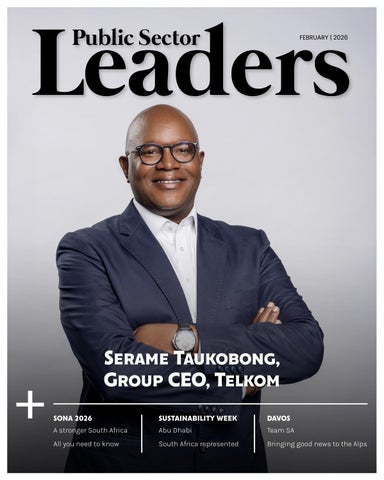
Serame Taukobong, Group Chief Executive Officer, Telkom
26 | Women in Leadership
Thoko Didiza’s leadership in a time of rising focus on food security
28 | Trailblazer
Andy Mothibi: A new chapter for justice and accountability in South Africa
40 | Tech
Leading South Africa’s workforce into the AI and digital economy
42 | Agriculture
BRICS countries are diversifying exports: Where does South Africa stand?
58 | In Other News
SA is off EU high-risk list:
A milestone for financial credibility and trade potential
60 | Regional Focus
Western Cape’s water future: From crisis response to strategic resilience
52 | World Radio Day
Embracing AI without replacing the human voice that audiences cherish
56 | A matric milestone
South Africa records best-ever NSC results


62 | Sporting Action
The Big Five: ‘Snowboks’ in Milano Cortina, and the year in sport
66 | Financial Fitness
Are you managing to save?
68 | Legal Matters
Ten legal resolutions to protect your rights and peace of mind in 2026
72 | Health and Wellness
Corporate wellness in 2026: What you need to know
74 | Upcoming Events
February calendar


The GEPF’s investment portfolio has grown to R2.69 trillion; proof that every year of service contributes to a fund built on trust and responsibility. Your dedication has built this strength, and this strength now protects your future.
From years of service to years of dignity... For Life


For


PUBLIC SECTOR LEADERS
The Digimag For Leaders In The South African Public Sector Fully Accredited Member of ABC

Advertising Sales, Distribution and Subscriptions
Top Media & Communications (Pty) Ltd
Tel: 086 000 9590 info@topco.co.za | www.topco.co.za
CEO Ralf Fletcher
TOPCO STUDIO
Production Director
Van Fletcher van.fletcher@topco.co.za
Group Editor
Fiona Wakelin fiona.wakelin@topco.co.za
Deputy Editor
Koketso Mamabolo koketso.mamabolo@topco.co.za
Assistant Editor
Shumirai Chimombe shumirai.chimombe@topco.co.za
Contributors
Jessie Taylor
Wandile Sihlobo
Thulani Dube
Paula Quinsee
Design
Tashwell Brown
Traffic Manager Daniël Bouwer artwork@topco.co.za
SALES
National Project Manager
Emlyn Dunn Tel: 072 1263962 emlyn.dunn@topco.co.za
Brand Coordinators
Sidney Phiri sidney.phiri@topco.co.za
Printers
LAW Print
Images iStock / Unsplash / GCIS | Flickr
Digital Publishing Platforms Issuu Magzter Media Carrier
Head Office
Top Media & Communications (Pty) Ltd T/A Topco Media Elkay House, 186 Loop St Cape Town
Tel: +27 86 000 9590
Fax: +27 21 423 7576
Email: info@topco.co.za
Website: www.topco.co.za (ScanQRcodebelowtoviewwebsite) 60

DISCLAIMER
All rights reserved. No part of this publication may be reproduced, stored in a retrieval system or transmitted, in any form or by any means, electronic, mechanical, photocopying, recording or otherwise, without the prior written consent of Top Media & Communications (Pty) Ltd T/A Topco Media. Reg. No. 2011/105655/07. While every care has been taken when compiling this publication, the publishers, editor and contributors accept no responsibility for any consequences arising from any errors or emissions.


BY FIONA WAKELIN

What a powerhouse edition we have for you this month!
In his letter penned to the nation on 9 February His Excellency, President Cyril Ramaphosa, focused on the stellar work being done by the South African Revenue Service (SARS).
“In many ways SARS is a standard-bearer for a capable state. It has been a trailblazer in the use of technology to construct a citizen-friendly ecosystem, making it easier for taxpayers to meet their obligations. It is little wonder that SARS is regarded as one of the best tax authorities in the world. The South African Revenue Service also stands as a credible blueprint for rebuilding institutional capacity in the wake of the state capture era,” – H.E. Ramaphosa.
On our front cover we celebrate Serame Taukobong who joined Telkom in 2018 as CEO of its consumer business. Under his leadership, Telkom’s mobile business increased by over 300%. He was then appointed Telkom Group CEO in June 2022 - and repositioned a legacy SOC-style organisation into a competitive tech business. Telkom is a big deal. It is a major South African information and communications technology (ICT) provider, offering integrated services - including mobile, high-speed fibre, data, and voice solutions to consumers and businesses. The government, represented by the Department of Communications and Digital Technologies, owns 40.51% of Telkom; when combined with the Public Investment Corporation’s shares which amount to 10.25%, the state’s overall ownership amounts to over 50.76%. It is also a big deal because it is a profitable stateowned company.

February is the month of our State of the Nation Address and the article subtitled A stronger South Africa in a changing world brings you the salient points reflecting economic stabilisation and renewed growth the country is enjoying. South Africa has recorded four consecutive quarters of GDP growth, achieved two primary budget surpluses and seen inflation fall to its lowest level in two decades. The rand has strengthened, borrowing costs have declined, and investor confidence is improving.
This is followed by a bird’s eye view into the important themes and discussions which happened both at Davos and Abu Dhabi Sustainability Week.
Our Women in leadership slot is filled by the Speaker of the National Assembly Thoko Didiza and the Trailblazer is new National Director of Public Prosecutions, Andy Mothibi.
We have a really important balance of the natural environment and technology in the articles looking at our vital wetlands (February is Wetlands Month) and all things AI.
Radio continues to be the major purveyor of information on the continent and as February 13 marks World Radio Day, we take a look at how this medium is able to embrace AI “without replacing the human voice that audiences cherish”.
In Other News, we are off the EU high-risk countries list and our Sporting Action regular brings you a fascinating piece on “The Big Five ‘Snowboks’ in Milano Cortina as well as an exciting glimpse into what 2026 holds for you in the world of sport.
From myself and the amazing team, we hope you enjoy the read.

BY FIONA WAKELIN

In his letter penned to the nation on 9 February His Excellency, President Cyril Ramaphosa focused on the stellar work being done by the South African Revenue Service (SARS). In the first week of February, President Ramaphosa visited the SARS National Command Centre in Tshwane to commend and congratulate its staff and leadership on their outstanding work.
His Excellency noted that, in the last financial year, SARS achieved the highest revenue collection in the tax authority’s history, collecting R2.3-trillion – which translates into the provision of basic services, social grants being paid, and public infrastructure being maintained.
“In many ways SARS is a standard-bearer for a capable state. It has been a trailblazer in the use of technology to construct a citizen-friendly ecosystem, making it easier for taxpayers to meet their obligations. It is little wonder that SARS is regarded as one of the best tax authorities in the world. The South African Revenue Service also stands as a credible blueprint for rebuilding institutional capacity in the wake of the state capture era.

“In 2018, I appointed a commission of inquiry into SARS headed by Judge Robert Nugent. When the commission began with its work, SARS was crippled by political
interference, leadership purges were commonplace, and specialist enforcement capacity had been substantially dismantled. Morale at the tax authority was at an all-time low and revenue collection had been significantly weakened. Levels of compliance were steadily declining, with both corporate income tax and personal tax collections down.
“Seven years since the Nugent Commission issued its recommendations, nearly all those recommendations have been implemented. Among the key recommendations were restoring capable independent leadership and governance, restoring compliance and enforcement capabilities, modernising systems, and improving efficiency and services to taxpayers, “ – H.E. Ramaphosa.
President Ramaphosa then lauded the important role SARS played in South Africa’s exit from the Financial Action Task Force (FAFT) grey list and in the sovereign credit ratings upgrade from S&P last year, noting that certainty in tax policy and honesty and efficiency in tax administration is a key consideration for investors looking to bring their business to South Africa.
“As we continue in our efforts to build an ethical, capable state and prevent a recurrence of that dark period in our nation’s history, we will look to SARS as an example of what can be done when institutional integrity is restored. Just as state capture took place over a prolonged period of time, the work of rebuilding will not happen overnight. Recommendations have been and will continue to be acted upon. Laws and processes have changed. Investigations have been undertaken and prosecutions have been initiated. Most importantly, institutions have been rebuilt.
“The turnaround of SARS has shown what is possible with a clear mission, committed leadership and capable people,” – President Ramaphosa.

Serame Taukobong , Group CEO and Executive Director, Telkom

Every country must make difficult choices over several years to strengthen its foundations for a better future.
Living in a time of global uncertainty, those choices require exceptional execution discipline for reforms to deliver real outcomes. The stakes are high but the rewards are massive, as we at Telkom discovered. Like South Africa, Telkom was at a turning point three years ago that required renewed strengthening of the foundations that underpin service delivery and economic uplift.

At the time, like South Africa, Telkom faced its own structural reality. Therefore we embarked on a data-led strategy, acting as a united team that we called, the OneTelkom concept. We remade ourselves to become the backbone for South Africa’s digital future, knowing that our country needs to be digital and data-intensive to win the future. This meant structuring our business around the reality that economic activity, public service delivery, industrial growth, and citizen empowerment require the movement, processing, and security of data.
We had to make trade-offs and take risks. For example, moving away from legacy copper infrastructure toward fibre and concentrating investment in expanding our mobile capacity. This led to the strengthening of a digital backbone capable of enabling a future in which data is ubiquitous.
The success of those decisions is evident in Telkom’s numbers. Group data revenue grew by 9.6% in the third quarter to R6 864 million, accounting for 60% of total year-to-date revenue. Mobile data revenue increased by 12.9%, supported by mobile data subscribers rising 29.3% to 19.3 million. Mobile data traffic expanded by 20.4%. Fibre-related data revenue grew by 8.9%. Openserve’s connectivity rate remains robust at 52.4%, with connected homes reaching 786,490 and homes passed exceeding 1.5 million. Mobile subscribers now exceed 25 million. Prepaid subscribers grew to 22.2 million, reflecting inclusive participation across economic segments. Fibre monetisation continues to strengthen Openserve’s revenue profile, with overall revenue up 2.2% in the quarter. This reflects a structural migration of our business toward digital
demand. It also illustrates Telkom’s alignment of national digital adoption with institutional capability. Telkom, the backbone underpinning South Africa’s digital economy is strengthening our country in tandem with broader reform.
Digital infrastructure now sits alongside electricity and logistics as a foundational enabler of national growth. Energy powers production. Logistics moves goods. In the modern economy, digital underpins our national capability.
Fuel pumps need connectivity. Financial transactions are cleared over data networks. Public service platforms process citizen data in real time. Mining operations depend on data analytics and connected systems. Healthcare systems rely on digital records and communication platforms. Schools and universities require reliable broadband for modern curricula. Small businesses depend on e-commerce and digital payments. Data is the bloodstream of every sector.
However, it is the depth and scale of this interconnectedness that is often overlooked. Telkom’s network does not simply support isolated services. Instead, it underpins critical national operations every day. From government platforms running on SITA-linked infrastructure to retail payment systems and distributed industrial networks, the digital backbone is woven into the operational fabric of the state and the economy. Its resilience is therefore not a matter of commercial considerations alone, but one of national continuity, capability, and confidence.
When that network performs reliably, it is almost invisible. When it fails, the consequences ripple instantly across industries and public services. This makes a reliable and operational digital backbone a matter of strategic national security.
As fibre penetration deepens and mobile data adoption expands across income segments and geographies, enterprises begin to plan differently. They automate supply chains and digitalise procurement systems. They expand into new markets through online platforms. Similarly, the public sector relies on digitalisation to modernise workflows and deliver services to citizens who were previously unable to
access them due to remote geographic locations. Taken together, these shifts demonstrate that Telkom’s turnaround is delivering sustained structural results. The national reform journey and Telkom’s turnaround are not separate stories. The country needs a dataintensive backbone that is resilient, modern, and financially sustainable. Furthermore, it must remain aligned with national priorities and capable of supporting public sector modernisation, industrial growth, and inclusive digital participation.For Telkom, it also means maintaining network quality even in constrained environments. We must also ensure that the digital backbone remains robust enough to support the country’s next phase of development.
We recognise that long-term resilience is inseparable from national development priorities. Safeguarding and strengthening that backbone is therefore a shared imperative between Telkom and the state.
If this moment represents a genuine turning point for South Africa, then the institutions that carry daily economic activity must be resilient by design. Digital infrastructure is inseparable from national competitiveness and public sector capability.
Everyone in the country uses the digital backbone. Its integrity and continuity are therefore matters of national interest. Telkom’s data-led strategy is built around that reality. During periods of national transition, infrastructure must be strengthened and safeguarded. In a data-driven economy, that responsibility extends beyond physical assets to the digital systems that coordinate public services, enable industry, and connect citizens to opportunity.
The digital backbone is not simply an enabler of growth but is integral to the country’s institutional capacity. Its resilience shapes investor confidence, service delivery, economic inclusion, and national sovereignty. Telkom’s turnaround has positioned us to carry that responsibility with discipline and intent. As the country consolidates its reform trajectory, the durability of our digital backbone will help determine how confidently South Africa moves into its next phase of development.
BY LUNGA SIYO

By Lunga Siyo, CEO for Consumer and Small Business
Back in the 1990s, Telkom produced a heartwarming television ad that many people still remember. It featured an elderly man greeting his neighbour by shouting “Molo!” across a rural valley - until a Telkom team arrived in their bakkie to install landlines for the two friends. “Last year, Telkom gave millions of people a new way to say hello,” said the closing voiceover.
These were the days before cellphones, of course, and the country and Telkom now find themselves in a completely different place. From a peak of about 5.5 million landlines in 2000, South Africa now has less than 420,000, and they contribute just 1.8% of Telkom Consumer’s revenue.
But Telkom has transformed just as quickly as mobile technology has revolutionised communications worldwide. Today, 25,3 million mobile subscribers rely on us for mobile data and more than 786,000 households use Telkom fibre, with a connectivity rate of 52.4% of homes passed totalling 1,501,406.
More than 60% of our revenue now comes from data, and we are delivering quality earnings and growth from our unique position as the backbone of South
Africa’s digital future. This doesn’t mean the future will be smooth sailing, however. Telkom’s landline monopoly in the “Molo!” days is a distant memory and the telecoms landscape is more competitive and dynamic than ever.
Largest fibre network
While there are fewer copper cables in our lives, our networks and the traffic they carry are bigger than ever. Telkom has built the country’s largest open access fibre network, covering 180,000km, and every day it carries enough data to allow you to watch the 1990s “Molo!” ad (which you can find on YouTube) well over 1.5 billion times.
That ad will probably bring a smile to your face, and Telkom is still doing that with its customer service. We deliver fibre connections less than three days after they’re requested, on average, and maintain a network availability rate of over 99.9%. In doing so, we boost the economy, the fiscus and employment.
In mobile, the first half of the 2026 financial year saw 5G penetration surge by 13% to 1.7 million devices, underscoring the accelerating adoption of next-generation connectivity. The proportion of devices that support 4G is now
Landlines are responsible for a small percentage of Telkom Consumer’s gross revenue, but with 25,3 million and growing mobile subscribers, the Group’s future looks bright
at 94%, which puts us in a good position to make way for an alldata network supported by voice over LTE for voice calls.
Satellite and fibre pioneer
It might surprise you to learn that Telkom started investing in satellite and fibre technologies in the 1980s. Far from being a slouch, the company was a pioneer, and the result is that for many years we have supplied the backbone for fibre connections nationwide. Being an early adopter tends to lead to early obsolescence, though, and Telkom has had to deal with that. Our core network, which carries large volumes of data at high speed between
cities and regions, was built using technology that is now outdated. The same applied to our transport network, which connects different parts of a region or metropolitan area.
For several years, we’ve been moving customers to a futureproof technology known as a packet optical transport network, but the migration took time and we saw the result in our cash flows and profitability.
The same applied in our landline business, where the decline has been pronounced in the last three years. The good news is that there isn’t far to go, and the “legacy” technologies we must maintain in the national interest will be decommissioned over the next few years as demand dwindles and data-led alternatives continue to become more affordable.
In the meantime, we continue to manage the decline in our fixed line business in a way that mitigates risk, and we even have a good news story from the decommissioning of old infrastructure: thousands of tonnes of copper have been recovered from obsolete cables by residents of a rural Eastern Cape village. Some families rely on this labourintensive project as their sole source of income.
A brighter future
Telkom has had to tread a difficult path, growing market share in new areas of information and communications technology at the same time as managing the decline of its legacy business. Our consecutive financial results show that we have navigated that path with efficiency and purpose. Now, we are determined to keep delivering quality earnings and growth from our unique position as the backbone of South Africa’s
digital future. We will continue sharpening our competitiveness through the OneTelkom approach. And having stabilised the balance sheet and right-sized our workforce, at the same time as aggressively expanding our new-generation networks, we now have the space to act decisively on the final phase of shaping our structure for sustainable high performance.
As we plan the next step up to making the most of our strengths as a well-established infraco, we’re confident our customers will be greeting us with an enthusiastic “Molo!” for many years to come.


BY MPHO MCNAMEE
If South Africa succeeds, Telkom succeeds

MPHO MCNAMEE – GROUP CHIEF CORPORATE AFFAIRS
South Africa’s digital transition has rarely been smooth. Even today, online services and digital platforms are part of daily life for some communities, while in others, they remain unreliable or expensive, sometimes both. This uneven reality directly affects those who can benefit from the digital economy, particularly career opportunities.
Companies operating national infrastructure deal with this reality daily. This is where good corporate citizenship becomes a strategic consideration. Globally, ESG expectations increasingly examine how companies create value beyond their financial statements. In South Africa, the recent King V good corporate governance report sets clear behavioural expectations and requirements for value creation. Local companies must therefore embrace ways to help
shape social stability, institutional trust, and digital capability if the South African economy is to reflect the needs of a digital world. Telkom has been doing this since the dawn of democracy.
That linkage is also becoming more explicit in the national policy agenda. In SONA the President positions digital infrastructure as core economic infrastructure and as a prerequisite for modernising public services, strengthening data and data-centre capacity, widening affordable connectivity, and enabling secure digital participation. This is more than a technical detail because it speaks to competitiveness, inclusion, and the ability of the state and economy to operate at digital speed. For an operator of foundational networks, the measure of success will increasingly be how
reliably and affordably we enable these outcomes at scale and across regions.
For its part, Telkom operates significant components of South Africa’s digital backbone. Its networks connect enterprises, public institutions, and households across provinces. As more services shift online, the depth of digital capability becomes increasingly relevant to the health of the infrastructure itself. Infrastructure does not function in a vacuum. It is shaped by how people actually use it.
A digitally capable population participates more fully in the economy and uses infrastructure more intensively. Where capability remains uneven, growth patterns follow the same lines. In an economy already under strain,
widening capability gaps, especially in a digital context, further compound existing pressures. For a company entrusted with national connectivity, this is not an abstract policy debate. It affects network use, service adoption, enterprise digitalisation, and long-term revenue quality. The depth of digital participation influences how resilient demand becomes over time. For Telkom, good corporate citizenship recognises that infrastructure and capability must be developed together.
Education remains one of the most significant pressure points. Curricula assume learners can research online, collaborate digitally, and submit assignments electronically. However, access to and confidence in these digital tools vary widely. When connectivity fails, lesson plans change. Teachers must improvise, often daily.
In its most recent financial year, 39,809 learners accessed online academic support through the Telkom Foundation’s virtual platform. A further 3,694 learners received structured face-to-face academic assistance. The approach combines scale with proximity, recognising that reach and understanding are not always the same thing.
Infrastructure support adds another layer. During the same period, Telkom reached 1,627 beneficiaries through ICT resources and connectivity initiatives in high schools. Coding and robotics programmes trained 900 learners in low-income areas and rural schools, providing exposure to tools increasingly expected in tertiary study and entry-level work. Telkom Foundation’s model also recognises the realities outside the
classroom. During the past financial year, psychosocial services reached 1,007,382 people nationwide through structured interventions and support platforms. Academic performance is not removed from learners’ social and emotional conditions. Addressing one without acknowledging the other has little impact.
After school, another gap appears. Many young people complete high school without having structured exposure to digital work environments. Through accredited ICT learnerships in partnership with the MICT SETA, Telkom Foundation trained and certified 1,086 learners, with workplace experience integrated into programme design. Areas such as business analysis, systems development, and technical support reflect identifiable economic demand. While certification matters, knowing how digital tools work in practice is also important.
We must, of course, look beyond individual interventions. South Africa’s productivity increasingly depends on how widely digital capability spreads beyond the major metropolitan centres. Public administration, small business development, agriculture, logistics, and manufacturing are all shaped by technology-enabled systems. Expanding infrastructure while capability remains uneven deepens existing divides. This has consequences for growth, fiscal stability, social stability and long-term competitiveness.
Through its Centres of Excellence, Telkom supports postgraduate research in data science and related disciplines. Developing local technical depth strengthens resilience and reduces reliance on imported

capability in critical domains. Over time, that depth supports enterprise growth and innovation ecosystems that are locally anchored rather than externally dependent. Corporate citizenship, viewed through this lens, becomes part of responsible infrastructure stewardship. Infrastructure providers operate within an economy whose inclusivity and capability influence longterm sustainability. Strengthening social capability improves the conditions in which infrastructure investment performs and strengthens democracy.
South Africa’s development trajectory will influence the long-term viability of its infrastructure institutions. Digital capability cannot be left to the periphery. It shapes how deeply businesses adopt technology, how effectively public services modernise, and how widely new markets can scale. When digital fluency spreads, network usage deepens, enterprise services expand, and innovation becomes more investable.
For Telkom and the Telkom Foundation, operating at the centre of the country’s digital backbone brings visibility into both opportunity and constraint. Investment in connectivity only realises its full value when communities, schools, and small businesses gain the capabilities to use it productively. Ensuring that connectivity translates into participation strengthens longterm demand, stakeholder value, and institutional resilience.
In that sense, good corporate citizenship sits inside the long-term logic of infrastructure itself and our role in building the South Africa of tomorrow since the dawn of democracy.
BY JESSIE TAYLOR

A

President Cyril Ramaphosa’s 2026 State of the Nation
Address (SONA) was both reflective and forward-looking.
Framed by the 70th anniversary of the 1956 Women’s March, the 50th anniversary of the 1976 Soweto uprising and 30 years since the adoption of the Constitution, the address positioned South Africa at a pivotal moment: stronger than a year ago, yet facing urgent structural challenges that demand decisive action. The president noted that South Africa’s strength lies not only in its institutions and natural resources, but in its people and their capacity to work together in a rapidly changing global environment.
A central theme of the address was economic stabilisation and renewed growth. South Africa has recorded four consecutive quarters of GDP growth, achieved two primary budget surpluses and seen inflation fall to its lowest level in two decades. The rand has strengthened, borrowing costs have declined, and investor confidence is improving.
The president said that load shedding has ended, renewable energy investment is accelerating, and Eskom’s restructuring is under way, including the establishment of an independent transmission entity. By 2030, more than 40% of the electricity supply is expected to come from renewable sources.
In logistics, private rail operators have been granted network access, and new public–private partnerships are being introduced in ports and rail corridors. A partnership to manage Durban’s Pier 2 Container Terminal aims to restore it to world-class standards. The government has also committed over R1 trillion in public infrastructure investment over three years, the largest allocation of its kind in the country’s history.
These reforms are framed as essential to unlocking inclusive growth and job creation, one of the three strategic priorities of the Government of National Unity (GNU), alongside reducing poverty and building a capable, ethical state. Agriculture continues to perform strongly, with South Africa now the world’s secondlargest citrus exporter. However, a severe outbreak of
BY JESSIE TAYLOR

foot-and-mouth disease has prompted the classification of a national disaster and a decision to vaccinate the entire national cattle herd of 14 million animals. President Ramaphosa said that industrial policy is increasingly focused on future growth sectors. International pledges to the Just Energy Transition Investment Plan now total approximately R250 billion. Tax incentives for new energy vehicles and support for battery manufacturing aim to position South Africa as a key player in green manufacturing. Mining is described as a “sunrise industry”, with ore reserves valued at more than R40 trillion. New exploration funding and beneficiation initiatives are intended to expand value addition and exports.
Tackling organised crime and corruption
While economic indicators are improving, the president acknowledged persistent public concern about crime,
corruption and local government dysfunction. Organised crime was described as the most immediate threat to democracy and development. President Ramaphosa said that the government will consolidate intelligence at the national level, deploy multidisciplinary intervention teams and intensify efforts against gang violence, illegal mining and the illicit economy. The South African National Defence Force will support police operations in targeted areas of the Western Cape and Gauteng.
Reform of the criminal justice system will be accelerated, including strengthening the Special Investigating Unit, the National Prosecuting Authority, and the Hawks. In addition, a Whistleblower Protection Bill will be introduced to criminalise retaliation and support those who expose wrongdoing. New procurement regulations under the Public Procurement Act are expected by mid-2026 to address systemic corruption risks.

Water security and local government reform
Water has emerged as one of the most pressing service delivery challenges. President Ramaphosa acknowledged protests driven by unreliable access and years of inadequate planning and maintenance. The government has committed more than R156 billion over three years to water and sanitation infrastructure, including major projects such as the Lesotho Highlands Water Project and Ntabelanga Dam. A National Water Resource Infrastructure Agency is in its final stages of establishment.
To address immediate crises, a National Water Crisis Committee, chaired by the president, will coordinate interventions and deploy technical expertise to struggling municipalities. He added that criminal charges have already been laid against 56 municipalities for failing to meet obligations, and action will extend to municipal managers in their personal capacity where necessary. More broadly, a revised White Paper on Local
Source: SONA
Government will be finalised in the coming months, proposing a differentiated approach to municipal responsibilities, merit-based senior appointments and stronger national intervention powers. The overhaul seeks to address what the Auditor-General has described as weak accountability, poor financial management and instability in local governance.
Throughout the address, the president returned to a central message: South Africa has made measurable progress, but the work is far from complete. Economic reform, infrastructure investment, institutional rebuilding and social protection are converging to create what he described as a “unique window of opportunity”.
The 2026 SONA sets out an ambitious agenda rooted in inclusive growth, service delivery reform and ethical governance. Its success will depend not only on policy announcements but also on sustained implementation and collaboration across government, business, and communities.
BY SHUMIRAI CHIMOMBE

“Climate action is a driver and an enabler for economic growth”
President Cyril Ramaphosa was in the United Arab Emirates (UAE) recently at the invitation of His Highness Sheikh Mohammed bin Zayed Al Nahyan, President of the UAE, to attend the Abu Dhabi Sustainability Week (ASDW).
The ADSW, which took place from 11 to 15 January, brought together Heads of State and government decision-makers, business leaders, investors, innovators and civil society to exchange ideas and address the most pressing global sustainability challenges. The event paved the way to igniting new opportunities for collaboration in sustainable development initiatives across interconnected systems, including energy, finance,
food, water and nature. President Ramaphosa’s programme included participating in a high level session titled: Next Leap: Global South Infrastructure, which focused on exploring opportunities for investment in sustainable and scalable infrastructure across the Global South, particularly in power and water. On the margins of the ABSW he held a bilateral meeting with the UAE President regarding strengthening bilateral relations and cooperation, especially trade and investment, between the two countries.
His Excellency was accompanied by the Minister of International Relations and Cooperation, Mr Ronald Lamola; Minister in The Presidency, Ms Khumbudzo Ntshavheni; Minister of Trade, Industry and Competition,
Mr Parks Tau; and the Minister of Justice and Constitutional Development, Ms Mmamoloko Kubayi.
AN ENGAGING FIRESIDE CHAT ON SOUTH AFRICA AS A LEADER IN SUSTAINABILITY
As part of the Heads of State panel on 13 January, H.E. Ramaphosa had a fireside chat with Ms Razan Khalifa Al Mubarak, President of the International Union for Conservation of Nature (IUCN) and executive managing director of the Mohamed bin Zayed Species Conservation Fund. With the topic ‘A vision for Global Energy’ their conversation covered a number of topical issues, including South Africa’s energy transition strategy, fostering partnerships and attracting investment through smart financing, energy generation and green hydrogen,
Razan started off the discussion by indicating that as the G20 president, President Ramaphosa had championed the energy transition which is seen as an engine for opportunity, for hope, for economic development. She asked him to elaborate on the relationship between economic development and climate action.
He responded that quite often people see this as a trade offthat you either have to protect the planet or have economic growth. However the two have to be seen as mutually reinforcing, and in fact, countries that have embarked on climate action strategies have found that those interventions do finally yield economic growth.
“Therefore, one needs to see climate action as a driver and an enabler for economic growth. The more we embrace clean energy, the more new technologies come about. New opportunities open up and we find that there are new subsectors of the economy that are established, and where we might close certain subsectors new ones open.
“So the two go hand in hand. A dual approach focusing on both can actually drive the economy forward. That’s precisely what we have decided to do in South Africa.”
Razan highlighted that South Africa had advocated for a new model of international partnership that, in just one year, had succeeded in mobilising more than $1.5 billion in investment in renewable energy in Africa. She asked President Ramaphosa to expand on this approach. H.E Ramaphosa: “In
the face of having to take action on climate change we needed to lift our gaze beyond the horizon and ask ourselves, what do we do to address the damage to our climate and emissions? And by the way, one should start off by saying the African continent is least responsible for climate damage. And yet we are having to carry the burden of what other locales in the world have done for climate change. Notwithstanding that, we decided that we now need to put our best foot forward and find solutions. And the solution we came up with was to mobilise international funding.”
This move resulted in $1.5-billion being invested in South Africa. The President highlighted that the whole process was nationally designed and put forward to potential investors. This involved creating an innovative blended finance architecture as well as grants, and concessional funding. Consequently, South Africa has become a leader in this model of financing, with a number of countries in the Global South having followed suit.
The Northern Cape province, which has the best radiation area in the world according to His Excellency, attracted more than R110-billion in investments in renewable energy, thanks to this South Africandesigned model of enhancing cooperation with investors.
“So this in our view has led to a very good end, but more than that, it sets out very good examples for other countries to follow. So we’re really pleased.”
As a final question Razan asked His Excellency to explain how he envisioned the continent’s role
in shifting from being an energy importer to an energy and ideas powerhouse that integrates all of its assets including nature.
The President responded that Africa has great opportunity when it comes to energy generation.
“We’ve got one of the greatest endowments in the world - the sun, the wind, and our mighty rivers. So, a combination of all three, as well as our minerals, gives rise to great opportunities where we can generate energy. 600 million people on the African continent still lack access to electricity. And that in itself, rather than being a challenge, we see it as an opportunity to utilise all these endowments. Instead of exporting rock, soil and stones, we should now beneficiate and add value to our minerals so that they are properly utilised in energy generation.” In terms of green hydrogen, President Ramaphosa indicated that Africa is the center of green hydrogen potential. By harnessing its vast solar and wind resources, the continent is positioned to become a leading exporter of energy. And this presents significant investment opportunities for generating energy for infrastructure development.
“Infrastructure development in Africa is going to explode by leaps and bounds. And on the back of energy generation, and on the back of good financing and clever financing models, we will be able as a continent to see higher levels of growth.”
His Excellency concluded with an invitation to financiers and investors to come and invest in the African continent.
“That is where the future is.”
BY KOKETSO MAMABOLO

Finance Minister Enoch Godongwana
Arecord number of the world’s politicians made the trip to Davos this year under the shadow of geopolitical shifts which could change the world as we know it. Amidst all this uncertainty, the value of safe and reliable partners has never been greater.
Team South Africa took good news with them to the Alps, on a mission to position the country as a regional leader in sub-Saharan Africa and go from “aid recipient" to “partner of choice” for multilateral institutions and private investors.
Alongside private sector partners, the South African delegation went to present the country as a “stable, rules-based economy ready for responsible
investment,” placing an emphasis on the importance of multilateralism and explaining how the government and private sector are working to address energy and logistics challenges.
“When we came here in 2025, we presented our ambitious plan for driving economic reforms, building investor confidence and mobilising private investment,” said Finance Minister Enoch Godongwana, who led a delegation of ministers from Dirco, dtic, small business development, and tourism. “We returned in 2026 with concrete evidence of our progress. We returned not with promises but with real successes.”
Things are looking up for SA Inc. The list of achievements Team South Africa was able to share with investors points to a ship that is finally going in the right direction. For starters, S&P gave the country its first sovereign credit rating upgrade in nearly two decades, the Financial Action Task Force removed South Africa from the greylist and the EU did the same on a list of high-risk third country jurisdictions.
The centre-piece of the good news is the impact of Operation Vulindlela, now in its second phase. The first phase involved 35 reforms in five areas: electricity, logistics, telecommunications, water, and the visa system.
Over 90% of the reforms were either completed or on the way to completion by the time phase two began last year, with half a trillion rands worth of investment estimated to have been unlocked through the reforms.
The result has been significant milestones such as recording over 300 consecutive days with no loadshedding and 4 400 MW of additional generating capacity at the start of the year. Data costs are down 51%, the visa application backlog of 306 000 has been cleared through digital reforms, 220 GW worth of private sector renewable energy projects are in development, and eleven train operating companies have been selected to add 20 million tonnes of freight capacity to the rail network.
Phase II of Operation Vulindlela continues on the trajectory of the first phase with a greater focus on service delivery at the local government level, spatial inequality, and digital public infrastructure.
The objective is growth and while the impact of the reforms has yet to be reflected in GDP growth figures, government officials and private sector leaders continue to stress the need for patience and further reforms to attract further investment.
Operation Vulindlela describes the growth path the country will experience over the next five years as “green and digital”.
Some of the key engagements which took place in Davos were on accelerating intra-African trade, how to use mineral resources in a sustainable way amidst the tech revolution, how South Africa and the EU can collaborate to use digital technologies and AI to drive growth, and a discussion on using sovereign wealth funds and direct foreign investment for infrastructure and energy transitions.
While the investment agenda included ‘bankable’ projects – such as the Gauteng-Durban high speed rail project, the expansion of the ports of Durban and Cape Town, and utility-scale solar farms – the engagements had by both the private and public sectors reflect a greater focus on expanding trade networks and questions of how to ensure that Africa does not get left behind specifically when it comes to digital transformation in age of AI.
Speaking on the sidelines at Davos the Group CEO of Telkom, Serame Taukobong, emphasised the importance of execution at scale for digital transformation to be a success. This requires aligning policy and infrastructure so as to increase connectivity which will drive the digital economy.
“At the core of digital transformation is digital inclusion. And that means everyone having access to the digital economy,” said Serame, stressing that the government cannot do it alone and that public-private partnerships are the route to inclusive growth at scale.
Operation Vulindlela is an example of those partnerships in action, bringing together technical expertise and experience from the private sector to solve public sector challenges. In the end, everyone benefits. By focusing on sectors which are key to digital transformation, namely energy, transportation and telecommunications, the country’s strategy will increase connectivity which will in turn improve growth.
“A strong Transnet, a strong Eskom, a strong Telkom, that is the foundation of really driving economic growth,” said Serame. All three seem to be on an upward trajectory. The signs are there, good things are starting to happen on the tip of Africa.
BY JESSE TAYLOR

Food insecurity has surged to the forefront of South Africa’s socio-economic challenges. Fueled by climate variability, global price shocks, energy constraints and supply chain disruptions, food affordability and access are now central public policy issues, demanding sustained political leadership and strategic policy responses.
Against this background, the Speaker of the National Assembly and former Minister for Agriculture, Land Reform and Rural Development, Thoko Didiza, stands out as a critical voice on the intersections of agriculture, rural development and national food security. Her recent engagements - from championing agricultural investment to shaping legislative priorities - signal a purposeful shift toward responsive governance amid growing concern about food security.
In late 2025, the African Agri Investment Indaba, a major convening of policymakers, investors and agricultural innovators, underscored South Africa’s ambition to broaden food system resilience. Ms Didiza, in her capacity as Speaker of the National Assembly, delivered a keynote address on the importance of investment in food security and climate-smart agriculture, elevating the conversation beyond political rhetoric and toward tangible economic collaboration.
As Speaker, she is no longer at the helm of the agriculture ministry, but her visibility in agricultural discourse reflects a broader leadership role in shaping
national priorities. Her leadership extends beyond agriculture forums into formal legislative reporting and regional engagements. At the Southern African Development Community Parliamentary Forum (SADC-PF) plenary session, she highlighted South Africa’s progress across various public policy fronts, including initiatives to tackle food insecurity. By anchoring food security alongside issues such as artificial intelligence policy and gender-based violence, Ms Didiza raised that hunger is intimately tied to legislative coherence and national capacity.
South Africa’s food system pressures are not abstract. Households are grappling with higher staple prices and constrained purchasing power, afflicting millions who spend a disproportionate share of their income on food. Food inflation remains a dominant concern for families and policymakers alike, a backdrop that heightens the urgency of Ms Didiza’s lobbying.
Ms Didiza’s engagement with food security is multidimensional. Her agricultural leadership legacy includes previous strategic interventions designed to strengthen production and market access. For instance, as Minister of Agriculture, Land Reform and Rural Development, she launched a blended finance scheme with the Land Bank, aimed at improving access to credit and resources for farmers, a measure directly linked to enhancing productivity and stabilising food supply. She backed initiatives such as the Agro Energy Fund, which provided targeted support to farmers grappling with energy costs that threaten productive capacity. These programmes foreground her understanding that food security must be anchored in rural economic viability and infrastructure resilience, not just in headline harvest statistics.
Ms Didiza’s relevance emerges amid broader political and economic transitions. South Africa’s government is navigating coalition complexities, budgetary pressures and public discontent over service delivery. In this environment, seasoned leadership, characterised by continuity and problem-solving, offers a stabilising counterpoint to volatility.
Her evolution from ministerial posts to her current role as Speaker suggests a recalibration of influence, leveraging parliamentary authority to shape national discourse and build cross-sector consensus.
South Africa’s political leadership still reflects gendered disparities, particularly in portfolios traditionally perceived as “technical” or “economic.” Yet Ms Didiza’s trajectory - from early roles in agriculture to high office - challenges reductive notions of women’s leadership as peripheral or symbolic. Her hands-on engagement in agricultural investment, rural development, and food security positions her not just as a representative but as an architect of policy responses that matter to citizens.
Ms Didiza is one of South Africa’s most experienced political leaders, currently serving as Speaker of the National Assembly, a position she assumed on 14 June 2024. She entered public life through anti-apartheid activism and community organising. Her parliamentary career began in 1994, when she was elected to the first post-apartheid National Assembly. She quickly ascended, becoming Deputy Minister of Agriculture under President Nelson Mandela, the youngest person appointed to a deputy ministerial post at the time. Later, she served as Minister of Agriculture and Land Affairs and subsequently as Minister of Public Works. In the sixth administration (2019–2024), Ms Didiza led the merged portfolio of Agriculture, Land Reform and Rural Development, overseeing critical initiatives to support farmers and expand rural economies.
She holds multiple academic qualifications, including a Bachelor of Arts and Honours degree and a Master’s in tertiary education management. Her broader career blends governance, grassroots activism and international engagement. She has also served as Chairperson of various parliamentary committees and participated in continental leadership initiatives, reinforcing her reputation as a strategic thinker in public leadership. This is significant in a context where women, often the primary stewards of household nutrition and food management in rural and urban communities, bear disproportionate burdens when food systems falter. Ms Didiza’s leadership, therefore, intersects with both macroeconomic stability and the everyday realities of food access for families across South Africa.
Ms Didiza’s role - as a speaker, policymaker and advocate - offers insights into how leadership can navigate these intersecting challenges. Her contributions underscore the importance of coherence among legislative priorities, investment frameworks, and social outcomes.
BY JESSIE TAYLOR

dvocate Jan Lekgoa “Andy” Mothibi’s appointment as National Director of Public Prosecutions (NDPP) marks a pivotal moment for South Africa’s criminal justice system. Effective 1 February 2026, Mothibi takes the helm of the National Prosecuting Authority (NPA), the constitutional institution charged with prosecuting crime and upholding the rule of law. His appointment by President Cyril Ramaphosa, after a rigorous but unusual selection process, reflects both confidence in his capabilities and the urgency of restoring public trust in prosecutorial leadership.
Adv. Mothibi’s career trajectory is a testament to resilience, integrity and deep experience in public service. He began his legal journey as a public
prosecutor and magistrate in the Johannesburg and Soweto courts, roles that grounded him in the realities of the justice system. Over more than two decades, Adv. Mothibi’s professional footprint expanded across both public and private sectors. He served in corporate legal, governance and risk leadership positions at the South African Revenue Service (SARS) and in the financial sector before being appointed Head of the Special Investigating Unit (SIU) in 2016. At the SIU, he led efforts to investigate and combat maladministration, corruption and irregularities in state institutions and the private sector - work that helped recover substantial public funds and reinforced ethical governance. Parliament’s justice watchdog welcomed Mothibi’s
appointment as both timely and critical, emphasising that his leadership comes “at a vital juncture for restoring public confidence in the criminal justice system”. The committee noted the constitutional importance of the NDPP’s role in ensuring prosecutions are pursued without fear, favour or prejudice. While the advisory panel on which the formal appointment process was based concluded that none of the publicly interviewed candidates were suitable, President Ramaphosa exercised his constitutional prerogative to appoint Adv. Mothibi, given his breadth of experience and proven leadership. This decision, while welcomed by many, has also sparked debate over appointment transparency and the processes by which heads of critical justice institutions are selected.
Adv. Mothibi succeeds Advocate Shamila Batohi, who has led the NPA since 2019. Adv. Batohi’s tenure was marked by dedicated service through challenging times, including prosecutorial pressures and internal institutional reform. Her retirement at the end of January 2026 closes an important chapter in the authority’s history.
The role of the NDPP is fundamentally about trust and accountability. The NPA sits at the intersection of law enforcement, constitutional governance and public confidence. The stability, credibility and direction provided by the NDPP are vital for upholding the rule of law and ensuring justice is served decisively and equitably. Adv. Mothibi’s experience at the SIU, where investigations into maladministration and corruption were central, positions him uniquely to lead the NPA’s prosecutorial mandate with a sharpened focus on accountability.
The Public Servants Association (PSA) expressed strong confidence that he will bring “integrity, decisiveness and stability” to the NPA, particularly as the authority faces ongoing pressure to implement high-profile commission findings and pursue complex criminal cases.
He steps into the NDPP role at a time when the NPA’s mandate extends from everyday crime to matters of national consequence, including corruption cases that involve significant public resources and public servants. While debates about the selection process highlight
the need for transparency and robust governance in appointments to critical offices, there is broad recognition that the NDPP must embody independence, integrity and competence - qualities that Mothibi’s career reflects.
Adv, Mothibi’s leadership offers an opportunity to fortify prosecutorial institutions and renew public faith in the justice system. His tenure will be measured by how well the NPA navigates prosecutorial complexities, builds stronger partnerships with law enforcement, and demonstrates that the rule of law is not just a constitutional promise but a lived reality for all South Africans.
The National Prosecuting Authority (NPA) is South Africa’s central institution responsible for prosecuting criminal cases on behalf of the State. Established under the Constitution, the NPA ensures that justice is pursued impartially, consistently, and in accordance with the law. Its work spans the full spectrum of criminality, from everyday offences to complex cases of corruption, organised crime, and matters of national significance. At the helm of the NPA is the National Director of Public Prosecutions (NDPP), a position entrenched in the Constitution to safeguard independence and impartiality. The NDPP oversees the operational and strategic functioning of the NPA, ensuring that prosecutorial decisions are made without fear, favour or prejudice.
The NPA is structured into specialised units to address particular types of crime. These include the Priority Crimes Litigation Unit, which investigates high-profile criminal cases; the Specialised Commercial Crime Unit, focused on fraud, corruption, and corporate wrongdoing; and the Sexual Offences and Community Affairs Unit, which addresses crimes against vulnerable groups. Additionally, the Specialised Investigating Unit (SIU) works alongside the NPA to uncover maladministration and corruption in state institutions, enhancing accountability and governance. Beyond prosecution, the NPA plays a critical advisory role to law enforcement and government, offering guidance on the application of criminal law and the legal viability of cases.
BY SHUMIRAI CHIMOMBE

Celebrating the irreplaceable value of indigenous knowledge in conserving vital African ecosystems
INDIGENOUS STEWARDSHIP OF WETLANDS IS ESSENTIAL TO THE FUTURE OF THESE LIFE-SUSTAINING ECOSYSTEMS
Indigenous peoples have coexisted with wetlands for thousands of years, developing rich traditional ecological knowledge that reflects a connection with the land and water.
This holistic knowledge encompasses scientific insight and ethical and spiritual values; often, wetlands under stewardship of indigenous peoples are in better health.
Although indigenous peoples make up only about 6% of the world’s population, they are critical contributors to safeguarding our planet’s remaining biodiversity.
The degradation of wetlands in some regions impacts human rights to a healthy environment, especially for indigenous peoples and local communities whose cultural identities, traditional knowledge systems and livelihoods are intricately tied to these ecosystems.
Respecting and integrating Indigenous stewardship and knowledge systems in wetland conservation is just and essential for effective, inclusive and lasting solutions.
Source: World Wetlands Day official website
World Wetlands Day is celebrated each year on 2 February to raise awareness and understanding about the critical importance of wetlands. These vital ecosystems contribute to biodiversity, climate mitigation and adaptation, freshwater availability, world economies, and human survival.
This day also marks the anniversary of the Convention on Wetlands which was adopted as an international treaty on 2 February 1971 in the Iranian city of Ramsar. The Convention provides the framework for the conservation and wise use of wetlands and their resources. South Africa is one of the 172 Contracting Parties to the Ramsar Convention on Wetlands of International Importance.
This year’s theme is “Wetlands and traditional knowledge: Celebrating cultural heritage” and it celebrates the profound and time-honoured connection between wetlands and indigenous communities.
In her message to mark World Wetlands Day 2026, Dr. Musonda Mumba, Secretary General of the Ramsar Convention on Wetlands said that the theme spotlights the timeless role of traditional knowledge in sustaining wetlands ecosystems and preserving cultural identity.
“Culturally-rooted practices have helped maintain wetlands ecological balance and resilience for generations. From ecological monitoring of signs of flora and fauna, to rotational harvesting, to taboos that protect certain species, areas and spaces. As we celebrate World Wetlands Day 2026, let us recognise that living knowledge systems are vital to shaping resilient wetlands and thriving communities today and for generations to come.”
Dr Mohammed Ali Qurban, CEO of the National Center of Wildlife (NCW), Saudi Arabia said that this occasion underscores that
protecting wetlands is not solely dependent on modern scientific solutions, but also relies on inherited human knowledge that has over successive generations contributed to the management of these environments and the conservation of their resources.
“Throughout history, wetlands have served as sources of water and food, spaces for cultural interaction, and a repository for local knowledge that has helped achieve a balance between the use of these resources and their protection. Accordingly, the degradation of these ecosystems threatens not only biodiversity, but also human wellbeing and the traditional knowledge systems associated with them.”
Prof. Celeste Saulo, SecretaryGeneral, World Meteorological Organization said that this year’s theme reminds us that protecting wetlands does not only depend on scientific and technological
BY SHUMIRAI CHIMOMBE
Culturally-rooted practices have helped maintain wetlands ecological balance and resilience for generations.
solutions. For generations, Indigenous Peoples and local communities have safeguarded wetlands through knowledge systems rooted in observation, stewardship, and deep respect for nature.
“At the World Meteorological Organisation, we recognise the importance of combining the best of science with the wisdom of traditional knowledge. As we work toward the 2030 Agenda, we must ensure that conservation efforts are inclusive, respectful, and grounded in local realities. Let us celebrate and learn from traditional knowledge, and work together to protect wetlands for generations to come.”
According to a study published on ResearchGate, the importance of indigenous and local knowledge systems for science, policy, environmental conservation and the cultural heritage of indigenous peoples is increasingly being recognised globally. The paper explains that many traditional and indigenous knowledge systems around the world are closely linked with ideals of stewardship of nature expressed for example, in the idea
that natural sites can be sacred and thus deserve to be respected and protected on that basis. When traditional or indigenous knowledge is lost, ecological degradation often ensues, as ethical principles and sustainable resource use might be replaced with short-term economic benefits of natural resource exploitation.
In a Zimbabwean study published in 2025 researchers found that wetlands provide key resources for rural livelihoods and economies throughout the world. For the majority of communal farmers in Africa, wetlands support diverse livelihoods such as gardening, crop farming, livestock grazing and fruit production. Given the holistic, socio-cultural and environmental embedded nature of indigenous knowledge systems, it is worthy embracing local community environmental practices in fostering sustainable wetland management in an era marked by climate change.
“Indigenous Knowledge embraces technical, institutional and religious spheres of wisdom. Reincarnation and restoration of these forms of wisdom seems to be sound ammunition for sustaining wetlands in a climate change epoch.”
The value of indigenous knowledge also came into the spotlight at the 15th Meeting of the Conference of the Contracting Parties to the Ramsar Convention on Wetlands (COP15) which took place in Zimbabwe in July last year. At the conference, the Resolution on promoting incorporation of new technology and traditional
knowledge in wetland conservation, restoration, management, and wise use was formally adopted as one of the 20 COP15 resolutions for protection and restoration.
In its introduction, the Resolution stated that: “Scientific knowledge and indigenous and local knowledge are integral parts of knowledge systems. Modern science-based technology and traditional knowledge are inseparable in long-term human development and both vital to build a harmonious relationship with nature. The draft resolution is to call on incorporation and integration of frontier technology and traditional knowledge in wetland conservation, restoration, management, and wise and sustainable use.”
Indigenous wetland management practices in Sekhukhune District, Limpopo, South Africa
A University of Venda study titled ‘Perspectives on Wetlands’ Cultural Ecosystem Services and Indigenous Wetland Management Practices in the Limpopo Province, South Africa’, was undertaken in 2023 to determine indigenous wetland management practices in Makhuduthamaga Local Municipality.
The study was conducted at seven villages which each had a wetland associated with it. The key findings of the study were that wetlands provide cultural ecosystem services such as religious, spiritual, recreational, and educational services; wetlands are the most respected ecosystems where the

gods, ancestors, and water spirits reside, the place of worship and performance of rituals; wetlands are holy with supernatural powers for healing and to drive away evil spirits, bad luck, and witchcraft.
The study also found that traditional leaders are the key stakeholders in the management of wetlands in villages and they set taboos and protocols for the sustainable use of wetlands. It was also revealed that nonadherence to taboos and protocols pronounced by traditional authorities’ leads to the anger of the gods, ancestors, and water spirits, resulting in calamities to society.
In conclusion, the study showed that there is a positive relationship between community and wetland cultural ecosystem services and
between indigenous knowledge and wetland management practices. There should be continuous community awareness and capacitybuilding for traditional authorities on wetland management.
Kasibo Wetland, Hwange, Zimbabwe
Kasibo Wetland, one of the country’s flagship wetlands, has a rich history dating back to 1965 when a hunting community first settled there, drawn by its abundance of game, wild fruits, and the magnificent, perennial spring. Revered as a sacred shrine, the community developed traditional taboos - from specific methods of water collection to prohibitions against cutting trees or cultivating upstream - all designed to protect this vital resource.
As the population grew, the community, led by traditional leaders, took proactive steps to preserve the
wetland. The core source almost dried out due to human activity. However, through a communitydriven project supported by the Government, the Environmental Management Agency (EMA), the Agricultural and Rural Development Advisory Services (Ardas), the Hwange Rural District Council, and development partners, the wetland has become a vital source of sustenance and income for 40 households It has blossomed into a model of sustainable living, supporting diverse wildlife (including reedbucks, otters, and various fish species) and enriching the lives of villagers through its spring, gardens, and beekeeping projects.
The EMA has been providing expert advice and introducing “modern taboos” like banning upstream cultivation and promoting contour ridges to prevent siltation.
BY SHUMIRAI CHIMOMBE
The Tana River Delta Ramsar Site is a wetland on the Tana River located in the Coast Province of Kenya. It is the second most important estuarine and deltaic ecosystem in East Africa, with diverse freshwater, floodplain, estuarine and coastal habitats featuring extensive and varied mangrove systems, pristine beaches and shallow marine areas.
The local community holds valuable knowledge for the conservation of this wetland. Their council of elders have over the centuries been responsible for the management of watering points, sacred sites and shrines. The council of elders have been recognised in the Tana River Delta Ramsar Site management plan and identified as key players in the management of these sites. By recognising and involving these local structures and indigenous knowledge, conflict over the use of watering points has been avoided and the local sacred sites and the shrines have been conserved.
The Sudd in South Sudan is one of Africa’s largest freshwater wetlands consisting of a network of papyrus swamps, floating vegetation, and seasonal floodplains. For generations, women of the Sudd have been the custodians of this wetland’s rhythms.
Thanks to their lived experience and ancestral knowledge, they know when the fish migrate, which reeds are ripe for weaving, and how to navigate the seasonal floods. Through sustainable harvesting of papyrus, medicinal plants, and fish,

they maintain the delicate balance between use and regeneration. The women have developed microeconomies with activities such as basket weaving, fish smoking, beekeeping and herbal medicine, based on the resources they draw from the wetland. These activities
provide income, food security, and social cohesion especially in regions where formal employment is scarce. In addition to benefiting from the wetland, they also protect it. Their indigenous knowledge systems guide community decisions on when and where to harvest, how to

avoid overfishing, and how to restore degraded areas. In many villages, women lead local conservation committees, ensuring that wetland use aligns with seasonal cycles and ecological thresholds. As droughts
and floods intensify across the Nile Basin due to climate change, the Sudd’s wetlands are under threat. And it is the women who are leading adaptation efforts such as restoring degraded marshes and advocating for inclusive water governance. Their efforts are increasingly shaping national dialogues on wetland management, advocating for policies that recognise gendered knowledge and community rights.
BY SHUMIRAI CHIMOMBE

Wetlands International (WI) - the global not-for-profit organisation dedicated to the conservation and restoration of wetlands - defines wetlands as occurring where water meets land. They include mangroves, peatlands and marshes, rivers and lakes, deltas, floodplains and flooded forests, ricefields, and even coral reefs.
Although wetlands cover a small percentage of the earth’s surface, they are essential systems. Also known as ‘biodiversity hotspots’,
they are aptly described by WI as the arteries and veins of the landscape. Abundant in nature, wetlands play a significantly vital role in contributing to human well-being by providing nutrition, water supply and purification, climate and flood regulation, coastal protection, feeding and nesting sites. They also support economies by providing resources for agriculture and fisheries, as well as opportunities for ecotourism.
Yet, the Ramsar Convention on Wetlands states that study after study demonstrates that
wetland area and quality continue to decline in most regions of the world. Consequently, the ecosystem services that wetlands provide to people are increasingly compromised.
The report titled Convention on Wetlands Global Wetland Outlook 2025: Valuing, conserving, restoring and financing wetlands indicates that “the scale of wetland loss and degradation remains a global concern. Wetland decline affects people’s livelihoods and wellbeing, disrupts the climate system, reduces the availability of

water resources, increases local communities’ susceptibility to natural disasters, and causes the loss of species and ecosystems.”
The Convention is an intergovernmental treaty that provides the framework for the conservation and wise use of wetlands and their resources. It was signed and adopted on 2 February 1971, in the Iranian city of Ramsar. Almost 90% of UN member states have agreed to become “Contracting Parties”. Contracting Parties commit to work towards the wise use of all the wetlands
and water resources in their territory, through national plans, policies and legislation, management actions and public education. Currently there are 172 contracting parties.
HOW DO WETLANDS HELP TO MITIGATE CLIMATE CHANGE?
Although wetlands cover approximately 6% of the Earth’s land surface, they have enormous carbon capturing abilities - also known as having a high carbon sequestration rate. This enables them to capture 50 times more carbon than rain forests, according to the World Wildlife Fund (WWF). This plays an indispensable role in keeping the heattrapping gas that contributes to climate change out of the atmosphere.
Wetlands maintain their high carbon content by pulling leaves, animal waste, and other high carbon matter down from the surface of the water, burying and locking them in the water and sediment.
Peatlands are wetlands that are highly instrumental in climate regulation. The Ramsar Convention indicates that after oceanic deposits, peatlands are the world’s most important carbon sinks, containing 30% of all global soil carbon. In South Africa, peatlands are not common, estimated to cover only 1% of the country’s total wetland area making it essential to protect them.
The rapid rise in extreme weather events such as fires, storms, droughts and floods is evidence of the increasing impact of climate change. Ramsar reports that over 90% of natural disasters are caused by floods, droughts, storm surges and other waterrelated hazards. Healthy wetlands form a very efficient buffer against these events, acting as natural sponges
They are essential to rich biodiversity, playing animportant role in the lives of humans
that store water during floods and preserve surface water during droughts.
The organisation Good Governance Africa reports that globally, wetlands are depleting three times faster than forests.
This is due to various factors such as the impact of climate change as well as population increase and urbanisation, drainage and infilling for agricultural and construction, mining, and the spread of invasive alien vegetation.
The impact of climate change on wetlands includes the loss of the carbon stored in the sediment into the atmosphere. Damage to peatlands has been identified as a significant source of greenhouse gas emissions responsible for climate change. Changing weather patterns and the rise in temperatures increase the risk of more frequent floods and droughts which can lead to changes to the wetlands hydrology. These impacts will have adverse effects on biodiversity and ecosystems.
Wetlands that are degraded and vulnerable are less resilient to climate change.
According to the Convention, the wise use of wetlands is “the maintenance of their ecological character, achieved through the implementation of ecosystem approaches, within the context of sustainable development. Wise use can thus be seen as the
conservation and sustainable use of wetlands and all the services they provide, for the benefit of people and nature.”
Upon joining the Convention, each contracting party is required to designate at least one wetland site within their territory to be included in the List of Wetlands of International Importance (the “Ramsar List”). These “Ramsar Sites” are recognised as being of significant value not only for the country or the countries where they are located, but for humanity as a whole.
There are currently 2 520 Ramsar Sites around the world covering a total of 253 084 219 hectares, and parties continue to designate wetlands for inclusion in the List.
WETLANDS OF INTERNATIONAL IMPORTANCE IN SOUTH AFRICA
In South Africa, there are 31 Ramsar sites covering 584 921 ha. Mkambati Nature Reserve in the Eastern Cape province was designated as the 31st Wetland of International Importance in 2025.

BY THULANI DUBE

South Africa stands at a pivotal moment in its economic and social journey. The convergence of digital technologies, artificial intelligence, and shifting global value chains is redefining what it means to be competitive, productive, and employable. For leaders, particularly those entrusted with innovation, strategy, and people development, the question is no longer whether to invest in digital and AI skills, but how to do so in a way that empowers employees, strengthens institutions, and responds meaningfully to the country’s unique structural challenges. In a context marked by high unemployment, deep inequality and uneven access to quality education, digital and AI capability building is not simply an organisational priority but a national imperative. Investing in digital skills without investing in how people think, learn, and adapt will widen inequality rather than close it.
In an ever evolving digital economy, evidence is mounting that organisations with strong digital and AI capabilities outperform their peers by a wide margin, not only in productivity but in resilience and long term value creation. The real differentiator however is not technology itself. It is people. Tools do not transform organisations but rather empowered employees do. In South Africa, where human capital is abundant but underutilised, the opportunity lies in equipping workers at all levels with the digital fluency and AI confidence required to participate meaningfully in the modern
economy. This goes far beyond creating more software engineers or data scientists. It is about ensuring that a factory supervisor, for instance, can interpret data dashboards, that a call centre agent can work alongside AI systems, that a municipal official can use digital tools to improve service delivery and that a school leaver freely accesses the digital economy.
One of the most persistent myths surrounding AI is that it is primarily a job destroying force. In reality, AI is a task transforming technology and should be viewed as a tool that adds value. It automates routine and predictable activities while increasing the value of human judgment, creativity, empathy, and contextual understanding. The danger for South Africa is not that AI will replace workers totally, but that organisations will fail to prepare their people to work effectively with it, thereby deepening exclusion. Empowerment, therefore, begins with AI literacy as a core workforce capability. This does not mean turning everyone into a machine learning expert, but ensuring that employees understand what AI can and cannot do, how it affects their roles, and how to use it responsibly, ethically and productively. Leading organisations are embedding this literacy into everyday work rather than treating it as optional training. For example, financial services firms in South Africa are increasingly reskilling customer service staff
into AI assisted advisors, where intelligent systems handle routine queries and humans focus on more complex problem solving and relationship building activities. This approach preserves jobs while improving service quality and ultimately employee satisfaction. Similarly, in the retail and logistics sectors, workers are being trained to interpret AI driven demand forecasts and inventory insights, enabling faster decisions and reducing waste. These examples demonstrate a critical principle that inclusive adoption is a leadership choice, not a technological inevitability.
Empowering employees also requires moving away from one size-fits all learning models. South Africa’s workforce is diverse in age, educational background, language, and digital exposure. Effective digital and AI upskilling must therefore be modular, practical, and deeply contextual. Micro-credentials, on-thejob learning, and problem based projects linked to real business challenges are far more effective than abstract courses. Partnerships with universities, TVET colleges, and innovation hubs can play a vital role in co-developing curricula that reflects local realities This not only builds relevant skills but also creates local innovation ecosystems and grassroots employment opportunities.
When executives and senior managers visibly invest in their own digital and AI capability, it sends a powerful signal that learning is not remedial but strategic. Crucially, leadership behaviour sets the tone. In many organisations, resistance to AI stems less from fear of the technology and more from fear of obsolescence. Leaders who frame AI as a tool for augmentation rather than replacement, and who create safe spaces for experimentation, are far more likely to unlock innovation in its staff as well as the amplified capacity of individuals to make better decisions, act faster, and solve more complex problems with the support of intelligent tools.
Monitoring and evaluation also matters. Traditional success metrics focused narrowly on efficiency and short term return on investment are insufficient in a country grappling with unemployment and social instability. Forward looking leaders are broadening their scorecards to include indicators such as the number of employees reskilled, internal mobility achieved, youth and women trained in digital roles, and partnerships formed with educational institutions. These metrics
align organisational success with national development priorities and reinforce the idea that competitiveness and inclusion are not opposing goals but mutually reinforcing ones.
Equally important is the narrative leaders choose to tell. Technology narratives are never neutral, they shape behaviour, culture, and adoption. In South Africa, a country deeply rooted in the philosophy of ubuntu, there is an opportunity to frame AI as a shared resource that enhances collective capability rather than an elite tool that benefits only a few. When employees see digital and AI skills as pathways to agency, relevance, and dignity, rather than as threats, engagement shifts from compliance to aspiration. This narrative is especially powerful for younger workers navigating an uncertain labour market and for experienced employees who fear being left behind.
Ultimately, empowering employees with digital and AI skills is about preparing organisations, and the country as a whole, for an economy defined by constant change. It requires leaders to rethink work design, invest patiently in people, and collaborate across sectors. For South Africa, the stakes are particularly high. Done well, digital and AI empowerment can help unlock productivity, stimulate innovation, and absorb talent into meaningful work. Done poorly, it risks reinforcing existing divides. The choice rests with leadership. By placing people at the centre of technological transformation, South African leaders can ensure that the future of work is not only more advanced, but more inclusive, more human, and more hopeful.


BY WANDILE SIHLOBO

Among the original BRICS countries, most members, particularly India, China, and Brazil, are signing various free trade agreements. Their actions are key to setting themselves well in the changing global environment, where each country must work hard to diversify its export markets.
As the recent issue of The Economist magazine points out:
“India has closed three trade agreements since the middle of last year: with Britain, New Zealand and Oman.”
Moreover, India may soon announce a Free Trade Agreement with the European Union. They have already agreed to significantly reduce tariffs on cars from the EU, a sign that a deal may be announced in the coming days. We also hear that India may soon start trade talks with Canada.
As India is this busy, Brazil has also been seeing some success. As part of Mercosur, along with Argentina, Bolivia, Paraguay, and Uruguay, Brazil is now part of the EUMercosur trade agreement, which will offer its farmers access to the EU market. These farm products will likely pose new competition for South African exports to the EU.
China has also not been standing still; it is in trade talks with Canada, and many more countries are engaging China to gain market access for their products.
Clearly, the BRICS members are busy with trade talks, all with countries outside the BRICS grouping. South Africa should embark on the same path, focusing more intently on expanding exports to greater Asia and the Middle East.
Equally, we must also seek to elevate trade matters with the BRICS grouping, aiming to secure a BRICS trade agreement. Such
a closer economic tie within this group would help improve its longevity.
Currently, the focus on BRICS is mainly on high-level political and geopolitical matters, which are important but not sufficient. Ultimately, the citizens of each BRICS member will ask, “What are the economic benefits of this grouping?”
If trade matters are not elevated, it becomes difficult to answer such important questions about the economic benefits of this grouping, and even more difficult to consider its longevity, when the people of the grouping feel there is limited benefit in being part of it.
Significantly, South Africa has long been reflecting on its export diversification strategy and has elevated the discussion following the announcement of the Liberation Day tariffs in the U.S. In the past few months, South African political

leaders have visited several Asian and Middle Eastern countries, all of which are key to long-term market access for South African products.
But what we have not done well is the technical work to ensure that political visibility translates into business activity. It is not sufficient to register our interests; we need to ensure that there is follow-up work by the technical teams at the Department of Trade, Industry and Cooperation (dtic), and the Department of International Relations and Cooperation (DIRCO), that works with business on the key matters that lead to solidifying trade deals or agreements. This also means that South Africa’s dtic and DIRCO must have sufficient, well-equipped staff to ensure that such follow-ups are conducted and lead to tangible outcomes beyond the political visits.
Also worth noting is that South Africa also needs to seriously untangle itself from the Southern African Customs Union (SACU). This grouping comprises Botswana, Eswatini, Lesotho, Namibia and South Africa.
As a customs union, South Africa’s trade agreements must be pursued alongside this grouping. But over time, it seems there is no shared urgency among the other SACU members to open export markets. This leads to distraction and slows down South Africa.
Therefore, if South Africa is to be as effective as India, Brazil and China in opening up new export markets, we must untangle ourselves from SACU and ensure there is sufficient, welltrained staff to drive trade matters seriously beyond the political visits to the various countries.
Other BRICS members are moving and are securing their place in the changing world; South Africa must not be left behind.
Wandile Sihlobo is the chief economist of the Agricultural Business Chamber of South Africa. He is also a senior research fellow in the Department of Agricultural Economics at Stellenbosch University.


BY JESSIE TAYLOR

Why 2026 could be a defining year for artificial intelligence
As 2026 unfolds, artificial intelligence (AI) is stepping beyond its earlier phase of demos and pilot projects into something far more embedded in daily life, business and public service. The next year promises to be a pivotal one, where AI evolves from reactive tools into proactive partners that help people, organisations, and governments work more efficiently and creatively.
This shift is supported by major industry players - from Google and Microsoft to Apple, OpenAI and Amazon - each pushing the boundaries of how AI assistants and agents interact with users and systems.
One of the clearest signals of this evolution is the growing role of AI agents, systems that not only respond to prompts but act semiautonomously to complete multistep goals under human oversight. AI agents will transform how organisations work by enabling employees to delegate tasks and focus on higher-level strategy rather than routine execution. These agents can coordinate workflows, automate decision steps and provide personalised support across different business functions.
For everyday users, conversational and personal AI assistants are set for substantial upgrades. Siri, Apple’s long-standing voice assistant, is being reimagined as an AI chatbot powered in part by Google’s Gemini models, enabling more natural, contextually aware interactions across iPhones and Macs.
Google itself is redefining its AI assistant strategy by transitioning the Google Assistant to Geminipowered in 2026. This change means Android users will enjoy more advanced natural language understanding, enabling the assistant to handle more complex queries and tasks with greater fluency. Gemini also received a “Personal Intelligence” upgrade,

which securely uses data such as Gmail, Photos, and Search history to provide highly personalised, contextualised assistance while keeping privacy front of mind.
Meanwhile, Amazon’s voice assistant platform is evolving with Alexa+. This AI-powered version introduces more conversational and interactive features, making interactions feel more like chatting with an intuitive partner than issuing commands. Early rollouts indicate a shift toward richer dialogues and improved comprehension.
OpenAI’s ChatGPT continues to be one of the most widely used AI platforms, moving beyond simple chat responses toward embedded roles in productivity systems and business applications. New features under development, including contextual memory and potential monetisation streams such as in-system advertising, aim to deepen engagement and make ChatGPT-like capabilities available in more diverse settings.
Another notable entrant in the AI assistant ecosystem is Grok from xAI. Recent updates include a voice agent API that expands Grok’s reach into real-time conversational applications, customer service tools, and accessibility use cases.
Beyond assistants and enterprise trends, AI’s broader impact will become more visible in society. For instance, generative AI models will continue to enrich creative industries, producing content, video and interactive experiences that were previously labour-intensive. At the same time, authentic content and human aesthetic judgment will become a differentiator as audiences seek genuine quality in a sea of automated outputs.
Microsoft’s “What’s next in AI: 7 trends to watch in 2026” highlights how AI is set to amplify human achievement through collaboration. Rather than replacing people, AI will help teams tackle larger and more complex challenges by automating data management, content generation and personalised insights. Security, healthcare and research are expected to benefit particularly from this trend.
In business contexts, AI adoption is increasingly moving from experimentation to productionlevel deployment. Organisations are embedding AI tools directly into workflows, whether for marketing personalisation, data analytics, customer support automation or strategic decision support, rather than treating AI as a separate
adjunct. This trend signals a maturation in which AI is no longer an add-on but a core part of digital transformation strategies in both the public and private sectors.
The integration of AI into daily life and work also raises important considerations around trust, governance and transparency. As multimodal interaction (text, voice, image and video) becomes standard, organisations and policymakers will need to establish clearer governance and provenance frameworks to ensure that AI systems are auditable, explainable and aligned with ethical norms. This year holds the potential for AI’s role to evolve from novelty to normalisation - tools that don’t just respond to requests but help orchestrate work, enhance decision-making and create personalised experiences tailored to individuals and organisations alike. Whether through smarter assistants like Siri, Gemini and Alexa, or through advanced agents embedded into cloud platforms such as Azure and Google Cloud, AI is becoming an integral part of how we live and work.
The journey towards AI that feels like a reliable colleague rather than a simple tool reflects an important shift in expectations and capabilities. By focusing on responsible adoption, clear governance, and skills development, organisations can harness the transformative potential of AI to enhance productivity, innovation, and public value.
BY KOKETSO MAMABOLO

How much electricity does ChatGPT use?
“For more than 200 years, economic growth was defined by industry capacity. Now for the first time in history, it is measured in computational power and digital capability,” said Dr Sultan Ahmed Al Jaber, the UAE’s Minister of Industry and Advanced Technology and chairman of state-owned renewable energy firm Masdar, speaking at the Abu Dhabi Sustainability Week earlier this month.
While the majority of businesses are still in the experimentation phase, in a global survey by Mckinsey on AI usage 88% of respondents reported that they use AI for at least one business function, up 10% from last year.
General AI use (20% in 2017) has been rising steadily and the same can be said for generative AI, which was at 37% in 2023 and 79% last year.
Unsurprisingly, the bigger the company’s revenue the higher the level of AI scaling.
The technology, media and telecommunications, and healthcare sectors report the highest use of AI agents while software engineering, manufacturing, and IT see the most cost benefits. In terms of revenue, sales, strategy and corporate finance, and product or service development have seen the most benefits.
By 2033, UN Trade and Development predicts that the AI market will reach $4.8-trillion, a staggering increase from the 2023 figure of $189-billion. Research from Microsoft’s AI Economy Institute shows that one in six people now use generative AI tools.
The global north is seeing adoption levels double those of the global south but in the second half of 2025 South Africa had the highest adoption figures on the continent with 21.1%, comparable to
developed regions such as the EU and North America.
Interestingly, in a survey of 3 000 South Africans, UCT found that 37% of respondents had never heard of AI, while 36% knew very little about it and it is reasonable to expect those numbers to change very soon.
“Artificial intelligence is rewiring every industry, reshaping every sector and resetting expectations for global growth. And while the world is changing around us, one constant remains and that is energy,” said Dr Al Jaber.
“Every algorithm, every data centre, every breakthrough and advanced technology needs power to drive it. Simply put, there is no artificial intelligence without actual energy.” Last year, oil giants Chevron and Exxon Mobil showed great interest in discussions about using natural gas and carbon capture to provide AI data centres with low-carbon energy.
Jeff Gustavson, president of Chevron New Energies, said: “It fits many of our capabilities - natural gas, construction, operations, and being able to provide customers with a low-carbon pathway on power through CCUS [carbon capture utilisation and storage], geothermal, and maybe other technologies.”
The backbone of the AI world are data centres which are facilities where data is stored and processed. These facilities use about 60% of the electricity needed for AI functions with consumption varying from centre to centre.
In 2024 it was estimated that data centres accounted for 1.5% of global electricity consumption, growing 12% per year over the last five years. According to the International Energy Agency (IEA), “the rise of AI is accelerating the deployment
of high performance accelerated servers, leading to greater power density in data centres.”
IEA estimates that the figure will double by 2030, with a growth rate four times faster than that of any other sector.
While current data centre electricity consumption in Africa is low (the US and China have the highest South Africa stands out with a consumption rate that is predicted to be 15 times larger than the continental average in the next five years.
Research suggests that on the global front renewable energy will meet almost half of the additional energy demand from data centres, followed by natural gas and coal, and the portion of nuclear energy set to increase.
Between 2024 and 2030, IEAs data shows a 22% average annual increase for renewable energy usage in data centres.
“This growth is primarily driven by the rising deployment of wind and solar PV in power systems across the globe, with some new capacity financed through PPAs with technology companies.”
The US, the dominant player in the AI space, meets most of its data centre energy demand using fossil fuels, mainly natural gas. Data centres in China,the next big player, are getting 70% of their electricity from coal.
By 2035, both countries are expected to have to gradually decrease reliance on fossil fuels and rely more on renewables and nuclear power.
The question remains whether or not the US will remain on this trajectory given the “energy abundance” strategy being touted, which involves doubling down on fossil fuels by leaning into them
BY KOKETSO MAMABOLO
more to power the AI revolution, especially given the fact that the country is home to 41% of the data centres in the world.
This revolution has been rapid, to say the least, and the industry is hungry for data centres to meet the growing demand for AI services. The amount of money being pumped into development is breathtaking. For example, leading firm Open AI and the US government are planning on spending $500-billion dollars on AI. Chinese firm DeepSeek’s hardware uses less than 10% of the energy OpenAI uses.
In a fascinating investigation on the nexus between AI and energy, MIT’s Technology Review said: “The energy resources required to power this artificial-intelligence revolution are staggering, and the world’s biggest fintech companies have made it a top priority to harness even more of that energy, aiming to reshape our energy grids in the process.”
In total, OpenAI, the US government, Apple and Google plan on spending over $1-trillion on AI infrastructure and development, the bulk of which will go to building data centres.
From the mid-2000s to the late 2010s, the electricity consumption by data centres did not see much of an increase due to improving efficiency. Even with the boom in industries relying on cloud-based services, usage remained relatively stable for over a decade.
Then in 2017 things started changing when technology that seemed a distant reality, and merely the stuff of science fiction, took big leaps. The age of AI had
begun. In the matter of six years the need for more data centres to match the developments meant energy consumption doubled.
It is widely believed that our AI footprint is as small as it will ever be. Somewhere along the line we reached the point of no return as AI technology leapt into the future, with ever-expanding use cases and increasing personalisation.
The servers in data centres are where the training data is fed into and computation happens. To train GPT-4, OpenAI spent $100-million and used 50 gigawatt hours of electricity which is enough to power to supply 110 000 average South African households for a month or 9 200 homes for an entire year (equivalent to the power needed for towns the size of Stellenbosch and Makhanda).
While training is cost and energy intensive, it’s the queries and the processing needed at the data centres to answer the queries where a significant amount of consumption is happening.
This is called inference and it accounts for 80% of AI’s computing power.
While not all data centres are being used for AI (industry figures are hard to come by) there is evidence that the number being built specifically for AI inference is growing.
At the data centres, AI models are loaded onto chips called graphics processing units (GPUs). No matter who manufactures them, which is an incredibly small number of firms, what all chips have in common is that need a lot of energy to run without overheating

A typical data centre could have thousands of these chips providing information to other chips called CPUs, and all of this requires cooling fans and large amounts of fresh water to keep operations to prevent overheating.

HOW MUCH? IT DEPENDS…
The question of how much energy a single query uses is difficult to answer. Firstly, there is very little incentive for AI firms to be transparent about the data. Experts remain in the dark on
what’s going on behind the scenes for models like OpenAI’s ChatGPT and Anthropic’s Claude. Secondly, electricity consumption varies from centre to centre - some have more GPUs than others. Thirdly, the number of parameters (adjustable
variables) the AI model has an impact on how much electricity is consumed. It’s not clear how many parameters new AI models have, but they range from as small as 3 billion parameters to as much as 600 billion parameters.
The best available info, via research conducted by MIT Technology Review, is sourced from open source AI models such as Meta’s Llama.
The result is that estimates are based on very little information, and while it may be possible to calculate how much energy leading chipmaker Nvidia’s H100 GPU uses, consumption from CPUs and other equipment like cooling fans need to be factored in too.
A paper by Microsoft demonstrated that doubling the amount of energy used by the GPU for large language models (ChatGPT, Claude, Gemini, Meta AI etc.) gives a good estimate of how much energy is required for the entire operation. But this is still just an estimate.
To explain their findings, MIT Technology Review used an example where a person asks an AI model 15 questions, makes 10 attempts to create an image, and 3 attempts to create a five second video. The energy used in the inferencing would be enough to run a microwave for over three and half hours.
Given the fact that last year OpenAI was receiving over two billion queries per day, this an alarming amount of energy. In order to function seamlessly, data centres need power 24/7.
Research from the Lawrence Berkeley National Laboratory shows that data centres in the US used 200 terawatt-hours of electricity in 2024, enough to supply Thailand electricity for a whole year.
“By 2028, the researchers estimate, the power going to AI-specific purposes will rise between 165 and
326 terawatt-hours per year. That’s more than all electricity currently used by US data centres for all purposes; it's enough to power 22% of US households each year,” says the MIT Technology Review.
In terms of emissions, that is equivalent to travelling 482.8 billion kilometres or taking 1 600 round trips from Earth to the Sun.
The importance of energy for the AI industry is not lost on the tech giants who have been bringing in talent from the energy sector at a noticeably high rate to ensure that they not only consume electricity but influence generation capacity.
Hiring of energy professionals by tech firms increased 34% yearon-year in 2024 and Amazon is leading the pack with 605 new hires over the last five years. Microsoft has recruited 570 more energy professionals in the same time period. This points to an energy “race” that is being directly driven by the enormous and everincreasing demand for AI services.
WHERE TO FROM HERE?
In a white paper published last year, the World Economic Forum outlined four areas stakeholders need to be focusing on when it comes to the impact of AI on energy consumption:
1. Deploying AI to optimise consumption and reduce waste
2. Establishing transparency and efficiency frameworks for electricity usage in the industry
3. Promoting innovation in data centre infrastructure
4. Driving collaboration between all stakeholders, from AI developers to electricity providers to governments
Hiring of energy professionals by tech firms increased 34% year-on-year in 2024 and Amazon is leading the pack with 605 new hires over the last five years.
According to the Data Center Map, there are 243 data centres in Africa.
The nexus between energy and AI is particularly important in South Africa given our struggles with electricity and the fact that the country is home to 60 data centres, the most on the continent by far.
And there are big plans for the digital infrastructure in Africa, from undersea cables to data centres, and even the continent’s first AI factory. Driven by Zimbabwean telecoms billionaire Strive Maswiya’s Cassava Technologies in partnership with Jensen Huang’s Nvidia (Huang is one of the richest people in the world), the factory will be built in South Africa with 3 000 of Nvidia’s GPUs, before the project expands into other African countries with a further 9 000 GPUs.
AI is expected to bring a spark to the African economy, time will tell if the continent can produce the electricity it needs, and if the world can produce all that energy sustainably.
BY SHUMIRAI CHIMOMBE

World Radio Day 2026
Embracing AI without replacing the human voice that audiences cherish
World Radio Day is celebrated annually on 13 February to recognise the work broadcasters do in informing, engaging and entertaining communities. It is celebrated on this day to mark the founding of United Nations Radio in 1946.
Proclaimed in 2011 by UNESCO member states and adopted by the UN General Assembly in 2012, this day has become a global occasion for public, commercial and community broadcasters to reflect on how radio has sustained its resilience and adaptability in a rapidly changing world.
At a time when AI is disrupting and redefining the way the world works, it is fitting that the theme for 2026 was ‘Radio and Artificial Intelligence: AI is a tool, not a voice’. In a statement, the South African
Government said that radio remains one of the most widely used and affordable forms of communication, especially in communities where access to digital platforms may be limited. Across South Africa, community, public, and commercial radio stations serve as vital platforms that connect citizens, amplify local voices, and ensure that information reaches people in all corners of the country.
“The theme for this year is ‘AI is a tool, not a voice’ which highlights the continued relevance of radio in an evolving media landscape. Even as technology advances and new digital platforms emerge, radio remains a resilient medium that adapts to change while maintaining its unique ability to reach diverse audiences in real time. It fosters social cohesion, supports local languages, and preserves cultural heritage through
storytelling and community engagement. Technology alone does not build trust. Radio broadcasters do.”
Khaled El-Enany, DirectorGeneral of UNESCO indicated that despite remaining one of the most trusted and accessible sources of information, radio is facing profound and accelerating change. Among the greatest challenges is the rise of AI.
“AI opens new horizons. Broadcasters are using it to produce content more efficiently, understand audience preferences, and reach new markets. Translation and transcription tools are helping to break down language barriers and amplify indigenous and minority languages, which are often underrepresented in mainstream media. If used ethically, AI can help radio do what it does best: connect people and build public trust.”
To help stations and listeners understand how AI can help radio flourish, UNESCO outlined several key areas where technology and broadcasting intersect.
Ease and flow: letting technology take care of the routine tasks, such as scheduling, voicetracking, daily weather or sports updates, administrative chores so the team can focus on what truly matters: inform, educate, entertain.
Meaningful growth: understanding your audience more deeply, connecting ads to listener needs, improving revenue.
Listener empowerment: helping every listener feel included, offering personalised experiences, real-time interaction, and space for under-represented voices that deserve to be heard.
Quality content: using AI to support fact-checking, source verification, rediscovery of archival richness and increased factuality, while keeping human judgment at the center.
For World Radio Day 2026, UNESCO generously provided 13 creative ideas and online resources to help radio stations build confidence in integrating AI as well as to use them as discussion points with their audiences. Some of them include:
• Transparency: Should we announce that we are using AI on-air voices? In the age of AI voice-generation, should listeners be warned when a voice on air is not real? This idea encourages us to think about disclosure policies, on-air mentions and descriptions, so as not to mislead the public.
• Increased accessibility: Radio for everyone AI has played a significant role in making radio more inclusive. Some of its impact includes generating live transcription for the hearing impaired and voice synthesis for the visually impaired, and providing automatic translation for audiences who do not speak nor understand the language of the broadcast. This idea celebrates AI's ability to open up the airwaves to all audiences, without excluding anyone.
• Algorithmic bias: When the machine imposes its stereotypes AI models learn from the data they are given. If the data is biased, the results will be too. If radio broadcasters do not exercise caution and discernment in using, it could reproduce and amplify stereotypes, including gender and racial stereotypes. This idea raises critical questions - does AI favour certain voices? Does it suppress certain tones or nuances? What strategies could be put in place to ensure that AI nourishes a wider range of perspectives on air? Therefore it is essential to maintain human editorial to guarantee diversity.
• Editorial suggestions - AI as Editor-in-Chief?
There are AI tools that can summarise long articles, generate angle ideas or prioritise topics based on current events. It can also become a strategic tool for reducing informational blind spots in places or contexts where reporting is impossible due to censorship, conflict or lack of access. But the angle, tone, narrative and reporting must remain human choices. This idea encourages this perspective - AI suggests, but never decides. The journalist remains the author. AI is a pencil, not a pen. AI is a tool, not a voice.
• Assisted journalism - Can AI really investigate?
AI can make it quicker to verify data, cross-check sources, warn of dubious information, and more. But it can also generate deepfakes and made-up stories. This idea questions the boundary between assistance and manipulation. It's not about rejecting the tool, but establishing safeguards.
• Memory and AI
Radio stations have thousands of hours of archives which are often underutilised because they are difficult to index, browse or restore. AI can add value and transform these historical archives into an active resource, using tools such as transcription, keyword searching, automatic summary and thematic upgrading. Some vanished voices could also be recreated, reintegrated, or protected. This idea raises the question of what we preserve, what we transmit, and the editorial mission linked to how we use augmented memory.

Honouring the human voice of radio
“The strength of radio is definitely that human element and the human connection that radio brings. The presenters and the personalities that are the voice of so many millions of people around the country. Those are the credible voices that our people in South Africa yearn to listen to every single day.”
- Lydia Mtshali, Manager: SABC Radio Marketing
“While technology continues to evolve, radio remains deeply human. It is rooted in voice, emotion, language and culture. AI will not replace radio. It can support and enhance broadcasting, making it faster, more efficient and more accessible. But trust, connection and storytelling will always come from people. We honour the strength of human connection, on air and beyond.” - Umhlobo Wenene FM, isiXhosa radio station
“Together, let us ensure that AI serves the public - and not the other way around. Let us ensure that radio continues to inform with integrity, connect with empathy, and speak with a human voice.”
- Khaled El-Enany, Director-General of UNESCO
Source: UNESCO | Redtech | South African Government | RELX SDG Resource Centre | Remitly | SABC |
BY JESSIE TAYLOR

South Africa’s 2025 National Senior Certificate (NSC) matric results have marked a historic high for the country’s education system, with learners achieving an overall national pass rate of 88 % — the highest ever recorded. This achievement, announced by Basic Education Minister Siviwe Gwarube on 12 January 2026, reflects a 0.7 percentagepoint increase from the previous year and demonstrates both resilience and growth in the nation’s schooling outcomes.
The 2025 cohort was the largest in history, with over 900 000 candidates writing the NSC examinations at roughly 6 000 centres nationwide. Of these, more than 656 000 learners passed their matric exams, significantly contributing to the strong national rate. This milestone is especially significant when viewed against the backdrop of continued efforts
to expand access to education, improve teaching quality, and support learners from diverse backgrounds.
PROGRESS, INCLUSION AND OPPORTUNITY
The achievement of the Class of 2025 goes beyond a single statistic. It tells a story of steady progress and collective effort from learners, teachers, parents and communities. From township classrooms to rural schools, South Africa’s young people have demonstrated remarkable commitment and perseverance in their final year of schooling. President Cyril Ramaphosa highlighted that these results reflect the value of strategic investments in education and the impact of sustained support structures across the system.
All nine provinces recorded pass rates above 80%, reinforcing that this achievement is national in scope and not confined to a few regions. The improvement in pass rates across provinces also signals stronger foundations in basic education, balanced with targeted interventions to reduce barriers to learning.
The breakdown of provincial results paints a compelling picture of regional strengths:
• KwaZulu-Natal emerged as the top-performing province with a 90.6 % pass rate, the highest in the country. This success reflects sustained efforts to support learners through targeted programmes and community engagement.
• Free State followed closely with 89.33%, maintaining a

consistent year-onyear performance.
• Gauteng, with its large and diverse cohort, achieved 89.06 %, reinforcing its role as a key contributor to national educational outcomes.
• North West recorded 88.49%, while the Western Cape achieved 88.2%, both surpassing the national average.
• The Northern Cape delivered a solid 87.79%, showing notable progress, while Mpumalanga (86.55%) and Limpopo (86.15%) also performed admirably above the 80% mark.
• The Eastern Cape, though the lowest of the provinces, still achieved a commendable 84.17 %, further illustrating the widespread improvement across the country.
This record-breaking pass rate does not exist in isolation. It follows a trend of improvement in South African matric results over recent years. In 2024, the country achieved a then -record pass rate of 87.3%, with all provinces above 84%. Even before that, national pass rates have steadily risen from earlier years, indicating long-term progress in learner achievement.
The 2025 matric results signal optimism for the future of South Africa’s youth. A sustained rise in pass rates opens the door to further education, training, and employment opportunities for tens of thousands of young people. These outcomes also highlight the importance of continued investment in education, equitable access to quality learning environments, and support services that help learners succeed.
Yet, while the national pass rate is cause for celebration, it also invites reflection. Educational experts note that participation in mathematics remains a challenge, with fewer learners taking the subject at the highest level, and that dropout rates before matric examinations can influence statistics. Ensuring that more learners persist through their entire schooling journey and are supported to excel in essential subjects will be critical to translating high pass rates into broader economic and social development.
South Africa’s 2025 matric results represent a proud moment in the nation’s educational journey. With an unprecedented 88 % pass rate and strong performances across all provinces, learners
have demonstrated resilience, determination and excellence. These results shine a light on what is possible when communities, schools and policymakers work in concert to support learners. As the country builds on this achievement, the focus will remain on sustaining this momentum and ensuring that every young person has the opportunity to fulfil their potential.
The scale of South Africa’s 2025 National Senior Certificate examinations highlights just how significant this year’s results were.
Just under 1 million candidates sat for the matric exams nationally, with approximately 927 000 fulltime candidates writing through the Department of Basic Education alone. When including independent examination bodies, the total number of candidates exceeded 1 million, making it the largest matric cohort in the country’s history.
Examinations were written at around 9 400 exam centres across South Africa, spanning public schools, independent schools, rural areas, townships and urban hubs. The Department of Basic Education accounted for nearly 7 000 of these centres, with the remainder managed by independent assessment bodies.
The exams ran over a five-week period covering more than 100 nationally set examination papers across all subjects.
Once written, millions of scripts were processed and marked at dozens of marking centres in every province. Provinces such as KwaZulu-Natal and the Western Cape alone operated more than 30 marking centres combined, supported by thousands of markers, senior markers and internal moderators working under tight deadlines.
BY JESSIE TAYLOR

South Africa’s formal removal from the European Union (EU)’s list of high-risk third country jurisdictions marks an important step forward for the nation’s financial reputation and international economic engagement. The decision, which takes effect on 29 January, recognises substantial progress in strengthening the country’s financial integrity framework, particularly in anti-money laundering and counterterrorism financing (AML/CFT) systems.
This follows South Africa’s earlier exit from the Financial Action Task Force (FATF) greylist, signalling growing confidence
in the structural and regulatory reforms implemented in recent years. The high-risk list is an EU regulatory tool used to identify jurisdictions considered to have strategic deficiencies in their financial crime prevention regimes. Jurisdictions on this list face enhanced scrutiny by EUbased financial institutions, which must carry out additional due diligence, monitor transactions closely, and often require higher levels of approval for cross-border payments. These requirements create time, cost and administrative burdens for businesses and financial
institutions engaging with listed countries.
South Africa was added to the EU high-risk list in August 2023, following its placement on the FATF greylist earlier that year. The FATF designation reflected concerns about gaps in regulatory oversight and weaknesses in the management of financial crime risks. Exiting both the FATF greylist in October and the EU’s highrisk list in January represents a comprehensive demonstration of reform progress and the country’s commitment to international standards.
The EU’s decision has positive implications for financial markets, trade, foreign direct investment and South Africa’s broader economic diplomacy. By aligning more closely with global AML/CFT standards, the country sends a strong signal to investors that its regulatory environment is becoming more transparent and predictable, enhancing credibility and potentially reducing the cost of capital for domestic firms seeking to engage with European partners.
For international banks and financial institutions, the removal reduces administrative friction and facilitates smoother crossborder transactions. Routine payments to South African entities can proceed more efficiently, benefiting sectors reliant on international trade, including manufacturing, agriculture, and financial services.
The timing of the EU decision, shortly after South Africa’s exit from the FATF greylist, reinforces the country’s multilateral achievements. Exiting the greylist reflected years of sustained effort by government, regulators, the private sector, and law enforcement agencies to strengthen AML/CFT systems. Reforms included improved supervisory mechanisms, enhanced access to beneficial ownership data, and stricter penalties for non-compliance. The EU’s move now formally acknowledges progress in practice, not just in principle.
Industry observers and economists note that, while enhanced scrutiny may persist at the discretion of individual institutions, the EU’s removal of the official designation is
a strong vote of confidence in South Africa’s financial reforms. It signals to international markets that the country is serious about compliance and capable of operating effectively within global financial systems.
Authorities emphasise that delisting is not an endpoint. South Africa is preparing for the next FATF mutual evaluation cycle, scheduled to conclude with a report in October 2027. This will assess the country’s ongoing adherence to AML/ CFT standards and highlight the need for continued investment in regulatory oversight, law enforcement capacity, and institutional integrity.
The National Treasury stresses that sustained vigilance is necessary to strengthen prevention, detection, investigation and prosecution of financial crimes. While the EU delisting simplifies certain procedures, it also serves as a reminder that financial integrity must remain a continuous priority.
South Africa’s removal from the EU high-risk list is a clear affirmation of progress in financial governance and institutional strengthening. It signals to investors, markets, and trading partners that the country is committed to meeting international regulatory standards. In an era where global confidence and competitiveness are critical for economic growth, this development strengthens South Africa’s narrative of reform, resilience, and opportunity.
By reducing barriers to trade, enhancing investor confidence, and confirming the credibility of its financial system, South Africa is better positioned to expand economic partnerships,
particularly with the European Union. This milestone reflects the combined effort of government, regulators, and the private sector to improve compliance and governance, laying the foundation for sustained economic growth and global integration.
THE EU’S LIST OF HIGH-RISK THIRD COUNTRY
The European Union’s list of highrisk third country jurisdictions is a regulatory tool used to protect the EU’s financial system against money laundering and terrorism financing risks. It identifies nonEU countries with strategic deficiencies in their anti-money laundering and counter-terrorist financing (AML/CFT) frameworks. Countries on the high-risk list are subject to enhanced due diligence by EU-based financial institutions and other regulated entities, such as banks, auditors, and investment firms. This includes closer scrutiny of transactions, verification of beneficial ownership, and additional monitoring requirements. These measures aim to reduce the risk of financial crime within the EU internal market.
As of June 2025, countries remaining on the high-risk list include Afghanistan, Algeria, Angola, Burkina Faso, Cameroon, Côte d’Ivoire, Haiti, Iran, Kenya, Laos, Lebanon, Mali, Monaco, Mozambique, Myanmar, Namibia, Nepal, North Korea, South Sudan, Syria, Tanzania, Trinidad and Tobago, Vanuatu, Venezuela, Vietnam, and Yemen.
Countries are removed from the list when they demonstrate improvements in regulatory oversight and enforcement. Recent examples of delisted countries include Barbados, Gibraltar, Jamaica, Panama, the Philippines, Senegal, Uganda, the United Arab Emirates, and South Africa.
REGIONAL FOCUS: WESTERN CAPE
BY JESSIE TAYLOR

crisis response to strategic resilience
Across the Western Cape, water has become far more than a utility. It is a critical pillar of economic performance, social equity, and long-term governance. The province’s recent launch of a comprehensive 10-Year Water Resilience Strategy (2025 - 2035) is a decisive shift from ad hoc crisis management to strategic planning, situating water security at the centre of public policy and economic development.
This strategy, unveiled by the Western Cape Provincial Government in late 2025, reflects lessons learned from the nearDay Zero drought of 2018 while anticipating future stressors such as climate variability, population growth, and economic expansion. The plan aims to uphold reliable, sustainable and equitable access to water for all communities, farms,
businesses and ecosystemsaligning directly with the province’s broader Growth for Jobs agenda to build a R1-trillion economy by 2035.
At its core, the water resilience strategy balances supply diversification, demand management, infrastructure investment, and institutional coordination. Key goals include securing an additional 310 million cubic metres of water annually through augmentation and efficiency, reducing non-revenue water losses to below 25 per cent, and ensuring that all municipalities develop diversified water sources and updated master plans. This strategy’s ambitions reflect a shift from short cycles of
drought panic and relief to longterm adaptive governance. It recognises that water is not simply an environmental resource but a foundational driver of economic resilience and social well-being. Effective water governance in the Western Cape requires concerted action across provincial departments, local municipalities, and national partners. It also requires closing the gap between planning and execution. Strengthening governance coordination is a central pillar of the resilience strategy, reflecting an understanding that fragmented efforts undermine outcomes and citizen trust.
The strategy’s emphasis on Blue Drop and Green Drop quality standards (metrics for drinking
water and wastewater services) underscores how water security intersects with public health, environmental sustainability and service delivery performance. Ministries responsible for infrastructure, local government, environmental affairs and economic development are now tasked with aligning their programmes with these standards, offering a more systematic approach to resilience.
For the Western Cape, water security is not merely about preventing crisis; it is an enabler of growth. Agriculture, a major employer and contributor to the provincial economy, depends on a reliable water supply for irrigation and livestock. At the same time, sectors such as tourism and manufacturing require consistent access to water to remain competitive. By prioritising resilience, the province is protecting these critical economic engines against the volatility of climate impacts and seasonal variability.
Despite forward-looking strategies, the Western Cape is confronting serious water shortages and early signs of drought. Dam levels across the province have dropped, driven by a combination of low rainfall, high water consumption and climatic trends that interrupt predictable replenishment cycles. Overall, provincial dam levels have fallen to around 58%, a steep decline from the 80% recorded at the same time last year. Cape Town’s key system dams now sit at about 66% capacity. These figures reflect some of the most rapid year-on-year decreases in recent memory and place pressure on urban, peri-urban and rural water supply systems alike.
In the Garden Route, municipalities are enforcing emergency restrictions as core reservoirs slump, including Knysna’s Akkerkloof Dam (now below 20%), which offers only weeks of water without significant augmentation. Emergency water tariffs and strict demand management measures
Effective water governance in the Western Cape requires concerted action across provincial departments, local municipalities, and national partners.
have been activated to limit consumption and preserve limited reserves. Towns such as George have implemented water tariffs and higher restriction tiers in response to falling dam levels.
The drought signals serve as a stark reminder that even as the province builds resilience, short-term water stress requires urgent action. Proactive conservation campaigns, infrastructure maintenance, and emergency planning must operate alongside long-term strategies to prevent disruptions to households, enterprises, and agricultural livelihoods, especially as climate trends make historical patterns less reliable.
In addition to drought conditions, the Western Cape has experienced a severe wildfire season over the last few months. This highlights the growing disaster risks associated with dry conditions and climate variability. In January, multiple wildfires burned across the Overstrand, Garden Route and Winelands regions, with active blazes around Pearly Beach, Stanford and Greyton. These fires stretched resources and prompted evacuation alerts for communities in the Overstrand Municipality as flames moved through dense vegetation and fynbos landscapes.
Provincial disaster briefings confirmed that the 2025/26 wildfire season is among the most intense in recent years. Government leaders reported that approximately 132 000 hectares of land have burned, making it the
worst fire season in more than a decade. Heightened fire activity was anticipated as part of the province’s fire season, which typically runs from November to April, when hot, dry, and windy conditions elevate wildfire risk. Earlier preparedness inspections indicated the government was ready for seasonal fire threats, yet the sheer number and scale of fires have underscored challenges in disaster response and public safety.
These wildfires have significant ecological and socio-economic impacts, threatening biodiversity, homes, and infrastructure, and highlighting the importance of integrated early warning systems, resource mobilisation and community preparedness during high fire danger periods.
BY KOKETSO MAMABOLO

The Big Five
‘Snowboks’ in Milano Cortina, and the year in sport
The ‘Snowboks’
This February the world will see South Africa’s big five in the snowy mountains of Italy. While lions on skis might be a funny thought, the five South Africans representing the country at the Winter Olympics in Milano Cortina have been dubbed “the big five” and are very much there on serious business.
From a teenage sensation to a tech entrepreneur turned winter athlete, the country’s largest ever team – all making their Olympic debuts – will be looking to make history by being the first South Africans to bring home a medal.
The first Africans to compete at the Winter Olympics was a team of four South African figure skaters in 1960. The last time SA had someone competing was at the 2018 Pyeongchang games.
Matt C Smith, who only began cross-country skiing in 2022, epitomises how uncharted this territory is for people representing a country which has little to no snow. Just about all the athletes are based abroad.
Matt built and sold a Nordic media-tech company and is also the author of the Startup Buzzword Dictionary. He grew up with dreams to be a Springbok
and fell in love with skiing after moving to Norway and joining a very supportive network of other athletes from non-winter sports countries. Now he’s somewhat of an ambassador and influencer, headlining a team of first Olympians and has dubbed himself the ‘Snowbok’.
German-born, 18-year old alpine skier Lara Markthaler has been skiing since she was a toddler and grew up traversing the mountains of Canada with her parents as she competed. Lara represented SA at the Youth Winter Olympic Games in 2024.
Nicole Burger has been described as South Africa’s skeleton pioneer. A former track & field athlete, equestrian rider and aspiring Springbok Sevens player, she is based in England and got into the sliding sport through the Royal Air Force’s sporting programme.
Malicia Malherbe is the country’s only athlete on the FIS Freestyle Ski World Cup circuit, competing in freestyle skiing, and the youngest member of the team is another alpine skier, teenager Thomas Weir. While medals may be a bit out of reach in events dominated by Europeans and North Americans, team SA’s ‘big five’ have made the country proud by going where few have gone before.
The price of metals has soared so much that the over 1 000 medals which will be given out at the Winter Olympics cost as much as 300% more than before.

ACTION
BY KOKETSO MAMABOLO

ICC Men’s T20 World Cup (7 February – 8 March)
Coming off the back of a thrilling edition of the SA20 tournament and a T20 series victory over the West Indies, Shukri Conrad’s Proteas squad will be hoping to emulate the success of the test side which became world champions last year. Eight of the fifteen members of the squad named for the T20 World Cup were part of that history-making side, including star bowler Kagiso Rabada and skipper Aiden Markham, which will give them the confidence and experience to perhaps do what the 2024 side failed when they went down to India in the heartbreaking final.
22 March)
Almost 100 000 spectators will enjoy a four-day experience combining golf with live entertainment when the LIV Golf tour hits local shores. March will see the likes of Bryson DeChambeau and Louis Oosthuizen competing at the impressive Steyn City course while fans are treated to live performances from musical acts such as Black Coffee and Calvin Harris. South Africa becomes the first African host on the tour which includes the US, Australia, Spain, and Saudi Arabia.
2026 FIFA Men’s World Cup - (11 June – 19 July)
While many consider the 2010 FIFA World Cup to be the best one in living memory, the hosts have not been on the scene since. Bafana Bafana, the one-time champions of Africa, brought their extended leave of absence to an end by qualifying for the 2026 edition of the global showpiece. Despite a disappointing exit from this year’s Afcon, Hugo Broos’ side will not rest on their laurels when they travel to the US in June, perhaps looking to match the feats of the Ghanaian side which came so close to making the semi-finals in 2010.
– 2 August)
This year’s Commonwealth Games will feature 10 sports, including 6 para sports, after rugby and hockey were removed from the programme. At the Birmingham Games in 2022, Team SA did not fare as well as they would have hoped, racking up 10 medals less than they did at the Gold Coast Games in 2018. It was in 2022 when Chad le Clos got his 18th Commonwealth medal and in 2018 when Tatjana Smith burst onto the scene. Once again, South Africa will look to its worldclass swimmers to rack up the medals along with what promises to be a strong track and field contingent, anchored by our up-and-coming sprinters.

Every sport has its great rivalries. Cricket has England and Australia in the Ashes. Football has Barcelona and Real Madrid in El Clasico. Tennis had the three-way rivalry between Nadal, Federer, and Djokovic. The Olympics had Bolt versus everyone. Rugby’s greatest rivalry is between the two teams who together have won 70% of all World Cups: South Africa and New Zealand. The rivalry between the Springboks and the All Blacks now has its own tour which will treat fans to a quadrennial matchup. The maiden tour kicks off in South Africa this August with the first of four matches against local franchises after which the All Blacks will meet the Springboks at Ellis Park for the first of four tests.
BY JESSIE TAYLOR

For many South Africans, managing personal finances is a daily challenge shaped by debt pressure, high living costs and weak income growth. But even in a challenging economic climate, there are reasons for optimism and practical steps individuals can take to build stronger financial habits and make saving a realistic goal.
Recent findings show that saving money remains difficult for a large proportion of South Africans. According to the 2025 1Life Generational Debt Survey, only about 41% of South Africans manage to save each month, while another 36% say they do not earn enough to save at all. This paints a picture of households squeezed between rising costs and limited disposable income, many of whom rely on debt to keep afloat.
Household debt levels add further context to this picture.
A DebtBusters Q2 2025 Debt Index revealed that the debt-to-annualincome ratio was at its highest levels since 2017, as consumers increasingly turn to credit to bridge the gap between stagnant incomes and rising living costs. Personal loans, payday loans and overdraft facilities have become common, reflecting how credit is used not just for investment but for everyday expenses.
More strikingly, surveys show that many households are spending well above advisable limits on debt repayments. DebtBusters’ Money Stress Tracker found that nearly 48% of households spend more than 40% of their disposable income on debt, a level considered unsustainable. In fact, 63% of households were found to be in the “danger zone” of debt stress, with some consumers using 7092% of their net income to service debt, depending on earnings and loan structures. These figures provide clear evidence of why saving has been out of reach
for many. When credit costs absorb such a large share of take-home pay, discretionary saving is constrained. However, these statistics also highlight the opportunity for targeted financial planning and gradual behaviour change.
Despite low overall savings rates, there are reasons for measured optimism heading into 2026. The South African Reserve Bank’s data shows that the household saving ratio - though negative in some quarters - is tracked systematically, offering a baseline from which policy and individual behaviour can improve.
On the macroeconomic front, recent budget projections and fiscal adjustments indicate stabilisation of debt levels and government commitment to fiscal sustainability. National Treasury forecasts show debtto-GDP stabilising and primary budget surpluses growing over the medium term, which can support lower interest rates and less pressure on credit costs.
These broader trends influence loan rates, inflation expectations and consumer confidence — all key factors in personal financial planning.
While the economic context remains challenging, such developments suggest that financing costs may moderate and that households could see incremental relief through policy effects and interest rate movements.
Financial literacy underpins all effective saving behaviour. Understanding compound
interest, debt costs, credit scores and basic investment principles empowers people to make informed choices about credit use and saving priorities. Long-term saving also benefits from diversified thinking. Even
HELP YOU BUY A HOME
Saving in the current economic climate requires realism, discipline and a clear strategy, but it is not beyond reach.
while debt is being reduced, individuals may consider low-risk savings products, retirement contributions or structured saving plans that balance access with growth potential.
South Africans face a challenging but not impossible journey towards improved financial fitness. Saving in the current economic climate requires realism, discipline and a clear strategy, but it is not beyond reach. While many households today allocate significant portions of income to debt, opportunities exist to recalibrate spending, prioritise savings and leverage more favourable economic conditions as they evolve.
With a more favourable lending environment expected in 2026 and relative stability in the rand, many South Africans are considering whether home ownership is finally within reach. For millions, however, the challenge is not affordability but access. An estimated 16 million South Africans remain excluded from the formal credit system due to limited or non-traditional credit histories.
To address this gap, lenders are increasingly turning to alternative data to assess creditworthiness more holistically. Beyond income and traditional credit scores, factors such as consistent cellphone payments, e-commerce activity and platform-based work histories are being used to build a fuller financial profile. According to BetterBond, this approach is particularly valuable for the self-employed and gig-economy workers who may lack payslips or long credit records.
Mobile phone data has emerged as one of the most useful indicators. Regular airtime and data purchases over a sustained period can demonstrate financial discipline and reliability, traits closely linked to loan repayment behaviour. When analysed alongside traditional credit data and with proper consent, this information can strengthen a bond application.
Behavioural indicators from platform work are also gaining traction. High Uber ratings for rides or food deliveries, for example, signal consistency, reliability and professionalism. While not a replacement for financial data, these metrics help lenders better understand how informal earners manage responsibility and income stability.
BY JESSIE TAYLOR

As people reset priorities at the start of a new year, legal wellbeing is often left off the list. Yet legal decisions, or the absence of them, have lasting consequences for finances, families and personal security. These 10 legal New Year’s resolutions offer practical guidance for those who want to protect their rights, reduce risk and approach the year ahead with confidence.
One of the most essential legal resolutions any individual can make is to ensure their will is up to date and valid. Changes in personal circumstances - such as marriage, divorce, children, property purchases or new financial responsibilities - can render an existing will outdated or ineffective. Updating a will also provides an opportunity to review executors, guardianship provisions and beneficiary nominations on retirement funds and insurance policies. Proper estate planning ensures that personal wishes are honoured and that loved ones are spared unnecessary legal and financial stress.
Legal challenges are often made worse when essential documents are missing. Ensure that identity documents, marriage certificates, antenuptial contracts, divorce orders, property deeds and important agreements are stored securely and are easy to access when needed. As more records move online, secure digital storage is becoming just as important as physical filing. Being organised reduces delays, lowers legal costs and brings peace of mind during emergencies.
From lease agreements and vehicle finance contracts to cellphone, insurance and service provider agreements, many individuals enter into long-term contracts and never revisit them. Laws, interest rates and personal circumstances change, and contracts that once made sense may no longer be appropriate. Reviewing agreements annually helps you identify unfair terms, avoid automatic renewals, renegotiate conditions and ensure compliance with consumer protection legislation.
Cybercrime, identity theft and data breaches carry serious legal and financial consequences. In 2026, digital safety is as much about protecting legal rights as it is about technology. Updating passwords, using two-factor authentication and limiting the sharing of personal information are basic steps. You should also understand your rights under data protection laws and know what action to take if their personal information is misused.
Courts remain essential, but they are not always the fastest or most cost-effective way to resolve disputes. Mediation and alternative dispute resolution processes are increasingly encouraged and can be particularly useful for family disputes, neighbourhood disagreements, contractual conflicts and small claims. Mediation often offers quicker resolution, lower costs and less emotional strain, while still producing fair and legally sound outcomes.
Legislative changes not only affect institutions but also shape the daily lives of ordinary people. Developments in property law, education legislation, environmental regulation and social rights all carry practical implications. Those who stay informed are better positioned to comply with legal requirements, exercise their rights and make informed personal and financial decisions.
Legal and financial planning should work together, not in isolation. Changes to income, assets, or debt should prompt a review of legal arrangements, such as wills, antenuptial contracts, or trust structures. Aligning these areas ensures that financial goals are supported by legally sound frameworks and that dependents are protected in the event of illness, disability or death.
Online legal platforms and digital tools have made basic legal information and documentation more accessible than ever. This can reduce costs and improve understanding. However, complex legal matters still require professional advice. Legal technology should be used to complement, not replace, qualified legal counsel, particularly where rights, assets or family relationships are at stake.
Cybercrime, identity theft and data breaches carry serious legal and financial consequences. In 2026, digital safety is as much about protecting legal rights as it is about technology. Updating passwords, using two-factor authentication and limiting the sharing of personal information are basic steps. You should also understand your rights under data protection laws and know what action to take if their personal information is misused.
Many legal problems escalate because individuals delay seeking advice, hoping issues will resolve themselves. Early legal guidance is often preventative, helping people understand their options before positions harden or deadlines pass. Treating legal advice as part of routine life planning, rather than crisis management, is one of the most effective ways individuals can protect themselves.
Legal wellbeing is not about anticipating conflict; it is about creating clarity, security and resilience. By taking deliberate steps at the start of the year, individuals position themselves to better manage change, protect their interests, and support those who depend on them. Legal preparedness is no longer a specialist concern. It is a practical life skill, one that empowers individuals to move through the year with confidence, stability, and peace of mind.

& WELLNESS
BY PAULA QUINSEE

Wellness has become a non-negotiable pillar when it comes to thriving employees and company cultures.
But for SMEs and entrepreneurs who are often running on lean teams and small (or non-existent) budgets, traditional wellness programmes (e.g. gym memberships, on-site therapists etc.) can be financially out of reach versus those businesses with larger budgets.
What is the biggest mental health issue facing corporate South Africa today and its cause?
In the latest State of the Heart report, the world is facing a human energy crisis at home and at work. People are tired, burnt out, and too often, not thriving. According to Gallup, seven in ten people report they are struggling or suffering. More than ever, people are lonely and isolated. Burnout and chronic stress are the two biggest mental health challenges we as humans are facing today.
65% of employees are disengaged in the workplace, often as a perception of overworking, however research on burnout shows that it is not overworking, rather the lack of meaningful connection that leads to disconnection. Disconnection from self (our purpose), disconnection from our support structures (relationships, families and friends) and disconnection in the workplace, indicating a lack of passion and investment in their work and organisation (not relating to the organisations purpose etc).
So what are the contributing factors?
There are several contributing factors, the mains ones being economic pressure (i.e. high costs of living), corporate restructuring (i.e. cost-cutting resulting in retrenchments), and a culture of “always-on” availability (long hours, never being able to completely
switch off or disconnect from devices). An underlying factor is that South African employees, particularly in middle and senior management roles, are expected to perform at high levels with limited resources (i.e. people, technology and efficient systems and processes). Constant restructuring and cost-cutting often leads to one person doing the work of two to three people, resulting in unmanageable workloads which is unsustainable in the long run.
When cost-cutting happens, or a ‘freeze’ is put on positions in organisations, key indicators to look out for are rises in absenteeism and extended leave due to burnout. Research shows it can take up to two years to recover from a serious bout of burnout.
Do managers have sufficient training to handle this issue effectively?
The majority of executives and managers are underequipped to handle mental health issues effectively as they are largely struggling to manage their own wellbeing in the process. They are often the “ham in the sandwich” getting pressure from above to drive productivity, output and deliverables and pushback from below as to workload, expectations and recognition (financial and non-financial).
Often what happens is managers are promoted based on their technical expertise and performance, not necessarily on their people management skills. As a result, when employees raise issues of burnout or challenges, managers often don’t know how to handle this, creating what is experienced as an unsupportive environment, resulting in alienating struggling employees, disengagement and employees leaving.
What measures should businesses ideally put in place to diagnose and manage mental health issues? Organisations should be proactive in their approach and put structures in place to help employees manage their wellbeing, even if on a shoe-string budget.
Some options organisations should consider are:
1. Manager training on managing mental health: Teach managers to spot early signs of burnout, anxiety, and depression, how to respond empathetically and what support structures they can give employees to tap into
2. Digital screening tools: There are many free tools, apps and online self-assessment tools that employees can access to help them manage their
wellbeing, and where possible with direct links to professional help (e.g. tele-counselling)
3. Onsite or virtual counselling: Make psychological or counselling services easily available through onsite counsellors or online platforms for employees to lean into
4. Normalise wellness conversations: Encourage leaders to openly talk about mental health and model the desired behaviour (e.g. taking annual leave, not emailing after hours etc). This helps to build psychological safety intentionally and remove the stigma associated with mental health issues
You don't need a massive budget to create a workplace that values wellbeing. Small, authentic actions often have the biggest impact.
Embedding wellness into your company culture isn’t about ticking a box, it’s about creating small, sustainable habits that prioritise people over processes. With creativity and intention, leaders and organisations (of all sizes) can create workplaces where wellbeing isn’t an extra, it’s an everyday experience.
These small but authentic efforts often resonate more with employees than expensive, outsourced programs because when real wellness at work feels human, not corporate, it resonates deeper.
Your people won't care until they know how much you care.


BY FIONA WAKELIN
The World Wetlands Day theme this year is "Wetlands and Traditional Knowledge: Celebrating Cultural Heritage" which highlights the important role of traditional and indigenous knowledge in wetland management and preserving cultural identity. It aims to encourage dialogue and understanding of the connection between wetlands and cultural practices.
World Wetlands Day is a global event dedicated to recognising the significance of wetlands, which encompass a wide range of habitats, including marshes, swamps, bogs, and mangroves. These ecosystems play a crucial role in maintaining water quality, supporting biodiversity, mitigating climate change, and providing livelihoods for millions of people worldwide.
This day marks the date of the adoption of the Convention on Wetlands on 2 February 1971, in the Iranian city of Ramsar on the shores of the Caspian Sea. Each year since 1997, the Ramsar Secretariat has provided materials to help raise public awareness about the importance and value of wetlands.

03-04 FEB
The National Department of Human Settlements will host the Presidential Summit on Innovative Building Technologies (IBTs) from 03 to 04 February 2026 at Nasrec Expo Centre, Johannesburg. The IBT Summit will take place under the theme: “Mainstreaming Innovative Building Technologies for sustainable human settlements”.
The Summit will be a national platform dedicated to advancing and showcasing innovative, sustainable, climate-resilient and scalable construction solutions that support the accelerated delivery of dignified housing, the eradication of informal settlements, and mud houses.
It will also bring together all three spheres of government, industry leaders, developers, investors, professionals in the built-environment, and research institutions to engage on practical solutions that can support integrated human settlements.

08-12 FEB
South Africa hosts Investing in African Mining Indaba 2026 under the theme “Stronger together: Progress through partnerships”at the Cape Town International Convention Centre (CTICC) from 8 to 12 February 2026, with Minister of Mineral and Petroleum Resources, Mr Gwede Mantashe, delivering the official opening address. The event brings together African leaders, industry stakeholders, and investors to discuss the responsible development of the continent’s mineral resources amid global geopolitical uncertainty. The Department of Mineral and Petroleum Resources (DMPR) and its entities will use the Indaba platform to restore and strengthen investor confidence in South Africa’s mining sector. Since the previous Indaba, the Department has made significant progress in ensuring stability, policy certainty, and growth through the implementation of a transparent Mining Licensing System, the launch of the Critical Minerals Strategy, and the Junior Mining Exploration Fund, which has accelerated exploration activity and contributed to the discovery of new mineral deposits.

The 7th Parliament will be holding the third State of the Nation Address (SONA) on 12 February at the Cape Town City Hall, Darling Street, at the Grand Parade, where President Nelson Mandela first appeared on 11 February 1990 before the people of South Africa after 27 years in prison.
The SONA is a constitutional event called by the President of the Republic in terms of Section 42(5) of the Constitution. It is a joint sitting of the two Houses of Parliament and one of the rare occasions that bring together the three arms of the state under one roof.
To ensure that the majority of South Africans listen to this important Address, it is scheduled to take place in the evening at 19:00, when the majority of South Africans are at home.
The Address provides the President with an opportunity to speak to the nation on the general state of South Africa, reflecting on a wide range of political, economic and social matters within domestic and global contexts. It is also an opportunity for him to account to the nation on the work of government and to set out the government’s programme of action for the year.

20 FEB
2026 Theme "Empowering Inclusion: Bridging Gaps for Social Justice", focusses on the importance of inclusive policies and social protections to address systemic inequality.
Since 2009, every 20 February has been the UN observance known as “World Day of Social Justice”. The purpose of the day is to focus on the plight of social injustice throughout the world and to press for improvements and solutions. World Day of Social Justice recognises the need to promote efforts to tackle issues such as poverty, exclusion, employment, gender equity and access to social well-being and justice for all.
As recognised by the World Summit, social development aims at social justice, solidarity, harmony and equality within and among countries. Social justice, equality and equity constitute the fundamental values of all societies. To achieve “a society for all” governments made a commitment to the creation of a framework for action to promote social justice at national, regional and international levels.
International Mother Language Day 2026 21 FEB
Celebrated every year on 21 February, UNESCO reiterates its commitment to linguistic diversity and invites its Member States to celebrate the day in as many languages as possible as a reminder that linguistic diversity and multilingualism are essential for sustainable development.
Created by UNESCO to promote linguistic and cultural diversity and multilingualism: “Languages are the most powerful instruments of preserving and developing our tangible and intangible heritage. All moves to promote the dissemination of mother tongues will serve not only to encourage linguistic diversity and multilingual education but also to develop fuller awareness of linguistic and cultural traditions throughout the world and to inspire solidarity based on understanding, tolerance and dialogue.”


Subscribe to Topco Media’s official Weekly newsletter as we keep you up-to-date with the latest business blogs and articles.


In South Africa, many young people face violence, poverty, and inequality. The resulting toxic stress, compounded by limited support, harms brain development, health, learning, and future opportunities, with its impact passing to future generations.
Founded in South Africa in 2009, Waves for Change (W4C) is a non-profit company that supports adolescents growing up in high-stress environments. From five beach sites across the Eastern and Western Cape, W4C has created safe, joyful “third spacesˮ where young people can practise coping skills, build resilience, and connect with caring peers and coaches.
Through research and collaboration with global partners, W4C created the Take 5 Model to extend the reach of Surf Therapy and strengthen youth mental well-being support worldwide.
Together, Surf Therapy and Take 5 advance one mission: empowering adolescents to thrive.
Surf Therapy fuses the rush and therapeutic benefits of surfing with the Take 5 routine to create a structured, evidence-based programme
How it works:
Adolescents are referred through schools, hospitals, and child and youth care centres
They attend weekly sessions for 10 months at one of five beach hubs.
Each session combines surfing with the Take 5 five step routine: Energiser, Check in, Breathing, Play, Reflection
After 10 months, participants graduate into weekend Surf Clubs, maintaining lifelong connections with coaches, peers, and the ocean.
Since 2011, Surf Therapy has supported more than 10,000 adolescents, trained 215 local coaches, and provided over 100,000 nourishing meals annually
Developed and rigorously refined within Surf Therapy, Take 5 is a teaching framework that helps organisations scale physical activity and play-based mental health programmes with confidence and ease
How it works:
Coaches and facilitators learn nine essential protective coaching skills for working with vulnerable youth
Coaches learn to integrate the Take 5 routine into their existing work
Waves for Change is working with the Department of Arts and Culture to integrate Take 5 into after-school programmes across the Western Cape The partnership will reach over 800 coaches and 100,000 children in the coming year. Outside of South Africa, Waves for Change is working in partnership with UNICEF to integrate Take 5 into government-led after-school and in-school mental health programmes in 5 countries across the African continent
Peer-reviewed studies show that Surf Therapy improves stress management and social behaviour outcomes for youth
Where W4C has a presence, Surf Therapy programmes are now integrated with city-wide health referral systems
A Case Study with the Western Cape Government shows that Take 5 makes coaches more effective at building resilience with vulnerable youth. There is increased demand from government ministries and civil society partners to use the Take 5 model in 2026

How can you help?
Sponsor a Surf Therapy site and connect hundreds of vulnerable children to the power of the ocean: R2,000,000 per year
Sponsor the training of a partner to use the Take 5 model: R250,000
Stay informed about environmental, social, & governance trends, strategies & best practices. Feature in our publication to join us in shaping a better tomorrow.