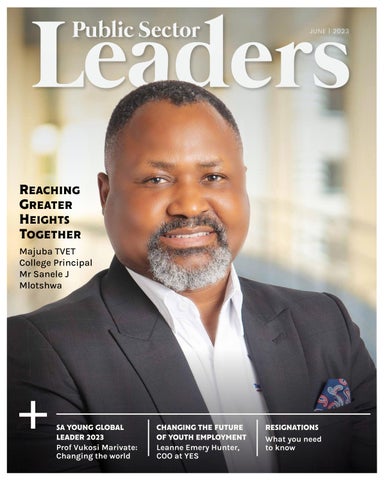
Public Sector Leaders | June 2023

Page 1


Reaching Greater Heights Together

Majuba TVET

College Principal

Mr Sanele J Mlotshwa

SA YOUNG GLOBAL

LEADER 2023

Prof Vukosi Marivate: Changing the world

CHANGING THE FUTURE OF YOUTH EMPLOYMENT

Leanne Emery Hunter, COO at YES

RESIGNATIONS

What you need to know

“Whether you are in the public sector, the private sector, supply chain or an interested individual, PSL has something for you.” For Bookings Contact Emlyn Dunn: emlyn.dunn@topco.co.za

Reasons to choose GEMS for your healthcare needs

Join GEMS today and become a part of a Scheme that prioritises access to affordable quality healthcare and rich benefits for you and your family.

The Government Employees Medical Scheme (GEMS) is a

5. No late joiner penalties.

6. Primary Care Extender benefit – provides an additional R863 per year for the Emerald and Emerald Value options.

7. Largest HIV Disease Management Programme (DMP).

8. Close collaboration with Trade Unions and government stakeholders.

9. GEMS provides greater access to quality healthcare through a wide array of networks.

10. GEMS offers comprehensive screening and preventative care

CREDITS

PUBLIC SECTOR LEADERS

The Digimag For Leaders In The South African Public Sector

Fully Accredited Member of ABC

Advertising Sales, Distribution and Subscriptions

Top Media & Communcations (Pty) Ltd

Tel: 086 000 9590

Info@topco.co.za | www.topco.co.za

CEO

Ralf Fletcher

TOPCO STUDIO

Production Director

Van Fletcher

van.fletcher@topco.co.za

Group Editor

Fiona Wakelin

fiona.wakelin@topco.co.za

Assistant Editor

Koketso Mamabolo

koketso.mamabolo@topco.co.za

Contributors

Jessie Taylor

Raine St. Claire

Design

Artizan

Traffic Manager

Daniël Bouwer artwork@topco.co.za

SALES

National Project Manager

Emlyn Dunn

Tel: 072 1263962

emlyn.dunn@topco.co.za

Brand Coordinator

Sidney Phiri

sidney.phiri@topco.co.za

Printers

LAW Print

Images

iStock / Unsplash / GCIS | Flickr

Digital Publishing Platforms

Issuu

Magzter

Media Carrier

Head Office

Top Media & Communications (Pty) Ltd T/A Topco Media

Elkay House, 186 Loop St Cape Town

Tel: +27 86 000 9590

Fax: +27 21 423 7576

Email: info@topco.co.za

Website: www.topco.co.za

DISCLAIMER

All rights reserved. No part of this publication may be reproduced, stored in a retrieval system or transmitted, in any form or by any means, electronic, mechanical, photocopying, recording or otherwise, without the prior written consent of Top Media & Communications (Pty) Ltd T/A Topco Media. Reg. No. 2011/105655/07. While every care has been taken when compiling this publication, the publishers, editor and contributors accept no responsibility for any consequences arising from any errors or emissions.

ADVANCED CYBER SECURITY FOR YOUR BUSINESS

For more than 30 years, ESET® has been developing industry-leading IT security software and services. Over 400,000 businesses and 110m users worldwide rely on us to deliver reliable, comprehensive protection.

SECURE YOUR BUSINESS DATA, WITH ESET

Letter from the Editor

Welcome to the June edition of Public Sector Leaders (PSL)

In his letter to the nation on 12 June, His Excellency, Cyril Ramaphosa focussed on the topic of the fundamental economic reforms in the country that are gathering pace:

“Since the start of this administration, we have been pursuing far-reaching reforms in ‘network’ industries like electricity, telecommunication, water, ports and rail. We have focused on reforms that are sustainable and transformative rather than temporary solutions that won’t last. It is understandable that the severity of the challenges the country is facing at this time give rise to frustration and impatience. Given the persistence of load shedding, for example, few people are able to contemplate the impact of a transformed energy landscape. While we are making progress towards ending loadshedding, transforming the electricity market to make it more competitive and cost-effective is critical to the country’s future,” President Ramaphosa.

It is a busy month for public sector leaders with President Cyril Ramaphosa, welcoming President of Portugal, Rebelo De Sousa on a state visit. His Excellency chaired the meeting held at the Union Buildings in Pretoria with Ministers and CEOs on Workstream with Business. President Ramaphosa addressed the National Assembly at The Presidency Budget Vote in Parliament, Cape Town and attended the inauguration of the President of Nigeria.

During the month of June we celebrate Youth Month and

Environment Month (both extremely topical) - with 16 June being Youth Day. Our cover icon this month is the Principal of Majuba TVET College, Mr Sanele J Mlotshwa - Majuba TVET is the key service provider for Technical and Vocational Education and Training in the Amajuba and uMzinyathi Districts. It services major industries in these areas, in the sectors of iron and steel manufacturing, mining (mainly coal), textile and clothing production, cement chemical manufacturing, tyre production, engineering and primary agriculture. There are 7 campuses, spread over a wide geographical area that includes Newcastle, Madadeni and Dundee. The College offers a diverse range of nationally recognised vocational and occupational programmes. It registers an outstanding number of about 30 000 students a year.

In this bumper edition of Public Sector Leaders, we include regulars such as Addressing the Nation - Letter from the Presidency - and a Calendar of Commemorative events.

The Trailblazer this month is Vukosi Marivate, Absa Chair of Data Science at UP and the SA Young Global Leader for 2023; our Women in Leadership is Leanne Emery Hunter, COO at Yes4Youth, while Regional Focus takes a look at a year of service delivery for North West Province. In Other News focusses on the draft Bill on IDs numbers and there is all you need to know about resignations in Legal Matters; if you are wondering about an affordable way to make your home green, please see the piece in Financial Fitness.

This month we extensively cover youth as well as environmental issues in timeous articles such as 5 ways to celebrate Youth Day; a Focus on the Department of Women, Youth and People with Disabilities; Environment/ Sustainability Month from a fashion perspective; Operation Vulindlela: Accelerating structural reforms and economic recovery; How the National Youth Policy can positively impact education and training; the Just Transition Energy Plan - what’s the progress? As well as youth employment initiatives and where we are with solving the electricity crisis.

Whether you are in the public sector, the private sector, supply chain or an interested individual, PSL has something for you.

We hope you enjoy the read.

Fundamental economic reforms are gathering pace

In his letter to the nation on 12 June, His Excellency Cyril Ramaphosa assured the country that South Africa’s economy is undergoing a fundamental transformation that will make it more competitive, inclusive and capable of growth.

“Since the start of this administration, we have been pursuing far-reaching reforms in ‘network’ industries like electricity,

telecommunication, water, ports and rail. We have focused on reforms that are sustainable and transformative rather than temporary solutions that won’t last.

“It is understandable that the severity of the challenges the country is facing at this time give rise to frustration and impatience. Given the persistence of load shedding, for example, few people are

able to contemplate the impact of a transformed energy landscape. “While we are making progress towards ending loadshedding, transforming the electricity market to make it more competitive and cost-effective is critical to the country’s future,” President Ramaphosa.

Continuing with the theme of economic reform His Excellency referred to Operation Vulindlela

(which we look at in this edition) and outlined progress in the following areas:

ENERGY

The licensing requirement for generation projects of any size has been removed. As a result, more than 100 projects are now in development, representing over 10,000 MW of new generation capacity and R200 billion of private sector investment.

A new Ministerial determination has been issued for the procurement of over 14,000 MW of new generation capacity from wind, solar and battery storage.

Tax incentives for rooftop solar are being implemented for businesses and households, which will drive a significant increase in rooftop solar installations.

Eskom is being unbundled into separate entities for generation, transmission and distribution. The Electricity Regulation Amendment Bill is being finalised for tabling in Parliament. These developments are part of establishing for the first time in our country a competitive market for electricity generation.

Eskom’s debt burden is being addressed through R254-billion in debt relief, subject to strict conditions. This will enable the company to make necessary investments in its infrastructure.

TRANSPORT AND LOGISTICS

Transnet Freight Rail is establishing an independent infrastructure

manager to enable transparent and accurate pricing of slots on the freight rail network and create a level playing field between public and private rail operators.

Partnerships with private terminal operators at the Durban and Ngqura container terminals will be finalised soon.

A National Logistics Crisis Committee has been established to improve the performance of ports and rail in the immediate term and drive the implementation of a Freight Logistics Roadmap into the future.

TELECOMMUNICATIONS

The completion of the spectrum auction in April 2022 has unlocked significant new investment and will enable expanded network access and reduced data costs.

The gazetting of a Rapid Deployment Policy and Policy Direction as well as a standard draft by-law for wayleave approvals will help to accelerate the rollout of telecommunications infrastructure such as fibre and towers.

A final date for the switch-off of analogue transmission will soon be gazetted to complete the digital migration process across the country.

Five provinces – Free State, Northern Cape, North West, Limpopo and Mpumalanga – have already undergone the migration and are receiving television broadcast on the digital platform.

WATER

The proportion of water use license applications processed within 90 days has increased to 70% from 35%. This is helping to speed up investment in sectors like mining, agriculture, forestry and infrastructure.

The Blue Drop, Green Drop and No Drop water quality monitoring system has been reinstated. This enables intervention where municipalities are failing to meet minimum norms and standards for water service delivery.

A Water Partnerships Office has been established to support private sector involvement in areas such as water re-use, improving wastewater treatment, desalination projects and improving rural water services.

IMMIGRATION

The Department of Home Affairs is implementing far-reaching reforms that will make the work visa system more agile and responsive to the realities of the new world of work and attract higher numbers of tourists.

“We are committed to stay the course on structural reform. We need consistency and perspective – not temporary, unsustainable solutions – if we are to improve the lives of South Africans, create jobs, attract higher levels of investment and build an economy of the future,” H.E. Ramaphosa

One of fifty public Technical and Vocational Education and Training (TVET) Colleges in South Africa, Majuba TVET College falls under the Department of Higher Education and Training (DHET). It is one of the largest of its kind in the country, specialising in priority skills development.

Majuba TVET College is the key service provider for Technical and Vocational Education and Training in the Amajuba and uMzinyathi Districts. It services major industries in these areas, in the sectors of iron and steel manufacturing, mining (mainly coal), textile and clothing production,

Majuba TVET College

Reaching Greater Heights Together

cement chemical manufacturing, tyre production, engineering and primary agriculture.

There are 7 campuses, spread over a wide geographical area that includes Newcastle, Madadeni and Dundee. The College offers a diverse range of nationally recognised vocational and occupational programmes. It registers an outstanding number of about 30 000 students a year.

Majuba TVET College is committed to education and training, using cuttingedge technology and innovative teaching methodologies, to enhance and optimise teaching and learning opportunities. Situated in Newcastle, northern KwaZulu-Natal, the College

plays a significant role in the holistic development of our students, as part of preparing them for the world of work.

The College regards itself as an important social partner in realising the shared socioeconomic objectives of the local, provincial and national government. To this end, the College creates access to education and training opportunities; and empowers our students with the relevant knowledge and skills to become economically active citizens.

VISION

Empowering our nation through quality education, training and development.

Mr Sanele J. Mlotshwa Principal

MISSION

We will provide responsive and relevant education, training and development to cater for the needs of business, industry and communities.

VALUES

Our motto reaching greater heights together guides our values which are:

CRISP

• Creativity:

To be resourceful, innovative and unconventional thinkers in what we do

• Respect:

To accord dignity to all those whom we serve and work with

• Integrity:

To demonstrate a sense of justice and honesty in everything we do

• Service:

To respond efficiently and effectively to the needs of our staff and clients

• Perseverance:

To continuously apply ourselves to the best of our abilities

PROGRAMME QUALIFICATION MIX FOR MAJUBA TVET COLLEGE

National Certificate Vocational Programmes NC(V) Engineering Studies Courses: (NQF L2 – L4)

• Engineering and Related Design(Boilermaking, Fitting and Turning, Motor Mechanics, and Welding)

• Electrical Infrastructure Construction - (Light Current / Heavy Current)

• Civil Engineering and Building Construction - (Bricklaying/ Plastering/Plumbing/Carpentry)

• Process Instrumentation

• Primary Agriculture

Business Studies Courses: NQF L2-L4

• Office Administration

• Hospitality

• Tourism

Nated-Courses/ Report 191

Courses offered

Engineering Studies Courses:

• Mechanical Engineering(Boilermaking/ Fitting and Turning/ Motor Mechanic/ Diesel Mechanic/ Welding)

• Electrical Engineering - (Light Current/ Heavy Current/ Instrument Mechanician/ Millwright)

• Civil Engineering - (Bricklaying/ Plastering/ Plumbing)

• Chemical engineering - (Water and Waste Water Treatment)

Business Studies Courses:

• Introductory Business Studies

• Financial Management

• Human Resource Management

• Management Assistant

• Public Management

• Hospitality

• Farming Management requirements

Mr Khaya Shangase. Deputy Principal: Corporate Services
Mrs Dilshad Hassim Deputy Principal: Finance
Mr.PatrickNtshangase Deputy Principal: Innovations and Development
Mrs Zandile Nkabinde Deputy Principal: Academic Services

Newcastle Training Centre

Expanding its Centres of Specialisation

Majuba TVET College is proud to expand its Centres of Specialisation now to three trades. For the past three years, Newcastle Training Centre campus has successfully been the Centre of Specialisation in Boilermaking. Recently the College was announced by the Department of Higher Education and Training as the Centre of Specialisation in another two more trades to include the qualification of Occupational Certificate: Millwright, and Occupational Certificate: Mechanical Fitter.

• To build a competent and compliant apprenticeship system that will meet the industry requirements

Majuba TVET College as a Centre of Specialisation in Boilermaking, Millwright, and Mechanical Fitter is committed to producing apprentices of the 21st century and beyond. We urge the industry to come on board as the stakeholder in this Centre of Specialisation project, given that the industry will soon be employing these artisans who are currently training in the Centres of Specialisation project. Your input is vital to producing artisans that meet industry needs.

BENEFITS OF THE INDUSTRY AS A PARTNER WITH MAJUBA TVET COLLEGE IN THE CENTRE OF SPECIALISATION PROJECT:

• To build a quality apprenticeship system for Boilermaking, Millwright, and Mechanical Fitter.

Mr T D Ngwenya

Acting Campus ManagerNewcastle Training Centre

To come on board, kindly contact the Newcastle Training Centre: Corner of Allen Street, and 2 HJ Van Eck Drive; Barry Herdzok Park, Newcastle 2940 Tel: 034 318 2021

Contact Person: Mr Thamsanqa Ngwenya (Acting Campus Manager) Cell: 064 870 7787

Acting Assistant Director: Curriculum Development and Implementation - Occupational Programmes

CURRICULUM DEVELOPMENT AND IMPLEMENTATION – OCCUPATIONAL PROGRAMMES

What is the occupational qualification?

• They are modern, industrybased qualifications that are developed under the legal auspices of the Quality Council for Trades and Occupations (QCTO).

How are occupational qualifications assessed or examined?

• All occupational qualifications have both theoretical tests (exams in an academic context)

Mr D Mabizela

and a practical test (a trade test in an artisan context). The actual assessment is called an EISA (External Integrated Summative Assessment).

What is included in occupational programmes?

• Knowledge modules - Theory

• Practical skills modules – Workrelated learning

• Work experience modules – Applying the knowledge modules and practical skills modules in a real-world environment.

• Industrial experience

• Exposure to current industry practices (WBE)

• Appropriate pedagogy e.g. Cognitive Apprenticeships, Dynamic Assessment Processes, Problem Based Learning, etc

• Use of applicable software to enhance T&L

• Ability to apply the knowledge modules and practical skills modules in a real-world environment.

• Ability to contribute to the development of a structured learning programme (NOCC)

• Thorough knowledge of assessment strategies for knowledge based assessments as well as practical assessments

Occupational Programmes Currently Offered (Legacy Qualifications & QCTO Accredited Qualifications)

• Occupational Certificate: Welder

• Occupational Certificate: CHEF

• Occupational Certificate: Boilermaker

• Occupational Certificate: Automotive Motor Mechanic

• Occupational Certificate: Bricklayer

• Occupational Certificate: Carpenter

• Occupational Certificate: Diesel Mechanic

• Occupational Certificate: Electrician

• Occupational Certificate: Fitter & Turner

• Occupational Certificate: Instrument Mechanic

• Occupational Certificate: Mechanical Fitter

• Occupational Certificate: Millwright

• Occupational Certificate: Plumber

• Occupational Certificate: Rigger

• Occupational Certificate: Plumber

• Occupational Certificate: Metal Machinist

• Certificate: Accounting Technician

• Certificate: Accounting

• Certificate: Local Government Accounting

• Certificate: Accounting Public Sector

• Certificate Accounting Technician: Public Sector

• FET Certificate: Accounting Technician

• FET Certificate Accounting Technician: Public sector

• FET Certificate: Local Government Accounting

• FET Certificate: Information Technology: Technical Support

• FET Certificate: Sports Coaching: Juniors/Beginners

• National Certificate: Information Technology: End User Computing

• National Certificate: Information Technology: Technical Support

• National Certificate: Coaching Science

• National Certificate: Animal Production

• National Certificate: Mixed Farming System

• National Certificate: Plant Production

• National Certificate: Wholesale & Retail Operations

• National Certificate: Operations Supervision

• National Certificate: Generic Management

• National Certificate: Buying Planning

• National Certificate: Furniture Making: Wood

• National Certificate: Public Administration

• General Education and Training Certificate: Clothing Manufacturing Process

• National Diploma: Animal Production

Part Qualifications:

• End-user Computing (Ms Word, Excel, PowerPoint, Internet)

• Garment Making

• Furniture Making

• Retail Skills Programmes

• Insurance Skills Programmes

• Technical Skills Programmes (IT Skills)

• Assistant Chef

• Coded Welding

• Shielded Metal Arc Welder

• Domestic Water & Drainage Pipe Repairer

• Hot and Cold Water Systems Installer

• Wheel Balancer

• Workshop Tool Assistant

• Basic Kitchen Appliance Repairs

• Plumbing Hand

• Bricklayer’s Assistant

Programmes Offered to People Living with Disability:

• Hand Sewing

• Plant Production

• Hides and Skin

• Furniture Making

We urge the industry to come on board as the stakeholder in the TVET Sector transition for Curriculum Development and Implementation – Occupational Programmes, given that the industry will soon be employing these students who are currently training in our colleges. Your input is vital to producing Graduates that meet industry needs.

COLLEGE PARTNERSHIPS AND LINKAGES

Student Work Placement/Internship Opportunities.

Majuba TVET College has established a dedicated Partnerships, and Linkages Unit.

The main objectives of the Partnerships and Linkages unit are to:

Collaborate with Business and Industry to identify opportunities to:

• Expose our students to the world-of work in their specific occupational areas;

• Place our students in workintegrated learning opportunities, in order to produce employable graduates

• Increase the number of students successfully entering the labour market upon completion of training.

• Work Integrated Learning For N6 Students

• Experiential Training For NCV Level 4 Students

• Workplace Support For Artisan Development

• Workplace Based Exposure

• Work/Job Readiness Training

• Employability Skills Training

• Self-Employment Support

• Entrepreneurship Training

• Application For Seta Funding

• Seta Bursary Support

• Partnerships With Private And Public Sector

• International Partnerships

STUDENTS AT MAJUBA TVET COLLEGE ARE PLACED WITHIN THE FOLLOWING INITIATIVES:

WORK INTEGRATED LEARNING (WIL):

The College sources internship opportunities for our:

• N6 students who require 18 to 24 months experiential practical training, in the field that they have studied, in order to meet the requirements for the issue of their National 3 Year N-Diploma.

• Engineering students to be placed in apprenticeship training, so that they may qualify as artisans. Apply to SETA’s and the National Skills Fund for funding for the disbursements of stipends

WORKPLACE-BASED

EXPOSURE (WBE):

The College collaborates with SSACI (Swiss South African Cooperation Initiative) to place our students in business or industry, during their recess period (holiday period) for 5 – 10 days. Host-companies are required to assess our students and complete logbooks for such students.

JOB READINESS PROGRAMMES:

Exit-level NCV Level 4 and N6 graduates are exposed to soft skills, namely:

• Interview Skills;

• Office Etiquette;

• CV Writing Skills; and

• Computer Skills

CONTACT DETAILS

Phone:

+27 34 326 4888

• NCV Level 4 students for a period of 12 months in either Engineering or the Business fields, as per the student’s field of study. ADVERTORIAL MAJUBA TVET COLLEGE

Address: 83 Allen Street, Newcastle, KwaZulu-Natal, 2940

Website: www.majuba.edu.za

Subscribe to Topco Media’s official Weekly newsletter as we keep you up-to-date with the latest business blogs and articles.

Solving the electricity crisis

Wind power key in our energy mix

The electricity crisis is on everyone’s mind. Whoever you are, wherever you are, whatever you do, the crisis is having a direct and indirect impact on everyone who lives in South Africa. Solving the electricity crisis is at the top of the agenda of both the private and public sectors, with various stakeholders bringing forth their solutions and contributing in whatever way they can. Here we explore the response to the challenge, with a focus on the role of renewable energy, particularly wind energy.

A MATTER OF URGENCY

In late May, it was announced that His Excellency President Cyril Ramaphosa had transferred some of the powers and functions found in the Electricity Regulation Act to Honourable Kgosientsho Ramokgopa, the Minister of Electricity. As Hon. Ramokgopa has made clear on a few occasions, his mandate stands only until the elections, intended to deal directly with the crisis and the office will be dissolved once the country makes it out of the crisis. Hence why the Minister has been given the powers and functions needed in the short-term.

All the powers and functions stated in Section 34(1) of the Act have been transferred to the Minister, along with a few from Section 34(2). Because Section 34(1)(e)(i) and Section 34(1) (e)(ii) ensure the participation of the private, of particular importance to the private sector energy industry will be the what the Minister does in terms of Section 34(1)(a) and Section 34(1)(b):

“The Minister may, in consultation with the Regulator – (a) determine that new generation capacity is needed to ensure the continued uninterrupted supply of electricity; (b) determine the types of energy sources from which electricity must be generated, and the percentages of electricity that must be generated from such source,” reads the Act.

With constant loadshedding due to a lack of generation capacity, it’s clear that we need new generation capacity to reach a point where we do have “the continued uninterrupted

supply of electricity” the Act refers to. What’s come into sharp focus over the past few months is what we’re using to produce our energy, and what we will need to use going forward.

This is where the renewable energy sector, a space filled with innovators who are dreaming of a green future, are beginning to make their mark. They are central to us achieving the net-zero target, and the South African industry is seeing the exciting emergence of new companies who are joining those who were focused on renewable energy long before it became a regular topic of discussion in the public space. This points to the shift in thinking and the opportunities available to entrepreneurs and investors.

An example of this is the wind energy industry which is beginning to position itself in the energy market. “We are in an energy transition — as is the world,” says Niveshen Govender, the CEO of the South African Wind Energy Association (SAWEA), “and as outlined by government’s energy road map, the IRP (Integrated Resource Plan), the future energy supply will be green, with renewable energy leading the transition.”

He tells Public Sector Leaders that wind energy is a key roleplayer in the transition. As part of the Renewable Energy IPP Procurement Programme (REIPPPP), 36 wind projects were selected and South Africa is currently sitting on 3024 MW of wind capacity. According to SAWEA, 30 GW of wind energy projects are in the works.

WIND IN FOCUS

“With market diversification in South Africa, the vision of wind powered green hydrogen, and the potential of off-shore wind being introduced, SAWEA believes that wind will continue to blow strong in South Africa,” continues Niveshen, who has over a decade of experience in the energy sector.

“It is expected that the local industry will embark on a 100GW RE [renewable energy] power supply contribution by 2050, so we are confident to forecast that our sector will continue to growcreating opportunities to thrive.”

We asked Niveshen about how the local industry is faring, the challenges and the link between the private and public sector:

NiveshenGovender CEO - SAWEA

How does the wind energy industry in SA compare to the rest of the world?

What can we learn from global best practice?

While there is almost 1TW of wind energy installed across the globe South Africa has achieved only 3.4GW – not even 1% of the global installed capacity. Considering that we have impressive wind resources, South Africa should be far ahead.

SAWEA feels that it is important to create an attractive environment for investment in wind power, so that our industry can achieve its potential and play a significant role in the country’s energy mix.

Building the wind sector should be intentional and supported by policy to be able to sustain and develop our local skills and workforce, as well as supply chains that are developing, in order for our country to be able to compete internationally. For this to happen, market development needs to be consistent and continuous.

What sort of engagements have you been having with government?

SAWEA engages with government at all levels to represent the interests of its members who are invested in the South African wind power value chain. We actively advocate for investment in wind power and are currently engaged with government stakeholders to address grid access, public procurement, localisation potential, skills and gender diversity, amongst other key topics.

Furthermore, it is our intention to continue to advocate for the support of a thriving wind sector to promote impact in line with our social imperatives. SAWEA|ThePresidency

What are the main challenges the industry is facing and what do you think government can do to help the industry overcome them?

Our most pressing challenge is the inability to connect wind projects to the national grid in areas with the best wind resources. To overcome this we look to government to assess various technical solutions that will assist to integrate more RE on a constrained grid – based on learnings from similar circumstances internationally.

To this end, government could further expedite updating the transmission infrastructure as a matter of urgency.

What can government do to help businesses in the wind energy industry?

Greater collaboration between government and the industry could yield better results, as lessons learnt over the last decade have shown that working together could get us further. The wind industry has the same goal of energy security as government does, as through affordable energy

supply we will be able to address the country’s crippling energy shortages, and our best chance to achieve this is through renewable energy.

SAWEA began more than two decades ago, how has the industry changed since then?

Founded in 2004, SAWEA has witnessed the introduction of renewable energy in South Africa and its establishment as a mainstream energy supply technology, playing a key role in the energy mix.

Since then, our plight to advocate for RE has changed from fighting for its place to advocating the impact opportunity by integrating more much faster.

What misconceptions are there about wind energy?

Wind energy is far more affordable and reliable than what is generally perceived. The misperception that wind energy is costly, is due to the absence of cost reflective tariffs in South Africa. Hence we need to better understand the actual cost of the various generation technologies in the country and compare cost like for like.

Secondly, the level of variability should be discredited, as although wind energy is indeed intermittent in nature, this resource has an impressive generation profile especially visible during the evening peak when the energy is most required.

With better system planning, the generation profile together with supplementary technological coupling, renewable energy has the ability to improve performance holistically.

CELEBRATING WIND POWER

ACHIEVEMENTS IN

SOUTH AFRICA

Ongoing procurement of new Wind Power generation will help close the energy capacity gap and play a key role in growing the country’s economy.

ACHIEVEMENTS TO DATE

Over R80.3 Billion investment into Wind Power

35 operational wind farms (34 from REIPPPP)

3.9 million SA households are powered by wind

Wind power investment into communities: Over 17.4 Billion committed to local communities

Carbon emission off-set: Approx. 52 Megatons

3357 megawatts of wind power has been procured, from 34 wind projects from BW1-4. A further 12 wind projects procured from BW5 totalling 1608MW, 6 of which have reached financial close, totalling 784MW

STIMULATING THE LOCAL VALUE CHAIN

POWERING SA’s ECONOMY

Wind Power adds capacity to the power grid: fast, reliable and cost effective

2019 Integrated Resource Plan is being revised to reflect determinations from the energy and electricity ministries, which has indicated Government’s commitment to effective policy to drive the inclusion of Wind Power in the energy mix going forward

The energy transition delivers thousands of new jobs each year

Wind energy production is an excellent vehicle for direct infrastructure investment and a positive multiplier of economic effects

Manufacturing facilities deliver new job creation and skills to area’s that will lose coal jobs, as decommissioning starts to take place in these areas

Specialised components and skills development are stimulating the local economy: tower manufacturer; component transportation; steel sector; construction industry; engineering and logistics

Source: Eskom Data Portal; IPPO REIPPPP Q3 Overview

Broadband Infraco

Connecting the Nation and Beyond

With technological innovation moving at a searing pace, closing the digital divide has become even more important in the last couple of years. Connectivity, in particular, is an issue that has required us to think differently about how we ensure everyone has access to the opportunities which the internet provides. One of the organisations working tirelessly to connect people in underserved areas is Broadband Infraco (BBI), a telecommunications SOC which was created to improve market efficiency in the long-distance connectivity sector. Here Acting CEO Gift Zowa fills us in on the important work they’re doing, the SOC’s priorities and plans for the future.

DOING WHAT’S NECESSARY

“Broadband is a critical necessity,” says Gift, speaking to Public Sector Leaders, while reflecting on the impact connectivity can

have on communities. Broadband Infraco was created to provide competition to Telkom, using Eskom and Transnet’s existing fibre infrastructure in order to offer a wider range of service providers. Its mandate is to provide services to the areas that aren’t commercially viable, with little incentives for private sector investment. “Broadband Infraco covers the gap,” explains Gift.

Broadband Infraco is also part owners of the West African Cable System (WACS), an undersea cable which connects the continent’s west coast with Portugal and the United Kingdom.

“Our portfolio of wholesale products and services are based on the provision of high-capacity managed bandwidth from Point of Presence (PoP) to PoP, delivered on our resilient National Long-Distance network.

“Our technology has evolved to make use of Next Generation Dense Wavelength Division Multiplex (DWDM) technology that is capable of carrying multiples of 100Gbps within its core network.

“Our products suite and services is based on the Open System Interconnection (OSI) model and

established on a variety of technology portfolios, including Synchronous Digital Hierarchy (SDH), DWDM or Optical Transport Network (OTN) and Carrier Ethernet.”

Broadband Infraco provides services to neighbouring countries, and beyond, having made agreements with neighbouring countries, such as Zimbabwe and Zambia, who access the internet via Broadband Infraco’s network.

Through the undersea cable - for which it received a contract for monitoring, maintenance and management - Broadband Infraco is able to reach even more countries.

“The immediate plans for expansion are now going to be based on the current project that we’re looking at, which is the SA Connect project, the intention of which is to connect the underserved areas throughout the country.”

This expansion will have two effects: making the network more resilient through ‘redundant links’ and bringing connectivity to areas that were not reached previously with the vision to bring broadband connectivity to 80% of the South African population.

DOING IT TOGETHER

“As a state-owned company, we try to ensure that we partner, where possible, with our competitors, customers, suppliers, and other various stakeholders,” explains Gift. “When we expand our network, or when we provide services, one of the key elements that we consider is the non-duplication of infrastructure. Partnerships and collaboration with the sector to remove duplication is critical because together we can expand further and do more.”

Broadband Infraco has a close relationship with Eskom and Transnet, but also opens itself up to entrepreneurs who want to make use of their network. This includes international private sector customers who sign agreements for cooperation, revenue sharing and supply.

Gift explains that these agreements with the private sector ensure that the end-to-end product which Broadband Infraco takes to the market are cost effective, offering a win-win for all parties involved.

DOING IT FOR ALL

Through its work, Broadband Infraco is able to uplift communities, and the SOC also focuses on empowering

women and the youth, both internally and externally.

Internally, they have interns and trainees who have recently completed their technical programmes, and take them through an accredited training programme which offers hands-on experience and prepares them for the world of work.

“Some of the incumbents can even start their businesses as soon as they complete their training,” says Gift. “The training is rigorous and we ensure that we follow through with the Engineering Council of South Africa so that they get registered in the various fields in which they work. This is done across the board, not just for engineering, but also for human resources, finance, safety representatives etc.”

The quality of the training Broadband Infraco offers leads to many trainees easily finding long-term employment opportunities.

Externally, Broadband Infraco also provides young entrepreneurs with opportunities to access markets. “We’ve got opportunities for companies, and specifically target youth-owned companies, as part of our contribution to society.” This focus also extends to black, women-owned businesses.

Broadband Infraco’s CSI initiatives include youth skills development programmes, offering training at schools and providing broadband access.

Part of Broadband Infraco’s budget is set aside to support small businesses, stimulating growth in the economy.

“We have a mandate to develop SMMEs, Internet Service Providers (ISPs) and Access Network Providers (ANPs) and other small business people,” says Gift.

“A key component of what we do is to empower and develop those businesses in a sustainable way and to play a deliberate role in supporting them.”

Broadband Infraco is currently focused on a number of projects, including an initiative to connect at least 412 government entities (schools, clinics, hospitals, etc.) in the Northern and Eastern Cape. Another project is the Presidential Employment Stimulus project, where Broadband Infraco is empowering small ISPs and SMMEs to provide services in remote areas, with further plans for expansion in the coming year.

The third project is the biggest of them all, i.e. the SA Connect project which aims to create around 33 000 public Wi-Fi hotspots, which could reach at least 5.8 million households throughout the country.

As Broadband Infraco continues on its mission for inclusivity, Gift highlights how there are opportunities for businesses to collaborate, receive support and for the youth to build

a future for themselves by getting involved in Broadband Infraco’s noble journey:

“I think there are huge opportunities in this field for young people, whether as technical employees or as business people. Or even just as students who are looking to get connected.

The fact that where we are right now is not where we want to be should not disturb or detract people because there are programmes and opportunities. There are projects that are being implemented that we are working on together with the rest of the industry, in order to cover that digital divide.”

CONTACT DETAILS

Phone: +27 11 235 1600

Address: 2040 Octave Road, Radiokop, Honeydew, 2040

Email: info@infraco.co.za

Follow us across South Africa as we take the Standard Bank Top Women EmpowHER Conference to North West!

Western Cape
Durban
North West

E mpow HER: Creating access to markets for

ENTREPRENEURS

Changing the world through AI Prof Vukosi Marivate

ASouth African aiming to change the world through Artificial Intelligence (AI) has been accepted into a prestigious global leadership programme. Prof Vukosi Marivate, the Absa Chair of Data Science at the University of Pretoria (UP), has been accepted into the World Economic Forum’s Young Global Leaders programme.

Prof Marivate is a leading expert in data science and AI in Africa. He is working to develop data-driven solutions to social and economic problems in Africa.

A group of young people tackling the world’s problems

Since its establishment, the Forum of Young Global Leaders has cultivated a diverse community of outstanding people addressing the world’s most pressing problems – today made up of over 1 400 members and alumni from more than 120 countries. This year’s cohort includes nearly 100 promising political leaders, innovative entrepreneurs, game-changing researchers and visionary activists who are accelerating positive and lasting change in their communities, countries and the world.

Wadia Ait Hamza, Head of the Forum of Young Global Leaders, says: “In a turbulent and polarised world, committed, conscientious and inspired leaders are needed to create real-world change for the benefit of all.

Young Global Leaders have demonstrated their commitment to improving the state of the world by unlocking the potential of technology for the common good, unveiling a plan to revolutionise health services in rural and refugee communities and galvanising private sector action on pollution.”

Led by Prof Marivate, the Masakhane Natural Language Processing (NLP) research project was named the 2021 Wikimedia Foundation Research Award of the Year

As part of their three-year leadership development programme, Young Global Leaders will have access to a range of executive education courses, learning journeys and opportunities to collaborate with trusted peers, Prof Marivate said: “I am very honoured by this inclusion. It fills me with pride and is not just a reflection of myself but also those who I have worked with and those who have supported my journey as a scientist.”

The appointment acknowledges the important work being carried out by Prof Marivate. As the holder of the

ABSA UP Chair of Data Science, his work with his research group, Data Science for Social Impact, focuses on two pillars.

Firstly, it looks at the intersection of AI and language – especially African languages – and how to create new tools, methods, and approaches. “We are one of the leading groups in this area and work to also support the wider African Natural Language Processing community,” says Prof Marivate The second aspect is studying the intersection of data science and society.

“[This] deals with how we can make data science or machine learning tools useful for society in general. This means our group works in areas such as health, education, the environment, and more,” he says.

Shining a light on African AI research

Joining the Forum will give Prof Marivate the opportunity to promote his research in new ways.

“I am hoping to use the platform to continue shining a light on African research in AI and natural language processing,” he said.

Some of Prof Marivate’s work centres around building tools for African languages. Many African languages have millions of speakers, but few digital resources, such as digital dictionaries.

Around 2 000 of the world’s languages are African, but they are

Sources:BizNews/UniversityofPretoria/WorldEconomicForum

barely represented in technology. The continent’s colonialist past has resulted in technological space that does not understand African names, cultures, places or history.

Led by Prof Marivate, the Masakhane Natural Language Processing (NLP) research project was named the 2021 Wikimedia Foundation Research Award of the Year. They received the award for their research paper titled ‘Participatory research for low-resourced machine translation: A case study in African languages.’

“Language matters. Being understood by other people is one of the things that unites families, tribes, nations, and the African diaspora. It is essential when it comes to being included in both the digital and societal environments,” said Prof Marivate.

“For example, there may be eleven official languages in South Africa, but only if a government minister makes a one-line statement in one of those languages, will it be translated, and even then, it is translated into English. Anyone speaking one of the other official languages will not have access to the speech, or to government directives. They would not have translations of any value for education and medical scenarios either, and would have no way of making their voice heard or understood.”

Leanne Emery Hunter, COO at YES

Changing the future of youth employment

Two in three South African youth are jobless, based on the latest Quarterly Labour Force Survey by Stats SA, and children are unlikely to experience a better life than their parents, based on South Africa’s ranking on the World Economic Forum’s Global Social Mobility Index 2020.

Without access to youth employment programmes, such as the Youth Employment Service (YES), it will take nine generations for a person born into poverty to reach a median income level, making it clear that South Africa needs to accelerate solutions to its youth unemployment crisis.

Leanne Emery Hunter, COO at YES, is at the front of the battle to create a more equal society.

YES is a 12-month quality work experience that equips unemployed youth with a toolkit to be a beacon of hope for their families, households and communities.

In February 2023, YES passed the 100 000 youth jobs created milestone, making it the largest scale job creation programme in South Africa entirely funded by the private sector.

The impact on social mobility is considerable: 61% of YES Youth come from social grant-recipient households, and 77% have dependants. Around R6 billion has been injected into local economies through YES Youth salaries, with no government funding.

Emery Hunter sat down with Public Sector Leaders to discuss her role in changing the country’s future:

Why is it important to create employment for youth? We must get as many of our youth as possible into meaningful roles in the economy, especially in futurefacing industries that will create a multiplier effect of creating more jobs. The youth of South Africa has enormous potential to change the social and economic trajectory of SA, yet this potential remains largely untapped.

On its own, no one programme can directly generate enough youth jobs to compensate for the

lack of economic growth and the numerous structural challenges

South Africa faces. However, if programmes are catalytic in their structure, they can have a longerterm multiplier effect that far exceeds the direct jobs created.

The over 100 000 jobs created through YES have helped give young people the skills, work experience, and social networks they need to contribute to the economy for the next 40 years and beyond. We’ve created jobs with impact that will act as a catalyst to create more employment inside and outside their current job sectors. These future professionals, entrepreneurs and change-makers will drive our economic prosperity in the years to come.

When did you first discover your passion for helping youth find employment?

I’ve worked in industries from telecoms to professional services to education. Still, I have always been passionate about youth development (particularly young women) and education, so I feel like I have found my home at YES.

I am an ex-ballet dancer, and I ran my part-time dancing studio from a young age for ten years, which perhaps instilled in me a love of teaching and working with young people. I’ve worked with numerous charitable organisations throughout the years, but YES was a total game-changer for me –the catalytic socio and economic effects of getting young people into jobs have been the most rewarding (and challenging) of my life.

We must get as many of our youth as possible into meaningful roles in the economy, especially in future-facing industries that will create a multiplier effect of creating more jobs

What motivates you in your role?

I want to be a part of the solution in South Africa, and I care deeply about youth empowerment. I am so fortunate to work in an organisation that challenges me as a leader daily but also allows me to build things from the ground up and feed into my purpose. It’s much easier to get up every day when you know that what you do makes a real, meaningful impact, and this helps me through the tough days. I am also surrounded by smart, passionate, and like-minded people at YES who are equally invested in tackling this crisis, which is extremely motivating.

What kind of leader would you describe yourself as?

I would like to think that I am a collaborative, strategic, clientcentric and empowering leader who can create positive momentum in high-growth organisations. I thrive in challenging and impact-driven organisations (particularly startup-type environments) and am very focused on supporting teams and the organisation to deliver to corporate clients and youth. How to deliver results while empowering and bringing out the best in teams and individuals is what keeps me up at night.

YES allows me to work in a fast-paced corporate-facing environment while tying into purposeful work that makes a true impact in society and satisfies my head and heart.

What are the highs and lows that come with your role?

The impact of the work we do is what gets me through the challenging times. It is not often that you get to work in a role that is so aligned with your purpose. Seeing the impact that the dignity of a job has on individuals, families, and communities is very rewarding and seeing what youth are capable of when given a chance is incredibly inspiring.

Besides the normal challenges of working in and scaling a young organisation (YES is only four years old), the most crushing low in my role is the magnitude of the crisis we face. Given challenges such as the low rates of economic growth, power cuts leading to job cuts, education and many more, South Africa is currently producing neither the volume nor type of jobs required to reverse the current unemployment trend.

Currently, more than 400 000 new jobseekers enter the market every year, but the country has only created around an average of 150 000 net jobs per year over the past 10 years. We urgently need to accelerate programmes and interventions that get youth into catalytic jobs if we have any hope of creating a future that works. That’s what gets us up in the morning at YES.

Funding, skills development, and capacity building

The way forward for just energy transition

An advisory body to President Cyril Ramaphosa has released its final recommendations on the country’s just energy transition plans and put forward suggestions on how to prepare local governments and increase skills development.

The Presidential Climate Commission (PCC) recently released its final recommendations on South Africa’s Just Energy Transition Investment Plan (JET-IP). The plan was unveiled by President Ramaphosa in November last year, but the PCC was requested to consult stakeholders and provide feedback on the plan.

Building capacity

The R1.5-trillion JET-IP was unveiled late last year and built on an $8.5-billion pledge from the United Kingdom, the United States of America, Germany, France and the European Union to help South Africa transition to a lowcarbon economy.

The plan centres around the decommissioning of coal-fired power stations and developing green sectors to keep South Africa as a competitive trading partner while meeting climate commitments.

South Africa has already received around $300 million in concessional loans, each from Germany and France, but these have not yet been allocated to specific projects as the JET-IP implementation plan is finalised.

Following community consultations in Mpumalanga, Limpopo, and the Northern Cape, where the bulk of the country’s energy is generated, the PCC submitted its final recommendations to President Ramaphosa for government’s consideration.

The PPC’s report called for a transition-capable developmental state to navigate the complexities of transition, with a focus on capacity building at the local

government level, funding to support electricity supply investments, integrated development planning, and budgeting processes.

The PCC also recommended the establishment of governance and oversight mechanisms for all transition funding and climate finance. This would allow the government to track international commitments.

Among the PCC’s other recommendations was the creation of an adaptation and resilience investment plan, which would give priority to water and food security, agriculture and tourism.

Dr Crispian Olver, the PCC’s executive director, said the PCC agreed with many stakeholders on the need to “remain prudent on the scale of the country’s foreign and domestic debt, the call for increases in grant and concessional finance, scaling up sustainable social ownership in renewable energy,

and a coordinated industrial and financing policy.

and a coordinated industrial and financing policy.

Dr Olver explained that skills development came into sharp focus during consultations with stakeholders.

Dr Olver explained that skills development came into sharp focus during consultations with stakeholders.

“Stakeholders across the board consider the just transition issues to be inadequately prioritised within the plan. On the positive side, what the plan does do… is to talk very explicitly to a range of just transition interventions in skills development, in economic diversification, and mine rehabilitation,” said Dr Olver.

“Stakeholders across the board consider the just transition issues to be inadequately prioritised within the plan. On the positive side, what the plan does do… is to talk very explicitly to a range of just transition interventions in skills development, in economic diversification, and mine rehabilitation,” said Dr Olver.

A focus on renewable energy

A focus on renewable energy

He added that the consensus was that greater focus should be placed on skills development, and this part of the plan received some criticism.

Grid capacity is a major constraint to scaling up the energy transition

Grid capacity is a major constraint to scaling up the energy transition

Education and Technical Vocational Education and Training (TVET) colleges but that’s not captured within the plan,” said Dr Olver.

Education and Technical Vocational Education and Training (TVET) colleges but that’s not captured within the plan,” said Dr Olver.

“We make a number of recommendations around how to enhance those sectors, and it’s important because people are going to critique this plan from the perspective of the Just Transition and whether it lives up to all the requirements that must be factored in.”

“We make a number of recommendations around how to enhance those sectors, and it’s important because people are going to critique this plan from the perspective of the Just Transition and whether it lives up to all the requirements that must be factored in.”

According to Dr Olver, another key area of the JET-IP is the expansion and upgrading of the electricity grid.

According to Dr Olver, another key area of the JET-IP is the expansion and upgrading of the electricity grid.

“Grid capacity is a major constraint to scaling up the energy transition and that is the view across the board. Government, business, labour, civil society all back a strong focus on upgrading and expanding the grid,” he said.

indicate how this grid expansion is going to be financed.

indicate how this grid expansion is going to be financed.

The PCC said the country must remain focused on ramping up renewable energy projects and connecting them to the grid. It recommends that 50 to 60 gigawatts (GW) of renewable energy capacity be included in the country’s energy mix by 203.

The PCC said the country must remain focused on ramping up renewable energy projects and connecting them to the grid. It recommends that 50 to 60 gigawatts (GW) of renewable energy capacity be included in the country’s energy mix by 203.

The country needs to add 6GW to 8GW of renewables per year, Olver stressed, but this is currently being addressed by 5GW bid window, to be launched soon, along with requests for proposals for 1.2GW of battery storage and 3GW of gas. While the grants will kickstart South Africa’s energy transition, they will not be enough to fund the just energy transition in its entirety, said Olver.

The country needs to add 6GW to 8GW of renewables per year, Olver stressed, but this is currently being addressed by 5GW bid window, to be launched soon, along with requests for proposals for 1.2GW of battery storage and 3GW of gas. While the grants will kickstart South Africa’s energy transition, they will not be enough to fund the just energy transition in its entirety, said Olver.

“Everyone is united in considering these to be inadequate. But our recommendation is not to hold up implementation while we try and argue for more grants. We must… bank what we’ve got, move forward with implementation and continue to fight for more,” he said.

“Everyone is united in considering these to be inadequate. But our recommendation is not to hold up implementation while we try and argue for more grants. We must… bank what we’ve got, move forward with implementation and continue to fight for more,” he said.

He added that the consensus was that greater focus should be placed on skills development, and this part of the plan received some criticism. “It’s partly because… if you look at the total skills development system, there’s a lot of funding available through the skills development levy and various funding flows to the Sector Education and Training Authorities (SETAs), Higher

“Grid capacity is a major constraint to scaling up the energy transition and that is the view across the board. Government, business, labour, civil society all back a strong focus on upgrading and expanding the grid,” he said.

“It’s partly because… if you look at the total skills development system, there’s a lot of funding available through the skills development levy and various funding flows to the Sector Education and Training Authorities (SETAs), Higher

“We note the Eskom transmission development plan, which talks about 8 500km of transmission lines needed by 2031. We fully support that and what we want to say is that in addition to government’s reforms, and moves to set up the State-owned transmission company, the JET IP needs to clearly

“We note the Eskom transmission development plan, which talks about 8 500km of transmission lines needed by 2031. We fully support that and what we want to say is that in addition to government’s reforms, and moves to set up the State-owned transmission company, the JET IP needs to clearly

“We also note that the JET IP needs to be closely integrated into government’s overall fiscal policy and we make the recommendation that National Treasury needs to undertake fiscal review, integrate the JET IP into the Medium Term Expenditure Framework (MTEF) and more broadly, in fact, we’d like to see the whole Just Transition integrated into the MTEF.”

“We also note that the JET IP needs to be closely integrated into government’s overall fiscal policy and we make the recommendation that National Treasury needs to undertake fiscal review, integrate the JET IP into the Medium Term Expenditure Framework (MTEF) and more broadly, in fact, we’d like to see the whole Just Transition integrated into the MTEF.”

Energy transition

Powering ahead in creating youth employment

South Africa’s transition to renewable energy holds the promise of creating job opportunities while igniting the green economy. However, at the heart of a just energy transition is reskilling those already working in fossil-fuel sectors such as mining and electricity generation.

If the transition is effectively managed, not only will these workers be part of the country’s move towards cleaner energy use, but thousands of others could benefit from the new job opportunities it unlocks.

GROWING JOB OPPORTUNITIES THROUGH THE GREEN ECONOMY

South Africa’s economy is dependent on coal-fired power, and the country accounts for 1.2% of global

greenhouse-gas emissions. The transition away from fossil fuels is expected to create significantly more jobs than are lost by closing down fossil fuel value chains.

While the transition is likely to result in the loss of about 300 000 jobs, it will see the creation of as many as 815 000 new jobs up to 2050. Most of the job losses will be the high-emissions industries of coal and petroleum, but the gains will come from mining-related and renewable energy industries.

In addition to those new jobs created, industries supporting renewable energy sectors are also likely to see growth that may result in indirect job creation. While it is still uncertain how many indirect jobs could be created, case studies in other countries

point to the number of indirect jobs being between 0.6 and 2.5 times the number of direct jobs.

The move towards renewable energy is also expected to rove the country’s competitiveness, and the resulting economic growth will likely create jobs in sectors unrelated to the green economy.

However, to take advantage of the potential job opportunities, the government will need to invest heavily in skills transfer programmes for those already working in fossil-fuels sectors.

Reskilling and upskilling existing workers is a key element of a just energy transition. With South Africa’s staggering youth unemployment rate, young people will be a key

focus for upskilling programmes and emerging opportunities in the renewable energy sector.

focus for upskilling programmes and emerging opportunities in the renewable energy sector.

The skills needed range from electrical engineers, operations and maintenance managers and mechanical technicians. Skills in manufacturing, assembly and installation are also needed. Business skills such as sales, marketing, finance and general business operations will also be needed.

The skills needed range from electrical engineers, operations and maintenance managers and mechanical technicians. Skills in manufacturing, assembly and installation are also needed. Business skills such as sales, marketing, finance and general business operations will also be needed.

Many of the skills required for these jobs are in short supply in South Africa.

Many of the skills required for these jobs are in short supply in South Africa.

UPSKILLING COAL-BASED SECTORS

UPSKILLING COAL-BASED SECTORS

But increasing skills training is not the sole guarantee that there will be a workforce ready to transition to renewable energy.

But increasing skills training is not the sole guarantee that there will be a workforce ready to transition to renewable energy.

New jobs and opportunities need to be created for workers in old power stations that are being decommissioned

New jobs and opportunities need to be created for workers in old power stations that are being decommissioned

More than two-thirds of South Africa’s coal mining takes place in four Mpumalanga municipalities, but just energy transition investments are taking place in provinces such as the Western Cape and Northern Cape.

More than two-thirds of South Africa’s coal mining takes place in four Mpumalanga municipalities, but just energy transition investments are taking place in provinces such as the Western Cape and Northern Cape.

These factors will need to be considered when creating the reskilling strategy, as coal workers are redirected towards new jobs sectors such as construction, electrical engineering and information technology.

These factors will need to be considered when creating the reskilling strategy, as coal workers are redirected towards new jobs sectors such as construction, electrical engineering and information technology.

Around R2.7-billion has been allocated for reskilling programmes across the country, according to the Just Energy Transition Investment Plan (JET-IP). The document offers a guide for South Africa’s move to renewable energy. Under the JET-IP, the government plans to set up a national skills hub to advise on reskilling needs. An estimated R1.6-billion will be allocated to establishing skills development zones in Mpumalanga, Eastern Cape and Northern Cape.

Around R2.7-billion has been allocated for reskilling programmes across the country, according to the Just Energy Transition Investment Plan (JET-IP). The document offers a guide for South Africa’s move to renewable energy. Under the JET-IP, the government plans to set up a national skills hub to advise on reskilling needs. An estimated R1.6-billion will be allocated to establishing skills development zones in Mpumalanga, Eastern Cape and Northern Cape.

young people, South Africa will look to increase the number of students enrolled in TVET colleges. The goal is to increase student intake to around 2.5 million.

young people, South Africa will look to increase the number of students enrolled in TVET colleges. The goal is to increase student intake to around 2.5 million.

Some programmes are already underway to educate and upskill youth will require skills for the future economy, including partnerships with the Manufacturing, Engineering and Related Services SETA (MerSETA) to implement green skills capacity-building programmes. The programmes target unemployed youth to be trained as technicians in the solar energy sector for potential employment at solar farms or solar installation companies.

Some programmes are already underway to educate and upskill youth will require skills for the future economy, including partnerships with the Manufacturing, Engineering and Related Services SETA (MerSETA) to implement green skills capacity-building programmes. The programmes target unemployed youth to be trained as technicians in the solar energy sector for potential employment at solar farms or solar installation companies.

Another programme, the Reskilling Lab by the Renewable Energy Solutions for Africa Foundation, aims to reskill employees at the coalbased power plants value chain to be able to take up jobs within the renewable energy sector and new value chain.

Another programme, the Reskilling Lab by the Renewable Energy Solutions for Africa Foundation, aims to reskill employees at the coalbased power plants value chain to be able to take up jobs within the renewable energy sector and new value chain.

President Cyril Ramaphosa added that at the heart of the country’s transition away from fossil fuels will be inclusion.

President Cyril Ramaphosa added that at the heart of the country’s transition away from fossil fuels will be inclusion.

“New jobs and opportunities need to be created for workers in old power stations that are being decommissioned and in the coal mines that reach the end of their life.

“New jobs and opportunities need to be created for workers in old power stations that are being decommissioned and in the coal mines that reach the end of their life.

These zones will be run by technical and vocational education and training (TVET) colleges and support the development of new skills and courses. In a bid to upscale the training of

These zones will be run by technical and vocational education and training (TVET) colleges and support the development of new skills and courses.

In a bid to upscale the training of

Sources:BusinessTech/ClimateChangeNews/EngineeringNews/EWN/ITWeb

“We need to skill, upskill and reskill workers who will be affected to take up positions in new industries. Affected communities need to benefit from the building of new renewable energy plants and new industries.”

“We need to skill, upskill and reskill workers who will be affected to take up positions in new industries. Affected communities need to benefit from the building of new renewable energy plants and new industries.”

WHY IS IT IMPORTANT TO CARE ABOUT BUYING SUSTAINABLY SOURCED ITEMS?

Climate change, biodiversity loss and pollution are the root causes of unsustainable patterns. Now, more than ever, the concept of sustainable fashion in the clothing industry has gone beyond a trend. To ensure sustainable consumption and production, a drastic shift in how we produce and consume has to happen. It is imperative for the industry and the planet.

Fashion trends, sustainability and the environment

The time for blindly following fashion trends is over.

Gen Z consumers have elevated the conversation to sustainable shopping across the generational landscape and worldwide active participation to reduce the environmental impact of fashion trends has skyrocketed.

A desire to save the environment is the primary reason behind the shift in consumer buying patterns, with almost 30% saying they want to improve the environment, while 23% wish to reduce production waste.

WHAT

IS THE BIG DEAL, WHAT ARE THE GOALS AND WHO ARE THE CULPRITS?

The emphasis is on creating a world where the products we use do not harm us, our communities or our planet. This ethos has to embrace the entire product lifecycle process; manufactured, consumed, and disposed of.

REDUCED WASTE GENERATION

Consumer shopping patterns, urbanisation, and population growth are the top contributing factors.

Ten percent of the world’s carbon emissions come from the fashion industry, which uses 98 million tonnes of non-renewable resources each

year. Blindly continuing along this unsustainable path will see municipal solid waste rise to a staggering 3.4 billion metric tonnes in 2050.

An equivalent of three planets will be needed to sustain our current lifestyles.

Fashion throwaway culture is exhausting natural resources and significantly contributes to the climate and ecological crisis, showing a high degree of reliance on fossil fuels, substantial environmental impact across its value chain, and excessive wastefulness. Moreover, it uses the foundations of overproduction and consumption, while concurrently supporting an underpaid workforce that faces issues of discrimination, unsafe working conditions, and harassment.

At the heart of the United Nations 2030 Agenda for Sustainable Development, are 17 Sustainable Development Goals (SDGs).

This is an urgent call for action by all countries - developed and developing - in a global partnership to end poverty and other deprivations with strategies that improve health and education, reduce inequality, and spur economic growth – all while tackling climate change and working to preserve our oceans and forests. One of the most important fashion industry goals is SDG 12, which calls for the decoupling of economic growth from increasing resource consumption.

We simply have to consume consciously, reuse more and reduce fashion waste.

HOW CAN WE REDUCE OUR FASHION ENVIRONMENTAL IMPACT?

• Buy less

• Only buy from sustainable brands

• Don’t support ultra-cheap, disposable fashion from brands that support human misery

• Choose quality

• Sell or donate clothes

• Buy second-hand, swap, & rent clothing

SLOW FASHION, CIRCULAR ECONOMY AND BRANDS WALKING THE SUSTAINABLE TALK

For the industry to make this change, brands and consumers have to work together. In order to keep pace with this changing landscape, it has become crucial to enhance the understanding of sustainability in fashion. This knowledge upgrade will enable brands to effectively navigate this transformative transition in their business operations.

Africa’s fashion industry has experienced a growth rate four times higher than the global average.

SLOW FASHION IS ALL THE BUZZ Companies that have an ethical and sustainable approach to producing garments that use minimised environmental resources are significantly becoming consumer favourites.

Wholesome Culture and Christy Dawn are synonymous with brands that adhere to practices that are more than just addressing textiles or products.

Nike diverts 99% of all footwear manufacturing from landfills by using one billion discarded plastic bottles

annually to create yarns for new jerseys and uppers for Flyknit shoes. The Reuse-A-Shoe and Nike Grind programmes convert waste into new products, playgrounds, running tracks and courts.

The Adidas Group has a long history of incorporating sustainability into operations and is living up to their slogan to make the planet more sustainable.

Adidas is actively reducing energy consumption, transitioning to clean energy sources, and exploring closed-loop solutions for energy harvesting. They also aim to increase the use of sustainable materials such as Better Cotton, Recycled Polyester, and Ocean Plastic. As part of their environmental initiatives, Adidas has introduced the Made to be Remade shoe, the company’s first fully recyclable footwear. This shoe, featured in the recent Ultraboost collection during

Earth Week, embodies the concept of a circular economy. At the end of its life, the shoe can be returned to Adidas for remanufacturing into a new pair of shoes or other products, emphasising its recyclability.

THE SPOTLIGHT NOW IS ON A CIRCULAR ECONOMY RAPIDLY MOVING AWAY FROM A FAST FASHION CULTURE

The top of the most circular fashion brands list includes industry heavyweights Patagonia, The North Face and Levi Strauss & Co.

LOCAL IS LEKKER

In South Africa, there is a remarkable display of talent taking up the challenge, exemplified by the Twyg Sustainable Fashion Awards launched in 2019.

These awards commend designers who actively promote sustainable practices in order to engage consumers. Notable brands such

For the industry to make this change, brands and consumers have to work together

as Float Apparel, Loskop, Hemplove, Nette Rose, and Eat Your Greens have successfully cultivated a devoted following. It is particularly commendable to see how emerging South African designers remain connected to their cultural roots, drawing inspiration from their heritage.

Noteworthy examples include Laduma Ngxokolo of Maxhosa Africa, Thebe Magugu, and Sindiso Khumalo. What’s genuinely exciting is witnessing these designers seamlessly blend environmental consciousness with the preservation of cultural traditions. A ready-towear brand named SELFI derives its name from the concept of self-

empowerment, embracing this ethos as a core principle.

Faithful to Nature, created by Robyn Smith, symbolises a brand that gave ordinary people access to honest, affordable, and ethical sustainably sourced options since 2006.

Understanding the concept of sustainable fashion involves recognising the significance of both new and pre-loved clothing. Yaga serves as an online platform for buying and selling fashion items, catering to this need. Aune Aunapuu, co-founder and CEO of Yaga, highlights the promising future of pre-loved fashion, particularly in emerging markets like Africa and Asia. The global second-hand market is projected to grow by 127% by 2026, and three out of four retail executives express openness to offering second-hand options to their customers. Remarkably, Africa’s fashion industry has experienced a growth rate four times higher than the global average. Yaga and Foschini have collaborated to promote circular fashion, whereby sellers on Yaga receive unique vouchers from Foschini as a token of appreciation for extending the lifespan of their garments.

THE RETAILER CONUNDRUM

To Gen Z, sustainability means sustainable manufacturing.

According to a 2022 survey conducted by Statista, 35% of customers in the U.S. expressed willingness to pay more for eco-friendly or sustainably produced products and brands.

However, two-thirds of retailers still believe that consumers will not pay more for sustainable products and

almost 100% believe that consumers would choose brand name over product sustainability. In reality, only 56% of consumers rank brand names as important but this highlights the expectation for retailers to act sustainably accountable.

There appears to be a significant disconnect among retail executives around the importance of sustainability in consumer purchasing.

With Gen Z projected to represent 27% of the world’s income and their priorities gaining increasing importance as they enter the workforce; it is imperative for brands and retailers to align with these consumers and their demands before it becomes too late.

GLOBAL COMMITMENT

To reach a sustainable future it is crucial to address the issue of clothing waste.

Half of the population still discards their pre-loved clothes, leading to a staggering 64% of the more than

30 billion produced items annually ending up in landfills.

Commitment to the long-term mission of sustainability is paramount. While consumers are increasingly making informed choices, achieving sustainable manufacturing requires substantial investments and enduring dedication. The prevalence of greenwashing has seen retailers and designers resorting to deceptive marketing tactics, using ambiguous imagery and fuzzy jargon to focus on isolated green practices.

However, with heightened brand accountability on social media and the rise of millennial and Gen Z consumerism, plus watchdog accounts like Diet Prada, brands are challenged for greenwashing and performative activism.

The challenge of creating a sustainable and clean environment is immense, and no single industry can solve it alone.

New legislation aims to create more inclusive identity processes

Aon new piece of legislation is set to increase security around South Africa’s identification processes, while making identification numbers more inclusive.

The National Identification Registration Bill will allow the Department of Home Affairs to clamp down on identity fraud, including fraudulently manufacturing ID documents, but it will also aim to create identity numbers that include the LQTBQI++ community.

CREATING BETTER

IDENTIFICATION SYSTEMS

According to Minster Motsoaledi, the legislation aims to facilitate the registration of identity information of all citizens, persons residing in the Republic temporarily or permanently, and provide a primary source for the verification and authentication of identity information.

In February, Cabinet approved the National Identification and Registration Bill of 2022 for public comments.

Minister in the Presidency Hon. Mondli Gungubele said the Bill would

also allow for the compilation and maintenance of a population register for citizens and permanent residents.

“It further provides for the creation of an identification database for certain foreigners who sojourn temporarily in the country. It also provides for a biometric National Identity System (NIS) that will enable a single view of a person by providing for particulars to be included in the population register and the identification database. The NIS will also be able to interface with other government and private sector identity systems,” he said.

The NIS will also be linked to the Movement Control System and other immigration systems.

The NIS will also be linked to the Movement Control System and other immigration systems.

The register and database will contain a person’s name, date and place of birth, gender, citizenship, ID number, recent photograph and fingerprints. It will also contain marital status, particulars of passports and travel documents, among others.

The register and database will contain a person’s name, date and place of birth, gender, citizenship, ID number, recent photograph and fingerprints. It will also contain marital status, particulars of passports and travel documents, among others.

This register may not be amended unless authorised by the director-general of the home affairs department and will see an identification number issued for

This register may not be amended unless authorised by the director-general of the home affairs department and will see an identification number issued for

every citizen and permanent resident whose particulars are included.

every citizen and permanent resident whose particulars are included.

Minister Motsoaledi added that, under the new law, a reference number would be assigned to foreigners, and that number would not be reallocated or reused by any other person.

Minister Motsoaledi added that, under the new law, a reference number would be assigned to foreigners, and that number would not be reallocated or reused by any other person.

The new Bill will allow for a number of changes to the country’s identification processes, including lower the age at which identity documents are issued. It will allow South African citizens to get their IDs at the age of 10 instead of the current age of 16.

The new Bill will allow for a number of changes to the country’s identification processes, including lower the age at which identity documents are issued. It will allow South African citizens to get their IDs at the age of 10 instead of the current age of 16.

Home Affairs Minister Aaron Motsoaledi said the change would allow police and other organisation broader access to biometric data, which could be useful in identifying children who have died at a crime scene, for example.

Home Affairs Minister Aaron Motsoaledi said the change would allow police and other organisation broader access to biometric data, which could be useful in identifying children who have died at a crime scene, for example.

He added that it would also make it impossible to sell fake birth certificates of children who have passed away.

He added that it would also make it impossible to sell fake birth certificates of children who have passed away.

INCLUSIVE IDENTIFICATION

INCLUSIVE IDENTIFICATION

Minister Motsoaledi said the new Bill aims to ensure universal registration of all vital events, including but not limited to births, marriages and deaths.

Minister Motsoaledi said the new Bill aims to ensure universal registration of all vital events, including but not limited to births, marriages and deaths.

It will also empower the director-general to issue a gender-neutral identity number for non-binary persons and criminalise burying a dead person without registering death. To date, South African ID numbers have indicated gender as either male or female. The new bill will aim to better reflect non-binary, intersex and trans citizens.

It will also empower the director-general to issue a gender-neutral identity number for non-binary persons and criminalise burying a dead person without registering death. To date, South African ID numbers have indicated gender as either male or female. The new bill will aim to better reflect non-binary, intersex and trans citizens.

Sources:CapeTimes/ITWeb/eNCA/SAGovernment/BusinessTech/TheMercury

The new Bill aims to ensure universal registration of all vital events, including but not limited to births, marriages and deaths

The new Bill aims to ensure universal registration of all vital events, including but not limited to births, marriages and deaths

The Bill will impose strict penalties for those convicted of identity fraud, either by producing false documents or having them. It proposes fines of up to R100 000 or a sentence of up to 10 years for those who unlawfully manufacture, produce, print and distribute documents purporting to be national identification cards. Those possessing fake ID documents will be liable to a fine or imprisonment for a period not exceeding three months.

The Bill will impose strict penalties for those convicted of identity fraud, either by producing false documents or having them. It proposes fines of up to R100 000 or a sentence of up to 10 years for those who unlawfully manufacture, produce, print and distribute documents purporting to be national identification cards. Those possessing fake ID documents will be liable to a fine or imprisonment for a period not exceeding three months.

The Bill gives effect to the Official Identity Management Policy and “seeks to provide a single, inclusive and integrated digital national identification system for all people who live or have lived in the country”, Minister Gungubele said. The policy was approved by Cabinet last year and will replace the Identification Act of 1997. It seeks to do away with the unreliable lengthy manual paper-based processes designed in the 1980s, on which the current National Population Register depends.

The Bill gives effect to the Official Identity Management Policy and “seeks to provide a single, inclusive and integrated digital national identification system for all people who live or have lived in the country”, Minister Gungubele said. The policy was approved by Cabinet last year and will replace the Identification Act of 1997. It seeks to do away with the unreliable lengthy manual paper-based processes designed in the 1980s, on which the current National Population Register depends.

Currently, changes to identity and status made in immigration systems are only partially reflected in the NPR.

Currently, changes to identity and status made in immigration systems are only partially reflected in the NPR.

According to the draft, the interfaces between systems would ensure data is accurate and continually updated in real-time.

According to the draft, the interfaces between systems would ensure data is accurate and continually updated in real-time.

The new system proposes that every birth in the country, irrespective of the status of the parents, must be registered. It also aims to link the biometrics of the parent to the child’s birth certificate.

The new system proposes that every birth in the country, irrespective of the status of the parents, must be registered. It also aims to link the biometrics of the parent to the child’s birth certificate.

Accelerating Reform

Operation Vulindlela

Established in October 2020, Operation Vulindlela (OV) - a joint initiative of the Presidency and National Treasury - is focused on accelerating the implementation of 35 priority reforms which have been identified for their potential impact on economic growth and job creation. New reforms which have been identified since OV was initiated include creating an enabling environment for hemp and cannabis; developing a strategy for the devolution of passenger rail; putting in place an enabling regime for State-Owned Enterprises to procure efficiently; and eliminating the backlog in title deeds for subsidised housing.

The Presidency and National Treasury released a progress report for Q1 of 2023:

KEY ACHIEVEMENTS IN Q1 2023

• Electricity Regulation Amendment Bill: The ERA Bill, which aims to establish a competitive market in the electricity sector and will support the unbundling of Eskom, was approved by Cabinet and has been tabled in Parliament.

• Digital migration: Cabinet has approved a final date for analogue

switch-off, which will be gazetted by the Minister of Communications and Digital Technologies. Five out of nine provinces have already been switched off, and set-top boxes have been provided to the majority of households who registered for the subsidy.

• The Rapid Deployment Policy and Policy Direction was approved by Cabinet on 27 March and gazetted on 3 April 2023. This is a significant milestone for reforms in the telecommunications sector, as it will accelerate the rollout of infrastructure such as towers and fibre.

• Streamlining wayleave approvals: The standard draft bylaw for wayleave approvals, which Operation Vulindlela developed jointly with the Department of Communications and Digital Technologies (DCDT)and the Department of Cooperative Governance and Traditional Affairs (COGTA), was gazetted on24 February 2023. This bylaw standardises and simplifies the process forobtaining permissions for telecommunications infrastructure.

• Titling reform: A joint steering committee has been established with the National Department of Human Settlements to oversee reforms aimed at addressing the backlog of title deeds for subsidised housing and making the titling system more efficient and accessible. A terms of reference have been adopted and an action plan is being developed.

• Modernisation of the mining rights system: The Department of Mineral Resources and Energy (DMRE) issued an RFP for a new cadastre system on 27 March 2023, which will modernise South Africa’s mining rights system and unlock latent investment.

THREE FOCUS AREAS

Electricity reforms

Operation Vulindlela is working through the National Energy Crisis Committee (NECOM) to ensure full implementation of the Energy Action Plan announced by President Ramaphosa in July 2022. The plan outlines a clear path to reducing the severity and frequency of load shedding in the short term, and

achieving energy security in the long term through a fundamental reform of the electricity sector.

The focus of the plan is on five key interventions:

1. Fix Eskom and improve the availability of existing supply

2. Enable and accelerate private investment in genera����on capacity

3. Accelerate procurement of new capacity from renewables, gas and battery storage

4. Unleash businesses and households to invest in roof top solar

5. .Fundamentally transform the electricity sector to achieve long-term energy security

Freight Logistics Reforms Ports And Rail

The poor performance of South Africa’s freight logistics system has resulted in a decline in exports, weighing on South Africa’s current account balance which recorded a deficit of 0.5 per cent of GDP in 2022. Implementation of economic reforms is key to reversing the current trend in performance. Achieving a turnaround in the ports and rail network will have a positive impact on output, exports and ultimately economic growth. Interventions to improve operational performance, encourage private sector participation and enable increased competition and investment are required to arrest the sector’s decline.

Progress has been made in the following areas to address challenges in the freight logistics system:

• Transnet Freight Rail (TFR) has completed accounting separation of their operations and rail infrastructure units. This is a crucial step towards functional separation and the establishment

of an independent Infrastructure Manager, which will enable transparent and accurate pricing of slots on the freight rail network and create a level playing field between public and private rail operators.

• Partnerships with private terminal operators at the Durban Pier 2 Container Terminal and Ngqura Container Terminal are expected to be in place by June 2023, following a process initiated by Transnet in August 2022.

Expediting The Issuance Of Title Deeds For Subsidised Housing

Operation Vulindlela initiated a reform programme to strengthen titling in South Africa through title regularisation, formalisation and preservation. Title regularisation is needed to tackle the primary transfer backlog, as it exists for an estimated 1.1 million subsidised properties developed by the state; title formalisation is necessary to bring back into the formal system properties that have transacted off-register – these would include deceased estates as well as informal transactions; and title preservation will ensure the creation of an affordable, accessible formal system that makes it as easy as possible to preserve title going forward. The programme seeks to leverage the significant investment in housing made by the state since 1994.

OV established a steering committee comprising National Treasury, the Department of Human Settlements, the Office of the Chief Registrar of Deeds, the Department of Agriculture, Land Reform and Rural Development, the Department of Justice and Constitutional Development and the Department of Planning, Monitoring and Evaluation. The steering committee aims to create a sound

Sources:2023/24Q1Report|OperationVulindlelaProgressUpdate

body of evidence to demonstrate the scale and nature of property registration problems, identify specific interventions that are required to create a functioning formal system, and to produce a cross-cuxng implementation plan to address the title deeds backlog and reform the titling system.

While this reform is at an early stage, work is underway through the titling steering committee to address the backlog of title deeds.

What To Look Out For In Q2 2023

• Gazetting of a final date for analogue switch-off to complete digital migration, following Cabinet approval. This will complete the initial priority reforms in the digital telecommunications sector.

• Introduction of the Electricity Regulation Act Amendment Bill to Parliament to establish a competitive market in the electricity sector.

• Introduction of the National Water Resource Infrastructure Agency (NWRIA) Bill to Parliament. The Bill proposes the selling up of an NWRIA to be responsible for the planning, financing and development of the water infrastructure for the country.

• Appointment of an independent board for the National Transmission Company and approval of licenses to advance the restructuring of Eskom.

• Release of revised Immigration Regulations to take forward the recommendations of the work visa review.

• Finalisation of the raw water pricing strategy to ensure cost recovery and efficiency to support continued service delivery.

• Establishment of private sector partnerships at the Ports of Durban and Ngqura to improve efficiency and competitiveness.

TThe National Youth Policy

How it can positively impact training and development

he National Youth Policy 2020-2030 (NYP 2030) is cross-sectoral and aimed at effecting positive youth development outcomes for young people at local, provincial, and national levels in South Africa. It has been developed by the Department of Women, Youth and People with Disabilities in collaboration with multiple stakeholders; the Policy’s intention is to redress the injustices of the past and deal decisively with the new challenges the youth are facing.

The NYP 2030 builds on South Africa’s first and second NYPs, which covered the period 2009- 2014 and 20152020, respectively and is informed by various national and international policy and legislative frameworks including the Constitution, the National Development Plan and the Economic Reconstruction Recovery Plan.

To enable young people to develop and realise their potential, the Policy avoids quick fixes that divert attention from complex institutional and systemic issues and is not to be seen as a panacea for all youth development challenges, but rather as an advocacy tool that aims to ensure that across all levels of society youth development is prioritised.

It articulates the need to accelerate implementation by scaling up the various interventions that have high impact; this will be attained by introducing new interventions, strengthening existing ones, and

partnering with key players in scaling and implementation.

Commentary by Leonie Hall https://keepclimbing.co.za

NATIONAL YOUTH POLICY POWER

The NYP states that the challenge facing post-school education is to find ways to assist the vast majority of school-leavers who do not qualify for direct entry into higher education or employment to gain skills. The priority is to capacitate current teachers and university / college lecturers in the education sector. Teachers need to receive skills development training to understand how SETAs and the broader policy environment can advantage youth development.

The Policy should prioritise expanding access to quality education and skills training programmes for young people. This can include multi-purposing schools as vocational training centres, empowering youth-led private training providers, as well as providing scholarships, bursaries, and financial support to ensure that young people have the opportunity to acquire relevant skills and knowledge.

It should include mechanisms for monitoring and evaluating the effectiveness of training and development programmes targeting young people. Tracer studies tracking the impacts of education and training on improving livelihood security and wages should be prioritised.

These studies can help identify areas of improvement, assess the impact of interventions, and ensure that resources are allocated efficiently. By monitoring the outcomes of training and development initiatives, the Policy can be refined and adjusted to better meet the needs of South Africa’s youth.

BARRIERS TO EMPLOYMENT: PROMOTING YOUTH

ENTREPRENEURSHIP

AND JOB CREATION

South Africa’s high rate of youth unemployment is largely attributed to the skills shortage in this age group. NYP 2020-2030 should encourage the development of entrepreneurial skills among young people and create an enabling environment for youth-led businesses.

This can be done through the provision of business development support, access to funding, mentorship programmes, and the establishment of youthfriendly policies and regulations. By promoting entrepreneurship, the Policy can help young people become job creators rather than job seekers.

CREATING CAREER PATHWAYS FOR SCHOOL LEAVERS WITH AND WITHOUT MATRIC

Large numbers of young people have exited the education system prematurely and possess few (or no) professional or technical skills.

About 60% of unemployed youth aged below 35 years have never

Tracer studies tracking the impacts of education and training on improving livelihood security and wages should be prioritised

worked. Without a targeted intervention, they will remain excluded from the economy.

A multi-faceted approach is needed to strengthen basic education and reduce dropout rates for current students.

The NYP has to create viable pathways for school-leavers to access post-school learning opportunities, while directly addressing the lack of skills and work experience among out-ofschool youth.

TRAINING STRATEGIES MUST BE MORE COMPETITIVE

Skills development providers should use these factors to inform their business strategies and build leverage. The Department of Higher Education is pushing for increased funding allocations to TVET colleges.

Training providers should consider evolving their business focus and using their comprehensive business databases and existing business networks at their disposal to tap into for on-the-job experience.

The year of service delivery:

North West Premier promises roads, water and jobs

Service delivery will become the priority for the North West province this year, Premier Kaobitsa Maape has promised. He aims to roll out the province’s biggest service delivery programme in the next year. In his 2023 State of the Province Address (SOPA), Premier Maape said that his administration would concentrate efforts on service delivery and job creation as the province still battles the aftereffects of the global pandemic.

ACCELERATED SERVICE DELIVERY

“This is the year of service delivery, the biggest ever government delivery programme, which will be the primary activity and dominant focus of all work of government over the next 12 months,” Premier Maape said.

“We are moving into our neighbourhoods, our streets and roads, which are critical points of contact for service delivery as our permanent homes.”

As part of the service delivery intervention, the provincial government will work with municipalities to provide basic services to communities.

Through the Accelerated Service Delivery Plan, municipalities are clearing illegal dumping sites, constructing new high mast lights, repairing existing ones, repairing damaged roads and addressing water and sewer issues.

To

help lower the unemployment rate, an expert panel was appointed last year to review the Provincial Growth and Development Strategy

“We have established a steering committee jointly with Minister of Water and Sanitation Senzo Mchunu to urgently attend to water and sanitation challenges across the province. The steering committee has developed a plan to deal with immediate water challenges, with priority being given to Ditsobotla, Naledi, Madibeng, Ramotshere Moiloa [municipalities] and others,” he said.

The Premier will also be establishing a “Provincial War Room” to deal with water and sanitation issues.

Among the service delivery interventions is a mobile app to allow the public to report and track service delivery interruptions. In addition, there are plans to broaden connectivity to schools with a R31.2-million project to triple learner access to broadband and Wi-Fi in the 2023 academic year.

Premier Maape also announced plans to bolster infrastructure, including a Routine Roads Maintenance Plan and R13 billion allocation for rural road projects.

“We have listened to the cries of our communities, farmers, business people and the transport industry in general, who are affected daily by

the poor state of roads,” he said. “We are taking action to repair, maintain and upgrade most of the roads in the province, which have been a source of complaints from many of our communities.”

MEGA PROJECTS

Premier Maape said that a panel of experts had been appointed, and they had produced a blueprint and a technical manual to use for mega projects. The panel has also identified 185 projects and prioritised eight critical mega infrastructure projects. Among the projects identified are the Smart City development, Bojanala Special Economic Zone, agri-processing and agro-hubs, and water and bulk water supply.

The second focus for Premier Maape lies in job creation, which he believes will be bolstered by the planned infrastructure projects.

According to Hon. Maape, the province achieved the highest average annual growth rate of 8.1% in 2021, mainly due to the recovery from the COVID-19-induced economic decline. However, he remains concerned about the province’s unemployment rate of 39%, which is higher than the national rate of 32.9%.

“These shocking numbers clearly demonstrate that more effort on job creation is needed,” he said.

To help lower the unemployment rate, an expert panel was appointed last year to review the Provincial Growth and Development Strategy. Premier Maape said this panel had

Sources:MailandGuardian/NorthWestGovernment/OFM

submitted a final draft report, and it would be the Executive Council.

Premier Maape said that his administration had already accepted one of the panel’s recommendations - the revival of the Premier’s Economic Advisory Council. This council should include focused expertise in the critical sectors of mining, agriculture, tourism, energy and manufacturing, and Premier Maape said it would be implemented without delay.

Youth will remain a key focus of the province’s unemployment strategy, Premier Maape said. He added that R12-million had been set aside to support youth-owned businesses that have been successfully incubated at our Mafikeng Digital Innovation Hub, and 13 069 Expanded Public Work Programme beneficiaries have been afforded work.

“Youth, women and persons with disabilities are the primary beneficiaries of available work opportunities through public infrastructure. This recruitment will reach the milestone of creating 200 000 job opportunities over the next five years,” he said.

In addition, 2 300 work opportunities in training and business development support were created for young people in the province.

Premier Maape added that the North West Parks Board would spend R4-million on a youth skills development programme, which will create at least 120 job opportunities.

FOCUS ON DEPARTMENT OF WOMEN, YOUTH AND PEOPLE WITH DISABILITIES

Promoting the rights of deaf South Africans

South African Sign Language (SASL) has been approved as the 12th official language, and the government is now working on plans to include the language in South African society.

In her budget vote speech, Minister in The Presidency for Women, Youth and Persons with Disabilities Nkosazana Dlamini Zuma said that her department is working with the Pan South African Language Board (PanSALB), the Deaf Community and other stakeholders to develop a plan of action to mainstream sign language.

12TH OFFICIAL LANGUAGE

The National Assembly in May approved an amendment to include South African Sign Language (SASL) as an official language to promote the rights of persons who are deaf and hard of hearing.

The South African Constitution previously provided for 11 official languages: Sepedi, Sesotho, Setswana, siSwati, Tshivenda, Xitsonga, Afrikaans, English, isiNdebele, isiXhosa and isiZulu.

“Primarily, the amendment seeks to advance the cultural acceptance of SASL, the deaf culture; ensure the realisation of the rights of persons who are deaf and hard of hearing

to equal protection and benefit of the law and human dignity; and to promote inclusive and substantive equality and prevent or eliminate unfair discrimination on the ground of disability, as guaranteed by section 9 of the Constitution,” the National Assembly said in a statement.

The National Assembly said that recognition of SASL as a twelfth official language is “an important step towards the realisation of the rights of persons who are deaf and hard of hearing”.

South Africa has more than four million deaf and hard-of-hearing people. SASL is used by more than 600 000 people in South Africa.

It has been included as a home language in schools and, since 2015, has been offered as a subject from preschool matric. This facilitates the deaf child’s equal and democratic right to literacy and learning through their home language and makes South Africa one of the few countries that offer a formal school curriculum for sign language. Across South Africa, more than 40 schools offer the language.

It has been included as a home language in schools and, since 2015, has been offered as a subject from preschool matric. This facilitates the deaf child’s equal and democratic right to literacy and learning through their home language and makes South Africa one of the few countries that offer a formal school curriculum for sign language. Across South Africa, more than 40 schools offer the language.

Making SASL South Africa’s 12th official language recognises deaf culture as a fundamental part of South African culture and will build a more inclusive society. It will also reduce stigma and discrimination against deaf persons.

It will allow improved legal protections and rights for deaf people, including the right to use SASL in legal proceedings and to access SASL interpretation services in settings such as health care and public services.

It will allow improved legal protections and rights for deaf people, including the right to use SASL in legal proceedings and to access SASL interpretation services in settings such as health care and public services.

PROMOTING THE RIGHTS OF DISABLED PEOPLE

PROMOTING THE RIGHTS OF DISABLED PEOPLE

As part of the Department of Women, Youth and Persons with Disabilities’s advocacy work, the budget will be set aside to increase the level of awareness, information and knowledge about different disabilities, said Minister Dlamini Zuma. This includes the publication of manuals on different areas of disability.

As part of the Department of Women, Youth and Persons with Disabilities’s advocacy work, the budget will be set aside to increase the level of awareness, information and knowledge about different disabilities, said Minister Dlamini Zuma. This includes the publication of manuals on different areas of disability.

“For the 2023/24 financial year, we will develop six best practice manuals and guidelines, in partnership with the Department of Health and related stakeholders, on disabilities in the following areas: Mental Health, Autism, Epilepsy, Acceptable Terminology on Disability, Wheelchair Provision, Deaf and Blind Disabilities. We will ensure that there is a campaign against the attack of persons with albinism,” Minister Dlamini Zuma said.

“For the 2023/24 financial year, we will develop six best practice manuals and guidelines, in partnership with the Department of Health and related stakeholders, on disabilities in the following areas: Mental Health, Autism, Epilepsy, Acceptable Terminology on Disability, Wheelchair Provision, Deaf and Blind Disabilities. We will ensure that there is a campaign against the attack of persons with albinism,” Minister Dlamini Zuma said.

She added that the department would be partnering with academic and research institutions to shine a spotlight on Climate Change Adaptation and Vulnerabilities of Persons with Disabilities.

She added that the department would be partnering with academic and research institutions to shine a spotlight on Climate Change Adaptation and Vulnerabilities of Persons with Disabilities.

President Cyril Ramaphosa has previously laid out steps that the government will take to address shortcomings in how the government deals with the challenges faced by people with disabilities.

President Cyril Ramaphosa has previously laid out steps that the government will take to address shortcomings in how the government deals with the challenges faced by people with disabilities.

Sources:BusinessTech/ClimateChangeNews/EngineeringNews/EWN/ITWeb

Making SASL South Africa’s 12th official language recognises deaf culture as a fundamental part of South African culture and will build a more inclusive society. It will also reduce stigma and discrimination against deaf persons. Sources:BusinessTech/ClimateChangeNews/EngineeringNews/EWN/ITWeb

Making SASL South Africa’s 12th official language recognises deaf culture as a fundamental part of South African culture

Making SASL South Africa’s 12th official language recognises deaf culture as a fundamental part of South African culture

This includes increased funding for disability-related programmes and services, such as education, training, employment and health care services for people with disabilities.

This includes increased funding for disability-related programmes and services, such as education, training, employment and health care services for people with disabilities.

The government will also strengthen disability-related policies and legislation and partner with disability organisations and other stakeholders to develop and implement disability-inclusive policies and programmes.

The government will also strengthen disability-related policies and legislation and partner with disability organisations and other stakeholders to develop and implement disability-inclusive policies and programmes.

President Ramaphosa said that other steps that government will take include creating accessible and inclusive environments for people with disabilities, especially at public facilities, and promoting the participation of people with disabilities in decision-making processes.

President Ramaphosa said that other steps that government will take include creating accessible and inclusive environments for people with disabilities, especially at public facilities, and promoting the participation of people with disabilities in decision-making processes.

An estimated 7% of South Africa’s population has some form of disability.

An estimated 7% of South Africa’s population has some form of disability.

“These are not just numbers. They represent human beings who have aspirations, dreams and purpose. They represent citizens whose rights to equal treatment and equal opportunity should be guaranteed and protected,” President Ramaphosa says.

“These are not just numbers. They represent human beings who have aspirations, dreams and purpose. They represent citizens whose rights to equal treatment and equal opportunity should be guaranteed and protected,” President Ramaphosa says.

Resignation

What you need to know before leaving your job

South Africans may have traditionally resigned from their jobs to pursue better work opportunities or for better remuneration. But, as workplaces around the world experience increased resignation rates, it’s clear that the South African workforce is now leaving employers for flexible work structures, healthy working environments, and opportunities for personal development.

But if you’re considering resigning from your job, there are a few details to consider.

NOTICE PERIOD

Resignation is covered by South African legislation, and the Basic Conditions of Employment Act does not make provision for a notice period of less than one week.

According to the Act, a notice period may not be less than one week if the employee has been employed for six months or less, two weeks if the employee has worked for more than six months but not more than one year, or four weeks if the employee has worked for one year or more.

A four-week notice period is also required if the employee is a farm worker or domestic worker who has been employed for more than six months.

This means that no employment contract may allow for a notice period shorter than one week.

However, if both the employer and employee agree, the notice period may be longer than the minimum. This longer notice period will need to apply to both parties.

Once the employer has received the resignation, they do not need to accommodate any request by the employee to withdraw their resignation should they change their mind

Longer notice periods should be carefully considered, as they may prevent an employee from taking up a new post or place an additional burden on an employer. In addition, if a longer notice period is agreed on, employers and employees cannot later claim the Act only requires the minimum period.

Resignations must be in writing

According to law, a notice of termination of employment, including a resignation, must be in writing. An indication of intent to resign, such as a verbal confrontation, does not count as a resignation. A written resignation can be sent in publishable form, including email, SMS, or Whatsapp message.

Once the employer has received the resignation, they do not need to accommodate any request by the employee to withdraw their resignation should they change their mind.

Work during the notice period

The Act states that an employer must pay the worker for their notice period, even if they do not want the employee to work for this period. For instance, if an employee works with confidential information, an employer may not want an employee to serve their notice period as it could pose a risk to the

company. In this case, the company may request the employee leave before the notice period is complete, but they will have to remuneration the employee for the period.

However, if the employee indicates that they are not willing to work during the notice period, the employer does not have to pay them for the time they do not work.

LEAVE AND RESIGNATION

The law states that a termination of a contract of employment given by an employer may not be during a period of leave or run concurrently with a period of leave.

A company may not give notice of termination of contract shortly before a period of leave so that an employee’s annual leave will run concurrently with the notice period. In addition, an employer may not require or allow a worker to take annual leave during a notice period. Leave that is due to the employee at the time of their resignation should be paid out.

RESIGNATION AND BENEFITS

An employee who is a pension fund member is entitled to their benefits after resignation. They will be entitled to withdraw their entire pension in a lump sum, leave their benefits at the pension fund, or transfer them to another pension fund.

However, the Pension Funds Act allows an employer to contact the employee’s pension fund to deduct an amount of money owed by that employee from their pension fund. This may apply when an employee has caused damages to the employer through

Sources:BusinessTech/IOL/LegalWise/LabourGuide/CliffeDekkerHofmeyr

fraud, theft or misconduct. In these cases, the employee would have to have admitted to it in writing or a judgment made against the employee before resignation.

A person who resigns may not claim unemployment benefits from Unemployment Insurance Fund.

Resignation and restraint of trade

An employer is entitled to prevent a worker from working for a competitor after the resignation, but only if a restraint of trade clause has been set out in the employment contract.

A restraint of trade is a clause that aims to protect the company’s confidential information by preventing the employee from going into the same business venture with anyone else for a specified period and within a defined area.

Once an employee has left a company, they are still prohibited from sharing the company’s confidential information, such as client information or financial accounts.

Disciplinary action and resignation

While an employee is serving their notice period, they are subject to the terms and conditions of their employment contract. If an employee resigns while facing disciplinary hearings, an employer may continue with the hearings until the employment relationship ends. If the disciplinary hearings are not finalised before the end of the notice period, they cannot continue the hearings or compel the former employee to attend them.

Five ways to green your home on a budget

As homeowners battle rising energy costs and increasing power outages, many turn to energy solutions such as generators and inverters. While these may keep the lights running, they still come with a cost to the environment.

Renewable energy, such as solar heating, may be more attractive for those seeking a greener solution to meet their home’s energy needs. But unfortunately, these

alternatives can come with a price tag beyond the average homeowner’s budget. However, there are affordable options that every family can implement to make their home greener.

HERE ARE FIVE WAYS TO GREEN YOUR HOME ON A BUDGET:

1. Reduce Your Energy Consumption

There are several ways to reduce your energy consumption with minimal

cost. This includes tricks such as fitting a timer or adding insulation to your geyser. You can also replace outdoor lighting with solar lights to reduce the energy you use and replace indoor light bulbs with energy-saving ones.

If you have some budget, consider making a few strategic changes to your home, such as installing infrared heaters, which can save up to 50% on energy costs, or connecting a solar heat pump to your geyser.

4. Reduce Your Waste

4. Reduce Your Waste

2. Refit your home

2. Refit your home

If you plan to renovate your home, it is the ideal time to include some greener choices. Consider using eco-friendly flooring like bamboo, which is becoming the go-to alternative for wooden floors. Also, consider improving your home’s insulation to reduce the amount you spend on heating your home in winter and cooling it in summer. One way to insulate your home is to include eco-friendly cellulose-fibre ceiling insulation.

If you plan to renovate your home, it is the ideal time to include some greener choices. Consider using eco-friendly flooring like bamboo, which is becoming the go-to alternative for wooden floors. Also, consider improving your home’s insulation to reduce the amount you spend on heating your home in winter and cooling it in summer. One way to insulate your home is to include eco-friendly cellulose-fibre ceiling insulation.

Sources:IOL/PrivateProperty/Reman

Sources:IOL/PrivateProperty/Reman

South Africa is a water scarce country and every drop of water you can save at home counts

South Africa is a water scarce country and every drop of water you can save at home counts

When repainting your home, change to low volatile organic compound (VOC) paints. VOC are some of the most harmful chemicals found in paint. Changing to low-VOC paint will reduce the number of contaminants in the ozone layer, groundwater and landfills, and it also has less toxic emissions and less impact on air quality.

When repainting your home, change to low volatile organic compound (VOC) paints. VOC are some of the most harmful chemicals found in paint. Changing to low-VOC paint will reduce the number of contaminants in the ozone layer, groundwater and landfills, and it also has less toxic emissions and less impact on air quality.

3. Become Water Wise

3. Become Water Wise

South Africa is a water scarce country and every drop of water you can save at home counts. Fortunately, there are a few affordable ways to save water in your home. You may consider a solution for your toilet that only allow flushing when the toilet handle is held down, which is easy to add to your existing cistern. You could also invest in water-efficient shower heads in your bathrooms.

South Africa is a water scarce country and every drop of water you can save at home counts. Fortunately, there are a few affordable ways to save water in your home. You may consider a solution for your toilet that only allow flushing when the toilet handle is held down, which is easy to add to your existing cistern. You could also invest in water-efficient shower heads in your bathrooms.

If you have a budget, you could also invest in a greywater system or rain tank. Rainwater tanks are an excellent alternative for watering gardens, and with the inclusion of a cleaning device, they could even be used to supply water to your swimming pool or taps. Greywater systems can divert water from your bath, shower or basin for irrigation. These systems could reduce your water bill by a third.

If you have a budget, you could also invest in a greywater system or rain tank. Rainwater tanks are an excellent alternative for watering gardens, and with the inclusion of a cleaning device, they could even be used to supply water to your swimming pool or taps. Greywater systems can divert water from your bath, shower or basin for irrigation. These systems could reduce your water bill by a third.

There are affordable ways to reduce your impact on the planet by reducing the amount of waste your home generates. The most effortless change is using environmentally friendly detergents, dishwashing liquid and washing powder.

There are affordable ways to reduce your impact on the planet by reducing the amount of waste your home generates. The most effortless change is using environmentally friendly detergents, dishwashing liquid and washing powder.

You can also reduce your waste through recycling. Numerous companies will collect and sort your recyclable waste, but you can also sort them yourself and drop them at your local municipal depot.

You can also reduce your waste through recycling. Numerous companies will collect and sort your recyclable waste, but you can also sort them yourself and drop them at your local municipal depot.

Food waste is another area where you can easily make affordable changes. Consider starting a worm farm at home to generate compost for your garden. Not only will your plants thank you, but you will also be part of diverting a fifth of all the waste that goes into landfill sites.

Food waste is another area where you can easily make affordable changes. Consider starting a worm farm at home to generate compost for your garden. Not only will your plants thank you, but you will also be part of diverting a fifth of all the waste that goes into landfill sites.

5.

Green Gardening

5. Green Gardening

Gardens are an area that can significantly make your home more environmentally friendly. A garden helps purify the air, reduce noise pollution, and cool your home in summer.

Gardens are an area that can significantly make your home more environmentally friendly. A garden helps purify the air, reduce noise pollution, and cool your home in summer.

You can set aside space for a vegetable garden, which will help reduce your food bill at the end of the month. In addition, using indigenous plants reduces your water usage and provides a home for indigenous insects and birds. If you’ve got some funds set aside, consider investing in a natural pond to ensure your garden has a vibrant ecosystem of dragonflies, toads and other wildlife. Some great solar options of filters and aerators will ensure you don’t increase your electricity bill.

You can set aside space for a vegetable garden, which will help reduce your food bill at the end of the month. In addition, using indigenous plants reduces your water usage and provides a home for indigenous insects and birds. If you’ve got some funds set aside, consider investing in a natural pond to ensure your garden has a vibrant ecosystem of dragonflies, toads and other wildlife. Some great solar options of filters and aerators will ensure you don’t increase your electricity bill.

Youth Month

16 JUNE

YOUTH DAY

As the burden of vast numbers of unemployed youth move sharper and sharper into focus, it’s fitting that each year we are called to remember that fair education and career prospects were something lives were given up for back in the winter of 1976. It was on that day, and the months that followed, that school children demanded an equal education which we have been able to take greater strides towards since that dark day in South Africa’s history. On this day we honour the fallen, and celebrate the progress we have made towards the South Africa that those children dreamed of back then.

17 JUNE

WORLD DAY TO COMBAT DESERTIFICATION AND DROUGHT

“Droughts are among the greatest threats to sustainable development, especially in developing countries, but increasingly so in developed nations too. In fact, forecasts estimate that by 2050 droughts may affect over three-quarters of the world’s population,” says the UN. Since 1994, the world has recognised the 17th of June as World Day to Combat Desertification and Drought. Although we’ve just come out of the UN’s Decade for Deserts and the Fight against Desertification, the efforts to raise awareness and spark early responses must and will continue. This year’s theme is “Her Land. Her Rights: Advancing Gender Equality and Land Restoration Goals”.

20 JUNE 23 JUNE

WORLD REFUGEE DAY

The courage it takes to flee one’s home is no small feat. It’s a journey fraught with uncertainty and this day, the 20th of June, is not just about raising awareness about the plight of refugees, but also taking a moment to truly grasp what sort of courage is woven into the fabric of people who take a leap they never thought they would have to take. “World Refugee Day shines a light on the rights, needs and dreams of refugees, helping to mobilise political will and resources so refugees can not only survive but also thrive,” says the UN Refugee Agency.

AFRICA PUBLIC SERVICE DAY

At the very heart of the state’s function is service to the people, which is what this day is all about. Beginning in 1994, Africa Public Service Day has been “an event entrenched in the African Union calendar”, after a conference held in Tangier, Morocco, which gathered leaders of public/civil service ministries across the continent. “It was agreed at this conference that 23 June should be celebrated annually as Africa Public Service Day to recognise the value and virtue of service to the community. It is also a platform to reflect and share practical recommendations on women empowerment in public service nationally and across the continent.”

WHO ARE THE TOP 5 WEALTHIEST WOMEN IN AFRICA?

AND WHO HAS TUMBLED FROM THE TOP?

Looking at the list of the richest women in Africa, what is striking is that acquiring billionaire status does not happen overnight. Everyone featured here has spent a lifetime investing in, and growing, their entrepreneurial empires. Silver hair and gold in the bank!

Top to bottom: Folorunsho Alakija; Ngina Kenyatta; Hajia Bola Shagaya; Wendy Appelbaum; Wendy Ackerman

TOPPING THE LIST OF WEALTHY POWERHOUSES IN AFRICA IS:

Folorunsho Alakija - a Nigerian billionaire

Fifty years ago Folorunsho started out in the fashion industry and today her business interests include real estate, oil and gas and printing.

She is the owner of several groups of companies including Dayspring Property Development Company Limited, a real estate company which owns properties around the globe, as well as Rose of Sharon Prints and Promotions.

Folorunsho is also Executive Director of FAMFA Oil, her family-owned oil production company.

NEXT IS:

Ngina Kenyatta - the mother of current Kenyan president, Uhuru Kenyatta

Nearing her ninth decade Ngina Kenyatta is a billionaire with a portfolio which includes investments, banking, media and the dairy industry. “Mama Kenyatta” has a 24.91% share in the Commercial Bank of Africa (CBA) –she also owns shares in Media Max, a media company that owns K24 TV, Kameme Radio, and The People newspaper.

THIRD PLACE GOES TO:

Hajia Bola Shagaya who also hails from Nigeria

With a current net worth of almost a billion US, Hajia Bola started out as an auditor for the Central Bank of Nigeria and then her entrepreneurial verve kicked in! She started an empire by importing Konica photographic equipment for resale. Nearly 40 years later she is CEO of Bolmus Group International with interests in oil, real estate, banking, and photography. Hajia founded Practoil Limited, and in 2005 became its managing director. Today Practoil is one of the largest importer and distributors of base oil in Nigeria today.

4TH AND 5TH PLACES ARE HELD BY SOUTH AFRICAN POWERHOUSES:

Wendy Appelbaum is the richest woman in South Africa and the 4th wealthiest on the continent

Wendy Appelbaum is the daughter of Liberty Group founder Donald Gordon and the owner and Chair of De Morgenzon Wine Estate. Previously, Wendy also served as the DeputyChairman of the Women’s Investment Portfolio Limited (Wiphold Limited), which is a renowned women’s investment holding company that is listed on JSE. Overall, Wendy is also

a director of Sphere Holdings (Pty) Ltd, which is a black empowerment company addressing financial services in mining sectors. In 2015, she was awarded both the Forbes Woman Businesswoman of the Year, and the Forbes Africa Woman of the Year.

Wendy Ackerman –FMCG powerhouse

Wendy Ackerman is one of the founders and an Executive Director of Pick ‘n Pay Stores. Along with her husband Raymond Ackerman, Wendy has been a tremendous force in building up one of South Africa’s leading FMCG retailers, which, to date, consists of over 450 stores, with the inclusion of 121 supermarkets and 14 hypermarkets.

The company extends its food and retail services across South Africa, southern Africa and even Australia, and has employed an estimated 49,000 people over the years. Wendy received an Inyathelo Award for her family’s philanthropic efforts in 2007.

A CAUTIONARY TALE

For many years Isabel Dos Santos, daughter of Angolan President, José Eduardo dos Santos, topped the list as the richest woman in Africa. Currently in self-imposed exile in Dubai she is embroiled in legal battles while watching her empire implode.

“Whether you are in the public sector, the private sector, supply chain or an interested individual, PSL has something for you“

Scan the QR code to book your spot

Proudly Brought to

Turn static files into dynamic content formats.

Create a flipbook