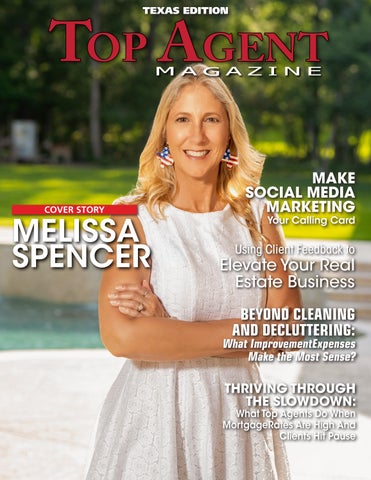

MELISSA SPENCER

Graham Harrop




Make Social Media Marketing Your Calling Card
These days, it’s no secret that buyers begin their home search online. As the industry continues to take a digital turn, Realtors in the know must learn to utilize a whole new range of tools available to them—and for good reason. Social media is a dynamic hybrid of personal contact and targeted marketing. To make the most of this new medium, agents can’t settle for the occasional post and expect results. Instead, let’s consider a few techniques that will make your social media presence
interactive, unmissable, and effective in generating business.
Your Profile is a Portal
Ideally, you’ll have profiles across Facebook, Instagram, LinkedIn and otherwise—but no matter what portal you’re utilizing, make sure your profile page is up-todate, well-curated, and easily navigated. Consider your profile a landing page.
Your photo, location, contact information, homepage, and a brief bio should all be readily visible so that potential clients can get an immediate sense for who you are and what your voice is. If a client wants to connect with you, it should be obvious how to do so. You might also incorporate a few savvier tools that make your profile more engaging—like hashtags. These searchable tags can help you lure potential clientele and give your audience a chance to explore deeper. #DreamHome #JustListed and #HomeInspiration are popular, existing tags to choose from, but you can cultivate your own hashtag by consistently tagging posts, which gives clients an extensive thread to comb through.
Interacting with Your Audience
Posting regularly is great way to appear in feeds, but engaging with your audience is just as important—and it helps you reach a new audience in the process. It’s a positive start to like your audience’s posts, pictures, and statuses, but commenting takes your engagement a step further and separates you from typical respondents. It’s also important that you diversify your engagements. In other words, don’t center every communication around your business, propositioning your services, or trying to sell. If applicable, present your value-add, but otherwise steer your engagement towards the personal. Let your clients know that you’re there, you’re human, and
ready to work at their pace. Which leads us to our next point...
Blending the Professional with the Personal
Engaging with your audience is one thing, but what about generating original content? How do you strike the right balance between a Call to Action, industry updates, and a personal touch? Think of it this way: any post you create should provide a point of connection for your audience. Sometimes, you might be sharing a family photo, or commenting on some unifying current event—like the Super Bowl! Other times, you may be sharing a Coming Soon listing, or providing tips to spruce up a home for spring. Regardless, you should focus on quality. Is your copywriting engaging? Does it express your unique voice and personality, while maintaining clarity? Are you giving your audience something to connect with, even if you are sharing property photos or advertising an open house? Instill some fun and some personalization to every piece of content you make, so that clients can picture the voice and person behind the post.
Things are always changing on the social media frontier, but some rules never shift. Adding clarity, consistency, and personality to your online presence are three surefire ways to grow your business and make social media second nature.

Beyond Cleaning and Decluttering:
What Improvement Expenses Make the Most Sense?
Decluttering open spaces, emptying cabinets and drawers and removing knick-knacks might seem like obvious – and free – ways to improve a home’s presentability. Unfortunately, however, not all sellers or agents are willing to do much more than decluttering and cleaning.
Think of the listing as a reflection on yourself. If you didn’t comb your hair, shine your shoes, dress
neatly and drive a clean car, people would think you don’t care about yourself. They may wonder, “If he doesn’t care about how he presents himself, how is he going to present my house?” Likewise, not prepare a house for its most beautiful presentation might cast doubt on how the overall marketing will go. And, while not all changes will be immediately noticeable, chances are that what isn’t changed will be noticed.
Ashley Aguilera, REALTOR®, broker and owner of The Aguilera Team in California’s Murrieta Valley and Temecula, says that after every consultation, her team formulates a game-plan. “We want to set their property apart from everything else on the market, but also fall within the comfort zone of the seller’s lifestyle,” she says. Changes may run the gamut from minor repairs and moving furniture for better flow, to adding accent pieces to harmonize the home’s look or create a “wow” factor before professional photography.
Many agents recommend conducting a professional inspection prior to listing; some will even hire the inspector at their own expense. Of course, any necessary repairs found during inspection and not repaired before listing must be formally disclosed. But wouldn’t it be nice to have no surprises during the buyer’s formal inspection?
In general, some improvements are required, others are low-cost and others pay for themselves
with lower time on the market, competing offers or higher sale price.
Landscaping & Exterior
First impressions begin outside. Be sure to mow and edge the lawn regularly; prune back overgrown trees and hedges; hire a professional to repair uneven pavement (especially if it’s a hazard); remove or replace dying annuals; and clean or repair porches or railings. Are there dry or dead patches of lawn? An inexpensive repair to the irrigation system might be the solution.
While painting an entire house can be extreme, a wise investment is to paint trim, porches, steps or railings that may look tired or have too many colors; choosing a single, neutral color for trim can create a bright, cohesive look. Finally, check the roof, gutters and windows, looking for spots to caulk, shingles to replace, or debris to remove.


Walls, carpets, ceilings and trim
Next, it’s time for agent and seller to open up to one another about the interior. Janelle Holte, who leads Seller’s Edge Home Team in the Minneapolis/St. Paul area, loves walking into a home knowing that her team will be the driving force behind selling it. “I like seeing how owners took care of it and raised their family in it,” she says. “But I won’t sugar-coat anything, so I tell them not to shoot the messenger!” She gives it to them straight, explaining what needs to be done to stage it to present well from a buyer’s perspective.
Those changes often include repainting at least the primarily living areas and replacing carpet, especially worn carpet or carpet that has faded or stained beyond what professional carpet cleaning could remedy. Sometimes, all that’s needed is professional carpet stretching to remove any buckling prior to cleaning.
Paint is extremely important if the home has faded or dirty walls, holes or chips on paint or plaster. If an entire paint job is not feasible, at least consider cleaning repairing the obvious and adding a fresh coat of semi-gloss to baseboards, moldings, windowsills, doors, banisters balustrades and built-ins. Don’t overlook the ceilings! A long-ago leak from a second-floor bathroom may have been completely repaired and moisture abated, but a patched-up ceiling is a red-flag.
Kitchens and baths
Most agents agree that the easiest costs to recoup in home improvements prior to selling are those spent in bathroom and kitchen updates. Complete remodels are unwise; you can’t anticipate the style preferences of their buyer. But refinishing, touching-up or painting cabinets can create a great impact, while also forcing the seller to remove unwanted or overstocked items from cabinets and drawers. Don’t forget the cabinet pulls – shiny, new nobs look nice.
Lee Ritchie of Ritchie Realty Group in Columbus, Ohio, gives a reminder to discuss any and all issues up front. “People need to be able rely on the professional who’s presenting, pricing and marketing their home,” she says. An honest and diligentagent will be an open book about the currentmarketconditions,thequalityofcomparable listings and the potential return-on-investment for improvements.
Some agents, like Debra Dobbs of @properties in Chicago, even roll up their sleeves to help with decluttering and repairs. While not at all required or expected, doing so sure lets sellers see the investment their agent is willing to make for them.
MELISSA SPENCER

Melissa Spencer — A Relationship-First Approach to Real Estate in North Houston
Melissa Spencer built her real estate career around one simple but powerful idea: helping people navigate life’s biggest transitions with confidence. From the beginning, she recognized that real estate is not just about property—it is about guiding clients through one of the most emotional and financially significant decisions they will ever make. That perspective has shaped her approach over the past 10 years and continues to drive her passion for building lifelong relationships with the families she serves.
Today, Melissa leads a specialized team of four, co-piloted by her husband and partner, Doyle Spencer. Together with two experienced agents, they operate with a collaborative, family-first mindset that allows them to provide around-the-clock support and diverse expertise on every transaction. Their structure ensures that clients benefit from both personalized attention and the strength of a well-coordinated team.
Based in Montgomery, Melissa and her team serve Montgomery County and North

Based in Montgomery, Melissa leads a specialized team of four, co-piloted by her husband and partner, Doyle Spencer. Together, they operate with a collaborative, family-first mindset.
Houston, with a strong focus on communities like The Woodlands, Spring, Magnolia, Tomball, and the Lake Conroe area. Their expertise spans everything from suburban homes to acreage, farm, and ranch properties, giving them the ability to guide a wide range of clients. What Melissa appreciates most about the region is its versatility— offering both vibrant city conveniences and peaceful, open spaces, all within a strong, community-driven environment.
Her marketing strategy is built on combining maximum exposure with precise
targeting. Every listing is supported by professional photography, cinematic video, and drone imagery, especially important for showcasing larger properties. These assets are then distributed through a multi-channel digital strategy, including social media advertising and the global reach of the RE/ MAX network. The goal is not just visibility, but reaching the right buyers locally and internationally.
Melissa’s personal brand is rooted in education and trust. Rather than focusing solely on transactions, she provides clients with

Rather than focusing solely on transactions, Melissa’s personal brand is rooted in education and trust, providing clients with the data, insight, and clarity they need to make informed decisions.
the data, insight, and clarity they need to make informed decisions. Her consistent presence in the community, along with transparent communication, has allowed her business to grow largely through referrals and repeat clients.
For Melissa, relationships extend far beyond closing day. She and her team maintain strong connections with their clients through personalized check-ins, neighborhood-specific market updates, home anniversary touches, and appreciation events. By treating clients like family and staying present long after the transaction is complete, they have built a business centered on loyalty and longterm connection.
Looking back, Melissa would not change her relationship-focused foundation or the decision to partner with her husband, whose discipline and expertise have been instrumental to their success. What she

For Melissa, success is measured not just in transactions, but in the communities she helps strengthen.
would do differently is embrace growth sooner by building her team earlier and trusting in collaboration. Giving back is also a core part of her mission, with strong support for her local church, military organizations, Children’s Miracle Network, and global missionary efforts. For Melissa, success is measured not just in transactions, but in the communities she helps strengthen.
When she is not busy advocating for her clients, Melissa cherishes the time spent embracing the authentic Texas
lifestyle. She and Doyle enjoy retreating to their ranchette, a dedicated property where they tend to their Longhorn cattle and connect with the land they love.
At home, she finds relaxation lounging by their Texas-shaped pool while enjoying the native wildlife that frequents their backyard. Passionate travelers, Melissa and Doyle find that their time away allows them to recharge and return to their business with a fresh perspective, ensuring they continue to provide the highest level of dedicated service to their community.
https://facebook.com/MelissaSpencerTheSpencerTeam http://instagram.com/melissaspencerthespencerteam http://tiktok.com/@melissaspencerrealtor
https://www.youtube.com/@thespencerteam.remaxintegrity

https://www.linkedin.com/in/melissa-spencer-8912a33a/google.com%2F

Thriving Through the Slowdown : WHAT TOP AGENTS DO When Mortgage Rates Are High and Clients Hit Pause

When mortgage rates climb and client confidence stalls, the real estate market shifts into a slower gear. Buyers put their plans on hold, sellers get nervous, and suddenly, those once-hot leads go cold. It’s a cycle every agent knows—but not all navigate it the same way.
Written by Jessica Fisher, Top Agent Magazine Publisher
The most successful agents don’t just wait out slow markets; they work them. They use downtime as runway. Because real estate, at its core, is a rollercoaster—filled with highs, lows, unexpected turns, and thrilling rebounds. And those who understand that are always preparing for the next climb, even when the ride slows down.
What Agents Should Do in Slow Market
Here’s how top-producing agents maximize their time and mindset when the market cools and clients choose to wait.
1Embrace the Downtime as a Strategic Gift
It’s tempting to view a slow market as a setback—but what if it’s actually a setup for your next breakthrough?
Downtime allows you to do the work you often push aside during busier seasons. Think of it as your off-season training. Athletes don’t just play during game time—they condition, study, and strategize during the off-season so they’re sharper when competition returns. The same applies here.
• Revisit your business plan. What worked this year? What didn’t? Refine your goals and track your metrics.
• Organize your systems. Clean up your CRM, refresh your email templates, and streamline your listing and buying processes.
• Take a break—intentionally. Recharging your mindset is productive, too. This industry demands energy, and rest is part of resilience.
By shifting your perspective from scarcity to strategy, you’ll find that this “slower” time can actually be your most productive yet.
2 Master Your Market and Elevate Your Expertise
In uncertain markets, clients crave certainty. That doesn’t mean you have all the answers— but it does mean you can provide clarity.
Use this time to become the agent who doesn’t just show homes, but explains the market.
• Deepen your economic knowledge. Understand how interest rates impact buying power and pricing trends. Learn how sellers can use concessions or rate buydowns to create win-win deals.
• Get additional certifications. Consider designations like Certified Residential Specialist (CRS) or Accredited Buyer’s Representative (ABR®) to enhance your expertise.
• Follow local data weekly. Be able to answer: How many homes sold last month? Are prices holding steady? Where’s the inventory?
The more fluent you are in your market’s story, the more confident your clients will be in working with you—even if they’re not ready yet.
3 Stay Top of Mind Without Selling
When clients feel uncertain, the worst thing you can do is push. Instead, lean into valuebased marketing. Show up as an advisor—not a salesperson.
• Create useful content. Videos, newsletters, or blog posts that break down current conditions show you’re active and informed.
• Host no-pressure events. Webinars like “What Buyers Should Know in 7% slow Market” or community meetups keep your presence warm and helpful.
• Send personal check-ins. Reach out to past clients just to say hello, share a relevant tip, or see how their home is treating them.
These moments build trust. So when your client is ready to move, they’ll remember that
you stayed engaged—not just when the market was hot, but when it mattered most.
4
Focus on Relationships, Not Just Transactions
Deals may slow down, but relationships never go out of season. Use this time to deepen your network.
• Reconnect with past clients. A note, call, or coffee can spark future referrals or repeat business.
• Collaborate with vendors. Stagers, lenders, inspectors—now’s the time to build stronger partnerships and find ways to co-market.
• Give first. Recommend local businesses, highlight community events, or offer to help with homeownership questions. Being generous with your time builds loyalty.

5
Keep Showing Up—
Because the Slow Market Will Turn
History shows it time and again: real estate rebounds. Rates drop, confidence returns, and the clients who were waiting suddenly jump in. The question is—will you be ready when they do?
Consistency is your competitive advantage.
• Keep posting. Even if engagement dips, stay visible.
• Keep learning. Markets shift, and knowledge is your edge.
• Keep moving. Host open houses, preview listings, attend broker tours—activity fuels momentum.
Agents who retreat during slow periods have to start over when the market wakes up. But those who stay present, focused, and proactive? They’re already ten steps ahead.
Use the Dip of the slow market to Prepare for the Climb
Real estate is a cyclical business. Every slowdown is followed by an upswing. And the agents who succeed long-term are those who accept that truth, prepare through the pauses, and never let external conditions define their value.
High mortgage rates might slow your pace, but they don’t stop your purpose. Embrace the down-time. Improve your skills. Stay visible. Strengthen relationships.
Because when the market comes back—and it will—you won’t just be back in the game.
You’ll be leading it.












USING CLIENT FEEDBACK TO ELEVATE YOUR REAL ESTATE BUSINESS

For real estate professionals, publishing your client testimonials is a key strategy for establishing trust, enhancing your reputation, and drawing in new clients. Through the strategic use of positive
client feedback, you can demonstrate your expertise and the exceptional value you offer in real estate transactions. Here are key strategies for maximizing the impact of real estate testimonials in your business:
Diversify Your Testimonials
Collect feedback from a broad spectrum of clients, such as first-time buyers, sellers, investors, and those facing unique challenges. This approach offers a comprehensive view of your capabilities.
Promptly Request Testimonials
Aim to obtain testimonials soon after closing a deal. Prompt timing ensures clients’ memories are fresh, enabling them to share detailed and impactful experiences.
Enhance Your Website with Testimonials
Develop a section on your website dedicated to client testimonials. Display them attractively, including clients’ names, photos, and specific transaction details if possible.
Utilize Testimonials in Marketing Efforts
Embed powerful testimonial excerpts in your marketing materials, including brochures and flyers, to catch the eye of prospective clients and underscore your track record.
Broadcast Testimonials on Social Media
Publicize your client feedback on social platforms, using engaging visuals or property photos to accompany the testimonials.
Innovate with Testimonial Videos
Elevate your client feedback with video testimonials. Short, engaging videos can make a lasting impression on potential clients by showcasing genuine satisfaction.


Incorporate Testimonials into Email Marketing
Utilize testimonials in your email campaigns to underscore your expertise and encourage engagement from potential clients.
Present Testimonials to Prospective Clients
Integrate client success stories into your presentations to illustrate your track record and reassure potential clients of your ability to deliver favorable results.
Feature Testimonials in Your Blog
Share client success stories in blog posts, integrating testimonials to lend credibility and a personal touch to your narratives.
Create Detailed Case Studies
With client consent, develop case studies that explore specific challenges and your successful interventions, offering deep insights into your problem-solving prowess.
Highlight Testimonials in Your Online Presence
Feature client testimonials in your profiles on key real estate and social media sites to bolster your online reputation and attract new clients.
Promote Third-Party Platform Reviews
Encourage clients to review your services on esteemed real estate platforms, enhancing your visibility and credibility.
Engage Through Testimonial Events
Host webinars or events where clients can share their experiences, providing a dynamic forum for potential clients to learn and interact.
Advertise with Testimonials
Use testimonials in your advertising campaigns to spotlight positive client experiences and foster trust with your target audience.
Keep Your Testimonials Current
Regularly refresh your testimonials to maintain relevance and demonstrate your continuous commitment to excellence and client satisfaction.
By strategically publishing real estate testimonials across various platforms and marketing channels, you can build a compelling narrative that resonates with potential clients. Authentic endorsements from satisfied clients serve as a powerful tool for establishing trust and differentiating yourself in a competitive real estate market.