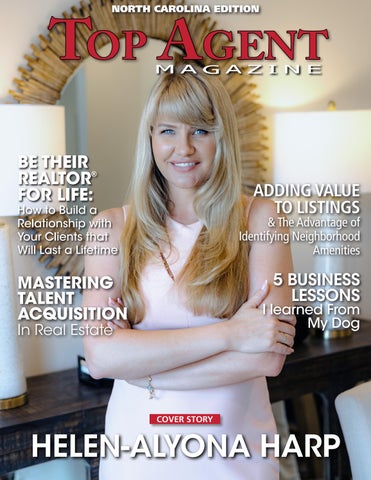

HARP



Adding Value to Listings & the Advantage of Identifying Neighborhood Amenities
Everyone knows the famous real estate phrase: location, location, location. In fact, it is hard to underestimate the pivotal role that a region can play when it comes to determining a home’s value. In today’s competitive market, the littlest things can truly add up—especially when it comes to neighborhood amenities. While most savvy agents know the figures regarding school
district ranking and local property taxes, have you ever considered the under-the-radar amenities that drive buyers and bidding wars? To derive the highest value from a listed home, you need to paint a complete picture of the area in which you’re selling. With that guiding principle in mind, let’s consider a few modern amenities and how they add drastically to your bottom line.
Walking a fifteen-minute radius of the area or performing a deep-dive into customer review sites or food blogs can help you identify hidden gems or local favorites.
A little can go a long way: restaurants, coffee shops, and entertainment
Everyone has a favorite take-out spot, coffee shop, or neighborhood watering hole. Identifying the key players in an area—such as restaurants, nightlife, and entertainment hotspots—will create a livable picture that prospective buyers can latch onto. Walking a fifteen-minute radius of the area or performing a deep-dive into customer review sites or food blogs can help you identify hidden gems or local favorites. While a cute coffee shop down the street may seem like a bonus instead of a foundational amenity, you never know what kind of homebuyer you might net if you include the cozy characteristics that make a house a home.
From here to there: public transportation and commuter access
While this rule may not apply to all properties, considering access to public transportation is a major draw for today’s buyers. Especially amidst the more eco-conscious Millennial segment eager to buy within city limits—knowing public transportation access points and schedules can add serious value to listed properties. Also, think outside the box: do nearby thoroughfares boast dedicated bike lanes? Are there plans to expand rail lines to the area in the future? Deliver a confidant picture of the area’s public transportation access and prospective buyers will trust your expertise.
Know thy history: creating a narrative of the neighborhood
As humans, we’re drawn to narratives. Sales pitches and marketing campaigns hinge on an alluring storyline. That’s why understanding a neighborhood’s history can frame and contextualize a property to great effect. After all, buyers aren’t just drawn to sturdy foundations and bedroom counts; they like to imagine their lives unfolding inside those four walls. Get a sense of the area’s historical timeline, architectural style, noteworthy community members, and the like. Conveying this intriguing information to buyers helps them connect more personally with a property, while understanding the holistic picture of their potential new home.
While it is always good to cover the basics of school districts and property values, it is even more useful to expand your knowledge base and bring a warm, human element to locational knowledge. Not only will you appeal to a younger demographic of homebuyers who values this strategic information, but you will also broaden your understanding of your service area at large. Think of it this way: a neighborhood is far more than a collection of homes on a block. A neighborhood is about atmosphere, access, and a sense of community. If you authentically appeal to this guiding truth, and buyers will surely rise to the occasion.
MASTERING TALENT ACQUISITION IN REAL ESTATE

The ability to draw in and keep exceptional agents forms the backbone of any thriving brokerage. The art of follow-up stands at the forefront of transforming potential interests
into concrete assets for our teams. Below, we delve into the strategic nuances of follow-up, showcasing its role as a critical differentiator in securing the industry’s best.
• Fostering Memorable Connections:
• Fostering Memorable Connections:
The initial meeting lays the groundwork, but it’s the diligent follow-up that cements a solid relationship. A personalized email or call after the first interaction not only reiterates the benefits of joining your team but also highlights your brokerage’s dedication to building meaningful connections.
The initial meeting lays the groundwork, but it’s the diligent follow-up that cements a solid relationship. A personalized email or call after the first interaction not only reiterates the benefits of joining your team but also highlights your brokerage’s dedication to building meaningful connections.
• Showcasing Commitment to Agent Success:
• Showcasing Commitment to Agent Success:
Continuous engagement post-meeting signals to prospective agents that your firm is invested in their career trajectory. This level of dedication showcases a supportive environment where agents’ growth and success are paramount.
Continuous engagement post-meeting signals to prospective agents that your firm is invested in their career trajectory. This level of dedication showcases a supportive environment where agents’ growth and success are paramount.

• Clarifying Doubts and Building Confidence:
• Clarifying Doubts and Building Confidence:
Utilize follow-up interactions as a platform to address any hesitations or queries. Engaging in open dialogue ensures that expectations and values are aligned, paving the way for a mutually beneficial partnership.

• Ensuring Your Brokerage Stands Out:
• Ensuring Your Brokerage Stands Out:
In a landscape where elite agents are pursued by numerous firms, staying actively engaged through follow-up can keep your brokerage at the forefront of their minds. Highlighting your unique offerings and culture through consistent communication underscores why your firm is the ideal choice.
In a landscape where elite agents are pursued by numerous firms, staying actively engaged through follow-up can keep your brokerage at the forefront of their minds. Highlighting your unique offerings and culture through consistent communication underscores why your firm is the ideal choice.

• Highlighting Paths for Professional Development:
• Highlighting Paths for Professional Development:
Utilize follow-up interactions as a platform to address any hesitations or queries. Engaging in open dialogue ensures that expectations and values are aligned, paving the way for a mutually beneficial partnership.
Follow-up conversations are golden opportunities to outline the developmental prospects within your firm. Elaborating on mentorship programs, educational workshops, and career progression plans can tip the scales in your favor.
Follow-up conversations are golden opportunities to outline the developmental prospects within your firm. Elaborating on mentorship programs, educational workshops, and career progression plans can tip the scales in your favor.

• Elaborating on Brokerage Values and Culture:
Post-meeting, candidates often seek deeper insights into your brokerage’s ethos and community. Follow-up communications are perfect for sharing success stories and the supportive network that defines your brokerage, aiding them in making an informed decision.

• Respecting Communication Styles:
Recognizing and adapting to a candidate’s preferred method of communication tailors a more personalized and effective followup. This adaptability not only respects their preferences but also fosters a stronger rapport.

• Smooth Transition to Onboarding:
A strategic follow-up process seamlessly bridges candidates to the onboarding phase, setting a positive tone for their integration into your team. This smooth transition is crucial in cultivating a productive and harmonious work environment from the get-go.
In conclusion, the power of follow-up in recruiting real estate agents cannot be overstated. It is not merely a formality but a strategic and essential component of the recruitment journey. Brokers and agencies that prioritize effective and consistent follow-up demonstrate a commitment to their agents’ success and position themselves as attractive destinations for top-tier real estate talent. In a field where relationships are paramount, unlocking success often begins with the simple act of following up.
HELEN-ALYONA HARP

Helen-Alyona Harp
— Guiding
Clients with Education, Protection, and Heart
Helen-Alyona Harp’s passion for real estate was shaped by a difficult experience selling her own home years ago. What should have been a straightforward transaction became stressful and complicated, eventually leading to the courthouse over a dispute involving security deposits. During the hardest moments, the agents involved stopped answering calls and were no longer there to guide or protect their clients. That experience stayed with Helen-Alyona and inspired her to become a different kind of real estate professional: one who answers the phone, explains the process, finds solutions, and stands beside clients when they need support most.
Now nine years into her career, HelenAlyona works as a solo agent serving North Carolina and South Carolina within about a 90-minute radius of Charlotte. Originally from Ukraine, she moved to Germany at 18, graduated from the University of Heidelberg, and later came to the United States. Fluent in Russian, Ukrainian, German, and English, she connects with clients across cultures and backgrounds. Her story and language skills have also allowed her to serve many members of the Russian-speaking and Slavic communities, especially those learning how to navigate homeownership in the United States.

Now nine years into her career, Helen-Alyona works as a solo agent serving North Carolina and South Carolina within about a 90-minute radius of Charlotte.
Helen-Alyona loves the Charlotte area, where she has lived for 16 years and watched the city grow into one of the Southeast’s most desirable places to live. She values its strong economy, quality of life, mild four-season climate, airport access, healthcare systems, schools, universities, parks, green spaces, and family-friendly attractions such as the U.S. National Whitewater Center and Carowinds. With the mountains and coast within easy
reach, Charlotte offers the lifestyle, opportunity, and convenience that many relocating buyers are seeking.
Her business has grown through education, trust, and consistent value. Early in her career, Helen-Alyona built momentum through door knocking, open houses, networking, and working directly with local buyers and sellers. As more people from Slavic and post-Soviet

Helen has been the number one agent in her Keller Williams Ballantyne office for three consecutive years among more than 600 Realtors, and in 2025, she became the number two Realtor in North and South Carolina within Keller Williams.
communities reached out for guidance, she began organizing first-time homebuyer seminars and teaching clients how to build credit, understand financing, and prepare to purchase a home. She later expanded that mission through YouTube, creating videos about Charlotte neighborhoods, schools, relocation, financing, and the buying and selling process. Today, many clients find
her through YouTube, social media, Google, referrals, and community events. Her dedication has also earned significant recognition: she has been the number one agent in her Keller Williams Ballantyne office for three consecutive years among more than 600 Realtors, and in 2025, she became the number two Realtor in North and South Carolina within Keller Williams.
For Helen-Alyona, real estate is never only transactional. She genuinely loves her clients and often sees them become part of her extended family. She stays in touch long after closing through birthday messages, home anniversary notes, small gifts, treats, Christmas deliveries, and client appreciation events, including her annual Easter Egg Hunt for families and children in the community. Her goal is for clients to feel supported, appreciated, and confident referring their friends and family because they know how deeply she cares.
Giving back is also central to Helen-Alyona’s life. As someone originally from Ukraine with loved ones still there, she is actively involved with Charlotte for Ukraine, helping raise funds and organize humanitarian support for medications, heaters, medical supplies, and
other urgent needs. She also supports animal shelters in Georgia, organizations fighting human trafficking, families in need, and food support through Feeding America. For Helen-Alyona, success is not only measured by business achievements, but by the ability to make a positive impact.
Looking back, Helen-Alyona would not change her journey, believing every challenge became a lesson that made her stronger, wiser, and more compassionate. She is grateful for the support system behind her, including her admin, transaction coordinator, marketing assistant, coach, and family. Through continued education, perseverance, and a client-first heart, Helen-Alyona continues to build a business rooted in protection, guidance, and meaningful service.



Be Their REALTOR® for Life:
How to Build a Relationship with Your Clients That Will Last a Lifetime
In the world of real estate, an agent’s relationship with their clients can make or break their career. This industry revolves around working well with people, and being able to develop a strong relationship with your clients is the foundation that you business is based upon. Just like with a house, if that foundation is weak, the rest of the structure is also going to be unsteady and fragile. The mark of a good REALTOR® is their ability to build up a good referral network and following of loyal clients. This isn’t something that just happens by accident. Building healthy, strong relationships with your clients takes work and knowing how to gain another person’s trust, respect, and friendship. Here are some ways to make sure you are building the right kind of relationship with your clients.
1. Use Your Friendliness and Optimism to Win Them Over:
No one wants a pushy, overly confident salesperson for a REALTOR®. Clients are much more inclined to put their trust in the hands of someone who is friendly when it comes to one of the biggest financial transactions of their lives. A pleasant, outgoing disposition will win you more clients as well as friends. You want to establish rapport in the first few minutes of first meeting prospective clients. Rather than starting with business right off the bat, begin your meeting with some small talk such as similar interests, hobbies, and family life. This will immediately help to put your clients at ease, and show that you are not simply trying to “sell” them something.
People also respond well to optimism. During what can be a very stressful time, clients need someone to help them stay positive when a situation looks difficult and challenging. Optimism also tends to radiate charisma, and people want to be around and do business with charismatic people. You want to learn how to understand, motivate, and inspire people.
2. Be an Inquisitive Learner and an Empathetic Listener:
Don’t be afraid to show your curiosity and ask your clients a lot of questions. Some of these questions may even be difficult and uncomfortable. You want to discover and learn as much as you can about your client. Don’t make the mistake of jumping straight into the role of the know-it-all. Every different client has unique needs, so you want to learn as much as you can about their specific situation before trying to propose a solution. You want to uncover their primary motive for buying or selling, and flush
out any potential concerns they might have. After you’ve gained as much information as possible, you can then gauge their interest in your possible solutions by asking “what if” questions. Being inquisitive also demonstrates to your clients that you are genuinely interested and invested in their situation.
On the other side of this coin is knowing how to listen empathetically. Empathy involves actually putting yourself or your mind in their shoes so you can genuinely understand their concerns, needs, and opinions. That understanding and empathy is then reflected in your conversation with that client. Your clients want to know that you care about their situation, and that they’re not just another sale for you to make. People are much more willing to put their trust in you when they can sense that you are actually making an effort to feel what they feel in order to understand their situation.
Showing your interest through questions, and then thoughtfully listening goes a long way towards gaining trust. Showing empathy and acknowledging the feelings and emotions involved in your clients situation helps build a relationship founded on genuine care and trust.
3. Watch for Nonverbal Clues:
Most communication happens nonverbally, so knowing how to interpret your client’s body language can be incredibly helpful. Here are a few things to pay special attention to:
Eye contact: Be careful with the level of eye contact you use with clients when first meeting. Too much and too little eye contact can send the wrong impression. You want to try and maintain eye contact around 70 percent of the time. That is the amount that most people are comfortable with. Pay attention to your client’s level of eye

contact to determine how comfortable they are. When someone avoids eye contact that could mean they are not engaged in the conversation. A good way to quickly build a feeling of rapport when first meeting clients is to make eye contact when you first meet them and then start nodding yes to what they’re saying. If the client reciprocates the eye contact and nodding, you’ve established a connection.
Choose the right handshake for each client: One handshake does not fit all people, and that first handshake can be crucial to making a good first impression. The way to do a good handshake for each client is to try and mirror the other person’s handshake in strength, keep your shoulders aligned as you are preferably standing when you shake hands. While you shake your client’s hand make sure you make eye contact and give them a sincere smile.
Here are a
4. Prove your honesty and credibility:
Honesty and integrity are the two traits that 98 percent of buyers and sellers report are qualities they consider “very important”. The thing is you can say you have these traits all you want on your website, bio, etc., but trust has to be earned, and the only way to do this is to prove your credibility.
Showing a little weakness can actually be to your advantage in this situation, and will actually make others more inclined view you as honest. You don’t want to come across as too good to be true. When revealing this weakness, however, the key to coming out on top is turning what sounds like a weakness into a strength. For example, your service may be more expensive, but that’s because you offer more personalized and extra services than your competitors.
few tips for how to sound more credible:
When you talk to your clients avoid using filler words such as “um” and “uh”, which can decrease your credibility. You also want to watch the tone of your voice. People tend to translate a deeper tone as sounding more credible.
You want to develop a relationship to last a lifetime when interacting with your clients. There are many things you can do to accomplish this, and using these tips can take you from getting just a few referrals and repeat customers to gaining a loyal client following. Taking the little extra time to make sure you are projecting the right attitude and making sure that you are doing things to gain your client’s trust can make a world of difference for your business.
Graham Harrop












5 BUSINESS LESSONS I LEARNED FROM MY DOG

Applying these key lessons to your business can lead to an increase in productivity, creativity, and resilience.
Our furry friends bring immense joy to our lives. Their ability to project love and happiness into the world helps us feel calm. They seem to live entirely in the moment, which is something we
can learn from as humans. We can take it a step further and analyze how their behavior could be emulated in our own lives, particularly when it comes to business.
While there are certain dog characteristics we don’t want to replicate as humans (you can probably name quite a few), there are several that could lead to an increase in productivity. In this article, we’ve gathered five of the best lessons to be learned from dogs. Each one has its strengths, and applying these lessons to your work will undoubtedly lead to an improved way of doing business.
As we look into the specific lessons dogs teach us, keep in mind how their instinctual behaviors can make us not only better colleagues but also more adaptive and resilient professionals.
Here are the five valuable lessons dogs have taught us about business:
1CLEAR AND FREQUENT COMMUNICATION
Dogs are always communicating. Though their communication may not be as clear to us if we aren’t familiar with their behavior, their messages come in bright as day to the dogs around them. If you’ve ever taken a dog to a dog park, you will see what we’re saying. A bow towards the ground with a tail wag means, “I’m ready to play!” while a tucked tail, cowering stance and whimpering means, “I’m scared!” The dogs who send these messages are hoping for a response in the dog they’re communicating with, whether it’s to engage in play or leave them alone. The dogs who observe these behaviors instinctively know what they mean. Though they might not always respect what the
other dog is saying, the message rarely gets misconstrued.
We can take this lesson into our business lives by remembering the importance of clear and frequent communication. We have a lot more to say than dogs, so it’s even more vital that we are upfront with what we’re thinking and feeling. We can’t expect a person to respond if we don’t engage. And just like dogs do, we should be prioritizing open communication through both verbal and nonverbal cues to maintain coherence and clarity.


2
EMBRACE REGULAR OUTDOOR TIME
If you’ve ever tried to work alongside your dog, you know they can be quite demanding when it comes to breaks. Dogs want to spend as much time as possible being outside, and they’ll let you know if it’s been too long since they’ve felt fresh air. Animals crave being outdoors. Let’s not forget that humans are animals, too. It’s quite unnatural for us to sit behind a computer for 8+ hours a day, so we have to remember to take breaks throughout the day.
Set a timer on your phone to remind yourself to get up and stretch. When you have a longer break, take a moment to step
outside, even if the weather is bad. A deep breath or two in the outdoors will help you reset. Once you return to work, you’ll feel refreshed and ready to be productive.
3 FIND THE REWARDS IN LEARNING
Most dogs want to learn because it makes us happy. Some need to be bribed with treats or play time. No matter the dog’s age, though, they are generally receptive to learning new things. Training a dog to do tricks or have manners provides them with enrichment and rewards. Dogs tend to learn quickly, and they never seem to forget the things they’re taught.
As humans, we can apply this to our own lives by always seeking out learning opportunities. While we might not be rewarded with treats, we will be rewarded with knowledge, and we can use that to improve our business, make more money, and work more efficiently.
4 PRIORITIZE MAKING A GOOD FIRST IMPRESSION
Most dogs love humans and other animals. When they first come across someone they’ve never met before, you’ll see them exhibit quite a variety of positive behaviors in an effort to bond with their new friend. They might wag their tail and bring them one of their toys, offer a paw to hold, roll over, or give them a thorough, kind sniff. All of these actions seem to say, “I’m a good dog, you can trust me.”
People should attempt to say the same thing when they first meet someone, especially when it comes to business. Gaining trust is a key aspect of becoming successful as an entrepreneur, so showing others your open, happy, and accepting side will make a lasting impression. A smile, handshake, and light, positive conversation goes a long way.
5
REMAIN ALERT AND ADAPTIVE
Though dogs do love socializing and meeting new creatures, they also have a protective nature, meant to keep them and their pack safe. You can see this behavior play out when the doorbell rings or a stranger walks by your house. They will bark loudly, alerting you that something is happening. If you inspect the danger and tell them nothing is wrong, they eventually adapt their behavior, going back to what they were doing prior. When everything seems peaceful, they are always keeping their nose, ears, and eyes on high alert, waiting for anything out of the ordinary to happen.
We can implement this lesson by continually looking out for inconsistencies, and staying in touch with our instincts. If something in your work seems wrong, look into why that is, and adapt accordingly. In business, it’s important to stay in tune to what is happening, so we can keep up with changes and refine our strategies. Change is inevitable, and being open to that will help us reach new levels of growth.
The wisdom imparted by our canine friends supplies us with endless inspiration for our professional lives. The lessons they teach us, such as clear communication, the importance of breaks, continuous learning, making positive first impressions, and remaining adaptive, are essential for success in today’s business environment. By utilizing these principles, we not only enhance our productivity and creativity but also foster an atmosphere of resilience and mutual respect in the workplace.