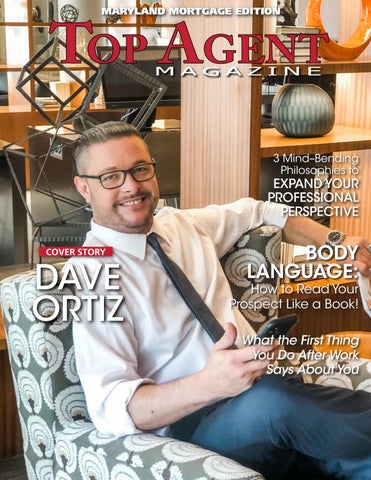
MARYLAND MORTGAGE EDITION
3 Mind–Bending Philosophies to
EXPAND YOUR PROFESSIONAL PERSPECTIVE COVER STORY
DAVE ORTIZ
BODY LANGUAGE:
How to Read Your Prospect Like a Book!
What the First Thing You Do After Work Says About You
MARYLAND MORTGAGE EDITION
9
DAVE ORTIZ
CONTENTS 4) 3 MIND–BENDING PHILOSOPHIES TO EXPAND YOUR PROFESSIONAL PERSPECTIVE 6) 6 METHODS FOR BUILDING BETTER EMAIL LISTS
15) WHAT THE FIRST THING YOU DO AFTER WORK SAYS ABOUT YOU 18) BODY LANGUAGE: HOW TO READ YOUR PROSPECT LIKE A BOOK! 22) HOW TO OVERCOME YOUR WORKPLACE FEARS
Phone 310-734-1440 | Fax 310-734-1440 mag@topagentmagazine.com | www.topagentmagazine.com No portion of this issue may be reproduced in any manner whatsoever without prior consent of the publisher. Top Agent Magazine is published by Feature Publications GA, Inc. Although precautions are taken to ensure the accuracy of published materials, Top Agent Magazine cannot be held responsible for opinions expressed or facts supplied by its authors. To subscribe or change address, send inquiry to mag@topagentmagazine.com. Published in the U.S.
2
Top Agent Magazine
mailto:mag@topagentmagazine.com
Top Agent Magazine
3
3 Mind-Bending Philosophies to Expand Your Professional Perspective
Beyond the day-to-day duties that make your business tick, so much of success is derived from the principles you put in place to guide your business. The foundational tenets you subscribe to can make or break your business for the long-term; they not only influence how you complete routine 4
tasks, but also impact your growth, your ability to manage a team, and what the future might hold. With all that in mind, here are three philosophies to remember as you strategize your professional life—whether you’re mapping your monthly goals or creating an overarching plan for growth.
Top Agent Magazine
Top Agent Magazine
1
Treat Your Business Like a Business
One of the perks of working in real estate is that you’re often able to create and manage your own schedule and volume, but that doesn’t mean you can skimp on the technical details of being your own boss. No real estate professional worth his or her salt would forgo empowering tools like a business and marketing plan, or spreadsheets to track cash flow and expenses, or regular profit-and-loss statements, or fiscal year budgets and projections. Taking these measures may appear daunting at first— and completing them will certainly require discipline and a learning curve—but harnessing valuable data and information can intelligently inform your professional decisions, strategies, and long-term growth.
2
Achieve a Holistic Understanding
When schedules are busy, it sometimes feels like enough to reach the end of the week’s to-do list. But, if you’re planning on a lasting career built on year-to-year growth, it’s not enough to account for the short-term. By creating daily, weekly, monthly, quarterly, yearly, and five-year goals, you’re outlining and quantifying your progress. While your quarterly and yearly goals may be clear in your mind, what about five years from now? Perhaps you’d like to add to your designations, or incorporate a new team member, or add an additional branch. No matter how you envision your profesTop Agent Magazine
sional future, the first order of business is to create a timeline. Once you have a clear deadline in mind, it’s far easier to build out the steps and calendar necessary to achieve your goals.
3 Specificity is Empowering While you may have a general sense of where you’d like to see your business go in the next few months or years, it’s hard to work toward or attain a goal that’s abstract. To make the most of your time and efforts, you must identify and understand precisely what you’re aiming toward. For instance, instead of planning to add volume to your enterprise, outline a specific, attainable number to work toward. Or, if you’d like to add an administrative staff in the years to come, consider the details of this decision—the money it would take, the type of people you’d want to hire, how many hours per week they’d work, what tasks they would complete, etc. Adding hard details to your goals not only makes them more realistic, but progress is more easily made when you have specific items you can cross off your to-do list along the way. While there are no 100% fool-proof or guaranteed routes to success, shifting your mindset from the present and the abstract, to the specific and the long-term can have a major impact on your chances of success. Instead of dreaming of being more productive or successful, do yourself a favor and craft a gameplan you can bank on.
Top Agent Magazine
5
6 Methods for Building Better Email Lists By Kendra Lee
Email lists can be a blessing or a curse. When they’re composed of real email addresses of people in your target micro-segment, and those people recognize you or your company by name, an email list is an invaluable lead generation resource. When the list is filled with contacts who don’t know of you or your company, i.e. a cold list, lead generation can be though – really tough. Likewise, if your list is populated with fake, inactive, or irrelevant accounts you’re at risk of being banned by your email software provider. Not surprisingly, I hear from clients all the time asking how to build an email list that will get results for their campaigns. Should they purchase? Should they attempt to build their own? Remember that with email list building your goal is to build a list of people within your micro-segment, so quality is more important than quantity. The more similar the contacts, the easier it is to tailor your nurturing and lead generation content to their specific needs. Here are six methods that will help you build a quality email list. 6
Top Agent Magazine
1
Nurturing and lead generation activities: When you engage in social media, nurturing activities, SEO, and Adwords, those mediums provide forums for you to drive people to your website, start a conversation via a social channel, attend an event you’re hosting, and add people to your list. People who respond really do want to be part of your list.
2
Membership organizations: Whether it’s through industry associations, mastermind groups, or networking events, these types of organizations provide an excellent means for collecting contact information. Generally, people will update or provide their own information because they want other members to have easy access to them so you know the data is current.
3
Shared lists: By finding a peer who targets a similar microsegment with a non-competitive offering, you may be able to forge a partnership in which you promote to each other’s lists. This happens frequently within the high tech space, with consultants, and with professional services organization where they understand the value of collaboration.
4
Research the web and build your own: Increasingly, we’re seeing companies comb LinkedIn, Zoominfo. com, InsideView.com, DiscoverOrg.com and other websites for contact information, and then follow-up with companies to confirm the validity of that information. This approach is time consuming, but it can be very effective. A client who we coached through this process recently got a 41% open rate on their email nurturing campaign. I really like DiscoverOrg for the detailed information they have if you’re selling in the IT or telecom industry.
5
Purchase lists: There are numerous companies that sell email lists, but you need to be careful which vendor you buy from
Top Agent Magazine
7
and how much you spend. Prices typically range from hundreds to several thousand dollars depending on list specificity and size. One warning: Expect higher bounce rates with these lists and negotiate for that issue when you purchase. To avoid high bounce rates, look for a list company that validates the information. In this way I’ve been very pleased with ExchangeLeads for new lists and validation of current lists. If you don’t have any list, this may be the way to get started.
6
Trade information for information: Sites like ExchangeLeads and Data.com community give you credit for providing contact information for companies you’ve worked with in the past. As you earn credit, you can use it to acquire lists for free. These services generally have a fee option as well, and the data integrity is dependent upon users keeping it current. Again, look for companies that validate data to reduce bounce rates and wasted time. I really like ExchangeLeads for trading information as well as purchasing it.
Ultimately, my advice would be to focus as much on the organic list building methods (#s 1-4) as possible, and supplement with the purchased methods (#s 5 and 6) when necessary. If you start with a purchased list, plan to nurture it and build your recognition. Don’t toss it away if you don’t get immediate results. At the end of the day, you want to strive for list quality over list quantity. Pushing your messaging out to unwitting, uninterested, or unsuspecting prospects won’t do anything to help you close more deals. Contact details for Kendra Lee: Phone: 303-741-6636 (Old fashioned, but very effective.) Email: Info@klagroup.com (Yes, I get every one of these personally.) Twitter: @KendraLeeKLA (And I do follow all direct messages on Twitter!) KLA Group is a sales consulting and training firm focused on helping clients get more customers in the Small and Midmarket Business (SMB) segment through lead generation, prospecting, hiring and onboarding strategies. Copyright©, Kendra Lee. All rights reserved. 8
Top Agent Magazine
DAVE ORTIZ
Top Agent Magazine
9
Dave Ortiz, Loan Officer for the Dave Ortiz Group at Service 1st Mortgage, Inc, assists clients throughout Maryland, Virginia, and ten other states from the East to West Coast.
Dave Ortiz got his start in the mortgage industry through his cousin, a successful lender. Sure enough, his career in commercial and residential loans took off from there. After building a robust network and secure foundations in the business, he discovered Service 1st Mortgage, Inc, and the rest is history.
DAVE ORTIZ 10Copyright Top Agent Magazine
Today, Dave is a Loan Officer for the Dave Ortiz Group at Service 1st Mortgage, Inc, where he manages an elite team, alongside mortgage power house, Shavon Staten, to assist clients throughout Maryland, Virginia, and ten other states from the East to West Coast. By utilizing the wealth of amenities at his broker, which has been helping clients since 2003, alongside his own thirteen years of experience in the housing industry, Dave offers unmatched service at a rapid pace. “My team and I go above and beyond and take huge pride in our product knowledge,” he says. “We’ll go to bat for you.” Top Agent Magazine
When helping clients, Dave and his team value a fast and comprehensive workflow, capable of executing a wide variety of loans at the lowest rates possible. Devoted to staying on the cutting edge of his industry, he has developed an online application system that gives clients access to a diverse network of lenders, as opposed to just one. By blending this innovative platform with his own expertise, Dave can guide his clients to loans quickly and effectively, without any headaches. “We can facilitate a smooth purchase within ten to twelve days, if need be,” he Top Agent Magazine
says. “Whatever it takes to help our borrowers reach their goals.” While his transactions are completed in record time, Dave still prefers to maintain contact with his clients long into the future, treating them as members of his own family. For his tireless work ethic and commitment to customer satisfaction, Dave has won himself an outstanding reputation among his peers, as evidenced by his tremendous volume and strong referral rate. Elsewhere, he has cultivated excellent relationships with Realtors. Copyright Top Agent Magazine11
By blending the innovative platform with his own expertise, Dave can guide his clients to loans quickly and effectively, without any headaches. “We can facilitate a smooth purchase within ten to twelve days, if need be,� he says. 12Copyright Top Agent Magazine
Top Agent Magazine
“If a Realtor needs something done fast, he or she can direct the borrower to my website and not have to worry about it from then on,” he says. “People know they can trust us.” Above all, Dave finds fulfilment in the compassionate service he has provided clients throughout the years. “I love when somebody is told that their transaction can’t be done,” he says. “That’s an opportunity for my team Top Agent Magazine
and I to apply our speed and organizational depth to make it work.” Beyond his career, Dave, the son of a former U.S. marine, enjoys supporting our veterans, taking special pride in helping them realize the dream of homeownership. When he’s not working with clients, Dave can be found spending quality time at home with his beloved family and mother, a “surviving spouse.” Copyright Top Agent Magazine13
Looking to the future, Dave has strong ambitions for his team and himself. “Sky’s the limit,” he says. “I want to see how far we can take this and how many people we can help. We’re always looking to take our
work to the next levels—plural.” But Dave is equally satisfied with the accomplished career he has forged by providing clients with quick, painless and productive service to suit all their needs.
For more information about Dave Ortiz email dave@daveortizgroup.com, visit DaveOrtizGroup.com or call 410-782-9820 http://www.justingrable.com www.
14Copyright Top Agent Magazine
Top Agent Magazine
What the First Thing You Do After Work Says About You We all have our routines. From that morning cup of coffee to a jog at the gym, it’s common to establish touchstones for our daily lives. But have you ever considered what these habits tell us about ourselves? Our actions reveal much about our motivations and emotional life, so taking a second look at your first move at the end of the day can be telling. With that in mind, see how you fare when it comes to post-workday habits... Top Agent Magazine
Break a Sweat After a long day of work, is your first instinct to strap on your sneakers and take off on a run? Do you stop off at the local yoga studio for an extended stretch? Maybe you head to the weight room to pump some iron. Whatever your exercise pick, if you’re inclined to sweat it out at the end of a long day, you’re likely a routine-oriented profes-
Top Agent Magazine ®
15
sional who internalizes work-related stress. Of course, you’ve chosen a healthy release for all that pent-up tension, and you’ve discovered the power of endorphins. Once work hours are over, not everyone finds the motivation to stay active. This means you’re driven by routine, conscious of your emotional and physical health, and prefer to leave your cares at the gym, rather than bring them into your home oasis. However, it’s important to give your body a rest now and again, as recuperation time is not only beneficial for physical health, but can help prevent burnout for the long haul. Flexibility is a skill, and one just as important to cultivate as rigid commitment. If you find yourself out of sorts if you miss just one day of working out, you might want to pay some attention to your routines and motivations, and rebalance your commitments and fitness routine accordingly.
Round-the-Clock Hustle If you’re the type to bring work home with you, you aren’t alone. While your motivation to work nonstop is admirable, it’s also important to make the mental transition from workplace to home, establishing the time to hustle and the time to relax. Just like those that hit the gym without fail after a long day, sometimes you’ll need to practice saying no. If your work life is indistinguishable from your personal life, it’ll be hard to catch a break and recharge. This means burnout, frayed nerves, and missed details will soon be on the horizon. Of course, round-the-clock hustle is a strength, too. You’re passionate about your work, care deeply about doing things right, and failure is not an option. Just make sure that you establish some foundational boundaries so that you maintain an 16
appropriate, healthy balance between your time at work and your time at home with the loved ones and hobbies you cherish. If making way for downtime isn’t easy, try penciling it in the way you would a work engagement. Dinner with a friend, a date night with a significant other, or a solo movie fest can be readily added to your calendar, and thus built in to your regimented schedule.
Turn to Food If your first instinct after work is to eat, it can say a few different things about your routine. Perhaps you’ve been so on-the-go all the day that you haven’t had time for lunch. In this case, you might need to regiment your schedule with more purpose aimed towards downtime and self-care; food is fuel, after all. If you head home and gorge after an average day, you may be turning to food as a way to relieve stress. In this case, you may need to reassess some of your post-work habits and find a healthier balance and outlet for your tension. Taking a walk, grabbing fresh ingredients for dinner, hitting the gym, or decompressing by catching up with a friend or a good book—all are healthier, more balanced ways of executing the transition from the office to the home. Pay attention to your consumption post-work. Determine how hungry or satiated you really are before making a grab for the nearest sustenance. People decompress in all different ways after getting home from the office, but always remember that routines are telling. Don’t take your daily actions and impulses for granted. Examine the root behind your well-worn practices, and you may detect nuances at play beneath the surface that can you help you recalibrate for the better.
Top Agent Magazine ®
Top Agent Magazine
mailto:mag@topagentmagazine.com http://www.topagentmagazine.com
Top Agent Magazine
17
Body Language: How to Read Your Prospect Like a Book!
By John Boe Are you aware that your body language gestures reveal your deepest feelings and hidden thoughts to total strangers? The very first sale you must make with each new prospect is to “sell yourself”. If your prospect doesn’t like or trust you, he or she will never even remotely consider buying your product or service. Understanding body language gestures will help you build trust and rapport quickly with your prospects and customers... face-to-face or over the phone. 18
Top Agent Magazine
Body language is a mixture of movement, posture, and tone of voice. Top sales reps and the most successful managers recognize the importance of nonverbal “buy signals” in the selling process and have learned to “listen with their eyes”. They understand the power of body language and know how to use their gestures and voice tone to establish trust and build rapport quickly. Body language research shows that nonverbal communication has a much greater impact and reliability than the spoken word. Therefore, if your prospect’s words are not congruent with his or her body language gestures, you would be wise to rely on the body language as a more accurate reflection of true feelings. The good news about body language is that you were born knowing the information. This explains why people from different cultures can communicate effectively without having to speak a single word. In the animal kingdom, every cat, dog, bear, horse, etc. on the planet will use the same body language gestures to communicate with each other. For example, when an animal is angry, they will pin their ears back flat against their head. Even though people understand body language instinctively, the meaning of “finger gestures” may change from one culture to another. Finger gestures, such as the V for victory sign or the okay gesture are “learned gestures” created by the culture and the meaning often varies from country to country. For example, on January 23, 1968, the USS Pueblo, a Navy intelligence ship, was engaged in a routine surveillance mission off the North Korean coast when it was intercepted by North Korean patrol boats. The 83-man crew were captured and imprisoned in Pyongyang, where they were interrogated and beaten. In an attempt to gain propaganda value from the crew, the North Koreans conducted a news conference. When photographed during the press conference, some of the ship’s crew expressed their disdain for their captors by sticking out their middle finger. While this finger gesture was noticed by the North Koreans they didn’t understand the disrespectful meaning that the gesture implied. After the photos were released worldwide and the meaning Top Agent Magazine
19
of the finger gesture was revealed, the North Koreans were politically embarrassed and severely beat the crew. During your sales presentation, it’s critically important to get started on the right foot. Research shows that we decide in the first few moments whether we like someone or not. Yes, we also judge a book by its cover too. There’s absolutely no substitute for a positive first impression. Create a favorable first impression and build rapport quickly by using open body language. In addition to smiling and making good eye contact, you should show the palms of your hands, keep your arms unfolded, and your legs uncrossed. Body language is
a mixture of movement, posture, and tone of voice.
You can build trust and rapport by deliberately, but subtly, “matching and mirroring” your prospect’s body language in the first few minutes of the appointment. For example, if you notice that your prospect starts off the appointment by crossing his or her legs and sitting back in the chair, you should match them by crossing your legs and sitting back in your chair as well. After you believe you have developed trust and rapport, you can verify it by seeing if your prospect will begin matching your gestures. Try leading your prospect into a more open and receptive body language posture by uncrossing your legs and leaning towards the table. If you notice your prospect subconsciously begins matching your body language gestures, congratulations, this indicates that you have laid the foundation of trust and rapport. Conversely, if you notice that your prospect is mismatching your body language gestures, you know trust and rapport has not been established and you need to continue the “matching and mirroring” process. Be mindful to evaluate the flow of “gesture clusters” rather than isolated gestures taken out of context. Listed below are some important body language gestures that you need to become familiar with. There are two basic categories of body postures; Open/Closed and Forward/Back. In an open and receptive body posture, arms are unfolded, legs uncrossed, and palms are exposed. In a closed body posture, arms are folded, legs are crossed and the entire body is usually turned away.
20
Top Agent Magazine
Body Movement Gestures • Leaning back and closed = Lack of interest • Leaning back and open = Contemplation and cautious interest • Leaning forward and closed = Potential aggressive behavior • Leaning forward and open = Interest and agreement Head Movement Gestures • Head neutral = Neutral and open attitude • Tilted back = Superior attitude “looking down your nose” • Tilted down = Negative and judgmental attitude • Tilted to one side = Interest Facial Gestures • Eye rub = Deceit, “see no evil” • Looking over top of glasses = Scrutiny • Nose rub = Dislike of the subject • Hand or fingers blocking mouth = Deceit, “speak no evil” • Chin stroking = Making a decision • Thumb under chin with index finger pointing vertically along the cheek = Critical judgment Are you missing your prospect’s buy signals? As a professional salesperson you must continuously monitor your prospect’s body language and adjust your presentation accordingly. By understanding your prospect’s body language gestures you will minimize perceived sales pressure and know when it’s appropriate to close the sale! “As the tongue speaketh to the ear, so the gesture speaketh to the eye.” – King James the First (1605) Copyright ©, John Boe. All rights reserved.
John Boe presents a wide variety of motivational and sales-oriented keynotes and seminar programs for sales meetings and conventions. John is a nationally recognized sales trainer and business motivational speaker with an impeccable track record in the meeting industry. To have John speak at your next event, visit www.johnboe.com or call 937-299-9001. Free Newsletter available on website. Top Agent Magazine
21
How To Overcome Your Workplace Fears Fear is something that can help protect us from danger, but it is also something that can be a hindrance to us in our lives, especially when it keeps us from potentially thriving and growing as a person. This is especially true in the workplace. Here’ a look at some proven ways to overcome common workplace fears.
your head, what exactly you’re feeling and why, it can help deflate the fear. Think of it as releasing some of the fear into the ether. Yes, you’ll still be nervous about your presentation, but a lot of what was holding you back is gone. You’ll feel lighter, and hopefully have just enough butterflies to make your soar.
1
2
Really owning the emotions that are putting you in a place of fear, is the first step. By just naming it and then talking it out in
Nothing can make you feel more isolated than going down the path of “This is something that only happens to me.” Trust me,
ASSESS THE FEELINGS BEHIND THE FEAR
22
TALK ABOUT YOUR FEARS WITH A TRUSTED CO-WORKER
Top Agent Magazine
Top Agent Magazine
it doesn’t, and you might be surprised to find out that some people have had it even worse. Talking to someone you trust and admire, hearing their own fear horror stories and how they overcame them, will help normalize what you’re feeling. Releasing yourself from the idea that it’s something about you, will be an enormous relief.
3
THINK OF THE WORST CASE SCENARIO
Although it might seem counter-productive, truly assessing what the worse outcome of the situation you’re afraid of serves two purposes. It might lead you to realize the worst case scenario isn’t that bad after all. Of course it could also lead you to a really uncomfortable thought, you could lose your job. As bad as that is, it also gives you an opportunity to start focusing on what really matters, and how you might grow from the experience and possibly end up better off. Countless people in their dream jobs now, were once fired and thought it was the end of the world. Hopefully, that won’t happen to you, but learning to have confidence in your abilities to always find a way, will be a great tool in overcoming fears.
4
COMPARTMENTALIZE
If you’re a super-organized type, you might try actually setting aside time in your day to focus on your fears. It might seem odd, but it will let you NOT focus on your fears during the other hours of your day. Think of it as a task, you aren’t just sitting there worrying, Top Agent Magazine
Start thinking of fears as challenges. As scary as it might seem to face them, for the most part they are things that can be fixed.
you’re taking in your fears and figuring out ways to overcome them.
5
START THINKING OF YOUR FEARS AS OPPORTUNITY FOR GROWTH
Start thinking of fears as challenges. As scary as it might seem to face them, for the most part they are things that can be fixed. A lot of fear is based on inexperience which leads to a lack of confidence. A common fear is workplace evaluations. Instead of looking at it as hearing everything that is wrong about you, think of it as an opportunity to see where you can improve. Going into it with a positive attitude rather than a defensive posture, will make the whole thing better for both parties. Overcoming fears is oftentimes about a simple attitude adjustment. Like anything it takes practice, but the results of that practice will lead to a life that you’re able to thrive in both personally and professionally.
Top Agent Magazine
23
mailto:mag@topagentmagazine.com
24
Top Agent Magazine