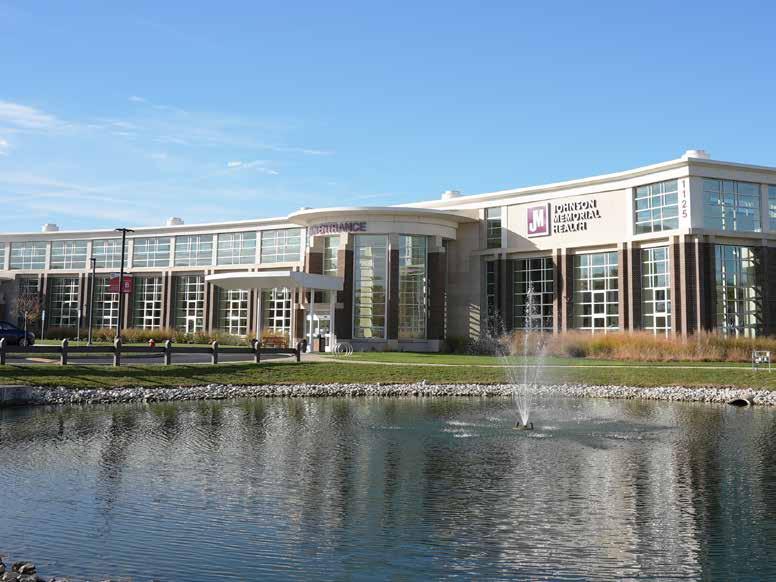
When you choose Johnson Memorial Health, you’re choosing care that’s been nationally recognized for both quality and safety, two things that matter most when your health on the line.
Our 5-Star Quality Rating from CMS and “A” Safety Grade from The Leapfrog Group means you can feel confident you’re getting exceptional care, right here in Johnson County.
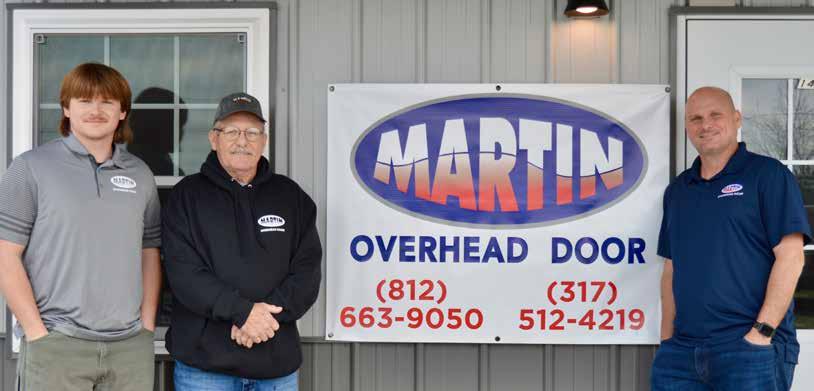
MARTIN OVERHEAD DOOR
THREE GENERATIONS, ONE OPEN DOOR TO THE FUTURE
Writer & Photographer / Christina Cochran
In a fast-growing community like Franklin, new businesses arrive with regularity. But every so often, one opens its doors carrying not just tools and inventory—but decades of grit, family legacy and quiet pride. Martin Overhead Door, now expanding into its second location in Franklin, is one of those rare stories.
What began in 1991 with a desk, a chair and a phone has become a multigenerational business rooted in hard work and steady growth. At the center of it all is David Martin, who founded the company after long days working for a larger garage door operation in Indianapolis. The hours and constant driving wore on him, but the idea of building something of his own kept calling.
So he took the leap.
In the early days, it wasn’t glamorous. David worked nights at a local factory while building
his business during the day. Sleep was scarce, but purpose was not. Each completed job—no matter how small—was his. That ownership fueled him.
“He always jokes that it was just him, a chair, a phone and a desk,” says his son, JD Martin. “But what he built from that was incredible.”
By 1999, the business had grown enough— and shifted enough—that JD joined his father. What started as a summer job during college quickly became something more permanent. Like his dad, JD found satisfaction in the physical nature of the work and the visible results at the end of each day.
Years later, the same story would unfold again.
JD’s son, Grant, grew up around the business. As a kid, he occasionally tagged along on weekend jobs, though at the time he admits he was “probably more of a nuisance than
anything.” Now, standing firmly as the third generation in the company, he sees those moments differently.
“I realize now my dad probably didn’t need me there,” Grant says. “He just wanted to spend time together and show me what he did.”
That passing down of not just skills, but values, is what defines Martin Overhead Door today.
JD doesn’t overcomplicate what it means to be a three-generation company. To him, it’s simple.
“I just know that I work with people I care about,” he says. “And that extends beyond my dad and my son. I’d do anything for the people who work here.”
That sense of family—both literal and extended—is foundational. It shapes how they treat customers, how they hire employees and how they measure success.
“Treat everyone with respect and kindness,” JD says. “We’re a family, and that’s what family does.”
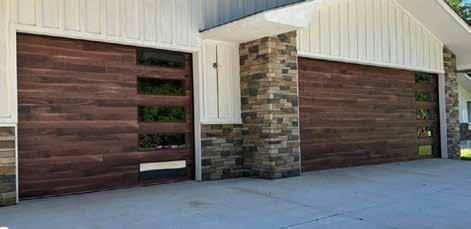
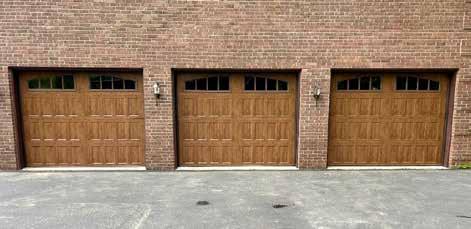
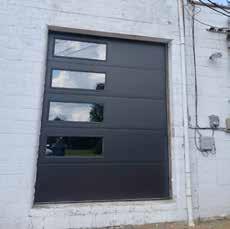
That philosophy has helped the company grow steadily over the years, expanding its reach across residential, commercial, industrial and agricultural garage door services. It’s a balance they’re proud of—large enough to handle complex jobs, yet small enough to remember a customer’s name long after the work is done.
And growth, for the Martins, is not just a goal—it’s a necessity.
JD has spent the better part of a decade considering expansion. With the rapid development across Johnson County and strong ties to the area, Franklin became the natural next step.
“I wish I had a more analytical answer,” he admits. “But it just felt right. Like we were supposed to be there.”
Between time spent in Franklin with friends, playing pickleball and watching the community evolve, the decision became
less about numbers and more about connection. The new location reflects both opportunity and intention—a way to serve a growing population while staying true to the company’s roots.
That kind of growth isn’t unfamiliar territory.
JD remembers when his father purchased a larger shop in 2002, worried about how they would sustain it. Within five years, they had outgrown it. Today, JD carries that same mindset forward.
“If you’re not growing, you’re dying,” he says. “That applies to everything.”
Still, for all the expansion and progress, David Martin sees something even more meaningful when he looks at the business today.
“To have a son and grandson want to be a part of it is something most people would cherish,” he says. “I’m the only lucky person I’ve known to see it happen.”
His pride is evident—not just in the growth of the company, but in the way it has evolved
without losing its core principles. Honesty, integrity and a willingness to learn remain central to the business.
“Treat your customers how you want to be treated,” David says. “If you make a mistake, admit it, fix it and make sure it doesn’t happen again.”
Looking ahead, Grant carries a vision that blends expansion with purpose. While he hopes to continue growing the company’s footprint across Indiana, his focus remains on people.
“My main goal is to create opportunities for hardworking employees to build great lives for their families,” he says. “That matters more than anything.”
It’s a perspective shaped by experience— one that understands success isn’t just measured in square footage or service calls, but in the lives impacted along the way.
Back in Franklin, the new location stands as more than just a second office. It’s a symbol of continuity—of a father’s leap of faith, a son’s commitment and a grandson’s vision for the future.
Three generations. One open door.
And for Martin Overhead Door, it feels like they’re just getting started.
HISTORIC HOME
TIMELESS WHITELAND FARMSTEAD AWAITS
NEXT CHAPTER
Writer / Teena Catt
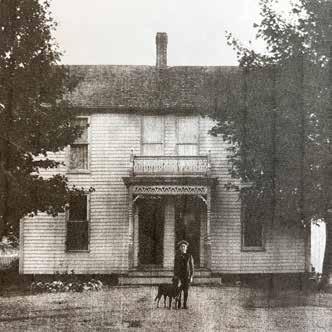
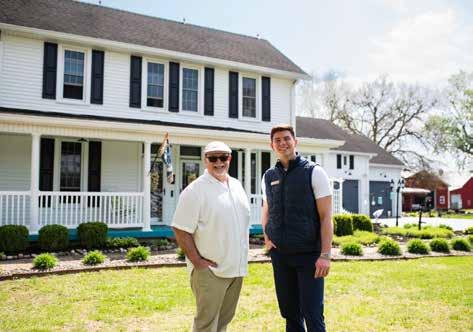
Nestled in a suburban area filled with homes of all ages sits a time capsule. The enchanting home and picturesque grounds at 211 Whiteland Road are looking for a new owner. Located on the south side of Whiteland Road, east of Sawmill Road, it is a standout piece of property that catches the eye with its immaculate landscaping and bright red barns.
Current owner Debby VanLandingham and her husband, Larry, purchased the home midrenovation in 1997. They poured their hearts and souls into making the house and grounds their dream come true. They lived there together on what VanLandingham describes as “an ongoing 29 years of improvement project.” Unfortunately, Larry passed away from cancer two years ago. The home and grounds have proven to be more than she can handle alone, and she has regrettably decided to put it on the market.
When the couple purchased this property, their children were already adults. They lived
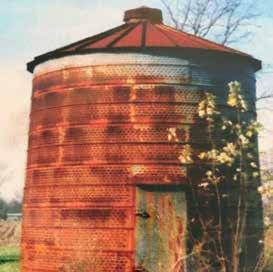
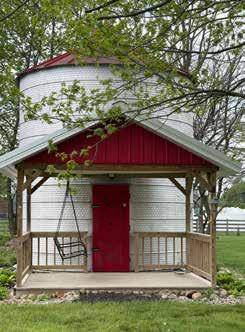
nearby in Park Forest subdivision, but this felt like home to Debby, as she had grown up next door on the Drake family property. Her grandchildren “grew up” here as they spent time exploring and playing on the grounds. An old, restored grain bin was used for winter storage and often served as the kids’ playhouse. Larry built a front porch and awning for Debby on the front of the grain bin, complete with a porch swing.
The white two-story farmhouse and barns were constructed between 1884 and 1898 by William VanArsdale. The lumber used for the house and barns was cut from the poplar trees in the woods on the property. It was a fouryear process: cutting the timber, planing the boards and constructing the buildings.
In 1898, George Brunnemer bought the present farm from VanArsdale, his brotherin-law. At that time, the farm consisted of approximately 80 acres. George purchased two other farms in Whiteland and gifted them to
his sons. This particular property was gifted to his son, Albert, and his wife, Rose. Albert and Rose moved into the house in 1899 with their year-old son, Myron.
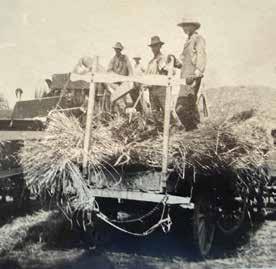
George and his brother, Daily, were both grain threshers, and they owned and operated a sawmill at the southwest corner of Sawmill (now Centerline Road) and Whiteland roads. The sawmill is where the name Sawmill Road originated. This was also the first threshing machine in Johnson County.
Myron married Christine Trout in 1921. He farmed and did custom wheat and oat threshing. Most farms had silos but were unable to fill them. Myron’s chopper and wind machine were then hired to do it for the farmers. Myron also owned a Baker tractor engine until 1936, when he then purchased a WD-40 Diesel International Harvester tractor. He was the only person in central Indiana at the time to own one. Although he was not the first person to own a combine machine in the
area, he was the first to purchase a 12-foot header in 1947. The farm raised soybeans, corn, wheat and clover hay. The Brunnemers also raised strawberries and tomatoes. They had dairy cows and sold the milk daily to Polk Dairy. Christine raised chickens and sold eggs. The original dairy barn still stands on the property, as well as other outbuildings, including the outhouse.
The house today has a two-story side addition to the original structure, adding additional living space and contemporary updates. The original house was heated by three stoves. Modern conveniences such as indoor plumbing and a furnace came later, in 1947. The original summer kitchen is behind the main house, today used as the swimming pool storage area. There was a smokehouse out back to smoke and store meat. A basement was hand-dug under the front part of the home sometime in the 1940s or 1950s.
The upstairs of the house had a separate entrance, and through the years each of George and Rose’s children occupied the upstairs of the house in the first three years of their marriages.
Myron and Christine’s children include names of well-known residents of Johnson County. Their daughter, Wilma Lee, married Denzil Church. Daughter Roseanna married Tom Mathena. Son Harlen married Patt Fennell. Generations of this family add to the
nostalgia of this beautiful home and property. VanLandingham’s contributions to restoring and preserving the home can be witnessed throughout the house. The front parlor room has the original carved woodwork trim, and the etched-glass transom windows above the door are still in place. An original lamp still hangs in the parlor.
The integrity of the home’s history now awaits a new owner to contribute and add flavor to this timeless property.
HARRINGTON & HARRIS HOME TEAM
WHERE STORY MEETS HOME
Writer / Christina Cochran
Photographer Brittany Walker
Just north of Franklin, along a quiet stretch of road many locals have driven without a second thought, sits a dairy farm filled with history. For generations, it has been more than land—it’s been a home, a livelihood, and a place where memories were made. That story is what makes the property special. And it’s exactly the kind of story the Harrington & Harris Home Team is passionate about telling. For Don Harrington, real estate has never been just about buying and selling homes. After more than 30 years in the business, his approach is rooted in something deeper— relationships, trust, and understanding what a place truly means to the people connected to it. “I’ve always believed this is about taking care of people,” Harrington says. “Not just the transaction.”
Harrington moved to Franklin 11 years ago, but his connection to the community runs deep. From supporting local organizations like the Artcraft Theatre to building relationships through his church and neighborhood, he’s become a familiar and invested presence in the city. “Franklin has really adopted me,” he says. “And I’ve adopted it right back.”
That sense of connection is a big part of what led to the creation of the Harrington & Harris Home Team. After decades in the business, Harrington began thinking about the future— not just for himself, but for the clients who had trusted him for years. “I wanted to make sure they were always taken care of,” he says. “Even
as I start to slow down at some point.” About five years ago, he began looking for the right partner—someone who shared his values and approach to the work. That search led him to Noah Harris, a Franklin College graduate who knew early on that real estate was his calling. The connection was immediate.
“Our values just lined up,” Harris says. “That was the biggest thing.” Together, they’ve built a team that blends experience with a fresh perspective. Harrington brings decades of knowledge and deep community ties, while Harris adds new energy and modern marketing strategies. The result is a balanced approach that meets clients where they are—whether they’re buying their first home or selling one they’ve lived in for decades. “It should feel like the same experience no matter which one of us you’re working with,” Harris says.
That approach is especially important when it comes to unique
properties—like the dairy farm they’re preparing to list this spring. For both Harrington and Harris, the property represents more than just a listing. It’s a piece of Johnson County’s history. “There’s a story there,” Harrington says. “And we want to make sure that story isn’t lost.”
That story matters—not just to the seller, whose family has deep roots on the land,
but also to the right buyer. Properties like this don’t appeal to everyone. They require someone who understands and appreciates what makes them special. “It takes a unique buyer,” Harris explains. “Someone who sees the history and connects with it.”
That’s why the team is focused not just on marketing the property, but on sharing its story—something that ties directly into the dairy farm feature appearing in this issue. For Harrington, the connection is personal. His own family has ties to the dairy industry, giving him a deeper appreciation for the life and work behind properties like this one. “I grew up around it,” he says. “So when this opportunity came up, it just meant something more.”
That sense of meaning carries through everything the team does. Whether working with first-time buyers or longtime homeowners, their goal is the same: to guide people with honesty, care, and a genuine investment in their outcome. Looking ahead, Harrington and Harris are focused on growing thoughtfully—adding team members when the time is right, but always keeping their core values intact. “We want to keep serving people well,” Harrington says. “That’s always going to be the priority.”
As Franklin continues to grow, so does the demand for real estate professionals who understand both the market and the community behind it. For the Harrington & Harris Home Team, that’s where they feel most at home. And for those drawn to properties with history—like the dairy farm just beyond the edge of town—they’re ready to help tell the next chapter.
Interested in learning more about the dairy farm or other properties in the area? Connect with the Harrington & Harris Home Team to explore current listings and find the place that fits your story.
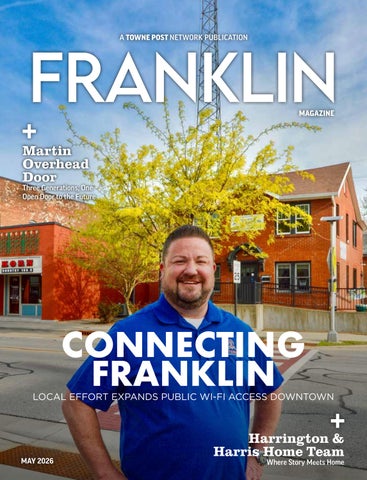
CONNECTING FRANKLIN
LOCAL EFFORT EXPANDS PUBLIC
WI-FI ACCESS DOWNTOWN
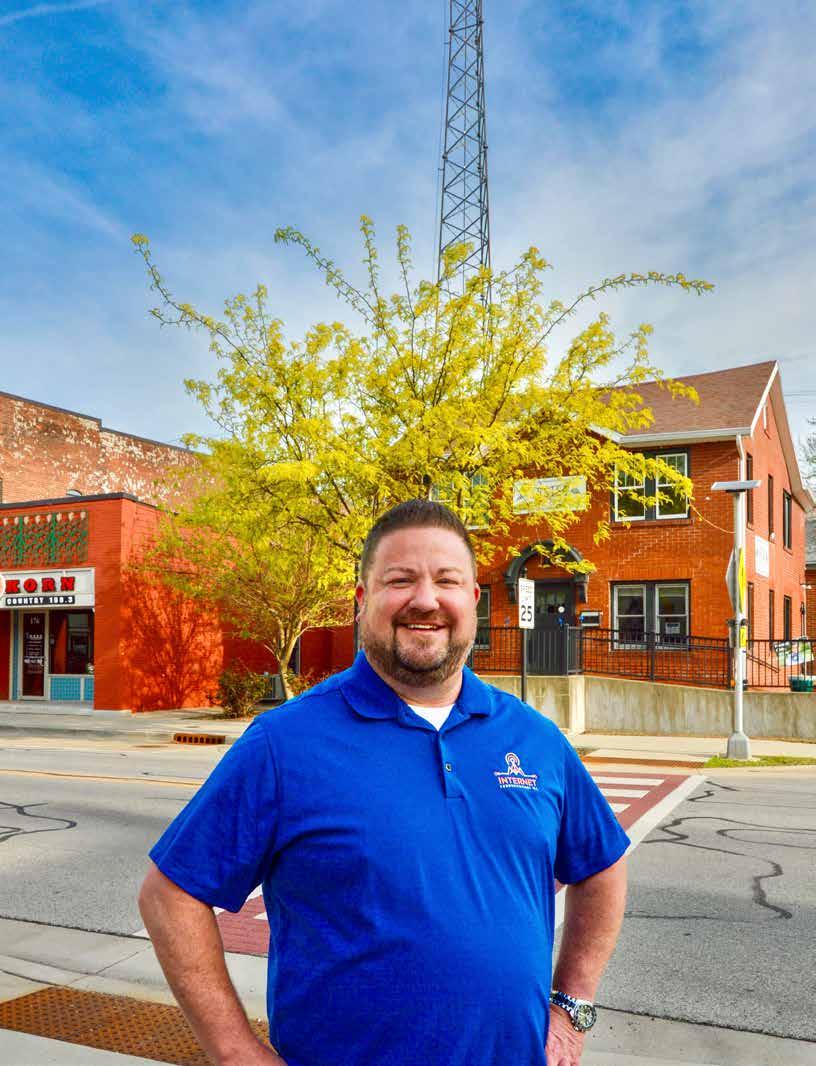
Writer & Photographer / Christina Cochran
On any given evening in downtown Franklin, the sidewalks hum with life. Families drift between storefronts, couples linger over dinner, and music spills into the streets during festivals and weekend events. It’s a scene that reflects a thriving community—but beneath the surface, something less visible often struggles to keep up: connectivity.
For Tyson Burris, that’s not just a technical issue. It’s personal.
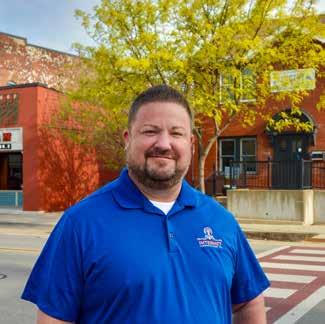
As the founder and president of Internet Communications Inc., Burris has spent decades quietly building the digital backbone that supports businesses, homes and institutions across Franklin and beyond. Now, he’s taking on one of his most ambitious projects yet: bringing free public Wi-Fi to downtown Franklin.
It’s a solution born from experience, frustration and a deep-rooted commitment to the place he calls home.
FROM DIAL-UP DAYS TO A WIRELESS VISION
Long before streaming, smart homes and cloud computing became everyday realities, Burris was already immersed in the world of connectivity.
“I officially founded the company in 2006,” he says, “but I was working in internet services long before that.”
In the early days, that meant helping customers navigate dial-up connections and later DSL—technologies that, while groundbreaking at the time, were often unreliable. Burris remembers how something as simple as a rainstorm could disrupt service.
“That was fundamentally unacceptable to me,” he says.
Determined to find a better way, Burris began experimenting with early fixed wireless technology, including Motorola Canopy systems. At a time when most households were struggling with slow speeds, his network could deliver between 3 and 10 Mbps—fast for that era, and more importantly, consistent.
Customers noticed.
“It wasn’t just that we were faster,” Burris explains. “We were more reliable, and we backed it up with strong customer service.”
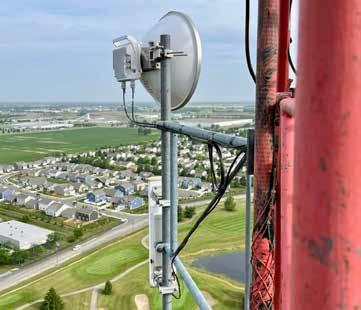
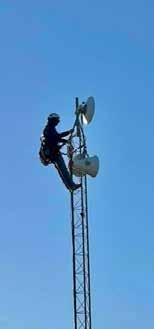
That philosophy became the foundation of Internet Communications Inc., which steadily expanded by building a network of towers across the region. Some were commercial. Others came through partnerships with local farmers—an approach that reflects Burris’s practical mindset and community-first approach.
“Farmers had the height, and they were
community-minded,” he says. “That made a big difference early on.”
GROWING WITH THE COMMUNITY
Over the years, both technology and expectations have evolved dramatically.
What started with trial and error and early equipment has grown into a much more advanced network with significantly faster speeds. Today, Burris and his team work out of their headquarters on Commerce Drive, and the company maintains a significant presence in two data center locations—733 Henry St. and 401 Shadeland Ave. Those sites give Internet Communications direct connectivity to all major upstream providers and allow the company to support businesses and providers that want to place equipment there.
Despite the expansion, one thing hasn’t changed: the company’s focus on flexibility and control.
“We’ve always tried to build and own as much of our network as possible,” Burris says. “That allows us to adapt quickly and maintain service quality.”
That adaptability has become even more important as the broadband industry shifts. Massive federal investments—like the $42 billion BEAD program—are reshaping how infrastructure is funded and deployed across the country.
But Burris says Internet Communications has taken a different path.
“As a company, we do not participate in or accept funding from BEAD or any local, state or federal broadband programs,” he says. “That’s a key differentiator for us.”
He says many competitors—including Comcast, Brightspeed, REMCs, fiber providers, AT&T and others—do rely on those funding sources.
“I don’t like the government being our competitor,” Burris says, “but that is the landscape right now.”
It’s a perspective shaped by years of hands-on experience—and by his connection to the community he serves.
A PROBLEM HIDDEN IN PLAIN SIGHT
For all of Franklin’s growth and charm, its popularity comes with challenges—especially during large events.
That growth has naturally led to his latest focus— improving connectivity right in the heart of Franklin. As downtown has become busier, especially during events, the need for a stronger, more reliable connection has become hard to ignore. For Burris, it’s a challenge he’s ready to take on.
From the farmers market to festivals and concerts, downtown can quickly fill with thousands of visitors. While that’s great for local businesses, it can strain cellular networks to the breaking point.
“The biggest issue is congestion,” Burris explains. “When large crowds gather, cellular networks slow down significantly.”
Anyone who has tried to send a text, process a payment or load a website during a busy event has likely experienced the frustration. For businesses—especially mobile vendors— those slowdowns can translate directly into lost revenue.
“It affects payments, customer experience and overall operations,” Burris says.
He’s seen it firsthand.
“My wife and I eat downtown regularly,” he adds. “And it’s clear there are connectivity problems that shouldn’t be happening.”
At one point, the issue became so persistent that Burris joked about deploying his own Wi-Fi system—from a golf cart.
Instead, he decided to do something bigger.
BUILDING A BETTER NETWORK DOWNTOWN
The idea for a downtown Wi-Fi system has
been years in the making. Now, it’s finally becoming a reality. Installation is set to begin in May, with Wi-Fi access points strategically placed throughout the downtown area.
For users, the experience will feel familiar— similar to connecting at an airport or coffee shop. After accepting terms of use through a hotspot gateway, visitors will have time-limited access to the network. During major events, those limits can be adjusted to accommodate larger crowds.
Behind the scenes, however, the system is anything but simple.
“We’re using high-capacity wireless links and multiple fiber backhaul entry points,” Burris explains. “That ensures performance and reliability.”
The network is designed specifically for outdoor use, complementing—not replacing—indoor Wi-Fi systems. It also opens the door to additional benefits, from cost savings for local businesses to potential promotional opportunities through the platform.
Perhaps most importantly, it provides a solution to the congestion problem by offloading data traffic from cellular networks—a strategy widely recognized as essential in high-density environments.
OVERCOMING OBSTACLES
Like any ambitious project, bringing downtown Wi-Fi to life hasn’t been without challenges.
Early plans to mount equipment on municipal light poles were ultimately set aside due to aesthetic concerns. Negotiations around using city-owned facilities also proved difficult, particularly when it came to access and control.
From a technical standpoint, even the height of installation matters. Outdoor Wi-Fi works best when placed between 15 and 25 feet above ground—low enough for devices to connect effectively, but high enough to
provide coverage. “That creates limitations,” Burris says. “You can’t just put equipment anywhere.”
The solution has been a more creative, collaborative approach—partnering with private building owners throughout downtown. In many cases, those partnerships also include providing internet service or other infrastructure in exchange.
It’s a model that reflects Burris’s willingness to adapt and persist.
“We’ve had to adjust along the way,” he says. “But we’ve kept moving forward.”
ROOTED IN FRANKLIN
For Burris, the project isn’t just about technology—it’s about community.
A graduate of Indian Creek, he has deep ties to the area. His mother worked at Franklin College for nearly 50 years, and his family remains closely connected to the city. His wife, a nurse, shares that same sense of commitment to helping others.
Together, they’ve raised four children—each of whom has spent time working in the family business.
“Family has always been a major part of the journey,” Burris says. That perspective carries into everything he does, from how he runs his company to how he approaches new initiatives.
“Being local creates accountability,” he explains. “People will absolutely let you know if you’re not doing things right.”
It’s a dynamic he welcomes.
“I take the good and the bad,” he says. “That’s how we make improvements.”
When he’s not working, you might find Burris enjoying a meal at Iozzo’s Garden of Italy—a reminder that he’s not just building infrastructure for the community, but living in it every day.
LOOKING AHEAD
As Franklin continues to grow, so too will its need for reliable, scalable connectivity. Burris believes the future lies in a layered approach—combining fixed wireless, fiber
and public Wi-Fi to create a resilient network capable of meeting rising demand.
“Connectivity is essential,” he says. “People rely on it as much as electricity in many ways.”
The downtown Wi-Fi project is just one piece of that larger vision. Similar initiatives are already being explored in nearby communities like Bargersville and Trafalgar, with the goal of expanding access and improving performance across the region.
At the same time, rising costs in labor, materials and construction are making traditional infrastructure projects more challenging—underscoring the importance of flexible, cost-effective solutions like fixed wireless.
For Burris, the mission remains clear.
“Our goal is to make sure Franklin is ready for the future,” he says.
A STRONGER SIGNAL FOR A STRONGER COMMUNITY
Back in downtown Franklin, the crowds will keep coming. The festivals, the markets, the shared moments—they’re all part of what makes the city special.
Soon, thanks to Burris and his team, those experiences may come with something new: a stronger, more reliable connection.
It’s the kind of improvement most people won’t think about—until they need it.
And when they do, it will be there, quietly supporting the businesses, visitors and everyday interactions that define Franklin. For Burris, that’s exactly the point. Building owners can contact the company to see if their location will be useful for the project.
Because in a connected world, the best technology isn’t just fast or powerful. It’s dependable. It’s accessible.
And, at its best, it brings people together.
CONNECT
Commerce Dr, Franklin
HOMETOWN HERO Noel Heminger
Writer / Teena Catt
Photographer / Scott Robertson, Daily Journal
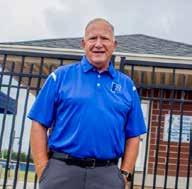
Noel Heminger grew up in Franklin on Home Avenue with his sister, Ann, and his brother, Tad. His parents, LeRoy and Helen Beatrice Heminger, were active in the community. LeRoy was instrumental in forming Franklin’s Little League program, and Beatrice was the director for the Franklin Girls Club for many years. Their community leadership modeled a lifetime of a youth-centered career for Heminger. In 2010, Heminger retired as Franklin Community School Corporation’s athletic director. The road to retirement was paved with a long history of athletic involvement for Heminger.
Growing up, Heminger lived near Province Park and the Franklin Boys Club on Monroe Street. He spent a lot of time on the ball fields and courts in town. In high school, he was a four-sport athlete, lettering in football, track, basketball and baseball. Graduating in 1968 from FCHS, Heminger went on to letter in baseball at Eastern Illinois University from 1968 to 1972.
While a student at Eastern Illinois University, he met Ruth (Carstens), who was an education major. They married in December 1973. Heminger had started his career in Effingham, Illinois. He was teaching and coaching when his old basketball coach, Dick Harmening, called him and asked him to return to Franklin to serve as his assistant basketball coach.
Anyone who lived in Franklin during those years will recall that FCHS basketball was on fire then, and it was an amazing opportunity to return to his hometown and coach a team that went on to the Final Four two consecutive years. There was a caveat, though — Ruth needed a teaching job, and somehow Harmening made that happen.
“I am a hometown boy. I love Franklin. I was away for five years and was happy to have the opportunity to return home and live my life in Franklin,” said Heminger.
The Hemingers grew their family in Franklin,
raising three daughters: Allyson Sever, Stephanie Potter and Jill Bland. Ruth taught math at FCHS, coached swimming and loved sports. Sadly, Ruth passed away in 2021. Noel and Ruth’s children grew up immersed in all aspects of athletics.
“Growing up, I remember going to baseball games, sleeping in the bleachers, eating treats from the concession stands, and riding on the mower with my dad between games dragging the infield. The players had nicknames for my sisters and me. Mine was Rugrat,” said Bland. In all the years Heminger was athletic director, Bland said he never missed one of her games or meets. “That’s pretty impressive given all of the sporting events he was coordinating,” said Bland.
that meeting as feeling overjoyed. He had brought baseballs along with him and obtained signatures from the entire team. “It was a fantastic experience,” Heminger said.
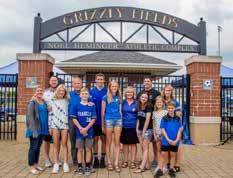
In 2021, Franklin Community School Corporation renamed the FCHS athletic complex in Heminger’s honor. Heminger helped shape the athletic complex during the design process for the high school’s building and grounds. In addition, his storied athletic career as a player, coach and mentor contributed to the honor.
Heminger coached basketball and football and taught physical education and health at Franklin Middle School from 1973 to 1975. He then went on to serve as assistant football, basketball and baseball coach from 1975 to 1978. From 1978 until 1995, he was head basketball coach. In 1994, he served as assistant athletic director and moved up to head athletic director in 1995 until his retirement in 2010.
Heminger was also a baseball scout for the Kansas City Royals. Heminger recalls he and his Midwest regional scout followed Indianapolis native Gary Thurman through several games. Thurman, who graduated from North Central High School, was drafted by the Royals in the first round (21st pick) of the 1983 amateur draft. Heminger said one of his favorite memories happened a few years later when Thurman invited him to spring training. He was invited into the baseball clubhouse and met George Brett and Bo Jackson, plus the rest of the team members. He describes
Heminger mentioned key people he considered mentors in his own life. Along with his father, LeRoy Heminger, he listed Dick Harmening, Ted Server, J.R. Bishop and Bill Self, who rank high on his list as men he has had a great deal of respect for.
When asked about retirement life, Heminger laughed and said grandchildren keep his schedule busy. His eight grandchildren have inherited the family’s athletic genes, as he is often at their various sporting events. He loves attending and cheering them on. Heminger also enjoys the outdoorsman lifestyle of hunting and fishing in his spare time. He enjoys an annual family fishing trip to Canada as well. With a move to the outskirts of town, he has tried his hand at farming. He grows pumpkins and sunflowers. “Sometimes the harvest isn’t any good, but I have fun doing it,” said Heminger.
BOUND TOGETHER BOOK CLUB
BEFORE I FORGET
BY TORY HENWOOD HOEN
Writer / Christina Cochran
They say you cannot judge a book by its cover, but I most definitely did when I first spotted Before I Forget by Tory Henwood Hoen. On the cover is a beautiful loon, and I immediately recalled one of my all-time favorite movies, On Golden Pond. As I perused the inside jacket cover, I realized the book’s setting takes place on the fictional Catwood Pond in the Adirondack Mountains. I decided that it was close enough to New Hampshire in the movie. Sold!
The novel blends family life with a comingof-age theme and centers on a daughter becoming the caregiver for her father who has Alzheimer’s disease. While you may think this story sounds depressing, I assure you this rare novel will reach inside you and leave its mark on your heart. There were places in the book when I teared up, but there were also places where I laughed aloud.
Cricket Campbell is 26 years old and works for a wellness company. She does not love her job in New York City and finds herself stuck. Stuck in a job where she says, “We’ve conflated health with vanity. It is not that I don’t believe in healing. I just don’t believe you can buy it for $78 an ounce.” She is also stuck in moving past a tragedy that happened a decade ago. Returning to Catwood Pond is the last thing she had
planned to do. When her sister, Nina, who has been taking care of her dad, has an opportunity to study abroad, the two sisters start looking at long-term care facilities for their father, Arthur.
Cricket decides she wants to return home and assume the role of caregiver. She soon realizes her father possesses a rare gift and, as he is losing his grasp on the past, he is increasingly able to predict the future. This gift brings on a cast of characters who are drawn to Arthur, the oracle whose words and wisdom reshape her — and the reader’s — thinking.
Told in a dual-timeline fashion, the novel
is not one with flashy plot twists but with a slow and steady unfolding emotional truth. We learn through this dual timeline the events that shaped Cricket and the events that tore her apart. As she begins to remember who she once was, she realizes the path going forward often starts with going back.
Themes of strength and compassion, hope and despair, and the selfless act of caregiving fill the pages of this story. This book is not just a book about Alzheimer’s. It is a book that is captivating and unforgettable. You will love the cast of characters, including cat Dominic. I give it a five-star rating.
NEIGHBORING SUPPORT
FUN TOWNSHIP TRUSTEE KEEPS FRANKLIN CONNECTED THROUGH COMPASSIONATE CARE
Writer / Katie Hosea
In a small town like Franklin, it’s easy to recognize the people who keep things running — teachers, firefighters and local business owners. But behind the scenes, there’s another vital role that often goes unnoticed: the township trustee. While not always in the spotlight, the trustee’s work is deeply woven into the fabric of the community, offering support when residents need it most.
A township trustee serves as a direct line of support for local residents, particularly during times of hardship. Their responsibilities are both practical and compassionate, focusing on meeting immediate needs while maintaining important community spaces.
At its core, the trustee’s office provides township support through emergency, short-term financial assistance, formerly known as township poor relief. This can include help with basic necessities like rent, utilities or food for individuals and families facing unexpected challenges.
But the role doesn’t stop there. Trustees also manage and maintain local cemeteries, preserving the history and dignity of the community, offer guidance and resources to residents navigating difficult situations, and serve as a community connector, helping people access the support they need. In many ways, the trustee acts as a safety net, stepping in when other resources fall short.
In Franklin and the surrounding townships, that responsibility falls to Lydia Wales. Serving residents across Franklin, Union and Needham townships, Wales and her team work daily to ensure that no neighbor is left without support during times of crisis.
Supporting the trustee is a dedicated township board that helps guide decisions and ensure resources are used responsibly. Franklin’s board includes Jeannie Barnett, president; Tara Payne, secretary; and Dawn Barr, board member. Together, they provide oversight and help shape the direction of township services, ensuring transparency and accountability.
In larger cities, assistance programs can feel distant or difficult to navigate. But in a small town, the township trustee brings help closer to home, both physically and personally. It’s a role rooted in accessibility, compassion and community connection.
For many residents, the trustee’s office is more than a government entity; it’s a lifeline during tough times and a reminder that even in moments of struggle, no one in Franklin stands alone.
For residents considering the future of Franklin Union Needham (FUN) Township, Lydia Wales represents more than just extensive experience.
In a role that requires both fiscal responsibility and deep empathy, she has demonstrated a commitment to treating every resident with dignity and respect. Whether assisting a family through a temporary crisis or ensuring township resources are used thoughtfully, her approach reflects a strong sense of purpose and accountability.
Just as importantly, Wales has shown a dedication to being present and accessible. In small-town leadership, that visibility matters. Residents aren’t just numbers — they’re neighbors, and her work reflects an understanding of that responsibility.
Continuity in this role can mean stability for those who rely on township services. With an established knowledge of community needs and a clear investment in its people, Wales brings both consistency and compassion to the position.
In a world where big systems often overlook small-town needs, the township trustee remains a powerful example of local government at its most human: neighbors helping neighbors.
RESEARCH STU DY SEEKING
People living with Atrial Fibrillation or Atrial Flutter
Purdue University, College of Pharmacy is seeking people living with atrial fibrillation/flutter who are planning to have or recently have had a electric cardioversion or ablation to treat atrial fibrillation or flutter. In order to qualify you must be taking anticoagulation (a blood thinner such as coumadin, Eliquis, Xarelto).
If you qualify for the study:
• You will be asked to take a medicine called Zofran (ondansetron) or a placebo (sugar pill) twice a day for 4 weeks
• You will be asked to wear a Ziopatch on your chest which monitors your heart beats for 4 weeks and keep a log of any symptoms that you have related to the medicine and atrial fibrillation.
• You will complete 5 visits lasting about 30 minutes (1 visit at the start of the study and then a visit each week). The visits can be completed at your home or in the clinical reearch center located on the IU Indianapolis campus
• You will receive up to $350 after completing all study visits.
If you are interested in participating, please call or text 317-847-2094 or email: hwroblew@iu.edu
MAY HAPPENINGS WITH FESTIVAL COUNTRY
Writer / Mackenzie Steagall
With more than 1,000 events in Franklin and the other communities of Festival Country each year, this is your destination for fun every season. Kick off your summer with these activities in May.
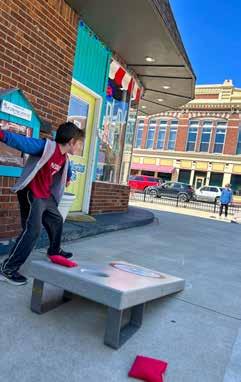
Stop by the Fun Plaza, now open in front of Toodleydoo Toys, 1 W. Jefferson St. This new space, created by Discover Downtown Franklin and Festival Country Indiana, is a free game area, with cornhole, foosball, Connect 4 and checkers. You can borrow game accessories from the toy store during regular business hours. Play a few games and enjoy this new entertaining downtown destination.
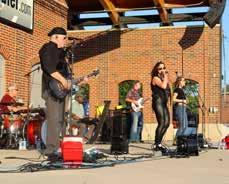
Mark your calendar for the Festival Country Kickoff from 4 to 10 p.m. on May 16 at the DriveHubler.com Amphitheater, 237 W. Monroe St. Celebrate the fifth year of the amphitheater with birthday festivities, food trucks and a night of live music from three great bands. Bring your lawn chairs and rock the night away.
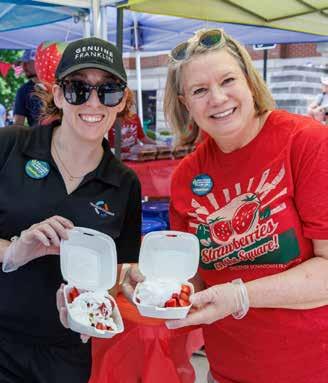
Then, on May 22, attend Discover Downtown Franklin’s Strawberries on the Square from 11 a.m. to 9 p.m. on West Court Street. Savor the flavor of summer with a classic strawberry shortcake and ice cream. This family-friendly festival features free admission, live music and
activities for kids, like face painting and balloon art, from noon to 3 p.m.
The Franklin Farmers Market earned the distinction of Indiana’s Ultimate Farmers Market last year, and it returns this year, better than ever. The market is open from 8 a.m. to noon, May 30 through September 12 at the DriveHubler.com Amphitheater. Find fresh produce, meat, honey and handmade items from 80 new and familiar local vendors.
Find information about more events and festivals at the visitor center, 66 S. Water St., or at festivalcountryindiana.com/festivals-and-events.
the Franklin Family Aquatic Center for the 2026 season!
YOUR POOL PASS NOW AT
CROSSWORD PUZZLE
ACROSS
1. Pantry container
4. “By yesterday!”
8. Kind of sax
12. “I see!”
13. Partake at a feast
14. Combine, as resources
15. Anti-prohibitionist
16. Intensified
1. Benchley classic 2. “Could I interrupt?”
3. Figure of interest?
4. Long Island university
5. Bro’s sibling, maybe 6. Mandela’s org. 7. Child’s ammo 8. Certain helicopter 9. Filming locale
This plant sale, which is for one day only, features a wide variety of vegetable plants, herbs, flowers, hanging baskets, strawberry plants and more. The sale will be located at Franklin Community Middle School. The hours are 10 a.m. to 5 p.m. Cash, check and credit card will be accepted. Proceeds benefit Franklin FFA alumni and students.
2-3 MATINEE MUSICALE CONCERT AT THE MUSEUM
135 N Main St, Franklin, IN 7 p.m., 2 p.m.
Enjoy a concert performed by Matinee Musicale at the museum. Tickets are $8 and the theme is Happy Birthday America. Shows are 7 p.m. on May 2 and 2 p.m. on May 3.
3 HEALTHY KIDS RUNNING SERIES
405 Driftwood Court, Franklin, IN 4 p.m.
Register online and have your kids take part in the healthy kids running series every Sunday from April 12 to May 3. Kids can do one race or the whole series. There are age divisions starting at 2 to 3 years of age, going up to sixth, seventh and eighth grade students.
7 JEFF GREGORY MEMORIAL GOLF OUTING
1800 East King Street, Franklin, IN 10:30 a.m. - noon
Enjoy a golf outing to raise money for the Jeff Gregory Memorial Fund. Registration is 10:30 a.m. to noon followed by a noon shotgun start.
8
FAMILY MOVIE SERIES
237 W. Monroe St., Franklin, IN 8 p.m.
Enjoy a free showing of the movie Little Rascals at the amphitheater.
10
WOLFF VON ROOS AT FIRST PRESBYTERIAN CHURCH
100 E. Madison Ave., Franklin, IN 4 p.m.
Enjoy a free concert by Wolff Von Roos, an international organist, composer and conductor. Admission is free and open to the public.
15 HOOSIER VINTAGE WHEELS SWAP MEET AND CAR SHOW
250 Fairground St., Franklin, IN 7 a.m.
Over 500 vendor spaces with used and new auto parts and supplies for vintage vehicles, muscle cars and race cars, along with memorabilia, gas and oil antiques, bicycles and just about anything that can be loaded up and brought to the fairgrounds. Admission is $5, and kids get in free. Free parking. There will also be an early Ford and flathead powered car show and a model car display and competition both days. Call 317-416-9034 for information about the model car competition. On Saturday starting at 9 a.m., there will be an open car show. Entry into the car show is $20. The contact number for the car show is 317-408-9931.