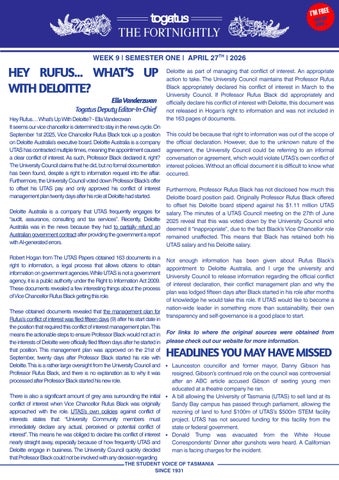

HEY RUFUS... WHAT’S UP WITHDELOITTE?
EllaVanderzwan TogatusDeputyEditor-In-Chief
HeyRufus What’sUpWithDeloitte?-EllaVanderzwan Itseemsourvicechancellorisdeterminedtostayinthenewscycle On September 1st 2025,Vice Chancellor Rufus Black took up a position onDeloitteAustralia’sexecutiveboard DeloitteAustraliaisacompany UTAShascontractedmultipletimes,meaningtheappointmentcaused a clear conflict of interest As such, Professor Black declared it, right? TheUniversityCouncilclaimsthathedid,butnoformaldocumentation has been found, despite a right to information request into the affair Furthermore,theUniversityCouncilvoteddownProfessorBlack’soffer to offset his UTAS pay and only approved his conflict of interest managementplantwentydaysafterhisroleatDeloittehadstarted.
Deloitte Australia is a company that UTAS frequently engages for “audit, assurance, consulting and tax services”. Recently, Deloitte Australia was in the news because they had to partially refund an Australiangovernmentcontractafterprovidingthegovernmentareport withAI-generatederrors
Robert Hogan fromThe UTAS Papers obtained 163 documents in a right to information, a legal process that allows citizens to obtain informationongovernmentagencies WhileUTASisnotagovernment agency, it isapublic authorityunder theRight toInformation Act 2009 Thesedocumentsrevealedafewinterestingthingsabouttheprocess ofViceChancellorRufusBlackgettingthisrole
These obtained documents revealed that the management plan for Rufus’sconflictofinterestwasfiledfifteendays(9)afterhisstartdatein thepositionthatrequiredthisconflictofinterestmanagementplan This meanstheactionablestepstoensureProfessorBlackwouldnotactin theinterestsofDeloittewereofficiallyfiledfifteendaysafterhestartedin that position This management plan was approved on the 21st of September, twenty days after Professor Black started his role with Deloitte ThisisaratherlargeoversightfromtheUniversityCounciland Professor Rufus Black, and there is no explanation as to why it was processedafterProfessorBlackstartedhisnewrole
There is also a significant amount of grey area surrounding the initial conflict of interest when Vice Chancellor Rufus Black was originally approached with the role. UTAS’s own policies against conflict of interests states that: “University Community members must immediately declare any actual, perceived or potential conflict of interest”.This means he was obliged to declare this conflict of interest nearly straight away, especially because of how frequently UTAS and Deloitte engage in business.The University Council quickly decided thatProfessorBlackcouldnotbeinvolvedwithanydecisionregarding
Launceston councillor and former mayor, Danny Gibson has resigned Gibson’s continued role on the council was controversial after an ABC article accused Gibson of sexting young men educated at a theatre company he ran
A bill allowing the University of Tasmania (UTAS) to sell land at its Sandy Bay campus has passed through parliament, allowing the rezoning of land to fund $100m of UTAS’s $500m STEM facility project UTAS has not secured funding for this facility from the state or federal government Donald Trump was evacuated from the White House Correspondents' Dinner after gunshots were heard A Californian man is facing charges for the incident
HEADLINESYOUMAYHAVEMISSED
INCARCERATION,EXECUTION, ANDTHEARCHITECTUREOF COLONIALVIOLENCE
Ayda Issa, Tasmanian Palestine Advocacy Network Co-President
Perhaps you have heard of the so-called “new death penalty” law approved by Israel’s parliament, or about the mass incarceration of Palestinians by Israel. These are not neutral processes, but tools of colonial violence, designed to control, fragment, and suppress an occupied population that have been used by the zionist Israeli occupation since its earliest days.
Language is also not neutral. The terms political prisoner and political detainee are deliberate rhetorical choices. These terms originate from the Palestinian prisoner movement and were shaped through exchange with other revolutionary struggles. The concept of the political prisoner travelled across anti-colonial contexts from Angola to Vietnam and Ireland situating Palestinian incarceration within a broader anti-colonial struggle. While “detainee” often refers to those held without charge under administrative detention, and “prisoner” to those “formally” charged, both require the qualifier political because Palestinian imprisonment does not resemble ordinary legal detention. It is not governed by a transparent legal process. It is not bound by equal application of law.It is not, in any meaningful sense, justice.
Global institutions that are meant to guarantee protection and accountability have repeatedly failed to act, and international law has not been upheld in any consistent or meaningful way There is no reliable framework of rescue or enforcement that Palestinians can depend on Survival, therefore, is not grounded in external intervention but in persistence Survival is not passive, it is political It is rooted in resistance, organisation, and collective endurance
Palestinians live under military law, not civilian law They are tried in military courts with conviction rates approaching totality, often based on secret evidence or coerced confessions Thousands are currently detained in administrative detention which allows for indefinite imprisonment without charge or trial Thousands more are serving out sentences in Israeli prisons after being subjected to unlawful detention and sham legal proceedings
Torture and abuse in custody is widespread and systematic physical, sexual, psychological, and medical Human rights organisations have described this as a form of “slow killing,” evidenced by recurring deaths in custody Now, with the expansion of the death penalty, this violence is no longer only implicit, it is formalised This law does not operate equally It is racialised in both its application and intent.It removes one of the last
remaining legal barriers that could protect Palestinian prisoners from execution This is not justice It is state violence, codified The targeting of children further exposes the logic of this system Hundreds of Palestinian children are detained each year, many without charge They are arrested in night raids, blindfolded, restrained, physically assaulted, strip searched, interrogated without legal counsel, and coerced into signing confessions presented to them in a language they cannot understand
Nadera Shalhoub-Kevorkian describes this process as “unchilding”, which is defined as the systematic stripping away of childhood itself Palestinian children are not treated as children, but as threats to be managed Their anger and frustration at an occupation they did not choose are pathologised and their existence is securitised Unchilding begins long before imprisonment, through surveillance, restriction, and militarised control of daily life, gradually stripping them of the protections and assumptions that define childhood elsewhere It is a system preparing them to be subjected to structural violence and abuse.
The targeting of children is not unique to Israel. In Australia, First Nations children are disproportionately incarcerated, drawn into the justice system at younger ages and at vastly higher rates than their non-Indigenous counterparts. In both contexts, incarceration operates as a tool of control that extends beyond the individual child. Children are targeted not necessarily for what they have done, but because of what they represent: the continuity, survival, and future of their communities By intervening in childhood, these systems disrupt intergenerational transmission, fracture social bonds, and weaken collective political and cultural life In this sense, the incarceration of children functions as a form of collective erasure
These are not isolated policies They are part of a coherent strategy:
To suppress political mobilisation
To fragment society
To enforce racialised control
To normalise violence as governance
Palestinian incarceration by Israel is a system that operates at a scale, with consistency and intent, that shapes both the individual lives and collective condition of the Palestinian people
Nothing about this is neutral
Read Ayda’s full piece continues on our website
ELITEATHLETESCHOLARSHIP!
Some students spend their mornings rolling out of bed five minutes before class Others are already halfway through a training session before most of campus has had coffee
For the student-athletes juggling university with elitelevel sport, life can feel like one long balancing act; lectures squeezed between gym sessions, assignments submitted from airport lounges, and weekends rarely spent doing anything remotely relaxing
It’s exactly this chaos that the University of Tasmania’s Elite Sport Scholarship program was designed for Running since 1992, these scholarships support student-athletes who are chasing big goals both academically and athletically, because trying to earn a degree while competing at a high level is, frankly, a lot
Successful recipients receive $2,000 in financial support and a 12-month UniGym membership, helping ease some of the pressure that comes with balancing study, sport, and the occasional attempt at a social life. It’s recognition of the commitment, discipline and sheer organisational wizardry it takes to manage deadlines and training schedules in the same 24-hour period.
The 2026 cohort is stacked with talent, featuring athletes from cricket, hockey, rowing, athletics, trail running, netball and basketball From emerging athletes to national-level competitors, the scholarships recognise students putting in serious work behind the scenes, not just on game day, but in the everyday grind of making both sport and study happen Congratulations to these student-athletes!
Elite Athlete Scholarship
Ava Curtis (Cricket)
Emerging Athlete Scholarships
HarleyWilkie (Hockey)
Noah Haas (Rowing)
Blake Doyle (Athletics)
Sophie Kruimink (Hockey)
Stella Pritchard (Hockey)
George Knight (Trail Running)
Indigenous Athlete Scholarships
Isaac Grundy (Netball)
BonnieTalbot (Athletics)
Millie Baker (Basketball)
WHAT ISLIBERALSIM:HOUSING
Tasmanian Premier Jeremy Rockliff recently announced that 4,000 new houses were to be built across the state.Which bring us to the topic of housing through a liberal lens.
If you’ve tried to find a place to live in Hobart, you already know the deal:dozens of people at inspections, rent that makes your bank account flinch, and the creeping sense that something is seriously dysfunctional.
The usual explanation is simple: landlords are greedy, the system is unfair, and rents need to be capped It’s an appealing story but it’s also incomplete
A potentially more uncomfortable explanation is this: rent is high because there just isn’t enough housing
That might sound obvious, but it matters; Because if the problem is a shortage, then the solution isn’t just to push prices down, it is to increase supply
Looking at this from a liberal perspective, in that framework, prices aren’t just numbers, they’re market signals When rents rise, it is the market indicating an insufficient supply of houses
The problem is, in a lot of Australian cities, that signal isn’t being allowed to work properly Try building things in Hobart and you’ll likely run into zoning limits, height restrictions, community objections, and long approval processes All of that makes it slower, riskier, and more expensive to build So less gets built, the shortage persists, and rent and house prices rise
Australia hasn’t always approached housing this way Prime Minister Menzies, not exactly a radical, saw home ownership as central to independence and stability, even as a fundamental right His government focused more on enabling people to get into housing, not freezing the market in place.More building, more ownership, more opportunity. Under his tenure, Australia had the highest rate of home ownership ever.
Fast forward to now, and we’ve ended up in a situation where demand keeps rising, but supply is tightly controlled and growth is often stifled.
So, what about rent caps?They sound like an easy fix.But there’s a catch:if you cap rents, you also reduce the incentive to build new places or even rent out existing ones This is because while rent caps are likely to relieve short term pain on renters, you are limiting the capacity for developers and landlords to adjust prices This is particularly problematic when interest rates go up, inflation rises and utilities become more expensive Most rentals owned by landlords are still mortgaged and landlords still have to pay the banks each month That being said, protections for tenants are vital for the market to thrive So, it’s a very fine balancing act between protecting tenants from unfair practices and rent hikes, versus stifling growth and making the issue worse
That doesn’t mean we should do nothing It just means being smarter about what we do
A more effective approach would be as follows: make it easier to build apartments (especially near campuses) allow higher-density housing in inner areas speed up approvals so projects don’t take years to start support students and young people directly (like targeted rent assistance), instead of distorting the whole market None of these ideas are silver bullets, and nothing fixes things overnight.But it gets at the core issue: there aren’t enough places to live in Hobart,Tasmania, or the country.
It’s easy to blame the visible part of the problem, the rent you pay each week. But that’s a symptom of the problem. If we actually want cheaper rent, the uncomfortable truth might be the right one: we need more housing, and that means pushing entities such as government, particularly local government, to support building more houses That’s something that you, as an individual, can do
Lots of love from the 2026 Togatus Editorial Team:
Ineka Leffler, Editor-in-Chief
Ella Vanderzwan, Deputy Editor-in-Chief
Amalie Cox, Creative Director
Anaya Shepherd, Digital Editor
Jasmine Jones, Content & Copy Editor
Erin Coull, Content & Copy Editor
Email (and to submit articles): togatusmagazine@gmailcom
Instagram: @togatus
To receive this content digitally subscribe here: