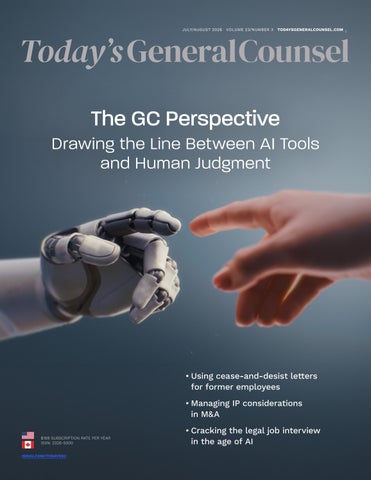
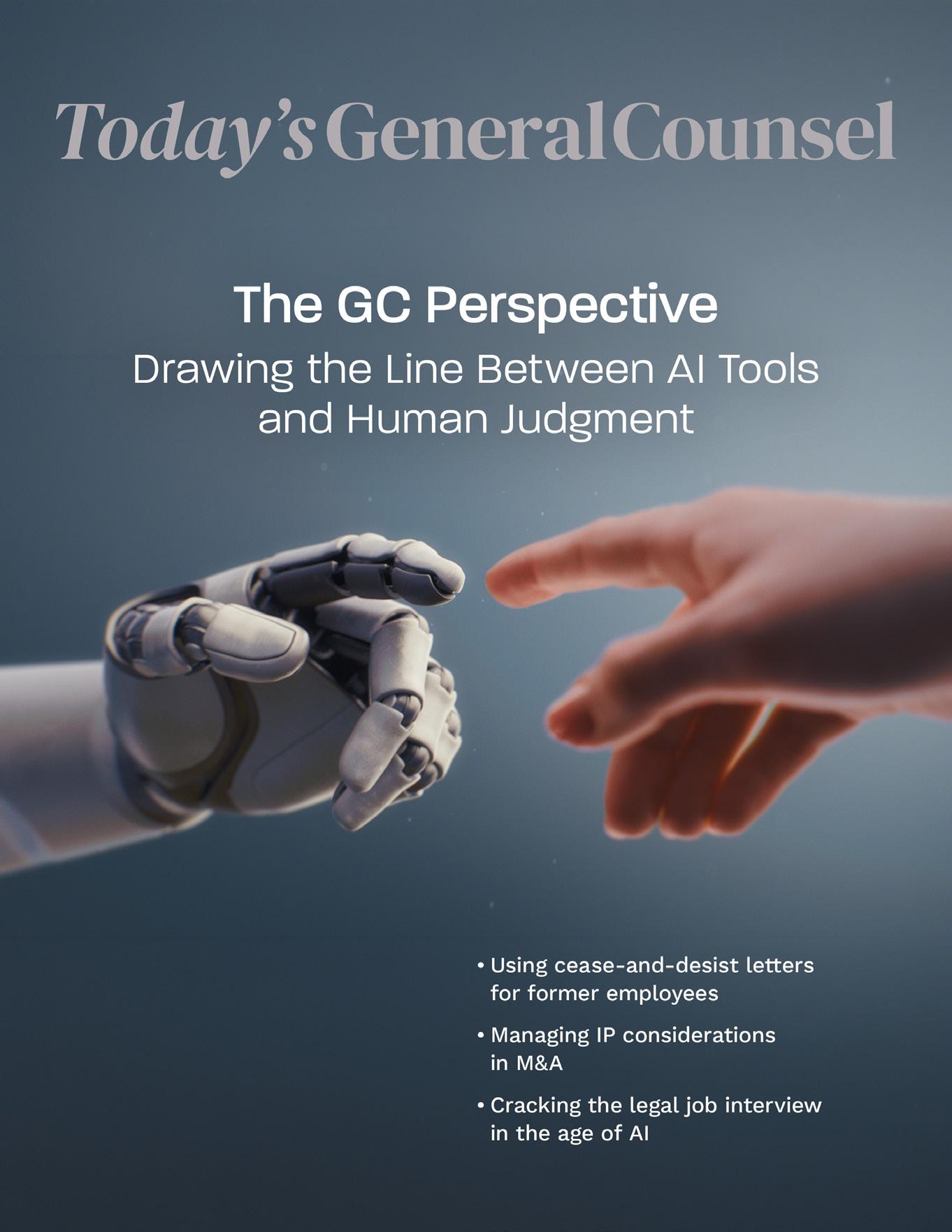
Most legal departments have officially moved past the experimentation phase with AI. The tools are approved, budgets are allocated, and the software is up and running. At the same time, a troubling pattern is emerging: talented legal minds are over-relying on these tools and using them irresponsibly.
Noga Rosenthal, General Counsel at advertising company Ampersand, breaks down this critical issue in her cover story, “How to Set Standards So AI Tools Don’t Replace Human Legal Judgment.” Crucially, she stresses the urgency of setting behavioral standards for how teams interact with these new technological tools. As Rosenthal notes, “General counsel should set an expectation that AI is used to test thinking, not replace the effort of developing it, and that the standard for good work is still a lawyer who can explain their reasoning.”
She warns that the stakes are incredibly high for an existential reason as well: “If a lawyer simply copies and pastes an AI-generated answer and shares it with a business partner, it won’t be long before the business team asks why it needs the lawyer.” To combat this, Rosenthal provides a practical checklist so GCs and their teams can craft internal rules to foster responsible AI usage—a resource you’ll want to save and refer to regularly.
While AI poses a novel internal challenge, GCs are simultaneously navigating traditional operational risks— including managing former employees. On that front, cease-and-desist (C&D) letters are a powerful and often overlooked tool in-house teams should consider. In their latest installment of Employment Law in Focus, Today’s General Counsel columnists Leah M. Stiegler and Anne Bibeau break down the key insights every GC should know. “Used strategically, it may stop harmful conduct without costly litigation,” they write. “Used carelessly, however, it can create regulatory and reputational risk of its own.”
Elsewhere in the issue, don’t miss out on other key insights on topics such as managing intellectual property considerations in M&A deals, cracking job interviews in the age of AI, and choosing the right legal AI for your team.
As always, these articles are just a selection of the content we are publishing daily. Be sure to check our website regularly and follow us on LinkedIn and X for the latest updates. Also, subscribe to our newsletters to have our insights delivered directly to your inbox.
Thanks for reading!
Amanda Kaiser Editor-in-Chief
JULY/AUGUST 2026 Volume 23/Number 3
8 How to Set Standards So AI Tools Don’t Replace Human Legal Judgment
By Noga Rosenthal
Learn how general counsel should set clear expectations for how legal teams should and should not be using AI tools. PAGE 8
COLUMN
EMPLOYMENT LAW IN FOCUS
11 An Underused Arrow in the GC’s Quiver: Cease-and-Desist Letters to Former Employees
By Leah M. Stiegler and Anne Bibeau
Learn why a cease-anddesist (C&D) letter is a powerful tool in your legal arsenal when dealing with former employees and preventing litigation.
INTELLECTUAL PROPERTY
14 Managing IP Considerations in M&A: A Practical Guide for General Counsel By Matthew
R. Carey
Read this step-by-step guide to effectively navigate IP considerations in M&A transactions.
14
16 How Digital Forensics Built a Defensible Timeline for Sonoma County’s Largest Wildfire
By Mark Clews
Learn how a digital forensics team investigated Sonoma County’s largest wildfire and preserved data under challenging circumstances.
Presented by
22 From Value Protection to Value Creation: The New Mandate for In-House Legal
By David Lancelot
Learn about the importance of value creation for the in-house legal profession through perspectives from several legal leaders.
18 The Model is Not the Answer: Choose Legal AI Based on What Your Team Needs
By Bärí A. Williams
Many in-house teams choose a legal AI model based on hype rather than need. Learn how to determine what is best for your team.
COLUMN THE AI-ENABLED LAWYER WITH JARED COSEGLIA
24 How to Crack the Legal Job Interview in the Age of AI
By Jared Coseglia
18
Learn how the scope of the legal job interview is evolving and what job seekers and hiring managers need to do to stay competitive in a high-tech environment.
EXECUTIVE EDITOR
Bruce Rubenstein
CHIEF EXECUTIVE OFFICER
Robert Nienhouse
EDITOR-IN-CHIEF
Amanda Kaiser
SENIOR EDITOR
Barbara Camm
ASSOCIATE EDITOR
Jessica Bajorinas
MANAGING DIRECTOR OF CLIENT PARTNERSHIPS & INITIATIVES
Lainie Geary
DIRECTOR OF ADMINISTRATION
Catherine Nienhouse
CONTRIBUTORS
Anne Bibeau
Matthew R. Carey
Mark Clews
Jared Coseglia
David Lancelot
Noga Rosenthal
Leah Stiegler
Bärí A. Williams
DATABASE MANAGER
Patricia McGuinness
ART DIRECTION & PHOTO ILLUSTRATION MPower Ideation, LLC
CLIENT PARTNERSHIPS MANAGER
Stella Vargas
EDITORIAL ADVISORY BOARD
Dennis J. Block
GREENBERG TRAURIG LLP
Thomas W. Brunner WILEY REIN LLP
Mark A. Carter DINSMORE & SHOHL LLP
Jeffery Cross SMITH, GAMBRELL & RUSSELL LLP
Jamie Gorelick WILMERHALE LLP
Robert L. Haig KELLEY, DRYE & WARREN LLP
Robert C. Heim DECHERT LLP
Sheila Hollis DUANE MORRIS LLP
SUBSCRIPTION
Subscription rate per year: $199
For subscription requests, email subscriptions@todaysgc.com
David A. Katz WACHTELL, LIPTON, ROSEN & KATZ Nikiforos Iatrou MCCARTHY TETRAULT LLP
Steven F. Molo MOLOLAMKEN LLP
Robert A. Profusek JONES DAY
George D. Ruttinger CROWELL & MORING LLP
Jonathan S. Sack
MORVILLO ABRAMOWITZ GRAND IASON & ANELLO PC
Victor E. Schwartz SHOOK, HARDY & BACON LLP
Jonathan D. Schiller BOIES SCHILLER FLEXNER LLP
REPRINTS
For reprint requests, email Lisa Payne: lpayne@mossbergco.com Mossberg & Company Inc.
All rights reserved. No part of this publication may be reproduced or transmitted in any form or by any means, electronic or mechanical, including photocopy, recording, or any information or retrieval system, without the written permission of the publisher. Articles published in Today’s General Counsel are not to be construed as legal or professional advice, nor unless otherwise stated are they necessarily the views of a writer’s firm or its clients.
To submit an article, go to todaysgeneralcounsel.com/submissions
How to Set Standards So AI Tools Don’t Replace Human Legal Judgment
By NOGA ROSENTHAL
Many general counsel (GCs) have started noticing a pattern. Their teams are using artificial intelligence (AI) tools, but not always well. Some lawyers are copying and pasting AI-generated answers directly into advice they offer their executives or sending them up the chain without applying their own judgment. Others are running contracts through AI redlining tools and accepting the output without stopping to ask whether those redlines reflect the company’s risk tolerance
or the reality of the deal. On the other end of the spectrum, some lawyers are avoiding AI entirely, even when it would help them work faster or learn more.
What these patterns have in common is not an adoption problem. Most in-house teams have moved past experimentation to approved tools. This is a behavioral issue. If a lawyer simply copies and pastes an AI-generated answer and shares it with a business partner, it won’t be long before the business team
asks why it needs the lawyer. A legal department does not get value from AI because lawyers can generate longer answers, broader markups, or longer summaries in record time. It gets value when AI helps lawyers think more critically, work more efficiently, and deliver well-reasoned end products that reflect their judgment. To prevent that erosion, legal leaders need to set behavioral standards for how their teams use these tools.
A discreet risk of AI in a legal
department is what it does to the development of junior lawyers Learning to think like a lawyer requires wrestling with hard problems, sitting with uncertainty, and building the instinct to know when something is wrong before you can fully articulate why. If junior attorneys default to AI for first-pass analysis, they may get to the right answer without ever learning how to get there on their own. GCs should set an expectation that AI is used to test thinking, not replace the effort of developing it, and that the standard for good work is still a lawyer who can explain their reasoning.
THE NEED FOR A POLICY BASED ON JUDGMENT, VERIFICATION, AND CALIBRATION
GCs should address these risks directly in a set of clear expectations for how lawyers should and should not be using AI. Addressing that behavioral gap starts with setting clear expectations around three areas: judgment, verification, and calibration.
First, attorneys should not copy and paste AI-generated content into advice, notes, or agreements without their review and revisions. Similarly, they should not assume that more edits or more redlines to a contract reflect better legal work. These failures do not come from bad tools. They come from treating AI as a substitute for thinking rather than a tool to improve it.
Second, attorneys should always verify any response from an AI tool. Legal teams should assume that anything generated by AI may be incomplete, overbroad, or wrong in a material way. That means checking cases, statutes, contract provisions, citations, quotes, and factual assertions before relying on them. Legal
teams may often find that the legal AI tool changes its output or stance when an attorney asks questions differently or with additional nuances. Attorneys should use their instincts to push back on the AI-generated answer within the legal tool if they intuitively think the response is “off.”
THE OVER-REDLINING RISK
The third principle is calibration. One of the most common problems in legal AI use is over-redlining. AI tools tend to identify every arguable issue and mark every possible change. That may be useful as an issue-spotting exercise, but it is not
AI weakens your legal function and skills if it replaces your judgment. But it can become your competitive edge if it helps sharpen your judgment.
the same as giving business-ready legal advice. Good in-house lawyers know the difference and can provide a practical markup. Sometimes the right instruction is to redline comprehensively. Other times the right instruction is to mark only the real risk points and keep the deal moving. Legal teams need to understand that AI does not independently decide this threshold. A good lawyer does by calibrating the tool.
Consider a common scenario where the opposing side has said that they do not accept redlines and it has the market power to hold this line. In that case, the attorney can use AI to highlight the business
risks, such as no terminations for convenience, and have the businessperson sign off on those risks. However, it’s a waste of everyone’s time if the attorney tries to redline that agreement using their standard vendor playbook within an AI tool.
Tied to this, legal teams should always calibrate their AI tool by providing the tool with context around their company’s industry, their risk tolerance, and ownership structure. A hospital or a bank may take a more conservative stance on a contract than a start-up. Lawyers should also calibrate based on who will receive the work product. A summary for a time-pressed CEO should be concise and focused on key points, while a memo for the deal team may need more detail on specific terms and risks. The user needs to instruct the AI tool accordingly so that the output matches the audience and purpose.
USE AI BEFORE ESCALATING, BUT BRING YOUR OWN JUDGMENT
Also, legal teams should not rely on AI to make judgment calls that belong to the lawyer. For example, an AI tool may suggest removing an indemnity cap or broadening a limitation of liability clause based on general legal risk. Whether that change makes sense depends on the company’s risk tolerance, the commercial context, and the importance of the deal. That is a judgment call the lawyer must make. The AI tool cannot make it.
Once guardrails are clear, legal teams should operate under defined standards when they have to use AI in their work. These are not suggestions. These are baseline expectations for how legal professionals should perform.
Lawyers should be expected to use AI to pressure-test issues or research questions before escalating them. They should ask the AI follow-up questions, explore different approaches, and identify possible paths. They can then escalate the issue to their manager, but they must include a point of view. “Here is the issue, here is what I checked, here is my recommendation, and here is where I want input” should be the standard.
AI CAN BE A GREAT SECOND CHECK ON LEGAL ANALYSIS
That leads to one of the best uses of AI in a legal department, which is as a second check on someone’s own legal analysis. Used properly, AI can help lawyers test a conclusion they have already reached. “I think the answer is X. Am I missing anything?” is a strong prompt. “What is the decision tree for this policy?” is another. A flawed decision tree may reveal that the underlying policy itself needs revision. Also helpful is asking the AI to “Give me the strongest counterargument to this interpretation.” Those uses are valuable because they sharpen the lawyer’s reasoning rather than replace it.
AI is also well-suited to drafting. It can produce first drafts of clauses, fallback language, templates, amendments, issue lists, and post-signing summaries. For in-house teams handling a high volume of commercial work, the technology can save substantial time. A deal summary generated by AI immediately after signing is another good example. An attorney can verify the information quickly while the details of the deal are fresh. The summary can then be used to ensure ongoing contract compliance.
The same is true for templates and amendments. Many legal teams waste time recreating standard forms from scratch or making repetitive edits that AI can handle well on the first pass. Used with supervision, AI can shorten that cycle and let lawyers spend more time on business judgment, negotiation strategy, and stakeholder advice.
A PRACTICAL CHECKLIST FOR INTERNAL RULES:
Do:
• Verify every legal citation, factual statement, quote, and contract reference.
• Bring your own recommendation, not just an AI-generated output.
• Use AI to ask first-pass questions before escalating.
• Use AI to teach yourself about basic legal concepts such as various standard contractual provisions, then use it to test yourself on those concepts.
• Use AI to challenge your initial answer and identify gaps.
• Use AI to draft clauses, templates, amendments, and first-pass redlines.
• Use AI to prepare post-close summaries for contract compliance while the details are still fresh.
Don’t:
• Paste AI content into advice, notes, or agreements without review.
• Assume that more edits mean better legal work.
• Use AI to avoid judgment calls that belong to the lawyer.
• Input sensitive or privileged information except through approved workflows.
CONCLUSION
For GCs, the management issue is not whether lawyers are using AI.
Prefer to read this online? Click here.
They already are. The management issue is whether the department has taught them to use it like a disciplined legal team rather than like an autocomplete engine. That discipline requires structure, not just culture. AI use should be governed like any other enterprise risk, with a defined process for approving tools, clear data boundaries that protect privileged and sensitive information, and explicit accountability for how the technology is used. Someone in the department needs to own that list, and lawyers need to know what falls outside approved workflows.
A good legal AI policy should leave the team with one standard: Use AI to accelerate your work, challenge your thinking, and improve your draft. AI weakens your legal function and skills if it replaces your judgment. But it can become your competitive edge if it helps sharpen your judgment.
Noga Rosenthal is a seasoned privacy compliance and data ethics professional specializing in the technology sector. She has developed and managed global privacy programs for companies such as Xaxis, Epsilon, and Ampersand. Rosenthal serves as a trustee for the Practicing Law Institute and an adjunct professor at Fordham Law School. Her LinkedIn profile is here
An Underused Arrow in the GC’s Quiver: Cease-and-Desist Letters to Former Employees
By LEAH M. STIEGLER AND ANNE BIBEAU
When a former employee leaves, companies hope that matter ends there. But in many cases, the real risk begins after the departure. From soliciting your workforce and misusing confidential data to posting defamatory claims online or threatening current staff, former employees can create serious legal and operational challenges. In those moments, a cease-and-desist (C&D) letter is a
powerful tool in your legal arsenal. Used strategically, it may stop harmful conduct without costly litigation. Used carelessly, however, it can create regulatory and reputational risk of its own. Here is what every general counsel (GC) should know.
WHY C&D LETTERS MATTER
A C&D letter formally notifies a former employee that their conduct is unlawful and demands that it stop
immediately. It also creates a written record of the company’s objection, which can become critical if litigation follows, particularly in proving damages. In many cases, however, a well-crafted letter resolves the matter before litigation becomes necessary. Former employees, particularly those without legal counsel, often reconsider their actions when faced with a formal legal demand from corporate counsel.
Too often, we find that GCs use C&D letters for intellectual property infringement or copyright misuse scenarios, but forget that a good C&D letter is a useful arrow in your quiver when it comes to addressing a former disgruntled or bad actor employee.
Common employment scenarios that warrant a C&D letter include:
• Violation of noncompete or nonsolicitation agreements
• Theft or misuse of confidential and proprietary information
• Defamation or disparagement of the company or its leadership
• Harassment or threats directed at current employees
• Unauthorized use of pricing information, templates, client lists, or trade secrets
Consider this scenario that illustrates precisely why GCs should have a C&D protocol ready to deploy.
The lesson for GCs is clear: A C&D letter is a legal tool, not a leverage tactic.
A private company recently discovered that a former employee had embarked on a multi-front campaign against the business almost immediately after her resignation. First, she was actively encouraging current employees to leave the company and join her new competing venture, which directly violated a non-solicitation agreement she had
signed when she started with the company. Second, she had posted a false and misleading Google review of the company, misrepresenting the viability of its core product and publishing inaccurate information about its customer pricing. Third (and perhaps most seriously), a review of her email activity in the final days of her employment revealed that she had forwarded company templates and confidential customer contact information to her personal email before resigning.
The company had multiple, well-documented legal bases for action, and further damage was imminent. This was a textbook case for a C&D letter.
But when deciding whether to move forward with a C&D, a company should first consider the legal and practical implications.
Step 1: Do you have a legal basis to issue the C&D?
Before drafting a single word, confirm that you have a legally defensible reason to send the letter. Ask whether the former employee has breached a contract, such as an enforceable non-solicitation, nondisclosure, or non-compete agreement, violated a common law duty of loyalty, misappropriated trade secrets under state or federal law, or committed a tort such as defamation or tortious interference. In the example above, all of these boxes were checked, but often the facts do not rise to the level of a legal basis, or state laws create private rights of action for such letters, such as when a company threatens to enforce an unlawful non compete. Without a clear legal foundation, a C&D letter can expose the company to regulatory enforcement actions, legal claims, or bad PR.
Step 2: What is the ask?
Be specific and comprehensive in your demands. In the scenario above, the right answer was all of the above: immediately cease soliciting company employees; Remove the false and defamatory Google review; return or certifiably destroy all company templates, customer data, and proprietary information in her possession; and refrain from using any of that information in connection with her competing business. Vague demands invite non-compliance and undermine your position if the matter proceeds to litigation. Always include a response deadline and open the phone line for communication.
Step 3: Consider the PR factor
This is a step many companies overlook. In today’s environment, former employees routinely photograph C&D letters and post them to social media, sometimes generating significant public sympathy for themselves and criticism of the company. Your letter may very well become a public document, so draft it accordingly. This does not mean softening your legal demands, but rather being intentional about your messaging. If the conduct involves threats to current employees, consider including language that speaks to the broader audience: “This company takes the safety of its workforce and the integrity of its workplace culture seriously, and we will not tolerate conduct that threatens either.” A well-toned letter can help contain reputational risk before a dispute escalates publicly.
Step 4: If the C&D gets no reaction, do you proceed with litigation?
Not every refusal to comply warrants a lawsuit, and GCs must conduct a
sober cost-benefit analysis. Consider the following:
• What are your actual damages? Consider lost clients, diverted employees, and misappropriated trade secrets or any other quantifiable damages.
• What are your opportunity costs? Litigation consumes internal resources, management time, and focus.
• What are your legal fees relative to your likely recovery? Or are you pursuing it as a matter of principle?
• What is the ultimate outcome that you are trying to achieve? Injunctive relief to stop ongoing harm is often more valuable than a damages judgment against a former employee with limited assets.
• Sometimes proceeding aggressively is the right answer. Other times, the C&D letter alone accomplishes the goal of stopping the harmful conduct, and further escalation is unnecessary.
ABUSE AND OVERUSE OF C&D LETTERS
GCs must also be mindful of the legal and regulatory risks of overuse of C&D letters. The Federal Trade Commission (FTC)’s recent enforcement action against Rollins, Inc., one of the largest pest-control companies in the United States operating more than 700 locations with over 18,000 employees, serves as a stark warning.
Rollins required all newly hired employees, regardless of role, to sign non compete agreements prohibiting them from working in the pestcontrol industry within a 75-mile radius of their assigned location for two years following their departure. There was no individualized
assessment of whether employees actually had access to trade secrets or occupied roles that warranted such restrictions.
According to the FTC, Rollins regularly issued threatening C&D letters to these former employees, including many pest-control technicians, to enforce agreements that were likely unenforceable from the outset. The FTC found that Rollins exploited its power imbalance over these workers, who often could not afford counsel to respond to the C&D letters, thereby using the intimidation of formal legal demands to scare them away from competing jobs they had every legal right to take.
CONSIDER CAREFULLY
The lesson for GCs is clear: A C&D letter is a legal tool, not a leverage tactic. Before sending one, confirm not only that a restrictive covenant exists on paper, but that it is actually enforceable given the employee’s role, the scope of the restriction, and the law of the applicable jurisdiction.
The C&D letter, deployed thoughtfully and grounded in sound legal analysis, remains one of the most cost-effective tools available to companies dealing with problematic former employees. The key is a disciplined approach: Confirm your legal basis, articulate your demands clearly, consider the public dimension of your letter, and make strategic decisions about escalation with clear eyes.
And always remember that the goal is to protect your business, not to intimidate workers out of rights they lawfully hold. Finally, never hesitate to have a second set of eyes on your C&D decision by having outside counsel review the basis, content, and process.
Prefer to read this online? Click here.
Leah M. Stiegler is a principal in the Labor & Employment practice at Woods Rogers in Virginia. She advises company leaders and their human resources departments on compliance with employment laws. Woods Rogers hosts the biweekly video series “What’s the Tea in L&E,” available on YouTube
Anne Bibeau is a principal in the Labor & Employment practice at Woods Rogers in Virginia. She advises company leaders and their human resources departments on compliance with employment laws. Woods Rogers hosts the biweekly video series “What’s the Tea in L&E,” available on YouTube
Managing IP Considerations in M&A: A Practical Guide for General Counsel
By MATTHEW R. CAREY
Intellectual property (IP) often sits at the center of enterprise value in modern M&A. For companies in technology, life sciences, and consumer products, IP is not just an asset class but a core driver of competitive advantage. General counsel (GCs) on both sides of a transaction play a critical role in ensuring IP issues are identified, evaluated, and addressed from letter of intent (LOI) through closing and into post-deal integration. Here is a step-by-step guide for in-house teams navigating IP considerations in M&A transactions.
START WITH WHAT MATTERS
Both buyers and sellers should align early on which IP is truly material to the deal, whether that be patents, trademarks, and copyrights, or unregistered assets such as trade secrets, software, and know-how. Buyers will focus on whether the target’s IP meaningfully supports its revenue and growth projections. Sellers, in turn, should be ready to clearly articulate how their IP portfolio underpins the business and differentiates the business from competitors.
For sellers, conducting internal
diligence before going to market pays dividends. A well-organized portfolio with clear ownership and documentation speeds up the process and reduces the chance of unwelcome surprises.
OWNERSHIP AND CHAIN OF TITLE
One of the most common sources of risk is uncertainty around IP ownership. Buyers expect a clean chain of title for all material assets, including executed assignments from employees, contractors, and any third parties who contributed to development. Gaps can delay closing or create indemnity exposure. Buyers should scrutinize assignment provisions carefully, particularly in jurisdictions with employee-friendly IP laws.
AI-GENERATED IP
A newer but increasingly important diligence issue involves the target’s use of artificial intelligence (AI) in developing its core IP. Ownership of AI-generated outputs remains unsettled. Under current United States Patent and Trademark Office (USPTO) guidance, only natural persons can be named as inventors, which means patents covering inventions developed with
significant AI involvement may face protectability challenges. Buyers are right to ask whether key assets were created with the assistance of artificial intellligence (AI) tools and, if so, whether the human inventive contribution is sufficient and well documented. Sellers should be prepared to document how AI was used in their development processes and what safeguards are in place.
LICENSES AND THIRD-PARTY DEPENDENCIES
Most companies rely on IP they have licensed from others, and many have granted others the right to use theirs. Buyers need to understand these relationships because some license agreements contain change-of-control provisions that can require consent, allow termination, or impose new conditions at closing. Sellers should inventory all material licenses early and surface any problem provisions before they become surprises.
FREEDOM TO OPERATE
Buyers will evaluate whether the target has freedom to operate in its core markets, including assessing infringement risk and reviewing any history of disputes or litigation. Even without active claims, operating in a space with dense patent coverage or relying on third-party technology that has not been fully vetted can create exposure that buyers will want to understand. Sellers should disclose known risks and, where possible, provide supporting analyses.
SOFTWARE, OPEN SOURCE, AND TRADE SECRETS
Software diligence matters more than ever, especially in AI, Software as a Service (SaaS), and data-driven deals. Buyers will look at how the target
uses open-source software because certain open-source licenses carry obligations that can affect commercialization, including requirements to disclose source code.
Trade secrets and proprietary data can represent significant value, but only if they are properly protected. Buyers will want to see that the target has reasonable safeguards in place, such as access controls, non-disclosure agreements (NDAs), and non-competes.
IP does not just affect legal risk. It affects the purchase price.
REPS, WARRANTIES, AND INDEMNITIES
This is where the deal documents allocate IP risk between buyer and seller. Sellers make statements in the purchase agreement about the state of their IP, such as confirming ownership, non-infringement, and the absence of undisclosed claims. If those statements prove false, the buyer has a contractual claim.
Buyers want these protections to be as broad as possible. Sellers push back by narrowing their exposure through qualifiers that limit reps to what the seller actually knew, thresholds that filter out immaterial issues, and caps on total liability. Where diligence uncovers a specific known risk, the parties may negotiate a tailored indemnity to address it directly.
IP AND DEAL ECONOMICS
IP does not just affect legal risk. It affects the purchase price. A strong,
Prefer to read this online? Click here.
well-protected portfolio can support a premium valuation, while gaps or uncertainties can lead to discounts, holdbacks, or adjusted earnout terms. On the buy side, general counsel can flag portfolio weaknesses that should drive the price down or warrant protective deal terms. On the sell side, the legal team can help present the portfolio in a way that supports the asking price and preempts buyer concerns.
KEY TAKEAWAYS
For GCs navigating IP in M&A, the fundamentals hold: Prepare early, organize your portfolio, be transparent about risks, and make sure the deal documents reflect what diligence actually uncovered. The landscape is evolving, particularly around AI and data assets, but the fundamentals still apply: The better your preparation, the fewer surprises at the closing table.
Matthew R. Carey is a partner and chair of the Electrical and Computer Technologies practice group at Marshall, Gerstein & Borun LLP. He may be reached at mcarey@marshallip.com
How Digital Forensics Built a Defensible Timeline for Sonoma County’s Largest Wildfire
By MARK CLEWS | PRESENTED BY
When the smoke clears, the investigation begins.
Based in California, we face the ongoing threat of wildfires. The most recent major incidents, the Palisades and Eaton fires in January 2025, burned approximately 37,000 acres, claimed 30 lives, and destroyed more than 16,000 structures across Los Angeles County.
Thanks to the heroic efforts of firefighters and other first responders, these fires were eventually contained. Now, attention has shifted to how the fires started and who may be held responsible, as investigations and litigation begin to unfold. A wide range of electronic evidence may prove relevant, making digital forensic techniques essential for preserving and analyzing this data as part of the ongoing inquiry.
A previous fire our team investigated underscored the vast array of potential data sources involved and the complexity of preserving them. From mobile devices and security camera footage to utility logs and weather data, each source presents unique challenges for collection, authentication, and analysis.
THE CHALLENGE
In 2019, a fire ignited in Northern California at a PG&E transmission line near a geothermal power plant. Known as the Kincade Fire, it became the largest wildfire in Sonoma County’s history, burning over 77,000 acres and destroying an estimated 167 homes before it was contained.
Our team was retained to investigate the actions taken by the geothermal facility in the period
preceding the fire’s ignition. For safety and evidence preservation purposes, the plant was shut down, making rapid investigation and data preservation essential to facilitate its timely restart.
THE APPROACH
A digital forensics team was deployed to the site and began interviewing geothermal, mechanical, and electrical engineers to identify potential data sources. In addition to common sources such as email communications and standard operating procedure (SOP) documentation, the team identified several non-standard data sources that could be relevant to the investigation.
A strategy was developed to defensibly preserve each of the following:
• CCTV footage
• Two-way radio audio logs
• Circuit recloser logs
• Security access logs
• SCADA operations data
• Safety and operations logs
• Anemometer (wind) telemetry
• Mobile device SMS and video
While some of these sources were relatively straightforward to collect, others posed significant challenges, such as using a cherry picker to retrieve data from equipment mounted on
EVIDENCE TIMELINE
Event Date/Time
Weather Alert October 23, 2019 11:10 am
De-Energization 2:28 pm
Ignition Identified 9:20 pm
Evacuation 9:30 pm
Evidence Sources
Email, Weather Data, Anemometer
SCADA, SOPs, Email
Phone Logs, Photos, CCTV
Radio Logs, CCTV, Email
Containment November 6, 2019 Incident Reports
poles, or entering pitch-black, shutdown turbine rooms to capture critical information.
FROM DISPARATE DATA TO A DEFENSIBLE TIMELINE
Once the data had been preserved, the disparate and complex nature of the sources required constructing a clear, accessible timeline of events. Leveraging our specialist structured data team, we ingested each source, including emails, documents, audio,
77,000+ acres. 167 homes. One client cleared. The Kincade Fire, Sonoma County’s largest wildfire on record.
video, and log files, into a centralized repository for analysis. From there, individual entries within the log files were extracted and correlated, enabling the creation of a comprehensive, visualized timeline for effective review.
By visualizing the data in this way, we were able to clearly demonstrate that our client was not responsible
for igniting the fire. The evidence showed unequivocally that our lines were powered down prior to the fire’s ignition at the PG&E transmission line.
THE OUTCOME
After investigating, the California Department of Forestry and Fire Protection (Cal Fire) determined that the fire was caused by PG&E equipment, specifically a high-voltage transmission line that failed during high winds. PG&E accepted this finding and later reached a $55 million settlement with Sonoma County to resolve criminal charges related to the fire.
WHAT THIS MEANS FOR THE NEXT FIRE INVESTIGATION
In any investigation, success often hinges on identifying which data sources are in scope and acting quickly to preserve those most at risk. In this case, several critical log files faced imminent overwriting once plant operations resumed. Had that occurred, key evidence underpinning our findings would have been permanently lost. Rapid deployment of a digital forensics team capable of asking the right questions, prioritizing preservation, and engineering tailored workflows for non-standard data can make the difference between
Prefer to read this online? Click here.
speculation and proof in high-stakes, time-sensitive matters.
HOW IDS APPROACHES
WILDFIRE INVESTIGATIONS
Our Digital Forensics team works seamlessly alongside our Structured Data and Visualization specialists to deliver a fully integrated view of fire investigations. This collaborative, multidisciplinary approach enables us to construct a clear, technically rigorous, and defensible narrative grounded not only in what the evidence shows, but also in what it definitively rules out.
Truth through data: Where here expertise leads, defensible outcomes follow.
ABOUT IDS
iDS provides consultative data solutions to corporations and law firms around the world, giving them a decisive advantage both in and out of the courtroom. Our subject matter experts and data strategists specialize in finding solutions to complex data problems—ensuring data can be leveraged as an asset and not a liability.
Mark Clews is a digital forensics and eDiscovery expert at iDiscovery Solutions with more than 25 years of experience spanning single-custodian investigations to multi-jurisdictional class actions. He has testified as an expert witness, served as an independent forensic examiner, and led engagements before regulators and state attorneys general. His forensic work has contributed to matters resulting in a $300 million Securities and Exchange Commission penalty settlement. Clews is a member of the Sedona Conference Working Group 6.
The Model is Not the Answer: Choose Legal AI Based on What Your Team Needs
By BÄRÍ A. WILLIAMS
Every few weeks, a new artificial intelligence (AI) model launches with a press release full of benchmark numbers. Legal media reports that it scores higher on reasoning tests, handles longer context windows, and generates output faster than others in the market. And somewhere in your organization, someone forwards the article with a question: Should we switch?
Most of those teams don’t have the wrong model. They have the wrong evaluation framework. They selected legal AI based on model hype rather than team need, building procurement decisions on general capability benchmarks that have almost no bearing on how in-house legal actually works.
Legal work, particularly contract review, is not a general task. It requires applying nuanced legal standards—your standards, your positions, your risk tolerances— to complex documents, clause by clause. A model that generates plausible legal language is not the same thing as a system that reliably identifies whether your indemnification clause meets your approved fallback position.
These are different things. Missing them has a real legal and financial impact.
THE BENCHMARK PROBLEM
Measure what matters, or don’t bother measuring.
Benchmarks aren’t the problem— bad benchmarks are. A test that measures how well AI thinks or writes tells you exactly that, and nothing more. It doesn’t tell you whether the AI can actually do legal work.
For legal AI specifically, the only benchmark that matters is one built around real contracts, reviewed against the standards a practicing lawyer would actually apply, and common sense. If it’s not testing that, it’s not testing anything useful.
General-purpose AI benchmarks measure general-purpose capability. They test reasoning, math, coding, and language comprehension. They are designed to be broadly comparable across many types of tasks.
They are not built for predicting how an AI tool will perform on specific legal contracts. That’s why model improvements of general-purpose models do not reliably translate to better performance on clause-level legal analysis.
Some of the provisions where AI struggles most are the provisions that carry the most legal risk, like assignment rights, protected health
information (PHI) ownership, or limitation of liability carve-outs. These require understanding conditional logic across multiple contract sections, not just pattern recognition on a single clause. A model that scores well on a reading comprehension benchmark can still fail systematically on these tasks.
If you are evaluating legal AI tools based on which model they run, you are not evaluating what matters.
WHAT YOUR TEAM ACTUALLY NEEDS
The right starting point for any legal AI evaluation is a clear-eyed assessment of your own team’s needs. For some, the constraint is volume. There are simply more contracts coming in than the team can review at its current pace. For others, it’s consistency. The team has standards, but those standards are not being applied consistently across all reviewers and contract types. Or maybe it’s coverage. The team can quickly and easily review routine contracts, but escalates everything else to outside counsel.
Each of these scenarios calls for a different evaluation. A team with a volume problem needs to test AI against realistic contract loads and measure how much attorney time is
saved and how much is required to validate outputs. A team with a consistency problem needs to test how well the AI enforces specific playbook standards, especially when it comes to nuanced positions. A team with a coverage problem needs to assess jurisdiction-specific accuracy, not just English-language common-law performance.
None of these evaluations begins with asking which model a tool uses. That comes after you understand what you’re really trying to measure.
THE RISK OF CHASING RECENCY
There is a particular risk for legal teams that have developed a habit of chasing the newest model: It introduces instability into workflows that depend on reliability.
In legal review, frequent tool changes are costly. The team develops judgment about how to interpret AI output, playbooks are tuned to a specific system’s behavior, and attorneys know where the tool is reliable and where it requires
closer review. When you switch tools or models frequently, you reset that accumulated knowledge and introduce new uncertainty into the review process.
The cost of switching legal AI is primarily operational. Constantly re-evaluating tools in response to model release cycles means a team hasn’t committed to building AI into its actual workflows, leaving it in evaluation mode indefinitely.
To get meaningful results from legal AI, first define what is needed,
If you are evaluating legal AI tools based on which model they run, you are not evaluating what matters.
then find a tool that meets that definition to build into standard workflows.
WHAT TO LOOK FOR WHEN YOU EVALUATE LEGAL AI
If you are beginning or re-evaluating your legal AI procurement, here’s a practical framework for evaluating legal AI tools based on your team’s needs.
1. Define your constraint first. Audit your own team needs. Is the problem volume, consistency, coverage, or workflow? The answer changes what you test and how you measure it. Spend time here before you look at any vendor.
2. Audit your escalation patterns. Review the last 12 months of outside counsel spend and identify which contract types and legal questions drove the most referrals. Those are your highestpriority use cases for AI support, and the most important ones to test.
3. Ask how the tool supports playbooks. Consistency in legal review requires a system that lets your team encode your actual positions: preferred language, acceptable fallbacks, risk thresholds. Ask vendors if they support playbooks, whether those playbooks can be customized to your standards, and if fallback positions are built into the review workflow. A tool that applies another version of market standard is not the same as one that applies yours.
4. Build a playtest set from your own contracts. Use real contracts your team has reviewed, with known outcomes. This gives you a ground truth against which to measure AI accuracy on your actual work, not a vendor’s curated examples.
5. Test on provisions that carry risk, not just provisions that are common. Assignment rights, IP ownership, data handling, limitation of liability are where AI errors create legal exposure. Evaluate accuracy specifically on these clauses.
6. Time the full validation cycle. Measure how fast the AI generates output and how long it takes an attorney to review and confirm that output. Both numbers matter for the productivity calculation.
7. Ask for transparency on model decisions. Find out how the vendor evaluates model updates, what benchmarks they use, and how they communicate changes. This tells you whether you are buying a product or inheriting an ongoing evaluation burden.
8. Define what success looks like before you start. Decide in advance what accuracy threshold, time savings, or outside counsel reduction would justify deployment. Evaluation without a definition of success is just procurement theater.
The right tool doesn’t just process contracts faster. It enforces your standards every time, across every reviewer on your team.
Prefer to read this online? Click here.
FIT OVER RECENCY: THE DECISION MATTERS
Don’t ask about the newest model— newer isn’t always better. The question your team should be asking is which system is most reliable for the specific work your team does, and which provider is most committed to maintaining that reliability over time.
The AI landscape will keep moving. New models will keep launching, and benchmarks will keep climbing. None of that changes the underlying evaluation framework for in-house legal teams.
Your team needs AI that applies your standards accurately, validates efficiently, integrates with your workflows, and protects your data. The model powering that AI is a means to those ends. Get the evaluation criteria right, then the model question largely takes care of itself. Stop chasing recency and start building for fit.
Bärí A. Williams leads LegalOn’s legal and legal content teams. An attorney with 16+ years in tech transactions, she blends legal expertise with industry insight. Previously, she held pivotal roles at Meta (Facebook) and StubHub, shaping innovative legal strategies. Her email is: bari.williams@legalontech.com
From Value Protection to Value Creation: The New Mandate for In-House Legal
By DAVID LANCELOT | PRESENTED BY
The in-house legal profession is at an inflection point. The questions being asked of legal leaders today are fundamentally different from those of a decade ago, and the expectations attached to the answers are higher. It is no longer enough to ask whether legal is a strategic partner. The harder question is whether legal is creating measurable value.
I have spent 25 years both in practice and in the classroom, working alongside general counsel (GC) and legal teams navigating this shift. The conclusion I keep reaching is the same: modern in-house leaders
understand that they must operate across law, business, technology, and governance. What remains genuinely contested is the harder question: not what legal is becoming, but how that transformation gets measured. The challenge is not strategy. It is accountability.
THE METRICS WE USE ARE TELLING THE WRONG STORY
For most of the profession’s history, legal performance has been measured by activity. Matters opened. Contracts reviewed. Hours logged. These metrics are easy to collect and almost completely useless when it
comes to understanding whether legal is actually driving the business’s strategic objectives.
The business experiences legal through the speed of a deal, the friction around a product launch, or the clarity of advice when a decision needs to be made. As Sterling Miller has noted, the business does not care how many contracts you reviewed; it cares how quickly deals get done and that they are deals that drive the business. According to IDC research, legal inefficiency costs organizations an average of 11% in delayed or lost revenue annually. Two-thirds of business leaders say legal friction slows the entire business, not just the legal team. Yet only 21% describe their legal function as highly effective. That is not a perception problem. It is a performance problem.
TIME TO YES
One of the most useful reframings I have encountered, a concept Sterling Miller refers to often, is “time to yes”: how long does it take legal to enable a decision, rather than process a request? A legal team can be extraordinarily busy and still create significant friction if the organization cannot get decisions at the pace it needs.
This connects to what Lisa Mather describes as “legal latency,” the gap between how fast the business moves and how quickly legal can respond. The problem, as she frames it, is not that legal lacks expertise. It is that legal’s delivery model is misaligned with the speed of the business. Closing that gap requires moving from a reactive model built around individual expertise to what Mather
Business leaders who genuinely rely on their legal teams do so because those teams have consistently demonstrated that they understand the business and that their instinct is to find a path forward.
calls a platform: self-service tools, standardized playbooks, automated workflows, and embedded expertise that allows the business to operate at speed. In this model, legal is not a bottleneck. It is infrastructure.
Bjarne Tellmann frames the underlying imperative well: Legal must help organizations navigate questions that do not yet have established answers, at the speed and scale of artificial intelligence (AI). That is a very different job description from the one most of us trained for.
TRUST IS THE CURRENCY THAT MAKES ALL OF THIS POSSIBLE
Mark Smolik puts it plainly: being present is not the same as being
influential. Just being invited to the table does not mean you have a voice at the table. Ultimately, what determines whether legal structures shape outcomes is trust. And trust is not designed. It is earned.
Business leaders who genuinely rely on their legal teams do so because those teams have consistently demonstrated that they understand the business and that their instinct is to find a path forward. The role of legal, as Smolik describes it, is finding a path to yes. That reframing—from risk identifier to problem-solver—is what moves legal from gatekeeper to genuine partner. It accumulates through small moments: a practical answer delivered quickly, a willingness to engage constructively rather than defaulting to caution.
EXECUTION IS WHERE TRANSFORMATION SUCCEEDS OR FAILS
Paula Pépin is direct about something I also see consistently in my work with legal teams. Legal teams do not generally have a strategy problem; they have an execution problem. Initiatives stall. Technology implementations underdeliver. Welldesigned operating models fail to take hold because people revert to familiar patterns under pressure. The capability that will define the next generation of in-house leaders is not strategic vision. It is operational leadership: The ability to translate intent into sustained change. Pépin describes the GC as increasingly an operator, responsible not just for legal advice but for designing and scaling how the legal team provides services. There was a time when you could be a great lawyer and deprioritize operations. That time has passed.
Prefer to read this online? Click here.
Bill Deckelman articulates the next dimension of this challenge with clarity. The opportunity AI presents is not simply to do the same work faster but to generate genuine legal intelligence: surfacing emerging risks before they crystallize and moving from managing known risks to anticipating new ones. The future will not be defined by how quickly lawyers respond, but by how effectively legal teams anticipate risk and shape business outcomes.
The leaders who will define this profession are those who can hold several things simultaneously: the ambition to transform the legal function, the operational discipline to actually do it, and the relational intelligence to earn the trust that makes influence possible. They will measure success not by how many risks they mitigate, but by how many decisions they enable. That is the standard this moment demands.
To learn more about these industry trends, register for this on-demand webinar entitled “ The Future of In-House Legal.”
David Lancelot is Chief Legal Officer and Executive Vice President of Advocacy at LawVu, the legal operating system built for in-house legal teams. He is also an Adjunct Professor at the University of Florida College of Law, where he teaches International In-House Legal Leadership. He is based in California.
THE AI-ENABLED LAWYER WITH JARED COSEGLIA
How to Crack the Legal Job Interview in the Age of AI
By JARED COSEGLIA
This column unpacks the ongoing impact of artificial intelligence (AI) on the legal profession, specifically the legal job market and careers within it. Each column starts with an emerging AI-employment trend and ends with actionable insights on how to successfully hire top talent or level up individual careers in the era of AI. This installment highlights the changing dynamics of the legal job interview in light of the technological evolution sweeping the industry. The column archive can be found here.
The interview game has changed—thanks to AI.
In years past, prospective employers and employees could rely on a basic tenet: most interviews were structured around three core questions. Why are you interested in this role? Why are you qualified for it? And why are you a good fit for the company?
Today, there is a fourth, unavoidable question that nearly every hiring manager in legal is asking in a legal job interview—often in the very first
round: “How are you using AI in your current job?”
This single question has quietly disrupted decades of interviewing best practices.
HOW TO TALK AI WHEN YOU AREN’T ALLOWED TO USE
AI AT
WORK
For over a decade under my leadership, TruLegal has coached job seekers to focus on the historical—not the hypothetical—during interviews. Reciprocally, we guide
hiring managers toward questions that elicit on-the-job storytelling. We often say: “Ask about what they’ve done. Not what they know.” But that philosophy gets complicated when AI enters the conversation.
In the back half of 2025, over 65% of candidates interviewing through TruLegal were asked some form of question about AI skills—whether they had them or not. For many—most, in fact—the question was as simple as: “Tell me how you are using AI at work.”
And for many, the honest answer was:
“I’m not allowed to use it.”
“I haven’t been given access.”
“Our department hasn’t rolled anything out yet.”
According to Thomson Reuters’ 2024 Future of Professionals Report, only 14% of legal professionals reported actively using generative AI in their day-to-day work at that time, even though more than 77% expected AI to have a “high or transformational impact” on their roles within five years. The appetite for AI is massive. Access and implementation are lagging.
So what should candidates—and hiring managers—do when realworld AI experience isn’t there? If you’re a hiring manager interviewing talent without a ready-made AI story, redirect the conversation toward indicators of AI readiness:
• “What processes would you explore using AI to create efficiencies for yourself or your team?”
• “Tell me about a time you navigated rapid technological change at work.”
• “How have you used technology to influence stakeholders and increase productivity?”
• “If you had an unlimited budget, what legal technology would you acquire and why?”
These questions preserve the integrity of behavioral interviewing while still evaluating the traits that matter in an AI-enabled environment. Because what you’re really testing isn’t tool familiarity. It’s mindset.
If you want AI-forward talent, you must demonstrate AI-forward leadership.
WHAT LEGAL HIRING MANAGERS ARE REALLY LOOKING FOR
Right now, legal AI job descriptions are snowflakes. No two look the same. That will change as consolidation continues and dominant platforms emerge in the legal AI software space. But for now, hiring managers are prioritizing qualities that historically have not topped legal search requirements:
• Adaptability
• Ingenuity
• Creativity
• Experimentation
• Change management
• Business enablement thinking
In a recent webinar I led with Hershel Eisenberger, Senior Director, Legal Counsel & Global Head of Privacy at Coca-Cola, we had AI “listen in” on our prep call discussing the “net new” attributes corporate law departments are
trying to identify in candidates— internal and external. The resulting word cloud was telling: proactively reactive; adaptability; comfortable with failure; superstructure building; embracing experimentation, creativity, and more.
In 2025, Clio’s Legal Trends Report suggested that up to 74% of billable tasks in law firms — especially those involving data gathering and analysis — are exposed to AI automation. WorldMetrics.org data shows that AI is successfully automating core tasks like document review (68% of firms) and research (82% of firms), with reported time savings of 50–60% in those workflows.
That doesn’t eliminate jobs. It reshapes them. And it demands professionals who can pivot, redesign workflows, and extract business value from emerging tools. Legal employers aren’t just hiring for what candidates can do. They’re hiring for what they can build tomorrow. The skills they want from talent, AI-enabled or not, lean into traits that are foundational for future professional investment and development.
WHAT AI-ENABLED JOB SEEKERS ARE REALLY LOOKING FOR
This shift cuts both ways. The most competitive candidates in today’s market aren’t just evaluating compensation and title.
They’re asking:
• Do you have a defined AI strategy?
• Are you investing in training?
• Is experimentation encouraged— or considered wasted time?
• Who owns AI internally? IT? Legal ops? Innovation?
High-performing professionals want to work where innovation
is supported from the top down. They’re wary of environments that publicly market AI ambition but privately stall progress due to risk aversion or internal politics.
According to LexisNexis’ 2024 survey on generative AI in legal, 89% of lawyers believed AI would impact their work, but fewer than half reported receiving formal training from their organizations. The same report in 2026 now finds that 58% of lawyers report producing work faster because of AI, rising to 65% for those using paid AI platforms. There is still a training and access gap. That gap is now a recruiting and retention vulnerability.
If you want AI-forward talent, you must demonstrate AI-forward leadership.
AI AS A TOPIC, NOT A FACILITATOR
In late 2024 and throughout 2025, many organizations—both law firms and corporations—experimented with automating first-round interviews by deploying AI interviewers instead of humans.
The logic was understandable:
• Increase speed to interview
• Standardize evaluation
• Reduce bias
• Lower administrative burden
But here’s what we observed at TruLegal: Candidates don’t want their first impression of your culture to be a chatbot. Over 50% of job seekers represented by TruLegal in 2025 who were asked to participate in an AI-conducted first round interview opted-out of further exploring the employment opportunity.
While AI can streamline scheduling, screening, and note-taking, the legal profession remains a
relationship-driven industry and one that is sensitive to digital assets, paper trails, cyber theft, and bias. While these efforts were rarely deployed for senior-level search, candidates at all levels of professional experience expect human engagement early in the process. Removing it may save time—but (AI) appears it will cull the talent pool significantly before skills or fit are assessed.
WHETHER YOU’RE HIRING OR INTERVIEWING, HERE’S THE BOTTOM LINE
For hiring managers:
• Evaluate AI mindset, not just AI tool usage.
• Be transparent and articulate about your organization’s AI maturity.
• Prepare to outline training programs and personal proficiency in AI to applicants.
• Ask about influence and outcomes, not just inputs and iterations.
For job seekers:
• If you lack direct AI access, explore with free tools (and your own data) independently.
• Stay informed on dominant and emerging tools in your niche.
• Develop change-management stories, not just technical anecdotes.
• Talking about the wins is impressive, but talking confidently about failure is attractive.
The AI question isn’t going away. But the most successful legal professionals in this new era won’t be those who can merely wield tools. They’ll be the ones who can articulate how technology—AI included—drives business outcomes, strengthens teams, and creates measurable value. The interview game hasn’t just
Prefer to read this online? Click here.
added a fourth question. It has added a new lens through which every answer is judged.
Jared Coseglia is the founder and CEO of TruLegal (formerly TRU Staffing Partners), a global leader in staffing AI-enabled talent for modern legal teams. He has placed over 5,000 professionals across Fortune 1000 companies and Am Law 200 firms.
Drafting & Reviewing Contracts with AI: What Works, Where It Breaks, and How to Use It Effectively
Thursday, July 9, 2026 | 1:00 PM ET
Learn how to distinguish useful AI outputs from risky ones, apply a practical framework for evaluating AI-generated content, and use prompting techniques that work across tools.
You’re Using AI. So Why Are You Still Buried in Contracts?
Tuesday, July 14, 2026 | 1:00 PM ET
Join LegalOn’s Corporate Counsel and Legal Engineer Lauren Kirk and Chief Growth Officer Corey Longhurst as they share how LegalOn’s Platform helps legal teams to move from oneoff prompts to a system where every standard, every decision, and every contract — before and after signature — becomes intelligence that drives the business forward.
Your Legal Data Can Talk Back: AI Prompting for Legal Matters, Spend and Vendor Insights
Thursday, July 16, 2026 | 1:00 PM ET
In this 30-minute session on AI prompting for legal matter, vendor, and spend insight, we’ll look at Brightflag and show what your data can do when it’s structured to talk back.